| ID |
Date |
Author |
Status |
Type |
Category |
Location |
Title |
|
3
|
Thu Apr 15 19:45:08 2021 |
Manar Amer | Fixed | report | mechanics | Other | Mirrors Mottors Connections |
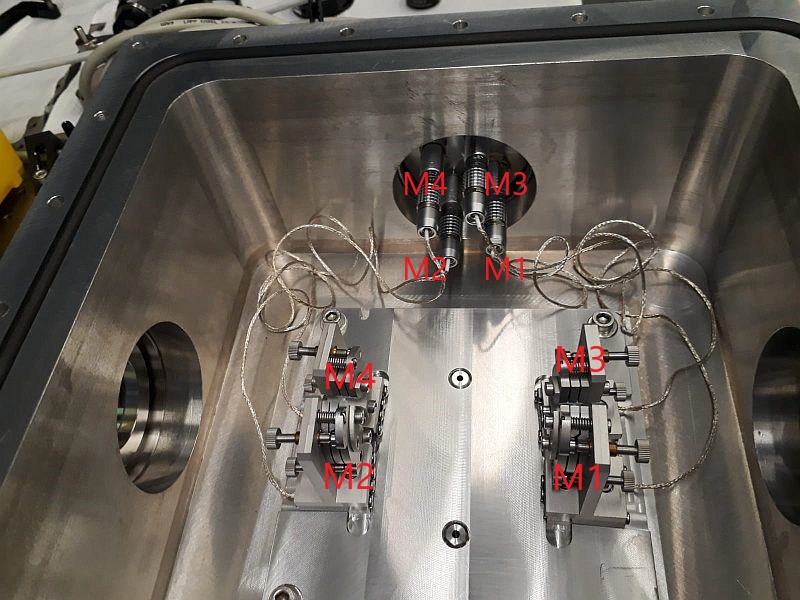
* The connections to control the motors of the mirrors are connected in the order stated :
M1 - M2 - M3 - M4
bottom right - bottom left - top right - top left
* The cables on the back of the box are connected as shown in attached photo
as they are connected they show on the software (Precision Tool commander) as
M1 - M2 - M3 - M4
Ch0 - Ch1 - Ch2 - Ch3
|
| Attachment 1: 20210804_Motor_connections_with_mirrors_inside_cavity_box.jpg
|
 |
| Attachment 2: 20210804_Mottor_cables_behind_cavity_box.jpg
|
 |
|
4
|
Thu Apr 15 19:54:19 2021 |
Manar Amer | Fixed | report | mechanics | cabling | Other | Mirrors Mottors Connections |
Added the cabling to the categories
| Manar Amer wrote: |
|
* The connections to control the motors of the mirrors are connected in the order stated :
M1 - M2 - M3 - M4
bottom right - bottom left - top right - top left
* The cables on the back of the box are connected as shown in attached photo
as they are connected they show on the software (Precision Tool commander) as
M1 - M2 - M3 - M4
Ch0 - Ch1 - Ch2 - Ch3
|
|
|
5
|
Mon Apr 19 18:41:03 2021 |
Manar Amer | Fixed | report | mechanics | cabling | software | Other | Setting up the Motors |
A document attached that describes the procedure needed to:
- connect the motors
- configure the Ethernet connection
- Calibrate and reference the software used to control the motors. |
| Attachment 1: setting_up_the_motors.docx
|
|
6
|
Mon Apr 19 18:47:28 2021 |
Manar Amer | Fixed | report | lasers and optics | Other | Alignment using Helium Neon Laser |
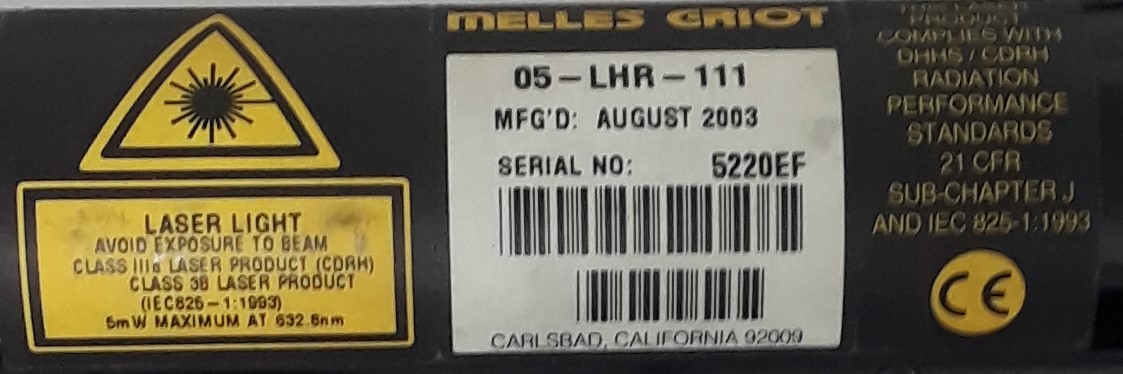
05 April 2021 : A rough alignment of the cavity was done using the Helium Neon Laser. |
| Attachment 1: 20210202__Helium_Neon_laser_parameters.jpg
|
 |
|
7
|
Mon Apr 19 19:11:47 2021 |
Manar Amer | Fixed | report | mechanics | software | Other | Distances between mirrors |
- At the reference zero the distance between the mirrors is (taken from a reference presentation "status9nov2020" attached):
M1-M2 = 88.029 mm
M3-M4 = 84.6895 mm
- The distances between the spherical mirrors ( M3-M4 ) was set to take into account the stability of the mirror ( M3-M4 > Spherical mirror focal length = 85.3 mm)
M3-M4 = 90.5 mm
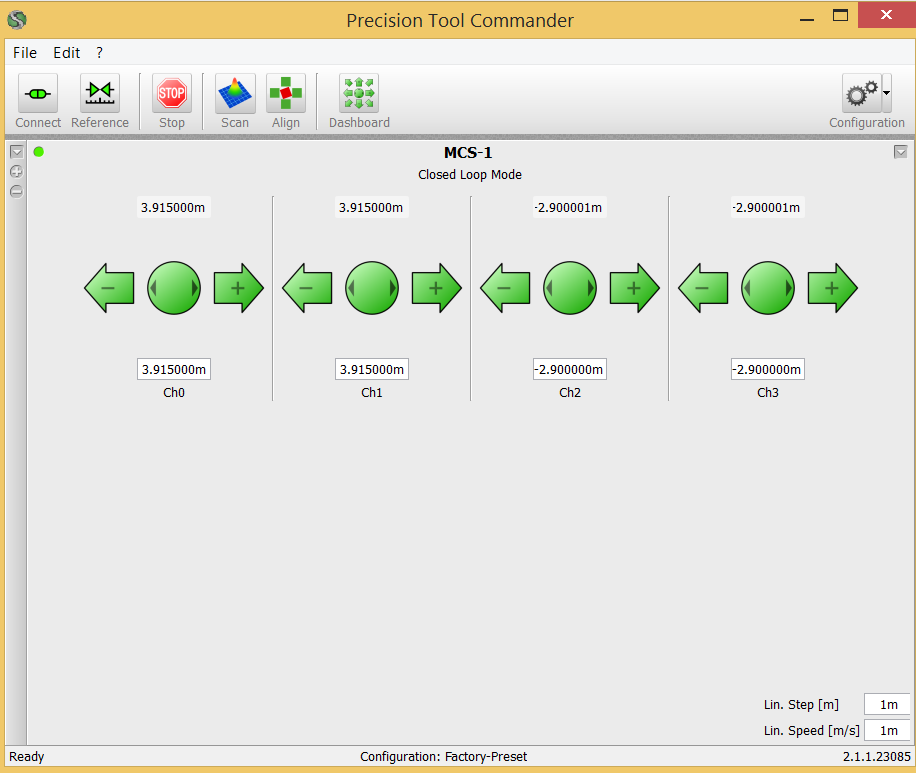
we increased the distance between them by 5.8 mm, and moving the mirrors symmetrically, M3 and M4 moved by -2.9 mm (negative defines outer motion)
- Following the definition of M3-M4, fixing of the angle = 2.55637 degrees and frequency (Frep = 876.3636 MHz). Distance between planners (M1-M2)
M1-M2 = 80.2 mm
we decreased the distance between them by 7.83 mm, and moving the mirrors symmetrically, M1 and M2 moved by +3.915 mm (positive defines inward motion)
**** Photo attached is the values on the software at the time. |
| Attachment 1: 20211604__Distances_Between_mirrors.png
|
 |
| Attachment 2: status9nov2020.pptx
|
|
8
|
Tue Apr 27 13:57:15 2021 |
Manar Amer | Fixed | report | lasers and optics | Other | Alignment using Koheras |
Following the Helium Neon Alignment + change in the distance between the mirrors to be; M3-M4 = 90.5 mm , M1-M2 = 80.2 mm -→ The alignment using the Koheras CW laser is done.
- Additional components used:
- for monitoring beam : Photodiode (power of beam), Beam Profiler (shape, position, power , ... )
- for Koheras frequency scan: function generator, Amplifier or use lase-lock (had some issues to be checked)
- Telescope: made using 1 m focal length to match the beam shape of the cavity
- Observed during:
- The alignment is fairly similar to the previous one, placed two irises to preserve it.
- Fundamental mode observed (beam profiler after M2) was circular
- when the frequency scan was fine-tuned around the fundamental mode we could see the mode pulsing in the cavity, but there was a bit of instability.
- when doing a very wide frequency scan (50 V ~ 1.5 GHz), multiple modes where showing inside the cavity
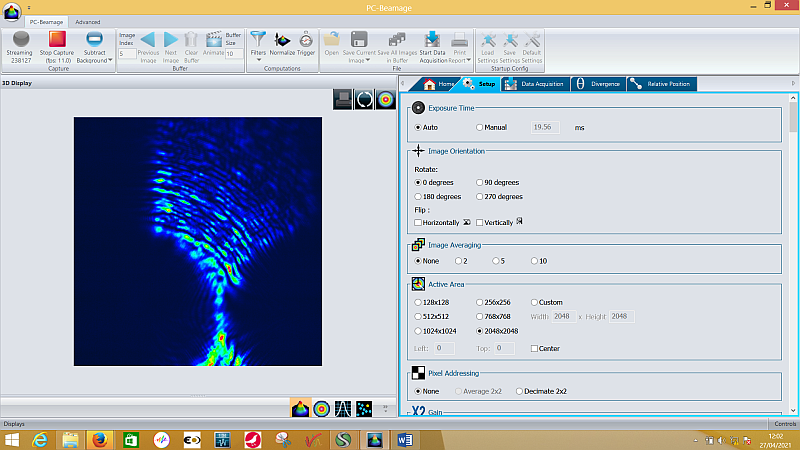
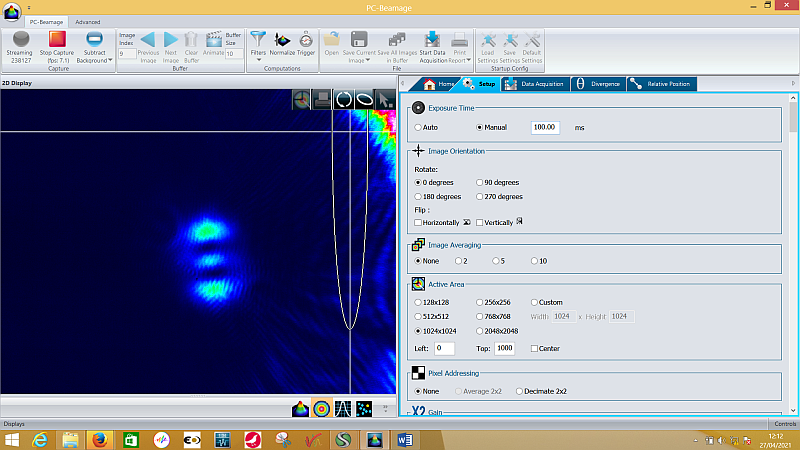
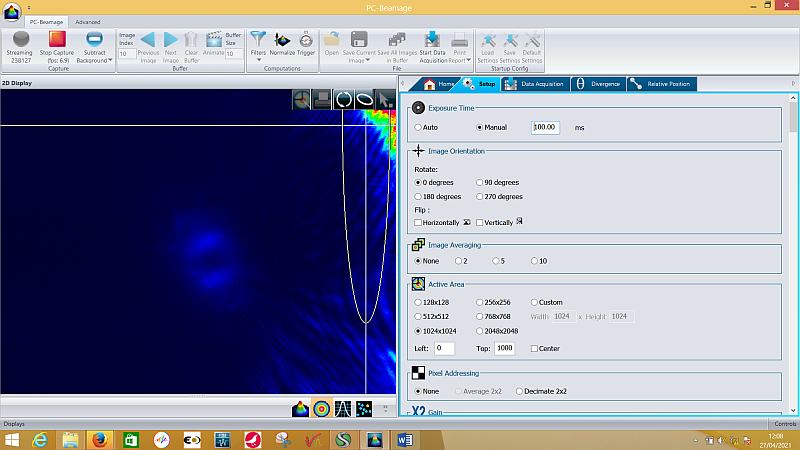
Photos attached show:
- some resonating modes in the cavity
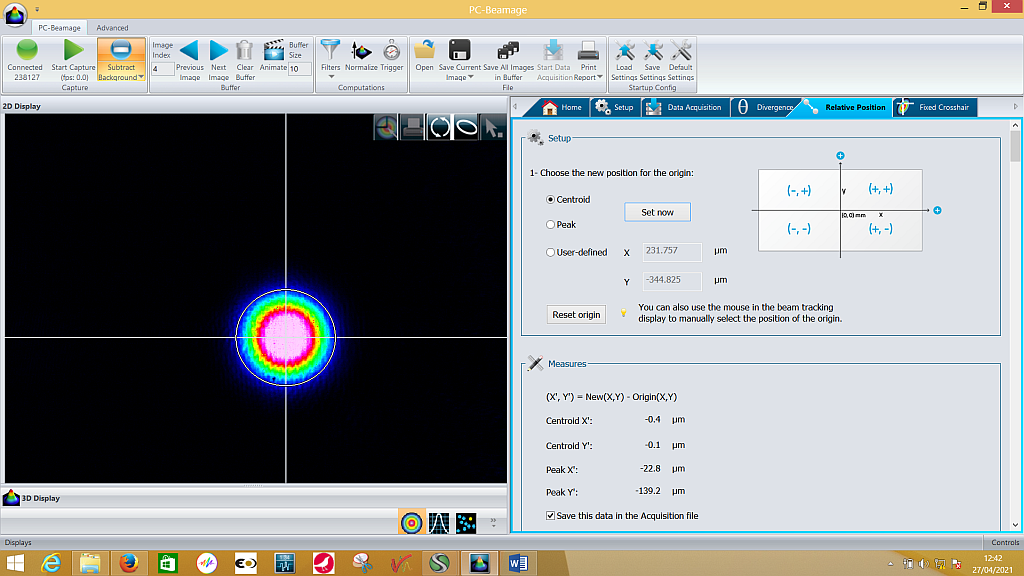
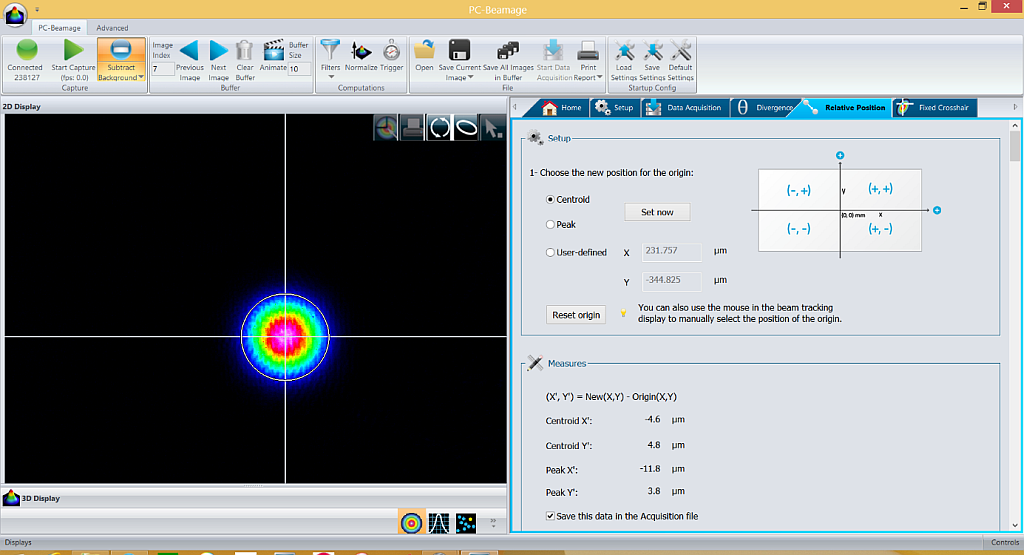
- Fundamental mode resonating in the cavity, with its properties (2D shape, 1D shape, position) ** The picture is taken after subtracting the background **
- from 2D it is very circular
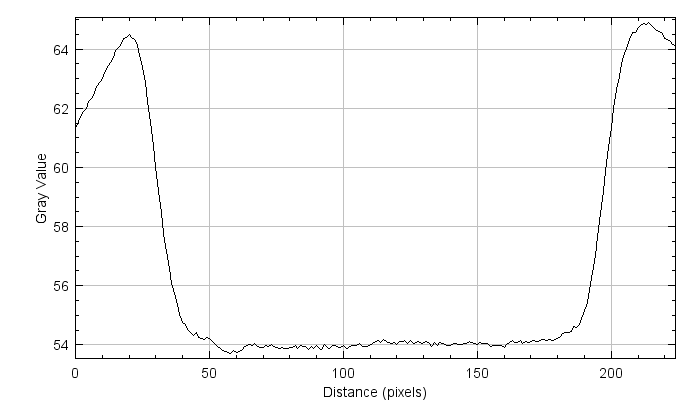
- from 1D it is confirmed to be circular (715.00 um - 704.00 um)
- From position, we have a reference to compare with tomorrow morning.
- Diffraction that can be observed in the cavity (you can clearly see the edges of the mirrors in the photo)
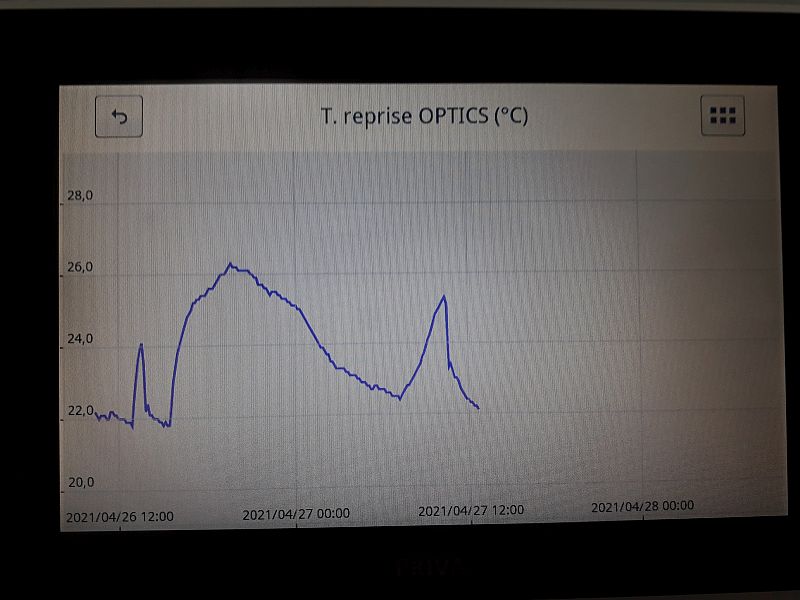
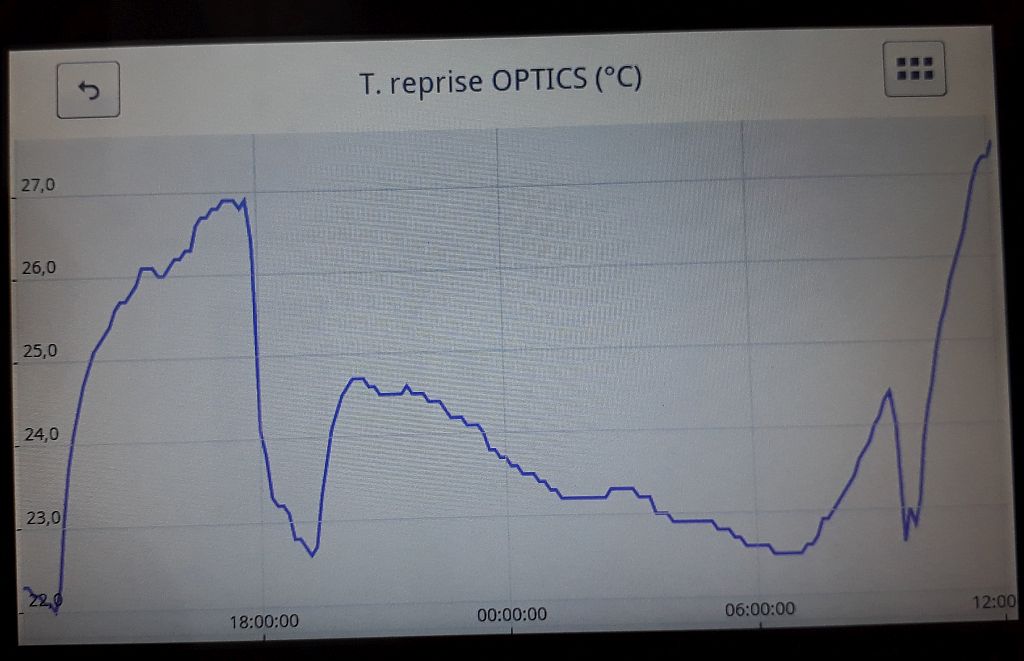
- The temperature curve is attached for the duration of the exp. (before starting Ronic switched something off and then put it on !!!!!! it seems to be for temp regulation )
** Notes for tomorrow morning : first : switch on the laser and check if the beam 00 mode is still observed and check its position
this is to see the stability and the effect of the temperature. |
| Attachment 1: 20212704_Fundamental_mode_in_cavity_2D_-_Position.png
|
 |
| Attachment 2: 20212704_Fundamental_mode_in_cavity_1D_shape.png
|
 |
| Attachment 3: 20212704__Difraction_along_the_mirror_edges_in_cavity.png
|
 |
| Attachment 4: 20212704__Modes_observed_resonating_in_the_cavity_0.png
|
 |
| Attachment 5: 20212704__Modes_observed_resonating_in_the_cavity_1.png
|
 |
| Attachment 6: 20212704_Temperature_Curve.jpg
|
 |
|
9
|
Thu Apr 29 06:14:09 2021 |
Manar Amer | Fixed | report | lasers and optics | Other | Mode observed and cavity Lock |
** Following up from yesterday an observation about the TM00 mode : it has been seen with similar dimensions and its position is the same, this was before restarting the temperature regulator.
--> after restarting the temp. regulator there was a slight shift in the position (likely it is caused by the temperature variation, a temperature graph for during the morning is attached)
** Coupling of the cavity and koheras is observed (photo attached)
** Error curve measurement to be done.
- What we used before to do a frequency scan and lock the cavity was a function generator and an amplifier
- There is noise from the amplifier causing the sweep to pass through the cavity frequencies a lot.
- we shift to using LaseLock, it gives a very clean sweep ( a clean sweep meaning we have a resistance at the output of laselock combined with the capacitance in the Piezo input behind the koheras, this gives the time constant which affects the signal shape)
- Changes in the temperature of the koheras affects its wavelength and in turn the mode resonates in the cavity.
- note** when the mode is at the top peak of the sweep (Piezo ) meaning we are observing the resonance at the ends of the sweep, we increase the temperature of the laser very slightly to shit the sweep a little ( temp increase ~ 0.010 c , very small increase step by step )
- For observing the Mode Lock of the cavity, there are a few points to be aware of :
- Coupling Frequency -----{convention represented in blue curve}
- The reflection from the mirror M1 (cavity reflection) -----{convention represented in yellow curve}
- The transmission from the nirrors M2,M3,M4 ( what is resonating in the cavity) -----{convention represented in green curve}
- :When the laser is in resonance with the cavity "locked" the reflection decreases and power is stored momentarily in the cavity meaning the transmission increase that is why when the cavity is locked we see a decrease in the reflection (yellow curve) and at the same moment an increase in the cavity transmission (green curve)
- To be done : do a measurement of the error signal curve, what is needed :
- the reflected beam (split it into two ) -- one for coupling measurement done before and the other for the error signal curve
- PDH -- photodiode with bandwidth amplifier
- Function generator
- EOM
- ...
| Manar Amer wrote: |
|
Following the Helium Neon Alignment + change in the distance between the mirrors to be; M3-M4 = 90.5 mm , M1-M2 = 80.2 mm -→ The alignment using the Koheras CW laser is done.
- Additional components used:
- for monitoring beam : Photodiode (power of beam), Beam Profiler (shape, position, power , ... )
- for Koheras frequency scan: function generator, Amplifier or use lase-lock (had some issues to be checked)
- Telescope: made using 1 m focal length to match the beam shape of the cavity
- Observed during:
- The alignment is fairly similar to the previous one, placed two irises to preserve it.
- Fundamental mode observed (beam profiler after M2) was circular
- when the frequency scan was fine-tuned around the fundamental mode we could see the mode pulsing in the cavity, but there was a bit of instability.
- when doing a very wide frequency scan (50 V ~ 1.5 GHz), multiple modes where showing inside the cavity
Photos attached show:
- some resonating modes in the cavity
- Fundamental mode resonating in the cavity, with its properties (2D shape, 1D shape, position) ** The picture is taken after subtracting the background **
- from 2D it is very circular
- from 1D it is confirmed to be circular (715.00 um - 704.00 um)
- From position, we have a reference to compare with tomorrow morning.
- Diffraction that can be observed in the cavity (you can clearly see the edges of the mirrors in the photo)
- The temperature curve is attached for the duration of the exp. (before starting Ronic switched something off and then put it on !!!!!! it seems to be for temp regulation )
** Notes for tomorrow morning : first : switch on the laser and check if the beam 00 mode is still observed and check its position
this is to see the stability and the effect of the temperature.
|
|
| Attachment 1: 20212804_Fundamental_mode_in_cavity_2D_-_Position.png
|
 |
| Attachment 2: 20212804_Cavity_Coupling_with_Koheras.jpg
|
 |
| Attachment 3: 20212804_Temperature_Curve.jpg
|
 |
|
11
|
Tue May 4 15:56:33 2021 |
Manar Amer | Fixed | report | mechanics | lasers and optics | software | Other | Distances between mirrors |
New update on the position of the Motors for the cavity
***** we moved the motors to set the cavity at 876MHz, and checked it right after with the RF modulation at FSR.
So compared to the expected setting we had to move inwards the two planar mirrors by 0.9 mm each.
Planar : M1-M2 motor = + 4.815 mm ------> M1-M2 = 78.399 mm
Spherical : M3-M4 motor = -2.9 mm ------> M3-M4 = 90.4895 mm
| Manar Amer wrote: |
- At the reference zero the distance between the mirrors is (taken from a reference presentation "status9nov2020" attached):
M1-M2 = 88.029 mm
M3-M4 = 84.6895 mm
- The distances between the spherical mirrors ( M3-M4 ) was set to take into account the stability of the mirror ( M3-M4 > Spherical mirror focal length = 85.3 mm)
M3-M4 = 90.5 mm
we increased the distance between them by 5.8 mm, and moving the mirrors symmetrically, M3 and M4 moved by -2.9 mm (negative defines outer motion)
- Following the definition of M3-M4, fixing of the angle = 2.55637 degrees and frequency (Frep = 876.3636 MHz). Distance between planners (M1-M2)
M1-M2 = 80.2 mm
we decreased the distance between them by 7.83 mm, and moving the mirrors symmetrically, M1 and M2 moved by +3.915 mm (positive defines inward motion)
**** Photo attached is the values on the software at the time.
|
|
| Attachment 1: 20210305_Distances_between_Mirrors_new_motor_set_point.png
|
 |
|
14
|
Wed Jun 30 20:29:17 2021 |
Manar Amer | Fixed | report | lasers and optics | Other | Mode observed and cavity Lock |
New configuration is made. The new mode observed in NF_Trans is the following :
| Manar Amer wrote: |
|
** Following up from yesterday an observation about the TM00 mode : it has been seen with similar dimensions and its position is the same, this was before restarting the temperature regulator.
--> after restarting the temp. regulator there was a slight shift in the position (likely it is caused by the temperature variation, a temperature graph for during the morning is attached)
** Coupling of the cavity and koheras is observed (photo attached)
** Error curve measurement to be done.
- What we used before to do a frequency scan and lock the cavity was a function generator and an amplifier
- There is noise from the amplifier causing the sweep to pass through the cavity frequencies a lot.
- we shift to using LaseLock, it gives a very clean sweep ( a clean sweep meaning we have a resistance at the output of laselock combined with the capacitance in the Piezo input behind the koheras, this gives the time constant which affects the signal shape)
- Changes in the temperature of the koheras affects its wavelength and in turn the mode resonates in the cavity.
- note** when the mode is at the top peak of the sweep (Piezo ) meaning we are observing the resonance at the ends of the sweep, we increase the temperature of the laser very slightly to shit the sweep a little ( temp increase ~ 0.010 c , very small increase step by step )
- For observing the Mode Lock of the cavity, there are a few points to be aware of :
- Coupling Frequency -----{convention represented in blue curve}
- The reflection from the mirror M1 (cavity reflection) -----{convention represented in yellow curve}
- The transmission from the nirrors M2,M3,M4 ( what is resonating in the cavity) -----{convention represented in green curve}
- :When the laser is in resonance with the cavity "locked" the reflection decreases and power is stored momentarily in the cavity meaning the transmission increase that is why when the cavity is locked we see a decrease in the reflection (yellow curve) and at the same moment an increase in the cavity transmission (green curve)
- To be done : do a measurement of the error signal curve, what is needed :
- the reflected beam (split it into two ) -- one for coupling measurement done before and the other for the error signal curve
- PDH -- photodiode with bandwidth amplifier
- Function generator
- EOM
- ...
| Manar Amer wrote: |
|
Following the Helium Neon Alignment + change in the distance between the mirrors to be; M3-M4 = 90.5 mm , M1-M2 = 80.2 mm -→ The alignment using the Koheras CW laser is done.
- Additional components used:
- for monitoring beam : Photodiode (power of beam), Beam Profiler (shape, position, power , ... )
- for Koheras frequency scan: function generator, Amplifier or use lase-lock (had some issues to be checked)
- Telescope: made using 1 m focal length to match the beam shape of the cavity
- Observed during:
- The alignment is fairly similar to the previous one, placed two irises to preserve it.
- Fundamental mode observed (beam profiler after M2) was circular
- when the frequency scan was fine-tuned around the fundamental mode we could see the mode pulsing in the cavity, but there was a bit of instability.
- when doing a very wide frequency scan (50 V ~ 1.5 GHz), multiple modes where showing inside the cavity
Photos attached show:
- some resonating modes in the cavity
- Fundamental mode resonating in the cavity, with its properties (2D shape, 1D shape, position) ** The picture is taken after subtracting the background **
- from 2D it is very circular
- from 1D it is confirmed to be circular (715.00 um - 704.00 um)
- From position, we have a reference to compare with tomorrow morning.
- Diffraction that can be observed in the cavity (you can clearly see the edges of the mirrors in the photo)
- The temperature curve is attached for the duration of the exp. (before starting Ronic switched something off and then put it on !!!!!! it seems to be for temp regulation )
** Notes for tomorrow morning : first : switch on the laser and check if the beam 00 mode is still observed and check its position
this is to see the stability and the effect of the temperature.
|
|
|
| Attachment 1: NF_Trans__2021-06-25__16-38-56.bmp
|
|
40
|
Thu Oct 21 10:24:01 2021 |
Blanc | Fixed | info | utilities | Other | Presentations |
Here the first part of all the presentations since the beginning of the project. |
| Attachment 1: 2-Présentation_LAL_22_06_2020_Corrigée.pptx
|
| Attachment 2: 4-Présentation_LAL_29_06_2020_Corrigée.pptx
|
| Attachment 3: 5-Présentation_LAL_27_07_2020.pptx
|
| Attachment 4: 6-Présentation_LAL_30_11_2020.pptx
|
| Attachment 5: 7-Présentation_LAL_07_12_2020.pptx
|
|
41
|
Thu Oct 21 10:30:38 2021 |
Blanc | Fixed | info | utilities | Other | Presentations |
Here the second part of all the presentations since the beginning of the project. |
| Attachment 1: 8-Présentation_LAL_15_04_2021_elog.pptx
|
| Attachment 2: 9-Présentation_LAL_10_05_2021_elog.pptx
|
| Attachment 3: 10-Présentation_LAL_28_06_2021.pptx
|
|
42
|
Thu Oct 21 10:32:54 2021 |
Blanc | Fixed | info | utilities | Other | Presentations |
Here the last part of all the presentations since the beginning of the project. |
| Attachment 1: 12-Présentation_LAL_13_09_2021.pptx
|
| Attachment 2: 13-Présentation_LAL_27_09_2021.pptx
|
| Attachment 3: 14-Présentation_LAL_11_10_2021.pptx
|
| Attachment 4: Présentation_Amplitude_23_08_2021.pptx
|
|
1
|
Tue Mar 23 18:33:16 2021 |
Ronic Chiche | Fixed | info | lasers and optics | detectors and electronics | Optical room | Phase noise measurement of the Amplitude MIKAN |
Installation of the MIKAN.
powermeter (with OD1) just after the oscillator shows 440mW for 4A of the MIKAN pump current.
Installation of a periscope as the oscillator beam position is very close to the table... not easy to put devices at this height (be aware to use proper wavelength range mirrors: Thorlabs BB1-E03)
Installation of a HALF waveplate to align beam polarisation on the isolator axis
Installation of a High power isolator (the one of ThomX): Newport ISO-FRDY-05-1030-N
powermeter (with OD1) just after the isolator shows 427mW
|
|
2
|
Tue Apr 6 09:25:47 2021 |
Ronic Chiche | Fixed | info | lasers and optics | detectors and electronics | Optical room | Phase noise measurement of the Amplitude MIKAN |
Coupling into a 50-50% fiber coupler using the Thorlabs XYZ table NanoMax TS.
We reached 117mW after the 50% arm which means we coupled about 230mW (the coupling better than 50%).
| Ronic Chiche wrote: |
|
Installation of the MIKAN.
powermeter (with OD1) just after the oscillator shows 440mW for 4A of the MIKAN pump current.
Installation of a periscope as the oscillator beam position is very close to the table... not easy to put devices at this height (be aware to use proper wavelength range mirrors: Thorlabs BB1-E03)
Installation of a HALF waveplate to align beam polarisation on the isolator axis
Installation of a High power isolator (the one of ThomX): Newport ISO-FRDY-05-1030-N
powermeter (with OD1) just after the isolator shows 427mW
|
|
|
10
|
Fri Apr 30 17:41:10 2021 |
Aurélien Martens | Fixed | report | lasers and optics | detectors and electronics | Optical room | Lock, cavity length and finesse estimate |
Ronic just suceeded in obtaining a reasonably good lock on the cavity. Air flow is switched off.
We stopped all movements (closed loop, click STOP in the PTC interface) and saw immediately a fair but not excellent lock.
We then switched off the smaract motors and the obtained lock was good. Switching on again the smaract means tthat the references are lost.
We futher saw a drift of the locking point, probalby suggetsing that the thermal load in the cavity slightly changed after switching off the motors.
We then added the second 1GHz BW EOM to add sidebands thanks to the MARCONI RF generator. We observed that the FSR is aroung 867.6MHz (in air). We then looked at the points where the transmission signal related to the sideband is halved. We observed that the corresponding frequencies are 867.296 and 867.776MHz. the corresponding FWHM of about 500kHz corresponds approximately to a 2000 finesse.
Picture color code:
TRANS : Green
REFLECT : Yellow
PZT : Blue
|
| Attachment 1: IMG_20210430_173331.jpg
|
 |
|
12
|
Fri May 7 15:40:10 2021 |
Ronic Chiche | Fixed | info | lasers and optics | Optical room | Theoretical Finesse, Gain and Coupling |
For spherical mirrors M3 and M4 (batch C117I054) the reflectance (R) is around 99.9987% (if T+R=1 => T=13ppm)
For plan mirror M2 (batch C217G054) the reflectance (R) is around 99.9977% (if T+R=1 => T=23ppm)
(1) => For plan mirror M1 (batch C217H023) the reflectance (R) is around 98.96% and transmittance (T) is around 1.14% (T=11400 ppm)
(2) => For plan mirror M1 (batch C217H027) the reflectance (R) is around 99.9385% (if T+R=1 => T=615ppm)
*************************************
case (1) :
Finesse = 546
Gain = 346
Coupling = 1.7%
=> it seems we don't use this mirror for M1
**************************************
case (2) :
Finesse = 9460
Gain = 5578
Coupling = 27%
if one adds 10ppm of losses due to dust on each mirror :
Finesse = 8923
Gain = 4963
Coupling = 44%
************************************** |
|
13
|
Wed Jun 30 20:26:38 2021 |
Kevin Dupraz | Under Process | info | lasers and optics | detectors and electronics | Optical room | Cameras Calibration |
After installing cameras the actual calibration are :
NF_Refl: acA1920-40gm
pixel size (real): 5.86um
Magnification = [0.53,0.56]
pixel size (image): 3.22um
image donne on input plan mirror M1 (accuracy about few mm)
NF_Trans: acA1920-40gm
pixel size (real): 5.86um
Magnification = 1.32
pixel size (image): 7.73um
image donne on output plan mirror M2 (accuracy about few mm)
need to adjust the NF transmission as the Magnification is greater than 1. |
| Attachment 1: NF_Refl_calib_hex2mm__2021-06-23__16-59-26.bmp
|
| Attachment 2: NF_Trans_calib_hex2mm__2021-06-23__17-06-49.bmp
|
| Attachment 3: NF_Inj_calib_DIODE__2021-06-24__10-56-00.bmp
|
| Attachment 4: NF_Inj_calib_DIODE__2021-06-24__10-42-00.bmp
|
| Attachment 5: NF_Trans__2021-06-25__16-38-56.bmp
|
|
15
|
Mon Sep 6 18:17:24 2021 |
Kevin Dupraz | Under Process | report | lasers and optics | detectors and electronics | Optical room | Cavity lock and references |
Cavity is lock and optimized with the NKT. Input power is maximized (10mW).
Cavity mode is in attachement. The reference on camera with BeamProfiler Matlab code is the following:
FF_refl: [2.0883 1.1606]
NF_refl: [5.3869 3.9327]
FF_inj: [1.9491 1.3980]
NF_inj: [5.6431 3.5234]
|
| Attachment 1: NF_Trans_2021-09-06__17-49-00.bmp
|
|
16
|
Tue Sep 7 11:05:47 2021 |
Aurélien Martens | Fixed | report | lasers and optics | detectors and electronics | Optical room | Lock, cavity length and finesse estimate |
we observed that the transmitted light coming from the cavity is made of the cavity mode light and the scattered light on the borders of the mirrors.
the scattered light on the borders of the mirrors is triggered by the cavity mode itself when the cavity is locked.
we didn't put an iris to cut this scattered light coming from the cavity.
Question:
could it be possible that the wrong Finesse value could come from the fact that the transmission was measured with the whole light coming from the cavity and not only the cavity mode light?
| Aurélien Martens wrote: |
|
Ronic just suceeded in obtaining a reasonably good lock on the cavity. Air flow is switched off.
We stopped all movements (closed loop, click STOP in the PTC interface) and saw immediately a fair but not excellent lock.
We then switched off the smaract motors and the obtained lock was good. Switching on again the smaract means tthat the references are lost.
We futher saw a drift of the locking point, probalby suggetsing that the thermal load in the cavity slightly changed after switching off the motors.
We then added the second 1GHz BW EOM to add sidebands thanks to the MARCONI RF generator. We observed that the FSR is aroung 867.6MHz (in air). We then looked at the points where the transmission signal related to the sideband is halved. We observed that the corresponding frequencies are 867.296 and 867.776MHz. the corresponding FWHM of about 500kHz corresponds approximately to a 2000 finesse.
Picture color code:
TRANS : Green
REFLECT : Yellow
PZT : Blue
|
|
|
17
|
Tue Sep 7 14:27:07 2021 |
Blanc | Fixed | info | lasers and optics | Optical room | Polarisation Results of the NKT |
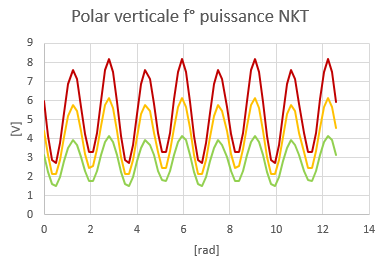
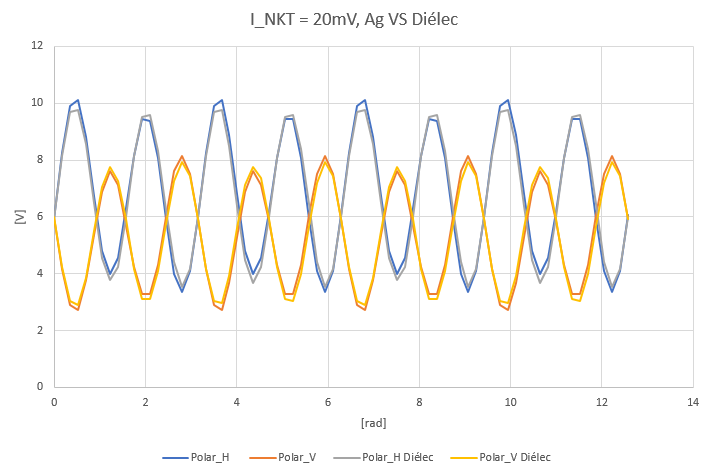
I made many tests about polarization and we can see some points thanks to the following figures :
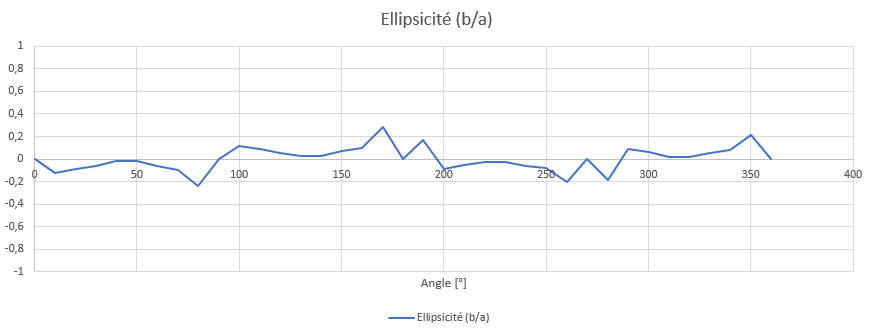
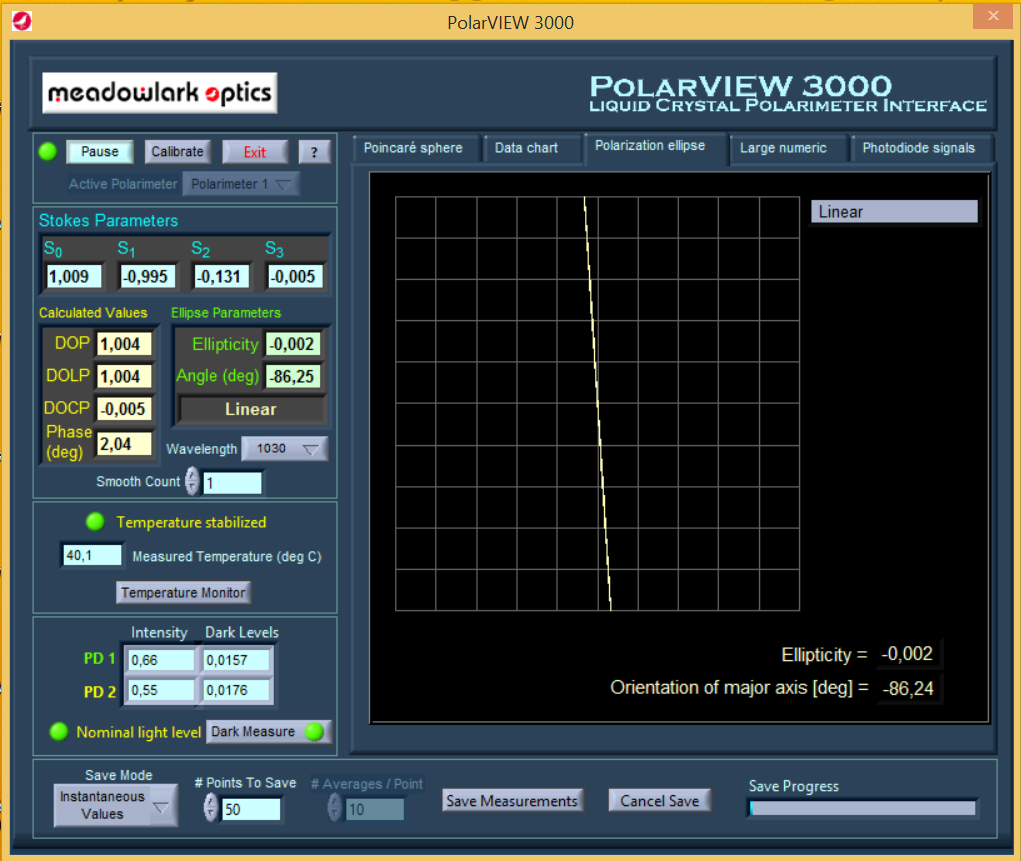
1- The ellipsicity of the NKT is near to 0 (between -0,2 and 0,2) which means the polarization is rectilinear horizontale (attachement 1).
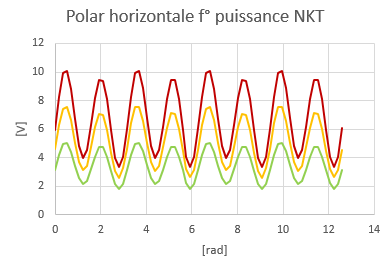
2- The power of the NKT has no influence on the polarization, verticale or horizontale (attachement 2 and 3).
3- The polarization is not changed by the type of mirror (Ag or Diélec) (attachement 4)
The next step is to measure the polarization after the cavity to know the ellipsicity. |
| Attachment 1: Ellipsicité_NKT.PNG
|
 |
| Attachment 2: Polar_horizontale_fonction_pussance_NKT.PNG
|
 |
| Attachment 3: Polar_verticale_fonction_pussance_NKT.PNG
|
 |
| Attachment 4: Polarisation_Ag_VS_Diélec.PNG
|
 |
|
18
|
Tue Sep 7 17:48:50 2021 |
Blanc | Fixed | info | lasers and optics | detectors and electronics | Optical room | Locking of the cavity and setup changing |
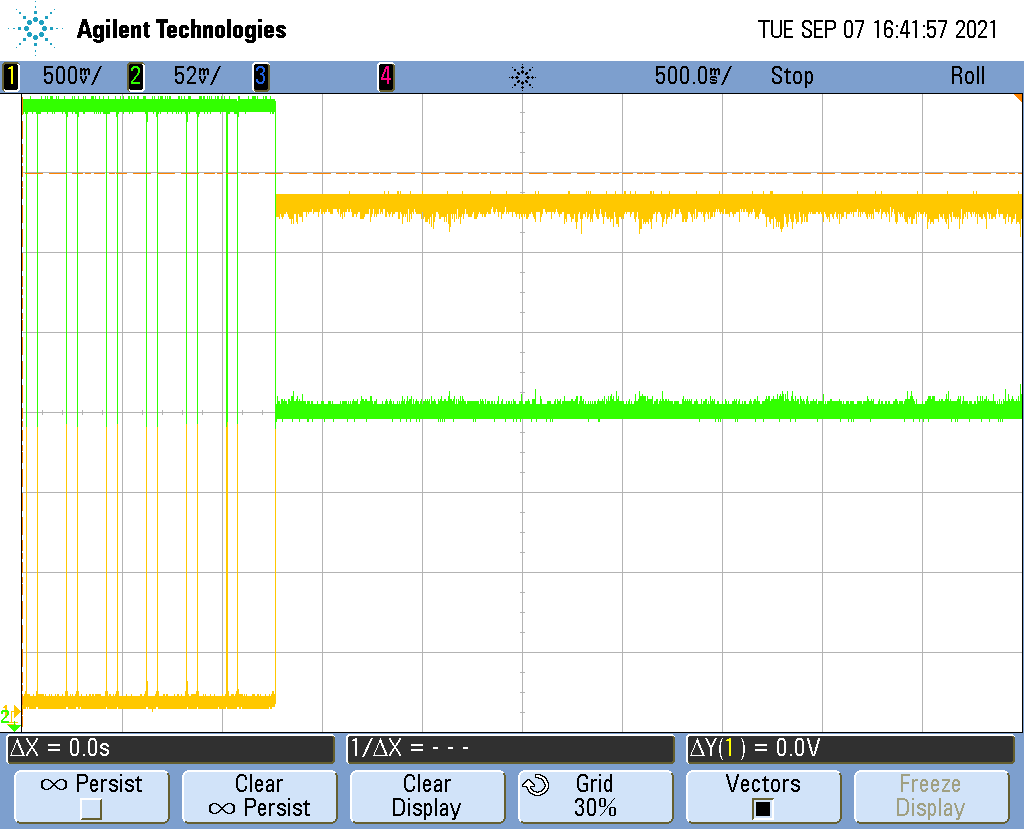
We change the setup a bit to have the same polarization on the photodiode and the PDH (in reflexion of the cavity). CF: schematics (futur).
Thanks to that, the symetry between reflexion and transmission is better now (as you can see on the plot).
We also put more power on PHD to have a better SNR by changing splitters. (We had 100 µW and now we have more than 1 mW, at the expense of the power on the camera).
Thanks to that we obtained a good locking, The coupling is quite good (roughtly 50%, on the green line)
In the following plot, the green line is the reflexion and the yellow lin is the transmission. |
| Attachment 1: scope_0.png
|
 |
|
19
|
Wed Sep 8 10:50:38 2021 |
Blanc | Fixed | info | lasers and optics | Optical room | Polarisation Results of the NKT |
To have the polarisation, we must have 1 value because the laser in entry of the system has 1 polar. Due to that, the graphe of the ellipticity is not true, it is the mean value on the following table which shows the ellipticity and the polarization.
| Blanc wrote: |
|
I made many tests about polarization and we can see some points thanks to the following figures :
1- The ellipsicity of the NKT is near to 0 (between -0,2 and 0,2) which means the polarization is rectilinear horizontale (attachement 1).
2- The power of the NKT has no influence on the polarization, verticale or horizontale (attachement 2 and 3).
3- The polarization is not changed by the type of mirror (Ag or Diélec) (attachement 4)
The next step is to measure the polarization after the cavity to know the ellipsicity.
|
|
| Attachment 1: Tableau_polar.PNG
|
 |
|
20
|
Thu Sep 9 16:34:37 2021 |
Blanc | Fixed | info | lasers and optics | Optical room | Ring light in the cavity |
We put a diaphragm in the input beam but it doesn't work to suppress the ring light only but it attenuates the whole transmitted beam (cavity mode and ring light) viewed on the camera. |
|
21
|
Thu Sep 16 18:23:13 2021 |
Blanc | Fixed | info | lasers and optics | Optical room | Polarization Results in transmission |
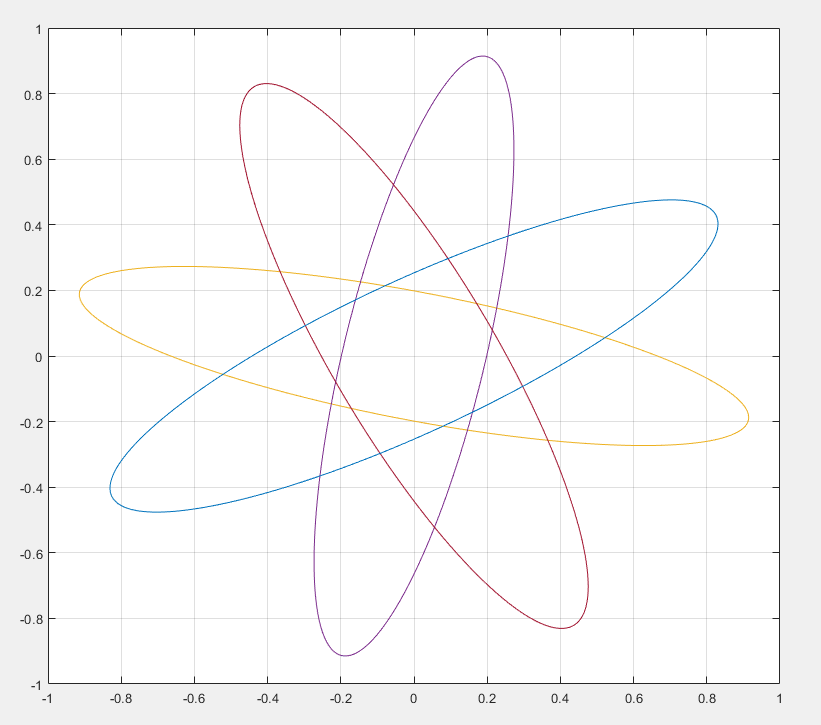
After data processing, I finally find the polarization in transmissin of the FPC. As you can see below, the polarisation is not linear but elliptical.
The four ellipsies are here due to having not enougth parameters to extract with certainty one ellipse. |
| Attachment 1: Polarisation_transmission_cavité.png
|
 |
|
22
|
Fri Sep 24 09:55:35 2021 |
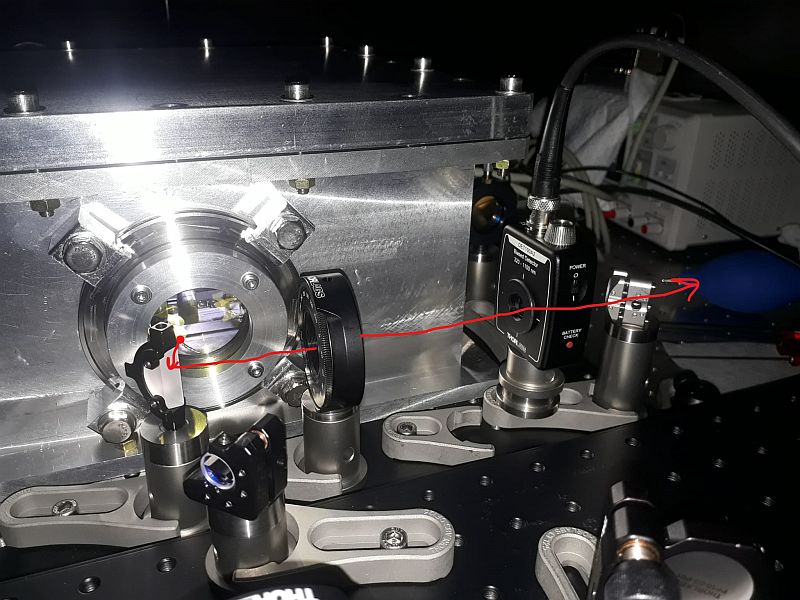
Manar Amer | Under Process | report | lasers and optics | Optical room | Reflection Line Polarization Measuremet |
With the help of Ronic the cavity was locked in preparation to measure the polarization of the reflection line when the cavity is locked (measurement when it is not locked was done before)
the purpose is to compare the two measurements (locked vs not locked)
General details:
- when not locked : measurements of the polarization was taken from the point where the photodiode is placed in the picture enclose
- When Locked: we can't measure it from that point as we need the line to split into two, one goes to PDH to maintain the lock of the cavity and the other one we use for our measurement.
- The reflection line is split at the point where the beam splitter is (BS, behind the photodiode in picture), we intended to take the measurements from this point.
Observation:
before starting the measurement of polarization, we observed
- the power measured for the reflection line (point at end of red arrow in picture, after BS) is really sensitive to the polarization, it shows when rotating the half-wave plate
- but, when measuring the power at the point shown in the picture (before BS, where the photodiode is placed) it is not sensitive to polarization.
This tells us that the dielectric BS placed in the reflection line affects the polarization.
This could affect the stability of the locking of the cavity, as the PDH is sensitive to polarization.
** Further investigation is needed before proceeding **
Footnotes:
- BS: Beam splitter.
- Dielectric component's sensitivity to polarization
- most of the components placed in the transmission line are dielectric.
|
| Attachment 1: Reflection_line.jpg
|
 |
|
23
|
Fri Oct 1 16:55:47 2021 |
Blanc | Fixed | info | mechanics | lasers and optics | detectors and electronics | Optical room | 1GHz oscillator Frep measurement |
| a previous cavity FSR measurement was giving a center frequency around 867.5MHz.
the present 1GHz oscillator Frep measurement is about 879.888MHz.
the present shift is about 12.4MHz which is equivalent to move one cavity lenght by 4.3mm which is HUGE !!!
as the 1GHz oscillator does not have any motor, one has to move the FP cavity mirrors instead.
the PZT inside the 1GHz oscillator (Thorlabs PC4QR) has a dynamic range of (20µm for 150V... we will drive it with 10V) 1.3µm.
then, we will have to adjust the FP cavity FSR with an accuracy much better than 4kHz (the cavity linewidth is 500kHz !!!) |
|
24
|
Mon Oct 4 14:57:04 2021 |
Aurélien Martens | Fixed | info | detectors and electronics | software | Optical room | ip adress of smaract driver |
the ip adress of the smaract driver is now 10.0.53.10:5000
please think about putting such kind of changes in the logbook |
|
25
|
Mon Oct 4 15:10:17 2021 |
Aurélien Martens | Fixed | report | mechanics | detectors and electronics | software | Optical room | new position of smaract motors |
following the measuremetn at 879.9 MHZ of the laser theoptical cavity length has been adjusted to that value from 876MHz setting of the 5th of may 21.
new motor positions:
M3/M4 : -2.9mm
M1/M2 : +5.196mm |
|
26
|
Mon Oct 4 15:24:14 2021 |
Aurélien Martens | Fixed | report | lasers and optics | detectors and electronics | Optical room | piezo actuation range |
A 10V applied on the laser piezo was found to induce a frequecny change of about 5kHz, compatible with expectations from the piezo sensitivity. this was measured by a freqeuncy analysis of the signal produced by the laser itself on a photodiode det10a
|
|
27
|
Mon Oct 4 15:38:43 2021 |
Aurélien Martens | Fixed | info | detectors and electronics | Optical room | phone is noise |
doing the sensitivty measurement of the piezo we observed satellite peaks around 800 to 900 Mhz. Removing the phones from the experience room(in the cupboard in the sas) removed that effect immediately. |
|
28
|
Tue Oct 5 11:35:16 2021 |
Aurélien Martens | Fixed | report | detectors and electronics | software | Optical room | new position of smaract motors |
a cavity length measurement gave 880.9Mhz. The m1/M2 have been put to +5.1000mm both M3/M4 srill at -2.9mm |
|
29
|
Tue Oct 5 12:18:34 2021 |
Aurélien Martens | Fixed | report | detectors and electronics | software | Optical room | new position of smaract motors |
to find the fundamental mode we moved the cavity mirrors to new positions:
+5.104mm for both planar mirrors in closed loop
spherical unchanged (-2.9mm) |
|
30
|
Tue Oct 5 12:23:51 2021 |
Aurélien Martens | Fixed | report | detectors and electronics | software | Optical room | new position of smaract motors |
the M1 is not at 5.1045mm to put the fundamental on the scanning range of the laser piezo
M2 still at 5.104mm
M3/M4 at -2.9mm still |
|
31
|
Tue Oct 5 16:23:04 2021 |
Aurélien Martens | Fixed | report | detectors and electronics | software | Optical room | new position of smaract motors |
after 3hours (1pm --> 4pm) the cavity moved by 12um in total
new positions: +5.1065mm on M1 and M2 (5.1050 before)
the drift is 4um/hour which amounts to about 10kHz drift / hour+the temperature of the optics room also changed unfortunaltey (linked to extinction of air flow at around 11am this morning). the drift in the room temperature was about 0.5K from 1pm to 2pm and 3K since 11am.
maybe this measurement needs to be redone to more precisely correlate the drift to an overall temperature change |
|
32
|
Tue Oct 5 18:24:53 2021 |
Ronic Chiche | Fixed | info | lasers and optics | Optical room | Locking with fast analog loop on AOM |
in addition to the standard locking scheme with the GHz laser PZT,
we added an AOM after the PDH modulation EOM and we drove it with an FM modulated signal generator (FMDev = 2.4MHz) seeded by the error signal.
(we didn't put a 50ohm plug to adapt the error signal coming from the PDH box, otherwise, it is too much smaller)
the result is a transmitted signal almost clean for some milliseconds... but we still have regular unlocks that the PZT loop is unable to drive.
the PZT resonant frequency around 30kHz seems much less present in the error signal.
todo list:
- take some data of the error/trans signals to make a post-mortem analysis (a windowed FFT could tell us if the 30kHz is more powerful just before an unlock)
- make an RLC model of the cable+resistor+PZT capacitor, to try to find a way to dump the 30kHz frequency.
|
|
33
|
Thu Oct 7 17:53:53 2021 |
Blanc | Fixed | info | lasers and optics | detectors and electronics | Optical room | Finess and coupling measurement |
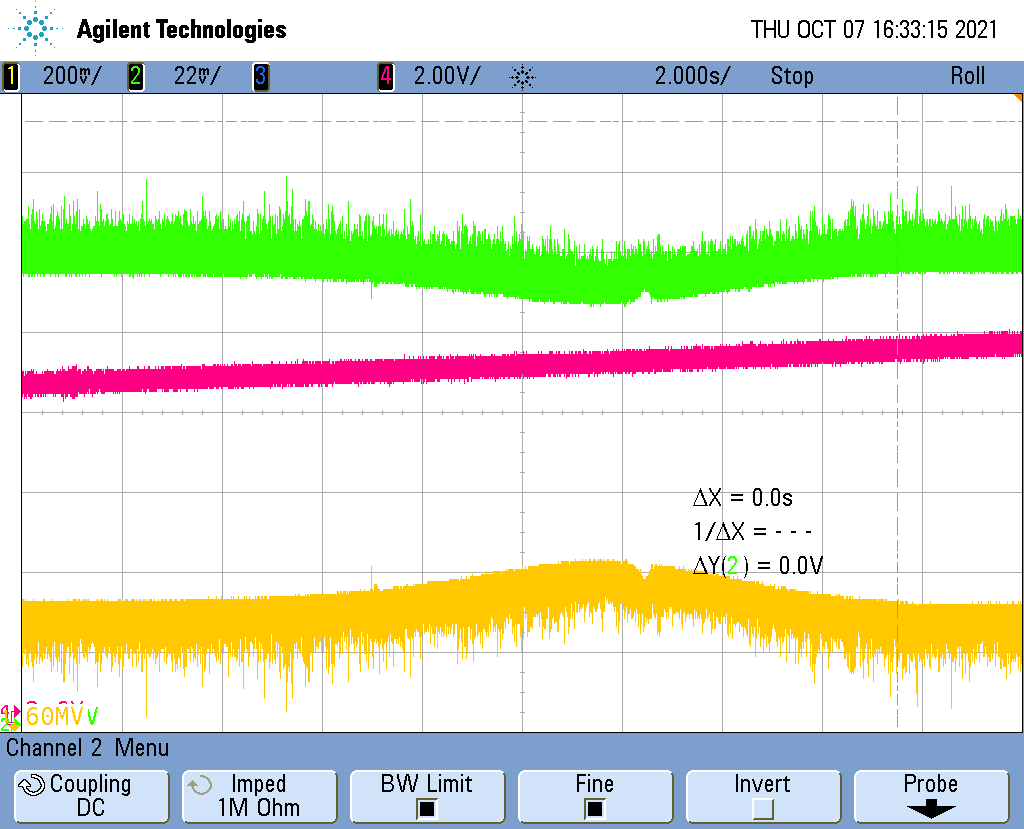
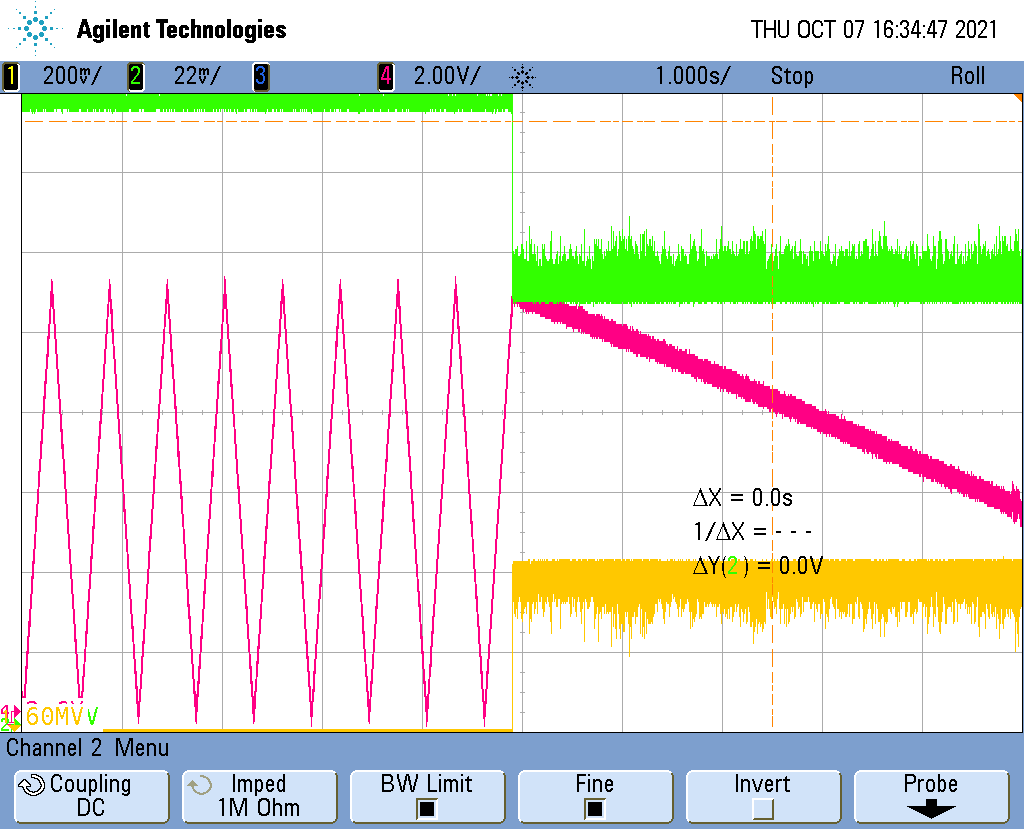
We did the measurement of the Finess and coupling with the NKT, with 2 EOM, without AOM (so the lock signal is noisy), on the burst line.
For the coupling, we have the same value as with the GHz locked on the burst line too, which is around 20 percent.
it seems this low coupling comes from the geometrical coupling as we observed an incoming beam bigger than the cavity mode on the cameras.
(the same oscillator, locked on the lock line exhibit 50% coupling)
the FSR center value is 879.9MHz, and the FWHM is between 879.67MHz and 880.1MHz.
So, the linewidth is about 430kHz and then the Finess value is roughly the same as before about 2050.
|
| Attachment 1: scope_10.png
|
 |
| Attachment 2: scope_12.png
|
 |
|
34
|
Fri Oct 8 16:02:19 2021 |
Blanc | Fixed | info | lasers and optics | detectors and electronics | Optical room | Setup and measurements |
To summerize the results of this week :
We made the setup in attachement 5 and align it to have the good mode in the cavity (TEM00).
With the good alignment, we found the lock of the GHz, in attachement 1. We used the motors in the cavity to position very precisely the mirrors to find this lock.
In attachement 2, we can see the error signal obtain thanks to the PDH, which is very clean.
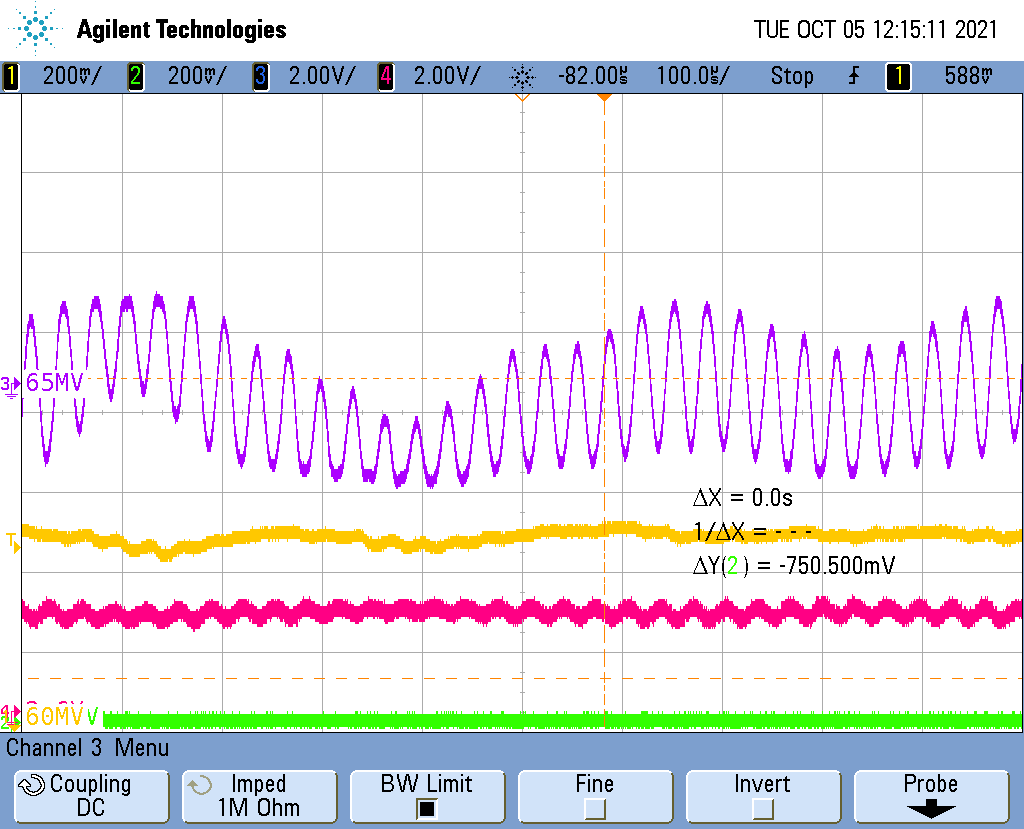
But after that, we saw some modulations at 30 kHz frequency which represent the resonance frequency of the piezo in the GHz (attachement 3). To compensate this, we placed a fibered AOM to cut the high frequencies.
Finally, we observed a big difference in the transmission noise if the motor loop is open or closed (attachement 4). To have the best noise, we have to stop the closed loop and stay in open loop, after adjusting the mirrors with the cosed loop.
We have also measured the finesse (2000) and the coupling (20%), detailed in the previous post.
|
| Attachment 1: acquisition_lock_GHz.png
|
 |
| Attachment 2: Signal_d'erreur_PDH_sur_GHz.png
|
 |
| Attachment 3: Résonances_dûes_au_pic_à_30kHz_dans_le_phase_noise.png
|
 |
| Attachment 4: Close_loop_vs_open_loop_GHz.png
|
 |
| Attachment 5: minicav_setup_Lock_GHz.PNG
|
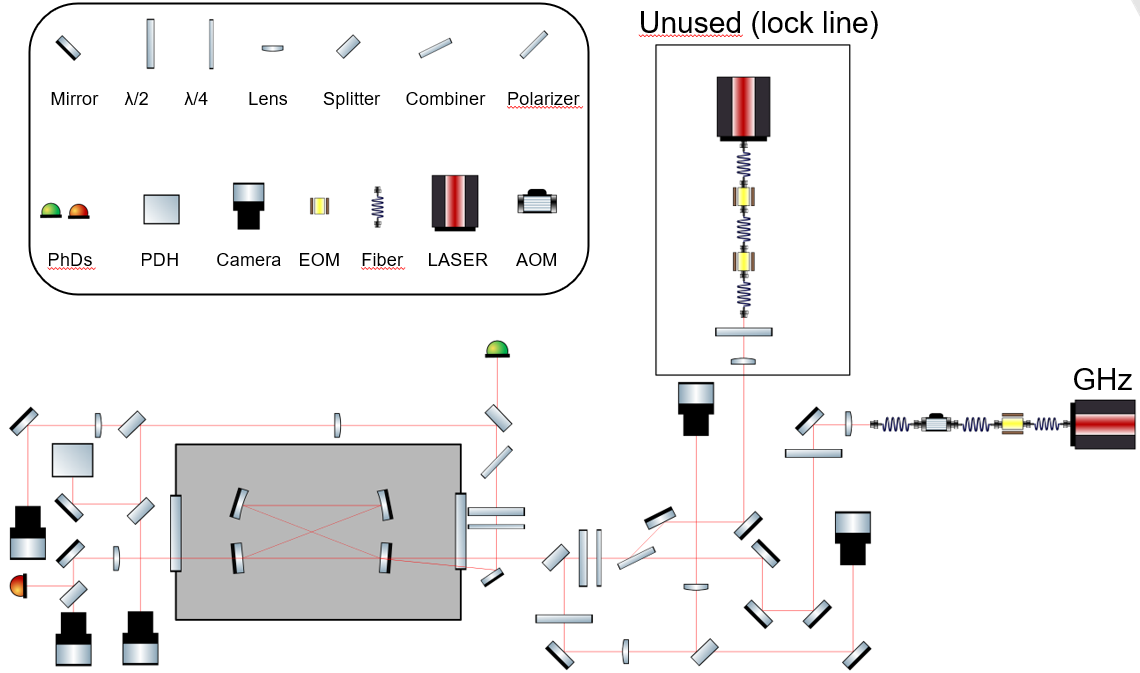 |
|
35
|
Tue Oct 19 18:27:20 2021 |
Ronic Chiche | Fixed | report | mechanics | lasers and optics | detectors and electronics | Optical room | PZT resonant frequencies |
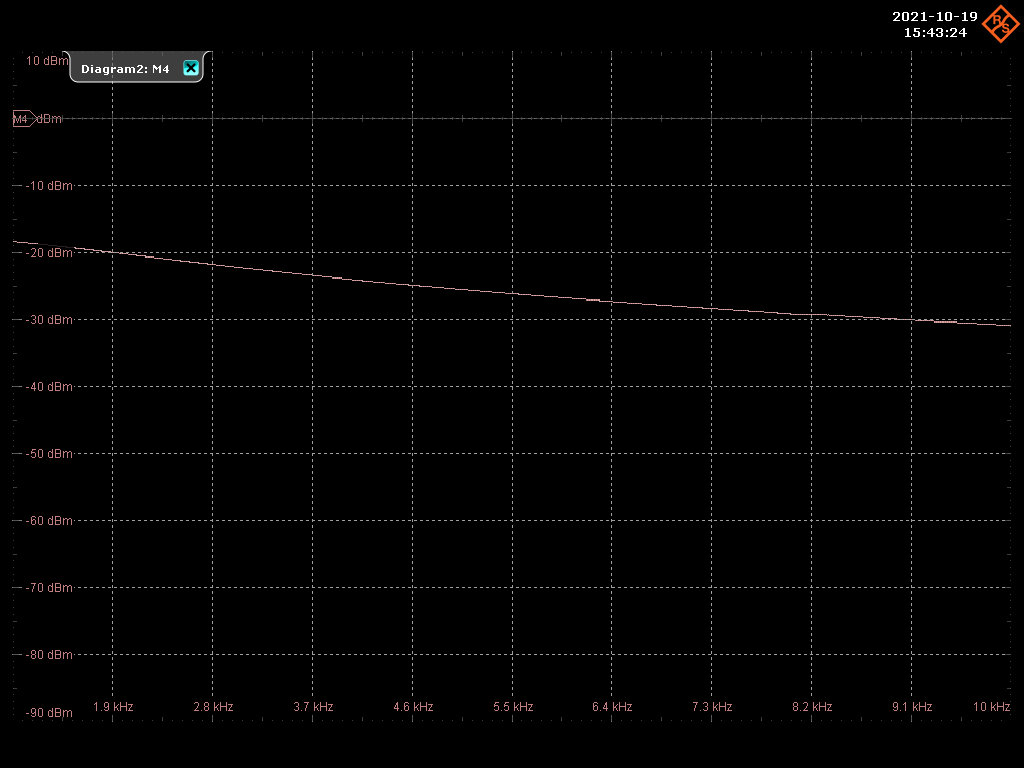
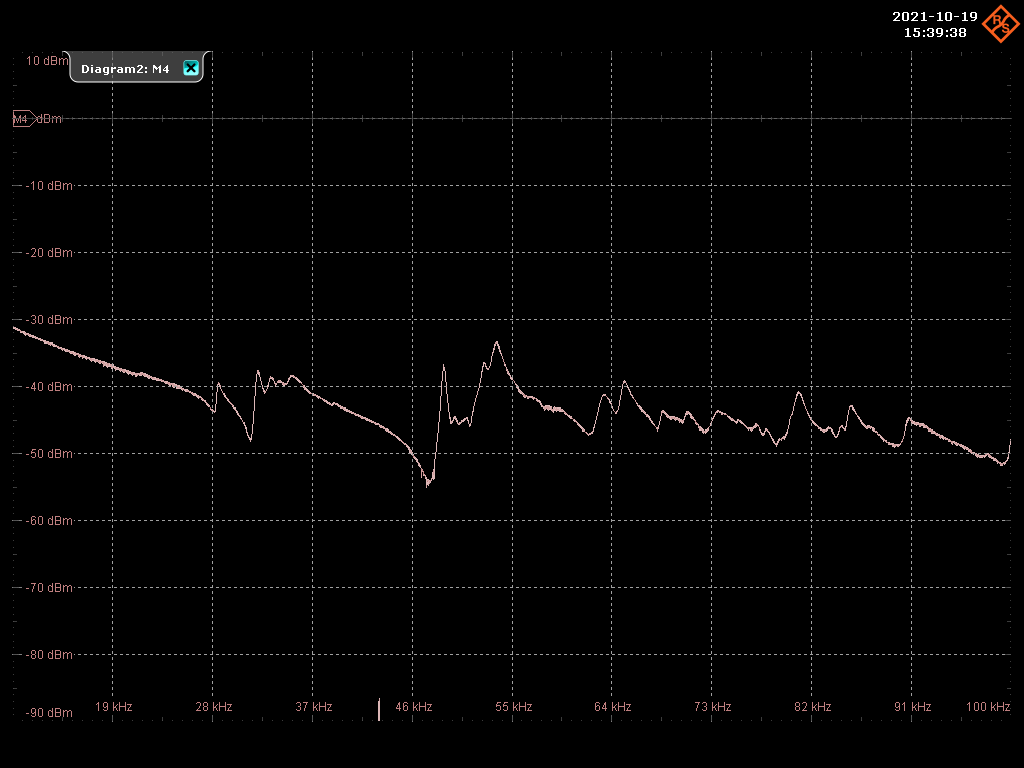
we have excited the PZT with a swept sinus wave from 1kHz to 10kHz and from 10kHz to 100kHz.
here are the 2 different spectrums:
- the 1kHz-10kHz is a standard spectrum where we see the impedance behavior of the PZT: Zpzt ~ 1/jCw
- the 10kHz-100kHz exhibit several PZT resonances and the 1st one is close to 28kHz.
(without PZT resonances, we should have the same behavior at higher frequencies than in the range 1kHz-10kHz) |
| Attachment 1: Sweep_1kHz-10kHz.png
|
 |
| Attachment 2: Sweep_10kHz-100kHz.png
|
 |
|
36
|
Wed Oct 20 12:36:15 2021 |
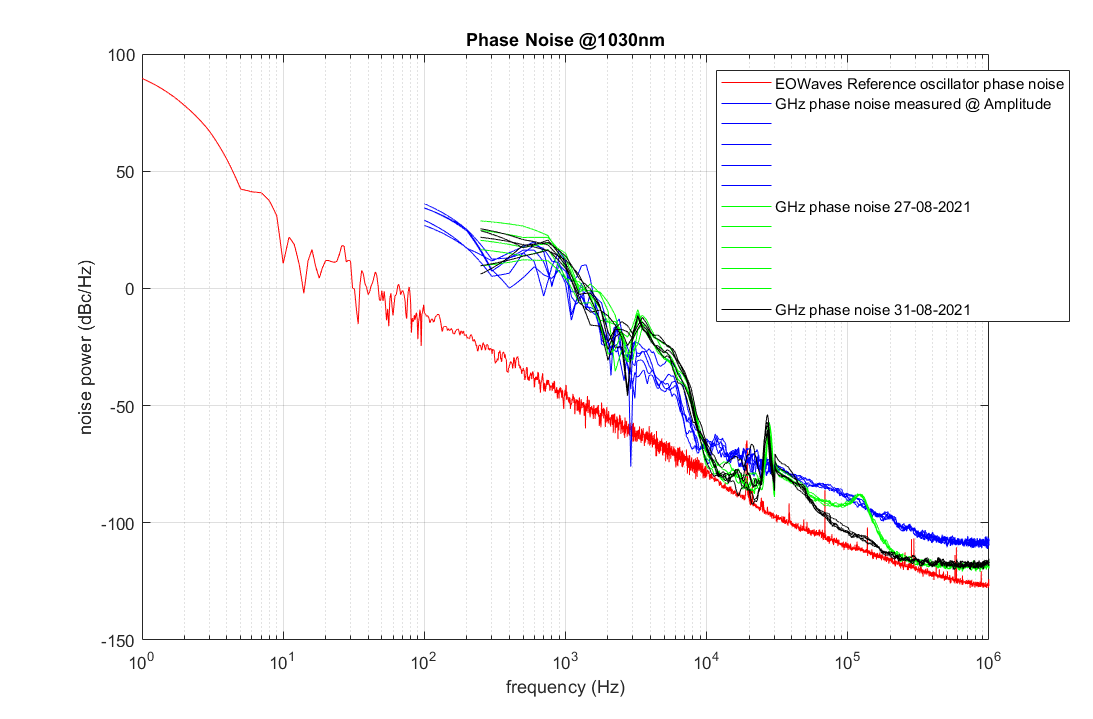
Ronic Chiche | Fixed | report | lasers and optics | Optical room | Amplitude GHz oscillator phase noise with PZT effect |
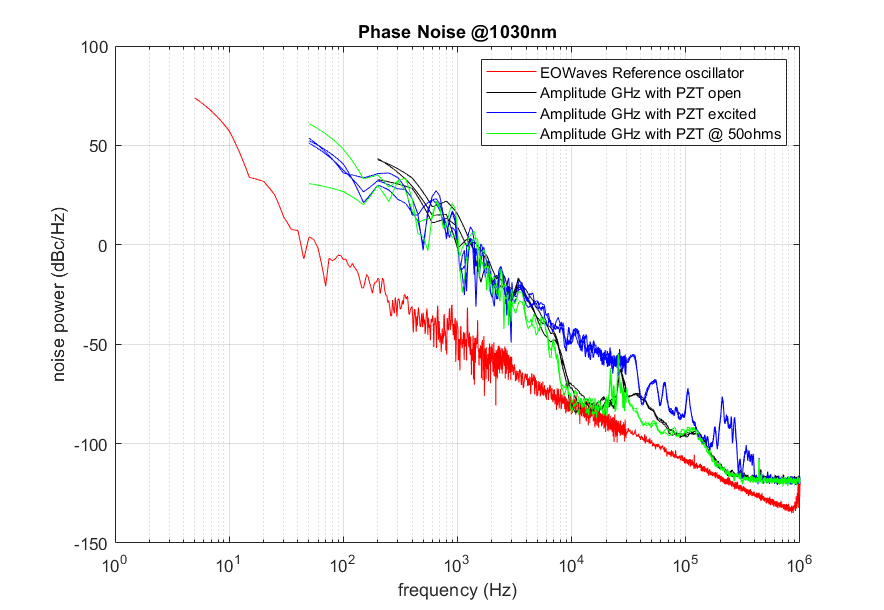
3 phase noise measurements made on the Amplitude GHz oscillator with different PZT configurations :
- black curve: PZT connector is open
- green curve: PZT connector is shorted by 50 ohms
- blue curve: PZT is excited by 100mVrms of white noise coming from a generator.
on the blue curve, one can clearly see a phase noise increase in the region 10kHz - 1MHz but it is not evident the peaks seen with the PZT open or shorted are related to the peaks excited with the noise injected on the PZT.
with a PZT not excited, one can just observe that the phase noise is decreasing a lot around 10kHz to reach the reference oscillator phase noise floor and then increase again exactly when the PZT resonant frequencies appear, between 20kHz and 200kHz.... reaching at the end the phase noise detection floor.
I add below the measurements done on October 20th, the ones done in September which are very similar and on which one can see a peak around 26kHz. |
| Attachment 1: Amplitude_GHz_phase_noise.png
|
 |
| Attachment 2: GHz_oscillator_phase_noise_without_front-end-1.png
|
 |
|
37
|
Wed Oct 20 14:54:00 2021 |
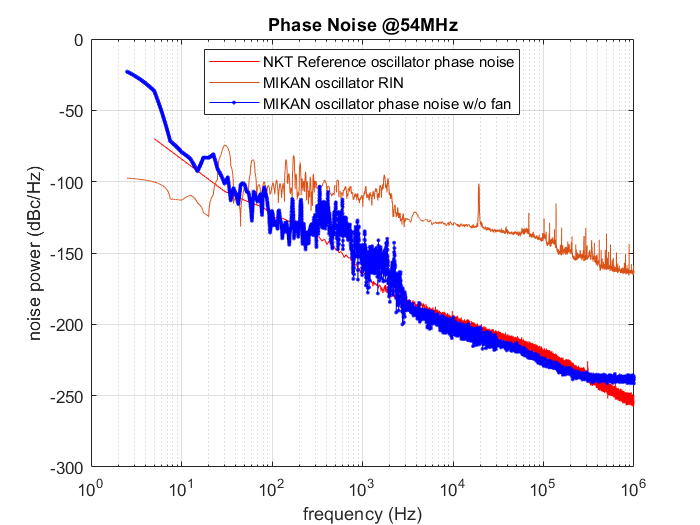
Ronic Chiche | Fixed | info | lasers and optics | detectors and electronics | Optical room | Phase noise measurement of the Amplitude MIKAN |
MIKAN phase noise and RIN measurements:
| Ronic Chiche wrote: |
|
Coupling into a 50-50% fiber coupler using the Thorlabs XYZ table NanoMax TS.
We reached 117mW after the 50% arm which means we coupled about 230mW (the coupling better than 50%).
| Ronic Chiche wrote: |
|
Installation of the MIKAN.
powermeter (with OD1) just after the oscillator shows 440mW for 4A of the MIKAN pump current.
Installation of a periscope as the oscillator beam position is very close to the table... not easy to put devices at this height (be aware to use proper wavelength range mirrors: Thorlabs BB1-E03)
Installation of a HALF waveplate to align beam polarisation on the isolator axis
Installation of a High power isolator (the one of ThomX): Newport ISO-FRDY-05-1030-N
powermeter (with OD1) just after the isolator shows 427mW
|
|
|
| Attachment 1: MIKAN_optical_phase_noise_comparison_with_NKT_CW_oscillator_&_RIN_@54MHz.png
|
 |
|
38
|
Wed Oct 20 15:27:51 2021 |
Ronic Chiche | Fixed | report | lasers and optics | Optical room | Amplitude GHz oscillator phase noise with PZT effect |
Thorlabs PZT datasheet.
Reference: PC4QR
| Ronic Chiche wrote: |
|
3 phase noise measurements made on the Amplitude GHz oscillator with different PZT configurations :
- black curve: PZT connector is open
- green curve: PZT connector is shorted by 50 ohms
- blue curve: PZT is excited by 100mVrms of white noise coming from a generator.
on the blue curve, one can clearly see a phase noise increase in the region 10kHz - 1MHz but it is not evident the peaks seen with the PZT open or shorted are related to the peaks excited with the noise injected on the PZT.
with a PZT not excited, one can just observe that the phase noise is decreasing a lot around 10kHz to reach the reference oscillator phase noise floor and then increase again exactly when the PZT resonant frequencies appear, between 20kHz and 200kHz.... reaching at the end the phase noise detection floor.
|
|
| Attachment 1: PC4QR-SpecSheet-1.pdf
|
|
39
|
Thu Oct 21 09:44:35 2021 |
Blanc | Fixed | info | mechanics | lasers and optics | detectors and electronics | Optical room | 1GHz oscillator Frep measurement |
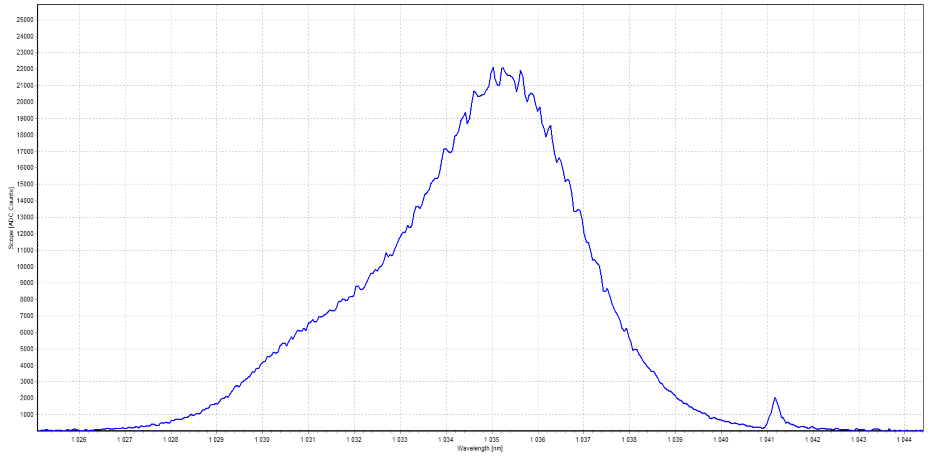
The optical spectrum of the GHz oscillator: FWHM ~ 4nm
| Blanc wrote: |
| a previous cavity FSR measurement was giving a center frequency around 867.5MHz. the present 1GHz oscillator Frep measurement is about 879.888MHz. the present shift is about 12.4MHz which is equivalent to move one cavity lenght by 4.3mm which is HUGE !!! as the 1GHz oscillator does not have any motor, one has to move the FP cavity mirrors instead. the PZT inside the 1GHz oscillator (Thorlabs PC4QR) has a dynamic range of (20µm for 150V... we will drive it with 10V) 1.3µm. then, we will have to adjust the FP cavity FSR with an accuracy much better than 4kHz (the cavity linewidth is 500kHz !!!) |
|
| Attachment 1: Spectre_GHz-3.PNG
|
 |
|
43
|
Thu Dec 2 16:12:17 2021 |
Aurélien Martens | Fixed | report | mechanics | software | Optical room | new smaract positions |
M1 and M2 at 5.1085mm and M3 and M4 at -2.9mm |
|
44
|
Mon Dec 6 11:22:08 2021 |
Kevin Dupraz | Under Process | info | lasers and optics | detectors and electronics | Optical room | Cameras Calibration |
| Kevin Dupraz wrote: |
|
After installing cameras the actual calibration are :
NF_Refl: acA1920-40gm
pixel size (real): 5.86um
Magnification = [0.53,0.56]
pixel size (image): 3.22um
image donne on input plan mirror M1 (accuracy about few mm)
NF_Trans: acA1920-40gm
pixel size (real): 5.86um
Magnification = 1.32
pixel size (image): 7.73um
image donne on output plan mirror M2 (accuracy about few mm)
need to adjust the NF transmission as the Magnification is greater than 1.
|
The NF_inj was calibrated with the USB microscope (1.4um/pixel on microscope image). The 5th ring of the lens is about 1.89 mm in diameter.
NF_inj: acA1920-40gm
pixel size (real): 5.86um
Magnification = 1.54
pixel size (image): 9um |
| Attachment 1: grab2021-12-06_10-51-34_325_microscope.bmp
|
| Attachment 2: grab2021-12-06_10-52-11_108_microscope_calib_05mm_ruler.bmp
|
|
45
|
Tue Dec 7 11:48:33 2021 |
Kevin Dupraz | Under Process | info | lasers and optics | detectors and electronics | Optical room | Cameras Calibration |
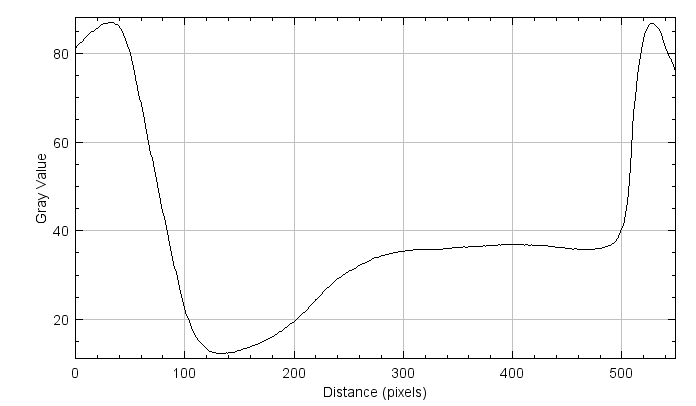
After check a mistake has been found on the magnification. This seems to be the good calibration (feel free to cross check). The projection of the 2mm hex is attached
the calibration are :
NF_Refl: acA1920-40gm
pixel size (real): 5.86um
Magnification = 1.71
pixel size (image): 10um
image donne on input plan mirror M1 (accuracy about few mm)
NF_Trans: acA1920-40gm
pixel size (real): 5.86um
Magnification = 0.68
pixel size (image): 4um
image donne on output plan mirror M2 (accuracy about few mm)
The NF_inj was calibrated with the USB microscope (1.4um/pixel on microscope image). The 5th ring of the lens is about 1.89 mm in diameter.
NF_inj: acA1920-40gm
pixel size (real): 5.86um
Magnification = 1.54
pixel size (image): 9um
| Kevin Dupraz wrote: |
|
| Kevin Dupraz wrote: |
|
After installing cameras the actual calibration are :
NF_Refl: acA1920-40gm
pixel size (real): 5.86um
Magnification = [0.53,0.56]
pixel size (image): 3.22um
image donne on input plan mirror M1 (accuracy about few mm)
NF_Trans: acA1920-40gm
pixel size (real): 5.86um
Magnification = 1.32
pixel size (image): 7.73um
image donne on output plan mirror M2 (accuracy about few mm)
need to adjust the NF transmission as the Magnification is greater than 1.
|
The NF_inj was calibrated with the USB microscope (1.4um/pixel on microscope image). The 5th ring of the lens is about 1.89 mm in diameter.
NF_inj: acA1920-40gm
pixel size (real): 5.86um
Magnification = 1.54
pixel size (image): 9um
|
|
| Attachment 1: Plot_of_NF_Trans_calib_hex2mm__2021-06-23__17-06-49.png
|
 |
| Attachment 2: Plot_of_NF_Refl_calib_hex2mm__2021-06-23__16-59-26.png
|
 |
|
46
|
Fri Dec 10 16:57:56 2021 |
Kevin Dupraz | Under Process | report | lasers and optics | Optical room | Manip 10 12 2021 (optimization injection Burst) |
Manip 10/12/2021
Après recherche de la résonnance principale
- MCS miroirs plan à 5.110250mm (en derive vers les negatifs)
- pic transmission à 5V
- couplage ~7%
Décalage du spot (très faible, à peine visible à la camera NF_refl)
- grosse perte en transmission ==> alignement OK
Grossissement du spot
* début taille_sigma à 0.220mm (calibration NF_Refl)
* nouvelle position en éloignant la lentille 1 taille à 0.300mm ==> max transmission ~3V,
- Walk en vertical ==> pas d'amélioration et dégradation.
- Divergent en entrée de cavité (test à la carte)
* En rapprochant la lentille 1 passage pas le minimum de taille vers 0.190 mm
* Depassement du minimum. Taille faisceau 0.317 mm (0.380 mm sur y) ==> max transmission ~2.5V,
- Walk en vertical ==> pas d'amélioration et dégradation.
- divergence pas apréciable
* On se met au minimum de taille sur la caméra. Taille faisceau 0.178 mm (0.170mm sur y) ==> max transmission ~5.3V
- Couplage 25% max (beaucoup de fluctuations).
- Gros décalage vertical (~ 1 sigma) ne provoque pas une baisse du transmis.
- Décalage horizontal sensible.
Après mangé Ronic a "lockée" la cavité. Le gain de la photodiode en transmission a été changé et la tension sur la résonnance principale est d'environ 600 - 800 mV
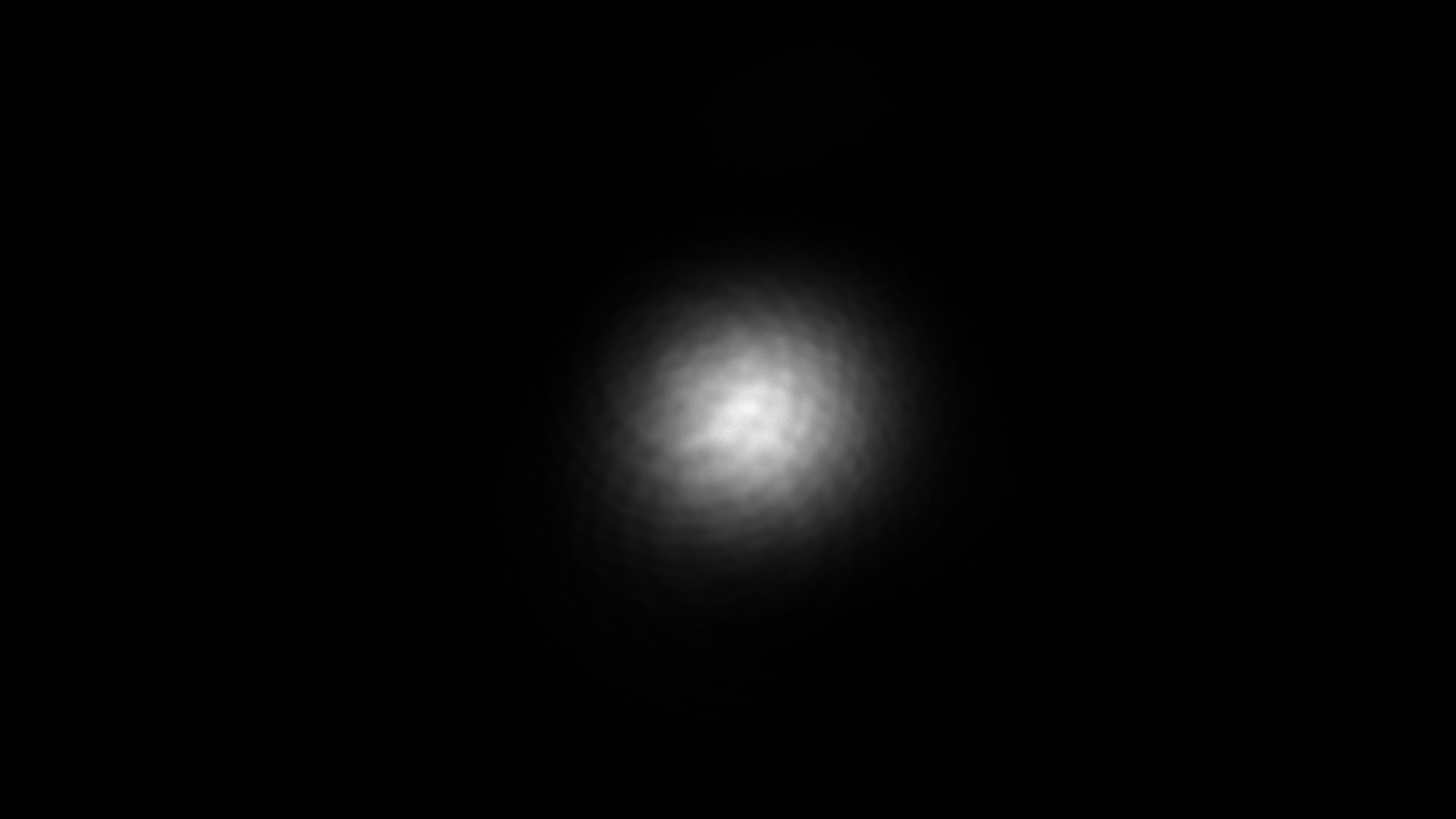
deux images ont été faites en entrée de cavité à environ 18 cm du splitter pour la camera de test afin d'être à peu près à une distance équivalente du miroir d'injection M1.
|
| Attachment 1: NF_Refl__2021-12-10__14-25-08.png
|
 |
| Attachment 2: test__2021-12-10__14-25-08_1920_25gm.png
|
 |
|
47
|
Tue Dec 14 12:59:07 2021 |
Kevin Dupraz | Under Process | report | lasers and optics | Optical room | Manip 14 12 2021 injection optimization (and calibration) |
Matin :
moteurs :
M1, M2 (plans): 5.110500m
M3, M4 (sphériques): -2.900000m
- Optimization de la première L/2 (en sortie tangor), le flux est maximisé en sortie du combiner.
* mesure sortie Tangor (Power meter de puissance) : 85 + 90 mW
* mesure sortie Tangor (Power meter PH100-Si-HA-OD1 "226316" + OD2) : 4.11mW
* mesure avant combiner, entre miroirs de replis Newfocus (Power meter + OD2) : 3.53mW
* mesure après pick-off (injection cavité) (Power meter + OD2) : 2.93mW
- Optimization du couplage avec la polarisation :
* modification de la polarisation injecté dans la cavité
* optimisation du flux reçu sur la photodiode en réflection
* mesure du couplage.
** Optimum trouvé à 15% de couplage (en scan 5Hz, 0-10V)
Position des lambdas :
- L/2 en injection : 333°
- L/4 en injection : 48°
- L/2 en réflection : 225°
- L/4 en réflection : 54°
- Déplacement de la photodiode en transmission.
* Réglage de l'iris au niveau de la photodiode : Iris ouvert PV résonance 31 mV, Iris fermée 25 mV
- Lock de la cavité.
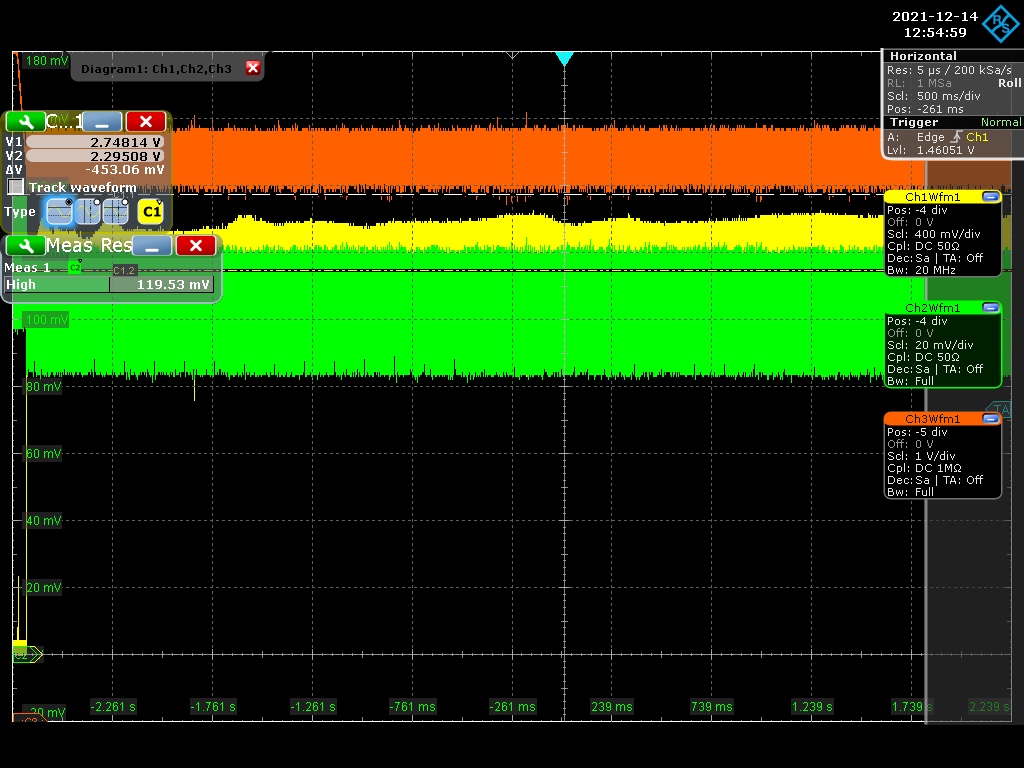
* transmission : 2.65V (60dB)
* reflection : 16.5% de couplage
* mesure devant la caméra en transmission (Power meter PH100-Si-HA-OD1 "226316" + OD2) : 0.635 uW
* image (P.J) sauvegardé bin |
| Attachment 1: Screenshot_2021-12-14_2_125459.png
|
 |
|
48
|
Thu Dec 16 10:40:55 2021 |
Kevin Dupraz | Under Process | report | lasers and optics | Optical room | Manip 14 12 2021 injection optimization (and calibration) |
Après-midi :
* Optimisation de l'alignement en injection pour avoir le plus de puissance en transmission
* Optimisation (vérification) de la polarisation pour avoir le plus de couplage.
* tension photoDiode en réflexion (50 Ohm) : max à 136 mV (couplage 20%)
* tension Photodiode transmission PDA100A-EC(50 ohm) : max à 3.6 V (60 dB de gain)
- Passage à 50 W en sortie de TANGOR.
* Vérificaton de l'alignement pour avoir le plus de puissance en transmission.
* Vérification de la polarisation pour avoir le plus de couplage.
* tension Photodiode transmission PDA100A-EC(50 ohm) : max à 4.9 V (40 dB de gain)
* Changement de la polarisation sur la ligne de réflexion (uniquement la lambda/4) pour ne pas saturer la photodiode.
* tension photoDiode en réflexion (50 Ohm) : max à 136 mV (couplage 12%)
* Références caméras :
> NF_refl : x0 = 11.9 mm; y0 = 8.65 mm; sigma_x = 0.185 mm; sigma_y = 0.167 mm.
> FF_refl : x0 = 2.44 mm; y0 = 0.61 mm; sigma_x = 0.241 mm; sigma_y = 0.259 mm.
> NF_inj : x0 = 8.57 mm; y0 = 5.40 mm; sigma_x = 0.123 mm; sigma_y = 0.127 mm.
- Plus de splitter 90/10 en sortie de TANGOR, 4.5 W en sortie TANGOR :
* Compensation du walk-of introduit par ce splitter.
* réalignement de la cavité après locking
* Photodiode Transmission (60dB + densité OD30) : max 2V
* Reflection (près changement de pile) : 18% de couplage (tension max 136 mV, 50 Ohm)
| Kevin Dupraz wrote: |
|
Matin :
moteurs :
M1, M2 (plans): 5.110500m
M3, M4 (sphériques): -2.900000m
- Optimization de la première L/2 (en sortie tangor), le flux est maximisé en sortie du combiner.
* mesure sortie Tangor (Power meter de puissance) : 85 + 90 mW
* mesure sortie Tangor (Power meter PH100-Si-HA-OD1 "226316" + OD2) : 4.11mW
* mesure avant combiner, entre miroirs de replis Newfocus (Power meter + OD2) : 3.53mW
* mesure après pick-off (injection cavité) (Power meter + OD2) : 2.93mW
- Optimization du couplage avec la polarisation :
* modification de la polarisation injecté dans la cavité
* optimisation du flux reçu sur la photodiode en réflection
* mesure du couplage.
** Optimum trouvé à 15% de couplage (en scan 5Hz, 0-10V)
Position des lambdas :
- L/2 en injection : 333°
- L/4 en injection : 48°
- L/2 en réflection : 225°
- L/4 en réflection : 54°
- Déplacement de la photodiode en transmission.
* Réglage de l'iris au niveau de la photodiode : Iris ouvert PV résonance 31 mV, Iris fermée 25 mV
- Lock de la cavité.
* transmission : 2.65V (60dB)
* reflection : 16.5% de couplage
* mesure devant la caméra en transmission (Power meter PH100-Si-HA-OD1 "226316" + OD2) : 0.635 uW
* image (P.J) sauvegardé bin
|
|
| Attachment 1: Screenshot_2021-12-14_3_182645.png
|
 |
|
49
|
Thu Dec 16 12:12:10 2021 |
Kevin Dupraz | Under Process | report | lasers and optics | Optical room | Manip 16 12 2021 montée en puissance |
Matin:
* Redémarrage Tangor 4W
- couplage 15%
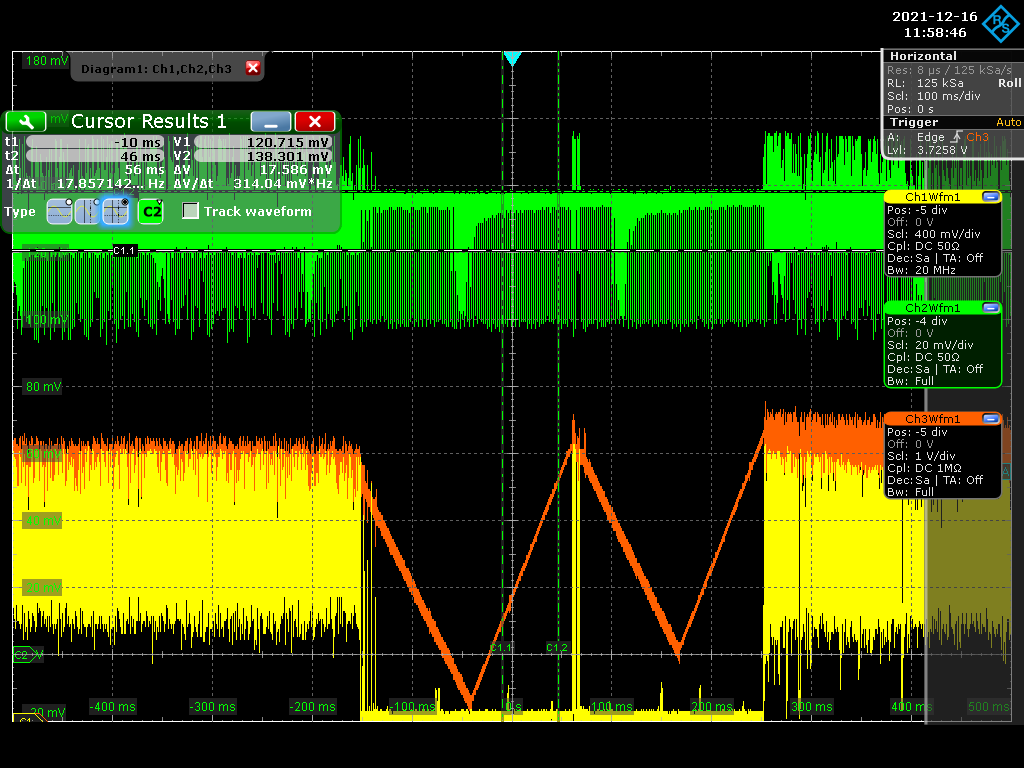
- max photodiode Transmission (60dB, OD30) : 1.9V
* Montée en Puissance 20 W
- début des effets thermiques : dérive thermique (la cavité chauffe et le piezo doit suivre, la tension baisse)
- max photodiode Transmission (40dB, OD30) : 1.6 V
- Reflection (~12%) ~140mV max:
* quand résonance => plus de signal sur la reflexion que hors lock.
- Hypothèses:
saturation de la photodiode ==> avec une densité OD10 (même effet)
effet de polarisation: essaie avec la densité OD10 (absorbante) dans le faisceau au niveau de la lambda/4 en reflection ==> la densité est brulée (ne tient pas la puissance)
==> essayer avec densité réflective.
* impossible de locker sur le max de transmission |
| Attachment 1: Screenshot_2021-12-16_0_115846.png
|
 |
|
50
|
Thu Dec 16 12:13:52 2021 |
Kevin Dupraz | Under Process | report | lasers and optics | Optical room | Manip 16 12 2021 montée en puissance |
| Kevin Dupraz wrote: |
|
Matin:
* Redémarrage Tangor 4W
- couplage 15%
- max photodiode Transmission (60dB, OD30) : 1.9V
* Montée en Puissance 20 W
- début des effets thermiques : dérive thermique (la cavité chauffe et le piezo doit suivre, la tension baisse)
- max photodiode Transmission (40dB, OD30) : 1.6 V
- Reflection (~12%) ~140mV max:
* quand résonance => plus de signal sur la reflexion que hors lock.
- Hypothèses:
saturation de la photodiode ==> avec une densité OD10 (même effet)
effet de polarisation: essaie avec la densité OD10 (absorbante) dans le faisceau au niveau de la lambda/4 en reflection ==> la densité est brulée (ne tient pas la puissance)
==> essayer avec densité réflective.
* impossible de locker sur le max de transmission
|
|
| Attachment 1: Screenshot_2021-12-16_1_121553.png
|
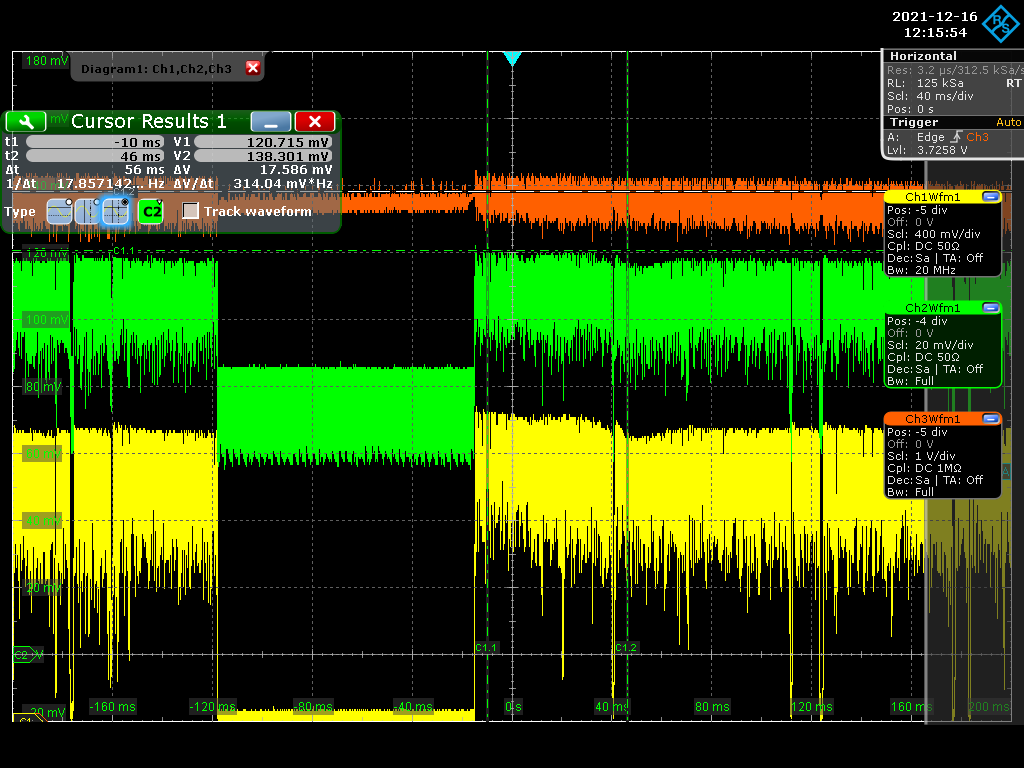 |
|
51
|
Thu Dec 16 18:16:12 2021 |
Blanc | Under Process | info | lasers and optics | Optical room | Changements et ajout d'optiques |
Optiques ajoutées :
- splitter 90/10 au début de la voie de réflexion, pour éjecter le flux et éviter que les lambdas ne chauffent.
- deuxième polariser pour avoir une meilleur extinction.
- splitter 10/90 après la première lentille sur la voie d'injection qui envoie 10% du flux sur la photodiode de réflexion.
Optiques changées :
- miroir HR à la place d'un splitter 97/3 à 0° que l'on utilisait à 45° dont le faisceau en transmission allait sur la photodiode de réflexion.
- splitter 70/30 à la place d'un splitter 98/2 à 0° que l'on utilisait à 45° qui divisait champ proche/champ lointain.
Mise en place d'un dump pour le faisceau réfléchi par le splitter 90/10 du début de la voie de transmission. |
|
52
|
Fri Dec 17 17:03:34 2021 |
Kevin Dupraz | Under Process | report | lasers and optics | Optical room | Manip 17 12 2021 reprise réf nouvelle injection pour polarisation |
Tangor : 4.2W
* Réalignement de l'injection suite aux modifications :
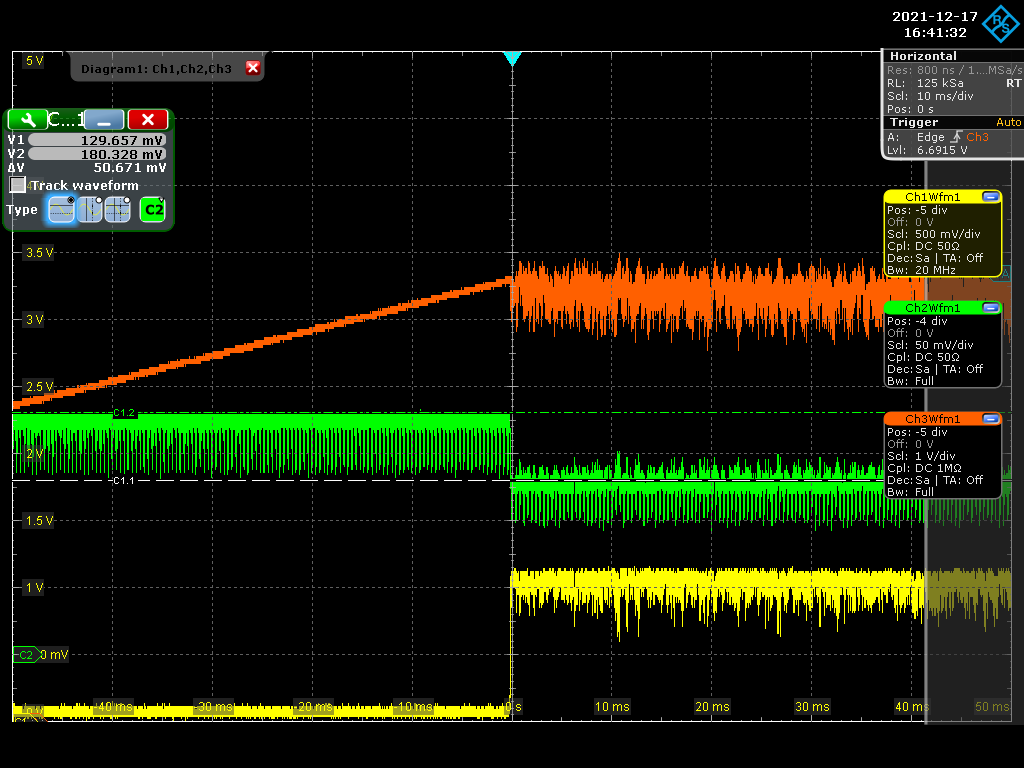
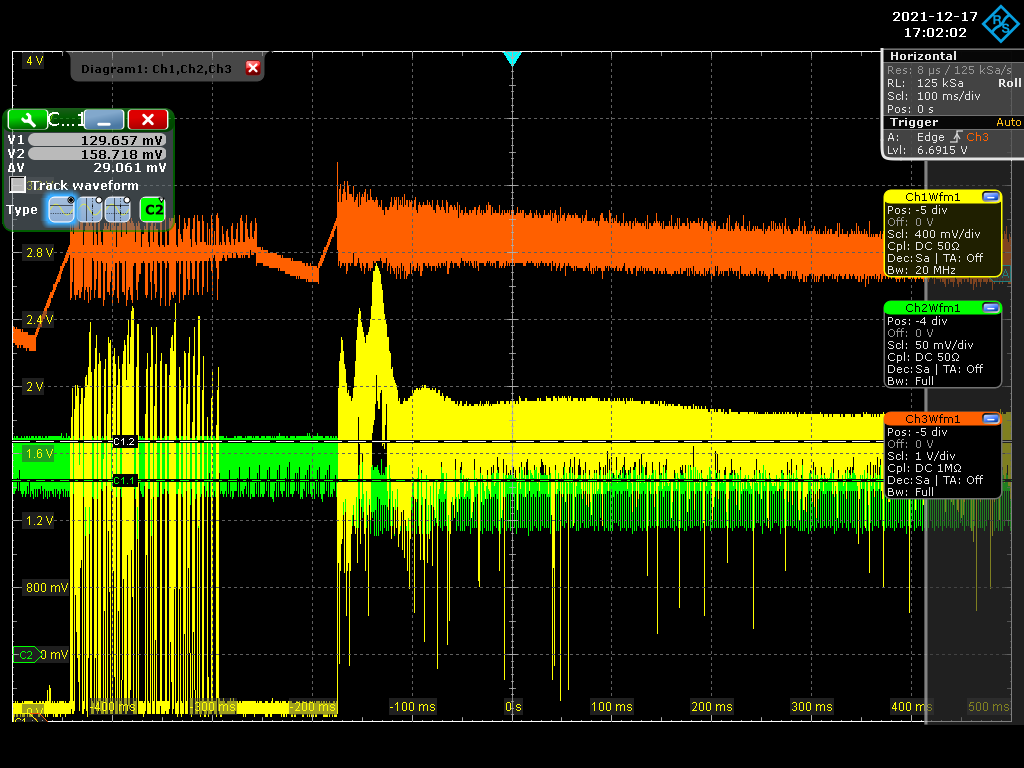
- Changement de l'ordre des waveplate maintenant : lambda/4, puis lambda/2
- suppression de l'iris au niveau de la transmission, perte d'au moins un facteur sur le signal en transmission
- reprise des références sur les caméras en reflection. (NF:[10.2548, 6.1092], FF:[1.9881, 1.5929])
* Optimisation du couplage en pointé, puis en polarisation
--> Maximum de reflection dans la photodiode (transmission maximale)
- couplage mesuré en réflection : 32% +- 4%(PV) max (180 mV)
- max intensité en transmission (0 dB, sans densité) : 1.1V
Tangor : 20W
- Montée en puissance: grosse dérive thermique mais le signal en réflection est "correcte".
- transmission (30dB, OD30) : pic max à 2.6 V
"puissance stable", 1.88V
- couplage : 25% (40mV/160mV)
On part en vacances ^^ |
| Attachment 1: Screenshot_2021-12-17_0_164132.png
|
 |
| Attachment 2: Screenshot_2021-12-17_1_170202.png
|
 |
|
53
|
Mon Mar 28 17:10:33 2022 |
Blanc | Fixed | info | lasers and optics | detectors and electronics | Optical room | input and output power of the AOM 50MHz |
Input power of the AOM :
150mW
output power of the AOM :
125mW
Generator output :
250mVpp, 50ohm, 240MHz
I realign once again the oscillator GHz because it was not mode lock. |
|
54
|
Tue May 17 17:28:31 2022 |
Blanc | Fixed | issue | lasers and optics | detectors and electronics | Optical room | Différence de fréquence Tangor/Lockline |
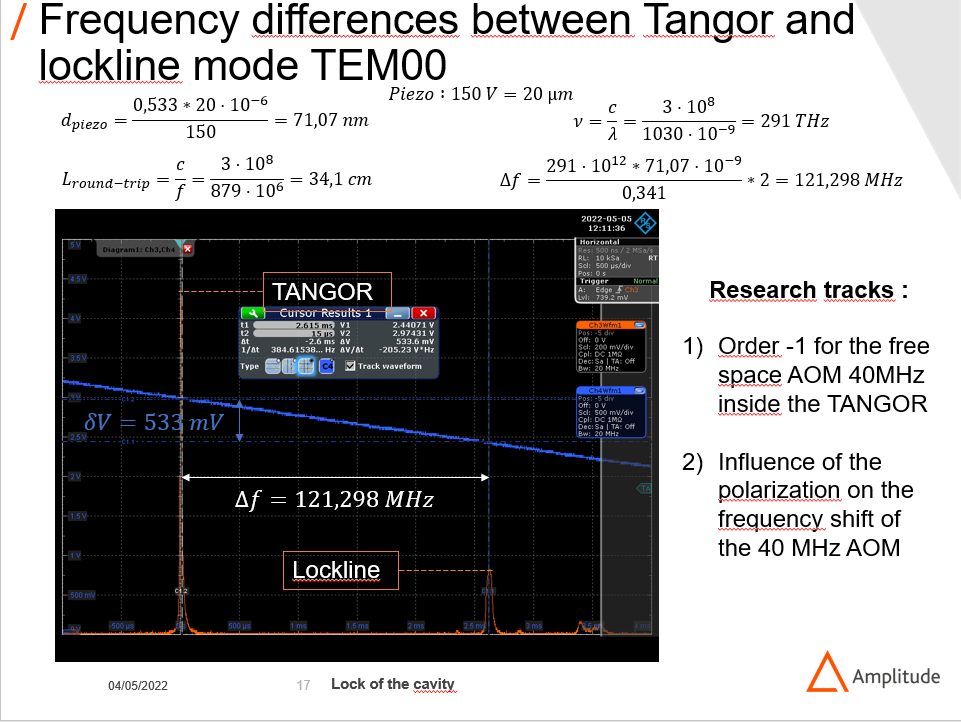
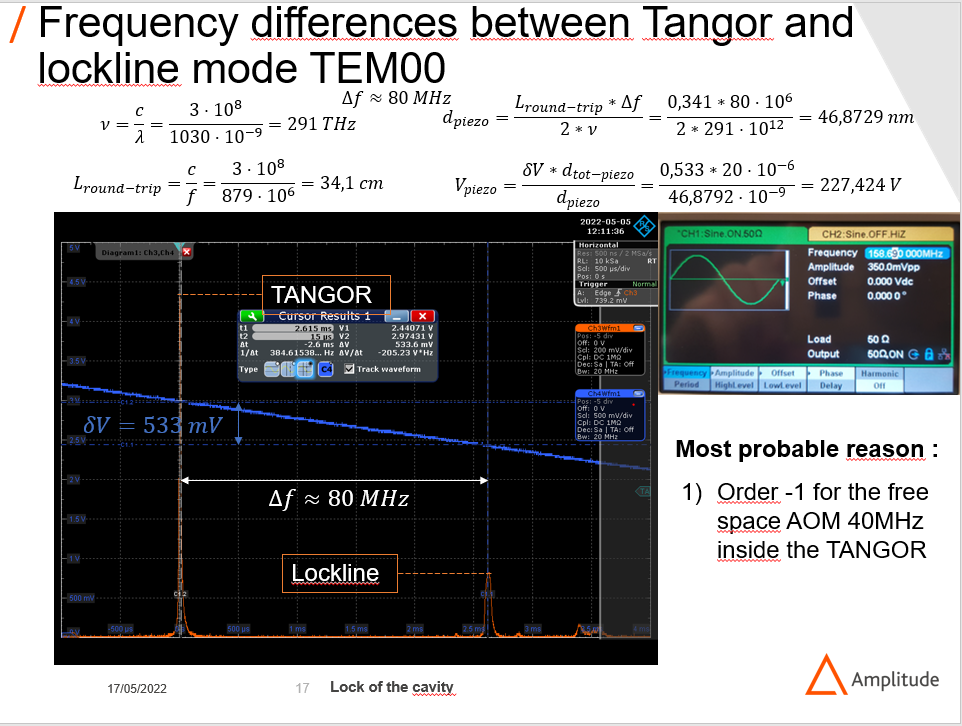
- On a observé que le fondamental du Tangor et celui de la Lockline n'étaient pas situés à la même fréquence. Avec la différence de tension donnée par le piezo entre les deux et le déplacement du piezo en fonction de la tension appliquée donnée par sa datasheet (150 V pour 20 µm), on obtient un écart de fréquence de 121 MHz [Image 1].
- On a tout d'abord testé si les drivers qui contrôllent les AOMs 200 MHz et 40 MHz dans le tangor envoyaient la fréquence voulues, soit respectivement 200 MHz et 40 MHz, ce qui est le cas.
- Sachant que le fondamental de la lockline est initialement à 240 MHz, on a shifté la fréquence de celui-ci pour le superposer au fondamental du Tangor, ce qui a donné un écart de fréquence de 80 MHz environ. Cela montre en reprenant les calculs que le déplacement du piezo est de 20 µm pour 227 V [Image 2]. De plus cela correspondrait à un ordre 1 sur l'AOM 200 MHz et -1 sur l'AOM 40 MHz.
- Mercredi 11/05/2022 et jeudi 12/05/2022, la température de la salle est montée à 33°C. On a dû réaligner le Tangor et la lockline qui avaient bougés.
- Ajout sur la ligne de transmission d'une lambda/2 et d'une lambda/4, déplacement de la caméra et de la photodiode en transmisson, imagerie refaite. Alignement fin à finir sur la photodiode en transmission. Ajouter un TPBS pour envoyer le train du Tangor sur une photodiode rapide. Prendre les références des caméras.
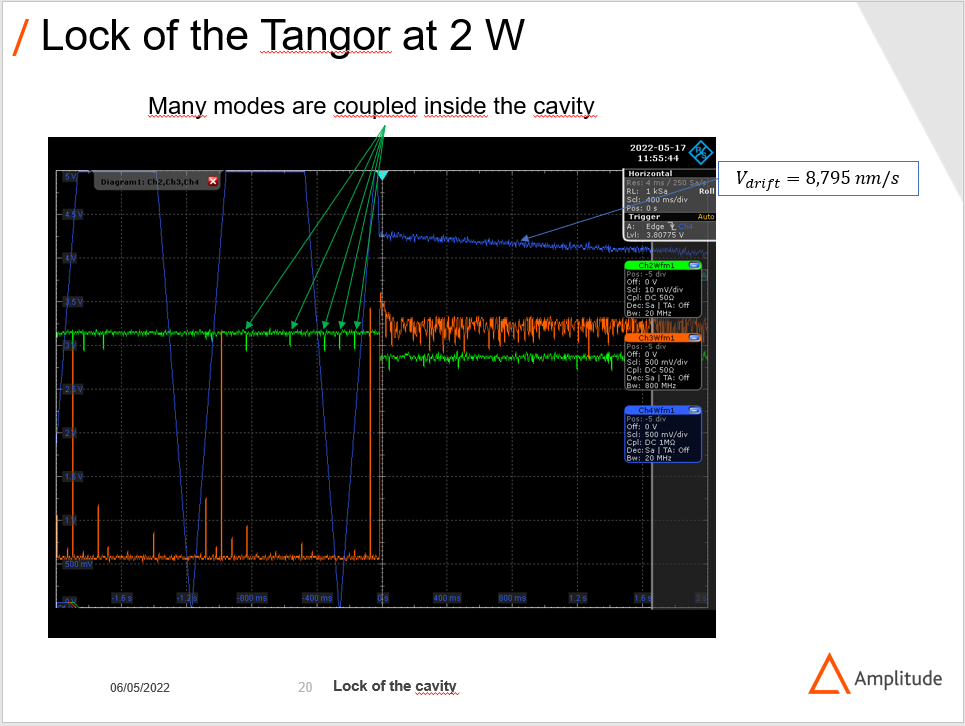
- On a vu du couplage sur plusieurs modes dans la cavité avec le Tangor [Image 3]. |
| Attachment 1: Freq_Tangor_Lockline_120_MHz.PNG
|
 |
| Attachment 2: Freq_Tangor_Lockline_80_MHz.PNG
|
 |
| Attachment 3: Lock_Tangor_2W.PNG
|
 |
|
55
|
Thu May 19 10:04:05 2022 |
Blanc | Under Process | report | lasers and optics | Optical room | Changement cadence et duty cycle + ref cam |
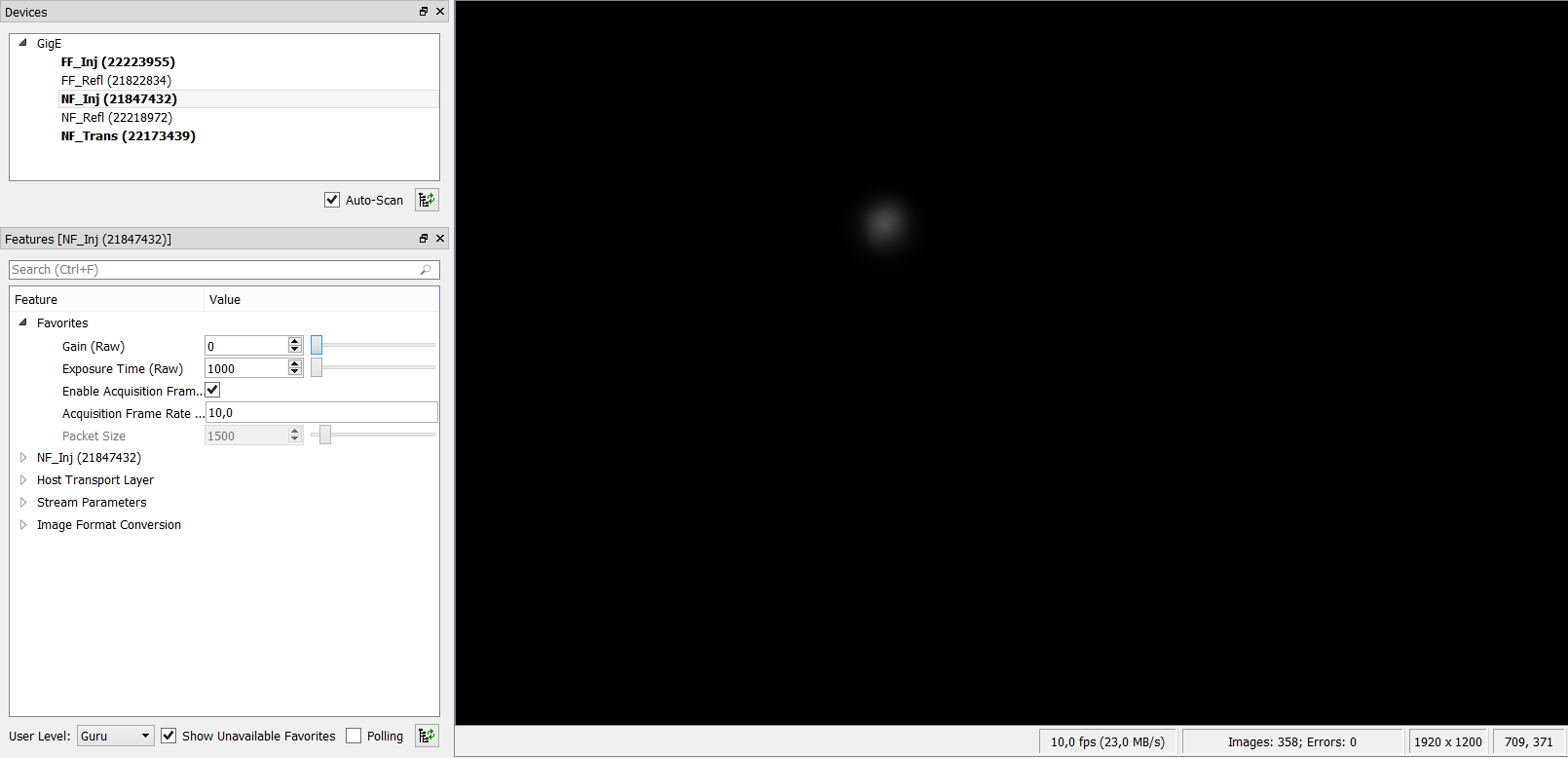
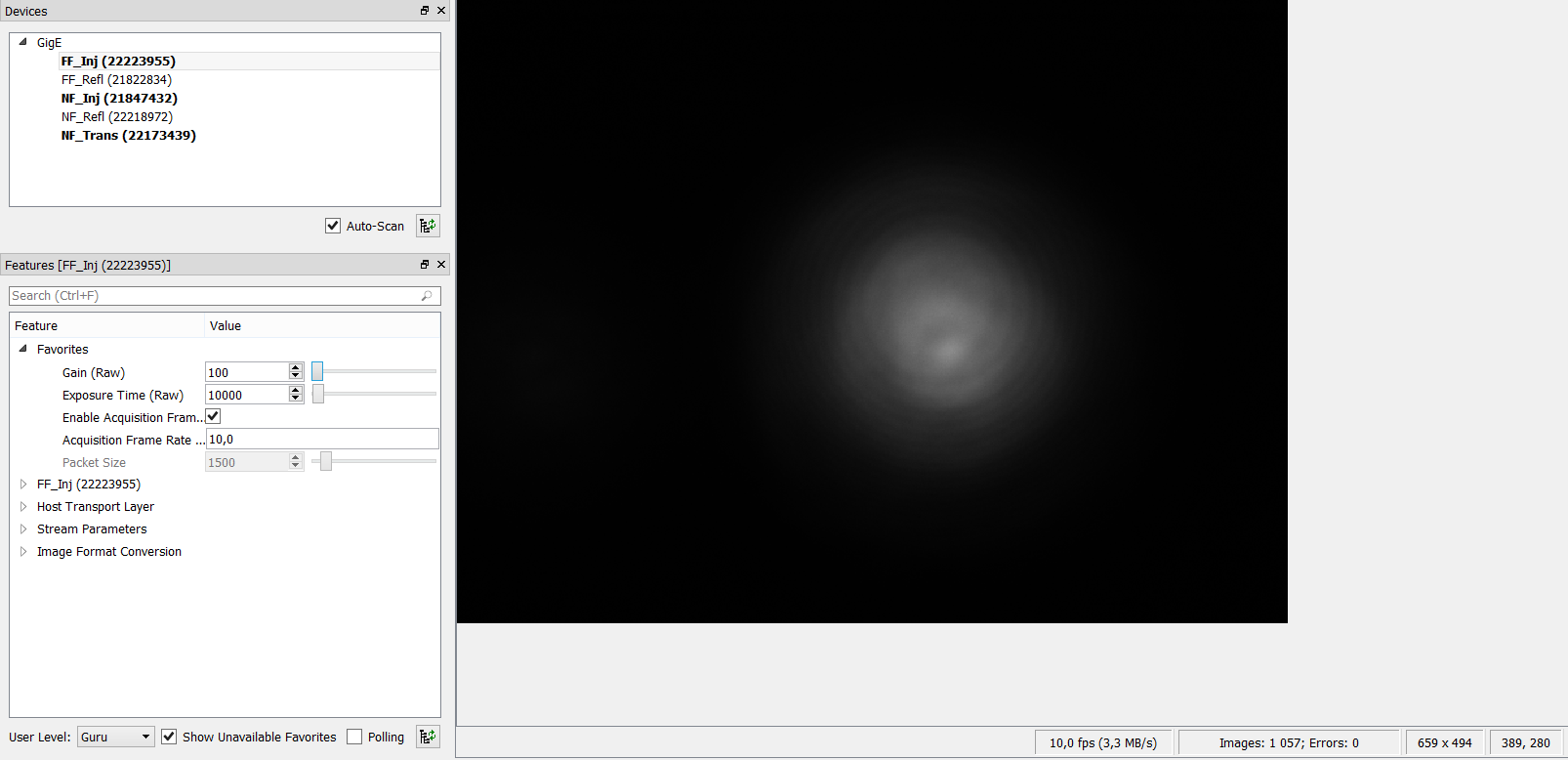
- Prise des nouvelles ref caméras : NF{709;371} , FF{389;280} [Image 1 & 2]
- Placement d'une photodiode rapide en transmission pour voir le train d'impulsions du Tangor à travers la cavité.
- Lock du Tangor en quasi-continue, P_moy = 2W, 100 kHz.
- Baisse de la cadence à 10 kHz, duty cycle 50% (sur le soft), 25 % (sur l'oscillo), à comprendre, P_moy = 1W [Image 3,4,5]
- On observe que la forme du burst a un impact sur le PDH et par consequent sur le piezo [Image3 & 4]
- Possibilité d'ajuster cela en jouant sur le gain du PID, mais si on baisse en cadence, en duty cycle et qu'on monte en puissance cela suffira ? |
| Attachment 1: Ref_NF_inj_18_05_2022.png
|
 |
| Attachment 2: Ref_FF_inj_18_05_2022.png
|
 |
| Attachment 3: Screenshot_2022-05-18_2_165654.png
|
 |
| Attachment 4: Screenshot_2022-05-18_5_173440.png
|
 |
| Attachment 5: Screenshot_2022-05-18_6_174947.png
|
 |
|
56
|
Tue Jun 14 11:16:37 2022 |
Blanc | Under Process | issue | lasers and optics | Optical room | Problèmes Cavitée |
Précédentes ref pour lesquelles la manip fonctionnait :
Caméras :
709 ; 371 NF
389 ; 280 FF
Moteurs :
5.091422 ; 5.091422 ; -2.9 ; -2.9
Problèmes dans la cavité :
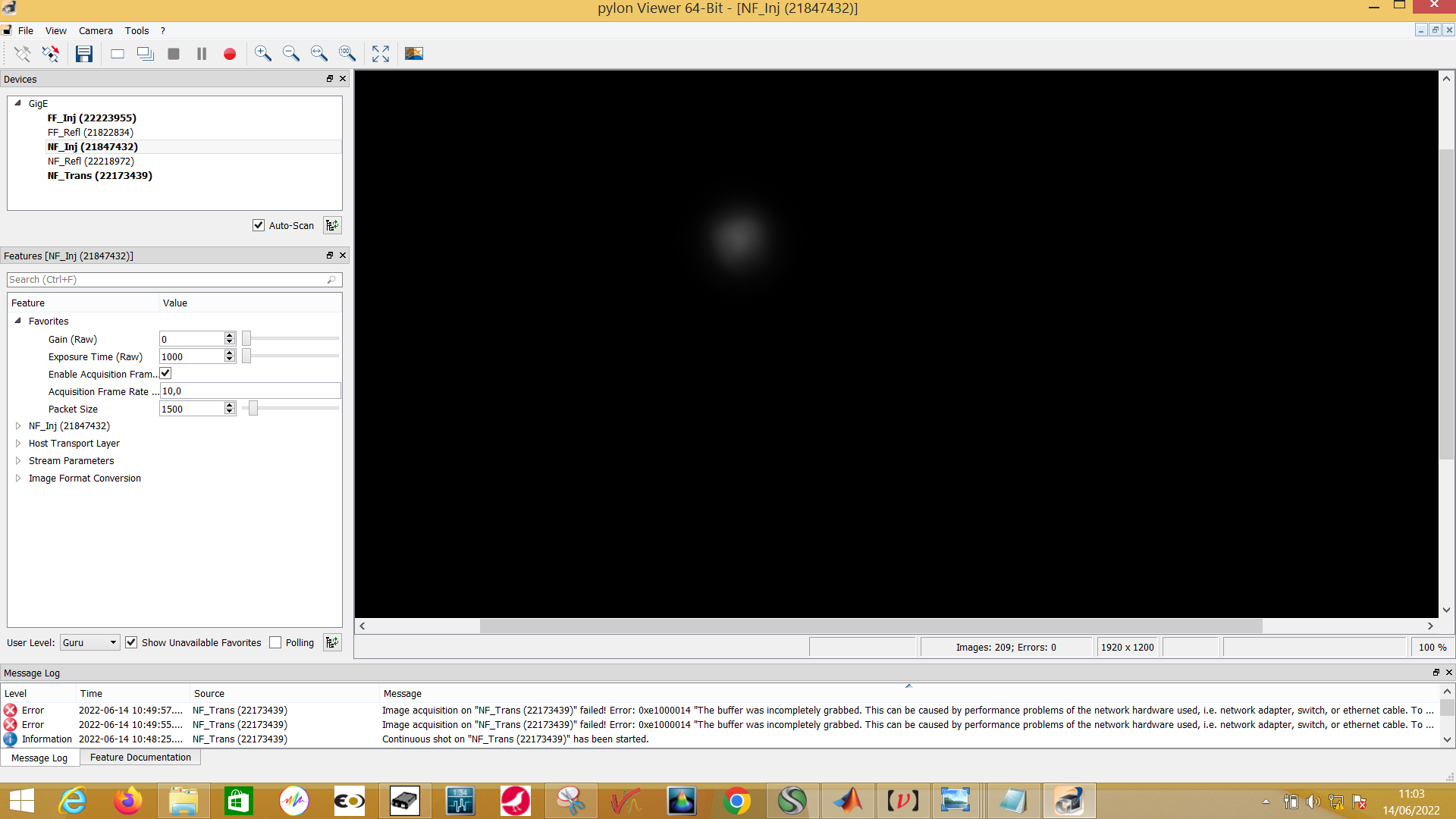
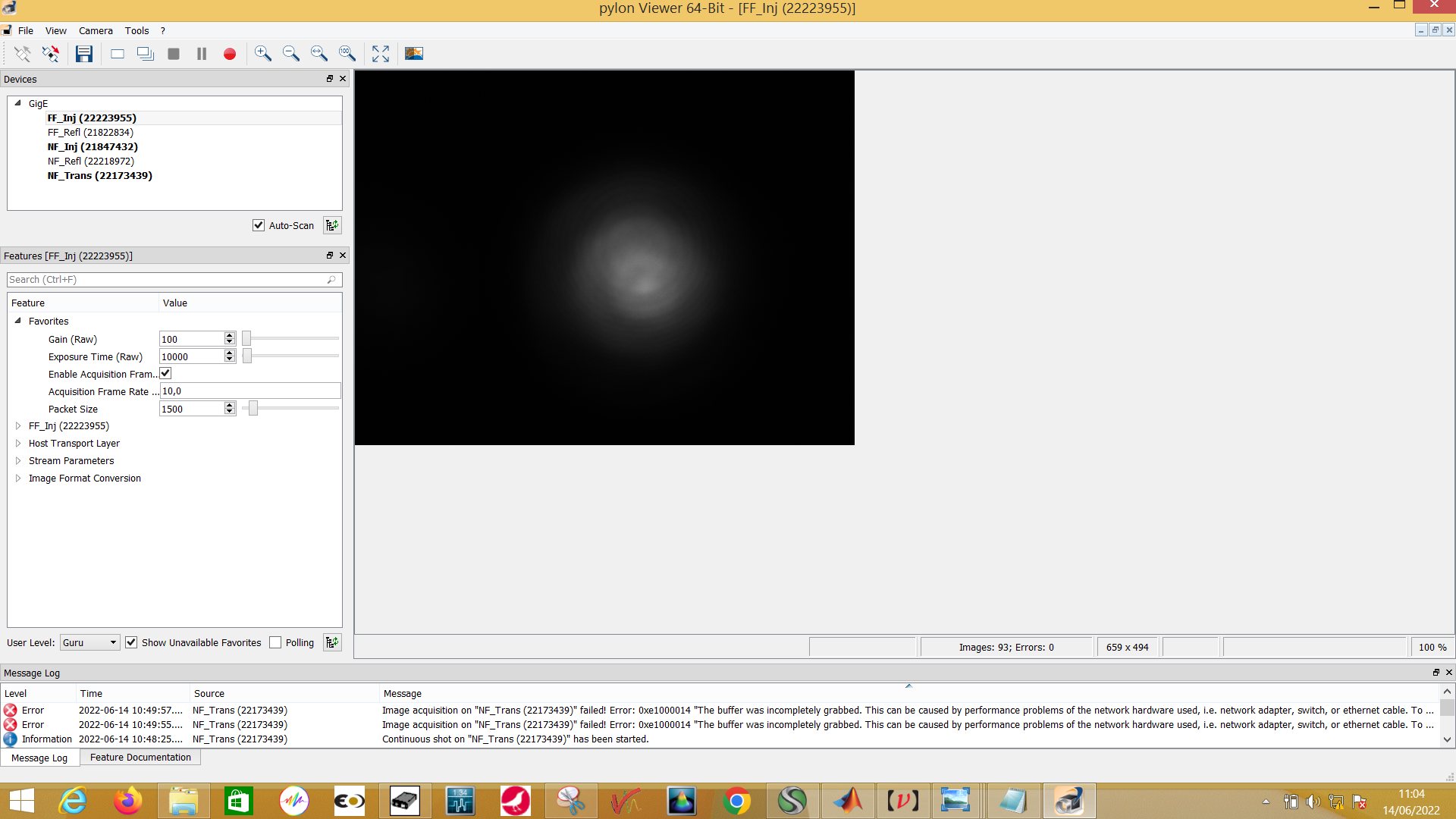
- Pas de beating de mode alors que l'on est sur les références d'injection
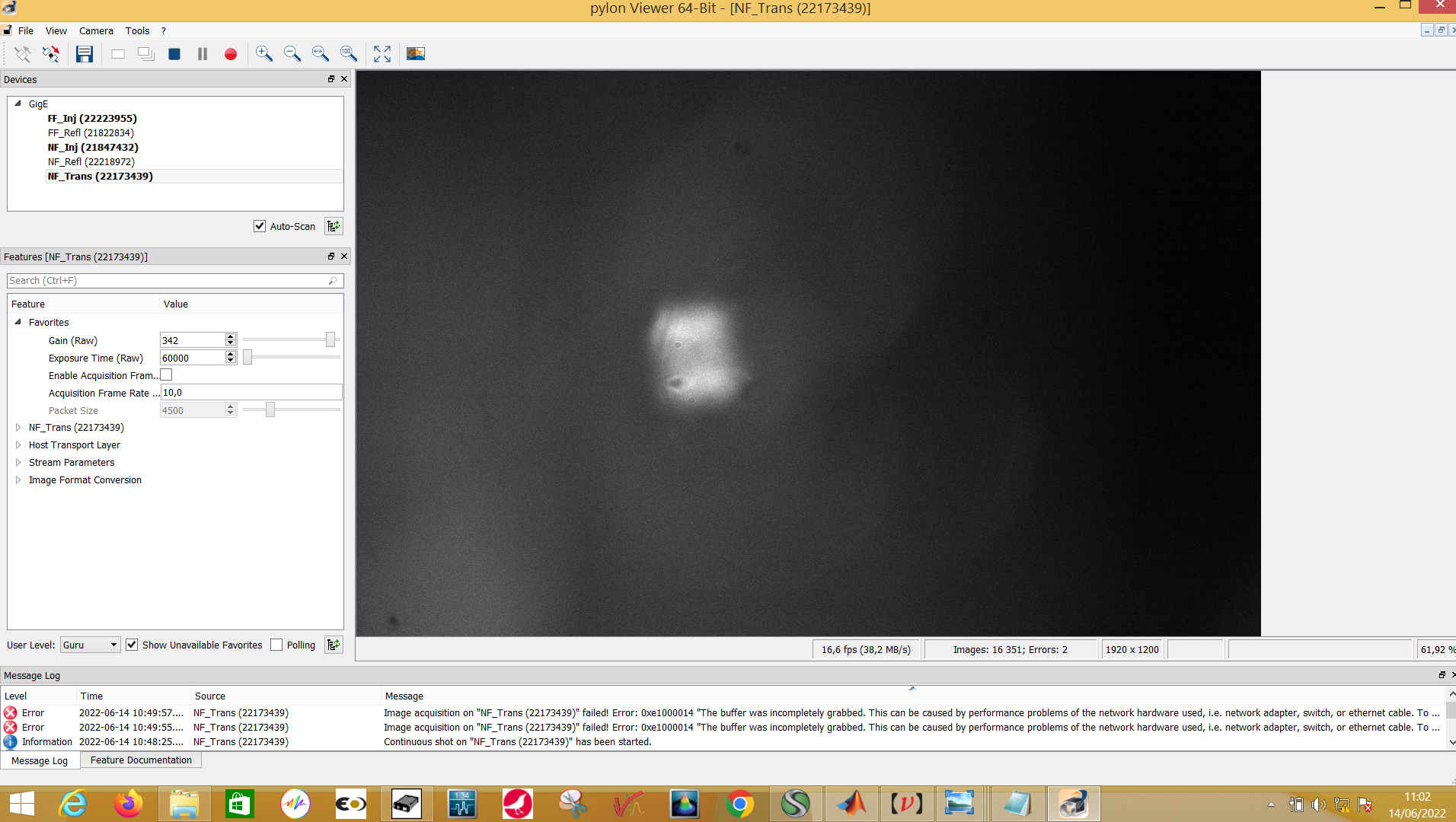
- Faisceau carré en transmission
- Les softs étaient ouverts et la clé de la lockline tournée en position laser alors que j'avais tout fermé à la fin des manips et mis en standby...
|
| Attachment 1: Transmission.PNG
|
 |
| Attachment 2: NF_inj.PNG
|
 |
| Attachment 3: FF_inj.PNG
|
 |
|
57
|
Tue Jan 10 18:04:20 2023 |
Blanc | Fixed | info | lasers and optics | Optical room | Données pour la baisse en cadence |
Position Cam :
692;363 NF_inj
520;193 FF_inj
Position Moteurs :
5.085435
5.085435
-2.9
-2.9
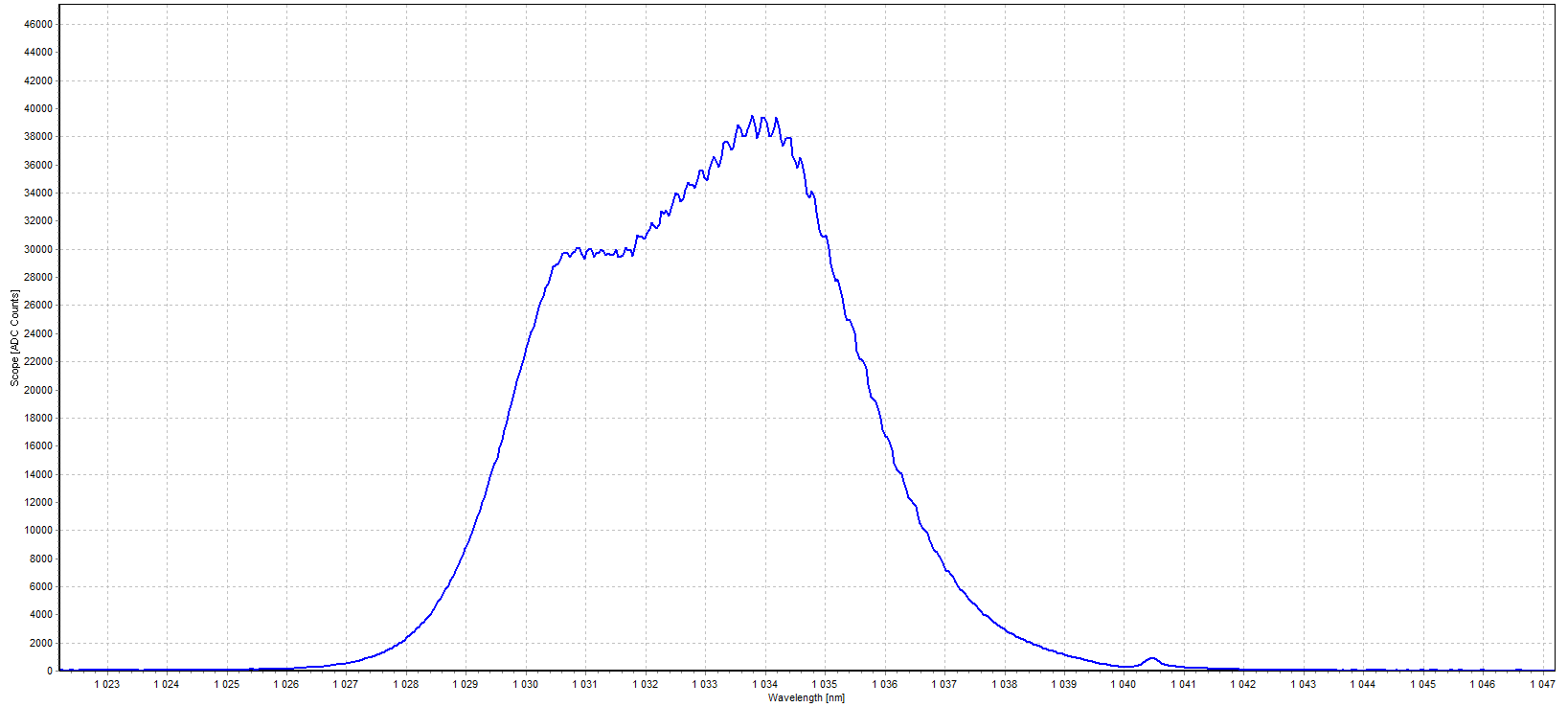
Spectre de l'oscillateur ~6 nm largeur (correct, cf image)
Durée d'impulsion : 3.35 ps (cf image)
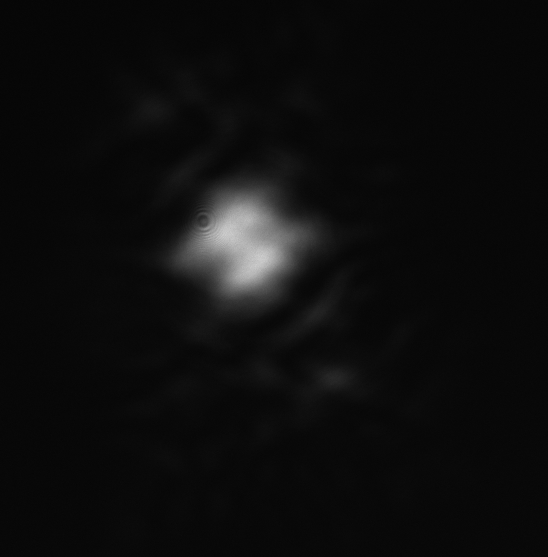
On peut également voir que la forme du mode TEM00 a changé (cf image sur la caméra de transmission), dû à un endommagement d'un/des miroirs de la cavité. On voit également que rien n'est visible sur la caméra de réflection.
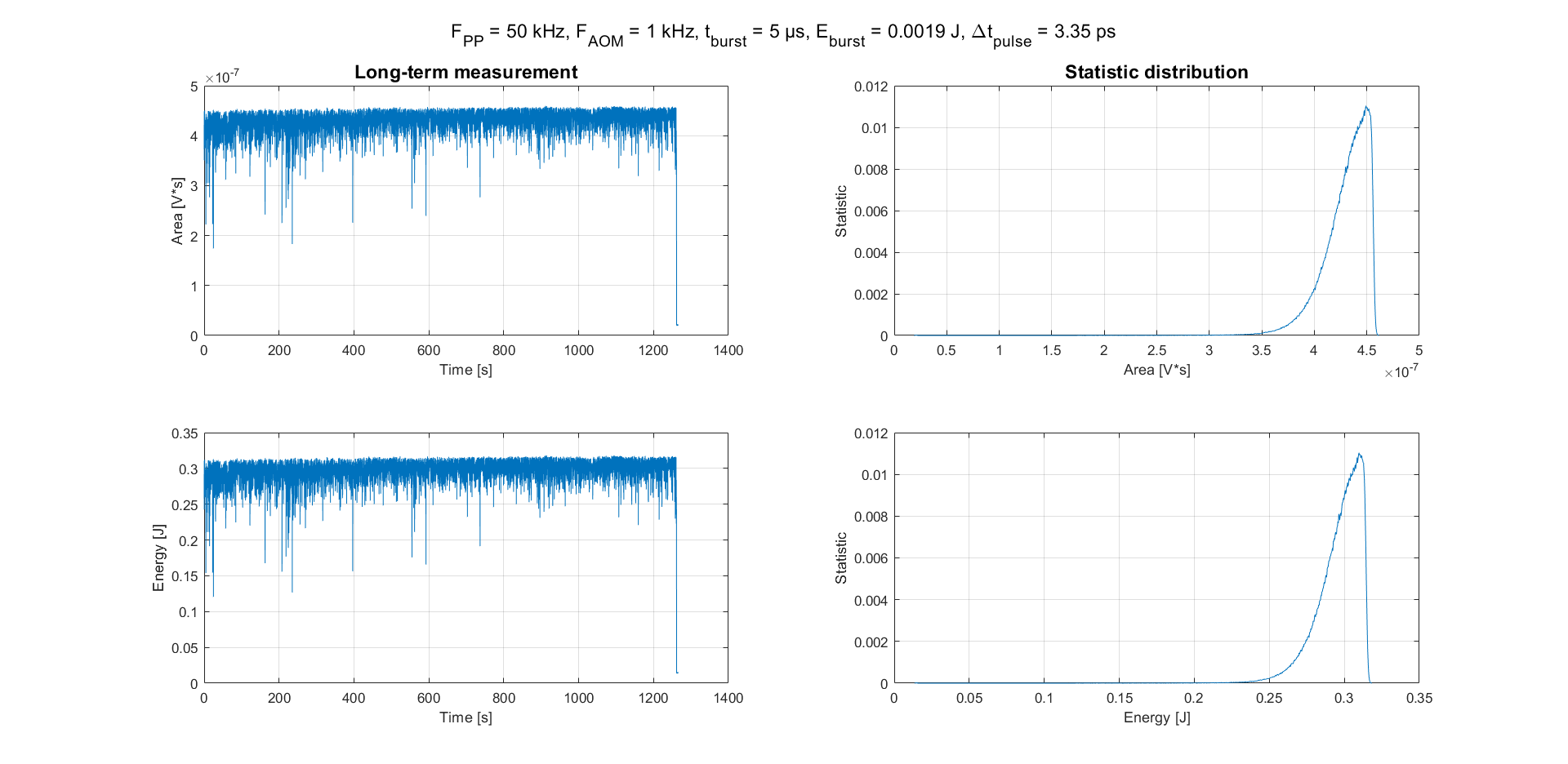
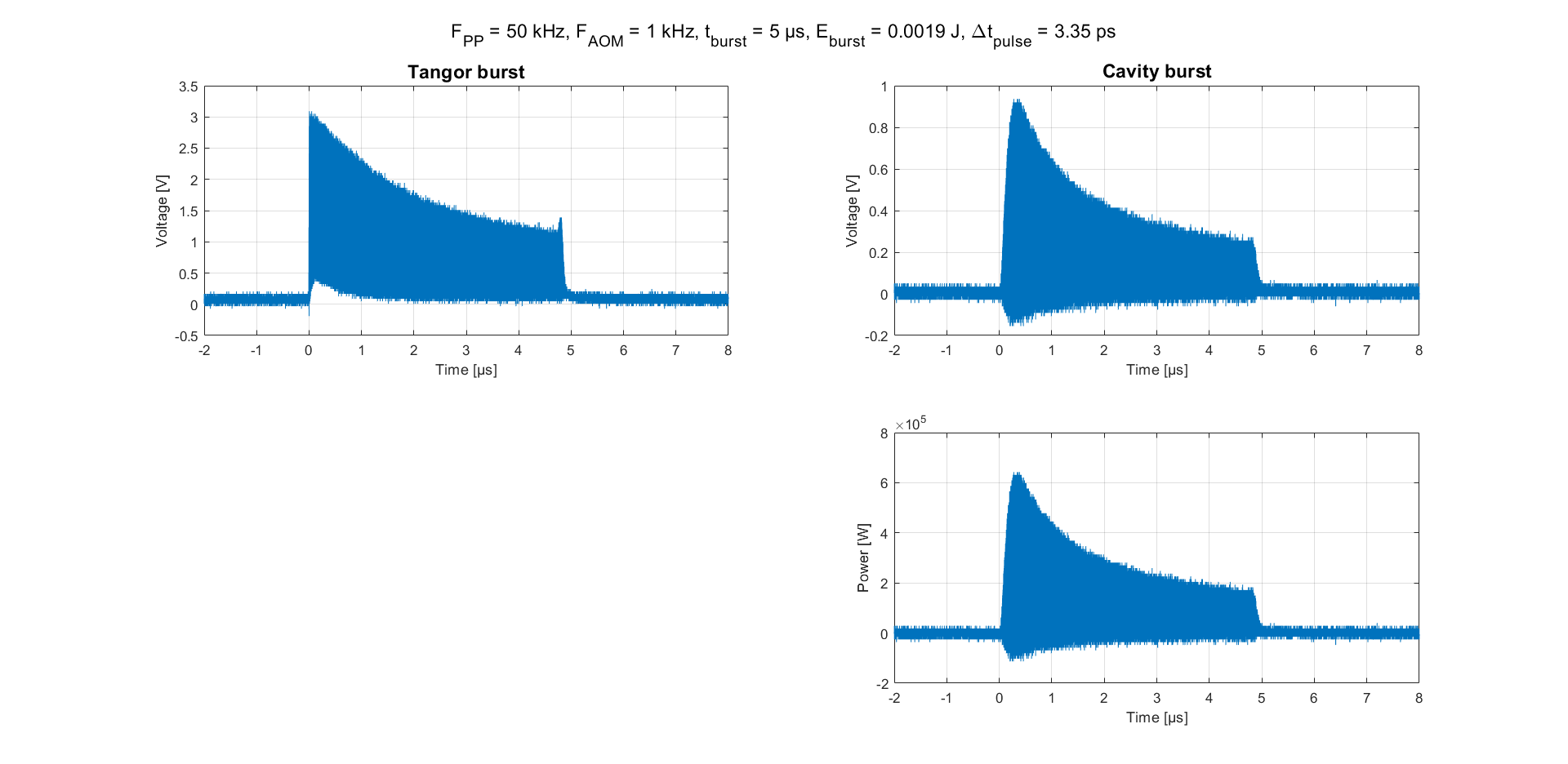
AOM 100 Hz , t_burst = 5 µs, PP 50 kHz : P_burst = 0.15 W, P_burst_PhD = 0.47 mW
AOM 100 Hz , t_burst = 5 µs, PP 50 kHz : P_burst = 0.25 W, P_burst_PhD = 0.75 mW
AOM 100 Hz , t_burst = 5 µs, PP 50 kHz : P_burst = 0.8 W, P_burst_PhD = 2.09 mW
J'ai également mis les mesures de long-term, ainsi que les burst correspondants. |
| Attachment 1: Spectre_oscillateur_GHz_10_01_2023.PNG
|
 |
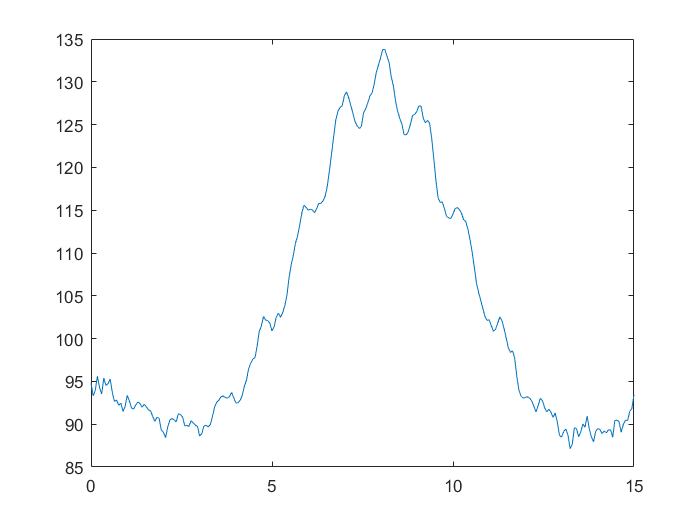
| Attachment 2: Pulse_Width_Compressor_10000µm_10_01_2023.png
|
 |
| Attachment 3: Mode_TEM00_lockline_lockée_après_cassage_cavité_trans2_10_01_2023.PNG
|
 |
| Attachment 4: Mode_TEM00_lockline_lockée_après_cassage_cavité_trans_10_01_2023.PNG
|
 |
| Attachment 5: Mode_TEM00_lockline_lockée_après_cassage_cavité_NF_refl_10_01_2023.PNG
|
 |
| Attachment 6: Long-term_Histo.png
|
 |
| Attachment 7: Tangor_and_Cavity_burst.png
|
 |
|
58
|
Wed Jan 18 17:52:33 2023 |
Blanc | Fixed | info | lasers and optics | Optical room | Tests et mesures lockline |
Mesures de puissance fibres lockline :
AVANT POLISSAGE
injection premier étage : 15 mW
sortie premier étage : 63 mW
Sortie AOM à 250 MHz : 2.5 mW
Sortie EOM : 1.3 mW
Sortie : 20 =>40 mW
APRES POLISSAGE
injection premier étage : 15 mW
sortie premier étage : 63 mW
Sortie AOM à 159 MHz : 2.9 mW Sortie AOM à 250 MHz : 15 mW
Sortie EOM : 1.5 mW Sortie EOM : ?
Sortie : 47 mW Sortie : 54 mW
Même après polissage de la fibre de sortie du premier étage, on observe que la puissance diminue d'un facteur 4 à travers l'AOM drivé à sa fréquence nominale. |
|
59
|
Thu Jan 19 14:56:27 2023 |
Blanc | Fixed | info | lasers and optics | Optical room | Tests et mesures lockline |
| Blanc wrote: |
|
Mesures de puissance fibres lockline :
AVANT POLISSAGE
injection premier étage : 15 mW
sortie premier étage : 63 mW
Sortie AOM à 250 MHz : 2.5 mW
Sortie EOM : 1.3 mW
Sortie : 20 =>40 mW
APRES POLISSAGE
injection premier étage : 15 mW
sortie premier étage : 63 mW
Sortie AOM à 159 MHz : 2.9 mW Sortie AOM à 250 MHz : 15 mW
Sortie EOM : 1.5 mW Sortie EOM : ?
Sortie : 47 mW Sortie : 54 mW
Même après polissage de la fibre de sortie du premier étage, on observe que la puissance diminue d'un facteur 4 à travers l'AOM drivé à sa fréquence nominale.
|
|
| Attachment 1: AOM_250_drivé_à_160_MHz_sortie_fibre_bleue.png
|
 |
| Attachment 2: schéma_mesures_lockline_18_01_2023.PNG
|
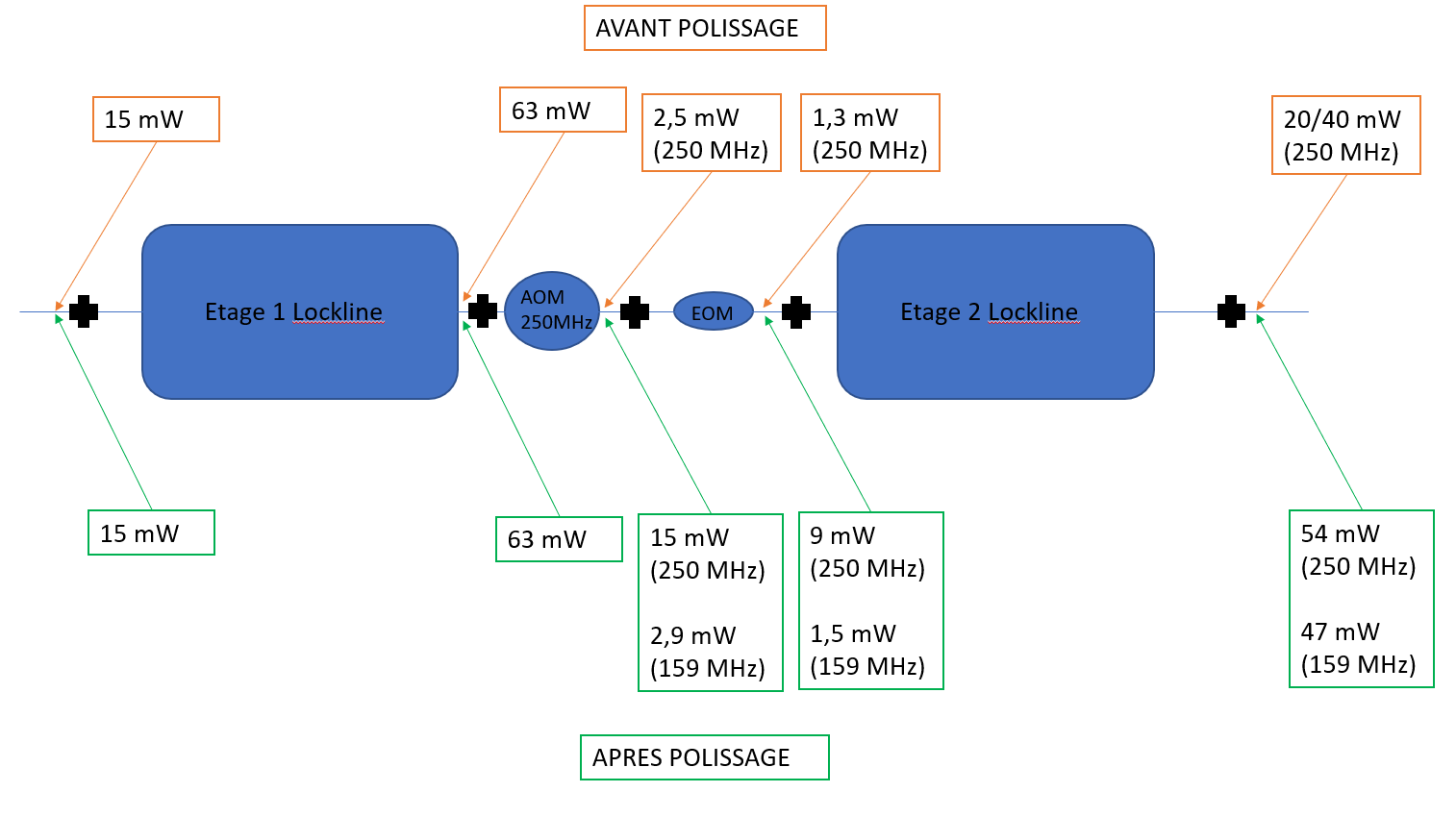 |
|
60
|
Thu Jan 19 15:05:58 2023 |
Blanc | Fixed | info | lasers and optics | Optical room | Suite Mesures de puissance lockline |
Changement d'AOM pour passer sur l'AOM 200 MHz.
Le schéma suivant récapitule les mesures prises.
Il y a eu une chute de la puissance en sortie de la fibre bleue de la lockline.
1) à la vue des mesures, il semble que le deuxieme etage de la lockline soit bien fatigué
2) La fibre bleue s'est déteriorée d'un seul coup...
Par contre il n'y a plus les modulations observées précédement sur la photodiode grâce au changement d'AOM, à la fois à 159 MHz et 200 MHz.
|
| Attachment 1: schéma_mesures_lockline_19_01_2023.PNG
|
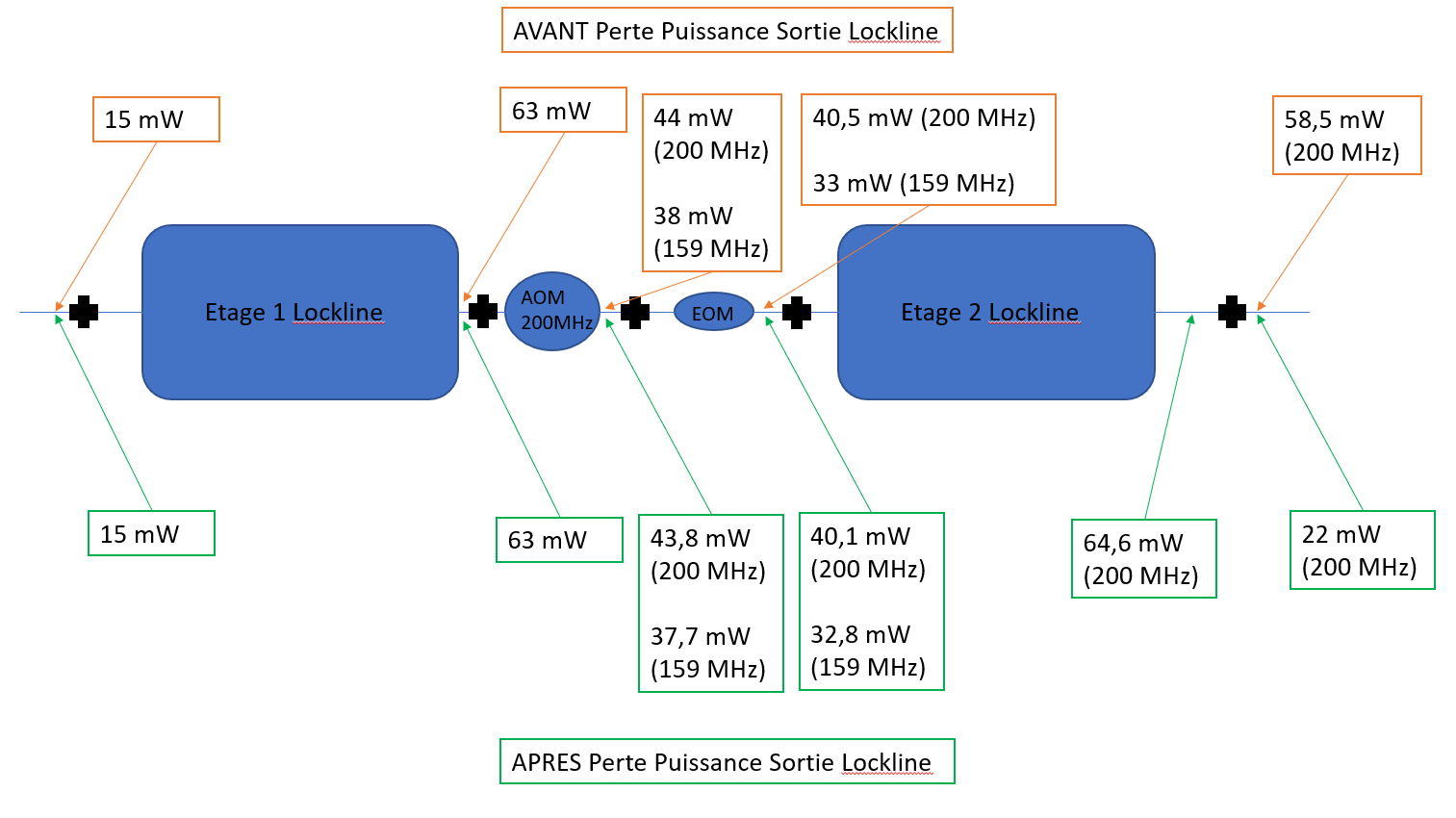 |
| Attachment 2: 20230119_124318.jpg
|
 |
|
61
|
Thu Jan 19 18:20:02 2023 |
Blanc | Fixed | info | lasers and optics | Optical room | Suite Mesures de puissance lockline |
| Blanc wrote: |
|
Changement d'AOM pour passer sur l'AOM 200 MHz.
Le schéma suivant récapitule les mesures prises.
Il y a eu une chute de la puissance en sortie de la fibre bleue de la lockline.
1) à la vue des mesures, il semble que le deuxieme etage de la lockline soit bien fatigué
2) La fibre bleue s'est déteriorée d'un seul coup...
Par contre il n'y a plus les modulations observées précédement sur la photodiode grâce au changement d'AOM, à la fois à 159 MHz et 200 MHz.
|
Repolissage de la fibre bleue et de la fibre de sortie du deuxieme étage.
Fin des manips :
sortie deuxieme étage : 60 mW
sortie fibre bleue : entre 50 et 55 mW |
|
62
|
Fri Jan 20 18:01:22 2023 |
Blanc | Fixed | info | lasers and optics | Optical room | Mesure de finesse |
Fréquence centrale : 879.48 MHz
FWHM mesurée à la main sans sweep : 120 / 130 KHz
=> Finesse = FSR/FWHM = ~7000
Apporter un analyseur de spectre pour régler le sweep du Marconi pour une mesure de finesse plus précise. |
|
63
|
Wed Jan 25 12:12:36 2023 |
Blanc | Fixed | info | lasers and optics | Optical room | Mesure de finesse |
| Blanc wrote: |
|
Fréquence centrale : 879.48 MHz
FWHM mesurée à la main sans sweep : 120 / 130 KHz
=> Finesse = FSR/FWHM = ~7000
Apporter un analyseur de spectre pour régler le sweep du Marconi pour une mesure de finesse plus précise.
|
On a pu mesurer la FWHM à l'aide du sweep : 124kHz
On obtient une finesse de 7300 en ayant traité les données. |
| Attachment 1: Mesure_de_finesse.png
|
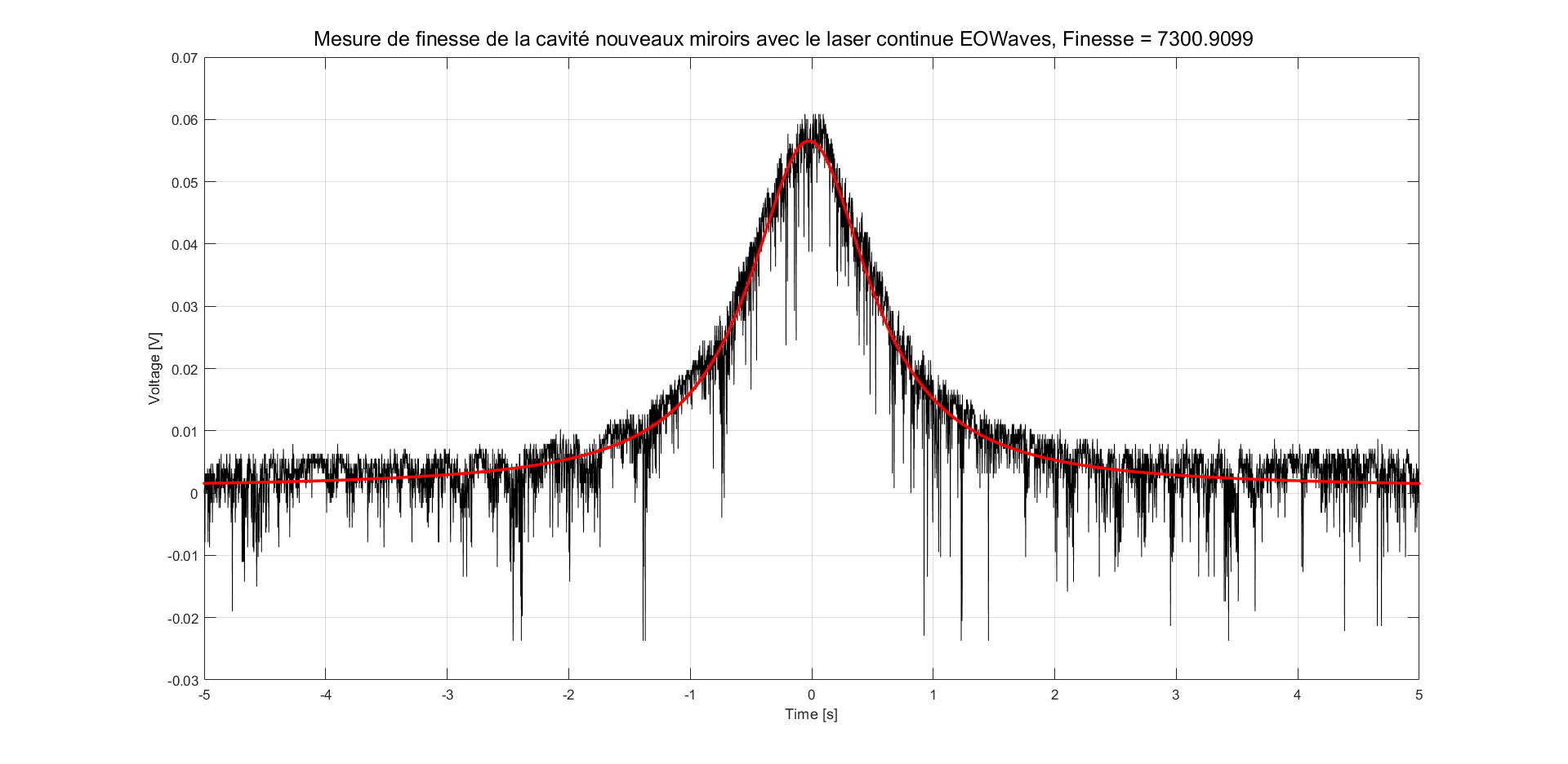 |
|
64
|
Wed Jan 25 12:18:25 2023 |
Blanc | Fixed | info | lasers and optics | Optical room | Position des miroirs et gain photodiode |
Nouvelle position des miroirs :
5.198865 ; 5.199305 ; -2.9 ; -2.9
Photodiode de transmission, gain de 60, 1MOhm osc : 2.5 V
Photodiode de transmission, gain de 50, 1MOhm osc : 800 mV |
|
65
|
Thu Jan 26 22:49:46 2023 |
Blanc | Fixed | info | lasers and optics | Optical room | Nouvelles positions moteurs et calibrations camera |
Positions moteurs :
5.198865 ; 5.198596 ; -2.9 ; -2.9
Calibration caméras :
NF_inj : 957;616
FF_inj : 328;2790
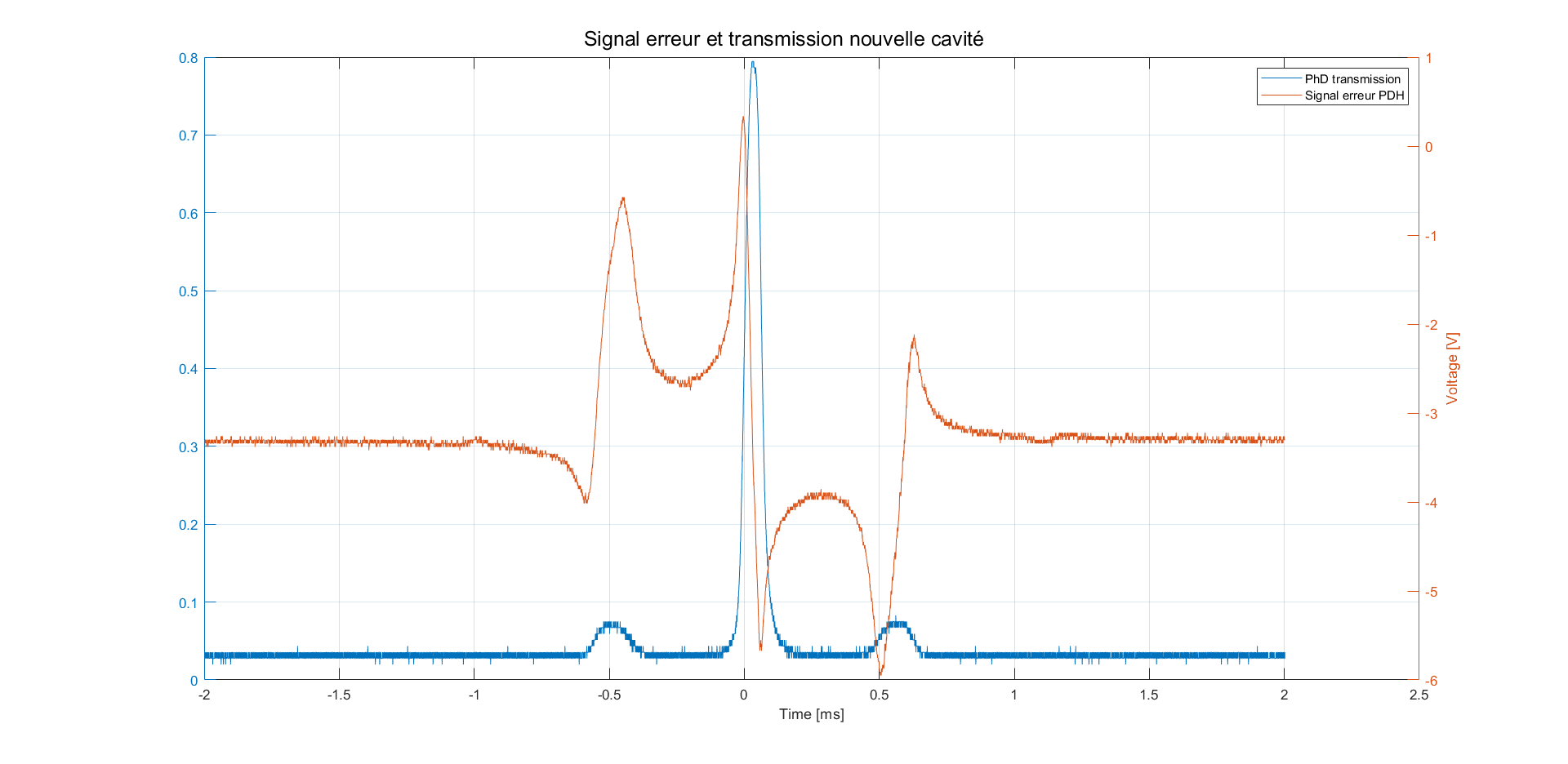
On a réussi à avoir un signal d'erreur très proche de la théorie, ainsi qu'un lock très propre. (Cf images)
En regardant laTF de la lockline, on a vu la modulation à +ou- 159 MHz autour du pic à 880 MHz de l'oscillateur GHz, mais cela n'explique pas l'offset sur le PDH.
Hypohèse à vérifier : le câble d'alimentation du PDH qui est défectueux. |
| Attachment 1: Lock_lockline.png
|
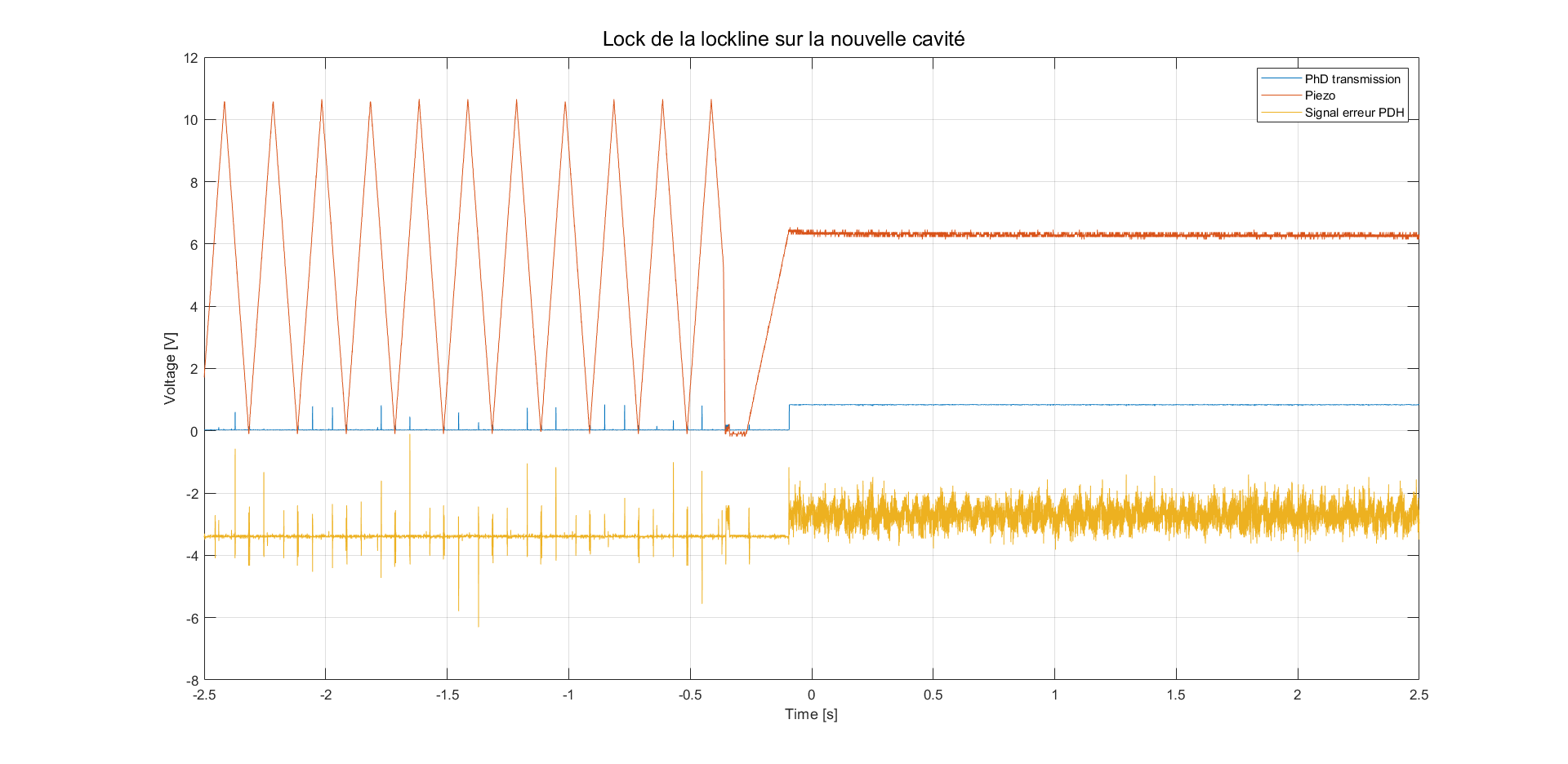 |
| Attachment 2: Signal_d'erreur_PDH.png
|
 |
|
66
|
Mon Jan 30 14:39:52 2023 |
Blanc | Fixed | info | lasers and optics | Optical room | Mesures de Polarisation |
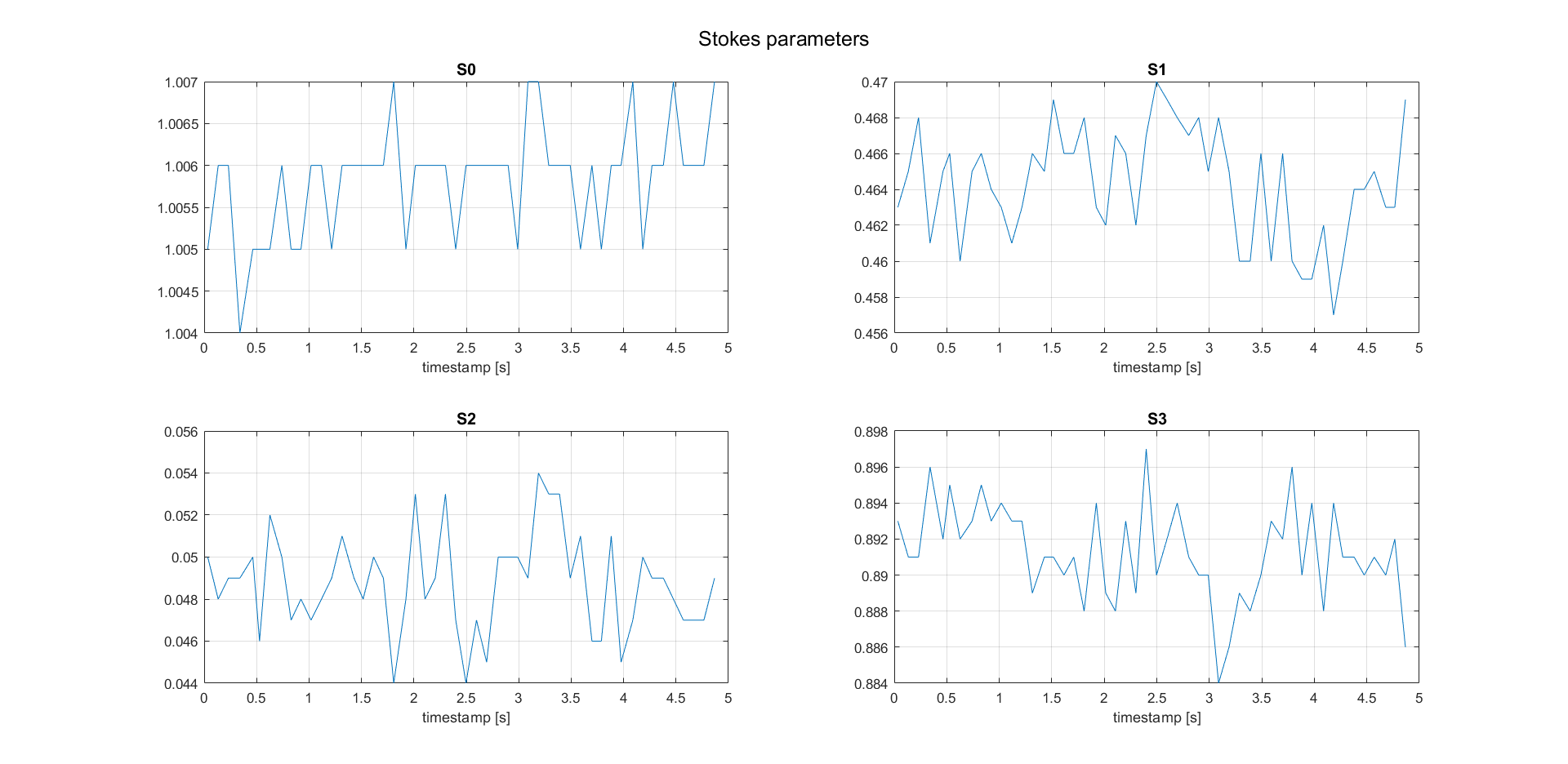
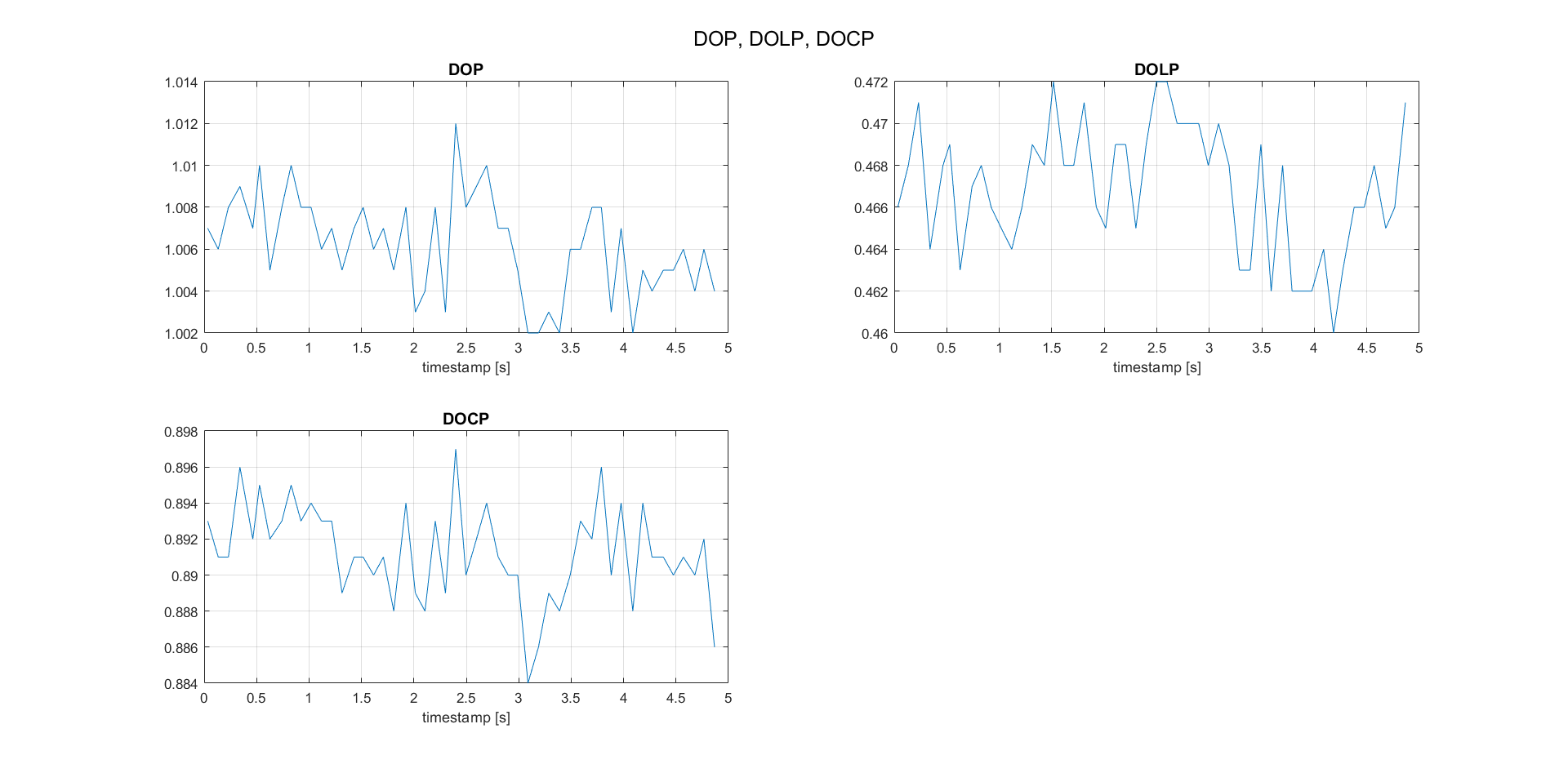
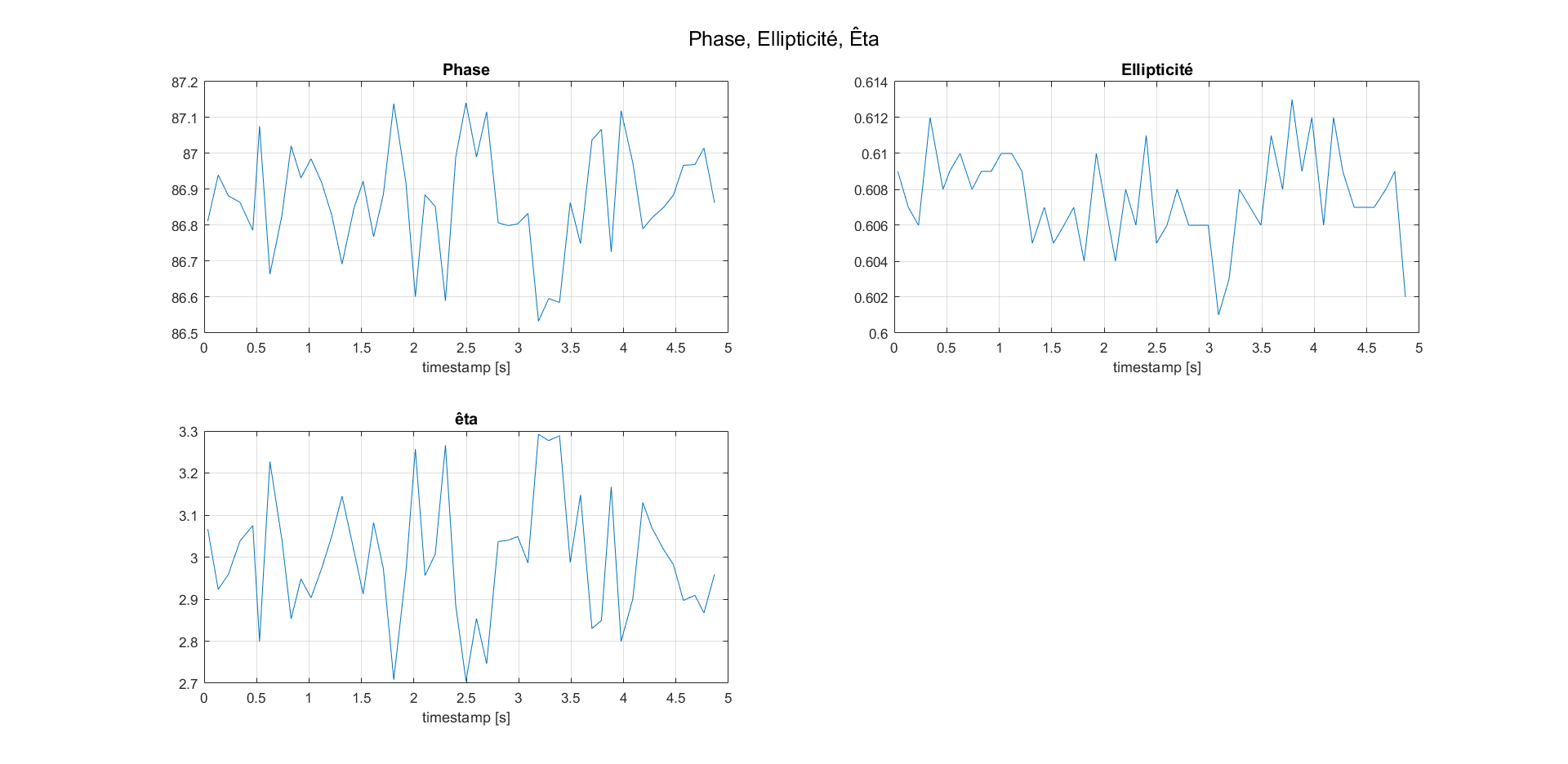
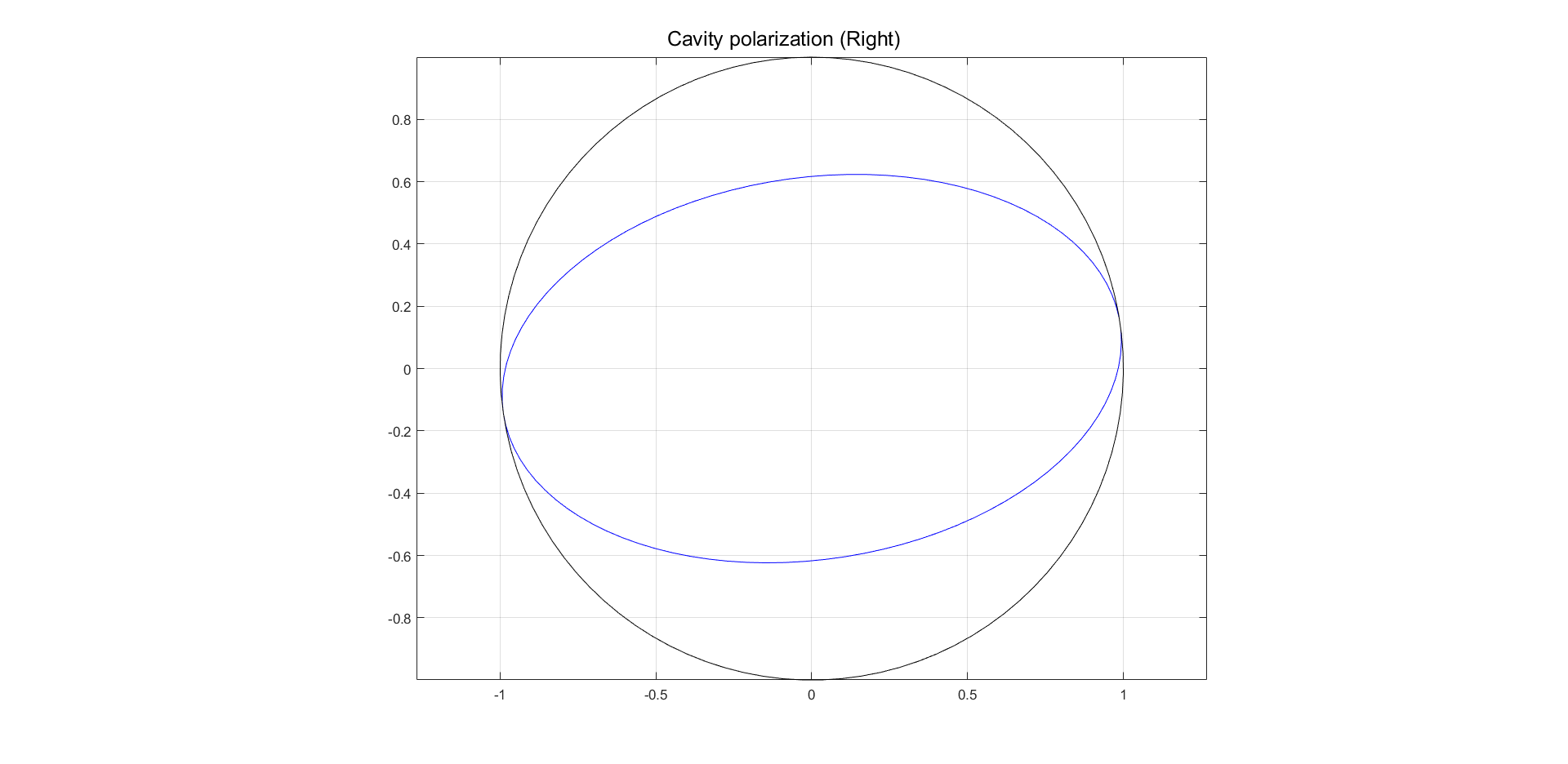
En récupérant la transmission du miroir M3 sphérique sortant de la cavité, on a pu faire une mesure de polarisation de la cavité. (Cf courbes ci-dessous)
La moyenne pour chaque courbe donne :
S0 = 1.0058 ; S1 = 0.4643 ; S2 = 0.0488 ; S3 = 0.8913
DOP = 1.0062 ; DOLP = 0.4669 ; DOCP = 0.8913
Phase = 86.8705° ; Ellipticité = 0.6076 ; Êta = 2.9962
Température de la tête du polarimètre : 39.9815
Par reconstruction, on obtient l'ellipse donnée en bleu ci-dessous. |
| Attachment 1: Paramètres_de_Stokes.png
|
 |
| Attachment 2: DOP_DOLP_DOCP.png
|
 |
| Attachment 3: Phase_Ellipticité_Êta.png
|
 |
| Attachment 4: Ellipse_polarisation_cavité.png
|
 |
|
67
|
Thu Feb 2 16:06:54 2023 |
Blanc | Fixed | info | lasers and optics | Optical room | Mesures de Polarisation |
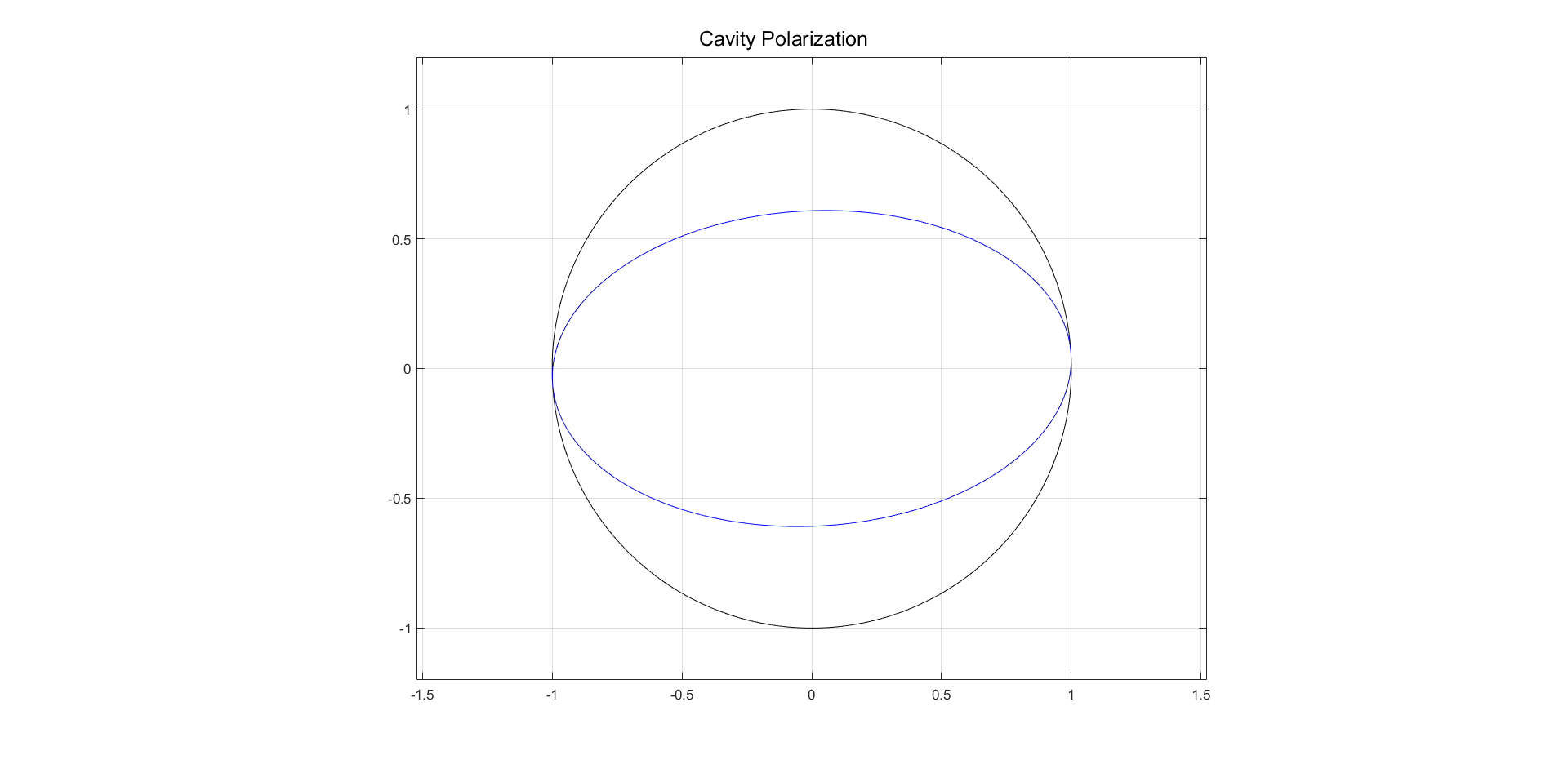
Correction su l'orientation de l'ellipse.
| Blanc wrote: |
|
En récupérant la transmission du miroir M3 sphérique sortant de la cavité, on a pu faire une mesure de polarisation de la cavité. (Cf courbes ci-dessous)
La moyenne pour chaque courbe donne :
S0 = 1.0058 ; S1 = 0.4643 ; S2 = 0.0488 ; S3 = 0.8913
DOP = 1.0062 ; DOLP = 0.4669 ; DOCP = 0.8913
Phase = 86.8705° ; Ellipticité = 0.6076 ; Êta = 2.9962
Température de la tête du polarimètre : 39.9815
Par reconstruction, on obtient l'ellipse donnée en bleu ci-dessous.
|
|
| Attachment 1: Ellipse_Polarization_CAVITY.png
|
 |
|
68
|
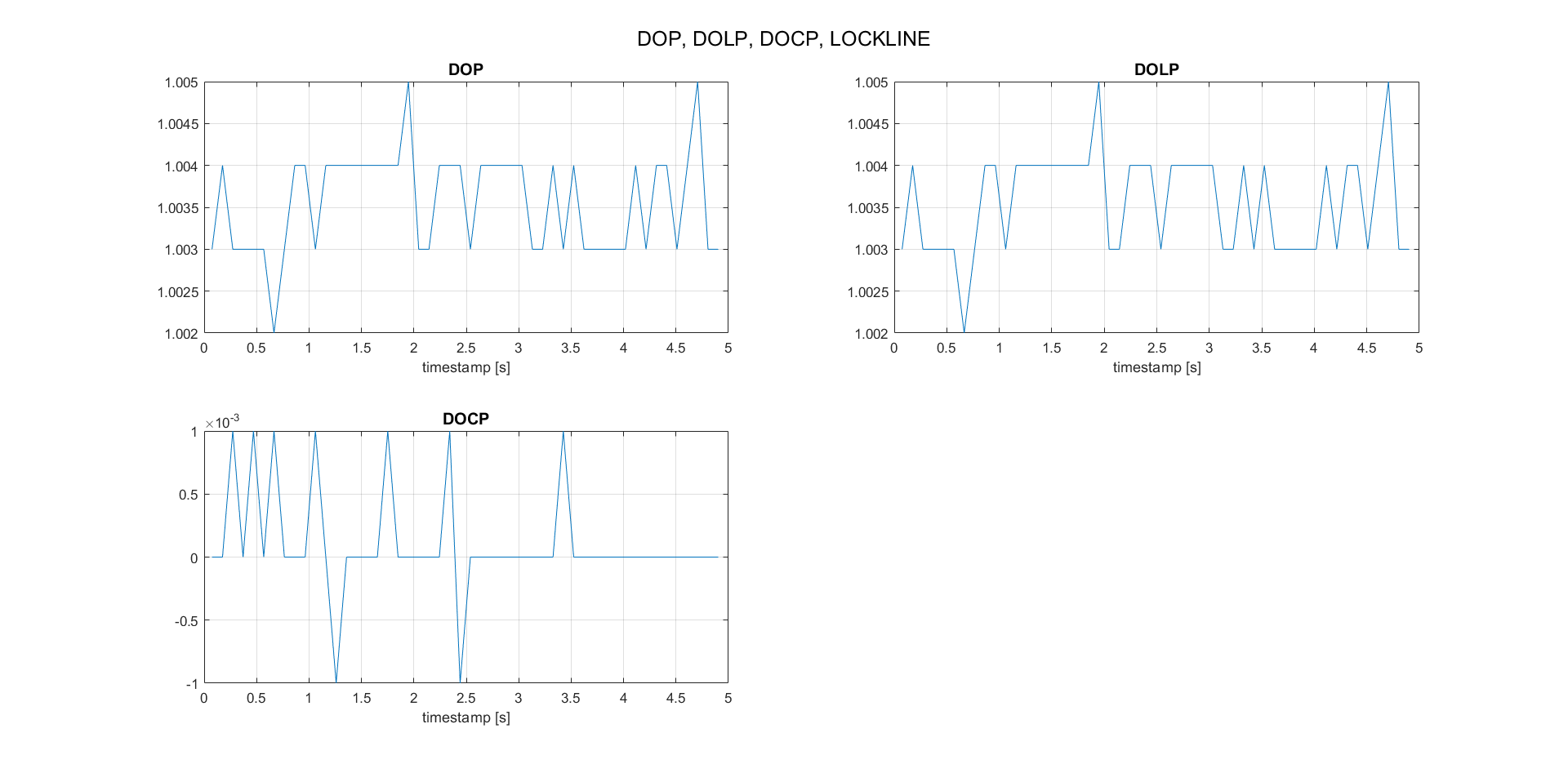
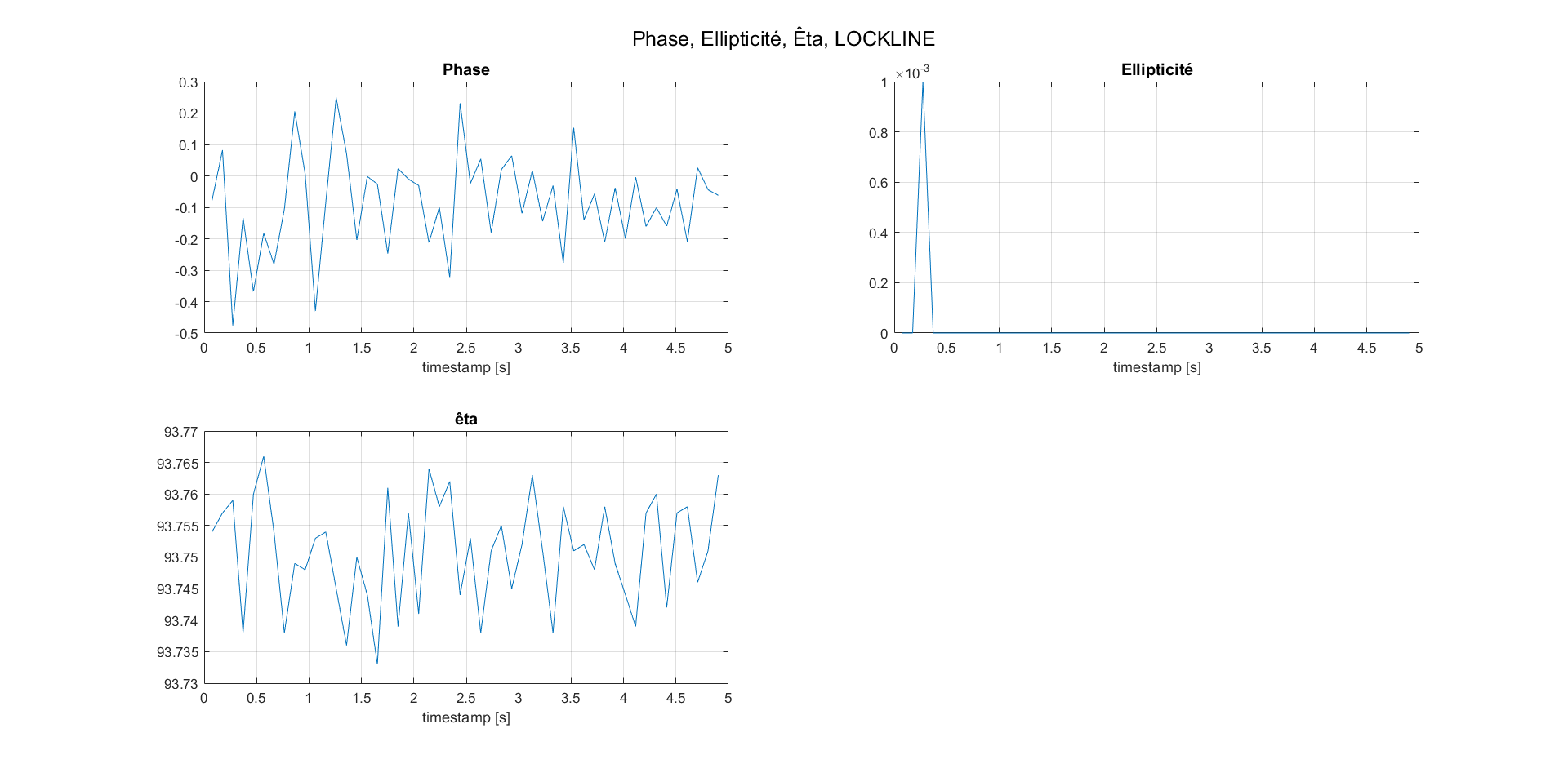
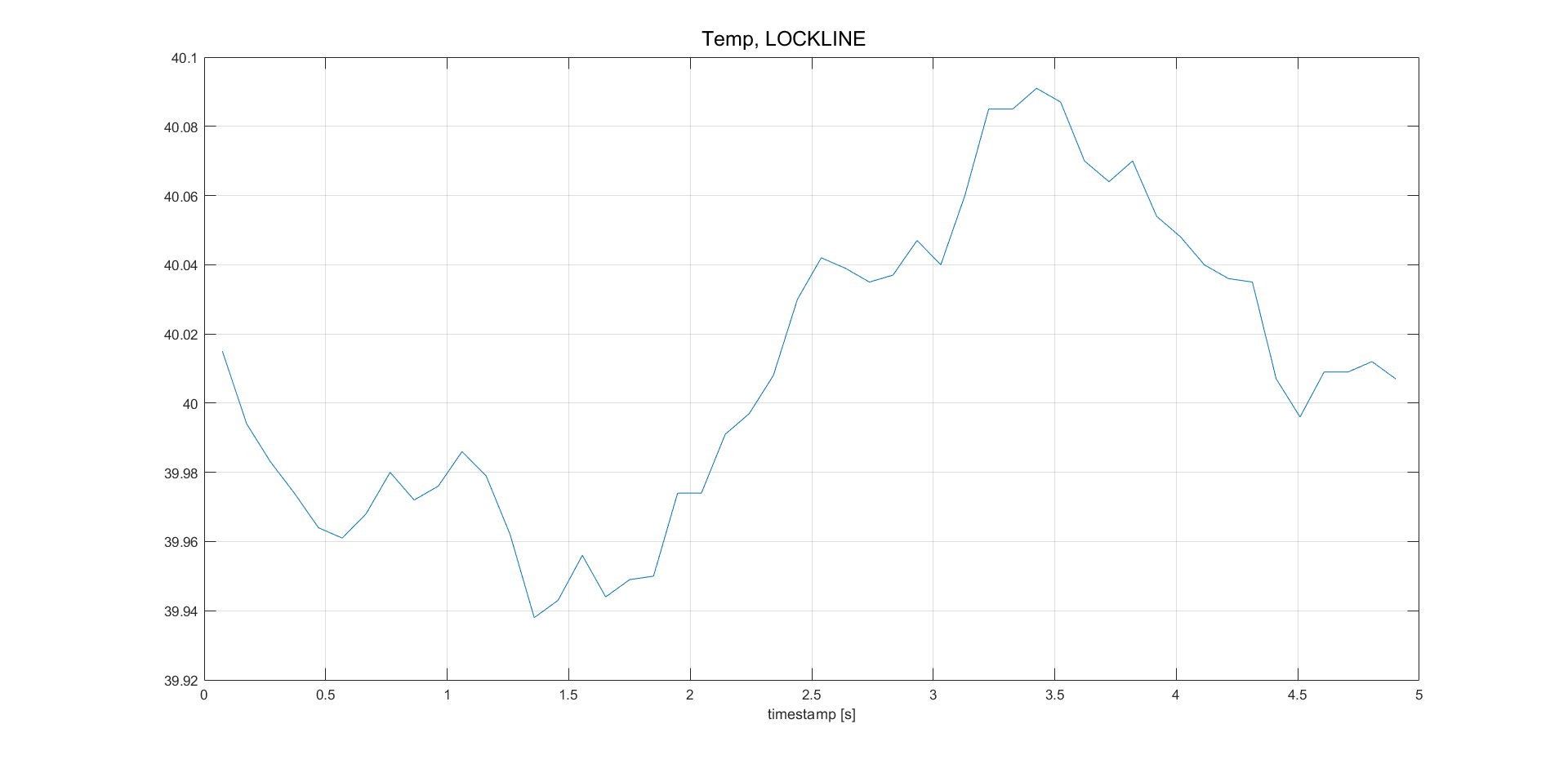
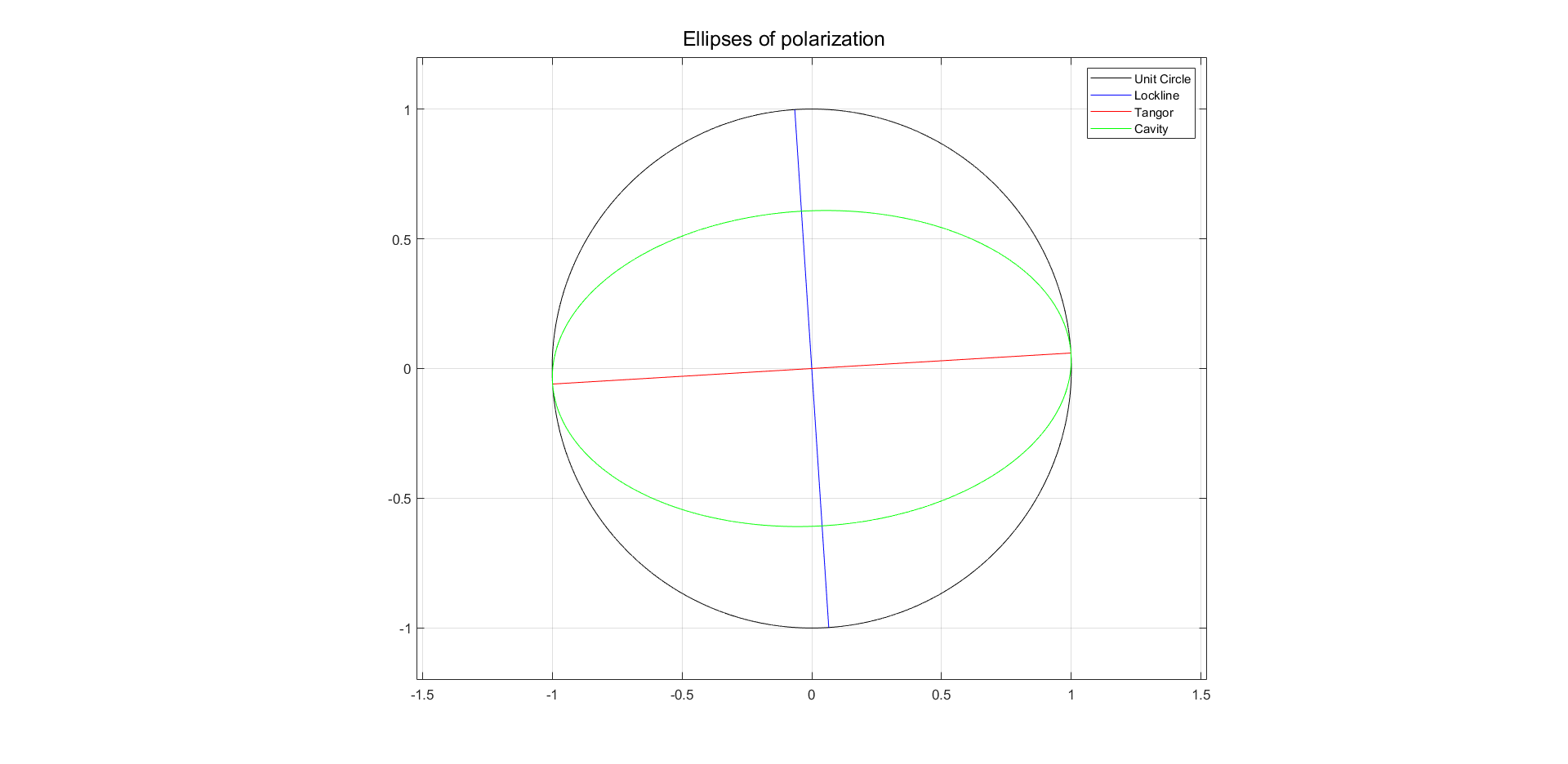
Thu Feb 2 16:21:05 2023 |
Blanc | Fixed | info | lasers and optics | Optical room | Mesures de Polarisation Lockline et Tangor |
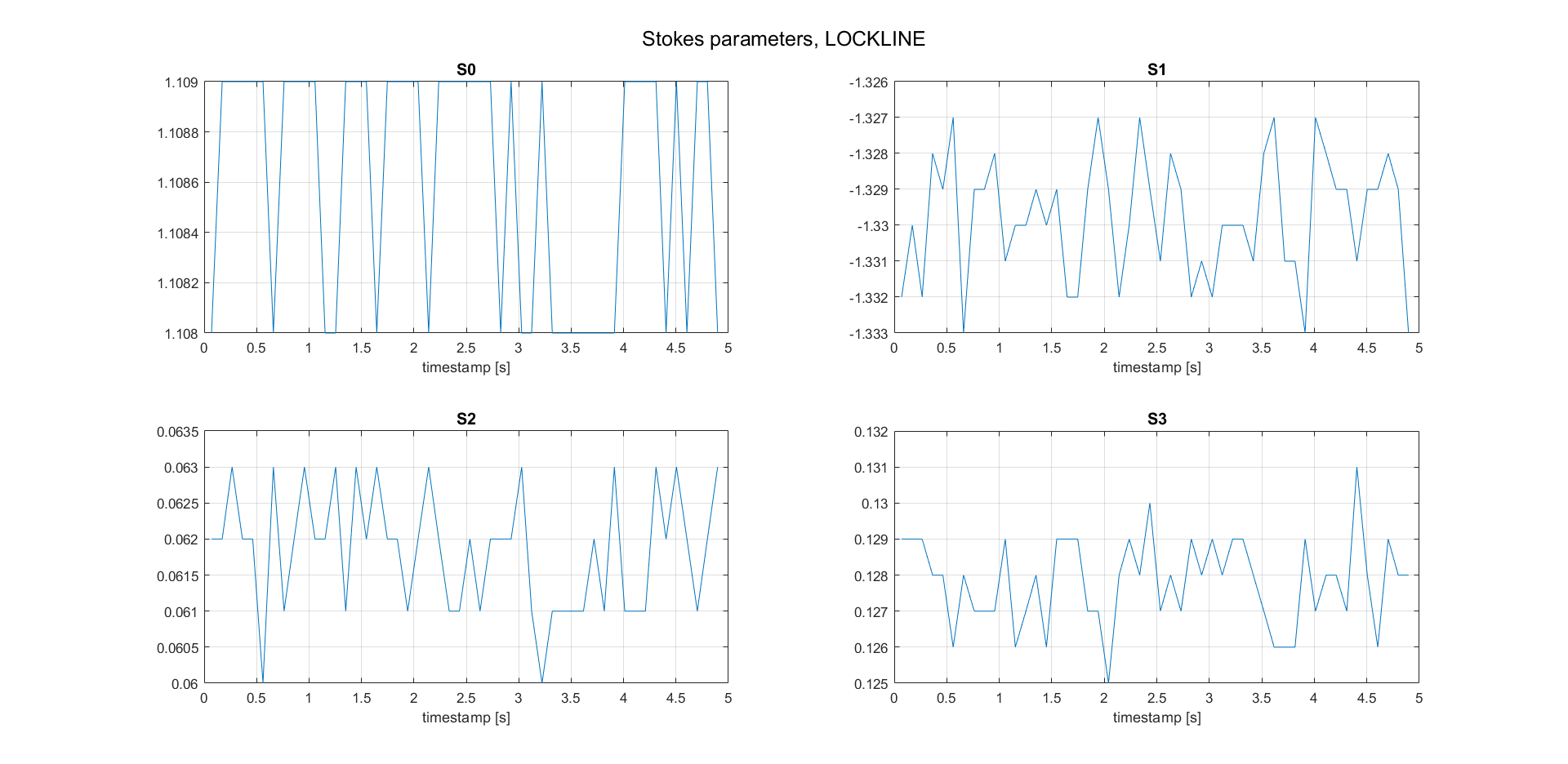
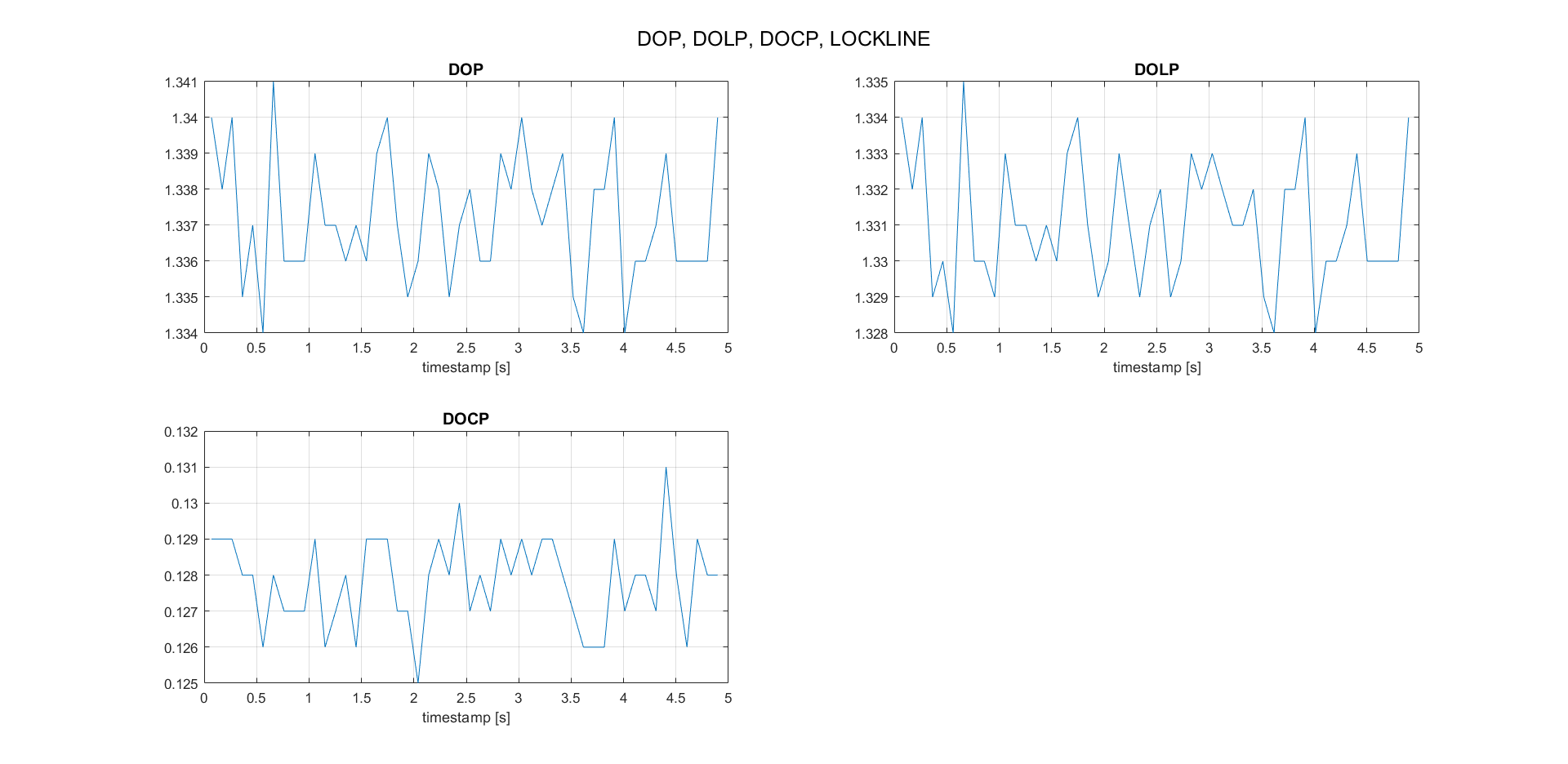
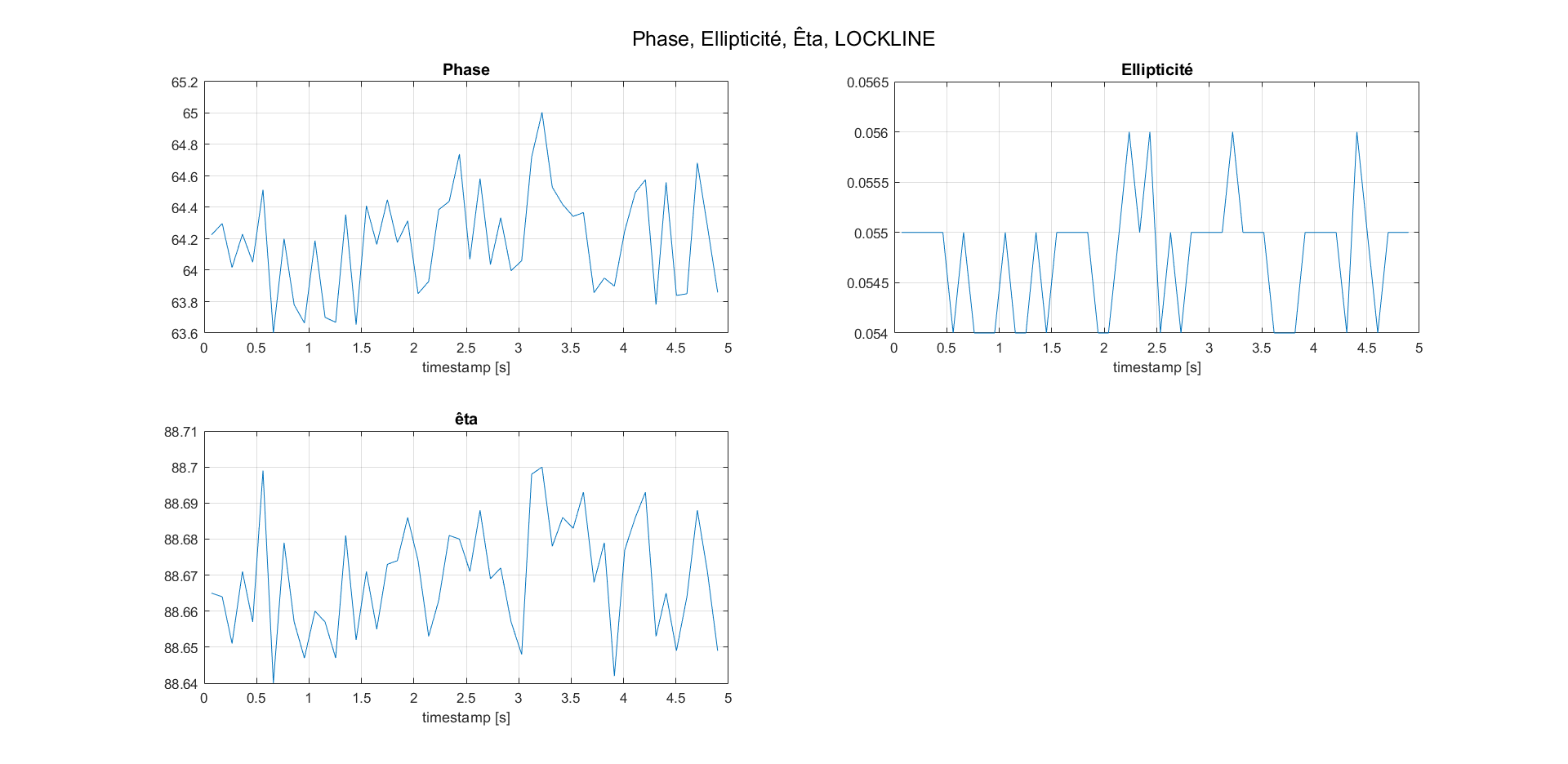
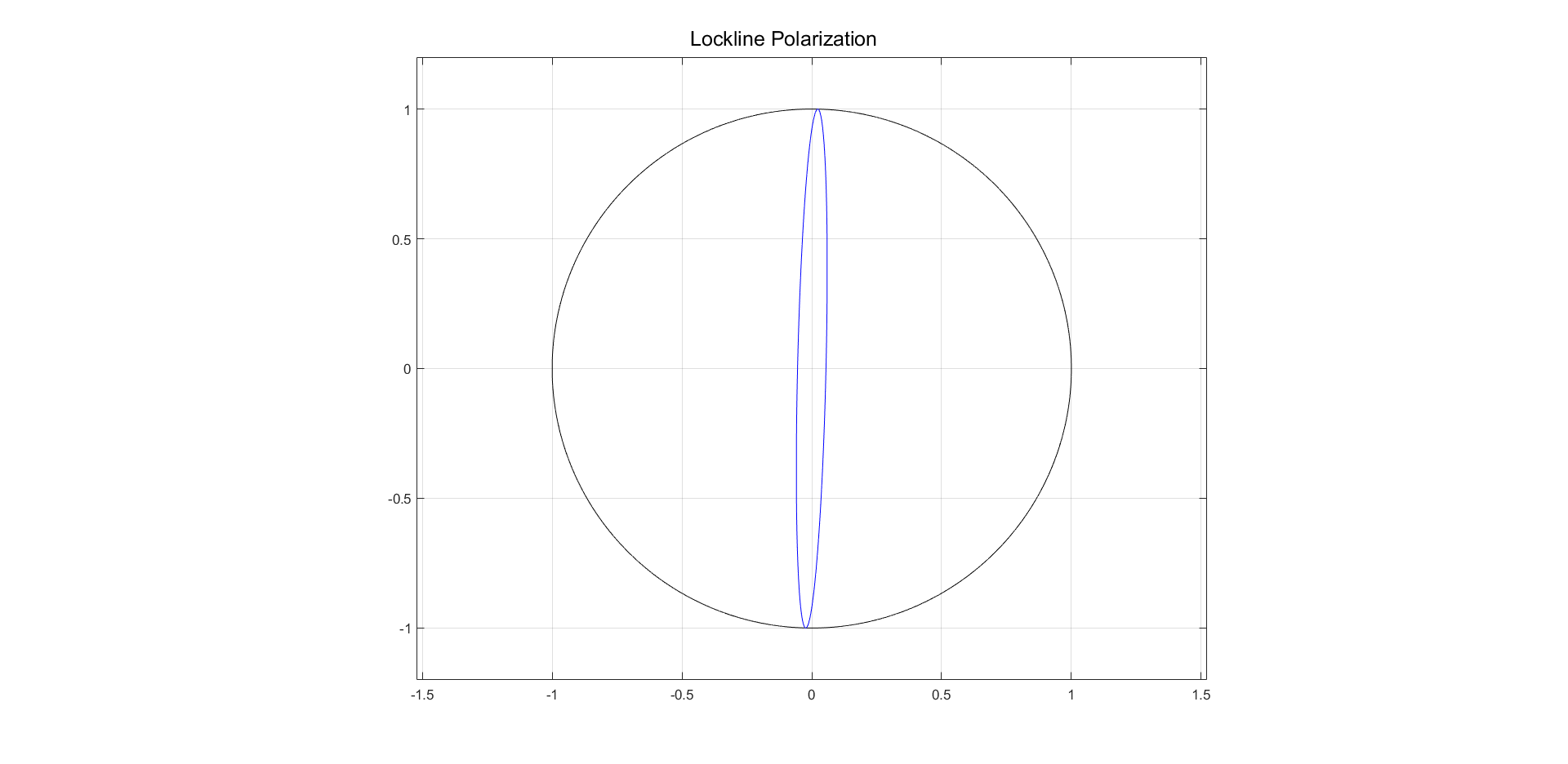
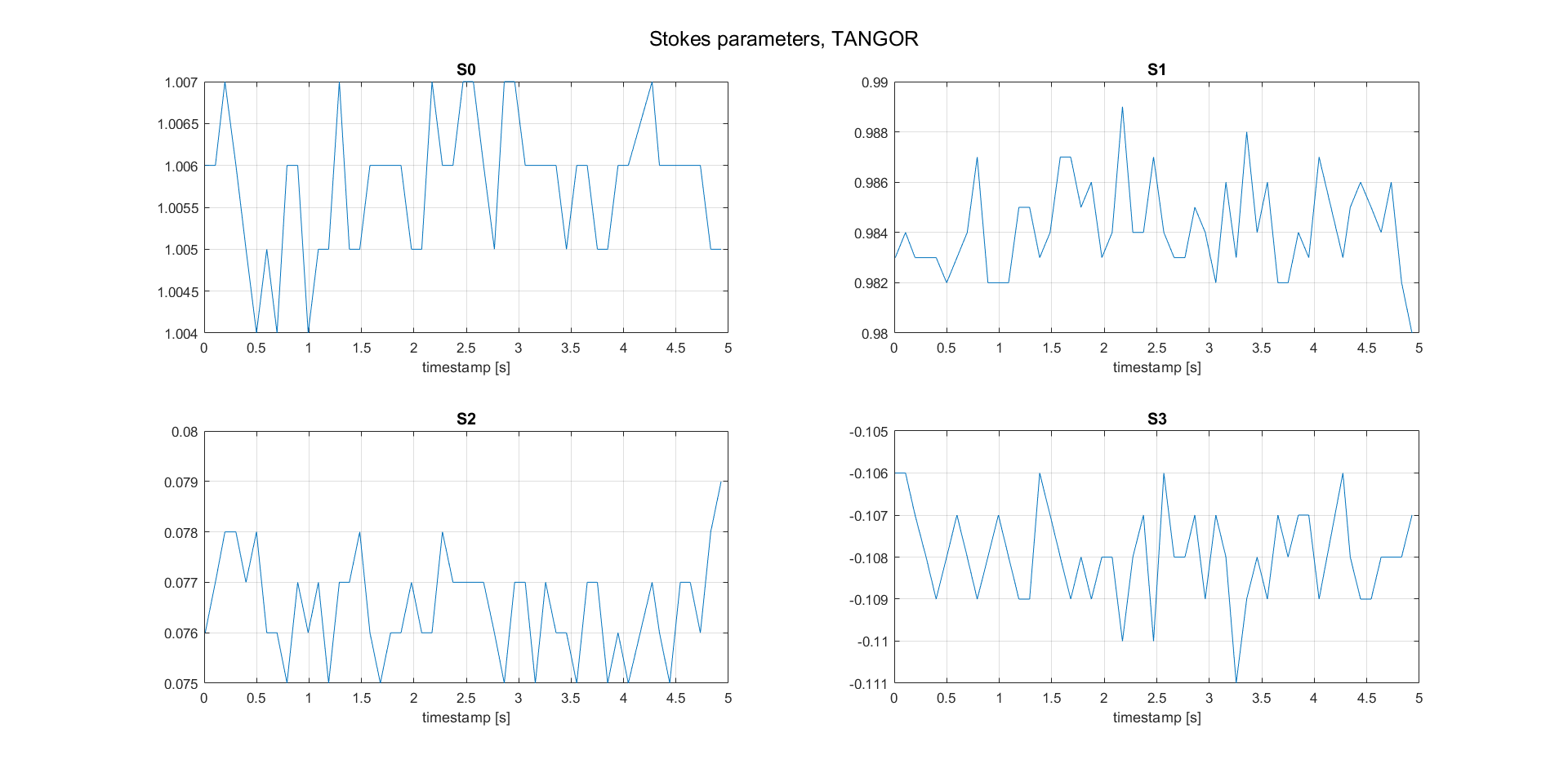
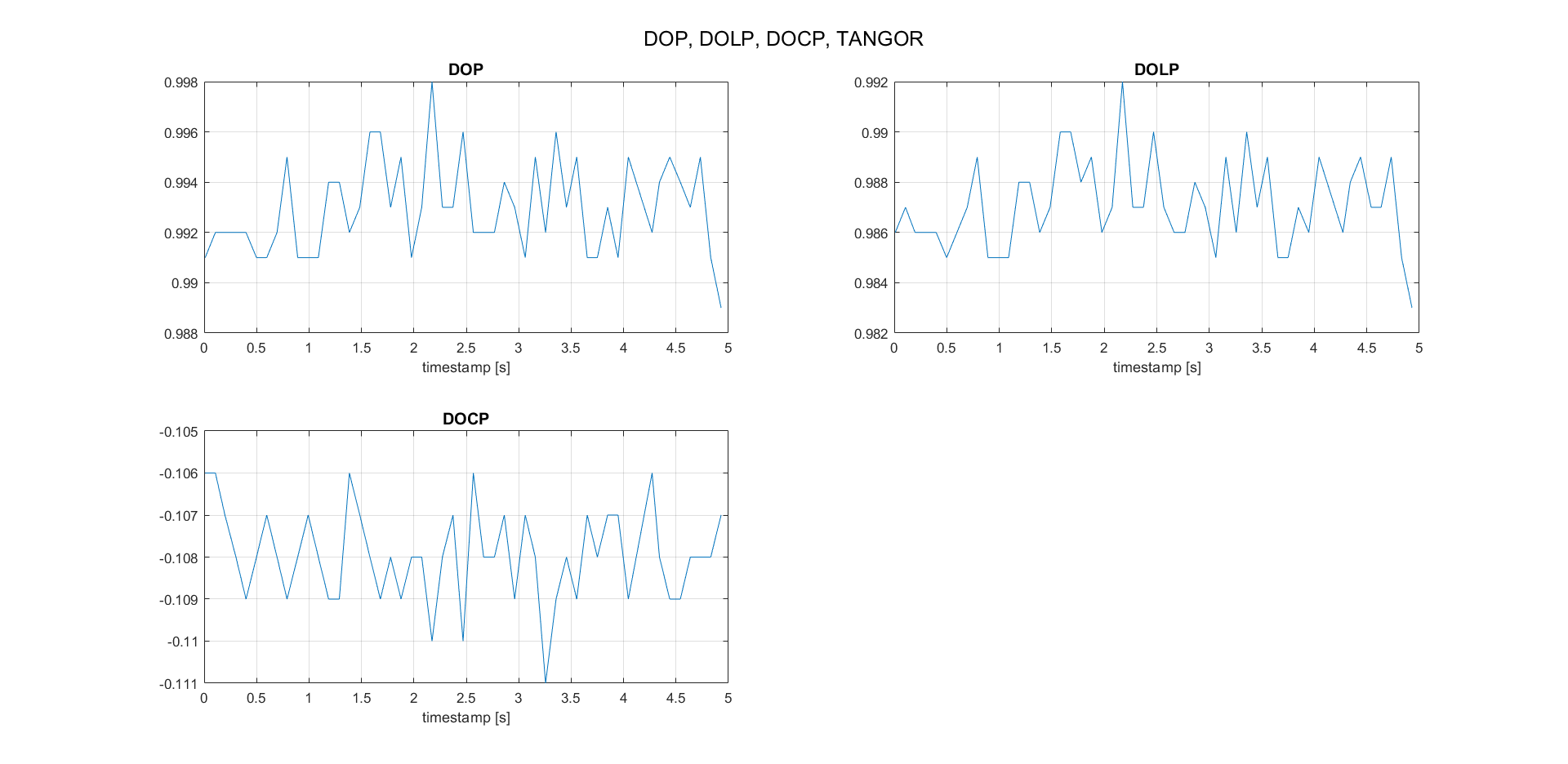
Vérification des polarisations après le combiner pour le Tangor et la Lockline.
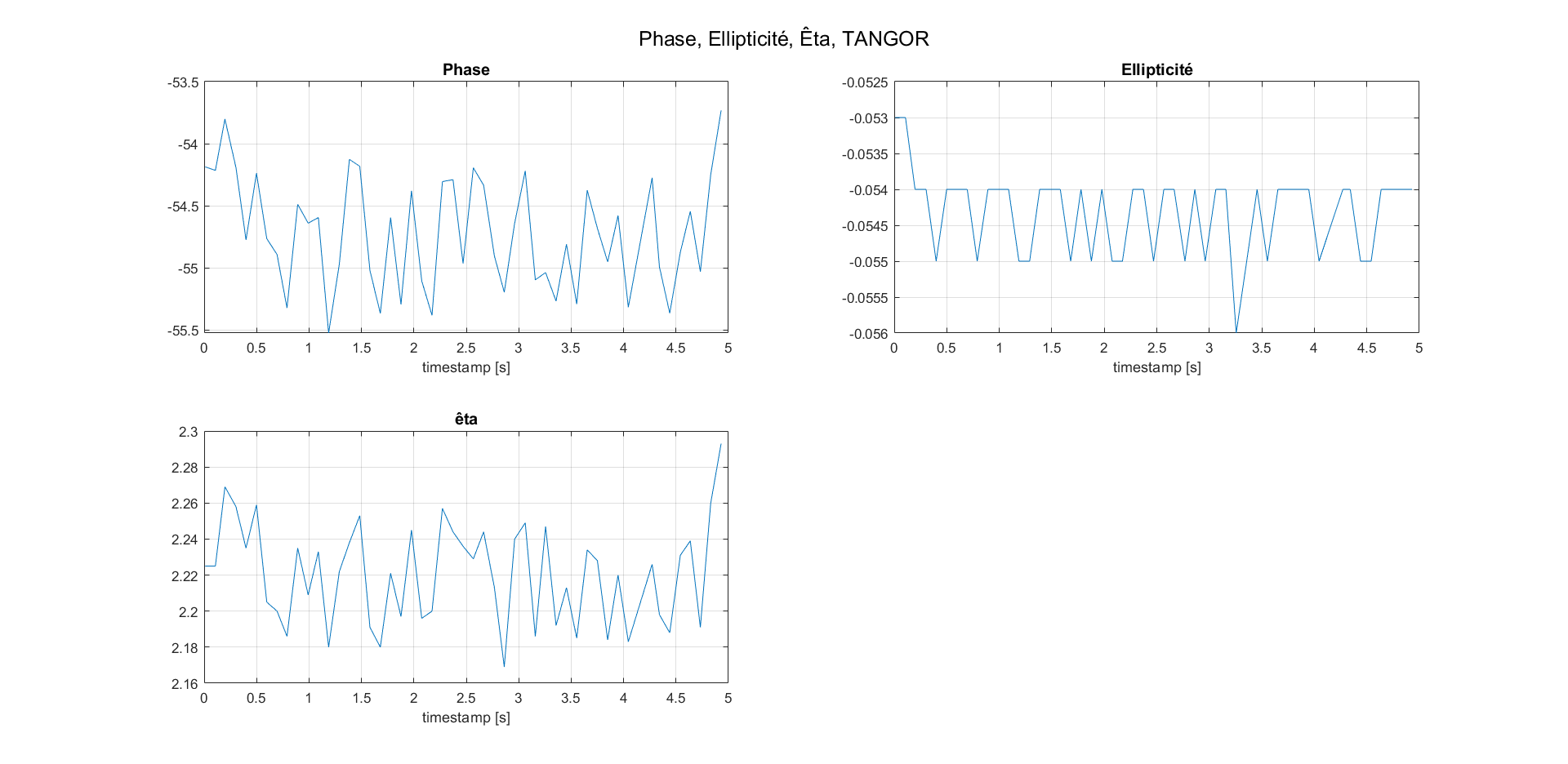
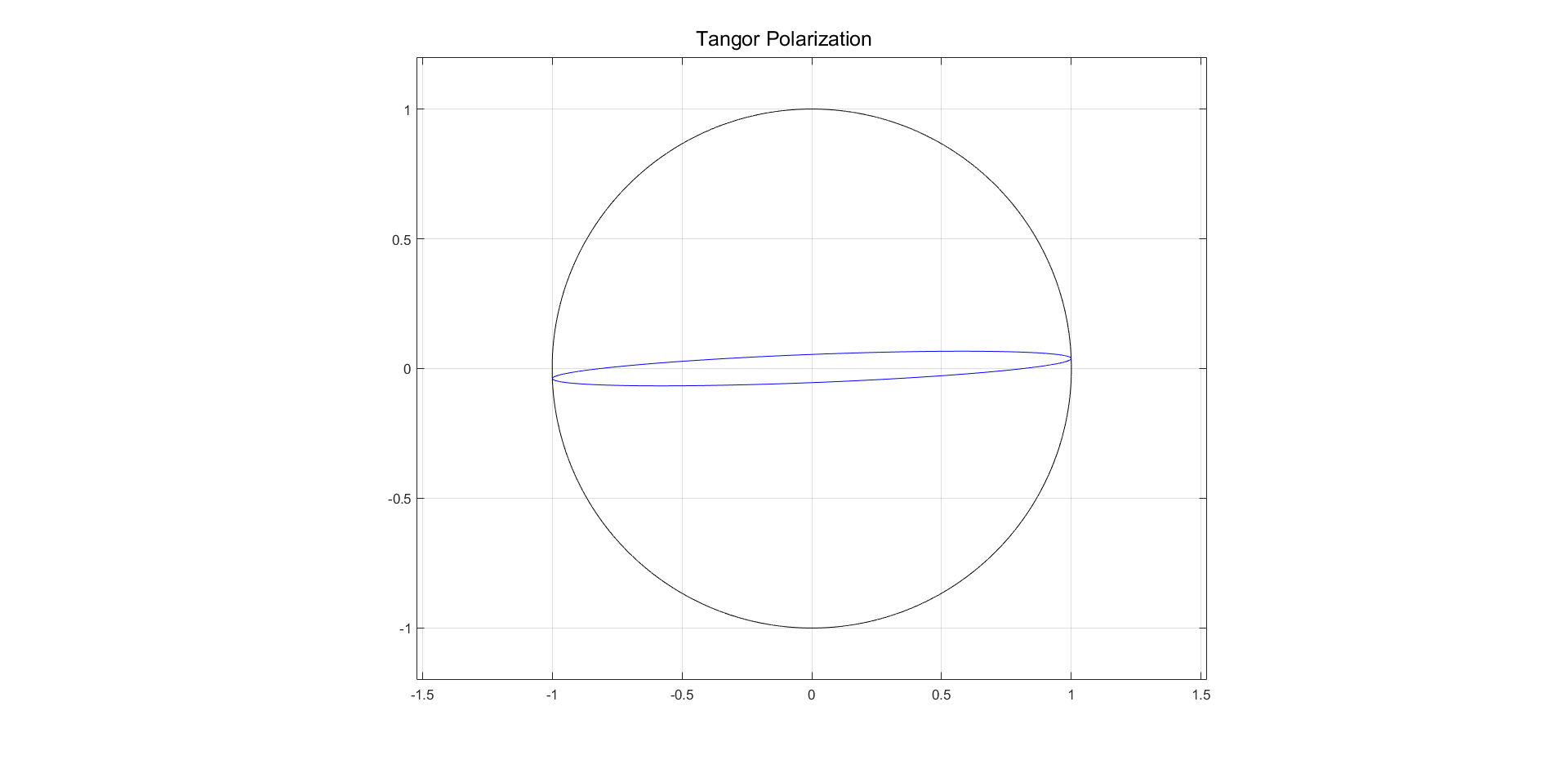
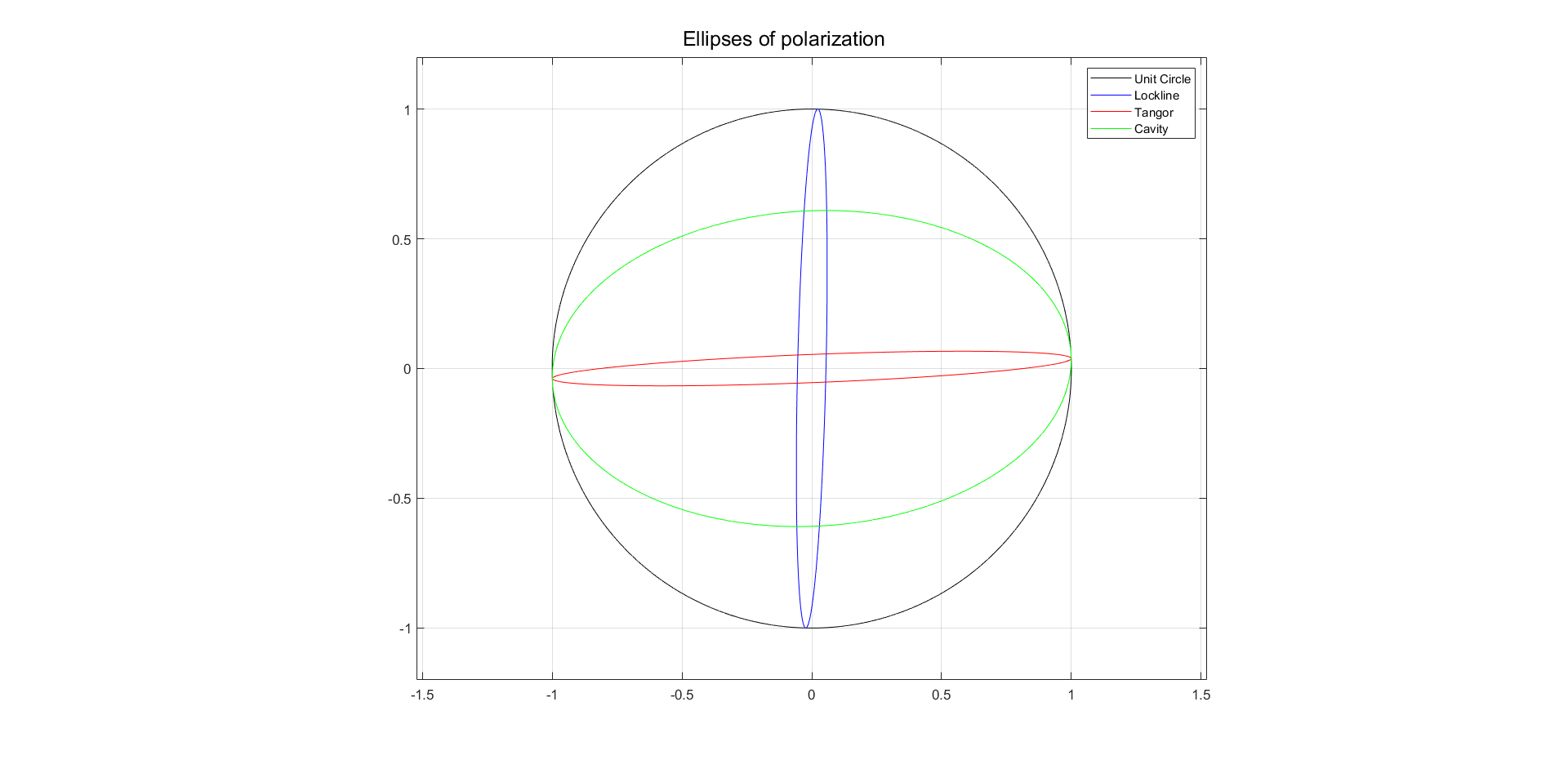
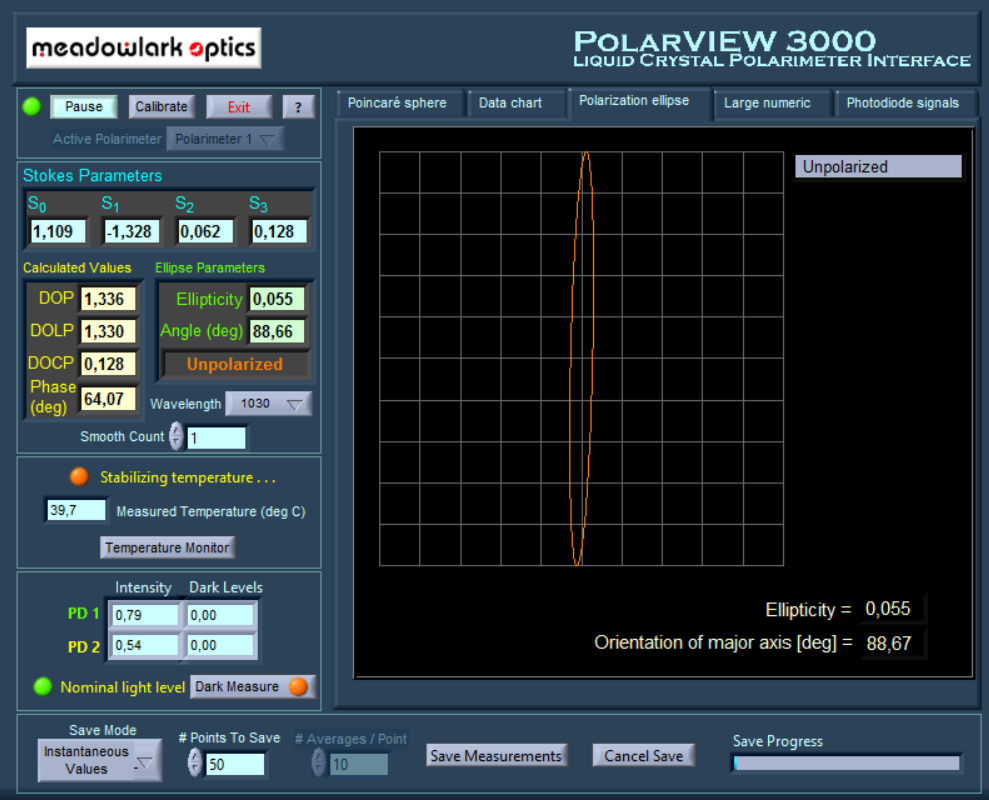
On remarque certains paramètres de Stokes ont des valeurs étranges, comme S1 de la lockline.
De plus le polariseur voit la lockline comme non-polarisé.
=> Différence entre les façons de baisser la puissance entre le Tangor et la Lockline ? |
| Attachment 1: Stokes_parameters_LOCKLINE.png
|
 |
| Attachment 2: DOP_DOLP_DOCP_LOCKLINE.png
|
 |
| Attachment 3: Phase_Ellipticité_Êta_LOCKLINE.png
|
 |
| Attachment 4: Ellipse_Polarization_LOCKLINE.png
|
 |
| Attachment 5: Stokes_parameters_TANGOR.png
|
 |
| Attachment 6: DOP_DOLP_DOCP_TANGOR.png
|
 |
| Attachment 7: Phase_Ellipticité_Êta_TANGOR.png
|
 |
| Attachment 8: Ellipse_Polarization_TANGOR.png
|
 |
| Attachment 9: Ellipse_Polarization_ALL.png
|
 |
| Attachment 10: Polarisation_lockline_after_combiner_image.PNG
|
 |
| Attachment 11: Polarisation_Tangor_after_combiner_image.PNG
|
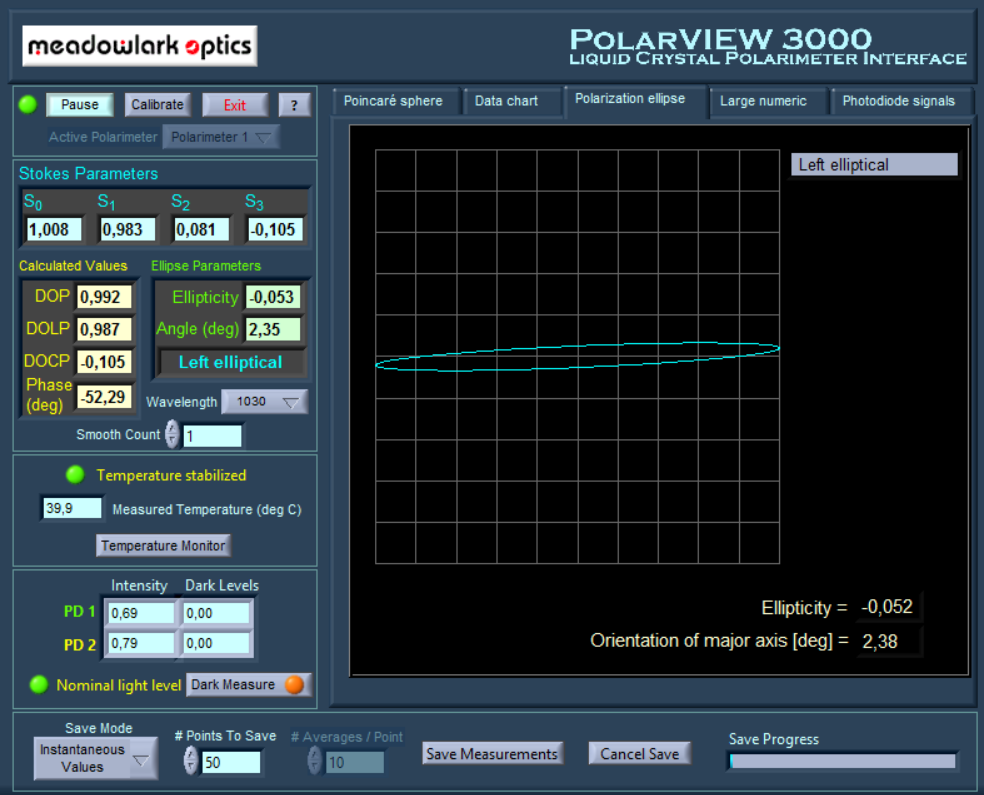 |
|
69
|
Thu Feb 2 16:26:30 2023 |
Blanc | Fixed | info | lasers and optics | Optical room | Combiner Layertec |
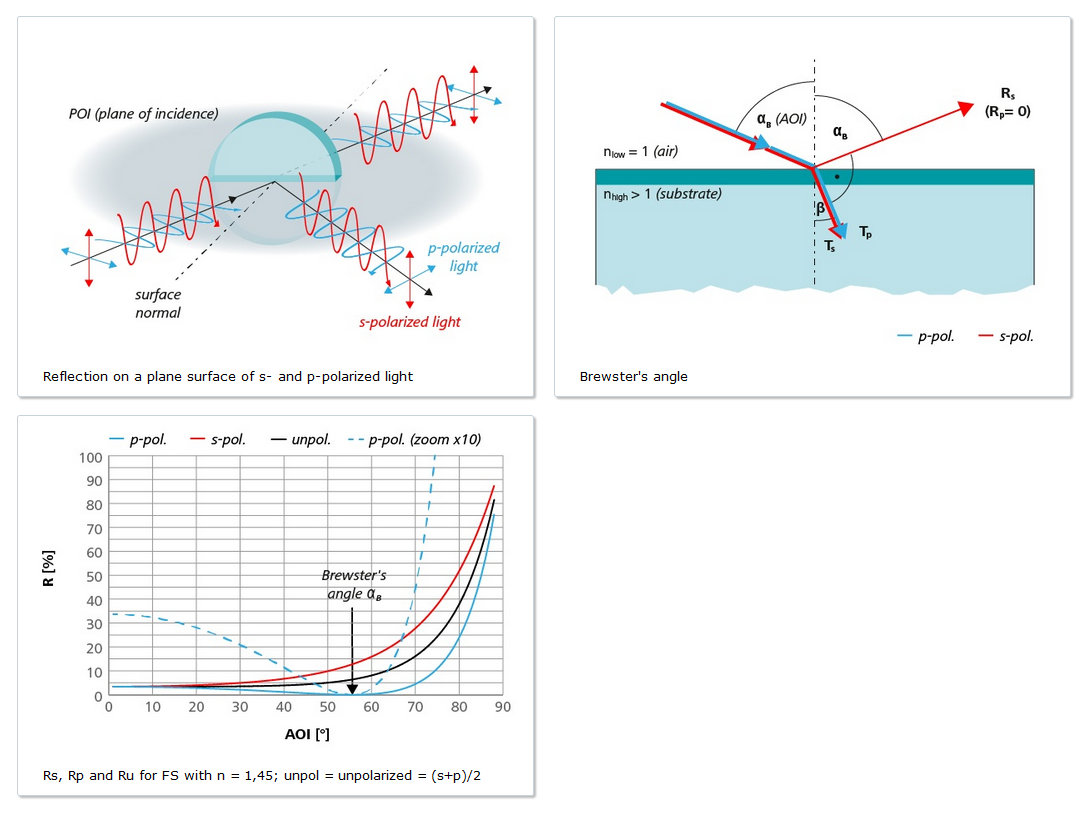
La doc du combiner Layertec servant à combiner la lockline et le Tangor. |
| Attachment 1: Courbes_Combiner_LAYERTEC.PNG
|
 |
| Attachment 2: Courbes_TFPolarizer_LAYERTEC.PNG
|
 |
|
70
|
Thu Feb 2 17:40:10 2023 |
Blanc | Fixed | info | lasers and optics | Optical room | Schéma Manip |
Ci-dessous le schéma actuel de la manip. |
| Attachment 1: 7_Minicav_setup_23_05_2022.PNG
|
 |
|
71
|
Mon Feb 6 16:51:51 2023 |
Blanc | Fixed | info | lasers and optics | Optical room | Optimisation de la polariation Tangor and Lockline |
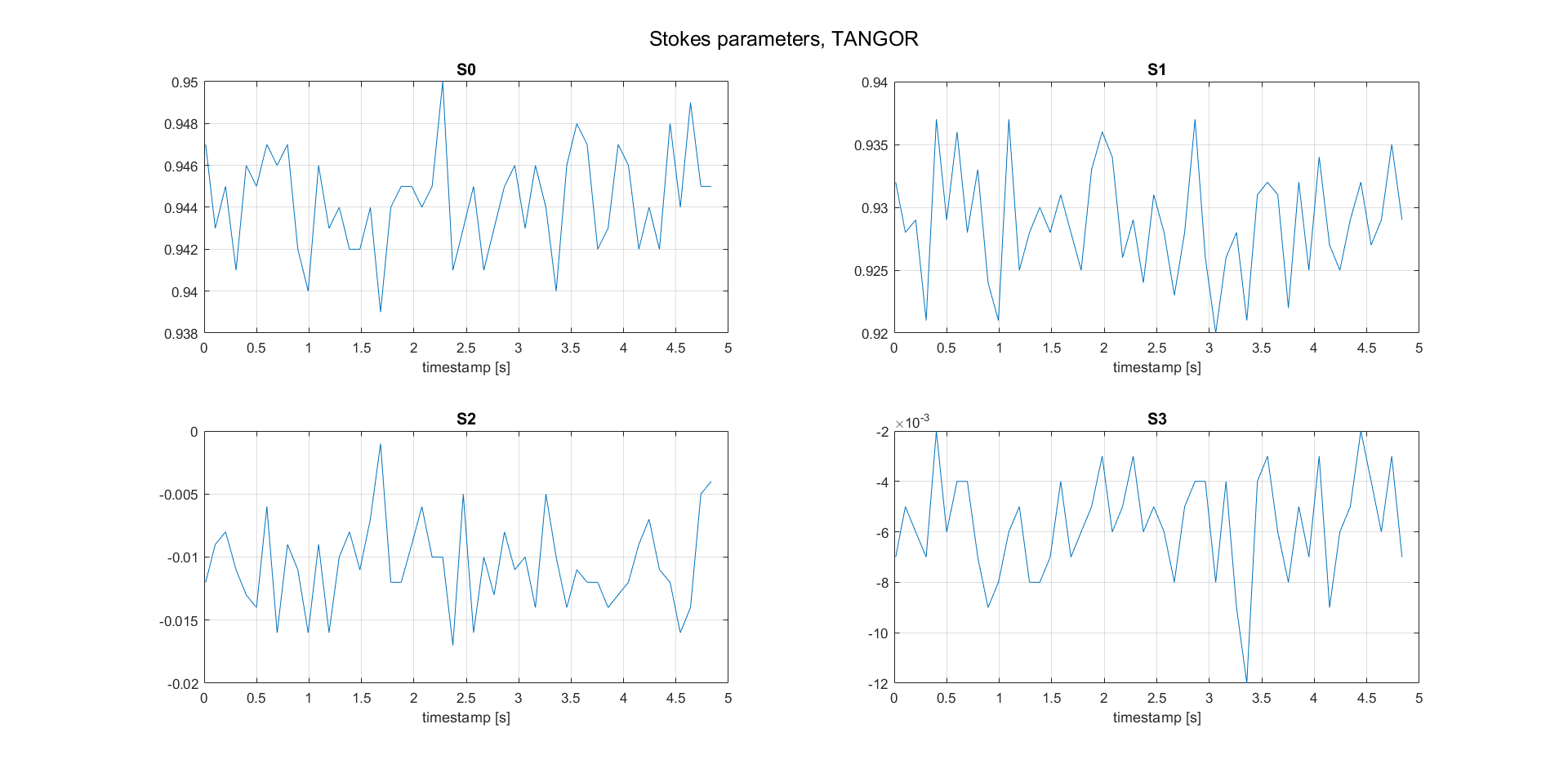
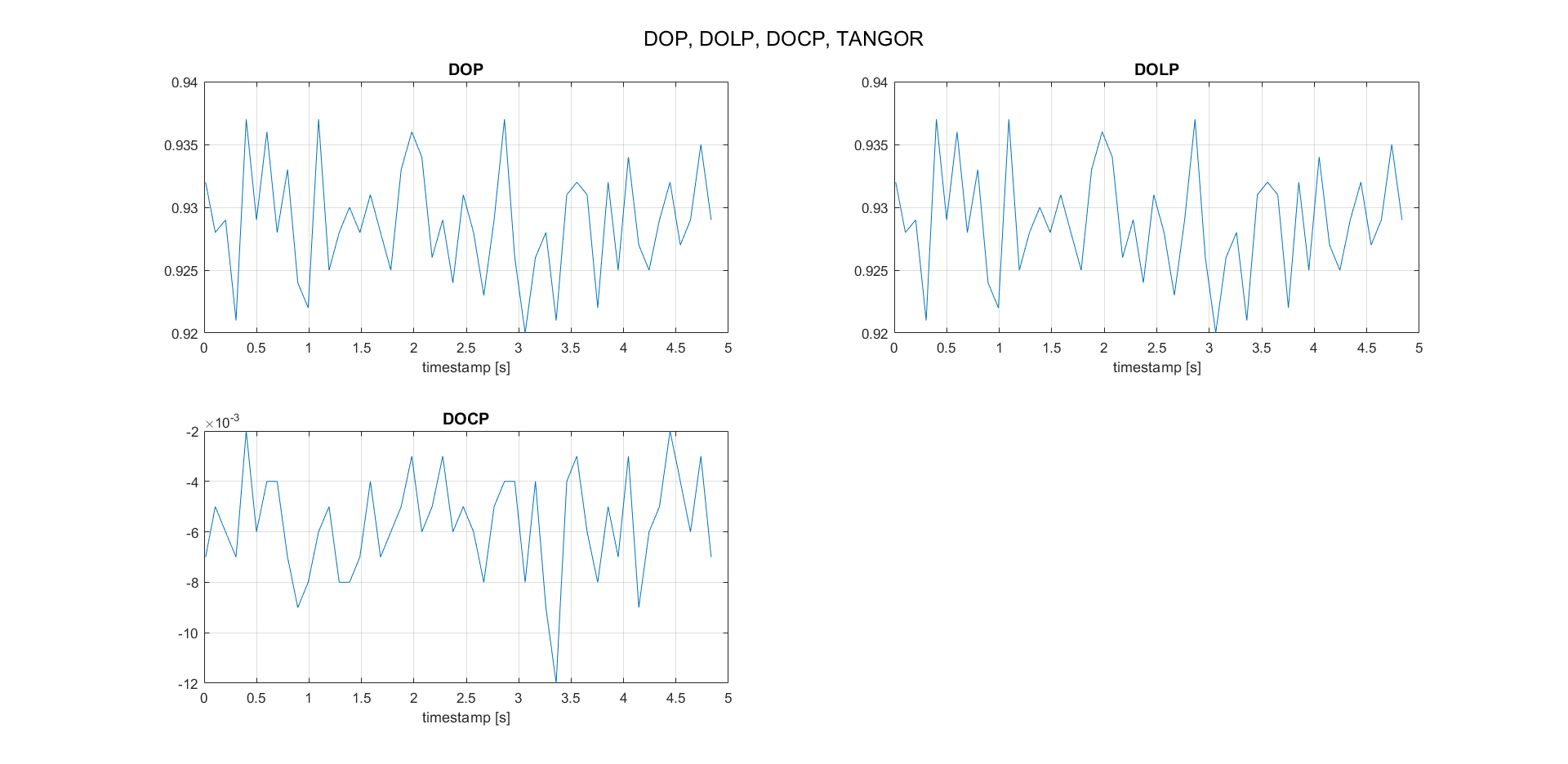
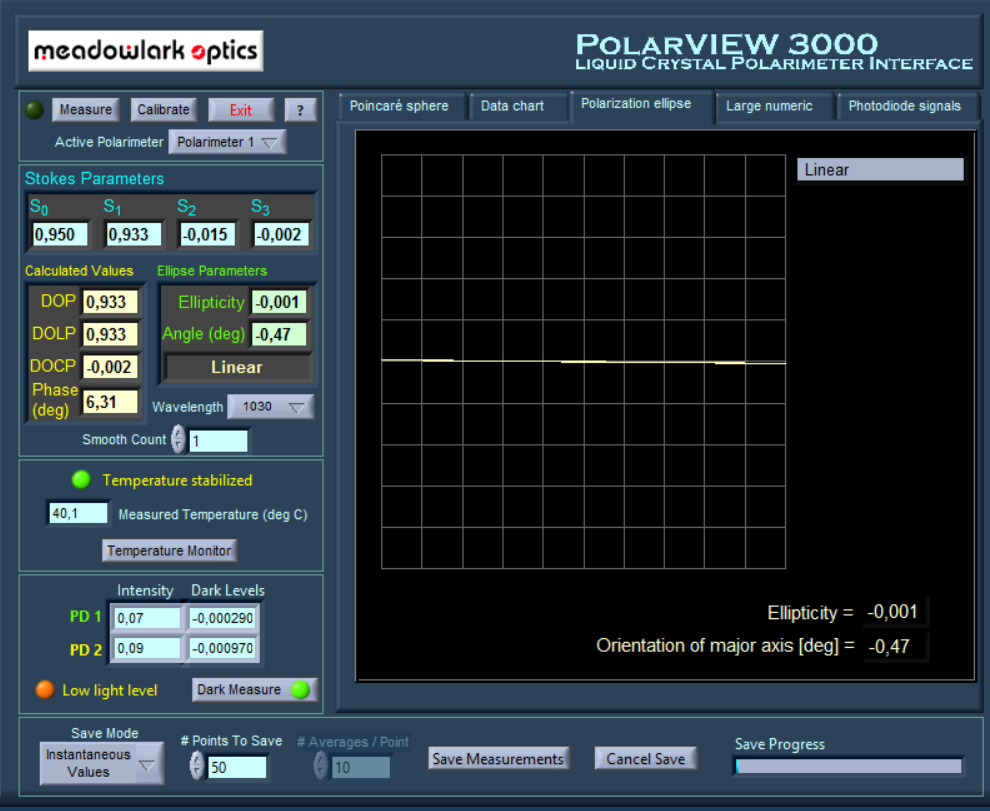
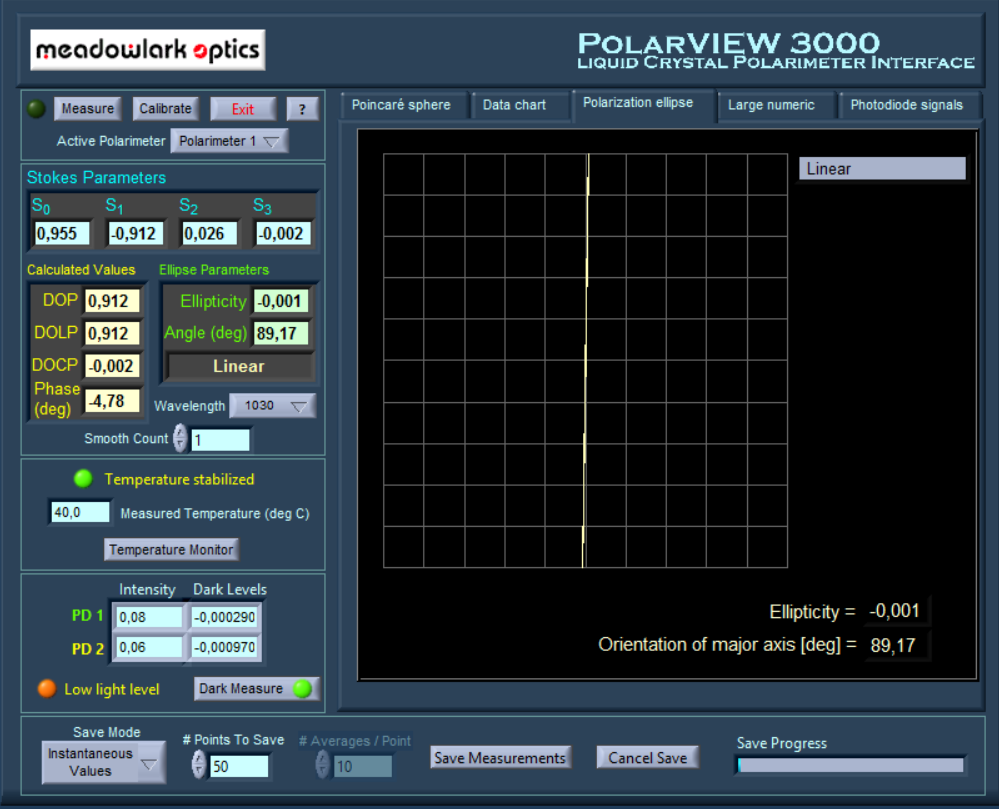
J'ai optimisé la polarisation du Tangor et de la Lockline en jouant sur l'angle du combiner et sur la lambda/2 de chacune des voies.
J'ai réussi à obtenir une polarisation croisée entre le Tangor et la Lockline et une polarisation quasi-linéaire pour chacune des deux voies.
Par contre, une partie de la puissance sur la ligne Tangor est perdu en passant à travers le combiner, car la fuite est plus intense (pas quantifiée car on n'y a pas accès).
|
| Attachment 1: Stokes_parameters_TANGOR.png
|
 |
| Attachment 2: DOP_DOLP_DOCP_TANGOR.png
|
 |
| Attachment 3: Phase_Ellipticité_Êta_TANGOR.png
|
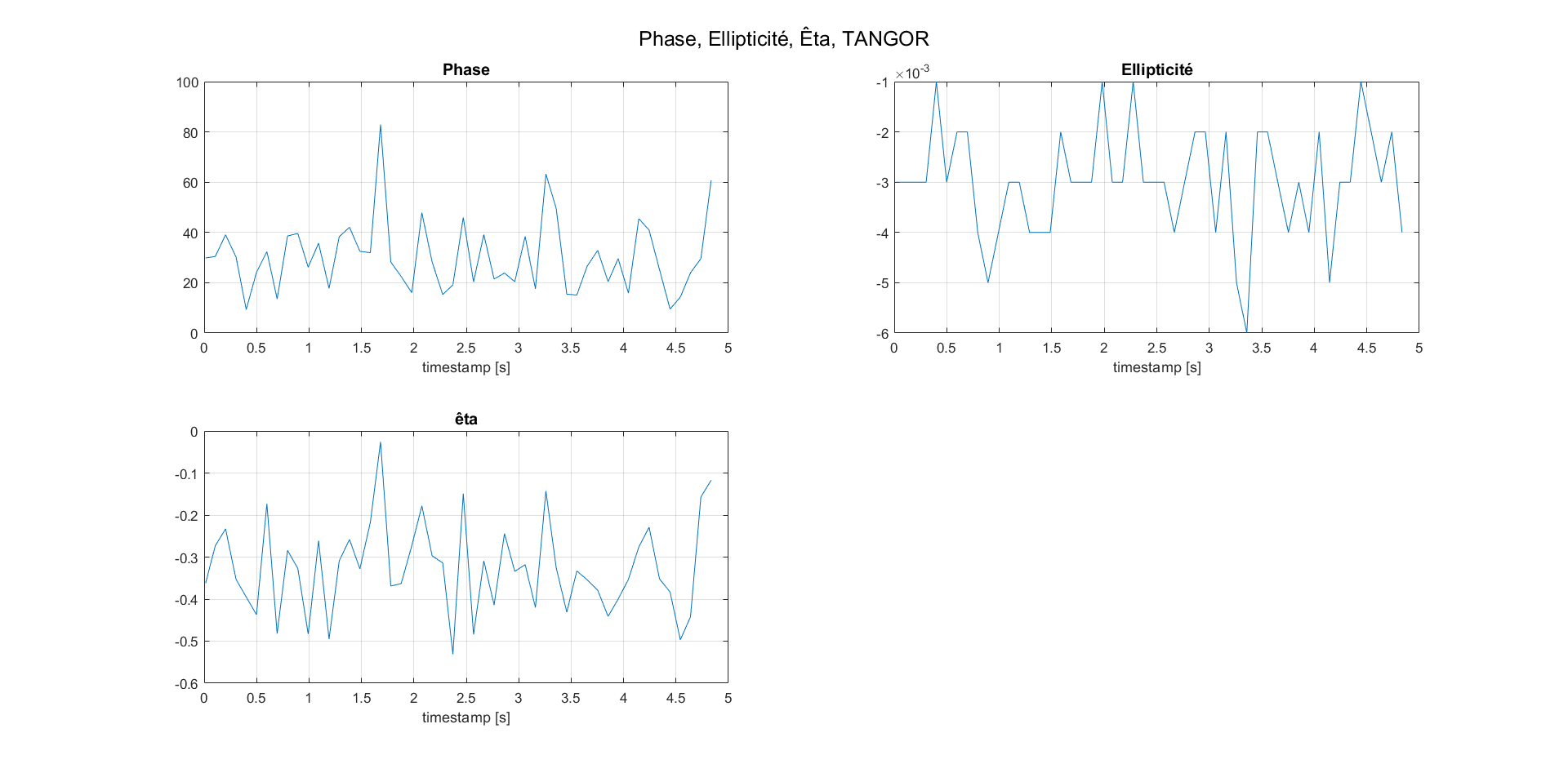 |
| Attachment 4: Tamp_TANGOR.png
|
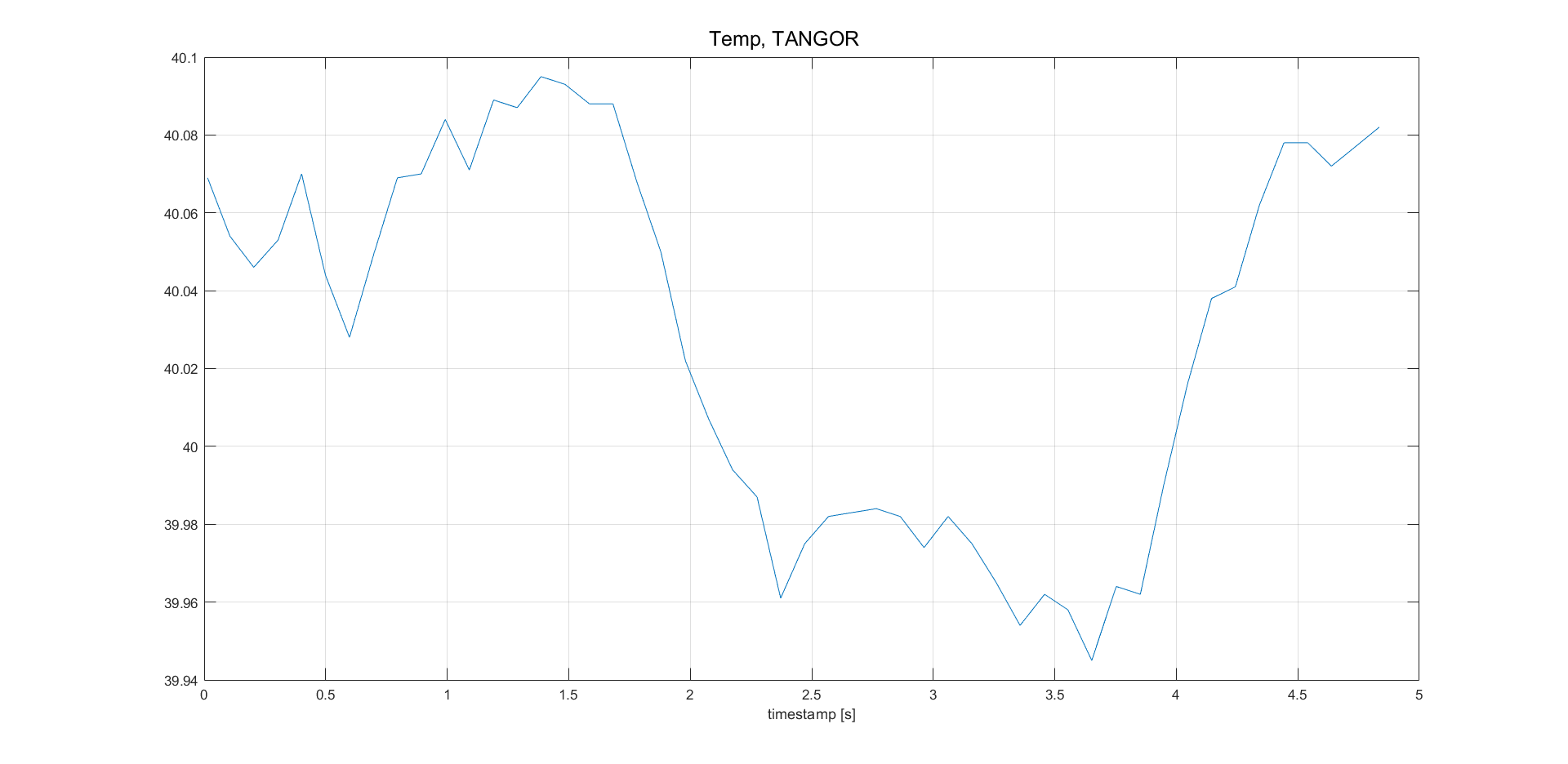 |
| Attachment 5: Ellipse_Polarization_TANGOR.png
|
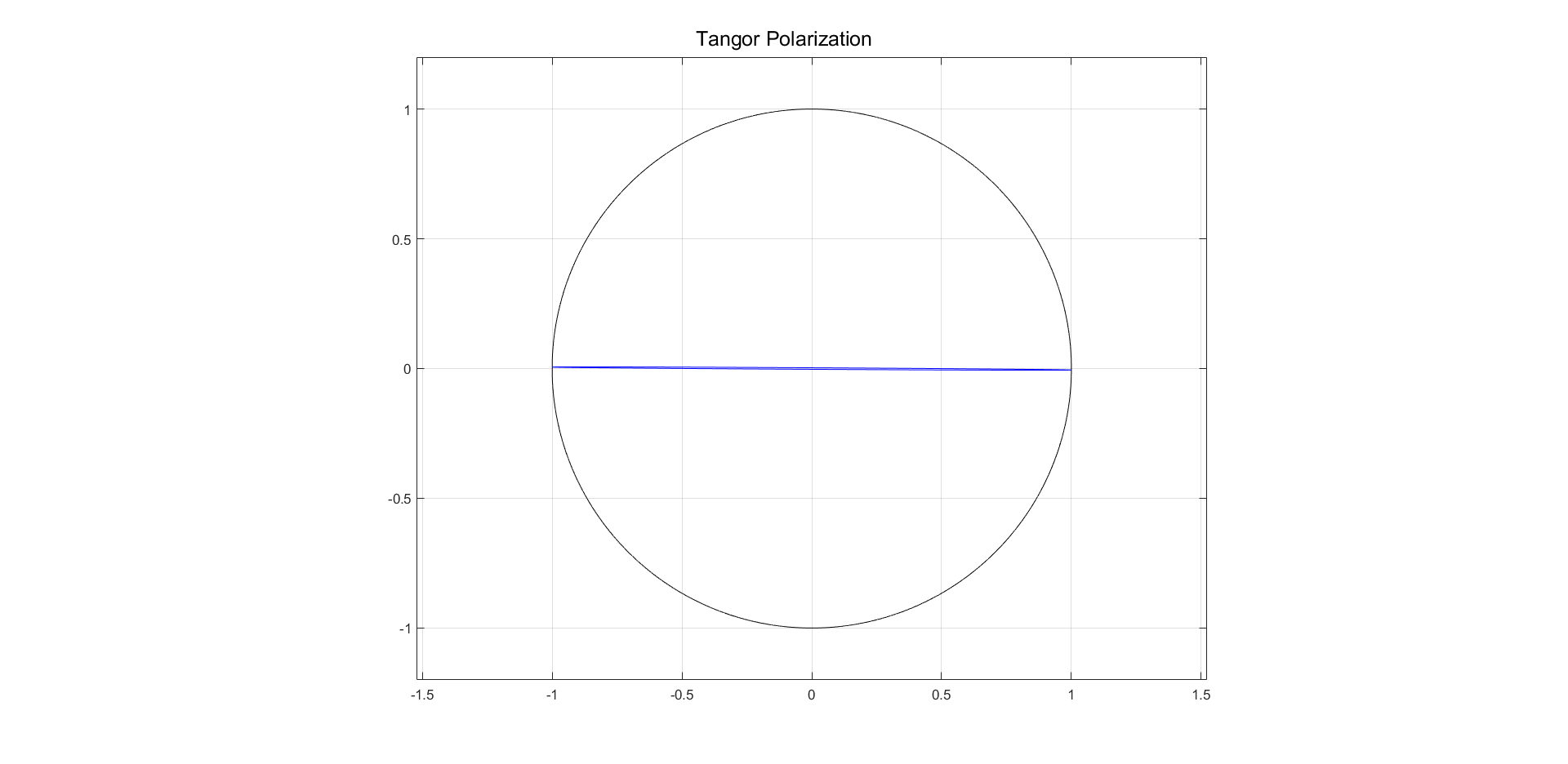 |
| Attachment 6: Stokes_parameters_LOCKLINE.png
|
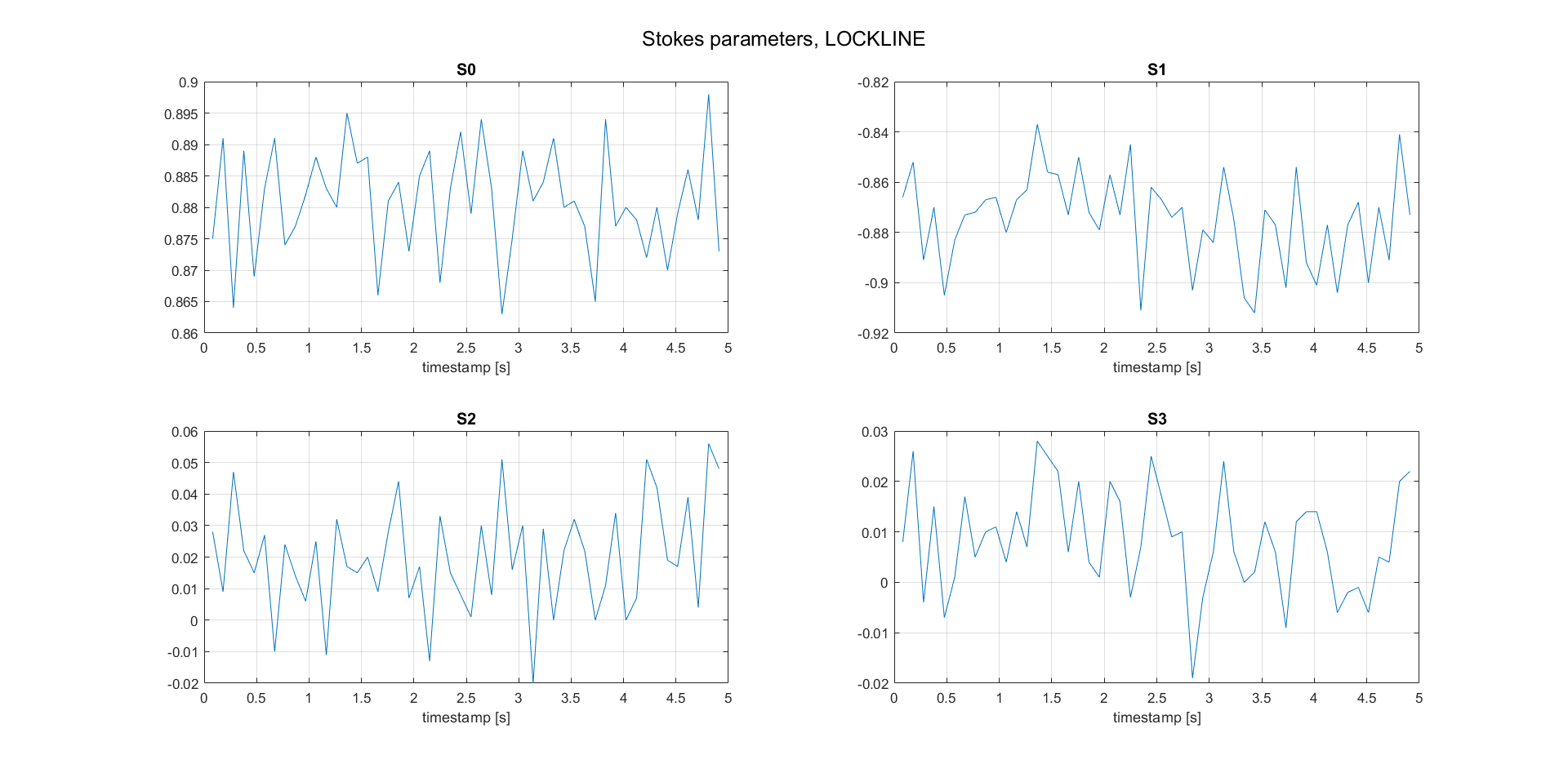 |
| Attachment 7: DOP_DOLP_DOCP_LOCKLINE.png
|
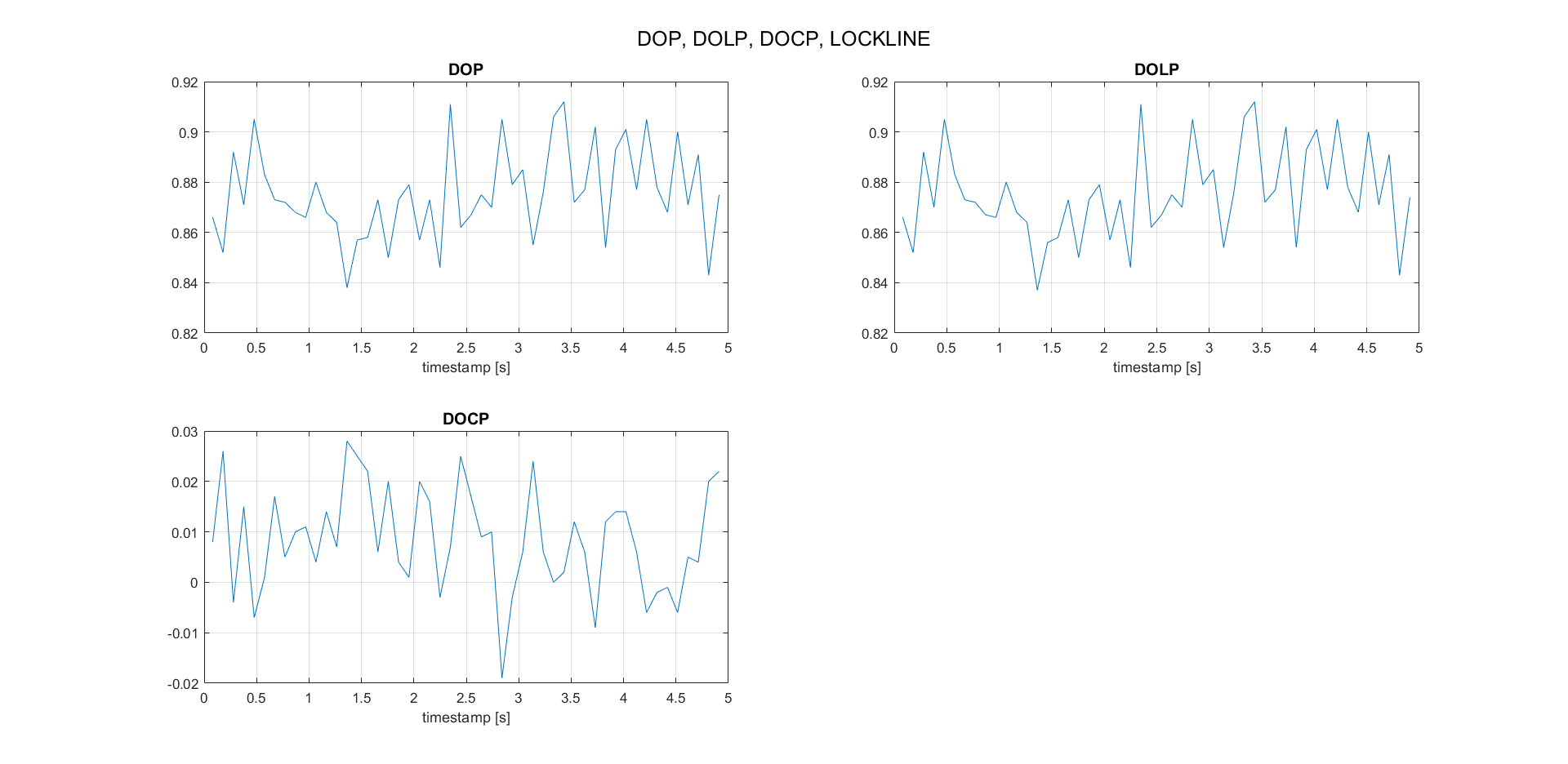 |
| Attachment 8: Phase_Ellipticité_Êta_LOCKLINE.png
|
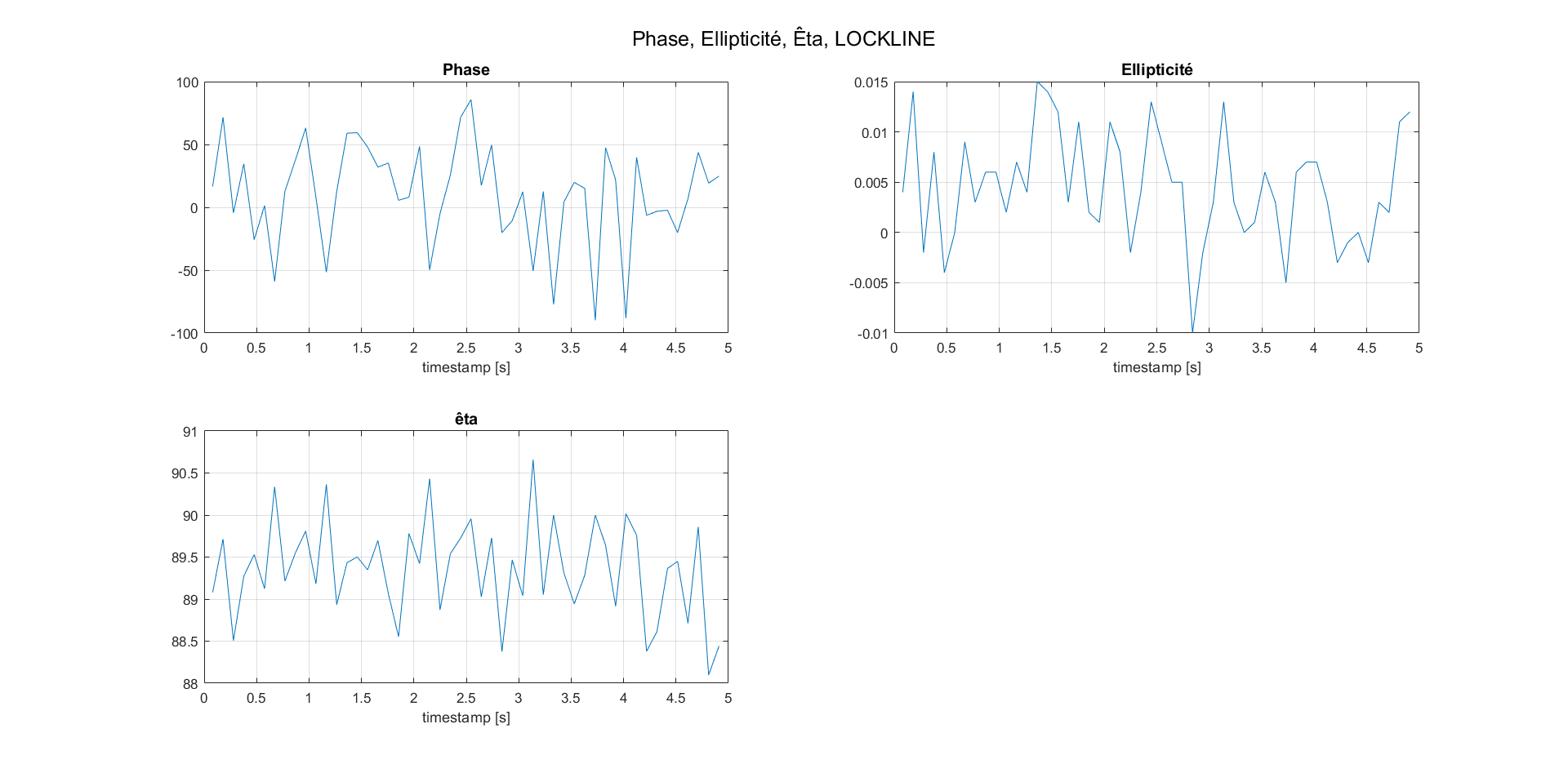 |
| Attachment 9: Tamp_LOCKLINE.png
|
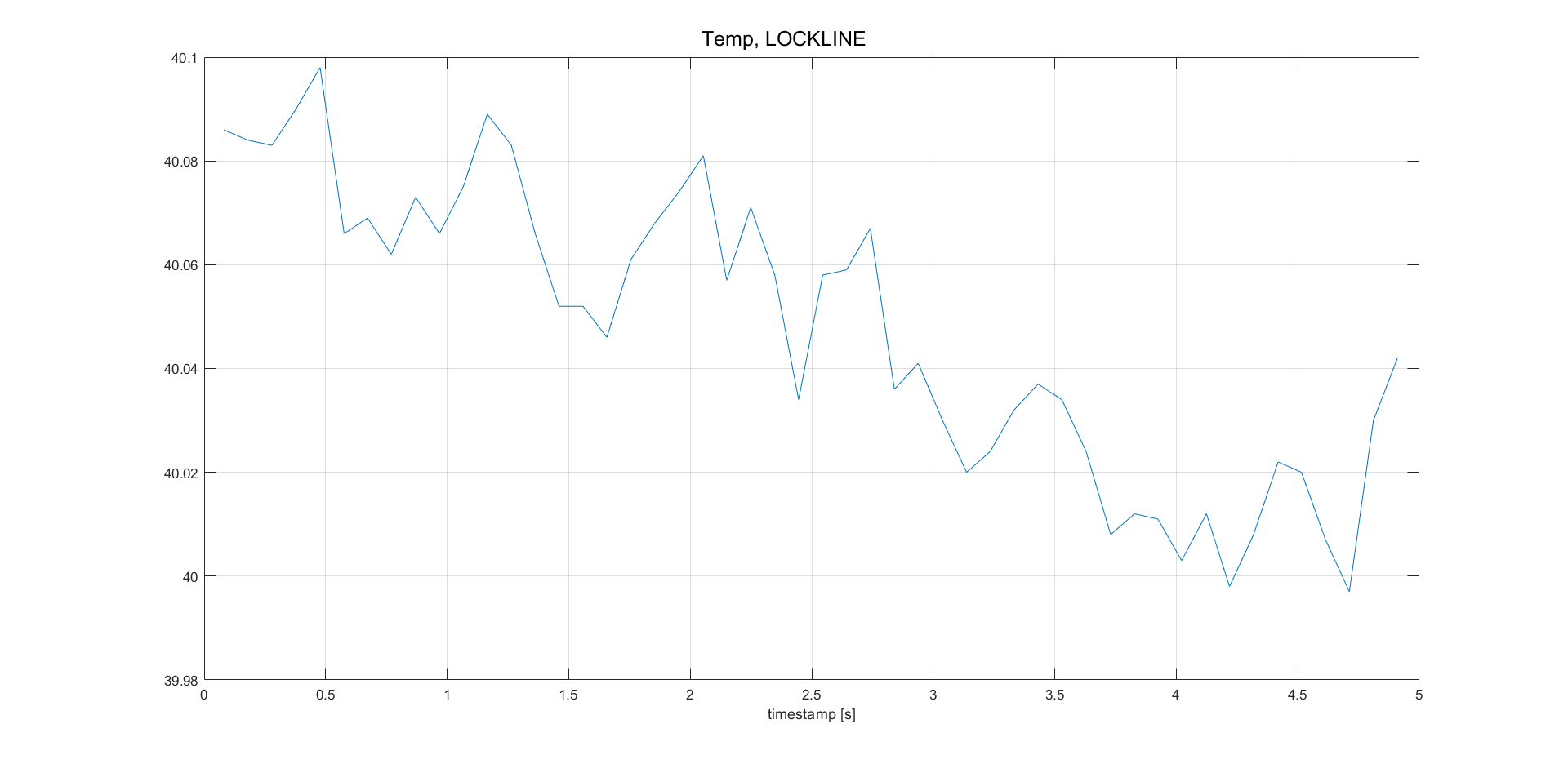 |
| Attachment 10: Ellipse_Polarization_LOCKLINE.png
|
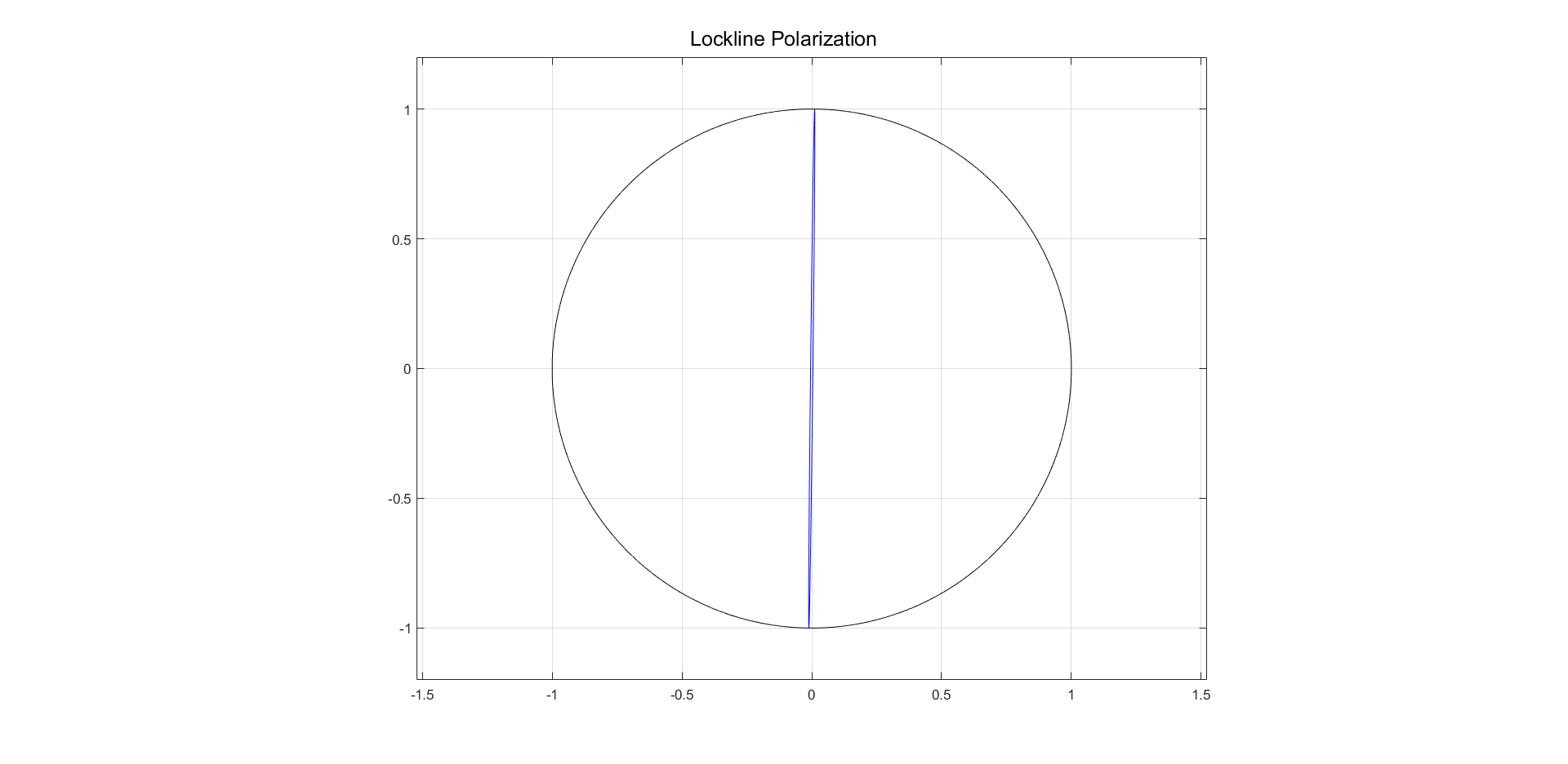 |
| Attachment 11: Ellipse_Polarization_ALL_03_02_2023.png
|
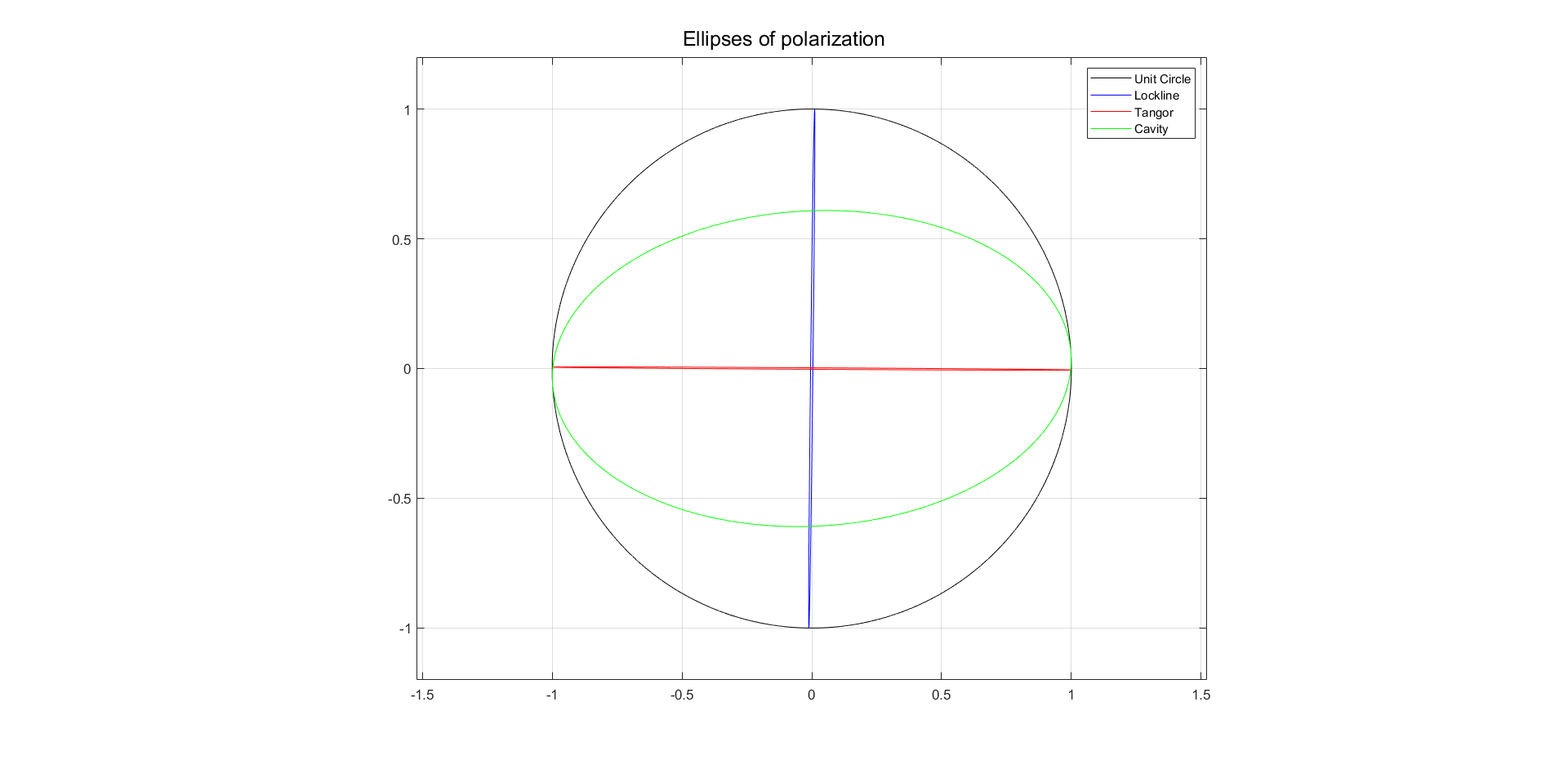 |
| Attachment 12: Polarisation_Tangor_after_combiner_03_02_2023_image.PNG
|
 |
| Attachment 13: Polarisation_lockline_after_combiner_03_02_2023_image.PNG
|
 |
|
72
|
Wed Feb 8 18:48:36 2023 |
Blanc | Fixed | info | lasers and optics | Optical room | Fin mesures de Polarisation Lockline et Tangor et Burst Cav |
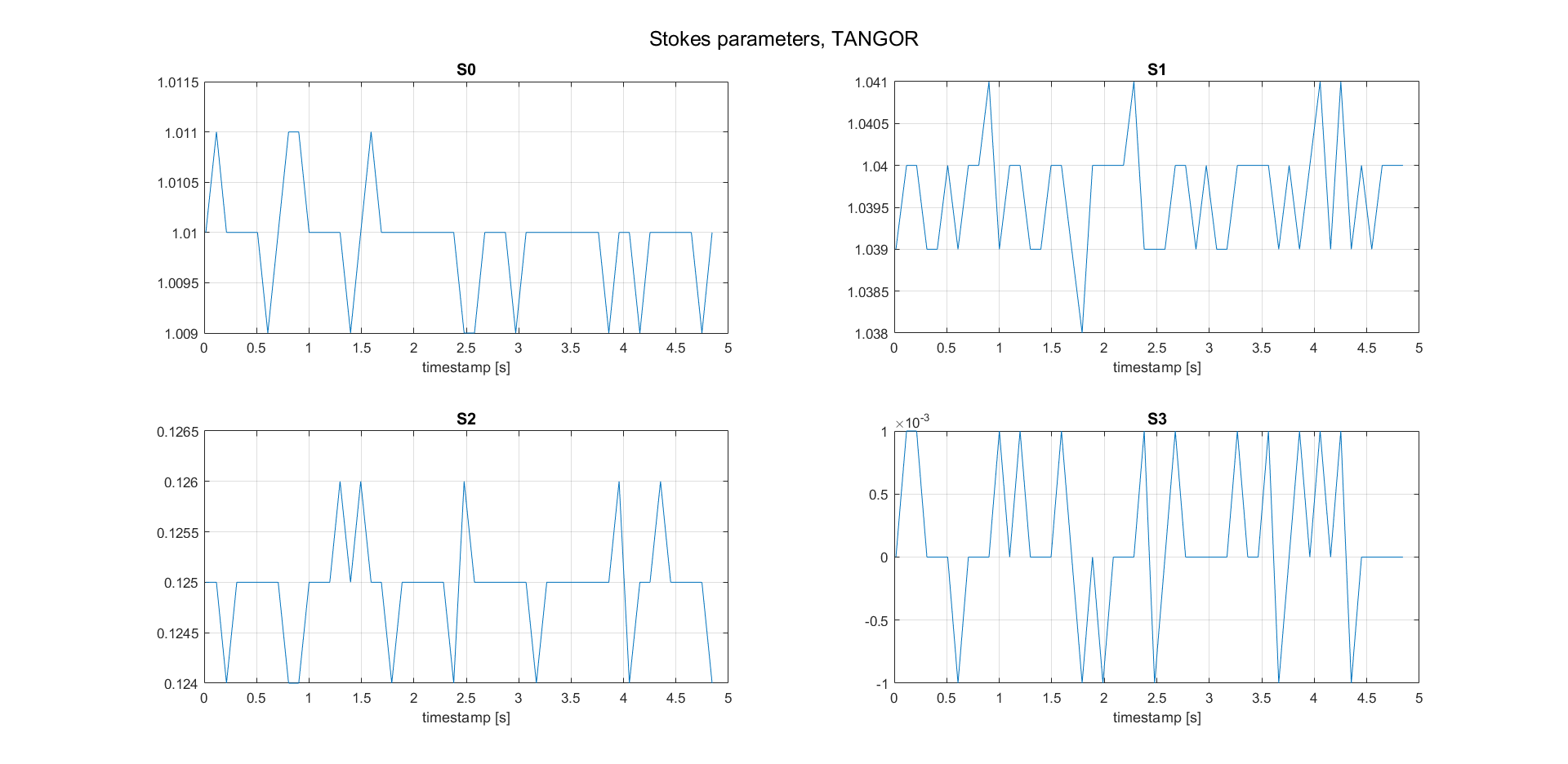
Avec un setup plus fiable que précédemment, on a remesuré la polarisation du Tangor et de la lockline et en ajustant le combiner sur ses deux axes ainsi que la lambda/2 de chaque voies à l'aide du polariseur que l'on a placé avant le combineur.
On obtient l'état de polarisation optimal pour les deux voies.
Suite à cela, j'ai réaligné la lockline sur les caméras, cela donne les nouvelles positions suivantes :
941 ; 586 NF_inj
412 ; 279 FF_inj
j'ai également retouché aux moteur pour retrouver le mode fondamental :
5.198865 ; 5.220196 ; -2.9 ; -2.9
Une fois le lock établi, j'ai maximisé le signal en jouant sur la première paire de lambda avant la cavité, puis avec la deuxième paire j'ai cherché l'extinction maximale du Tangor sur la voie du PDH.
Enfin, j'ai pu injecter un burst dans la cavité, à 100 kHz PP, 1kHz AOM, 40% Trans AOM, P_Tang = 0.2W. (cf : image) |
| Attachment 1: Stokes_parameters_TANGOR.png
|
 |
| Attachment 2: DOP_DOLP_DOCP_TANGOR.png
|
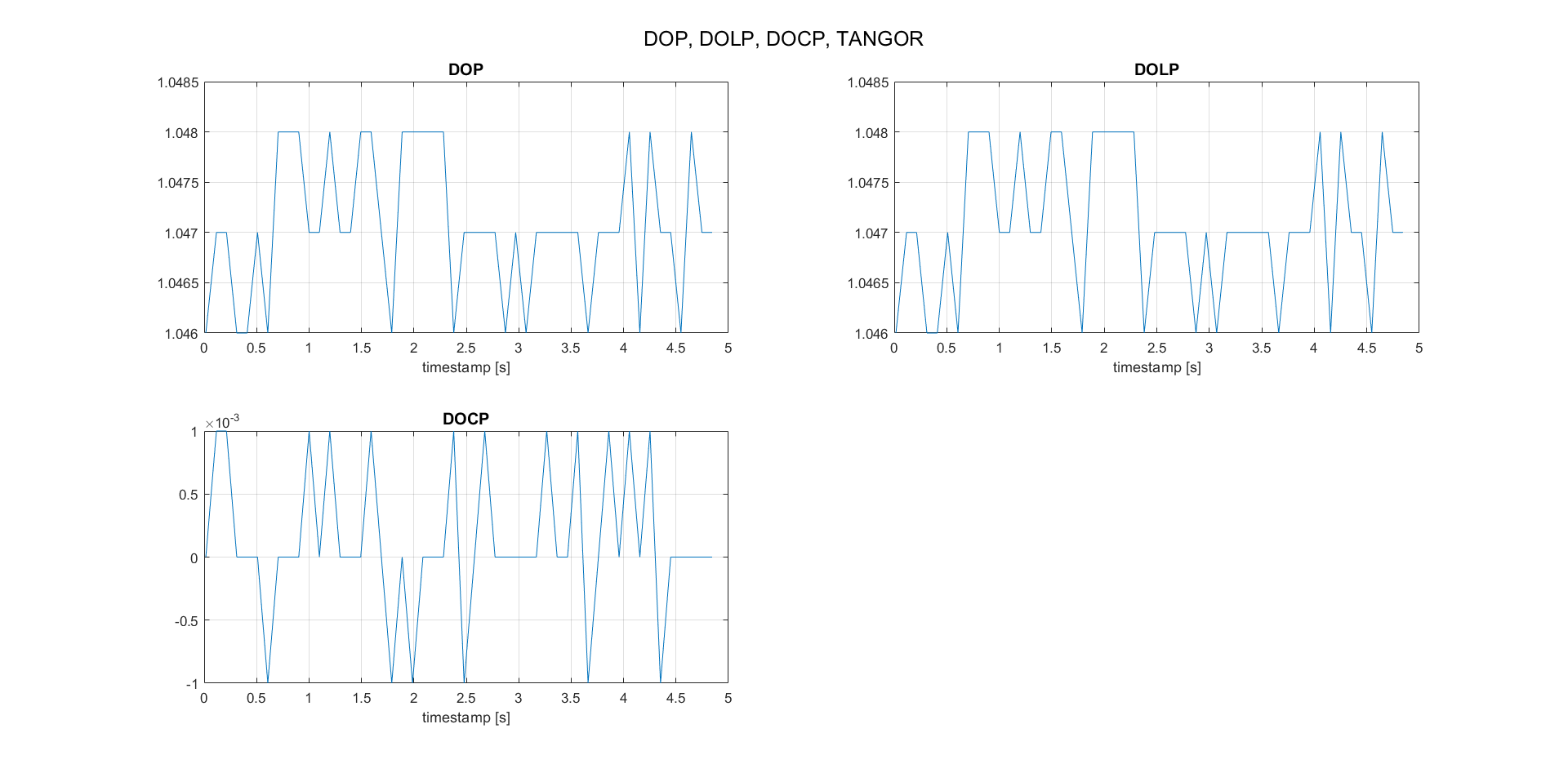 |
| Attachment 3: Phase_Ellipticité_Êta_TANGOR.png
|
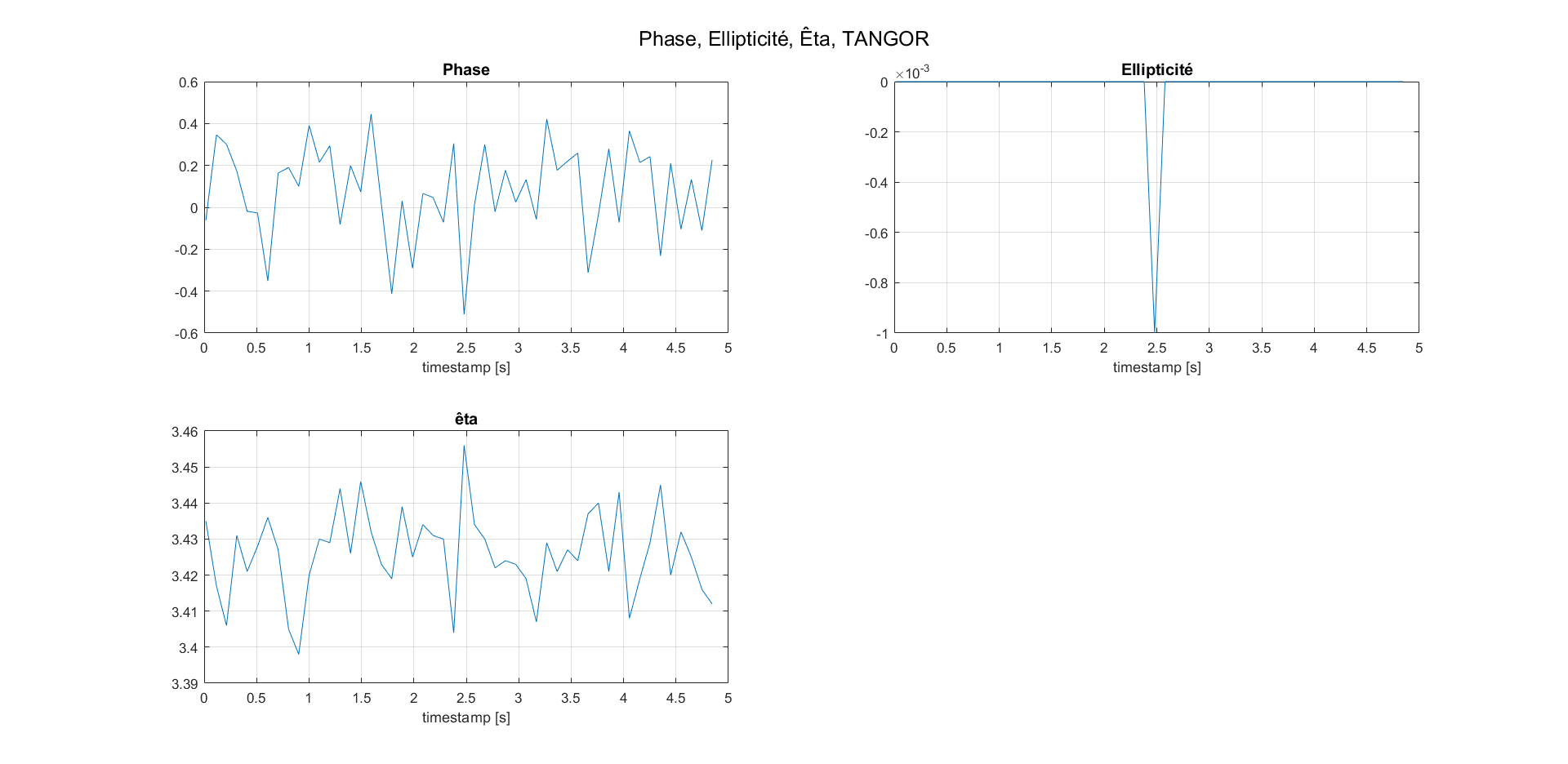 |
| Attachment 4: Tamp_TANGOR.png
|
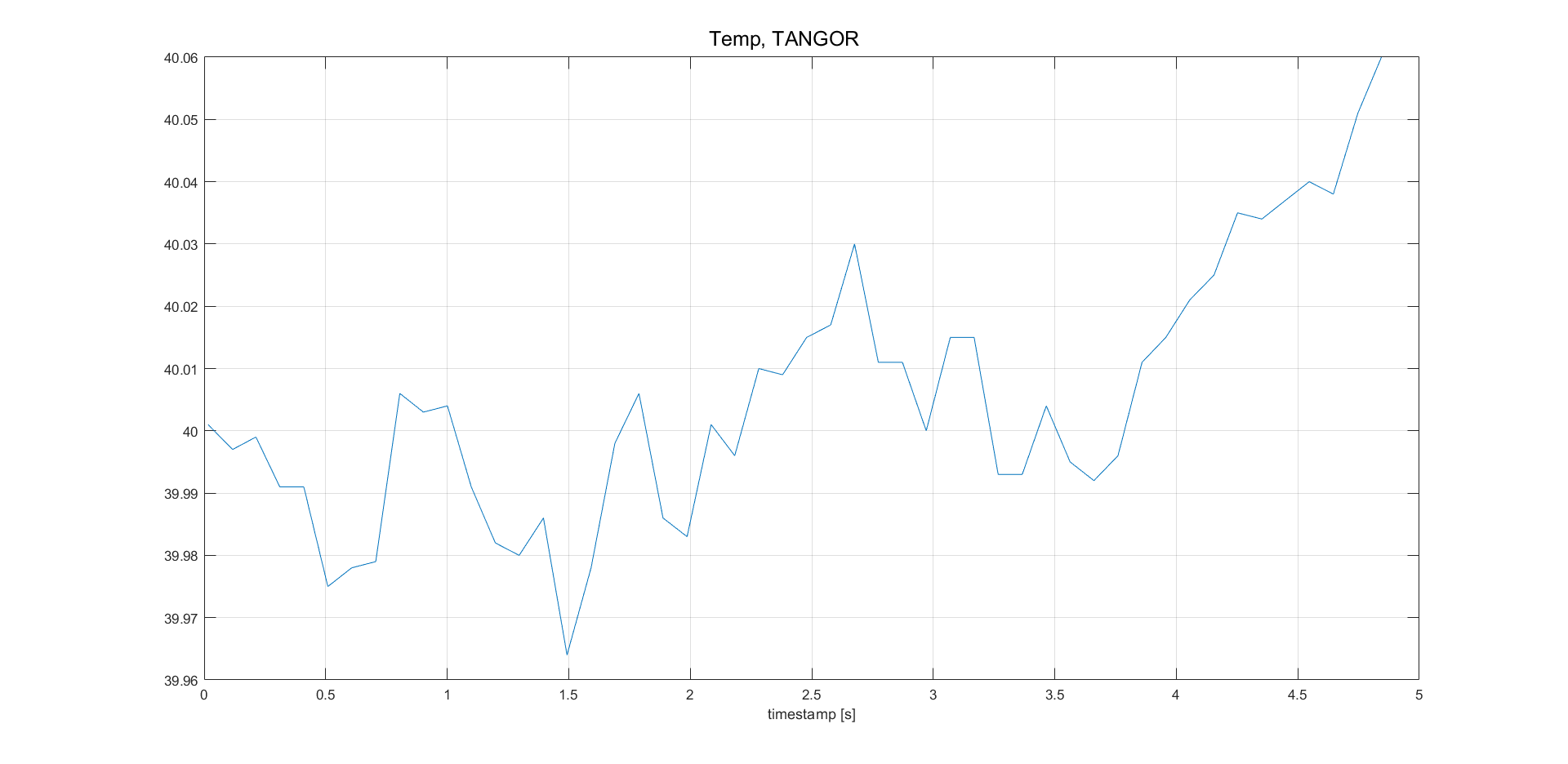 |
| Attachment 5: Stokes_parameters_LOCKLINE.png
|
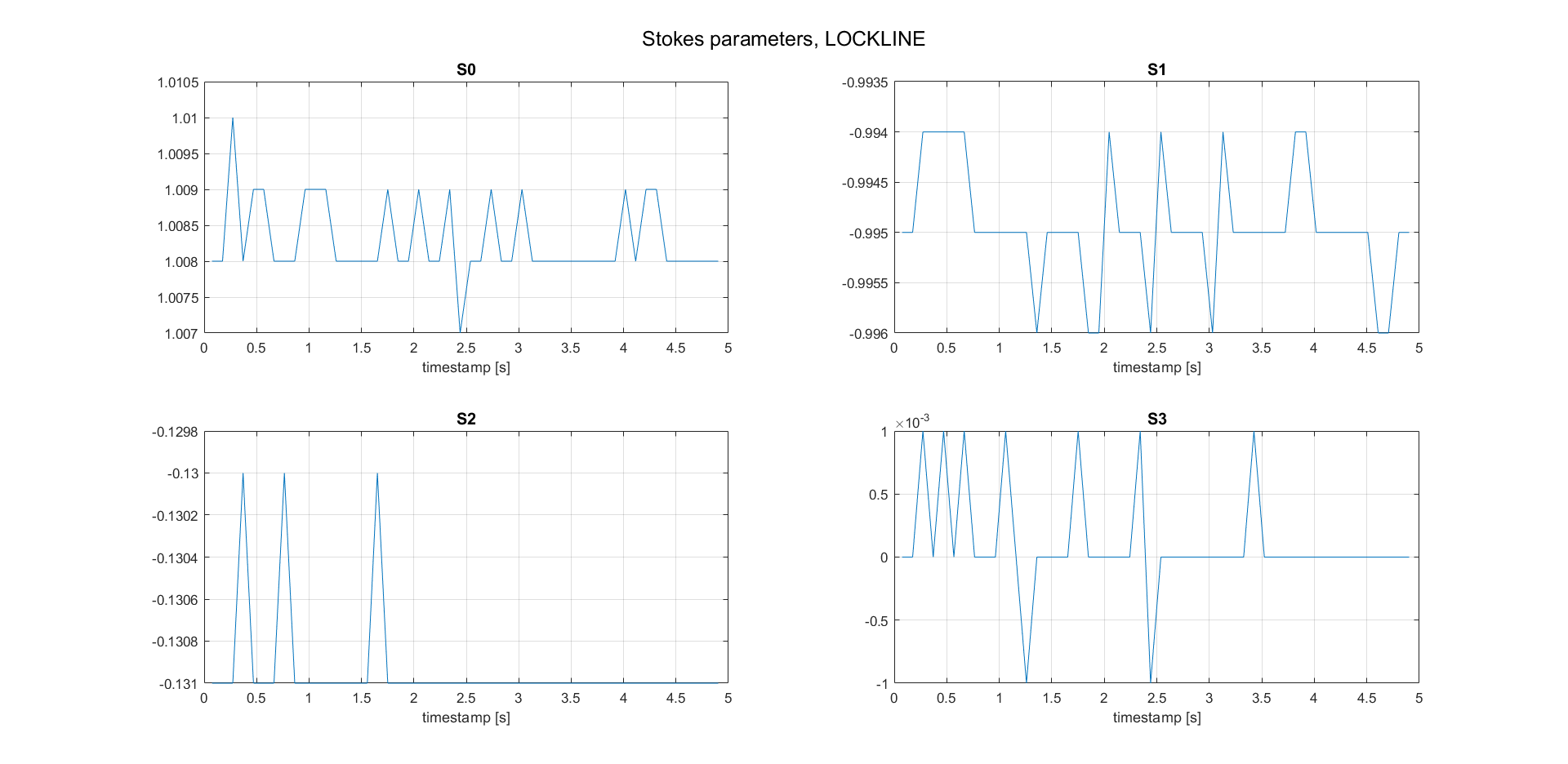 |
| Attachment 6: DOP_DOLP_DOCP_LOCKLINE.png
|
 |
| Attachment 7: Phase_Ellipticité_Êta_LOCKLINE.png
|
 |
| Attachment 8: Tamp_LOCKLINE.png
|
 |
| Attachment 9: Ellipse_Polarization_ALL_08_02_2023.png
|
 |
| Attachment 10: Polarisation_tangor_after_combiner_20230208.png
|
 |
| Attachment 11: Polarisation_lockline_after_combiner_20230208.png
|
 |
| Attachment 12: Burst_stocké_dans_la_cavité.png
|
 |
|
73
|
Thu Feb 9 17:43:11 2023 |
Blanc | Fixed | info | lasers and optics | Optical room | Burst Stacking in cavity |
Les trois premières images sont la premières injection d'un burst dans la cavité à 3 instant t. On remarque plusieurs choses :
- Le burst peut être plus ou moins bien injecté
- Il y a un "bump" sur la photodiode de la voie de réflexion (changement polar ??? ), qui atteint se valeur maximale quand le burst est injecté au mieux
- Il y a un offset sur le PDH qui varie, il est minimal quand le burst est bien injecté et augmente quand il est de moins en moins bien injecté (Une cause de la mauvaise injection du burst ??)
La quatrième image représente un délock/relock avec la lockline uniquement. Le signal sur la photodiode de réflexion n'est pas très élevé (désaligné? autre?)
Les trois dernières images représentent l'injection d'un burst au mieux possible après avoir changé la valeur de l'AOM lockline, ce qui a pour effet de jouer sur la CEP. |
| Attachment 1: Burst_bien_injecté.png
|
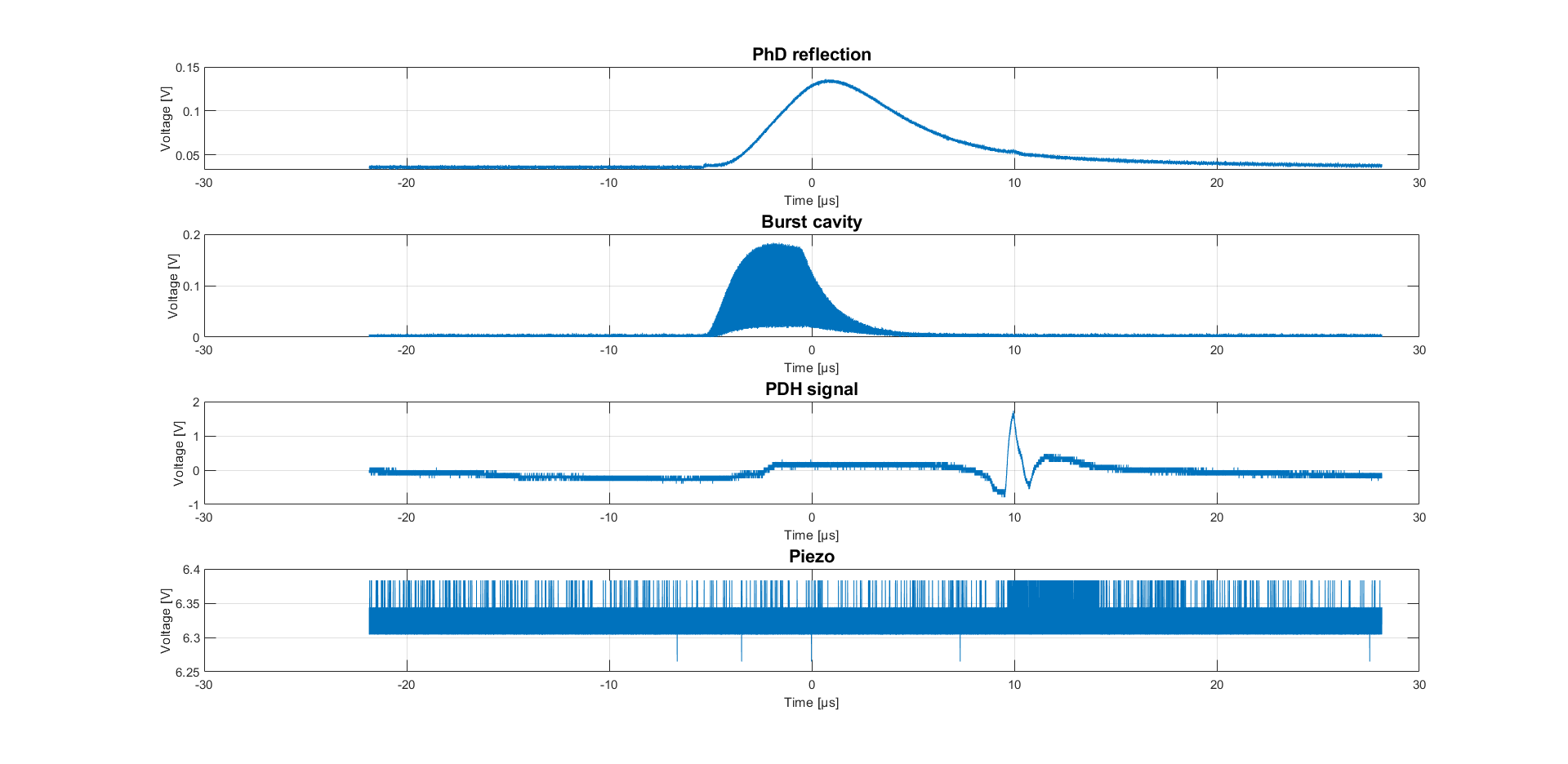 |
| Attachment 2: Burst_moyen_injecté.png
|
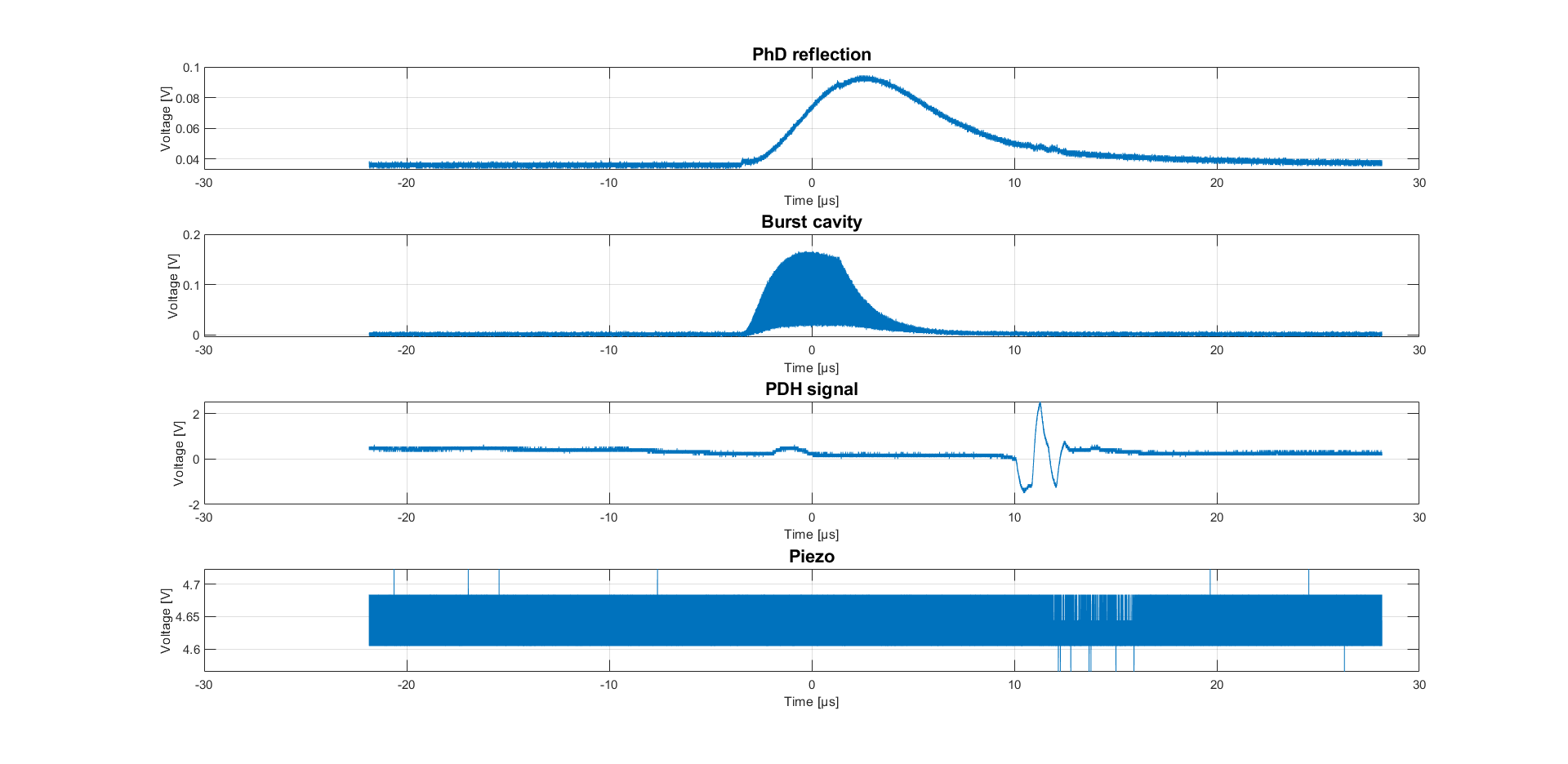 |
| Attachment 3: Burst_mal_injecté.png
|
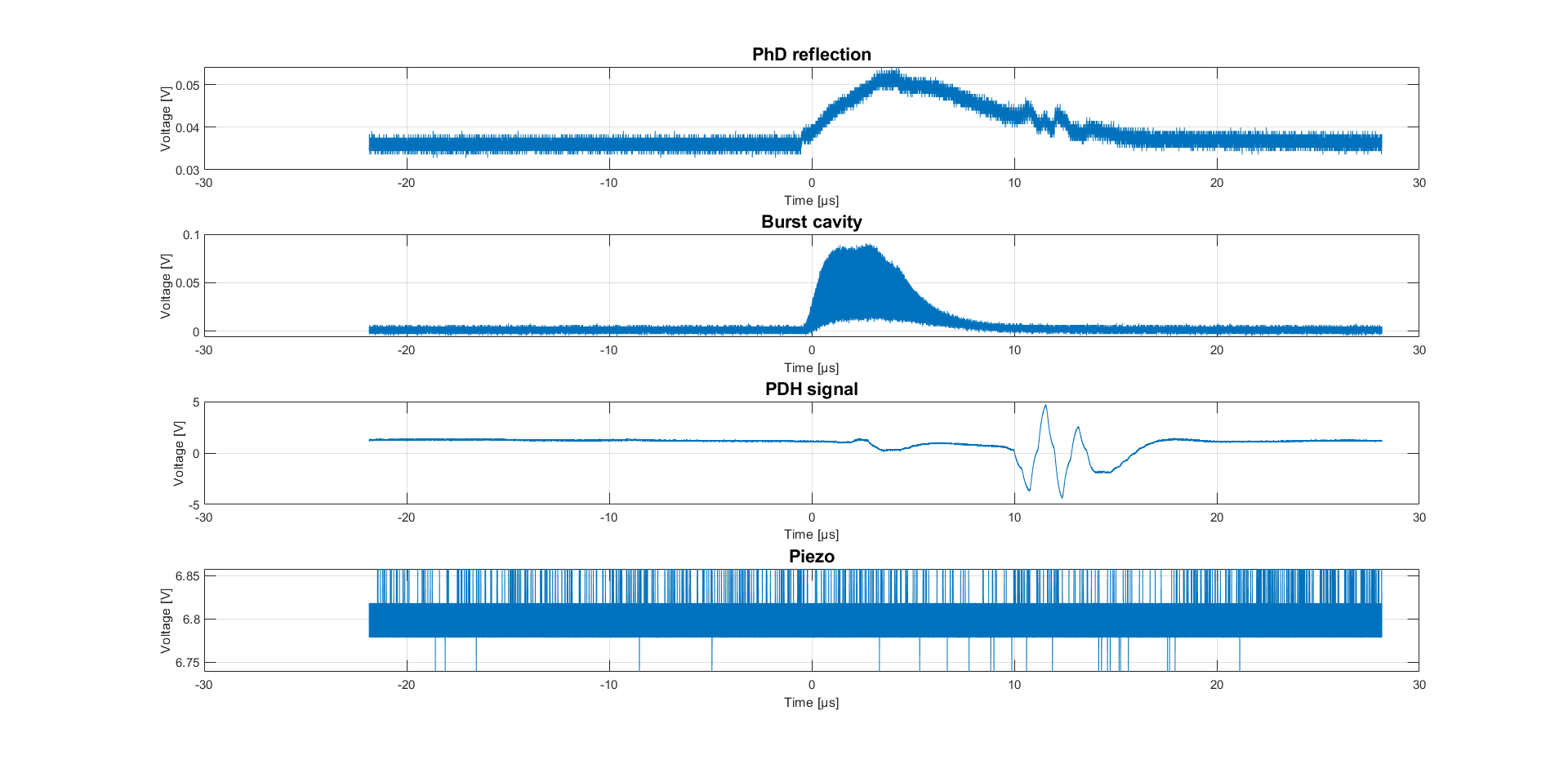 |
| Attachment 4: Comparaison_lock_délock_lockline.png
|
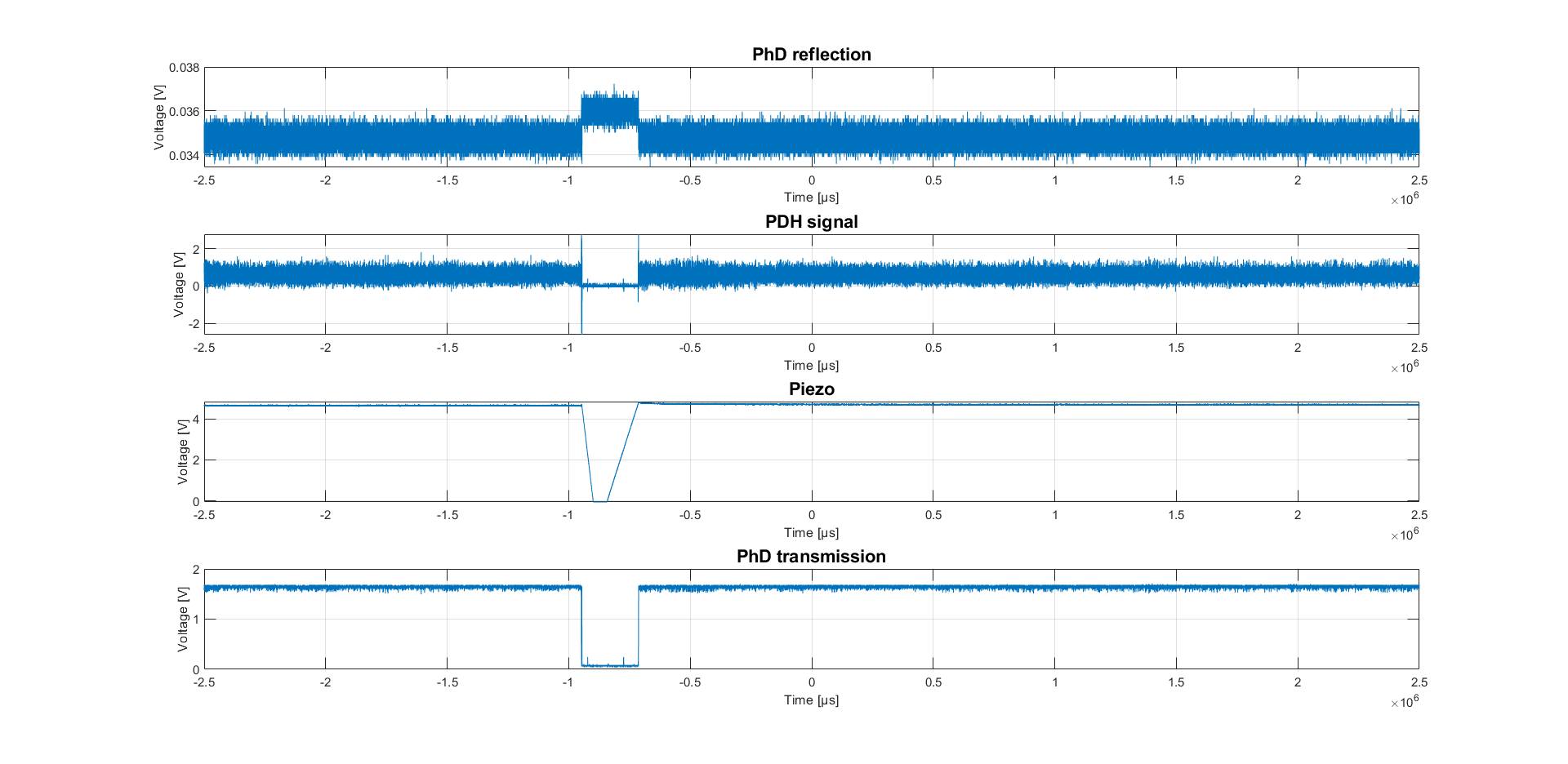 |
| Attachment 5: AOM_lockline_158_850_kHz.png
|
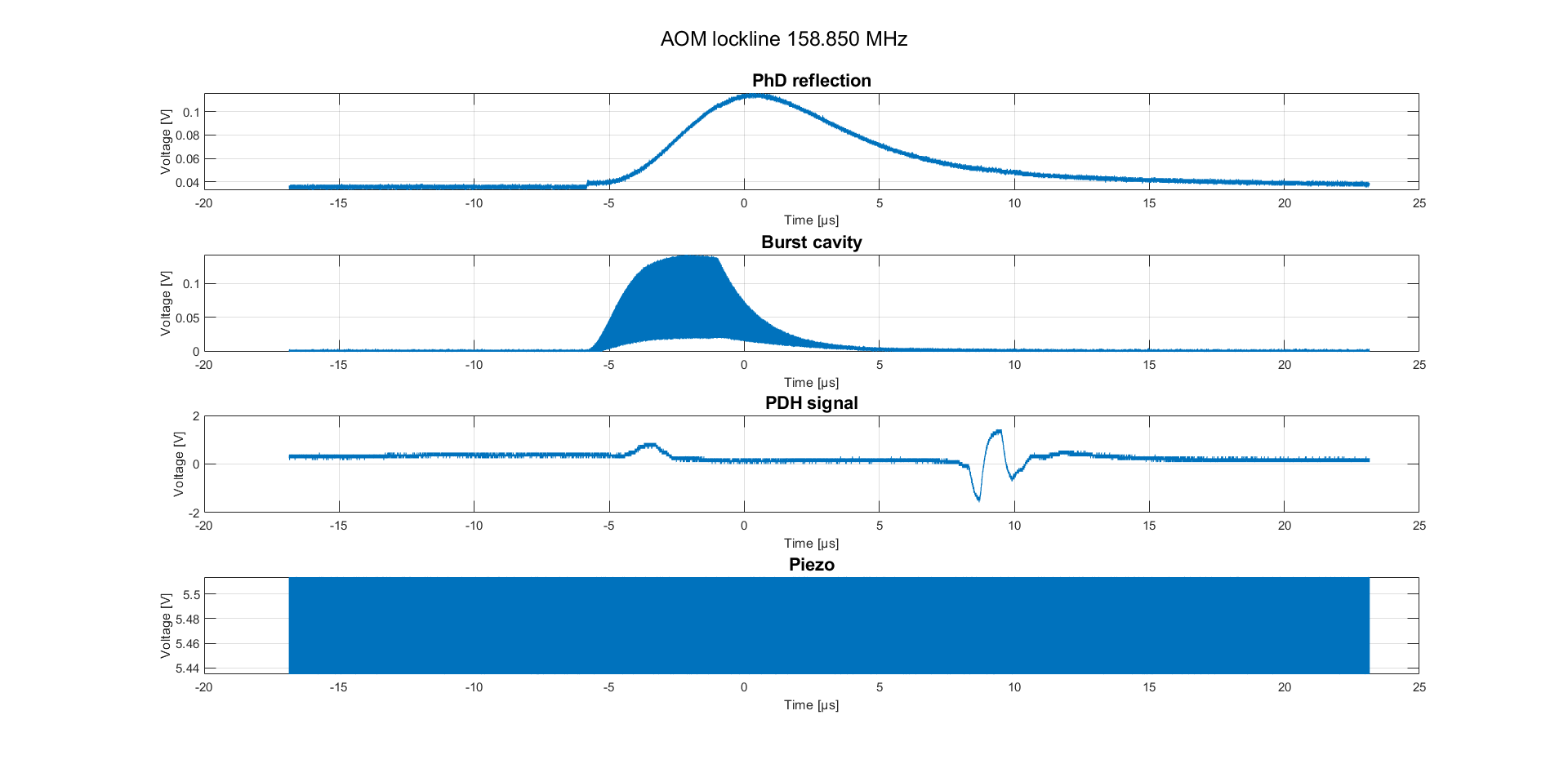 |
| Attachment 6: AOM_lockline_158_350_kHz.png
|
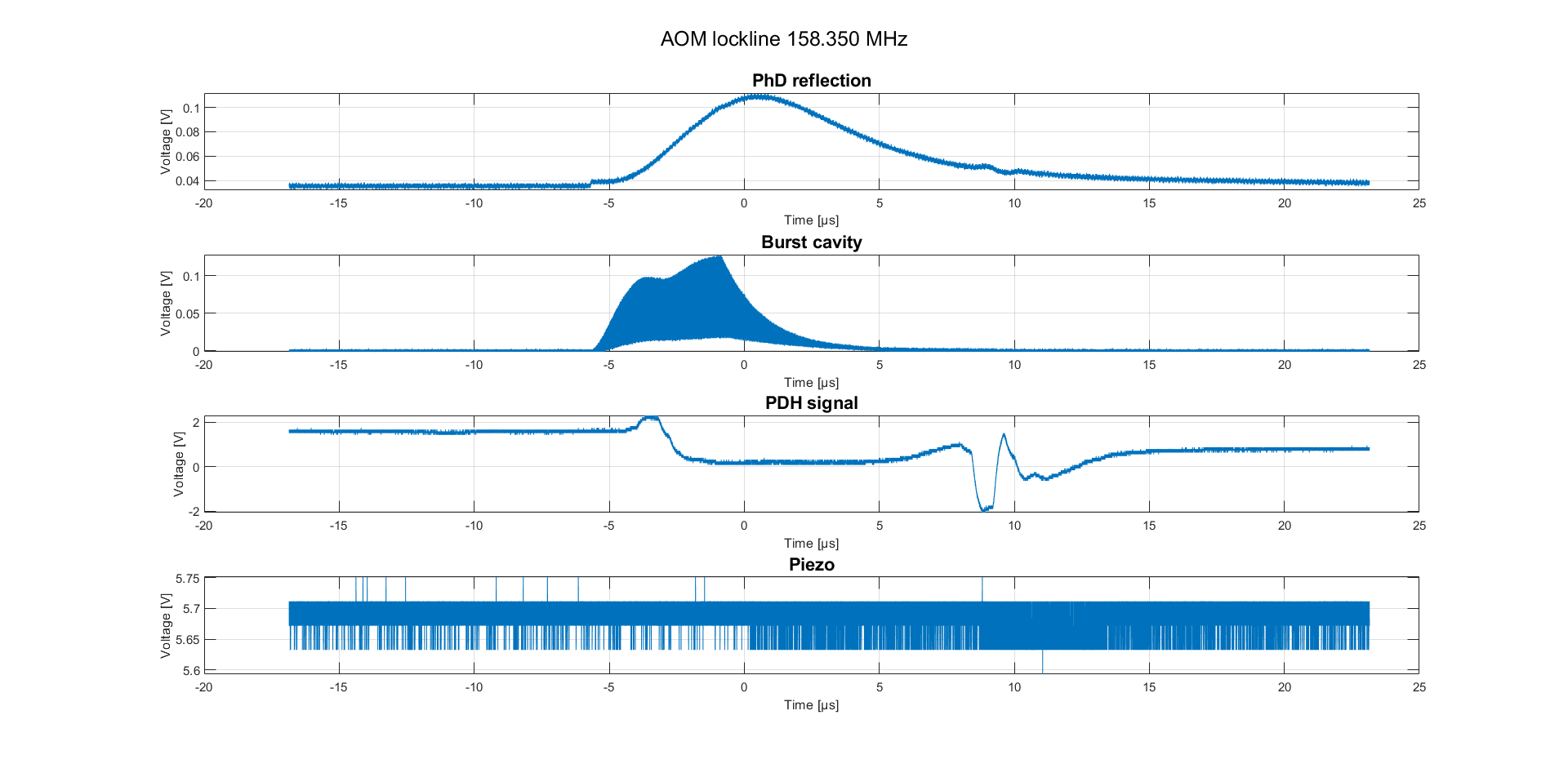 |
| Attachment 7: AOM_lockline_159_350_kHz.png
|
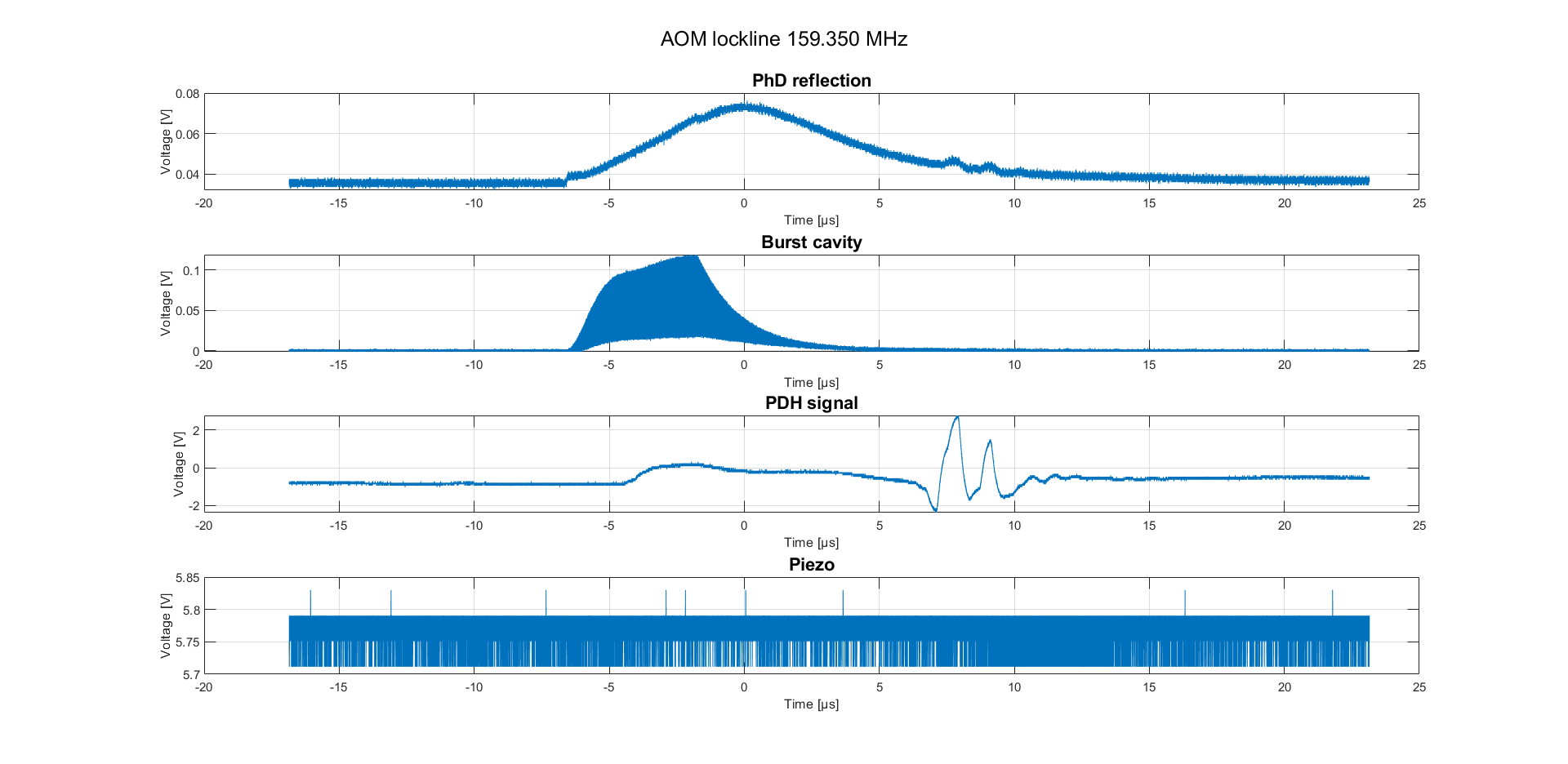 |
|
74
|
Fri Feb 17 18:02:11 2023 |
Blanc | Fixed | info | lasers and optics | Optical room | Mesure polarisation voie de réflexion |
J'ai fait les mesures de polarisation sur la voie de réflexion pour voir la polarisation avant le glan et après le glan du Tangor et de la lockline.
Dans l'ordre :
Image 1-9 : avant le glan
Image 10-18 après le glan
Malgré le fait que l'état de polarisation du Tangor et celui de l'axe du glan soient perpendiculaires, il n'y a pas extinction du Tangor en sortie de glan (défaut glan? partie du faisceau non polarisé?) |
| Attachment 1: Stokes_parameters_LOCKLINE.png
|
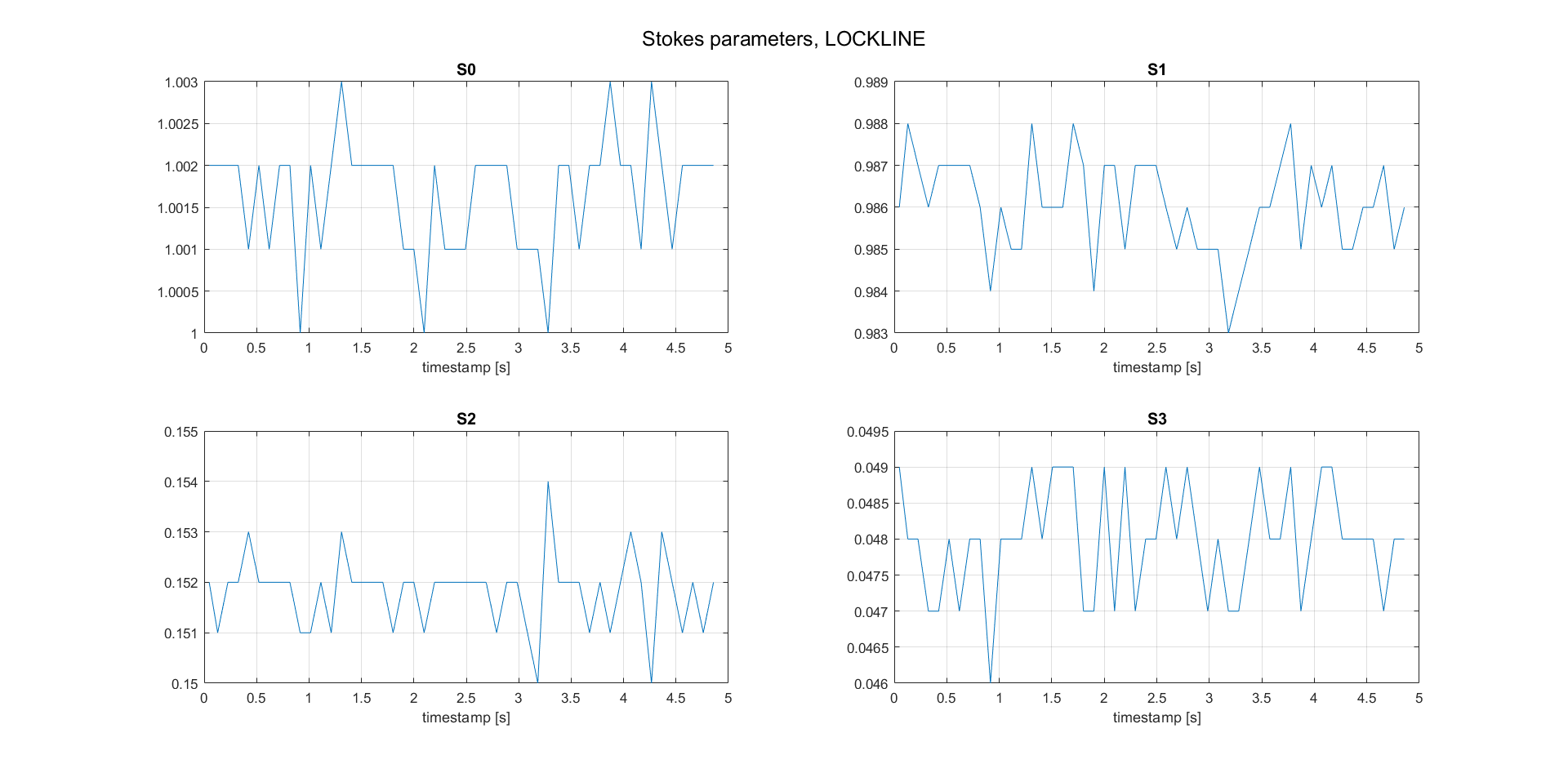 |
| Attachment 2: DOP_DOLP_DOCP_LOCKLINE.png
|
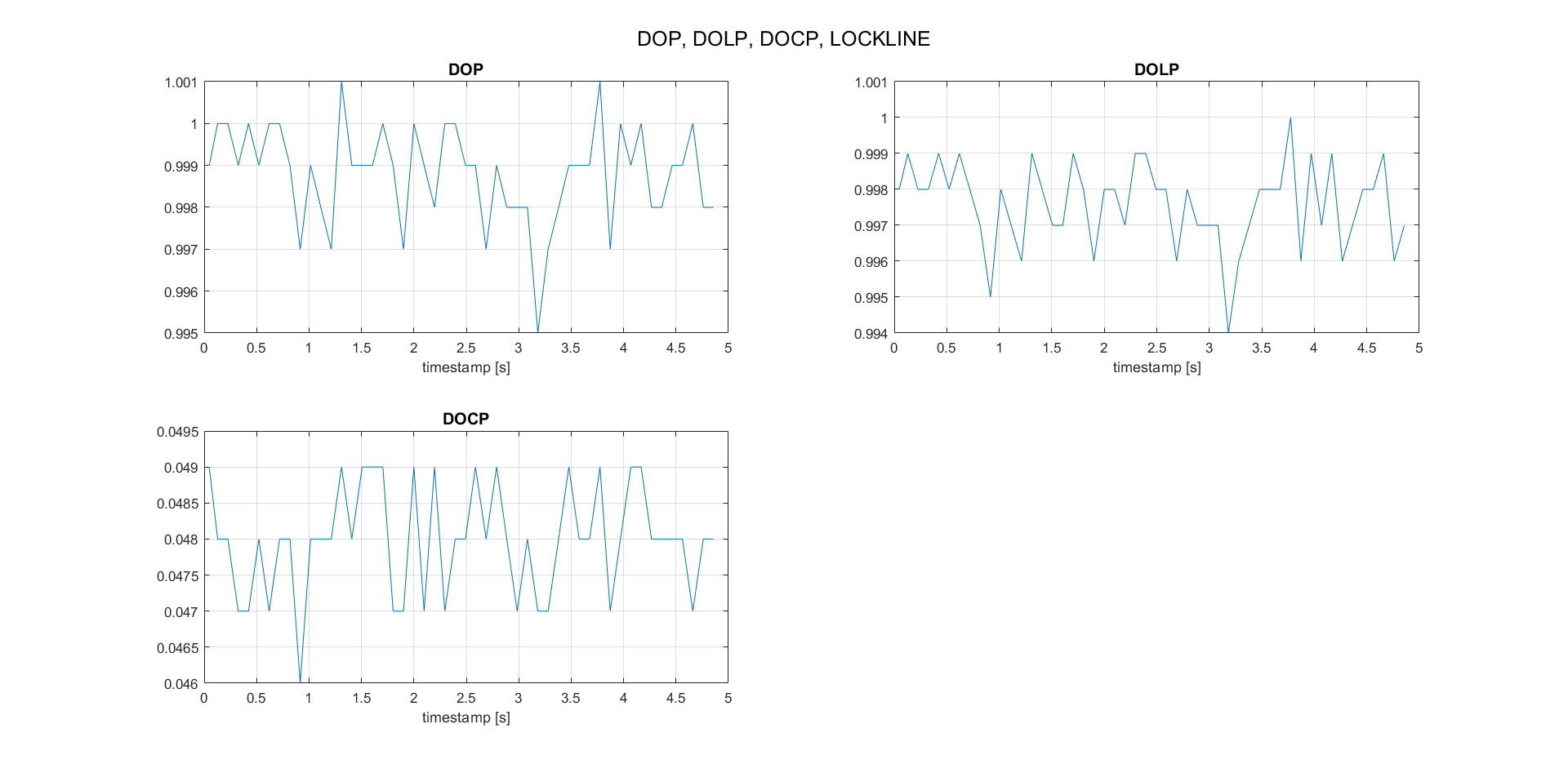 |
| Attachment 3: Phase_Ellipticité_Êta_LOCKLINE.png
|
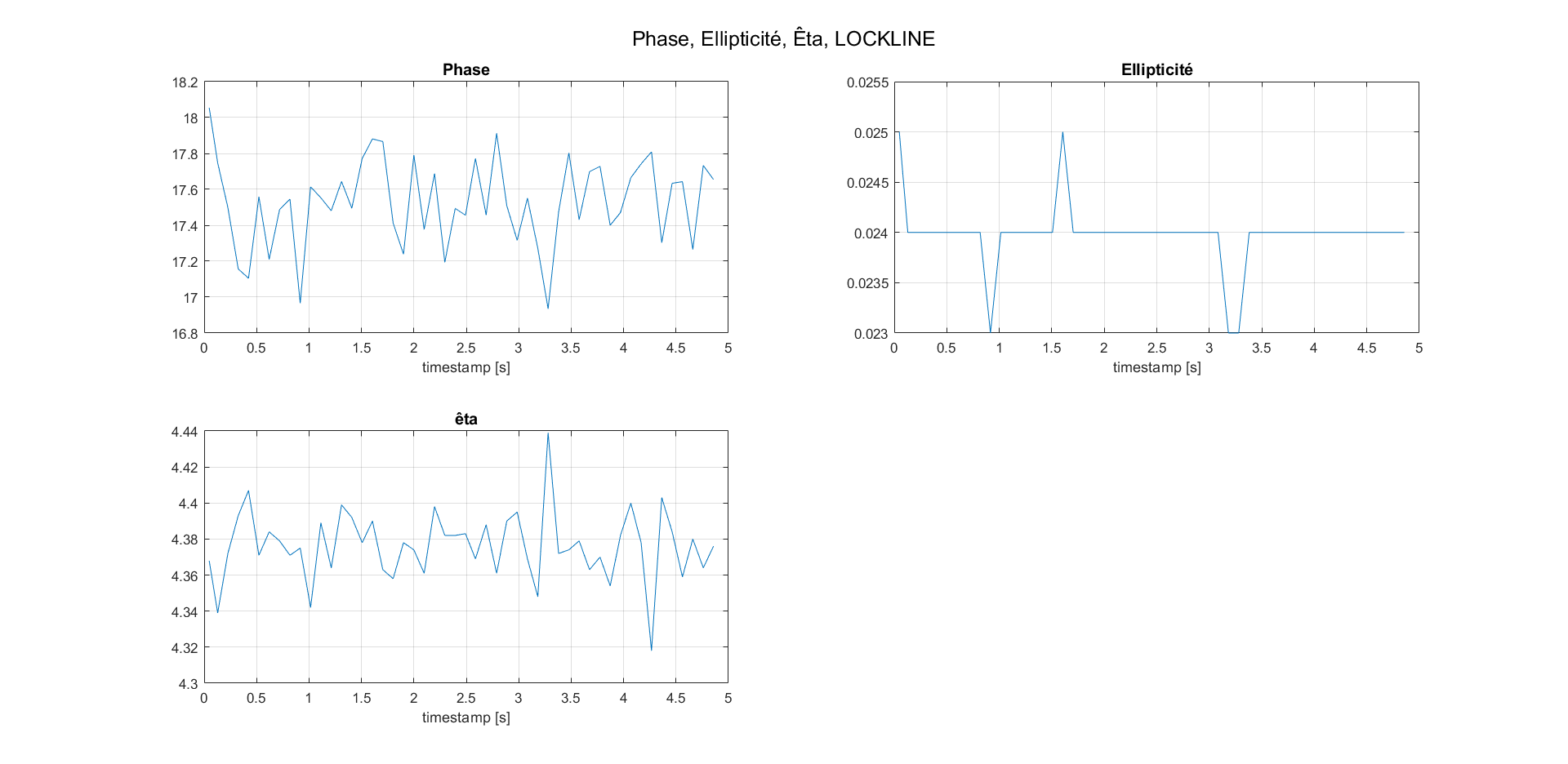 |
| Attachment 4: Ellipse_Polarization_LOCKLINE.png
|
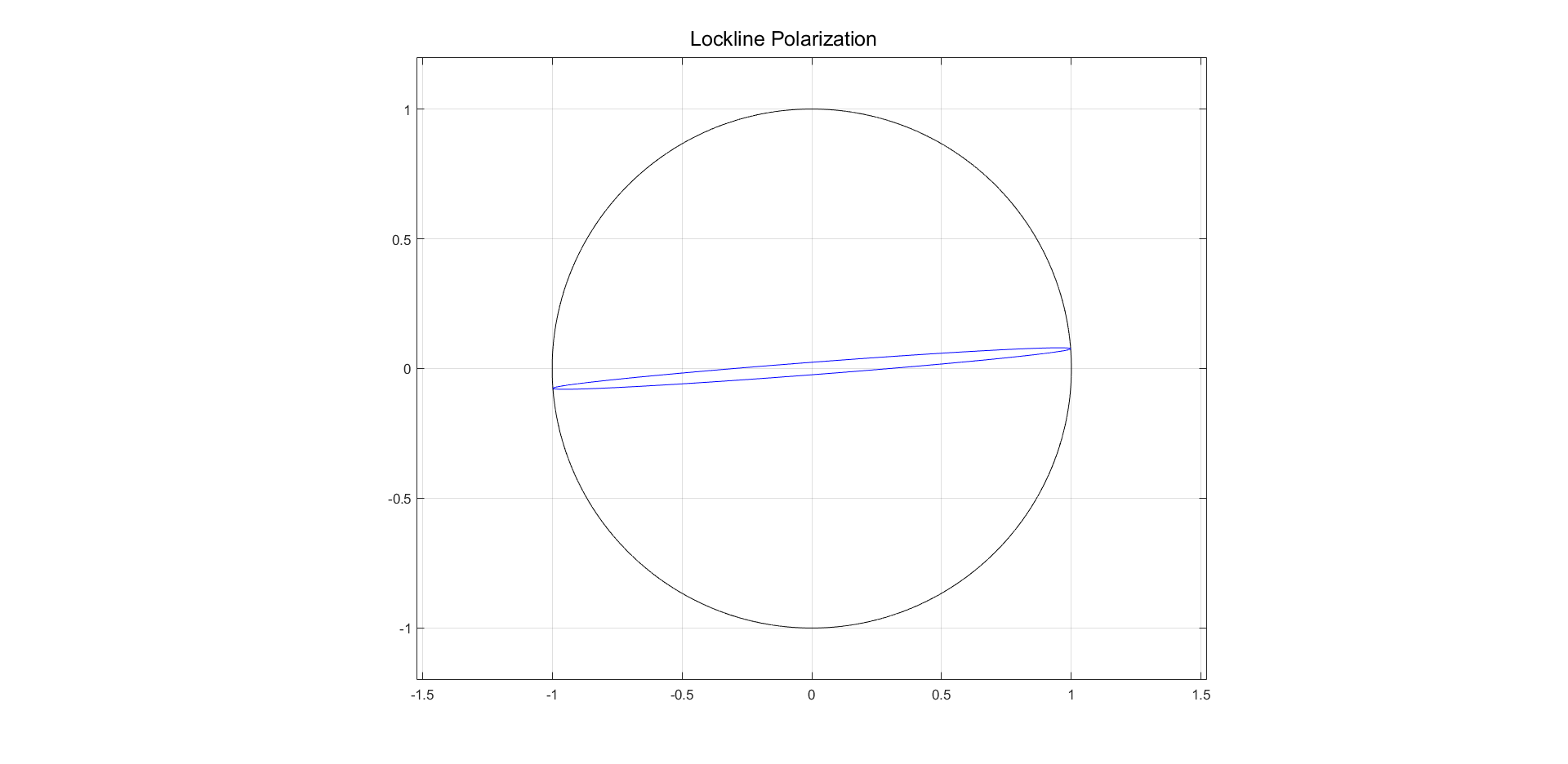 |
| Attachment 5: Stokes_parameters_TANGOR.png
|
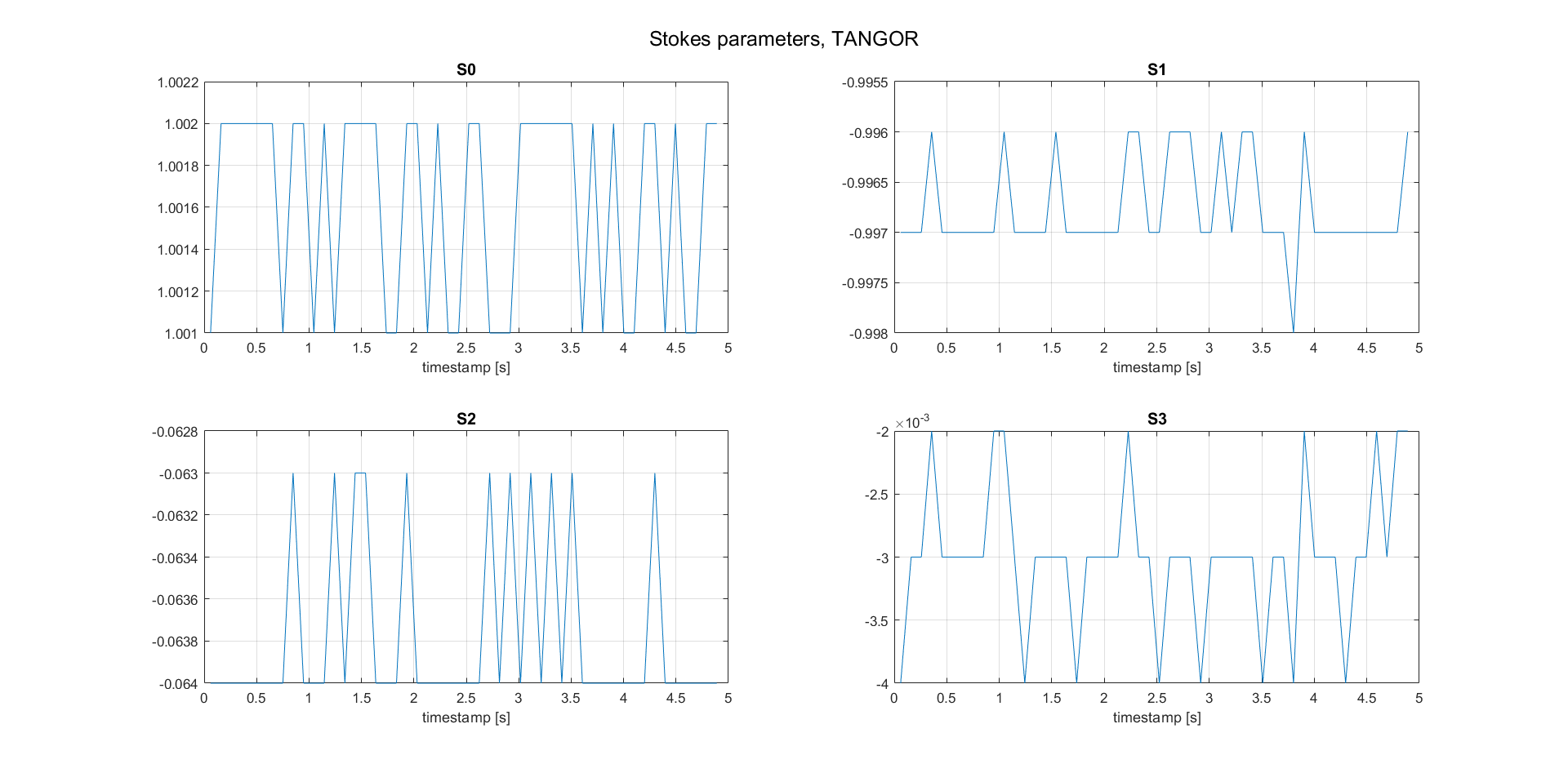 |
| Attachment 6: DOP_DOLP_DOCP_TANGOR.png
|
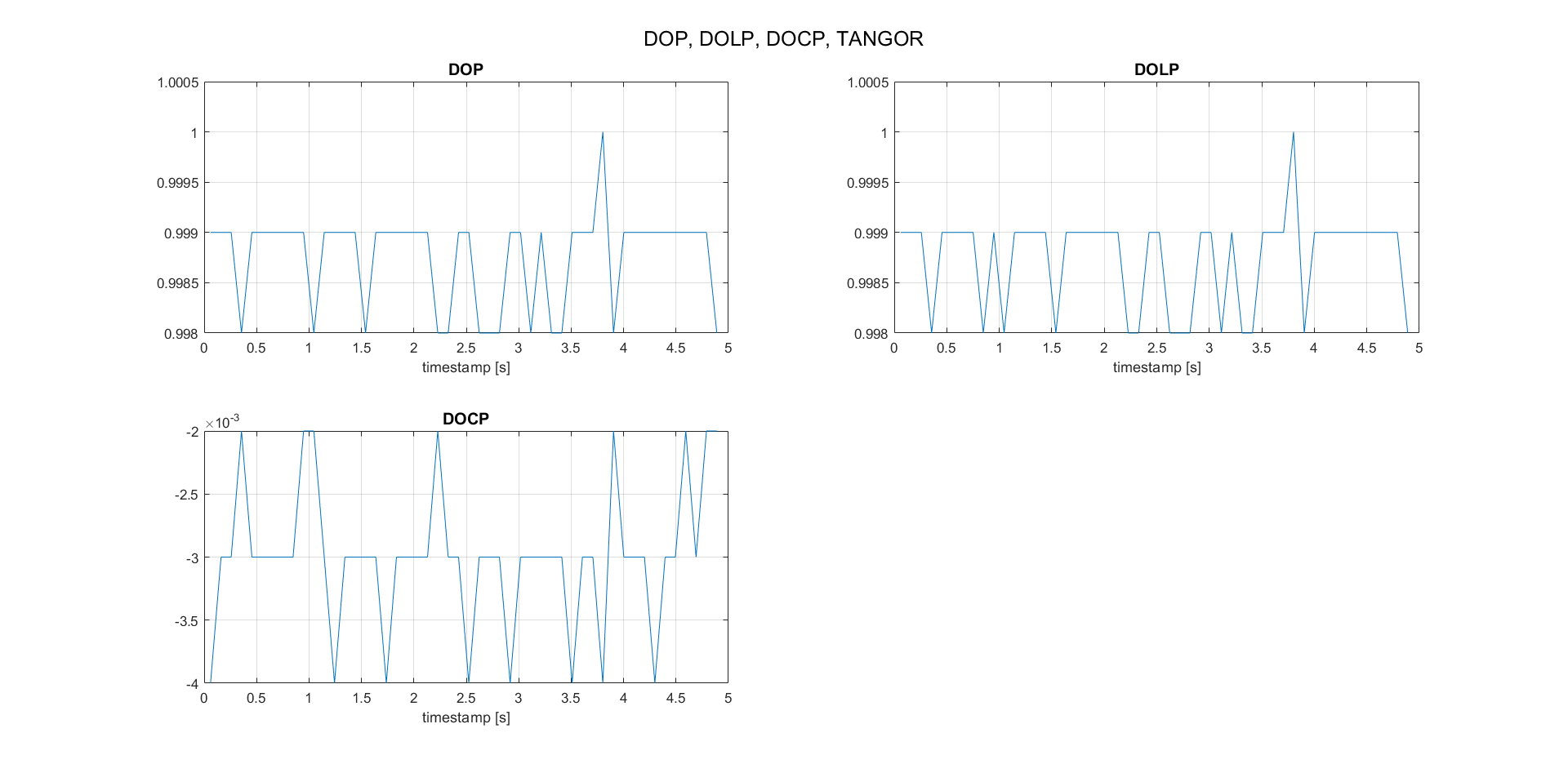 |
| Attachment 7: Phase_Ellipticité_Êta_TANGOR.png
|
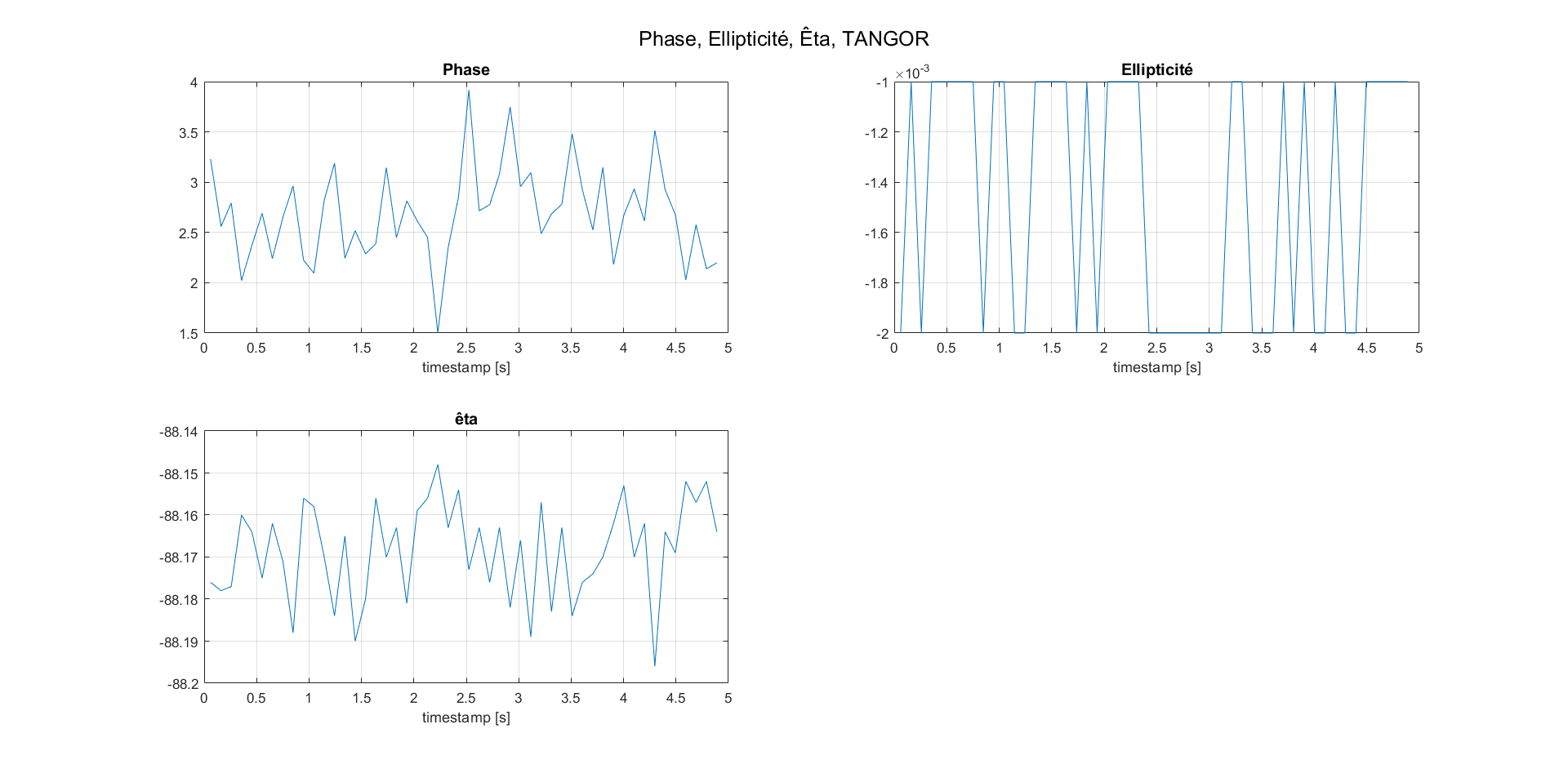 |
| Attachment 8: Ellipse_Polarization_TANGOR.png
|
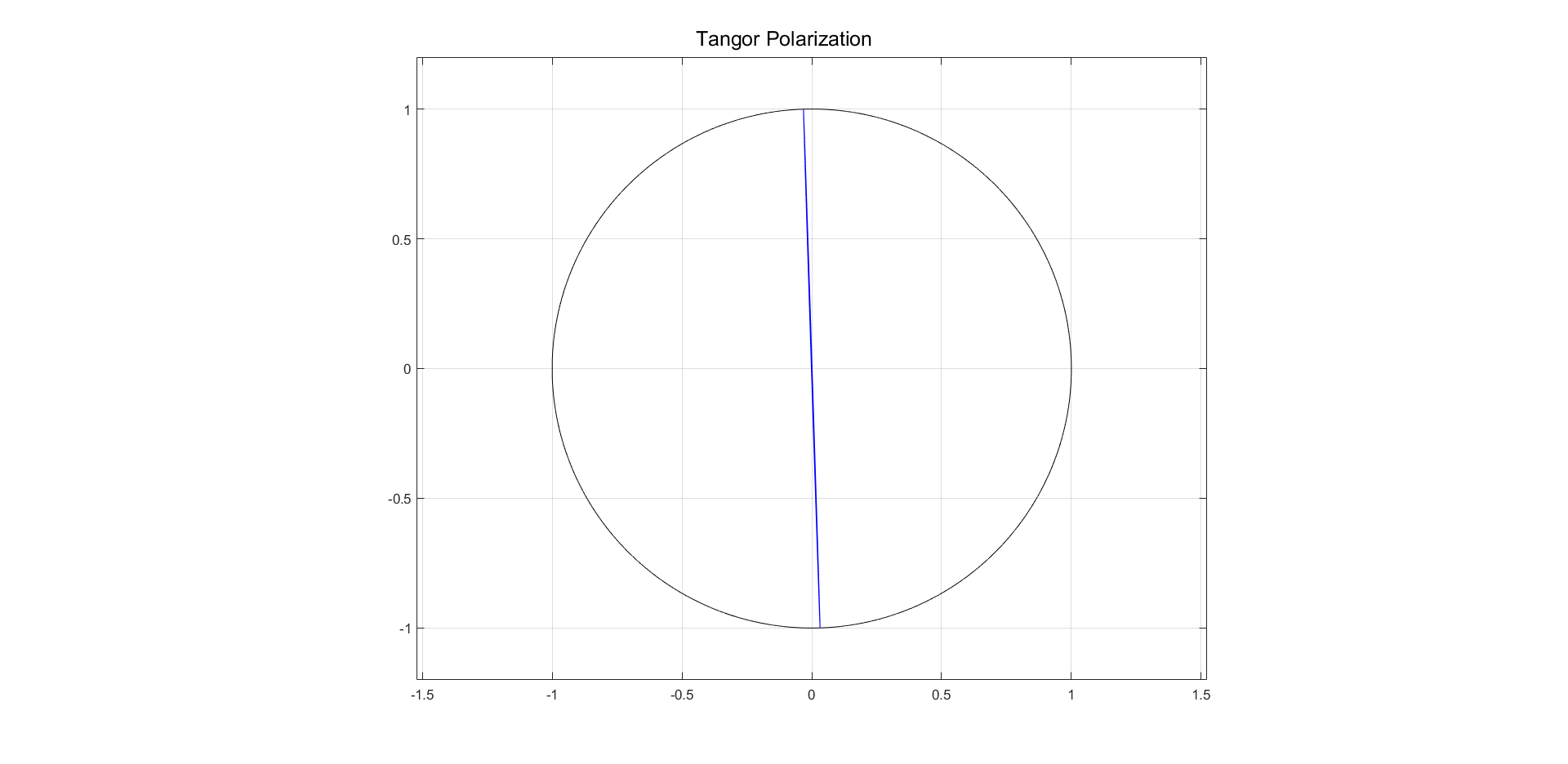 |
| Attachment 9: ALL_polar_Ellipses.png
|
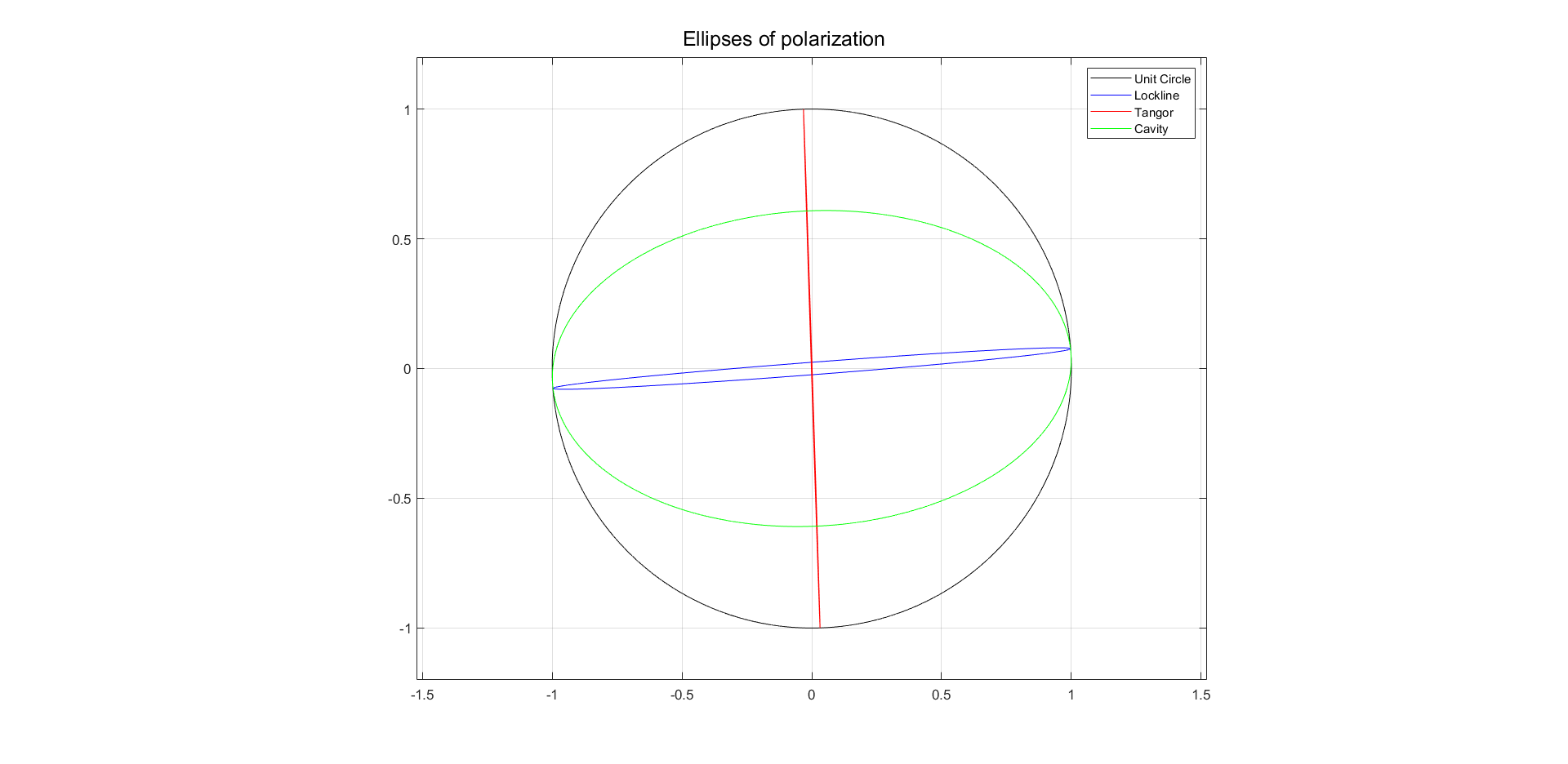 |
| Attachment 10: Stokes_parameters_LOCKLINE.png
|
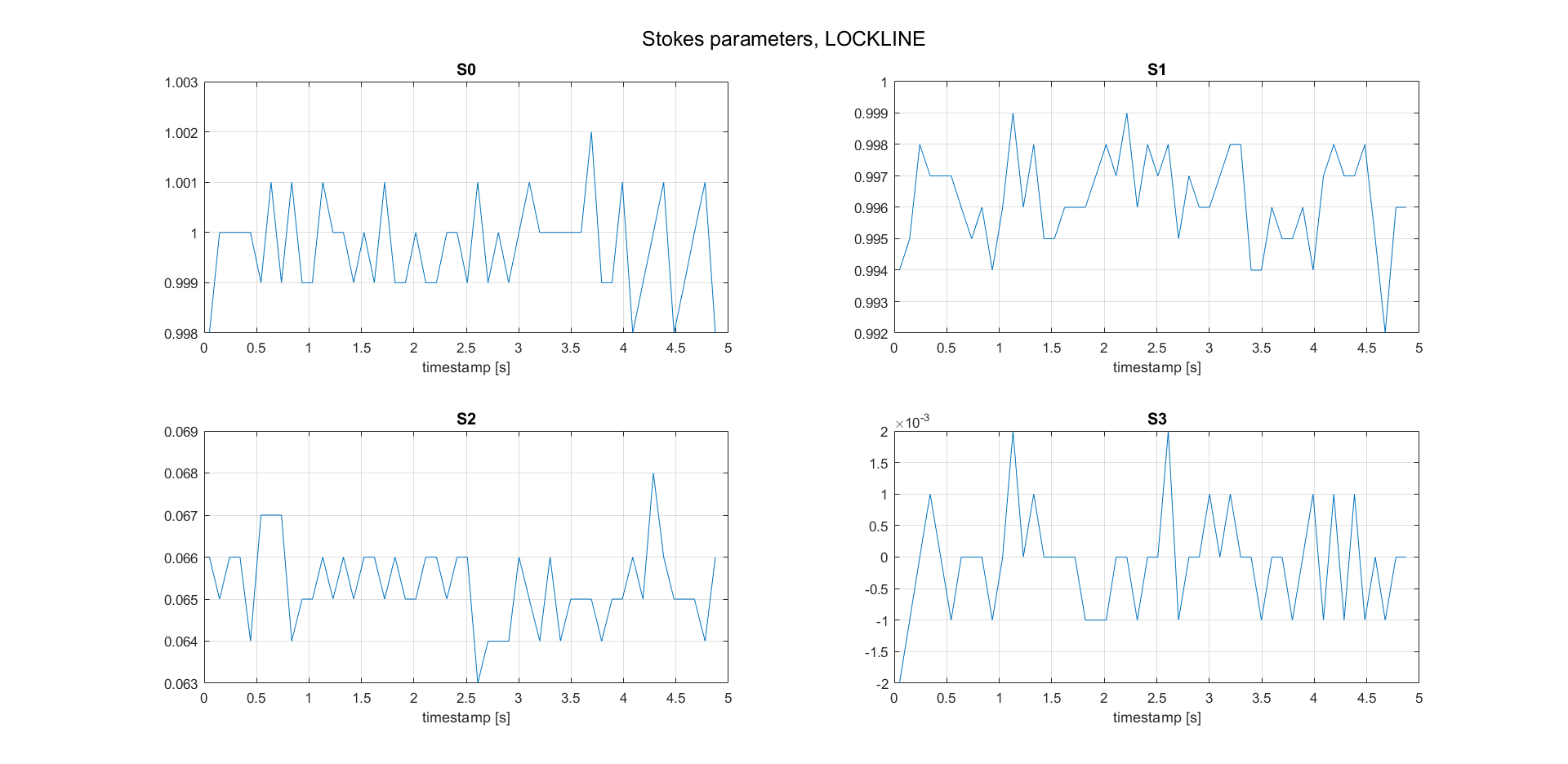 |
| Attachment 11: DOP_DOLP_DOCP_LOCKLINE.png
|
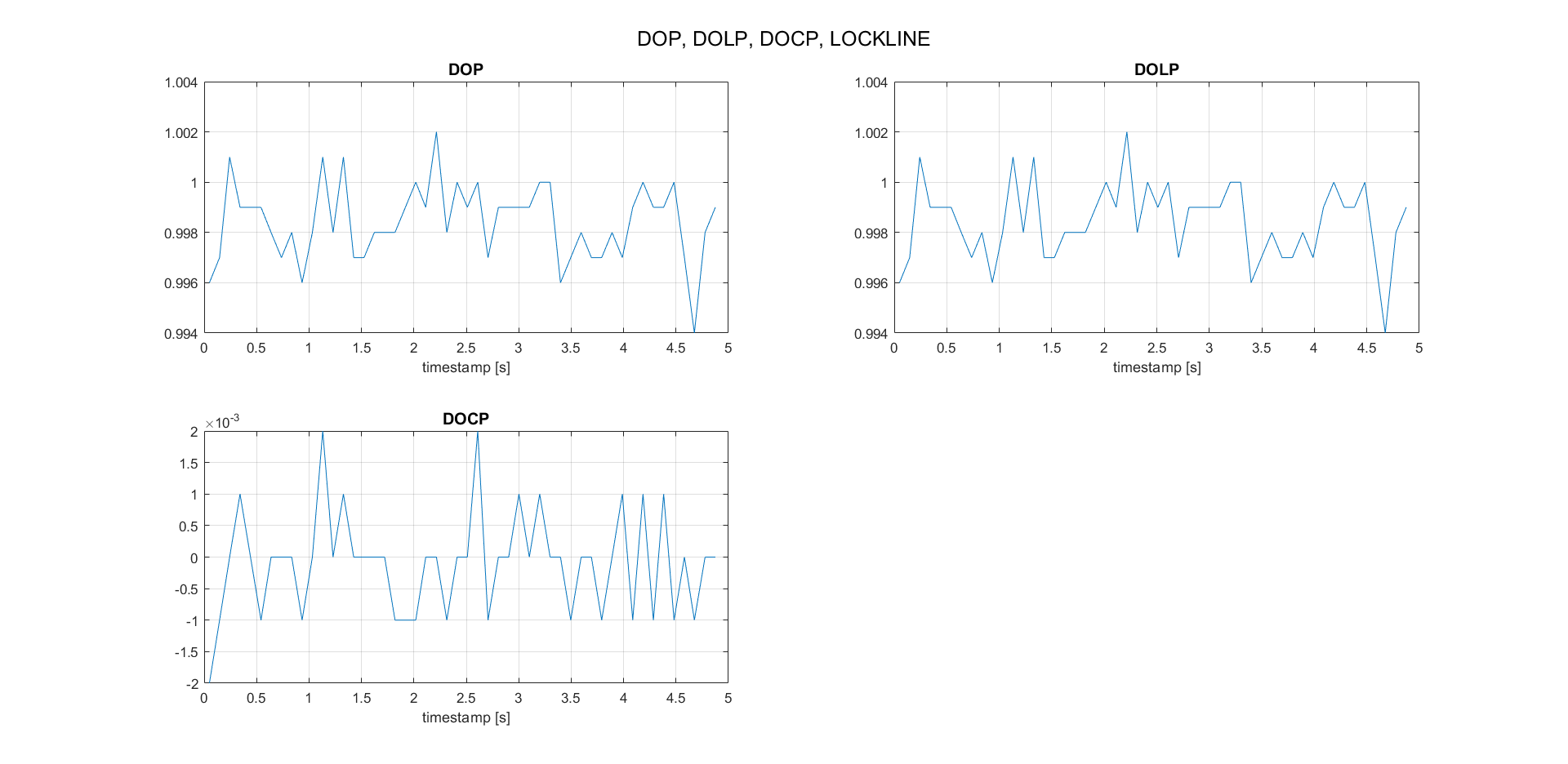 |
| Attachment 12: Phase_Ellipticité_Êta_LOCKLINE.png
|
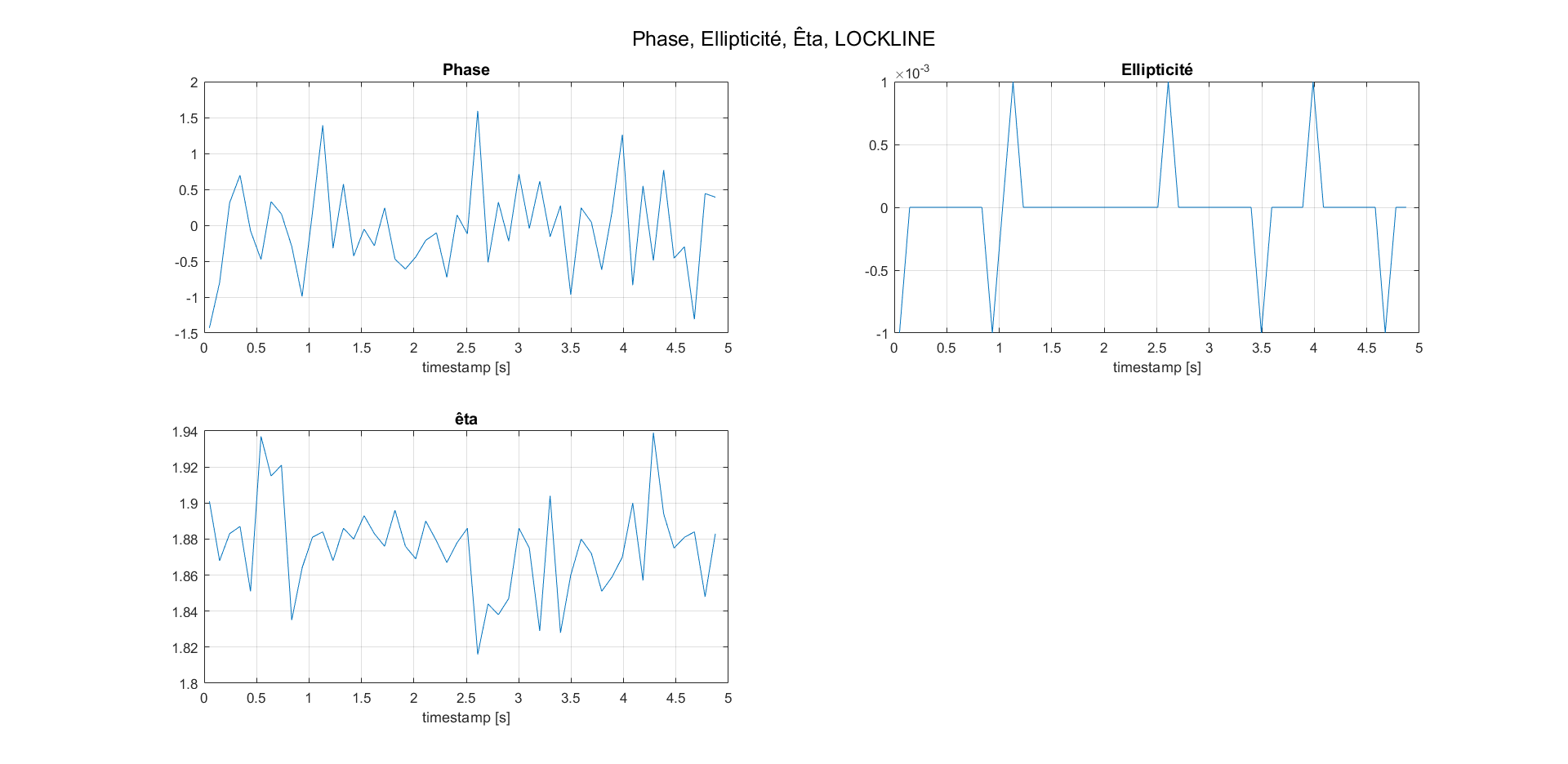 |
| Attachment 13: Ellipse_Polarization_LOCKLINE.png
|
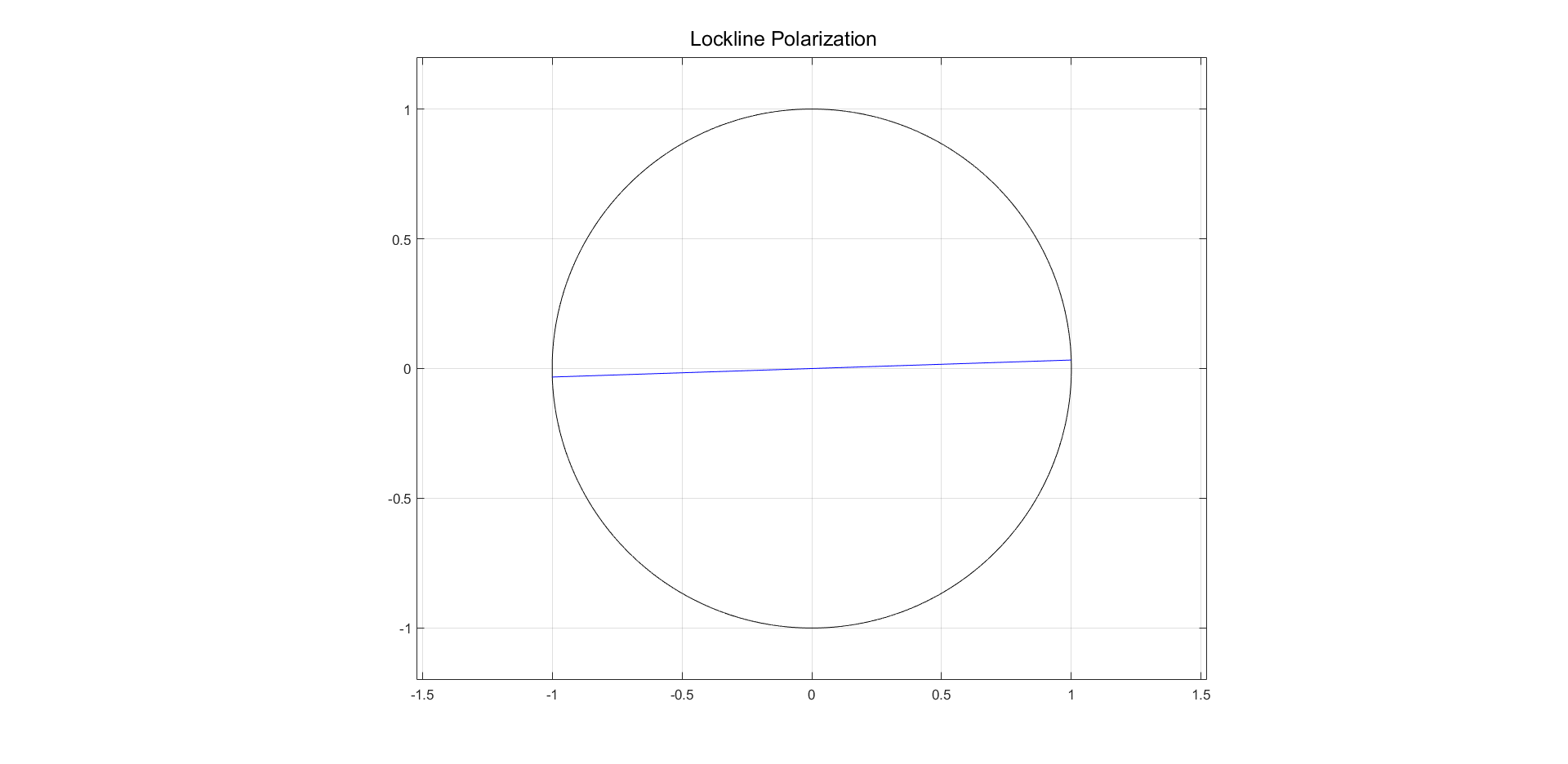 |
| Attachment 14: Stokes_parameters_TANGOR.png
|
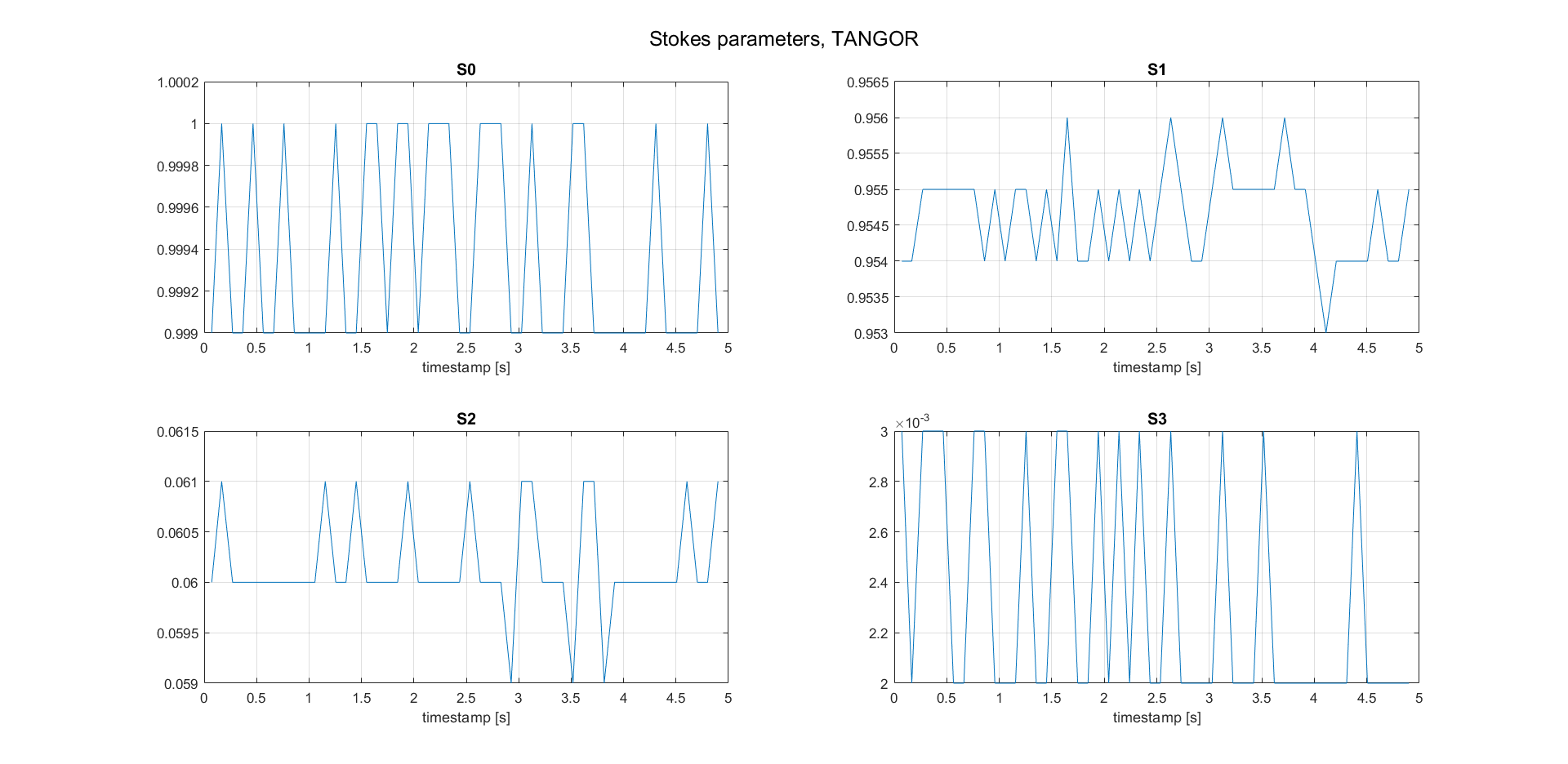 |
| Attachment 15: DOP_DOLP_DOCP_TANGOR.png
|
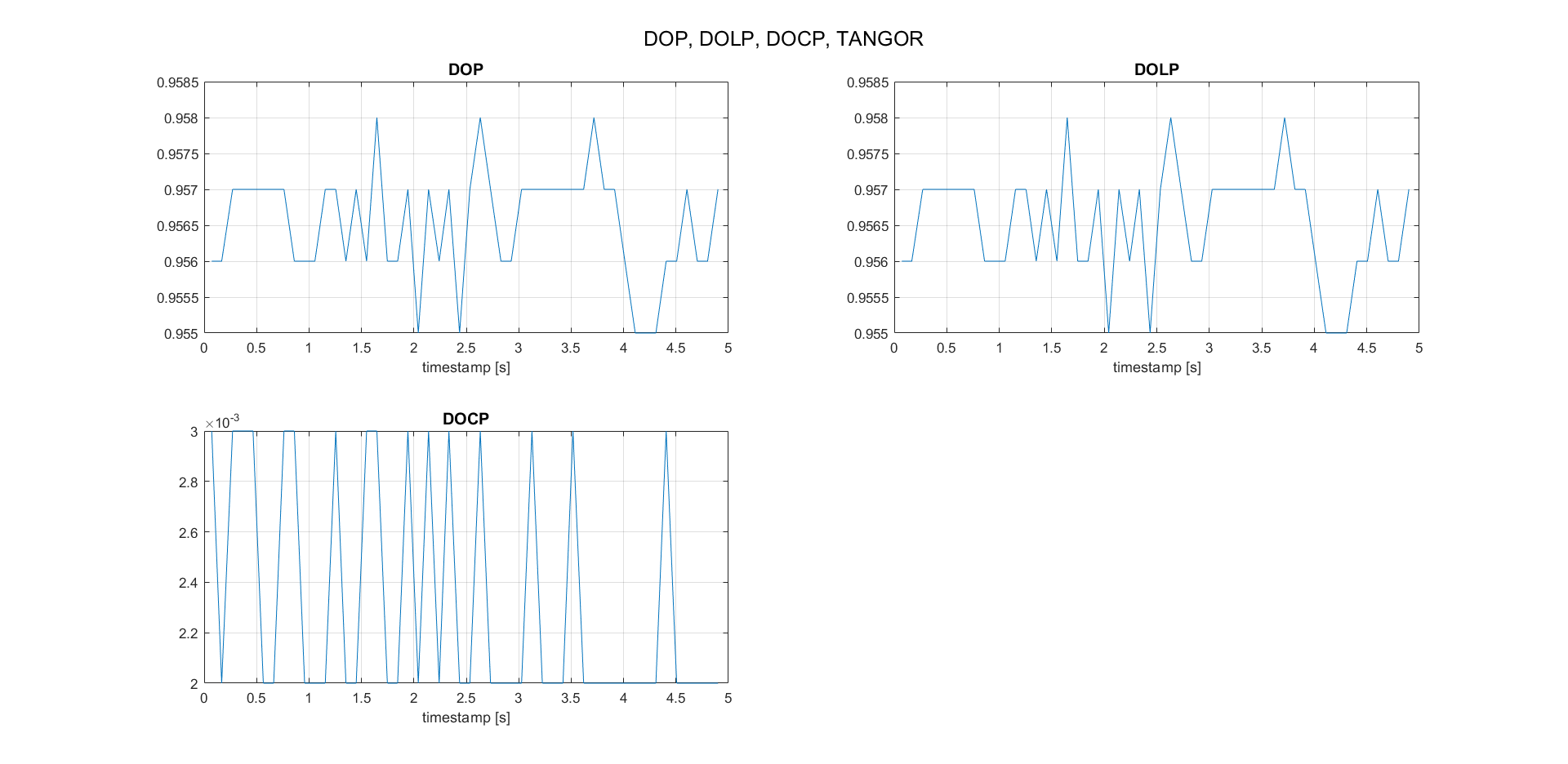 |
| Attachment 16: Phase_Ellipticité_Êta_TANGOR.png
|
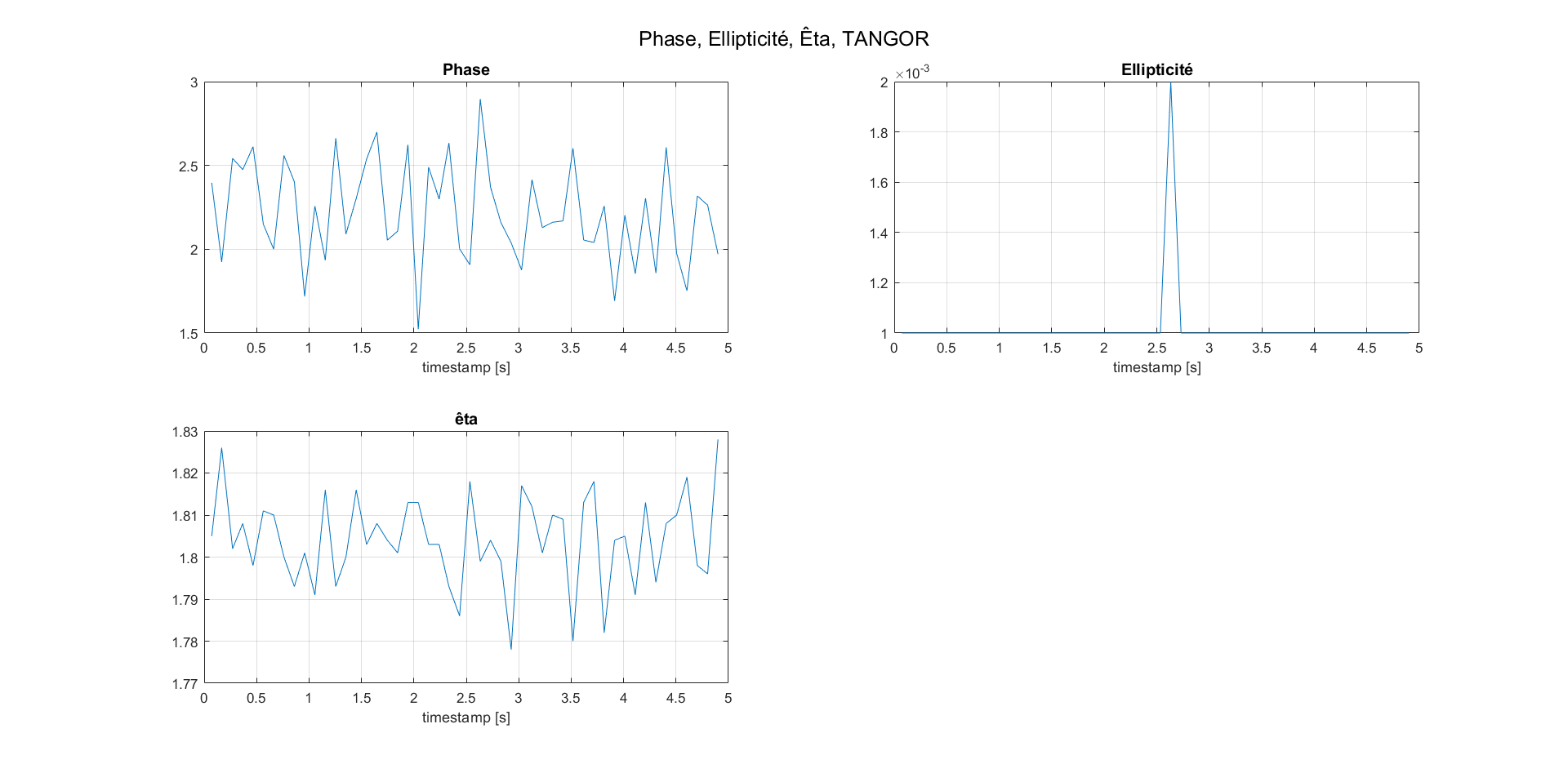 |
| Attachment 17: Ellipse_Polarization_TANGOR.png
|
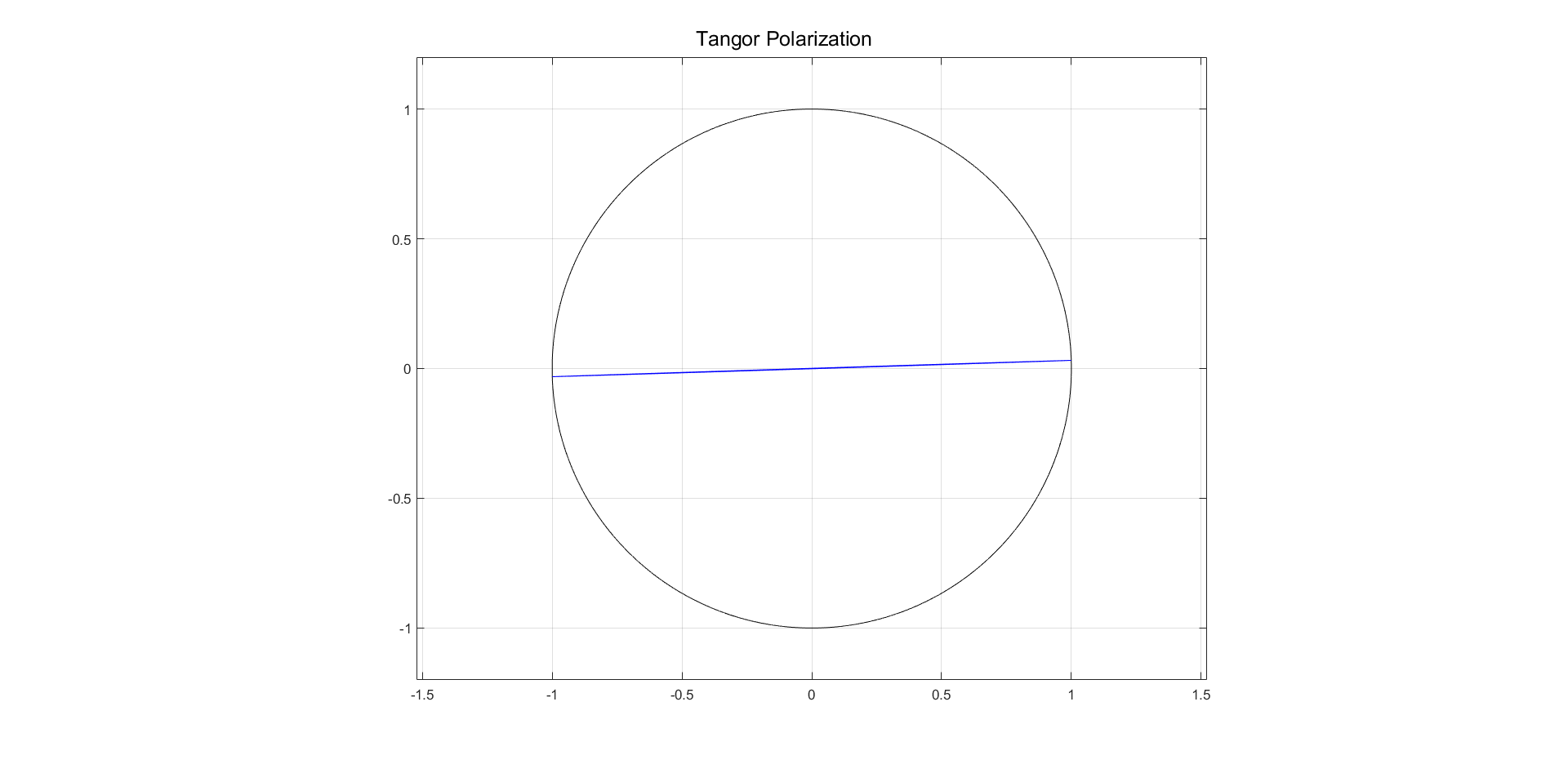 |
| Attachment 18: ALL_polar_Ellipses.png
|
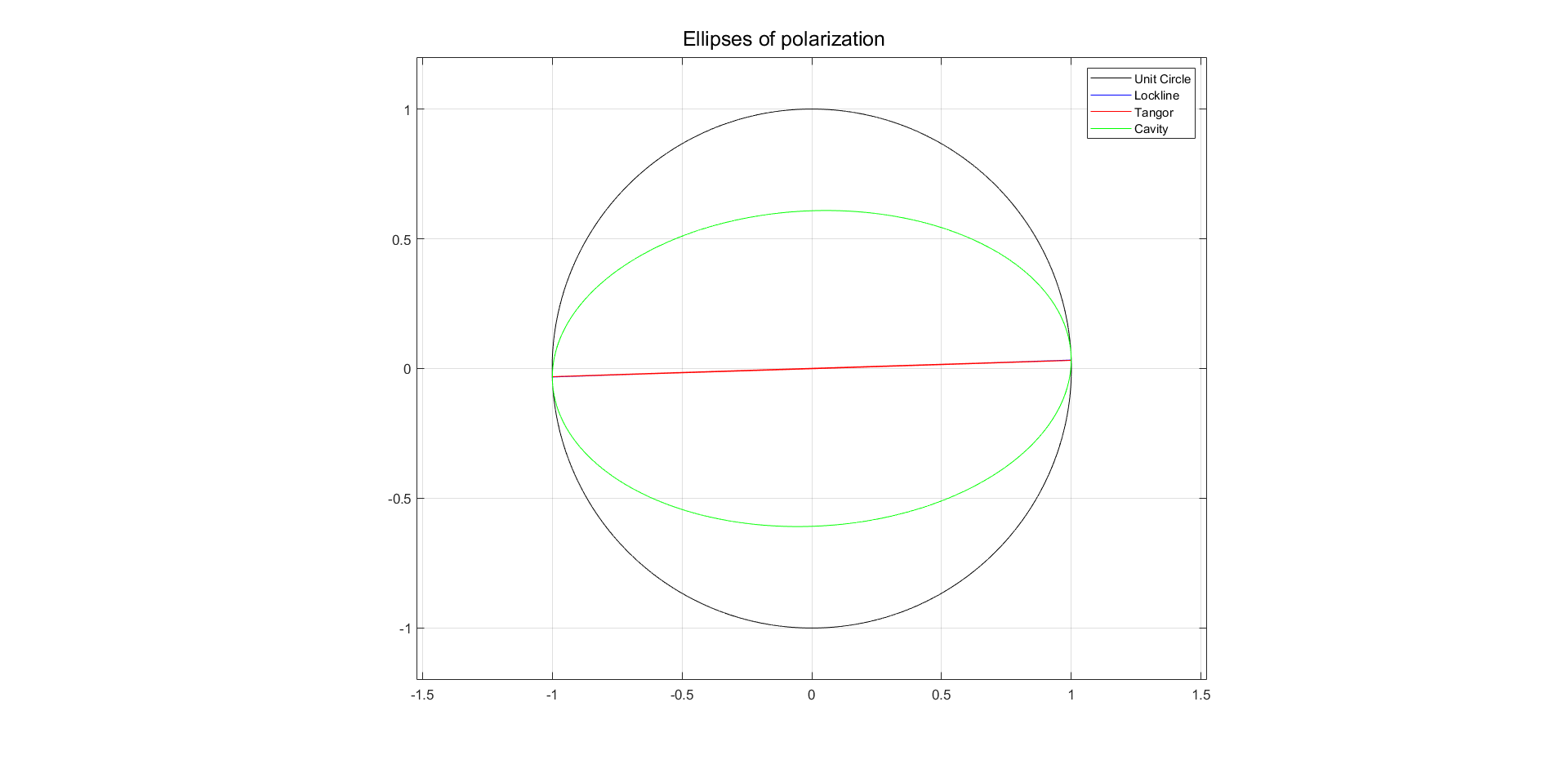 |
|
75
|
Mon Feb 20 12:49:47 2023 |
Blanc | Fixed | info | lasers and optics | Optical room | Update schéma manip |
Le dernier schéma de la manip avec plus d'infos. |
| Attachment 1: 8_Minicav_setup_20_02_2023.PNG
|
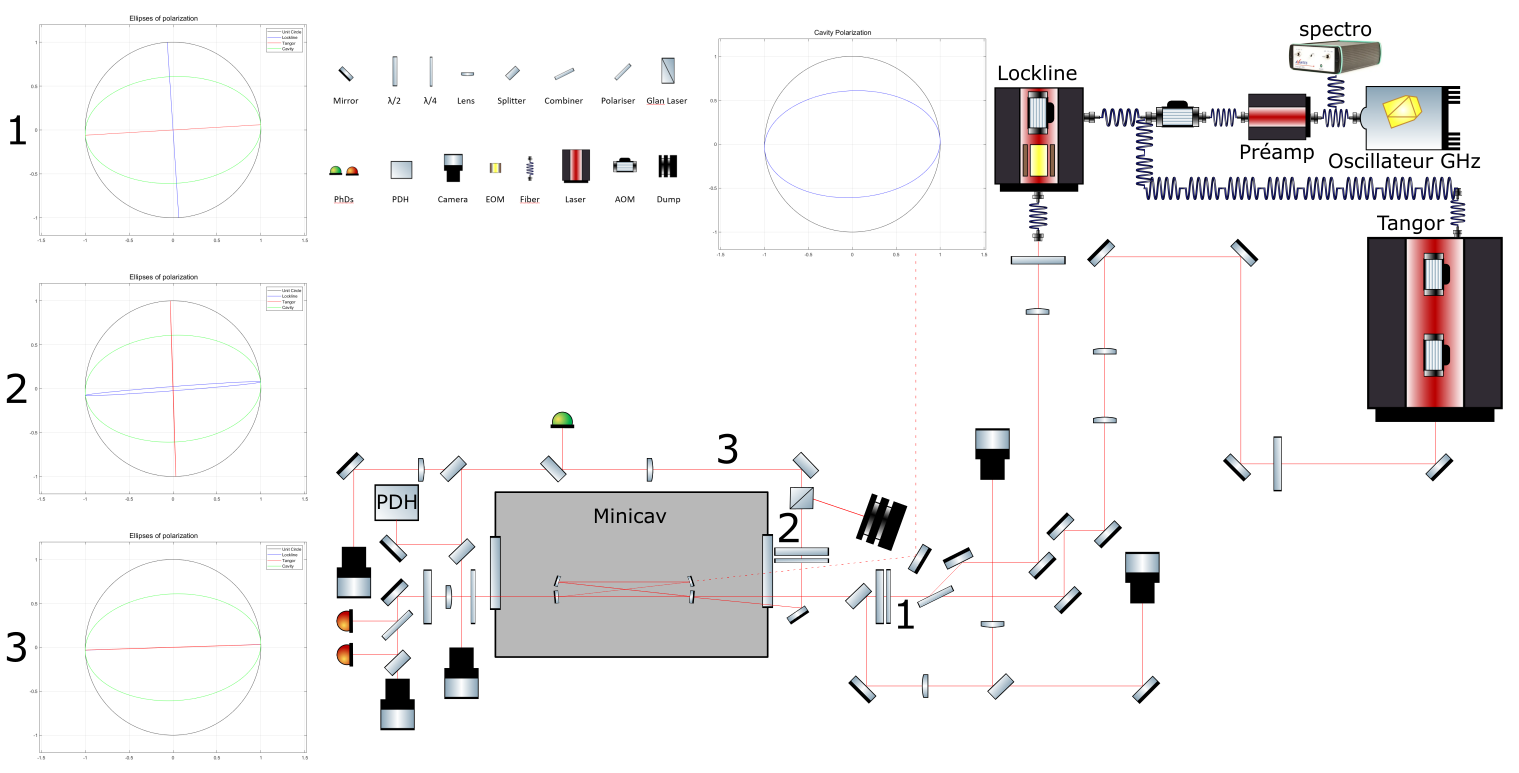 |
|
76
|
Thu Mar 2 11:02:12 2023 |
Blanc | Fixed | info | lasers and optics | Optical room | Calcul Polar |
J'ai fait le calcul de la puissance du Tangor qui passait à travers le glan avec 3 hypothèses :
1- Le faisceau est totalement polarisé et le glan est parfait (cf : image 1)
2- Le faisceau est totalement polarisé et le glan est imparfait (cf : image 2)
3- Le faisceau est partiellement polarisé et le glan est imparfait (cf : image 3)
La quatrième image montre la cause du "bump" liée au stacking du Tangor sur la voie PDH.
Comme j'ai aligné le glan quand la cavité n'était pas lockée et que j'ai fait matché la polar avant la cavité avec celle du glan (toujours pas locké), dans le cas où la polar de la cavité lockée est différente (ici le cas critique est représenté), il y a une fraction du Tangor qui va passer à travers le cube. |
| Attachment 1: Perfect_glan.PNG
|
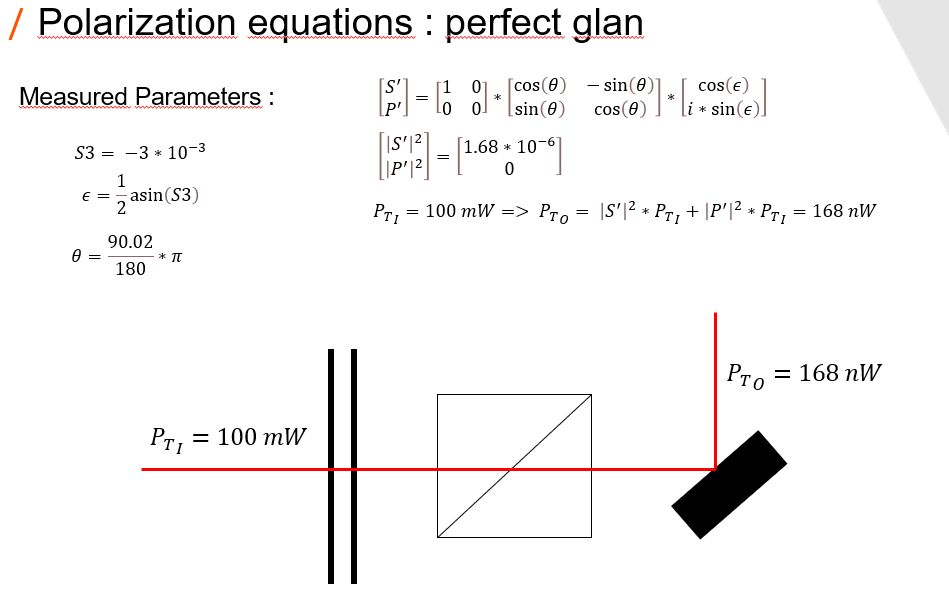 |
| Attachment 2: Unperfect_glan.PNG
|
 |
| Attachment 3: Partially_polarized_beam.PNG
|
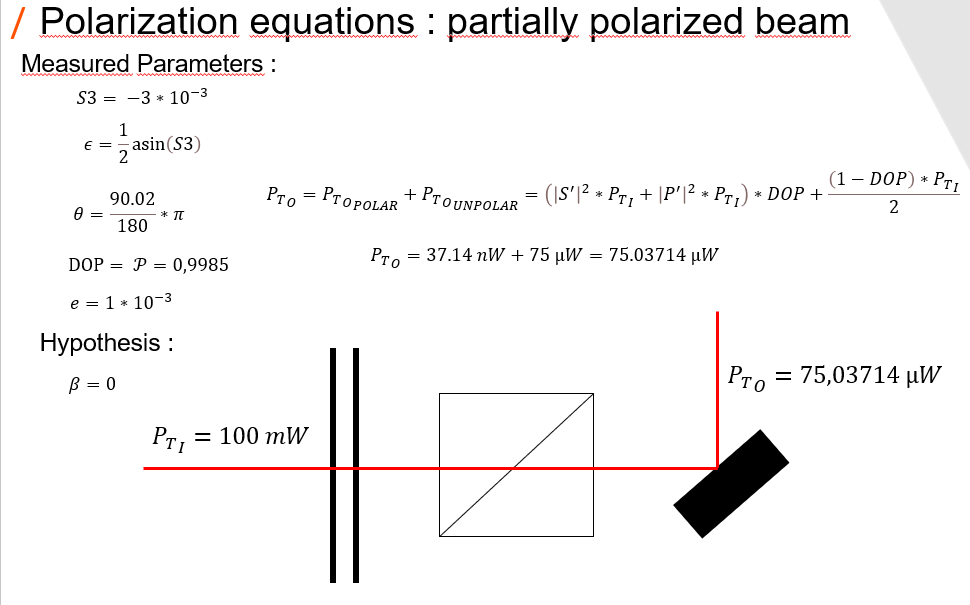 |
| Attachment 4: PB_PDH_line.PNG
|
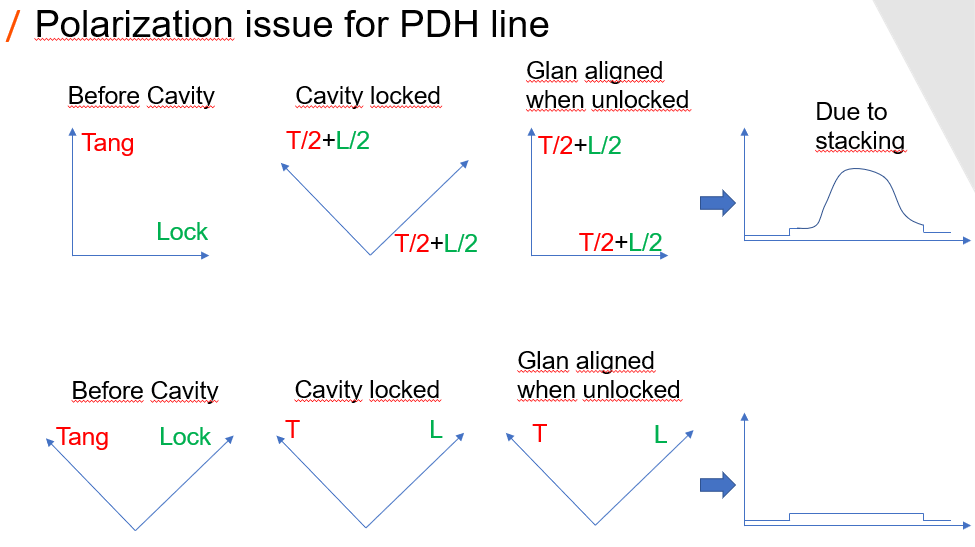 |
|
77
|
Thu Mar 2 11:42:19 2023 |
Blanc | Fixed | info | lasers and optics | Optical room | Polar cavité |
Après avoir locké avec la lockline et retiré le glan et la paire de lambda sur la voie PDH, j'ai observé que la polarisation dans la cavité changeait en fonction de la polarisation en amont que l'on pouvait changer grâce à la paire de lambda qui se trouve après le combiner. J'ai donc cherché à la rendre linéaire, vu que l'on a jusqu'ici préréglé la polarisation comme ci celle de la cavité était linéaire. (cf: images)
J'ai également observé que la perte de puissance sur la photodiode à gain utilisée pour le lock, que l'on pouvait observer en changeant la polarisation en entrée, n'était pas dûe au fait que la polarisation d'entrée ne soit pas la même que celle de la cavité, mais plutôt qu'elle était dûe au fait que la polarisation d'entrée ne soit pas la même que celle de l'ensemble lambda/4+lambda/2+PBS en transmission de la cavité. => On essayait de matcher au mieux avec cette polar et non celle de la cavité.
Il faut donc enlever le PBS pour pouvoir matcher au mieux avec la cavité. |
| Attachment 1: Stokes_parameters_CAVITY.png
|
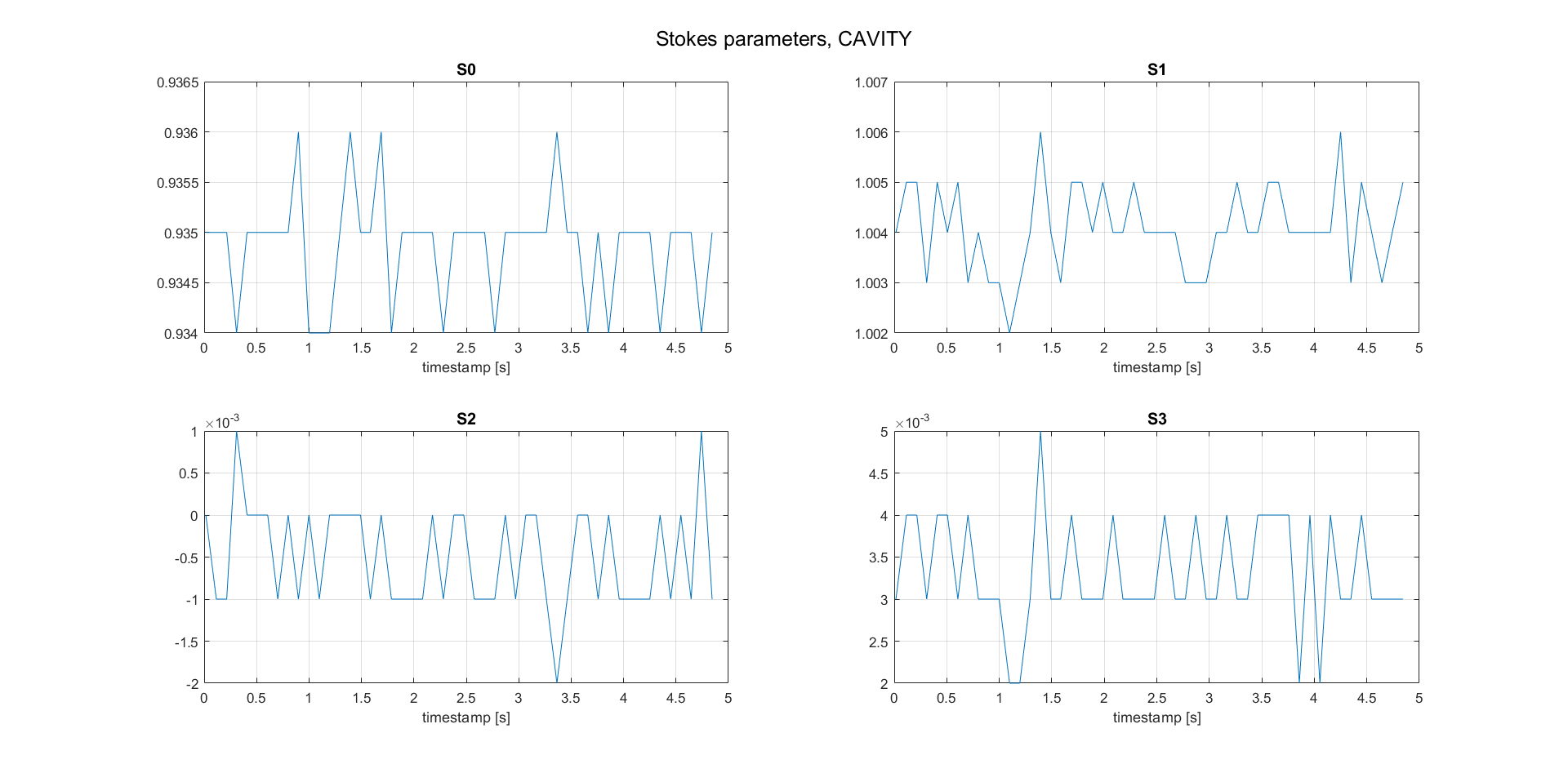 |
| Attachment 2: DOP_DOLP_DOCP_CAVITY.png
|
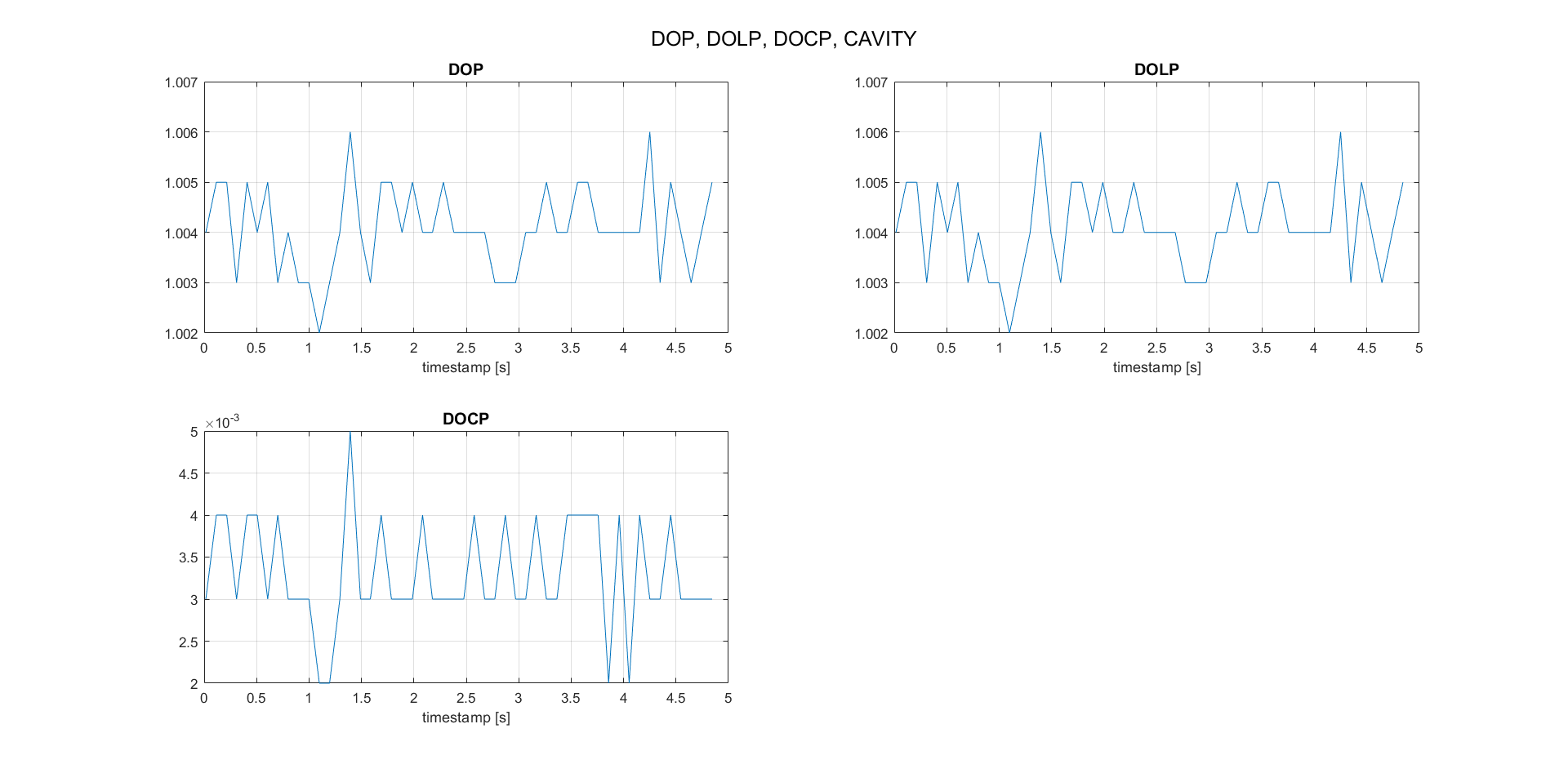 |
| Attachment 3: Phase_Ellipticité_Êta_CAVITY.png
|
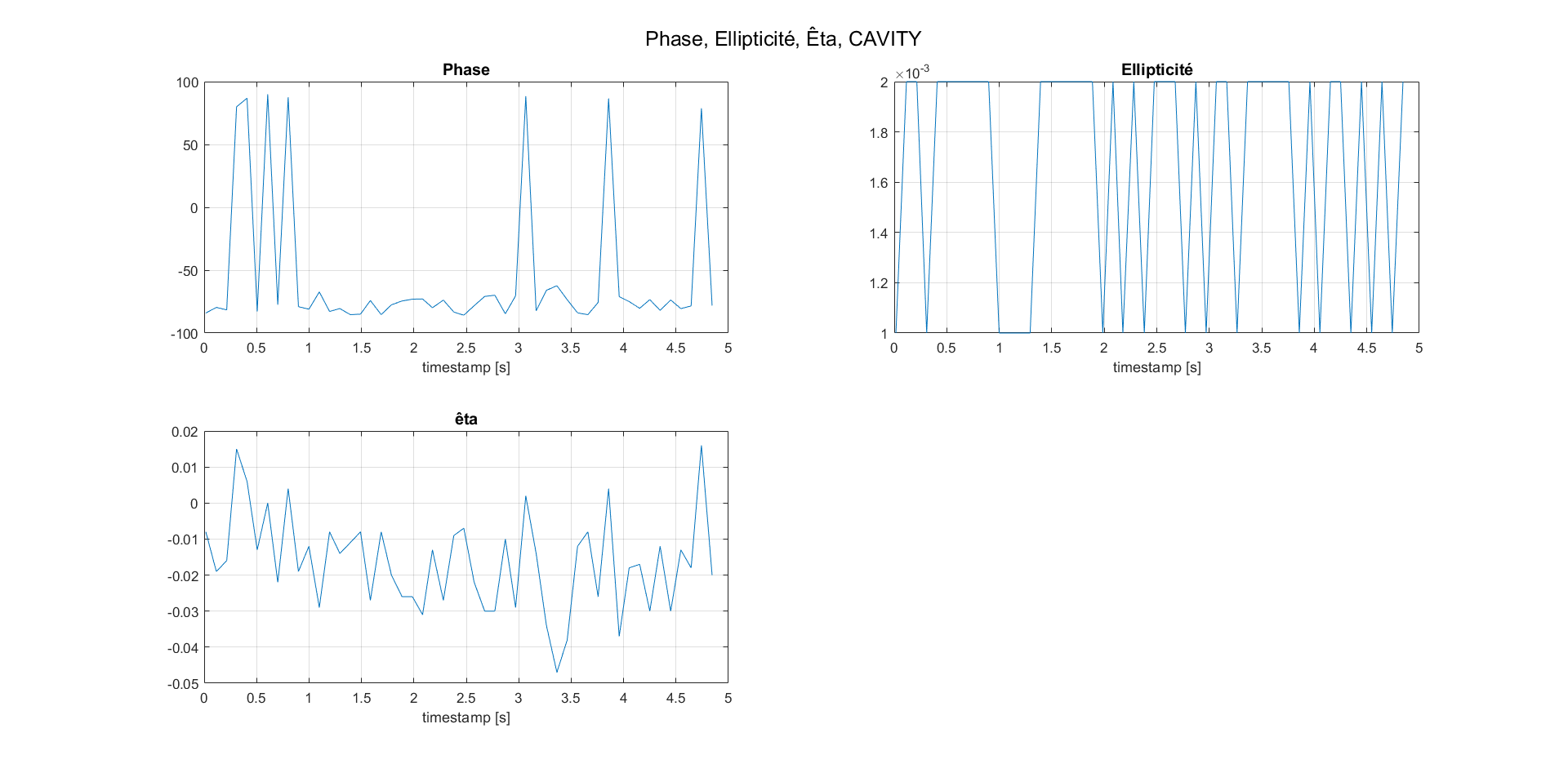 |
| Attachment 4: Ellipse_Polarization_CAVITY.png
|
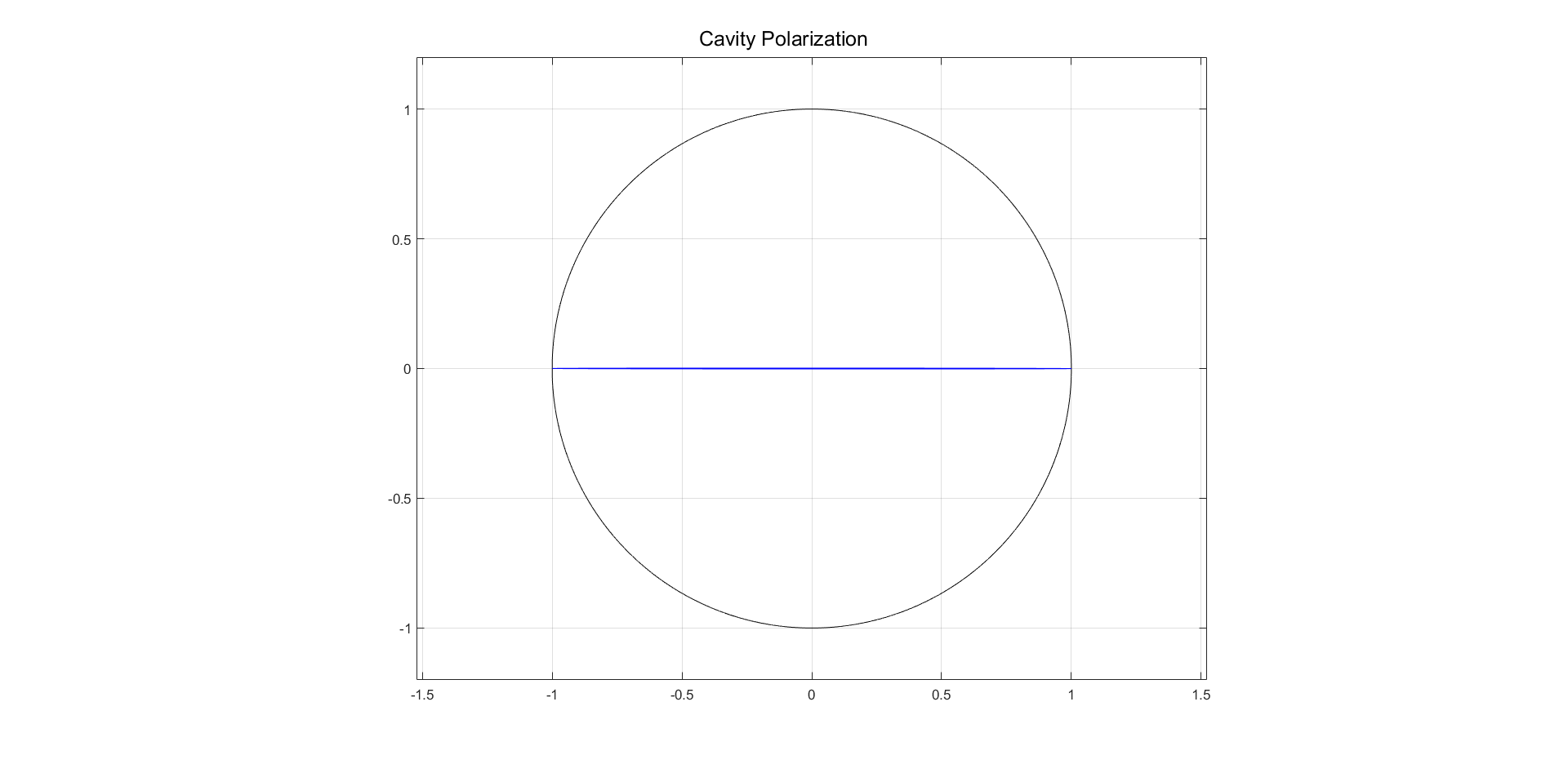 |
|
78
|
Thu Mar 2 17:42:51 2023 |
Blanc | Fixed | info | lasers and optics | Optical room | Polar cavité |
Après avoir enlevé le PBS en transmission de la cavité j'ai cherché à atteindre le maximum possible sur la photodiode de transmission en faisant varier la polarisation en entrée de la cavité.
J'ai remarqué que l'on était pas très sensible (40 mV d'incertitude) lorsque l'on atteignait le maximum et que l'on changeait l'état de polarisation (cf : images) |
| Attachment 1: Ellipse_Polarization_CAVITY.png
|
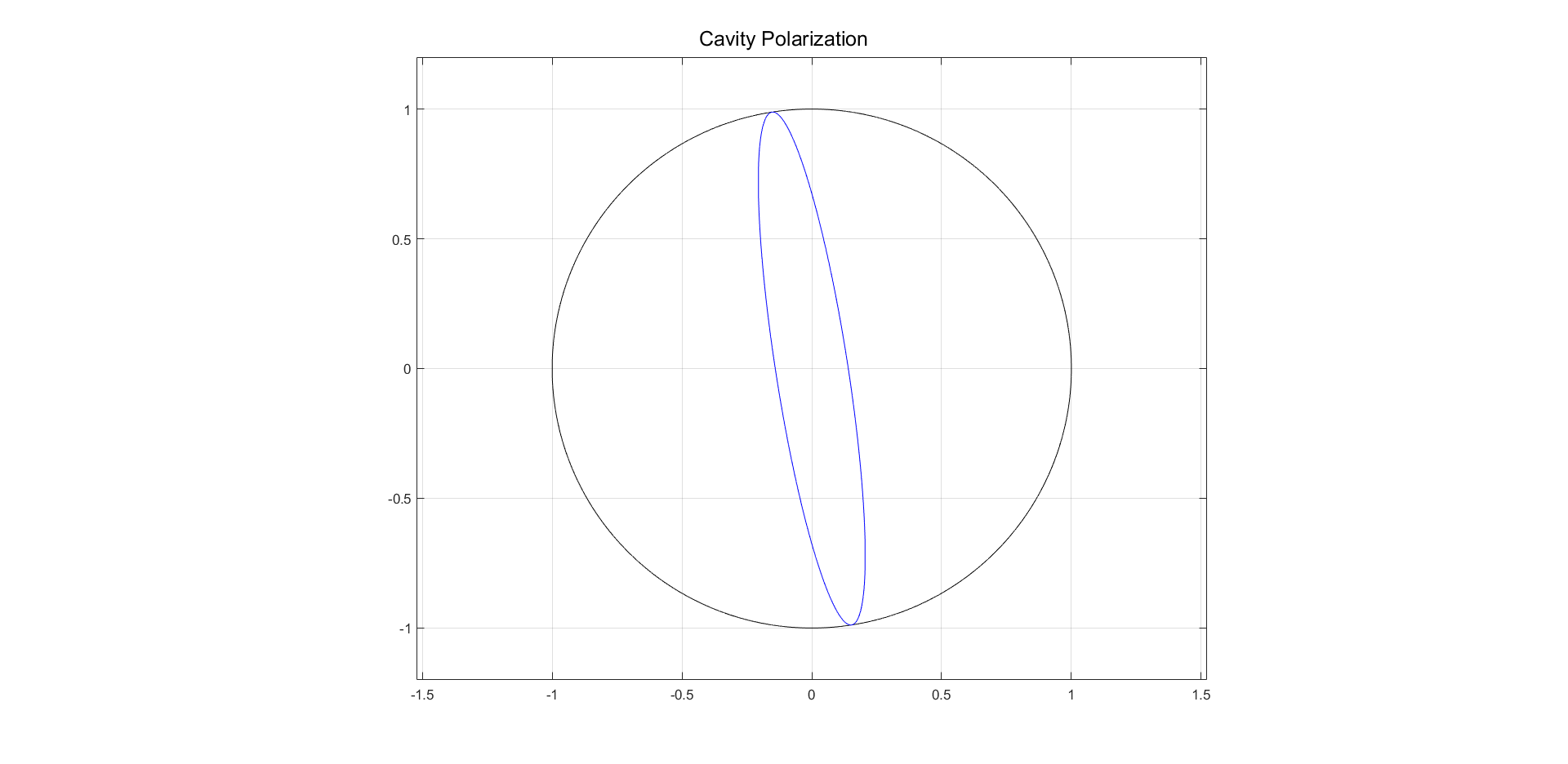 |
| Attachment 2: Ellipse_Polarization_CAVITY_2.png
|
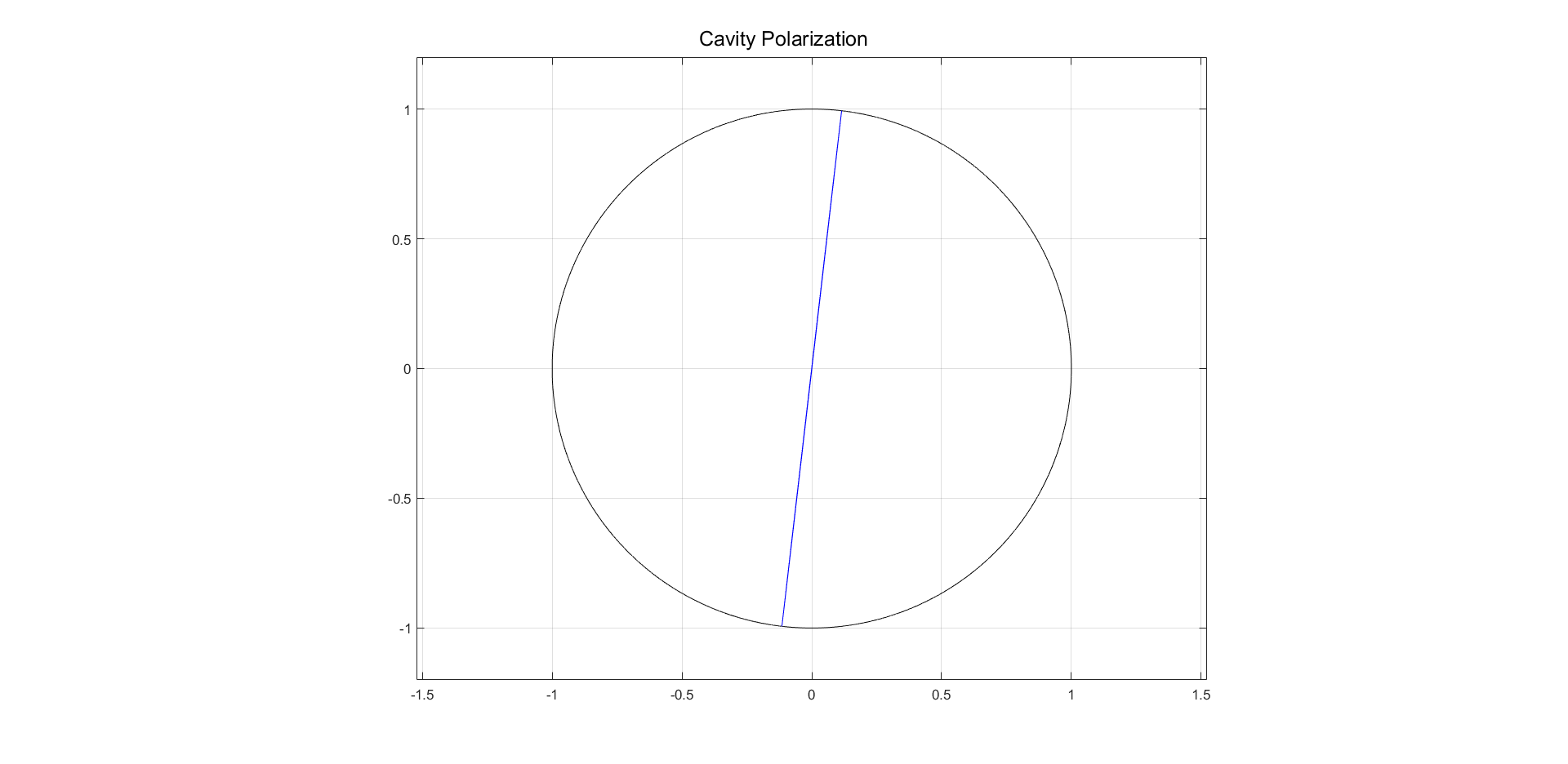 |
|
79
|
Fri Mar 3 17:55:17 2023 |
Blanc | Fixed | info | lasers and optics | Optical room | Dégénérescence cavité polar |
En étant locké avec la lockline, j'ai fait plusieurs mesures à différents états de polarisation.
Je peux constater que la puissance en transmission varie en fonction de la polarisation, mais il n'y a pas de délock.
On a les valeurs suivante en transmission pour chaque état de polarisation :
0° : 1.3518 V
45° : 1.6522 V
90° : 1.8419 V
135° : 1.6047 V
Circulaire Droite : 1.5415 V
Circulaire Gauche : 1.7154 V |
| Attachment 1: Ellipse_Polarization_0°.png
|
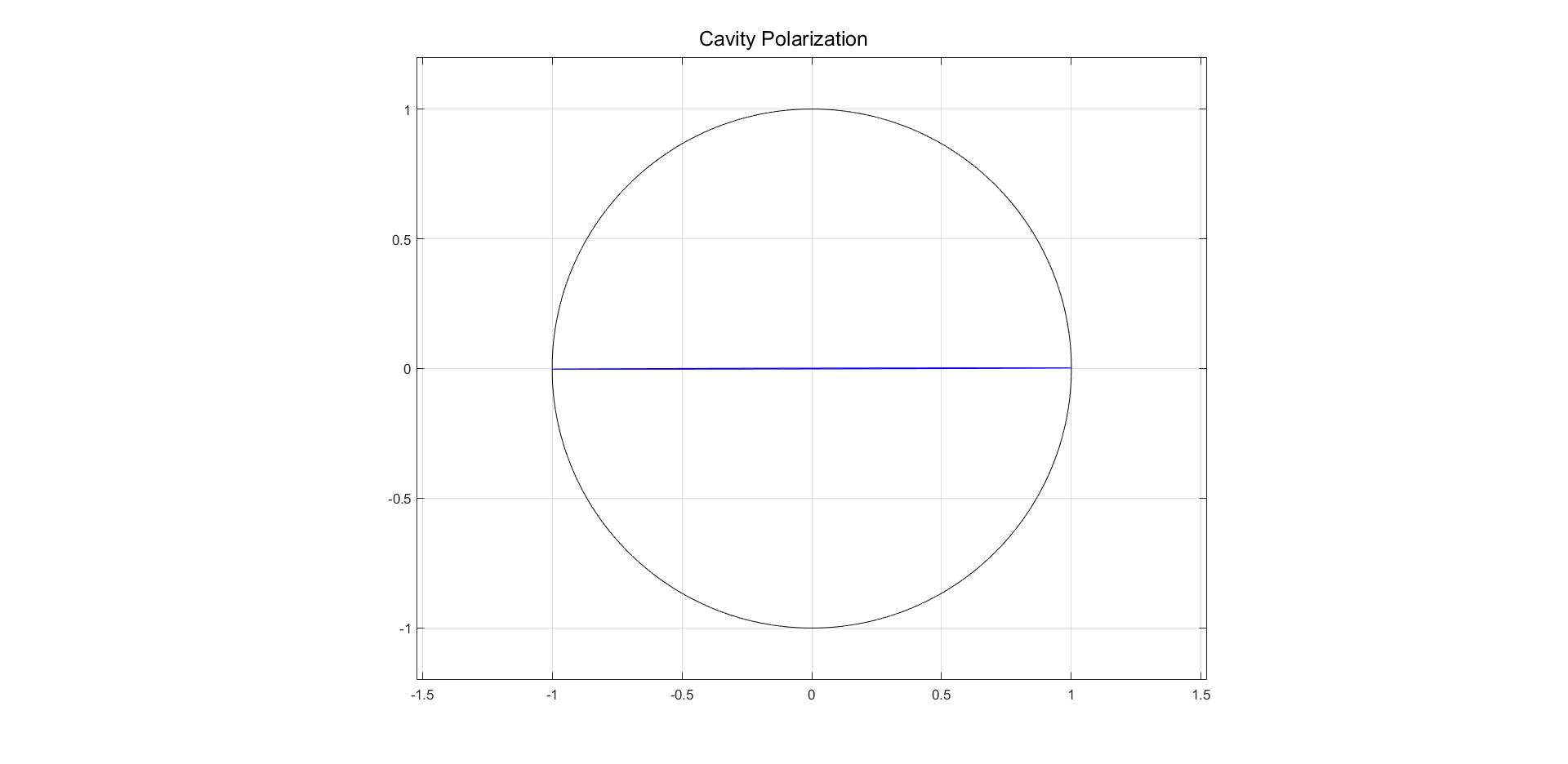 |
| Attachment 2: 0_deg_scope.png
|
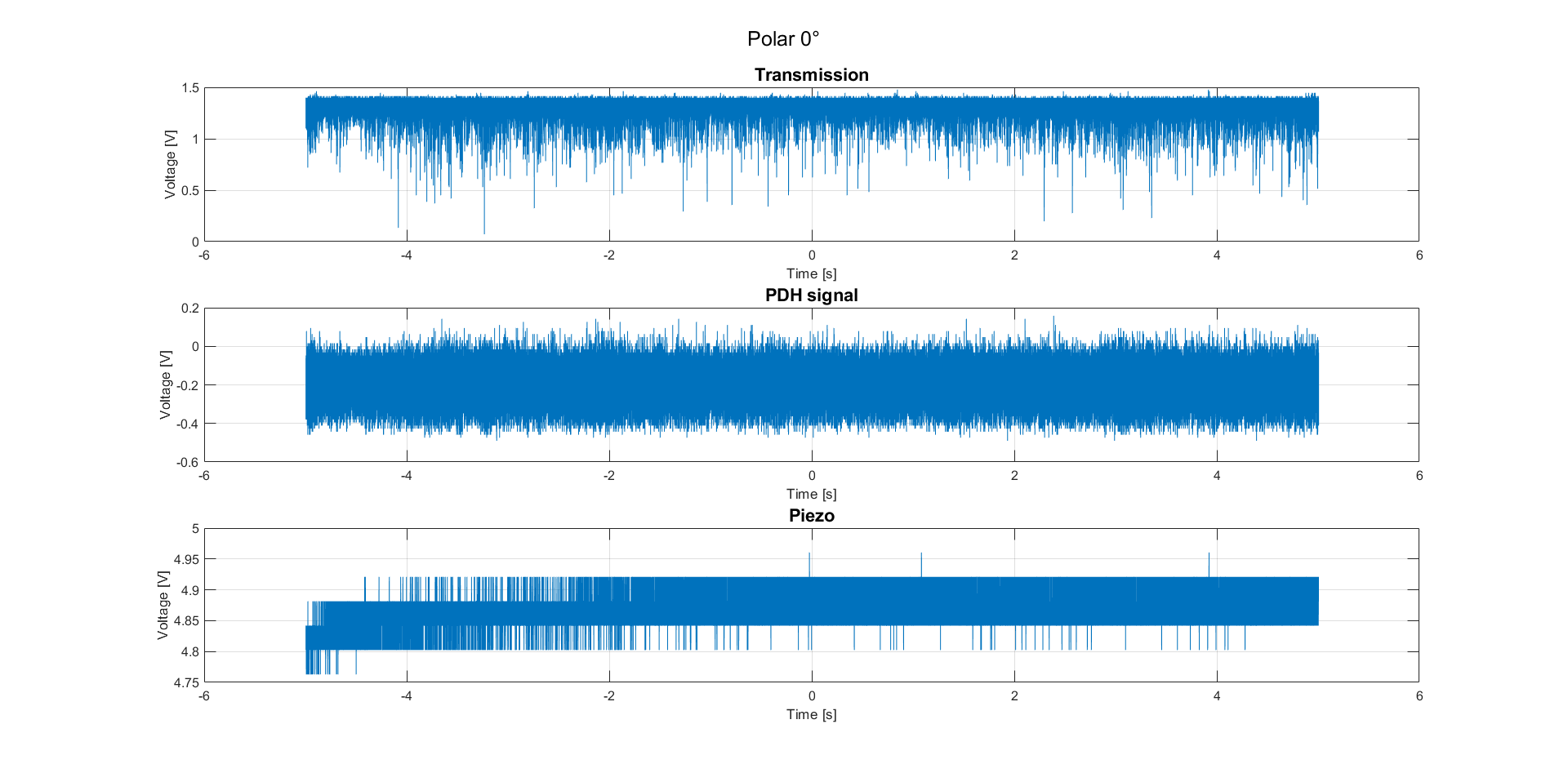 |
| Attachment 3: Ellipse_Polarization_45°.png
|
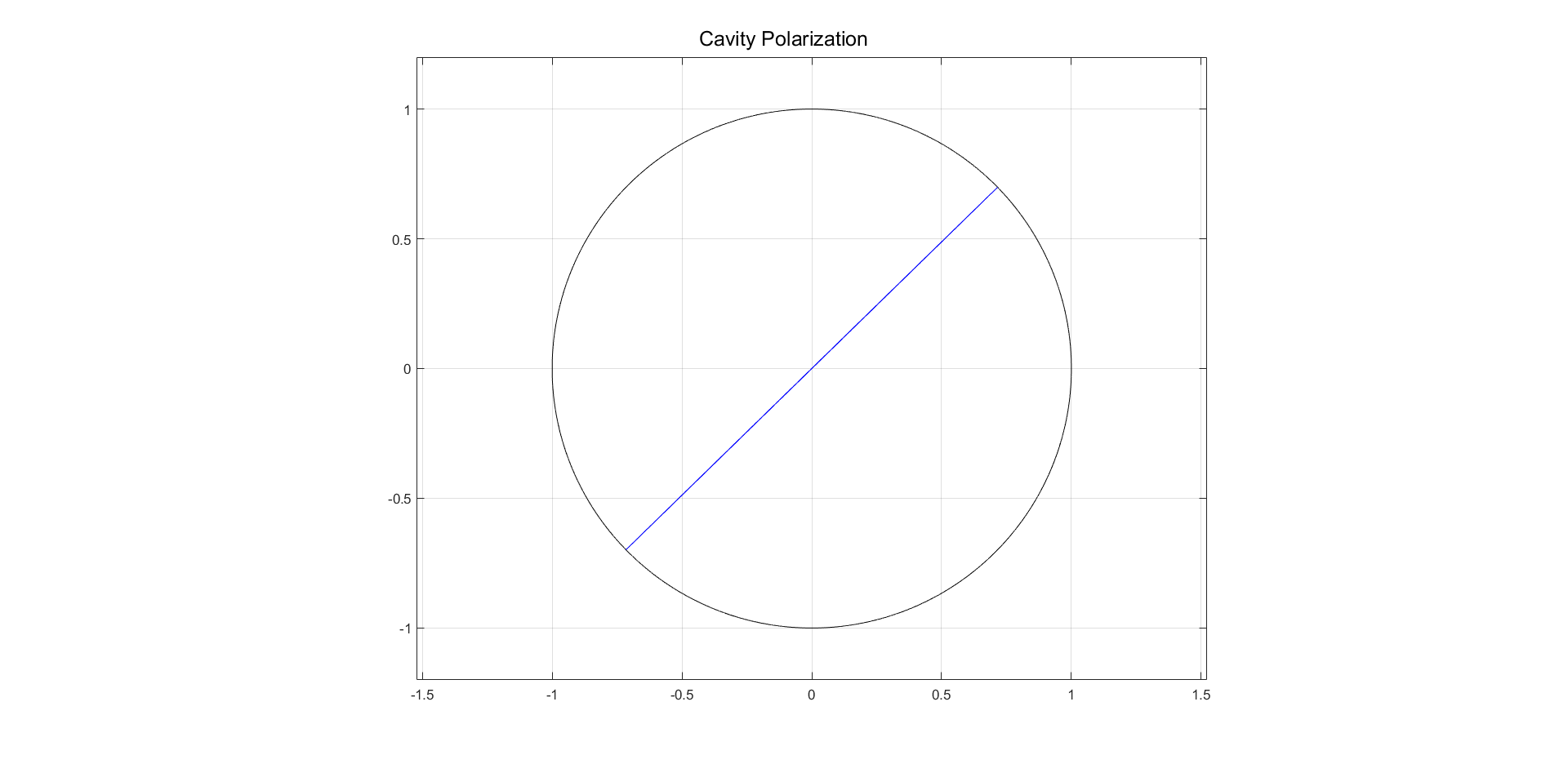 |
| Attachment 4: 45_deg_scope.png
|
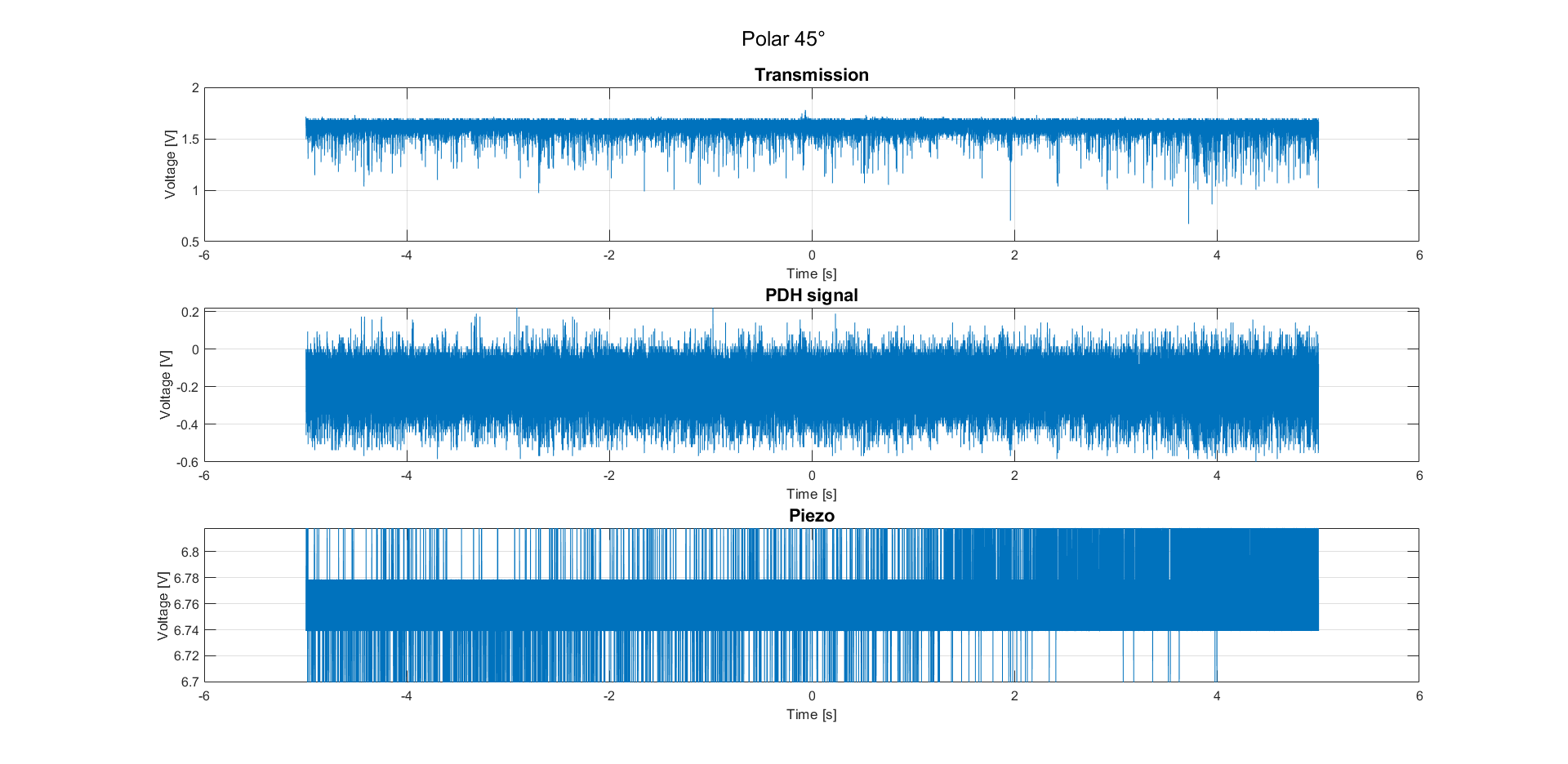 |
| Attachment 5: Ellipse_Polarization_90°.png
|
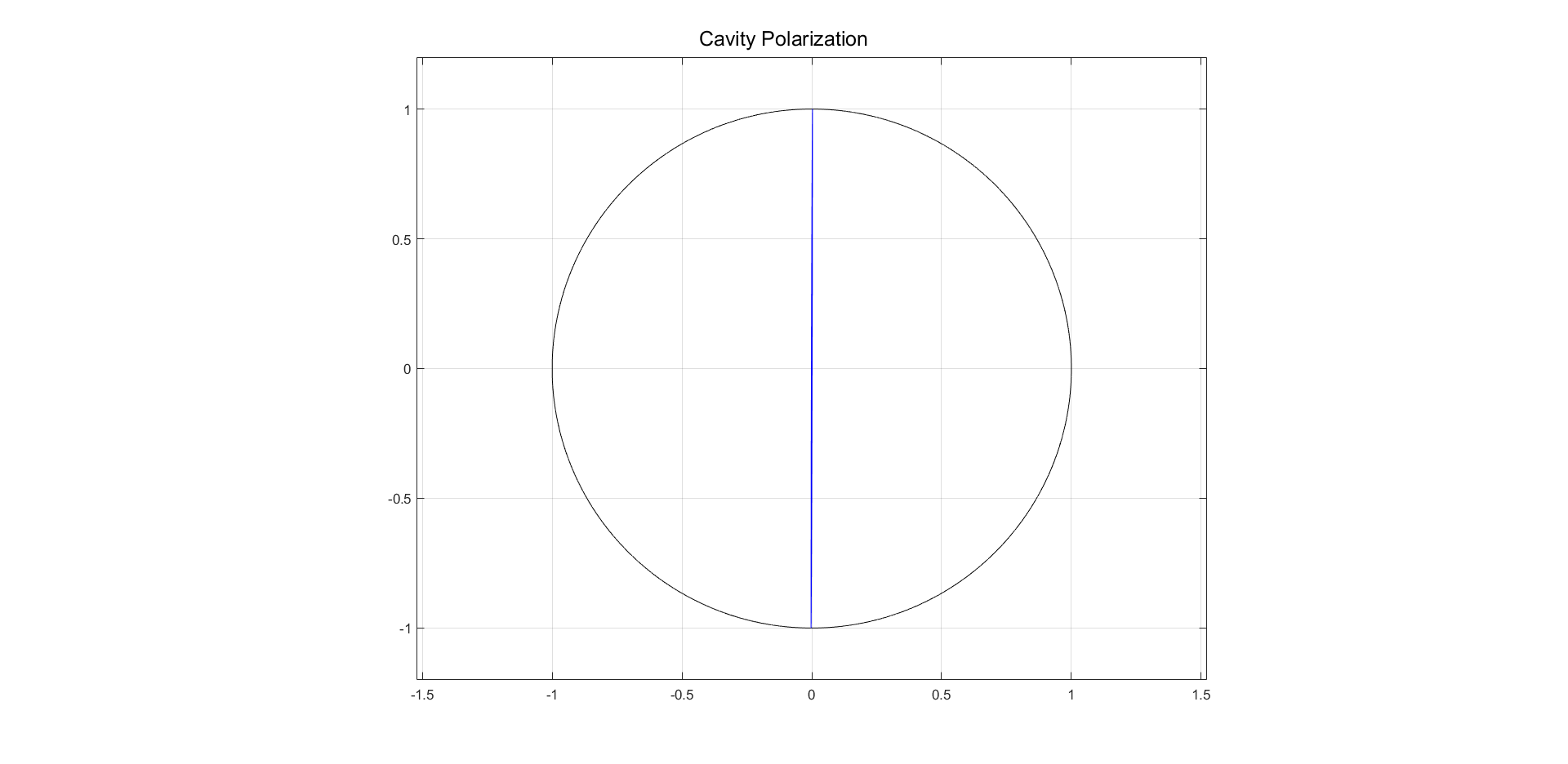 |
| Attachment 6: 90_deg_scope.png
|
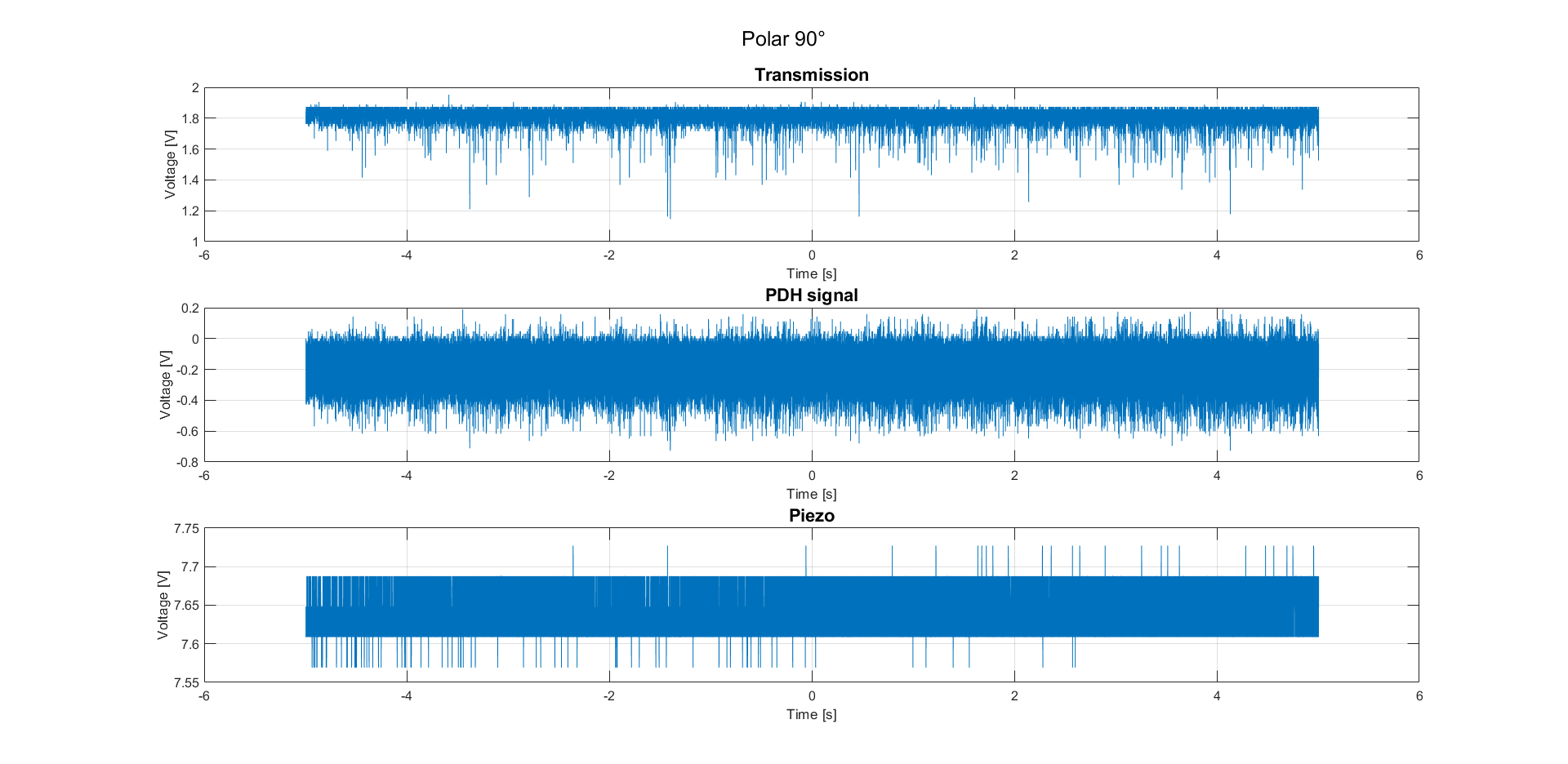 |
| Attachment 7: Ellipse_Polarization_135°.png
|
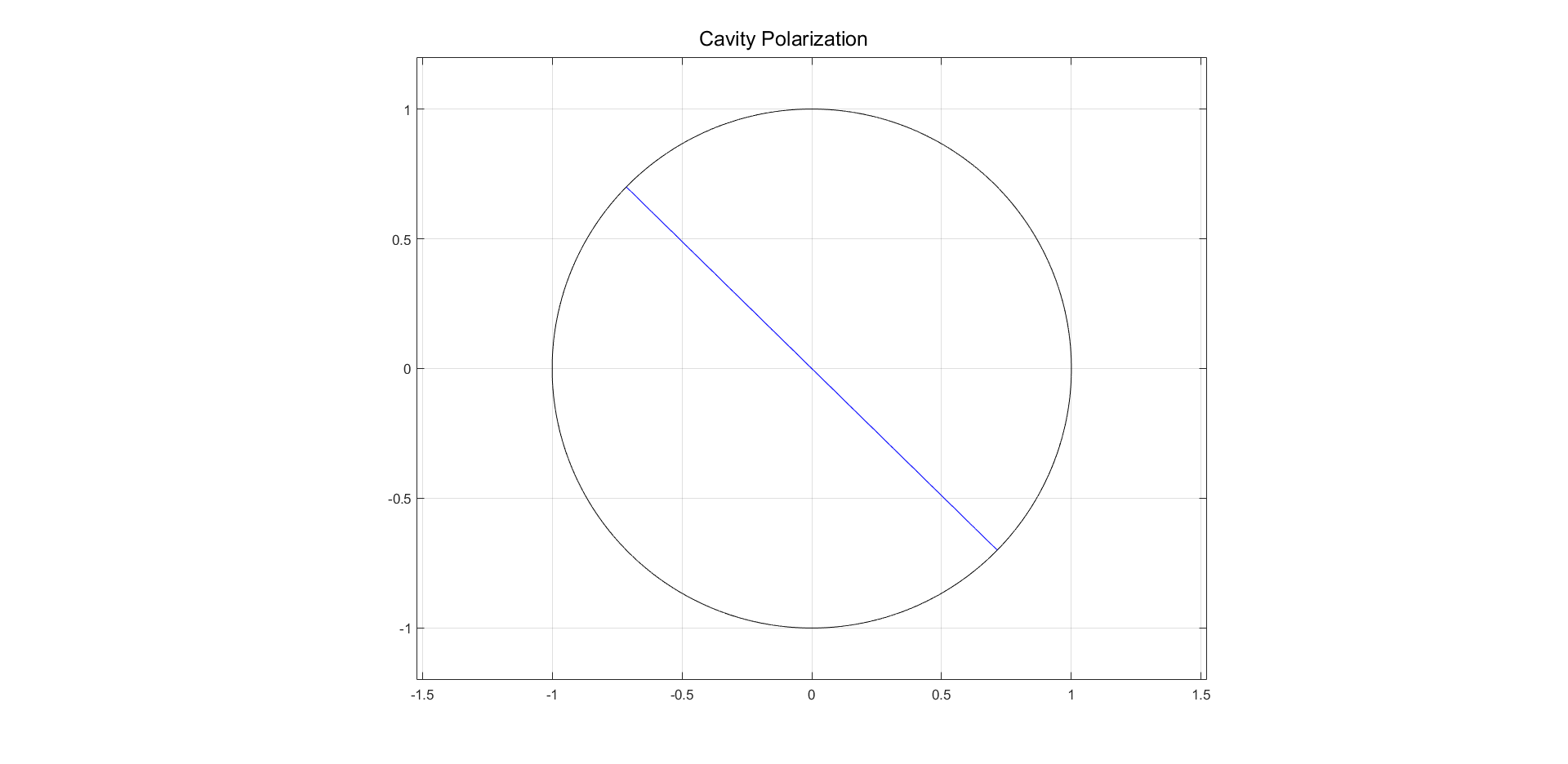 |
| Attachment 8: 135_deg_scope.png
|
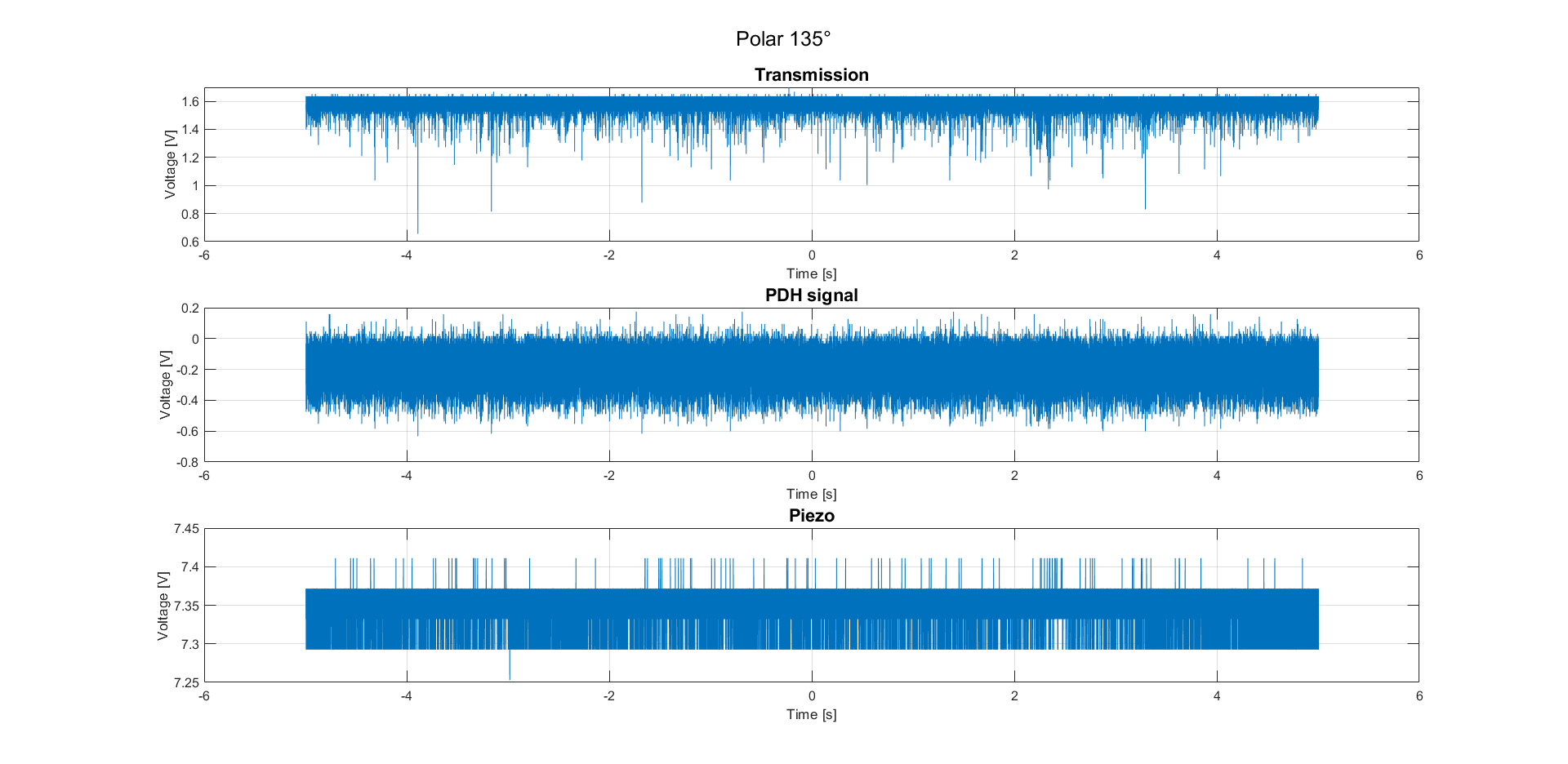 |
| Attachment 9: Ellipse_Polarization_Cir_D.png
|
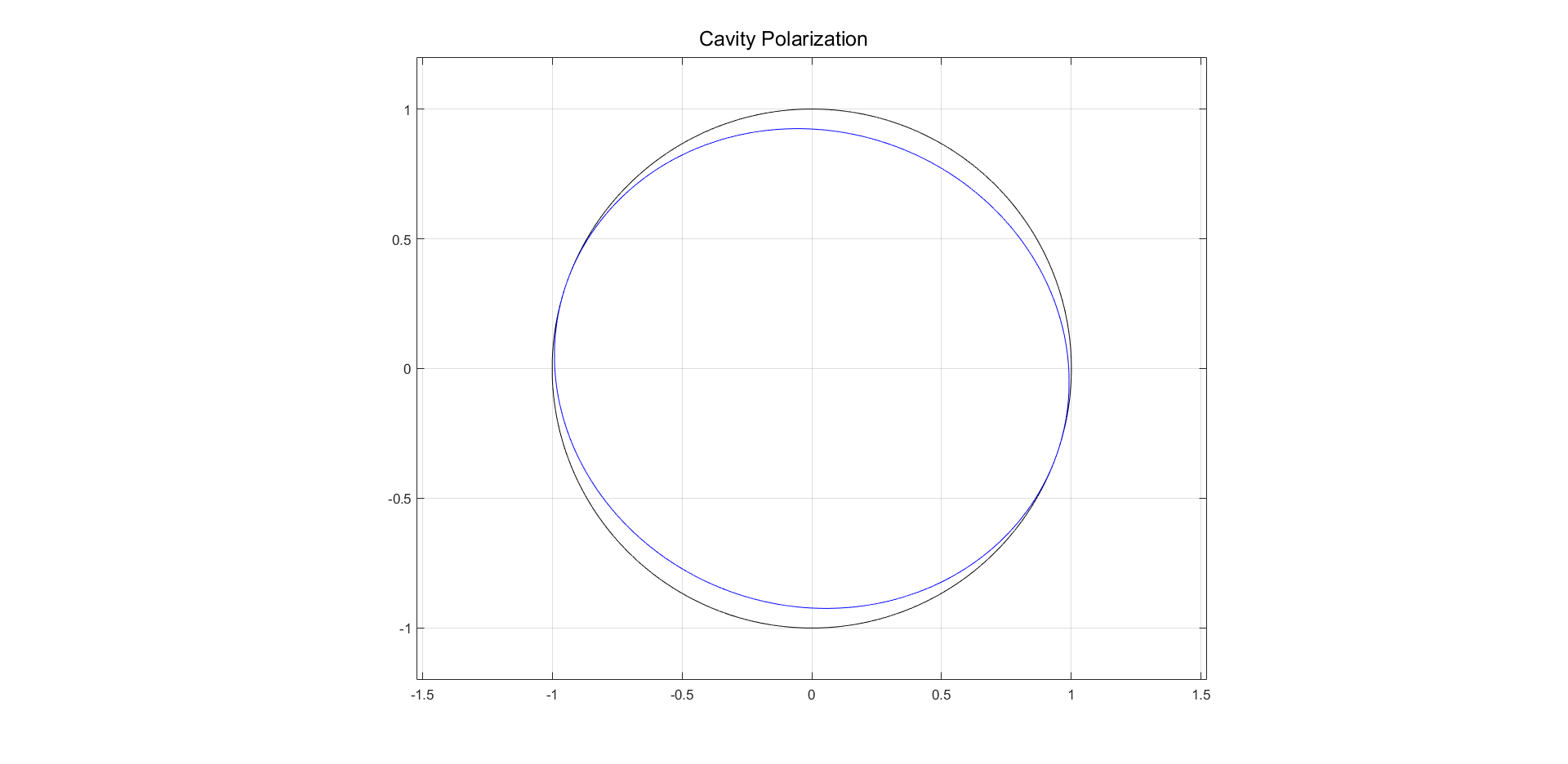 |
| Attachment 10: Cir_D_scope.png
|
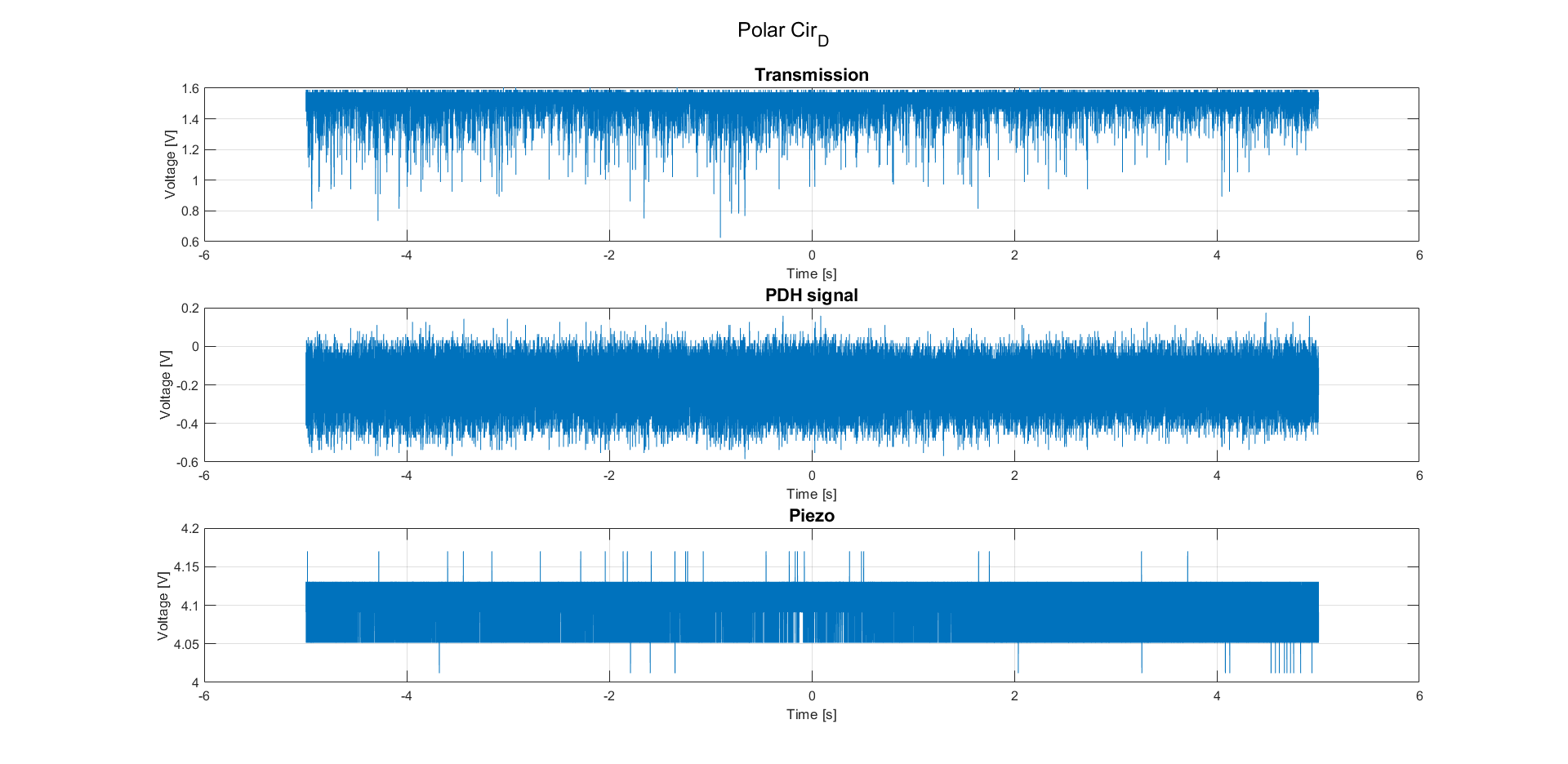 |
| Attachment 11: Ellipse_Polarization_Cir_G.png
|
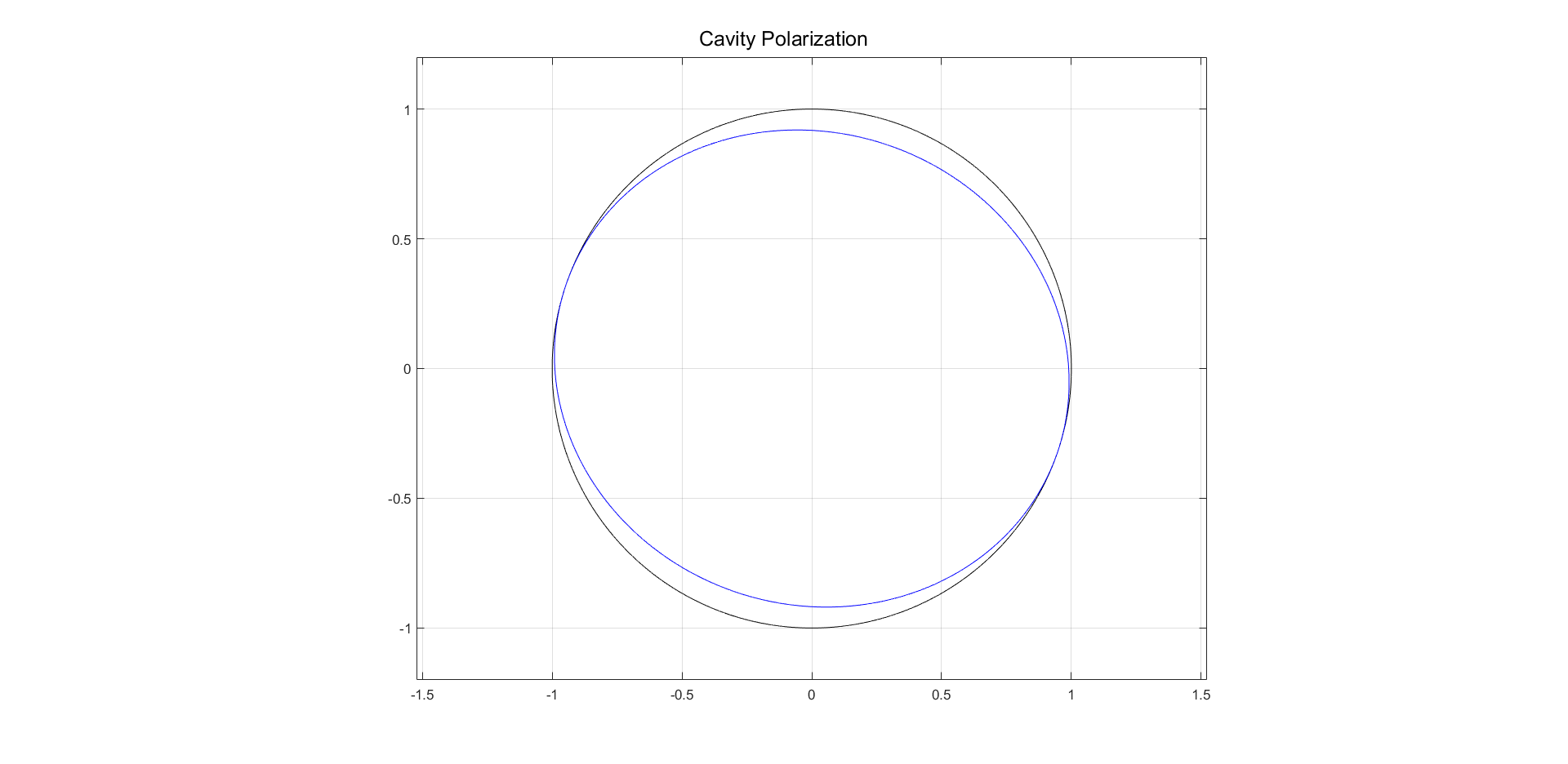 |
| Attachment 12: Cir_G_scope.png
|
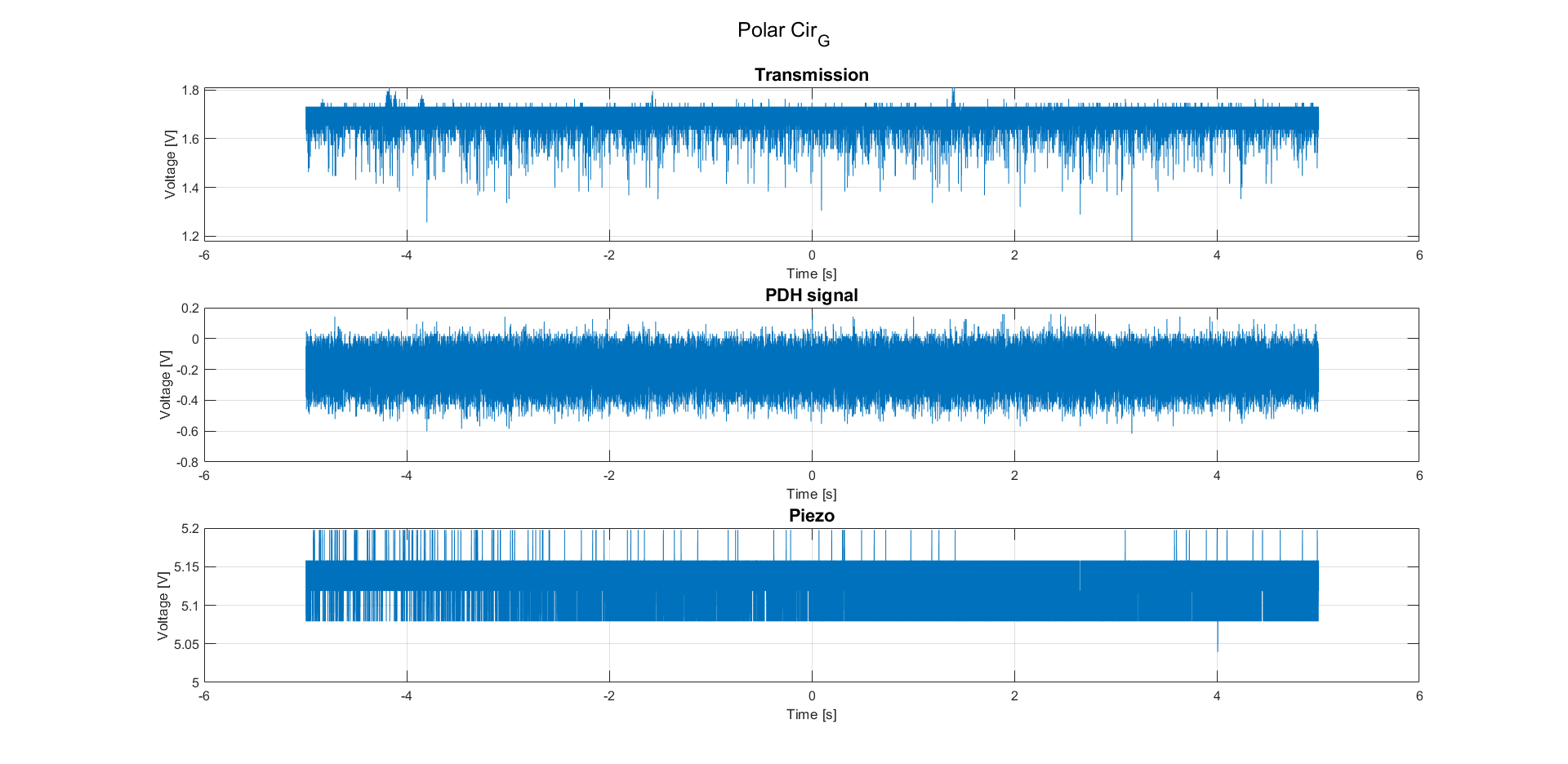 |
|
80
|
Mon Mar 6 12:21:59 2023 |
Blanc | Fixed | info | lasers and optics | Optical room | Couplage |
Voici le résultat de la manip sur le couplage sur la voie réfléchie pour deux états de polarisation orthogonaux. |
| Attachment 1: Ellipse_Polarization_90°.png
|
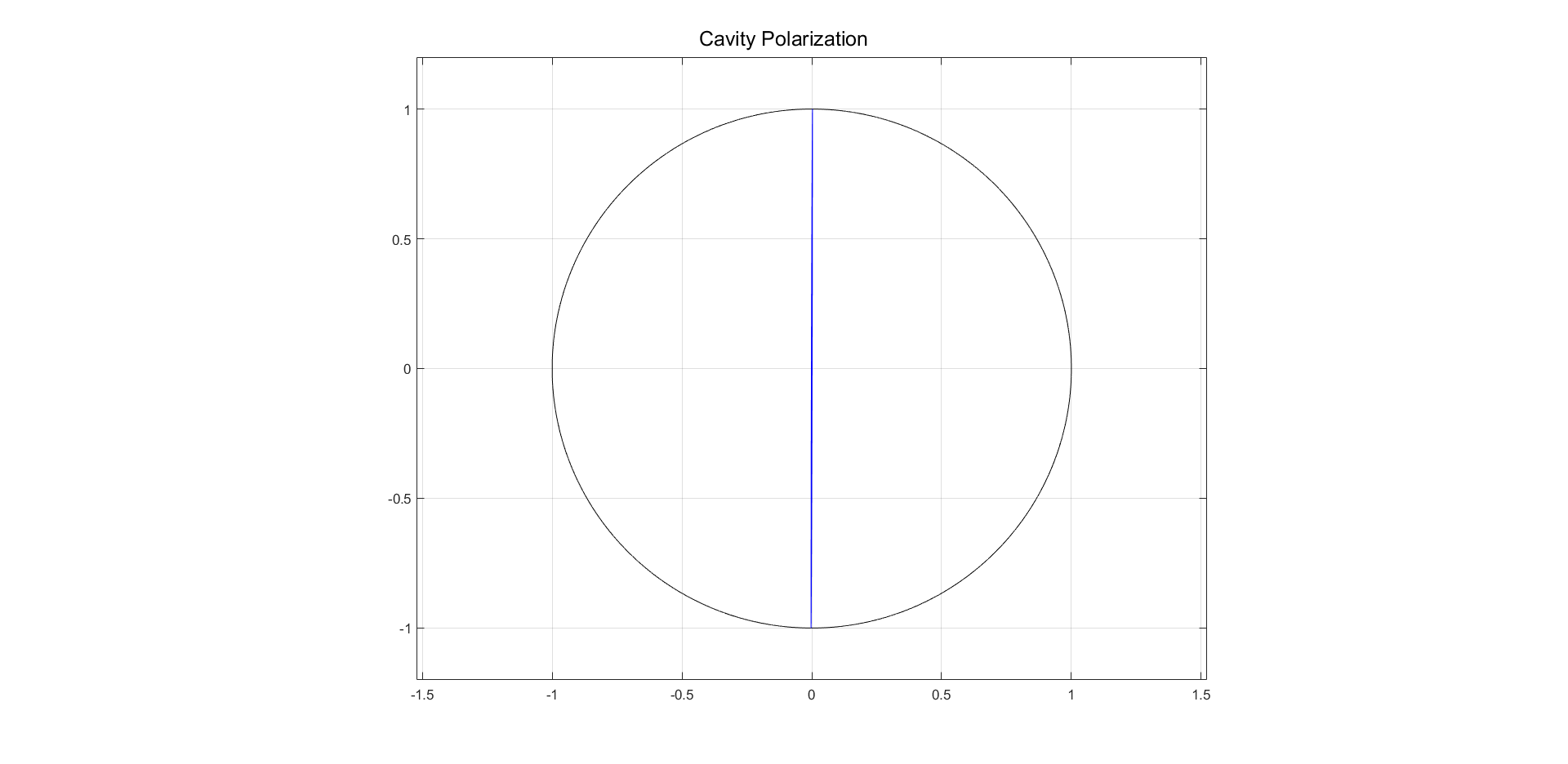 |
| Attachment 2: 90°_scope.png
|
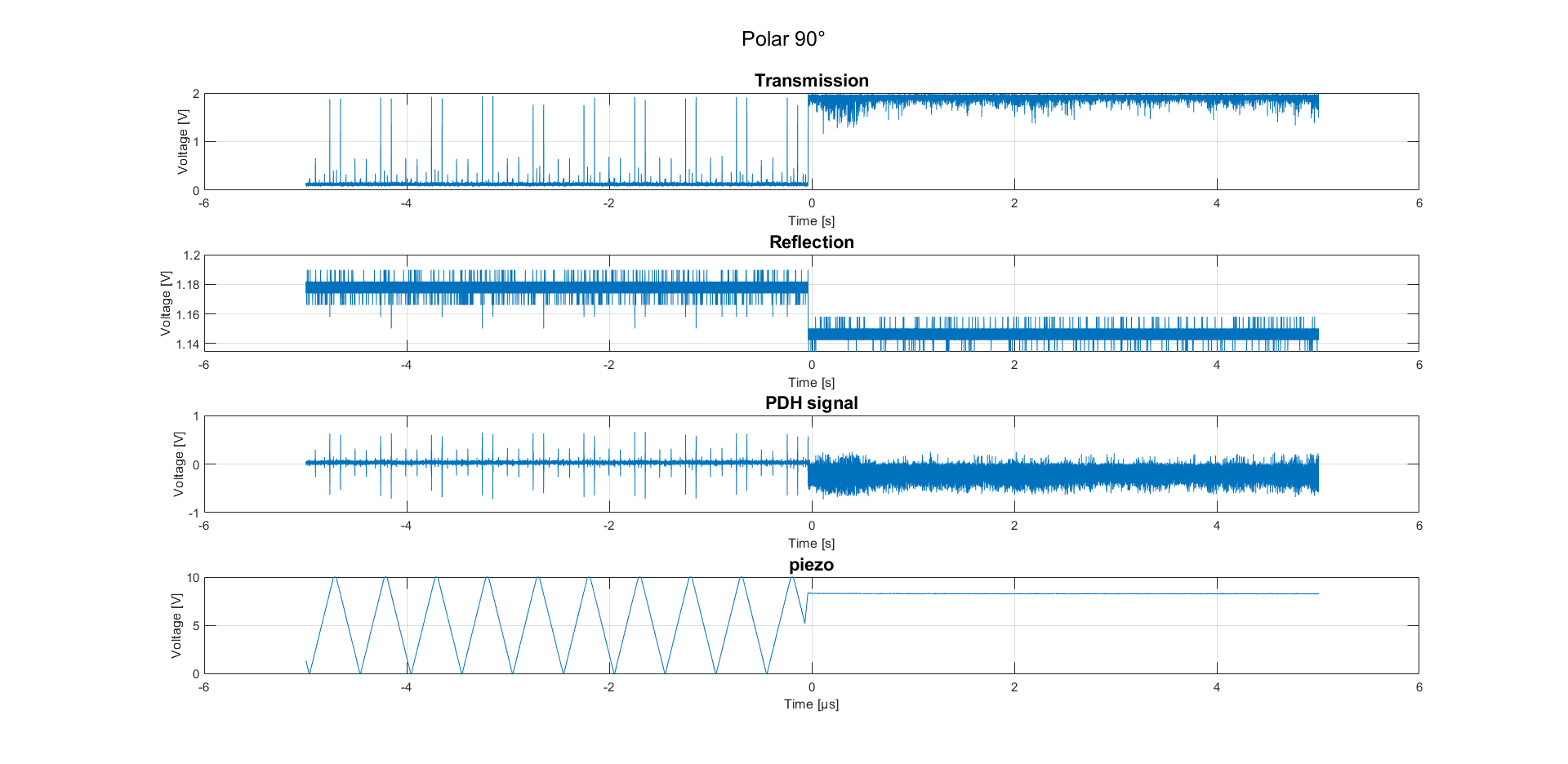 |
| Attachment 3: Ellipse_Polarization_0°.png
|
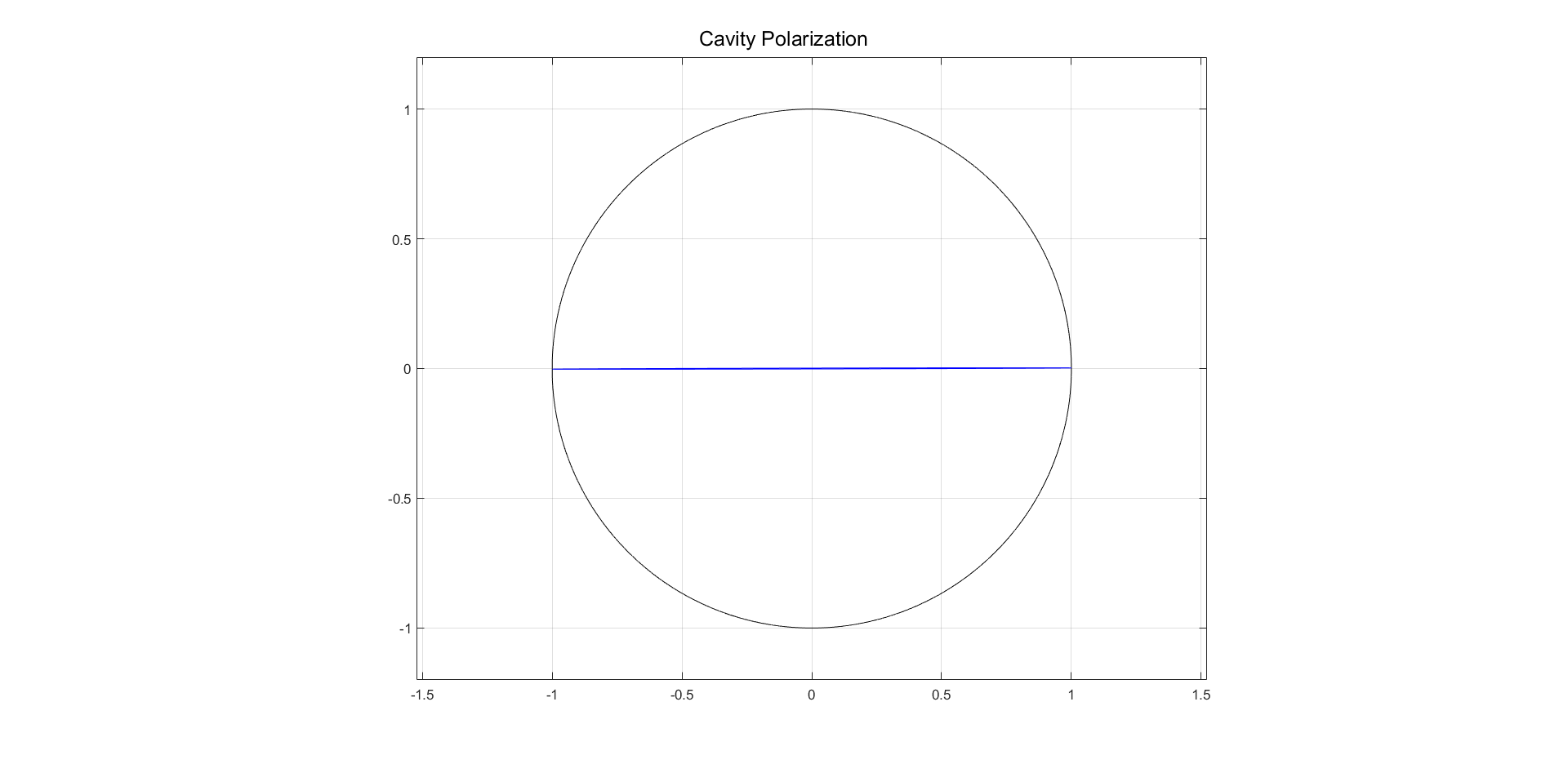 |
| Attachment 4: 0°_scope.png
|
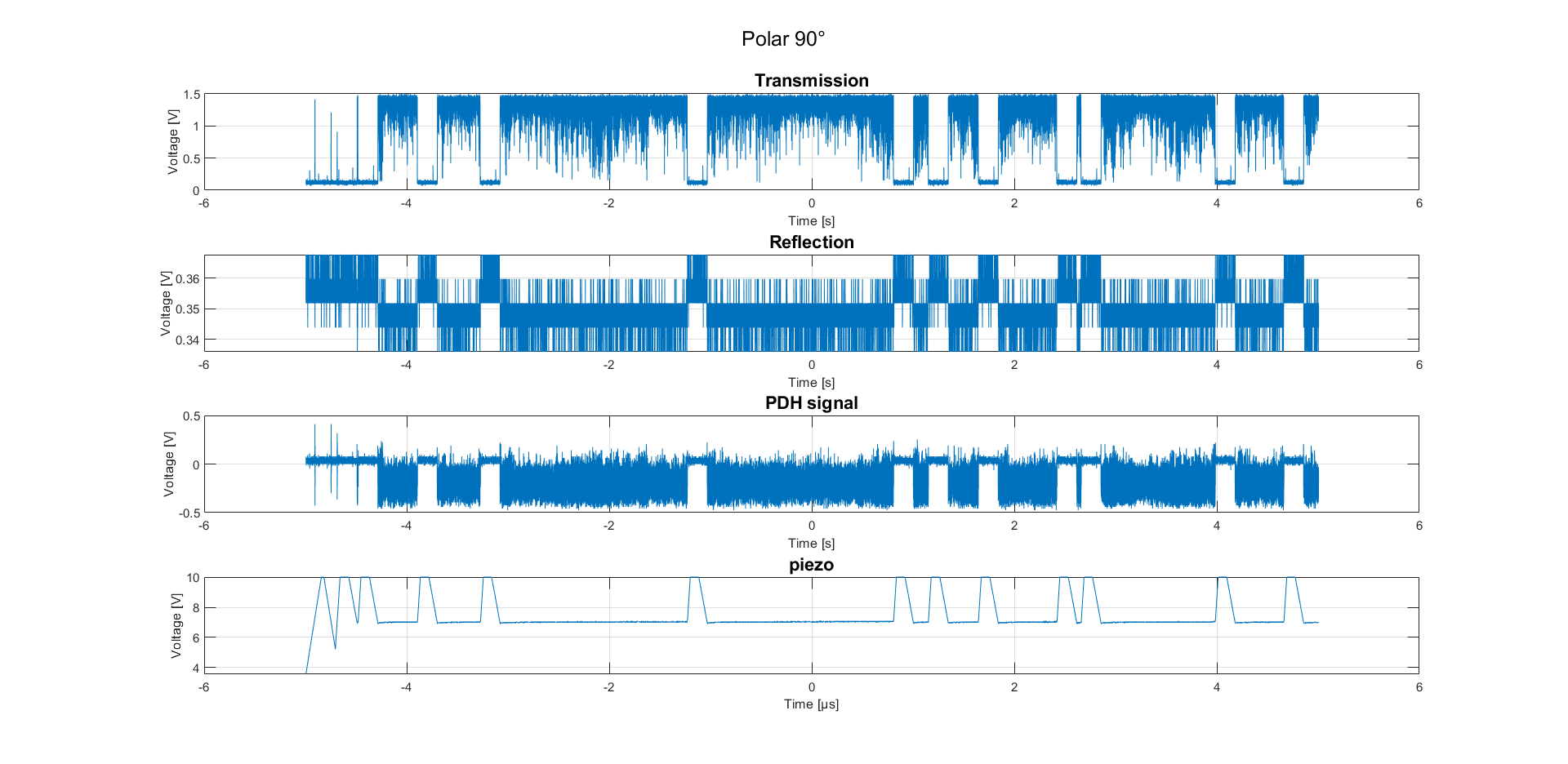 |
|
81
|
Mon Mar 27 15:48:37 2023 |
Blanc | Fixed | info | lasers and optics | Optical room | Caractérisation Cavité et Polar |
Pour caractériser la cavité, j'ai injecté différents états de polarisation (non locké) et j'ai relevé la transmission de la cavité et la réflexion de la cavité, locké puis délocké.
On observe que le pourcentage de couplage dans la cavité ne change pas en fonction de la polarisation, contrairement à l'intensité. |
| Attachment 1: ellipse.png
|
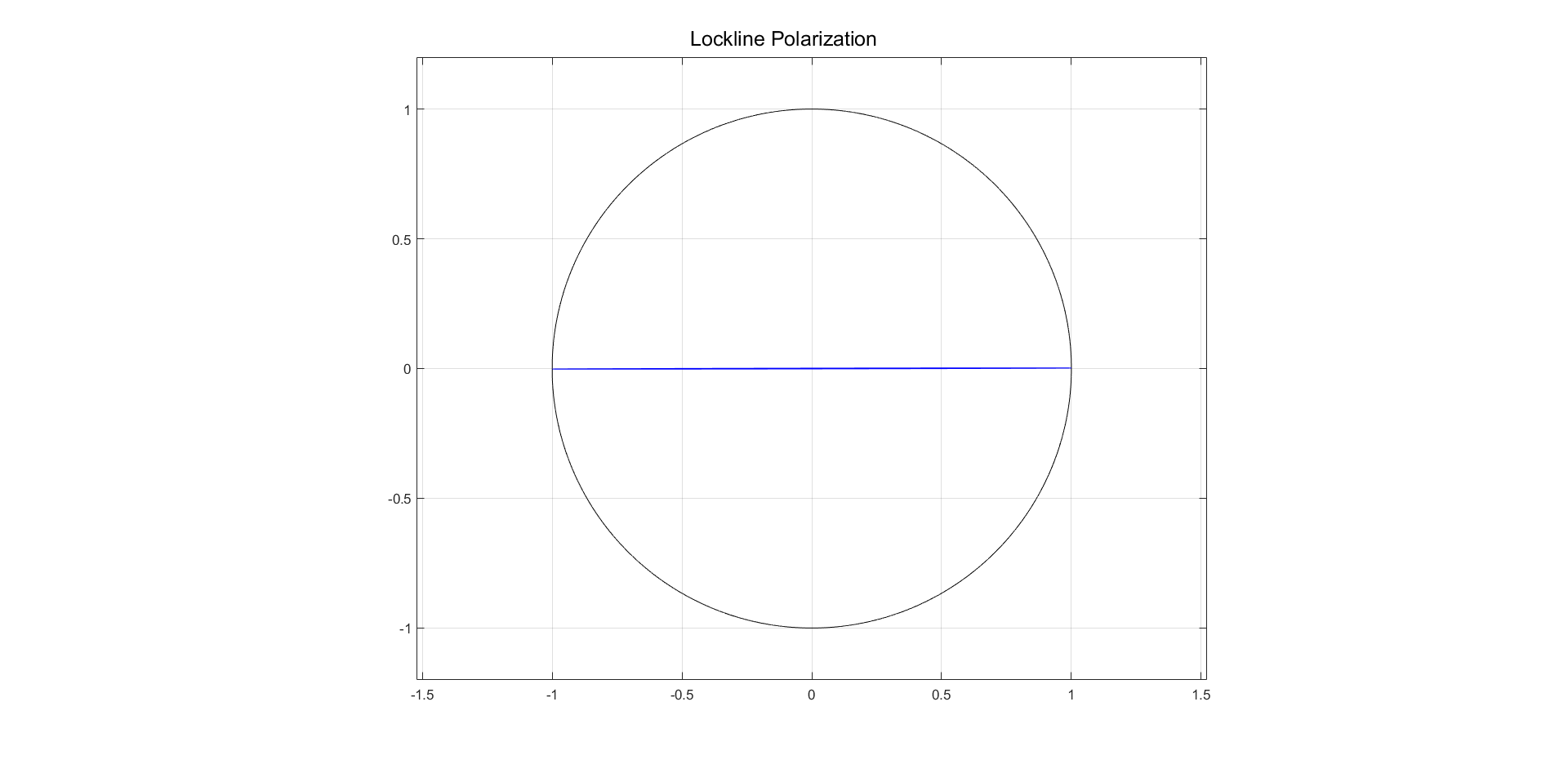 |
| Attachment 2: scope.png
|
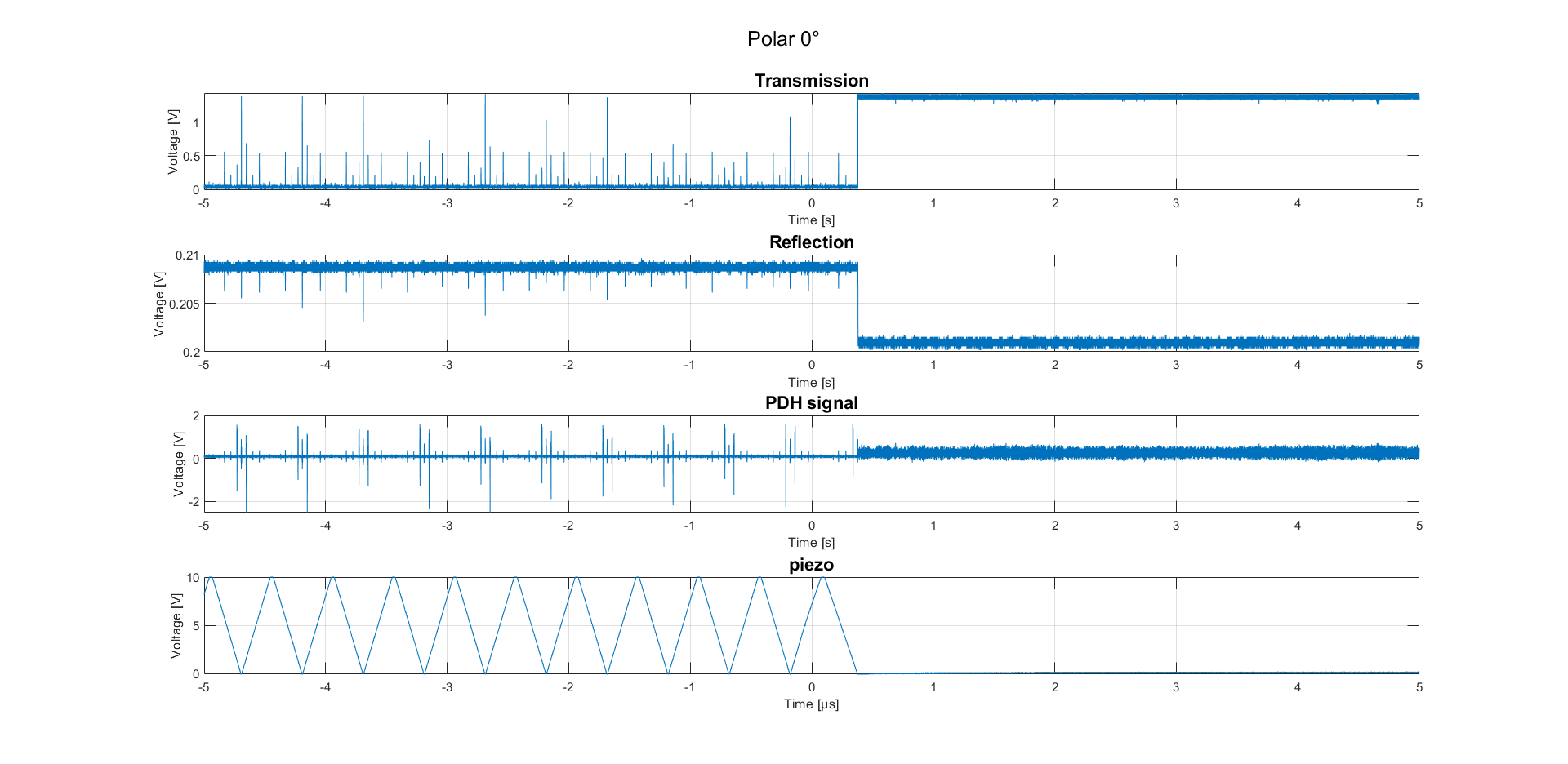 |
| Attachment 3: ellipse.png
|
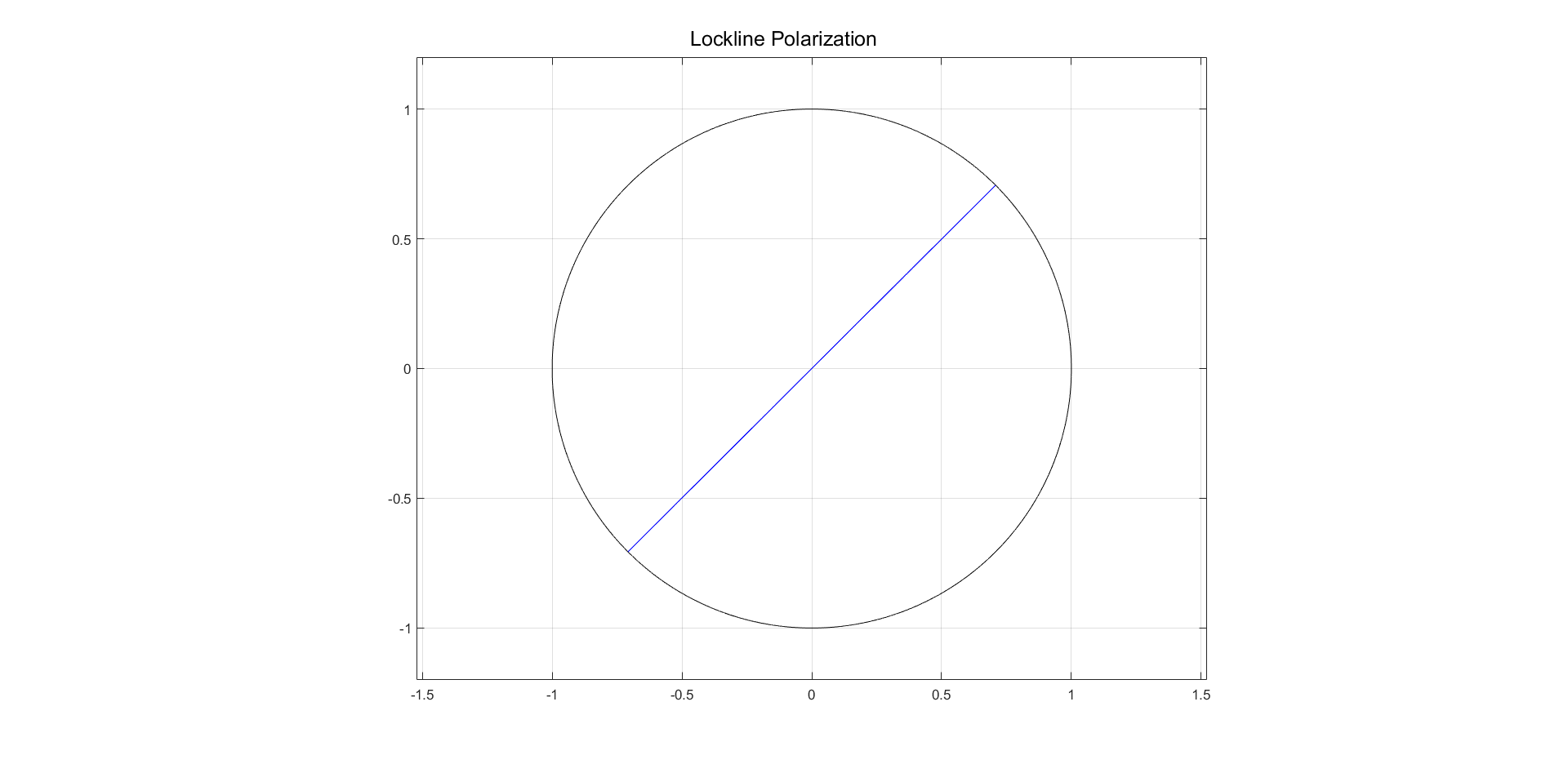 |
| Attachment 4: scope.png
|
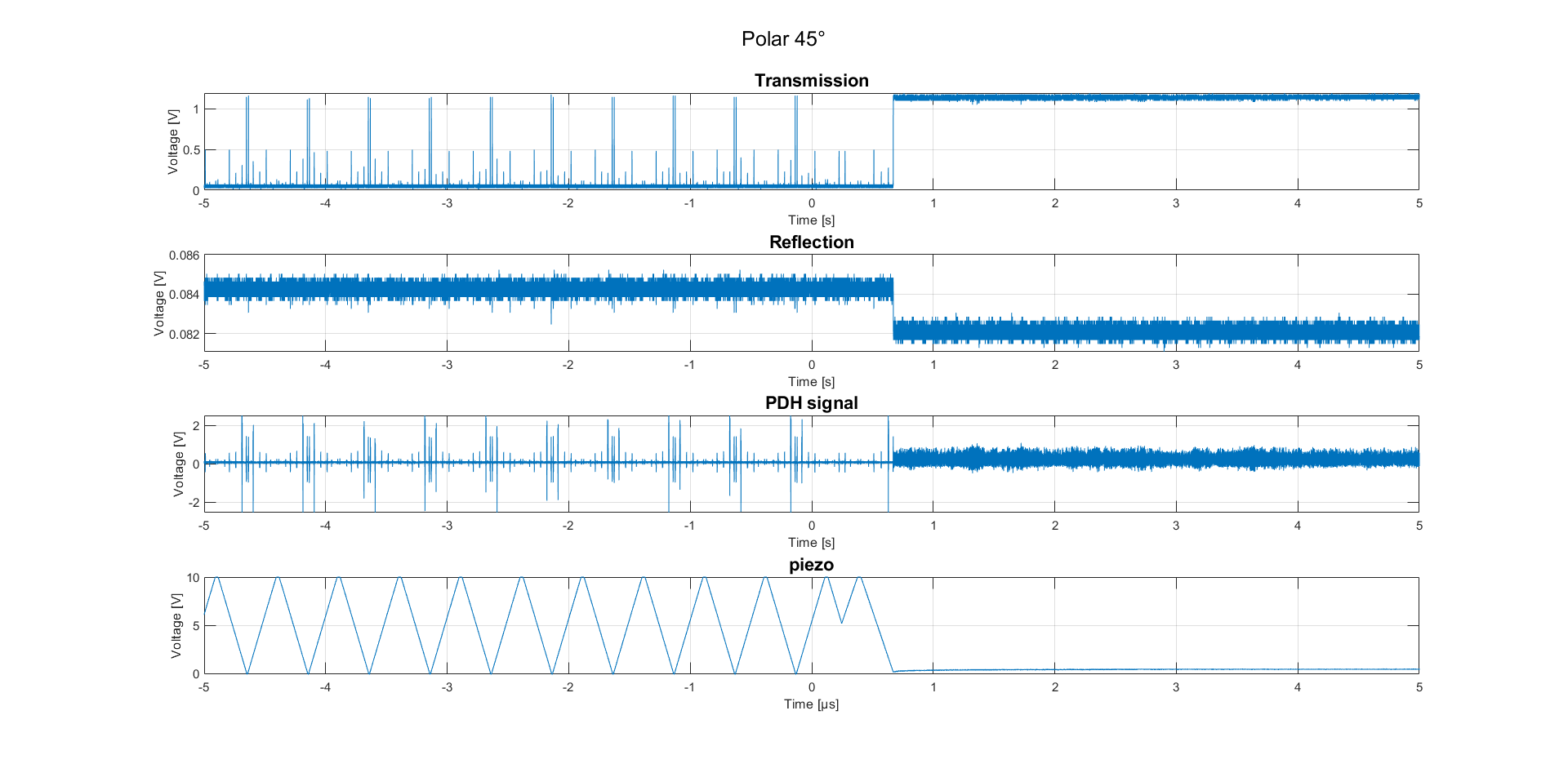 |
| Attachment 5: ellipse.png
|
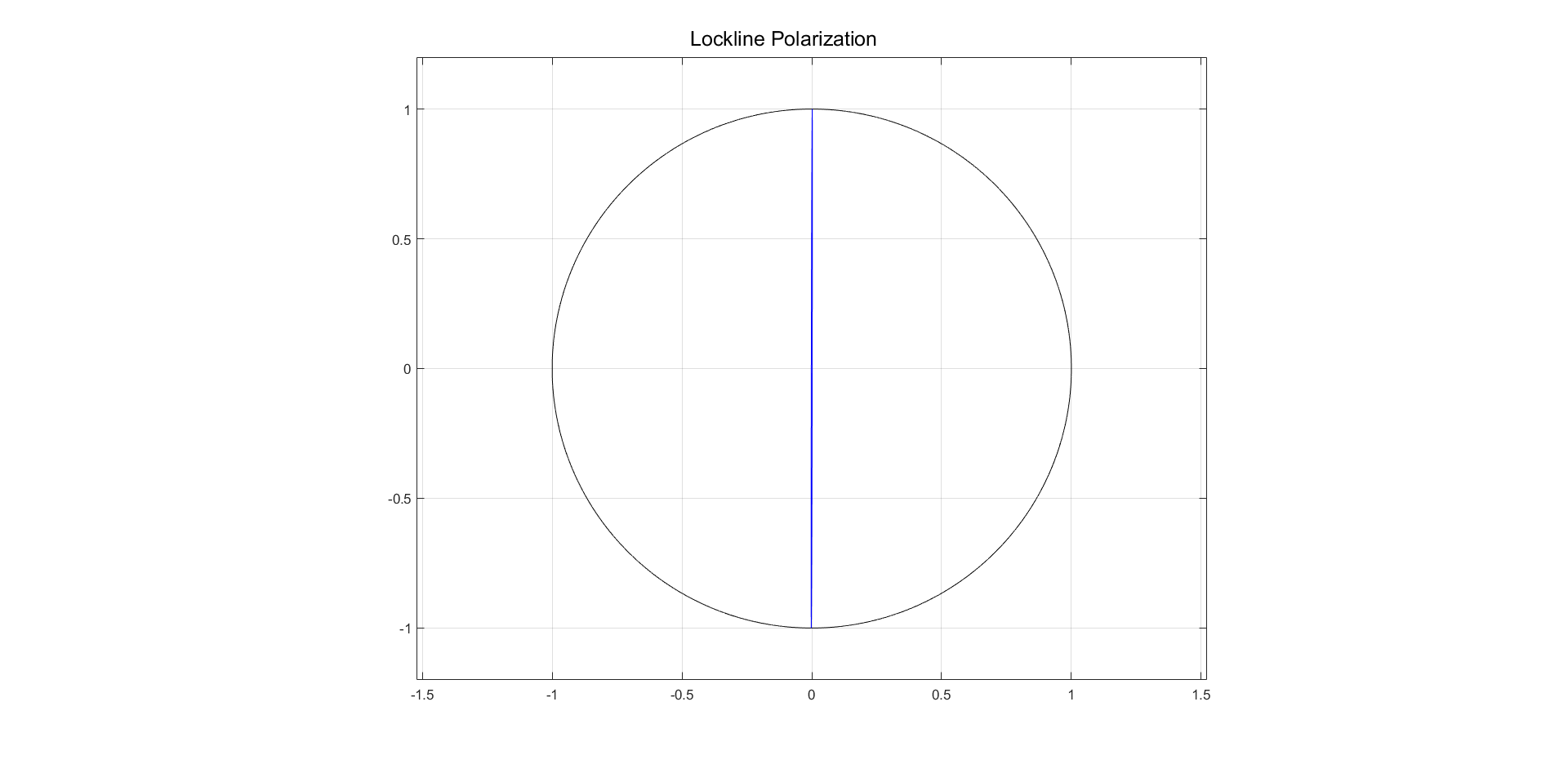 |
| Attachment 6: scope.png
|
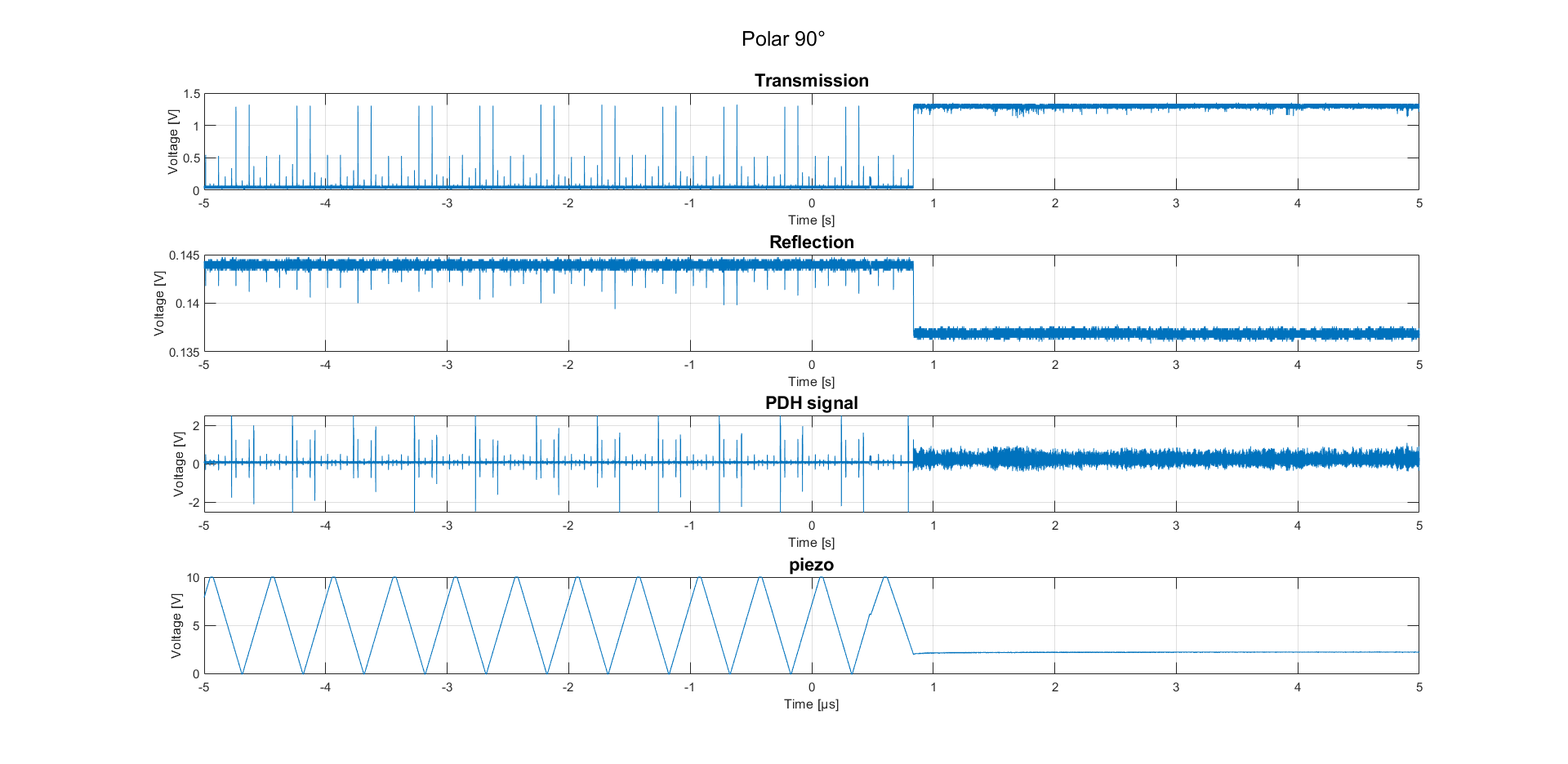 |
| Attachment 7: ellipse.png
|
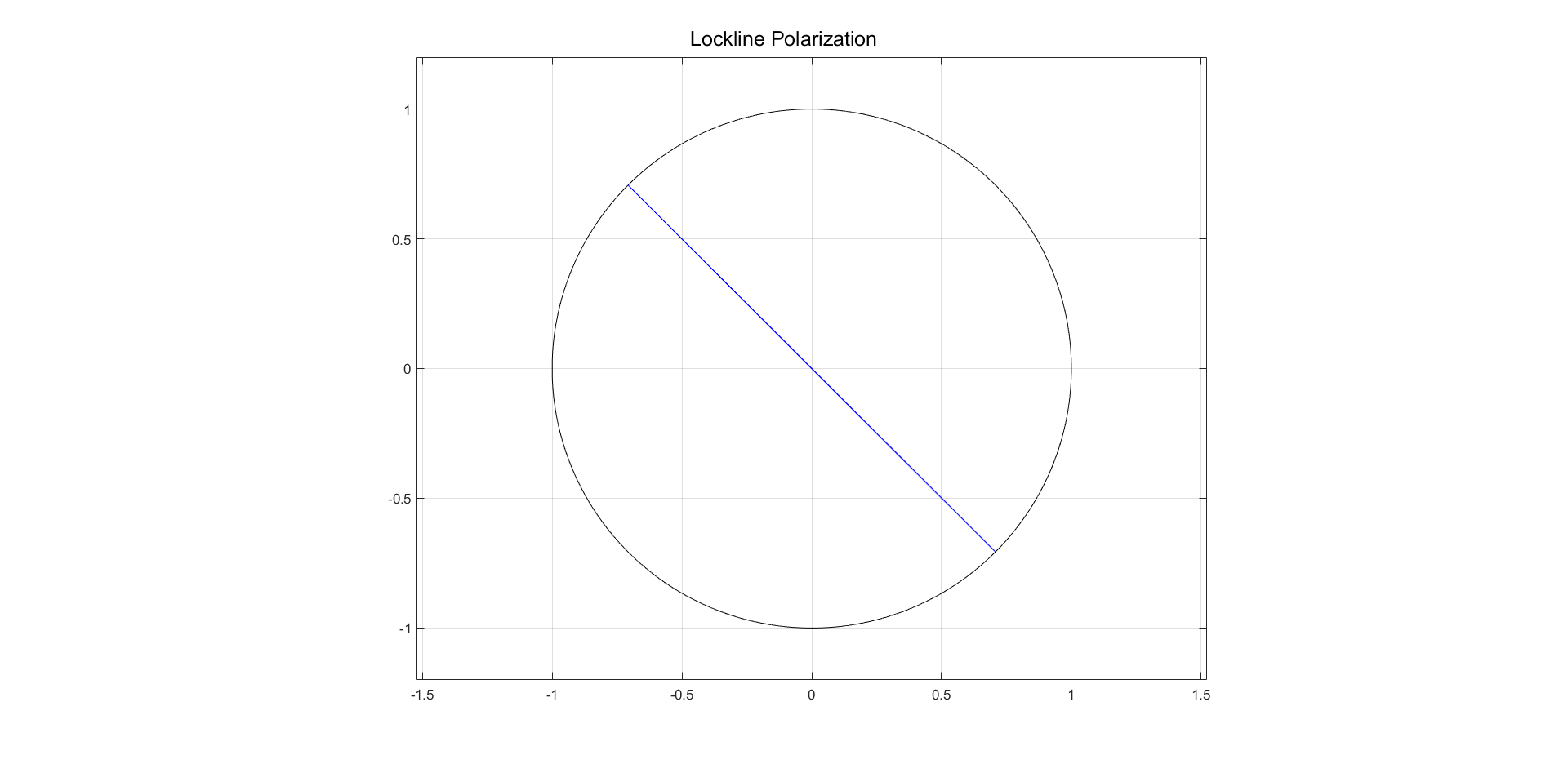 |
| Attachment 8: scope.png
|
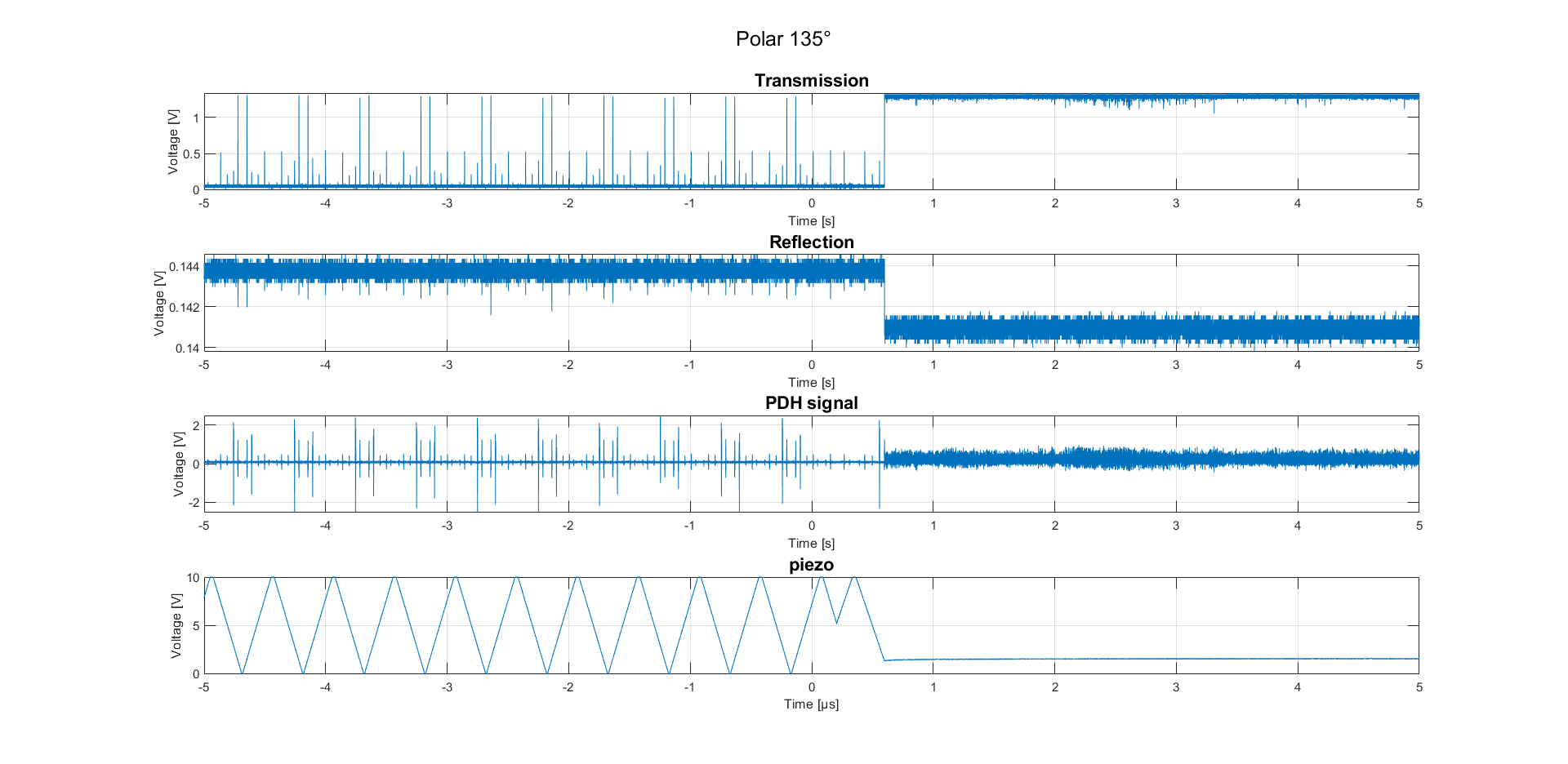 |
| Attachment 9: ellipse.png
|
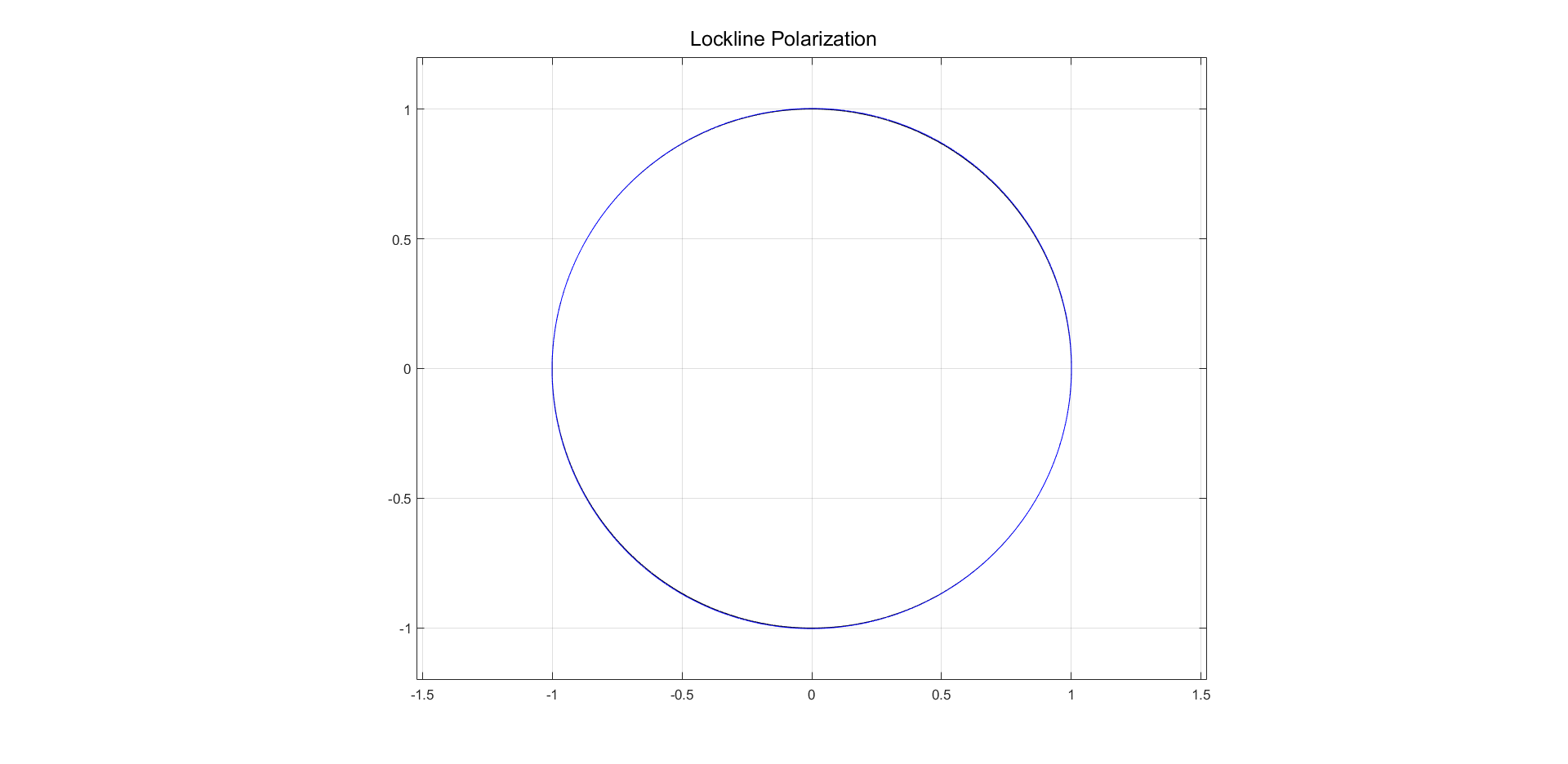 |
| Attachment 10: scope.png
|
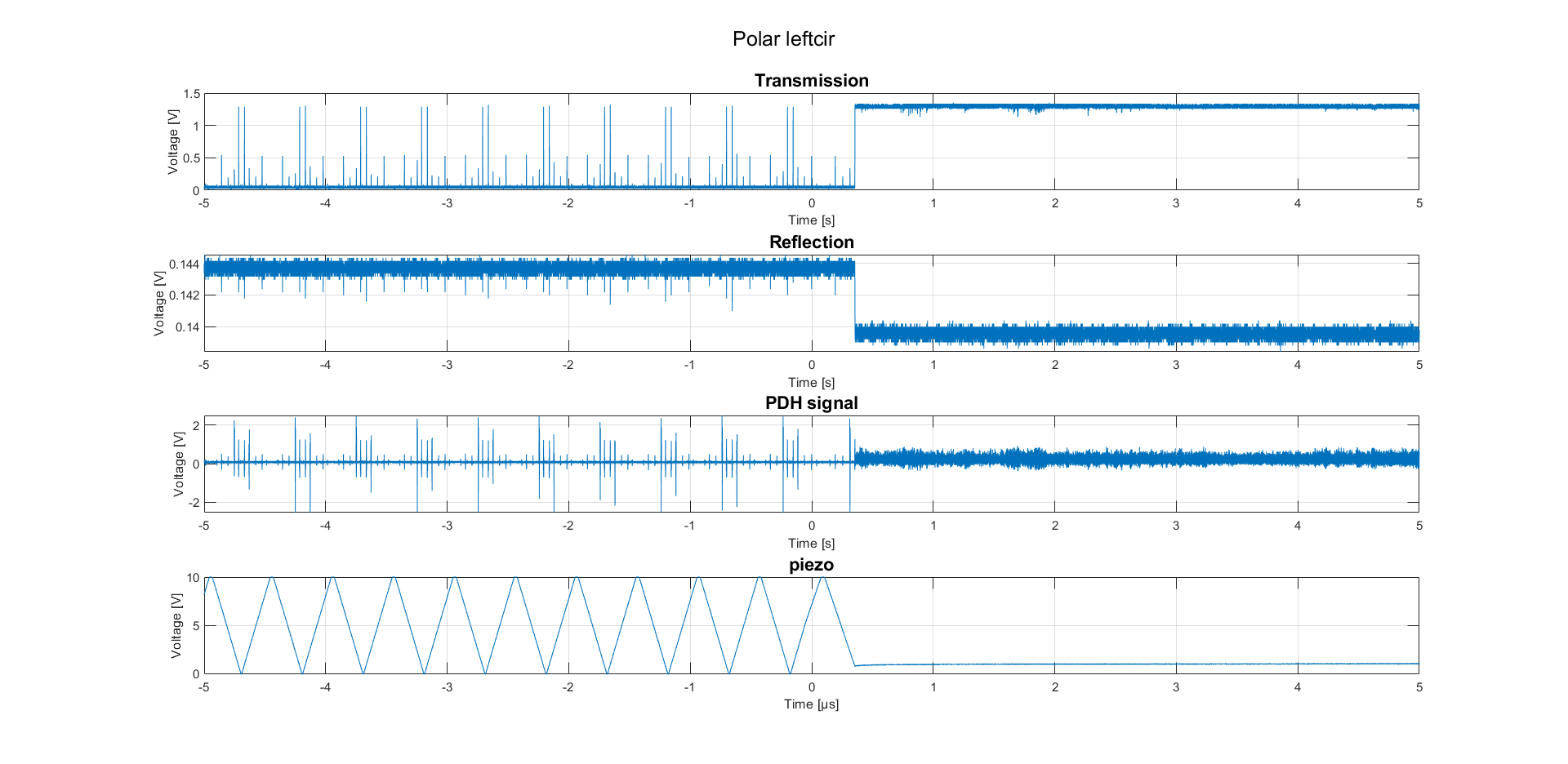 |
| Attachment 11: ellipse.png
|
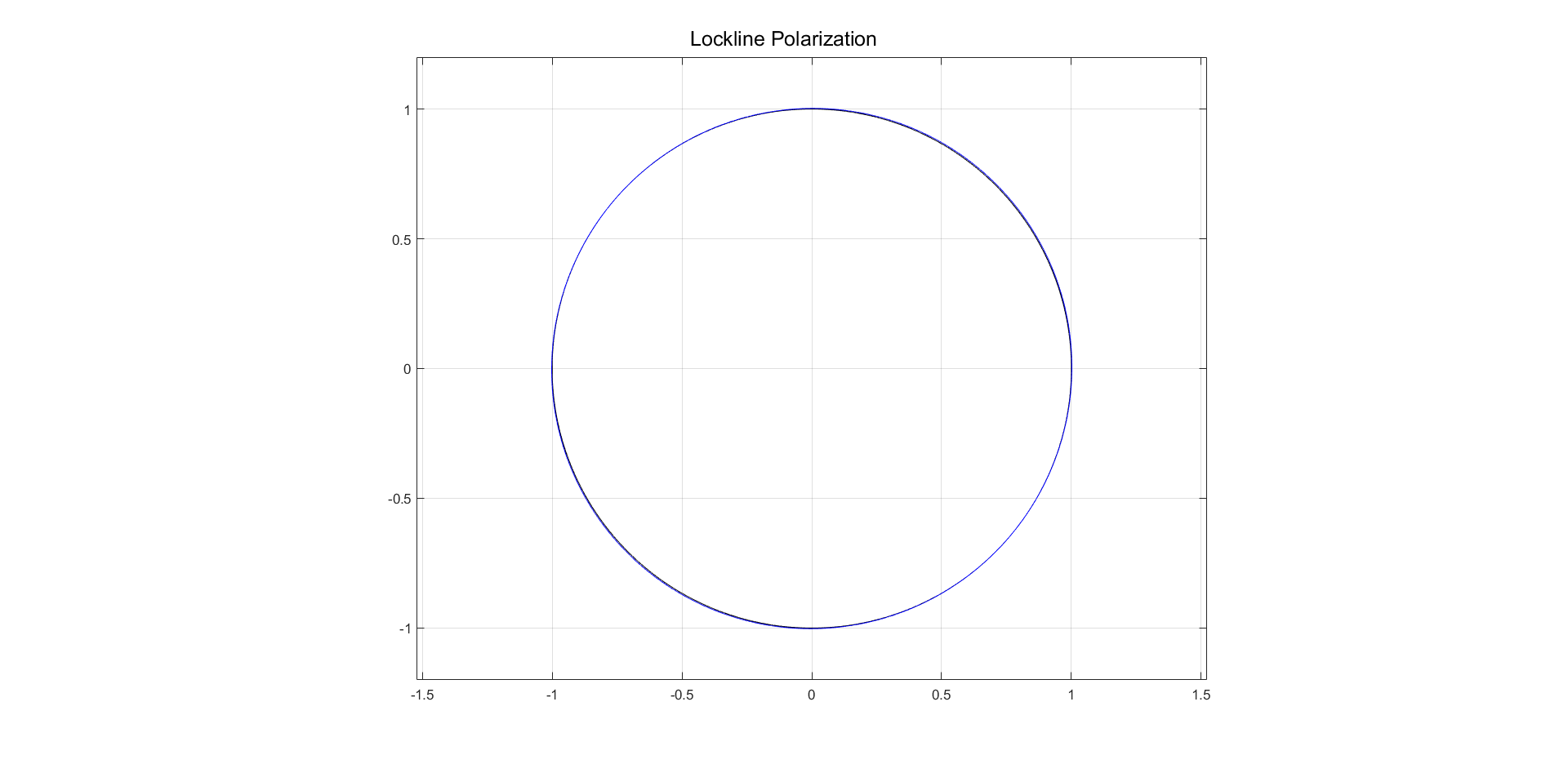 |
| Attachment 12: scope.png
|
 |
|
82
|
Mon Mar 27 17:24:18 2023 |
Blanc | Fixed | info | lasers and optics | Optical room | Caractérisation Cavité et Polar |
J'ai relevé la position des miroirs pour faire une comparaison avec ce que l'on avait précédement :
5.214037 ; 5.168388 ; -2.9 ; -2.9
De plus on a en transmission de M3, mesuré au puissancemètre thermique : P = 56.2 µW => Pcav = 4.683 W avec T_M3 = 12ppm.
Enfin, j'ai pris les images des modes sur les caméras en injection et en transmission (Cf images).
| Blanc wrote: |
|
Pour caractériser la cavité, j'ai injecté différents états de polarisation (non locké) et j'ai relevé la transmission de la cavité et la réflexion de la cavité, locké puis délocké.
On observe que le pourcentage de couplage dans la cavité ne change pas en fonction de la polarisation, contrairement à l'intensité.
|
|
| Attachment 1: Faisceau_trans_1920x1200pix_27_03_2023.PNG
|
 |
| Attachment 2: Faisceau_inj_NF_1920x1200pix_27_03_2023.png
|
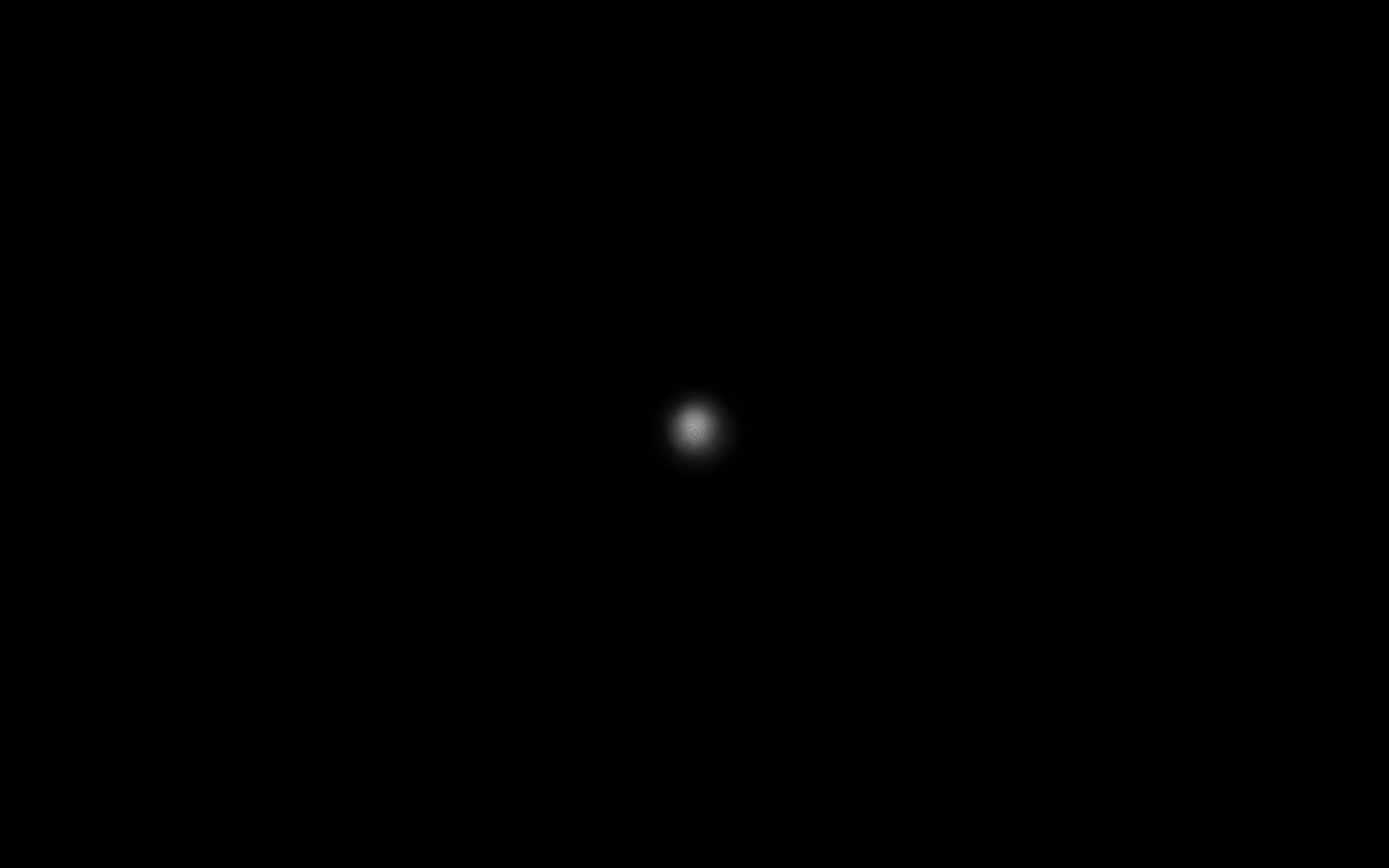 |
| Attachment 3: Faisceau_inj_FF_659x494pix_27_03_2023.png
|
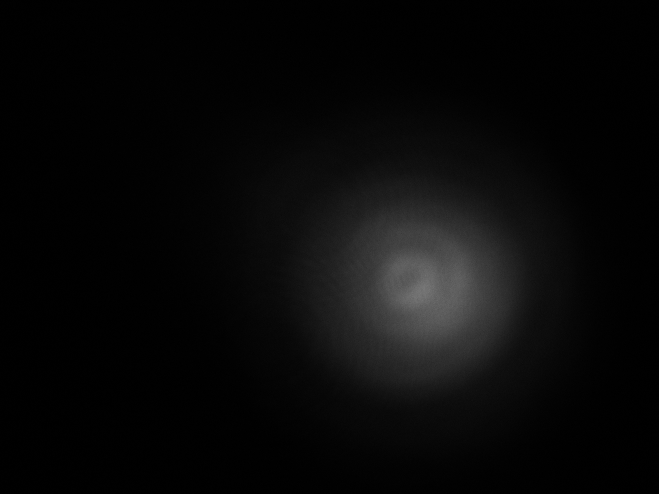 |
|
83
|
Wed Apr 5 13:09:49 2023 |
Blanc | Fixed | info | lasers and optics | Optical room | Taille faisceau |
J'ai fait une comparaison de la taille du faisceau sur les miroirs de la cavité pour savoir si le mauvais couplage dans la cavité était dû à cela.
Au vue des faibles différences, cela n'explique pas le couplage si bas que l'on obtient. |
| Attachment 1: NF_injection_comparison.png
|
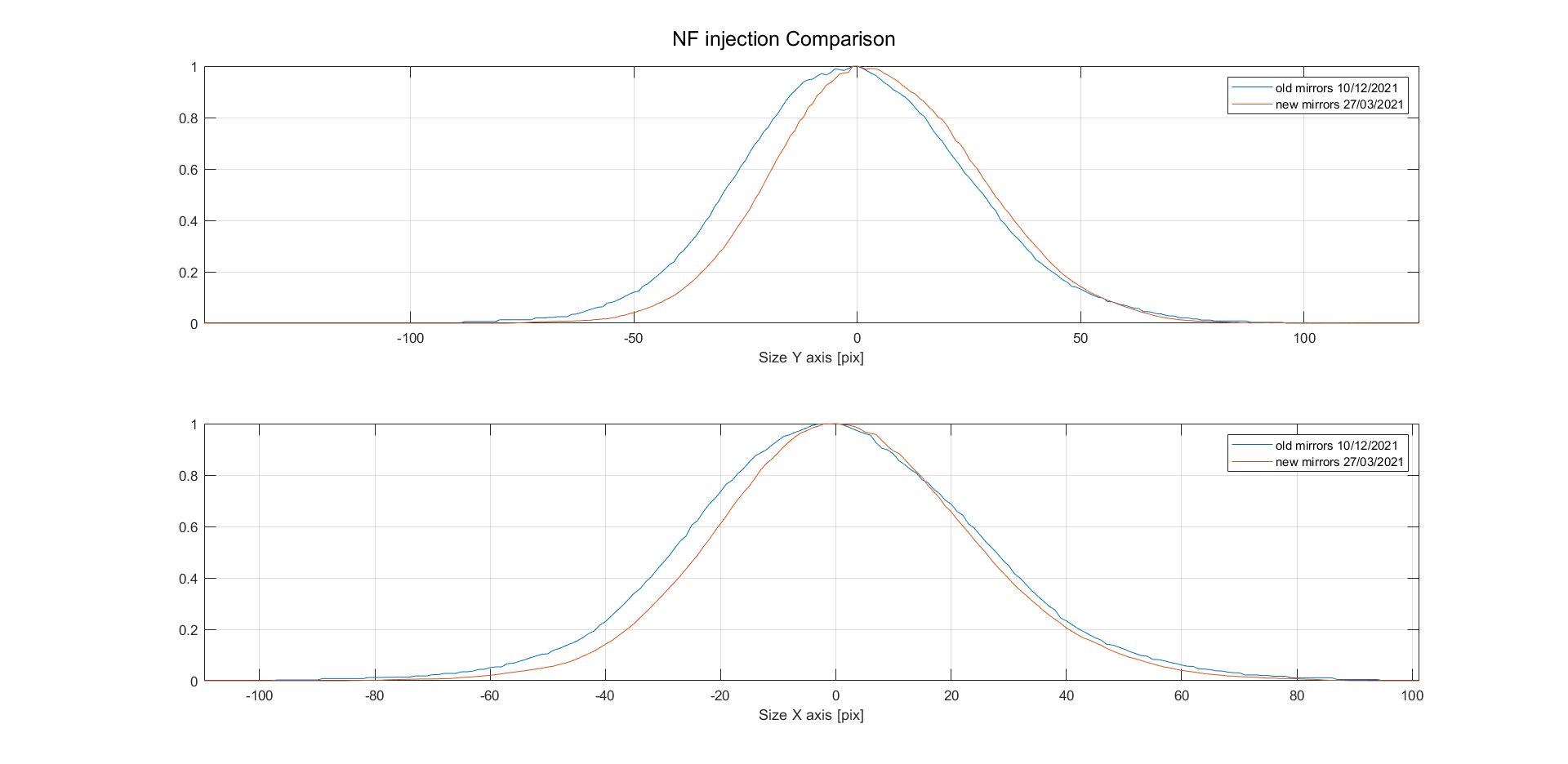 |
| Attachment 2: FF_injection_comparison.png
|
 |
| Attachment 3: Transmission_comparison_background_corrigé.png
|
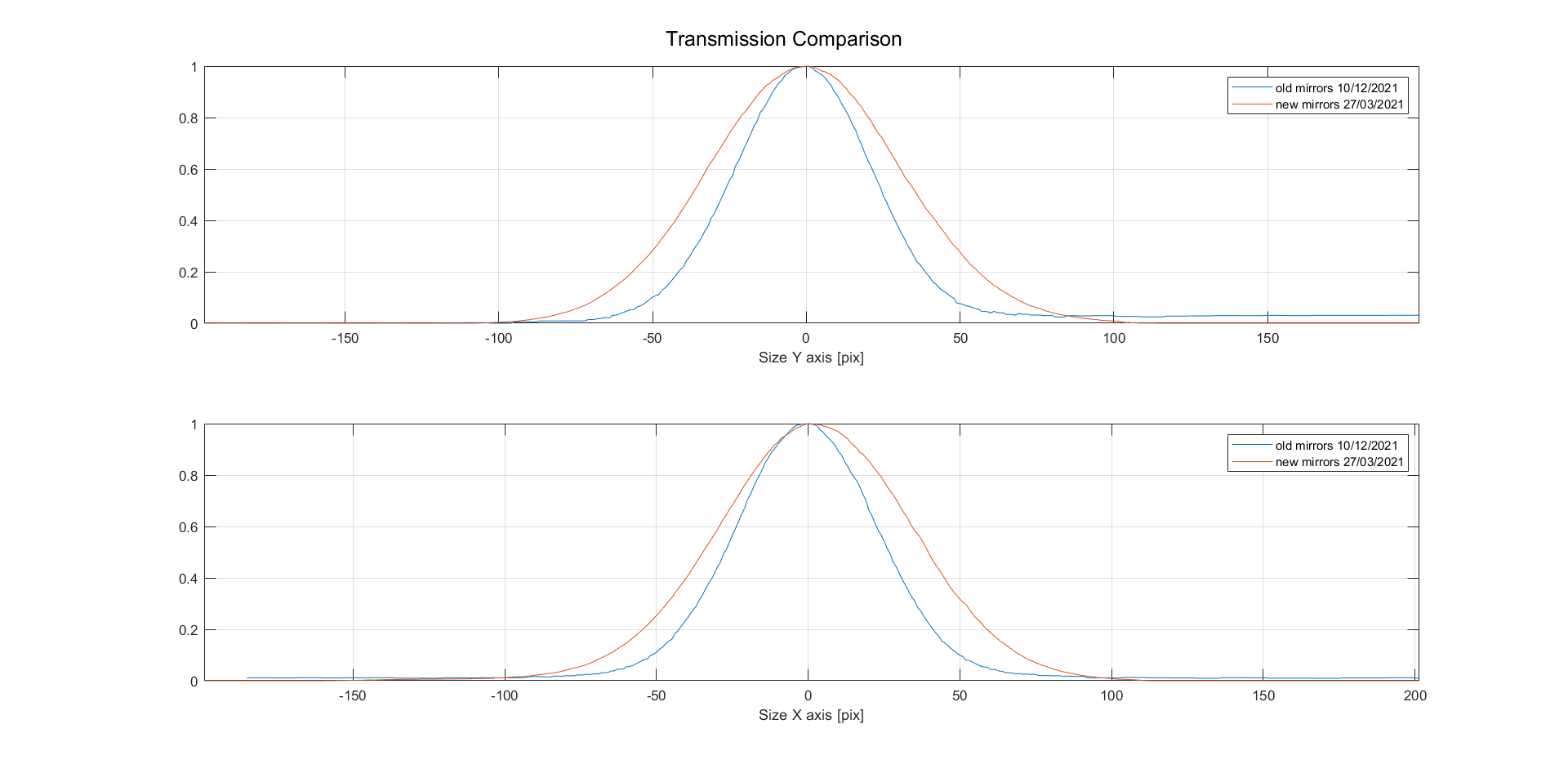 |
|
84
|
Wed Apr 5 13:16:38 2023 |
Blanc | Fixed | info | lasers and optics | Optical room | Couplage différents setups |
Pour voir à quel endroit le couplage diminuait drastiquement, j'ai mesuré celui-ci pour différentes configurations.
On observe que le couplage diminue fortement après le passage dans l'AOM.
Celui-ci est à son fonctionnement nominal à 197 MHz et 350mVpp.
La puissance entrante est P_in = 20.75 mW et la puissance sortante est P_out = 10.11 mW. |
| Attachment 1: Comparaison_couplage_différents_setups.png
|
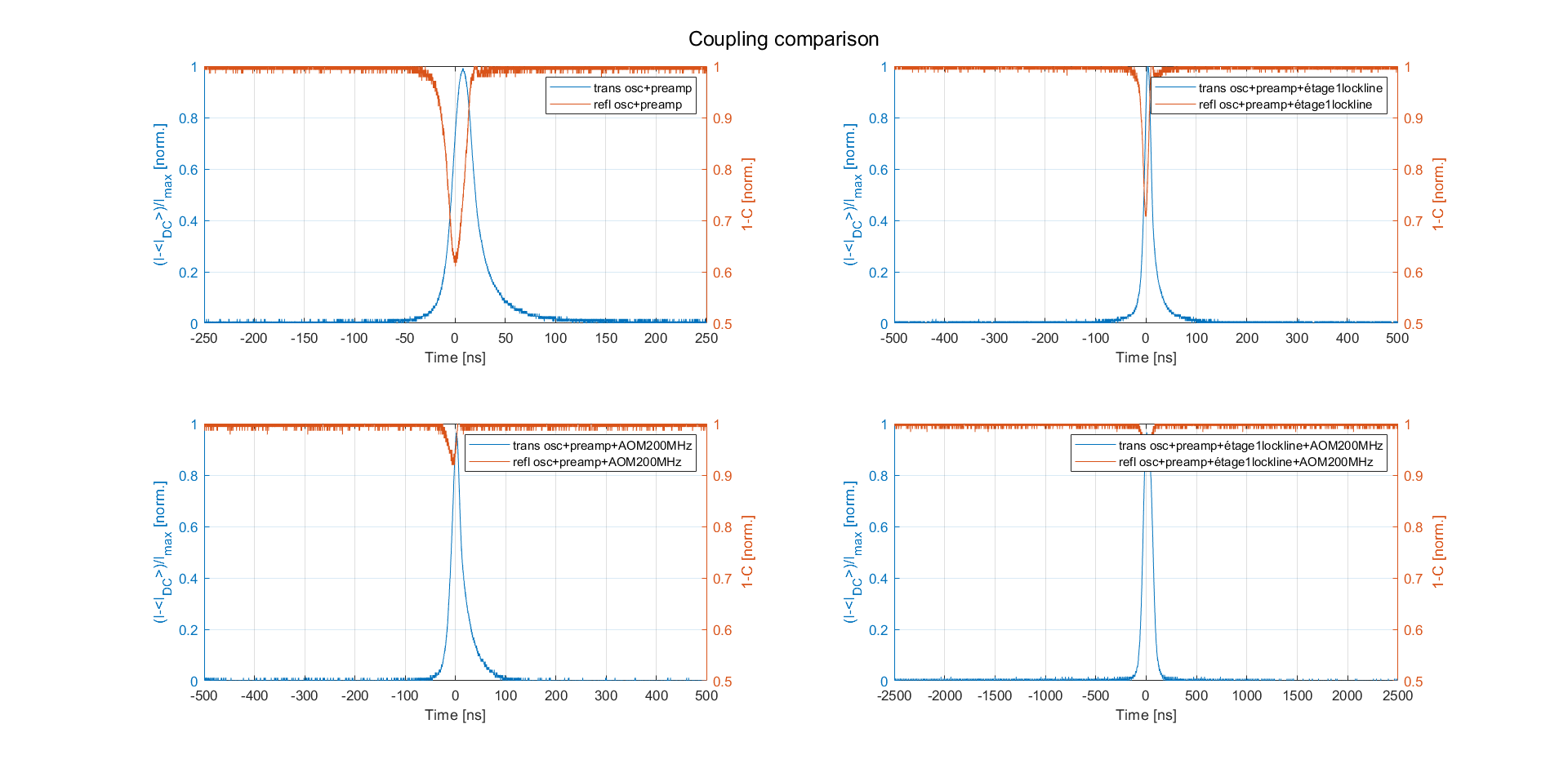 |
|
85
|
Mon Apr 24 18:41:27 2023 |
Blanc | Fixed | info | lasers and optics | Optical room | Couplage and CEP |
Pour avoir une idée du couplage en fonction de la CEP, j'ai pris 11 séries de 10 mesures de l'intensité réfléchie en changeant la CEP avec des AOM.
J'ai pu calculé chaque Δ = (I_Delock-I_lock)/I_Delock = C(1-|R|²) ainsi que leurs déviation standard, puis j'ai fait une moyenne sur les 10 mesures pour avoir un Δ et une barre d'erreur pour chaque Fréquence.
Enfin j'ai pu faire un fit de ces Δ en prenant en compte les barres d'erreur, et cela donne les courbes ci-dessous.
La première courbe est pour le preamp uniquement, et la deuxième pour le preamp+le premier étage de la lockline. |
| Attachment 1: Fit_Delta_en_fonction_de_la_CEP_Preamp.png
|
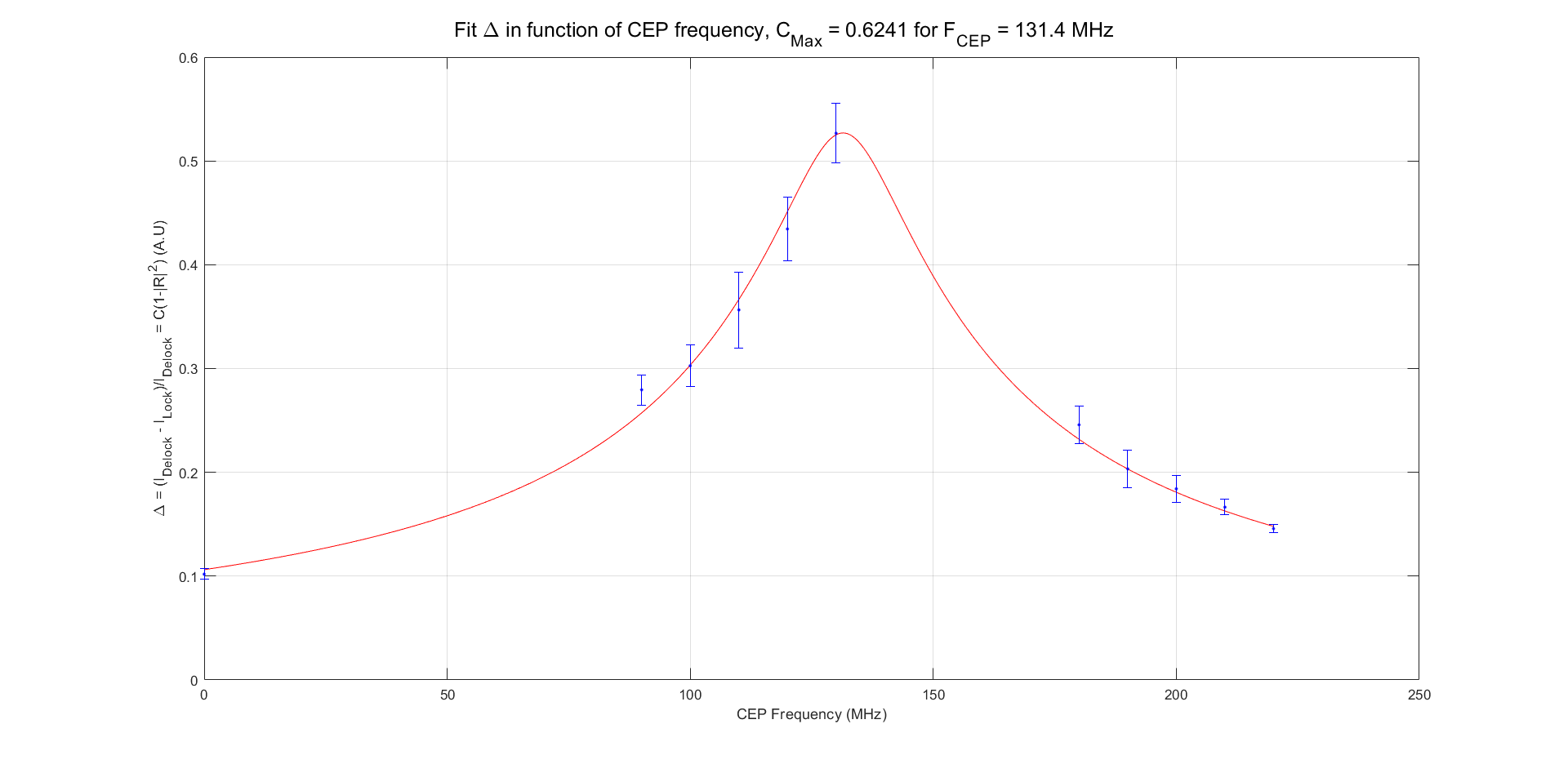 |
| Attachment 2: Fit_Delta_en_fonction_de_la_CEP_Preamp&Etage1Lockline.png
|
 |
|
86
|
Tue Apr 25 12:27:08 2023 |
Blanc | Fixed | info | lasers and optics | Optical room | Couplage and CEP |
Les courbes avec les barres d'erreurs du fit dans le titre.
| Blanc wrote: |
|
Pour avoir une idée du couplage en fonction de la CEP, j'ai pris 11 séries de 10 mesures de l'intensité réfléchie en changeant la CEP avec des AOM.
J'ai pu calculé chaque Δ = (I_Delock-I_lock)/I_Delock = C(1-|R|²) ainsi que leurs déviation standard, puis j'ai fait une moyenne sur les 10 mesures pour avoir un Δ et une barre d'erreur pour chaque Fréquence.
Enfin j'ai pu faire un fit de ces Δ en prenant en compte les barres d'erreur, et cela donne les courbes ci-dessous.
La première courbe est pour le preamp uniquement, et la deuxième pour le preamp+le premier étage de la lockline.
|
|
| Attachment 1: Fit_Delta_en_fonction_de_la_CEP_Preamp.png
|
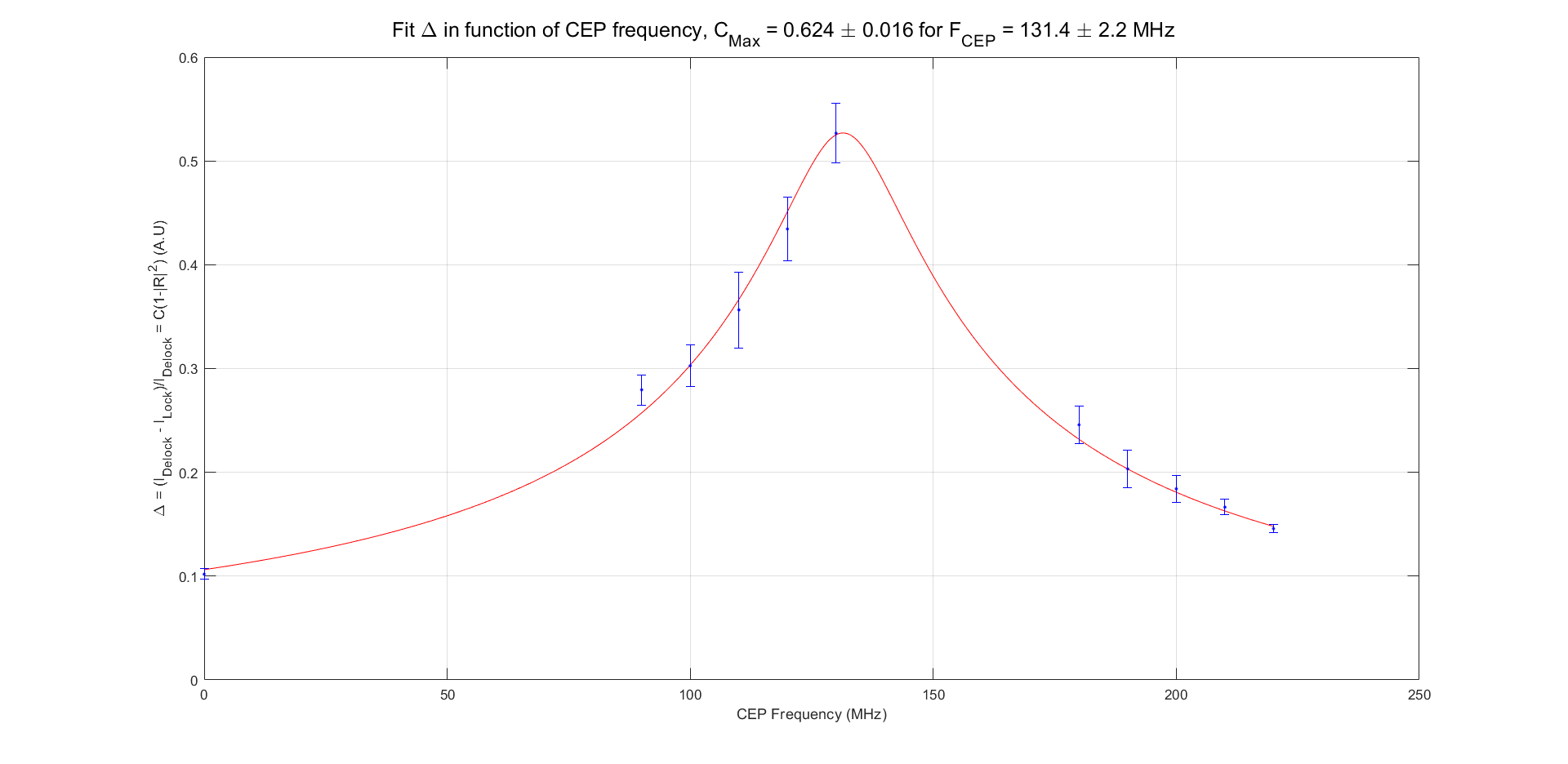 |
| Attachment 2: Fit_Delta_en_fonction_de_la_CEP_Preamp&Etage1Lockline.png
|
 |
|
87
|
Wed Apr 26 16:39:59 2023 |
Blanc | Fixed | info | lasers and optics | Optical room | Couplage and CEP |
Pour vérifier la cohérence des mesures précédentes, j'ai fait la même analyse avec l'intensité transmise.
J'ai calculé G = (I_Lock_Trans-I_Delock_Trans)/I_Delock_Refl ainsi que la deviation standard associée, puis moyenné et fitté, en prenant toujours en compte les barres d'erreurs.
| Blanc wrote: |
|
Les courbes avec les barres d'erreurs du fit dans le titre.
| Blanc wrote: |
|
Pour avoir une idée du couplage en fonction de la CEP, j'ai pris 11 séries de 10 mesures de l'intensité réfléchie en changeant la CEP avec des AOM.
J'ai pu calculé chaque Δ = (I_Delock-I_lock)/I_Delock = C(1-|R|²) ainsi que leurs déviation standard, puis j'ai fait une moyenne sur les 10 mesures pour avoir un Δ et une barre d'erreur pour chaque Fréquence.
Enfin j'ai pu faire un fit de ces Δ en prenant en compte les barres d'erreur, et cela donne les courbes ci-dessous.
La première courbe est pour le preamp uniquement, et la deuxième pour le preamp+le premier étage de la lockline.
|
|
|
| Attachment 1: Fit_Gain_en_fonction_de_la_CEP_Preamp.png
|
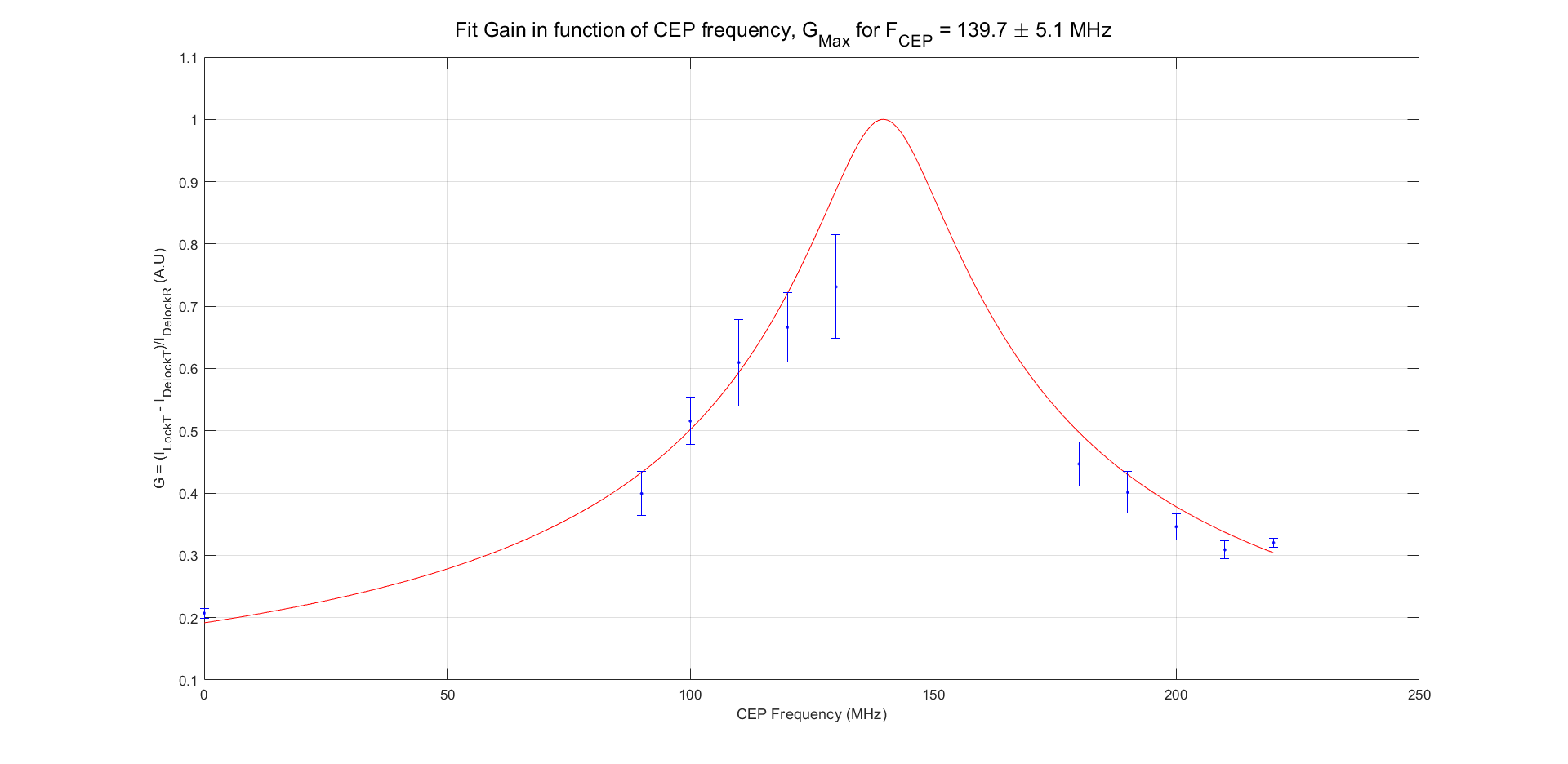 |
| Attachment 2: Fit_Gain_en_fonction_de_la_CEP_Preamp&Etage1Lockline.png
|
 |
|
88
|
Fri Apr 28 15:28:06 2023 |
Blanc | Fixed | info | lasers and optics | Optical room | Verification CEP |
On a voulu véifier que le changement de couplage induit par la CEP était une conséquence du changement de CEP dans l'oscillateur dû au très léger déplacement angulaire de la monture de fond de cavité où il y a le SESAM et le piezo.
Pour cela, j'ai changé très légèrement l'angle vertical de la monture de fond de cavité et j'ai vu un déplacement de Frep que l'on devait rattraper avec la cavité, ainsi qu'un changement dans le couplage (si on commence au couplage max, ~1/8 ème de tour de vis divise par 2 le couplage).
Le déplacement angulaire que l'on doit faire pour changer la CEP est également très inférieur à celui impliquand une perte du mode-lock (~5 tours de vis). De plus, l'expérience est reproductible, ce qui implique que l'on peut rattraper le shift induit par les AOM pour rester au meilleur couplage.
Cependant, il faut dorénavant vérifier avant toutes les manips la CEP de l'oscillateur pour se remettre au même point de fonctionnement. |
|
89
|
Fri May 26 18:08:27 2023 |
Blanc | Fixed | info | lasers and optics | Optical room | Modulation EOM |
EOM dans la lockline:
Image 1 (sans 2è étage): on voit la modulation en réflexion de la cavité.
Image 2 (avec 2è étage): on voit la modulation en réflexion de la cavité et il semblerait qu'elle soit présente aussi en transmission.
EOM sur le breadboard, pas d'ampli lockline:
Image 3 et 4 : Le niveau de signal est très bas en réflexion de la cavité, le modulation pourrait être noyé dans le bruit. Par contre il semblerait qu'en transmission il y ait possiblement la modulation mais ce n'est pas sûr. |
| Attachment 1: osc_preamp_AOM100_etage1_EOM.png
|
 |
| Attachment 2: osc_preamp_AOM100_etage1_EOM_etage2.png
|
 |
| Attachment 3: osc_preamp_AOM100_EOMbreadboard_matlab.png
|
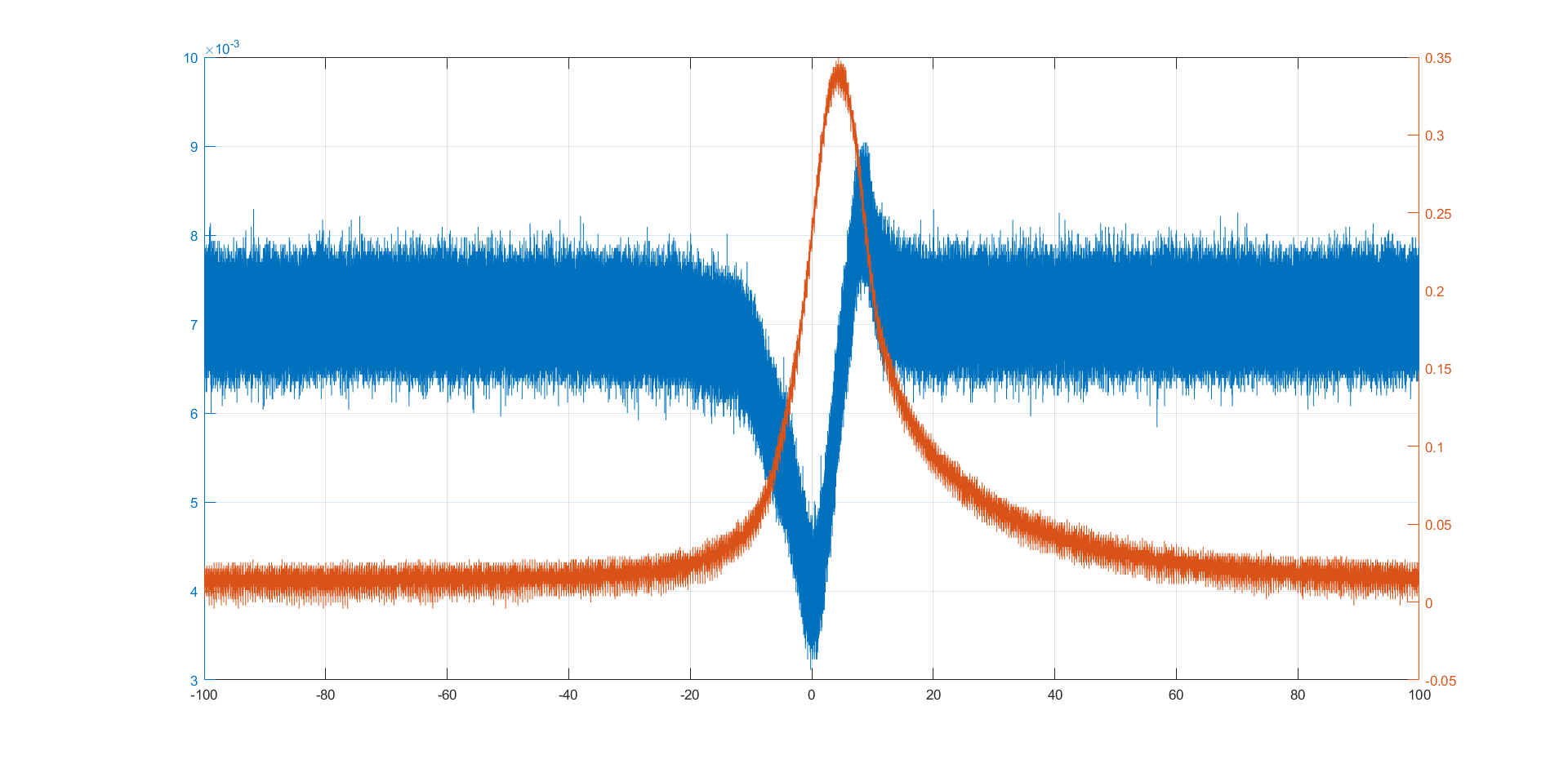 |
| Attachment 4: osc_preamp_AOM100_EOMbreadboard.png
|
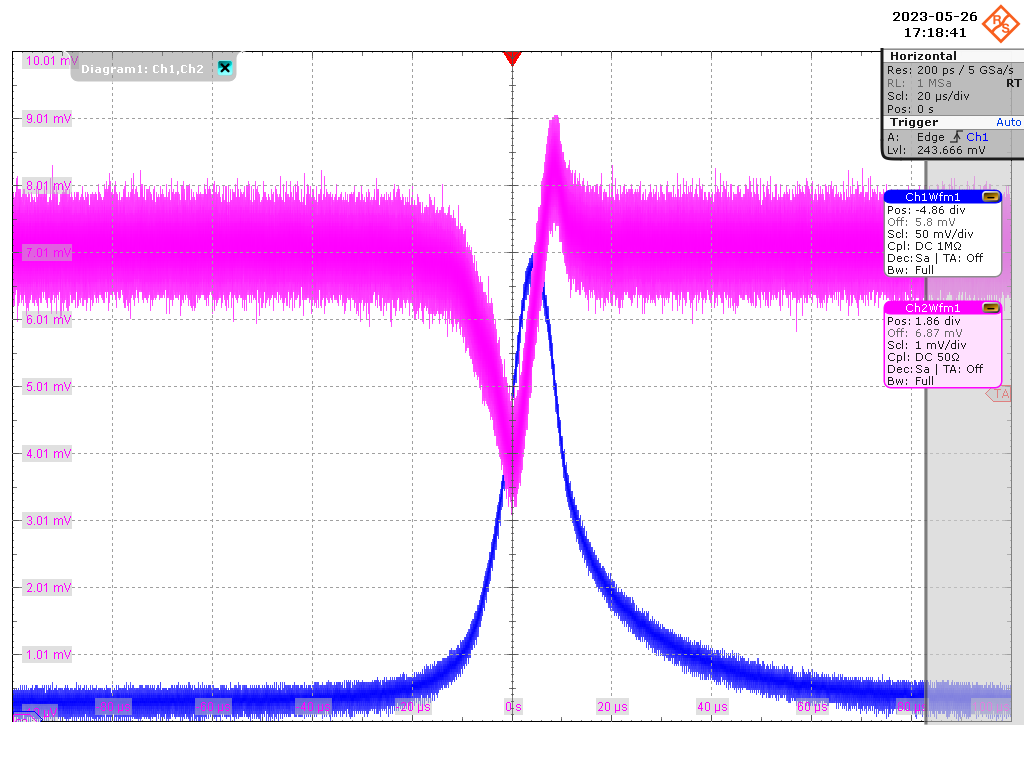 |