| ID |
Date |
Author |
Status |
Type |
Category |
Location |
Title |
|
52
|
Fri Aug 30 17:52:41 2019 |
Ronic Chiche | Fixed | issue | mechanics | detectors and electronics | Optical room | Motor issue |
Today, Axis 9 (Z-axis of P1) has blocked the software which drives all the motors.
impossible to bypass the problem.
I had to :
- switch off the motor driver crate n°2 (motors 9-16)
- disconnect all motor cables (9-16)
- reconnect only cables 15 and 16.(same internal board of crate n°2)
- restart the software to test that, now, the software launches properly
and I did again the procedure with connecting all motor cables |
|
59
|
Wed Sep 25 15:49:28 2019 |
Ronic Chiche | Fixed | issue | mechanics | detectors and electronics | Optical room | Motor issue |
Today again, same problem with axis 9 blocking the controlling software during the mirror alignment procedure.
after opening the motor 9-16 controlling crate, we saw 2 screws (RX- and TX+ of the controller) which were badly screwed.
we firmly screwed them... could it be the cause ?
after reconnecting everything, the software launches properly... and everything is back to work... wait and see.
| Ronic Chiche wrote: |
|
Today, Axis 9 (Z-axis of P1) has blocked the software which drives all the motors.
impossible to bypass the problem.
I had to :
- switch off the motor driver crate n°2 (motors 9-16)
- disconnect all motor cables (9-16)
- reconnect only cables 15 and 16.(same internal board of crate n°2)
- restart the software to test that, now, the software launches properly
and I did again the procedure with connecting all motor cables
|
|
|
293
|
Tue Nov 28 11:32:17 2023 |
Ronic Chiche | Fixed | info | mechanics | detectors and electronics | ThomX igloo | Smaract motors parameters and controller |
current Smaract motors parameters :
- Closed loop Max frequency : 5000
- Signal Amplitude threshold : 2047
- High voltage threshold : 511
when one drives the Smaract motors in "closed loop" mode, one can get a displacement as small as 50nm... but at the price of a delock of the laser/FP-cavity.
when one drives the motor in "open loop" mode, 1 step is equivalent to 4µm !!! it is much larger than the laser PZT range.
when one drives the motor in "Piezo Scan" mode with a speed of 1V/s, one can move the motor without losing the laser/Fp-cavity lock.
the PZT voltage range of 100V (max value) is roughly equivalent to 2-3µm of round trip length, which is enough to manage several "fast" (10-20 minutes) oscillations of the laser frequency :
see these posts to get some info on the laser frequency oscillations : https://elog.lal.in2p3.fr/FPC/THOMX+commissioning/289
 |
|
3
|
Tue Oct 2 16:23:54 2018 |
Ronic Chiche | Fixed | issue | mechanics | cabling | software | Optical room | test des vérins ISP |
* les vérins de 20mm (axe Z) ont été testés sur table grace à une rallonge SUB-C - DB9, au chassis ISP et au soft SUPERVISEUR écrit en labwindows CVI par Didier.
pour rappel, la course soft va de -1 650 000 à +1 650 000 pour 20mm de course, soit 0.6mm pour 100 000 de course soft.
ils ont été réglés en positions minimale (-1 650 000) pour que Yann puisse les intégrer facilement dans le chassis mécanique.
* une fois installés dans la capsule, les signaux passent par le feedthrough de la capsule.
MAIS cette capsule a vocation a être intégrée au chassis mécanique, intégré lui-même dans une enceinte et les signaux passent alors par un autre feedthrough, celui de l'enceinte.
Il faut donc IMPERATIVEMENT ce feedthrough (ou l'effet miroir qu'il produit) pour tester correctement les vérins dans leur capsule ! |
|
4
|
Tue Oct 2 18:00:36 2018 |
Ronic Chiche | Fixed | issue | mechanics | cabling | software | Optical room | test des vérins ISP |
| Ronic Chiche wrote: |
|
* les vérins de 20mm (axe Z) ont été testés sur table grace à une rallonge SUB-C - DB9, au chassis ISP et au soft SUPERVISEUR écrit en labwindows CVI par Didier.
pour rappel, la course soft va de -1 650 000 à +1 650 000 pour 20mm de course, soit 0.6mm pour 100 000 de course soft.
ils ont été réglés en positions minimale (-1 650 000) pour que Yann puisse les intégrer facilement dans le chassis mécanique.
* une fois installés dans la capsule, les signaux passent par le feedthrough de la capsule.
MAIS cette capsule a vocation a être intégrée au chassis mécanique, intégré lui-même dans une enceinte et les signaux passent alors par un autre feedthrough, celui de l'enceinte.
Il faut donc IMPERATIVEMENT ce feedthrough (ou l'effet miroir qu'il produit) pour tester correctement les vérins dans leur capsule !
|
|
| Attachment 1: CABLAGE_VERINS.pdf
|
|
5
|
Wed Oct 3 11:28:46 2018 |
Ronic Chiche | Fixed | report | mechanics | cabling | Optical room | test des vérins ISP 20mm et 6mm |
Après avoir utilisé la chaine : driver ISP - cable ISP DB9 - Feedthrough enceinte DB9-DB9 - cable perlé DB9-SUB-C - Capsule SUB-C,
l'ensemble de tous les vérins 6mm et 20mm ont été testés => ils fonctionnent TOUS.
Les vérins 6mm ont TOUS subis un HOME. cette commande cherche une fin de course du vérin et le place ensuite en position médianne.
Au niveau soft, la course d'un vérin 6mm va de -22 000 à +22 000. Après un HOME, chaque vérin est postionné à la valeur 0. |
|
6
|
Fri Oct 5 10:17:30 2018 |
Ronic Chiche | Fixed | report | mechanics | cabling | Optical room | test des vérins ISP 20mm et 6mm |
| Ronic Chiche wrote: |
|
Après avoir utilisé la chaine : driver ISP - cable ISP DB9 - Feedthrough enceinte DB9-DB9 - cable perlé DB9-SUB-C - Capsule SUB-C,
l'ensemble de tous les vérins 6mm et 20mm ont été testés => ils fonctionnent TOUS.
Les vérins 6mm ont TOUS subis un HOME. cette commande cherche une fin de course du vérin et le place ensuite en position médianne.
Au niveau soft, la course d'un vérin 6mm va de -22 000 à +22 000. Après un HOME, chaque vérin est postionné à la valeur 0.
|
Précision : le HOME sur les vérins de 6mm place AUTOMATIQUEMENT le vérin en position médianne après avoir atteint une fin de course (FDC)
Pour les vérins de 20mm, la commande HOME place le vérin sur sa FDC positive : +1 650 000 mais NE DEPLACE PAS ensuite automatiquement le vérin en position médiane.
Il faut le faire de façon manuelle.
Tous les vérins 20mm vont subir un HOME et être placés manuellement en position 0.
Il faut ensuite leurs envoyer un offset +825 000 ou -825 000 selon les vérins pour que la cavité ait une conformation rectangulaire.
(actuellement elle ne l'est pas à cause de cales de longueurs différentes selon les axes pour anticiper les effets thermiques à compenser ultérieurement).
|
|
8
|
Mon Oct 22 11:27:35 2018 |
Ronic Chiche | Fixed | info | mechanics | Optical room | Remontage mécanique |
Mail de Yann du 12/10/2018 :
Je vous fais le bilan des actions effectuées :
1/ La mécanique a été remontée avec changement des billes céramiques, soufflet défectueux, ect...
2/ Test et mise en place des vérins en position
3/ nettoyage des chambres et insertions de la méca
4/ connectorisation des câbles perlés et test des vérins par le soft
5/ fermeture des brides
6/ nettoyage du marbre et de la zone
On est donc prêt pour les test de vide et d'étuvage.
RAPPEL pour tous :
Des nouvelles combinaisons propres sont à disposition (on ne sort pas du flux avec la combi !)
Mettre MASQUE / CHARLOTTE / COMBI / GANTS !
Ne pas rentrer de CARTONS ou autres sources de pollution.
NETTOYER les outils ou objets à rentrer dans la zone
RANGER après les manips. |
|
9
|
Mon Oct 22 11:29:41 2018 |
Ronic Chiche | Fixed | info | mechanics | Optical room | Remontage des vérins |
Mail de Yann du 8/10/2018 :
Bonjour,
Tous les vérins sont maintenant OK ! Merci Ronic.
La cavité a été réglé en mode nominal (tilt à +2/-2 et Z à +5/-15 ou -5/+15).
Demain avec Christopher on remet tous dans les enceintes à vide.
Du coup, Patrick tu pourras ré-connecter les câbles céramique (à partir de demain apres midi).
On est dans les temps pour des tests de vide et d'étuvage a partir de lundi prochain.
A+
Yann. |
|
17
|
Tue Feb 19 15:50:08 2019 |
Loïc Amoudry | Fixed | info | mechanics | Optical room | Motors connexions |
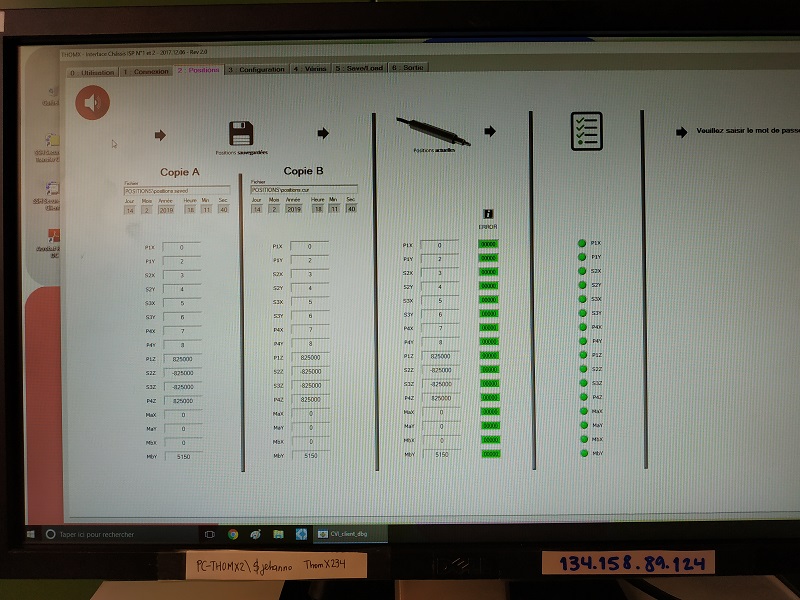
Motors are connected. The true mirror's name are P1 for injection mirrors, S2, S3 and P4. (S=spherical, P=planar).
They are still some old schemes (and notations on the cavity) which mention M1, M2, M3 and M4. I make the link here:
M3 = P1
M1 = S2
M2 = S3
M4 = P4
The wires are plugged as follows (I use notations wrote on the cavity and wires):
M3x = 1-1
M3y = 1-2
M3z = 2-1
M1x = 1-3
M1y = 1-4
M1z = 2-2
M2x = 1-5
M2y = 1-6
M2z = 2-3
M4x = 1-7
M4y = 1-8
M4z = 2-4 |
| Attachment 1: Validation_moteurs.jpg
|
 |
|
19
|
Tue Mar 19 17:01:52 2019 |
Loïc Amoudry | Fixed | issue | mechanics | Optical room | Motors Z axis reversed |
S2 and S3 z-axis are initially at 1/4 (5mm/20mm) of there range over ~20mm range. This is meant to be able to spread them up to ~15mm in case of thermal effect.
Actually, they are in an opposite position. Means that they can only be spread of 5mm from the initial position. |
|
23
|
Thu Mar 28 09:25:58 2019 |
Loïc Amoudry | Fixed | issue | mechanics | Optical room | Motors Z axis reversed |
All Z motors (for P1, S2, S3 and P4) have been initialized again with a proper HOME command with their own controller with the "superviser" software (which means they all moved to the +1650000 position).
Thus, they have been moved to their default position : +825000 for spherical mirrors (S2 and S3) and -825000 for plan mirrors (P1 and P4).
reminder : lower values on the motors makes the motor tip going inside which makes the cavity length larger.
thus spherical mirrors are in default position with a possible big range to put inside the motor tip (for thermal effects compensation).
by complementarity, plan mirrors are in default position with a possible big range to put outside the motor tip.
the Labwindows CVI was buggy about the proper representation of the motors motion in Z direction (wrong direction and wrong default position).
the software is now fixed.
| Loïc Amoudry wrote: |
|
S2 and S3 z-axis are initially at 1/4 (5mm/20mm) of there range over ~20mm range. This is meant to be able to spread them up to ~15mm in case of thermal effect.
Actually, they are in an opposite position. Means that they can only be spread of 5mm from the initial position.
|
|
|
64
|
Thu Oct 3 13:49:58 2019 |
Loïc Amoudry | Fixed | info | mechanics | Optical room | Pneumatic valves |
Frederic and Manu from vacuum group came this morning to fix again the pneumatic valves which had a leak again. |
|
73
|
Thu Oct 10 18:03:10 2019 |
Ronic Chiche | Fixed | issue | mechanics | Optical room | First Lock with 2nd satge of amplifier : Motor issue ? |
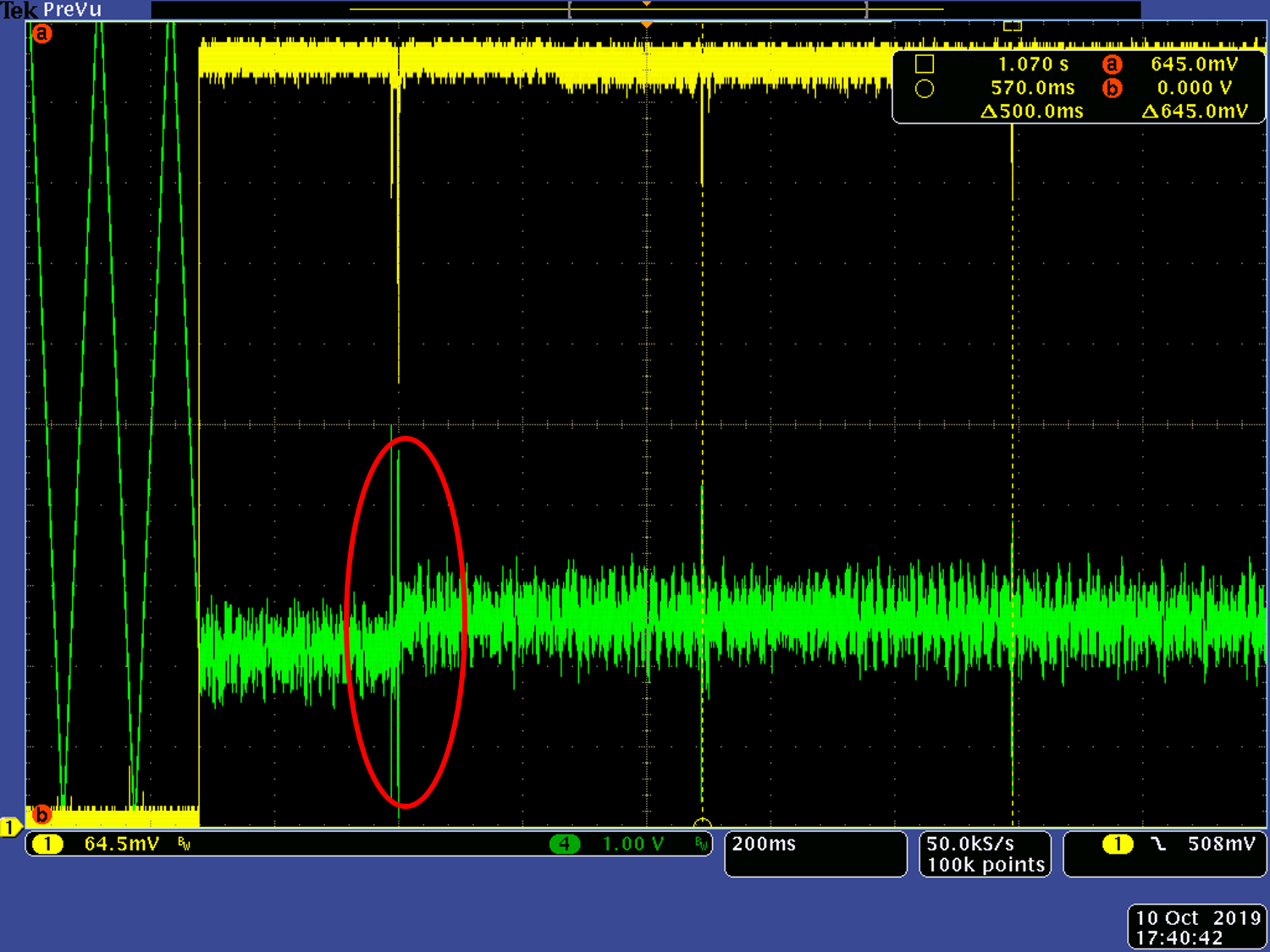
Global locking almost clean : tranmission and reflection are quite noiseless except the peaks at every 500ms.
During the amplifier 2nd stage lock, we experienced 2 strange behaviors :
- short "unlocks" every 500ms exactly all the time, during the whole lock process
- some PZT (in green on the picture) shift exactly synchronized with these "unlocks" (see the red circle).
these shifts are triggered by some OneFive motor move (Frep adjustment).
We tried to disconnect software activity (use the disconnect button on the software), to disconnect USB cable, to disconnect power supply of the motor controller box but none of these actions had an effect
=> still short unlocks every 500ms...
The amplifier 2nd stage seems to have small fan for the power supply... we can try to disconnect it.
We tried to turn on the 3rd stage which uses several fans for cooling the pump diodes... thus, one can see immediatly a big increasing in the PZT signal which tries to compensate the vibrations and quicly one loose the lock.
we have to think on how to suppress these vibrations.
|
| Attachment 1: Image1.png
|
 |
|
82
|
Tue Nov 26 16:11:52 2019 |
Ronic Chiche | Fixed | issue | mechanics | Optical room | First Lock with 2nd satge of amplifier : Motor issue ? |
The 500 ms noise disapeared. We had to disable the "power save" mode of the smaract translation stage. AND turn OFF and ON the controler box.
| Ronic Chiche wrote: |
|
Global locking almost clean : tranmission and reflection are quite noiseless except the peaks at every 500ms.
During the amplifier 2nd stage lock, we experienced 2 strange behaviors :
- short "unlocks" every 500ms exactly all the time, during the whole lock process
- some PZT (in green on the picture) shift exactly synchronized with these "unlocks" (see the red circle).
these shifts are triggered by some OneFive motor move (Frep adjustment).
We tried to disconnect software activity (use the disconnect button on the software), to disconnect USB cable, to disconnect power supply of the motor controller box but none of these actions had an effect
=> still short unlocks every 500ms...
The amplifier 2nd stage seems to have small fan for the power supply... we can try to disconnect it.
We tried to turn on the 3rd stage which uses several fans for cooling the pump diodes... thus, one can see immediatly a big increasing in the PZT signal which tries to compensate the vibrations and quicly one loose the lock.
we have to think on how to suppress these vibrations.
|
|
|
112
|
Mon Jan 17 10:04:14 2022 |
Ronic Chiche | Fixed | info | mechanics | ThomX igloo | Documentation about mechanics on Atrium |
https://atrium.in2p3.fr/0dded51a-1cb0-43e6-ae0d-626cd5db7078
a lot of schematics regarding the FP cavity are stored by the mechanic group on the Atrium repository. |
|
363
|
Mon Sep 16 12:03:30 2024 |
Ronic Chiche | Fixed | info | mechanics | ThomX igloo | Finding correct motors position and parameters to keep the lock during a move |
this morning, I try to find a new region for MOT.03 and MOT.06 where we can move them without unlocking the cavity.
I started from the position:
MOT06 : ~ -785 000
MOT03 : ~ -200 000
and I do -10 000 steps (dz = 10k x 6nm = 60µm) at a time on both motors.
previously a good region for MOT.06 was -900 000 !
I moved also the laser cavity by 40µm to cancel the beating with the RF frequency.
MOT06 : ~ -795 000
MOT03 : ~ -191 000
Max power after optimazing the CEP ~ 65kW => I need to realign => 78kW
I need to increase the D parameter on the PID to compensate the (85kW / 78kW ratio).
I changed the MOT.03 and MOT.06 speed to 30steps/s => it seems a bit better.
but I still see some lock losses during a move.
.... to be continued...
|
|
364
|
Tue Sep 17 12:48:13 2024 |
Ronic Chiche | Fixed | info | mechanics | ThomX igloo | Finding correct motors position and parameters to keep the lock during a move |
this morning with Daniele, we did a quite long run with this motor position and it seems we don't lose the lock too much.
the motor positions are:
MOT.03 (M4): -186 500 steps
MOT.06 (M1): -797 500 steps
we got 85kW after CEP optimization and rough alignment optimization.
| Ronic Chiche wrote: |
|
this morning, I try to find a new region for MOT.03 and MOT.06 where we can move them without unlocking the cavity.
I started from the position:
MOT06 : ~ -785 000
MOT03 : ~ -200 000
and I do -10 000 steps (dz = 10k x 6nm = 60µm) at a time on both motors.
previously a good region for MOT.06 was -900 000 !
I moved also the laser cavity by 40µm to cancel the beating with the RF frequency.
MOT06 : ~ -795 000
MOT03 : ~ -191 000
Max power after optimazing the CEP ~ 65kW => I need to realign => 78kW
I need to increase the D parameter on the PID to compensate the (85kW / 78kW ratio).
I changed the MOT.03 and MOT.06 speed to 30steps/s => it seems a bit better.
but I still see some lock losses during a move.
.... to be continued...
|
|
|
204
|
Tue Apr 4 13:03:23 2023 |
Manar Amer | Fixed | report | lasers and optics | vacuum | detectors and electronics | ThomX igloo | Cavity Alighnment |
Today, we prepared lenses for a telescope for the CW laser injection into the cavity, yet to be installed
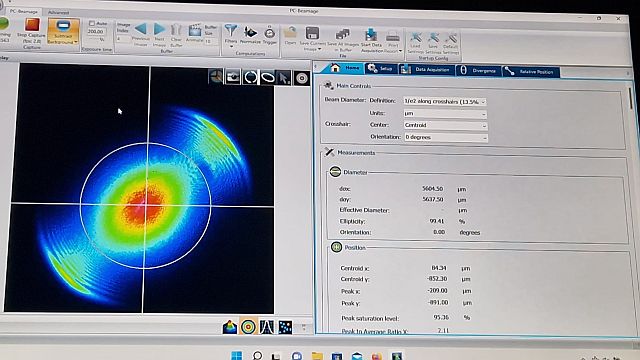
Image of the transmission at P4 attached, an estimation of the beam size of the mode see is ~ 5.5 mm
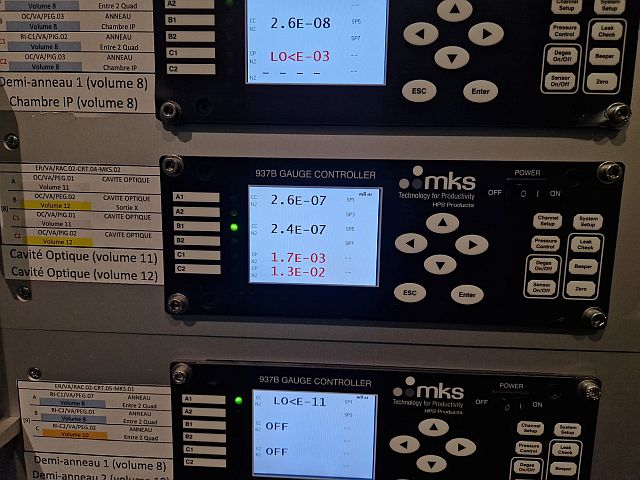
The vacuum in the 2 optical cavities is decreasing but slowly. today it is 2.6 - 2.4 * 10^-7 mbar
| Manar Amer wrote: |
|
Last week, with Ronic and Victor we aligned the cavity using CW laser (Koheras)
- we have also installed 4 mirrors in the cavity with the best theoretical qualities (serial number and images included)
- The Plan ULE mirror P4 thickness was not compatible with the piezoelectric mount. We had to install a metal spacer behind the mirror to be able to fix it. the metal spacers in from ThorLabs made from INOX, It is 1 inch diameter (25.4 mm), we drilled a hole in the middle of 15 mm in the Workshop in bat 200. Then cleaned it using an ultrasound bath in pure water, using a small Ultrasound bath machine in Maverics platform Vide and Surfaces next to ThomX eglo.
-
- This gives some difficulties in imaging the transmission at P4. To help with the imaging, we used the plastic #D printed irises that Yann made long time ago
- we took images of the mode inside the cavity at P4 transmission.
- We also observed some oxidization on the metal bars of the controllers, more on the side of S2 and P4. we are yet to test the motion of the motors in the z-axis.
- Friday evening we closed the windows using a new copper rings (last one we have, Ronic placed a new order).
- The pump was turned on by Bruno and Eric yesterday afternoon. The current vacuum level is 6-7*10^-6 mbar
the pre and the turbo pimps are on so still too noisy to work, we have access all day tomorrow.
|
|
| Attachment 1: 20230404_P4_Transmission.jpg
|
 |
| Attachment 2: 20230404_vacuum_level.jpg
|
 |
|
20
|
Fri Mar 22 17:53:10 2019 |
Loïc Amoudry | Fixed | report | lasers and optics | vacuum | Optical room | Cavity at atm pressure |
Dry air injected into the cavity.
Lock has been proceeded without any trouble. ~~4000 finesse. Considered to be the same than before.
x and y motors axis put back to the last "cavity at air" position. z position kept at maximum distance between spherical mirrors. |
| Attachment 1: finessealair.isf
|