| ID |
Date |
Author |
Status |
Type |
Category |
Location |
Title |
|
410
|
Thu Feb 20 12:36:19 2025 |
Ronic Chiche | Fixed | info | lasers and optics | ThomX igloo | New power record in ThomX cavity |
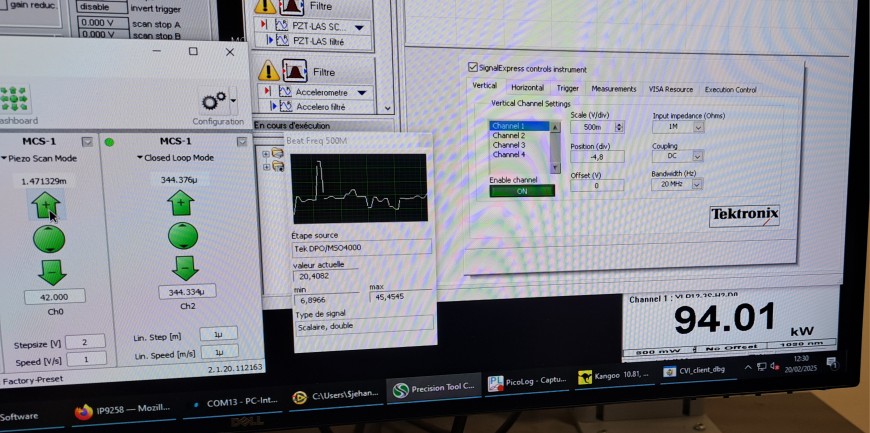
today, we were able to store more than 94kW in the FP cavity, always with the same parameter : 33% laser amplifier ratio
| Ronic Chiche wrote: |
|
today, we were able to store more than 93kW in the FP cavity, always with the same parameter : 33% laser amplifier ratio
|
|
| Attachment 1: img1.jpg
|
 |
|
418
|
Tue Mar 18 11:45:21 2025 |
Ronic Chiche | Fixed | info | lasers and optics | ThomX igloo | New power record in ThomX cavity |
today, we were able to store more than 95kW in the FP cavity, always with the same parameter : 33% laser amplifier ratio
| Ronic Chiche wrote: |
|
today, we were able to store more than 94kW in the FP cavity, always with the same parameter : 33% laser amplifier ratio
| Ronic Chiche wrote: |
|
today, we were able to store more than 93kW in the FP cavity, always with the same parameter : 33% laser amplifier ratio
|
|
|
| Attachment 1: img1(2).jpg
|
.jpg "img1(2).jpg") |
|
420
|
Mon Mar 31 18:19:30 2025 |
Ronic Chiche | Fixed | info | lasers and optics | ThomX igloo | New power record in ThomX cavity |
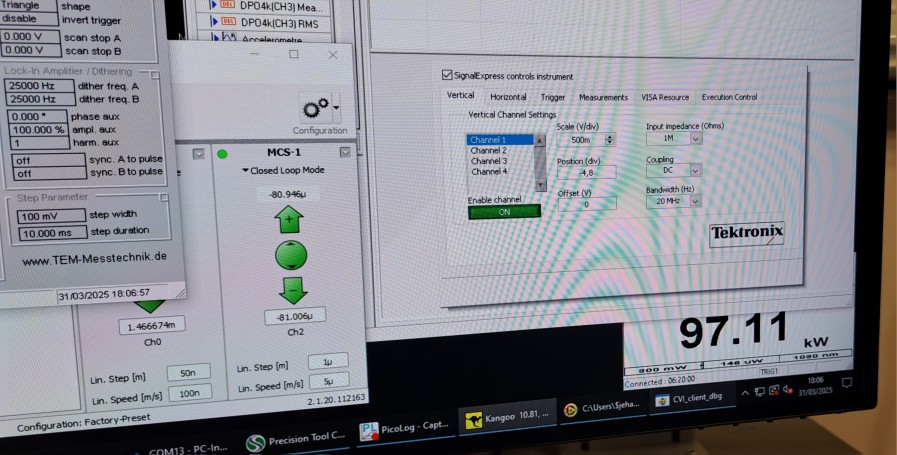
today, we were able to store more than 97kW in the FP cavity, always with the same parameter : 33% laser amplifier ratio
| Ronic Chiche wrote: |
|
today, we were able to store more than 95kW in the FP cavity, always with the same parameter : 33% laser amplifier ratio
| Ronic Chiche wrote: |
|
today, we were able to store more than 94kW in the FP cavity, always with the same parameter : 33% laser amplifier ratio
| Ronic Chiche wrote: |
|
today, we were able to store more than 93kW in the FP cavity, always with the same parameter : 33% laser amplifier ratio
|
|
|
|
| Attachment 1: 20250331_181029.jpg
|
 |
|
422
|
Fri May 2 10:05:43 2025 |
Ronic Chiche | Under Process | report | lasers and optics | ThomX igloo | air conditionning in ThomX Bunker |
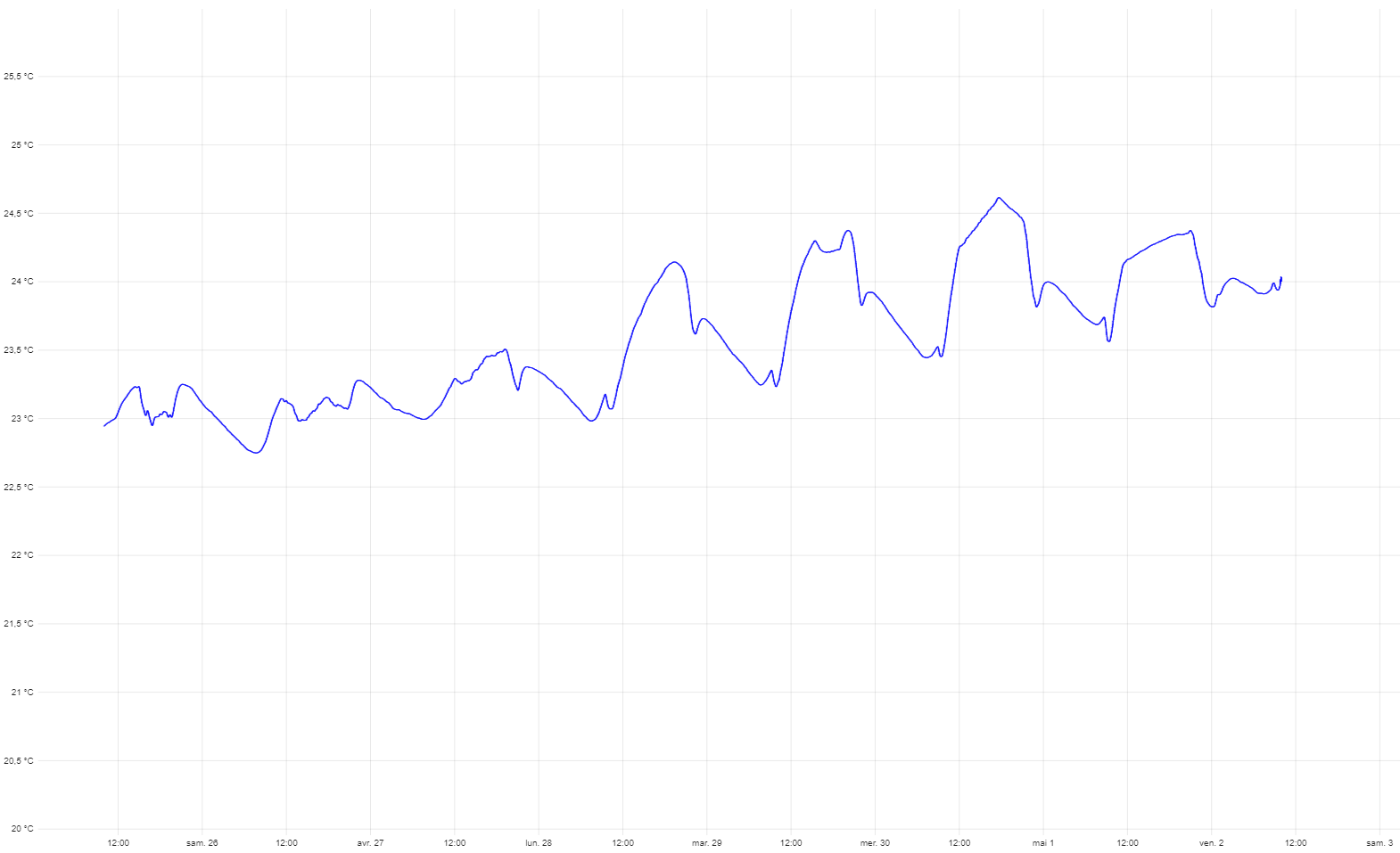
The temperature slitly increase in thomx Bunker from 23° to 24° during the last day.
The thermalisation of the CFP is very long...
In any case the operation of the CFP is so easy, it seems to be correlated to the weather... tody it's very nice as of hte rest of the week.
The stored power is easily 94 KW and there is not jump or delock problems.
The temperature of the bunker continiusly increase and now we observe some delocking du to high frq perturbations... may be the twe things are correlated. |
| Attachment 1: temp.png
|
 |
|
423
|
Tue May 6 09:29:43 2025 |
Ronic Chiche | Under Process | report | lasers and optics | ThomX igloo | air conditionning in ThomX Bunker |
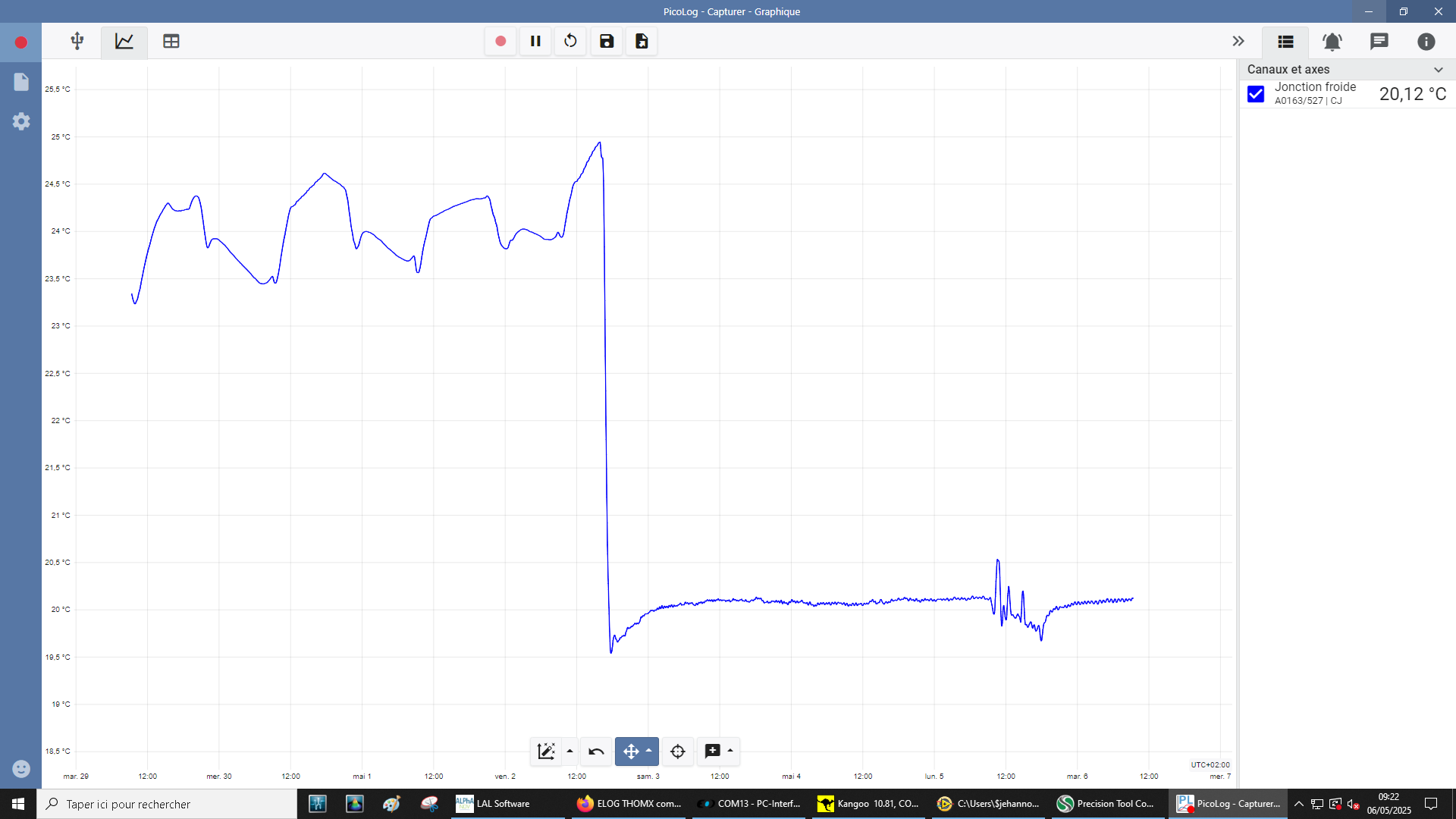
after the new temperature setting for the bunker air cooling (winter to summer transition), the temperature drop from 24° to 20°C which induced a slight misalignment between the onefive oscillator and the fiber injection.
the amplifier photodiode PD_IN which checks the amplifier power injection drop also from 3mW to 2.885mW... hopefully, it is enough to start the amplifier without realignment.
but bad news, I don't see any transmission of the cavity... to be checked...
| Ronic Chiche wrote: |
|
The temperature slitly increase in thomx Bunker from 23° to 24° during the last day.
The thermalisation of the CFP is very long...
In any case the operation of the CFP is so easy, it seems to be correlated to the weather... tody it's very nice as of hte rest of the week.
The stored power is easily 94 KW and there is not jump or delock problems.
The temperature of the bunker continiusly increase and now we observe some delocking du to high frq perturbations... may be the twe things are correlated.
|
|
| Attachment 1: Sans_titre.png
|
 |
|
424
|
Tue May 6 10:58:18 2025 |
Ronic Chiche | Under Process | report | lasers and optics | ThomX igloo | air conditionning in ThomX Bunker |
I finally got 93-94kW for 33% amp ratio.
I had to move the FP-cavity length to compensate the temperature change in the bunker.
doing that, I had the message "Low Limit SW pressed" when I tried to move P4z under -98 000 steps !!!
=> so, maybe this number is not the correct steps number and we are much closer to the end than we could expect.
=> could it be the reason for the 20Hz noise related to the too strong springs, as we already observed before ?
in the meantime, I changed the use of the P1z and P4z motors to not face the situation again.
so, P4z will be used to move to higher steps (even if its apparent position seems higher than P1z).
and P1z will be used to move to lower steps.
surprinsingly, the CEP position was almost already optimized...
| Ronic Chiche wrote: |
|
after the new temperature setting for the bunker air cooling (winter to summer transition), the temperature drop from 24° to 20°C which induced a slight misalignment between the onefive oscillator and the fiber injection.
the amplifier photodiode PD_IN which checks the amplifier power injection drop also from 3mW to 2.885mW... hopefully, it is enough to start the amplifier without realignment.
but bad news, I don't see any transmission of the cavity... to be checked...
| Ronic Chiche wrote: |
|
The temperature slitly increase in thomx Bunker from 23° to 24° during the last day.
The thermalisation of the CFP is very long...
In any case the operation of the CFP is so easy, it seems to be correlated to the weather... tody it's very nice as of hte rest of the week.
The stored power is easily 94 KW and there is not jump or delock problems.
The temperature of the bunker continiusly increase and now we observe some delocking du to high frq perturbations... may be the twe things are correlated.
|
|
|
|
428
|
Wed Jun 25 09:43:36 2025 |
Ronic Chiche | Fixed | info | lasers and optics | ThomX igloo | New power record in ThomX cavity |
yesterday, we were able to store more than 98kW in the FP cavity, always with the same parameter : 33% laser amplifier ratio
| Ronic Chiche wrote: |
|
today, we were able to store more than 97kW in the FP cavity, always with the same parameter : 33% laser amplifier ratio
| Ronic Chiche wrote: |
|
today, we were able to store more than 95kW in the FP cavity, always with the same parameter : 33% laser amplifier ratio
| Ronic Chiche wrote: |
|
today, we were able to store more than 94kW in the FP cavity, always with the same parameter : 33% laser amplifier ratio
| Ronic Chiche wrote: |
|
today, we were able to store more than 93kW in the FP cavity, always with the same parameter : 33% laser amplifier ratio
|
|
|
|
|
| Attachment 1: img1(3).jpg
|
.jpg "img1(3).jpg") |
|
431
|
Thu Jun 26 12:37:22 2025 |
Ronic Chiche | Fixed | info | lasers and optics | ThomX igloo | Recipies for different FPC power |
For ~ 46kW power in the FP-cavity:
- Alplhanov amplifier ratio : 20%
- Axis 18 position : -0004710 steps
- PID A (for laser/FPC lock) :
input : input a
P = 0.06
I = 0.0007
D = 0.85
Sign : positive
Sampling : fast
filter : off
criterion : input d
upper th. : 10V
lower th. : 0.04V
speed : 100V/s
relock mode : none
off mode : hold
range : 50%
offset : 5V
- PID B (for RF/FPC lock) :
input : input b
P = 3
I = 0.00002
D = 2
Sign : negative
Sampling : mid
filter : off
criterion : input c
upper th. : 0.45V
lower th. : -0.45V
speed : 1V/s
relock mode : none
off mode : hold
range : 20%
offset : 5V
|
|
432
|
Tue Jul 1 12:13:18 2025 |
Ronic Chiche | Fixed | info | lasers and optics | ThomX igloo | Recipies for different FPC power |
For ~ 23kW power in the FP-cavity:
- Alplhanov amplifier ratio : 15%
- Axis 18 position : -0016014 steps
- PID A (for laser/FPC lock) :
input : input a
P = 0.1
I = 0.0016
D = 1.4
Sign : positive
Sampling : fast
filter : off
criterion : input d
upper th. : 10V
lower th. : 0.03V
speed : 100V/s
relock mode : none
off mode : hold
range : 50%
offset : 5V
- PID B (for RF/FPC lock) :
input : input b
P = 5
I = 0.0001
D = 1
Sign : negative
Sampling : mid
filter : off
criterion : input c
upper th. : 0.45V
lower th. : -0.45V
speed : 1V/s
relock mode : none
off mode : hold
range : 20%
offset : 5V
| Ronic Chiche wrote: |
|
For ~ 46kW power in the FP-cavity:
- Alplhanov amplifier ratio : 20%
- Axis 18 position : -0004710 steps
- PID A (for laser/FPC lock) :
input : input a
P = 0.06
I = 0.0007
D = 0.85
Sign : positive
Sampling : fast
filter : off
criterion : input d
upper th. : 10V
lower th. : 0.04V
speed : 100V/s
relock mode : none
off mode : hold
range : 50%
offset : 5V
- PID B (for RF/FPC lock) :
input : input b
P = 3
I = 0.00002
D = 2
Sign : negative
Sampling : mid
filter : off
criterion : input c
upper th. : 0.45V
lower th. : -0.45V
speed : 1V/s
relock mode : none
off mode : hold
range : 20%
offset : 5V
|
|
|
436
|
Wed Jul 9 14:12:54 2025 |
Ronic Chiche | Fixed | info | lasers and optics | ThomX igloo | Recipies for different FPC power |
|
For ~ 66kW power in the FP-cavity:
- Alplhanov amplifier ratio : 25%
- Axis 18 position : +0018369 steps
- PID A (for laser/FPC lock) :
input : input a
P = 0.1
I = 0.0016
D = 1.4
Sign : positive
Sampling : fast
filter : off
criterion : input d
upper th. : 10V
lower th. : 0.03V
speed : 100V/s
relock mode : none
off mode : hold
range : 50%
offset : 5V
- PID B (for RF/FPC lock) :
input : input b
P = 5
I = 0.0001
D = 1
Sign : negative
Sampling : mid
filter : off
criterion : input c
upper th. : 0.45V
lower th. : -0.45V
speed : 1V/s
relock mode : none
off mode : hold
range : 20%
offset : 5V
| Ronic Chiche wrote: |
|
For ~ 23kW power in the FP-cavity:
- Alplhanov amplifier ratio : 15%
- Axis 18 position : -0016014 steps
- PID A (for laser/FPC lock) :
input : input a
P = 0.09
I = 0.0016
D = 1.35
Sign : positive
Sampling : fast
filter : off
criterion : input d
upper th. : 10V
lower th. : 0.03V
speed : 100V/s
relock mode : none
off mode : hold
range : 50%
offset : 5V
- PID B (for RF/FPC lock) :
input : input b
P = 5
I = 0.0001
D = 1
Sign : negative
Sampling : mid
filter : off
criterion : input c
upper th. : 0.45V
lower th. : -0.45V
speed : 1V/s
relock mode : none
off mode : hold
range : 20%
offset : 5V
| Ronic Chiche wrote: |
|
For ~ 46kW power in the FP-cavity:
- Alplhanov amplifier ratio : 20%
- Axis 18 position : -0004710 steps
- PID A (for laser/FPC lock) :
input : input a
P = 0.06
I = 0.0007
D = 0.85
Sign : positive
Sampling : fast
filter : off
criterion : input d
upper th. : 10V
lower th. : 0.04V
speed : 100V/s
relock mode : none
off mode : hold
range : 50%
offset : 5V
- PID B (for RF/FPC lock) :
input : input b
P = 3
I = 0.00002
D = 2
Sign : negative
Sampling : mid
filter : off
criterion : input c
upper th. : 0.45V
lower th. : -0.45V
speed : 1V/s
relock mode : none
off mode : hold
range : 20%
offset : 5V
|
|
|
|
444
|
Tue Jul 15 17:34:13 2025 |
Ronic Chiche | Under Process | info | lasers and optics | ThomX igloo | Stability test Without and with |
The laser starts at 93 KW.
This morning I operated the laser locked with the RF for 1h30 without any delock. All the machine was switch off.
All the system was very stable. Sometimes the 20 Hz perturbation was visible but no delocking.
In the afternoon I switched ON just the kikers and septum (with the Kikers delay of not giving perturbation for the synchro -8.561) and I do the same thing => The situation is exactely the same, all the system is very stable (but 20 Hz perturbations). NO deloking during 1h.
I change the delay between Kikers to -7.561 => exactely the same situation, all is very stable!!!!
In 3h of synchronized operation, NO delock at all with or without Kikers!!!
Conclusion no effect at all when juste pulsed element are switched ON.
Daniele |
|
445
|
Wed Jul 16 17:17:57 2025 |
Ronic Chiche | Under Process | info | lasers and optics | ThomX igloo | Suite tests stabilité |
We continue to find what gives high freq. perturbation.
The laser starts at 92 KW it is stable and locked to the RF. NO high freq parturbation.... With the machine off. (30 min of lock)
We put now the machine ON (All in warming exept pulsed elements)... => the system is very stable NO delock, NO high freq perturbations. The operator can even go to toilet during the operation... it's a very big improvement!!!
Now we continue with the e-beam production.... => when we put ON the Kikers wtih the rest of the machine (no electrons yet) some perturbations are observed and delock also.... but no really high freq perturbations juste very big 20 Hz like ones (at 10h30). Some people oh PERLE are in the igloo now. In any case it was easy to relock and it is very stable now.
10h50 some 40 Hz perturbation and delock.... and very big 20 Hz perturbations.... some delock arrived but not really high freq.
!!!!!!! PERLE PEOPLE MOVES LE PONT SINCE 10H30!!!!! CORRESPONDING TO DELOCK!!!
That means that the system is stable with all the maching On (but NO electrons).
So in the afternoon we will put the electrons and continue the investigation of stability.
I restart the laser after lunch with electrons in the machine. I have lost 7 KW of power.... and the lock parameter changed (P gain 0.05-> 0.03)
Je vois passer des hautes freq!! J'ai retrouvé 92 KW avec l'alignement qui avait bougé visiblement!! But the PID parameters are still 0.03.
I see a little bit Hig frq perturb but the laser dont delock. Also bigger high freq perturbation with delock. electrons effect or alignement problems??
We change the frequency for 50MeV. Delta freq = 3.6kHz so dela cavity lenght -1.1mm
We have electrons and we lock much better than before to add the amplifier to enlarge PID range.
We observe some high freq perturbations but the PID compensate and we have almost no delock!!
In conclusion: high freq perturbations dont come from the machine without electrons. The presence of the electrons is associated to some high frq perturbations but the new feedback system can compensate them and delock are rare but we have some with electrons.
Globaly the system is much better
Daniele |
|
446
|
Fri Jul 18 09:23:40 2025 |
Ronic Chiche | Under Process | info | lasers and optics | ThomX igloo | Xrays experiment with prostate |
Today we do XRays for experiment.
The laser start to 33% at 93 KW but Pgain = 0.033
The laser is locked so stable for the moment. We have Xrays and the system is stable.
I have started a trend of laser power.
Some high freq perturbations are visibles but no delock.
It's clear that when the charge vary a lot in the ring we see more high frq perturbations!!
Each time we inject electrons we see high freq pert!!! But the delock are rare!
When electrons are lost we see high freq perturbations!!
New PID parameters
P=0.03
I=0.0005
I2=0
D=0.5
Axe18=+0.0016014
We have done a vertical scan and de e-beam seem to be very very large!! >1mm
The e-beam is not well adjusted but the lock is really much better!
We do good measurement of X fluorescence spectrum of Prostate, ThomX is becoming more and more interesting Xrays source!!
Daniele |
|
447
|
Fri Jul 18 15:56:40 2025 |
Ronic Chiche | Under Process | info | lasers and optics | ThomX igloo | laser operation again with machine OFF |
The laser start at 33% with 92 KW optimized and
P=0.03
I=0.0005
I2=0
D=0.5
But we have more and more problems with the alignement from a day to another!!!
We start the machine and we do Xrays again.
The lock is easy and stable, we see some hig fraq perturbations but no delock as yesterday.
ATTENTION!!!!! when one switch ON or OFF the hexapode motors we have big delock like what we observed some time during the operation!!!!!
For the big delock we have to investigate the operation of the hexapode!!
We have changed the orbit and obtained almost 40000 Xrays. with an ebeam dimension of 121 µm rms.
And now I go in Hollydays!!
See you after 15 august
Daniele |
|
464
|
Mon Feb 2 15:29:45 2026 |
Ronic Chiche | Fixed | info | lasers and optics | ThomX igloo | Laser Amplifier used at 70% |
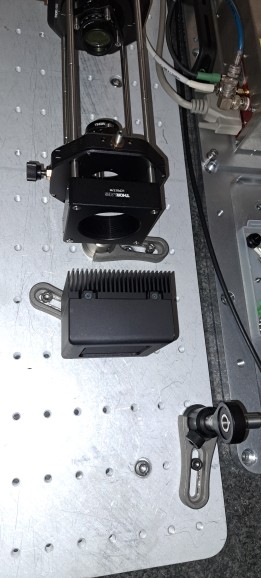
today, I installed a laser dump just before the telescope to avoid any high power (50W instead of 17W usually) issue in the injection line.
last time, we saw some plastic mounts of the polarizers slightly burnt because of some small misalignment.
I used a thorlabs LB2 (see picture) which is able to manage 80W CW or 25J/cm2 pulses => this is OK in both cases : 50W CW / 1.5µJ/pulse for ThomX.
I started the laser amplifier at 70% which produces 50W at the amplifier output and 45W at the input of the FPC.
start : 15h10
immediately, the Temp Amp1 increases from 26°C to 30°C
the Temp Amp2 stays around 26°C
PD_OUT = 79,2W
start + 5-10 min
Temp Amp1 : 31°C
Temp Amp2 : 27°C
PD_OUT = 79,2W
start + 30 min
Temp Amp1 : 31,6°C
Temp Amp2 : 27,5°C
PD_OUT = 79,2W
start + 1h00
Temp Amp1 : 31,6°C
Temp Amp2 : 27,6°C
PD_OUT = 79,2W
start + 1h30
Temp Amp1 : 31,7°C
Temp Amp2 : 27,7°C
PD_OUT = 79,2W
start + 2h00
Temp Amp1 : 31,7°C
Temp Amp2 : 27,7°C
PD_OUT = 79,2W
start + 2h30
Temp Amp1 : 31,7°C
Temp Amp2 : 27,7°C
PD_OUT = 79,2W
|
| Attachment 1: img1.jpg
|
 |
|
465
|
Wed Apr 22 09:52:40 2026 |
Ronic Chiche | Under Process | report | lasers and optics | ThomX igloo | Increasing the FP-cavity power |
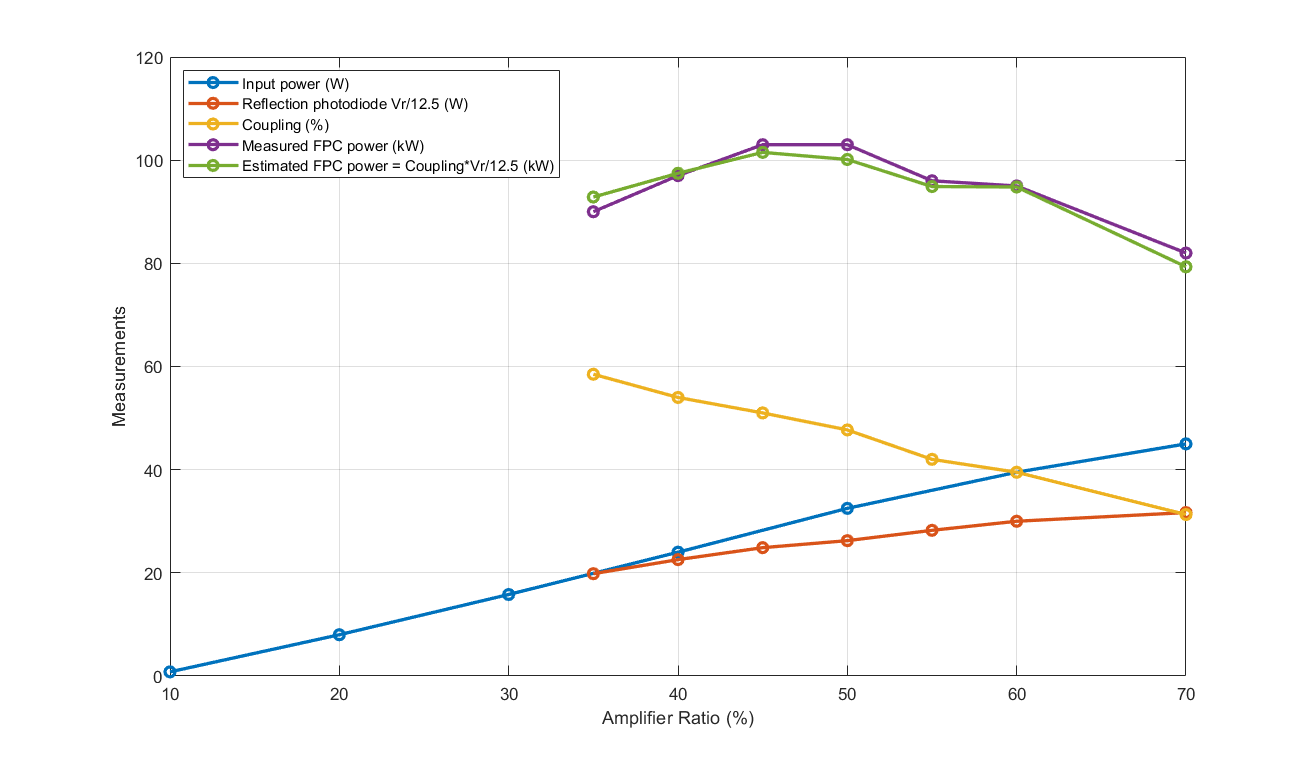
Last Friday, we tried to increase the FP-cavity power by just increasing the amplifier ratio from 35% to 70%.
It took a bit longer than expected because it started with the surprise of finding our entire setup powered off…
The power had tripped, and the switch that allowed us to remotely reset the power supplies had been damaged.
The switch was bypassed, and the instruments restarted → OK.
As usual, the locks were pretty unstable (as has been the case for several weeks), and we couldn’t hold them for more than 10–20 seconds…
So I removed the HV amplifier between the LaseLock and the laser PZT.
Since the Smaract MCS2 controller is much less noisy than the MCS1, we can use it directly without unlocking the cavity or going through "piezo-scan" mode.
So basically, having a larger range on the laser PZT is less useful.
Result: perfectly stable locks in the short term (as before installing the amplifier) AND in the long term as well… no more random unlocks!!!
So the amplifier must have been picking up parasitic noise that was being reinjected into the loop and causing regular unlocks… it works much better now! :-)
Actual power ramp-up was done entirely from the control room:
Previously measured relation between amplifier ratio and input power to the cavity:
Amplifier ratio = 10 20 30 40 50 60 70 %
Amplifier Pin = 0.8 8 15.8 24 32.5 39.5 45 W
We performed 7 measurement points:
- Amplifier ratio = 35%
Vr unlocked = 248 mV
Vr locked = 103 mV
Coupling = 58.5%
Stored power = 90 kW
Vpdh = 50 mV rms
- Amplifier ratio = 40%
Vr unlocked = 282 mV
Vr locked = 130 mV
Coupling = 54%
Stored power = 97 kW
Vpdh = 52 mV rms
- Amplifier ratio = 45%
Vr unlocked = 311 mV
Vr locked = 152 mV
Coupling = 51%
Stored power = 103 kW
Vpdh = 55 mV rms
- Amplifier ratio = 50%
Vr unlocked = 328 mV
Vr locked = 171.5 mV
Coupling = 47.7%
Stored power = 103 kW
Vpdh = 51 mV rms
- Amplifier ratio = 55%
Vr unlocked = 353 mV
Vr locked = 204 mV
Coupling = 42%
Stored power = 96 kW
Vpdh = 51 mV rms
- Amplifier ratio = 60%
Vr unlocked = 375 mV
Vr locked = 227 mV
Coupling = 39.5%
Stored power = 95 kW
Vpdh = 53 mV rms
- Amplifier ratio = 70%
Vr unlocked = 396 mV
Vr locked = 272 mV
Coupling = 31.3%
Stored power = 82 kW
Vpdh = 53 mV rms
Normally, the unlocked Vr voltage should be proportional to the incident power on the cavity.
But it clearly isn’t at all!
We need to verify that this photodiode remains well aligned as power increases.
Or whether we might be clipping on a lens edge as the power increases.
Or whether the power still follows the amplifier ratio/power relation measured several months ago.
To be checked during the power ramp-up from the bunker.
We didn’t go above 103 kW!!! :-(((
I think the main reason is that we are probably hitting a mount edge, and the coupling drops so quickly that it dominates
→ so we absolutely need to redesign a proper telescope.
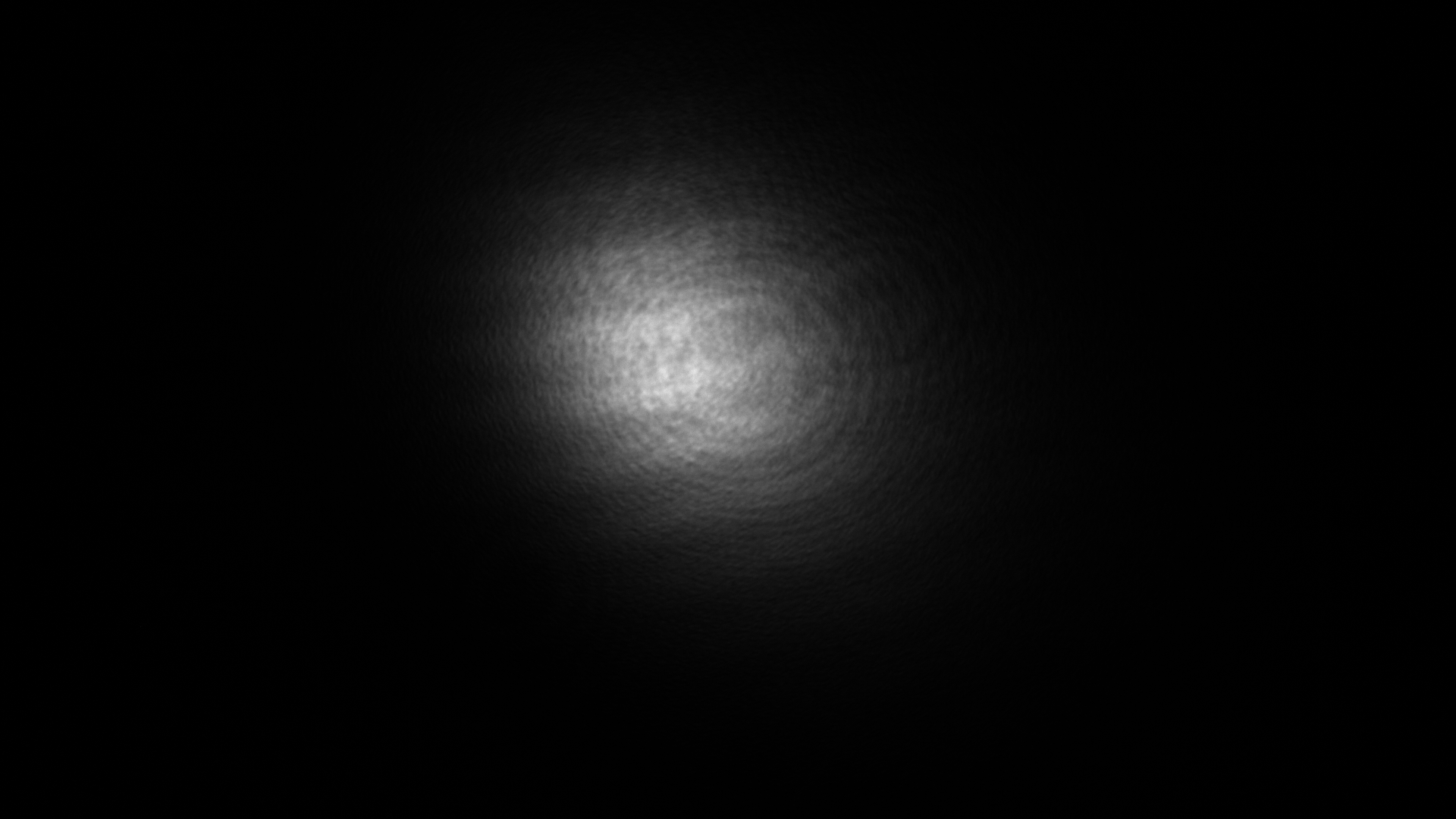
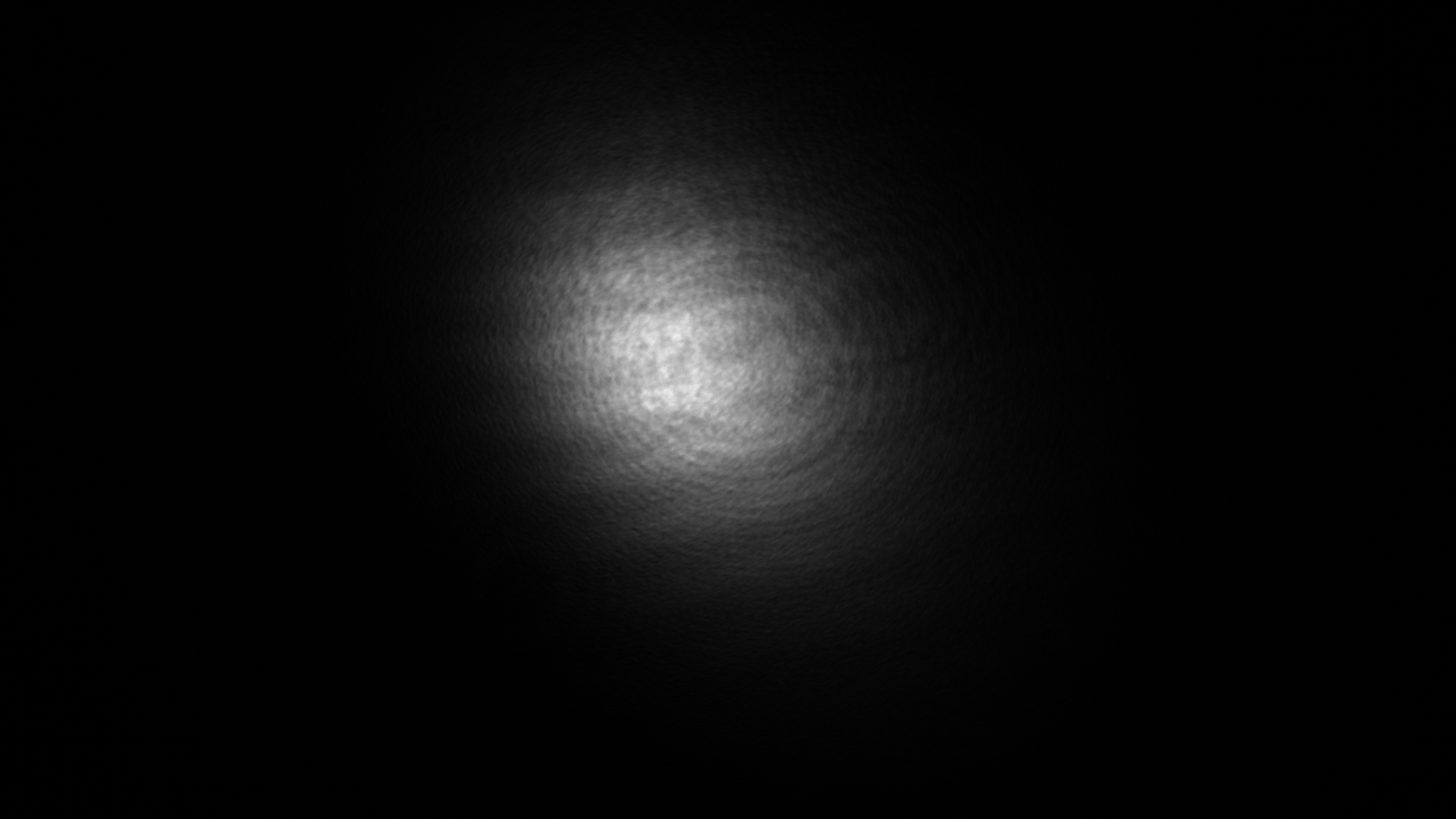
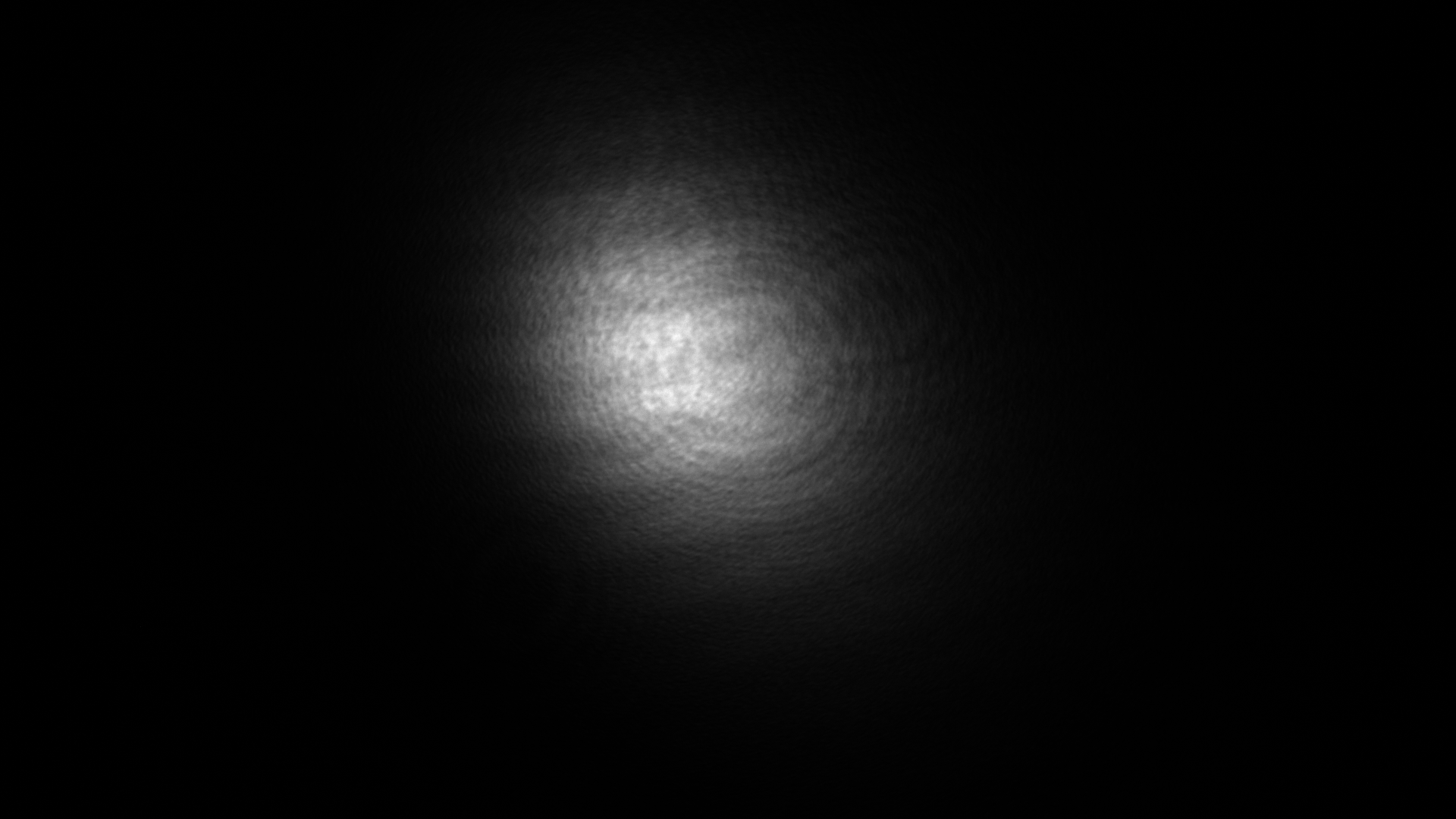
We also took beam images for different Pin values, but since the power in the cavity barely changes, it’s not very informative.
The last plot shows that the signal from the reflection photodiode indeed corresponds to the incident power in the cavity.
There is a strong chance we are hitting something when changing the power… to be checked in the bunker!!!
Have a nice weekend
Daniele & ronic
|
| Attachment 1: 35_-90kW.png
|
 |
| Attachment 2: 40_-97kW.png
|
 |
| Attachment 3: 45_-103kW.png
|
 |
| Attachment 4: 50_-103kW.png
|
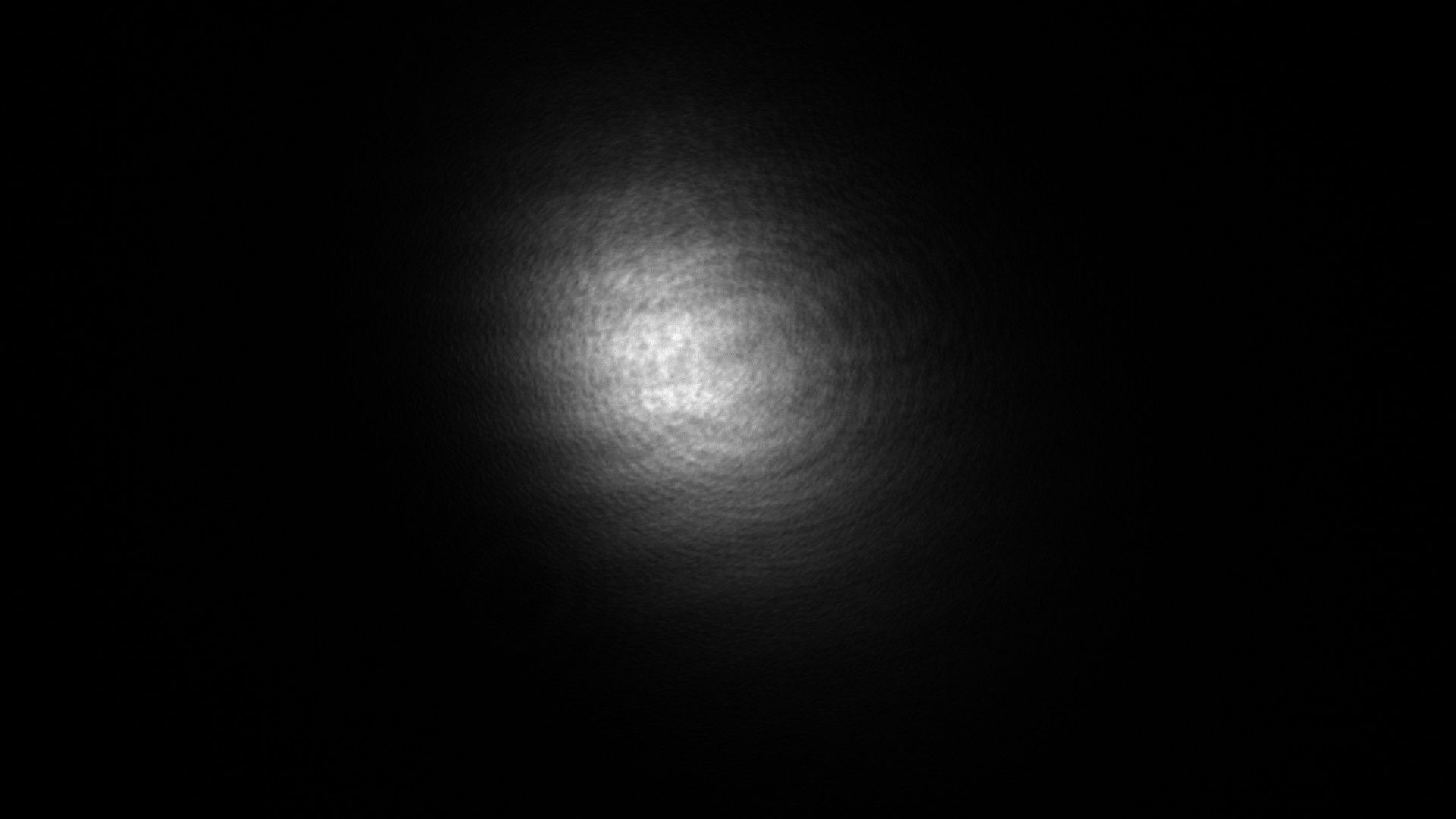 |
| Attachment 5: 55_-97kW.png
|
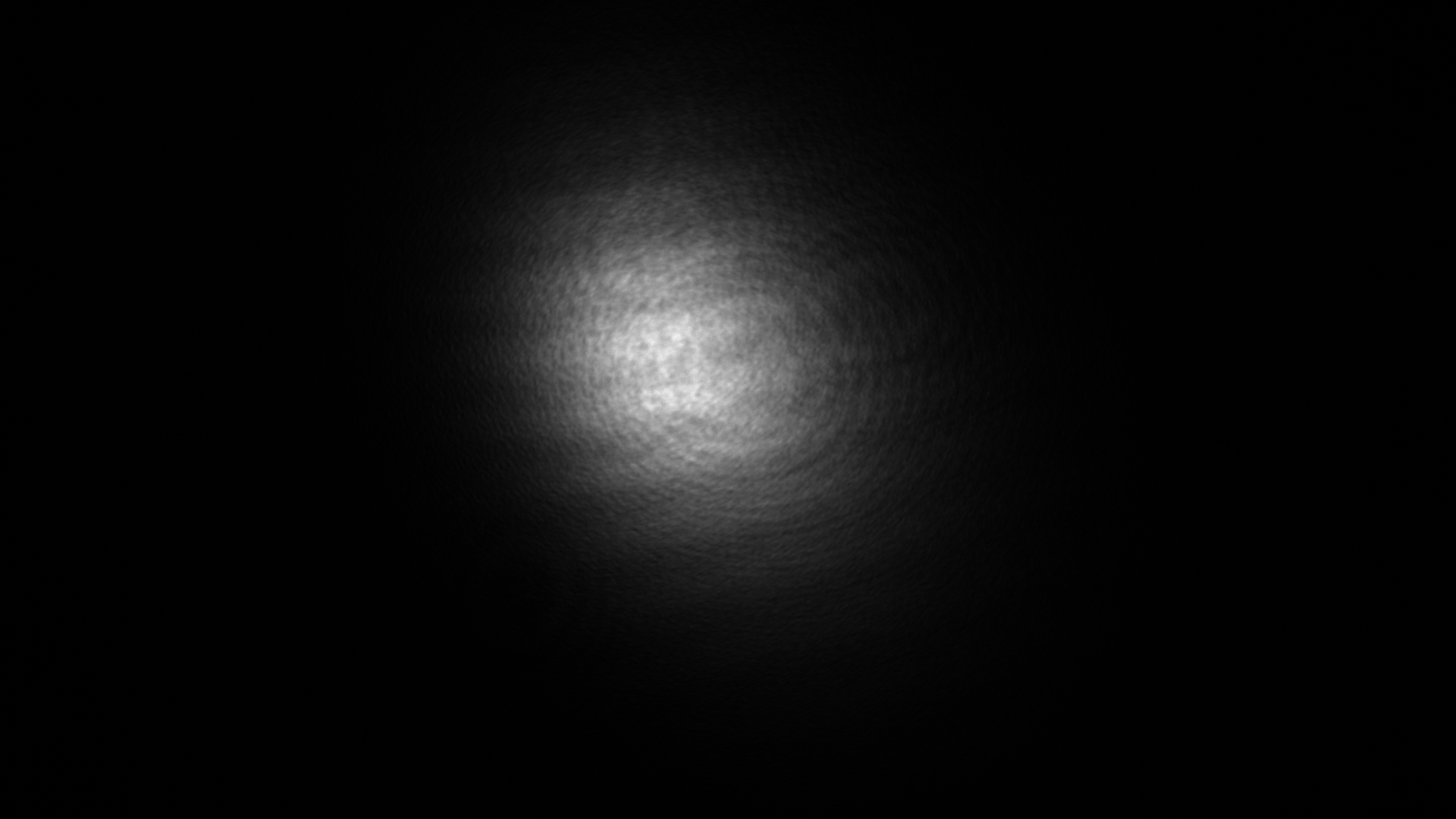 |
| Attachment 6: 60_-95kW.png
|
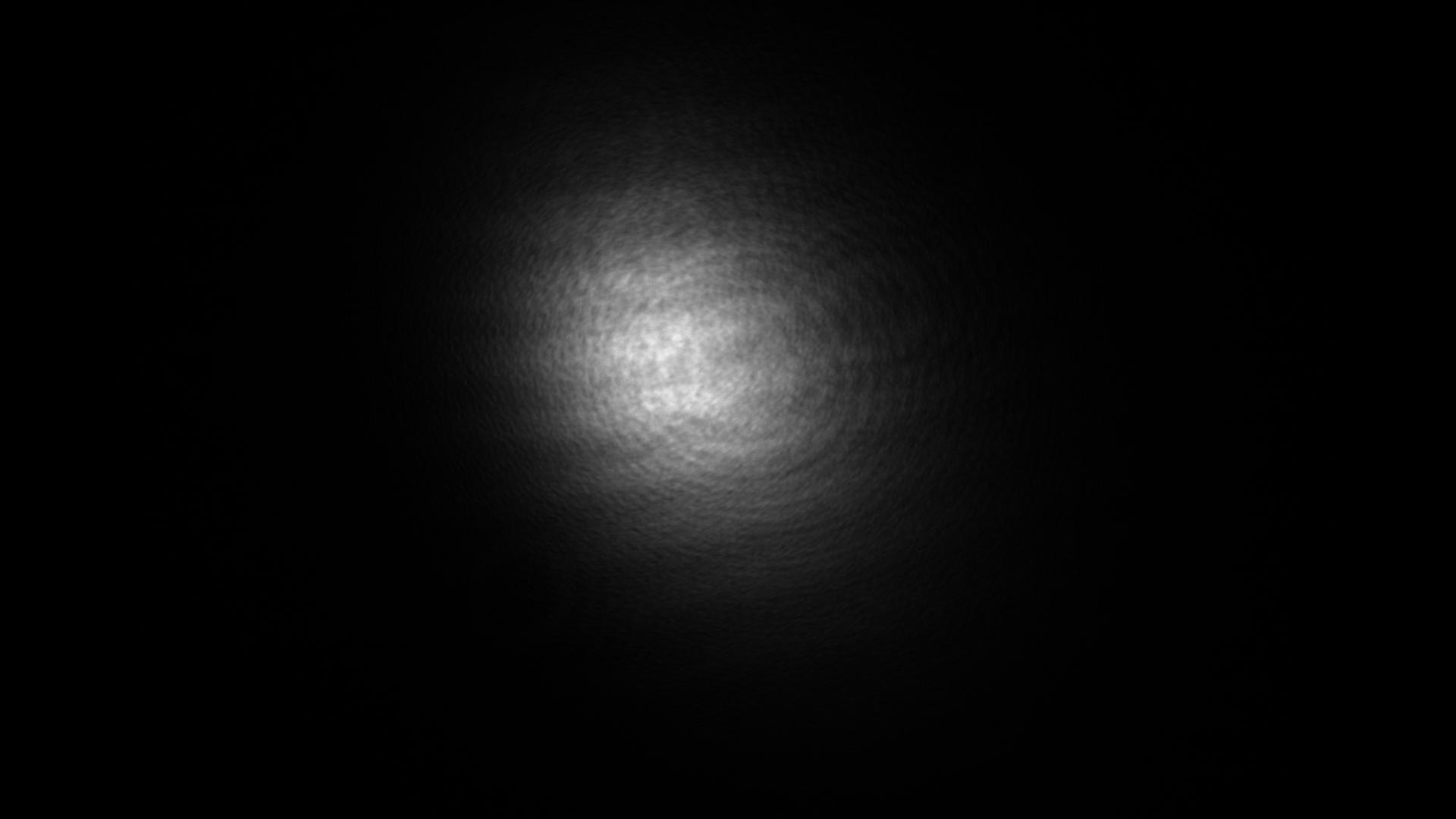 |
| Attachment 7: 70_-82kW.png
|
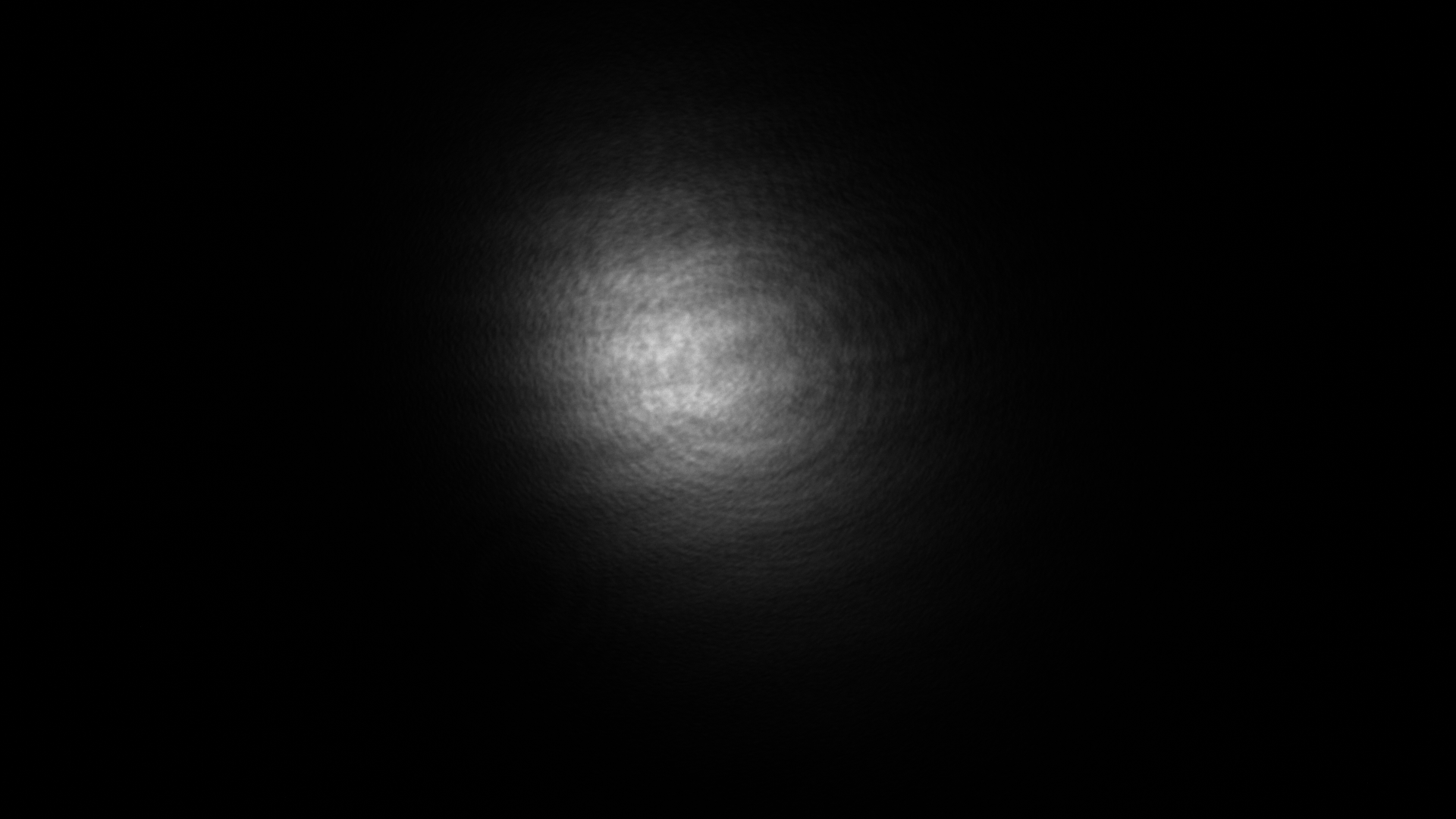 |
| Attachment 8: Measured_data.png
|
 |
|
466
|
Mon Apr 27 16:55:15 2026 |
Ronic Chiche | Under Process | report | lasers and optics | ThomX igloo | Increasing the FP-cavity power |
today with Alice and Daniele,
we checked the distance of the optical setup :
from the amplifier output (the fiber output) to the 2nd lens (+200 mm) :
131.5+41+17+28 cm = 217.5 cm
from the 2nd lens (+200 mm) to the FP cavity window :
133+97+70+14+22 cm = 336 cm
1st lens : -100 mm
2nd lens : +200 mm
distance between them : 11 cm
we checked also the alignment of the different iris and waveplates of the optical setup :
we had to realign a little bit the 2 waveplates.
after the realignment, we obtain the 96-97kW in the FPC for 33% of amplifier ratio !
| Ronic Chiche wrote: |
|
Last Friday, we tried to increase the FP-cavity power by just increasing the amplifier ratio from 35% to 70%.
It took a bit longer than expected because it started with the surprise of finding our entire setup powered off…
The power had tripped, and the switch that allowed us to remotely reset the power supplies had been damaged.
The switch was bypassed, and the instruments restarted → OK.
As usual, the locks were pretty unstable (as has been the case for several weeks), and we couldn’t hold them for more than 10–20 seconds…
So I removed the HV amplifier between the LaseLock and the laser PZT.
Since the Smaract MCS2 controller is much less noisy than the MCS1, we can use it directly without unlocking the cavity or going through "piezo-scan" mode.
So basically, having a larger range on the laser PZT is less useful.
Result: perfectly stable locks in the short term (as before installing the amplifier) AND in the long term as well… no more random unlocks!!!
So the amplifier must have been picking up parasitic noise that was being reinjected into the loop and causing regular unlocks… it works much better now! :-)
Actual power ramp-up was done entirely from the control room:
Previously measured relation between amplifier ratio and input power to the cavity:
Amplifier ratio = 10 20 30 40 50 60 70 %
Amplifier Pin = 0.8 8 15.8 24 32.5 39.5 45 W
We performed 7 measurement points:
- Amplifier ratio = 35%
Vr unlocked = 248 mV
Vr locked = 103 mV
Coupling = 58.5%
Stored power = 90 kW
Vpdh = 50 mV rms
- Amplifier ratio = 40%
Vr unlocked = 282 mV
Vr locked = 130 mV
Coupling = 54%
Stored power = 97 kW
Vpdh = 52 mV rms
- Amplifier ratio = 45%
Vr unlocked = 311 mV
Vr locked = 152 mV
Coupling = 51%
Stored power = 103 kW
Vpdh = 55 mV rms
- Amplifier ratio = 50%
Vr unlocked = 328 mV
Vr locked = 171.5 mV
Coupling = 47.7%
Stored power = 103 kW
Vpdh = 51 mV rms
- Amplifier ratio = 55%
Vr unlocked = 353 mV
Vr locked = 204 mV
Coupling = 42%
Stored power = 96 kW
Vpdh = 51 mV rms
- Amplifier ratio = 60%
Vr unlocked = 375 mV
Vr locked = 227 mV
Coupling = 39.5%
Stored power = 95 kW
Vpdh = 53 mV rms
- Amplifier ratio = 70%
Vr unlocked = 396 mV
Vr locked = 272 mV
Coupling = 31.3%
Stored power = 82 kW
Vpdh = 53 mV rms
Normally, the unlocked Vr voltage should be proportional to the incident power on the cavity.
But it clearly isn’t at all!
We need to verify that this photodiode remains well aligned as power increases.
Or whether we might be clipping on a lens edge as the power increases.
Or whether the power still follows the amplifier ratio/power relation measured several months ago.
To be checked during the power ramp-up from the bunker.
We didn’t go above 103 kW!!! :-(((
I think the main reason is that we are probably hitting a mount edge, and the coupling drops so quickly that it dominates
→ so we absolutely need to redesign a proper telescope.
We also took beam images for different Pin values, but since the power in the cavity barely changes, it’s not very informative.
The last plot shows that the signal from the reflection photodiode indeed corresponds to the incident power in the cavity.
There is a strong chance we are hitting something when changing the power… to be checked in the bunker!!!
Have a nice weekend
Daniele & ronic
|
|
|
467
|
Wed Apr 29 09:38:20 2026 |
Ronic Chiche | Under Process | report | lasers and optics | ThomX igloo | Increasing the FP-cavity power |
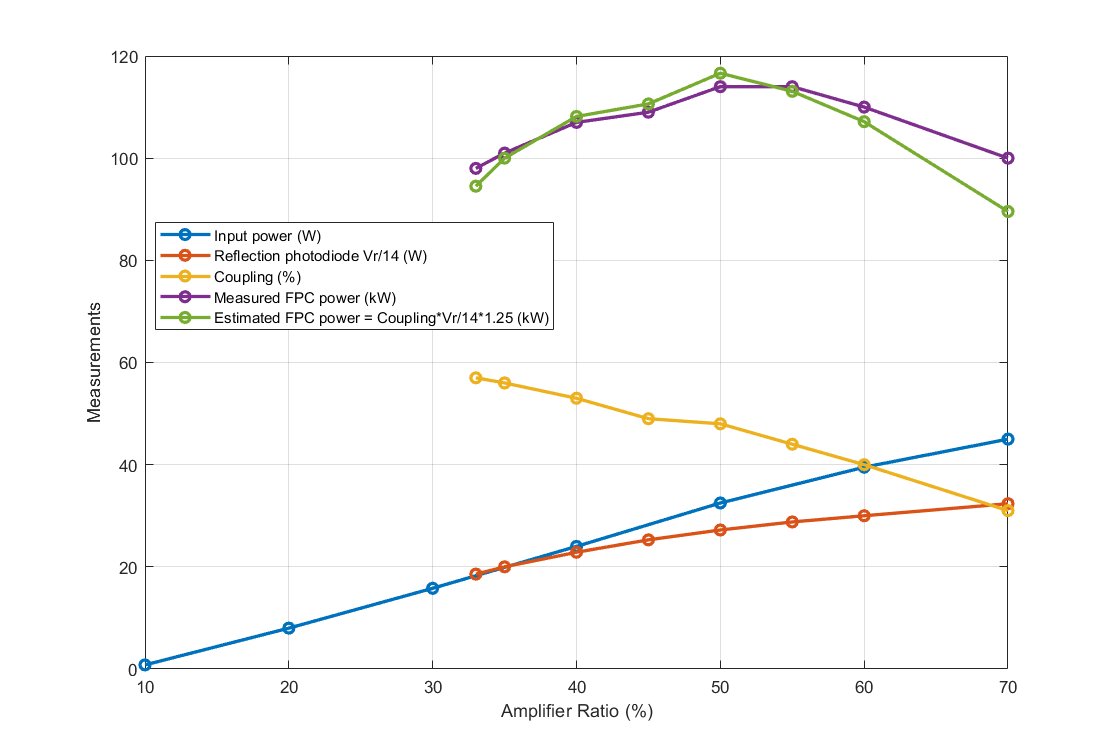
new power increase after alignment of the waveplates and iris.
amplifier ratio (%) => FPC cavity power (kW) => FPC cavity coupling (%) => Vr unlock (mV)
33 => 98 => 57 => 260
35 => 101 => 56 => 280
40 => 107 => 53 => 320
45 => 109 => 49 => 354
50 => 114 => 48 => 381
55 => 114 => 44 => 403
60 => 110 => 40 => 420
70 => 100 => 31 => 453
We still observe a discrepancy between the measured and estimated input power (using the unlocked reflection photodiode) as the amplifier ratio increases.
But this time, the estimated FPC power is also badly estimated.
So, it is possible that the reflection photodiode is operating in a nonlinear regime, as 300 mV across 50 Ohms is equivalent to 6 mA, which may be too much to remain in the linear regime.
It could be interesting to reduce the photodiode's power (add an optical filter) and use a 1k-Ohm load impedance.
| Ronic Chiche wrote: |
|
today with Alice and Daniele,
we checked the distance of the optical setup :
from the amplifier output (the fiber output) to the 2nd lens (+200 mm) :
131.5+41+17+28 cm = 217.5 cm
from the 2nd lens (+200 mm) to the FP cavity window :
133+97+70+14+22 cm = 336 cm
1st lens : -100 mm
2nd lens : +200 mm
distance between them : 11 cm
we checked also the alignment of the different iris and waveplates of the optical setup :
we had to realign a little bit the 2 waveplates.
after the realignment, we obtain the 96-97kW in the FPC for 33% of amplifier ratio !
| Ronic Chiche wrote: |
|
Last Friday, we tried to increase the FP-cavity power by just increasing the amplifier ratio from 35% to 70%.
It took a bit longer than expected because it started with the surprise of finding our entire setup powered off…
The power had tripped, and the switch that allowed us to remotely reset the power supplies had been damaged.
The switch was bypassed, and the instruments restarted → OK.
As usual, the locks were pretty unstable (as has been the case for several weeks), and we couldn’t hold them for more than 10–20 seconds…
So I removed the HV amplifier between the LaseLock and the laser PZT.
Since the Smaract MCS2 controller is much less noisy than the MCS1, we can use it directly without unlocking the cavity or going through "piezo-scan" mode.
So basically, having a larger range on the laser PZT is less useful.
Result: perfectly stable locks in the short term (as before installing the amplifier) AND in the long term as well… no more random unlocks!!!
So the amplifier must have been picking up parasitic noise that was being reinjected into the loop and causing regular unlocks… it works much better now! :-)
Actual power ramp-up was done entirely from the control room:
Previously measured relation between amplifier ratio and input power to the cavity:
Amplifier ratio = 10 20 30 40 50 60 70 %
Amplifier Pin = 0.8 8 15.8 24 32.5 39.5 45 W
We performed 7 measurement points:
- Amplifier ratio = 35%
Vr unlocked = 248 mV
Vr locked = 103 mV
Coupling = 58.5%
Stored power = 90 kW
Vpdh = 50 mV rms
- Amplifier ratio = 40%
Vr unlocked = 282 mV
Vr locked = 130 mV
Coupling = 54%
Stored power = 97 kW
Vpdh = 52 mV rms
- Amplifier ratio = 45%
Vr unlocked = 311 mV
Vr locked = 152 mV
Coupling = 51%
Stored power = 103 kW
Vpdh = 55 mV rms
- Amplifier ratio = 50%
Vr unlocked = 328 mV
Vr locked = 171.5 mV
Coupling = 47.7%
Stored power = 103 kW
Vpdh = 51 mV rms
- Amplifier ratio = 55%
Vr unlocked = 353 mV
Vr locked = 204 mV
Coupling = 42%
Stored power = 96 kW
Vpdh = 51 mV rms
- Amplifier ratio = 60%
Vr unlocked = 375 mV
Vr locked = 227 mV
Coupling = 39.5%
Stored power = 95 kW
Vpdh = 53 mV rms
- Amplifier ratio = 70%
Vr unlocked = 396 mV
Vr locked = 272 mV
Coupling = 31.3%
Stored power = 82 kW
Vpdh = 53 mV rms
Normally, the unlocked Vr voltage should be proportional to the incident power on the cavity.
But it clearly isn’t at all!
We need to verify that this photodiode remains well aligned as power increases.
Or whether we might be clipping on a lens edge as the power increases.
Or whether the power still follows the amplifier ratio/power relation measured several months ago.
To be checked during the power ramp-up from the bunker.
We didn’t go above 103 kW!!! :-(((
I think the main reason is that we are probably hitting a mount edge, and the coupling drops so quickly that it dominates
→ so we absolutely need to redesign a proper telescope.
We also took beam images for different Pin values, but since the power in the cavity barely changes, it’s not very informative.
The last plot shows that the signal from the reflection photodiode indeed corresponds to the incident power in the cavity.
There is a strong chance we are hitting something when changing the power… to be checked in the bunker!!!
Have a nice weekend
Daniele & ronic
|
|
|
| Attachment 1: Measured_data_v2.png
|
 |
|
468
|
Wed Apr 29 15:31:06 2026 |
Ronic Chiche | Under Process | report | lasers and optics | ThomX igloo | Increasing the FP-cavity power |
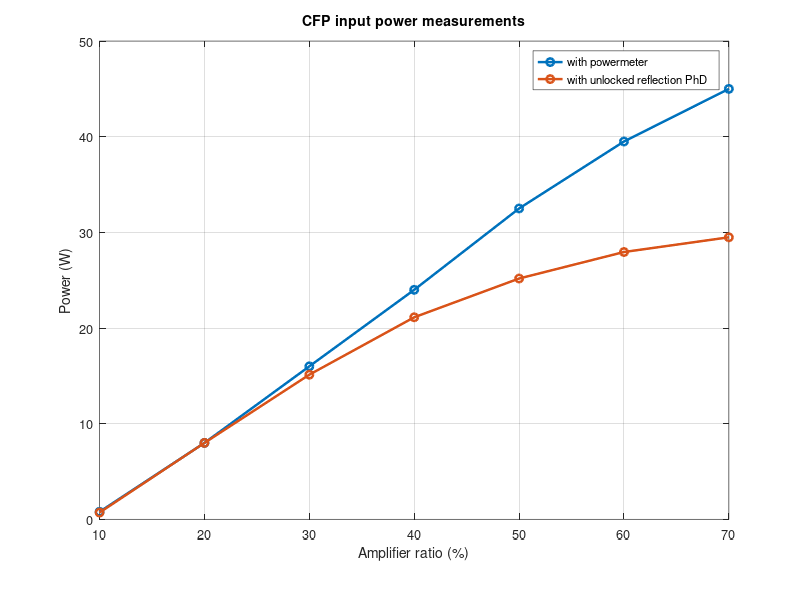
I installed a stronger optical filter on the reflection photodiode and loaded it on 1kOhms.
70% amplifier ratio => 575 mV => 575 µA => no more photodiode linearity issue
amplifier ratio (%) => Vr unlocked (mV)
10 => 14
20 => 156
30 => 295
40 => 412
50 => 491
60 => 545
70 => 575
to be compared to : https://elog.lal.in2p3.fr/FPC/THOMX+commissioning/378
=> still a big discrepency => could we have some clipping in the reflective wedge ?
=> I tried in realigning the wedge but got roughly the same result.
=> could it be the size of the PhD (DET36 presently) ?
=> we should also check the amplifier power at FPC input before increasing power
| Ronic Chiche wrote: |
|
new power increase after alignment of the waveplates and iris.
amplifier ratio (%) => FPC cavity power (kW) => FPC cavity coupling (%) => Vr unlock (mV)
33 => 98 => 57 => 260
35 => 101 => 56 => 280
40 => 107 => 53 => 320
45 => 109 => 49 => 354
50 => 114 => 48 => 381
55 => 114 => 44 => 403
60 => 110 => 40 => 420
70 => 100 => 31 => 453
We still observe a discrepancy between the measured and estimated input power (using the unlocked reflection photodiode) as the amplifier ratio increases.
But this time, the estimated FPC power is also badly estimated.
So, it is possible that the reflection photodiode is operating in a nonlinear regime, as 300 mV across 50 Ohms is equivalent to 6 mA, which may be too much to remain in the linear regime.
It could be interesting to reduce the photodiode's power (add an optical filter) and use a 1k-Ohm load impedance.
| Ronic Chiche wrote: |
|
today with Alice and Daniele,
we checked the distance of the optical setup :
from the amplifier output (the fiber output) to the 2nd lens (+200 mm) :
131.5+41+17+28 cm = 217.5 cm
from the 2nd lens (+200 mm) to the FP cavity window :
133+97+70+14+22 cm = 336 cm
1st lens : -100 mm
2nd lens : +200 mm
distance between them : 11 cm
we checked also the alignment of the different iris and waveplates of the optical setup :
we had to realign a little bit the 2 waveplates.
after the realignment, we obtain the 96-97kW in the FPC for 33% of amplifier ratio !
| Ronic Chiche wrote: |
|
Last Friday, we tried to increase the FP-cavity power by just increasing the amplifier ratio from 35% to 70%.
It took a bit longer than expected because it started with the surprise of finding our entire setup powered off…
The power had tripped, and the switch that allowed us to remotely reset the power supplies had been damaged.
The switch was bypassed, and the instruments restarted → OK.
As usual, the locks were pretty unstable (as has been the case for several weeks), and we couldn’t hold them for more than 10–20 seconds…
So I removed the HV amplifier between the LaseLock and the laser PZT.
Since the Smaract MCS2 controller is much less noisy than the MCS1, we can use it directly without unlocking the cavity or going through "piezo-scan" mode.
So basically, having a larger range on the laser PZT is less useful.
Result: perfectly stable locks in the short term (as before installing the amplifier) AND in the long term as well… no more random unlocks!!!
So the amplifier must have been picking up parasitic noise that was being reinjected into the loop and causing regular unlocks… it works much better now! :-)
Actual power ramp-up was done entirely from the control room:
Previously measured relation between amplifier ratio and input power to the cavity:
Amplifier ratio = 10 20 30 40 50 60 70 %
Amplifier Pin = 0.8 8 15.8 24 32.5 39.5 45 W
We performed 7 measurement points:
- Amplifier ratio = 35%
Vr unlocked = 248 mV
Vr locked = 103 mV
Coupling = 58.5%
Stored power = 90 kW
Vpdh = 50 mV rms
- Amplifier ratio = 40%
Vr unlocked = 282 mV
Vr locked = 130 mV
Coupling = 54%
Stored power = 97 kW
Vpdh = 52 mV rms
- Amplifier ratio = 45%
Vr unlocked = 311 mV
Vr locked = 152 mV
Coupling = 51%
Stored power = 103 kW
Vpdh = 55 mV rms
- Amplifier ratio = 50%
Vr unlocked = 328 mV
Vr locked = 171.5 mV
Coupling = 47.7%
Stored power = 103 kW
Vpdh = 51 mV rms
- Amplifier ratio = 55%
Vr unlocked = 353 mV
Vr locked = 204 mV
Coupling = 42%
Stored power = 96 kW
Vpdh = 51 mV rms
- Amplifier ratio = 60%
Vr unlocked = 375 mV
Vr locked = 227 mV
Coupling = 39.5%
Stored power = 95 kW
Vpdh = 53 mV rms
- Amplifier ratio = 70%
Vr unlocked = 396 mV
Vr locked = 272 mV
Coupling = 31.3%
Stored power = 82 kW
Vpdh = 53 mV rms
Normally, the unlocked Vr voltage should be proportional to the incident power on the cavity.
But it clearly isn’t at all!
We need to verify that this photodiode remains well aligned as power increases.
Or whether we might be clipping on a lens edge as the power increases.
Or whether the power still follows the amplifier ratio/power relation measured several months ago.
To be checked during the power ramp-up from the bunker.
We didn’t go above 103 kW!!! :-(((
I think the main reason is that we are probably hitting a mount edge, and the coupling drops so quickly that it dominates
→ so we absolutely need to redesign a proper telescope.
We also took beam images for different Pin values, but since the power in the cavity barely changes, it’s not very informative.
The last plot shows that the signal from the reflection photodiode indeed corresponds to the incident power in the cavity.
There is a strong chance we are hitting something when changing the power… to be checked in the bunker!!!
Have a nice weekend
Daniele & ronic
|
|
|
|
| Attachment 1: Sans_titre.png
|
 |
|
469
|
Mon May 18 11:33:46 2026 |
Ronic Chiche | Under Process | report | lasers and optics | ThomX igloo | Increasing the FP-cavity power |
this morning with Daniele, we set the amplifier ratio to 33% => 97kW
then, we set the amplifier ratio to 50% => 124 kW (position of the diffuser on Axis 18 : +11775)
we changed the waveplates axis => no effect
we changed the position of the L-shape :
- lower button / clockwise / 1/20 of a turn (one has to decrease the laser motor position to compensate) => no effect but the misalignement is very sensitive for this axis
- upper button / anti-clockwise (the Lshape position is getting down) / we went to the limit (not very sensitive in alignment) => no effect ! (no beam cut nor HOM apparition)
=> conclusion : now, the L-shape is badly positionned (it's off the beam) but it cannot be the reason for a lake of power in the cavity.
PS : the lock seems very stable for long term (~ 130kW)
| Ronic Chiche wrote: |
|
I installed a stronger optical filter on the reflection photodiode and loaded it on 1kOhms.
70% amplifier ratio => 575 mV => 575 µA => no more photodiode linearity issue
amplifier ratio (%) => Vr unlocked (mV)
10 => 14
20 => 156
30 => 295
40 => 412
50 => 491
60 => 545
70 => 575
to be compared to : https://elog.lal.in2p3.fr/FPC/THOMX+commissioning/378
=> still a big discrepency => could we have some clipping in the reflective wedge ?
=> I tried in realigning the wedge but got roughly the same result.
=> could it be the size of the PhD (DET36 presently) ?
=> we should also check the amplifier power at FPC input before increasing power
| Ronic Chiche wrote: |
|
new power increase after alignment of the waveplates and iris.
amplifier ratio (%) => FPC cavity power (kW) => FPC cavity coupling (%) => Vr unlock (mV)
33 => 98 => 57 => 260
35 => 101 => 56 => 280
40 => 107 => 53 => 320
45 => 109 => 49 => 354
50 => 114 => 48 => 381
55 => 114 => 44 => 403
60 => 110 => 40 => 420
70 => 100 => 31 => 453
We still observe a discrepancy between the measured and estimated input power (using the unlocked reflection photodiode) as the amplifier ratio increases.
But this time, the estimated FPC power is also badly estimated.
So, it is possible that the reflection photodiode is operating in a nonlinear regime, as 300 mV across 50 Ohms is equivalent to 6 mA, which may be too much to remain in the linear regime.
It could be interesting to reduce the photodiode's power (add an optical filter) and use a 1k-Ohm load impedance.
| Ronic Chiche wrote: |
|
today with Alice and Daniele,
we checked the distance of the optical setup :
from the amplifier output (the fiber output) to the 2nd lens (+200 mm) :
131.5+41+17+28 cm = 217.5 cm
from the 2nd lens (+200 mm) to the FP cavity window :
133+97+70+14+22 cm = 336 cm
1st lens : -100 mm
2nd lens : +200 mm
distance between them : 11 cm
we checked also the alignment of the different iris and waveplates of the optical setup :
we had to realign a little bit the 2 waveplates.
after the realignment, we obtain the 96-97kW in the FPC for 33% of amplifier ratio !
| Ronic Chiche wrote: |
|
Last Friday, we tried to increase the FP-cavity power by just increasing the amplifier ratio from 35% to 70%.
It took a bit longer than expected because it started with the surprise of finding our entire setup powered off…
The power had tripped, and the switch that allowed us to remotely reset the power supplies had been damaged.
The switch was bypassed, and the instruments restarted → OK.
As usual, the locks were pretty unstable (as has been the case for several weeks), and we couldn’t hold them for more than 10–20 seconds…
So I removed the HV amplifier between the LaseLock and the laser PZT.
Since the Smaract MCS2 controller is much less noisy than the MCS1, we can use it directly without unlocking the cavity or going through "piezo-scan" mode.
So basically, having a larger range on the laser PZT is less useful.
Result: perfectly stable locks in the short term (as before installing the amplifier) AND in the long term as well… no more random unlocks!!!
So the amplifier must have been picking up parasitic noise that was being reinjected into the loop and causing regular unlocks… it works much better now! :-)
Actual power ramp-up was done entirely from the control room:
Previously measured relation between amplifier ratio and input power to the cavity:
Amplifier ratio = 10 20 30 40 50 60 70 %
Amplifier Pin = 0.8 8 15.8 24 32.5 39.5 45 W
We performed 7 measurement points:
- Amplifier ratio = 35%
Vr unlocked = 248 mV
Vr locked = 103 mV
Coupling = 58.5%
Stored power = 90 kW
Vpdh = 50 mV rms
- Amplifier ratio = 40%
Vr unlocked = 282 mV
Vr locked = 130 mV
Coupling = 54%
Stored power = 97 kW
Vpdh = 52 mV rms
- Amplifier ratio = 45%
Vr unlocked = 311 mV
Vr locked = 152 mV
Coupling = 51%
Stored power = 103 kW
Vpdh = 55 mV rms
- Amplifier ratio = 50%
Vr unlocked = 328 mV
Vr locked = 171.5 mV
Coupling = 47.7%
Stored power = 103 kW
Vpdh = 51 mV rms
- Amplifier ratio = 55%
Vr unlocked = 353 mV
Vr locked = 204 mV
Coupling = 42%
Stored power = 96 kW
Vpdh = 51 mV rms
- Amplifier ratio = 60%
Vr unlocked = 375 mV
Vr locked = 227 mV
Coupling = 39.5%
Stored power = 95 kW
Vpdh = 53 mV rms
- Amplifier ratio = 70%
Vr unlocked = 396 mV
Vr locked = 272 mV
Coupling = 31.3%
Stored power = 82 kW
Vpdh = 53 mV rms
Normally, the unlocked Vr voltage should be proportional to the incident power on the cavity.
But it clearly isn’t at all!
We need to verify that this photodiode remains well aligned as power increases.
Or whether we might be clipping on a lens edge as the power increases.
Or whether the power still follows the amplifier ratio/power relation measured several months ago.
To be checked during the power ramp-up from the bunker.
We didn’t go above 103 kW!!! :-(((
I think the main reason is that we are probably hitting a mount edge, and the coupling drops so quickly that it dominates
→ so we absolutely need to redesign a proper telescope.
We also took beam images for different Pin values, but since the power in the cavity barely changes, it’s not very informative.
The last plot shows that the signal from the reflection photodiode indeed corresponds to the incident power in the cavity.
There is a strong chance we are hitting something when changing the power… to be checked in the bunker!!!
Have a nice weekend
Daniele & ronic
|
|
|
|
|