| ID |
Date |
Author |
Status |
Type |
Category |
Location |
Title |
|
319
|
Fri Jan 26 11:05:27 2024 |
Ronic Chiche | Fixed | info | mechanics | lasers and optics | cabling | ThomX igloo | controller M1 & M4 (plan mirrors) with IcePap controllers |
at the begining of each session, it will be mandatory to avoid any backlash for the motors :
- for the P4 motor : one can go 2k steps DOWN, then 2k steps UP to go back to -360 000 and use the steps UP without any backlash
- for the P1 motor : one can go 2k steps UP, then 2k steps DOWN to go back to -900 000 and use the steps DOWN without any backlash
today, I used the P1 motor to do some steps DOWN to find back the main resonance at the begining of the session.
| Ronic Chiche wrote: |
|
this double motors scheme works good.
if motor P4 is used by increasing value, the FP-cavityPZT signal (pink signal on scope) goes HIGHER
if motor P1 is used by increasing value, the FP-cavityPZT signal (pink signal on scope) goes LOWER
!!! CAREFUL !!!
after each session, it is mandatory to put the motors back to their initial position to avoid FP-cavity misalignment.
on P1 : - 900 000 steps
on P4 : - 360 000 steps
| Ronic Chiche wrote: |
|
previously, we have connected motor M4 with an IcePap controller.
see this post : https://elog.lal.in2p3.fr/FPC/THOMX+commissioning/278
due to the backlash behavior of the FP-cavity motors, it is impossible to work in both directions on one motor when the FP-cavity is locked.
so, we decided to use also the motor M1 to work in the other direction.
then, normally M1 will work in one direction and M4 in the other direction.
motor M1 (or P1Z) which was on the axis 9 on the ISP controller has been assigned to OC/OP/OCH.01-MOT.06
motor M4 (or P4Z) which was on the axis 12 on the ISP controller has been assigned to OC/OP/OCH.01-MOT.03
|
|
|
|
16
|
Thu Feb 14 18:20:52 2019 |
Loïc Amoudry | Fixed | report | mechanics | lasers and optics | Optical room | Basic alignment & alignment motors check |
14/02/19: The 4 motors but Mby control works. Mby motor home does not bring it to its "middle" position but to the end of its range. Issue circumvented using the higher rights software.
The beam is now going through the cavity windows (from P1 to S2). |
|
24
|
Fri Mar 29 18:33:15 2019 |
Ronic Chiche | Fixed | issue | mechanics | lasers and optics | Optical room | Alignment procedure |
we did again the complete alignment procedure starting with iris and optimizing injection motors Ma and Mb, then installing mirror S2, S3, P4 and P1, optimizing thetaX and thetaY axis for each motor.
everything was fine until we installed P1. we tried to optimize thetaX and thetaY of P1 and we clearly observed a strange motion when doing that :
- for thetaX axis, steps in one direction seem to have a different length from steps in reverse direction.
- for thetaY axis, trying to move in one direction, makes sometime a motion in the reverse direction.
at this moment, it is difficult to say if the problem comes from the controller, the mirror mount or the motor itself.
if both axis are concerned on the same mirror (P1), maybe the problem comes from the mount... to be continued on Monday.
|
|
40
|
Tue Jun 11 18:03:10 2019 |
Loïc Amoudry | Fixed | report | mechanics | lasers and optics | Other | Amplifier mission Bordeaux |
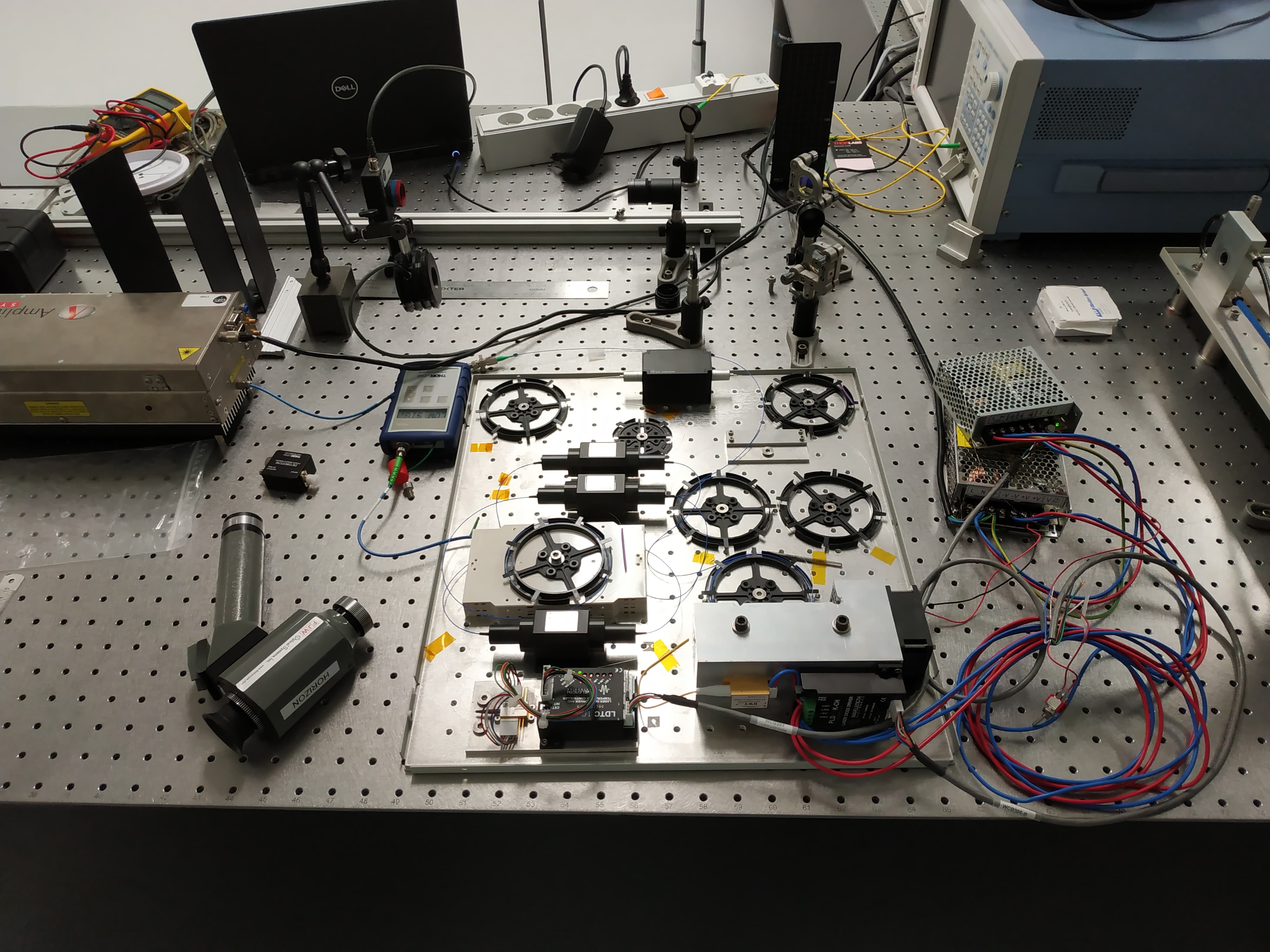
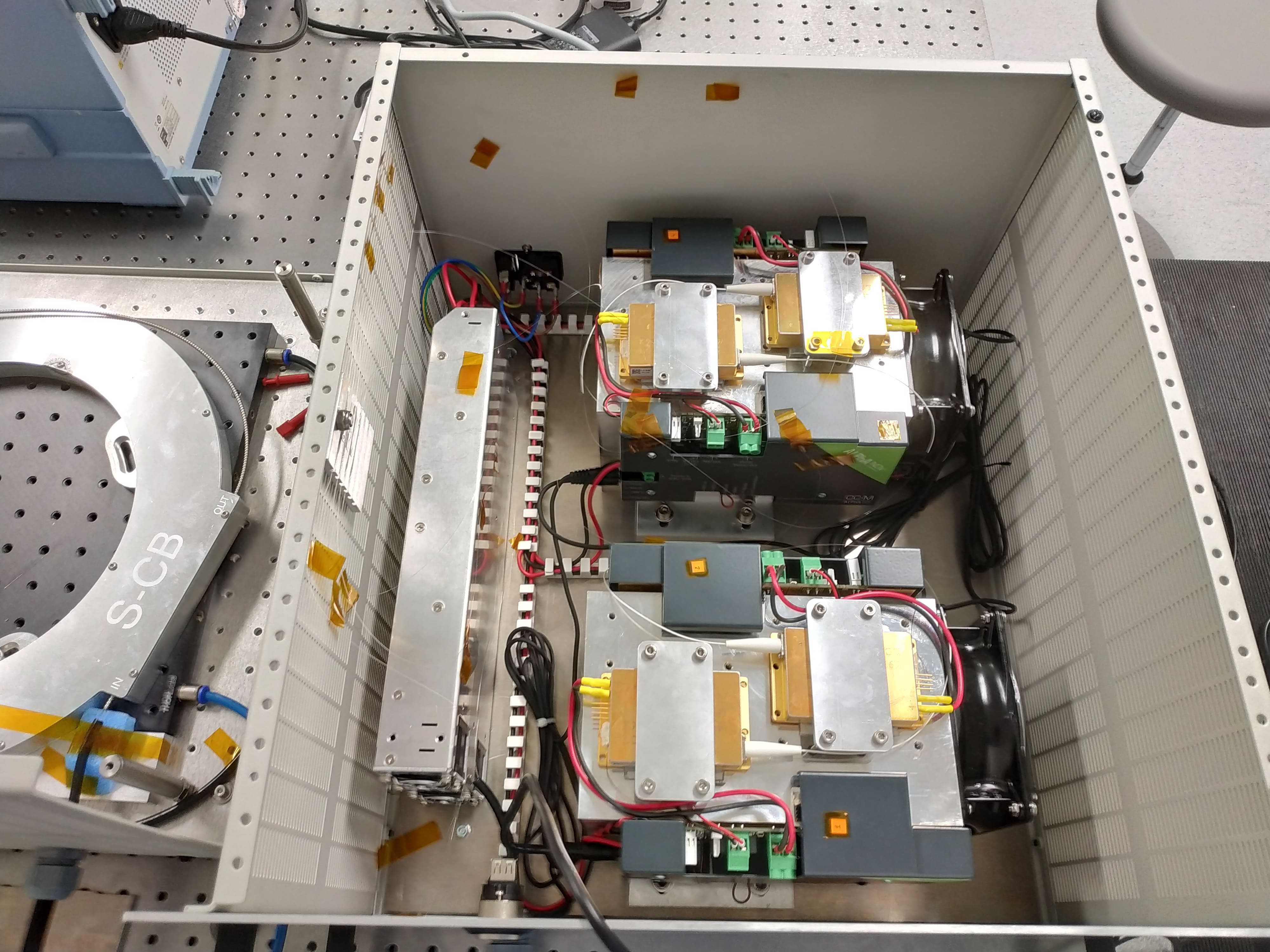
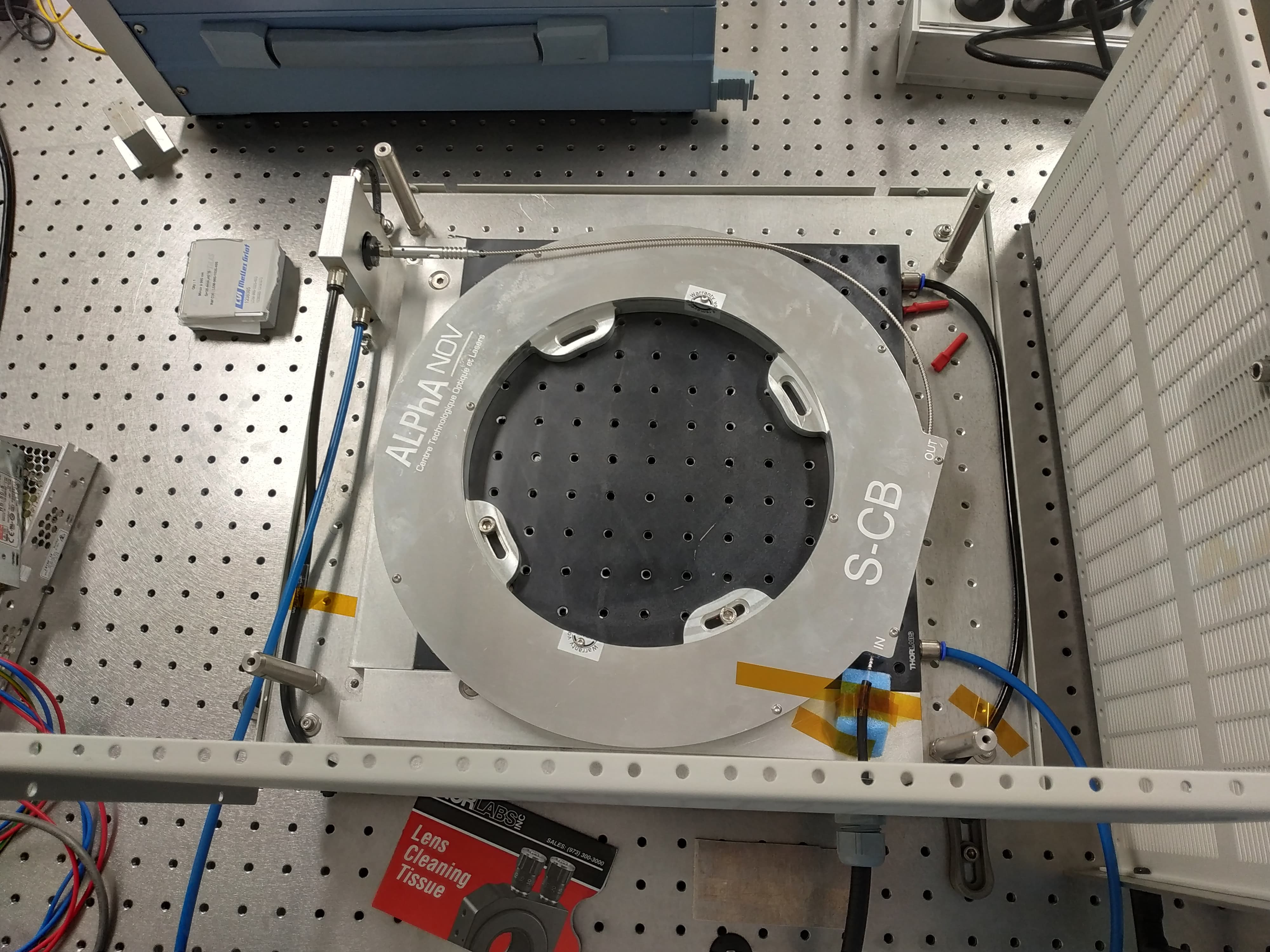
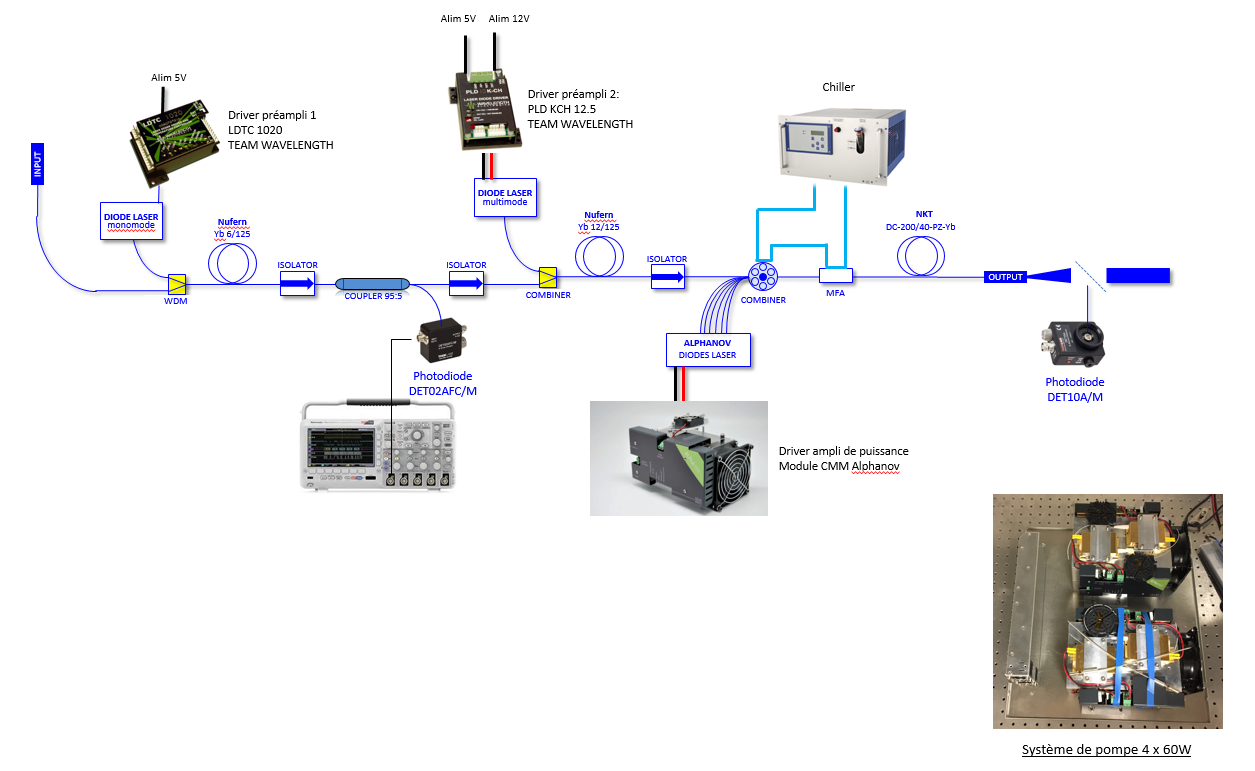
Voyage Bordeaux au CELIA avec Jérôme LHERMITE (Loïc et Titoutan)
1er jour (34°) :
Mesure du spectre et de la puissance des 4 diodes de pompe 3ème étage jusqu’à ~60W (12A).
Mécanique et câblage ampli.
2ème jour (30°) :
Soudure des fibres des diodes de pompe 3ème étage avec les fibres du recirculateur.
Câblage entre les 2 boitiers et fixation des fibres dans le boitier du 3ème étage.
3ème jour (26°) :
Connexion refroidissement à eau du recirculateur (chiller).
Soudure fibre CFBG avant 1er étage (temporaire pour faire des mesure).
Mise en place des éléments 1er et 2ème étage sur le support de l’ampli.
Montée en puissance 35W.
4ème jour :
Adaptation du mode de sortie en contrôlant la position de la fibre avant le collimateur.
Mesure de M².
|
| Attachment 1: 1st_and_2nd_stage.jpg
|
 |
| Attachment 2: 3rd_stage_pumps.jpg
|
 |
| Attachment 3: 3rd_stage_signal.jpg
|
 |
|
41
|
Wed Jun 12 12:07:11 2019 |
Loïc Amoudry | Fixed | report | mechanics | lasers and optics | Other | Amplifier mission Bordeaux |
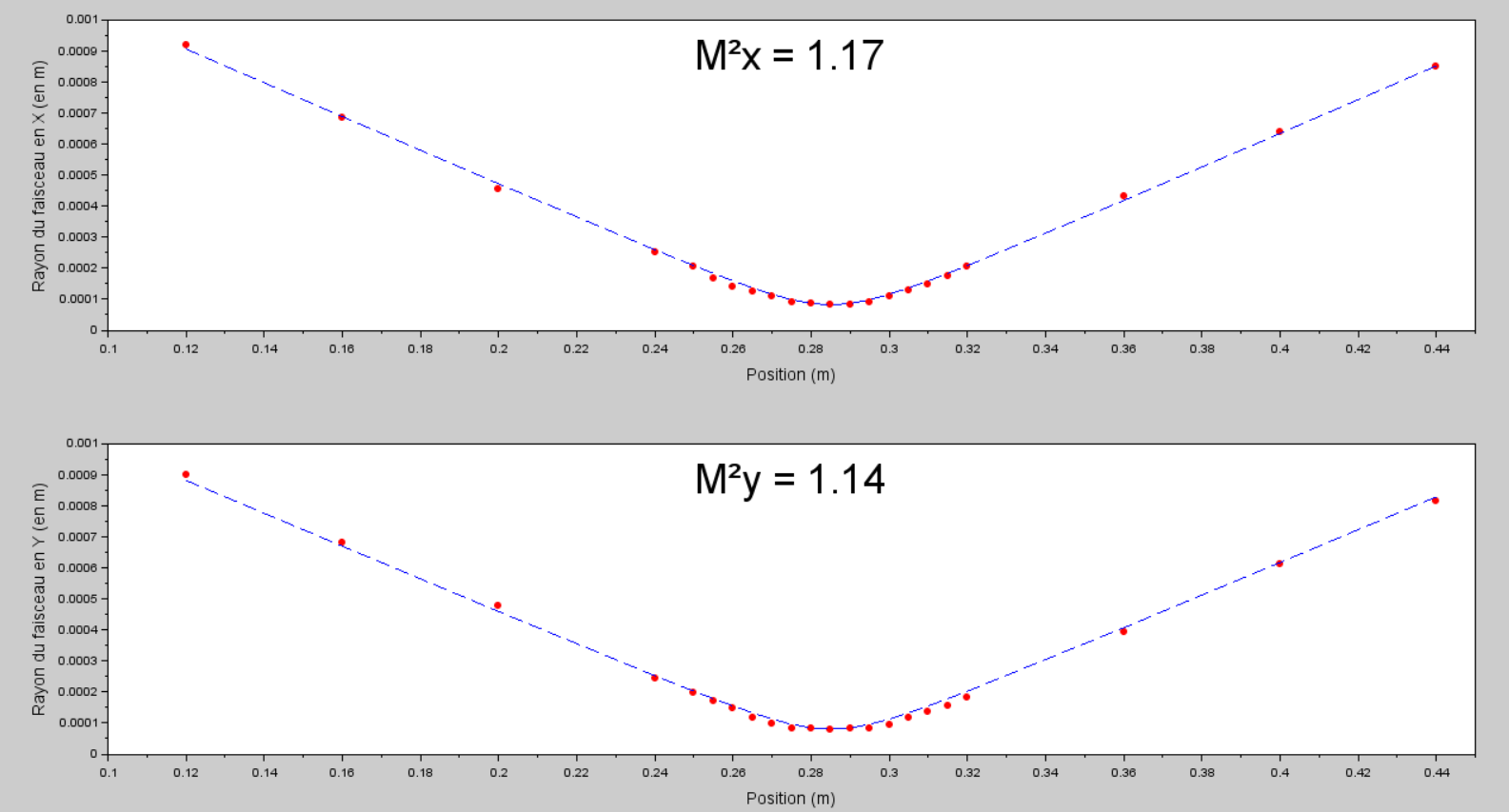
M² mesuré à 10W.
M²x = 1.17
M²y = 1.14
| Loïc Amoudry wrote: |
|
Voyage Bordeaux au CELIA avec Jérôme LHERMITE (Loïc et Titoutan)
1er jour (34°) :
Mesure du spectre et de la puissance des 4 diodes de pompe 3ème étage jusqu’à ~60W (12A).
Mécanique et câblage ampli.
2ème jour (30°) :
Soudure des fibres des diodes de pompe 3ème étage avec les fibres du recirculateur.
Câblage entre les 2 boitiers et fixation des fibres dans le boitier du 3ème étage.
3ème jour (26°) :
Connexion refroidissement à eau du recirculateur (chiller).
Soudure fibre CFBG avant 1er étage (temporaire pour faire des mesure).
Mise en place des éléments 1er et 2ème étage sur le support de l’ampli.
Montée en puissance 35W.
4ème jour :
Adaptation du mode de sortie en contrôlant la position de la fibre avant le collimateur.
Mesure de M².
|
|
| Attachment 1: Ampli_ThomX.PNG
|
 |
| Attachment 2: M2_ThomX.png
|
 |
|
49
|
Mon Jul 29 17:15:35 2019 |
Loïc Amoudry | Fixed | info | mechanics | lasers and optics | Optical room | Spin coater air supply removed and front panel changed |
Spin coater firstly needed vacuum and air supply. The air supply being useless for our experiments, it has been disabled.
The process is the following and is reversible:
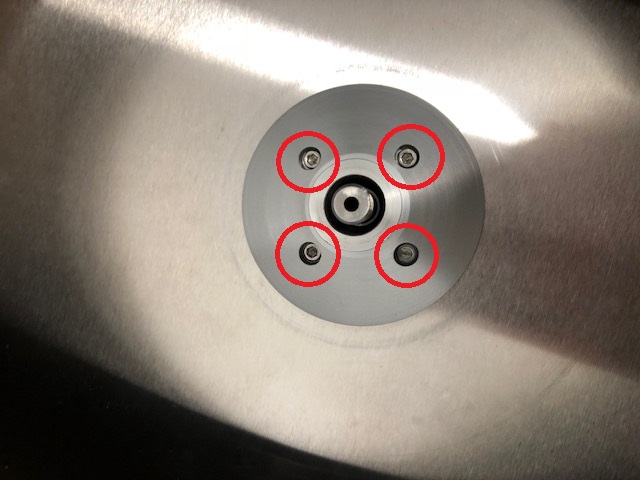
1) Remove the hub from the top of the spin coater, (see picture 1), 4 screws hold the hub in place, once these screws are removed the hub will lift off the motor shaft.
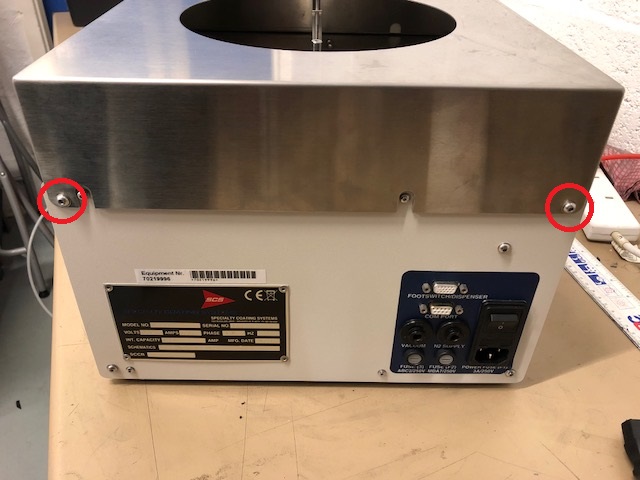
2) Remove the 2 screws holding the stainless steel top decks in place (see picture 2), please be careful when removing the top deck as the lid switch wire will be attached.
Once these have been removed, you can access the inside of the spin coater.
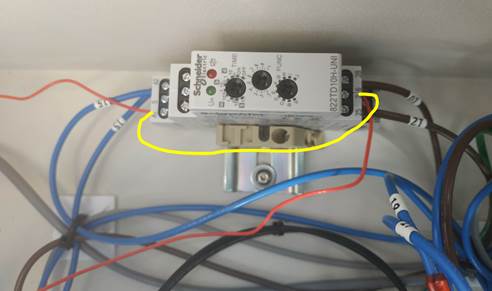
You must add a bypass wire to the timing block (see picture Purge Bypass 1), the wire must be connected to the A1 and 28 ports on the timing block and remove the red wires from connexion. This will now cause the spin coater to bypass the purge check switch and allow the machine to boot up without air/nitrogen being supplied. To revert this change, simply remove the bypass wire you have installed and plug the 2 red wires back to A1 and 28.
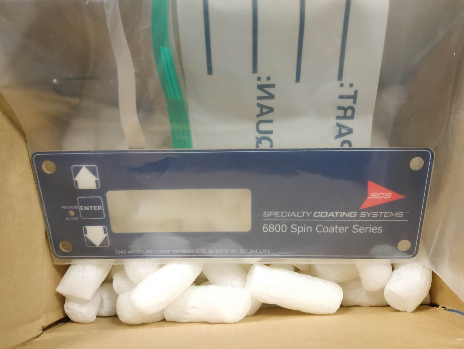
The "enter" button of the front panel had some trouble and has been changed. |
| Attachment 1: 1.jpg
|
 |
| Attachment 2: 2.jpg
|
 |
| Attachment 3: 3.jpg
|
 |
| Attachment 4: front_panel.png
|
 |
|
58
|
Thu Sep 12 16:19:26 2019 |
Loïc Amoudry | Fixed | report | mechanics | lasers and optics | Optical room | Cavity dust source check |
Several experiments have been done in order to check the potential source of dust in the ThomX cavity. For each step, we look at a clean surface, put the cavity under vacuum, go back at ambient pressure and check back the "clean surface".
1st: Primary pump on
2nd: Primary pump + Turbo pump on
3rd: Primary pump + Turbo pump + Ion pump on
4th: Primary pump + Turbo pump + Ion pump on + 10 "open/close" displacement of the pneumatic valve
5th: Primary pump + Turbo pump + Ion pump on + 1 full range displacement of P1 z motor
6th : Primary pump + Turbo pump + Ion pump on + RGA
None of these experiences have shown good correlation with dust generation.
The RGA has shown reasonable values.
Conclusion is that dust was already in the cavity and was only displaced by all combined motors, pneumatic valves, cavity opening and closing movements. |
|
111
|
Thu Jan 13 17:08:56 2022 |
Ronic Chiche | Fixed | issue | mechanics | lasers and optics | Optical room | Alignment procedure |
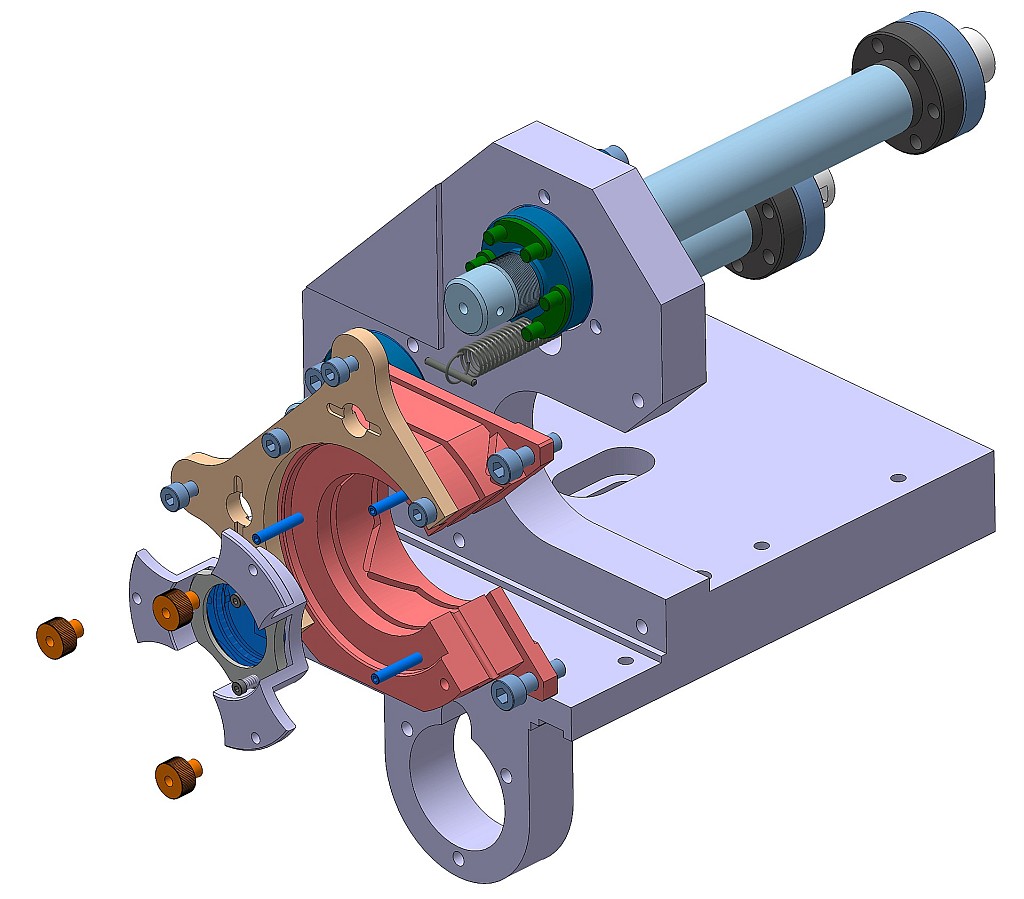
Picture of the installed mirrors inside the FP cavity.
To install an Iris instead of a mirror :
One has to remove manually the orange nuts and replace the mirror mount with the Iris mount.
| Ronic Chiche wrote: |
|
we did again the complete alignment procedure starting with iris and optimizing injection motors Ma and Mb, then installing mirror S2, S3, P4 and P1, optimizing thetaX and thetaY axis for each motor.
everything was fine until we installed P1. we tried to optimize thetaX and thetaY of P1 and we clearly observed a strange motion when doing that :
- for thetaX axis, steps in one direction seem to have a different length from steps in reverse direction.
- for thetaY axis, trying to move in one direction, makes sometime a motion in the reverse direction.
at this moment, it is difficult to say if the problem comes from the controller, the mirror mount or the motor itself.
if both axis are concerned on the same mirror (P1), maybe the problem comes from the mount... to be continued on Monday.
|
|
| Attachment 1: montage.jpg
|
 |
|
269
|
Thu Sep 21 18:56:56 2023 |
Ronic Chiche | Fixed | issue | mechanics | lasers and optics | ThomX igloo | !!! strange amplifier beam pointing fluctuations !!! |
this morning, I locked the cavity to ~25kW without any problem.
but this afternoon, the reflected power exhibited low frequency (~1Hz) fluctuations of about 10% without any lock.
the reflected PhD is a DET10 which has a small surface.
we checked the OneFive oscillator power which is perfectly stable.
we changed the DET10 PhD for a DET100 PhD with ~1cm surface : we don't see any power fluctuation => the amplifier power seems stable.
we put back the DET10 PhD : we see these fluctuations of about 10% => it could be some pointing effect !!!
when one locks the FP-cavity, we clearly see exactly the same power fluctuations at the Transmission PhD but complementary => the sum is constant.
so, it seems clear that the beam coupling to the cavity is fluctuating due to some pointing fluctuation of the incoming beam.
a reason of these fluctuations could be the thermal jump done today because of the air cooling system of the bunker :
the temperature jumped from 25°C yesterday (and maybe still this morning ?) to 18°C this afternoon !!!
thus, some mechanical parts (the compressor CVBG ?) could be moving and then could produce these pointing fluctuations... |
|
273
|
Wed Nov 8 17:51:30 2023 |
Ronic Chiche | Fixed | issue | mechanics | lasers and optics | ThomX igloo | !!! strange amplifier beam pointing fluctuations !!! |
we confirmed the effect of the bunker temperature on the laser amplifier "beam pointing" fluctuations.
once the temperature is getting back to stable values, it doesn't happend again.
we bought a temperature data logguer to monitor them in the future: https://www.picotech.com/data-logger/tc-08/thermocouple-data-logger
this post close this thread.
| Ronic Chiche wrote: |
|
this morning, I locked the cavity to ~25kW without any problem.
but this afternoon, the reflected power exhibited low frequency (~1Hz) fluctuations of about 10% without any lock.
the reflected PhD is a DET10 which has a small surface.
we checked the OneFive oscillator power which is perfectly stable.
we changed the DET10 PhD for a DET100 PhD with ~1cm surface : we don't see any power fluctuation => the amplifier power seems stable.
we put back the DET10 PhD : we see these fluctuations of about 10% => it could be some pointing effect !!!
when one locks the FP-cavity, we clearly see exactly the same power fluctuations at the Transmission PhD but complementary => the sum is constant.
so, it seems clear that the beam coupling to the cavity is fluctuating due to some pointing fluctuation of the incoming beam.
a reason of these fluctuations could be the thermal jump done today because of the air cooling system of the bunker :
the temperature jumped from 25°C yesterday (and maybe still this morning ?) to 18°C this afternoon !!!
thus, some mechanical parts (the compressor CVBG ?) could be moving and then could produce these pointing fluctuations...
|
|
|
278
|
Fri Nov 10 09:51:22 2023 |
Ronic Chiche | Fixed | report | mechanics | lasers and optics | ThomX igloo | M4 motor using icepap controller and jive/Atkpanel IHM |
Kevin moved the M4 mirror controller from the ISP controller to some ICEPAP controller.
the IHM to access this ICEPAP controller is accessible by launching 'jive' from any account ('operateur.thomx' for example).
once in the jive window, one has to select the 'device' tab, then select the OC=>OP=>OCH.02-MOT.03 device.
an AtkPanel is launched in which one can change the step values which are direclty the motor steps. |
|
282
|
Tue Nov 14 11:33:45 2023 |
Ronic Chiche | Fixed | report | mechanics | lasers and optics | ThomX igloo | M4 motor using icepap controller and jive/Atkpanel IHM |
one problem is the FP-cavity/laser lock loss when one moves a FP-cavity motor.
with acceleration = 0.01 units/s² and velocity = 50mm/s (here, the 'mm' unit seems strange as it is very fast), it's enough to make a move fast enough for small displacements (10 steps for example to center PZT position) and it seems that the cavity stays locked (only the FP-cavity/laser is locked).
=> to be checked when both FP-cavity/laser and FP-cavity/RF-reference feedback loops are running.
| Ronic Chiche wrote: |
|
Kevin moved the M4 mirror controller from the ISP controller to some ICEPAP controller.
the IHM to access this ICEPAP controller is accessible by launching 'jive' from any account ('operateur.thomx' for example).
once in the jive window, one has to select the 'device' tab, then select the OC=>OP=>OCH.02-MOT.03 device.
an AtkPanel is launched in which one can change the step values which are direclty the motor steps.
|
|
|
289
|
Fri Nov 24 12:56:39 2023 |
Ronic Chiche | Fixed | info | mechanics | lasers and optics | ThomX igloo | Laser cavity temperature/pressure sensitivity |
laser cavity :
when one decreases the laser motor position, the laser repetition rate increases (laser cavity length decreases).
=> +/- laser motor step => +/- laser cavity roundtrip length => -/+ laser repetition rate => -/+ laser harmonic @500MHz
=> +/- 100nm => +/- 200nm => -/+ 0.7Hz @33.33MHz => -/+ 10Hz @500MHz
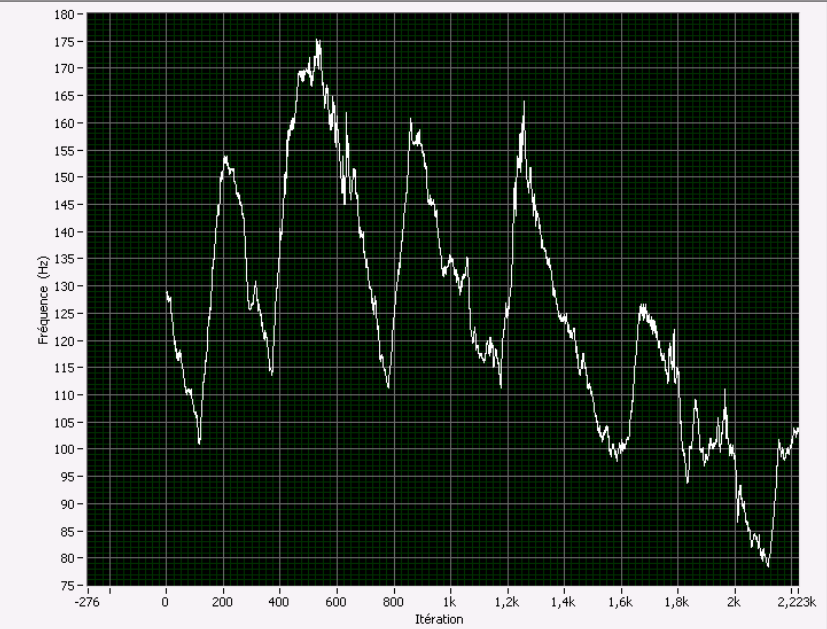
here is the natural variation of the laser cavity frequency beating with RF @500MHz over 1h (~1.6s / iteration)
one can see some oscillations equivalent to ~1µm of roundtrip length with ~10 minutes period and maybe a slower drift or oscillation with ~2µm of roundtrip range over the hour.
I mention that I moved the laser "PZT" motor before taking the data : could it be the reason of the 10-20min oscillations ?
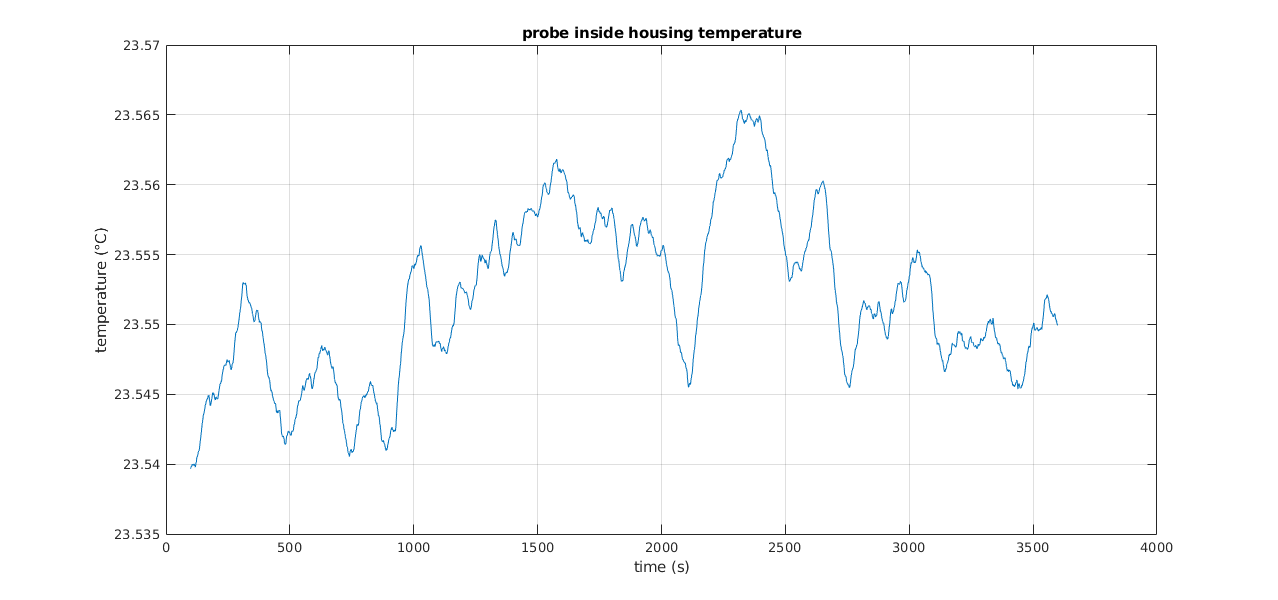
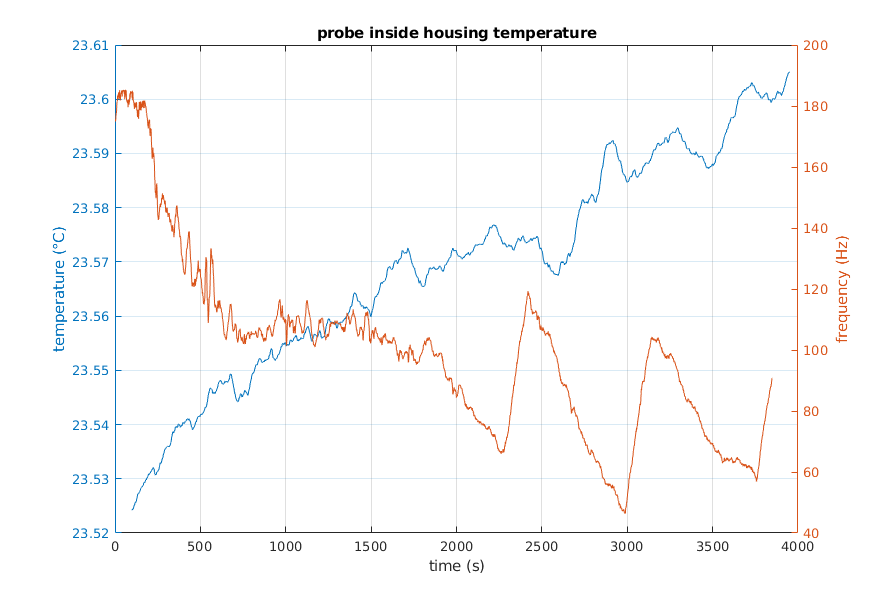
during the same time, here is a probe temperature curve (the probe in stuck on the end flange, close to X-hutch, of the FP-cavity, inside the housing... not close to the laser position).
the temperature variation range is ~2.5/100 °C which induces on inox (relative length thermal effect : 17e-6 /K) a length variation of 4µm of roundtrip (10m) which could be compatible to the laser cavity length variation measured. |
| Attachment 1: Screenshot_2023-11-24_11-44-53.png
|
 |
| Attachment 2: probe_temp.png
|
 |
|
290
|
Fri Nov 24 18:16:37 2023 |
Ronic Chiche | Fixed | info | mechanics | lasers and optics | ThomX igloo | Laser cavity temperature/pressure sensitivity |
Now, I placed a temperature probe stuck on the laser housing itself.
fig. 1
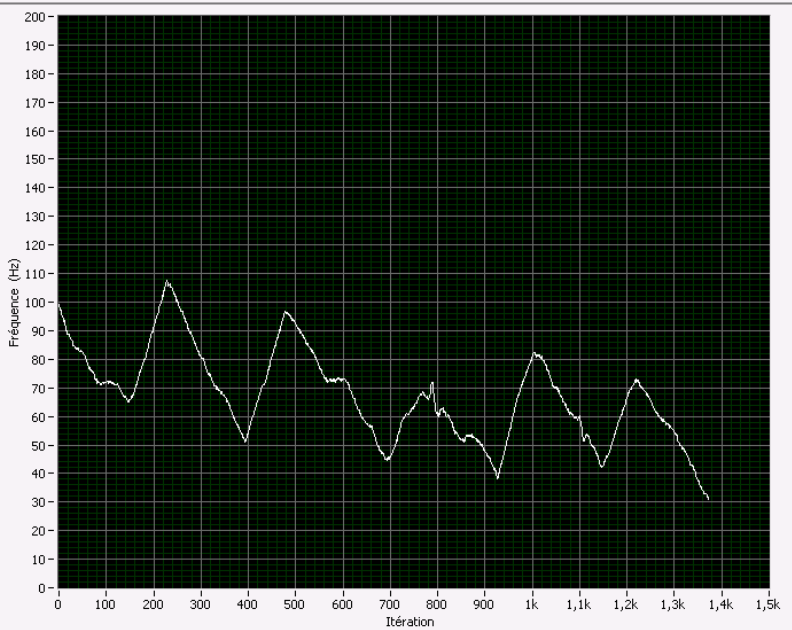
one can compare the temperature measured at the surface of the laser housing and the beating frequency with the 500MHz reference oscillator
one sees a possible very long term correlation but there is no correlation at the minute level when we see the frequency oscillation after t=2000s.
the laser housing temperature seems not to induce directly a frequency variation.
fig 2 / 3
we applied 15W on the heating wire rolled around the FP-cavity flange.
in red, we see the temperature increasing on the probe rolled around the wire, reaching almost 30°C.
we heat the inside of the housing (airflow stopped) during more than 30 minutes
in green, we don't see any variation (even if one makes a zoom) of the temperature of the probe stuck on the laser housing.
in same time, on fig 3, one can see the frequency drift.
there is no correlation between the oscillations and the temperature.
CONCLUSION :
the laser frequency fluctuations does not seem to come from the outside temperature.
| Ronic Chiche wrote: |
|
laser cavity :
when one decreases the laser motor position, the laser repetition rate increases (laser cavity length decreases).
=> +/- laser motor step => +/- laser cavity roundtrip length => -/+ laser repetition rate => -/+ laser harmonic @500MHz
=> +/- 100nm => +/- 200nm => -/+ 0.7Hz @33.33MHz => -/+ 10Hz @500MHz
here is the natural variation of the laser cavity frequency beating with RF @500MHz over 1h (~1.6s / iteration)
one can see some oscillations equivalent to ~1µm of roundtrip length with ~10 minutes period and maybe a slower drift or oscillation with ~2µm of roundtrip range over the hour.
I mention that I moved the laser "PZT" motor before taking the data : could it be the reason of the 10-20min oscillations ?
during the same time, here is a probe temperature curve (the probe in stuck on the end flange, close to X-hutch, of the FP-cavity, inside the housing... not close to the laser position).
the temperature variation range is ~2.5/100 °C which induces on inox (relative length thermal effect : 17e-6 /K) a length variation of 4µm of roundtrip (10m) which could be compatible to the laser cavity length variation measured.
|
|
| Attachment 1: temp_freq.png
|
 |
| Attachment 2: Screenshot_2023-11-24_16-47-37.png
|
 |
| Attachment 3: Screenshot_2023-11-24_16-48-02.png
|
 |
|
291
|
Fri Nov 24 18:47:25 2023 |
Ronic Chiche | Fixed | info | mechanics | lasers and optics | ThomX igloo | Laser cavity temperature/pressure sensitivity |
the last thing we did with Daniele, is to start/stop the airflow on top of the housing (closed) to see a possible pressure effect on the laser frequency drift.
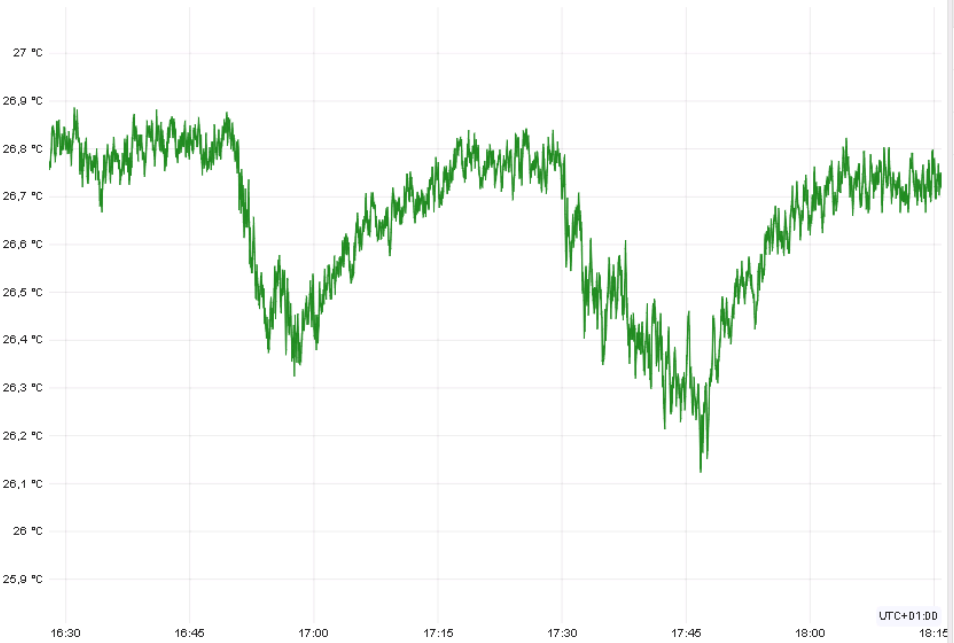
fig 1 : in green, the temperature measured with the probe stuck on the laser housing.
one can clearly see the 2 "start - wait ~10mins - stop" we did at 16h50 then at 17h30.
the air temperature blowed by the airflow is cooler than the housing temperature and we see the effect on the probe.
fig 2 : this is the laser frequency drift during the 1st airflow start/stop
the airflow has been turned on at 100 iterations and stopped at 500 iterations (~5 mins)
we don't see any correlation
fig 3 : this is again the laser frequency drift during the 2nd airflow start/stop
the airflow has been turned on at 1850 iterations and stopped at 2550 iterations (~10 mins)
we don't see any correlation
CONCLUSION : neither external temperature change or pressure variations can explain the 10-20min period oscillations observed on the laser frequency variations.
it can be either the laser temperature regulation or the RF reference oscillator temperature regulation (due to the oven of the quartz)
| Ronic Chiche wrote: |
|
Now, I placed a temperature probe stuck on the laser housing itself.
fig. 1
one can compare the temperature measured at the surface of the laser housing and the beating frequency with the 500MHz reference oscillator
one sees a possible very long term correlation but there is no correlation at the minute level when we see the frequency oscillation after t=2000s.
the laser housing temperature seems not to induce directly a frequency variation.
fig 2 / 3
we applied 15W on the heating wire rolled around the FP-cavity flange.
in red, we see the temperature increasing on the probe rolled around the wire, reaching almost 30°C.
we heat the inside of the housing (airflow stopped) during more than 30 minutes
in green, we don't see any variation (even if one makes a zoom) of the temperature of the probe stuck on the laser housing.
in same time, on fig 3, one can see the frequency drift.
there is no correlation between the oscillations and the temperature.
CONCLUSION :
the laser frequency fluctuations does not seem to come from the outside temperature.
| Ronic Chiche wrote: |
|
laser cavity :
when one decreases the laser motor position, the laser repetition rate increases (laser cavity length decreases).
=> +/- laser motor step => +/- laser cavity roundtrip length => -/+ laser repetition rate => -/+ laser harmonic @500MHz
=> +/- 100nm => +/- 200nm => -/+ 0.7Hz @33.33MHz => -/+ 10Hz @500MHz
here is the natural variation of the laser cavity frequency beating with RF @500MHz over 1h (~1.6s / iteration)
one can see some oscillations equivalent to ~1µm of roundtrip length with ~10 minutes period and maybe a slower drift or oscillation with ~2µm of roundtrip range over the hour.
I mention that I moved the laser "PZT" motor before taking the data : could it be the reason of the 10-20min oscillations ?
during the same time, here is a probe temperature curve (the probe in stuck on the end flange, close to X-hutch, of the FP-cavity, inside the housing... not close to the laser position).
the temperature variation range is ~2.5/100 °C which induces on inox (relative length thermal effect : 17e-6 /K) a length variation of 4µm of roundtrip (10m) which could be compatible to the laser cavity length variation measured.
|
|
|
| Attachment 1: Screenshot_2023-11-24_18-24-43.png
|
 |
| Attachment 2: Screenshot_2023-11-24_17-18-09.png
|
 |
| Attachment 3: Screenshot_2023-11-24_18-37-35.png
|
 |
|
292
|
Tue Nov 28 10:24:47 2023 |
Ronic Chiche | Fixed | info | mechanics | lasers and optics | ThomX igloo | Laser cavity temperature/pressure sensitivity |
today, I swapped the 500MHz RF reference oscillator for a Siglent 500MHz DDS oscillator.
see the attached plot : the beating frequency with the 500MHz laser harmonics produces the same behavior as before.
so, the oscillations should come from the laser temperature regulation.
| Ronic Chiche wrote: |
|
the last thing we did with Daniele, is to start/stop the airflow on top of the housing (closed) to see a possible pressure effect on the laser frequency drift.
fig 1 : in green, the temperature measured with the probe stuck on the laser housing.
one can clearly see the 2 "start - wait ~10mins - stop" we did at 16h50 then at 17h30.
the air temperature blowed by the airflow is cooler than the housing temperature and we see the effect on the probe.
fig 2 : this is the laser frequency drift during the 1st airflow start/stop
the airflow has been turned on at 100 iterations and stopped at 500 iterations (~5 mins)
we don't see any correlation
fig 3 : this is again the laser frequency drift during the 2nd airflow start/stop
the airflow has been turned on at 1850 iterations and stopped at 2550 iterations (~10 mins)
we don't see any correlation
CONCLUSION : neither external temperature change or pressure variations can explain the 10-20min period oscillations observed on the laser frequency variations.
it can be either the laser temperature regulation or the RF reference oscillator temperature regulation (due to the oven of the quartz)
| Ronic Chiche wrote: |
|
Now, I placed a temperature probe stuck on the laser housing itself.
fig. 1
one can compare the temperature measured at the surface of the laser housing and the beating frequency with the 500MHz reference oscillator
one sees a possible very long term correlation but there is no correlation at the minute level when we see the frequency oscillation after t=2000s.
the laser housing temperature seems not to induce directly a frequency variation.
fig 2 / 3
we applied 15W on the heating wire rolled around the FP-cavity flange.
in red, we see the temperature increasing on the probe rolled around the wire, reaching almost 30°C.
we heat the inside of the housing (airflow stopped) during more than 30 minutes
in green, we don't see any variation (even if one makes a zoom) of the temperature of the probe stuck on the laser housing.
in same time, on fig 3, one can see the frequency drift.
there is no correlation between the oscillations and the temperature.
CONCLUSION :
the laser frequency fluctuations does not seem to come from the outside temperature.
| Ronic Chiche wrote: |
|
laser cavity :
when one decreases the laser motor position, the laser repetition rate increases (laser cavity length decreases).
=> +/- laser motor step => +/- laser cavity roundtrip length => -/+ laser repetition rate => -/+ laser harmonic @500MHz
=> +/- 100nm => +/- 200nm => -/+ 0.7Hz @33.33MHz => -/+ 10Hz @500MHz
here is the natural variation of the laser cavity frequency beating with RF @500MHz over 1h (~1.6s / iteration)
one can see some oscillations equivalent to ~1µm of roundtrip length with ~10 minutes period and maybe a slower drift or oscillation with ~2µm of roundtrip range over the hour.
I mention that I moved the laser "PZT" motor before taking the data : could it be the reason of the 10-20min oscillations ?
during the same time, here is a probe temperature curve (the probe in stuck on the end flange, close to X-hutch, of the FP-cavity, inside the housing... not close to the laser position).
the temperature variation range is ~2.5/100 °C which induces on inox (relative length thermal effect : 17e-6 /K) a length variation of 4µm of roundtrip (10m) which could be compatible to the laser cavity length variation measured.
|
|
|
|
| Attachment 1: Screenshot_2023-11-28_10-21-33.png
|
 |
|
296
|
Wed Nov 29 09:35:10 2023 |
Ronic Chiche | Fixed | info | mechanics | lasers and optics | ThomX igloo | Laser cavity temperature/pressure sensitivity |
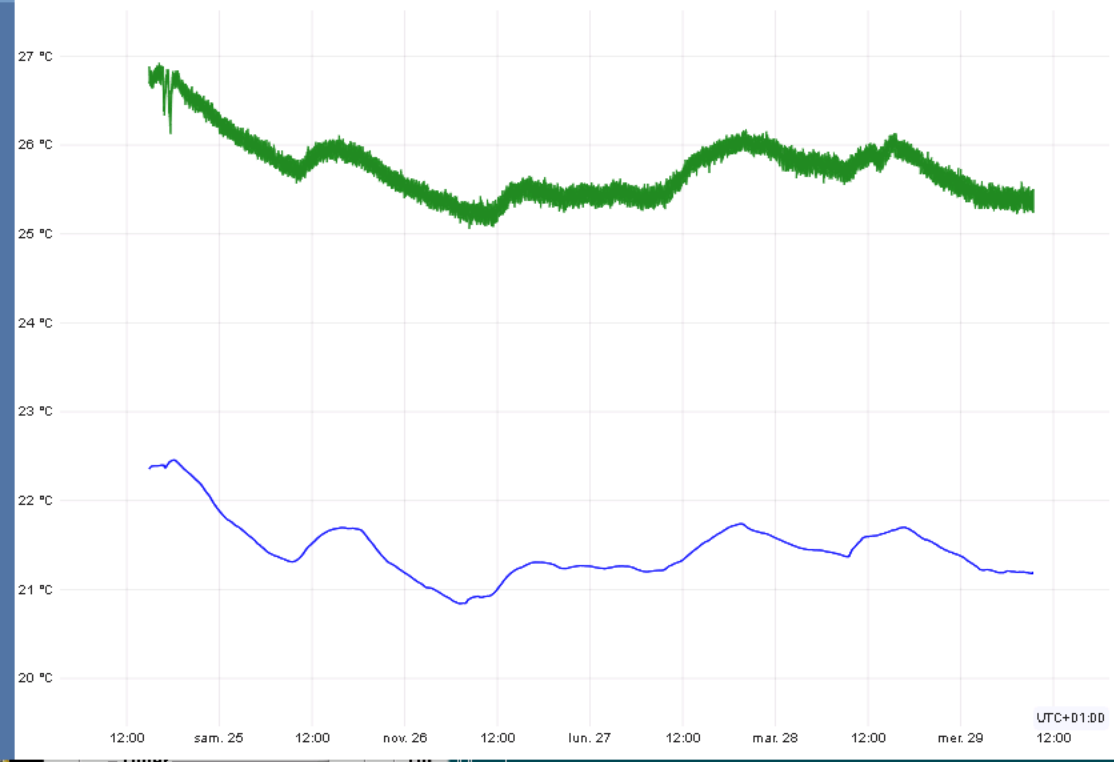
long-term correlation, over 5-6 days, between the temperature measured in the bunker, outside of the housing (blue curve) and the temperature measured with a probe stuck on the laser housing, inside of the FP-cavity housing (green).
it's a perfect correlation with almost the same temperature scale : 1°C outisde the housing => 1°C of laser housing
thus, a stabilization of the temperature, inside of the housing, could help to reduce the frequency drifts of the laser.
| Ronic Chiche wrote: |
|
today, I swapped the 500MHz RF reference oscillator for a Siglent 500MHz DDS oscillator.
see the attached plot : the beating frequency with the 500MHz laser harmonics produces the same behavior as before.
so, the oscillations should come from the laser temperature regulation.
| Ronic Chiche wrote: |
|
the last thing we did with Daniele, is to start/stop the airflow on top of the housing (closed) to see a possible pressure effect on the laser frequency drift.
fig 1 : in green, the temperature measured with the probe stuck on the laser housing.
one can clearly see the 2 "start - wait ~10mins - stop" we did at 16h50 then at 17h30.
the air temperature blowed by the airflow is cooler than the housing temperature and we see the effect on the probe.
fig 2 : this is the laser frequency drift during the 1st airflow start/stop
the airflow has been turned on at 100 iterations and stopped at 500 iterations (~5 mins)
we don't see any correlation
fig 3 : this is again the laser frequency drift during the 2nd airflow start/stop
the airflow has been turned on at 1850 iterations and stopped at 2550 iterations (~10 mins)
we don't see any correlation
CONCLUSION : neither external temperature change or pressure variations can explain the 10-20min period oscillations observed on the laser frequency variations.
it can be either the laser temperature regulation or the RF reference oscillator temperature regulation (due to the oven of the quartz)
| Ronic Chiche wrote: |
|
Now, I placed a temperature probe stuck on the laser housing itself.
fig. 1
one can compare the temperature measured at the surface of the laser housing and the beating frequency with the 500MHz reference oscillator
one sees a possible very long term correlation but there is no correlation at the minute level when we see the frequency oscillation after t=2000s.
the laser housing temperature seems not to induce directly a frequency variation.
fig 2 / 3
we applied 15W on the heating wire rolled around the FP-cavity flange.
in red, we see the temperature increasing on the probe rolled around the wire, reaching almost 30°C.
we heat the inside of the housing (airflow stopped) during more than 30 minutes
in green, we don't see any variation (even if one makes a zoom) of the temperature of the probe stuck on the laser housing.
in same time, on fig 3, one can see the frequency drift.
there is no correlation between the oscillations and the temperature.
CONCLUSION :
the laser frequency fluctuations does not seem to come from the outside temperature.
| Ronic Chiche wrote: |
|
laser cavity :
when one decreases the laser motor position, the laser repetition rate increases (laser cavity length decreases).
=> +/- laser motor step => +/- laser cavity roundtrip length => -/+ laser repetition rate => -/+ laser harmonic @500MHz
=> +/- 100nm => +/- 200nm => -/+ 0.7Hz @33.33MHz => -/+ 10Hz @500MHz
here is the natural variation of the laser cavity frequency beating with RF @500MHz over 1h (~1.6s / iteration)
one can see some oscillations equivalent to ~1µm of roundtrip length with ~10 minutes period and maybe a slower drift or oscillation with ~2µm of roundtrip range over the hour.
I mention that I moved the laser "PZT" motor before taking the data : could it be the reason of the 10-20min oscillations ?
during the same time, here is a probe temperature curve (the probe in stuck on the end flange, close to X-hutch, of the FP-cavity, inside the housing... not close to the laser position).
the temperature variation range is ~2.5/100 °C which induces on inox (relative length thermal effect : 17e-6 /K) a length variation of 4µm of roundtrip (10m) which could be compatible to the laser cavity length variation measured.
|
|
|
|
|
| Attachment 1: Screenshot_2023-11-29_09-27-56.png
|
 |
|
322
|
Fri Feb 2 11:53:40 2024 |
Ronic Chiche | Fixed | info | mechanics | lasers and optics | ThomX igloo | Laser cavity temperature/pressure sensitivity |
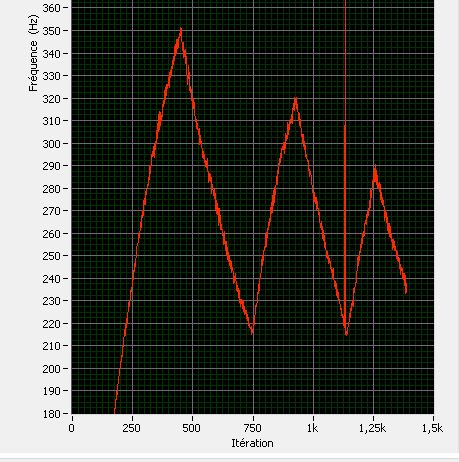
this morning, I did a 500MHz beating frequency (Laser vs RF) drift test with the Smaract motors configured with "Sensor Mode" OFF over 50 minutes (~ 1500 acquisitions)
compared with previous measurements, one observes a much more smooth "exponential-like" drift compared to "Sensor Mode" ON (see previous posts).
| Ronic Chiche wrote: |
|
long-term correlation, over 5-6 days, between the temperature measured in the bunker, outside of the housing (blue curve) and the temperature measured with a probe stuck on the laser housing, inside of the FP-cavity housing (green).
it's a perfect correlation with almost the same temperature scale : 1°C outisde the housing => 1°C of laser housing
thus, a stabilization of the temperature, inside of the housing, could help to reduce the frequency drifts of the laser.
| Ronic Chiche wrote: |
|
today, I swapped the 500MHz RF reference oscillator for a Siglent 500MHz DDS oscillator.
see the attached plot : the beating frequency with the 500MHz laser harmonics produces the same behavior as before.
so, the oscillations should come from the laser temperature regulation.
| Ronic Chiche wrote: |
|
the last thing we did with Daniele, is to start/stop the airflow on top of the housing (closed) to see a possible pressure effect on the laser frequency drift.
fig 1 : in green, the temperature measured with the probe stuck on the laser housing.
one can clearly see the 2 "start - wait ~10mins - stop" we did at 16h50 then at 17h30.
the air temperature blowed by the airflow is cooler than the housing temperature and we see the effect on the probe.
fig 2 : this is the laser frequency drift during the 1st airflow start/stop
the airflow has been turned on at 100 iterations and stopped at 500 iterations (~5 mins)
we don't see any correlation
fig 3 : this is again the laser frequency drift during the 2nd airflow start/stop
the airflow has been turned on at 1850 iterations and stopped at 2550 iterations (~10 mins)
we don't see any correlation
CONCLUSION : neither external temperature change or pressure variations can explain the 10-20min period oscillations observed on the laser frequency variations.
it can be either the laser temperature regulation or the RF reference oscillator temperature regulation (due to the oven of the quartz)
| Ronic Chiche wrote: |
|
Now, I placed a temperature probe stuck on the laser housing itself.
fig. 1
one can compare the temperature measured at the surface of the laser housing and the beating frequency with the 500MHz reference oscillator
one sees a possible very long term correlation but there is no correlation at the minute level when we see the frequency oscillation after t=2000s.
the laser housing temperature seems not to induce directly a frequency variation.
fig 2 / 3
we applied 15W on the heating wire rolled around the FP-cavity flange.
in red, we see the temperature increasing on the probe rolled around the wire, reaching almost 30°C.
we heat the inside of the housing (airflow stopped) during more than 30 minutes
in green, we don't see any variation (even if one makes a zoom) of the temperature of the probe stuck on the laser housing.
in same time, on fig 3, one can see the frequency drift.
there is no correlation between the oscillations and the temperature.
CONCLUSION :
the laser frequency fluctuations does not seem to come from the outside temperature.
| Ronic Chiche wrote: |
|
laser cavity :
when one decreases the laser motor position, the laser repetition rate increases (laser cavity length decreases).
=> +/- laser motor step => +/- laser cavity roundtrip length => -/+ laser repetition rate => -/+ laser harmonic @500MHz
=> +/- 100nm => +/- 200nm => -/+ 0.7Hz @33.33MHz => -/+ 10Hz @500MHz
here is the natural variation of the laser cavity frequency beating with RF @500MHz over 1h (~1.6s / iteration)
one can see some oscillations equivalent to ~1µm of roundtrip length with ~10 minutes period and maybe a slower drift or oscillation with ~2µm of roundtrip range over the hour.
I mention that I moved the laser "PZT" motor before taking the data : could it be the reason of the 10-20min oscillations ?
during the same time, here is a probe temperature curve (the probe in stuck on the end flange, close to X-hutch, of the FP-cavity, inside the housing... not close to the laser position).
the temperature variation range is ~2.5/100 °C which induces on inox (relative length thermal effect : 17e-6 /K) a length variation of 4µm of roundtrip (10m) which could be compatible to the laser cavity length variation measured.
|
|
|
|
|
|
| Attachment 1: Capture.JPG
|
 |
|
329
|
Mon Mar 4 12:39:56 2024 |
Ronic Chiche | Fixed | info | mechanics | lasers and optics | ThomX igloo | Laser and FP cavities frequency adjustment |
at the beginning of the procedure, the frequency gap between the new Ring 33MHz frequency (33.3378MHz) and the laser/FP cavities frequency was 12.33kHz
=> the Smaract motor position was at +100µm
=> the FP cavity motor Mot.03 position was at -358 720 steps
the PDin photodiode was at 3.151mW @ 33% amplifier ratio
the PDpulse photodiode was at 33.384MHz
after several moves (each time, one corrects the CEP / alignment to keep ~ 47kW inside the FP-cavity)
we can move the laser cavity at 300nm/s without any laser modelock loss
we move the FP cavity at the same speed (300nm/s = 50 steps/s with 1step = 6nm)
now, we did roughly half of the travel : dF @ 33MHz = 5.3kHz
=> the Smaract motor position was at +1075µm
=> the FP cavity motor Mot.03 position was at -200 000 steps
the PDin photodiode was at 3.178mW @ 33% amplifier ratio
the PDpulse photodiode was at 33.377MHz
|
|
330
|
Mon Mar 4 18:32:21 2024 |
Ronic Chiche | Fixed | info | mechanics | lasers and optics | ThomX igloo | Laser and FP cavities frequency adjustment |
This afternoon, I did the 2nd half of the travel: dF @ 33MHz = 0Hz
=> the Smaract motor position is now at +1750µm
=> the FP cavity motor Mot.03 position stayed at -200 000 steps
=> the FP cavity motor Mot.06 position is now at -790 000 steps
the PDin photodiode was at 3.191mW @ 33% amplifier ratio
the PDpulse photodiode was at 33.372 / 33.371MHz
the FP-cavity power is ~47kW @ 33% amplifier ratio => to be improved
there is no signal beating at 500MHz, only at 33MHz => to be investiguated => fixed
| Ronic Chiche wrote: |
|
at the beginning of the procedure, the frequency gap between the new Ring 33MHz frequency (33.3378MHz) and the laser/FP cavities frequency was 12.33kHz
=> the Smaract motor position was at +100µm
=> the FP cavity motor Mot.03 position was at -358 720 steps
the PDin photodiode was at 3.151mW @ 33% amplifier ratio
the PDpulse photodiode was at 33.384MHz
after several moves (each time, one corrects the CEP / alignment to keep ~ 47kW inside the FP-cavity)
we can move the laser cavity at 300nm/s without any laser modelock loss
we move the FP cavity at the same speed (300nm/s = 50 steps/s with 1step = 6nm)
now, we did roughly half of the travel : dF @ 33MHz = 5.3kHz
=> the Smaract motor position was at +1075µm
=> the FP cavity motor Mot.03 position was at -200 000 steps
the PDin photodiode was at 3.178mW @ 33% amplifier ratio
the PDpulse photodiode was at 33.377MHz
|
|