| ID |
Date |
Author |
Status |
Type |
Category |
Location |
Title |
|
427
|
Wed Jun 11 18:59:34 2025 |
Ronic Chiche | Under Process | issue | mechanics | lasers and optics | vacuum | detectors and electronics | ThomX igloo | Possible causes for the noise in the FP-cavity system | list of possible causes of the high frequency noise which makes the system loosing the lock => to be checked.
(if you have some new idea, I will edit the post)
1- Laser
1.1- vibrations on the laser box coming from the optical table / housing
1.2- vibrations coming from the Smaract translation stages (Frep or CEP) inside the laser box
1.3- pressure noise coming from the weather (the laser cavity is sealed) on the laser box
2- Amplifier
2.1- vibrations coming from the fans in the controler crate
2.2- vibrations coming from the chiller (water cooling cavitation)
3- Beam propagation
3.1- vibration noise coming from the housing / the table
3.2- vibration noise coming from the motors of the injection mirrors
4- Fabry-Perot cavity
4.1- pressure noise on the cavity vessels coming from the weather/air cooling
4.2- vibrations coming from the rust on the mechanics
4.3- vibrations of the mirror mounts due to temperature related to cavity power
4.4- vibrations coming from the electron ring mechanics
4.5- "vacuum" index variation coming from local ionization due to the electron beam
4.6- vibrations coming from the far position (related to the middle range) of some mounts and due to the spring of the translations stage.
5- Feedback system / Electronics / CEM
5.1- CEM votage noise on the laser or FPC PZT's
|
|
429
|
Wed Jun 25 09:57:56 2025 |
Ronic Chiche | Under Process | issue | mechanics | lasers and optics | vacuum | detectors and electronics | ThomX igloo | Possible causes for the noise in the FP-cavity system | 4.3 - Vibrations of the mirror mounts due to temperature related to cavity power (the electrons machine is OFF)
1) to test this possible issue, we plan to make a run at low power in the FP-cavity, around 10kW, instead of ~90kW as usual.
for that, I will need to change the diffuser position on axis 18 to get the same error signal for the locking.
the initial axis 18 position is +11304
I used the Alphanov amplifier at its standard value : 33%
first, I did a step at 26kW in the FPC by tuning the CEP
at this power, I saw exactly the same kind of behavior with a sudden large high frequency noise which prevent the lock to run properly and which is impossible to compensate.
=> one just have to wait... until it becomes more stable.
then, I went to 13kW in the FPC by tuning the CEP.
- I did the same alignement optimisation than for high power to remove possible coupling to high order modes in the error signal
- I tuned the power in the FPC by changing the CEP => the equivalent LW of the cavity will be different => I got ~ 13kW
- I changed the diffuser position on axis 18 to -23079
- I tuned the PID parameters :
initial => final
P = 0.055 => 0.1
I = 0.0005 => 0.002
D = 0.6 => 1
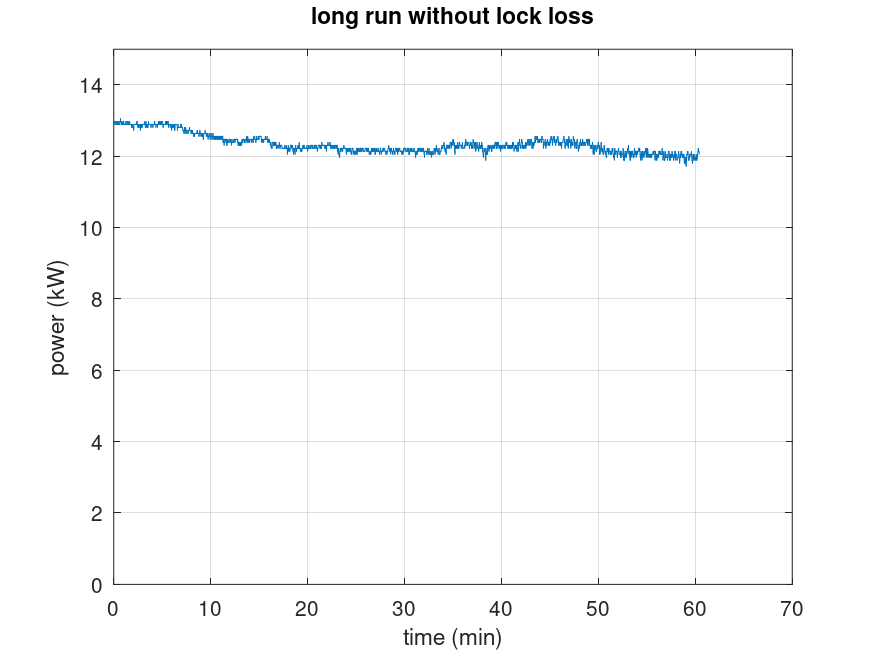
I started to record a long trend of the FPC power => see attached picture
I still observed the ~20Hz noise and sometime some high frequency noise, but not at a level which prevents the locking system to work.
CONCLUSION :
at this power and with a larger LW (CEP is not optimized), the FPC seems much more stable without any lock loss during 1h !
2) then I will do a test by decreasing the Alphanov amplifier ratio to work at a lower input power but with an optimized CEP.
Now, I optimized the CEP and alignment and reduce the Alphanov amplifier ratio to 15% => 24kW power in the FPC.
on CH2, I got 60mV (when I got 250mV when I'm at 97kW in the FPC) => ratio ~ 4.2 => 97kW / 4,2 ~ 23 kW
I checked that the PID parameters are not over-valuated which can produce a power reduction and the CEP is optimum as well as the alignment.
Axis 18 position : -13188
PID parameters (P = 0.1 / I = 0.002 / D = 1.5)
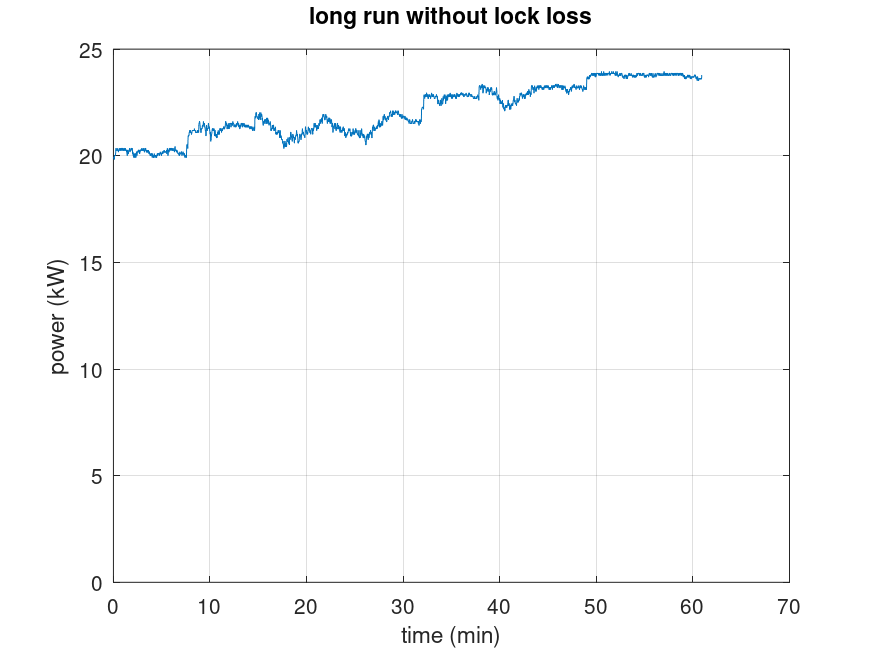
I started to record a long trend of the FPC power => cf 2nd trend with gradually increasing of the power because of the drift of the CEP + feedback adjustments.
CONCLUSION :
at this power and with nominal LW (CEP is optimized), the FPC seems much more stable without any lock loss during 1h !
3) I found a stable position for FPC around 46kW
I used the recepie for 46kW => after some time, I observed a lot of high frequency noise which induces some lock loss.
| Ronic Chiche wrote: |
|
list of possible causes of the high frequency noise which makes the system loosing the lock => to be checked.
(if you have some new idea, I will edit the post)
1- Laser
1.1- vibrations on the laser box coming from the optical table / housing
1.2- vibrations coming from the Smaract translation stages (Frep or CEP) inside the laser box
1.3- pressure noise coming from the weather (the laser cavity is sealed) on the laser box
2- Amplifier
2.1- vibrations coming from the fans in the controler crate
2.2- vibrations coming from the chiller (water cooling cavitation)
3- Beam propagation
3.1- vibration noise coming from the housing / the table
3.2- vibration noise coming from the motors of the injection mirrors
4- Fabry-Perot cavity
4.1- pressure noise on the cavity vessels coming from the weather/air cooling
4.2- vibrations coming from the rust on the mechanics
4.3- vibrations of the mirror mounts due to temperature related to cavity power
4.4- vibrations coming from the electron ring mechanics
4.5- "vacuum" index variation coming from local ionization due to the electron beam
5- Feedback system / Electronics / CEM
5.1- CEM votage noise on the laser or FPC PZT's
|
|
| Attachment 1: long_run_wihtout_lock_loss.png
|  |
| Attachment 2: long_run_wihtout_lock_loss_with_optimum_CEP.png
|  |
|
53
|
Tue Sep 3 17:51:04 2019 |
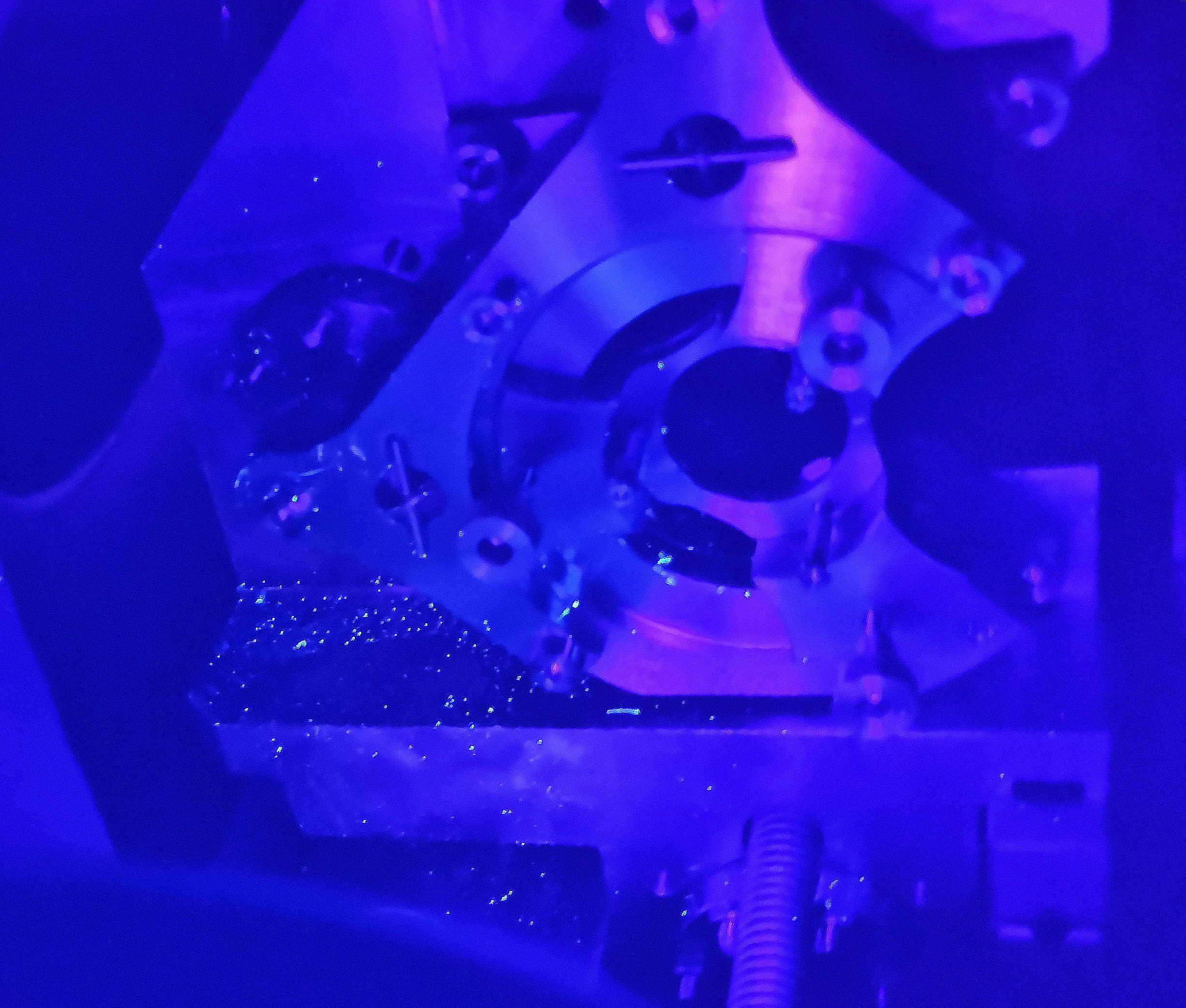
Ronic Chiche | Fixed | issue | mechanics | lasers and optics | vacuum | Optical room | Vessel cleanliness | looking in the vessel of the FP cavity using a UV lamp shows a lot of dust... more dust than outside the cavity !!!
here is picture where one can see a cleaned zone using a finger (with gloves).
question : where does come from this dust ?
2 possibilities :
- large and small belows which could trap the dust and release it during the pumping process
- ionic pumps could release some clusters when they are working.
we plan to clean as effectively as possible the inner surfaces, to close bellows, make woking ion pumps to check if it released again some dust. |
| Attachment 1: IMG_20190903_161910.jpg
|  |
|
393
|
Wed Jan 22 15:32:53 2025 |
Ronic Chiche | Fixed | info | mechanics | lasers and optics | vacuum | ThomX igloo | correlations between vacuum gauges and lock losses @ 20Hz | the machine people saw a correlation between BPM jumps and vacuum gauges peaks related to breakdowns in the beam pipe.
these breakdowns could produce some accoustic noise which could be related to our lock losses.
=> we tried to do a corrrelation between our lock losses and the vacuum gauge peaks => WE DON'T SEE any correlation !!! |
|
471
|
Wed Jun 10 16:16:33 2026 |
Ronic Chiche | Under Process | info | mechanics | lasers and optics | vacuum | ThomX igloo | removing of the M1 mirror | after trying to increase the power and after moving S3 to try to change the size of the beam on the mirrors, the FPC power suddenly droped.
so, we need to remove M1 to check if it has been damaged.
we placed an iris in reflection of the FPC to keep the alignment for the new mirror M1.
the alignment has been done with an iris and the amplifier at 10% (to get a quite round beam) and the beam profiler.
once the iris is almost closed, the alignment is good, using the diffractions rings. |
|
472
|
Thu Jun 11 11:16:55 2026 |
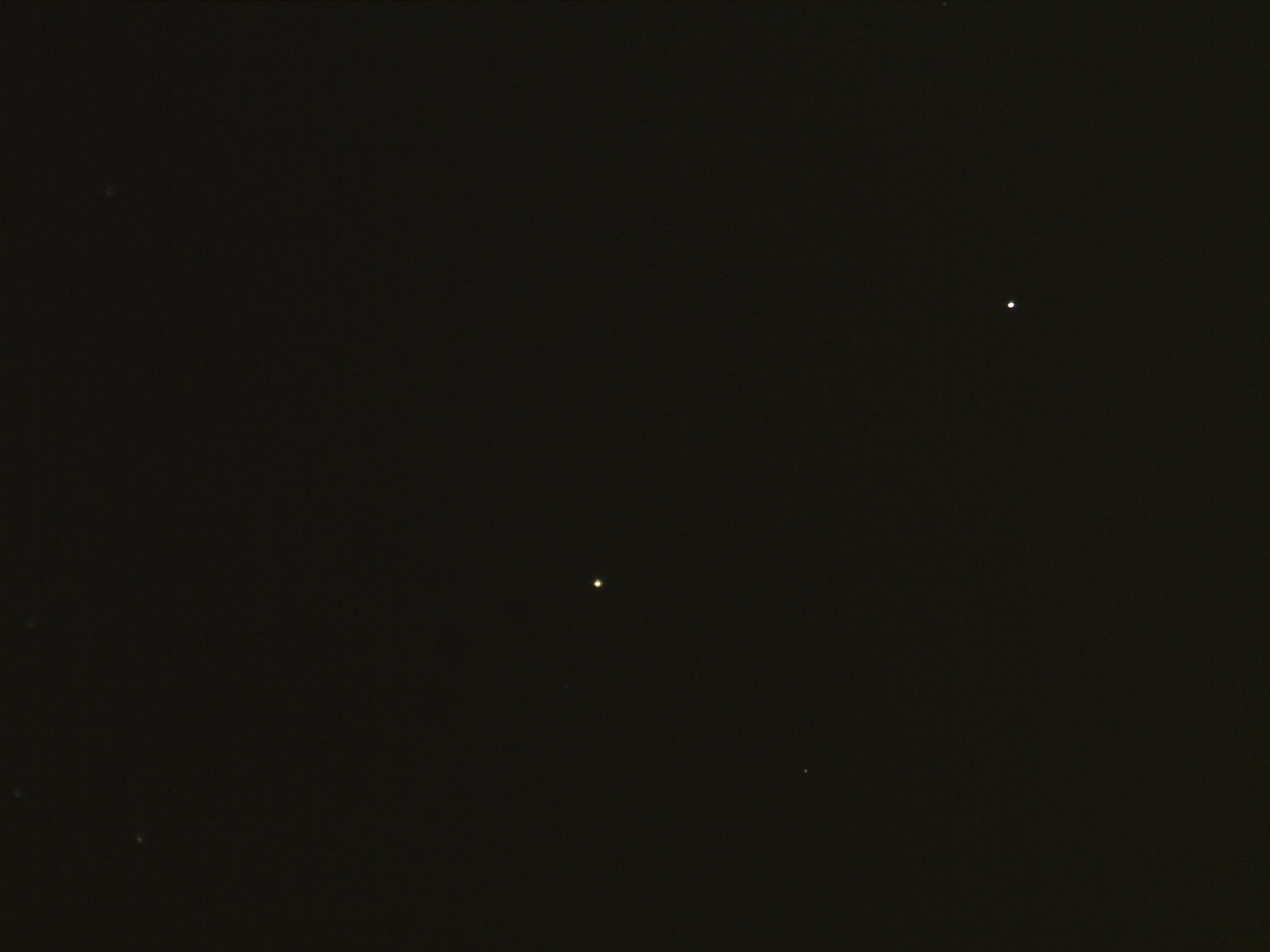
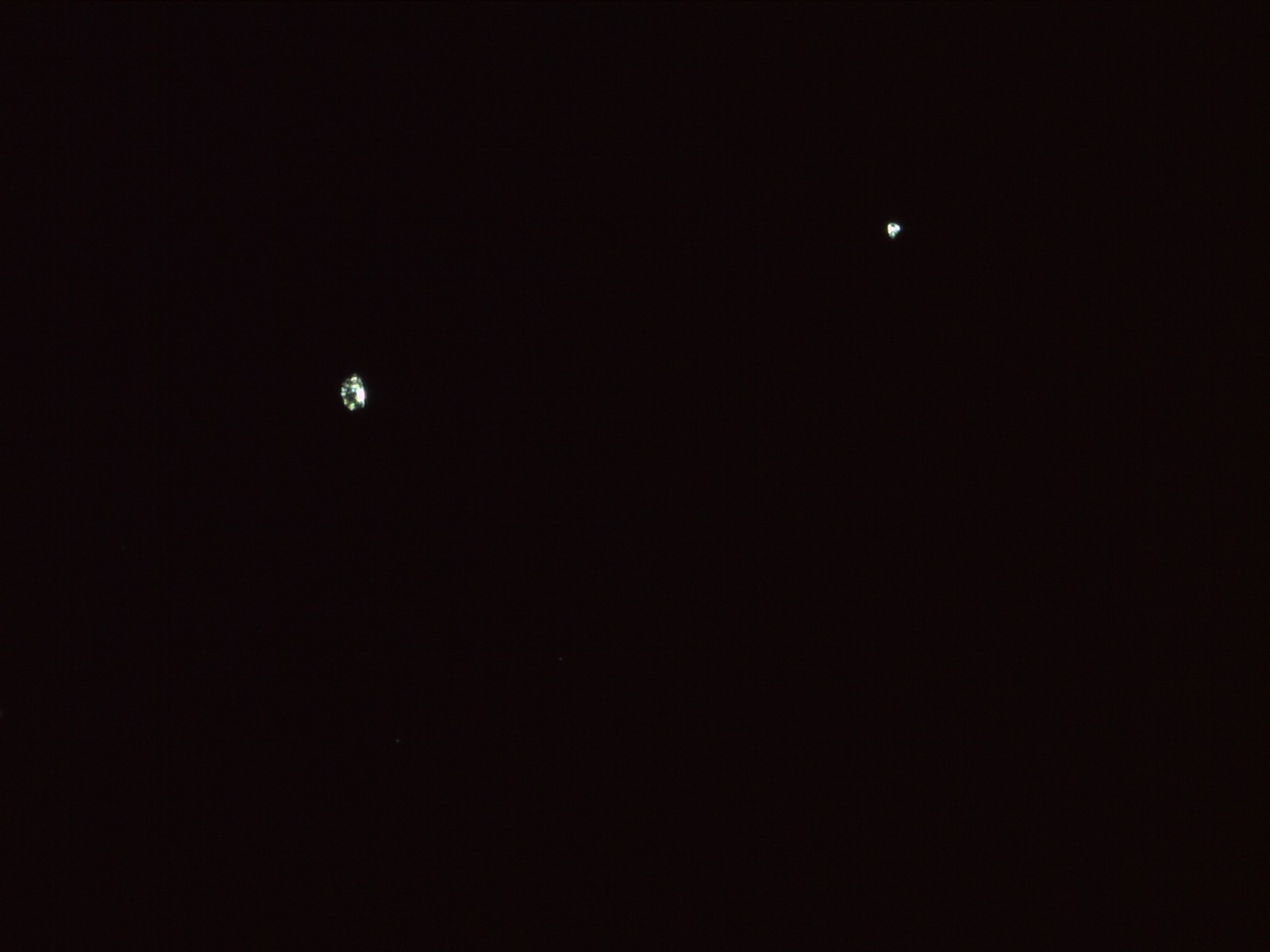
Ronic Chiche | Under Process | info | mechanics | lasers and optics | vacuum | ThomX igloo | removing of the M1 mirror | this morning, with Daniele, we took some images of the M1 mirror HR surface :
1- large image span of the mirror surface (~center) before being cleaned :
one can see a lot of spots
2- zoom in on some spots in the middle of the mirror.
Daniele saw 2 suspicious spots among many.
difficult to be sure if it's only some dust or if it's some damage
3- large image span of the mirror surface after being cleaned with the spin coater machine
only the 2 suspicious spots remain, all others have been washed.
4- zoom in on the 2 suspicious spots
if one compares with the image before cleaning, one can see the spots are much larger
5&6- zoom in on the 2 suspicious spots separately after a 2nd cleaning process with the spin coater,
it seems the spots are even a bit larger than before
conclusion : it seems that these spots are presently showing some damage on the mirror surface.
it is strange that there are 2 in the same time.
one possible explanation is that, as we had to move the z-axis motor before, and we know that the mechanics are rusty, it's possible that it released some metallic particles on the mirror surface.
and 2 were in the beam area....
| Ronic Chiche wrote: |
|
after trying to increase the power and after moving S3 to try to change the size of the beam on the mirrors, the FPC power suddenly droped.
so, we need to remove M1 to check if it has been damaged.
we placed an iris in reflection of the FPC to keep the alignment for the new mirror M1.
the alignment has been done with an iris and the amplifier at 10% (to get a quite round beam) and the beam profiler.
once the iris is almost closed, the alignment is good, using the diffractions rings.
|
|
| Attachment 1: large_image_before_cleaning.jpeg
|  |
| Attachment 2: 2_suspicious_spots_before_cleaning.jpeg
|  |
| Attachment 3: large_image_after_cleaning.jpeg
|  |
| Attachment 4: 2_suspicious_spots_after_cleaning_#1.jpeg
|  |
| Attachment 5: 2_suspicious_spots_after_cleaning_#2_focus_on_spot_1.jpeg.jpeg
|  |
| Attachment 6: 2_suspicious_spots_after_cleaning_#2_focus_on_spot_2.jpeg.jpeg
|  |
|
473
|
Thu Jun 11 17:11:02 2026 |
Ronic Chiche | Under Process | info | mechanics | lasers and optics | vacuum | ThomX igloo | removing of the M1 mirror | This afternoon, we installed a new M1 mirror, the only one for which the box was not already opened.
as the mirror should be "brand new", as the LMA has packaged it, we decided not to clean it with ultra-pure water and to install it out of the box.
we realigned it with the iris previously installed for that purpose.
primary and turbo pumping are in process. one has to wait until the vacuum level is low enough to start the ionic pumping and to reopen the isolating valve.
let's cross our fingers...
| Ronic Chiche wrote: |
|
this morning, with Daniele, we took some images of the M1 mirror HR surface :
1- large image span of the mirror surface (~center) before being cleaned :
one can see a lot of spots
2- zoom in on some spots in the middle of the mirror.
Daniele saw 2 suspicious spots among many.
difficult to be sure if it's only some dust or if it's some damage
3- large image span of the mirror surface after being cleaned with the spin coater machine
only the 2 suspicious spots remain, all others have been washed.
4- zoom in on the 2 suspicious spots
if one compares with the image before cleaning, one can see the spots are much larger
5&6- zoom in on the 2 suspicious spots separately after a 2nd cleaning process with the spin coater,
it seems the spots are even a bit larger than before
conclusion : it seems that these spots are presently showing some damage on the mirror surface.
it is strange that there are 2 in the same time.
one possible explanation is that, as we had to move the z-axis motor before, and we know that the mechanics are rusty, it's possible that it released some metallic particles on the mirror surface.
and 2 were in the beam area....
| Ronic Chiche wrote: |
|
after trying to increase the power and after moving S3 to try to change the size of the beam on the mirrors, the FPC power suddenly droped.
so, we need to remove M1 to check if it has been damaged.
we placed an iris in reflection of the FPC to keep the alignment for the new mirror M1.
the alignment has been done with an iris and the amplifier at 10% (to get a quite round beam) and the beam profiler.
once the iris is almost closed, the alignment is good, using the diffractions rings.
|
|
|
|
474
|
Thu Jun 25 16:04:34 2026 |
Ronic Chiche | Under Process | info | mechanics | lasers and optics | vacuum | ThomX igloo | removing of the M1 mirror | the pressure level with the ionic pump was limited to ~ 1.5 .10**-7 mbar after several days of pumping, due to some leakage located on the bottom screws of the large flange.
so we decided to reopen the flange and change the copper joint.
we did a new leakage test, and after tightening properly the screws, it seems there is no leakage anymore.
so, we started the ionic pumping in the morning (several starts and stops to clean the ionic pump with the turbo pumping), and at 3.30 pm, we closed the turbo/vessel valve.
the vacuum level is at 2.3.10*-7 mbar.
let's see how much it is tomorrow morning to have an estimation of the time needed to reach 2.10**-8 mbar (in the vessel), which should reduce to 5.10**-9 once the ring/vessel valve will be opened (the ring has roughly the same volume as the two vessel volumes).
| Ronic Chiche wrote: |
|
This afternoon, we installed a new M1 mirror, the only one for which the box was not already opened.
as the mirror should be "brand new", as the LMA has packaged it, we decided not to clean it with ultra-pure water and to install it out of the box.
we realigned it with the iris previously installed for that purpose.
primary and turbo pumping are in process. one has to wait until the vacuum level is low enough to start the ionic pumping and to reopen the isolating valve.
let's cross our fingers...
| Ronic Chiche wrote: |
|
this morning, with Daniele, we took some images of the M1 mirror HR surface :
1- large image span of the mirror surface (~center) before being cleaned :
one can see a lot of spots
2- zoom in on some spots in the middle of the mirror.
Daniele saw 2 suspicious spots among many.
difficult to be sure if it's only some dust or if it's some damage
3- large image span of the mirror surface after being cleaned with the spin coater machine
only the 2 suspicious spots remain, all others have been washed.
4- zoom in on the 2 suspicious spots
if one compares with the image before cleaning, one can see the spots are much larger
5&6- zoom in on the 2 suspicious spots separately after a 2nd cleaning process with the spin coater,
it seems the spots are even a bit larger than before
conclusion : it seems that these spots are presently showing some damage on the mirror surface.
it is strange that there are 2 in the same time.
one possible explanation is that, as we had to move the z-axis motor before, and we know that the mechanics are rusty, it's possible that it released some metallic particles on the mirror surface.
and 2 were in the beam area....
| Ronic Chiche wrote: |
|
after trying to increase the power and after moving S3 to try to change the size of the beam on the mirrors, the FPC power suddenly droped.
so, we need to remove M1 to check if it has been damaged.
we placed an iris in reflection of the FPC to keep the alignment for the new mirror M1.
the alignment has been done with an iris and the amplifier at 10% (to get a quite round beam) and the beam profiler.
once the iris is almost closed, the alignment is good, using the diffractions rings.
|
|
|
|
|
475
|
Fri Jun 26 09:42:31 2026 |
Ronic Chiche | Under Process | info | mechanics | lasers and optics | vacuum | ThomX igloo | removing of the M1 mirror | this morning, the vacuum level is still around 1.9 10**-7.
the vacuum guys said that last time, the pumping was much faster.
they ask if baking the vessel (with the mirrors inside ?) is absolutely impossible...
| Ronic Chiche wrote: |
|
the pressure level with the ionic pump was limited to ~ 1.5 .10**-7 mbar after several days of pumping, due to some leakage located on the bottom screws of the large flange.
so we decided to reopen the flange and change the copper joint.
we did a new leakage test, and after tightening properly the screws, it seems there is no leakage anymore.
so, we started the ionic pumping in the morning (several starts and stops to clean the ionic pump with the turbo pumping), and at 3.30 pm, we closed the turbo/vessel valve.
the vacuum level is at 2.3.10*-7 mbar.
let's see how much it is tomorrow morning to have an estimation of the time needed to reach 2.10**-8 mbar (in the vessel), which should reduce to 5.10**-9 once the ring/vessel valve will be opened (the ring has roughly the same volume as the two vessel volumes).
| Ronic Chiche wrote: |
|
This afternoon, we installed a new M1 mirror, the only one for which the box was not already opened.
as the mirror should be "brand new", as the LMA has packaged it, we decided not to clean it with ultra-pure water and to install it out of the box.
we realigned it with the iris previously installed for that purpose.
primary and turbo pumping are in process. one has to wait until the vacuum level is low enough to start the ionic pumping and to reopen the isolating valve.
let's cross our fingers...
| Ronic Chiche wrote: |
|
this morning, with Daniele, we took some images of the M1 mirror HR surface :
1- large image span of the mirror surface (~center) before being cleaned :
one can see a lot of spots
2- zoom in on some spots in the middle of the mirror.
Daniele saw 2 suspicious spots among many.
difficult to be sure if it's only some dust or if it's some damage
3- large image span of the mirror surface after being cleaned with the spin coater machine
only the 2 suspicious spots remain, all others have been washed.
4- zoom in on the 2 suspicious spots
if one compares with the image before cleaning, one can see the spots are much larger
5&6- zoom in on the 2 suspicious spots separately after a 2nd cleaning process with the spin coater,
it seems the spots are even a bit larger than before
conclusion : it seems that these spots are presently showing some damage on the mirror surface.
it is strange that there are 2 in the same time.
one possible explanation is that, as we had to move the z-axis motor before, and we know that the mechanics are rusty, it's possible that it released some metallic particles on the mirror surface.
and 2 were in the beam area....
| Ronic Chiche wrote: |
|
after trying to increase the power and after moving S3 to try to change the size of the beam on the mirrors, the FPC power suddenly droped.
so, we need to remove M1 to check if it has been damaged.
we placed an iris in reflection of the FPC to keep the alignment for the new mirror M1.
the alignment has been done with an iris and the amplifier at 10% (to get a quite round beam) and the beam profiler.
once the iris is almost closed, the alignment is good, using the diffractions rings.
|
|
|
|
|
|
413
|
Fri Feb 21 19:52:57 2025 |
Ronic Chiche | Fixed | info | mechanics | lasers and optics | detectors and electronics | software | ThomX igloo | Good Xrays production trend | this afternoon, we succeeded to get a quite long Xray production trend around 15-20 minutes with a flux above 25k on i1. |
| Attachment 1: img1(1).jpg
| .jpg "img1(1).jpg") |
|
132
|
Mon Mar 14 18:39:40 2022 |
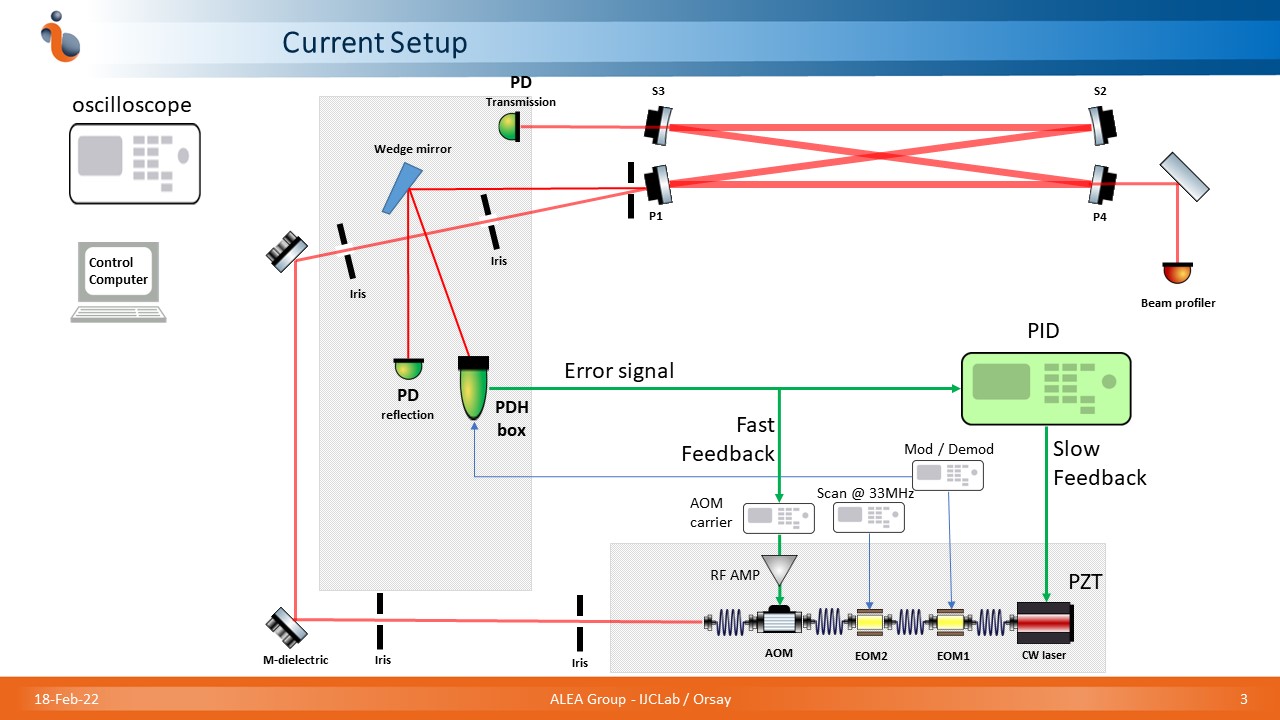
Manar Amer | Fixed | info | mechanics | lasers and optics | detectors and electronics | ThomX igloo | Current Installed Setup | Attached is the current setup in ThomX |
| Attachment 1: 18-02-2022_ThomX_FPCavity_Finesse_Setup.jpg
|  |
|
241
|
Fri Sep 8 12:43:04 2023 |
Ronic Chiche | Fixed | info | mechanics | lasers and optics | detectors and electronics | ThomX igloo | Removing high order modes | this morning we locked the laser and the FP-cavity with ~ 40kW => some HOM appeared "randomly" depending on the power.
we tried to play manually on the L-shape arm :
- first, we moved horizontally to put the L-shape in the beam axis
at some point, we saw the power level divided by ~2, we stopped and came back to restore the full power.
- then, we tried to move vertically.
whatever the direction, we were not able to see a clear cut of the beam.
BUT "strangely", at some point, the PZT drift followed the direction of the motion and was not really depending on the "cooling" or "heating" process when the lock stops or restart.
"strangely" again, at the endpoint, the power dropped by ~20-30% after a delock but it was impossible to restore the power when we put the arm at the initial position.
=> we had to adjust the FP-cavity alignment to restore the power !!!
=> we had the feeling that moving the arm could have misalign the cavity axis !!! :-(
=> we have to discuss with Yann and get the CAD files of the cavity to have a better understanding... |
|
242
|
Fri Sep 8 18:22:21 2023 |
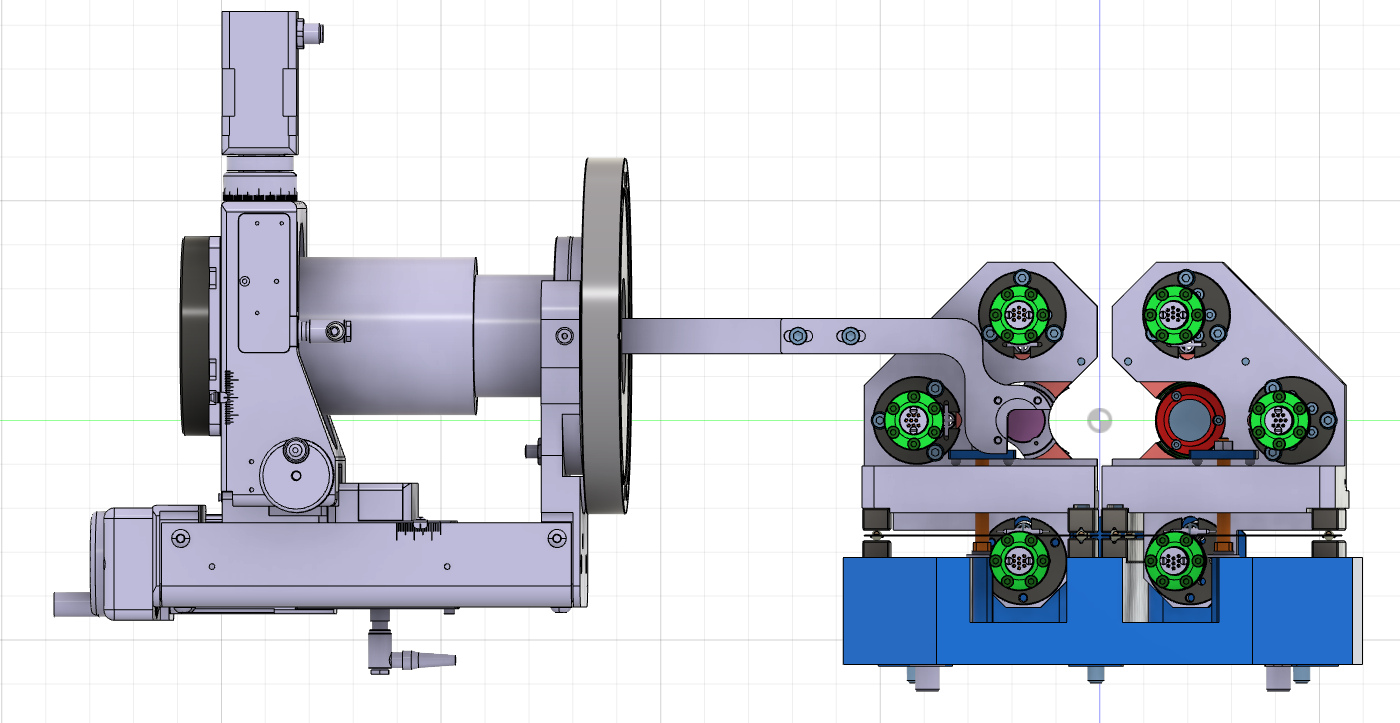
Ronic Chiche | Fixed | info | mechanics | lasers and optics | detectors and electronics | ThomX igloo | Removing high order modes | here is the picture of the L-shape arm and the inside of the vessel.
this image corresponds to the "zero" position on each positionner.
| Ronic Chiche wrote: |
|
this morning we locked the laser and the FP-cavity with ~ 40kW => some HOM appeared "randomly" depending on the power.
we tried to play manually on the L-shape arm :
- first, we moved horizontally to put the L-shape in the beam axis
at some point, we saw the power level divided by ~2, we stopped and came back to restore the full power.
- then, we tried to move vertically.
whatever the direction, we were not able to see a clear cut of the beam.
BUT "strangely", at some point, the PZT drift followed the direction of the motion and was not really depending on the "cooling" or "heating" process when the lock stops or restart.
"strangely" again, at the endpoint, the power dropped by ~20-30% after a delock but it was impossible to restore the power when we put the arm at the initial position.
=> we had to adjust the FP-cavity alignment to restore the power !!!
=> we had the feeling that moving the arm could have misalign the cavity axis !!! :-(
=> we have to discuss with Yann and get the CAD files of the cavity to have a better understanding...
|
|
| Attachment 1: Capture.PNG
|  |
|
245
|
Tue Sep 12 14:28:36 2023 |
Ronic Chiche | Fixed | info | mechanics | lasers and optics | detectors and electronics | ThomX igloo | Removing high order modes | yesterday with Daniele, we tried again to move the arm horizontally and vertically from the "zero position" to have a better understanding of the beahvior,
but it is roughly the same :
- a clear beam power reduction (=> cut of the beam) when one moves the horizontal axis
- a very small beam power reduction when one moves the vertical axis
as there are no end-position limits on the axis and as it is possible to "touch" the motors or different mecanichal pieces, we prefered to be conservative:
after several tries, one placed the arm at a position where the HOMs seem to be pretty well suppressed.
for the moment, we will consider this arm in a proper position.
| Ronic Chiche wrote: |
|
here is the picture of the L-shape arm and the inside of the vessel.
this image corresponds to the "zero" position on each positionner.
| Ronic Chiche wrote: |
|
this morning we locked the laser and the FP-cavity with ~ 40kW => some HOM appeared "randomly" depending on the power.
we tried to play manually on the L-shape arm :
- first, we moved horizontally to put the L-shape in the beam axis
at some point, we saw the power level divided by ~2, we stopped and came back to restore the full power.
- then, we tried to move vertically.
whatever the direction, we were not able to see a clear cut of the beam.
BUT "strangely", at some point, the PZT drift followed the direction of the motion and was not really depending on the "cooling" or "heating" process when the lock stops or restart.
"strangely" again, at the endpoint, the power dropped by ~20-30% after a delock but it was impossible to restore the power when we put the arm at the initial position.
=> we had to adjust the FP-cavity alignment to restore the power !!!
=> we had the feeling that moving the arm could have misalign the cavity axis !!! :-(
=> we have to discuss with Yann and get the CAD files of the cavity to have a better understanding...
|
|
|
|
258
|
Fri Sep 15 18:00:41 2023 |
Ronic Chiche | Under Process | issue | mechanics | lasers and optics | detectors and electronics | ThomX igloo | 20Hz oscillation in the locking between Laser and FP-cavity | this morning, we tried to find the origin of the 20Hz oscillation.
- we switched OFF the laser Smaract motors controller => no change
- then, we addionally disconnected the FP-cavity PZT cable from the Laselock (we put a charge of 1kohm) => no change
- then, we switched ON the laser Smaract motors controller and switched OFF the FP-cavity motors controllers => no change
in conclusion, we don't really know where this instabillity comes from.
the amplitude is roughly 1Vpp (when the oscillation is at its maximum) on the laser PZT <=> length oscillation of ~20nm pp
could it come :
- from the air cooling regulation with pressure variation ?
- from vibrations of the hexapod below the table ?
or is it from inside of the laser or FP cavities ?
see these posts for the first measurements on this issue: https://elog.lal.in2p3.fr/FPC/THOMX+commissioning/257
|
|
259
|
Fri Sep 15 18:11:07 2023 |
Ronic Chiche | Under Process | issue | mechanics | lasers and optics | detectors and electronics | ThomX igloo | 20Hz oscillation in the locking between Laser and FP-cavity | this afternoon, we did 2 tests to better understand this 20Hz oscillation:
- we locked the amplified laser directly to the 500MHz ring reference oscillator, without any intermediate locking to the FP-cavity => no change
the 20Hz oscillation is still present in the correction signal of the laser PZT.
- we switched OFF the controller of the hexapod => no change.
conclusion:
the 20Hz oscillation is coming from the laser cavity
or is coming from "outside" and could be measured, maybe at a higher level, with an external "noises & vibrations measurement system".
| Ronic Chiche wrote: |
|
this morning, we tried to find the origin of the 20Hz oscillation.
- we switched OFF the laser Smaract motors controller => no change
- then, we addionally disconnected the FP-cavity PZT cable from the Laselock (we put a charge of 1kohm) => no change
- then, we switched ON the laser Smaract motors controller and switched OFF the FP-cavity motors controllers => no change
in conclusion, we don't really know where this instabillity comes from.
the amplitude is roughly 1Vpp (when the oscillation is at its maximum) on the laser PZT <=> length oscillation of ~20nm pp
could it come :
- from the air cooling regulation with pressure variation ?
- from vibrations of the hexapod below the table ?
or is it from inside of the laser or FP cavities ?
see these posts for the first measurements on this issue: https://elog.lal.in2p3.fr/FPC/THOMX+commissioning/257
|
|
|
261
|
Fri Sep 15 18:56:36 2023 |
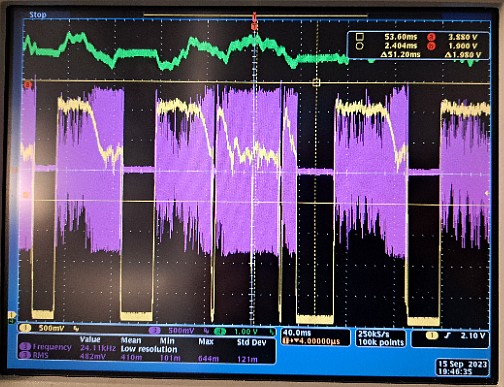
Ronic Chiche | Fixed | issue | mechanics | lasers and optics | detectors and electronics | ThomX igloo | !!! strange FP cavity behavior => impossible to lock !!! | suddenly, BEFORE switching the HV amplifier ON and BEFORE connecting it to the EOM (in order to explore the HV effect on the EOM for the fast feedback loop),
we lost the lock between the laser and the FP-cavity: in attchement a plot a the lock with the "best" PID parameters.
- yellow: FP-cavity transmission signal
- green: PZT signal
- pink: PDH error signal
the lock was pretty "normal" except that we observed that the intra-cavity power is always slowly increasing from 40kW to ~44kW during a lock, all along this last week.
there are several possiblities for that :
- a slow increasing of the input power (we see the effect on the reflected signal when the FP-cavity is not locked)
- fluctuations of the CEP to the "good" value,
- or more supprisingly an improvement of the Finesse.
after this issue, we tried to change the laser input power (30% to 25%), or the change the CEP => we always get the same result => the lock is either too "weak" (not enough gain) or too "strong" (the system is unstable and goes in oscillations visible on the picture a the end of each lock period).
we tried to change the PID parameters quite a lot to try to compensate a change in the FP-cavity transfer function without any effect => impossible to have a proper lock as before.
we tried to check if the PDH phase, to produce a proper error signal, has changed => no, it was the good one.
we tried to correct the laser alignement to the FP-cavity, but it was more or less correct and we didn't see any change in the locking.
then, one possibility could be that one dust have been suddenly removed from the cavity mirrors by the high power and the Finesse suddenly increased substancially.
=> more Finesse => less bandwidth => high frequency noise are less "visible" in the error signal and we get less bandwith for the feedback => more difficult to lock.
we thought that this kind of problem could be solved by changing the CEP, but in this case, it didn't succeded to lock.
the other possibility is that just before having this issue, we were doing tests on the EOM with a 0-10V signal.
=> could it be possible that the static polarisation of the laser has changed ?
then, we would need to adjust the waveplates in the laser path to adjust the correct polarisation ?
=> not for sure... as the maximum transmitted power at the begining of the lock is the same as before... and compatible with ~ 43 - 44kW in the FP-cavity.
could it be also that the intermediate signals of the PDH scheme are saturated (because of the increasing power : 40kW to 44kW) and produce a "false" error signal leading to instability ?
or could it be a bug in the Laselock ?
=> we could restart it to confirm.... |
| Attachment 1: 20230915_172239.jpg
|  |
|
263
|
Mon Sep 18 12:48:39 2023 |
Ronic Chiche | Fixed | issue | mechanics | lasers and optics | detectors and electronics | ThomX igloo | !!! strange FP cavity behavior => impossible to lock !!! | this morning, we tried:
- to move a bit the arm of the L-shape off the beam axis (in case of it could have touch something and induce vibrations) => no effect
- to change the CEP to get an equivalent lower Finesse => weak improvement
- to add a diffuser in front of the PDH photodiode and check the saturation level after the FEMTO amplifier to avoid non linearity effects in the PDH signal => weak improvement
- to move the half and quarter waveplates in the incoming beam path => no effect
then, we have to work with the laser intracavity EOM to try to cancel high frequencies noise
| Ronic Chiche wrote: |
|
suddenly, BEFORE switching the HV amplifier ON and BEFORE connecting it to the EOM (in order to explore the HV effect on the EOM for the fast feedback loop),
we lost the lock between the laser and the FP-cavity: in attchement a plot a the lock with the "best" PID parameters.
- yellow: FP-cavity transmission signal
- green: PZT signal
- pink: PDH error signal
the lock was pretty "normal" except that we observed that the intra-cavity power is always slowly increasing from 40kW to ~44kW during a lock, all along this last week.
there are several possiblities for that :
- a slow increasing of the input power (we see the effect on the reflected signal when the FP-cavity is not locked)
- fluctuations of the CEP to the "good" value,
- or more supprisingly an improvement of the Finesse.
after this issue, we tried to change the laser input power (30% to 25%), or the change the CEP => we always get the same result => the lock is either too "weak" (not enough gain) or too "strong" (the system is unstable and goes in oscillations visible on the picture a the end of each lock period).
we tried to change the PID parameters quite a lot to try to compensate a change in the FP-cavity transfer function without any effect => impossible to have a proper lock as before.
we tried to check if the PDH phase, to produce a proper error signal, has changed => no, it was the good one.
we tried to correct the laser alignement to the FP-cavity, but it was more or less correct and we didn't see any change in the locking.
then, one possibility could be that one dust have been suddenly removed from the cavity mirrors by the high power and the Finesse suddenly increased substancially.
=> more Finesse => less bandwidth => high frequency noise are less "visible" in the error signal and we get less bandwith for the feedback => more difficult to lock.
we thought that this kind of problem could be solved by changing the CEP, but in this case, it didn't succeded to lock.
the other possibility is that just before having this issue, we were doing tests on the EOM with a 0-10V signal.
=> could it be possible that the static polarisation of the laser has changed ?
then, we would need to adjust the waveplates in the laser path to adjust the correct polarisation ?
=> not for sure... as the maximum transmitted power at the begining of the lock is the same as before... and compatible with ~ 43 - 44kW in the FP-cavity.
could it be also that the intermediate signals of the PDH scheme are saturated (because of the increasing power : 40kW to 44kW) and produce a "false" error signal leading to instability ?
or could it be a bug in the Laselock ?
=> we could restart it to confirm....
|
|
|
264
|
Mon Sep 18 17:12:07 2023 |
Ronic Chiche | Fixed | issue | mechanics | lasers and optics | detectors and electronics | ThomX igloo | !!! strange FP cavity behavior => impossible to lock !!! | it could be also an optical unstability, as when the intra-cavity power increases, the radius of curvatures of the mirrors increases too due to thermal effect, and then one could go in the instability region.
but if it was the case, by reducing the power in the FP-cavity, we would also reduce the thermal effect and then, we would come back in the stability region...
and it is not the case : the system is unstable even with 20kW instead of 40kW.
| Ronic Chiche wrote:kW |
|
this morning, we tried:
- to move a bit the arm of the L-shape off the beam axis (in case of it could have touch something and induce vibrations) => no effect
- to change the CEP to get an equivalent lower Finesse => weak improvement
- to add a diffuser in front of the PDH photodiode and check the saturation level after the FEMTO amplifier to avoid non linearity effects in the PDH signal => weak improvement
- to move the half and quarter waveplates in the incoming beam path => no effect
then, we have to work with the laser intracavity EOM to try to cancel high frequencies noise
| Ronic Chiche wrote: |
|
suddenly, BEFORE switching the HV amplifier ON and BEFORE connecting it to the EOM (in order to explore the HV effect on the EOM for the fast feedback loop),
we lost the lock between the laser and the FP-cavity: in attchement a plot a the lock with the "best" PID parameters.
- yellow: FP-cavity transmission signal
- green: PZT signal
- pink: PDH error signal
the lock was pretty "normal" except that we observed that the intra-cavity power is always slowly increasing from 40kW to ~44kW during a lock, all along this last week.
there are several possiblities for that :
- a slow increasing of the input power (we see the effect on the reflected signal when the FP-cavity is not locked)
- fluctuations of the CEP to the "good" value,
- or more supprisingly an improvement of the Finesse.
after this issue, we tried to change the laser input power (30% to 25%), or the change the CEP => we always get the same result => the lock is either too "weak" (not enough gain) or too "strong" (the system is unstable and goes in oscillations visible on the picture a the end of each lock period).
we tried to change the PID parameters quite a lot to try to compensate a change in the FP-cavity transfer function without any effect => impossible to have a proper lock as before.
we tried to check if the PDH phase, to produce a proper error signal, has changed => no, it was the good one.
we tried to correct the laser alignement to the FP-cavity, but it was more or less correct and we didn't see any change in the locking.
then, one possibility could be that one dust have been suddenly removed from the cavity mirrors by the high power and the Finesse suddenly increased substancially.
=> more Finesse => less bandwidth => high frequency noise are less "visible" in the error signal and we get less bandwith for the feedback => more difficult to lock.
we thought that this kind of problem could be solved by changing the CEP, but in this case, it didn't succeded to lock.
the other possibility is that just before having this issue, we were doing tests on the EOM with a 0-10V signal.
=> could it be possible that the static polarisation of the laser has changed ?
then, we would need to adjust the waveplates in the laser path to adjust the correct polarisation ?
=> not for sure... as the maximum transmitted power at the begining of the lock is the same as before... and compatible with ~ 43 - 44kW in the FP-cavity.
could it be also that the intermediate signals of the PDH scheme are saturated (because of the increasing power : 40kW to 44kW) and produce a "false" error signal leading to instability ?
or could it be a bug in the Laselock ?
=> we could restart it to confirm....
|
|
|
|
265
|
Wed Sep 20 14:16:09 2023 |
Ronic Chiche | Fixed | issue | mechanics | lasers and optics | detectors and electronics | ThomX igloo | !!! strange FP cavity behavior => impossible to lock !!! | This morning,
- I installed the fast feedback loop.
now, the error signal goes to the Laselock AND
to a FEMTO DHPVA amplifier which is connected to the Leysop M250 HV amplifier connected through its HV+ output to the EOM.
one can set the gain of this loop thanks to the DHPVA gain potentiometer and to a 30dB attenuator.
it allows to have a fast and stable lock ONLY IF one reduce the FP-cavity gain using the CEP.
I will check later if I'm able to lock at the maximum gain but today, the cavity power is ~ 30kW, to be compared to the 45kW we were able to get before the "mirror cleaning event".
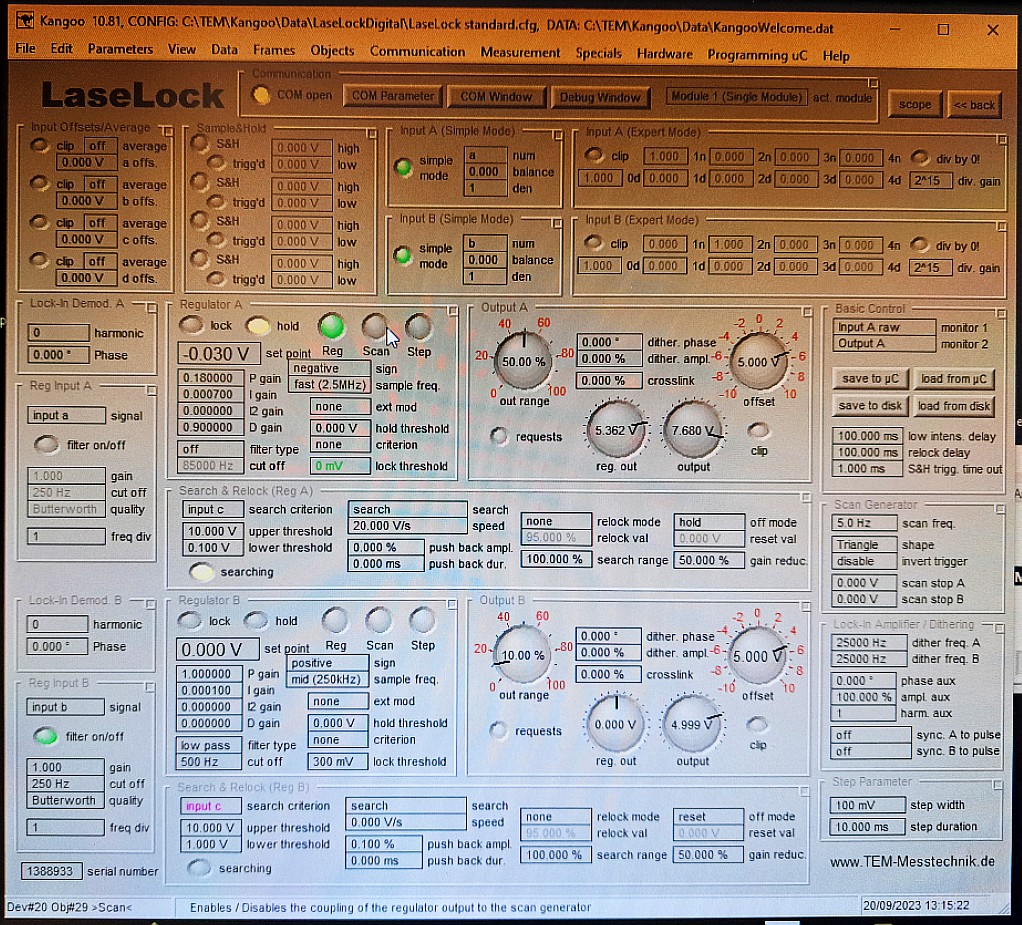
- I had to swap the sampling frequency of the Laselock from 250kHz to 2.5MHz to reduce the latency and improve the Slow feedback loop stability.
with the previous sampling frequency, the fast feedback loop was almost uneffective...
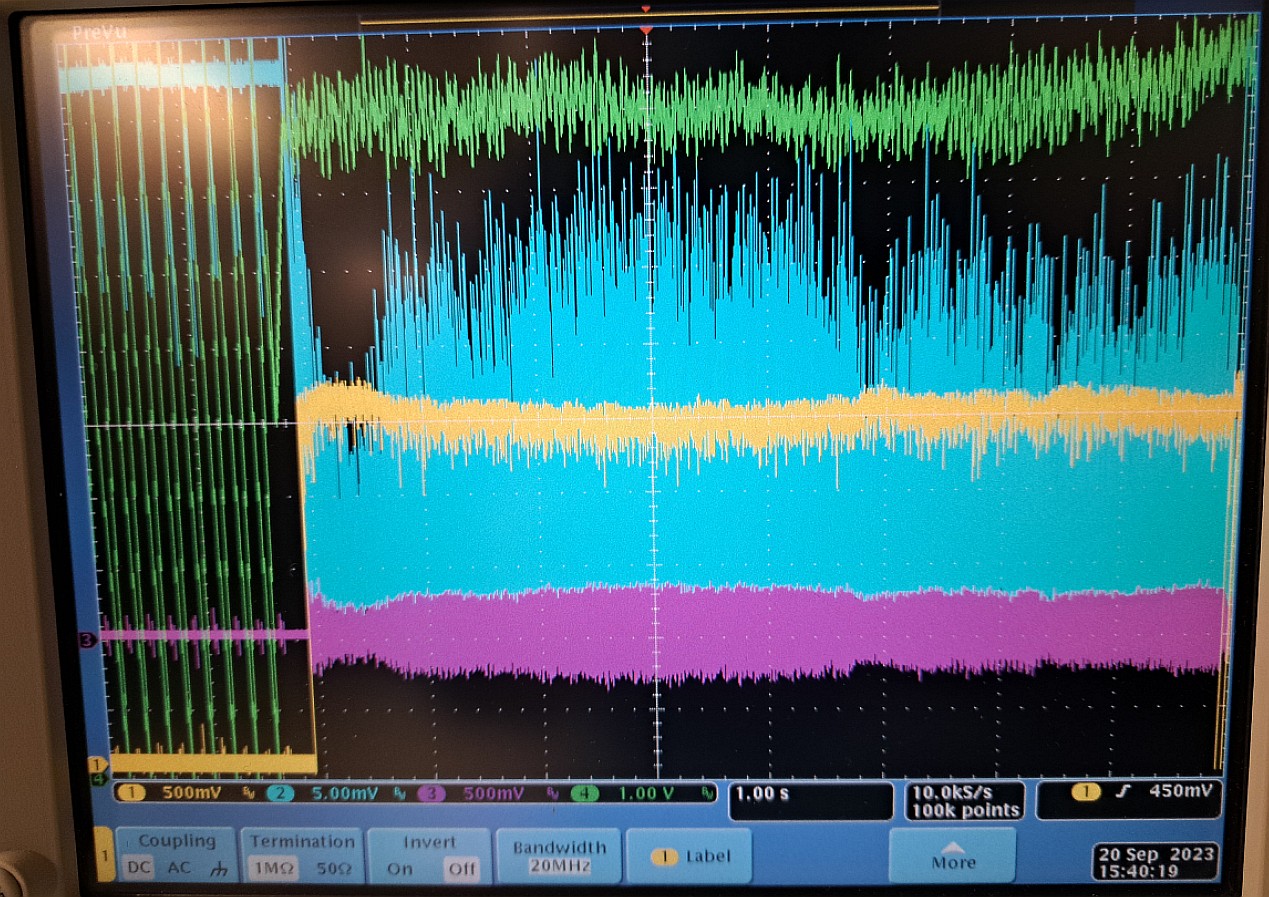
in attachement, the Laselock parameters and a picture of a lock.
yellow: FP-cavity transmission signal
blue : FP-cavity reflection signal
green: PZT signal
pink: PDH error signal
One has to move again the L-shape arm to remove the HOM
and check if we are able to lock in the same time the FP-cavity on the 500.25MHz reference oscillator... to be done this afternoon.
| Ronic Chiche wrote: |
|
it could be also an optical unstability, as when the intra-cavity power increases, the radius of curvatures of the mirrors increases too due to thermal effect, and then one could go in the instability region.
but if it was the case, by reducing the power in the FP-cavity, we would also reduce the thermal effect and then, we would come back in the stability region...
and it is not the case : the system is unstable even with 20kW instead of 40kW.
| Ronic Chiche wrote:kW |
|
this morning, we tried:
- to move a bit the arm of the L-shape off the beam axis (in case of it could have touch something and induce vibrations) => no effect
- to change the CEP to get an equivalent lower Finesse => weak improvement
- to add a diffuser in front of the PDH photodiode and check the saturation level after the FEMTO amplifier to avoid non linearity effects in the PDH signal => weak improvement
- to move the half and quarter waveplates in the incoming beam path => no effect
then, we have to work with the laser intracavity EOM to try to cancel high frequencies noise
| Ronic Chiche wrote: |
|
suddenly, BEFORE switching the HV amplifier ON and BEFORE connecting it to the EOM (in order to explore the HV effect on the EOM for the fast feedback loop),
we lost the lock between the laser and the FP-cavity: in attchement a plot a the lock with the "best" PID parameters.
- yellow: FP-cavity transmission signal
- green: PZT signal
- pink: PDH error signal
the lock was pretty "normal" except that we observed that the intra-cavity power is always slowly increasing from 40kW to ~44kW during a lock, all along this last week.
there are several possiblities for that :
- a slow increasing of the input power (we see the effect on the reflected signal when the FP-cavity is not locked)
- fluctuations of the CEP to the "good" value,
- or more supprisingly an improvement of the Finesse.
after this issue, we tried to change the laser input power (30% to 25%), or the change the CEP => we always get the same result => the lock is either too "weak" (not enough gain) or too "strong" (the system is unstable and goes in oscillations visible on the picture a the end of each lock period).
we tried to change the PID parameters quite a lot to try to compensate a change in the FP-cavity transfer function without any effect => impossible to have a proper lock as before.
we tried to check if the PDH phase, to produce a proper error signal, has changed => no, it was the good one.
we tried to correct the laser alignement to the FP-cavity, but it was more or less correct and we didn't see any change in the locking.
then, one possibility could be that one dust have been suddenly removed from the cavity mirrors by the high power and the Finesse suddenly increased substancially.
=> more Finesse => less bandwidth => high frequency noise are less "visible" in the error signal and we get less bandwith for the feedback => more difficult to lock.
we thought that this kind of problem could be solved by changing the CEP, but in this case, it didn't succeded to lock.
the other possibility is that just before having this issue, we were doing tests on the EOM with a 0-10V signal.
=> could it be possible that the static polarisation of the laser has changed ?
then, we would need to adjust the waveplates in the laser path to adjust the correct polarisation ?
=> not for sure... as the maximum transmitted power at the begining of the lock is the same as before... and compatible with ~ 43 - 44kW in the FP-cavity.
could it be also that the intermediate signals of the PDH scheme are saturated (because of the increasing power : 40kW to 44kW) and produce a "false" error signal leading to instability ?
or could it be a bug in the Laselock ?
=> we could restart it to confirm....
|
|
|
|
| Attachment 1: 20230920_131634.jpg
|  |
| Attachment 2: 20230920_131559.jpg
|  |
|