| ID |
Date |
Author |
Status |
Type |
Category |
Location |
Title |
|
217
|
Mon Apr 15 18:19:40 2024 |
Xinyi Lu | Fixed | info | lasers and optics | Optical room | Finesse measurement of 2-mirror cavity |
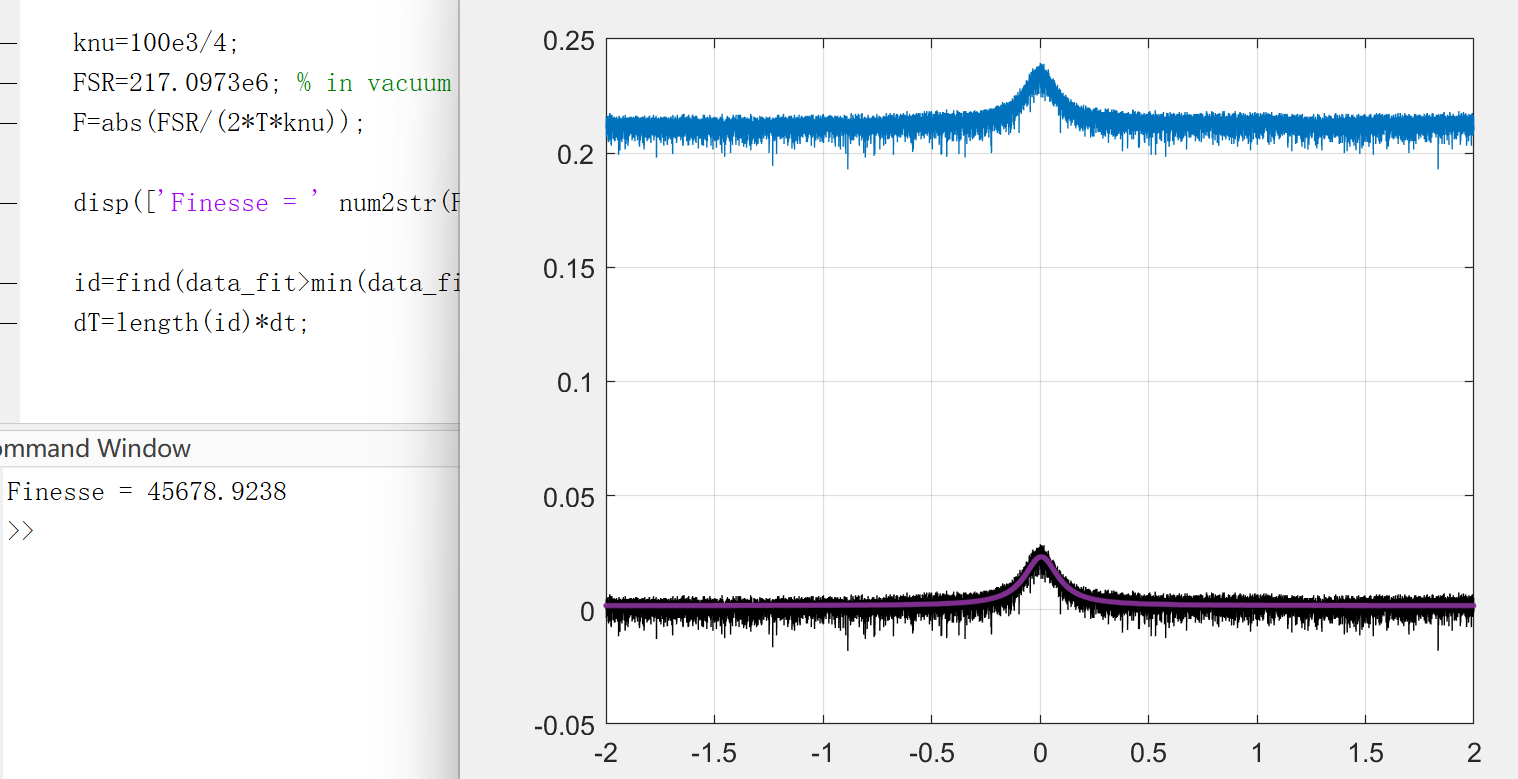
- Today Daniele and I cleaned the spherical mirror by wiping it with alcohol, and the finesse increased to 47k in air.
- After vacuuming, the final finesse is about 45k. The enhancement factor is expected to be 23k.
- Then we tuned the cavity length, FSR = 216.666 MHz. Aurélien helped us to install the menhir laser of 216 MHz.
- Tomorrow we will optimize the optical path and inject the laser into the fiber.
| Xinyi Lu wrote: |
|
Today Viktor and I completed the installation of the two-mirror cavity and managed to lock and measure the finesse.
- The finesse is 36k now (see figure 1). For the designed value of the mirror, the expected finesse is ~50k.
- The diameter of M2 transmission is 1.67 mm,1.65 mm (see figure 2).
- The installation process took a lot of time in orienting the PBS. In addition, we found that the cavity reflected beam and the window reflected beam would interfere (see figure 3). The small spot in the lower right corner is the window reflected light.
- We need to discuss whether the next step is to clean the mirrors or vacuum and move on.
| Xinyi Lu wrote: |
|
Today, Viktor and I started installing the two-mirror cavity.
- Firstly, we cleaned the environment and the dust counter showed good cleanliness
- After opening the cavity we tried to determine the source of the strange spot with a laser detection card and found that the beam was very close to the front edge of the longitudinal D-shaped mirror. In addition there was nothing else strange.
- The setup of the two-mirror cavity is shown in Figure 1. We have to use the menhir laser of 216MHz. The mirrors used are shown in Figure 2.
- We have installed the M2 and will continue the installation tomorrow.
|
|
|
| Attachment 1: finesse_45k.png
|
 |
|
214
|
Wed Apr 10 11:35:54 2024 |
Xinyi Lu | Fixed | info | lasers and optics | Optical room | Finesse measurement (35k) |
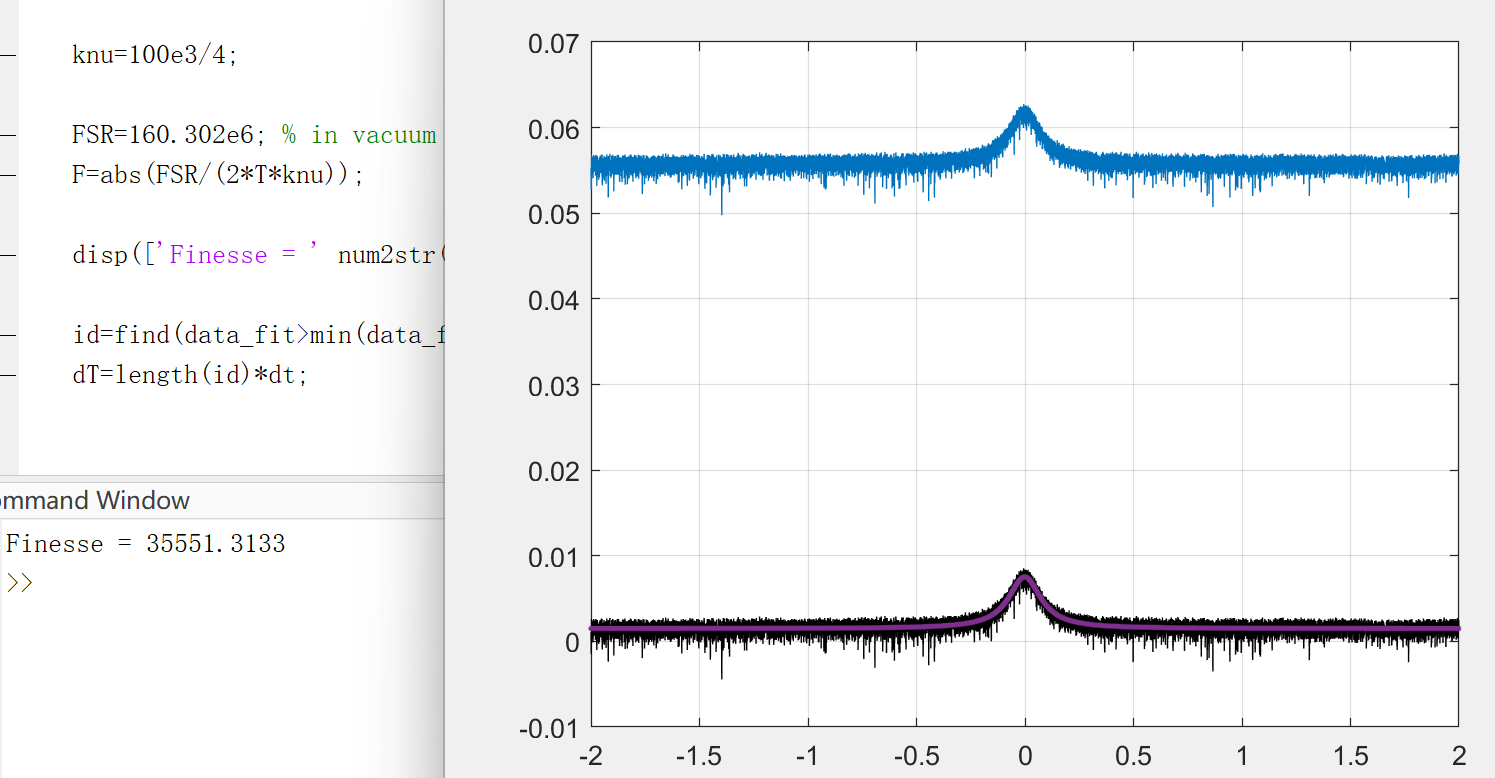
These days, Ronic, Aurélien and I use OEwaves CW laser to measure the finesse of SBOX. We made 5 measurements at 100kHz / 4s sweeps.
The finesse is around 35k (see Figure 1), corresponding to an enhancement factor of 14k.
In our experiments, we only saw up to 9k gain with 70% coupling, corresponding to an enhancement factor of 12.8k.
It could be because of the additional losses introduced by the high power, or the mirror became cleaner after the experiment......
Additionally, we found that the output of the OEwaves CW laser was not a perfect circle, with a depression at the edge of the circle. |
| Attachment 1: 5_measurements_of_finesse.png
|
 |
| Attachment 2: fit.png
|
 |
|
242
|
Thu Sep 4 17:52:03 2025 |
Alice Renaux | Under Process | report | lasers and optics | Optical room | Finesse measurement |
Today, with Ronic, we measured the finesse of the 2-mirror cavity witht the NKT CW laser.
We were able to perfrom the measurement only once, and the results of the measurement are attached to this note. We added sidebands to the laser spectrum peak thanks to an EOM, and we sweeped the modulation frequency on a 1MHz span around an estimated FSR of 216.63MHz in 10s. We found a 82kHz linewidth, hence a finesse of 2651. |
| Attachment 1: Figure_3.png
|
 |
|
243
|
Thu Sep 4 17:56:50 2025 |
Alice Renaux | Under Process | report | lasers and optics | Optical room | Finesse measurement |
(Finesse 2651 is consistent with that obtained from the mirrors' transmission coefficients, which is about 3100.)
| Alice Renaux wrote: |
|
Today, with Ronic, we measured the finesse of the 2-mirror cavity witht the NKT CW laser.
We were able to perfrom the measurement only once, and the results of the measurement are attached to this note. We added sidebands to the laser spectrum peak thanks to an EOM, and we sweeped the modulation frequency on a 1MHz span around an estimated FSR of 216.63MHz in 10s. We found a 82kHz linewidth, hence a finesse of 2651.
|
|
|
218
|
Tue Apr 16 18:38:04 2024 |
Xinyi Lu | Fixed | info | lasers and optics | Optical room | Fiber injection, spectrum and connection of 2nd stage amplifier |
Today, Daniele and I injected the laser into the fiber, installed the telescope, connected the second stage of the amplifier, and obtained resonances.
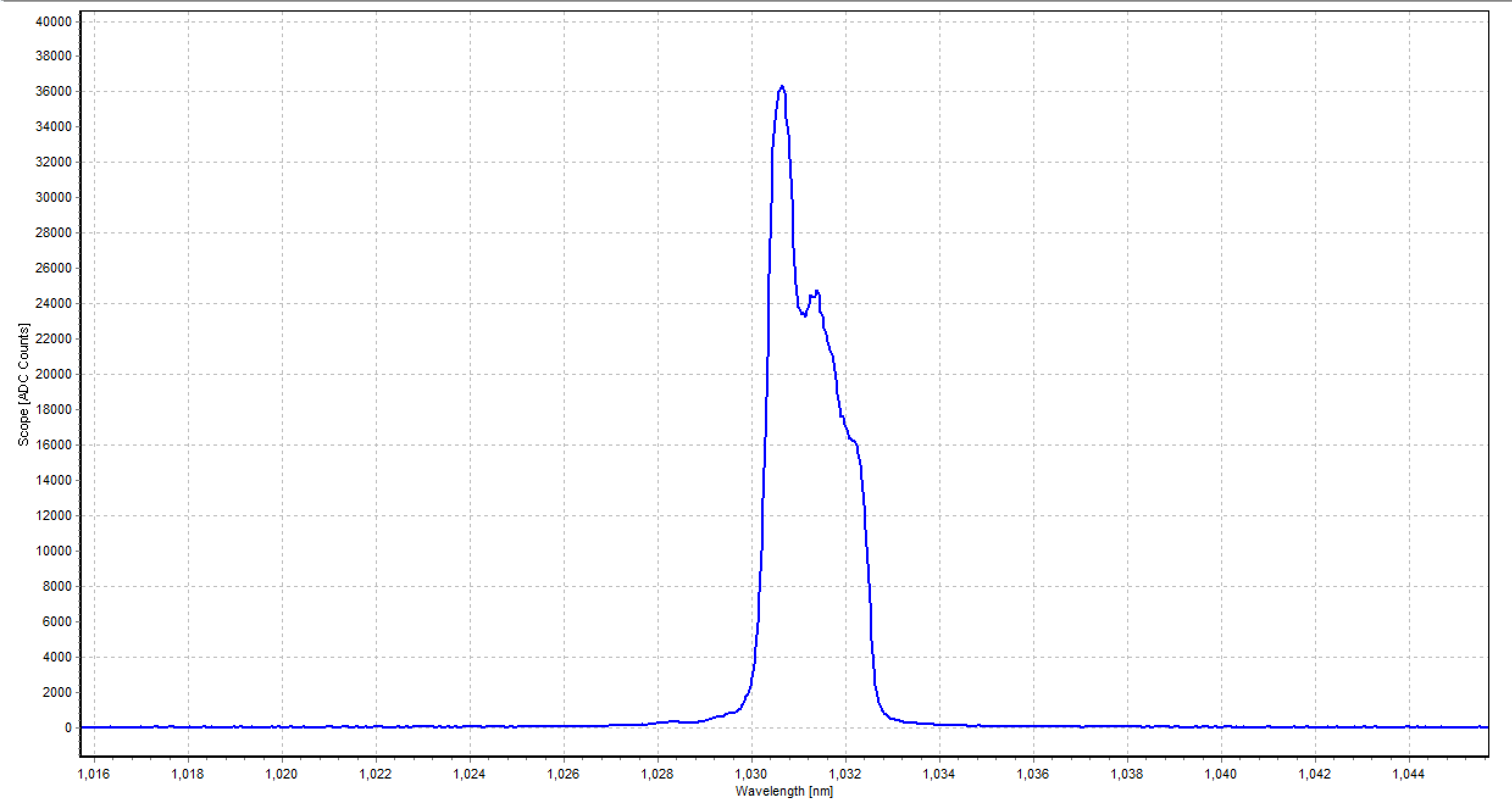
- The output power of the menhir laser @ 216MHz is 150mW, after CVBG is 28mW , 9.6mW injected into the fiber, and 1.6mW via AOM and EOM. This is not far from the minimum 1mW seed power required by the amplifier.
- The spectrum after CVBG is shown in Figure 1.
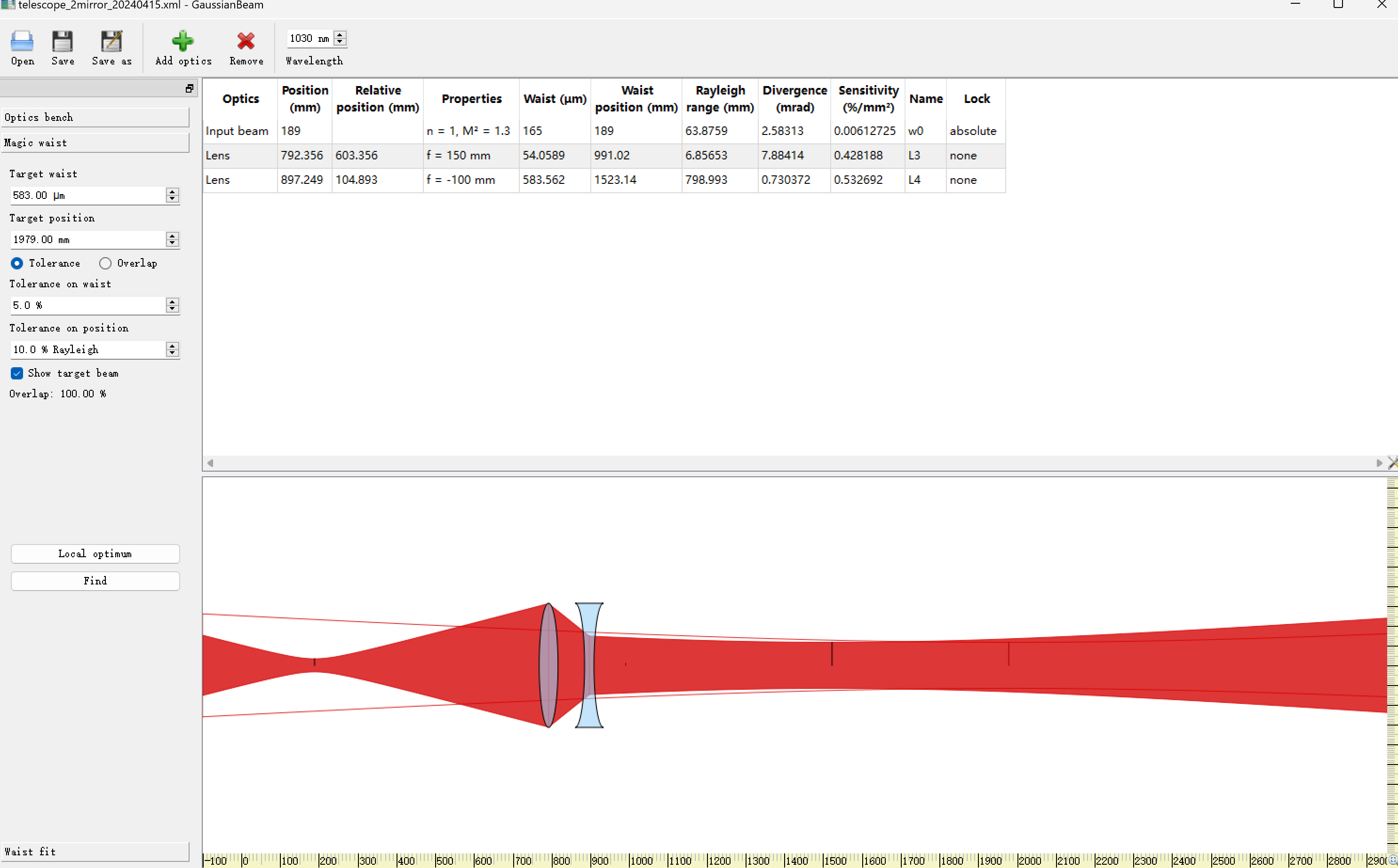
- The waist of this 2-mirror cavity is 0.583 mm, and the position is on the M1. A set of telescopes is designed and installed as in Figure 2.
- We injected the second stage of the amplifier into the cavity and obtained fundamental mode. Aurélien and I are trying to lock it. |
| Attachment 1: CVBG_inject_to_fiber.png
|
 |
| Attachment 2: telescope.png
|
 |
|
111
|
Tue Jul 12 10:07:05 2022 |
Manar Amer | Fixed | report | lasers and optics | detectors and electronics | Optical room | FSR change & Finesse Measurements |
The FSR of the 2 mirror (plan-spherical) Cavity was adjusted from 210 MHz to reach 216.643 MHz
it was done by having two reference irises, one at the injection point and one at the reflection
then changing the position of injection plan mirror to slightly closer distance and monitoring the reflection on the oscilloscope to be max.
The cavity modes were still seen, and we had to only improve the injection alignment after.
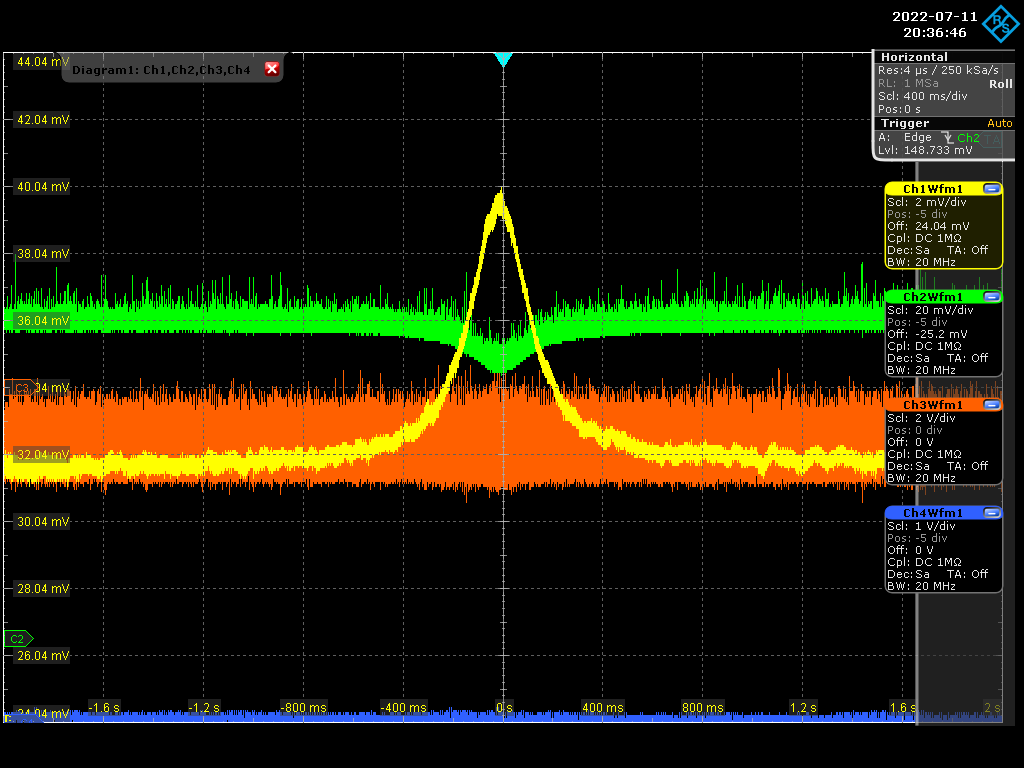
Me and Ronic locked in air and measured the Finesse, which was bigger by ~ 20%
average Finesse = 30208.53614
FWHM (KHz) = 7.0179
Finesse = 30869.9522
FWHM (KHz) = 7.1257
Finesse = 30403.005
FWHM (KHz) = 7.1287
Finesse = 30390.4014
FWHM (KHz) = 7.2884
Finesse = 29724.5531
FWHM (KHz) = 7.3055
Finesse = 29654.769
| Manar Amer wrote: |
|
Update for Finesse measurement, The cavity was put under vacuum ~ 1.1*10^-1 mbar
and the alignment and coupling improved.
FSR = 210.1 MHz
Average Finesse = 25686.46222
FWHM (KHz) = 8.2387
Finesse = 25501.5659
FWHM (KHz) = 8.2028
Finesse = 25613.2858
FWHM (KHz) = 8.0978
Finesse = 25945.3289
FWHM (KHz) = 8.1744
Finesse = 25702.3142
FWHM (KHz) = 8.1847
Finesse = 25669.8163
Concluded from Ronic's calculations, this could be the maximum finesse we might be able to obtain with this setup
with Gain ~ 8000
On Monday we adjust the frequency to match 2160.66 MHz and lock the Pulsed,
at the same time start we start with the CELIA amplifier.
| Manar Amer wrote: |
|
The cavity was realigned using irises instead of pinholes, gave a better alignment.
The inside of the box, the spherical and the injection mirror were cleaned and placed back inside the box.
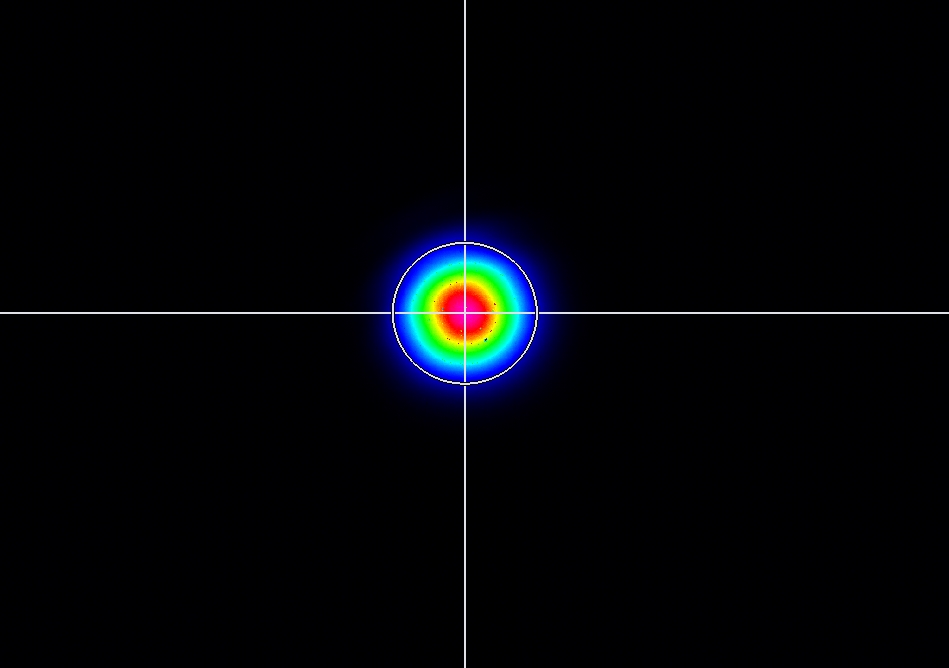
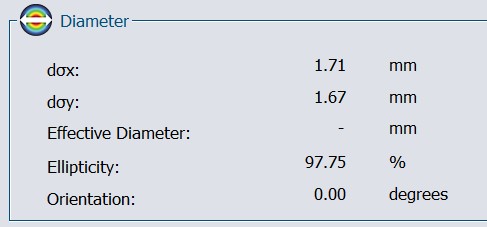
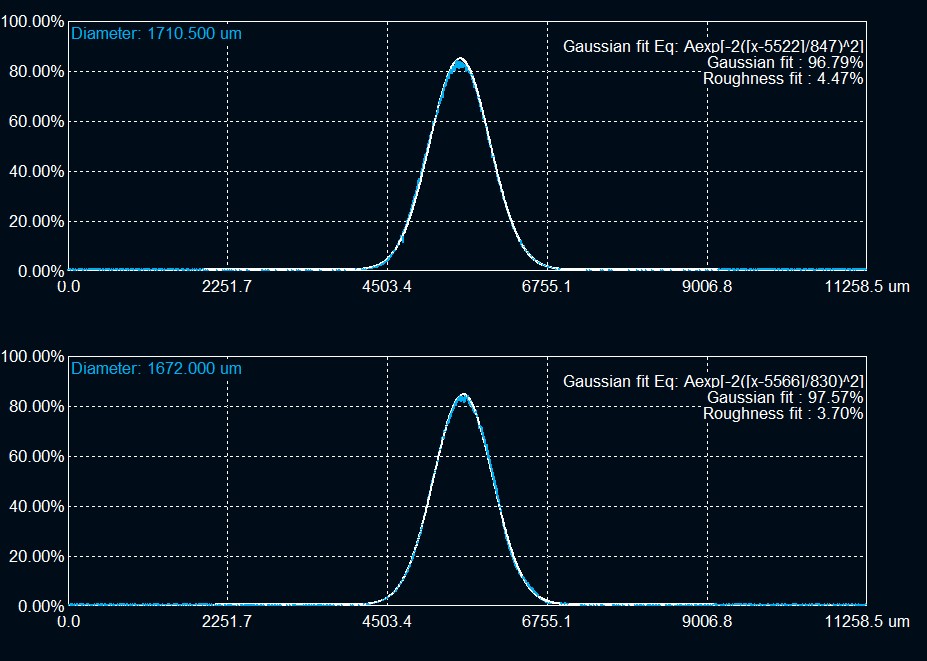
we see beating of fundamental mode, previously at the transmission point we placed a wedge to split the beam which resulted in an elliptical mode
we removed it and placed a very thin beam splitter, the beam is circular now.
The cavity was locked in air at a coupling of ~ 60-70 %
Finesse and line width measured five readings with a Finesse average 25095.08884 of a Gain ~ 8000
FWHM (KHz) = 8.2928
Finesse = 25323.0544
FWHM (KHz) = 7.9202
Finesse = 26514.4395
FWHM (KHz) = 8.5834
Finesse = 24465.8636
FWHM (KHz) = 8.4571
Finesse = 24831.2419
FWHM (KHz) = 8.6275
Finesse = 24340.8448
Theoretical and expected Finesse for the 2 mirror setup with the losses is calculated by Ronic for comparison between four and 2 mirror setup.
| Manar Amer wrote: |
|
The SBox cavity setup was changed to have only 2 mirrors M1 plane and M2 spherical, both from ThomX
Distance between the mirror ~ 72 cm , increased from 70 cm to take into account the thickness of the ThomX mirrors
Two lenses (300 mm @ 50 cm , 200 @ 104 cm) were placed to have the beam radius ~ 0.55 mm.
The cavity was locked with a coupling of 60 %, for Finesse measurement the sweep was taken over 100 KHz of 2 seconds.
FSR ~ 210.00 MHz, line width ~ 8.56 KHz, Finesse ~ 24 500 .
|
|
|
|
| Attachment 1: 00mode.jpg
|
 |
| Attachment 2: 00mode_diameter.jpg
|
 |
| Attachment 3: 00mode_diameter_fit.jpg
|
 |
|
112
|
Tue Jul 12 10:19:30 2022 |
Manar Amer | Fixed | report | lasers and optics | detectors and electronics | Optical room | FSR change & Finesse Measurements |
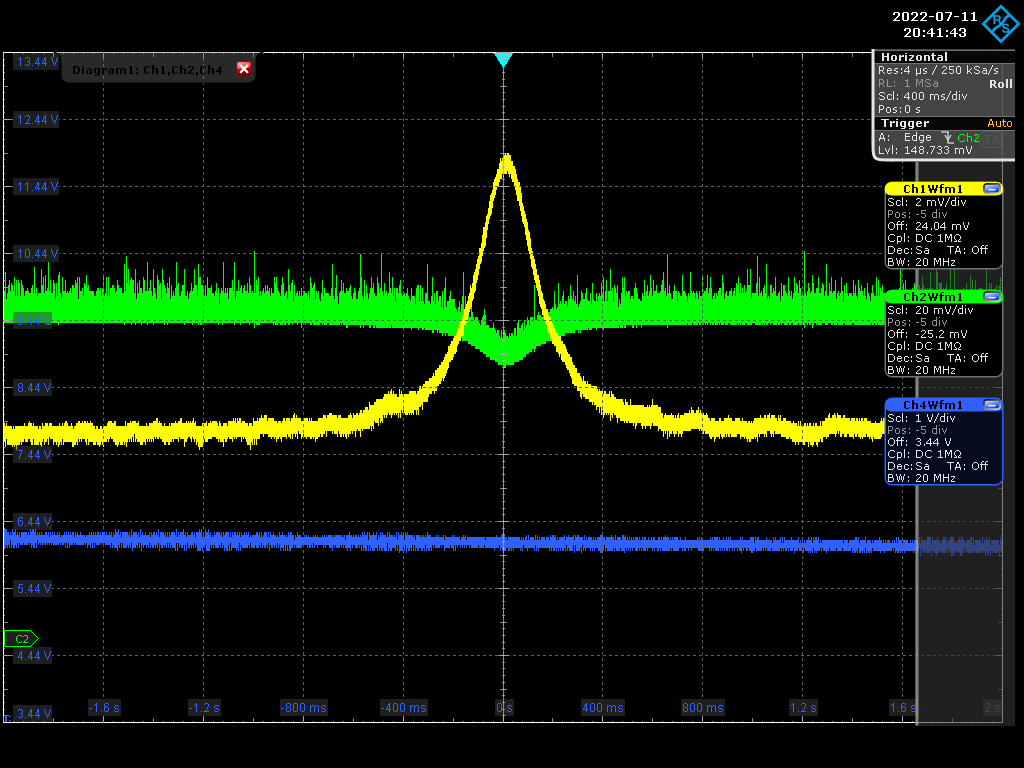
Yesterday evening the cavity was Vacuum pumped up to pressure of 5.5*10^-2 and locked
changed FSR to be 216.662 MHz and alignment a little and measured the Finesse
in Vacuum we have average Finesse = 30341.6265
FWHM (KHz) = 7.0592
Finesse = 30692.1961
FWHM (KHz) = 7.2186
Finesse = 30014.556
FWHM (KHz) = 7.1051
Finesse = 30493.7635
FWHM (KHz) = 7.1079
Finesse = 30481.9812
FWHM (KHz) = 7.1413
Finesse = 30339.2695
FWHM (KHz) = 7.1624
Finesse = 30249.776
FWHM (KHz) = 7.0239
Finesse = 30846.2719
FWHM (KHz) = 7.2614
Finesse = 29837.6477
FWHM (KHz) = 7.1935
Finesse = 30119.1768
| Manar Amer wrote: |
|
The FSR of the 2 mirror (plan-spherical) Cavity was adjusted from 210 MHz to reach 216.643 MHz
it was done by having two reference irises, one at the injection point and one at the reflection
then changing the position of injection plan mirror to slightly closer distance and monitoring the reflection on the oscilloscope to be max.
The cavity modes were still seen, and we had to only improve the injection alignment after.
Me and Ronic locked in air and measured the Finesse, which was bigger by ~ 20%
average Finesse = 30208.53614
FWHM (KHz) = 7.0179
Finesse = 30869.9522
FWHM (KHz) = 7.1257
Finesse = 30403.005
FWHM (KHz) = 7.1287
Finesse = 30390.4014
FWHM (KHz) = 7.2884
Finesse = 29724.5531
FWHM (KHz) = 7.3055
Finesse = 29654.769
| Manar Amer wrote: |
|
Update for Finesse measurement, The cavity was put under vacuum ~ 1.1*10^-1 mbar
and the alignment and coupling improved.
FSR = 210.1 MHz
Average Finesse = 25686.46222
FWHM (KHz) = 8.2387
Finesse = 25501.5659
FWHM (KHz) = 8.2028
Finesse = 25613.2858
FWHM (KHz) = 8.0978
Finesse = 25945.3289
FWHM (KHz) = 8.1744
Finesse = 25702.3142
FWHM (KHz) = 8.1847
Finesse = 25669.8163
Concluded from Ronic's calculations, this could be the maximum finesse we might be able to obtain with this setup
with Gain ~ 8000
On Monday we adjust the frequency to match 2160.66 MHz and lock the Pulsed,
at the same time start we start with the CELIA amplifier.
| Manar Amer wrote: |
|
The cavity was realigned using irises instead of pinholes, gave a better alignment.
The inside of the box, the spherical and the injection mirror were cleaned and placed back inside the box.
we see beating of fundamental mode, previously at the transmission point we placed a wedge to split the beam which resulted in an elliptical mode
we removed it and placed a very thin beam splitter, the beam is circular now.
The cavity was locked in air at a coupling of ~ 60-70 %
Finesse and line width measured five readings with a Finesse average 25095.08884 of a Gain ~ 8000
FWHM (KHz) = 8.2928
Finesse = 25323.0544
FWHM (KHz) = 7.9202
Finesse = 26514.4395
FWHM (KHz) = 8.5834
Finesse = 24465.8636
FWHM (KHz) = 8.4571
Finesse = 24831.2419
FWHM (KHz) = 8.6275
Finesse = 24340.8448
Theoretical and expected Finesse for the 2 mirror setup with the losses is calculated by Ronic for comparison between four and 2 mirror setup.
| Manar Amer wrote: |
|
The SBox cavity setup was changed to have only 2 mirrors M1 plane and M2 spherical, both from ThomX
Distance between the mirror ~ 72 cm , increased from 70 cm to take into account the thickness of the ThomX mirrors
Two lenses (300 mm @ 50 cm , 200 @ 104 cm) were placed to have the beam radius ~ 0.55 mm.
The cavity was locked with a coupling of 60 %, for Finesse measurement the sweep was taken over 100 KHz of 2 seconds.
FSR ~ 210.00 MHz, line width ~ 8.56 KHz, Finesse ~ 24 500 .
|
|
|
|
|
| Attachment 1: Screenshot_2022-07-11_1_204143.png
|
 |
| Attachment 2: Screenshot_2022-07-11_0_203646.png
|
 |
|
113
|
Tue Jul 12 14:41:55 2022 |
Manar Amer | Fixed | report | lasers and optics | detectors and electronics | Optical room | FSR change & Finesse Measurements |
a Finesse of 30k with the present mirrors :
T1=120 ppm ;A1=(2.6+1) ppm;
T2=1.5 ppm ;A2=(4.5+0.27) ppm;
corresponds to 39 ppm of additional losses for each mirror and a theoretical gain of about 11k.
| Manar Amer wrote: |
|
Yesterday evening the cavity was Vacuum pumped up to pressure of 5.5*10^-2 and locked
changed FSR to be 216.662 MHz and alignment a little and measured the Finesse
in Vacuum we have average Finesse = 30341.6265
FWHM (KHz) = 7.0592
Finesse = 30692.1961
FWHM (KHz) = 7.2186
Finesse = 30014.556
FWHM (KHz) = 7.1051
Finesse = 30493.7635
FWHM (KHz) = 7.1079
Finesse = 30481.9812
FWHM (KHz) = 7.1413
Finesse = 30339.2695
FWHM (KHz) = 7.1624
Finesse = 30249.776
FWHM (KHz) = 7.0239
Finesse = 30846.2719
FWHM (KHz) = 7.2614
Finesse = 29837.6477
FWHM (KHz) = 7.1935
Finesse = 30119.1768
| Manar Amer wrote: |
|
The FSR of the 2 mirror (plan-spherical) Cavity was adjusted from 210 MHz to reach 216.643 MHz
it was done by having two reference irises, one at the injection point and one at the reflection
then changing the position of injection plan mirror to slightly closer distance and monitoring the reflection on the oscilloscope to be max.
The cavity modes were still seen, and we had to only improve the injection alignment after.
Me and Ronic locked in air and measured the Finesse, which was bigger by ~ 20%
average Finesse = 30208.53614
FWHM (KHz) = 7.0179
Finesse = 30869.9522
FWHM (KHz) = 7.1257
Finesse = 30403.005
FWHM (KHz) = 7.1287
Finesse = 30390.4014
FWHM (KHz) = 7.2884
Finesse = 29724.5531
FWHM (KHz) = 7.3055
Finesse = 29654.769
| Manar Amer wrote: |
|
Update for Finesse measurement, The cavity was put under vacuum ~ 1.1*10^-1 mbar
and the alignment and coupling improved.
FSR = 210.1 MHz
Average Finesse = 25686.46222
FWHM (KHz) = 8.2387
Finesse = 25501.5659
FWHM (KHz) = 8.2028
Finesse = 25613.2858
FWHM (KHz) = 8.0978
Finesse = 25945.3289
FWHM (KHz) = 8.1744
Finesse = 25702.3142
FWHM (KHz) = 8.1847
Finesse = 25669.8163
Concluded from Ronic's calculations, this could be the maximum finesse we might be able to obtain with this setup
with Gain ~ 8000
On Monday we adjust the frequency to match 2160.66 MHz and lock the Pulsed,
at the same time start we start with the CELIA amplifier.
| Manar Amer wrote: |
|
The cavity was realigned using irises instead of pinholes, gave a better alignment.
The inside of the box, the spherical and the injection mirror were cleaned and placed back inside the box.
we see beating of fundamental mode, previously at the transmission point we placed a wedge to split the beam which resulted in an elliptical mode
we removed it and placed a very thin beam splitter, the beam is circular now.
The cavity was locked in air at a coupling of ~ 60-70 %
Finesse and line width measured five readings with a Finesse average 25095.08884 of a Gain ~ 8000
FWHM (KHz) = 8.2928
Finesse = 25323.0544
FWHM (KHz) = 7.9202
Finesse = 26514.4395
FWHM (KHz) = 8.5834
Finesse = 24465.8636
FWHM (KHz) = 8.4571
Finesse = 24831.2419
FWHM (KHz) = 8.6275
Finesse = 24340.8448
Theoretical and expected Finesse for the 2 mirror setup with the losses is calculated by Ronic for comparison between four and 2 mirror setup.
| Manar Amer wrote: |
|
The SBox cavity setup was changed to have only 2 mirrors M1 plane and M2 spherical, both from ThomX
Distance between the mirror ~ 72 cm , increased from 70 cm to take into account the thickness of the ThomX mirrors
Two lenses (300 mm @ 50 cm , 200 @ 104 cm) were placed to have the beam radius ~ 0.55 mm.
The cavity was locked with a coupling of 60 %, for Finesse measurement the sweep was taken over 100 KHz of 2 seconds.
FSR ~ 210.00 MHz, line width ~ 8.56 KHz, Finesse ~ 24 500 .
|
|
|
|
|
|
|
32
|
Tue Dec 10 09:36:56 2019 |
Ronic Chiche | Fixed | info | lasers and optics | Optical room | FSR and Finesse measurement |
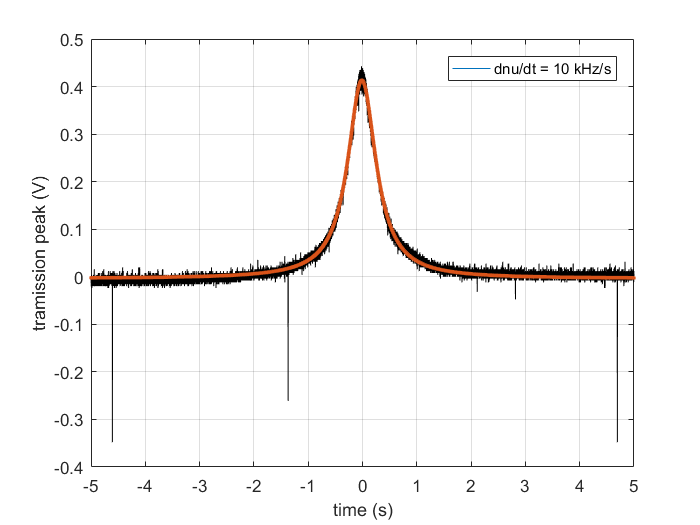
Yesterday the cavity has been aligned and locked with the CW Koheras laser.
the FSR has been measured by modulation technique at 133.344MHz at 1mbar pressure in the cavity.
the polarization has to be optimized for the Finesse measurement otherwise, some "shoulders" appear beside the Airy peak and reduce Finesse fit.
once it is done, 3 consecutive measurements give an average Finesse of 20800. |
| Attachment 1: untitled.png
|
 |
|
181
|
Tue Jan 16 18:42:42 2024 |
Xinyi Lu | Fixed | info | lasers and optics | Optical room | FSR and Finesse measurement |
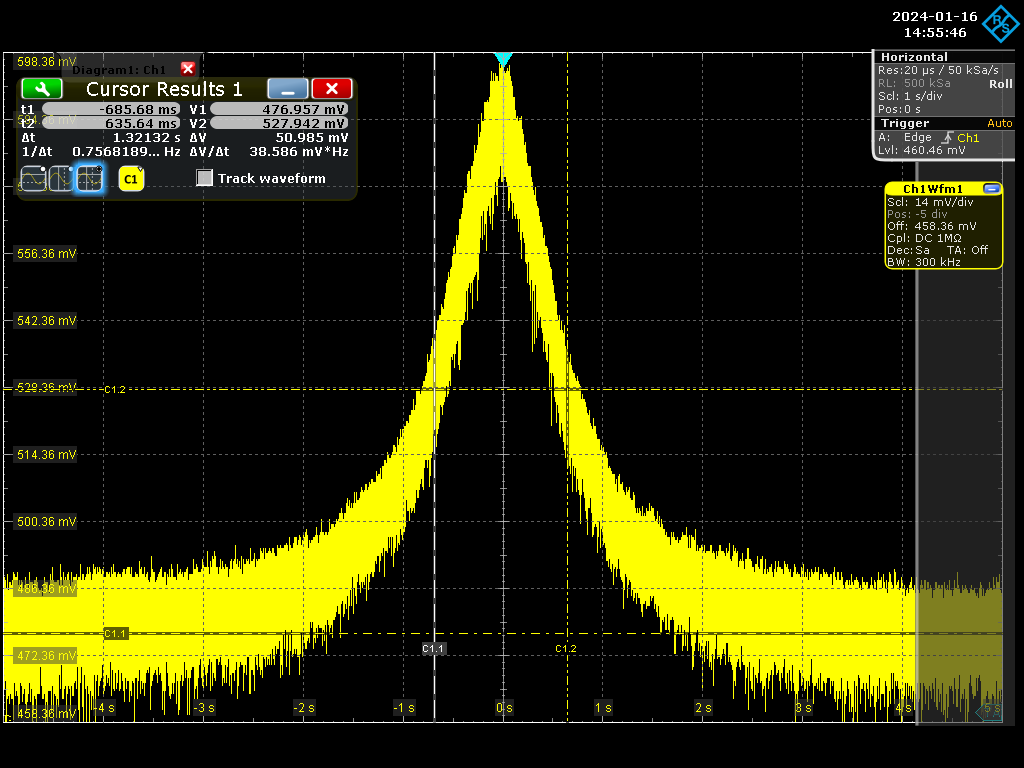
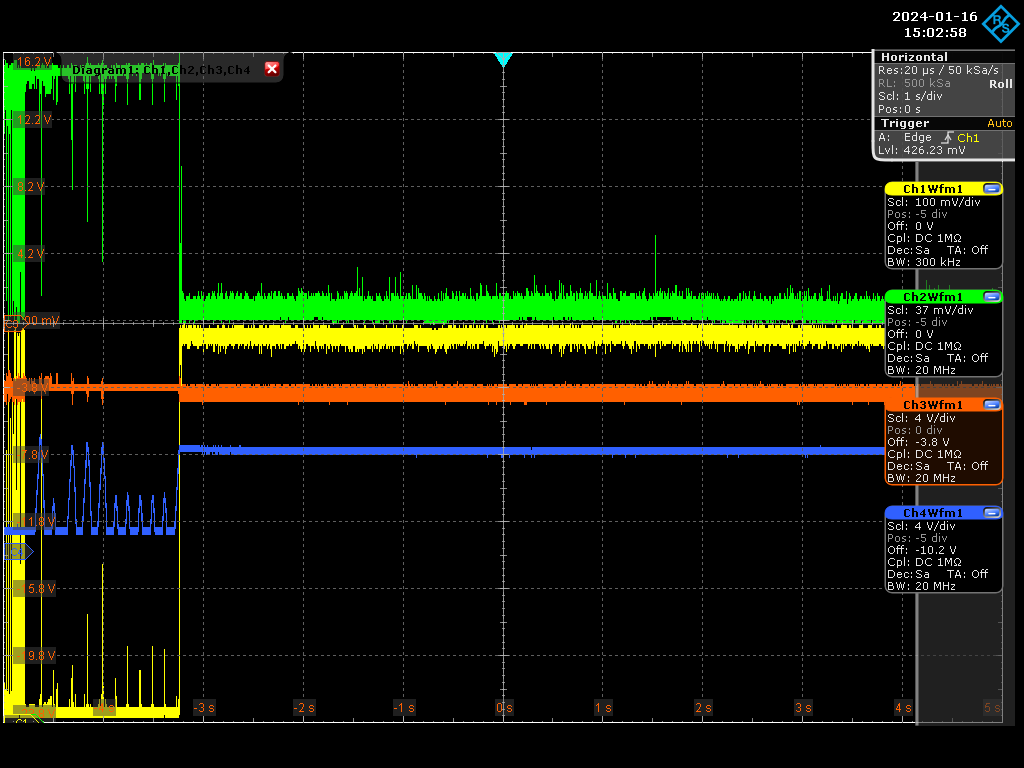
- Today, Ronic and I measured the finesse and FSR after optimizing the locking. FSR was adjusted to 160.27 MHz to match the pulsed laser repetition rate. The finesse was 3029.
Note: It's now CW laser injected, SBOX's old mirrors. There are lots of dust on the old mirrors without cleaning.
- Then we cleaned the cavity inside and outside, and removed four mirrors.
- Tomorrow we will check the clean condition and install new mirrors if we can. Before installation, it may be helpful to discuss how to minimize the introduction of dust. |
| Attachment 1: Screenshot_2024-01-16_2_145546.png
|
 |
| Attachment 2: Screenshot_2024-01-16_4_150258.png
|
 |
|
67
|
Wed Mar 23 18:11:22 2022 |
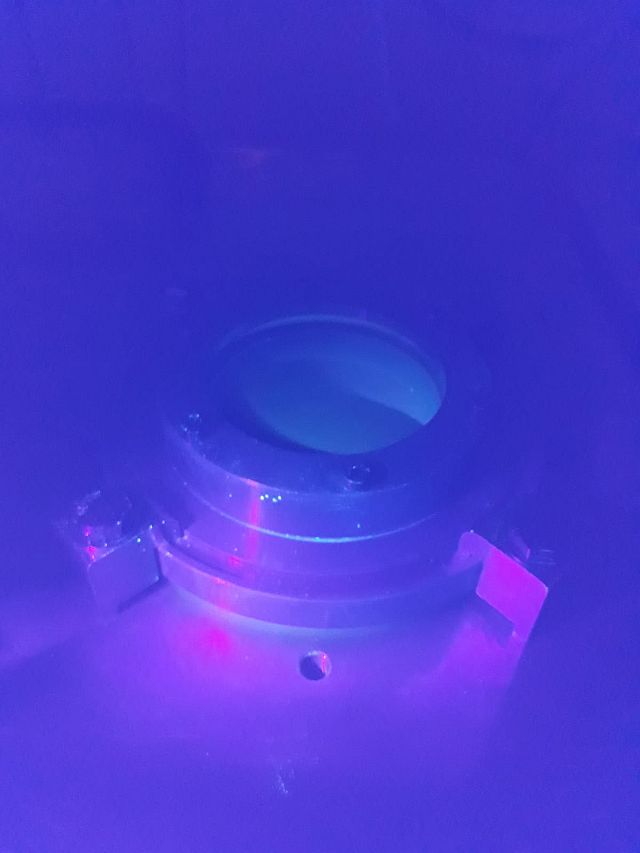
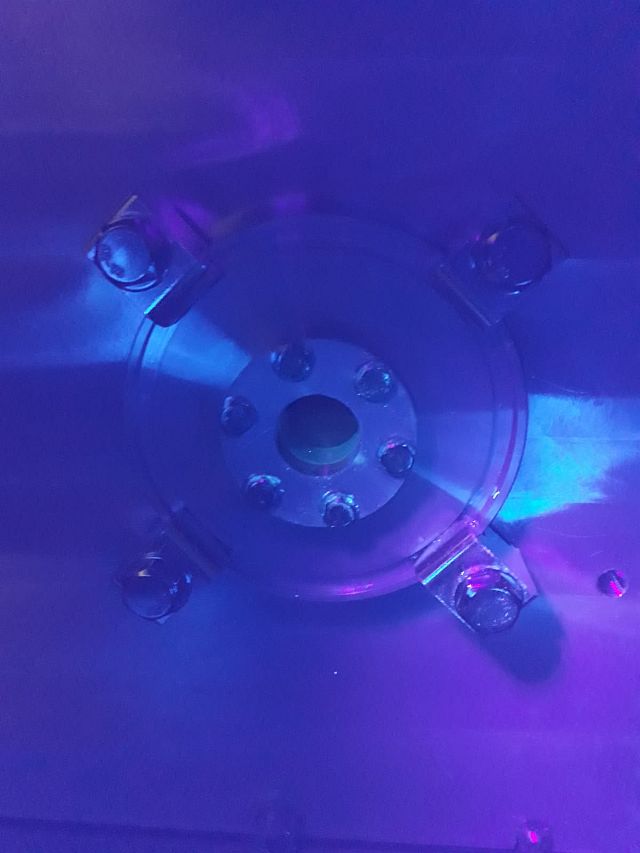
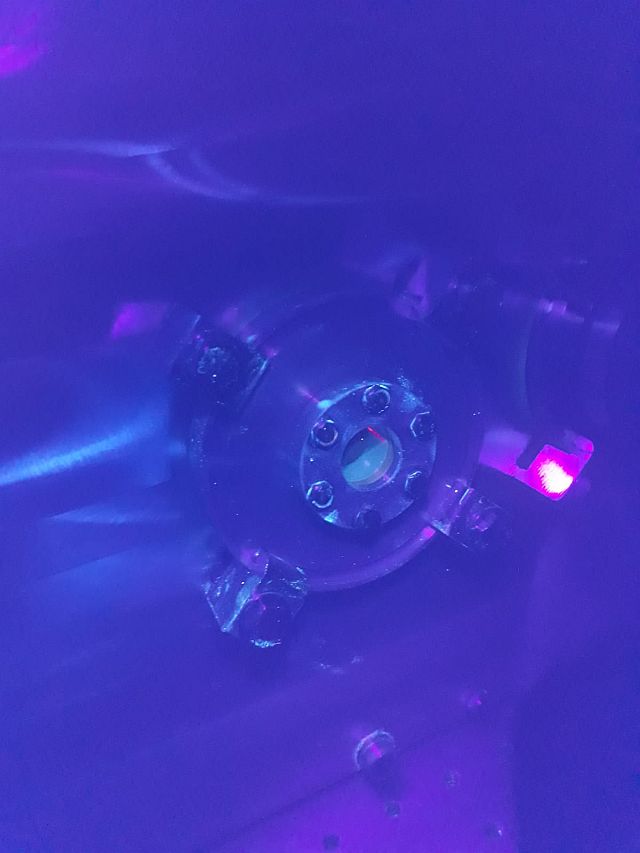
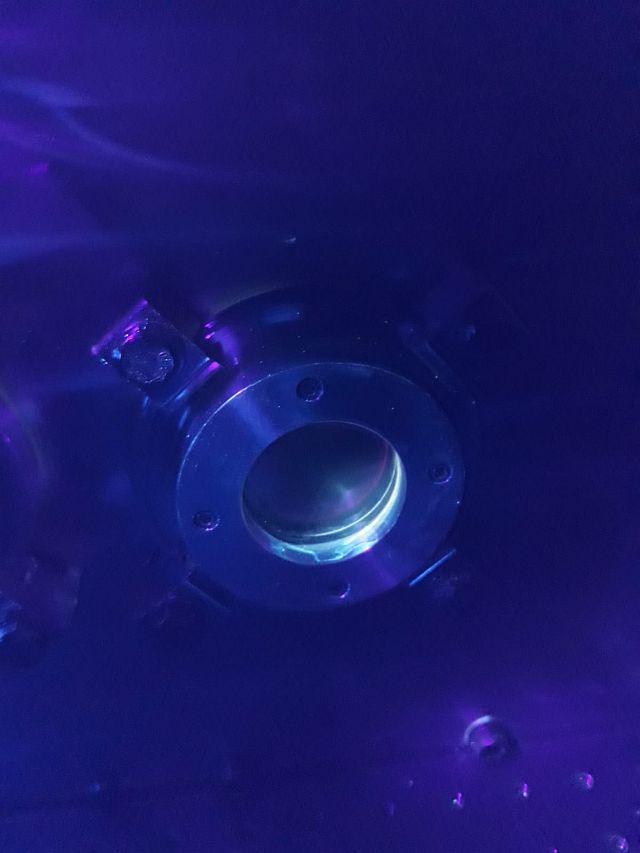
Manar Amer | Fixed | report | utilities | Optical room | Dust Cleaning of SBox |
An Initial cleaning of the KBoX outside was done, All the optics and mechanics placed that were on the table were removed.
Only the old Mitylaser amplifier remains on the table.
Since we will be using the ThomX Celia amplifier, we will remove it and place it in a secure location (to be decided).
Tomorrow a cleaning of the inside of the cavity box is to be done. |
| Attachment 1: Log_Top_window.jpg
|
 |
| Attachment 2: Log_Reflection_window.jpg
|
 |
| Attachment 3: Log_Injection_Side_window.jpg
|
 |
| Attachment 4: Log_Injection_side_window2.jpg
|
 |
|
68
|
Wed Mar 23 18:17:45 2022 |
Manar Amer | Fixed | report | utilities | Optical room | Dust Cleaning of SBox |
The cleaning was done twice with half an hour interval between the two times
reading on the dust meter was taken after each time, and it was zero averaged over a 10-min
| Manar Amer wrote: |
|
An Initial cleaning of the KBoX outside was done, All the optics and mechanics placed that were on the table were removed.
Only the old Mitylaser amplifier remains on the table.
Since we will be using the ThomX Celia amplifier, we will remove it and place it in a secure location (to be decided).
Tomorrow a cleaning of the inside of the cavity box is to be done.
|
|
|
71
|
Wed Mar 30 18:53:01 2022 |
Manar Amer | Fixed | report | mechanics | lasers and optics | utilities | Optical room | Dust Cleaning of SBox |
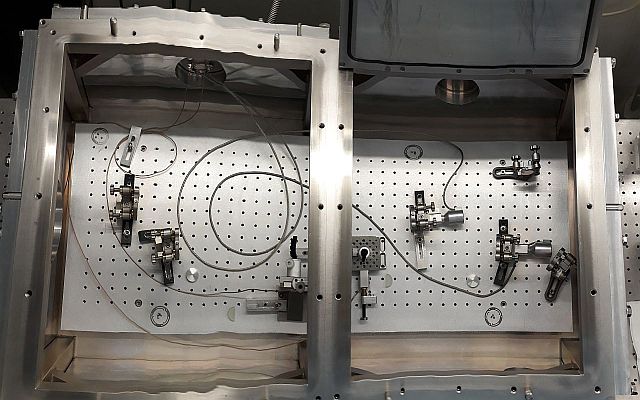
The inside of the cavity was cleaned today. It was very dirty and had big dust particles and fibers inside.
Cleaning was done for everything; wall, floor, fixed mounts, wires (still have some dust difficult to remove), edges.
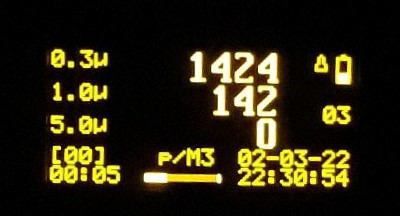
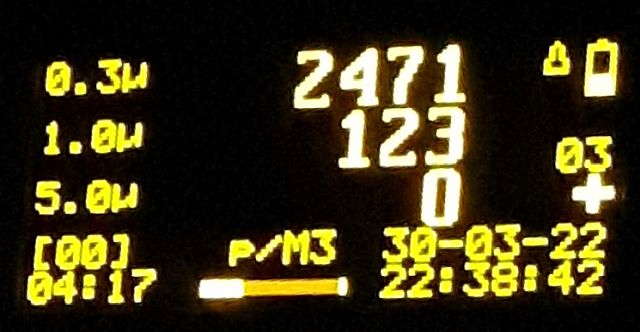
The dust meter average was measured outside the cavity (2471 p/m3 av 6 min) and inside after cleaning (1424 p/m3 av 10 min).
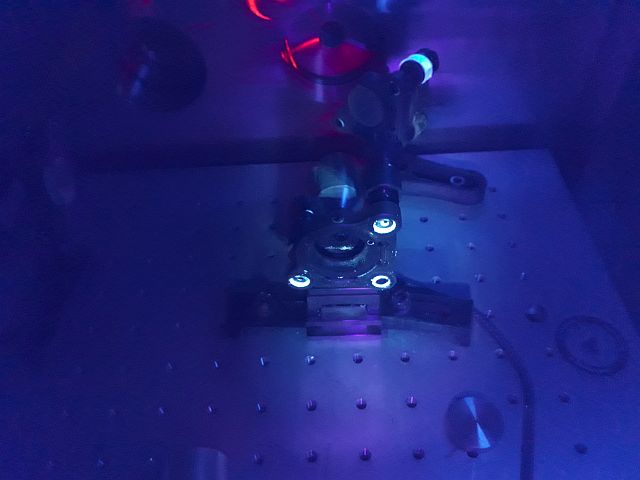
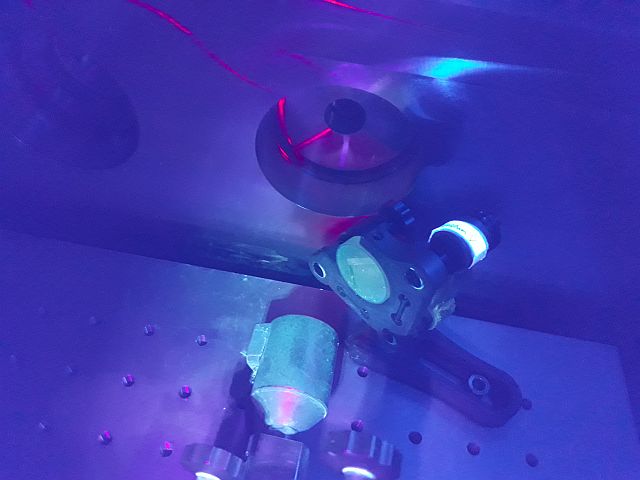
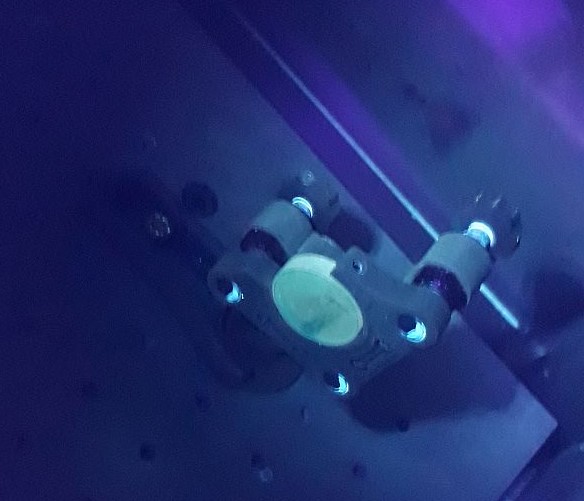
The cavity was left open under the clean air flow, will observe it under UV, clean and measure Dust tomorrow.
Images attached are after cleaning.
Objects inside the cavity at the moment :
- 4 main mirror mounts
- 4 mirror fixers on mounts and 3 screws each (total 12)
- 2 reflecting mirror mounts
- 2 dielectric mirrors (mounted and to be cleaned)
- two mounts for D-shaped mirrors.
- 2 D-shaped mirrors (unmounted, and they will need cleaning)
- 2 metal irises (pinholes)
| Manar Amer wrote: |
|
The cleaning was done twice with half an hour interval between the two times
reading on the dust meter was taken after each time, and it was zero averaged over a 10-min
| Manar Amer wrote: |
|
An Initial cleaning of the KBoX outside was done, All the optics and mechanics placed that were on the table were removed.
Only the old Mitylaser amplifier remains on the table.
Since we will be using the ThomX Celia amplifier, we will remove it and place it in a secure location (to be decided).
Tomorrow a cleaning of the inside of the cavity box is to be done.
|
|
|
| Attachment 1: 20220330_SBox_Inside_Cavity_Box.jpg
|
 |
| Attachment 2: 20220330_Injection_Mount_UV.jpg
|
 |
| Attachment 3: 20220330_Reflection_One_UV.jpg
|
 |
| Attachment 4: 20220330_Reflection_two_UV.jpg
|
 |
| Attachment 5: 20220330_Dust_Meter_Inside_cavity_Av10min.jpg
|
 |
| Attachment 6: 20220330_Dust_Meter_Outside_cavity_Av6min.jpg
|
 |
|
72
|
Thu Mar 31 13:29:01 2022 |
Manar Amer | Fixed | report | mechanics | lasers and optics | utilities | Optical room | Dust Cleaning of SBox |
After an overnight where the cavity box was left open, a measurement of the Dust meter was taken:
Outside on the optical table on direct air flux (1701 p/m3 Av 10 min) and
Inside the cavity box (998 p/m3 Av 10 min)
The dust inside the cavity has decreased by ~ 30 % for 0.3 u particles.
Note: the cavity box is still open.
| Manar Amer wrote: |
|
The inside of the cavity was cleaned today. It was very dirty and had big dust particles and fibers inside.
Cleaning was done for everything; wall, floor, fixed mounts, wires (still have some dust difficult to remove), edges.
The dust meter average was measured outside the cavity (2471 p/m3 av 6 min) and inside after cleaning (1424 p/m3 av 10 min).
The cavity was left open under the clean air flow, will observe it under UV, clean and measure Dust tomorrow.
Images attached are after cleaning.
Objects inside the cavity at the moment :
- 4 main mirror mounts
- 4 mirror fixers on mounts and 3 screws each (total 12)
- 2 reflecting mirror mounts
- 2 dielectric mirrors (mounted and to be cleaned)
- two mounts for D-shaped mirrors.
- 2 D-shaped mirrors (unmounted, and they will need cleaning)
- 2 metal irises (pinholes)
| Manar Amer wrote: |
|
The cleaning was done twice with half an hour interval between the two times
reading on the dust meter was taken after each time, and it was zero averaged over a 10-min
| Manar Amer wrote: |
|
An Initial cleaning of the KBoX outside was done, All the optics and mechanics placed that were on the table were removed.
Only the old Mitylaser amplifier remains on the table.
Since we will be using the ThomX Celia amplifier, we will remove it and place it in a secure location (to be decided).
Tomorrow a cleaning of the inside of the cavity box is to be done.
|
|
|
|
| Attachment 1: 20220331_Dust_Meter_Outside_cavity_Av10min.jpg
|
 |
| Attachment 2: 20220331_Dust_Meter_Inside_cavity_Av10min.jpg
|
 |
|
103
|
Wed Jul 6 18:37:02 2022 |
Manar Amer | Fixed | report | lasers and optics | Optical room | Divergence of the CW beam after collimator |
Closing the series of the telescope for the beam @ 133.33 MHz
|
|
212
|
Mon Apr 8 08:34:54 2024 |
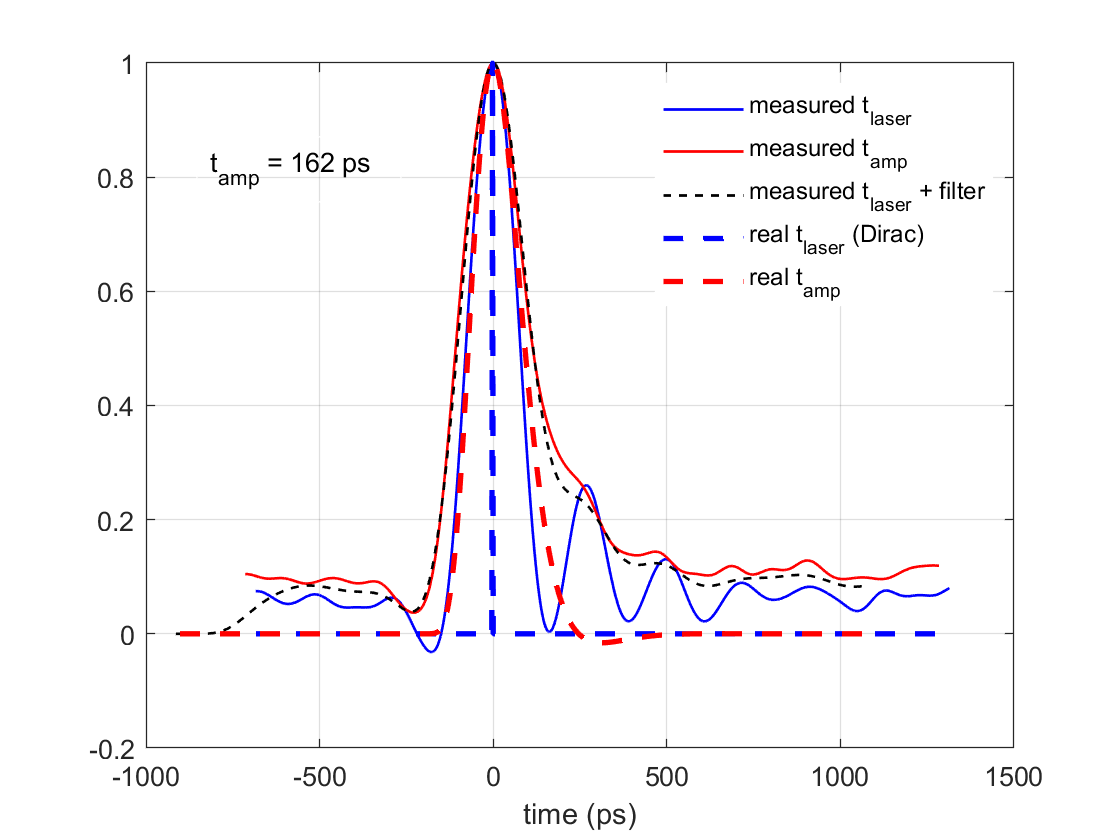
Xinyi Lu | Fixed | info | lasers and optics | Optical room | Different cavity modes & Pulse width |
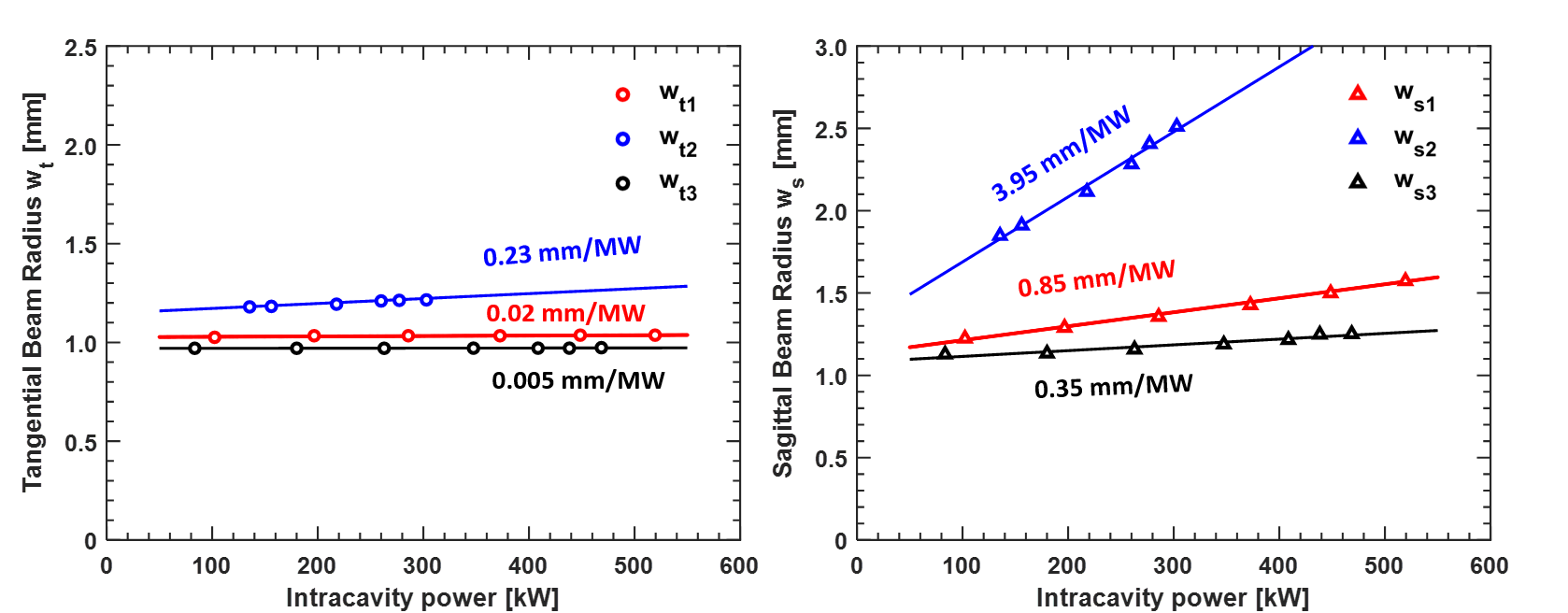
- Last week, we obtained three curves of the variation of different cavity modes with power (Fig. 1). By comparing the gain for similar cavity mode sizes, we found that the gain always drops with increasing power.
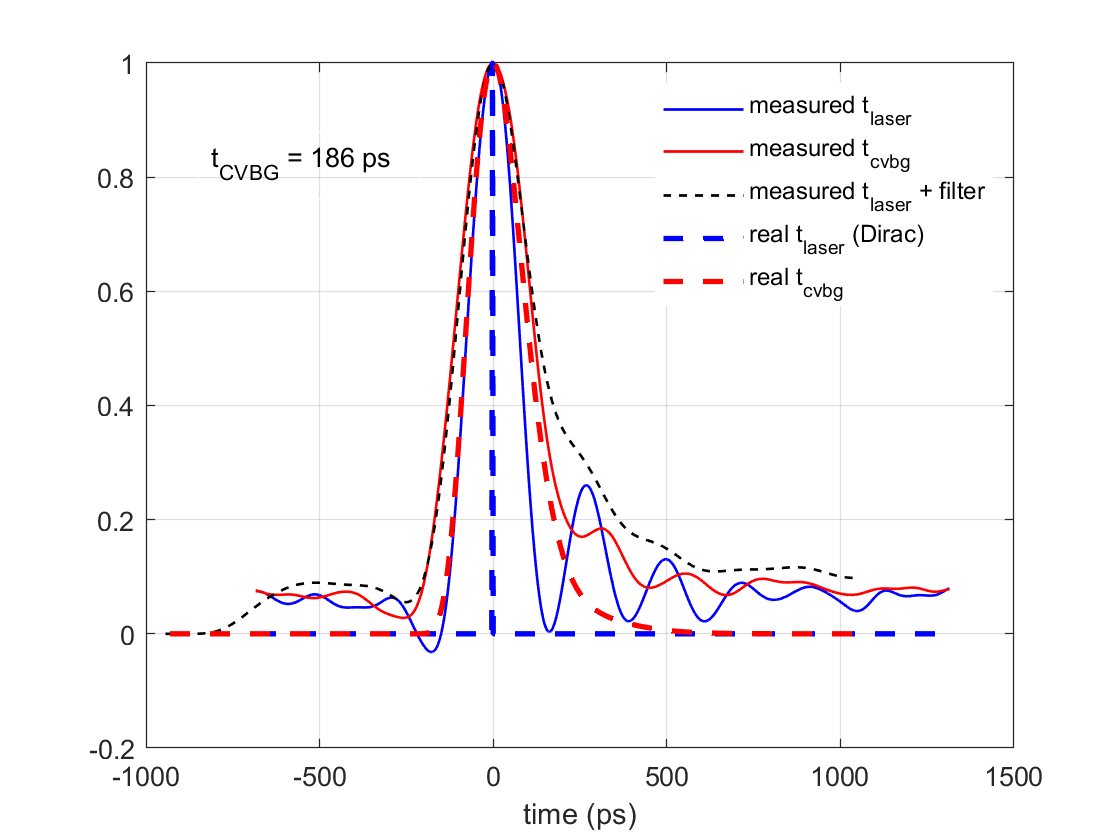
- We measured the pulse width. The pulse width of the seed laser, after CVBG, amplified at 2A was measured by UPD (rise time < 70ps). Code filtering was performed by comparing the data to reduce the effect of rise time. The final result was t= 186 ps after CVBG and t=162 ps for the amplified at 2A.
- Today we will measure finesse using CW laser.
| Xinyi Lu wrote: |
|
- We re-measured the gain before moving the mirror. Gain ~9000 was achieved at 3A, but as the power increased, the gain dropped and was difficult to optimize. In fact, we found that each day the gain was a little higher than the previous day.
| Amp current (A) |
Injection power (W) |
Circulating power (kW) |
Gain(coupling~0.7) |
Finesse |
| 3 |
23.5 |
213 |
9046 |
33595 |
| 4 |
35.5 |
309 |
8692 |
32933 |
| 5 |
47 |
390 |
8292 |
32165 |
- We then moved the M3 spherical mirror 1.7mm to make the beam size larger and measured the variation in cavity mode size at different powers. (Figure 1, red is the original result and blue is the result for a larger cavity mode). It is clear that the larger the cavity mode, the larger the slope. The new slope of w_y is 7.9mm/MW. Tomorrow we will make the cavity mode smaller (like in Carstens' paper) and compare the three curves.
- It is not simple to compare the gain variations of different cavity modes because it takes more time to optimize the telescope and alignment. Ronic suggested that we could compensate for the cavity mode variation by moving the spherical mirror to see how the gain changes at different powers while keeping the cavity mode unchanged.
- In addition, we measured the spectrum of the menhir laser, after cvgb, amplifier output at 3A (Figure 2). We found that the peak changed from 1031 nm to 1032 nm after CVBG, probably because of the imperfect alignment of CVBG.
| Xinyi Lu wrote: |
|
- Today we moved the position of the D-shaped mirror at 6A. When motor1 (vertical) is 0.2mm away from the spot, the power in the cavity rises from 457kW to 483kW. Gain=8407 is similar to that at low power (Gain=8511). So the D-shaped mirror lost some of the gain in the previous experiments. At 4A and 5A we did not move the D-shaped mirror. (Figure 1)
- At 8A, we got 553 kW inside the cavity for one minute (Figure 2). The pump temperature is higher than yesterday (up to 34°C).
- At 7.5A and 8A, the cavity can remain stably locked, but the power fluctuation in the cavity is so large that it is difficult to optimize the alignment. This may be due to the short time the amplifier was on, the pump temperature, amplifier pointing and power fluctuations, and thermal effects in the cavity....... The amplifier operated differently at different moments.
- We measured the spectrum of the amplified laser. (Figure 3) The peak is 1032.2 nm. We will optimize the alignment and increase the power to optimize this measurement.
- Next arrangement
Thursday: larger laser beam size
Friday: smaller laser beam size
Monday: finesse measurement with CW laser (Firstly check the possibility of measuring with pulsed laser)
| Xinyi Lu wrote: |
|
Yesterday, Ronic, Xing, Qili and I achieved a more stable 520kW power at 7.5A (71W injection) by optimizing the alignment and locking parameters. (Figure 1)
- The cavity can be stable locked when airflow is on. At 7.5A, the pump temperature is about 28℃. The chiller temperature didn't change, to the same 23 ℃ setting. We can try 8A later (75W injection) for a short time;
- Figure 2 demonstrates the cavity mode variation, wy/Pc ~ 1.7 mm/MW, half that of the OL paper (3.3 mm/MW). The thermal deformation of our device is much smaller.
- The experimental data are shown in Figure 3. Figure 4 shows the injection power vs circulating power.
- There are some tests that can be done at the moment. I'll update on the elog after discussing the necessity today. ^_^
|
|
|
|
| Attachment 1: cavitymode_vs_power_f.png
|
 |
| Attachment 2: different_cavity_mode_data.xlsx
|
|
213
|
Tue Apr 9 08:57:22 2024 |
Xinyi Lu | Fixed | info | lasers and optics | Optical room | Different cavity modes & Pulse width |
Additional information:
The pulse duration has been performed in RF on a UPD-70-IR2-P photodiode from Alphalas GmbH by carefully deconvoluting the response function of the photodiode measured directly with the sub-picosecond laser beam.
Figure 1 shows the pulse width through the CVBG. Figure 2 is the pulse width when amplified to 10W.
| Xinyi Lu wrote: |
|
- Last week, we obtained three curves of the variation of different cavity modes with power (Fig. 1). By comparing the gain for similar cavity mode sizes, we found that the gain always drops with increasing power.
- We measured the pulse width. The pulse width of the seed laser, after CVBG, amplified at 2A was measured by UPD (rise time < 70ps). Code filtering was performed by comparing the data to reduce the effect of rise time. The final result was t= 186 ps after CVBG and t=162 ps for the amplified at 2A.
- Today we will measure finesse using CW laser.
| Xinyi Lu wrote: |
|
- We re-measured the gain before moving the mirror. Gain ~9000 was achieved at 3A, but as the power increased, the gain dropped and was difficult to optimize. In fact, we found that each day the gain was a little higher than the previous day.
| Amp current (A) |
Injection power (W) |
Circulating power (kW) |
Gain(coupling~0.7) |
Finesse |
| 3 |
23.5 |
213 |
9046 |
33595 |
| 4 |
35.5 |
309 |
8692 |
32933 |
| 5 |
47 |
390 |
8292 |
32165 |
- We then moved the M3 spherical mirror 1.7mm to make the beam size larger and measured the variation in cavity mode size at different powers. (Figure 1, red is the original result and blue is the result for a larger cavity mode). It is clear that the larger the cavity mode, the larger the slope. The new slope of w_y is 7.9mm/MW. Tomorrow we will make the cavity mode smaller (like in Carstens' paper) and compare the three curves.
- It is not simple to compare the gain variations of different cavity modes because it takes more time to optimize the telescope and alignment. Ronic suggested that we could compensate for the cavity mode variation by moving the spherical mirror to see how the gain changes at different powers while keeping the cavity mode unchanged.
- In addition, we measured the spectrum of the menhir laser, after cvgb, amplifier output at 3A (Figure 2). We found that the peak changed from 1031 nm to 1032 nm after CVBG, probably because of the imperfect alignment of CVBG.
| Xinyi Lu wrote: |
|
- Today we moved the position of the D-shaped mirror at 6A. When motor1 (vertical) is 0.2mm away from the spot, the power in the cavity rises from 457kW to 483kW. Gain=8407 is similar to that at low power (Gain=8511). So the D-shaped mirror lost some of the gain in the previous experiments. At 4A and 5A we did not move the D-shaped mirror. (Figure 1)
- At 8A, we got 553 kW inside the cavity for one minute (Figure 2). The pump temperature is higher than yesterday (up to 34°C).
- At 7.5A and 8A, the cavity can remain stably locked, but the power fluctuation in the cavity is so large that it is difficult to optimize the alignment. This may be due to the short time the amplifier was on, the pump temperature, amplifier pointing and power fluctuations, and thermal effects in the cavity....... The amplifier operated differently at different moments.
- We measured the spectrum of the amplified laser. (Figure 3) The peak is 1032.2 nm. We will optimize the alignment and increase the power to optimize this measurement.
- Next arrangement
Thursday: larger laser beam size
Friday: smaller laser beam size
Monday: finesse measurement with CW laser (Firstly check the possibility of measuring with pulsed laser)
| Xinyi Lu wrote: |
|
Yesterday, Ronic, Xing, Qili and I achieved a more stable 520kW power at 7.5A (71W injection) by optimizing the alignment and locking parameters. (Figure 1)
- The cavity can be stable locked when airflow is on. At 7.5A, the pump temperature is about 28℃. The chiller temperature didn't change, to the same 23 ℃ setting. We can try 8A later (75W injection) for a short time;
- Figure 2 demonstrates the cavity mode variation, wy/Pc ~ 1.7 mm/MW, half that of the OL paper (3.3 mm/MW). The thermal deformation of our device is much smaller.
- The experimental data are shown in Figure 3. Figure 4 shows the injection power vs circulating power.
- There are some tests that can be done at the moment. I'll update on the elog after discussing the necessity today. ^_^
|
|
|
|
|
| Attachment 1: t_cvbg.png
|
 |
| Attachment 2: t_amp.png
|
 |
|
25
|
Thu Jan 24 17:44:21 2019 |
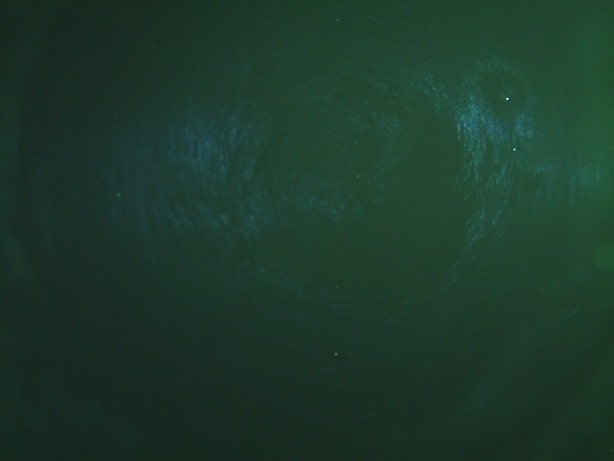
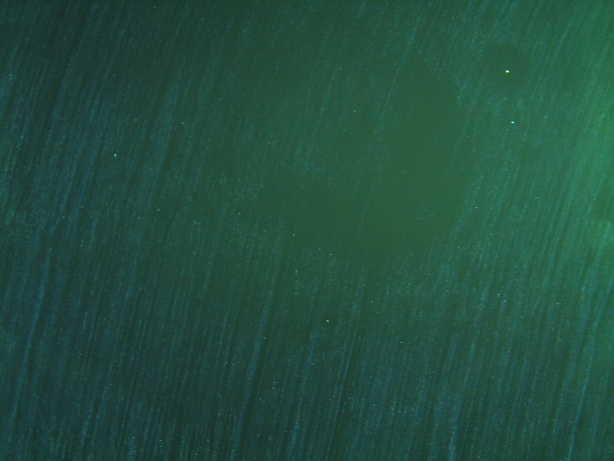
Loïc Amoudry | Fixed | report | lasers and optics | Optical room | Deposit on S-box mirrors after return from LMA |
Cleaning on dirty surface shows something is deposited on the surface. Cleaning displaces and removes part of the deposit. |
| Attachment 1: 28_M2ReflectiveBeforeCleaning_compressed.jpg
|
 |
| Attachment 2: 29_M2ReflectiveAfter1stCleanPaper_compressed.jpg
|
 |
|
237
|
Fri Jun 13 20:10:00 2025 |
Alice Renaux | Fixed | report | lasers and optics | Optical room | Damaged mirrors test |
Today with Dorian we tested three mirrors with which we previously haven't been able to obtain any resonance or optical beating :
- C16111/11 : The mirror looks normal under a microscope, apart from a few inclusions and maybe a small scratch towards the edge. We tested it with a 161186 M1 mirror and we weren't able to obtain any optical beating on the cavity's mirrors or resonance.
- 161185 (1) : The mirror looks normal with the naked eye. We tested it with a 161182 M2 mirror and we were able to notice some optical beating on the cavity's mirrors as well as small resonance peaks and a higher-order transverse mode.
- 161185 (2) : The mirror shows some damage on the substrate side (not the coated side). We tested it with a 161186 M2 mirror and we were able to notice some optical beating on the cavity's mirrors as well as huge resonance peaks and a Gaussian transverse mode.
The updated recap file is available here, as well as a few pictures. |
|
160
|
Mon Sep 12 18:49:42 2022 |
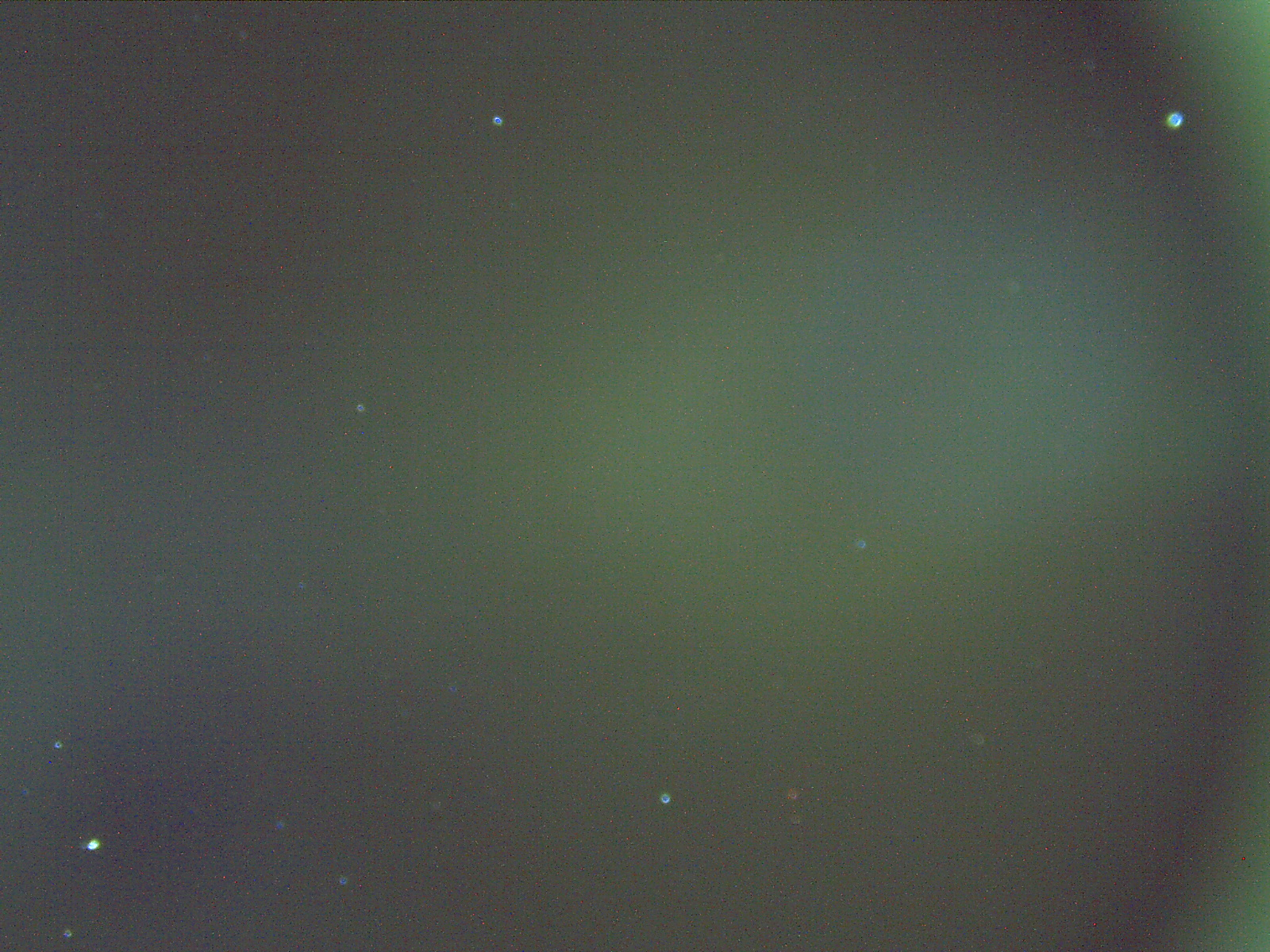
Manar Amer | Fixed | issue | lasers and optics | Optical room | Damage on mirror surface |
Following the storage of ~ 50 kW inside the cavity and a sudden drop in transmitted power from the cavity
damage to the mirror surface was suspected.
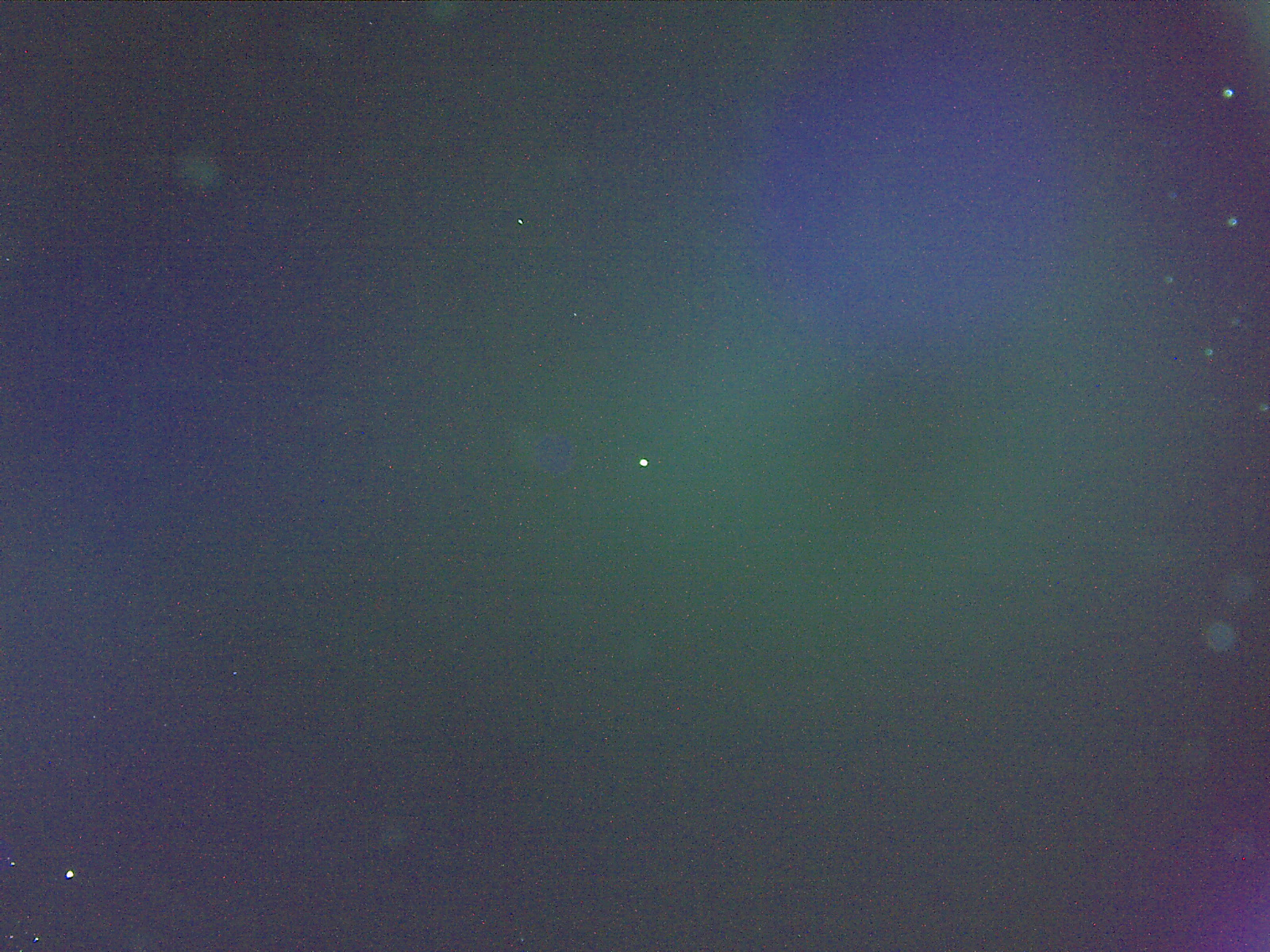
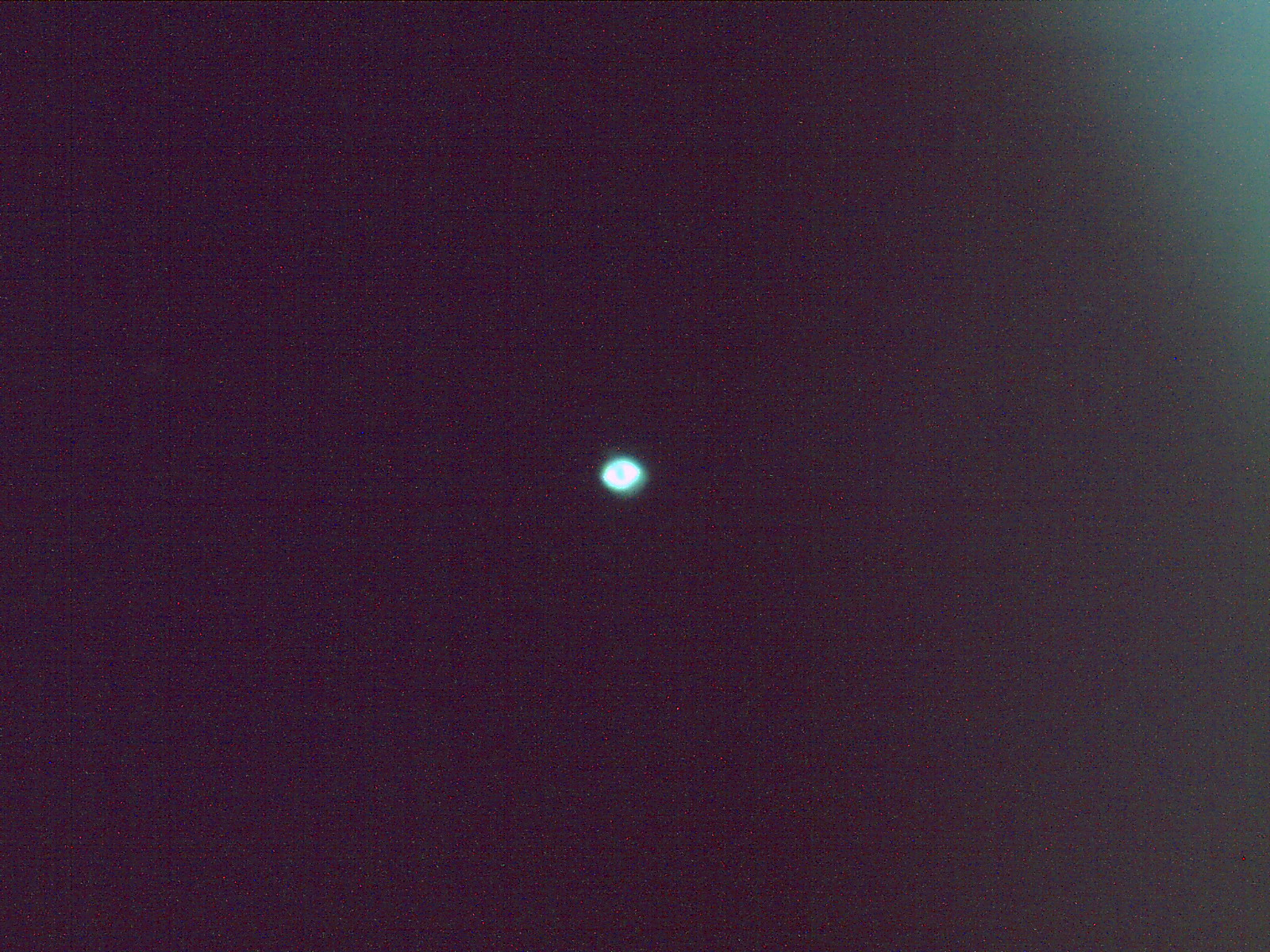
We broke vacuum and took images of the surface of the 2 mirrors in the cavity, the spherical and the planar mirror
image 1 , spherical reflective surface (no visible damage with the UV light, and no visible damage under the microscope)
image 2 , planar coupler mirror reflective surface (no visible damage under UV light, but under the microscope there is a damaged spot close to the center)
image 4 is the planar surface reflective surface at zoom 8 on the microscope.
|
| Attachment 1: image001.jpg
|
 |
| Attachment 2: image002.jpg
|
 |
| Attachment 3: image004.jpg
|
 |