| ID |
Date |
Author |
Status |
Type |
Category |
Location |
Title |
|
235
|
Wed May 28 10:55:15 2025 |
Alice Renaux | Under Process | report | lasers and optics | Optical room | 2-mirror cavity alignment |
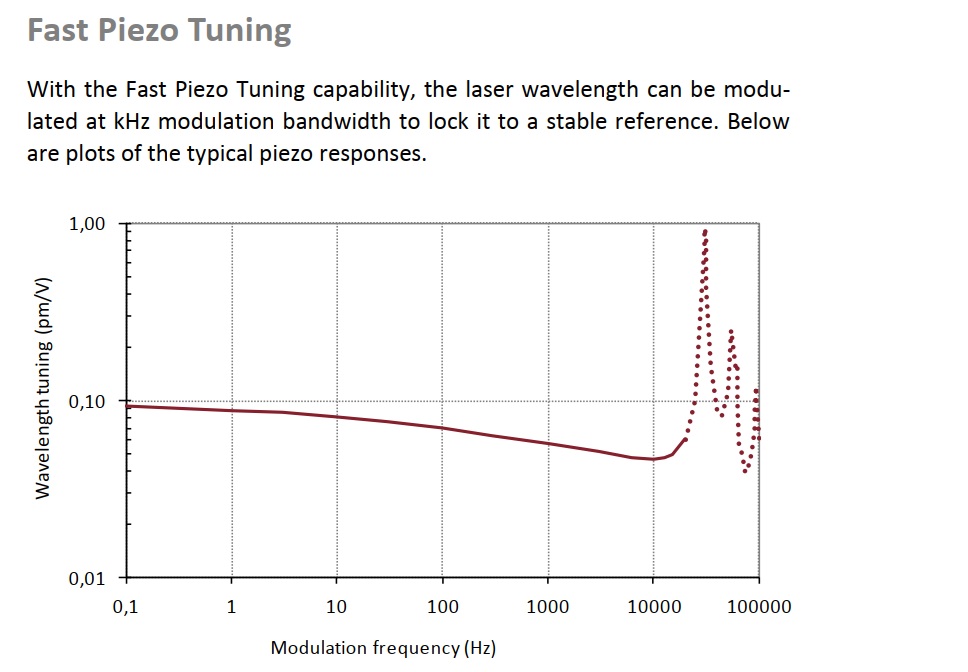
The NKT laser PZT sensitivity is ~0.09pm/V of wavelength variation, which is equivalent to ~ 25MHz/V
So, the full range of the scan is roughly 250MHz (more than a FSR) for 10V.
It seems impossible to get such large resonances unless the Finesse is very low => let's try to change M1 by a spare GammaFactory plan or 10m ROC mirror.
| Alice Renaux wrote: |
|
Yesterday and today, I replaced the OEWaves CW laser with the NKT CW laser. Its screen does not display anything, so it has to be operated through the GraphiK software.
I then re-aligned the cavity with a new adjustment adaptation tool between the mirror mounts and the irises.
The motor positions are :
- 1 : 3.354420 mm
- 3 : 2.128850 mm
- 4 : 3.468480 mm
- 5 : 3.157300 mm
I then connected the LaseLock module to scan the NKT laser wavelength on a roughly 0-10 V range at a 2Hz rate, so that it could match the cavity's resonance frequency.
Without optimizing the injection, I monitored the transmitted power with a photodiode paired with an amplifier. The pictures are available through this link : https://box.in2p3.fr/s/TGgwkKgYik7MyqW, and an example picture is attached. Their timestamp is in their filenames, and it seems that the transmission varies quite a lot on a ≈10 s scale, and these variations seem to be periodic on a ≈1 minute scale. The peaks seem weirdly wide, almost up to 100-200 MHz (≈FSR).
|
|
| Attachment 1: Sans_titre.jpg
|
 |
|
219
|
Thu Apr 25 22:12:25 2024 |
Xinyi Lu | Fixed | info | lasers and optics | Optical room | 2 mirror cavity high power experiments |
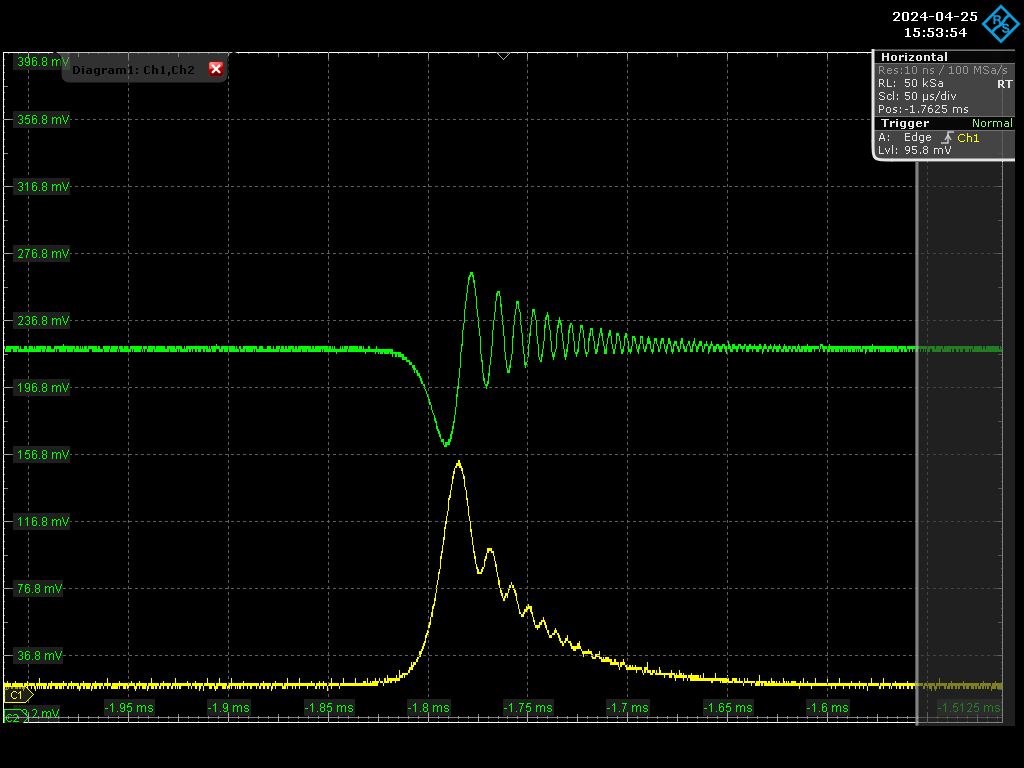
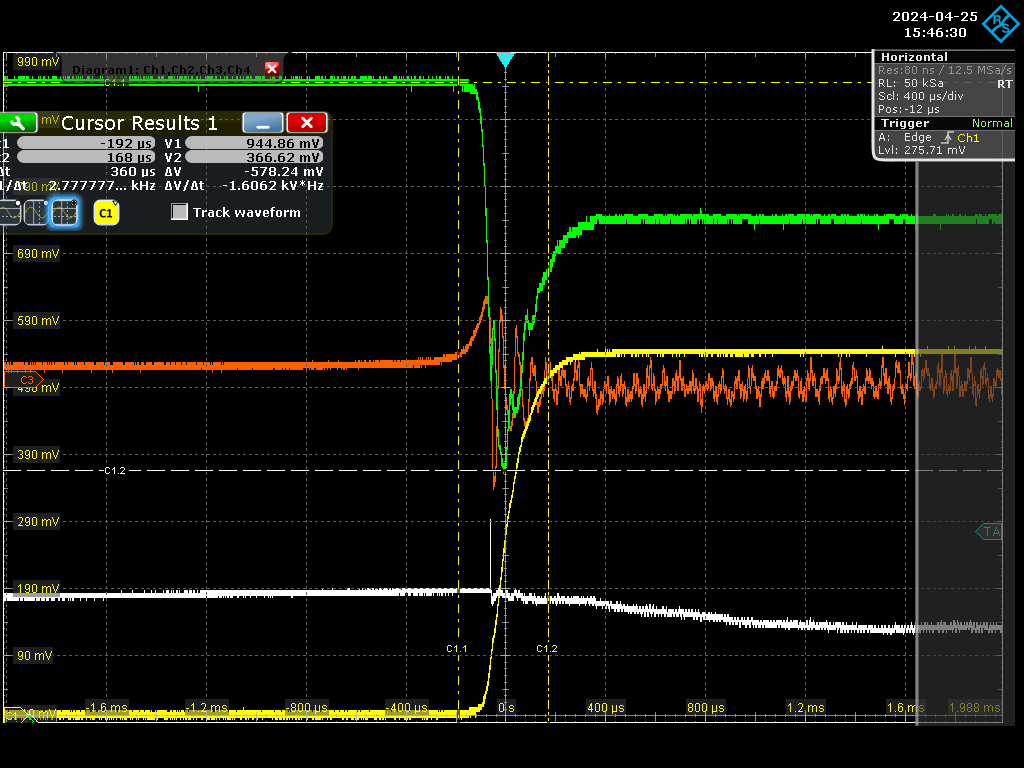
Today, Ronic and I recorded some intracavity power and cavity mode size as shown in Fig. 1.
Coupling was calculated using the locking curve of this overcoupled cavity. Pr/Pi = 1-Cgeo*Cimp, Cimp = 1-|1-2T1/RTL|^2
We can see that the effective gain, coupling, and mode size decrease with increasing power. And the beam is constantly moving.
Tomorrow we will try to optimize the telescope for the high-power hot cavity.
|
| Attachment 1: record_20240425.png
|
 |
| Attachment 2: Screenshot_2024-04-25_4_155354-155kw.png
|
 |
| Attachment 3: Screenshot_2024-04-25_1_154630-155kw.png
|
 |
| Attachment 4: 60kW_highordermode2.jpg
|
 |
|
106
|
Wed Jul 6 19:57:17 2022 |
Manar Amer | Fixed | report | lasers and optics | detectors and electronics | Optical room | 2 Mirror Setup @ 216.6 MHz |
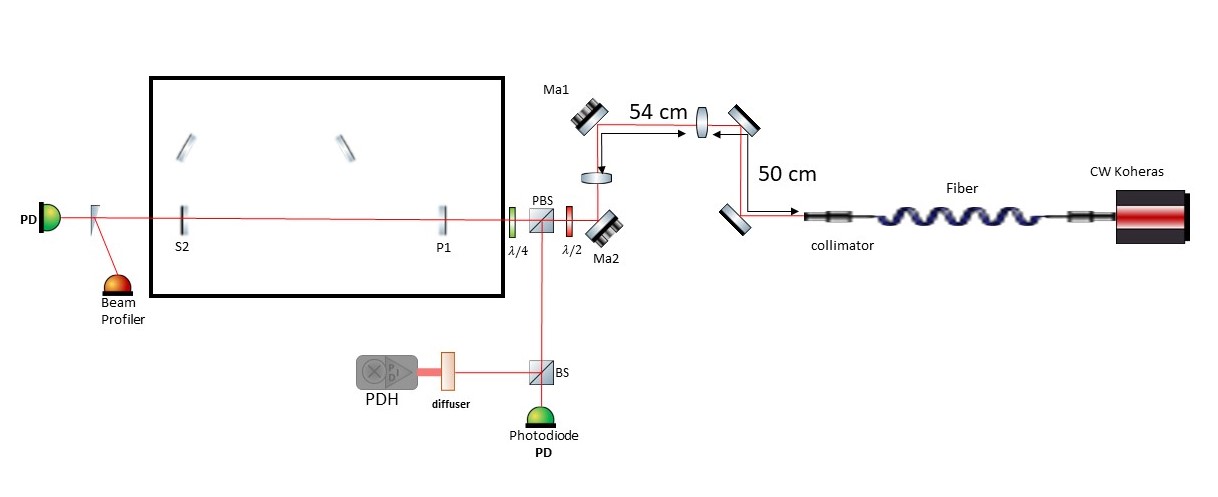
The SBox cavity setup was changed to have only 2 mirrors M1 plane and M2 spherical, both from ThomX
Distance between the mirror ~ 72 cm , increased from 70 cm to take into account the thickness of the ThomX mirrors
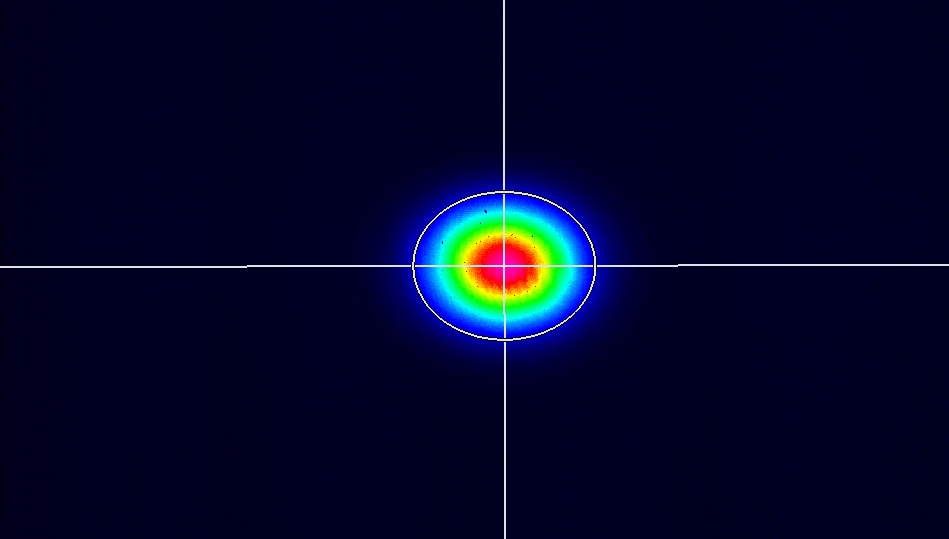
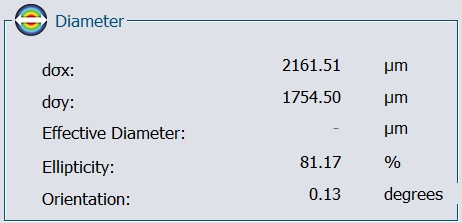
Two lenses (300 mm @ 50 cm , 200 @ 104 cm) were placed to have the beam radius ~ 0.55 mm.
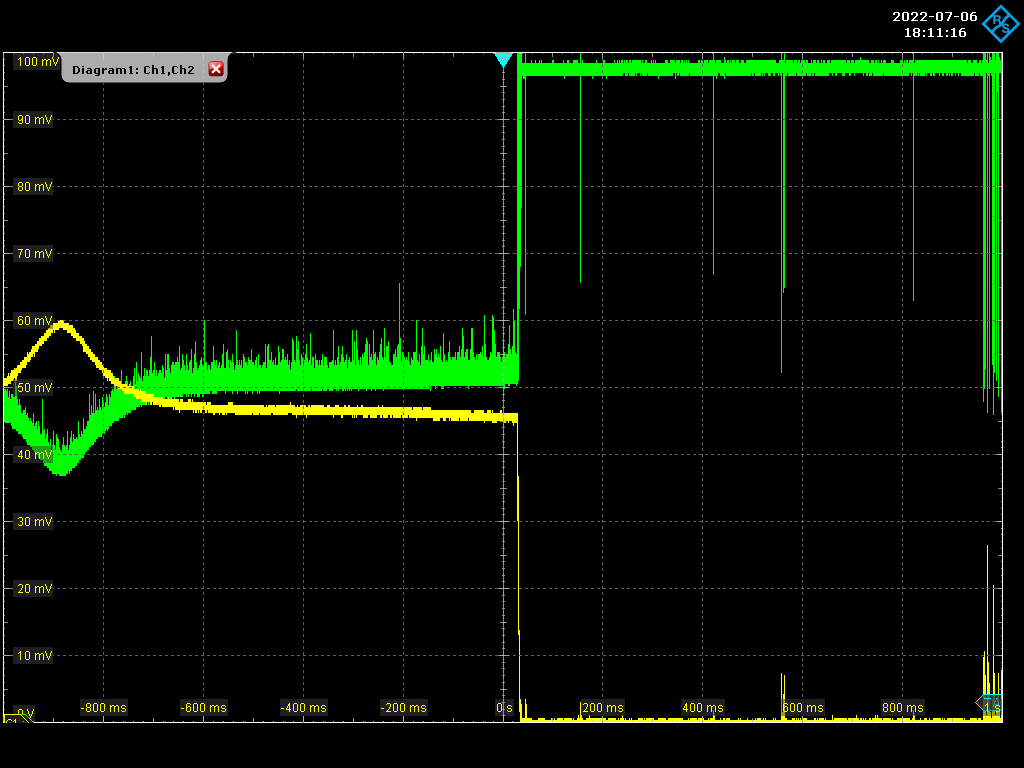
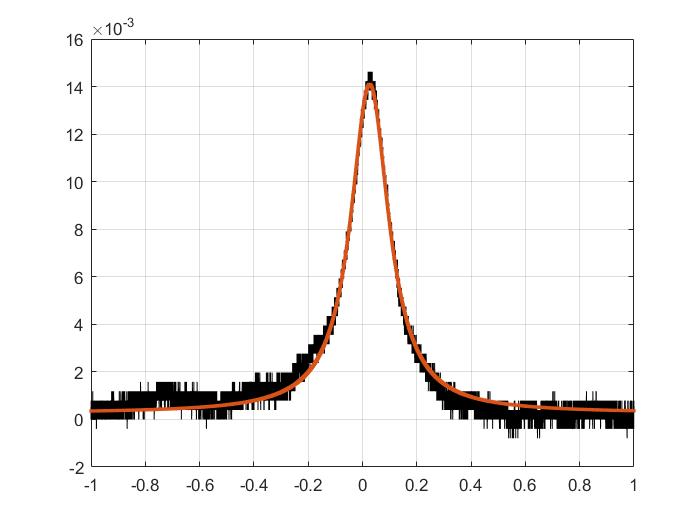
The cavity was locked with a coupling of 60 %, for Finesse measurement the sweep was taken over 100 KHz of 2 seconds.
FSR ~ 210.00 MHz, line width ~ 8.56 KHz, Finesse ~ 24 500 .
|
| Attachment 1: 20220706_Setup.jpg
|
 |
| Attachment 2: Screenshot_2022-07-06_1_181116.png
|
 |
| Attachment 3: Finesse_Fit.jpg
|
 |
| Attachment 4: 00mode.jpg
|
 |
| Attachment 5: 00mode_diameter.jpg
|
 |
|
109
|
Fri Jul 8 17:48:48 2022 |
Manar Amer | Fixed | report | lasers and optics | detectors and electronics | Optical room | 2 Mirror Setup @ 216.6 MHz |
The cavity was realigned using irises instead of pinholes, gave a better alignment.
The inside of the box, the spherical and the injection mirror were cleaned and placed back inside the box.
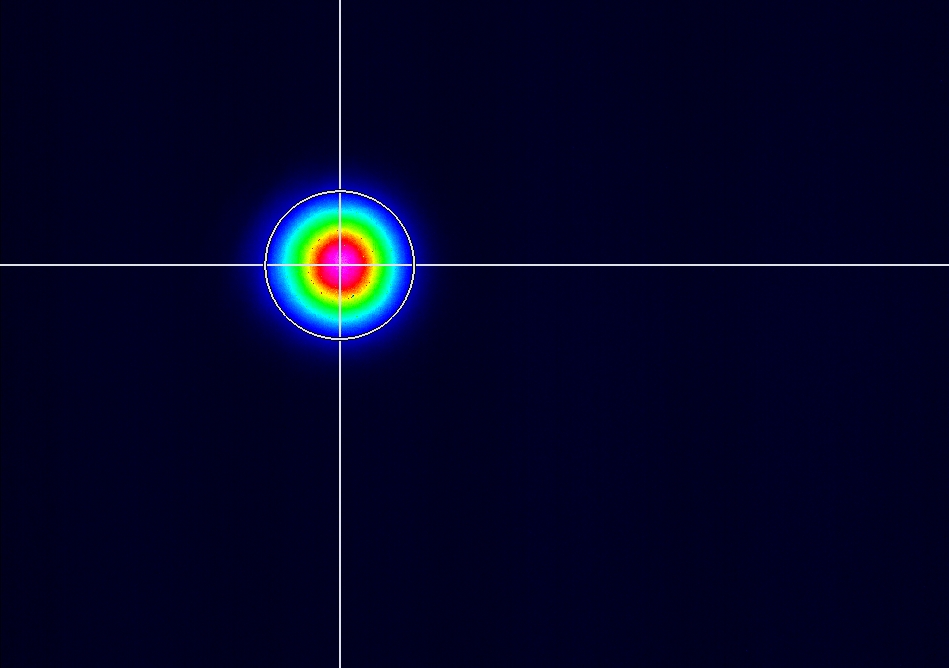
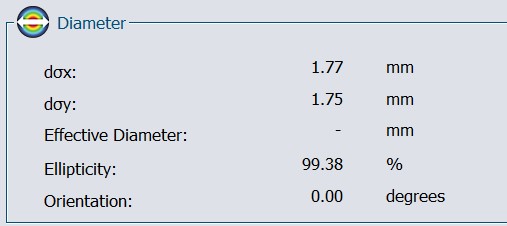
we see beating of fundamental mode, previously at the transmission point we placed a wedge to split the beam which resulted in an elliptical mode
we removed it and placed a very thin beam splitter, the beam is circular now.
The cavity was locked in air at a coupling of ~ 60-70 %
Finesse and line width measured five readings with a Finesse average 25095.08884 of a Gain ~ 8000
FWHM (KHz) = 8.2928
Finesse = 25323.0544
FWHM (KHz) = 7.9202
Finesse = 26514.4395
FWHM (KHz) = 8.5834
Finesse = 24465.8636
FWHM (KHz) = 8.4571
Finesse = 24831.2419
FWHM (KHz) = 8.6275
Finesse = 24340.8448
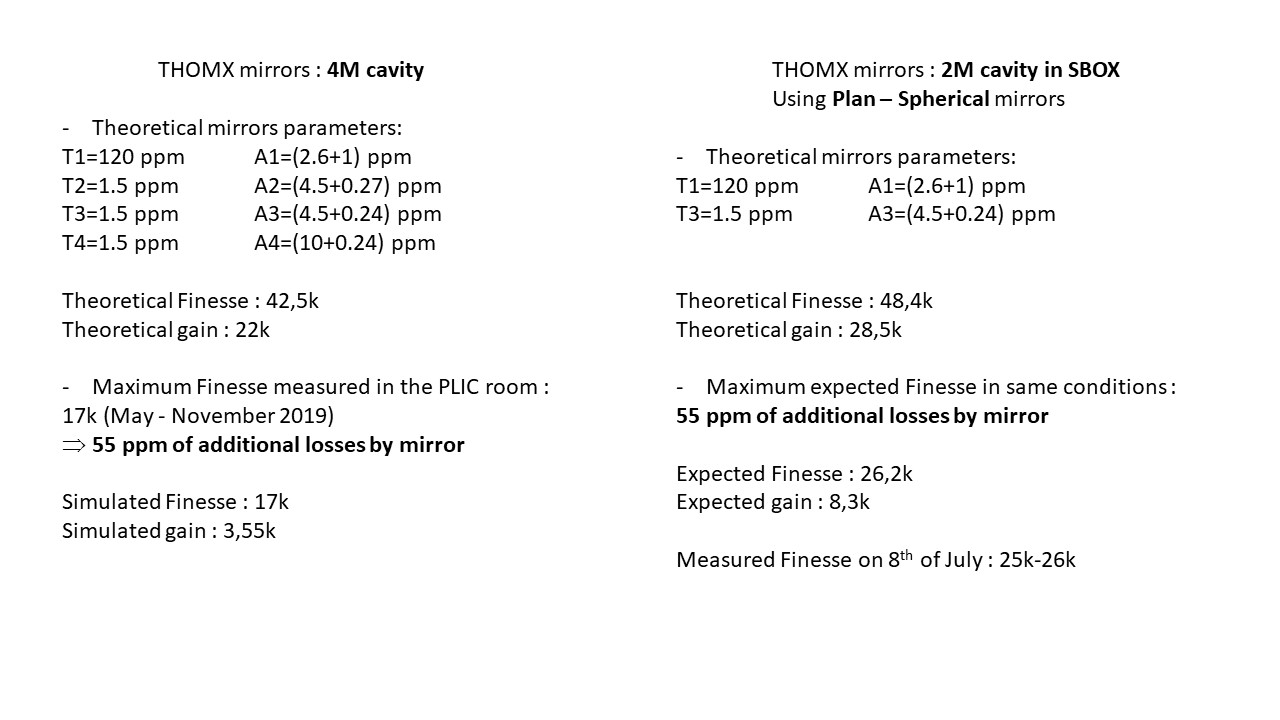
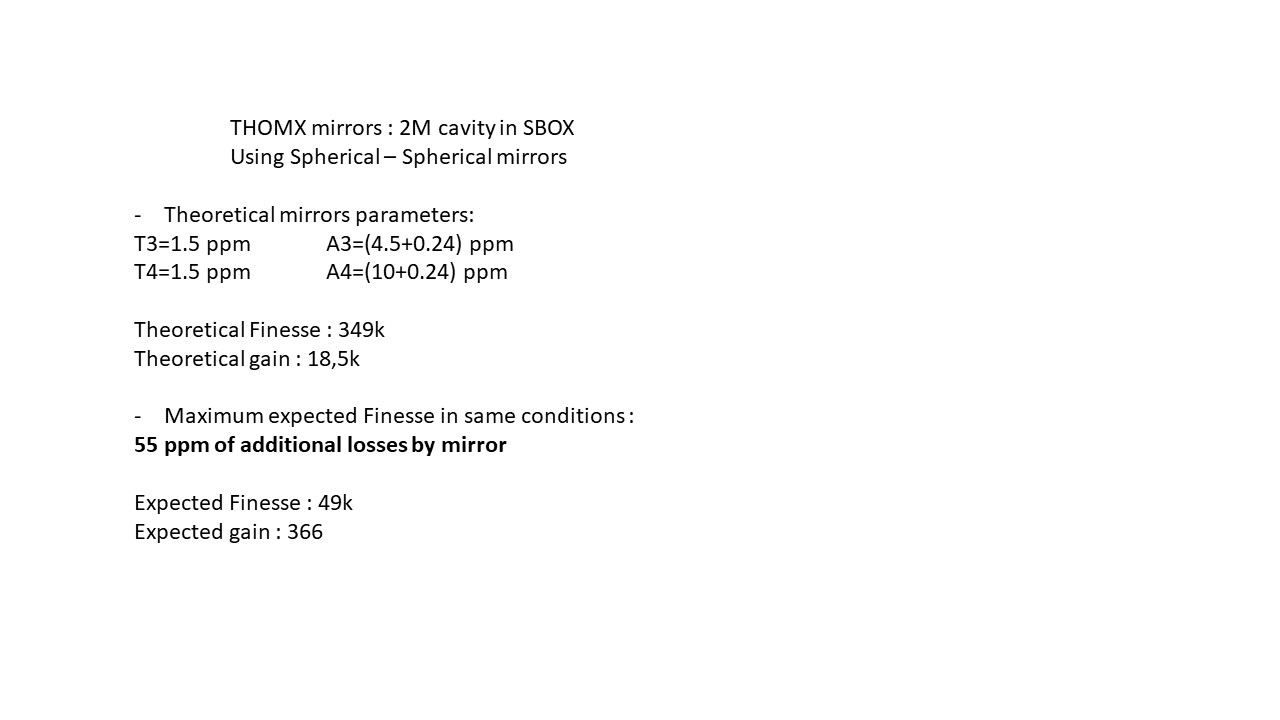
Theoretical and expected Finesse for the 2 mirror setup with the losses is calculated by Ronic for comparison between four and 2 mirror setup.
| Manar Amer wrote: |
|
The SBox cavity setup was changed to have only 2 mirrors M1 plane and M2 spherical, both from ThomX
Distance between the mirror ~ 72 cm , increased from 70 cm to take into account the thickness of the ThomX mirrors
Two lenses (300 mm @ 50 cm , 200 @ 104 cm) were placed to have the beam radius ~ 0.55 mm.
The cavity was locked with a coupling of 60 %, for Finesse measurement the sweep was taken over 100 KHz of 2 seconds.
FSR ~ 210.00 MHz, line width ~ 8.56 KHz, Finesse ~ 24 500 .
|
|
| Attachment 1: 00mode.jpg
|
 |
| Attachment 2: 00mode_diameter.jpg
|
 |
| Attachment 3: Screenshot_2022-07-08_0_164115.png
|
 |
| Attachment 4: Slide1.JPG
|
 |
| Attachment 5: Slide2.JPG
|
 |
|
110
|
Fri Jul 8 19:37:24 2022 |
Manar Amer | Fixed | report | lasers and optics | detectors and electronics | Optical room | 2 Mirror Setup @ 216.6 MHz |
Update for Finesse measurement, The cavity was put under vacuum ~ 1.1*10^-1 mbar
and the alignment and coupling improved.
FSR = 210.1 MHz
Average Finesse = 25686.46222
FWHM (KHz) = 8.2387
Finesse = 25501.5659
FWHM (KHz) = 8.2028
Finesse = 25613.2858
FWHM (KHz) = 8.0978
Finesse = 25945.3289
FWHM (KHz) = 8.1744
Finesse = 25702.3142
FWHM (KHz) = 8.1847
Finesse = 25669.8163
Concluded from Ronic's calculations, this could be the maximum finesse we might be able to obtain with this setup
with Gain ~ 8000
On Monday we adjust the frequency to match 2160.66 MHz and lock the Pulsed,
at the same time start we start with the CELIA amplifier.
| Manar Amer wrote: |
|
The cavity was realigned using irises instead of pinholes, gave a better alignment.
The inside of the box, the spherical and the injection mirror were cleaned and placed back inside the box.
we see beating of fundamental mode, previously at the transmission point we placed a wedge to split the beam which resulted in an elliptical mode
we removed it and placed a very thin beam splitter, the beam is circular now.
The cavity was locked in air at a coupling of ~ 60-70 %
Finesse and line width measured five readings with a Finesse average 25095.08884 of a Gain ~ 8000
FWHM (KHz) = 8.2928
Finesse = 25323.0544
FWHM (KHz) = 7.9202
Finesse = 26514.4395
FWHM (KHz) = 8.5834
Finesse = 24465.8636
FWHM (KHz) = 8.4571
Finesse = 24831.2419
FWHM (KHz) = 8.6275
Finesse = 24340.8448
Theoretical and expected Finesse for the 2 mirror setup with the losses is calculated by Ronic for comparison between four and 2 mirror setup.
| Manar Amer wrote: |
|
The SBox cavity setup was changed to have only 2 mirrors M1 plane and M2 spherical, both from ThomX
Distance between the mirror ~ 72 cm , increased from 70 cm to take into account the thickness of the ThomX mirrors
Two lenses (300 mm @ 50 cm , 200 @ 104 cm) were placed to have the beam radius ~ 0.55 mm.
The cavity was locked with a coupling of 60 %, for Finesse measurement the sweep was taken over 100 KHz of 2 seconds.
FSR ~ 210.00 MHz, line width ~ 8.56 KHz, Finesse ~ 24 500 .
|
|
|
| Attachment 1: Screenshot_2022-07-08_2_182405.png
|
 |
|
138
|
Wed Aug 24 10:45:24 2022 |
Manar Amer | Fixed | report | lasers and optics | Optical room | 2 Mirror Setup @ 216.6 MHz |
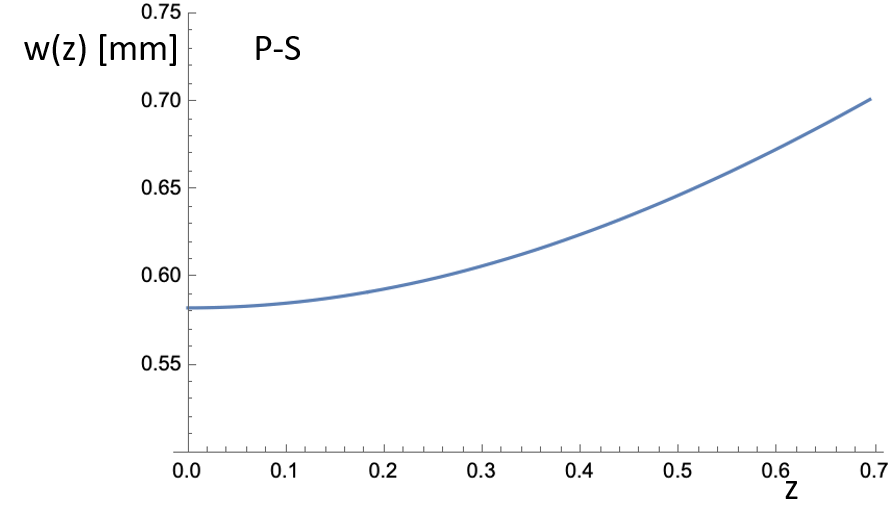
Adding information about the 2 mirror cavity setup (plan - spherical) that is currently installed.
From Aurélien at the start of the manipulation.
@ 0 is where the injection mirror is located
| Manar Amer wrote: |
|
The SBox cavity setup was changed to have only 2 mirrors M1 plane and M2 spherical, both from ThomX
Distance between the mirror ~ 72 cm , increased from 70 cm to take into account the thickness of the ThomX mirrors
Two lenses (300 mm @ 50 cm , 200 @ 104 cm) were placed to have the beam radius ~ 0.55 mm.
The cavity was locked with a coupling of 60 %, for Finesse measurement the sweep was taken over 100 KHz of 2 seconds.
FSR ~ 210.00 MHz, line width ~ 8.56 KHz, Finesse ~ 24 500 .
|
|
| Attachment 1: manip2miroirs.pptx
|
| Attachment 2: 2mirror_plan_shperical_beam_size.png
|
 |
|
195
|
Wed Feb 28 17:26:46 2024 |
Ronic Chiche | Fixed | info | lasers and optics | software | Optical room | 100W CELIA laser amplifier "how's to" document |
1st version of the document.
if some information is not correct or missing, give any comment by replying to this post. |
| Attachment 1: How_to_start_the_Amplifier_v1.pdf
|
|
207
|
Fri Mar 29 16:23:34 2024 |
Ronic Chiche | Fixed | info | lasers and optics | detectors and electronics | Optical room | 100W CELIA laser amplifier "Power vs Pump current" curve |
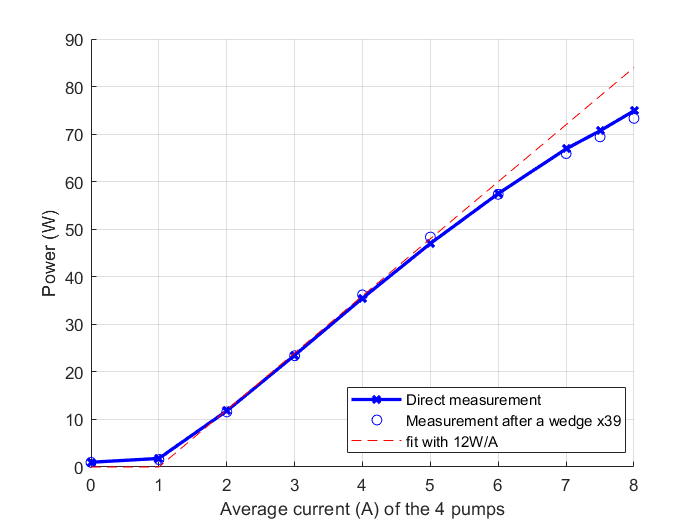
We measured again the 100W CELIA laser amplifier with a pump current until 8A.
as the first current pump of the amplifier has a Peltier issue, we don't exceeded 6A on this stage and we compensated with the 3 other stages.
7A average current is obtained with 6A / 7.3A / 7.3A / 7.4A
7.5A average current is obtained with 6A / 8A / 8A / 8A
8A average current is obtained with 6A / 8.6A / 8.7A / 8.7A
we did the power measured either with the "big" powermeter which is able to handle 100W
and with a smaller powermeter after a wedge, in the reflection path, which is multiplied by 39 to match the big powermeter measurement.
a fit a 12W/A from the cut-off current of 2A is a good estimation until 5A. |
| Attachment 1: CELIA_100W_amplifier_Power_vs_Current.png
|
 |
|
124
|
Wed Aug 10 12:51:16 2022 |
Ronic Chiche | Fixed | report | lasers and optics | Optical room | "ThomX" CELIA Amplifier commissionning |
The "ThomX" CELIA amplifier is installed on the optical table.
I added all the rubber pieces available between the 2 racks to isolate as best as possible the top rack, which embeds some fans, from the bottom rack from which the laser beam is going out to the FP cavity.
1ST STAGE
-----------------
if I put 1mW (minimum input power) on the input fiber of the amplifier and I switch ON the first stage, one can measure 7mW on the 5% output tap on the front panel.
then it is mandatory to check this power before swtiching ON the other stage.
this 5% output tap on the front panel MUST BE ABOVE 7mW
input power : 1mW => 5% output tap : 7mW => amplifier output : 260µW
with the present setup, I can reach 6.8mW of input power, but the 5% output tap seems to saturate at ~ 8mW.
in this condition, the amplifier output is around 800µW
the SMA connector on the rear panel does not output any signal with the 1st stage ON.
2ND STAGE
-----------------
then, one can switch ON the 2nd stage : amplifier output is around 1.4 W (without any iris or dichroïc mirror).
the SMA connector on the rear panel does not output any signal with the 2nd stage ON. |
|
125
|
Thu Aug 11 12:11:48 2022 |
Ronic Chiche | Fixed | report | lasers and optics | Optical room | "ThomX" CELIA Amplifier commissionning |
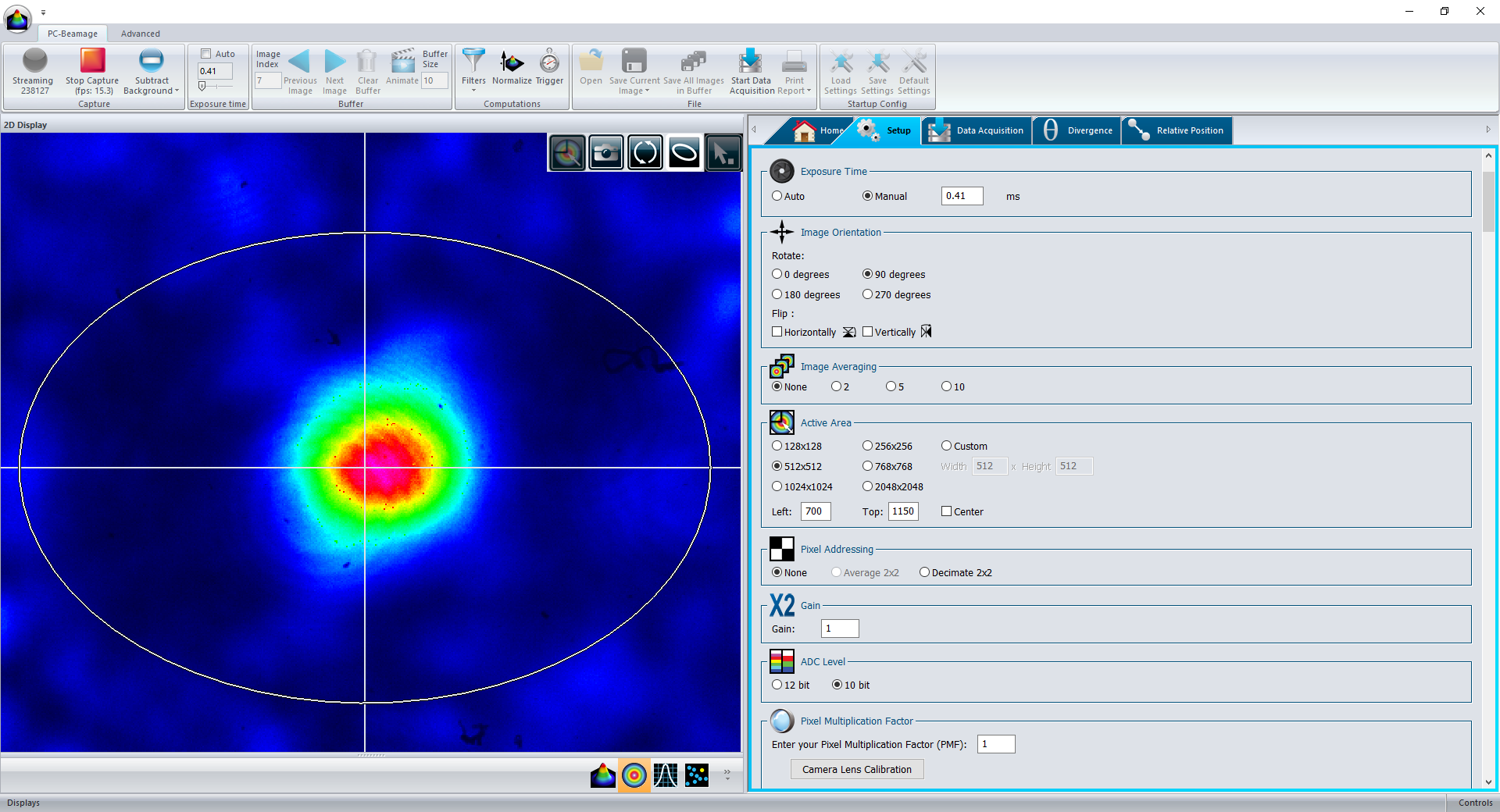
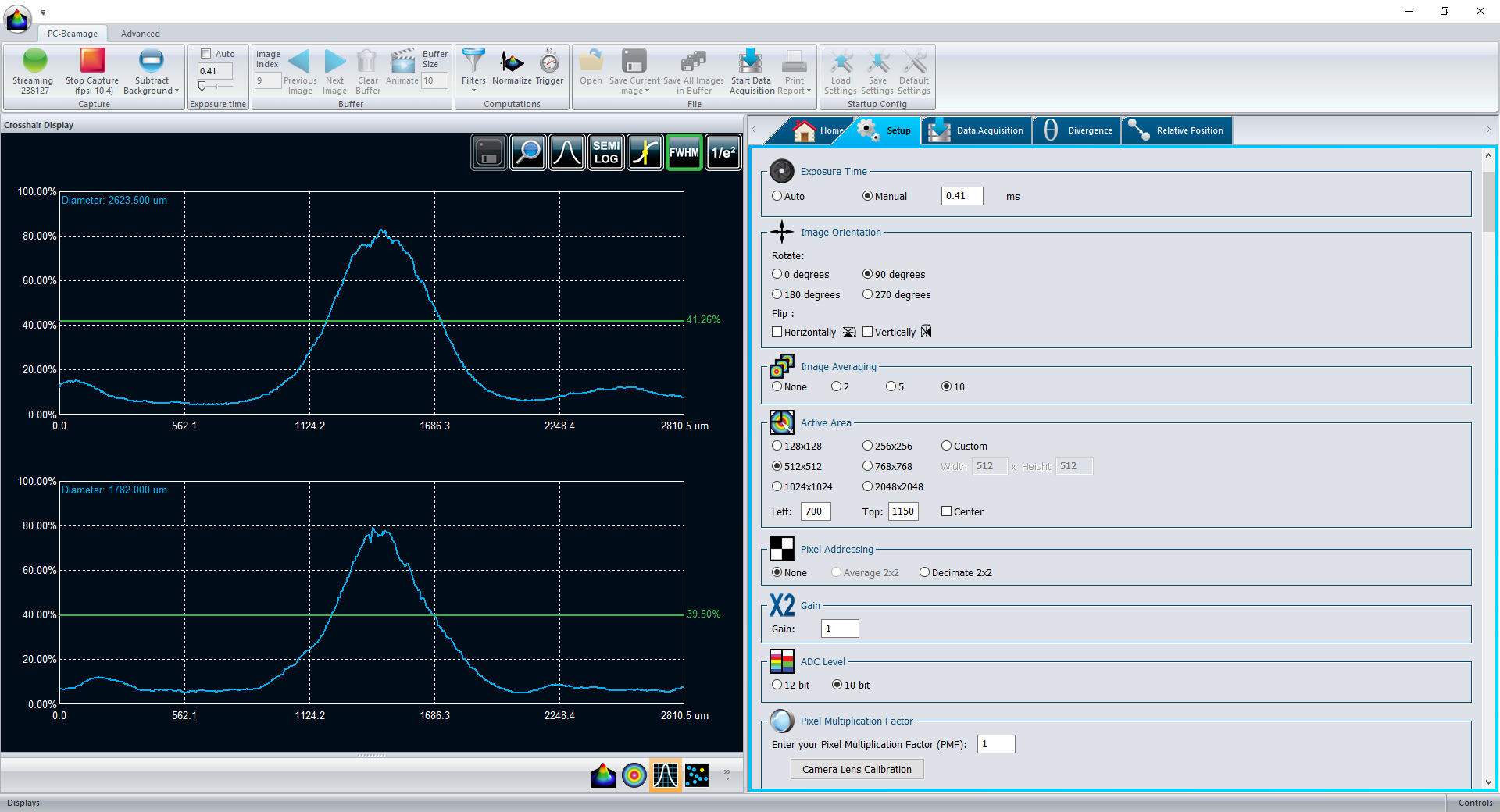
Beam size at the amplifier output:
to make this measurement, I switched ON only 1st and 2nd stage.
the dichroïc mirror seems to work the best in reflection at normal AOI !!!
it's strange as most dichroïc mirrors seem to be specified at AOI = 45° ! => to be checked ! => the dichroïc mirror was set on its wrong face !!! => problem solved
the 2 images correspond to the beam measured at 24cm from the amplifier output.
we cannot use the gaussian fit due to the pump beam shape which perturbate the measurement.
I used the FWHM measurement => DX = 2.6 mm, DY = 1.8mm
Pulse shape model:
dP(x,y,t) = DP * exp( - ln(2) * ( (x/DX_fwhm)² + (y/DY_fwhm)² ) * sech²( t / tp )
=> can we use safely the Newport 20Z40DM.10 mirrors to transport the amplifier beam ?
they are specified for 500 W/cm2 CW and 4 J/cm2 for 10 nsec pulses @ 1064 nm.
- if I am correct, for the previous shape model, the average power is :
Pmoy (W) = 2pi / ln(2) * tp * DP * DX_fwhm * DY_fwhm * Frep
with DP=500W/cm2, DX_fwhm=2.6mm DY_fwhm=1.8mm, tp=77ps, Frep=216MHz => Pmoy = 3.5 W !!!
this means that we should not exceed this average power with these mirrors !?!
- if I am correct, for the previous shape model, the maximal energy density (in the pulse center) is :
DE (J/cm2) = tp * DP => Pmoy = 2pi / ln(2) * DE * DX_fwhm * DY_fwhm * Frep
with DE= 4J/cm2, DX_fwhm=2.6mm DY_fwhm=1.8mm, Frep=216MHz => Pmoy = 366 MW !!!
if one applies a safety factor due to the pulse duration ratio (77ps / 10ns) => Pmoy = 2.8 MW !
this specification seems much less restrictive !
=> can we use safely the Thorlabs BB1-E03 mirrors to transport the amplifier beam ?
they are specified for 10 kW/cm CW (linear power density) and 0.5 J/cm2 for 10 nsec pulses @ 1064 nm.
- the linear power density (LPD) is defined as the average power divided by the beam diameter (1/e²)
LPD = Pmoy / DXY = Pmoy / (1.7 DXY_fwhm) => Pmoy = LPD * 1.7 DXY_fwhm
with LPD=10kW/cm and DY_fwhm=1.8mm => Pmoy = 3 kW
- for maximal energy density:
with DE= 0.5J/cm2, DX_fwhm=2.6mm DY_fwhm=1.8mm, Frep=216MHz => Pmoy = 45 MW !!!
if one applies a safety factor due to the pulse duration ratio (77ps / 10ns) => Pmoy = 350 kW !
| Ronic Chiche wrote: |
|
The "ThomX" CELIA amplifier is installed on the optical table.
I added all the rubber pieces available between the 2 racks to isolate as best as possible the top rack, which embeds some fans, from the bottom rack from which the laser beam is going out to the FP cavity.
1ST STAGE
-----------------
if I put 1mW (minimum input power) on the input fiber of the amplifier and I switch ON the first stage, one can measure 7mW on the 5% output tap on the front panel.
then it is mandatory to check this power before swtiching ON the other stage.
this 5% output tap on the front panel MUST BE ABOVE 7mW
input power : 1mW => 5% output tap : 7mW => amplifier output : 260µW
with the present setup, I can reach 6.8mW of input power, but the 5% output tap seems to saturate at ~ 8mW.
in this condition, the amplifier output is around 800µW
the SMA connector on the rear panel does not output any signal with the 1st stage ON.
2ND STAGE
-----------------
then, one can switch ON the 2nd stage : amplifier output is around 1.4 W (without any iris or dichroïc mirror).
the SMA connector on the rear panel does not output any signal with the 2nd stage ON.
|
|
| Attachment 1: Capture.PNG
|
 |
| Attachment 2: Capture2.PNG
|
 |
|
128
|
Fri Aug 12 17:48:28 2022 |
Ronic Chiche | Fixed | report | lasers and optics | Optical room | "ThomX" CELIA Amplifier commissionning |
this afternoon, with Fabian, we did some measurements on the 3rd stage.
finally we used the Dichroïc mirror at AOI=45°C as first mirror and a Thorlabs BB1-E03 as 2nd mirror to send the beam to the powermeter.
we put an iris to cut the pump beam part.
with only the 2nd stage ON, the dirchroïc mirror and the iris : P=0.4W
3RD STAGE
-----------------
IT IS MANDATORY TO SWITCH ON THE CHILLER
once the Alphanov software is launched, 4 windows appears on the screeen, one for each diode.
once the chiller temperature reach the set value (23°C in our case), one can start to increase the pump current.
(set "voltage adj." to AUTO)
the TEC of the first diode is not operative, then we decided to stop its current to 4A to avoid a too large temperature (in this condition, the temperature of the diode reach ~45°C !)
the other diodes temperatures are stabilized around 25°C
1A for all diodes => 1 W
2A for all diodes => 10.7 W
3A for all diodes => 22 W
4A for all diodes => 33 W
5A for diodes 2-3-4 => 40.5 W
6A for diodes 2-3-4 => 48.1 W
we stopped the measurement at 6A and we did not notice any change in the optical spectrum
During the optical spectrum measurement we tried to use a NDUV20 Thorlabs reflective filter to reflect the high power beam to the powermeter and let a few power part be transmitted to the spectral measurement.
unfortunatelly, the ND filter coating has been completly removed => DO NOT USE Thorlabs ND filters at high power !
| Ronic Chiche wrote: |
|
Beam size at the amplifier output:
to make this measurement, I switched ON only 1st and 2nd stage.
the dichroïc mirror seems to work the best in reflection at normal AOI !!!
it's strange as most dichroïc mirrors seem to be specified at AOI = 45° ! => to be checked ! => the dichroïc mirror was set on its wrong face !!! => problem solved
the 2 images correspond to the beam measured at 24cm from the amplifier output.
we cannot use the gaussian fit due to the pump beam shape which perturbate the measurement.
I used the FWHM measurement => DX = 2.6 mm, DY = 1.8mm
Pulse shape model:
dP(x,y,t) = DP * exp( - ln(2) * ( (x/DX_fwhm)² + (y/DY_fwhm)² ) * sech²( t / tp )
=> can we use safely the Newport 20Z40DM.10 mirrors to transport the amplifier beam ?
they are specified for 500 W/cm2 CW and 4 J/cm2 for 10 nsec pulses @ 1064 nm.
- if I am correct, for the previous shape model, the average power is :
Pmoy (W) = 2pi / ln(2) * tp * DP * DX_fwhm * DY_fwhm * Frep
with DP=500W/cm2, DX_fwhm=2.6mm DY_fwhm=1.8mm, tp=77ps, Frep=216MHz => Pmoy = 3.5 W !!!
this means that we should not exceed this average power with these mirrors !?!
- if I am correct, for the previous shape model, the maximal energy density (in the pulse center) is :
DE (J/cm2) = tp * DP => Pmoy = 2pi / ln(2) * DE * DX_fwhm * DY_fwhm * Frep
with DE= 4J/cm2, DX_fwhm=2.6mm DY_fwhm=1.8mm, Frep=216MHz => Pmoy = 366 MW !!!
if one applies a safety factor due to the pulse duration ratio (77ps / 10ns) => Pmoy = 2.8 MW !
this specification seems much less restrictive !
=> can we use safely the Thorlabs BB1-E03 mirrors to transport the amplifier beam ?
they are specified for 10 kW/cm CW (linear power density) and 0.5 J/cm2 for 10 nsec pulses @ 1064 nm.
- the linear power density (LPD) is defined as the average power divided by the beam diameter (1/e²)
LPD = Pmoy / DXY = Pmoy / (1.7 DXY_fwhm) => Pmoy = LPD * 1.7 DXY_fwhm
with LPD=10kW/cm and DY_fwhm=1.8mm => Pmoy = 3 kW
- for maximal energy density:
with DE= 0.5J/cm2, DX_fwhm=2.6mm DY_fwhm=1.8mm, Frep=216MHz => Pmoy = 45 MW !!!
if one applies a safety factor due to the pulse duration ratio (77ps / 10ns) => Pmoy = 350 kW !
| Ronic Chiche wrote: |
|
The "ThomX" CELIA amplifier is installed on the optical table.
I added all the rubber pieces available between the 2 racks to isolate as best as possible the top rack, which embeds some fans, from the bottom rack from which the laser beam is going out to the FP cavity.
1ST STAGE
-----------------
if I put 1mW (minimum input power) on the input fiber of the amplifier and I switch ON the first stage, one can measure 7mW on the 5% output tap on the front panel.
then it is mandatory to check this power before swtiching ON the other stage.
this 5% output tap on the front panel MUST BE ABOVE 7mW
input power : 1mW => 5% output tap : 7mW => amplifier output : 260µW
with the present setup, I can reach 6.8mW of input power, but the 5% output tap seems to saturate at ~ 8mW.
in this condition, the amplifier output is around 800µW
the SMA connector on the rear panel does not output any signal with the 1st stage ON.
2ND STAGE
-----------------
then, one can switch ON the 2nd stage : amplifier output is around 1.4 W (without any iris or dichroïc mirror).
the SMA connector on the rear panel does not output any signal with the 2nd stage ON.
|
|
|