| ID |
Date |
Author |
Status |
Type |
Category |
Location |
Title |
|
144
|
Tue Sep 6 17:47:40 2022 |
Ronic Chiche | Fixed | issue | lasers and optics | Optical room | unsuccessful telescope design :-( |
we wanted to calculate the right telescope with 2 spherical lenses.
1) we have the FP cavity mode size which is 0.58mm at the input mirror and 0.7mm at the output mirror.
2) we planned to measure the laser beam at the output of the amplifier working at P=1W (2nd stage ON only).
we did several measurements at different positions from the amplifier output.
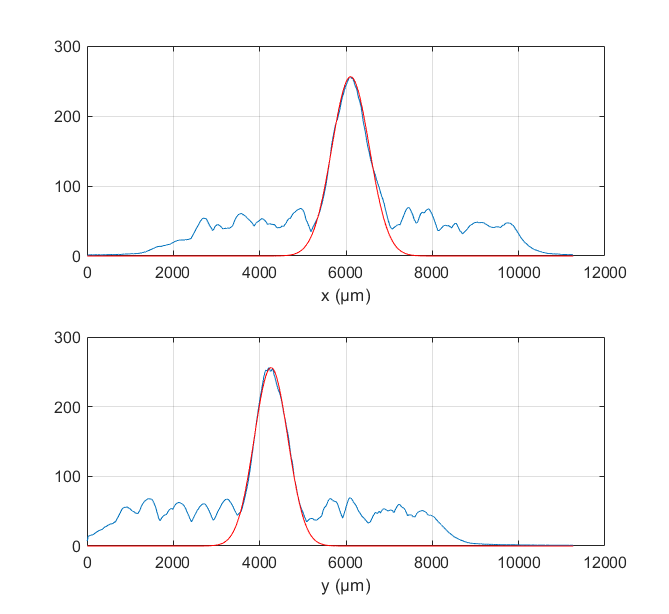
for each of these measurements, we were able to fit the intensity profile I = I0 * exp(-2 *r^2 / w^2) on x or y axis, then we have w(z).
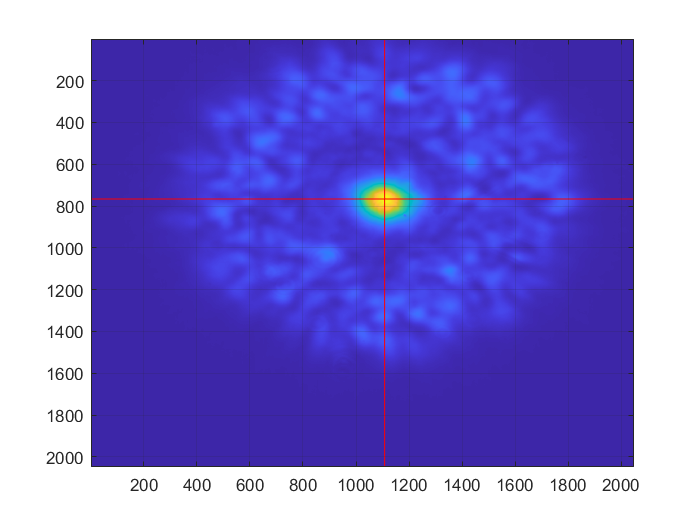
attached files give an example of the beam image at z=40mm and an example of the beam fits for w and y.
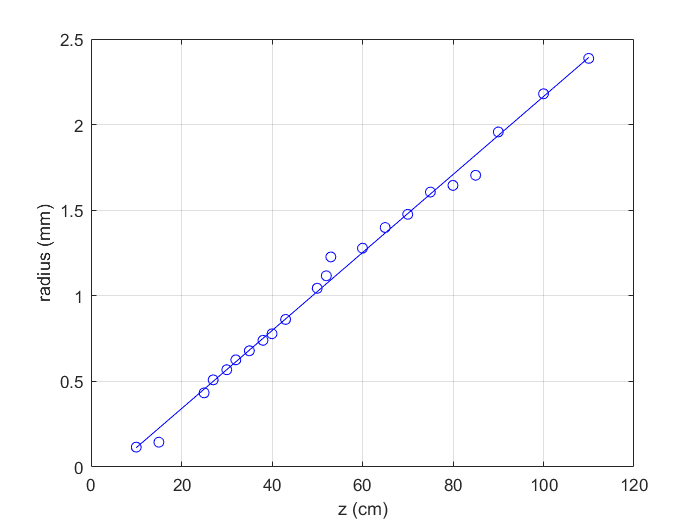
with all the w(z) measurements, we were able to fit the divergence of the beam => 2.3 mrad
attached file show the radius measurements and the divergence fit.
with this divergence, we should find a waist bigger than 140 µm (value for M²=1).
unfortunately the smallest beam radius measured is 116 µm which would give a M²<1 that is not allowed !
then it seems the measurements have not been done correctly... :-(
we will try to do them again... maybe at P=10W or 50W ?!? |
| Attachment 1: image_at_z_being_40mm.png
|
 |
| Attachment 2: beam_fit_at_z_being_40mm.png
|
 |
| Attachment 3: propagation_fit.png
|
 |
|
228
|
Tue Dec 3 13:51:52 2024 |
Ronic Chiche | Fixed | info | utilities | Optical room | optical table cleaning |
this morning with Alice and Daniele, we removed all the optics elements and equipments from the SBOX optical table and started to clean it.
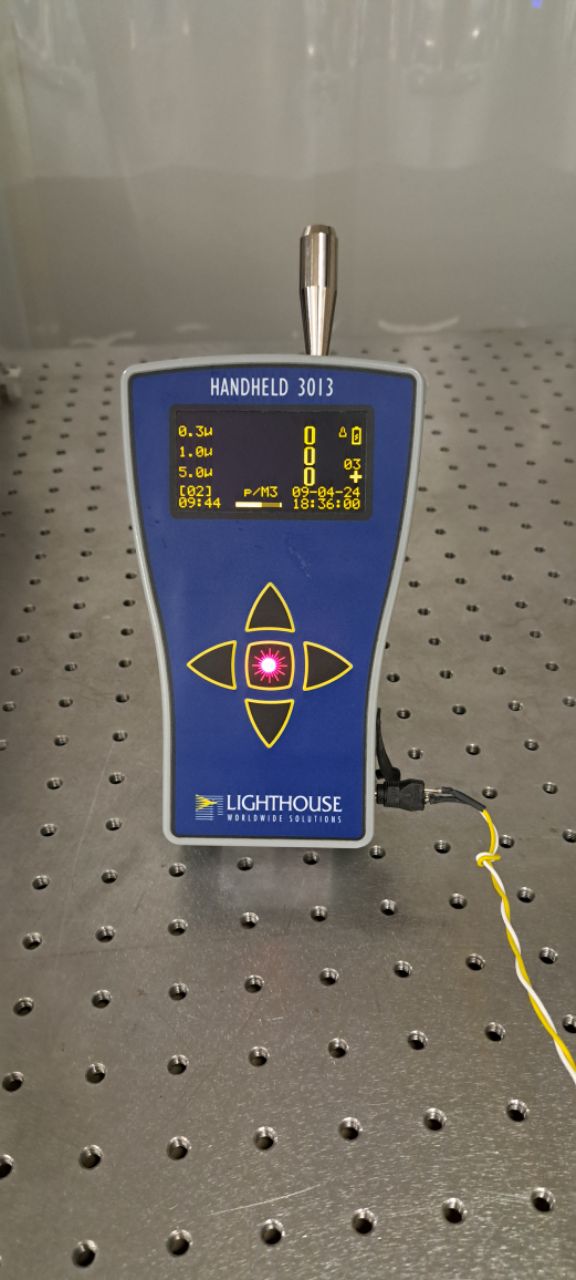
the dust meter count 0 on all particle sizes after the cleaning.
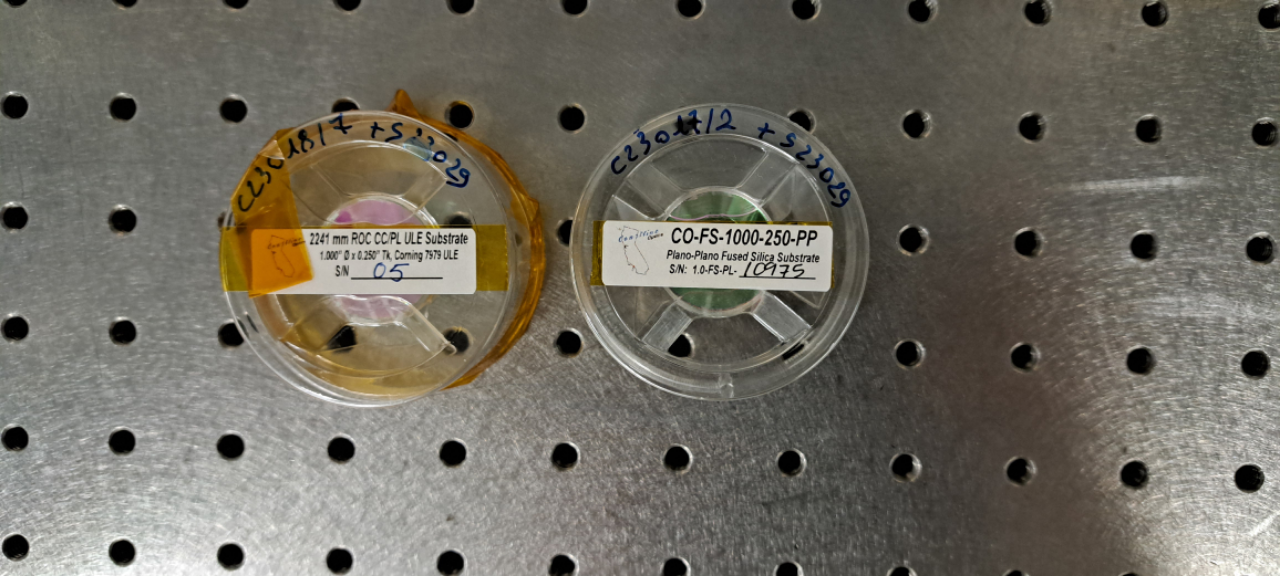
we observed a small part of the SBOX which seems to be oxydised (see picture).
the two previously used mirrors of the SBOX (C23018/7 and C23017/2) were already in their plastic boxes outside of the SBOX.
they are still on the optical table.
we have to decide which mirrors to put in the cavity:
if we don't want to use a "new" ThomX coupling mirror M1, we have to use a Gamma-factory mirror (161185) with T=460ppm for example (we don't have any other FS plan mirrors).
if we don't plan to work at high power in the SBOX for the moment, we could use an "old" ThomX M2 mirror with ROC=2.241m (C1611/11) to avoid any risk of contamination of a "new" ThomX M2 mirror. |
| Attachment 1: Oxydation.jpg
|
 |
| Attachment 2: 20241203_113105.jpg
|
 |
| Attachment 3: 20241203_125359.jpg
|
 |
|
229
|
Fri Dec 6 16:59:57 2024 |
Ronic Chiche | Fixed | info | utilities | Optical room | optical table cleaning |
this afternoon, we checked the dust meter which is at 0 for 1 and 5µm dust particles but ~ 2000-3000 for 0.3µm particles.
we opened the two top panels to let the air flow clean the inside of the vessel.
we observed some other minor oxydised regions (than the one taken in picture) on the external parts of the inox panels but at first sight, nothing inside the vessel.
| Ronic Chiche wrote: |
|
this morning with Alice and Daniele, we removed all the optics elements and equipments from the SBOX optical table and started to clean it.
the dust meter count 0 on all particle sizes after the cleaning.
we observed a small part of the SBOX which seems to be oxydised (see picture).
the two previously used mirrors of the SBOX (C23018/7 and C23017/2) were already in their plastic boxes outside of the SBOX.
they are still on the optical table.
we have to decide which mirrors to put in the cavity:
if we don't want to use a "new" ThomX coupling mirror M1, we have to use a Gamma-factory mirror (161185) with T=460ppm for example (we don't have any other FS plan mirrors).
if we don't plan to work at high power in the SBOX for the moment, we could use an "old" ThomX M2 mirror with ROC=2.241m (C1611/11) to avoid any risk of contamination of a "new" ThomX M2 mirror.
|
|
|
231
|
Tue Mar 4 18:33:26 2025 |
Ronic Chiche | Fixed | info | utilities | Optical room | optical table cleaning |
now, it seems the table is clean enough (dust meter counts 0 particles) to install a 2 mirrors FP-cavity.
| Ronic Chiche wrote: |
|
this afternoon, we checked the dust meter which is at 0 for 1 and 5µm dust particles but ~ 2000-3000 for 0.3µm particles.
we opened the two top panels to let the air flow clean the inside of the vessel.
we observed some other minor oxydised regions (than the one taken in picture) on the external parts of the inox panels but at first sight, nothing inside the vessel.
| Ronic Chiche wrote: |
|
this morning with Alice and Daniele, we removed all the optics elements and equipments from the SBOX optical table and started to clean it.
the dust meter count 0 on all particle sizes after the cleaning.
we observed a small part of the SBOX which seems to be oxydised (see picture).
the two previously used mirrors of the SBOX (C23018/7 and C23017/2) were already in their plastic boxes outside of the SBOX.
they are still on the optical table.
we have to decide which mirrors to put in the cavity:
if we don't want to use a "new" ThomX coupling mirror M1, we have to use a Gamma-factory mirror (161185) with T=460ppm for example (we don't have any other FS plan mirrors).
if we don't plan to work at high power in the SBOX for the moment, we could use an "old" ThomX M2 mirror with ROC=2.241m (C1611/11) to avoid any risk of contamination of a "new" ThomX M2 mirror.
|
|
|
|
175
|
Thu Dec 7 09:30:03 2023 |
Ronic Chiche | Fixed | info | mechanics | lasers and optics | detectors and electronics | software | Optical room | new setup for the 160MHz Menhir oscillator |
from the begining of the week, Xinyi, Aurélien, Viktor and myself started to install a new setup for the Menhir 160MHz oscillator.
the goal is to rich a record power in the FP-cavity.
- the 160MHz Menhir oscillator has been injected in a fiber.
we reached ~ 25mV on 50ohms which is equivalent to 0.5mA in a DET10 photodiode.
=> ~1mW coupled in the fiber => it is not enough to put an EOM and an AOM before the amplifier.
=> one needs to improve the fiber injection.
in fact, I checked the power in the fiber with a powermeter, and it is ~16mW !
at this level of power, one needs to add some optical density before connecting to a photodiode, or it can be saturated.
- we calculated the mirrors position in the SBOX vessel to obtain a 160MHz FSR FP-cavity.
see in attached files, the calculations and scheme in the PPTX file and the Matlab code to get some results.
- we cleaned the optical table and verified with the dust counter that the SBOX environnement is clean.
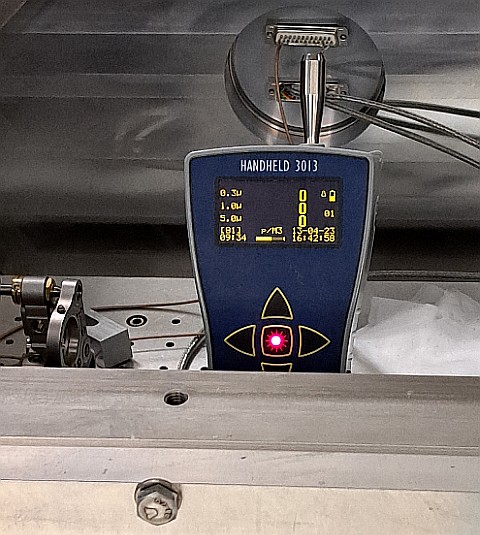
the 2nd airflow box (from the entrance) seems more dusty (measureed directly close to the top) than the others.
we also opened the vessel and cleaned it.
see the dust measurement inside the SBOX.
- we checked the motors inside the vessel :
=> spherical and plan mirrors translation stage control with the ESP300.
the translation stage have been placed on the middle of their range.
=> the 2 D-shape mirrors translation stage control with PICOMOTORS controller Newport 8742.
- today, Viktor and Xinyi should start the installation of the mirrors mount and make some test to check if the beam is properly propagated inside the FP-cavity, before installing the final mirrors.
the mirror mounts are the Newport SU100TW-F2K zero-drift low waveform distortion : https://www.newport.com/p/SU100TW-F2K
they can accept mirrors with 6-6.35mm thickness => normally the SBOX mirrors from the LMA have a 6.35mm thickness.
see 1st file from this post : https://elog.lal.in2p3.fr/FPC/SBOX+commissioning/174 |
| Attachment 1: Plan_SBOX_@_160MHz.pptx
|
| Attachment 2: Implantation_disymmetric.m
|
clear
clc

% simulation parameters
c=299792458;            % light speed in vacuum
Frep=160.3084e6;        % laser repetition rate
D=0.07;                 % side distance between "output" windows of the vessel
DR=0.12;                % side distance between "input" windows of the vessel
L0=1.02;                % cavity box length
L3=0.505;               % distance between spherical mirrors

theta1=linspace(0.115,0.120,1e3);

% calculated parameters
Lrt=c/Frep;
theta2=2*atan(1./((Lrt/D)-1./tan(theta1/2)));
L2=D./sin(theta2);
L4=D./sin(theta1);
L1=Lrt-L2-L3-L4;

LM3=(DR-D)./tan(theta2);
LM2=L0-DR./tan(theta2);
LM1=L0-L1-LM2;
LM4=L0-L3-LM3;

id=LM1>0.15 & LM2>0.15 & LM3>0.15 & LM4>0.15 & abs(LM1-LM3)>0.08 & abs(LM2-LM4)>0.08;
L1(~id)=0;
L2(~id)=0;
L4(~id)=0;
LM1(~id)=0;
LM2(~id)=0;
LM3(~id)=0;
LM4(~id)=0;

figure(1)
clf
plot(theta1*1e3,L1)
hold on
plot(theta1*1e3,L2)
plot(theta1*1e3,L4)
plot(theta1*1e3,LM1)
plot(theta1*1e3,LM2)
plot(theta1*1e3,LM3)
plot(theta1*1e3,LM4)
grid on
legend('L1','L2','L4','LM1','LM2','LM3','LM4','location','best')
xlabel('theta1 angle (mrad)')
ylabel('length parameters (m)')

id=find(id~=0);
id=id(1);

disp(['LRT = ' num2str(Lrt) ' m'])
disp(['D = ' num2str(D*1e3) ' mm'])
disp(['theta1 = ' num2str(theta1(id)*1e3) ' mrad'])
disp(['theta2 = ' num2str(theta2(id)*1e3) ' mrad'])
disp(['L1 = ' num2str(L1(id)*1e3) ' mm'])
disp(['L2 = ' num2str(L2(id)*1e3) ' mm'])
disp(['L3 = ' num2str(L3*1e3) ' mm'])
disp(['L4 = ' num2str(L4(id)*1e3) ' mm'])
disp(' ')
disp(['L0 = ' num2str(L0) ' m'])
disp(['DR = ' num2str(DR*1e3) ' mm'])
disp(['LM1 = ' num2str(LM1(id)*1e3) ' mm'])
disp(['LM2 = ' num2str(LM2(id)*1e3) ' mm'])
disp(['LM3 = ' num2str(LM3(id)*1e3) ' mm'])
disp(['LM4 = ' num2str(LM4(id)*1e3) ' mm'])
disp(['LM3-LM1 = ' num2str((LM3(id)-LM1(id))*1e3) ' mm'])
disp(['LM2-LM4 = ' num2str((LM2(id)-LM4(id))*1e3) ' mm'])
|
| Attachment 3: IMG_20210519_155329.jpg
|
 |
|
244
|
Tue Sep 9 21:23:11 2025 |
Alice Renaux | Under Process | report | lasers and optics | Optical room | new cavity |
Yesterday, we changed the M1 mirror to a 161185 Gamma Factory mirror of transmission 460ppm, the cavity finesse is now 13360.
We managed to lock it today. |
|
245
|
Wed Sep 10 11:27:45 2025 |
Alice Renaux | Under Process | report | lasers and optics | Optical room | new cavity |
The 2-mirrors cavity has 460ppm of transmission for M1 and 10ppm for M2 which should exhibit a Finesse around 13400.
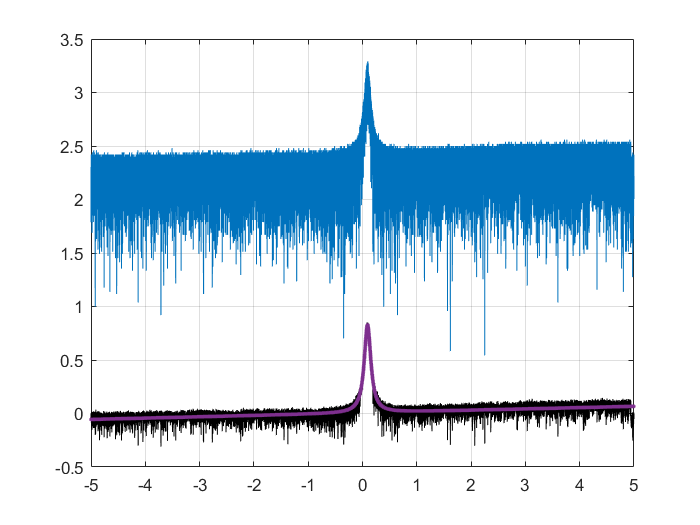
Today, we managed to lock the NKT laser (with an AOM for fast feedback) onto the cavity, and we made 5 Finesse measurements with the modulation technic : 14151, 13847, 13968, 14604, 13892 with an average around 14000 => LW = 216MHz/F ~ 16kHz.
On the plot (Frequency span 1MHz <=> Time span 10s)
blue curve : raw data
black curve : cleaned data
red curve : fitted data
| Alice Renaux wrote: |
|
Yesterday, we changed the M1 mirror to a 161185 Gamma Factory mirror of transmission 460ppm, the cavity finesse is now 13360.
We managed to lock it today.
|
|
| Attachment 1: Finesse.png
|
 |
|
163
|
Tue Sep 13 19:31:14 2022 |
Manar Amer | Fixed | report | lasers and optics | Optical room | liPower storage In Cavity |
After changing the mirror M1 and cleaning the 2 mirrors
They were placed in the cavity box (avoiding touching the mounts to not affect the alignment and placing the mirrors as close to the previous position)
we saw horizontal higher order modes immediately after injecting power, horizontal misalignment!!.
We aligned the injected beam, adjusted the cavity length and saw the modes 01 (high transition) and 00 (ok but still much lower than 01)
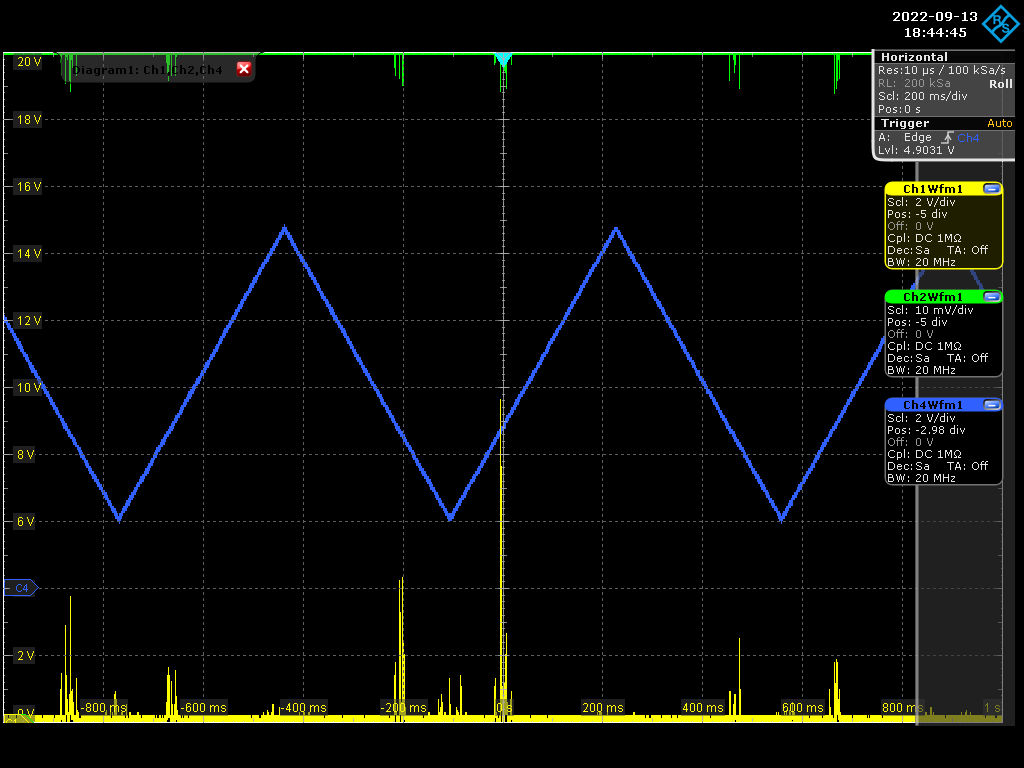
The image attached shows some coupling < 5% , we adjusted the CEP, but it was the max coupling.
we will need to align better tomorrow to increase 00 modes.
The cavity box is closed and placed under vacuum again.
| Manar Amer wrote: |
|
at max stage we reached at 2.5 A on the diodes we have
8000 gain , coupling ~ 60% , with power inside the cavity 50 kW
The higer order mode that was observed today,
it was also observed on Friday along the other higher order mode recorded on the logbook.
after cutting it with the D-shaped mirror we recorded the shape (image attached)
| Manar Amer wrote: |
|
Power increased in the amplifier
reflective filters added at the transmission point to be able to have signal on the Beam Profiler, Transmission diode and power meter
|
Amplifier output current (A)
diode 1
|
Amplifier output current (A)
diode 2
|
Amplifier output current (A)
diode 3
|
Amplifier output current (A)
diode 4
|
Power Output (W) |
Transmitted power (mW) |
note |
| 0.5 |
0.5 |
0.5 |
0.5 |
|
|
no change in the beam shape |
| 1 |
1 |
1 |
1 |
|
|
|
| 1.5 |
1 |
1 |
1 |
|
|
Appearance of higher order mode (vertical), suppressed using D-shaped mirror (vertical only) by (-23000), image recorded. |
| 1.5 |
1.5 |
1.5 |
1.5 |
|
|
no change |
| 2 |
1.8 |
1.5
|
1.5 |
|
52 mA |
52 mA after CEP adjustment , power measured after 2 reflective fillers NDUV30A and NDUV20 |
| 2 |
2 |
2 |
2 |
|
70 mA |
|
| 2.5 |
2.5 |
2 |
2 |
|
95 |
|
| 2.5 |
2.5 |
2.5 |
2.5 |
|
|
sudden drop in power, cavity lock lost, lock system looks ok (maybe something in the cavity)
mode shape is the same
coupling is large, transmission is very low
change the CEP, mo effect in changing it (we have no gain in the cavity, No Finesse) could be something happened to the mirrors !!!!!!
|
| Manar Amer wrote: |
|
At transmission power of 42 mW, coupling 60%, we see fundamental mode with a degeneracy
The D-shape motors were moved to a position 2 000 000 steps (in theory they should be the max position)
but no change appeared on the 00 mode or the higher order mode.
We will break the vacuum and check the position of the D-shaped mirrors.
| Manar Amer wrote: |
|
We start of power output from amplifier of 1W with only the first and second stage on then we start with the third stage power increase,
Note: when changing the current on the third stage 4 diodes, better to do it step by step for each one with a step of ~ 0.5 A
|
Amplifier output current (A)
for four diodes
|
Power Output (W) |
Transmitted power (MW)
|
| 0 , 0 , 0 , 0 |
~ 1 |
2.3 |
| 1 , 1 , 1 , 1 |
/ |
11.0 |
| 1.5 , 1.3, 1 , 1 |
/ |
35 |
| 1.5 , 1.5 , 1 , 1 |
/ |
42.16 |
| |
|
- we placed at the transmission point a splitter the transmitted power before was 35 mW after placing it we had 26 mW
- 97 % transmission , 3% reflected which goes to the beam profiler
- We see degeneracy modes at the last step of 42.16 mW , so we started to test the D-shaped mirrors
- the full range of the motors is 50.8 mm
- each step = 30 nm , 30 000 steps = 1 mm
|
|
|
|
|
| Attachment 1: Screenshot_2022-09-13_0_184445.png
|
 |
|
220
|
Mon May 6 18:38:18 2024 |
Xinyi Lu | Fixed | info | lasers and optics | Optical room | high-power experiments of 2-mirror cavity |
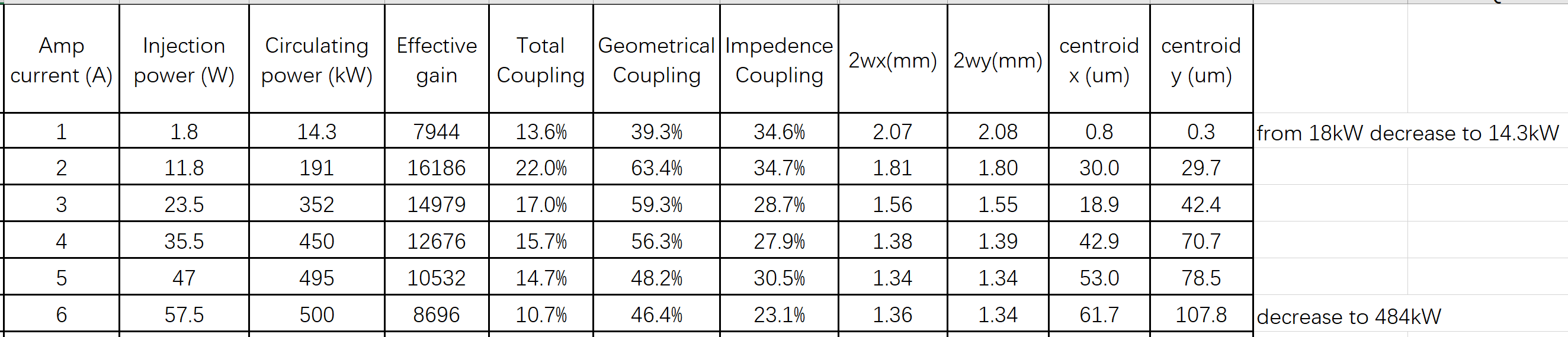
Today, Ronic, Daniele and I redo the high-power 2-mirror cavity experiments, and the results are shown in the table (Figure 1 and Excel 2 ).
- The intracavity power ~500kW can be obtained at 47W injection, but we then have no increase or even a decrease in intracavity power when increasing the injection power, and the coupling is decreasing. It looks like the saturation power of the current device.
- We moved the telescope last week at 2A by moving the concave lens 0.5cm closer to the cavity but almost no change in intracavity power (195kW to 193kW). The telescopes for today's experiment are in the new locations from last week, and we didn't move them today.
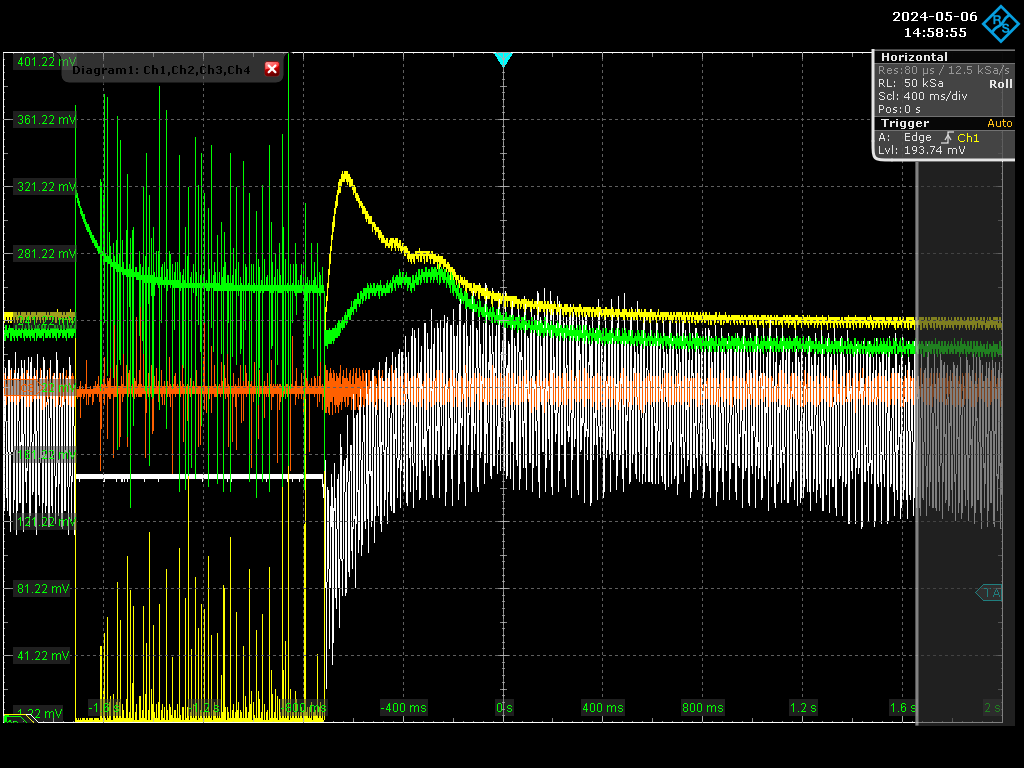
- Figure 3 shows the locking curve at 500kW with some thermal effect changes.
- Figure 4 shows the de-lock and to-lock curves at 14kW.
- The current results may be due to two causes, the thermal lensing effect and the physical change in the mirror coating. It is possible that the transmission of the two mirrors changes with temperature.
- The next plan is to adjust the telescope at 4A to see if we can increase the intracavity power. Meanwhile, do some simulations about dynamic locking, coupling rate, and transmittance.
| Xinyi Lu wrote: |
|
Today, Ronic and I recorded some intracavity power and cavity mode size as shown in Fig. 1.
Coupling was calculated using the locking curve of this overcoupled cavity. Pr/Pi = 1-Cgeo*Cimp, Cimp = 1-|1-2T1/RTL|^2
We can see that the effective gain, coupling, and mode size decrease with increasing power. And the beam is constantly moving.
Tomorrow we will try to optimize the telescope for the high-power hot cavity.
|
|
| Attachment 1: record_20240506.png
|
 |
| Attachment 2: record20240506.xlsx
|
| Attachment 3: Screenshot_2024-05-06_11_145855-500kW.png
|
 |
| Attachment 4: Screenshot_2024-05-06_1_112931-14kW.png
|
 |
|
221
|
Thu May 16 18:51:17 2024 |
Xinyi Lu | Fixed | info | lasers and optics | Optical room | high-power experiments of 2-mirror cavity |
here is a Matlab code to try to optimize the telescope for a hot cavity,
taking into account the thermal lens in the coupling mirror.
from that code, one can deduce using the "Gaussian Beam" software (using the attached xml file) an optimized telescope with 100% geometrical coupling @ Pcav = 700kW and absorption in the coatings = 0.6ppm
| Xinyi Lu wrote: |
|
Today, Ronic, Daniele and I redo the high-power 2-mirror cavity experiments, and the results are shown in the table (Figure 1 and Excel 2 ).
- The intracavity power ~500kW can be obtained at 47W injection, but we then have no increase or even a decrease in intracavity power when increasing the injection power, and the coupling is decreasing. It looks like the saturation power of the current device.
- We moved the telescope last week at 2A by moving the concave lens 0.5cm closer to the cavity but almost no change in intracavity power (195kW to 193kW). The telescopes for today's experiment are in the new locations from last week, and we didn't move them today.
- Figure 3 shows the locking curve at 500kW with some thermal effect changes.
- Figure 4 shows the de-lock and to-lock curves at 14kW.
- The current results may be due to two causes, the thermal lensing effect and the physical change in the mirror coating. It is possible that the transmission of the two mirrors changes with temperature.
- The next plan is to adjust the telescope at 4A to see if we can increase the intracavity power. Meanwhile, do some simulations about dynamic locking, coupling rate, and transmittance.
| Xinyi Lu wrote: |
|
Today, Ronic and I recorded some intracavity power and cavity mode size as shown in Fig. 1.
Coupling was calculated using the locking curve of this overcoupled cavity. Pr/Pi = 1-Cgeo*Cimp, Cimp = 1-|1-2T1/RTL|^2
We can see that the effective gain, coupling, and mode size decrease with increasing power. And the beam is constantly moving.
Tomorrow we will try to optimize the telescope for the high-power hot cavity.
|
|
|
| Attachment 1: telescope_optimization_for_700kW.pdf
|
| Attachment 2: 2_Mirrors_-_216MHz_-_700kW_cavity_setup.xml
|
<?xml version="1.0" encoding="UTF-8"?>
<!DOCTYPE gaussianBeam>
<gaussianBeam version="1.1">
    <bench id="0">
        <wavelength>1.03e-06</wavelength>
        <leftBoundary>0</leftBoundary>
        <rightBoundary>3</rightBoundary>
        <targetBeam id="0">
            <position>1.884</position>
            <waist>0.0005927</waist>
            <positionTolerance>0.1</positionTolerance>
            <waistTolerance>0.01</waistTolerance>
            <minOverlap>0.98</minOverlap>
            <overlapCriterion>0</overlapCriterion>
        </targetBeam>
        <beamFit id="0">
            <name>Fit0</name>
            <dataType>1</dataType>
            <color>4278190335</color>
            <data id="0">
                <position>0</position>
                <value>0</value>
            </data>
            <data id="1">
                <position>0</position>
                <value>0</value>
            </data>
            <data id="2">
                <position>0</position>
                <value>0</value>
            </data>
        </beamFit>
        <opticsList>
            <inputBeam id="2">
                <waist>0.0001447</waist>
                <index>1</index>
                <M2>1</M2>
                <position>0.189</position>
                <name>w0</name>
                <absoluteLock>1</absoluteLock>
            </inputBeam>
            <lens id="5">
                <focal>0.25</focal>
                <position>1</position>
                <name>L3</name>
                <absoluteLock>0</absoluteLock>
            </lens>
            <lens id="6">
                <focal>-0.15</focal>
                <position>1.25</position>
                <name>L4</name>
                <absoluteLock>0</absoluteLock>
            </lens>
            <lens id="11">
                <focal>0.457</focal>
                <position>1.979</position>
                <name>L4</name>
                <absoluteLock>1</absoluteLock>
            </lens>
            <dielectricSlab id="8">
                <indexRatio>1</indexRatio>
                <width>0.01</width>
                <position>1.979</position>
                <name>D2</name>
                <absoluteLock>1</absoluteLock>
            </dielectricSlab>
            <dielectricSlab id="7">
                <indexRatio>1</indexRatio>
                <width>0.01</width>
                <position>2.6708</position>
                <name>D1</name>
                <absoluteLock>1</absoluteLock>
            </dielectricSlab>
        </opticsList>
    </bench>
    <view id="0" bench="0">
        <horizontalRange>3</horizontalRange>
        <verticalRange>0.009999</verticalRange>
        <origin>0</origin>
        <showTargetBeam id="0">1</showTargetBeam>
    </view>
</gaussianBeam>
|
| Attachment 3: cavity_2M_dynamic_thermal_effect.m
|
clear
clc

c=3e8;
lambda=1030e-9;
Pin=35;
Gcav=20e3;

%% 2M-cavity geometrical setup definition
FSR=216.67e6;           % Free Spectral Range of the FP-cavity
Lrt=c/FSR;              % round trip distance in the FP-cavity
L=Lrt/2;                % distance between mirrors
iR10=0;                 % cold ROC of M1
iR20=1/2.241;           % cold ROC of M2

%% 2M-cavity thermal setup definition
A_Coating=0.6e-6;       % absorption in the coatings
% Heraeus Suprasil 3001 parameters
n_Sup3001=1.45;         % refractive index for Fused Silica
A_Sup3001=0.3e-6;       % 0.3+/-0.2 ppm/cm @ 1064nm
kappa_Sup3001=1.38;     % 1.38 W/m/K @ 20°C    / 1.46W/m/K @ 100°C
alpha_Sup3001=0.6e-6;   % 0.51ppm/K @ 0-100°C / 0.59ppm/K @ 0-300°C
beta_Sup3001=8e-6;      % cf Suprasil 3001 documentation
% Corning 7972 ULE parameters
n_ULE=1.45;             % refractive index for ULE
kappa_ULE=1.31;         % 1.31 W/m/K @ 25°C
alpha_ULE=10e-9;        % Premium grade < 10ppb/K
beta_ULE=11e-6;         % 11.24ppm/K @ 40-60°C / 10.68ppm/K @ 20-40°C

%% 2M-cavity cold mode definition
zw0=iR10*L*(1-iR20*L)/(iR10+iR20-2*L*iR10*iR20);
zr0=sqrt(L*(1-L*iR10)*(1-L*iR20)*(iR10+iR20-L*iR10*iR20))/(iR10+iR20-2*L*iR10*iR20);

% complex radius at z=0 (M1)
q0=-zw0+1i*zr0;
% beam size at z=0 (M1)
wm10=sqrt(lambda/pi/zr0)*abs(q0);
% complex radius at z=L (M2)
qL=L-zw0+1i*zr0;
% beam size at z=L (M2)
wm20=sqrt(lambda/pi/zr0)*abs(qL);

% beam profiler position
Lb=0.67;
% definition of the z-axis
Nz=1e3;
z=linspace(-zr0,L+Lb,Nz);
idm=z<=0;
idp=z>=0 & z<=L;
idb=z>=L;

%% telescope definition
% cold optimization
zwT=zw0;
zrT=zr0;
% hot optimization
zwT=-0.38;
zrT=0.155;
qT=z-zwT+1i*zrT;
wT=sqrt(lambda/pi/zrT)*abs(qT);

%% geometrical coupling definition
C0=4*zrT*zr0/((zwT-zw0)^2+(zrT+zr0)^2);

Nk=200;
Pcav=zeros(1,Nk);
C=C0*ones(1,Nk);
wm1=wm10*ones(1,Nk);
wm2=wm20*ones(1,Nk);
kt=0.05;
iR1th_f=0;
iR2th_f=0;
iR1thl_f=0;
iR2thl_f=0;

figure(1)
clf
hold on
grid on
xlabel('z position (m)')
ylabel('beam size (µm)')
plot(z(idm),wT(idm)*1e6,'r')
ylim([0 900])

for k=1:Nk

    % cavity power
    Pcav(k)=Gcav*C(k)*Pin*(k>1);
    % absorbed power in coatings
    Pa=A_Coating*Pcav(k);
    % thermal ROC for M1 and M2
    iR1th_i=-alpha_Sup3001/(2*pi*kappa_Sup3001*wm1(k)^2)*Pa;
    iR2th_i=-alpha_ULE/(2*pi*kappa_ULE*wm2(k)^2)*Pa;
    % thermal lens for M1 and M2
    iR1thl_i=beta_Sup3001/(2*pi*kappa_Sup3001*wm1(k)^2)*Pa;
    iR2thl_i=-0*beta_ULE/(2*pi*kappa_ULE*wm2(k)^2)*Pa;

    % slow thermal effect simulation
    iR1th_f=iR1th_f+kt*(iR1th_i-iR1th_f);
    iR2th_f=iR2th_f+kt*(iR2th_i-iR2th_f);
    iR1thl_f=iR1thl_f+kt*(iR1thl_i-iR1thl_f);
    iR2thl_f=iR2thl_f+kt*(iR2thl_i-iR2thl_f);

    % total ROC for M1 and M2
    iR1=iR10+iR1th_f;
    iR2=iR20+iR2th_f;
    % total ROC in tranmission for M1 and M2
    iR1t=iR10+iR1thl_f;
    iR2t=iR20+iR2thl_f;

    % cavity mode parameters
    zw=iR1*L*(1-iR2*L)/(iR1+iR2-2*L*iR1*iR2);
    zr=sqrt(L*(1-L*iR1)*(1-L*iR2)*(iR1+iR2-L*iR1*iR2))/(iR1+iR2-2*L*iR1*iR2);
    q0=-zw+1i*zr;
    qL=L-zw+1i*zr;
    q=z-zw+1i*zr;
    w=sqrt(lambda/pi/zr)*abs(q);

    % beam from telescope to cavity
    zwTA=(zwT+2*iR1t*(zrT^2+zwT^2))/(1+4*iR1t*zwT+4*iR1t^2*(zwT^2+zrT^2));
    zrTA=zrT/(1+4*iR1t*zwT+4*iR1t^2*(zwT^2+zrT^2));
    qTA=z-zwTA+1i*zrTA;
    wTA=sqrt(lambda/pi/zrTA)*abs(qTA);

    % beam after the cavity
    zwOUT=(zw+2*iR2t*(zr^2+zw^2))/(1+4*iR2t*zw+4*iR2t^2*(zw^2+zr^2));
    zrOUT=zr/(1+4*iR2t*zw+4*iR2t^2*(zw^2+zr^2));
    qOUT=z-zwOUT+1i*zrOUT;
    wOUT=sqrt(lambda/pi/zrOUT)*abs(qOUT);

    % plots
    plot(z(idp),w(idp)*1e6,'k')
    plot(z(idp),wTA(idp)*1e6,'r')
    %plot(z(idb),wOUT(idb)*1e6,'b')

    % coupling calculation
    if k<Nk
        wm1(k+1)=sqrt(lambda/pi/zr)*abs(q0);
        wm2(k+1)=sqrt(lambda/pi/zr)*abs(qL);
        C(k+1)=4*zrTA*zr/((zwTA-zw)^2+(zrTA+zr)^2);
    end

end

figure(2)
clf
plot(Pcav/1e3)
grid on
ylim([0 max(Pcav/1e3)])
ylabel('cavity power (kW)')

figure(3)
clf
plot(C)
grid on
ylim([0 1])
ylabel('coupling (A.U)')

zwT=(zw-2*iR1t*(zr^2+zw^2))/(1-4*iR1t*zw+4*iR1t^2*(zw^2+zr^2));
zrT=zr/(1-4*iR1t*zw+4*iR1t^2*(zw^2+zr^2));

disp(['waist position for telescope from hot cavity  : ' num2str(zwT) ' m'])
disp(['Rayleigh length for telescope from hot cavity : ' num2str(zrT) ' m'])
|
|
222
|
Fri May 17 15:02:01 2024 |
Xinyi Lu | Fixed | info | lasers and optics | Optical room | high-power experiments of 2-mirror cavity |
Here's a summary of our experiment last week:
The initial telescope position: 920 mm (f=+250mm) and 1148 mm (f=-150mm) from the amplifier output.
Mon May 6: We moved the concave lens 0.5mm closer to the cavity.
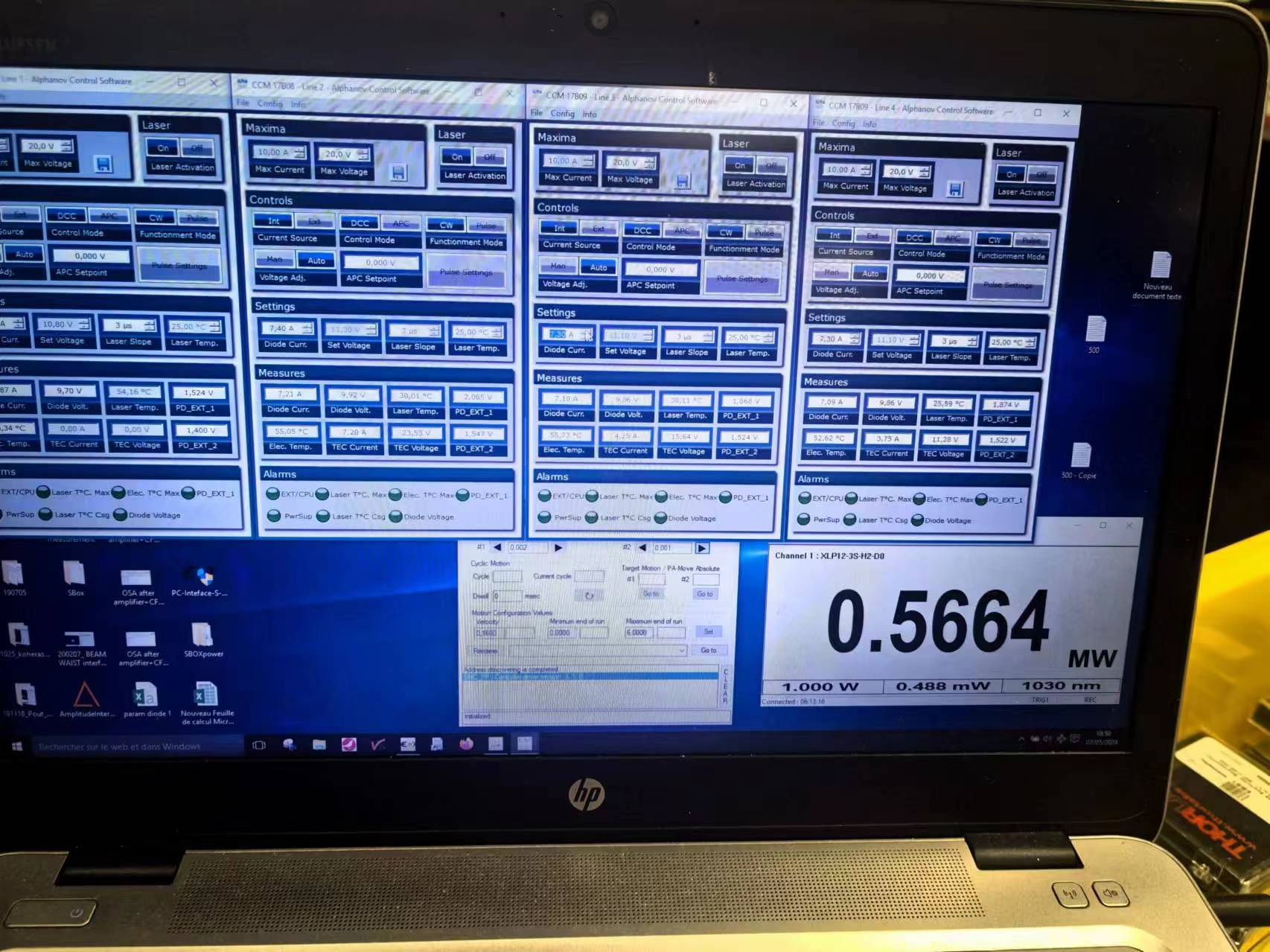
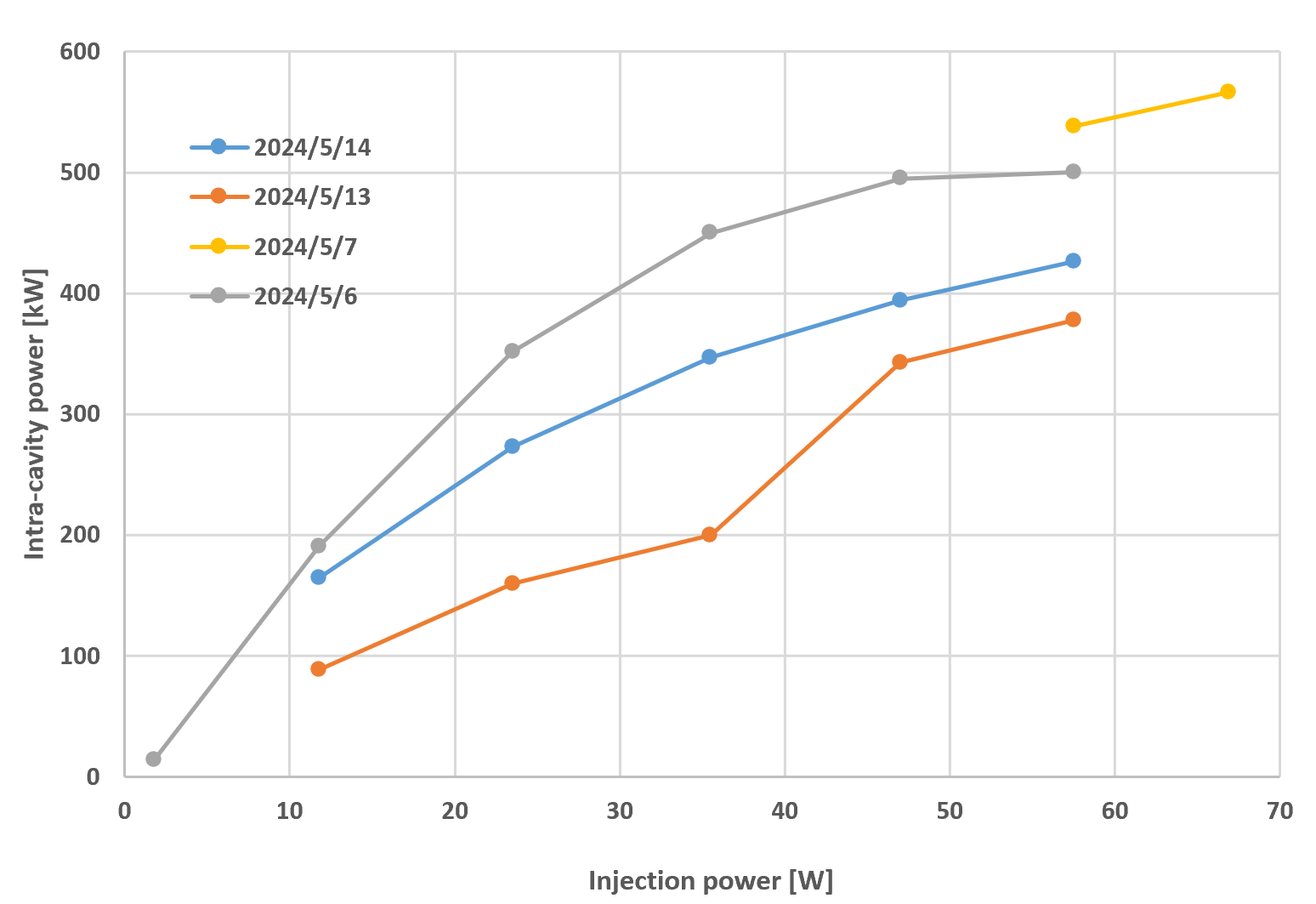
Tue May 7: We moved the D-shaped mirror position at high power, and the intracavity power reached a maximum of 566 kW at 7 A (as Fig 1). The telescopes are the same as on May 6.
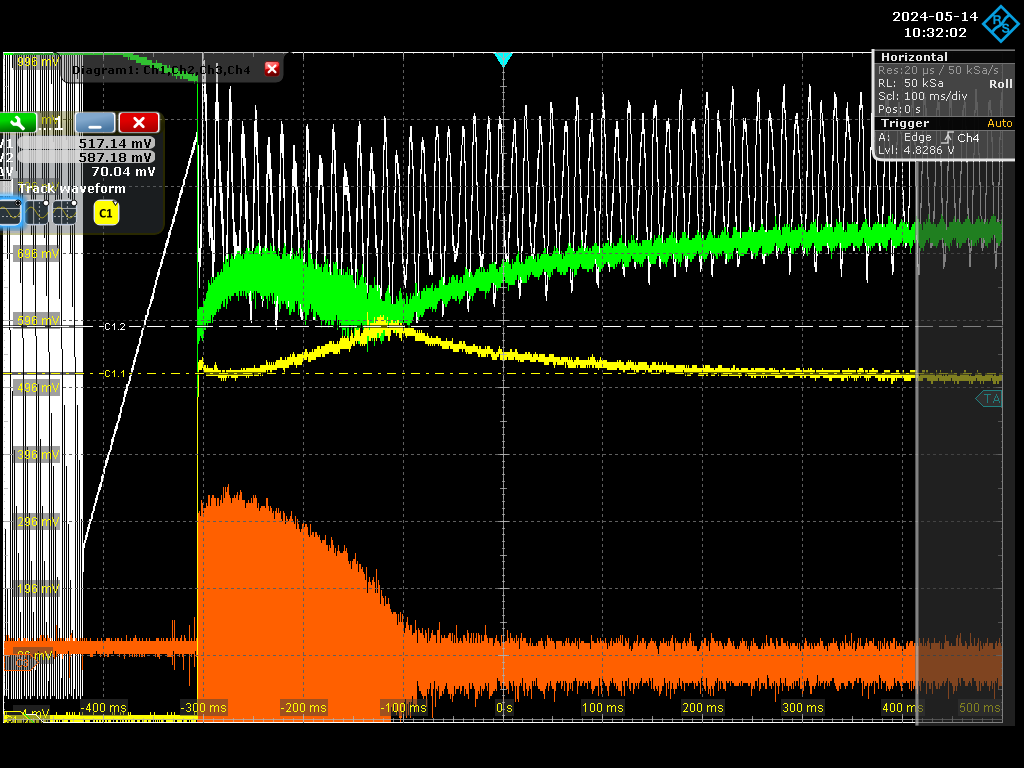
Mon May 13: We moved the two lenses closer to the cavity by 12 cm with the two lenses 20 cm apart. At 5A and 6A, we tried several times to move the concave lens slightly to get higher power. CEP and alignment were optimized after each movement. The best power is shown in Fig. 2 and the table.
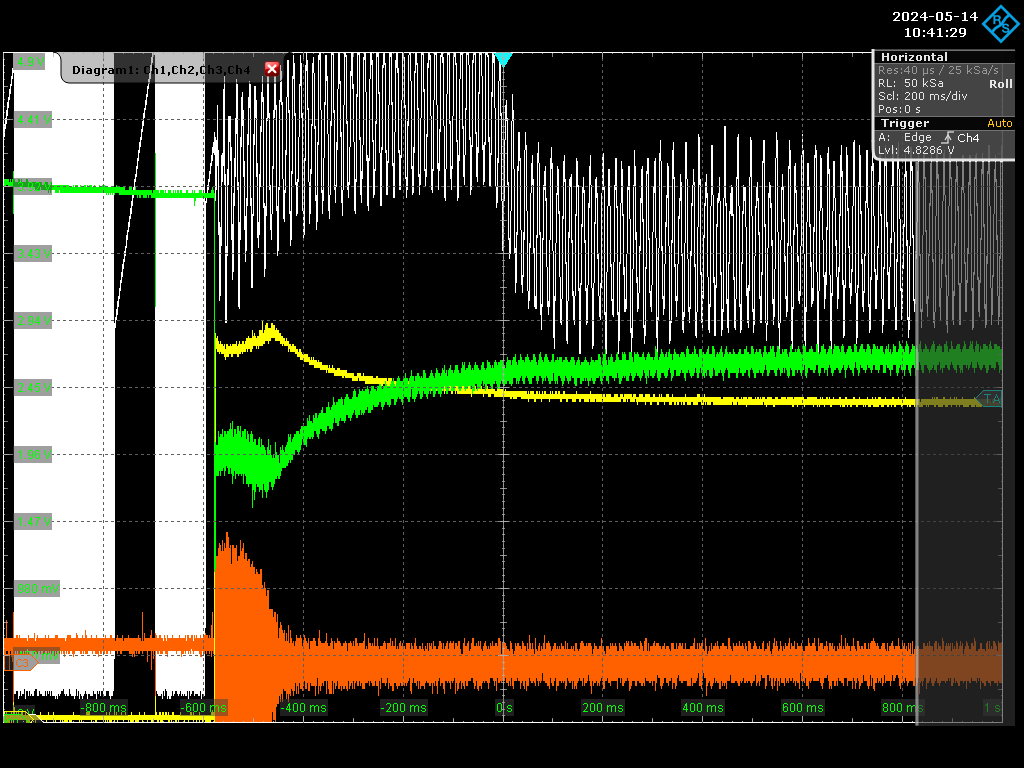
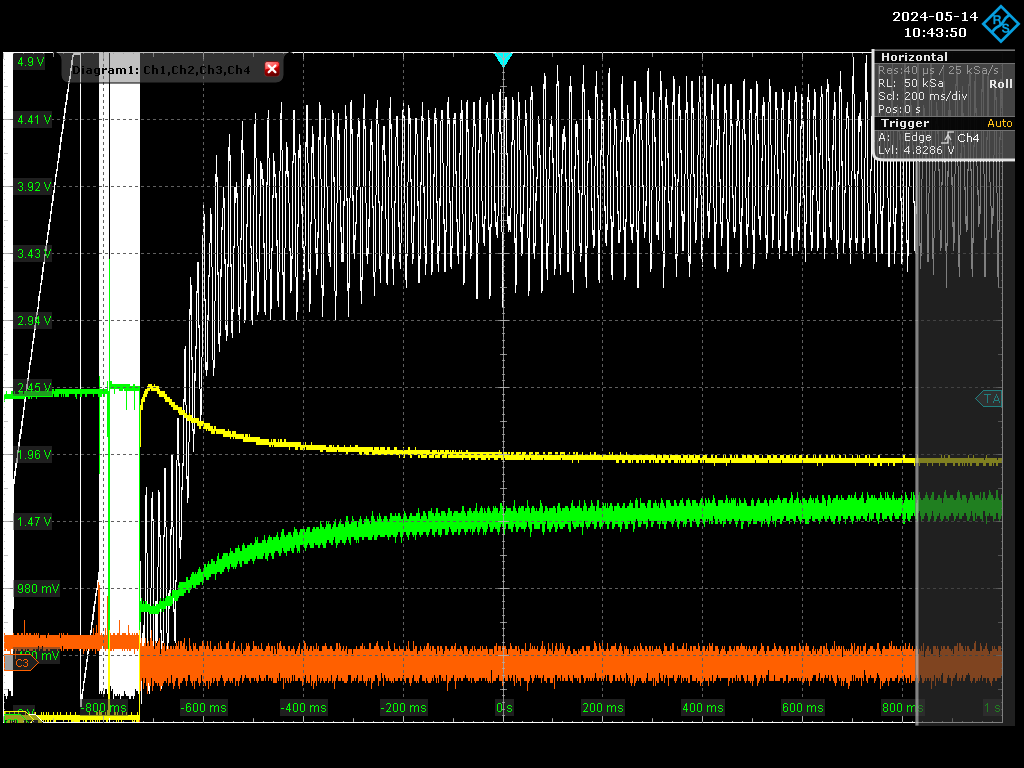
Tue May 14: We moved the two lenses far from the cavity ((in the middle of May 13 and before). We tried several times to move the concave lens slightly to get higher power. CEP and alignment were optimized after each movement. The best power is shown in Fig. 2 and the table.
We find a small peak in the transmission at high power when the cavity is just locked (as shown in Figure 4-6 at different powers).
| Xinyi Lu wrote: |
|
here is a Matlab code to try to optimize the telescope for a hot cavity,
taking into account the thermal lens in the coupling mirror.
from that code, one can deduce using the "Gaussian Beam" software (using the attached xml file) an optimized telescope with 100% geometrical coupling @ Pcav = 700kW and absorption in the coatings = 0.6ppm
| Xinyi Lu wrote: |
|
Today, Ronic, Daniele and I redo the high-power 2-mirror cavity experiments, and the results are shown in the table (Figure 1 and Excel 2 ).
- The intracavity power ~500kW can be obtained at 47W injection, but we then have no increase or even a decrease in intracavity power when increasing the injection power, and the coupling is decreasing. It looks like the saturation power of the current device.
- We moved the telescope last week at 2A by moving the concave lens 0.5cm closer to the cavity but almost no change in intracavity power (195kW to 193kW). The telescopes for today's experiment are in the new locations from last week, and we didn't move them today.
- Figure 3 shows the locking curve at 500kW with some thermal effect changes.
- Figure 4 shows the de-lock and to-lock curves at 14kW.
- The current results may be due to two causes, the thermal lensing effect and the physical change in the mirror coating. It is possible that the transmission of the two mirrors changes with temperature.
- The next plan is to adjust the telescope at 4A to see if we can increase the intracavity power. Meanwhile, do some simulations about dynamic locking, coupling rate, and transmittance.
| Xinyi Lu wrote: |
|
Today, Ronic and I recorded some intracavity power and cavity mode size as shown in Fig. 1.
Coupling was calculated using the locking curve of this overcoupled cavity. Pr/Pi = 1-Cgeo*Cimp, Cimp = 1-|1-2T1/RTL|^2
We can see that the effective gain, coupling, and mode size decrease with increasing power. And the beam is constantly moving.
Tomorrow we will try to optimize the telescope for the high-power hot cavity.
|
|
|
|
| Attachment 1: 7A_566kW.jpg
|
 |
| Attachment 2: high_power_experiments.png
|
 |
| Attachment 3: record_20240506-0514.xlsx
|
| Attachment 4: Screenshot_2024-05-14_1_103202-400kW-6A.png
|
 |
| Attachment 5: Screenshot_2024-05-14_5_104129-377kw-4.75A.png
|
 |
| Attachment 6: Screenshot_2024-05-14_6_104350-300kW-3.5A.png
|
 |
|
36
|
Fri Dec 13 18:28:00 2019 |
Ronic Chiche | Fixed | report | lasers and optics | Optical room | first data with 3A on the 3rd stage |
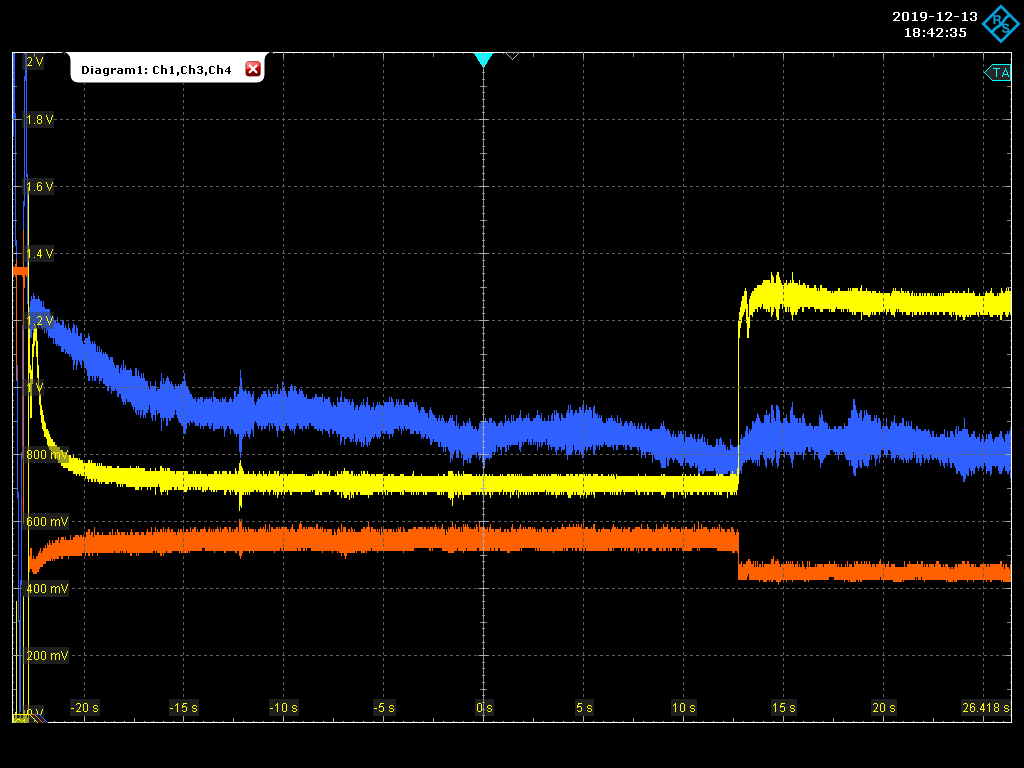
Today, at 3A on the 3rd stage, we saw some HOM effects.
the transmissions is about 100mW which corresponds to 30kW inside cavity.
we tried to play with D shape motors but without success.
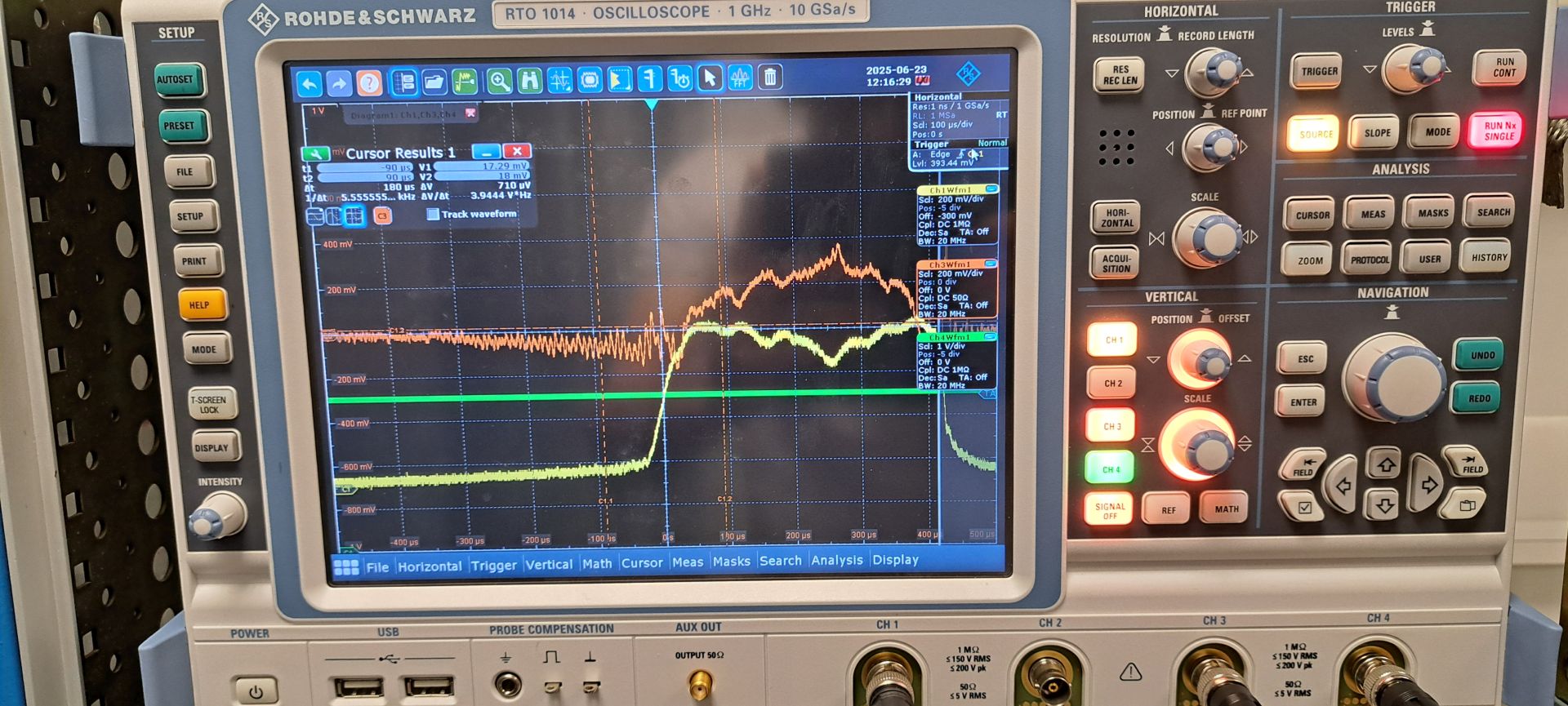
on the plot below, a mix between Thermal effects andHOM effects (the trans step at 13s is done without any external action)
-yellow : transmission
- orange : coupling
- blue : PZT correction
the camera video does not correspond exactly to the scope plot.
it is just an example of HOM effect. |
| Attachment 1: Screenshot_2019-12-13_3_184235.png
|
 |
| Attachment 2: HOM.gif
|
 |
|
38
|
Tue Dec 17 10:56:08 2019 |
Ronic Chiche | Fixed | report | lasers and optics | Optical room | first data with 3A on the 3rd stage |
2 pictures :
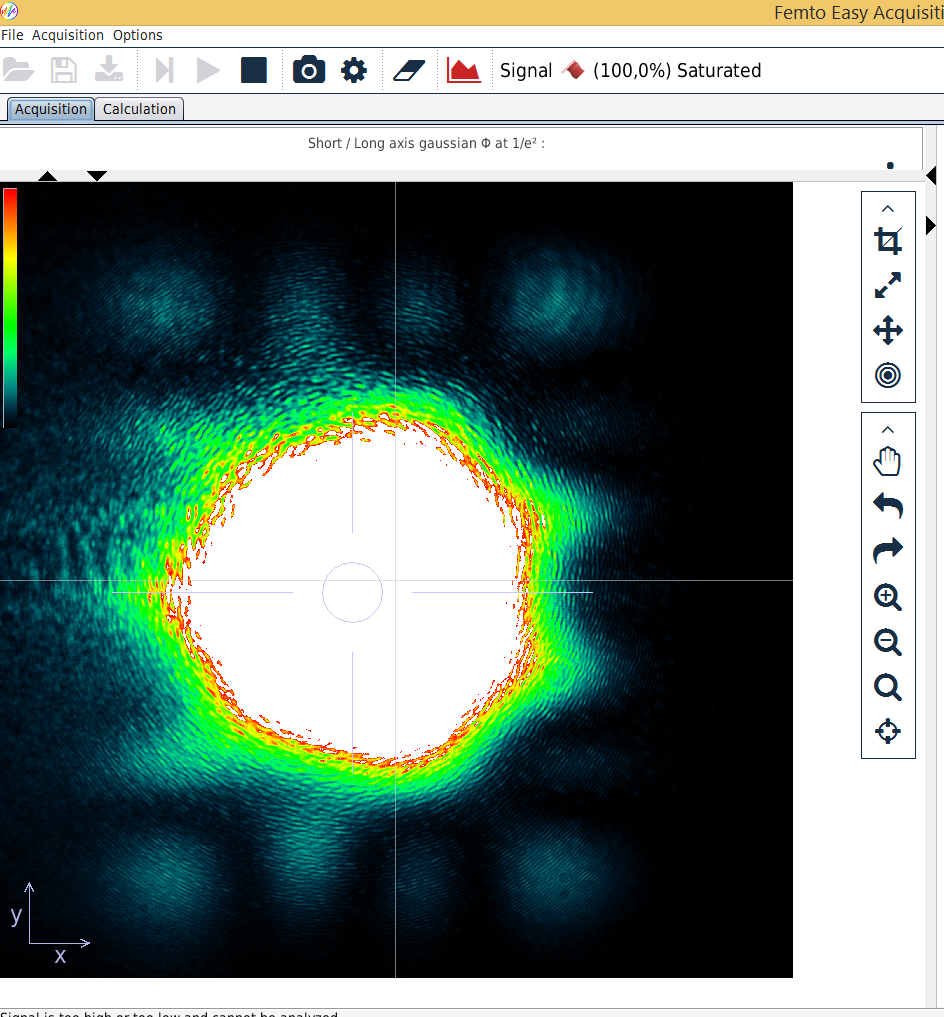
typical beam with HOM
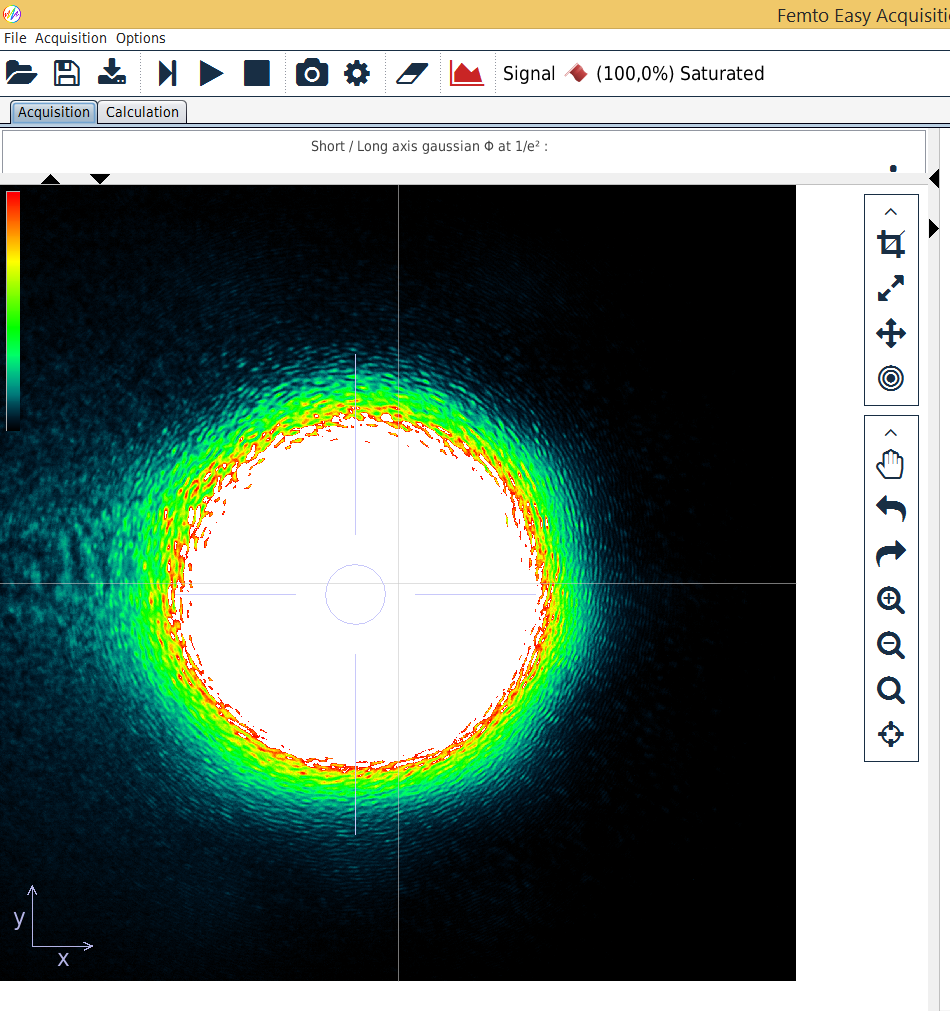
typical beam after moving the D-shape motor : no more HOM
| Ronic Chiche wrote: |
|
Today, at 3A on the 3rd stage, we saw some HOM effects.
the transmissions is about 100mW which corresponds to 30kW inside cavity.
we tried to play with D shape motors but without success.
on the plot below, a mix between Thermal effects andHOM effects (the trans step at 13s is done without any external action)
-yellow : transmission
- orange : coupling
- blue : PZT correction
the camera video does not correspond exactly to the scope plot.
it is just an example of HOM effect.
|
|
| Attachment 1: HOM_5-3_saturated.png
|
 |
| Attachment 2: fundamental_mode_saturated.png
|
 |
|
238
|
Mon Jun 23 14:38:33 2025 |
Ronic Chiche | Under Process | issue | mechanics | lasers and optics | detectors and electronics | Optical room | first attempt to lock |
With Alice, we installed the EOWaves oscillator to be locked on the FP-cavity (T1 ~ 2500ppm, T2 ~ 10ppm => F ~ 2500)
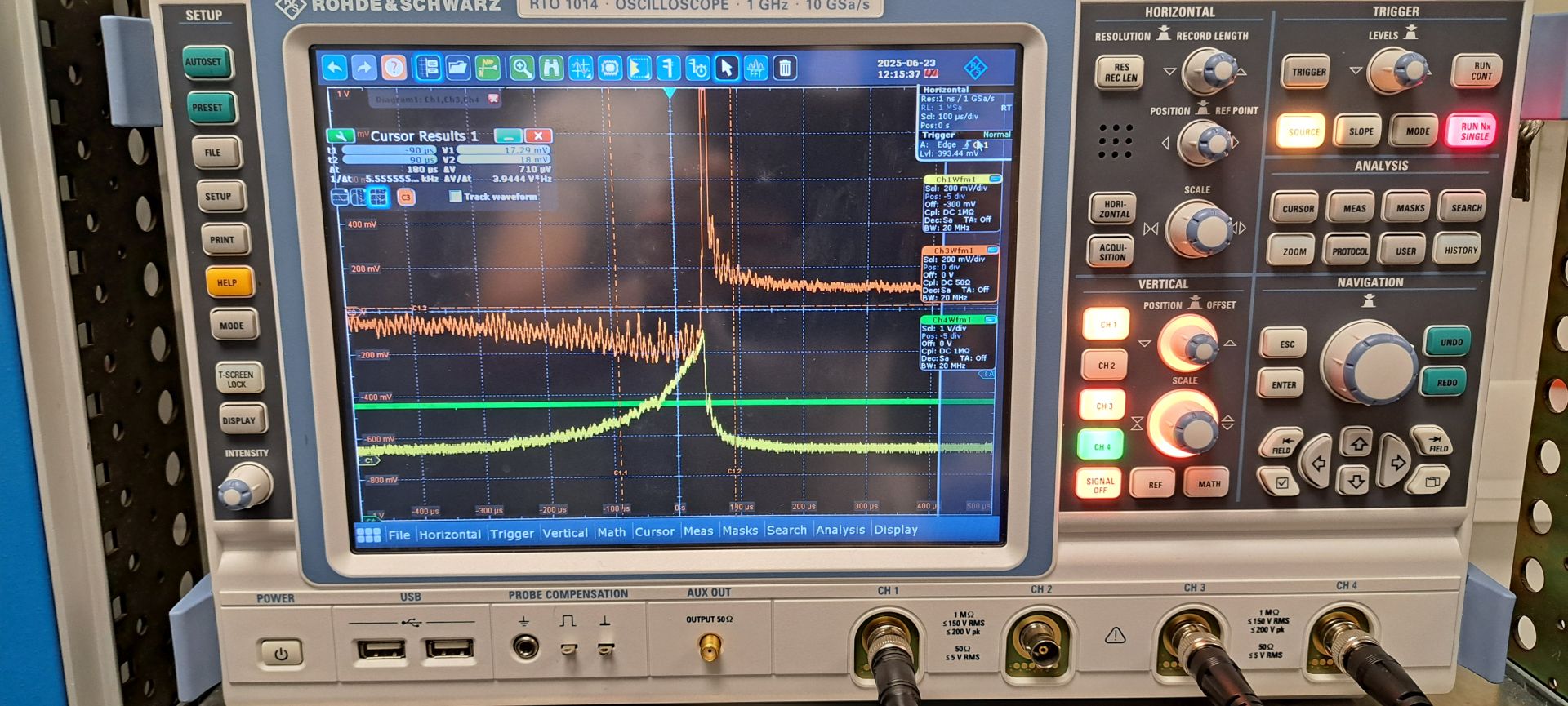
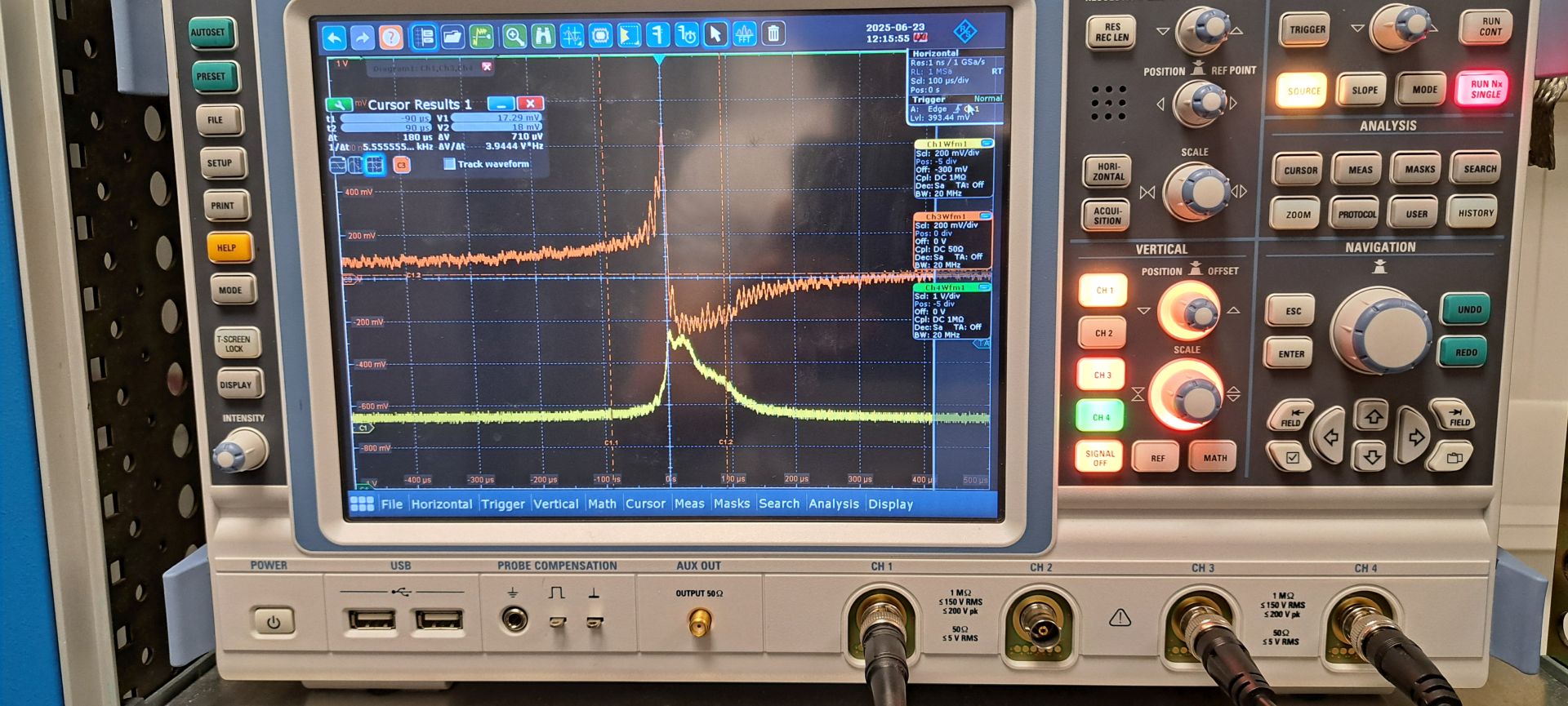
FSR = 216MHz => LW = 86kHz.
We installed the PDH box, and we got some error signal, but the shape of the transmission signal and error signal is a bit strange...
It grows smoothly, and when the power is large enough, one can see a sudden and fast drop.
Could it be some mechanical problem with the mirrors' mounts ?
I opened the SBOX this morning to do some inspection, and the mirrors seem properly installed in the mounts.
In some rare cases (last picture), the "instability" effect is not dominant, and we are able to maintain a quasi-lock during some 1- 2ms.
But it is still impossible to lock the cavity.
(We did a test with a vacuum in the SBOX at ~2mbar, but the problem is the same.) |
| Attachment 1: 20250623_123816.jpg
|
 |
| Attachment 2: 20250623_123833.jpg
|
 |
| Attachment 3: 20250623_123908.jpg
|
 |
|
121
|
Thu Jul 28 13:52:23 2022 |
Aurélien Martens | Fixed | report | utilities | Optical room | chiller for CELIA amplifier |
The chiller of CELIA amplifier has been moved from the corridor to the changing room in front of PLIC.
It was not functionning well (quick drop of flow below 0.9l/min). After several cleanings of the filter, shorting the water circuit a stable 2.1l/min flow was obtained. Then the water circuit was elongated to go close to the amplifier but not into it. Allowing to get about 1.3l/min stable. Now the amplifier is conencted, the filter has been cleaned again twice and the flow seem stable with 1.4l/min. New filters have been ordered and must arrive quickly. Changing it is necessary I think. |
|
122
|
Mon Aug 8 11:11:28 2022 |
Aurélien Martens | Fixed | report | utilities | Optical room | chiller for CELIA amplifier |
today, temperature of the chiller has been set to 23°C.
measured temperature in the chiller reaches 23°C after approximatively 10 minutes
| Aurélien Martens wrote: |
|
The chiller of CELIA amplifier has been moved from the corridor to the changing room in front of PLIC.
It was not functionning well (quick drop of flow below 0.9l/min). After several cleanings of the filter, shorting the water circuit a stable 2.1l/min flow was obtained. Then the water circuit was elongated to go close to the amplifier but not into it. Allowing to get about 1.3l/min stable. Now the amplifier is conencted, the filter has been cleaned again twice and the flow seem stable with 1.4l/min. New filters have been ordered and must arrive quickly. Changing it is necessary I think.
|
|
|
47
|
Fri Jan 10 18:51:23 2020 |
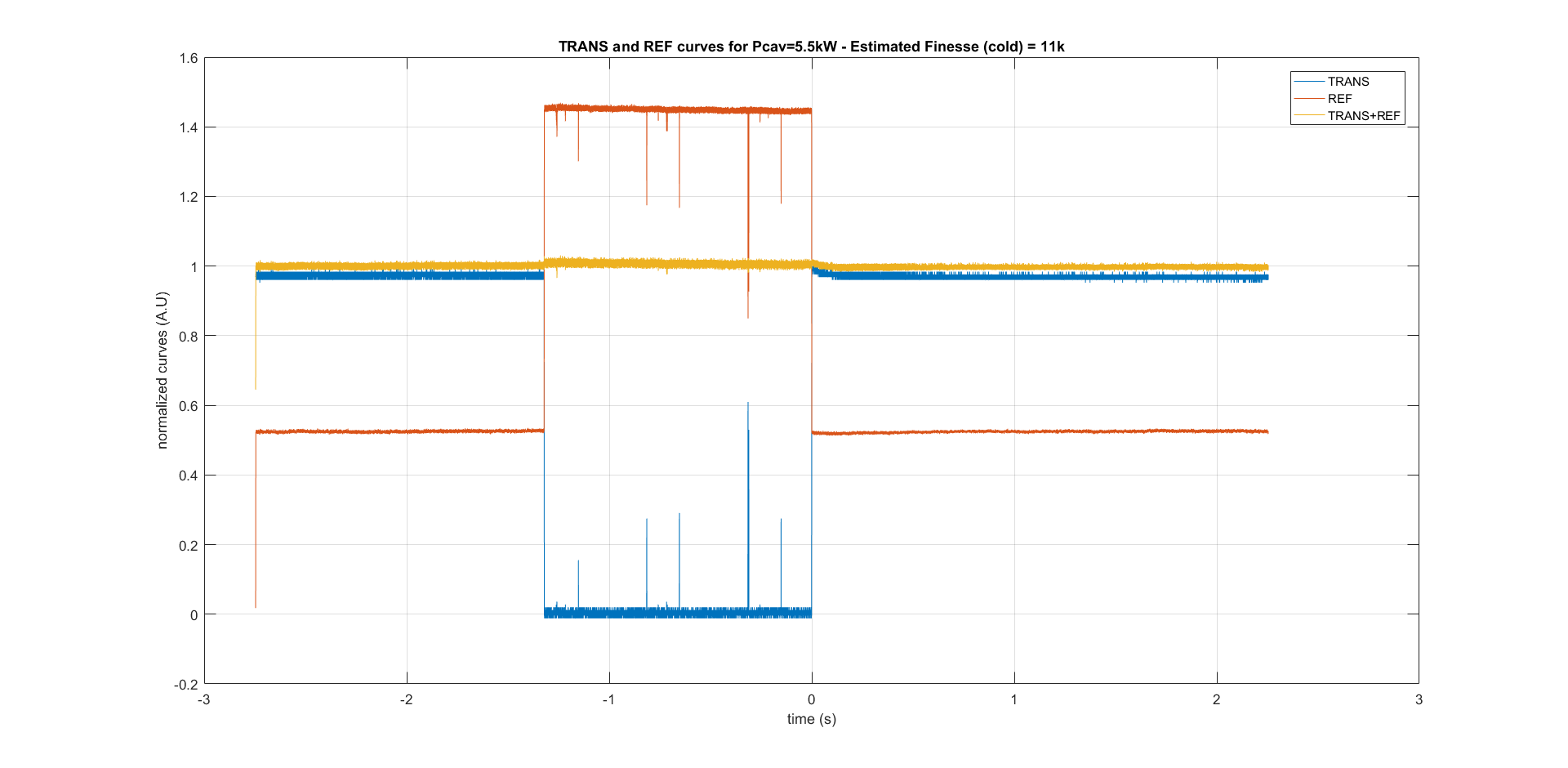
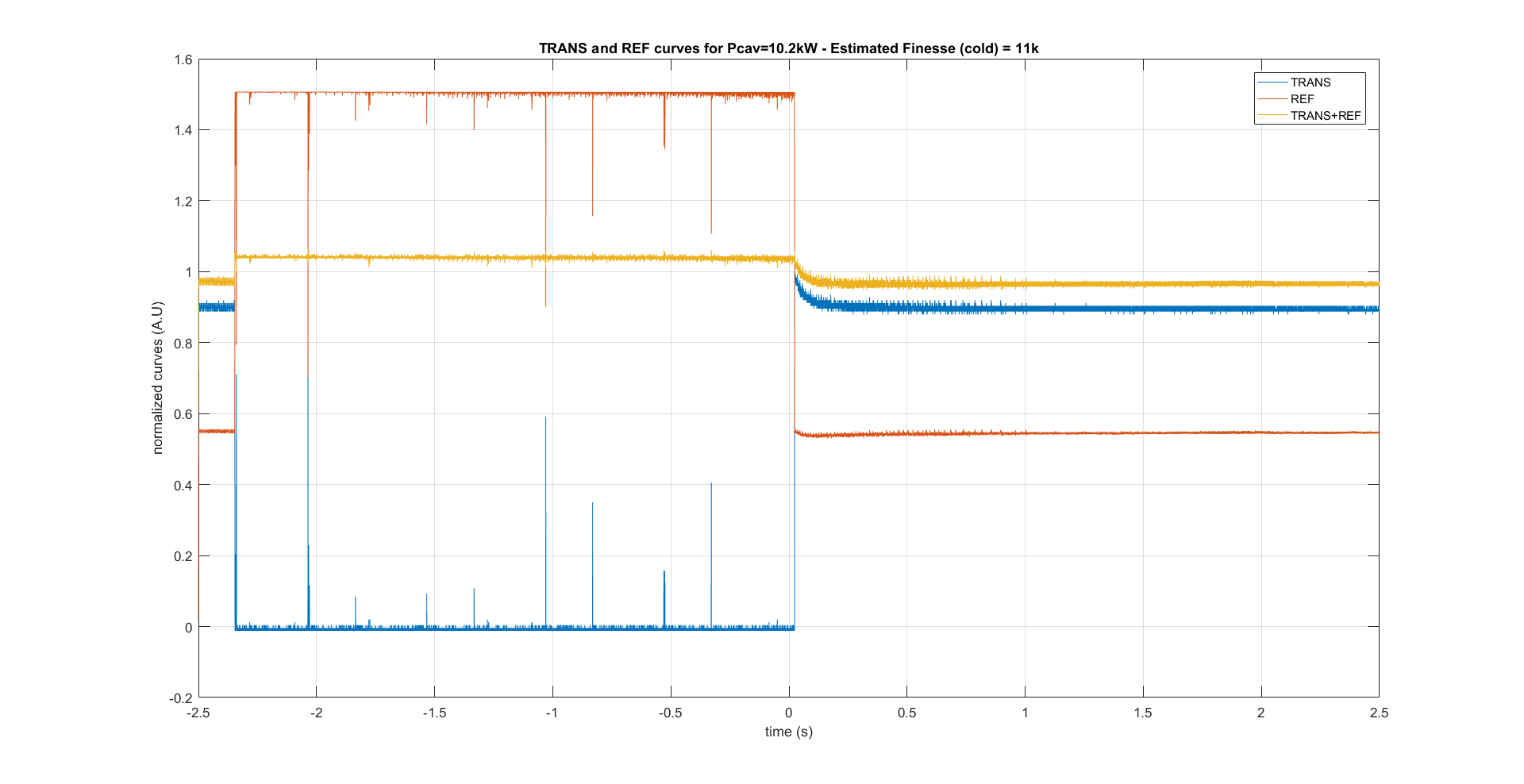
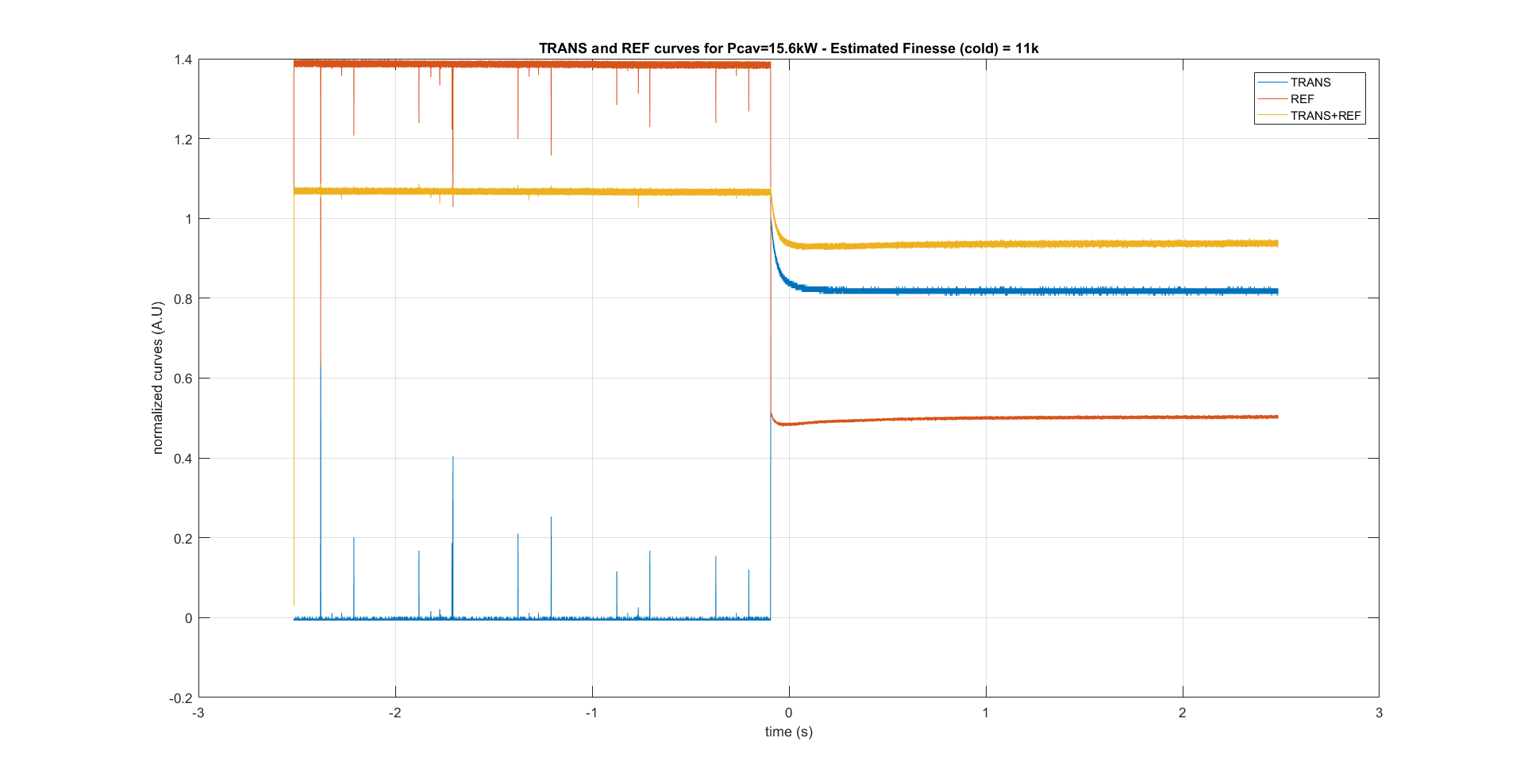
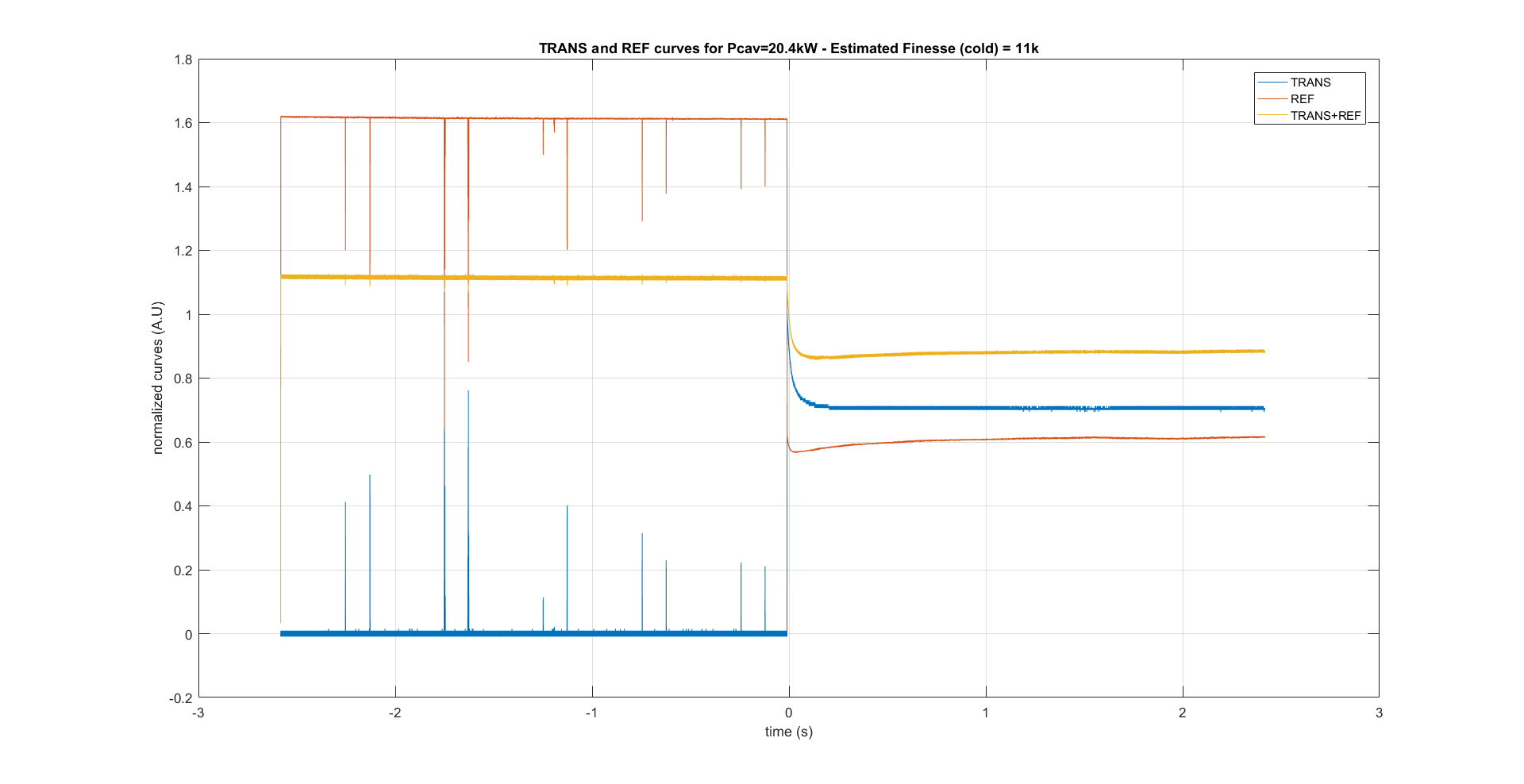
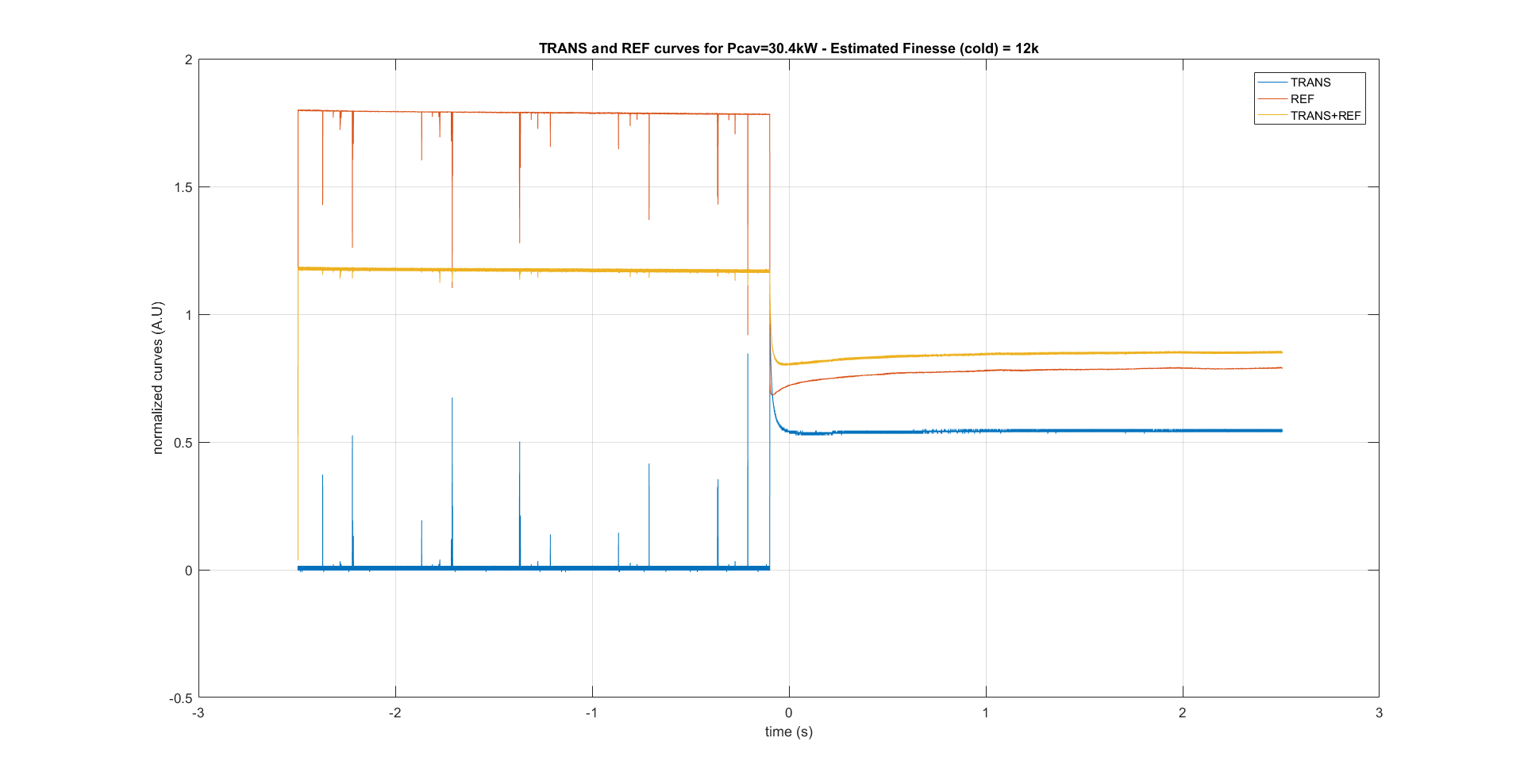
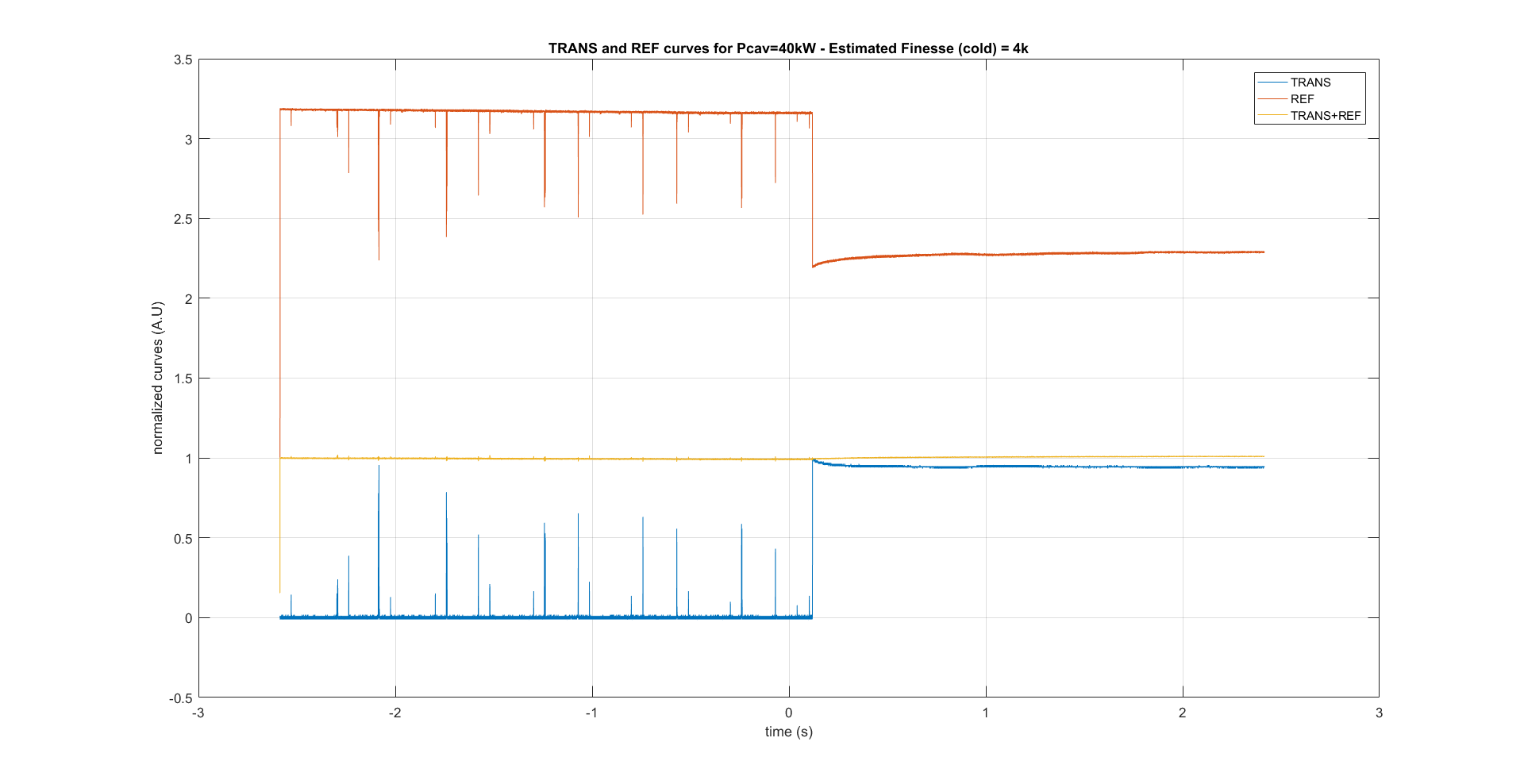
Ronic Chiche | Fixed | report | lasers and optics | Optical room | analysis of stored and reflected power |
the 10th of January, we increased the power of the amplifier to study the cavity transmitted and reflected power signals.
analyzing the noise transfer functions of transmitted and reflected power one could deduce the Finesse of the cavity.
the power of this technic (if it is confirmed) does not depend on the decay time of one signal which depends on the speed of the cut off but on the difference between reflected and transmitted transfer functions,
and then is independant of the cut off speed.
here are 6 analysis of the Finesse when the cavity is cold, depending only on short lock periods.
5 of them agrees on a Finesse around 11k.
the 6th estimation at 40kW stored in the cavity is about 4k but now, we know that the M1 mirror had suddenly a hole for this power... thus the Finesse value is reasonable.
we can then, use the non conservation of TRANS+REF signal to estimate the FInesse decrease when the cavity is hot... to be done
|
| Attachment 1: TRANS_&_REF.png
|
 |
| Attachment 2: TRANS_&_REF.png
|
 |
| Attachment 3: TRANS_&_REF.png
|
 |
| Attachment 4: TRANS_&_REF.png
|
 |
| Attachment 5: TRANS_&_REF.png
|
 |
| Attachment 6: TRANS_&_REF.png
|
 |
|
48
|
Fri Jan 24 16:16:24 2020 |
Ronic Chiche | Fixed | report | lasers and optics | Optical room | analysis of stored and reflected power |
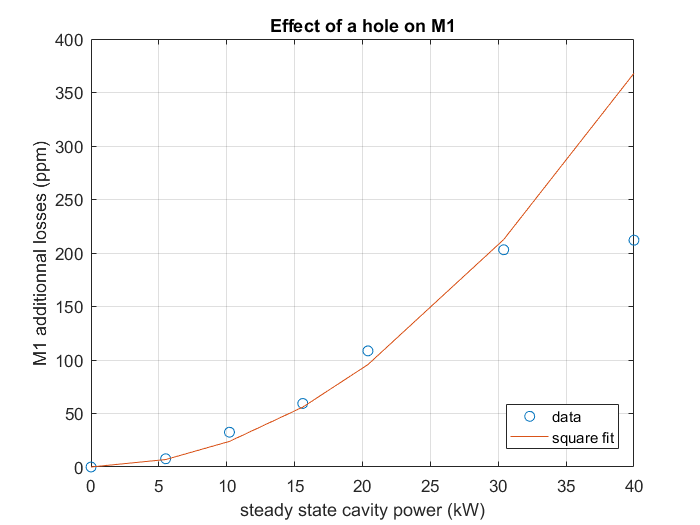
A chart which summarizes the data we have or we can estimate.
in orange, the case 1, where we suppose the initial cold Finesse is the one measured by modulation technique in December 2019 (F=20.8k).
and in green, the case 2, where we suppose the initial cold Finesse is the one measured by "zero compensation" technique between transmission and reflection signals during the power-up measurements (F~11k).
clearly, the case which matches better the only one data (written in red) of input power and then of cavity gain, is the Finesse estimated by the "zero compensation" technique. it matches also better the gain of the cavity measured after M1 had its hole and for which the estimated Finesse of 4k, and then estimated gain of 277 by "zero compensation" technique is not so far from the measurement of 185 (the gain is may be higher than 185 as it is possible we had some additional misalignment which reduced the gain).
| Ronic Chiche wrote: |
|
the 10th of January, we increased the power of the amplifier to study the cavity transmitted and reflected power signals.
analyzing the noise transfer functions of transmitted and reflected power one could deduce the Finesse of the cavity.
the power of this technic (if it is confirmed) does not depend on the decay time of one signal which depends on the speed of the cut off but on the difference between reflected and transmitted transfer functions,
and then is independant of the cut off speed.
here are 6 analysis of the Finesse when the cavity is cold, depending only on short lock periods.
5 of them agrees on a Finesse around 11k.
the 6th estimation at 40kW stored in the cavity is about 4k but now, we know that the M1 mirror had suddenly a hole for this power... thus the Finesse value is reasonable.
we can then, use the non conservation of TRANS+REF signal to estimate the FInesse decrease when the cavity is hot... to be done
|
|
| Attachment 1: Losses.pdf
|
| Attachment 2: M1_losses_vs_Pcav.png
|
 |
|
56
|
Thu Feb 6 11:01:08 2020 |
Ronic Chiche | Fixed | report | lasers and optics | Optical room | analysis of stored and reflected power |
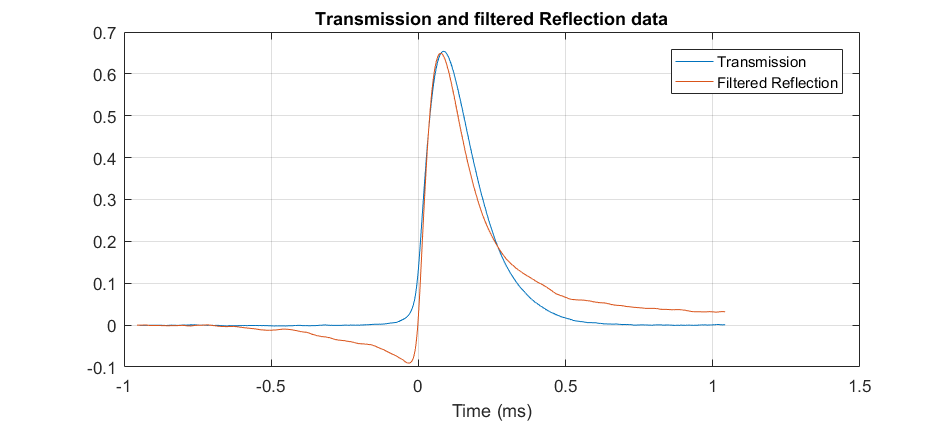
with this Finesse around 22-23k, the technique comparing TRANSMISSION and REFLECTION signals doesn't work, even in taking into account individual photodiode time responses.
It seems that the cavity is not completely stationnary and the shapes are not comparable easily with just a Low Pass Filter related to the Finesse.
Below, an example of the best fit of filtered REFLECTION signal compared to TRANSMISSION signal.... it is clear that the shapes don't fit....
| Ronic Chiche wrote: |
|
the 10th of January, we increased the power of the amplifier to study the cavity transmitted and reflected power signals.
analyzing the noise transfer functions of transmitted and reflected power one could deduce the Finesse of the cavity.
the power of this technic (if it is confirmed) does not depend on the decay time of one signal which depends on the speed of the cut off but on the difference between reflected and transmitted transfer functions,
and then is independant of the cut off speed.
here are 6 analysis of the Finesse when the cavity is cold, depending only on short lock periods.
5 of them agrees on a Finesse around 11k.
the 6th estimation at 40kW stored in the cavity is about 4k but now, we know that the M1 mirror had suddenly a hole for this power... thus the Finesse value is reasonable.
we can then, use the non conservation of TRANS+REF signal to estimate the FInesse decrease when the cavity is hot... to be done
|
|
| Attachment 1: untitled.png
|
 |
|
58
|
Wed Jun 19 18:54:00 2019 |
Huan Wang | Fixed | info | lasers and optics | Optical room | amplifier |
Onefive output power is 24mW now, and 2.41mW(after EOM) injected into fiber,
a injection power monitor added, 99% (2.06mW) injected into amplifier, 1% (16.1uW) monitored with photodiode DET36A/M, which gives ~500mV DC signal on oscilloscope with 1Mohm impedanc;
First stage amplifier works good, monitoring phtodiode gives more than 200mV DC signal with 50ohm impedance on oscilloscope (as attached photo);
Second stage, the old monitoring photodiode is broken, a new monitoring photodiode is connected, which we don't have reference data for it,
on the optical output port of the monitoring signal, it's written 150mW, but at where we measured 40mW. |
| Attachment 1: 1st_stage_amplifier_monitoring_photodiode_signal.jpg
|
 |