| ID |
Date |
Author |
Status |
Type |
Category |
Location |
Title |
|
161
|
Mon Sep 12 18:50:57 2022 |
Manar Amer | Fixed | issue | lasers and optics | Optical room | Damage on mirror surface |
Tomorrow will try to shift the injection mirror to avoid hitting the damaged spot.
| Manar Amer wrote: |
|
Following the storage of ~ 50 kW inside the cavity and a sudden drop in transmitted power from the cavity
damage to the mirror surface was suspected.
We broke vacuum and took images of the surface of the 2 mirrors in the cavity, the spherical and the planar mirror
image 1 , spherical reflective surface (no visible damage with the UV light, and no visible damage under the microscope)
image 2 , planar coupler mirror reflective surface (no visible damage under UV light, but under the microscope there is a damaged spot close to the center)
image 4 is the planar surface reflective surface at zoom 8 on the microscope.
|
|
|
162
|
Tue Sep 13 19:26:27 2022 |
Manar Amer | Fixed | report | lasers and optics | Optical room | Damage on mirror surface |
After discussing, we have decided against shifting the mirror to avoid the time lost.
We changed the injection mirror to a different mirror from Mighty Laser set, Transmission of mirror 80 ppm. (no visible damage at the center of the mirror, only a small scratch on the back)
mirror cleaned using pure ethanol and pure water with spin coater, also the spherical mirror was cleaned again.
| Manar Amer wrote: |
|
Tomorrow will try to shift the injection mirror to avoid hitting the damaged spot.
| Manar Amer wrote: |
|
Following the storage of ~ 50 kW inside the cavity and a sudden drop in transmitted power from the cavity
damage to the mirror surface was suspected.
We broke vacuum and took images of the surface of the 2 mirrors in the cavity, the spherical and the planar mirror
image 1 , spherical reflective surface (no visible damage with the UV light, and no visible damage under the microscope)
image 2 , planar coupler mirror reflective surface (no visible damage under UV light, but under the microscope there is a damaged spot close to the center)
image 4 is the planar surface reflective surface at zoom 8 on the microscope.
|
|
|
|
166
|
Fri Sep 16 15:56:45 2022 |
Manar Amer | Fixed | report | lasers and optics | Optical room | Damage on mirror surface |
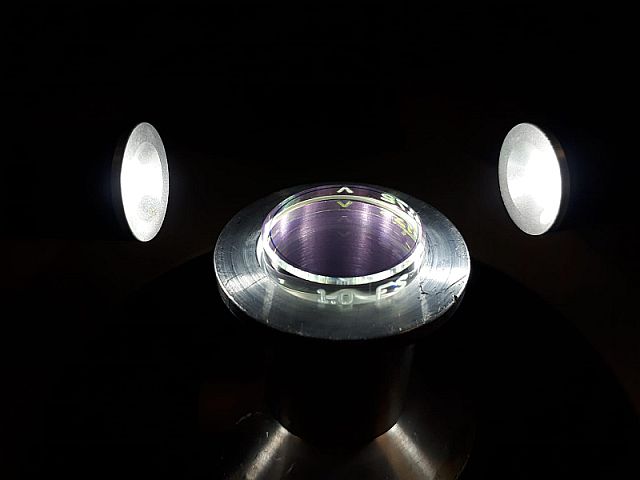
a better image of the damaged spot, image taken with the arrow for the reflective surface facing the other direction (image shows position)
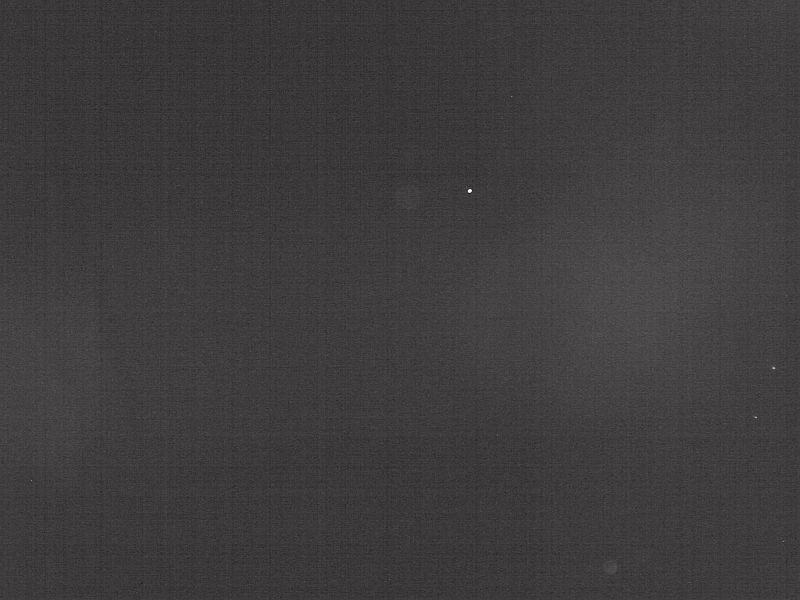
The image of M1 for ThomX reflective surface was taken at min zoom (full image scale 13 mm) and max zoom (full image scale 2 mm) on microscope
The spot appears to be not close to the center of the mirror, at max zoom in the center we do not see the spot it is just out of the image
the last image has the mirror position adjusted to center the damaged spot for a better image of it.
| Manar Amer wrote: |
|
After discussing, we have decided against shifting the mirror to avoid the time lost.
We changed the injection mirror to a different mirror from Mighty Laser set, Transmission of mirror 80 ppm. (no visible damage at the center of the mirror, only a small scratch on the back)
mirror cleaned using pure ethanol and pure water with spin coater, also the spherical mirror was cleaned again.
| Manar Amer wrote: |
|
Tomorrow will try to shift the injection mirror to avoid hitting the damaged spot.
| Manar Amer wrote: |
|
Following the storage of ~ 50 kW inside the cavity and a sudden drop in transmitted power from the cavity
damage to the mirror surface was suspected.
We broke vacuum and took images of the surface of the 2 mirrors in the cavity, the spherical and the planar mirror
image 1 , spherical reflective surface (no visible damage with the UV light, and no visible damage under the microscope)
image 2 , planar coupler mirror reflective surface (no visible damage under UV light, but under the microscope there is a damaged spot close to the center)
image 4 is the planar surface reflective surface at zoom 8 on the microscope.
|
|
|
|
| Attachment 1: M1_mirror_on_Microscope_stand0.jpg
|
 |
| Attachment 2: M1X_front_min_zoom.jpg
|
 |
| Attachment 3: M1X_front_max_zoom.jpg
|
 |
| Attachment 4: M1X_front_damaged_spot_max_zoom.jpg
|
 |
|
167
|
Fri Sep 16 17:47:56 2022 |
Manar Amer | Fixed | report | lasers and optics | Optical room | Damage on mirror surface |
ThomX injection mirror has been cleaned and placed again inside the optical cavity.
This time to avoid the damaged spot I have displaced the mirror mount horizontally to have a distance between center of the beam and the spot ~ 2.5 - 3 mm.
The alignment was affected slightly but recovered by adjusting the mirror mount nobs, (00 mode observed in air)
The cavity was closed is being pumped with vacuum.
To be done: adjust the cavity length and find the resonance, improve the outer alignment, lock the cavity
| Manar Amer wrote: |
|
a better image of the damaged spot, image taken with the arrow for the reflective surface facing the other direction (image shows position)
The image of M1 for ThomX reflective surface was taken at min zoom (full image scale 13 mm) and max zoom (full image scale 2 mm) on microscope
The spot appears to be not close to the center of the mirror, at max zoom in the center we do not see the spot it is just out of the image
the last image has the mirror position adjusted to center the damaged spot for a better image of it.
| Manar Amer wrote: |
|
After discussing, we have decided against shifting the mirror to avoid the time lost.
We changed the injection mirror to a different mirror from Mighty Laser set, Transmission of mirror 80 ppm. (no visible damage at the center of the mirror, only a small scratch on the back)
mirror cleaned using pure ethanol and pure water with spin coater, also the spherical mirror was cleaned again.
| Manar Amer wrote: |
|
Tomorrow will try to shift the injection mirror to avoid hitting the damaged spot.
| Manar Amer wrote: |
|
Following the storage of ~ 50 kW inside the cavity and a sudden drop in transmitted power from the cavity
damage to the mirror surface was suspected.
We broke vacuum and took images of the surface of the 2 mirrors in the cavity, the spherical and the planar mirror
image 1 , spherical reflective surface (no visible damage with the UV light, and no visible damage under the microscope)
image 2 , planar coupler mirror reflective surface (no visible damage under UV light, but under the microscope there is a damaged spot close to the center)
image 4 is the planar surface reflective surface at zoom 8 on the microscope.
|
|
|
|
|
|
156
|
Fri Sep 9 18:35:07 2022 |
Ronic Chiche | Fixed | info | mechanics | lasers and optics | detectors and electronics | Optical room | D-shape mirrors positionning status |
This afternoon we opened the cavity and put the D-shape mirrors at their correct place, close to the beam.
we checked the relative position of the mirrors to the beam using the 2nd stage of the amplifier (<1W) and with the sensitive (and cleaned) orange optical card.
with this configuration, we can see very clearly the beam inside the cavity (~ 100µW) and we can check easily if the D-shape mirrors are correctly placed.
the motors used to move the D-shape are the Newport Picomotors 8303-V
with roughly 30nm/step sensitivity and 50mm of range (~1 600 000 steps)
the 4 axis controller used ot move these motors is the Newport 8742.
For both Vertical and Horizontal D-shape mirrors:
* when you do +N steps on the controller, you retract the D-shape mirror from the beam
* when you do -N steps on the controller, you push the D-shape mirror to the beam
the 0 position on the controller corresponds to the D-shape close to the beam.
now, the FP cavity is closed and pumped to go back to vacuum.
|
|
157
|
Fri Sep 9 19:03:58 2022 |
Ronic Chiche | Fixed | info | mechanics | lasers and optics | detectors and electronics | Optical room | D-shape mirrors positionning status |
The cavity box is vacuum pumped at 6*10^-2 mbar.
| Ronic Chiche wrote: |
|
This afternoon we opened the cavity and put the D-shape mirrors at their correct place, close to the beam.
we checked the relative position of the mirrors to the beam using the 2nd stage of the amplifier (<1W) and with the sensitive (and cleaned) orange optical card.
with this configuration, we can see very clearly the beam inside the cavity (~ 100µW) and we can check easily if the D-shape mirrors are correctly placed.
the motors used to move the D-shape are the Newport Picomotors 8303-V
with roughly 30nm/step sensitivity and 50mm of range (~1 600 000 steps)
the 4 axis controller used ot move these motors is the Newport 8742.
For both Vertical and Horizontal D-shape mirrors:
* when you do +N steps on the controller, you retract the D-shape mirror from the beam
* when you do -N steps on the controller, you push the D-shape mirror to the beam
the 0 position on the controller corresponds to the D-shape close to the beam.
now, the FP cavity is closed and pumped to go back to vacuum.
|
|
|
223
|
Wed Jun 19 10:38:00 2024 |
Ronic Chiche | Fixed | info | mechanics | lasers and optics | detectors and electronics | Optical room | D-shape mirrors positionning status |
summary:
- the motors used to move the D-shape are the Newport Picomotors 8303-V
the sensitivity is roughly 30nm/step
the range is 1 600 000 steps or 50mm
- the 4 axis controller used ot move these motors is the Newport 8742.
channel 1 is for the vertical D-shape
channel 2 is for the horizontal D-shape
+N steps on the controller, you retract the D-shape mirror from the beam
-N steps on the controller, you push the D-shape mirror to the beam
the 0 position, vertically and horizontally is close to the beam.
the stand position is at ~ +200 000 steps in both directions.
| Ronic Chiche wrote: |
|
The cavity box is vacuum pumped at 6*10^-2 mbar.
| Ronic Chiche wrote: |
|
This afternoon we opened the cavity and put the D-shape mirrors at their correct place, close to the beam.
we checked the relative position of the mirrors to the beam using the 2nd stage of the amplifier (<1W) and with the sensitive (and cleaned) orange optical card.
with this configuration, we can see very clearly the beam inside the cavity (~ 100µW) and we can check easily if the D-shape mirrors are correctly placed.
the motors used to move the D-shape are the Newport Picomotors 8303-V
with roughly 30nm/step sensitivity and 50mm of range (~1 600 000 steps)
the 4 axis controller used ot move these motors is the Newport 8742.
For both Vertical and Horizontal D-shape mirrors:
* when you do +N steps on the controller, you retract the D-shape mirror from the beam
* when you do -N steps on the controller, you push the D-shape mirror to the beam
the 0 position on the controller corresponds to the D-shape close to the beam.
now, the FP cavity is closed and pumped to go back to vacuum.
|
|
|
|
179
|
Wed Jan 10 18:35:46 2024 |
Xinyi Lu | Fixed | info | lasers and optics | Optical room | Coupling efficiency improvement |
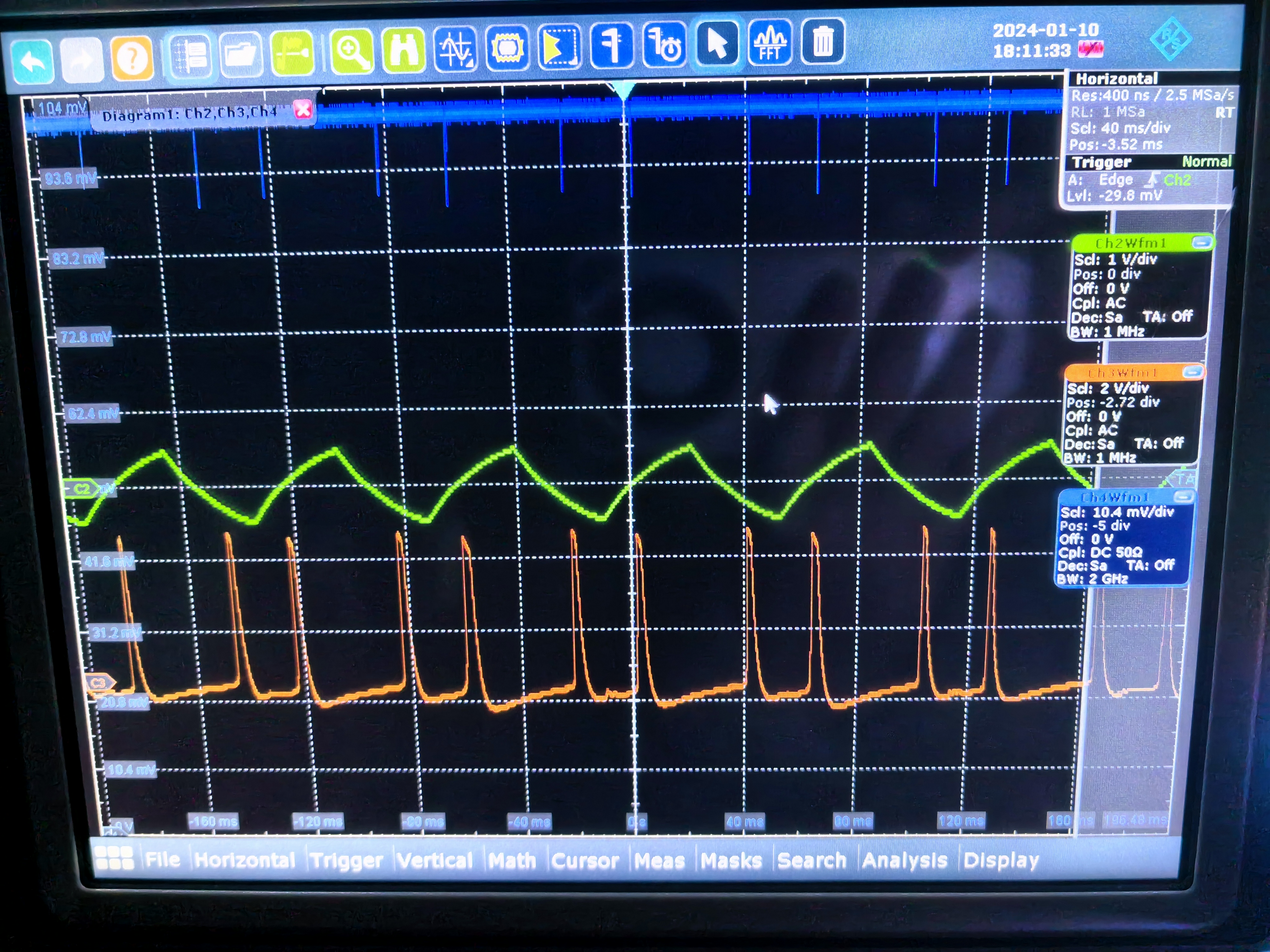
- Recently we have focused on improving the coupling efficiency. Without the telescope, the original coupling efficiency was less than 3%.
- I measured the parameters of the incident CW laser using both a HASO wavefront sensor and a CCD. I designed and installed the telescope, but the coupling efficiency still did not improve.
- After discussing with Aurélien and Ronic, it was decided to replace the M1 because the original M1 has a damaged spot in the center to the left. The damaged spot may be causing the coupling efficiency to be too low.
- Today, I replaced the M1 and realigned the cavity. Fortunately, the coupling efficiency has improved.
- We'll continue to optimize the alignment, improve the coupling, and carry out tests on the cavity. |
| Attachment 1: Coupling_efficiency_0110.jpg
|
 |
| Attachment 2: damaged_spot_on_M1.png
|
 |
|
180
|
Mon Jan 15 19:19:00 2024 |
Xinyi Lu | Fixed | info | lasers and optics | Optical room | Coupling efficiency improvement |
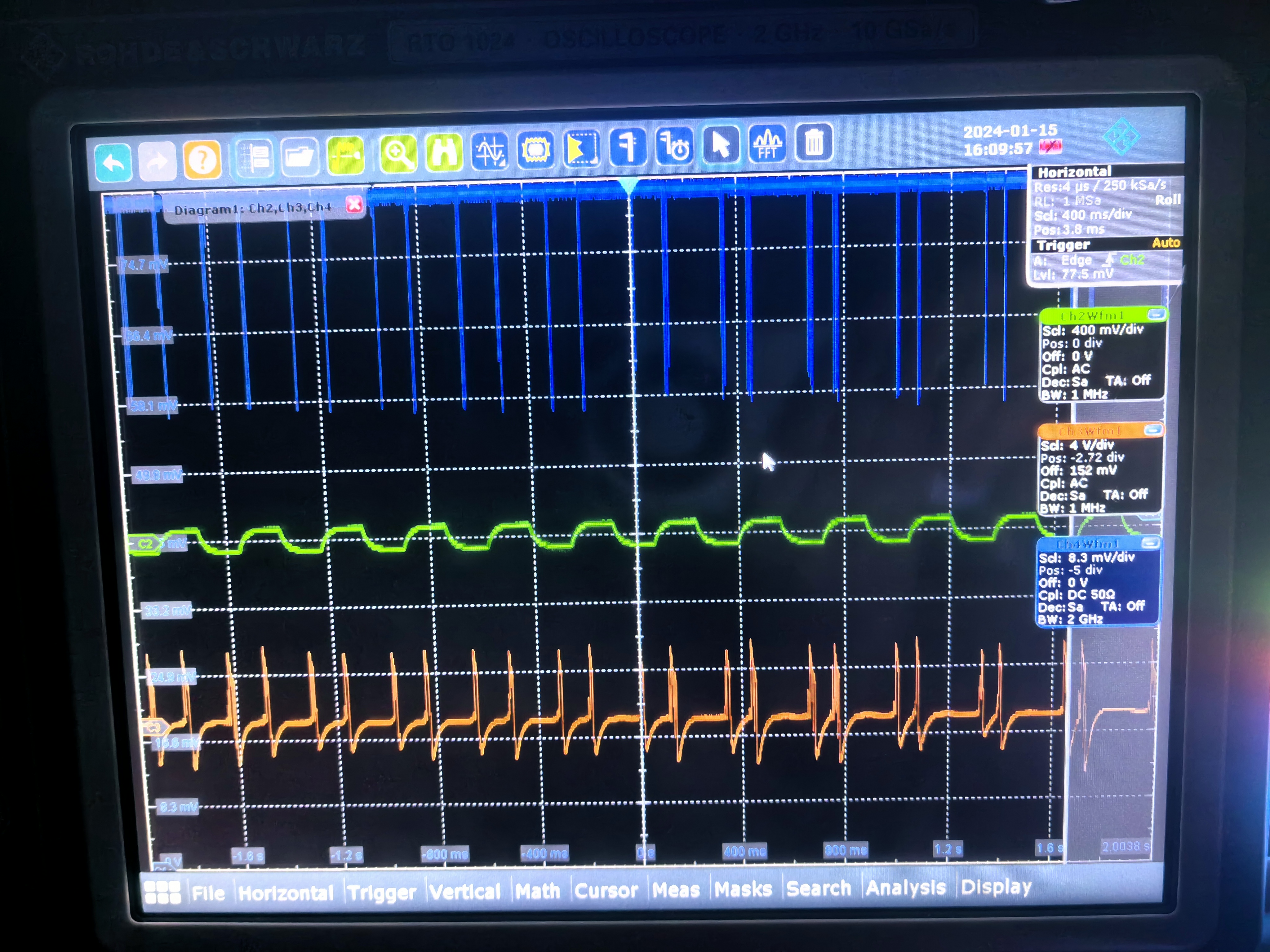
- We got 30% coupling efficiency by installing a set of telescopes, adjusting the polarization and optimizing the alignment. The diameter of the cavity mode is about 2.1mm.
- Ronic and I successfully locked the optical cavity. Tomorrow we will test the FSR and finesse.
| Xinyi Lu wrote: |
|
- Recently we have focused on improving the coupling efficiency. Without the telescope, the original coupling efficiency was less than 3%.
- I measured the parameters of the incident CW laser using both a HASO wavefront sensor and a CCD. I designed and installed the telescope, but the coupling efficiency still did not improve.
- After discussing with Aurélien and Ronic, it was decided to replace the M1 because the original M1 has a damaged spot in the center to the left. The damaged spot may be causing the coupling efficiency to be too low.
- Today, I replaced the M1 and realigned the cavity. Fortunately, the coupling efficiency has improved.
- We'll continue to optimize the alignment, improve the coupling, and carry out tests on the cavity.
|
|
| Attachment 1: coupling_efficiency.jpg
|
 |
| Attachment 2: cavity_locking.jpg
|
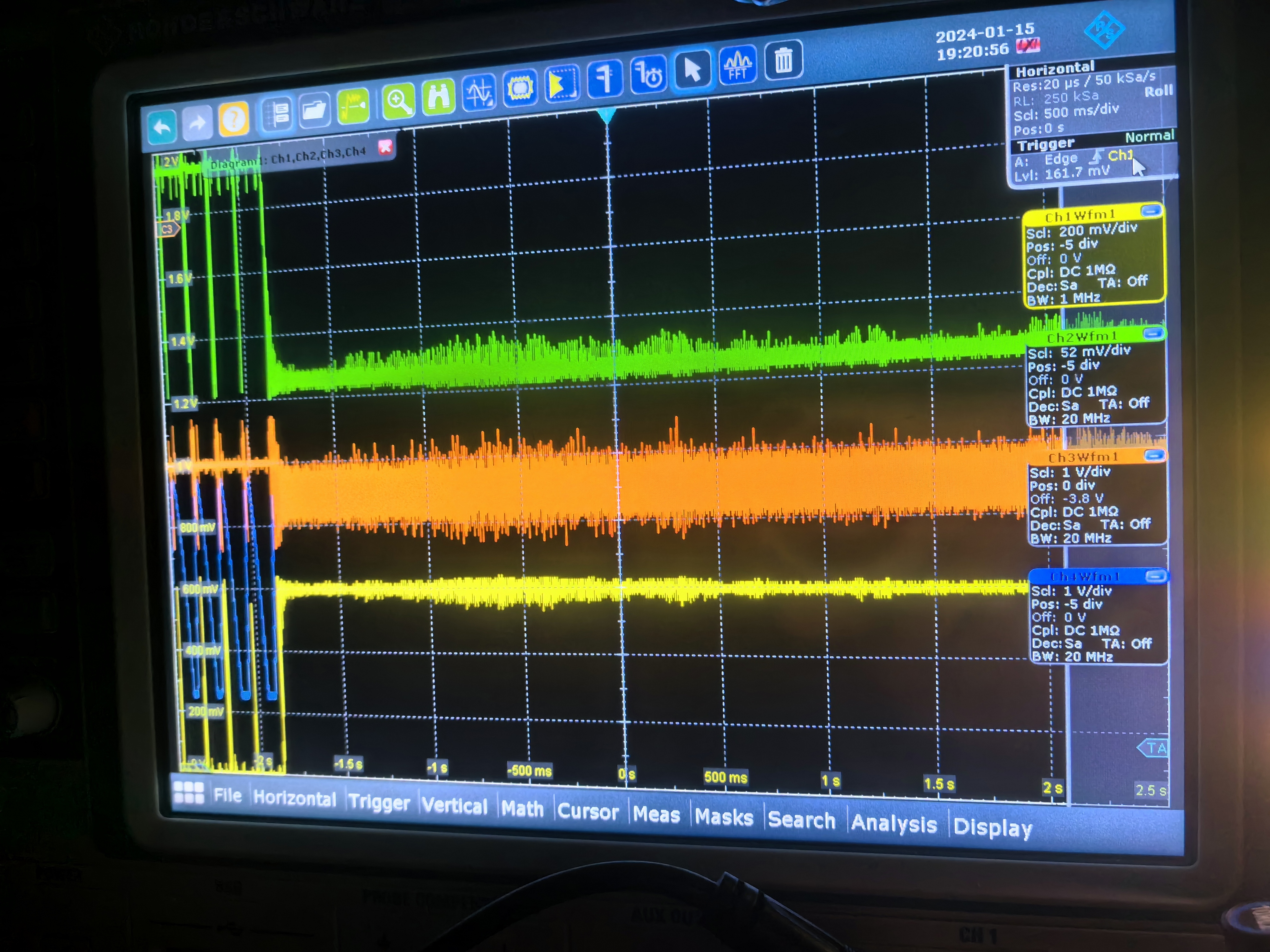 |
|
196
|
Thu Mar 7 18:55:42 2024 |
Xinyi Lu | Fixed | info | lasers and optics | Optical room | Coupling efficiency improvement |
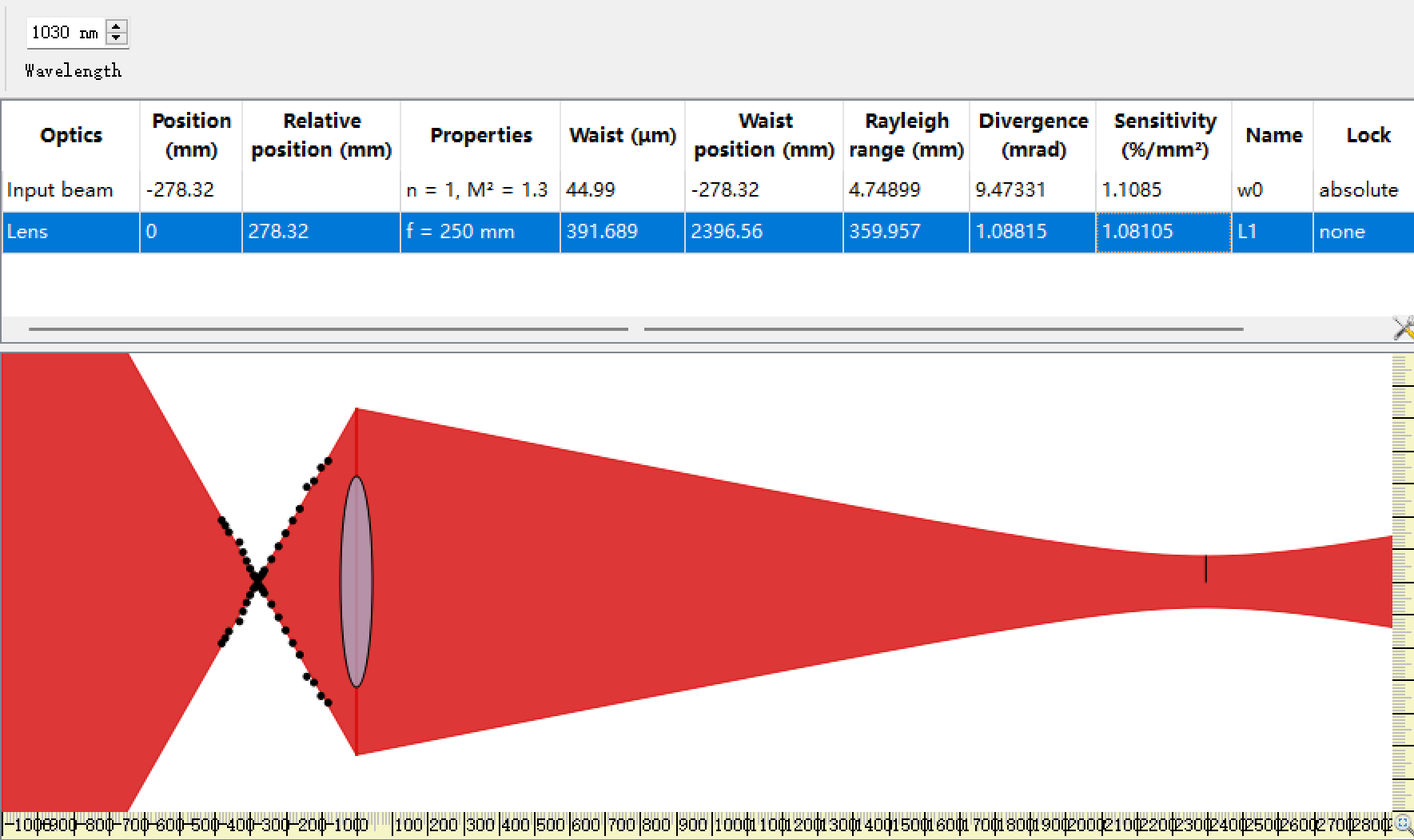
- These days, Ronic, Fatematuj and I measured the beam parameters of the output of the third-stage amplifier.
- We used 2 wedges and reflection filters to reduce the intensity on the CCD.
- We measured multiple points at pump current of 2 A (output power ~10 W). The waist diameter of the output is w_x = 792.26 um, w_y=873.90 um.
- The next step is to design the telescope and improve the coupling efficiency. |
| Attachment 1: beam_after_lens.png
|
 |
|
197
|
Fri Mar 8 18:04:43 2024 |
Xinyi Lu | Fixed | info | lasers and optics | Optical room | Coupling efficiency improvement |
Today, Ronic and I installed the new telescope and locked the cavity.
- We locked at the amplifier current of 1 A and obtained 32% of coupling. (see Figure 1)
- The telescope was designed for a current of 2 A (output power ~10 W). To inject this power, we need to add some filters to devices.
- For CEP tuning, when we changed the AOM frequency while cavity locking, sometimes it caused unlock and power drops. It will be dangerous in high-power cases. So it's better to optimize the AOM frequency in low power and just tune the laser current in high power. Now the current variation range of the menhir laser is 750mA to 950mA.
| Xinyi Lu wrote: |
|
- These days, Ronic, Fatematuj and I measured the beam parameters of the output of the third-stage amplifier.
- We used 2 wedges and reflection filters to reduce the intensity on the CCD.
- We measured multiple points at pump current of 2 A (output power ~10 W). The waist diameter of the output is w_x = 792.26 um, w_y=873.90 um.
- The next step is to design the telescope and improve the coupling efficiency.
|
|
| Attachment 1: Screenshot_2024-03-08_0_172245.png
|
 |
|
198
|
Tue Mar 12 22:13:47 2024 |
Xinyi Lu | Fixed | info | lasers and optics | Optical room | Coupling efficiency improvement |
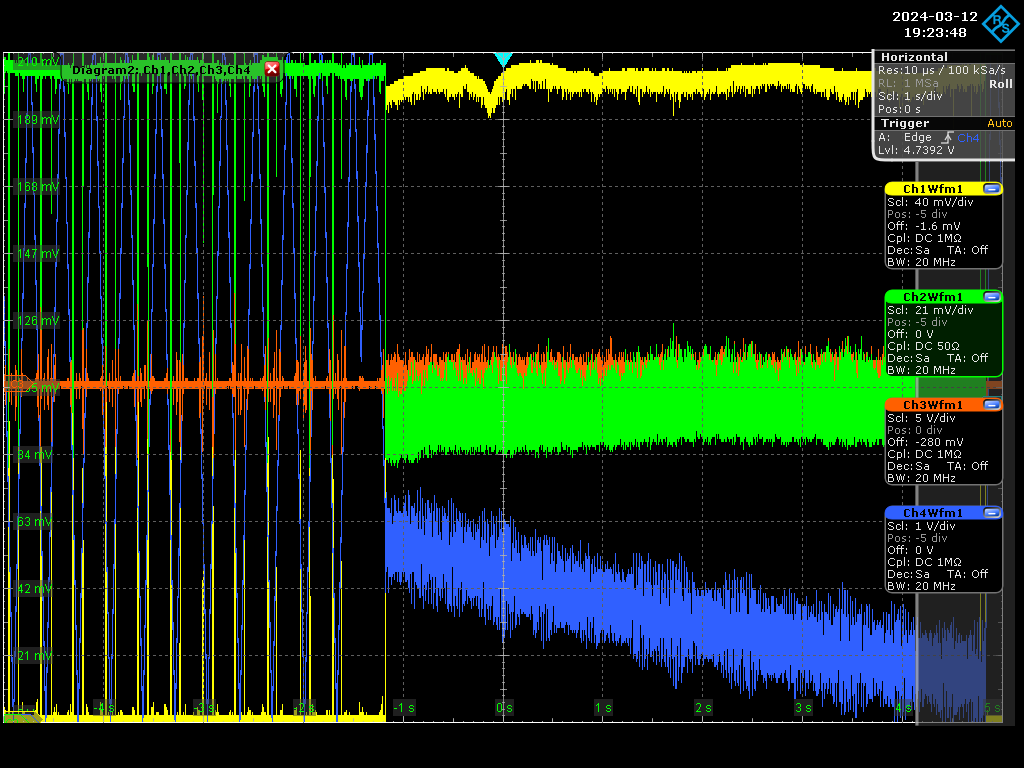
- Today, Ronic and I locked at the amplifier current of 2 A and obtained ~60% coupling after optimizing the CEP (see Figure 1).
- The injected power is 10 W at 2 A. We measured only 14 kW inside the cavity, which corresponds to an effective gain of 1,400 and a full gain of 2,300. The cavity finesse is 23,000 and the normal gain should be around 6,200.
- We found fluctuations in transmission, possibly because of mode degradation. Tomorrow we will use D-shape mirrors to suppress high-order modes and optimize alignment and locking.
| Xinyi Lu wrote: |
|
Today, Ronic and I installed the new telescope and locked the cavity.
- We locked at the amplifier current of 1 A and obtained 32% of coupling. (see Figure 1)
- The telescope was designed for a current of 2 A (output power ~10 W). To inject this power, we need to add some filters to devices.
- For CEP tuning, when we changed the AOM frequency while cavity locking, sometimes it caused unlock and power drops. It will be dangerous in high-power cases. So it's better to optimize the AOM frequency in low power and just tune the laser current in high power. Now the current variation range of the menhir laser is 750mA to 950mA.
| Xinyi Lu wrote: |
|
- These days, Ronic, Fatematuj and I measured the beam parameters of the output of the third-stage amplifier.
- We used 2 wedges and reflection filters to reduce the intensity on the CCD.
- We measured multiple points at pump current of 2 A (output power ~10 W). The waist diameter of the output is w_x = 792.26 um, w_y=873.90 um.
- The next step is to design the telescope and improve the coupling efficiency.
|
|
|
| Attachment 1: Screenshot_2024-03-12_0_192348.png
|
 |
|
186
|
Fri Jan 26 17:33:05 2024 |
Xinyi Lu | Fixed | info | lasers and optics | Optical room | Cleaning of Mirrors |
Today Daniele, Ronic and I cleaned the mirrors and locked the cavity. However, the finesse was only 13,000 because of the not clean enough environment and not pure enough alcohol and water.
We will carefully clean the environment, clean the mirrors again with pure alcohol and water and measure the finesse when I return. If it doesn't work, we will use plasma to clean the mirror. We have gone to the lab to confirm the plasma device and then we will study the best parameter settings: polarity, time, and current.
Have a nice weekend! |
|
187
|
Mon Feb 12 17:17:04 2024 |
Xinyi Lu | Fixed | info | lasers and optics | Optical room | Cleaning of Mirrors |
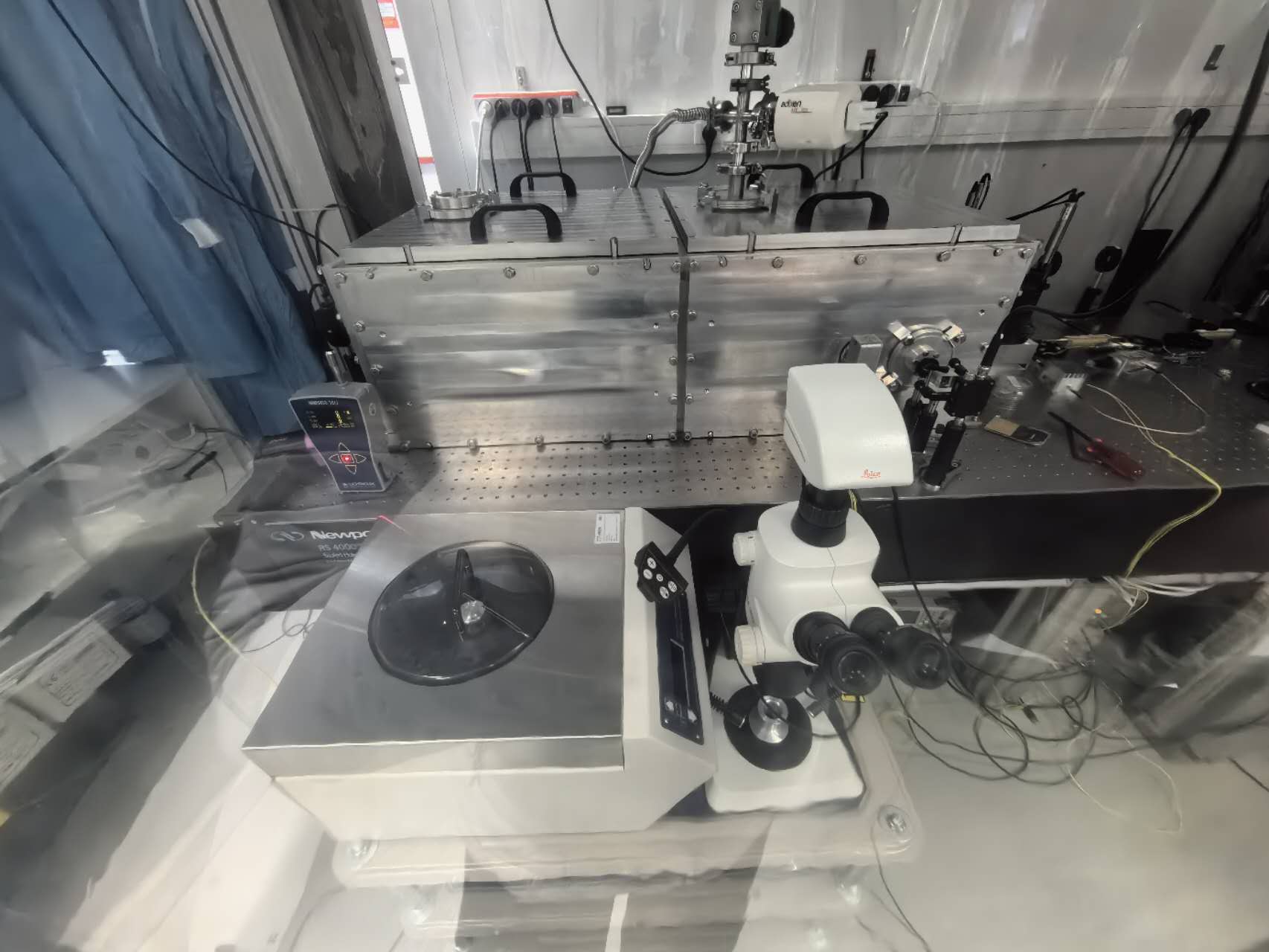
- Today we cleaned the environment and put the spin coater and microscope inside the airflow.
- Tomorrow, Daniele and I will clean the mirrors one by one using pure alcohol and water, and measure the finesse each time. If it does not improve, we will clean them with plasma.
| Xinyi Lu wrote: |
|
Today Daniele, Ronic and I cleaned the mirrors and locked the cavity. However, the finesse was only 13,000 because of the not clean enough environment and not pure enough alcohol and water.
We will carefully clean the environment, clean the mirrors again with pure alcohol and water and measure the finesse when I return. If it doesn't work, we will use plasma to clean the mirror. We have gone to the lab to confirm the plasma device and then we will study the best parameter settings: polarity, time, and current.
Have a nice weekend!
|
|
| Attachment 1: optical_room.jpg
|
 |
|
188
|
Tue Feb 13 17:33:28 2024 |
Xinyi Lu | Fixed | info | lasers and optics | Optical room | Cleaning of Mirrors |
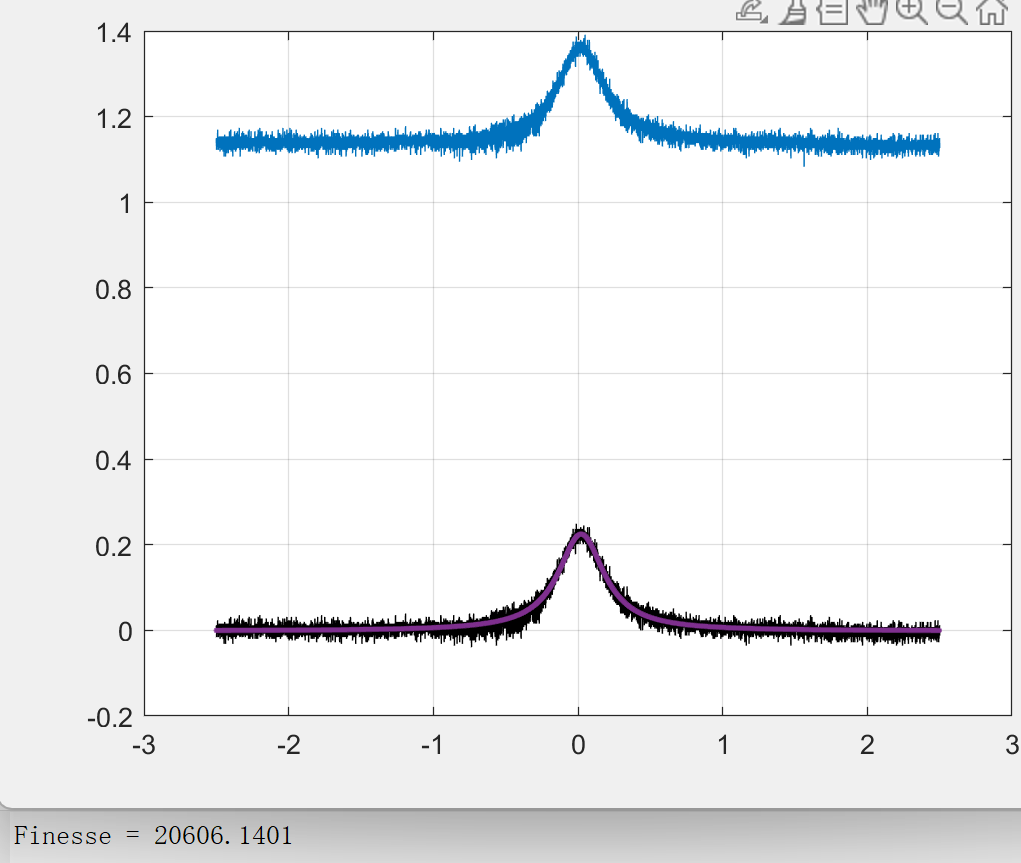
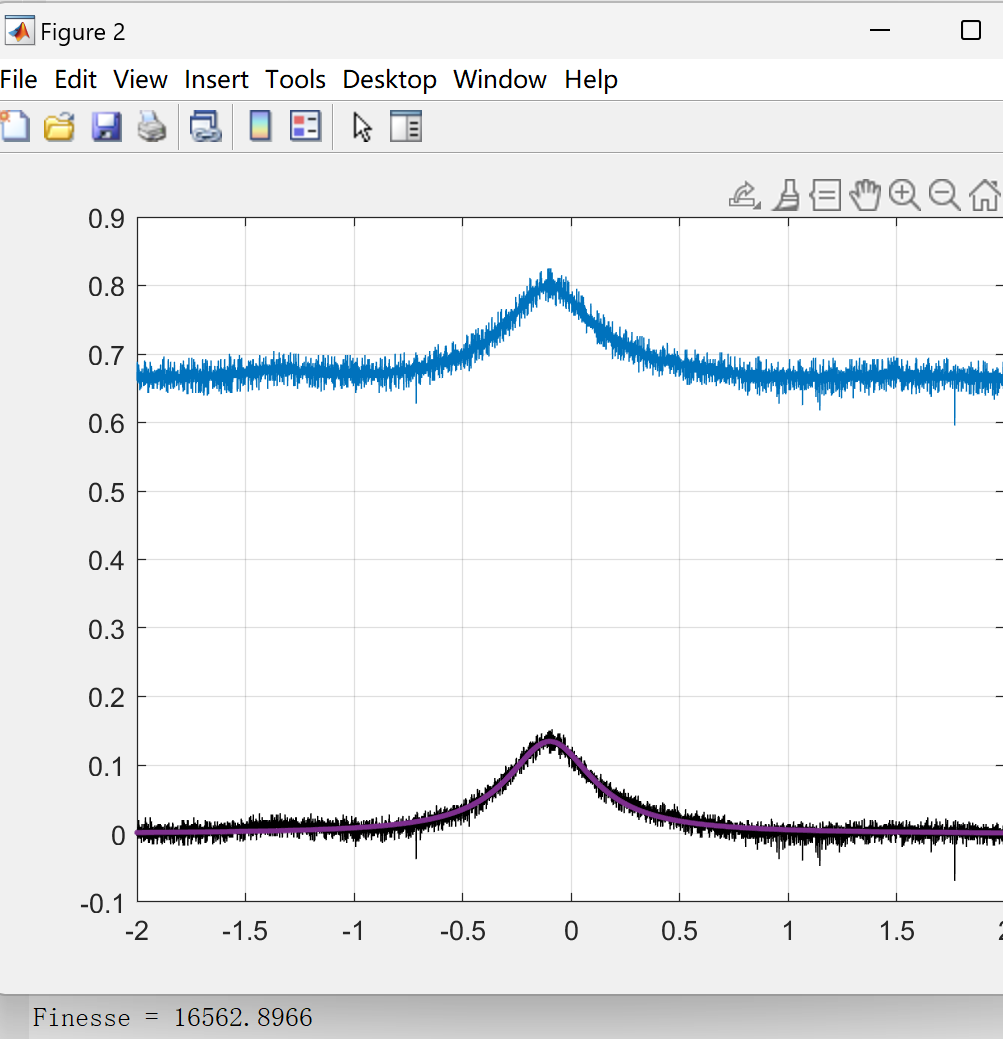
Today, Daniele and I cleaned mirrors one by one using pure water, alcohol, and the spin coater. Here are the measurements of finesse each time:
1. Initial value: 14,076
2. Clean Mirror 2: 20,606
3. Clean Mirror 4: 18,750
4. Clean Mirror 3: 18,762
5. Clean Mirror 1: 18,563
6. Reclean Mirror 4: 15,226 (unstable lock)
7. Reclean Mirror 4 again: 16,563 (unstable lock)
The finesse reached a maximum of 20,606 but finally was down. For the last two measurements, the locking state was unstable and noisy. Tomorrow we will optimize the locking status and re-measure.
| Xinyi Lu wrote: |
|
- Today we cleaned the environment and put the spin coater and microscope inside the airflow.
- Tomorrow, Daniele and I will clean the mirrors one by one using pure alcohol and water, and measure the finesse each time. If it does not improve, we will clean them with plasma.
|
|
| Attachment 1: 2nd_measurement_F20606.png
|
 |
| Attachment 2: 7th_measurement__F16563_bad_locking.png
|
 |
|
189
|
Wed Feb 14 17:20:26 2024 |
Xinyi Lu | Fixed | info | lasers and optics | Optical room | Cleaning of Mirrors |
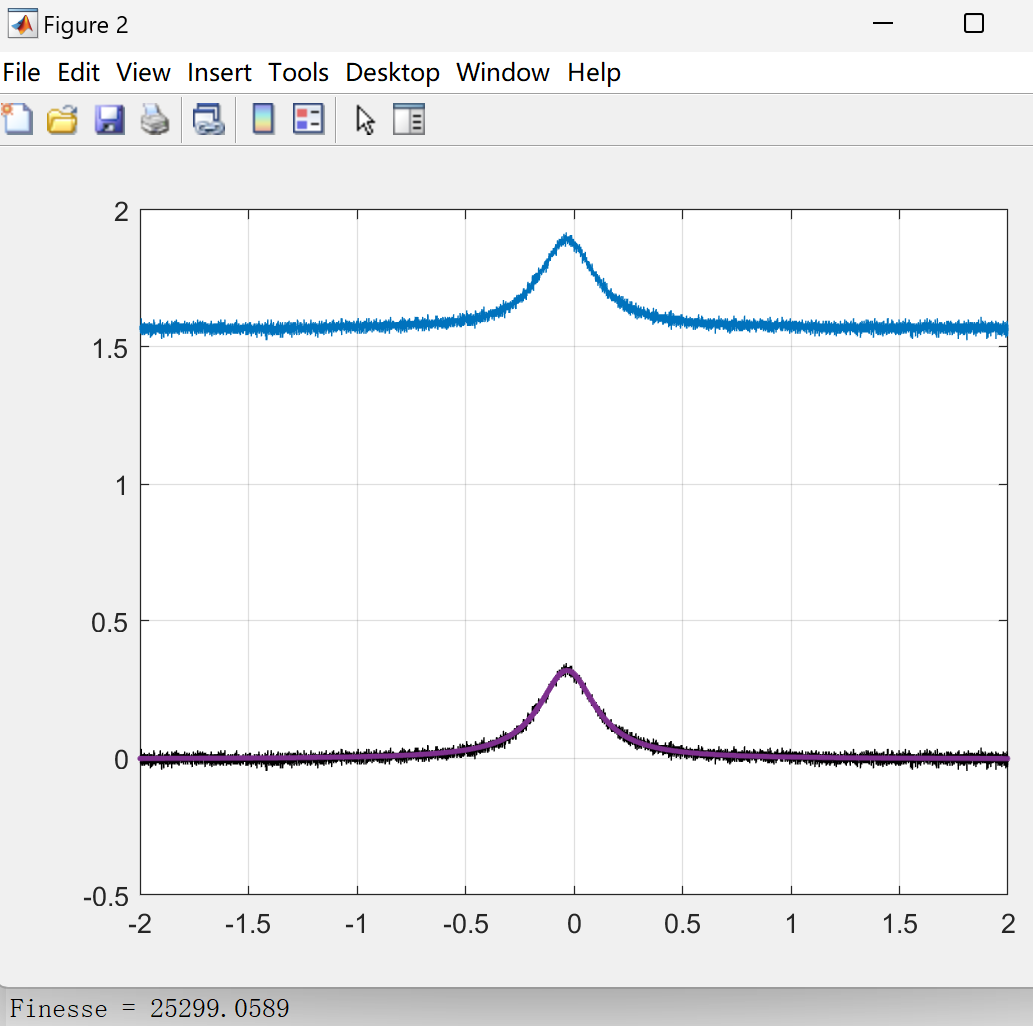
- Today, Daniele and I cleaned the cavity inside, recleaned the M2 and M4 and their mounts, optimized the locking, and the finesse is now about 25,000.
- Although it's lower than the expected 30,000-40,000, we decided to move on to the next step. In addition, the mount of M4 is near the end of the tuning range and may cause instability at high power.
- We adjusted the cavity length to match the repetition rate of the pulsed laser, and the FSR in air is 160.265 MHz.
- Tomorrow, we'll turn on the vacuum and use the pulsed laser to get resonance.
| Xinyi Lu wrote: |
|
Today, Daniele and I cleaned mirrors one by one using pure water, alcohol, and the spin coater. Here are the measurements of finesse each time:
1. Initial value: 14,076
2. Clean Mirror 2: 20,606
3. Clean Mirror 4: 18,750
4. Clean Mirror 3: 18,762
5. Clean Mirror 1: 18,563
6. Reclean Mirror 4: 15,226 (unstable lock)
7. Reclean Mirror 4 again: 16,563 (unstable lock)
The finesse reached a maximum of 20,606 but finally was down. For the last two measurements, the locking state was unstable and noisy. Tomorrow we will optimize the locking status and re-measure.
|
|
| Attachment 1: F_25299.png
|
 |
|
73
|
Mon Apr 4 13:58:23 2022 |
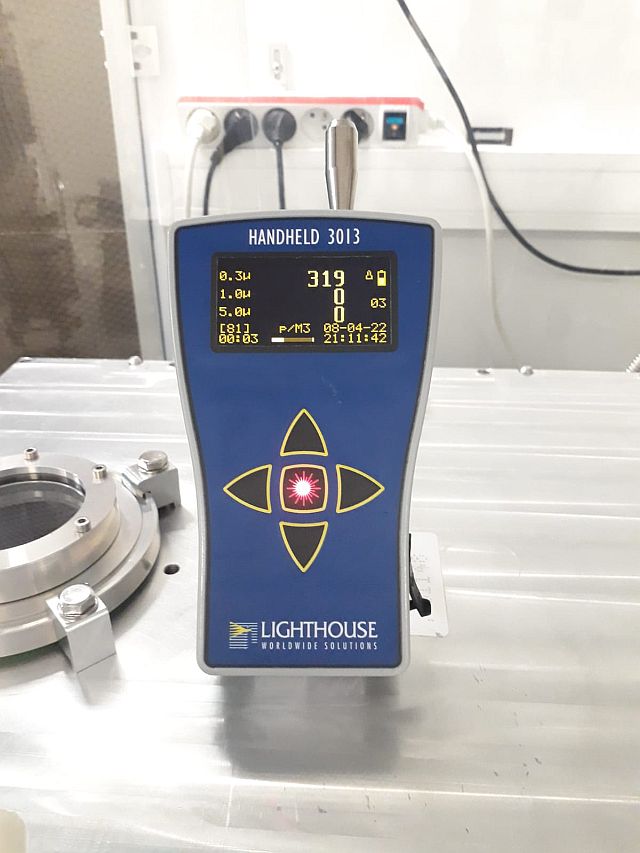
Manar Amer | Fixed | issue | detectors and electronics | utilities | Optical room | Clean Airflow Dust measurements |
The dust meter cap was cleaned using Alcohol, and using the filter white cap the dust count was (0 Av. 10 min)
After the dust counter was hand held in direct airflow, it counted (1581 p/m3 Av. 2 min).
I tested the count also in the SAS, and it counted twice the amount ~ 4500 p/m3
Note: discussion on the next steps to take for the airflow filtering !!!!!!!! |
|
74
|
Fri Apr 8 19:27:12 2022 |
Manar Amer | Fixed | issue | detectors and electronics | utilities | Optical room | Clean Airflow Dust measurements |
Dust measurement done today on top of the SBox average 10min
| Manar Amer wrote: |
|
The dust meter cap was cleaned using Alcohol, and using the filter white cap the dust count was (0 Av. 10 min)
After the dust counter was hand held in direct airflow, it counted (1581 p/m3 Av. 2 min).
I tested the count also in the SAS, and it counted twice the amount ~ 4500 p/m3
Note: discussion on the next steps to take for the airflow filtering !!!!!!!!
|
|
| Attachment 1: 20220408_DustMeasurement.jpg
|
 |
|
18
|
Wed Oct 31 13:51:17 2018 |
Loïc Amoudry | Fixed | info | lasers and optics | Optical room | Change of the 3 ULE mirrors by 3 spare ULE mirrors |
First finesse measurement 20 266, FSR 133.351 MHz under vacuum |
| Attachment 1: Miroirs_à_1031_nm-ThomX_-_décembre2017.pdf
|
| Attachment 2: vacuum.isf
|
|
1
|
Wed Sep 26 18:12:44 2018 |
Loïc Amoudry | Fixed | info | lasers and optics | Optical room | Cavity polarization states (Koheras), Finesse of 2 polarization states |
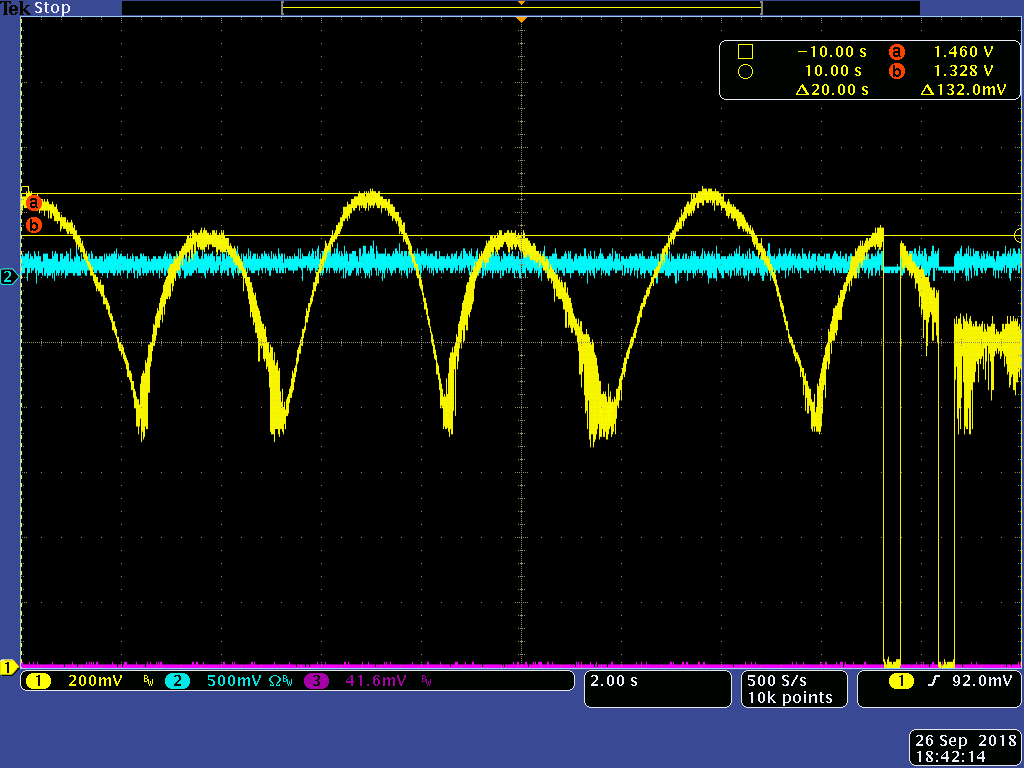
Measurments of Finesse with the 2 polarization states, let's call them H (higher) and L (lower): 24500 for the H and 23500 for the L.
We checked the polarization states in transmission of the FP cavity after a PBS. The H was stronger in PBS trans and the L stronger in PBS ref.
We measured the power in reflection of the PBS and added a half WP that we aligned with the PBS polarization. Then, to get the maximum power we had to tilt the half WP of 22° for the H and 18° for the L.
Finally we checked the extinction through half WP and PBS for H and L.
- For H : max 75 mW min 5 mW. Ratio 6.66%
- For L : max 70 mW min 4 mW. Ratio 5.7%
Right after Koheras : max 3.5 mW min 47 uW. Ratio 1.3%
|
| Attachment 1: Finesse_higher.isf
|
| Attachment 2: Finesse_lower.isf
|
| Attachment 3: The2polarizations_states_direct_trans.isf
|
| Attachment 4: The2polarizations_states_direct_trans.png
|
 |