| ID |
Date |
Author |
Status |
Type |
Category |
Location |
Title |
|
49
|
Thu Dec 16 12:12:10 2021 |
Kevin Dupraz | Under Process | report | lasers and optics | Optical room | Manip 16 12 2021 montée en puissance |
Matin:
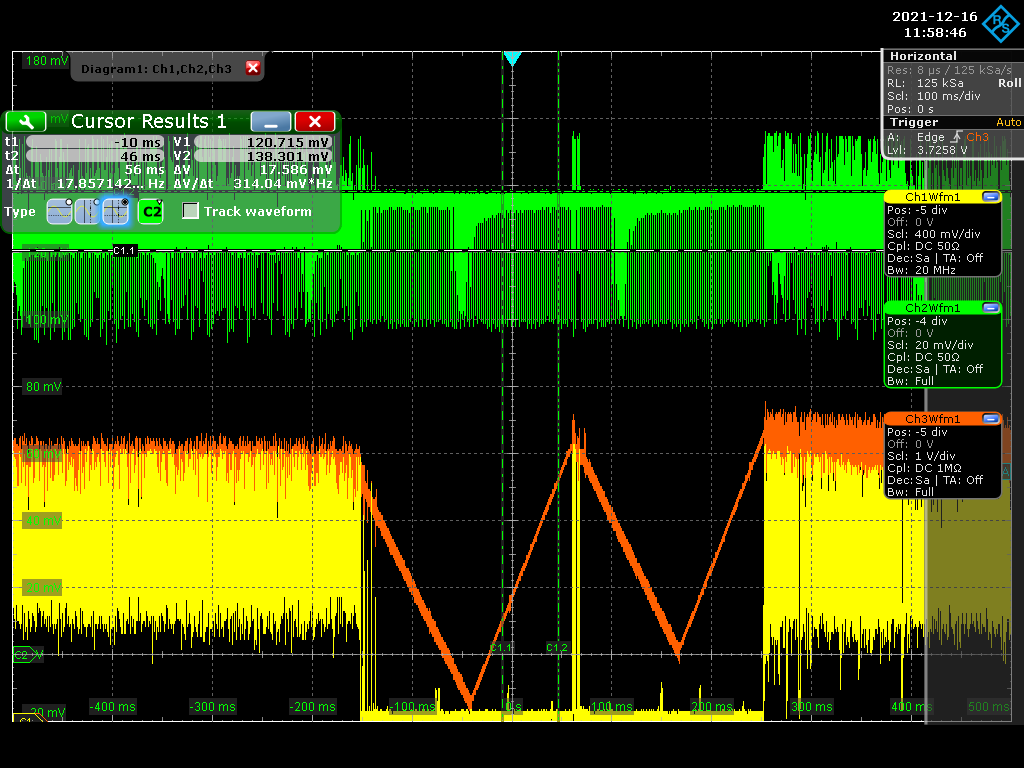
* Redémarrage Tangor 4W
- couplage 15%
- max photodiode Transmission (60dB, OD30) : 1.9V
* Montée en Puissance 20 W
- début des effets thermiques : dérive thermique (la cavité chauffe et le piezo doit suivre, la tension baisse)
- max photodiode Transmission (40dB, OD30) : 1.6 V
- Reflection (~12%) ~140mV max:
* quand résonance => plus de signal sur la reflexion que hors lock.
- Hypothèses:
saturation de la photodiode ==> avec une densité OD10 (même effet)
effet de polarisation: essaie avec la densité OD10 (absorbante) dans le faisceau au niveau de la lambda/4 en reflection ==> la densité est brulée (ne tient pas la puissance)
==> essayer avec densité réflective.
* impossible de locker sur le max de transmission |
| Attachment 1: Screenshot_2021-12-16_0_115846.png
|
 |
|
48
|
Thu Dec 16 10:40:55 2021 |
Kevin Dupraz | Under Process | report | lasers and optics | Optical room | Manip 14 12 2021 injection optimization (and calibration) |
Après-midi :
* Optimisation de l'alignement en injection pour avoir le plus de puissance en transmission
* Optimisation (vérification) de la polarisation pour avoir le plus de couplage.
* tension photoDiode en réflexion (50 Ohm) : max à 136 mV (couplage 20%)
* tension Photodiode transmission PDA100A-EC(50 ohm) : max à 3.6 V (60 dB de gain)
- Passage à 50 W en sortie de TANGOR.
* Vérificaton de l'alignement pour avoir le plus de puissance en transmission.
* Vérification de la polarisation pour avoir le plus de couplage.
* tension Photodiode transmission PDA100A-EC(50 ohm) : max à 4.9 V (40 dB de gain)
* Changement de la polarisation sur la ligne de réflexion (uniquement la lambda/4) pour ne pas saturer la photodiode.
* tension photoDiode en réflexion (50 Ohm) : max à 136 mV (couplage 12%)
* Références caméras :
> NF_refl : x0 = 11.9 mm; y0 = 8.65 mm; sigma_x = 0.185 mm; sigma_y = 0.167 mm.
> FF_refl : x0 = 2.44 mm; y0 = 0.61 mm; sigma_x = 0.241 mm; sigma_y = 0.259 mm.
> NF_inj : x0 = 8.57 mm; y0 = 5.40 mm; sigma_x = 0.123 mm; sigma_y = 0.127 mm.
- Plus de splitter 90/10 en sortie de TANGOR, 4.5 W en sortie TANGOR :
* Compensation du walk-of introduit par ce splitter.
* réalignement de la cavité après locking
* Photodiode Transmission (60dB + densité OD30) : max 2V
* Reflection (près changement de pile) : 18% de couplage (tension max 136 mV, 50 Ohm)
| Kevin Dupraz wrote: |
|
Matin :
moteurs :
M1, M2 (plans): 5.110500m
M3, M4 (sphériques): -2.900000m
- Optimization de la première L/2 (en sortie tangor), le flux est maximisé en sortie du combiner.
* mesure sortie Tangor (Power meter de puissance) : 85 + 90 mW
* mesure sortie Tangor (Power meter PH100-Si-HA-OD1 "226316" + OD2) : 4.11mW
* mesure avant combiner, entre miroirs de replis Newfocus (Power meter + OD2) : 3.53mW
* mesure après pick-off (injection cavité) (Power meter + OD2) : 2.93mW
- Optimization du couplage avec la polarisation :
* modification de la polarisation injecté dans la cavité
* optimisation du flux reçu sur la photodiode en réflection
* mesure du couplage.
** Optimum trouvé à 15% de couplage (en scan 5Hz, 0-10V)
Position des lambdas :
- L/2 en injection : 333°
- L/4 en injection : 48°
- L/2 en réflection : 225°
- L/4 en réflection : 54°
- Déplacement de la photodiode en transmission.
* Réglage de l'iris au niveau de la photodiode : Iris ouvert PV résonance 31 mV, Iris fermée 25 mV
- Lock de la cavité.
* transmission : 2.65V (60dB)
* reflection : 16.5% de couplage
* mesure devant la caméra en transmission (Power meter PH100-Si-HA-OD1 "226316" + OD2) : 0.635 uW
* image (P.J) sauvegardé bin
|
|
| Attachment 1: Screenshot_2021-12-14_3_182645.png
|
 |
|
47
|
Tue Dec 14 12:59:07 2021 |
Kevin Dupraz | Under Process | report | lasers and optics | Optical room | Manip 14 12 2021 injection optimization (and calibration) |
Matin :
moteurs :
M1, M2 (plans): 5.110500m
M3, M4 (sphériques): -2.900000m
- Optimization de la première L/2 (en sortie tangor), le flux est maximisé en sortie du combiner.
* mesure sortie Tangor (Power meter de puissance) : 85 + 90 mW
* mesure sortie Tangor (Power meter PH100-Si-HA-OD1 "226316" + OD2) : 4.11mW
* mesure avant combiner, entre miroirs de replis Newfocus (Power meter + OD2) : 3.53mW
* mesure après pick-off (injection cavité) (Power meter + OD2) : 2.93mW
- Optimization du couplage avec la polarisation :
* modification de la polarisation injecté dans la cavité
* optimisation du flux reçu sur la photodiode en réflection
* mesure du couplage.
** Optimum trouvé à 15% de couplage (en scan 5Hz, 0-10V)
Position des lambdas :
- L/2 en injection : 333°
- L/4 en injection : 48°
- L/2 en réflection : 225°
- L/4 en réflection : 54°
- Déplacement de la photodiode en transmission.
* Réglage de l'iris au niveau de la photodiode : Iris ouvert PV résonance 31 mV, Iris fermée 25 mV
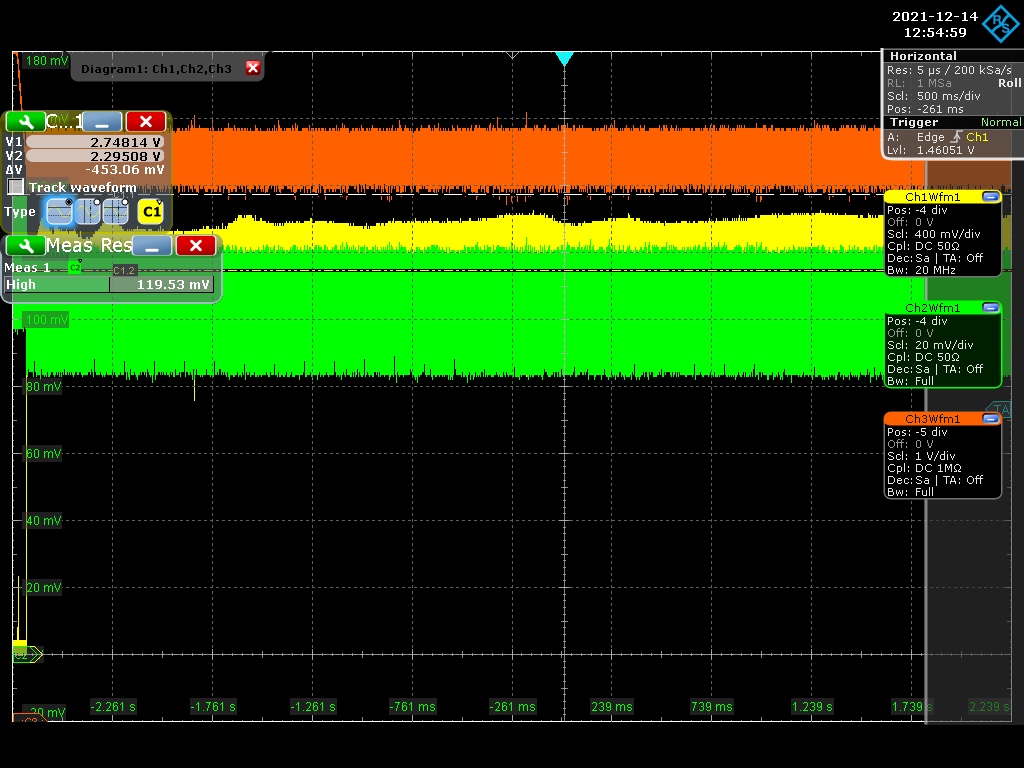
- Lock de la cavité.
* transmission : 2.65V (60dB)
* reflection : 16.5% de couplage
* mesure devant la caméra en transmission (Power meter PH100-Si-HA-OD1 "226316" + OD2) : 0.635 uW
* image (P.J) sauvegardé bin |
| Attachment 1: Screenshot_2021-12-14_2_125459.png
|
 |
|
46
|
Fri Dec 10 16:57:56 2021 |
Kevin Dupraz | Under Process | report | lasers and optics | Optical room | Manip 10 12 2021 (optimization injection Burst) |
Manip 10/12/2021
Après recherche de la résonnance principale
- MCS miroirs plan à 5.110250mm (en derive vers les negatifs)
- pic transmission à 5V
- couplage ~7%
Décalage du spot (très faible, à peine visible à la camera NF_refl)
- grosse perte en transmission ==> alignement OK
Grossissement du spot
* début taille_sigma à 0.220mm (calibration NF_Refl)
* nouvelle position en éloignant la lentille 1 taille à 0.300mm ==> max transmission ~3V,
- Walk en vertical ==> pas d'amélioration et dégradation.
- Divergent en entrée de cavité (test à la carte)
* En rapprochant la lentille 1 passage pas le minimum de taille vers 0.190 mm
* Depassement du minimum. Taille faisceau 0.317 mm (0.380 mm sur y) ==> max transmission ~2.5V,
- Walk en vertical ==> pas d'amélioration et dégradation.
- divergence pas apréciable
* On se met au minimum de taille sur la caméra. Taille faisceau 0.178 mm (0.170mm sur y) ==> max transmission ~5.3V
- Couplage 25% max (beaucoup de fluctuations).
- Gros décalage vertical (~ 1 sigma) ne provoque pas une baisse du transmis.
- Décalage horizontal sensible.
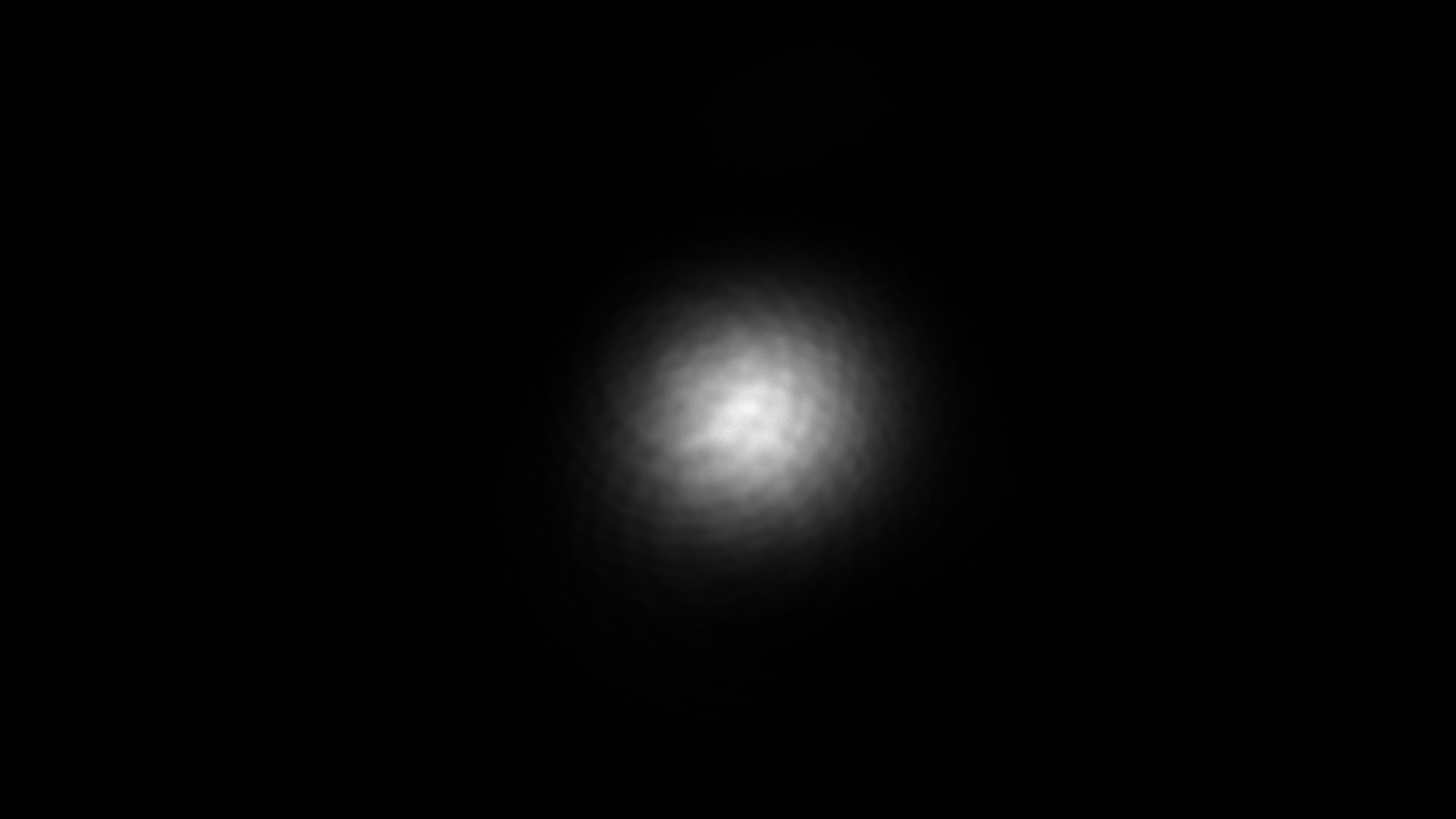
Après mangé Ronic a "lockée" la cavité. Le gain de la photodiode en transmission a été changé et la tension sur la résonnance principale est d'environ 600 - 800 mV
deux images ont été faites en entrée de cavité à environ 18 cm du splitter pour la camera de test afin d'être à peu près à une distance équivalente du miroir d'injection M1.
|
| Attachment 1: NF_Refl__2021-12-10__14-25-08.png
|
 |
| Attachment 2: test__2021-12-10__14-25-08_1920_25gm.png
|
 |
|
45
|
Tue Dec 7 11:48:33 2021 |
Kevin Dupraz | Under Process | info | lasers and optics | detectors and electronics | Optical room | Cameras Calibration |
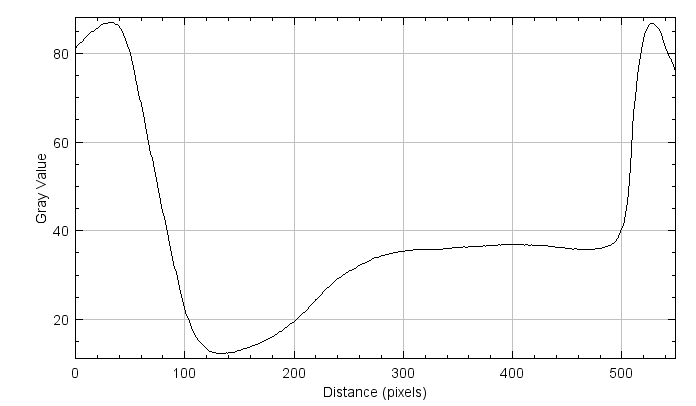
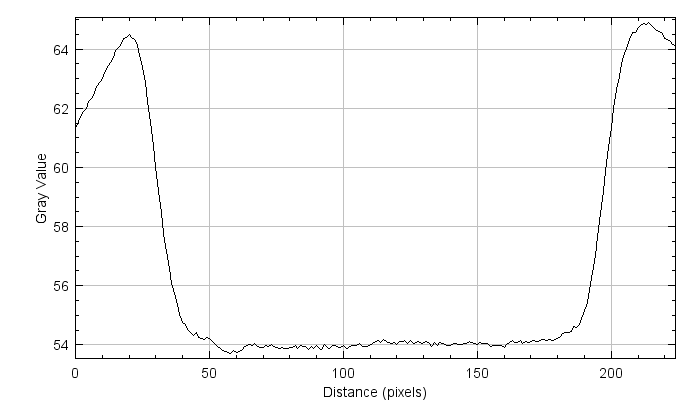
After check a mistake has been found on the magnification. This seems to be the good calibration (feel free to cross check). The projection of the 2mm hex is attached
the calibration are :
NF_Refl: acA1920-40gm
pixel size (real): 5.86um
Magnification = 1.71
pixel size (image): 10um
image donne on input plan mirror M1 (accuracy about few mm)
NF_Trans: acA1920-40gm
pixel size (real): 5.86um
Magnification = 0.68
pixel size (image): 4um
image donne on output plan mirror M2 (accuracy about few mm)
The NF_inj was calibrated with the USB microscope (1.4um/pixel on microscope image). The 5th ring of the lens is about 1.89 mm in diameter.
NF_inj: acA1920-40gm
pixel size (real): 5.86um
Magnification = 1.54
pixel size (image): 9um
| Kevin Dupraz wrote: |
|
| Kevin Dupraz wrote: |
|
After installing cameras the actual calibration are :
NF_Refl: acA1920-40gm
pixel size (real): 5.86um
Magnification = [0.53,0.56]
pixel size (image): 3.22um
image donne on input plan mirror M1 (accuracy about few mm)
NF_Trans: acA1920-40gm
pixel size (real): 5.86um
Magnification = 1.32
pixel size (image): 7.73um
image donne on output plan mirror M2 (accuracy about few mm)
need to adjust the NF transmission as the Magnification is greater than 1.
|
The NF_inj was calibrated with the USB microscope (1.4um/pixel on microscope image). The 5th ring of the lens is about 1.89 mm in diameter.
NF_inj: acA1920-40gm
pixel size (real): 5.86um
Magnification = 1.54
pixel size (image): 9um
|
|
| Attachment 1: Plot_of_NF_Trans_calib_hex2mm__2021-06-23__17-06-49.png
|
 |
| Attachment 2: Plot_of_NF_Refl_calib_hex2mm__2021-06-23__16-59-26.png
|
 |
|
44
|
Mon Dec 6 11:22:08 2021 |
Kevin Dupraz | Under Process | info | lasers and optics | detectors and electronics | Optical room | Cameras Calibration |
| Kevin Dupraz wrote: |
|
After installing cameras the actual calibration are :
NF_Refl: acA1920-40gm
pixel size (real): 5.86um
Magnification = [0.53,0.56]
pixel size (image): 3.22um
image donne on input plan mirror M1 (accuracy about few mm)
NF_Trans: acA1920-40gm
pixel size (real): 5.86um
Magnification = 1.32
pixel size (image): 7.73um
image donne on output plan mirror M2 (accuracy about few mm)
need to adjust the NF transmission as the Magnification is greater than 1.
|
The NF_inj was calibrated with the USB microscope (1.4um/pixel on microscope image). The 5th ring of the lens is about 1.89 mm in diameter.
NF_inj: acA1920-40gm
pixel size (real): 5.86um
Magnification = 1.54
pixel size (image): 9um |
| Attachment 1: grab2021-12-06_10-51-34_325_microscope.bmp
|
| Attachment 2: grab2021-12-06_10-52-11_108_microscope_calib_05mm_ruler.bmp
|
|
43
|
Thu Dec 2 16:12:17 2021 |
Aurélien Martens | Fixed | report | mechanics | software | Optical room | new smaract positions |
M1 and M2 at 5.1085mm and M3 and M4 at -2.9mm |
|
42
|
Thu Oct 21 10:32:54 2021 |
Blanc | Fixed | info | utilities | Other | Presentations |
Here the last part of all the presentations since the beginning of the project. |
| Attachment 1: 12-Présentation_LAL_13_09_2021.pptx
|
| Attachment 2: 13-Présentation_LAL_27_09_2021.pptx
|
| Attachment 3: 14-Présentation_LAL_11_10_2021.pptx
|
| Attachment 4: Présentation_Amplitude_23_08_2021.pptx
|
|
41
|
Thu Oct 21 10:30:38 2021 |
Blanc | Fixed | info | utilities | Other | Presentations |
Here the second part of all the presentations since the beginning of the project. |
| Attachment 1: 8-Présentation_LAL_15_04_2021_elog.pptx
|
| Attachment 2: 9-Présentation_LAL_10_05_2021_elog.pptx
|
| Attachment 3: 10-Présentation_LAL_28_06_2021.pptx
|
|
40
|
Thu Oct 21 10:24:01 2021 |
Blanc | Fixed | info | utilities | Other | Presentations |
Here the first part of all the presentations since the beginning of the project. |
| Attachment 1: 2-Présentation_LAL_22_06_2020_Corrigée.pptx
|
| Attachment 2: 4-Présentation_LAL_29_06_2020_Corrigée.pptx
|
| Attachment 3: 5-Présentation_LAL_27_07_2020.pptx
|
| Attachment 4: 6-Présentation_LAL_30_11_2020.pptx
|
| Attachment 5: 7-Présentation_LAL_07_12_2020.pptx
|
|
39
|
Thu Oct 21 09:44:35 2021 |
Blanc | Fixed | info | mechanics | lasers and optics | detectors and electronics | Optical room | 1GHz oscillator Frep measurement |
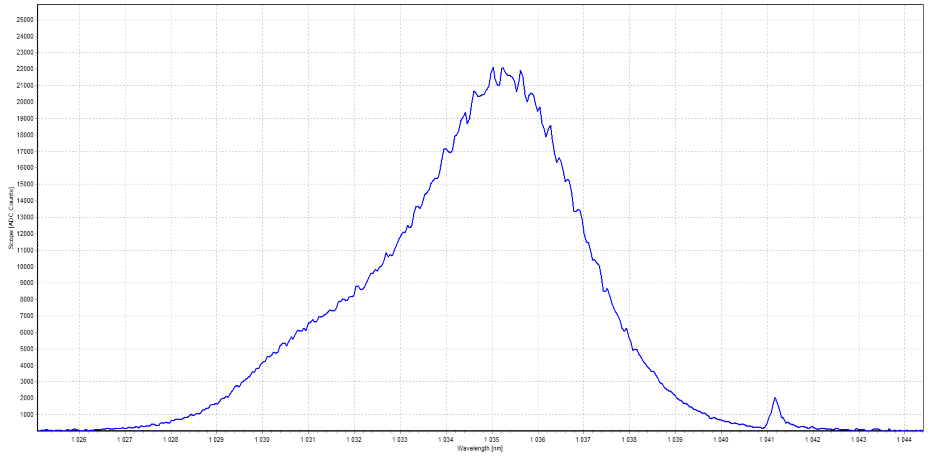
The optical spectrum of the GHz oscillator: FWHM ~ 4nm
| Blanc wrote: |
| a previous cavity FSR measurement was giving a center frequency around 867.5MHz. the present 1GHz oscillator Frep measurement is about 879.888MHz. the present shift is about 12.4MHz which is equivalent to move one cavity lenght by 4.3mm which is HUGE !!! as the 1GHz oscillator does not have any motor, one has to move the FP cavity mirrors instead. the PZT inside the 1GHz oscillator (Thorlabs PC4QR) has a dynamic range of (20µm for 150V... we will drive it with 10V) 1.3µm. then, we will have to adjust the FP cavity FSR with an accuracy much better than 4kHz (the cavity linewidth is 500kHz !!!) |
|
| Attachment 1: Spectre_GHz-3.PNG
|
 |
|
38
|
Wed Oct 20 15:27:51 2021 |
Ronic Chiche | Fixed | report | lasers and optics | Optical room | Amplitude GHz oscillator phase noise with PZT effect |
Thorlabs PZT datasheet.
Reference: PC4QR
| Ronic Chiche wrote: |
|
3 phase noise measurements made on the Amplitude GHz oscillator with different PZT configurations :
- black curve: PZT connector is open
- green curve: PZT connector is shorted by 50 ohms
- blue curve: PZT is excited by 100mVrms of white noise coming from a generator.
on the blue curve, one can clearly see a phase noise increase in the region 10kHz - 1MHz but it is not evident the peaks seen with the PZT open or shorted are related to the peaks excited with the noise injected on the PZT.
with a PZT not excited, one can just observe that the phase noise is decreasing a lot around 10kHz to reach the reference oscillator phase noise floor and then increase again exactly when the PZT resonant frequencies appear, between 20kHz and 200kHz.... reaching at the end the phase noise detection floor.
|
|
| Attachment 1: PC4QR-SpecSheet-1.pdf
|
|
37
|
Wed Oct 20 14:54:00 2021 |
Ronic Chiche | Fixed | info | lasers and optics | detectors and electronics | Optical room | Phase noise measurement of the Amplitude MIKAN |
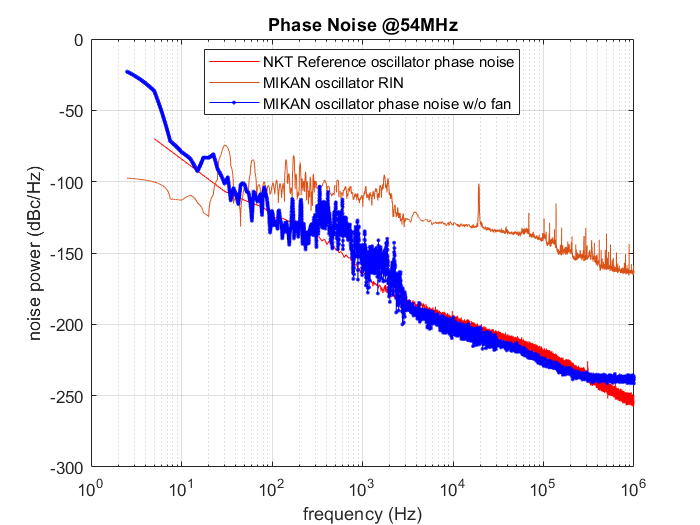
MIKAN phase noise and RIN measurements:
| Ronic Chiche wrote: |
|
Coupling into a 50-50% fiber coupler using the Thorlabs XYZ table NanoMax TS.
We reached 117mW after the 50% arm which means we coupled about 230mW (the coupling better than 50%).
| Ronic Chiche wrote: |
|
Installation of the MIKAN.
powermeter (with OD1) just after the oscillator shows 440mW for 4A of the MIKAN pump current.
Installation of a periscope as the oscillator beam position is very close to the table... not easy to put devices at this height (be aware to use proper wavelength range mirrors: Thorlabs BB1-E03)
Installation of a HALF waveplate to align beam polarisation on the isolator axis
Installation of a High power isolator (the one of ThomX): Newport ISO-FRDY-05-1030-N
powermeter (with OD1) just after the isolator shows 427mW
|
|
|
| Attachment 1: MIKAN_optical_phase_noise_comparison_with_NKT_CW_oscillator_&_RIN_@54MHz.png
|
 |
|
36
|
Wed Oct 20 12:36:15 2021 |
Ronic Chiche | Fixed | report | lasers and optics | Optical room | Amplitude GHz oscillator phase noise with PZT effect |
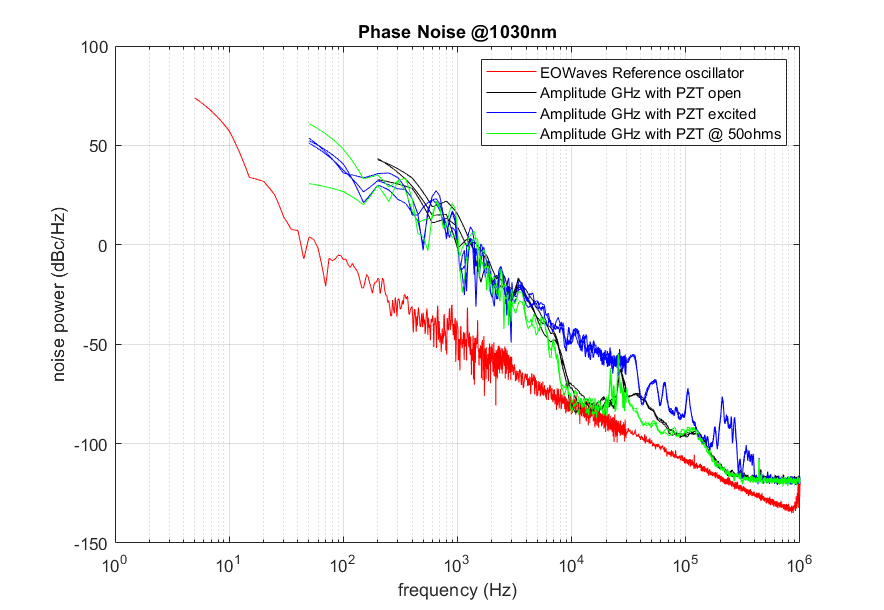
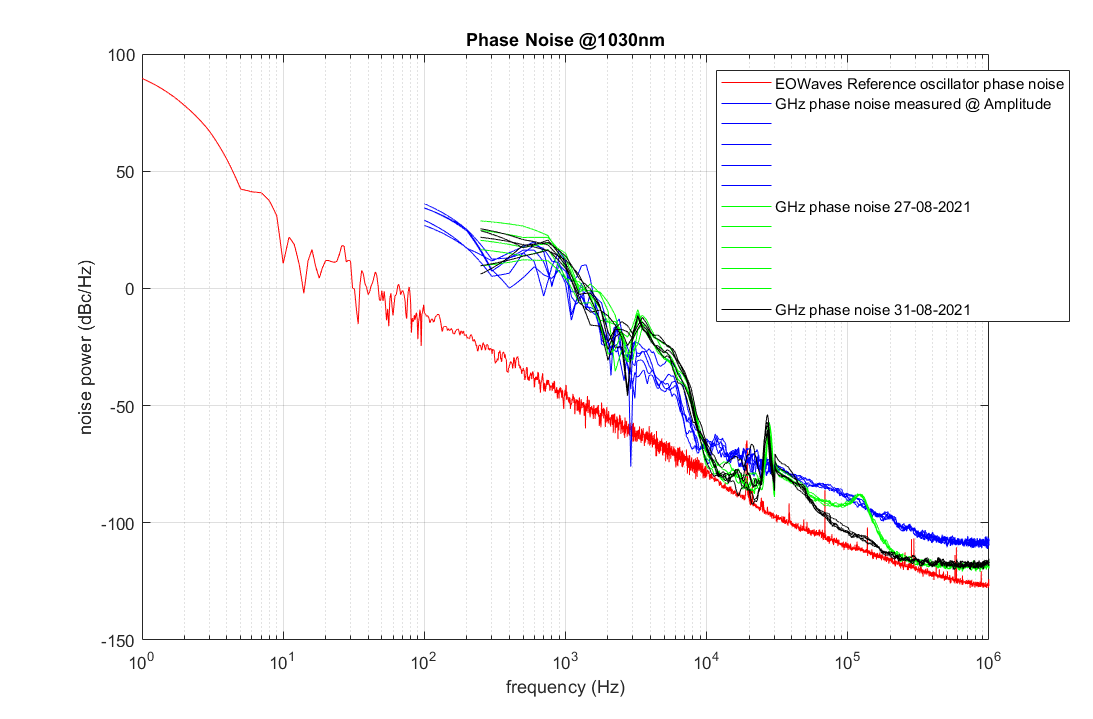
3 phase noise measurements made on the Amplitude GHz oscillator with different PZT configurations :
- black curve: PZT connector is open
- green curve: PZT connector is shorted by 50 ohms
- blue curve: PZT is excited by 100mVrms of white noise coming from a generator.
on the blue curve, one can clearly see a phase noise increase in the region 10kHz - 1MHz but it is not evident the peaks seen with the PZT open or shorted are related to the peaks excited with the noise injected on the PZT.
with a PZT not excited, one can just observe that the phase noise is decreasing a lot around 10kHz to reach the reference oscillator phase noise floor and then increase again exactly when the PZT resonant frequencies appear, between 20kHz and 200kHz.... reaching at the end the phase noise detection floor.
I add below the measurements done on October 20th, the ones done in September which are very similar and on which one can see a peak around 26kHz. |
| Attachment 1: Amplitude_GHz_phase_noise.png
|
 |
| Attachment 2: GHz_oscillator_phase_noise_without_front-end-1.png
|
 |
|
35
|
Tue Oct 19 18:27:20 2021 |
Ronic Chiche | Fixed | report | mechanics | lasers and optics | detectors and electronics | Optical room | PZT resonant frequencies |
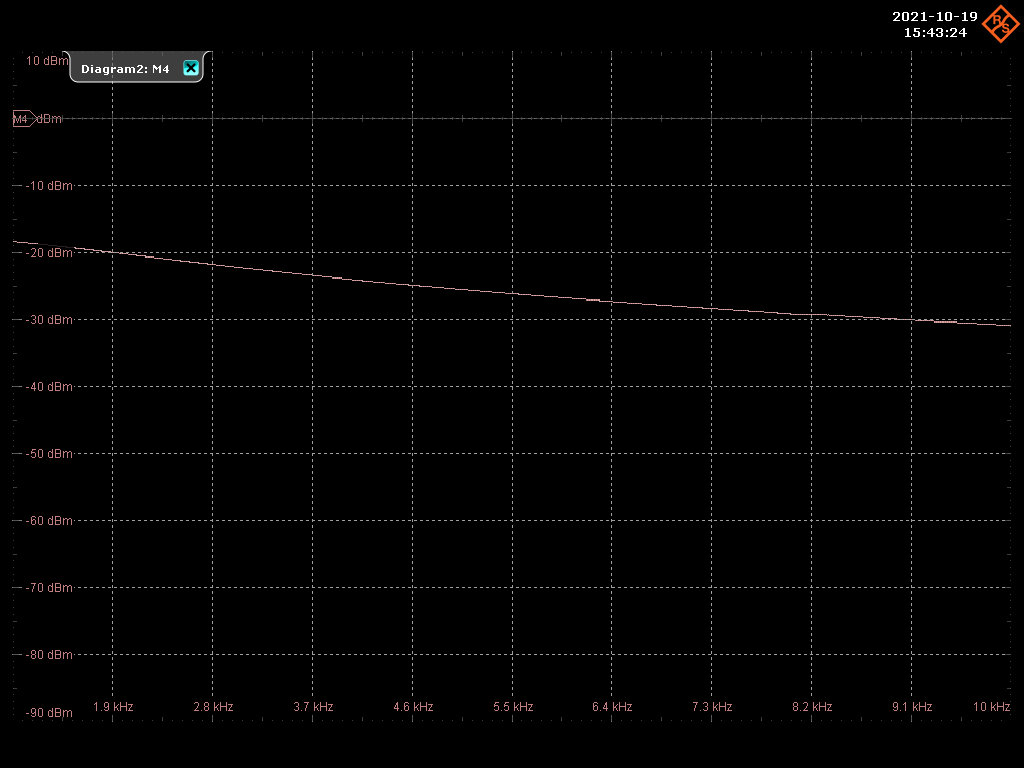
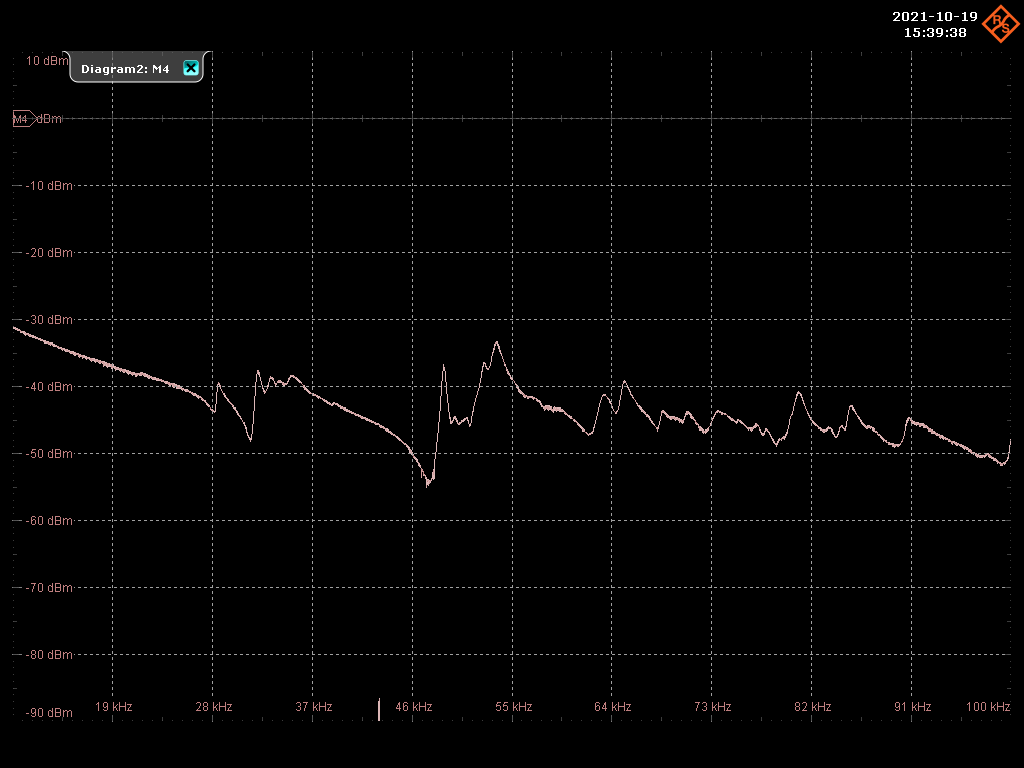
we have excited the PZT with a swept sinus wave from 1kHz to 10kHz and from 10kHz to 100kHz.
here are the 2 different spectrums:
- the 1kHz-10kHz is a standard spectrum where we see the impedance behavior of the PZT: Zpzt ~ 1/jCw
- the 10kHz-100kHz exhibit several PZT resonances and the 1st one is close to 28kHz.
(without PZT resonances, we should have the same behavior at higher frequencies than in the range 1kHz-10kHz) |
| Attachment 1: Sweep_1kHz-10kHz.png
|
 |
| Attachment 2: Sweep_10kHz-100kHz.png
|
 |
|
34
|
Fri Oct 8 16:02:19 2021 |
Blanc | Fixed | info | lasers and optics | detectors and electronics | Optical room | Setup and measurements |
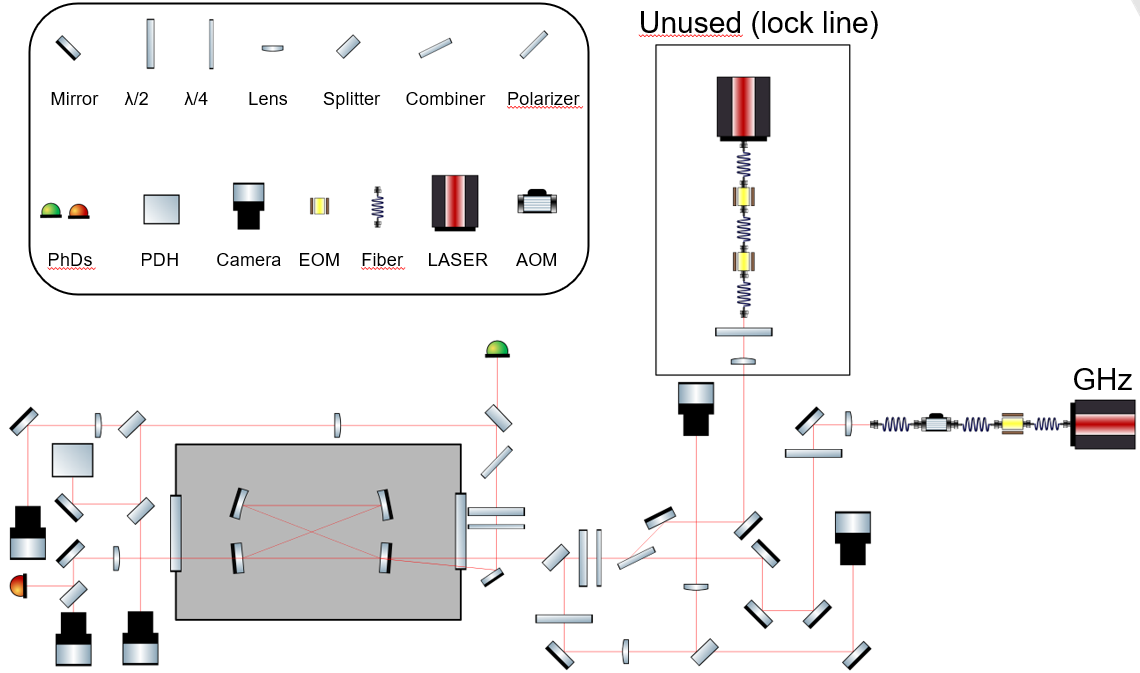
To summerize the results of this week :
We made the setup in attachement 5 and align it to have the good mode in the cavity (TEM00).
With the good alignment, we found the lock of the GHz, in attachement 1. We used the motors in the cavity to position very precisely the mirrors to find this lock.
In attachement 2, we can see the error signal obtain thanks to the PDH, which is very clean.
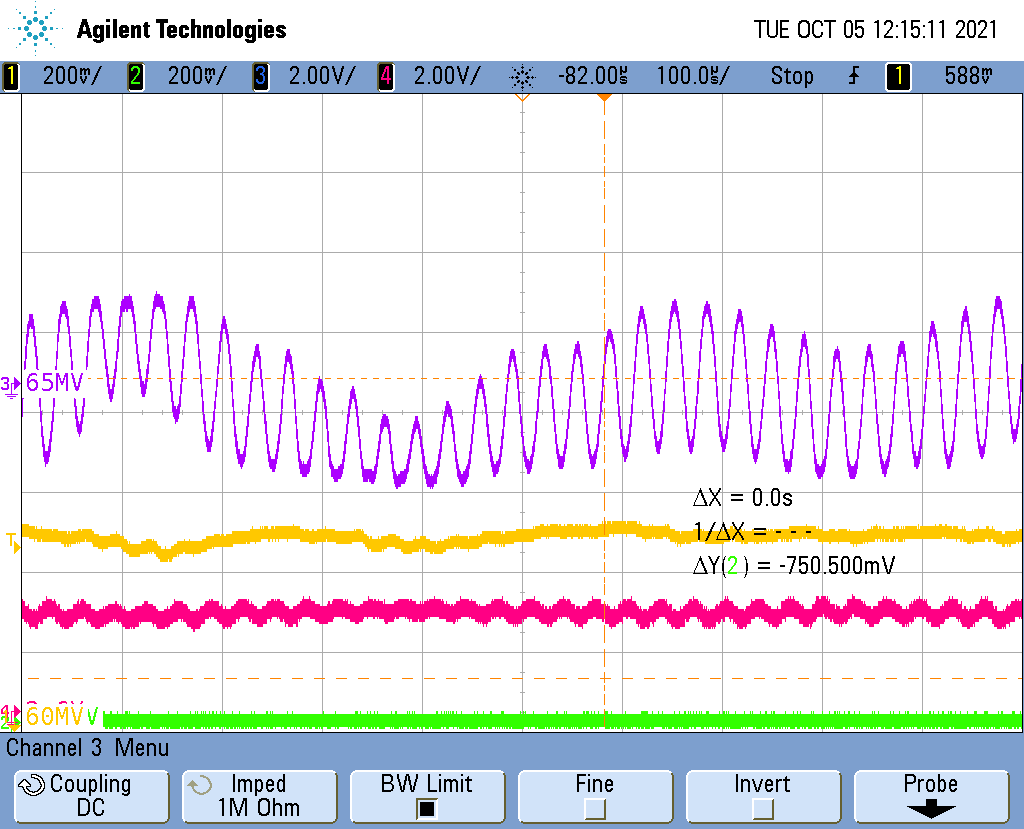
But after that, we saw some modulations at 30 kHz frequency which represent the resonance frequency of the piezo in the GHz (attachement 3). To compensate this, we placed a fibered AOM to cut the high frequencies.
Finally, we observed a big difference in the transmission noise if the motor loop is open or closed (attachement 4). To have the best noise, we have to stop the closed loop and stay in open loop, after adjusting the mirrors with the cosed loop.
We have also measured the finesse (2000) and the coupling (20%), detailed in the previous post.
|
| Attachment 1: acquisition_lock_GHz.png
|
 |
| Attachment 2: Signal_d'erreur_PDH_sur_GHz.png
|
 |
| Attachment 3: Résonances_dûes_au_pic_à_30kHz_dans_le_phase_noise.png
|
 |
| Attachment 4: Close_loop_vs_open_loop_GHz.png
|
 |
| Attachment 5: minicav_setup_Lock_GHz.PNG
|
 |
|
33
|
Thu Oct 7 17:53:53 2021 |
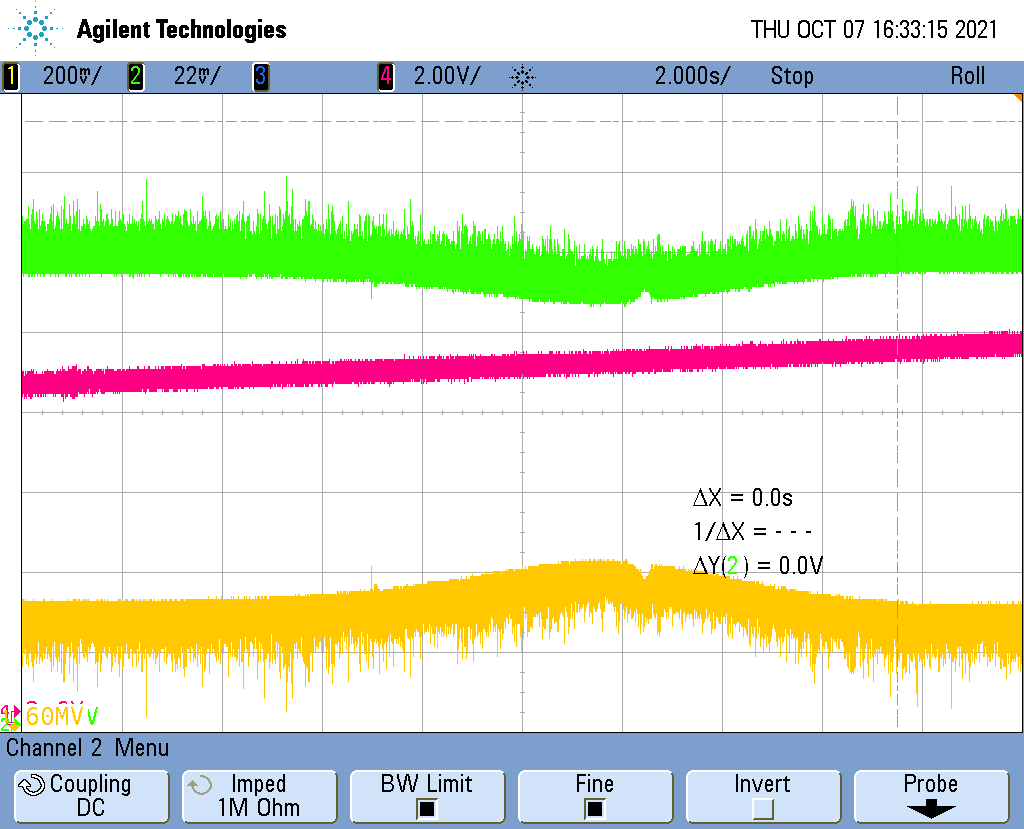
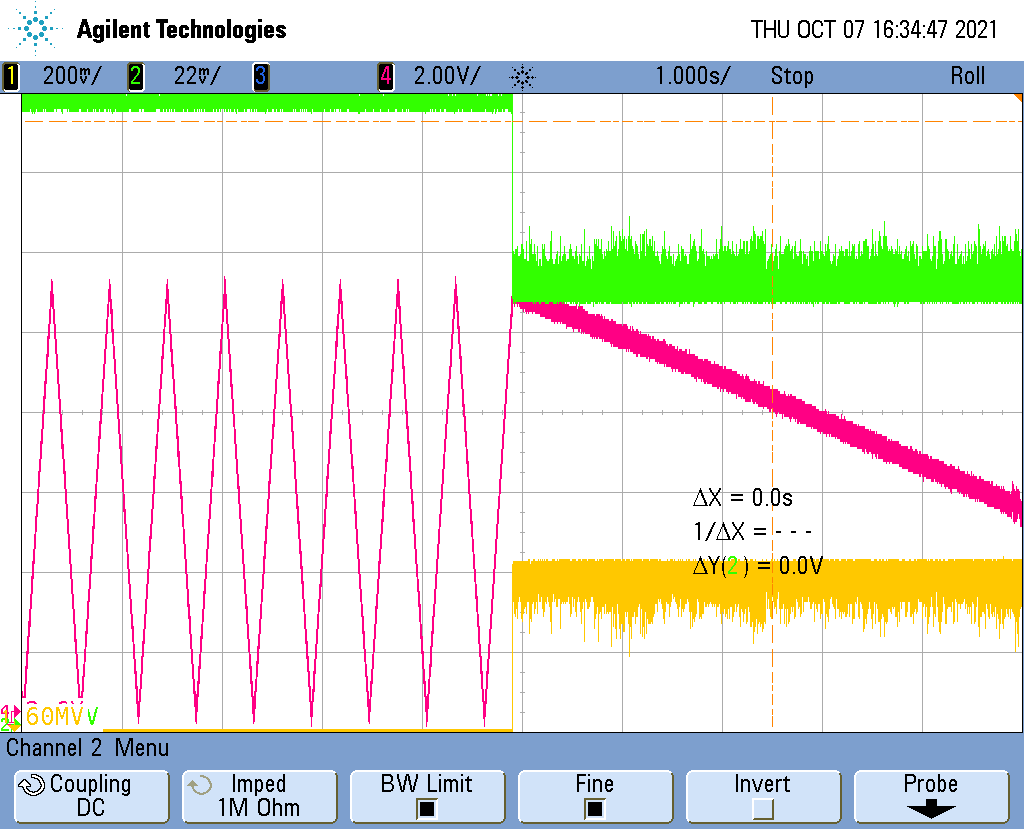
Blanc | Fixed | info | lasers and optics | detectors and electronics | Optical room | Finess and coupling measurement |
We did the measurement of the Finess and coupling with the NKT, with 2 EOM, without AOM (so the lock signal is noisy), on the burst line.
For the coupling, we have the same value as with the GHz locked on the burst line too, which is around 20 percent.
it seems this low coupling comes from the geometrical coupling as we observed an incoming beam bigger than the cavity mode on the cameras.
(the same oscillator, locked on the lock line exhibit 50% coupling)
the FSR center value is 879.9MHz, and the FWHM is between 879.67MHz and 880.1MHz.
So, the linewidth is about 430kHz and then the Finess value is roughly the same as before about 2050.
|
| Attachment 1: scope_10.png
|
 |
| Attachment 2: scope_12.png
|
 |
|
32
|
Tue Oct 5 18:24:53 2021 |
Ronic Chiche | Fixed | info | lasers and optics | Optical room | Locking with fast analog loop on AOM |
in addition to the standard locking scheme with the GHz laser PZT,
we added an AOM after the PDH modulation EOM and we drove it with an FM modulated signal generator (FMDev = 2.4MHz) seeded by the error signal.
(we didn't put a 50ohm plug to adapt the error signal coming from the PDH box, otherwise, it is too much smaller)
the result is a transmitted signal almost clean for some milliseconds... but we still have regular unlocks that the PZT loop is unable to drive.
the PZT resonant frequency around 30kHz seems much less present in the error signal.
todo list:
- take some data of the error/trans signals to make a post-mortem analysis (a windowed FFT could tell us if the 30kHz is more powerful just before an unlock)
- make an RLC model of the cable+resistor+PZT capacitor, to try to find a way to dump the 30kHz frequency.
|
|
31
|
Tue Oct 5 16:23:04 2021 |
Aurélien Martens | Fixed | report | detectors and electronics | software | Optical room | new position of smaract motors |
after 3hours (1pm --> 4pm) the cavity moved by 12um in total
new positions: +5.1065mm on M1 and M2 (5.1050 before)
the drift is 4um/hour which amounts to about 10kHz drift / hour+the temperature of the optics room also changed unfortunaltey (linked to extinction of air flow at around 11am this morning). the drift in the room temperature was about 0.5K from 1pm to 2pm and 3K since 11am.
maybe this measurement needs to be redone to more precisely correlate the drift to an overall temperature change |
|
30
|
Tue Oct 5 12:23:51 2021 |
Aurélien Martens | Fixed | report | detectors and electronics | software | Optical room | new position of smaract motors |
the M1 is not at 5.1045mm to put the fundamental on the scanning range of the laser piezo
M2 still at 5.104mm
M3/M4 at -2.9mm still |