| ID |
Date |
Author |
Status |
Type |
Category |
Location |
Title |
|
127
|
Fri Aug 12 11:46:17 2022 |
Ronic Chiche | Fixed | info | lasers and optics | Optical room | OEwaves lock and Finesse measurement |
this morning, I locked the FP cavity with the OEwaves CW laser and the "Fred fiber amplifier" used at 500mA of pump current.
the lock was much more easy than with the Koheras.
I had to change the 10GHz EOM which seems damaged as the modulation depth is very low and does not allow a Finesse measurement by modulation technique.
I changed it by a recently buyed 2GHz EOM... the modulation depth is large enough and we can make the Finesse measurement.
I took several sets of data and the average Finesse is 25.5k ! |
|
64
|
Mon Jul 5 14:14:01 2021 |
Manar Amer | Fixed | report | lasers and optics | detectors and electronics | Optical room | OEwaves CW Laser - Phase Noise |
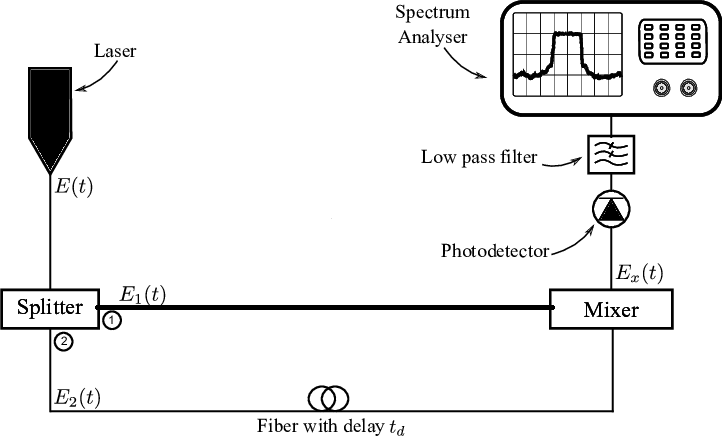
- We started measuring the phase noise on the OEwaves CW laser.
- Class 3b
- wavelength 1.5 um
- The procedure is done using self coupling of the laser
- splitter 50%-50%\
- delay line 100 m
- all fibers are PM type (polarity maintained)
- Photodetector is "lab buddy", very fast diode.
- Note: différance from schematic (we did not use a low pass filter)
|
| Attachment 1: 20210207_OEwaves_laser.jpg
|
 |
| Attachment 2: 20210207_Self_coupling_setup.jpg
|
 |
| Attachment 3: Schematic-setup-for-optical-delayed-self-coupling-detection.png
|
 |
|
65
|
Mon Jul 5 14:40:57 2021 |
Manar Amer | Fixed | report | lasers and optics | detectors and electronics | Optical room | OEwaves CW Laser - Phase Noise |
a correction on the wavelength of the laser it is 1030 um
| Manar Amer wrote: |
- We started measuring the phase noise on the OEwaves CW laser.
- Class 3b
- wavelength 1.5 um
- The procedure is done using self coupling of the laser
- splitter 50%-50%\
- delay line 100 m
- all fibers are PM type (polarity maintained)
- Photodetector is "lab buddy", very fast diode.
- Note: différance from schematic (we did not use a low pass filter)
|
|
|
66
|
Mon Jul 5 14:46:44 2021 |
Manar Amer | Fixed | report | lasers and optics | detectors and electronics | Optical room | OEwaves CW Laser - Phase Noise |
correction on unit 1030 nm
| Manar Amer wrote: |
|
a correction on the wavelength of the laser it is 1030 um
| Manar Amer wrote: |
- We started measuring the phase noise on the OEwaves CW laser.
- Class 3b
- wavelength 1.5 um
- The procedure is done using self coupling of the laser
- splitter 50%-50%\
- delay line 100 m
- all fibers are PM type (polarity maintained)
- Photodetector is "lab buddy", very fast diode.
- Note: différance from schematic (we did not use a low pass filter)
|
|
|
|
174
|
Thu Dec 7 09:09:27 2023 |
Ronic Chiche | Fixed | info | lasers and optics | ThomX igloo | New mirrors batch informations |
the 2 files describe the specfications for the 16 mirrors ordered (4 for ThomX + spare, 4 for SBOX + spare) and the measurements made by the LMA.
I add also a 3rd file in which all the "special' mirrors are referenced. |
| Attachment 1: miroirs_puma_2022_thomx_Kbox.docx
|
| Attachment 2: Miroirs_Ã _1031_nm-ThomX_-_KBox_Mars_2023.pdf
|
| Attachment 3: Recap_miroirs_KBOX_et_THOMX.xlsx
|
|
246
|
Wed Aug 5 11:25:41 2026 |
Ronic Chiche | Under Process | info | mechanics | lasers and optics | cabling | Optical room | Neolase amplifier installation |
we have all the adaptor plugs for connecting the chiller.
so, I tested first the chiller connected in closed loop (on itself).
there is no manual, so procedure is not completely clear...
DO NOT PLUG ANYTHING BEFORE THE CHILLER ASK FOR IT
ONE MUST FOLLOW THE PROCEDURE ON THE CHILLER DISPLAY
1) if the chiller circuit is full of coolant liquid,
one must start by a System Startup -> Draining
(a trash tank and the hose will be need for emptying the circuit)
2) once the chiller circuit is empty
one must continue by System Startup -> Filling
(a clean demineralized water tank and the hose will be need for filling the circuit)
=> OK !
the chiller is able the fill and drain its circuit.
I saw the cooling water circulating in the closed loop.
|
|
247
|
Wed Aug 5 12:22:52 2026 |
Ronic Chiche | Under Process | info | mechanics | lasers and optics | cabling | Optical room | Neolase amplifier installation |
now, I connected the chiller circuit to the amplifier, thanks to the adapters.
chiller IN => blue pipe => laser OUT
chiller OUT => black pipe => laser IN
after several filling and compression procedure, the flow is only 1.7Lpm and the pressure is 0.8 bar.
the temperature has been set to 20°C according to the manual operating range 18-23°C.
the flow is too low !
according to the manual, the flow should be 3-5Lpm !
a very small leakage appears if the mechanical constrains on the pipe is too high.
so, I separated the IN and OUT pipes to release this constrain and fixed the pipes to keep the position.
| Ronic Chiche wrote: |
|
we have all the adaptor plugs for connecting the chiller.
so, I tested first the chiller connected in closed loop (on itself).
there is no manual, so procedure is not completely clear...
DO NOT PLUG ANYTHING BEFORE THE CHILLER ASK FOR IT
ONE MUST FOLLOW THE PROCEDURE ON THE CHILLER DISPLAY
1) if the chiller circuit is full of coolant liquid,
one must start by a System Startup -> Draining
(a trash tank and the hose will be need for emptying the circuit)
2) once the chiller circuit is empty
one must continue by System Startup -> Filling
(a clean demineralized water tank and the hose will be need for filling the circuit)
=> OK !
the chiller is able the fill and drain its circuit.
I saw the cooling water circulating in the closed loop.
|
|
|
248
|
Wed Aug 5 13:49:49 2026 |
Ronic Chiche | Under Process | info | mechanics | lasers and optics | cabling | Optical room | Neolase amplifier installation |
pipes are maybe too long ?
we can use the Darcy-Weisbach + Blasius laws (non linear laws).
I asked to ChatGPT, Claude, Mistral and MathGPT to solve it with these parameters :
L ~ 3m
D = 1 cm
water at 20°C
dP = 0.7 bar
they all found ~ 22-23L/min
so, the tube length should not be the problem... to be investiguated.
| Ronic Chiche wrote: |
|
now, I connected the chiller circuit to the amplifier, thanks to the adapters.
chiller IN => blue pipe => laser OUT
chiller OUT => black pipe => laser IN
after several filling and compression procedure, the flow is only 1.7Lpm and the pressure is 0.8 bar.
the temperature has been set to 20°C according to the manual operating range 18-23°C.
the flow is too low !
according to the manual, the flow should be 3-5Lpm !
a very small leakage appears if the mechanical constrains on the pipe is too high.
so, I separated the IN and OUT pipes to release this constrain and fixed the pipes to keep the position.
| Ronic Chiche wrote: |
|
we have all the adaptor plugs for connecting the chiller.
so, I tested first the chiller connected in closed loop (on itself).
there is no manual, so procedure is not completely clear...
DO NOT PLUG ANYTHING BEFORE THE CHILLER ASK FOR IT
ONE MUST FOLLOW THE PROCEDURE ON THE CHILLER DISPLAY
1) if the chiller circuit is full of coolant liquid,
one must start by a System Startup -> Draining
(a trash tank and the hose will be need for emptying the circuit)
2) once the chiller circuit is empty
one must continue by System Startup -> Filling
(a clean demineralized water tank and the hose will be need for filling the circuit)
=> OK !
the chiller is able the fill and drain its circuit.
I saw the cooling water circulating in the closed loop.
|
|
|
|
249
|
Thu Aug 6 14:49:32 2026 |
Ronic Chiche | Under Process | info | mechanics | lasers and optics | cabling | Optical room | Neolase amplifier installation |
I drained the chiller to install again the short pipe (< 1m) in closed loop.
then, I filled again the chiller and did the compression process to obtain 1bar.
in that case, the flow measured by the chiller is correct about 5.8Lpm.
PS : the correct length for the previous calculation is 6m (2x 3m) and not 3m...
in that case, the flow should be ~ 15Lpm (and not 22 Lpm)
| )Ronic Chiche wrote: |
|
pipes are maybe too long ?
we can use the Darcy-Weisbach + Blasius laws (non linear laws).
I asked to ChatGPT, Claude, Mistral and MathGPT to solve it with these parameters :
L ~ 3m
D = 1 cm
water at 20°C
dP = 0.7 bar
they all found ~ 22-23L/min
so, the tube length should not be the problem... to be investiguated.
| Ronic Chiche wrote: |
|
now, I connected the chiller circuit to the amplifier, thanks to the adapters.
chiller IN => blue pipe => laser OUT
chiller OUT => black pipe => laser IN
after several filling and compression procedure, the flow is only 1.7Lpm and the pressure is 0.8 bar.
the temperature has been set to 20°C according to the manual operating range 18-23°C.
the flow is too low !
according to the manual, the flow should be 3-5Lpm !
a very small leakage appears if the mechanical constrains on the pipe is too high.
so, I separated the IN and OUT pipes to release this constrain and fixed the pipes to keep the position.
| Ronic Chiche wrote: |
|
we have all the adaptor plugs for connecting the chiller.
so, I tested first the chiller connected in closed loop (on itself).
there is no manual, so procedure is not completely clear...
DO NOT PLUG ANYTHING BEFORE THE CHILLER ASK FOR IT
ONE MUST FOLLOW THE PROCEDURE ON THE CHILLER DISPLAY
1) if the chiller circuit is full of coolant liquid,
one must start by a System Startup -> Draining
(a trash tank and the hose will be need for emptying the circuit)
2) once the chiller circuit is empty
one must continue by System Startup -> Filling
(a clean demineralized water tank and the hose will be need for filling the circuit)
=> OK !
the chiller is able the fill and drain its circuit.
I saw the cooling water circulating in the closed loop.
|
|
|
|
|
250
|
Thu Aug 6 15:12:49 2026 |
Ronic Chiche | Under Process | info | mechanics | lasers and optics | cabling | Optical room | Neolase amplifier installation |
now, I installed the long pipes (2x 3m) in closed loop (without the amplifier connected), but the exact ones used to connect the laser, with the same pipe adapters.
after the compression process, the chiller works at 0.9 bar and the measured flow is 4.7Lpm.
so, it's still OK !
after a long time, I observed a small leakage on the "male" adapter on the amplifier side.
| Ronic Chiche wrote: |
|
I drained the chiller to install again the short pipe (< 1m) in closed loop.
then, I filled again the chiller and did the compression process to obtain 1bar.
in that case, the flow measured by the chiller is correct about 5.8Lpm.
PS : the correct length for the previous calculation is 6m (2x 3m) and not 3m...
in that case, the flow should be ~ 15Lpm (and not 22 Lpm)
| )Ronic Chiche wrote: |
|
pipes are maybe too long ?
we can use the Darcy-Weisbach + Blasius laws (non linear laws).
I asked to ChatGPT, Claude, Mistral and MathGPT to solve it with these parameters :
L ~ 3m
D = 1 cm
water at 20°C
dP = 0.7 bar
they all found ~ 22-23L/min
so, the tube length should not be the problem... to be investiguated.
| Ronic Chiche wrote: |
|
now, I connected the chiller circuit to the amplifier, thanks to the adapters.
chiller IN => blue pipe => laser OUT
chiller OUT => black pipe => laser IN
after several filling and compression procedure, the flow is only 1.7Lpm and the pressure is 0.8 bar.
the temperature has been set to 20°C according to the manual operating range 18-23°C.
the flow is too low !
according to the manual, the flow should be 3-5Lpm !
a very small leakage appears if the mechanical constrains on the pipe is too high.
so, I separated the IN and OUT pipes to release this constrain and fixed the pipes to keep the position.
| Ronic Chiche wrote: |
|
we have all the adaptor plugs for connecting the chiller.
so, I tested first the chiller connected in closed loop (on itself).
there is no manual, so procedure is not completely clear...
DO NOT PLUG ANYTHING BEFORE THE CHILLER ASK FOR IT
ONE MUST FOLLOW THE PROCEDURE ON THE CHILLER DISPLAY
1) if the chiller circuit is full of coolant liquid,
one must start by a System Startup -> Draining
(a trash tank and the hose will be need for emptying the circuit)
2) once the chiller circuit is empty
one must continue by System Startup -> Filling
(a clean demineralized water tank and the hose will be need for filling the circuit)
=> OK !
the chiller is able the fill and drain its circuit.
I saw the cooling water circulating in the closed loop.
|
|
|
|
|
|
251
|
Fri Aug 7 10:59:52 2026 |
Ronic Chiche | Under Process | info | mechanics | lasers and optics | cabling | Optical room | Neolase amplifier installation |
I cut a small part of the black pipe on the amplifier side (could it be slightly deformed by a try with an other type of adapter ?), with the dedicated tool, changed the adapter and plugged it more firmly in the pipe (pipe deeply inserted in the adapter).
it seems, there is no more leakage.
measured pressure and flow are 0.9 bar and 4.7Lpm => OK without amplifier.
| Ronic Chiche wrote: |
|
now, I installed the long pipes (2x 3m) in closed loop (without the amplifier connected), but the exact ones used to connect the laser, with the same pipe adapters.
after the compression process, the chiller works at 0.9 bar and the measured flow is 4.7Lpm.
so, it's still OK !
after a long time, I observed a small leakage on the "male" adapter on the amplifier side.
| Ronic Chiche wrote: |
|
I drained the chiller to install again the short pipe (< 1m) in closed loop.
then, I filled again the chiller and did the compression process to obtain 1bar.
in that case, the flow measured by the chiller is correct about 5.8Lpm.
PS : the correct length for the previous calculation is 6m (2x 3m) and not 3m...
in that case, the flow should be ~ 15Lpm (and not 22 Lpm)
| )Ronic Chiche wrote: |
|
pipes are maybe too long ?
we can use the Darcy-Weisbach + Blasius laws (non linear laws).
I asked to ChatGPT, Claude, Mistral and MathGPT to solve it with these parameters :
L ~ 3m
D = 1 cm
water at 20°C
dP = 0.7 bar
they all found ~ 22-23L/min
so, the tube length should not be the problem... to be investiguated.
| Ronic Chiche wrote: |
|
now, I connected the chiller circuit to the amplifier, thanks to the adapters.
chiller IN => blue pipe => laser OUT
chiller OUT => black pipe => laser IN
after several filling and compression procedure, the flow is only 1.7Lpm and the pressure is 0.8 bar.
the temperature has been set to 20°C according to the manual operating range 18-23°C.
the flow is too low !
according to the manual, the flow should be 3-5Lpm !
a very small leakage appears if the mechanical constrains on the pipe is too high.
so, I separated the IN and OUT pipes to release this constrain and fixed the pipes to keep the position.
| Ronic Chiche wrote: |
|
we have all the adaptor plugs for connecting the chiller.
so, I tested first the chiller connected in closed loop (on itself).
there is no manual, so procedure is not completely clear...
DO NOT PLUG ANYTHING BEFORE THE CHILLER ASK FOR IT
ONE MUST FOLLOW THE PROCEDURE ON THE CHILLER DISPLAY
1) if the chiller circuit is full of coolant liquid,
one must start by a System Startup -> Draining
(a trash tank and the hose will be need for emptying the circuit)
2) once the chiller circuit is empty
one must continue by System Startup -> Filling
(a clean demineralized water tank and the hose will be need for filling the circuit)
=> OK !
the chiller is able the fill and drain its circuit.
I saw the cooling water circulating in the closed loop.
|
|
|
|
|
|
|
252
|
Fri Aug 7 11:41:17 2026 |
Ronic Chiche | Under Process | info | mechanics | lasers and optics | cabling | Optical room | Neolase amplifier installation |
as soon as I connect the amplifier to the pipes, the flow decreases to 1.7Lpm.
and the filling process is very long and noisy, as there was something blocking the filling process...
| Ronic Chiche wrote: |
|
I cut a small part of the black pipe on the amplifier side (could it be slightly deformed by a try with an other type of adapter ?), with the dedicated tool, changed the adapter and plugged it more firmly in the pipe (pipe deeply inserted in the adapter).
it seems, there is no more leakage.
measured pressure and flow are 0.9 bar and 4.7Lpm => OK without amplifier.
| Ronic Chiche wrote: |
|
now, I installed the long pipes (2x 3m) in closed loop (without the amplifier connected), but the exact ones used to connect the laser, with the same pipe adapters.
after the compression process, the chiller works at 0.9 bar and the measured flow is 4.7Lpm.
so, it's still OK !
after a long time, I observed a small leakage on the "male" adapter on the amplifier side.
| Ronic Chiche wrote: |
|
I drained the chiller to install again the short pipe (< 1m) in closed loop.
then, I filled again the chiller and did the compression process to obtain 1bar.
in that case, the flow measured by the chiller is correct about 5.8Lpm.
PS : the correct length for the previous calculation is 6m (2x 3m) and not 3m...
in that case, the flow should be ~ 15Lpm (and not 22 Lpm)
| )Ronic Chiche wrote: |
|
pipes are maybe too long ?
we can use the Darcy-Weisbach + Blasius laws (non linear laws).
I asked to ChatGPT, Claude, Mistral and MathGPT to solve it with these parameters :
L ~ 3m
D = 1 cm
water at 20°C
dP = 0.7 bar
they all found ~ 22-23L/min
so, the tube length should not be the problem... to be investiguated.
| Ronic Chiche wrote: |
|
now, I connected the chiller circuit to the amplifier, thanks to the adapters.
chiller IN => blue pipe => laser OUT
chiller OUT => black pipe => laser IN
after several filling and compression procedure, the flow is only 1.7Lpm and the pressure is 0.8 bar.
the temperature has been set to 20°C according to the manual operating range 18-23°C.
the flow is too low !
according to the manual, the flow should be 3-5Lpm !
a very small leakage appears if the mechanical constrains on the pipe is too high.
so, I separated the IN and OUT pipes to release this constrain and fixed the pipes to keep the position.
| Ronic Chiche wrote: |
|
we have all the adaptor plugs for connecting the chiller.
so, I tested first the chiller connected in closed loop (on itself).
there is no manual, so procedure is not completely clear...
DO NOT PLUG ANYTHING BEFORE THE CHILLER ASK FOR IT
ONE MUST FOLLOW THE PROCEDURE ON THE CHILLER DISPLAY
1) if the chiller circuit is full of coolant liquid,
one must start by a System Startup -> Draining
(a trash tank and the hose will be need for emptying the circuit)
2) once the chiller circuit is empty
one must continue by System Startup -> Filling
(a clean demineralized water tank and the hose will be need for filling the circuit)
=> OK !
the chiller is able the fill and drain its circuit.
I saw the cooling water circulating in the closed loop.
|
|
|
|
|
|
|
|
176
|
Fri Dec 8 18:59:24 2023 |
Xinyi Lu | Fixed | report | lasers and optics | Optical room | Mounts installation and cavity alignment |
Over the last two days, Viktor, Ronic and I have started to install the mirror mounts and try to align the cavity.
- We used the Menhir laser @ 160MHz for alignment.
- To make it easier to operate, we removed some lenses and waveplates, and kept only a few necessary reflective mirrors.
- We measured the distance with rulers and placed the mounts in designed positions.
- We installed Iris on the mirror mounts, used a CCD camera to determine if the beam was in the center, and optimized the two reflective mirrors outside the cavity.
- There were some problems with the controller of the injection mirrors (Newport™) in front of the cavity, and Ronic has fixed them successfully.
- Next week, we will continue to align the cavity, measure the cavity mode, and design the telescope. We will install the old SBX mirrors for alignment first, and then replace them with the final good mirrors. |
|
177
|
Thu Dec 14 17:52:53 2023 |
Xinyi Lu | Fixed | report | lasers and optics | Optical room | Mounts installation and cavity alignment |
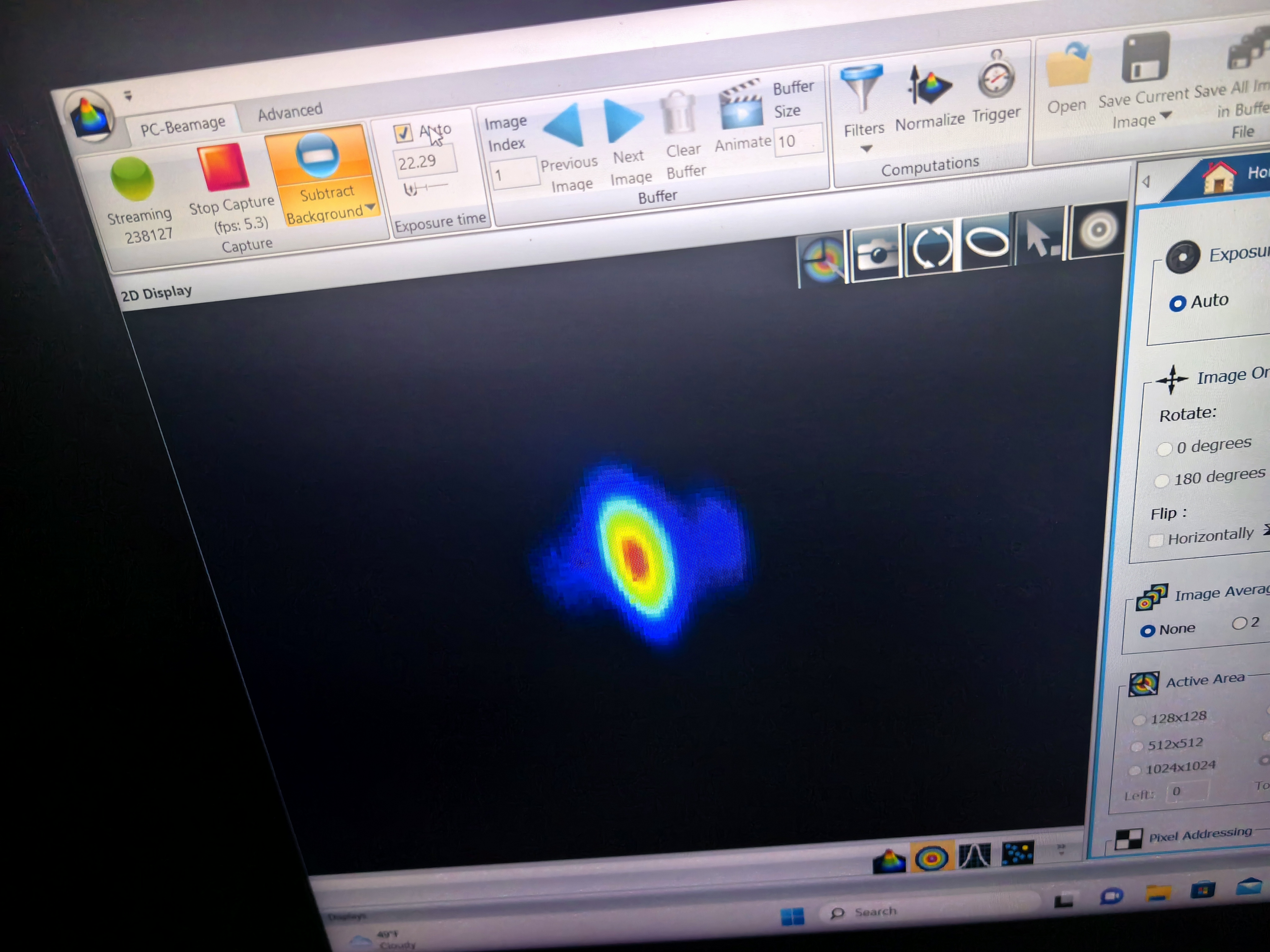
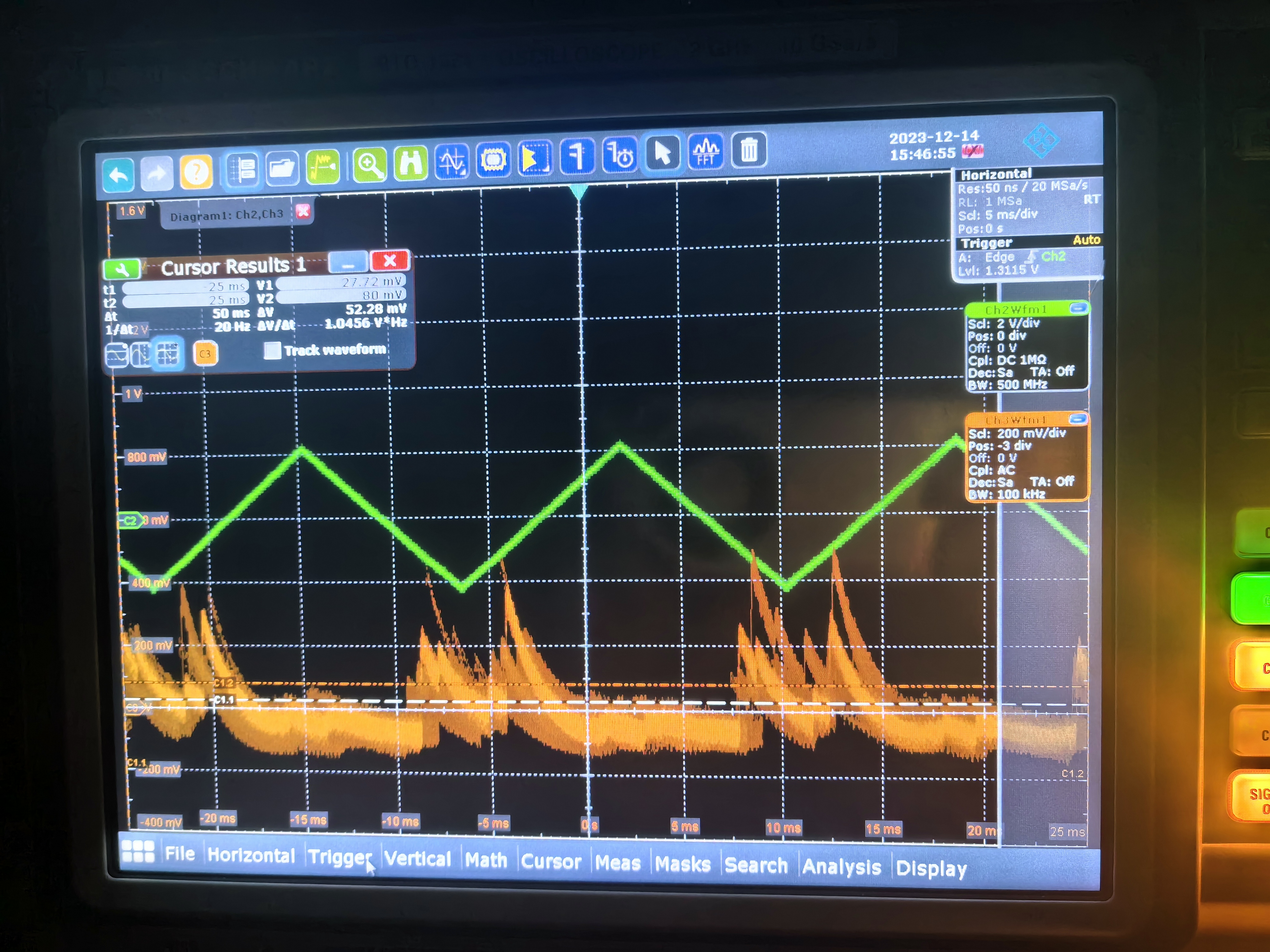
Over the past few days, Viktor, Ronic and I have continued to align the cavity. We installed 4 mirrors and monitored the transmitted laser with a CCD and photodiode. By adjusting the motors of the cavity mirror stages and the injector mirrors, we obtained resonances and less symmetric TEM20-like patterns. Possible reasons for this are a mismatch between the beam sizes of the laser and the cavity mode, and the mounts are installed in rough positions.
Tomorrow, we plan to use the CW laser to realign the optical cavity and position the mounts more precisely.
| Xinyi Lu wrote: |
|
Over the last two days, Viktor, Ronic and I have started to install the mirror mounts and try to align the cavity.
- We used the Menhir laser @ 160MHz for alignment.
- To make it easier to operate, we removed some lenses and waveplates, and kept only a few necessary reflective mirrors.
- We measured the distance with rulers and placed the mounts in designed positions.
- We installed Iris on the mirror mounts, used a CCD camera to determine if the beam was in the center, and optimized the two reflective mirrors outside the cavity.
- There were some problems with the controller of the injection mirrors (Newport™) in front of the cavity, and Ronic has fixed them successfully.
- Next week, we will continue to align the cavity, measure the cavity mode, and design the telescope. We will install the old SBX mirrors for alignment first, and then replace them with the final good mirrors.
|
|
| Attachment 1: CCD.jpg
|
 |
| Attachment 2: oscillograph.jpg
|
 |
|
178
|
Wed Dec 20 10:45:37 2023 |
Xinyi Lu | Fixed | report | lasers and optics | Optical room | Mounts installation and cavity alignment |
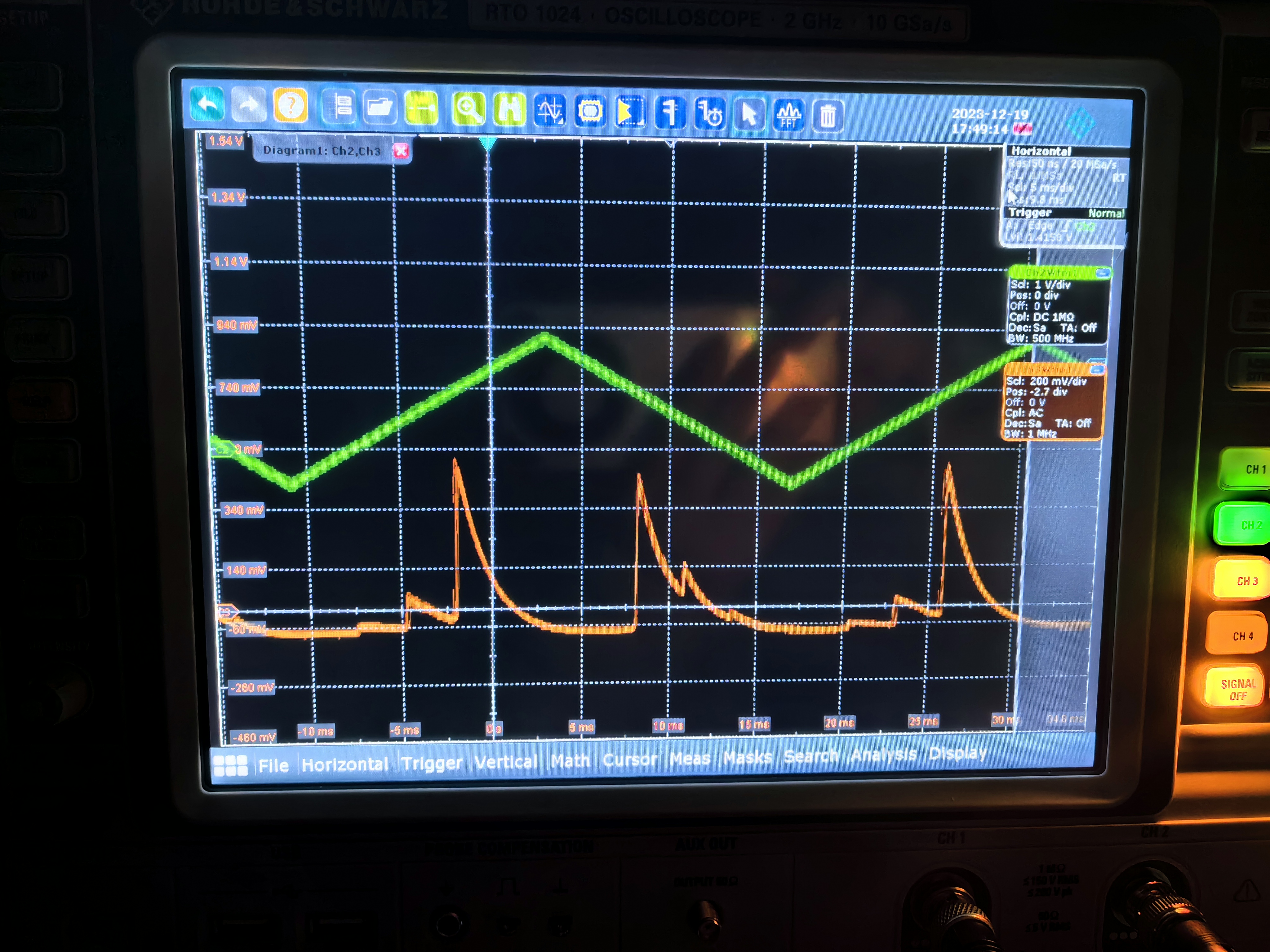
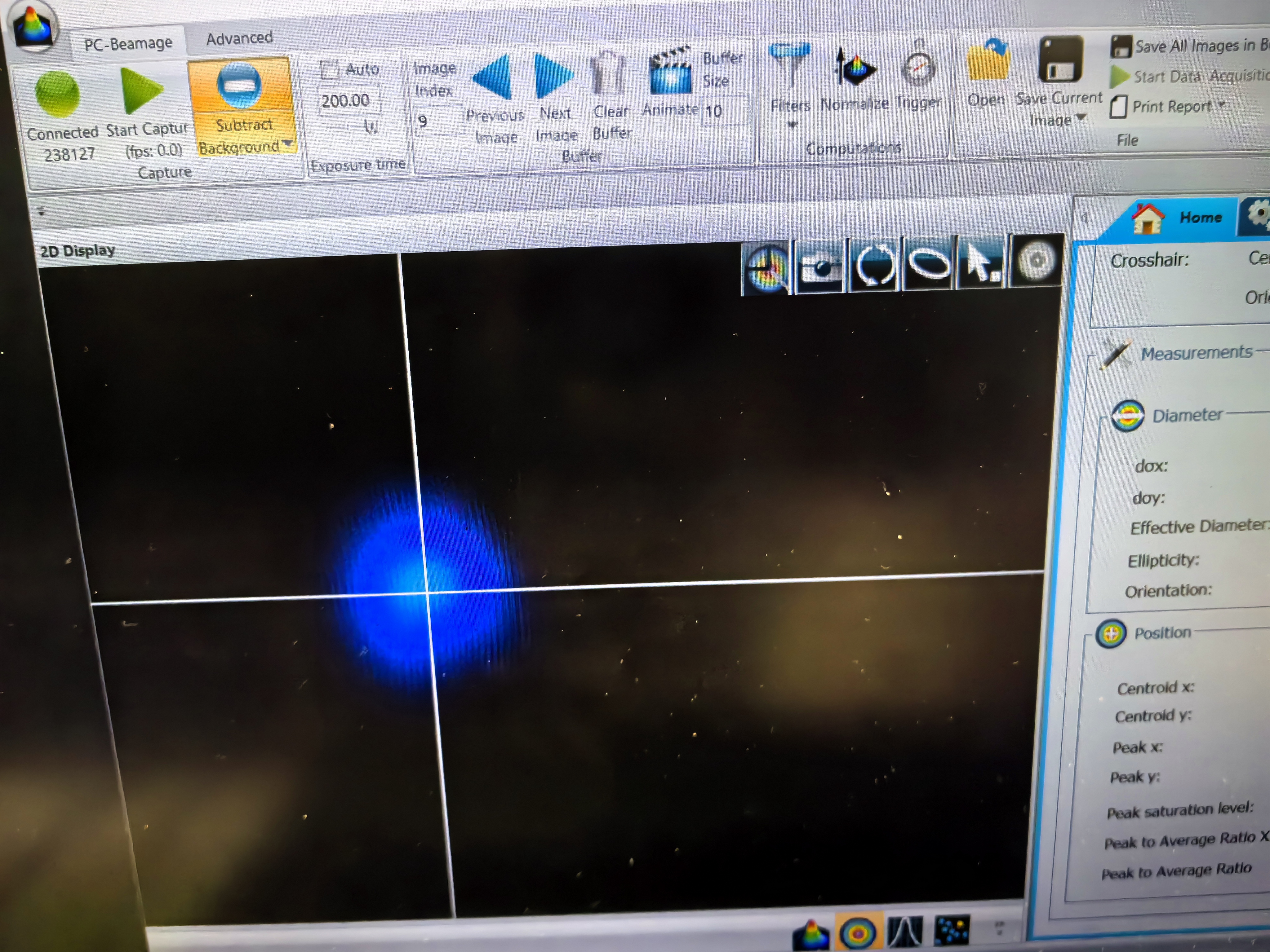
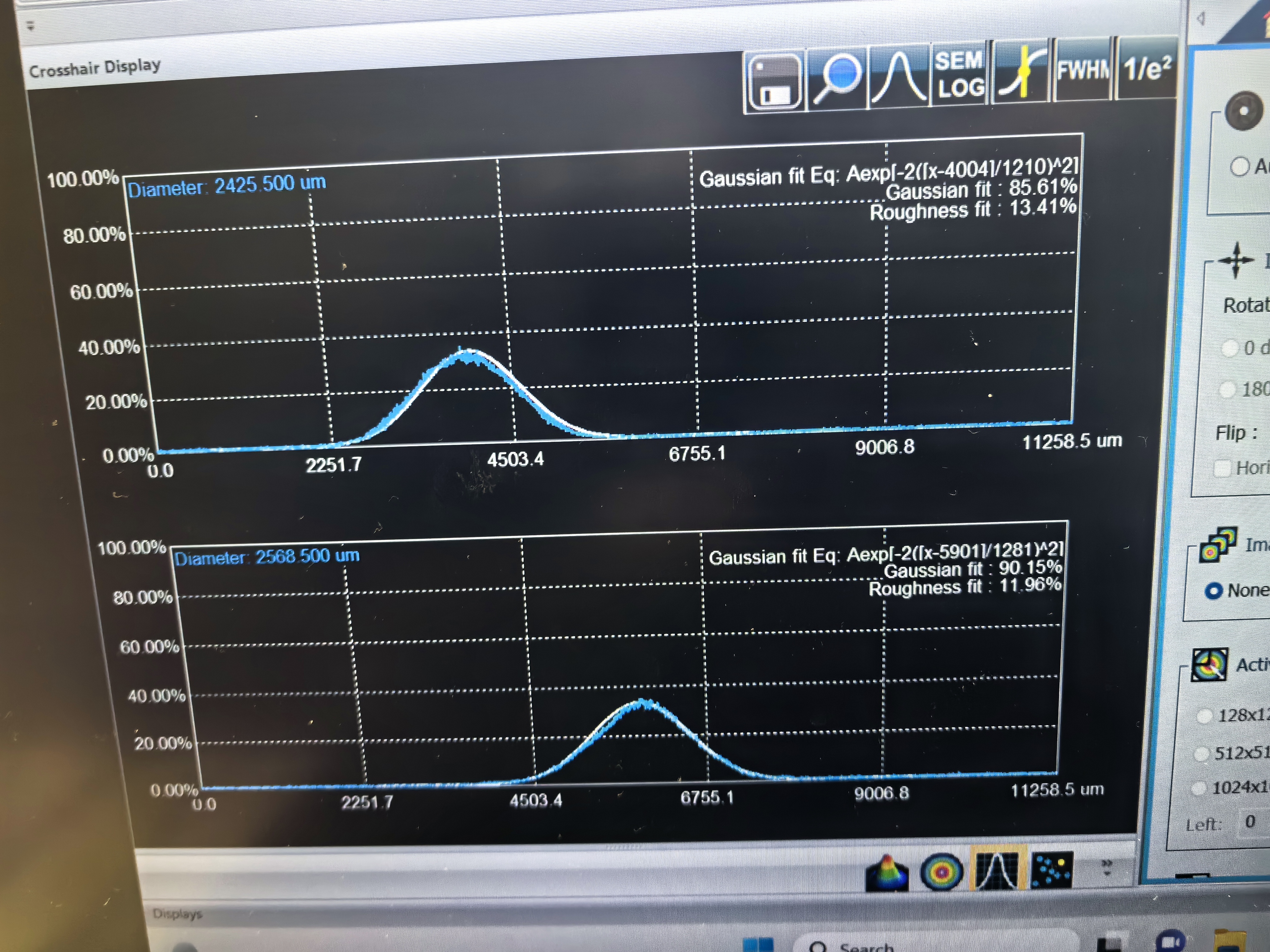
- Over the last few days, Viktor, Ronic and I have reinstalled the mounts and realigned the cavity with CW laser and old mirrors. By optimizing the injector mirrors, we got the fundamental mode at the transmission. We measured the beam size in the M2 window with a diameter of 2.5 mm.
- The current coupling efficiency is low. There is a need to increase the coupling in order to lock the cavity and measure FSR and finesse.
- The next step is to measure the incident light parameters and design the telescope to improve the coupling efficiency.
| Xinyi Lu wrote: |
|
Over the past few days, Viktor, Ronic and I have continued to align the cavity. We installed 4 mirrors and monitored the transmitted laser with a CCD and photodiode. By adjusting the motors of the cavity mirror stages and the injector mirrors, we obtained resonances and less symmetric TEM20-like patterns. Possible reasons for this are a mismatch between the beam sizes of the laser and the cavity mode, and the mounts are installed in rough positions.
Tomorrow, we plan to use the CW laser to realign the optical cavity and position the mounts more precisely.
| Xinyi Lu wrote: |
|
Over the last two days, Viktor, Ronic and I have started to install the mirror mounts and try to align the cavity.
- We used the Menhir laser @ 160MHz for alignment.
- To make it easier to operate, we removed some lenses and waveplates, and kept only a few necessary reflective mirrors.
- We measured the distance with rulers and placed the mounts in designed positions.
- We installed Iris on the mirror mounts, used a CCD camera to determine if the beam was in the center, and optimized the two reflective mirrors outside the cavity.
- There were some problems with the controller of the injection mirrors (Newport™) in front of the cavity, and Ronic has fixed them successfully.
- Next week, we will continue to align the cavity, measure the cavity mode, and design the telescope. We will install the old SBX mirrors for alignment first, and then replace them with the final good mirrors.
|
|
|
| Attachment 1: resonances.jpg
|
 |
| Attachment 2: cavity_mode.jpg
|
 |
| Attachment 3: cavity_mode_diameter.jpg
|
 |
|
7
|
Thu Oct 18 09:42:39 2018 |
Loïc Amoudry | Fixed | report | mechanics | lasers and optics | Optical room | Motors for D-shaped mirrors |
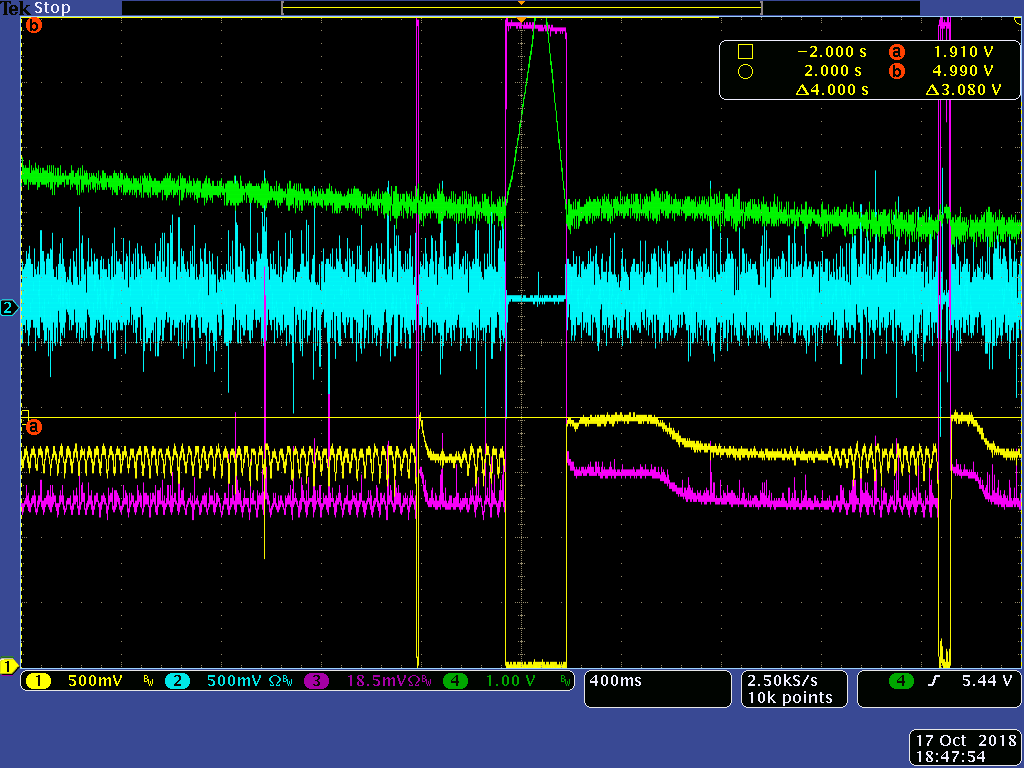
Motors have been installed on 16/10/18. No problem with them.
Effect of the motors tested on 17/10/18. No improvement. But they give the possibility to perfectly cut HOM or let them go through as show the following picture of a 2.2 mode at ~340 mW in trans and 70% coupling @4A. |
| Attachment 1: tek00000.png
|
 |
| Attachment 2: tek0000CH1.isf
|
| Attachment 3: tek0000CH2.isf
|
| Attachment 4: tek0000CH3.isf
|
| Attachment 5: tek0000CH4.isf
|
|
24
|
Fri Dec 21 13:42:43 2018 |
Loïc Amoudry | Fixed | info | lasers and optics | Optical room | Mirrors features, come back from LMA |
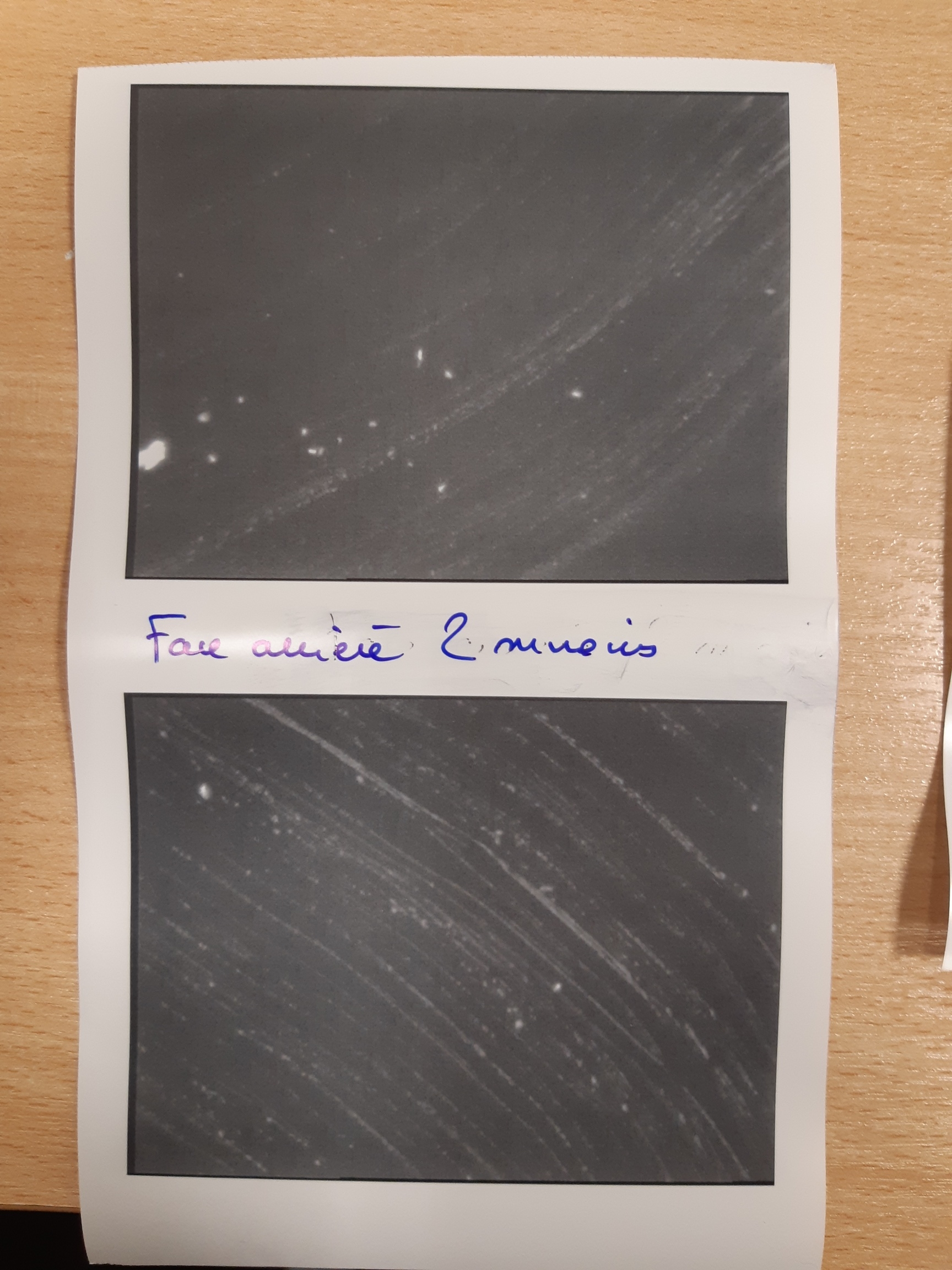
Mirrors arrived today from LMA. Their features are damaged.
Photos avant ou après nettoyage, pas clair dans le mail de Laurent :
"J'ai commencé à nettoyer M1 et M2 avec notr methode habituelle et je me suis aperçu que sur la partie centrale (en gros taille de ton faisceau j'ai l'impression) que des choses apparaissaient (voir photo)
Si bien que la diffusion n'a pas évolué dans le bon sens (diminution) voir empiré pour M1. J'ai donc arrêter de les nettoyer !!!
J'ai regardé les faces arrières des miroirs avant nettoyage et j'ai pu voir ce que tu vois sur la photo même au centre. Je sais pas de quoi cela peut venir.
Une chose est sûre le coating IBS a été altéré par je ne sais quoi dans ta manip provoquant cette dégradation dès qu'on y touche. L'interaction avec les faisceaux d'eélectrons n'avait jamais altéré les miroirs sur l'expértience DESY par exemple!!
Pour me rassurer, j'ai pris un miroir fait sur un micropoli qu'on a en stock et aucun pb lors du nettoyage (on peut penser à tout)"
|
| Attachment 1: 181201_caracteristiques_miroirs.PNG
|
 |
| Attachment 2: 20181207_155704_resized.jpg
|
 |
| Attachment 3: 20181207_155726_resized.jpg
|
 |
|
23
|
Thu Nov 15 13:02:44 2018 |
Loïc Amoudry | Fixed | info | lasers and optics | Optical room | Mirrors cleaning |
The new mirrors didn't give expected results. Then the 4 old mirrors have been sent to LMA on 12/11/18 for a cleaning and caracterization before and after cleaning. Also asked for a diffusion/absorption map on the mirrors if possible. They didn't really answered on what will they do.
Received on 13/11/18 by LMA. |
|
31
|
Fri Dec 6 11:54:58 2019 |
Loïc Amoudry | Fixed | report | lasers and optics | Optical room | Mirror's installed |
The initial 400kW SBOX mirrors which have been cleaned ont 28th of november have been installed this morning on the SBOX. |
|
60
|
Wed Dec 16 12:36:37 2020 |
Loïc Amoudry | Fixed | report | lasers and optics | Optical room | Mirror's cleaning and microscope imaging |
On 10th of december 2020 we cleaned the SBOX mirrors and took microscope images (the name of the images indicates what they are).
There are 7 mirror, the initial M1 (spot in the center), M2 (spot on the edge), M3 and M4 which made the 200-400kW and the M2, M3 and M4 SPARE. The difference we make between M3 and M4 SPARE is the number on the box (11 or 13).
We used 3 different cleaning methods : 1st, one spin coater on HR, 2nd one, tissu wipe on AR (wipe with the optical tissu and isoprop) or 3rd one, mirror wiped on tissue (put isoprop on tissu and press AR face of the mirror doing "8" shape 3 times).
The second method is far les efficient as a cleaning method. The image "M3_M4_spare_11_after_cleaning_back.tif " shows the traces let by it and removed by the 3rd method on image "M3_M4_spare_11_after_cleaning_back_second_time_on_tissu.tif".
We can also notice that the spin coater let some trace on the HR face, round shaped, see Image "M3_M4_spare_13_after_cleaning_back.tif". We can propose to use the third method with Acetone on HR face before using spin coater to remove oil or organic particles.
It also lets a trace on the AR face, this is why we clean the AR face with the 2nd method after cleaning it with the spin coater.
Note : The position of the mirrors in the microscope is always the same here. Meaning mirrors are directed so that the arrow (which shows the HR face and is placed on the side of the mirror) is placed on the top of the images. |
| Attachment 1: M1_before_cleaning.tif
|
| Attachment 2: M1_after_cleaning.tif
|
| Attachment 3: M2_after_cleaning.tif
|
| Attachment 4: M3_after_cleaning.tif
|
| Attachment 5: M4_after_cleaning.tif
|
| Attachment 6: M2_spare_before_cleaning.tif
|
| Attachment 7: M2_spare_after_cleaning.tif
|
| Attachment 8: M2_spare_after_cleaning_back.tif
|
| Attachment 9: M3_M4_spare_11_before_cleaning.tif
|
| Attachment 10: M3_M4_spare_11_after_cleaning_back.tif
|
| Attachment 11: M3_M4_spare_11_after_cleaning_back_second_time_on_tissu.tif
|
| Attachment 12: M3_M4_spare_13_before_cleaning.tif
|
| Attachment 13: M3_M4_spare_13_after_cleaning.tif
|
| Attachment 14: M3_M4_spare_13_after_cleaning_back.tif
|