| ID |
Date |
Author |
Status |
Type |
Category |
Location |
Title |
|
44
|
Mon Dec 6 11:22:08 2021 |
Kevin Dupraz | Under Process | info | lasers and optics | detectors and electronics | Optical room | Cameras Calibration |
| Kevin Dupraz wrote: |
|
After installing cameras the actual calibration are :
NF_Refl: acA1920-40gm
pixel size (real): 5.86um
Magnification = [0.53,0.56]
pixel size (image): 3.22um
image donne on input plan mirror M1 (accuracy about few mm)
NF_Trans: acA1920-40gm
pixel size (real): 5.86um
Magnification = 1.32
pixel size (image): 7.73um
image donne on output plan mirror M2 (accuracy about few mm)
need to adjust the NF transmission as the Magnification is greater than 1.
|
The NF_inj was calibrated with the USB microscope (1.4um/pixel on microscope image). The 5th ring of the lens is about 1.89 mm in diameter.
NF_inj: acA1920-40gm
pixel size (real): 5.86um
Magnification = 1.54
pixel size (image): 9um |
| Attachment 1: grab2021-12-06_10-51-34_325_microscope.bmp
|
| Attachment 2: grab2021-12-06_10-52-11_108_microscope_calib_05mm_ruler.bmp
|
|
45
|
Tue Dec 7 11:48:33 2021 |
Kevin Dupraz | Under Process | info | lasers and optics | detectors and electronics | Optical room | Cameras Calibration |
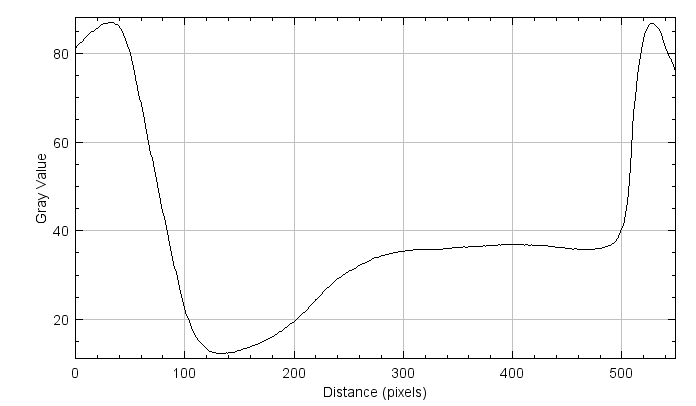
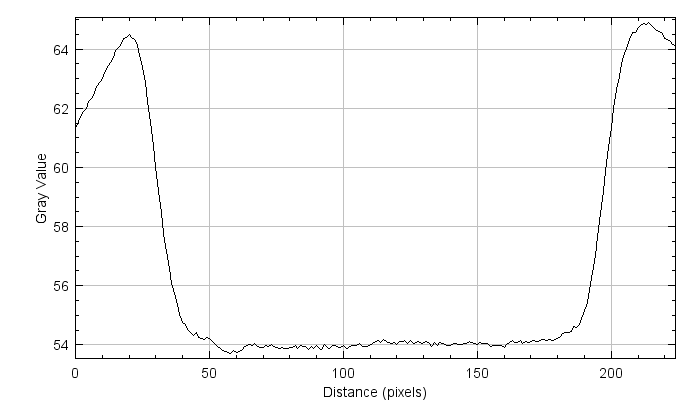
After check a mistake has been found on the magnification. This seems to be the good calibration (feel free to cross check). The projection of the 2mm hex is attached
the calibration are :
NF_Refl: acA1920-40gm
pixel size (real): 5.86um
Magnification = 1.71
pixel size (image): 10um
image donne on input plan mirror M1 (accuracy about few mm)
NF_Trans: acA1920-40gm
pixel size (real): 5.86um
Magnification = 0.68
pixel size (image): 4um
image donne on output plan mirror M2 (accuracy about few mm)
The NF_inj was calibrated with the USB microscope (1.4um/pixel on microscope image). The 5th ring of the lens is about 1.89 mm in diameter.
NF_inj: acA1920-40gm
pixel size (real): 5.86um
Magnification = 1.54
pixel size (image): 9um
| Kevin Dupraz wrote: |
|
| Kevin Dupraz wrote: |
|
After installing cameras the actual calibration are :
NF_Refl: acA1920-40gm
pixel size (real): 5.86um
Magnification = [0.53,0.56]
pixel size (image): 3.22um
image donne on input plan mirror M1 (accuracy about few mm)
NF_Trans: acA1920-40gm
pixel size (real): 5.86um
Magnification = 1.32
pixel size (image): 7.73um
image donne on output plan mirror M2 (accuracy about few mm)
need to adjust the NF transmission as the Magnification is greater than 1.
|
The NF_inj was calibrated with the USB microscope (1.4um/pixel on microscope image). The 5th ring of the lens is about 1.89 mm in diameter.
NF_inj: acA1920-40gm
pixel size (real): 5.86um
Magnification = 1.54
pixel size (image): 9um
|
|
| Attachment 1: Plot_of_NF_Trans_calib_hex2mm__2021-06-23__17-06-49.png
|
 |
| Attachment 2: Plot_of_NF_Refl_calib_hex2mm__2021-06-23__16-59-26.png
|
 |
|
46
|
Fri Dec 10 16:57:56 2021 |
Kevin Dupraz | Under Process | report | lasers and optics | Optical room | Manip 10 12 2021 (optimization injection Burst) |
Manip 10/12/2021
Après recherche de la résonnance principale
- MCS miroirs plan à 5.110250mm (en derive vers les negatifs)
- pic transmission à 5V
- couplage ~7%
Décalage du spot (très faible, à peine visible à la camera NF_refl)
- grosse perte en transmission ==> alignement OK
Grossissement du spot
* début taille_sigma à 0.220mm (calibration NF_Refl)
* nouvelle position en éloignant la lentille 1 taille à 0.300mm ==> max transmission ~3V,
- Walk en vertical ==> pas d'amélioration et dégradation.
- Divergent en entrée de cavité (test à la carte)
* En rapprochant la lentille 1 passage pas le minimum de taille vers 0.190 mm
* Depassement du minimum. Taille faisceau 0.317 mm (0.380 mm sur y) ==> max transmission ~2.5V,
- Walk en vertical ==> pas d'amélioration et dégradation.
- divergence pas apréciable
* On se met au minimum de taille sur la caméra. Taille faisceau 0.178 mm (0.170mm sur y) ==> max transmission ~5.3V
- Couplage 25% max (beaucoup de fluctuations).
- Gros décalage vertical (~ 1 sigma) ne provoque pas une baisse du transmis.
- Décalage horizontal sensible.
Après mangé Ronic a "lockée" la cavité. Le gain de la photodiode en transmission a été changé et la tension sur la résonnance principale est d'environ 600 - 800 mV
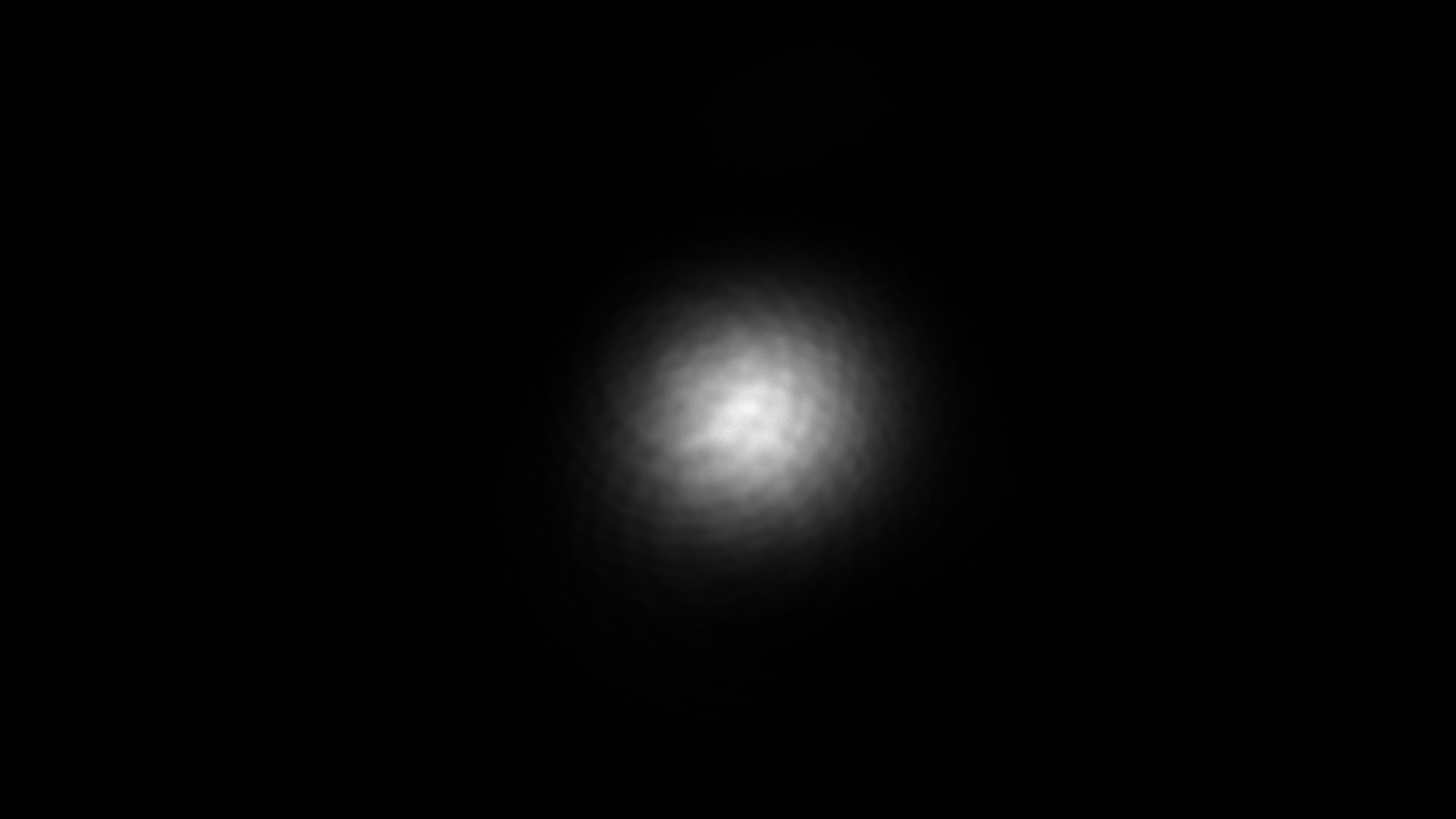
deux images ont été faites en entrée de cavité à environ 18 cm du splitter pour la camera de test afin d'être à peu près à une distance équivalente du miroir d'injection M1.
|
| Attachment 1: NF_Refl__2021-12-10__14-25-08.png
|
 |
| Attachment 2: test__2021-12-10__14-25-08_1920_25gm.png
|
 |
|
47
|
Tue Dec 14 12:59:07 2021 |
Kevin Dupraz | Under Process | report | lasers and optics | Optical room | Manip 14 12 2021 injection optimization (and calibration) |
Matin :
moteurs :
M1, M2 (plans): 5.110500m
M3, M4 (sphériques): -2.900000m
- Optimization de la première L/2 (en sortie tangor), le flux est maximisé en sortie du combiner.
* mesure sortie Tangor (Power meter de puissance) : 85 + 90 mW
* mesure sortie Tangor (Power meter PH100-Si-HA-OD1 "226316" + OD2) : 4.11mW
* mesure avant combiner, entre miroirs de replis Newfocus (Power meter + OD2) : 3.53mW
* mesure après pick-off (injection cavité) (Power meter + OD2) : 2.93mW
- Optimization du couplage avec la polarisation :
* modification de la polarisation injecté dans la cavité
* optimisation du flux reçu sur la photodiode en réflection
* mesure du couplage.
** Optimum trouvé à 15% de couplage (en scan 5Hz, 0-10V)
Position des lambdas :
- L/2 en injection : 333°
- L/4 en injection : 48°
- L/2 en réflection : 225°
- L/4 en réflection : 54°
- Déplacement de la photodiode en transmission.
* Réglage de l'iris au niveau de la photodiode : Iris ouvert PV résonance 31 mV, Iris fermée 25 mV
- Lock de la cavité.
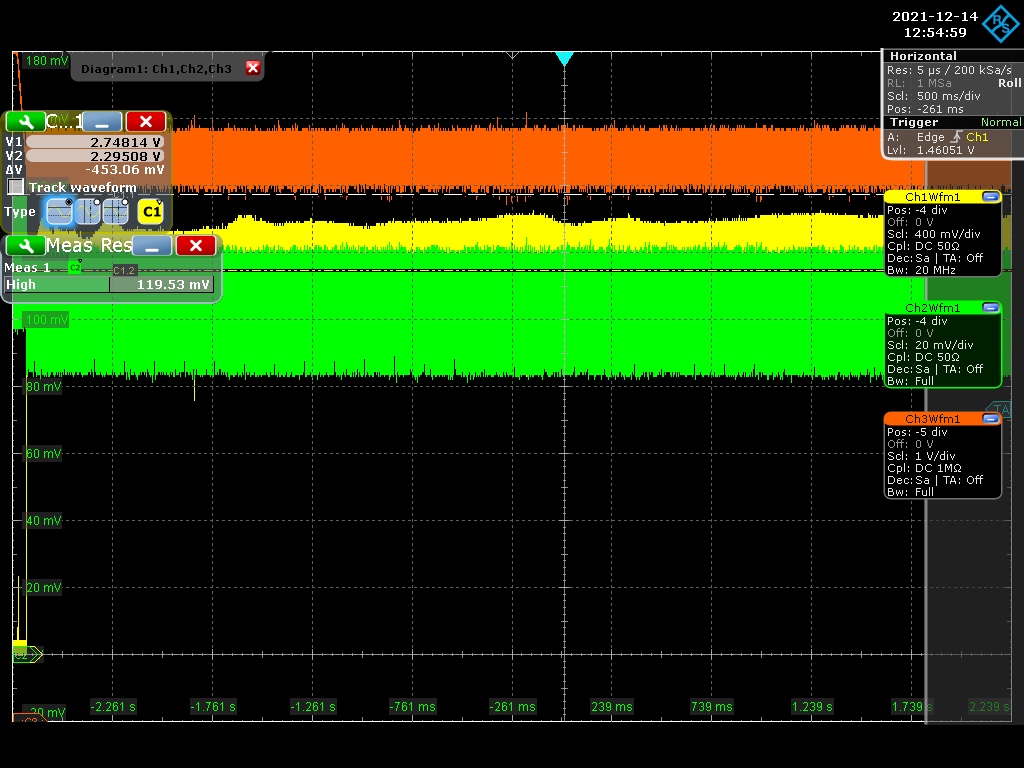
* transmission : 2.65V (60dB)
* reflection : 16.5% de couplage
* mesure devant la caméra en transmission (Power meter PH100-Si-HA-OD1 "226316" + OD2) : 0.635 uW
* image (P.J) sauvegardé bin |
| Attachment 1: Screenshot_2021-12-14_2_125459.png
|
 |
|
48
|
Thu Dec 16 10:40:55 2021 |
Kevin Dupraz | Under Process | report | lasers and optics | Optical room | Manip 14 12 2021 injection optimization (and calibration) |
Après-midi :
* Optimisation de l'alignement en injection pour avoir le plus de puissance en transmission
* Optimisation (vérification) de la polarisation pour avoir le plus de couplage.
* tension photoDiode en réflexion (50 Ohm) : max à 136 mV (couplage 20%)
* tension Photodiode transmission PDA100A-EC(50 ohm) : max à 3.6 V (60 dB de gain)
- Passage à 50 W en sortie de TANGOR.
* Vérificaton de l'alignement pour avoir le plus de puissance en transmission.
* Vérification de la polarisation pour avoir le plus de couplage.
* tension Photodiode transmission PDA100A-EC(50 ohm) : max à 4.9 V (40 dB de gain)
* Changement de la polarisation sur la ligne de réflexion (uniquement la lambda/4) pour ne pas saturer la photodiode.
* tension photoDiode en réflexion (50 Ohm) : max à 136 mV (couplage 12%)
* Références caméras :
> NF_refl : x0 = 11.9 mm; y0 = 8.65 mm; sigma_x = 0.185 mm; sigma_y = 0.167 mm.
> FF_refl : x0 = 2.44 mm; y0 = 0.61 mm; sigma_x = 0.241 mm; sigma_y = 0.259 mm.
> NF_inj : x0 = 8.57 mm; y0 = 5.40 mm; sigma_x = 0.123 mm; sigma_y = 0.127 mm.
- Plus de splitter 90/10 en sortie de TANGOR, 4.5 W en sortie TANGOR :
* Compensation du walk-of introduit par ce splitter.
* réalignement de la cavité après locking
* Photodiode Transmission (60dB + densité OD30) : max 2V
* Reflection (près changement de pile) : 18% de couplage (tension max 136 mV, 50 Ohm)
| Kevin Dupraz wrote: |
|
Matin :
moteurs :
M1, M2 (plans): 5.110500m
M3, M4 (sphériques): -2.900000m
- Optimization de la première L/2 (en sortie tangor), le flux est maximisé en sortie du combiner.
* mesure sortie Tangor (Power meter de puissance) : 85 + 90 mW
* mesure sortie Tangor (Power meter PH100-Si-HA-OD1 "226316" + OD2) : 4.11mW
* mesure avant combiner, entre miroirs de replis Newfocus (Power meter + OD2) : 3.53mW
* mesure après pick-off (injection cavité) (Power meter + OD2) : 2.93mW
- Optimization du couplage avec la polarisation :
* modification de la polarisation injecté dans la cavité
* optimisation du flux reçu sur la photodiode en réflection
* mesure du couplage.
** Optimum trouvé à 15% de couplage (en scan 5Hz, 0-10V)
Position des lambdas :
- L/2 en injection : 333°
- L/4 en injection : 48°
- L/2 en réflection : 225°
- L/4 en réflection : 54°
- Déplacement de la photodiode en transmission.
* Réglage de l'iris au niveau de la photodiode : Iris ouvert PV résonance 31 mV, Iris fermée 25 mV
- Lock de la cavité.
* transmission : 2.65V (60dB)
* reflection : 16.5% de couplage
* mesure devant la caméra en transmission (Power meter PH100-Si-HA-OD1 "226316" + OD2) : 0.635 uW
* image (P.J) sauvegardé bin
|
|
| Attachment 1: Screenshot_2021-12-14_3_182645.png
|
 |
|
49
|
Thu Dec 16 12:12:10 2021 |
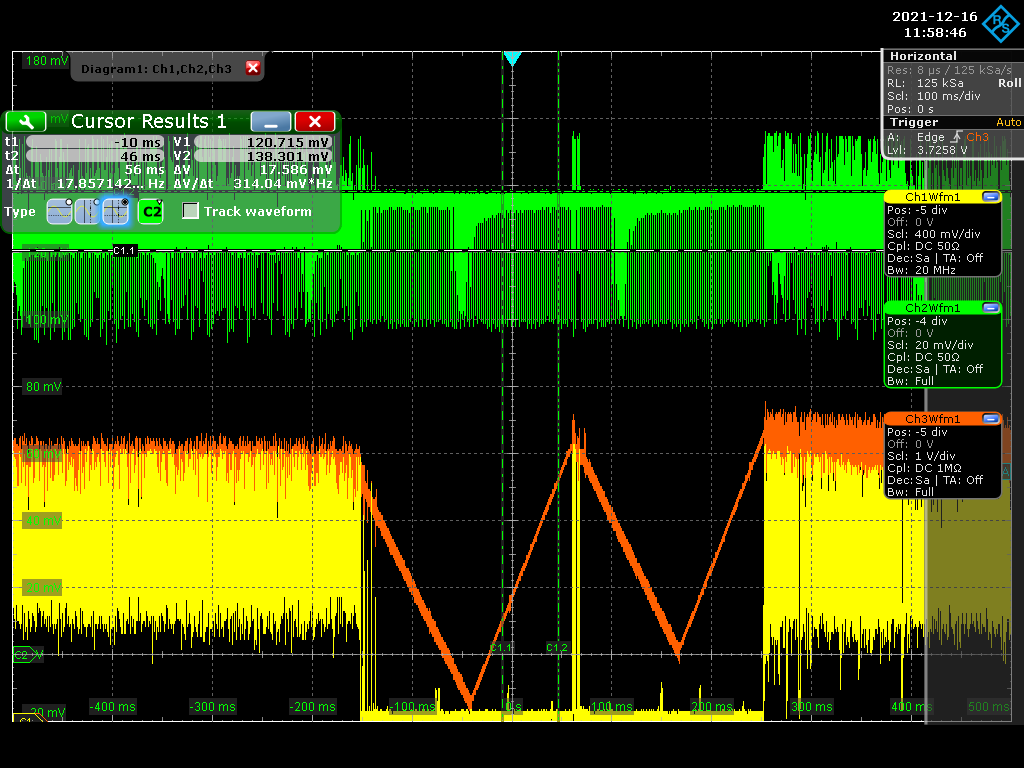
Kevin Dupraz | Under Process | report | lasers and optics | Optical room | Manip 16 12 2021 montée en puissance |
Matin:
* Redémarrage Tangor 4W
- couplage 15%
- max photodiode Transmission (60dB, OD30) : 1.9V
* Montée en Puissance 20 W
- début des effets thermiques : dérive thermique (la cavité chauffe et le piezo doit suivre, la tension baisse)
- max photodiode Transmission (40dB, OD30) : 1.6 V
- Reflection (~12%) ~140mV max:
* quand résonance => plus de signal sur la reflexion que hors lock.
- Hypothèses:
saturation de la photodiode ==> avec une densité OD10 (même effet)
effet de polarisation: essaie avec la densité OD10 (absorbante) dans le faisceau au niveau de la lambda/4 en reflection ==> la densité est brulée (ne tient pas la puissance)
==> essayer avec densité réflective.
* impossible de locker sur le max de transmission |
| Attachment 1: Screenshot_2021-12-16_0_115846.png
|
 |
|
50
|
Thu Dec 16 12:13:52 2021 |
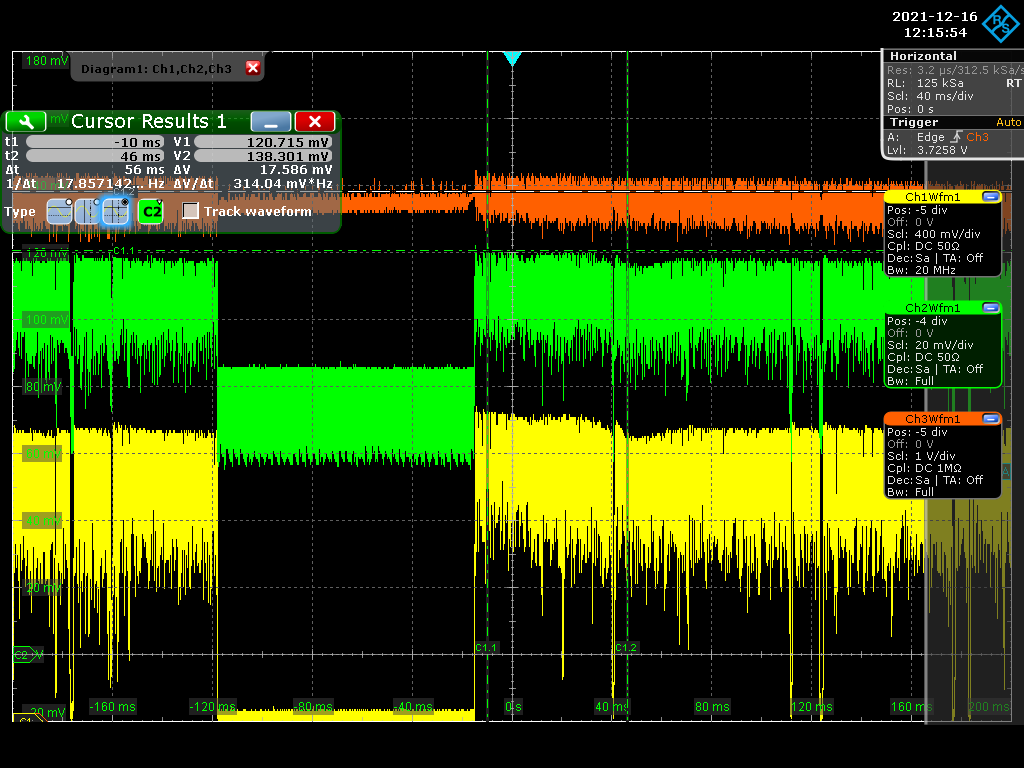
Kevin Dupraz | Under Process | report | lasers and optics | Optical room | Manip 16 12 2021 montée en puissance |
| Kevin Dupraz wrote: |
|
Matin:
* Redémarrage Tangor 4W
- couplage 15%
- max photodiode Transmission (60dB, OD30) : 1.9V
* Montée en Puissance 20 W
- début des effets thermiques : dérive thermique (la cavité chauffe et le piezo doit suivre, la tension baisse)
- max photodiode Transmission (40dB, OD30) : 1.6 V
- Reflection (~12%) ~140mV max:
* quand résonance => plus de signal sur la reflexion que hors lock.
- Hypothèses:
saturation de la photodiode ==> avec une densité OD10 (même effet)
effet de polarisation: essaie avec la densité OD10 (absorbante) dans le faisceau au niveau de la lambda/4 en reflection ==> la densité est brulée (ne tient pas la puissance)
==> essayer avec densité réflective.
* impossible de locker sur le max de transmission
|
|
| Attachment 1: Screenshot_2021-12-16_1_121553.png
|
 |
|
52
|
Fri Dec 17 17:03:34 2021 |
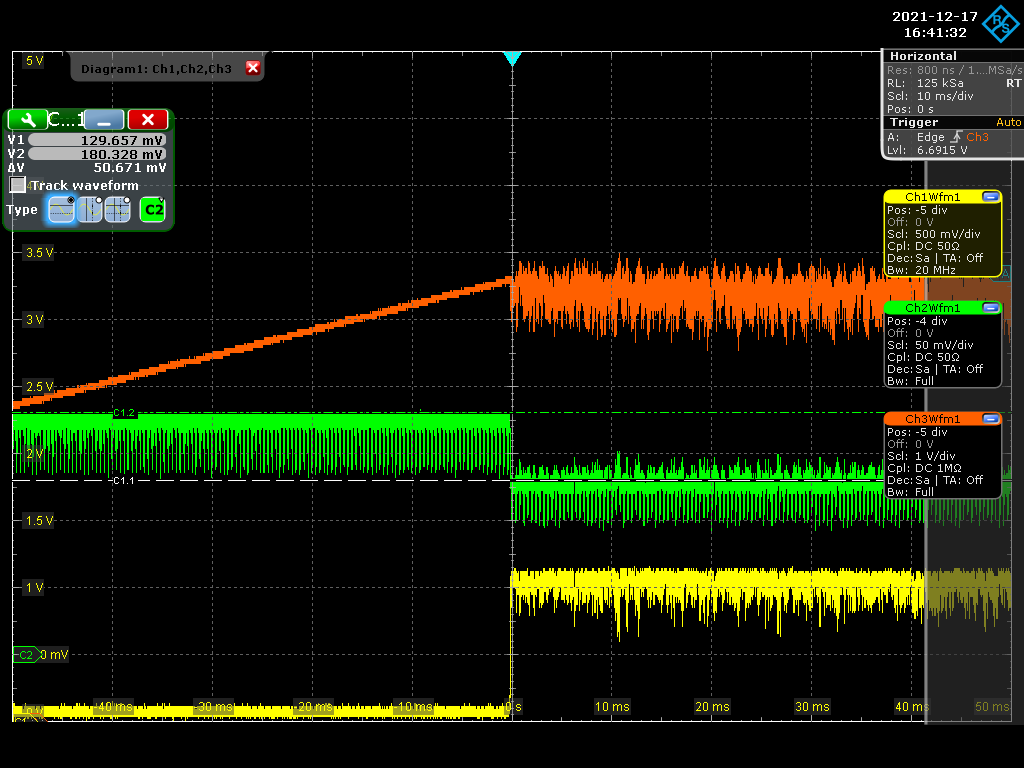
Kevin Dupraz | Under Process | report | lasers and optics | Optical room | Manip 17 12 2021 reprise réf nouvelle injection pour polarisation |
Tangor : 4.2W
* Réalignement de l'injection suite aux modifications :
- Changement de l'ordre des waveplate maintenant : lambda/4, puis lambda/2
- suppression de l'iris au niveau de la transmission, perte d'au moins un facteur sur le signal en transmission
- reprise des références sur les caméras en reflection. (NF:[10.2548, 6.1092], FF:[1.9881, 1.5929])
* Optimisation du couplage en pointé, puis en polarisation
--> Maximum de reflection dans la photodiode (transmission maximale)
- couplage mesuré en réflection : 32% +- 4%(PV) max (180 mV)
- max intensité en transmission (0 dB, sans densité) : 1.1V
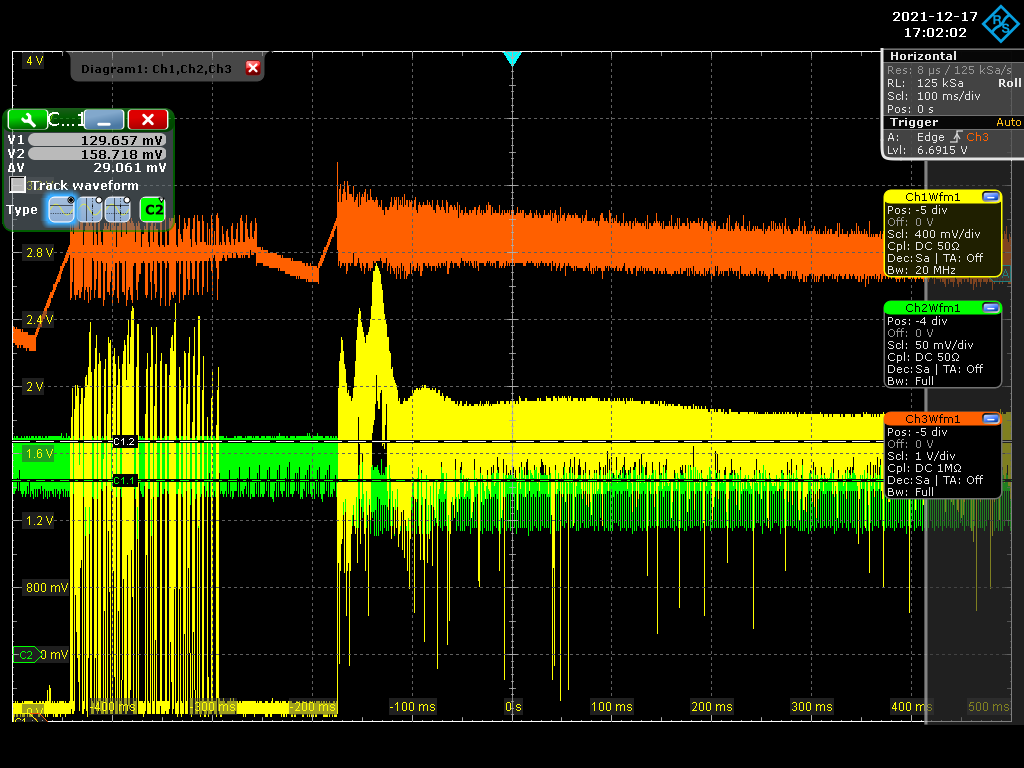
Tangor : 20W
- Montée en puissance: grosse dérive thermique mais le signal en réflection est "correcte".
- transmission (30dB, OD30) : pic max à 2.6 V
"puissance stable", 1.88V
- couplage : 25% (40mV/160mV)
On part en vacances ^^ |
| Attachment 1: Screenshot_2021-12-17_0_164132.png
|
 |
| Attachment 2: Screenshot_2021-12-17_1_170202.png
|
 |
|
17
|
Tue Sep 7 14:27:07 2021 |
Blanc | Fixed | info | lasers and optics | Optical room | Polarisation Results of the NKT |
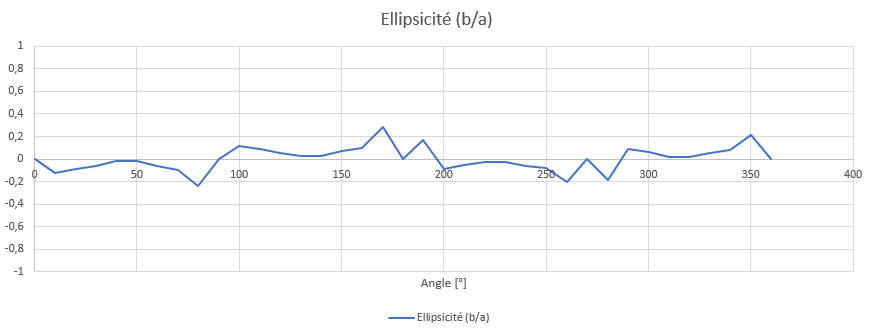
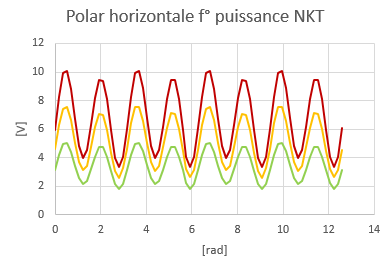
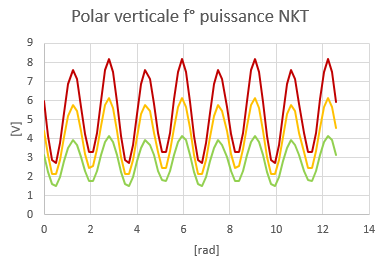
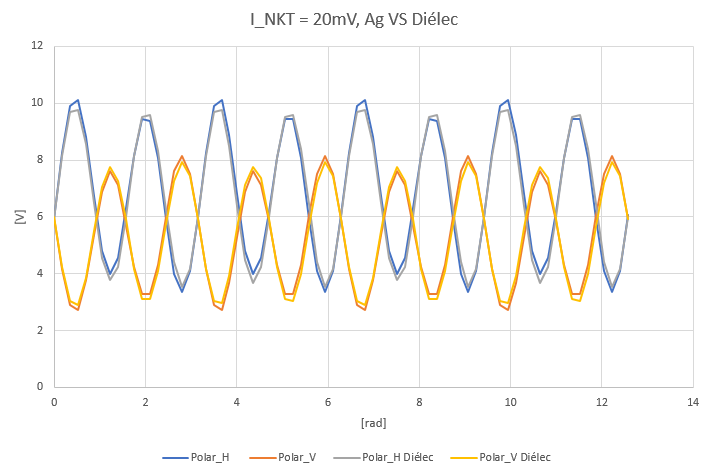
I made many tests about polarization and we can see some points thanks to the following figures :
1- The ellipsicity of the NKT is near to 0 (between -0,2 and 0,2) which means the polarization is rectilinear horizontale (attachement 1).
2- The power of the NKT has no influence on the polarization, verticale or horizontale (attachement 2 and 3).
3- The polarization is not changed by the type of mirror (Ag or Diélec) (attachement 4)
The next step is to measure the polarization after the cavity to know the ellipsicity. |
| Attachment 1: Ellipsicité_NKT.PNG
|
 |
| Attachment 2: Polar_horizontale_fonction_pussance_NKT.PNG
|
 |
| Attachment 3: Polar_verticale_fonction_pussance_NKT.PNG
|
 |
| Attachment 4: Polarisation_Ag_VS_Diélec.PNG
|
 |
|
18
|
Tue Sep 7 17:48:50 2021 |
Blanc | Fixed | info | lasers and optics | detectors and electronics | Optical room | Locking of the cavity and setup changing |
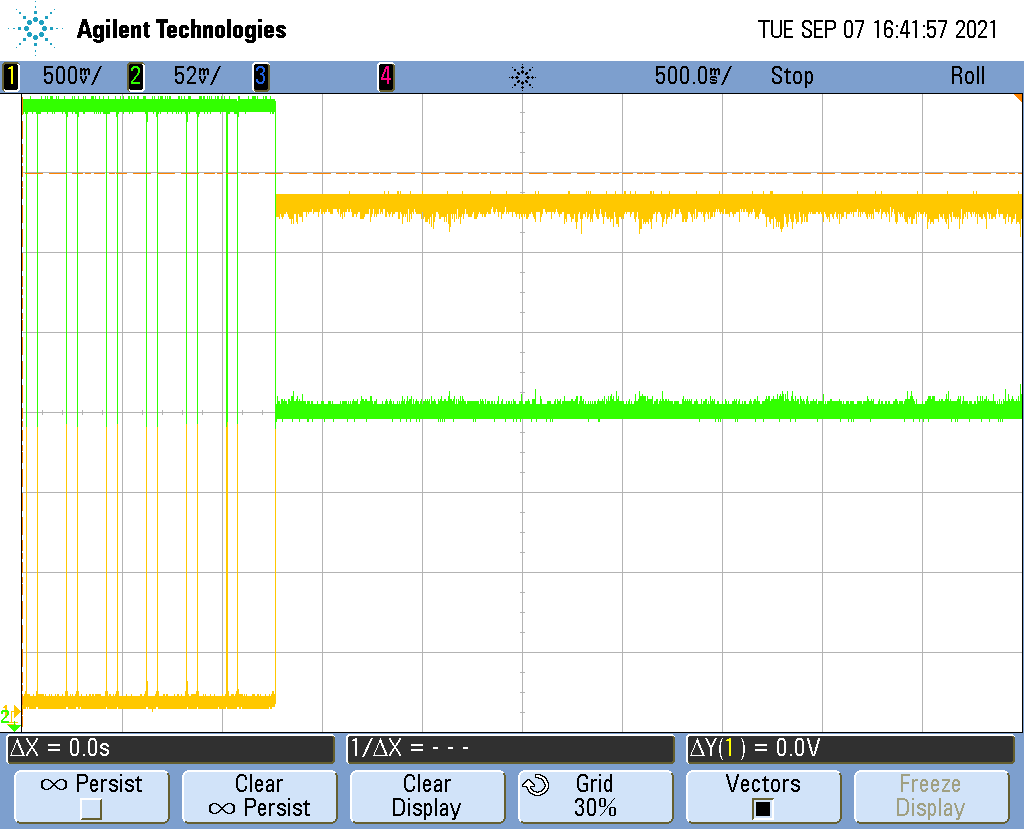
We change the setup a bit to have the same polarization on the photodiode and the PDH (in reflexion of the cavity). CF: schematics (futur).
Thanks to that, the symetry between reflexion and transmission is better now (as you can see on the plot).
We also put more power on PHD to have a better SNR by changing splitters. (We had 100 µW and now we have more than 1 mW, at the expense of the power on the camera).
Thanks to that we obtained a good locking, The coupling is quite good (roughtly 50%, on the green line)
In the following plot, the green line is the reflexion and the yellow lin is the transmission. |
| Attachment 1: scope_0.png
|
 |
|
19
|
Wed Sep 8 10:50:38 2021 |
Blanc | Fixed | info | lasers and optics | Optical room | Polarisation Results of the NKT |
To have the polarisation, we must have 1 value because the laser in entry of the system has 1 polar. Due to that, the graphe of the ellipticity is not true, it is the mean value on the following table which shows the ellipticity and the polarization.
| Blanc wrote: |
|
I made many tests about polarization and we can see some points thanks to the following figures :
1- The ellipsicity of the NKT is near to 0 (between -0,2 and 0,2) which means the polarization is rectilinear horizontale (attachement 1).
2- The power of the NKT has no influence on the polarization, verticale or horizontale (attachement 2 and 3).
3- The polarization is not changed by the type of mirror (Ag or Diélec) (attachement 4)
The next step is to measure the polarization after the cavity to know the ellipsicity.
|
|
| Attachment 1: Tableau_polar.PNG
|
 |
|
20
|
Thu Sep 9 16:34:37 2021 |
Blanc | Fixed | info | lasers and optics | Optical room | Ring light in the cavity |
We put a diaphragm in the input beam but it doesn't work to suppress the ring light only but it attenuates the whole transmitted beam (cavity mode and ring light) viewed on the camera. |
|
21
|
Thu Sep 16 18:23:13 2021 |
Blanc | Fixed | info | lasers and optics | Optical room | Polarization Results in transmission |
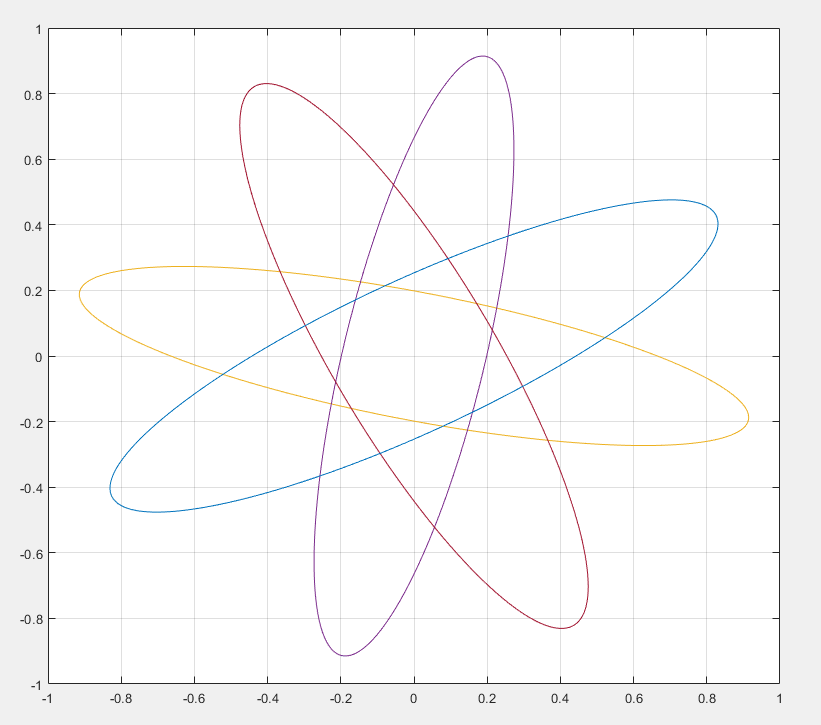
After data processing, I finally find the polarization in transmissin of the FPC. As you can see below, the polarisation is not linear but elliptical.
The four ellipsies are here due to having not enougth parameters to extract with certainty one ellipse. |
| Attachment 1: Polarisation_transmission_cavité.png
|
 |
|
23
|
Fri Oct 1 16:55:47 2021 |
Blanc | Fixed | info | mechanics | lasers and optics | detectors and electronics | Optical room | 1GHz oscillator Frep measurement |
| a previous cavity FSR measurement was giving a center frequency around 867.5MHz.
the present 1GHz oscillator Frep measurement is about 879.888MHz.
the present shift is about 12.4MHz which is equivalent to move one cavity lenght by 4.3mm which is HUGE !!!
as the 1GHz oscillator does not have any motor, one has to move the FP cavity mirrors instead.
the PZT inside the 1GHz oscillator (Thorlabs PC4QR) has a dynamic range of (20µm for 150V... we will drive it with 10V) 1.3µm.
then, we will have to adjust the FP cavity FSR with an accuracy much better than 4kHz (the cavity linewidth is 500kHz !!!) |
|
33
|
Thu Oct 7 17:53:53 2021 |
Blanc | Fixed | info | lasers and optics | detectors and electronics | Optical room | Finess and coupling measurement |
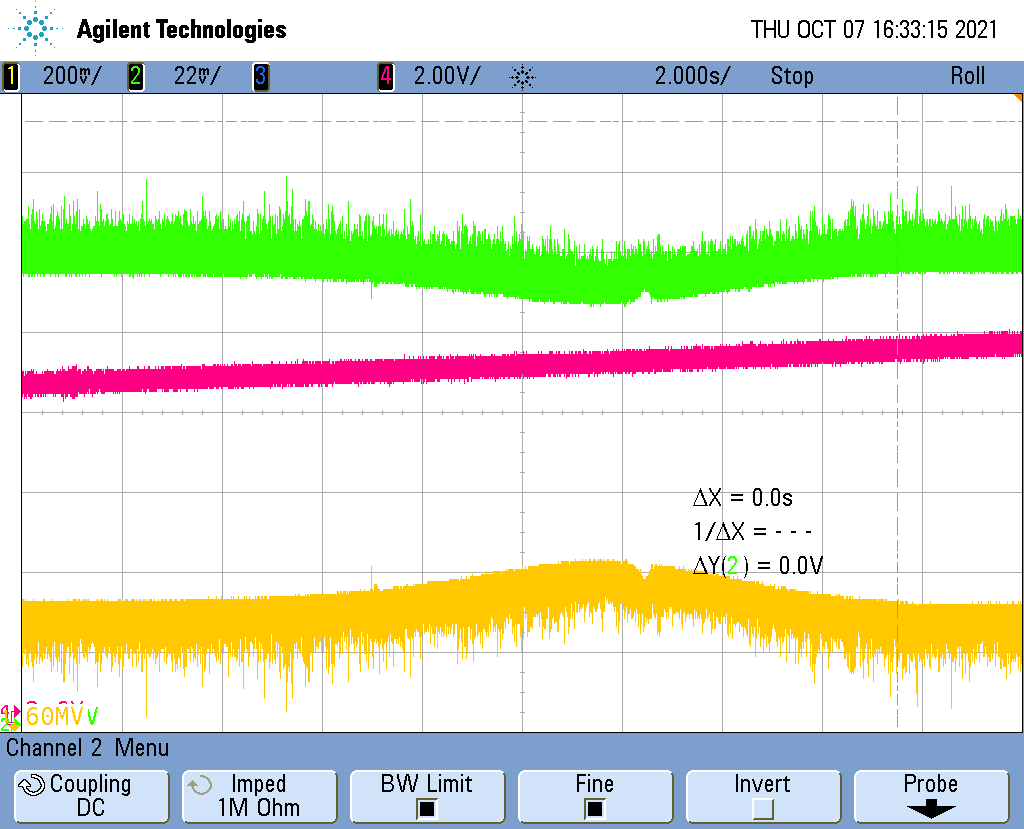
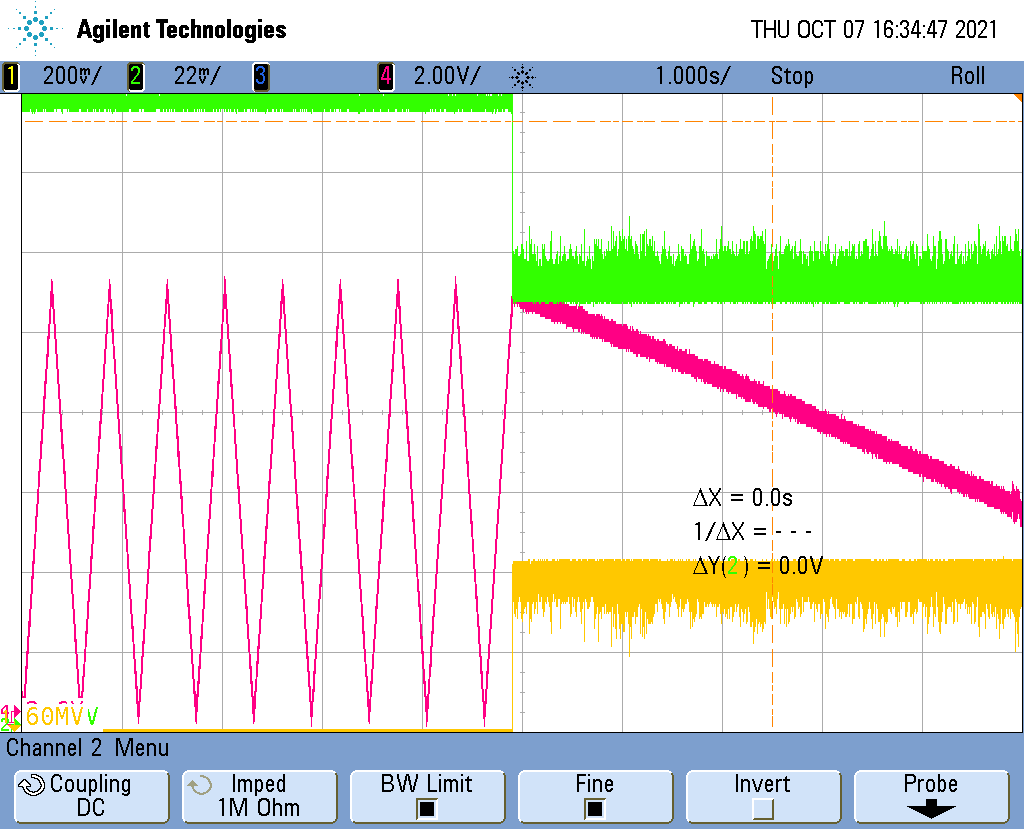
We did the measurement of the Finess and coupling with the NKT, with 2 EOM, without AOM (so the lock signal is noisy), on the burst line.
For the coupling, we have the same value as with the GHz locked on the burst line too, which is around 20 percent.
it seems this low coupling comes from the geometrical coupling as we observed an incoming beam bigger than the cavity mode on the cameras.
(the same oscillator, locked on the lock line exhibit 50% coupling)
the FSR center value is 879.9MHz, and the FWHM is between 879.67MHz and 880.1MHz.
So, the linewidth is about 430kHz and then the Finess value is roughly the same as before about 2050.
|
| Attachment 1: scope_10.png
|
 |
| Attachment 2: scope_12.png
|
 |
|
34
|
Fri Oct 8 16:02:19 2021 |
Blanc | Fixed | info | lasers and optics | detectors and electronics | Optical room | Setup and measurements |
To summerize the results of this week :
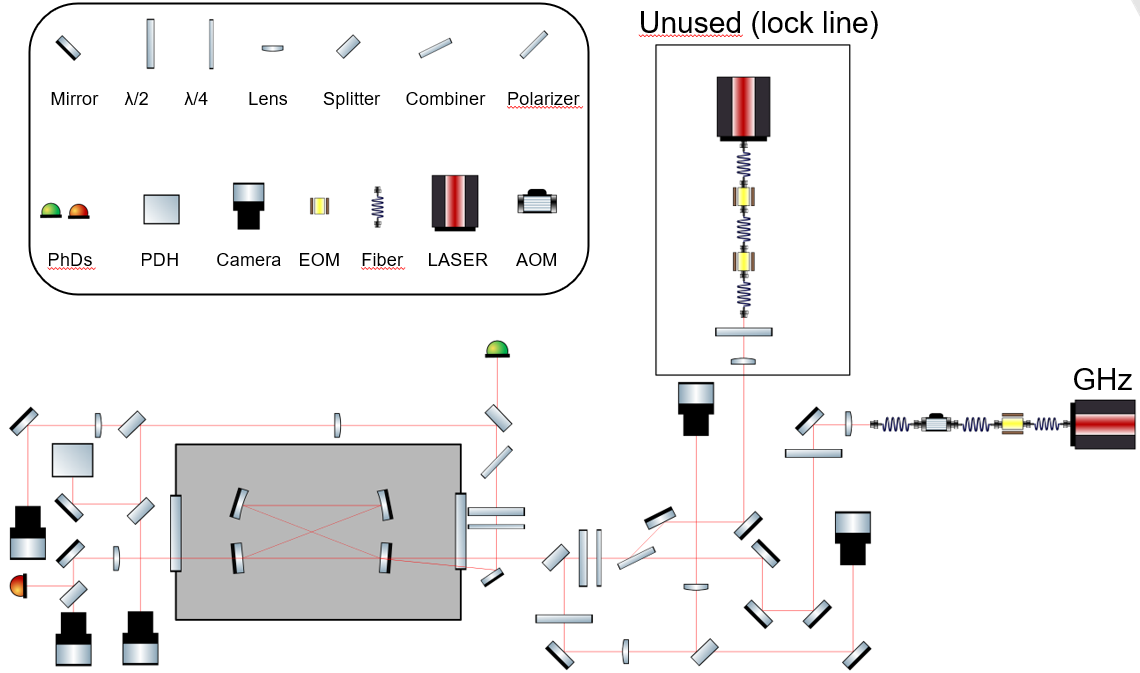
We made the setup in attachement 5 and align it to have the good mode in the cavity (TEM00).
With the good alignment, we found the lock of the GHz, in attachement 1. We used the motors in the cavity to position very precisely the mirrors to find this lock.
In attachement 2, we can see the error signal obtain thanks to the PDH, which is very clean.
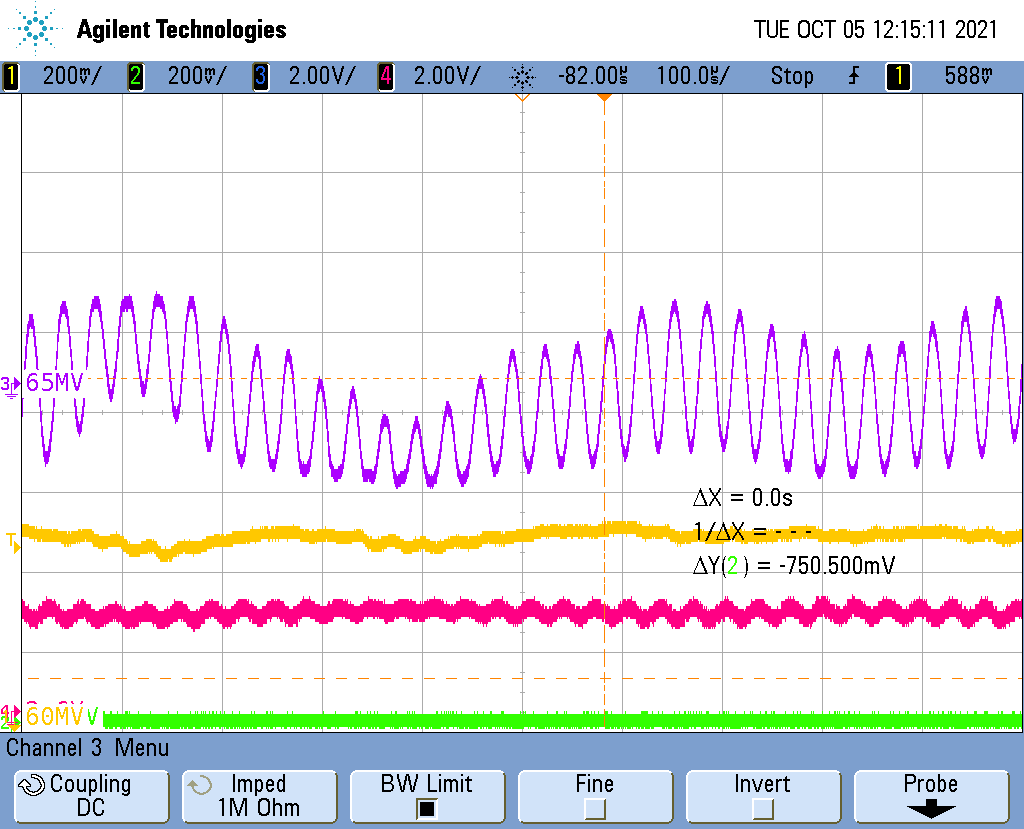
But after that, we saw some modulations at 30 kHz frequency which represent the resonance frequency of the piezo in the GHz (attachement 3). To compensate this, we placed a fibered AOM to cut the high frequencies.
Finally, we observed a big difference in the transmission noise if the motor loop is open or closed (attachement 4). To have the best noise, we have to stop the closed loop and stay in open loop, after adjusting the mirrors with the cosed loop.
We have also measured the finesse (2000) and the coupling (20%), detailed in the previous post.
|
| Attachment 1: acquisition_lock_GHz.png
|
 |
| Attachment 2: Signal_d'erreur_PDH_sur_GHz.png
|
 |
| Attachment 3: Résonances_dûes_au_pic_à_30kHz_dans_le_phase_noise.png
|
 |
| Attachment 4: Close_loop_vs_open_loop_GHz.png
|
 |
| Attachment 5: minicav_setup_Lock_GHz.PNG
|
 |
|
39
|
Thu Oct 21 09:44:35 2021 |
Blanc | Fixed | info | mechanics | lasers and optics | detectors and electronics | Optical room | 1GHz oscillator Frep measurement |
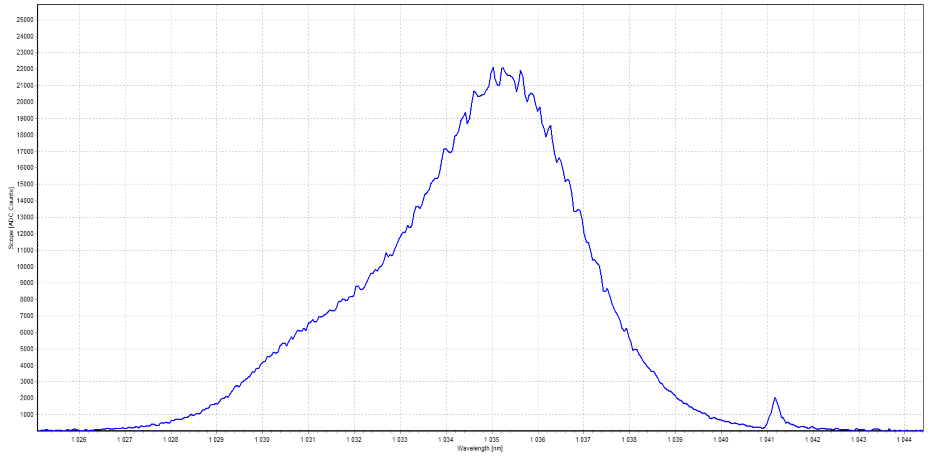
The optical spectrum of the GHz oscillator: FWHM ~ 4nm
| Blanc wrote: |
| a previous cavity FSR measurement was giving a center frequency around 867.5MHz. the present 1GHz oscillator Frep measurement is about 879.888MHz. the present shift is about 12.4MHz which is equivalent to move one cavity lenght by 4.3mm which is HUGE !!! as the 1GHz oscillator does not have any motor, one has to move the FP cavity mirrors instead. the PZT inside the 1GHz oscillator (Thorlabs PC4QR) has a dynamic range of (20µm for 150V... we will drive it with 10V) 1.3µm. then, we will have to adjust the FP cavity FSR with an accuracy much better than 4kHz (the cavity linewidth is 500kHz !!!) |
|
| Attachment 1: Spectre_GHz-3.PNG
|
 |
|
40
|
Thu Oct 21 10:24:01 2021 |
Blanc | Fixed | info | utilities | Other | Presentations |
Here the first part of all the presentations since the beginning of the project. |
| Attachment 1: 2-Présentation_LAL_22_06_2020_Corrigée.pptx
|
| Attachment 2: 4-Présentation_LAL_29_06_2020_Corrigée.pptx
|
| Attachment 3: 5-Présentation_LAL_27_07_2020.pptx
|
| Attachment 4: 6-Présentation_LAL_30_11_2020.pptx
|
| Attachment 5: 7-Présentation_LAL_07_12_2020.pptx
|
|
41
|
Thu Oct 21 10:30:38 2021 |
Blanc | Fixed | info | utilities | Other | Presentations |
Here the second part of all the presentations since the beginning of the project. |
| Attachment 1: 8-Présentation_LAL_15_04_2021_elog.pptx
|
| Attachment 2: 9-Présentation_LAL_10_05_2021_elog.pptx
|
| Attachment 3: 10-Présentation_LAL_28_06_2021.pptx
|
|
42
|
Thu Oct 21 10:32:54 2021 |
Blanc | Fixed | info | utilities | Other | Presentations |
Here the last part of all the presentations since the beginning of the project. |
| Attachment 1: 12-Présentation_LAL_13_09_2021.pptx
|
| Attachment 2: 13-Présentation_LAL_27_09_2021.pptx
|
| Attachment 3: 14-Présentation_LAL_11_10_2021.pptx
|
| Attachment 4: Présentation_Amplitude_23_08_2021.pptx
|