| ID |
Date |
Author |
Status |
Type |
Category |
Location |
Title |
|
402
|
Mon Feb 17 10:48:00 2025 |
Ronic Chiche | Under Process | info | mechanics | lasers and optics | detectors and electronics | ThomX igloo | correlations between accelerometer and lock losses @ 20Hz | new plots, with the accelerometer placed directly on the optical cavity table (on the marble part), close to the oscillator.
the correlation seems a bit better....
we would need to put the accelerometer on one foot of the table to check if the table has not some micro-movement or at the IP to check if the water in the dipole are doing some vibrations.
| Ronic Chiche wrote: |
|
this morning, I did some new plots with the accelerometer placed on the top of the case of the OneFive laser.
I previously observed with the accelerometer placed on the top of one cavity vessel, the correlation between the accelerometer signal and the PZT noise is pretty good but not 100%.
I will move the accelerometer on the optical cavity table.
| Ronic Chiche wrote: |
|
at the end of the day, I moved the accelerometer from the top of the cavity vessel to the top case of the Onefive laser.
I quickly saw again quite strong correlations between the vibrations compensated by the PZT and the accelerometer signal.
when one does a laser motor step which makes a systematic lock loss, one doesn't see any signal on the accelerometer.
=> more measurements have to be done.
I would like also to put also the accelerometer on the mechanics attached to the pipe at the IP.
=> to be discussed to find the best place as a lot of cables, the 2 dipoles and the aluminium sheets around the vacuum stufs don't let a lot of place to put the accelerometer....
| Ronic Chiche wrote: |
|
then, I moved the accelerometer on top of the "X-hutch side" vessel, placed directly on the metal top case, inside the housing.
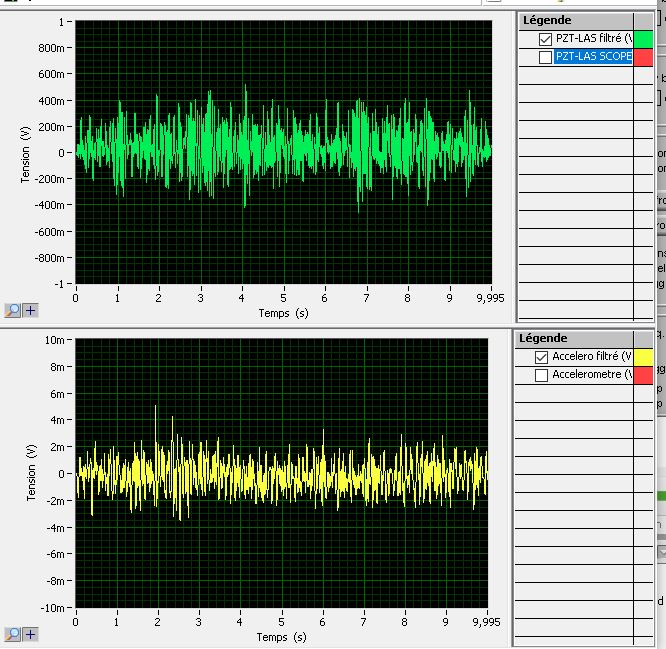
- the "no noise same range" image shows a standard situation during 10s when there no noise either on PZT or Accelerometer.
on can compare the noise level on the accelerometer with the previous post when it was outside on top of the housing.
its noise is much much lower... which means the housing is properly dumping the acoustic noise at this frequency around 20-30Hz.
so, we increase the accelerometer measurement sensitivity to better measure its noise.
- the "no noise new range" image shows a standard situation during 10s when there no noise either on PZT or Accelerometer but with a smaller range.
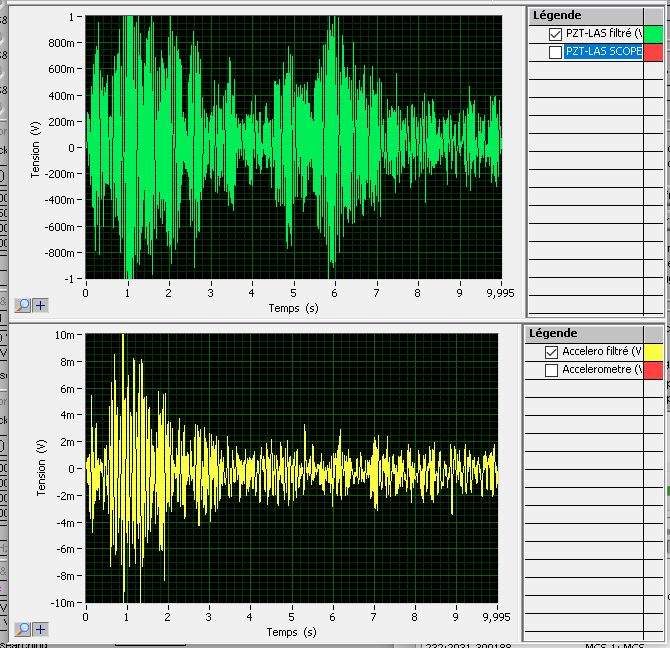
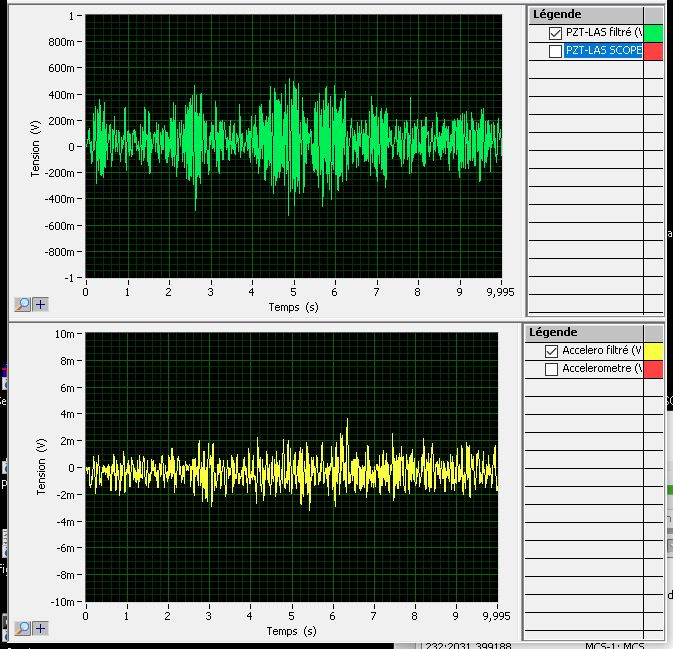
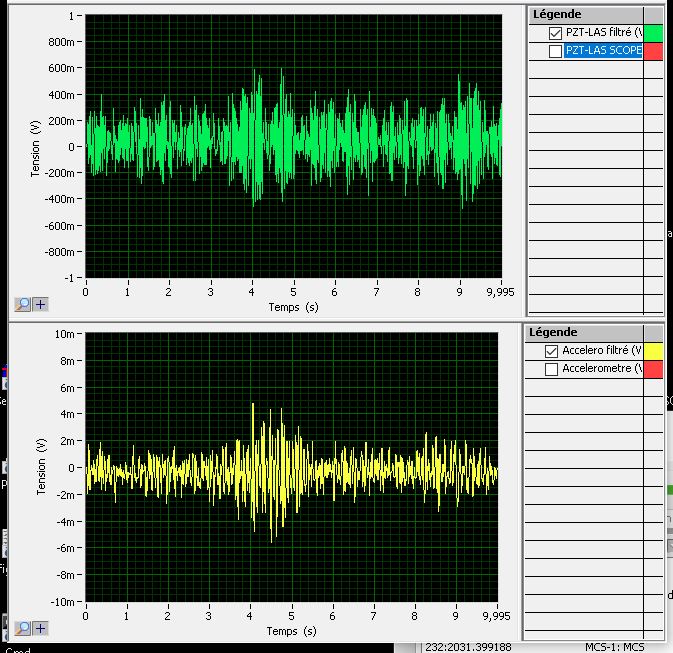
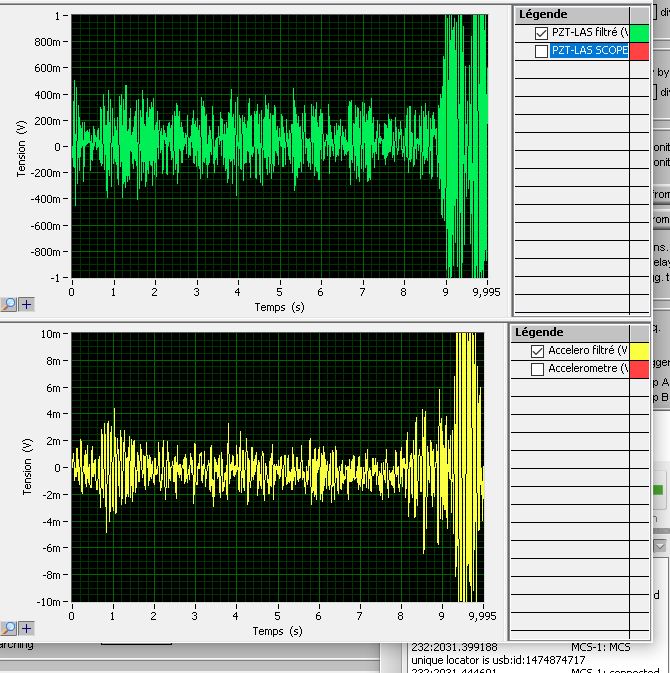
- the "noise 1,2,3" images show the situation when the PZT start to compensate large noise with good correlation with accelerometer placed on top of the optical vessel.
- the "noise 1,2,3 not clear" images show the situation when the PZT start to compensate large noise with correlation with accelerometer but the signal level is not the same as before.
this make me think the origin of the noise is maybe not coming from the inside of the optical vessel.
=> conclusion : we see for the first time a correlation between the PZT noise and some vibration/acoustic noise.
now, we have to investigate the precise origin of this noise (or the different sources).
| Ronic Chiche wrote: |
|
this morning, I did some measurement with nobody interfering with the tests.
- the "no noise" image shows a standard situation during 10s when there is no noise either on PZT or Accelerometer.
most of the time, we are in this situation.
- the "slaping door" image shows the case where the large igloo door is opened and slaping when it closes.
the accelerometer and the PZT exhibit correlated noise when the door is slaping.
we can see a PZT "recovery" time longer than the perturbation.
but these events are rare and are not the source of the problematic perturbations.
- "noise 1,2,3" images show the typical situation when the PZT start to compensate large noise without any correlation with accelerometer placed on top of the housing.
=> conclusion, some external noise (to the housing) should not be the source of the perturbations on the PZT.
| Ronic Chiche wrote: |
|
today I connected a copy of the laser PZT signal to the 2nd scope CH2 (with AC coupling to remove the DC offset) to be able to monitor synchronously the Accelerometer and laser PZT signals.
the accelerometer is still connected to the 2nd scope CH4 and placed on top of the housing.
I filtered both signals in the Labview Signal Express software with a low-pass filter at 30Hz to focus on low frequencies noise (~20Hz).
now, I need to wait to work with the bunker closed to compare with normal operation (if some people work in the same time in the bunker, obviously, we will get some correlation between the accelerometer and laser PZT signals.....)
| Ronic Chiche wrote: |
|
I installed an accelerometer setup in the bunker.
presently, the accelerometer is placed on top of the housing and its signal is connected to the 2nd scope (33MHz and 500MHz RF beating) on channel 4.
the FPC is locked to ~90kW.
the accelerometer noise is filtered on the Labview Signal Express software in order to focus on the 20Hz noise.
one applied a RII elliptic 5th order low pass filter at 30Hz.
the 20Hz noise can be seen on the PZT which always compensate for CFP frequency drifts.
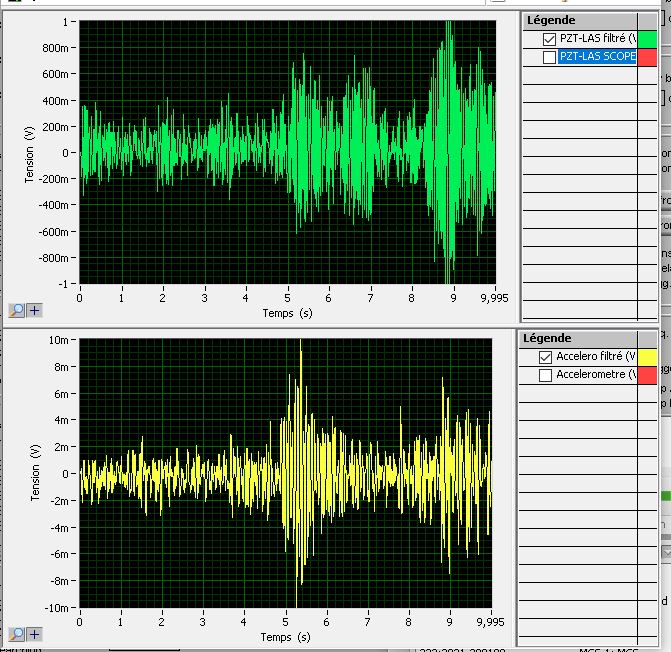
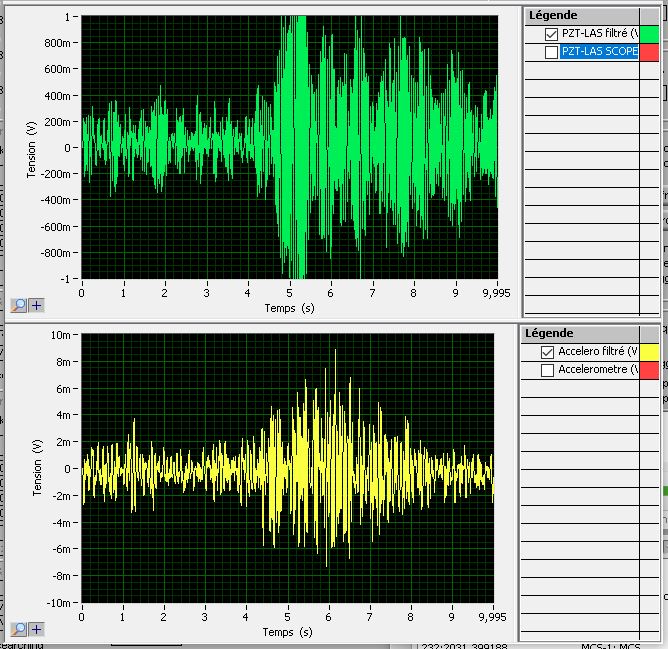
figure 1 : example of typical accelerometer filtered noise (yellow curve) when the PZT compensation (green curve) is quite (measurement on 4 seconds)
figure 2 : example of accelerometer filtered noise (yellow curve) when the PZT compensation (green curve) exhibits some 20Hz noise (measurement on 10 seconds)
conclusion : there is no clear evidence of a correlation between accoustic noise outside of the housing (measured by the accelerometer) and the 20Hz noise in the laser PZT compensation.
=> putting the 2 signals on 2 different scopes doesn't help because the slow acquisition done is not synchronous.
next try : use the same scope and put the accelerometer inside the housing, for example on top of one of the FPC vessel.
|
|
|
|
|
|
|
| Attachment 1: no_noise.JPG
|  |
| Attachment 2: Capture5.JPG
|  |
| Attachment 3: Capture6.JPG
|  |
| Attachment 4: Capture7.JPG
|  |
| Attachment 5: Capture2.JPG
|  |
| Attachment 6: Capture3.JPG
|  |
| Attachment 7: Capture4.JPG
|  |
|
404
|
Mon Feb 17 17:37:27 2025 |
Ronic Chiche | Under Process | info | mechanics | lasers and optics | detectors and electronics | ThomX igloo | correlations between accelerometer and lock losses @ 20Hz | one possible source for this acoustic noise was the vibrations coming from the water cooling of the dipoles which is normally never turned off even when the machine is off.
this afternoon, Kevin turned off the main valve of the water cooling of half of the dipoles (the half on the FPC side), and we recorded the peak-peak value of accelerometer signal on a long trend (~20mn) but we didn't see a clear difference before and after.
I keep recording the accelerometer pk-pk signal during the night in case of one could see something different...
| Ronic Chiche wrote: |
|
new plots, with the accelerometer placed directly on the optical cavity table (on the marble part), close to the oscillator.
the correlation seems a bit better....
we would need to put the accelerometer on one foot of the table to check if the table has not some micro-movement or at the IP to check if the water in the dipole are doing some vibrations.
| Ronic Chiche wrote: |
|
this morning, I did some new plots with the accelerometer placed on the top of the case of the OneFive laser.
I previously observed with the accelerometer placed on the top of one cavity vessel, the correlation between the accelerometer signal and the PZT noise is pretty good but not 100%.
I will move the accelerometer on the optical cavity table.
| Ronic Chiche wrote: |
|
at the end of the day, I moved the accelerometer from the top of the cavity vessel to the top case of the Onefive laser.
I quickly saw again quite strong correlations between the vibrations compensated by the PZT and the accelerometer signal.
when one does a laser motor step which makes a systematic lock loss, one doesn't see any signal on the accelerometer.
=> more measurements have to be done.
I would like also to put also the accelerometer on the mechanics attached to the pipe at the IP.
=> to be discussed to find the best place as a lot of cables, the 2 dipoles and the aluminium sheets around the vacuum stufs don't let a lot of place to put the accelerometer....
| Ronic Chiche wrote: |
|
then, I moved the accelerometer on top of the "X-hutch side" vessel, placed directly on the metal top case, inside the housing.
- the "no noise same range" image shows a standard situation during 10s when there no noise either on PZT or Accelerometer.
on can compare the noise level on the accelerometer with the previous post when it was outside on top of the housing.
its noise is much much lower... which means the housing is properly dumping the acoustic noise at this frequency around 20-30Hz.
so, we increase the accelerometer measurement sensitivity to better measure its noise.
- the "no noise new range" image shows a standard situation during 10s when there no noise either on PZT or Accelerometer but with a smaller range.
- the "noise 1,2,3" images show the situation when the PZT start to compensate large noise with good correlation with accelerometer placed on top of the optical vessel.
- the "noise 1,2,3 not clear" images show the situation when the PZT start to compensate large noise with correlation with accelerometer but the signal level is not the same as before.
this make me think the origin of the noise is maybe not coming from the inside of the optical vessel.
=> conclusion : we see for the first time a correlation between the PZT noise and some vibration/acoustic noise.
now, we have to investigate the precise origin of this noise (or the different sources).
| Ronic Chiche wrote: |
|
this morning, I did some measurement with nobody interfering with the tests.
- the "no noise" image shows a standard situation during 10s when there is no noise either on PZT or Accelerometer.
most of the time, we are in this situation.
- the "slaping door" image shows the case where the large igloo door is opened and slaping when it closes.
the accelerometer and the PZT exhibit correlated noise when the door is slaping.
we can see a PZT "recovery" time longer than the perturbation.
but these events are rare and are not the source of the problematic perturbations.
- "noise 1,2,3" images show the typical situation when the PZT start to compensate large noise without any correlation with accelerometer placed on top of the housing.
=> conclusion, some external noise (to the housing) should not be the source of the perturbations on the PZT.
| Ronic Chiche wrote: |
|
today I connected a copy of the laser PZT signal to the 2nd scope CH2 (with AC coupling to remove the DC offset) to be able to monitor synchronously the Accelerometer and laser PZT signals.
the accelerometer is still connected to the 2nd scope CH4 and placed on top of the housing.
I filtered both signals in the Labview Signal Express software with a low-pass filter at 30Hz to focus on low frequencies noise (~20Hz).
now, I need to wait to work with the bunker closed to compare with normal operation (if some people work in the same time in the bunker, obviously, we will get some correlation between the accelerometer and laser PZT signals.....)
| Ronic Chiche wrote: |
|
I installed an accelerometer setup in the bunker.
presently, the accelerometer is placed on top of the housing and its signal is connected to the 2nd scope (33MHz and 500MHz RF beating) on channel 4.
the FPC is locked to ~90kW.
the accelerometer noise is filtered on the Labview Signal Express software in order to focus on the 20Hz noise.
one applied a RII elliptic 5th order low pass filter at 30Hz.
the 20Hz noise can be seen on the PZT which always compensate for CFP frequency drifts.
figure 1 : example of typical accelerometer filtered noise (yellow curve) when the PZT compensation (green curve) is quite (measurement on 4 seconds)
figure 2 : example of accelerometer filtered noise (yellow curve) when the PZT compensation (green curve) exhibits some 20Hz noise (measurement on 10 seconds)
conclusion : there is no clear evidence of a correlation between accoustic noise outside of the housing (measured by the accelerometer) and the 20Hz noise in the laser PZT compensation.
=> putting the 2 signals on 2 different scopes doesn't help because the slow acquisition done is not synchronous.
next try : use the same scope and put the accelerometer inside the housing, for example on top of one of the FPC vessel.
|
|
|
|
|
|
|
|
|
405
|
Tue Feb 18 10:40:55 2025 |
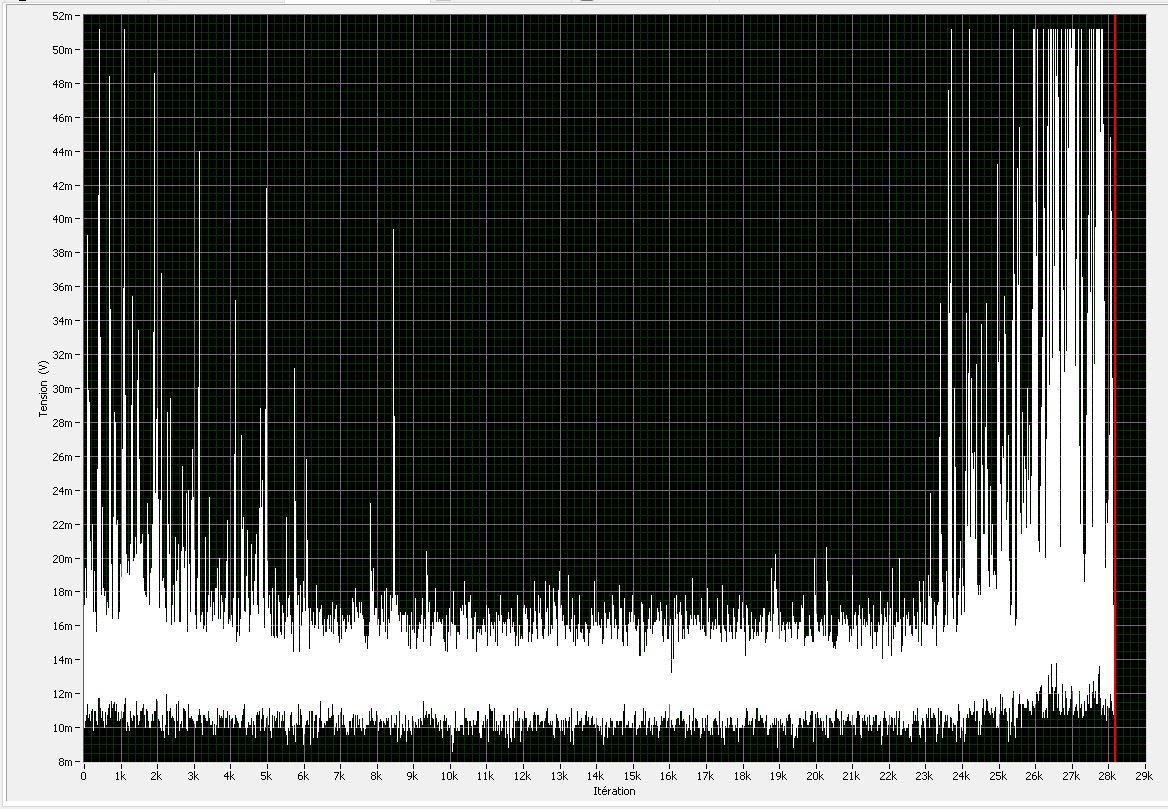
Ronic Chiche | Under Process | info | mechanics | lasers and optics | detectors and electronics | ThomX igloo | correlations between accelerometer and lock losses @ 20Hz | here is the pk-pk measurement of the accelerometer during the whole night.
the recording started at 5pm yesterday and has been stopped this morning at 10am.
one got 28k points in 17 hours => 1.65k points / h
the "last" peak in the evening at 8.5k points is equivalent to 10pm.
the "fisrt" peaks in the morning at 23k points is equivalent to 7am.
I discussed with Jean-Noël but we don't any clear correlation of this schedule with some equipment schedule in ThomX....
I restarted a new acquisition at 10.30am.
| Ronic Chiche wrote: |
|
one possible source for this acoustic noise was the vibrations coming from the water cooling of the dipoles which is normally never turned off even when the machine is off.
this afternoon, Kevin turned off the main valve of the water cooling of half of the dipoles (the half on the FPC side), and we recorded the peak-peak value of accelerometer signal on a long trend (~20mn) but we didn't see a clear difference before and after.
I keep recording the accelerometer pk-pk signal during the night in case of one could see something different...
| Ronic Chiche wrote: |
|
new plots, with the accelerometer placed directly on the optical cavity table (on the marble part), close to the oscillator.
the correlation seems a bit better....
we would need to put the accelerometer on one foot of the table to check if the table has not some micro-movement or at the IP to check if the water in the dipole are doing some vibrations.
| Ronic Chiche wrote: |
|
this morning, I did some new plots with the accelerometer placed on the top of the case of the OneFive laser.
I previously observed with the accelerometer placed on the top of one cavity vessel, the correlation between the accelerometer signal and the PZT noise is pretty good but not 100%.
I will move the accelerometer on the optical cavity table.
| Ronic Chiche wrote: |
|
at the end of the day, I moved the accelerometer from the top of the cavity vessel to the top case of the Onefive laser.
I quickly saw again quite strong correlations between the vibrations compensated by the PZT and the accelerometer signal.
when one does a laser motor step which makes a systematic lock loss, one doesn't see any signal on the accelerometer.
=> more measurements have to be done.
I would like also to put also the accelerometer on the mechanics attached to the pipe at the IP.
=> to be discussed to find the best place as a lot of cables, the 2 dipoles and the aluminium sheets around the vacuum stufs don't let a lot of place to put the accelerometer....
| Ronic Chiche wrote: |
|
then, I moved the accelerometer on top of the "X-hutch side" vessel, placed directly on the metal top case, inside the housing.
- the "no noise same range" image shows a standard situation during 10s when there no noise either on PZT or Accelerometer.
on can compare the noise level on the accelerometer with the previous post when it was outside on top of the housing.
its noise is much much lower... which means the housing is properly dumping the acoustic noise at this frequency around 20-30Hz.
so, we increase the accelerometer measurement sensitivity to better measure its noise.
- the "no noise new range" image shows a standard situation during 10s when there no noise either on PZT or Accelerometer but with a smaller range.
- the "noise 1,2,3" images show the situation when the PZT start to compensate large noise with good correlation with accelerometer placed on top of the optical vessel.
- the "noise 1,2,3 not clear" images show the situation when the PZT start to compensate large noise with correlation with accelerometer but the signal level is not the same as before.
this make me think the origin of the noise is maybe not coming from the inside of the optical vessel.
=> conclusion : we see for the first time a correlation between the PZT noise and some vibration/acoustic noise.
now, we have to investigate the precise origin of this noise (or the different sources).
| Ronic Chiche wrote: |
|
this morning, I did some measurement with nobody interfering with the tests.
- the "no noise" image shows a standard situation during 10s when there is no noise either on PZT or Accelerometer.
most of the time, we are in this situation.
- the "slaping door" image shows the case where the large igloo door is opened and slaping when it closes.
the accelerometer and the PZT exhibit correlated noise when the door is slaping.
we can see a PZT "recovery" time longer than the perturbation.
but these events are rare and are not the source of the problematic perturbations.
- "noise 1,2,3" images show the typical situation when the PZT start to compensate large noise without any correlation with accelerometer placed on top of the housing.
=> conclusion, some external noise (to the housing) should not be the source of the perturbations on the PZT.
| Ronic Chiche wrote: |
|
today I connected a copy of the laser PZT signal to the 2nd scope CH2 (with AC coupling to remove the DC offset) to be able to monitor synchronously the Accelerometer and laser PZT signals.
the accelerometer is still connected to the 2nd scope CH4 and placed on top of the housing.
I filtered both signals in the Labview Signal Express software with a low-pass filter at 30Hz to focus on low frequencies noise (~20Hz).
now, I need to wait to work with the bunker closed to compare with normal operation (if some people work in the same time in the bunker, obviously, we will get some correlation between the accelerometer and laser PZT signals.....)
| Ronic Chiche wrote: |
|
I installed an accelerometer setup in the bunker.
presently, the accelerometer is placed on top of the housing and its signal is connected to the 2nd scope (33MHz and 500MHz RF beating) on channel 4.
the FPC is locked to ~90kW.
the accelerometer noise is filtered on the Labview Signal Express software in order to focus on the 20Hz noise.
one applied a RII elliptic 5th order low pass filter at 30Hz.
the 20Hz noise can be seen on the PZT which always compensate for CFP frequency drifts.
figure 1 : example of typical accelerometer filtered noise (yellow curve) when the PZT compensation (green curve) is quite (measurement on 4 seconds)
figure 2 : example of accelerometer filtered noise (yellow curve) when the PZT compensation (green curve) exhibits some 20Hz noise (measurement on 10 seconds)
conclusion : there is no clear evidence of a correlation between accoustic noise outside of the housing (measured by the accelerometer) and the 20Hz noise in the laser PZT compensation.
=> putting the 2 signals on 2 different scopes doesn't help because the slow acquisition done is not synchronous.
next try : use the same scope and put the accelerometer inside the housing, for example on top of one of the FPC vessel.
|
|
|
|
|
|
|
|
|
| Attachment 1: Capture.JPG
|  |
|
406
|
Tue Feb 18 17:36:25 2025 |
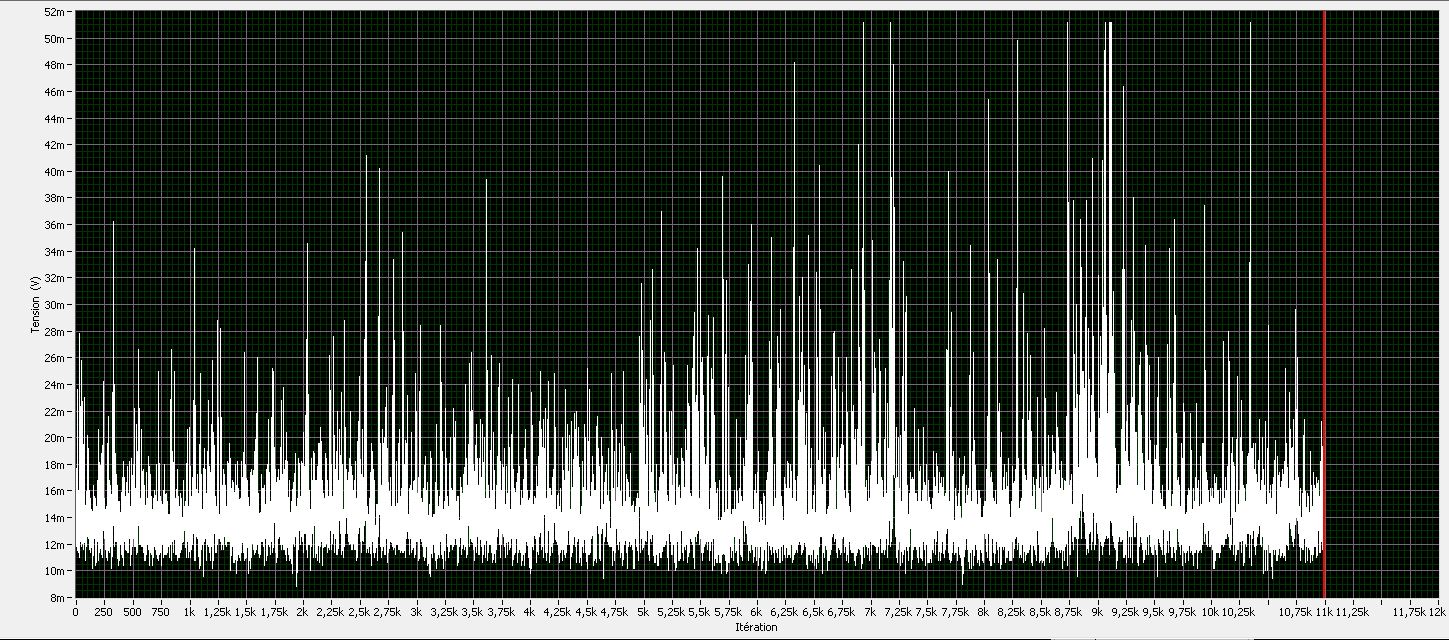
Ronic Chiche | Under Process | info | mechanics | lasers and optics | detectors and electronics | ThomX igloo | correlations between accelerometer and lock losses @ 20Hz | here is the acquisition from 10:30am to 5:30pm
11k point in 7h => 1.57k points / h
the noise is almost the same during the daylight, a little bit increasing from 1:30pm.
I restarted an acquisition at 5:30pm to check if the noise reduction during the night is repeatable or not....
| Ronic Chiche wrote: |
|
here is the pk-pk measurement of the accelerometer during the whole night.
the recording started at 5pm yesterday and has been stopped this morning at 10am.
one got 28k points in 17 hours => 1.65k points / h
the "last" peak in the evening at 8.5k points is equivalent to 10pm.
the "fisrt" peaks in the morning at 23k points is equivalent to 7am.
I discussed with Jean-Noël but we don't any clear correlation of this schedule with some equipment schedule in ThomX....
I restarted a new acquisition at 10.30am.
| Ronic Chiche wrote: |
|
one possible source for this acoustic noise was the vibrations coming from the water cooling of the dipoles which is normally never turned off even when the machine is off.
this afternoon, Kevin turned off the main valve of the water cooling of half of the dipoles (the half on the FPC side), and we recorded the peak-peak value of accelerometer signal on a long trend (~20mn) but we didn't see a clear difference before and after.
I keep recording the accelerometer pk-pk signal during the night in case of one could see something different...
| Ronic Chiche wrote: |
|
new plots, with the accelerometer placed directly on the optical cavity table (on the marble part), close to the oscillator.
the correlation seems a bit better....
we would need to put the accelerometer on one foot of the table to check if the table has not some micro-movement or at the IP to check if the water in the dipole are doing some vibrations.
| Ronic Chiche wrote: |
|
this morning, I did some new plots with the accelerometer placed on the top of the case of the OneFive laser.
I previously observed with the accelerometer placed on the top of one cavity vessel, the correlation between the accelerometer signal and the PZT noise is pretty good but not 100%.
I will move the accelerometer on the optical cavity table.
| Ronic Chiche wrote: |
|
at the end of the day, I moved the accelerometer from the top of the cavity vessel to the top case of the Onefive laser.
I quickly saw again quite strong correlations between the vibrations compensated by the PZT and the accelerometer signal.
when one does a laser motor step which makes a systematic lock loss, one doesn't see any signal on the accelerometer.
=> more measurements have to be done.
I would like also to put also the accelerometer on the mechanics attached to the pipe at the IP.
=> to be discussed to find the best place as a lot of cables, the 2 dipoles and the aluminium sheets around the vacuum stufs don't let a lot of place to put the accelerometer....
| Ronic Chiche wrote: |
|
then, I moved the accelerometer on top of the "X-hutch side" vessel, placed directly on the metal top case, inside the housing.
- the "no noise same range" image shows a standard situation during 10s when there no noise either on PZT or Accelerometer.
on can compare the noise level on the accelerometer with the previous post when it was outside on top of the housing.
its noise is much much lower... which means the housing is properly dumping the acoustic noise at this frequency around 20-30Hz.
so, we increase the accelerometer measurement sensitivity to better measure its noise.
- the "no noise new range" image shows a standard situation during 10s when there no noise either on PZT or Accelerometer but with a smaller range.
- the "noise 1,2,3" images show the situation when the PZT start to compensate large noise with good correlation with accelerometer placed on top of the optical vessel.
- the "noise 1,2,3 not clear" images show the situation when the PZT start to compensate large noise with correlation with accelerometer but the signal level is not the same as before.
this make me think the origin of the noise is maybe not coming from the inside of the optical vessel.
=> conclusion : we see for the first time a correlation between the PZT noise and some vibration/acoustic noise.
now, we have to investigate the precise origin of this noise (or the different sources).
| Ronic Chiche wrote: |
|
this morning, I did some measurement with nobody interfering with the tests.
- the "no noise" image shows a standard situation during 10s when there is no noise either on PZT or Accelerometer.
most of the time, we are in this situation.
- the "slaping door" image shows the case where the large igloo door is opened and slaping when it closes.
the accelerometer and the PZT exhibit correlated noise when the door is slaping.
we can see a PZT "recovery" time longer than the perturbation.
but these events are rare and are not the source of the problematic perturbations.
- "noise 1,2,3" images show the typical situation when the PZT start to compensate large noise without any correlation with accelerometer placed on top of the housing.
=> conclusion, some external noise (to the housing) should not be the source of the perturbations on the PZT.
| Ronic Chiche wrote: |
|
today I connected a copy of the laser PZT signal to the 2nd scope CH2 (with AC coupling to remove the DC offset) to be able to monitor synchronously the Accelerometer and laser PZT signals.
the accelerometer is still connected to the 2nd scope CH4 and placed on top of the housing.
I filtered both signals in the Labview Signal Express software with a low-pass filter at 30Hz to focus on low frequencies noise (~20Hz).
now, I need to wait to work with the bunker closed to compare with normal operation (if some people work in the same time in the bunker, obviously, we will get some correlation between the accelerometer and laser PZT signals.....)
| Ronic Chiche wrote: |
|
I installed an accelerometer setup in the bunker.
presently, the accelerometer is placed on top of the housing and its signal is connected to the 2nd scope (33MHz and 500MHz RF beating) on channel 4.
the FPC is locked to ~90kW.
the accelerometer noise is filtered on the Labview Signal Express software in order to focus on the 20Hz noise.
one applied a RII elliptic 5th order low pass filter at 30Hz.
the 20Hz noise can be seen on the PZT which always compensate for CFP frequency drifts.
figure 1 : example of typical accelerometer filtered noise (yellow curve) when the PZT compensation (green curve) is quite (measurement on 4 seconds)
figure 2 : example of accelerometer filtered noise (yellow curve) when the PZT compensation (green curve) exhibits some 20Hz noise (measurement on 10 seconds)
conclusion : there is no clear evidence of a correlation between accoustic noise outside of the housing (measured by the accelerometer) and the 20Hz noise in the laser PZT compensation.
=> putting the 2 signals on 2 different scopes doesn't help because the slow acquisition done is not synchronous.
next try : use the same scope and put the accelerometer inside the housing, for example on top of one of the FPC vessel.
|
|
|
|
|
|
|
|
|
|
| Attachment 1: Capture.JPG
|  |
|
407
|
Tue Feb 18 19:33:27 2025 |
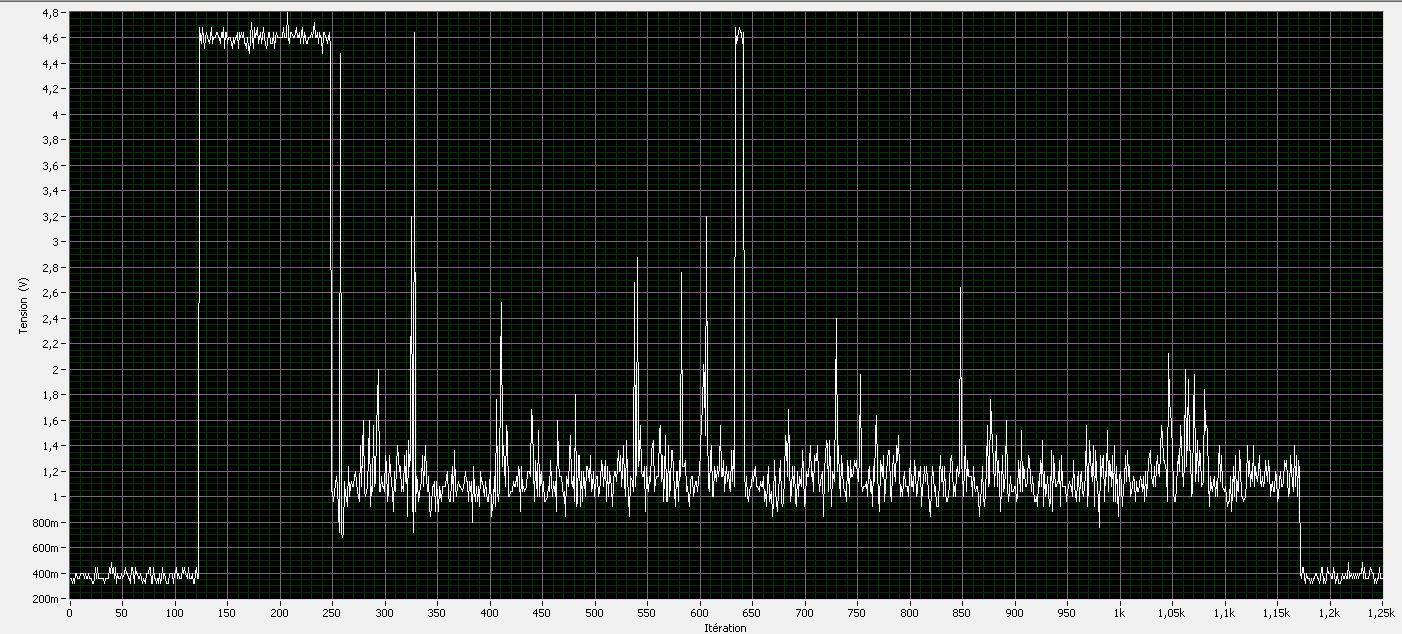
Ronic Chiche | Under Process | info | mechanics | lasers and optics | detectors and electronics | ThomX igloo | correlations between accelerometer and lock losses @ 20Hz | here is the same kind of measurement (pk-pk of 1 sec of acquisition) done on the laser PZT when the FP is at 90kW.
it's from 6:20pm to 7:10pm => ~2.4s by point
the minimum values are for the PZT being off.
the maximum values are for PZT scanning or lock loss.
in between, we get the measurements of the perturbations.
at 6:30pm (~250 points), Jean-Noel stopped all the water cooling circuit of ThomX.
at 6:46pm (~650 points), Jean-Noel restarted the main water cooling circuit.
at 7pm (~1000 points), Jean-Noel restarted all the water cooling circuit.
at 7:10pm (~1250 points) => we stopped the acquisition.
conclusion : no clear effect of the water cooling circuit on the locking stability.
| Ronic Chiche wrote: |
|
here is the acquisition from 10:30am to 5:30pm
11k point in 7h => 1.57k points / h
the noise is almost the same during the daylight, a little bit increasing from 1:30pm.
I restarted an acquisition at 5:30pm to check if the noise reduction during the night is repeatable or not....
| Ronic Chiche wrote: |
|
here is the pk-pk measurement of the accelerometer during the whole night.
the recording started at 5pm yesterday and has been stopped this morning at 10am.
one got 28k points in 17 hours => 1.65k points / h
the "last" peak in the evening at 8.5k points is equivalent to 10pm.
the "fisrt" peaks in the morning at 23k points is equivalent to 7am.
I discussed with Jean-Noël but we don't any clear correlation of this schedule with some equipment schedule in ThomX....
I restarted a new acquisition at 10.30am.
| Ronic Chiche wrote: |
|
one possible source for this acoustic noise was the vibrations coming from the water cooling of the dipoles which is normally never turned off even when the machine is off.
this afternoon, Kevin turned off the main valve of the water cooling of half of the dipoles (the half on the FPC side), and we recorded the peak-peak value of accelerometer signal on a long trend (~20mn) but we didn't see a clear difference before and after.
I keep recording the accelerometer pk-pk signal during the night in case of one could see something different...
| Ronic Chiche wrote: |
|
new plots, with the accelerometer placed directly on the optical cavity table (on the marble part), close to the oscillator.
the correlation seems a bit better....
we would need to put the accelerometer on one foot of the table to check if the table has not some micro-movement or at the IP to check if the water in the dipole are doing some vibrations.
| Ronic Chiche wrote: |
|
this morning, I did some new plots with the accelerometer placed on the top of the case of the OneFive laser.
I previously observed with the accelerometer placed on the top of one cavity vessel, the correlation between the accelerometer signal and the PZT noise is pretty good but not 100%.
I will move the accelerometer on the optical cavity table.
| Ronic Chiche wrote: |
|
at the end of the day, I moved the accelerometer from the top of the cavity vessel to the top case of the Onefive laser.
I quickly saw again quite strong correlations between the vibrations compensated by the PZT and the accelerometer signal.
when one does a laser motor step which makes a systematic lock loss, one doesn't see any signal on the accelerometer.
=> more measurements have to be done.
I would like also to put also the accelerometer on the mechanics attached to the pipe at the IP.
=> to be discussed to find the best place as a lot of cables, the 2 dipoles and the aluminium sheets around the vacuum stufs don't let a lot of place to put the accelerometer....
| Ronic Chiche wrote: |
|
then, I moved the accelerometer on top of the "X-hutch side" vessel, placed directly on the metal top case, inside the housing.
- the "no noise same range" image shows a standard situation during 10s when there no noise either on PZT or Accelerometer.
on can compare the noise level on the accelerometer with the previous post when it was outside on top of the housing.
its noise is much much lower... which means the housing is properly dumping the acoustic noise at this frequency around 20-30Hz.
so, we increase the accelerometer measurement sensitivity to better measure its noise.
- the "no noise new range" image shows a standard situation during 10s when there no noise either on PZT or Accelerometer but with a smaller range.
- the "noise 1,2,3" images show the situation when the PZT start to compensate large noise with good correlation with accelerometer placed on top of the optical vessel.
- the "noise 1,2,3 not clear" images show the situation when the PZT start to compensate large noise with correlation with accelerometer but the signal level is not the same as before.
this make me think the origin of the noise is maybe not coming from the inside of the optical vessel.
=> conclusion : we see for the first time a correlation between the PZT noise and some vibration/acoustic noise.
now, we have to investigate the precise origin of this noise (or the different sources).
| Ronic Chiche wrote: |
|
this morning, I did some measurement with nobody interfering with the tests.
- the "no noise" image shows a standard situation during 10s when there is no noise either on PZT or Accelerometer.
most of the time, we are in this situation.
- the "slaping door" image shows the case where the large igloo door is opened and slaping when it closes.
the accelerometer and the PZT exhibit correlated noise when the door is slaping.
we can see a PZT "recovery" time longer than the perturbation.
but these events are rare and are not the source of the problematic perturbations.
- "noise 1,2,3" images show the typical situation when the PZT start to compensate large noise without any correlation with accelerometer placed on top of the housing.
=> conclusion, some external noise (to the housing) should not be the source of the perturbations on the PZT.
| Ronic Chiche wrote: |
|
today I connected a copy of the laser PZT signal to the 2nd scope CH2 (with AC coupling to remove the DC offset) to be able to monitor synchronously the Accelerometer and laser PZT signals.
the accelerometer is still connected to the 2nd scope CH4 and placed on top of the housing.
I filtered both signals in the Labview Signal Express software with a low-pass filter at 30Hz to focus on low frequencies noise (~20Hz).
now, I need to wait to work with the bunker closed to compare with normal operation (if some people work in the same time in the bunker, obviously, we will get some correlation between the accelerometer and laser PZT signals.....)
| Ronic Chiche wrote: |
|
I installed an accelerometer setup in the bunker.
presently, the accelerometer is placed on top of the housing and its signal is connected to the 2nd scope (33MHz and 500MHz RF beating) on channel 4.
the FPC is locked to ~90kW.
the accelerometer noise is filtered on the Labview Signal Express software in order to focus on the 20Hz noise.
one applied a RII elliptic 5th order low pass filter at 30Hz.
the 20Hz noise can be seen on the PZT which always compensate for CFP frequency drifts.
figure 1 : example of typical accelerometer filtered noise (yellow curve) when the PZT compensation (green curve) is quite (measurement on 4 seconds)
figure 2 : example of accelerometer filtered noise (yellow curve) when the PZT compensation (green curve) exhibits some 20Hz noise (measurement on 10 seconds)
conclusion : there is no clear evidence of a correlation between accoustic noise outside of the housing (measured by the accelerometer) and the 20Hz noise in the laser PZT compensation.
=> putting the 2 signals on 2 different scopes doesn't help because the slow acquisition done is not synchronous.
next try : use the same scope and put the accelerometer inside the housing, for example on top of one of the FPC vessel.
|
|
|
|
|
|
|
|
|
|
|
| Attachment 1: Capture.JPG
|  |
|
408
|
Wed Feb 19 09:28:12 2025 |
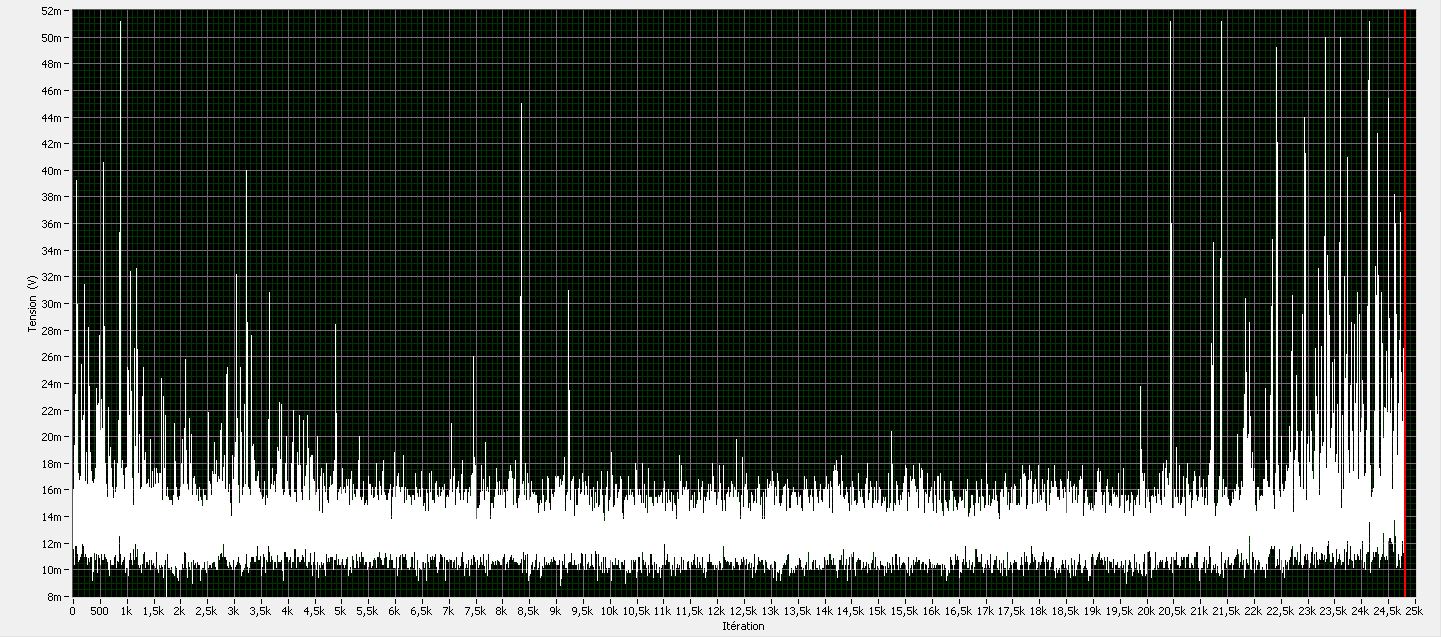
Ronic Chiche | Under Process | info | mechanics | lasers and optics | detectors and electronics | ThomX igloo | correlations between accelerometer and lock losses @ 20Hz | long term pk-pk measurement of the accelerometer (placed on the optical cavity table, on the marble part close to the laser oscillator) from 5:30pm to 9am => ~ 2.255s / pt
start of the quiet period : ~ 5k pts <=> 8:45pm
3 peaks at ~ 7.5k, 8.5k, 9.5k pts <=> 10:10pm, 10:50pm, 11:30pm
begining of the noise : big peak at ~20.5k pts <=> 6:20am
conclusion : relatively same behavior than the previous measurement made in the same condition except the "quiet" and "wake up" schedule of the noise is not strictly the same.
| Ronic Chiche wrote: |
|
here is the same kind of measurement (pk-pk of 1 sec of acquisition) done on the laser PZT when the FP is at 90kW.
it's from 6:20pm to 7:10pm => ~2.4s by point
the minimum values are for the PZT being off.
the maximum values are for PZT scanning or lock loss.
in between, we get the measurements of the perturbations.
at 6:30pm (~250 points), Jean-Noel stopped all the water cooling circuit of ThomX.
at 6:46pm (~650 points), Jean-Noel restarted the main water cooling circuit.
at 7pm (~1000 points), Jean-Noel restarted all the water cooling circuit.
at 7:10pm (~1250 points) => we stopped the acquisition.
conclusion : no clear effect of the water cooling circuit on the locking stability.
| Ronic Chiche wrote: |
|
here is the acquisition from 10:30am to 5:30pm
11k point in 7h => 1.57k points / h
the noise is almost the same during the daylight, a little bit increasing from 1:30pm.
I restarted an acquisition at 5:30pm to check if the noise reduction during the night is repeatable or not....
| Ronic Chiche wrote: |
|
here is the pk-pk measurement of the accelerometer during the whole night.
the recording started at 5pm yesterday and has been stopped this morning at 10am.
one got 28k points in 17 hours => 1.65k points / h
the "last" peak in the evening at 8.5k points is equivalent to 10pm.
the "fisrt" peaks in the morning at 23k points is equivalent to 7am.
I discussed with Jean-Noël but we don't any clear correlation of this schedule with some equipment schedule in ThomX....
I restarted a new acquisition at 10.30am.
| Ronic Chiche wrote: |
|
one possible source for this acoustic noise was the vibrations coming from the water cooling of the dipoles which is normally never turned off even when the machine is off.
this afternoon, Kevin turned off the main valve of the water cooling of half of the dipoles (the half on the FPC side), and we recorded the peak-peak value of accelerometer signal on a long trend (~20mn) but we didn't see a clear difference before and after.
I keep recording the accelerometer pk-pk signal during the night in case of one could see something different...
| Ronic Chiche wrote: |
|
new plots, with the accelerometer placed directly on the optical cavity table (on the marble part), close to the oscillator.
the correlation seems a bit better....
we would need to put the accelerometer on one foot of the table to check if the table has not some micro-movement or at the IP to check if the water in the dipole are doing some vibrations.
| Ronic Chiche wrote: |
|
this morning, I did some new plots with the accelerometer placed on the top of the case of the OneFive laser.
I previously observed with the accelerometer placed on the top of one cavity vessel, the correlation between the accelerometer signal and the PZT noise is pretty good but not 100%.
I will move the accelerometer on the optical cavity table.
| Ronic Chiche wrote: |
|
at the end of the day, I moved the accelerometer from the top of the cavity vessel to the top case of the Onefive laser.
I quickly saw again quite strong correlations between the vibrations compensated by the PZT and the accelerometer signal.
when one does a laser motor step which makes a systematic lock loss, one doesn't see any signal on the accelerometer.
=> more measurements have to be done.
I would like also to put also the accelerometer on the mechanics attached to the pipe at the IP.
=> to be discussed to find the best place as a lot of cables, the 2 dipoles and the aluminium sheets around the vacuum stufs don't let a lot of place to put the accelerometer....
| Ronic Chiche wrote: |
|
then, I moved the accelerometer on top of the "X-hutch side" vessel, placed directly on the metal top case, inside the housing.
- the "no noise same range" image shows a standard situation during 10s when there no noise either on PZT or Accelerometer.
on can compare the noise level on the accelerometer with the previous post when it was outside on top of the housing.
its noise is much much lower... which means the housing is properly dumping the acoustic noise at this frequency around 20-30Hz.
so, we increase the accelerometer measurement sensitivity to better measure its noise.
- the "no noise new range" image shows a standard situation during 10s when there no noise either on PZT or Accelerometer but with a smaller range.
- the "noise 1,2,3" images show the situation when the PZT start to compensate large noise with good correlation with accelerometer placed on top of the optical vessel.
- the "noise 1,2,3 not clear" images show the situation when the PZT start to compensate large noise with correlation with accelerometer but the signal level is not the same as before.
this make me think the origin of the noise is maybe not coming from the inside of the optical vessel.
=> conclusion : we see for the first time a correlation between the PZT noise and some vibration/acoustic noise.
now, we have to investigate the precise origin of this noise (or the different sources).
| Ronic Chiche wrote: |
|
this morning, I did some measurement with nobody interfering with the tests.
- the "no noise" image shows a standard situation during 10s when there is no noise either on PZT or Accelerometer.
most of the time, we are in this situation.
- the "slaping door" image shows the case where the large igloo door is opened and slaping when it closes.
the accelerometer and the PZT exhibit correlated noise when the door is slaping.
we can see a PZT "recovery" time longer than the perturbation.
but these events are rare and are not the source of the problematic perturbations.
- "noise 1,2,3" images show the typical situation when the PZT start to compensate large noise without any correlation with accelerometer placed on top of the housing.
=> conclusion, some external noise (to the housing) should not be the source of the perturbations on the PZT.
| Ronic Chiche wrote: |
|
today I connected a copy of the laser PZT signal to the 2nd scope CH2 (with AC coupling to remove the DC offset) to be able to monitor synchronously the Accelerometer and laser PZT signals.
the accelerometer is still connected to the 2nd scope CH4 and placed on top of the housing.
I filtered both signals in the Labview Signal Express software with a low-pass filter at 30Hz to focus on low frequencies noise (~20Hz).
now, I need to wait to work with the bunker closed to compare with normal operation (if some people work in the same time in the bunker, obviously, we will get some correlation between the accelerometer and laser PZT signals.....)
| Ronic Chiche wrote: |
|
I installed an accelerometer setup in the bunker.
presently, the accelerometer is placed on top of the housing and its signal is connected to the 2nd scope (33MHz and 500MHz RF beating) on channel 4.
the FPC is locked to ~90kW.
the accelerometer noise is filtered on the Labview Signal Express software in order to focus on the 20Hz noise.
one applied a RII elliptic 5th order low pass filter at 30Hz.
the 20Hz noise can be seen on the PZT which always compensate for CFP frequency drifts.
figure 1 : example of typical accelerometer filtered noise (yellow curve) when the PZT compensation (green curve) is quite (measurement on 4 seconds)
figure 2 : example of accelerometer filtered noise (yellow curve) when the PZT compensation (green curve) exhibits some 20Hz noise (measurement on 10 seconds)
conclusion : there is no clear evidence of a correlation between accoustic noise outside of the housing (measured by the accelerometer) and the 20Hz noise in the laser PZT compensation.
=> putting the 2 signals on 2 different scopes doesn't help because the slow acquisition done is not synchronous.
next try : use the same scope and put the accelerometer inside the housing, for example on top of one of the FPC vessel.
|
|
|
|
|
|
|
|
|
|
|
|
| Attachment 1: Capture.JPG
|  |
|
409
|
Wed Feb 19 10:35:06 2025 |
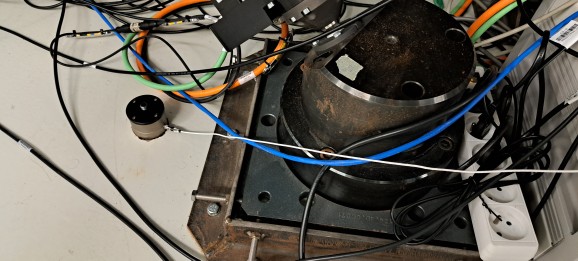
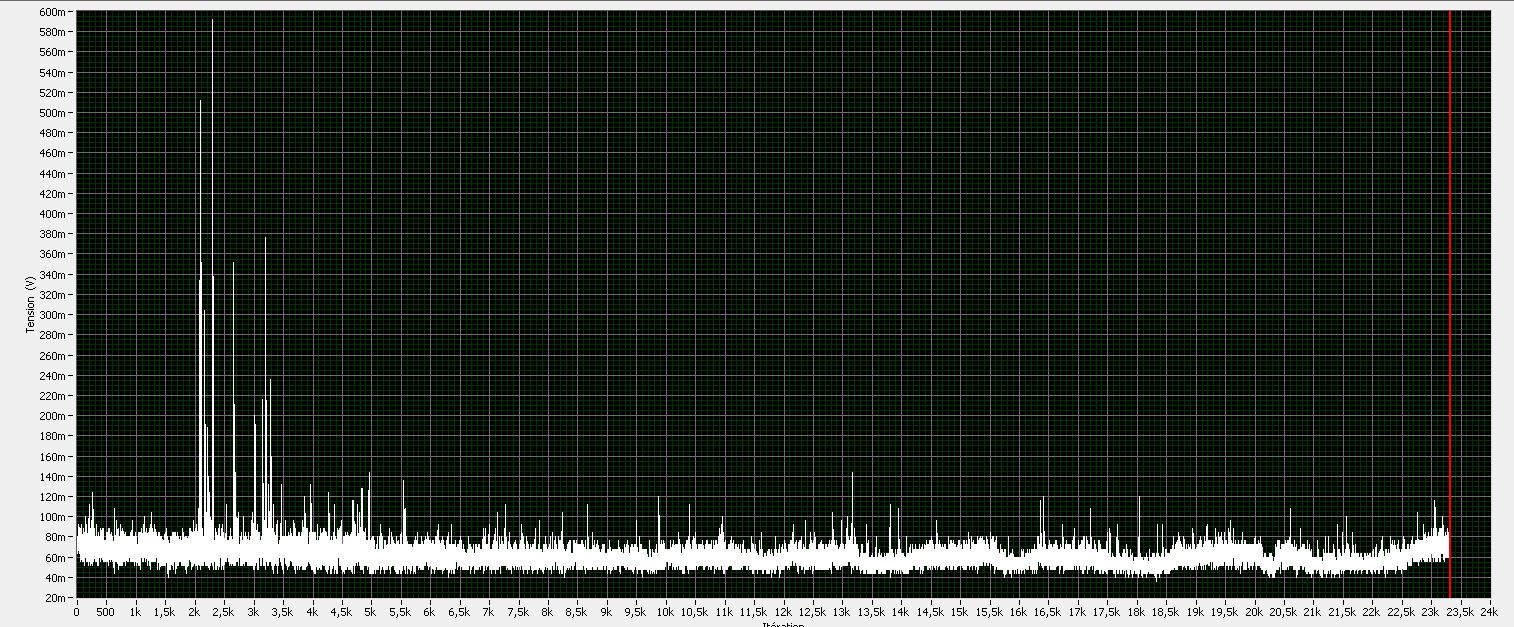
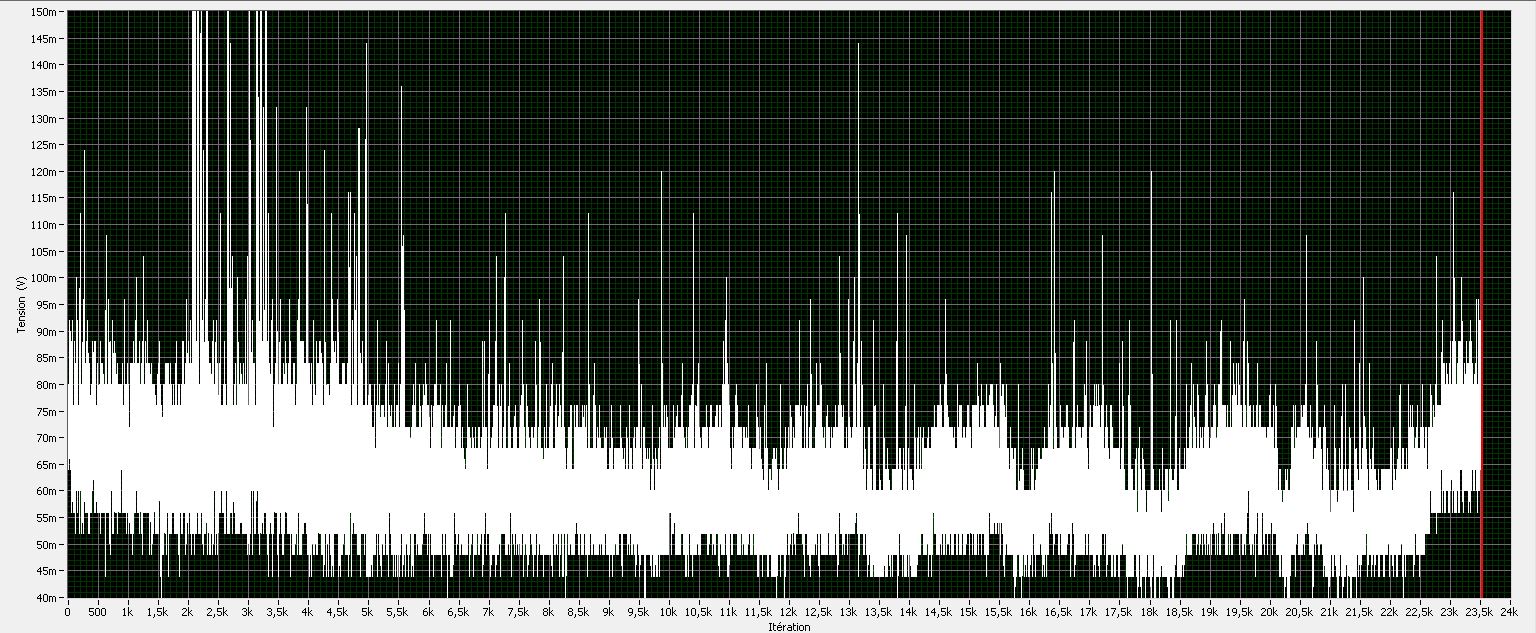
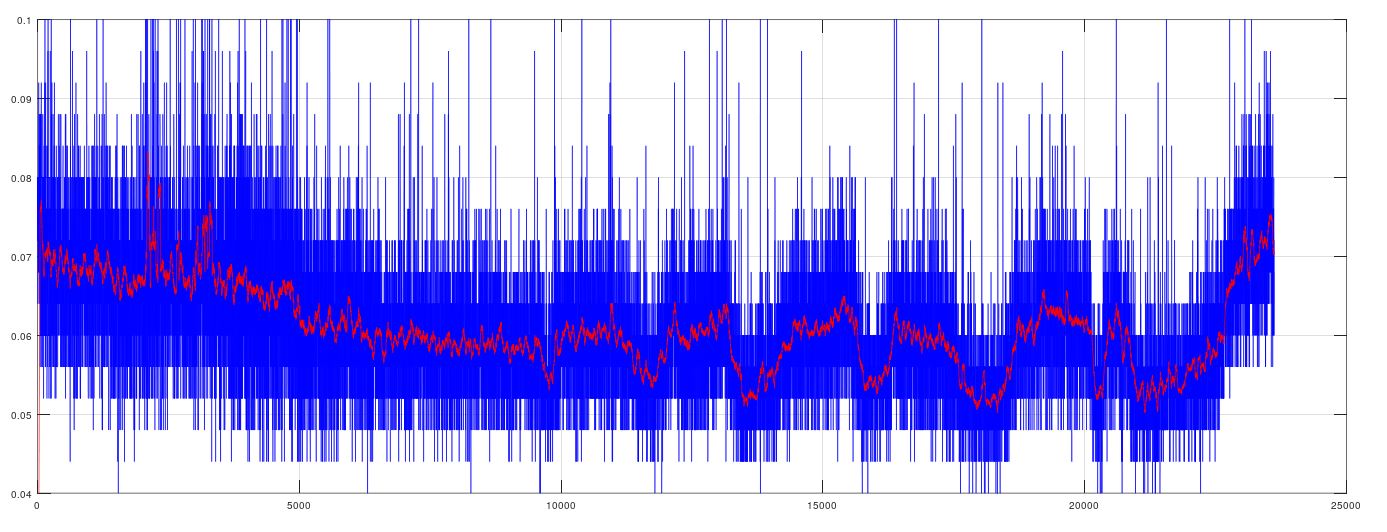
Ronic Chiche | Under Process | info | mechanics | lasers and optics | detectors and electronics | ThomX igloo | correlations between accelerometer and lock losses @ 20Hz | I installed the accelerometer on the ground close to one feet of the FP cavity hexapod (see picture) and restarted the acquisition at 6:40pm on 20th of february.
the acquisition corresponds to the night between the 20th and the 21th of february.
23.3k points from 6:40pm to 9am => 2.215s / point
the large peaks in between 2k and 3.5k points correspond to 7:55pm to 8:50pm => some working operation in the bunker (maybe finish the work of the kicker).
one does not observe a clear decrease of the vibrations during the night.
I added a vertical zoom of the acquisition => it seems there is a small decrease during the night but nothing clear.
the last plot shows exactly the same data but with a strong filtering (raw data in blue, filtered data in red).
we see a little bit better the reduction of the vibration during the night.
| Ronic Chiche wrote: |
|
long term pk-pk measurement of the accelerometer (placed on the optical cavity table, on the marble part close to the laser oscillator) from 5:30pm to 9am => ~ 2.255s / pt
start of the quiet period : ~ 5k pts <=> 8:45pm
3 peaks at ~ 7.5k, 8.5k, 9.5k pts <=> 10:10pm, 10:50pm, 11:30pm
begining of the noise : big peak at ~20.5k pts <=> 6:20am
conclusion : relatively same behavior than the previous measurement made in the same condition except the "quiet" and "wake up" schedule of the noise is not strictly the same.
| Ronic Chiche wrote: |
|
here is the same kind of measurement (pk-pk of 1 sec of acquisition) done on the laser PZT when the FP is at 90kW.
it's from 6:20pm to 7:10pm => ~2.4s by point
the minimum values are for the PZT being off.
the maximum values are for PZT scanning or lock loss.
in between, we get the measurements of the perturbations.
at 6:30pm (~250 points), Jean-Noel stopped all the water cooling circuit of ThomX.
at 6:46pm (~650 points), Jean-Noel restarted the main water cooling circuit.
at 7pm (~1000 points), Jean-Noel restarted all the water cooling circuit.
at 7:10pm (~1250 points) => we stopped the acquisition.
conclusion : no clear effect of the water cooling circuit on the locking stability.
| Ronic Chiche wrote: |
|
here is the acquisition from 10:30am to 5:30pm
11k point in 7h => 1.57k points / h
the noise is almost the same during the daylight, a little bit increasing from 1:30pm.
I restarted an acquisition at 5:30pm to check if the noise reduction during the night is repeatable or not....
| Ronic Chiche wrote: |
|
here is the pk-pk measurement of the accelerometer during the whole night.
the recording started at 5pm yesterday and has been stopped this morning at 10am.
one got 28k points in 17 hours => 1.65k points / h
the "last" peak in the evening at 8.5k points is equivalent to 10pm.
the "fisrt" peaks in the morning at 23k points is equivalent to 7am.
I discussed with Jean-Noël but we don't any clear correlation of this schedule with some equipment schedule in ThomX....
I restarted a new acquisition at 10.30am.
| Ronic Chiche wrote: |
|
one possible source for this acoustic noise was the vibrations coming from the water cooling of the dipoles which is normally never turned off even when the machine is off.
this afternoon, Kevin turned off the main valve of the water cooling of half of the dipoles (the half on the FPC side), and we recorded the peak-peak value of accelerometer signal on a long trend (~20mn) but we didn't see a clear difference before and after.
I keep recording the accelerometer pk-pk signal during the night in case of one could see something different...
| Ronic Chiche wrote: |
|
new plots, with the accelerometer placed directly on the optical cavity table (on the marble part), close to the oscillator.
the correlation seems a bit better....
we would need to put the accelerometer on one foot of the table to check if the table has not some micro-movement or at the IP to check if the water in the dipole are doing some vibrations.
| Ronic Chiche wrote: |
|
this morning, I did some new plots with the accelerometer placed on the top of the case of the OneFive laser.
I previously observed with the accelerometer placed on the top of one cavity vessel, the correlation between the accelerometer signal and the PZT noise is pretty good but not 100%.
I will move the accelerometer on the optical cavity table.
| Ronic Chiche wrote: |
|
at the end of the day, I moved the accelerometer from the top of the cavity vessel to the top case of the Onefive laser.
I quickly saw again quite strong correlations between the vibrations compensated by the PZT and the accelerometer signal.
when one does a laser motor step which makes a systematic lock loss, one doesn't see any signal on the accelerometer.
=> more measurements have to be done.
I would like also to put also the accelerometer on the mechanics attached to the pipe at the IP.
=> to be discussed to find the best place as a lot of cables, the 2 dipoles and the aluminium sheets around the vacuum stufs don't let a lot of place to put the accelerometer....
| Ronic Chiche wrote: |
|
then, I moved the accelerometer on top of the "X-hutch side" vessel, placed directly on the metal top case, inside the housing.
- the "no noise same range" image shows a standard situation during 10s when there no noise either on PZT or Accelerometer.
on can compare the noise level on the accelerometer with the previous post when it was outside on top of the housing.
its noise is much much lower... which means the housing is properly dumping the acoustic noise at this frequency around 20-30Hz.
so, we increase the accelerometer measurement sensitivity to better measure its noise.
- the "no noise new range" image shows a standard situation during 10s when there no noise either on PZT or Accelerometer but with a smaller range.
- the "noise 1,2,3" images show the situation when the PZT start to compensate large noise with good correlation with accelerometer placed on top of the optical vessel.
- the "noise 1,2,3 not clear" images show the situation when the PZT start to compensate large noise with correlation with accelerometer but the signal level is not the same as before.
this make me think the origin of the noise is maybe not coming from the inside of the optical vessel.
=> conclusion : we see for the first time a correlation between the PZT noise and some vibration/acoustic noise.
now, we have to investigate the precise origin of this noise (or the different sources).
| Ronic Chiche wrote: |
|
this morning, I did some measurement with nobody interfering with the tests.
- the "no noise" image shows a standard situation during 10s when there is no noise either on PZT or Accelerometer.
most of the time, we are in this situation.
- the "slaping door" image shows the case where the large igloo door is opened and slaping when it closes.
the accelerometer and the PZT exhibit correlated noise when the door is slaping.
we can see a PZT "recovery" time longer than the perturbation.
but these events are rare and are not the source of the problematic perturbations.
- "noise 1,2,3" images show the typical situation when the PZT start to compensate large noise without any correlation with accelerometer placed on top of the housing.
=> conclusion, some external noise (to the housing) should not be the source of the perturbations on the PZT.
| Ronic Chiche wrote: |
|
today I connected a copy of the laser PZT signal to the 2nd scope CH2 (with AC coupling to remove the DC offset) to be able to monitor synchronously the Accelerometer and laser PZT signals.
the accelerometer is still connected to the 2nd scope CH4 and placed on top of the housing.
I filtered both signals in the Labview Signal Express software with a low-pass filter at 30Hz to focus on low frequencies noise (~20Hz).
now, I need to wait to work with the bunker closed to compare with normal operation (if some people work in the same time in the bunker, obviously, we will get some correlation between the accelerometer and laser PZT signals.....)
| Ronic Chiche wrote: |
|
I installed an accelerometer setup in the bunker.
presently, the accelerometer is placed on top of the housing and its signal is connected to the 2nd scope (33MHz and 500MHz RF beating) on channel 4.
the FPC is locked to ~90kW.
the accelerometer noise is filtered on the Labview Signal Express software in order to focus on the 20Hz noise.
one applied a RII elliptic 5th order low pass filter at 30Hz.
the 20Hz noise can be seen on the PZT which always compensate for CFP frequency drifts.
figure 1 : example of typical accelerometer filtered noise (yellow curve) when the PZT compensation (green curve) is quite (measurement on 4 seconds)
figure 2 : example of accelerometer filtered noise (yellow curve) when the PZT compensation (green curve) exhibits some 20Hz noise (measurement on 10 seconds)
conclusion : there is no clear evidence of a correlation between accoustic noise outside of the housing (measured by the accelerometer) and the 20Hz noise in the laser PZT compensation.
=> putting the 2 signals on 2 different scopes doesn't help because the slow acquisition done is not synchronous.
next try : use the same scope and put the accelerometer inside the housing, for example on top of one of the FPC vessel.
|
|
|
|
|
|
|
|
|
|
|
|
|
| Attachment 1: img1.jpg
|  |
| Attachment 2: Capture.JPG
|  |
| Attachment 3: Capture.JPG
|  |
| Attachment 4: Capture.JPG
|  |
|
411
|
Fri Feb 21 10:13:03 2025 |
Ronic Chiche | Under Process | info | mechanics | lasers and optics | detectors and electronics | ThomX igloo | correlations between accelerometer and lock losses @ 20Hz | for this 20Hz oscillation, could it be a natural resonance of the optical table placed on its feet ?
typical mass of the table m ~ 8T
feets :
young modulus of steel E ~ 210 G N/m²
length L ~ 1m
diameter d ~ 10cm
rigidity for 6 feets => k ~ 6. pi.d²/4L E ~ 9.9 G N/m
rough estimation of the oscillation frequency : f = sqrt(k / m) / 2pi ~ 177 Hz
if the rigidity of the real moving feets is lower (~ by a factor 80) than if they were made of plain steel, we are not so far.
to be continued...
| Ronic Chiche wrote: |
|
I installed the accelerometer on the ground close to one feet of the FP cavity hexapod (see picture) and restarted the acquisition at 6:40pm on 20th of february.
the acquisition corresponds to the night between the 20th and the 21th of february.
23.3k points from 6:40pm to 9am => 2.215s / point
the large peaks in between 2k and 3.5k points correspond to 7:55pm to 8:50pm => some working operation in the bunker (maybe finish the work of the kicker).
one does not observe a clear decrease of the vibrations during the night.
I added a vertical zoom of the acquisition => it seems there is a small decrease during the night but nothing clear.
the last plot shows exactly the same data but with a strong filtering (raw data in blue, filtered data in red).
we see a little bit better the reduction of the vibration during the night.
| Ronic Chiche wrote: |
|
long term pk-pk measurement of the accelerometer (placed on the optical cavity table, on the marble part close to the laser oscillator) from 5:30pm to 9am => ~ 2.255s / pt
start of the quiet period : ~ 5k pts <=> 8:45pm
3 peaks at ~ 7.5k, 8.5k, 9.5k pts <=> 10:10pm, 10:50pm, 11:30pm
begining of the noise : big peak at ~20.5k pts <=> 6:20am
conclusion : relatively same behavior than the previous measurement made in the same condition except the "quiet" and "wake up" schedule of the noise is not strictly the same.
| Ronic Chiche wrote: |
|
here is the same kind of measurement (pk-pk of 1 sec of acquisition) done on the laser PZT when the FP is at 90kW.
it's from 6:20pm to 7:10pm => ~2.4s by point
the minimum values are for the PZT being off.
the maximum values are for PZT scanning or lock loss.
in between, we get the measurements of the perturbations.
at 6:30pm (~250 points), Jean-Noel stopped all the water cooling circuit of ThomX.
at 6:46pm (~650 points), Jean-Noel restarted the main water cooling circuit.
at 7pm (~1000 points), Jean-Noel restarted all the water cooling circuit.
at 7:10pm (~1250 points) => we stopped the acquisition.
conclusion : no clear effect of the water cooling circuit on the locking stability.
| Ronic Chiche wrote: |
|
here is the acquisition from 10:30am to 5:30pm
11k point in 7h => 1.57k points / h
the noise is almost the same during the daylight, a little bit increasing from 1:30pm.
I restarted an acquisition at 5:30pm to check if the noise reduction during the night is repeatable or not....
| Ronic Chiche wrote: |
|
here is the pk-pk measurement of the accelerometer during the whole night.
the recording started at 5pm yesterday and has been stopped this morning at 10am.
one got 28k points in 17 hours => 1.65k points / h
the "last" peak in the evening at 8.5k points is equivalent to 10pm.
the "fisrt" peaks in the morning at 23k points is equivalent to 7am.
I discussed with Jean-Noël but we don't any clear correlation of this schedule with some equipment schedule in ThomX....
I restarted a new acquisition at 10.30am.
| Ronic Chiche wrote: |
|
one possible source for this acoustic noise was the vibrations coming from the water cooling of the dipoles which is normally never turned off even when the machine is off.
this afternoon, Kevin turned off the main valve of the water cooling of half of the dipoles (the half on the FPC side), and we recorded the peak-peak value of accelerometer signal on a long trend (~20mn) but we didn't see a clear difference before and after.
I keep recording the accelerometer pk-pk signal during the night in case of one could see something different...
| Ronic Chiche wrote: |
|
new plots, with the accelerometer placed directly on the optical cavity table (on the marble part), close to the oscillator.
the correlation seems a bit better....
we would need to put the accelerometer on one foot of the table to check if the table has not some micro-movement or at the IP to check if the water in the dipole are doing some vibrations.
| Ronic Chiche wrote: |
|
this morning, I did some new plots with the accelerometer placed on the top of the case of the OneFive laser.
I previously observed with the accelerometer placed on the top of one cavity vessel, the correlation between the accelerometer signal and the PZT noise is pretty good but not 100%.
I will move the accelerometer on the optical cavity table.
| Ronic Chiche wrote: |
|
at the end of the day, I moved the accelerometer from the top of the cavity vessel to the top case of the Onefive laser.
I quickly saw again quite strong correlations between the vibrations compensated by the PZT and the accelerometer signal.
when one does a laser motor step which makes a systematic lock loss, one doesn't see any signal on the accelerometer.
=> more measurements have to be done.
I would like also to put also the accelerometer on the mechanics attached to the pipe at the IP.
=> to be discussed to find the best place as a lot of cables, the 2 dipoles and the aluminium sheets around the vacuum stufs don't let a lot of place to put the accelerometer....
| Ronic Chiche wrote: |
|
then, I moved the accelerometer on top of the "X-hutch side" vessel, placed directly on the metal top case, inside the housing.
- the "no noise same range" image shows a standard situation during 10s when there no noise either on PZT or Accelerometer.
on can compare the noise level on the accelerometer with the previous post when it was outside on top of the housing.
its noise is much much lower... which means the housing is properly dumping the acoustic noise at this frequency around 20-30Hz.
so, we increase the accelerometer measurement sensitivity to better measure its noise.
- the "no noise new range" image shows a standard situation during 10s when there no noise either on PZT or Accelerometer but with a smaller range.
- the "noise 1,2,3" images show the situation when the PZT start to compensate large noise with good correlation with accelerometer placed on top of the optical vessel.
- the "noise 1,2,3 not clear" images show the situation when the PZT start to compensate large noise with correlation with accelerometer but the signal level is not the same as before.
this make me think the origin of the noise is maybe not coming from the inside of the optical vessel.
=> conclusion : we see for the first time a correlation between the PZT noise and some vibration/acoustic noise.
now, we have to investigate the precise origin of this noise (or the different sources).
| Ronic Chiche wrote: |
|
this morning, I did some measurement with nobody interfering with the tests.
- the "no noise" image shows a standard situation during 10s when there is no noise either on PZT or Accelerometer.
most of the time, we are in this situation.
- the "slaping door" image shows the case where the large igloo door is opened and slaping when it closes.
the accelerometer and the PZT exhibit correlated noise when the door is slaping.
we can see a PZT "recovery" time longer than the perturbation.
but these events are rare and are not the source of the problematic perturbations.
- "noise 1,2,3" images show the typical situation when the PZT start to compensate large noise without any correlation with accelerometer placed on top of the housing.
=> conclusion, some external noise (to the housing) should not be the source of the perturbations on the PZT.
| Ronic Chiche wrote: |
|
today I connected a copy of the laser PZT signal to the 2nd scope CH2 (with AC coupling to remove the DC offset) to be able to monitor synchronously the Accelerometer and laser PZT signals.
the accelerometer is still connected to the 2nd scope CH4 and placed on top of the housing.
I filtered both signals in the Labview Signal Express software with a low-pass filter at 30Hz to focus on low frequencies noise (~20Hz).
now, I need to wait to work with the bunker closed to compare with normal operation (if some people work in the same time in the bunker, obviously, we will get some correlation between the accelerometer and laser PZT signals.....)
| Ronic Chiche wrote: |
|
I installed an accelerometer setup in the bunker.
presently, the accelerometer is placed on top of the housing and its signal is connected to the 2nd scope (33MHz and 500MHz RF beating) on channel 4.
the FPC is locked to ~90kW.
the accelerometer noise is filtered on the Labview Signal Express software in order to focus on the 20Hz noise.
one applied a RII elliptic 5th order low pass filter at 30Hz.
the 20Hz noise can be seen on the PZT which always compensate for CFP frequency drifts.
figure 1 : example of typical accelerometer filtered noise (yellow curve) when the PZT compensation (green curve) is quite (measurement on 4 seconds)
figure 2 : example of accelerometer filtered noise (yellow curve) when the PZT compensation (green curve) exhibits some 20Hz noise (measurement on 10 seconds)
conclusion : there is no clear evidence of a correlation between accoustic noise outside of the housing (measured by the accelerometer) and the 20Hz noise in the laser PZT compensation.
=> putting the 2 signals on 2 different scopes doesn't help because the slow acquisition done is not synchronous.
next try : use the same scope and put the accelerometer inside the housing, for example on top of one of the FPC vessel.
|
|
|
|
|
|
|
|
|
|
|
|
|
|
|
417
|
Tue Mar 18 11:25:07 2025 |
Ronic Chiche | Under Process | report | mechanics | lasers and optics | detectors and electronics | ThomX igloo | day by day run for X-ray production | this morning, the cavity was pretty misaligned => basic alignment in y direction helps a lot => 93kW for 33% amp ratio.
the Rigol 33MHz generator phase was adjusted : phase ch2 = phase ch1 (40 deg) + 36 deg = 76 deg.
| Ronic Chiche wrote: |
|
this morning, I restarted the lock of the CFP after almost 2 weeks without operation.
after quick alignment and CEP tuning, I got 88kW for 33% ratio for the laser amplifier.
the FPC seems pretty far from the RF frequency (2.8kHz @ 33MHz) but it's possible the present RF frequency has been tuned for 61.5 or 70MeV (the present FPC length is tuned for 50MeV).
Jean-Noel had to reinject some SF6 gas in the section pipe => it immediately produces some lock losses during the whole filling process and even several minutes after he finishes.
this is an interesting correlation with the vibrations from the beam pipe => one needs to install the accelerometer to check the behavior.
but the lock losses were not related to "high frequency" or "20Hz oscillations" noises which are the 2 main processes for lock losses, it was just like some "cuts" in the signals.
I finally got 90kW in the FPC for 33% ratio for the laser amplifier after walking alignment procedure.
| Ronic Chiche wrote: |
|
today we did x-rays => we got 41 000 pA at maximum and 90kW in the FPC for 33% amplifier ratio.
finally, I changed the strategy for the feeback on RF.
i removed the integration and derivative parameters and reduced the gain parameter :
P=0.25 / I=D=0 => it seems to be more stable => less low frequency oscillations becoming larger and larger during a perturbation.
| Ronic Chiche wrote: |
|
this morning, I restarted the cavity after the Christmas shutdown.
everything went fine.
I got ~ 86kW for 33% laser amplifier ratio after optimization of the CEP and alignment with walking procedure.
IcePap controllers are OK and the displacements (MOT.03 and MOT.06) let the CFP locked.
I locked also on the RF frequency (I tuned the laser and CFP cavity length) => +4.1ns (C2-C4) between the 10Hz trig (C2) and the 33MHz laser signal (C4)
I observed that the search & relock range on the regulator B plays an important role on the RF locking stability.
so, I increased the previous range +/-0.25V to +/-0.5V.
we have always the 20Hz noise which can be increasing some time but the lock seems more robust.
| Ronic Chiche wrote: |
|
this morning, Kevin reduced the steering current in the IcePap controllers of the FP cavity motors.
the motor MOT.06 was producing a pattern in the Transmission signal when it was moved and doing a lock loss very often.
so, we changed its current from 0.8A to 0.4A and it fixes the problem => no more systematic lock loss.
so, we changed also the MOT.03 steering current from 0.8A to 0.7A.
on this motor, we have also a false warning about the Low limit switch which seems to be activated (strange because, we are always using it in the positive direction)
Kevin reverted the logic to remove the message.
we obtained 91kW in the FPC for 33% amplifier ratio after CEP and alignment tuning.
we did synchronized xray production with a relative delay between laser 33MHz and trigger (CH2-CH4) of +4 ns
| Ronic Chiche wrote: |
|
major result of the day: X-ray vertical scan by moving the hexapod
abscise : hexapod position
ordinate : xray flux in asynchronous condition
red curve : continuous injection at 10Hz (the scan lasts for ~5 minutes)
green curve : one single injection (the beam is not extracted).
blue curve : one single injection, ~ 10-15 minutes later
| Ronic Chiche wrote: |
|
This morning, I added an amplifier on the 33MHz beating signal in between the mixer+LPF and the scope/Laselock.
it seems to improve the robustness of the RF/FPC lock.
because of this gain, I increased the upper and lower thresholds on the search criterion of the RF/FPC lock from +/-50mV to +250mV/-200mV
=> see the picture of the Laselock parameters.
the optimum phase for X-ray production is roughly +3.6ns between C2 (machine trigger) and C4 (33MHz laser signal).
we have to use the machine at 70MeV with a new frequency at 500.0325MHz / 33.3355MHz.
=> we need to move the FPC tomorrow by roughly 60kHz @ 500MHz.
| Ronic Chiche wrote: |
|
last thing we tried :
we removed the threshold on the FPC/RF error signal.
=> we cannot choose automatically the RF bucket anymore (we need to manually let the phase drift slowly and start the lock at the right moment).
=> but the FPC/RF lock seems more robust.
in that case, we have 2 different sources of lock losses:
- the ones dues to the laser or CFP motors move.
even at low speed or in "piezo scan" mode, one observes too fast mouvement that are not properly compensated and involving some phase shift.
- the ones not related to any action.
=> the 20Hz signal seems to increase until it makes the system losing the lock
| Ronic Chiche wrote: |
|
we observed that :
- the MOT.03 motor always exhibits some perturbations on the transmitted, reflected and PZT signals (see picture) in contrary to the MOT.06 motor.
does the differences come from the motor relative positions (-900 000 steps for MOT.06 and -100 000 steps for MOT.03) or from the controller configuration ?
- the stability limits (oscillations arise) of the PID for the RF/CFP locks are P = 1 / I = 0.0001 / D = 5
then we put the new PID parameters : P = 0.25 / I = 0.000025 / D = 1
- the 20Hz oscillations are stil arising from time to time
- the lock laser/CFP is pretty robust, one observes more RF/CFP lock losses.
- we removed the 250Hz filter on the RF/CFP error signal to increase the feedback BW but we didn't see a any improvement
- at 5pm, the laser/CFP lock seems as stable as in the morning, then we don't see any change in stability during time.
we loggued CFP power measurement and signals from the cavity (~ 1GB of data)
| Ronic Chiche wrote: |
|
today with Alice, we planned to do a long run with ~80kW in the FPC to check if the lock problems are coming from the interaction with the machine or not.
the goal is to check this assumption on a full day comparable with a day of X-ray production.
we started the amplifier at 10am.
during a move of MaY (injection mirrors of the FPC), we observed a sudden total loss of resonances...
the reason was an abnormal displacement of the motor despite the fact the measured position was reasonable.
we already observed an issue like that....
to fix the problem, one just had to move back MaY.
the cavity started to be locked at 11:15am
the RF frequency has been changed to 500.09595MHz equivalent to 33.33973MHz
but we don't have a beating signal @ 500MHz => one will ask to Vincent to fix the issue.
laser motor CH0 : 1.503453 mm
laser moror CH2 : - 50µm
~ 83kW at 12:30pm
| Ronic Chiche wrote: |
|
at the begining of the day, we started to get ~81kW in the FPC for 33% amplifier ratio and after ~1h, we got 84kW after CEP and alignment tuning.
at the end of the day, we got 89kW without walking alignment.
we tried to improve a bit the robustness of the FPC and RF locks:
see the capture for the new locking parameters.
| Ronic Chiche wrote: |
|
the RF frequency changed from 500.1003MHz to 500.0913MHz => it reduced by 9kHz @ 500MHz which is equivalent to 600Hz @ 33MHz (we measured 500Hz @ 33MHz). the electron orbit length increased, so we have to increase the cavities length => increase motor values by ~ 68µm.
for the laser cavity : 1.496 560 mm => 1.564 560 mm
the initial values for the motor of the FP cavity are : MOT.03=-130 000 steps and MOT.06=-900 000 steps.
68µm is roughly 11 000 steps (6nm/step) => MOT.03=-130 000 steps and MOT.06=-889 000 steps.
optimum CEP position : -210.8µm => -192µm
I got 80kW in the FP cavity after CEP and walking alignment
then, 82kW after waiting 3h.
then, 84kW after waiting 5h.
|
|
|
|
|
|
|
|
|
|
|
|
|
419
|
Mon Mar 31 17:12:56 2025 |
Ronic Chiche | Under Process | report | mechanics | lasers and optics | detectors and electronics | ThomX igloo | day by day run for X-ray production | today, the alignment of FP cavity was so bad that I tuned the 01 mode by error (CEP and alignment)... insead of the 00 mode !!!
I was able to reach ~30kW and was limited at this value, so I used the camera to check what was happening and saw the 01 mode.
so, I moved the lock on a 00 mode and redid a full tuning (CEP and alignment).
I got ~93kW => ok
| Ronic Chiche wrote: |
|
this morning, the cavity was pretty misaligned => basic alignment in y direction helps a lot => 93kW for 33% amp ratio.
the Rigol 33MHz generator phase was adjusted : phase ch2 = phase ch1 (40 deg) + 36 deg = 76 deg.
| Ronic Chiche wrote: |
|
this morning, I restarted the lock of the CFP after almost 2 weeks without operation.
after quick alignment and CEP tuning, I got 88kW for 33% ratio for the laser amplifier.
the FPC seems pretty far from the RF frequency (2.8kHz @ 33MHz) but it's possible the present RF frequency has been tuned for 61.5 or 70MeV (the present FPC length is tuned for 50MeV).
Jean-Noel had to reinject some SF6 gas in the section pipe => it immediately produces some lock losses during the whole filling process and even several minutes after he finishes.
this is an interesting correlation with the vibrations from the beam pipe => one needs to install the accelerometer to check the behavior.
but the lock losses were not related to "high frequency" or "20Hz oscillations" noises which are the 2 main processes for lock losses, it was just like some "cuts" in the signals.
I finally got 90kW in the FPC for 33% ratio for the laser amplifier after walking alignment procedure.
| Ronic Chiche wrote: |
|
today we did x-rays => we got 41 000 pA at maximum and 90kW in the FPC for 33% amplifier ratio.
finally, I changed the strategy for the feeback on RF.
i removed the integration and derivative parameters and reduced the gain parameter :
P=0.25 / I=D=0 => it seems to be more stable => less low frequency oscillations becoming larger and larger during a perturbation.
| Ronic Chiche wrote: |
|
this morning, I restarted the cavity after the Christmas shutdown.
everything went fine.
I got ~ 86kW for 33% laser amplifier ratio after optimization of the CEP and alignment with walking procedure.
IcePap controllers are OK and the displacements (MOT.03 and MOT.06) let the CFP locked.
I locked also on the RF frequency (I tuned the laser and CFP cavity length) => +4.1ns (C2-C4) between the 10Hz trig (C2) and the 33MHz laser signal (C4)
I observed that the search & relock range on the regulator B plays an important role on the RF locking stability.
so, I increased the previous range +/-0.25V to +/-0.5V.
we have always the 20Hz noise which can be increasing some time but the lock seems more robust.
| Ronic Chiche wrote: |
|
this morning, Kevin reduced the steering current in the IcePap controllers of the FP cavity motors.
the motor MOT.06 was producing a pattern in the Transmission signal when it was moved and doing a lock loss very often.
so, we changed its current from 0.8A to 0.4A and it fixes the problem => no more systematic lock loss.
so, we changed also the MOT.03 steering current from 0.8A to 0.7A.
on this motor, we have also a false warning about the Low limit switch which seems to be activated (strange because, we are always using it in the positive direction)
Kevin reverted the logic to remove the message.
we obtained 91kW in the FPC for 33% amplifier ratio after CEP and alignment tuning.
we did synchronized xray production with a relative delay between laser 33MHz and trigger (CH2-CH4) of +4 ns
| Ronic Chiche wrote: |
|
major result of the day: X-ray vertical scan by moving the hexapod
abscise : hexapod position
ordinate : xray flux in asynchronous condition
red curve : continuous injection at 10Hz (the scan lasts for ~5 minutes)
green curve : one single injection (the beam is not extracted).
blue curve : one single injection, ~ 10-15 minutes later
| Ronic Chiche wrote: |
|
This morning, I added an amplifier on the 33MHz beating signal in between the mixer+LPF and the scope/Laselock.
it seems to improve the robustness of the RF/FPC lock.
because of this gain, I increased the upper and lower thresholds on the search criterion of the RF/FPC lock from +/-50mV to +250mV/-200mV
=> see the picture of the Laselock parameters.
the optimum phase for X-ray production is roughly +3.6ns between C2 (machine trigger) and C4 (33MHz laser signal).
we have to use the machine at 70MeV with a new frequency at 500.0325MHz / 33.3355MHz.
=> we need to move the FPC tomorrow by roughly 60kHz @ 500MHz.
| Ronic Chiche wrote: |
|
last thing we tried :
we removed the threshold on the FPC/RF error signal.
=> we cannot choose automatically the RF bucket anymore (we need to manually let the phase drift slowly and start the lock at the right moment).
=> but the FPC/RF lock seems more robust.
in that case, we have 2 different sources of lock losses:
- the ones dues to the laser or CFP motors move.
even at low speed or in "piezo scan" mode, one observes too fast mouvement that are not properly compensated and involving some phase shift.
- the ones not related to any action.
=> the 20Hz signal seems to increase until it makes the system losing the lock
| Ronic Chiche wrote: |
|
we observed that :
- the MOT.03 motor always exhibits some perturbations on the transmitted, reflected and PZT signals (see picture) in contrary to the MOT.06 motor.
does the differences come from the motor relative positions (-900 000 steps for MOT.06 and -100 000 steps for MOT.03) or from the controller configuration ?
- the stability limits (oscillations arise) of the PID for the RF/CFP locks are P = 1 / I = 0.0001 / D = 5
then we put the new PID parameters : P = 0.25 / I = 0.000025 / D = 1
- the 20Hz oscillations are stil arising from time to time
- the lock laser/CFP is pretty robust, one observes more RF/CFP lock losses.
- we removed the 250Hz filter on the RF/CFP error signal to increase the feedback BW but we didn't see a any improvement
- at 5pm, the laser/CFP lock seems as stable as in the morning, then we don't see any change in stability during time.
we loggued CFP power measurement and signals from the cavity (~ 1GB of data)
| Ronic Chiche wrote: |
|
today with Alice, we planned to do a long run with ~80kW in the FPC to check if the lock problems are coming from the interaction with the machine or not.
the goal is to check this assumption on a full day comparable with a day of X-ray production.
we started the amplifier at 10am.
during a move of MaY (injection mirrors of the FPC), we observed a sudden total loss of resonances...
the reason was an abnormal displacement of the motor despite the fact the measured position was reasonable.
we already observed an issue like that....
to fix the problem, one just had to move back MaY.
the cavity started to be locked at 11:15am
the RF frequency has been changed to 500.09595MHz equivalent to 33.33973MHz
but we don't have a beating signal @ 500MHz => one will ask to Vincent to fix the issue.
laser motor CH0 : 1.503453 mm
laser moror CH2 : - 50µm
~ 83kW at 12:30pm
| Ronic Chiche wrote: |
|
at the begining of the day, we started to get ~81kW in the FPC for 33% amplifier ratio and after ~1h, we got 84kW after CEP and alignment tuning.
at the end of the day, we got 89kW without walking alignment.
we tried to improve a bit the robustness of the FPC and RF locks:
see the capture for the new locking parameters.
| Ronic Chiche wrote: |
|
the RF frequency changed from 500.1003MHz to 500.0913MHz => it reduced by 9kHz @ 500MHz which is equivalent to 600Hz @ 33MHz (we measured 500Hz @ 33MHz). the electron orbit length increased, so we have to increase the cavities length => increase motor values by ~ 68µm.
for the laser cavity : 1.496 560 mm => 1.564 560 mm
the initial values for the motor of the FP cavity are : MOT.03=-130 000 steps and MOT.06=-900 000 steps.
68µm is roughly 11 000 steps (6nm/step) => MOT.03=-130 000 steps and MOT.06=-889 000 steps.
optimum CEP position : -210.8µm => -192µm
I got 80kW in the FP cavity after CEP and walking alignment
then, 82kW after waiting 3h.
then, 84kW after waiting 5h.
|
|
|
|
|
|
|
|
|
|
|
|
|
|
421
|
Tue Apr 29 09:26:08 2025 |
Ronic Chiche | Under Process | report | mechanics | lasers and optics | detectors and electronics | ThomX igloo | day by day run for X-ray production | today, after 1 week of vacation, I was able to easily lock the cavity with 92kW with 33% amp ratio without too much optimizations (no walking alignment).
could it be related to the nice weather we got during this week ?
as in the past we observed more noise when the weather was changing and we had very difficult locking procedure after a simple weekend...
| Ronic Chiche wrote: |
|
today, the alignment of FP cavity was so bad that I tuned the 01 mode by error (CEP and alignment)... insead of the 00 mode !!!
I was able to reach ~30kW and was limited at this value, so I used the camera to check what was happening and saw the 01 mode.
so, I moved the lock on a 00 mode and redid a full tuning (CEP and alignment).
I got ~93kW => ok
| Ronic Chiche wrote: |
|
this morning, the cavity was pretty misaligned => basic alignment in y direction helps a lot => 93kW for 33% amp ratio.
the Rigol 33MHz generator phase was adjusted : phase ch2 = phase ch1 (40 deg) + 36 deg = 76 deg.
| Ronic Chiche wrote: |
|
this morning, I restarted the lock of the CFP after almost 2 weeks without operation.
after quick alignment and CEP tuning, I got 88kW for 33% ratio for the laser amplifier.
the FPC seems pretty far from the RF frequency (2.8kHz @ 33MHz) but it's possible the present RF frequency has been tuned for 61.5 or 70MeV (the present FPC length is tuned for 50MeV).
Jean-Noel had to reinject some SF6 gas in the section pipe => it immediately produces some lock losses during the whole filling process and even several minutes after he finishes.
this is an interesting correlation with the vibrations from the beam pipe => one needs to install the accelerometer to check the behavior.
but the lock losses were not related to "high frequency" or "20Hz oscillations" noises which are the 2 main processes for lock losses, it was just like some "cuts" in the signals.
I finally got 90kW in the FPC for 33% ratio for the laser amplifier after walking alignment procedure.
| Ronic Chiche wrote: |
|
today we did x-rays => we got 41 000 pA at maximum and 90kW in the FPC for 33% amplifier ratio.
finally, I changed the strategy for the feeback on RF.
i removed the integration and derivative parameters and reduced the gain parameter :
P=0.25 / I=D=0 => it seems to be more stable => less low frequency oscillations becoming larger and larger during a perturbation.
| Ronic Chiche wrote: |
|
this morning, I restarted the cavity after the Christmas shutdown.
everything went fine.
I got ~ 86kW for 33% laser amplifier ratio after optimization of the CEP and alignment with walking procedure.
IcePap controllers are OK and the displacements (MOT.03 and MOT.06) let the CFP locked.
I locked also on the RF frequency (I tuned the laser and CFP cavity length) => +4.1ns (C2-C4) between the 10Hz trig (C2) and the 33MHz laser signal (C4)
I observed that the search & relock range on the regulator B plays an important role on the RF locking stability.
so, I increased the previous range +/-0.25V to +/-0.5V.
we have always the 20Hz noise which can be increasing some time but the lock seems more robust.
| Ronic Chiche wrote: |
|
this morning, Kevin reduced the steering current in the IcePap controllers of the FP cavity motors.
the motor MOT.06 was producing a pattern in the Transmission signal when it was moved and doing a lock loss very often.
so, we changed its current from 0.8A to 0.4A and it fixes the problem => no more systematic lock loss.
so, we changed also the MOT.03 steering current from 0.8A to 0.7A.
on this motor, we have also a false warning about the Low limit switch which seems to be activated (strange because, we are always using it in the positive direction)
Kevin reverted the logic to remove the message.
we obtained 91kW in the FPC for 33% amplifier ratio after CEP and alignment tuning.
we did synchronized xray production with a relative delay between laser 33MHz and trigger (CH2-CH4) of +4 ns
| Ronic Chiche wrote: |
|
major result of the day: X-ray vertical scan by moving the hexapod
abscise : hexapod position
ordinate : xray flux in asynchronous condition
red curve : continuous injection at 10Hz (the scan lasts for ~5 minutes)
green curve : one single injection (the beam is not extracted).
blue curve : one single injection, ~ 10-15 minutes later
| Ronic Chiche wrote: |
|
This morning, I added an amplifier on the 33MHz beating signal in between the mixer+LPF and the scope/Laselock.
it seems to improve the robustness of the RF/FPC lock.
because of this gain, I increased the upper and lower thresholds on the search criterion of the RF/FPC lock from +/-50mV to +250mV/-200mV
=> see the picture of the Laselock parameters.
the optimum phase for X-ray production is roughly +3.6ns between C2 (machine trigger) and C4 (33MHz laser signal).
we have to use the machine at 70MeV with a new frequency at 500.0325MHz / 33.3355MHz.
=> we need to move the FPC tomorrow by roughly 60kHz @ 500MHz.
| Ronic Chiche wrote: |
|
last thing we tried :
we removed the threshold on the FPC/RF error signal.
=> we cannot choose automatically the RF bucket anymore (we need to manually let the phase drift slowly and start the lock at the right moment).
=> but the FPC/RF lock seems more robust.
in that case, we have 2 different sources of lock losses:
- the ones dues to the laser or CFP motors move.
even at low speed or in "piezo scan" mode, one observes too fast mouvement that are not properly compensated and involving some phase shift.
- the ones not related to any action.
=> the 20Hz signal seems to increase until it makes the system losing the lock
| Ronic Chiche wrote: |
|
we observed that :
- the MOT.03 motor always exhibits some perturbations on the transmitted, reflected and PZT signals (see picture) in contrary to the MOT.06 motor.
does the differences come from the motor relative positions (-900 000 steps for MOT.06 and -100 000 steps for MOT.03) or from the controller configuration ?
- the stability limits (oscillations arise) of the PID for the RF/CFP locks are P = 1 / I = 0.0001 / D = 5
then we put the new PID parameters : P = 0.25 / I = 0.000025 / D = 1
- the 20Hz oscillations are stil arising from time to time
- the lock laser/CFP is pretty robust, one observes more RF/CFP lock losses.
- we removed the 250Hz filter on the RF/CFP error signal to increase the feedback BW but we didn't see a any improvement
- at 5pm, the laser/CFP lock seems as stable as in the morning, then we don't see any change in stability during time.
we loggued CFP power measurement and signals from the cavity (~ 1GB of data)
| Ronic Chiche wrote: |
|
today with Alice, we planned to do a long run with ~80kW in the FPC to check if the lock problems are coming from the interaction with the machine or not.
the goal is to check this assumption on a full day comparable with a day of X-ray production.
we started the amplifier at 10am.
during a move of MaY (injection mirrors of the FPC), we observed a sudden total loss of resonances...
the reason was an abnormal displacement of the motor despite the fact the measured position was reasonable.
we already observed an issue like that....
to fix the problem, one just had to move back MaY.
the cavity started to be locked at 11:15am
the RF frequency has been changed to 500.09595MHz equivalent to 33.33973MHz
but we don't have a beating signal @ 500MHz => one will ask to Vincent to fix the issue.
laser motor CH0 : 1.503453 mm
laser moror CH2 : - 50µm
~ 83kW at 12:30pm
| Ronic Chiche wrote: |
|
at the begining of the day, we started to get ~81kW in the FPC for 33% amplifier ratio and after ~1h, we got 84kW after CEP and alignment tuning.
at the end of the day, we got 89kW without walking alignment.
we tried to improve a bit the robustness of the FPC and RF locks:
see the capture for the new locking parameters.
| Ronic Chiche wrote: |
|
the RF frequency changed from 500.1003MHz to 500.0913MHz => it reduced by 9kHz @ 500MHz which is equivalent to 600Hz @ 33MHz (we measured 500Hz @ 33MHz). the electron orbit length increased, so we have to increase the cavities length => increase motor values by ~ 68µm.
for the laser cavity : 1.496 560 mm => 1.564 560 mm
the initial values for the motor of the FP cavity are : MOT.03=-130 000 steps and MOT.06=-900 000 steps.
68µm is roughly 11 000 steps (6nm/step) => MOT.03=-130 000 steps and MOT.06=-889 000 steps.
optimum CEP position : -210.8µm => -192µm
I got 80kW in the FP cavity after CEP and walking alignment
then, 82kW after waiting 3h.
then, 84kW after waiting 5h.
|
|
|
|
|
|
|
|
|
|
|
|
|
|
|
425
|
Wed May 14 09:50:52 2025 |
Ronic Chiche | Under Process | report | mechanics | lasers and optics | detectors and electronics | ThomX igloo | day by day run for X-ray production | Today, I removed the NKT oscillator from the bunker to put it in the PLIC room.
I locked the FP cavity and obtained 97kW with 33% amplifier ratio, without any alignment, just by changing a little bit the CEP.
| Ronic Chiche wrote: |
|
today, after 1 week of vacation, I was able to easily lock the cavity with 92kW with 33% amp ratio without too much optimizations (no walking alignment).
could it be related to the nice weather we got during this week ?
as in the past we observed more noise when the weather was changing and we had very difficult locking procedure after a simple weekend...
| Ronic Chiche wrote: |
|
today, the alignment of FP cavity was so bad that I tuned the 01 mode by error (CEP and alignment)... insead of the 00 mode !!!
I was able to reach ~30kW and was limited at this value, so I used the camera to check what was happening and saw the 01 mode.
so, I moved the lock on a 00 mode and redid a full tuning (CEP and alignment).
I got ~93kW => ok
| Ronic Chiche wrote: |
|
this morning, the cavity was pretty misaligned => basic alignment in y direction helps a lot => 93kW for 33% amp ratio.
the Rigol 33MHz generator phase was adjusted : phase ch2 = phase ch1 (40 deg) + 36 deg = 76 deg.
| Ronic Chiche wrote: |
|
this morning, I restarted the lock of the CFP after almost 2 weeks without operation.
after quick alignment and CEP tuning, I got 88kW for 33% ratio for the laser amplifier.
the FPC seems pretty far from the RF frequency (2.8kHz @ 33MHz) but it's possible the present RF frequency has been tuned for 61.5 or 70MeV (the present FPC length is tuned for 50MeV).
Jean-Noel had to reinject some SF6 gas in the section pipe => it immediately produces some lock losses during the whole filling process and even several minutes after he finishes.
this is an interesting correlation with the vibrations from the beam pipe => one needs to install the accelerometer to check the behavior.
but the lock losses were not related to "high frequency" or "20Hz oscillations" noises which are the 2 main processes for lock losses, it was just like some "cuts" in the signals.
I finally got 90kW in the FPC for 33% ratio for the laser amplifier after walking alignment procedure.
| Ronic Chiche wrote: |
|
today we did x-rays => we got 41 000 pA at maximum and 90kW in the FPC for 33% amplifier ratio.
finally, I changed the strategy for the feeback on RF.
i removed the integration and derivative parameters and reduced the gain parameter :
P=0.25 / I=D=0 => it seems to be more stable => less low frequency oscillations becoming larger and larger during a perturbation.
| Ronic Chiche wrote: |
|
this morning, I restarted the cavity after the Christmas shutdown.
everything went fine.
I got ~ 86kW for 33% laser amplifier ratio after optimization of the CEP and alignment with walking procedure.
IcePap controllers are OK and the displacements (MOT.03 and MOT.06) let the CFP locked.
I locked also on the RF frequency (I tuned the laser and CFP cavity length) => +4.1ns (C2-C4) between the 10Hz trig (C2) and the 33MHz laser signal (C4)
I observed that the search & relock range on the regulator B plays an important role on the RF locking stability.
so, I increased the previous range +/-0.25V to +/-0.5V.
we have always the 20Hz noise which can be increasing some time but the lock seems more robust.
| Ronic Chiche wrote: |
|
this morning, Kevin reduced the steering current in the IcePap controllers of the FP cavity motors.
the motor MOT.06 was producing a pattern in the Transmission signal when it was moved and doing a lock loss very often.
so, we changed its current from 0.8A to 0.4A and it fixes the problem => no more systematic lock loss.
so, we changed also the MOT.03 steering current from 0.8A to 0.7A.
on this motor, we have also a false warning about the Low limit switch which seems to be activated (strange because, we are always using it in the positive direction)
Kevin reverted the logic to remove the message.
we obtained 91kW in the FPC for 33% amplifier ratio after CEP and alignment tuning.
we did synchronized xray production with a relative delay between laser 33MHz and trigger (CH2-CH4) of +4 ns
| Ronic Chiche wrote: |
|
major result of the day: X-ray vertical scan by moving the hexapod
abscise : hexapod position
ordinate : xray flux in asynchronous condition
red curve : continuous injection at 10Hz (the scan lasts for ~5 minutes)
green curve : one single injection (the beam is not extracted).
blue curve : one single injection, ~ 10-15 minutes later
| Ronic Chiche wrote: |
|
This morning, I added an amplifier on the 33MHz beating signal in between the mixer+LPF and the scope/Laselock.
it seems to improve the robustness of the RF/FPC lock.
because of this gain, I increased the upper and lower thresholds on the search criterion of the RF/FPC lock from +/-50mV to +250mV/-200mV
=> see the picture of the Laselock parameters.
the optimum phase for X-ray production is roughly +3.6ns between C2 (machine trigger) and C4 (33MHz laser signal).
we have to use the machine at 70MeV with a new frequency at 500.0325MHz / 33.3355MHz.
=> we need to move the FPC tomorrow by roughly 60kHz @ 500MHz.
| Ronic Chiche wrote: |
|
last thing we tried :
we removed the threshold on the FPC/RF error signal.
=> we cannot choose automatically the RF bucket anymore (we need to manually let the phase drift slowly and start the lock at the right moment).
=> but the FPC/RF lock seems more robust.
in that case, we have 2 different sources of lock losses:
- the ones dues to the laser or CFP motors move.
even at low speed or in "piezo scan" mode, one observes too fast mouvement that are not properly compensated and involving some phase shift.
- the ones not related to any action.
=> the 20Hz signal seems to increase until it makes the system losing the lock
| Ronic Chiche wrote: |
|
we observed that :
- the MOT.03 motor always exhibits some perturbations on the transmitted, reflected and PZT signals (see picture) in contrary to the MOT.06 motor.
does the differences come from the motor relative positions (-900 000 steps for MOT.06 and -100 000 steps for MOT.03) or from the controller configuration ?
- the stability limits (oscillations arise) of the PID for the RF/CFP locks are P = 1 / I = 0.0001 / D = 5
then we put the new PID parameters : P = 0.25 / I = 0.000025 / D = 1
- the 20Hz oscillations are stil arising from time to time
- the lock laser/CFP is pretty robust, one observes more RF/CFP lock losses.
- we removed the 250Hz filter on the RF/CFP error signal to increase the feedback BW but we didn't see a any improvement
- at 5pm, the laser/CFP lock seems as stable as in the morning, then we don't see any change in stability during time.
we loggued CFP power measurement and signals from the cavity (~ 1GB of data)
| Ronic Chiche wrote: |
|
today with Alice, we planned to do a long run with ~80kW in the FPC to check if the lock problems are coming from the interaction with the machine or not.
the goal is to check this assumption on a full day comparable with a day of X-ray production.
we started the amplifier at 10am.
during a move of MaY (injection mirrors of the FPC), we observed a sudden total loss of resonances...
the reason was an abnormal displacement of the motor despite the fact the measured position was reasonable.
we already observed an issue like that....
to fix the problem, one just had to move back MaY.
the cavity started to be locked at 11:15am
the RF frequency has been changed to 500.09595MHz equivalent to 33.33973MHz
but we don't have a beating signal @ 500MHz => one will ask to Vincent to fix the issue.
laser motor CH0 : 1.503453 mm
laser moror CH2 : - 50µm
~ 83kW at 12:30pm
| Ronic Chiche wrote: |
|
at the begining of the day, we started to get ~81kW in the FPC for 33% amplifier ratio and after ~1h, we got 84kW after CEP and alignment tuning.
at the end of the day, we got 89kW without walking alignment.
we tried to improve a bit the robustness of the FPC and RF locks:
see the capture for the new locking parameters.
| Ronic Chiche wrote: |
|
the RF frequency changed from 500.1003MHz to 500.0913MHz => it reduced by 9kHz @ 500MHz which is equivalent to 600Hz @ 33MHz (we measured 500Hz @ 33MHz). the electron orbit length increased, so we have to increase the cavities length => increase motor values by ~ 68µm.
for the laser cavity : 1.496 560 mm => 1.564 560 mm
the initial values for the motor of the FP cavity are : MOT.03=-130 000 steps and MOT.06=-900 000 steps.
68µm is roughly 11 000 steps (6nm/step) => MOT.03=-130 000 steps and MOT.06=-889 000 steps.
optimum CEP position : -210.8µm => -192µm
I got 80kW in the FP cavity after CEP and walking alignment
then, 82kW after waiting 3h.
then, 84kW after waiting 5h.
|
|
|
|
|
|
|
|
|
|
|
|
|
|
|
|
430
|
Wed Jun 25 18:48:28 2025 |
Ronic Chiche | Under Process | report | mechanics | lasers and optics | detectors and electronics | ThomX igloo | day by day run for X-ray production | New locking parameters (I got 98kW for 33% amp ratio) :
Axis 18 position : +0009420
P = 0.05
I = 0.0005
D = 0.6
stability seems better than previous parameters.
| Ronic Chiche wrote: |
|
Today, I removed the NKT oscillator from the bunker to put it in the PLIC room.
I locked the FP cavity and obtained 97kW with 33% amplifier ratio, without any alignment, just by changing a little bit the CEP.
| Ronic Chiche wrote: |
|
today, after 1 week of vacation, I was able to easily lock the cavity with 92kW with 33% amp ratio without too much optimizations (no walking alignment).
could it be related to the nice weather we got during this week ?
as in the past we observed more noise when the weather was changing and we had very difficult locking procedure after a simple weekend...
| Ronic Chiche wrote: |
|
today, the alignment of FP cavity was so bad that I tuned the 01 mode by error (CEP and alignment)... insead of the 00 mode !!!
I was able to reach ~30kW and was limited at this value, so I used the camera to check what was happening and saw the 01 mode.
so, I moved the lock on a 00 mode and redid a full tuning (CEP and alignment).
I got ~93kW => ok
| Ronic Chiche wrote: |
|
this morning, the cavity was pretty misaligned => basic alignment in y direction helps a lot => 93kW for 33% amp ratio.
the Rigol 33MHz generator phase was adjusted : phase ch2 = phase ch1 (40 deg) + 36 deg = 76 deg.
| Ronic Chiche wrote: |
|
this morning, I restarted the lock of the CFP after almost 2 weeks without operation.
after quick alignment and CEP tuning, I got 88kW for 33% ratio for the laser amplifier.
the FPC seems pretty far from the RF frequency (2.8kHz @ 33MHz) but it's possible the present RF frequency has been tuned for 61.5 or 70MeV (the present FPC length is tuned for 50MeV).
Jean-Noel had to reinject some SF6 gas in the section pipe => it immediately produces some lock losses during the whole filling process and even several minutes after he finishes.
this is an interesting correlation with the vibrations from the beam pipe => one needs to install the accelerometer to check the behavior.
but the lock losses were not related to "high frequency" or "20Hz oscillations" noises which are the 2 main processes for lock losses, it was just like some "cuts" in the signals.
I finally got 90kW in the FPC for 33% ratio for the laser amplifier after walking alignment procedure.
| Ronic Chiche wrote: |
|
today we did x-rays => we got 41 000 pA at maximum and 90kW in the FPC for 33% amplifier ratio.
finally, I changed the strategy for the feeback on RF.
i removed the integration and derivative parameters and reduced the gain parameter :
P=0.25 / I=D=0 => it seems to be more stable => less low frequency oscillations becoming larger and larger during a perturbation.
| Ronic Chiche wrote: |
|
this morning, I restarted the cavity after the Christmas shutdown.
everything went fine.
I got ~ 86kW for 33% laser amplifier ratio after optimization of the CEP and alignment with walking procedure.
IcePap controllers are OK and the displacements (MOT.03 and MOT.06) let the CFP locked.
I locked also on the RF frequency (I tuned the laser and CFP cavity length) => +4.1ns (C2-C4) between the 10Hz trig (C2) and the 33MHz laser signal (C4)
I observed that the search & relock range on the regulator B plays an important role on the RF locking stability.
so, I increased the previous range +/-0.25V to +/-0.5V.
we have always the 20Hz noise which can be increasing some time but the lock seems more robust.
| Ronic Chiche wrote: |
|
this morning, Kevin reduced the steering current in the IcePap controllers of the FP cavity motors.
the motor MOT.06 was producing a pattern in the Transmission signal when it was moved and doing a lock loss very often.
so, we changed its current from 0.8A to 0.4A and it fixes the problem => no more systematic lock loss.
so, we changed also the MOT.03 steering current from 0.8A to 0.7A.
on this motor, we have also a false warning about the Low limit switch which seems to be activated (strange because, we are always using it in the positive direction)
Kevin reverted the logic to remove the message.
we obtained 91kW in the FPC for 33% amplifier ratio after CEP and alignment tuning.
we did synchronized xray production with a relative delay between laser 33MHz and trigger (CH2-CH4) of +4 ns
| Ronic Chiche wrote: |
|
major result of the day: X-ray vertical scan by moving the hexapod
abscise : hexapod position
ordinate : xray flux in asynchronous condition
red curve : continuous injection at 10Hz (the scan lasts for ~5 minutes)
green curve : one single injection (the beam is not extracted).
blue curve : one single injection, ~ 10-15 minutes later
| Ronic Chiche wrote: |
|
This morning, I added an amplifier on the 33MHz beating signal in between the mixer+LPF and the scope/Laselock.
it seems to improve the robustness of the RF/FPC lock.
because of this gain, I increased the upper and lower thresholds on the search criterion of the RF/FPC lock from +/-50mV to +250mV/-200mV
=> see the picture of the Laselock parameters.
the optimum phase for X-ray production is roughly +3.6ns between C2 (machine trigger) and C4 (33MHz laser signal).
we have to use the machine at 70MeV with a new frequency at 500.0325MHz / 33.3355MHz.
=> we need to move the FPC tomorrow by roughly 60kHz @ 500MHz.
| Ronic Chiche wrote: |
|
last thing we tried :
we removed the threshold on the FPC/RF error signal.
=> we cannot choose automatically the RF bucket anymore (we need to manually let the phase drift slowly and start the lock at the right moment).
=> but the FPC/RF lock seems more robust.
in that case, we have 2 different sources of lock losses:
- the ones dues to the laser or CFP motors move.
even at low speed or in "piezo scan" mode, one observes too fast mouvement that are not properly compensated and involving some phase shift.
- the ones not related to any action.
=> the 20Hz signal seems to increase until it makes the system losing the lock
| Ronic Chiche wrote: |
|
we observed that :
- the MOT.03 motor always exhibits some perturbations on the transmitted, reflected and PZT signals (see picture) in contrary to the MOT.06 motor.
does the differences come from the motor relative positions (-900 000 steps for MOT.06 and -100 000 steps for MOT.03) or from the controller configuration ?
- the stability limits (oscillations arise) of the PID for the RF/CFP locks are P = 1 / I = 0.0001 / D = 5
then we put the new PID parameters : P = 0.25 / I = 0.000025 / D = 1
- the 20Hz oscillations are stil arising from time to time
- the lock laser/CFP is pretty robust, one observes more RF/CFP lock losses.
- we removed the 250Hz filter on the RF/CFP error signal to increase the feedback BW but we didn't see a any improvement
- at 5pm, the laser/CFP lock seems as stable as in the morning, then we don't see any change in stability during time.
we loggued CFP power measurement and signals from the cavity (~ 1GB of data)
| Ronic Chiche wrote: |
|
today with Alice, we planned to do a long run with ~80kW in the FPC to check if the lock problems are coming from the interaction with the machine or not.
the goal is to check this assumption on a full day comparable with a day of X-ray production.
we started the amplifier at 10am.
during a move of MaY (injection mirrors of the FPC), we observed a sudden total loss of resonances...
the reason was an abnormal displacement of the motor despite the fact the measured position was reasonable.
we already observed an issue like that....
to fix the problem, one just had to move back MaY.
the cavity started to be locked at 11:15am
the RF frequency has been changed to 500.09595MHz equivalent to 33.33973MHz
but we don't have a beating signal @ 500MHz => one will ask to Vincent to fix the issue.
laser motor CH0 : 1.503453 mm
laser moror CH2 : - 50µm
~ 83kW at 12:30pm
| Ronic Chiche wrote: |
|
at the begining of the day, we started to get ~81kW in the FPC for 33% amplifier ratio and after ~1h, we got 84kW after CEP and alignment tuning.
at the end of the day, we got 89kW without walking alignment.
we tried to improve a bit the robustness of the FPC and RF locks:
see the capture for the new locking parameters.
| Ronic Chiche wrote: |
|
the RF frequency changed from 500.1003MHz to 500.0913MHz => it reduced by 9kHz @ 500MHz which is equivalent to 600Hz @ 33MHz (we measured 500Hz @ 33MHz). the electron orbit length increased, so we have to increase the cavities length => increase motor values by ~ 68µm.
for the laser cavity : 1.496 560 mm => 1.564 560 mm
the initial values for the motor of the FP cavity are : MOT.03=-130 000 steps and MOT.06=-900 000 steps.
68µm is roughly 11 000 steps (6nm/step) => MOT.03=-130 000 steps and MOT.06=-889 000 steps.
optimum CEP position : -210.8µm => -192µm
I got 80kW in the FP cavity after CEP and walking alignment
then, 82kW after waiting 3h.
then, 84kW after waiting 5h.
|
|
|
|
|
|
|
|
|
|
|
|
|
|
|
|
|
433
|
Tue Jul 1 17:31:41 2025 |
Ronic Chiche | Under Process | report | mechanics | lasers and optics | detectors and electronics | ThomX igloo | day by day run for X-ray production | We had a long run without any lock loss during ~1h with the 23kW recipie in the morning.
during the afternoon, we had some few lock losses but the FPC system was globally quiet and stable,
but at the end of the day, I observed more and more frequent high frequency noise which implies lock losses.
at the same time, Dalkia changed the temperature of the air flow in the bunker.
could it be the reason of the stability degradation or is it because the cavity is more unstable when hot ?
| Ronic Chiche wrote: |
|
New locking parameters (I got 98kW for 33% amp ratio) :
Axis 18 position : +0009420
P = 0.05
I = 0.0005
D = 0.6
stability seems better than previous parameters.
| Ronic Chiche wrote: |
|
Today, I removed the NKT oscillator from the bunker to put it in the PLIC room.
I locked the FP cavity and obtained 97kW with 33% amplifier ratio, without any alignment, just by changing a little bit the CEP.
| Ronic Chiche wrote: |
|
today, after 1 week of vacation, I was able to easily lock the cavity with 92kW with 33% amp ratio without too much optimizations (no walking alignment).
could it be related to the nice weather we got during this week ?
as in the past we observed more noise when the weather was changing and we had very difficult locking procedure after a simple weekend...
| Ronic Chiche wrote: |
|
today, the alignment of FP cavity was so bad that I tuned the 01 mode by error (CEP and alignment)... insead of the 00 mode !!!
I was able to reach ~30kW and was limited at this value, so I used the camera to check what was happening and saw the 01 mode.
so, I moved the lock on a 00 mode and redid a full tuning (CEP and alignment).
I got ~93kW => ok
| Ronic Chiche wrote: |
|
this morning, the cavity was pretty misaligned => basic alignment in y direction helps a lot => 93kW for 33% amp ratio.
the Rigol 33MHz generator phase was adjusted : phase ch2 = phase ch1 (40 deg) + 36 deg = 76 deg.
| Ronic Chiche wrote: |
|
this morning, I restarted the lock of the CFP after almost 2 weeks without operation.
after quick alignment and CEP tuning, I got 88kW for 33% ratio for the laser amplifier.
the FPC seems pretty far from the RF frequency (2.8kHz @ 33MHz) but it's possible the present RF frequency has been tuned for 61.5 or 70MeV (the present FPC length is tuned for 50MeV).
Jean-Noel had to reinject some SF6 gas in the section pipe => it immediately produces some lock losses during the whole filling process and even several minutes after he finishes.
this is an interesting correlation with the vibrations from the beam pipe => one needs to install the accelerometer to check the behavior.
but the lock losses were not related to "high frequency" or "20Hz oscillations" noises which are the 2 main processes for lock losses, it was just like some "cuts" in the signals.
I finally got 90kW in the FPC for 33% ratio for the laser amplifier after walking alignment procedure.
| Ronic Chiche wrote: |
|
today we did x-rays => we got 41 000 pA at maximum and 90kW in the FPC for 33% amplifier ratio.
finally, I changed the strategy for the feeback on RF.
i removed the integration and derivative parameters and reduced the gain parameter :
P=0.25 / I=D=0 => it seems to be more stable => less low frequency oscillations becoming larger and larger during a perturbation.
| Ronic Chiche wrote: |
|
this morning, I restarted the cavity after the Christmas shutdown.
everything went fine.
I got ~ 86kW for 33% laser amplifier ratio after optimization of the CEP and alignment with walking procedure.
IcePap controllers are OK and the displacements (MOT.03 and MOT.06) let the CFP locked.
I locked also on the RF frequency (I tuned the laser and CFP cavity length) => +4.1ns (C2-C4) between the 10Hz trig (C2) and the 33MHz laser signal (C4)
I observed that the search & relock range on the regulator B plays an important role on the RF locking stability.
so, I increased the previous range +/-0.25V to +/-0.5V.
we have always the 20Hz noise which can be increasing some time but the lock seems more robust.
| Ronic Chiche wrote: |
|
this morning, Kevin reduced the steering current in the IcePap controllers of the FP cavity motors.
the motor MOT.06 was producing a pattern in the Transmission signal when it was moved and doing a lock loss very often.
so, we changed its current from 0.8A to 0.4A and it fixes the problem => no more systematic lock loss.
so, we changed also the MOT.03 steering current from 0.8A to 0.7A.
on this motor, we have also a false warning about the Low limit switch which seems to be activated (strange because, we are always using it in the positive direction)
Kevin reverted the logic to remove the message.
we obtained 91kW in the FPC for 33% amplifier ratio after CEP and alignment tuning.
we did synchronized xray production with a relative delay between laser 33MHz and trigger (CH2-CH4) of +4 ns
| Ronic Chiche wrote: |
|
major result of the day: X-ray vertical scan by moving the hexapod
abscise : hexapod position
ordinate : xray flux in asynchronous condition
red curve : continuous injection at 10Hz (the scan lasts for ~5 minutes)
green curve : one single injection (the beam is not extracted).
blue curve : one single injection, ~ 10-15 minutes later
| Ronic Chiche wrote: |
|
This morning, I added an amplifier on the 33MHz beating signal in between the mixer+LPF and the scope/Laselock.
it seems to improve the robustness of the RF/FPC lock.
because of this gain, I increased the upper and lower thresholds on the search criterion of the RF/FPC lock from +/-50mV to +250mV/-200mV
=> see the picture of the Laselock parameters.
the optimum phase for X-ray production is roughly +3.6ns between C2 (machine trigger) and C4 (33MHz laser signal).
we have to use the machine at 70MeV with a new frequency at 500.0325MHz / 33.3355MHz.
=> we need to move the FPC tomorrow by roughly 60kHz @ 500MHz.
| Ronic Chiche wrote: |
|
last thing we tried :
we removed the threshold on the FPC/RF error signal.
=> we cannot choose automatically the RF bucket anymore (we need to manually let the phase drift slowly and start the lock at the right moment).
=> but the FPC/RF lock seems more robust.
in that case, we have 2 different sources of lock losses:
- the ones dues to the laser or CFP motors move.
even at low speed or in "piezo scan" mode, one observes too fast mouvement that are not properly compensated and involving some phase shift.
- the ones not related to any action.
=> the 20Hz signal seems to increase until it makes the system losing the lock
| Ronic Chiche wrote: |
|
we observed that :
- the MOT.03 motor always exhibits some perturbations on the transmitted, reflected and PZT signals (see picture) in contrary to the MOT.06 motor.
does the differences come from the motor relative positions (-900 000 steps for MOT.06 and -100 000 steps for MOT.03) or from the controller configuration ?
- the stability limits (oscillations arise) of the PID for the RF/CFP locks are P = 1 / I = 0.0001 / D = 5
then we put the new PID parameters : P = 0.25 / I = 0.000025 / D = 1
- the 20Hz oscillations are stil arising from time to time
- the lock laser/CFP is pretty robust, one observes more RF/CFP lock losses.
- we removed the 250Hz filter on the RF/CFP error signal to increase the feedback BW but we didn't see a any improvement
- at 5pm, the laser/CFP lock seems as stable as in the morning, then we don't see any change in stability during time.
we loggued CFP power measurement and signals from the cavity (~ 1GB of data)
| Ronic Chiche wrote: |
|
today with Alice, we planned to do a long run with ~80kW in the FPC to check if the lock problems are coming from the interaction with the machine or not.
the goal is to check this assumption on a full day comparable with a day of X-ray production.
we started the amplifier at 10am.
during a move of MaY (injection mirrors of the FPC), we observed a sudden total loss of resonances...
the reason was an abnormal displacement of the motor despite the fact the measured position was reasonable.
we already observed an issue like that....
to fix the problem, one just had to move back MaY.
the cavity started to be locked at 11:15am
the RF frequency has been changed to 500.09595MHz equivalent to 33.33973MHz
but we don't have a beating signal @ 500MHz => one will ask to Vincent to fix the issue.
laser motor CH0 : 1.503453 mm
laser moror CH2 : - 50µm
~ 83kW at 12:30pm
| Ronic Chiche wrote: |
|
at the begining of the day, we started to get ~81kW in the FPC for 33% amplifier ratio and after ~1h, we got 84kW after CEP and alignment tuning.
at the end of the day, we got 89kW without walking alignment.
we tried to improve a bit the robustness of the FPC and RF locks:
see the capture for the new locking parameters.
| Ronic Chiche wrote: |
|
the RF frequency changed from 500.1003MHz to 500.0913MHz => it reduced by 9kHz @ 500MHz which is equivalent to 600Hz @ 33MHz (we measured 500Hz @ 33MHz). the electron orbit length increased, so we have to increase the cavities length => increase motor values by ~ 68µm.
for the laser cavity : 1.496 560 mm => 1.564 560 mm
the initial values for the motor of the FP cavity are : MOT.03=-130 000 steps and MOT.06=-900 000 steps.
68µm is roughly 11 000 steps (6nm/step) => MOT.03=-130 000 steps and MOT.06=-889 000 steps.
optimum CEP position : -210.8µm => -192µm
I got 80kW in the FP cavity after CEP and walking alignment
then, 82kW after waiting 3h.
then, 84kW after waiting 5h.
|
|
|
|
|
|
|
|
|
|
|
|
|
|
|
|
|
|
434
|
Tue Jul 8 18:45:17 2025 |
Ronic Chiche | Under Process | report | mechanics | lasers and optics | detectors and electronics | ThomX igloo | day by day run for X-ray production | long run yesterday at relatively low power (~23kW) with double loop (FPC + RF) between 10am and 6pm
| Ronic Chiche wrote: |
|
We had a long run without any lock loss during ~1h with the 23kW recipie in the morning.
during the afternoon, we had some few lock losses but the FPC system was globally quiet and stable,
but at the end of the day, I observed more and more frequent high frequency noise which implies lock losses.
at the same time, Dalkia changed the temperature of the air flow in the bunker.
could it be the reason of the stability degradation or is it because the cavity is more unstable when hot ?
| Ronic Chiche wrote: |
|
New locking parameters (I got 98kW for 33% amp ratio) :
Axis 18 position : +0009420
P = 0.05
I = 0.0005
D = 0.6
stability seems better than previous parameters.
| Ronic Chiche wrote: |
|
Today, I removed the NKT oscillator from the bunker to put it in the PLIC room.
I locked the FP cavity and obtained 97kW with 33% amplifier ratio, without any alignment, just by changing a little bit the CEP.
| Ronic Chiche wrote: |
|
today, after 1 week of vacation, I was able to easily lock the cavity with 92kW with 33% amp ratio without too much optimizations (no walking alignment).
could it be related to the nice weather we got during this week ?
as in the past we observed more noise when the weather was changing and we had very difficult locking procedure after a simple weekend...
| Ronic Chiche wrote: |
|
today, the alignment of FP cavity was so bad that I tuned the 01 mode by error (CEP and alignment)... insead of the 00 mode !!!
I was able to reach ~30kW and was limited at this value, so I used the camera to check what was happening and saw the 01 mode.
so, I moved the lock on a 00 mode and redid a full tuning (CEP and alignment).
I got ~93kW => ok
| Ronic Chiche wrote: |
|
this morning, the cavity was pretty misaligned => basic alignment in y direction helps a lot => 93kW for 33% amp ratio.
the Rigol 33MHz generator phase was adjusted : phase ch2 = phase ch1 (40 deg) + 36 deg = 76 deg.
| Ronic Chiche wrote: |
|
this morning, I restarted the lock of the CFP after almost 2 weeks without operation.
after quick alignment and CEP tuning, I got 88kW for 33% ratio for the laser amplifier.
the FPC seems pretty far from the RF frequency (2.8kHz @ 33MHz) but it's possible the present RF frequency has been tuned for 61.5 or 70MeV (the present FPC length is tuned for 50MeV).
Jean-Noel had to reinject some SF6 gas in the section pipe => it immediately produces some lock losses during the whole filling process and even several minutes after he finishes.
this is an interesting correlation with the vibrations from the beam pipe => one needs to install the accelerometer to check the behavior.
but the lock losses were not related to "high frequency" or "20Hz oscillations" noises which are the 2 main processes for lock losses, it was just like some "cuts" in the signals.
I finally got 90kW in the FPC for 33% ratio for the laser amplifier after walking alignment procedure.
| Ronic Chiche wrote: |
|
today we did x-rays => we got 41 000 pA at maximum and 90kW in the FPC for 33% amplifier ratio.
finally, I changed the strategy for the feeback on RF.
i removed the integration and derivative parameters and reduced the gain parameter :
P=0.25 / I=D=0 => it seems to be more stable => less low frequency oscillations becoming larger and larger during a perturbation.
| Ronic Chiche wrote: |
|
this morning, I restarted the cavity after the Christmas shutdown.
everything went fine.
I got ~ 86kW for 33% laser amplifier ratio after optimization of the CEP and alignment with walking procedure.
IcePap controllers are OK and the displacements (MOT.03 and MOT.06) let the CFP locked.
I locked also on the RF frequency (I tuned the laser and CFP cavity length) => +4.1ns (C2-C4) between the 10Hz trig (C2) and the 33MHz laser signal (C4)
I observed that the search & relock range on the regulator B plays an important role on the RF locking stability.
so, I increased the previous range +/-0.25V to +/-0.5V.
we have always the 20Hz noise which can be increasing some time but the lock seems more robust.
| Ronic Chiche wrote: |
|
this morning, Kevin reduced the steering current in the IcePap controllers of the FP cavity motors.
the motor MOT.06 was producing a pattern in the Transmission signal when it was moved and doing a lock loss very often.
so, we changed its current from 0.8A to 0.4A and it fixes the problem => no more systematic lock loss.
so, we changed also the MOT.03 steering current from 0.8A to 0.7A.
on this motor, we have also a false warning about the Low limit switch which seems to be activated (strange because, we are always using it in the positive direction)
Kevin reverted the logic to remove the message.
we obtained 91kW in the FPC for 33% amplifier ratio after CEP and alignment tuning.
we did synchronized xray production with a relative delay between laser 33MHz and trigger (CH2-CH4) of +4 ns
| Ronic Chiche wrote: |
|
major result of the day: X-ray vertical scan by moving the hexapod
abscise : hexapod position
ordinate : xray flux in asynchronous condition
red curve : continuous injection at 10Hz (the scan lasts for ~5 minutes)
green curve : one single injection (the beam is not extracted).
blue curve : one single injection, ~ 10-15 minutes later
| Ronic Chiche wrote: |
|
This morning, I added an amplifier on the 33MHz beating signal in between the mixer+LPF and the scope/Laselock.
it seems to improve the robustness of the RF/FPC lock.
because of this gain, I increased the upper and lower thresholds on the search criterion of the RF/FPC lock from +/-50mV to +250mV/-200mV
=> see the picture of the Laselock parameters.
the optimum phase for X-ray production is roughly +3.6ns between C2 (machine trigger) and C4 (33MHz laser signal).
we have to use the machine at 70MeV with a new frequency at 500.0325MHz / 33.3355MHz.
=> we need to move the FPC tomorrow by roughly 60kHz @ 500MHz.
| Ronic Chiche wrote: |
|
last thing we tried :
we removed the threshold on the FPC/RF error signal.
=> we cannot choose automatically the RF bucket anymore (we need to manually let the phase drift slowly and start the lock at the right moment).
=> but the FPC/RF lock seems more robust.
in that case, we have 2 different sources of lock losses:
- the ones dues to the laser or CFP motors move.
even at low speed or in "piezo scan" mode, one observes too fast mouvement that are not properly compensated and involving some phase shift.
- the ones not related to any action.
=> the 20Hz signal seems to increase until it makes the system losing the lock
| Ronic Chiche wrote: |
|
we observed that :
- the MOT.03 motor always exhibits some perturbations on the transmitted, reflected and PZT signals (see picture) in contrary to the MOT.06 motor.
does the differences come from the motor relative positions (-900 000 steps for MOT.06 and -100 000 steps for MOT.03) or from the controller configuration ?
- the stability limits (oscillations arise) of the PID for the RF/CFP locks are P = 1 / I = 0.0001 / D = 5
then we put the new PID parameters : P = 0.25 / I = 0.000025 / D = 1
- the 20Hz oscillations are stil arising from time to time
- the lock laser/CFP is pretty robust, one observes more RF/CFP lock losses.
- we removed the 250Hz filter on the RF/CFP error signal to increase the feedback BW but we didn't see a any improvement
- at 5pm, the laser/CFP lock seems as stable as in the morning, then we don't see any change in stability during time.
we loggued CFP power measurement and signals from the cavity (~ 1GB of data)
| Ronic Chiche wrote: |
|
today with Alice, we planned to do a long run with ~80kW in the FPC to check if the lock problems are coming from the interaction with the machine or not.
the goal is to check this assumption on a full day comparable with a day of X-ray production.
we started the amplifier at 10am.
during a move of MaY (injection mirrors of the FPC), we observed a sudden total loss of resonances...
the reason was an abnormal displacement of the motor despite the fact the measured position was reasonable.
we already observed an issue like that....
to fix the problem, one just had to move back MaY.
the cavity started to be locked at 11:15am
the RF frequency has been changed to 500.09595MHz equivalent to 33.33973MHz
but we don't have a beating signal @ 500MHz => one will ask to Vincent to fix the issue.
laser motor CH0 : 1.503453 mm
laser moror CH2 : - 50µm
~ 83kW at 12:30pm
| Ronic Chiche wrote: |
|
at the begining of the day, we started to get ~81kW in the FPC for 33% amplifier ratio and after ~1h, we got 84kW after CEP and alignment tuning.
at the end of the day, we got 89kW without walking alignment.
we tried to improve a bit the robustness of the FPC and RF locks:
see the capture for the new locking parameters.
| Ronic Chiche wrote: |
|
the RF frequency changed from 500.1003MHz to 500.0913MHz => it reduced by 9kHz @ 500MHz which is equivalent to 600Hz @ 33MHz (we measured 500Hz @ 33MHz). the electron orbit length increased, so we have to increase the cavities length => increase motor values by ~ 68µm.
for the laser cavity : 1.496 560 mm => 1.564 560 mm
the initial values for the motor of the FP cavity are : MOT.03=-130 000 steps and MOT.06=-900 000 steps.
68µm is roughly 11 000 steps (6nm/step) => MOT.03=-130 000 steps and MOT.06=-889 000 steps.
optimum CEP position : -210.8µm => -192µm
I got 80kW in the FP cavity after CEP and walking alignment
then, 82kW after waiting 3h.
then, 84kW after waiting 5h.
|
|
|
|
|
|
|
|
|
|
|
|
|
|
|
|
|
|
| Attachment 1: 2025-07-07_-_long_run.png
| 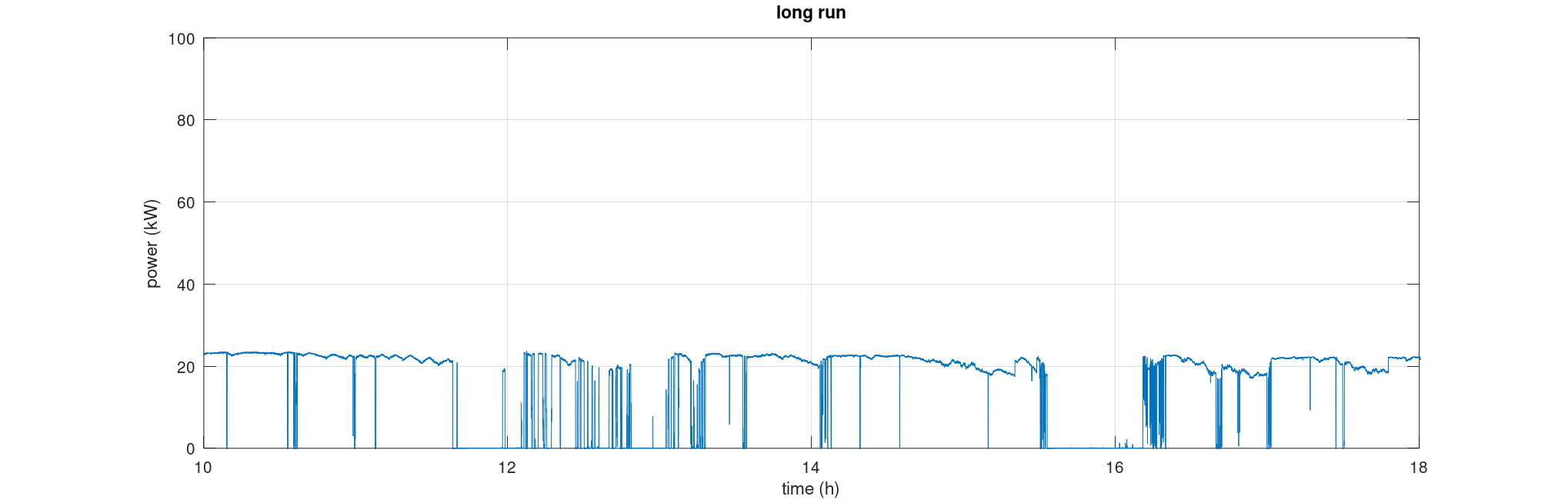 |
|
435
|
Tue Jul 8 18:48:51 2025 |
Ronic Chiche | Under Process | report | mechanics | lasers and optics | detectors and electronics | ThomX igloo | day by day run for X-ray production | long run today at relatively nominal power (~90kW) with double loop (FPC + RF) between 13:30am and 6:30pm
| Ronic Chiche wrote: |
|
long run yesterday at relatively low power (~23kW) with double loop (FPC + RF) between 10am and 6pm
| Ronic Chiche wrote: |
|
We had a long run without any lock loss during ~1h with the 23kW recipie in the morning.
during the afternoon, we had some few lock losses but the FPC system was globally quiet and stable,
but at the end of the day, I observed more and more frequent high frequency noise which implies lock losses.
at the same time, Dalkia changed the temperature of the air flow in the bunker.
could it be the reason of the stability degradation or is it because the cavity is more unstable when hot ?
| Ronic Chiche wrote: |
|
New locking parameters (I got 98kW for 33% amp ratio) :
Axis 18 position : +0009420
P = 0.05
I = 0.0005
D = 0.6
stability seems better than previous parameters.
| Ronic Chiche wrote: |
|
Today, I removed the NKT oscillator from the bunker to put it in the PLIC room.
I locked the FP cavity and obtained 97kW with 33% amplifier ratio, without any alignment, just by changing a little bit the CEP.
| Ronic Chiche wrote: |
|
today, after 1 week of vacation, I was able to easily lock the cavity with 92kW with 33% amp ratio without too much optimizations (no walking alignment).
could it be related to the nice weather we got during this week ?
as in the past we observed more noise when the weather was changing and we had very difficult locking procedure after a simple weekend...
| Ronic Chiche wrote: |
|
today, the alignment of FP cavity was so bad that I tuned the 01 mode by error (CEP and alignment)... insead of the 00 mode !!!
I was able to reach ~30kW and was limited at this value, so I used the camera to check what was happening and saw the 01 mode.
so, I moved the lock on a 00 mode and redid a full tuning (CEP and alignment).
I got ~93kW => ok
| Ronic Chiche wrote: |
|
this morning, the cavity was pretty misaligned => basic alignment in y direction helps a lot => 93kW for 33% amp ratio.
the Rigol 33MHz generator phase was adjusted : phase ch2 = phase ch1 (40 deg) + 36 deg = 76 deg.
| Ronic Chiche wrote: |
|
this morning, I restarted the lock of the CFP after almost 2 weeks without operation.
after quick alignment and CEP tuning, I got 88kW for 33% ratio for the laser amplifier.
the FPC seems pretty far from the RF frequency (2.8kHz @ 33MHz) but it's possible the present RF frequency has been tuned for 61.5 or 70MeV (the present FPC length is tuned for 50MeV).
Jean-Noel had to reinject some SF6 gas in the section pipe => it immediately produces some lock losses during the whole filling process and even several minutes after he finishes.
this is an interesting correlation with the vibrations from the beam pipe => one needs to install the accelerometer to check the behavior.
but the lock losses were not related to "high frequency" or "20Hz oscillations" noises which are the 2 main processes for lock losses, it was just like some "cuts" in the signals.
I finally got 90kW in the FPC for 33% ratio for the laser amplifier after walking alignment procedure.
| Ronic Chiche wrote: |
|
today we did x-rays => we got 41 000 pA at maximum and 90kW in the FPC for 33% amplifier ratio.
finally, I changed the strategy for the feeback on RF.
i removed the integration and derivative parameters and reduced the gain parameter :
P=0.25 / I=D=0 => it seems to be more stable => less low frequency oscillations becoming larger and larger during a perturbation.
| Ronic Chiche wrote: |
|
this morning, I restarted the cavity after the Christmas shutdown.
everything went fine.
I got ~ 86kW for 33% laser amplifier ratio after optimization of the CEP and alignment with walking procedure.
IcePap controllers are OK and the displacements (MOT.03 and MOT.06) let the CFP locked.
I locked also on the RF frequency (I tuned the laser and CFP cavity length) => +4.1ns (C2-C4) between the 10Hz trig (C2) and the 33MHz laser signal (C4)
I observed that the search & relock range on the regulator B plays an important role on the RF locking stability.
so, I increased the previous range +/-0.25V to +/-0.5V.
we have always the 20Hz noise which can be increasing some time but the lock seems more robust.
| Ronic Chiche wrote: |
|
this morning, Kevin reduced the steering current in the IcePap controllers of the FP cavity motors.
the motor MOT.06 was producing a pattern in the Transmission signal when it was moved and doing a lock loss very often.
so, we changed its current from 0.8A to 0.4A and it fixes the problem => no more systematic lock loss.
so, we changed also the MOT.03 steering current from 0.8A to 0.7A.
on this motor, we have also a false warning about the Low limit switch which seems to be activated (strange because, we are always using it in the positive direction)
Kevin reverted the logic to remove the message.
we obtained 91kW in the FPC for 33% amplifier ratio after CEP and alignment tuning.
we did synchronized xray production with a relative delay between laser 33MHz and trigger (CH2-CH4) of +4 ns
| Ronic Chiche wrote: |
|
major result of the day: X-ray vertical scan by moving the hexapod
abscise : hexapod position
ordinate : xray flux in asynchronous condition
red curve : continuous injection at 10Hz (the scan lasts for ~5 minutes)
green curve : one single injection (the beam is not extracted).
blue curve : one single injection, ~ 10-15 minutes later
| Ronic Chiche wrote: |
|
This morning, I added an amplifier on the 33MHz beating signal in between the mixer+LPF and the scope/Laselock.
it seems to improve the robustness of the RF/FPC lock.
because of this gain, I increased the upper and lower thresholds on the search criterion of the RF/FPC lock from +/-50mV to +250mV/-200mV
=> see the picture of the Laselock parameters.
the optimum phase for X-ray production is roughly +3.6ns between C2 (machine trigger) and C4 (33MHz laser signal).
we have to use the machine at 70MeV with a new frequency at 500.0325MHz / 33.3355MHz.
=> we need to move the FPC tomorrow by roughly 60kHz @ 500MHz.
| Ronic Chiche wrote: |
|
last thing we tried :
we removed the threshold on the FPC/RF error signal.
=> we cannot choose automatically the RF bucket anymore (we need to manually let the phase drift slowly and start the lock at the right moment).
=> but the FPC/RF lock seems more robust.
in that case, we have 2 different sources of lock losses:
- the ones dues to the laser or CFP motors move.
even at low speed or in "piezo scan" mode, one observes too fast mouvement that are not properly compensated and involving some phase shift.
- the ones not related to any action.
=> the 20Hz signal seems to increase until it makes the system losing the lock
| Ronic Chiche wrote: |
|
we observed that :
- the MOT.03 motor always exhibits some perturbations on the transmitted, reflected and PZT signals (see picture) in contrary to the MOT.06 motor.
does the differences come from the motor relative positions (-900 000 steps for MOT.06 and -100 000 steps for MOT.03) or from the controller configuration ?
- the stability limits (oscillations arise) of the PID for the RF/CFP locks are P = 1 / I = 0.0001 / D = 5
then we put the new PID parameters : P = 0.25 / I = 0.000025 / D = 1
- the 20Hz oscillations are stil arising from time to time
- the lock laser/CFP is pretty robust, one observes more RF/CFP lock losses.
- we removed the 250Hz filter on the RF/CFP error signal to increase the feedback BW but we didn't see a any improvement
- at 5pm, the laser/CFP lock seems as stable as in the morning, then we don't see any change in stability during time.
we loggued CFP power measurement and signals from the cavity (~ 1GB of data)
| Ronic Chiche wrote: |
|
today with Alice, we planned to do a long run with ~80kW in the FPC to check if the lock problems are coming from the interaction with the machine or not.
the goal is to check this assumption on a full day comparable with a day of X-ray production.
we started the amplifier at 10am.
during a move of MaY (injection mirrors of the FPC), we observed a sudden total loss of resonances...
the reason was an abnormal displacement of the motor despite the fact the measured position was reasonable.
we already observed an issue like that....
to fix the problem, one just had to move back MaY.
the cavity started to be locked at 11:15am
the RF frequency has been changed to 500.09595MHz equivalent to 33.33973MHz
but we don't have a beating signal @ 500MHz => one will ask to Vincent to fix the issue.
laser motor CH0 : 1.503453 mm
laser moror CH2 : - 50µm
~ 83kW at 12:30pm
| Ronic Chiche wrote: |
|
at the begining of the day, we started to get ~81kW in the FPC for 33% amplifier ratio and after ~1h, we got 84kW after CEP and alignment tuning.
at the end of the day, we got 89kW without walking alignment.
we tried to improve a bit the robustness of the FPC and RF locks:
see the capture for the new locking parameters.
| Ronic Chiche wrote: |
|
the RF frequency changed from 500.1003MHz to 500.0913MHz => it reduced by 9kHz @ 500MHz which is equivalent to 600Hz @ 33MHz (we measured 500Hz @ 33MHz). the electron orbit length increased, so we have to increase the cavities length => increase motor values by ~ 68µm.
for the laser cavity : 1.496 560 mm => 1.564 560 mm
the initial values for the motor of the FP cavity are : MOT.03=-130 000 steps and MOT.06=-900 000 steps.
68µm is roughly 11 000 steps (6nm/step) => MOT.03=-130 000 steps and MOT.06=-889 000 steps.
optimum CEP position : -210.8µm => -192µm
I got 80kW in the FP cavity after CEP and walking alignment
then, 82kW after waiting 3h.
then, 84kW after waiting 5h.
|
|
|
|
|
|
|
|
|
|
|
|
|
|
|
|
|
|
|
| Attachment 1: 2025-07-08_-_long_run.png
| 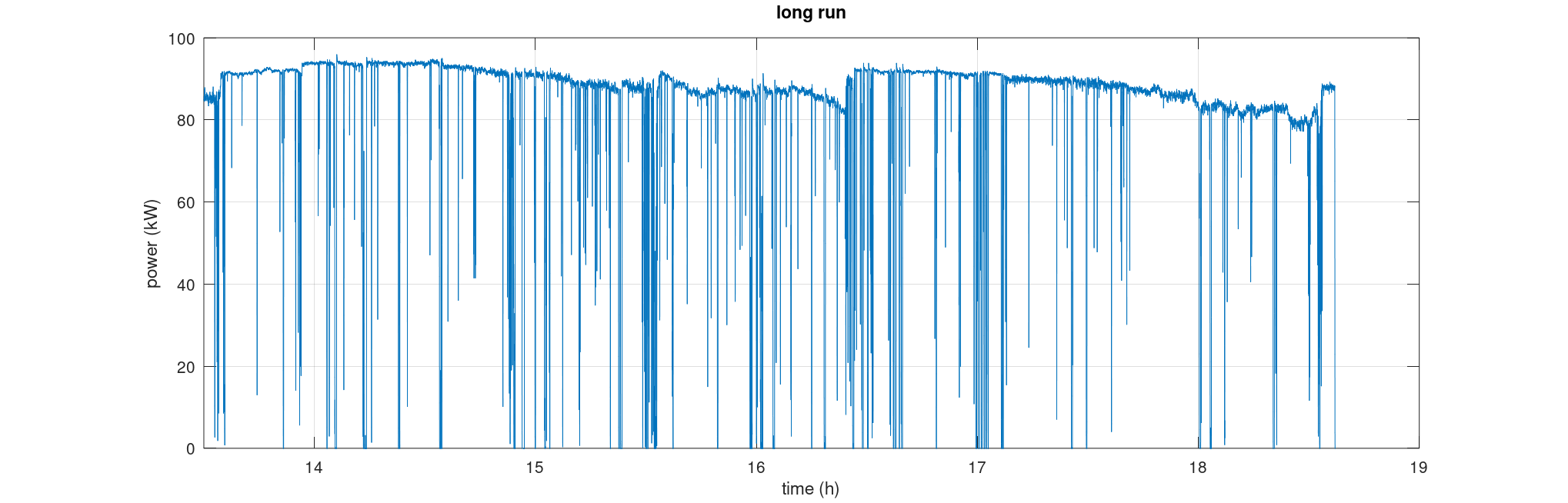 |
|
452
|
Tue Sep 16 17:41:28 2025 |
Ronic Chiche | Fixed | info | mechanics | lasers and optics | detectors and electronics | ThomX igloo | Accelerometer measurement | with Daniele, we placed the accelerometer on top of the fiber amplifier box which is inside the housing.
the goal was to try to detect a correlation with some possible accoustic noise coming from the bubbles of the water, cooling the amplifier box baseplate.
we monitored a long trend of the transmission which is perturbated when high frequency noise arises, and the accelerometer signal.
the long trend plots only the peak-peak value of a full 1 second acquisition every 2 seconds during ~2500 pts equivalent to ~5000 seconds = 1h20
on the plot, the top white signal is the transmission pk-pk and the bottom red signal is the accelerometer pk-pk.
we don't see any correlation except at 600-700 pts because Daniele entered the bunker and slightly knock on the bottom of the optical table several times.
and at 1950-2300 pts, because he opened the housing (much more noise recorded by the accelerometer) and then it close it again.
he also try to knock on the amplifier controller rack which is placed on the ground, below the table, but he didn't see any correlation with some cavity lock losses.
=> no clear conclusion.
except that the noise seen on the transmission when the housing is open is close to the "high frequency noise" we observe... could it be some accoustic noise coming from elsewhere ? |
| Attachment 1: Capture.JPG
| 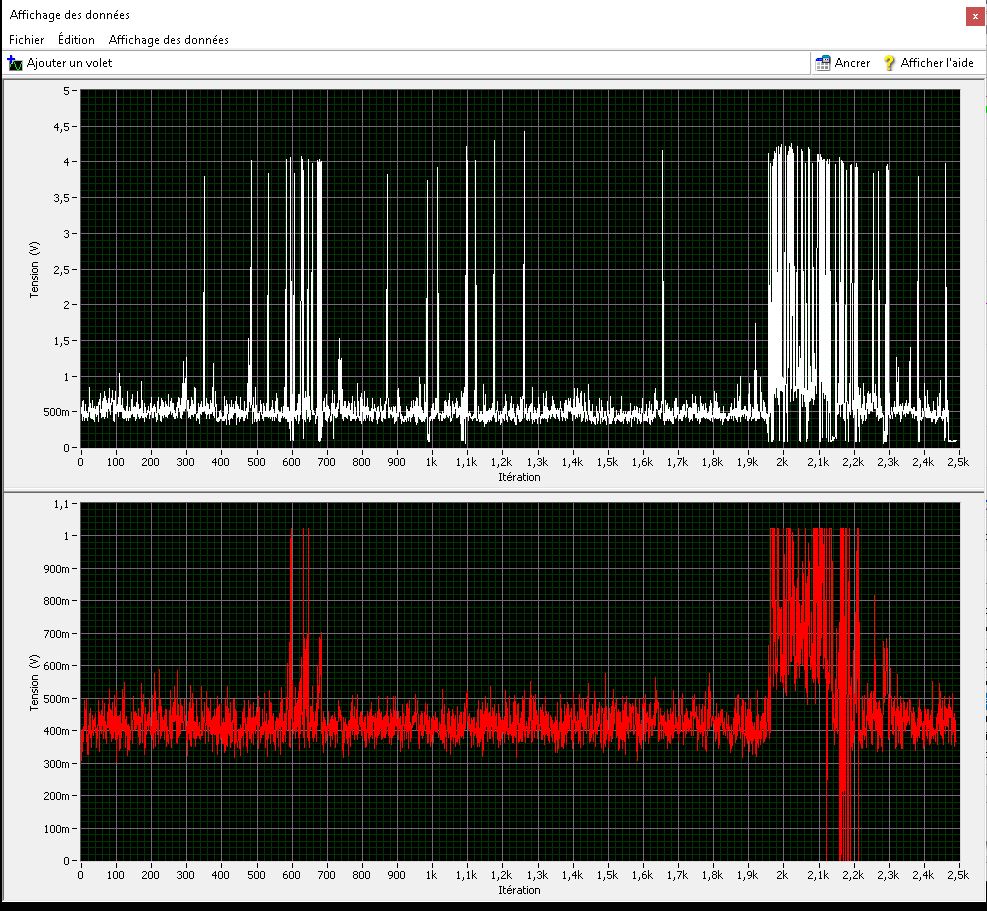 |
|
22
|
Tue Mar 26 18:32:40 2019 |
Loïc Amoudry | Fixed | report | mechanics | lasers and optics | cabling | Optical room | Wires in laser path | There was some ceramic wires close to the beem path right before P4. We moved them away (we can imagine they could move again with vibration). |
| Attachment 1: before.jpg
| 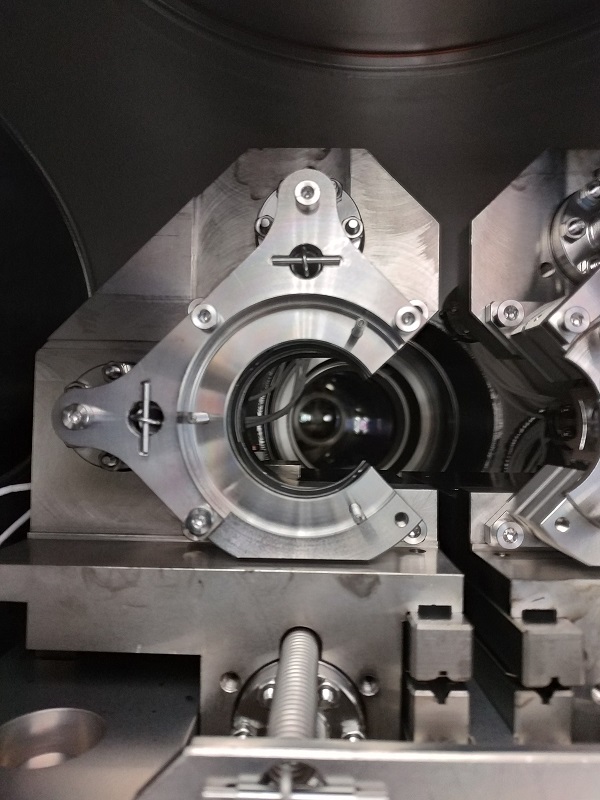 |
| Attachment 2: after_wire_displaced.jpg
| 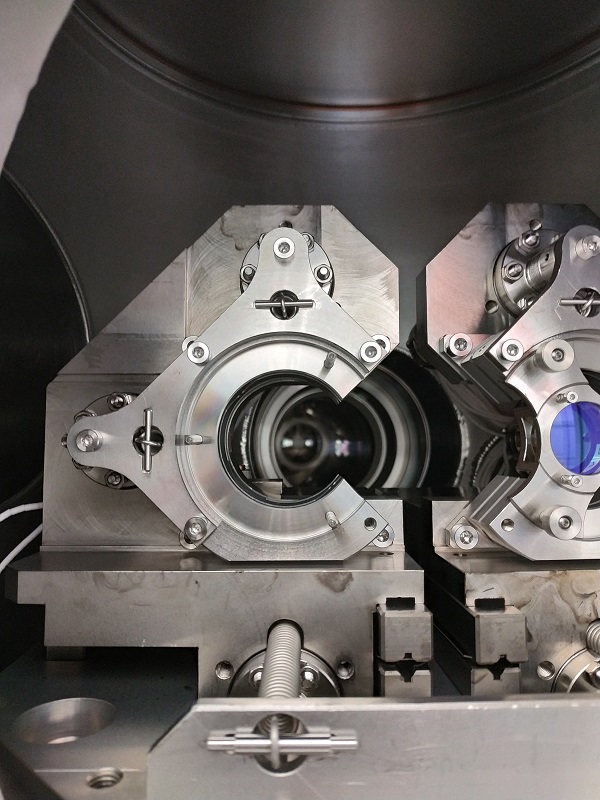 |
|
316
|
Thu Jan 25 10:15:28 2024 |
Ronic Chiche | Fixed | info | mechanics | lasers and optics | cabling | ThomX igloo | controller M1 & M4 (plan mirrors) with IcePap controllers | previously, we have connected motor M4 with an IcePap controller.
see this post : https://elog.lal.in2p3.fr/FPC/THOMX+commissioning/278
due to the backlash behavior of the FP-cavity motors, it is impossible to work in both directions on one motor when the FP-cavity is locked.
so, we decided to use also the motor M1 to work in the other direction.
then, normally M1 will work in one direction and M4 in the other direction.
motor M1 (or P1Z) which was on the axis 9 on the ISP controller has been assigned to OC/OP/OCH.01-MOT.06
motor M4 (or P4Z) which was on the axis 12 on the ISP controller has been assigned to OC/OP/OCH.01-MOT.03
|
|
317
|
Thu Jan 25 12:45:41 2024 |
Ronic Chiche | Fixed | info | mechanics | lasers and optics | cabling | ThomX igloo | controller M1 & M4 (plan mirrors) with IcePap controllers | this double motors scheme works good.
if motor P4 is used by increasing value, the FP-cavityPZT signal (pink signal on scope) goes HIGHER
if motor P1 is used by increasing value, the FP-cavityPZT signal (pink signal on scope) goes LOWER
!!! CAREFUL !!!
after each session, it is mandatory to put the motors back to their initial position to avoid FP-cavity misalignment.
on P1 : - 900 000 steps
on P4 : - 360 000 steps
| Ronic Chiche wrote: |
|
previously, we have connected motor M4 with an IcePap controller.
see this post : https://elog.lal.in2p3.fr/FPC/THOMX+commissioning/278
due to the backlash behavior of the FP-cavity motors, it is impossible to work in both directions on one motor when the FP-cavity is locked.
so, we decided to use also the motor M1 to work in the other direction.
then, normally M1 will work in one direction and M4 in the other direction.
motor M1 (or P1Z) which was on the axis 9 on the ISP controller has been assigned to OC/OP/OCH.01-MOT.06
motor M4 (or P4Z) which was on the axis 12 on the ISP controller has been assigned to OC/OP/OCH.01-MOT.03
|
|
|