| ID |
Date |
Author |
Status |
Type |
Category |
Location |
Title |
|
392
|
Wed Jan 8 16:08:59 2025 |
Ronic Chiche | Under Process | info | lasers and optics | detectors and electronics | cabling | ThomX igloo | CEM noise measurements |
This afternoon, we started almost all the parts of the machine with Vincent and Nicolas, and we didn't see any change in the Loop noise signal.
we saw only a peak comb at 10Hz on the Loop noise signal when the septum is ON. the amplitude of the peaks is then related to the voltage on the septum.
but we still don't see any noise correlation on the PZT signal.
the global conclusion about CEM noise is it is not related to laser PZT noise.
if the 20Hz oscillation is coming from a mechanical unstability in the CFP, we should be able to trigger it by moving the longitudinal motors of the CFP.
we tried also to move the MOT.03 and MOT.06 motors and we didn't see any clear correlation with the 20Hz oscillation.
the 20Hz oscillation could come from the CTA pressure variations on the housing => we can try to trigger the oscillation on the housing.
| Ronic Chiche wrote: |
|
The goal of these measurements is to check if one can find some correlation between the CFP lock losses observed during a run and some CEM noise in the bunker.
the main issue is coming from a 20Hz noise apearing/disapearing in the laser cavity PZT signal.
is it a real cavity length noise that must be compensated or is it a pickup noise in the error signal which produce some unwanted compensation ?
the second issue (apearing much less often) is a higher frequency noise visible mainly in the transmission signal of the CFP which becomes wider and noisy during 1-2 seconds.
This morning, I installed a simple wire loop all around the table (the machine is OFF).
this wire is connected to the wire of a BNC connector at one end and to the ground of the same BNC connector at the other end to form a loop.
this BNC connector is connected to a 1kHz low pass filter to remove high frequency CEM noises and connected to a 10-1000 variable gain amplifier, plugged to the CH3 of the CFP scope (instead of the PDH/PZT-CAV signal).
I locked the CFP above 80kW after tuning the CEP.
I took several pictures to illustrate what I observed :
- on the right, the scope signal in time domain (blue = TRANS / green = PZT laser / cyan = REFLECT / pink = LOOP noise)
- on the left, the spectral analysis in frequency domain (red = PZT laser / white = LOOP noise)
in these 3 measurements, I don't do anything to the CFP, I just wait for the signals.
1) normal condition : see picture "Without Noise @ 20Hz"
the PZT signal in time domain is relatively flat and the 20Hz noise is barely visible in frequency domain.
we don't see any correlation with the LOOP noise for which one can see clear 50Hz and 100Hz peaks.
2) 20Hz noise condition : see picture "With Noise @ 20Hz"
the PZT signal in time and frequency domain exhibit a clear 20Hz oscillation.
the REFLECT and TRANS signals are also correlated to this 20Hz oscillation.
but still no correlation with the LOOP noise in time or frequency domain.
3) 20Hz noise lock loss condition : see picture "Delock @ 20Hz"
because of the lock loss the spectral analysis of the PZT signal is meaningless,
but in time domain, one can clearly see the growth of the 20Hz signal, inducing large noise on TRANS and REFLECT signal but still no correlation with the LOOP noise.
Conclusion : the 20Hz noise seems not related to any CEM noisy signal but more probably to a real mechanical noise in the CFP (not in the laser cavity because it would be seen in the phase noise measurements).
in this measurement, I tried to produce a tone around 400Hz with my voice, close to the FP cavity.
it is difficult to right volume as the cavity can easily lose the lock.
4) Voice noise condition : see picture "Voice noise @ 400Hz"
here, I changed the spectral span to 500Hz.
one can see a small bump in frequency domain around 400Hz due to the accoustic noise in the PZT signal.
the general shape of the PZT spectral signal is maybe related to the PID parameters : one can see more signal at lower frequencies.
in time domain, one can see TRANS and REFLECT signals are more noisy than before and these signals shapes seems identical to what has been observed when one has lock loss due to high frequency noise.
maybe we could put a mic in the bunker, connected to one scope to check if sometime one doesn't have much more accoustic noise...
|
|
|
27
|
Tue Apr 2 18:05:46 2019 |
Loïc Amoudry | Fixed | info | lasers and optics | Optical room | Beam size at closest spherical mirrors position |
S3 and S2 @ +1 640 000 and P1 and P4 @ -825 000
Diameter in x: 4.7mm
Diameter in y: 4.7mm |
|
18
|
Tue Mar 19 16:35:32 2019 |
Loïc Amoudry | Fixed | report | lasers and optics | Optical room | Beam size and finesse |
FSR initiale : 33.34 MHz (S3 = -825000 et S4 = -825000)
Beam size initiale : wx=2.05mm et wy=2.15mm
Finesse initiale : 3400
FSR après éloignement des miroirs sphériques : 33.29 MHz (S3 ~= -1496000 et S4 ~= -1496000)
Beam size : wx=1.7mm et wy=1.85mm
Finesse : 3600
FSR après rapprochement des miroirs sphériques : 33.39 MHz (S3 ~= -250000 et S4 ~= -500000)
Beam size : wx = 2.1mm et wy=2.4mm
Fit de la caméra jamais au dessus de 90%. ~~80%. |
|
103
|
Fri Nov 6 14:23:16 2020 |
Loïc Amoudry | Fixed | report | lasers and optics | Optical room | Beam size and finesse |
Measurement behind P4 (planar mirror)
| Loïc Amoudry wrote: |
|
FSR initiale : 33.34 MHz (S3 = -825000 et S4 = -825000)
Beam size initiale : wx=2.05mm et wy=2.15mm
Finesse initiale : 3400
FSR après éloignement des miroirs sphériques : 33.29 MHz (S3 ~= -1496000 et S4 ~= -1496000)
Beam size : wx=1.7mm et wy=1.85mm
Finesse : 3600
FSR après rapprochement des miroirs sphériques : 33.39 MHz (S3 ~= -250000 et S4 ~= -500000)
Beam size : wx = 2.1mm et wy=2.4mm
Fit de la caméra jamais au dessus de 90%. ~~80%.
|
|
|
88
|
Fri Feb 7 14:46:55 2020 |
Ronic Chiche | Fixed | report | lasers and optics | Optical room | Beam pulse duration |
We installed the 2 CVBG for compression after the amplifier.
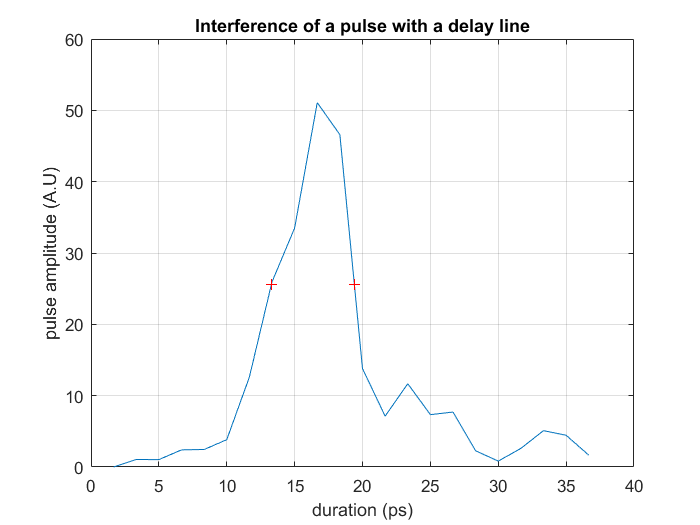
We used an interferometric technique with a delay line and combining the two paths in a CCD to measure interferences... see interferences.avi video file
One can notice some misalignement at the end of the video.
After supressing the global shape of the superposed pulses, one measures the amplitude of the remaining fringes (peak-peak or standard deviation) each 250µm of the delay line (500µm of round-trip). one gets the interferences pulse shape with a FWHM of 6ps...
It seems that an 'after pulse' is visible in the interferences.
An other meausurement using a 2 photons photodiode will be used to confirm this measurement.
|
| Attachment 1: interferences.avi
|
| Attachment 2: pulse_duration.png
|
 |
|
89
|
Wed Feb 12 17:43:43 2020 |
Ronic Chiche | Fixed | report | lasers and optics | Optical room | Beam pulse duration |
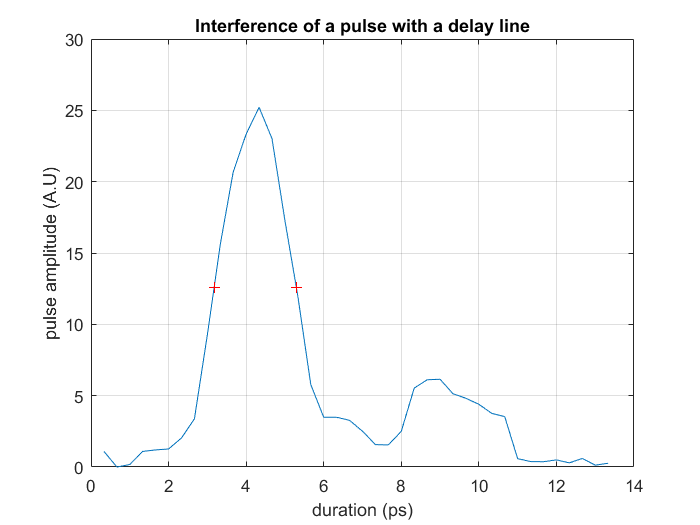
Yesterday, Loic installed a telescope before CVBG's to reduce the spot size on CVBG's and reduced the incident angle 0.5-1° on them (on the datasheet the specified incident angle is 2.8°).
We used an interferometric technique with a delay line and combining the two paths in a CCD to measure interferences.
After supressing the global shape of the superposed pulses, one measures the amplitude of the remaining fringes (standard deviation) each 50µm of the delay line (100µm of round-trip). one gets the interferences pulse shape with a FWHM of 2 ps... (see curve)
we still see an 'after pulse'.
if the pulse is 1ps long and 100kW is stored in the cavity, it means 3GW peak for the whole beam... it is comparable with the damage threshold of the mirror !!!
| Ronic Chiche wrote: |
|
We installed the 2 CVBG for compression after the amplifier.
We used an interferometric technique with a delay line and combining the two paths in a CCD to measure interferences... see interferences.avi video file
One can notice some misalignement at the end of the video.
After supressing the global shape of the superposed pulses, one measures the amplitude of the remaining fringes (peak-peak or standard deviation) each 250µm of the delay line (500µm of round-trip). one gets the interferences pulse shape with a FWHM of 6ps...
It seems that an 'after pulse' is visible in the interferences.
An other meausurement using a 2 photons photodiode will be used to confirm this measurement.
|
|
| Attachment 1: pulse_width.png
|
 |
|
90
|
Fri Feb 14 09:26:07 2020 |
Ronic Chiche | Fixed | report | lasers and optics | Optical room | Beam pulse duration |
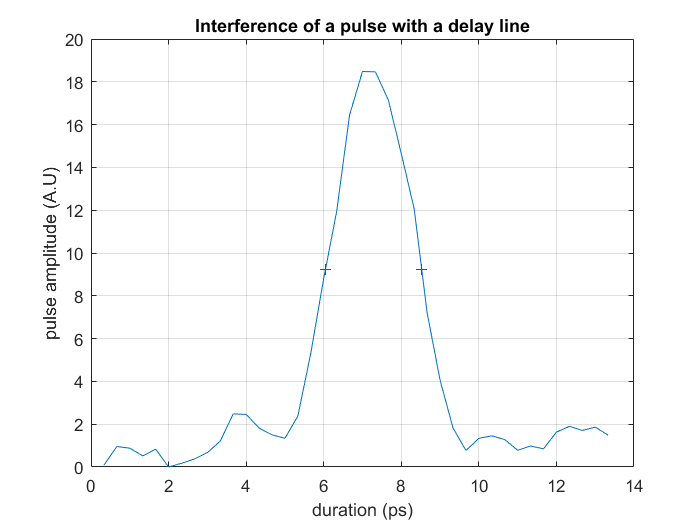
Yesterday, Loïc put the CVBG's back to their specified angles.
We used an interferometric technique with a delay line and combining the two paths in a CCD to measure interferences.
After supressing the global shape of the superposed pulses, one measures the amplitude of the remaining fringes (standard deviation) each 50µm of the delay line (100µm of round-trip). one gets the interferences pulse shape with a FWHM of 2.5 ps... (see curve)
from Fabian calculation, at 100kW, with w=2mm, the fluence on mirror should be around 0.05J/cm^2.
from this article (https://www.sciencedirect.com/science/article/pii/S0030402618313275), the damage threshold for SiO2/Ta2O5 multilayers should be around 4.8J/cm^2 @ 1030nm
| Ronic Chiche wrote: |
|
Yesterday, Loic installed a telescope before CVBG's to reduce the spot size on CVBG's and reduced the incident angle 0.5-1° on them (on the datasheet the specified incident angle is 2.8°).
We used an interferometric technique with a delay line and combining the two paths in a CCD to measure interferences.
After supressing the global shape of the superposed pulses, one measures the amplitude of the remaining fringes (standard deviation) each 50µm of the delay line (100µm of round-trip). one gets the interferences pulse shape with a FWHM of 2 ps... (see curve)
we still see an 'after pulse'.
if the pulse is 1ps long and 100kW is stored in the cavity, it means 3GW peak for the whole beam... it is comparable with the damage threshold of the mirror !!!
| Ronic Chiche wrote: |
|
We installed the 2 CVBG for compression after the amplifier.
We used an interferometric technique with a delay line and combining the two paths in a CCD to measure interferences... see interferences.avi video file
One can notice some misalignement at the end of the video.
After supressing the global shape of the superposed pulses, one measures the amplitude of the remaining fringes (peak-peak or standard deviation) each 250µm of the delay line (500µm of round-trip). one gets the interferences pulse shape with a FWHM of 6ps...
It seems that an 'after pulse' is visible in the interferences.
An other meausurement using a 2 photons photodiode will be used to confirm this measurement.
|
|
|
| Attachment 1: interferences_pulse_duration.png
|
 |
|
94
|
Mon Feb 24 16:28:52 2020 |
Ronic Chiche | Fixed | report | lasers and optics | Optical room | Beam pulse duration |
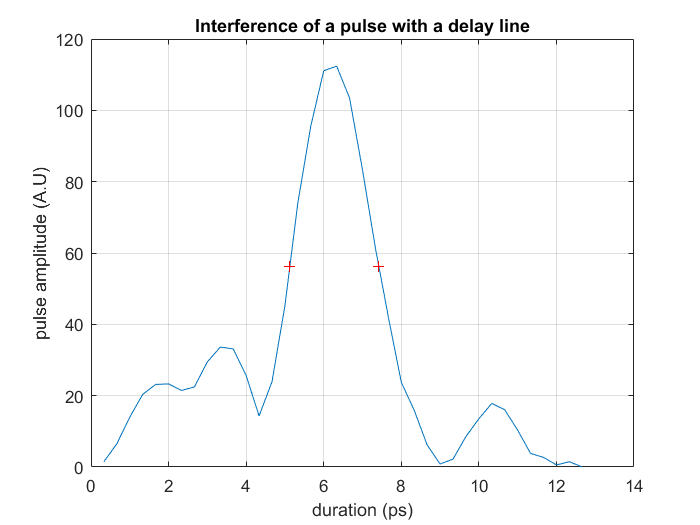
Last Thursday (20th of February), Loïc and Titouan realigned the stretcher CVBG to its nominal angle and they used an interferometric technique with a delay line and combining the two paths in a CCD to measure interferences.
After supressing the global shape of the superposed pulses, one measures the amplitude of the remaining fringes (standard deviation) each 50µm of the delay line (100µm of round-trip).
one gets the interferences pulse shape with a FWHM of 2.3 ps... (see curve)
| Ronic Chiche wrote: |
|
Yesterday, Loïc put the CVBG's back to their specified angles.
We used an interferometric technique with a delay line and combining the two paths in a CCD to measure interferences.
After supressing the global shape of the superposed pulses, one measures the amplitude of the remaining fringes (standard deviation) each 50µm of the delay line (100µm of round-trip). one gets the interferences pulse shape with a FWHM of 2.5 ps... (see curve)
from Fabian calculation, at 100kW, with w=2mm, the fluence on mirror should be around 0.05J/cm^2.
from this article (https://www.sciencedirect.com/science/article/pii/S0030402618313275), the damage threshold for SiO2/Ta2O5 multilayers should be around 4.8J/cm^2 @ 1030nm
| Ronic Chiche wrote: |
|
Yesterday, Loic installed a telescope before CVBG's to reduce the spot size on CVBG's and reduced the incident angle 0.5-1° on them (on the datasheet the specified incident angle is 2.8°).
We used an interferometric technique with a delay line and combining the two paths in a CCD to measure interferences.
After supressing the global shape of the superposed pulses, one measures the amplitude of the remaining fringes (standard deviation) each 50µm of the delay line (100µm of round-trip). one gets the interferences pulse shape with a FWHM of 2 ps... (see curve)
we still see an 'after pulse'.
if the pulse is 1ps long and 100kW is stored in the cavity, it means 3GW peak for the whole beam... it is comparable with the damage threshold of the mirror !!!
| Ronic Chiche wrote: |
|
We installed the 2 CVBG for compression after the amplifier.
We used an interferometric technique with a delay line and combining the two paths in a CCD to measure interferences... see interferences.avi video file
One can notice some misalignement at the end of the video.
After supressing the global shape of the superposed pulses, one measures the amplitude of the remaining fringes (peak-peak or standard deviation) each 250µm of the delay line (500µm of round-trip). one gets the interferences pulse shape with a FWHM of 6ps...
It seems that an 'after pulse' is visible in the interferences.
An other meausurement using a 2 photons photodiode will be used to confirm this measurement.
|
|
|
|
| Attachment 1: Interferences_pulse_width.png
|
 |
|
16
|
Thu Feb 14 18:20:52 2019 |
Loïc Amoudry | Fixed | report | mechanics | lasers and optics | Optical room | Basic alignment & alignment motors check |
14/02/19: The 4 motors but Mby control works. Mby motor home does not bring it to its "middle" position but to the end of its range. Issue circumvented using the higher rights software.
The beam is now going through the cavity windows (from P1 to S2). |
|
78
|
Wed Nov 13 14:44:56 2019 |
Loïc Amoudry | Fixed | report | lasers and optics | Optical room | Amplifier output power |
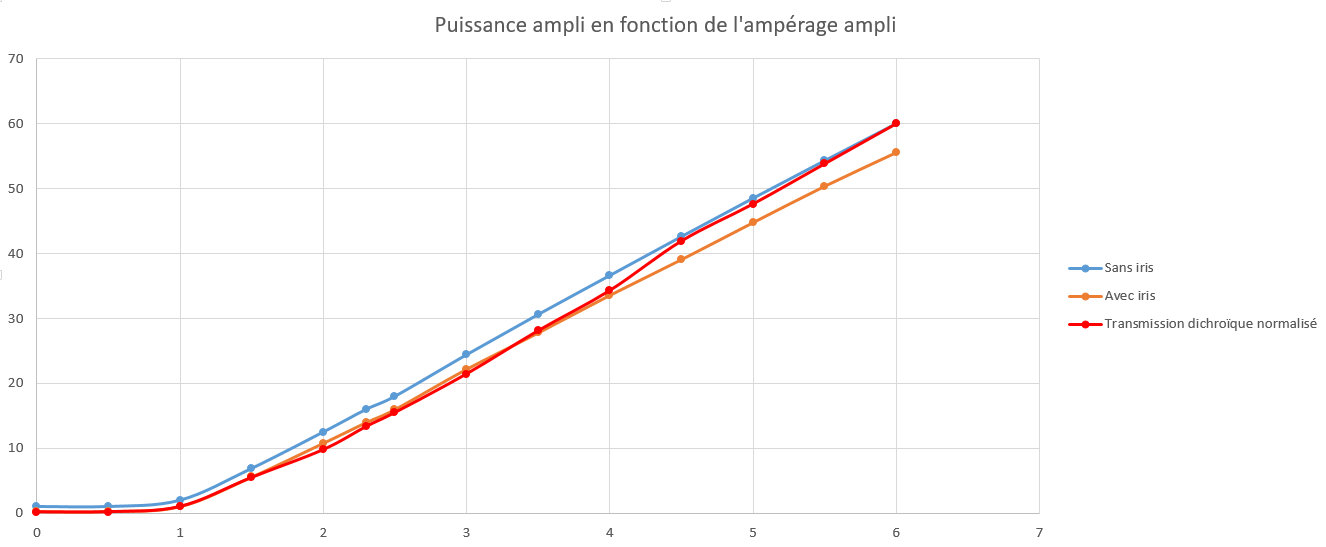
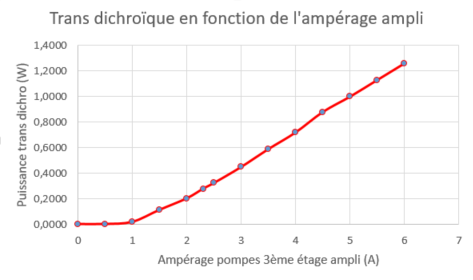
The ouput power of the ThomX amplifier has been measured as a function of the 3rd stage pumps current (0A is 1st and 2nd stage turned on).
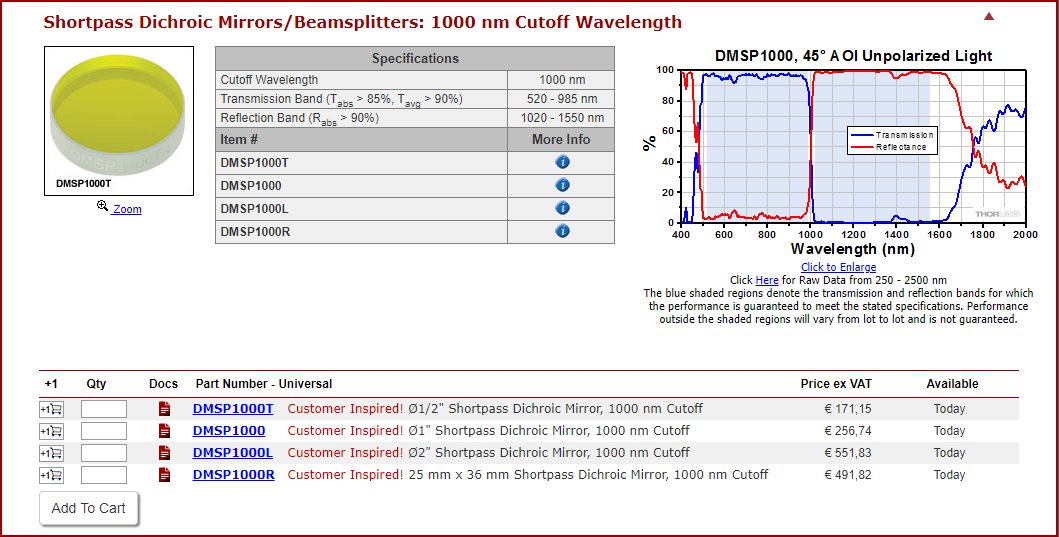
We measured the total power, the total power without the "donuts" pump signal dumped by an iris and the transmission of a dichroic mirror (for ref see image). |
| Attachment 1: dichroic.PNG
|
 |
| Attachment 2: courbe.PNG
|
 |
| Attachment 3: power.xlsx
|
|
79
|
Wed Nov 13 15:05:18 2019 |
Loïc Amoudry | Fixed | report | lasers and optics | Optical room | Amplifier output power |
| Loïc Amoudry wrote: |
|
The ouput power of the ThomX amplifier has been measured as a function of the 3rd stage pumps current (0A is 1st and 2nd stage turned on).
We measured the total power, the total power without the "donuts" pump signal dumped by an iris and the transmission of a dichroic mirror (for ref see image).
|
|
| Attachment 1: courbedichro.PNG
|
 |
|
154
|
Tue Aug 30 18:31:49 2022 |
Loïc Amoudry | Fixed | report | lasers and optics | Optical room | Amplifier output power |
We checked the Dichroic mirror we have : it is a DMSP1000 shortpass dichroic mirror as specified in this post.
The Arrow engraved on the edge of the mirror points on the AR surface !
not on the HR surface...
the AOI is 45°.
| Loïc Amoudry wrote: |
|
The ouput power of the ThomX amplifier has been measured as a function of the 3rd stage pumps current (0A is 1st and 2nd stage turned on).
We measured the total power, the total power without the "donuts" pump signal dumped by an iris and the transmission of a dichroic mirror (for ref see image).
|
|
|
40
|
Tue Jun 11 18:03:10 2019 |
Loïc Amoudry | Fixed | report | mechanics | lasers and optics | Other | Amplifier mission Bordeaux |
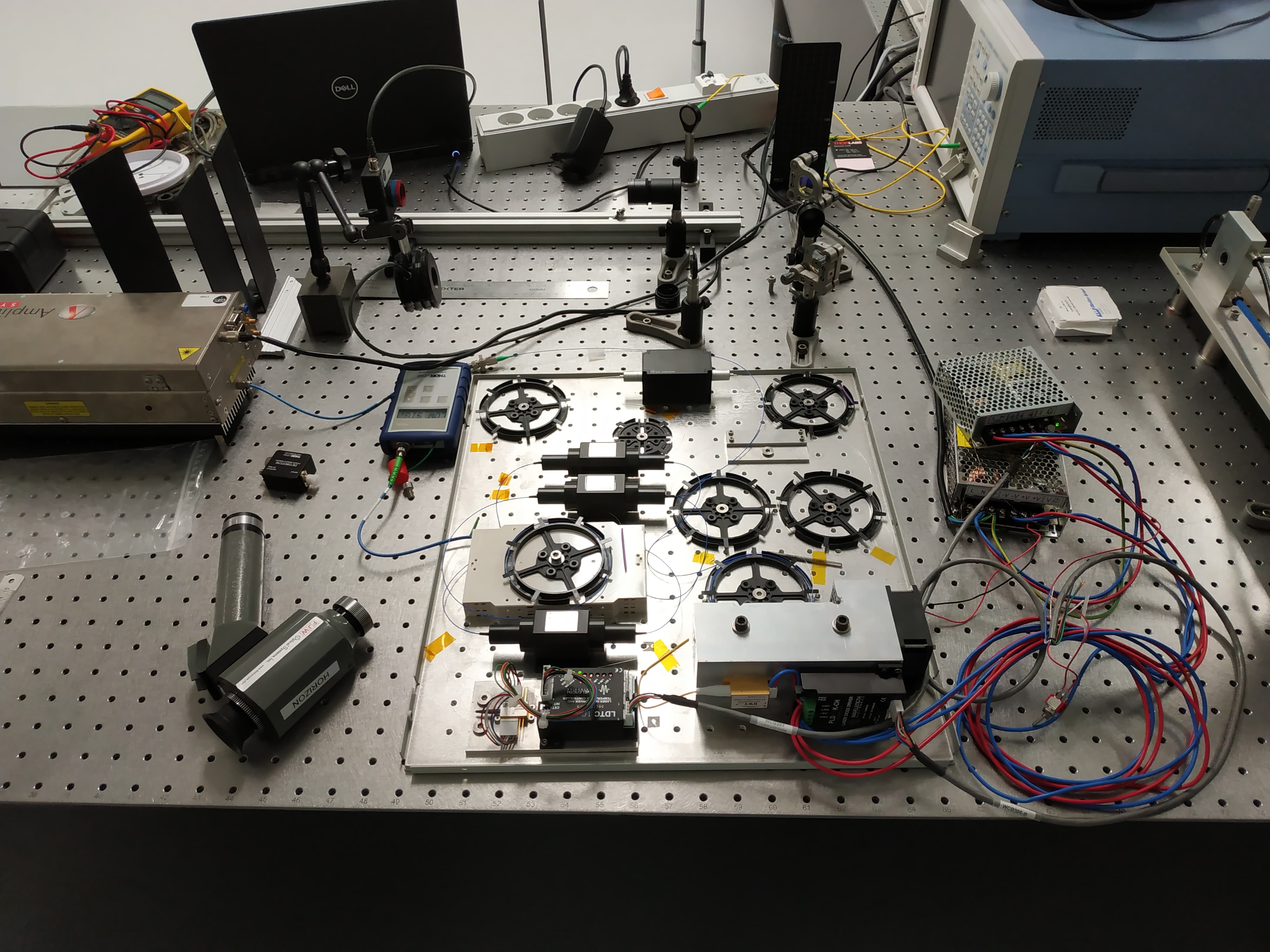
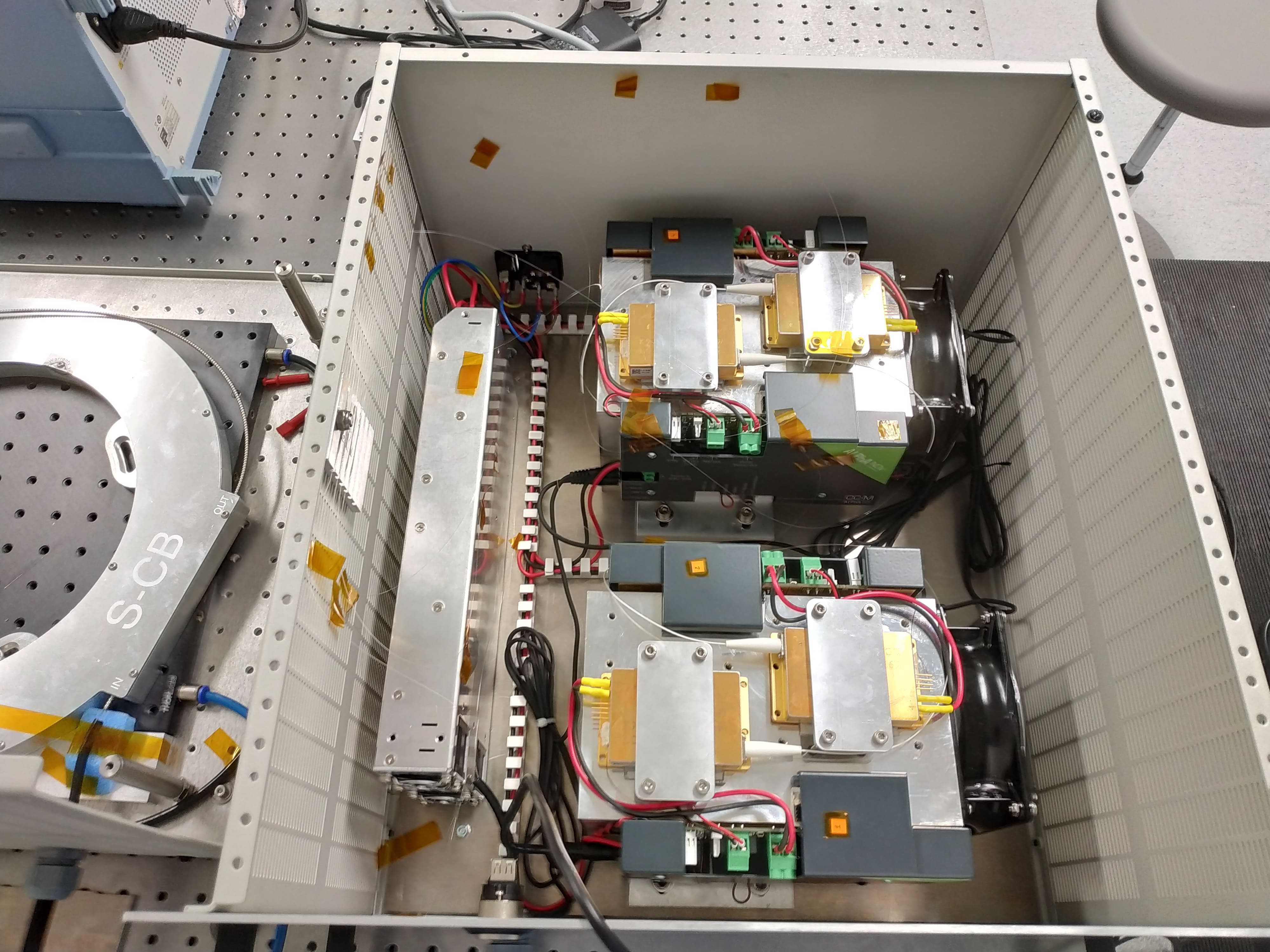
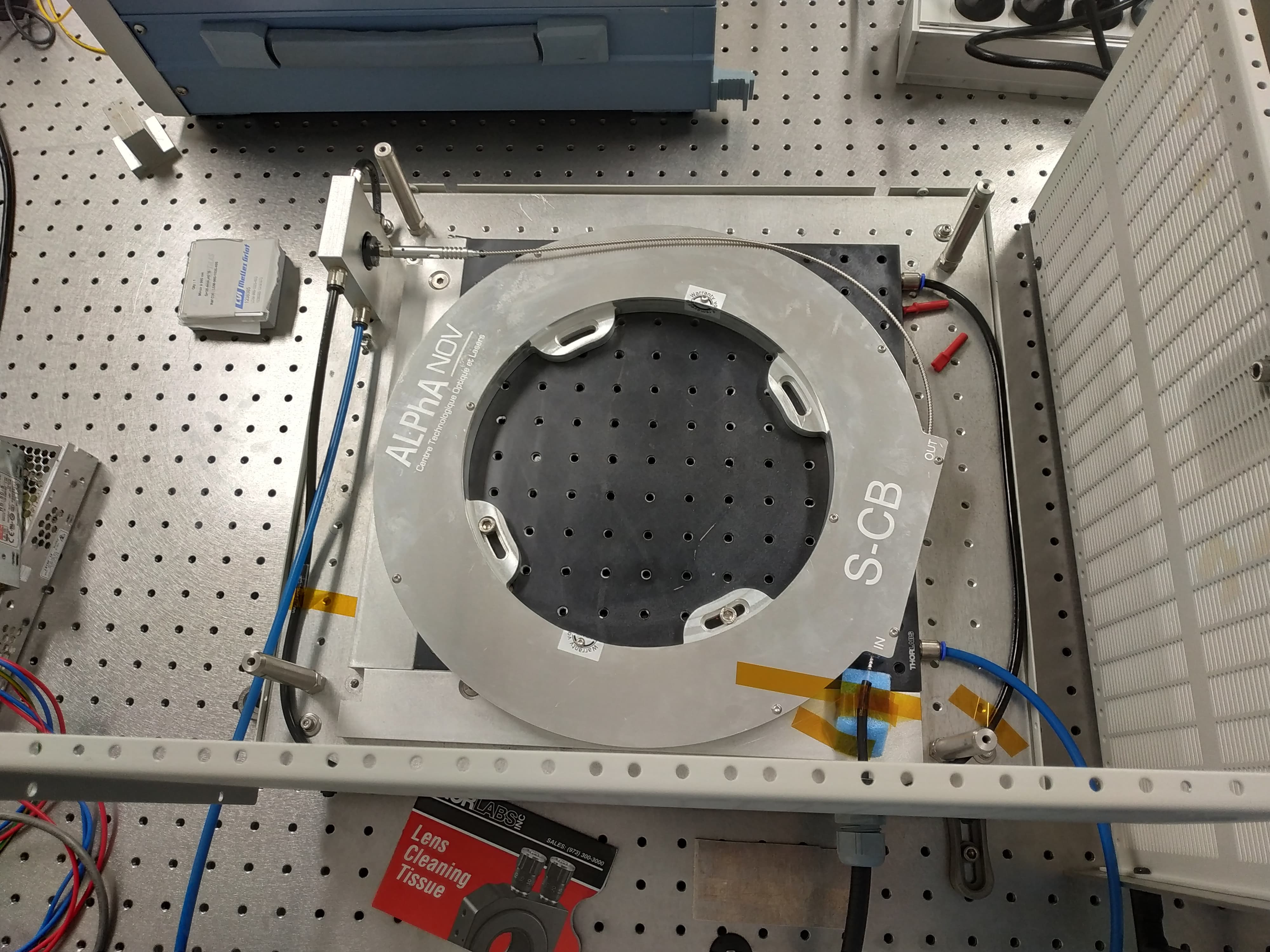
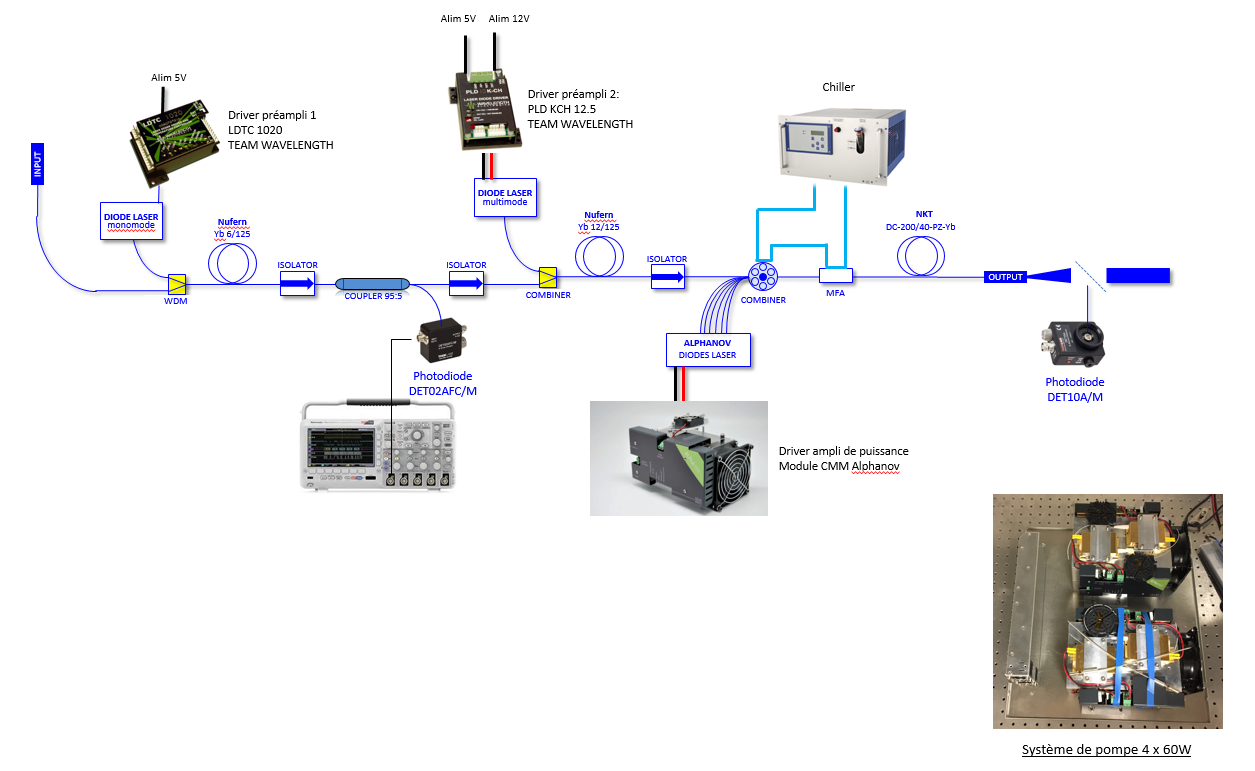
Voyage Bordeaux au CELIA avec Jérôme LHERMITE (Loïc et Titoutan)
1er jour (34°) :
Mesure du spectre et de la puissance des 4 diodes de pompe 3ème étage jusqu’à ~60W (12A).
Mécanique et câblage ampli.
2ème jour (30°) :
Soudure des fibres des diodes de pompe 3ème étage avec les fibres du recirculateur.
Câblage entre les 2 boitiers et fixation des fibres dans le boitier du 3ème étage.
3ème jour (26°) :
Connexion refroidissement à eau du recirculateur (chiller).
Soudure fibre CFBG avant 1er étage (temporaire pour faire des mesure).
Mise en place des éléments 1er et 2ème étage sur le support de l’ampli.
Montée en puissance 35W.
4ème jour :
Adaptation du mode de sortie en contrôlant la position de la fibre avant le collimateur.
Mesure de M².
|
| Attachment 1: 1st_and_2nd_stage.jpg
|
 |
| Attachment 2: 3rd_stage_pumps.jpg
|
 |
| Attachment 3: 3rd_stage_signal.jpg
|
 |
|
41
|
Wed Jun 12 12:07:11 2019 |
Loïc Amoudry | Fixed | report | mechanics | lasers and optics | Other | Amplifier mission Bordeaux |
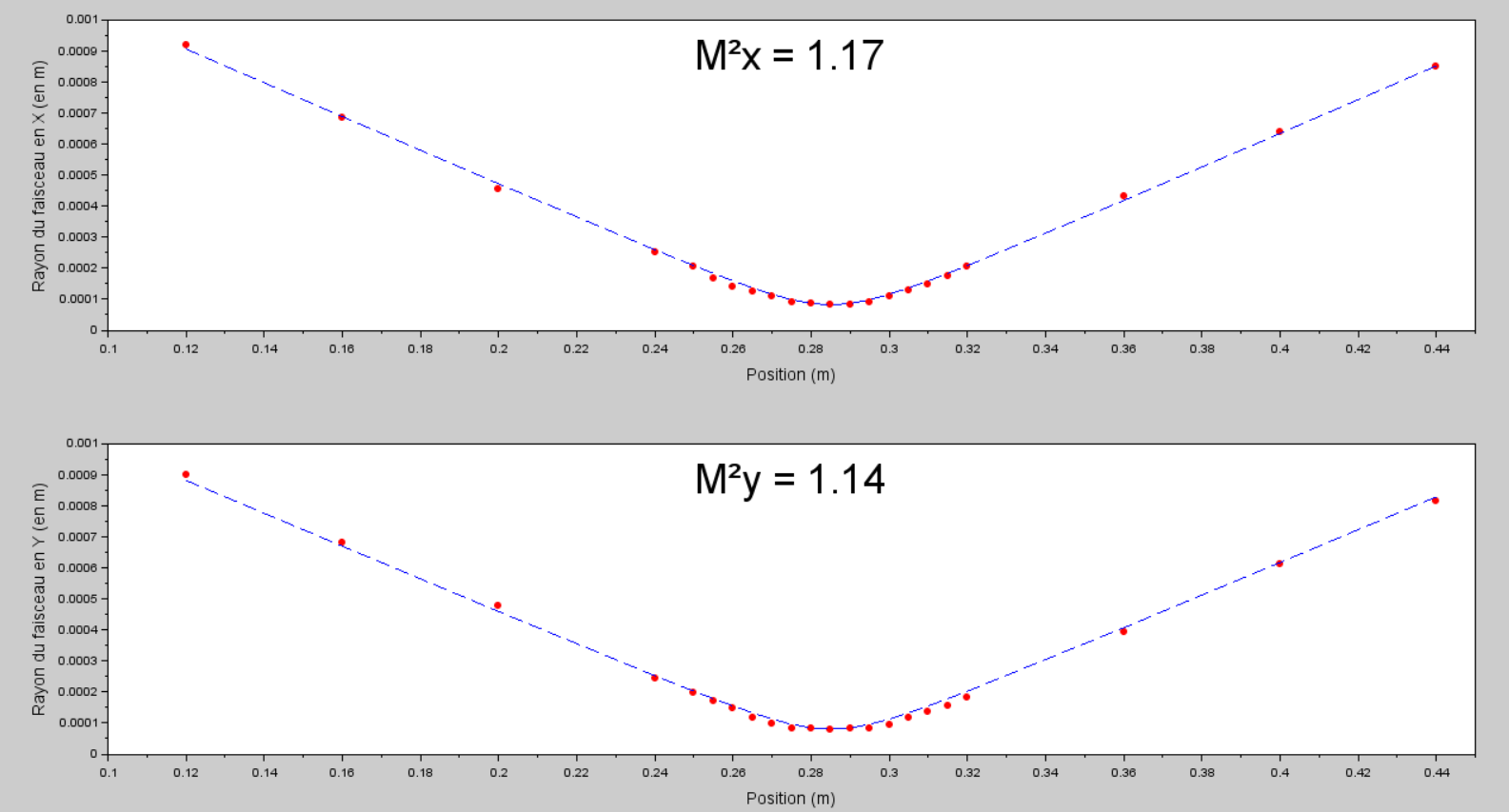
M² mesuré à 10W.
M²x = 1.17
M²y = 1.14
| Loïc Amoudry wrote: |
|
Voyage Bordeaux au CELIA avec Jérôme LHERMITE (Loïc et Titoutan)
1er jour (34°) :
Mesure du spectre et de la puissance des 4 diodes de pompe 3ème étage jusqu’à ~60W (12A).
Mécanique et câblage ampli.
2ème jour (30°) :
Soudure des fibres des diodes de pompe 3ème étage avec les fibres du recirculateur.
Câblage entre les 2 boitiers et fixation des fibres dans le boitier du 3ème étage.
3ème jour (26°) :
Connexion refroidissement à eau du recirculateur (chiller).
Soudure fibre CFBG avant 1er étage (temporaire pour faire des mesure).
Mise en place des éléments 1er et 2ème étage sur le support de l’ampli.
Montée en puissance 35W.
4ème jour :
Adaptation du mode de sortie en contrôlant la position de la fibre avant le collimateur.
Mesure de M².
|
|
| Attachment 1: Ampli_ThomX.PNG
|
 |
| Attachment 2: M2_ThomX.png
|
 |
|
98
|
Fri Feb 28 09:20:37 2020 |
Ronic Chiche | Not Fixed | issue | lasers and optics | Optical room | Amplifier laser diodes issue |
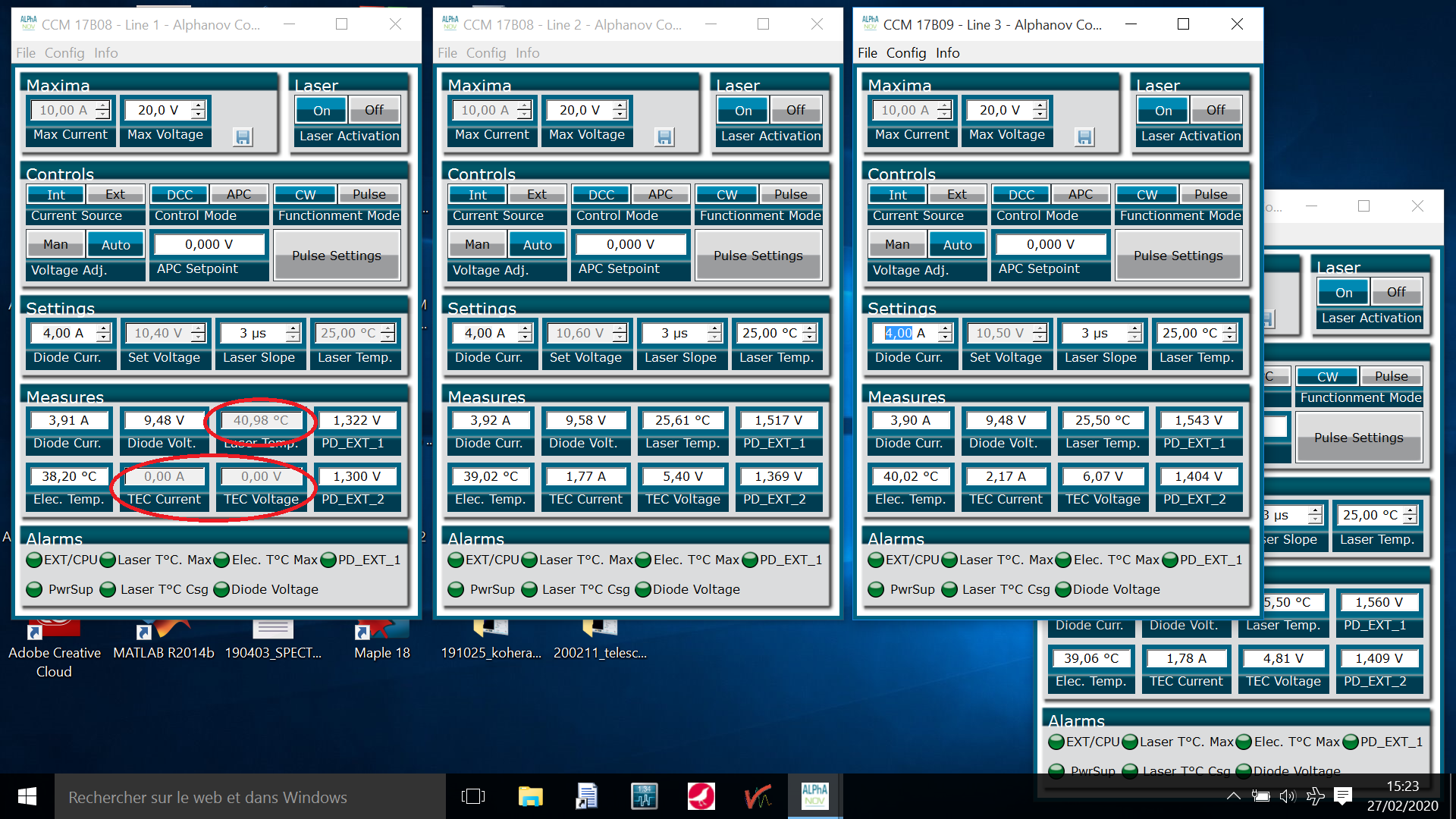
This is a long time issue for the ThomX amplifier : on the 4 pumping diodes available, the 1st diode has a higher temperature than the others around 40°C (see the picture).
the problem comes from the TEC which is not activated (see diodes parameter files in execel format). the related software windows are shaded.
I phoned to Jerome to ask him if one can securely activate the TEC, and he answered "yes".
but once the TEC is activated by loading parameters and modifying the line of the TEC activation, the temperature does'nt fall down as it seems the TEC does'nt work properly.
maybe it is not connected properly ? to be checked...
the result is, as the diode temperature is too high, an alarm is fired and the diode is deactivated... impossible to increase the current.
one has to deactivate the TEC and shut down electrically the amplifier to go back to the starting point.
Conclusion :
- the TEC of the diode 1 does'nt work properly.
- one can't activate it otherwise an alarm is fired and the diode is disabled.
- one should check the TEC connections in the amplifier |
| Attachment 1: Problem_TEC.PNG
|
 |
| Attachment 2: param_diode_1.csv
|
Current Max;10
Current Source;0
Current Slope;3
Laser Activation;1
Laser Temperature;25
DCDC Voltage;10.4
DCDC Voltage Mode;1
APC Mode;0
APC Power;0
Device 0;0
Device 1;0
Device 2;0
Voltage Max;20
Functionment Mode;0
Frequency;1
Pulse Width;100000
Init State;1
Fan Mode;1
Fan Voltage;0
TEC Activation;0
Laser Temperature Max;45
Case Temperature Min;10
Case Temperature Max;60
Potentiometer Calibration;5
Transimpedance Gain;2000
PD_EXT_1 Threshold;0
Serial Number;1708
Software Type;1
Software Version0;3
Software Version1;3
Software Version2;0
Hardware Version0;3
Hardware Version1;1
Hardware Version2;0
Equipments0;4
Equipments1;1
Equipments2;0
Equipments3;0
|
| Attachment 3: param_diode_2.csv
|
Current Max;10
Current Source;0
Current Slope;3
Laser Activation;1
Laser Temperature;25
DCDC Voltage;10.6
DCDC Voltage Mode;1
APC Mode;0
APC Power;0
Device 0;0
Device 1;0
Device 2;0
Voltage Max;20
Functionment Mode;0
Frequency;1
Pulse Width;100000
Init State;1
Fan Mode;1
Fan Voltage;0
TEC Activation;1
Laser Temperature Max;45
Case Temperature Min;10
Case Temperature Max;60
Potentiometer Calibration;5
Transimpedance Gain;2000
PD_EXT_1 Threshold;0
Serial Number;1708
Software Type;1
Software Version0;3
Software Version1;3
Software Version2;0
Hardware Version0;3
Hardware Version1;1
Hardware Version2;0
Equipments0;4
Equipments1;1
Equipments2;0
Equipments3;0
|
|
195
|
Tue Mar 14 16:54:48 2023 |
Manar Amer | Fixed | report | lasers and optics | detectors and electronics | ThomX igloo | Amplifier Beam Profile over time |
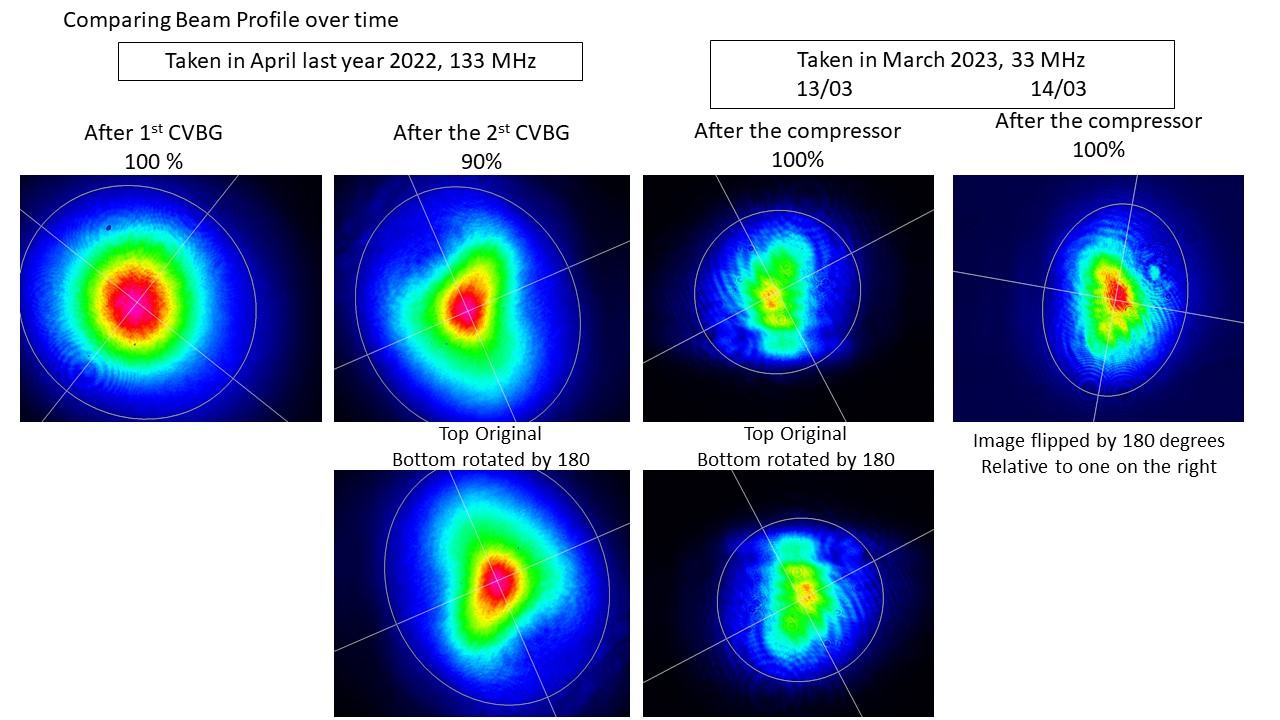
This morning, with Ronic, we opened the compressor box to observe if there is any misalignment of the mounts or the CVBG's
a comparison slide between the Beam Profile over time and measurements we have taken, is included.
we noticed today that the images need a rotation, and I took the assumption we did not rotate last year and did the rotation of the previous images.
Comparing the last two images, they look slightly similar. but the one from last year is much better than the current one
(remembering it was taken, when we aligned the CVBG's and the chiller was @23, now the temperature is @25 for the chiller)
The image we took today is also better than the one from yesterday.
(we take the image when the compressor box is open)
|
| Attachment 1: comparision_Between_Beam_profile_over_time.jpg
|
 |
|
196
|
Wed Mar 15 21:13:07 2023 |
Manar Amer | Fixed | report | lasers and optics | detectors and electronics | ThomX igloo | Amplifier Beam Profile over time |
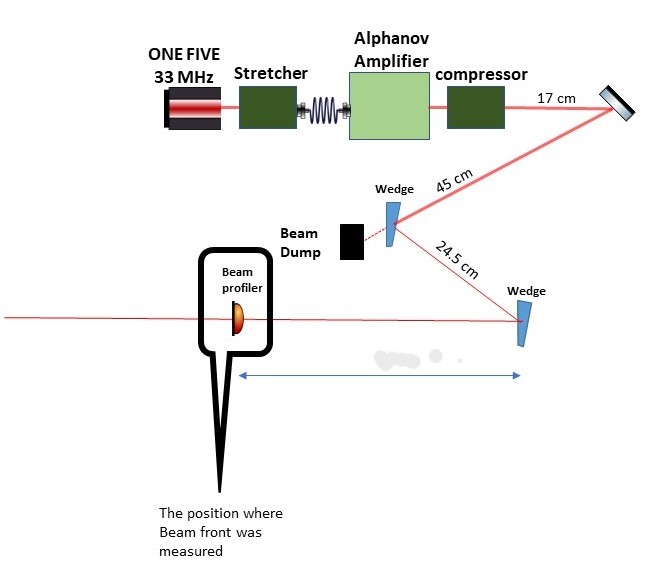
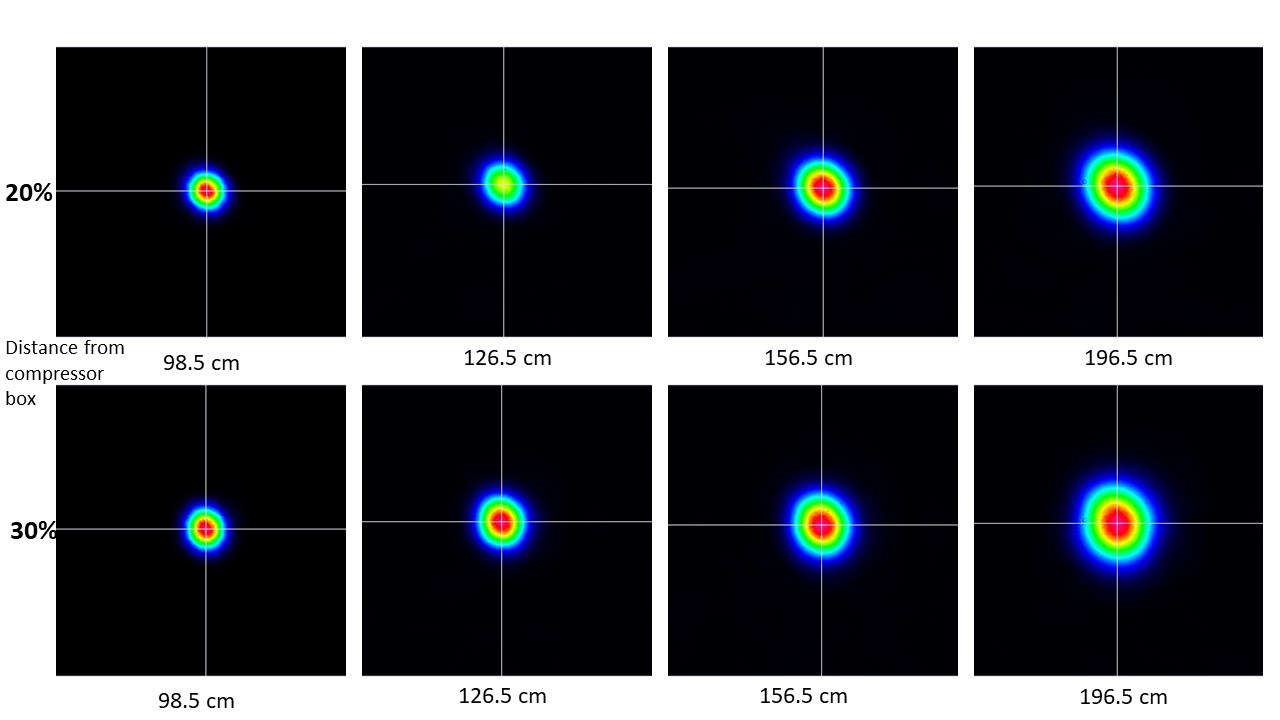
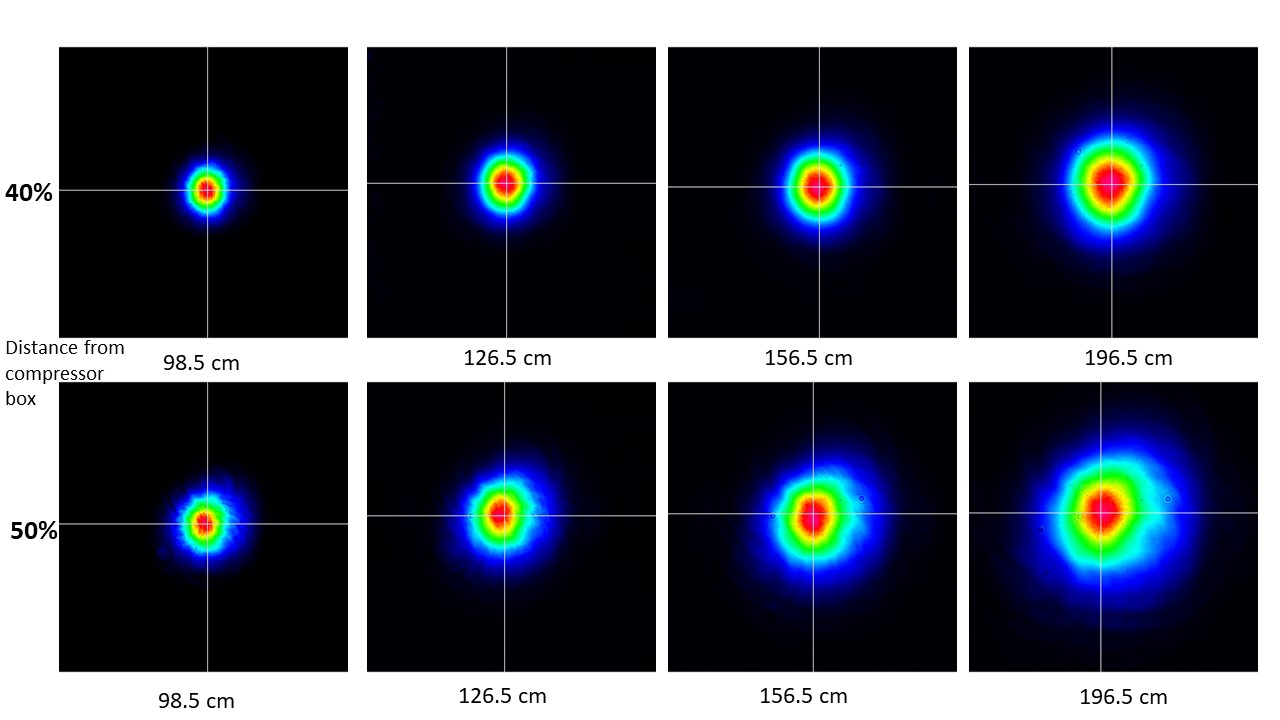
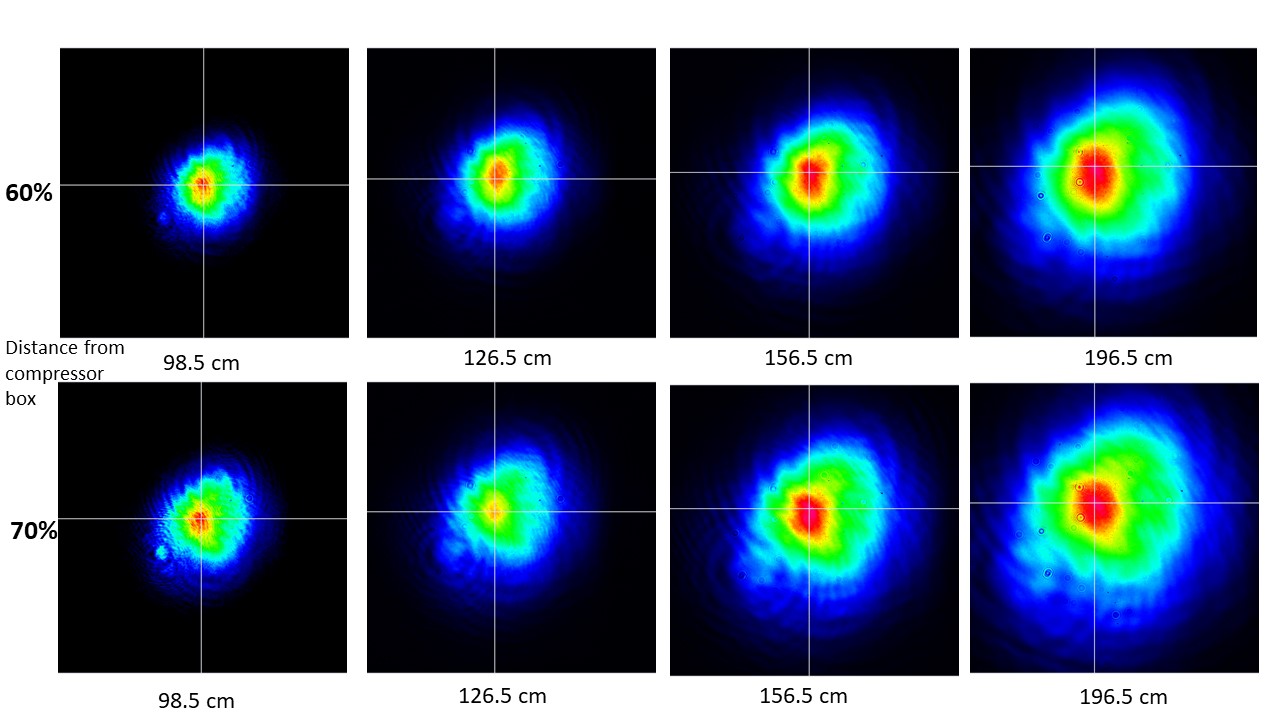
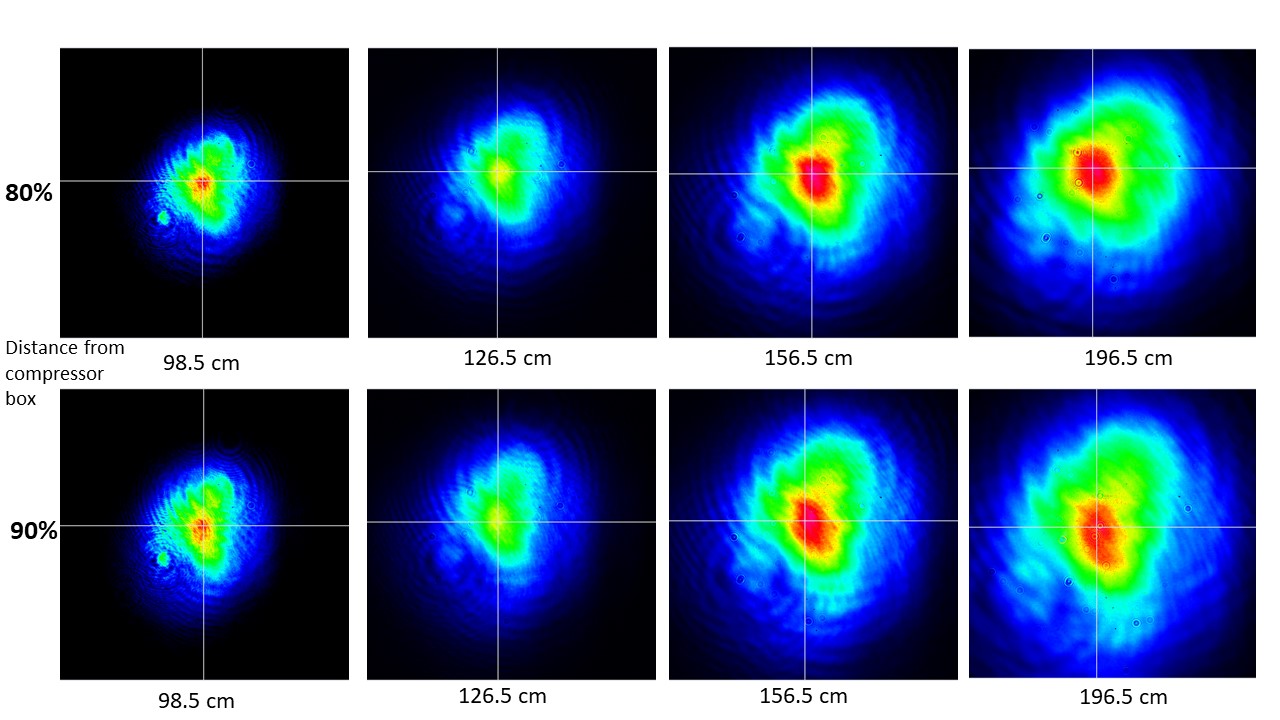
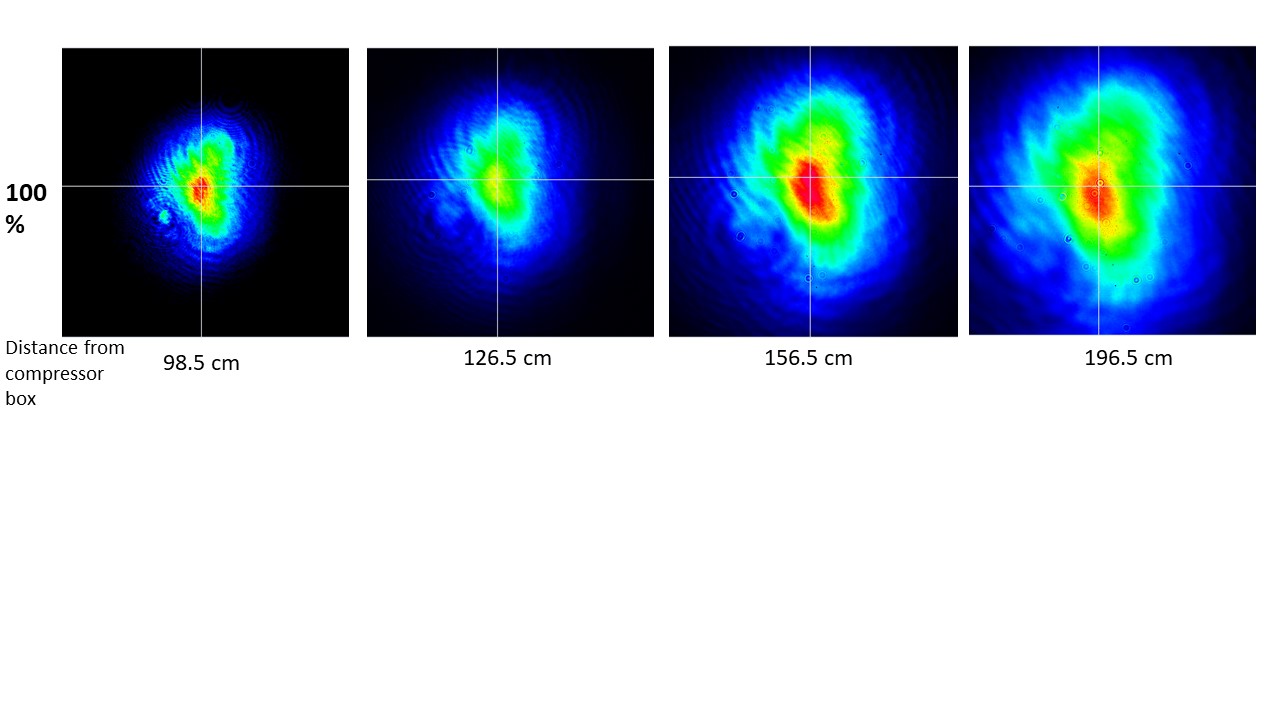
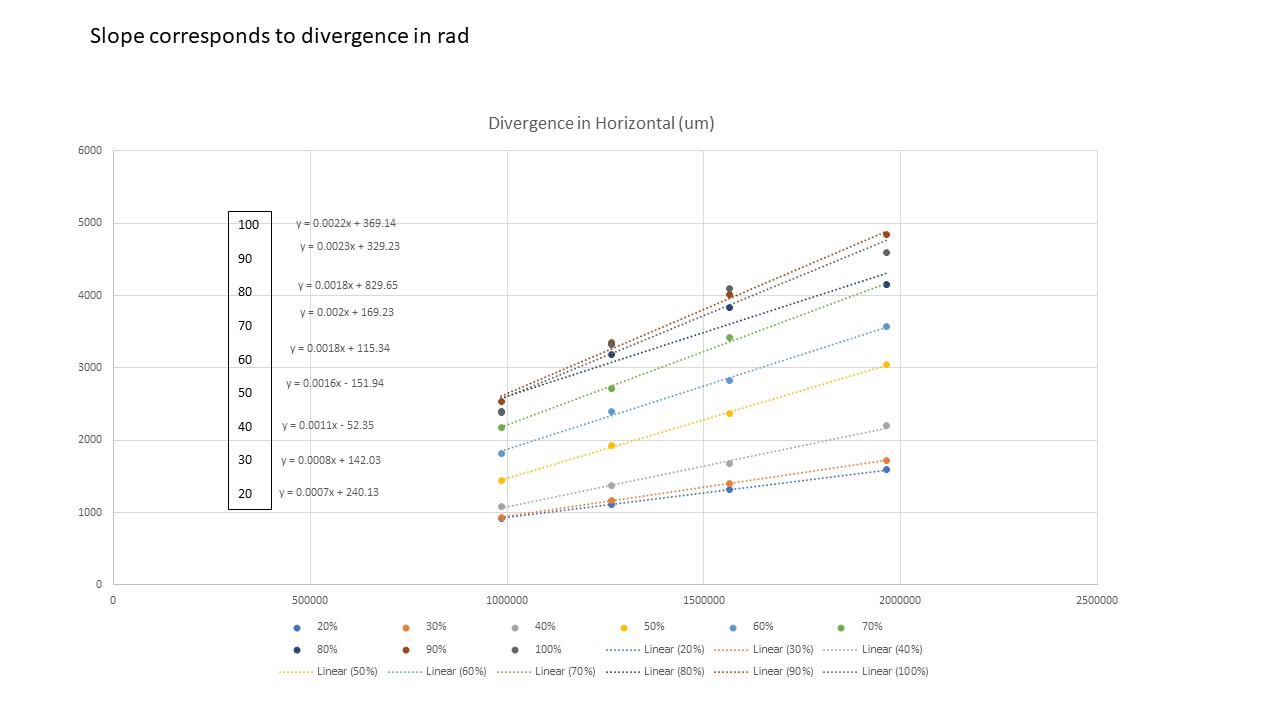
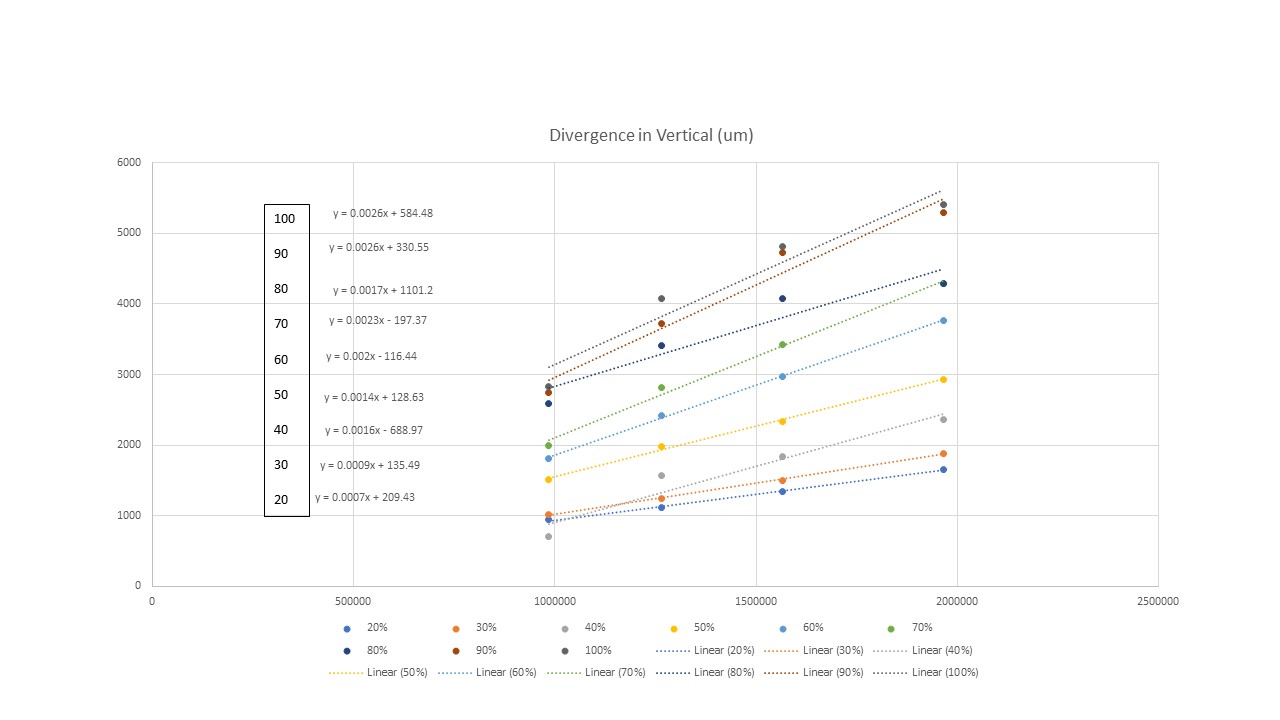
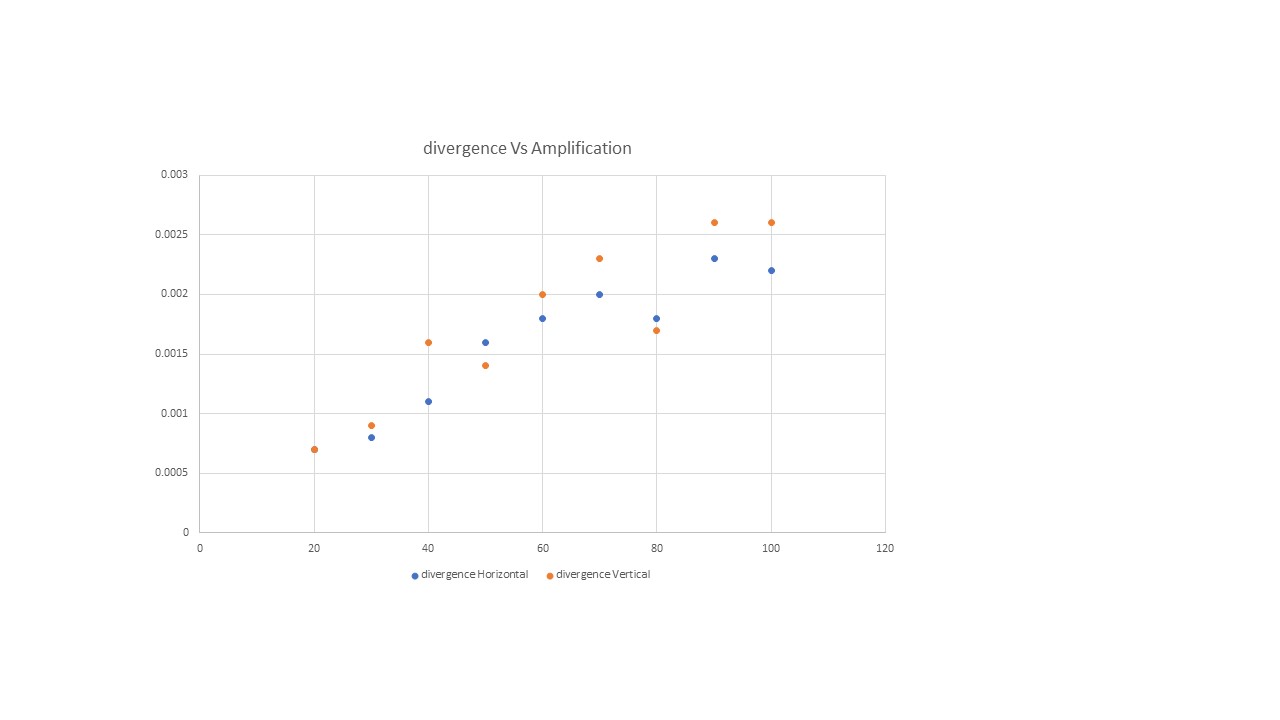
This morning we took data of the beam profile at 4 different points to see the evolution of
- the beam shape
- divergence
over distance for all amplification percentages
Data plotted for the distance vs radius for all and divergence in rad is extracted and plotted as a variation of amplification power.
Added is the Excel file with all the details and the PowerPoint for referance
| Manar Amer wrote: |
|
This morning, with Ronic, we opened the compressor box to observe if there is any misalignment of the mounts or the CVBG's
a comparison slide between the Beam Profile over time and measurements we have taken, is included.
we noticed today that the images need a rotation, and I took the assumption we did not rotate last year and did the rotation of the previous images.
Comparing the last two images, they look slightly similar. but the one from last year is much better than the current one
(remembering it was taken, when we aligned the CVBG's and the chiller was @23, now the temperature is @25 for the chiller)
The image we took today is also better than the one from yesterday.
(we take the image when the compressor box is open)
|
|
| Attachment 1: Beam_wavefront_setup.jpg
|
 |
| Attachment 2: Slide2.JPG
|
 |
| Attachment 3: Slide3.JPG
|
 |
| Attachment 4: Slide4.JPG
|
 |
| Attachment 5: Slide5.JPG
|
 |
| Attachment 6: Slide6.JPG
|
 |
| Attachment 7: Slide7.JPG
|
 |
| Attachment 8: Slide8.JPG
|
 |
| Attachment 9: Slide9.JPG
|
 |
| Attachment 10: 20230315_Data.xlsx
|
|
197
|
Wed Mar 15 21:14:51 2023 |
Manar Amer | Fixed | report | lasers and optics | detectors and electronics | ThomX igloo | Amplifier Beam Profile over time |
Information about today's work is added to logBook !!
| Manar Amer wrote: |
|
This morning we took data of the beam profile at 4 different points to see the evolution of
- the beam shape
- divergence
over distance for all amplification percentages
Data plotted for the distance vs radius for all and divergence in rad is extracted and plotted as a variation of amplification power.
Added is the Excel file with all the details and the PowerPoint for referance
| Manar Amer wrote: |
|
This morning, with Ronic, we opened the compressor box to observe if there is any misalignment of the mounts or the CVBG's
a comparison slide between the Beam Profile over time and measurements we have taken, is included.
we noticed today that the images need a rotation, and I took the assumption we did not rotate last year and did the rotation of the previous images.
Comparing the last two images, they look slightly similar. but the one from last year is much better than the current one
(remembering it was taken, when we aligned the CVBG's and the chiller was @23, now the temperature is @25 for the chiller)
The image we took today is also better than the one from yesterday.
(we take the image when the compressor box is open)
|
|
|
|
133
|
Fri Mar 18 11:48:14 2022 |
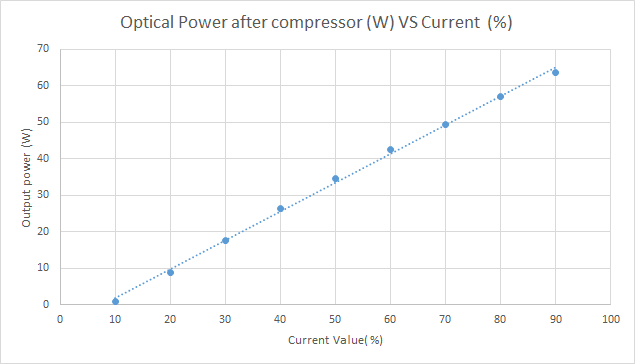
Ronic Chiche | Fixed | info | lasers and optics | ThomX igloo | Alphanov amplifier power measurement |
This morning, with Manar and Aurélien, we measure the power directly at the output of the Alphanov amplifier with the 2 compressors CVBG (seeding laser at Frep = 133MHz)
(we had to remove the base plate where the deflector mirrors were mounted to put the large powermeter).
with the previously described procedure, it seems that the Alphanov software is now working and we were able to start immediately the amplifier.
the chiller temperature was set at 25°C but we saw in the Alphanov documentation that the chiller temperature was closer to 20°C.
we did several measurements at 25°C and 20°C and it doesn't change a lot the output power.
so, we set the temperature to 23°C to avoid condensation (if too cold).
we will ask Guillaume what is the best temperature for the chiller.
power measurements:
power ratio => measured output power (with external powermeter, not with the software)
10% => 1W
20% => 9W
30% => 17.6W
40% => 26.4W
50% => 34.5W
60% => 42.5W
70% => 49.3W
80% => 56.6W
90% => 63.6W
100% => ~70W (expected value, not measured)
we stopped the measurements at 90% as we observed a difference in the software between the expected values (previously recorded by Alphanov) and the present ones.
the present values are quite bigger than the ones measured by Alphanov.
Aurélien will call Guillaume to check if it is a problem or not. |
| Attachment 1: power_after_compressor_vs_current_for_133MHz_laser.png
|
 |
|
134
|
Fri Mar 18 15:04:30 2022 |
Ronic Chiche | Fixed | info | lasers and optics | ThomX igloo | Alphanov amplifier power measurement |
answers from Guillaume:
- the chiller temperature has to be set to 25°C
- the power measured with the software can change a little from what Alphanov measured with their laser.
=> one can set power tolerances to 30% in the "caracterisation.csv" file.
| Ronic Chiche wrote: |
|
This morning, with Manar and Aurélien, we measure the power directly at the output of the Alphanov amplifier.
(we had to remove the base plate where the deflector mirrors were mounted to put the large powermeter).
with the previously described procedure, it seems that the Alphanov software is now working and we were able to start immediately the amplifier.
the chiller temperature was set at 25°C but we saw in the Alphanov documentation that the chiller temperature was closer to 20°C.
we did several measurements at 25°C and 20°C and it doesn't change a lot the output power.
so, we set the temperature to 23°C to avoid condensation (if too cold).
we will ask Guillaume what is the best temperature for the chiller.
power measurements:
power ratio => measured output power (with external powermeter, not with the software)
10% => 1W
20% => 9W
30% => 17.6W
40% => 26.4W
50% => 34.5W
60% => 42.5W
70% => 49.3W
80% => 56.6W
90% => 63.6W
100% => ~70W (expected value, not measured)
we stopped the measurements at 90% as we observed a difference in the software between the expected values (previously recorded by Alphanov) and the present ones.
the present values are quite bigger than the ones measured by Alphanov.
Aurélien will call Guillaume to check if it is a problem or not.
|
|