| ID |
Date |
Author |
Status |
Type |
Category |
Location |
Title |
|
129
|
Fri Mar 11 12:59:35 2022 |
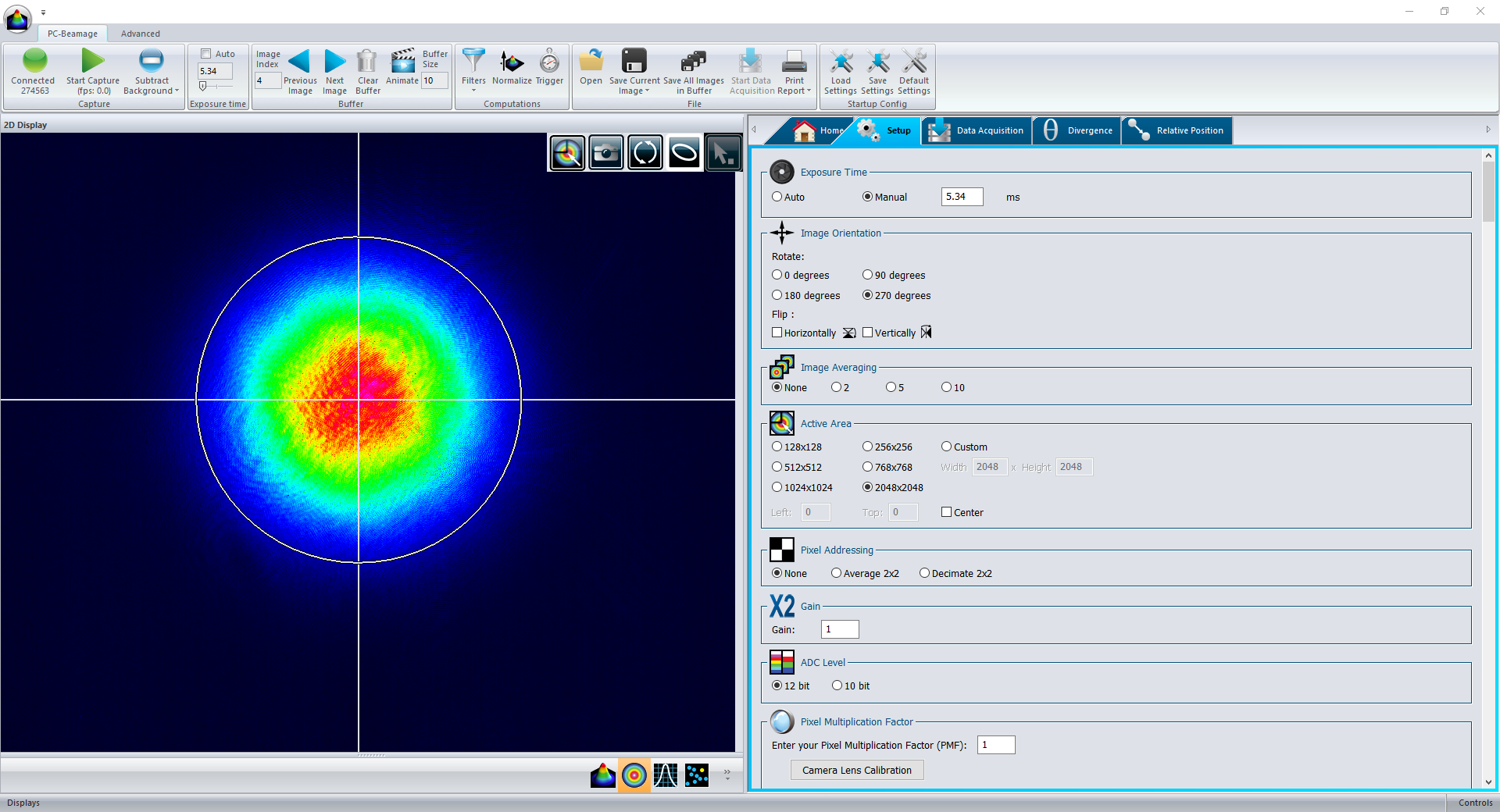
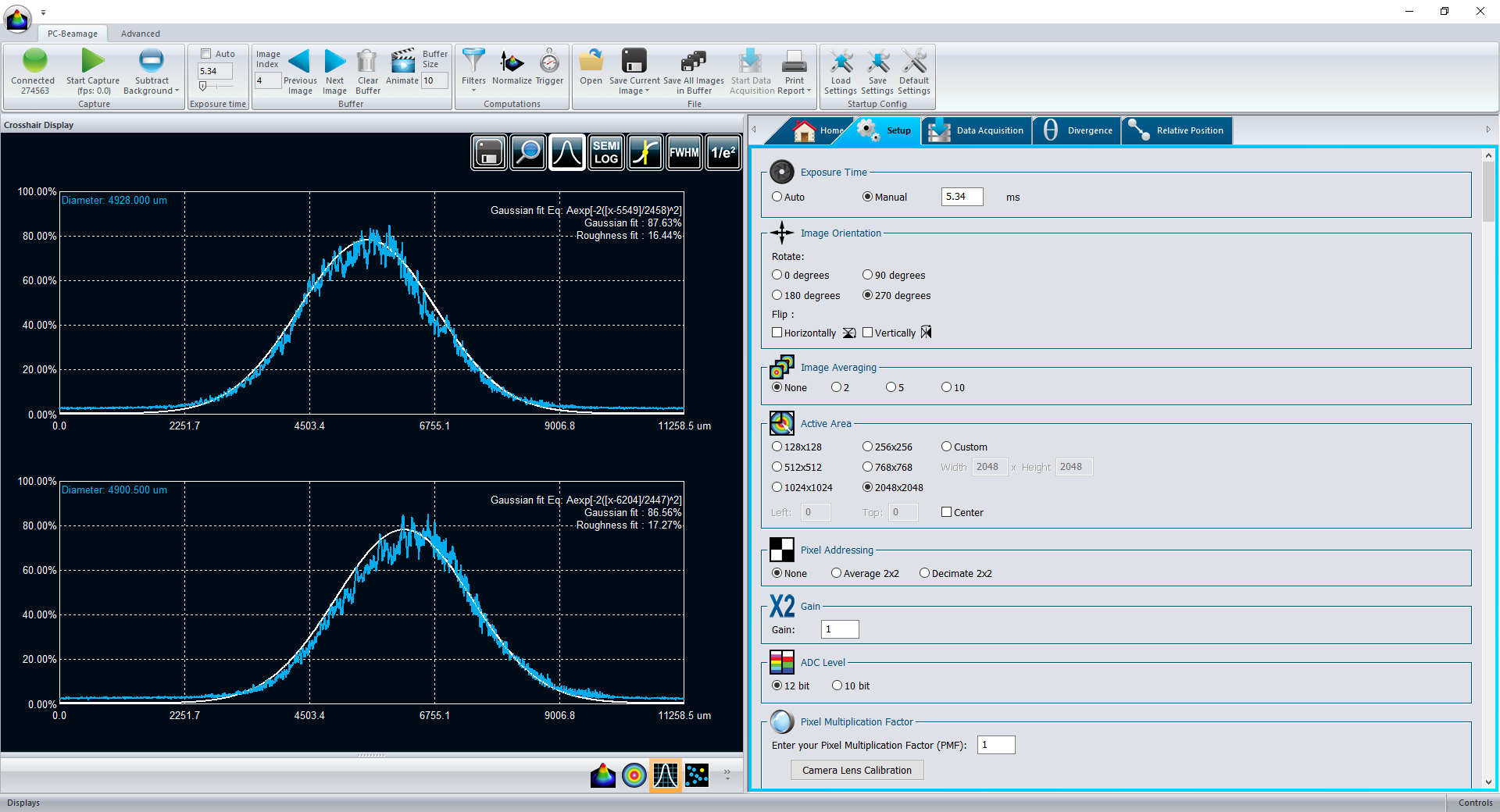
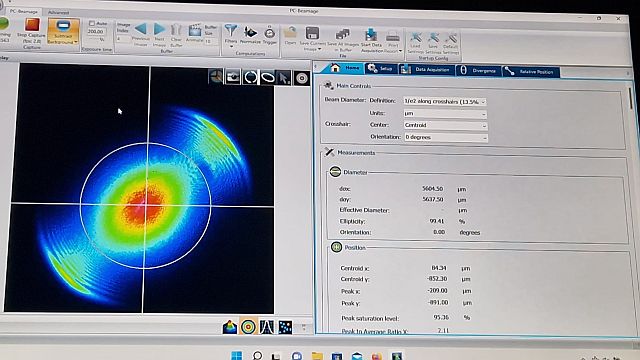
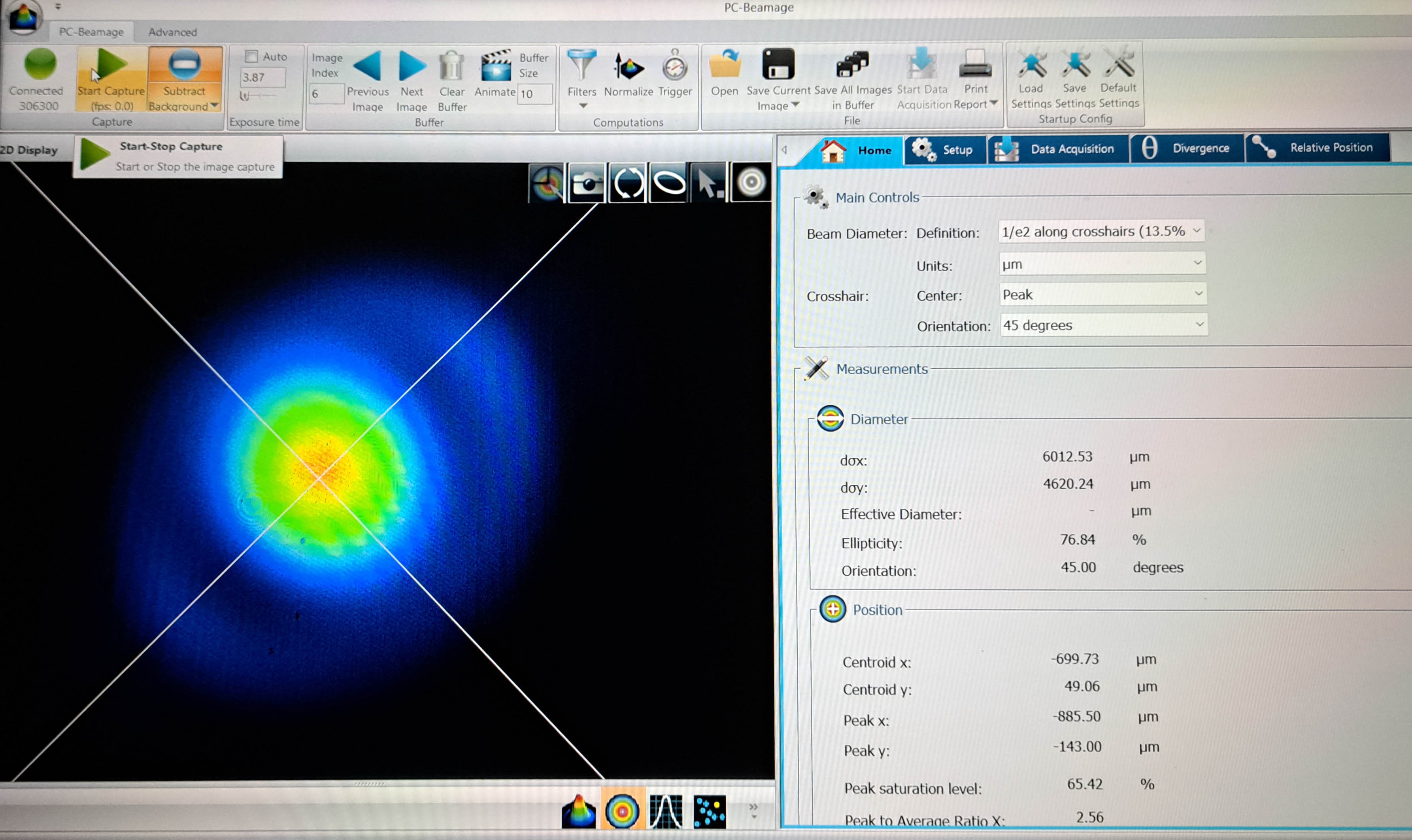
Manar Amer | Fixed | report | lasers and optics | ThomX igloo | Cavity beam Image | Updated beam image after change on the mode axis.
Taken after P4. |
| Attachment 1: Capture.PNG
|  |
| Attachment 2: Capture2.PNG
|  |
|
20
|
Fri Mar 22 17:53:10 2019 |
Loïc Amoudry | Fixed | report | lasers and optics | vacuum | Optical room | Cavity at atm pressure | Dry air injected into the cavity.
Lock has been proceeded without any trouble. ~~4000 finesse. Considered to be the same than before.
x and y motors axis put back to the last "cavity at air" position. z position kept at maximum distance between spherical mirrors. |
| Attachment 1: finessealair.isf
|
|
121
|
Thu Feb 3 14:11:50 2022 |
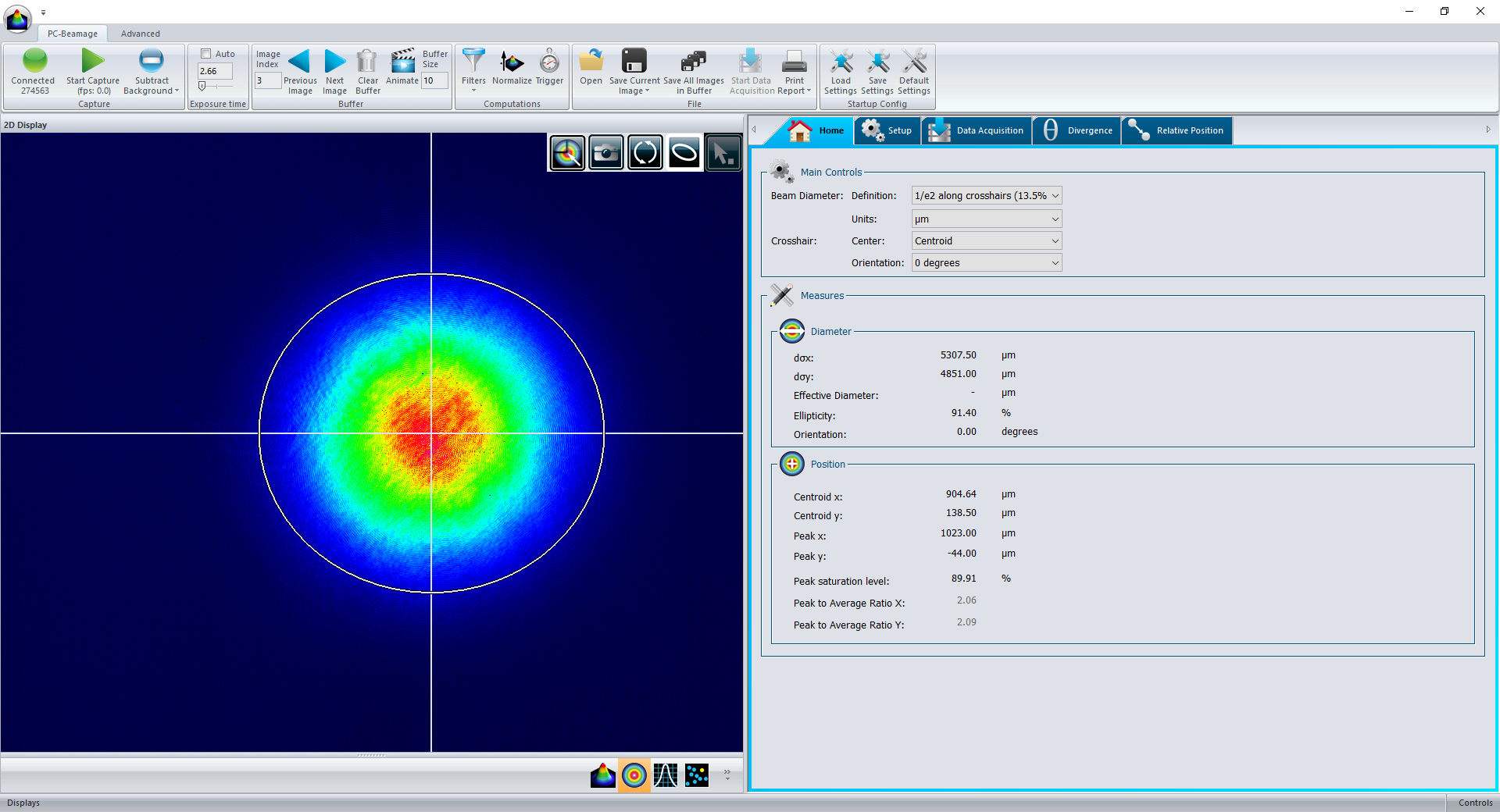
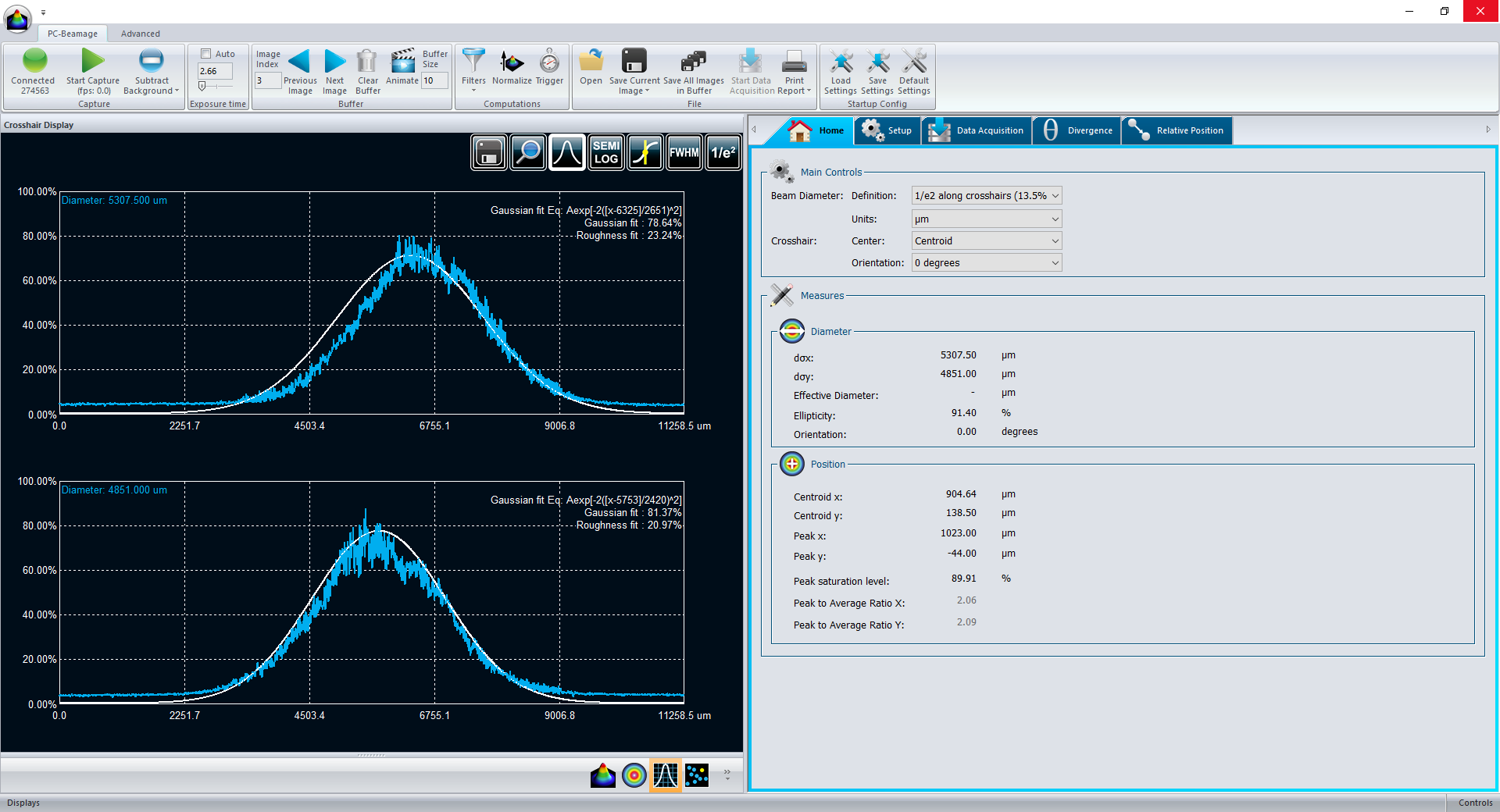
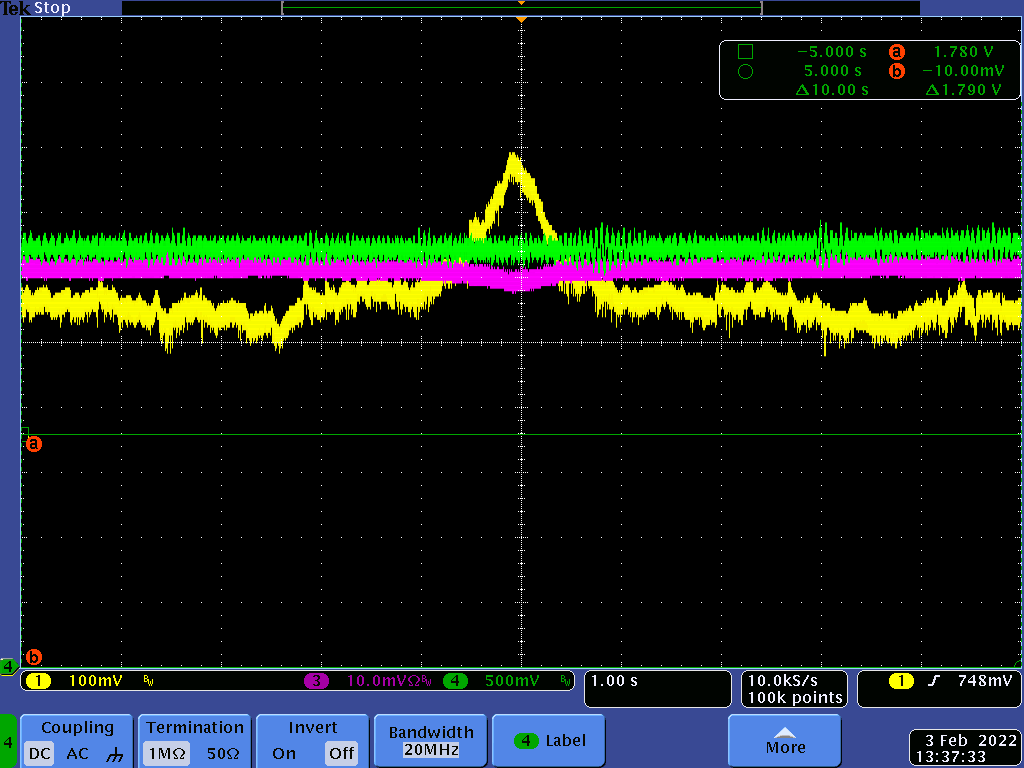
Manar Amer | Fixed | report | lasers and optics | detectors and electronics | ThomX igloo | Cavity Lock and Finess measurment | This morning, me and Ronic managed to obtain the FSR and image of the finesse which is to be analyzed.
Adding:
- Beam Image at P4 propagation, no lens is added.
- Image of the Finesse on Oscilloscope
more information to be included later
Will continue in the afternoon . |
| Attachment 1: Capture3.PNG
|  |
| Attachment 2: Capture4.PNG
|  |
| Attachment 3: tek0011.png
|  |
| Attachment 4: tek0011CH1.isf
|
| Attachment 5: tek0011CH3.isf
|
| Attachment 6: tek0011CH4.isf
|
|
125
|
Thu Feb 3 18:59:10 2022 |
Manar Amer | Fixed | report | lasers and optics | detectors and electronics | ThomX igloo | Cavity Lock and Finess measurment | |
to measure the Finesse, instead of having 2x EOM for the PDH and for the modulation sweep, I simply used 2x generators coupled with DC-blocks to a T connector (SMA) screwed directly on the EOM input.
as the transmission signal is fluctuating, it is not easy to have a good fit of the Airy peak.
if I measure the width at half of the maximum of the peak, I found roughly 10kHz instead of the awaited 2kHz... :-(
one needs a better evaluation with a more stable transmission signal and also to be sure that the L-shape metal piece (used to remove high order modes) does not introduce some losses and then reduce the Finesse...
| Manar Amer wrote: |
|
This morning, me and Ronic managed to obtain the FSR and image of the finesse which is to be analyzed.
Adding:
- Beam Image at P4 propagation, no lens is added.
- Image of the Finesse on Oscilloscope
more information to be included later
Will continue in the afternoon .
|
|
|
126
|
Thu Feb 3 19:01:04 2022 |
Manar Amer | Fixed | report | lasers and optics | detectors and electronics | ThomX igloo | Cavity Lock and Finess measurment | |
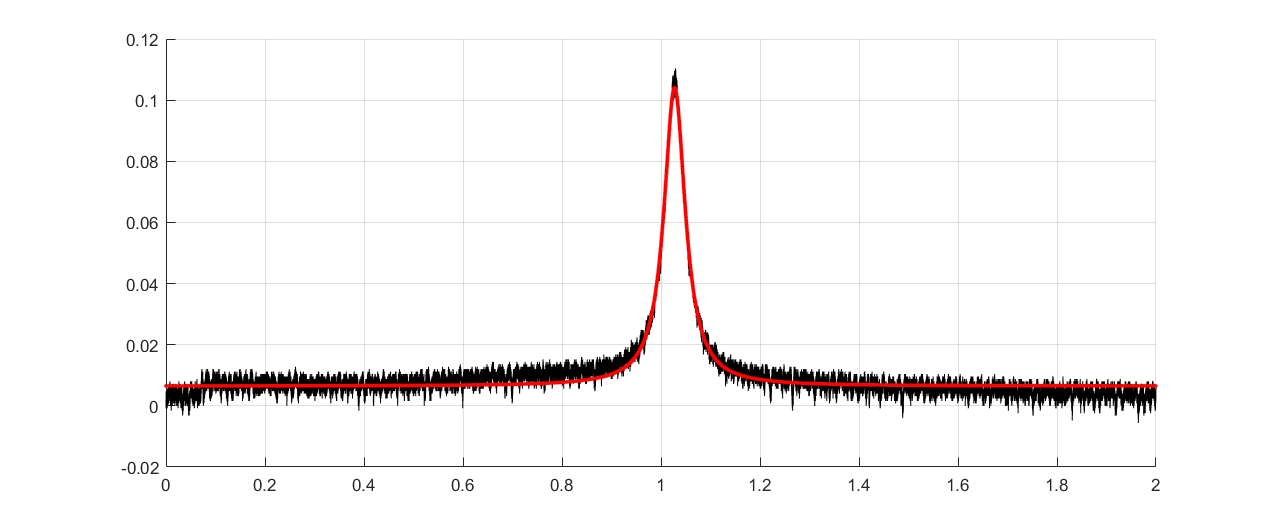
After changing the way of injecting modulation for PDH and modulation for FSR scanning (we split the modulations to 2 different EOMs), the locking is very stable and we can measure the Finesse.
FSR = 33.34MHz
hereafter, the transmission power during an FSR scan and its fit (sweep of 300kHz of FSR in 2s)
we took 5 acquisitions which give a Finesse of :
4236
4254
4400
4045
4177
=> roughly Finesse = 4200 ! far from the 17000 previously obtained........
| Manar Amer wrote: |
|
to measure the Finesse, instead of having 2x EOM for the PDH and for the modulation sweep, I simply used 2x generators coupled with DC-blocks to a T connector (SMA) screwed directly on the EOM input.
as the transmission signal is fluctuating, it is not easy to have a good fit of the Airy peak.
if I measure the width at half of the maximum of the peak, I found roughly 10kHz instead of the awaited 2kHz... :-(
one needs a better evaluation with a more stable transmission signal and also to be sure that the L-shape metal piece (used to remove high order modes) does not introduce some losses and then reduce the Finesse...
| Manar Amer wrote: |
|
This morning, me and Ronic managed to obtain the FSR and image of the finesse which is to be analyzed.
Adding:
- Beam Image at P4 propagation, no lens is added.
- Image of the Finesse on Oscilloscope
more information to be included later
Will continue in the afternoon .
|
|
|
| Attachment 1: Finesse_Fit.png
|  |
|
127
|
Fri Feb 4 10:59:56 2022 |
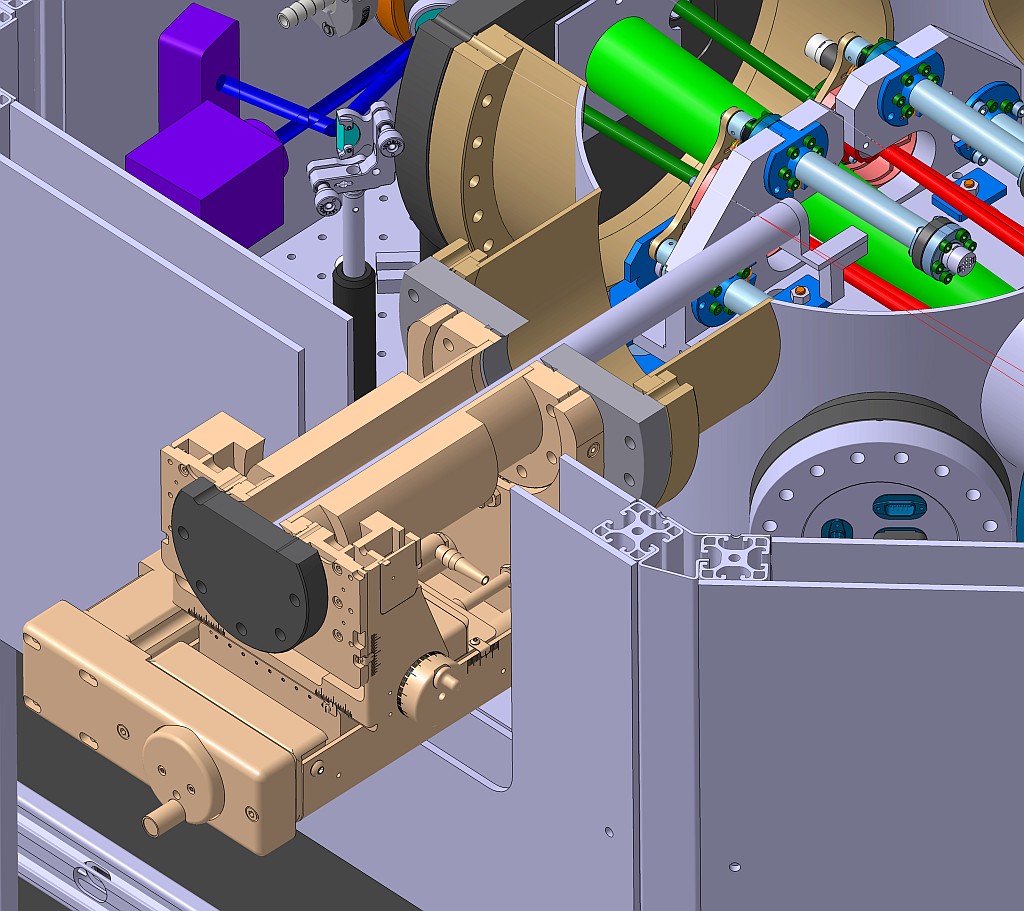
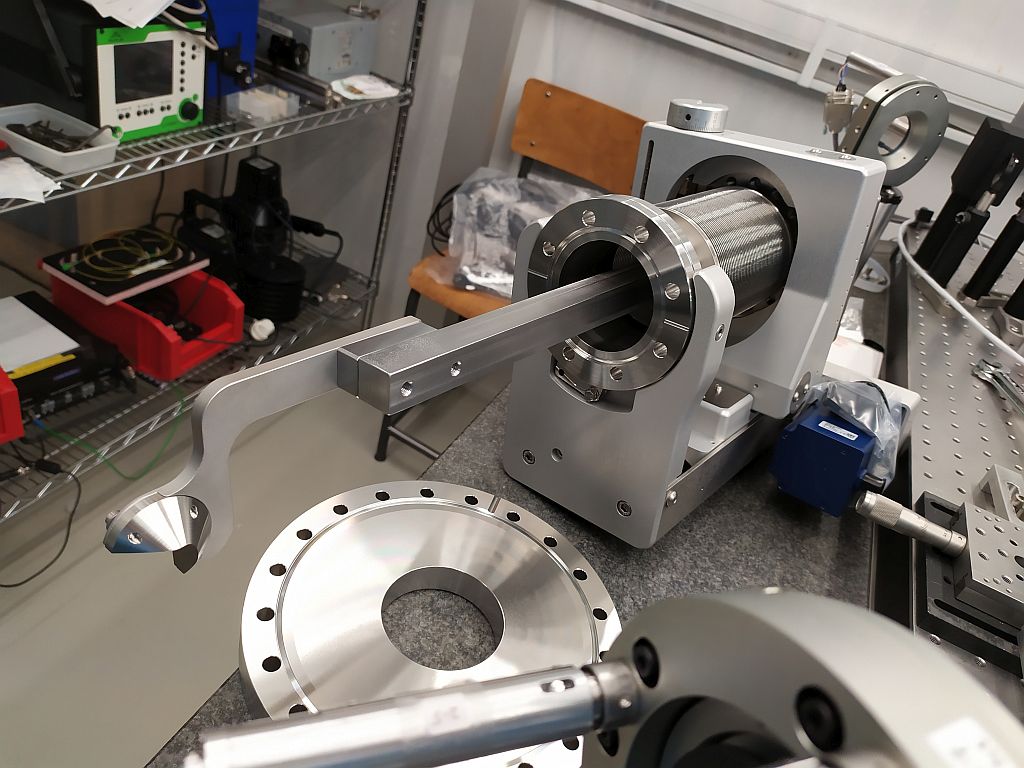
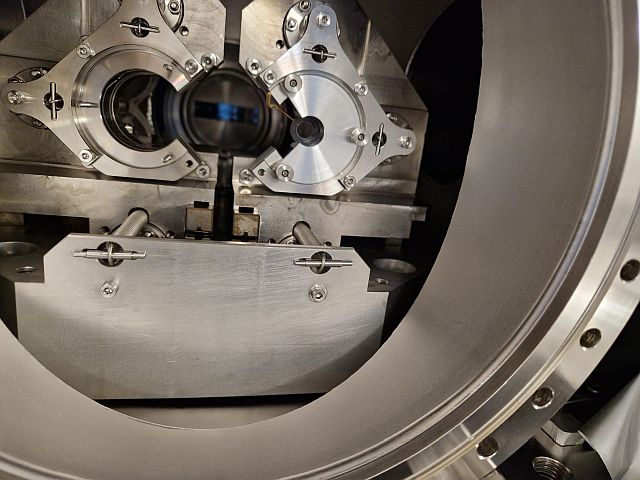
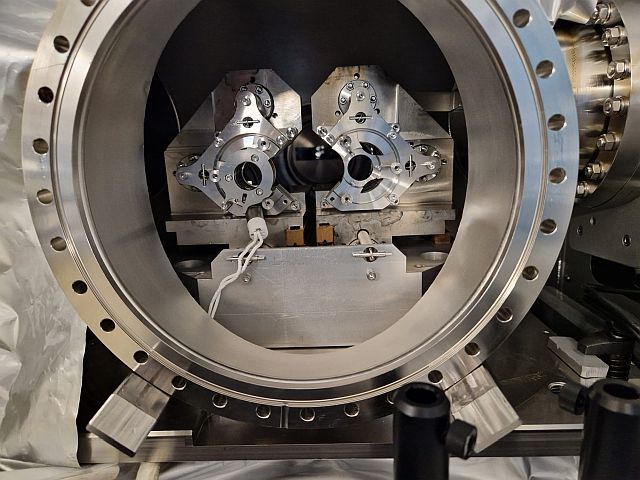
Manar Amer | Fixed | report | lasers and optics | detectors and electronics | ThomX igloo | Cavity Lock and Finess measurment | one thing which could reduce the Finesse is the L-shape metal piece if it is slightly inserted in the FP-cavity mode path.
understanding where this L-shape effectively is is not easy... some pictures are attached.
| Manar Amer wrote: |
|
After changing the way of injecting modulation for PDH and modulation for FSR scanning (we split the modulations to 2 different EOMs), the locking is very stable and we can measure the Finesse.
FSR = 33.34MHz
hereafter, the transmission power during an FSR scan and its fit (sweep of 300kHz of FSR in 2s)
we took 5 acquisitions which give a Finesse of :
4236
4254
4400
4045
4177
=> roughly Finesse = 4200 ! far from the 17000 previously obtained........
| Manar Amer wrote: |
|
to measure the Finesse, instead of having 2x EOM for the PDH and for the modulation sweep, I simply used 2x generators coupled with DC-blocks to a T connector (SMA) screwed directly on the EOM input.
as the transmission signal is fluctuating, it is not easy to have a good fit of the Airy peak.
if I measure the width at half of the maximum of the peak, I found roughly 10kHz instead of the awaited 2kHz... :-(
one needs a better evaluation with a more stable transmission signal and also to be sure that the L-shape metal piece (used to remove high order modes) does not introduce some losses and then reduce the Finesse...
| Manar Amer wrote: |
|
This morning, me and Ronic managed to obtain the FSR and image of the finesse which is to be analyzed.
Adding:
- Beam Image at P4 propagation, no lens is added.
- Image of the Finesse on Oscilloscope
more information to be included later
Will continue in the afternoon .
|
|
|
|
| Attachment 1: apercu_03.jpg
|  |
| Attachment 2: Bras_manipulateur.jpg
|  |
|
212
|
Tue May 30 18:32:37 2023 |
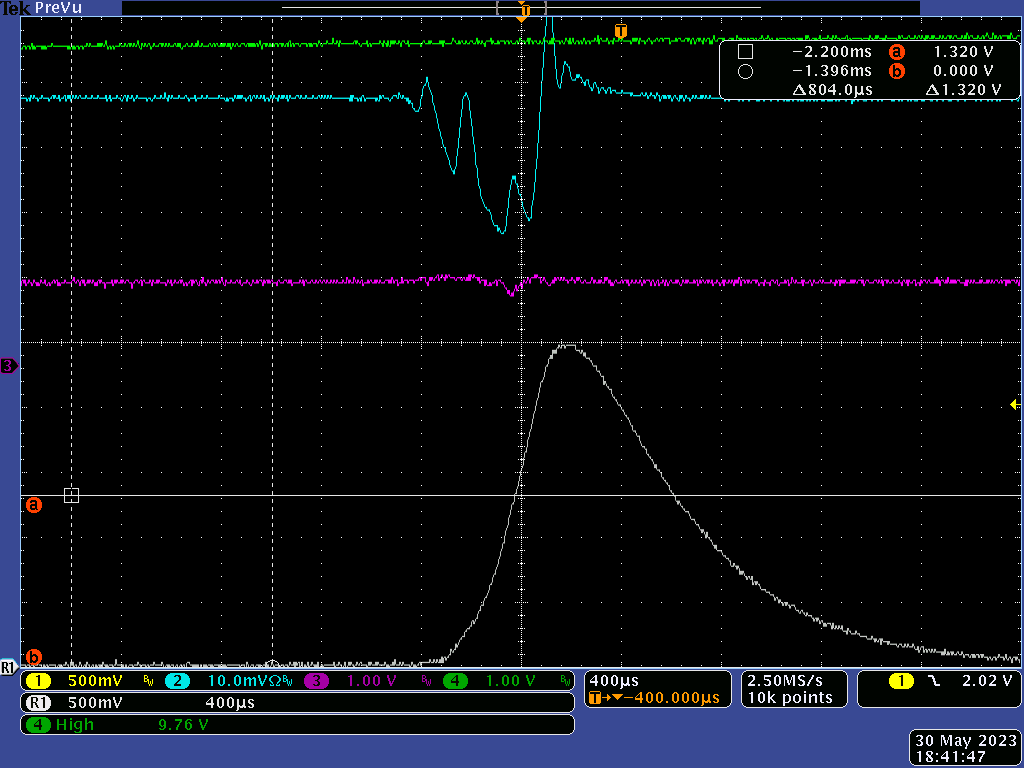
Manar Amer | Fixed | report | lasers and optics | detectors and electronics | cabling | software | ThomX igloo | Cavity Lock - Alphanov Amplifier | This morning, while trying Guillaume solution of disconnecting the 24 V necessary to the second and third stage and raise the threshold of Temp preamp 1 (to only operate the ampli with first stage only)
Ronic disconnected the 24 volt connection, turned on amplifier LAL software but no MMD3 error or a big temp on Temp preamp 1 , software worked fine with no issue.
we connected the 24 V again and the software worked with no issues.
Still not sure what happened for it to work correctly !!!!!!!!!!
- We used the amplifier at 0% all day with no errors (to test , I turned it for 10 minutes @ 10% with no error too)
- We changed the lase lock box with ThomX one (having Ethernet connection), it was connected to computer and works ok
- Ronic installed a signal amplifier for the PDH error signal. (yet to be fully optimized)
- we see a better coupling than before in the cavity.
- The dominant mode is 00 mode, but we see many higher order modes, need to alight better.
| Manar Amer wrote: |
|
Today with Ronic and Daniele we attempted to lock the cavity, but the alphanov amplifier did not turn on because of an error in MMD3 (related to the third stage)
the new error is having the MMD3 error show on the alarm window of the LAL software, and having the Alarms on the line 3 of the alphanov software red for both EXT/CPU and Laser T Max (never been red before)
this is after a 2-week work stop, but the last time when Daniele changed the fiber connector it worked for 3 hours with no errors.
Ronic, is in contact with Guillaume from Alphanov to fix the issue !!!
Work scheduled all Wednesday, in hopes the issue is fixed by then.
| Manar Amer wrote: |
|
Added Note: the coupling we get is at low power, only preamplifier is on (~ 300 mW)
was done at the end due to excitation of higher order modes.
Wanted to improve the fundamental first, then increase the power.
| Manar Amer wrote: |
- On Monday with Daniele,
- we did full characterization of amplifier beam @ 10% amplification, adjusted the telescope accordingly and injected into the cavity aligned and improved on the fundamental mode.
- On Tuesday with Daniele and Kevin
- I added a low pass filter between 1 - 1.9 MHz on the reflected signal, to reject the oscillator signal (33.33 MHz)
- removed the external resistors on the signal, only the internal resistance of the oscilloscope used ( transmission : 1 M ohm , Reflection : 50 ohm )
- We connected the motors to control the CEP and adjusted on them until we reached ~ 5 -10% coupling
- Images:
- 1st : showing the size of the beam just before injecting into the cavity @ 10%
- 2nd: signal with only improved alignment (not CEP adjustment yet), no low pass filter added yet
- 3rd : zoom on the signals (reflection and error) while adjusting on the CEP
- 4th :attempting to lock the cavity , after getting the max coupling using the CEP motors
Note : the voltage ranges are not the same between the images
| Manar Amer wrote: |
|
Yesterday,
- we installed the second high power reflecting mirrors at the output of the amplifier.
- We aligned and installed a telescope that has adjustable distance between the 2 lenses of -100 mm, and + 200 mm, with approximate diameter at the injection window of ~ 4.5 mm.
- Amplifier was turned on only at the first stage only (output power ~ 300 mW) aligned and injected into the cavity.
- Measured the repetition frequency of the One Five oscillators, Frep = 33.326239 MHz
- Changed the FSR of the cavity to match it.
- Using the Piezo scan on the oscillator, we observed 00 Mode, Fundamental. the shape is the same
- We see transmission on the diode, but there was zero coupling observed (yet to be investigated experimentally )
- a reason could be the CEP of the oscillator ,
- bad matching of the beam waist position,
- noise from the amplifier (as we were operating it at very low power)
- additional alignment needed,
|
|
|
|
|
| Attachment 1: tek00000.png
|  |
|
215
|
Fri Jun 2 10:54:25 2023 |
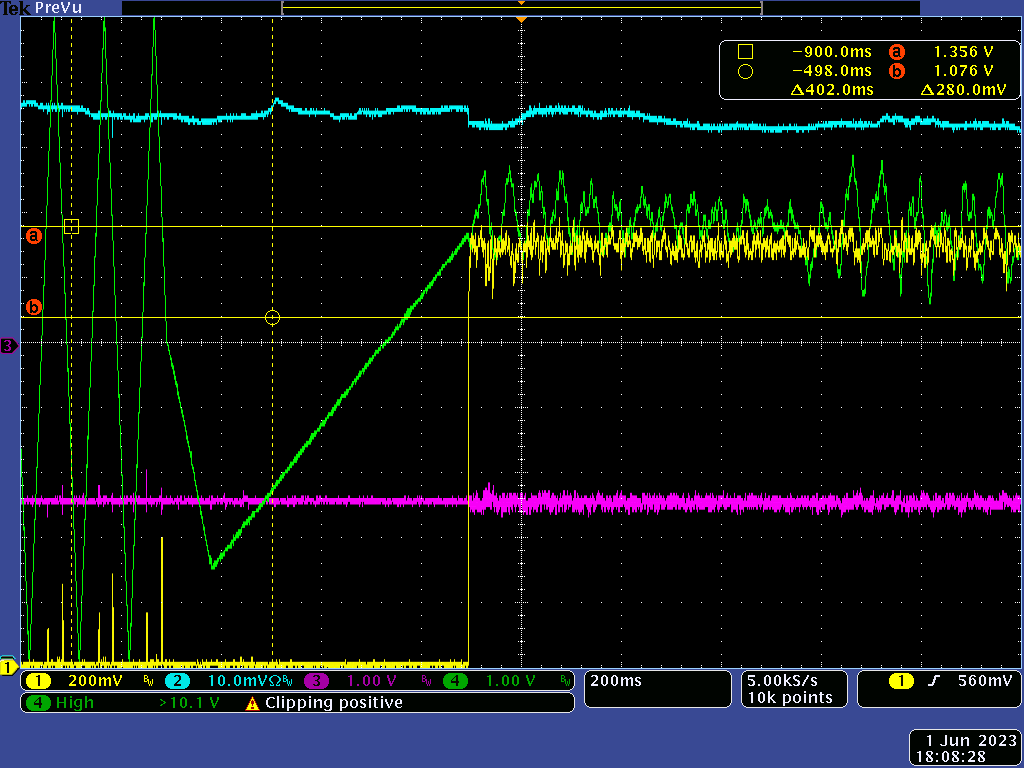
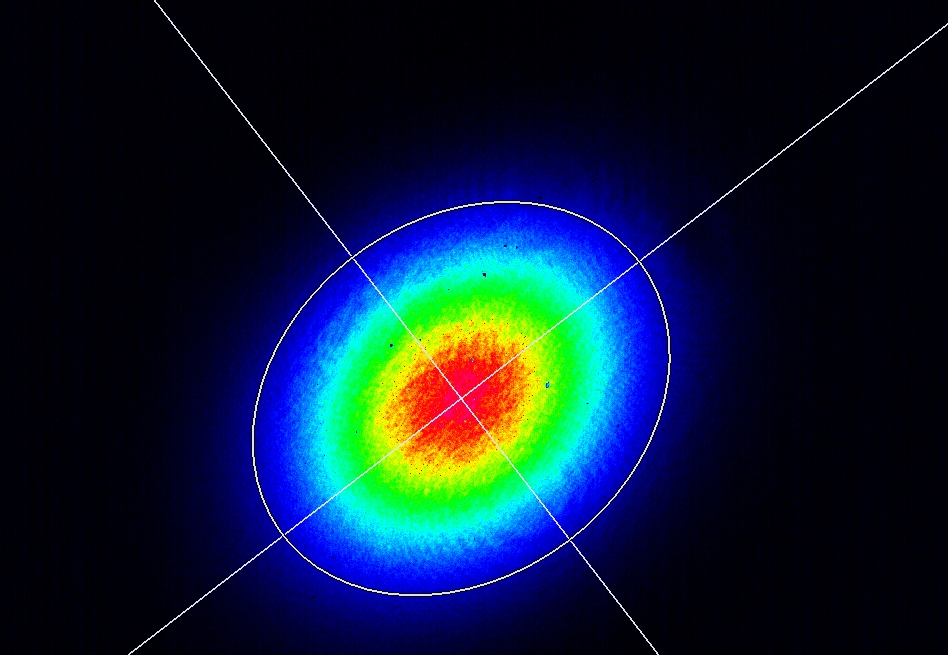
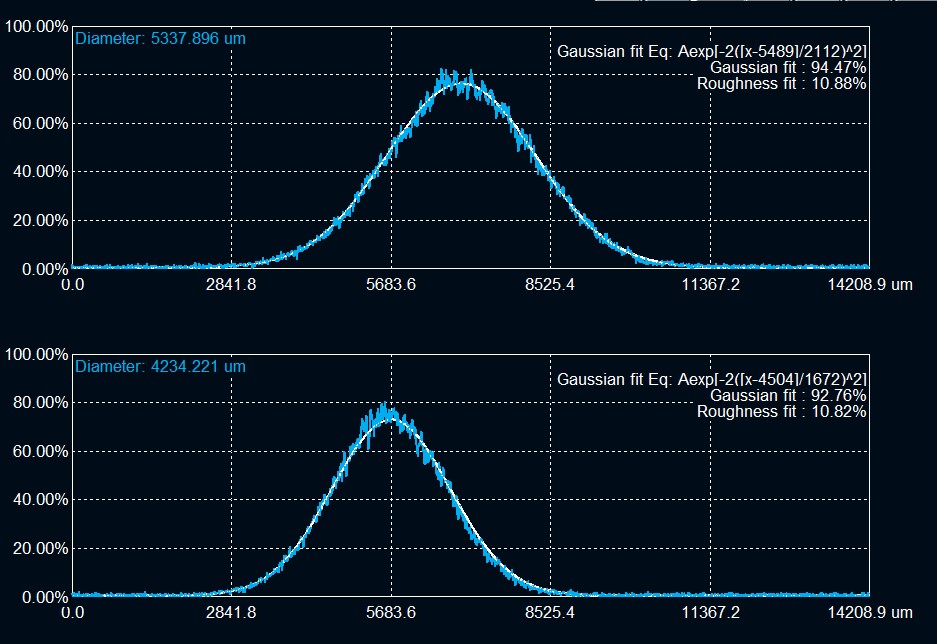
Manar Amer | Fixed | report | lasers and optics | detectors and electronics | cabling | software | ThomX igloo | Cavity Lock - Alphanov Amplifier | Yesterday, with Ronic we locked ThomX cavity on the second resonance
Laser : 33.36 MHz , Amplifier : 0 % (worked with no errors all day)
adding image for the lock on the second resonance (locked), 00 Mode image, fit, Beam measurements
and image of the first resonance signal (not locked)
Info : when locking on the secondary resonance, we aligned better and adjusted on the oscillator CEP and increased the transmission signal
Controllers connected to computer
through Ethernet :
- Cavity Mirror motors
- Lase lock
- oscillator CEP and Frequency motors (easier to follow the drift with this controller, and we can see it moving)
by USB :
| Manar Amer wrote: |
|
This morning, while trying Guillaume solution of disconnecting the 24 V necessary to the second and third stage and raise the threshold of Temp preamp 1 (to only operate the ampli with first stage only)
Ronic disconnected the 24 volt connection, turned on amplifier LAL software but no MMD3 error or a big temp on Temp preamp 1 , software worked fine with no issue.
we connected the 24 V again and the software worked with no issues.
Still not sure what happened for it to work correctly !!!!!!!!!!
- We used the amplifier at 0% all day with no errors (to test , I turned it for 10 minutes @ 10% with no error too)
- We changed the lase lock box with ThomX one (having Ethernet connection), it was connected to computer and works ok
- Ronic installed a signal amplifier for the PDH error signal. (yet to be fully optimized)
- we see a better coupling than before in the cavity.
- The dominant mode is 00 mode, but we see many higher order modes, need to alight better.
| Manar Amer wrote: |
|
Today with Ronic and Daniele we attempted to lock the cavity, but the alphanov amplifier did not turn on because of an error in MMD3 (related to the third stage)
the new error is having the MMD3 error show on the alarm window of the LAL software, and having the Alarms on the line 3 of the alphanov software red for both EXT/CPU and Laser T Max (never been red before)
this is after a 2-week work stop, but the last time when Daniele changed the fiber connector it worked for 3 hours with no errors.
Ronic, is in contact with Guillaume from Alphanov to fix the issue !!!
Work scheduled all Wednesday, in hopes the issue is fixed by then.
| Manar Amer wrote: |
|
Added Note: the coupling we get is at low power, only preamplifier is on (~ 300 mW)
was done at the end due to excitation of higher order modes.
Wanted to improve the fundamental first, then increase the power.
| Manar Amer wrote: |
- On Monday with Daniele,
- we did full characterization of amplifier beam @ 10% amplification, adjusted the telescope accordingly and injected into the cavity aligned and improved on the fundamental mode.
- On Tuesday with Daniele and Kevin
- I added a low pass filter between 1 - 1.9 MHz on the reflected signal, to reject the oscillator signal (33.33 MHz)
- removed the external resistors on the signal, only the internal resistance of the oscilloscope used ( transmission : 1 M ohm , Reflection : 50 ohm )
- We connected the motors to control the CEP and adjusted on them until we reached ~ 5 -10% coupling
- Images:
- 1st : showing the size of the beam just before injecting into the cavity @ 10%
- 2nd: signal with only improved alignment (not CEP adjustment yet), no low pass filter added yet
- 3rd : zoom on the signals (reflection and error) while adjusting on the CEP
- 4th :attempting to lock the cavity , after getting the max coupling using the CEP motors
Note : the voltage ranges are not the same between the images
| Manar Amer wrote: |
|
Yesterday,
- we installed the second high power reflecting mirrors at the output of the amplifier.
- We aligned and installed a telescope that has adjustable distance between the 2 lenses of -100 mm, and + 200 mm, with approximate diameter at the injection window of ~ 4.5 mm.
- Amplifier was turned on only at the first stage only (output power ~ 300 mW) aligned and injected into the cavity.
- Measured the repetition frequency of the One Five oscillators, Frep = 33.326239 MHz
- Changed the FSR of the cavity to match it.
- Using the Piezo scan on the oscillator, we observed 00 Mode, Fundamental. the shape is the same
- We see transmission on the diode, but there was zero coupling observed (yet to be investigated experimentally )
- a reason could be the CEP of the oscillator ,
- bad matching of the beam waist position,
- noise from the amplifier (as we were operating it at very low power)
- additional alignment needed,
|
|
|
|
|
|
| Attachment 1: tek00003_secondary_resonance_fundamental_mode_lock.png
|  |
| Attachment 2: tek0002CH1.isf
|
| Attachment 3: tek0002CH2.isf
|
| Attachment 4: tek0002CH3.isf
|
| Attachment 5: tek0002CH4.isf
|
| Attachment 6: 20230602_00mode_second_resonance.jpg
|  |
| Attachment 7: 20230602_00mode_second_resonance_fit.jpg
|  |
| Attachment 8: 20230602_00mode_second_resonance_measurements.jpg
|  |
| Attachment 9: tek00002_first_resonance_fundamental_mode_signal.png
|  |
| Attachment 10: tek0001CH1.isf
|
| Attachment 11: tek0001CH2.isf
|
| Attachment 12: tek0001CH3.isf
|
| Attachment 13: tek0001CH4.isf
|
|
216
|
Tue Jun 6 01:12:11 2023 |
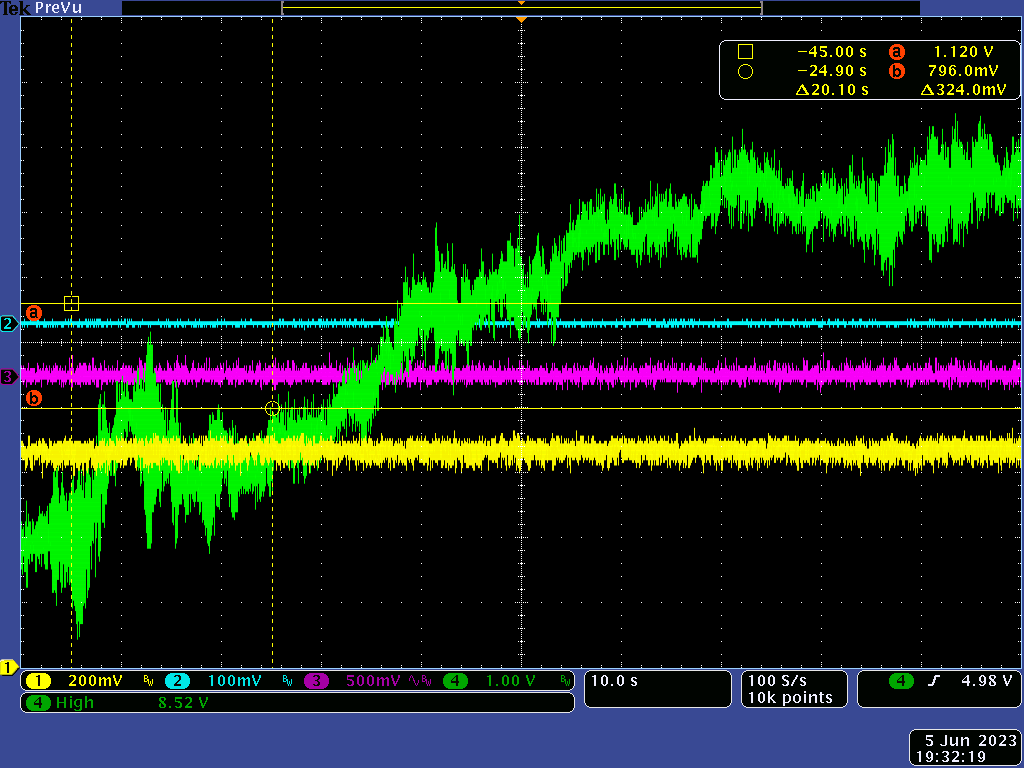
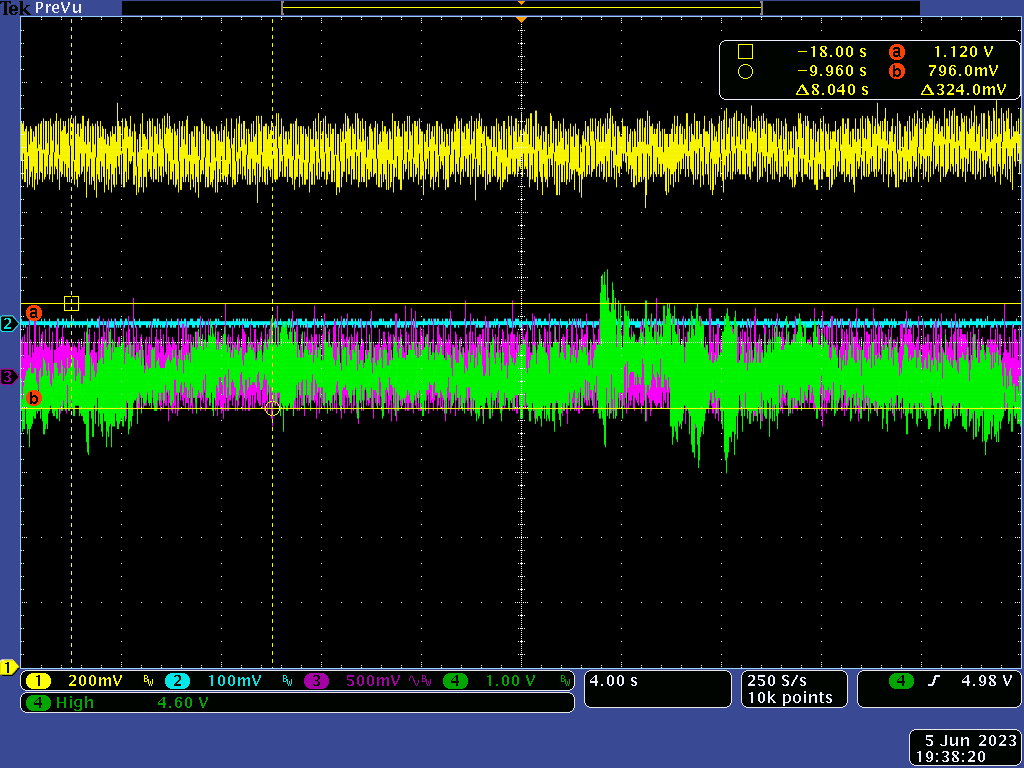
Manar Amer | Fixed | report | lasers and optics | detectors and electronics | cabling | software | ThomX igloo | Cavity Lock - Alphanov Amplifier | Today, I installed a power meter at the transmission point of the 1st spherical mirror , transmission 3 ppm (direct from cavity window beam profiler, no filter)
We locked the cavity at 2 different resonances of the fundamental mode, the lock in both cases was stable for a round 1 minute.
at different transmitted power of 33.85 uW ( 11 W average inside cavity) and then locked again at 82.65 uW (27.5 W average inside cavity) transmitted power
Note : the coupling is almost zero for both of the resonances locked !!!!
Oscillator : 33.33 MHz ( 33.356 MHz , frequency read on LAL software)
power injected into amplifier (after injecting into fiber and an EOM) : 3.886 mW (on LAL software)
Amplifier power : 0% (injected power into cavity ~ 300 mW)
Both images of oscilloscope have same voltage scales, only difference timescale and the color code is :
yellow : transmission
blue : reflection
green : piezo voltage
red : error signal
| Manar Amer wrote: |
|
Yesterday, with Ronic we locked ThomX cavity on the second resonance
Laser : 33.36 MHz , Amplifier : 0 % (worked with no errors all day)
adding image for the lock on the second resonance (locked), 00 Mode image, fit, Beam measurements
and image of the first resonance signal (not locked)
Info : when locking on the secondary resonance, we aligned better and adjusted on the oscillator CEP and increased the transmission signal
Controllers connected to computer
through Ethernet :
- Cavity Mirror motors
- Lase lock
- oscillator CEP and Frequency motors (easier to follow the drift with this controller, and we can see it moving)
by USB :
| Manar Amer wrote: |
|
This morning, while trying Guillaume solution of disconnecting the 24 V necessary to the second and third stage and raise the threshold of Temp preamp 1 (to only operate the ampli with first stage only)
Ronic disconnected the 24 volt connection, turned on amplifier LAL software but no MMD3 error or a big temp on Temp preamp 1 , software worked fine with no issue.
we connected the 24 V again and the software worked with no issues.
Still not sure what happened for it to work correctly !!!!!!!!!!
- We used the amplifier at 0% all day with no errors (to test , I turned it for 10 minutes @ 10% with no error too)
- We changed the lase lock box with ThomX one (having Ethernet connection), it was connected to computer and works ok
- Ronic installed a signal amplifier for the PDH error signal. (yet to be fully optimized)
- we see a better coupling than before in the cavity.
- The dominant mode is 00 mode, but we see many higher order modes, need to alight better.
| Manar Amer wrote: |
|
Today with Ronic and Daniele we attempted to lock the cavity, but the alphanov amplifier did not turn on because of an error in MMD3 (related to the third stage)
the new error is having the MMD3 error show on the alarm window of the LAL software, and having the Alarms on the line 3 of the alphanov software red for both EXT/CPU and Laser T Max (never been red before)
this is after a 2-week work stop, but the last time when Daniele changed the fiber connector it worked for 3 hours with no errors.
Ronic, is in contact with Guillaume from Alphanov to fix the issue !!!
Work scheduled all Wednesday, in hopes the issue is fixed by then.
| Manar Amer wrote: |
|
Added Note: the coupling we get is at low power, only preamplifier is on (~ 300 mW)
was done at the end due to excitation of higher order modes.
Wanted to improve the fundamental first, then increase the power.
| Manar Amer wrote: |
- On Monday with Daniele,
- we did full characterization of amplifier beam @ 10% amplification, adjusted the telescope accordingly and injected into the cavity aligned and improved on the fundamental mode.
- On Tuesday with Daniele and Kevin
- I added a low pass filter between 1 - 1.9 MHz on the reflected signal, to reject the oscillator signal (33.33 MHz)
- removed the external resistors on the signal, only the internal resistance of the oscilloscope used ( transmission : 1 M ohm , Reflection : 50 ohm )
- We connected the motors to control the CEP and adjusted on them until we reached ~ 5 -10% coupling
- Images:
- 1st : showing the size of the beam just before injecting into the cavity @ 10%
- 2nd: signal with only improved alignment (not CEP adjustment yet), no low pass filter added yet
- 3rd : zoom on the signals (reflection and error) while adjusting on the CEP
- 4th :attempting to lock the cavity , after getting the max coupling using the CEP motors
Note : the voltage ranges are not the same between the images
| Manar Amer wrote: |
|
Yesterday,
- we installed the second high power reflecting mirrors at the output of the amplifier.
- We aligned and installed a telescope that has adjustable distance between the 2 lenses of -100 mm, and + 200 mm, with approximate diameter at the injection window of ~ 4.5 mm.
- Amplifier was turned on only at the first stage only (output power ~ 300 mW) aligned and injected into the cavity.
- Measured the repetition frequency of the One Five oscillators, Frep = 33.326239 MHz
- Changed the FSR of the cavity to match it.
- Using the Piezo scan on the oscillator, we observed 00 Mode, Fundamental. the shape is the same
- We see transmission on the diode, but there was zero coupling observed (yet to be investigated experimentally )
- a reason could be the CEP of the oscillator ,
- bad matching of the beam waist position,
- noise from the amplifier (as we were operating it at very low power)
- additional alignment needed,
|
|
|
|
|
|
|
| Attachment 1: 20230605_tek00001_33uW.png
|  |
| Attachment 2: 20230605_tek00002_82uW.png
|  |
|
218
|
Wed Jun 7 21:46:50 2023 |
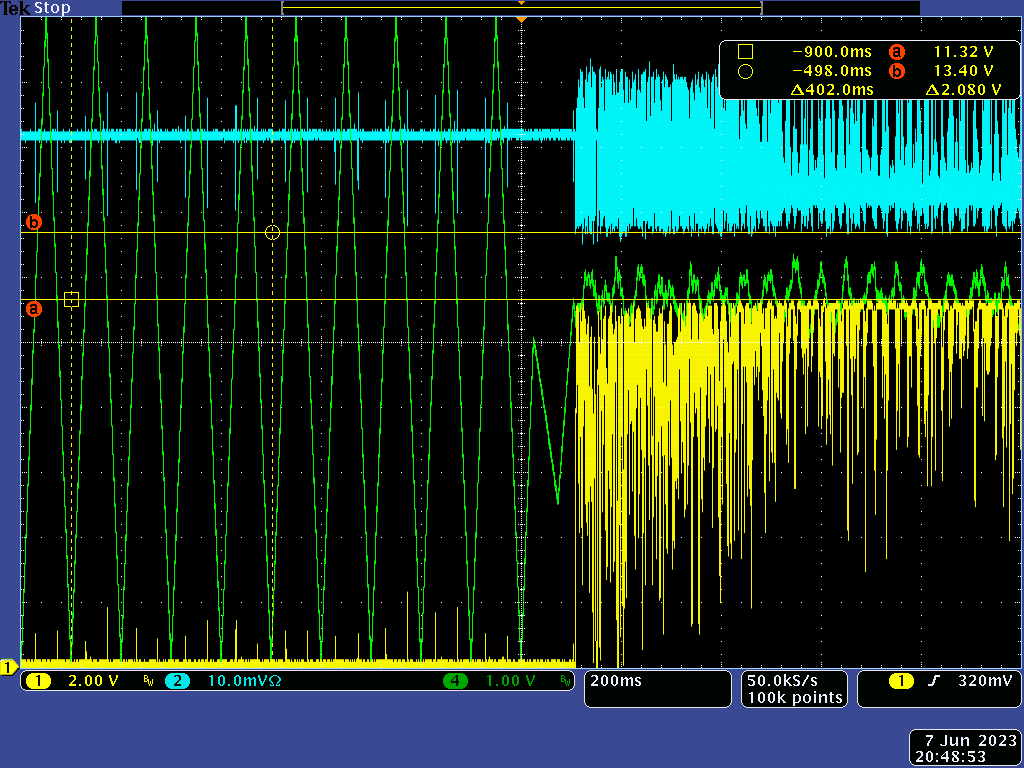
Manar Amer | Fixed | report | lasers and optics | detectors and electronics | cabling | software | ThomX igloo | Cavity Lock - Alphanov Amplifier | Today with Ronic,
starting with major events that happened (Water circulation + ThomX valves )
- Early in the morning a company worked on the water network, it seemed it was not restarted properly so there was no water circulation in the main ThomX pipes.
- There was an error on the ThomX amplifier chiller , which was noticed at the end of the morning work , where we couldn't find the cavity resonance , could be due to the temperature increase of the amplifer.
- Solved : the issue was solved by restarting the water network and the amplifier chiller was restarted an no error found and temp. Stabilized around 25°
- Around 12h15 ThomX there was a power cut off for less than a second (micro cutt), which cased all the valves to close, the valve air compressor did not restart after the power cut off, we restarted it with Daniele in the evening with the help of Marie and the valves open around 5-6 bar , you will see then all the controllers green and the valves will open.
Results of the day :
- All the power supplies and function generators are under the table, nothing on the table (reduced noise on the signal)
- EOM of Oscillator Off (for now, might turn on if needed)
- Amplifier on 0% , output ~ 300 mW
- Locked on the first resonance of the cavity, lase lock parameters to be optimized better
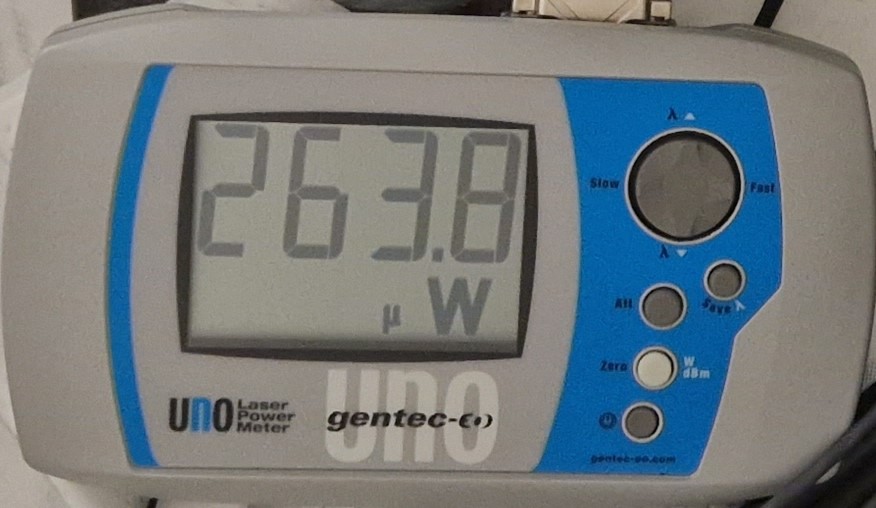
- Transmitted power increased to ~ 267.2 uW
- Average power inside cavity = 89. 06 W , peak power = 0.2 kW (pulse width = 12.6 ps , frep = 33.36 MHz )
- current effective cavity gain > 300
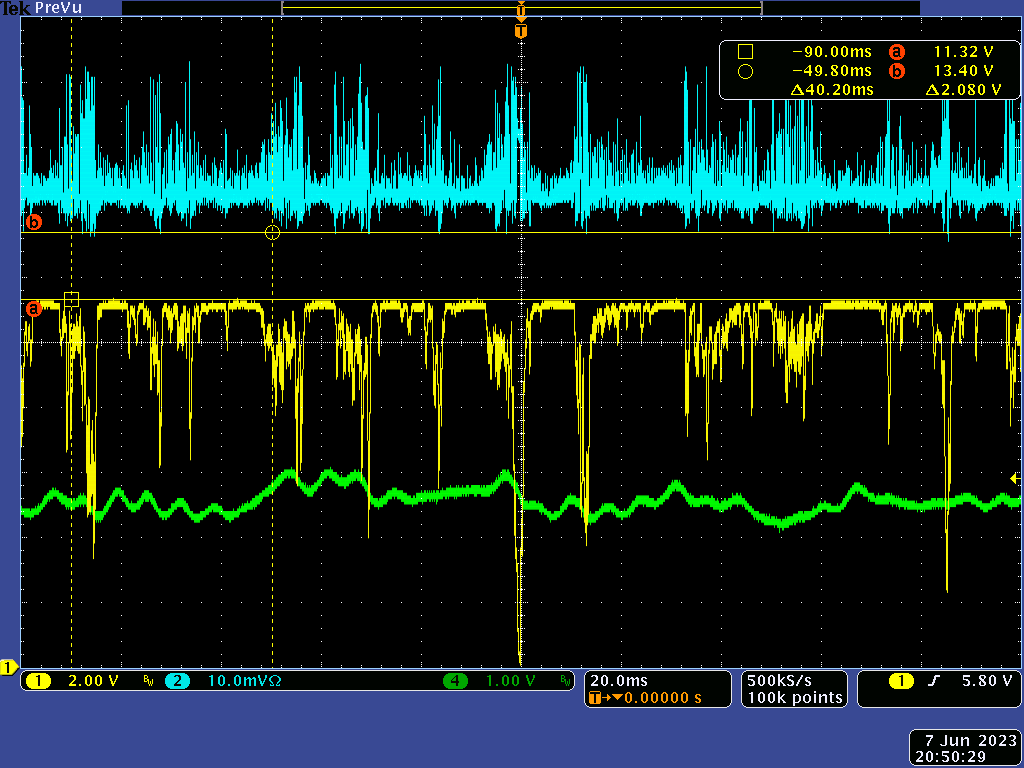
Oscilloscope :
- error signal, not shown as it was too noisy to have in the image
- blue : reflection (low bypass filter ), yellow : transmission (resistance of 100 k ohm added), green : piezo signal
- 1st image : showing lock and scan regions.
- 2nd image: time zoom on the locked signal
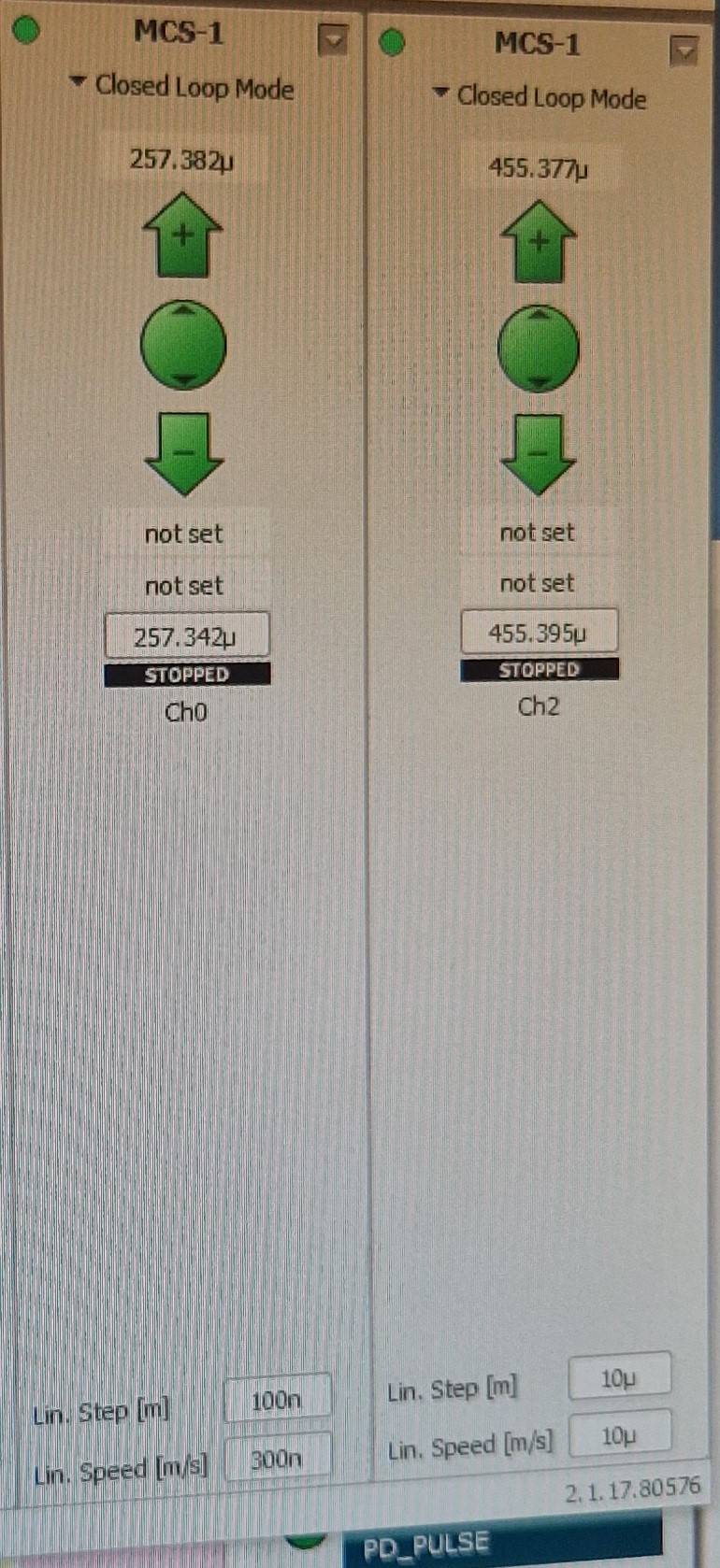
oscillators controller / smartAct:
- Frequency and CEP control , the parameters in the photo attached are the best for the moment to see the smooth change of the resonance peaks when operating the motors, and we can stay FSR range and compensate the variation easily.
- even though we stayed at closed loop (for easier adjustment), we still managed to lock , will try to switch off later to see if reduces a lot of noise.
| Manar Amer wrote: |
|
Today, I installed a power meter at the transmission point of the 1st spherical mirror , transmission 3 ppm (direct from cavity window beam profiler, no filter)
We locked the cavity at 2 different resonances of the fundamental mode, the lock in both cases was stable for a round 1 minute.
at different transmitted power of 33.85 uW ( 11 W average inside cavity) and then locked again at 82.65 uW (27.5 W average inside cavity) transmitted power
Note : the coupling is almost zero for both of the resonances locked !!!!
Oscillator : 33.33 MHz ( 33.356 MHz , frequency read on LAL software)
power injected into amplifier (after injecting into fiber and an EOM) : 3.886 mW (on LAL software)
Amplifier power : 0% (injected power into cavity ~ 300 mW)
Both images of oscilloscope have same voltage scales, only difference timescale and the color code is :
yellow : transmission
blue : reflection
green : piezo voltage
red : error signal
| Manar Amer wrote: |
|
Yesterday, with Ronic we locked ThomX cavity on the second resonance
Laser : 33.36 MHz , Amplifier : 0 % (worked with no errors all day)
adding image for the lock on the second resonance (locked), 00 Mode image, fit, Beam measurements
and image of the first resonance signal (not locked)
Info : when locking on the secondary resonance, we aligned better and adjusted on the oscillator CEP and increased the transmission signal
Controllers connected to computer
through Ethernet :
- Cavity Mirror motors
- Lase lock
- oscillator CEP and Frequency motors (easier to follow the drift with this controller, and we can see it moving)
by USB :
| Manar Amer wrote: |
|
This morning, while trying Guillaume solution of disconnecting the 24 V necessary to the second and third stage and raise the threshold of Temp preamp 1 (to only operate the ampli with first stage only)
Ronic disconnected the 24 volt connection, turned on amplifier LAL software but no MMD3 error or a big temp on Temp preamp 1 , software worked fine with no issue.
we connected the 24 V again and the software worked with no issues.
Still not sure what happened for it to work correctly !!!!!!!!!!
- We used the amplifier at 0% all day with no errors (to test , I turned it for 10 minutes @ 10% with no error too)
- We changed the lase lock box with ThomX one (having Ethernet connection), it was connected to computer and works ok
- Ronic installed a signal amplifier for the PDH error signal. (yet to be fully optimized)
- we see a better coupling than before in the cavity.
- The dominant mode is 00 mode, but we see many higher order modes, need to alight better.
| Manar Amer wrote: |
|
Today with Ronic and Daniele we attempted to lock the cavity, but the alphanov amplifier did not turn on because of an error in MMD3 (related to the third stage)
the new error is having the MMD3 error show on the alarm window of the LAL software, and having the Alarms on the line 3 of the alphanov software red for both EXT/CPU and Laser T Max (never been red before)
this is after a 2-week work stop, but the last time when Daniele changed the fiber connector it worked for 3 hours with no errors.
Ronic, is in contact with Guillaume from Alphanov to fix the issue !!!
Work scheduled all Wednesday, in hopes the issue is fixed by then.
| Manar Amer wrote: |
|
Added Note: the coupling we get is at low power, only preamplifier is on (~ 300 mW)
was done at the end due to excitation of higher order modes.
Wanted to improve the fundamental first, then increase the power.
| Manar Amer wrote: |
- On Monday with Daniele,
- we did full characterization of amplifier beam @ 10% amplification, adjusted the telescope accordingly and injected into the cavity aligned and improved on the fundamental mode.
- On Tuesday with Daniele and Kevin
- I added a low pass filter between 1 - 1.9 MHz on the reflected signal, to reject the oscillator signal (33.33 MHz)
- removed the external resistors on the signal, only the internal resistance of the oscilloscope used ( transmission : 1 M ohm , Reflection : 50 ohm )
- We connected the motors to control the CEP and adjusted on them until we reached ~ 5 -10% coupling
- Images:
- 1st : showing the size of the beam just before injecting into the cavity @ 10%
- 2nd: signal with only improved alignment (not CEP adjustment yet), no low pass filter added yet
- 3rd : zoom on the signals (reflection and error) while adjusting on the CEP
- 4th :attempting to lock the cavity , after getting the max coupling using the CEP motors
Note : the voltage ranges are not the same between the images
| Manar Amer wrote: |
|
Yesterday,
- we installed the second high power reflecting mirrors at the output of the amplifier.
- We aligned and installed a telescope that has adjustable distance between the 2 lenses of -100 mm, and + 200 mm, with approximate diameter at the injection window of ~ 4.5 mm.
- Amplifier was turned on only at the first stage only (output power ~ 300 mW) aligned and injected into the cavity.
- Measured the repetition frequency of the One Five oscillators, Frep = 33.326239 MHz
- Changed the FSR of the cavity to match it.
- Using the Piezo scan on the oscillator, we observed 00 Mode, Fundamental. the shape is the same
- We see transmission on the diode, but there was zero coupling observed (yet to be investigated experimentally )
- a reason could be the CEP of the oscillator ,
- bad matching of the beam waist position,
- noise from the amplifier (as we were operating it at very low power)
- additional alignment needed,
|
|
|
|
|
|
|
|
| Attachment 1: tek00001.png
|  |
| Attachment 2: 20230607_183626_Frep_CEP_motors_smartAct.jpg
|  |
| Attachment 3: 20230607_183641_transmitted_power.jpg
|  |
| Attachment 4: tek00002.png
|  |
|
220
|
Fri Jun 9 19:51:43 2023 |
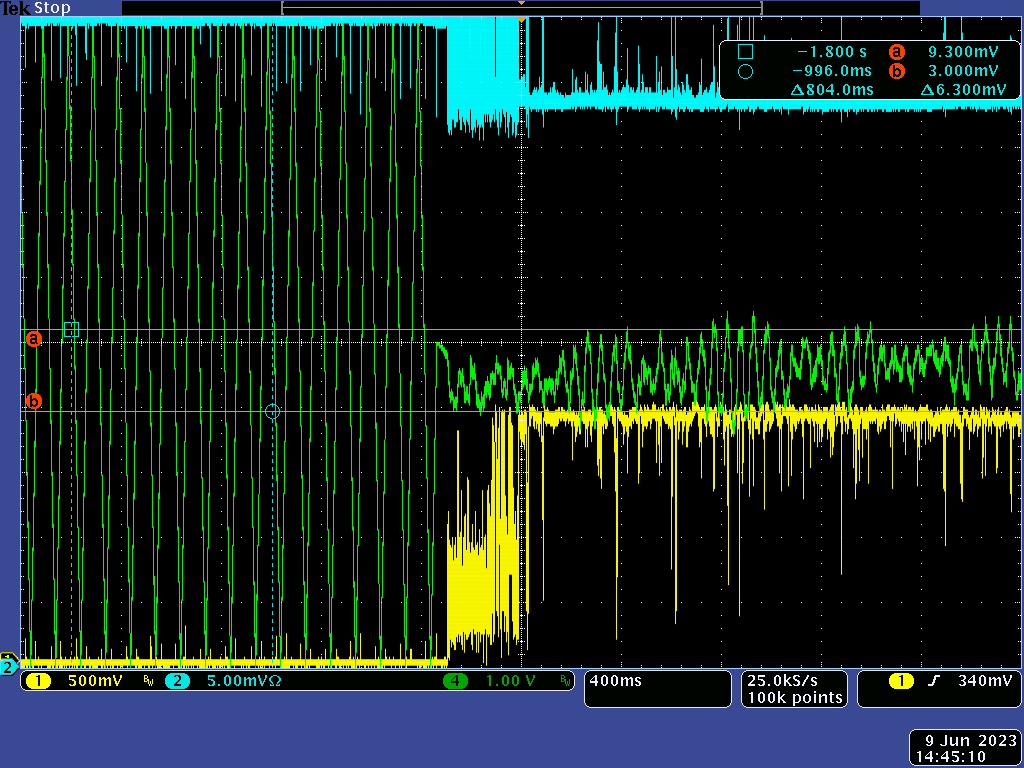
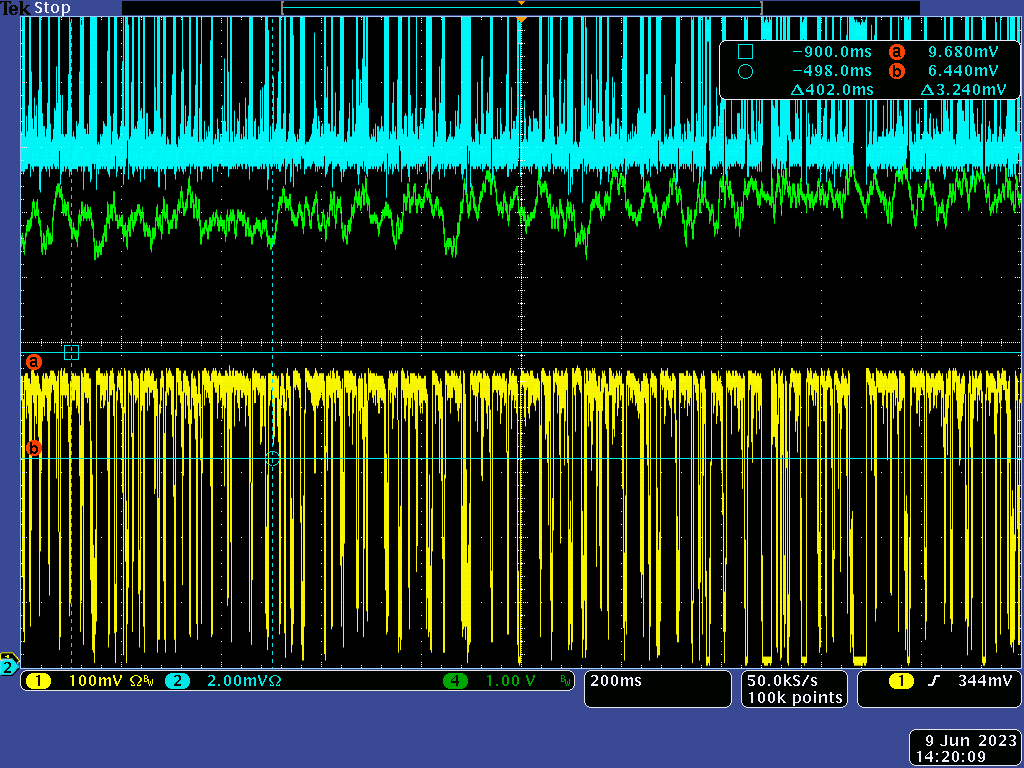
Manar Amer | Fixed | report | lasers and optics | detectors and electronics | cabling | software | ThomX igloo | Cavity Lock - Alphanov Amplifier | In the morning, we locked on the first resonance. With an increase on the amplifier power @ 20-25% and 30%, which reduced the noise
we manage to get a coupling when improving the CEP up to 55 - 60 % coupling : put there is still a drift on the CEP
The controller for the oscillator frep and CEP produces a lot of noise, even if it is disconnected. we need to switch it off to remove its effect (Kevin will order a new one)
The image attached is of the oscilloscope lock on the first resonance @30% amplifier power ~ 10 W injected into cavity,
transmitted power ~ 36 mW (cavity average power 12 kW)
cavity effective gain > 1200
in the afternoon, we installed and aligned a gentec power meter we can monitor from the computer. (will need to buy a permeant one for ThomX)
there was an issue with the laselock USB connection, yet to be solved.
and the control of the computer.
| Manar Amer wrote: |
|
Today with Ronic,
starting with major events that happened (Water circulation + ThomX valves )
- Early in the morning a company worked on the water network, it seemed it was not restarted properly so there was no water circulation in the main ThomX pipes.
- There was an error on the ThomX amplifier chiller , which was noticed at the end of the morning work , where we couldn't find the cavity resonance , could be due to the temperature increase of the amplifer.
- Solved : the issue was solved by restarting the water network and the amplifier chiller was restarted an no error found and temp. Stabilized around 25°
- Around 12h15 ThomX there was a power cut off for less than a second (micro cutt), which cased all the valves to close, the valve air compressor did not restart after the power cut off, we restarted it with Daniele in the evening with the help of Marie and the valves open around 5-6 bar , you will see then all the controllers green and the valves will open.
Results of the day :
- All the power supplies and function generators are under the table, nothing on the table (reduced noise on the signal)
- EOM of Oscillator Off (for now, might turn on if needed)
- Amplifier on 0% , output ~ 300 mW
- Locked on the first resonance of the cavity, lase lock parameters to be optimized better
- Transmitted power increased to ~ 267.2 uW
- Average power inside cavity = 89. 06 W , peak power = 0.2 kW (pulse width = 12.6 ps , frep = 33.36 MHz )
- current effective cavity gain > 300
Oscilloscope :
- error signal, not shown as it was too noisy to have in the image
- blue : reflection (low bypass filter ), yellow : transmission (resistance of 100 k ohm added), green : piezo signal
- 1st image : showing lock and scan regions.
- 2nd image: time zoom on the locked signal
oscillators controller / smartAct:
- Frequency and CEP control , the parameters in the photo attached are the best for the moment to see the smooth change of the resonance peaks when operating the motors, and we can stay FSR range and compensate the variation easily.
- even though we stayed at closed loop (for easier adjustment), we still managed to lock , will try to switch off later to see if reduces a lot of noise.
| Manar Amer wrote: |
|
Today, I installed a power meter at the transmission point of the 1st spherical mirror , transmission 3 ppm (direct from cavity window beam profiler, no filter)
We locked the cavity at 2 different resonances of the fundamental mode, the lock in both cases was stable for a round 1 minute.
at different transmitted power of 33.85 uW ( 11 W average inside cavity) and then locked again at 82.65 uW (27.5 W average inside cavity) transmitted power
Note : the coupling is almost zero for both of the resonances locked !!!!
Oscillator : 33.33 MHz ( 33.356 MHz , frequency read on LAL software)
power injected into amplifier (after injecting into fiber and an EOM) : 3.886 mW (on LAL software)
Amplifier power : 0% (injected power into cavity ~ 300 mW)
Both images of oscilloscope have same voltage scales, only difference timescale and the color code is :
yellow : transmission
blue : reflection
green : piezo voltage
red : error signal
| Manar Amer wrote: |
|
Yesterday, with Ronic we locked ThomX cavity on the second resonance
Laser : 33.36 MHz , Amplifier : 0 % (worked with no errors all day)
adding image for the lock on the second resonance (locked), 00 Mode image, fit, Beam measurements
and image of the first resonance signal (not locked)
Info : when locking on the secondary resonance, we aligned better and adjusted on the oscillator CEP and increased the transmission signal
Controllers connected to computer
through Ethernet :
- Cavity Mirror motors
- Lase lock
- oscillator CEP and Frequency motors (easier to follow the drift with this controller, and we can see it moving)
by USB :
| Manar Amer wrote: |
|
This morning, while trying Guillaume solution of disconnecting the 24 V necessary to the second and third stage and raise the threshold of Temp preamp 1 (to only operate the ampli with first stage only)
Ronic disconnected the 24 volt connection, turned on amplifier LAL software but no MMD3 error or a big temp on Temp preamp 1 , software worked fine with no issue.
we connected the 24 V again and the software worked with no issues.
Still not sure what happened for it to work correctly !!!!!!!!!!
- We used the amplifier at 0% all day with no errors (to test , I turned it for 10 minutes @ 10% with no error too)
- We changed the lase lock box with ThomX one (having Ethernet connection), it was connected to computer and works ok
- Ronic installed a signal amplifier for the PDH error signal. (yet to be fully optimized)
- we see a better coupling than before in the cavity.
- The dominant mode is 00 mode, but we see many higher order modes, need to alight better.
| Manar Amer wrote: |
|
Today with Ronic and Daniele we attempted to lock the cavity, but the alphanov amplifier did not turn on because of an error in MMD3 (related to the third stage)
the new error is having the MMD3 error show on the alarm window of the LAL software, and having the Alarms on the line 3 of the alphanov software red for both EXT/CPU and Laser T Max (never been red before)
this is after a 2-week work stop, but the last time when Daniele changed the fiber connector it worked for 3 hours with no errors.
Ronic, is in contact with Guillaume from Alphanov to fix the issue !!!
Work scheduled all Wednesday, in hopes the issue is fixed by then.
| Manar Amer wrote: |
|
Added Note: the coupling we get is at low power, only preamplifier is on (~ 300 mW)
was done at the end due to excitation of higher order modes.
Wanted to improve the fundamental first, then increase the power.
| Manar Amer wrote: |
- On Monday with Daniele,
- we did full characterization of amplifier beam @ 10% amplification, adjusted the telescope accordingly and injected into the cavity aligned and improved on the fundamental mode.
- On Tuesday with Daniele and Kevin
- I added a low pass filter between 1 - 1.9 MHz on the reflected signal, to reject the oscillator signal (33.33 MHz)
- removed the external resistors on the signal, only the internal resistance of the oscilloscope used ( transmission : 1 M ohm , Reflection : 50 ohm )
- We connected the motors to control the CEP and adjusted on them until we reached ~ 5 -10% coupling
- Images:
- 1st : showing the size of the beam just before injecting into the cavity @ 10%
- 2nd: signal with only improved alignment (not CEP adjustment yet), no low pass filter added yet
- 3rd : zoom on the signals (reflection and error) while adjusting on the CEP
- 4th :attempting to lock the cavity , after getting the max coupling using the CEP motors
Note : the voltage ranges are not the same between the images
| Manar Amer wrote: |
|
Yesterday,
- we installed the second high power reflecting mirrors at the output of the amplifier.
- We aligned and installed a telescope that has adjustable distance between the 2 lenses of -100 mm, and + 200 mm, with approximate diameter at the injection window of ~ 4.5 mm.
- Amplifier was turned on only at the first stage only (output power ~ 300 mW) aligned and injected into the cavity.
- Measured the repetition frequency of the One Five oscillators, Frep = 33.326239 MHz
- Changed the FSR of the cavity to match it.
- Using the Piezo scan on the oscillator, we observed 00 Mode, Fundamental. the shape is the same
- We see transmission on the diode, but there was zero coupling observed (yet to be investigated experimentally )
- a reason could be the CEP of the oscillator ,
- bad matching of the beam waist position,
- noise from the amplifier (as we were operating it at very low power)
- additional alignment needed,
|
|
|
|
|
|
|
|
|
| Attachment 1: tek00001_noise_reduced_first_resonance.png
|  |
| Attachment 2: tek00000_cavity_lock_with_noise_from_odcillator_controller.png
|  |
|
221
|
Mon Jun 19 16:08:15 2023 |
Manar Amer | Fixed | report | lasers and optics | detectors and electronics | cabling | software | ThomX igloo | Cavity Lock - Alphanov Amplifier | The computer is possible to connect from the control room,
we are able to run remotely the amplifier, cavity motors, oscillator motors, lase lock (note: there is an issue with the keyboard, we are not able to use it with remote access!!!!!!!!)
Note on Amplifier: On Friday, Daniele and Ronic faced again the temperature issue that came up before. it is due to the fluctuation of the diode temperature.
It was fixed today by Ronic and Daniele. it seems there are three diodes for monitoring the temperature, only one was connected, and it had issues, with some directions from alphanov.
Ronic just removed the defective diode and soldered (connected) a different one. The amplifier should work without this issue.
now we start searching for X-rays after locking the cavity remotely
| Manar Amer wrote: |
|
In the morning, we locked on the first resonance. With an increase on the amplifier power @ 20-25% and 30%, which reduced the noise
we manage to get a coupling when improving the CEP up to 55 - 60 % coupling : put there is still a drift on the CEP
The controller for the oscillator frep and CEP produces a lot of noise, even if it is disconnected. we need to switch it off to remove its effect (Kevin will order a new one)
The image attached is of the oscilloscope lock on the first resonance @30% amplifier power ~ 10 W injected into cavity,
transmitted power ~ 36 mW (cavity average power 12 kW)
cavity effective gain > 1200
in the afternoon, we installed and aligned a gentec power meter we can monitor from the computer. (will need to buy a permeant one for ThomX)
there was an issue with the laselock USB connection, yet to be solved.
and the control of the computer.
| Manar Amer wrote: |
|
Today with Ronic,
starting with major events that happened (Water circulation + ThomX valves )
- Early in the morning a company worked on the water network, it seemed it was not restarted properly so there was no water circulation in the main ThomX pipes.
- There was an error on the ThomX amplifier chiller , which was noticed at the end of the morning work , where we couldn't find the cavity resonance , could be due to the temperature increase of the amplifer.
- Solved : the issue was solved by restarting the water network and the amplifier chiller was restarted an no error found and temp. Stabilized around 25°
- Around 12h15 ThomX there was a power cut off for less than a second (micro cutt), which cased all the valves to close, the valve air compressor did not restart after the power cut off, we restarted it with Daniele in the evening with the help of Marie and the valves open around 5-6 bar , you will see then all the controllers green and the valves will open.
Results of the day :
- All the power supplies and function generators are under the table, nothing on the table (reduced noise on the signal)
- EOM of Oscillator Off (for now, might turn on if needed)
- Amplifier on 0% , output ~ 300 mW
- Locked on the first resonance of the cavity, lase lock parameters to be optimized better
- Transmitted power increased to ~ 267.2 uW
- Average power inside cavity = 89. 06 W , peak power = 0.2 kW (pulse width = 12.6 ps , frep = 33.36 MHz )
- current effective cavity gain > 300
Oscilloscope :
- error signal, not shown as it was too noisy to have in the image
- blue : reflection (low bypass filter ), yellow : transmission (resistance of 100 k ohm added), green : piezo signal
- 1st image : showing lock and scan regions.
- 2nd image: time zoom on the locked signal
oscillators controller / smartAct:
- Frequency and CEP control , the parameters in the photo attached are the best for the moment to see the smooth change of the resonance peaks when operating the motors, and we can stay FSR range and compensate the variation easily.
- even though we stayed at closed loop (for easier adjustment), we still managed to lock , will try to switch off later to see if reduces a lot of noise.
| Manar Amer wrote: |
|
Today, I installed a power meter at the transmission point of the 1st spherical mirror , transmission 3 ppm (direct from cavity window beam profiler, no filter)
We locked the cavity at 2 different resonances of the fundamental mode, the lock in both cases was stable for a round 1 minute.
at different transmitted power of 33.85 uW ( 11 W average inside cavity) and then locked again at 82.65 uW (27.5 W average inside cavity) transmitted power
Note : the coupling is almost zero for both of the resonances locked !!!!
Oscillator : 33.33 MHz ( 33.356 MHz , frequency read on LAL software)
power injected into amplifier (after injecting into fiber and an EOM) : 3.886 mW (on LAL software)
Amplifier power : 0% (injected power into cavity ~ 300 mW)
Both images of oscilloscope have same voltage scales, only difference timescale and the color code is :
yellow : transmission
blue : reflection
green : piezo voltage
red : error signal
| Manar Amer wrote: |
|
Yesterday, with Ronic we locked ThomX cavity on the second resonance
Laser : 33.36 MHz , Amplifier : 0 % (worked with no errors all day)
adding image for the lock on the second resonance (locked), 00 Mode image, fit, Beam measurements
and image of the first resonance signal (not locked)
Info : when locking on the secondary resonance, we aligned better and adjusted on the oscillator CEP and increased the transmission signal
Controllers connected to computer
through Ethernet :
- Cavity Mirror motors
- Lase lock
- oscillator CEP and Frequency motors (easier to follow the drift with this controller, and we can see it moving)
by USB :
| Manar Amer wrote: |
|
This morning, while trying Guillaume solution of disconnecting the 24 V necessary to the second and third stage and raise the threshold of Temp preamp 1 (to only operate the ampli with first stage only)
Ronic disconnected the 24 volt connection, turned on amplifier LAL software but no MMD3 error or a big temp on Temp preamp 1 , software worked fine with no issue.
we connected the 24 V again and the software worked with no issues.
Still not sure what happened for it to work correctly !!!!!!!!!!
- We used the amplifier at 0% all day with no errors (to test , I turned it for 10 minutes @ 10% with no error too)
- We changed the lase lock box with ThomX one (having Ethernet connection), it was connected to computer and works ok
- Ronic installed a signal amplifier for the PDH error signal. (yet to be fully optimized)
- we see a better coupling than before in the cavity.
- The dominant mode is 00 mode, but we see many higher order modes, need to alight better.
| Manar Amer wrote: |
|
Today with Ronic and Daniele we attempted to lock the cavity, but the alphanov amplifier did not turn on because of an error in MMD3 (related to the third stage)
the new error is having the MMD3 error show on the alarm window of the LAL software, and having the Alarms on the line 3 of the alphanov software red for both EXT/CPU and Laser T Max (never been red before)
this is after a 2-week work stop, but the last time when Daniele changed the fiber connector it worked for 3 hours with no errors.
Ronic, is in contact with Guillaume from Alphanov to fix the issue !!!
Work scheduled all Wednesday, in hopes the issue is fixed by then.
| Manar Amer wrote: |
|
Added Note: the coupling we get is at low power, only preamplifier is on (~ 300 mW)
was done at the end due to excitation of higher order modes.
Wanted to improve the fundamental first, then increase the power.
| Manar Amer wrote: |
- On Monday with Daniele,
- we did full characterization of amplifier beam @ 10% amplification, adjusted the telescope accordingly and injected into the cavity aligned and improved on the fundamental mode.
- On Tuesday with Daniele and Kevin
- I added a low pass filter between 1 - 1.9 MHz on the reflected signal, to reject the oscillator signal (33.33 MHz)
- removed the external resistors on the signal, only the internal resistance of the oscilloscope used ( transmission : 1 M ohm , Reflection : 50 ohm )
- We connected the motors to control the CEP and adjusted on them until we reached ~ 5 -10% coupling
- Images:
- 1st : showing the size of the beam just before injecting into the cavity @ 10%
- 2nd: signal with only improved alignment (not CEP adjustment yet), no low pass filter added yet
- 3rd : zoom on the signals (reflection and error) while adjusting on the CEP
- 4th :attempting to lock the cavity , after getting the max coupling using the CEP motors
Note : the voltage ranges are not the same between the images
| Manar Amer wrote: |
|
Yesterday,
- we installed the second high power reflecting mirrors at the output of the amplifier.
- We aligned and installed a telescope that has adjustable distance between the 2 lenses of -100 mm, and + 200 mm, with approximate diameter at the injection window of ~ 4.5 mm.
- Amplifier was turned on only at the first stage only (output power ~ 300 mW) aligned and injected into the cavity.
- Measured the repetition frequency of the One Five oscillators, Frep = 33.326239 MHz
- Changed the FSR of the cavity to match it.
- Using the Piezo scan on the oscillator, we observed 00 Mode, Fundamental. the shape is the same
- We see transmission on the diode, but there was zero coupling observed (yet to be investigated experimentally )
- a reason could be the CEP of the oscillator ,
- bad matching of the beam waist position,
- noise from the amplifier (as we were operating it at very low power)
- additional alignment needed,
|
|
|
|
|
|
|
|
|
|
|
203
|
Tue Mar 28 13:56:52 2023 |
Manar Amer | Fixed | report | lasers and optics | detectors and electronics | ThomX igloo | Cavity Alighnment | Last week, with Ronic and Victor we aligned the cavity using CW laser (Koheras)
- we have also installed 4 mirrors in the cavity with the best theoretical qualities (serial number and images included)
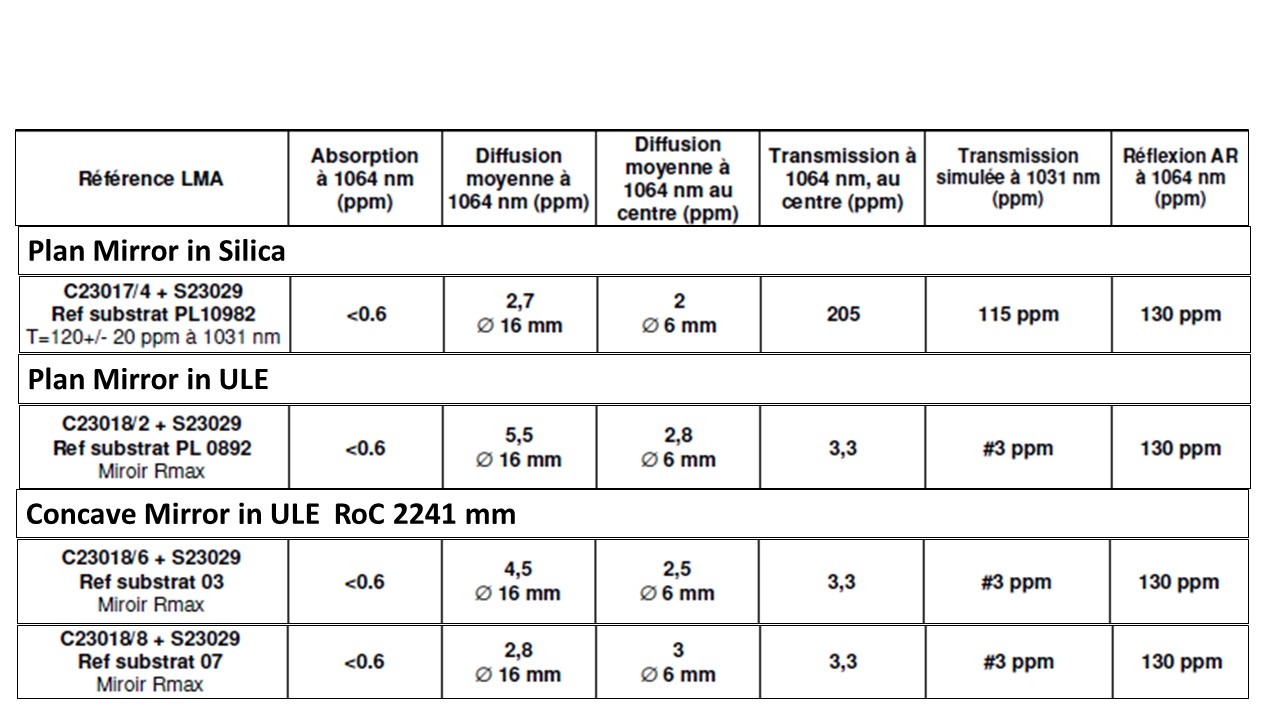
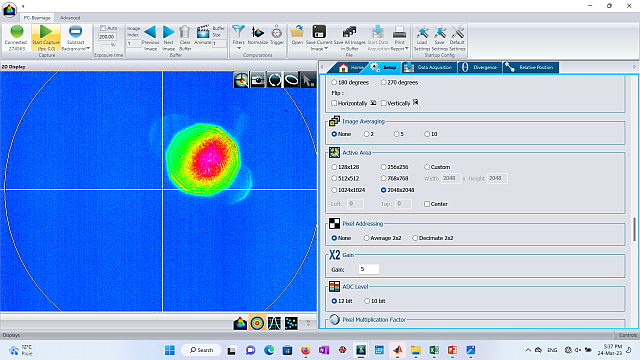
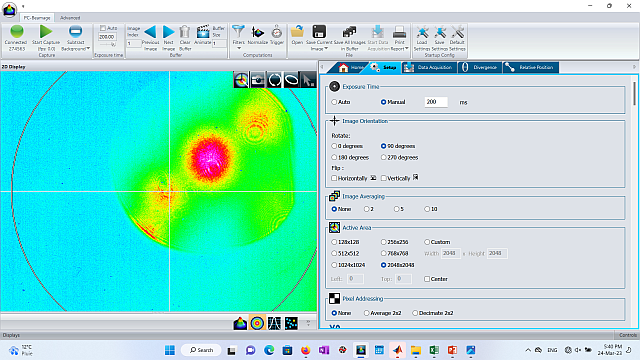
- The Plan ULE mirror P4 thickness was not compatible with the piezoelectric mount. We had to install a metal spacer behind the mirror to be able to fix it. the metal spacers in from ThorLabs made from INOX, It is 1 inch diameter (25.4 mm), we drilled a hole in the middle of 15 mm in the Workshop in bat 200. Then cleaned it using an ultrasound bath in pure water, using a small Ultrasound bath machine in Maverics platform Vide and Surfaces next to ThomX eglo.
-
- This gives some difficulties in imaging the transmission at P4. To help with the imaging, we used the plastic #D printed irises that Yann made long time ago
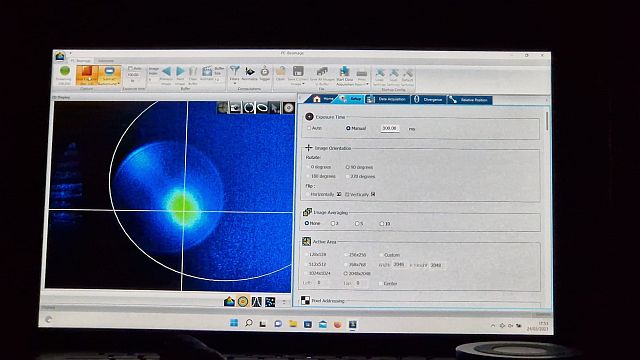
- we took images of the mode inside the cavity at P4 transmission.
- We also observed some oxidization on the metal bars of the controllers, more on the side of S2 and P4. we are yet to test the motion of the motors in the z-axis.
- Friday evening we closed the windows using a new copper rings (last one we have, Ronic placed a new order).
- The pump was turned on by Bruno and Eric yesterday afternoon. The current vacuum level is 6-7*10^-6 mbar
the pre and the turbo pimps are on so still too noisy to work, we have access all day tomorrow.
|
| Attachment 1: 20230328_Mirror_Used.jpg
|  |
| Attachment 2: WhatsApp_Image_2023-03-28_at_12.18.17_PM(1).jpg
| .jpg "WhatsApp_Image_2023-03-28_at_12.18.17_PM(1).jpg") |
| Attachment 3: WhatsApp_Image_2023-03-23_at_11.32.39_AM(3).jpg
| .jpg "WhatsApp_Image_2023-03-23_at_11.32.39_AM(3).jpg") |
| Attachment 4: WhatsApp_Image_2023-03-28_at_12.18.16_PM(4).jpg
| .jpg "WhatsApp_Image_2023-03-28_at_12.18.16_PM(4).jpg") |
| Attachment 5: iris_4mm_P4__reduced.png
|  |
| Attachment 6: iris_ouvert_a_fond_P4___reduced.png
|  |
| Attachment 7: 20230324_Transmission_S3.jpg
|  |
| Attachment 8: Image_of_P1_S3_window_open_Oxidization_shown.jpg
|  |
| Attachment 9: Image_of_P4_S2_window_open_Oxidization_shown.jpg
|  |
|
204
|
Tue Apr 4 13:03:23 2023 |
Manar Amer | Fixed | report | lasers and optics | vacuum | detectors and electronics | ThomX igloo | Cavity Alighnment | Today, we prepared lenses for a telescope for the CW laser injection into the cavity, yet to be installed
Image of the transmission at P4 attached, an estimation of the beam size of the mode see is ~ 5.5 mm
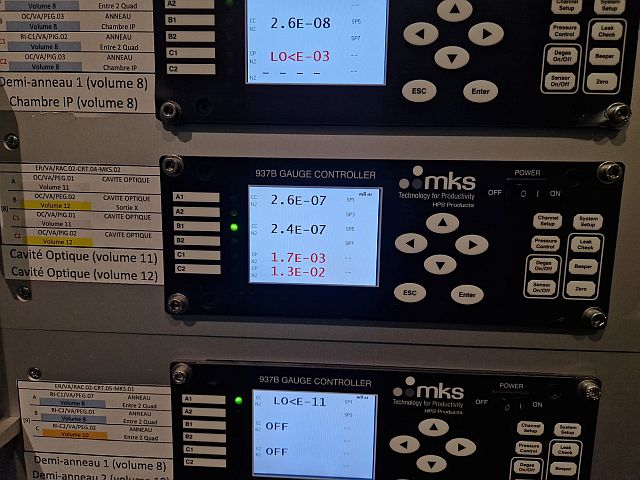
The vacuum in the 2 optical cavities is decreasing but slowly. today it is 2.6 - 2.4 * 10^-7 mbar
| Manar Amer wrote: |
|
Last week, with Ronic and Victor we aligned the cavity using CW laser (Koheras)
- we have also installed 4 mirrors in the cavity with the best theoretical qualities (serial number and images included)
- The Plan ULE mirror P4 thickness was not compatible with the piezoelectric mount. We had to install a metal spacer behind the mirror to be able to fix it. the metal spacers in from ThorLabs made from INOX, It is 1 inch diameter (25.4 mm), we drilled a hole in the middle of 15 mm in the Workshop in bat 200. Then cleaned it using an ultrasound bath in pure water, using a small Ultrasound bath machine in Maverics platform Vide and Surfaces next to ThomX eglo.
-
- This gives some difficulties in imaging the transmission at P4. To help with the imaging, we used the plastic #D printed irises that Yann made long time ago
- we took images of the mode inside the cavity at P4 transmission.
- We also observed some oxidization on the metal bars of the controllers, more on the side of S2 and P4. we are yet to test the motion of the motors in the z-axis.
- Friday evening we closed the windows using a new copper rings (last one we have, Ronic placed a new order).
- The pump was turned on by Bruno and Eric yesterday afternoon. The current vacuum level is 6-7*10^-6 mbar
the pre and the turbo pimps are on so still too noisy to work, we have access all day tomorrow.
|
|
| Attachment 1: 20230404_P4_Transmission.jpg
|  |
| Attachment 2: 20230404_vacuum_level.jpg
|  |
|
192
|
Wed Mar 8 15:11:49 2023 |
Ronic Chiche | Fixed | info | lasers and optics | ThomX igloo | CW laser installation and cleaning | This morning with Manar, in order to prepare the installation of the news FP cavity mirrors,
- we installed the Koheras below the optical table
- we put a fiber prolongator at the end of the Koheras fiber and we put a mounted collimator at the end of the fiber.
we added a mirror at 45° to inject the beam to injection axis of the table.
- as the beam was still slightly divergent, we added a 750mm lens ~20cm after the collimator to improve the beam collimation.
now the collimated beam is going approximatively through the middle all of the iris in the optical path.
we finished by ~2h of cleaning of the optical table and elements, which were very dirty.
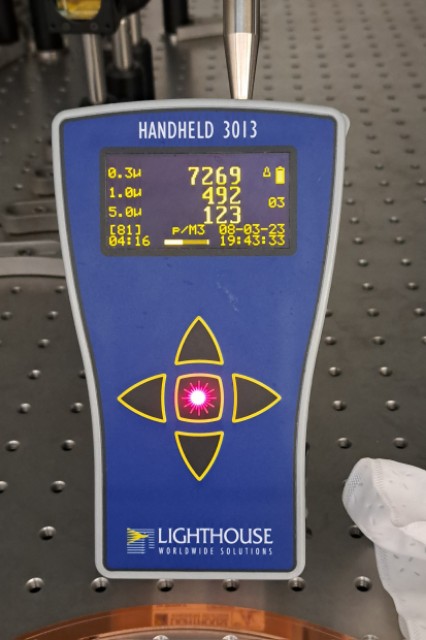
it is still a bit dirty. see the attached file to get the numbers provided by the particle counter after the cleaning. |
| Attachment 1: 20230308_121713.jpg
|  |
|
193
|
Mon Mar 13 14:02:59 2023 |
Ronic Chiche | Fixed | info | lasers and optics | ThomX igloo | CW laser installation and cleaning | This morning with Ronic , in preparation for the mirror installation, we removed additional mechanics and cables from the table.
We organized and cleaned the permanently installed cables on the table away from the area of the cavity opening.
We opened the two top vents and left the shutters open to circulate clean air , (note the shutters surrounding the laser and amplifier are half closed for safety)
Note: before installing the mirrors, preferably the shutters should be opened a day before to have clean air in the surrounding of the cavity openings
and avoid any cleaning or air disturbance.
| Ronic Chiche wrote: |
|
This morning with Manar, in order to prepare the installation of the news FP cavity mirrors,
- we installed the Koheras below the optical table
- we put a fiber prolongator at the end of the Koheras fiber and we put a mounted collimator at the end of the fiber.
we added a mirror at 45° to inject the beam to injection axis of the table.
- as the beam was still slightly divergent, we added a 750mm lens ~20cm after the collimator to improve the beam collimation.
now the collimated beam is going approximatively through the middle all of the iris in the optical path.
we finished by ~2h of cleaning of the optical table and elements, which were very dirty.
it is still a bit dirty. see the attached file to get the numbers provided by the particle counter after the cleaning.
|
|
|
205
|
Fri Apr 7 00:26:11 2023 |
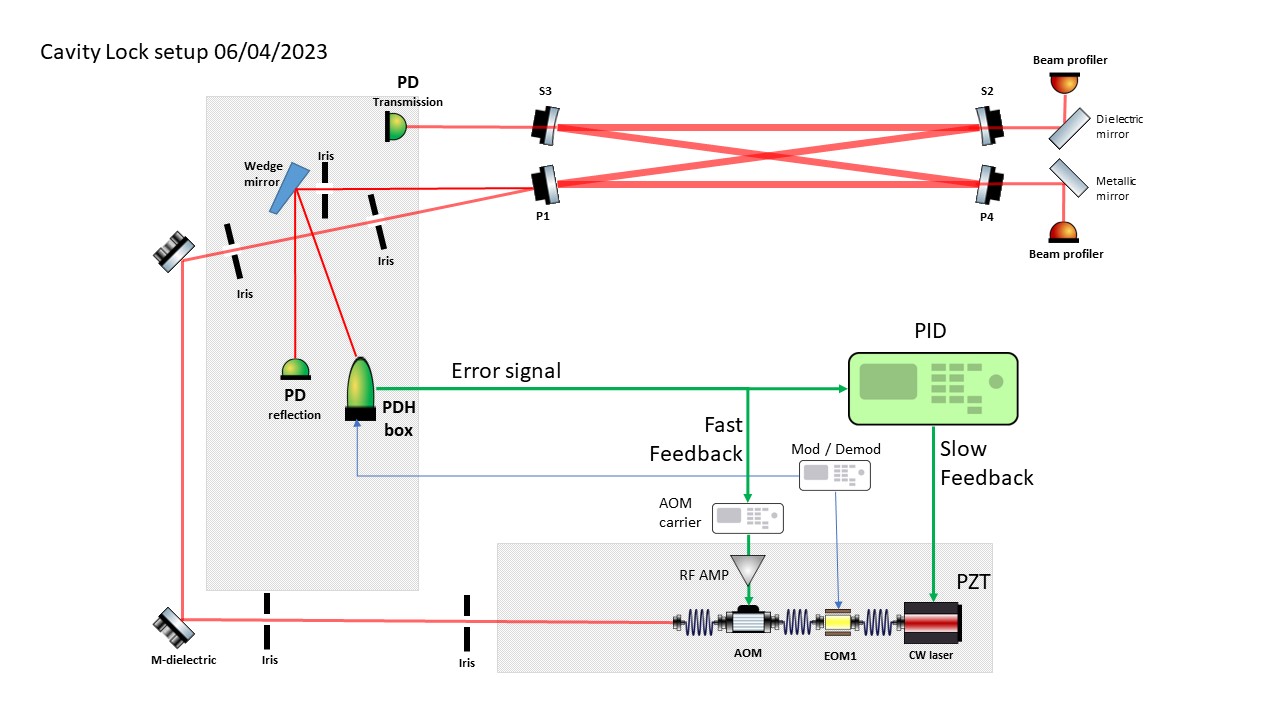
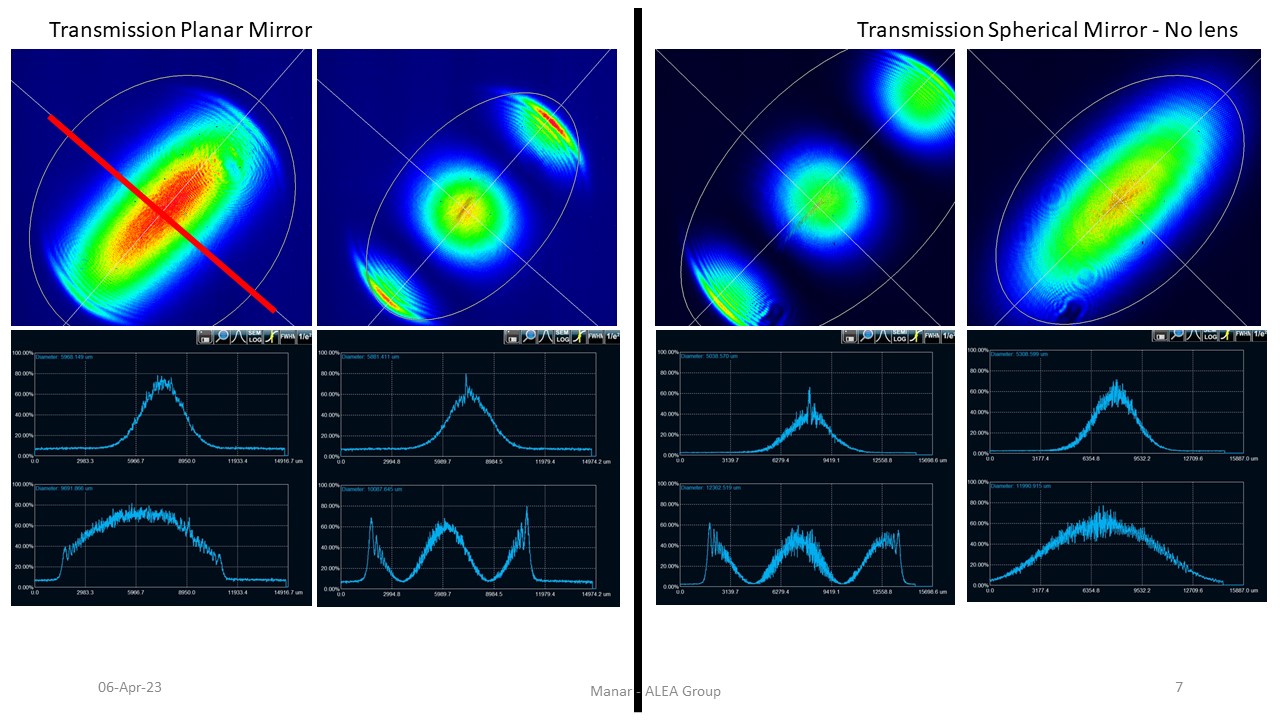
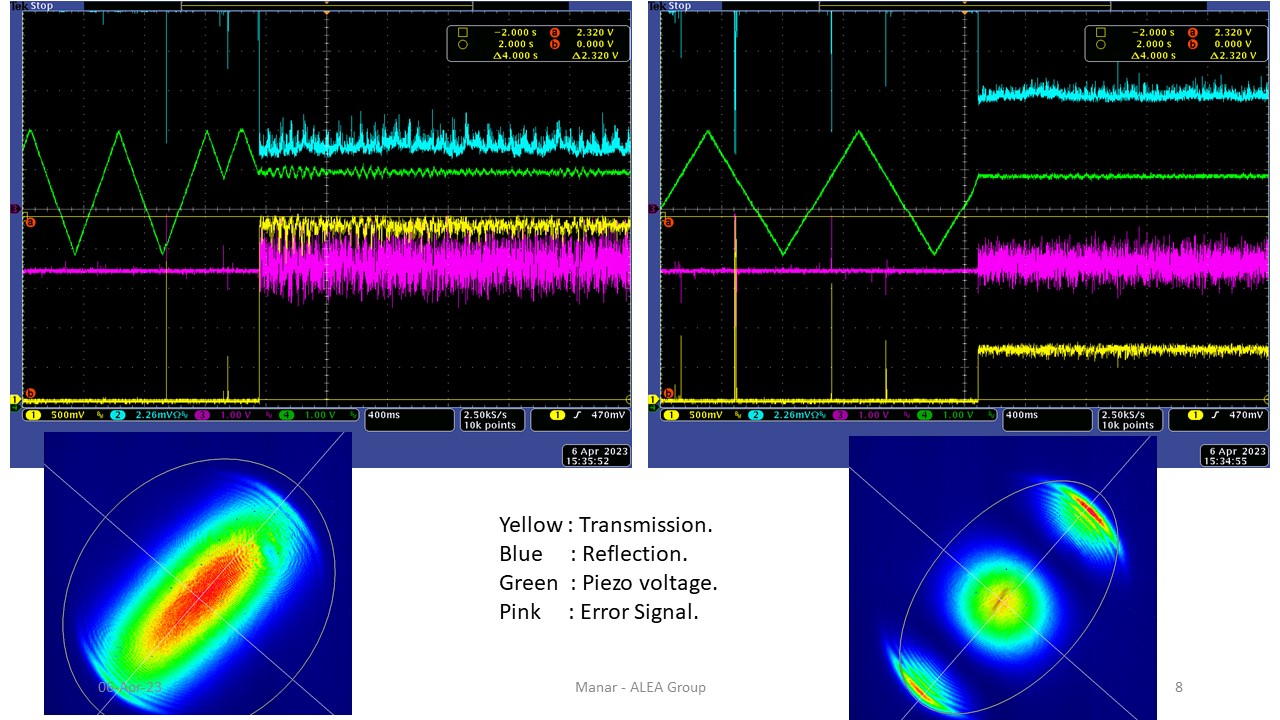
Manar Amer | Fixed | report | lasers and optics | detectors and electronics | ThomX igloo | CW FP Cavit lock | Yesterday morning we locked the cavity on a strange mode in the cavity (we call it mode, but not sure what it is ??)
we also managed to lock on a higher order mode 02
we get an estimated 30% coupling (expected value), and note that we have not installed a telescope yet.
| Manar Amer wrote: |
|
Today, we prepared lenses for a telescope for the CW laser injection into the cavity, yet to be installed
Image of the transmission at P4 attached, an estimation of the beam size of the mode see is ~ 5.5 mm
The vacuum in the 2 optical cavities is decreasing but slowly. today it is 2.6 - 2.4 * 10^-7 mbar
| Manar Amer wrote: |
|
Last week, with Ronic and Victor we aligned the cavity using CW laser (Koheras)
- we have also installed 4 mirrors in the cavity with the best theoretical qualities (serial number and images included)
- The Plan ULE mirror P4 thickness was not compatible with the piezoelectric mount. We had to install a metal spacer behind the mirror to be able to fix it. the metal spacers in from ThorLabs made from INOX, It is 1 inch diameter (25.4 mm), we drilled a hole in the middle of 15 mm in the Workshop in bat 200. Then cleaned it using an ultrasound bath in pure water, using a small Ultrasound bath machine in Maverics platform Vide and Surfaces next to ThomX eglo.
-
- This gives some difficulties in imaging the transmission at P4. To help with the imaging, we used the plastic #D printed irises that Yann made long time ago
- we took images of the mode inside the cavity at P4 transmission.
- We also observed some oxidization on the metal bars of the controllers, more on the side of S2 and P4. we are yet to test the motion of the motors in the z-axis.
- Friday evening we closed the windows using a new copper rings (last one we have, Ronic placed a new order).
- The pump was turned on by Bruno and Eric yesterday afternoon. The current vacuum level is 6-7*10^-6 mbar
the pre and the turbo pimps are on so still too noisy to work, we have access all day tomorrow.
|
|
|
| Attachment 1: 20230406_setup.jpg
|  |
| Attachment 2: 20230406_transmission_S2-P4.jpg
|  |
| Attachment 3: 20230406_Cavity_Lock.jpg
|  |
|
206
|
Fri Apr 7 15:56:40 2023 |
Manar Amer | Fixed | report | lasers and optics | detectors and electronics | ThomX igloo | CW FP Cavit lock | This morning with Daniele and Viktor,
- we confirmed the "potato" mode was well centered on the injected beam and was not due to some misalignment of the injected beam compared to the cavity axis.
we look at the reflected beam during a lock. we can see the direct reflected beam superposed with the cavity mode (cf attached image).
- then we assumed the "potato" mode problem could come from the too short distance between spherical mirrors which introduces ellipticity and finally can lead to some instability.
we manage to move further spherical mirrors S2 and S3 by moving them from 1 350 000 to 800 000 steps.
=> we increased the distance by 2x 550 000 steps (with 6µm for 1000 steps) => we increased the distance between spherical mirrors by 6.6 mm
the new mode shrinked a lot and at the end was spherical at 73%.
the mode size is now about 4400 x 6000 µm but with the major and minor axis still at 45° !
| Manar Amer wrote: |
|
Yesterday morning we locked the cavity on a strange mode in the cavity (we call it mode, but not sure what it is ??)
we also managed to lock on a higher order mode 02
we get an estimated 30% coupling (expected value), and note that we have not installed a telescope yet.
| Manar Amer wrote: |
|
Today, we prepared lenses for a telescope for the CW laser injection into the cavity, yet to be installed
Image of the transmission at P4 attached, an estimation of the beam size of the mode see is ~ 5.5 mm
The vacuum in the 2 optical cavities is decreasing but slowly. today it is 2.6 - 2.4 * 10^-7 mbar
| Manar Amer wrote: |
|
Last week, with Ronic and Victor we aligned the cavity using CW laser (Koheras)
- we have also installed 4 mirrors in the cavity with the best theoretical qualities (serial number and images included)
- The Plan ULE mirror P4 thickness was not compatible with the piezoelectric mount. We had to install a metal spacer behind the mirror to be able to fix it. the metal spacers in from ThorLabs made from INOX, It is 1 inch diameter (25.4 mm), we drilled a hole in the middle of 15 mm in the Workshop in bat 200. Then cleaned it using an ultrasound bath in pure water, using a small Ultrasound bath machine in Maverics platform Vide and Surfaces next to ThomX eglo.
-
- This gives some difficulties in imaging the transmission at P4. To help with the imaging, we used the plastic #D printed irises that Yann made long time ago
- we took images of the mode inside the cavity at P4 transmission.
- We also observed some oxidization on the metal bars of the controllers, more on the side of S2 and P4. we are yet to test the motion of the motors in the z-axis.
- Friday evening we closed the windows using a new copper rings (last one we have, Ronic placed a new order).
- The pump was turned on by Bruno and Eric yesterday afternoon. The current vacuum level is 6-7*10^-6 mbar
the pre and the turbo pimps are on so still too noisy to work, we have access all day tomorrow.
|
|
|
|
| Attachment 1: 20230407_103103-2.jpg
|  |
|
86
|
Thu Nov 28 10:40:29 2019 |
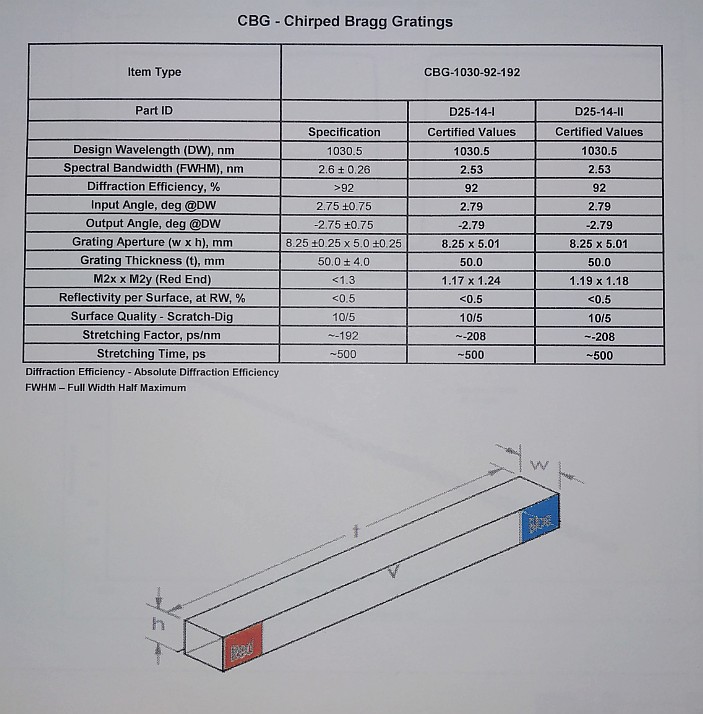
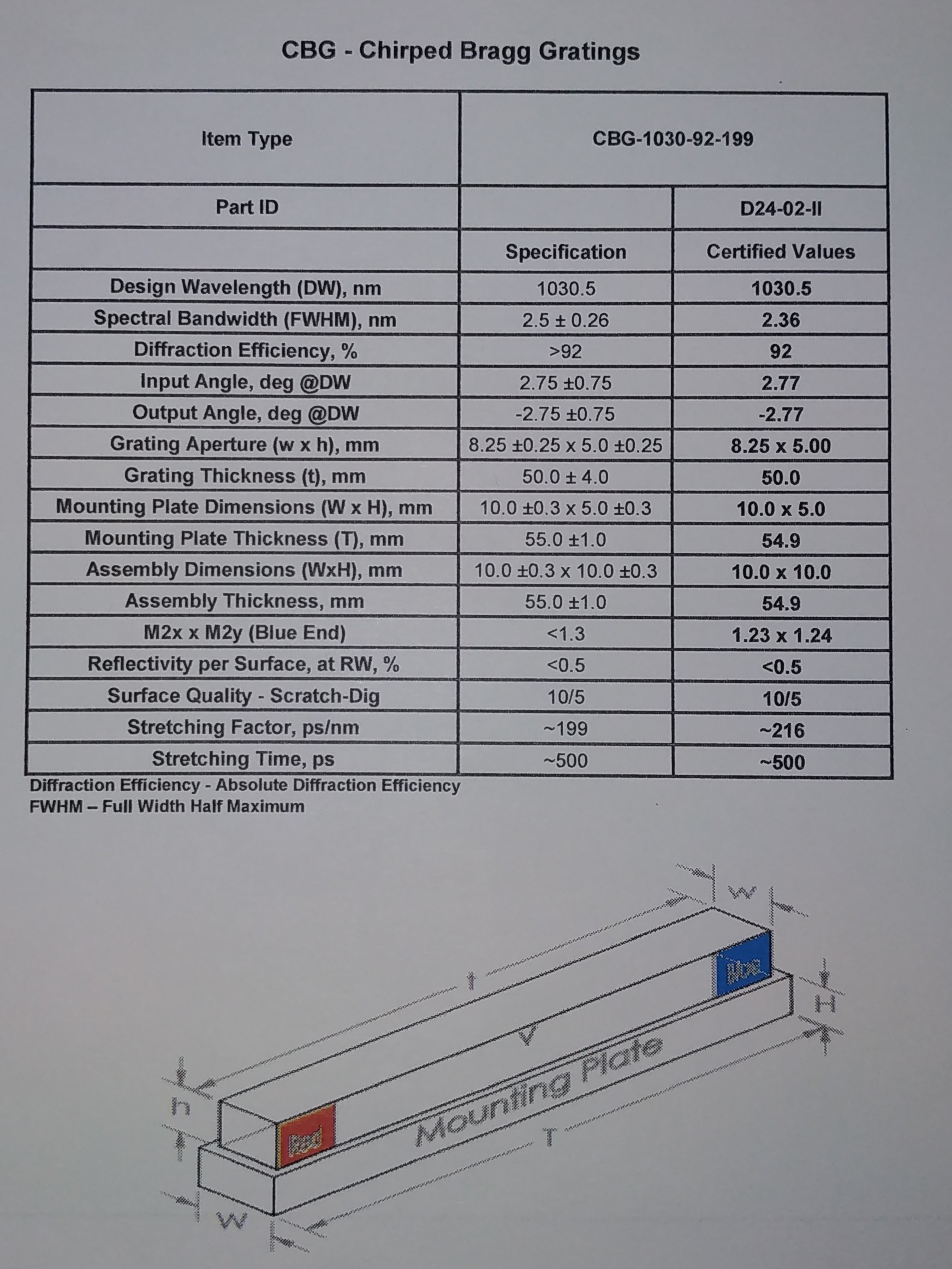
Loïc Amoudry | Fixed | info | lasers and optics | Optical room | CVBG reference and Eric Cormier calculation | The Stretcher is the "D 24-02-II", it must be used in double path before the amplifier injection.
There are two compressors in single path, "D 25-14-I" and "D 25-14-II".
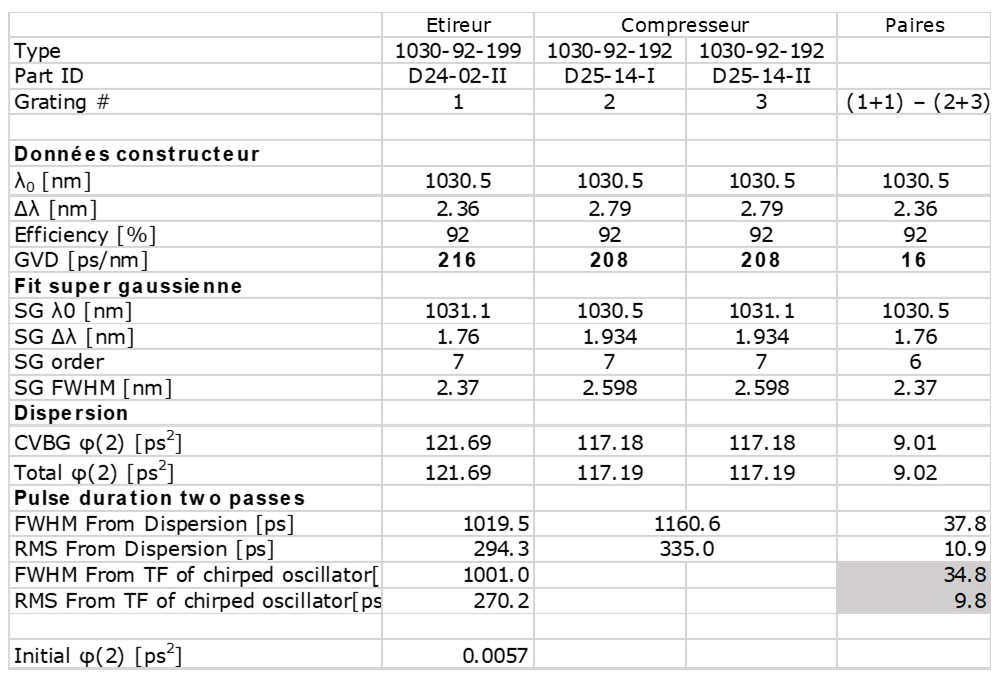
Eric calculations are attached below. |
| Attachment 1: compresseurs.jpg
|  |
| Attachment 2: Etireur.jpg
|  |
| Attachment 3: calcul_Eric.jpg
|  |
|
391
|
Wed Jan 8 12:24:48 2025 |
Ronic Chiche | Under Process | info | lasers and optics | detectors and electronics | cabling | ThomX igloo | CEM noise measurements | The goal of these measurements is to check if one can find some correlation between the CFP lock losses observed during a run and some CEM noise in the bunker.
the main issue is coming from a 20Hz noise apearing/disapearing in the laser cavity PZT signal.
is it a real cavity length noise that must be compensated or is it a pickup noise in the error signal which produce some unwanted compensation ?
the second issue (apearing much less often) is a higher frequency noise visible mainly in the transmission signal of the CFP which becomes wider and noisy during 1-2 seconds.
This morning, I installed a simple wire loop all around the table (the machine is OFF).
this wire is connected to the wire of a BNC connector at one end and to the ground of the same BNC connector at the other end to form a loop.
this BNC connector is connected to a 1kHz low pass filter to remove high frequency CEM noises and connected to a 10-1000 variable gain amplifier, plugged to the CH3 of the CFP scope (instead of the PDH/PZT-CAV signal).
I locked the CFP above 80kW after tuning the CEP.
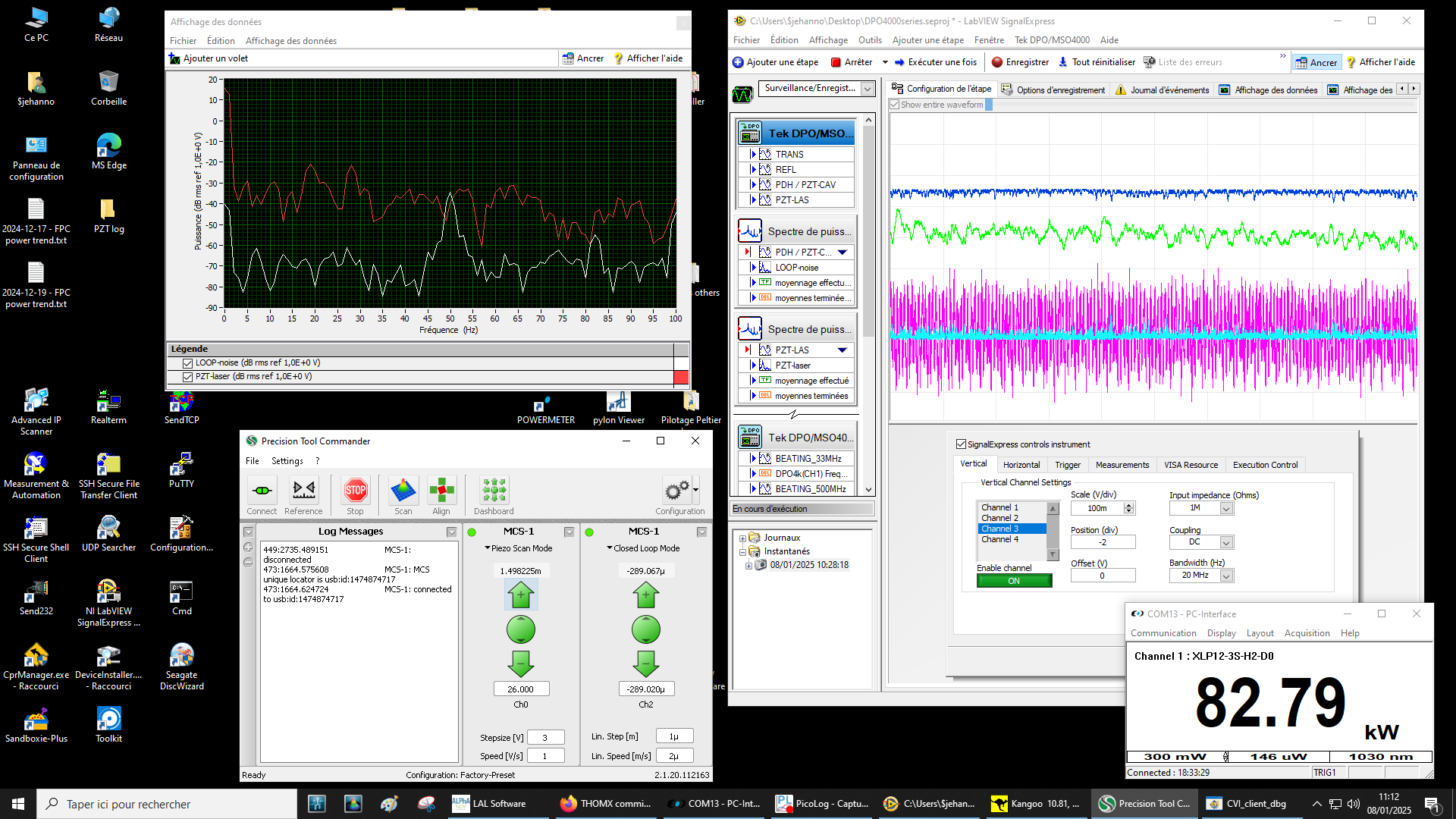
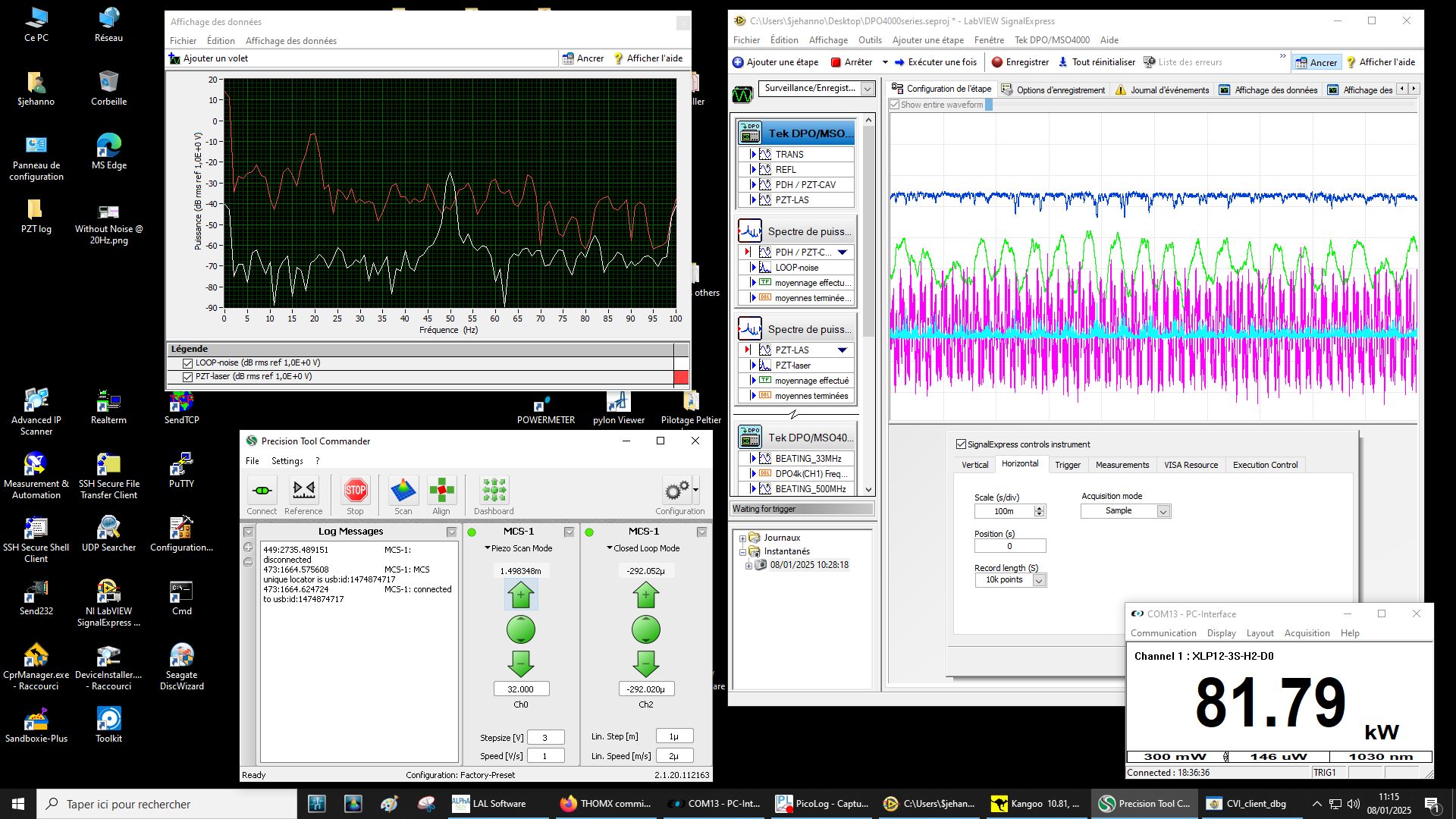
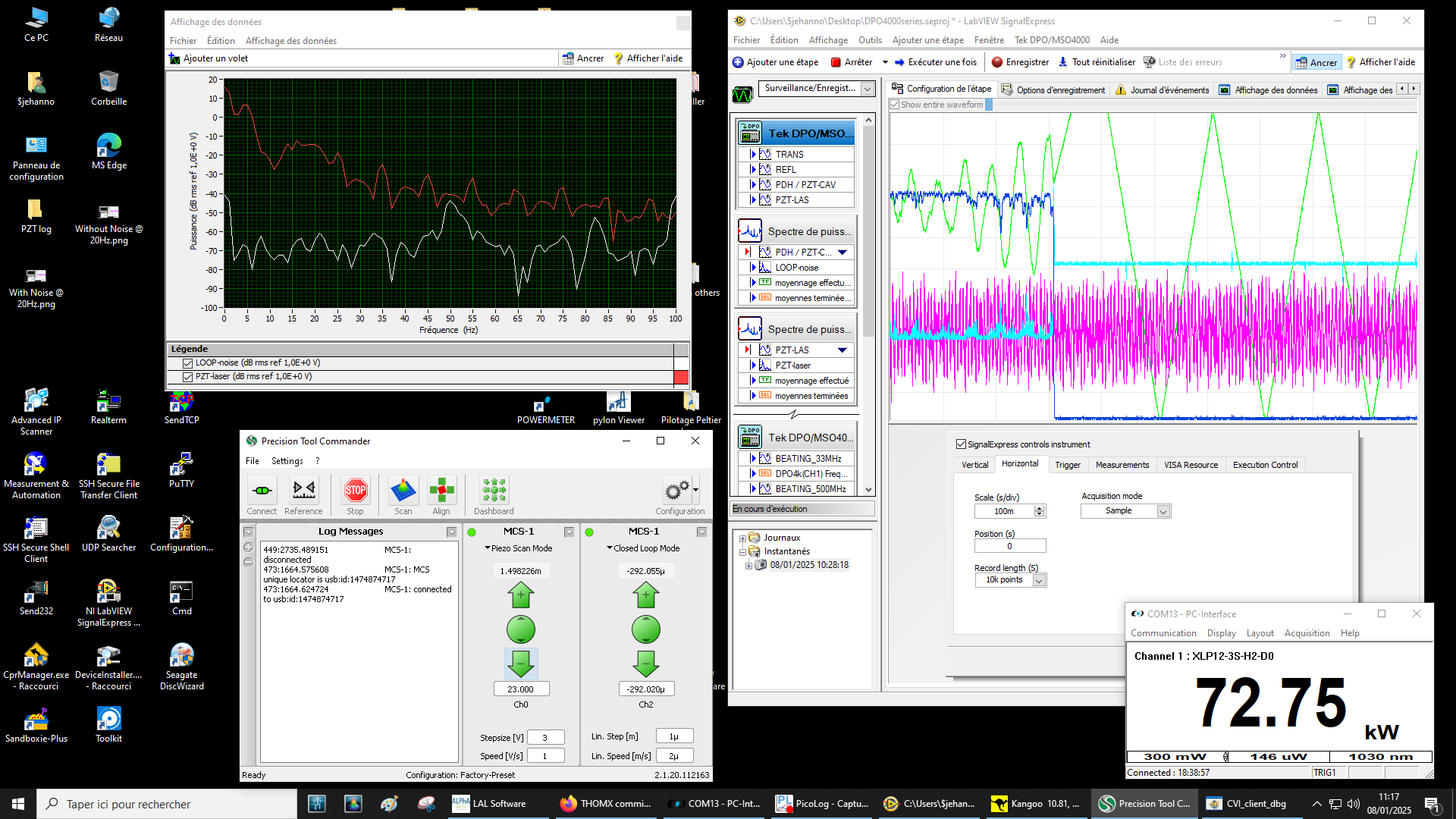
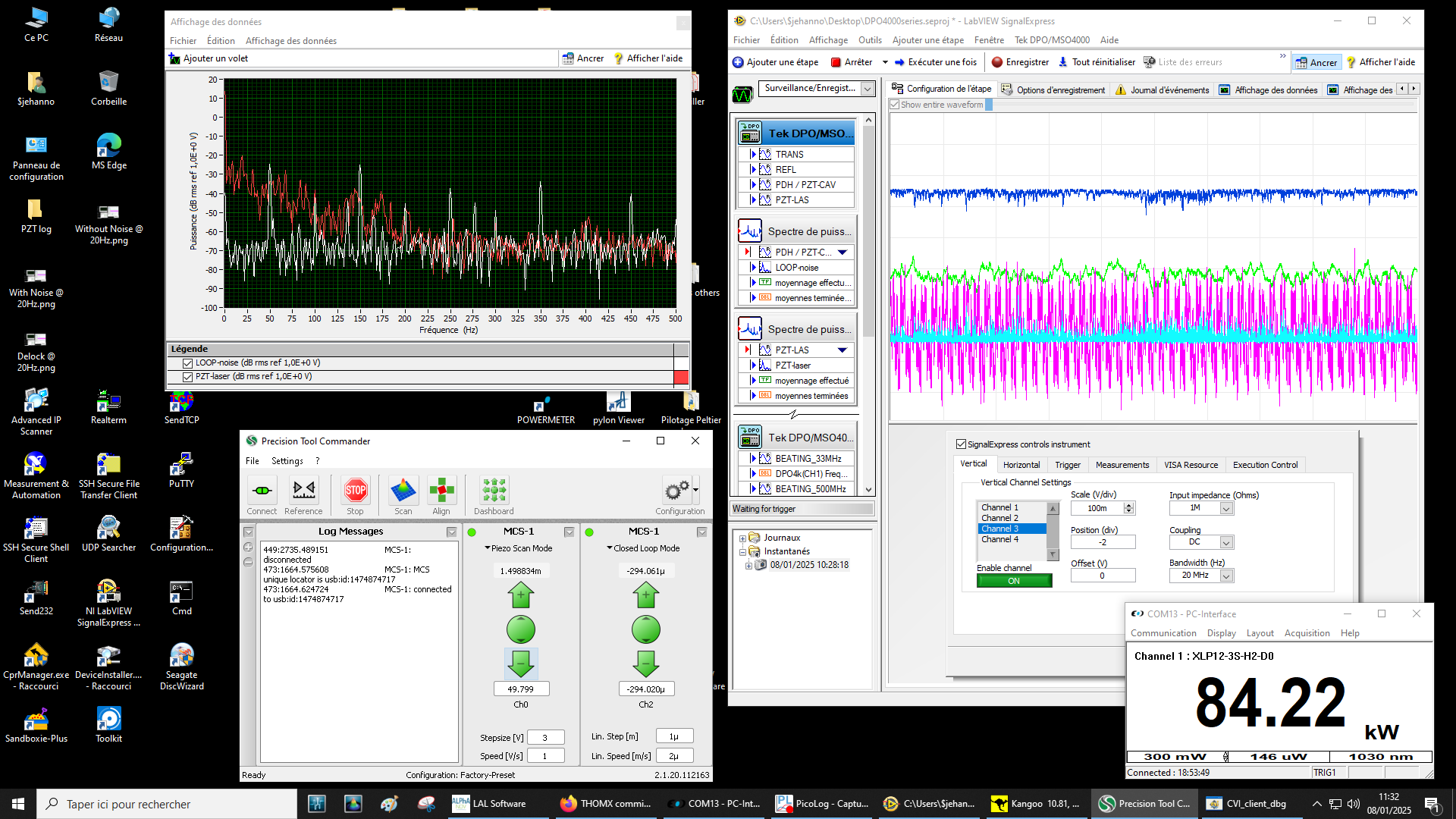
I took several pictures to illustrate what I observed :
- on the right, the scope signal in time domain (blue = TRANS / green = PZT laser / cyan = REFLECT / pink = LOOP noise)
- on the left, the spectral analysis in frequency domain (red = PZT laser / white = LOOP noise)
in these 3 measurements, I don't do anything to the CFP, I just wait for the signals.
1) normal condition : see picture "Without Noise @ 20Hz"
the PZT signal in time domain is relatively flat and the 20Hz noise is barely visible in frequency domain.
we don't see any correlation with the LOOP noise for which one can see clear 50Hz and 100Hz peaks.
2) 20Hz noise condition : see picture "With Noise @ 20Hz"
the PZT signal in time and frequency domain exhibit a clear 20Hz oscillation.
the REFLECT and TRANS signals are also correlated to this 20Hz oscillation.
but still no correlation with the LOOP noise in time or frequency domain.
3) 20Hz noise lock loss condition : see picture "Delock @ 20Hz"
because of the lock loss the spectral analysis of the PZT signal is meaningless,
but in time domain, one can clearly see the growth of the 20Hz signal, inducing large noise on TRANS and REFLECT signal but still no correlation with the LOOP noise.
Conclusion : the 20Hz noise seems not related to any CEM noisy signal but more probably to a real mechanical noise in the CFP (not in the laser cavity because it would be seen in the phase noise measurements).
in this measurement, I tried to produce a tone around 400Hz with my voice, close to the FP cavity.
it is difficult to right volume as the cavity can easily lose the lock.
4) Voice noise condition : see picture "Voice noise @ 400Hz"
here, I changed the spectral span to 500Hz.
one can see a small bump in frequency domain around 400Hz due to the accoustic noise in the PZT signal.
the general shape of the PZT spectral signal is maybe related to the PID parameters : one can see more signal at lower frequencies.
in time domain, one can see TRANS and REFLECT signals are more noisy than before and these signals shapes seems identical to what has been observed when one has lock loss due to high frequency noise.
maybe we could put a mic in the bunker, connected to one scope to check if sometime one doesn't have much more accoustic noise...
|
| Attachment 1: Without_Noise_@_20Hz.png
|  |
| Attachment 2: With_Noise_@_20Hz.png
|  |
| Attachment 3: Delock_@_20Hz.png
|  |
| Attachment 4: Voice_noise_@400Hz.png
|  |
|