| ID |
Date |
Author |
Status |
Type |
Category |
Location |
Title |
|
142
|
Fri Apr 8 13:12:34 2022 |
Manar Amer | Fixed | report | lasers and optics | ThomX igloo | Alphanov amplifier Beam Profile | This Morning, another reading was taken for the output of the amplifier after the compressor using 2 wedge mirrors.
In addition, a start of the calibration of a PulseCheck "Autocorrelator" to measure the pulse duration.
note, the pulsed laser used is OneFive 133.33 MHz
| Manar Amer wrote: |
|
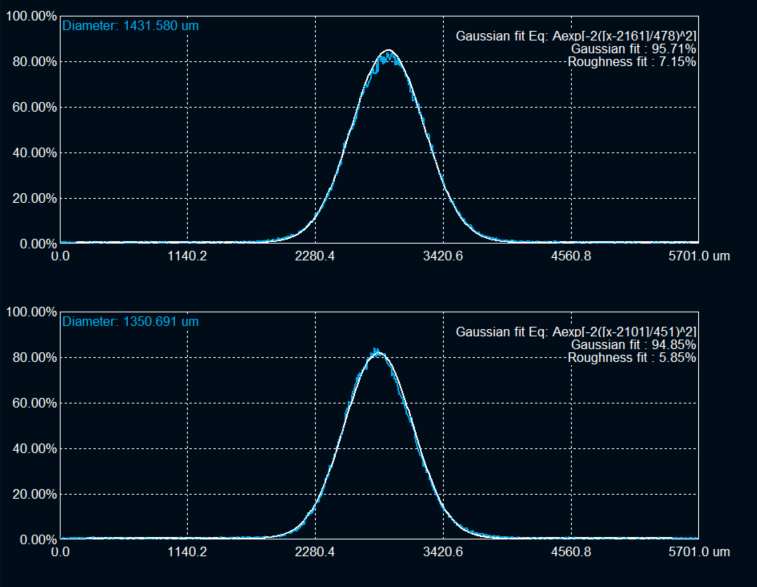
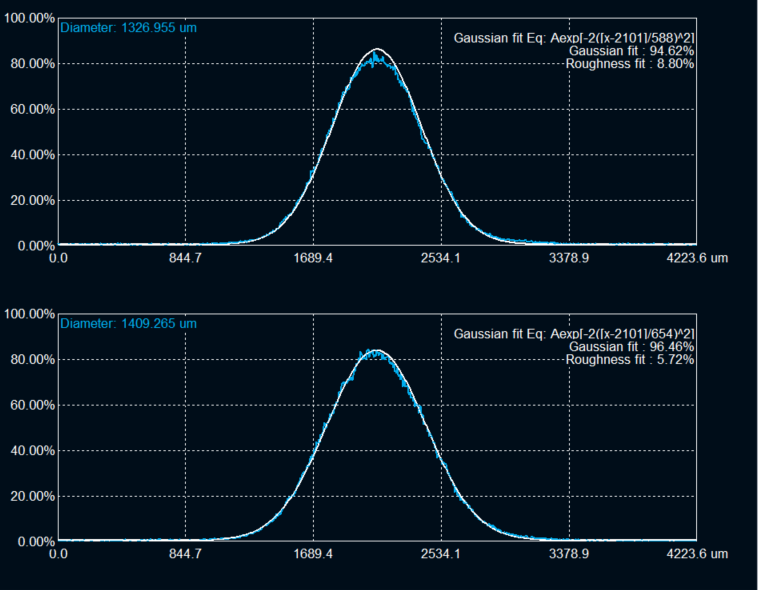
Adding the readings 20% , 30% , 40% for output of amplifier after the compressor
| Manar Amer wrote: |
|
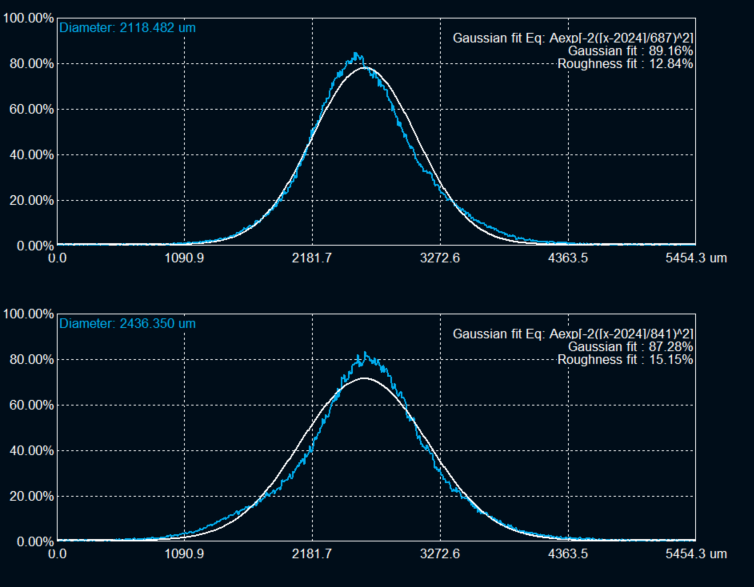
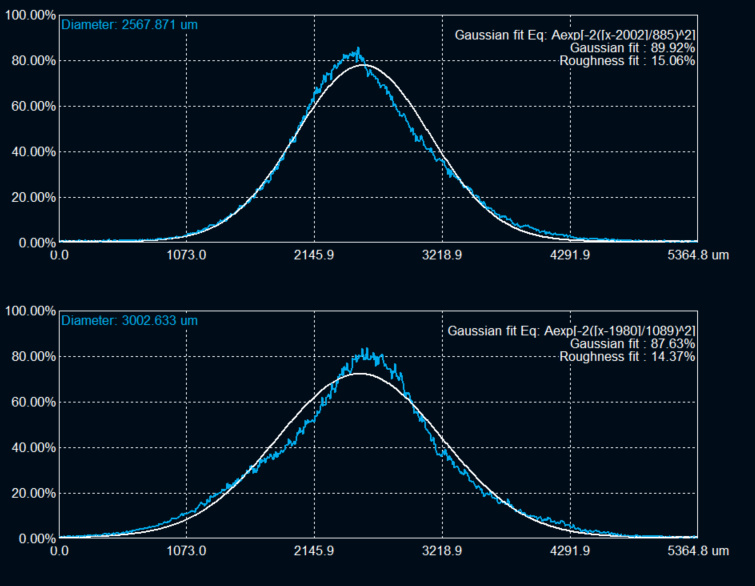
Readings of the beam shape and fit at the output of the compressor
differance from previous reading is that here we used wedges instead of HR mirrors.
Similar to previous readings, the beam shape deforms and the Gaussian fit is bad after 50% amplification
| Manar Amer wrote: |
|
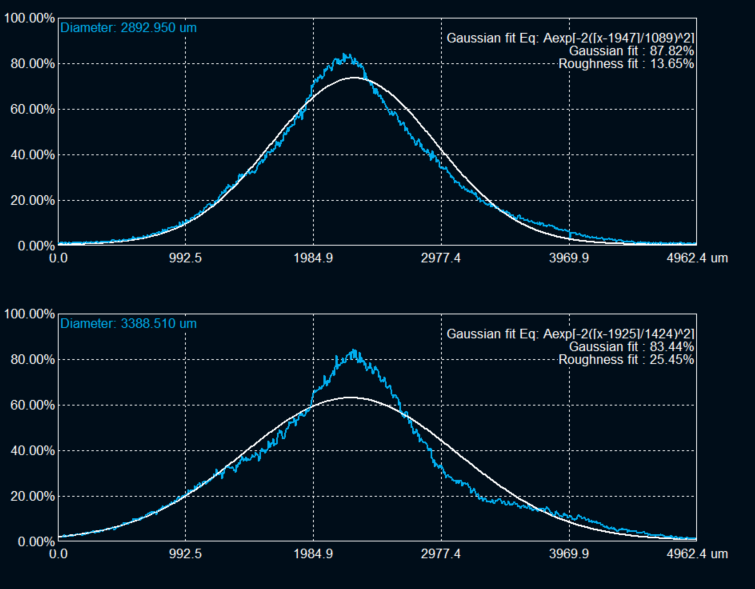
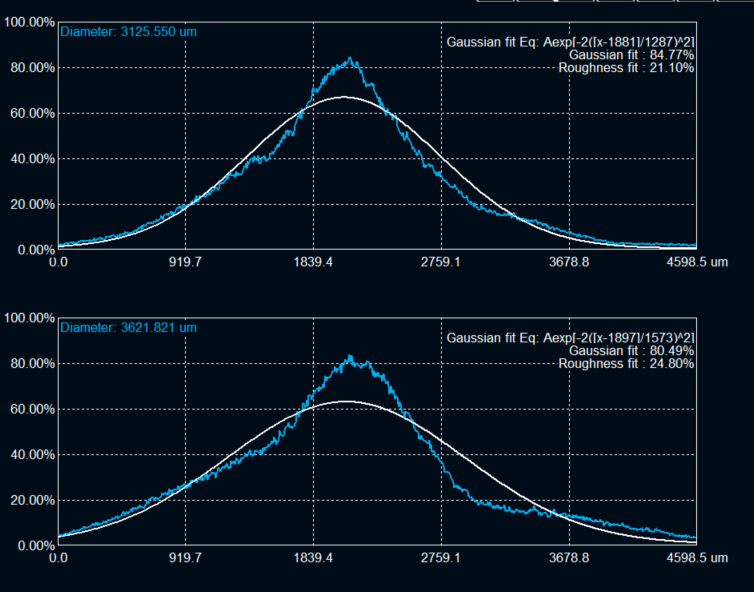
Readings of the beam shape and horizontal (upper plot) and vertical (lower plot) axis fit at the direct output of the amplifier.
The beam shape relatively shaped like an egg.
| Manar Amer wrote: |
|
Today a second reading of the beam profile was done , with Victor ,Ronic, Aurlien and Manar
an additional set-up was made using two 4 deg wedges instead of High reflecting (HR) and Anti-reflecting (AR) mirrors.
Two reading were taken:
- at the output of the compressor with a NE30A filter on the beam profiler
- at the output of the amplifier with NE30A + NE10A filter on beam profiler
| Manar Amer wrote: |
|
Adding the fitted beam in 1D in Horizontal and vertical axis.
for 10% to 60%
| Manar Amer wrote: |
|
| Manar Amer wrote: |
|
Today: Manar, Ronic and Aurlien started the study of the beam profile of the alphanov amplifier at high power.
The setup shown in the image shows how the power is reduced by using Anti-reflective mirrors,
pick up 1 : Anti-reflective coating on both sides , pick up 2 : Anti-reflective coating on one side and High reflectivity on the other
using this method, we avoid saturation and damage to the beam profiler from the high power amplified laser
in addition, an OD3 filter is placed in front of the beam profiler. and a reflective mirror is placed close to deflect the reflection from the mirror(pick up 1) second surface.
The beam observed is relatively well shaped and fitted up to 50% of amplification is where the shape starts to deform a little and is not well-fitted by a Gaussian. (image attached shows the fit for 60% amplification)
The cause is yet to be determined, as it could only be related to the reflections that occur from the mirrors (pick up 1 and pick up 2)
*** Note be always careful at High Power :)
|
|
|
|
|
|
|
|
| Attachment 1: 20220408_Amplifier_compressor_20perc.bmp
|
| Attachment 2: 20220408_Amplifier_compressor_40perc.bmp
|
| Attachment 3: 20220408_Amplifier_compressor_60perc.bmp
|
| Attachment 4: 20220408_Amplifier_compressor_70perc.bmp
|
| Attachment 5: 20220408_Amplifier_compressor_80perc.bmp
|
| Attachment 6: 20220408_Amplifier_compressor_90perc.bmp
|
| Attachment 7: 20220408_Amplifier_compressor_BeamFit_20perc.png
|  |
| Attachment 8: 20220408_Amplifier_compressor_BeamFit_40perc.png
|  |
| Attachment 9: 20220408_Amplifier_compressor_BeamFit_60perc.png
|  |
| Attachment 10: 20220408_Amplifier_compressor_BeamFit_70perc.png
|  |
| Attachment 11: 20220408_Amplifier_compressor_BeamFit_80perc.png
|  |
| Attachment 12: 20220408_Amplifier_compressor_BeamFit_90perc.png
|  |
|
147
|
Fri Apr 15 19:00:20 2022 |
Manar Amer | Fixed | report | lasers and optics | ThomX igloo | Alphanov amplifier Beam Profile | Victor, Ronic, Manar
Today was dedicated to the study of the CVBG, and it's effect on the beam profile
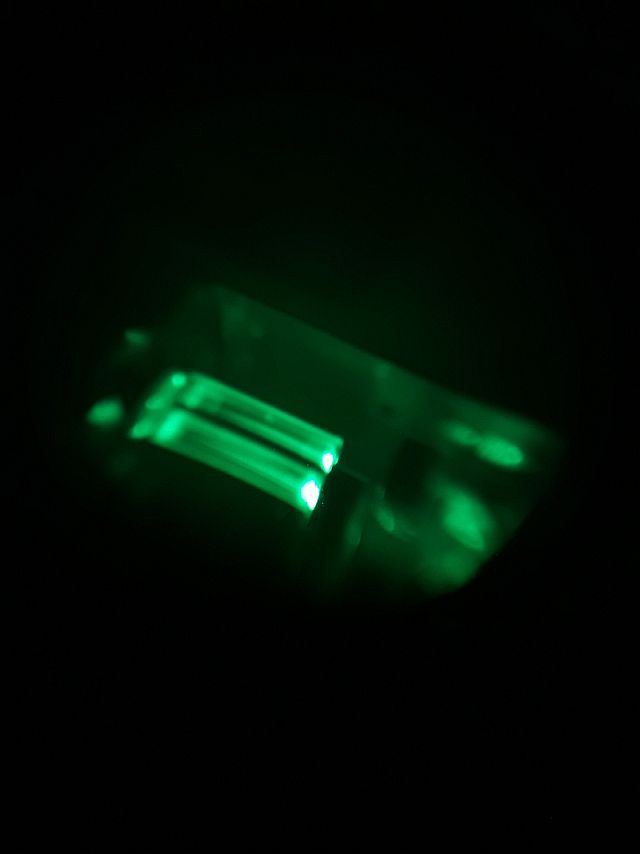
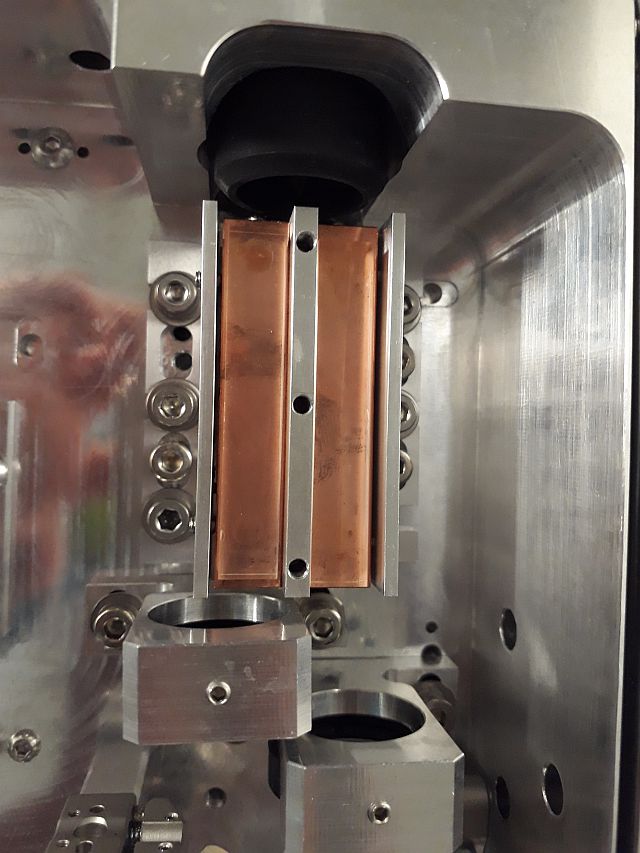
we opened the box containing the 2 CVBGs : The 2CVBG are glued from the bottom on a copper surface .
Using the beam viwer, the beam line inside the two CVBG is not at the exact center but not at the edges too and not hitting the boarders.
From the sides you see two lines, one is reflection on the metal.
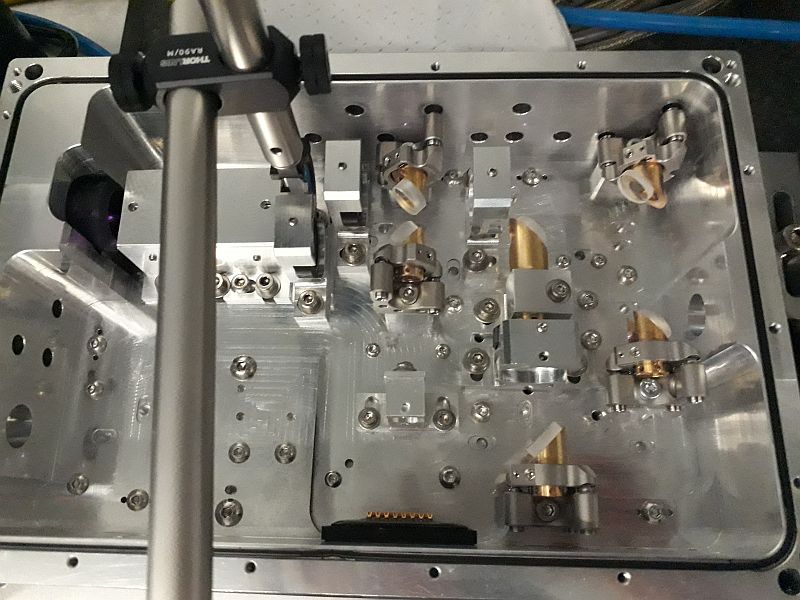
To observe the effect of the first CVBG by itself, we blocked the second reflection into the 2nd CVBG.
By placing the D-shaped mirror just at the entrance of the 2nd CVBG (there was just enough space to put it)
Beam Profiler + OD 10E + OD 30E + OD(not known) placed at ~ 1 m from the output of compressor.
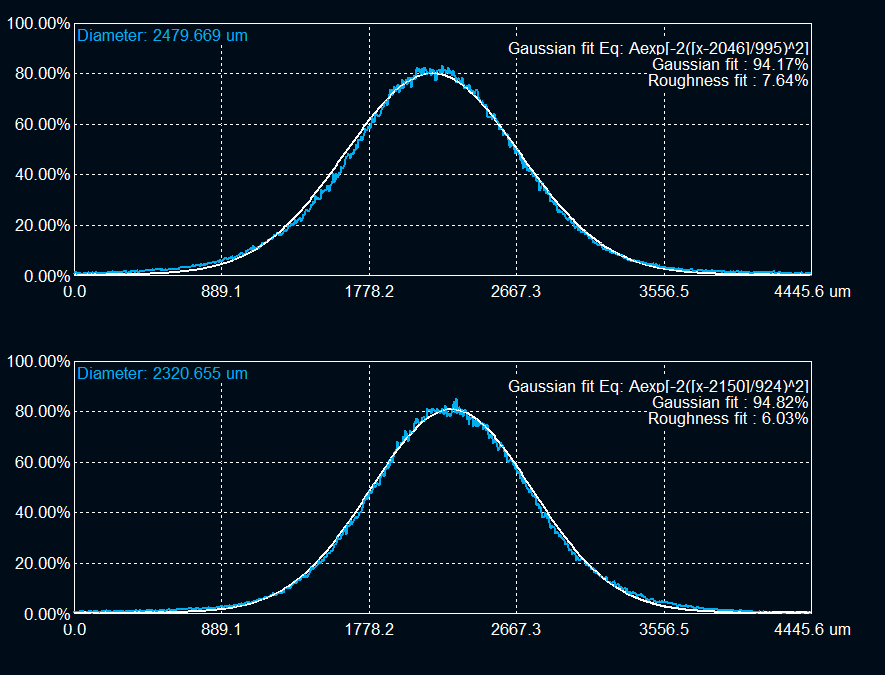
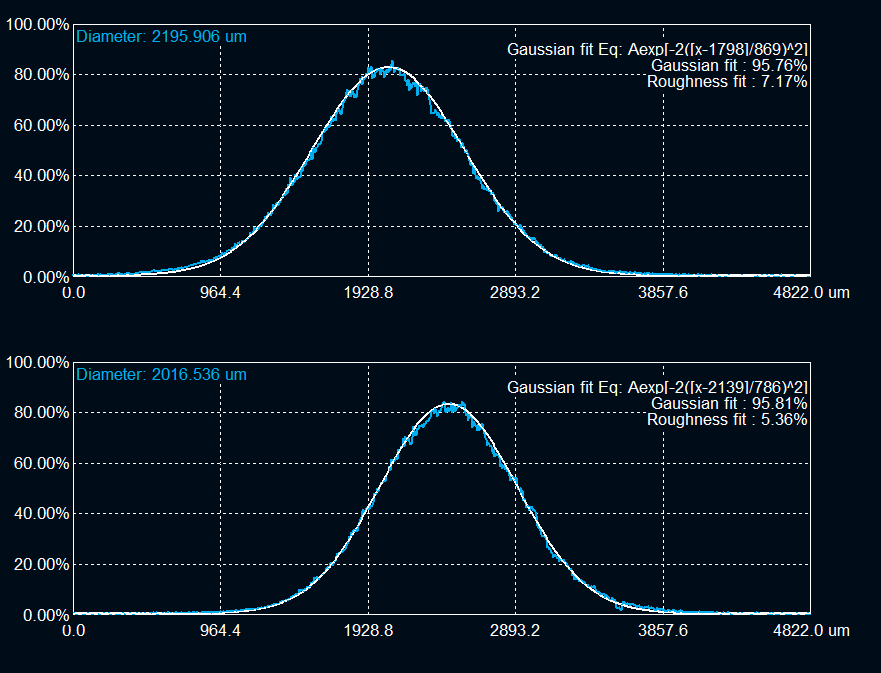
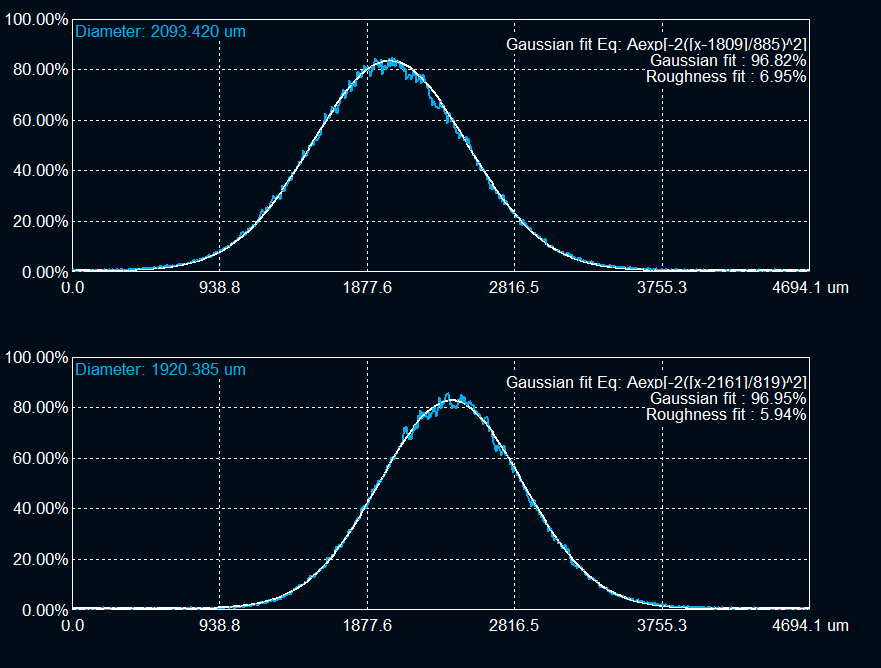
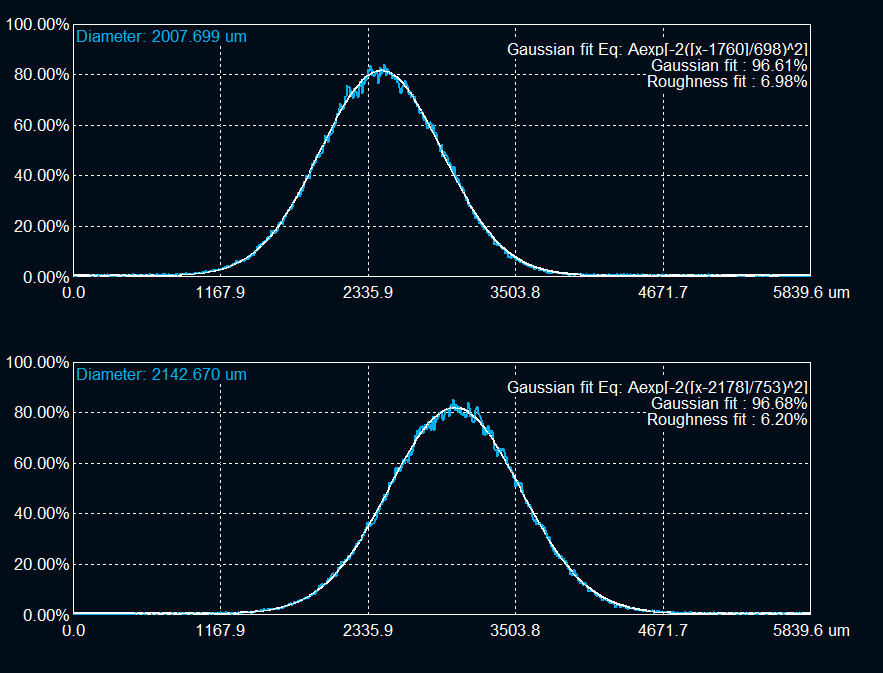
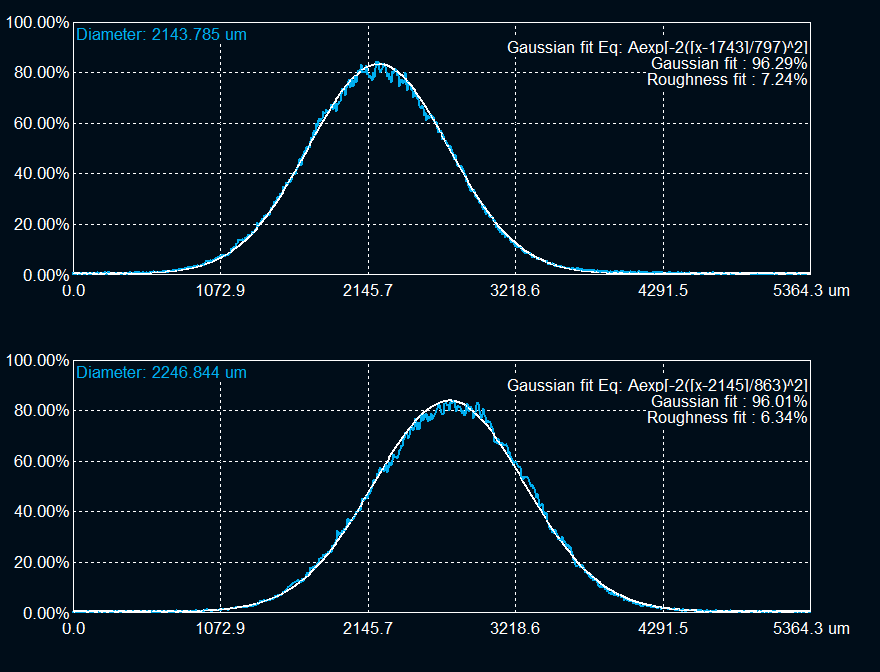
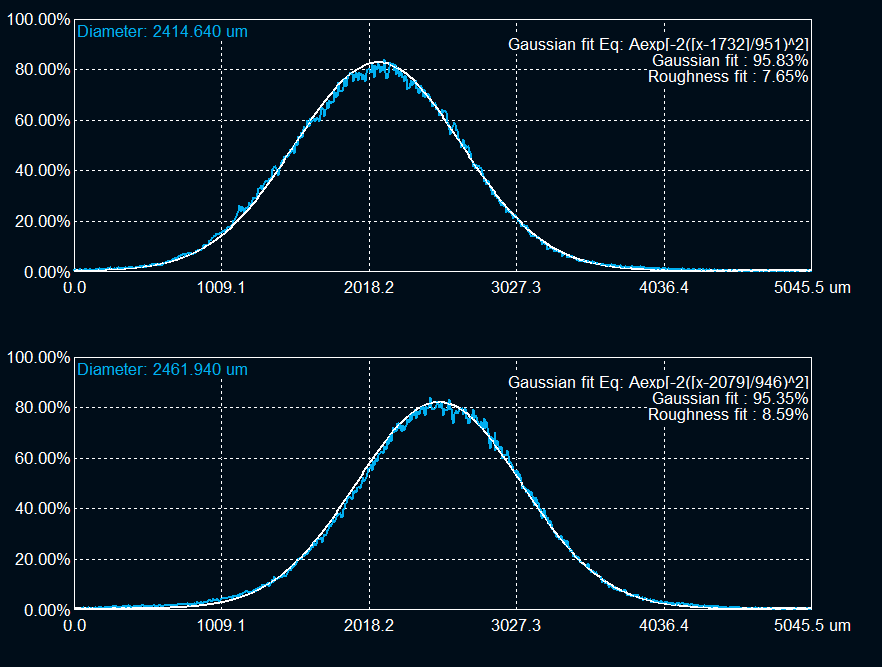
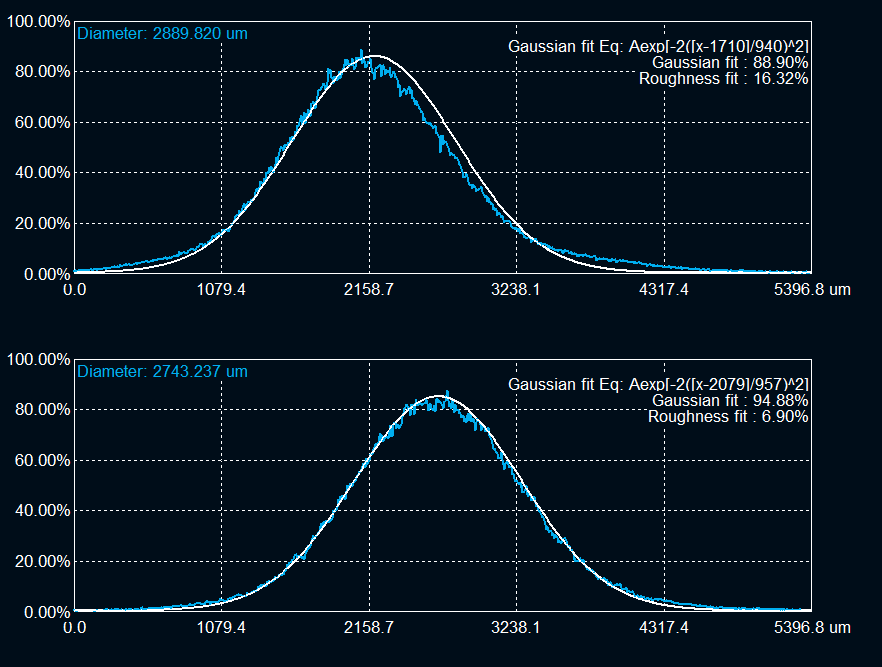
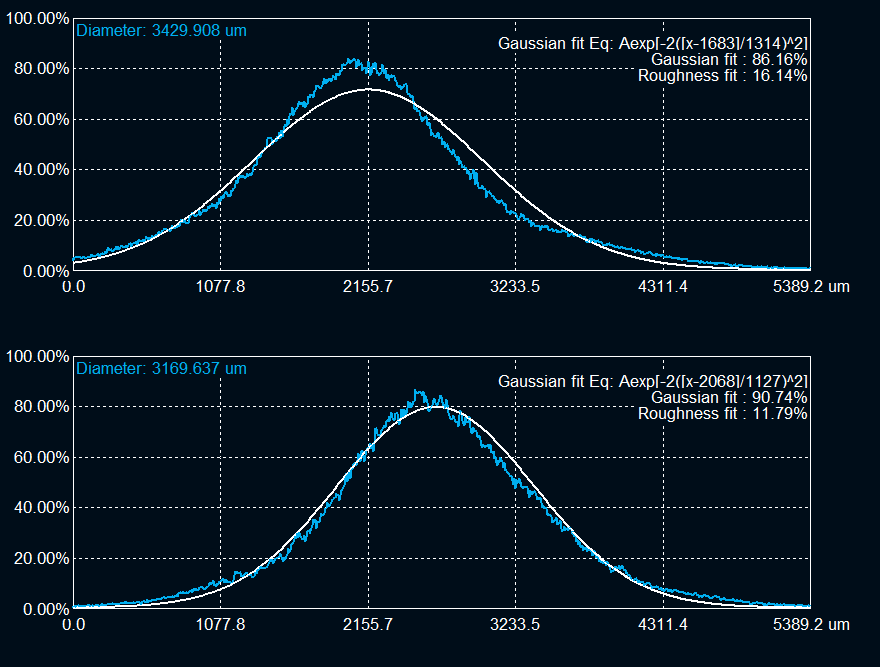
We see clearly a much better circular shape of the beam and a better Gaussian fit,
only above 90% where we see the fit percentage going down to ~ 86% and on just the Horizontal Axis.
| Manar Amer wrote: |
|
This Morning, another reading was taken for the output of the amplifier after the compressor using 2 wedge mirrors.
In addition, a start of the calibration of a PulseCheck "Autocorrelator" to measure the pulse duration.
note, the pulsed laser used is OneFive 133.33 MHz
| Manar Amer wrote: |
|
Adding the readings 20% , 30% , 40% for output of amplifier after the compressor
| Manar Amer wrote: |
|
Readings of the beam shape and fit at the output of the compressor
differance from previous reading is that here we used wedges instead of HR mirrors.
Similar to previous readings, the beam shape deforms and the Gaussian fit is bad after 50% amplification
| Manar Amer wrote: |
|
Readings of the beam shape and horizontal (upper plot) and vertical (lower plot) axis fit at the direct output of the amplifier.
The beam shape relatively shaped like an egg.
| Manar Amer wrote: |
|
Today a second reading of the beam profile was done , with Victor ,Ronic, Aurlien and Manar
an additional set-up was made using two 4 deg wedges instead of High reflecting (HR) and Anti-reflecting (AR) mirrors.
Two reading were taken:
- at the output of the compressor with a NE30A filter on the beam profiler
- at the output of the amplifier with NE30A + NE10A filter on beam profiler
| Manar Amer wrote: |
|
Adding the fitted beam in 1D in Horizontal and vertical axis.
for 10% to 60%
| Manar Amer wrote: |
|
| Manar Amer wrote: |
|
Today: Manar, Ronic and Aurlien started the study of the beam profile of the alphanov amplifier at high power.
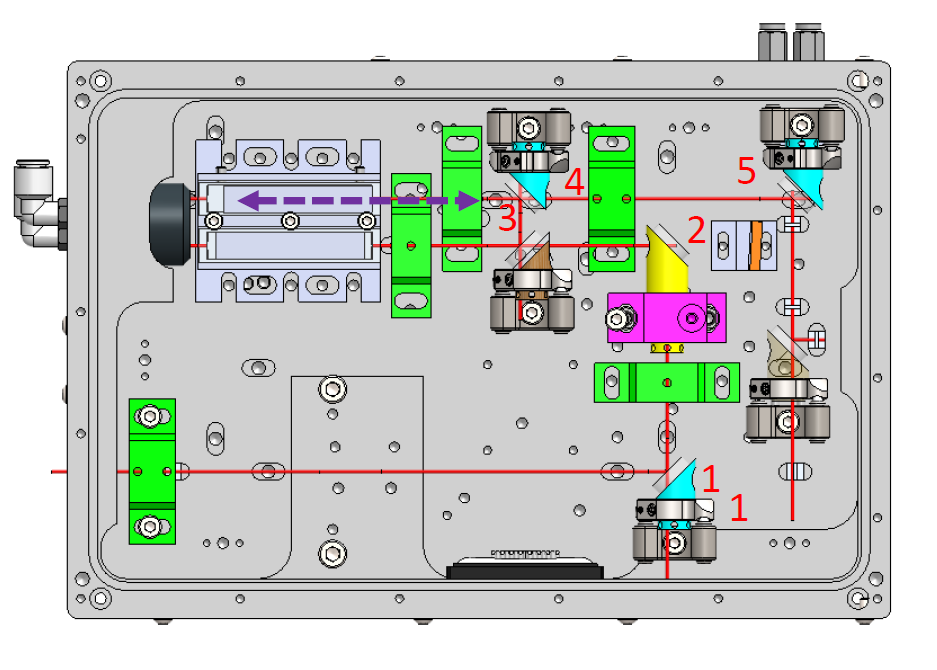
The setup shown in the image shows how the power is reduced by using Anti-reflective mirrors,
pick up 1 : Anti-reflective coating on both sides , pick up 2 : Anti-reflective coating on one side and High reflectivity on the other
using this method, we avoid saturation and damage to the beam profiler from the high power amplified laser
in addition, an OD3 filter is placed in front of the beam profiler. and a reflective mirror is placed close to deflect the reflection from the mirror(pick up 1) second surface.
The beam observed is relatively well shaped and fitted up to 50% of amplification is where the shape starts to deform a little and is not well-fitted by a Gaussian. (image attached shows the fit for 60% amplification)
The cause is yet to be determined, as it could only be related to the reflections that occur from the mirrors (pick up 1 and pick up 2)
*** Note be always careful at High Power :)
|
|
|
|
|
|
|
|
|
| Attachment 1: 20220415_Inside_CVBG_Box.jpg
|  |
| Attachment 2: 20220415_CVBG.jpg
|  |
| Attachment 3: 20220415_Compressor_Box.png
|  |
| Attachment 4: 10p_1CVBG.bmp
|
| Attachment 5: 20p_1CVBG.bmp
|
| Attachment 6: 30p_1CVBG.bmp
|
| Attachment 7: 40p_1CVBG.bmp
|
| Attachment 8: 50p_1CVBG.bmp
|
| Attachment 9: 60p_1CVBG.bmp
|
| Attachment 10: 70p_1CVBG.bmp
|
| Attachment 11: 90p_1CVBG.bmp
|
| Attachment 12: 20220415_D_shaped_Mirror_Blocking_2ndCVBG.jpg
|  |
| Attachment 13: 10p_1CVBG_BeamFit.png
|  |
| Attachment 14: 20p_1CVBG_BeamFit.png
|  |
| Attachment 15: 30p_1CVBG_BeamFit.png
|  |
| Attachment 16: 40p_1CVBG_BeamFit.png
|  |
| Attachment 17: 50p_1CVBG_BeamFit.png
|  |
| Attachment 18: 60p_1CVBG_BeamFit.png
|  |
| Attachment 19: 70p_1CVBG_BeamFit.png
|  |
| Attachment 20: 90p_1CVBG_BeamFit.png
|  |
|
148
|
Tue Apr 19 12:15:43 2022 |
Manar Amer | Fixed | report | lasers and optics | ThomX igloo | Alphanov amplifier Beam Profile | For better comparison ,
the measurements done previously with 2 CVBGs was done at ~ 30 cm and the one done on Friday was for 1 CVBG is at 1 m
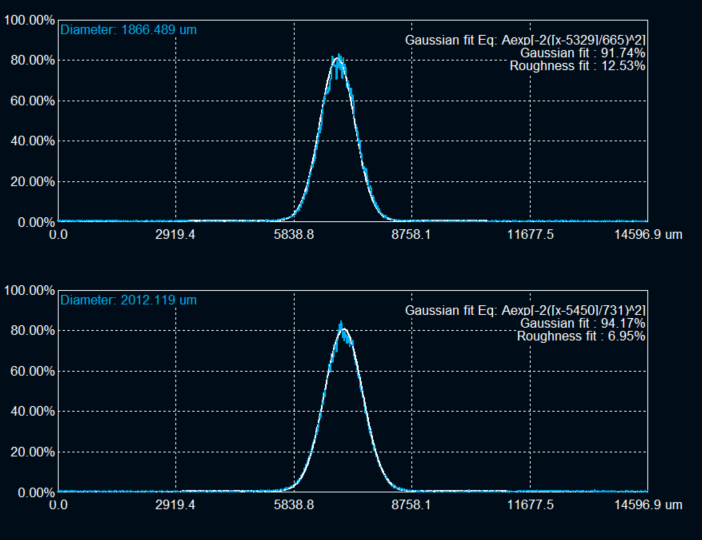
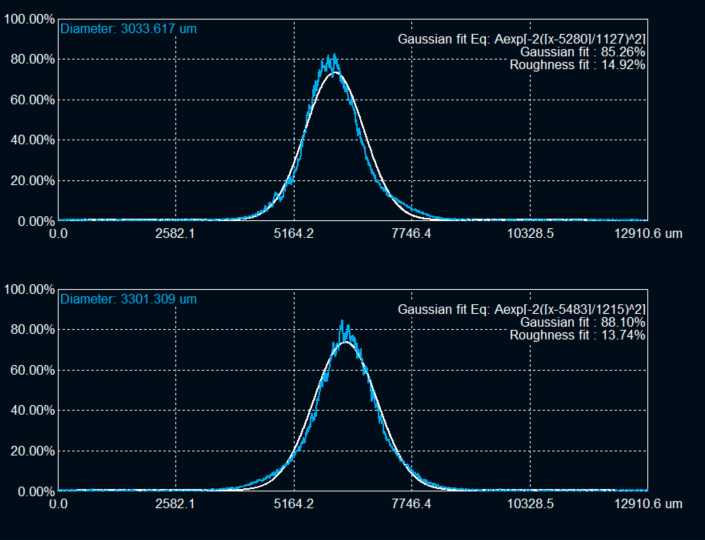
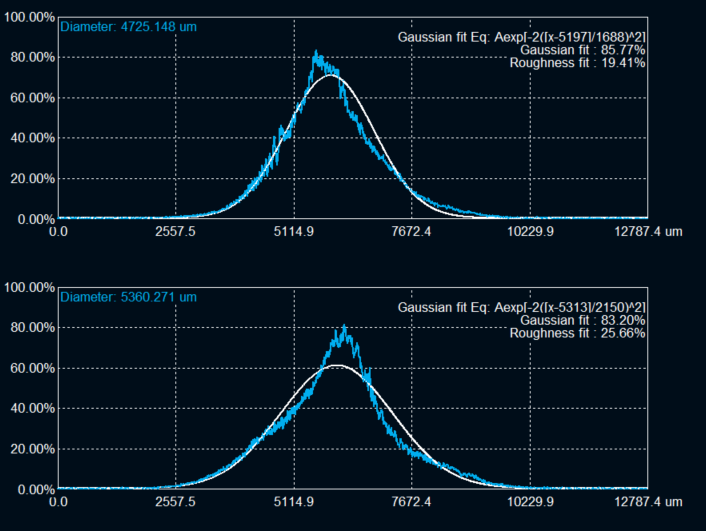
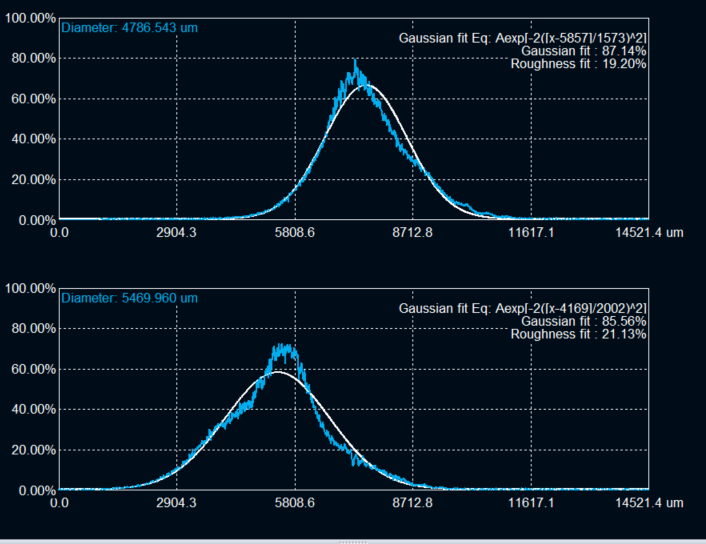
so we did additional measurement for 2 CVBGs at 1 m, for 20 , 50 and 70 % amplification
we clearly see the similar deformation at high power.
Conclusion : the effect is most likely coming from the 2nd CVBG
At 70 % victor optimized the horizontal axis for the injection mirror into 2nd CVBG , we see an improvement in the Gaussian fit on Horizontal and vertical axis of ~ 2%
| Manar Amer wrote: |
|
Victor, Ronic, Manar
Today was dedicated to the study of the CVBG, and it's effect on the beam profile
we opened the box containing the 2 CVBGs : The 2CVBG are glued from the bottom on a copper surface .
Using the beam viwer, the beam line inside the two CVBG is not at the exact center but not at the edges too and not hitting the boarders.
From the sides you see two lines, one is reflection on the metal.
To observe the effect of the first CVBG by itself, we blocked the second reflection into the 2nd CVBG.
By placing the D-shaped mirror just at the entrance of the 2nd CVBG (there was just enough space to put it)
Beam Profiler + OD 10E + OD 30E + OD(not known) placed at ~ 1 m from the output of compressor.
We see clearly a much better circular shape of the beam and a better Gaussian fit,
only above 90% where we see the fit percentage going down to ~ 86% and on just the Horizontal Axis.
| Manar Amer wrote: |
|
This Morning, another reading was taken for the output of the amplifier after the compressor using 2 wedge mirrors.
In addition, a start of the calibration of a PulseCheck "Autocorrelator" to measure the pulse duration.
note, the pulsed laser used is OneFive 133.33 MHz
| Manar Amer wrote: |
|
Adding the readings 20% , 30% , 40% for output of amplifier after the compressor
| Manar Amer wrote: |
|
Readings of the beam shape and fit at the output of the compressor
differance from previous reading is that here we used wedges instead of HR mirrors.
Similar to previous readings, the beam shape deforms and the Gaussian fit is bad after 50% amplification
| Manar Amer wrote: |
|
Readings of the beam shape and horizontal (upper plot) and vertical (lower plot) axis fit at the direct output of the amplifier.
The beam shape relatively shaped like an egg.
| Manar Amer wrote: |
|
Today a second reading of the beam profile was done , with Victor ,Ronic, Aurlien and Manar
an additional set-up was made using two 4 deg wedges instead of High reflecting (HR) and Anti-reflecting (AR) mirrors.
Two reading were taken:
- at the output of the compressor with a NE30A filter on the beam profiler
- at the output of the amplifier with NE30A + NE10A filter on beam profiler
| Manar Amer wrote: |
|
Adding the fitted beam in 1D in Horizontal and vertical axis.
for 10% to 60%
| Manar Amer wrote: |
|
| Manar Amer wrote: |
|
Today: Manar, Ronic and Aurlien started the study of the beam profile of the alphanov amplifier at high power.
The setup shown in the image shows how the power is reduced by using Anti-reflective mirrors,
pick up 1 : Anti-reflective coating on both sides , pick up 2 : Anti-reflective coating on one side and High reflectivity on the other
using this method, we avoid saturation and damage to the beam profiler from the high power amplified laser
in addition, an OD3 filter is placed in front of the beam profiler. and a reflective mirror is placed close to deflect the reflection from the mirror(pick up 1) second surface.
The beam observed is relatively well shaped and fitted up to 50% of amplification is where the shape starts to deform a little and is not well-fitted by a Gaussian. (image attached shows the fit for 60% amplification)
The cause is yet to be determined, as it could only be related to the reflections that occur from the mirrors (pick up 1 and pick up 2)
*** Note be always careful at High Power :)
|
|
|
|
|
|
|
|
|
|
| Attachment 1: 20p_2CVBG.bmp
|
| Attachment 2: 50p_2CVBG.bmp
|
| Attachment 3: 70p_2CVBG.bmp
|
| Attachment 4: 70p_2CVBG_CVBG_Input_Mirror_Optimize.bmp
|
| Attachment 5: 20p_2CVBG_BeamFit.png
|  |
| Attachment 6: 50p_2CVBG_BeamFit.png
|  |
| Attachment 7: 70p_2CVBG_BeamFit.png
|  |
| Attachment 8: 70p_2CVBG_CVBG_Input_Mirror_Optimize_BeamFit.png
|  |
|
24
|
Fri Mar 29 18:33:15 2019 |
Ronic Chiche | Fixed | issue | mechanics | lasers and optics | Optical room | Alignment procedure | we did again the complete alignment procedure starting with iris and optimizing injection motors Ma and Mb, then installing mirror S2, S3, P4 and P1, optimizing thetaX and thetaY axis for each motor.
everything was fine until we installed P1. we tried to optimize thetaX and thetaY of P1 and we clearly observed a strange motion when doing that :
- for thetaX axis, steps in one direction seem to have a different length from steps in reverse direction.
- for thetaY axis, trying to move in one direction, makes sometime a motion in the reverse direction.
at this moment, it is difficult to say if the problem comes from the controller, the mirror mount or the motor itself.
if both axis are concerned on the same mirror (P1), maybe the problem comes from the mount... to be continued on Monday.
|
|
111
|
Thu Jan 13 17:08:56 2022 |
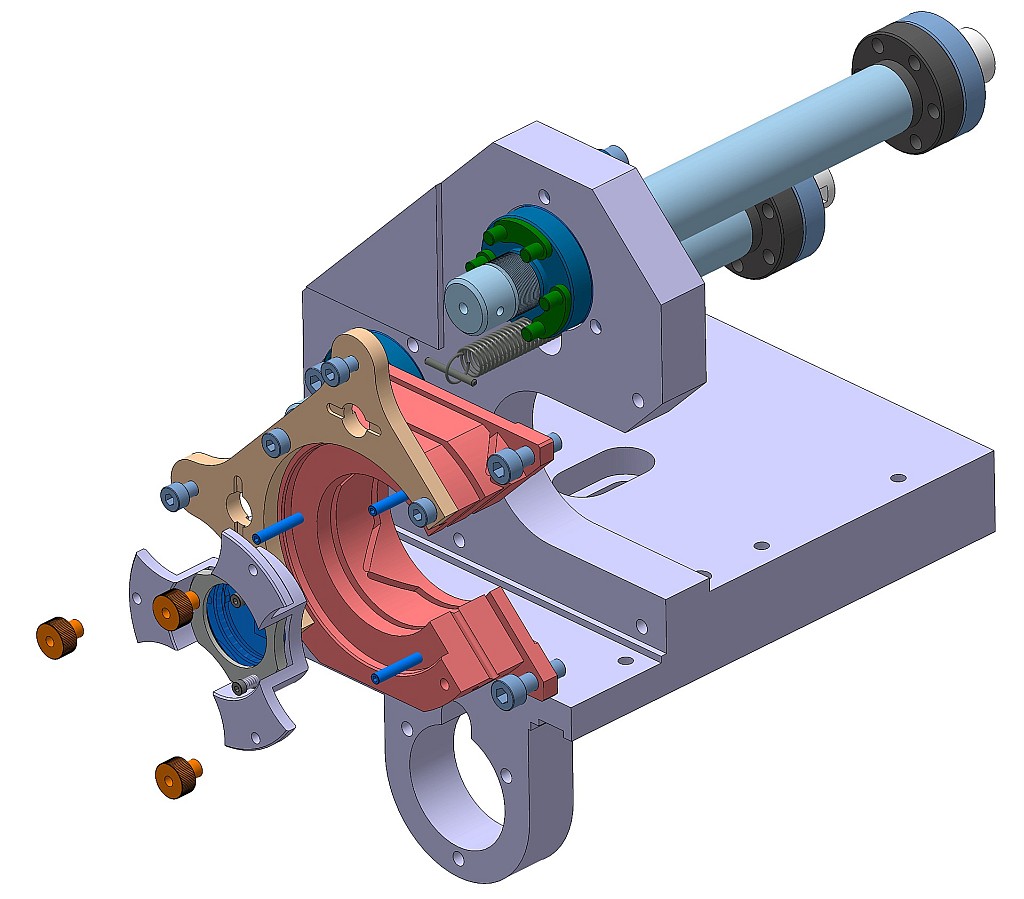
Ronic Chiche | Fixed | issue | mechanics | lasers and optics | Optical room | Alignment procedure | Picture of the installed mirrors inside the FP cavity.
To install an Iris instead of a mirror :
One has to remove manually the orange nuts and replace the mirror mount with the Iris mount.
| Ronic Chiche wrote: |
|
we did again the complete alignment procedure starting with iris and optimizing injection motors Ma and Mb, then installing mirror S2, S3, P4 and P1, optimizing thetaX and thetaY axis for each motor.
everything was fine until we installed P1. we tried to optimize thetaX and thetaY of P1 and we clearly observed a strange motion when doing that :
- for thetaX axis, steps in one direction seem to have a different length from steps in reverse direction.
- for thetaY axis, trying to move in one direction, makes sometime a motion in the reverse direction.
at this moment, it is difficult to say if the problem comes from the controller, the mirror mount or the motor itself.
if both axis are concerned on the same mirror (P1), maybe the problem comes from the mount... to be continued on Monday.
|
|
| Attachment 1: montage.jpg
|  |
|
448
|
Thu Aug 7 11:14:47 2025 |
Ronic Chiche | Fixed | info | lasers and optics | detectors and electronics | ThomX igloo | Alignment correction during the summer break | I restarted the FPC system this morning.
after some classic alignement procedure (some LEFT steps on the cavity injection motors X & Y) and CEP tuning,
I got 92kW for 33% amplifier ratio.
the cavity was not particularely misaligned...
then I did a long run at 90kW with both feedbacks ON without any problem. |
|
315
|
Fri Jan 19 18:05:42 2024 |
Ronic Chiche | Fixed | info | detectors and electronics | ThomX igloo | Adding one photodiode in reflection | this morning, I added a DET36 photodiode in reflection (I used a thin beam splitter) to better measure the coupling over the full beam size.
this DET36 photodiode is sent to the "laser locking" oscilloscope with the other signals :
CH1 :transmission
CH2 : reflection
CH3 : error signal or FP-cavity PZT (depending on the Laselock Monitor 1 signal configuration)
CH4 : laser PZT (Laselock Monitor 2 signal)
I kept the DET10 photodiode in reflection, but slightly misaligned to get the 500MHz laser harmonic without too much amplitude variation when locked (the lock behavior changes almost the center of the beam).
the DET10 photodiode is sent to the "RF locking" oscilloscope on CH1 |
|
452
|
Tue Sep 16 17:41:28 2025 |
Ronic Chiche | Fixed | info | mechanics | lasers and optics | detectors and electronics | ThomX igloo | Accelerometer measurement | with Daniele, we placed the accelerometer on top of the fiber amplifier box which is inside the housing.
the goal was to try to detect a correlation with some possible accoustic noise coming from the bubbles of the water, cooling the amplifier box baseplate.
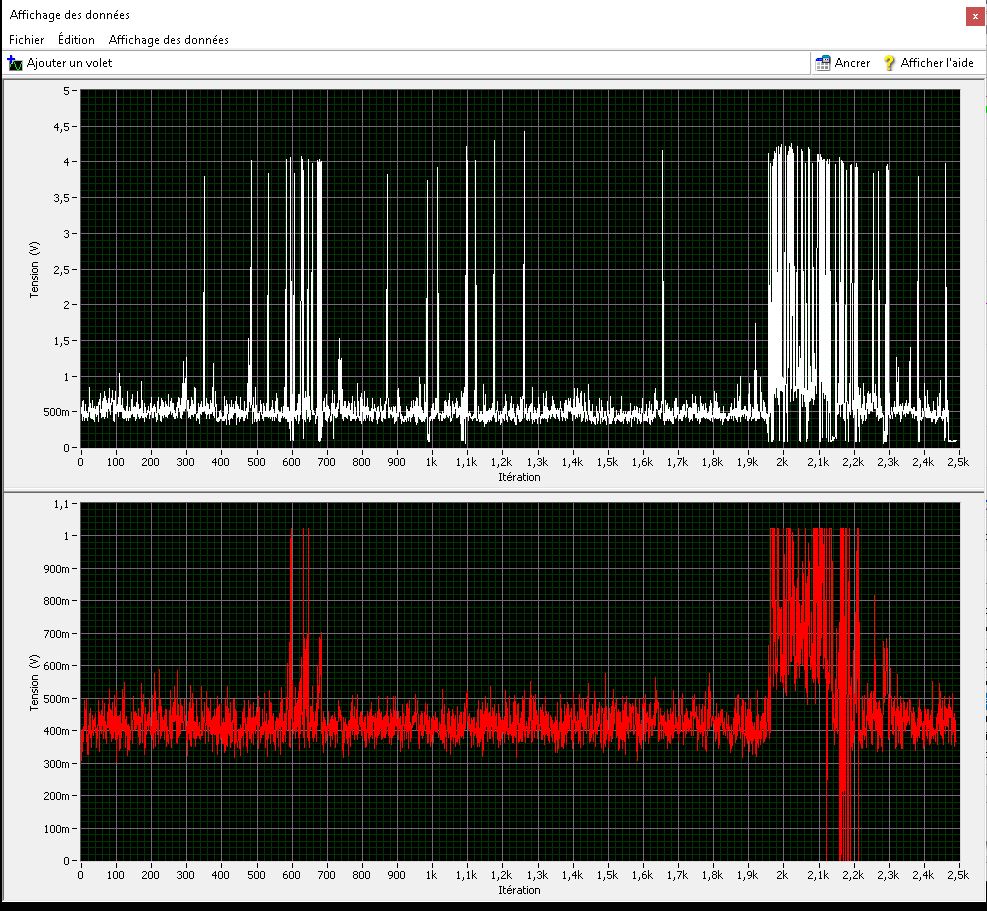
we monitored a long trend of the transmission which is perturbated when high frequency noise arises, and the accelerometer signal.
the long trend plots only the peak-peak value of a full 1 second acquisition every 2 seconds during ~2500 pts equivalent to ~5000 seconds = 1h20
on the plot, the top white signal is the transmission pk-pk and the bottom red signal is the accelerometer pk-pk.
we don't see any correlation except at 600-700 pts because Daniele entered the bunker and slightly knock on the bottom of the optical table several times.
and at 1950-2300 pts, because he opened the housing (much more noise recorded by the accelerometer) and then it close it again.
he also try to knock on the amplifier controller rack which is placed on the ground, below the table, but he didn't see any correlation with some cavity lock losses.
=> no clear conclusion.
except that the noise seen on the transmission when the housing is open is close to the "high frequency noise" we observe... could it be some accoustic noise coming from elsewhere ? |
| Attachment 1: Capture.JPG
|  |
|
426
|
Wed Jun 11 11:35:22 2025 |
Ronic Chiche | Fixed | info | lasers and optics | detectors and electronics | software | ThomX igloo | 33MHz phase adjustment | the 33MHz beating signal (phase) is used to start and stop automatically the lock on the 500MHz beating signal.
this 33MHz beating phase has a fixed range (typically +/-0.5V), so it is important to center this beating phase in the middle of its own range when the 500MHz signal is locked
=> tune the 33MHz phase in order to get ~ 0V on 33MHz beating signal when the 500MHz locking is ON.
this can be done by using the python script "Write_Phase_Rigol_33MHz located in the path /tmp_mnt/data/shared/commissioning_scripts/common
|
|
213
|
Thu Jun 1 10:31:45 2023 |
Ronic Chiche | Fixed | info | lasers and optics | ThomX igloo | 33MHz oscillator + Alphanov amplifier lock | the last tries to lock the 33MHz + amplifier to the 30k Finesse FP-cavity were unsuccessful.
during a laser Frep scan using the Laselock, one observes that the main cavity resonance is not able to stay inside the PZT scan range from one scan to another (500ms-1s period)
is it the effect of a large and slow phase noise ?
some informations:
- The 33MHz laser came back at lab from repair on March 2018.
- it has been sent to Alphanov in May 2020.
- it failled and has been sent to NKT/OneFive for repair in September 2021
- it came back to lab from repair in June 2022.
- on post #92 (Feb. 2020), it seems that we already locked the 33MHz laser + CELIA amplifier to the ThomX FP-cavity.
- The PZT sensitivity for the 33MHz laser is given to 0,3Hz/V for Frep <=> 2.6MHz/V for optical frequency.
=> 10V on PZT is equivalent to 26MHz of optical frequency shift which is less than FSR !
- by comparison, the PZT sensitivity for the 133MHz laser is given to 3.9Hz/V for Frep <=> 8.5MHz/V for optical frequency.
- by comparison, the PZT sensitivity for the NKT CW laser is given 10pm/100V for Wavelength <=> 30MHz/V for optical frequency
- by comparison, the PZT sensitivity for the ThomX FP cavity (Z20H38x40C) is 4nm/V for length expansion => 8nm/V for round-trip expansion <=> 0.03Hz/V for FSR expansion <=> 260kHz/V for optical frequency !!!
the PZT expansion estimation is in attached file. |
| Attachment 1: 120705_Displacement_of_cylindrical_piezo_ceramics.xls
|
|
214
|
Thu Jun 1 18:15:04 2023 |
Ronic Chiche | Fixed | info | lasers and optics | ThomX igloo | 33MHz oscillator + Alphanov amplifier lock | finding the right modulation/demodulation PDH phase is very difficult on the main resonance because the we get non stationnary signals with a lot of oscillations.
changing the phase, in this condition, does not really change the error signal.
Then, we moved on the first secundary resonance with less gain and less coupling.
Thus, the error signal is more similar to the theoretical PDH signal => one can adjust the modulation/demodulation PDH phase to get the maximum error signal.
then, we locked pretty easily on this first secondary resonance, with a coupling around some % when we adjust the CEP motor.
we tried to lock on the main resonance but it is too noisy and unstable.
it seems we really need high BW feedback.
I tried to add a fast analog loop on the laser intra-cavity EOM but without a clear effect.
the problem is the gain of this loop : it is difficult to produce a "high voltage" (above 10Vpp) on this EOM.
I put "my" amplifier but the voltage output is limited... commercial amplifiers will have the same issue.
we can add HV amplifiers but it takes place and it will add some noise on the signal.
A loop with an AOM could be easier to install and manage... but at the price of a loss of power before the laser amplifier...
| Ronic Chiche wrote: |
|
the last tries to lock the 33MHz + amplifier to the 30k Finesse FP-cavity were unsuccessful.
during a laser Frep scan using the Laselock, one observes that the main cavity resonance is not able to stay inside the PZT scan range from one scan to another (500ms-1s period)
is it the effect of a large and slow phase noise ?
some informations:
- The 33MHz laser came back at lab from repair on March 2018.
- it has been sent to Alphanov in May 2020.
- it failled and has been sent to NKT/OneFive for repair in September 2021
- it came back to lab from repair in June 2022.
- on post #92 (Feb. 2020), it seems that we already locked the 33MHz laser + CELIA amplifier to the ThomX FP-cavity.
- The PZT sensitivity for the 33MHz laser is given to 0,3Hz/V for Frep <=> 2.6MHz/V for optical frequency.
=> 10V on PZT is equivalent to 26MHz of optical frequency shift which is less than FSR !
- by comparison, the PZT sensitivity for the 133MHz laser is given to 3.9Hz/V for Frep <=> 8.5MHz/V for optical frequency.
- by comparison, the PZT sensitivity for the NKT CW laser is given 10pm/100V for Wavelength <=> 30MHz/V for optical frequency
- by comparison, the PZT sensitivity for the ThomX FP cavity (Z20H38x40C) is 4nm/V for length expansion => 8nm/V for round-trip expansion <=> 0.03Hz/V for FSR expansion <=> 260kHz/V for optical frequency !!!
the PZT expansion estimation is in attached file.
|
|
|
217
|
Tue Jun 6 15:52:59 2023 |
Ronic Chiche | Fixed | info | lasers and optics | ThomX igloo | 33MHz oscillator + Alphanov amplifier lock | today with Daniele, we locked easily (but with a noisy lock) on the secundary resonance and we tried to lock on the main resonance (with very low coupling ~10% which mean a CEP ~Pi)
the lock was possible but was very noisy.
I installed a fast loop using my small DC amplifier based on OP37 (max gain=100) modified to be AC coupled to avoid to amplify the PDH box offset.
the output votage swing of the OP37 is only ~10V. Thus, the effect of this fast loop on the lock stability is not visible !
Thus, I added the M250 Leysop HV amplifier (see attached documentation), which is able to drive an EOM with >5MHz bandwidth and ~250V swing, after my OP37 amplifier.
with this additionnal HV amplifier, now we can clearly see the effect of the EOM loop which improves the lock stability BUT, even with a poor CEP, the lock is very unstable on the main resonance.
it seems the optical phase noise is still too large and/or its BW too high to be completely compensated.
The next step is to try to remove all the possible noise sources from the optical table:
- the laptop placed on the ionic pump
- the 2 Rigol generators on the table surface
and switch off the controller of the Smaract laser cavity motors.
If it doesn't help, we can send the error signal to a spectrum analyzer to have a better view of the different harmonics involved in the residual phase noise.
could it remain some noise above the present PDH box BW (1.9MHz LP filter) ?
lastely, we can also make an optical phase noise measurement to check if the Alphanov amplifier does not add some noise.
| Ronic Chiche wrote: |
|
finding the right modulation/demodulation PDH phase is very difficult on the main resonance because the we get non stationnary signals with a lot of oscillations.
changing the phase, in this condition, does not really change the error signal.
Then, we moved on the first secundary resonance with less gain and less coupling.
Thus, the error signal is more similar to the theoretical PDH signal => one can adjust the modulation/demodulation PDH phase to get the maximum error signal.
then, we locked pretty easily on this first secondary resonance, with a coupling around some % when we adjust the CEP motor.
we tried to lock on the main resonance but it is too noisy and unstable.
it seems we really need high BW feedback.
I tried to add a fast analog loop on the laser intra-cavity EOM but without a clear effect.
the problem is the gain of this loop : it is difficult to produce a "high voltage" (above 10Vpp) on this EOM.
I put "my" amplifier but the voltage output is limited... commercial amplifiers will have the same issue.
we can add HV amplifiers but it takes place and it will add some noise on the signal.
A loop with an AOM could be easier to install and manage... but at the price of a loss of power before the laser amplifier...
| Ronic Chiche wrote: |
|
the last tries to lock the 33MHz + amplifier to the 30k Finesse FP-cavity were unsuccessful.
during a laser Frep scan using the Laselock, one observes that the main cavity resonance is not able to stay inside the PZT scan range from one scan to another (500ms-1s period)
is it the effect of a large and slow phase noise ?
some informations:
- The 33MHz laser came back at lab from repair on March 2018.
- it has been sent to Alphanov in May 2020.
- it failled and has been sent to NKT/OneFive for repair in September 2021
- it came back to lab from repair in June 2022.
- on post #92 (Feb. 2020), it seems that we already locked the 33MHz laser + CELIA amplifier to the ThomX FP-cavity.
- The PZT sensitivity for the 33MHz laser is given to 0,3Hz/V for Frep <=> 2.6MHz/V for optical frequency.
=> 10V on PZT is equivalent to 26MHz of optical frequency shift which is less than FSR !
- by comparison, the PZT sensitivity for the 133MHz laser is given to 3.9Hz/V for Frep <=> 8.5MHz/V for optical frequency.
- by comparison, the PZT sensitivity for the NKT CW laser is given 10pm/100V for Wavelength <=> 30MHz/V for optical frequency
- by comparison, the PZT sensitivity for the ThomX FP cavity (Z20H38x40C) is 4nm/V for length expansion => 8nm/V for round-trip expansion <=> 0.03Hz/V for FSR expansion <=> 260kHz/V for optical frequency !!!
the PZT expansion estimation is in attached file.
|
|
|
| Attachment 1: M250_Video_Amplifier.pdf
|
| Attachment 2: M250_manual.pdf
|
|
219
|
Thu Jun 8 11:12:20 2023 |
Ronic Chiche | Fixed | info | lasers and optics | ThomX igloo | 33MHz oscillator + Alphanov amplifier lock | After removing the 2 generators from the optical table, the lock is much more stable and now, it is possible to lock on the main resonance with a poor CEP but with quite good stability.
the coupling is still very low ~ 5% for that CEP but if one improves it (CEP ->0), using the laser double-wedge motor, one clearly sees an improvement of the coupling... but at the cost of the lock stability.
the reason of the poor coupling is also because the laser amplifier is used at 0%, for which we know the part of the laser signal power, compared to the total power, is low.
(a part of the beam @1030nm is not propagating in the fiber core of the amp, and then, it cannot be coupled to the FP-cavity).
the fast lock loop on the EOM has been disabled for the moment.
it has to be installed back to improve the stability at a better CEP.
at present, the FP-cavity power is estimated at ~ 90W (~270µW in transmission of ~3ppm mirrors) for ~300mW of total power coming from the laser amp.
next steps :
- in Open Loop : check what is the best coupling we can observe for CEP=0 @ P ~ 10W (laser amp at ~ 25%)
- in Closed Loop : @ P ~ 10W => measure the best transmitted power after alignement/polarization/feedback adjust => ~ 3-10kW in the cavity ?
| Ronic Chiche wrote: |
|
today with Daniele, we locked easily (but with a noisy lock) on the secundary resonance and we tried to lock on the main resonance (with very low coupling ~10% which mean a CEP ~Pi)
the lock was possible but was very noisy.
I installed a fast loop using my small DC amplifier based on OP37 (max gain=100) modified to be AC coupled to avoid to amplify the PDH box offset.
the output votage swing of the OP37 is only ~10V. Thus, the effect of this fast loop on the lock stability is not visible !
Thus, I added the M250 Leysop HV amplifier (see attached documentation), which is able to drive an EOM with >5MHz bandwidth and ~250V swing, after my OP37 amplifier.
with this additionnal HV amplifier, now we can clearly see the effect of the EOM loop which improves the lock stability BUT, even with a poor CEP, the lock is very unstable on the main resonance.
it seems the optical phase noise is still too large and/or its BW too high to be completely compensated.
The next step is to try to remove all the possible noise sources from the optical table:
- the laptop placed on the ionic pump
- the 2 Rigol generators on the table surface
and switch off the controller of the Smaract laser cavity motors.
If it doesn't help, we can send the error signal to a spectrum analyzer to have a better view of the different harmonics involved in the residual phase noise.
could it remain some noise above the present PDH box BW (1.9MHz LP filter) ?
lastely, we can also make an optical phase noise measurement to check if the Alphanov amplifier does not add some noise.
| Ronic Chiche wrote: |
|
finding the right modulation/demodulation PDH phase is very difficult on the main resonance because the we get non stationnary signals with a lot of oscillations.
changing the phase, in this condition, does not really change the error signal.
Then, we moved on the first secundary resonance with less gain and less coupling.
Thus, the error signal is more similar to the theoretical PDH signal => one can adjust the modulation/demodulation PDH phase to get the maximum error signal.
then, we locked pretty easily on this first secondary resonance, with a coupling around some % when we adjust the CEP motor.
we tried to lock on the main resonance but it is too noisy and unstable.
it seems we really need high BW feedback.
I tried to add a fast analog loop on the laser intra-cavity EOM but without a clear effect.
the problem is the gain of this loop : it is difficult to produce a "high voltage" (above 10Vpp) on this EOM.
I put "my" amplifier but the voltage output is limited... commercial amplifiers will have the same issue.
we can add HV amplifiers but it takes place and it will add some noise on the signal.
A loop with an AOM could be easier to install and manage... but at the price of a loss of power before the laser amplifier...
| Ronic Chiche wrote: |
|
the last tries to lock the 33MHz + amplifier to the 30k Finesse FP-cavity were unsuccessful.
during a laser Frep scan using the Laselock, one observes that the main cavity resonance is not able to stay inside the PZT scan range from one scan to another (500ms-1s period)
is it the effect of a large and slow phase noise ?
some informations:
- The 33MHz laser came back at lab from repair on March 2018.
- it has been sent to Alphanov in May 2020.
- it failled and has been sent to NKT/OneFive for repair in September 2021
- it came back to lab from repair in June 2022.
- on post #92 (Feb. 2020), it seems that we already locked the 33MHz laser + CELIA amplifier to the ThomX FP-cavity.
- The PZT sensitivity for the 33MHz laser is given to 0,3Hz/V for Frep <=> 2.6MHz/V for optical frequency.
=> 10V on PZT is equivalent to 26MHz of optical frequency shift which is less than FSR !
- by comparison, the PZT sensitivity for the 133MHz laser is given to 3.9Hz/V for Frep <=> 8.5MHz/V for optical frequency.
- by comparison, the PZT sensitivity for the NKT CW laser is given 10pm/100V for Wavelength <=> 30MHz/V for optical frequency
- by comparison, the PZT sensitivity for the ThomX FP cavity (Z20H38x40C) is 4nm/V for length expansion => 8nm/V for round-trip expansion <=> 0.03Hz/V for FSR expansion <=> 260kHz/V for optical frequency !!!
the PZT expansion estimation is in attached file.
|
|
|
|
|
222
|
Tue Jun 20 18:45:10 2023 |
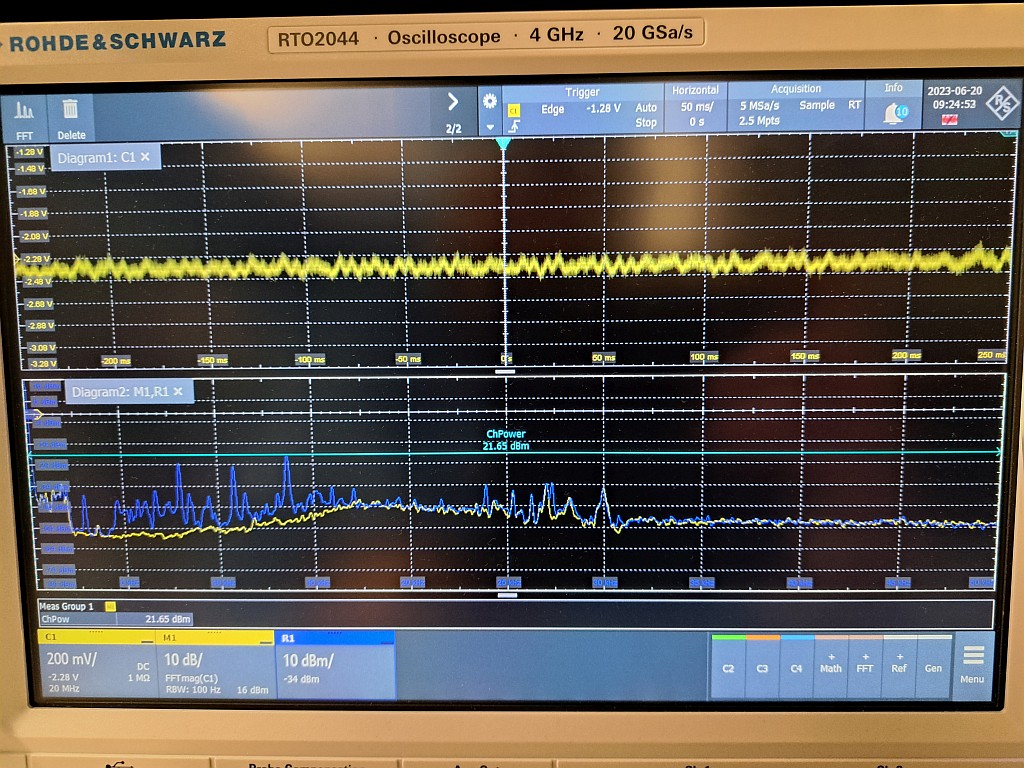
Ronic Chiche | Fixed | info | lasers and optics | ThomX igloo | 33MHz oscillator + Alphanov amplifier lock | this morning, I tested the laser+amplifier @ 30% lock on the FP cavity with and without Smaract motors.
I recorded the PDH error signal during a lock:
- blue : with Smaract motors controller powered ON but motors are stopped
- yellow: with Smaract motors controller powered OFF
with Smaract motors controller powered ON and motors stopped, one can see a group of resonances around 10kHz (8 - 11 - 14kHz) which disappears when the controller is powered OFF.
one can see also a group of resonances around 25-30kHz for which some peaks desappear when the controller is OFF but most of them are still there... could it come from noise on the Onefive laser PZT ?
one can see also a noise reduction at low frequency with a corner frequency around 17kHz, which could be the Unity Gain Bandwidth of the feedback loop on the laser PZT (fast feedback loop on EOM was disconnected)
=> to be confirmed
*************************************************************************************************************************************************************
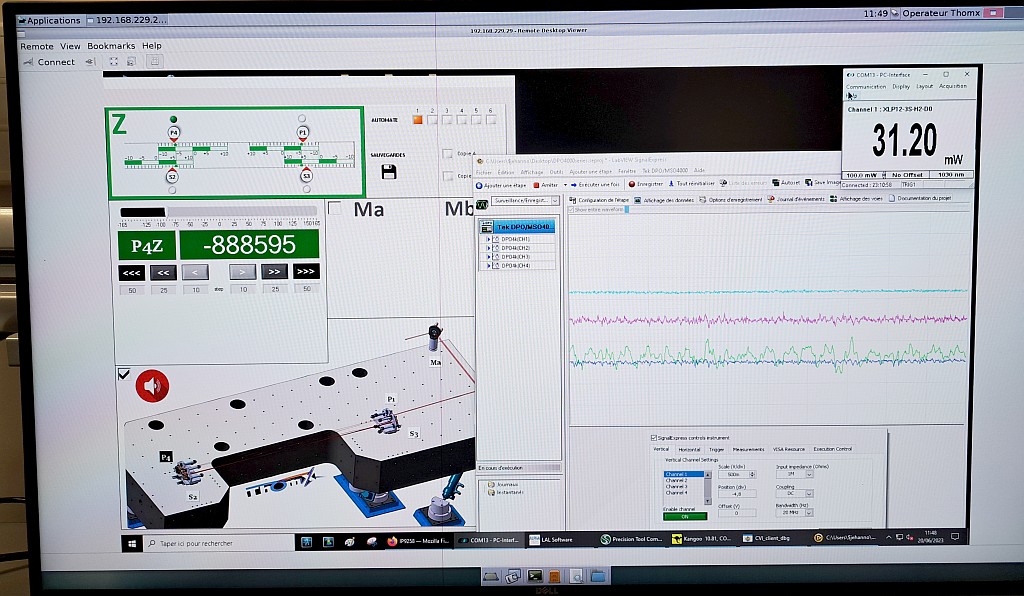
I was able to lock with a decent noise on transmission and reflection signals @ Pin=17W (30%) of input power and with a coupling ~ 20%.
I measured 31mW in transmission => Pcav ~ 10.3kW (T ~ 3ppm)
as T1=115 ppm and F=30000, the cavity gain is T1*(F/pi)^2 = 10.5k,
so, the FP cavity power should have been 17W * 20% * 10,5k = 35.7 kW !!! (maybe the formula is wrong if the coupling loss comes from the CEP detuning effect)
=> we have to check the incoming power and the formula !
so, maximum expected power in FP-cavity could be 70W * 100% * 10,5k * (10.3/35.7) = 210 kW !!! :-(
*************************************************************************************************************************************************************
I was able to redo the lock easily in remote in the control room (with the Smaract motors controller OFF).
| Ronic Chiche wrote: |
|
After removing the 2 generators from the optical table, the lock is much more stable and now, it is possible to lock on the main resonance with a poor CEP but with quite good stability.
the coupling is still very low ~ 5% for that CEP but if one improves it (CEP ->0), using the laser double-wedge motor, one clearly sees an improvement of the coupling... but at the cost of the lock stability.
the reason of the poor coupling is also because the laser amplifier is used at 0%, for which we know the part of the laser signal power, compared to the total power, is low.
(a part of the beam @1030nm is not propagating in the fiber core of the amp, and then, it cannot be coupled to the FP-cavity).
the fast lock loop on the EOM has been disabled for the moment.
it has to be installed back to improve the stability at a better CEP.
at present, the FP-cavity power is estimated at ~ 90W (~270µW in transmission of ~3ppm mirrors) for ~300mW of total power coming from the laser amp.
next steps :
- in Open Loop : check what is the best coupling we can observe for CEP=0 @ P ~ 10W (laser amp at ~ 25%)
- in Closed Loop : @ P ~ 10W => measure the best transmitted power after alignement/polarization/feedback adjust => ~ 3-10kW in the cavity ?
| Ronic Chiche wrote: |
|
today with Daniele, we locked easily (but with a noisy lock) on the secundary resonance and we tried to lock on the main resonance (with very low coupling ~10% which mean a CEP ~Pi)
the lock was possible but was very noisy.
I installed a fast loop using my small DC amplifier based on OP37 (max gain=100) modified to be AC coupled to avoid to amplify the PDH box offset.
the output votage swing of the OP37 is only ~10V. Thus, the effect of this fast loop on the lock stability is not visible !
Thus, I added the M250 Leysop HV amplifier (see attached documentation), which is able to drive an EOM with >5MHz bandwidth and ~250V swing, after my OP37 amplifier.
with this additionnal HV amplifier, now we can clearly see the effect of the EOM loop which improves the lock stability BUT, even with a poor CEP, the lock is very unstable on the main resonance.
it seems the optical phase noise is still too large and/or its BW too high to be completely compensated.
The next step is to try to remove all the possible noise sources from the optical table:
- the laptop placed on the ionic pump
- the 2 Rigol generators on the table surface
and switch off the controller of the Smaract laser cavity motors.
If it doesn't help, we can send the error signal to a spectrum analyzer to have a better view of the different harmonics involved in the residual phase noise.
could it remain some noise above the present PDH box BW (1.9MHz LP filter) ?
lastely, we can also make an optical phase noise measurement to check if the Alphanov amplifier does not add some noise.
| Ronic Chiche wrote: |
|
finding the right modulation/demodulation PDH phase is very difficult on the main resonance because the we get non stationnary signals with a lot of oscillations.
changing the phase, in this condition, does not really change the error signal.
Then, we moved on the first secundary resonance with less gain and less coupling.
Thus, the error signal is more similar to the theoretical PDH signal => one can adjust the modulation/demodulation PDH phase to get the maximum error signal.
then, we locked pretty easily on this first secondary resonance, with a coupling around some % when we adjust the CEP motor.
we tried to lock on the main resonance but it is too noisy and unstable.
it seems we really need high BW feedback.
I tried to add a fast analog loop on the laser intra-cavity EOM but without a clear effect.
the problem is the gain of this loop : it is difficult to produce a "high voltage" (above 10Vpp) on this EOM.
I put "my" amplifier but the voltage output is limited... commercial amplifiers will have the same issue.
we can add HV amplifiers but it takes place and it will add some noise on the signal.
A loop with an AOM could be easier to install and manage... but at the price of a loss of power before the laser amplifier...
| Ronic Chiche wrote: |
|
the last tries to lock the 33MHz + amplifier to the 30k Finesse FP-cavity were unsuccessful.
during a laser Frep scan using the Laselock, one observes that the main cavity resonance is not able to stay inside the PZT scan range from one scan to another (500ms-1s period)
is it the effect of a large and slow phase noise ?
some informations:
- The 33MHz laser came back at lab from repair on March 2018.
- it has been sent to Alphanov in May 2020.
- it failled and has been sent to NKT/OneFive for repair in September 2021
- it came back to lab from repair in June 2022.
- on post #92 (Feb. 2020), it seems that we already locked the 33MHz laser + CELIA amplifier to the ThomX FP-cavity.
- The PZT sensitivity for the 33MHz laser is given to 0,3Hz/V for Frep <=> 2.6MHz/V for optical frequency.
=> 10V on PZT is equivalent to 26MHz of optical frequency shift which is less than FSR !
- by comparison, the PZT sensitivity for the 133MHz laser is given to 3.9Hz/V for Frep <=> 8.5MHz/V for optical frequency.
- by comparison, the PZT sensitivity for the NKT CW laser is given 10pm/100V for Wavelength <=> 30MHz/V for optical frequency
- by comparison, the PZT sensitivity for the ThomX FP cavity (Z20H38x40C) is 4nm/V for length expansion => 8nm/V for round-trip expansion <=> 0.03Hz/V for FSR expansion <=> 260kHz/V for optical frequency !!!
the PZT expansion estimation is in attached file.
|
|
|
|
|
| Attachment 1: PDH_error_signal_with_Smaract_motors_ON-OFF.jpg
|  |
| Attachment 2: Lock_at_amp_@30%.jpg
|  |
| Attachment 3: 10kW_in_remote.jpg
|  |
|
223
|
Tue Jun 20 19:08:17 2023 |
Ronic Chiche | Fixed | info | lasers and optics | ThomX igloo | 33MHz oscillator + Alphanov amplifier lock | I checked with the Matlab code below the CEP detuning effect (2nm sech² spectrum... not exactly the same as in ThomX)
@ CEP = 0 => coupling = 100% and Gcav = 10.5k
if all the coupling loss comes from the CEP detuning effect :
@ CEP = pi/5 => coupling = 20% and Gcav = 2.14k (~ 10.5k x 20%)
so, it does not matter if the coupling loss comes from the CEP detuning effect or from beam mismatch or misalignment.
=> we should have more power at 20% coupling, not 10kW but 35kW !!!
=> we have to check the real input power !
| Ronic Chiche wrote: |
|
this morning, I tested the laser+amplifier @ 30% lock on the FP cavity with and without Smaract motors.
I recorded the PDH error signal during a lock:
- blue : with Smaract motors controller powered ON but motors are stopped
- yellow: with Smaract motors controller powered OFF
with Smaract motors controller powered ON and motors stopped, one can see a group of resonances around 10kHz (8 - 11 - 14kHz) which disappears when the controller is powered OFF.
one can see also a group of resonances around 25-30kHz for which some peaks desappear when the controller is OFF but most of them are still there... could it come from noise on the Onefive laser PZT ?
one can see also a noise reduction at low frequency with a corner frequency around 17kHz, which could be the Unity Gain Bandwidth of the feedback loop on the laser PZT (fast feedback loop on EOM was disconnected)
=> to be confirmed
*************************************************************************************************************************************************************
I was able to lock with a decent noise on transmission and reflection signals @ Pin=17W (30%) of input power and with a coupling ~ 20%.
I measured 31mW in transmission => Pcav ~ 10.3kW (T ~ 3ppm)
as T1=115 ppm and F=30000, the cavity gain is T1*(F/pi)^2 = 10.5k,
so, the FP cavity power should have been 17W * 20% * 10,5k = 35.7 kW !!! (maybe the formula is wrong if the coupling loss comes from the CEP detuning effect)
=> we have to check the incoming power and the formula !
so, maximum expected power in FP-cavity could be 70W * 100% * 10,5k * (10.3/35.7) = 210 kW !!! :-(
*************************************************************************************************************************************************************
I was able to redo the lock easily in remote in the control room (with the Smaract motors controller OFF).
| Ronic Chiche wrote: |
|
After removing the 2 generators from the optical table, the lock is much more stable and now, it is possible to lock on the main resonance with a poor CEP but with quite good stability.
the coupling is still very low ~ 5% for that CEP but if one improves it (CEP ->0), using the laser double-wedge motor, one clearly sees an improvement of the coupling... but at the cost of the lock stability.
the reason of the poor coupling is also because the laser amplifier is used at 0%, for which we know the part of the laser signal power, compared to the total power, is low.
(a part of the beam @1030nm is not propagating in the fiber core of the amp, and then, it cannot be coupled to the FP-cavity).
the fast lock loop on the EOM has been disabled for the moment.
it has to be installed back to improve the stability at a better CEP.
at present, the FP-cavity power is estimated at ~ 90W (~270µW in transmission of ~3ppm mirrors) for ~300mW of total power coming from the laser amp.
next steps :
- in Open Loop : check what is the best coupling we can observe for CEP=0 @ P ~ 10W (laser amp at ~ 25%)
- in Closed Loop : @ P ~ 10W => measure the best transmitted power after alignement/polarization/feedback adjust => ~ 3-10kW in the cavity ?
| Ronic Chiche wrote: |
|
today with Daniele, we locked easily (but with a noisy lock) on the secundary resonance and we tried to lock on the main resonance (with very low coupling ~10% which mean a CEP ~Pi)
the lock was possible but was very noisy.
I installed a fast loop using my small DC amplifier based on OP37 (max gain=100) modified to be AC coupled to avoid to amplify the PDH box offset.
the output votage swing of the OP37 is only ~10V. Thus, the effect of this fast loop on the lock stability is not visible !
Thus, I added the M250 Leysop HV amplifier (see attached documentation), which is able to drive an EOM with >5MHz bandwidth and ~250V swing, after my OP37 amplifier.
with this additionnal HV amplifier, now we can clearly see the effect of the EOM loop which improves the lock stability BUT, even with a poor CEP, the lock is very unstable on the main resonance.
it seems the optical phase noise is still too large and/or its BW too high to be completely compensated.
The next step is to try to remove all the possible noise sources from the optical table:
- the laptop placed on the ionic pump
- the 2 Rigol generators on the table surface
and switch off the controller of the Smaract laser cavity motors.
If it doesn't help, we can send the error signal to a spectrum analyzer to have a better view of the different harmonics involved in the residual phase noise.
could it remain some noise above the present PDH box BW (1.9MHz LP filter) ?
lastely, we can also make an optical phase noise measurement to check if the Alphanov amplifier does not add some noise.
| Ronic Chiche wrote: |
|
finding the right modulation/demodulation PDH phase is very difficult on the main resonance because the we get non stationnary signals with a lot of oscillations.
changing the phase, in this condition, does not really change the error signal.
Then, we moved on the first secundary resonance with less gain and less coupling.
Thus, the error signal is more similar to the theoretical PDH signal => one can adjust the modulation/demodulation PDH phase to get the maximum error signal.
then, we locked pretty easily on this first secondary resonance, with a coupling around some % when we adjust the CEP motor.
we tried to lock on the main resonance but it is too noisy and unstable.
it seems we really need high BW feedback.
I tried to add a fast analog loop on the laser intra-cavity EOM but without a clear effect.
the problem is the gain of this loop : it is difficult to produce a "high voltage" (above 10Vpp) on this EOM.
I put "my" amplifier but the voltage output is limited... commercial amplifiers will have the same issue.
we can add HV amplifiers but it takes place and it will add some noise on the signal.
A loop with an AOM could be easier to install and manage... but at the price of a loss of power before the laser amplifier...
| Ronic Chiche wrote: |
|
the last tries to lock the 33MHz + amplifier to the 30k Finesse FP-cavity were unsuccessful.
during a laser Frep scan using the Laselock, one observes that the main cavity resonance is not able to stay inside the PZT scan range from one scan to another (500ms-1s period)
is it the effect of a large and slow phase noise ?
some informations:
- The 33MHz laser came back at lab from repair on March 2018.
- it has been sent to Alphanov in May 2020.
- it failled and has been sent to NKT/OneFive for repair in September 2021
- it came back to lab from repair in June 2022.
- on post #92 (Feb. 2020), it seems that we already locked the 33MHz laser + CELIA amplifier to the ThomX FP-cavity.
- The PZT sensitivity for the 33MHz laser is given to 0,3Hz/V for Frep <=> 2.6MHz/V for optical frequency.
=> 10V on PZT is equivalent to 26MHz of optical frequency shift which is less than FSR !
- by comparison, the PZT sensitivity for the 133MHz laser is given to 3.9Hz/V for Frep <=> 8.5MHz/V for optical frequency.
- by comparison, the PZT sensitivity for the NKT CW laser is given 10pm/100V for Wavelength <=> 30MHz/V for optical frequency
- by comparison, the PZT sensitivity for the ThomX FP cavity (Z20H38x40C) is 4nm/V for length expansion => 8nm/V for round-trip expansion <=> 0.03Hz/V for FSR expansion <=> 260kHz/V for optical frequency !!!
the PZT expansion estimation is in attached file.
|
|
|
|
|
|
| Attachment 1: ThomX_FP_intracavity_signal.m
|
clear
clc

% resonance order
% Main resonance => Nr=0
Nr=00;

c=3e8;
lambda0=1030e-9;
dlambda0=2e-9;

FSR=33e6;
T1=115e-6;
F=30e3;
CEP=2*pi/10;

L0=c/FSR;
f0=c/lambda0;
df0=f0*dlambda0/lambda0;
n0=round(f0/FSR);
dn0=round(df0/FSR);
n=n0-3*dn0:n0+3*dn0;

fcav=n*FSR;

Pin=sech(1.77*(fcav-f0)/df0).^2;
Ein=sqrt(Pin);

figure(1)
clf
plot(c./fcav*1e9,Pin)
grid on
xlabel('wavelength (nm)')
ylabel('power (A.U.)')
title('normalized laser power spectrum')

df_FSR=linspace(-FSR/2,FSR/2,1e6);
Ec=Ffp(df_FSR,FSR,T1,F,1);

figure(2)
clf
plot(F*df_FSR/FSR,abs(Ec).^2,'r')
grid on
xlim([-5 5])
xlabel('normalized frequency (Hz / LW)')
ylabel('real part (A.U.)')
title('FP-cavity intra-cavity power gain')

dLmax=lambda0/1000;
Nk=1e2;
dL=linspace(-dLmax/2,dLmax/2,Nk+1)-L0*CEP/(2*pi)*FSR/f0;
for k=1:length(dL)
    df=FSR*(dL(k)+Nr*lambda0)/L0;
    Frep=FSR+df;
    flas=(n+CEP/2/pi)*Frep;

    [Ec,Er]=Ffp(flas,FSR,T1,F,Ein);
    Gc(k)=sum(abs(Ec).^2)/sum(Pin);
    Gr(k)=sum(abs(Er).^2)/sum(Pin);
end

figure(3)
clf
plot(dL/1e-6,Gc,'.')
grid on
xlabel('length scan (µm)')
ylabel('cavity power gain (A.U.)')

figure(4)
clf
plot(dL/1e-6,Gr,'.')
grid on
xlabel('length scan (µm)')
ylabel('cavity refleced power gain (A.U.)')

% cavity field & reflectivity of the FP cavity
function [Ec,Er] = Ffp(df,FSR,T1,F,Ein)
rho=1-pi/F;
t1=sqrt(T1);
r1=sqrt(1-t1^2);
r2=rho/r1;
if r2>1
    error('r2 > 1 !!!!')
end
Fc=1i*t1./(1-rho*exp(-1i*2*pi*df/FSR));
Ec=Fc.*Ein;
Fr=r1+1i*t1*r2*exp(-1i*2*pi*df/FSR).*Fc;
Er=Fr.*Ein;
end
|
|
224
|
Thu Jun 22 20:20:03 2023 |
Ronic Chiche | Fixed | info | lasers and optics | ThomX igloo | 33MHz oscillator + Alphanov amplifier lock | we checked yesterday morning the real input power @ 30% for the amp => it is 16W in agreement with the previously measured values
| Ronic Chiche wrote: |
|
I checked with the Matlab code below the CEP detuning effect (2nm sech² spectrum... not exactly the same as in ThomX)
@ CEP = 0 => coupling = 100% and Gcav = 10.5k
if all the coupling loss comes from the CEP detuning effect :
@ CEP = pi/5 => coupling = 20% and Gcav = 2.14k (~ 10.5k x 20%)
so, it does not matter if the coupling loss comes from the CEP detuning effect or from beam mismatch or misalignment.
=> we should have more power at 20% coupling, not 10kW but 35kW !!!
=> we have to check the real input power !
| Ronic Chiche wrote: |
|
this morning, I tested the laser+amplifier @ 30% lock on the FP cavity with and without Smaract motors.
I recorded the PDH error signal during a lock:
- blue : with Smaract motors controller powered ON but motors are stopped
- yellow: with Smaract motors controller powered OFF
with Smaract motors controller powered ON and motors stopped, one can see a group of resonances around 10kHz (8 - 11 - 14kHz) which disappears when the controller is powered OFF.
one can see also a group of resonances around 25-30kHz for which some peaks desappear when the controller is OFF but most of them are still there... could it come from noise on the Onefive laser PZT ?
one can see also a noise reduction at low frequency with a corner frequency around 17kHz, which could be the Unity Gain Bandwidth of the feedback loop on the laser PZT (fast feedback loop on EOM was disconnected)
=> to be confirmed
*************************************************************************************************************************************************************
I was able to lock with a decent noise on transmission and reflection signals @ Pin=17W (30%) of input power and with a coupling ~ 20%.
I measured 31mW in transmission => Pcav ~ 10.3kW (T ~ 3ppm)
as T1=115 ppm and F=30000, the cavity gain is T1*(F/pi)^2 = 10.5k,
so, the FP cavity power should have been 17W * 20% * 10,5k = 35.7 kW !!! (maybe the formula is wrong if the coupling loss comes from the CEP detuning effect)
=> we have to check the incoming power and the formula !
so, maximum expected power in FP-cavity could be 70W * 100% * 10,5k * (10.3/35.7) = 210 kW !!! :-(
*************************************************************************************************************************************************************
I was able to redo the lock easily in remote in the control room (with the Smaract motors controller OFF).
| Ronic Chiche wrote: |
|
After removing the 2 generators from the optical table, the lock is much more stable and now, it is possible to lock on the main resonance with a poor CEP but with quite good stability.
the coupling is still very low ~ 5% for that CEP but if one improves it (CEP ->0), using the laser double-wedge motor, one clearly sees an improvement of the coupling... but at the cost of the lock stability.
the reason of the poor coupling is also because the laser amplifier is used at 0%, for which we know the part of the laser signal power, compared to the total power, is low.
(a part of the beam @1030nm is not propagating in the fiber core of the amp, and then, it cannot be coupled to the FP-cavity).
the fast lock loop on the EOM has been disabled for the moment.
it has to be installed back to improve the stability at a better CEP.
at present, the FP-cavity power is estimated at ~ 90W (~270µW in transmission of ~3ppm mirrors) for ~300mW of total power coming from the laser amp.
next steps :
- in Open Loop : check what is the best coupling we can observe for CEP=0 @ P ~ 10W (laser amp at ~ 25%)
- in Closed Loop : @ P ~ 10W => measure the best transmitted power after alignement/polarization/feedback adjust => ~ 3-10kW in the cavity ?
| Ronic Chiche wrote: |
|
today with Daniele, we locked easily (but with a noisy lock) on the secundary resonance and we tried to lock on the main resonance (with very low coupling ~10% which mean a CEP ~Pi)
the lock was possible but was very noisy.
I installed a fast loop using my small DC amplifier based on OP37 (max gain=100) modified to be AC coupled to avoid to amplify the PDH box offset.
the output votage swing of the OP37 is only ~10V. Thus, the effect of this fast loop on the lock stability is not visible !
Thus, I added the M250 Leysop HV amplifier (see attached documentation), which is able to drive an EOM with >5MHz bandwidth and ~250V swing, after my OP37 amplifier.
with this additionnal HV amplifier, now we can clearly see the effect of the EOM loop which improves the lock stability BUT, even with a poor CEP, the lock is very unstable on the main resonance.
it seems the optical phase noise is still too large and/or its BW too high to be completely compensated.
The next step is to try to remove all the possible noise sources from the optical table:
- the laptop placed on the ionic pump
- the 2 Rigol generators on the table surface
and switch off the controller of the Smaract laser cavity motors.
If it doesn't help, we can send the error signal to a spectrum analyzer to have a better view of the different harmonics involved in the residual phase noise.
could it remain some noise above the present PDH box BW (1.9MHz LP filter) ?
lastely, we can also make an optical phase noise measurement to check if the Alphanov amplifier does not add some noise.
| Ronic Chiche wrote: |
|
finding the right modulation/demodulation PDH phase is very difficult on the main resonance because the we get non stationnary signals with a lot of oscillations.
changing the phase, in this condition, does not really change the error signal.
Then, we moved on the first secundary resonance with less gain and less coupling.
Thus, the error signal is more similar to the theoretical PDH signal => one can adjust the modulation/demodulation PDH phase to get the maximum error signal.
then, we locked pretty easily on this first secondary resonance, with a coupling around some % when we adjust the CEP motor.
we tried to lock on the main resonance but it is too noisy and unstable.
it seems we really need high BW feedback.
I tried to add a fast analog loop on the laser intra-cavity EOM but without a clear effect.
the problem is the gain of this loop : it is difficult to produce a "high voltage" (above 10Vpp) on this EOM.
I put "my" amplifier but the voltage output is limited... commercial amplifiers will have the same issue.
we can add HV amplifiers but it takes place and it will add some noise on the signal.
A loop with an AOM could be easier to install and manage... but at the price of a loss of power before the laser amplifier...
| Ronic Chiche wrote: |
|
the last tries to lock the 33MHz + amplifier to the 30k Finesse FP-cavity were unsuccessful.
during a laser Frep scan using the Laselock, one observes that the main cavity resonance is not able to stay inside the PZT scan range from one scan to another (500ms-1s period)
is it the effect of a large and slow phase noise ?
some informations:
- The 33MHz laser came back at lab from repair on March 2018.
- it has been sent to Alphanov in May 2020.
- it failled and has been sent to NKT/OneFive for repair in September 2021
- it came back to lab from repair in June 2022.
- on post #92 (Feb. 2020), it seems that we already locked the 33MHz laser + CELIA amplifier to the ThomX FP-cavity.
- The PZT sensitivity for the 33MHz laser is given to 0,3Hz/V for Frep <=> 2.6MHz/V for optical frequency.
=> 10V on PZT is equivalent to 26MHz of optical frequency shift which is less than FSR !
- by comparison, the PZT sensitivity for the 133MHz laser is given to 3.9Hz/V for Frep <=> 8.5MHz/V for optical frequency.
- by comparison, the PZT sensitivity for the NKT CW laser is given 10pm/100V for Wavelength <=> 30MHz/V for optical frequency
- by comparison, the PZT sensitivity for the ThomX FP cavity (Z20H38x40C) is 4nm/V for length expansion => 8nm/V for round-trip expansion <=> 0.03Hz/V for FSR expansion <=> 260kHz/V for optical frequency !!!
the PZT expansion estimation is in attached file.
|
|
|
|
|
|
|
|
227
|
Wed Jul 26 14:49:41 2023 |
Ronic Chiche | Fixed | info | lasers and optics | ThomX igloo | 33MHz oscillator + Alphanov amplifier lock | Today, we locked the cavity with input power @ 30% for the amp => we got 40kW with only 30% of coupling (and a bad lock => we could have more power inside cavity).
P@30% = 16W
Coupling = 30% => 4.8W of input power => Measured Gain = 8300
| Ronic Chiche wrote: |
|
we checked yesterday morning the real input power @ 30% for the amp => it is 16W in agreement with the previously measured values
| Ronic Chiche wrote: |
|
I checked with the Matlab code below the CEP detuning effect (2nm sech² spectrum... not exactly the same as in ThomX)
@ CEP = 0 => coupling = 100% and Gcav = 10.5k
if all the coupling loss comes from the CEP detuning effect :
@ CEP = pi/5 => coupling = 20% and Gcav = 2.14k (~ 10.5k x 20%)
so, it does not matter if the coupling loss comes from the CEP detuning effect or from beam mismatch or misalignment.
=> we should have more power at 20% coupling, not 10kW but 35kW !!!
=> we have to check the real input power !
| Ronic Chiche wrote: |
|
this morning, I tested the laser+amplifier @ 30% lock on the FP cavity with and without Smaract motors.
I recorded the PDH error signal during a lock:
- blue : with Smaract motors controller powered ON but motors are stopped
- yellow: with Smaract motors controller powered OFF
with Smaract motors controller powered ON and motors stopped, one can see a group of resonances around 10kHz (8 - 11 - 14kHz) which disappears when the controller is powered OFF.
one can see also a group of resonances around 25-30kHz for which some peaks desappear when the controller is OFF but most of them are still there... could it come from noise on the Onefive laser PZT ?
one can see also a noise reduction at low frequency with a corner frequency around 17kHz, which could be the Unity Gain Bandwidth of the feedback loop on the laser PZT (fast feedback loop on EOM was disconnected)
=> to be confirmed
*************************************************************************************************************************************************************
I was able to lock with a decent noise on transmission and reflection signals @ Pin=17W (30%) of input power and with a coupling ~ 20%.
I measured 31mW in transmission => Pcav ~ 10.3kW (T ~ 3ppm)
as T1=115 ppm and F=30000, the cavity gain is T1*(F/pi)^2 = 10.5k,
so, the FP cavity power should have been 17W * 20% * 10,5k = 35.7 kW !!! (maybe the formula is wrong if the coupling loss comes from the CEP detuning effect)
=> we have to check the incoming power and the formula !
so, maximum expected power in FP-cavity could be 70W * 100% * 10,5k * (10.3/35.7) = 210 kW !!! :-(
*************************************************************************************************************************************************************
I was able to redo the lock easily in remote in the control room (with the Smaract motors controller OFF).
| Ronic Chiche wrote: |
|
After removing the 2 generators from the optical table, the lock is much more stable and now, it is possible to lock on the main resonance with a poor CEP but with quite good stability.
the coupling is still very low ~ 5% for that CEP but if one improves it (CEP ->0), using the laser double-wedge motor, one clearly sees an improvement of the coupling... but at the cost of the lock stability.
the reason of the poor coupling is also because the laser amplifier is used at 0%, for which we know the part of the laser signal power, compared to the total power, is low.
(a part of the beam @1030nm is not propagating in the fiber core of the amp, and then, it cannot be coupled to the FP-cavity).
the fast lock loop on the EOM has been disabled for the moment.
it has to be installed back to improve the stability at a better CEP.
at present, the FP-cavity power is estimated at ~ 90W (~270µW in transmission of ~3ppm mirrors) for ~300mW of total power coming from the laser amp.
next steps :
- in Open Loop : check what is the best coupling we can observe for CEP=0 @ P ~ 10W (laser amp at ~ 25%)
- in Closed Loop : @ P ~ 10W => measure the best transmitted power after alignement/polarization/feedback adjust => ~ 3-10kW in the cavity ?
| Ronic Chiche wrote: |
|
today with Daniele, we locked easily (but with a noisy lock) on the secundary resonance and we tried to lock on the main resonance (with very low coupling ~10% which mean a CEP ~Pi)
the lock was possible but was very noisy.
I installed a fast loop using my small DC amplifier based on OP37 (max gain=100) modified to be AC coupled to avoid to amplify the PDH box offset.
the output votage swing of the OP37 is only ~10V. Thus, the effect of this fast loop on the lock stability is not visible !
Thus, I added the M250 Leysop HV amplifier (see attached documentation), which is able to drive an EOM with >5MHz bandwidth and ~250V swing, after my OP37 amplifier.
with this additionnal HV amplifier, now we can clearly see the effect of the EOM loop which improves the lock stability BUT, even with a poor CEP, the lock is very unstable on the main resonance.
it seems the optical phase noise is still too large and/or its BW too high to be completely compensated.
The next step is to try to remove all the possible noise sources from the optical table:
- the laptop placed on the ionic pump
- the 2 Rigol generators on the table surface
and switch off the controller of the Smaract laser cavity motors.
If it doesn't help, we can send the error signal to a spectrum analyzer to have a better view of the different harmonics involved in the residual phase noise.
could it remain some noise above the present PDH box BW (1.9MHz LP filter) ?
lastely, we can also make an optical phase noise measurement to check if the Alphanov amplifier does not add some noise.
| Ronic Chiche wrote: |
|
finding the right modulation/demodulation PDH phase is very difficult on the main resonance because the we get non stationnary signals with a lot of oscillations.
changing the phase, in this condition, does not really change the error signal.
Then, we moved on the first secundary resonance with less gain and less coupling.
Thus, the error signal is more similar to the theoretical PDH signal => one can adjust the modulation/demodulation PDH phase to get the maximum error signal.
then, we locked pretty easily on this first secondary resonance, with a coupling around some % when we adjust the CEP motor.
we tried to lock on the main resonance but it is too noisy and unstable.
it seems we really need high BW feedback.
I tried to add a fast analog loop on the laser intra-cavity EOM but without a clear effect.
the problem is the gain of this loop : it is difficult to produce a "high voltage" (above 10Vpp) on this EOM.
I put "my" amplifier but the voltage output is limited... commercial amplifiers will have the same issue.
we can add HV amplifiers but it takes place and it will add some noise on the signal.
A loop with an AOM could be easier to install and manage... but at the price of a loss of power before the laser amplifier...
| Ronic Chiche wrote: |
|
the last tries to lock the 33MHz + amplifier to the 30k Finesse FP-cavity were unsuccessful.
during a laser Frep scan using the Laselock, one observes that the main cavity resonance is not able to stay inside the PZT scan range from one scan to another (500ms-1s period)
is it the effect of a large and slow phase noise ?
some informations:
- The 33MHz laser came back at lab from repair on March 2018.
- it has been sent to Alphanov in May 2020.
- it failled and has been sent to NKT/OneFive for repair in September 2021
- it came back to lab from repair in June 2022.
- on post #92 (Feb. 2020), it seems that we already locked the 33MHz laser + CELIA amplifier to the ThomX FP-cavity.
- The PZT sensitivity for the 33MHz laser is given to 0,3Hz/V for Frep <=> 2.6MHz/V for optical frequency.
=> 10V on PZT is equivalent to 26MHz of optical frequency shift which is less than FSR !
- by comparison, the PZT sensitivity for the 133MHz laser is given to 3.9Hz/V for Frep <=> 8.5MHz/V for optical frequency.
- by comparison, the PZT sensitivity for the NKT CW laser is given 10pm/100V for Wavelength <=> 30MHz/V for optical frequency
- by comparison, the PZT sensitivity for the ThomX FP cavity (Z20H38x40C) is 4nm/V for length expansion => 8nm/V for round-trip expansion <=> 0.03Hz/V for FSR expansion <=> 260kHz/V for optical frequency !!!
the PZT expansion estimation is in attached file.
|
|
|
|
|
|
|
|
|
244
|
Fri Sep 8 19:45:56 2023 |
Ronic Chiche | Fixed | info | lasers and optics | ThomX igloo | 33MHz oscillator + Alphanov amplifier lock | redoing the PDH error signal scheme with discrete components is more flexible and it is easier to check the signal/noise ratio.
now, we are able to get a quite clean lock only with the PZT correction (w/o fast feedback correction using the EOM) even with both motors controllers ON (cavity and laser).
then, one can consider this part is over, even if one can still improve the lock with the EOM.
see this post for that part and some details on the new PDH signal scheme : https://elog.lal.in2p3.fr/FPC/THOMX+commissioning/240
| Ronic Chiche wrote: |
|
Today, we locked the cavity with input power @ 30% for the amp => we got 40kW with only 30% of coupling (and a bad lock => we could have more power inside cavity).
P@30% = 16W
Coupling = 30% => 4.8W of input power => Measured Gain = 8300
| Ronic Chiche wrote: |
|
we checked yesterday morning the real input power @ 30% for the amp => it is 16W in agreement with the previously measured values
| Ronic Chiche wrote: |
|
I checked with the Matlab code below the CEP detuning effect (2nm sech² spectrum... not exactly the same as in ThomX)
@ CEP = 0 => coupling = 100% and Gcav = 10.5k
if all the coupling loss comes from the CEP detuning effect :
@ CEP = pi/5 => coupling = 20% and Gcav = 2.14k (~ 10.5k x 20%)
so, it does not matter if the coupling loss comes from the CEP detuning effect or from beam mismatch or misalignment.
=> we should have more power at 20% coupling, not 10kW but 35kW !!!
=> we have to check the real input power !
| Ronic Chiche wrote: |
|
this morning, I tested the laser+amplifier @ 30% lock on the FP cavity with and without Smaract motors.
I recorded the PDH error signal during a lock:
- blue : with Smaract motors controller powered ON but motors are stopped
- yellow: with Smaract motors controller powered OFF
with Smaract motors controller powered ON and motors stopped, one can see a group of resonances around 10kHz (8 - 11 - 14kHz) which disappears when the controller is powered OFF.
one can see also a group of resonances around 25-30kHz for which some peaks desappear when the controller is OFF but most of them are still there... could it come from noise on the Onefive laser PZT ?
one can see also a noise reduction at low frequency with a corner frequency around 17kHz, which could be the Unity Gain Bandwidth of the feedback loop on the laser PZT (fast feedback loop on EOM was disconnected)
=> to be confirmed
*************************************************************************************************************************************************************
I was able to lock with a decent noise on transmission and reflection signals @ Pin=17W (30%) of input power and with a coupling ~ 20%.
I measured 31mW in transmission => Pcav ~ 10.3kW (T ~ 3ppm)
as T1=115 ppm and F=30000, the cavity gain is T1*(F/pi)^2 = 10.5k,
so, the FP cavity power should have been 17W * 20% * 10,5k = 35.7 kW !!! (maybe the formula is wrong if the coupling loss comes from the CEP detuning effect)
=> we have to check the incoming power and the formula !
so, maximum expected power in FP-cavity could be 70W * 100% * 10,5k * (10.3/35.7) = 210 kW !!! :-(
*************************************************************************************************************************************************************
I was able to redo the lock easily in remote in the control room (with the Smaract motors controller OFF).
| Ronic Chiche wrote: |
|
After removing the 2 generators from the optical table, the lock is much more stable and now, it is possible to lock on the main resonance with a poor CEP but with quite good stability.
the coupling is still very low ~ 5% for that CEP but if one improves it (CEP ->0), using the laser double-wedge motor, one clearly sees an improvement of the coupling... but at the cost of the lock stability.
the reason of the poor coupling is also because the laser amplifier is used at 0%, for which we know the part of the laser signal power, compared to the total power, is low.
(a part of the beam @1030nm is not propagating in the fiber core of the amp, and then, it cannot be coupled to the FP-cavity).
the fast lock loop on the EOM has been disabled for the moment.
it has to be installed back to improve the stability at a better CEP.
at present, the FP-cavity power is estimated at ~ 90W (~270µW in transmission of ~3ppm mirrors) for ~300mW of total power coming from the laser amp.
next steps :
- in Open Loop : check what is the best coupling we can observe for CEP=0 @ P ~ 10W (laser amp at ~ 25%)
- in Closed Loop : @ P ~ 10W => measure the best transmitted power after alignement/polarization/feedback adjust => ~ 3-10kW in the cavity ?
| Ronic Chiche wrote: |
|
today with Daniele, we locked easily (but with a noisy lock) on the secundary resonance and we tried to lock on the main resonance (with very low coupling ~10% which mean a CEP ~Pi)
the lock was possible but was very noisy.
I installed a fast loop using my small DC amplifier based on OP37 (max gain=100) modified to be AC coupled to avoid to amplify the PDH box offset.
the output votage swing of the OP37 is only ~10V. Thus, the effect of this fast loop on the lock stability is not visible !
Thus, I added the M250 Leysop HV amplifier (see attached documentation), which is able to drive an EOM with >5MHz bandwidth and ~250V swing, after my OP37 amplifier.
with this additionnal HV amplifier, now we can clearly see the effect of the EOM loop which improves the lock stability BUT, even with a poor CEP, the lock is very unstable on the main resonance.
it seems the optical phase noise is still too large and/or its BW too high to be completely compensated.
The next step is to try to remove all the possible noise sources from the optical table:
- the laptop placed on the ionic pump
- the 2 Rigol generators on the table surface
and switch off the controller of the Smaract laser cavity motors.
If it doesn't help, we can send the error signal to a spectrum analyzer to have a better view of the different harmonics involved in the residual phase noise.
could it remain some noise above the present PDH box BW (1.9MHz LP filter) ?
lastely, we can also make an optical phase noise measurement to check if the Alphanov amplifier does not add some noise.
| Ronic Chiche wrote: |
|
finding the right modulation/demodulation PDH phase is very difficult on the main resonance because the we get non stationnary signals with a lot of oscillations.
changing the phase, in this condition, does not really change the error signal.
Then, we moved on the first secundary resonance with less gain and less coupling.
Thus, the error signal is more similar to the theoretical PDH signal => one can adjust the modulation/demodulation PDH phase to get the maximum error signal.
then, we locked pretty easily on this first secondary resonance, with a coupling around some % when we adjust the CEP motor.
we tried to lock on the main resonance but it is too noisy and unstable.
it seems we really need high BW feedback.
I tried to add a fast analog loop on the laser intra-cavity EOM but without a clear effect.
the problem is the gain of this loop : it is difficult to produce a "high voltage" (above 10Vpp) on this EOM.
I put "my" amplifier but the voltage output is limited... commercial amplifiers will have the same issue.
we can add HV amplifiers but it takes place and it will add some noise on the signal.
A loop with an AOM could be easier to install and manage... but at the price of a loss of power before the laser amplifier...
| Ronic Chiche wrote: |
|
the last tries to lock the 33MHz + amplifier to the 30k Finesse FP-cavity were unsuccessful.
during a laser Frep scan using the Laselock, one observes that the main cavity resonance is not able to stay inside the PZT scan range from one scan to another (500ms-1s period)
is it the effect of a large and slow phase noise ?
some informations:
- The 33MHz laser came back at lab from repair on March 2018.
- it has been sent to Alphanov in May 2020.
- it failled and has been sent to NKT/OneFive for repair in September 2021
- it came back to lab from repair in June 2022.
- on post #92 (Feb. 2020), it seems that we already locked the 33MHz laser + CELIA amplifier to the ThomX FP-cavity.
- The PZT sensitivity for the 33MHz laser is given to 0,3Hz/V for Frep <=> 2.6MHz/V for optical frequency.
=> 10V on PZT is equivalent to 26MHz of optical frequency shift which is less than FSR !
- by comparison, the PZT sensitivity for the 133MHz laser is given to 3.9Hz/V for Frep <=> 8.5MHz/V for optical frequency.
- by comparison, the PZT sensitivity for the NKT CW laser is given 10pm/100V for Wavelength <=> 30MHz/V for optical frequency
- by comparison, the PZT sensitivity for the ThomX FP cavity (Z20H38x40C) is 4nm/V for length expansion => 8nm/V for round-trip expansion <=> 0.03Hz/V for FSR expansion <=> 260kHz/V for optical frequency !!!
the PZT expansion estimation is in attached file.
|
|
|
|
|
|
|
|
|
|
153
|
Tue Jul 12 15:55:20 2022 |
Ronic Chiche | Fixed | info | lasers and optics | Optical room | 33MHz laser SN2439 back to Orsay | On the 8th of July, the SN2439 33MHz laser was returned from NKT to our lab, being repaired.
it stayed all the weekend to warm up in the optical room and has been turned on on Monday.
the mode-locking was not working (28mW output power and a CW line for the optical spectrum), thus I "kicked" the laser with 100µm moves on the motors.
now, the laser is mode-locked with 42mW output power and the expected optical spectrum.
|
| Attachment 1: Capture.PNG
| 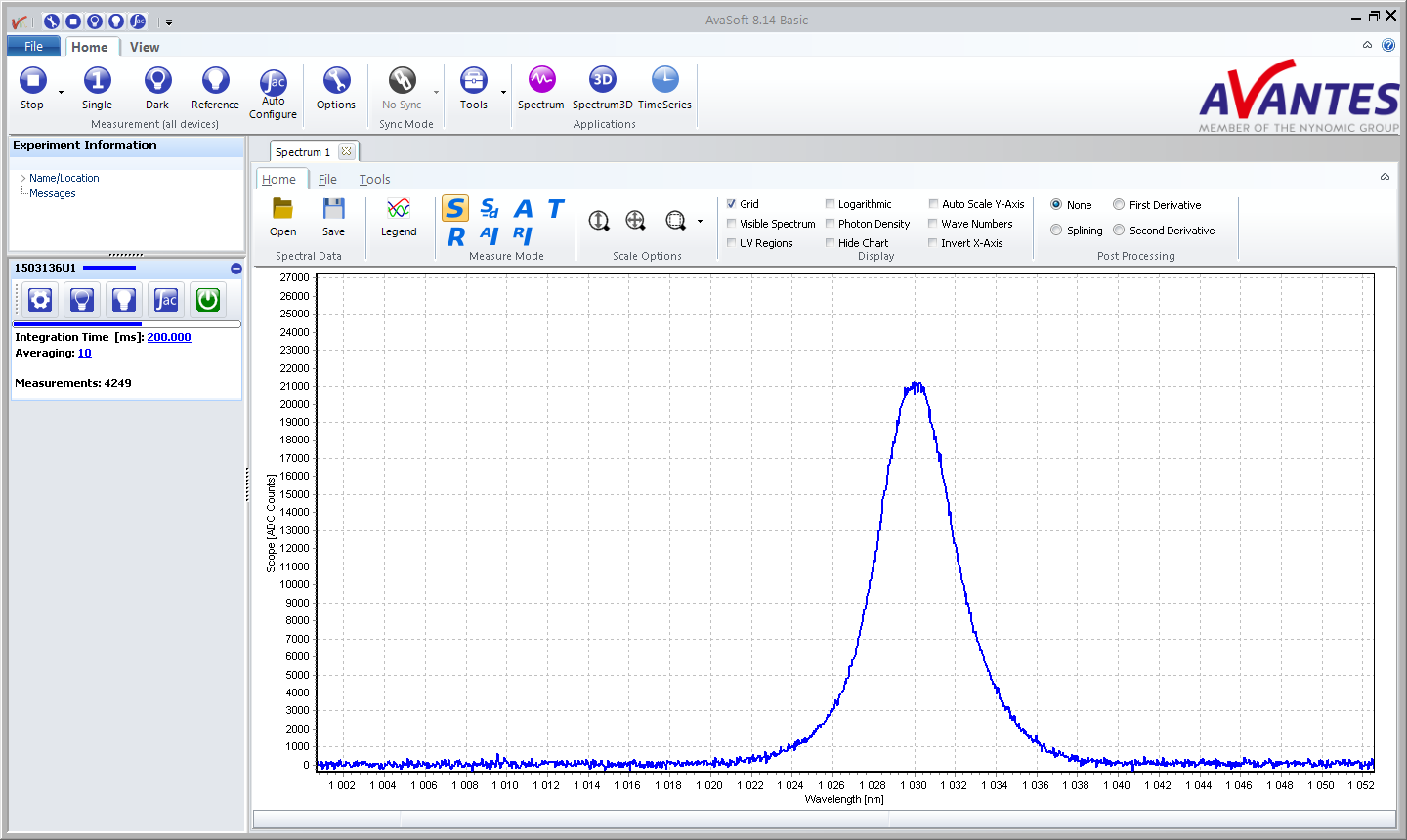 |
|
155
|
Mon Oct 3 18:54:58 2022 |
Ronic Chiche | Fixed | info | lasers and optics | Optical room | 33MHz laser SN2439 back to Orsay | This morning, with Aurélien and Daniele, we did the swap between the 33MHz and 133MHz oscillators.
now, the 33MHz oscillator is on ThomX inside the casemate.
it has been restarted and some laser is going out.
it has been screwed on the metal plate, roughly aligned with the Alphanov "fiber injection and strecher" box.
tomorrow, we will do the fine alignment with this box and check if the laser is properly modelocking.
the 133MHz oscillator is back in the PLIC optical room.
it has been restarted and some laser is going out.
it seems there are no pulses at the output... it seems we have to trigger the modelock.
| Ronic Chiche wrote: |
|
On the 8th of July, the SN2439 33MHz laser was returned from NKT to our lab, being repaired.
it stayed all the weekend to warm up in the optical room and has been turned on on Monday.
the mode-locking was not working (28mW output power and a CW line for the optical spectrum), thus I "kicked" the laser with 100µm moves on the motors.
now, the laser is mode-locked with 42mW output power and the expected optical spectrum.
|
|
|