| ID |
Date |
Author |
Status |
Type |
Category |
Location |
Title |
|
257
|
Thu Sep 14 19:16:44 2023 |
Ronic Chiche | Fixed | info | detectors and electronics | Optical room | lock oscillateur 33MHz - synthé 500MHz | this afternoon, we were able to lock the laser on the FP-cavity and the FP-cavity on the Ring reference oscillator in a same time from the control room.
the procedure when laser, cavity and reference oscillators are far in frequency, is :
1) start the amplifier to get the laser signal in the reference photodiode used to measure the 33MHz.
2) look at the beating frequency with the reference oscillator and quickly cancel it using the Smaract motors.
one need to remember the direction and distance corrected by the Smaract motors.
3) compensate the motion in the FP-cavity using these rules :
- 600nm with the Smaract motors <=> 100 steps on the FP-cavity motors
- decreasing the value on the Smaract motors <=> increasing the value on the FP-cavity motors
4) start the lock between the laser and FP-cavity
5) adjust both cavity length step by step until reaching < 5Hz of beating
6) start the lock between FP-cavity and reference oscillator
we still see the 20Hz noise both in the PDH error signal and in the laser PZT feedback signal.
it could mean :
either the FP cavity is stable but the Laser cavity is oscillating (noise source) and badly compensated by its own PZT
or the FP cavity is oscillating (noise source) and the Laser cavity is oscillating too (due to feedback) but badly compensated with the laser PZT
the bad compensation in both case could come from a mechanical resonance which produces a phase jump that the PID is not able to properly compensate, even with a high gain (integration).
=> to be checked with a behavorial simulation
the noise source in the laser cavity could be the Smaract motors.
=> we need to switch them off to compare the noise with and without
| Ronic Chiche wrote: |
|
this afternoon, I firstly connected the HV output of the Laselock to the FP-cavity PZT : https://elog.lal.in2p3.fr/FPC/THOMX+commissioning/248
locking the FP-cavity on the local synthesizer works better with the improved HV output range.
the ~20Hz oscillation in the beating signal of the FP-cavity/synthesizer is still there.
one can observe exactly the same oscillation on the Laser PZT signal.
I think the FP-cavity is oscillating at this frequency and the laser PZT correction signal is compensating it.
this oscillation produces also an error signal with the beating of the laser harmonic and the synthesizer.
an other possibility for this low frequency oscillation could be the hexapod stability ?
then, I switched to the 500MHz Ring Synthesizer instead of the local one.
we were able to lock all the elements, FP-cavity and Laser, in a same time.
we have Vp=3.25V of signal amplitude when not locked and dVrms = 140mVrms of rms noise once locked => rms jitter = dVrms / (2pi F Vp) ~ 13.7ps rms
with F=500MHz.
reaching a state where both loops are locked is not simple as :
- the FP-cavity motors are noisy when they move, and one direction has some backlash compensation which produces a long unlock.
- the laser motors are less noisy but too noisy to be moved w/o unlock
- moving the FP-cavity motor changes the laser PZT position and can put the system out of the locking range for the laser PZT.
the correct strategy is :
1) lock the laser on the FP-cavity using the laser motors (no lock of the FP-cavity compare to the synthesizer).
2) wait to have a quite good thermal stabilization => this can take time especially if it is the first lock of the day when the cavity is cold.
3) measure the frequency beating between FP-cavity and synthesizer.
4) pre-compensate the direction of the laser PZT with the laser motor when you will play on the FP-cavity motor
ex : a step on the right on P4 motor will move the laser PZT to the top, then you need to pre-compensate this move by placing the laser PZT voltage lower with the laser motor (Smaract).
5) do the move on P4 motor
6) check that the frequency beating between FP-cavity and synthesizer is reduced
7) redo 4) 5) 6) until the frequency beating is < 5Hz and stable
8) start the lock on the FP-cavity PZT.
due to the power drifts inducing frequency drifts, it will be difficult to work continuously more than a couple of minutes.
the procedure has to be done continously from 4) to 8)
having HV output on the laser PZT should help to improve both lockings range and inscrease the locking duration => to be checked w/o fast feedback loop (FFL) or with FFL if needed.
| Ronic Chiche wrote: |
|
this morning, I added a Thorlabs lowpass filter at 1kHz after the mixer and a resistor at the Laselock output to the FP-cavity PZT.
I set the PID with P=10 and I=D~0
in attachement, a plot of the 500MHz mixer output, before and during the lock.
during the lock, one gets a residual oscillation around 20Hz... where does it come from ???
could it be some mechanical resonance, as we already had before (it was ~30Hz) : https://elog.lal.in2p3.fr/FPC/THOMX+commissioning/84
when unlocked, one gets : A*sin(dPHI) with A=3V => 6Vpp signal
when locked, one gets a 400mVpp error signal => A*dPHIpp = 0.4pp => dPHIpp = 133 mrad
dPHI = 2*pi*F500M*dt => peak-peak jitter dtpp = 42 ps => rms jitter = 15ps
this value can be measured directly on the 500MHz signals coming from the laser and the reference synthesizer.
| Ronic Chiche wrote: |
|
this afternoon, I tried to lock the FP-cavity on a local 500MHz synthesizer as a frequency reference
(it's faster to change the frequency from the sythesizer than from the FP cavity !!!)
I found some parameters on the PID of the Laselock to phase-lock the reference and the FP-cavity
but the locking quality is poor => we produce some oscillations which are copied by the FP-cavity/laser lock on the laser PZT.
the error signal (FP-cavity/reference) is quite noisy, then maybe one can try to do some analog filtering at a lower frequency ?
=> one can use Thorlabs LPF at 10kHz or 1KHz.
one can try also to filter the signal going to the PZT to reduce the excitation of the PZT resonance.
=> use a variable resistor in serie with the PZT capacitance to make and RC filter (Cpzt ~ 70nF)
for reminding, the previously working PID parameters, found with the 133MHz laser/533MHz reference lock, were:
P=10, I=0.01, D=0 for mid SR, and no filtering.
once we will found good PID parameters, we will be able to switch to the Ring oscillator at 500MHz as a reference,
then work with HV from the Laselock to improve the locking range.
| Ronic Chiche wrote: |
|
this afternoon, I installed the frequency detection scheme in the bunker :
- I changed the large reflected photodiode DET100 by a fast small DET10.
- a 50ohms splitter is connected to the photodiode :
* one cable is going directly to the scope for monitoring
* one cable is going to the 500MHz sharp bandpass filter to select only this harmonic.
despite the small BW of the filter, one gets 3 harmonics : 500MHz + (0 +/- 33) MHz with a bit less power on sidebands.
power on 500MHz : ~ -30dBm if the laser amplifier is at 30%
- after the BPF, one goes directly to the RF amplifier which is 2x Minicircuit amp ZX60-33LN in cascade to get ~ +3dBm
- then one goes to the level 17 mixer on the RF port.
the LO port is feeded with the 500MHz coming from the Ring reference oscillator.
in attachement is a picture of the output signal : ~ 1.5Vpp
I think the width of the signal is coming from the 33MHz sidebands which are not perfectly removed by the 20MHz BW of the scope.
one finds a frequency shift of 250kHz.
as the laser frequency has been set at 500.25MHz (on the 15th harmonic), would it mean the Ring reference oscillator was at 500MHz sharp ? => to be checked with Kevin.
| Ronic Chiche wrote: |
|
Today, I connected the BNC-DB9 female prolongator cable to the FP-cavity PZT cable (DB9-DB9) and to the channel B of the Laselock.
I additionnaly connected the reflected laser beam (normally connected to scope ch2) to the spectrum analyzer @ 1GHz to observe the 30th harmonic of the laser comb.
on the 2 attached pictures, the 1st one is @0V on FP-cavity PZT and the 2nd one is @10V on the FP-cavity PZT.
as the laser is locked on the FP-cavity, its frequency follows the FP-cavity length and its frequency changes.
as expected, applying 10V on the FP-cavity PZT, increases the laser harmonic frequency @ 1GHz by about 10Hz => the relative change is 10^-9 V^-1
(as the FP-cavity length is always moving due to temperature or low frequency vibrations, there are always some FP-cavity length fluctuations, and the measurement has to be quick to get a correct evaluation).
| Ronic Chiche wrote: |
|
Today, I installed a DB9-DB9 female-male cable on the PZT connector of the FP-cavity.
the PZT is connected between pins 1 and 2, with a capacitance around 70nF.
I need to make a prolongator cable BNC-DB9 female to connect it to the feedback system.
with a (dLpzt / dV) of 5nm/V, one should be able to see 37mHz/V on Frep which is equivalent to ~10Hz/10V @ 1GHz (30th Frep harmonics)
I connected a photodiode on the spectrum analyzer to measure this variation => to be done tomorrow.
I don't have any information about the polarity of the PZT on the DB9 connector but I know that the PZT length should increase with positivite voltage in normal operation.
from the Yann documentation about the PZT mount (in attached file), it should mean that the cavity length should decrease when the PZT length is increasing, and then the FP-cavity FSR should increase.
=> to be tested tomorrow.
about the PZT mount :
I understand that the HR face of the P4 mirror is the face placed on the only part with a chamfer (chanfrein), on the FP-cavity side.
in the documentation, the PZT connector orientation is misleading as it is oriented to the FP-cavity side instead of to the "outside" as one can see it in the cavity picture in attached file.
| Ronic Chiche wrote: |
- régler le problème 1:
Kevin m'a apporté un déphaseur Minicircuits JSPHS-661 (400-660MHz / 180° de phase) qui permet de déphaser le 500MHz de ~ 1ns avec une tension DC 0-10V.
on peut alors changer le signe du lock pour scanner les 2ns d'une période complète de 500MHz.
- régler le problème 2:
la synchro anneau se fait sur la RF du synthé 500MHz avec une signal de trig fabriqué à partir d'un 16MHz, issu d'une division de ce 500MHz.
en cas de perte de synchro de la cavité FP, on va relocker sur le 500MHz mais avec une phase aléatoire par rapport au 16MHz.
on peut donc remplacer ce 16MHz par le signal 33MHz issu du laser de telle façon que l'injection des électrons dans l'anneau se fera toujours avec la même phase par rapport à ce signal à 33MHz.
il faudra donc envoyer ce signal issu du laser cavité FP au système de synchro anneau, de cette façon la phase d'injection des électrons dans l'anneau par rapport au laser sera toujours la même.
mais il n'y a aucune raison que les électrons tombent exactement sur le pulse laser (avec la bonne phase).
il faudra donc scanner la phase du signal de trig pour décaler l'injection machine par rapport au signal 33MHz avec des steps ~ 1ns.
pour cela, on peut utiliser les générateurs de delais Greenfield Technology GFT1020 actuellement utilisés pour la synchro (résolution 100ps).
voir schéma attaché en pdf
| Ronic Chiche wrote: |
|
pour préparer le lock cavité-anneau, j'ai un setup de lock en salle optique entre le laser OneFive 133MHz et un synthé à 533MHz (133MHz x4).
ce matin, j'ai pu locker les 2 ensembles avec le laselock avec une stabilité RMS, je pense inférieure à la ps.
ma limite de mesure du jitter temporel au scope est de ~ 2.5ps.
- une fois locké avec le laselock, je peux facilement décaler légèrement en phase les 2 signaux de façon très précise (<1ps) en jouant sur l'offset de lock,
mais je ai une plage assez petite (+/- 250ps) qui correspond grosso modo aux plages linéaires du sinus (1/4 de période) soit 500ps (F ~ 533MHz => T ~ 2ns)
en changeant le signe du lock, je peux faire des sauts du lock d'une 1/2 période, soit 1ns...
mais cela ne suffit pas à couvrir l'intégralité de la période du signal de référence.
=> 1er problème : je n'ai accès qu'aux plages "linéaires" du signal de référence.
il faudrait un petit déphaseur programmable piloté en remote pour faire des steps de 100ps environ, sur une plage de 1 ou 2ns afin d'être sur de scanner tout la période du 500MHz.
- en coupant le lock, les fréquences driftent l'une par rapport à l'autre.
et en raccrochant le lock, on peut scanner toute la période entre 2 pulses d'électrons par steps de 2ns.
puis en changeant le signe du lock, par steps de 2ns mais décalé de 1ns.
on peut donc facilement scanner la période des électrons avec des steps de 1ns et une plage de 500ps autour de chacun de ces steps.
=> 2e problème : lorsque l'on perd le lock de la cavité FP/laser involontairement, on perd l'info de la longueur de la cavité FP.
et lorsqu'on retrouvera le lock, il va se raccrocher sur une autre oscillation du 500MHz.
et donc on va perdre la phase avec les électrons à 16MHz.
=> on peut éventuellement afficher ce signal à 16MHz, en même temps que le 500MHz pour rechercher l'oscillation correspondante à la bonne phase sur le 16MHz.
mais dans tous les cas, il faudra rechercher à nouveau la phase é-/laser à chaque délock.
- Autre possibilité, faire la synchro sur le 16MHz au lieu du 500MHz.
la tentative aujourd'hui n'a rien donné car le signal est 30x moins intense => beaucoup plus de bruit.
=> le lock n'arrive pas du tout à accrocher même en filtrant énormément le signal IF avec 10kHz de BW.
|
|
|
|
|
|
|
|
|
|
268
|
Wed Sep 20 19:17:44 2023 |
Ronic Chiche | Fixed | info | detectors and electronics | Optical room | lock oscillateur 33MHz - synthé 500MHz | after a sudden FP-cavity Finesse increase, we had to install the Fast Feedback Loop in order to continue to lock the cavity.
this afternoon, I was able to lock both the FP-cavity and the Laser on the 500.25MHz oscillator reference.
I had to change the CEP to reduce the effective Finesse and help to get a better stabililty => P ~ 25kW inside the FP-cavity for 30% of laser amp. power ratio.
the 20Hz oscillation is still there on the PZT signal and can be seen also on the reflected signal when the amplitude of the PZT signal is large or when the lock is lost or almost lost.
this 20Hz signal is modulated by a higher frequency of the reflected signal => to be investigated...
the posts, specific to the 20Hz oscillation noise, are here : https://elog.lal.in2p3.fr/FPC/THOMX+commissioning/258
this post closes this thread.
| Ronic Chiche wrote: |
|
this afternoon, we were able to lock the laser on the FP-cavity and the FP-cavity on the Ring reference oscillator in a same time from the control room.
the procedure when laser, cavity and reference oscillators are far in frequency, is :
1) start the amplifier to get the laser signal in the reference photodiode used to measure the 33MHz.
2) look at the beating frequency with the reference oscillator and quickly cancel it using the Smaract motors.
one need to remember the direction and distance corrected by the Smaract motors.
3) compensate the motion in the FP-cavity using these rules :
- 600nm with the Smaract motors <=> 100 steps on the FP-cavity motors
- decreasing the value on the Smaract motors <=> increasing the value on the FP-cavity motors
4) start the lock between the laser and FP-cavity
5) adjust both cavity length step by step until reaching < 5Hz of beating
6) start the lock between FP-cavity and reference oscillator
we still see the 20Hz noise both in the PDH error signal and in the laser PZT feedback signal.
it could mean :
either the FP cavity is stable but the Laser cavity is oscillating (noise source) and badly compensated by its own PZT
or the FP cavity is oscillating (noise source) and the Laser cavity is oscillating too (due to feedback) but badly compensated with the laser PZT
the bad compensation in both case could come from a mechanical resonance which produces a phase jump that the PID is not able to properly compensate, even with a high gain (integration).
=> to be checked with a behavorial simulation
the noise source in the laser cavity could be the Smaract motors.
=> we need to switch them off to compare the noise with and without
| Ronic Chiche wrote: |
|
this afternoon, I firstly connected the HV output of the Laselock to the FP-cavity PZT : https://elog.lal.in2p3.fr/FPC/THOMX+commissioning/248
locking the FP-cavity on the local synthesizer works better with the improved HV output range.
the ~20Hz oscillation in the beating signal of the FP-cavity/synthesizer is still there.
one can observe exactly the same oscillation on the Laser PZT signal.
I think the FP-cavity is oscillating at this frequency and the laser PZT correction signal is compensating it.
this oscillation produces also an error signal with the beating of the laser harmonic and the synthesizer.
an other possibility for this low frequency oscillation could be the hexapod stability ?
then, I switched to the 500MHz Ring Synthesizer instead of the local one.
we were able to lock all the elements, FP-cavity and Laser, in a same time.
we have Vp=3.25V of signal amplitude when not locked and dVrms = 140mVrms of rms noise once locked => rms jitter = dVrms / (2pi F Vp) ~ 13.7ps rms
with F=500MHz.
reaching a state where both loops are locked is not simple as :
- the FP-cavity motors are noisy when they move, and one direction has some backlash compensation which produces a long unlock.
- the laser motors are less noisy but too noisy to be moved w/o unlock
- moving the FP-cavity motor changes the laser PZT position and can put the system out of the locking range for the laser PZT.
the correct strategy is :
1) lock the laser on the FP-cavity using the laser motors (no lock of the FP-cavity compare to the synthesizer).
2) wait to have a quite good thermal stabilization => this can take time especially if it is the first lock of the day when the cavity is cold.
3) measure the frequency beating between FP-cavity and synthesizer.
4) pre-compensate the direction of the laser PZT with the laser motor when you will play on the FP-cavity motor
ex : a step on the right on P4 motor will move the laser PZT to the top, then you need to pre-compensate this move by placing the laser PZT voltage lower with the laser motor (Smaract).
5) do the move on P4 motor
6) check that the frequency beating between FP-cavity and synthesizer is reduced
7) redo 4) 5) 6) until the frequency beating is < 5Hz and stable
8) start the lock on the FP-cavity PZT.
due to the power drifts inducing frequency drifts, it will be difficult to work continuously more than a couple of minutes.
the procedure has to be done continously from 4) to 8)
having HV output on the laser PZT should help to improve both lockings range and inscrease the locking duration => to be checked w/o fast feedback loop (FFL) or with FFL if needed.
| Ronic Chiche wrote: |
|
this morning, I added a Thorlabs lowpass filter at 1kHz after the mixer and a resistor at the Laselock output to the FP-cavity PZT.
I set the PID with P=10 and I=D~0
in attachement, a plot of the 500MHz mixer output, before and during the lock.
during the lock, one gets a residual oscillation around 20Hz... where does it come from ???
could it be some mechanical resonance, as we already had before (it was ~30Hz) : https://elog.lal.in2p3.fr/FPC/THOMX+commissioning/84
when unlocked, one gets : A*sin(dPHI) with A=3V => 6Vpp signal
when locked, one gets a 400mVpp error signal => A*dPHIpp = 0.4pp => dPHIpp = 133 mrad
dPHI = 2*pi*F500M*dt => peak-peak jitter dtpp = 42 ps => rms jitter = 15ps
this value can be measured directly on the 500MHz signals coming from the laser and the reference synthesizer.
| Ronic Chiche wrote: |
|
this afternoon, I tried to lock the FP-cavity on a local 500MHz synthesizer as a frequency reference
(it's faster to change the frequency from the sythesizer than from the FP cavity !!!)
I found some parameters on the PID of the Laselock to phase-lock the reference and the FP-cavity
but the locking quality is poor => we produce some oscillations which are copied by the FP-cavity/laser lock on the laser PZT.
the error signal (FP-cavity/reference) is quite noisy, then maybe one can try to do some analog filtering at a lower frequency ?
=> one can use Thorlabs LPF at 10kHz or 1KHz.
one can try also to filter the signal going to the PZT to reduce the excitation of the PZT resonance.
=> use a variable resistor in serie with the PZT capacitance to make and RC filter (Cpzt ~ 70nF)
for reminding, the previously working PID parameters, found with the 133MHz laser/533MHz reference lock, were:
P=10, I=0.01, D=0 for mid SR, and no filtering.
once we will found good PID parameters, we will be able to switch to the Ring oscillator at 500MHz as a reference,
then work with HV from the Laselock to improve the locking range.
| Ronic Chiche wrote: |
|
this afternoon, I installed the frequency detection scheme in the bunker :
- I changed the large reflected photodiode DET100 by a fast small DET10.
- a 50ohms splitter is connected to the photodiode :
* one cable is going directly to the scope for monitoring
* one cable is going to the 500MHz sharp bandpass filter to select only this harmonic.
despite the small BW of the filter, one gets 3 harmonics : 500MHz + (0 +/- 33) MHz with a bit less power on sidebands.
power on 500MHz : ~ -30dBm if the laser amplifier is at 30%
- after the BPF, one goes directly to the RF amplifier which is 2x Minicircuit amp ZX60-33LN in cascade to get ~ +3dBm
- then one goes to the level 17 mixer on the RF port.
the LO port is feeded with the 500MHz coming from the Ring reference oscillator.
in attachement is a picture of the output signal : ~ 1.5Vpp
I think the width of the signal is coming from the 33MHz sidebands which are not perfectly removed by the 20MHz BW of the scope.
one finds a frequency shift of 250kHz.
as the laser frequency has been set at 500.25MHz (on the 15th harmonic), would it mean the Ring reference oscillator was at 500MHz sharp ? => to be checked with Kevin.
| Ronic Chiche wrote: |
|
Today, I connected the BNC-DB9 female prolongator cable to the FP-cavity PZT cable (DB9-DB9) and to the channel B of the Laselock.
I additionnaly connected the reflected laser beam (normally connected to scope ch2) to the spectrum analyzer @ 1GHz to observe the 30th harmonic of the laser comb.
on the 2 attached pictures, the 1st one is @0V on FP-cavity PZT and the 2nd one is @10V on the FP-cavity PZT.
as the laser is locked on the FP-cavity, its frequency follows the FP-cavity length and its frequency changes.
as expected, applying 10V on the FP-cavity PZT, increases the laser harmonic frequency @ 1GHz by about 10Hz => the relative change is 10^-9 V^-1
(as the FP-cavity length is always moving due to temperature or low frequency vibrations, there are always some FP-cavity length fluctuations, and the measurement has to be quick to get a correct evaluation).
| Ronic Chiche wrote: |
|
Today, I installed a DB9-DB9 female-male cable on the PZT connector of the FP-cavity.
the PZT is connected between pins 1 and 2, with a capacitance around 70nF.
I need to make a prolongator cable BNC-DB9 female to connect it to the feedback system.
with a (dLpzt / dV) of 5nm/V, one should be able to see 37mHz/V on Frep which is equivalent to ~10Hz/10V @ 1GHz (30th Frep harmonics)
I connected a photodiode on the spectrum analyzer to measure this variation => to be done tomorrow.
I don't have any information about the polarity of the PZT on the DB9 connector but I know that the PZT length should increase with positivite voltage in normal operation.
from the Yann documentation about the PZT mount (in attached file), it should mean that the cavity length should decrease when the PZT length is increasing, and then the FP-cavity FSR should increase.
=> to be tested tomorrow.
about the PZT mount :
I understand that the HR face of the P4 mirror is the face placed on the only part with a chamfer (chanfrein), on the FP-cavity side.
in the documentation, the PZT connector orientation is misleading as it is oriented to the FP-cavity side instead of to the "outside" as one can see it in the cavity picture in attached file.
| Ronic Chiche wrote: |
- régler le problème 1:
Kevin m'a apporté un déphaseur Minicircuits JSPHS-661 (400-660MHz / 180° de phase) qui permet de déphaser le 500MHz de ~ 1ns avec une tension DC 0-10V.
on peut alors changer le signe du lock pour scanner les 2ns d'une période complète de 500MHz.
- régler le problème 2:
la synchro anneau se fait sur la RF du synthé 500MHz avec une signal de trig fabriqué à partir d'un 16MHz, issu d'une division de ce 500MHz.
en cas de perte de synchro de la cavité FP, on va relocker sur le 500MHz mais avec une phase aléatoire par rapport au 16MHz.
on peut donc remplacer ce 16MHz par le signal 33MHz issu du laser de telle façon que l'injection des électrons dans l'anneau se fera toujours avec la même phase par rapport à ce signal à 33MHz.
il faudra donc envoyer ce signal issu du laser cavité FP au système de synchro anneau, de cette façon la phase d'injection des électrons dans l'anneau par rapport au laser sera toujours la même.
mais il n'y a aucune raison que les électrons tombent exactement sur le pulse laser (avec la bonne phase).
il faudra donc scanner la phase du signal de trig pour décaler l'injection machine par rapport au signal 33MHz avec des steps ~ 1ns.
pour cela, on peut utiliser les générateurs de delais Greenfield Technology GFT1020 actuellement utilisés pour la synchro (résolution 100ps).
voir schéma attaché en pdf
| Ronic Chiche wrote: |
|
pour préparer le lock cavité-anneau, j'ai un setup de lock en salle optique entre le laser OneFive 133MHz et un synthé à 533MHz (133MHz x4).
ce matin, j'ai pu locker les 2 ensembles avec le laselock avec une stabilité RMS, je pense inférieure à la ps.
ma limite de mesure du jitter temporel au scope est de ~ 2.5ps.
- une fois locké avec le laselock, je peux facilement décaler légèrement en phase les 2 signaux de façon très précise (<1ps) en jouant sur l'offset de lock,
mais je ai une plage assez petite (+/- 250ps) qui correspond grosso modo aux plages linéaires du sinus (1/4 de période) soit 500ps (F ~ 533MHz => T ~ 2ns)
en changeant le signe du lock, je peux faire des sauts du lock d'une 1/2 période, soit 1ns...
mais cela ne suffit pas à couvrir l'intégralité de la période du signal de référence.
=> 1er problème : je n'ai accès qu'aux plages "linéaires" du signal de référence.
il faudrait un petit déphaseur programmable piloté en remote pour faire des steps de 100ps environ, sur une plage de 1 ou 2ns afin d'être sur de scanner tout la période du 500MHz.
- en coupant le lock, les fréquences driftent l'une par rapport à l'autre.
et en raccrochant le lock, on peut scanner toute la période entre 2 pulses d'électrons par steps de 2ns.
puis en changeant le signe du lock, par steps de 2ns mais décalé de 1ns.
on peut donc facilement scanner la période des électrons avec des steps de 1ns et une plage de 500ps autour de chacun de ces steps.
=> 2e problème : lorsque l'on perd le lock de la cavité FP/laser involontairement, on perd l'info de la longueur de la cavité FP.
et lorsqu'on retrouvera le lock, il va se raccrocher sur une autre oscillation du 500MHz.
et donc on va perdre la phase avec les électrons à 16MHz.
=> on peut éventuellement afficher ce signal à 16MHz, en même temps que le 500MHz pour rechercher l'oscillation correspondante à la bonne phase sur le 16MHz.
mais dans tous les cas, il faudra rechercher à nouveau la phase é-/laser à chaque délock.
- Autre possibilité, faire la synchro sur le 16MHz au lieu du 500MHz.
la tentative aujourd'hui n'a rien donné car le signal est 30x moins intense => beaucoup plus de bruit.
=> le lock n'arrive pas du tout à accrocher même en filtrant énormément le signal IF avec 10kHz de BW.
|
|
|
|
|
|
|
|
|
|
|
323
|
Wed Feb 7 18:33:42 2024 |
Ronic Chiche | Fixed | info | detectors and electronics | Optical room | lock oscillateur 33MHz - synthé 500MHz | This morning with Daniele, we changed the laser/RF locking scheme :
1) we use the laser 33MHz internal photodiode to do some beating with the 33MHz RF generator (A Rigol generator locked on the 500MHz Ring oscillator).
this beating is only for monitoring purpose, in order to manually adjust the laser frequency at the beginning of a run.
2) the previous scheme was using a fast photodiode in reflection of the FP cavity to do some beating with the 500MHz Ring RF generator,
but the beating signal was becoming very noisy when the FP-cavity was locked.
so, we moved this fast photodiode in transmission of the FP-cavity, in addition to the slow one (already connected to the scope to monitor the transmitted power).
this fast photodiode is used to extract the 500MHz harmonics to make the beating with the 500MHz Ring RF generator.
now, this beating signal is very clean when the FP-cavity is locked (no signal when the FP-cavity is not locked, obviously).
=> the acquisition of the lock of the 2 feedback loops seems much more easy and stable.
BUT we did a jitter measurement and it is still around 10-15ps rms and seems to be dominated by the 20Hz noise oscillation !!!
some previous measurements showed that this oscillation should come from the laser or from the Alphanov amplifier (not from the FP-cavity).
we have to redo a beating test with the Alphanov amplifier @ 500MHz and with the laser @ 33MHz...
| Ronic Chiche wrote: |
|
after a sudden FP-cavity Finesse increase, we had to install the Fast Feedback Loop in order to continue to lock the cavity.
this afternoon, I was able to lock both the FP-cavity and the Laser on the 500.25MHz oscillator reference.
I had to change the CEP to reduce the effective Finesse and help to get a better stabililty => P ~ 25kW inside the FP-cavity for 30% of laser amp. power ratio.
the 20Hz oscillation is still there on the PZT signal and can be seen also on the reflected signal when the amplitude of the PZT signal is large or when the lock is lost or almost lost.
this 20Hz signal is modulated by a higher frequency of the reflected signal => to be investigated...
the posts, specific to the 20Hz oscillation noise, are here : https://elog.lal.in2p3.fr/FPC/THOMX+commissioning/258
this post closes this thread.
| Ronic Chiche wrote: |
|
this afternoon, we were able to lock the laser on the FP-cavity and the FP-cavity on the Ring reference oscillator in a same time from the control room.
the procedure when laser, cavity and reference oscillators are far in frequency, is :
1) start the amplifier to get the laser signal in the reference photodiode used to measure the 33MHz.
2) look at the beating frequency with the reference oscillator and quickly cancel it using the Smaract motors.
one need to remember the direction and distance corrected by the Smaract motors.
3) compensate the motion in the FP-cavity using these rules :
- 600nm with the Smaract motors <=> 100 steps on the FP-cavity motors
- decreasing the value on the Smaract motors <=> increasing the value on the FP-cavity motors
4) start the lock between the laser and FP-cavity
5) adjust both cavity length step by step until reaching < 5Hz of beating
6) start the lock between FP-cavity and reference oscillator
we still see the 20Hz noise both in the PDH error signal and in the laser PZT feedback signal.
it could mean :
either the FP cavity is stable but the Laser cavity is oscillating (noise source) and badly compensated by its own PZT
or the FP cavity is oscillating (noise source) and the Laser cavity is oscillating too (due to feedback) but badly compensated with the laser PZT
the bad compensation in both case could come from a mechanical resonance which produces a phase jump that the PID is not able to properly compensate, even with a high gain (integration).
=> to be checked with a behavorial simulation
the noise source in the laser cavity could be the Smaract motors.
=> we need to switch them off to compare the noise with and without
| Ronic Chiche wrote: |
|
this afternoon, I firstly connected the HV output of the Laselock to the FP-cavity PZT : https://elog.lal.in2p3.fr/FPC/THOMX+commissioning/248
locking the FP-cavity on the local synthesizer works better with the improved HV output range.
the ~20Hz oscillation in the beating signal of the FP-cavity/synthesizer is still there.
one can observe exactly the same oscillation on the Laser PZT signal.
I think the FP-cavity is oscillating at this frequency and the laser PZT correction signal is compensating it.
this oscillation produces also an error signal with the beating of the laser harmonic and the synthesizer.
an other possibility for this low frequency oscillation could be the hexapod stability ?
then, I switched to the 500MHz Ring Synthesizer instead of the local one.
we were able to lock all the elements, FP-cavity and Laser, in a same time.
we have Vp=3.25V of signal amplitude when not locked and dVrms = 140mVrms of rms noise once locked => rms jitter = dVrms / (2pi F Vp) ~ 13.7ps rms
with F=500MHz.
reaching a state where both loops are locked is not simple as :
- the FP-cavity motors are noisy when they move, and one direction has some backlash compensation which produces a long unlock.
- the laser motors are less noisy but too noisy to be moved w/o unlock
- moving the FP-cavity motor changes the laser PZT position and can put the system out of the locking range for the laser PZT.
the correct strategy is :
1) lock the laser on the FP-cavity using the laser motors (no lock of the FP-cavity compare to the synthesizer).
2) wait to have a quite good thermal stabilization => this can take time especially if it is the first lock of the day when the cavity is cold.
3) measure the frequency beating between FP-cavity and synthesizer.
4) pre-compensate the direction of the laser PZT with the laser motor when you will play on the FP-cavity motor
ex : a step on the right on P4 motor will move the laser PZT to the top, then you need to pre-compensate this move by placing the laser PZT voltage lower with the laser motor (Smaract).
5) do the move on P4 motor
6) check that the frequency beating between FP-cavity and synthesizer is reduced
7) redo 4) 5) 6) until the frequency beating is < 5Hz and stable
8) start the lock on the FP-cavity PZT.
due to the power drifts inducing frequency drifts, it will be difficult to work continuously more than a couple of minutes.
the procedure has to be done continously from 4) to 8)
having HV output on the laser PZT should help to improve both lockings range and inscrease the locking duration => to be checked w/o fast feedback loop (FFL) or with FFL if needed.
| Ronic Chiche wrote: |
|
this morning, I added a Thorlabs lowpass filter at 1kHz after the mixer and a resistor at the Laselock output to the FP-cavity PZT.
I set the PID with P=10 and I=D~0
in attachement, a plot of the 500MHz mixer output, before and during the lock.
during the lock, one gets a residual oscillation around 20Hz... where does it come from ???
could it be some mechanical resonance, as we already had before (it was ~30Hz) : https://elog.lal.in2p3.fr/FPC/THOMX+commissioning/84
when unlocked, one gets : A*sin(dPHI) with A=3V => 6Vpp signal
when locked, one gets a 400mVpp error signal => A*dPHIpp = 0.4pp => dPHIpp = 133 mrad
dPHI = 2*pi*F500M*dt => peak-peak jitter dtpp = 42 ps => rms jitter = 15ps
this value can be measured directly on the 500MHz signals coming from the laser and the reference synthesizer.
| Ronic Chiche wrote: |
|
this afternoon, I tried to lock the FP-cavity on a local 500MHz synthesizer as a frequency reference
(it's faster to change the frequency from the sythesizer than from the FP cavity !!!)
I found some parameters on the PID of the Laselock to phase-lock the reference and the FP-cavity
but the locking quality is poor => we produce some oscillations which are copied by the FP-cavity/laser lock on the laser PZT.
the error signal (FP-cavity/reference) is quite noisy, then maybe one can try to do some analog filtering at a lower frequency ?
=> one can use Thorlabs LPF at 10kHz or 1KHz.
one can try also to filter the signal going to the PZT to reduce the excitation of the PZT resonance.
=> use a variable resistor in serie with the PZT capacitance to make and RC filter (Cpzt ~ 70nF)
for reminding, the previously working PID parameters, found with the 133MHz laser/533MHz reference lock, were:
P=10, I=0.01, D=0 for mid SR, and no filtering.
once we will found good PID parameters, we will be able to switch to the Ring oscillator at 500MHz as a reference,
then work with HV from the Laselock to improve the locking range.
| Ronic Chiche wrote: |
|
this afternoon, I installed the frequency detection scheme in the bunker :
- I changed the large reflected photodiode DET100 by a fast small DET10.
- a 50ohms splitter is connected to the photodiode :
* one cable is going directly to the scope for monitoring
* one cable is going to the 500MHz sharp bandpass filter to select only this harmonic.
despite the small BW of the filter, one gets 3 harmonics : 500MHz + (0 +/- 33) MHz with a bit less power on sidebands.
power on 500MHz : ~ -30dBm if the laser amplifier is at 30%
- after the BPF, one goes directly to the RF amplifier which is 2x Minicircuit amp ZX60-33LN in cascade to get ~ +3dBm
- then one goes to the level 17 mixer on the RF port.
the LO port is feeded with the 500MHz coming from the Ring reference oscillator.
in attachement is a picture of the output signal : ~ 1.5Vpp
I think the width of the signal is coming from the 33MHz sidebands which are not perfectly removed by the 20MHz BW of the scope.
one finds a frequency shift of 250kHz.
as the laser frequency has been set at 500.25MHz (on the 15th harmonic), would it mean the Ring reference oscillator was at 500MHz sharp ? => to be checked with Kevin.
| Ronic Chiche wrote: |
|
Today, I connected the BNC-DB9 female prolongator cable to the FP-cavity PZT cable (DB9-DB9) and to the channel B of the Laselock.
I additionnaly connected the reflected laser beam (normally connected to scope ch2) to the spectrum analyzer @ 1GHz to observe the 30th harmonic of the laser comb.
on the 2 attached pictures, the 1st one is @0V on FP-cavity PZT and the 2nd one is @10V on the FP-cavity PZT.
as the laser is locked on the FP-cavity, its frequency follows the FP-cavity length and its frequency changes.
as expected, applying 10V on the FP-cavity PZT, increases the laser harmonic frequency @ 1GHz by about 10Hz => the relative change is 10^-9 V^-1
(as the FP-cavity length is always moving due to temperature or low frequency vibrations, there are always some FP-cavity length fluctuations, and the measurement has to be quick to get a correct evaluation).
| Ronic Chiche wrote: |
|
Today, I installed a DB9-DB9 female-male cable on the PZT connector of the FP-cavity.
the PZT is connected between pins 1 and 2, with a capacitance around 70nF.
I need to make a prolongator cable BNC-DB9 female to connect it to the feedback system.
with a (dLpzt / dV) of 5nm/V, one should be able to see 37mHz/V on Frep which is equivalent to ~10Hz/10V @ 1GHz (30th Frep harmonics)
I connected a photodiode on the spectrum analyzer to measure this variation => to be done tomorrow.
I don't have any information about the polarity of the PZT on the DB9 connector but I know that the PZT length should increase with positivite voltage in normal operation.
from the Yann documentation about the PZT mount (in attached file), it should mean that the cavity length should decrease when the PZT length is increasing, and then the FP-cavity FSR should increase.
=> to be tested tomorrow.
about the PZT mount :
I understand that the HR face of the P4 mirror is the face placed on the only part with a chamfer (chanfrein), on the FP-cavity side.
in the documentation, the PZT connector orientation is misleading as it is oriented to the FP-cavity side instead of to the "outside" as one can see it in the cavity picture in attached file.
| Ronic Chiche wrote: |
- régler le problème 1:
Kevin m'a apporté un déphaseur Minicircuits JSPHS-661 (400-660MHz / 180° de phase) qui permet de déphaser le 500MHz de ~ 1ns avec une tension DC 0-10V.
on peut alors changer le signe du lock pour scanner les 2ns d'une période complète de 500MHz.
- régler le problème 2:
la synchro anneau se fait sur la RF du synthé 500MHz avec une signal de trig fabriqué à partir d'un 16MHz, issu d'une division de ce 500MHz.
en cas de perte de synchro de la cavité FP, on va relocker sur le 500MHz mais avec une phase aléatoire par rapport au 16MHz.
on peut donc remplacer ce 16MHz par le signal 33MHz issu du laser de telle façon que l'injection des électrons dans l'anneau se fera toujours avec la même phase par rapport à ce signal à 33MHz.
il faudra donc envoyer ce signal issu du laser cavité FP au système de synchro anneau, de cette façon la phase d'injection des électrons dans l'anneau par rapport au laser sera toujours la même.
mais il n'y a aucune raison que les électrons tombent exactement sur le pulse laser (avec la bonne phase).
il faudra donc scanner la phase du signal de trig pour décaler l'injection machine par rapport au signal 33MHz avec des steps ~ 1ns.
pour cela, on peut utiliser les générateurs de delais Greenfield Technology GFT1020 actuellement utilisés pour la synchro (résolution 100ps).
voir schéma attaché en pdf
| Ronic Chiche wrote: |
|
pour préparer le lock cavité-anneau, j'ai un setup de lock en salle optique entre le laser OneFive 133MHz et un synthé à 533MHz (133MHz x4).
ce matin, j'ai pu locker les 2 ensembles avec le laselock avec une stabilité RMS, je pense inférieure à la ps.
ma limite de mesure du jitter temporel au scope est de ~ 2.5ps.
- une fois locké avec le laselock, je peux facilement décaler légèrement en phase les 2 signaux de façon très précise (<1ps) en jouant sur l'offset de lock,
mais je ai une plage assez petite (+/- 250ps) qui correspond grosso modo aux plages linéaires du sinus (1/4 de période) soit 500ps (F ~ 533MHz => T ~ 2ns)
en changeant le signe du lock, je peux faire des sauts du lock d'une 1/2 période, soit 1ns...
mais cela ne suffit pas à couvrir l'intégralité de la période du signal de référence.
=> 1er problème : je n'ai accès qu'aux plages "linéaires" du signal de référence.
il faudrait un petit déphaseur programmable piloté en remote pour faire des steps de 100ps environ, sur une plage de 1 ou 2ns afin d'être sur de scanner tout la période du 500MHz.
- en coupant le lock, les fréquences driftent l'une par rapport à l'autre.
et en raccrochant le lock, on peut scanner toute la période entre 2 pulses d'électrons par steps de 2ns.
puis en changeant le signe du lock, par steps de 2ns mais décalé de 1ns.
on peut donc facilement scanner la période des électrons avec des steps de 1ns et une plage de 500ps autour de chacun de ces steps.
=> 2e problème : lorsque l'on perd le lock de la cavité FP/laser involontairement, on perd l'info de la longueur de la cavité FP.
et lorsqu'on retrouvera le lock, il va se raccrocher sur une autre oscillation du 500MHz.
et donc on va perdre la phase avec les électrons à 16MHz.
=> on peut éventuellement afficher ce signal à 16MHz, en même temps que le 500MHz pour rechercher l'oscillation correspondante à la bonne phase sur le 16MHz.
mais dans tous les cas, il faudra rechercher à nouveau la phase é-/laser à chaque délock.
- Autre possibilité, faire la synchro sur le 16MHz au lieu du 500MHz.
la tentative aujourd'hui n'a rien donné car le signal est 30x moins intense => beaucoup plus de bruit.
=> le lock n'arrive pas du tout à accrocher même en filtrant énormément le signal IF avec 10kHz de BW.
|
|
|
|
|
|
|
|
|
|
|
|
447
|
Fri Jul 18 15:56:40 2025 |
Ronic Chiche | Under Process | info | lasers and optics | ThomX igloo | laser operation again with machine OFF | The laser start at 33% with 92 KW optimized and
P=0.03
I=0.0005
I2=0
D=0.5
But we have more and more problems with the alignement from a day to another!!!
We start the machine and we do Xrays again.
The lock is easy and stable, we see some hig fraq perturbations but no delock as yesterday.
ATTENTION!!!!! when one switch ON or OFF the hexapode motors we have big delock like what we observed some time during the operation!!!!!
For the big delock we have to investigate the operation of the hexapode!!
We have changed the orbit and obtained almost 40000 Xrays. with an ebeam dimension of 121 µm rms.
And now I go in Hollydays!!
See you after 15 august
Daniele |
|
441
|
Thu Jul 10 18:02:54 2025 |
Ronic Chiche | Fixed | info | detectors and electronics | ThomX igloo | laser PZT amplifier | this afternoon, I added the Gain = 2.8 amplifier at the output of the Laselock to drive the laser PZT.
the power supply of the board is disymetric to address the correct maximal dynamic range of the amplifier (~ 30V) and voltage drop (~ 2V) related to the power supply voltage.
so, the power supply is set to -2V / 32V which gives roughly 0-28V of dynamic range at the ouput for 0-10V at the input.
despite the additionnal noise added by the amplifier, we are able to lock easily, and reach ~ 93kW in the FPC for 33% amplifier ratio.
obviously, as the dynamic range of this PZT has been multiplied by ~3, it is much more comfortable to operate the motors.
but the overall stability seems a bit degraded... to be checked, as finding the right PID + fast loop gain is not easy.
=> to be done tomorow. |
|
355
|
Thu Sep 5 09:51:22 2024 |
Ronic Chiche | Fixed | issue | lasers and optics | detectors and electronics | ThomX igloo | fixing CVBG issue | the CVBG of the compressor module seems to have an issue.
here is the plan of the work :
1) faire des résonances avec la CFP
2) ajuster les iris d'alignement du faisceau de l'ampli pour être sur de ne pas perdre la référence de l'axe de la CFP
3) installer des wedges haute puissance à proximité du compresseur + beam profiler
4) verifier la forme du faisceau au beam profiler en fonction de la puissance de l'ampli
5) ouvrir le boîtier du compresseur
6) prendre des images du boîtier à la caméra thermique en fonction de la puissance
7) éventuellement shunter le 2e CVBG avec un D shape et regarder le mode et caractéristique en sortie d'ampli.
8) ajuster l'injection dans le premier CVBG ou le second ou les deux en fonctions des résultats précédent
here are some useful logbook posts:
D-shape + images thermiques du compresseur qui peuvent servir de référence :
https://elog.lal.in2p3.fr/FPC/THOMX+commissioning/147
https://elog.lal.in2p3.fr/FPC/THOMX+commissioning/150
post des images du faisceau en fonction de la puissance de l'ampli :
https://elog.lal.in2p3.fr/FPC/THOMX+commissioning/135 (et autres posts du fil)
https://elog.lal.in2p3.fr/FPC/THOMX+commissioning/195 (et autres posts du fil)
|
|
356
|
Thu Sep 5 09:53:10 2024 |
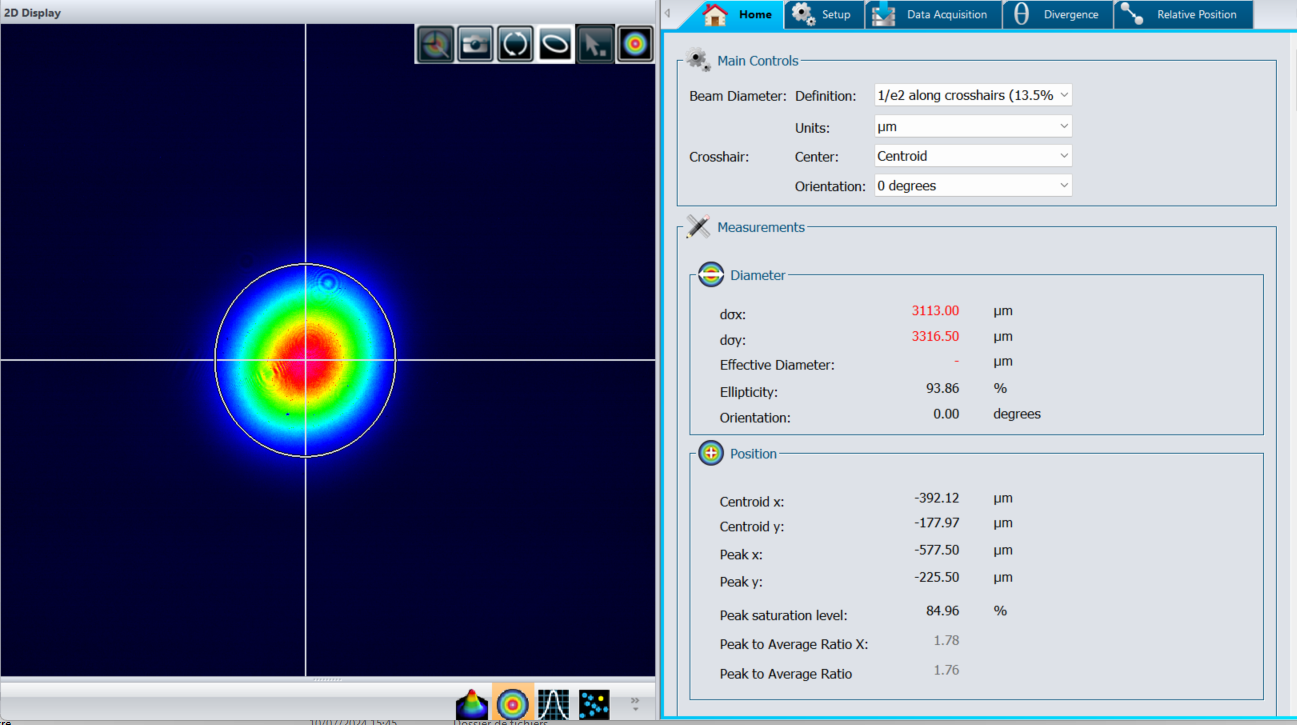
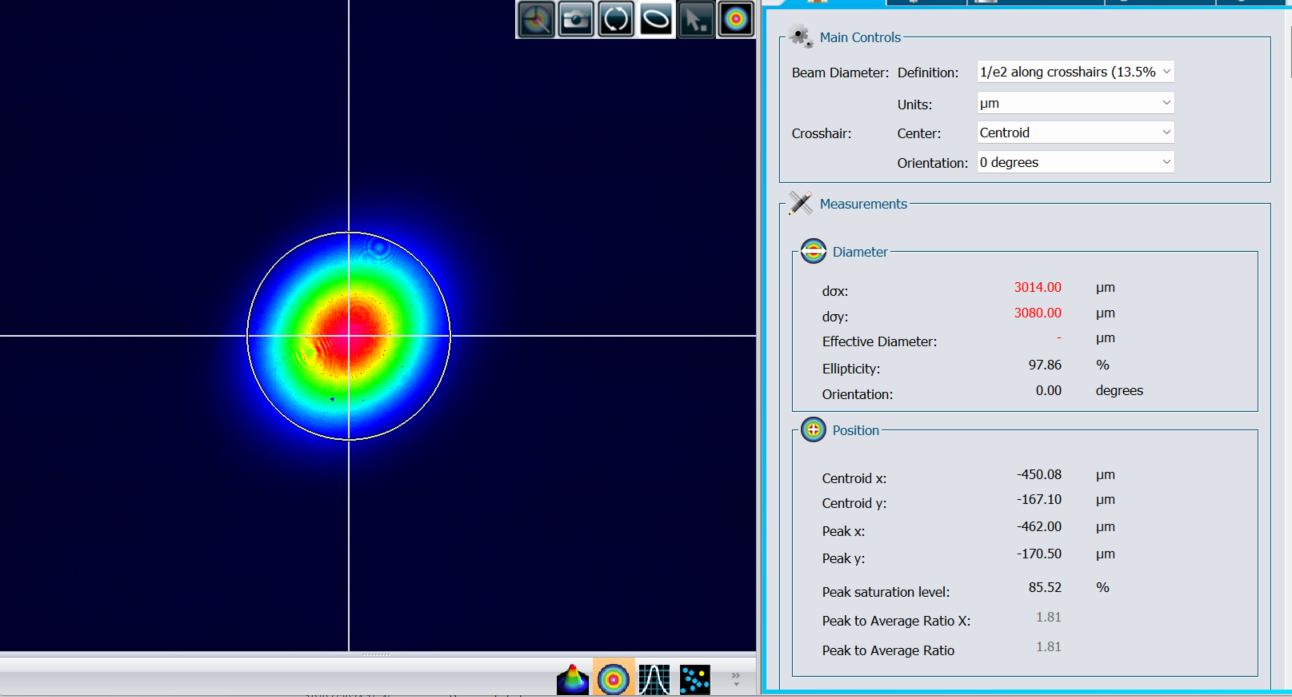
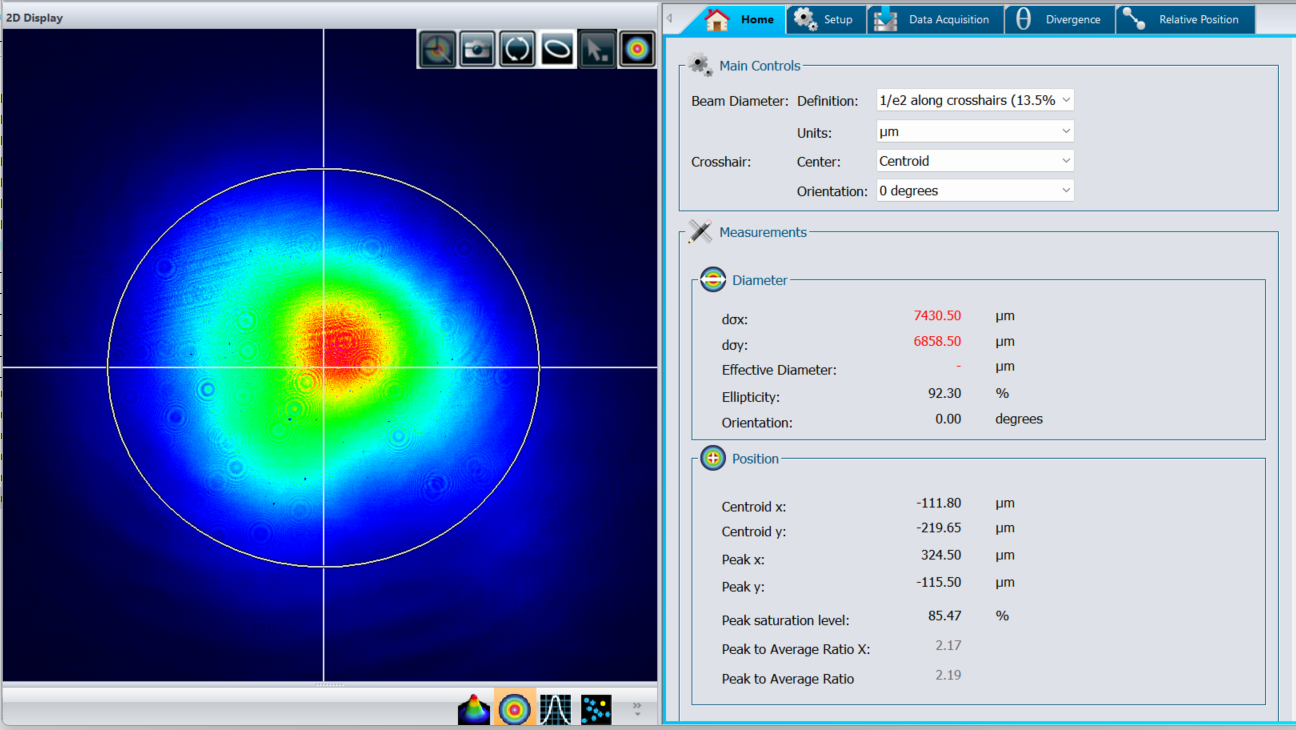
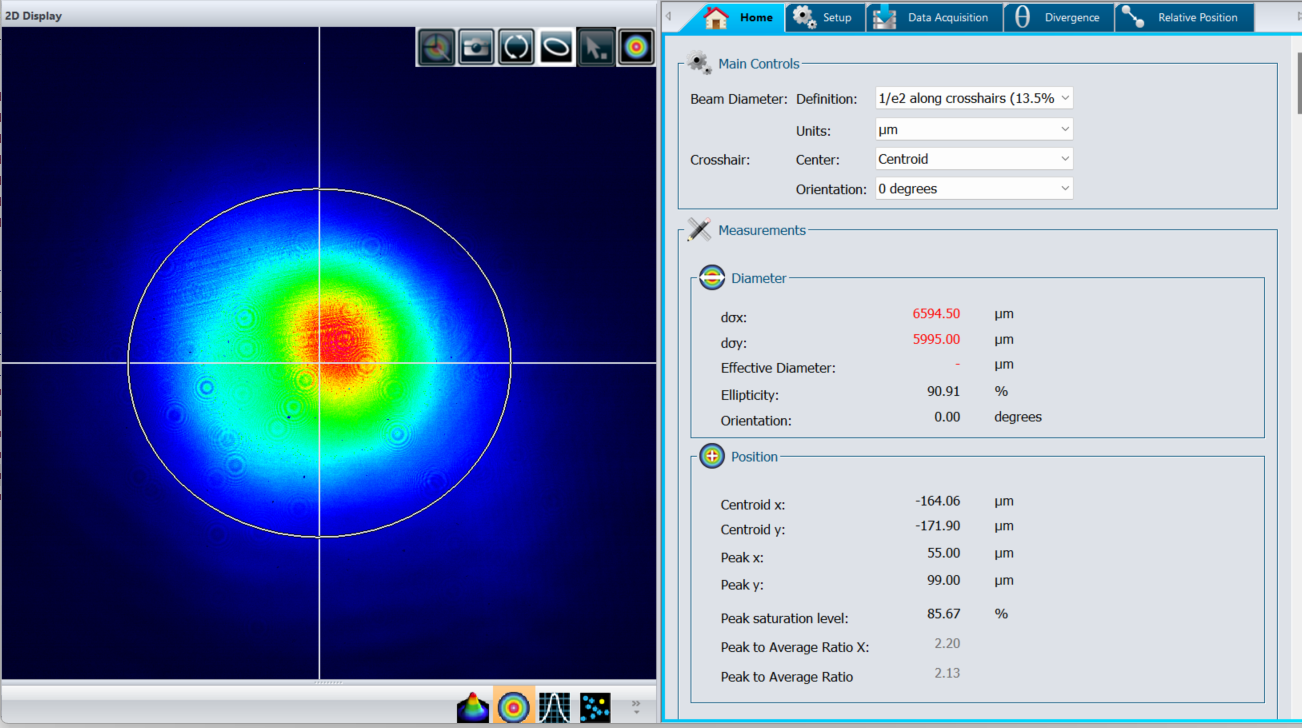
Ronic Chiche | Fixed | issue | lasers and optics | detectors and electronics | ThomX igloo | fixing CVBG issue | 1) this morning, I aligned to CFP to get back 82kW in the cavity for 33% of amplifier ratio.
thus, we can ajust the iris positions on the optical table to fix the CFP optical path before touching the CVBG.
2) we aligned the 5 iris. all of them were misaligned by 1-2mm, principaly vertically (maybe because we had to change the CFP frequency some time ago to match the new RF frequency?).
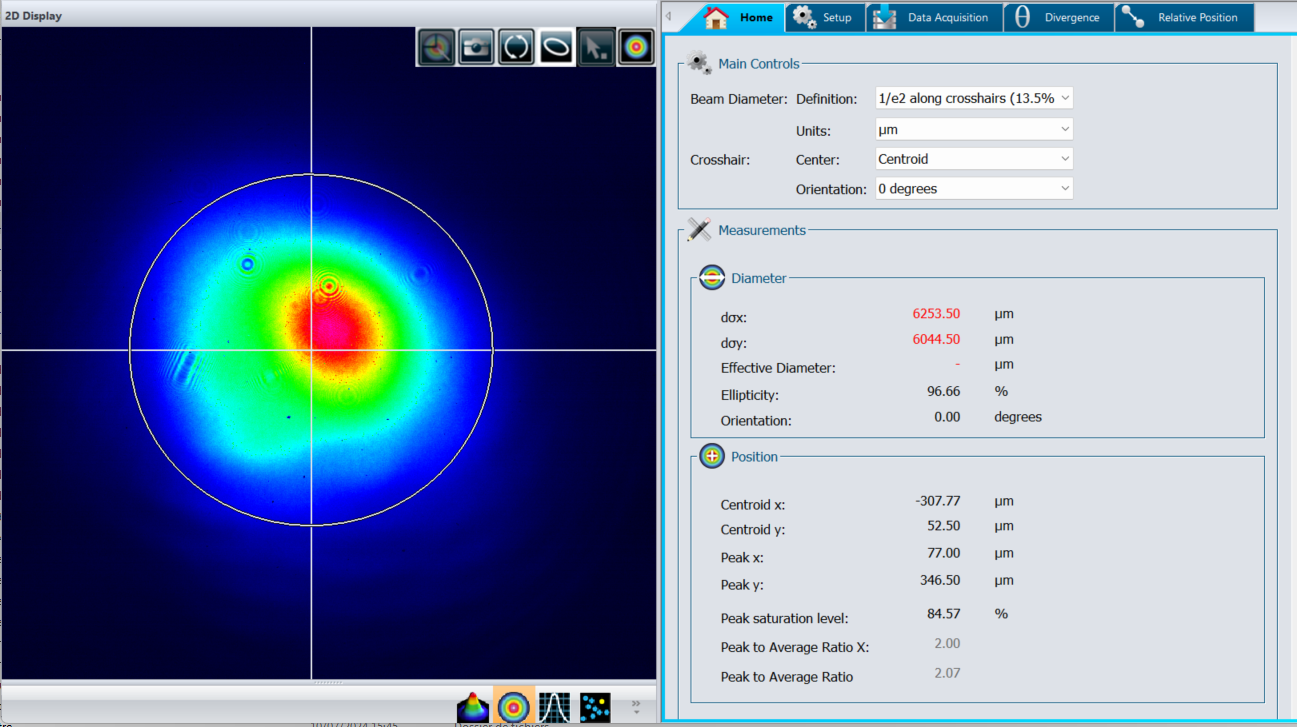
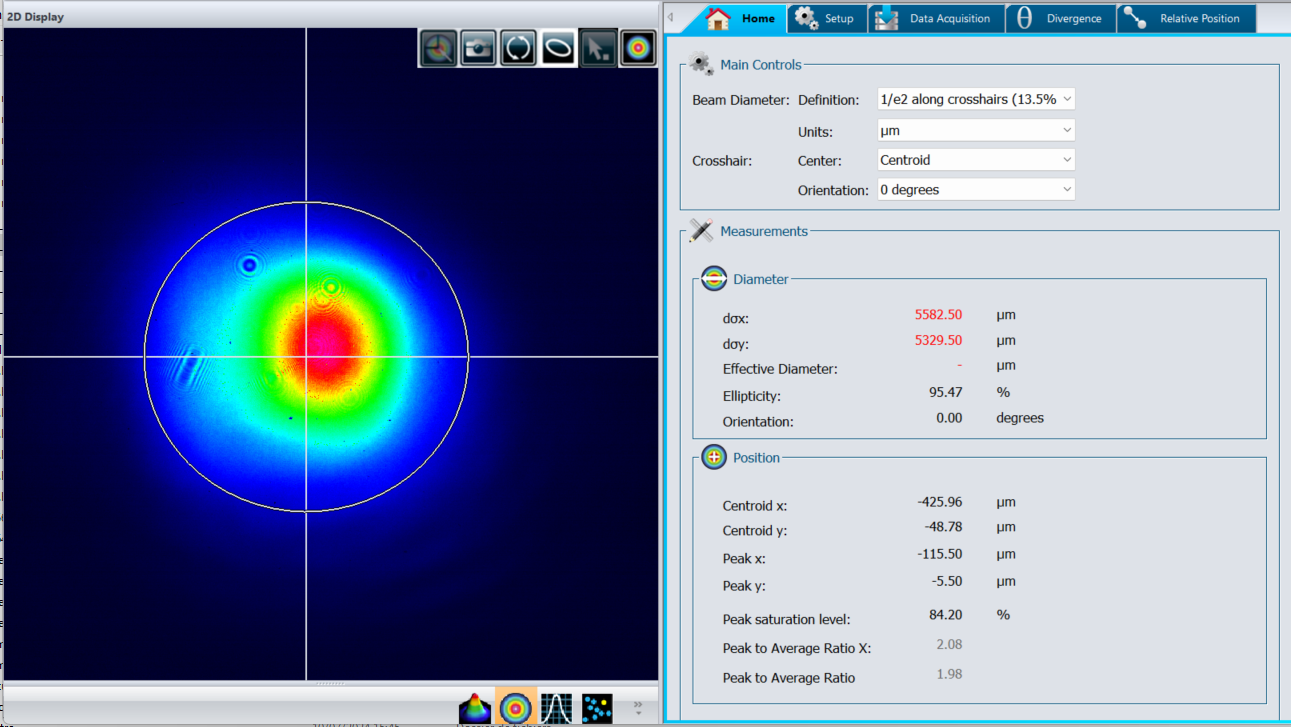
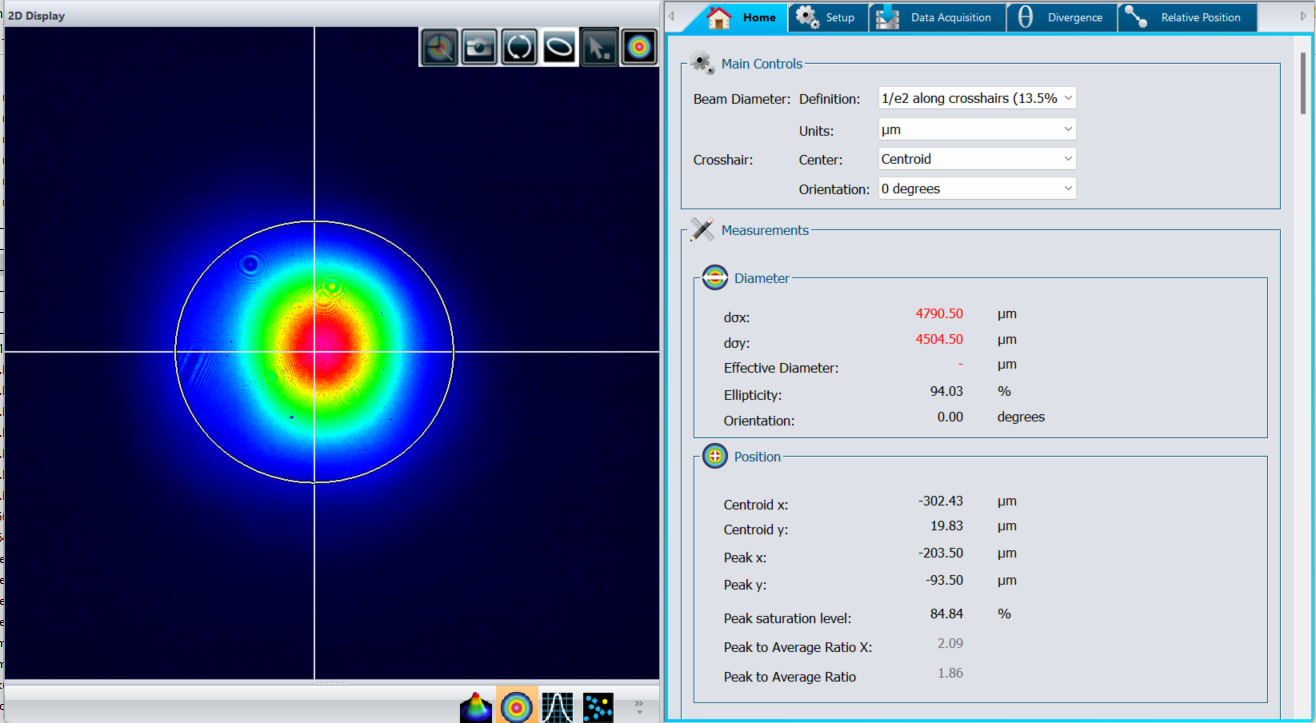
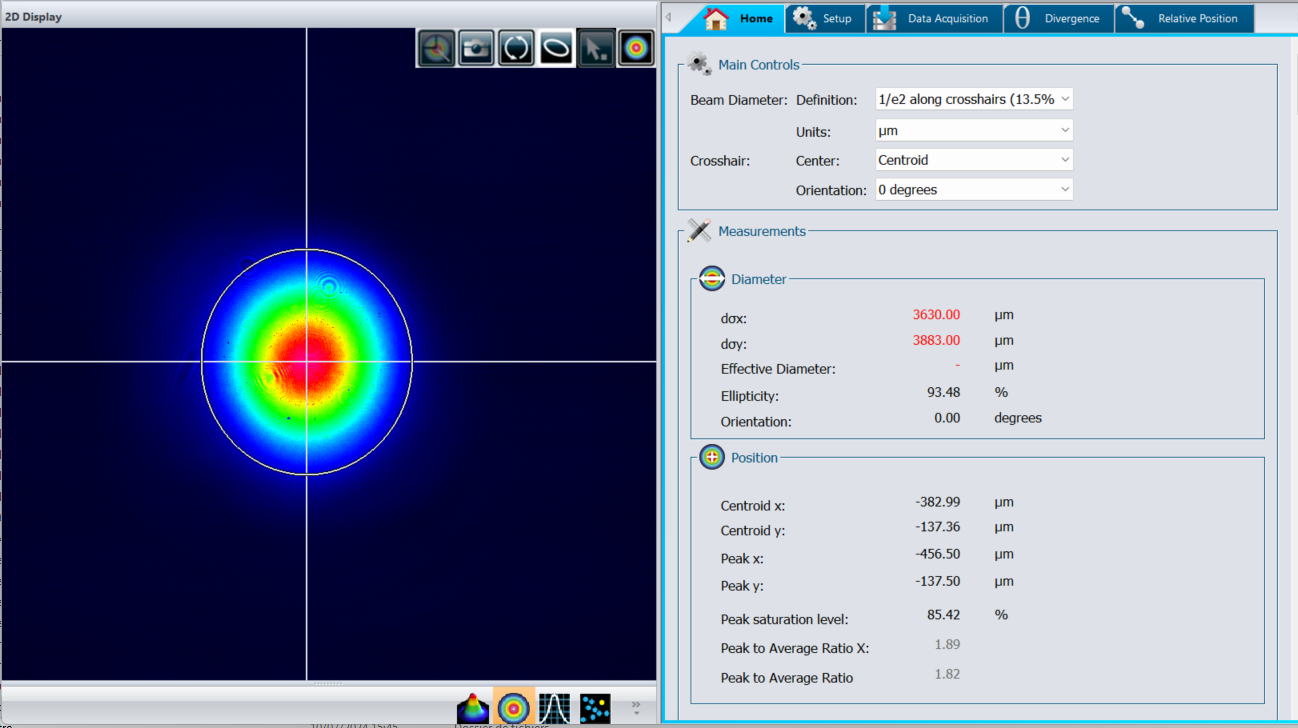
3) we opened the compressor box and found out the beam on the last mirror was really on the border => we have to move it.
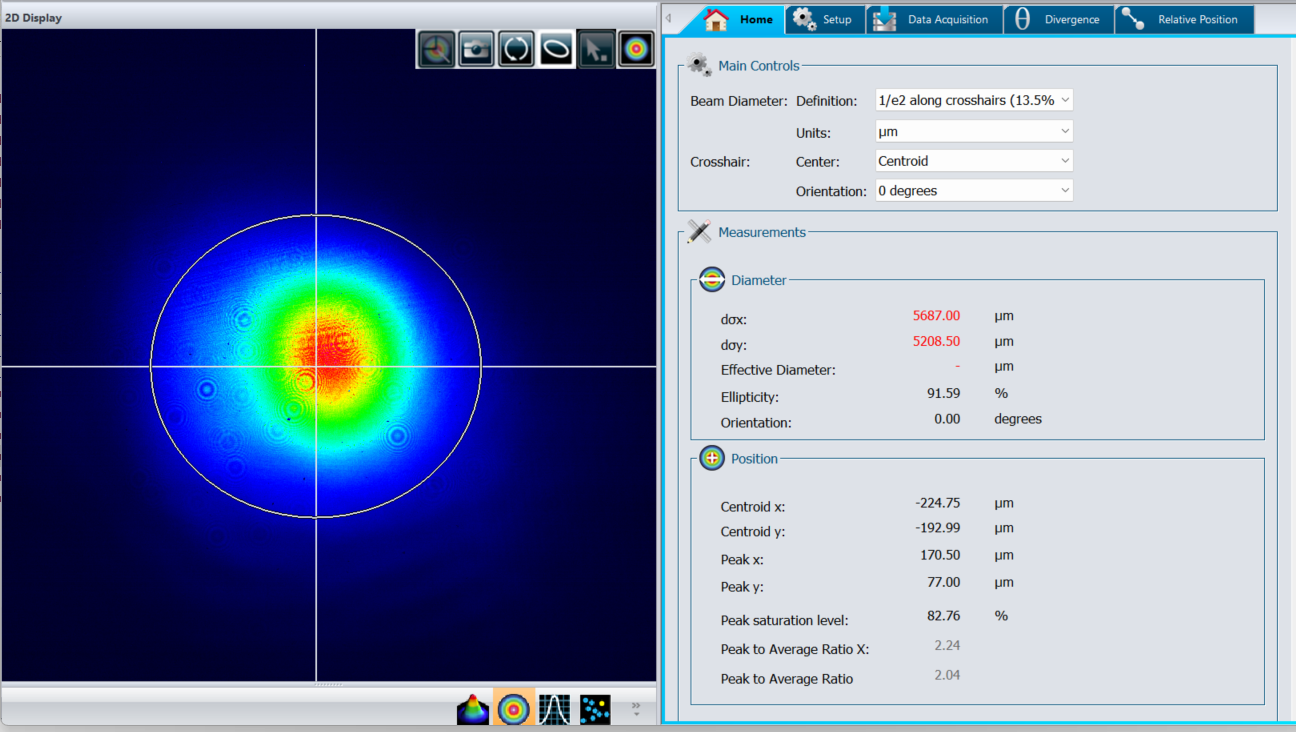
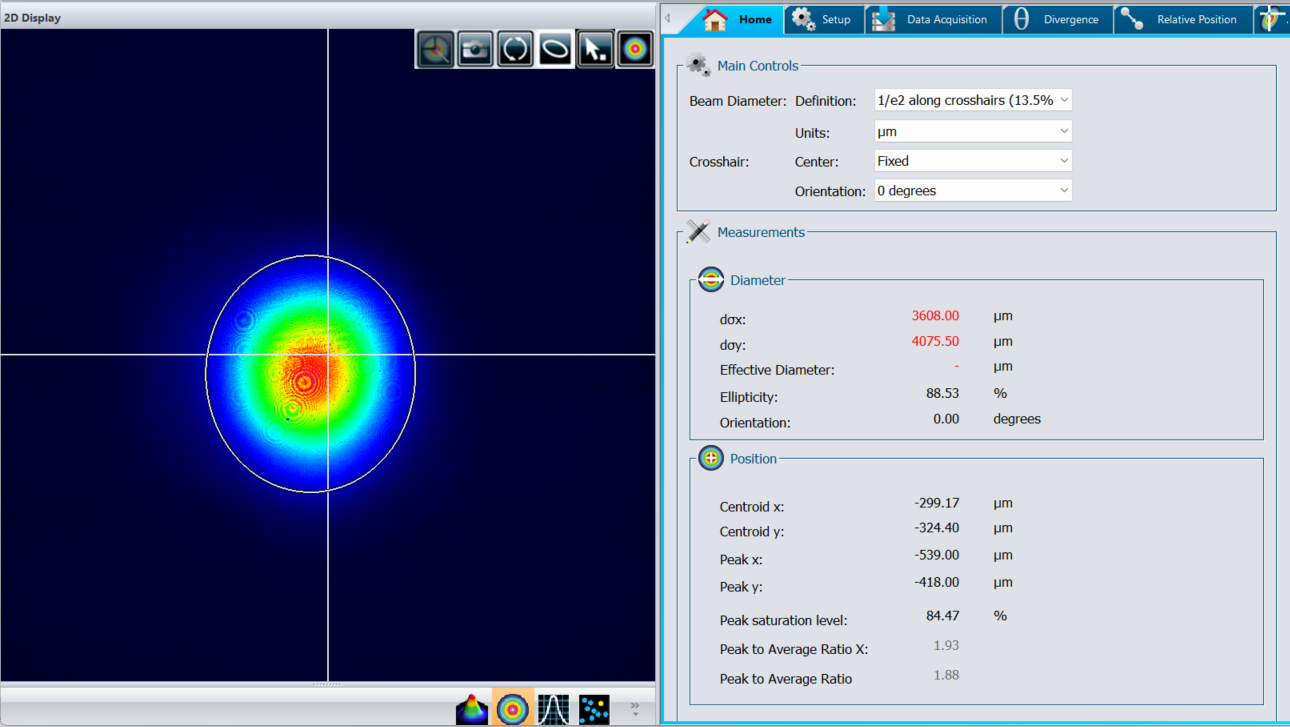
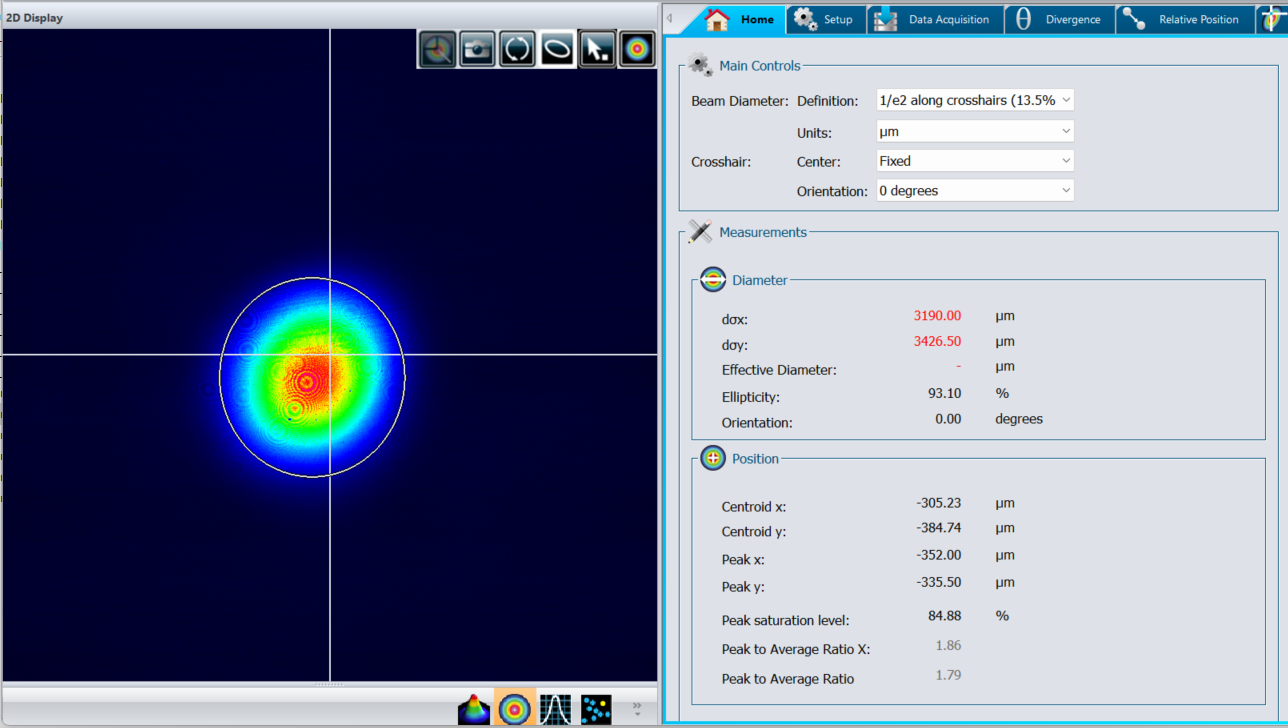
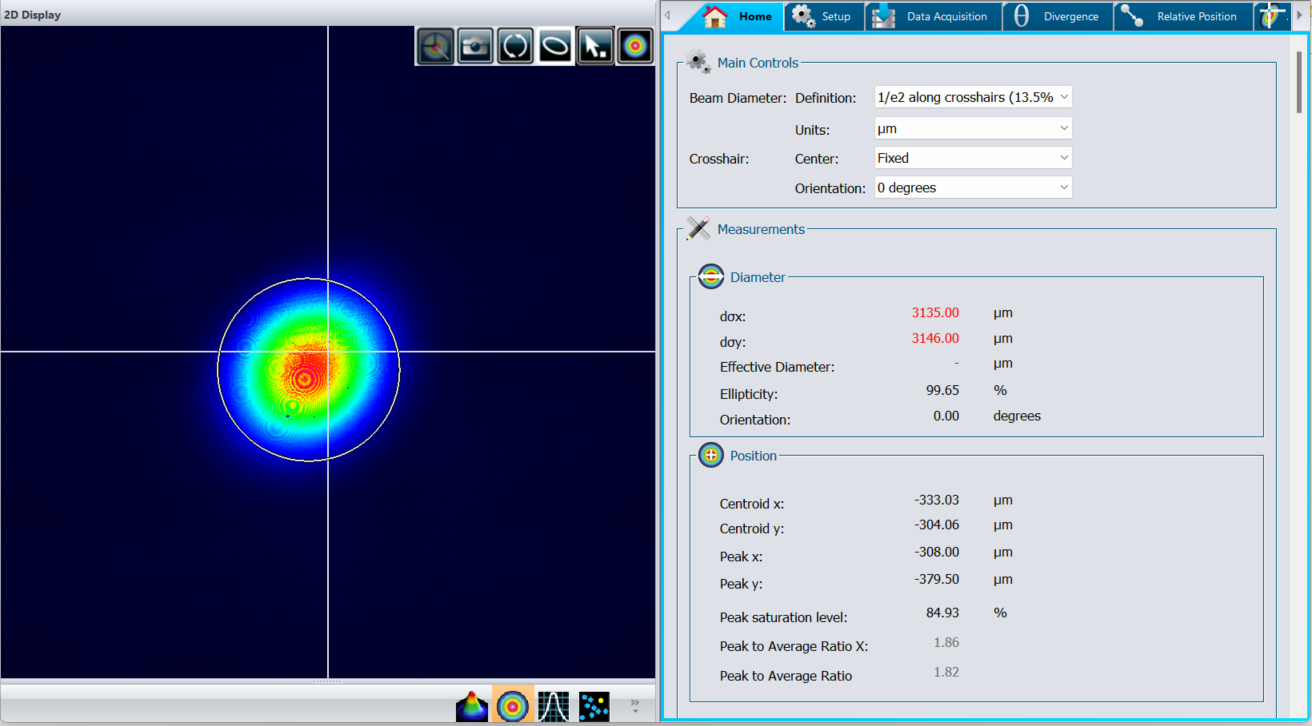
=> we recorded several beam profiles at 20-70% of amplifier ratio (see images before realignement)
above 50% of amplifier ratio, the beam is deformed.
=> we realigned the 2 last mirrors of the compressor and compensate the axis displacement with the 2 inches injection mirrors at the output of the compressor to get back the telescope axis.
amplifier ratio (%) power after compressor (W)
0 0.286
10 0.91
20 8.6
30 16.7
40 25.5
50 34.5
60 42.5
70 50.0
80 57.0
90 64.0
100 70.0
small power drop for ratio < 40% compared to previous measurements : https://elog.lal.in2p3.fr/FPC/THOMX+commissioning/133
the power is back => OK ! :-)))
we took some images with the beam profiler at high power after the realignement (see images after realignement)
tomorrow, we have to realign the amplifier beam axis to the CFP axis.
| Ronic Chiche wrote: |
|
the CVBG of the compressor module seems to have an issue.
here is the plan of the work :
1) faire des résonances avec la CFP
2) ajuster les iris d'alignement du faisceau de l'ampli pour être sur de ne pas perdre la référence de l'axe de la CFP
3) installer des wedges haute puissance à proximité du compresseur + beam profiler
4) verifier la forme du faisceau au beam profiler en fonction de la puissance de l'ampli
5) ouvrir le boîtier du compresseur
6) prendre des images du boîtier à la caméra thermique en fonction de la puissance
7) éventuellement shunter le 2e CVBG avec un D shape et regarder le mode et caractéristique en sortie d'ampli.
8) ajuster l'injection dans le premier CVBG ou le second ou les deux en fonctions des résultats précédent
here are some useful logbook posts:
D-shape + images thermiques du compresseur qui peuvent servir de référence :
https://elog.lal.in2p3.fr/FPC/THOMX+commissioning/147
https://elog.lal.in2p3.fr/FPC/THOMX+commissioning/150
post des images du faisceau en fonction de la puissance de l'ampli :
https://elog.lal.in2p3.fr/FPC/THOMX+commissioning/135 (et autres posts du fil)
https://elog.lal.in2p3.fr/FPC/THOMX+commissioning/195 (et autres posts du fil)
|
|
| Attachment 1: 70%_before_realign.png
|  |
| Attachment 2: 60%_before_realign.png
|  |
| Attachment 3: 50%_before_realign.png
|  |
| Attachment 4: 40%_before_realign.png
|  |
| Attachment 5: 30%_before_realign.png
|  |
| Attachment 6: 20%_before_realign.png
|  |
| Attachment 7: 80%_after_alignment.png
|  |
| Attachment 8: 70%_after_alignment.png
|  |
| Attachment 9: 60%_after_alignment.png
|  |
| Attachment 10: 40%_after_alignment.png
|  |
| Attachment 11: 30%_after_alignment.png
|  |
| Attachment 12: 20%_after_alignment.png
|  |
|
357
|
Fri Sep 6 11:56:53 2024 |
Ronic Chiche | Fixed | issue | lasers and optics | detectors and electronics | ThomX igloo | fixing CVBG issue | this morning with Daniele, we realigned the amplifier beam axis on the iris position.
it was pretty fast an easy => we got rapidely some resonance and we locked back to 87kW @33% amp ratio after tuning CEP and alignment.
we tried to play on the L-shape but we didn't a clear effect.
we also played on the 1/2 and 1/4 waveplates to tune the polarization.
we see very clearly the locked reflected signal changing without almost changing the transmission !
Aurélien suggested to slightly focusing the beam in the DET36 photodiode to have a better estimation of the coupling.
presently, the beam is clearly larger than the DET36 photodiode area which artificially increases the measured coupling.
(I cannot use a DET100 because I need 500MHz BW to get some RF signal for beating with the 500MHz reference signal).
I added a +75mm lens in front of the DET36 reflection signal photodiode => now, the beam is rougly 1-2mm diameter, centered on the DET36.
when I optimize the alignment and the CEP, I get 86-87kW in the CFP and 45% coupling => cf plot
end of the CVBG issue posts.
| Ronic Chiche wrote: |
|
1) this morning, I aligned to CFP to get back 82kW in the cavity for 33% of amplifier ratio.
thus, we can ajust the iris positions on the optical table to fix the CFP optical path before touching the CVBG.
2) we aligned the 5 iris. all of them were misaligned by 1-2mm, principaly vertically (maybe because we had to change the CFP frequency some time ago to match the new RF frequency?).
3) we opened the compressor box and found out the beam on the last mirror was really on the border => we have to move it.
=> we recorded several beam profiles at 20-70% of amplifier ratio (see images before realignement)
above 50% of amplifier ratio, the beam is deformed.
=> we realigned the 2 last mirrors of the compressor and compensate the axis displacement with the 2 inches injection mirrors at the output of the compressor to get back the telescope axis.
amplifier ratio (%) power after compressor (W)
0 0.286
10 0.91
20 8.6
30 16.7
40 25.5
50 34.5
60 42.5
70 50.0
80 57.0
90 64.0
100 70.0
the power is back => OK ! :-)))
we took some images with the beam profiler at high power after the realignement (see images after realignement)
tomorrow, we have to realign the amplifier beam axis to the CFP axis.
| Ronic Chiche wrote: |
|
the CVBG of the compressor module seems to have an issue.
here is the plan of the work :
1) faire des résonances avec la CFP
2) ajuster les iris d'alignement du faisceau de l'ampli pour être sur de ne pas perdre la référence de l'axe de la CFP
3) installer des wedges haute puissance à proximité du compresseur + beam profiler
4) verifier la forme du faisceau au beam profiler en fonction de la puissance de l'ampli
5) ouvrir le boîtier du compresseur
6) prendre des images du boîtier à la caméra thermique en fonction de la puissance
7) éventuellement shunter le 2e CVBG avec un D shape et regarder le mode et caractéristique en sortie d'ampli.
8) ajuster l'injection dans le premier CVBG ou le second ou les deux en fonctions des résultats précédent
here are some useful logbook posts:
D-shape + images thermiques du compresseur qui peuvent servir de référence :
https://elog.lal.in2p3.fr/FPC/THOMX+commissioning/147
https://elog.lal.in2p3.fr/FPC/THOMX+commissioning/150
post des images du faisceau en fonction de la puissance de l'ampli :
https://elog.lal.in2p3.fr/FPC/THOMX+commissioning/135 (et autres posts du fil)
https://elog.lal.in2p3.fr/FPC/THOMX+commissioning/195 (et autres posts du fil)
|
|
|
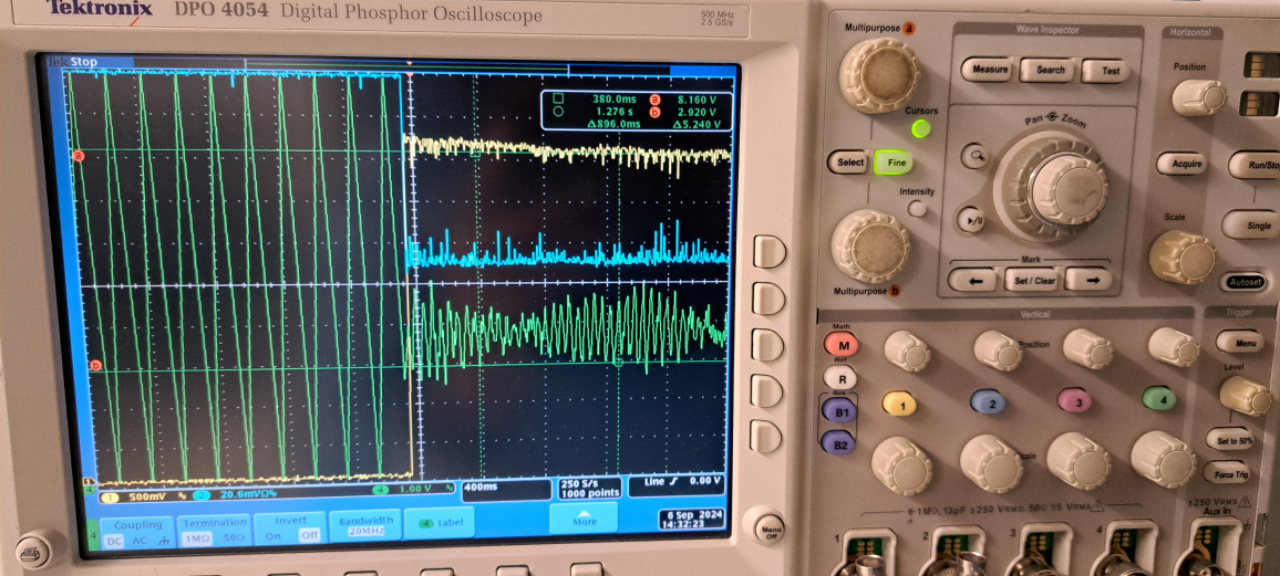
| Attachment 1: 20240906_151100.jpg
|  |
|
476
|
Wed Jul 15 18:16:37 2026 |
Ronic Chiche | Under Process | issue | lasers and optics | Optical room | elliptic mode shape | the mode shape @ 5-15kW is very elliptic (50% of ellipticity : large size = 2x small size).
we only changed M1 and did not move M2,M3,M4.
what are the possible reasons for the ellipticity:
- M1 misalignment (cavity axis if off the mirrors center) :
we changed the M1 orientation in X and Y => no effect on the mode shape
- cavity too close from instability region :
we changed the distance between spherical mirrors (S3 moved by almost 700µm ) => no effect on the mode shape
- thermal effect changing the mirror curvature :
we observed mode at 5 or 15 kW => no effect on the mode shape
- bad alignment of the lens in front of the camera :
we observed elliptic and round shape beams with exactly the same centroid on the camera
- thermal effect changing some stress on the mount holding the mirror :
we observed mode at 5 or 15 kW => no effect on the mode shape
- default in the mirror substrate polishing :
why not, but it's strange that with the previous mirror we saw the same kind of ellipticity at low power and a perfect round shape beam at high power.
(with this mirror, we never succeded to overcome 15kW in FPC)
- how strong the small screws holding the mirror are tightened, which could induce some stress :
but why did we saw a perfect round shape of the beam at high power with the previous mirror ?
and it would be strange to get almost the same orientation of the ellipse with the 2 mirrors.
- other ideas ??? |
| Attachment 1: Image__2026-07-15__15-28-39.jpeg
|  |
|
262
|
Fri Sep 15 19:13:44 2023 |
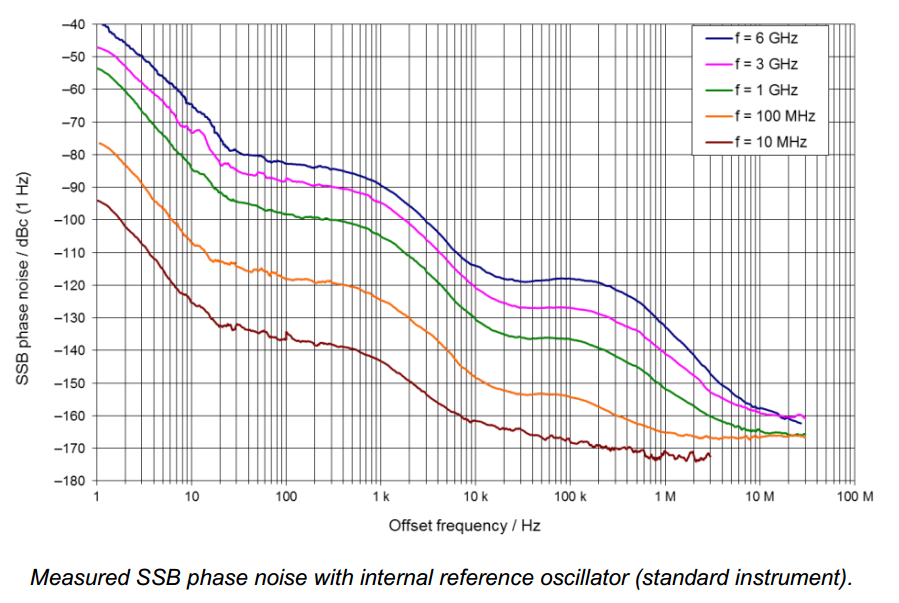
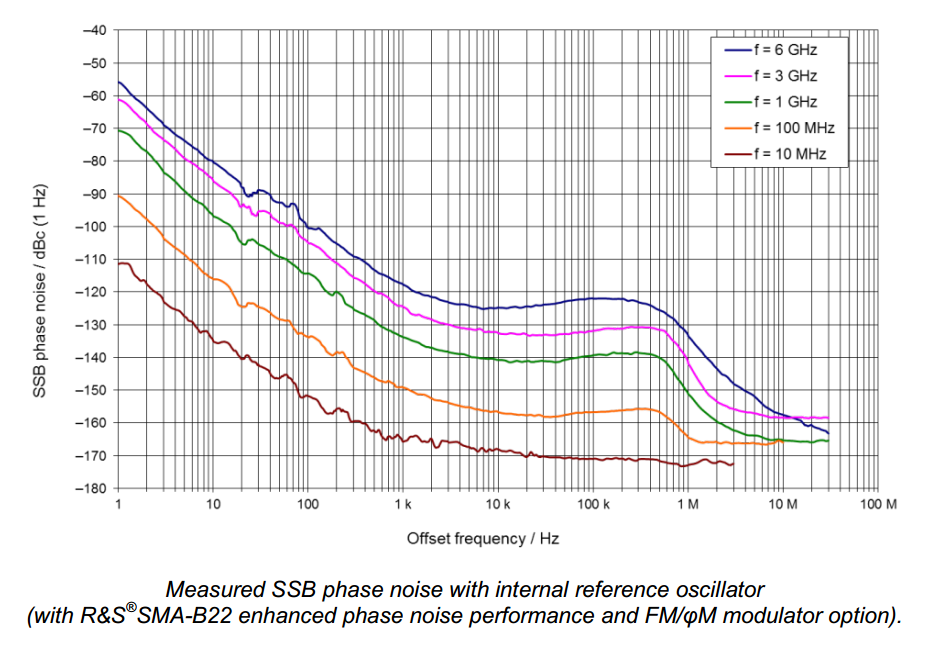
Ronic Chiche | Fixed | info | lasers and optics | ThomX igloo | drift calculation for the SMA100A | the goal is to estimate what could be the frequency drift at 500MHz for the SMA100A: see phase noise datasheet in attachement
Sphi(f) = FFT ( Rphi(T) ) = FFT ( < Phi(t) Phi(t+T) > )
at low frequency, Sphi(f) ~ A / (f^n) = A*(2pi)^n / (i2pi*f)^n => Rphi(T) = A*(2pi)^n*T^(n-1) / (n-1)!
for the SMA100A : n ~ 2 and A =10^-7 at f0=1GHz with B22 option
=> Rphi(T) ~ 4e-6*T
|
| Attachment 1: Capture1.PNG
|  |
| Attachment 2: Capture2.PNG
|  |
|
382
|
Fri Nov 22 10:23:33 2024 |
Ronic Chiche | Under Process | report | mechanics | lasers and optics | detectors and electronics | ThomX igloo | day by day run for X-ray production | the RF frequency changed from 500.1003MHz to 500.0913MHz => it reduced by 9kHz @ 500MHz which is equivalent to 600Hz @ 33MHz (we measured 500Hz @ 33MHz). the electron orbit length increased, so we have to increase the cavities length => increase motor values by ~ 68µm.
for the laser cavity : 1.496 560 mm => 1.564 560 mm
the initial values for the motor of the FP cavity are : MOT.03=-130 000 steps and MOT.06=-900 000 steps.
68µm is roughly 11 000 steps (6nm/step) => MOT.03=-130 000 steps and MOT.06=-889 000 steps.
optimum CEP position : -210.8µm => -192µm
I got 80kW in the FP cavity after CEP and walking alignment
then, 82kW after waiting 3h.
then, 84kW after waiting 5h.
|
|
383
|
Tue Nov 26 18:00:14 2024 |
Ronic Chiche | Under Process | report | mechanics | lasers and optics | detectors and electronics | ThomX igloo | day by day run for X-ray production | at the begining of the day, we started to get ~81kW in the FPC for 33% amplifier ratio and after ~1h, we got 84kW after CEP and alignment tuning.
at the end of the day, we got 89kW without walking alignment.
we tried to improve a bit the robustness of the FPC and RF locks:
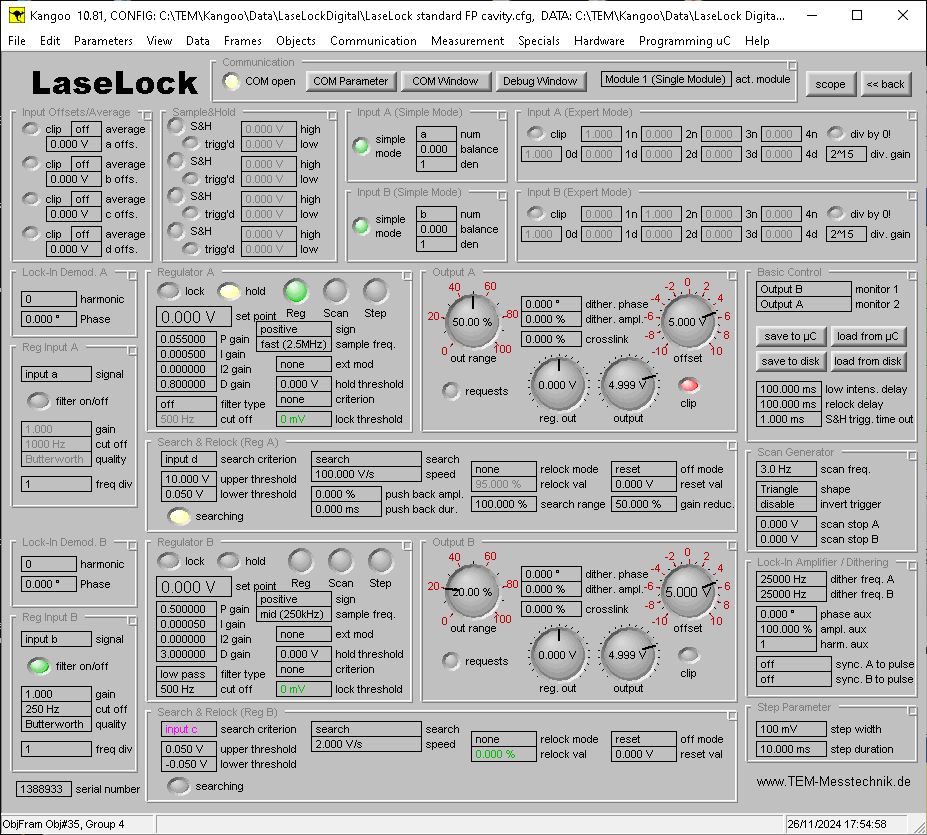
see the capture for the new locking parameters.
| Ronic Chiche wrote: |
|
the RF frequency changed from 500.1003MHz to 500.0913MHz => it reduced by 9kHz @ 500MHz which is equivalent to 600Hz @ 33MHz (we measured 500Hz @ 33MHz). the electron orbit length increased, so we have to increase the cavities length => increase motor values by ~ 68µm.
for the laser cavity : 1.496 560 mm => 1.564 560 mm
the initial values for the motor of the FP cavity are : MOT.03=-130 000 steps and MOT.06=-900 000 steps.
68µm is roughly 11 000 steps (6nm/step) => MOT.03=-130 000 steps and MOT.06=-889 000 steps.
optimum CEP position : -210.8µm => -192µm
I got 80kW in the FP cavity after CEP and walking alignment
then, 82kW after waiting 3h.
then, 84kW after waiting 5h.
|
|
| Attachment 1: Capture.JPG
|  |
|
384
|
Wed Dec 4 12:26:03 2024 |
Ronic Chiche | Under Process | report | mechanics | lasers and optics | detectors and electronics | ThomX igloo | day by day run for X-ray production | today with Alice, we planned to do a long run with ~80kW in the FPC to check if the lock problems are coming from the interaction with the machine or not.
the goal is to check this assumption on a full day comparable with a day of X-ray production.
we started the amplifier at 10am.
during a move of MaY (injection mirrors of the FPC), we observed a sudden total loss of resonances...
the reason was an abnormal displacement of the motor despite the fact the measured position was reasonable.
we already observed an issue like that....
to fix the problem, one just had to move back MaY.
the cavity started to be locked at 11:15am
the RF frequency has been changed to 500.09595MHz equivalent to 33.33973MHz
but we don't have a beating signal @ 500MHz => one will ask to Vincent to fix the issue.
laser motor CH0 : 1.503453 mm
laser moror CH2 : - 50µm
~ 83kW at 12:30pm
| Ronic Chiche wrote: |
|
at the begining of the day, we started to get ~81kW in the FPC for 33% amplifier ratio and after ~1h, we got 84kW after CEP and alignment tuning.
at the end of the day, we got 89kW without walking alignment.
we tried to improve a bit the robustness of the FPC and RF locks:
see the capture for the new locking parameters.
| Ronic Chiche wrote: |
|
the RF frequency changed from 500.1003MHz to 500.0913MHz => it reduced by 9kHz @ 500MHz which is equivalent to 600Hz @ 33MHz (we measured 500Hz @ 33MHz). the electron orbit length increased, so we have to increase the cavities length => increase motor values by ~ 68µm.
for the laser cavity : 1.496 560 mm => 1.564 560 mm
the initial values for the motor of the FP cavity are : MOT.03=-130 000 steps and MOT.06=-900 000 steps.
68µm is roughly 11 000 steps (6nm/step) => MOT.03=-130 000 steps and MOT.06=-889 000 steps.
optimum CEP position : -210.8µm => -192µm
I got 80kW in the FP cavity after CEP and walking alignment
then, 82kW after waiting 3h.
then, 84kW after waiting 5h.
|
|
|
|
385
|
Wed Dec 4 17:11:50 2024 |
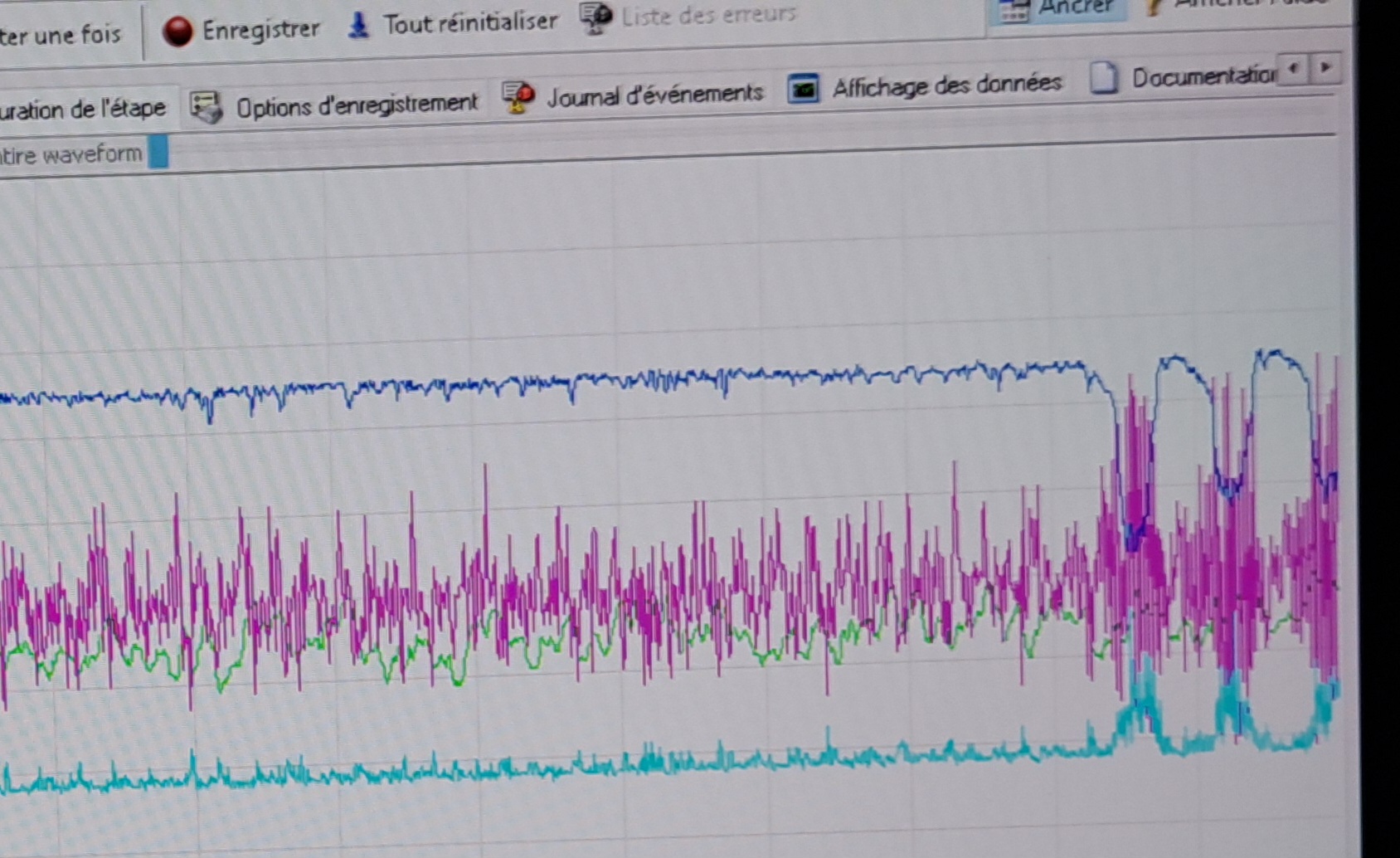
Ronic Chiche | Under Process | report | mechanics | lasers and optics | detectors and electronics | ThomX igloo | day by day run for X-ray production | we observed that :
- the MOT.03 motor always exhibits some perturbations on the transmitted, reflected and PZT signals (see "peaks" in the picture) in contrary to the MOT.06 motor.
does the differences come from the motor relative positions (-900 000 steps for MOT.06 and -100 000 steps for MOT.03) or from the controller configuration ?
- the stability limits (oscillations arise) of the PID for the RF/CFP locks are P = 1 / I = 0.0001 / D = 5
then we put the new PID parameters : P = 0.25 / I = 0.000025 / D = 1
- the 20Hz oscillations are stil arising from time to time
- the lock laser/CFP is pretty robust, one observes more RF/CFP lock losses.
- we removed the 250Hz filter on the RF/CFP error signal to increase the feedback BW but we didn't see a any improvement
- at 5pm, the laser/CFP lock seems as stable as in the morning, then we don't see any change in stability during time.
we loggued CFP power measurement and signals from the cavity (~ 1GB of data)
| Ronic Chiche wrote: |
|
today with Alice, we planned to do a long run with ~80kW in the FPC to check if the lock problems are coming from the interaction with the machine or not.
the goal is to check this assumption on a full day comparable with a day of X-ray production.
we started the amplifier at 10am.
during a move of MaY (injection mirrors of the FPC), we observed a sudden total loss of resonances...
the reason was an abnormal displacement of the motor despite the fact the measured position was reasonable.
we already observed an issue like that....
to fix the problem, one just had to move back MaY.
the cavity started to be locked at 11:15am
the RF frequency has been changed to 500.09595MHz equivalent to 33.33973MHz
but we don't have a beating signal @ 500MHz => one will ask to Vincent to fix the issue.
laser motor CH0 : 1.503453 mm
laser moror CH2 : - 50µm
~ 83kW at 12:30pm
| Ronic Chiche wrote: |
|
at the begining of the day, we started to get ~81kW in the FPC for 33% amplifier ratio and after ~1h, we got 84kW after CEP and alignment tuning.
at the end of the day, we got 89kW without walking alignment.
we tried to improve a bit the robustness of the FPC and RF locks:
see the capture for the new locking parameters.
| Ronic Chiche wrote: |
|
the RF frequency changed from 500.1003MHz to 500.0913MHz => it reduced by 9kHz @ 500MHz which is equivalent to 600Hz @ 33MHz (we measured 500Hz @ 33MHz). the electron orbit length increased, so we have to increase the cavities length => increase motor values by ~ 68µm.
for the laser cavity : 1.496 560 mm => 1.564 560 mm
the initial values for the motor of the FP cavity are : MOT.03=-130 000 steps and MOT.06=-900 000 steps.
68µm is roughly 11 000 steps (6nm/step) => MOT.03=-130 000 steps and MOT.06=-889 000 steps.
optimum CEP position : -210.8µm => -192µm
I got 80kW in the FP cavity after CEP and walking alignment
then, 82kW after waiting 3h.
then, 84kW after waiting 5h.
|
|
|
|
| Attachment 1: 20241204_125955.jpg
|  |
|
386
|
Wed Dec 4 17:53:49 2024 |
Ronic Chiche | Under Process | report | mechanics | lasers and optics | detectors and electronics | ThomX igloo | day by day run for X-ray production | last thing we tried :
we removed the threshold on the FPC/RF error signal.
=> we cannot choose automatically the RF bucket anymore (we need to manually let the phase drift slowly and start the lock at the right moment).
=> but the FPC/RF lock seems more robust.
in that case, we have 2 different sources of lock losses:
- the ones dues to the laser or CFP motors move.
even at low speed or in "piezo scan" mode, one observes too fast mouvement that are not properly compensated and involving some phase shift.
- the ones not related to any action.
=> the 20Hz signal seems to increase until it makes the system losing the lock
| Ronic Chiche wrote: |
|
we observed that :
- the MOT.03 motor always exhibits some perturbations on the transmitted, reflected and PZT signals (see picture) in contrary to the MOT.06 motor.
does the differences come from the motor relative positions (-900 000 steps for MOT.06 and -100 000 steps for MOT.03) or from the controller configuration ?
- the stability limits (oscillations arise) of the PID for the RF/CFP locks are P = 1 / I = 0.0001 / D = 5
then we put the new PID parameters : P = 0.25 / I = 0.000025 / D = 1
- the 20Hz oscillations are stil arising from time to time
- the lock laser/CFP is pretty robust, one observes more RF/CFP lock losses.
- we removed the 250Hz filter on the RF/CFP error signal to increase the feedback BW but we didn't see a any improvement
- at 5pm, the laser/CFP lock seems as stable as in the morning, then we don't see any change in stability during time.
we loggued CFP power measurement and signals from the cavity (~ 1GB of data)
| Ronic Chiche wrote: |
|
today with Alice, we planned to do a long run with ~80kW in the FPC to check if the lock problems are coming from the interaction with the machine or not.
the goal is to check this assumption on a full day comparable with a day of X-ray production.
we started the amplifier at 10am.
during a move of MaY (injection mirrors of the FPC), we observed a sudden total loss of resonances...
the reason was an abnormal displacement of the motor despite the fact the measured position was reasonable.
we already observed an issue like that....
to fix the problem, one just had to move back MaY.
the cavity started to be locked at 11:15am
the RF frequency has been changed to 500.09595MHz equivalent to 33.33973MHz
but we don't have a beating signal @ 500MHz => one will ask to Vincent to fix the issue.
laser motor CH0 : 1.503453 mm
laser moror CH2 : - 50µm
~ 83kW at 12:30pm
| Ronic Chiche wrote: |
|
at the begining of the day, we started to get ~81kW in the FPC for 33% amplifier ratio and after ~1h, we got 84kW after CEP and alignment tuning.
at the end of the day, we got 89kW without walking alignment.
we tried to improve a bit the robustness of the FPC and RF locks:
see the capture for the new locking parameters.
| Ronic Chiche wrote: |
|
the RF frequency changed from 500.1003MHz to 500.0913MHz => it reduced by 9kHz @ 500MHz which is equivalent to 600Hz @ 33MHz (we measured 500Hz @ 33MHz). the electron orbit length increased, so we have to increase the cavities length => increase motor values by ~ 68µm.
for the laser cavity : 1.496 560 mm => 1.564 560 mm
the initial values for the motor of the FP cavity are : MOT.03=-130 000 steps and MOT.06=-900 000 steps.
68µm is roughly 11 000 steps (6nm/step) => MOT.03=-130 000 steps and MOT.06=-889 000 steps.
optimum CEP position : -210.8µm => -192µm
I got 80kW in the FP cavity after CEP and walking alignment
then, 82kW after waiting 3h.
then, 84kW after waiting 5h.
|
|
|
|
|
|
387
|
Wed Dec 11 18:51:35 2024 |
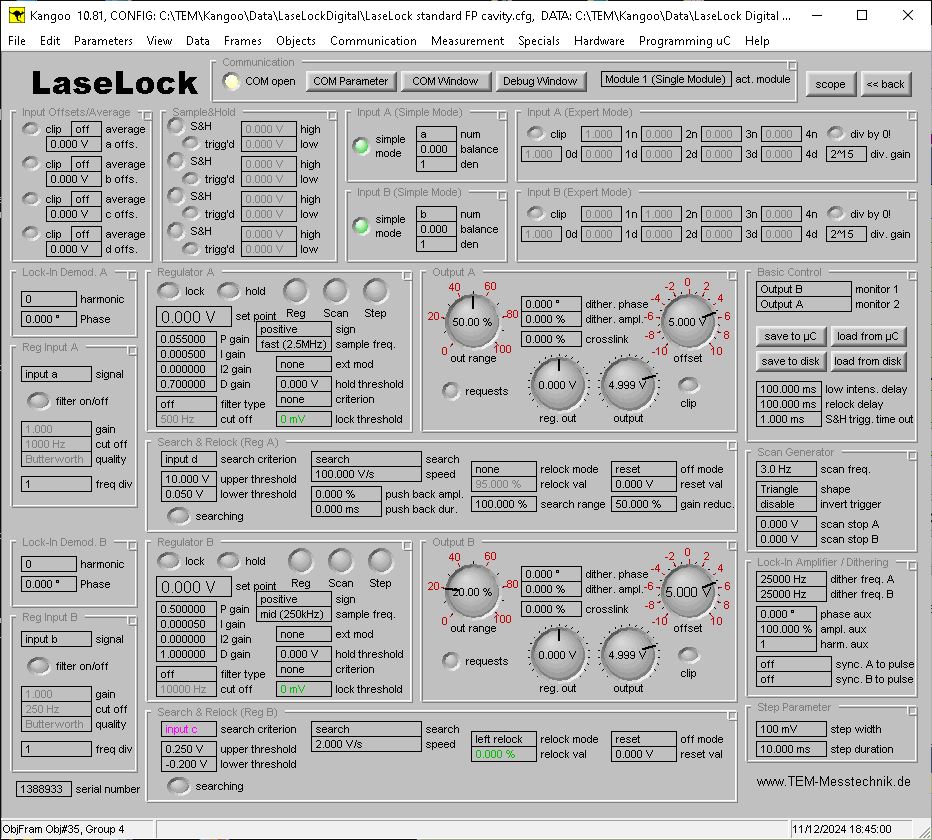
Ronic Chiche | Under Process | report | mechanics | lasers and optics | detectors and electronics | ThomX igloo | day by day run for X-ray production | This morning, I added an amplifier on the 33MHz beating signal in between the mixer+LPF and the scope/Laselock.
it seems to improve the robustness of the RF/FPC lock.
because of this gain, I increased the upper and lower thresholds on the search criterion of the RF/FPC lock from +/-50mV to +250mV/-200mV
=> see the picture of the Laselock parameters.
the optimum phase for X-ray production is roughly +3.6ns between C2 (machine trigger) and C4 (33MHz laser signal).
we have to use the machine at 70MeV with a new frequency at 500.0325MHz / 33.3355MHz.
=> we need to move the FPC tomorrow by roughly 60kHz @ 500MHz.
| Ronic Chiche wrote: |
|
last thing we tried :
we removed the threshold on the FPC/RF error signal.
=> we cannot choose automatically the RF bucket anymore (we need to manually let the phase drift slowly and start the lock at the right moment).
=> but the FPC/RF lock seems more robust.
in that case, we have 2 different sources of lock losses:
- the ones dues to the laser or CFP motors move.
even at low speed or in "piezo scan" mode, one observes too fast mouvement that are not properly compensated and involving some phase shift.
- the ones not related to any action.
=> the 20Hz signal seems to increase until it makes the system losing the lock
| Ronic Chiche wrote: |
|
we observed that :
- the MOT.03 motor always exhibits some perturbations on the transmitted, reflected and PZT signals (see picture) in contrary to the MOT.06 motor.
does the differences come from the motor relative positions (-900 000 steps for MOT.06 and -100 000 steps for MOT.03) or from the controller configuration ?
- the stability limits (oscillations arise) of the PID for the RF/CFP locks are P = 1 / I = 0.0001 / D = 5
then we put the new PID parameters : P = 0.25 / I = 0.000025 / D = 1
- the 20Hz oscillations are stil arising from time to time
- the lock laser/CFP is pretty robust, one observes more RF/CFP lock losses.
- we removed the 250Hz filter on the RF/CFP error signal to increase the feedback BW but we didn't see a any improvement
- at 5pm, the laser/CFP lock seems as stable as in the morning, then we don't see any change in stability during time.
we loggued CFP power measurement and signals from the cavity (~ 1GB of data)
| Ronic Chiche wrote: |
|
today with Alice, we planned to do a long run with ~80kW in the FPC to check if the lock problems are coming from the interaction with the machine or not.
the goal is to check this assumption on a full day comparable with a day of X-ray production.
we started the amplifier at 10am.
during a move of MaY (injection mirrors of the FPC), we observed a sudden total loss of resonances...
the reason was an abnormal displacement of the motor despite the fact the measured position was reasonable.
we already observed an issue like that....
to fix the problem, one just had to move back MaY.
the cavity started to be locked at 11:15am
the RF frequency has been changed to 500.09595MHz equivalent to 33.33973MHz
but we don't have a beating signal @ 500MHz => one will ask to Vincent to fix the issue.
laser motor CH0 : 1.503453 mm
laser moror CH2 : - 50µm
~ 83kW at 12:30pm
| Ronic Chiche wrote: |
|
at the begining of the day, we started to get ~81kW in the FPC for 33% amplifier ratio and after ~1h, we got 84kW after CEP and alignment tuning.
at the end of the day, we got 89kW without walking alignment.
we tried to improve a bit the robustness of the FPC and RF locks:
see the capture for the new locking parameters.
| Ronic Chiche wrote: |
|
the RF frequency changed from 500.1003MHz to 500.0913MHz => it reduced by 9kHz @ 500MHz which is equivalent to 600Hz @ 33MHz (we measured 500Hz @ 33MHz). the electron orbit length increased, so we have to increase the cavities length => increase motor values by ~ 68µm.
for the laser cavity : 1.496 560 mm => 1.564 560 mm
the initial values for the motor of the FP cavity are : MOT.03=-130 000 steps and MOT.06=-900 000 steps.
68µm is roughly 11 000 steps (6nm/step) => MOT.03=-130 000 steps and MOT.06=-889 000 steps.
optimum CEP position : -210.8µm => -192µm
I got 80kW in the FP cavity after CEP and walking alignment
then, 82kW after waiting 3h.
then, 84kW after waiting 5h.
|
|
|
|
|
|
| Attachment 1: Capture.JPG
|  |
|
388
|
Thu Dec 12 18:28:02 2024 |
Ronic Chiche | Under Process | report | mechanics | lasers and optics | detectors and electronics | ThomX igloo | day by day run for X-ray production | major result of the day: X-ray vertical scan by moving the hexapod
abscise : hexapod position
ordinate : xray flux in asynchronous condition
red curve : continuous injection at 10Hz (the scan lasts for ~5 minutes)
green curve : one single injection (the beam is not extracted).
blue curve : one single injection, ~ 10-15 minutes later
| Ronic Chiche wrote: |
|
This morning, I added an amplifier on the 33MHz beating signal in between the mixer+LPF and the scope/Laselock.
it seems to improve the robustness of the RF/FPC lock.
because of this gain, I increased the upper and lower thresholds on the search criterion of the RF/FPC lock from +/-50mV to +250mV/-200mV
=> see the picture of the Laselock parameters.
the optimum phase for X-ray production is roughly +3.6ns between C2 (machine trigger) and C4 (33MHz laser signal).
we have to use the machine at 70MeV with a new frequency at 500.0325MHz / 33.3355MHz.
=> we need to move the FPC tomorrow by roughly 60kHz @ 500MHz.
| Ronic Chiche wrote: |
|
last thing we tried :
we removed the threshold on the FPC/RF error signal.
=> we cannot choose automatically the RF bucket anymore (we need to manually let the phase drift slowly and start the lock at the right moment).
=> but the FPC/RF lock seems more robust.
in that case, we have 2 different sources of lock losses:
- the ones dues to the laser or CFP motors move.
even at low speed or in "piezo scan" mode, one observes too fast mouvement that are not properly compensated and involving some phase shift.
- the ones not related to any action.
=> the 20Hz signal seems to increase until it makes the system losing the lock
| Ronic Chiche wrote: |
|
we observed that :
- the MOT.03 motor always exhibits some perturbations on the transmitted, reflected and PZT signals (see picture) in contrary to the MOT.06 motor.
does the differences come from the motor relative positions (-900 000 steps for MOT.06 and -100 000 steps for MOT.03) or from the controller configuration ?
- the stability limits (oscillations arise) of the PID for the RF/CFP locks are P = 1 / I = 0.0001 / D = 5
then we put the new PID parameters : P = 0.25 / I = 0.000025 / D = 1
- the 20Hz oscillations are stil arising from time to time
- the lock laser/CFP is pretty robust, one observes more RF/CFP lock losses.
- we removed the 250Hz filter on the RF/CFP error signal to increase the feedback BW but we didn't see a any improvement
- at 5pm, the laser/CFP lock seems as stable as in the morning, then we don't see any change in stability during time.
we loggued CFP power measurement and signals from the cavity (~ 1GB of data)
| Ronic Chiche wrote: |
|
today with Alice, we planned to do a long run with ~80kW in the FPC to check if the lock problems are coming from the interaction with the machine or not.
the goal is to check this assumption on a full day comparable with a day of X-ray production.
we started the amplifier at 10am.
during a move of MaY (injection mirrors of the FPC), we observed a sudden total loss of resonances...
the reason was an abnormal displacement of the motor despite the fact the measured position was reasonable.
we already observed an issue like that....
to fix the problem, one just had to move back MaY.
the cavity started to be locked at 11:15am
the RF frequency has been changed to 500.09595MHz equivalent to 33.33973MHz
but we don't have a beating signal @ 500MHz => one will ask to Vincent to fix the issue.
laser motor CH0 : 1.503453 mm
laser moror CH2 : - 50µm
~ 83kW at 12:30pm
| Ronic Chiche wrote: |
|
at the begining of the day, we started to get ~81kW in the FPC for 33% amplifier ratio and after ~1h, we got 84kW after CEP and alignment tuning.
at the end of the day, we got 89kW without walking alignment.
we tried to improve a bit the robustness of the FPC and RF locks:
see the capture for the new locking parameters.
| Ronic Chiche wrote: |
|
the RF frequency changed from 500.1003MHz to 500.0913MHz => it reduced by 9kHz @ 500MHz which is equivalent to 600Hz @ 33MHz (we measured 500Hz @ 33MHz). the electron orbit length increased, so we have to increase the cavities length => increase motor values by ~ 68µm.
for the laser cavity : 1.496 560 mm => 1.564 560 mm
the initial values for the motor of the FP cavity are : MOT.03=-130 000 steps and MOT.06=-900 000 steps.
68µm is roughly 11 000 steps (6nm/step) => MOT.03=-130 000 steps and MOT.06=-889 000 steps.
optimum CEP position : -210.8µm => -192µm
I got 80kW in the FP cavity after CEP and walking alignment
then, 82kW after waiting 3h.
then, 84kW after waiting 5h.
|
|
|
|
|
|
|
| Attachment 1: Capture.JPG
| 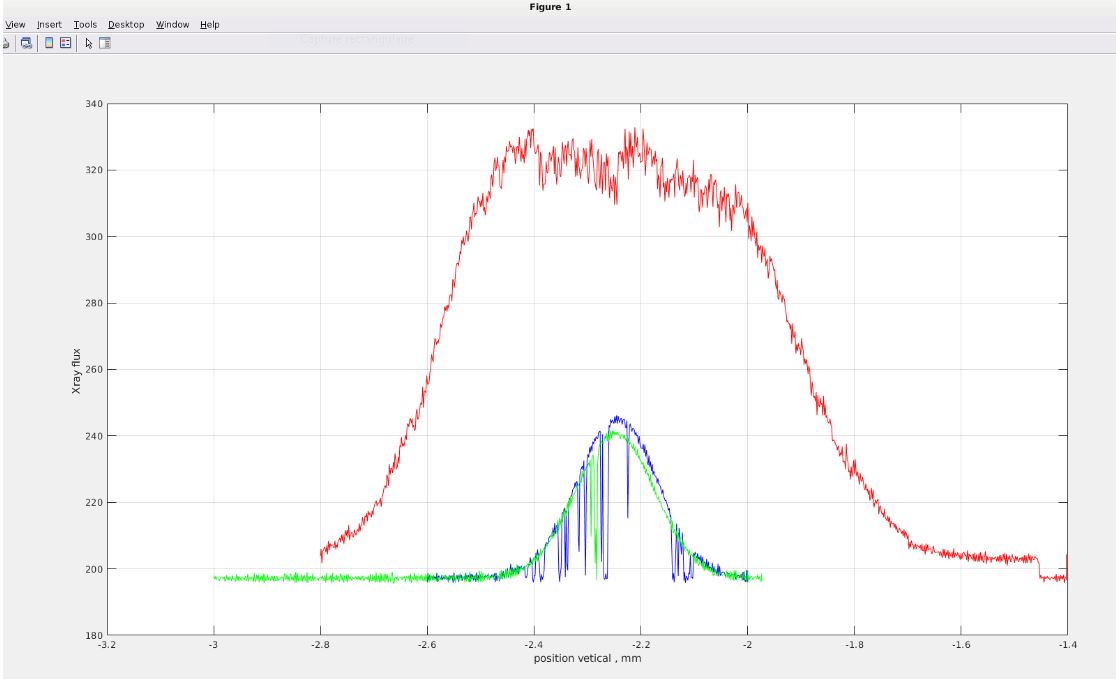 |
|
389
|
Tue Dec 17 16:28:32 2024 |
Ronic Chiche | Under Process | report | mechanics | lasers and optics | detectors and electronics | ThomX igloo | day by day run for X-ray production | this morning, Kevin reduced the steering current in the IcePap controllers of the FP cavity motors.
the motor MOT.06 was producing a pattern in the Transmission signal when it was moved and doing a lock loss very often.
so, we changed its current from 0.8A to 0.4A and it fixes the problem => no more systematic lock loss.
so, we changed also the MOT.03 steering current from 0.8A to 0.7A.
on this motor, we have also a false warning about the Low limit switch which seems to be activated (strange because, we are always using it in the positive direction)
Kevin reverted the logic to remove the message.
we obtained 91kW in the FPC for 33% amplifier ratio after CEP and alignment tuning.
we did synchronized xray production with a relative delay between laser 33MHz and trigger (CH2-CH4) of +4 ns
| Ronic Chiche wrote: |
|
major result of the day: X-ray vertical scan by moving the hexapod
abscise : hexapod position
ordinate : xray flux in asynchronous condition
red curve : continuous injection at 10Hz (the scan lasts for ~5 minutes)
green curve : one single injection (the beam is not extracted).
blue curve : one single injection, ~ 10-15 minutes later
| Ronic Chiche wrote: |
|
This morning, I added an amplifier on the 33MHz beating signal in between the mixer+LPF and the scope/Laselock.
it seems to improve the robustness of the RF/FPC lock.
because of this gain, I increased the upper and lower thresholds on the search criterion of the RF/FPC lock from +/-50mV to +250mV/-200mV
=> see the picture of the Laselock parameters.
the optimum phase for X-ray production is roughly +3.6ns between C2 (machine trigger) and C4 (33MHz laser signal).
we have to use the machine at 70MeV with a new frequency at 500.0325MHz / 33.3355MHz.
=> we need to move the FPC tomorrow by roughly 60kHz @ 500MHz.
| Ronic Chiche wrote: |
|
last thing we tried :
we removed the threshold on the FPC/RF error signal.
=> we cannot choose automatically the RF bucket anymore (we need to manually let the phase drift slowly and start the lock at the right moment).
=> but the FPC/RF lock seems more robust.
in that case, we have 2 different sources of lock losses:
- the ones dues to the laser or CFP motors move.
even at low speed or in "piezo scan" mode, one observes too fast mouvement that are not properly compensated and involving some phase shift.
- the ones not related to any action.
=> the 20Hz signal seems to increase until it makes the system losing the lock
| Ronic Chiche wrote: |
|
we observed that :
- the MOT.03 motor always exhibits some perturbations on the transmitted, reflected and PZT signals (see picture) in contrary to the MOT.06 motor.
does the differences come from the motor relative positions (-900 000 steps for MOT.06 and -100 000 steps for MOT.03) or from the controller configuration ?
- the stability limits (oscillations arise) of the PID for the RF/CFP locks are P = 1 / I = 0.0001 / D = 5
then we put the new PID parameters : P = 0.25 / I = 0.000025 / D = 1
- the 20Hz oscillations are stil arising from time to time
- the lock laser/CFP is pretty robust, one observes more RF/CFP lock losses.
- we removed the 250Hz filter on the RF/CFP error signal to increase the feedback BW but we didn't see a any improvement
- at 5pm, the laser/CFP lock seems as stable as in the morning, then we don't see any change in stability during time.
we loggued CFP power measurement and signals from the cavity (~ 1GB of data)
| Ronic Chiche wrote: |
|
today with Alice, we planned to do a long run with ~80kW in the FPC to check if the lock problems are coming from the interaction with the machine or not.
the goal is to check this assumption on a full day comparable with a day of X-ray production.
we started the amplifier at 10am.
during a move of MaY (injection mirrors of the FPC), we observed a sudden total loss of resonances...
the reason was an abnormal displacement of the motor despite the fact the measured position was reasonable.
we already observed an issue like that....
to fix the problem, one just had to move back MaY.
the cavity started to be locked at 11:15am
the RF frequency has been changed to 500.09595MHz equivalent to 33.33973MHz
but we don't have a beating signal @ 500MHz => one will ask to Vincent to fix the issue.
laser motor CH0 : 1.503453 mm
laser moror CH2 : - 50µm
~ 83kW at 12:30pm
| Ronic Chiche wrote: |
|
at the begining of the day, we started to get ~81kW in the FPC for 33% amplifier ratio and after ~1h, we got 84kW after CEP and alignment tuning.
at the end of the day, we got 89kW without walking alignment.
we tried to improve a bit the robustness of the FPC and RF locks:
see the capture for the new locking parameters.
| Ronic Chiche wrote: |
|
the RF frequency changed from 500.1003MHz to 500.0913MHz => it reduced by 9kHz @ 500MHz which is equivalent to 600Hz @ 33MHz (we measured 500Hz @ 33MHz). the electron orbit length increased, so we have to increase the cavities length => increase motor values by ~ 68µm.
for the laser cavity : 1.496 560 mm => 1.564 560 mm
the initial values for the motor of the FP cavity are : MOT.03=-130 000 steps and MOT.06=-900 000 steps.
68µm is roughly 11 000 steps (6nm/step) => MOT.03=-130 000 steps and MOT.06=-889 000 steps.
optimum CEP position : -210.8µm => -192µm
I got 80kW in the FP cavity after CEP and walking alignment
then, 82kW after waiting 3h.
then, 84kW after waiting 5h.
|
|
|
|
|
|
|
|
|
390
|
Tue Jan 7 10:18:08 2025 |
Ronic Chiche | Under Process | report | mechanics | lasers and optics | detectors and electronics | ThomX igloo | day by day run for X-ray production | this morning, I restarted the cavity after the Christmas shutdown.
everything went fine.
I got ~ 86kW for 33% laser amplifier ratio after optimization of the CEP and alignment with walking procedure.
IcePap controllers are OK and the displacements (MOT.03 and MOT.06) let the CFP locked.
I locked also on the RF frequency (I tuned the laser and CFP cavity length) => +4.1ns (C2-C4) between the 10Hz trig (C2) and the 33MHz laser signal (C4)
I observed that the search & relock range on the regulator B plays an important role on the RF locking stability.
so, I increased the previous range +/-0.25V to +/-0.5V.
we have always the 20Hz noise which can be increasing some time but the lock seems more robust.
| Ronic Chiche wrote: |
|
this morning, Kevin reduced the steering current in the IcePap controllers of the FP cavity motors.
the motor MOT.06 was producing a pattern in the Transmission signal when it was moved and doing a lock loss very often.
so, we changed its current from 0.8A to 0.4A and it fixes the problem => no more systematic lock loss.
so, we changed also the MOT.03 steering current from 0.8A to 0.7A.
on this motor, we have also a false warning about the Low limit switch which seems to be activated (strange because, we are always using it in the positive direction)
Kevin reverted the logic to remove the message.
we obtained 91kW in the FPC for 33% amplifier ratio after CEP and alignment tuning.
we did synchronized xray production with a relative delay between laser 33MHz and trigger (CH2-CH4) of +4 ns
| Ronic Chiche wrote: |
|
major result of the day: X-ray vertical scan by moving the hexapod
abscise : hexapod position
ordinate : xray flux in asynchronous condition
red curve : continuous injection at 10Hz (the scan lasts for ~5 minutes)
green curve : one single injection (the beam is not extracted).
blue curve : one single injection, ~ 10-15 minutes later
| Ronic Chiche wrote: |
|
This morning, I added an amplifier on the 33MHz beating signal in between the mixer+LPF and the scope/Laselock.
it seems to improve the robustness of the RF/FPC lock.
because of this gain, I increased the upper and lower thresholds on the search criterion of the RF/FPC lock from +/-50mV to +250mV/-200mV
=> see the picture of the Laselock parameters.
the optimum phase for X-ray production is roughly +3.6ns between C2 (machine trigger) and C4 (33MHz laser signal).
we have to use the machine at 70MeV with a new frequency at 500.0325MHz / 33.3355MHz.
=> we need to move the FPC tomorrow by roughly 60kHz @ 500MHz.
| Ronic Chiche wrote: |
|
last thing we tried :
we removed the threshold on the FPC/RF error signal.
=> we cannot choose automatically the RF bucket anymore (we need to manually let the phase drift slowly and start the lock at the right moment).
=> but the FPC/RF lock seems more robust.
in that case, we have 2 different sources of lock losses:
- the ones dues to the laser or CFP motors move.
even at low speed or in "piezo scan" mode, one observes too fast mouvement that are not properly compensated and involving some phase shift.
- the ones not related to any action.
=> the 20Hz signal seems to increase until it makes the system losing the lock
| Ronic Chiche wrote: |
|
we observed that :
- the MOT.03 motor always exhibits some perturbations on the transmitted, reflected and PZT signals (see picture) in contrary to the MOT.06 motor.
does the differences come from the motor relative positions (-900 000 steps for MOT.06 and -100 000 steps for MOT.03) or from the controller configuration ?
- the stability limits (oscillations arise) of the PID for the RF/CFP locks are P = 1 / I = 0.0001 / D = 5
then we put the new PID parameters : P = 0.25 / I = 0.000025 / D = 1
- the 20Hz oscillations are stil arising from time to time
- the lock laser/CFP is pretty robust, one observes more RF/CFP lock losses.
- we removed the 250Hz filter on the RF/CFP error signal to increase the feedback BW but we didn't see a any improvement
- at 5pm, the laser/CFP lock seems as stable as in the morning, then we don't see any change in stability during time.
we loggued CFP power measurement and signals from the cavity (~ 1GB of data)
| Ronic Chiche wrote: |
|
today with Alice, we planned to do a long run with ~80kW in the FPC to check if the lock problems are coming from the interaction with the machine or not.
the goal is to check this assumption on a full day comparable with a day of X-ray production.
we started the amplifier at 10am.
during a move of MaY (injection mirrors of the FPC), we observed a sudden total loss of resonances...
the reason was an abnormal displacement of the motor despite the fact the measured position was reasonable.
we already observed an issue like that....
to fix the problem, one just had to move back MaY.
the cavity started to be locked at 11:15am
the RF frequency has been changed to 500.09595MHz equivalent to 33.33973MHz
but we don't have a beating signal @ 500MHz => one will ask to Vincent to fix the issue.
laser motor CH0 : 1.503453 mm
laser moror CH2 : - 50µm
~ 83kW at 12:30pm
| Ronic Chiche wrote: |
|
at the begining of the day, we started to get ~81kW in the FPC for 33% amplifier ratio and after ~1h, we got 84kW after CEP and alignment tuning.
at the end of the day, we got 89kW without walking alignment.
we tried to improve a bit the robustness of the FPC and RF locks:
see the capture for the new locking parameters.
| Ronic Chiche wrote: |
|
the RF frequency changed from 500.1003MHz to 500.0913MHz => it reduced by 9kHz @ 500MHz which is equivalent to 600Hz @ 33MHz (we measured 500Hz @ 33MHz). the electron orbit length increased, so we have to increase the cavities length => increase motor values by ~ 68µm.
for the laser cavity : 1.496 560 mm => 1.564 560 mm
the initial values for the motor of the FP cavity are : MOT.03=-130 000 steps and MOT.06=-900 000 steps.
68µm is roughly 11 000 steps (6nm/step) => MOT.03=-130 000 steps and MOT.06=-889 000 steps.
optimum CEP position : -210.8µm => -192µm
I got 80kW in the FP cavity after CEP and walking alignment
then, 82kW after waiting 3h.
then, 84kW after waiting 5h.
|
|
|
|
|
|
|
|
|
|
394
|
Thu Jan 23 17:55:41 2025 |
Ronic Chiche | Under Process | report | mechanics | lasers and optics | detectors and electronics | ThomX igloo | day by day run for X-ray production | today we did x-rays => we got 41 000 pA at maximum and 90kW in the FPC for 33% amplifier ratio.
finally, I changed the strategy for the feeback on RF.
i removed the integration and derivative parameters and reduced the gain parameter :
P=0.25 / I=D=0 => it seems to be more stable => less low frequency oscillations becoming larger and larger during a perturbation.
| Ronic Chiche wrote: |
|
this morning, I restarted the cavity after the Christmas shutdown.
everything went fine.
I got ~ 86kW for 33% laser amplifier ratio after optimization of the CEP and alignment with walking procedure.
IcePap controllers are OK and the displacements (MOT.03 and MOT.06) let the CFP locked.
I locked also on the RF frequency (I tuned the laser and CFP cavity length) => +4.1ns (C2-C4) between the 10Hz trig (C2) and the 33MHz laser signal (C4)
I observed that the search & relock range on the regulator B plays an important role on the RF locking stability.
so, I increased the previous range +/-0.25V to +/-0.5V.
we have always the 20Hz noise which can be increasing some time but the lock seems more robust.
| Ronic Chiche wrote: |
|
this morning, Kevin reduced the steering current in the IcePap controllers of the FP cavity motors.
the motor MOT.06 was producing a pattern in the Transmission signal when it was moved and doing a lock loss very often.
so, we changed its current from 0.8A to 0.4A and it fixes the problem => no more systematic lock loss.
so, we changed also the MOT.03 steering current from 0.8A to 0.7A.
on this motor, we have also a false warning about the Low limit switch which seems to be activated (strange because, we are always using it in the positive direction)
Kevin reverted the logic to remove the message.
we obtained 91kW in the FPC for 33% amplifier ratio after CEP and alignment tuning.
we did synchronized xray production with a relative delay between laser 33MHz and trigger (CH2-CH4) of +4 ns
| Ronic Chiche wrote: |
|
major result of the day: X-ray vertical scan by moving the hexapod
abscise : hexapod position
ordinate : xray flux in asynchronous condition
red curve : continuous injection at 10Hz (the scan lasts for ~5 minutes)
green curve : one single injection (the beam is not extracted).
blue curve : one single injection, ~ 10-15 minutes later
| Ronic Chiche wrote: |
|
This morning, I added an amplifier on the 33MHz beating signal in between the mixer+LPF and the scope/Laselock.
it seems to improve the robustness of the RF/FPC lock.
because of this gain, I increased the upper and lower thresholds on the search criterion of the RF/FPC lock from +/-50mV to +250mV/-200mV
=> see the picture of the Laselock parameters.
the optimum phase for X-ray production is roughly +3.6ns between C2 (machine trigger) and C4 (33MHz laser signal).
we have to use the machine at 70MeV with a new frequency at 500.0325MHz / 33.3355MHz.
=> we need to move the FPC tomorrow by roughly 60kHz @ 500MHz.
| Ronic Chiche wrote: |
|
last thing we tried :
we removed the threshold on the FPC/RF error signal.
=> we cannot choose automatically the RF bucket anymore (we need to manually let the phase drift slowly and start the lock at the right moment).
=> but the FPC/RF lock seems more robust.
in that case, we have 2 different sources of lock losses:
- the ones dues to the laser or CFP motors move.
even at low speed or in "piezo scan" mode, one observes too fast mouvement that are not properly compensated and involving some phase shift.
- the ones not related to any action.
=> the 20Hz signal seems to increase until it makes the system losing the lock
| Ronic Chiche wrote: |
|
we observed that :
- the MOT.03 motor always exhibits some perturbations on the transmitted, reflected and PZT signals (see picture) in contrary to the MOT.06 motor.
does the differences come from the motor relative positions (-900 000 steps for MOT.06 and -100 000 steps for MOT.03) or from the controller configuration ?
- the stability limits (oscillations arise) of the PID for the RF/CFP locks are P = 1 / I = 0.0001 / D = 5
then we put the new PID parameters : P = 0.25 / I = 0.000025 / D = 1
- the 20Hz oscillations are stil arising from time to time
- the lock laser/CFP is pretty robust, one observes more RF/CFP lock losses.
- we removed the 250Hz filter on the RF/CFP error signal to increase the feedback BW but we didn't see a any improvement
- at 5pm, the laser/CFP lock seems as stable as in the morning, then we don't see any change in stability during time.
we loggued CFP power measurement and signals from the cavity (~ 1GB of data)
| Ronic Chiche wrote: |
|
today with Alice, we planned to do a long run with ~80kW in the FPC to check if the lock problems are coming from the interaction with the machine or not.
the goal is to check this assumption on a full day comparable with a day of X-ray production.
we started the amplifier at 10am.
during a move of MaY (injection mirrors of the FPC), we observed a sudden total loss of resonances...
the reason was an abnormal displacement of the motor despite the fact the measured position was reasonable.
we already observed an issue like that....
to fix the problem, one just had to move back MaY.
the cavity started to be locked at 11:15am
the RF frequency has been changed to 500.09595MHz equivalent to 33.33973MHz
but we don't have a beating signal @ 500MHz => one will ask to Vincent to fix the issue.
laser motor CH0 : 1.503453 mm
laser moror CH2 : - 50µm
~ 83kW at 12:30pm
| Ronic Chiche wrote: |
|
at the begining of the day, we started to get ~81kW in the FPC for 33% amplifier ratio and after ~1h, we got 84kW after CEP and alignment tuning.
at the end of the day, we got 89kW without walking alignment.
we tried to improve a bit the robustness of the FPC and RF locks:
see the capture for the new locking parameters.
| Ronic Chiche wrote: |
|
the RF frequency changed from 500.1003MHz to 500.0913MHz => it reduced by 9kHz @ 500MHz which is equivalent to 600Hz @ 33MHz (we measured 500Hz @ 33MHz). the electron orbit length increased, so we have to increase the cavities length => increase motor values by ~ 68µm.
for the laser cavity : 1.496 560 mm => 1.564 560 mm
the initial values for the motor of the FP cavity are : MOT.03=-130 000 steps and MOT.06=-900 000 steps.
68µm is roughly 11 000 steps (6nm/step) => MOT.03=-130 000 steps and MOT.06=-889 000 steps.
optimum CEP position : -210.8µm => -192µm
I got 80kW in the FP cavity after CEP and walking alignment
then, 82kW after waiting 3h.
then, 84kW after waiting 5h.
|
|
|
|
|
|
|
|
|
|
|