| ID |
Date |
Author |
Status |
Type |
Category |
Location |
Title |
|
156
|
Wed Oct 5 15:51:26 2022 |
Ronic Chiche | Fixed | info | lasers and optics | Optical room | 33MHz laser SN2439 back to Orsay | Yesterday with Aurélien, we try to make the laser modelock using the Smaract translation stages embedded inside the laser head.
unfortunately, we got some errors when we try to do the "calibration" and "reference" of both Smaract stages !
we contacted by email M. Nicoul to help us on this topic
Today, we removed the 33MHz and its controller and motors controller from the casemate to install it in the PLIC room.
with the help of M. Nicoul, we did a first check of the PZT capacitance of each stage (~ 60nF)
for channel 0 (Frep), the measured capacitance is 53nF on the laser head
for channel 2 (CEP), the measured capacitance is 63nF on the laser head
between pins 1 and 9 of the DB9 connector.
M. Nicoul says that these values are compatible with the reference values ~ 60nF, then the PZT translation stages are OK.
Then, the controler is maybe damaged.
One has to find a new one to test the stages.
| Ronic Chiche wrote: |
|
This morning, with Aurélien and Daniele, we did the swap between the 33MHz and 133MHz oscillators.
now, the 33MHz oscillator is on ThomX inside the casemate.
it has been restarted and some laser is going out.
it has been screwed on the metal plate, roughly aligned with the Alphanov "fiber injection and strecher" box.
tomorrow, we will do the fine alignment with this box and check if the laser is properly modelocking.
the 133MHz oscillator is back in the PLIC optical room.
it has been restarted and some laser is going out.
it seems there are no pulses at the output... it seems we have to trigger the modelock.
| Ronic Chiche wrote: |
|
On the 8th of July, the SN2439 33MHz laser was returned from NKT to our lab, being repaired.
it stayed all the weekend to warm up in the optical room and has been turned on on Monday.
the mode-locking was not working (28mW output power and a CW line for the optical spectrum), thus I "kicked" the laser with 100µm moves on the motors.
now, the laser is mode-locked with 42mW output power and the expected optical spectrum.
|
|
|
| Attachment 1: Stick-Slip_Positioners_Mechanical_and_Electrical_Interface_Data_Sheet.pdf
|
|
157
|
Fri Oct 7 17:47:39 2022 |
Ronic Chiche | Fixed | info | lasers and optics | Optical room | 33MHz laser SN2439 back to Orsay | Today, we used an "ELI-NP" Smaract controller made with these 2 references :
MCS-3CC-ETH-TAB (SN 2271) => main controller
MCS-3S-EP-SDS15-TAB (SN 2472) => sensor module
with the ethernet parameters:
IP : 10.0.52.226
MASK: 255.255.255.0
GW : 10.0.52.01
PORT : 5001
one has to configure the device into PTC or MCS software as :
network:10.0.52.226:5001
then, one can access the Smaract controller and move both Frep and CEP stages.
we succeded to make the laser modelock again ! :-)
the output power is about 42mW !
| Ronic Chiche wrote: |
|
Yesterday with Aurélien, we try to make the laser modelock using the Smaract translation stages embedded inside the laser head.
unfortunately, we got some errors when we try to do the "calibration" and "reference" of both Smaract stages !
we contacted by email M. Nicoul to help us on this topic
Today, we removed the 33MHz and its controller and motors controller from the casemate to install it in the PLIC room.
with the help of M. Nicoul, we did a first check of the PZT capacitance of each stage (~ 60nF)
for channel 0 (Frep), the measured capacitance is 53nF on the laser head
for channel 2 (CEP), the measured capacitance is 63nF on the laser head
between pins 1 and 9 of the DB9 connector.
M. Nicoul says that these values are compatible with the reference values ~ 60nF, then the PZT translation stages are OK.
Then, the controler is maybe damaged.
One has to find a new one to test the stages.
| Ronic Chiche wrote: |
|
This morning, with Aurélien and Daniele, we did the swap between the 33MHz and 133MHz oscillators.
now, the 33MHz oscillator is on ThomX inside the casemate.
it has been restarted and some laser is going out.
it has been screwed on the metal plate, roughly aligned with the Alphanov "fiber injection and strecher" box.
tomorrow, we will do the fine alignment with this box and check if the laser is properly modelocking.
the 133MHz oscillator is back in the PLIC optical room.
it has been restarted and some laser is going out.
it seems there are no pulses at the output... it seems we have to trigger the modelock.
| Ronic Chiche wrote: |
|
On the 8th of July, the SN2439 33MHz laser was returned from NKT to our lab, being repaired.
it stayed all the weekend to warm up in the optical room and has been turned on on Monday.
the mode-locking was not working (28mW output power and a CW line for the optical spectrum), thus I "kicked" the laser with 100µm moves on the motors.
now, the laser is mode-locked with 42mW output power and the expected optical spectrum.
|
|
|
|
|
158
|
Thu Oct 13 12:12:49 2022 |
Ronic Chiche | Fixed | info | lasers and optics | Optical room | 33MHz laser SN2439 back to Orsay | Yesterday, we put back the 33MHz oscillator into the casemate with the new Smaract controller.
after switching ON the laser controller, we saw some power at the output but we have to check if the laser is modelock or not.
| Ronic Chiche wrote: |
|
Today, we used an "ELI-NP" Smaract controller made with these 2 references :
MCS-3CC-ETH-TAB (SN 2271) => main controller
MCS-3S-EP-SDS15-TAB (SN 2472) => sensor module
with the ethernet parameters:
IP : 10.0.52.226
MASK: 255.255.255.0
GW : 10.0.52.01
PORT : 5001
one has to configure the device into PTC or MCS software as :
network:10.0.52.226:5001
then, one can access the Smaract controller and move both Frep and CEP stages.
we succeded to make the laser modelock again ! :-)
the output power is about 42mW !
| Ronic Chiche wrote: |
|
Yesterday with Aurélien, we try to make the laser modelock using the Smaract translation stages embedded inside the laser head.
unfortunately, we got some errors when we try to do the "calibration" and "reference" of both Smaract stages !
we contacted by email M. Nicoul to help us on this topic
Today, we removed the 33MHz and its controller and motors controller from the casemate to install it in the PLIC room.
with the help of M. Nicoul, we did a first check of the PZT capacitance of each stage (~ 60nF)
for channel 0 (Frep), the measured capacitance is 53nF on the laser head
for channel 2 (CEP), the measured capacitance is 63nF on the laser head
between pins 1 and 9 of the DB9 connector.
M. Nicoul says that these values are compatible with the reference values ~ 60nF, then the PZT translation stages are OK.
Then, the controler is maybe damaged.
One has to find a new one to test the stages.
| Ronic Chiche wrote: |
|
This morning, with Aurélien and Daniele, we did the swap between the 33MHz and 133MHz oscillators.
now, the 33MHz oscillator is on ThomX inside the casemate.
it has been restarted and some laser is going out.
it has been screwed on the metal plate, roughly aligned with the Alphanov "fiber injection and strecher" box.
tomorrow, we will do the fine alignment with this box and check if the laser is properly modelocking.
the 133MHz oscillator is back in the PLIC optical room.
it has been restarted and some laser is going out.
it seems there are no pulses at the output... it seems we have to trigger the modelock.
| Ronic Chiche wrote: |
|
On the 8th of July, the SN2439 33MHz laser was returned from NKT to our lab, being repaired.
it stayed all the weekend to warm up in the optical room and has been turned on on Monday.
the mode-locking was not working (28mW output power and a CW line for the optical spectrum), thus I "kicked" the laser with 100µm moves on the motors.
now, the laser is mode-locked with 42mW output power and the expected optical spectrum.
|
|
|
|
|
|
159
|
Thu Oct 13 12:19:11 2022 |
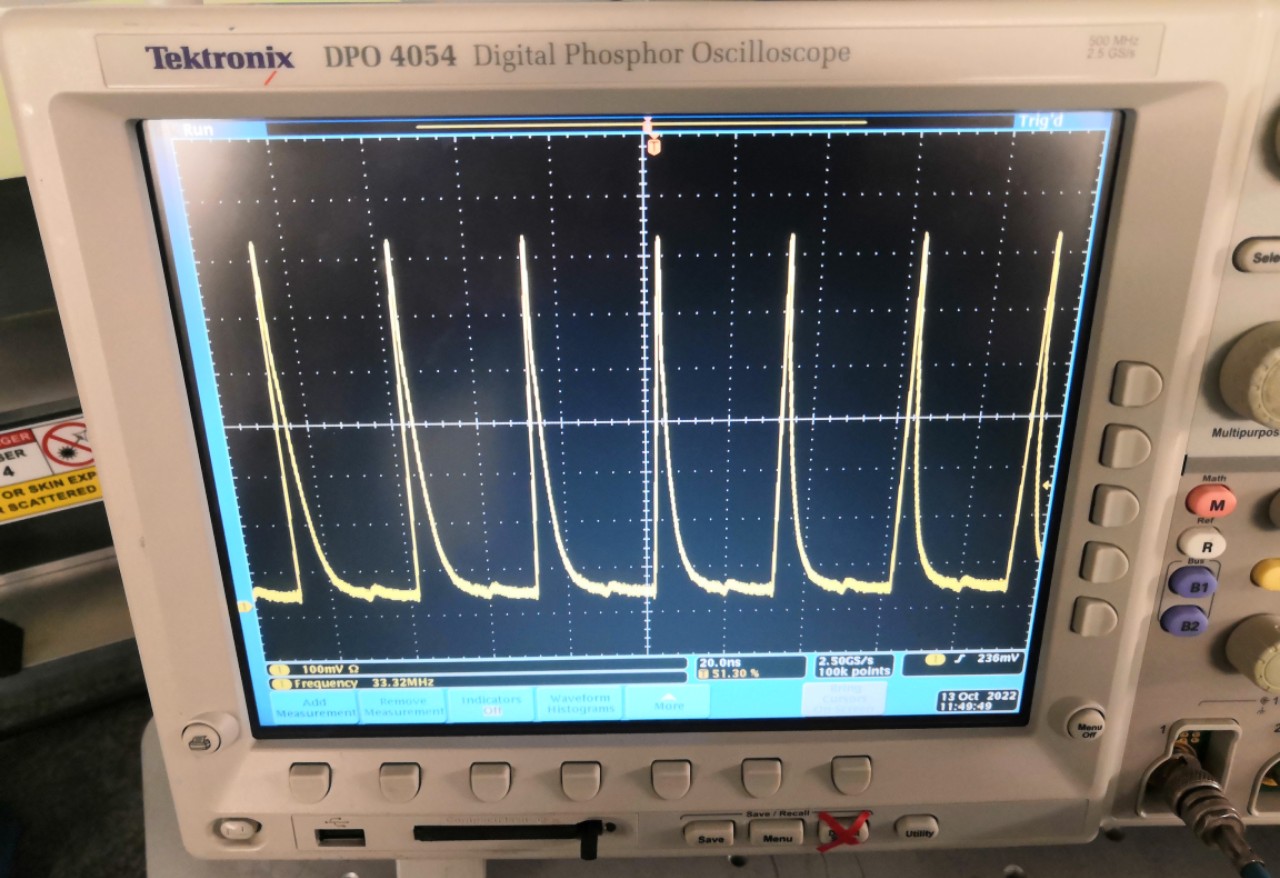
Ronic Chiche | Fixed | info | lasers and optics | Optical room | 33MHz laser SN2439 back to Orsay | Today, we succeded to make the laser modelock.
the ouptut power is above 35mW (the powermeter was saturated)
here is a screenshot of the signal on the scope.
| Ronic Chiche wrote: |
|
Yesterday, we put back the 33MHz oscillator into the casemate with the new Smaract controller.
after switching ON the laser controller, we saw some power at the output but we have to check if the laser is modelock or not.
| Ronic Chiche wrote: |
|
Today, we used an "ELI-NP" Smaract controller made with these 2 references :
MCS-3CC-ETH-TAB (SN 2271) => main controller
MCS-3S-EP-SDS15-TAB (SN 2472) => sensor module
with the ethernet parameters:
IP : 10.0.52.226
MASK: 255.255.255.0
GW : 10.0.52.01
PORT : 5001
one has to configure the device into PTC or MCS software as :
network:10.0.52.226:5001
then, one can access the Smaract controller and move both Frep and CEP stages.
we succeded to make the laser modelock again ! :-)
the output power is about 42mW !
| Ronic Chiche wrote: |
|
Yesterday with Aurélien, we try to make the laser modelock using the Smaract translation stages embedded inside the laser head.
unfortunately, we got some errors when we try to do the "calibration" and "reference" of both Smaract stages !
we contacted by email M. Nicoul to help us on this topic
Today, we removed the 33MHz and its controller and motors controller from the casemate to install it in the PLIC room.
with the help of M. Nicoul, we did a first check of the PZT capacitance of each stage (~ 60nF)
for channel 0 (Frep), the measured capacitance is 53nF on the laser head
for channel 2 (CEP), the measured capacitance is 63nF on the laser head
between pins 1 and 9 of the DB9 connector.
M. Nicoul says that these values are compatible with the reference values ~ 60nF, then the PZT translation stages are OK.
Then, the controler is maybe damaged.
One has to find a new one to test the stages.
| Ronic Chiche wrote: |
|
This morning, with Aurélien and Daniele, we did the swap between the 33MHz and 133MHz oscillators.
now, the 33MHz oscillator is on ThomX inside the casemate.
it has been restarted and some laser is going out.
it has been screwed on the metal plate, roughly aligned with the Alphanov "fiber injection and strecher" box.
tomorrow, we will do the fine alignment with this box and check if the laser is properly modelocking.
the 133MHz oscillator is back in the PLIC optical room.
it has been restarted and some laser is going out.
it seems there are no pulses at the output... it seems we have to trigger the modelock.
| Ronic Chiche wrote: |
|
On the 8th of July, the SN2439 33MHz laser was returned from NKT to our lab, being repaired.
it stayed all the weekend to warm up in the optical room and has been turned on on Monday.
the mode-locking was not working (28mW output power and a CW line for the optical spectrum), thus I "kicked" the laser with 100µm moves on the motors.
now, the laser is mode-locked with 42mW output power and the expected optical spectrum.
|
|
|
|
|
|
| Attachment 1: IMG_20221013_095839.jpg
|  |
|
200
|
Mon Mar 20 17:23:09 2023 |
Ronic Chiche | Fixed | info | lasers and optics | Optical room | 33MHz laser SN2439 back to Orsay | As the general local network for the FP-cavity devices is 192.168.xxx.xxx, I changed the IP adress of the smaract laser motors (Frep and CEP) controller.
For that, I used the embedded web server as described in the manual in attached file.
the new adresses are :
IP : 192.168.1.10
Gateaway : 192.168.1.1
Subnet : 255.255.255.0
Port : 5000
| Ronic Chiche wrote: |
|
Today, we succeded to make the laser modelock.
the ouptut power is above 35mW (the powermeter was saturated)
here is a screenshot of the signal on the scope.
| Ronic Chiche wrote: |
|
Yesterday, we put back the 33MHz oscillator into the casemate with the new Smaract controller.
after switching ON the laser controller, we saw some power at the output but we have to check if the laser is modelock or not.
| Ronic Chiche wrote: |
|
Today, we used an "ELI-NP" Smaract controller made with these 2 references :
MCS-3CC-ETH-TAB (SN 2271) => main controller
MCS-3S-EP-SDS15-TAB (SN 2472) => sensor module
with the ethernet parameters:
IP : 10.0.52.226
MASK: 255.255.255.0
GW : 10.0.52.01
PORT : 5001
one has to configure the device into PTC or MCS software as :
network:10.0.52.226:5001
then, one can access the Smaract controller and move both Frep and CEP stages.
we succeded to make the laser modelock again ! :-)
the output power is about 42mW !
| Ronic Chiche wrote: |
|
Yesterday with Aurélien, we try to make the laser modelock using the Smaract translation stages embedded inside the laser head.
unfortunately, we got some errors when we try to do the "calibration" and "reference" of both Smaract stages !
we contacted by email M. Nicoul to help us on this topic
Today, we removed the 33MHz and its controller and motors controller from the casemate to install it in the PLIC room.
with the help of M. Nicoul, we did a first check of the PZT capacitance of each stage (~ 60nF)
for channel 0 (Frep), the measured capacitance is 53nF on the laser head
for channel 2 (CEP), the measured capacitance is 63nF on the laser head
between pins 1 and 9 of the DB9 connector.
M. Nicoul says that these values are compatible with the reference values ~ 60nF, then the PZT translation stages are OK.
Then, the controler is maybe damaged.
One has to find a new one to test the stages.
| Ronic Chiche wrote: |
|
This morning, with Aurélien and Daniele, we did the swap between the 33MHz and 133MHz oscillators.
now, the 33MHz oscillator is on ThomX inside the casemate.
it has been restarted and some laser is going out.
it has been screwed on the metal plate, roughly aligned with the Alphanov "fiber injection and strecher" box.
tomorrow, we will do the fine alignment with this box and check if the laser is properly modelocking.
the 133MHz oscillator is back in the PLIC optical room.
it has been restarted and some laser is going out.
it seems there are no pulses at the output... it seems we have to trigger the modelock.
| Ronic Chiche wrote: |
|
On the 8th of July, the SN2439 33MHz laser was returned from NKT to our lab, being repaired.
it stayed all the weekend to warm up in the optical room and has been turned on on Monday.
the mode-locking was not working (28mW output power and a CW line for the optical spectrum), thus I "kicked" the laser with 100µm moves on the motors.
now, the laser is mode-locked with 42mW output power and the expected optical spectrum.
|
|
|
|
|
|
|
| Attachment 1: MCS_Network_Interface_Configuration_Guide-1.pdf
|
| Attachment 2: 20230320_154643[1].jpg
| ![20230320_154643[1].jpg](../THOMX+commissioning/230320_172255/20230320_154643[1].jpg "20230320_154643[1].jpg") |
|
35
|
Thu Apr 18 16:17:53 2019 |
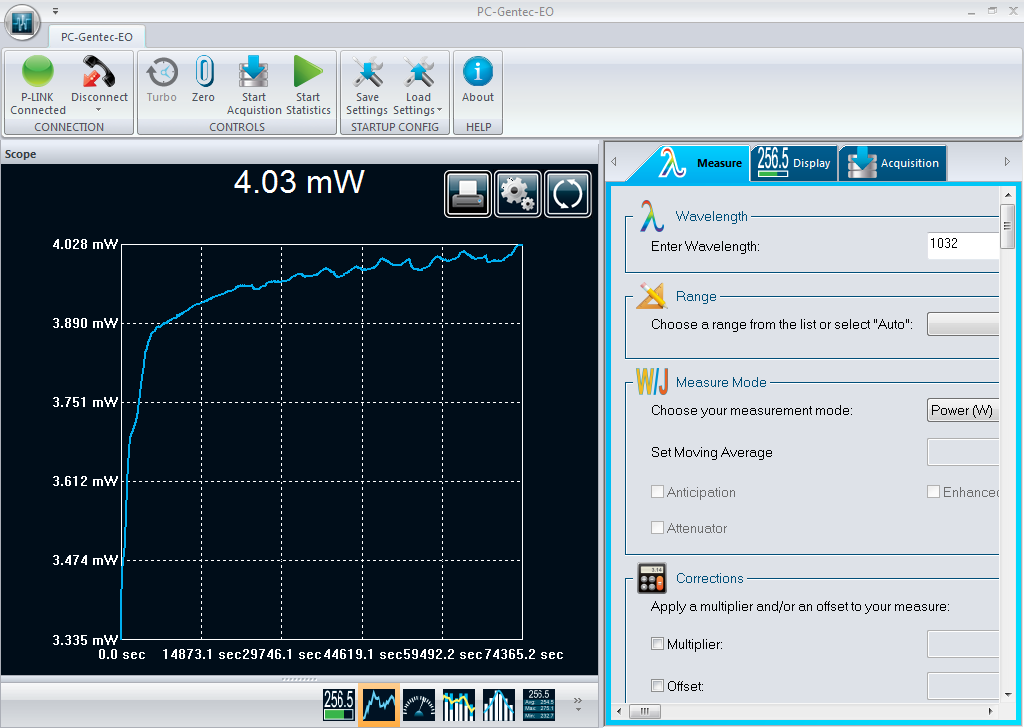
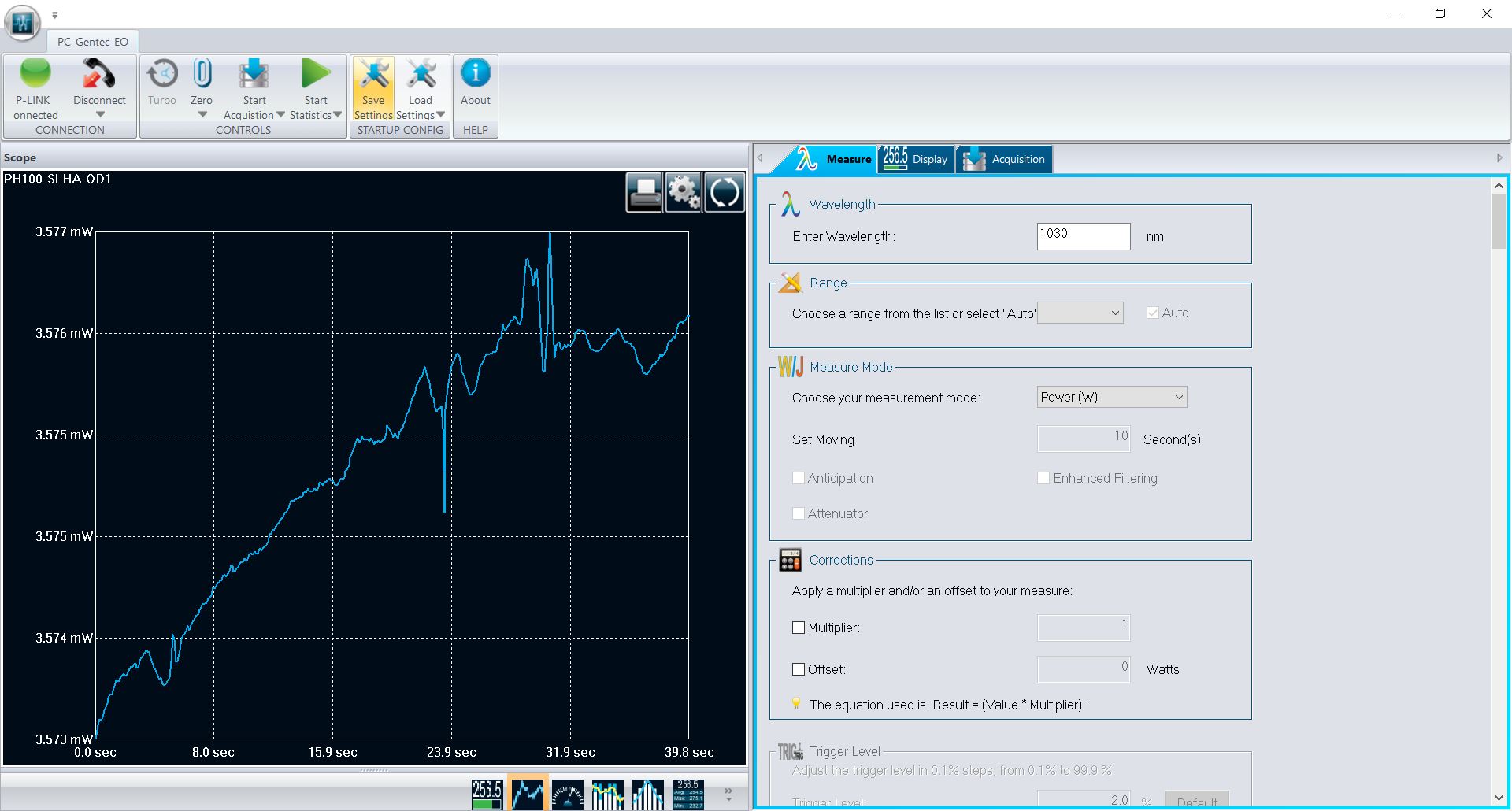
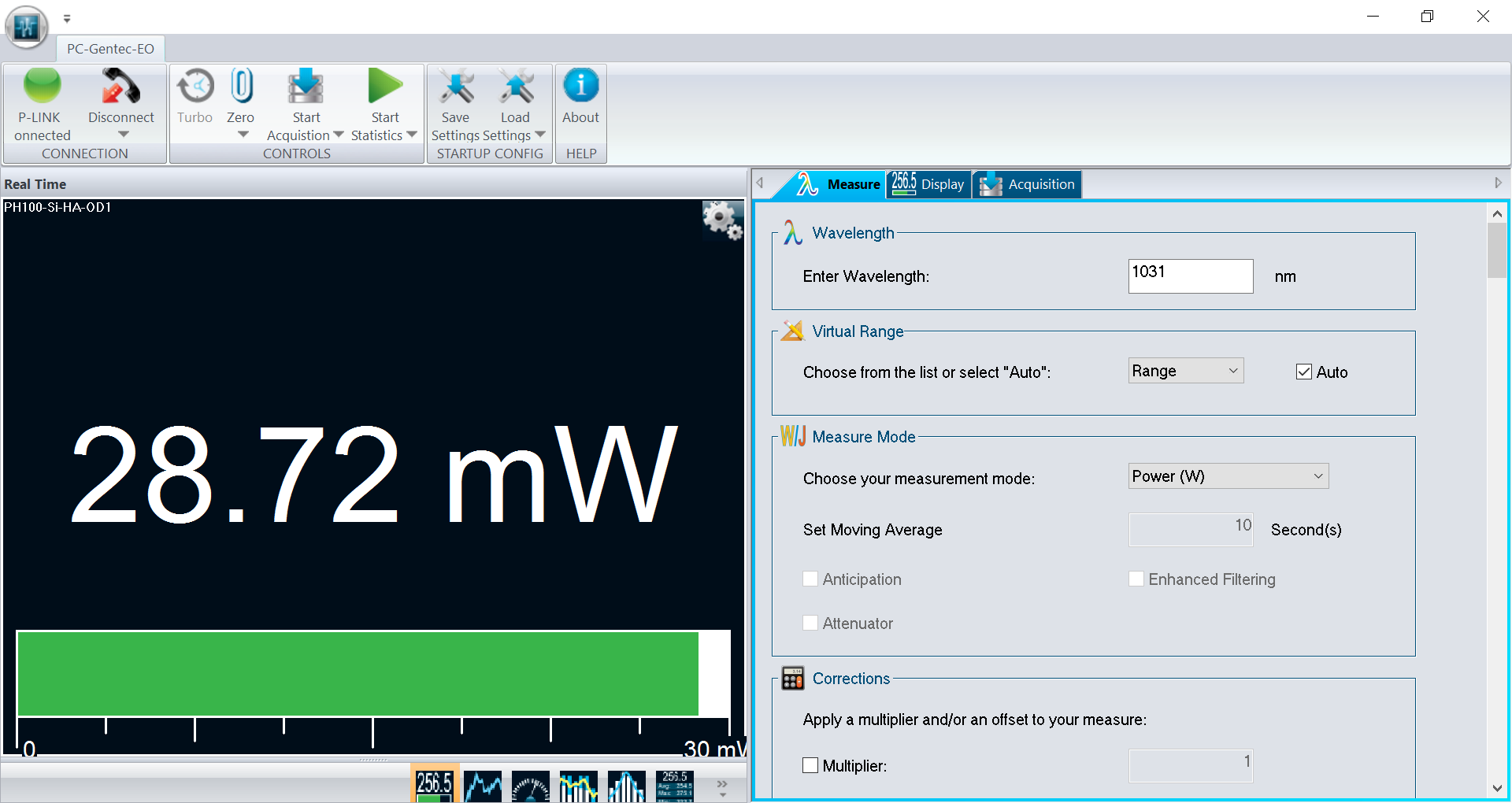
Loïc Amoudry | Fixed | issue | lasers and optics | Optical room | 33MHz Onefive power overtime decrease | Power of the 33MHz Onfive decreases over time. Have to pay attention to that.
Note that air dryers have never been stopped.
10th april 2018: ~40mW (first picture, 10dB filter)
25th september 2018: ~36mW (second picture, 10dB filter)
16th april 2019: ~29mW (third picture, no filter)
|
| Attachment 1: 180410_power_33mhz_1jours.PNG
|  |
| Attachment 2: 180925_Power.JPG
|  |
| Attachment 3: 190416_power_ouput_Onefive.PNG
|  |
|
314
|
Tue Jan 16 12:26:12 2024 |
Ronic Chiche | Fixed | info | lasers and optics | detectors and electronics | ThomX igloo | 33MHz (FP-cavity vs RF) phase stability | this morning, with Vincent Chaumat, we made a beating (phase detection) between the laser 33MHz and the 33MHz coming from the Rigol generator locked by the 10MHz link onto the 500MHz ring generator.
once the laser and the FP-cavity are locked on the RF reference, the 33MHz phase detection is stabilized and confirm the laser/FP-cavity lock on the RF reference.
we plan to make a drift measurement and a jitter measurement to estimate this lock quality.
the 33MHz frequency being quite small, the quality of this estimation will be poor but it can give a "worse case" estimation. |
|
320
|
Fri Jan 26 13:04:56 2024 |
Ronic Chiche | Fixed | info | lasers and optics | detectors and electronics | ThomX igloo | 33MHz (FP-cavity vs RF) phase stability | today, I locked the laser on the FP-cavity and the FP-cavity on the RF reference with 47kW inside the FP-cavity.
equivalent jitter :
when lock is OFF : sine signal V=V0*sin(phi(t)) with V0=300mV => Vrms = 300/sqrt(2)) = 210mV rms
when lock is ON : noise 10mV < dV < 20mV
for low phase values : dV=V0*dphi
when the RF locking is done, this voltage is about dV = 20mV rms => dphi = dV/V0 = 67 mrad
dphi = 2*pi*f0*dt => jitter dt = dphi/(2*pi*f0) = dV * T0/(2*pi*V0)
T0/(2*pi*V0) ~ 1ps/mV => jitter ~ 10-20 ps rms
previous measurements were exhibiting a jitter lower than 5ps rms : https://elog.lal.in2p3.fr/FPC/THOMX+commissioning/299
| Ronic Chiche wrote: |
|
this morning, with Vincent Chaumat, we made a beating (phase detection) between the laser 33MHz and the 33MHz coming from the Rigol generator locked by the 10MHz link onto the 500MHz ring generator.
once the laser and the FP-cavity are locked on the RF reference, the 33MHz phase detection is stabilized and confirm the laser/FP-cavity lock on the RF reference.
we plan to make a drift measurement and a jitter measurement to estimate this lock quality.
the 33MHz frequency being quite small, the quality of this estimation will be poor but it can give a "worse case" estimation.
|
|
|
81
|
Fri Nov 22 17:56:56 2019 |
Ronic Chiche | Fixed | issue | lasers and optics | detectors and electronics | Optical room | 30Hz noise issue | since some days, we observe the cavity is difficult to lock and a strange 30Hz noise has appeared on the PZT signal which normally compensate the phase noise difference between the cavity and the laser.
to test if the problem could come from the laser, we changed the OneFive laser for the Koheras but we have exactly the same problem, thus we concluded that the problem come from the cavity or from the feedback.
today, we borrowed an accelerometer measurement setup to Julien Bonis to test if we can see a clear noise at 30Hz from the seismic noise.
we placed to accelerometer directly on the top of the cavity but the spectrum we obtained do not show a clear noise line at 30Hz, only a small excess of noise in this region...
nothing which clearly indicate the cause of our problem.
yesterday, we changed the feedback setup in changing the PDH box from n°2 to N°3 without any change in the 30Hz noise line.
today, we also changed the feedback setup by introducing and amplifier of 100 just after the PDH box.
if noise is coupled after the amp we should be more immunized from it... but nothing changed again.
still looking for the origin of this problem... |
|
84
|
Tue Nov 26 16:35:39 2019 |
Ronic Chiche | Fixed | issue | lasers and optics | detectors and electronics | Optical room | 30Hz noise issue | The 30 Hz noise issue has been solved !
It came from translation stage of P1 and/or P4.
Fabian remembered that close to the mirror's mount translation stage end coarse, there is a mechanical instability. The mount kind of "lift up" because of the spring strength and could induce resonance.
Initial positions:
- P1: - 1 500 000
- S2: + 1 400 000
- S3: + 1 400 000
- P4: - 1 500 000
The 30 Hz noise was removed while moving only P1 closer (then if we put back P1 to the initial position, the noise clearly appear again):
- P1: - 1 300 000 --> no 30Hz noise
- S2: + 1 400 000
- S3: + 1 400 000
- P4: - 1 500 000
The 30 Hz noise appeared again while moving P4 further:
- P1: - 1 300 000
- S2: + 1 400 000
- S3: + 1 400 000
- P4: - 1 600 000 --> 30Hz noise
Final positions:
- P1: - 1 300 000
- S2: + 1 400 000
- S3: + 1 400 000
- P4: - 1 500 000
| Ronic Chiche wrote: |
|
since some days, we observe the cavity is difficult to lock and a strange 30Hz noise has appeared on the PZT signal which normally compensate the phase noise difference between the cavity and the laser.
to test if the problem could come from the laser, we changed the OneFive laser for the Koheras but we have exactly the same problem, thus we concluded that the problem come from the cavity or from the feedback.
today, we borrowed an accelerometer measurement setup to Julien Bonis to test if we can see a clear noise at 30Hz from the seismic noise.
we placed to accelerometer directly on the top of the cavity but the spectrum we obtained do not show a clear noise line at 30Hz, only a small excess of noise in this region...
nothing which clearly indicate the cause of our problem.
yesterday, we changed the feedback setup in changing the PDH box from n°2 to N°3 without any change in the 30Hz noise line.
today, we also changed the feedback setup by introducing and amplifier of 100 just after the PDH box.
if noise is coupled after the amp we should be more immunized from it... but nothing changed again.
still looking for the origin of this problem...
|
|
|
48
|
Thu Jul 4 18:30:39 2019 |
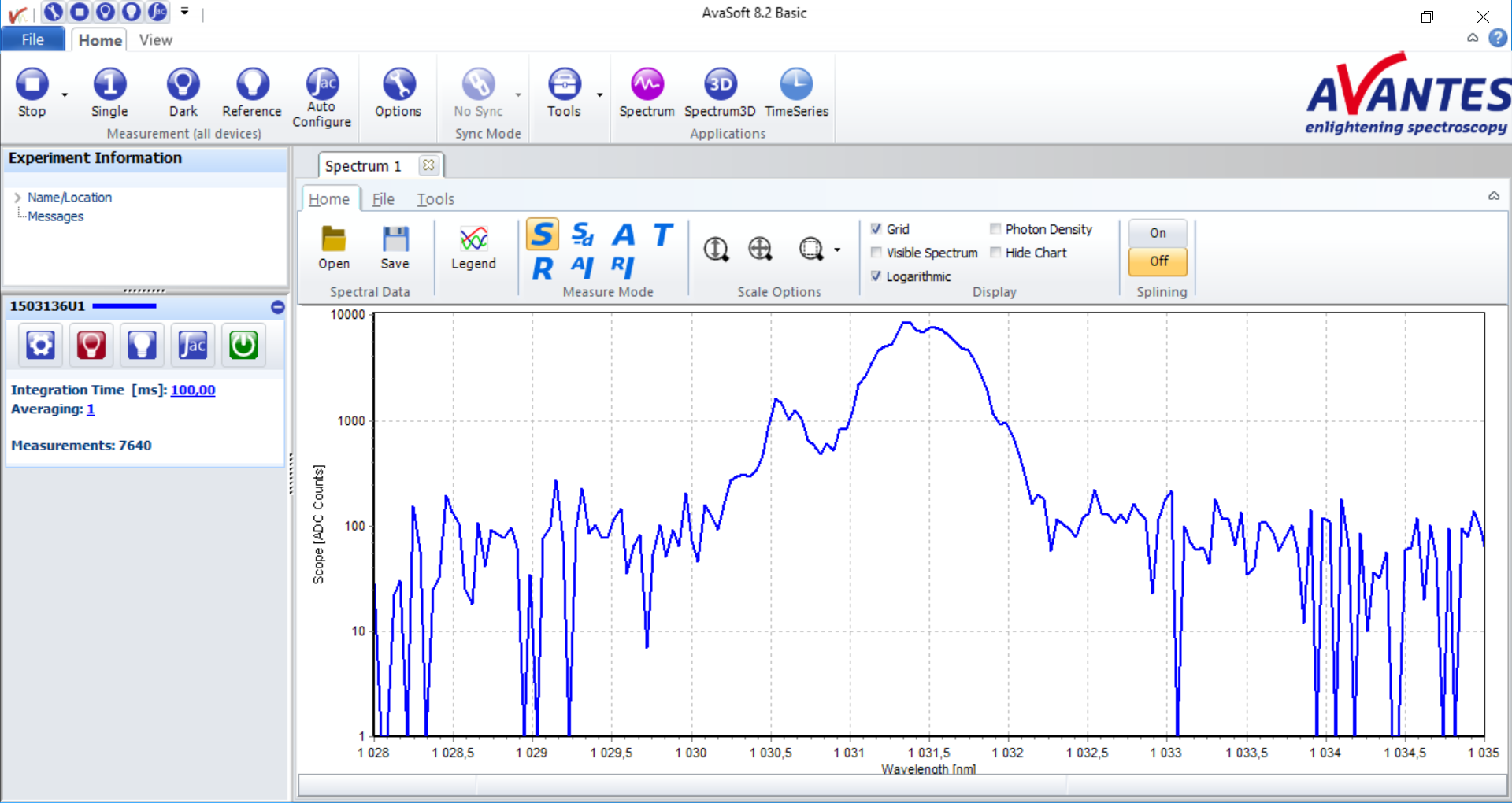
Loïc Amoudry | Fixed | report | lasers and optics | Optical room | 2nd stage output power validated | Onefive output power : 28mW
Power before fiber injection : 7.8mW
After EOM and 99% coupling fiber : 1.8mW
After EOM and 1% coupling fiber : 14 uW (~1%), ~7.5V @ 1MOhm on DET36
Frep : 33.326 MHz
Output 1st stage + collimator & dichroic mirror: 36uW
Output 2nd stage @6A (~260mV @50Ohm on DET36): 300mW --> after 20-30min
Output 2nd stage is the same value as Onefive 133.33MHz |
| Attachment 1: 190704_2ndstage6A_spectrum.PNG
|  |
|
258
|
Fri Sep 15 18:00:41 2023 |
Ronic Chiche | Under Process | issue | mechanics | lasers and optics | detectors and electronics | ThomX igloo | 20Hz oscillation in the locking between Laser and FP-cavity | this morning, we tried to find the origin of the 20Hz oscillation.
- we switched OFF the laser Smaract motors controller => no change
- then, we addionally disconnected the FP-cavity PZT cable from the Laselock (we put a charge of 1kohm) => no change
- then, we switched ON the laser Smaract motors controller and switched OFF the FP-cavity motors controllers => no change
in conclusion, we don't really know where this instabillity comes from.
the amplitude is roughly 1Vpp (when the oscillation is at its maximum) on the laser PZT <=> length oscillation of ~20nm pp
could it come :
- from the air cooling regulation with pressure variation ?
- from vibrations of the hexapod below the table ?
or is it from inside of the laser or FP cavities ?
see these posts for the first measurements on this issue: https://elog.lal.in2p3.fr/FPC/THOMX+commissioning/257
|
|
259
|
Fri Sep 15 18:11:07 2023 |
Ronic Chiche | Under Process | issue | mechanics | lasers and optics | detectors and electronics | ThomX igloo | 20Hz oscillation in the locking between Laser and FP-cavity | this afternoon, we did 2 tests to better understand this 20Hz oscillation:
- we locked the amplified laser directly to the 500MHz ring reference oscillator, without any intermediate locking to the FP-cavity => no change
the 20Hz oscillation is still present in the correction signal of the laser PZT.
- we switched OFF the controller of the hexapod => no change.
conclusion:
the 20Hz oscillation is coming from the laser cavity
or is coming from "outside" and could be measured, maybe at a higher level, with an external "noises & vibrations measurement system".
| Ronic Chiche wrote: |
|
this morning, we tried to find the origin of the 20Hz oscillation.
- we switched OFF the laser Smaract motors controller => no change
- then, we addionally disconnected the FP-cavity PZT cable from the Laselock (we put a charge of 1kohm) => no change
- then, we switched ON the laser Smaract motors controller and switched OFF the FP-cavity motors controllers => no change
in conclusion, we don't really know where this instabillity comes from.
the amplitude is roughly 1Vpp (when the oscillation is at its maximum) on the laser PZT <=> length oscillation of ~20nm pp
could it come :
- from the air cooling regulation with pressure variation ?
- from vibrations of the hexapod below the table ?
or is it from inside of the laser or FP cavities ?
see these posts for the first measurements on this issue: https://elog.lal.in2p3.fr/FPC/THOMX+commissioning/257
|
|
|
324
|
Fri Feb 9 09:50:45 2024 |
Ronic Chiche | Under Process | issue | mechanics | lasers and optics | detectors and electronics | ThomX igloo | 20Hz oscillation in the locking between Laser and FP-cavity | yesterday I did 2 tests to try to understand the origin of the 20Hz oscillation which is dominant in the remaining 10-20ps rms jitter between the transmitted pulses and the RF reference generator.
10ps rms jitter is equivalent to phase jitter dphi = 2*pi*f0*dt = 2mrad rms @ 33MHz or 30mrad rms @ 500MHz.
with V0 = 1Vpeak of beating signal amplitude, the equivalent rms beating voltage is dV = V0 * sin(dphi) ~ V0 * dphi = 2mV rms @ 33MHz or 30mV rms @ 500MHz
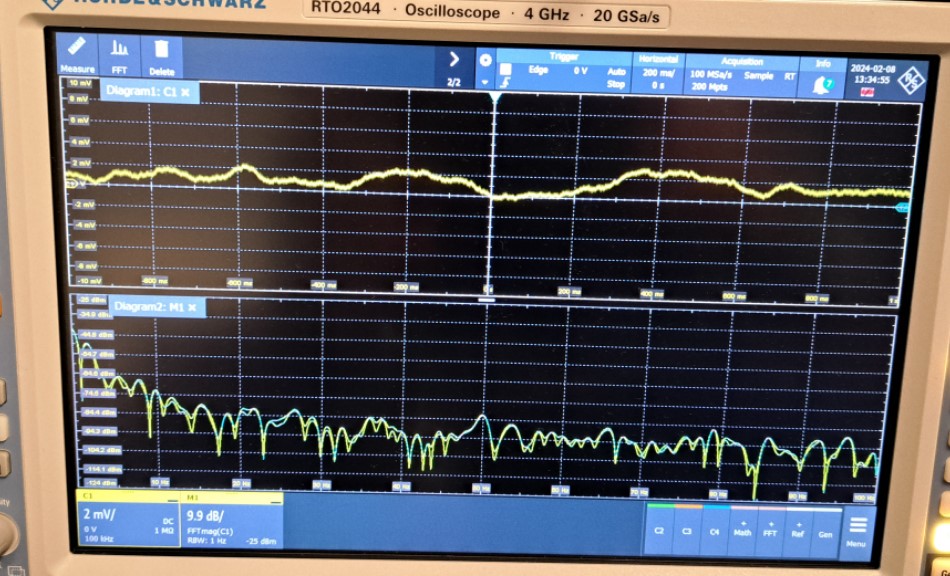
1) I did a beating between the internal photodiode of the laser with an external 33MHz oscillator (the photodiode is too slow to use higher harmonic).
the difficult part is to see the 2mV rms noise on a 2Vpp oscillating signal, so I locked the external 33MHz reference oscillator with the beating signal => see first plot.
there is no trace of 20Hz oscillation in the beating signal => the lock is too good and removed the oscillation ?
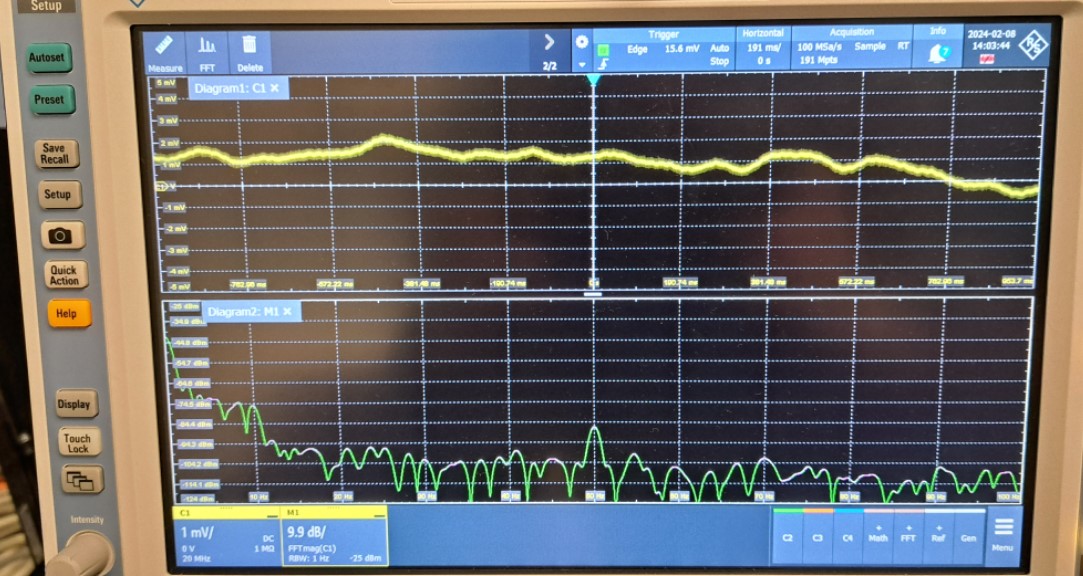
2) I did a beating between the photodiode in reflection of the FP-cavity (so the signal is not coming only from the oscillator but is going also through the Alphanov amplifier) with the 500MHz RF Ring generator.
I cannot the lock the generator anymore, so the measurement is done in open loop. I adjust the laser Frep with the motor to try to cancel the beating frequency => see 2nd plot
there is no trace of 20Hz oscillation in the beating signal => it is in contradiction with the previous post : "conclusion: the 20Hz oscillation is coming from the laser cavity" ?!?
maybe we need a more complex measurement scheme with the possibility to measure in the same time the 10-20ps rms jitter coming from the locked FP-cavity transmitted signal/500MHz Ring generator
AND the beating signal between the laser or amplifier with 500MHz local reference generator... to be done...
| Ronic Chiche wrote: |
|
this afternoon, we did 2 tests to better understand this 20Hz oscillation:
- we locked the amplified laser directly to the 500MHz ring reference oscillator, without any intermediate locking to the FP-cavity => no change
the 20Hz oscillation is still present in the correction signal of the laser PZT.
- we switched OFF the controller of the hexapod => no change.
conclusion:
the 20Hz oscillation is coming from the laser cavity
or is coming from "outside" and could be measured, maybe at a higher level, with an external "noises & vibrations measurement system".
| Ronic Chiche wrote: |
|
this morning, we tried to find the origin of the 20Hz oscillation.
- we switched OFF the laser Smaract motors controller => no change
- then, we addionally disconnected the FP-cavity PZT cable from the Laselock (we put a charge of 1kohm) => no change
- then, we switched ON the laser Smaract motors controller and switched OFF the FP-cavity motors controllers => no change
in conclusion, we don't really know where this instabillity comes from.
the amplitude is roughly 1Vpp (when the oscillation is at its maximum) on the laser PZT <=> length oscillation of ~20nm pp
could it come :
- from the air cooling regulation with pressure variation ?
- from vibrations of the hexapod below the table ?
or is it from inside of the laser or FP cavities ?
see these posts for the first measurements on this issue: https://elog.lal.in2p3.fr/FPC/THOMX+commissioning/257
|
|
|
| Attachment 1: 20240208_133745.jpg
|  |
| Attachment 2: 20240208_140636.jpg
|  |
|
325
|
Fri Feb 9 15:49:39 2024 |
Ronic Chiche | Under Process | issue | mechanics | lasers and optics | detectors and electronics | ThomX igloo | 20Hz oscillation in the locking between Laser and FP-cavity | what does this 10ps phase jitter mean in term of cavity length variations ?
L = L0 + dL sin(2pi fm t) = L0 (1 + dL/L0 sin(2pi fm t))
F = c / L ~ F0 - F0² dL / c sin(2pi fm t) with F0 = c / L0
d/dt(phi) = 2pi F => phi = 2pi F0 t + F0² dL / (c fm) cos(2pi fm t) => dphi = F0² dL / (c fm)
dphi = 2pi F0 dt => dL = L0 * 2pi fm dt
dt rms = 10ps @ fm = 20Hz of modulation frequency <=> dL rms = 10 nm (L0 = 9m)
| Ronic Chiche wrote: |
|
yesterday I did 2 tests to try to understand the origin of the 20Hz oscillation which is dominant in the remaining 10-20ps rms jitter between the transmitted pulses and the RF reference generator.
10ps rms jitter is equivalent to phase jitter dphi = 2*pi*f0*dt = 2mrad rms @ 33MHz or 30mrad rms @ 500MHz.
with V0 = 1Vpeak of beating signal amplitude, the equivalent rms beating voltage is dV = V0 * sin(dphi) ~ V0 * dphi = 2mV rms @ 33MHz or 30mV rms @ 500MHz
1) I did a beating between the internal photodiode of the laser with an external 33MHz oscillator (the photodiode is too slow to use higher harmonic).
the difficult part is to see the 2mV rms noise on a 2Vpp oscillating signal, so I locked the external 33MHz reference oscillator with the beating signal => see first plot.
there is no trace of 20Hz oscillation in the beating signal => the lock is too good and removed the oscillation ?
2) I did a beating between the photodiode in reflection of the FP-cavity (so the signal is not coming only from the oscillator but is going also through the Alphanov amplifier) with the 500MHz RF Ring generator.
I cannot the lock the generator anymore, so the measurement is done in open loop. I adjust the laser Frep with the motor to try to cancel the beating frequency => see 2nd plot
there is no trace of 20Hz oscillation in the beating signal => it is in contradiction with the previous post : "conclusion: the 20Hz oscillation is coming from the laser cavity" ?!?
maybe we need a more complex measurement scheme with the possibility to measure in the same time the 10-20ps rms jitter coming from the locked FP-cavity transmitted signal/500MHz Ring generator
AND the beating signal between the laser or amplifier with 500MHz local reference generator... to be done...
| Ronic Chiche wrote: |
|
this afternoon, we did 2 tests to better understand this 20Hz oscillation:
- we locked the amplified laser directly to the 500MHz ring reference oscillator, without any intermediate locking to the FP-cavity => no change
the 20Hz oscillation is still present in the correction signal of the laser PZT.
- we switched OFF the controller of the hexapod => no change.
conclusion:
the 20Hz oscillation is coming from the laser cavity
or is coming from "outside" and could be measured, maybe at a higher level, with an external "noises & vibrations measurement system".
| Ronic Chiche wrote: |
|
this morning, we tried to find the origin of the 20Hz oscillation.
- we switched OFF the laser Smaract motors controller => no change
- then, we addionally disconnected the FP-cavity PZT cable from the Laselock (we put a charge of 1kohm) => no change
- then, we switched ON the laser Smaract motors controller and switched OFF the FP-cavity motors controllers => no change
in conclusion, we don't really know where this instabillity comes from.
the amplitude is roughly 1Vpp (when the oscillation is at its maximum) on the laser PZT <=> length oscillation of ~20nm pp
could it come :
- from the air cooling regulation with pressure variation ?
- from vibrations of the hexapod below the table ?
or is it from inside of the laser or FP cavities ?
see these posts for the first measurements on this issue: https://elog.lal.in2p3.fr/FPC/THOMX+commissioning/257
|
|
|
|
|
326
|
Fri Feb 9 18:00:05 2024 |
Ronic Chiche | Under Process | issue | mechanics | lasers and optics | detectors and electronics | ThomX igloo | 20Hz oscillation in the locking between Laser and FP-cavity | measure to be done next week to check the 20Hz noise on the laser amplifier signal:
- install a DET10 in reflection of the FP-cavity to get a high BW and measure the 500MHz harmonic.
- do the beating with the 500MHz Ring RF generator
- with the laser motor try to be close to the 500MHz Ring RF frequency => beating frequency below 1kHz
- send the beating signal to some RF spectrum analyzer to use its large dynamic range.
for example, with the Siglent RF spectrum analyzer, it is possible to detect easily a peak @ -96dBm <=> 3.5µV rms
so, one should be able to make the measurement @ 500MHz or even @ 33MHz even if the phase sensitivity is lower :
for example V0=100mV peak beating signal @ f0=33MHz should produce a 20Hz noise signal of:
dV ~ V0 * dphi = V0 * 2*pi*f0*dt = 200µV rms with jitter dt=10ps rms
| Ronic Chiche wrote: |
|
what does this 10ps phase jitter mean in term of cavity length variations ?
L = L0 + dL sin(2pi fm t) = L0 (1 + dL/L0 sin(2pi fm t))
F = c / L ~ F0 - F0² dL / c sin(2pi fm t) with F0 = c / L0
d/dt(phi) = 2pi F => phi = 2pi F0 t + F0² dL / (c fm) cos(2pi fm t) => dphi = F0² dL / (c fm)
dphi = 2pi F0 dt => dL = L0 * 2pi fm dt
dt rms = 10ps @ fm = 20Hz of modulation frequency <=> dL rms = 10 nm (L0 = 9m)
| Ronic Chiche wrote: |
|
yesterday I did 2 tests to try to understand the origin of the 20Hz oscillation which is dominant in the remaining 10-20ps rms jitter between the transmitted pulses and the RF reference generator.
10ps rms jitter is equivalent to phase jitter dphi = 2*pi*f0*dt = 2mrad rms @ 33MHz or 30mrad rms @ 500MHz.
with V0 = 1Vpeak of beating signal amplitude, the equivalent rms beating voltage is dV = V0 * sin(dphi) ~ V0 * dphi = 2mV rms @ 33MHz or 30mV rms @ 500MHz
1) I did a beating between the internal photodiode of the laser with an external 33MHz oscillator (the photodiode is too slow to use higher harmonic).
the difficult part is to see the 2mV rms noise on a 2Vpp oscillating signal, so I locked the external 33MHz reference oscillator with the beating signal => see first plot.
there is no trace of 20Hz oscillation in the beating signal => the lock is too good and removed the oscillation ?
2) I did a beating between the photodiode in reflection of the FP-cavity (so the signal is not coming only from the oscillator but is going also through the Alphanov amplifier) with the 500MHz RF Ring generator.
I cannot the lock the generator anymore, so the measurement is done in open loop. I adjust the laser Frep with the motor to try to cancel the beating frequency => see 2nd plot
there is no trace of 20Hz oscillation in the beating signal => it is in contradiction with the previous post : "conclusion: the 20Hz oscillation is coming from the laser cavity" ?!?
maybe we need a more complex measurement scheme with the possibility to measure in the same time the 10-20ps rms jitter coming from the locked FP-cavity transmitted signal/500MHz Ring generator
AND the beating signal between the laser or amplifier with 500MHz local reference generator... to be done...
| Ronic Chiche wrote: |
|
this afternoon, we did 2 tests to better understand this 20Hz oscillation:
- we locked the amplified laser directly to the 500MHz ring reference oscillator, without any intermediate locking to the FP-cavity => no change
the 20Hz oscillation is still present in the correction signal of the laser PZT.
- we switched OFF the controller of the hexapod => no change.
conclusion:
the 20Hz oscillation is coming from the laser cavity
or is coming from "outside" and could be measured, maybe at a higher level, with an external "noises & vibrations measurement system".
| Ronic Chiche wrote: |
|
this morning, we tried to find the origin of the 20Hz oscillation.
- we switched OFF the laser Smaract motors controller => no change
- then, we addionally disconnected the FP-cavity PZT cable from the Laselock (we put a charge of 1kohm) => no change
- then, we switched ON the laser Smaract motors controller and switched OFF the FP-cavity motors controllers => no change
in conclusion, we don't really know where this instabillity comes from.
the amplitude is roughly 1Vpp (when the oscillation is at its maximum) on the laser PZT <=> length oscillation of ~20nm pp
could it come :
- from the air cooling regulation with pressure variation ?
- from vibrations of the hexapod below the table ?
or is it from inside of the laser or FP cavities ?
see these posts for the first measurements on this issue: https://elog.lal.in2p3.fr/FPC/THOMX+commissioning/257
|
|
|
|
|
|
361
|
Fri Sep 6 17:27:20 2024 |
Ronic Chiche | Under Process | issue | mechanics | lasers and optics | detectors and electronics | ThomX igloo | 20Hz oscillation in the locking between Laser and FP-cavity | could it be possible this 20Hz oscillations comes from anouncements in the bunker, puting the housing+table in vibration ?
(there are such anouncements during restricted access) => to be asked to Harold
| Ronic Chiche wrote: |
|
measure to be done next week to check the 20Hz noise on the laser amplifier signal:
- install a DET10 in reflection of the FP-cavity to get a high BW and measure the 500MHz harmonic.
- do the beating with the 500MHz Ring RF generator
- with the laser motor try to be close to the 500MHz Ring RF frequency => beating frequency below 1kHz
- send the beating signal to some RF spectrum analyzer to use its large dynamic range.
for example, with the Siglent RF spectrum analyzer, it is possible to detect easily a peak @ -96dBm <=> 3.5µV rms
so, one should be able to make the measurement @ 500MHz or even @ 33MHz even if the phase sensitivity is lower :
for example V0=100mV peak beating signal @ f0=33MHz should produce a 20Hz noise signal of:
dV ~ V0 * dphi = V0 * 2*pi*f0*dt = 200µV rms with jitter dt=10ps rms
| Ronic Chiche wrote: |
|
what does this 10ps phase jitter mean in term of cavity length variations ?
L = L0 + dL sin(2pi fm t) = L0 (1 + dL/L0 sin(2pi fm t))
F = c / L ~ F0 - F0² dL / c sin(2pi fm t) with F0 = c / L0
d/dt(phi) = 2pi F => phi = 2pi F0 t + F0² dL / (c fm) cos(2pi fm t) => dphi = F0² dL / (c fm)
dphi = 2pi F0 dt => dL = L0 * 2pi fm dt
dt rms = 10ps @ fm = 20Hz of modulation frequency <=> dL rms = 10 nm (L0 = 9m)
| Ronic Chiche wrote: |
|
yesterday I did 2 tests to try to understand the origin of the 20Hz oscillation which is dominant in the remaining 10-20ps rms jitter between the transmitted pulses and the RF reference generator.
10ps rms jitter is equivalent to phase jitter dphi = 2*pi*f0*dt = 2mrad rms @ 33MHz or 30mrad rms @ 500MHz.
with V0 = 1Vpeak of beating signal amplitude, the equivalent rms beating voltage is dV = V0 * sin(dphi) ~ V0 * dphi = 2mV rms @ 33MHz or 30mV rms @ 500MHz
1) I did a beating between the internal photodiode of the laser with an external 33MHz oscillator (the photodiode is too slow to use higher harmonic).
the difficult part is to see the 2mV rms noise on a 2Vpp oscillating signal, so I locked the external 33MHz reference oscillator with the beating signal => see first plot.
there is no trace of 20Hz oscillation in the beating signal => the lock is too good and removed the oscillation ?
2) I did a beating between the photodiode in reflection of the FP-cavity (so the signal is not coming only from the oscillator but is going also through the Alphanov amplifier) with the 500MHz RF Ring generator.
I cannot the lock the generator anymore, so the measurement is done in open loop. I adjust the laser Frep with the motor to try to cancel the beating frequency => see 2nd plot
there is no trace of 20Hz oscillation in the beating signal => it is in contradiction with the previous post : "conclusion: the 20Hz oscillation is coming from the laser cavity" ?!?
maybe we need a more complex measurement scheme with the possibility to measure in the same time the 10-20ps rms jitter coming from the locked FP-cavity transmitted signal/500MHz Ring generator
AND the beating signal between the laser or amplifier with 500MHz local reference generator... to be done...
| Ronic Chiche wrote: |
|
this afternoon, we did 2 tests to better understand this 20Hz oscillation:
- we locked the amplified laser directly to the 500MHz ring reference oscillator, without any intermediate locking to the FP-cavity => no change
the 20Hz oscillation is still present in the correction signal of the laser PZT.
- we switched OFF the controller of the hexapod => no change.
conclusion:
the 20Hz oscillation is coming from the laser cavity
or is coming from "outside" and could be measured, maybe at a higher level, with an external "noises & vibrations measurement system".
| Ronic Chiche wrote: |
|
this morning, we tried to find the origin of the 20Hz oscillation.
- we switched OFF the laser Smaract motors controller => no change
- then, we addionally disconnected the FP-cavity PZT cable from the Laselock (we put a charge of 1kohm) => no change
- then, we switched ON the laser Smaract motors controller and switched OFF the FP-cavity motors controllers => no change
in conclusion, we don't really know where this instabillity comes from.
the amplitude is roughly 1Vpp (when the oscillation is at its maximum) on the laser PZT <=> length oscillation of ~20nm pp
could it come :
- from the air cooling regulation with pressure variation ?
- from vibrations of the hexapod below the table ?
or is it from inside of the laser or FP cavities ?
see these posts for the first measurements on this issue: https://elog.lal.in2p3.fr/FPC/THOMX+commissioning/257
|
|
|
|
|
|
|
269
|
Thu Sep 21 18:56:56 2023 |
Ronic Chiche | Fixed | issue | mechanics | lasers and optics | ThomX igloo | !!! strange amplifier beam pointing fluctuations !!! | this morning, I locked the cavity to ~25kW without any problem.
but this afternoon, the reflected power exhibited low frequency (~1Hz) fluctuations of about 10% without any lock.
the reflected PhD is a DET10 which has a small surface.
we checked the OneFive oscillator power which is perfectly stable.
we changed the DET10 PhD for a DET100 PhD with ~1cm surface : we don't see any power fluctuation => the amplifier power seems stable.
we put back the DET10 PhD : we see these fluctuations of about 10% => it could be some pointing effect !!!
when one locks the FP-cavity, we clearly see exactly the same power fluctuations at the Transmission PhD but complementary => the sum is constant.
so, it seems clear that the beam coupling to the cavity is fluctuating due to some pointing fluctuation of the incoming beam.
a reason of these fluctuations could be the thermal jump done today because of the air cooling system of the bunker :
the temperature jumped from 25°C yesterday (and maybe still this morning ?) to 18°C this afternoon !!!
thus, some mechanical parts (the compressor CVBG ?) could be moving and then could produce these pointing fluctuations... |
|
273
|
Wed Nov 8 17:51:30 2023 |
Ronic Chiche | Fixed | issue | mechanics | lasers and optics | ThomX igloo | !!! strange amplifier beam pointing fluctuations !!! | we confirmed the effect of the bunker temperature on the laser amplifier "beam pointing" fluctuations.
once the temperature is getting back to stable values, it doesn't happend again.
we bought a temperature data logguer to monitor them in the future: https://www.picotech.com/data-logger/tc-08/thermocouple-data-logger
this post close this thread.
| Ronic Chiche wrote: |
|
this morning, I locked the cavity to ~25kW without any problem.
but this afternoon, the reflected power exhibited low frequency (~1Hz) fluctuations of about 10% without any lock.
the reflected PhD is a DET10 which has a small surface.
we checked the OneFive oscillator power which is perfectly stable.
we changed the DET10 PhD for a DET100 PhD with ~1cm surface : we don't see any power fluctuation => the amplifier power seems stable.
we put back the DET10 PhD : we see these fluctuations of about 10% => it could be some pointing effect !!!
when one locks the FP-cavity, we clearly see exactly the same power fluctuations at the Transmission PhD but complementary => the sum is constant.
so, it seems clear that the beam coupling to the cavity is fluctuating due to some pointing fluctuation of the incoming beam.
a reason of these fluctuations could be the thermal jump done today because of the air cooling system of the bunker :
the temperature jumped from 25°C yesterday (and maybe still this morning ?) to 18°C this afternoon !!!
thus, some mechanical parts (the compressor CVBG ?) could be moving and then could produce these pointing fluctuations...
|
|
|
261
|
Fri Sep 15 18:56:36 2023 |
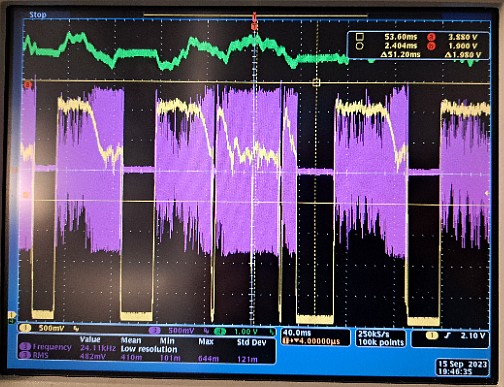
Ronic Chiche | Fixed | issue | mechanics | lasers and optics | detectors and electronics | ThomX igloo | !!! strange FP cavity behavior => impossible to lock !!! | suddenly, BEFORE switching the HV amplifier ON and BEFORE connecting it to the EOM (in order to explore the HV effect on the EOM for the fast feedback loop),
we lost the lock between the laser and the FP-cavity: in attchement a plot a the lock with the "best" PID parameters.
- yellow: FP-cavity transmission signal
- green: PZT signal
- pink: PDH error signal
the lock was pretty "normal" except that we observed that the intra-cavity power is always slowly increasing from 40kW to ~44kW during a lock, all along this last week.
there are several possiblities for that :
- a slow increasing of the input power (we see the effect on the reflected signal when the FP-cavity is not locked)
- fluctuations of the CEP to the "good" value,
- or more supprisingly an improvement of the Finesse.
after this issue, we tried to change the laser input power (30% to 25%), or the change the CEP => we always get the same result => the lock is either too "weak" (not enough gain) or too "strong" (the system is unstable and goes in oscillations visible on the picture a the end of each lock period).
we tried to change the PID parameters quite a lot to try to compensate a change in the FP-cavity transfer function without any effect => impossible to have a proper lock as before.
we tried to check if the PDH phase, to produce a proper error signal, has changed => no, it was the good one.
we tried to correct the laser alignement to the FP-cavity, but it was more or less correct and we didn't see any change in the locking.
then, one possibility could be that one dust have been suddenly removed from the cavity mirrors by the high power and the Finesse suddenly increased substancially.
=> more Finesse => less bandwidth => high frequency noise are less "visible" in the error signal and we get less bandwith for the feedback => more difficult to lock.
we thought that this kind of problem could be solved by changing the CEP, but in this case, it didn't succeded to lock.
the other possibility is that just before having this issue, we were doing tests on the EOM with a 0-10V signal.
=> could it be possible that the static polarisation of the laser has changed ?
then, we would need to adjust the waveplates in the laser path to adjust the correct polarisation ?
=> not for sure... as the maximum transmitted power at the begining of the lock is the same as before... and compatible with ~ 43 - 44kW in the FP-cavity.
could it be also that the intermediate signals of the PDH scheme are saturated (because of the increasing power : 40kW to 44kW) and produce a "false" error signal leading to instability ?
or could it be a bug in the Laselock ?
=> we could restart it to confirm.... |
| Attachment 1: 20230915_172239.jpg
|  |
|