| ID |
Date |
Author |
Status |
Type |
Category |
Location |
Title |
|
379
|
Wed Nov 20 12:00:47 2024 |
Ronic Chiche | Fixed | info | lasers and optics | detectors and electronics | ThomX igloo | Checking the amplifier power |
we did a long term run (25 mn) with the powermeter located at the FPC position at 33% amplifier ratio.
the initial power was 18W .
then, it goes to 18.5W in 10 minutes, then 5 minutes later, it goes to 18.3W and stay stable until the end the run.
| Ronic Chiche wrote: |
|
this morning, with Daniele, we checked the amplifier power, right after the CVBG (the power meter has to be placed on a metal plate above the large table hole), and just at the input of the FP cavity, after the 1/4 and 1/2 waveplates (the power meter has to be placed on flat beam dump+ Thorlabs beam dump + V metallic mount to be at the right height).
we compared with the power measured the 9th of september : https://elog.lal.in2p3.fr/FPC/THOMX+commissioning/356
the 3 collumns are the measurement close to the CVBG on 9th of september / same position today / just befor the FPC today
amplifier ratio (%) power after compressor (W) (new) power @ CVBG (new) power @ FPC ratio FPC/CVBG power (%)
10 0.91 0.93 0.83 89.2
20 8.6 8.6 8.0 93.0
30 16.7 16.9 15.8 93.5
40 25.5 25.6 24.0 93.7
50 34.5 34.6 32.5 93.9
60 42.5 42.5 39.5 92.9
70 50.0 50.0 45.0 90.0
we observed with the viewer the beam on the powermeter.
at 70% of amplifier ratio, the beam size is as big as the powermeter detector.
then, the 93% to 90% transport efficiency drop could come from this "too small" powermeter detector.
we observed also at this power ratio (70%) that the 1/4 and 1/2 waveplates were not perfectly centered and we burn a part of the platic mount at this power.
|
|
|
380
|
Wed Nov 20 12:42:11 2024 |
Ronic Chiche | Fixed | info | lasers and optics | detectors and electronics | ThomX igloo | Checking the amplifier power |
I put back and aligned the 1/2 waveplate only and I get 71kW max after its optimization and optimizing the CEP and alignment (without walking procedure).
this waveplate change a lot the reflected power seen on the CH2 of the scope.
to be continued this afternoon...
| Ronic Chiche wrote: |
|
we did a long term run (25 mn) with the powermeter located at the FPC position at 33% amplifier ratio.
the initial power was 18W .
then, it goes to 18.5W in 10 minutes, then 5 minutes later, it goes to 18.3W and stay stable until the end the run.
| Ronic Chiche wrote: |
|
this morning, with Daniele, we checked the amplifier power, right after the CVBG (the power meter has to be placed on a metal plate above the large table hole), and just at the input of the FP cavity, after the 1/4 and 1/2 waveplates (the power meter has to be placed on flat beam dump+ Thorlabs beam dump + V metallic mount to be at the right height).
we compared with the power measured the 9th of september : https://elog.lal.in2p3.fr/FPC/THOMX+commissioning/356
the 3 collumns are the measurement close to the CVBG on 9th of september / same position today / just befor the FPC today
amplifier ratio (%) power after compressor (W) (new) power @ CVBG (new) power @ FPC ratio FPC/CVBG power (%)
10 0.91 0.93 0.83 89.2
20 8.6 8.6 8.0 93.0
30 16.7 16.9 15.8 93.5
40 25.5 25.6 24.0 93.7
50 34.5 34.6 32.5 93.9
60 42.5 42.5 39.5 92.9
70 50.0 50.0 45.0 90.0
we observed with the viewer the beam on the powermeter.
at 70% of amplifier ratio, the beam size is as big as the powermeter detector.
then, the 93% to 90% transport efficiency drop could come from this "too small" powermeter detector.
we observed also at this power ratio (70%) that the 1/4 and 1/2 waveplates were not perfectly centered and we burn a part of the platic mount at this power.
|
|
|
|
381
|
Wed Nov 20 18:55:37 2024 |
Ronic Chiche | Fixed | info | lasers and optics | detectors and electronics | ThomX igloo | Checking the amplifier power |
this afternoon, we put back the 1/4 and 1/2 waveplates and after a long alignment/angle tuning/CEP optimization process, we hardly got 80-81kW in the cavity for 33% amplifier ratio. the transmission photodiode is then ~ 7.5 divisions (500mV/division) on the scope.
BUT during the 1/2 and 1/4 waveplate angle tuning process, we clearly saw:
- a reflection signal level which is very sensitive to the input polarization
- a coupling which can be almost zero with ~70kW inside the cavity
- the more important: ~9.5 divisions (500mV/division) on the scope with only 70-75kW in the powermeter
=> which device should we believe ?
the problem is all these photodiodes (reflection, error signal, transmission) and powermeter are aligned with mirrors which seem to be sensitive to the polarization state of the beam... and for the "output" beam side of the cavity, we cannot remove the mirrors because of the mechanics of the cavity which prevent a direct view of the ports. for the "input" beam side of the cavity, the output port is used for the cavity beam size measurement with a Basler camera.
we have to think to how to solve this issue !
| Ronic Chiche wrote: |
|
I put back and aligned the 1/2 waveplate only and I get 71kW max after its optimization and optimizing the CEP and alignment (without walking procedure).
this waveplate change a lot the reflected power seen on the CH2 of the scope.
to be continued this afternoon...
| Ronic Chiche wrote: |
|
we did a long term run (25 mn) with the powermeter located at the FPC position at 33% amplifier ratio.
the initial power was 18W .
then, it goes to 18.5W in 10 minutes, then 5 minutes later, it goes to 18.3W and stay stable until the end the run.
| Ronic Chiche wrote: |
|
this morning, with Daniele, we checked the amplifier power, right after the CVBG (the power meter has to be placed on a metal plate above the large table hole), and just at the input of the FP cavity, after the 1/4 and 1/2 waveplates (the power meter has to be placed on flat beam dump+ Thorlabs beam dump + V metallic mount to be at the right height).
we compared with the power measured the 9th of september : https://elog.lal.in2p3.fr/FPC/THOMX+commissioning/356
the 3 collumns are the measurement close to the CVBG on 9th of september / same position today / just befor the FPC today
amplifier ratio (%) power after compressor (W) (new) power @ CVBG (new) power @ FPC ratio FPC/CVBG power (%)
10 0.91 0.93 0.83 89.2
20 8.6 8.6 8.0 93.0
30 16.7 16.9 15.8 93.5
40 25.5 25.6 24.0 93.7
50 34.5 34.6 32.5 93.9
60 42.5 42.5 39.5 92.9
70 50.0 50.0 45.0 90.0
we observed with the viewer the beam on the powermeter.
at 70% of amplifier ratio, the beam size is as big as the powermeter detector.
then, the 93% to 90% transport efficiency drop could come from this "too small" powermeter detector.
we observed also at this power ratio (70%) that the 1/4 and 1/2 waveplates were not perfectly centered and we burn a part of the platic mount at this power.
|
|
|
|
|
415
|
Wed Mar 5 13:17:26 2025 |
Ronic Chiche | Fixed | info | lasers and optics | detectors and electronics | ThomX igloo | Electrons-Photons phase stability measurement |
we installed a measurement at the IP with the BPM for ion cleaning for electrons and we used a fast photodiode at the output of the FP-cavity and measured with a fast oscilloscope the phase jitter between the 2 signals.
in red, the BPM signal
in blue, the photodiode signal.
on the right of the picture, this is the trend of the phase difference measurement.
in yellow, this is the histogram of this phase difference.
one measured 35ps of FWHM which is equivalent to 15ps rms for a Gaussian distribution. |
| Attachment 1: img1(1).jpg
|
.jpg "img1(1).jpg") |
|
416
|
Wed Mar 5 15:08:38 2025 |
Ronic Chiche | Fixed | info | lasers and optics | detectors and electronics | ThomX igloo | Electrons-Photons phase stability measurement |
the phase between the 500Mhz ring RF oscillator and the electrons is measured on a BPM and is very stable after 2-3ms (<< 6ps, typically) !
in the same time, we can use the residual phase beating after our 500MHz mixer to estimate the phase noise coming from the laser part.
the rms noise of this signal is around 60mV for 1.25V peak (2.5 pk-pk) signal => ~ 50mrad rms
dt = dphi / 2pi * 2ns ~ 15 ps which is the noise measured between electrons and photons at the IP !!!
we clearly see that this rms noise level is correlated with the 20Hz oscillation observed on the FPC feedback signals.
BUT even when this rms phase noise varies, we DO NOT see any effect on the X-ray production at this time,
which means this is not yet a limiting factor.
this observation is confirmed by the X-ray production flux calculation for which the time jitter is "added" to the electron beam size parameter which seems to be dominant.
| Ronic Chiche wrote: |
|
we installed a measurement at the IP with the BPM for ion cleaning for electrons and we used a fast photodiode at the output of the FP-cavity and measured with a fast oscilloscope the phase jitter between the 2 signals.
in red, the BPM signal
in blue, the photodiode signal.
on the right of the picture, this is the trend of the phase difference measurement.
in yellow, this is the histogram of this phase difference.
one measured 35ps of FWHM which is equivalent to 15ps rms for a Gaussian distribution.
|
|
|
437
|
Wed Jul 9 16:27:18 2025 |
Ronic Chiche | Fixed | info | lasers and optics | detectors and electronics | ThomX igloo | optical attenuator added on the diffuser + new PID parameters |
Today we did several long runs (~1h each) at ~23kW, 46kW, 66kW with different PID parameters which seems better.
P = 0.1
I = 0.0015
D = 1.5
which implies a different fast loop gain.
For these new PID parameters, it was impossible to use 33% amplifier ratio => to much power on the PID at the diffuser limit (axis 18).
so, we added a NE02 optical attenuator on the mobile diffuser => we can't use the old recipies anymore. |
|
438
|
Wed Jul 9 17:20:01 2025 |
Ronic Chiche | Fixed | info | lasers and optics | detectors and electronics | ThomX igloo | New recipies with additionnal attenuation before the diffuser |
With optical attenuation only
For ~ 92kW power in the FP-cavity:
- Alplhanov amplifier ratio : 33%
- Axis 18 position : +0003768 steps
- PID A (for laser/FPC lock) :
input : input a
P = 0.1
I = 0.0015
D = 1.5
Sign : positive
Sampling : fast
filter : off
criterion : input d
upper th. : 10V
lower th. : 0.05V
speed : 100V/s
relock mode : none
off mode : hold
range : 50%
offset : 5V
- PID B (for RF/FPC lock) :
input : input b
P = 5
I = 0.0001
D = 1
Sign : negative
Sampling : mid
filter : off
criterion : input c
upper th. : 0.45V
lower th. : -0.45V
speed : 1V/s
relock mode : none
off mode : hold
range : 20%
offset : 5V
|
|
439
|
Wed Jul 9 18:11:59 2025 |
Ronic Chiche | Fixed | info | lasers and optics | detectors and electronics | ThomX igloo | long run to test the appearance of high frequency noise |
Today with Daniele, we did 6 long runs at different power (23kW, 46kW, 66kW, 73kW, 92kW, 92kW)
All the lock loss in between these several runs are due to FPC locking parameters change.
most of the few lock losses during the stable power duration, are due to 20Hz oscillation noise or because we forgot to center properly the PZT in its range (operator faults).
the 4 first runs (23kW, 46kW, 66kW, 73kW) are using the PID : (P=0.1 / I=0.0015 / D=1.5) without the additionnal optical attenuator placed after the diffuser.
the 5th run (92kW) is using the PID : (P=0.1 / I=0.0015 / D=1.5) with the additionnal optical attenuator placed after the diffuser.
the 6th run (92kW) is using the PID : (P=0.05 / I=0.0005 / D=0.6) and obviously a different diffuser position) with the additionnal optical attenuator placed after the diffuser.
surprisingly, we never saw any high frequency noise during the day !
to be noticed : the electron machine was OFF / the day was sunny without wind / almost nobody was working in the bunker. |
| Attachment 1: long_run_with_different_FPC_power.png
|
 |
|
440
|
Thu Jul 10 15:44:43 2025 |
Ronic Chiche | Fixed | info | lasers and optics | detectors and electronics | ThomX igloo | long run to test the appearance of high frequency noise |
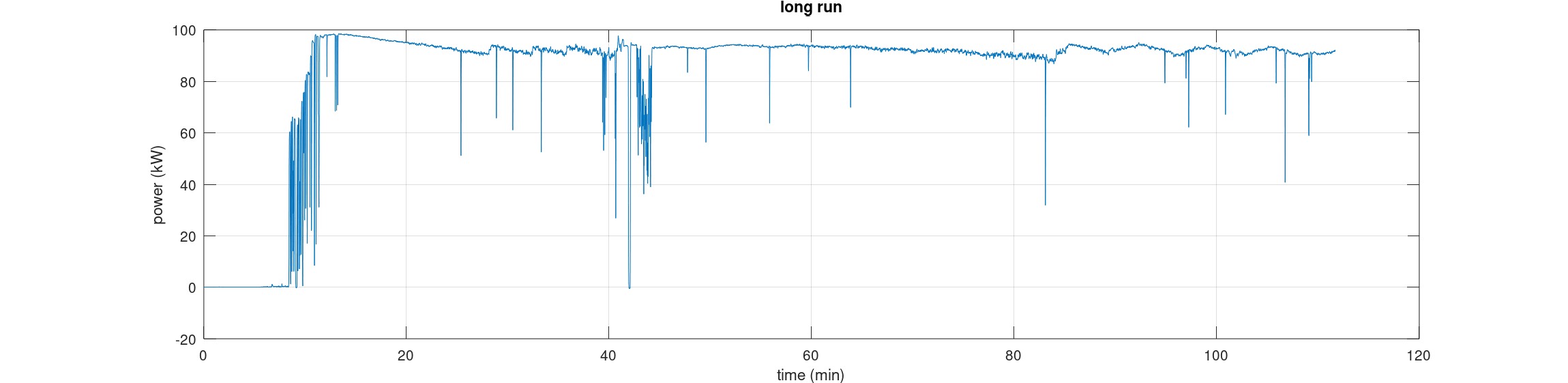
today, long run directly at full power (33% amplifier ratio) => 98kW in the FPC at the very begining of the run.
(P=0.05 / I=0.0005 / D=0.6)
10-40 min : almost misalignment effect (CEP did not change so much)
I increased 3 times the amplifier ratio to 34%, 35%, 36% to compensate the misalignment and keep the power almost constant.
then I did a full tuning (CEP + alignment)
45-110 min : misalignment effect after ~30min of warming up of the FPC => much more stable.
I corrected twice (@ 85min) the alignment to compensate a bit the power loss
globally, the FPC seems stable => all the lock losses come from the 20Hz noise and are recovered very quicly by the locking.
I never saw the high frequency noise which can produce long lock losses.
maybe it's time to add the gain x3 on the laser PZT channel to get some room on the 20Hz noise compensation.
| Ronic Chiche wrote: |
|
Today with Daniele, we did 6 long runs at different power (23kW, 46kW, 66kW, 73kW, 92kW, 92kW)
All the lock loss in between these several runs are due to FPC locking parameters change.
most of the few lock losses during the stable power duration, are due to 20Hz oscillation noise or because we forgot to center properly the PZT in its range (operator faults).
the 4 first runs (23kW, 46kW, 66kW, 73kW) are using the PID : (P=0.1 / I=0.0015 / D=1.5) without the additionnal optical attenuator placed after the diffuser.
the 5th run (92kW) is using the PID : (P=0.1 / I=0.0015 / D=1.5) with the additionnal optical attenuator placed after the diffuser.
the 6th run (92kW) is using the PID : (P=0.05 / I=0.0005 / D=0.6 and obviously a different diffuser position) with the additionnal optical attenuator placed after the diffuser.
surprisingly, we never saw any high frequency noise during the day !
to be noticed : the electron machine was OFF / the day was sunny without wind / almost nobody was working in the bunker.
|
|
| Attachment 1: 2025-07-10_-_long_run.png
|
 |
|
442
|
Thu Jul 10 18:33:48 2025 |
Ronic Chiche | Fixed | info | lasers and optics | detectors and electronics | ThomX igloo | New recipies with additionnal attenuation before the diffuser and new x3 amplifier on laser PZT |
With optical attenuation + x3 amplifier on laser PZT channel + feedback tuning
Temporary recipie for ~ 92kW power in the FP-cavity:
(in the previous scheme, without x3 laser PZT amp, a good lock was achieved for a PDH signal power noise ~ 70 mV rms)
- Alplhanov amplifier ratio : 34%
- Axis 18 position : +0016956 steps
- PID A (for laser/FPC lock) :
input : input a
P = 0.04
I = 0.0005
D = 0.48
Sign : positive
Sampling : fast
filter : off
criterion : input d
upper th. : 10V
lower th. : 0.03V
speed : 100V/s
relock mode : none
off mode : reset
range : 50%
offset : 5V
- PID B (for RF/FPC lock) :
input : input b
P = 1
I = 0.00005
D = 1
Sign : positive
Sampling : mid
filter : off
criterion : input c
upper th. : +0.4V
lower th. : -0.45V
speed : 1V/s
relock mode : none
off mode : reset
range : 50%
offset : 5V
| Ronic Chiche wrote: |
|
For ~ 92kW power in the FP-cavity:
- Alplhanov amplifier ratio : 33%
- Axis 18 position : +0003768 steps
- PID A (for laser/FPC lock) :
input : input a
P = 0.1
I = 0.0015
D = 1.5
Sign : positive
Sampling : fast
filter : off
criterion : input d
upper th. : 10V
lower th. : 0.05V
speed : 100V/s
relock mode : none
off mode : hold
range : 50%
offset : 5V
- PID B (for RF/FPC lock) :
input : input b
P = 5
I = 0.0001
D = 1
Sign : negative
Sampling : mid
filter : off
criterion : input c
upper th. : 0.45V
lower th. : -0.45V
speed : 1V/s
relock mode : none
off mode : hold
range : 20%
offset : 5V
|
|
|
443
|
Fri Jul 11 16:15:12 2025 |
Ronic Chiche | Fixed | info | lasers and optics | detectors and electronics | ThomX igloo | Tuning of the slow feeback loop analog BW + fast feedback loop gain + PID |
Today with Daniele, we tuned the potentiometer after the Laselock which drives the analog BW of the PID on the laser PZT,
and we tuned also the fast loop gain (with the rotary potentiometer dedicated to it) => the PID parameters have changed.
so, the recipies has changed => to be updated
the global observation with the x3 amplifier on the laser PZT channel, is the system is more noisy.
the maximum power for 33% amp ratio is now ~93kW instead of 97-98kW.
we tried this afternoon to do a long run with the RF and the FPC loops activated, but it seams that a lot of high frequency noise is present.
is it coming from the new parameters feedback setup or because of the electron machine which is ON ? |
|
448
|
Thu Aug 7 11:14:47 2025 |
Ronic Chiche | Fixed | info | lasers and optics | detectors and electronics | ThomX igloo | Alignment correction during the summer break |
I restarted the FPC system this morning.
after some classic alignement procedure (some LEFT steps on the cavity injection motors X & Y) and CEP tuning,
I got 92kW for 33% amplifier ratio.
the cavity was not particularely misaligned...
then I did a long run at 90kW with both feedbacks ON without any problem. |
|
451
|
Tue Sep 16 12:32:52 2025 |
Ronic Chiche | Fixed | info | lasers and optics | detectors and electronics | ThomX igloo | polarization measurement of the FP cavity beam |
today, with Daniele, we did a simple polarization measurement in transmission of the FP cavity beam.
1) we locked the FP cavity and measured 82.5kw (for 33% amplifier ratio) with the power-meter moved a little bit further (this is maybe the reason why the power is a little bit lower than usually measured).
2) then, we installed a high power PBS CCM1-PBS25-1064-HP(/M) with a transmission of 89% of the P-polarization @ 1030nm
We measured 66.5kW in transmission of the cube.
3) then we installed a half waveplate to find the optimum angle => 77kW measured at an angle of 342°
(almost no power has been observed in the vertical polarization state of the PBS).
Then we rotated the waveplate to find the previous measurement => 66.5kW at an angle of 348°
(we checked that adding the waveplate in the path almost does not change the measured power)
Conclusions :
- the FP cavity polarization is almost horizontal (P-polarization) and linear (77kW ~ 89%*82.5kW)
- the angle of the polarization is roughly 2*(348-342)° = 12°
|
|
457
|
Tue Sep 30 15:17:30 2025 |
Ronic Chiche | Fixed | issue | lasers and optics | detectors and electronics | ThomX igloo | High frequency noise |
Today, the lock of the FPC was particularly bad (maybe the worst ever seen), with a lot of high frequency noise.
the lock was impossible during several minutes !
we tried to switch off all the equipments of the machine, one by one without any effect on the lock.
at the end, we looked at the accelerometer installed inside the housing to check if there was some correlation.
and for the 1st time we clearly saw a 100% correlation beween the accelerometer signal with a noise oscillating above +/-300mV
but we didn't find the origin of this noise. |
|
458
|
Wed Oct 1 10:14:12 2025 |
Ronic Chiche | Fixed | issue | lasers and optics | detectors and electronics | ThomX igloo | High frequency noise |
At the end of the day, we found out what was the origin of this noise : some road renovation work with jackhammer and road roller just at the entrance of the "Igloo".
this origin was 100% correlated with a large increase of the accelerometer signal.
but we clearly saw that the FPC is much more sensitive than the accelerometer... the signal can have a small increase or just one peak and the cavity lock is lost.
then, we can make the assumption that all the "high frequency noise" which produces some lock losses could come from acoustic noise due to the road traffic or from the equipments in the bunker itself.
| Ronic Chiche wrote: |
|
Today, the lock of the FPC was particularly bad (maybe the worst ever seen), with a lot of high frequency noise.
the lock was impossible during several minutes !
we tried to switch off all the equipments of the machine, one by one without any effect on the lock.
at the end, we looked at the accelerometer installed inside the housing to check if there was some correlation.
and for the 1st time we clearly saw a 100% correlation beween the accelerometer signal with a noise oscillating above +/-300mV
but we didn't find the origin of this noise.
|
|
|
459
|
Tue Oct 28 10:07:48 2025 |
Ronic Chiche | Fixed | issue | lasers and optics | detectors and electronics | ThomX igloo | High frequency noise |
After this observation, we did a test with Daniele to try to correlate the road traffic in front of the Igloo with the lock losses observed on the FPC.
We didn't see any clear correlation. Cars or buses are not the direct origin of the FPC lock losses... only when some heavy load is hitting the building, we observed a clear correlation.
So, we still observed a lot of FPC lock losses when the day is windy...
One possible cause could be the large door of the igloo (~20 m²) hitting the Igloo when the day is windy.
I installed the accelerometer on the rail on the bottom of the large door to see if there is any correlation.
| Ronic Chiche wrote: |
|
At the end of the day, we found out what was the origin of this noise : some road renovation work with jackhammer and road roller just at the entrance of the "Igloo".
this origin was 100% correlated with a large increase of the accelerometer signal.
but we clearly saw that the FPC is much more sensitive than the accelerometer... the signal can have a small increase or just one peak and the cavity lock is lost.
then, we can make the assumption that all the "high frequency noise" which produces some lock losses could come from acoustic noise due to the road traffic or from the equipments in the bunker itself.
| Ronic Chiche wrote: |
|
Today, the lock of the FPC was particularly bad (maybe the worst ever seen), with a lot of high frequency noise.
the lock was impossible during several minutes !
we tried to switch off all the equipments of the machine, one by one without any effect on the lock.
at the end, we looked at the accelerometer installed inside the housing to check if there was some correlation.
and for the 1st time we clearly saw a 100% correlation beween the accelerometer signal with a noise oscillating above +/-300mV
but we didn't find the origin of this noise.
|
|
|
|
460
|
Tue Oct 28 17:31:47 2025 |
Ronic Chiche | Fixed | issue | lasers and optics | detectors and electronics | ThomX igloo | High frequency noise |
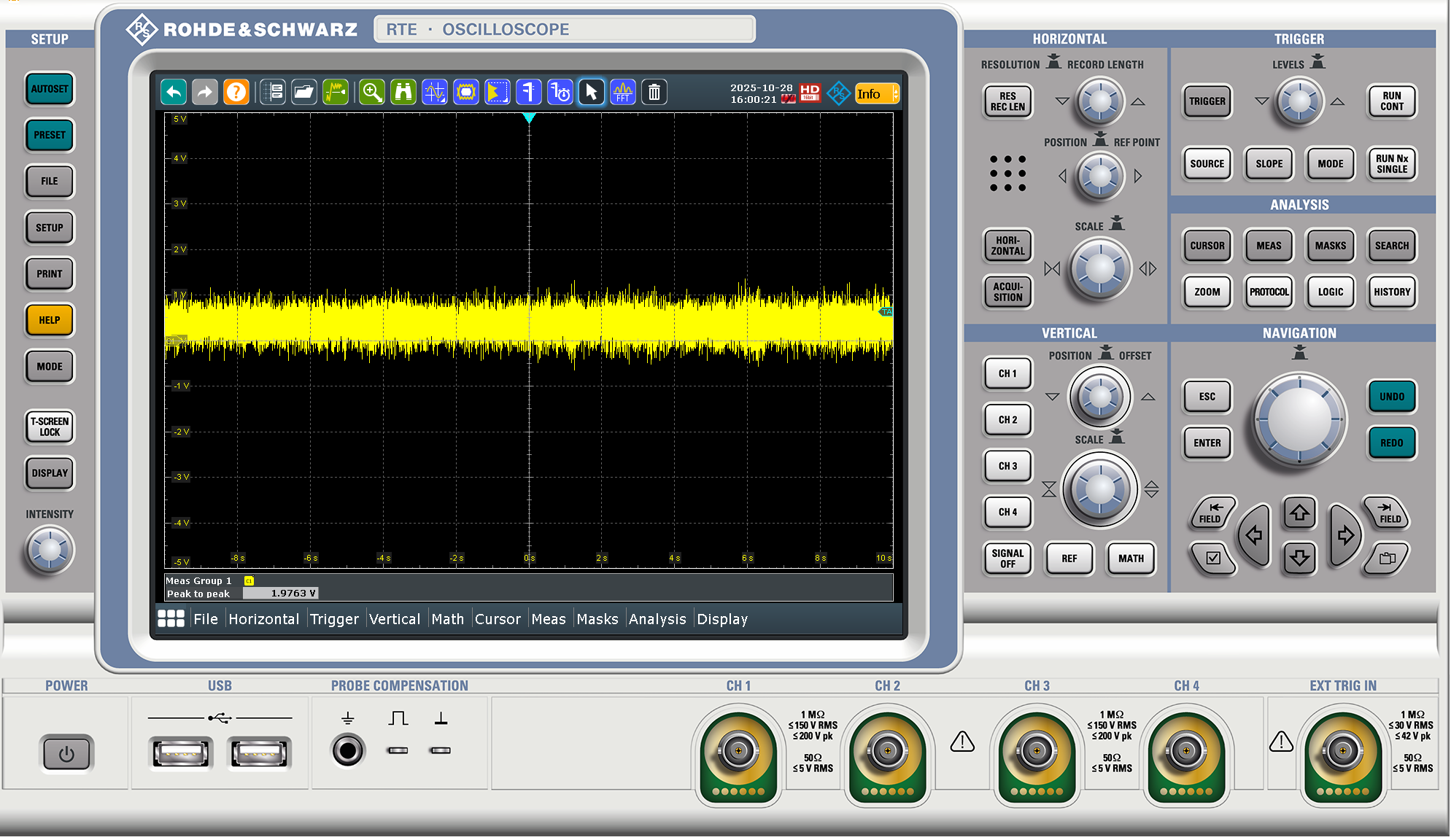
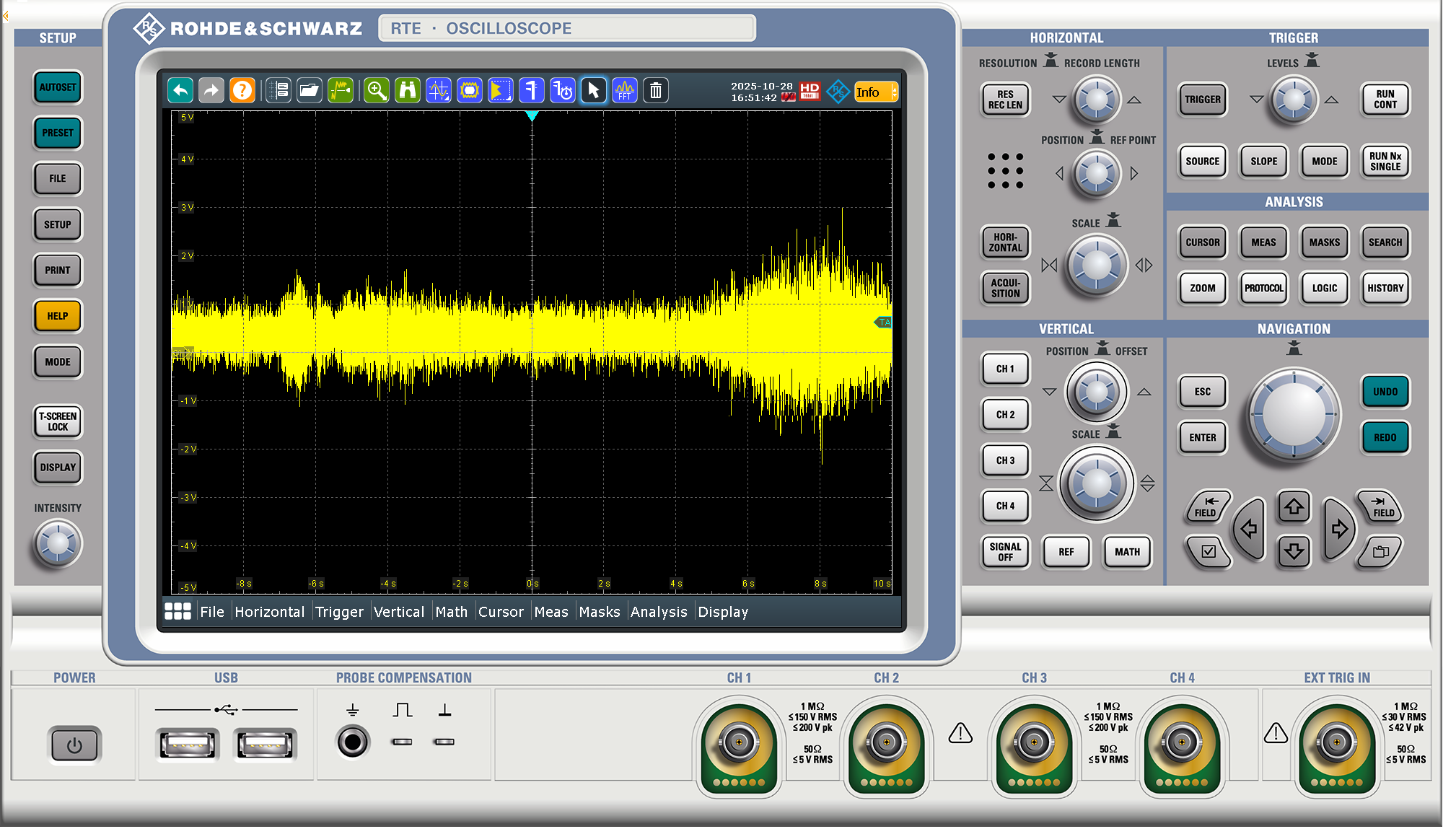
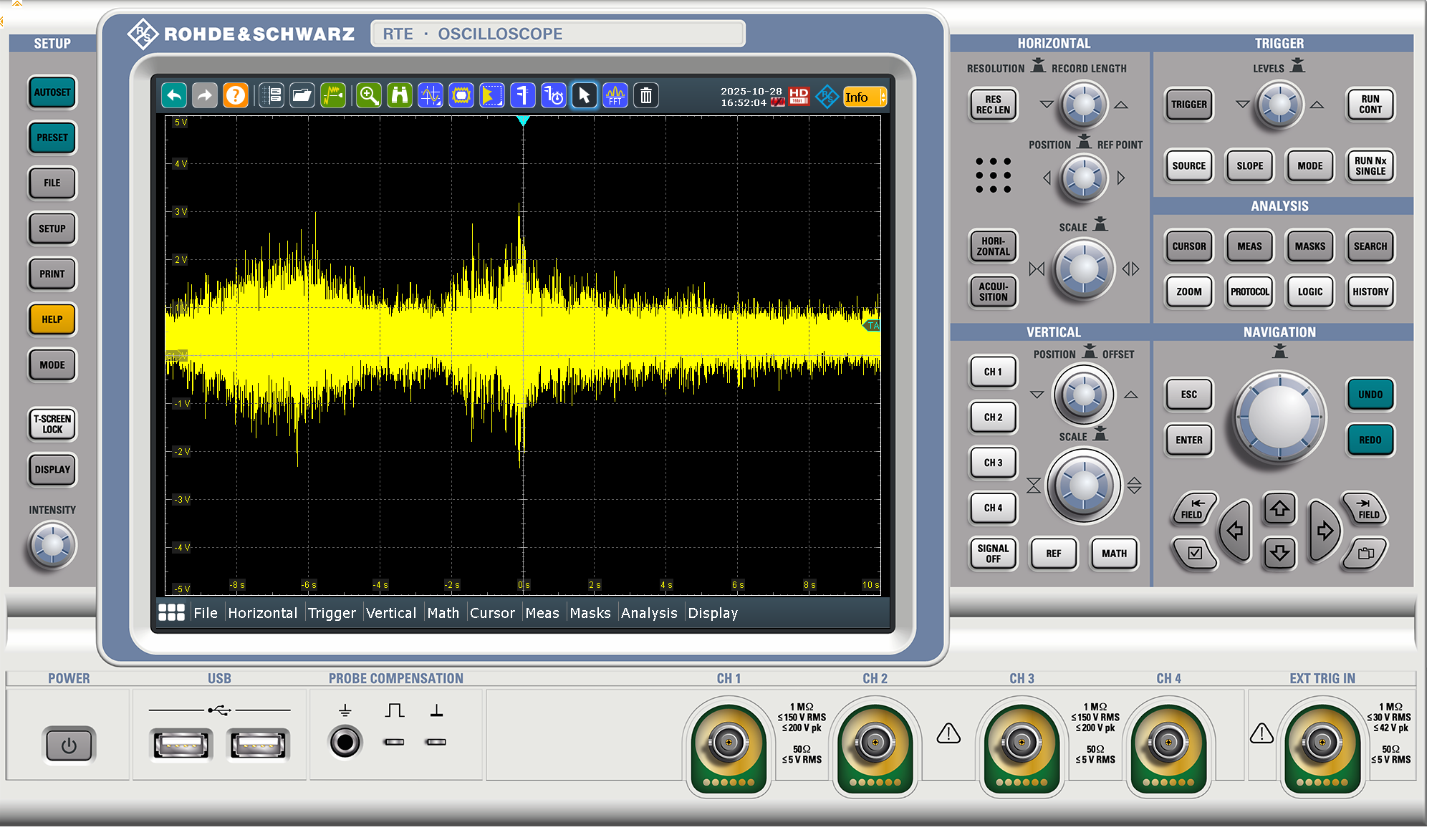
we did some tests with Marie to make some vibrations on the door.
below, I exhibit some pictures of the scope with the accelerometer plugged on it without or with noise...
this level of noise is not able to make the FPC loosing the lock.
even when saturating the noise signal on the accelerometer, the FPC is not loosing the lock all the time.
then, when a day is very windy, it's possible it could have some effect, but for a normal day, it's seems very doubtful that is the reason...
| Ronic Chiche wrote: |
|
After this observation, we did a test with Daniele to try to correlate the road traffic in front of the Igloo with the lock losses observed on the FPC.
We didn't see any clear correlation. Cars or buses are not the direct origin of the FPC lock losses... only when some heavy load is hitting the building, we observed a clear correlation.
So, we still observed a lot of FPC lock losses when the day is windy...
One possible cause could be the large door of the igloo (~20 m²) hitting the Igloo when the day is windy.
I installed the accelerometer on the rail on the bottom of the large door to see if there is any correlation.
| Ronic Chiche wrote: |
|
At the end of the day, we found out what was the origin of this noise : some road renovation work with jackhammer and road roller just at the entrance of the "Igloo".
this origin was 100% correlated with a large increase of the accelerometer signal.
but we clearly saw that the FPC is much more sensitive than the accelerometer... the signal can have a small increase or just one peak and the cavity lock is lost.
then, we can make the assumption that all the "high frequency noise" which produces some lock losses could come from acoustic noise due to the road traffic or from the equipments in the bunker itself.
| Ronic Chiche wrote: |
|
Today, the lock of the FPC was particularly bad (maybe the worst ever seen), with a lot of high frequency noise.
the lock was impossible during several minutes !
we tried to switch off all the equipments of the machine, one by one without any effect on the lock.
at the end, we looked at the accelerometer installed inside the housing to check if there was some correlation.
and for the 1st time we clearly saw a 100% correlation beween the accelerometer signal with a noise oscillating above +/-300mV
but we didn't find the origin of this noise.
|
|
|
|
| Attachment 1: Accelerometer_on_door_wo_noise.png
|
 |
| Attachment 2: Accelerometer_on_door_with_few_noise.png
|
 |
| Attachment 3: Accelerometer_on_door_with_few_noise2.png
|
 |
|
461
|
Mon Dec 1 18:03:29 2025 |
Ronic Chiche | Fixed | report | lasers and optics | detectors and electronics | ThomX igloo | Noise issue |
since several days, we see that the locking is more and more unstable and the lock duration was sometime less than 20-30 seconds !
1) I tried to optimize the feedback loops
I discovered that the gain on the fast loop on the laser EOM was very low and was almost uneffective for the global stability of the lock (I can remove the cable of the HV to EOM and it does not change the stability of the signals).
when I tried to increase this loop gain in open loop for the PZT loop, I clearly saw an improvement of the transmission signal stored in the cavity.
but when I close the PZT loop, it does not help to get a better locking.
so, at the end, I cancel this loop gain (HV amplifier for the EOM is OFF !) and only the slow feedback loop on the PZT is working.
I reduced the by a factor 2 the range on the PZT loop side to reduce the noise due to the amplified Laselock (voltage divider 1/2 before the HV amp for the PZT).
and I switched off the laser motor controller (Smaract MCS).
after optmization of the PID parameters, I was able to get back the 90kW we had in the past for 33% laser amp ratio and with a very good stability :
the transmission signal is a line and the reflection signal is almost a line too.
in this condition, I seems that I can lock the laser and the FPC indefinitely.
2) issue with Smaract controller
I put back the Smaract controller only for the CEP channel => one can clearly see a bit more noise on the PDH signal but the transmssion and the reflection signal stay almost the same with a very good stability.
then, I put back the Smaract controller for both channels (CEP and laser cavity length) => the lock was very bad, even after a PID optimization despite the fact it was a "Low Vibration" (LV) Smaract MCS controller.
we tried to change the 3-channels LV controller by a standard 3-channels (not LV) spare controller => it was OK for the CEP channel but not good at all the laser cavity length channel => very noisy.
so, we kept this standard controller for the CEP channel and we took 1-channel LV spare controller for the laser cavity length channel => it was ok. no more additionnal noise and we can work without delock in piezo-scan mode.
important parameters :
I used 1ms for hold time in the Smaract controller configuration.
I used 1V/s in piezo scan mode for the speed => it does affect the noise level when the piezo is moved !
3) IP Smaract controller parameters :
I used the MCSNetworkInterfaceConfig.exe software to configure both IP addresses of the 2 controllers.
it's easy, one just has to choose the options.
the IP address for controller ruling the laser cavity length is : 192.168.1.200:5000
the IP address for controller ruling the CEP is : 192.168.1.201:5000
4) final long run test
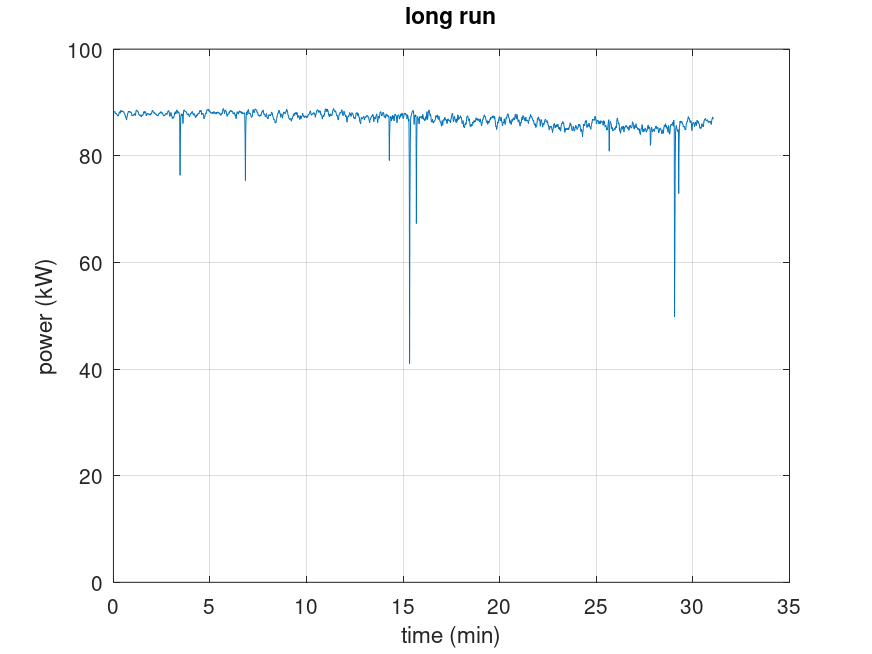
We did a 1/2h run test to check how many lock loss one gets... see the picture.
we had some few lock losses (with the RF feedback lock ON too) but most of the time, the RF phase was not lost and the X-rays should be continued to be produced.
a test should be done tomorrow.
|
| Attachment 1: 2025-12-01_-_long_run_few_delocks.png
|
 |
|
462
|
Wed Dec 3 16:23:40 2025 |
Ronic Chiche | Fixed | report | lasers and optics | detectors and electronics | ThomX igloo | Noise issue |
yesterday, in the same conditions, we had so many locking issues... exactly in the same way than before. :-(
so we still have "locking issues" depending on something we didn't find...
today, we removed the "1/2 voltage divider" before the PZT amplifier to get back the full dynamic.
we have a little bit more noise and we lose some power on transmission (85kW instead of 90kW) but it worked pretty well.
we had quite long X-rays runs ~ 20 minutes without any lock losses => see the picture.
but we have to keep in mind that maybe it was just a "good" day and an another day can be "bad".
we still have to understand where do these perturbations come from.
the good news is we brought back the previous setting of the FPC.
| Ronic Chiche wrote: |
|
since several days, we see that the locking is more and more unstable and the lock duration was sometime less than 20-30 seconds !
1) I tried to optimize the feedback loops
I discovered that the gain on the fast loop on the laser EOM was very low and was almost uneffective for the global stability of the lock (I can remove the cable of the HV to EOM and it does not change the stability of the signals).
when I tried to increase this loop gain in open loop for the PZT loop, I clearly saw an improvement of the transmission signal stored in the cavity.
but when I close the PZT loop, it does not help to get a better locking.
so, at the end, I cancel this loop gain (HV amplifier for the EOM is OFF !) and only the slow feedback loop on the PZT is working.
I reduced the by a factor 2 the range on the PZT loop side to reduce the noise due to the amplified Laselock (voltage divider 1/2 before the HV amp for the PZT).
and I switched off the laser motor controller (Smaract MCS).
after optmization of the PID parameters, I was able to get back the 90kW we had in the past for 33% laser amp ratio and with a very good stability :
the transmission signal is a line and the reflection signal is almost a line too.
in this condition, I seems that I can lock the laser and the FPC indefinitely.
2) issue with Smaract controller
I put back the Smaract controller only for the CEP channel => one can clearly see a bit more noise on the PDH signal but the transmssion and the reflection signal stay almost the same with a very good stability.
then, I put back the Smaract controller for both channels (CEP and laser cavity length) => the lock was very bad, even after a PID optimization despite the fact it was a "Low Vibration" (LV) Smaract MCS controller.
we tried to change the 3-channels LV controller by a standard 3-channels (not LV) spare controller => it was OK for the CEP channel but not good at all the laser cavity length channel => very noisy.
so, we kept this standard controller for the CEP channel and we took 1-channel LV spare controller for the laser cavity length channel => it was ok. no more additionnal noise and we can work without delock in piezo-scan mode.
important parameters :
I used 1ms for hold time in the Smaract controller configuration.
I used 1V/s in piezo scan mode for the speed => it does affect the noise level when the piezo is moved !
3) IP Smaract controller parameters :
I used the MCSNetworkInterfaceConfig.exe software to configure both IP addresses of the 2 controllers.
it's easy, one just has to choose the options.
the IP address for controller ruling the laser cavity length is : 192.168.1.200:5000
the IP address for controller ruling the CEP is : 192.168.1.201:5000
4) final long run test
We did a 1/2h run test to check how many lock loss one gets... see the picture.
we had some few lock losses (with the RF feedback lock ON too) but most of the time, the RF phase was not lost and the X-rays should be continued to be produced.
a test should be done tomorrow.
|
|
| Attachment 1: Screenshot_2025-12-03_15-36-59.png
|
 |
|
463
|
Mon Dec 8 11:17:17 2025 |
Ronic Chiche | Fixed | issue | lasers and optics | detectors and electronics | ThomX igloo | High frequency noise |
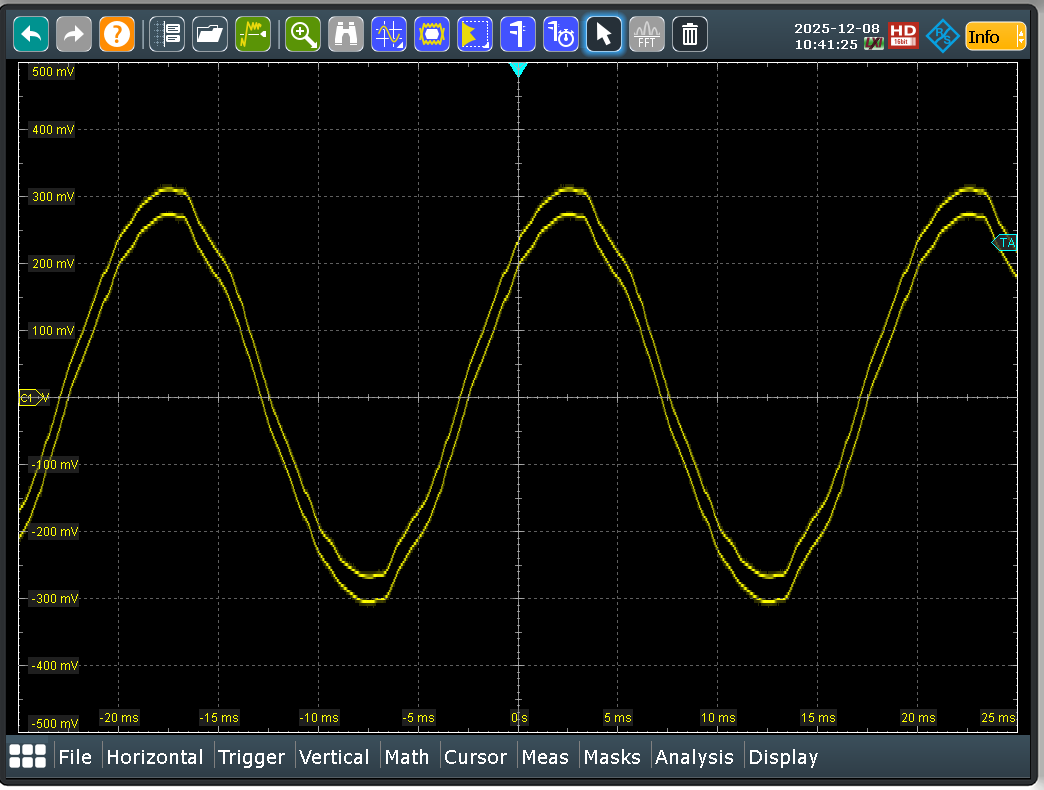
This morning, I installed a high-voltage probe (1:1000) on the AC-line to see if one could detect a correlation between lock losses and AC-line voltage variations.
I observed many lock losses but without any variation or correlation of the AC-line signal (scope set in "peak detect" with "envelope" arithmetics).
see attached figure.
| Ronic Chiche wrote: |
|
we did some tests with Marie to make some vibrations on the door.
below, I exhibit some pictures of the scope with the accelerometer plugged on it without or with noise...
this level of noise is not able to make the FPC loosing the lock.
even when saturating the noise signal on the accelerometer, the FPC is not loosing the lock all the time.
then, when a day is very windy, it's possible it could have some effect, but for a normal day, it's seems very doubtful that is the reason...
| Ronic Chiche wrote: |
|
After this observation, we did a test with Daniele to try to correlate the road traffic in front of the Igloo with the lock losses observed on the FPC.
We didn't see any clear correlation. Cars or buses are not the direct origin of the FPC lock losses... only when some heavy load is hitting the building, we observed a clear correlation.
So, we still observed a lot of FPC lock losses when the day is windy...
One possible cause could be the large door of the igloo (~20 m²) hitting the Igloo when the day is windy.
I installed the accelerometer on the rail on the bottom of the large door to see if there is any correlation.
| Ronic Chiche wrote: |
|
At the end of the day, we found out what was the origin of this noise : some road renovation work with jackhammer and road roller just at the entrance of the "Igloo".
this origin was 100% correlated with a large increase of the accelerometer signal.
but we clearly saw that the FPC is much more sensitive than the accelerometer... the signal can have a small increase or just one peak and the cavity lock is lost.
then, we can make the assumption that all the "high frequency noise" which produces some lock losses could come from acoustic noise due to the road traffic or from the equipments in the bunker itself.
| Ronic Chiche wrote: |
|
Today, the lock of the FPC was particularly bad (maybe the worst ever seen), with a lot of high frequency noise.
the lock was impossible during several minutes !
we tried to switch off all the equipments of the machine, one by one without any effect on the lock.
at the end, we looked at the accelerometer installed inside the housing to check if there was some correlation.
and for the 1st time we clearly saw a 100% correlation beween the accelerometer signal with a noise oscillating above +/-300mV
but we didn't find the origin of this noise.
|
|
|
|
|
| Attachment 1: AC-line.png
|
 |