| ID |
Date |
Author |
Status |
Type |
Category |
Location |
Title |
|
2
|
Thu Sep 27 15:43:48 2018 |
Ronic Chiche | Fixed | info | lasers and optics | Optical room | Onefive Origami 33MHz specs - Polarisation |
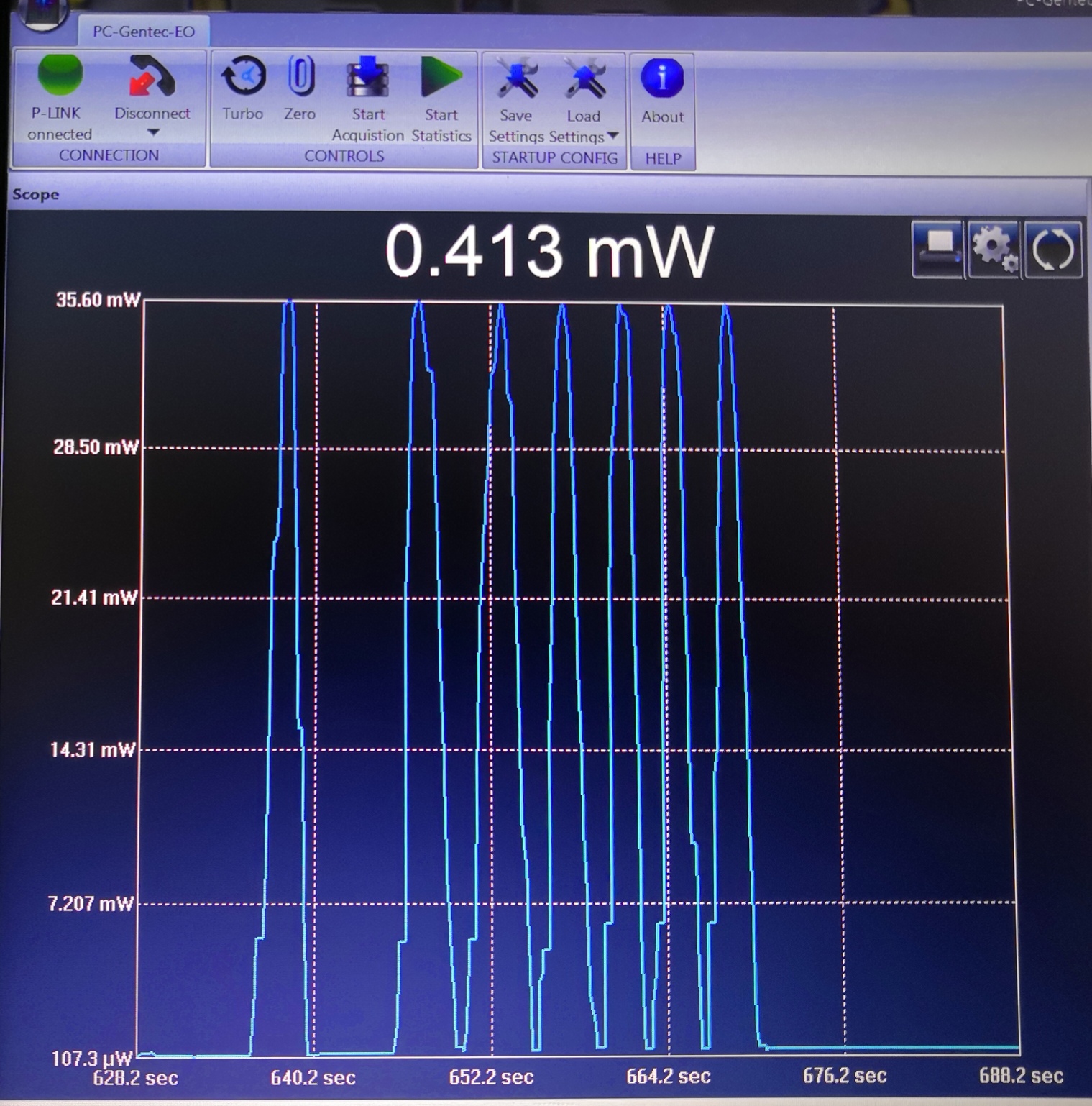
one rotate a lambda/2 before a PBS and meausure the refected power:
Pmax=35.6 mW
Pmin=107 µW
Ellipticity ~ 3 per mille
|
| Attachment 1: polar_onefive_33MHz_polarisation.jpg
|
 |
|
3
|
Tue Oct 2 16:23:54 2018 |
Ronic Chiche | Fixed | issue | mechanics | cabling | software | Optical room | test des vérins ISP |
* les vérins de 20mm (axe Z) ont été testés sur table grace à une rallonge SUB-C - DB9, au chassis ISP et au soft SUPERVISEUR écrit en labwindows CVI par Didier.
pour rappel, la course soft va de -1 650 000 à +1 650 000 pour 20mm de course, soit 0.6mm pour 100 000 de course soft.
ils ont été réglés en positions minimale (-1 650 000) pour que Yann puisse les intégrer facilement dans le chassis mécanique.
* une fois installés dans la capsule, les signaux passent par le feedthrough de la capsule.
MAIS cette capsule a vocation a être intégrée au chassis mécanique, intégré lui-même dans une enceinte et les signaux passent alors par un autre feedthrough, celui de l'enceinte.
Il faut donc IMPERATIVEMENT ce feedthrough (ou l'effet miroir qu'il produit) pour tester correctement les vérins dans leur capsule ! |
|
4
|
Tue Oct 2 18:00:36 2018 |
Ronic Chiche | Fixed | issue | mechanics | cabling | software | Optical room | test des vérins ISP |
| Ronic Chiche wrote: |
|
* les vérins de 20mm (axe Z) ont été testés sur table grace à une rallonge SUB-C - DB9, au chassis ISP et au soft SUPERVISEUR écrit en labwindows CVI par Didier.
pour rappel, la course soft va de -1 650 000 à +1 650 000 pour 20mm de course, soit 0.6mm pour 100 000 de course soft.
ils ont été réglés en positions minimale (-1 650 000) pour que Yann puisse les intégrer facilement dans le chassis mécanique.
* une fois installés dans la capsule, les signaux passent par le feedthrough de la capsule.
MAIS cette capsule a vocation a être intégrée au chassis mécanique, intégré lui-même dans une enceinte et les signaux passent alors par un autre feedthrough, celui de l'enceinte.
Il faut donc IMPERATIVEMENT ce feedthrough (ou l'effet miroir qu'il produit) pour tester correctement les vérins dans leur capsule !
|
|
| Attachment 1: CABLAGE_VERINS.pdf
|
|
5
|
Wed Oct 3 11:28:46 2018 |
Ronic Chiche | Fixed | report | mechanics | cabling | Optical room | test des vérins ISP 20mm et 6mm |
Après avoir utilisé la chaine : driver ISP - cable ISP DB9 - Feedthrough enceinte DB9-DB9 - cable perlé DB9-SUB-C - Capsule SUB-C,
l'ensemble de tous les vérins 6mm et 20mm ont été testés => ils fonctionnent TOUS.
Les vérins 6mm ont TOUS subis un HOME. cette commande cherche une fin de course du vérin et le place ensuite en position médianne.
Au niveau soft, la course d'un vérin 6mm va de -22 000 à +22 000. Après un HOME, chaque vérin est postionné à la valeur 0. |
|
6
|
Fri Oct 5 10:17:30 2018 |
Ronic Chiche | Fixed | report | mechanics | cabling | Optical room | test des vérins ISP 20mm et 6mm |
| Ronic Chiche wrote: |
|
Après avoir utilisé la chaine : driver ISP - cable ISP DB9 - Feedthrough enceinte DB9-DB9 - cable perlé DB9-SUB-C - Capsule SUB-C,
l'ensemble de tous les vérins 6mm et 20mm ont été testés => ils fonctionnent TOUS.
Les vérins 6mm ont TOUS subis un HOME. cette commande cherche une fin de course du vérin et le place ensuite en position médianne.
Au niveau soft, la course d'un vérin 6mm va de -22 000 à +22 000. Après un HOME, chaque vérin est postionné à la valeur 0.
|
Précision : le HOME sur les vérins de 6mm place AUTOMATIQUEMENT le vérin en position médianne après avoir atteint une fin de course (FDC)
Pour les vérins de 20mm, la commande HOME place le vérin sur sa FDC positive : +1 650 000 mais NE DEPLACE PAS ensuite automatiquement le vérin en position médiane.
Il faut le faire de façon manuelle.
Tous les vérins 20mm vont subir un HOME et être placés manuellement en position 0.
Il faut ensuite leurs envoyer un offset +825 000 ou -825 000 selon les vérins pour que la cavité ait une conformation rectangulaire.
(actuellement elle ne l'est pas à cause de cales de longueurs différentes selon les axes pour anticiper les effets thermiques à compenser ultérieurement).
|
|
7
|
Mon Oct 22 11:03:22 2018 |
Ronic Chiche | Fixed | info | vacuum | Optical room | Détection de fuite |
Mail de Bruno Mercier du 18/10/2018 :
Un petit CR de la journée:
Nous avons effectué une détection de fuite sur l'ensemble des cavités optiques. Une fuite très importante a été localisée au niveau de la bride de la Pompe ionique (PI) située sur la deuxième cavité optique par rapport à l'entrée de la salle blanche.
Manu a démonté la PI , la fuite provenait du fait que le joint n'était pas tout à fait centré. Après un remontage de la PI, une nouvelle détection a été faite:
détection d'une fuite sur la bride avec les sorties Sub-d M4 après resserrage c'est OK.
Détection d'une fuite sur la bride de sortie DN200 avec hublots de la cavité 1 après resserrage c'est OK.
Demain et le début de la semaine prochaine sera consacré à la mise en place de l'étuvage, puis de la descente en pression avec pompage ionique.
bonne fin de journée,
Bruno |
|
8
|
Mon Oct 22 11:27:35 2018 |
Ronic Chiche | Fixed | info | mechanics | Optical room | Remontage mécanique |
Mail de Yann du 12/10/2018 :
Je vous fais le bilan des actions effectuées :
1/ La mécanique a été remontée avec changement des billes céramiques, soufflet défectueux, ect...
2/ Test et mise en place des vérins en position
3/ nettoyage des chambres et insertions de la méca
4/ connectorisation des câbles perlés et test des vérins par le soft
5/ fermeture des brides
6/ nettoyage du marbre et de la zone
On est donc prêt pour les test de vide et d'étuvage.
RAPPEL pour tous :
Des nouvelles combinaisons propres sont à disposition (on ne sort pas du flux avec la combi !)
Mettre MASQUE / CHARLOTTE / COMBI / GANTS !
Ne pas rentrer de CARTONS ou autres sources de pollution.
NETTOYER les outils ou objets à rentrer dans la zone
RANGER après les manips. |
|
9
|
Mon Oct 22 11:29:41 2018 |
Ronic Chiche | Fixed | info | mechanics | Optical room | Remontage des vérins |
Mail de Yann du 8/10/2018 :
Bonjour,
Tous les vérins sont maintenant OK ! Merci Ronic.
La cavité a été réglé en mode nominal (tilt à +2/-2 et Z à +5/-15 ou -5/+15).
Demain avec Christopher on remet tous dans les enceintes à vide.
Du coup, Patrick tu pourras ré-connecter les câbles céramique (à partir de demain apres midi).
On est dans les temps pour des tests de vide et d'étuvage a partir de lundi prochain.
A+
Yann. |
|
10
|
Mon Nov 26 15:18:49 2018 |
Ronic Chiche | Fixed | info | vacuum | Optical room | Etuvage cavité THOMX |
Mail de Bruno Mercier du 19/11/2018 :
Une première cavité a été étuvée, la pression est actuellement de
3.10-10 mbar, l' étuvage de la deuxième cavité vient de commencer et se
finira en début de la semaine prochaine.

Bonne journée,
Bruno
|
|
24
|
Fri Mar 29 18:33:15 2019 |
Ronic Chiche | Fixed | issue | mechanics | lasers and optics | Optical room | Alignment procedure |
we did again the complete alignment procedure starting with iris and optimizing injection motors Ma and Mb, then installing mirror S2, S3, P4 and P1, optimizing thetaX and thetaY axis for each motor.
everything was fine until we installed P1. we tried to optimize thetaX and thetaY of P1 and we clearly observed a strange motion when doing that :
- for thetaX axis, steps in one direction seem to have a different length from steps in reverse direction.
- for thetaY axis, trying to move in one direction, makes sometime a motion in the reverse direction.
at this moment, it is difficult to say if the problem comes from the controller, the mirror mount or the motor itself.
if both axis are concerned on the same mirror (P1), maybe the problem comes from the mount... to be continued on Monday.
|
|
38
|
Thu May 23 10:10:56 2019 |
Ronic Chiche | Fixed | report | lasers and optics | Optical room | Finesse measurement by decay time technique |
5 Files attached:
- Note on the technique and results for the present cavity on 2019, May 21th : F ~ 18 000
- 2Tektronix scope raw data
- 2 matlab files to fit the scope raw data and extract the Finesse |
| Attachment 1: 2019-05-21_-_Finesse_measurement_by_decay_time_technique.docx
|
| Attachment 2: tek0005CH1.isf
|
| Attachment 3: tek0006CH1.isf
|
| Attachment 4: plotdata.m
|
clear
clc

global datacut tcut Trt

[h,data]=myisfread('tek0005CH1.isf');
dt=h.Xincr;
Nt=h.Npoints;
t=0:dt:(Nt-1)*dt;
t=t';

% offset removing
offset=mean(data(0.9*Nt:Nt));
data=data-offset;

% magnitude calculation
datamax=mean(data(1:0.1*Nt));

% cuting data to remove constant part at the beginning of the signal
% and where log(data) becomes complex (signal close to zero is sometime negative)
id1=find(data<0.967*datamax);
id2=find(imag(log(data))~=0);
tcut=t(id1(1):id2(1)-1);
datacut=data(id1(1):id2(1)-1);

%fit
L=9;
c=3e8;
Trt=L/c;
rho=1-1.5e-4;
k=1-15e-4;
pc0=0.14;
t0=2e-3;
x0=[rho k pc0 t0];

options = optimset('Display','iter','PlotFcns',@optimplotfval,'TolX',1e-7,'TolFun',1e-7);
x=fminsearch('myerror',x0,options);

rho=x(1);
k=x(2);
pc0=x(3);
t0=x(4);
datafit=pc0/(rho-k)^2*((1-k)*rho.^((tcut-t0)/Trt)-(1-rho)*k.^((tcut-t0)/Trt)).^2;

%%
figure(1)
clf
plot(t*1e3,data)
grid on
xlabel('Time (ms)')
ylabel('Transmited power (A.U)')

figure(2)
clf
plot(tcut*1e3,log(datacut))
hold on
plot(tcut*1e3,log(datafit),'.')
grid on
xlabel('Time (ms)')
ylabel('Log(Transmited power) (A.U)')
legend('data','fit')

Tpin=Trt/2/abs(log(k));
Tcav=Trt/2/abs(log(rho));
F=2*pi*Tcav/Trt;

disp(['Finesse                 : ' num2str(F)])
disp(['Cavity decay time : ' num2str(Tcav*1e6) ' µs'])
disp(['Pin sw decay time : ' num2str(Tpin*1e6) ' µs'])
|
| Attachment 5: myerror.m
|
function [ output ] = myerror( x )
%MYERROR Summary of this function goes here
%   Detailed explanation goes here

global tcut datacut Trt

rho=x(1);
k=x(2);
pc0=x(3);
t0=x(4);

mydata=pc0/(rho-k)^2*((1-k)*rho.^((tcut-t0)/Trt)-(1-rho)*k.^((tcut-t0)/Trt)).^2;
output=sum((mydata-datacut).^2);

end
|
|
46
|
Thu Jul 4 10:17:46 2019 |
Ronic Chiche | Fixed | info | detectors and electronics | Optical room | New design for PDH boxes |
A new design has been studied for the 5 PDH boxes to better match the low (33MHz) repetition rate of the ThomX laser.
the 5 PDH boxes have been modified and tested (see the attached report).
A mixer has been integrated to the PDH box for a more simple use.
the PDH N°1 has been lend to Huan for her experiment in China. |
| Attachment 1: 2019-06-14_-_PDH_Maurice_modifié.pdf
|
|
50
|
Fri Aug 30 09:44:56 2019 |
Ronic Chiche | Fixed | report | lasers and optics | Optical room | Finesse measurement after mirror cleaning using the spin coater |
Last Finesse measurement in air : ~ 17 000 the 20th of may (see logbook)
28th and 29th of august, we cleanned, with Loïc, mirrors S3 then P1 successively using only ultra pure water with the spin coater.
we measured the finesse after each cleaning by modulation technique and in both cases, F ~ 12 500 !!!
maybe the mirror surfaces have been covered by some hydrocarbure during the summer ?
or by an other contaminant which is difficult to clean with only water ?
we decided to clean the mirrors first with an isopropanol solution and then with ultra pure water and the spin coater. |
|
51
|
Fri Aug 30 17:46:15 2019 |
Ronic Chiche | Fixed | report | lasers and optics | Optical room | Finesse measurement after mirror cleaning using the spin coater |
today I cleaned S3 with isopropanol and then with pure water on spin coater.
Finesse is only 10 700.(coupling 50% ? => to be confirmed...)
maybe we have to redo the procedure with a different way of cleanig (pushing less on the mirror ... ?)
| Ronic Chiche wrote: |
|
Last Finesse measurement in air : ~ 17 000 the 20th of may (see logbook)
from 28th to 30th of august, we cleanned, with Loïc, mirrors S3 then P1 successively using only ultra pure water with the spin coater.
we measured the finesse after each cleaning by modulation technique and in both cases, the finesse did not change !
maybe the mirror surfaces have been covered by some hydrocarbure during the summer ?
or by an other contaminant which is difficult to clean with only water ?
we decided to clean the mirrors first with an isopropanol solution and then with ultra pure water and the spin coater.
|
|
|
52
|
Fri Aug 30 17:52:41 2019 |
Ronic Chiche | Fixed | issue | mechanics | detectors and electronics | Optical room | Motor issue |
Today, Axis 9 (Z-axis of P1) has blocked the software which drives all the motors.
impossible to bypass the problem.
I had to :
- switch off the motor driver crate n°2 (motors 9-16)
- disconnect all motor cables (9-16)
- reconnect only cables 15 and 16.(same internal board of crate n°2)
- restart the software to test that, now, the software launches properly
and I did again the procedure with connecting all motor cables |
|
53
|
Tue Sep 3 17:51:04 2019 |
Ronic Chiche | Fixed | issue | mechanics | lasers and optics | vacuum | Optical room | Vessel cleanliness |
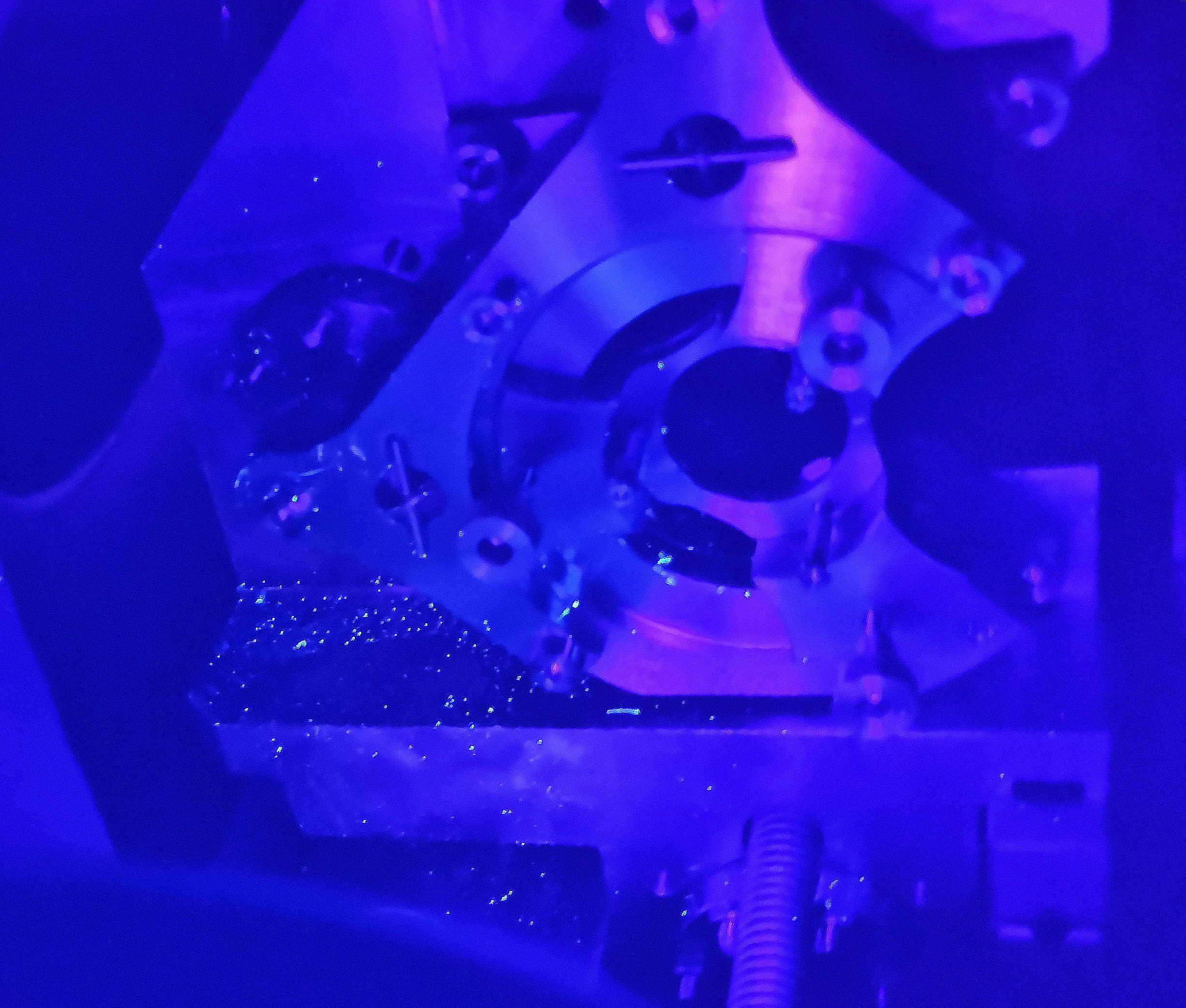
looking in the vessel of the FP cavity using a UV lamp shows a lot of dust... more dust than outside the cavity !!!
here is picture where one can see a cleaned zone using a finger (with gloves).
question : where does come from this dust ?
2 possibilities :
- large and small belows which could trap the dust and release it during the pumping process
- ionic pumps could release some clusters when they are working.
we plan to clean as effectively as possible the inner surfaces, to close bellows, make woking ion pumps to check if it released again some dust. |
| Attachment 1: IMG_20190903_161910.jpg
|
 |
|
54
|
Tue Sep 3 18:04:03 2019 |
Ronic Chiche | Fixed | report | lasers and optics | Optical room | Finesse measurement after mirror cleaning using the spin coater |
Following finesse measurements (start @10700):
Clean P1 with SC (water) + isoprop (wipe) finesse @15000
Clean S2 with SC (water) + isoprop (wipe) finesse @13000
Clean P4 with SC (water) + isoprop (wipe) finesse @11000
We have to take into account that "cleaning" the mirror change the alignment axis in the cavity so the finesse can change because of that. It would explain the erratic nature of these results which seem to not show any effective cleaning.
| Ronic Chiche wrote: |
|
today I cleaned S3 with isopropanol and then with pure water on spin coater.
Finesse is only 10 700.(coupling 50% ? => to be confirmed...)
maybe we have to redo the procedure with a different way of cleanig (pushing less on the mirror ... ?)
| Ronic Chiche wrote: |
|
Last Finesse measurement in air : ~ 17 000 the 20th of may (see logbook)
from 28th to 30th of august, we cleanned, with Loïc, mirrors S3 then P1 successively using only ultra pure water with the spin coater.
we measured the finesse after each cleaning by modulation technique and in both cases, the finesse did not change !
maybe the mirror surfaces have been covered by some hydrocarbure during the summer ?
or by an other contaminant which is difficult to clean with only water ?
we decided to clean the mirrors first with an isopropanol solution and then with ultra pure water and the spin coater.
|
|
|
|
59
|
Wed Sep 25 15:49:28 2019 |
Ronic Chiche | Fixed | issue | mechanics | detectors and electronics | Optical room | Motor issue |
Today again, same problem with axis 9 blocking the controlling software during the mirror alignment procedure.
after opening the motor 9-16 controlling crate, we saw 2 screws (RX- and TX+ of the controller) which were badly screwed.
we firmly screwed them... could it be the cause ?
after reconnecting everything, the software launches properly... and everything is back to work... wait and see.
| Ronic Chiche wrote: |
|
Today, Axis 9 (Z-axis of P1) has blocked the software which drives all the motors.
impossible to bypass the problem.
I had to :
- switch off the motor driver crate n°2 (motors 9-16)
- disconnect all motor cables (9-16)
- reconnect only cables 15 and 16.(same internal board of crate n°2)
- restart the software to test that, now, the software launches properly
and I did again the procedure with connecting all motor cables
|
|
|
61
|
Fri Sep 27 16:17:36 2019 |
Ronic Chiche | Fixed | info | lasers and optics | Optical room | Finesse measurement |
After mirrors were going back from LMA for cleaning and thermal anealing, they have been installed in FP cavity for Finesse measurement.
after getting strange results when the cavity is closed (very low Finesse...maybe too much ethanol inside cavity procucing some lineic losses), we get 12k-12k5 Finesse with primary vacuum (~4 mbar) and a clean lock (very flat transmission signal and quite noiseless reflection signal)
we let the cavity pumped all the WE to see if we can measure a difference or not at lower pressure. |
|
63
|
Mon Sep 30 11:30:32 2019 |
Ronic Chiche | Fixed | info | lasers and optics | Optical room | Finesse measurement |
To complete these observations:
Finesse has been measured on thursday, right after cleaning the cavity with ethanol @6000.
Finesse has been measured on friday, after opening the cavity for few tens of minutes @12000-12500. The cavity was openned while locking and the transmission was continuously and ~linearly increasing.
Finesse has been measured today after ~50h pumping with primary vacuum @17000. It's back to the highest value we've ever measured on this cavity.
Parameters @17000 finesse:
Input power: 7.85 mW (Koheras + AOM + 2*EOM)
Coupling: 70-75% => Pin ~ 5.9 mW
Transmission through S2 and P4: 50 µW (transmission estimated to 1.5 ppm) => Pcav ~ 33 W => G ~ 5600
It is compatible with a simulation with nominal parameters for mirrors and adding 47ppm by mirror of losses (absorption and scattering) which indicates 17k of Finesse and 4100 of power gain.
in this simulation, the coupling should be 94% instead of the 70-75% measured. It is possible that the losses (47 ppm) are not the same on all mirrors.
| Ronic Chiche wrote: |
|
After mirrors were going back from LMA for cleaning and thermal anealing, they have been installed in FP cavity for Finesse measurement.
after getting strange results when the cavity is closed (very low Finesse...maybe too much ethanol inside cavity procucing some lineic losses), we get 12k-12k5 Finesse with primary vacuum (~4 mbar) and a clean lock (very flat transmission signal and quite noiseless reflection signal)
we let the cavity pumped all the WE to see if we can measure a difference or not at lower pressure.
|
|