| ID |
Date |
Author |
Status |
Type |
Category |
Location |
Title |
|
72
|
Thu Oct 10 17:51:26 2019 |
Ronic Chiche | Fixed | issue | lasers and optics | detectors and electronics | Optical room | First Lock with 2nd satge of amplifier : Finesse issue ? |
1st lock today with the second stage of the amplifier.
~ 300mW of injected power (but which proportion of the pump and of the signal ? => One must use a spectrometer to determine this proportion)
MAYBE the real injected power of the signal is lower => maybe the Finesse is higher !
Coupling ~ 75%
1.2 mW measured in transmission => ~800W inside the FP cavity
=> Gain ~ 3500 => Finesse ~ 11k !!!
Last Finesse measurement was about 19k ! :-( |
|
73
|
Thu Oct 10 18:03:10 2019 |
Ronic Chiche | Fixed | issue | mechanics | Optical room | First Lock with 2nd satge of amplifier : Motor issue ? |
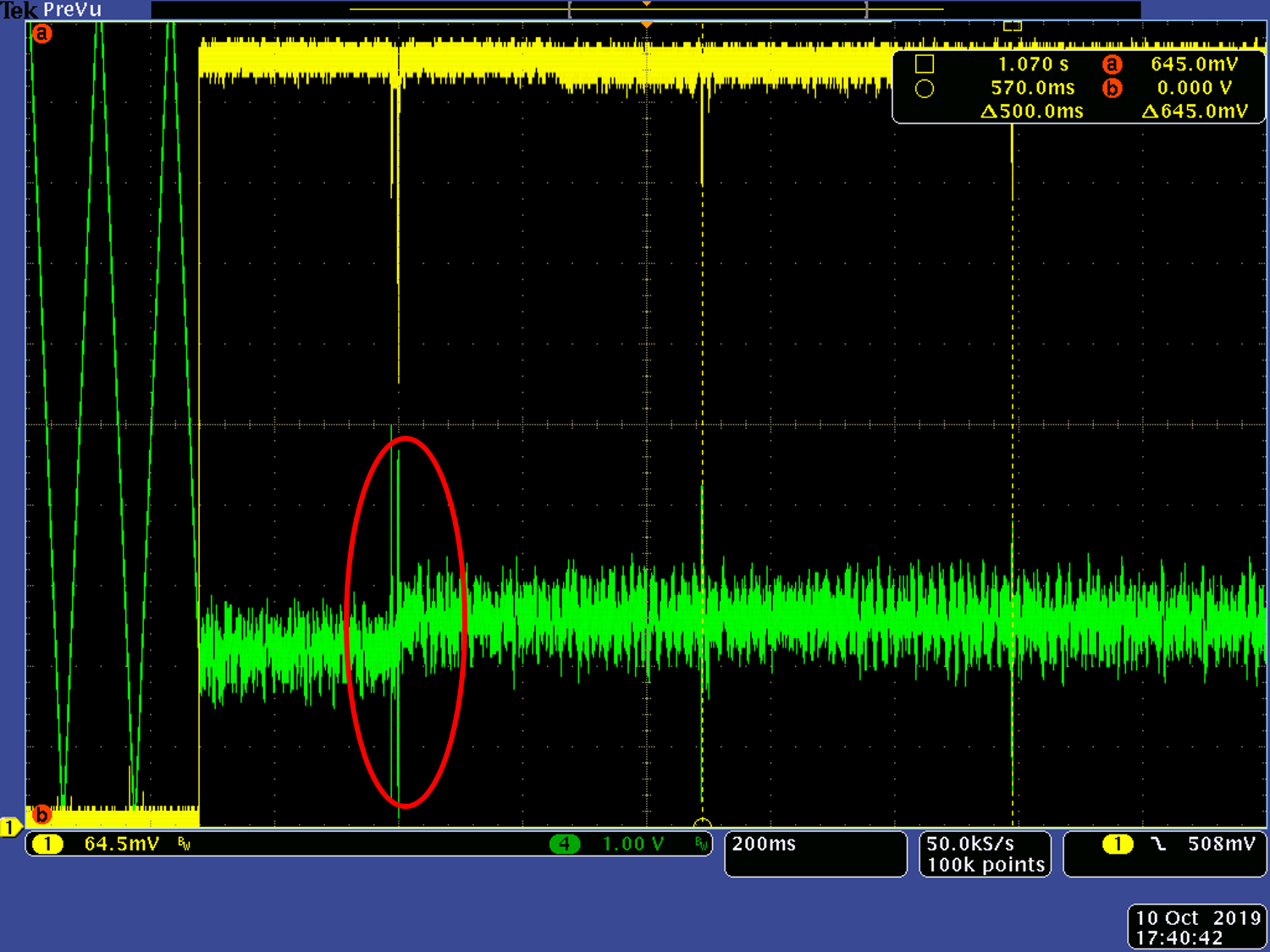
Global locking almost clean : tranmission and reflection are quite noiseless except the peaks at every 500ms.
During the amplifier 2nd stage lock, we experienced 2 strange behaviors :
- short "unlocks" every 500ms exactly all the time, during the whole lock process
- some PZT (in green on the picture) shift exactly synchronized with these "unlocks" (see the red circle).
these shifts are triggered by some OneFive motor move (Frep adjustment).
We tried to disconnect software activity (use the disconnect button on the software), to disconnect USB cable, to disconnect power supply of the motor controller box but none of these actions had an effect
=> still short unlocks every 500ms...
The amplifier 2nd stage seems to have small fan for the power supply... we can try to disconnect it.
We tried to turn on the 3rd stage which uses several fans for cooling the pump diodes... thus, one can see immediatly a big increasing in the PZT signal which tries to compensate the vibrations and quicly one loose the lock.
we have to think on how to suppress these vibrations.
|
| Attachment 1: Image1.png
|
 |
|
74
|
Fri Oct 11 18:42:32 2019 |
Ronic Chiche | Fixed | issue | lasers and optics | detectors and electronics | Optical room | First Lock with 2nd satge of amplifier : Finesse issue ? |
First of all, we used and optical spectrometer to determine which proportion of pump and signal is in the injected beam.
the wavelength is THE SAME for the 2nd stage for the beam coming from the core or coming from the clad !
thus, it is impossible to use a spectrometer to obtain this proportion.
Thus, we made the assumption the pump beam (Sp) is unpolarized in contrary to the core beam (Sc) which is almost linearly polarized (Scp, Scs)
with a half waveplate and a PBS, we can define 2 cases in rotating the half waveplate at the output of the PBS :
maximum power : Scp + Sp/2 = a1
minimum power : Scs + Sp/2 = a2
The sum of both power a1 and a2 : a1+a2 = (Scp+Scs) + Sp is the total power of the beam before PBS.
The subtraction of power a1 and a2 : a1-a2 = Scp - Scs is independant of the pump power which can vary for example in opening an iris which normally block the most part of the pump beam.
if the core beam is perfectly linear, Scs=0 => a1-a2=Scp and Sp=2*a2
We did 2 measurements with a1=227mW, a2=67mW => Scp=160mW (Sp=134mW)
and with a1'=277mW, a2'=107mW => Scp=170mW (Sp'=214mW with a wider opened iris)
if these measurements and assumptions are correct, the real power injected to the cavity was 170mW (instead of 300mW).
with a coupling of 75% => Gain ~ 6.3k => Finesse ~ 19.7k !
to be confirmed...
| Ronic Chiche wrote: |
|
1st lock today with the second stage of the amplifier.
~ 300mW of injected power (but which proportion of the pump and of the signal ? => One must use a spectrometer to determine this proportion)
MAYBE the real injected power of the signal is lower => maybe the Finesse is higher !
Coupling ~ 75%
1.2 mW measured in transmission => ~800W inside the FP cavity
=> Gain ~ 3500 => Finesse ~ 11k !!!
Last Finesse measurement was about 19k ! :-(
|
|
|
75
|
Fri Oct 11 18:49:00 2019 |
Ronic Chiche | Fixed | info | detectors and electronics | Optical room | New locking scheme |
Before, the locking scheme was to produce an error signal with the PDH box, send its output to the electronic amplifier box and then to the laser EOM for the fast loop and to the Laselock input. The drawback was changing one loop gain, changes also the other loop gain.
Now, the locking scheme is the error signal coming from the PDH box is directly sent to the Laselock input and in a same time to the electronic amplifier box which is only connected to the laser EOM for the fast loop. then, one has the fast loop gain which can be changed with the electronic amplifier box, one has the slow loop gain which can be changed on the Laselock and if one needs to change global gain of both loops, one can move the PDH diffuser.
This scheme is currently used and locked the setup. |
|
81
|
Fri Nov 22 17:56:56 2019 |
Ronic Chiche | Fixed | issue | lasers and optics | detectors and electronics | Optical room | 30Hz noise issue |
since some days, we observe the cavity is difficult to lock and a strange 30Hz noise has appeared on the PZT signal which normally compensate the phase noise difference between the cavity and the laser.
to test if the problem could come from the laser, we changed the OneFive laser for the Koheras but we have exactly the same problem, thus we concluded that the problem come from the cavity or from the feedback.
today, we borrowed an accelerometer measurement setup to Julien Bonis to test if we can see a clear noise at 30Hz from the seismic noise.
we placed to accelerometer directly on the top of the cavity but the spectrum we obtained do not show a clear noise line at 30Hz, only a small excess of noise in this region...
nothing which clearly indicate the cause of our problem.
yesterday, we changed the feedback setup in changing the PDH box from n°2 to N°3 without any change in the 30Hz noise line.
today, we also changed the feedback setup by introducing and amplifier of 100 just after the PDH box.
if noise is coupled after the amp we should be more immunized from it... but nothing changed again.
still looking for the origin of this problem... |
|
82
|
Tue Nov 26 16:11:52 2019 |
Ronic Chiche | Fixed | issue | mechanics | Optical room | First Lock with 2nd satge of amplifier : Motor issue ? |
The 500 ms noise disapeared. We had to disable the "power save" mode of the smaract translation stage. AND turn OFF and ON the controler box.
| Ronic Chiche wrote: |
|
Global locking almost clean : tranmission and reflection are quite noiseless except the peaks at every 500ms.
During the amplifier 2nd stage lock, we experienced 2 strange behaviors :
- short "unlocks" every 500ms exactly all the time, during the whole lock process
- some PZT (in green on the picture) shift exactly synchronized with these "unlocks" (see the red circle).
these shifts are triggered by some OneFive motor move (Frep adjustment).
We tried to disconnect software activity (use the disconnect button on the software), to disconnect USB cable, to disconnect power supply of the motor controller box but none of these actions had an effect
=> still short unlocks every 500ms...
The amplifier 2nd stage seems to have small fan for the power supply... we can try to disconnect it.
We tried to turn on the 3rd stage which uses several fans for cooling the pump diodes... thus, one can see immediatly a big increasing in the PZT signal which tries to compensate the vibrations and quicly one loose the lock.
we have to think on how to suppress these vibrations.
|
|
|
84
|
Tue Nov 26 16:35:39 2019 |
Ronic Chiche | Fixed | issue | lasers and optics | detectors and electronics | Optical room | 30Hz noise issue |
The 30 Hz noise issue has been solved !
It came from translation stage of P1 and/or P4.
Fabian remembered that close to the mirror's mount translation stage end coarse, there is a mechanical instability. The mount kind of "lift up" because of the spring strength and could induce resonance.
Initial positions:
- P1: - 1 500 000
- S2: + 1 400 000
- S3: + 1 400 000
- P4: - 1 500 000
The 30 Hz noise was removed while moving only P1 closer (then if we put back P1 to the initial position, the noise clearly appear again):
- P1: - 1 300 000 --> no 30Hz noise
- S2: + 1 400 000
- S3: + 1 400 000
- P4: - 1 500 000
The 30 Hz noise appeared again while moving P4 further:
- P1: - 1 300 000
- S2: + 1 400 000
- S3: + 1 400 000
- P4: - 1 600 000 --> 30Hz noise
Final positions:
- P1: - 1 300 000
- S2: + 1 400 000
- S3: + 1 400 000
- P4: - 1 500 000
| Ronic Chiche wrote: |
|
since some days, we observe the cavity is difficult to lock and a strange 30Hz noise has appeared on the PZT signal which normally compensate the phase noise difference between the cavity and the laser.
to test if the problem could come from the laser, we changed the OneFive laser for the Koheras but we have exactly the same problem, thus we concluded that the problem come from the cavity or from the feedback.
today, we borrowed an accelerometer measurement setup to Julien Bonis to test if we can see a clear noise at 30Hz from the seismic noise.
we placed to accelerometer directly on the top of the cavity but the spectrum we obtained do not show a clear noise line at 30Hz, only a small excess of noise in this region...
nothing which clearly indicate the cause of our problem.
yesterday, we changed the feedback setup in changing the PDH box from n°2 to N°3 without any change in the 30Hz noise line.
today, we also changed the feedback setup by introducing and amplifier of 100 just after the PDH box.
if noise is coupled after the amp we should be more immunized from it... but nothing changed again.
still looking for the origin of this problem...
|
|
|
88
|
Fri Feb 7 14:46:55 2020 |
Ronic Chiche | Fixed | report | lasers and optics | Optical room | Beam pulse duration |
We installed the 2 CVBG for compression after the amplifier.
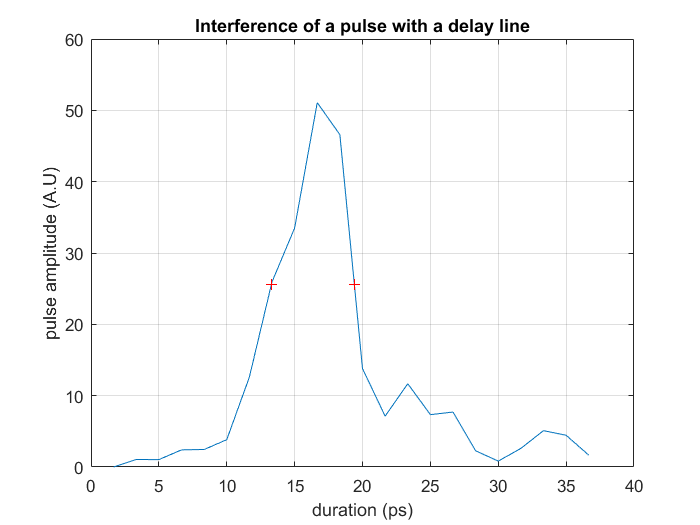
We used an interferometric technique with a delay line and combining the two paths in a CCD to measure interferences... see interferences.avi video file
One can notice some misalignement at the end of the video.
After supressing the global shape of the superposed pulses, one measures the amplitude of the remaining fringes (peak-peak or standard deviation) each 250µm of the delay line (500µm of round-trip). one gets the interferences pulse shape with a FWHM of 6ps...
It seems that an 'after pulse' is visible in the interferences.
An other meausurement using a 2 photons photodiode will be used to confirm this measurement.
|
| Attachment 1: interferences.avi
|
| Attachment 2: pulse_duration.png
|
 |
|
89
|
Wed Feb 12 17:43:43 2020 |
Ronic Chiche | Fixed | report | lasers and optics | Optical room | Beam pulse duration |
Yesterday, Loic installed a telescope before CVBG's to reduce the spot size on CVBG's and reduced the incident angle 0.5-1° on them (on the datasheet the specified incident angle is 2.8°).
We used an interferometric technique with a delay line and combining the two paths in a CCD to measure interferences.
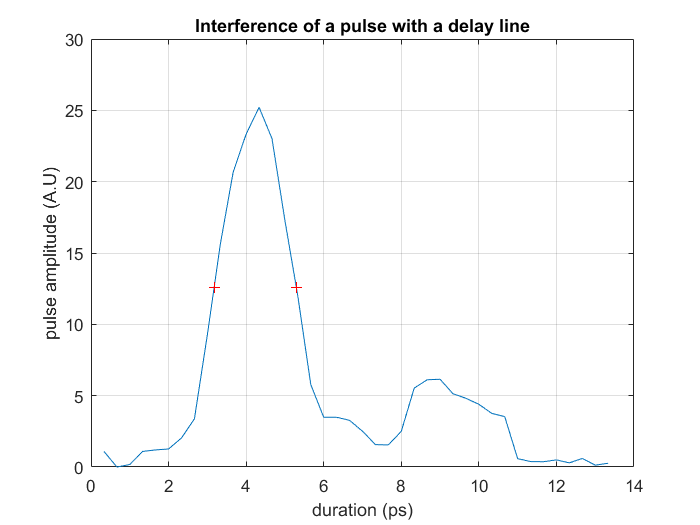
After supressing the global shape of the superposed pulses, one measures the amplitude of the remaining fringes (standard deviation) each 50µm of the delay line (100µm of round-trip). one gets the interferences pulse shape with a FWHM of 2 ps... (see curve)
we still see an 'after pulse'.
if the pulse is 1ps long and 100kW is stored in the cavity, it means 3GW peak for the whole beam... it is comparable with the damage threshold of the mirror !!!
| Ronic Chiche wrote: |
|
We installed the 2 CVBG for compression after the amplifier.
We used an interferometric technique with a delay line and combining the two paths in a CCD to measure interferences... see interferences.avi video file
One can notice some misalignement at the end of the video.
After supressing the global shape of the superposed pulses, one measures the amplitude of the remaining fringes (peak-peak or standard deviation) each 250µm of the delay line (500µm of round-trip). one gets the interferences pulse shape with a FWHM of 6ps...
It seems that an 'after pulse' is visible in the interferences.
An other meausurement using a 2 photons photodiode will be used to confirm this measurement.
|
|
| Attachment 1: pulse_width.png
|
 |
|
90
|
Fri Feb 14 09:26:07 2020 |
Ronic Chiche | Fixed | report | lasers and optics | Optical room | Beam pulse duration |
Yesterday, Loïc put the CVBG's back to their specified angles.
We used an interferometric technique with a delay line and combining the two paths in a CCD to measure interferences.
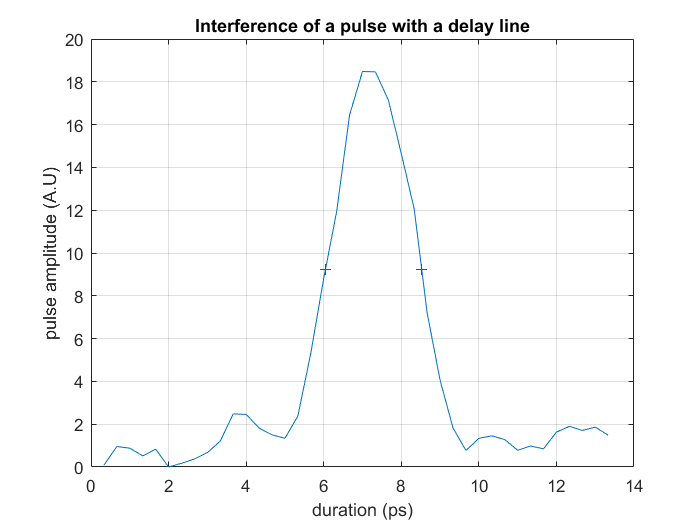
After supressing the global shape of the superposed pulses, one measures the amplitude of the remaining fringes (standard deviation) each 50µm of the delay line (100µm of round-trip). one gets the interferences pulse shape with a FWHM of 2.5 ps... (see curve)
from Fabian calculation, at 100kW, with w=2mm, the fluence on mirror should be around 0.05J/cm^2.
from this article (https://www.sciencedirect.com/science/article/pii/S0030402618313275), the damage threshold for SiO2/Ta2O5 multilayers should be around 4.8J/cm^2 @ 1030nm
| Ronic Chiche wrote: |
|
Yesterday, Loic installed a telescope before CVBG's to reduce the spot size on CVBG's and reduced the incident angle 0.5-1° on them (on the datasheet the specified incident angle is 2.8°).
We used an interferometric technique with a delay line and combining the two paths in a CCD to measure interferences.
After supressing the global shape of the superposed pulses, one measures the amplitude of the remaining fringes (standard deviation) each 50µm of the delay line (100µm of round-trip). one gets the interferences pulse shape with a FWHM of 2 ps... (see curve)
we still see an 'after pulse'.
if the pulse is 1ps long and 100kW is stored in the cavity, it means 3GW peak for the whole beam... it is comparable with the damage threshold of the mirror !!!
| Ronic Chiche wrote: |
|
We installed the 2 CVBG for compression after the amplifier.
We used an interferometric technique with a delay line and combining the two paths in a CCD to measure interferences... see interferences.avi video file
One can notice some misalignement at the end of the video.
After supressing the global shape of the superposed pulses, one measures the amplitude of the remaining fringes (peak-peak or standard deviation) each 250µm of the delay line (500µm of round-trip). one gets the interferences pulse shape with a FWHM of 6ps...
It seems that an 'after pulse' is visible in the interferences.
An other meausurement using a 2 photons photodiode will be used to confirm this measurement.
|
|
|
| Attachment 1: interferences_pulse_duration.png
|
 |
|
94
|
Mon Feb 24 16:28:52 2020 |
Ronic Chiche | Fixed | report | lasers and optics | Optical room | Beam pulse duration |
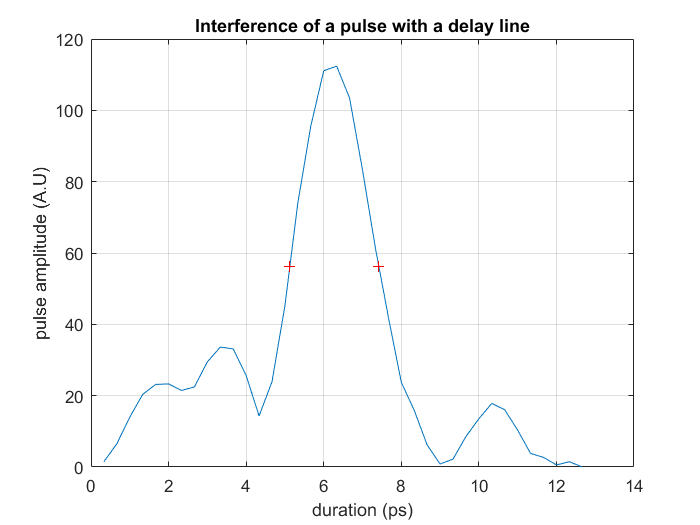
Last Thursday (20th of February), Loïc and Titouan realigned the stretcher CVBG to its nominal angle and they used an interferometric technique with a delay line and combining the two paths in a CCD to measure interferences.
After supressing the global shape of the superposed pulses, one measures the amplitude of the remaining fringes (standard deviation) each 50µm of the delay line (100µm of round-trip).
one gets the interferences pulse shape with a FWHM of 2.3 ps... (see curve)
| Ronic Chiche wrote: |
|
Yesterday, Loïc put the CVBG's back to their specified angles.
We used an interferometric technique with a delay line and combining the two paths in a CCD to measure interferences.
After supressing the global shape of the superposed pulses, one measures the amplitude of the remaining fringes (standard deviation) each 50µm of the delay line (100µm of round-trip). one gets the interferences pulse shape with a FWHM of 2.5 ps... (see curve)
from Fabian calculation, at 100kW, with w=2mm, the fluence on mirror should be around 0.05J/cm^2.
from this article (https://www.sciencedirect.com/science/article/pii/S0030402618313275), the damage threshold for SiO2/Ta2O5 multilayers should be around 4.8J/cm^2 @ 1030nm
| Ronic Chiche wrote: |
|
Yesterday, Loic installed a telescope before CVBG's to reduce the spot size on CVBG's and reduced the incident angle 0.5-1° on them (on the datasheet the specified incident angle is 2.8°).
We used an interferometric technique with a delay line and combining the two paths in a CCD to measure interferences.
After supressing the global shape of the superposed pulses, one measures the amplitude of the remaining fringes (standard deviation) each 50µm of the delay line (100µm of round-trip). one gets the interferences pulse shape with a FWHM of 2 ps... (see curve)
we still see an 'after pulse'.
if the pulse is 1ps long and 100kW is stored in the cavity, it means 3GW peak for the whole beam... it is comparable with the damage threshold of the mirror !!!
| Ronic Chiche wrote: |
|
We installed the 2 CVBG for compression after the amplifier.
We used an interferometric technique with a delay line and combining the two paths in a CCD to measure interferences... see interferences.avi video file
One can notice some misalignement at the end of the video.
After supressing the global shape of the superposed pulses, one measures the amplitude of the remaining fringes (peak-peak or standard deviation) each 250µm of the delay line (500µm of round-trip). one gets the interferences pulse shape with a FWHM of 6ps...
It seems that an 'after pulse' is visible in the interferences.
An other meausurement using a 2 photons photodiode will be used to confirm this measurement.
|
|
|
|
| Attachment 1: Interferences_pulse_width.png
|
 |
|
95
|
Wed Feb 26 10:38:37 2020 |
Ronic Chiche | Fixed | info | lasers and optics | Optical room | Optical spectrum analyzer resolution |
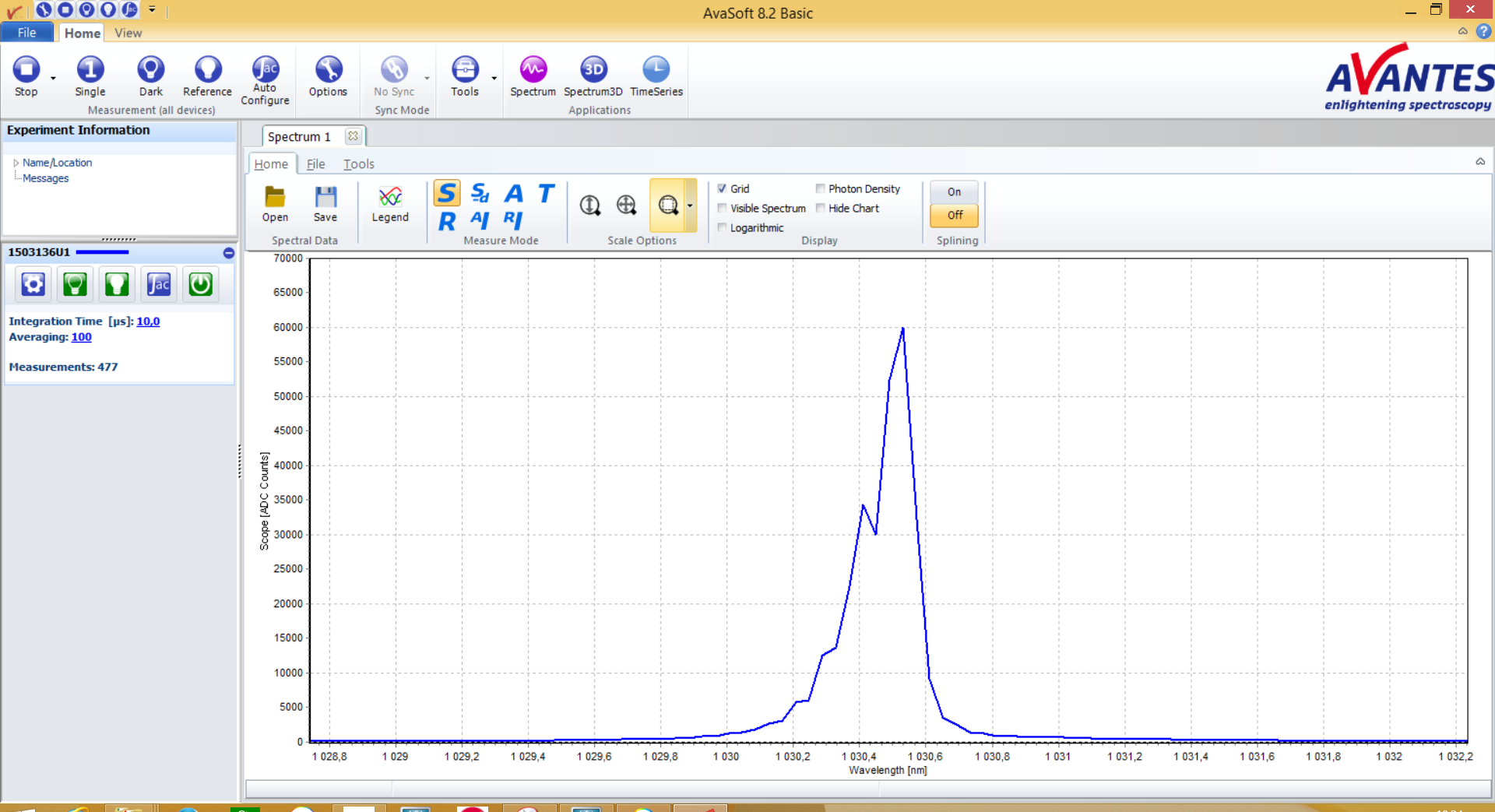
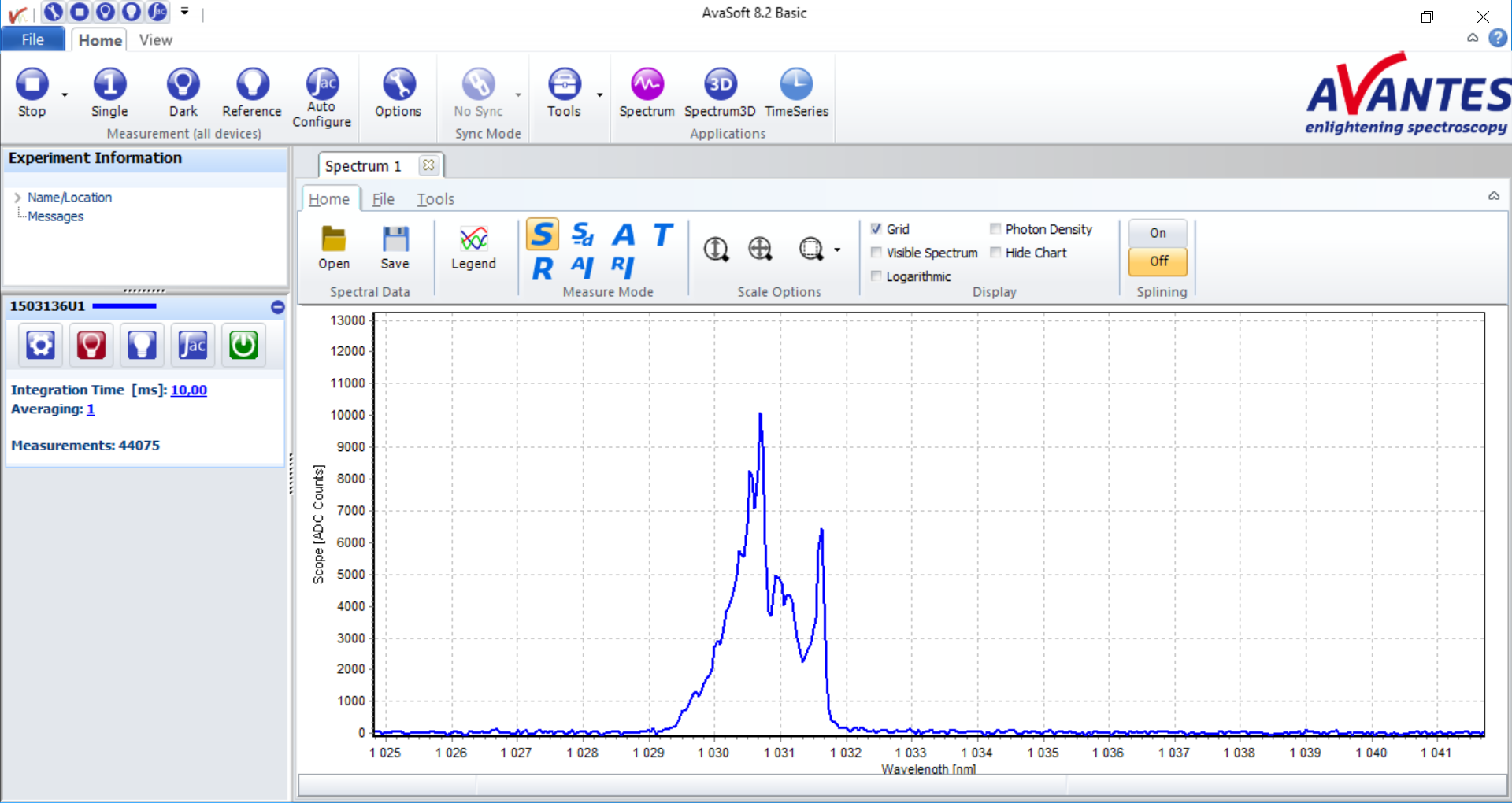
The Koheras @0.5mW is directly connected with fibers FC/APC -> FC/PC to the Avantes optical spectrum analyzer.
The FWHM wavelength, measured with the Avantes software, is 0.126nm |
| Attachment 1: Capture.PNG
|
 |
|
96
|
Wed Feb 26 11:05:09 2020 |
Ronic Chiche | Fixed | info | lasers and optics | Optical room | Optical spectrum analyzer resolution |
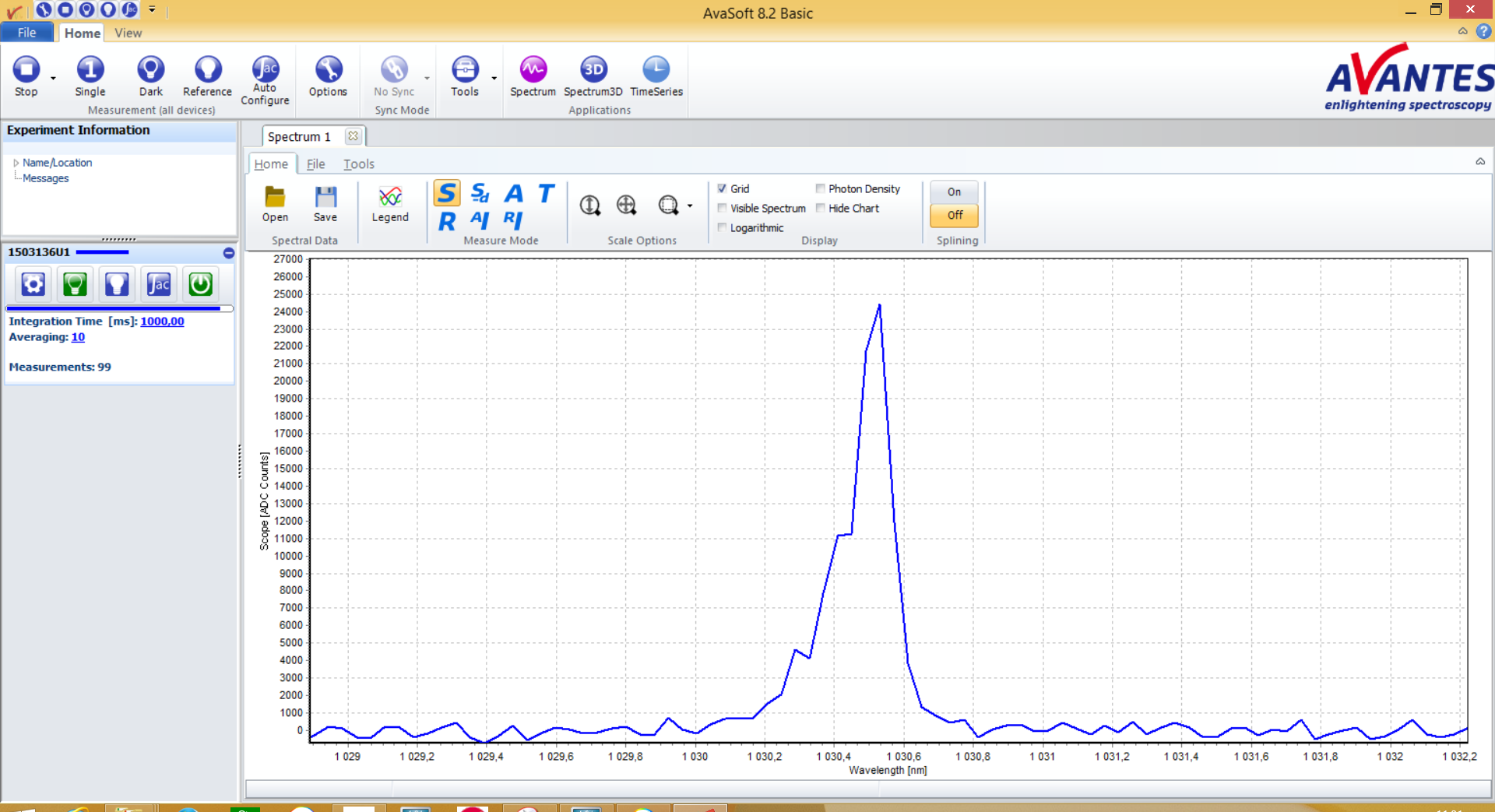
Same measurement with Koheras @100mW and using fiber coupling lenses between Koheras and Avantes OSA.
The FWHM wavelength, measured with the Avantes software, is 0.116nm
| Ronic Chiche wrote: |
|
The Koheras @0.5mW is directly connected with fibers FC/APC -> FC/PC to the Avantes optical spectrum analyzer.
The FWHM wavelength, measured with the Avantes software, is 0.126nm
|
|
| Attachment 1: Capture2.PNG
|
 |
|
97
|
Wed Feb 26 16:48:02 2020 |
Ronic Chiche | Fixed | info | lasers and optics | Optical room | Optical spectrum before and after CVBG |
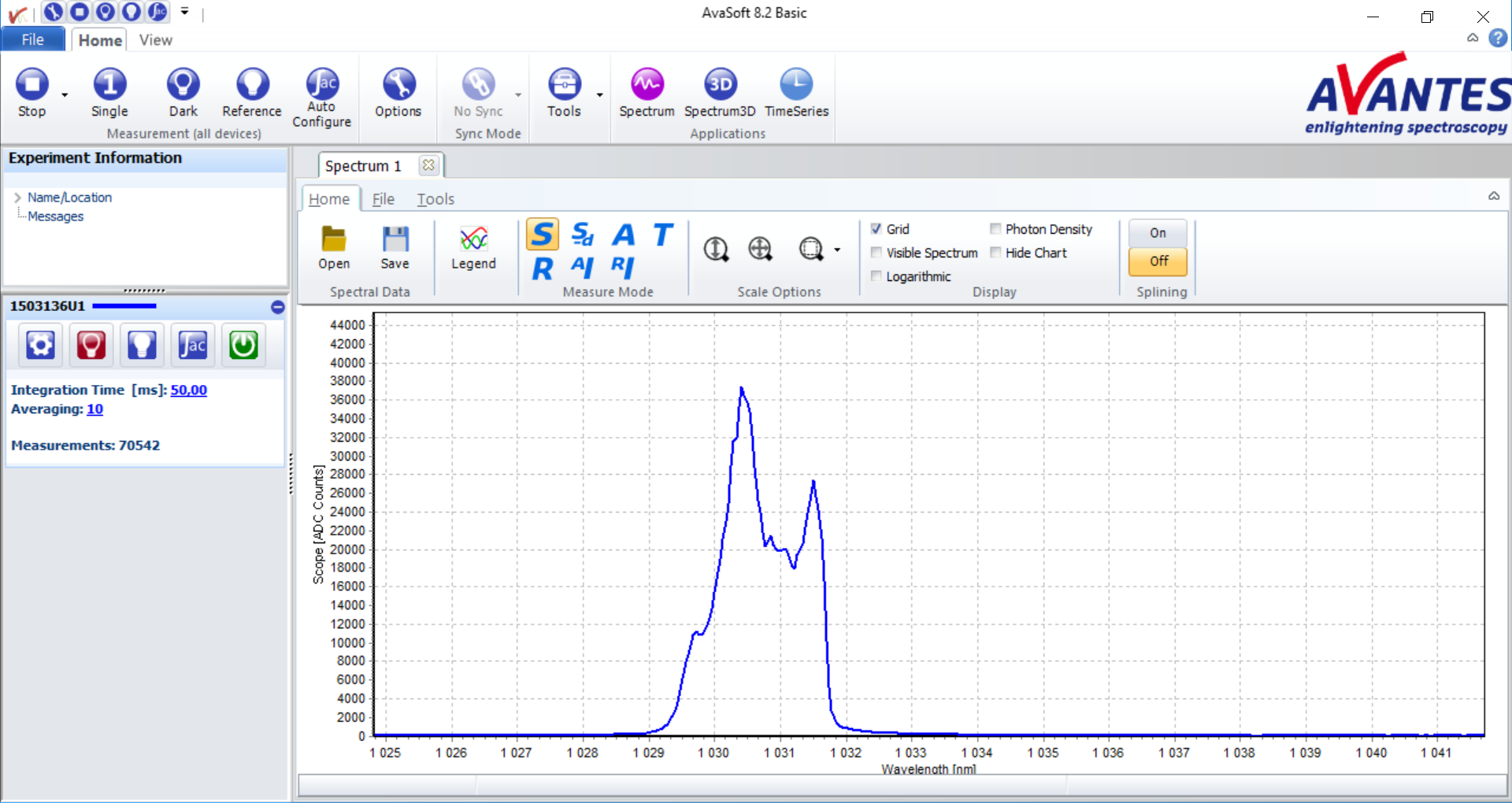
Measurement of the optical spectrum with Avantes OSA before (1st picture) and after CVBG (2nd picture) with 2nd stage on the laser amplifier.
The 1st CVBG stretches the beam horizontally due to the default incident angle and the fact that different wavelength are reflected in the CVBG with different depth.
as a result, the optical spectrum is varying along the transversal axis of the beam.
The 2nd CVBG is injected with the opposiste incident angle and should compensate the stretch effect to get back a circular beam.
spatially, the beam is quite circular but one can still see a dependance between position in the beam and optical spectrum.
Then, it is difficult to show the "right" optical spectrum after CVBG (one could use a diffuser for that) but it is clear that the spectral width is quite the same (~ 2nm due to the CFBG at the input of the amplifier) before and after CVBG. |
| Attachment 1: OSA_after_amplifier_CFBG_and_before_CVBG.PNG
|
 |
| Attachment 2: OSA_after_amplifier_CFBG_2_CVBG.PNG
|
 |
|
98
|
Fri Feb 28 09:20:37 2020 |
Ronic Chiche | Not Fixed | issue | lasers and optics | Optical room | Amplifier laser diodes issue |
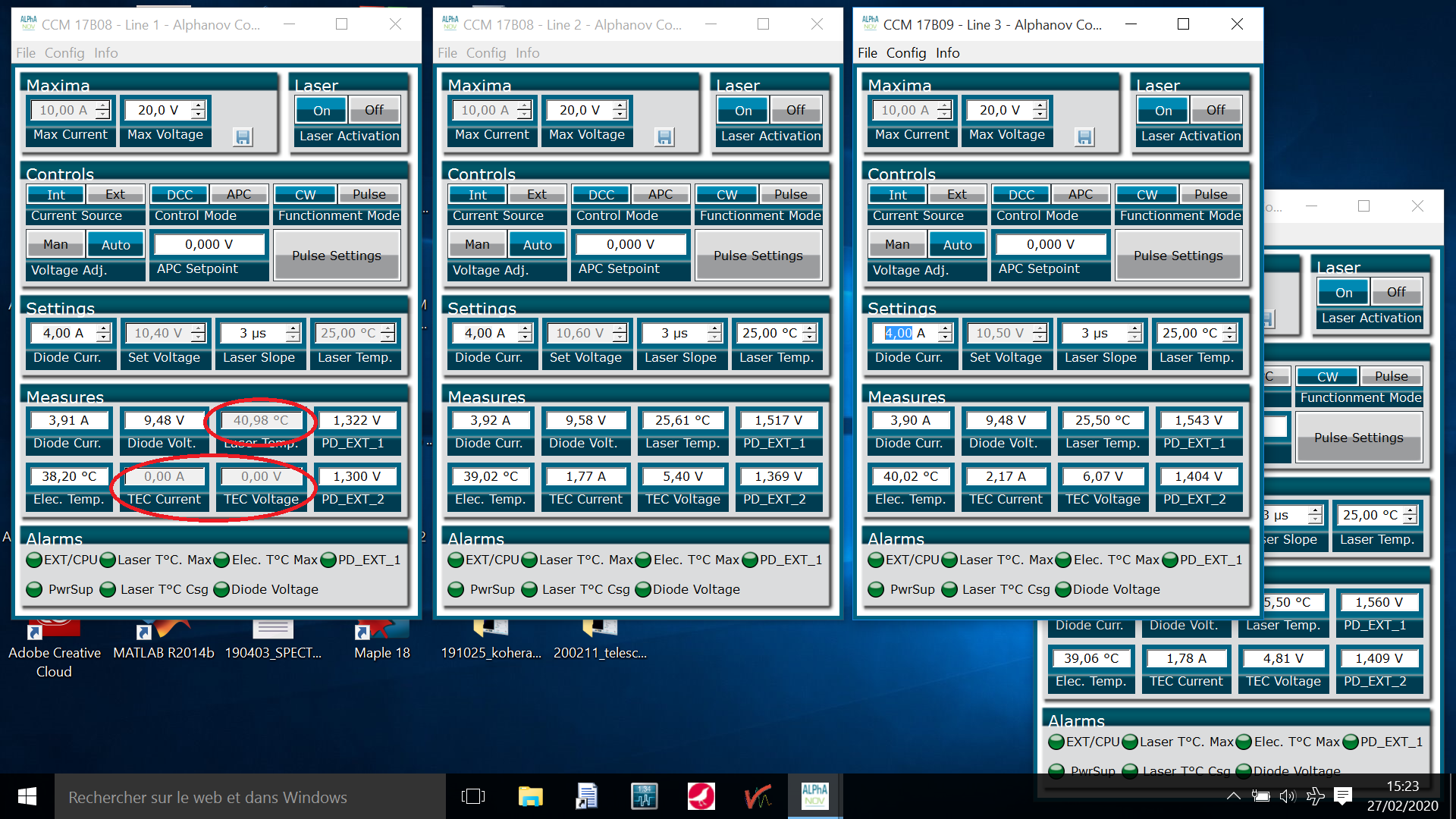
This is a long time issue for the ThomX amplifier : on the 4 pumping diodes available, the 1st diode has a higher temperature than the others around 40°C (see the picture).
the problem comes from the TEC which is not activated (see diodes parameter files in execel format). the related software windows are shaded.
I phoned to Jerome to ask him if one can securely activate the TEC, and he answered "yes".
but once the TEC is activated by loading parameters and modifying the line of the TEC activation, the temperature does'nt fall down as it seems the TEC does'nt work properly.
maybe it is not connected properly ? to be checked...
the result is, as the diode temperature is too high, an alarm is fired and the diode is deactivated... impossible to increase the current.
one has to deactivate the TEC and shut down electrically the amplifier to go back to the starting point.
Conclusion :
- the TEC of the diode 1 does'nt work properly.
- one can't activate it otherwise an alarm is fired and the diode is disabled.
- one should check the TEC connections in the amplifier |
| Attachment 1: Problem_TEC.PNG
|
 |
| Attachment 2: param_diode_1.csv
|
Current Max;10
Current Source;0
Current Slope;3
Laser Activation;1
Laser Temperature;25
DCDC Voltage;10.4
DCDC Voltage Mode;1
APC Mode;0
APC Power;0
Device 0;0
Device 1;0
Device 2;0
Voltage Max;20
Functionment Mode;0
Frequency;1
Pulse Width;100000
Init State;1
Fan Mode;1
Fan Voltage;0
TEC Activation;0
Laser Temperature Max;45
Case Temperature Min;10
Case Temperature Max;60
Potentiometer Calibration;5
Transimpedance Gain;2000
PD_EXT_1 Threshold;0
Serial Number;1708
Software Type;1
Software Version0;3
Software Version1;3
Software Version2;0
Hardware Version0;3
Hardware Version1;1
Hardware Version2;0
Equipments0;4
Equipments1;1
Equipments2;0
Equipments3;0
|
| Attachment 3: param_diode_2.csv
|
Current Max;10
Current Source;0
Current Slope;3
Laser Activation;1
Laser Temperature;25
DCDC Voltage;10.6
DCDC Voltage Mode;1
APC Mode;0
APC Power;0
Device 0;0
Device 1;0
Device 2;0
Voltage Max;20
Functionment Mode;0
Frequency;1
Pulse Width;100000
Init State;1
Fan Mode;1
Fan Voltage;0
TEC Activation;1
Laser Temperature Max;45
Case Temperature Min;10
Case Temperature Max;60
Potentiometer Calibration;5
Transimpedance Gain;2000
PD_EXT_1 Threshold;0
Serial Number;1708
Software Type;1
Software Version0;3
Software Version1;3
Software Version2;0
Hardware Version0;3
Hardware Version1;1
Hardware Version2;0
Equipments0;4
Equipments1;1
Equipments2;0
Equipments3;0
|
|
99
|
Fri Feb 28 17:44:12 2020 |
Ronic Chiche | Fixed | report | lasers and optics | Optical room | Pointing stability with CVBG |
Yesterday, with Titouan, we made some measurements on pointing stability of the laser beam after amplifier and CVBG.
the amplifier beam go through a first telescope to be small enough and colimated before going to CVBG's, then go to CVBG's and then is sent through the FP-cavity telescope to the FP-cavity itself.
the total length is about 6m to mirror M1.
the surface of the mirror M1 is imaged with several wedges to a Basler CCD.
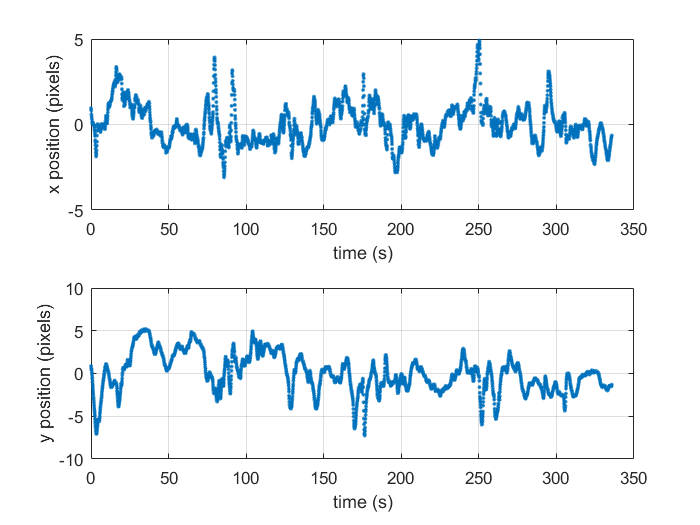
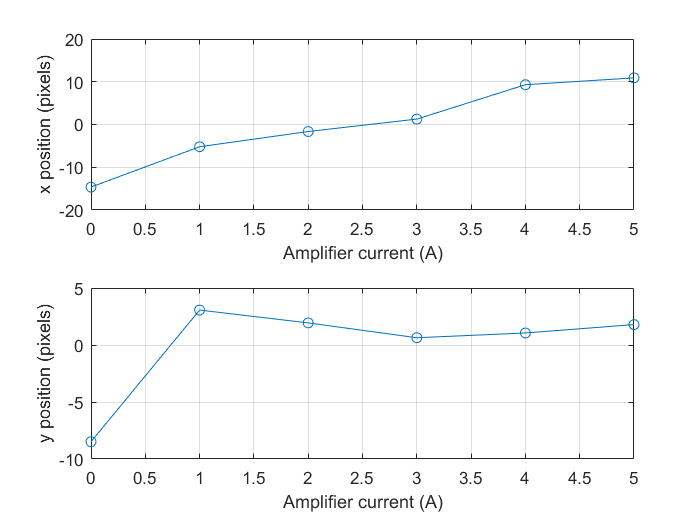
(x is for veritcal position and y is for horizontal position)
* the 1st plot shows the pointing stability at low power of amplifier without airflow and walking around during about 5 minutes extracted from the Basler CCD video.
when walking around or with airflow the pointing stabily is much worse.
* the 2nd plot shows the pointing stability vs amplifier current.
it is comparable (a litle bit worse) to the pointing stability at low power.
one clearly see the beam expanding in vertical direction and also in horizontal direction.
the effect could come from the CVBG telescope lenses which are standard lenses and not high power lenses.
the pointing effect could come also from the same effect if the lens is not perfectly centered.
we took also some picture of the CVBG at different power with the Thermal camera but we need to get the data from camera (old software not compatible with Windows 10) |
| Attachment 1: Pointing_stability_without_airflow_and_no_one_walking_around.png
|
 |
| Attachment 2: Pointing_stability_without_airflow_vs_amplifier_current.png
|
 |
|
101
|
Tue Jul 7 12:49:38 2020 |
Ronic Chiche | Fixed | info | lasers and optics | Optical room | Finesse measurement after the Edge installation |
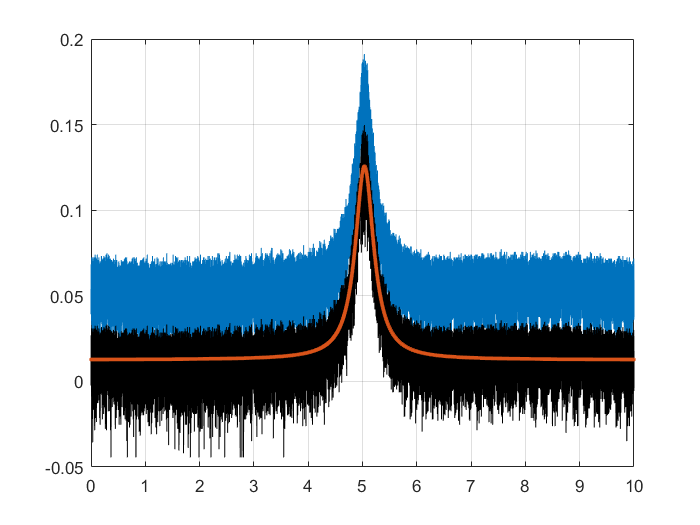
After the Edge installation inside the cavity, the Finesse has been measured several times by modulation technique with an average around 16000:
(the scan speed is 50kHz in 10 seconds.)
So, it hasn't changed since the last measurement in June, just before the Edge installation.
The Edge position is normally the furthest from cavity beam (all rotating knobs are at 0 positions)
We used the last Onefive telescope (used with CVBGs). Coupling reached ~50% after alignment.
The cavity vacuum is ~7.2e-9 mbar as the cavity has been recently opened...
|
| Attachment 1: untitled.png
|
 |
|
106
|
Thu Nov 4 13:05:49 2021 |
Ronic Chiche | Fixed | info | lasers and optics | ThomX igloo | FP cavity alignment |
as the iris used to locate the FP-cavity axis have been removed before moving the table inside the Igloo, we have to find again this FP-cavity axis.
this morning with Viktor, we started to make the alignment of the FP-cavity with a red laser using only the "input window" iris mount built by Yann.
we used a 4 axis mount for the red laser, plus a 2 axis mount for the injection mirror (we didn't use the final injection mirrors).
the red laser is clearly visible in the transmission of the 3 "output mirrors" of the cavity.
1- we made a pre-alignment of the red laser using the reflection on the input window
=> one can see the beam at the output of all the 3 "output mirrors", but not centered on their respective windows.
2- we made a final alignment of the red laser to have roughly the beam going through the middle of all the 3 "output windows".
(rough alignment as we don't have the iris mounts for these windows, yet).
3- we put a second iris in the input path to fix the input beam axis relative to the FP cavity axis.
(the first iris is the one used on the "input window" iris mount).
this afternoon, we plan to replace the mirror used by the final injection mirrors of the cavity.
and then, use the Koheras laser to try to get some resonances.
|
|
107
|
Thu Nov 4 18:57:16 2021 |
Ronic Chiche | Fixed | info | lasers and optics | ThomX igloo | FP cavity alignment |
This afternoon, we continued the alignment of the red laser.
we did it using the 2 final injection mirrors.
we still see a clear transmission after M2, a weak transmission after M3, and almost nothing after M4 due to the power loss going through the dielectric injection mirrors (which are not optimized for red wavelength).
we placed 2 new iris in the path before the injection mirrors to help the alignment of the Koheras with the periscope.
and we prepared different equipments to continue next time: scope, photodiode, beam profiler, power meter....
| Ronic Chiche wrote: |
|
as the iris used to locate the FP-cavity axis have been removed before moving the table inside the Igloo, we have to find again this FP-cavity axis.
this morning with Viktor, we started to make the alignment of the FP-cavity with a red laser using only the "input window" iris mount built by Yann.
we used a 4 axis mount for the red laser, plus a 2 axis mount for the injection mirror (we didn't use the final injection mirrors).
the red laser is clearly visible in the transmission of the 3 "output mirrors" of the cavity.
1- we made a pre-alignment of the red laser using the reflection on the input window
=> one can see the beam at the output of all the 3 "output mirrors", but not centered on their respective windows.
2- we made a final alignment of the red laser to have roughly the beam going through the middle of all the 3 "output windows".
(rough alignment as we don't have the iris mounts for these windows, yet).
3- we put a second iris in the input path to fix the input beam axis relative to the FP cavity axis.
(the first iris is the one used on the "input window" iris mount).
this afternoon, we plan to replace the mirror used by the final injection mirrors of the cavity.
and then, use the Koheras laser to try to get some resonances.
|
|
|
108
|
Fri Nov 26 20:12:10 2021 |
Ronic Chiche | Fixed | report | lasers and optics | ThomX igloo | FP cavity alignment |
A continuation of the alignment process was done, there was change in it due to variation in temperature,
it was done using the semiconducting laser, and we were able to obtain an output at M2.
2 references were placed before the alignment mirrors Ma and Mb , to fix the line when changing from semiconducting laser to CW "koheras"
Another reference was placed at the reflection line.
Then we changed to CW laser and placed a beamprofiler at the output of m3 trying to observe the cavity mode, but with no success
(there was a shaped observed which we thought of as the cavity mode, but it changed position when moving the alignment -- > not mode (the cavity mode only changes intensity with alignment mirrors, or disappears))
later a continuation will be done for the alignment using 2 beamprofilers
Note: a reference file of the mirror positions was saved on the command computer and a laptop dedicated to ThomX cavity is placed in the casmate
| Ronic Chiche wrote: |
|
This afternoon, we continued the alignment of the red laser.
we did it using the 2 final injection mirrors.
we still see a clear transmission after M2, a weak transmission after M3, and almost nothing after M4 due to the power loss going through the dielectric injection mirrors (which are not optimized for red wavelength).
we placed 2 new iris in the path before the injection mirrors to help the alignment of the Koheras with the periscope.
and we prepared different equipments to continue next time: scope, photodiode, beam profiler, power meter....
| Ronic Chiche wrote: |
|
as the iris used to locate the FP-cavity axis have been removed before moving the table inside the Igloo, we have to find again this FP-cavity axis.
this morning with Viktor, we started to make the alignment of the FP-cavity with a red laser using only the "input window" iris mount built by Yann.
we used a 4 axis mount for the red laser, plus a 2 axis mount for the injection mirror (we didn't use the final injection mirrors).
the red laser is clearly visible in the transmission of the 3 "output mirrors" of the cavity.
1- we made a pre-alignment of the red laser using the reflection on the input window
=> one can see the beam at the output of all the 3 "output mirrors", but not centered on their respective windows.
2- we made a final alignment of the red laser to have roughly the beam going through the middle of all the 3 "output windows".
(rough alignment as we don't have the iris mounts for these windows, yet).
3- we put a second iris in the input path to fix the input beam axis relative to the FP cavity axis.
(the first iris is the one used on the "input window" iris mount).
this afternoon, we plan to replace the mirror used by the final injection mirrors of the cavity.
and then, use the Koheras laser to try to get some resonances.
|
|
|