| ID |
Date |
Author |
Status |
Type |
Category |
Location |
Title |
|
26
|
Tue Apr 2 18:03:31 2019 |
Loïc Amoudry | Fixed | report | lasers and optics | Optical room | Transmission of the mirrors |
We openned the cavity, removed S2 and measured trans of P1 and same for S2.
Pin ~= 3.91 mW
PS2 ~= 20 nW --> ~~ 5 ppm !!!
PP1 ~= 5.23 uW --> ~~ 1337 ppm !?!?!
P1 is the Sapphire mirror. 3mm thick. Tomorrow we'll measure its trans again, being out of the mount for constraint issues. |
|
28
|
Thu Apr 4 09:42:12 2019 |
Loïc Amoudry | Fixed | report | lasers and optics | Optical room | Transmission of the mirrors |
After verification, transmission of P1 correspond to ~150ppm.
The 1337ppm come from a beam leakage. Reflection from P1 goes to the input window which reflects again a part of the beam directly into the cavity between P1 and S3 then between P4 and S2.
| Loïc Amoudry wrote: |
|
We openned the cavity, removed S2 and measured trans of P1 and same for S2.
Pin ~= 3.91 mW
PS2 ~= 20 nW --> ~~ 5 ppm !!!
PP1 ~= 5.23 uW --> ~~ 1337 ppm !?!?!
P1 is the Sapphire mirror. 3mm thick. Tomorrow we'll measure its trans again, being out of the mount for constraint issues.
|
|
|
29
|
Fri Apr 5 11:18:47 2019 |
Loïc Amoudry | Fixed | report | lasers and optics | Optical room | Transmission of the mirrors |
P1 transmission out of the mount (means angle of the mirror is not the real angle):
Pin = 3.2 mW
Pout = 545 nW
Offset = 68 nW
Transmission = (545-68)/3.2e6 = 149 ppm
| Loïc Amoudry wrote: |
|
After verification, transmission of P1 correspond to ~150ppm.
The 1337ppm come from a beam leakage. Reflection from P1 goes to the input window which reflects again a part of the beam directly into the cavity between P1 and S3 then between P4 and S2.
| Loïc Amoudry wrote: |
|
We openned the cavity, removed S2 and measured trans of P1 and same for S2.
Pin ~= 3.91 mW
PS2 ~= 20 nW --> ~~ 5 ppm !!!
PP1 ~= 5.23 uW --> ~~ 1337 ppm !?!?!
P1 is the Sapphire mirror. 3mm thick. Tomorrow we'll measure its trans again, being out of the mount for constraint issues.
|
|
|
|
39
|
Thu May 23 17:30:03 2019 |
Loïc Amoudry | Fixed | report | lasers and optics | Optical room | Transmission of Sapphire mirror |
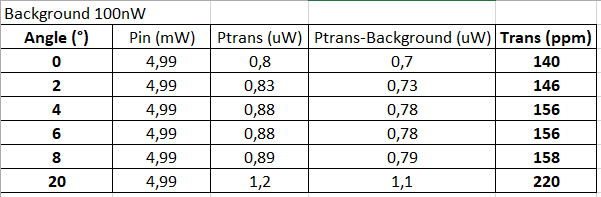
See image. |
| Attachment 1: Sapphire_transmission.PNG
|
 |
|
232
|
Wed Aug 2 13:07:59 2023 |
Ronic Chiche | Not Fixed | issue | detectors and electronics | ThomX igloo | ThomX ring injection kicker noise => USB communication issue with Alphanov amplifier |
several times already, when the electrons ring injection kicker is running @10Hz, we observed peaks at the same frequency on reflected and transmitted photodiodes,
at the exact moment when the kicker is activated. we have in addition, USB communication issues with the Alphanov amplifier... the connection is lost several times.
sometime, the connection is retrieved, sometimes not... one has to stop the Alphanov application and restart it => the laser power get down to 0 % !!!
one way to get rid to this problem could be to add a "metallic sock" around the USB cable, to connected to the ground to remove the external charges.
we could ask also for a kicker shielding as this noise could perturbate several systems in the bunker. |
|
67
|
Thu Oct 3 18:00:10 2019 |
Loïc Amoudry | Fixed | report | lasers and optics | Optical room | ThomX amplifier M2 |
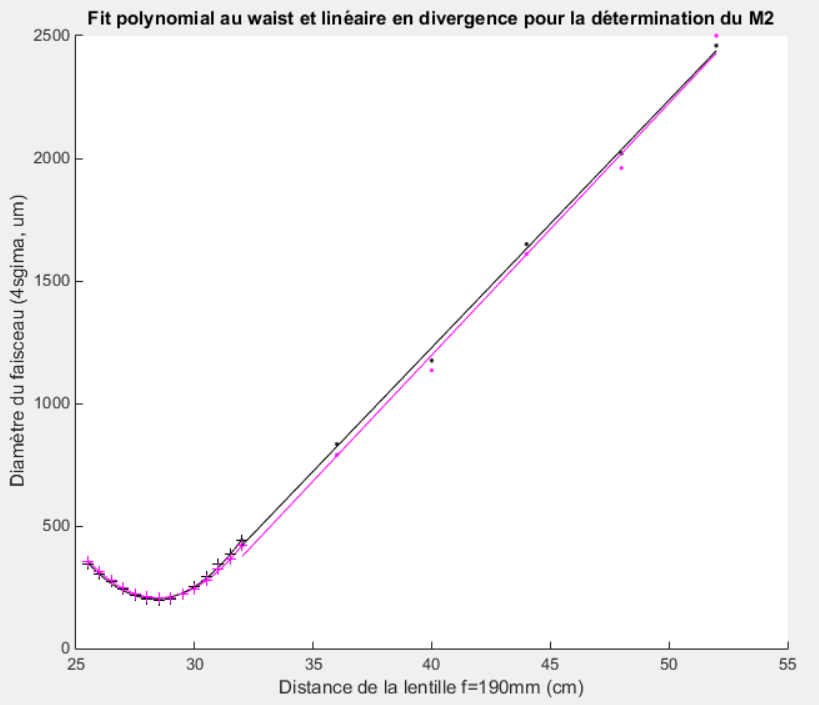
The ThomX M2 has been measured between 1.5-1.6 for x and y |
| Attachment 1: Fit_matlab_M2.PNG
|
 |
|
92
|
Tue Feb 18 12:24:00 2020 |
Loïc Amoudry | Fixed | report | lasers and optics | Optical room | ThomX Locked with CVBGs |
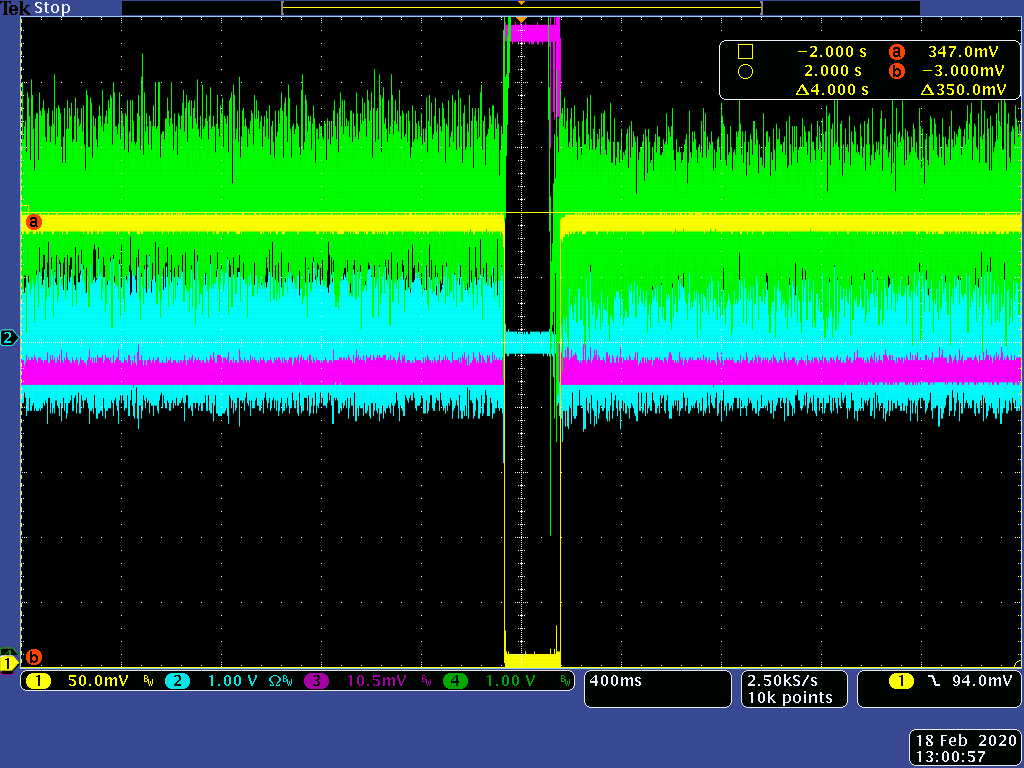
ThomX has been locked with a new telescope while using compression CVBGs.
Coupling is ~50-55% and lock is stable.
Power up to ~50kW should follow up soon (stop when HOM are observed). We'll not go over ~100kW to not risk any breakdown due to the short pulse length (~2.5 ps).
Fabian and Ronic discussed LIDT (laser induced damage threshold) for Ta2O5 at 2.5 ps is => 1J/cm²
We have w > 2 mm ( => surface ~= 0.126 cm²) . At 100 kW it means 800 kW/cm². At 33.33 MHz it means 24 mJ/cm². With 2.5 ps, peak power is 10 GW/cm² (1.2 GW peak).
|
| Attachment 1: tek00001.png
|
 |
| Attachment 2: tek0002CH1.isf
|
| Attachment 3: tek0002CH2.isf
|
| Attachment 4: tek0002CH3.isf
|
| Attachment 5: tek0002CH4.isf
|
|
271
|
Mon Oct 9 13:11:23 2023 |
Daniele Nutarelli | Fixed | info | lasers and optics | ThomX igloo | Tests of pointing stability of the laser CFP |
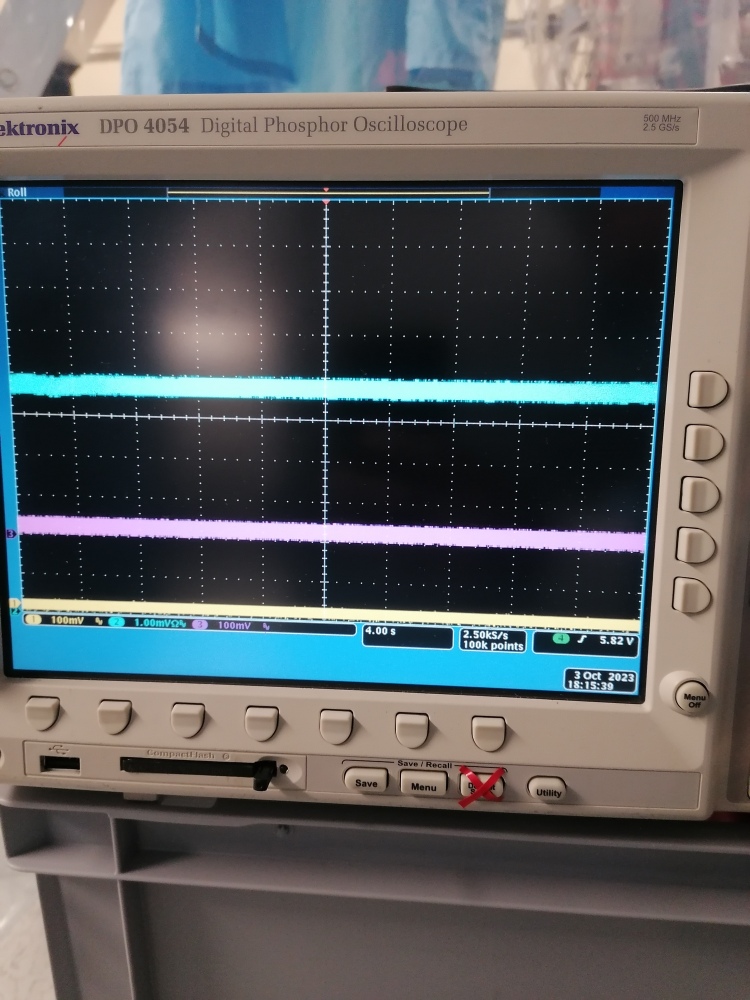
Last monday with Victor we have cheked the stability of de pointing of the laser FP.
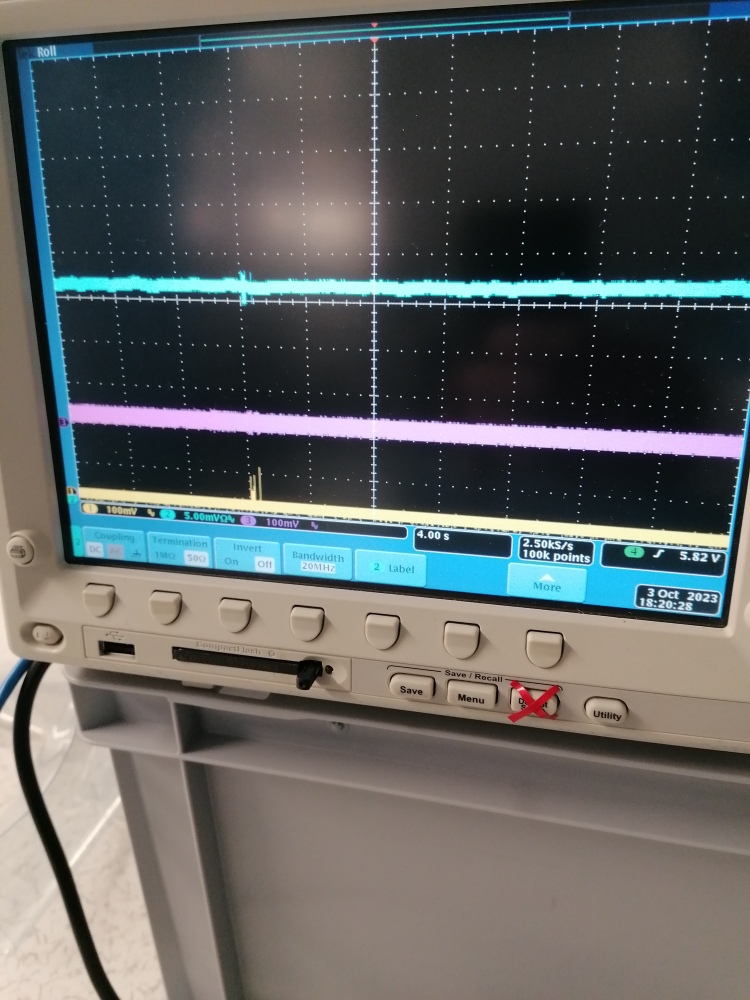
The climatisation was operating since 3 days in satble way. The laser pointing was very stable before to inejct in to the cavity (picture 1) and also for the reflexion from the cavity (picture 2).
That means thant it is necessary to have a stable climatisation operation. |
| Attachment 1: IMG_20231003_155009_resized_20231009_103610100.jpg
|
 |
| Attachment 2: IMG_20231003_155458_resized_20231009_103610449.jpg
|
 |
|
288
|
Thu Nov 23 12:26:26 2023 |
Ronic Chiche | Fixed | issue | lasers and optics | ThomX igloo | Temperature control of the Laser length with the inside Peltier |
|
bunker temperature @ 22.5°C
today, Sebastien Pitrel improved its python software to manually control the laser peltier.
we were able to make to some test. unfortunately, doing only one step change the 500MHz relative frequency by ~400Hz (see the attached plot from 480Hz to 100Hz which is the laser harmonic @500MHz compared to the RF reference @500MHz), which is equivalent to a round trip length variation of 8µm !!!
the present PZT's ranges are equivalent to 400nm of the round trip length. the laser PZT range could be extended by a factor 10 if one drives it using 100V instead of 10V actually, but it would not be enough to be able to use the Peltier ! :-(
if the Peltier changes the inox baseplate of the laser, the relative length change is 1e-5 /K which is equivalent to 100µm/K of the round trip length.
it means the internal temperature steps, done by the peltier, are around 0.08K.
maybe we could try to have smaller steps by using an external thermal setup ?
|
|
287
|
Thu Nov 23 12:25:07 2023 |
Ronic Chiche | Fixed | issue | mechanics | lasers and optics | detectors and electronics | ThomX igloo | Temperature control of the FP-cavity length |
as the CFP motors displacements induce a cavity unlock, we try to change the cavity length by changing the temperature of elment of the cavity.
yesterday, we tried to put a "heating cable" borrowed to the vacuum group to change the temperature of one bellows between the FP-cavity and the electron ring.
we chose a below because it is flexible and should not apply a too strong force on the cavity vessels.
we heated the cable at ~30°C but we didn't see a clear effect on the FP-cavity frequency measurement.
then, we put a heating cable around the X-ray output flange of the FP-cavity vessel and we saw a clear effect : a relatively fast (at a "second" level) frequency change.
the problem is the heating system is not remotely driven.
the cable is R=55ohms impedance and can reach 450°C for 1kW dissipated.
so today, we will try to use 2 remotely controlled Siglent SPD3303X power supplies.
they can reach V=120V DC => P=V²/R=260W => we could reach more than 100°C |
|
294
|
Tue Nov 28 18:38:16 2023 |
Ronic Chiche | Fixed | issue | mechanics | lasers and optics | detectors and electronics | ThomX igloo | Temperature control of the FP-cavity length |
several days ago, we installed a heating cable around the output flange (close to the X-hutch) of the FP-cavity vessel.
we are able to heat this cable by applying a DC voltage coming from 2 DC voltage supplies in serie (2 devices with 2x 0-30V / 3A => 0-120V / 3A).
currently, we apply at maximum 7V DC on each channel => 28V DC on the cable. its temperature reach ~ 30°C after 1/2h or more.
this temperature increase on one vessel of the FP-cavity, changes very slowly the length of the FP-cavity.
see this post (red curve on fig. 2) for a typical temperature curve measured (exponential-like curve) on the heating cable itself : https://elog.lal.in2p3.fr/FPC/THOMX+commissioning/290
the length change rate of the FP-cavity, due to this heating, is difficult to estimate because it depends on the part of this exponential curve you make the measurement.
but globally the drift is about 50nm every 5 minutes, which is roughly equivalent to 10 steps of the FP-cavity motor every 5 minutes.
| Ronic Chiche wrote: |
|
as the CFP motors displacements induce a cavity unlock, we try to change the cavity length by changing the temperature of elment of the cavity.
yesterday, we tried to put a "heating cable" borrowed to the vacuum group to change the temperature of one bellows between the FP-cavity and the electron ring.
we chose a below because it is flexible and should not apply a too strong force on the cavity vessels.
we heated the cable at ~30°C but we didn't see a clear effect on the FP-cavity frequency measurement.
then, we put a heating cable around the X-ray output flange of the FP-cavity vessel and we saw a clear effect : a relatively fast (at a "second" level) frequency change.
the problem is the heating system is not remotely driven.
the cable is R=55ohms impedance and can reach 450°C for 1kW dissipated.
so today, we will try to use 2 remotely controlled Siglent SPD3303X power supplies.
they can reach V=120V DC => P=V²/R=260W => we could reach more than 100°C
|
|
|
297
|
Wed Nov 29 12:20:18 2023 |
Ronic Chiche | Fixed | issue | mechanics | lasers and optics | detectors and electronics | ThomX igloo | Temperature control of the FP-cavity length |
today, I removed one of the DC voltage supply (as with 30V, we are already able to 30°C on the heating cable).
the remaining DC voltage supply is configured in series (2x30V = 60V max) and is at the IP address : 192.168.1.101
| Ronic Chiche wrote: |
|
several days ago, we installed a heating cable around the output flange (close to the X-hutch) of the FP-cavity vessel.
we are able to heat this cable by applying a DC voltage coming from 2 DC voltage supplies in serie (2 devices with 2x 0-30V / 3A => 0-120V / 3A).
currently, we apply at maximum 7V DC on each channel => 28V DC on the cable. its temperature reach ~ 30°C after 1/2h or more.
this temperature increase on one vessel of the FP-cavity, changes very slowly the length of the FP-cavity.
see this post (red curve on fig. 2) for a typical temperature curve measured (exponential-like curve) on the heating cable itself : https://elog.lal.in2p3.fr/FPC/THOMX+commissioning/290
the length change rate of the FP-cavity, due to this heating, is difficult to estimate because it depends on the part of this exponential curve you make the measurement.
but globally the drift is about 50nm every 5 minutes, which is roughly equivalent to 10 steps of the FP-cavity motor every 5 minutes.
| Ronic Chiche wrote: |
|
as the CFP motors displacements induce a cavity unlock, we try to change the cavity length by changing the temperature of elment of the cavity.
yesterday, we tried to put a "heating cable" borrowed to the vacuum group to change the temperature of one bellows between the FP-cavity and the electron ring.
we chose a below because it is flexible and should not apply a too strong force on the cavity vessels.
we heated the cable at ~30°C but we didn't see a clear effect on the FP-cavity frequency measurement.
then, we put a heating cable around the X-ray output flange of the FP-cavity vessel and we saw a clear effect : a relatively fast (at a "second" level) frequency change.
the problem is the heating system is not remotely driven.
the cable is R=55ohms impedance and can reach 450°C for 1kW dissipated.
so today, we will try to use 2 remotely controlled Siglent SPD3303X power supplies.
they can reach V=120V DC => P=V²/R=260W => we could reach more than 100°C
|
|
|
|
301
|
Thu Nov 30 15:53:10 2023 |
Ronic Chiche | Fixed | issue | mechanics | lasers and optics | detectors and electronics | ThomX igloo | Temperature control of the FP-cavity length |
this afternoon, I started the heating cable after the warm-up of the FP-cavity :
14h20 : start to fill 50kW in the cavity
15h : start of the heating cable @10V (2x 5V) (iteration 2300)
15h16 : start of the heating cable @60V (2x 30V) (iteration 3400)
15h20 : start of the heating cable @20V (2x 10V) (iteration 3600)
the offset frequency, for 20V of voltage on the DC voltage supply, is 175Hz @500MHz (equivalent to 3.5µm)
| Ronic Chiche wrote: |
|
today, I removed one of the DC voltage supply (as with 30V, we are already able to 30°C on the heating cable).
the remaining DC voltage supply is configured in series (2x30V = 60V max) and is at the IP address : 192.168.1.101
| Ronic Chiche wrote: |
|
several days ago, we installed a heating cable around the output flange (close to the X-hutch) of the FP-cavity vessel.
we are able to heat this cable by applying a DC voltage coming from 2 DC voltage supplies in serie (2 devices with 2x 0-30V / 3A => 0-120V / 3A).
currently, we apply at maximum 7V DC on each channel => 28V DC on the cable. its temperature reach ~ 30°C after 1/2h or more.
this temperature increase on one vessel of the FP-cavity, changes very slowly the length of the FP-cavity.
see this post (red curve on fig. 2) for a typical temperature curve measured (exponential-like curve) on the heating cable itself : https://elog.lal.in2p3.fr/FPC/THOMX+commissioning/290
the length change rate of the FP-cavity, due to this heating, is difficult to estimate because it depends on the part of this exponential curve you make the measurement.
but globally the drift is about 50nm every 5 minutes, which is roughly equivalent to 10 steps of the FP-cavity motor every 5 minutes.
| Ronic Chiche wrote: |
|
as the CFP motors displacements induce a cavity unlock, we try to change the cavity length by changing the temperature of elment of the cavity.
yesterday, we tried to put a "heating cable" borrowed to the vacuum group to change the temperature of one bellows between the FP-cavity and the electron ring.
we chose a below because it is flexible and should not apply a too strong force on the cavity vessels.
we heated the cable at ~30°C but we didn't see a clear effect on the FP-cavity frequency measurement.
then, we put a heating cable around the X-ray output flange of the FP-cavity vessel and we saw a clear effect : a relatively fast (at a "second" level) frequency change.
the problem is the heating system is not remotely driven.
the cable is R=55ohms impedance and can reach 450°C for 1kW dissipated.
so today, we will try to use 2 remotely controlled Siglent SPD3303X power supplies.
they can reach V=120V DC => P=V²/R=260W => we could reach more than 100°C
|
|
|
|
| Attachment 1: Screenshot_2023-11-30_15-48-05.png
|
 |
|
302
|
Mon Dec 4 10:45:50 2023 |
Ronic Chiche | Fixed | issue | mechanics | lasers and optics | detectors and electronics | ThomX igloo | Temperature control of the FP-cavity length |
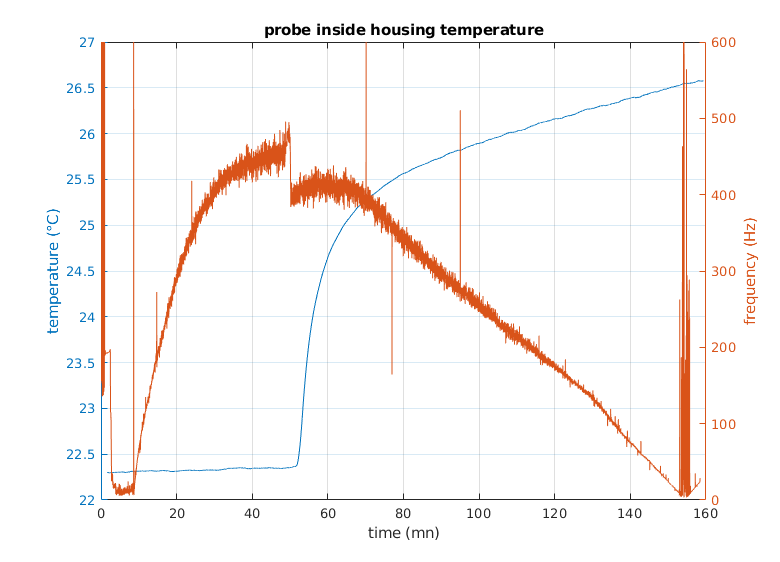
last friday, I locked the cavity and then, switched ON the heating cable after waiting the cavity reaches a steady state in frequency drift : see the figure.
blue : temperature of the probe on the heating cable
red : freqeuncy drift between FP-cavity (laser locked on it) and RF reference oscillator.
@ 10min : filling the FP-cavity with 50kW
@ 50min : "long" lock loss of about 1min => jumb in frequency => it is strange to see the cavity does not reach the same frequency steady state after the lock loss than before the lock loss.
(just before the small frequency jump, the frequency is increasing a bit because of the lock has been lost and the laser is drifting by itself in open loop. the jump, after that, corresponds to the moment where the laser is locked back to the FP-cavity)
@ 55min : switch ON the heating cable with 20V on the voltage supply => the probe stuck on the cable shows the temperature increases => and a bit later, one can see the frequency decreasing.
surprisingly, we don't reach a steady state ...
I suspect that filling the FP-cavity with power (without switching ON the heating cable) could first inscrease the frequency and later could decrease it if several parts of the mechanics are involved and if the thermal conduction is slow because of some isolation embbedded in the mechanics (for example ceramics balls).
it is possible to make the frequency drifting sensitivity test of the heating cable without locking the cavity at 50kW.
one can work in open loop, without power in the FP-cavity, and follow the frequency drift by keeping the main resonance at the same relative position to the laser PZT.
| Ronic Chiche wrote: |
|
this afternoon, I started the heating cable after the warm-up of the FP-cavity :
14h20 : start to fill 50kW in the cavity
15h : start of the heating cable @10V (2x 5V) (iteration 2300)
15h16 : start of the heating cable @60V (2x 30V) (iteration 3400)
15h20 : start of the heating cable @20V (2x 10V) (iteration 3600)
the offset frequency, for 20V of voltage on the DC voltage supply, is 175Hz @500MHz (equivalent to 3.5µm)
| Ronic Chiche wrote: |
|
today, I removed one of the DC voltage supply (as with 30V, we are already able to 30°C on the heating cable).
the remaining DC voltage supply is configured in series (2x30V = 60V max) and is at the IP address : 192.168.1.101
| Ronic Chiche wrote: |
|
several days ago, we installed a heating cable around the output flange (close to the X-hutch) of the FP-cavity vessel.
we are able to heat this cable by applying a DC voltage coming from 2 DC voltage supplies in serie (2 devices with 2x 0-30V / 3A => 0-120V / 3A).
currently, we apply at maximum 7V DC on each channel => 28V DC on the cable. its temperature reach ~ 30°C after 1/2h or more.
this temperature increase on one vessel of the FP-cavity, changes very slowly the length of the FP-cavity.
see this post (red curve on fig. 2) for a typical temperature curve measured (exponential-like curve) on the heating cable itself : https://elog.lal.in2p3.fr/FPC/THOMX+commissioning/290
the length change rate of the FP-cavity, due to this heating, is difficult to estimate because it depends on the part of this exponential curve you make the measurement.
but globally the drift is about 50nm every 5 minutes, which is roughly equivalent to 10 steps of the FP-cavity motor every 5 minutes.
| Ronic Chiche wrote: |
|
as the CFP motors displacements induce a cavity unlock, we try to change the cavity length by changing the temperature of elment of the cavity.
yesterday, we tried to put a "heating cable" borrowed to the vacuum group to change the temperature of one bellows between the FP-cavity and the electron ring.
we chose a below because it is flexible and should not apply a too strong force on the cavity vessels.
we heated the cable at ~30°C but we didn't see a clear effect on the FP-cavity frequency measurement.
then, we put a heating cable around the X-ray output flange of the FP-cavity vessel and we saw a clear effect : a relatively fast (at a "second" level) frequency change.
the problem is the heating system is not remotely driven.
the cable is R=55ohms impedance and can reach 450°C for 1kW dissipated.
so today, we will try to use 2 remotely controlled Siglent SPD3303X power supplies.
they can reach V=120V DC => P=V²/R=260W => we could reach more than 100°C
|
|
|
|
|
| Attachment 1: 2023_12_01_temp_freq.png
|
 |
|
304
|
Thu Dec 7 14:59:02 2023 |
Ronic Chiche | Fixed | issue | mechanics | lasers and optics | detectors and electronics | ThomX igloo | Temperature control of the FP-cavity length |
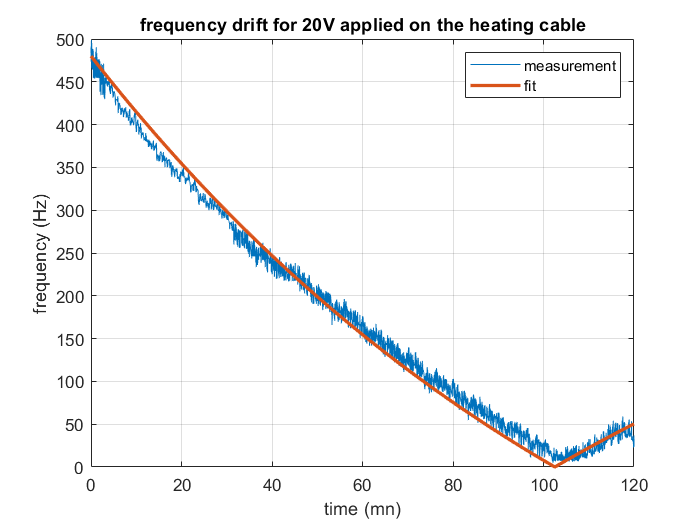
on last tuesday, I did a long-term measurement of the frequency drift when the heating cable is powered ON at 20V (2x 10V) @ t=0mn.
the freqeuncy drift (between the laser, locked in open loop on the FP-cavity, and the RF reference oscillator) acquisition was made by the National Instrument software.
the sampling rate of this acquisition is not set by the user but depends on several parameters of the acquisition... and then can be subject to change.
on can see on the data, in blue, a possible sampling rate change @ t~30mn.
@ t~100mn : the frequency sign changes but the measurement gives always the absolute value.
in orange, the fit is not very good... possibly due to the sampling rate change.
the conclusion we can have is only this frequency drift action has a very long time constant ~ 2h
and could be used to compensate, as soon as the power is in the FPcavity, the frequency drift coming from this power.
| Ronic Chiche wrote: |
|
last friday, I locked the cavity and then, switched ON the heating cable after waiting the cavity reaches a steady state in frequency drift : see the figure.
blue : temperature of the probe on the heating cable
red : freqeuncy drift between FP-cavity (laser locked on it) and RF reference oscillator.
@ 10min : filling the FP-cavity with 50kW
@ 50min : "long" lock loss of about 1min => jumb in frequency => it is strange to see the cavity does not reach the same frequency steady state after the lock loss than before the lock loss.
(just before the small frequency jump, the frequency is increasing a bit because of the lock has been lost and the laser is drifting by itself in open loop. the jump, after that, corresponds to the moment where the laser is locked back to the FP-cavity)
@ 55min : switch ON the heating cable with 20V on the voltage supply => the probe stuck on the cable shows the temperature increases => and a bit later, one can see the frequency decreasing.
surprisingly, we don't reach a steady state ...
I suspect that filling the FP-cavity with power (without switching ON the heating cable) could first inscrease the frequency and later could decrease it if several parts of the mechanics are involved and if the thermal conduction is slow because of some isolation embbedded in the mechanics (for example ceramics balls).
it is possible to make the frequency drifting sensitivity test of the heating cable without locking the cavity at 50kW.
one can work in open loop, without power in the FP-cavity, and follow the frequency drift by keeping the main resonance at the same relative position to the laser PZT.
| Ronic Chiche wrote: |
|
this afternoon, I started the heating cable after the warm-up of the FP-cavity :
14h20 : start to fill 50kW in the cavity
15h : start of the heating cable @10V (2x 5V) (iteration 2300)
15h16 : start of the heating cable @60V (2x 30V) (iteration 3400)
15h20 : start of the heating cable @20V (2x 10V) (iteration 3600)
the offset frequency, for 20V of voltage on the DC voltage supply, is 175Hz @500MHz (equivalent to 3.5µm)
| Ronic Chiche wrote: |
|
today, I removed one of the DC voltage supply (as with 30V, we are already able to 30°C on the heating cable).
the remaining DC voltage supply is configured in series (2x30V = 60V max) and is at the IP address : 192.168.1.101
| Ronic Chiche wrote: |
|
several days ago, we installed a heating cable around the output flange (close to the X-hutch) of the FP-cavity vessel.
we are able to heat this cable by applying a DC voltage coming from 2 DC voltage supplies in serie (2 devices with 2x 0-30V / 3A => 0-120V / 3A).
currently, we apply at maximum 7V DC on each channel => 28V DC on the cable. its temperature reach ~ 30°C after 1/2h or more.
this temperature increase on one vessel of the FP-cavity, changes very slowly the length of the FP-cavity.
see this post (red curve on fig. 2) for a typical temperature curve measured (exponential-like curve) on the heating cable itself : https://elog.lal.in2p3.fr/FPC/THOMX+commissioning/290
the length change rate of the FP-cavity, due to this heating, is difficult to estimate because it depends on the part of this exponential curve you make the measurement.
but globally the drift is about 50nm every 5 minutes, which is roughly equivalent to 10 steps of the FP-cavity motor every 5 minutes.
| Ronic Chiche wrote: |
|
as the CFP motors displacements induce a cavity unlock, we try to change the cavity length by changing the temperature of elment of the cavity.
yesterday, we tried to put a "heating cable" borrowed to the vacuum group to change the temperature of one bellows between the FP-cavity and the electron ring.
we chose a below because it is flexible and should not apply a too strong force on the cavity vessels.
we heated the cable at ~30°C but we didn't see a clear effect on the FP-cavity frequency measurement.
then, we put a heating cable around the X-ray output flange of the FP-cavity vessel and we saw a clear effect : a relatively fast (at a "second" level) frequency change.
the problem is the heating system is not remotely driven.
the cable is R=55ohms impedance and can reach 450°C for 1kW dissipated.
so today, we will try to use 2 remotely controlled Siglent SPD3303X power supplies.
they can reach V=120V DC => P=V²/R=260W => we could reach more than 100°C
|
|
|
|
|
|
| Attachment 1: untitled.png
|
 |
|
306
|
Mon Dec 11 17:21:32 2023 |
Ronic Chiche | Fixed | issue | mechanics | lasers and optics | detectors and electronics | ThomX igloo | Temperature control of the FP-cavity length |
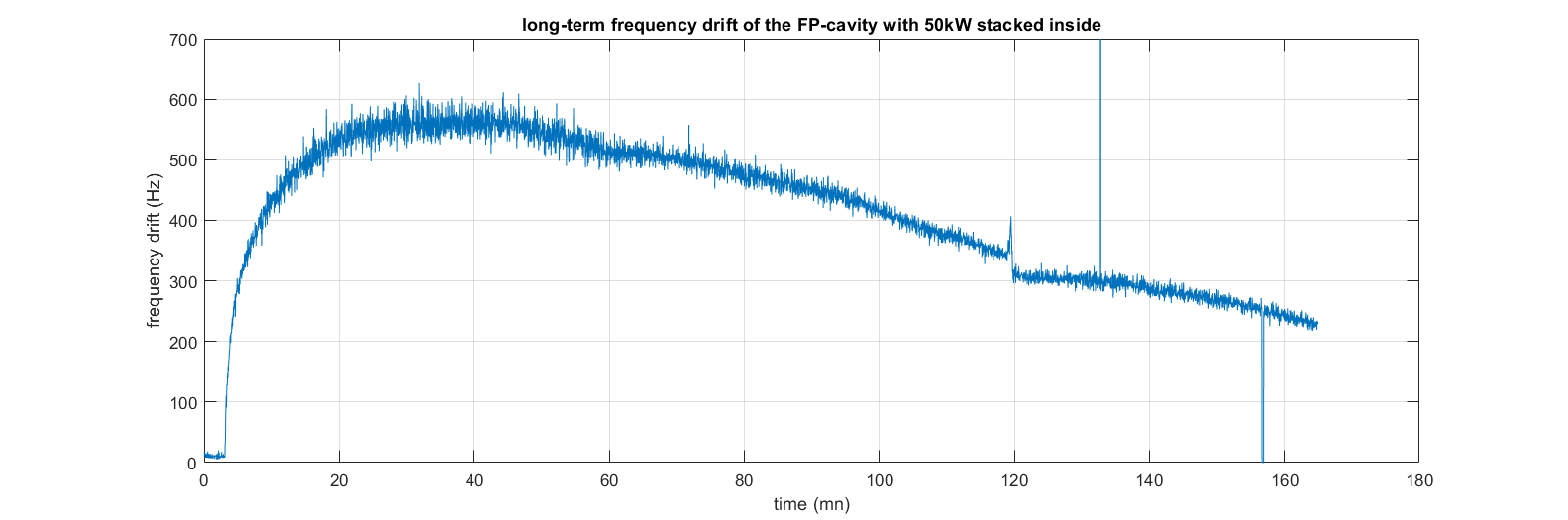
today with Fatematuj, we did a long-term frequency drift measurement between the FP-cavity loaded with 50kW and the RF reference frequency... and without any other thermal source (no heating cable !)
we had a small lock loss at t ~ 120mn.
we see at the begining an exponential behavior of the FP-cavity reaching a thermal steady state until t ~ 40mn, and then we see the frequency slowly drifting in the reverted direction...
which is the evidence of the thermal source reaching a different mechanical part of the FP-cavity for which an increase of temperature induces a reverted change in frequency.
the very long delay between these 2 opposite behaviors could come from the ceramic balls on which the big mechanical mounts of the mirrors are placed.
we have to redo this measurement with a longer period to see if and when we are reaching a steady state !
| Ronic Chiche wrote: |
|
on last tuesday, I did a long-term measurement of the frequency drift when the heating cable is powered ON at 20V (2x 10V) @ t=0mn.
the freqeuncy drift (between the laser, locked in open loop on the FP-cavity, and the RF reference oscillator) acquisition was made by the National Instrument software.
the sampling rate of this acquisition is not set by the user but depends on several parameters of the acquisition... and then can be subject to change.
on can see on the data, in blue, a possible sampling rate change @ t~30mn.
@ t~100mn : the frequency sign changes but the measurement gives always the absolute value.
in orange, the fit is not very good... possibly due to the sampling rate change.
the conclusion we can have is only this frequency drift action has a very long time constant ~ 2h
and could be used to compensate, as soon as the power is in the FPcavity, the frequency drift coming from this power.
| Ronic Chiche wrote: |
|
last friday, I locked the cavity and then, switched ON the heating cable after waiting the cavity reaches a steady state in frequency drift : see the figure.
blue : temperature of the probe on the heating cable
red : freqeuncy drift between FP-cavity (laser locked on it) and RF reference oscillator.
@ 10min : filling the FP-cavity with 50kW
@ 50min : "long" lock loss of about 1min => jumb in frequency => it is strange to see the cavity does not reach the same frequency steady state after the lock loss than before the lock loss.
(just before the small frequency jump, the frequency is increasing a bit because of the lock has been lost and the laser is drifting by itself in open loop. the jump, after that, corresponds to the moment where the laser is locked back to the FP-cavity)
@ 55min : switch ON the heating cable with 20V on the voltage supply => the probe stuck on the cable shows the temperature increases => and a bit later, one can see the frequency decreasing.
surprisingly, we don't reach a steady state ...
I suspect that filling the FP-cavity with power (without switching ON the heating cable) could first inscrease the frequency and later could decrease it if several parts of the mechanics are involved and if the thermal conduction is slow because of some isolation embbedded in the mechanics (for example ceramics balls).
it is possible to make the frequency drifting sensitivity test of the heating cable without locking the cavity at 50kW.
one can work in open loop, without power in the FP-cavity, and follow the frequency drift by keeping the main resonance at the same relative position to the laser PZT.
| Ronic Chiche wrote: |
|
this afternoon, I started the heating cable after the warm-up of the FP-cavity :
14h20 : start to fill 50kW in the cavity
15h : start of the heating cable @10V (2x 5V) (iteration 2300)
15h16 : start of the heating cable @60V (2x 30V) (iteration 3400)
15h20 : start of the heating cable @20V (2x 10V) (iteration 3600)
the offset frequency, for 20V of voltage on the DC voltage supply, is 175Hz @500MHz (equivalent to 3.5µm)
| Ronic Chiche wrote: |
|
today, I removed one of the DC voltage supply (as with 30V, we are already able to 30°C on the heating cable).
the remaining DC voltage supply is configured in series (2x30V = 60V max) and is at the IP address : 192.168.1.101
| Ronic Chiche wrote: |
|
several days ago, we installed a heating cable around the output flange (close to the X-hutch) of the FP-cavity vessel.
we are able to heat this cable by applying a DC voltage coming from 2 DC voltage supplies in serie (2 devices with 2x 0-30V / 3A => 0-120V / 3A).
currently, we apply at maximum 7V DC on each channel => 28V DC on the cable. its temperature reach ~ 30°C after 1/2h or more.
this temperature increase on one vessel of the FP-cavity, changes very slowly the length of the FP-cavity.
see this post (red curve on fig. 2) for a typical temperature curve measured (exponential-like curve) on the heating cable itself : https://elog.lal.in2p3.fr/FPC/THOMX+commissioning/290
the length change rate of the FP-cavity, due to this heating, is difficult to estimate because it depends on the part of this exponential curve you make the measurement.
but globally the drift is about 50nm every 5 minutes, which is roughly equivalent to 10 steps of the FP-cavity motor every 5 minutes.
| Ronic Chiche wrote: |
|
as the CFP motors displacements induce a cavity unlock, we try to change the cavity length by changing the temperature of elment of the cavity.
yesterday, we tried to put a "heating cable" borrowed to the vacuum group to change the temperature of one bellows between the FP-cavity and the electron ring.
we chose a below because it is flexible and should not apply a too strong force on the cavity vessels.
we heated the cable at ~30°C but we didn't see a clear effect on the FP-cavity frequency measurement.
then, we put a heating cable around the X-ray output flange of the FP-cavity vessel and we saw a clear effect : a relatively fast (at a "second" level) frequency change.
the problem is the heating system is not remotely driven.
the cable is R=55ohms impedance and can reach 450°C for 1kW dissipated.
so today, we will try to use 2 remotely controlled Siglent SPD3303X power supplies.
they can reach V=120V DC => P=V²/R=260W => we could reach more than 100°C
|
|
|
|
|
|
|
| Attachment 1: frequency_drift.png
|
 |
|
91
|
Fri Feb 14 18:02:37 2020 |
Loïc Amoudry | Fixed | report | lasers and optics | Optical room | Telescope for compressors and ThomX |
CVBGs telescope is done with w ~= 1mm.
ThomX telescope is done with w ~= 2.3mm in x and y.
Newt step is to lock with these short pulses (measured ~2.5ps with FWHM standard deviation interference method). |
|
445
|
Wed Jul 16 17:17:57 2025 |
Ronic Chiche | Under Process | info | lasers and optics | ThomX igloo | Suite tests stabilité |
We continue to find what gives high freq. perturbation.
The laser starts at 92 KW it is stable and locked to the RF. NO high freq parturbation.... With the machine off. (30 min of lock)
We put now the machine ON (All in warming exept pulsed elements)... => the system is very stable NO delock, NO high freq perturbations. The operator can even go to toilet during the operation... it's a very big improvement!!!
Now we continue with the e-beam production.... => when we put ON the Kikers wtih the rest of the machine (no electrons yet) some perturbations are observed and delock also.... but no really high freq perturbations juste very big 20 Hz like ones (at 10h30). Some people oh PERLE are in the igloo now. In any case it was easy to relock and it is very stable now.
10h50 some 40 Hz perturbation and delock.... and very big 20 Hz perturbations.... some delock arrived but not really high freq.
!!!!!!! PERLE PEOPLE MOVES LE PONT SINCE 10H30!!!!! CORRESPONDING TO DELOCK!!!
That means that the system is stable with all the maching On (but NO electrons).
So in the afternoon we will put the electrons and continue the investigation of stability.
I restart the laser after lunch with electrons in the machine. I have lost 7 KW of power.... and the lock parameter changed (P gain 0.05-> 0.03)
Je vois passer des hautes freq!! J'ai retrouvé 92 KW avec l'alignement qui avait bougé visiblement!! But the PID parameters are still 0.03.
I see a little bit Hig frq perturb but the laser dont delock. Also bigger high freq perturbation with delock. electrons effect or alignement problems??
We change the frequency for 50MeV. Delta freq = 3.6kHz so dela cavity lenght -1.1mm
We have electrons and we lock much better than before to add the amplifier to enlarge PID range.
We observe some high freq perturbations but the PID compensate and we have almost no delock!!
In conclusion: high freq perturbations dont come from the machine without electrons. The presence of the electrons is associated to some high frq perturbations but the new feedback system can compensate them and delock are rare but we have some with electrons.
Globaly the system is much better
Daniele |
|
160
|
Thu Oct 13 12:26:07 2022 |
Ronic Chiche | Fixed | info | lasers and optics | ThomX igloo | Strecher and fiber injection alignment |
Today, after laser was modelocked, we checked the power inside the fiber coming from the Alphanov Strecher box.
it was almost zero, at the nW level.
after doing some very rough alignment, we clearly saw some power (with the powermeter) correlated with the position of mirrors, when turning the alignment knobs.
this is a first step but the output power in the fiber is still very low, about 20nW !
an additionnal 2mm L-shaped hex key is needed to do some walking alignment on the mounts. |
|
161
|
Mon Oct 17 13:58:08 2022 |
Ronic Chiche | Fixed | info | lasers and optics | ThomX igloo | Strecher and fiber injection alignment |
This morning with Viktor, we started the alignment of the CVBG and fiber.
we did a better alignment of the 2-pass CVBG.
we are able to the see a spot after PBS (after the 2 CVBG pass) which means the alignment is OK even if it can be improved.
then, we started the fiber injection alignment with the 2 last mirrors (7 & 8 on Alphanov documentation).
we saw that if we unswcrew the fiber to play on the focal position, we are able to improve a lot the power in the fiber.
2-3µW with the fiber screwed => 500µW with the fiber unscrewed.
it means the beam is not enough focused.
I will ask Guillaume Machinet his advice when injecting the 33MHz... do we need to replace the long focal lens just after the Isolator ?
and with which value approximatively ?
we played also with the Schafter+Kirchhoff mount of the fiber colimator (see attached documentation).
we loosen the 2 screws around the eccentric key which adjust the focal position + play on this eccentic key + tighten the 2 screws again.
now, we reached 330µW with the fiber properly screwed.
we have to check the available power before the fiber injection but we have very few place to place the powermeter.
maybe with a small mirror ?
| Ronic Chiche wrote: |
|
Today, after laser was modelocked, we checked the power inside the fiber coming from the Alphanov Strecher box.
it was almost zero, at the nW level.
after doing some very rough alignment, we clearly saw some power (with the powermeter) correlated with the position of mirrors, when turning the alignment knobs.
this is a first step but the output power in the fiber is still very low, about 20nW !
an additionnal 2mm L-shaped hex key is needed to do some walking alignment on the mounts.
|
|
| Attachment 1: Adjustment_SMS.pdf
|