| ID |
Date |
Author |
Status |
Type |
Category |
Location |
Title |
|
101
|
Tue Jul 7 12:49:38 2020 |
Ronic Chiche | Fixed | info | lasers and optics | Optical room | Finesse measurement after the Edge installation |
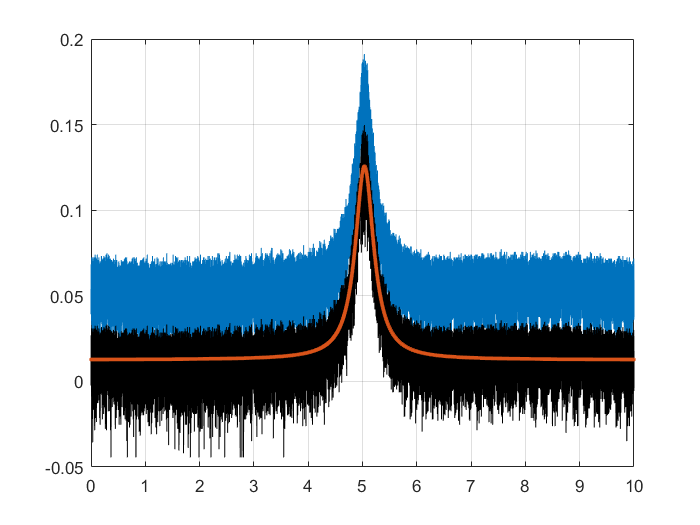
After the Edge installation inside the cavity, the Finesse has been measured several times by modulation technique with an average around 16000:
(the scan speed is 50kHz in 10 seconds.)
So, it hasn't changed since the last measurement in June, just before the Edge installation.
The Edge position is normally the furthest from cavity beam (all rotating knobs are at 0 positions)
We used the last Onefive telescope (used with CVBGs). Coupling reached ~50% after alignment.
The cavity vacuum is ~7.2e-9 mbar as the cavity has been recently opened...
|
| Attachment 1: untitled.png
|
 |
|
102
|
Tue Oct 27 13:13:50 2020 |
Loïc Amoudry | Fixed | info | lasers and optics | Optical room | Coating reflectivity |
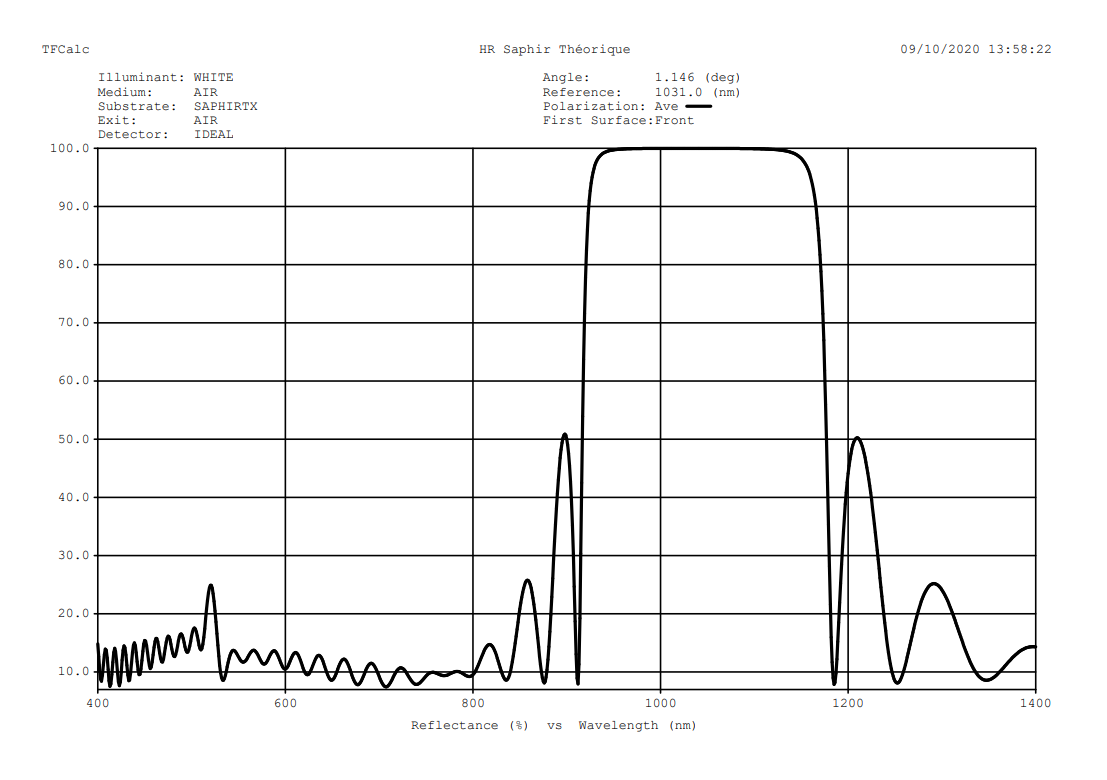
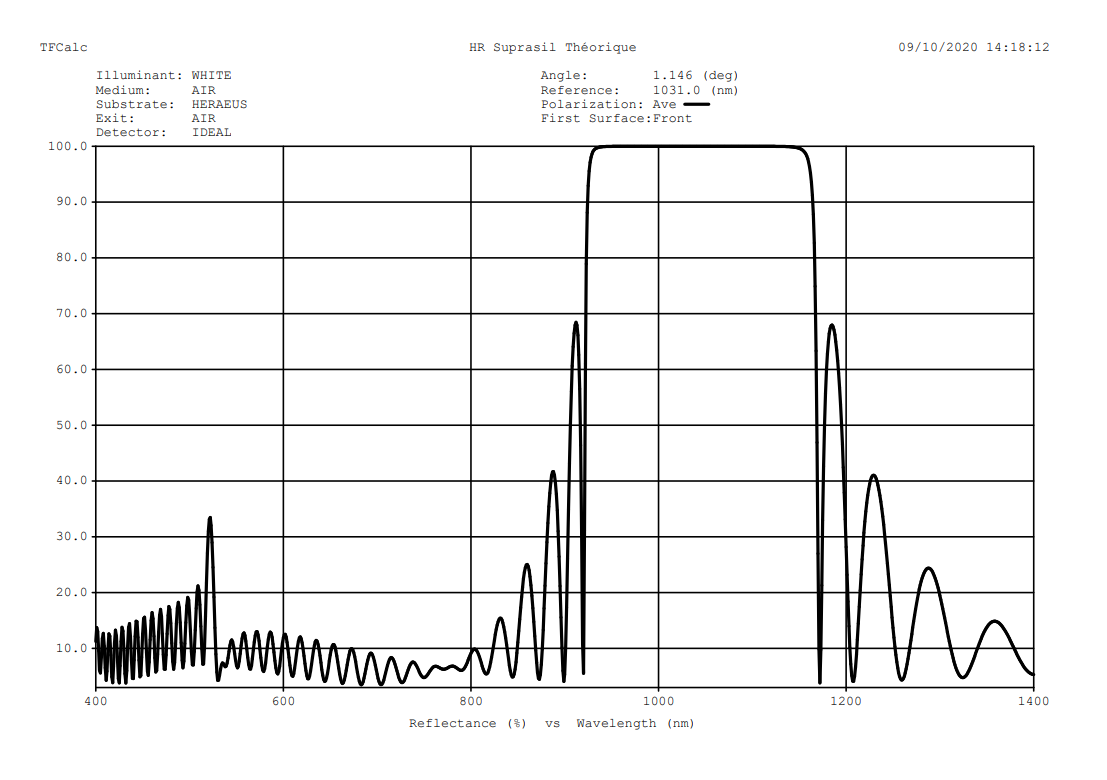
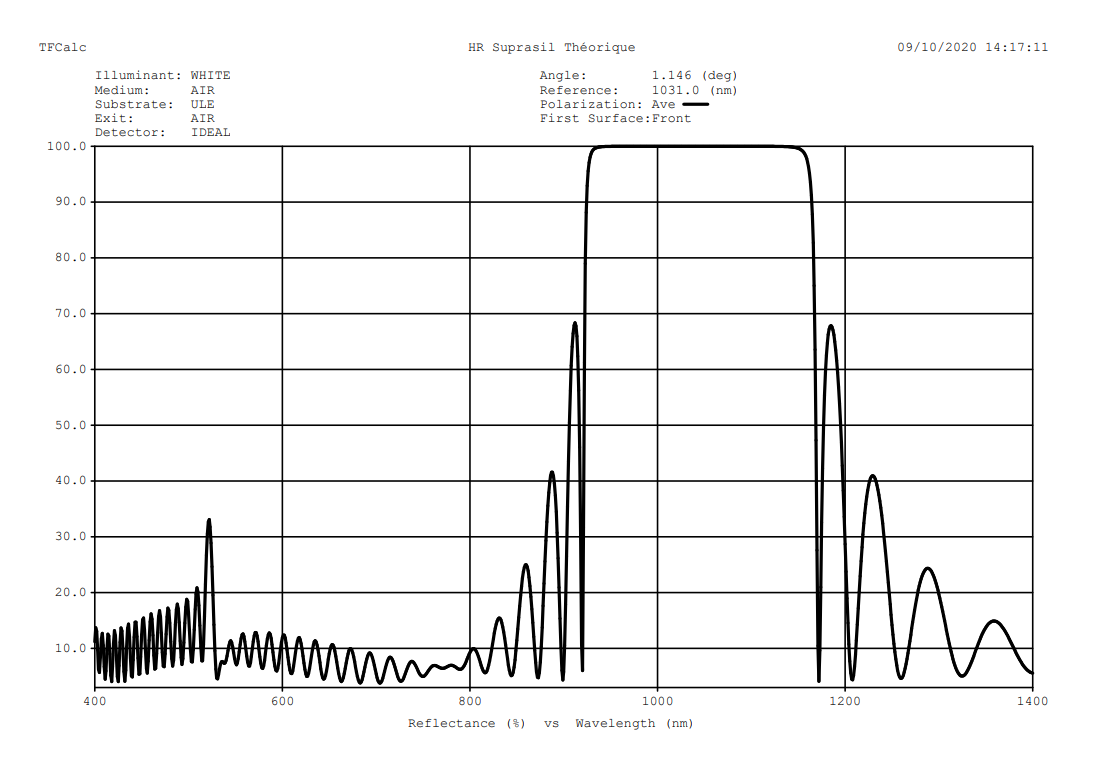
Coatings reflectivity curves and datas for HR Saphir, HR Suprasil and HR ULE. |
| Attachment 1: HR_Saphir_Théorique.PNG
|
 |
| Attachment 2: HR_Suprasil_Théorique.PNG
|
 |
| Attachment 3: HR_ULE_Théorique.PNG
|
 |
| Attachment 4: Table_HR_Saphir.TXT
|
400.0	85.1750
401.0	87.3579
402.0	89.6588
403.0	91.2610
404.0	91.5817
405.0	90.5819
406.0	88.8006
407.0	87.0591
408.0	86.0823
409.0	86.2646
410.0	87.5842
411.0	89.5943
412.0	91.5095
413.0	92.4844
414.0	92.0541
415.0	90.4258
416.0	88.3396
417.0	86.6428
418.0	85.9386
419.0	86.4444
420.0	87.9765
421.0	89.9869
422.0	91.6931
423.0	92.3704
424.0	91.7171
425.0	90.0207
426.0	87.9708
427.0	86.2994
428.0	85.5165
429.0	85.8139
430.0	87.0628
431.0	88.8460
432.0	90.5433
433.0	91.5207
434.0	91.3963
435.0	90.2238
436.0	88.4481
437.0	86.6722
438.0	85.4180
439.0	84.9957
440.0	85.4699
441.0	86.6720
442.0	88.2333
443.0	89.6609
444.0	90.4796
445.0	90.4096
446.0	89.4823
447.0	88.0125
448.0	86.4504
449.0	85.2159
450.0	84.5929
451.0	84.6908
452.0	85.4459
453.0	86.6395
454.0	87.9385
455.0	88.9689
456.0	89.4245
457.0	89.1716
458.0	88.2943
459.0	87.0511
460.0	85.7733
461.0	84.7630
462.0	84.2266
463.0	84.2490
464.0	84.7926
465.0	85.7091
466.0	86.7665
467.0	87.6948
468.0	88.2511
469.0	88.2900
470.0	87.8065
471.0	86.9318
472.0	85.8842
473.0	84.9012
474.0	84.1822
475.0	83.8540
476.0	83.9574
477.0	84.4483
478.0	85.2074
479.0	86.0603
480.0	86.8101
481.0	87.2800
482.0	87.3580
483.0	87.0263
484.0	86.3627
485.0	85.5151
486.0	84.6592
487.0	83.9585
488.0	83.5339
489.0	83.4489
490.0	83.7039
491.0	84.2394
492.0	84.9441
493.0	85.6722
494.0	86.2679
495.0	86.5977
496.0	86.5806
497.0	86.2082
498.0	85.5457
499.0	84.7139
500.0	83.8602
501.0	83.1284
502.0	82.6350
503.0	82.4549
504.0	82.6140
505.0	83.0868
506.0	83.7970
507.0	84.6233
508.0	85.4110
509.0	85.9927
510.0	86.2173
511.0	85.9810
512.0	85.2518
513.0	84.0769
514.0	82.5717
515.0	80.8932
516.0	79.2103
517.0	77.6790
518.0	76.4268
519.0	75.5474
520.0	75.1010
521.0	75.1173
522.0	75.5997
523.0	76.5265
524.0	77.8522
525.0	79.5075
526.0	81.3991
527.0	83.4129
528.0	85.4198
529.0	87.2874
530.0	88.8939
531.0	90.1440
532.0	90.9816
533.0	91.3958
534.0	91.4184
535.0	91.1151
536.0	90.5717
537.0	89.8801
538.0	89.1269
539.0	88.3862
540.0	87.7151
541.0	87.1536
542.0	86.7252
543.0	86.4394
544.0	86.2944
545.0	86.2791
546.0	86.3760
547.0	86.5627
548.0	86.8142
549.0	87.1038
550.0	87.4051
551.0	87.6927
552.0	87.9441
553.0	88.1400
554.0	88.2660
555.0	88.3132
556.0	88.2786
557.0	88.1654
558.0	87.9828
559.0	87.7453
560.0	87.4718
561.0	87.1836
562.0	86.9035
563.0	86.6537
564.0	86.4544
565.0	86.3222
566.0	86.2689
567.0	86.3007
568.0	86.4177
569.0	86.6133
570.0	86.8746
571.0	87.1832
572.0	87.5159
573.0	87.8467
574.0	88.1484
575.0	88.3956
576.0	88.5666
577.0	88.6460
578.0	88.6262
579.0	88.5085
580.0	88.3032
581.0	88.0282
582.0	87.7077
583.0	87.3695
584.0	87.0428
585.0	86.7555
586.0	86.5322
587.0	86.3927
588.0	86.3503
589.0	86.4112
590.0	86.5743
591.0	86.8309
592.0	87.1653
593.0	87.5555
594.0	87.9748
595.0	88.3932
596.0	88.7800
597.0	89.1058
598.0	89.3457
599.0	89.4812
600.0	89.5022
601.0	89.4082
602.0	89.2079
603.0	88.9187
604.0	88.5647
605.0	88.1744
606.0	87.7786
607.0	87.4076
608.0	87.0890
609.0	86.8466
610.0	86.6983
611.0	86.6559
612.0	86.7246
613.0	86.9024
614.0	87.1806
615.0	87.5441
616.0	87.9723
617.0	88.4395
618.0	88.9172
619.0	89.3752
620.0	89.7838
621.0	90.1164
622.0	90.3511
623.0	90.4728
624.0	90.4747
625.0	90.3586
626.0	90.1347
627.0	89.8206
628.0	89.4397
629.0	89.0191
630.0	88.5878
631.0	88.1743
632.0	87.8049
633.0	87.5025
634.0	87.2858
635.0	87.1678
636.0	87.1564
637.0	87.2536
638.0	87.4557
639.0	87.7534
640.0	88.1325
641.0	88.5740
642.0	89.0555
643.0	89.5514
644.0	90.0351
645.0	90.4801
646.0	90.8614
647.0	91.1580
648.0	91.3536
649.0	91.4382
650.0	91.4087
651.0	91.2692
652.0	91.0305
653.0	90.7091
654.0	90.3257
655.0	89.9040
656.0	89.4689
657.0	89.0450
658.0	88.6552
659.0	88.3198
660.0	88.0558
661.0	87.8762
662.0	87.7897
663.0	87.8008
664.0	87.9093
665.0	88.1109
666.0	88.3971
667.0	88.7558
668.0	89.1712
669.0	89.6251
670.0	90.0968
671.0	90.5648
672.0	91.0073
673.0	91.4034
674.0	91.7346
675.0	91.9854
676.0	92.1448
677.0	92.2065
678.0	92.1694
679.0	92.0378
680.0	91.8207
681.0	91.5313
682.0	91.1858
683.0	90.8027
684.0	90.4016
685.0	90.0018
686.0	89.6219
687.0	89.2786
688.0	88.9866
689.0	88.7576
690.0	88.6007
691.0	88.5214
692.0	88.5225
693.0	88.6035
694.0	88.7608
695.0	88.9881
696.0	89.2763
697.0	89.6142
698.0	89.9884
699.0	90.3843
... 702 more lines ...
|
| Attachment 5: Table_HR_Suprasil.TXT
|
400.0	88.7768
401.0	86.2695
402.0	86.9869
403.0	90.4219
404.0	93.9311
405.0	94.4202
406.0	91.5736
407.0	88.2471
408.0	87.3107
409.0	89.5856
410.0	93.4985
411.0	95.7352
412.0	94.1050
413.0	90.1872
414.0	87.3945
415.0	87.8016
416.0	91.1922
417.0	95.1117
418.0	96.1514
419.0	93.2754
420.0	89.0618
421.0	86.7369
422.0	87.7741
423.0	91.5348
424.0	95.4121
425.0	96.1862
426.0	93.1187
427.0	88.7806
428.0	86.2246
429.0	86.8956
430.0	90.3858
431.0	94.5243
432.0	96.2184
433.0	94.0233
434.0	89.7026
435.0	86.2514
436.0	85.5664
437.0	87.9247
438.0	92.0610
439.0	95.3794
440.0	95.4098
441.0	92.1048
442.0	87.8382
443.0	85.1256
444.0	85.2208
445.0	88.0207
446.0	92.1272
447.0	95.1008
448.0	94.8653
449.0	91.5769
450.0	87.4159
451.0	84.6395
452.0	84.4255
453.0	86.8006
454.0	90.7043
455.0	94.0931
456.0	94.8538
457.0	92.4633
458.0	88.4538
459.0	85.0028
460.0	83.5861
461.0	84.6760
462.0	87.8282
463.0	91.6865
464.0	94.2531
465.0	93.9852
466.0	91.0438
467.0	87.1133
468.0	84.0546
469.0	83.0053
470.0	84.2668
471.0	87.3829
472.0	91.1293
473.0	93.7318
474.0	93.7554
475.0	91.1805
476.0	87.3920
477.0	84.1027
478.0	82.4884
479.0	83.0065
480.0	85.4731
481.0	89.0633
482.0	92.3464
483.0	93.7547
484.0	92.5348
485.0	89.3177
486.0	85.6011
487.0	82.7975
488.0	81.7479
489.0	82.7037
490.0	85.3914
491.0	88.9875
492.0	92.1563
493.0	93.4820
494.0	92.2910
495.0	89.1389
496.0	85.3795
497.0	82.3416
498.0	80.8731
499.0	81.3072
500.0	83.5345
501.0	86.9877
502.0	90.5950
503.0	92.9602
504.0	92.9836
505.0	90.5767
506.0	86.7214
507.0	82.8027
508.0	79.9454
509.0	78.7948
510.0	79.5788
511.0	82.1721
512.0	86.0363
513.0	90.0979
514.0	92.8237
515.0	92.8080
516.0	89.6601
517.0	84.2984
518.0	78.2762
519.0	72.9235
520.0	69.0109
521.0	66.8539
522.0	66.5189
523.0	67.9560
524.0	71.0307
525.0	75.4775
526.0	80.8144
527.0	86.2988
528.0	91.0341
529.0	94.2687
530.0	95.7257
531.0	95.6946
532.0	94.8141
533.0	93.7444
534.0	92.9478
535.0	92.6210
536.0	92.7218
537.0	93.0387
538.0	93.2833
539.0	93.1983
540.0	92.6557
541.0	91.7049
542.0	90.5482
543.0	89.4625
544.0	88.7103
545.0	88.4738
546.0	88.8188
547.0	89.6831
548.0	90.8803
549.0	92.1261
550.0	93.0952
551.0	93.5083
552.0	93.2254
553.0	92.2962
554.0	90.9411
555.0	89.4748
556.0	88.2148
557.0	87.4127
558.0	87.2185
559.0	87.6694
560.0	88.6885
561.0	90.0902
562.0	91.5989
563.0	92.8906
564.0	93.6662
565.0	93.7361
566.0	93.0822
567.0	91.8625
568.0	90.3549
569.0	88.8746
570.0	87.7015
571.0	87.0363
572.0	86.9846
573.0	87.5537
574.0	88.6554
575.0	90.1112
576.0	91.6670
577.0	93.0282
578.0	93.9181
579.0	94.1489
580.0	93.6768
581.0	92.6139
582.0	91.1902
583.0	89.6868
584.0	88.3714
585.0	87.4543
586.0	87.0688
587.0	87.2669
588.0	88.0202
589.0	89.2232
590.0	90.6988
591.0	92.2131
592.0	93.5070
593.0	94.3454
594.0	94.5721
595.0	94.1526
596.0	93.1809
597.0	91.8511
598.0	90.4048
599.0	89.0794
600.0	88.0701
601.0	87.5117
602.0	87.4726
603.0	87.9558
604.0	88.9008
605.0	90.1865
606.0	91.6388
607.0	93.0464
608.0	94.1900
609.0	94.8829
610.0	95.0123
611.0	94.5667
612.0	93.6365
613.0	92.3892
614.0	91.0295
615.0	89.7592
616.0	88.7484
617.0	88.1199
618.0	87.9438
619.0	88.2373
620.0	88.9666
621.0	90.0492
622.0	91.3571
623.0	92.7263
624.0	93.9737
625.0	94.9227
626.0	95.4356
627.0	95.4408
628.0	94.9490
629.0	94.0483
630.0	92.8835
631.0	91.6250
632.0	90.4403
633.0	89.4723
634.0	88.8271
635.0	88.5697
636.0	88.7235
637.0	89.2712
638.0	90.1569
639.0	91.2880
640.0	92.5411
641.0	93.7712
642.0	94.8279
643.0	95.5772
644.0	95.9234
645.0	95.8275
646.0	95.3135
647.0	94.4627
648.0	93.3961
649.0	92.2526
650.0	91.1682
651.0	90.2604
652.0	89.6190
653.0	89.3025
654.0	89.3368
655.0	89.7164
656.0	90.4055
657.0	91.3394
658.0	92.4284
659.0	93.5629
660.0	94.6232
661.0	95.4926
662.0	96.0735
663.0	96.3022
664.0	96.1591
665.0	95.6715
666.0	94.9076
667.0	93.9639
668.0	92.9501
669.0	91.9742
670.0	91.1319
671.0	90.4986
672.0	90.1268
673.0	90.0442
674.0	90.2546
675.0	90.7383
676.0	91.4535
677.0	92.3386
678.0	93.3151
679.0	94.2936
680.0	95.1811
681.0	95.8911
682.0	96.3540
683.0	96.5266
684.0	96.3981
685.0	95.9906
686.0	95.3556
687.0	94.5651
688.0	93.7017
689.0	92.8487
690.0	92.0821
691.0	91.4649
692.0	91.0437
693.0	90.8475
694.0	90.8873
695.0	91.1568
696.0	91.6327
697.0	92.2769
698.0	93.0377
699.0	93.8535
... 702 more lines ...
|
| Attachment 6: Table_HR_ULE.TXT
|
400.0	88.8169
401.0	86.3032
402.0	86.9425
403.0	90.2811
404.0	93.7560
405.0	94.3189
406.0	91.5829
407.0	88.2983
408.0	87.3068
409.0	89.4657
410.0	93.2829
411.0	95.5426
412.0	94.0486
413.0	90.2468
414.0	87.4569
415.0	87.7596
416.0	91.0002
417.0	94.8351
418.0	95.9534
419.0	93.2567
420.0	89.1596
421.0	86.8145
422.0	87.7168
423.0	91.3002
424.0	95.0839
425.0	95.9528
426.0	93.0943
427.0	88.9008
428.0	86.3412
429.0	86.8771
430.0	90.1658
431.0	94.1580
432.0	95.8952
433.0	93.9149
434.0	89.8013
435.0	86.4179
436.0	85.6475
437.0	87.8104
438.0	91.7310
439.0	94.9586
440.0	95.1187
441.0	92.0672
442.0	87.9911
443.0	85.3139
444.0	85.2940
445.0	87.8758
446.0	91.7558
447.0	94.6419
448.0	94.5451
449.0	91.5227
450.0	87.5732
451.0	84.8583
452.0	84.5518
453.0	86.7172
454.0	90.3711
455.0	93.6048
456.0	94.4271
457.0	92.2831
458.0	88.5372
459.0	85.2320
460.0	83.8052
461.0	84.7450
462.0	87.6525
463.0	91.2651
464.0	93.7253
465.0	93.5764
466.0	90.9056
467.0	87.2331
468.0	84.3094
469.0	83.2445
470.0	84.3542
471.0	87.2224
472.0	90.7103
473.0	93.1764
474.0	93.2819
475.0	90.9621
476.0	87.4531
477.0	84.3465
478.0	82.7737
479.0	83.1942
480.0	85.4476
481.0	88.7648
482.0	91.8222
483.0	93.1775
484.0	92.1183
485.0	89.1833
486.0	85.7296
487.0	83.0799
488.0	82.0489
489.0	82.8935
490.0	85.3625
491.0	88.6854
492.0	91.6271
493.0	92.8886
494.0	91.8394
495.0	88.9570
496.0	85.4671
497.0	82.6097
498.0	81.2008
499.0	81.5726
500.0	83.6272
501.0	86.8278
502.0	90.1722
503.0	92.3738
504.0	92.4226
505.0	90.2205
506.0	86.6455
507.0	82.9720
508.0	80.2650
509.0	79.1543
510.0	79.8697
511.0	82.2930
512.0	85.9080
513.0	89.7006
514.0	92.2446
515.0	92.2375
516.0	89.2957
517.0	84.2338
518.0	78.4829
519.0	73.3093
520.0	69.4765
521.0	67.3161
522.0	66.9105
523.0	68.2200
524.0	71.1171
525.0	75.3494
526.0	80.4646
527.0	85.7709
528.0	90.4283
529.0	93.7121
530.0	95.3162
531.0	95.4591
532.0	94.7081
533.0	93.6840
534.0	92.8442
535.0	92.4054
536.0	92.3607
537.0	92.5419
538.0	92.7036
539.0	92.6187
540.0	92.1647
541.0	91.3689
542.0	90.3932
543.0	89.4708
544.0	88.8299
545.0	88.6321
546.0	88.9374
547.0	89.6905
548.0	90.7259
549.0	91.7930
550.0	92.6095
551.0	92.9374
552.0	92.6603
553.0	91.8249
554.0	90.6244
555.0	89.3340
556.0	88.2335
557.0	87.5460
558.0	87.4044
559.0	87.8387
560.0	88.7740
561.0	90.0371
562.0	91.3761
563.0	92.5019
564.0	93.1542
565.0	93.1743
566.0	92.5554
567.0	91.4435
568.0	90.0877
569.0	88.7697
570.0	87.7392
571.0	87.1759
572.0	87.1720
573.0	87.7289
574.0	88.7592
575.0	90.0929
576.0	91.4943
577.0	92.6967
578.0	93.4565
579.0	93.6150
580.0	93.1441
581.0	92.1523
582.0	90.8506
583.0	89.4931
584.0	88.3207
585.0	87.5226
586.0	87.2173
587.0	87.4477
588.0	88.1815
589.0	89.3144
590.0	90.6766
591.0	92.0500
592.0	93.1986
593.0	93.9145
594.0	94.0664
595.0	93.6340
596.0	92.7113
597.0	91.4791
598.0	90.1586
599.0	88.9650
600.0	88.0747
601.0	87.6085
602.0	87.6251
603.0	88.1216
604.0	89.0353
605.0	90.2475
606.0	91.5915
607.0	92.8700
608.0	93.8837
609.0	94.4682
610.0	94.5301
611.0	94.0689
612.0	93.1755
613.0	92.0080
614.0	90.7552
615.0	89.6018
616.0	88.7022
617.0	88.1666
618.0	88.0562
619.0	88.3820
620.0	89.1067
621.0	90.1473
622.0	91.3790
623.0	92.6457
624.0	93.7769
625.0	94.6129
626.0	95.0332
627.0	94.9812
628.0	94.4756
629.0	93.6045
630.0	92.5054
631.0	91.3368
632.0	90.2529
633.0	89.3841
634.0	88.8265
635.0	88.6369
636.0	88.8330
637.0	89.3938
638.0	90.2616
639.0	91.3449
640.0	92.5238
641.0	93.6609
642.0	94.6170
643.0	95.2712
644.0	95.5411
645.0	95.3981
646.0	94.8721
647.0	94.0438
648.0	93.0292
649.0	91.9585
650.0	90.9577
651.0	90.1350
652.0	89.5720
653.0	89.3205
654.0	89.4015
655.0	89.8058
656.0	90.4954
657.0	91.4052
658.0	92.4467
659.0	93.5142
660.0	94.4943
661.0	95.2793
662.0	95.7814
663.0	95.9466
664.0	95.7630
665.0	95.2619
666.0	94.5118
667.0	93.6059
668.0	92.6479
669.0	91.7390
670.0	90.9675
671.0	90.4027
672.0	90.0913
673.0	90.0569
674.0	90.2996
675.0	90.7974
676.0	91.5074
677.0	92.3678
678.0	93.3021
679.0	94.2238
680.0	95.0453
681.0	95.6864
682.0	96.0849
683.0	96.2044
684.0	96.0396
685.0	95.6160
686.0	94.9856
687.0	94.2187
688.0	93.3942
689.0	92.5910
690.0	91.8798
691.0	91.3188
692.0	90.9503
693.0	90.7997
694.0	90.8750
695.0	91.1675
696.0	91.6526
697.0	92.2913
698.0	93.0324
699.0	93.8155
... 702 more lines ...
|
|
103
|
Fri Nov 6 14:23:16 2020 |
Loïc Amoudry | Fixed | report | lasers and optics | Optical room | Beam size and finesse |
Measurement behind P4 (planar mirror)
| Loïc Amoudry wrote: |
|
FSR initiale : 33.34 MHz (S3 = -825000 et S4 = -825000)
Beam size initiale : wx=2.05mm et wy=2.15mm
Finesse initiale : 3400
FSR après éloignement des miroirs sphériques : 33.29 MHz (S3 ~= -1496000 et S4 ~= -1496000)
Beam size : wx=1.7mm et wy=1.85mm
Finesse : 3600
FSR après rapprochement des miroirs sphériques : 33.39 MHz (S3 ~= -250000 et S4 ~= -500000)
Beam size : wx = 2.1mm et wy=2.4mm
Fit de la caméra jamais au dessus de 90%. ~~80%.
|
|
|
104
|
Fri Dec 18 16:10:04 2020 |
Loïc Amoudry | Fixed | report | lasers and optics | Optical room | Onefive ouput power and spectrum |
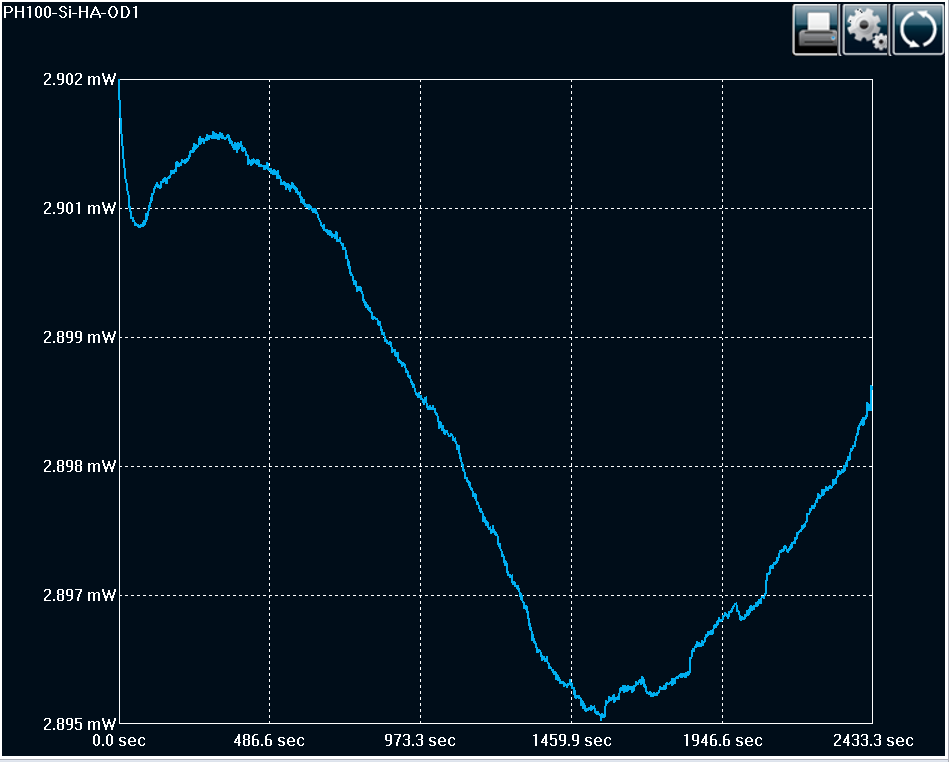
After turning on, one can see the 133.33MHz Onefive output power for ~40min with OD2 filter (~/20). So the real output power is ~57mW. A measurment over several days (15?) should come in few weeks.
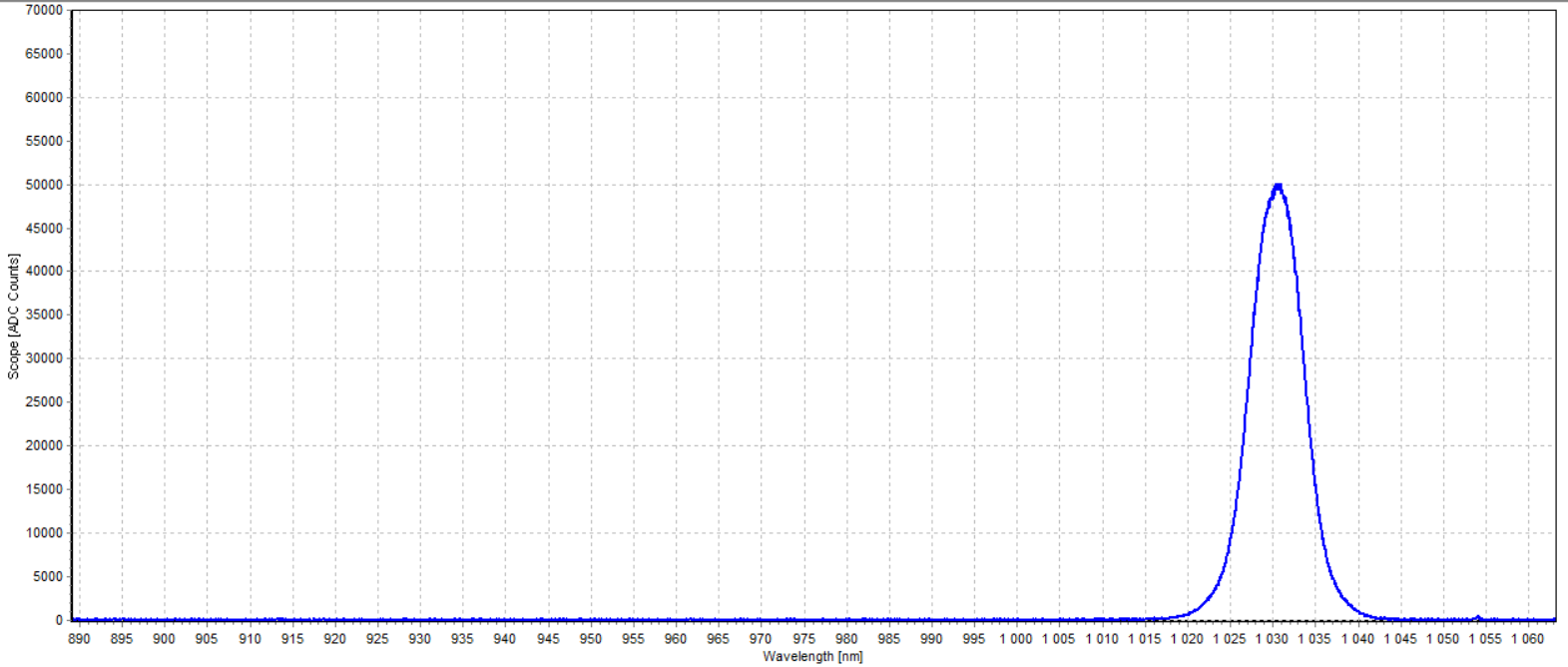
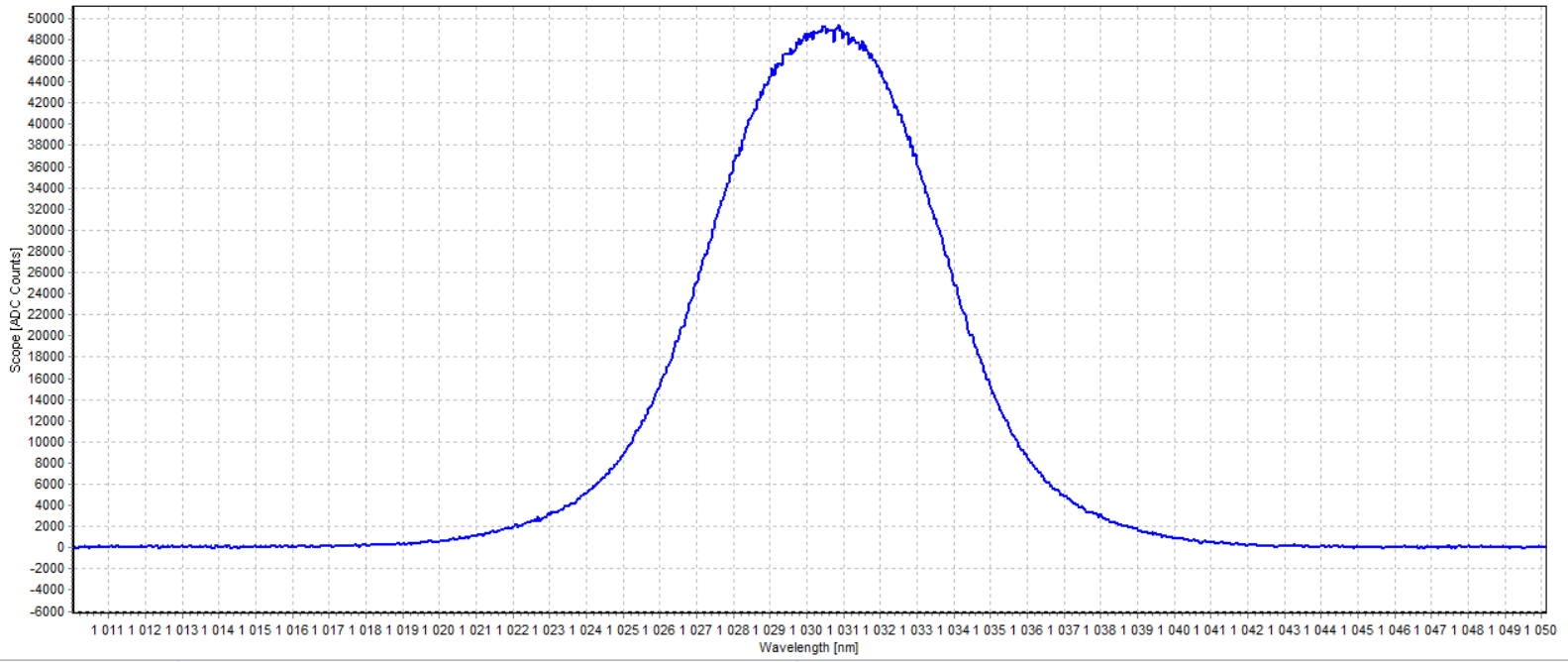
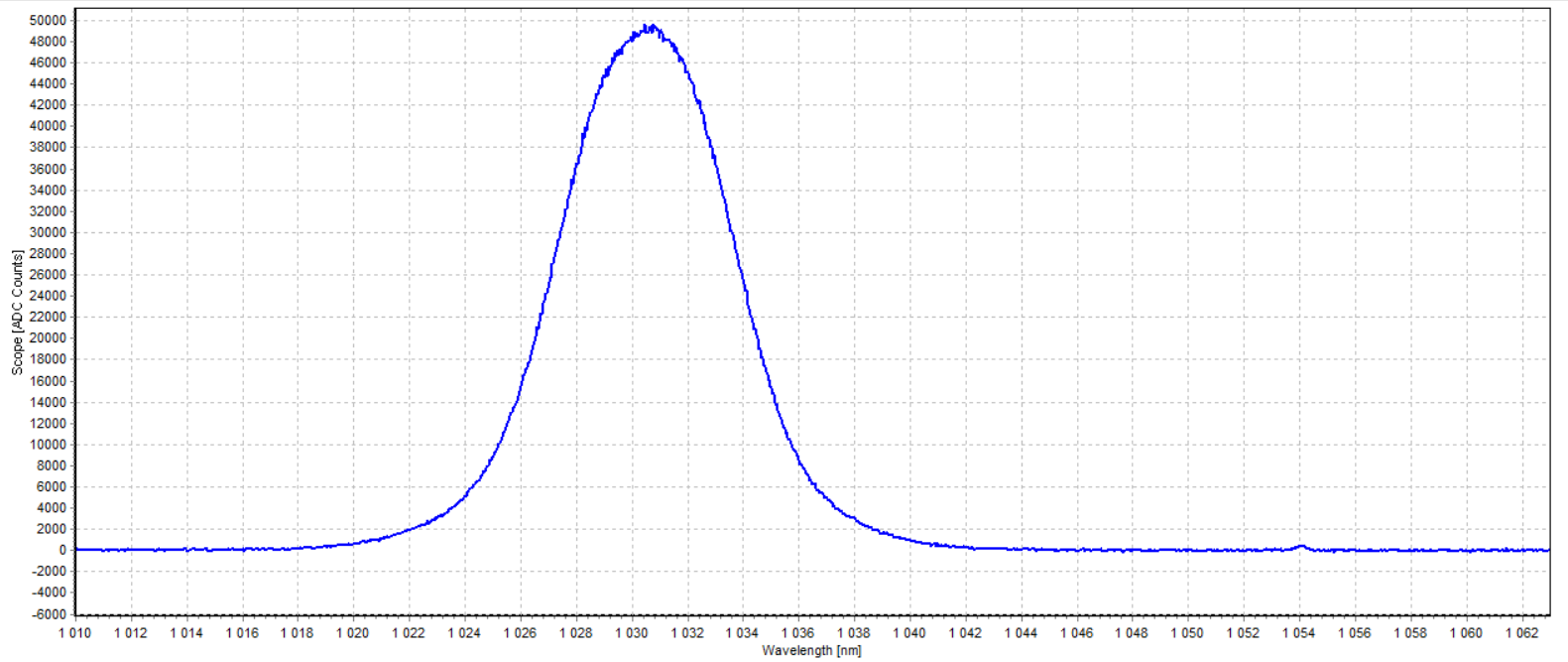
The spectrum here has been taken one day after turning on the Onefive (see Fig. 133_spectrum_full and 133_spectrum). One can see the central wavelength of 1030.5 nm and a small peak at 1054nm (see Fig. 133_spectrum2).
|
| Attachment 1: 33MHz_output_power.PNG
|
 |
| Attachment 2: 133_spectrum_full.PNG
|
 |
| Attachment 3: 133_spectrum.PNG
|
 |
| Attachment 4: 133_spectrum2.PNG
|
 |
|
105
|
Fri Dec 18 17:06:53 2020 |
Loïc Amoudry | Fixed | report | lasers and optics | Optical room | Onefive ouput power and spectrum |
1) Note: The OneFive laser used for experimenting is the one for the SBox
but, for now only this laser arrived from the company so we are doing tests (measuring the spectrometer and power ) on it inside the ThomX cavity clean room.
2) on the RF - Analyzer the value of the laser repetition frequency is measured:
* 17/12/2020 (when first turning it on, the day before in the afternoon ) ---> 133.330 700 MHz
* this day18/12/2020 (in the afternoon, after a full day to it being on) ----> 133.330 840 MHz
they have a difference of 140 Hz this comes from normal thermal expansion inside the laser which is ok, as it changed over the course of a day of operating the laser.
3) the power meter is connected to the desktop in the ThomX cavity room and a TeamViewer application has been installed to observe the measurement over the period of several days mentioned (15?) remotely.
to access this you need to have an account on the application and allow your account to access it from the desktop.
for now, only Ronic and Manar has remote access.
| Loïc Amoudry wrote: |
|
After turning on, one can see the 133.33MHz Onefive output power for ~40min with OD2 filter (~/20). So the real output power is ~57mW. A measurment over several days (15?) should come in few weeks.
The spectrum here has been taken one day after turning on the Onefive (see Fig. 133_spectrum_full and 133_spectrum). One can see the central wavelength of 1030.5 nm and a small peak at 1054nm (see Fig. 133_spectrum2).
|
|
|
106
|
Thu Nov 4 13:05:49 2021 |
Ronic Chiche | Fixed | info | lasers and optics | ThomX igloo | FP cavity alignment |
as the iris used to locate the FP-cavity axis have been removed before moving the table inside the Igloo, we have to find again this FP-cavity axis.
this morning with Viktor, we started to make the alignment of the FP-cavity with a red laser using only the "input window" iris mount built by Yann.
we used a 4 axis mount for the red laser, plus a 2 axis mount for the injection mirror (we didn't use the final injection mirrors).
the red laser is clearly visible in the transmission of the 3 "output mirrors" of the cavity.
1- we made a pre-alignment of the red laser using the reflection on the input window
=> one can see the beam at the output of all the 3 "output mirrors", but not centered on their respective windows.
2- we made a final alignment of the red laser to have roughly the beam going through the middle of all the 3 "output windows".
(rough alignment as we don't have the iris mounts for these windows, yet).
3- we put a second iris in the input path to fix the input beam axis relative to the FP cavity axis.
(the first iris is the one used on the "input window" iris mount).
this afternoon, we plan to replace the mirror used by the final injection mirrors of the cavity.
and then, use the Koheras laser to try to get some resonances.
|
|
107
|
Thu Nov 4 18:57:16 2021 |
Ronic Chiche | Fixed | info | lasers and optics | ThomX igloo | FP cavity alignment |
This afternoon, we continued the alignment of the red laser.
we did it using the 2 final injection mirrors.
we still see a clear transmission after M2, a weak transmission after M3, and almost nothing after M4 due to the power loss going through the dielectric injection mirrors (which are not optimized for red wavelength).
we placed 2 new iris in the path before the injection mirrors to help the alignment of the Koheras with the periscope.
and we prepared different equipments to continue next time: scope, photodiode, beam profiler, power meter....
| Ronic Chiche wrote: |
|
as the iris used to locate the FP-cavity axis have been removed before moving the table inside the Igloo, we have to find again this FP-cavity axis.
this morning with Viktor, we started to make the alignment of the FP-cavity with a red laser using only the "input window" iris mount built by Yann.
we used a 4 axis mount for the red laser, plus a 2 axis mount for the injection mirror (we didn't use the final injection mirrors).
the red laser is clearly visible in the transmission of the 3 "output mirrors" of the cavity.
1- we made a pre-alignment of the red laser using the reflection on the input window
=> one can see the beam at the output of all the 3 "output mirrors", but not centered on their respective windows.
2- we made a final alignment of the red laser to have roughly the beam going through the middle of all the 3 "output windows".
(rough alignment as we don't have the iris mounts for these windows, yet).
3- we put a second iris in the input path to fix the input beam axis relative to the FP cavity axis.
(the first iris is the one used on the "input window" iris mount).
this afternoon, we plan to replace the mirror used by the final injection mirrors of the cavity.
and then, use the Koheras laser to try to get some resonances.
|
|
|
108
|
Fri Nov 26 20:12:10 2021 |
Ronic Chiche | Fixed | report | lasers and optics | ThomX igloo | FP cavity alignment |
A continuation of the alignment process was done, there was change in it due to variation in temperature,
it was done using the semiconducting laser, and we were able to obtain an output at M2.
2 references were placed before the alignment mirrors Ma and Mb , to fix the line when changing from semiconducting laser to CW "koheras"
Another reference was placed at the reflection line.
Then we changed to CW laser and placed a beamprofiler at the output of m3 trying to observe the cavity mode, but with no success
(there was a shaped observed which we thought of as the cavity mode, but it changed position when moving the alignment -- > not mode (the cavity mode only changes intensity with alignment mirrors, or disappears))
later a continuation will be done for the alignment using 2 beamprofilers
Note: a reference file of the mirror positions was saved on the command computer and a laptop dedicated to ThomX cavity is placed in the casmate
| Ronic Chiche wrote: |
|
This afternoon, we continued the alignment of the red laser.
we did it using the 2 final injection mirrors.
we still see a clear transmission after M2, a weak transmission after M3, and almost nothing after M4 due to the power loss going through the dielectric injection mirrors (which are not optimized for red wavelength).
we placed 2 new iris in the path before the injection mirrors to help the alignment of the Koheras with the periscope.
and we prepared different equipments to continue next time: scope, photodiode, beam profiler, power meter....
| Ronic Chiche wrote: |
|
as the iris used to locate the FP-cavity axis have been removed before moving the table inside the Igloo, we have to find again this FP-cavity axis.
this morning with Viktor, we started to make the alignment of the FP-cavity with a red laser using only the "input window" iris mount built by Yann.
we used a 4 axis mount for the red laser, plus a 2 axis mount for the injection mirror (we didn't use the final injection mirrors).
the red laser is clearly visible in the transmission of the 3 "output mirrors" of the cavity.
1- we made a pre-alignment of the red laser using the reflection on the input window
=> one can see the beam at the output of all the 3 "output mirrors", but not centered on their respective windows.
2- we made a final alignment of the red laser to have roughly the beam going through the middle of all the 3 "output windows".
(rough alignment as we don't have the iris mounts for these windows, yet).
3- we put a second iris in the input path to fix the input beam axis relative to the FP cavity axis.
(the first iris is the one used on the "input window" iris mount).
this afternoon, we plan to replace the mirror used by the final injection mirrors of the cavity.
and then, use the Koheras laser to try to get some resonances.
|
|
|
|
109
|
Thu Dec 2 21:31:21 2021 |
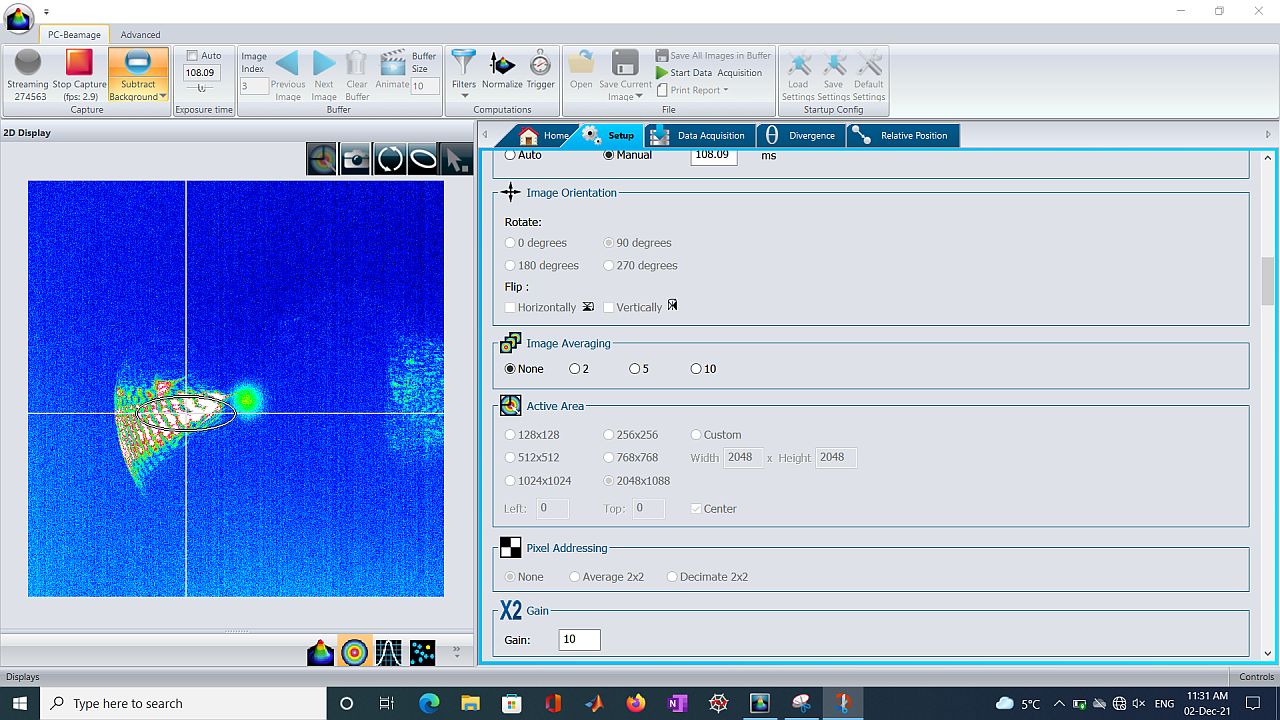
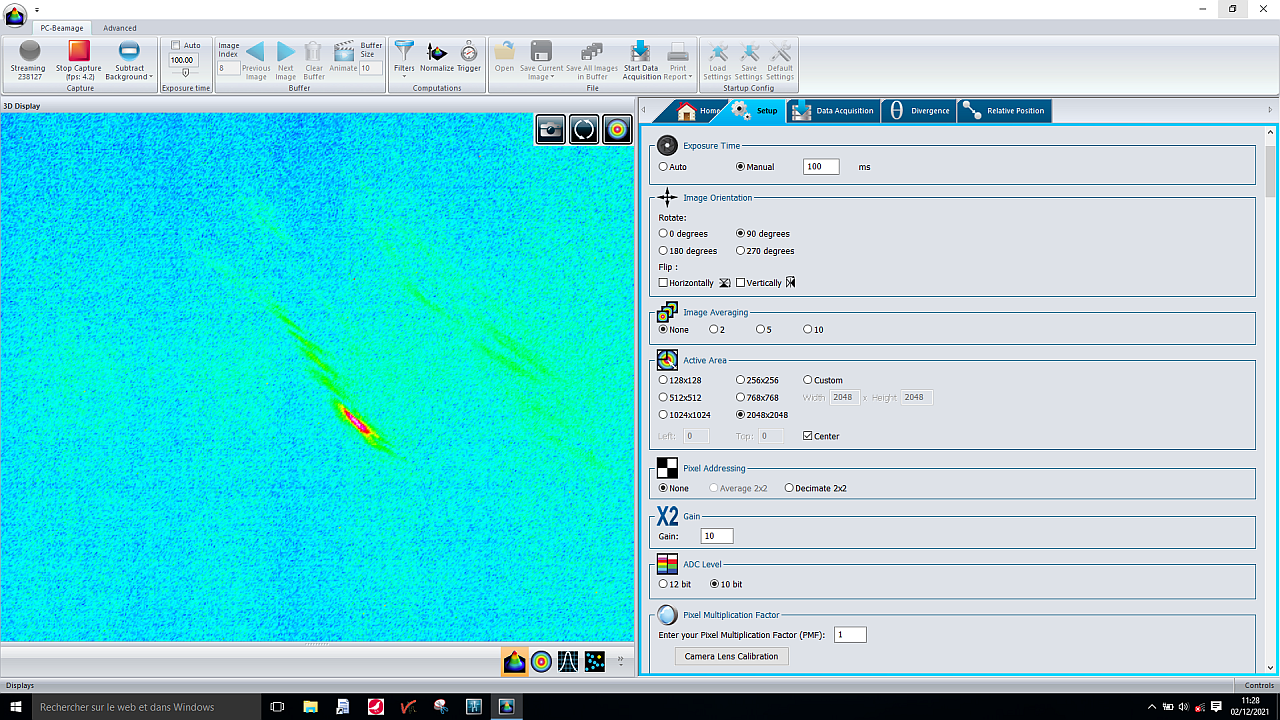
Manar Amer | Fixed | report | lasers and optics | ThomX igloo | FP cavity alignment |
Note the direction of injection is M1 - M2 - M3 - M4
P1 - S2 - S3 - P4
The injected beam is aligned at the center of the irises placed at the windows mounts of mirror M1 (Injection) and M2(spherical)
At Transmission of M2 : in addition to centered beam, we observe diffraction which interferes in observing the beating at M2 output
(could be diffracted beam from the metal pipes inside or from the D-shaped mirror installed inside)
At Transmission of M3 : we observe a beam output could be part of TM00 mode (the shape is distorted !!)
suspicious reasons :
- when we have a frequency sweep on the CW(Koheras) piezo; we observe it beating (when increasing the drive it is increasing in intensity)
- when we adjust the alignment mirrors; the beam doesn't change position and only its intensity changes
continuation with the alignment and try to eliminate the diffraction and find the shape of the beam.
A manual change in the D-shaped mirror position to remove any possible effects from it.
|
| Attachment 1: 2021_12_02_M2_Transmission.jpg
|
 |
| Attachment 2: 2021_12_02_M3_transmission_90deg.PNG
|
 |
|
110
|
Tue Jan 11 10:36:35 2022 |
Manar Amer | Fixed | report | lasers and optics | ThomX igloo | FP cavity alignment |
The alignment is on hold until next week 17th - 18th Jan
an Alignment attempt will be done when the ring part close to the FP cavity is opened.
| Manar Amer wrote: |
|
Note the direction of injection is M1 - M2 - M3 - M4
P1 - S2 - S3 - P4
The injected beam is aligned at the center of the irises placed at the windows mounts of mirror M1 (Injection) and M2(spherical)
At Transmission of M2 : in addition to centered beam, we observe diffraction which interferes in observing the beating at M2 output
(could be diffracted beam from the metal pipes inside or from the D-shaped mirror installed inside)
At Transmission of M3 : we observe a beam output could be part of TM00 mode (the shape is distorted !!)
suspicious reasons :
- when we have a frequency sweep on the CW(Koheras) piezo; we observe it beating (when increasing the drive it is increasing in intensity)
- when we adjust the alignment mirrors; the beam doesn't change position and only its intensity changes
continuation with the alignment and try to eliminate the diffraction and find the shape of the beam.
A manual change in the D-shaped mirror position to remove any possible effects from it.
|
|
|
113
|
Mon Jan 17 21:22:28 2022 |
Manar Amer | Fixed | report | lasers and optics | ThomX igloo | FP cavity alignment |
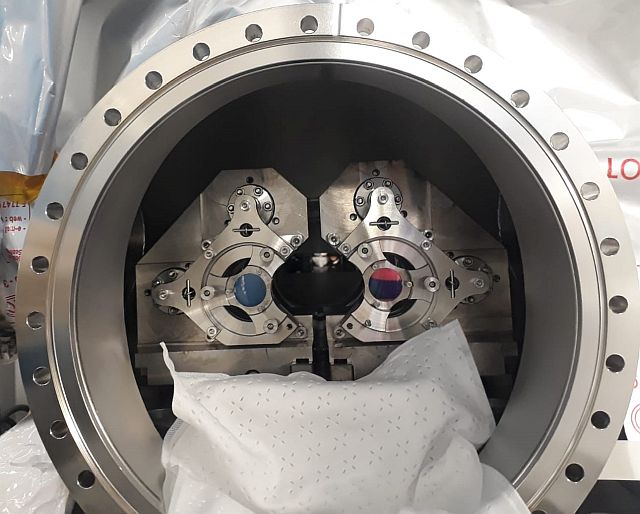
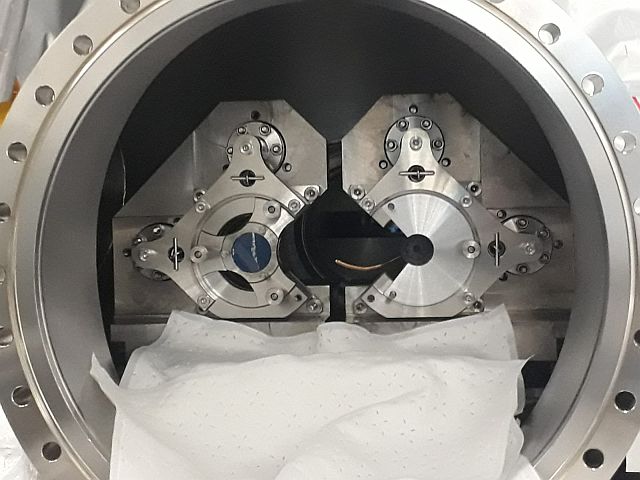
***** Continuation of the alignment ---- FP Cavity Open --- ****
The cavity was put under outer pressure and was opened for the alignment
The alignment was done using CW koheras infrared laser and the inside mirrors irises
we observed the beam output centered at S2, S3 and P4
transmission from S4 to P1 was aligned at the center of P1 iris and an outside reference was fixed, then P1 mirror was placed, and we aligned the reflection with the transmission.
....... After the interior alignment, the cavity windows were closed ....
A beam profiler was placed at P4 transmission -----> nothing observed even with a piezo drive on the CW infrared laser
observed a beam output at S2 and S3, but the fundamental mode is not seen, or even a higher order mode (which we can't explain, as the beam is centered on the mirrors)
images show the output at S2 and S3
| Manar Amer wrote: |
|
The alignment is on hold until next week 17th - 18th Jan
an Alignment attempt will be done when the ring part close to the FP cavity is opened.
| Manar Amer wrote: |
|
Note the direction of injection is M1 - M2 - M3 - M4
P1 - S2 - S3 - P4
The injected beam is aligned at the center of the irises placed at the windows mounts of mirror M1 (Injection) and M2(spherical)
At Transmission of M2 : in addition to centered beam, we observe diffraction which interferes in observing the beating at M2 output
(could be diffracted beam from the metal pipes inside or from the D-shaped mirror installed inside)
At Transmission of M3 : we observe a beam output could be part of TM00 mode (the shape is distorted !!)
suspicious reasons :
- when we have a frequency sweep on the CW(Koheras) piezo; we observe it beating (when increasing the drive it is increasing in intensity)
- when we adjust the alignment mirrors; the beam doesn't change position and only its intensity changes
continuation with the alignment and try to eliminate the diffraction and find the shape of the beam.
A manual change in the D-shaped mirror position to remove any possible effects from it.
|
|
|
| Attachment 1: Interior_of_cavity_P1_S3_windowOpen.jpg
|
 |
| Attachment 2: Interior_of_cavity_P1_S3_windowOpen_irrisOnP1.jpg
|
 |
| Attachment 3: CavityAlignment_cavityOpen_S2_Output.jpg
|
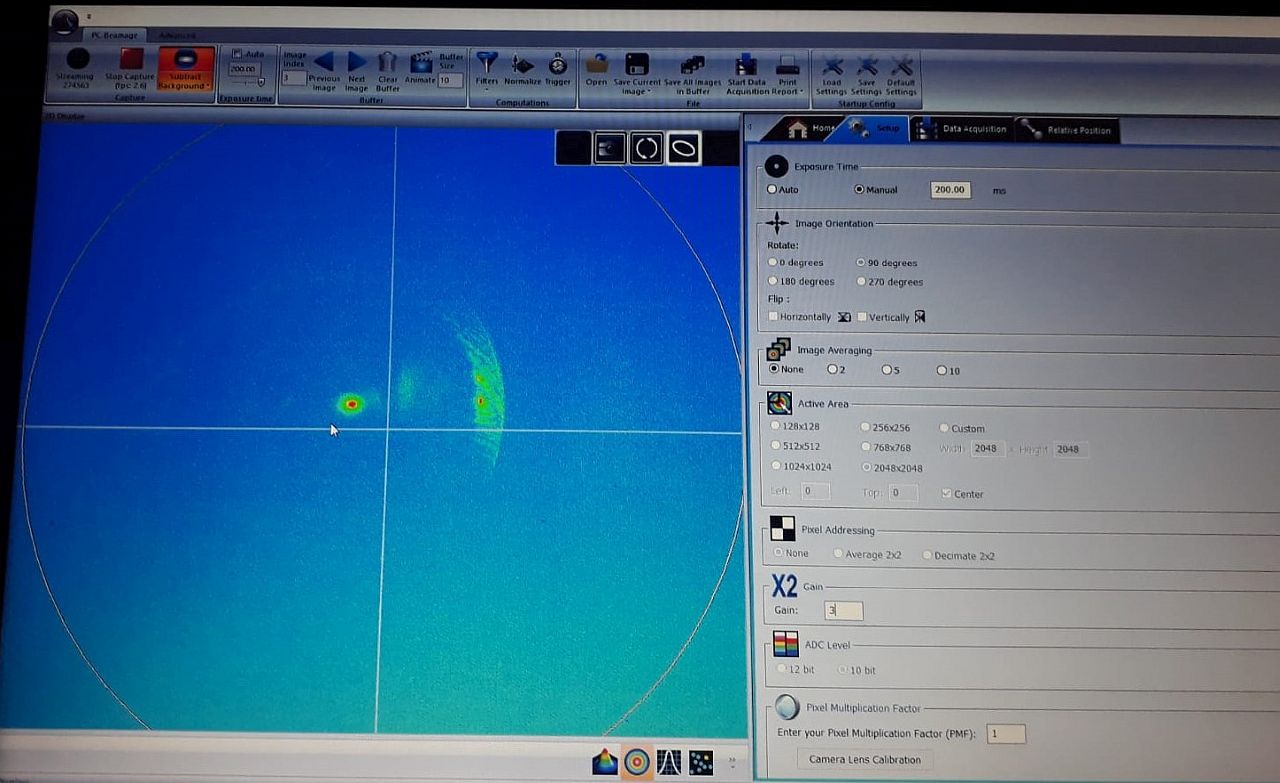 |
| Attachment 4: CavityAlignment_cavityOpen_S3_Output.jpeg
|
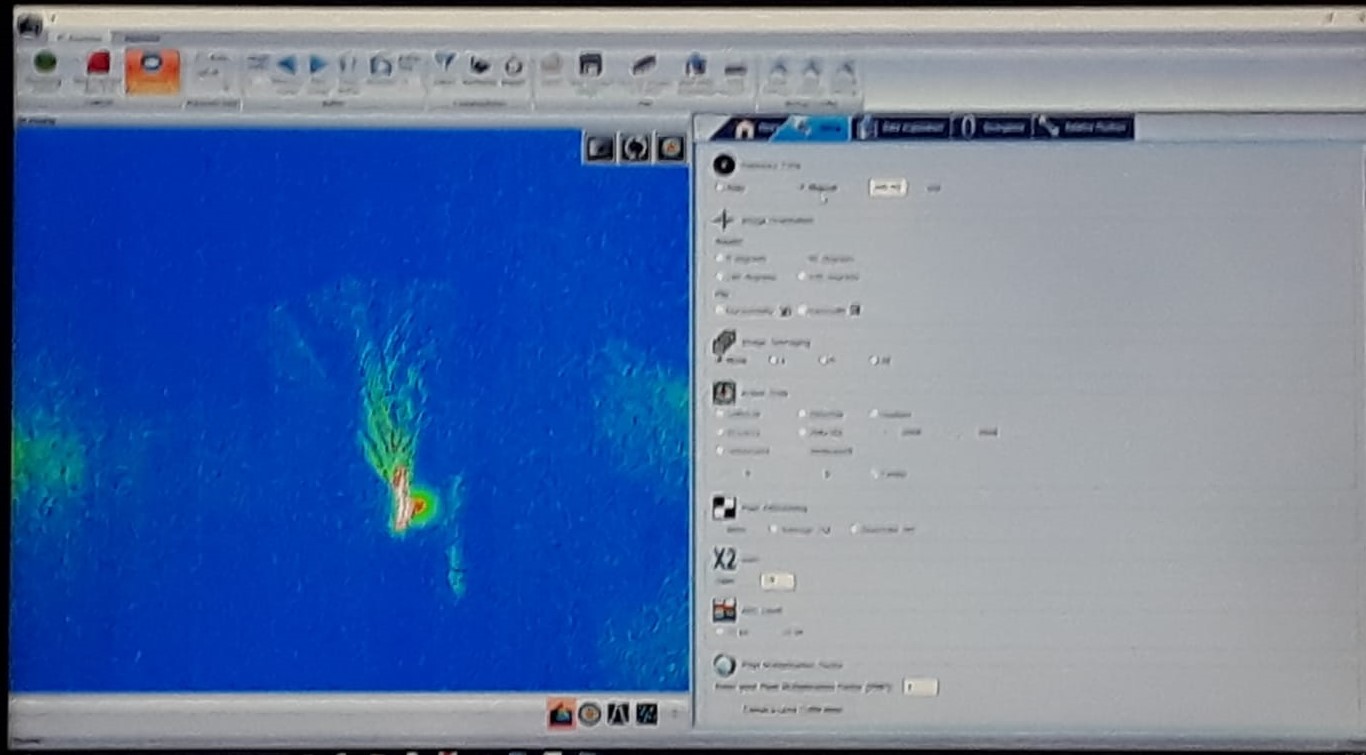 |
|
114
|
Wed Jan 19 09:36:53 2022 |
Manar Amer | Fixed | report | lasers and optics | ThomX igloo | FP cavity alignment |
Yesterday, we did the alignment again using Iris and beam profilers to obtain a more precise result.
at the end of the alignment procedure, we successfully obtained the beating modes.
the geometrical alignment seems good (weak odd modes) but we could need to put a telescope on the Koheras line as the beam size seems quite different from the mode size (quite strong even modes).
without any improvement of the alignment using photodiodes, one obtains about 15-20% of coupling.
we put several Iris on the table:
- 2 Iris before the 2 alignment mirrors to fix the axis of the laser on these mirrors
- 1 Iris just before the cavity (we will add an additional one today) to fix the cavity axis
- 1 Iris in reflection of the cavity to fix the M1 orientation
| Manar Amer wrote: |
|
***** Continuation of the alignment ---- FP Cavity Open --- ****
The cavity was put under outer pressure and was opened for the alignment
The alignment was done using CW koheras infrared laser and the inside mirrors irises
we observed the beam output centered at S2, S3 and P4
transmission from S4 to P1 was aligned at the center of P1 iris and an outside reference was fixed, then P1 mirror was placed, and we aligned the reflection with the transmission.
....... After the interior alignment, the cavity windows were closed ....
A beam profiler was placed at P4 transmission -----> nothing observed even with a piezo drive on the CW infrared laser
observed a beam output at S2 and S3, but the fundamental mode is not seen, or even a higher order mode (which we can't explain, as the beam is centered on the mirrors)
images show the output at S2 and S3
| Manar Amer wrote: |
|
The alignment is on hold until next week 17th - 18th Jan
an Alignment attempt will be done when the ring part close to the FP cavity is opened.
| Manar Amer wrote: |
|
Note the direction of injection is M1 - M2 - M3 - M4
P1 - S2 - S3 - P4
The injected beam is aligned at the center of the irises placed at the windows mounts of mirror M1 (Injection) and M2(spherical)
At Transmission of M2 : in addition to centered beam, we observe diffraction which interferes in observing the beating at M2 output
(could be diffracted beam from the metal pipes inside or from the D-shaped mirror installed inside)
At Transmission of M3 : we observe a beam output could be part of TM00 mode (the shape is distorted !!)
suspicious reasons :
- when we have a frequency sweep on the CW(Koheras) piezo; we observe it beating (when increasing the drive it is increasing in intensity)
- when we adjust the alignment mirrors; the beam doesn't change position and only its intensity changes
continuation with the alignment and try to eliminate the diffraction and find the shape of the beam.
A manual change in the D-shaped mirror position to remove any possible effects from it.
|
|
|
|
|
128
|
Fri Mar 11 12:46:58 2022 |
Ronic Chiche | Fixed | info | lasers and optics | ThomX igloo | FP cavity mode axis change and Finesse measurement |
this morning with Manar, we did a cavity mode axis change.
we checked the cavity mode centroid position on the beam profiler (placed behind P4) and changed it by roughly 1mm on the X-axis and by 500µm on the Y-axis.
for doing that, we played only on the S2 mirror while the cavity is locked and we slightly changed X and Y motors, step by step, and we realigned the laser beam with external injection mirrors when needed.
in the end, we were able to improve the transmission power by roughly 25% (810mV to 1020mV on the Transmission photodiode on the scope).
we did several Finesse measurements after that: 4950, 5190, 5100, 5120, 5200 => ~ 5100
compare to the previous Finesse value, around 4200, this is also roughly 25% better, in agreement with the transmission power increase.
conclusion: it seems the Finesse, thus the losses are almost the same "everywhere" on the mirrors => we need to clean them or replace them.
|
|
129
|
Fri Mar 11 12:59:35 2022 |
Manar Amer | Fixed | report | lasers and optics | ThomX igloo | Cavity beam Image |
Updated beam image after change on the mode axis.
Taken after P4. |
| Attachment 1: Capture.PNG
|
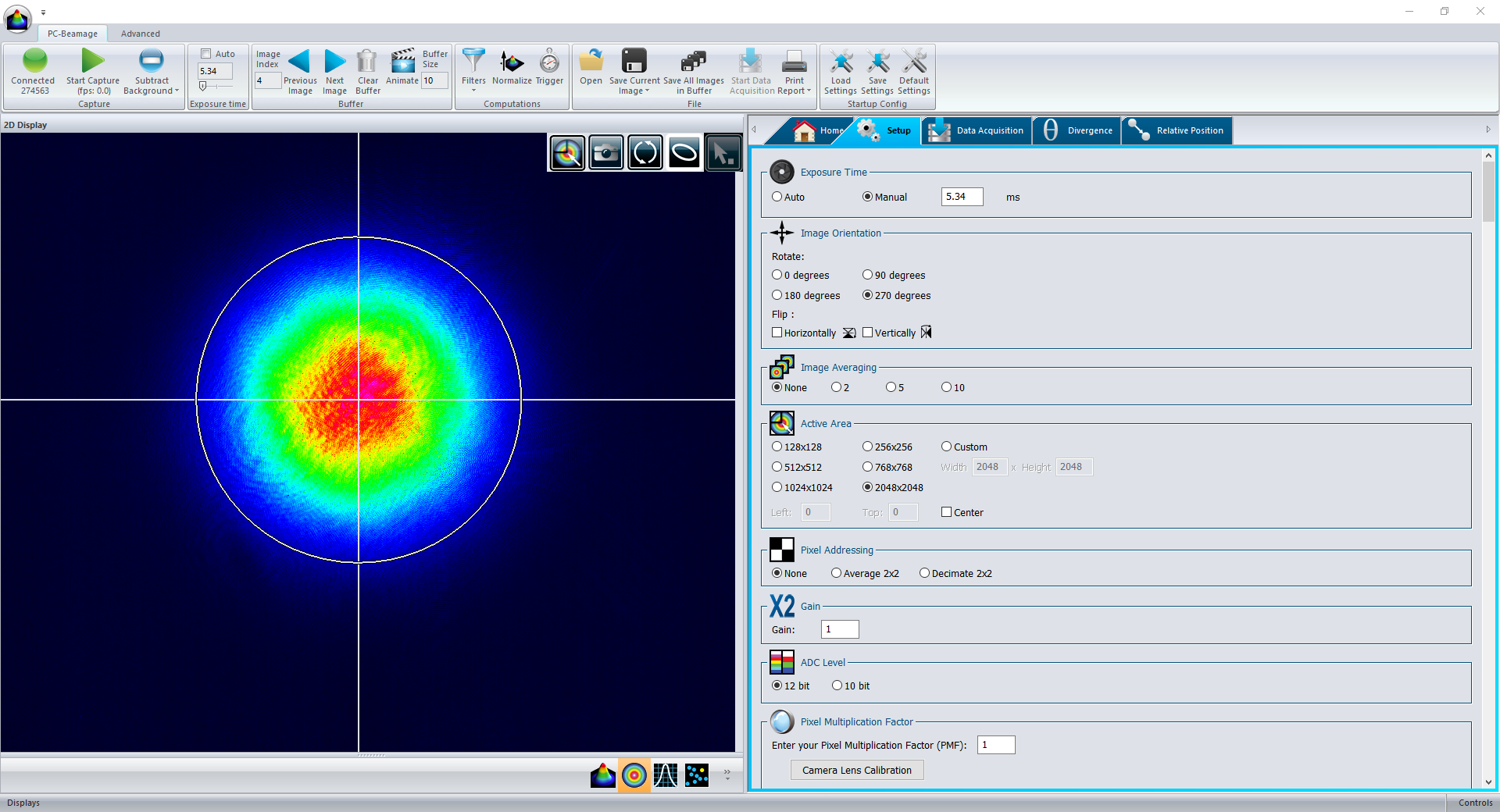 |
| Attachment 2: Capture2.PNG
|
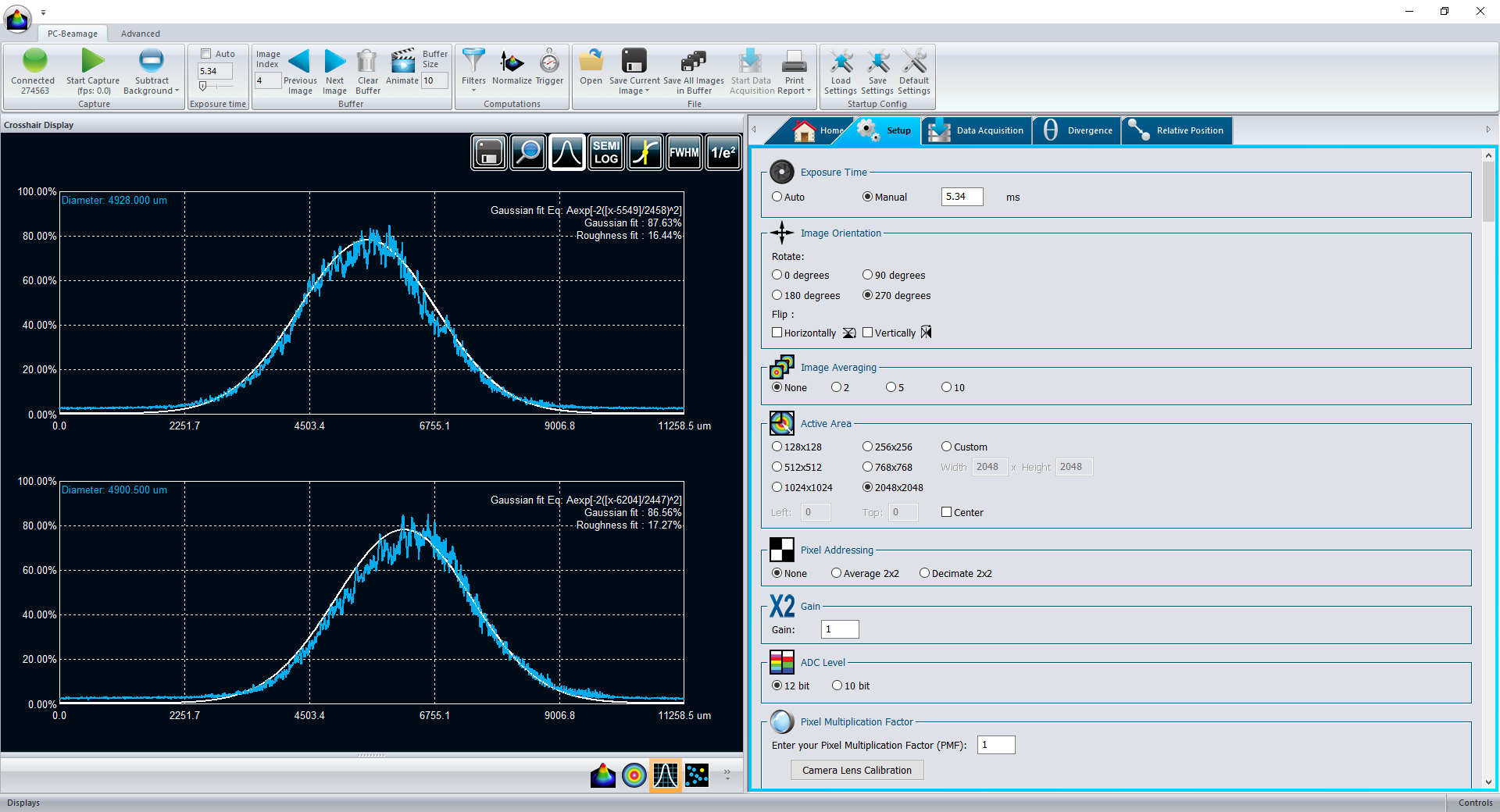 |
|
130
|
Fri Mar 11 17:33:33 2022 |
Ronic Chiche | Fixed | info | lasers and optics | ThomX igloo | First hands on the Alphanov amplifier & software |
Aurélien, Manar, and I spent more than 2h trying to start the software communicating with the Alphanov amplifier controller.
each time, we had a problem with the software, asking to switch OFF and ON the controller before being able to switch the amplifier diodes ON.
we switched OFF and ON many times without any success.
in the end, Aurélien called Guillaume from Alphanov... and without changing anything, it worked... strange!
one possible problem could be the correct detection of Frep of the seed laser (OneFive).
as we didn't check the signal coming from the seed laser, it could be the reason... to be confirmed.
the present status for the controller is:
- the power connector (on the rear side) is ON
- the green relay (on the rear side) is ACTIVATED
- the key (on the front side) is OFF
- the emission button (on the front side) is OFF
the normal procedure to start the controller is:
- switch the front side key ON
- start the software (possible error msg asking to switch OFF and ON the power button: don't do that)
- switch the emission button on the front side (which is red) ON
- switch the preamplifier button ON
=> all the software LEDs should be green and the PD_PULSE window should indicate 133.33MHz
otherwise, try a RESET on the software and restart the procedure (and pray).
at the end of the day, we successfully switched ON the preamp and increased the Power adjustment around 20% to get something about 10W on the big PowerMeter placed at the output of the amplifier.
=> we need another day of practice to be more confident with the software!
|
|
131
|
Fri Mar 11 17:58:24 2022 |
Ronic Chiche | Fixed | info | lasers and optics | ThomX igloo | First hands on the Alphanov amplifier & software |
Additional information related to the injected power into the amplifier fibers.
power = 4.45 mW (as shown from the software)
the minimum to inject into amplifier is 2 mW
| Ronic Chiche wrote: |
|
Aurélien, Manar, and I spent more than 2h trying to start the software communicating with the Alphanov amplifier controller.
each time, we had a problem with the software, asking to switch OFF and ON the controller before being able to switch the amplifier diodes ON.
we switched OFF and ON many times without any success.
in the end, Aurélien called Guillaume from Alphanov... and without changing anything, it worked... strange!
one possible problem could be the correct detection of Frep of the seed laser (OneFive).
as we didn't check the signal coming from the seed laser, it could be the reason... to be confirmed.
the present status for the controller is:
- the power connector (on the rear side) is ON
- the green relay (on the rear side) is ACTIVATED
- the key (on the front side) is OFF
- the emission button (on the front side) is OFF
the normal procedure to start the controller is:
- switch the front side key ON
- start the software (possible error msg asking to switch OFF and ON the power button: don't do that)
- switch the emission button on the front side (which is red) ON
- switch the preamplifier button ON
=> all the software LEDs should be green and the PD_PULSE window should indicate 133.33MHz
otherwise, try a RESET on the software and restart the procedure (and pray).
at the end of the day, we successfully switched ON the preamp and increased the Power adjustment around 20% to get something about 10W on the big PowerMeter placed at the output of the amplifier.
=> we need another day of practice to be more confident with the software!
|
|
|
133
|
Fri Mar 18 11:48:14 2022 |
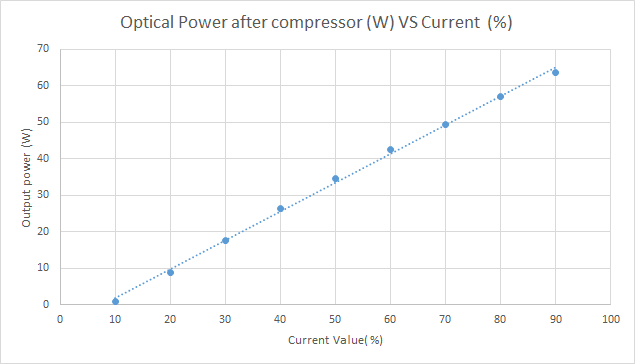
Ronic Chiche | Fixed | info | lasers and optics | ThomX igloo | Alphanov amplifier power measurement |
This morning, with Manar and Aurélien, we measure the power directly at the output of the Alphanov amplifier with the 2 compressors CVBG (seeding laser at Frep = 133MHz)
(we had to remove the base plate where the deflector mirrors were mounted to put the large powermeter).
with the previously described procedure, it seems that the Alphanov software is now working and we were able to start immediately the amplifier.
the chiller temperature was set at 25°C but we saw in the Alphanov documentation that the chiller temperature was closer to 20°C.
we did several measurements at 25°C and 20°C and it doesn't change a lot the output power.
so, we set the temperature to 23°C to avoid condensation (if too cold).
we will ask Guillaume what is the best temperature for the chiller.
power measurements:
power ratio => measured output power (with external powermeter, not with the software)
10% => 1W
20% => 9W
30% => 17.6W
40% => 26.4W
50% => 34.5W
60% => 42.5W
70% => 49.3W
80% => 56.6W
90% => 63.6W
100% => ~70W (expected value, not measured)
we stopped the measurements at 90% as we observed a difference in the software between the expected values (previously recorded by Alphanov) and the present ones.
the present values are quite bigger than the ones measured by Alphanov.
Aurélien will call Guillaume to check if it is a problem or not. |
| Attachment 1: power_after_compressor_vs_current_for_133MHz_laser.png
|
 |
|
134
|
Fri Mar 18 15:04:30 2022 |
Ronic Chiche | Fixed | info | lasers and optics | ThomX igloo | Alphanov amplifier power measurement |
answers from Guillaume:
- the chiller temperature has to be set to 25°C
- the power measured with the software can change a little from what Alphanov measured with their laser.
=> one can set power tolerances to 30% in the "caracterisation.csv" file.
| Ronic Chiche wrote: |
|
This morning, with Manar and Aurélien, we measure the power directly at the output of the Alphanov amplifier.
(we had to remove the base plate where the deflector mirrors were mounted to put the large powermeter).
with the previously described procedure, it seems that the Alphanov software is now working and we were able to start immediately the amplifier.
the chiller temperature was set at 25°C but we saw in the Alphanov documentation that the chiller temperature was closer to 20°C.
we did several measurements at 25°C and 20°C and it doesn't change a lot the output power.
so, we set the temperature to 23°C to avoid condensation (if too cold).
we will ask Guillaume what is the best temperature for the chiller.
power measurements:
power ratio => measured output power (with external powermeter, not with the software)
10% => 1W
20% => 9W
30% => 17.6W
40% => 26.4W
50% => 34.5W
60% => 42.5W
70% => 49.3W
80% => 56.6W
90% => 63.6W
100% => ~70W (expected value, not measured)
we stopped the measurements at 90% as we observed a difference in the software between the expected values (previously recorded by Alphanov) and the present ones.
the present values are quite bigger than the ones measured by Alphanov.
Aurélien will call Guillaume to check if it is a problem or not.
|
|
|
135
|
Tue Mar 22 21:19:48 2022 |
Manar Amer | Fixed | report | lasers and optics | ThomX igloo | Alphanov amplifier Beam Profile |
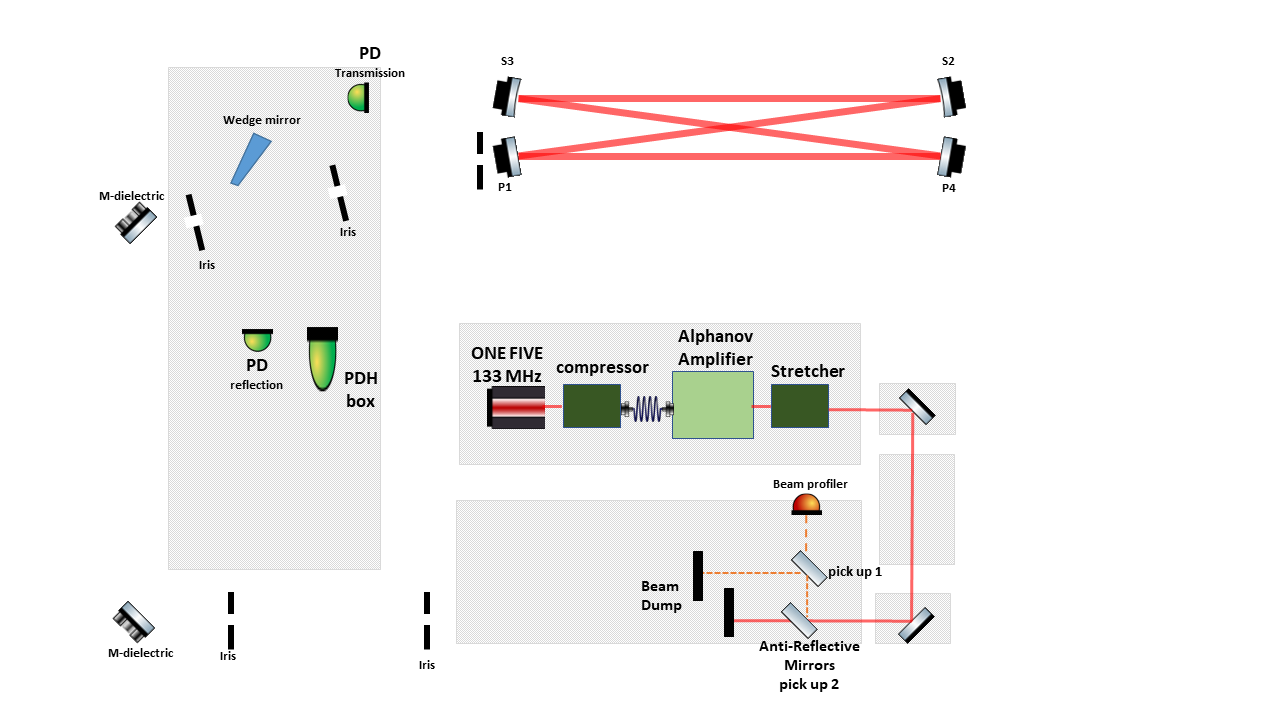
Today: Manar, Ronic and Aurlien started the study of the beam profile of the alphanov amplifier at high power.
The setup shown in the image shows how the power is reduced by using Anti-reflective mirrors,
pick up 1 : Anti-reflective coating on both sides , pick up 2 : Anti-reflective coating on one side and High reflectivity on the other
using this method, we avoid saturation and damage to the beam profiler from the high power amplified laser
in addition, an OD3 filter is placed in front of the beam profiler. and a reflective mirror is placed close to deflect the reflection from the mirror(pick up 1) second surface.
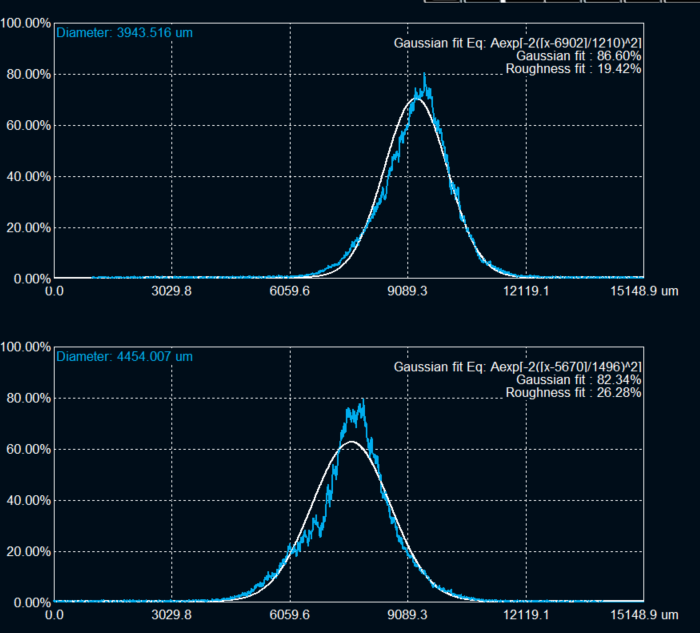
The beam observed is relatively well shaped and fitted up to 50% of amplification is where the shape starts to deform a little and is not well-fitted by a Gaussian. (image attached shows the fit for 60% amplification)
The cause is yet to be determined, as it could only be related to the reflections that occur from the mirrors (pick up 1 and pick up 2)
*** Note be always careful at High Power :)
|
| Attachment 1: 22-03-2022_Alphanov_Beam_setup.png
|
 |
| Attachment 2: 22032022_10perc_133MHz_Amplifier_beamShape.bmp
|
| Attachment 3: 22032022_20perc_133MHz_Amplifier_beamShape.bmp
|
| Attachment 4: 22032022_30perc_133MHz_Amplifier_beamShape.bmp
|
| Attachment 5: 22032022_40perc_133MHz_Amplifier_beamShape.bmp
|
| Attachment 6: 22032022_50perc_133MHz_Amplifier_beamShape.bmp
|
| Attachment 7: 22032022_60perc_133MHz_Amplifier_beamShape.bmp
|
| Attachment 8: 22032022_60perc_133MHz_Amplifier_beamFit.png
|
 |
|
136
|
Tue Mar 22 21:20:28 2022 |
Manar Amer | Fixed | report | lasers and optics | ThomX igloo | Alphanov amplifier Beam Profile |
| Manar Amer wrote: |
|
Today: Manar, Ronic and Aurlien started the study of the beam profile of the alphanov amplifier at high power.
The setup shown in the image shows how the power is reduced by using Anti-reflective mirrors,
pick up 1 : Anti-reflective coating on both sides , pick up 2 : Anti-reflective coating on one side and High reflectivity on the other
using this method, we avoid saturation and damage to the beam profiler from the high power amplified laser
in addition, an OD3 filter is placed in front of the beam profiler. and a reflective mirror is placed close to deflect the reflection from the mirror(pick up 1) second surface.
The beam observed is relatively well shaped and fitted up to 50% of amplification is where the shape starts to deform a little and is not well-fitted by a Gaussian. (image attached shows the fit for 60% amplification)
The cause is yet to be determined, as it could only be related to the reflections that occur from the mirrors (pick up 1 and pick up 2)
*** Note be always careful at High Power :)
|
|