| ID |
Date |
Author |
Status |
Type |
Category |
Location |
Title |
|
56
|
Thu Feb 6 11:01:08 2020 |
Ronic Chiche | Fixed | report | lasers and optics | Optical room | analysis of stored and reflected power |
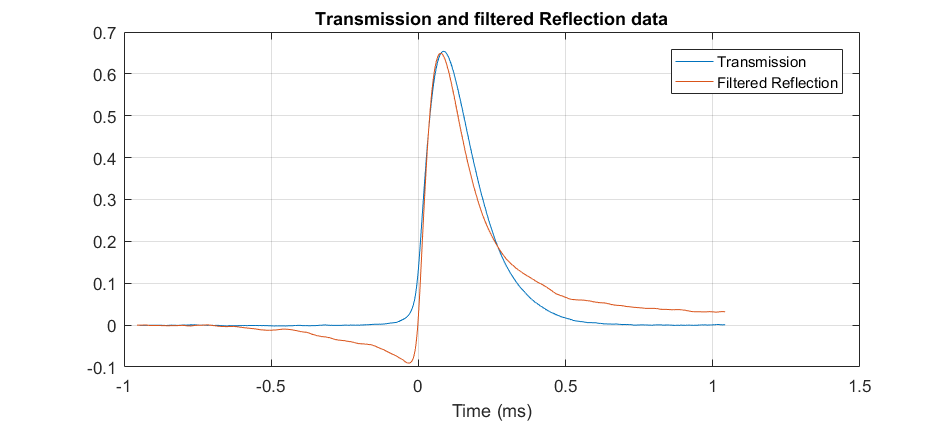
with this Finesse around 22-23k, the technique comparing TRANSMISSION and REFLECTION signals doesn't work, even in taking into account individual photodiode time responses.
It seems that the cavity is not completely stationnary and the shapes are not comparable easily with just a Low Pass Filter related to the Finesse.
Below, an example of the best fit of filtered REFLECTION signal compared to TRANSMISSION signal.... it is clear that the shapes don't fit....
| Ronic Chiche wrote: |
|
the 10th of January, we increased the power of the amplifier to study the cavity transmitted and reflected power signals.
analyzing the noise transfer functions of transmitted and reflected power one could deduce the Finesse of the cavity.
the power of this technic (if it is confirmed) does not depend on the decay time of one signal which depends on the speed of the cut off but on the difference between reflected and transmitted transfer functions,
and then is independant of the cut off speed.
here are 6 analysis of the Finesse when the cavity is cold, depending only on short lock periods.
5 of them agrees on a Finesse around 11k.
the 6th estimation at 40kW stored in the cavity is about 4k but now, we know that the M1 mirror had suddenly a hole for this power... thus the Finesse value is reasonable.
we can then, use the non conservation of TRANS+REF signal to estimate the FInesse decrease when the cavity is hot... to be done
|
|
| Attachment 1: untitled.png
|
 |
|
62
|
Tue Jan 12 10:44:57 2021 |
Ronic Chiche | Fixed | issue | lasers and optics | Optical room | Origami SN2440 133MHz laser power measurment... and failure |
we received from NKT the Origami SN2440 133MHz oscillator from repair on 2020/12/17
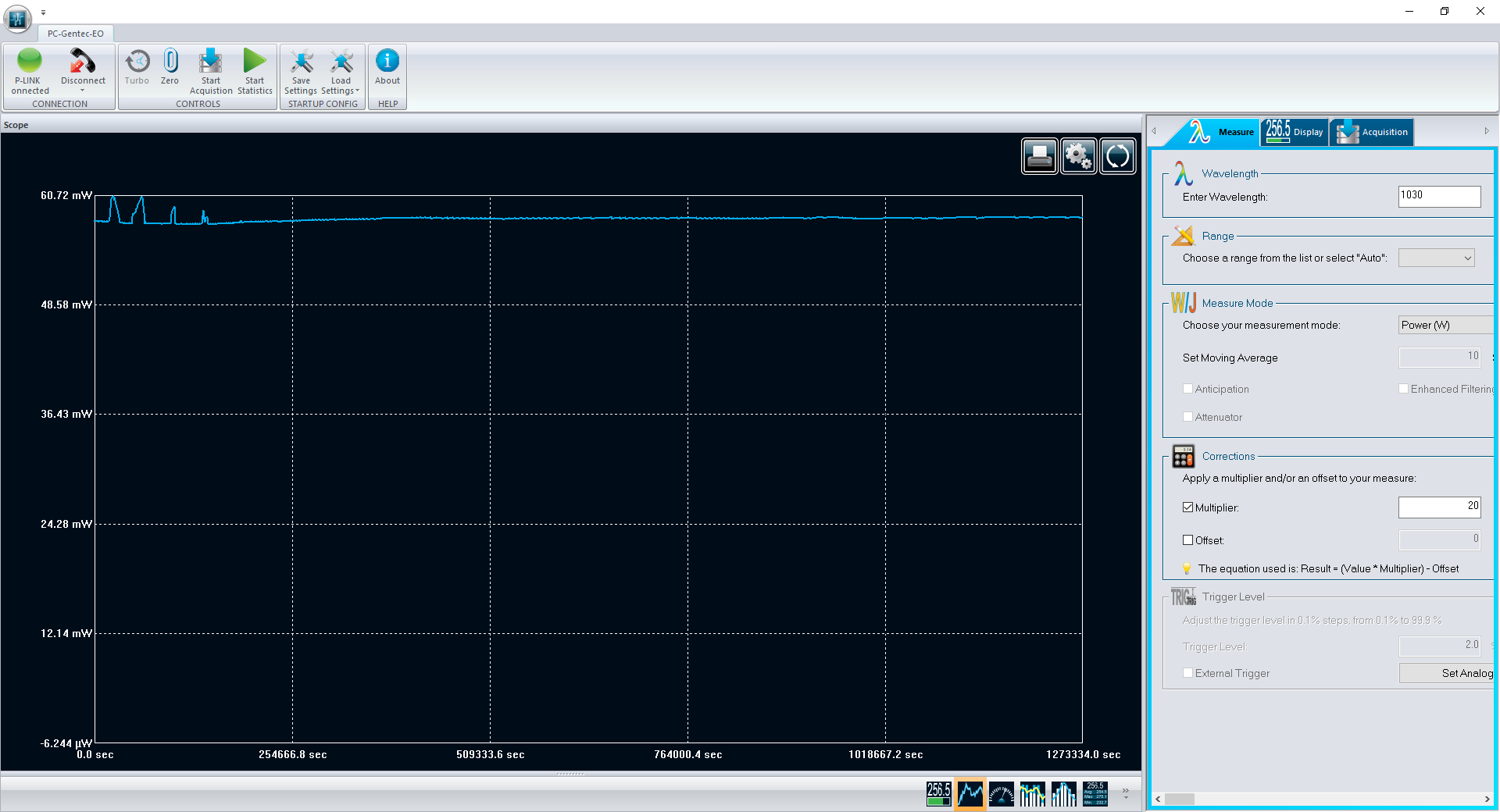
and we measured the power trend from 2020/12/21 until the whole winter Hollyday, during 14 days and 17h (1 273 334 s).
the power was quite constant, about 58mW (the measurement has been done with the OD2 filter and using a (x20) factor in the software to compensate for it),
except for some peaks at the beginning of the measurement to 60.7mW.
I tried to reproduce these peaks by switching on several lights in the room and the airflow ceil but the effect is neglectable,
thus these peaks seem to really come from the oscillator power.
at the beginning of January, the oscillator suffered a back reflection from the rugged anodized convex surface of the power meter (apparently not from the OD2 filter itself) and the laser stopped immediately to modelock.
the laser power dropped to 0 and the laser controller led started to blink red. NKT has been contacted and they think it could be the laser pump diodes that have been damaged.
for the future, we will have to install a fixed optical isolator from the start, even for short operations.
|
| Attachment 1: 133mhzpower.PNG
|
 |
| Attachment 2: 133mhz_power_zoom.png
|
 |
|
63
|
Thu Jun 10 17:55:15 2021 |
Ronic Chiche | Fixed | info | lasers and optics | Optical room | Origami SN2440 133MHz laser tests |
Today, we received the Origami SN2440 133MHz oscillator from repair (NKT mentioned a defective wire inside the controller....)
We immediately installed it behind an isolator (Faraday rotator+PBS+halfwave plate).
the output power is around 60mW.
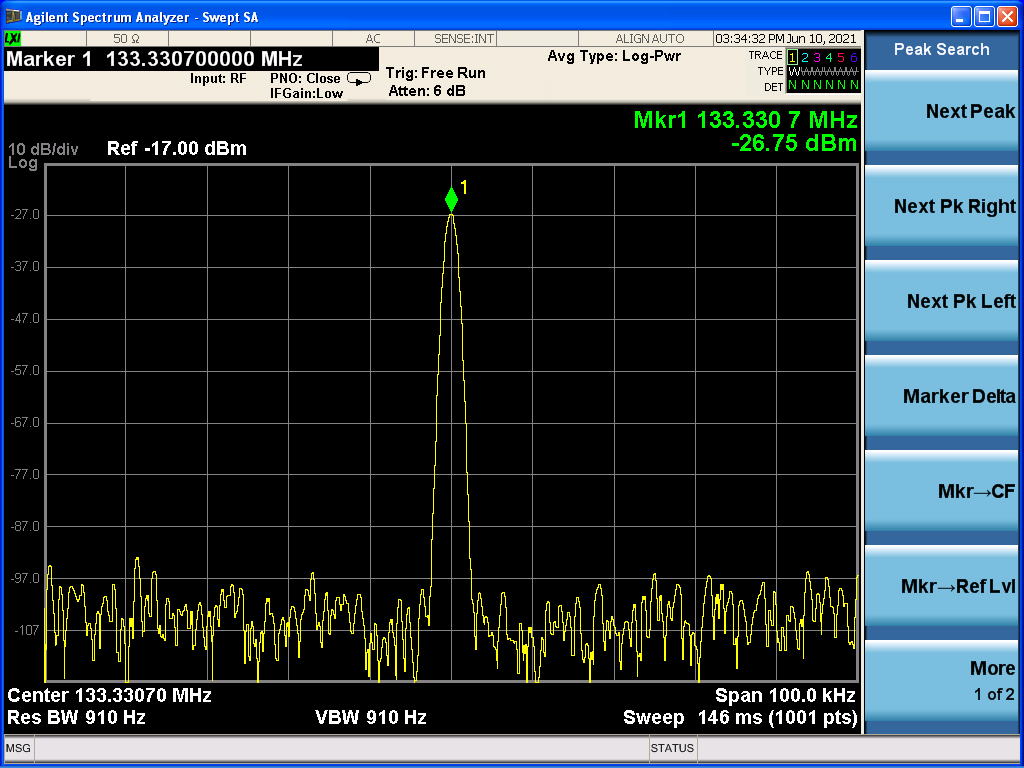
the spectrum is around 1030nm
the repetition rate is around 133.33MHz |
| Attachment 1: IMG_20210610_161502.jpg
|
 |
| Attachment 2: spectre_133MHz.PNG
|
 |
| Attachment 3: Screen_0015.png
|
 |
|
123
|
Mon Aug 8 17:58:32 2022 |
Ronic Chiche | Fixed | info | lasers and optics | Optical room | Pulse duration measurement before and after CVBG (as a strecher) |
I recorded the pulse shape of the MENHIR 216MHz in its fiber injection setup.
the fiber is then connected to the Labbuddy photodiode (~ 15GHz BW) and then to the R&S RTO2000 4GHz scope (~ 100ps rise time).
1) I put a mirror just before the CVBG.
I'm able to get >8mW in the fiber.
as the pulses coming from the laser are not streched, they should be close to Menhir pulse width (~ 200fs).
then, what I measure here is only the pulse response of the measurement system.
2) I remove the mirror before the CVBG to stretch the pulse inside the CVBG
I'm able to get >6mW in the fiber.
the 1st plot is the comparison of the 2 measurements:
in blue, the pulse measurement w/o the CVBG
in red, the pulse measurement with the CVBG
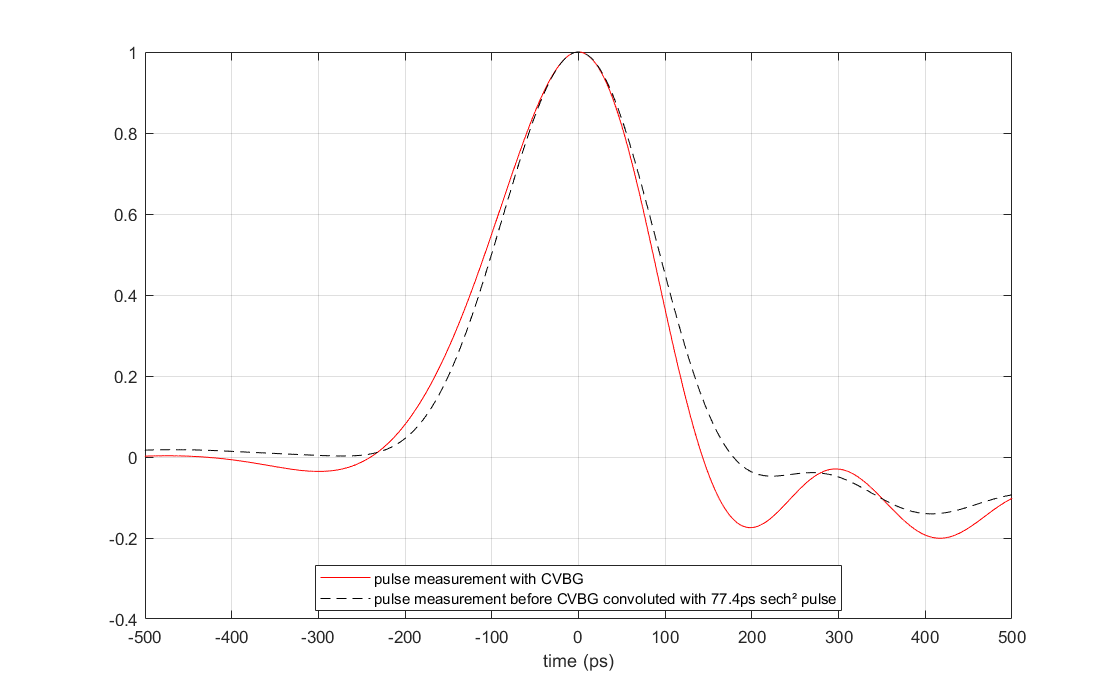
the 2nd plot is the comparison of the pulse streched by the CVBG with the pulse w/o CVBG convoluted with a tp=77.4ps sech² pulse (sech²(t/tp)).
in red, the pulse measurement with the CVBG
in dashed black, the convolution.
(as the spectrum is changed by the CVBG, it is normal that both pulse shapes are not exactly the same).
tp=77.4ps corresponds to t_FWHM = 1.76*77.4ps = 136 ps
both pulses exhibit a FWHM duration of 194 ps.
with the present spectrum after CVBG (see 3rd plot), if the pulse was Fourier Transform limited (no stretched), the product of the FWHM (BW x duration) should be 0.315 (for sech² pulses).
FWHM BW wavelength ~ 1.1nm => FWHM BW ~ 311GHz => FWHM Tau ~ 0.315/311GHz ~ 1 ps
with 136 ps of FWHM duration, one can consider the CVBG has properly streched the pulse. |
| Attachment 1: pulse_measurement_without_and_with_CVBG.png
|
 |
| Attachment 2: pulse_measurement_after_CVBG_compared_with_convolution.png
|
 |
| Attachment 3: SpectrumafterCVBGzoom.png.png
|
 |
|
124
|
Wed Aug 10 12:51:16 2022 |
Ronic Chiche | Fixed | report | lasers and optics | Optical room | "ThomX" CELIA Amplifier commissionning |
The "ThomX" CELIA amplifier is installed on the optical table.
I added all the rubber pieces available between the 2 racks to isolate as best as possible the top rack, which embeds some fans, from the bottom rack from which the laser beam is going out to the FP cavity.
1ST STAGE
-----------------
if I put 1mW (minimum input power) on the input fiber of the amplifier and I switch ON the first stage, one can measure 7mW on the 5% output tap on the front panel.
then it is mandatory to check this power before swtiching ON the other stage.
this 5% output tap on the front panel MUST BE ABOVE 7mW
input power : 1mW => 5% output tap : 7mW => amplifier output : 260µW
with the present setup, I can reach 6.8mW of input power, but the 5% output tap seems to saturate at ~ 8mW.
in this condition, the amplifier output is around 800µW
the SMA connector on the rear panel does not output any signal with the 1st stage ON.
2ND STAGE
-----------------
then, one can switch ON the 2nd stage : amplifier output is around 1.4 W (without any iris or dichroïc mirror).
the SMA connector on the rear panel does not output any signal with the 2nd stage ON. |
|
125
|
Thu Aug 11 12:11:48 2022 |
Ronic Chiche | Fixed | report | lasers and optics | Optical room | "ThomX" CELIA Amplifier commissionning |
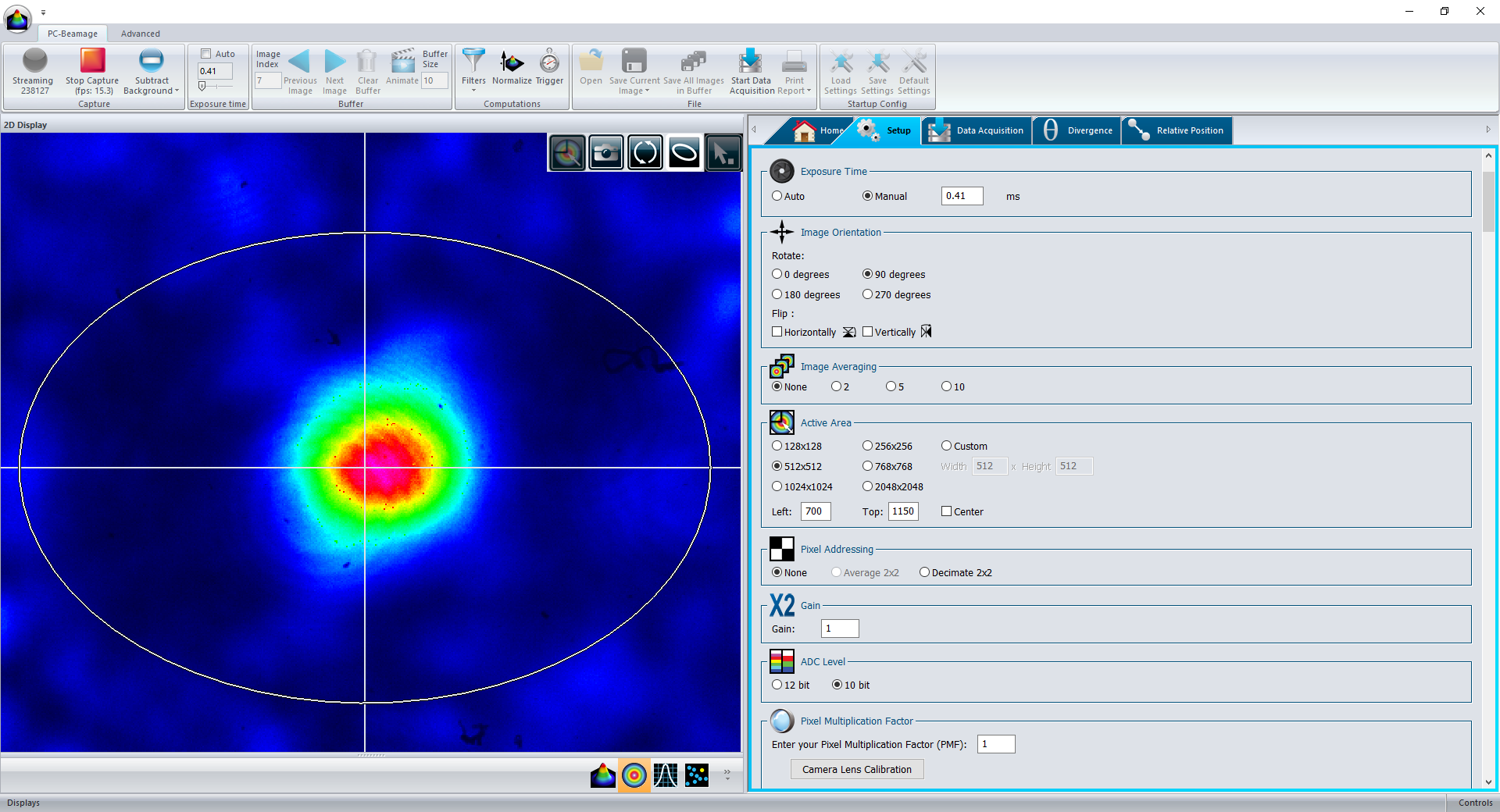
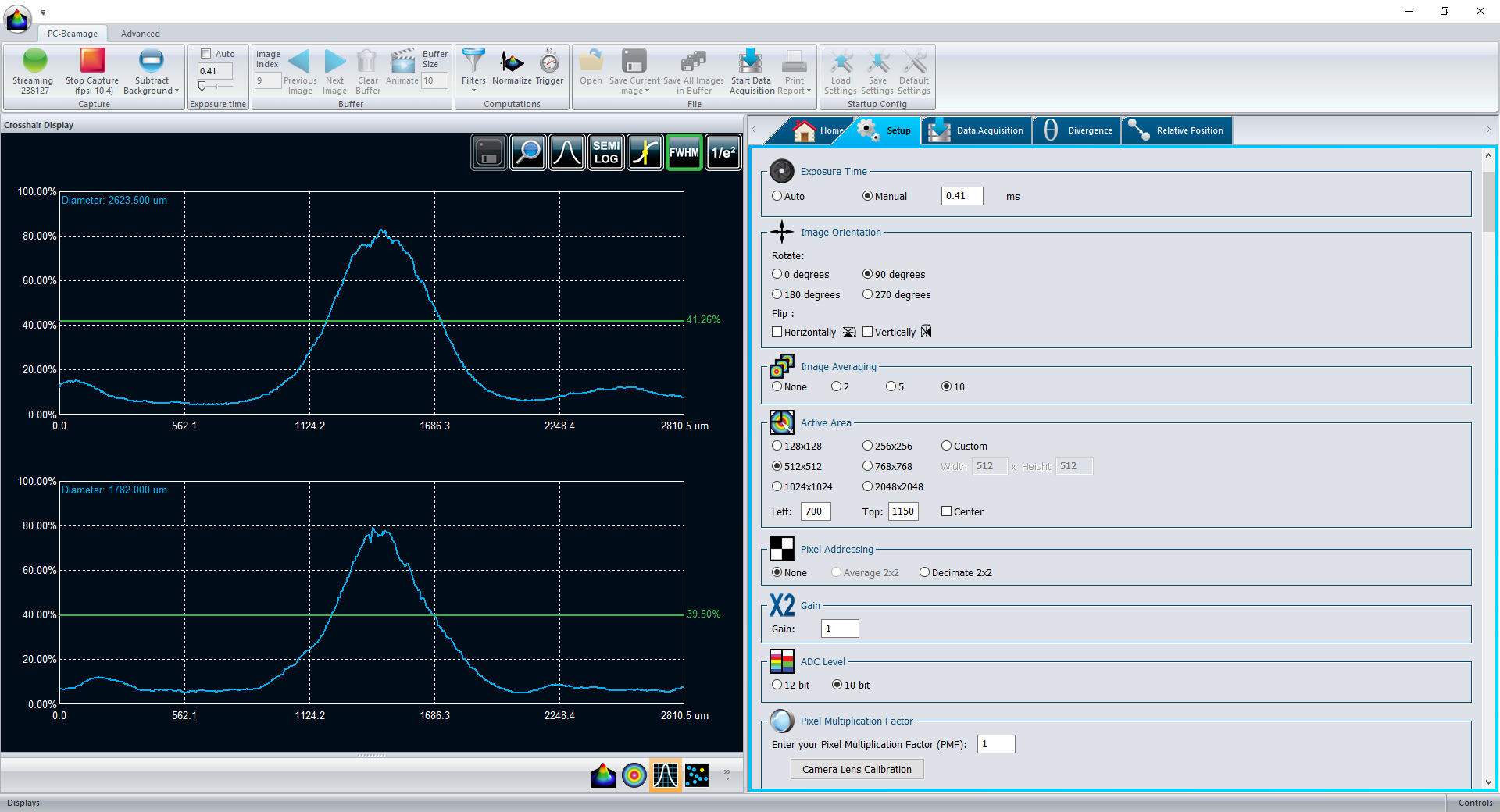
Beam size at the amplifier output:
to make this measurement, I switched ON only 1st and 2nd stage.
the dichroïc mirror seems to work the best in reflection at normal AOI !!!
it's strange as most dichroïc mirrors seem to be specified at AOI = 45° ! => to be checked ! => the dichroïc mirror was set on its wrong face !!! => problem solved
the 2 images correspond to the beam measured at 24cm from the amplifier output.
we cannot use the gaussian fit due to the pump beam shape which perturbate the measurement.
I used the FWHM measurement => DX = 2.6 mm, DY = 1.8mm
Pulse shape model:
dP(x,y,t) = DP * exp( - ln(2) * ( (x/DX_fwhm)² + (y/DY_fwhm)² ) * sech²( t / tp )
=> can we use safely the Newport 20Z40DM.10 mirrors to transport the amplifier beam ?
they are specified for 500 W/cm2 CW and 4 J/cm2 for 10 nsec pulses @ 1064 nm.
- if I am correct, for the previous shape model, the average power is :
Pmoy (W) = 2pi / ln(2) * tp * DP * DX_fwhm * DY_fwhm * Frep
with DP=500W/cm2, DX_fwhm=2.6mm DY_fwhm=1.8mm, tp=77ps, Frep=216MHz => Pmoy = 3.5 W !!!
this means that we should not exceed this average power with these mirrors !?!
- if I am correct, for the previous shape model, the maximal energy density (in the pulse center) is :
DE (J/cm2) = tp * DP => Pmoy = 2pi / ln(2) * DE * DX_fwhm * DY_fwhm * Frep
with DE= 4J/cm2, DX_fwhm=2.6mm DY_fwhm=1.8mm, Frep=216MHz => Pmoy = 366 MW !!!
if one applies a safety factor due to the pulse duration ratio (77ps / 10ns) => Pmoy = 2.8 MW !
this specification seems much less restrictive !
=> can we use safely the Thorlabs BB1-E03 mirrors to transport the amplifier beam ?
they are specified for 10 kW/cm CW (linear power density) and 0.5 J/cm2 for 10 nsec pulses @ 1064 nm.
- the linear power density (LPD) is defined as the average power divided by the beam diameter (1/e²)
LPD = Pmoy / DXY = Pmoy / (1.7 DXY_fwhm) => Pmoy = LPD * 1.7 DXY_fwhm
with LPD=10kW/cm and DY_fwhm=1.8mm => Pmoy = 3 kW
- for maximal energy density:
with DE= 0.5J/cm2, DX_fwhm=2.6mm DY_fwhm=1.8mm, Frep=216MHz => Pmoy = 45 MW !!!
if one applies a safety factor due to the pulse duration ratio (77ps / 10ns) => Pmoy = 350 kW !
| Ronic Chiche wrote: |
|
The "ThomX" CELIA amplifier is installed on the optical table.
I added all the rubber pieces available between the 2 racks to isolate as best as possible the top rack, which embeds some fans, from the bottom rack from which the laser beam is going out to the FP cavity.
1ST STAGE
-----------------
if I put 1mW (minimum input power) on the input fiber of the amplifier and I switch ON the first stage, one can measure 7mW on the 5% output tap on the front panel.
then it is mandatory to check this power before swtiching ON the other stage.
this 5% output tap on the front panel MUST BE ABOVE 7mW
input power : 1mW => 5% output tap : 7mW => amplifier output : 260µW
with the present setup, I can reach 6.8mW of input power, but the 5% output tap seems to saturate at ~ 8mW.
in this condition, the amplifier output is around 800µW
the SMA connector on the rear panel does not output any signal with the 1st stage ON.
2ND STAGE
-----------------
then, one can switch ON the 2nd stage : amplifier output is around 1.4 W (without any iris or dichroïc mirror).
the SMA connector on the rear panel does not output any signal with the 2nd stage ON.
|
|
| Attachment 1: Capture.PNG
|
 |
| Attachment 2: Capture2.PNG
|
 |
|
126
|
Thu Aug 11 19:27:09 2022 |
Ronic Chiche | Fixed | info | lasers and optics | detectors and electronics | Optical room | Koheras CW laser lock on FP cavity |
I locked the Koheras CW on the FP cavity but the lock was pretty noisy and very difficult to acquire.
I tried to produce some modulation sidebands close to 216MHz to measure the Finesse but the power loss was very small so, the signal to extract the Finesse would be unreadable !
(generator voltage was at maximum Vout = 0.5Vrms on 50 ohms... is it normal ? or the used 10GHz EOM suffers some problems ?)
At one moment, I lost the lock and was not able to find it again... it seems the Koheras is too noisy for this cavity (may be is it a good news for the Finesse ?).
Tomorrow, I will try to use the OEwave + amplifier to lock the cavity.
|
|
127
|
Fri Aug 12 11:46:17 2022 |
Ronic Chiche | Fixed | info | lasers and optics | Optical room | OEwaves lock and Finesse measurement |
this morning, I locked the FP cavity with the OEwaves CW laser and the "Fred fiber amplifier" used at 500mA of pump current.
the lock was much more easy than with the Koheras.
I had to change the 10GHz EOM which seems damaged as the modulation depth is very low and does not allow a Finesse measurement by modulation technique.
I changed it by a recently buyed 2GHz EOM... the modulation depth is large enough and we can make the Finesse measurement.
I took several sets of data and the average Finesse is 25.5k ! |
|
128
|
Fri Aug 12 17:48:28 2022 |
Ronic Chiche | Fixed | report | lasers and optics | Optical room | "ThomX" CELIA Amplifier commissionning |
this afternoon, with Fabian, we did some measurements on the 3rd stage.
finally we used the Dichroïc mirror at AOI=45°C as first mirror and a Thorlabs BB1-E03 as 2nd mirror to send the beam to the powermeter.
we put an iris to cut the pump beam part.
with only the 2nd stage ON, the dirchroïc mirror and the iris : P=0.4W
3RD STAGE
-----------------
IT IS MANDATORY TO SWITCH ON THE CHILLER
once the Alphanov software is launched, 4 windows appears on the screeen, one for each diode.
once the chiller temperature reach the set value (23°C in our case), one can start to increase the pump current.
(set "voltage adj." to AUTO)
the TEC of the first diode is not operative, then we decided to stop its current to 4A to avoid a too large temperature (in this condition, the temperature of the diode reach ~45°C !)
the other diodes temperatures are stabilized around 25°C
1A for all diodes => 1 W
2A for all diodes => 10.7 W
3A for all diodes => 22 W
4A for all diodes => 33 W
5A for diodes 2-3-4 => 40.5 W
6A for diodes 2-3-4 => 48.1 W
we stopped the measurement at 6A and we did not notice any change in the optical spectrum
During the optical spectrum measurement we tried to use a NDUV20 Thorlabs reflective filter to reflect the high power beam to the powermeter and let a few power part be transmitted to the spectral measurement.
unfortunatelly, the ND filter coating has been completly removed => DO NOT USE Thorlabs ND filters at high power !
| Ronic Chiche wrote: |
|
Beam size at the amplifier output:
to make this measurement, I switched ON only 1st and 2nd stage.
the dichroïc mirror seems to work the best in reflection at normal AOI !!!
it's strange as most dichroïc mirrors seem to be specified at AOI = 45° ! => to be checked ! => the dichroïc mirror was set on its wrong face !!! => problem solved
the 2 images correspond to the beam measured at 24cm from the amplifier output.
we cannot use the gaussian fit due to the pump beam shape which perturbate the measurement.
I used the FWHM measurement => DX = 2.6 mm, DY = 1.8mm
Pulse shape model:
dP(x,y,t) = DP * exp( - ln(2) * ( (x/DX_fwhm)² + (y/DY_fwhm)² ) * sech²( t / tp )
=> can we use safely the Newport 20Z40DM.10 mirrors to transport the amplifier beam ?
they are specified for 500 W/cm2 CW and 4 J/cm2 for 10 nsec pulses @ 1064 nm.
- if I am correct, for the previous shape model, the average power is :
Pmoy (W) = 2pi / ln(2) * tp * DP * DX_fwhm * DY_fwhm * Frep
with DP=500W/cm2, DX_fwhm=2.6mm DY_fwhm=1.8mm, tp=77ps, Frep=216MHz => Pmoy = 3.5 W !!!
this means that we should not exceed this average power with these mirrors !?!
- if I am correct, for the previous shape model, the maximal energy density (in the pulse center) is :
DE (J/cm2) = tp * DP => Pmoy = 2pi / ln(2) * DE * DX_fwhm * DY_fwhm * Frep
with DE= 4J/cm2, DX_fwhm=2.6mm DY_fwhm=1.8mm, Frep=216MHz => Pmoy = 366 MW !!!
if one applies a safety factor due to the pulse duration ratio (77ps / 10ns) => Pmoy = 2.8 MW !
this specification seems much less restrictive !
=> can we use safely the Thorlabs BB1-E03 mirrors to transport the amplifier beam ?
they are specified for 10 kW/cm CW (linear power density) and 0.5 J/cm2 for 10 nsec pulses @ 1064 nm.
- the linear power density (LPD) is defined as the average power divided by the beam diameter (1/e²)
LPD = Pmoy / DXY = Pmoy / (1.7 DXY_fwhm) => Pmoy = LPD * 1.7 DXY_fwhm
with LPD=10kW/cm and DY_fwhm=1.8mm => Pmoy = 3 kW
- for maximal energy density:
with DE= 0.5J/cm2, DX_fwhm=2.6mm DY_fwhm=1.8mm, Frep=216MHz => Pmoy = 45 MW !!!
if one applies a safety factor due to the pulse duration ratio (77ps / 10ns) => Pmoy = 350 kW !
| Ronic Chiche wrote: |
|
The "ThomX" CELIA amplifier is installed on the optical table.
I added all the rubber pieces available between the 2 racks to isolate as best as possible the top rack, which embeds some fans, from the bottom rack from which the laser beam is going out to the FP cavity.
1ST STAGE
-----------------
if I put 1mW (minimum input power) on the input fiber of the amplifier and I switch ON the first stage, one can measure 7mW on the 5% output tap on the front panel.
then it is mandatory to check this power before swtiching ON the other stage.
this 5% output tap on the front panel MUST BE ABOVE 7mW
input power : 1mW => 5% output tap : 7mW => amplifier output : 260µW
with the present setup, I can reach 6.8mW of input power, but the 5% output tap seems to saturate at ~ 8mW.
in this condition, the amplifier output is around 800µW
the SMA connector on the rear panel does not output any signal with the 1st stage ON.
2ND STAGE
-----------------
then, one can switch ON the 2nd stage : amplifier output is around 1.4 W (without any iris or dichroïc mirror).
the SMA connector on the rear panel does not output any signal with the 2nd stage ON.
|
|
|
|
139
|
Tue Aug 30 17:48:39 2022 |
Ronic Chiche | Fixed | info | lasers and optics | Optical room | 2nd stage CELIA amplifier |
today, we measured the 2nd stage CELIA amplifier pump wavelength : 970-990 nm |
| Attachment 1: 2nd_stage_pump_wavelength.jpg
|
 |
|
140
|
Wed Aug 31 18:14:51 2022 |
Ronic Chiche | Fixed | info | lasers and optics | Optical room | 2nd stage CELIA amplifier |
today we did several test with the Dichroic shortpass mirror (Thorlabs DMSP1000) and with a 10nm optical filter around 1030nm (which works in tranmission at AOI=0).
one used the dichroic mirror in reflection: one should cut the pump @970-990nm and we should keep only the signal @1030nm.
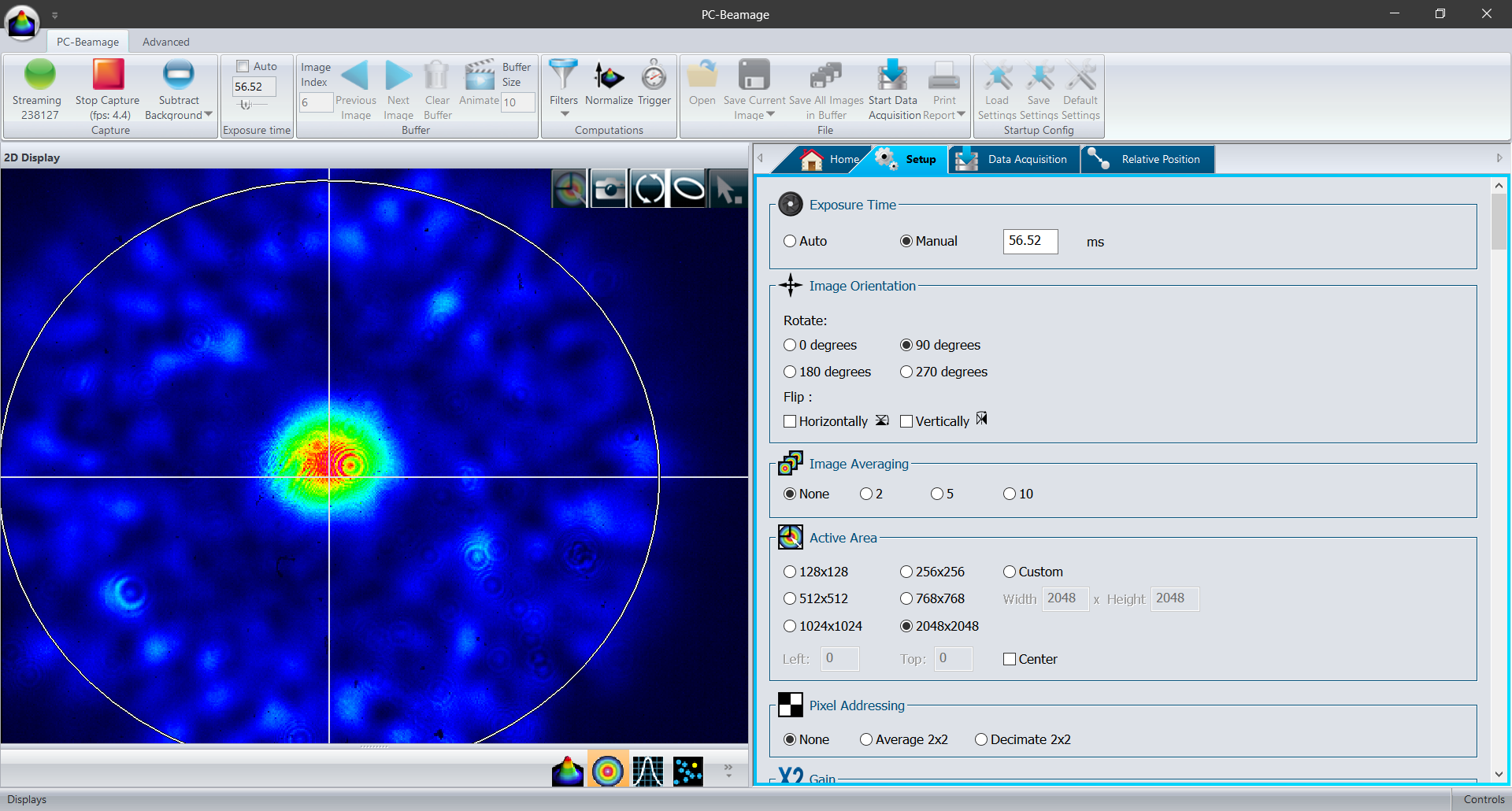
but we still saw plenty spots around the central beam (see the image).
adding the 10nm optical filter on the camera, the image did not change !
then we confirmed the whole signal (centered beam + spots) are well @1030nm.
this spots could be the remaining high order modes of the large fiber used for the 3rd stage of the amplifier.
| Ronic Chiche wrote: |
|
today, we measured the 2nd stage CELIA amplifier pump wavelength : 970-990 nm
|
|
| Attachment 1: image_faisceau_multimode_@1030nm.PNG
|
 |
|
144
|
Tue Sep 6 17:47:40 2022 |
Ronic Chiche | Fixed | issue | lasers and optics | Optical room | unsuccessful telescope design :-( |
we wanted to calculate the right telescope with 2 spherical lenses.
1) we have the FP cavity mode size which is 0.58mm at the input mirror and 0.7mm at the output mirror.
2) we planned to measure the laser beam at the output of the amplifier working at P=1W (2nd stage ON only).
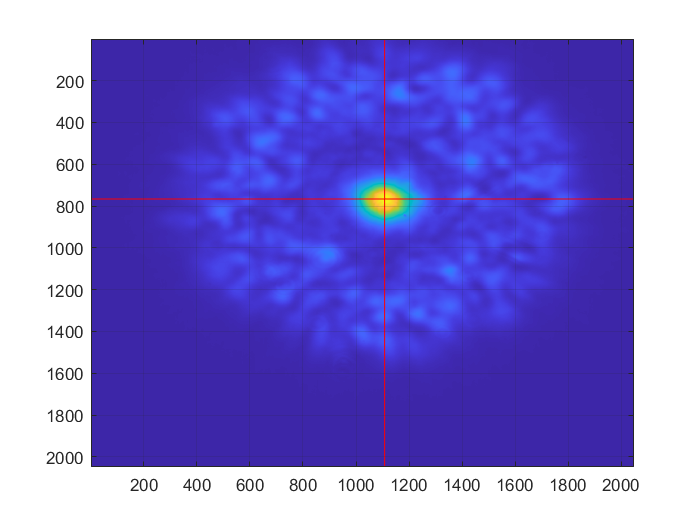
we did several measurements at different positions from the amplifier output.
for each of these measurements, we were able to fit the intensity profile I = I0 * exp(-2 *r^2 / w^2) on x or y axis, then we have w(z).
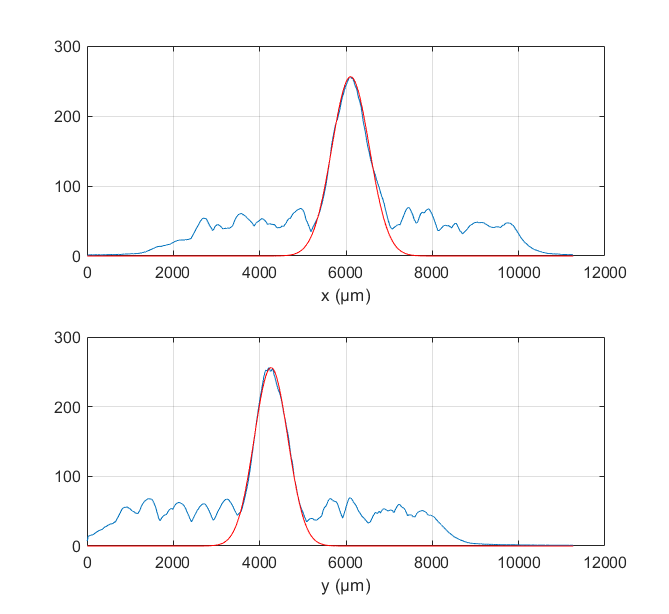
attached files give an example of the beam image at z=40mm and an example of the beam fits for w and y.
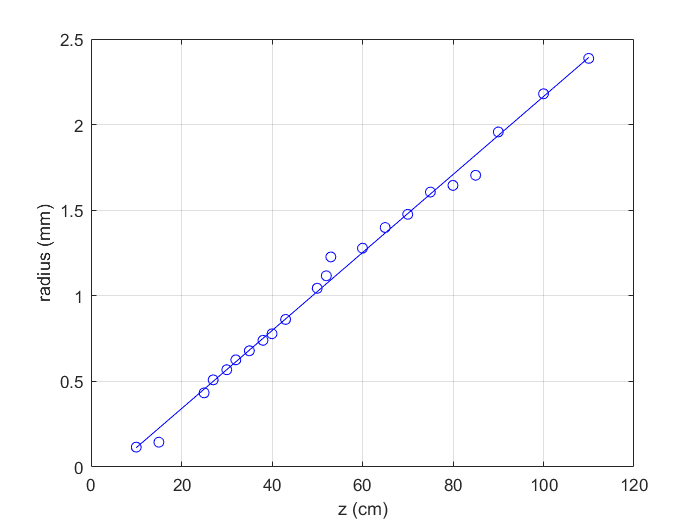
with all the w(z) measurements, we were able to fit the divergence of the beam => 2.3 mrad
attached file show the radius measurements and the divergence fit.
with this divergence, we should find a waist bigger than 140 µm (value for M²=1).
unfortunately the smallest beam radius measured is 116 µm which would give a M²<1 that is not allowed !
then it seems the measurements have not been done correctly... :-(
we will try to do them again... maybe at P=10W or 50W ?!? |
| Attachment 1: image_at_z_being_40mm.png
|
 |
| Attachment 2: beam_fit_at_z_being_40mm.png
|
 |
| Attachment 3: propagation_fit.png
|
 |
|
156
|
Fri Sep 9 18:35:07 2022 |
Ronic Chiche | Fixed | info | mechanics | lasers and optics | detectors and electronics | Optical room | D-shape mirrors positionning status |
This afternoon we opened the cavity and put the D-shape mirrors at their correct place, close to the beam.
we checked the relative position of the mirrors to the beam using the 2nd stage of the amplifier (<1W) and with the sensitive (and cleaned) orange optical card.
with this configuration, we can see very clearly the beam inside the cavity (~ 100µW) and we can check easily if the D-shape mirrors are correctly placed.
the motors used to move the D-shape are the Newport Picomotors 8303-V
with roughly 30nm/step sensitivity and 50mm of range (~1 600 000 steps)
the 4 axis controller used ot move these motors is the Newport 8742.
For both Vertical and Horizontal D-shape mirrors:
* when you do +N steps on the controller, you retract the D-shape mirror from the beam
* when you do -N steps on the controller, you push the D-shape mirror to the beam
the 0 position on the controller corresponds to the D-shape close to the beam.
now, the FP cavity is closed and pumped to go back to vacuum.
|
|
157
|
Fri Sep 9 19:03:58 2022 |
Ronic Chiche | Fixed | info | mechanics | lasers and optics | detectors and electronics | Optical room | D-shape mirrors positionning status |
The cavity box is vacuum pumped at 6*10^-2 mbar.
| Ronic Chiche wrote: |
|
This afternoon we opened the cavity and put the D-shape mirrors at their correct place, close to the beam.
we checked the relative position of the mirrors to the beam using the 2nd stage of the amplifier (<1W) and with the sensitive (and cleaned) orange optical card.
with this configuration, we can see very clearly the beam inside the cavity (~ 100µW) and we can check easily if the D-shape mirrors are correctly placed.
the motors used to move the D-shape are the Newport Picomotors 8303-V
with roughly 30nm/step sensitivity and 50mm of range (~1 600 000 steps)
the 4 axis controller used ot move these motors is the Newport 8742.
For both Vertical and Horizontal D-shape mirrors:
* when you do +N steps on the controller, you retract the D-shape mirror from the beam
* when you do -N steps on the controller, you push the D-shape mirror to the beam
the 0 position on the controller corresponds to the D-shape close to the beam.
now, the FP cavity is closed and pumped to go back to vacuum.
|
|
|
173
|
Fri Jan 6 12:33:18 2023 |
Ronic Chiche | Fixed | info | lasers and optics | Optical room | Laser Menhir reinstallation + CVBG + fiber injection |
The lab purchased the Menhir laser @ 216MHz.
it has been sent back to Menhir photonics for inspection, and then is now at lab.
it has been reinstalled to the SBOX setup with injection in a CVBG for pulse stretching before amplification.
the power after CVBG is 24mV.
the power coupled to the fiber is only 6.4mW => to be optimized.
the spectrum has been mesured after CVBG and seems correct : picture is attached.
|
| Attachment 1: MenhirJan2022.PNG
|
 |
|
174
|
Thu Dec 7 09:09:27 2023 |
Ronic Chiche | Fixed | info | lasers and optics | ThomX igloo | New mirrors batch informations |
the 2 files describe the specfications for the 16 mirrors ordered (4 for ThomX + spare, 4 for SBOX + spare) and the measurements made by the LMA.
I add also a 3rd file in which all the "special' mirrors are referenced. |
| Attachment 1: miroirs_puma_2022_thomx_Kbox.docx
|
| Attachment 2: Miroirs_à_1031_nm-ThomX_-_KBox_Mars_2023.pdf
|
| Attachment 3: Recap_miroirs_KBOX_et_THOMX.xlsx
|
|
175
|
Thu Dec 7 09:30:03 2023 |
Ronic Chiche | Fixed | info | mechanics | lasers and optics | detectors and electronics | software | Optical room | new setup for the 160MHz Menhir oscillator |
from the begining of the week, Xinyi, Aurélien, Viktor and myself started to install a new setup for the Menhir 160MHz oscillator.
the goal is to rich a record power in the FP-cavity.
- the 160MHz Menhir oscillator has been injected in a fiber.
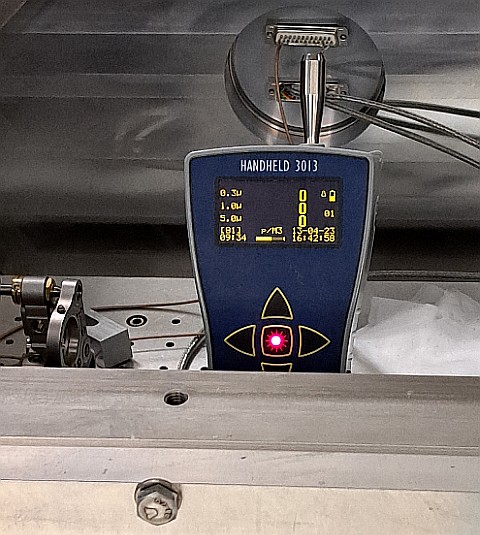
we reached ~ 25mV on 50ohms which is equivalent to 0.5mA in a DET10 photodiode.
=> ~1mW coupled in the fiber => it is not enough to put an EOM and an AOM before the amplifier.
=> one needs to improve the fiber injection.
in fact, I checked the power in the fiber with a powermeter, and it is ~16mW !
at this level of power, one needs to add some optical density before connecting to a photodiode, or it can be saturated.
- we calculated the mirrors position in the SBOX vessel to obtain a 160MHz FSR FP-cavity.
see in attached files, the calculations and scheme in the PPTX file and the Matlab code to get some results.
- we cleaned the optical table and verified with the dust counter that the SBOX environnement is clean.
the 2nd airflow box (from the entrance) seems more dusty (measureed directly close to the top) than the others.
we also opened the vessel and cleaned it.
see the dust measurement inside the SBOX.
- we checked the motors inside the vessel :
=> spherical and plan mirrors translation stage control with the ESP300.
the translation stage have been placed on the middle of their range.
=> the 2 D-shape mirrors translation stage control with PICOMOTORS controller Newport 8742.
- today, Viktor and Xinyi should start the installation of the mirrors mount and make some test to check if the beam is properly propagated inside the FP-cavity, before installing the final mirrors.
the mirror mounts are the Newport SU100TW-F2K zero-drift low waveform distortion : https://www.newport.com/p/SU100TW-F2K
they can accept mirrors with 6-6.35mm thickness => normally the SBOX mirrors from the LMA have a 6.35mm thickness.
see 1st file from this post : https://elog.lal.in2p3.fr/FPC/SBOX+commissioning/174 |
| Attachment 1: Plan_SBOX_@_160MHz.pptx
|
| Attachment 2: Implantation_disymmetric.m
|
clear
clc

% simulation parameters
c=299792458;            % light speed in vacuum
Frep=160.3084e6;        % laser repetition rate
D=0.07;                 % side distance between "output" windows of the vessel
DR=0.12;                % side distance between "input" windows of the vessel
L0=1.02;                % cavity box length
L3=0.505;               % distance between spherical mirrors

theta1=linspace(0.115,0.120,1e3);

% calculated parameters
Lrt=c/Frep;
theta2=2*atan(1./((Lrt/D)-1./tan(theta1/2)));
L2=D./sin(theta2);
L4=D./sin(theta1);
L1=Lrt-L2-L3-L4;

LM3=(DR-D)./tan(theta2);
LM2=L0-DR./tan(theta2);
LM1=L0-L1-LM2;
LM4=L0-L3-LM3;

id=LM1>0.15 & LM2>0.15 & LM3>0.15 & LM4>0.15 & abs(LM1-LM3)>0.08 & abs(LM2-LM4)>0.08;
L1(~id)=0;
L2(~id)=0;
L4(~id)=0;
LM1(~id)=0;
LM2(~id)=0;
LM3(~id)=0;
LM4(~id)=0;

figure(1)
clf
plot(theta1*1e3,L1)
hold on
plot(theta1*1e3,L2)
plot(theta1*1e3,L4)
plot(theta1*1e3,LM1)
plot(theta1*1e3,LM2)
plot(theta1*1e3,LM3)
plot(theta1*1e3,LM4)
grid on
legend('L1','L2','L4','LM1','LM2','LM3','LM4','location','best')
xlabel('theta1 angle (mrad)')
ylabel('length parameters (m)')

id=find(id~=0);
id=id(1);

disp(['LRT = ' num2str(Lrt) ' m'])
disp(['D = ' num2str(D*1e3) ' mm'])
disp(['theta1 = ' num2str(theta1(id)*1e3) ' mrad'])
disp(['theta2 = ' num2str(theta2(id)*1e3) ' mrad'])
disp(['L1 = ' num2str(L1(id)*1e3) ' mm'])
disp(['L2 = ' num2str(L2(id)*1e3) ' mm'])
disp(['L3 = ' num2str(L3*1e3) ' mm'])
disp(['L4 = ' num2str(L4(id)*1e3) ' mm'])
disp(' ')
disp(['L0 = ' num2str(L0) ' m'])
disp(['DR = ' num2str(DR*1e3) ' mm'])
disp(['LM1 = ' num2str(LM1(id)*1e3) ' mm'])
disp(['LM2 = ' num2str(LM2(id)*1e3) ' mm'])
disp(['LM3 = ' num2str(LM3(id)*1e3) ' mm'])
disp(['LM4 = ' num2str(LM4(id)*1e3) ' mm'])
disp(['LM3-LM1 = ' num2str((LM3(id)-LM1(id))*1e3) ' mm'])
disp(['LM2-LM4 = ' num2str((LM2(id)-LM4(id))*1e3) ' mm'])
|
| Attachment 3: IMG_20210519_155329.jpg
|
 |
|
195
|
Wed Feb 28 17:26:46 2024 |
Ronic Chiche | Fixed | info | lasers and optics | software | Optical room | 100W CELIA laser amplifier "how's to" document |
1st version of the document.
if some information is not correct or missing, give any comment by replying to this post. |
| Attachment 1: How_to_start_the_Amplifier_v1.pdf
|
|
207
|
Fri Mar 29 16:23:34 2024 |
Ronic Chiche | Fixed | info | lasers and optics | detectors and electronics | Optical room | 100W CELIA laser amplifier "Power vs Pump current" curve |
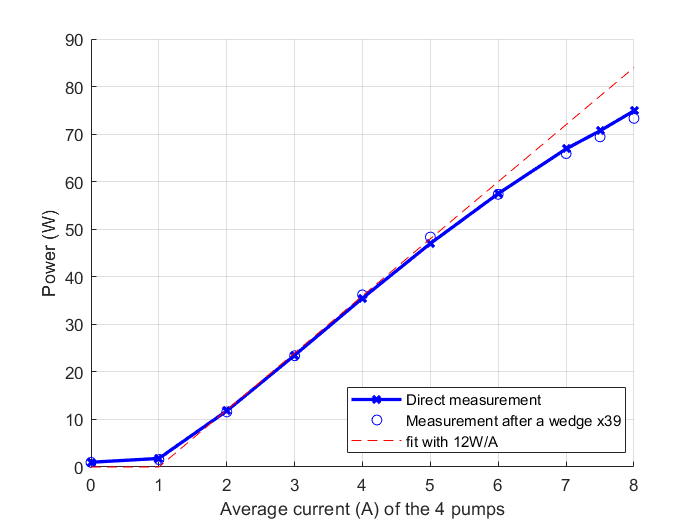
We measured again the 100W CELIA laser amplifier with a pump current until 8A.
as the first current pump of the amplifier has a Peltier issue, we don't exceeded 6A on this stage and we compensated with the 3 other stages.
7A average current is obtained with 6A / 7.3A / 7.3A / 7.4A
7.5A average current is obtained with 6A / 8A / 8A / 8A
8A average current is obtained with 6A / 8.6A / 8.7A / 8.7A
we did the power measured either with the "big" powermeter which is able to handle 100W
and with a smaller powermeter after a wedge, in the reflection path, which is multiplied by 39 to match the big powermeter measurement.
a fit a 12W/A from the cut-off current of 2A is a good estimation until 5A. |
| Attachment 1: CELIA_100W_amplifier_Power_vs_Current.png
|
 |
|
223
|
Wed Jun 19 10:38:00 2024 |
Ronic Chiche | Fixed | info | mechanics | lasers and optics | detectors and electronics | Optical room | D-shape mirrors positionning status |
summary:
- the motors used to move the D-shape are the Newport Picomotors 8303-V
the sensitivity is roughly 30nm/step
the range is 1 600 000 steps or 50mm
- the 4 axis controller used ot move these motors is the Newport 8742.
channel 1 is for the vertical D-shape
channel 2 is for the horizontal D-shape
+N steps on the controller, you retract the D-shape mirror from the beam
-N steps on the controller, you push the D-shape mirror to the beam
the 0 position, vertically and horizontally is close to the beam.
the stand position is at ~ +200 000 steps in both directions.
| Ronic Chiche wrote: |
|
The cavity box is vacuum pumped at 6*10^-2 mbar.
| Ronic Chiche wrote: |
|
This afternoon we opened the cavity and put the D-shape mirrors at their correct place, close to the beam.
we checked the relative position of the mirrors to the beam using the 2nd stage of the amplifier (<1W) and with the sensitive (and cleaned) orange optical card.
with this configuration, we can see very clearly the beam inside the cavity (~ 100µW) and we can check easily if the D-shape mirrors are correctly placed.
the motors used to move the D-shape are the Newport Picomotors 8303-V
with roughly 30nm/step sensitivity and 50mm of range (~1 600 000 steps)
the 4 axis controller used ot move these motors is the Newport 8742.
For both Vertical and Horizontal D-shape mirrors:
* when you do +N steps on the controller, you retract the D-shape mirror from the beam
* when you do -N steps on the controller, you push the D-shape mirror to the beam
the 0 position on the controller corresponds to the D-shape close to the beam.
now, the FP cavity is closed and pumped to go back to vacuum.
|
|
|