| ID |
Date |
Author |
Status |
Type |
Category |
Location |
Title |
|
218
|
Tue Apr 16 18:38:04 2024 |
Xinyi Lu | Fixed | info | lasers and optics | Optical room | Fiber injection, spectrum and connection of 2nd stage amplifier |
Today, Daniele and I injected the laser into the fiber, installed the telescope, connected the second stage of the amplifier, and obtained resonances.
- The output power of the menhir laser @ 216MHz is 150mW, after CVBG is 28mW , 9.6mW injected into the fiber, and 1.6mW via AOM and EOM. This is not far from the minimum 1mW seed power required by the amplifier.
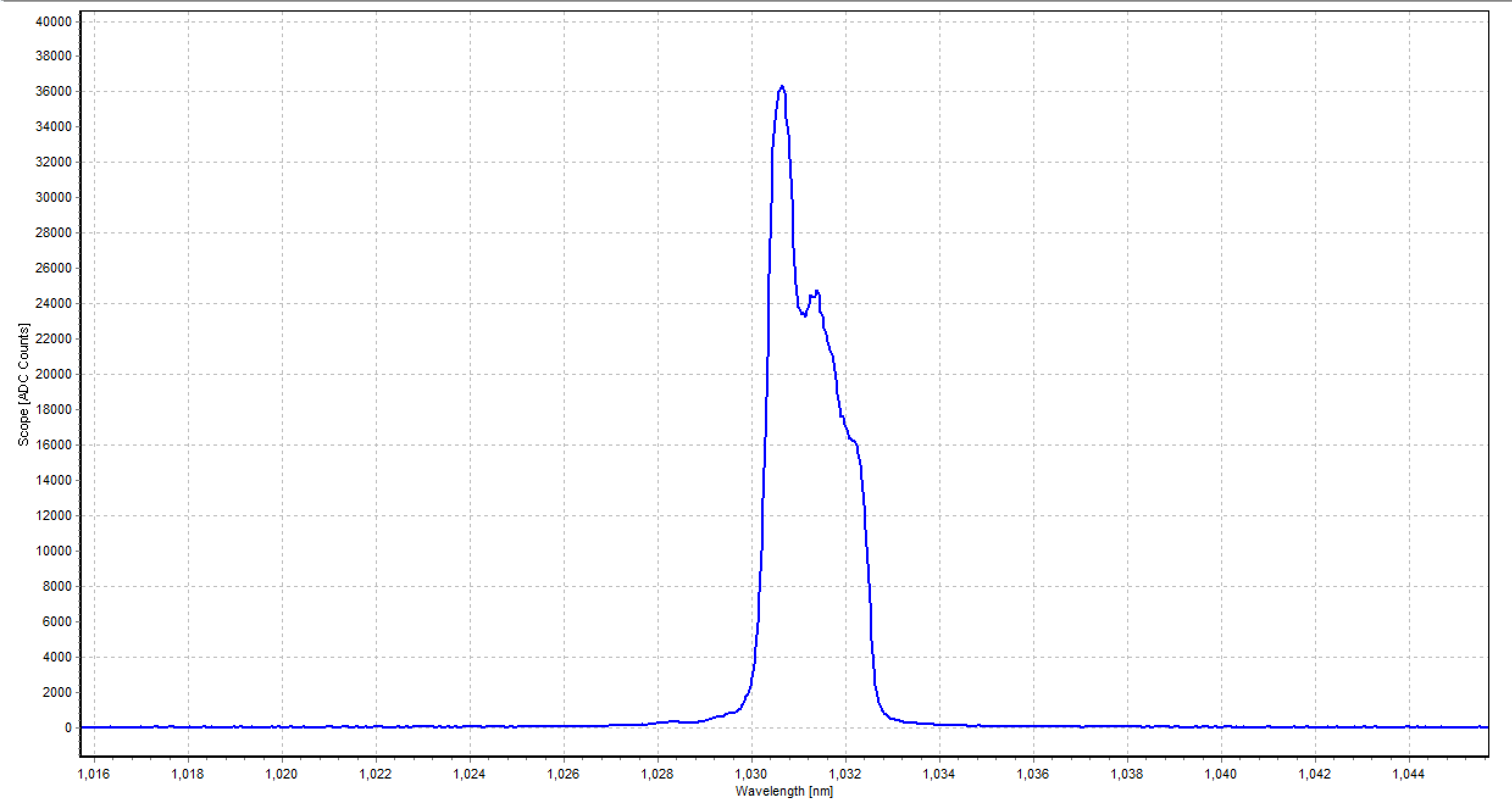
- The spectrum after CVBG is shown in Figure 1.
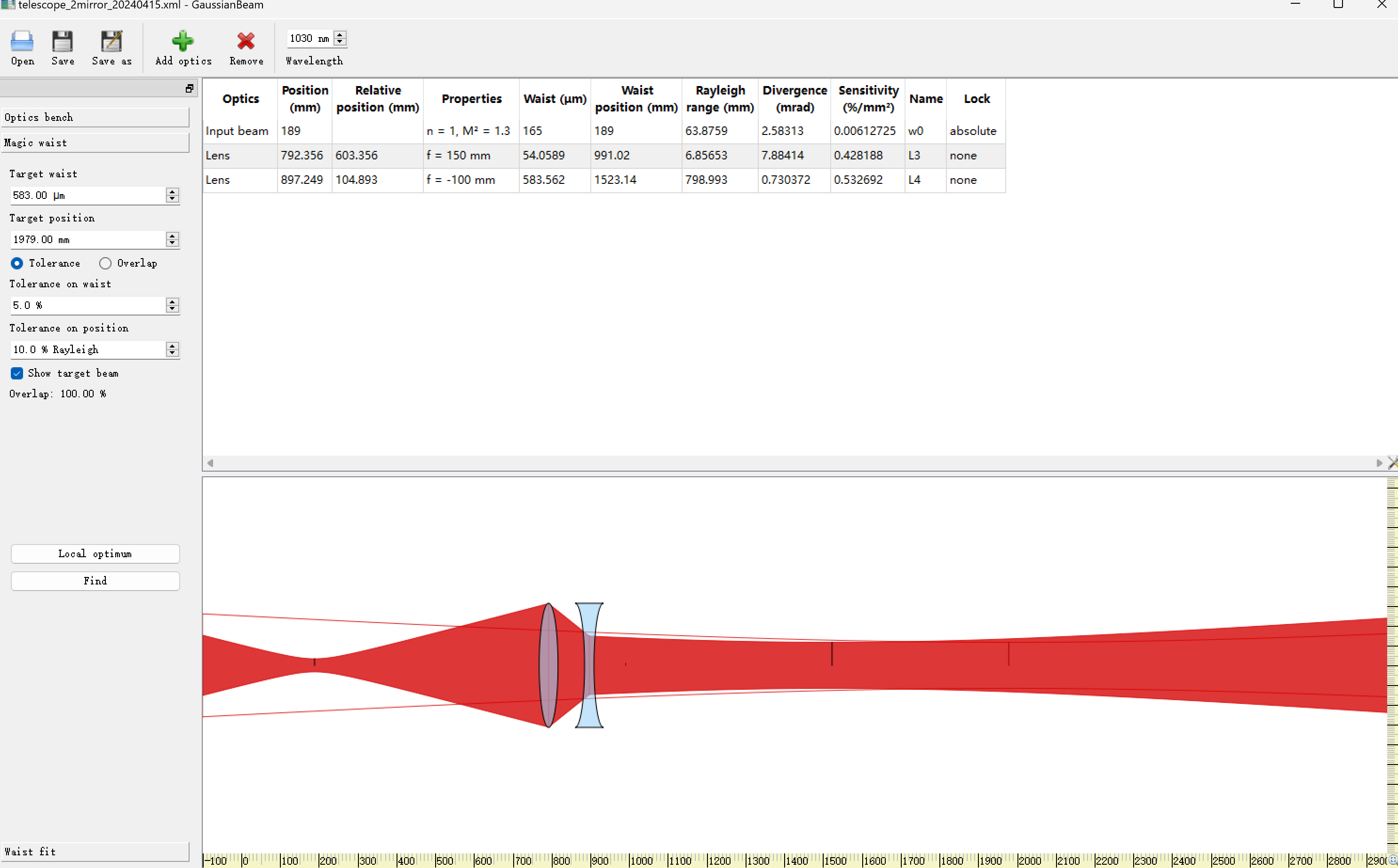
- The waist of this 2-mirror cavity is 0.583 mm, and the position is on the M1. A set of telescopes is designed and installed as in Figure 2.
- We injected the second stage of the amplifier into the cavity and obtained fundamental mode. Aurélien and I are trying to lock it. |
| Attachment 1: CVBG_inject_to_fiber.png
|
 |
| Attachment 2: telescope.png
|
 |
|
219
|
Thu Apr 25 22:12:25 2024 |
Xinyi Lu | Fixed | info | lasers and optics | Optical room | 2 mirror cavity high power experiments |
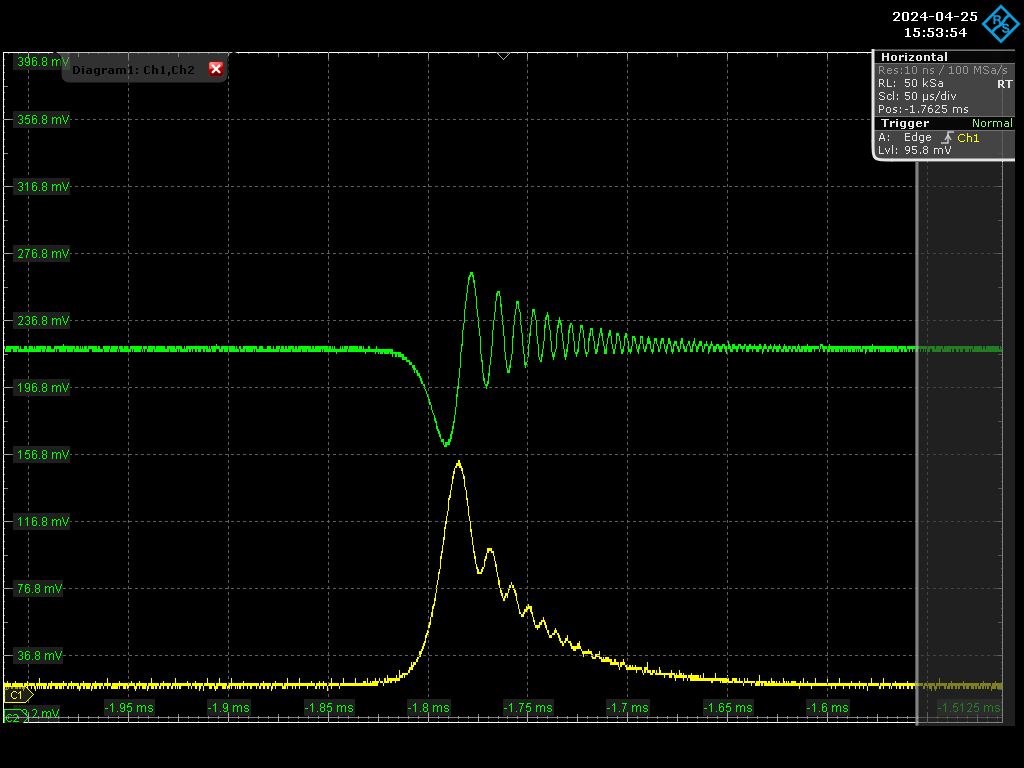
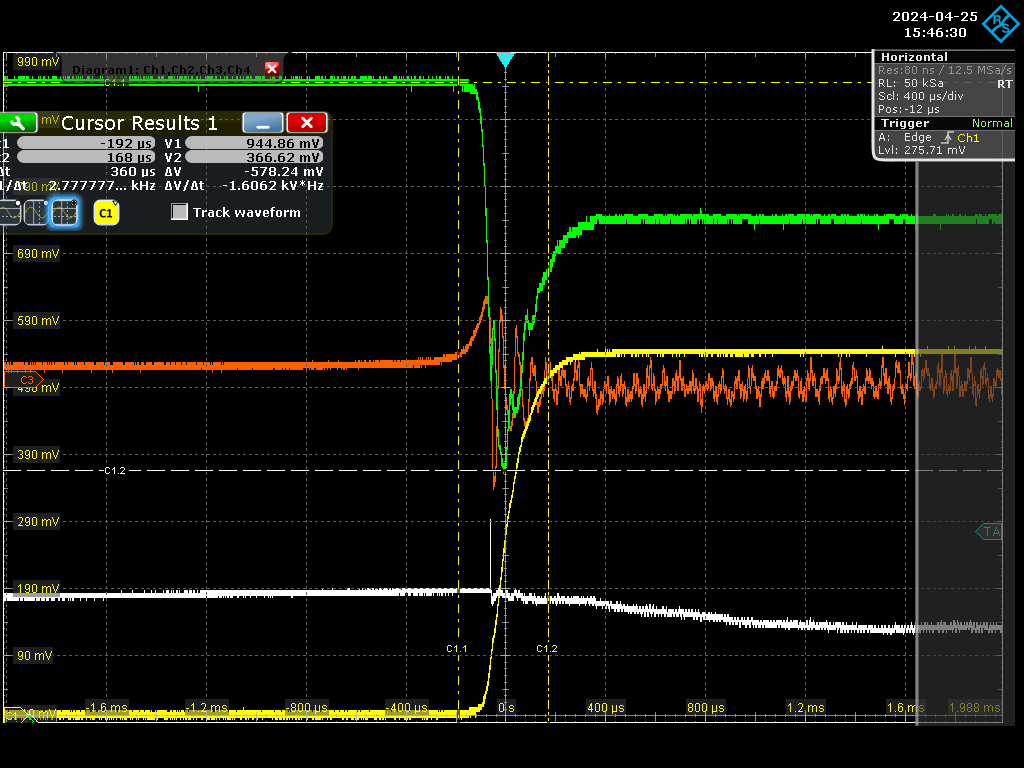
Today, Ronic and I recorded some intracavity power and cavity mode size as shown in Fig. 1.
Coupling was calculated using the locking curve of this overcoupled cavity. Pr/Pi = 1-Cgeo*Cimp, Cimp = 1-|1-2T1/RTL|^2
We can see that the effective gain, coupling, and mode size decrease with increasing power. And the beam is constantly moving.
Tomorrow we will try to optimize the telescope for the high-power hot cavity.
|
| Attachment 1: record_20240425.png
|
 |
| Attachment 2: Screenshot_2024-04-25_4_155354-155kw.png
|
 |
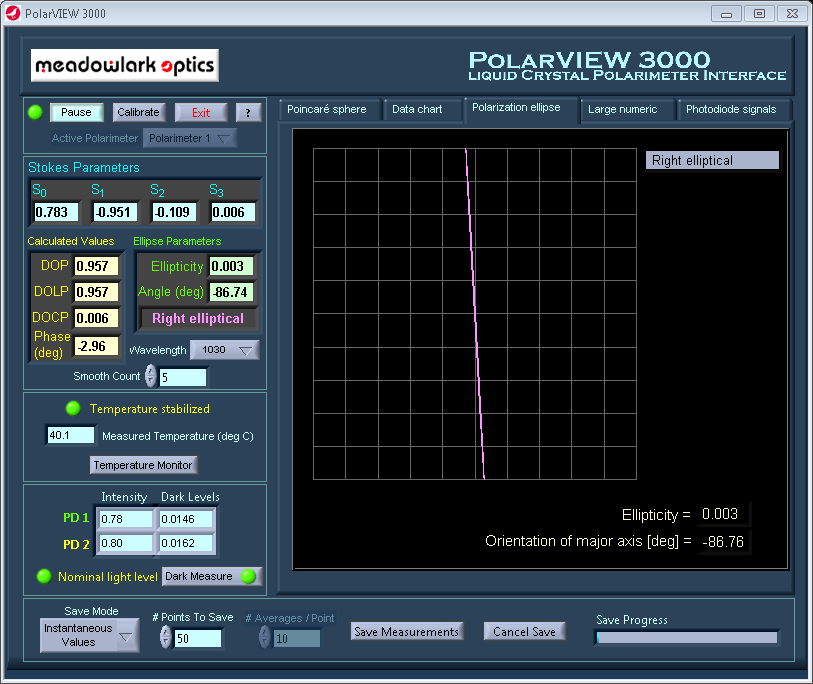
| Attachment 3: Screenshot_2024-04-25_1_154630-155kw.png
|
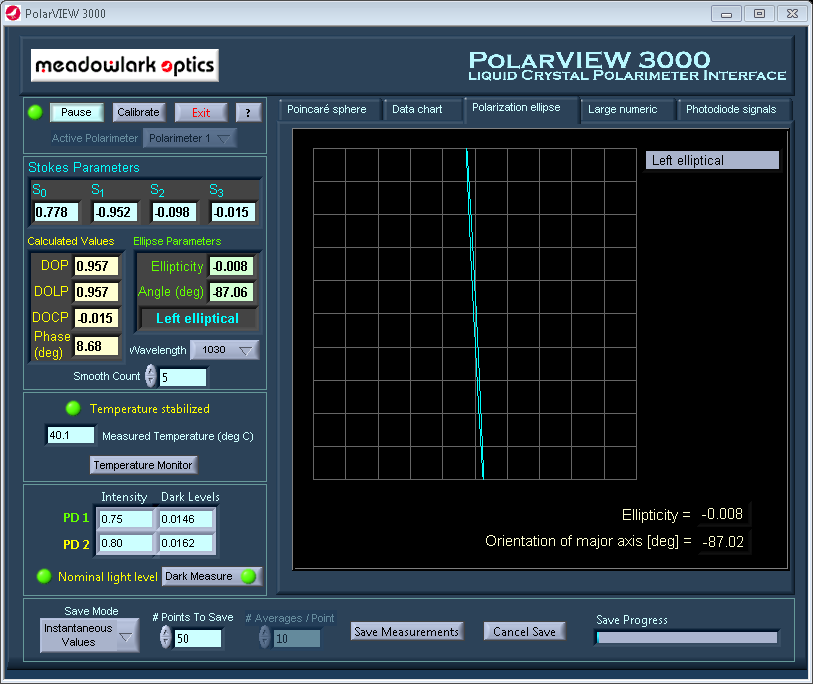
 |
| Attachment 4: 60kW_highordermode2.jpg
|
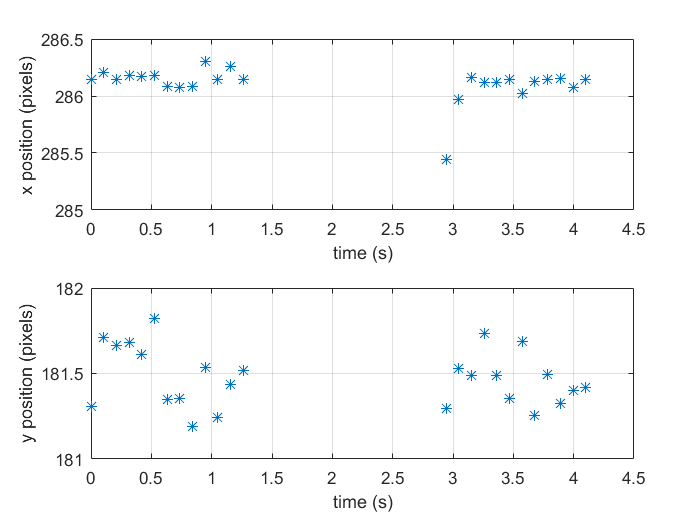
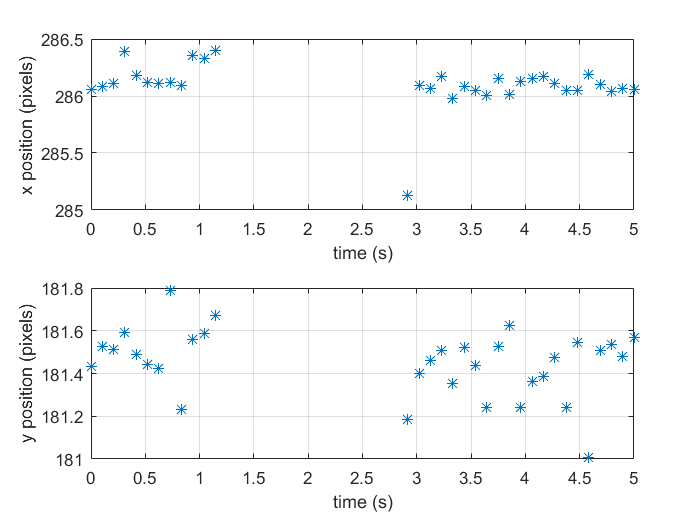
 |
|
220
|
Mon May 6 18:38:18 2024 |
Xinyi Lu | Fixed | info | lasers and optics | Optical room | high-power experiments of 2-mirror cavity |
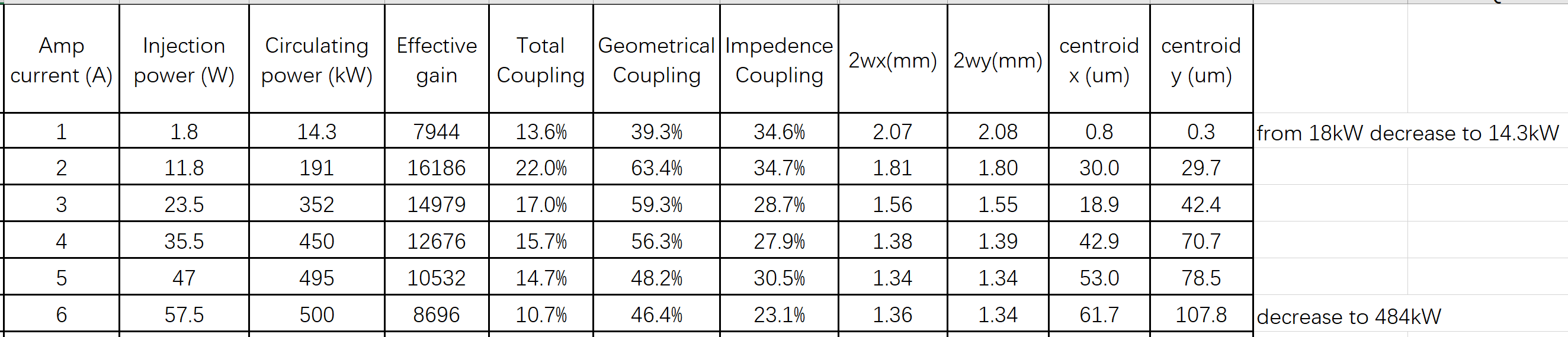
Today, Ronic, Daniele and I redo the high-power 2-mirror cavity experiments, and the results are shown in the table (Figure 1 and Excel 2 ).
- The intracavity power ~500kW can be obtained at 47W injection, but we then have no increase or even a decrease in intracavity power when increasing the injection power, and the coupling is decreasing. It looks like the saturation power of the current device.
- We moved the telescope last week at 2A by moving the concave lens 0.5cm closer to the cavity but almost no change in intracavity power (195kW to 193kW). The telescopes for today's experiment are in the new locations from last week, and we didn't move them today.
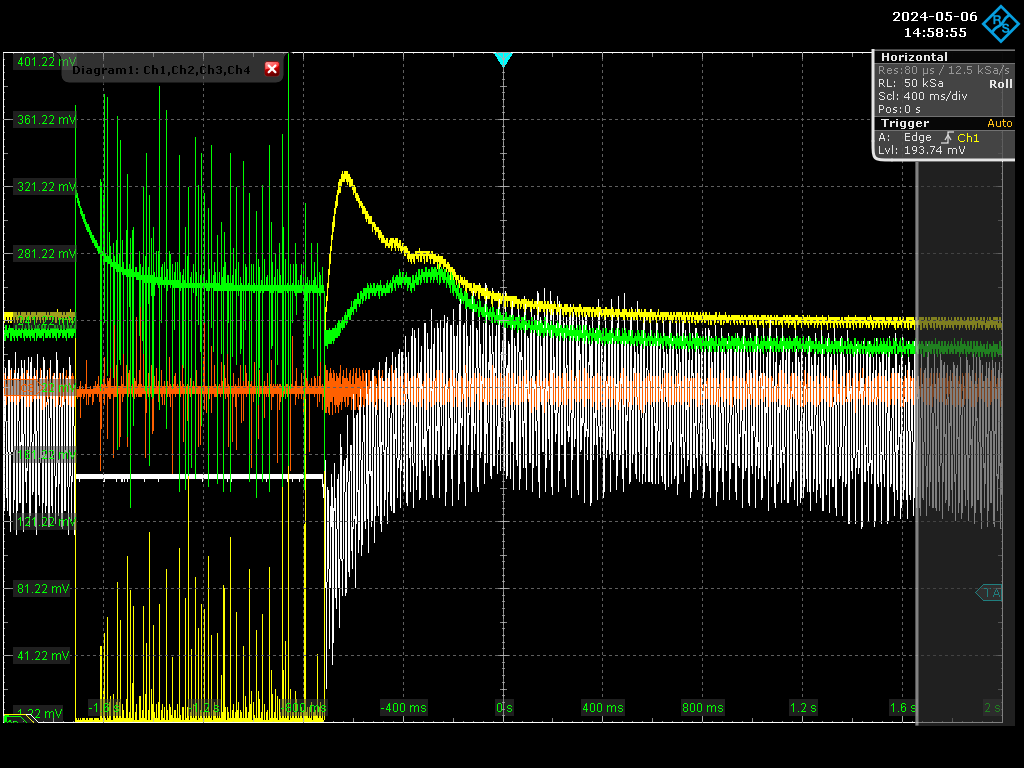
- Figure 3 shows the locking curve at 500kW with some thermal effect changes.
- Figure 4 shows the de-lock and to-lock curves at 14kW.
- The current results may be due to two causes, the thermal lensing effect and the physical change in the mirror coating. It is possible that the transmission of the two mirrors changes with temperature.
- The next plan is to adjust the telescope at 4A to see if we can increase the intracavity power. Meanwhile, do some simulations about dynamic locking, coupling rate, and transmittance.
| Xinyi Lu wrote: |
|
Today, Ronic and I recorded some intracavity power and cavity mode size as shown in Fig. 1.
Coupling was calculated using the locking curve of this overcoupled cavity. Pr/Pi = 1-Cgeo*Cimp, Cimp = 1-|1-2T1/RTL|^2
We can see that the effective gain, coupling, and mode size decrease with increasing power. And the beam is constantly moving.
Tomorrow we will try to optimize the telescope for the high-power hot cavity.
|
|
| Attachment 1: record_20240506.png
|
 |
| Attachment 2: record20240506.xlsx
|
| Attachment 3: Screenshot_2024-05-06_11_145855-500kW.png
|
 |
| Attachment 4: Screenshot_2024-05-06_1_112931-14kW.png
|
 |
|
221
|
Thu May 16 18:51:17 2024 |
Xinyi Lu | Fixed | info | lasers and optics | Optical room | high-power experiments of 2-mirror cavity |
here is a Matlab code to try to optimize the telescope for a hot cavity,
taking into account the thermal lens in the coupling mirror.
from that code, one can deduce using the "Gaussian Beam" software (using the attached xml file) an optimized telescope with 100% geometrical coupling @ Pcav = 700kW and absorption in the coatings = 0.6ppm
| Xinyi Lu wrote: |
|
Today, Ronic, Daniele and I redo the high-power 2-mirror cavity experiments, and the results are shown in the table (Figure 1 and Excel 2 ).
- The intracavity power ~500kW can be obtained at 47W injection, but we then have no increase or even a decrease in intracavity power when increasing the injection power, and the coupling is decreasing. It looks like the saturation power of the current device.
- We moved the telescope last week at 2A by moving the concave lens 0.5cm closer to the cavity but almost no change in intracavity power (195kW to 193kW). The telescopes for today's experiment are in the new locations from last week, and we didn't move them today.
- Figure 3 shows the locking curve at 500kW with some thermal effect changes.
- Figure 4 shows the de-lock and to-lock curves at 14kW.
- The current results may be due to two causes, the thermal lensing effect and the physical change in the mirror coating. It is possible that the transmission of the two mirrors changes with temperature.
- The next plan is to adjust the telescope at 4A to see if we can increase the intracavity power. Meanwhile, do some simulations about dynamic locking, coupling rate, and transmittance.
| Xinyi Lu wrote: |
|
Today, Ronic and I recorded some intracavity power and cavity mode size as shown in Fig. 1.
Coupling was calculated using the locking curve of this overcoupled cavity. Pr/Pi = 1-Cgeo*Cimp, Cimp = 1-|1-2T1/RTL|^2
We can see that the effective gain, coupling, and mode size decrease with increasing power. And the beam is constantly moving.
Tomorrow we will try to optimize the telescope for the high-power hot cavity.
|
|
|
| Attachment 1: telescope_optimization_for_700kW.pdf
|
| Attachment 2: 2_Mirrors_-_216MHz_-_700kW_cavity_setup.xml
|
<?xml version="1.0" encoding="UTF-8"?>
<!DOCTYPE gaussianBeam>
<gaussianBeam version="1.1">
    <bench id="0">
        <wavelength>1.03e-06</wavelength>
        <leftBoundary>0</leftBoundary>
        <rightBoundary>3</rightBoundary>
        <targetBeam id="0">
            <position>1.884</position>
            <waist>0.0005927</waist>
            <positionTolerance>0.1</positionTolerance>
            <waistTolerance>0.01</waistTolerance>
            <minOverlap>0.98</minOverlap>
            <overlapCriterion>0</overlapCriterion>
        </targetBeam>
        <beamFit id="0">
            <name>Fit0</name>
            <dataType>1</dataType>
            <color>4278190335</color>
            <data id="0">
                <position>0</position>
                <value>0</value>
            </data>
            <data id="1">
                <position>0</position>
                <value>0</value>
            </data>
            <data id="2">
                <position>0</position>
                <value>0</value>
            </data>
        </beamFit>
        <opticsList>
            <inputBeam id="2">
                <waist>0.0001447</waist>
                <index>1</index>
                <M2>1</M2>
                <position>0.189</position>
                <name>w0</name>
                <absoluteLock>1</absoluteLock>
            </inputBeam>
            <lens id="5">
                <focal>0.25</focal>
                <position>1</position>
                <name>L3</name>
                <absoluteLock>0</absoluteLock>
            </lens>
            <lens id="6">
                <focal>-0.15</focal>
                <position>1.25</position>
                <name>L4</name>
                <absoluteLock>0</absoluteLock>
            </lens>
            <lens id="11">
                <focal>0.457</focal>
                <position>1.979</position>
                <name>L4</name>
                <absoluteLock>1</absoluteLock>
            </lens>
            <dielectricSlab id="8">
                <indexRatio>1</indexRatio>
                <width>0.01</width>
                <position>1.979</position>
                <name>D2</name>
                <absoluteLock>1</absoluteLock>
            </dielectricSlab>
            <dielectricSlab id="7">
                <indexRatio>1</indexRatio>
                <width>0.01</width>
                <position>2.6708</position>
                <name>D1</name>
                <absoluteLock>1</absoluteLock>
            </dielectricSlab>
        </opticsList>
    </bench>
    <view id="0" bench="0">
        <horizontalRange>3</horizontalRange>
        <verticalRange>0.009999</verticalRange>
        <origin>0</origin>
        <showTargetBeam id="0">1</showTargetBeam>
    </view>
</gaussianBeam>
|
| Attachment 3: cavity_2M_dynamic_thermal_effect.m
|
clear
clc

c=3e8;
lambda=1030e-9;
Pin=35;
Gcav=20e3;

%% 2M-cavity geometrical setup definition
FSR=216.67e6;           % Free Spectral Range of the FP-cavity
Lrt=c/FSR;              % round trip distance in the FP-cavity
L=Lrt/2;                % distance between mirrors
iR10=0;                 % cold ROC of M1
iR20=1/2.241;           % cold ROC of M2

%% 2M-cavity thermal setup definition
A_Coating=0.6e-6;       % absorption in the coatings
% Heraeus Suprasil 3001 parameters
n_Sup3001=1.45;         % refractive index for Fused Silica
A_Sup3001=0.3e-6;       % 0.3+/-0.2 ppm/cm @ 1064nm
kappa_Sup3001=1.38;     % 1.38 W/m/K @ 20°C    / 1.46W/m/K @ 100°C
alpha_Sup3001=0.6e-6;   % 0.51ppm/K @ 0-100°C / 0.59ppm/K @ 0-300°C
beta_Sup3001=8e-6;      % cf Suprasil 3001 documentation
% Corning 7972 ULE parameters
n_ULE=1.45;             % refractive index for ULE
kappa_ULE=1.31;         % 1.31 W/m/K @ 25°C
alpha_ULE=10e-9;        % Premium grade < 10ppb/K
beta_ULE=11e-6;         % 11.24ppm/K @ 40-60°C / 10.68ppm/K @ 20-40°C

%% 2M-cavity cold mode definition
zw0=iR10*L*(1-iR20*L)/(iR10+iR20-2*L*iR10*iR20);
zr0=sqrt(L*(1-L*iR10)*(1-L*iR20)*(iR10+iR20-L*iR10*iR20))/(iR10+iR20-2*L*iR10*iR20);

% complex radius at z=0 (M1)
q0=-zw0+1i*zr0;
% beam size at z=0 (M1)
wm10=sqrt(lambda/pi/zr0)*abs(q0);
% complex radius at z=L (M2)
qL=L-zw0+1i*zr0;
% beam size at z=L (M2)
wm20=sqrt(lambda/pi/zr0)*abs(qL);

% beam profiler position
Lb=0.67;
% definition of the z-axis
Nz=1e3;
z=linspace(-zr0,L+Lb,Nz);
idm=z<=0;
idp=z>=0 & z<=L;
idb=z>=L;

%% telescope definition
% cold optimization
zwT=zw0;
zrT=zr0;
% hot optimization
zwT=-0.38;
zrT=0.155;
qT=z-zwT+1i*zrT;
wT=sqrt(lambda/pi/zrT)*abs(qT);

%% geometrical coupling definition
C0=4*zrT*zr0/((zwT-zw0)^2+(zrT+zr0)^2);

Nk=200;
Pcav=zeros(1,Nk);
C=C0*ones(1,Nk);
wm1=wm10*ones(1,Nk);
wm2=wm20*ones(1,Nk);
kt=0.05;
iR1th_f=0;
iR2th_f=0;
iR1thl_f=0;
iR2thl_f=0;

figure(1)
clf
hold on
grid on
xlabel('z position (m)')
ylabel('beam size (µm)')
plot(z(idm),wT(idm)*1e6,'r')
ylim([0 900])

for k=1:Nk

    % cavity power
    Pcav(k)=Gcav*C(k)*Pin*(k>1);
    % absorbed power in coatings
    Pa=A_Coating*Pcav(k);
    % thermal ROC for M1 and M2
    iR1th_i=-alpha_Sup3001/(2*pi*kappa_Sup3001*wm1(k)^2)*Pa;
    iR2th_i=-alpha_ULE/(2*pi*kappa_ULE*wm2(k)^2)*Pa;
    % thermal lens for M1 and M2
    iR1thl_i=beta_Sup3001/(2*pi*kappa_Sup3001*wm1(k)^2)*Pa;
    iR2thl_i=-0*beta_ULE/(2*pi*kappa_ULE*wm2(k)^2)*Pa;

    % slow thermal effect simulation
    iR1th_f=iR1th_f+kt*(iR1th_i-iR1th_f);
    iR2th_f=iR2th_f+kt*(iR2th_i-iR2th_f);
    iR1thl_f=iR1thl_f+kt*(iR1thl_i-iR1thl_f);
    iR2thl_f=iR2thl_f+kt*(iR2thl_i-iR2thl_f);

    % total ROC for M1 and M2
    iR1=iR10+iR1th_f;
    iR2=iR20+iR2th_f;
    % total ROC in tranmission for M1 and M2
    iR1t=iR10+iR1thl_f;
    iR2t=iR20+iR2thl_f;

    % cavity mode parameters
    zw=iR1*L*(1-iR2*L)/(iR1+iR2-2*L*iR1*iR2);
    zr=sqrt(L*(1-L*iR1)*(1-L*iR2)*(iR1+iR2-L*iR1*iR2))/(iR1+iR2-2*L*iR1*iR2);
    q0=-zw+1i*zr;
    qL=L-zw+1i*zr;
    q=z-zw+1i*zr;
    w=sqrt(lambda/pi/zr)*abs(q);

    % beam from telescope to cavity
    zwTA=(zwT+2*iR1t*(zrT^2+zwT^2))/(1+4*iR1t*zwT+4*iR1t^2*(zwT^2+zrT^2));
    zrTA=zrT/(1+4*iR1t*zwT+4*iR1t^2*(zwT^2+zrT^2));
    qTA=z-zwTA+1i*zrTA;
    wTA=sqrt(lambda/pi/zrTA)*abs(qTA);

    % beam after the cavity
    zwOUT=(zw+2*iR2t*(zr^2+zw^2))/(1+4*iR2t*zw+4*iR2t^2*(zw^2+zr^2));
    zrOUT=zr/(1+4*iR2t*zw+4*iR2t^2*(zw^2+zr^2));
    qOUT=z-zwOUT+1i*zrOUT;
    wOUT=sqrt(lambda/pi/zrOUT)*abs(qOUT);

    % plots
    plot(z(idp),w(idp)*1e6,'k')
    plot(z(idp),wTA(idp)*1e6,'r')
    %plot(z(idb),wOUT(idb)*1e6,'b')

    % coupling calculation
    if k<Nk
        wm1(k+1)=sqrt(lambda/pi/zr)*abs(q0);
        wm2(k+1)=sqrt(lambda/pi/zr)*abs(qL);
        C(k+1)=4*zrTA*zr/((zwTA-zw)^2+(zrTA+zr)^2);
    end

end

figure(2)
clf
plot(Pcav/1e3)
grid on
ylim([0 max(Pcav/1e3)])
ylabel('cavity power (kW)')

figure(3)
clf
plot(C)
grid on
ylim([0 1])
ylabel('coupling (A.U)')

zwT=(zw-2*iR1t*(zr^2+zw^2))/(1-4*iR1t*zw+4*iR1t^2*(zw^2+zr^2));
zrT=zr/(1-4*iR1t*zw+4*iR1t^2*(zw^2+zr^2));

disp(['waist position for telescope from hot cavity  : ' num2str(zwT) ' m'])
disp(['Rayleigh length for telescope from hot cavity : ' num2str(zrT) ' m'])
|
|
222
|
Fri May 17 15:02:01 2024 |
Xinyi Lu | Fixed | info | lasers and optics | Optical room | high-power experiments of 2-mirror cavity |
Here's a summary of our experiment last week:
The initial telescope position: 920 mm (f=+250mm) and 1148 mm (f=-150mm) from the amplifier output.
Mon May 6: We moved the concave lens 0.5mm closer to the cavity.
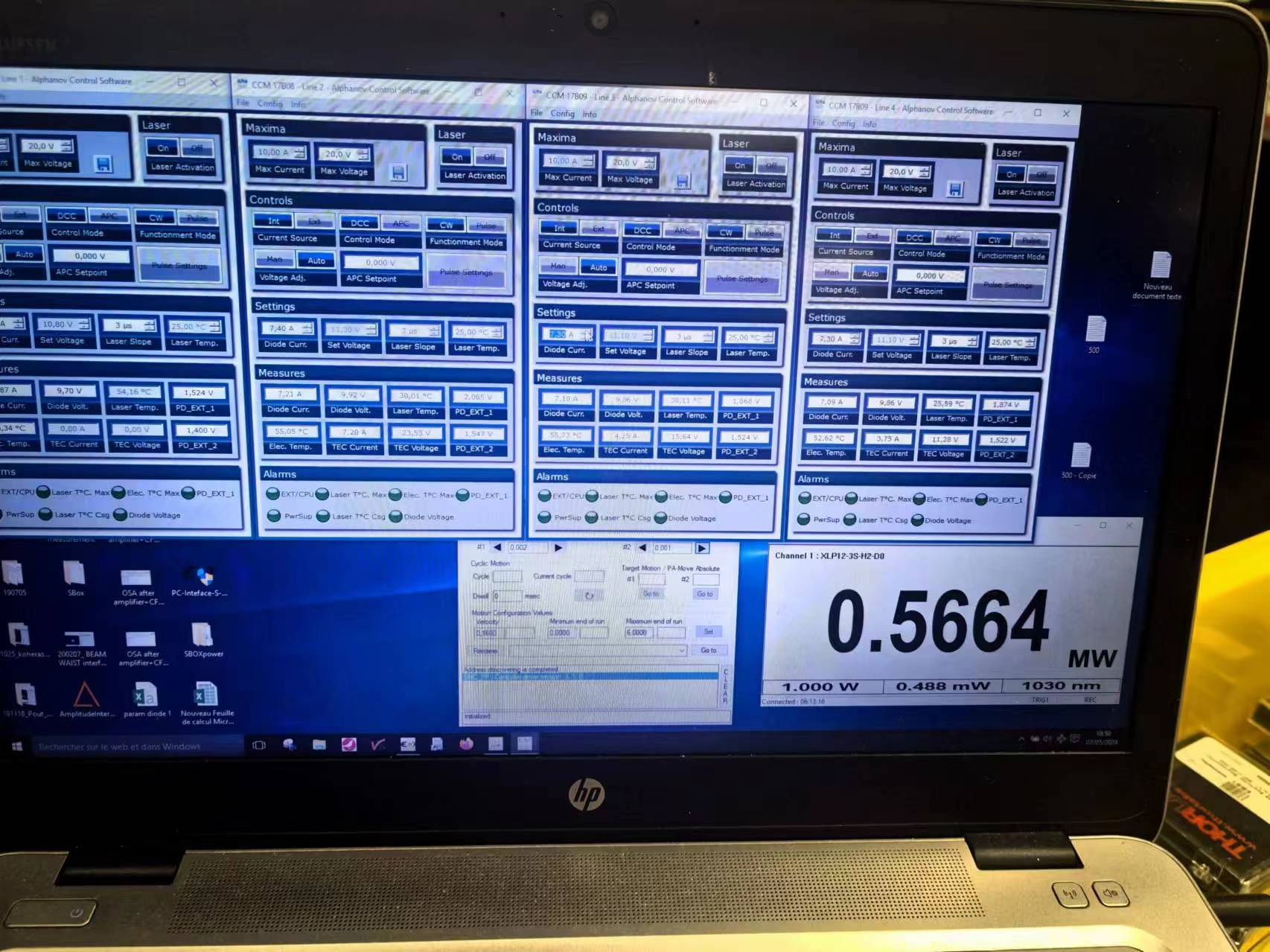
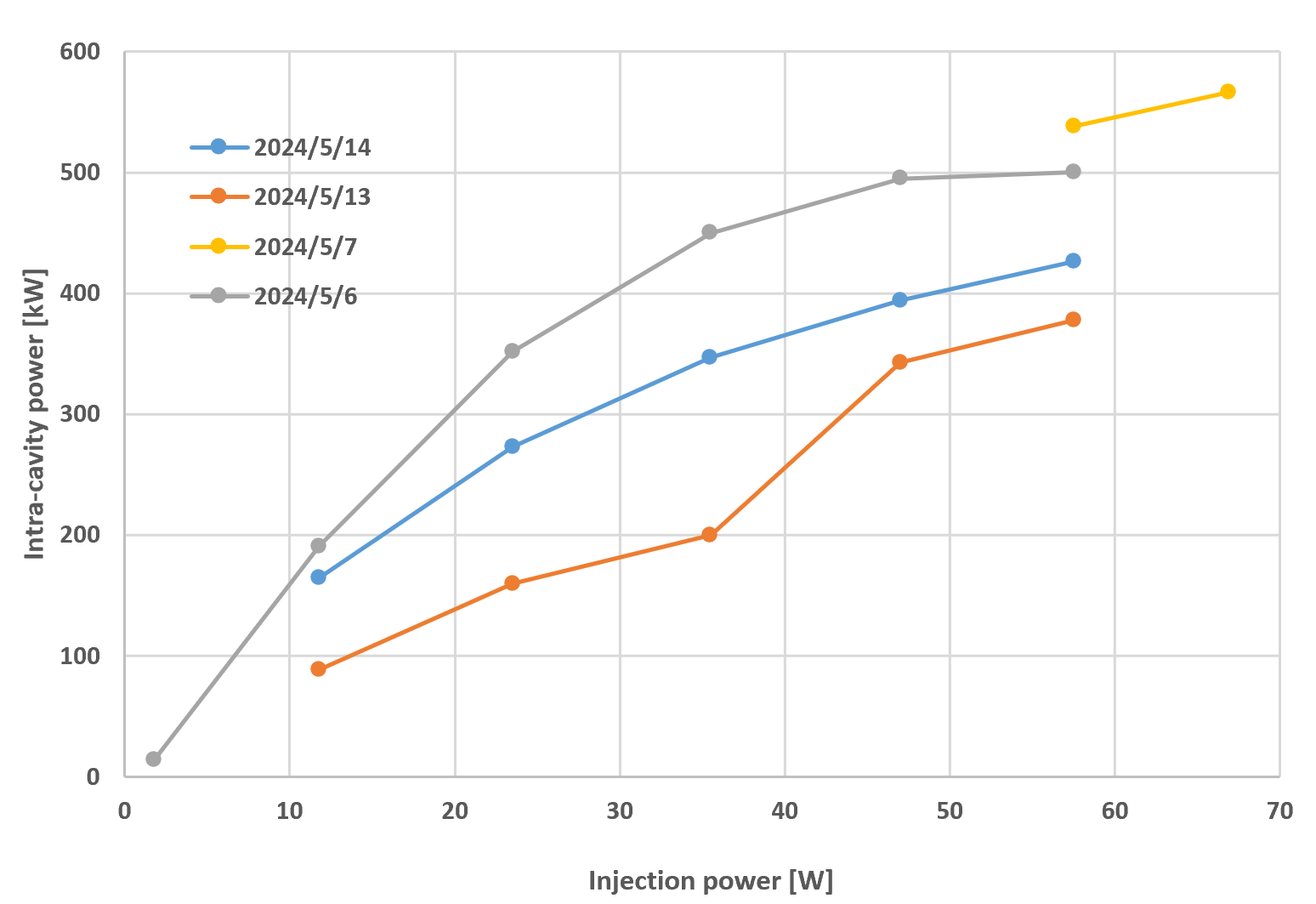
Tue May 7: We moved the D-shaped mirror position at high power, and the intracavity power reached a maximum of 566 kW at 7 A (as Fig 1). The telescopes are the same as on May 6.
Mon May 13: We moved the two lenses closer to the cavity by 12 cm with the two lenses 20 cm apart. At 5A and 6A, we tried several times to move the concave lens slightly to get higher power. CEP and alignment were optimized after each movement. The best power is shown in Fig. 2 and the table.
Tue May 14: We moved the two lenses far from the cavity ((in the middle of May 13 and before). We tried several times to move the concave lens slightly to get higher power. CEP and alignment were optimized after each movement. The best power is shown in Fig. 2 and the table.
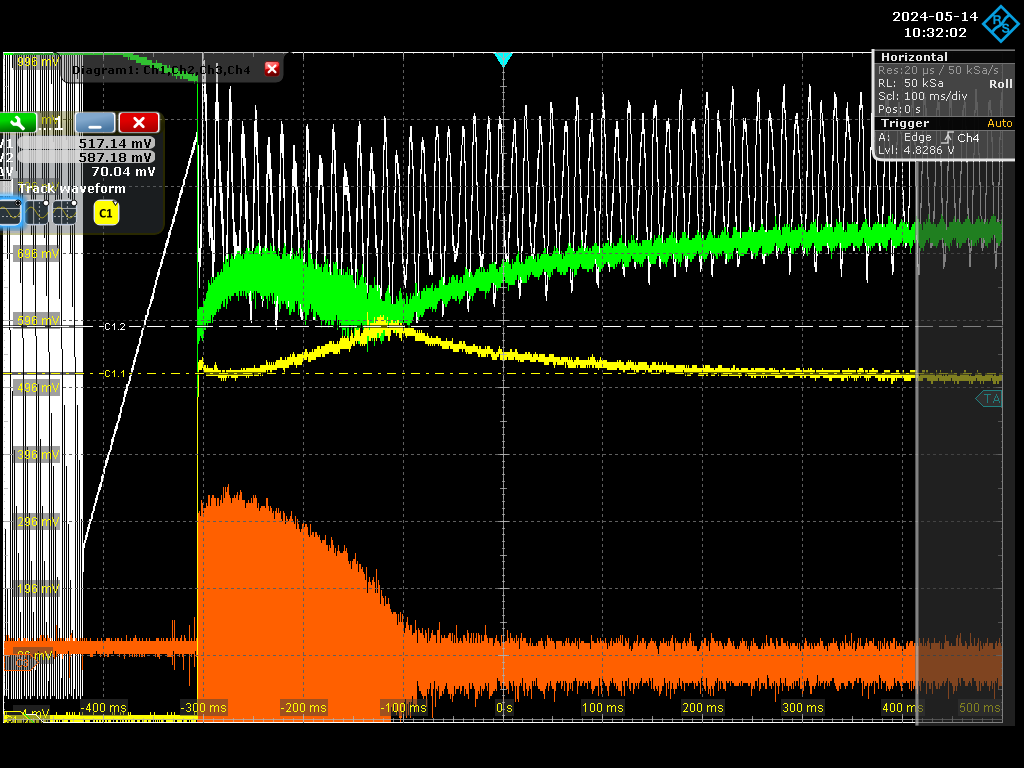
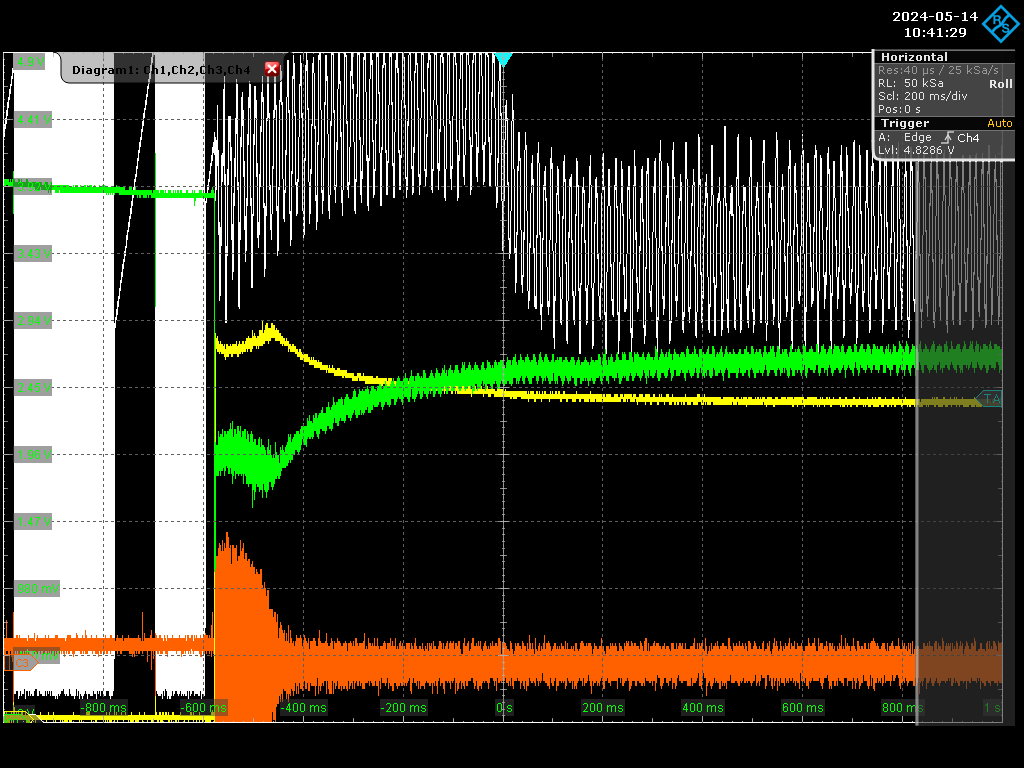
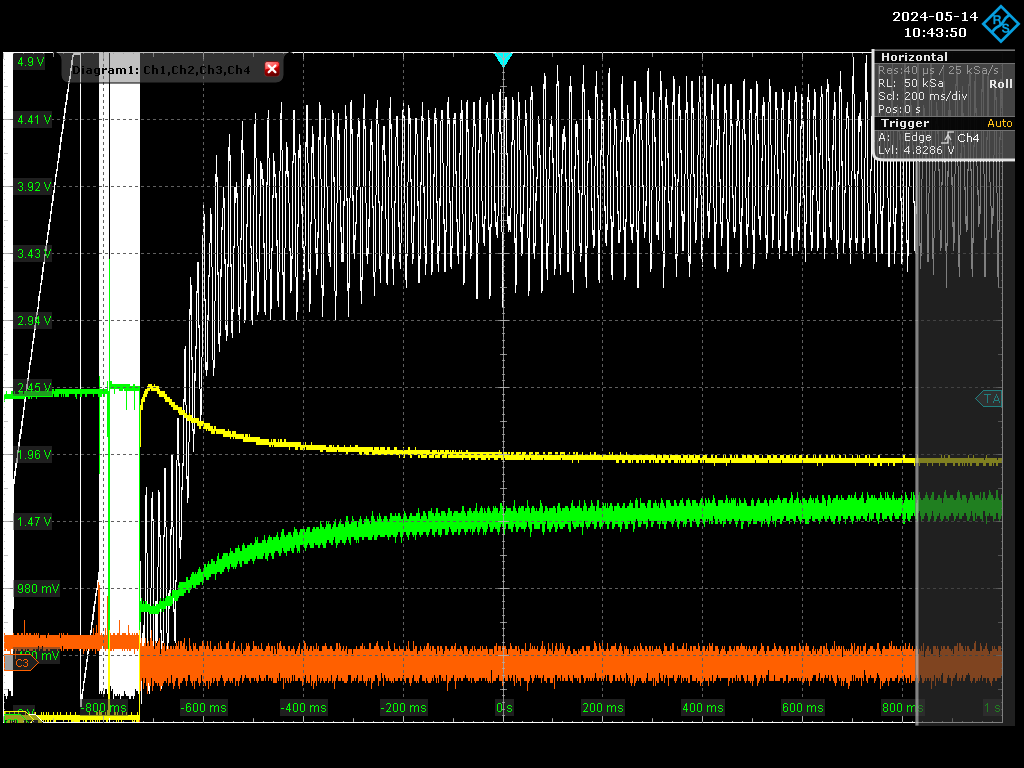
We find a small peak in the transmission at high power when the cavity is just locked (as shown in Figure 4-6 at different powers).
| Xinyi Lu wrote: |
|
here is a Matlab code to try to optimize the telescope for a hot cavity,
taking into account the thermal lens in the coupling mirror.
from that code, one can deduce using the "Gaussian Beam" software (using the attached xml file) an optimized telescope with 100% geometrical coupling @ Pcav = 700kW and absorption in the coatings = 0.6ppm
| Xinyi Lu wrote: |
|
Today, Ronic, Daniele and I redo the high-power 2-mirror cavity experiments, and the results are shown in the table (Figure 1 and Excel 2 ).
- The intracavity power ~500kW can be obtained at 47W injection, but we then have no increase or even a decrease in intracavity power when increasing the injection power, and the coupling is decreasing. It looks like the saturation power of the current device.
- We moved the telescope last week at 2A by moving the concave lens 0.5cm closer to the cavity but almost no change in intracavity power (195kW to 193kW). The telescopes for today's experiment are in the new locations from last week, and we didn't move them today.
- Figure 3 shows the locking curve at 500kW with some thermal effect changes.
- Figure 4 shows the de-lock and to-lock curves at 14kW.
- The current results may be due to two causes, the thermal lensing effect and the physical change in the mirror coating. It is possible that the transmission of the two mirrors changes with temperature.
- The next plan is to adjust the telescope at 4A to see if we can increase the intracavity power. Meanwhile, do some simulations about dynamic locking, coupling rate, and transmittance.
| Xinyi Lu wrote: |
|
Today, Ronic and I recorded some intracavity power and cavity mode size as shown in Fig. 1.
Coupling was calculated using the locking curve of this overcoupled cavity. Pr/Pi = 1-Cgeo*Cimp, Cimp = 1-|1-2T1/RTL|^2
We can see that the effective gain, coupling, and mode size decrease with increasing power. And the beam is constantly moving.
Tomorrow we will try to optimize the telescope for the high-power hot cavity.
|
|
|
|
| Attachment 1: 7A_566kW.jpg
|
 |
| Attachment 2: high_power_experiments.png
|
 |
| Attachment 3: record_20240506-0514.xlsx
|
| Attachment 4: Screenshot_2024-05-14_1_103202-400kW-6A.png
|
 |
| Attachment 5: Screenshot_2024-05-14_5_104129-377kw-4.75A.png
|
 |
| Attachment 6: Screenshot_2024-05-14_6_104350-300kW-3.5A.png
|
 |
|
32
|
Tue Dec 10 09:36:56 2019 |
Ronic Chiche | Fixed | info | lasers and optics | Optical room | FSR and Finesse measurement |
Yesterday the cavity has been aligned and locked with the CW Koheras laser.
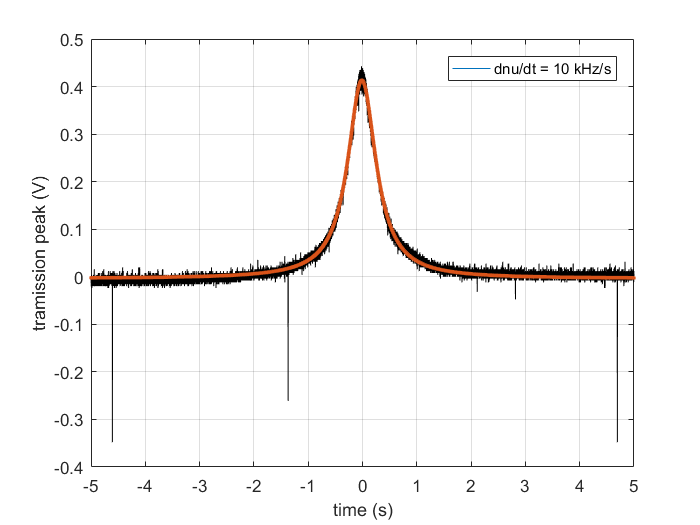
the FSR has been measured by modulation technique at 133.344MHz at 1mbar pressure in the cavity.
the polarization has to be optimized for the Finesse measurement otherwise, some "shoulders" appear beside the Airy peak and reduce Finesse fit.
once it is done, 3 consecutive measurements give an average Finesse of 20800. |
| Attachment 1: untitled.png
|
 |
|
33
|
Wed Dec 11 17:13:02 2019 |
Ronic Chiche | Fixed | issue | lasers and optics | Optical room | 2nd stage amplifier issue |
the 2nd stage amplifier needed several hours (4-5h) to reach its nominal power (we look at photodiode level on a scope), instead of the awaited 30 minutes.
could it come from the probable spectrum shifting of the OneFive laser ?
(the power coming from the CVBG, coupled to the fiber, is lower than expected). |
|
34
|
Thu Dec 12 11:49:05 2019 |
Ronic Chiche | Fixed | issue | lasers and optics | Optical room | 2nd stage amplifier issue |
Last time, we switched ON directly the 2nd stage at 6A without increasing/decrinsing slowly the current.
today, we switched ON the chiller, switched ON the 1st stage, switch ON the power supply of the 2nd stage at 0A and then we increased slowly the current until 6A... and the problem disappeared.
| ARonic Chiche wrote: |
|
the 2nd stage amplifier needed several hours (4-5h) to reach its nominal power (we look at photodiode level on a scope), instead of the awaited 30 minutes.
could it come from the probable spectrum shifting of the OneFive laser ?
(the power coming from the CVBG, coupled to the fiber, is lower than expected).
|
|
|
35
|
Fri Dec 13 15:56:22 2019 |
Ronic Chiche | Fixed | issue | lasers and optics | Optical room | 2nd stage amplifier issue |
2nd stage output power was going down. We checked the pump diode technical data sheet and the operating temperature is [25°C:35°C].
We increased the chiller temperature setpoint from 19°C to 23°C.
Then the output power increased (93mW on 2nd stage photodiode).
| Ronic Chiche wrote: |
|
Last time, we switched ON directly the 2nd stage at 6A without increasing/decrinsing slowly the current.
today, we switched ON the chiller, switched ON the 1st stage, switch ON the power supply of the 2nd stage at 0A and then we increased slowly the current until 6A... and the problem disappeared.
| ARonic Chiche wrote: |
|
the 2nd stage amplifier needed several hours (4-5h) to reach its nominal power (we look at photodiode level on a scope), instead of the awaited 30 minutes.
could it come from the probable spectrum shifting of the OneFive laser ?
(the power coming from the CVBG, coupled to the fiber, is lower than expected).
|
|
|
|
36
|
Fri Dec 13 18:28:00 2019 |
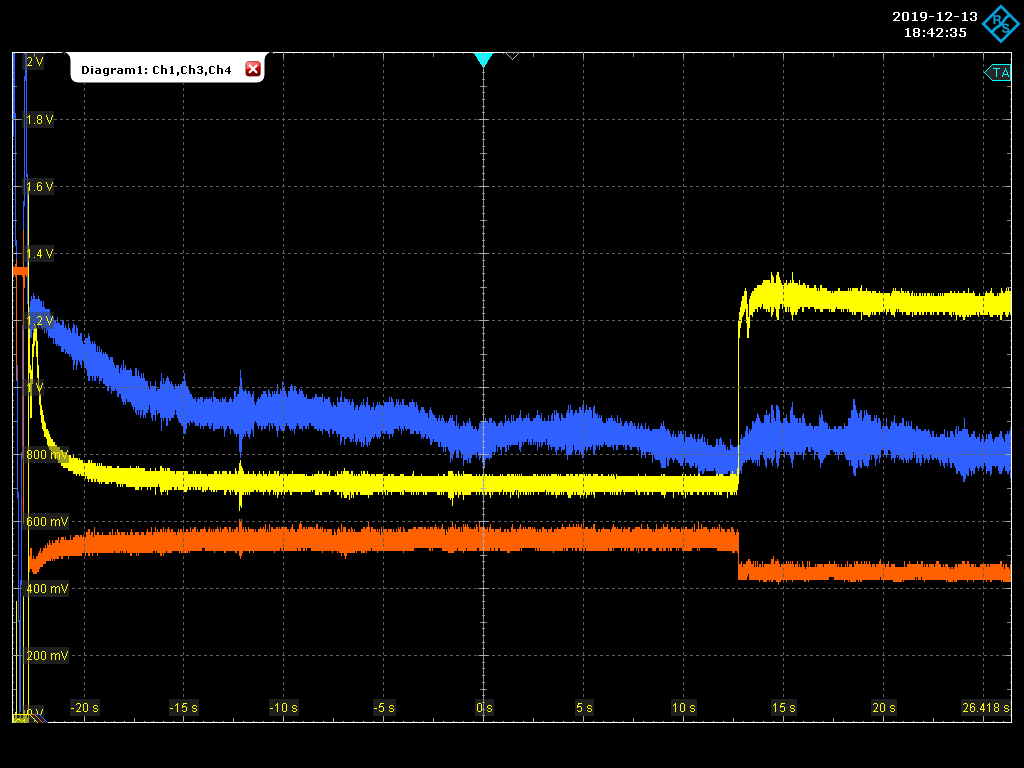
Ronic Chiche | Fixed | report | lasers and optics | Optical room | first data with 3A on the 3rd stage |
Today, at 3A on the 3rd stage, we saw some HOM effects.
the transmissions is about 100mW which corresponds to 30kW inside cavity.
we tried to play with D shape motors but without success.
on the plot below, a mix between Thermal effects andHOM effects (the trans step at 13s is done without any external action)
-yellow : transmission
- orange : coupling
- blue : PZT correction
the camera video does not correspond exactly to the scope plot.
it is just an example of HOM effect. |
| Attachment 1: Screenshot_2019-12-13_3_184235.png
|
 |
| Attachment 2: HOM.gif
|
 |
|
37
|
Tue Dec 17 10:46:24 2019 |
Ronic Chiche | Fixed | info | lasers and optics | Optical room | Beam size behind M2 |
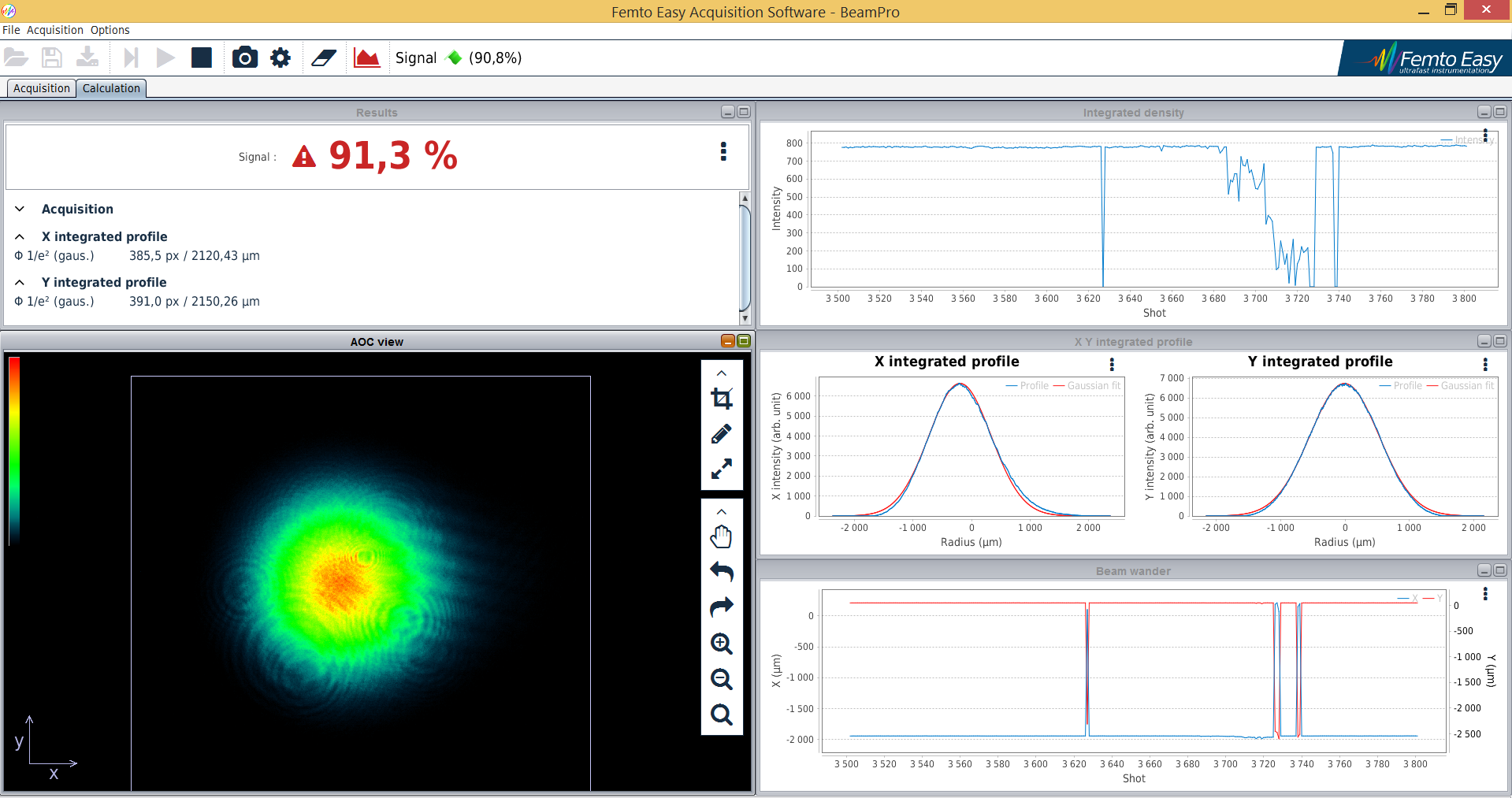
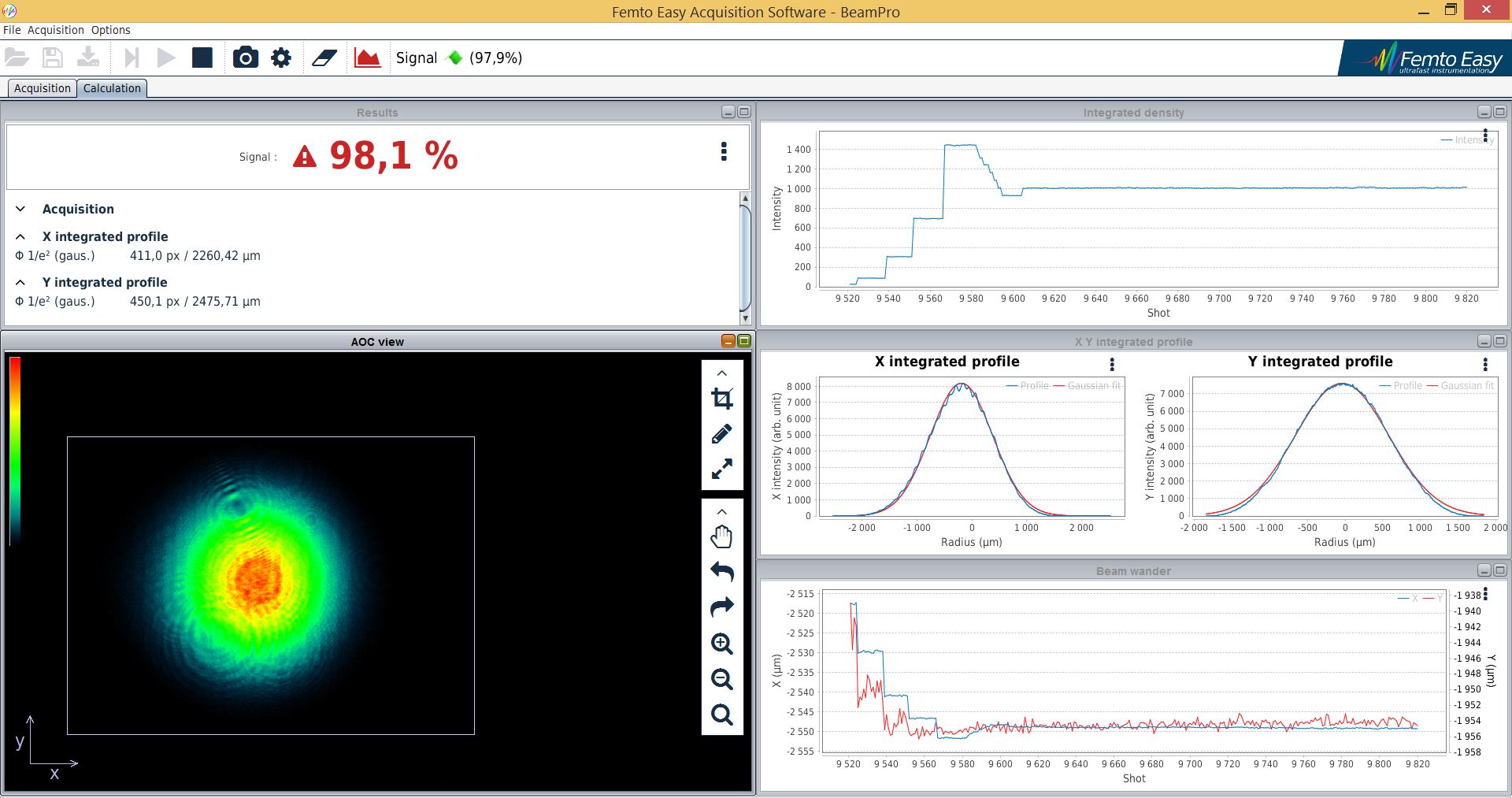
Beam diameter behind M2 :
- 2nd stage @ 6A - 1kW inside cavity
sx = 2120 µm
sy = 2150 µm
- 3rd stage @ 3A - 30kW inside cavity
sx = 2260 µm
sy = 2475 µm |
| Attachment 1: beam_diameter_behind_M2_-_1kW.png
|
 |
| Attachment 2: beam_diameter_behind_M2_-_30kW.png
|
 |
|
38
|
Tue Dec 17 10:56:08 2019 |
Ronic Chiche | Fixed | report | lasers and optics | Optical room | first data with 3A on the 3rd stage |
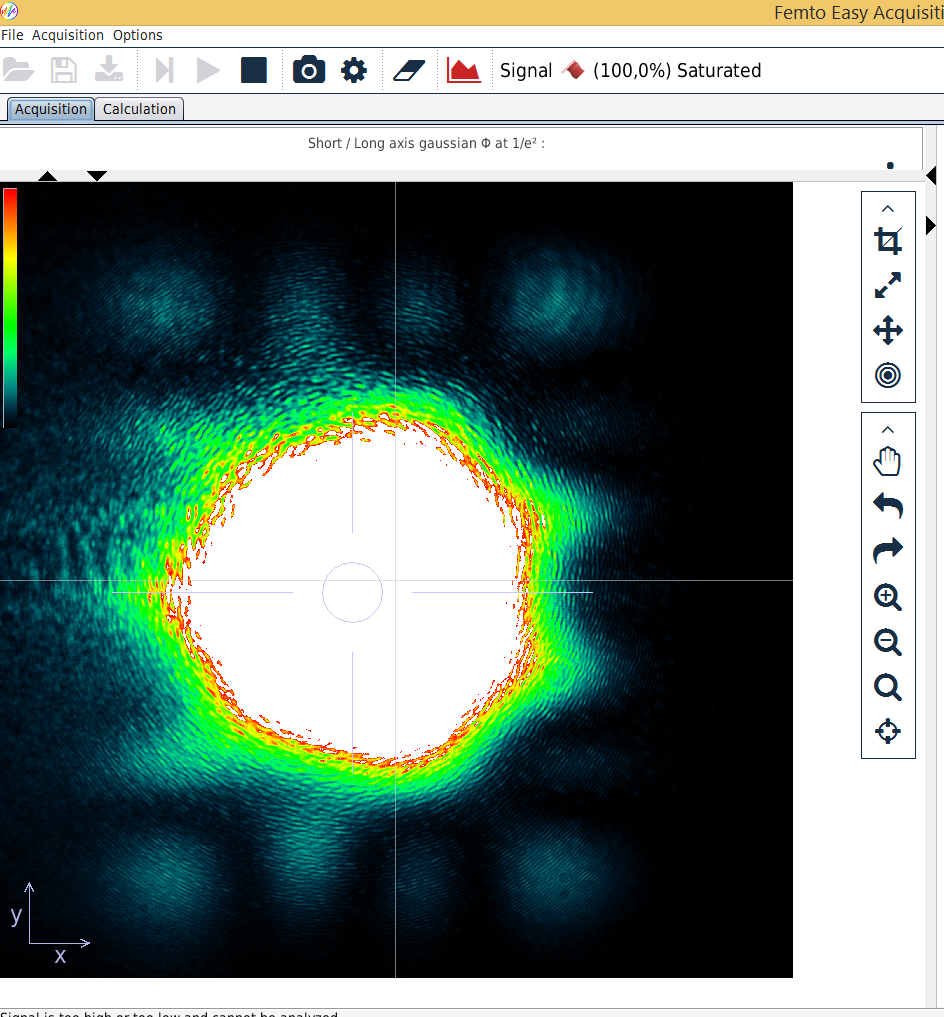
2 pictures :
typical beam with HOM
typical beam after moving the D-shape motor : no more HOM
| Ronic Chiche wrote: |
|
Today, at 3A on the 3rd stage, we saw some HOM effects.
the transmissions is about 100mW which corresponds to 30kW inside cavity.
we tried to play with D shape motors but without success.
on the plot below, a mix between Thermal effects andHOM effects (the trans step at 13s is done without any external action)
-yellow : transmission
- orange : coupling
- blue : PZT correction
the camera video does not correspond exactly to the scope plot.
it is just an example of HOM effect.
|
|
| Attachment 1: HOM_5-3_saturated.png
|
 |
| Attachment 2: fundamental_mode_saturated.png
|
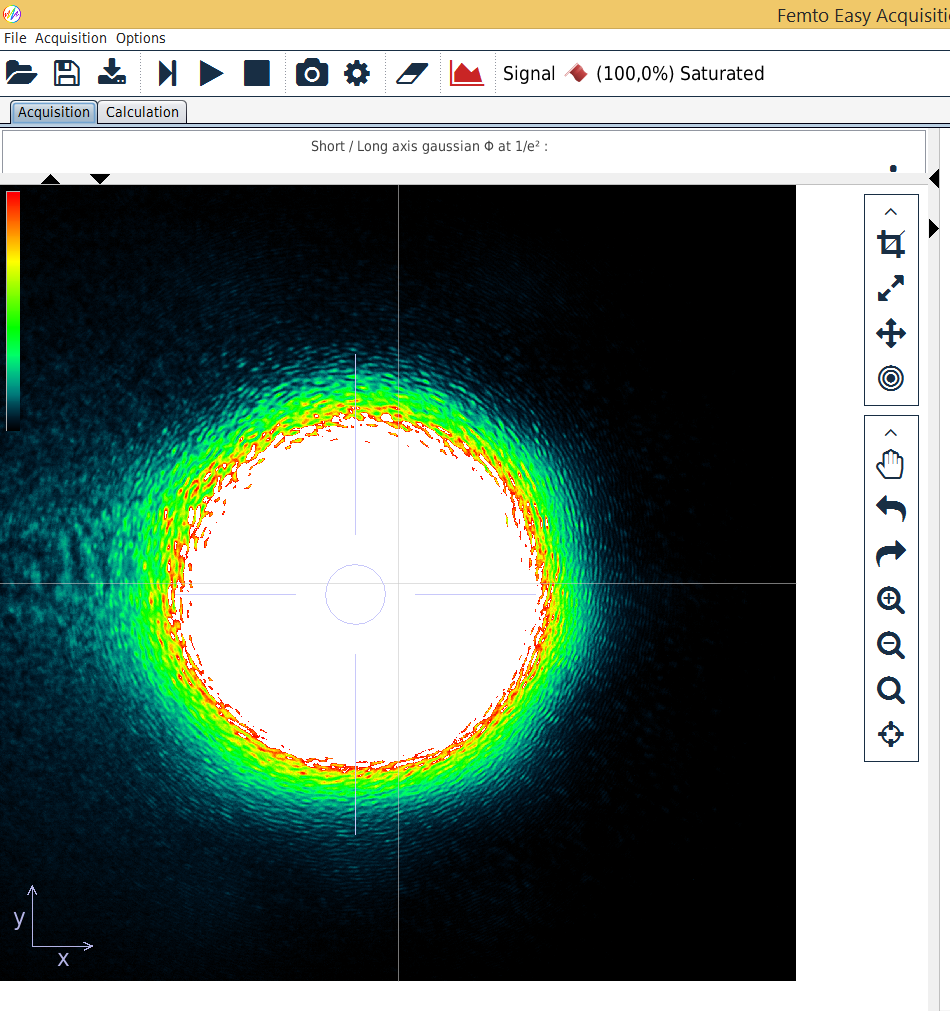 |
|
39
|
Tue Dec 17 12:16:54 2019 |
Ronic Chiche | Fixed | info | lasers and optics | Optical room | Optical amplifier polarization state |
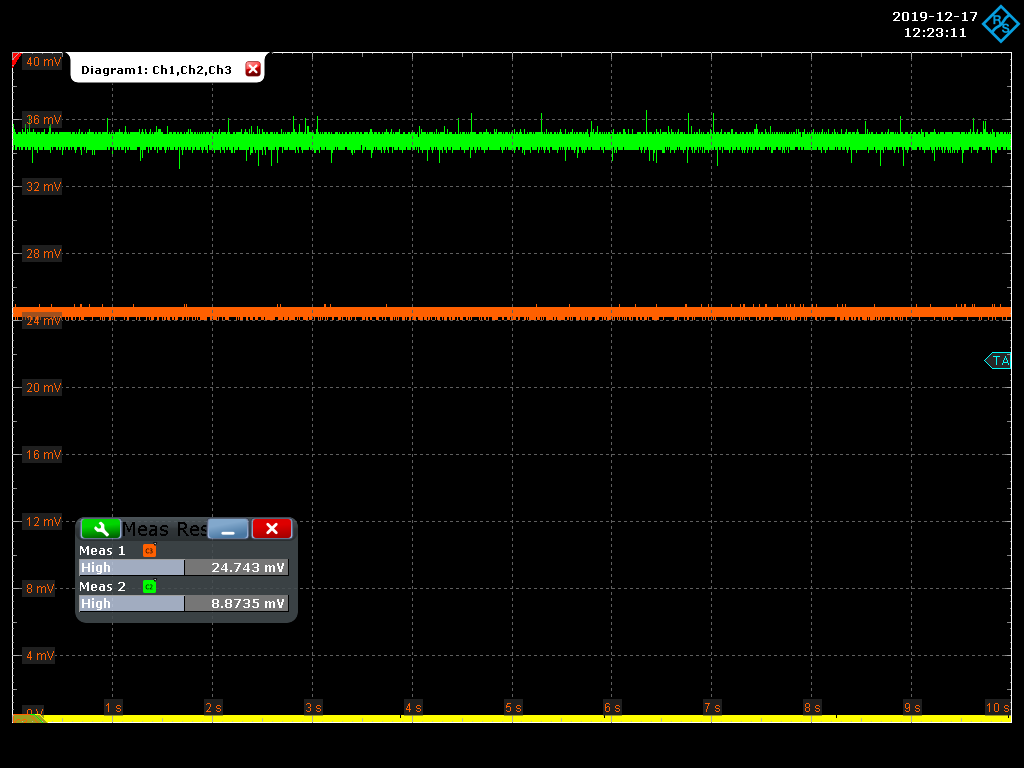
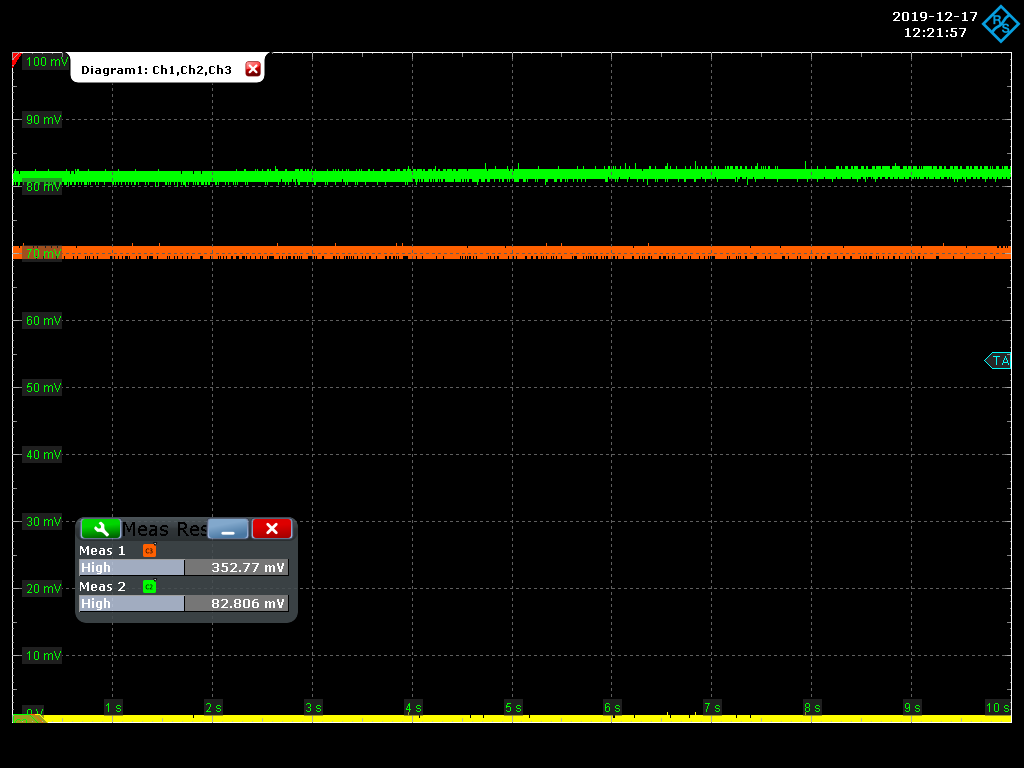
We placed a PBS + 2 photodiodes (PhD1, PhD2) at the output of the amplifier to check how the polarization of the amplifier changes with power.
example with 2nd stage @ 6A :
PhD1 = 24.7 mV
PhD2 = 8.9 mV
PhD1/PhD2 = 2.78
and with 3rd stage @ 2A :
PhD1 = 353 mV
PhD2 = 82.8 mV
PhD1/PhD2 = 4.26
Conclusion : we must adapt the quarter and half waveplates for each input power to be always matched with cavity polarization !!!
One could also study how the amplifier polarization changes during time and temperature. |
| Attachment 1: Screenshot_2019-12-17_8_122311.png
|
 |
| Attachment 2: Screenshot_2019-12-17_7_122157.png
|
 |
|
40
|
Tue Dec 17 17:54:38 2019 |
Ronic Chiche | Fixed | info | lasers and optics | Optical room | Optical amplifier polarization state |
The polarimeter was giving a strange 50% of DOP of the light coming from the cavity.
we had to calibrate (LONG calibration process with care) the polarimeter to get a proper 100% of DOP !
the polarimeter needs also a good alignment with 2 mirrors, a colimated beam and a max power on photodiode between 0.7 and 0.8 (use electronic gain to adapt the level)
at low power (1.5kW inside cavity), the cavity is almost vertically polarized (89°).
| Ronic Chiche wrote: |
|
We placed a PBS + 2 photodiodes (PhD1, PhD2) at the output of the amplifier to check how the polarization of the amplifier changes with power.
example with 2nd stage @ 6A :
PhD1 = 24.7 mV
PhD2 = 8.9 mV
PhD1/PhD2 = 2.78
and with 3rd stage @ 2A :
PhD1 = 353 mV
PhD2 = 82.8 mV
PhD1/PhD2 = 4.26
Conclusion : we must adapt the quarter and half waveplates for each input power to be always matched with cavity polarization !!!
One could also study how the amplifier polarization changes during time and temperature.
|
|
| Attachment 1: cavity_polar_2e_etage_1kW.PNG
|
 |
|
41
|
Tue Dec 17 17:58:12 2019 |
Ronic Chiche | Fixed | info | lasers and optics | Optical room | Beam size behind M2 |
the telescope matchs the cold cavity beam, so it is normal to have a power decrease on the transmission photodiode when the cavity is heating at high power.
we can try to adjust the telescope by moving lens, one by one, to increase the cavity power.
| Ronic Chiche wrote: |
|
Beam diameter behind M2 :
- 2nd stage @ 6A - 1kW inside cavity
sx = 2120 µm
sy = 2150 µm
- 3rd stage @ 3A - 30kW inside cavity
sx = 2260 µm
sy = 2475 µm
|
|
|
42
|
Thu Dec 19 09:21:45 2019 |
Ronic Chiche | Fixed | info | lasers and optics | Optical room | Optical amplifier polarization state |
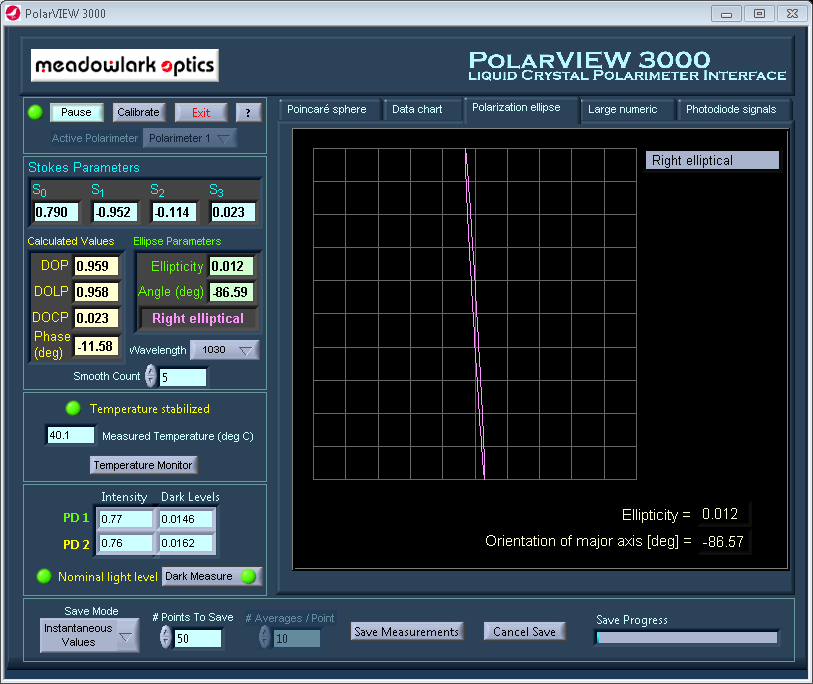
polarization state of the cavity at higher power : 20kW, 30kW and 33kW (slight CEP and alignment optimization) :
the polarization state changes only a little to ~ 87° and is almost linear.
| Ronic Chiche wrote: |
|
The polarimeter was giving a strange 50% of DOP of the light coming from the cavity.
we had to calibrate (LONG calibration process with care) the polarimeter to get a proper 100% of DOP !
the polarimeter needs also a good alignment with 2 mirrors, a colimated beam and a max power on photodiode between 0.7 and 0.8 (use electronic gain to adapt the level)
at low power (1.5kW inside cavity), the cavity is almost vertically polarized (89°).
| Ronic Chiche wrote: |
|
We placed a PBS + 2 photodiodes (PhD1, PhD2) at the output of the amplifier to check how the polarization of the amplifier changes with power.
example with 2nd stage @ 6A :
PhD1 = 24.7 mV
PhD2 = 8.9 mV
PhD1/PhD2 = 2.78
and with 3rd stage @ 2A :
PhD1 = 353 mV
PhD2 = 82.8 mV
PhD1/PhD2 = 4.26
Conclusion : we must adapt the quarter and half waveplates for each input power to be always matched with cavity polarization !!!
One could also study how the amplifier polarization changes during time and temperature.
|
|
|
| Attachment 1: cavity_polar_3e_etage_2A_-_20kW.PNG
|
 |
| Attachment 2: cavity_polar_3e_etage_3A_-_30kW.PNG
|
 |
| Attachment 3: cavity_polar_3e_etage_3A_-_33kW.PNG
|
 |
|
44
|
Thu Dec 19 16:03:17 2019 |
Ronic Chiche | Fixed | info | lasers and optics | Optical room | Beam size behind M2 |
Yesterday, we tried to better adapt positions of the telescope lenses, dynamically, during the lock, to improve the matching between input beam and cavity mode.
it is a difficult task because it is quite sensitive to the alignment. we need to realign very often... and it is a long process.
at the end, we concluded that we need to move to much the lenses to be feasible, then we stopped.
then we tried also to change the cavity mode by moving the spherical mirrors inside the cavity but again, the telescope is too far from its expected parameters.
we need to make a cavity mode smaller at high power and we need to move too far the spherical mirrors, then we stopped also this trial.
the conclusion is we need to better measure the cavity mode and make a telescope better adapted to the "hot" cavity.
it is still strange to measure a tranmsission signal AND a coupling signal with a "thermal" decay at the beginning of the lock for both and we expect that they complementary and should vary in contrary direction.
very strange as we use very large PhD which should net be sensitive to misalignments.
| Ronic Chiche wrote: |
|
the telescope matchs the cold cavity beam, so it is normal to have a power decrease on the transmission photodiode when the cavity is heating at high power.
we can try to adjust the telescope by moving lens, one by one, to increase the cavity power.
| Ronic Chiche wrote: |
|
Beam diameter behind M2 :
- 2nd stage @ 6A - 1kW inside cavity
sx = 2120 µm
sy = 2150 µm
- 3rd stage @ 3A - 30kW inside cavity
sx = 2260 µm
sy = 2475 µm
|
|
|
|
45
|
Thu Dec 19 16:23:39 2019 |
Ronic Chiche | Fixed | info | lasers and optics | Optical room | Cavity beam axis moving with power |
how the cavity beam axis is moving during a lock when the cavity is hot ?
could it explain a part of the Transmission / Coupling signal decay ?
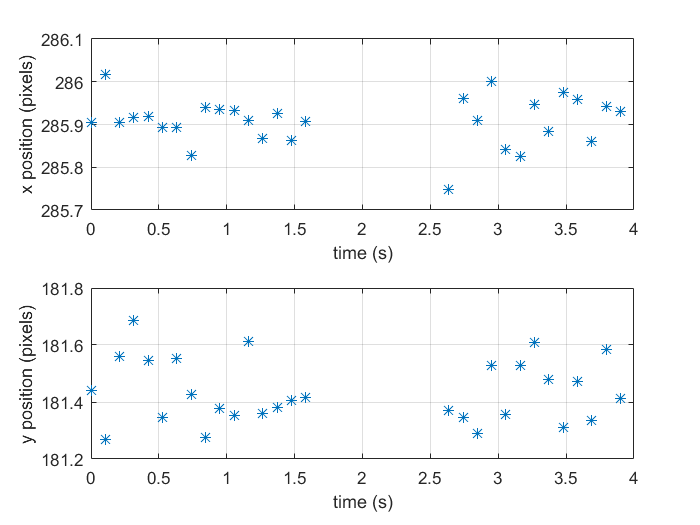
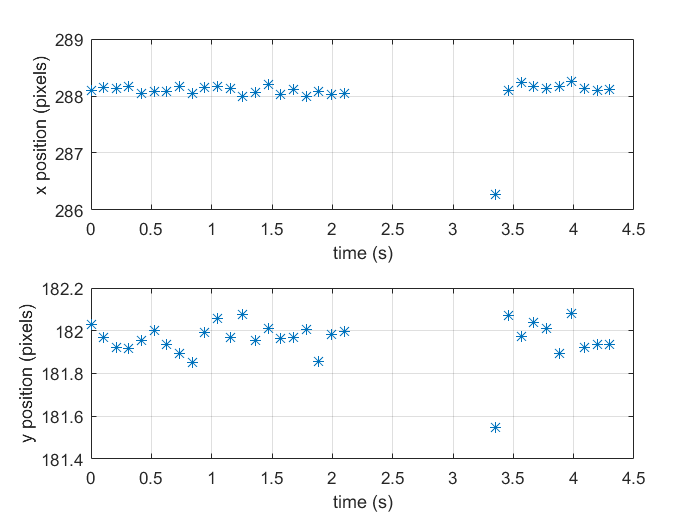
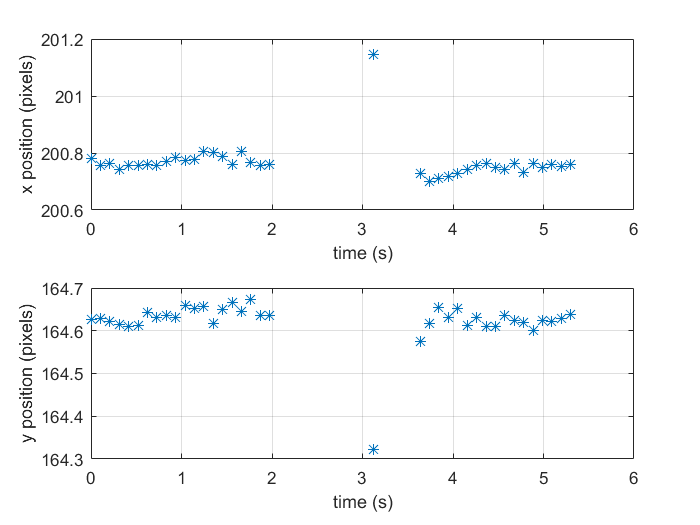
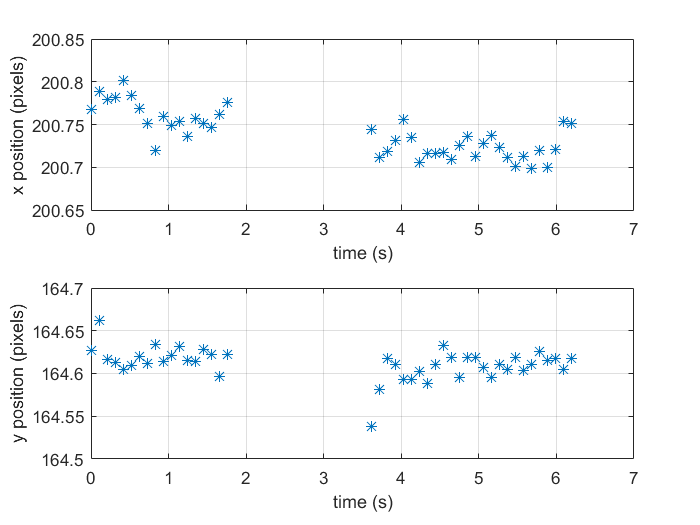
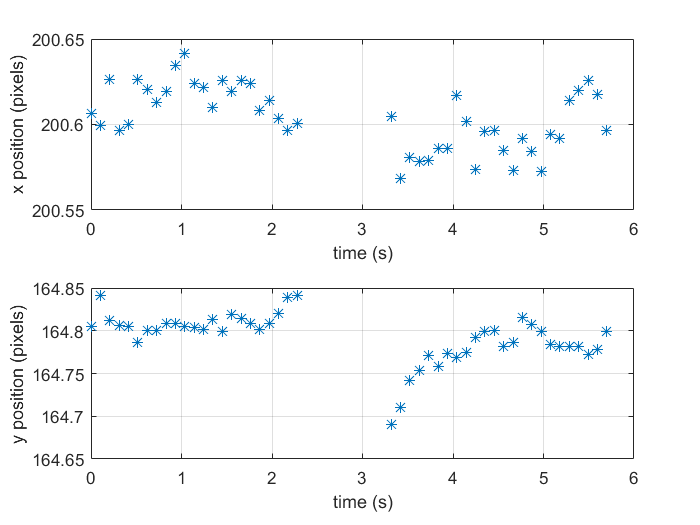
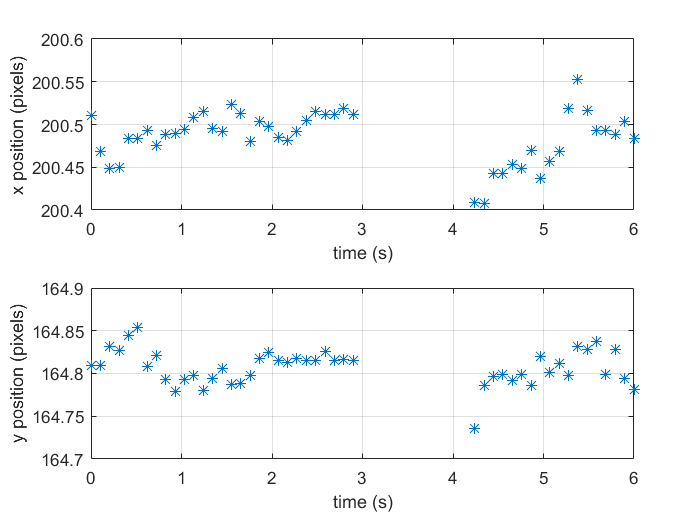
we placed 2 Basler camera, one at (30+Z) cm and the other at (85+Z) cm (Z is about 15cm) from the M3 mirror, we recorded the video during a lock and we analyzed the centroid X and Y displacement at 2A and 3A.
frames acquisition speed is a quite slow ~ 100ms => we need to acquire the frames faster !
with these data, the displacement is no more than some pixels, which means << 100µm ... it should be completely negligeable for photdiode thorlabs DET100 with ~10mm of diameter.
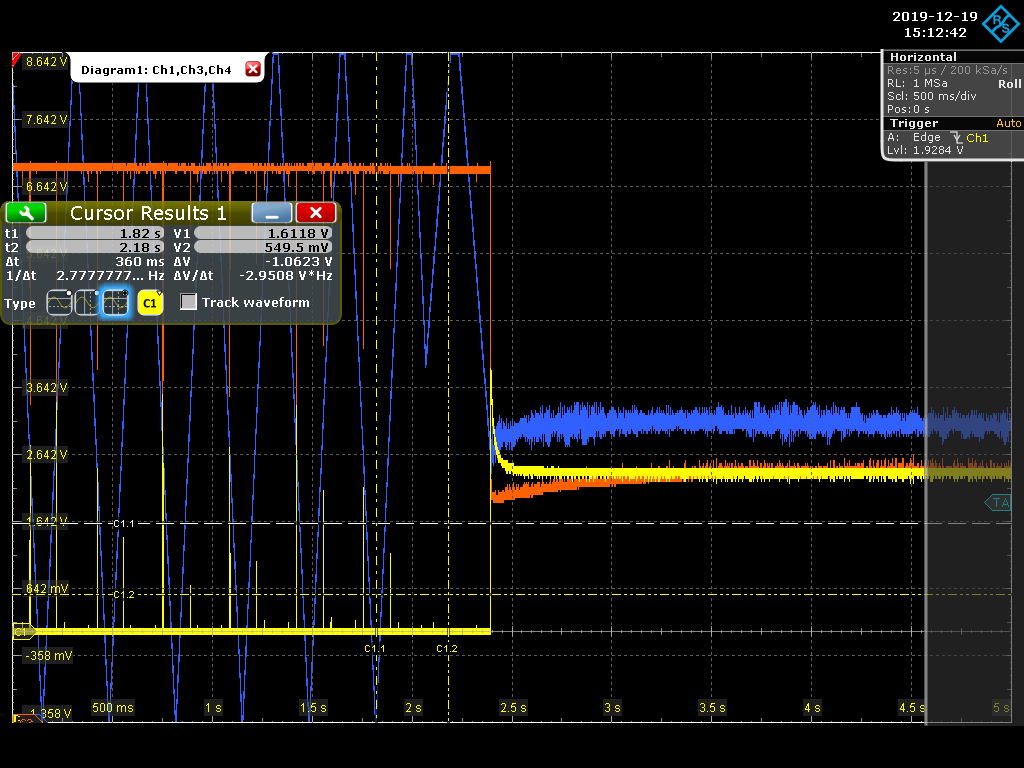
the last picture displays typical locking curves (before and after lock) :
- transmission : yellow
- coupling : orange
- PZT correction : blue |
| Attachment 1: Basler_30cm_2A_v1.png
|
 |
| Attachment 2: Basler_30cm_2A_v2.png
|
 |
| Attachment 3: Basler_30cm_3A_v1.png
|
 |
| Attachment 4: Basler_30cm_3A_v2.png
|
 |
| Attachment 5: Basler_85cm_2A_v1.png
|
 |
| Attachment 6: Basler_85cm_2A_v2.png
|
 |
| Attachment 7: Basler_85cm_3A_v1.png
|
 |
| Attachment 8: Basler_85cm_3A_v2.png
|
 |
| Attachment 9: Screenshot_2019-12-19_4_151242.png
|
 |
|
47
|
Fri Jan 10 18:51:23 2020 |
Ronic Chiche | Fixed | report | lasers and optics | Optical room | analysis of stored and reflected power |
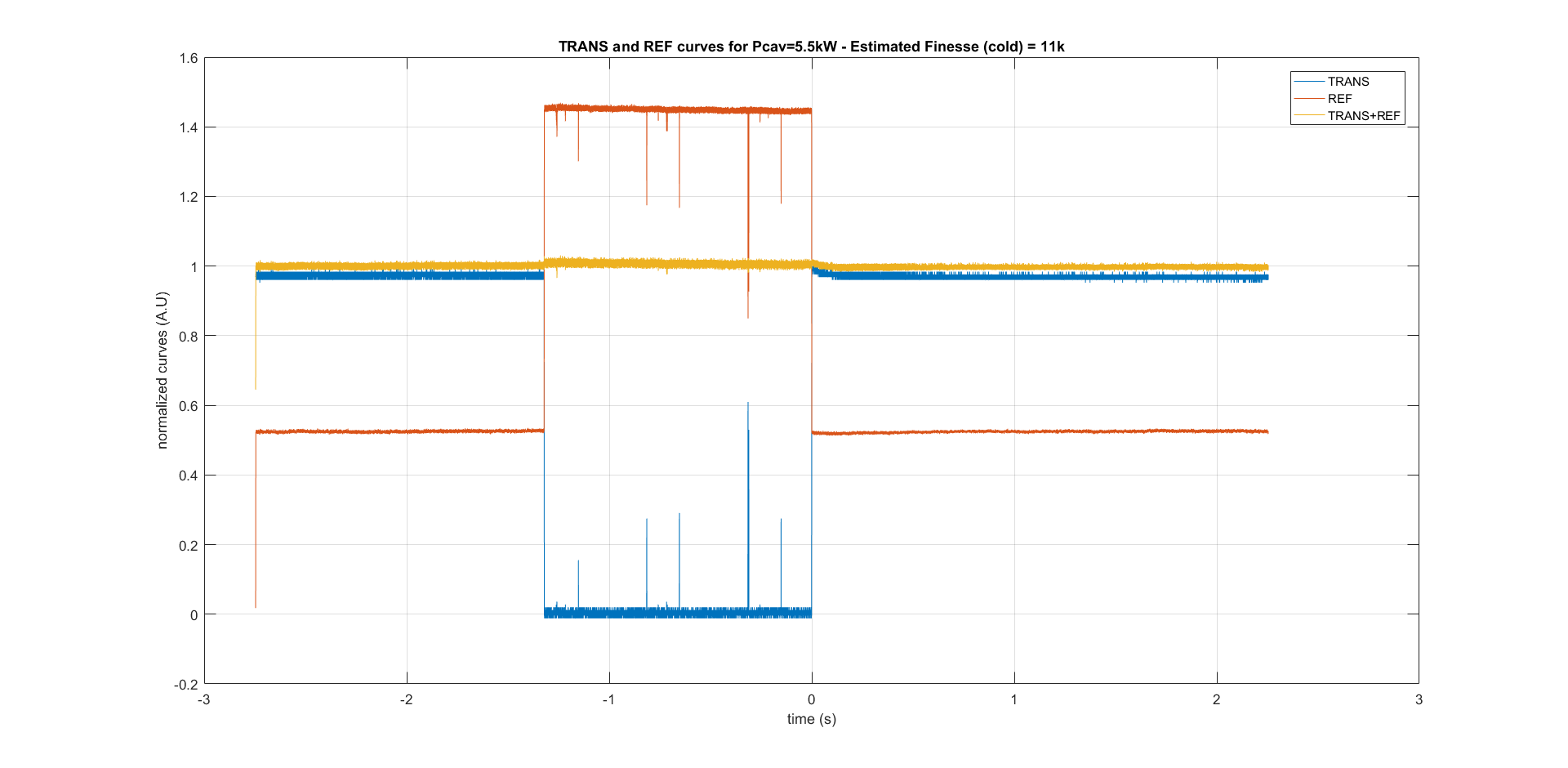
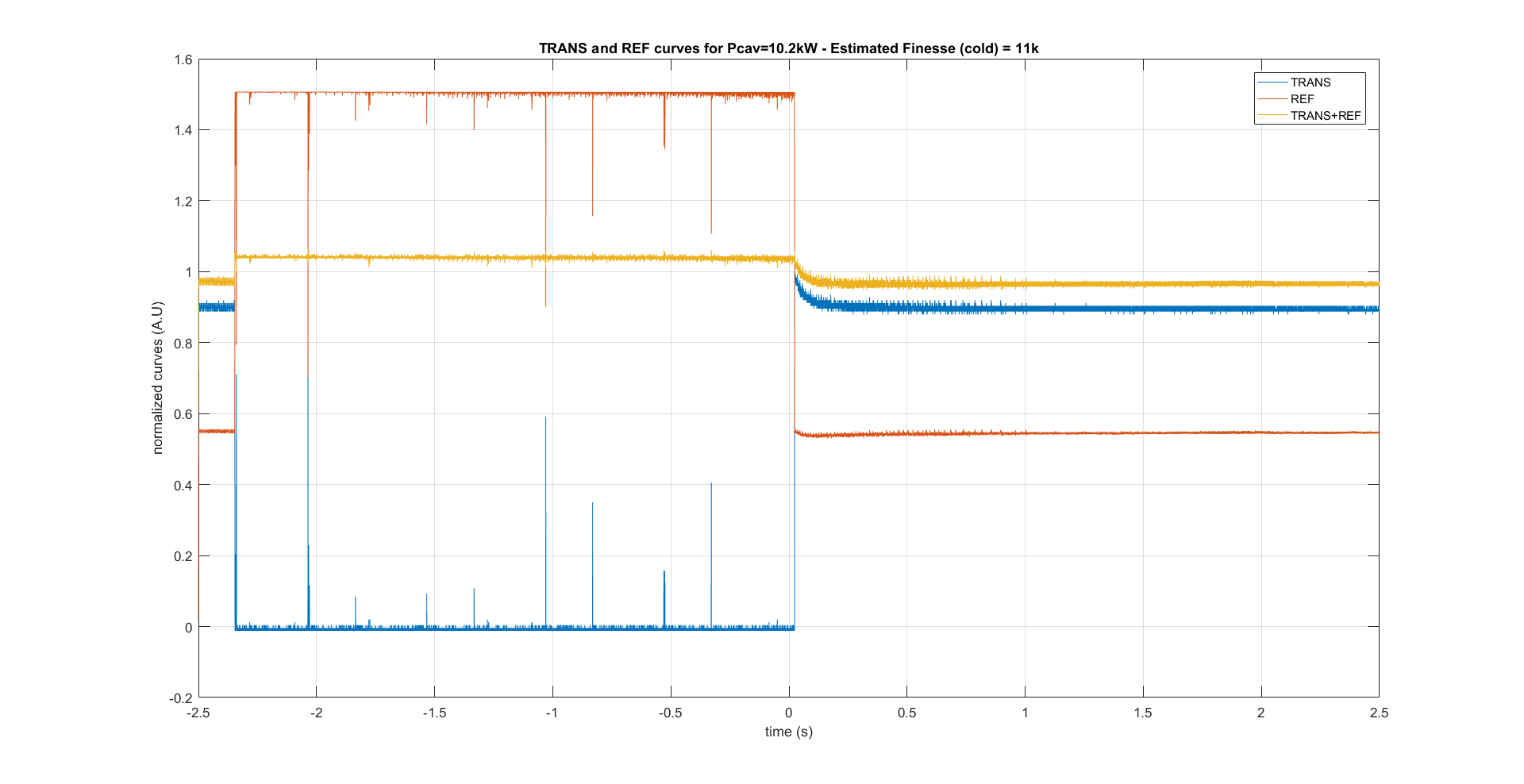
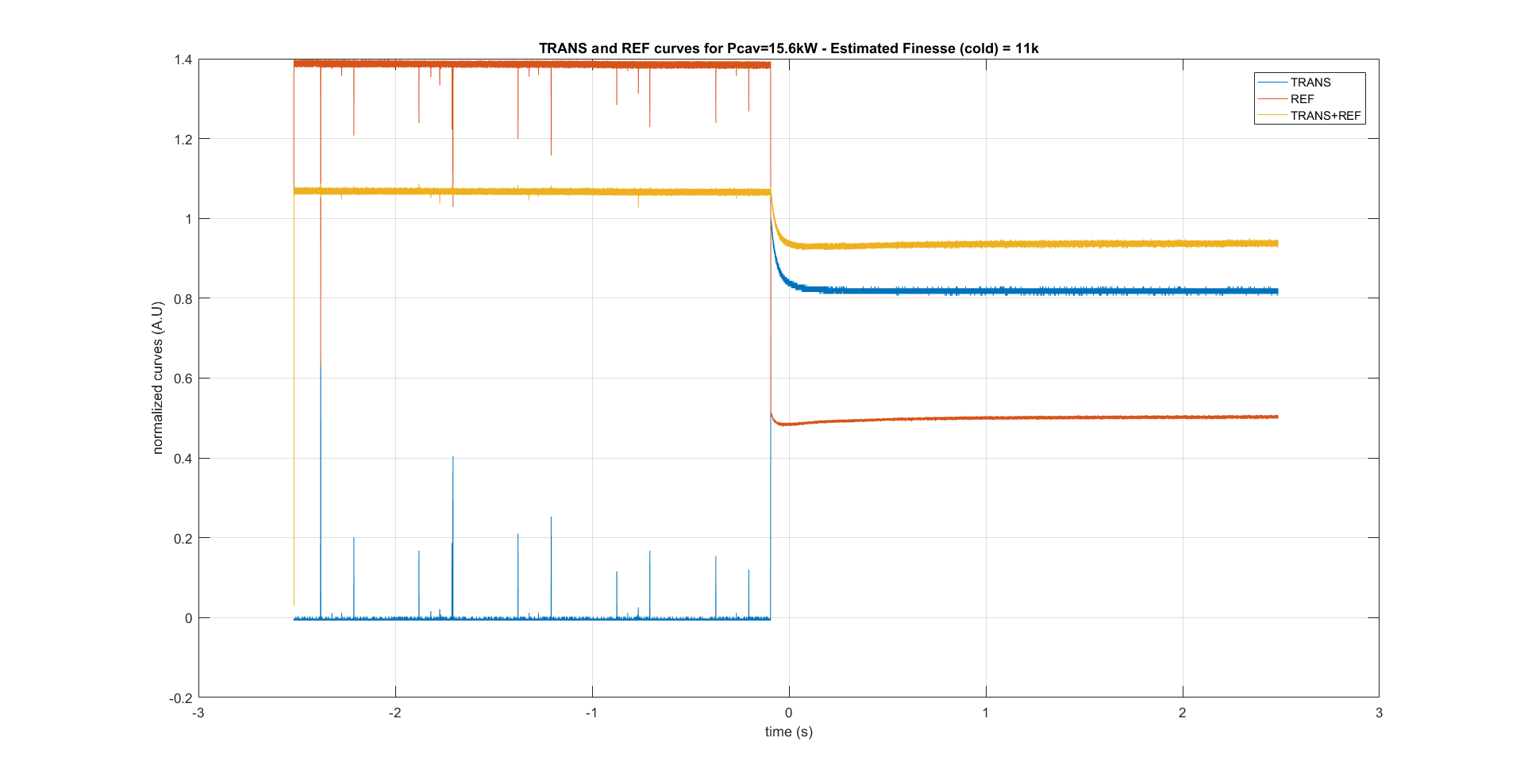
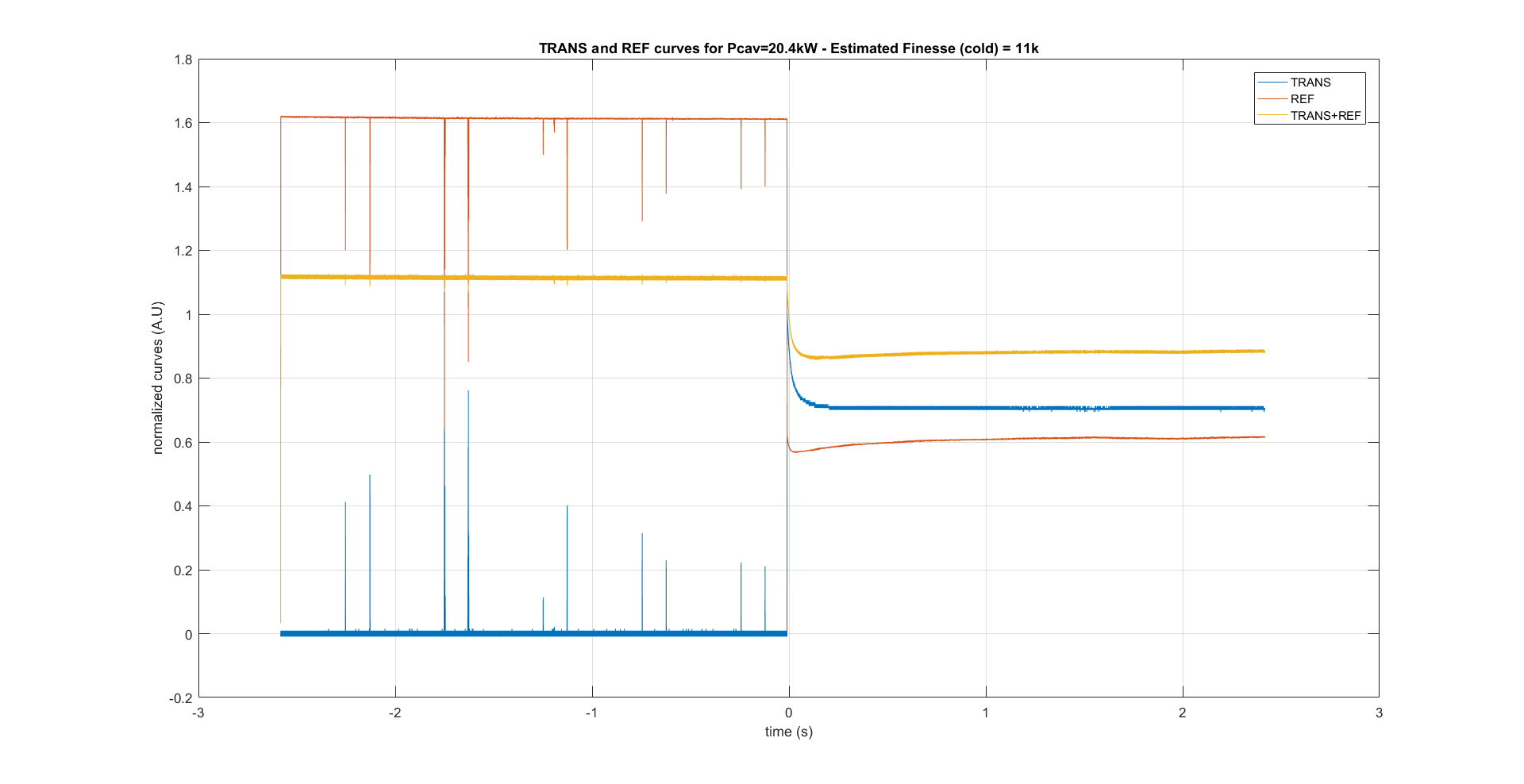
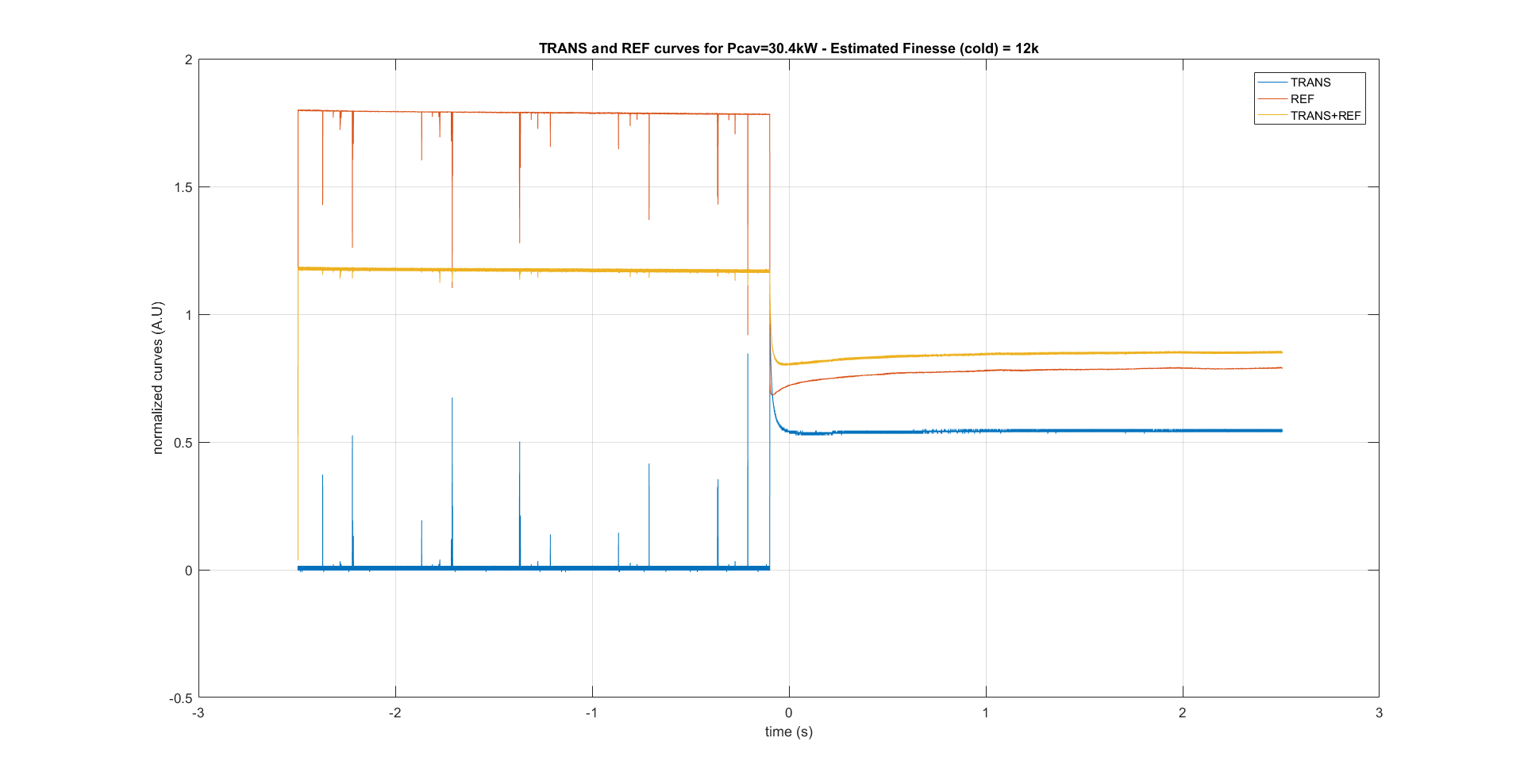
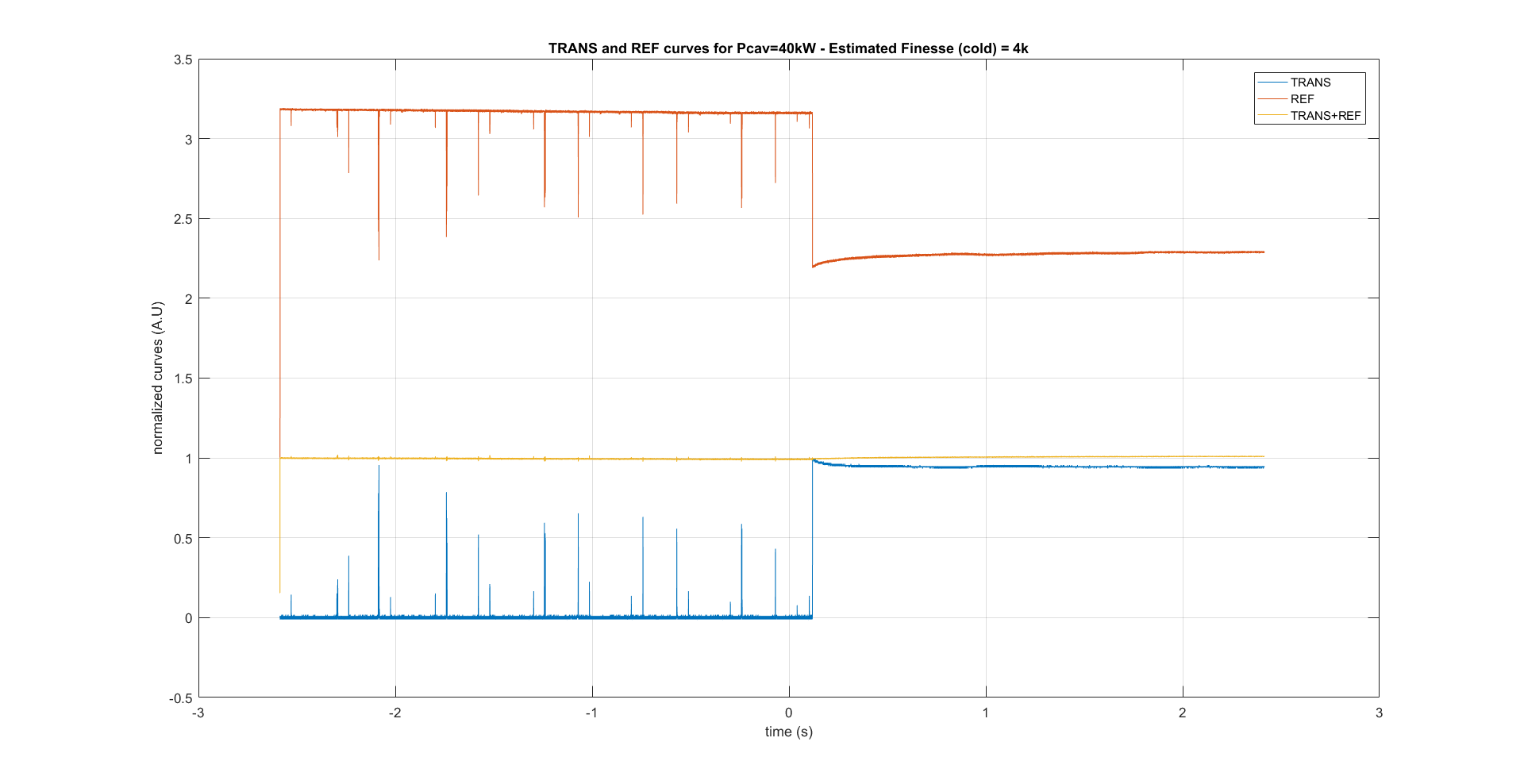
the 10th of January, we increased the power of the amplifier to study the cavity transmitted and reflected power signals.
analyzing the noise transfer functions of transmitted and reflected power one could deduce the Finesse of the cavity.
the power of this technic (if it is confirmed) does not depend on the decay time of one signal which depends on the speed of the cut off but on the difference between reflected and transmitted transfer functions,
and then is independant of the cut off speed.
here are 6 analysis of the Finesse when the cavity is cold, depending only on short lock periods.
5 of them agrees on a Finesse around 11k.
the 6th estimation at 40kW stored in the cavity is about 4k but now, we know that the M1 mirror had suddenly a hole for this power... thus the Finesse value is reasonable.
we can then, use the non conservation of TRANS+REF signal to estimate the FInesse decrease when the cavity is hot... to be done
|
| Attachment 1: TRANS_&_REF.png
|
 |
| Attachment 2: TRANS_&_REF.png
|
 |
| Attachment 3: TRANS_&_REF.png
|
 |
| Attachment 4: TRANS_&_REF.png
|
 |
| Attachment 5: TRANS_&_REF.png
|
 |
| Attachment 6: TRANS_&_REF.png
|
 |
|
48
|
Fri Jan 24 16:16:24 2020 |
Ronic Chiche | Fixed | report | lasers and optics | Optical room | analysis of stored and reflected power |
A chart which summarizes the data we have or we can estimate.
in orange, the case 1, where we suppose the initial cold Finesse is the one measured by modulation technique in December 2019 (F=20.8k).
and in green, the case 2, where we suppose the initial cold Finesse is the one measured by "zero compensation" technique between transmission and reflection signals during the power-up measurements (F~11k).
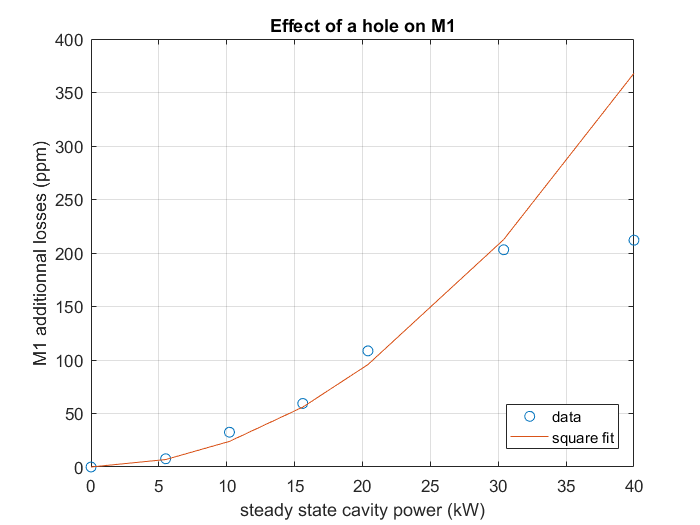
clearly, the case which matches better the only one data (written in red) of input power and then of cavity gain, is the Finesse estimated by the "zero compensation" technique. it matches also better the gain of the cavity measured after M1 had its hole and for which the estimated Finesse of 4k, and then estimated gain of 277 by "zero compensation" technique is not so far from the measurement of 185 (the gain is may be higher than 185 as it is possible we had some additional misalignment which reduced the gain).
| Ronic Chiche wrote: |
|
the 10th of January, we increased the power of the amplifier to study the cavity transmitted and reflected power signals.
analyzing the noise transfer functions of transmitted and reflected power one could deduce the Finesse of the cavity.
the power of this technic (if it is confirmed) does not depend on the decay time of one signal which depends on the speed of the cut off but on the difference between reflected and transmitted transfer functions,
and then is independant of the cut off speed.
here are 6 analysis of the Finesse when the cavity is cold, depending only on short lock periods.
5 of them agrees on a Finesse around 11k.
the 6th estimation at 40kW stored in the cavity is about 4k but now, we know that the M1 mirror had suddenly a hole for this power... thus the Finesse value is reasonable.
we can then, use the non conservation of TRANS+REF signal to estimate the FInesse decrease when the cavity is hot... to be done
|
|
| Attachment 1: Losses.pdf
|
| Attachment 2: M1_losses_vs_Pcav.png
|
 |