| ID |
Date |
Author |
Status |
Type |
Category |
Location |
Title |
|
28
|
Fri Feb 1 14:04:27 2019 |
Loïc Amoudry | Fixed | info | lasers and optics | Other | Meeting with LMA people, AFM |
30/01/19 - The following powerpoint shows the results discussed with LMA people.
What came out from the discussion is:
- Their cleaning method uses demineralized water drop on a spinner. It is probably the explanation of the circular traces on the mirror's surfaces but we still don't know what is this deposit (XPS is running out on 2 of this mirrors at this time).
- According to their point of view, the spots could come from the coating deposition technique and are "normal". No real explaination, should not come from the substrat which is ultra-polished but can come from some clustering in the coating.
We gave them 2 of the mirrors so they can check if it is possible to clean them. They'll also do a measurement of the mirror's topology. |
| Attachment 1: POINT_SUR_LES_MIROIRS.pptx
|
|
29
|
Wed Nov 13 13:15:53 2019 |
Loïc Amoudry | Fixed | report | lasers and optics | Other | AFM+ InfraRed spectroscopy (IR spectro) has been performed |
AFM+ InfraRed spectroscopy (IR spectro) has been performed on 400kW S-BOX mirrors.
Seems that XPS made M3 and M4 dirty, but M1 have also ome dust. M2 seems clean, further AFM experiment should show that it is as clean as M1. |
| Attachment 1: 191113_AFMetspecIR-miroirs_SBOX.pdf
|
|
30
|
Fri Dec 6 11:53:53 2019 |
Loïc Amoudry | Fixed | report | lasers and optics | Optical room | Mirror's cleaning |
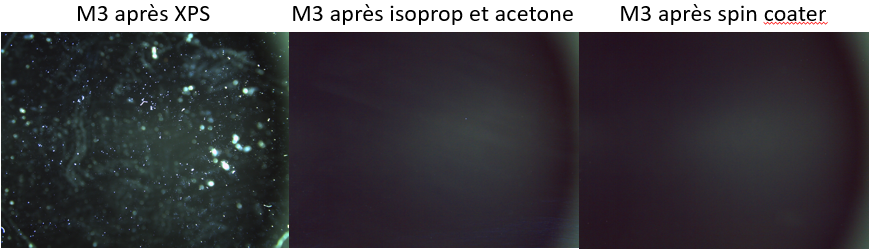
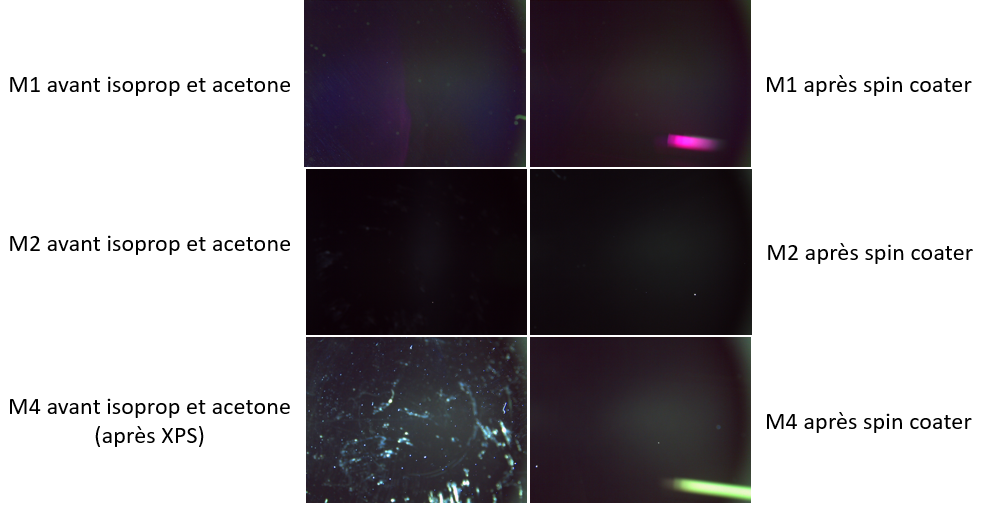
XPS has been proceeded on the 400kW SBOX mirrors M3 and M4 (the initial cavity spherical mirrors) in frebruary 2019. Deposited a lot of particles on these mirrors.
All the mirrors received a Infrared spectroscopy the 12th of november 2019. Deposited glue on the non-reflective face (was used to hold them).
15th of november (2019): The four 400kW SBOX mirror's have been cleaned with aceton and isopropanol.
28th of november (2019): The four 400kW SBOX mirror's have been cleaned with spin coater.
Summary:
Aceton and isopropanol removed most of the particles and all the glue. But it let some traces on the mirror surface on all the mirrors (so there is some kind of grease on the surfaces).
Spin coater removes all the traces.
See pictures. On all the first images, we also see the dust which is on the non reflective face through the mirror. On M3 and M4 there is still the "glue" on the non reflective face on their frst images + refletive faces very dirty because of XPS. |
| Attachment 1: resume_M3.PNG
|
 |
| Attachment 2: resume_M1_M2_M4.PNG
|
 |
|
31
|
Fri Dec 6 11:54:58 2019 |
Loïc Amoudry | Fixed | report | lasers and optics | Optical room | Mirror's installed |
The initial 400kW SBOX mirrors which have been cleaned ont 28th of november have been installed this morning on the SBOX. |
|
46
|
Thu Jan 9 16:54:05 2020 |
Loïc Amoudry | Fixed | report | lasers and optics | Optical room | Microscope and cleaning of SBOX mirrors |
The mirrors went in the cavity the 28th of november (We did several power up to 30kW stored and only one to 40kW then the power went down to 2kW during the run).
Microscope study shows that mirrors get some dust during the handling [travel from microscope to SBOX --> installation --> in SBOX for +1month and power up --> travel to microscope].
Almost all of these dusts can be removed with cleaning.
There is only one important difference between 28th of november and today, a large spot on M1. |
| Attachment 1: resume_nettoyage_apres_sejour_dans_K-BOX_et_montee_en_puissance.PNG
|
 |
|
49
|
Fri Jan 24 17:52:14 2020 |
Loïc Amoudry | Fixed | report | lasers and optics | Optical room | AFM analysis of M1 |
AFM has been proceeded on M1 and M2.
The pdf shows the first images taken with the PLIC room Leica microscope (zoom x10 and x80).
Then the hole has been studied with a handmade microscope. It brought a better resolution. We can now see the hole has an edge, a center structure and and extra-hole sparkle (pailleté) structure.
The AFM shows these 3 structures are real. The top of the hole is at ~+1µm and the center ~-2µm compare to the coating surface. The sparkles are ~10nm high and we also found kind of "explosion" desposit while zooming on the sparkles.
The 3D view and profil show perfectly the "crater". |
| Attachment 1: 200115_AFM_miroirs.pdf
|
|
50
|
Fri Jan 24 17:56:11 2020 |
Loïc Amoudry | Fixed | info | lasers and optics | Optical room | AFM analysis of M2 |
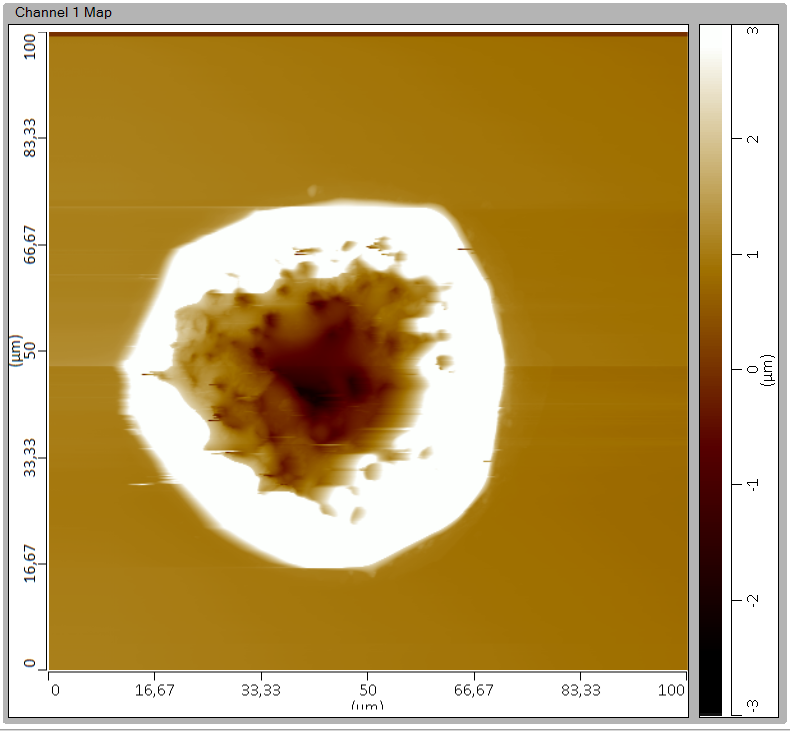
We had enough time to proceed a quick scan of M2 which has also a hole but not centered on the mirror.
The hole is larger and higher than the one on M1. But the vertical range was to high for the AFM. Then we cannot see if there are sparkles or not on this image. Further study with microscope would be welcome. |
| Attachment 1: M2.PNG
|
 |
|
51
|
Fri Jan 24 17:58:45 2020 |
Loïc Amoudry | Fixed | info | lasers and optics | Optical room | CFBG removed from ThomX CELIA amplifier |
The CFBG has been removed successfully and the amplifier is closed now.
The soldering machine had a calibration trouble and was sent to the company for review during holidays.
The output power has been checked and is the same as before (tested until 30W ouput power). |
|
52
|
Wed Jan 29 19:00:02 2020 |
Loïc Amoudry | Fixed | report | lasers and optics | Optical room | Glow discharge cleaner on SBOX mirrors |
The glow discharge cleaner has been tested on the SBOX mirrors.
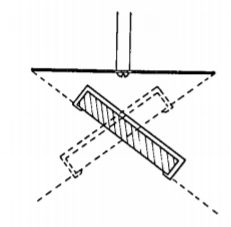
I've put them 1 by 1. Each run was 15min long at 15mA. The mirrors HR face was always away from the electrode and ~35° angle with the support. These values have been choosen thanks to the reference:
We have learned that Air can be compared to Azote and Azote to Oxygen in glow discharge. The main difference is H2O in air which make the glow discharge less stable as say several papers.
|
| Attachment 1: glow.PNG
|
 |
|
53
|
Wed Jan 29 19:04:38 2020 |
Loïc Amoudry | Fixed | report | lasers and optics | Optical room | SBOX mirrors cleaned |
Today, SBOX mirrors have been cleaned with spin coater on HR face and isoprop on back face. They show similar spots as before.
They also have been installed in the SBOX. The M1 mount has been displaced so the beam doesn't go in its center (spot). |
|
54
|
Wed Feb 5 14:47:16 2020 |
Loïc Amoudry | Fixed | report | lasers and optics | Optical room | SBOX mirrors cleaned |
Yesterday, after installation and alignment of mirrors and cavity, the Finesse has been measured with cavity at air pressure, with Koheras and modulation technique.
the measurement has been done 7 times with quite different fits for the Finesse : 21.5k, 21.5k, 23.7k, 21.3k, 22.3k, 22k, 21.5k
But, as the cavity is at air pressure, the lock is not very stable.
we will pump the cavity and make the measurement again.
| Loïc Amoudry wrote: |
|
Today, SBOX mirrors have been cleaned with spin coater on HR face and isoprop on back face. They show similar spots as before.
They also have been installed in the SBOX. The M1 mount has been displaced so the beam doesn't go in its center (spot).
|
|
|
55
|
Wed Feb 5 16:46:01 2020 |
Loïc Amoudry | Fixed | report | lasers and optics | Optical room | SBOX mirrors cleaned |
Today we put the cavity to vacuum (~ 0.1 mBar) and we measured again the Finesse with Koheras and modulation technique.
the measurement has been done 3 times with Finesse of 23.2k, 23.8k, 23k
| Loïc Amoudry wrote: |
|
Yesterday, after installation and alignment of mirrors and cavity, the Finesse has been measured with cavity at air pressure, with Koheras and modulation technique.
the measurement has been done 5 times with quite different fits for the Finesse : 21.5k, 21.5k, 23.7k, 21.3k, 22.3k.
But, as the cavity is at air pressure, the lock is not very stable.
we will pump the cavity and make the measurement again.
| Loïc Amoudry wrote: |
|
Today, SBOX mirrors have been cleaned with spin coater on HR face and isoprop on back face. They show similar spots as before.
They also have been installed in the SBOX. The M1 mount has been displaced so the beam doesn't go in its center (spot).
|
|
|
|
57
|
Thu Feb 6 16:58:57 2020 |
Loïc Amoudry | Fixed | report | lasers and optics | Optical room | Power up to 48kW crater effect again |
As we said, after glow discharge and spin coater we recovered a low power finesse ~23000 (aligning away from the M1 crater).
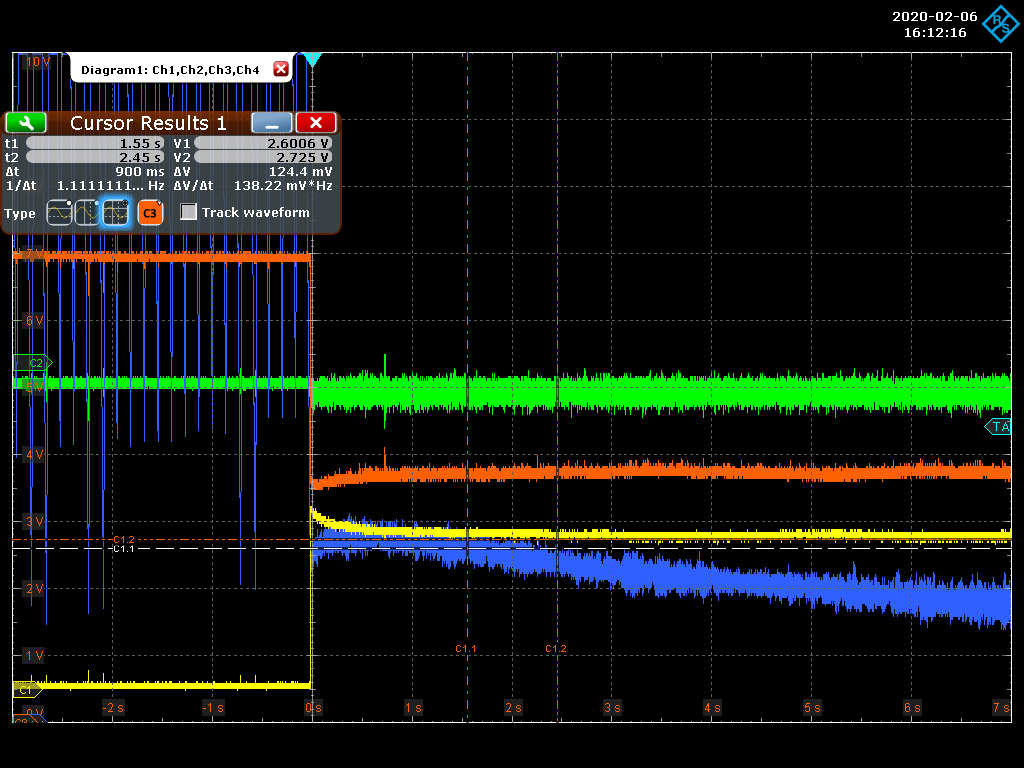
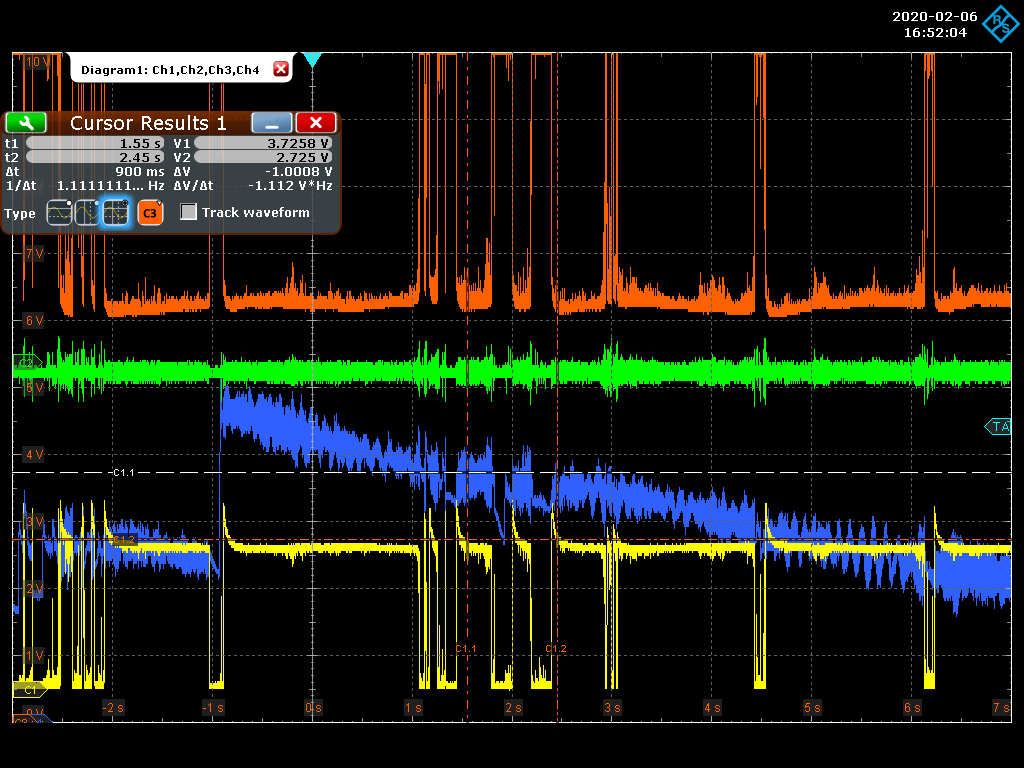
Today, we have made some power up to 48kW (3A on 3rd stage). At this power, there was no important effect on the transmission which can be compared with the coupling (see image "3A_136mWtrans"). We waited ~20min without aligning and the power dropped slowly (misalignment) to 39kW.
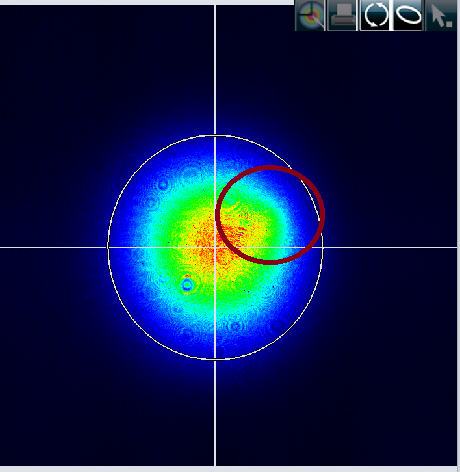
Then we increased the amplifier power to 4A and the power went up to 44kW. At this moment, the strange transmission behavior that we observed before mirror crater, appeared again (see image "4A_126mWtrans"). We also observed a mode deformation with the camera, see image "mode_strange". This shape was not depend of the camera/filter rotation angle and still appear with another camera.
| Loïc Amoudry wrote: |
|
The mirrors went in the cavity the 28th of november (We did several power up to 30kW stored and only one to 40kW then the power went down to 2kW during the run).
Microscope study shows that mirrors get some dust during the handling [travel from microscope to SBOX --> installation --> in SBOX for +1month and power up --> travel to microscope].
Almost all of these dusts can be removed with cleaning.
There is only one important difference between 28th of november and today, a large spot on M1.
|
|
| Attachment 1: 3A_136mWtrans.png
|
 |
| Attachment 2: 4A_126mWtrans.png
|
 |
| Attachment 3: mode_strange.png
|
 |
|
60
|
Wed Dec 16 12:36:37 2020 |
Loïc Amoudry | Fixed | report | lasers and optics | Optical room | Mirror's cleaning and microscope imaging |
On 10th of december 2020 we cleaned the SBOX mirrors and took microscope images (the name of the images indicates what they are).
There are 7 mirror, the initial M1 (spot in the center), M2 (spot on the edge), M3 and M4 which made the 200-400kW and the M2, M3 and M4 SPARE. The difference we make between M3 and M4 SPARE is the number on the box (11 or 13).
We used 3 different cleaning methods : 1st, one spin coater on HR, 2nd one, tissu wipe on AR (wipe with the optical tissu and isoprop) or 3rd one, mirror wiped on tissue (put isoprop on tissu and press AR face of the mirror doing "8" shape 3 times).
The second method is far les efficient as a cleaning method. The image "M3_M4_spare_11_after_cleaning_back.tif " shows the traces let by it and removed by the 3rd method on image "M3_M4_spare_11_after_cleaning_back_second_time_on_tissu.tif".
We can also notice that the spin coater let some trace on the HR face, round shaped, see Image "M3_M4_spare_13_after_cleaning_back.tif". We can propose to use the third method with Acetone on HR face before using spin coater to remove oil or organic particles.
It also lets a trace on the AR face, this is why we clean the AR face with the 2nd method after cleaning it with the spin coater.
Note : The position of the mirrors in the microscope is always the same here. Meaning mirrors are directed so that the arrow (which shows the HR face and is placed on the side of the mirror) is placed on the top of the images. |
| Attachment 1: M1_before_cleaning.tif
|
| Attachment 2: M1_after_cleaning.tif
|
| Attachment 3: M2_after_cleaning.tif
|
| Attachment 4: M3_after_cleaning.tif
|
| Attachment 5: M4_after_cleaning.tif
|
| Attachment 6: M2_spare_before_cleaning.tif
|
| Attachment 7: M2_spare_after_cleaning.tif
|
| Attachment 8: M2_spare_after_cleaning_back.tif
|
| Attachment 9: M3_M4_spare_11_before_cleaning.tif
|
| Attachment 10: M3_M4_spare_11_after_cleaning_back.tif
|
| Attachment 11: M3_M4_spare_11_after_cleaning_back_second_time_on_tissu.tif
|
| Attachment 12: M3_M4_spare_13_before_cleaning.tif
|
| Attachment 13: M3_M4_spare_13_after_cleaning.tif
|
| Attachment 14: M3_M4_spare_13_after_cleaning_back.tif
|
|
58
|
Wed Jun 19 18:54:00 2019 |
Huan Wang | Fixed | info | lasers and optics | Optical room | amplifier |
Onefive output power is 24mW now, and 2.41mW(after EOM) injected into fiber,
a injection power monitor added, 99% (2.06mW) injected into amplifier, 1% (16.1uW) monitored with photodiode DET36A/M, which gives ~500mV DC signal on oscilloscope with 1Mohm impedanc;
First stage amplifier works good, monitoring phtodiode gives more than 200mV DC signal with 50ohm impedance on oscilloscope (as attached photo);
Second stage, the old monitoring photodiode is broken, a new monitoring photodiode is connected, which we don't have reference data for it,
on the optical output port of the monitoring signal, it's written 150mW, but at where we measured 40mW. |
| Attachment 1: 1st_stage_amplifier_monitoring_photodiode_signal.jpg
|
 |
|
59
|
Mon Jun 24 16:15:08 2019 |
Huan Wang | Fixed | info | lasers and optics | Optical room | amplifier |
I just had a phone call with Jérome and he told me 2 things :
* Be carefull ! the MightyLaser amplifier is not designed to work with 33MHz laser : the streching level is not sufficient !
One could worsen the phase noise by self-modulation due to peak power or even distroy the amplifier !
One should use it only at low power !!!
* He thinks we should more or less find back the same DC levels than before even with lower seeding power and lower repetition rate.
He thinks we should look at the optical spectrum to check if we don't have some ASE in the 1st stage and 2nd stage signal !
We can send him plots or call him to discuss these points.
| Huan Wang wrote: |
|
Onefive output power is 24mW now, and 2.41mW(after EOM) injected into fiber,
a injection power monitor added, 99% (2.06mW) injected into amplifier, 1% (16.1uW) monitored with photodiode DET36A/M, which gives ~500mV DC signal on oscilloscope with 1Mohm impedanc;
First stage amplifier works good, monitoring phtodiode gives more than 200mV DC signal with 50ohm impedance on oscilloscope (as attached photo);
Second stage, the old monitoring photodiode is broken, a new monitoring photodiode is connected, which we don't have reference data for it,
on the optical output port of the monitoring signal, it's written 150mW, but at where we measured 40mW.
|
|
|
121
|
Thu Jul 28 13:52:23 2022 |
Aurélien Martens | Fixed | report | utilities | Optical room | chiller for CELIA amplifier |
The chiller of CELIA amplifier has been moved from the corridor to the changing room in front of PLIC.
It was not functionning well (quick drop of flow below 0.9l/min). After several cleanings of the filter, shorting the water circuit a stable 2.1l/min flow was obtained. Then the water circuit was elongated to go close to the amplifier but not into it. Allowing to get about 1.3l/min stable. Now the amplifier is conencted, the filter has been cleaned again twice and the flow seem stable with 1.4l/min. New filters have been ordered and must arrive quickly. Changing it is necessary I think. |
|
122
|
Mon Aug 8 11:11:28 2022 |
Aurélien Martens | Fixed | report | utilities | Optical room | chiller for CELIA amplifier |
today, temperature of the chiller has been set to 23°C.
measured temperature in the chiller reaches 23°C after approximatively 10 minutes
| Aurélien Martens wrote: |
|
The chiller of CELIA amplifier has been moved from the corridor to the changing room in front of PLIC.
It was not functionning well (quick drop of flow below 0.9l/min). After several cleanings of the filter, shorting the water circuit a stable 2.1l/min flow was obtained. Then the water circuit was elongated to go close to the amplifier but not into it. Allowing to get about 1.3l/min stable. Now the amplifier is conencted, the filter has been cleaned again twice and the flow seem stable with 1.4l/min. New filters have been ordered and must arrive quickly. Changing it is necessary I think.
|
|
|
226
|
Fri Nov 29 12:06:05 2024 |
Alice Renaux | Fixed | info | lasers and optics | Optical room | Menhir 160MHz laser |
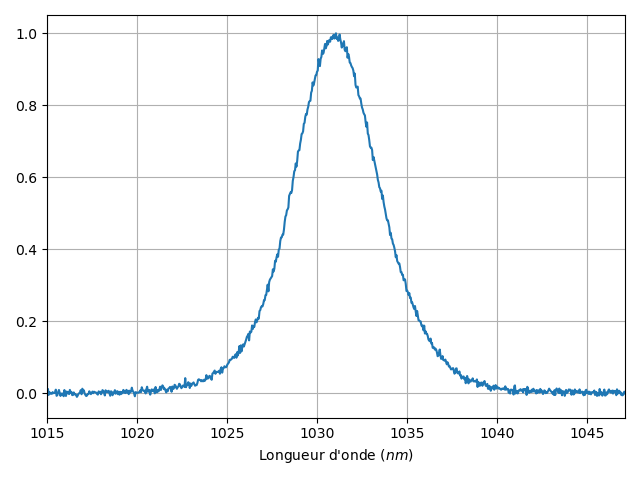
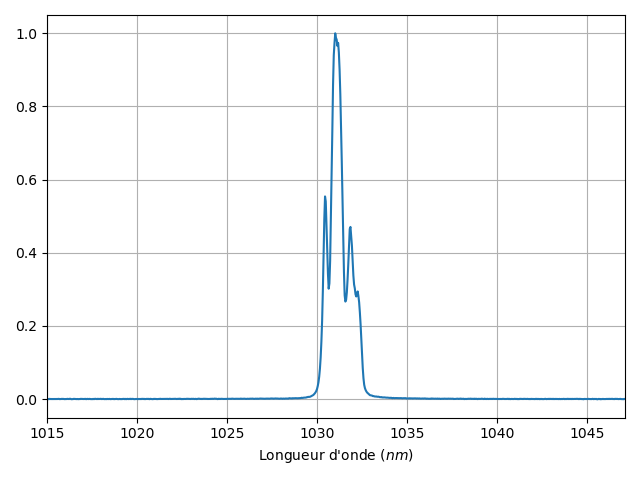
The Menhir 160MHz has been put back in place on the CELIA amplifier setup. Its output power is measured to be 150-160mW with an attenuator as expected. Its spectrum is available in "spectre_avant_cvbg.xlsx" and "spectre_avant_cvbg.png".
The pulses are stretched by means of a CVBG. Their spectrum is available in "spectre_apres_cvbg.xlsx" and "spectre_apres_cvbg.png".
The laser is coupled into an optical fiber with an output power of 11.5mW for a 32mW input.
|
| Attachment 1: spectre_avant_cvbg.xlsx
|
| Attachment 2: spectre_apres_cvbg.xlsx
|
| Attachment 3: spectre_avant_cvbg.png
|
 |
| Attachment 4: spectre_apres_cvbg.png
|
 |
|
227
|
Fri Nov 29 16:50:04 2024 |
Alice Renaux | Under Process | info | lasers and optics | Optical room | Menhir 216MHz laser |
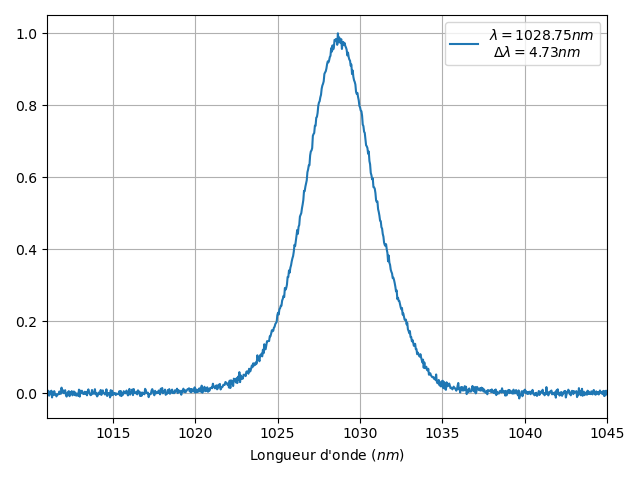
The Menhir 216MHz laser has been put back in place on the cavity table. Its output power is measured to be 160mW with an attenuator. Its spectrum is available in "spectre.xlsx" and "spectre.png". The main wavelength is a bit shorter (1028.75nm) and the spectrum a bit narrower (4.73nm) than expected.
|
| Attachment 1: spectre.xlsx
|
| Attachment 2: spectre.png
|
 |