| ID |
Date |
Author |
Status |
Type |
Category |
Location |
Title |
|
427
|
Wed Jun 11 18:59:34 2025 |
Ronic Chiche | Under Process | issue | mechanics | lasers and optics | vacuum | detectors and electronics | ThomX igloo | Possible causes for the noise in the FP-cavity system | list of possible causes of the high frequency noise which makes the system loosing the lock => to be checked.
(if you have some new idea, I will edit the post)
1- Laser
1.1- vibrations on the laser box coming from the optical table / housing
1.2- vibrations coming from the Smaract translation stages (Frep or CEP) inside the laser box
1.3- pressure noise coming from the weather (the laser cavity is sealed) on the laser box
2- Amplifier
2.1- vibrations coming from the fans in the controler crate
2.2- vibrations coming from the chiller (water cooling cavitation)
3- Beam propagation
3.1- vibration noise coming from the housing / the table
3.2- vibration noise coming from the motors of the injection mirrors
4- Fabry-Perot cavity
4.1- pressure noise on the cavity vessels coming from the weather/air cooling
4.2- vibrations coming from the rust on the mechanics
4.3- vibrations of the mirror mounts due to temperature related to cavity power
4.4- vibrations coming from the electron ring mechanics
4.5- "vacuum" index variation coming from local ionization due to the electron beam
4.6- vibrations coming from the far position (related to the middle range) of some mounts and due to the spring of the translations stage.
5- Feedback system / Electronics / CEM
5.1- CEM votage noise on the laser or FPC PZT's
|
|
429
|
Wed Jun 25 09:57:56 2025 |
Ronic Chiche | Under Process | issue | mechanics | lasers and optics | vacuum | detectors and electronics | ThomX igloo | Possible causes for the noise in the FP-cavity system | 4.3 - Vibrations of the mirror mounts due to temperature related to cavity power (the electrons machine is OFF)
1) to test this possible issue, we plan to make a run at low power in the FP-cavity, around 10kW, instead of ~90kW as usual.
for that, I will need to change the diffuser position on axis 18 to get the same error signal for the locking.
the initial axis 18 position is +11304
I used the Alphanov amplifier at its standard value : 33%
first, I did a step at 26kW in the FPC by tuning the CEP
at this power, I saw exactly the same kind of behavior with a sudden large high frequency noise which prevent the lock to run properly and which is impossible to compensate.
=> one just have to wait... until it becomes more stable.
then, I went to 13kW in the FPC by tuning the CEP.
- I did the same alignement optimisation than for high power to remove possible coupling to high order modes in the error signal
- I tuned the power in the FPC by changing the CEP => the equivalent LW of the cavity will be different => I got ~ 13kW
- I changed the diffuser position on axis 18 to -23079
- I tuned the PID parameters :
initial => final
P = 0.055 => 0.1
I = 0.0005 => 0.002
D = 0.6 => 1
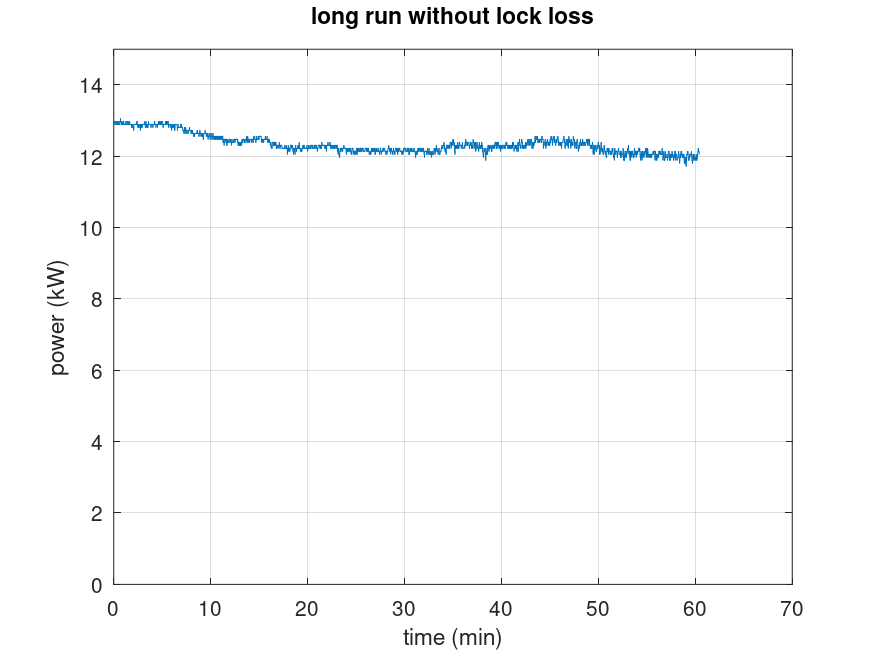
I started to record a long trend of the FPC power => see attached picture
I still observed the ~20Hz noise and sometime some high frequency noise, but not at a level which prevents the locking system to work.
CONCLUSION :
at this power and with a larger LW (CEP is not optimized), the FPC seems much more stable without any lock loss during 1h !
2) then I will do a test by decreasing the Alphanov amplifier ratio to work at a lower input power but with an optimized CEP.
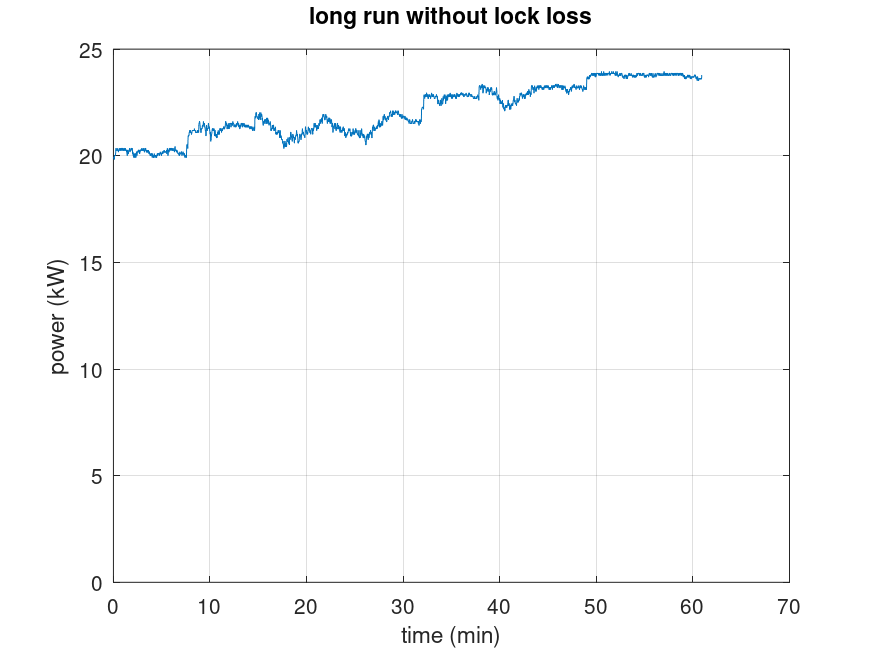
Now, I optimized the CEP and alignment and reduce the Alphanov amplifier ratio to 15% => 24kW power in the FPC.
on CH2, I got 60mV (when I got 250mV when I'm at 97kW in the FPC) => ratio ~ 4.2 => 97kW / 4,2 ~ 23 kW
I checked that the PID parameters are not over-valuated which can produce a power reduction and the CEP is optimum as well as the alignment.
Axis 18 position : -13188
PID parameters (P = 0.1 / I = 0.002 / D = 1.5)
I started to record a long trend of the FPC power => cf 2nd trend with gradually increasing of the power because of the drift of the CEP + feedback adjustments.
CONCLUSION :
at this power and with nominal LW (CEP is optimized), the FPC seems much more stable without any lock loss during 1h !
3) I found a stable position for FPC around 46kW
I used the recepie for 46kW => after some time, I observed a lot of high frequency noise which induces some lock loss.
| Ronic Chiche wrote: |
|
list of possible causes of the high frequency noise which makes the system loosing the lock => to be checked.
(if you have some new idea, I will edit the post)
1- Laser
1.1- vibrations on the laser box coming from the optical table / housing
1.2- vibrations coming from the Smaract translation stages (Frep or CEP) inside the laser box
1.3- pressure noise coming from the weather (the laser cavity is sealed) on the laser box
2- Amplifier
2.1- vibrations coming from the fans in the controler crate
2.2- vibrations coming from the chiller (water cooling cavitation)
3- Beam propagation
3.1- vibration noise coming from the housing / the table
3.2- vibration noise coming from the motors of the injection mirrors
4- Fabry-Perot cavity
4.1- pressure noise on the cavity vessels coming from the weather/air cooling
4.2- vibrations coming from the rust on the mechanics
4.3- vibrations of the mirror mounts due to temperature related to cavity power
4.4- vibrations coming from the electron ring mechanics
4.5- "vacuum" index variation coming from local ionization due to the electron beam
5- Feedback system / Electronics / CEM
5.1- CEM votage noise on the laser or FPC PZT's
|
|
| Attachment 1: long_run_wihtout_lock_loss.png
|  |
| Attachment 2: long_run_wihtout_lock_loss_with_optimum_CEP.png
|  |
|
42
|
Wed Jun 12 17:49:20 2019 |
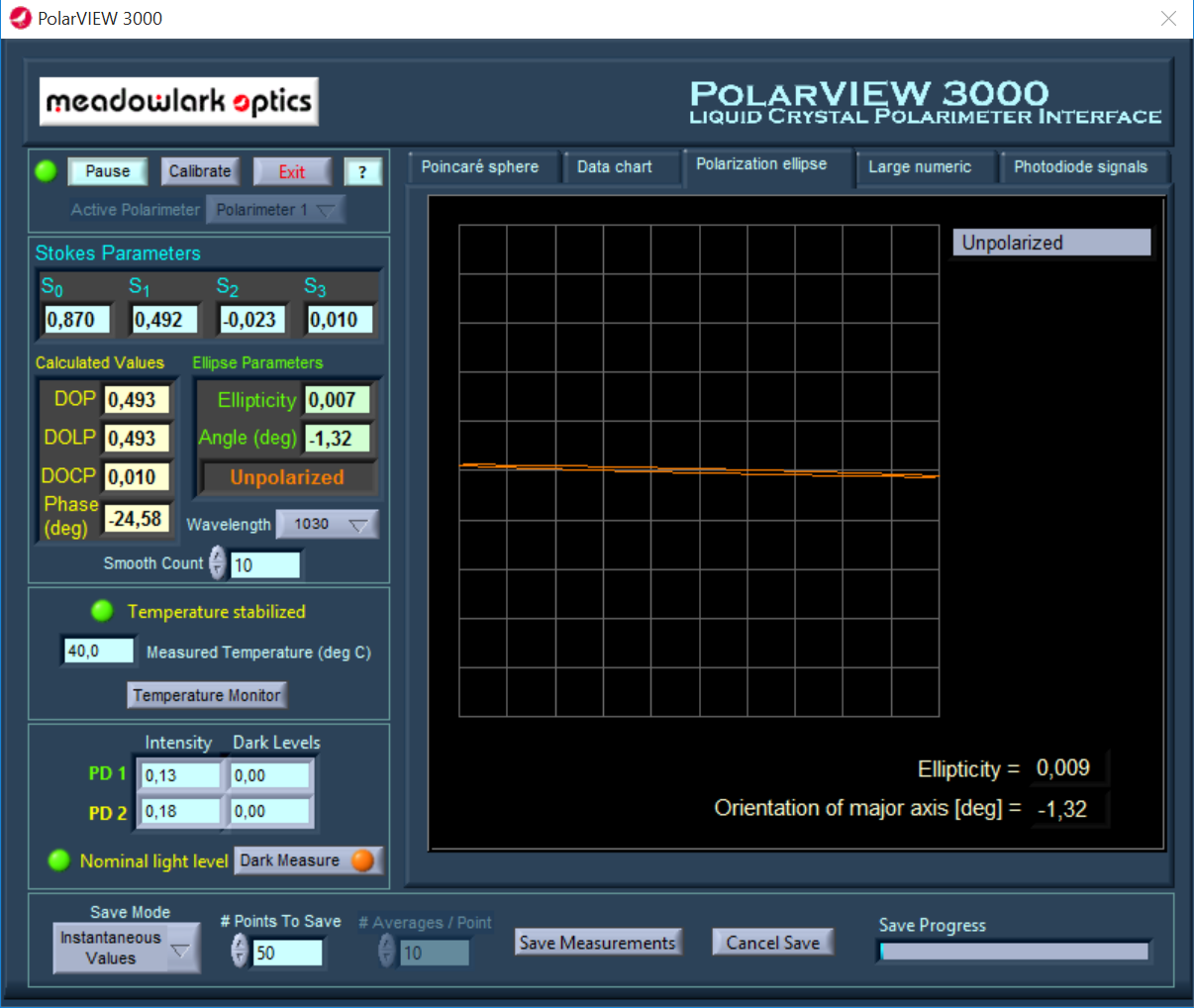
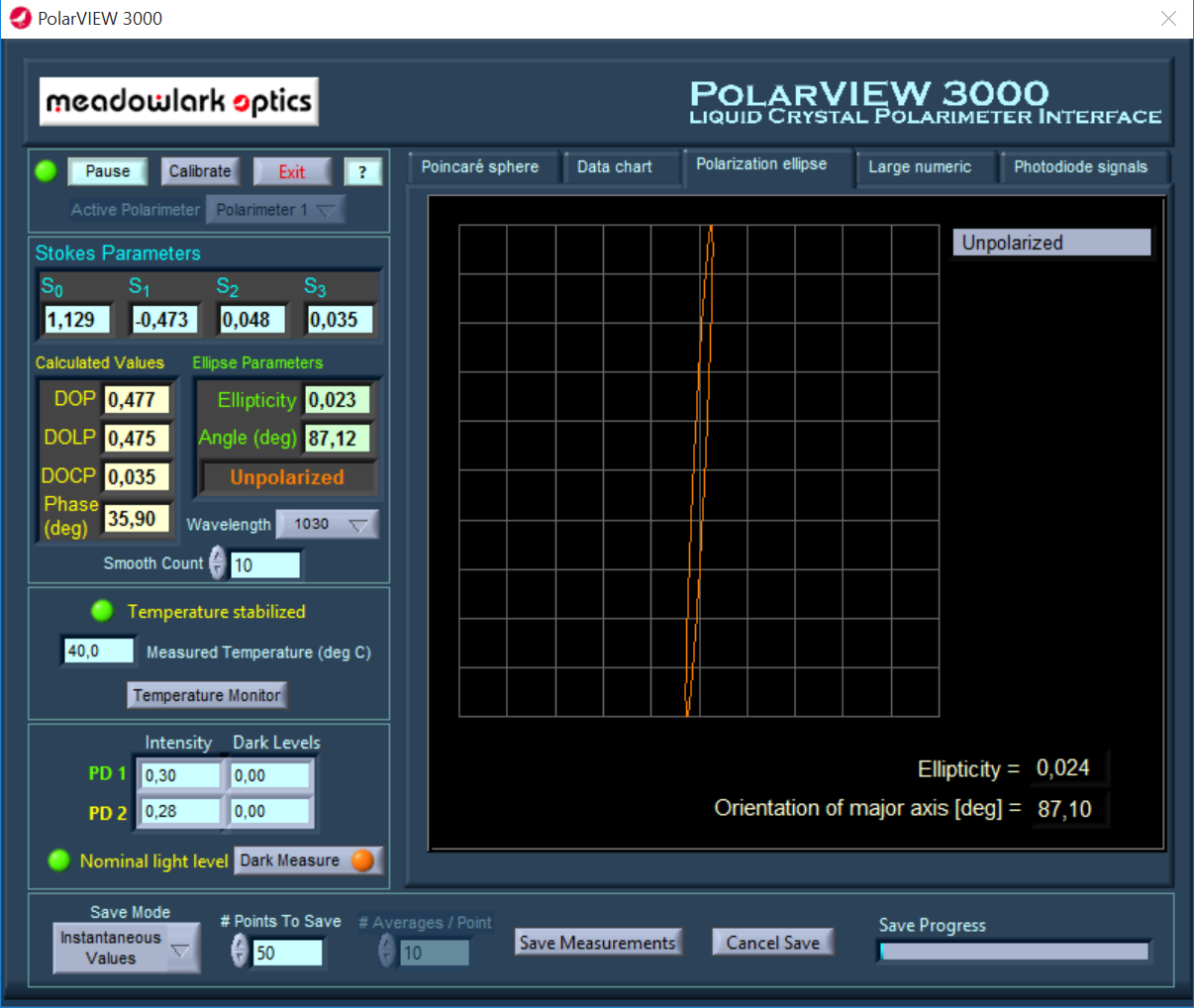
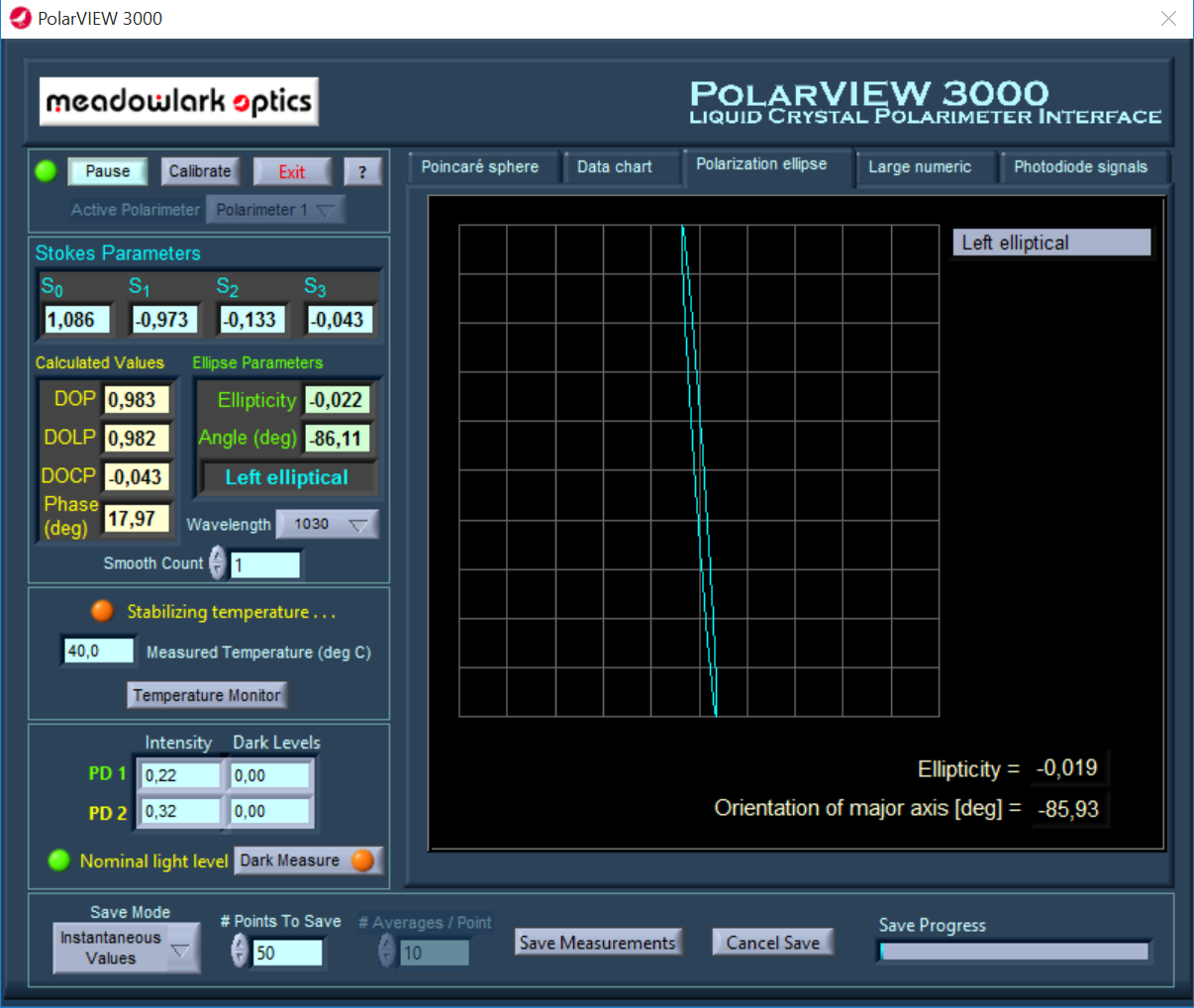
Loïc Amoudry | Fixed | info | lasers and optics | Optical room | Polarization | Polariztion measured with Input vertically/horizontally polarized (~100% DOLP)
- Transmission (P4) locked on cavity horizontal polarization is ~50% linearly polarized and ~50% unpolarized ?
- Transmission (P4) locked on cavity vertical polarization is ~50% linearly polarized and ~50% unpolarized ? |
| Attachment 1: Polar_horiz_trans_P4.PNG
|  |
| Attachment 2: Polar_vert_trans_P4.PNG
|  |
| Attachment 3: Polar_vert_input.PNG
|  |
|
99
|
Fri Feb 28 17:44:12 2020 |
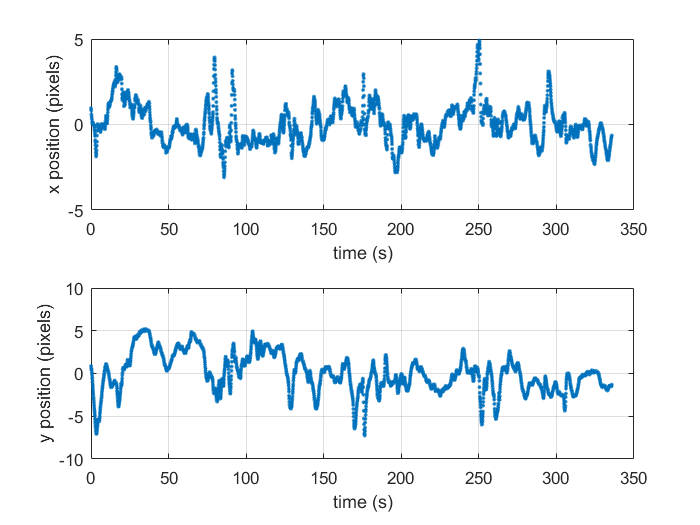
Ronic Chiche | Fixed | report | lasers and optics | Optical room | Pointing stability with CVBG | Yesterday, with Titouan, we made some measurements on pointing stability of the laser beam after amplifier and CVBG.
the amplifier beam go through a first telescope to be small enough and colimated before going to CVBG's, then go to CVBG's and then is sent through the FP-cavity telescope to the FP-cavity itself.
the total length is about 6m to mirror M1.
the surface of the mirror M1 is imaged with several wedges to a Basler CCD.
(x is for veritcal position and y is for horizontal position)
* the 1st plot shows the pointing stability at low power of amplifier without airflow and walking around during about 5 minutes extracted from the Basler CCD video.
when walking around or with airflow the pointing stabily is much worse.
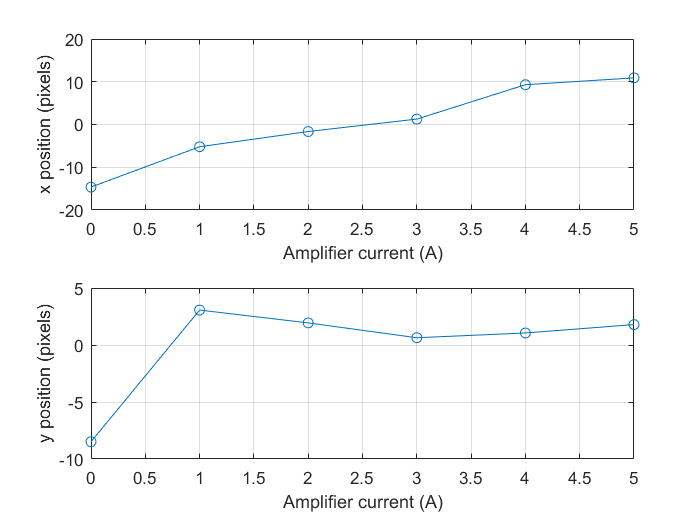
* the 2nd plot shows the pointing stability vs amplifier current.
it is comparable (a litle bit worse) to the pointing stability at low power.
one clearly see the beam expanding in vertical direction and also in horizontal direction.
the effect could come from the CVBG telescope lenses which are standard lenses and not high power lenses.
the pointing effect could come also from the same effect if the lens is not perfectly centered.
we took also some picture of the CVBG at different power with the Thermal camera but we need to get the data from camera (old software not compatible with Windows 10) |
| Attachment 1: Pointing_stability_without_airflow_and_no_one_walking_around.png
|  |
| Attachment 2: Pointing_stability_without_airflow_vs_amplifier_current.png
|  |
|
64
|
Thu Oct 3 13:49:58 2019 |
Loïc Amoudry | Fixed | info | mechanics | Optical room | Pneumatic valves | Frederic and Manu from vacuum group came this morning to fix again the pneumatic valves which had a leak again. |
|
83
|
Tue Nov 26 16:21:27 2019 |
Loïc Amoudry | Fixed | issue | vacuum | Optical room | Pneumatic valves | The pneumatic valves are now plugged on the university air network.
The air valve is fully openned for the moment.
We still have to check if there is some minor leakage close to the pneumatic valve to improve the setup.
But it's not anymore an issue for the lock. |
|
208
|
Thu Apr 13 17:48:49 2023 |
Manar Amer | Fixed | report | lasers and optics | detectors and electronics | ThomX igloo | PW laser Injection into cavity | Yesterday,
- we installed the second high power reflecting mirrors at the output of the amplifier.
- We aligned and installed a telescope that has adjustable distance between the 2 lenses of -100 mm, and + 200 mm, with approximate diameter at the injection window of ~ 4.5 mm.
- Amplifier was turned on only at the first stage only (output power ~ 300 mW) aligned and injected into the cavity.
- Measured the repetition frequency of the One Five oscillators, Frep = 33.326239 MHz
- Changed the FSR of the cavity to match it.
- Using the Piezo scan on the oscillator, we observed 00 Mode, Fundamental. the shape is the same
- We see transmission on the diode, but there was zero coupling observed (yet to be investigated experimentally )
- a reason could be the CEP of the oscillator ,
- bad matching of the beam waist position,
- noise from the amplifier (as we were operating it at very low power)
- additional alignment needed,
|
| Attachment 1: 20230412_pulsed_cav_mode.bmp
|
|
209
|
Wed Apr 19 16:39:28 2023 |
Manar Amer | Fixed | report | lasers and optics | detectors and electronics | ThomX igloo | PW laser Injection into cavity |
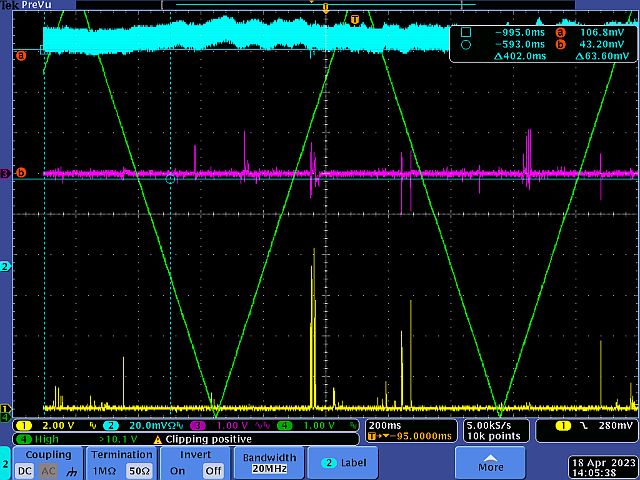
- On Monday with Daniele,
- we did full characterization of amplifier beam @ 10% amplification, adjusted the telescope accordingly and injected into the cavity aligned and improved on the fundamental mode.
- On Tuesday with Daniele and Kevin
- I added a low pass filter between 1 - 1.9 MHz on the reflected signal, to reject the oscillator signal (33.33 MHz)
- removed the external resistors on the signal, only the internal resistance of the oscilloscope used ( transmission : 1 M ohm , Reflection : 50 ohm )
- We connected the motors to control the CEP and adjusted on them until we reached ~ 5 -10% coupling
- Images:
- 1st : showing the size of the beam just before injecting into the cavity @ 10%
- 2nd: signal with only improved alignment (not CEP adjustment yet), no low pass filter added yet
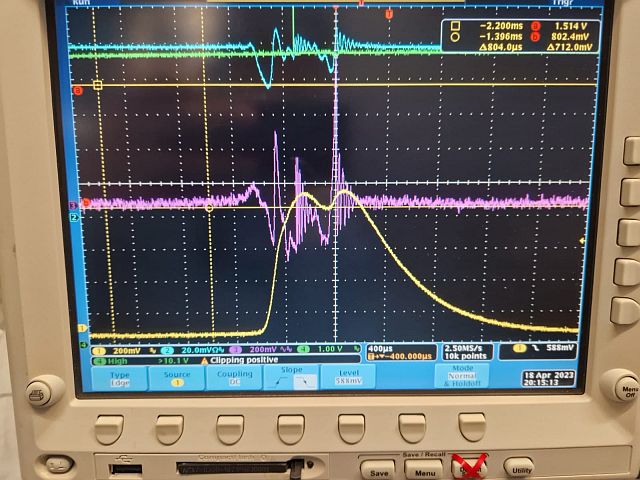
- 3rd : zoom on the signals (reflection and error) while adjusting on the CEP
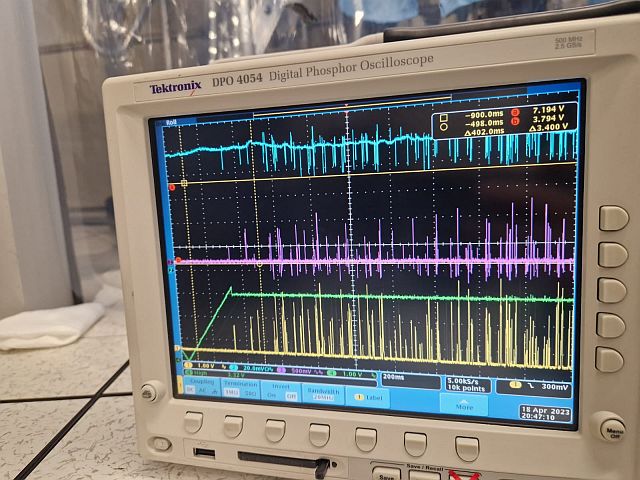
- 4th :attempting to lock the cavity , after getting the max coupling using the CEP motors
Note : the voltage ranges are not the same between the images
| Manar Amer wrote: |
|
Yesterday,
- we installed the second high power reflecting mirrors at the output of the amplifier.
- We aligned and installed a telescope that has adjustable distance between the 2 lenses of -100 mm, and + 200 mm, with approximate diameter at the injection window of ~ 4.5 mm.
- Amplifier was turned on only at the first stage only (output power ~ 300 mW) aligned and injected into the cavity.
- Measured the repetition frequency of the One Five oscillators, Frep = 33.326239 MHz
- Changed the FSR of the cavity to match it.
- Using the Piezo scan on the oscillator, we observed 00 Mode, Fundamental. the shape is the same
- We see transmission on the diode, but there was zero coupling observed (yet to be investigated experimentally )
- a reason could be the CEP of the oscillator ,
- bad matching of the beam waist position,
- noise from the amplifier (as we were operating it at very low power)
- additional alignment needed,
|
|
| Attachment 1: 20230418_size_of_beam_before_injection_window_at_10percetage_ampli.jpg
|  |
| Attachment 2: 20230418_coupling_at_the_start_only_alignment_improved1.jpg
|  |
| Attachment 3: 20230418_zoom_on_Oscilliscope_signal_fundamental_mode.jpg
|  |
| Attachment 4: 20230418_coupling_after_improving_it_with_regulator_on_attempting_to_lock.jpg
|  |
|
210
|
Wed Apr 19 16:41:46 2023 |
Manar Amer | Fixed | report | lasers and optics | detectors and electronics | ThomX igloo | PW laser Injection into cavity | Added Note: the coupling we get is at low power, only preamplifier is on (~ 300 mW)
was done at the end due to excitation of higher order modes.
Wanted to improve the fundamental first, then increase the power.
| Manar Amer wrote: |
- On Monday with Daniele,
- we did full characterization of amplifier beam @ 10% amplification, adjusted the telescope accordingly and injected into the cavity aligned and improved on the fundamental mode.
- On Tuesday with Daniele and Kevin
- I added a low pass filter between 1 - 1.9 MHz on the reflected signal, to reject the oscillator signal (33.33 MHz)
- removed the external resistors on the signal, only the internal resistance of the oscilloscope used ( transmission : 1 M ohm , Reflection : 50 ohm )
- We connected the motors to control the CEP and adjusted on them until we reached ~ 5 -10% coupling
- Images:
- 1st : showing the size of the beam just before injecting into the cavity @ 10%
- 2nd: signal with only improved alignment (not CEP adjustment yet), no low pass filter added yet
- 3rd : zoom on the signals (reflection and error) while adjusting on the CEP
- 4th :attempting to lock the cavity , after getting the max coupling using the CEP motors
Note : the voltage ranges are not the same between the images
| Manar Amer wrote: |
|
Yesterday,
- we installed the second high power reflecting mirrors at the output of the amplifier.
- We aligned and installed a telescope that has adjustable distance between the 2 lenses of -100 mm, and + 200 mm, with approximate diameter at the injection window of ~ 4.5 mm.
- Amplifier was turned on only at the first stage only (output power ~ 300 mW) aligned and injected into the cavity.
- Measured the repetition frequency of the One Five oscillators, Frep = 33.326239 MHz
- Changed the FSR of the cavity to match it.
- Using the Piezo scan on the oscillator, we observed 00 Mode, Fundamental. the shape is the same
- We see transmission on the diode, but there was zero coupling observed (yet to be investigated experimentally )
- a reason could be the CEP of the oscillator ,
- bad matching of the beam waist position,
- noise from the amplifier (as we were operating it at very low power)
- additional alignment needed,
|
|
|
|
211
|
Mon May 22 16:07:12 2023 |
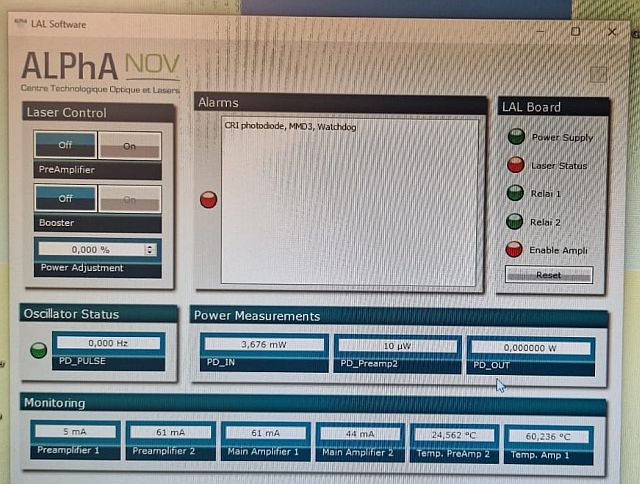
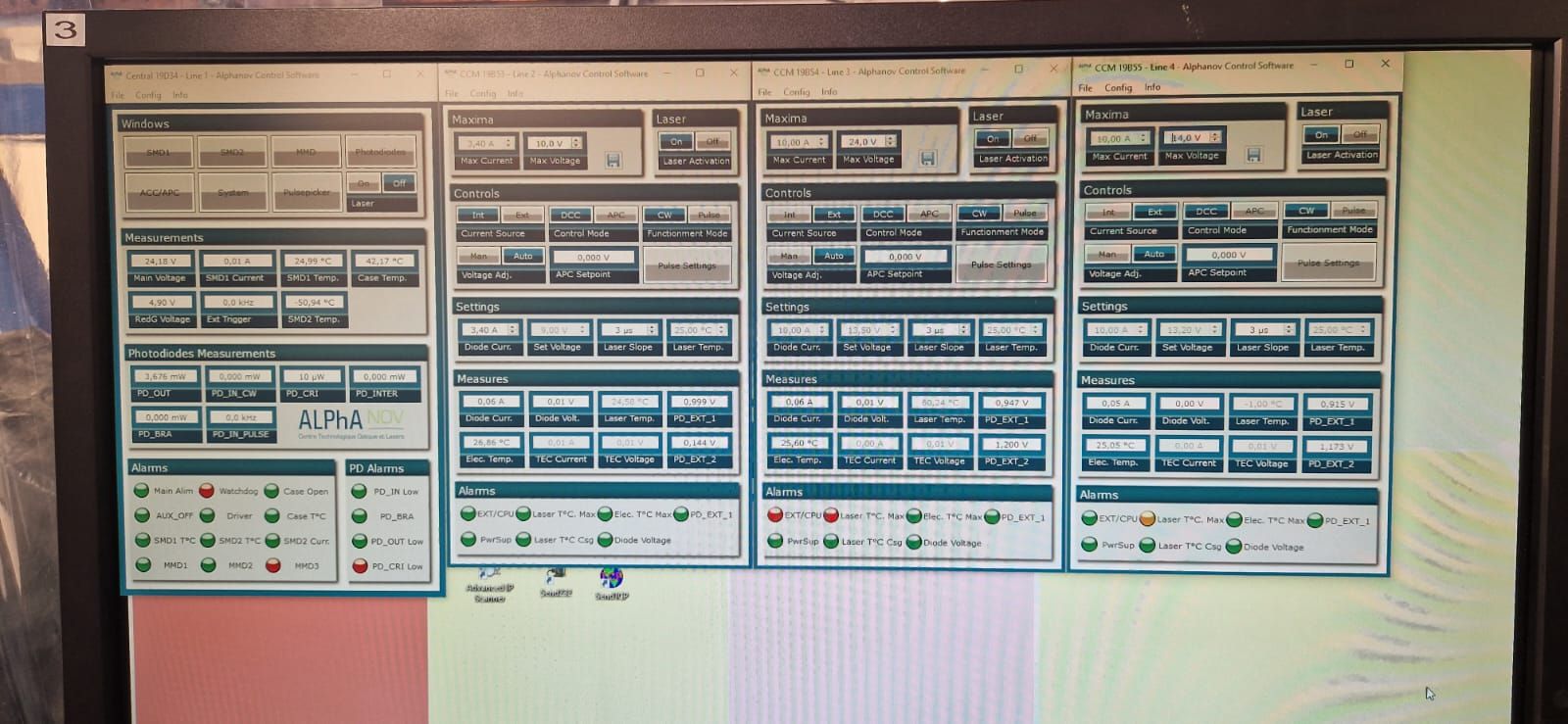
Manar Amer | Fixed | report | lasers and optics | detectors and electronics | ThomX igloo | PW laser Injection into cavity | Today with Ronic and Daniele we attempted to lock the cavity, but the alphanov amplifier did not turn on because of an error in MMD3 (related to the third stage)
the new error is having the MMD3 error show on the alarm window of the LAL software, and having the Alarms on the line 3 of the alphanov software red for both EXT/CPU and Laser T Max (never been red before)
this is after a 2-week work stop, but the last time when Daniele changed the fiber connector it worked for 3 hours with no errors.
Ronic, is in contact with Guillaume from Alphanov to fix the issue !!!
Work scheduled all Wednesday, in hopes the issue is fixed by then.
| Manar Amer wrote: |
|
Added Note: the coupling we get is at low power, only preamplifier is on (~ 300 mW)
was done at the end due to excitation of higher order modes.
Wanted to improve the fundamental first, then increase the power.
| Manar Amer wrote: |
- On Monday with Daniele,
- we did full characterization of amplifier beam @ 10% amplification, adjusted the telescope accordingly and injected into the cavity aligned and improved on the fundamental mode.
- On Tuesday with Daniele and Kevin
- I added a low pass filter between 1 - 1.9 MHz on the reflected signal, to reject the oscillator signal (33.33 MHz)
- removed the external resistors on the signal, only the internal resistance of the oscilloscope used ( transmission : 1 M ohm , Reflection : 50 ohm )
- We connected the motors to control the CEP and adjusted on them until we reached ~ 5 -10% coupling
- Images:
- 1st : showing the size of the beam just before injecting into the cavity @ 10%
- 2nd: signal with only improved alignment (not CEP adjustment yet), no low pass filter added yet
- 3rd : zoom on the signals (reflection and error) while adjusting on the CEP
- 4th :attempting to lock the cavity , after getting the max coupling using the CEP motors
Note : the voltage ranges are not the same between the images
| Manar Amer wrote: |
|
Yesterday,
- we installed the second high power reflecting mirrors at the output of the amplifier.
- We aligned and installed a telescope that has adjustable distance between the 2 lenses of -100 mm, and + 200 mm, with approximate diameter at the injection window of ~ 4.5 mm.
- Amplifier was turned on only at the first stage only (output power ~ 300 mW) aligned and injected into the cavity.
- Measured the repetition frequency of the One Five oscillators, Frep = 33.326239 MHz
- Changed the FSR of the cavity to match it.
- Using the Piezo scan on the oscillator, we observed 00 Mode, Fundamental. the shape is the same
- We see transmission on the diode, but there was zero coupling observed (yet to be investigated experimentally )
- a reason could be the CEP of the oscillator ,
- bad matching of the beam waist position,
- noise from the amplifier (as we were operating it at very low power)
- additional alignment needed,
|
|
|
|
| Attachment 1: 2023-05-22_MMD3_error_on_alarm_window.jpg
|  |
| Attachment 2: 2023-05-22_alphanov_software.jpg
|  |
|
32
|
Mon Apr 8 11:55:40 2019 |
Loïc Amoudry | Fixed | report | lasers and optics | Optical room | P4 cleaned and finesse measurement | P4 cleaned with isopropanol.
Finesse measured afterward: ~=13 000 (clear increase) |
|
365
|
Tue Sep 17 13:04:32 2024 |
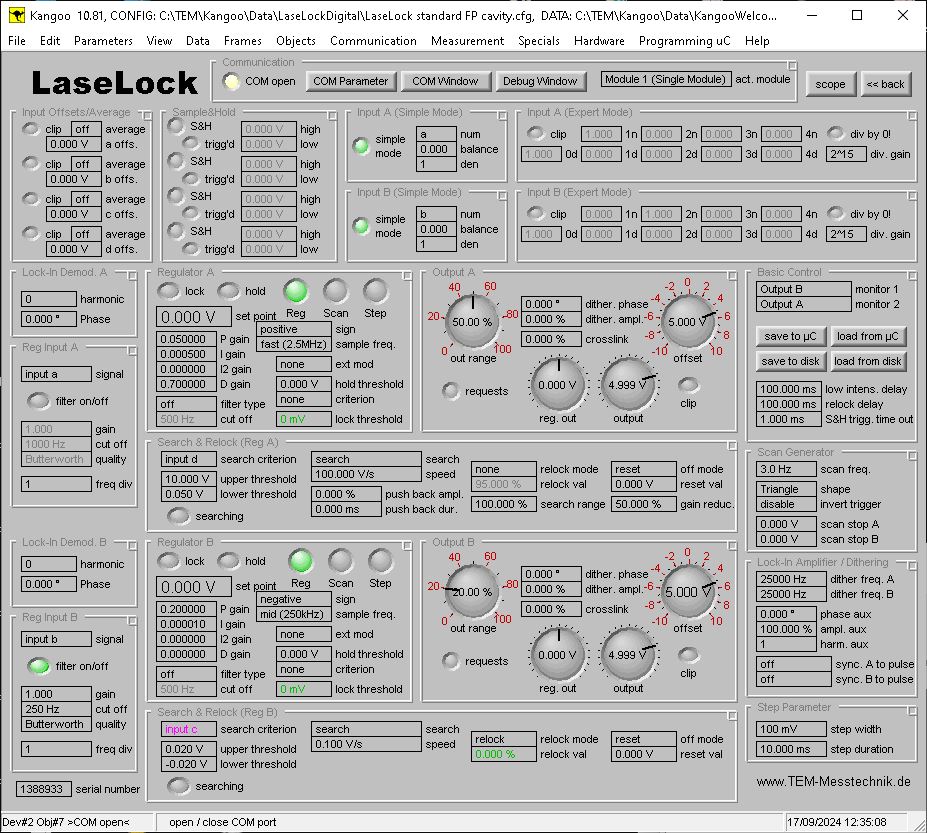
Ronic Chiche | Under Process | info | lasers and optics | software | ThomX igloo | Optimizing lock parameters for stable X-ray production | here are the (good) lock parameters used this morning.
for the RF/FPC lock, the 33MHz beating signal used to select the right bucket is 1Vpp
=> beating signal : V0 . sin(phi) with V0=0.5V.
to discrimate a 500MHz bucket, we need to get dV < V0 dphi.
dphi = 2pi / 15 = 420 mrad => dV < 0.2 V => dV < +/- 0.1V
we used dV = +/- 0.02V but perharps we can relax the constraint.
we also reduced the RF scanning speed at 0.1V/s to let the system find the right phase when the system is slowly drifting.
|
| Attachment 1: Capture.JPG
|  |
|
366
|
Thu Oct 3 16:38:03 2024 |
Ronic Chiche | Under Process | info | lasers and optics | software | ThomX igloo | Optimizing lock parameters for stable X-ray production | Today with Daniele and Alice, we operated to cavity.
we obtained 84kW for 33% of amplifier ratio.
we had to tune the CEP @ -565µm and the FP-cavity alignment.
then we locked properly the FP-cavity on the ring RF frequency.
we quite easily relock with the correct phase when we are loosing the lock.
the ThomX machine was running during these 2 locks, so we are ready for doing X-rays again.
| Ronic Chiche wrote: |
|
here are the (good) lock parameters used this morning.
for the RF/FPC lock, the 33MHz beating signal used to select the right bucket is 1Vpp
=> beating signal : V0 . sin(phi) with V0=0.5V.
to discrimate a 500MHz bucket, we need to get dV < V0 dphi.
dphi = 2pi / 15 = 420 mrad => dV < 0.2 V => dV < +/- 0.1V
we used dV = +/- 0.02V but perharps we can relax the constraint.
we also reduced the RF scanning speed at 0.1V/s to let the system find the right phase when the system is slowly drifting.
|
|
|
368
|
Wed Oct 9 09:56:21 2024 |
Ronic Chiche | Under Process | info | lasers and optics | software | ThomX igloo | Optimizing lock parameters for stable X-ray production | This morning, I wanted to test quickly if the Smaract motors can be used in open loop instead of closed loop or in piezo scan.
the goal is to do very fine steps without to much vibrations (like with piezo scan mode) but with the full motor range (the piezo scan mode has a very limited range).
I can check what happens to the 33MHz beating frequency between the laser and the RF frequency without the laser amplifier or the lock of the FP-cavity.
1Hz of beating freqency variation is equivalent to 270nm of round-trip length, which is 135nm of motor displacement !
=> the full range of the piezo scan mode is difficult to estimate because the measurement sensitivity is not good enough but around 5Hz.
=> 1350nm in closed loop is equivalent to ~ 10Hz => 135nm is equivalent to 1Hz => ok
=> 1 step in open loop is equivalent to ~ 10Hz !!! => this is a way too coarse tuning !!!! => cannot be used unless one finds a way to set the motion differently in the settings parameters.
but usually, the settings parameters are used only to tune the speed, not the step size.
| Ronic Chiche wrote: |
|
Today with Daniele and Alice, we operated to cavity.
we obtained 84kW for 33% of amplifier ratio.
we had to tune the CEP @ -565µm and the FP-cavity alignment.
then we locked properly the FP-cavity on the ring RF frequency.
we quite easily relock with the correct phase when we are loosing the lock.
the ThomX machine was running during these 2 locks, so we are ready for doing X-rays again.
| Ronic Chiche wrote: |
|
here are the (good) lock parameters used this morning.
for the RF/FPC lock, the 33MHz beating signal used to select the right bucket is 1Vpp
=> beating signal : V0 . sin(phi) with V0=0.5V.
to discrimate a 500MHz bucket, we need to get dV < V0 dphi.
dphi = 2pi / 15 = 420 mrad => dV < 0.2 V => dV < +/- 0.1V
we used dV = +/- 0.02V but perharps we can relax the constraint.
we also reduced the RF scanning speed at 0.1V/s to let the system find the right phase when the system is slowly drifting.
|
|
|
|
369
|
Wed Oct 9 18:39:34 2024 |
Ronic Chiche | Under Process | info | lasers and optics | software | ThomX igloo | Optimizing lock parameters for stable X-ray production | This afternoon, we scanned the optical table vertically with the hexapod in asynchronous mode to find its optimum position, looking at the X-ray production.
then, we searched for the correct bucket and phase in the bucket thanks to the Kevin script on the 500MHz and the 33MHz phases.
we got relatively easily some stable X-rays.
on the gain "0" on the current amplifier of the X-rays photodiode, we got 15 000 pA (380k Xrays / pA => 5.7.10^9 Xrays).
but we saw, when the cathode charge was fluctuating, that we could be saturated above 20 000 pA !
the power in the cavity was ~84kW after CEP and alignment tuning.
the command to launch the X-rays measurement window is:
taurustrend -r 100 /XLI/OP/TMD.01/I1
| Ronic Chiche wrote: |
|
This morning, I wanted to test quickly if the Smaract motors can be used in open loop instead of closed loop or in piezo scan.
the goal is to do very fine steps without to much vibrations (like with piezo scan mode) but with the full motor range (the piezo scan mode has a very limited range).
I can check what happens to the 33MHz beating frequency between the laser and the RF frequency without the laser amplifier or the lock of the FP-cavity.
1Hz of beating freqency variation is equivalent to 270nm of round-trip length, which is 135nm of motor displacement !
=> the full range of the piezo scan mode is difficult to estimate because the measurement sensitivity is not good enough but around 5Hz.
=> 1350nm in closed loop is equivalent to ~ 10Hz => 135nm is equivalent to 1Hz => ok
=> 1 step in open loop is equivalent to ~ 10Hz !!! => this is a way too coarse tuning !!!! => cannot be used unless one finds a way to set the motion differently in the settings parameters.
but usually, the settings parameters are used only to tune the speed, not the step size.
| Ronic Chiche wrote: |
|
Today with Daniele and Alice, we operated to cavity.
we obtained 84kW for 33% of amplifier ratio.
we had to tune the CEP @ -565µm and the FP-cavity alignment.
then we locked properly the FP-cavity on the ring RF frequency.
we quite easily relock with the correct phase when we are loosing the lock.
the ThomX machine was running during these 2 locks, so we are ready for doing X-rays again.
| Ronic Chiche wrote: |
|
here are the (good) lock parameters used this morning.
for the RF/FPC lock, the 33MHz beating signal used to select the right bucket is 1Vpp
=> beating signal : V0 . sin(phi) with V0=0.5V.
to discrimate a 500MHz bucket, we need to get dV < V0 dphi.
dphi = 2pi / 15 = 420 mrad => dV < 0.2 V => dV < +/- 0.1V
we used dV = +/- 0.02V but perharps we can relax the constraint.
we also reduced the RF scanning speed at 0.1V/s to let the system find the right phase when the system is slowly drifting.
|
|
|
|
|
374
|
Tue Oct 22 18:58:56 2024 |
Ronic Chiche | Under Process | info | lasers and optics | software | ThomX igloo | Optimizing lock parameters for stable X-ray production | Today, after setting the locking parameters, I got 80kW in the FPC for 33% amplifier ratio after CEP tuning (Smaract CH2 ~ -423.5µm) and alignment.
maybe the alignment has to be improved by some walking procedure.
| Ronic Chiche wrote: |
|
This afternoon, we scanned the optical table vertically with the hexapod in asynchronous mode to find its optimum position, looking at the X-ray production.
then, we searched for the correct bucket and phase in the bucket thanks to the Kevin script on the 500MHz and the 33MHz phases.
we got relatively easily some stable X-rays.
on the gain "0" on the current amplifier of the X-rays photodiode, we got 15 000 pA (380k Xrays / pA => 5.7.10^9 Xrays).
but we saw, when the cathode charge was fluctuating, that we could be saturated above 20 000 pA !
the power in the cavity was ~84kW after CEP and alignment tuning.
the command to launch the X-rays measurement window is:
taurustrend -r 100 /XLI/OP/TMD.01/I1
| Ronic Chiche wrote: |
|
This morning, I wanted to test quickly if the Smaract motors can be used in open loop instead of closed loop or in piezo scan.
the goal is to do very fine steps without to much vibrations (like with piezo scan mode) but with the full motor range (the piezo scan mode has a very limited range).
I can check what happens to the 33MHz beating frequency between the laser and the RF frequency without the laser amplifier or the lock of the FP-cavity.
1Hz of beating freqency variation is equivalent to 270nm of round-trip length, which is 135nm of motor displacement !
=> the full range of the piezo scan mode is difficult to estimate because the measurement sensitivity is not good enough but around 5Hz.
=> 1350nm in closed loop is equivalent to ~ 10Hz => 135nm is equivalent to 1Hz => ok
=> 1 step in open loop is equivalent to ~ 10Hz !!! => this is a way too coarse tuning !!!! => cannot be used unless one finds a way to set the motion differently in the settings parameters.
but usually, the settings parameters are used only to tune the speed, not the step size.
| Ronic Chiche wrote: |
|
Today with Daniele and Alice, we operated to cavity.
we obtained 84kW for 33% of amplifier ratio.
we had to tune the CEP @ -565µm and the FP-cavity alignment.
then we locked properly the FP-cavity on the ring RF frequency.
we quite easily relock with the correct phase when we are loosing the lock.
the ThomX machine was running during these 2 locks, so we are ready for doing X-rays again.
| Ronic Chiche wrote: |
|
here are the (good) lock parameters used this morning.
for the RF/FPC lock, the 33MHz beating signal used to select the right bucket is 1Vpp
=> beating signal : V0 . sin(phi) with V0=0.5V.
to discrimate a 500MHz bucket, we need to get dV < V0 dphi.
dphi = 2pi / 15 = 420 mrad => dV < 0.2 V => dV < +/- 0.1V
we used dV = +/- 0.02V but perharps we can relax the constraint.
we also reduced the RF scanning speed at 0.1V/s to let the system find the right phase when the system is slowly drifting.
|
|
|
|
|
|
375
|
Wed Oct 23 12:23:10 2024 |
Ronic Chiche | Under Process | info | lasers and optics | software | ThomX igloo | Optimizing lock parameters for stable X-ray production | this morning, I did some walking procedure and I got 82kW in the FPC with 33% amplifier ratio (after CEP optimization too).
but when I move the FP cavity motors to adjust the frequency, I cannot keep this power and it is reduced.
could it be we get a stronger correlation between axis than before in the mechanics has more rust than before ?
I'm able to keep the power quite easily with a stable phase related to the 33MHz RF generator,
so, we are ready to produce X-rays again.
we could do also a measurement of the amplifier power vs ratio, as maybe it reduced a bit which could explain why we have this small power drop compare to before.
| Ronic Chiche wrote: |
|
Today, after setting the locking parameters, I got 80kW in the FPC for 33% amplifier ratio after CEP tuning (Smaract CH2 ~ -423.5µm) and alignment.
maybe the alignment has to be improved by some walking procedure.
| Ronic Chiche wrote: |
|
This afternoon, we scanned the optical table vertically with the hexapod in asynchronous mode to find its optimum position, looking at the X-ray production.
then, we searched for the correct bucket and phase in the bucket thanks to the Kevin script on the 500MHz and the 33MHz phases.
we got relatively easily some stable X-rays.
on the gain "0" on the current amplifier of the X-rays photodiode, we got 15 000 pA (380k Xrays / pA => 5.7.10^9 Xrays).
but we saw, when the cathode charge was fluctuating, that we could be saturated above 20 000 pA !
the power in the cavity was ~84kW after CEP and alignment tuning.
the command to launch the X-rays measurement window is:
taurustrend -r 100 /XLI/OP/TMD.01/I1
| Ronic Chiche wrote: |
|
This morning, I wanted to test quickly if the Smaract motors can be used in open loop instead of closed loop or in piezo scan.
the goal is to do very fine steps without to much vibrations (like with piezo scan mode) but with the full motor range (the piezo scan mode has a very limited range).
I can check what happens to the 33MHz beating frequency between the laser and the RF frequency without the laser amplifier or the lock of the FP-cavity.
1Hz of beating freqency variation is equivalent to 270nm of round-trip length, which is 135nm of motor displacement !
=> the full range of the piezo scan mode is difficult to estimate because the measurement sensitivity is not good enough but around 5Hz.
=> 1350nm in closed loop is equivalent to ~ 10Hz => 135nm is equivalent to 1Hz => ok
=> 1 step in open loop is equivalent to ~ 10Hz !!! => this is a way too coarse tuning !!!! => cannot be used unless one finds a way to set the motion differently in the settings parameters.
but usually, the settings parameters are used only to tune the speed, not the step size.
| Ronic Chiche wrote: |
|
Today with Daniele and Alice, we operated to cavity.
we obtained 84kW for 33% of amplifier ratio.
we had to tune the CEP @ -565µm and the FP-cavity alignment.
then we locked properly the FP-cavity on the ring RF frequency.
we quite easily relock with the correct phase when we are loosing the lock.
the ThomX machine was running during these 2 locks, so we are ready for doing X-rays again.
| Ronic Chiche wrote: |
|
here are the (good) lock parameters used this morning.
for the RF/FPC lock, the 33MHz beating signal used to select the right bucket is 1Vpp
=> beating signal : V0 . sin(phi) with V0=0.5V.
to discrimate a 500MHz bucket, we need to get dV < V0 dphi.
dphi = 2pi / 15 = 420 mrad => dV < 0.2 V => dV < +/- 0.1V
we used dV = +/- 0.02V but perharps we can relax the constraint.
we also reduced the RF scanning speed at 0.1V/s to let the system find the right phase when the system is slowly drifting.
|
|
|
|
|
|
|
376
|
Fri Nov 8 15:23:11 2024 |
Ronic Chiche | Under Process | info | lasers and optics | software | ThomX igloo | Optimizing lock parameters for stable X-ray production | this morning, I did some walking procedure and CEP alignment to get ~80kW in the FPC with 33% amplifier ratio.
we have to check if this power drop comes from:
- a laser amplifier power drop
- or related to some cavity axis shift which could change the cavity gain due to L-shapes
| Ronic Chiche wrote: |
|
this morning, I did some walking procedure and I got 82kW in the FPC with 33% amplifier ratio (after CEP optimization too).
but when I move the FP cavity motors to adjust the frequency, I cannot keep this power and it is reduced.
could it be we get a stronger correlation between axis than before in the mechanics has more rust than before ?
I'm able to keep the power quite easily with a stable phase related to the 33MHz RF generator,
so, we are ready to produce X-rays again.
we could do also a measurement of the amplifier power vs ratio, as maybe it reduced a bit which could explain why we have this small power drop compare to before.
| Ronic Chiche wrote: |
|
Today, after setting the locking parameters, I got 80kW in the FPC for 33% amplifier ratio after CEP tuning (Smaract CH2 ~ -423.5µm) and alignment.
maybe the alignment has to be improved by some walking procedure.
| Ronic Chiche wrote: |
|
This afternoon, we scanned the optical table vertically with the hexapod in asynchronous mode to find its optimum position, looking at the X-ray production.
then, we searched for the correct bucket and phase in the bucket thanks to the Kevin script on the 500MHz and the 33MHz phases.
we got relatively easily some stable X-rays.
on the gain "0" on the current amplifier of the X-rays photodiode, we got 15 000 pA (380k Xrays / pA => 5.7.10^9 Xrays).
but we saw, when the cathode charge was fluctuating, that we could be saturated above 20 000 pA !
the power in the cavity was ~84kW after CEP and alignment tuning.
the command to launch the X-rays measurement window is:
taurustrend -r 100 /XLI/OP/TMD.01/I1
| Ronic Chiche wrote: |
|
This morning, I wanted to test quickly if the Smaract motors can be used in open loop instead of closed loop or in piezo scan.
the goal is to do very fine steps without to much vibrations (like with piezo scan mode) but with the full motor range (the piezo scan mode has a very limited range).
I can check what happens to the 33MHz beating frequency between the laser and the RF frequency without the laser amplifier or the lock of the FP-cavity.
1Hz of beating freqency variation is equivalent to 270nm of round-trip length, which is 135nm of motor displacement !
=> the full range of the piezo scan mode is difficult to estimate because the measurement sensitivity is not good enough but around 5Hz.
=> 1350nm in closed loop is equivalent to ~ 10Hz => 135nm is equivalent to 1Hz => ok
=> 1 step in open loop is equivalent to ~ 10Hz !!! => this is a way too coarse tuning !!!! => cannot be used unless one finds a way to set the motion differently in the settings parameters.
but usually, the settings parameters are used only to tune the speed, not the step size.
| Ronic Chiche wrote: |
|
Today with Daniele and Alice, we operated to cavity.
we obtained 84kW for 33% of amplifier ratio.
we had to tune the CEP @ -565µm and the FP-cavity alignment.
then we locked properly the FP-cavity on the ring RF frequency.
we quite easily relock with the correct phase when we are loosing the lock.
the ThomX machine was running during these 2 locks, so we are ready for doing X-rays again.
| Ronic Chiche wrote: |
|
here are the (good) lock parameters used this morning.
for the RF/FPC lock, the 33MHz beating signal used to select the right bucket is 1Vpp
=> beating signal : V0 . sin(phi) with V0=0.5V.
to discrimate a 500MHz bucket, we need to get dV < V0 dphi.
dphi = 2pi / 15 = 420 mrad => dV < 0.2 V => dV < +/- 0.1V
we used dV = +/- 0.02V but perharps we can relax the constraint.
we also reduced the RF scanning speed at 0.1V/s to let the system find the right phase when the system is slowly drifting.
|
|
|
|
|
|
|
|
377
|
Tue Nov 19 17:37:55 2024 |
Ronic Chiche | Under Process | info | lasers and optics | software | ThomX igloo | Optimizing lock parameters for stable X-ray production | the RF frequency is now 500.1003MHz which is equivalent (if divided by 15) to 33.34002MHz.
the frequency has to be changed by ~2kHz @33MHz <=> ~550µm /2 for one motor.
I changed the laser and the FP cavities frequency.
for the laser frequency, the smaract motor CH1 is at 1.500627m.
for the FPC frequency, the plane mirror motors are at MOT.03= - 123 130 steps and MOT.06
BE CARREFUL, when the offset frequency is large, as we measure it on a scope with a beat frequency, if the scope window is too large,
one gets some stromboscope effect and one measures a lower frequency depending on the number of points in the window.
we got ~81kW for 33% amplifier ratio
| Ronic Chiche wrote: |
|
this morning, I did some walking procedure and CEP alignment to get ~80kW in the FPC with 33% amplifier ratio.
we have to check if this power drop comes from:
- a laser amplifier power drop
- or related to some cavity axis shift which could change the cavity gain due to L-shapes
| Ronic Chiche wrote: |
|
this morning, I did some walking procedure and I got 82kW in the FPC with 33% amplifier ratio (after CEP optimization too).
but when I move the FP cavity motors to adjust the frequency, I cannot keep this power and it is reduced.
could it be we get a stronger correlation between axis than before in the mechanics has more rust than before ?
I'm able to keep the power quite easily with a stable phase related to the 33MHz RF generator,
so, we are ready to produce X-rays again.
we could do also a measurement of the amplifier power vs ratio, as maybe it reduced a bit which could explain why we have this small power drop compare to before.
| Ronic Chiche wrote: |
|
Today, after setting the locking parameters, I got 80kW in the FPC for 33% amplifier ratio after CEP tuning (Smaract CH2 ~ -423.5µm) and alignment.
maybe the alignment has to be improved by some walking procedure.
| Ronic Chiche wrote: |
|
This afternoon, we scanned the optical table vertically with the hexapod in asynchronous mode to find its optimum position, looking at the X-ray production.
then, we searched for the correct bucket and phase in the bucket thanks to the Kevin script on the 500MHz and the 33MHz phases.
we got relatively easily some stable X-rays.
on the gain "0" on the current amplifier of the X-rays photodiode, we got 15 000 pA (380k Xrays / pA => 5.7.10^9 Xrays).
but we saw, when the cathode charge was fluctuating, that we could be saturated above 20 000 pA !
the power in the cavity was ~84kW after CEP and alignment tuning.
the command to launch the X-rays measurement window is:
taurustrend -r 100 /XLI/OP/TMD.01/I1
| Ronic Chiche wrote: |
|
This morning, I wanted to test quickly if the Smaract motors can be used in open loop instead of closed loop or in piezo scan.
the goal is to do very fine steps without to much vibrations (like with piezo scan mode) but with the full motor range (the piezo scan mode has a very limited range).
I can check what happens to the 33MHz beating frequency between the laser and the RF frequency without the laser amplifier or the lock of the FP-cavity.
1Hz of beating freqency variation is equivalent to 270nm of round-trip length, which is 135nm of motor displacement !
=> the full range of the piezo scan mode is difficult to estimate because the measurement sensitivity is not good enough but around 5Hz.
=> 1350nm in closed loop is equivalent to ~ 10Hz => 135nm is equivalent to 1Hz => ok
=> 1 step in open loop is equivalent to ~ 10Hz !!! => this is a way too coarse tuning !!!! => cannot be used unless one finds a way to set the motion differently in the settings parameters.
but usually, the settings parameters are used only to tune the speed, not the step size.
| Ronic Chiche wrote: |
|
Today with Daniele and Alice, we operated to cavity.
we obtained 84kW for 33% of amplifier ratio.
we had to tune the CEP @ -565µm and the FP-cavity alignment.
then we locked properly the FP-cavity on the ring RF frequency.
we quite easily relock with the correct phase when we are loosing the lock.
the ThomX machine was running during these 2 locks, so we are ready for doing X-rays again.
| Ronic Chiche wrote: |
|
here are the (good) lock parameters used this morning.
for the RF/FPC lock, the 33MHz beating signal used to select the right bucket is 1Vpp
=> beating signal : V0 . sin(phi) with V0=0.5V.
to discrimate a 500MHz bucket, we need to get dV < V0 dphi.
dphi = 2pi / 15 = 420 mrad => dV < 0.2 V => dV < +/- 0.1V
we used dV = +/- 0.02V but perharps we can relax the constraint.
we also reduced the RF scanning speed at 0.1V/s to let the system find the right phase when the system is slowly drifting.
|
|
|
|
|
|
|
|
|
97
|
Wed Feb 26 16:48:02 2020 |
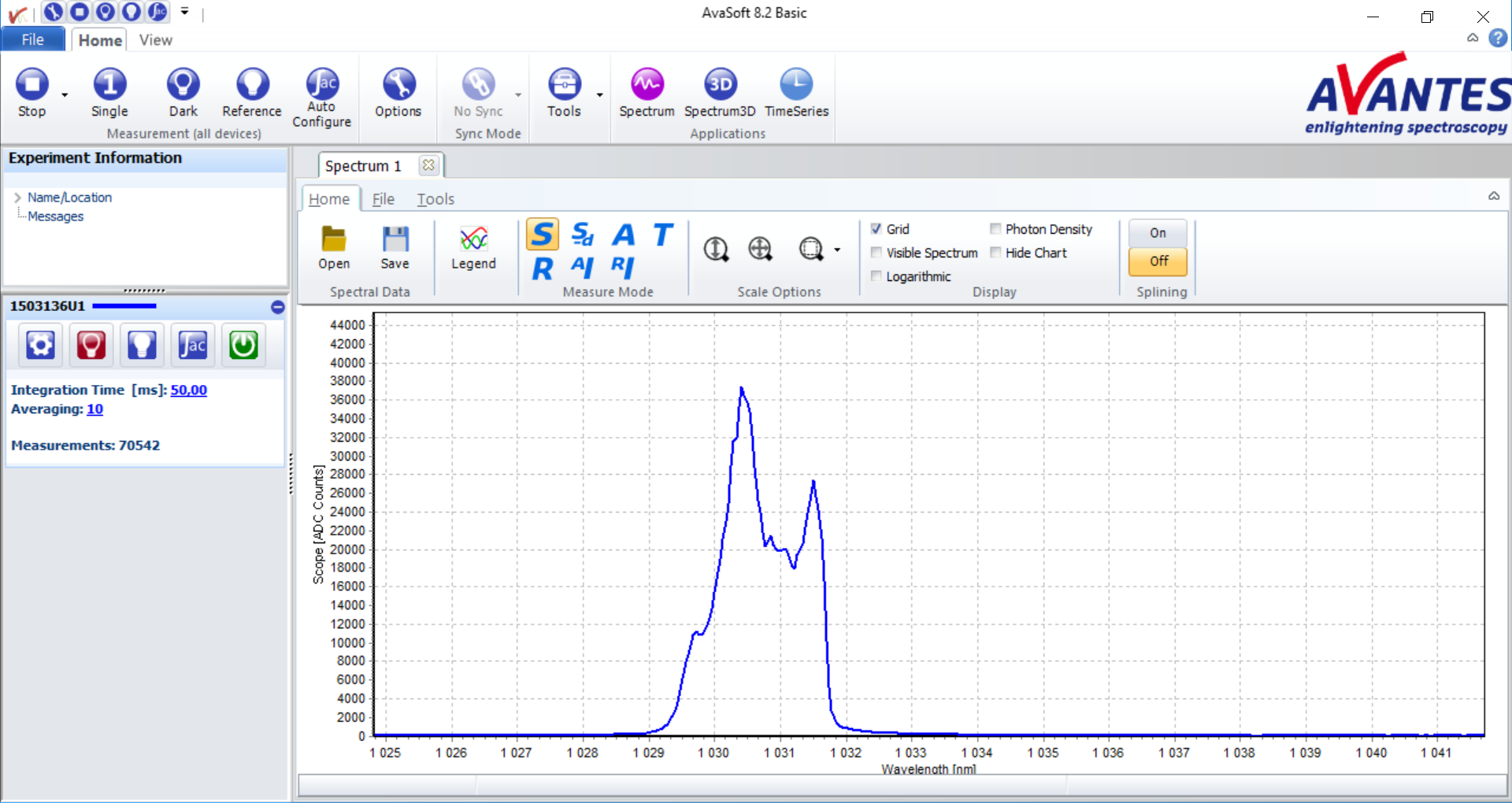
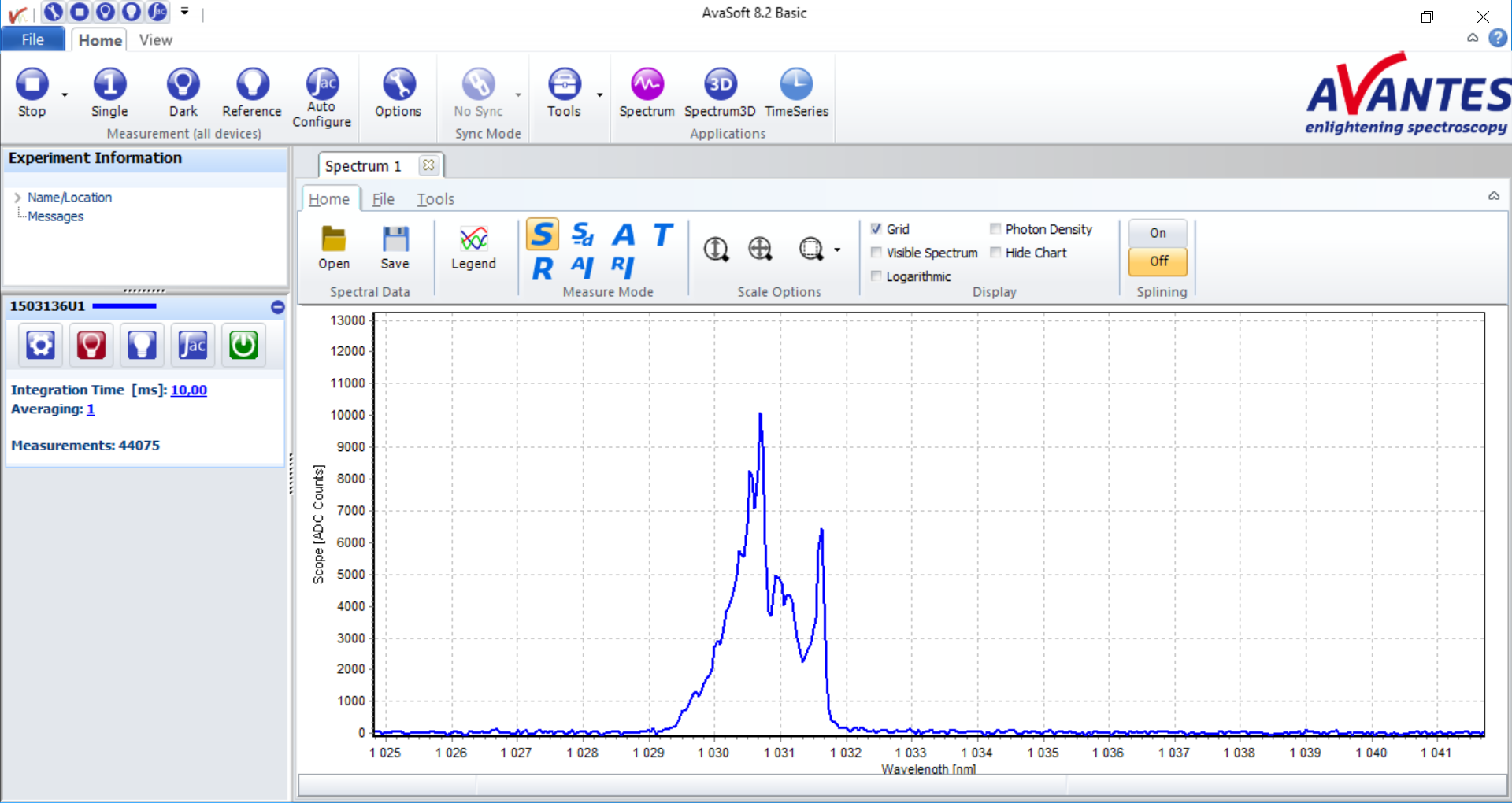
Ronic Chiche | Fixed | info | lasers and optics | Optical room | Optical spectrum before and after CVBG | Measurement of the optical spectrum with Avantes OSA before (1st picture) and after CVBG (2nd picture) with 2nd stage on the laser amplifier.
The 1st CVBG stretches the beam horizontally due to the default incident angle and the fact that different wavelength are reflected in the CVBG with different depth.
as a result, the optical spectrum is varying along the transversal axis of the beam.
The 2nd CVBG is injected with the opposiste incident angle and should compensate the stretch effect to get back a circular beam.
spatially, the beam is quite circular but one can still see a dependance between position in the beam and optical spectrum.
Then, it is difficult to show the "right" optical spectrum after CVBG (one could use a diffuser for that) but it is clear that the spectral width is quite the same (~ 2nm due to the CFBG at the input of the amplifier) before and after CVBG. |
| Attachment 1: OSA_after_amplifier_CFBG_and_before_CVBG.PNG
|  |
| Attachment 2: OSA_after_amplifier_CFBG_2_CVBG.PNG
|  |
|