| ID |
Date |
Author |
Status |
Type |
Category |
Location |
Title |
|
184
|
Wed Feb 8 11:25:50 2023 |
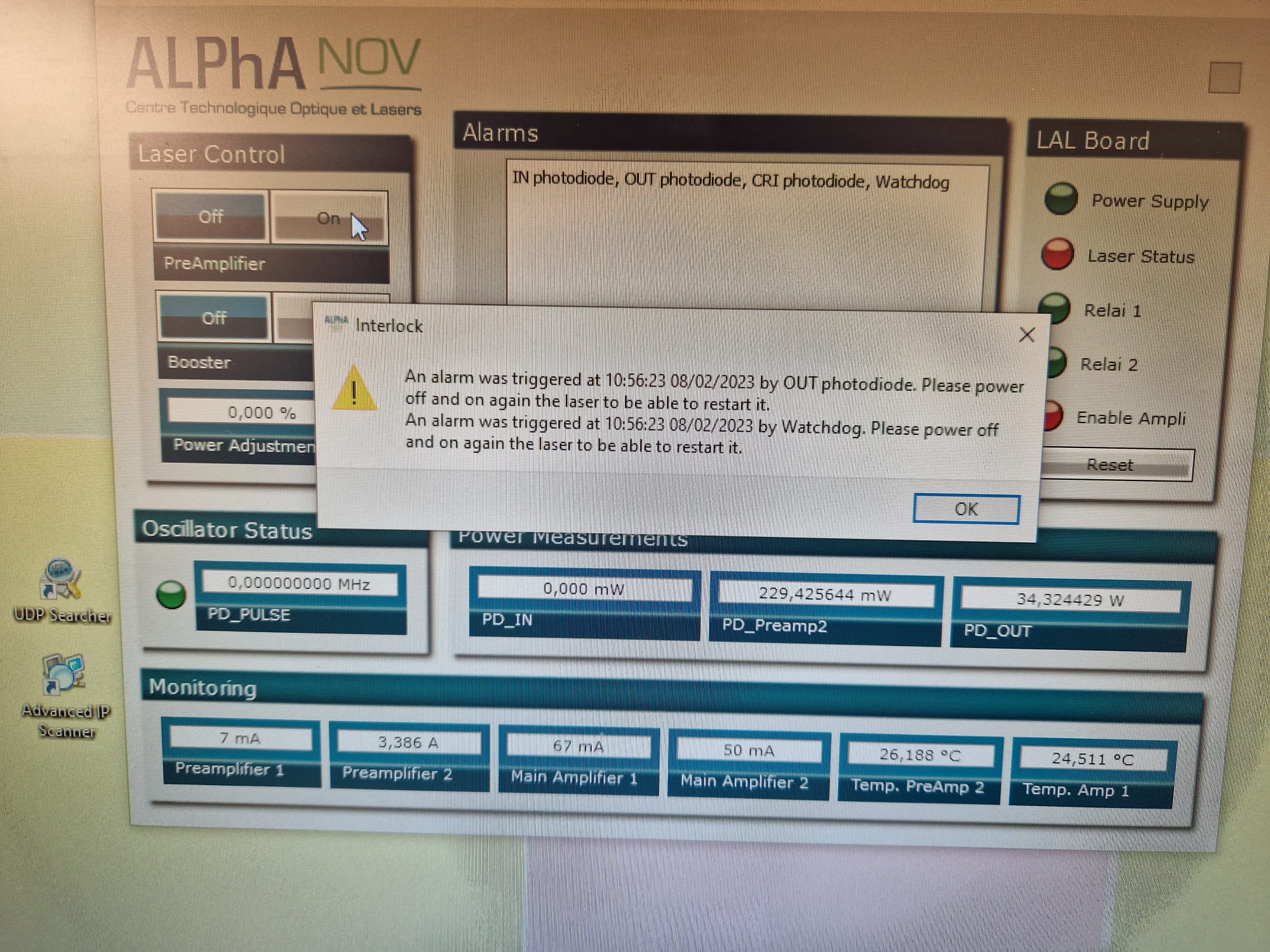
Ronic Chiche | Fixed | report | lasers and optics | software | ThomX igloo | Alphanov amplifier beam profile measurement | we have had this new issue (watchdog alarm switching off the amplifier) for several days.
Alphanov mentionned it could come from the input oscillator stability (modelock loss for example).
Today,
- I tried to start the amplifier at 0% but it ended immediately in a "watchdog alarm" which stopped the amplifier
the input average power detected by the software was around 5.2mW, far above the 2mW needed by the amplifier.
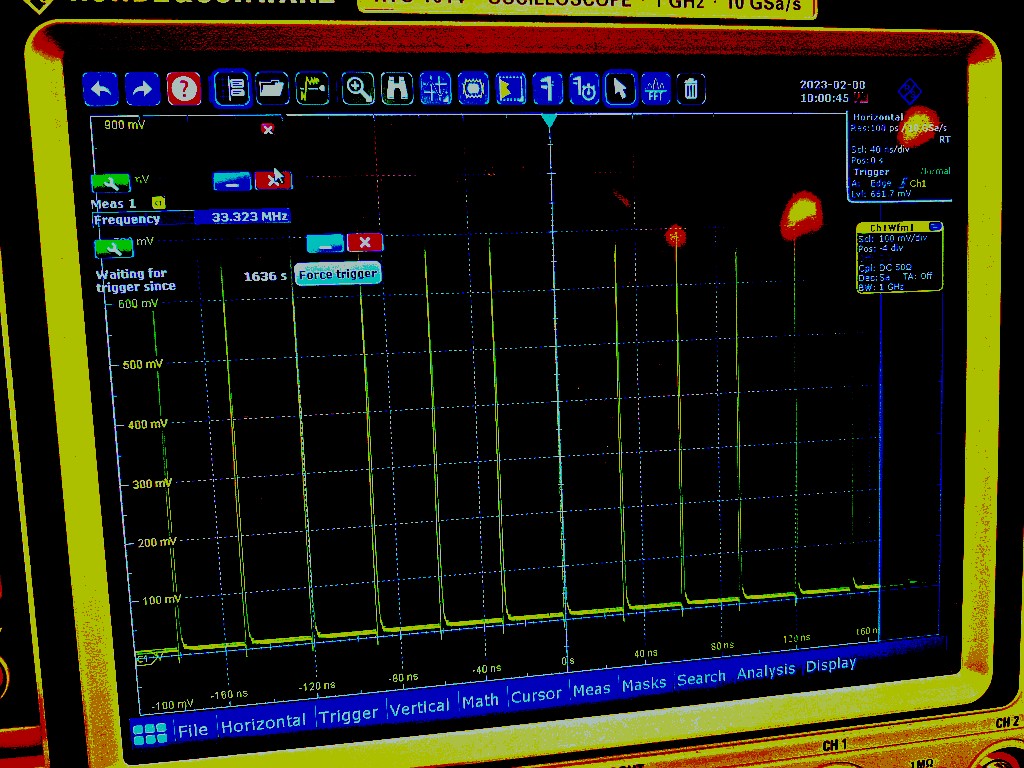
- I checked the 33MHz oscillator at the output of the fiber connected to the Shafter-Kirchhoff fiber coupler with the Labbuddy fiber photodiode and a scope.
see the picture below : the peak are clean and at 33MHz... then, the Onefive oscillator is not faulty.
- after plugging back the fiber to the amplifier input, the input average power detected by the software increased a bit around 5.5 - 5.6mW.
I tried to start again the amplifier at 0% and now, it worked without any alarm !!!
then, the origin of the "watchdog alarm" was maybe the threshold on this input power.
Then, I launched the "Alphanov" software and changed again the "threshold level", previously set at 1V (see previous post below), to 0.96V !
with this threshold level, the Alphanov software detects at the beginning a frequency of 66MHz and then decreases slowly to 33MHz => to be understood.
it should allow also more room before triggering again the "watchdog alarm" if the input average power decreases a bit => to be confirmed by Alphanov.
| Ronic Chiche wrote: |
|
the laser amplifier worked for some days but it ended to a "watchdog" alarm which switches off the amplifier... investigation is ongoing
| Ronic Chiche wrote: |
|
Ronic on Friday operated the Amplifier from the Alphanov software, switched it off then turned on the LAL software,
and it worked for 40 min without issues or error appearing,
| Ronic Chiche wrote: |
|
this morning with Manar,
- we fixed the chiller problem (+/-2°C fluctuation around the set temperature value = 25°C).
we opened and closed several times the water valve of the primary circuit to remove air bubles => no effect on the temperature variations.
we put the chiller in "Auto-Tuning" (AT) mode, then pressed the "AT" key => the chiller tune its PID parameters to optimize its temperature stabilization => no more fluctuations (+/-0.2°C fluctuation around the set temperature value = 25°C).
we had anyway a "temperature case" alarm from the Alphanov software at P=40%*Pmax, which stops the amplifier.
we put the chiller it AT mode again but with some power in the amplifier => no difference, the temperature regulation seems very good now, but we still have some "temperature case" alarms... => contact Alphanov for that.
- we changed the mount of the 2nd wedge by a kinematic mount to help for the alignment and we added an iris in the path.
now the optical path seems OK to make the beam profile measurement easily.
as we have still amplifier stops due to "temperature case" alarm, even at low power (P=20%*Pmax), we stopped the measurements => see Manar logbook post.
| Ronic Chiche wrote: |
|
this morning with Manar,
- we checked first the chiller problem.
the fluctations of +/-2° around 25°C are still there.
I discussed with Jean-Noel Cayla about the possible problem of the "dirty" water in the primary circuit.
he told me that the water goes through 3 "effective" filters, then the water should not be too dirty in the primary circuit even if one uses "common water" to fill it.
he told me also that the water temperature could be a bit higher than before, around 22°C, and that could prevent a good thermal exchange with the secundary circuit (the one of the amplifier).
=> the resistivity is about 7Mohmhs.
we had again a "case temperature alarm" from the Alphanov Software, after 1h of work @ 20%
this stopped the amplifier, we did not restart it.
- we measured the beam path with the wedges :
compressor box output to mirror : 17cm
mirror to 1s wedge : 24 cm
1st wedge to 2nd wedge : 24.5 cm
2nd wedge to lift bottom mirror : 136 cm
lift bottom mirror to top mirror : 14 cm
lift top mirror to beam profiler (x=0) : 7 cm
- we measured the beam profile at 3 positions with amplifier @ 20% + 2 wedges :
the power is ~ 70 µW
we made the measurements at x=0, x=60 cm, x=120cm
after that, we had the Alphanov amplifier "temperature case incident" and we stopped the measurements.
| Ronic Chiche wrote: |
|
yesterday morning with Manar,
1) we fixed the threshold level of the laser input signal which makes the measurement of the repetition rate.
(if the rep rate is not measured properly, the amplifier safety interlock stops immediately the amplification).
we followed a tutorial from Guillaume Machinet.
when you start the Alphanov control software, 4 panels pops up : central control, 2nd stage amplifier, and 2 panels for controlling the pumps of the 3rd stage amplifier.
!!! Warning !!! ..... if you switch ON the amplifier using the central control panel, the amplifier starts immediately AT FULL POWER..... !!! Warning !!!
it is not mentionned in the tutorial document.
to prevent this problem, you first need to switch "Laser OFF" on the 2 panels controlling the pumps of the 3rd stage amplifier and let "Laser ON" only on the panel controlling the 2nd stage.
after starting the amplifier, we tried to find the median value of the threshold to get ~33MHz instead of 100MHz measured previously.
the initial voltage threshold on the photodiode measuring the rep rate was 0.4V which leads to get 100MHz.
first, we changed step by step the threshold to reach 0.87V => one gets 33MHz.
we tried the find the maximum threshold but once the level is above the signal maximum value, it triggers an alarm and stops immediately the amplifier.
then, one needs to restart completely the software which can be tedious due to connections/alarms issues.
finaly, we found out that the low and high level thresholds to get 33MHz were not reproductible at each start of the amplifier... :-(
then, we put the threshold at 1V following the turial procedure which seems to work.
2) we installed the optical scheme to make the beam profile measurement : see attached image
we used the HR mirror close to the amplifier output (as putting a wedge at that place is not convenient if you want to properly dump the transmission and reflections).
and then, we placed 2 wedges, using the front reflection to get low power beam profile.
the Thorlabs LB2 has been used to dump the transmission of the first wedge, it can handle 25kW/cm² and 25J/cm².
we used black aluminium screens to dump the secondary beams.
we measured after the 2 wedges :
amplifier at 20% => 71µW
amplifier at 30% => 139µW
amplifier at 40% => 200µW
it has to be compared with the amplifier power :
amplifier at 20% => 8.7 W
amplifier at 30% => 17 W
amplifier at 40% => 26 W
which leads to a reflection coefficient of the wedge of 0.28%.
=> OK, as one uses PS811-B Thorlabs 4° wedges with B coating.
with B coating, the reflectivity given by the manufacturer is around 0.3% @ 1030nm.
unfortunately, we had a "case temperature alarm" coming from the Alphanov software when we reached 40% for the amplification level.
this alarm stopped immediately the amplifier.
we saw that the chiller was in warning state too and the "present temperature PV" was not stable at all, flutuating by 3-4 degrees after the amplifier has been turned off...
we restarted several times the chiller to see if the problem disapears but it was still there ! => to be investiguated !
PS : we changed the USB cable between the amplifier controler and the PC to try to fix the several "connexion lost" problems but it didn't help...
PS2 : after discussing with Sophie Chance and Marie Jacquet, ThomX suffered a water circuit leakage on Monday:
the full circuit has been emptied and they had to remplace the water by some common water and not demineralized water....
it can be related to the chilller issue observed yesterday !
| Ronic Chiche wrote: |
|
today with Manar, we brought everything to make the profile measurement.
the chiller was in error because of the water level : we filled it in.
! warning ! there is no alarm signal, only a message on the screen.
we checked the incoming power measured by the software : 5.5 mW => OK
and we measured the output power (with pump) for :
0% => ~ 300 mW
10% => ~900 mW
20% => 8.65 W
30% => 17W
=> same as before.
the first HR mirror at the output of the amplifier was slightly scratched => we replaced it.
for sake of simplicity, we plan to use first a HR mirror and then 2x wedges for the profile measurement => to be checked next time.
we have to remove secundary beam reflections, then wedges are easier to use than AR/AR mirrors (as the 2 reflected beams are parallele).
at full power, the output power is ~ 70W
after 1st wedge : 2.8W
after 2nd wedge : 112 mW => the power should be low enough to use absorptive filters in front of the beam profiler.
|
|
|
|
|
|
|
| Attachment 1: scope.jpg
|  |
|
185
|
Wed Feb 8 14:09:50 2023 |
Ronic Chiche | Fixed | report | lasers and optics | software | ThomX igloo | Alphanov amplifier beam profile measurement | With Daniele after, we took a readings of the beam with a lens of 750 mm.
From the observed data, we can state that the beam is not completely Gaussian M2 > 1, due to the variation of the ellipticity of the beam along the focused path
readings have been saved and will be added after processing them.
Also adding to the previous comment about the error, after closing the bunker and starting the measurement we did not have issue for around 20 min then the same error appeared (alarm triggered by Watchdog) it shows when the input average power detected by the software was around 5.474 mW , I did a reset of the software then turned the amplifier on and the reading is 5.515mW it works for about 2 minutes (enough to take 2 readings) then it switches off. In addition, there was a drop in the power reading on the PD_preamp2 (which seems related to watchdog issue) we had to do this many times in order to finish taking the readings .
| Ronic Chiche wrote: |
|
we have had this new issue (watchdog alarm switching off the amplifier) for several days.
Alphanov mentionned it could come from the input oscillator stability (modelock loss for example).
Today,
- I tried to start the amplifier at 0% but it ended immediately in a "watchdog alarm" which stopped the amplifier
the input average power detected by the software was around 5.2mW, far above the 2mW needed by the amplifier.
- I checked the 33MHz oscillator at the output of the fiber connected to the Shafter-Kirchhoff fiber coupler with the Labbuddy fiber photodiode and a scope.
see the picture below : the peak are clean and at 33MHz... then, the Onefive oscillator is not faulty.
- after plugging back the fiber to the amplifier input, the input average power detected by the software increased a bit around 5.5 - 5.6mW.
I tried to start again the amplifier at 0% and now, it worked without any alarm !!!
then, the origin of the "watchdog alarm" was maybe the threshold on this input power.
Then, I launched the "Alphanov" software and changed again the "threshold level", previously set at 1V (see previous post below), to 0.96V !
with this threshold level, the Alphanov software detects at the beginning a frequency of 66MHz and then decreases slowly to 33MHz => to be understood.
it should allow also more room before triggering again the "watchdog alarm" if the input average power decreases a bit => to be confirmed by Alphanov.
| Ronic Chiche wrote: |
|
the laser amplifier worked for some days but it ended to a "watchdog" alarm which switches off the amplifier... investigation is ongoing
| Ronic Chiche wrote: |
|
Ronic on Friday operated the Amplifier from the Alphanov software, switched it off then turned on the LAL software,
and it worked for 40 min without issues or error appearing,
| Ronic Chiche wrote: |
|
this morning with Manar,
- we fixed the chiller problem (+/-2°C fluctuation around the set temperature value = 25°C).
we opened and closed several times the water valve of the primary circuit to remove air bubles => no effect on the temperature variations.
we put the chiller in "Auto-Tuning" (AT) mode, then pressed the "AT" key => the chiller tune its PID parameters to optimize its temperature stabilization => no more fluctuations (+/-0.2°C fluctuation around the set temperature value = 25°C).
we had anyway a "temperature case" alarm from the Alphanov software at P=40%*Pmax, which stops the amplifier.
we put the chiller it AT mode again but with some power in the amplifier => no difference, the temperature regulation seems very good now, but we still have some "temperature case" alarms... => contact Alphanov for that.
- we changed the mount of the 2nd wedge by a kinematic mount to help for the alignment and we added an iris in the path.
now the optical path seems OK to make the beam profile measurement easily.
as we have still amplifier stops due to "temperature case" alarm, even at low power (P=20%*Pmax), we stopped the measurements => see Manar logbook post.
| Ronic Chiche wrote: |
|
this morning with Manar,
- we checked first the chiller problem.
the fluctations of +/-2° around 25°C are still there.
I discussed with Jean-Noel Cayla about the possible problem of the "dirty" water in the primary circuit.
he told me that the water goes through 3 "effective" filters, then the water should not be too dirty in the primary circuit even if one uses "common water" to fill it.
he told me also that the water temperature could be a bit higher than before, around 22°C, and that could prevent a good thermal exchange with the secundary circuit (the one of the amplifier).
=> the resistivity is about 7Mohmhs.
we had again a "case temperature alarm" from the Alphanov Software, after 1h of work @ 20%
this stopped the amplifier, we did not restart it.
- we measured the beam path with the wedges :
compressor box output to mirror : 17cm
mirror to 1s wedge : 24 cm
1st wedge to 2nd wedge : 24.5 cm
2nd wedge to lift bottom mirror : 136 cm
lift bottom mirror to top mirror : 14 cm
lift top mirror to beam profiler (x=0) : 7 cm
- we measured the beam profile at 3 positions with amplifier @ 20% + 2 wedges :
the power is ~ 70 µW
we made the measurements at x=0, x=60 cm, x=120cm
after that, we had the Alphanov amplifier "temperature case incident" and we stopped the measurements.
| Ronic Chiche wrote: |
|
yesterday morning with Manar,
1) we fixed the threshold level of the laser input signal which makes the measurement of the repetition rate.
(if the rep rate is not measured properly, the amplifier safety interlock stops immediately the amplification).
we followed a tutorial from Guillaume Machinet.
when you start the Alphanov control software, 4 panels pops up : central control, 2nd stage amplifier, and 2 panels for controlling the pumps of the 3rd stage amplifier.
!!! Warning !!! ..... if you switch ON the amplifier using the central control panel, the amplifier starts immediately AT FULL POWER..... !!! Warning !!!
it is not mentionned in the tutorial document.
to prevent this problem, you first need to switch "Laser OFF" on the 2 panels controlling the pumps of the 3rd stage amplifier and let "Laser ON" only on the panel controlling the 2nd stage.
after starting the amplifier, we tried to find the median value of the threshold to get ~33MHz instead of 100MHz measured previously.
the initial voltage threshold on the photodiode measuring the rep rate was 0.4V which leads to get 100MHz.
first, we changed step by step the threshold to reach 0.87V => one gets 33MHz.
we tried the find the maximum threshold but once the level is above the signal maximum value, it triggers an alarm and stops immediately the amplifier.
then, one needs to restart completely the software which can be tedious due to connections/alarms issues.
finaly, we found out that the low and high level thresholds to get 33MHz were not reproductible at each start of the amplifier... :-(
then, we put the threshold at 1V following the turial procedure which seems to work.
2) we installed the optical scheme to make the beam profile measurement : see attached image
we used the HR mirror close to the amplifier output (as putting a wedge at that place is not convenient if you want to properly dump the transmission and reflections).
and then, we placed 2 wedges, using the front reflection to get low power beam profile.
the Thorlabs LB2 has been used to dump the transmission of the first wedge, it can handle 25kW/cm² and 25J/cm².
we used black aluminium screens to dump the secondary beams.
we measured after the 2 wedges :
amplifier at 20% => 71µW
amplifier at 30% => 139µW
amplifier at 40% => 200µW
it has to be compared with the amplifier power :
amplifier at 20% => 8.7 W
amplifier at 30% => 17 W
amplifier at 40% => 26 W
which leads to a reflection coefficient of the wedge of 0.28%.
=> OK, as one uses PS811-B Thorlabs 4° wedges with B coating.
with B coating, the reflectivity given by the manufacturer is around 0.3% @ 1030nm.
unfortunately, we had a "case temperature alarm" coming from the Alphanov software when we reached 40% for the amplification level.
this alarm stopped immediately the amplifier.
we saw that the chiller was in warning state too and the "present temperature PV" was not stable at all, flutuating by 3-4 degrees after the amplifier has been turned off...
we restarted several times the chiller to see if the problem disapears but it was still there ! => to be investiguated !
PS : we changed the USB cable between the amplifier controler and the PC to try to fix the several "connexion lost" problems but it didn't help...
PS2 : after discussing with Sophie Chance and Marie Jacquet, ThomX suffered a water circuit leakage on Monday:
the full circuit has been emptied and they had to remplace the water by some common water and not demineralized water....
it can be related to the chilller issue observed yesterday !
| Ronic Chiche wrote: |
|
today with Manar, we brought everything to make the profile measurement.
the chiller was in error because of the water level : we filled it in.
! warning ! there is no alarm signal, only a message on the screen.
we checked the incoming power measured by the software : 5.5 mW => OK
and we measured the output power (with pump) for :
0% => ~ 300 mW
10% => ~900 mW
20% => 8.65 W
30% => 17W
=> same as before.
the first HR mirror at the output of the amplifier was slightly scratched => we replaced it.
for sake of simplicity, we plan to use first a HR mirror and then 2x wedges for the profile measurement => to be checked next time.
we have to remove secundary beam reflections, then wedges are easier to use than AR/AR mirrors (as the 2 reflected beams are parallele).
at full power, the output power is ~ 70W
after 1st wedge : 2.8W
after 2nd wedge : 112 mW => the power should be low enough to use absorptive filters in front of the beam profiler.
|
|
|
|
|
|
|
|
| Attachment 1: 20230208_error_watchdog.jpeg
|  |
|
186
|
Fri Feb 10 09:54:46 2023 |
Ronic Chiche | Fixed | report | lasers and optics | software | ThomX igloo | Alphanov amplifier beam profile measurement | This morning,
- with the "Alphanov" software => Central panel => "system" button => Watchdog "Period Max" was at 100ns and has been set to 200ns.
(Alphanov told me to change the value from 50ns to 100ns but it was already at 100ns, then I set it to 200ns).
=> to be checked with Alphanov : what is the meaning of this parameter.
- it seems the watchdog alarm is related to the "PD_IN" parameter value of the "LAL" software (5.5mW is OK, but 5.2mW triggers the alarm).
my understanding is the Threshold Voltage, which detects the input signal to measure the repetition rate, could be at a too high level... even very close to the max level of the signal.
then if the input decreases a little bit, the signal goes below this Threshold Voltage => the software does not detect a signal any more => it triggers the watchdog alarm and the amplifier stops
(which stops also the preamplifier, related to the PD_CRI of the "Alphanov" software which goes to ~0W. PD_Preamp2 is a copy of PD_CRI but in the "LAL" software).
then, I changed back the Threshold Voltage from 0.96V (to detect properly 33MHz rep rate) to 0.7V which is close to the original value (0.67V) but for which the software detects ~100MHz rep. rate !
with this Threshold level, I did a test by detuning very slightly the input power by unscrewing a little bit the fiber-fiber coupler => PD_IN = 4.9mW => no alarm triggered !
then I screwed back the coupler => PD_IN = 5.6mW.
I did a power test with 3rd stage of the amplifier at 20% during 15 minutes => no alarm.
conclusion : there is an issue with the rep rate detection.
at 33MHz, one needs to put the threshold at the limit of the signal which fires an alarm if the signal decreased a little bit.
by lowering the threshold => no more alarm (I hope) but a wrong rep rate value !
| Ronic Chiche wrote: |
|
With Daniele after, we took a readings of the beam with a lens of 750 mm.
From the observed data, we can state that the beam is not completely Gaussian M2 > 1, due to the variation of the ellipticity of the beam along the focused path
readings have been saved and will be added after processing them.
Also adding to the previous comment about the error, after closing the bunker and starting the measurement we did not have issue for around 20 min then the same error appeared (alarm triggered by Watchdog) it shows when the input average power detected by the software was around 5.474 mW , I did a reset of the software then turned the amplifier on and the reading is 5.515mW it works for about 2 minutes (enough to take 2 readings) then it switches off. In addition, there was a drop in the power reading on the PD_preamp2 (which seems related to watchdog issue) we had to do this many times in order to finish taking the readings .
| Ronic Chiche wrote: |
|
we have had this new issue (watchdog alarm switching off the amplifier) for several days.
Alphanov mentionned it could come from the input oscillator stability (modelock loss for example).
Today,
- I tried to start the amplifier at 0% but it ended immediately in a "watchdog alarm" which stopped the amplifier
the input average power detected by the software was around 5.2mW, far above the 2mW needed by the amplifier.
- I checked the 33MHz oscillator at the output of the fiber connected to the Shafter-Kirchhoff fiber coupler with the Labbuddy fiber photodiode and a scope.
see the picture below : the peak are clean and at 33MHz... then, the Onefive oscillator is not faulty.
- after plugging back the fiber to the amplifier input, the input average power detected by the software increased a bit around 5.5 - 5.6mW.
I tried to start again the amplifier at 0% and now, it worked without any alarm !!!
then, the origin of the "watchdog alarm" was maybe the threshold on this input power.
Then, I launched the "Alphanov" software and changed again the "threshold level", previously set at 1V (see previous post below), to 0.96V !
with this threshold level, the Alphanov software detects at the beginning a frequency of 66MHz and then decreases slowly to 33MHz => to be understood.
it should allow also more room before triggering again the "watchdog alarm" if the input average power decreases a bit => to be confirmed by Alphanov.
| Ronic Chiche wrote: |
|
the laser amplifier worked for some days but it ended to a "watchdog" alarm which switches off the amplifier... investigation is ongoing
| Ronic Chiche wrote: |
|
Ronic on Friday operated the Amplifier from the Alphanov software, switched it off then turned on the LAL software,
and it worked for 40 min without issues or error appearing,
| Ronic Chiche wrote: |
|
this morning with Manar,
- we fixed the chiller problem (+/-2°C fluctuation around the set temperature value = 25°C).
we opened and closed several times the water valve of the primary circuit to remove air bubles => no effect on the temperature variations.
we put the chiller in "Auto-Tuning" (AT) mode, then pressed the "AT" key => the chiller tune its PID parameters to optimize its temperature stabilization => no more fluctuations (+/-0.2°C fluctuation around the set temperature value = 25°C).
we had anyway a "temperature case" alarm from the Alphanov software at P=40%*Pmax, which stops the amplifier.
we put the chiller it AT mode again but with some power in the amplifier => no difference, the temperature regulation seems very good now, but we still have some "temperature case" alarms... => contact Alphanov for that.
- we changed the mount of the 2nd wedge by a kinematic mount to help for the alignment and we added an iris in the path.
now the optical path seems OK to make the beam profile measurement easily.
as we have still amplifier stops due to "temperature case" alarm, even at low power (P=20%*Pmax), we stopped the measurements => see Manar logbook post.
| Ronic Chiche wrote: |
|
this morning with Manar,
- we checked first the chiller problem.
the fluctations of +/-2° around 25°C are still there.
I discussed with Jean-Noel Cayla about the possible problem of the "dirty" water in the primary circuit.
he told me that the water goes through 3 "effective" filters, then the water should not be too dirty in the primary circuit even if one uses "common water" to fill it.
he told me also that the water temperature could be a bit higher than before, around 22°C, and that could prevent a good thermal exchange with the secundary circuit (the one of the amplifier).
=> the resistivity is about 7Mohmhs.
we had again a "case temperature alarm" from the Alphanov Software, after 1h of work @ 20%
this stopped the amplifier, we did not restart it.
- we measured the beam path with the wedges :
compressor box output to mirror : 17cm
mirror to 1s wedge : 24 cm
1st wedge to 2nd wedge : 24.5 cm
2nd wedge to lift bottom mirror : 136 cm
lift bottom mirror to top mirror : 14 cm
lift top mirror to beam profiler (x=0) : 7 cm
- we measured the beam profile at 3 positions with amplifier @ 20% + 2 wedges :
the power is ~ 70 µW
we made the measurements at x=0, x=60 cm, x=120cm
after that, we had the Alphanov amplifier "temperature case incident" and we stopped the measurements.
| Ronic Chiche wrote: |
|
yesterday morning with Manar,
1) we fixed the threshold level of the laser input signal which makes the measurement of the repetition rate.
(if the rep rate is not measured properly, the amplifier safety interlock stops immediately the amplification).
we followed a tutorial from Guillaume Machinet.
when you start the Alphanov control software, 4 panels pops up : central control, 2nd stage amplifier, and 2 panels for controlling the pumps of the 3rd stage amplifier.
!!! Warning !!! ..... if you switch ON the amplifier using the central control panel, the amplifier starts immediately AT FULL POWER..... !!! Warning !!!
it is not mentionned in the tutorial document.
to prevent this problem, you first need to switch "Laser OFF" on the 2 panels controlling the pumps of the 3rd stage amplifier and let "Laser ON" only on the panel controlling the 2nd stage.
after starting the amplifier, we tried to find the median value of the threshold to get ~33MHz instead of 100MHz measured previously.
the initial voltage threshold on the photodiode measuring the rep rate was 0.4V which leads to get 100MHz.
first, we changed step by step the threshold to reach 0.87V => one gets 33MHz.
we tried the find the maximum threshold but once the level is above the signal maximum value, it triggers an alarm and stops immediately the amplifier.
then, one needs to restart completely the software which can be tedious due to connections/alarms issues.
finaly, we found out that the low and high level thresholds to get 33MHz were not reproductible at each start of the amplifier... :-(
then, we put the threshold at 1V following the turial procedure which seems to work.
2) we installed the optical scheme to make the beam profile measurement : see attached image
we used the HR mirror close to the amplifier output (as putting a wedge at that place is not convenient if you want to properly dump the transmission and reflections).
and then, we placed 2 wedges, using the front reflection to get low power beam profile.
the Thorlabs LB2 has been used to dump the transmission of the first wedge, it can handle 25kW/cm² and 25J/cm².
we used black aluminium screens to dump the secondary beams.
we measured after the 2 wedges :
amplifier at 20% => 71µW
amplifier at 30% => 139µW
amplifier at 40% => 200µW
it has to be compared with the amplifier power :
amplifier at 20% => 8.7 W
amplifier at 30% => 17 W
amplifier at 40% => 26 W
which leads to a reflection coefficient of the wedge of 0.28%.
=> OK, as one uses PS811-B Thorlabs 4° wedges with B coating.
with B coating, the reflectivity given by the manufacturer is around 0.3% @ 1030nm.
unfortunately, we had a "case temperature alarm" coming from the Alphanov software when we reached 40% for the amplification level.
this alarm stopped immediately the amplifier.
we saw that the chiller was in warning state too and the "present temperature PV" was not stable at all, flutuating by 3-4 degrees after the amplifier has been turned off...
we restarted several times the chiller to see if the problem disapears but it was still there ! => to be investiguated !
PS : we changed the USB cable between the amplifier controler and the PC to try to fix the several "connexion lost" problems but it didn't help...
PS2 : after discussing with Sophie Chance and Marie Jacquet, ThomX suffered a water circuit leakage on Monday:
the full circuit has been emptied and they had to remplace the water by some common water and not demineralized water....
it can be related to the chilller issue observed yesterday !
| Ronic Chiche wrote: |
|
today with Manar, we brought everything to make the profile measurement.
the chiller was in error because of the water level : we filled it in.
! warning ! there is no alarm signal, only a message on the screen.
we checked the incoming power measured by the software : 5.5 mW => OK
and we measured the output power (with pump) for :
0% => ~ 300 mW
10% => ~900 mW
20% => 8.65 W
30% => 17W
=> same as before.
the first HR mirror at the output of the amplifier was slightly scratched => we replaced it.
for sake of simplicity, we plan to use first a HR mirror and then 2x wedges for the profile measurement => to be checked next time.
we have to remove secundary beam reflections, then wedges are easier to use than AR/AR mirrors (as the 2 reflected beams are parallele).
at full power, the output power is ~ 70W
after 1st wedge : 2.8W
after 2nd wedge : 112 mW => the power should be low enough to use absorptive filters in front of the beam profiler.
|
|
|
|
|
|
|
|
|
|
187
|
Tue Feb 14 12:53:09 2023 |
Ronic Chiche | Fixed | report | lasers and optics | software | ThomX igloo | Alphanov amplifier beam profile measurement | This morning with Daniele, we did a second measurement of the beam profile using a different lens of focal 400 mm.
at a power amplification of 20%
the amplifier stayed on for around one hour and a half with no errors.
tomorrow will attemt to do one at higher amplification percentage.
data will be added after processing.
| Ronic Chiche wrote: |
|
This morning,
- with the "Alphanov" software => Central panel => "system" button => Watchdog "Period Max" was at 100ns and has been set to 200ns.
(Alphanov told me to change the value from 50ns to 100ns but it was already at 100ns, then I set it to 200ns).
=> to be checked with Alphanov : what is the meaning of this parameter.
- it seems the watchdog alarm is related to the "PD_IN" parameter value of the "LAL" software (5.5mW is OK, but 5.2mW triggers the alarm).
my understanding is the Threshold Voltage, which detects the input signal to measure the repetition rate, could be at a too high level... even very close to the max level of the signal.
then if the input decreases a little bit, the signal goes below this Threshold Voltage => the software does not detect a signal any more => it triggers the watchdog alarm and the amplifier stops
(which stops also the preamplifier, related to the PD_CRI of the "Alphanov" software which goes to ~0W. PD_Preamp2 is a copy of PD_CRI but in the "LAL" software).
then, I changed back the Threshold Voltage from 0.96V (to detect properly 33MHz rep rate) to 0.7V which is close to the original value (0.67V) but for which the software detects ~100MHz rep. rate !
with this Threshold level, I did a test by detuning very slightly the input power by unscrewing a little bit the fiber-fiber coupler => PD_IN = 4.9mW => no alarm triggered !
then I screwed back the coupler => PD_IN = 5.6mW.
I did a power test with 3rd stage of the amplifier at 20% during 15 minutes => no alarm.
conclusion : there is an issue with the rep rate detection.
at 33MHz, one needs to put the threshold at the limit of the signal which fires an alarm if the signal decreased a little bit.
by lowering the threshold => no more alarm (I hope) but a wrong rep rate value !
| Ronic Chiche wrote: |
|
With Daniele after, we took a readings of the beam with a lens of 750 mm.
From the observed data, we can state that the beam is not completely Gaussian M2 > 1, due to the variation of the ellipticity of the beam along the focused path
readings have been saved and will be added after processing them.
Also adding to the previous comment about the error, after closing the bunker and starting the measurement we did not have issue for around 20 min then the same error appeared (alarm triggered by Watchdog) it shows when the input average power detected by the software was around 5.474 mW , I did a reset of the software then turned the amplifier on and the reading is 5.515mW it works for about 2 minutes (enough to take 2 readings) then it switches off. In addition, there was a drop in the power reading on the PD_preamp2 (which seems related to watchdog issue) we had to do this many times in order to finish taking the readings .
| Ronic Chiche wrote: |
|
we have had this new issue (watchdog alarm switching off the amplifier) for several days.
Alphanov mentionned it could come from the input oscillator stability (modelock loss for example).
Today,
- I tried to start the amplifier at 0% but it ended immediately in a "watchdog alarm" which stopped the amplifier
the input average power detected by the software was around 5.2mW, far above the 2mW needed by the amplifier.
- I checked the 33MHz oscillator at the output of the fiber connected to the Shafter-Kirchhoff fiber coupler with the Labbuddy fiber photodiode and a scope.
see the picture below : the peak are clean and at 33MHz... then, the Onefive oscillator is not faulty.
- after plugging back the fiber to the amplifier input, the input average power detected by the software increased a bit around 5.5 - 5.6mW.
I tried to start again the amplifier at 0% and now, it worked without any alarm !!!
then, the origin of the "watchdog alarm" was maybe the threshold on this input power.
Then, I launched the "Alphanov" software and changed again the "threshold level", previously set at 1V (see previous post below), to 0.96V !
with this threshold level, the Alphanov software detects at the beginning a frequency of 66MHz and then decreases slowly to 33MHz => to be understood.
it should allow also more room before triggering again the "watchdog alarm" if the input average power decreases a bit => to be confirmed by Alphanov.
| Ronic Chiche wrote: |
|
the laser amplifier worked for some days but it ended to a "watchdog" alarm which switches off the amplifier... investigation is ongoing
| Ronic Chiche wrote: |
|
Ronic on Friday operated the Amplifier from the Alphanov software, switched it off then turned on the LAL software,
and it worked for 40 min without issues or error appearing,
| Ronic Chiche wrote: |
|
this morning with Manar,
- we fixed the chiller problem (+/-2°C fluctuation around the set temperature value = 25°C).
we opened and closed several times the water valve of the primary circuit to remove air bubles => no effect on the temperature variations.
we put the chiller in "Auto-Tuning" (AT) mode, then pressed the "AT" key => the chiller tune its PID parameters to optimize its temperature stabilization => no more fluctuations (+/-0.2°C fluctuation around the set temperature value = 25°C).
we had anyway a "temperature case" alarm from the Alphanov software at P=40%*Pmax, which stops the amplifier.
we put the chiller it AT mode again but with some power in the amplifier => no difference, the temperature regulation seems very good now, but we still have some "temperature case" alarms... => contact Alphanov for that.
- we changed the mount of the 2nd wedge by a kinematic mount to help for the alignment and we added an iris in the path.
now the optical path seems OK to make the beam profile measurement easily.
as we have still amplifier stops due to "temperature case" alarm, even at low power (P=20%*Pmax), we stopped the measurements => see Manar logbook post.
| Ronic Chiche wrote: |
|
this morning with Manar,
- we checked first the chiller problem.
the fluctations of +/-2° around 25°C are still there.
I discussed with Jean-Noel Cayla about the possible problem of the "dirty" water in the primary circuit.
he told me that the water goes through 3 "effective" filters, then the water should not be too dirty in the primary circuit even if one uses "common water" to fill it.
he told me also that the water temperature could be a bit higher than before, around 22°C, and that could prevent a good thermal exchange with the secundary circuit (the one of the amplifier).
=> the resistivity is about 7Mohmhs.
we had again a "case temperature alarm" from the Alphanov Software, after 1h of work @ 20%
this stopped the amplifier, we did not restart it.
- we measured the beam path with the wedges :
compressor box output to mirror : 17cm
mirror to 1s wedge : 24 cm
1st wedge to 2nd wedge : 24.5 cm
2nd wedge to lift bottom mirror : 136 cm
lift bottom mirror to top mirror : 14 cm
lift top mirror to beam profiler (x=0) : 7 cm
- we measured the beam profile at 3 positions with amplifier @ 20% + 2 wedges :
the power is ~ 70 µW
we made the measurements at x=0, x=60 cm, x=120cm
after that, we had the Alphanov amplifier "temperature case incident" and we stopped the measurements.
| Ronic Chiche wrote: |
|
yesterday morning with Manar,
1) we fixed the threshold level of the laser input signal which makes the measurement of the repetition rate.
(if the rep rate is not measured properly, the amplifier safety interlock stops immediately the amplification).
we followed a tutorial from Guillaume Machinet.
when you start the Alphanov control software, 4 panels pops up : central control, 2nd stage amplifier, and 2 panels for controlling the pumps of the 3rd stage amplifier.
!!! Warning !!! ..... if you switch ON the amplifier using the central control panel, the amplifier starts immediately AT FULL POWER..... !!! Warning !!!
it is not mentionned in the tutorial document.
to prevent this problem, you first need to switch "Laser OFF" on the 2 panels controlling the pumps of the 3rd stage amplifier and let "Laser ON" only on the panel controlling the 2nd stage.
after starting the amplifier, we tried to find the median value of the threshold to get ~33MHz instead of 100MHz measured previously.
the initial voltage threshold on the photodiode measuring the rep rate was 0.4V which leads to get 100MHz.
first, we changed step by step the threshold to reach 0.87V => one gets 33MHz.
we tried the find the maximum threshold but once the level is above the signal maximum value, it triggers an alarm and stops immediately the amplifier.
then, one needs to restart completely the software which can be tedious due to connections/alarms issues.
finaly, we found out that the low and high level thresholds to get 33MHz were not reproductible at each start of the amplifier... :-(
then, we put the threshold at 1V following the turial procedure which seems to work.
2) we installed the optical scheme to make the beam profile measurement : see attached image
we used the HR mirror close to the amplifier output (as putting a wedge at that place is not convenient if you want to properly dump the transmission and reflections).
and then, we placed 2 wedges, using the front reflection to get low power beam profile.
the Thorlabs LB2 has been used to dump the transmission of the first wedge, it can handle 25kW/cm² and 25J/cm².
we used black aluminium screens to dump the secondary beams.
we measured after the 2 wedges :
amplifier at 20% => 71µW
amplifier at 30% => 139µW
amplifier at 40% => 200µW
it has to be compared with the amplifier power :
amplifier at 20% => 8.7 W
amplifier at 30% => 17 W
amplifier at 40% => 26 W
which leads to a reflection coefficient of the wedge of 0.28%.
=> OK, as one uses PS811-B Thorlabs 4° wedges with B coating.
with B coating, the reflectivity given by the manufacturer is around 0.3% @ 1030nm.
unfortunately, we had a "case temperature alarm" coming from the Alphanov software when we reached 40% for the amplification level.
this alarm stopped immediately the amplifier.
we saw that the chiller was in warning state too and the "present temperature PV" was not stable at all, flutuating by 3-4 degrees after the amplifier has been turned off...
we restarted several times the chiller to see if the problem disapears but it was still there ! => to be investiguated !
PS : we changed the USB cable between the amplifier controler and the PC to try to fix the several "connexion lost" problems but it didn't help...
PS2 : after discussing with Sophie Chance and Marie Jacquet, ThomX suffered a water circuit leakage on Monday:
the full circuit has been emptied and they had to remplace the water by some common water and not demineralized water....
it can be related to the chilller issue observed yesterday !
| Ronic Chiche wrote: |
|
today with Manar, we brought everything to make the profile measurement.
the chiller was in error because of the water level : we filled it in.
! warning ! there is no alarm signal, only a message on the screen.
we checked the incoming power measured by the software : 5.5 mW => OK
and we measured the output power (with pump) for :
0% => ~ 300 mW
10% => ~900 mW
20% => 8.65 W
30% => 17W
=> same as before.
the first HR mirror at the output of the amplifier was slightly scratched => we replaced it.
for sake of simplicity, we plan to use first a HR mirror and then 2x wedges for the profile measurement => to be checked next time.
we have to remove secundary beam reflections, then wedges are easier to use than AR/AR mirrors (as the 2 reflected beams are parallele).
at full power, the output power is ~ 70W
after 1st wedge : 2.8W
after 2nd wedge : 112 mW => the power should be low enough to use absorptive filters in front of the beam profiler.
|
|
|
|
|
|
|
|
|
|
|
188
|
Wed Feb 22 16:11:32 2023 |
Ronic Chiche | Fixed | report | lasers and optics | software | ThomX igloo | Alphanov amplifier beam profile measurement | On Monday 20th of February, Daniele and Viktor took some beam profile measurement data @ 50% of power amplification.
data and analysis can be found in the attached file.
| Ronic Chiche wrote: |
|
This morning with Daniele, we did a second measurement of the beam profile using a different lens of focal 400 mm.
at a power amplification of 20%
the amplifier stayed on for around one hour and a half with no errors.
tomorrow will attemt to do one at higher amplification percentage.
data will be added after processing.
| Ronic Chiche wrote: |
|
This morning,
- with the "Alphanov" software => Central panel => "system" button => Watchdog "Period Max" was at 100ns and has been set to 200ns.
(Alphanov told me to change the value from 50ns to 100ns but it was already at 100ns, then I set it to 200ns).
=> to be checked with Alphanov : what is the meaning of this parameter.
- it seems the watchdog alarm is related to the "PD_IN" parameter value of the "LAL" software (5.5mW is OK, but 5.2mW triggers the alarm).
my understanding is the Threshold Voltage, which detects the input signal to measure the repetition rate, could be at a too high level... even very close to the max level of the signal.
then if the input decreases a little bit, the signal goes below this Threshold Voltage => the software does not detect a signal any more => it triggers the watchdog alarm and the amplifier stops
(which stops also the preamplifier, related to the PD_CRI of the "Alphanov" software which goes to ~0W. PD_Preamp2 is a copy of PD_CRI but in the "LAL" software).
then, I changed back the Threshold Voltage from 0.96V (to detect properly 33MHz rep rate) to 0.7V which is close to the original value (0.67V) but for which the software detects ~100MHz rep. rate !
with this Threshold level, I did a test by detuning very slightly the input power by unscrewing a little bit the fiber-fiber coupler => PD_IN = 4.9mW => no alarm triggered !
then I screwed back the coupler => PD_IN = 5.6mW.
I did a power test with 3rd stage of the amplifier at 20% during 15 minutes => no alarm.
conclusion : there is an issue with the rep rate detection.
at 33MHz, one needs to put the threshold at the limit of the signal which fires an alarm if the signal decreased a little bit.
by lowering the threshold => no more alarm (I hope) but a wrong rep rate value !
| Ronic Chiche wrote: |
|
With Daniele after, we took a readings of the beam with a lens of 750 mm.
From the observed data, we can state that the beam is not completely Gaussian M2 > 1, due to the variation of the ellipticity of the beam along the focused path
readings have been saved and will be added after processing them.
Also adding to the previous comment about the error, after closing the bunker and starting the measurement we did not have issue for around 20 min then the same error appeared (alarm triggered by Watchdog) it shows when the input average power detected by the software was around 5.474 mW , I did a reset of the software then turned the amplifier on and the reading is 5.515mW it works for about 2 minutes (enough to take 2 readings) then it switches off. In addition, there was a drop in the power reading on the PD_preamp2 (which seems related to watchdog issue) we had to do this many times in order to finish taking the readings .
| Ronic Chiche wrote: |
|
we have had this new issue (watchdog alarm switching off the amplifier) for several days.
Alphanov mentionned it could come from the input oscillator stability (modelock loss for example).
Today,
- I tried to start the amplifier at 0% but it ended immediately in a "watchdog alarm" which stopped the amplifier
the input average power detected by the software was around 5.2mW, far above the 2mW needed by the amplifier.
- I checked the 33MHz oscillator at the output of the fiber connected to the Shafter-Kirchhoff fiber coupler with the Labbuddy fiber photodiode and a scope.
see the picture below : the peak are clean and at 33MHz... then, the Onefive oscillator is not faulty.
- after plugging back the fiber to the amplifier input, the input average power detected by the software increased a bit around 5.5 - 5.6mW.
I tried to start again the amplifier at 0% and now, it worked without any alarm !!!
then, the origin of the "watchdog alarm" was maybe the threshold on this input power.
Then, I launched the "Alphanov" software and changed again the "threshold level", previously set at 1V (see previous post below), to 0.96V !
with this threshold level, the Alphanov software detects at the beginning a frequency of 66MHz and then decreases slowly to 33MHz => to be understood.
it should allow also more room before triggering again the "watchdog alarm" if the input average power decreases a bit => to be confirmed by Alphanov.
| Ronic Chiche wrote: |
|
the laser amplifier worked for some days but it ended to a "watchdog" alarm which switches off the amplifier... investigation is ongoing
| Ronic Chiche wrote: |
|
Ronic on Friday operated the Amplifier from the Alphanov software, switched it off then turned on the LAL software,
and it worked for 40 min without issues or error appearing,
| Ronic Chiche wrote: |
|
this morning with Manar,
- we fixed the chiller problem (+/-2°C fluctuation around the set temperature value = 25°C).
we opened and closed several times the water valve of the primary circuit to remove air bubles => no effect on the temperature variations.
we put the chiller in "Auto-Tuning" (AT) mode, then pressed the "AT" key => the chiller tune its PID parameters to optimize its temperature stabilization => no more fluctuations (+/-0.2°C fluctuation around the set temperature value = 25°C).
we had anyway a "temperature case" alarm from the Alphanov software at P=40%*Pmax, which stops the amplifier.
we put the chiller it AT mode again but with some power in the amplifier => no difference, the temperature regulation seems very good now, but we still have some "temperature case" alarms... => contact Alphanov for that.
- we changed the mount of the 2nd wedge by a kinematic mount to help for the alignment and we added an iris in the path.
now the optical path seems OK to make the beam profile measurement easily.
as we have still amplifier stops due to "temperature case" alarm, even at low power (P=20%*Pmax), we stopped the measurements => see Manar logbook post.
| Ronic Chiche wrote: |
|
this morning with Manar,
- we checked first the chiller problem.
the fluctations of +/-2° around 25°C are still there.
I discussed with Jean-Noel Cayla about the possible problem of the "dirty" water in the primary circuit.
he told me that the water goes through 3 "effective" filters, then the water should not be too dirty in the primary circuit even if one uses "common water" to fill it.
he told me also that the water temperature could be a bit higher than before, around 22°C, and that could prevent a good thermal exchange with the secundary circuit (the one of the amplifier).
=> the resistivity is about 7Mohmhs.
we had again a "case temperature alarm" from the Alphanov Software, after 1h of work @ 20%
this stopped the amplifier, we did not restart it.
- we measured the beam path with the wedges :
compressor box output to mirror : 17cm
mirror to 1s wedge : 24 cm
1st wedge to 2nd wedge : 24.5 cm
2nd wedge to lift bottom mirror : 136 cm
lift bottom mirror to top mirror : 14 cm
lift top mirror to beam profiler (x=0) : 7 cm
- we measured the beam profile at 3 positions with amplifier @ 20% + 2 wedges :
the power is ~ 70 µW
we made the measurements at x=0, x=60 cm, x=120cm
after that, we had the Alphanov amplifier "temperature case incident" and we stopped the measurements.
| Ronic Chiche wrote: |
|
yesterday morning with Manar,
1) we fixed the threshold level of the laser input signal which makes the measurement of the repetition rate.
(if the rep rate is not measured properly, the amplifier safety interlock stops immediately the amplification).
we followed a tutorial from Guillaume Machinet.
when you start the Alphanov control software, 4 panels pops up : central control, 2nd stage amplifier, and 2 panels for controlling the pumps of the 3rd stage amplifier.
!!! Warning !!! ..... if you switch ON the amplifier using the central control panel, the amplifier starts immediately AT FULL POWER..... !!! Warning !!!
it is not mentionned in the tutorial document.
to prevent this problem, you first need to switch "Laser OFF" on the 2 panels controlling the pumps of the 3rd stage amplifier and let "Laser ON" only on the panel controlling the 2nd stage.
after starting the amplifier, we tried to find the median value of the threshold to get ~33MHz instead of 100MHz measured previously.
the initial voltage threshold on the photodiode measuring the rep rate was 0.4V which leads to get 100MHz.
first, we changed step by step the threshold to reach 0.87V => one gets 33MHz.
we tried the find the maximum threshold but once the level is above the signal maximum value, it triggers an alarm and stops immediately the amplifier.
then, one needs to restart completely the software which can be tedious due to connections/alarms issues.
finaly, we found out that the low and high level thresholds to get 33MHz were not reproductible at each start of the amplifier... :-(
then, we put the threshold at 1V following the turial procedure which seems to work.
2) we installed the optical scheme to make the beam profile measurement : see attached image
we used the HR mirror close to the amplifier output (as putting a wedge at that place is not convenient if you want to properly dump the transmission and reflections).
and then, we placed 2 wedges, using the front reflection to get low power beam profile.
the Thorlabs LB2 has been used to dump the transmission of the first wedge, it can handle 25kW/cm² and 25J/cm².
we used black aluminium screens to dump the secondary beams.
we measured after the 2 wedges :
amplifier at 20% => 71µW
amplifier at 30% => 139µW
amplifier at 40% => 200µW
it has to be compared with the amplifier power :
amplifier at 20% => 8.7 W
amplifier at 30% => 17 W
amplifier at 40% => 26 W
which leads to a reflection coefficient of the wedge of 0.28%.
=> OK, as one uses PS811-B Thorlabs 4° wedges with B coating.
with B coating, the reflectivity given by the manufacturer is around 0.3% @ 1030nm.
unfortunately, we had a "case temperature alarm" coming from the Alphanov software when we reached 40% for the amplification level.
this alarm stopped immediately the amplifier.
we saw that the chiller was in warning state too and the "present temperature PV" was not stable at all, flutuating by 3-4 degrees after the amplifier has been turned off...
we restarted several times the chiller to see if the problem disapears but it was still there ! => to be investiguated !
PS : we changed the USB cable between the amplifier controler and the PC to try to fix the several "connexion lost" problems but it didn't help...
PS2 : after discussing with Sophie Chance and Marie Jacquet, ThomX suffered a water circuit leakage on Monday:
the full circuit has been emptied and they had to remplace the water by some common water and not demineralized water....
it can be related to the chilller issue observed yesterday !
| Ronic Chiche wrote: |
|
today with Manar, we brought everything to make the profile measurement.
the chiller was in error because of the water level : we filled it in.
! warning ! there is no alarm signal, only a message on the screen.
we checked the incoming power measured by the software : 5.5 mW => OK
and we measured the output power (with pump) for :
0% => ~ 300 mW
10% => ~900 mW
20% => 8.65 W
30% => 17W
=> same as before.
the first HR mirror at the output of the amplifier was slightly scratched => we replaced it.
for sake of simplicity, we plan to use first a HR mirror and then 2x wedges for the profile measurement => to be checked next time.
we have to remove secundary beam reflections, then wedges are easier to use than AR/AR mirrors (as the 2 reflected beams are parallele).
at full power, the output power is ~ 70W
after 1st wedge : 2.8W
after 2nd wedge : 112 mW => the power should be low enough to use absorptive filters in front of the beam profiler.
|
|
|
|
|
|
|
|
|
|
|
| Attachment 1: Analyse_Données_20_fevrier.pptx
|
|
189
|
Thu Feb 23 10:15:30 2023 |
Ronic Chiche | Fixed | report | lasers and optics | software | ThomX igloo | Alphanov amplifier beam profile measurement |
Yesterday, Guillaume Machinet and Vincent Clet from Alphanov came to fixe some issues with the laser amplifier:
- 1) they fixed the "rep. rate" measurement issue.
previously, the voltage range in which it was possible to detect the correct rep rate (33MHz) was very narrow ~ 50mV.
we had fixed this threshold at 1V but any small voltage variation, making the signal a bit lower than this threshold, was triggering an alarm and stopping the amplifier.
it was the reason we put this threshold at 0.7V but with a false rep rate measurement of 100MHz.
the origin of this problem was a saturation of the input signal photodiode, which magnify the pulse oscillations and produce false rep rate detection.
Guillaume put a 3dB optical filter after the tap measuring the ~ 5.9mW of input power => no more saturation on this photodiode.
the range for detecting the correct rep rate is now wider, between 0.3V and 0.7V, thus we put the threshold at 0.5V at which we measured properly ~33MHz
2) they also fixed the issue of the output power estimation on the "LAL" software.
previously, even with the amplifier @ 0%, this output power estimation was around 35W !
the issue was double :
- there is a real drift of the DC voltage, from ~50mV when Guillaume made the amplifier to ~200mV now, coming from their photodiode measuring this output power.
this drift is not really understood and could come from a DC current from the ThomX setup (induction ?) or from a “faulty” Alphanov photodiode board.
this voltage is reported on the PD_EXT2 window from the "Line2" of the "Alphanov" internal software.
- the file making a correspondence between the measured voltage of the photodiode and the estimated output power was not properly filled.
in particular, 35W was corresponding to 200mV on one line of this file, which explains why the "LAL" software was showing 35W when the DC offset was reaching 200mV without any output power.
then, we redid the calibration between output power % and photodiode voltage to take into account this DC voltage change and we changed the associated corresponding file :
Pout = 0.3W / Voltage = 0.2V / P% = 0%
etc...
then, we have put back the safety parameters, surveying the output power variations :
for P% > 20%, the software checks that the voltage variations are not changing by 30% for more than 10 consecutive measurements.
*******************************************************************************************************************************
information about the Watchdog values from the "Alphanov" internal software.
the FPGA on the controller board reads the input signal data every ~3ns (330MHz).
then, it is able to check if a signal is present every 30ns (33MHz).
the watchdog values are : min = 20ns and max = 200ns.
above and below these values, the watchdog alarm is triggered and the amplifier stops.
*******************************************************************************************************************************
information about input power check:
the photodiode signal is integrated in a capacitor with a long decay time (at the 'ms' scale ?)
then, at each pulse, the signal increases and the software measures how long it takes to reach 1V => let's say ~1.5µs.
if the input power drops, it will take a longer time to reach 1V.
we put a threshold at ~3µs => if it is above, the input power dropped too much and the amplifier stops.
| Ronic Chiche wrote: |
|
On Monday 20th of February, Daniele and Viktor took some beam profile measurement data @ 50% of power amplification.
data and analysis can be found in the attached file.
| Ronic Chiche wrote: |
|
This morning with Daniele, we did a second measurement of the beam profile using a different lens of focal 400 mm.
at a power amplification of 20%
the amplifier stayed on for around one hour and a half with no errors.
tomorrow will attemt to do one at higher amplification percentage.
data will be added after processing.
| Ronic Chiche wrote: |
|
This morning,
- with the "Alphanov" software => Central panel => "system" button => Watchdog "Period Max" was at 100ns and has been set to 200ns.
(Alphanov told me to change the value from 50ns to 100ns but it was already at 100ns, then I set it to 200ns).
=> to be checked with Alphanov : what is the meaning of this parameter.
- it seems the watchdog alarm is related to the "PD_IN" parameter value of the "LAL" software (5.5mW is OK, but 5.2mW triggers the alarm).
my understanding is the Threshold Voltage, which detects the input signal to measure the repetition rate, could be at a too high level... even very close to the max level of the signal.
then if the input decreases a little bit, the signal goes below this Threshold Voltage => the software does not detect a signal any more => it triggers the watchdog alarm and the amplifier stops
(which stops also the preamplifier, related to the PD_CRI of the "Alphanov" software which goes to ~0W. PD_Preamp2 is a copy of PD_CRI but in the "LAL" software).
then, I changed back the Threshold Voltage from 0.96V (to detect properly 33MHz rep rate) to 0.7V which is close to the original value (0.67V) but for which the software detects ~100MHz rep. rate !
with this Threshold level, I did a test by detuning very slightly the input power by unscrewing a little bit the fiber-fiber coupler => PD_IN = 4.9mW => no alarm triggered !
then I screwed back the coupler => PD_IN = 5.6mW.
I did a power test with 3rd stage of the amplifier at 20% during 15 minutes => no alarm.
conclusion : there is an issue with the rep rate detection.
at 33MHz, one needs to put the threshold at the limit of the signal which fires an alarm if the signal decreased a little bit.
by lowering the threshold => no more alarm (I hope) but a wrong rep rate value !
| Ronic Chiche wrote: |
|
With Daniele after, we took a readings of the beam with a lens of 750 mm.
From the observed data, we can state that the beam is not completely Gaussian M2 > 1, due to the variation of the ellipticity of the beam along the focused path
readings have been saved and will be added after processing them.
Also adding to the previous comment about the error, after closing the bunker and starting the measurement we did not have issue for around 20 min then the same error appeared (alarm triggered by Watchdog) it shows when the input average power detected by the software was around 5.474 mW , I did a reset of the software then turned the amplifier on and the reading is 5.515mW it works for about 2 minutes (enough to take 2 readings) then it switches off. In addition, there was a drop in the power reading on the PD_preamp2 (which seems related to watchdog issue) we had to do this many times in order to finish taking the readings .
| Ronic Chiche wrote: |
|
we have had this new issue (watchdog alarm switching off the amplifier) for several days.
Alphanov mentionned it could come from the input oscillator stability (modelock loss for example).
Today,
- I tried to start the amplifier at 0% but it ended immediately in a "watchdog alarm" which stopped the amplifier
the input average power detected by the software was around 5.2mW, far above the 2mW needed by the amplifier.
- I checked the 33MHz oscillator at the output of the fiber connected to the Shafter-Kirchhoff fiber coupler with the Labbuddy fiber photodiode and a scope.
see the picture below : the peak are clean and at 33MHz... then, the Onefive oscillator is not faulty.
- after plugging back the fiber to the amplifier input, the input average power detected by the software increased a bit around 5.5 - 5.6mW.
I tried to start again the amplifier at 0% and now, it worked without any alarm !!!
then, the origin of the "watchdog alarm" was maybe the threshold on this input power.
Then, I launched the "Alphanov" software and changed again the "threshold level", previously set at 1V (see previous post below), to 0.96V !
with this threshold level, the Alphanov software detects at the beginning a frequency of 66MHz and then decreases slowly to 33MHz => to be understood.
it should allow also more room before triggering again the "watchdog alarm" if the input average power decreases a bit => to be confirmed by Alphanov.
| Ronic Chiche wrote: |
|
the laser amplifier worked for some days but it ended to a "watchdog" alarm which switches off the amplifier... investigation is ongoing
| Ronic Chiche wrote: |
|
Ronic on Friday operated the Amplifier from the Alphanov software, switched it off then turned on the LAL software,
and it worked for 40 min without issues or error appearing,
| Ronic Chiche wrote: |
|
this morning with Manar,
- we fixed the chiller problem (+/-2°C fluctuation around the set temperature value = 25°C).
we opened and closed several times the water valve of the primary circuit to remove air bubles => no effect on the temperature variations.
we put the chiller in "Auto-Tuning" (AT) mode, then pressed the "AT" key => the chiller tune its PID parameters to optimize its temperature stabilization => no more fluctuations (+/-0.2°C fluctuation around the set temperature value = 25°C).
we had anyway a "temperature case" alarm from the Alphanov software at P=40%*Pmax, which stops the amplifier.
we put the chiller it AT mode again but with some power in the amplifier => no difference, the temperature regulation seems very good now, but we still have some "temperature case" alarms... => contact Alphanov for that.
- we changed the mount of the 2nd wedge by a kinematic mount to help for the alignment and we added an iris in the path.
now the optical path seems OK to make the beam profile measurement easily.
as we have still amplifier stops due to "temperature case" alarm, even at low power (P=20%*Pmax), we stopped the measurements => see Manar logbook post.
| Ronic Chiche wrote: |
|
this morning with Manar,
- we checked first the chiller problem.
the fluctations of +/-2° around 25°C are still there.
I discussed with Jean-Noel Cayla about the possible problem of the "dirty" water in the primary circuit.
he told me that the water goes through 3 "effective" filters, then the water should not be too dirty in the primary circuit even if one uses "common water" to fill it.
he told me also that the water temperature could be a bit higher than before, around 22°C, and that could prevent a good thermal exchange with the secundary circuit (the one of the amplifier).
=> the resistivity is about 7Mohmhs.
we had again a "case temperature alarm" from the Alphanov Software, after 1h of work @ 20%
this stopped the amplifier, we did not restart it.
- we measured the beam path with the wedges :
compressor box output to mirror : 17cm
mirror to 1s wedge : 24 cm
1st wedge to 2nd wedge : 24.5 cm
2nd wedge to lift bottom mirror : 136 cm
lift bottom mirror to top mirror : 14 cm
lift top mirror to beam profiler (x=0) : 7 cm
- we measured the beam profile at 3 positions with amplifier @ 20% + 2 wedges :
the power is ~ 70 µW
we made the measurements at x=0, x=60 cm, x=120cm
after that, we had the Alphanov amplifier "temperature case incident" and we stopped the measurements.
| Ronic Chiche wrote: |
|
yesterday morning with Manar,
1) we fixed the threshold level of the laser input signal which makes the measurement of the repetition rate.
(if the rep rate is not measured properly, the amplifier safety interlock stops immediately the amplification).
we followed a tutorial from Guillaume Machinet.
when you start the Alphanov control software, 4 panels pops up : central control, 2nd stage amplifier, and 2 panels for controlling the pumps of the 3rd stage amplifier.
!!! Warning !!! ..... if you switch ON the amplifier using the central control panel, the amplifier starts immediately AT FULL POWER..... !!! Warning !!!
it is not mentionned in the tutorial document.
to prevent this problem, you first need to switch "Laser OFF" on the 2 panels controlling the pumps of the 3rd stage amplifier and let "Laser ON" only on the panel controlling the 2nd stage.
after starting the amplifier, we tried to find the median value of the threshold to get ~33MHz instead of 100MHz measured previously.
the initial voltage threshold on the photodiode measuring the rep rate was 0.4V which leads to get 100MHz.
first, we changed step by step the threshold to reach 0.87V => one gets 33MHz.
we tried the find the maximum threshold but once the level is above the signal maximum value, it triggers an alarm and stops immediately the amplifier.
then, one needs to restart completely the software which can be tedious due to connections/alarms issues.
finaly, we found out that the low and high level thresholds to get 33MHz were not reproductible at each start of the amplifier... :-(
then, we put the threshold at 1V following the turial procedure which seems to work.
2) we installed the optical scheme to make the beam profile measurement : see attached image
we used the HR mirror close to the amplifier output (as putting a wedge at that place is not convenient if you want to properly dump the transmission and reflections).
and then, we placed 2 wedges, using the front reflection to get low power beam profile.
the Thorlabs LB2 has been used to dump the transmission of the first wedge, it can handle 25kW/cm² and 25J/cm².
we used black aluminium screens to dump the secondary beams.
we measured after the 2 wedges :
amplifier at 20% => 71µW
amplifier at 30% => 139µW
amplifier at 40% => 200µW
it has to be compared with the amplifier power :
amplifier at 20% => 8.7 W
amplifier at 30% => 17 W
amplifier at 40% => 26 W
which leads to a reflection coefficient of the wedge of 0.28%.
=> OK, as one uses PS811-B Thorlabs 4° wedges with B coating.
with B coating, the reflectivity given by the manufacturer is around 0.3% @ 1030nm.
unfortunately, we had a "case temperature alarm" coming from the Alphanov software when we reached 40% for the amplification level.
this alarm stopped immediately the amplifier.
we saw that the chiller was in warning state too and the "present temperature PV" was not stable at all, flutuating by 3-4 degrees after the amplifier has been turned off...
we restarted several times the chiller to see if the problem disapears but it was still there ! => to be investiguated !
PS : we changed the USB cable between the amplifier controler and the PC to try to fix the several "connexion lost" problems but it didn't help...
PS2 : after discussing with Sophie Chance and Marie Jacquet, ThomX suffered a water circuit leakage on Monday:
the full circuit has been emptied and they had to remplace the water by some common water and not demineralized water....
it can be related to the chilller issue observed yesterday !
| Ronic Chiche wrote: |
|
today with Manar, we brought everything to make the profile measurement.
the chiller was in error because of the water level : we filled it in.
! warning ! there is no alarm signal, only a message on the screen.
we checked the incoming power measured by the software : 5.5 mW => OK
and we measured the output power (with pump) for :
0% => ~ 300 mW
10% => ~900 mW
20% => 8.65 W
30% => 17W
=> same as before.
the first HR mirror at the output of the amplifier was slightly scratched => we replaced it.
for sake of simplicity, we plan to use first a HR mirror and then 2x wedges for the profile measurement => to be checked next time.
we have to remove secundary beam reflections, then wedges are easier to use than AR/AR mirrors (as the 2 reflected beams are parallele).
at full power, the output power is ~ 70W
after 1st wedge : 2.8W
after 2nd wedge : 112 mW => the power should be low enough to use absorptive filters in front of the beam profiler.
|
|
|
|
|
|
|
|
|
|
|
|
|
190
|
Mon Feb 27 18:23:13 2023 |
Ronic Chiche | Fixed | report | lasers and optics | software | ThomX igloo | Alphanov amplifier beam profile measurement | This morning with Victor we took a reading of the beam profile using a 400 mm lens at 70 % and 100 % amplification.
Will process the data and add after
Note : after an hour and half of amplifier on at 70% we increased the power to 100%, and after ~ 10 minutes the amplifier turned off and showed an error on the software called MMD3
and an error of the power mentioning " Le laser a été arrêté parce que sa puissance est trop éloignée de la puissance nominale"
"The laser has been stopped because its power is too far from the nominal power"
after that, the amplifier worked in varying intervals until it switched off because of the previously mentioned error.
solution could be related to the configuration file values ??????
| Ronic Chiche wrote: |
|
On Monday 20th of February, Daniele and Viktor took some beam profile measurement data @ 50% of power amplification.
data and analysis can be found in the attached file.
| Ronic Chiche wrote: |
|
This morning with Daniele, we did a second measurement of the beam profile using a different lens of focal 400 mm.
at a power amplification of 20%
the amplifier stayed on for around one hour and a half with no errors.
tomorrow will attemt to do one at higher amplification percentage.
data will be added after processing.
| Ronic Chiche wrote: |
|
This morning,
- with the "Alphanov" software => Central panel => "system" button => Watchdog "Period Max" was at 100ns and has been set to 200ns.
(Alphanov told me to change the value from 50ns to 100ns but it was already at 100ns, then I set it to 200ns).
=> to be checked with Alphanov : what is the meaning of this parameter.
- it seems the watchdog alarm is related to the "PD_IN" parameter value of the "LAL" software (5.5mW is OK, but 5.2mW triggers the alarm).
my understanding is the Threshold Voltage, which detects the input signal to measure the repetition rate, could be at a too high level... even very close to the max level of the signal.
then if the input decreases a little bit, the signal goes below this Threshold Voltage => the software does not detect a signal any more => it triggers the watchdog alarm and the amplifier stops
(which stops also the preamplifier, related to the PD_CRI of the "Alphanov" software which goes to ~0W. PD_Preamp2 is a copy of PD_CRI but in the "LAL" software).
then, I changed back the Threshold Voltage from 0.96V (to detect properly 33MHz rep rate) to 0.7V which is close to the original value (0.67V) but for which the software detects ~100MHz rep. rate !
with this Threshold level, I did a test by detuning very slightly the input power by unscrewing a little bit the fiber-fiber coupler => PD_IN = 4.9mW => no alarm triggered !
then I screwed back the coupler => PD_IN = 5.6mW.
I did a power test with 3rd stage of the amplifier at 20% during 15 minutes => no alarm.
conclusion : there is an issue with the rep rate detection.
at 33MHz, one needs to put the threshold at the limit of the signal which fires an alarm if the signal decreased a little bit.
by lowering the threshold => no more alarm (I hope) but a wrong rep rate value !
| Ronic Chiche wrote: |
|
With Daniele after, we took a readings of the beam with a lens of 750 mm.
From the observed data, we can state that the beam is not completely Gaussian M2 > 1, due to the variation of the ellipticity of the beam along the focused path
readings have been saved and will be added after processing them.
Also adding to the previous comment about the error, after closing the bunker and starting the measurement we did not have issue for around 20 min then the same error appeared (alarm triggered by Watchdog) it shows when the input average power detected by the software was around 5.474 mW , I did a reset of the software then turned the amplifier on and the reading is 5.515mW it works for about 2 minutes (enough to take 2 readings) then it switches off. In addition, there was a drop in the power reading on the PD_preamp2 (which seems related to watchdog issue) we had to do this many times in order to finish taking the readings .
| Ronic Chiche wrote: |
|
we have had this new issue (watchdog alarm switching off the amplifier) for several days.
Alphanov mentionned it could come from the input oscillator stability (modelock loss for example).
Today,
- I tried to start the amplifier at 0% but it ended immediately in a "watchdog alarm" which stopped the amplifier
the input average power detected by the software was around 5.2mW, far above the 2mW needed by the amplifier.
- I checked the 33MHz oscillator at the output of the fiber connected to the Shafter-Kirchhoff fiber coupler with the Labbuddy fiber photodiode and a scope.
see the picture below : the peak are clean and at 33MHz... then, the Onefive oscillator is not faulty.
- after plugging back the fiber to the amplifier input, the input average power detected by the software increased a bit around 5.5 - 5.6mW.
I tried to start again the amplifier at 0% and now, it worked without any alarm !!!
then, the origin of the "watchdog alarm" was maybe the threshold on this input power.
Then, I launched the "Alphanov" software and changed again the "threshold level", previously set at 1V (see previous post below), to 0.96V !
with this threshold level, the Alphanov software detects at the beginning a frequency of 66MHz and then decreases slowly to 33MHz => to be understood.
it should allow also more room before triggering again the "watchdog alarm" if the input average power decreases a bit => to be confirmed by Alphanov.
| Ronic Chiche wrote: |
|
the laser amplifier worked for some days but it ended to a "watchdog" alarm which switches off the amplifier... investigation is ongoing
| Ronic Chiche wrote: |
|
Ronic on Friday operated the Amplifier from the Alphanov software, switched it off then turned on the LAL software,
and it worked for 40 min without issues or error appearing,
| Ronic Chiche wrote: |
|
this morning with Manar,
- we fixed the chiller problem (+/-2°C fluctuation around the set temperature value = 25°C).
we opened and closed several times the water valve of the primary circuit to remove air bubles => no effect on the temperature variations.
we put the chiller in "Auto-Tuning" (AT) mode, then pressed the "AT" key => the chiller tune its PID parameters to optimize its temperature stabilization => no more fluctuations (+/-0.2°C fluctuation around the set temperature value = 25°C).
we had anyway a "temperature case" alarm from the Alphanov software at P=40%*Pmax, which stops the amplifier.
we put the chiller it AT mode again but with some power in the amplifier => no difference, the temperature regulation seems very good now, but we still have some "temperature case" alarms... => contact Alphanov for that.
- we changed the mount of the 2nd wedge by a kinematic mount to help for the alignment and we added an iris in the path.
now the optical path seems OK to make the beam profile measurement easily.
as we have still amplifier stops due to "temperature case" alarm, even at low power (P=20%*Pmax), we stopped the measurements => see Manar logbook post.
| Ronic Chiche wrote: |
|
this morning with Manar,
- we checked first the chiller problem.
the fluctations of +/-2° around 25°C are still there.
I discussed with Jean-Noel Cayla about the possible problem of the "dirty" water in the primary circuit.
he told me that the water goes through 3 "effective" filters, then the water should not be too dirty in the primary circuit even if one uses "common water" to fill it.
he told me also that the water temperature could be a bit higher than before, around 22°C, and that could prevent a good thermal exchange with the secundary circuit (the one of the amplifier).
=> the resistivity is about 7Mohmhs.
we had again a "case temperature alarm" from the Alphanov Software, after 1h of work @ 20%
this stopped the amplifier, we did not restart it.
- we measured the beam path with the wedges :
compressor box output to mirror : 17cm
mirror to 1s wedge : 24 cm
1st wedge to 2nd wedge : 24.5 cm
2nd wedge to lift bottom mirror : 136 cm
lift bottom mirror to top mirror : 14 cm
lift top mirror to beam profiler (x=0) : 7 cm
- we measured the beam profile at 3 positions with amplifier @ 20% + 2 wedges :
the power is ~ 70 µW
we made the measurements at x=0, x=60 cm, x=120cm
after that, we had the Alphanov amplifier "temperature case incident" and we stopped the measurements.
| Ronic Chiche wrote: |
|
yesterday morning with Manar,
1) we fixed the threshold level of the laser input signal which makes the measurement of the repetition rate.
(if the rep rate is not measured properly, the amplifier safety interlock stops immediately the amplification).
we followed a tutorial from Guillaume Machinet.
when you start the Alphanov control software, 4 panels pops up : central control, 2nd stage amplifier, and 2 panels for controlling the pumps of the 3rd stage amplifier.
!!! Warning !!! ..... if you switch ON the amplifier using the central control panel, the amplifier starts immediately AT FULL POWER..... !!! Warning !!!
it is not mentionned in the tutorial document.
to prevent this problem, you first need to switch "Laser OFF" on the 2 panels controlling the pumps of the 3rd stage amplifier and let "Laser ON" only on the panel controlling the 2nd stage.
after starting the amplifier, we tried to find the median value of the threshold to get ~33MHz instead of 100MHz measured previously.
the initial voltage threshold on the photodiode measuring the rep rate was 0.4V which leads to get 100MHz.
first, we changed step by step the threshold to reach 0.87V => one gets 33MHz.
we tried the find the maximum threshold but once the level is above the signal maximum value, it triggers an alarm and stops immediately the amplifier.
then, one needs to restart completely the software which can be tedious due to connections/alarms issues.
finaly, we found out that the low and high level thresholds to get 33MHz were not reproductible at each start of the amplifier... :-(
then, we put the threshold at 1V following the turial procedure which seems to work.
2) we installed the optical scheme to make the beam profile measurement : see attached image
we used the HR mirror close to the amplifier output (as putting a wedge at that place is not convenient if you want to properly dump the transmission and reflections).
and then, we placed 2 wedges, using the front reflection to get low power beam profile.
the Thorlabs LB2 has been used to dump the transmission of the first wedge, it can handle 25kW/cm² and 25J/cm².
we used black aluminium screens to dump the secondary beams.
we measured after the 2 wedges :
amplifier at 20% => 71µW
amplifier at 30% => 139µW
amplifier at 40% => 200µW
it has to be compared with the amplifier power :
amplifier at 20% => 8.7 W
amplifier at 30% => 17 W
amplifier at 40% => 26 W
which leads to a reflection coefficient of the wedge of 0.28%.
=> OK, as one uses PS811-B Thorlabs 4° wedges with B coating.
with B coating, the reflectivity given by the manufacturer is around 0.3% @ 1030nm.
unfortunately, we had a "case temperature alarm" coming from the Alphanov software when we reached 40% for the amplification level.
this alarm stopped immediately the amplifier.
we saw that the chiller was in warning state too and the "present temperature PV" was not stable at all, flutuating by 3-4 degrees after the amplifier has been turned off...
we restarted several times the chiller to see if the problem disapears but it was still there ! => to be investiguated !
PS : we changed the USB cable between the amplifier controler and the PC to try to fix the several "connexion lost" problems but it didn't help...
PS2 : after discussing with Sophie Chance and Marie Jacquet, ThomX suffered a water circuit leakage on Monday:
the full circuit has been emptied and they had to remplace the water by some common water and not demineralized water....
it can be related to the chilller issue observed yesterday !
| Ronic Chiche wrote: |
|
today with Manar, we brought everything to make the profile measurement.
the chiller was in error because of the water level : we filled it in.
! warning ! there is no alarm signal, only a message on the screen.
we checked the incoming power measured by the software : 5.5 mW => OK
and we measured the output power (with pump) for :
0% => ~ 300 mW
10% => ~900 mW
20% => 8.65 W
30% => 17W
=> same as before.
the first HR mirror at the output of the amplifier was slightly scratched => we replaced it.
for sake of simplicity, we plan to use first a HR mirror and then 2x wedges for the profile measurement => to be checked next time.
we have to remove secundary beam reflections, then wedges are easier to use than AR/AR mirrors (as the 2 reflected beams are parallele).
at full power, the output power is ~ 70W
after 1st wedge : 2.8W
after 2nd wedge : 112 mW => the power should be low enough to use absorptive filters in front of the beam profiler.
|
|
|
|
|
|
|
|
|
|
|
|
| Attachment 1: WhatsApp_Image_2023-02-27_at_6.07.00_PM.jpeg
| 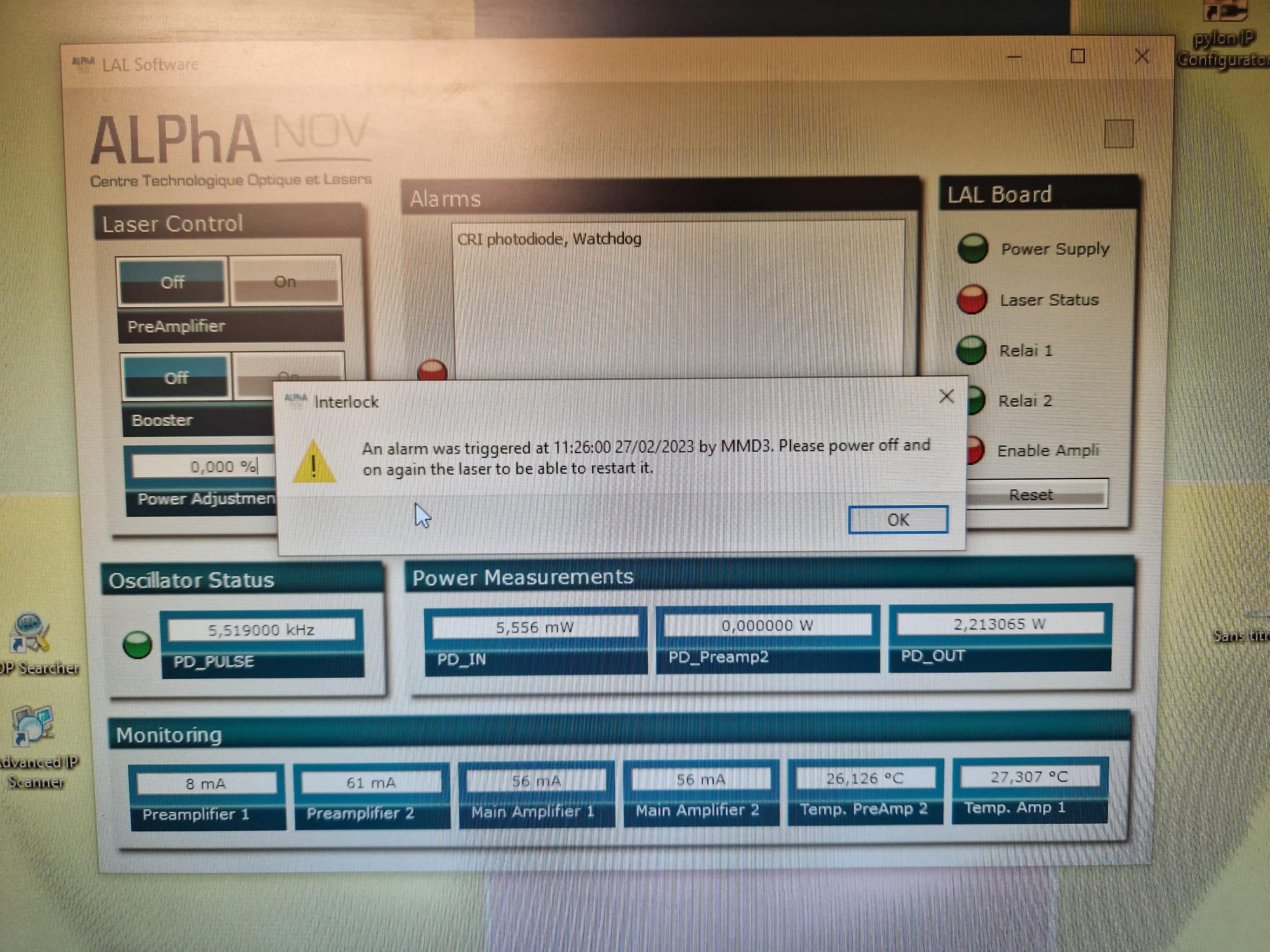 |
|
191
|
Wed Mar 8 14:49:12 2023 |
Ronic Chiche | Fixed | report | lasers and optics | software | ThomX igloo | Alphanov amplifier beam profile measurement | this morning with Manar,
we checked the Alphanov amplifier issue : "The laser has been stopped because its power is too far from the nominal power".
the photodiode voltage measuring the output power has drifted again and then, the estimated output power was wrong, triggering an alarm issue.
I changed the "calibration" file to fix the issue : see the attached file
| Ronic Chiche wrote: |
|
This morning with Victor we took a reading of the beam profile using a 400 mm lens at 70 % and 100 % amplification.
Will process the data and add after
Note : after an hour and half of amplifier on at 70% we increased the power to 100%, and after ~ 10 minutes the amplifier turned off and showed an error on the software called MMD3
and an error of the power mentioning " Le laser a été arrêté parce que sa puissance est trop éloignée de la puissance nominale"
"The laser has been stopped because its power is too far from the nominal power"
after that, the amplifier worked in varying intervals until it switched off because of the previously mentioned error.
solution could be related to the configuration file values ??????
| Ronic Chiche wrote: |
|
On Monday 20th of February, Daniele and Viktor took some beam profile measurement data @ 50% of power amplification.
data and analysis can be found in the attached file.
| Ronic Chiche wrote: |
|
This morning with Daniele, we did a second measurement of the beam profile using a different lens of focal 400 mm.
at a power amplification of 20%
the amplifier stayed on for around one hour and a half with no errors.
tomorrow will attemt to do one at higher amplification percentage.
data will be added after processing.
| Ronic Chiche wrote: |
|
This morning,
- with the "Alphanov" software => Central panel => "system" button => Watchdog "Period Max" was at 100ns and has been set to 200ns.
(Alphanov told me to change the value from 50ns to 100ns but it was already at 100ns, then I set it to 200ns).
=> to be checked with Alphanov : what is the meaning of this parameter.
- it seems the watchdog alarm is related to the "PD_IN" parameter value of the "LAL" software (5.5mW is OK, but 5.2mW triggers the alarm).
my understanding is the Threshold Voltage, which detects the input signal to measure the repetition rate, could be at a too high level... even very close to the max level of the signal.
then if the input decreases a little bit, the signal goes below this Threshold Voltage => the software does not detect a signal any more => it triggers the watchdog alarm and the amplifier stops
(which stops also the preamplifier, related to the PD_CRI of the "Alphanov" software which goes to ~0W. PD_Preamp2 is a copy of PD_CRI but in the "LAL" software).
then, I changed back the Threshold Voltage from 0.96V (to detect properly 33MHz rep rate) to 0.7V which is close to the original value (0.67V) but for which the software detects ~100MHz rep. rate !
with this Threshold level, I did a test by detuning very slightly the input power by unscrewing a little bit the fiber-fiber coupler => PD_IN = 4.9mW => no alarm triggered !
then I screwed back the coupler => PD_IN = 5.6mW.
I did a power test with 3rd stage of the amplifier at 20% during 15 minutes => no alarm.
conclusion : there is an issue with the rep rate detection.
at 33MHz, one needs to put the threshold at the limit of the signal which fires an alarm if the signal decreased a little bit.
by lowering the threshold => no more alarm (I hope) but a wrong rep rate value !
| Ronic Chiche wrote: |
|
With Daniele after, we took a readings of the beam with a lens of 750 mm.
From the observed data, we can state that the beam is not completely Gaussian M2 > 1, due to the variation of the ellipticity of the beam along the focused path
readings have been saved and will be added after processing them.
Also adding to the previous comment about the error, after closing the bunker and starting the measurement we did not have issue for around 20 min then the same error appeared (alarm triggered by Watchdog) it shows when the input average power detected by the software was around 5.474 mW , I did a reset of the software then turned the amplifier on and the reading is 5.515mW it works for about 2 minutes (enough to take 2 readings) then it switches off. In addition, there was a drop in the power reading on the PD_preamp2 (which seems related to watchdog issue) we had to do this many times in order to finish taking the readings .
| Ronic Chiche wrote: |
|
we have had this new issue (watchdog alarm switching off the amplifier) for several days.
Alphanov mentionned it could come from the input oscillator stability (modelock loss for example).
Today,
- I tried to start the amplifier at 0% but it ended immediately in a "watchdog alarm" which stopped the amplifier
the input average power detected by the software was around 5.2mW, far above the 2mW needed by the amplifier.
- I checked the 33MHz oscillator at the output of the fiber connected to the Shafter-Kirchhoff fiber coupler with the Labbuddy fiber photodiode and a scope.
see the picture below : the peak are clean and at 33MHz... then, the Onefive oscillator is not faulty.
- after plugging back the fiber to the amplifier input, the input average power detected by the software increased a bit around 5.5 - 5.6mW.
I tried to start again the amplifier at 0% and now, it worked without any alarm !!!
then, the origin of the "watchdog alarm" was maybe the threshold on this input power.
Then, I launched the "Alphanov" software and changed again the "threshold level", previously set at 1V (see previous post below), to 0.96V !
with this threshold level, the Alphanov software detects at the beginning a frequency of 66MHz and then decreases slowly to 33MHz => to be understood.
it should allow also more room before triggering again the "watchdog alarm" if the input average power decreases a bit => to be confirmed by Alphanov.
| Ronic Chiche wrote: |
|
the laser amplifier worked for some days but it ended to a "watchdog" alarm which switches off the amplifier... investigation is ongoing
| Ronic Chiche wrote: |
|
Ronic on Friday operated the Amplifier from the Alphanov software, switched it off then turned on the LAL software,
and it worked for 40 min without issues or error appearing,
| Ronic Chiche wrote: |
|
this morning with Manar,
- we fixed the chiller problem (+/-2°C fluctuation around the set temperature value = 25°C).
we opened and closed several times the water valve of the primary circuit to remove air bubles => no effect on the temperature variations.
we put the chiller in "Auto-Tuning" (AT) mode, then pressed the "AT" key => the chiller tune its PID parameters to optimize its temperature stabilization => no more fluctuations (+/-0.2°C fluctuation around the set temperature value = 25°C).
we had anyway a "temperature case" alarm from the Alphanov software at P=40%*Pmax, which stops the amplifier.
we put the chiller it AT mode again but with some power in the amplifier => no difference, the temperature regulation seems very good now, but we still have some "temperature case" alarms... => contact Alphanov for that.
- we changed the mount of the 2nd wedge by a kinematic mount to help for the alignment and we added an iris in the path.
now the optical path seems OK to make the beam profile measurement easily.
as we have still amplifier stops due to "temperature case" alarm, even at low power (P=20%*Pmax), we stopped the measurements => see Manar logbook post.
| Ronic Chiche wrote: |
|
this morning with Manar,
- we checked first the chiller problem.
the fluctations of +/-2° around 25°C are still there.
I discussed with Jean-Noel Cayla about the possible problem of the "dirty" water in the primary circuit.
he told me that the water goes through 3 "effective" filters, then the water should not be too dirty in the primary circuit even if one uses "common water" to fill it.
he told me also that the water temperature could be a bit higher than before, around 22°C, and that could prevent a good thermal exchange with the secundary circuit (the one of the amplifier).
=> the resistivity is about 7Mohmhs.
we had again a "case temperature alarm" from the Alphanov Software, after 1h of work @ 20%
this stopped the amplifier, we did not restart it.
- we measured the beam path with the wedges :
compressor box output to mirror : 17cm
mirror to 1s wedge : 24 cm
1st wedge to 2nd wedge : 24.5 cm
2nd wedge to lift bottom mirror : 136 cm
lift bottom mirror to top mirror : 14 cm
lift top mirror to beam profiler (x=0) : 7 cm
- we measured the beam profile at 3 positions with amplifier @ 20% + 2 wedges :
the power is ~ 70 µW
we made the measurements at x=0, x=60 cm, x=120cm
after that, we had the Alphanov amplifier "temperature case incident" and we stopped the measurements.
| Ronic Chiche wrote: |
|
yesterday morning with Manar,
1) we fixed the threshold level of the laser input signal which makes the measurement of the repetition rate.
(if the rep rate is not measured properly, the amplifier safety interlock stops immediately the amplification).
we followed a tutorial from Guillaume Machinet.
when you start the Alphanov control software, 4 panels pops up : central control, 2nd stage amplifier, and 2 panels for controlling the pumps of the 3rd stage amplifier.
!!! Warning !!! ..... if you switch ON the amplifier using the central control panel, the amplifier starts immediately AT FULL POWER..... !!! Warning !!!
it is not mentionned in the tutorial document.
to prevent this problem, you first need to switch "Laser OFF" on the 2 panels controlling the pumps of the 3rd stage amplifier and let "Laser ON" only on the panel controlling the 2nd stage.
after starting the amplifier, we tried to find the median value of the threshold to get ~33MHz instead of 100MHz measured previously.
the initial voltage threshold on the photodiode measuring the rep rate was 0.4V which leads to get 100MHz.
first, we changed step by step the threshold to reach 0.87V => one gets 33MHz.
we tried the find the maximum threshold but once the level is above the signal maximum value, it triggers an alarm and stops immediately the amplifier.
then, one needs to restart completely the software which can be tedious due to connections/alarms issues.
finaly, we found out that the low and high level thresholds to get 33MHz were not reproductible at each start of the amplifier... :-(
then, we put the threshold at 1V following the turial procedure which seems to work.
2) we installed the optical scheme to make the beam profile measurement : see attached image
we used the HR mirror close to the amplifier output (as putting a wedge at that place is not convenient if you want to properly dump the transmission and reflections).
and then, we placed 2 wedges, using the front reflection to get low power beam profile.
the Thorlabs LB2 has been used to dump the transmission of the first wedge, it can handle 25kW/cm² and 25J/cm².
we used black aluminium screens to dump the secondary beams.
we measured after the 2 wedges :
amplifier at 20% => 71µW
amplifier at 30% => 139µW
amplifier at 40% => 200µW
it has to be compared with the amplifier power :
amplifier at 20% => 8.7 W
amplifier at 30% => 17 W
amplifier at 40% => 26 W
which leads to a reflection coefficient of the wedge of 0.28%.
=> OK, as one uses PS811-B Thorlabs 4° wedges with B coating.
with B coating, the reflectivity given by the manufacturer is around 0.3% @ 1030nm.
unfortunately, we had a "case temperature alarm" coming from the Alphanov software when we reached 40% for the amplification level.
this alarm stopped immediately the amplifier.
we saw that the chiller was in warning state too and the "present temperature PV" was not stable at all, flutuating by 3-4 degrees after the amplifier has been turned off...
we restarted several times the chiller to see if the problem disapears but it was still there ! => to be investiguated !
PS : we changed the USB cable between the amplifier controler and the PC to try to fix the several "connexion lost" problems but it didn't help...
PS2 : after discussing with Sophie Chance and Marie Jacquet, ThomX suffered a water circuit leakage on Monday:
the full circuit has been emptied and they had to remplace the water by some common water and not demineralized water....
it can be related to the chilller issue observed yesterday !
| Ronic Chiche wrote: |
|
today with Manar, we brought everything to make the profile measurement.
the chiller was in error because of the water level : we filled it in.
! warning ! there is no alarm signal, only a message on the screen.
we checked the incoming power measured by the software : 5.5 mW => OK
and we measured the output power (with pump) for :
0% => ~ 300 mW
10% => ~900 mW
20% => 8.65 W
30% => 17W
=> same as before.
the first HR mirror at the output of the amplifier was slightly scratched => we replaced it.
for sake of simplicity, we plan to use first a HR mirror and then 2x wedges for the profile measurement => to be checked next time.
we have to remove secundary beam reflections, then wedges are easier to use than AR/AR mirrors (as the 2 reflected beams are parallele).
at full power, the output power is ~ 70W
after 1st wedge : 2.8W
after 2nd wedge : 112 mW => the power should be low enough to use absorptive filters in front of the beam profiler.
|
|
|
|
|
|
|
|
|
|
|
|
|
| Attachment 1: 20230308_124313.jpg
| 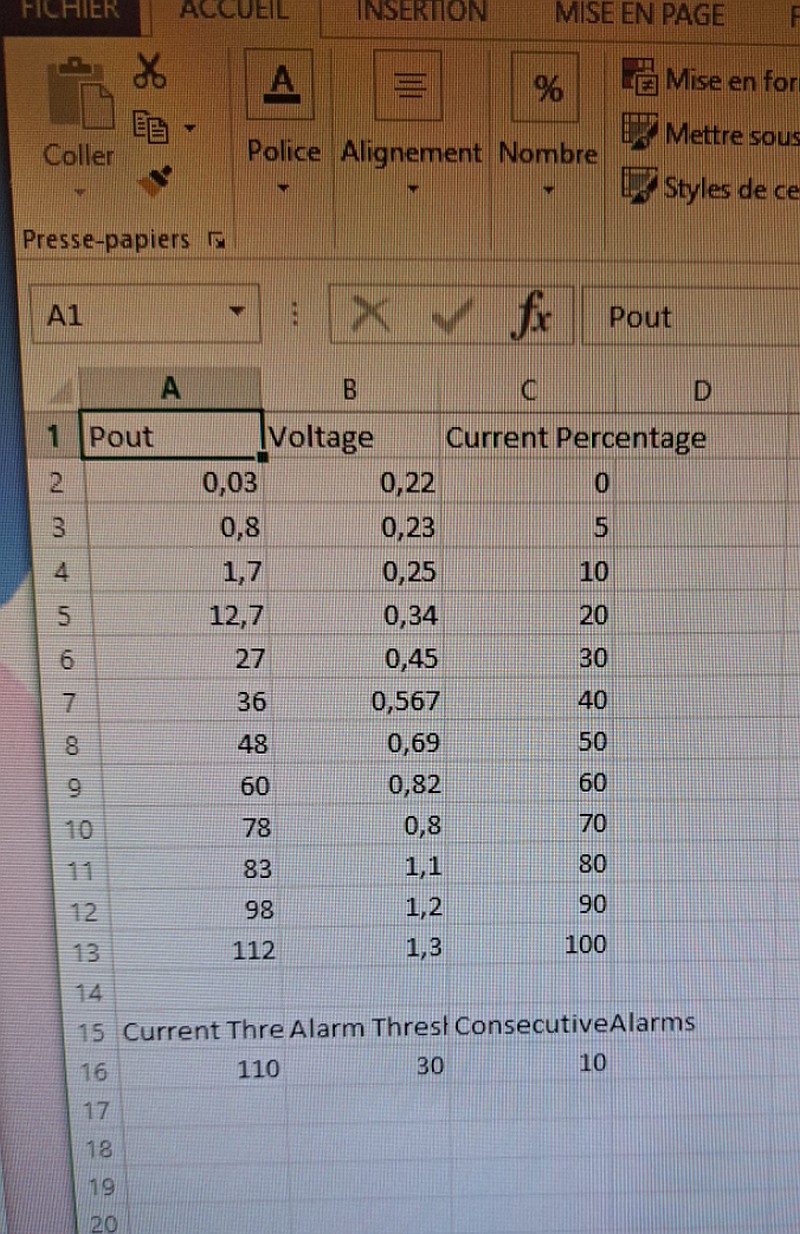 |
|
192
|
Wed Mar 8 15:11:49 2023 |
Ronic Chiche | Fixed | info | lasers and optics | ThomX igloo | CW laser installation and cleaning | This morning with Manar, in order to prepare the installation of the news FP cavity mirrors,
- we installed the Koheras below the optical table
- we put a fiber prolongator at the end of the Koheras fiber and we put a mounted collimator at the end of the fiber.
we added a mirror at 45° to inject the beam to injection axis of the table.
- as the beam was still slightly divergent, we added a 750mm lens ~20cm after the collimator to improve the beam collimation.
now the collimated beam is going approximatively through the middle all of the iris in the optical path.
we finished by ~2h of cleaning of the optical table and elements, which were very dirty.
it is still a bit dirty. see the attached file to get the numbers provided by the particle counter after the cleaning. |
| Attachment 1: 20230308_121713.jpg
|  |
|
193
|
Mon Mar 13 14:02:59 2023 |
Ronic Chiche | Fixed | info | lasers and optics | ThomX igloo | CW laser installation and cleaning | This morning with Ronic , in preparation for the mirror installation, we removed additional mechanics and cables from the table.
We organized and cleaned the permanently installed cables on the table away from the area of the cavity opening.
We opened the two top vents and left the shutters open to circulate clean air , (note the shutters surrounding the laser and amplifier are half closed for safety)
Note: before installing the mirrors, preferably the shutters should be opened a day before to have clean air in the surrounding of the cavity openings
and avoid any cleaning or air disturbance.
| Ronic Chiche wrote: |
|
This morning with Manar, in order to prepare the installation of the news FP cavity mirrors,
- we installed the Koheras below the optical table
- we put a fiber prolongator at the end of the Koheras fiber and we put a mounted collimator at the end of the fiber.
we added a mirror at 45° to inject the beam to injection axis of the table.
- as the beam was still slightly divergent, we added a 750mm lens ~20cm after the collimator to improve the beam collimation.
now the collimated beam is going approximatively through the middle all of the iris in the optical path.
we finished by ~2h of cleaning of the optical table and elements, which were very dirty.
it is still a bit dirty. see the attached file to get the numbers provided by the particle counter after the cleaning.
|
|
|
194
|
Mon Mar 13 16:10:24 2023 |
Ronic Chiche | Fixed | report | lasers and optics | software | ThomX igloo | Alphanov amplifier beam profile measurement | We took reading of the beam profile of the amplifier without a lens @ 30 cm from the 2nd wedge for amplification percentages
20-30-40-50-60-70-80-90-100 % another additional 3 readings will be taken at different locations for all amplification percentages.
| Ronic Chiche wrote: |
|
this morning with Manar,
we checked the Alphanov amplifier issue : "The laser has been stopped because its power is too far from the nominal power".
the photodiode voltage measuring the output power has drifted again and then, the estimated output power was wrong, triggering an alarm issue.
I changed the "calibration" file to fix the issue : see the attached file
| Ronic Chiche wrote: |
|
This morning with Victor we took a reading of the beam profile using a 400 mm lens at 70 % and 100 % amplification.
Will process the data and add after
Note : after an hour and half of amplifier on at 70% we increased the power to 100%, and after ~ 10 minutes the amplifier turned off and showed an error on the software called MMD3
and an error of the power mentioning " Le laser a été arrêté parce que sa puissance est trop éloignée de la puissance nominale"
"The laser has been stopped because its power is too far from the nominal power"
after that, the amplifier worked in varying intervals until it switched off because of the previously mentioned error.
solution could be related to the configuration file values ??????
| Ronic Chiche wrote: |
|
On Monday 20th of February, Daniele and Viktor took some beam profile measurement data @ 50% of power amplification.
data and analysis can be found in the attached file.
| Ronic Chiche wrote: |
|
This morning with Daniele, we did a second measurement of the beam profile using a different lens of focal 400 mm.
at a power amplification of 20%
the amplifier stayed on for around one hour and a half with no errors.
tomorrow will attemt to do one at higher amplification percentage.
data will be added after processing.
| Ronic Chiche wrote: |
|
This morning,
- with the "Alphanov" software => Central panel => "system" button => Watchdog "Period Max" was at 100ns and has been set to 200ns.
(Alphanov told me to change the value from 50ns to 100ns but it was already at 100ns, then I set it to 200ns).
=> to be checked with Alphanov : what is the meaning of this parameter.
- it seems the watchdog alarm is related to the "PD_IN" parameter value of the "LAL" software (5.5mW is OK, but 5.2mW triggers the alarm).
my understanding is the Threshold Voltage, which detects the input signal to measure the repetition rate, could be at a too high level... even very close to the max level of the signal.
then if the input decreases a little bit, the signal goes below this Threshold Voltage => the software does not detect a signal any more => it triggers the watchdog alarm and the amplifier stops
(which stops also the preamplifier, related to the PD_CRI of the "Alphanov" software which goes to ~0W. PD_Preamp2 is a copy of PD_CRI but in the "LAL" software).
then, I changed back the Threshold Voltage from 0.96V (to detect properly 33MHz rep rate) to 0.7V which is close to the original value (0.67V) but for which the software detects ~100MHz rep. rate !
with this Threshold level, I did a test by detuning very slightly the input power by unscrewing a little bit the fiber-fiber coupler => PD_IN = 4.9mW => no alarm triggered !
then I screwed back the coupler => PD_IN = 5.6mW.
I did a power test with 3rd stage of the amplifier at 20% during 15 minutes => no alarm.
conclusion : there is an issue with the rep rate detection.
at 33MHz, one needs to put the threshold at the limit of the signal which fires an alarm if the signal decreased a little bit.
by lowering the threshold => no more alarm (I hope) but a wrong rep rate value !
| Ronic Chiche wrote: |
|
With Daniele after, we took a readings of the beam with a lens of 750 mm.
From the observed data, we can state that the beam is not completely Gaussian M2 > 1, due to the variation of the ellipticity of the beam along the focused path
readings have been saved and will be added after processing them.
Also adding to the previous comment about the error, after closing the bunker and starting the measurement we did not have issue for around 20 min then the same error appeared (alarm triggered by Watchdog) it shows when the input average power detected by the software was around 5.474 mW , I did a reset of the software then turned the amplifier on and the reading is 5.515mW it works for about 2 minutes (enough to take 2 readings) then it switches off. In addition, there was a drop in the power reading on the PD_preamp2 (which seems related to watchdog issue) we had to do this many times in order to finish taking the readings .
| Ronic Chiche wrote: |
|
we have had this new issue (watchdog alarm switching off the amplifier) for several days.
Alphanov mentionned it could come from the input oscillator stability (modelock loss for example).
Today,
- I tried to start the amplifier at 0% but it ended immediately in a "watchdog alarm" which stopped the amplifier
the input average power detected by the software was around 5.2mW, far above the 2mW needed by the amplifier.
- I checked the 33MHz oscillator at the output of the fiber connected to the Shafter-Kirchhoff fiber coupler with the Labbuddy fiber photodiode and a scope.
see the picture below : the peak are clean and at 33MHz... then, the Onefive oscillator is not faulty.
- after plugging back the fiber to the amplifier input, the input average power detected by the software increased a bit around 5.5 - 5.6mW.
I tried to start again the amplifier at 0% and now, it worked without any alarm !!!
then, the origin of the "watchdog alarm" was maybe the threshold on this input power.
Then, I launched the "Alphanov" software and changed again the "threshold level", previously set at 1V (see previous post below), to 0.96V !
with this threshold level, the Alphanov software detects at the beginning a frequency of 66MHz and then decreases slowly to 33MHz => to be understood.
it should allow also more room before triggering again the "watchdog alarm" if the input average power decreases a bit => to be confirmed by Alphanov.
| Ronic Chiche wrote: |
|
the laser amplifier worked for some days but it ended to a "watchdog" alarm which switches off the amplifier... investigation is ongoing
| Ronic Chiche wrote: |
|
Ronic on Friday operated the Amplifier from the Alphanov software, switched it off then turned on the LAL software,
and it worked for 40 min without issues or error appearing,
| Ronic Chiche wrote: |
|
this morning with Manar,
- we fixed the chiller problem (+/-2°C fluctuation around the set temperature value = 25°C).
we opened and closed several times the water valve of the primary circuit to remove air bubles => no effect on the temperature variations.
we put the chiller in "Auto-Tuning" (AT) mode, then pressed the "AT" key => the chiller tune its PID parameters to optimize its temperature stabilization => no more fluctuations (+/-0.2°C fluctuation around the set temperature value = 25°C).
we had anyway a "temperature case" alarm from the Alphanov software at P=40%*Pmax, which stops the amplifier.
we put the chiller it AT mode again but with some power in the amplifier => no difference, the temperature regulation seems very good now, but we still have some "temperature case" alarms... => contact Alphanov for that.
- we changed the mount of the 2nd wedge by a kinematic mount to help for the alignment and we added an iris in the path.
now the optical path seems OK to make the beam profile measurement easily.
as we have still amplifier stops due to "temperature case" alarm, even at low power (P=20%*Pmax), we stopped the measurements => see Manar logbook post.
| Ronic Chiche wrote: |
|
this morning with Manar,
- we checked first the chiller problem.
the fluctations of +/-2° around 25°C are still there.
I discussed with Jean-Noel Cayla about the possible problem of the "dirty" water in the primary circuit.
he told me that the water goes through 3 "effective" filters, then the water should not be too dirty in the primary circuit even if one uses "common water" to fill it.
he told me also that the water temperature could be a bit higher than before, around 22°C, and that could prevent a good thermal exchange with the secundary circuit (the one of the amplifier).
=> the resistivity is about 7Mohmhs.
we had again a "case temperature alarm" from the Alphanov Software, after 1h of work @ 20%
this stopped the amplifier, we did not restart it.
- we measured the beam path with the wedges :
compressor box output to mirror : 17cm
mirror to 1s wedge : 24 cm
1st wedge to 2nd wedge : 24.5 cm
2nd wedge to lift bottom mirror : 136 cm
lift bottom mirror to top mirror : 14 cm
lift top mirror to beam profiler (x=0) : 7 cm
- we measured the beam profile at 3 positions with amplifier @ 20% + 2 wedges :
the power is ~ 70 µW
we made the measurements at x=0, x=60 cm, x=120cm
after that, we had the Alphanov amplifier "temperature case incident" and we stopped the measurements.
| Ronic Chiche wrote: |
|
yesterday morning with Manar,
1) we fixed the threshold level of the laser input signal which makes the measurement of the repetition rate.
(if the rep rate is not measured properly, the amplifier safety interlock stops immediately the amplification).
we followed a tutorial from Guillaume Machinet.
when you start the Alphanov control software, 4 panels pops up : central control, 2nd stage amplifier, and 2 panels for controlling the pumps of the 3rd stage amplifier.
!!! Warning !!! ..... if you switch ON the amplifier using the central control panel, the amplifier starts immediately AT FULL POWER..... !!! Warning !!!
it is not mentionned in the tutorial document.
to prevent this problem, you first need to switch "Laser OFF" on the 2 panels controlling the pumps of the 3rd stage amplifier and let "Laser ON" only on the panel controlling the 2nd stage.
after starting the amplifier, we tried to find the median value of the threshold to get ~33MHz instead of 100MHz measured previously.
the initial voltage threshold on the photodiode measuring the rep rate was 0.4V which leads to get 100MHz.
first, we changed step by step the threshold to reach 0.87V => one gets 33MHz.
we tried the find the maximum threshold but once the level is above the signal maximum value, it triggers an alarm and stops immediately the amplifier.
then, one needs to restart completely the software which can be tedious due to connections/alarms issues.
finaly, we found out that the low and high level thresholds to get 33MHz were not reproductible at each start of the amplifier... :-(
then, we put the threshold at 1V following the turial procedure which seems to work.
2) we installed the optical scheme to make the beam profile measurement : see attached image
we used the HR mirror close to the amplifier output (as putting a wedge at that place is not convenient if you want to properly dump the transmission and reflections).
and then, we placed 2 wedges, using the front reflection to get low power beam profile.
the Thorlabs LB2 has been used to dump the transmission of the first wedge, it can handle 25kW/cm² and 25J/cm².
we used black aluminium screens to dump the secondary beams.
we measured after the 2 wedges :
amplifier at 20% => 71µW
amplifier at 30% => 139µW
amplifier at 40% => 200µW
it has to be compared with the amplifier power :
amplifier at 20% => 8.7 W
amplifier at 30% => 17 W
amplifier at 40% => 26 W
which leads to a reflection coefficient of the wedge of 0.28%.
=> OK, as one uses PS811-B Thorlabs 4° wedges with B coating.
with B coating, the reflectivity given by the manufacturer is around 0.3% @ 1030nm.
unfortunately, we had a "case temperature alarm" coming from the Alphanov software when we reached 40% for the amplification level.
this alarm stopped immediately the amplifier.
we saw that the chiller was in warning state too and the "present temperature PV" was not stable at all, flutuating by 3-4 degrees after the amplifier has been turned off...
we restarted several times the chiller to see if the problem disapears but it was still there ! => to be investiguated !
PS : we changed the USB cable between the amplifier controler and the PC to try to fix the several "connexion lost" problems but it didn't help...
PS2 : after discussing with Sophie Chance and Marie Jacquet, ThomX suffered a water circuit leakage on Monday:
the full circuit has been emptied and they had to remplace the water by some common water and not demineralized water....
it can be related to the chilller issue observed yesterday !
| Ronic Chiche wrote: |
|
today with Manar, we brought everything to make the profile measurement.
the chiller was in error because of the water level : we filled it in.
! warning ! there is no alarm signal, only a message on the screen.
we checked the incoming power measured by the software : 5.5 mW => OK
and we measured the output power (with pump) for :
0% => ~ 300 mW
10% => ~900 mW
20% => 8.65 W
30% => 17W
=> same as before.
the first HR mirror at the output of the amplifier was slightly scratched => we replaced it.
for sake of simplicity, we plan to use first a HR mirror and then 2x wedges for the profile measurement => to be checked next time.
we have to remove secundary beam reflections, then wedges are easier to use than AR/AR mirrors (as the 2 reflected beams are parallele).
at full power, the output power is ~ 70W
after 1st wedge : 2.8W
after 2nd wedge : 112 mW => the power should be low enough to use absorptive filters in front of the beam profiler.
|
|
|
|
|
|
|
|
|
|
|
|
|
|
| Attachment 1: Beam_wavefront_30cm_no_Lens.jpg
| 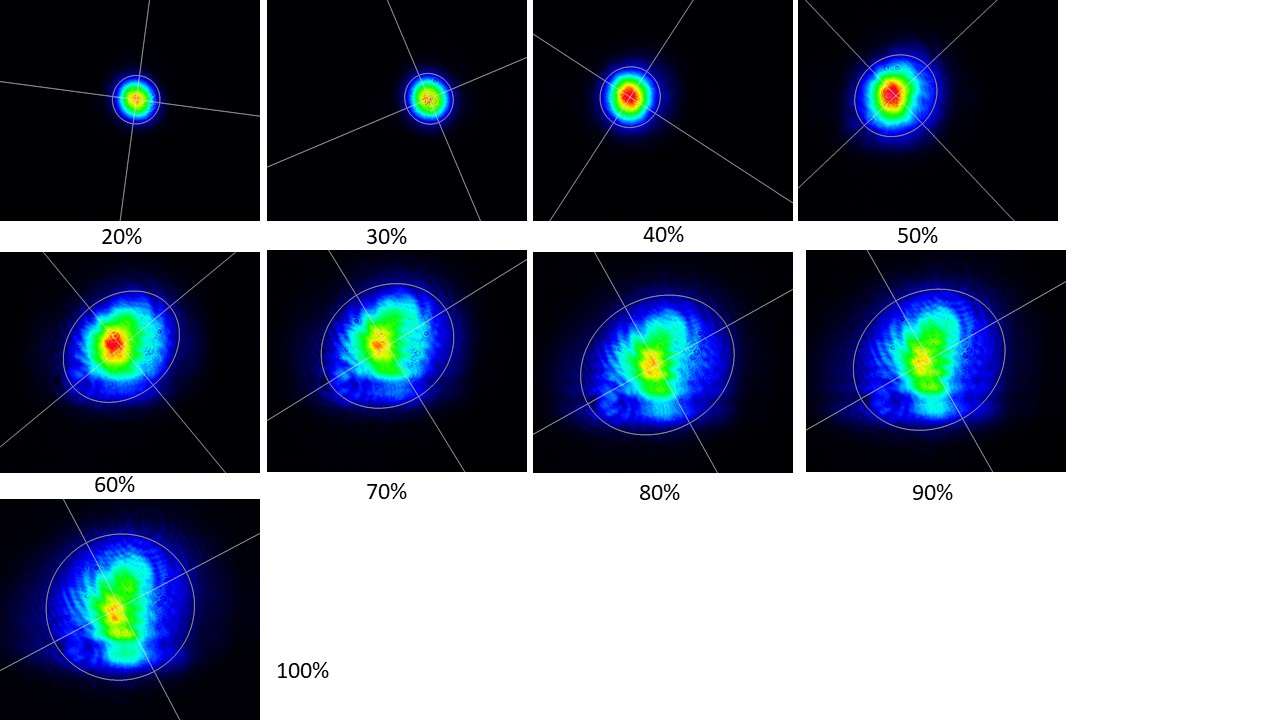 |
|
199
|
Mon Mar 20 09:33:54 2023 |
Ronic Chiche | Fixed | info | utilities | ThomX igloo | Power shut down on Saturday the 18th | All the equipments have been switched off on Friday 17th due to a power shut down on Saturday 18th :
CW and Onefive oscillators, computers, laser amplifier, cavity mirror motors, chiller, etc... |
|
200
|
Mon Mar 20 17:23:09 2023 |
Ronic Chiche | Fixed | info | lasers and optics | Optical room | 33MHz laser SN2439 back to Orsay | As the general local network for the FP-cavity devices is 192.168.xxx.xxx, I changed the IP adress of the smaract laser motors (Frep and CEP) controller.
For that, I used the embedded web server as described in the manual in attached file.
the new adresses are :
IP : 192.168.1.10
Gateaway : 192.168.1.1
Subnet : 255.255.255.0
Port : 5000
| Ronic Chiche wrote: |
|
Today, we succeded to make the laser modelock.
the ouptut power is above 35mW (the powermeter was saturated)
here is a screenshot of the signal on the scope.
| Ronic Chiche wrote: |
|
Yesterday, we put back the 33MHz oscillator into the casemate with the new Smaract controller.
after switching ON the laser controller, we saw some power at the output but we have to check if the laser is modelock or not.
| Ronic Chiche wrote: |
|
Today, we used an "ELI-NP" Smaract controller made with these 2 references :
MCS-3CC-ETH-TAB (SN 2271) => main controller
MCS-3S-EP-SDS15-TAB (SN 2472) => sensor module
with the ethernet parameters:
IP : 10.0.52.226
MASK: 255.255.255.0
GW : 10.0.52.01
PORT : 5001
one has to configure the device into PTC or MCS software as :
network:10.0.52.226:5001
then, one can access the Smaract controller and move both Frep and CEP stages.
we succeded to make the laser modelock again ! :-)
the output power is about 42mW !
| Ronic Chiche wrote: |
|
Yesterday with Aurélien, we try to make the laser modelock using the Smaract translation stages embedded inside the laser head.
unfortunately, we got some errors when we try to do the "calibration" and "reference" of both Smaract stages !
we contacted by email M. Nicoul to help us on this topic
Today, we removed the 33MHz and its controller and motors controller from the casemate to install it in the PLIC room.
with the help of M. Nicoul, we did a first check of the PZT capacitance of each stage (~ 60nF)
for channel 0 (Frep), the measured capacitance is 53nF on the laser head
for channel 2 (CEP), the measured capacitance is 63nF on the laser head
between pins 1 and 9 of the DB9 connector.
M. Nicoul says that these values are compatible with the reference values ~ 60nF, then the PZT translation stages are OK.
Then, the controler is maybe damaged.
One has to find a new one to test the stages.
| Ronic Chiche wrote: |
|
This morning, with Aurélien and Daniele, we did the swap between the 33MHz and 133MHz oscillators.
now, the 33MHz oscillator is on ThomX inside the casemate.
it has been restarted and some laser is going out.
it has been screwed on the metal plate, roughly aligned with the Alphanov "fiber injection and strecher" box.
tomorrow, we will do the fine alignment with this box and check if the laser is properly modelocking.
the 133MHz oscillator is back in the PLIC optical room.
it has been restarted and some laser is going out.
it seems there are no pulses at the output... it seems we have to trigger the modelock.
| Ronic Chiche wrote: |
|
On the 8th of July, the SN2439 33MHz laser was returned from NKT to our lab, being repaired.
it stayed all the weekend to warm up in the optical room and has been turned on on Monday.
the mode-locking was not working (28mW output power and a CW line for the optical spectrum), thus I "kicked" the laser with 100µm moves on the motors.
now, the laser is mode-locked with 42mW output power and the expected optical spectrum.
|
|
|
|
|
|
|
| Attachment 1: MCS_Network_Interface_Configuration_Guide-1.pdf
|
| Attachment 2: 20230320_154643[1].jpg
| ![20230320_154643[1].jpg](../THOMX+commissioning/230320_172255/20230320_154643[1].jpg "20230320_154643[1].jpg") |
|
201
|
Mon Mar 20 17:39:28 2023 |
Ronic Chiche | Fixed | info | utilities | ThomX igloo | Power shut down on Saturday the 18th | Today, I restarted all the equipements :
Chiller : ok, temperature converged quickly to the set temperature : 25°C
Cavity mirrors motors controller : I had to configure the general network as 192.168.xxx.xxx in order to operate the software designed by Didier Jehanno
Computer : ok, now, it IP address is 192.168.1.1
Laser amplifier controller : I had a LOT of issues in restarting the LAL software. I had to restart several times the amplifier controller in order to access it by software. I quickly check the power increase to 50% after it has been correctly seeded
CW oscillator : ok, Koheras restarted without any issue.
OneFive oscillator : the power ON was ok but it did not modelock. I tried several gently knocks on the case but without success (one clearly see the effect on the scope, the oscillator "tries" to modelock).
fortunately, after about 1h, the oscillator modelocked alone (check with Buddy fiber photodiode + scope).... the power is the same as before. the Alphanov software measures 5.4mW (it was 5.5 mW the 2/1/2023)
Smaract controller for OneFive : ok, I changed its IP address to 192.168.1.10. I tested the PC control in moving forth and back the "CEP" motor by 1mm... the OneFive was still modelocked.
| Ronic Chiche wrote: |
|
All the equipments have been switched off on Friday 17th due to a power shut down on Saturday 18th :
CW and Onefive oscillators, computers, laser amplifier, cavity mirror motors, chiller, etc...
|
|
|
202
|
Mon Mar 20 17:55:25 2023 |
Ronic Chiche | Fixed | report | lasers and optics | software | ThomX igloo | Alphanov amplifier beam profile measurement | due to several "case temperature" issues, I change the "Max case temperature" in the "general config" of the "Alphanov Software" from 50°C to 55°C.
=> validated by Alphanov.
| Ronic Chiche wrote: |
|
We took reading of the beam profile of the amplifier without a lens @ 30 cm from the 2nd wedge for amplification percentages
20-30-40-50-60-70-80-90-100 % another additional 3 readings will be taken at different locations for all amplification percentages.
| Ronic Chiche wrote: |
|
this morning with Manar,
we checked the Alphanov amplifier issue : "The laser has been stopped because its power is too far from the nominal power".
the photodiode voltage measuring the output power has drifted again and then, the estimated output power was wrong, triggering an alarm issue.
I changed the "calibration" file to fix the issue : see the attached file
| Ronic Chiche wrote: |
|
This morning with Victor we took a reading of the beam profile using a 400 mm lens at 70 % and 100 % amplification.
Will process the data and add after
Note : after an hour and half of amplifier on at 70% we increased the power to 100%, and after ~ 10 minutes the amplifier turned off and showed an error on the software called MMD3
and an error of the power mentioning " Le laser a été arrêté parce que sa puissance est trop éloignée de la puissance nominale"
"The laser has been stopped because its power is too far from the nominal power"
after that, the amplifier worked in varying intervals until it switched off because of the previously mentioned error.
solution could be related to the configuration file values ??????
| Ronic Chiche wrote: |
|
On Monday 20th of February, Daniele and Viktor took some beam profile measurement data @ 50% of power amplification.
data and analysis can be found in the attached file.
| Ronic Chiche wrote: |
|
This morning with Daniele, we did a second measurement of the beam profile using a different lens of focal 400 mm.
at a power amplification of 20%
the amplifier stayed on for around one hour and a half with no errors.
tomorrow will attemt to do one at higher amplification percentage.
data will be added after processing.
| Ronic Chiche wrote: |
|
This morning,
- with the "Alphanov" software => Central panel => "system" button => Watchdog "Period Max" was at 100ns and has been set to 200ns.
(Alphanov told me to change the value from 50ns to 100ns but it was already at 100ns, then I set it to 200ns).
=> to be checked with Alphanov : what is the meaning of this parameter.
- it seems the watchdog alarm is related to the "PD_IN" parameter value of the "LAL" software (5.5mW is OK, but 5.2mW triggers the alarm).
my understanding is the Threshold Voltage, which detects the input signal to measure the repetition rate, could be at a too high level... even very close to the max level of the signal.
then if the input decreases a little bit, the signal goes below this Threshold Voltage => the software does not detect a signal any more => it triggers the watchdog alarm and the amplifier stops
(which stops also the preamplifier, related to the PD_CRI of the "Alphanov" software which goes to ~0W. PD_Preamp2 is a copy of PD_CRI but in the "LAL" software).
then, I changed back the Threshold Voltage from 0.96V (to detect properly 33MHz rep rate) to 0.7V which is close to the original value (0.67V) but for which the software detects ~100MHz rep. rate !
with this Threshold level, I did a test by detuning very slightly the input power by unscrewing a little bit the fiber-fiber coupler => PD_IN = 4.9mW => no alarm triggered !
then I screwed back the coupler => PD_IN = 5.6mW.
I did a power test with 3rd stage of the amplifier at 20% during 15 minutes => no alarm.
conclusion : there is an issue with the rep rate detection.
at 33MHz, one needs to put the threshold at the limit of the signal which fires an alarm if the signal decreased a little bit.
by lowering the threshold => no more alarm (I hope) but a wrong rep rate value !
| Ronic Chiche wrote: |
|
With Daniele after, we took a readings of the beam with a lens of 750 mm.
From the observed data, we can state that the beam is not completely Gaussian M2 > 1, due to the variation of the ellipticity of the beam along the focused path
readings have been saved and will be added after processing them.
Also adding to the previous comment about the error, after closing the bunker and starting the measurement we did not have issue for around 20 min then the same error appeared (alarm triggered by Watchdog) it shows when the input average power detected by the software was around 5.474 mW , I did a reset of the software then turned the amplifier on and the reading is 5.515mW it works for about 2 minutes (enough to take 2 readings) then it switches off. In addition, there was a drop in the power reading on the PD_preamp2 (which seems related to watchdog issue) we had to do this many times in order to finish taking the readings .
| Ronic Chiche wrote: |
|
we have had this new issue (watchdog alarm switching off the amplifier) for several days.
Alphanov mentionned it could come from the input oscillator stability (modelock loss for example).
Today,
- I tried to start the amplifier at 0% but it ended immediately in a "watchdog alarm" which stopped the amplifier
the input average power detected by the software was around 5.2mW, far above the 2mW needed by the amplifier.
- I checked the 33MHz oscillator at the output of the fiber connected to the Shafter-Kirchhoff fiber coupler with the Labbuddy fiber photodiode and a scope.
see the picture below : the peak are clean and at 33MHz... then, the Onefive oscillator is not faulty.
- after plugging back the fiber to the amplifier input, the input average power detected by the software increased a bit around 5.5 - 5.6mW.
I tried to start again the amplifier at 0% and now, it worked without any alarm !!!
then, the origin of the "watchdog alarm" was maybe the threshold on this input power.
Then, I launched the "Alphanov" software and changed again the "threshold level", previously set at 1V (see previous post below), to 0.96V !
with this threshold level, the Alphanov software detects at the beginning a frequency of 66MHz and then decreases slowly to 33MHz => to be understood.
it should allow also more room before triggering again the "watchdog alarm" if the input average power decreases a bit => to be confirmed by Alphanov.
| Ronic Chiche wrote: |
|
the laser amplifier worked for some days but it ended to a "watchdog" alarm which switches off the amplifier... investigation is ongoing
| Ronic Chiche wrote: |
|
Ronic on Friday operated the Amplifier from the Alphanov software, switched it off then turned on the LAL software,
and it worked for 40 min without issues or error appearing,
| Ronic Chiche wrote: |
|
this morning with Manar,
- we fixed the chiller problem (+/-2°C fluctuation around the set temperature value = 25°C).
we opened and closed several times the water valve of the primary circuit to remove air bubles => no effect on the temperature variations.
we put the chiller in "Auto-Tuning" (AT) mode, then pressed the "AT" key => the chiller tune its PID parameters to optimize its temperature stabilization => no more fluctuations (+/-0.2°C fluctuation around the set temperature value = 25°C).
we had anyway a "temperature case" alarm from the Alphanov software at P=40%*Pmax, which stops the amplifier.
we put the chiller it AT mode again but with some power in the amplifier => no difference, the temperature regulation seems very good now, but we still have some "temperature case" alarms... => contact Alphanov for that.
- we changed the mount of the 2nd wedge by a kinematic mount to help for the alignment and we added an iris in the path.
now the optical path seems OK to make the beam profile measurement easily.
as we have still amplifier stops due to "temperature case" alarm, even at low power (P=20%*Pmax), we stopped the measurements => see Manar logbook post.
| Ronic Chiche wrote: |
|
this morning with Manar,
- we checked first the chiller problem.
the fluctations of +/-2° around 25°C are still there.
I discussed with Jean-Noel Cayla about the possible problem of the "dirty" water in the primary circuit.
he told me that the water goes through 3 "effective" filters, then the water should not be too dirty in the primary circuit even if one uses "common water" to fill it.
he told me also that the water temperature could be a bit higher than before, around 22°C, and that could prevent a good thermal exchange with the secundary circuit (the one of the amplifier).
=> the resistivity is about 7Mohmhs.
we had again a "case temperature alarm" from the Alphanov Software, after 1h of work @ 20%
this stopped the amplifier, we did not restart it.
- we measured the beam path with the wedges :
compressor box output to mirror : 17cm
mirror to 1s wedge : 24 cm
1st wedge to 2nd wedge : 24.5 cm
2nd wedge to lift bottom mirror : 136 cm
lift bottom mirror to top mirror : 14 cm
lift top mirror to beam profiler (x=0) : 7 cm
- we measured the beam profile at 3 positions with amplifier @ 20% + 2 wedges :
the power is ~ 70 µW
we made the measurements at x=0, x=60 cm, x=120cm
after that, we had the Alphanov amplifier "temperature case incident" and we stopped the measurements.
| Ronic Chiche wrote: |
|
yesterday morning with Manar,
1) we fixed the threshold level of the laser input signal which makes the measurement of the repetition rate.
(if the rep rate is not measured properly, the amplifier safety interlock stops immediately the amplification).
we followed a tutorial from Guillaume Machinet.
when you start the Alphanov control software, 4 panels pops up : central control, 2nd stage amplifier, and 2 panels for controlling the pumps of the 3rd stage amplifier.
!!! Warning !!! ..... if you switch ON the amplifier using the central control panel, the amplifier starts immediately AT FULL POWER..... !!! Warning !!!
it is not mentionned in the tutorial document.
to prevent this problem, you first need to switch "Laser OFF" on the 2 panels controlling the pumps of the 3rd stage amplifier and let "Laser ON" only on the panel controlling the 2nd stage.
after starting the amplifier, we tried to find the median value of the threshold to get ~33MHz instead of 100MHz measured previously.
the initial voltage threshold on the photodiode measuring the rep rate was 0.4V which leads to get 100MHz.
first, we changed step by step the threshold to reach 0.87V => one gets 33MHz.
we tried the find the maximum threshold but once the level is above the signal maximum value, it triggers an alarm and stops immediately the amplifier.
then, one needs to restart completely the software which can be tedious due to connections/alarms issues.
finaly, we found out that the low and high level thresholds to get 33MHz were not reproductible at each start of the amplifier... :-(
then, we put the threshold at 1V following the turial procedure which seems to work.
2) we installed the optical scheme to make the beam profile measurement : see attached image
we used the HR mirror close to the amplifier output (as putting a wedge at that place is not convenient if you want to properly dump the transmission and reflections).
and then, we placed 2 wedges, using the front reflection to get low power beam profile.
the Thorlabs LB2 has been used to dump the transmission of the first wedge, it can handle 25kW/cm² and 25J/cm².
we used black aluminium screens to dump the secondary beams.
we measured after the 2 wedges :
amplifier at 20% => 71µW
amplifier at 30% => 139µW
amplifier at 40% => 200µW
it has to be compared with the amplifier power :
amplifier at 20% => 8.7 W
amplifier at 30% => 17 W
amplifier at 40% => 26 W
which leads to a reflection coefficient of the wedge of 0.28%.
=> OK, as one uses PS811-B Thorlabs 4° wedges with B coating.
with B coating, the reflectivity given by the manufacturer is around 0.3% @ 1030nm.
unfortunately, we had a "case temperature alarm" coming from the Alphanov software when we reached 40% for the amplification level.
this alarm stopped immediately the amplifier.
we saw that the chiller was in warning state too and the "present temperature PV" was not stable at all, flutuating by 3-4 degrees after the amplifier has been turned off...
we restarted several times the chiller to see if the problem disapears but it was still there ! => to be investiguated !
PS : we changed the USB cable between the amplifier controler and the PC to try to fix the several "connexion lost" problems but it didn't help...
PS2 : after discussing with Sophie Chance and Marie Jacquet, ThomX suffered a water circuit leakage on Monday:
the full circuit has been emptied and they had to remplace the water by some common water and not demineralized water....
it can be related to the chilller issue observed yesterday !
| Ronic Chiche wrote: |
|
today with Manar, we brought everything to make the profile measurement.
the chiller was in error because of the water level : we filled it in.
! warning ! there is no alarm signal, only a message on the screen.
we checked the incoming power measured by the software : 5.5 mW => OK
and we measured the output power (with pump) for :
0% => ~ 300 mW
10% => ~900 mW
20% => 8.65 W
30% => 17W
=> same as before.
the first HR mirror at the output of the amplifier was slightly scratched => we replaced it.
for sake of simplicity, we plan to use first a HR mirror and then 2x wedges for the profile measurement => to be checked next time.
we have to remove secundary beam reflections, then wedges are easier to use than AR/AR mirrors (as the 2 reflected beams are parallele).
at full power, the output power is ~ 70W
after 1st wedge : 2.8W
after 2nd wedge : 112 mW => the power should be low enough to use absorptive filters in front of the beam profiler.
|
|
|
|
|
|
|
|
|
|
|
|
|
|
|
|
213
|
Thu Jun 1 10:31:45 2023 |
Ronic Chiche | Fixed | info | lasers and optics | ThomX igloo | 33MHz oscillator + Alphanov amplifier lock | the last tries to lock the 33MHz + amplifier to the 30k Finesse FP-cavity were unsuccessful.
during a laser Frep scan using the Laselock, one observes that the main cavity resonance is not able to stay inside the PZT scan range from one scan to another (500ms-1s period)
is it the effect of a large and slow phase noise ?
some informations:
- The 33MHz laser came back at lab from repair on March 2018.
- it has been sent to Alphanov in May 2020.
- it failled and has been sent to NKT/OneFive for repair in September 2021
- it came back to lab from repair in June 2022.
- on post #92 (Feb. 2020), it seems that we already locked the 33MHz laser + CELIA amplifier to the ThomX FP-cavity.
- The PZT sensitivity for the 33MHz laser is given to 0,3Hz/V for Frep <=> 2.6MHz/V for optical frequency.
=> 10V on PZT is equivalent to 26MHz of optical frequency shift which is less than FSR !
- by comparison, the PZT sensitivity for the 133MHz laser is given to 3.9Hz/V for Frep <=> 8.5MHz/V for optical frequency.
- by comparison, the PZT sensitivity for the NKT CW laser is given 10pm/100V for Wavelength <=> 30MHz/V for optical frequency
- by comparison, the PZT sensitivity for the ThomX FP cavity (Z20H38x40C) is 4nm/V for length expansion => 8nm/V for round-trip expansion <=> 0.03Hz/V for FSR expansion <=> 260kHz/V for optical frequency !!!
the PZT expansion estimation is in attached file. |
| Attachment 1: 120705_Displacement_of_cylindrical_piezo_ceramics.xls
|
|
214
|
Thu Jun 1 18:15:04 2023 |
Ronic Chiche | Fixed | info | lasers and optics | ThomX igloo | 33MHz oscillator + Alphanov amplifier lock | finding the right modulation/demodulation PDH phase is very difficult on the main resonance because the we get non stationnary signals with a lot of oscillations.
changing the phase, in this condition, does not really change the error signal.
Then, we moved on the first secundary resonance with less gain and less coupling.
Thus, the error signal is more similar to the theoretical PDH signal => one can adjust the modulation/demodulation PDH phase to get the maximum error signal.
then, we locked pretty easily on this first secondary resonance, with a coupling around some % when we adjust the CEP motor.
we tried to lock on the main resonance but it is too noisy and unstable.
it seems we really need high BW feedback.
I tried to add a fast analog loop on the laser intra-cavity EOM but without a clear effect.
the problem is the gain of this loop : it is difficult to produce a "high voltage" (above 10Vpp) on this EOM.
I put "my" amplifier but the voltage output is limited... commercial amplifiers will have the same issue.
we can add HV amplifiers but it takes place and it will add some noise on the signal.
A loop with an AOM could be easier to install and manage... but at the price of a loss of power before the laser amplifier...
| Ronic Chiche wrote: |
|
the last tries to lock the 33MHz + amplifier to the 30k Finesse FP-cavity were unsuccessful.
during a laser Frep scan using the Laselock, one observes that the main cavity resonance is not able to stay inside the PZT scan range from one scan to another (500ms-1s period)
is it the effect of a large and slow phase noise ?
some informations:
- The 33MHz laser came back at lab from repair on March 2018.
- it has been sent to Alphanov in May 2020.
- it failled and has been sent to NKT/OneFive for repair in September 2021
- it came back to lab from repair in June 2022.
- on post #92 (Feb. 2020), it seems that we already locked the 33MHz laser + CELIA amplifier to the ThomX FP-cavity.
- The PZT sensitivity for the 33MHz laser is given to 0,3Hz/V for Frep <=> 2.6MHz/V for optical frequency.
=> 10V on PZT is equivalent to 26MHz of optical frequency shift which is less than FSR !
- by comparison, the PZT sensitivity for the 133MHz laser is given to 3.9Hz/V for Frep <=> 8.5MHz/V for optical frequency.
- by comparison, the PZT sensitivity for the NKT CW laser is given 10pm/100V for Wavelength <=> 30MHz/V for optical frequency
- by comparison, the PZT sensitivity for the ThomX FP cavity (Z20H38x40C) is 4nm/V for length expansion => 8nm/V for round-trip expansion <=> 0.03Hz/V for FSR expansion <=> 260kHz/V for optical frequency !!!
the PZT expansion estimation is in attached file.
|
|
|
217
|
Tue Jun 6 15:52:59 2023 |
Ronic Chiche | Fixed | info | lasers and optics | ThomX igloo | 33MHz oscillator + Alphanov amplifier lock | today with Daniele, we locked easily (but with a noisy lock) on the secundary resonance and we tried to lock on the main resonance (with very low coupling ~10% which mean a CEP ~Pi)
the lock was possible but was very noisy.
I installed a fast loop using my small DC amplifier based on OP37 (max gain=100) modified to be AC coupled to avoid to amplify the PDH box offset.
the output votage swing of the OP37 is only ~10V. Thus, the effect of this fast loop on the lock stability is not visible !
Thus, I added the M250 Leysop HV amplifier (see attached documentation), which is able to drive an EOM with >5MHz bandwidth and ~250V swing, after my OP37 amplifier.
with this additionnal HV amplifier, now we can clearly see the effect of the EOM loop which improves the lock stability BUT, even with a poor CEP, the lock is very unstable on the main resonance.
it seems the optical phase noise is still too large and/or its BW too high to be completely compensated.
The next step is to try to remove all the possible noise sources from the optical table:
- the laptop placed on the ionic pump
- the 2 Rigol generators on the table surface
and switch off the controller of the Smaract laser cavity motors.
If it doesn't help, we can send the error signal to a spectrum analyzer to have a better view of the different harmonics involved in the residual phase noise.
could it remain some noise above the present PDH box BW (1.9MHz LP filter) ?
lastely, we can also make an optical phase noise measurement to check if the Alphanov amplifier does not add some noise.
| Ronic Chiche wrote: |
|
finding the right modulation/demodulation PDH phase is very difficult on the main resonance because the we get non stationnary signals with a lot of oscillations.
changing the phase, in this condition, does not really change the error signal.
Then, we moved on the first secundary resonance with less gain and less coupling.
Thus, the error signal is more similar to the theoretical PDH signal => one can adjust the modulation/demodulation PDH phase to get the maximum error signal.
then, we locked pretty easily on this first secondary resonance, with a coupling around some % when we adjust the CEP motor.
we tried to lock on the main resonance but it is too noisy and unstable.
it seems we really need high BW feedback.
I tried to add a fast analog loop on the laser intra-cavity EOM but without a clear effect.
the problem is the gain of this loop : it is difficult to produce a "high voltage" (above 10Vpp) on this EOM.
I put "my" amplifier but the voltage output is limited... commercial amplifiers will have the same issue.
we can add HV amplifiers but it takes place and it will add some noise on the signal.
A loop with an AOM could be easier to install and manage... but at the price of a loss of power before the laser amplifier...
| Ronic Chiche wrote: |
|
the last tries to lock the 33MHz + amplifier to the 30k Finesse FP-cavity were unsuccessful.
during a laser Frep scan using the Laselock, one observes that the main cavity resonance is not able to stay inside the PZT scan range from one scan to another (500ms-1s period)
is it the effect of a large and slow phase noise ?
some informations:
- The 33MHz laser came back at lab from repair on March 2018.
- it has been sent to Alphanov in May 2020.
- it failled and has been sent to NKT/OneFive for repair in September 2021
- it came back to lab from repair in June 2022.
- on post #92 (Feb. 2020), it seems that we already locked the 33MHz laser + CELIA amplifier to the ThomX FP-cavity.
- The PZT sensitivity for the 33MHz laser is given to 0,3Hz/V for Frep <=> 2.6MHz/V for optical frequency.
=> 10V on PZT is equivalent to 26MHz of optical frequency shift which is less than FSR !
- by comparison, the PZT sensitivity for the 133MHz laser is given to 3.9Hz/V for Frep <=> 8.5MHz/V for optical frequency.
- by comparison, the PZT sensitivity for the NKT CW laser is given 10pm/100V for Wavelength <=> 30MHz/V for optical frequency
- by comparison, the PZT sensitivity for the ThomX FP cavity (Z20H38x40C) is 4nm/V for length expansion => 8nm/V for round-trip expansion <=> 0.03Hz/V for FSR expansion <=> 260kHz/V for optical frequency !!!
the PZT expansion estimation is in attached file.
|
|
|
| Attachment 1: M250_Video_Amplifier.pdf
|
| Attachment 2: M250_manual.pdf
|
|
219
|
Thu Jun 8 11:12:20 2023 |
Ronic Chiche | Fixed | info | lasers and optics | ThomX igloo | 33MHz oscillator + Alphanov amplifier lock | After removing the 2 generators from the optical table, the lock is much more stable and now, it is possible to lock on the main resonance with a poor CEP but with quite good stability.
the coupling is still very low ~ 5% for that CEP but if one improves it (CEP ->0), using the laser double-wedge motor, one clearly sees an improvement of the coupling... but at the cost of the lock stability.
the reason of the poor coupling is also because the laser amplifier is used at 0%, for which we know the part of the laser signal power, compared to the total power, is low.
(a part of the beam @1030nm is not propagating in the fiber core of the amp, and then, it cannot be coupled to the FP-cavity).
the fast lock loop on the EOM has been disabled for the moment.
it has to be installed back to improve the stability at a better CEP.
at present, the FP-cavity power is estimated at ~ 90W (~270µW in transmission of ~3ppm mirrors) for ~300mW of total power coming from the laser amp.
next steps :
- in Open Loop : check what is the best coupling we can observe for CEP=0 @ P ~ 10W (laser amp at ~ 25%)
- in Closed Loop : @ P ~ 10W => measure the best transmitted power after alignement/polarization/feedback adjust => ~ 3-10kW in the cavity ?
| Ronic Chiche wrote: |
|
today with Daniele, we locked easily (but with a noisy lock) on the secundary resonance and we tried to lock on the main resonance (with very low coupling ~10% which mean a CEP ~Pi)
the lock was possible but was very noisy.
I installed a fast loop using my small DC amplifier based on OP37 (max gain=100) modified to be AC coupled to avoid to amplify the PDH box offset.
the output votage swing of the OP37 is only ~10V. Thus, the effect of this fast loop on the lock stability is not visible !
Thus, I added the M250 Leysop HV amplifier (see attached documentation), which is able to drive an EOM with >5MHz bandwidth and ~250V swing, after my OP37 amplifier.
with this additionnal HV amplifier, now we can clearly see the effect of the EOM loop which improves the lock stability BUT, even with a poor CEP, the lock is very unstable on the main resonance.
it seems the optical phase noise is still too large and/or its BW too high to be completely compensated.
The next step is to try to remove all the possible noise sources from the optical table:
- the laptop placed on the ionic pump
- the 2 Rigol generators on the table surface
and switch off the controller of the Smaract laser cavity motors.
If it doesn't help, we can send the error signal to a spectrum analyzer to have a better view of the different harmonics involved in the residual phase noise.
could it remain some noise above the present PDH box BW (1.9MHz LP filter) ?
lastely, we can also make an optical phase noise measurement to check if the Alphanov amplifier does not add some noise.
| Ronic Chiche wrote: |
|
finding the right modulation/demodulation PDH phase is very difficult on the main resonance because the we get non stationnary signals with a lot of oscillations.
changing the phase, in this condition, does not really change the error signal.
Then, we moved on the first secundary resonance with less gain and less coupling.
Thus, the error signal is more similar to the theoretical PDH signal => one can adjust the modulation/demodulation PDH phase to get the maximum error signal.
then, we locked pretty easily on this first secondary resonance, with a coupling around some % when we adjust the CEP motor.
we tried to lock on the main resonance but it is too noisy and unstable.
it seems we really need high BW feedback.
I tried to add a fast analog loop on the laser intra-cavity EOM but without a clear effect.
the problem is the gain of this loop : it is difficult to produce a "high voltage" (above 10Vpp) on this EOM.
I put "my" amplifier but the voltage output is limited... commercial amplifiers will have the same issue.
we can add HV amplifiers but it takes place and it will add some noise on the signal.
A loop with an AOM could be easier to install and manage... but at the price of a loss of power before the laser amplifier...
| Ronic Chiche wrote: |
|
the last tries to lock the 33MHz + amplifier to the 30k Finesse FP-cavity were unsuccessful.
during a laser Frep scan using the Laselock, one observes that the main cavity resonance is not able to stay inside the PZT scan range from one scan to another (500ms-1s period)
is it the effect of a large and slow phase noise ?
some informations:
- The 33MHz laser came back at lab from repair on March 2018.
- it has been sent to Alphanov in May 2020.
- it failled and has been sent to NKT/OneFive for repair in September 2021
- it came back to lab from repair in June 2022.
- on post #92 (Feb. 2020), it seems that we already locked the 33MHz laser + CELIA amplifier to the ThomX FP-cavity.
- The PZT sensitivity for the 33MHz laser is given to 0,3Hz/V for Frep <=> 2.6MHz/V for optical frequency.
=> 10V on PZT is equivalent to 26MHz of optical frequency shift which is less than FSR !
- by comparison, the PZT sensitivity for the 133MHz laser is given to 3.9Hz/V for Frep <=> 8.5MHz/V for optical frequency.
- by comparison, the PZT sensitivity for the NKT CW laser is given 10pm/100V for Wavelength <=> 30MHz/V for optical frequency
- by comparison, the PZT sensitivity for the ThomX FP cavity (Z20H38x40C) is 4nm/V for length expansion => 8nm/V for round-trip expansion <=> 0.03Hz/V for FSR expansion <=> 260kHz/V for optical frequency !!!
the PZT expansion estimation is in attached file.
|
|
|
|
|
222
|
Tue Jun 20 18:45:10 2023 |
Ronic Chiche | Fixed | info | lasers and optics | ThomX igloo | 33MHz oscillator + Alphanov amplifier lock | this morning, I tested the laser+amplifier @ 30% lock on the FP cavity with and without Smaract motors.
I recorded the PDH error signal during a lock:
- blue : with Smaract motors controller powered ON but motors are stopped
- yellow: with Smaract motors controller powered OFF
with Smaract motors controller powered ON and motors stopped, one can see a group of resonances around 10kHz (8 - 11 - 14kHz) which disappears when the controller is powered OFF.
one can see also a group of resonances around 25-30kHz for which some peaks desappear when the controller is OFF but most of them are still there... could it come from noise on the Onefive laser PZT ?
one can see also a noise reduction at low frequency with a corner frequency around 17kHz, which could be the Unity Gain Bandwidth of the feedback loop on the laser PZT (fast feedback loop on EOM was disconnected)
=> to be confirmed
*************************************************************************************************************************************************************
I was able to lock with a decent noise on transmission and reflection signals @ Pin=17W (30%) of input power and with a coupling ~ 20%.
I measured 31mW in transmission => Pcav ~ 10.3kW (T ~ 3ppm)
as T1=115 ppm and F=30000, the cavity gain is T1*(F/pi)^2 = 10.5k,
so, the FP cavity power should have been 17W * 20% * 10,5k = 35.7 kW !!! (maybe the formula is wrong if the coupling loss comes from the CEP detuning effect)
=> we have to check the incoming power and the formula !
so, maximum expected power in FP-cavity could be 70W * 100% * 10,5k * (10.3/35.7) = 210 kW !!! :-(
*************************************************************************************************************************************************************
I was able to redo the lock easily in remote in the control room (with the Smaract motors controller OFF).
| Ronic Chiche wrote: |
|
After removing the 2 generators from the optical table, the lock is much more stable and now, it is possible to lock on the main resonance with a poor CEP but with quite good stability.
the coupling is still very low ~ 5% for that CEP but if one improves it (CEP ->0), using the laser double-wedge motor, one clearly sees an improvement of the coupling... but at the cost of the lock stability.
the reason of the poor coupling is also because the laser amplifier is used at 0%, for which we know the part of the laser signal power, compared to the total power, is low.
(a part of the beam @1030nm is not propagating in the fiber core of the amp, and then, it cannot be coupled to the FP-cavity).
the fast lock loop on the EOM has been disabled for the moment.
it has to be installed back to improve the stability at a better CEP.
at present, the FP-cavity power is estimated at ~ 90W (~270µW in transmission of ~3ppm mirrors) for ~300mW of total power coming from the laser amp.
next steps :
- in Open Loop : check what is the best coupling we can observe for CEP=0 @ P ~ 10W (laser amp at ~ 25%)
- in Closed Loop : @ P ~ 10W => measure the best transmitted power after alignement/polarization/feedback adjust => ~ 3-10kW in the cavity ?
| Ronic Chiche wrote: |
|
today with Daniele, we locked easily (but with a noisy lock) on the secundary resonance and we tried to lock on the main resonance (with very low coupling ~10% which mean a CEP ~Pi)
the lock was possible but was very noisy.
I installed a fast loop using my small DC amplifier based on OP37 (max gain=100) modified to be AC coupled to avoid to amplify the PDH box offset.
the output votage swing of the OP37 is only ~10V. Thus, the effect of this fast loop on the lock stability is not visible !
Thus, I added the M250 Leysop HV amplifier (see attached documentation), which is able to drive an EOM with >5MHz bandwidth and ~250V swing, after my OP37 amplifier.
with this additionnal HV amplifier, now we can clearly see the effect of the EOM loop which improves the lock stability BUT, even with a poor CEP, the lock is very unstable on the main resonance.
it seems the optical phase noise is still too large and/or its BW too high to be completely compensated.
The next step is to try to remove all the possible noise sources from the optical table:
- the laptop placed on the ionic pump
- the 2 Rigol generators on the table surface
and switch off the controller of the Smaract laser cavity motors.
If it doesn't help, we can send the error signal to a spectrum analyzer to have a better view of the different harmonics involved in the residual phase noise.
could it remain some noise above the present PDH box BW (1.9MHz LP filter) ?
lastely, we can also make an optical phase noise measurement to check if the Alphanov amplifier does not add some noise.
| Ronic Chiche wrote: |
|
finding the right modulation/demodulation PDH phase is very difficult on the main resonance because the we get non stationnary signals with a lot of oscillations.
changing the phase, in this condition, does not really change the error signal.
Then, we moved on the first secundary resonance with less gain and less coupling.
Thus, the error signal is more similar to the theoretical PDH signal => one can adjust the modulation/demodulation PDH phase to get the maximum error signal.
then, we locked pretty easily on this first secondary resonance, with a coupling around some % when we adjust the CEP motor.
we tried to lock on the main resonance but it is too noisy and unstable.
it seems we really need high BW feedback.
I tried to add a fast analog loop on the laser intra-cavity EOM but without a clear effect.
the problem is the gain of this loop : it is difficult to produce a "high voltage" (above 10Vpp) on this EOM.
I put "my" amplifier but the voltage output is limited... commercial amplifiers will have the same issue.
we can add HV amplifiers but it takes place and it will add some noise on the signal.
A loop with an AOM could be easier to install and manage... but at the price of a loss of power before the laser amplifier...
| Ronic Chiche wrote: |
|
the last tries to lock the 33MHz + amplifier to the 30k Finesse FP-cavity were unsuccessful.
during a laser Frep scan using the Laselock, one observes that the main cavity resonance is not able to stay inside the PZT scan range from one scan to another (500ms-1s period)
is it the effect of a large and slow phase noise ?
some informations:
- The 33MHz laser came back at lab from repair on March 2018.
- it has been sent to Alphanov in May 2020.
- it failled and has been sent to NKT/OneFive for repair in September 2021
- it came back to lab from repair in June 2022.
- on post #92 (Feb. 2020), it seems that we already locked the 33MHz laser + CELIA amplifier to the ThomX FP-cavity.
- The PZT sensitivity for the 33MHz laser is given to 0,3Hz/V for Frep <=> 2.6MHz/V for optical frequency.
=> 10V on PZT is equivalent to 26MHz of optical frequency shift which is less than FSR !
- by comparison, the PZT sensitivity for the 133MHz laser is given to 3.9Hz/V for Frep <=> 8.5MHz/V for optical frequency.
- by comparison, the PZT sensitivity for the NKT CW laser is given 10pm/100V for Wavelength <=> 30MHz/V for optical frequency
- by comparison, the PZT sensitivity for the ThomX FP cavity (Z20H38x40C) is 4nm/V for length expansion => 8nm/V for round-trip expansion <=> 0.03Hz/V for FSR expansion <=> 260kHz/V for optical frequency !!!
the PZT expansion estimation is in attached file.
|
|
|
|
|
| Attachment 1: PDH_error_signal_with_Smaract_motors_ON-OFF.jpg
| 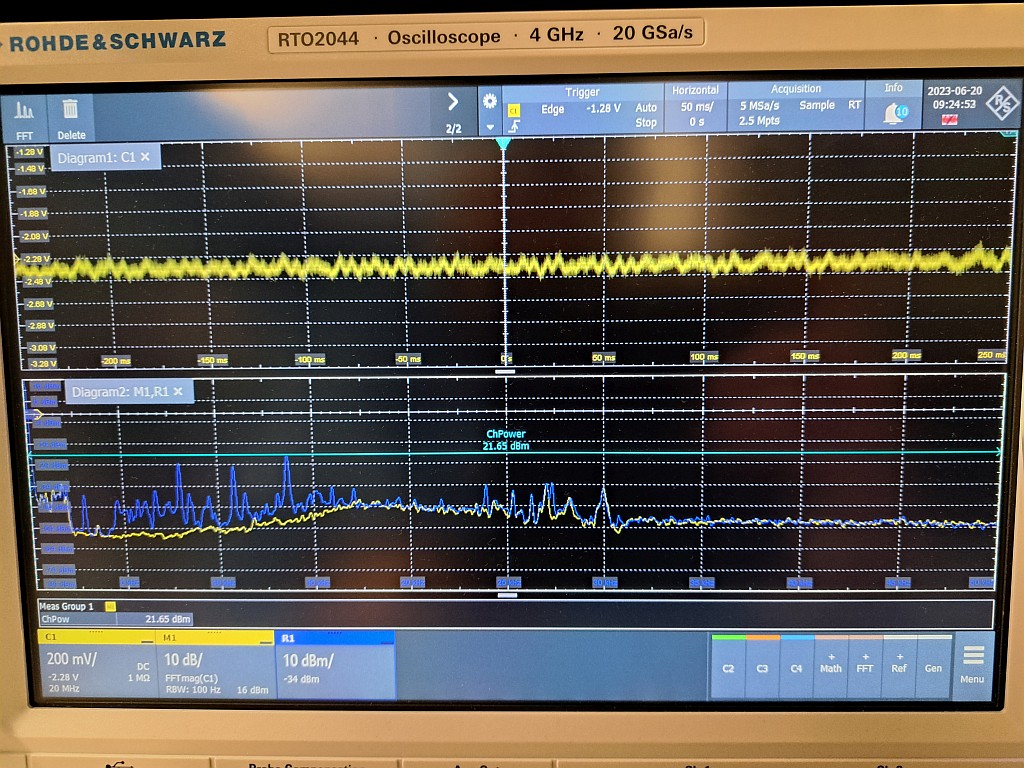 |
| Attachment 2: Lock_at_amp_@30%.jpg
|  |
| Attachment 3: 10kW_in_remote.jpg
| 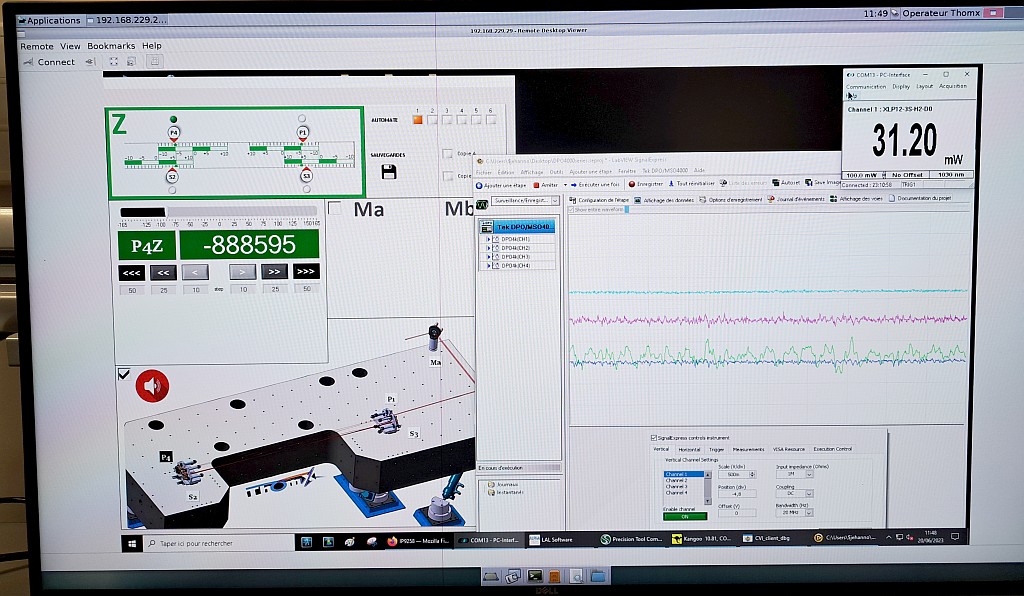 |
|