| ID |
Date |
Author |
Status |
Type |
Category |
Location |
Title |
|
212
|
Tue May 30 18:32:37 2023 |
Manar Amer | Fixed | report | lasers and optics | detectors and electronics | cabling | software | ThomX igloo | Cavity Lock - Alphanov Amplifier | This morning, while trying Guillaume solution of disconnecting the 24 V necessary to the second and third stage and raise the threshold of Temp preamp 1 (to only operate the ampli with first stage only)
Ronic disconnected the 24 volt connection, turned on amplifier LAL software but no MMD3 error or a big temp on Temp preamp 1 , software worked fine with no issue.
we connected the 24 V again and the software worked with no issues.
Still not sure what happened for it to work correctly !!!!!!!!!!
- We used the amplifier at 0% all day with no errors (to test , I turned it for 10 minutes @ 10% with no error too)
- We changed the lase lock box with ThomX one (having Ethernet connection), it was connected to computer and works ok
- Ronic installed a signal amplifier for the PDH error signal. (yet to be fully optimized)
- we see a better coupling than before in the cavity.
- The dominant mode is 00 mode, but we see many higher order modes, need to alight better.
| Manar Amer wrote: |
|
Today with Ronic and Daniele we attempted to lock the cavity, but the alphanov amplifier did not turn on because of an error in MMD3 (related to the third stage)
the new error is having the MMD3 error show on the alarm window of the LAL software, and having the Alarms on the line 3 of the alphanov software red for both EXT/CPU and Laser T Max (never been red before)
this is after a 2-week work stop, but the last time when Daniele changed the fiber connector it worked for 3 hours with no errors.
Ronic, is in contact with Guillaume from Alphanov to fix the issue !!!
Work scheduled all Wednesday, in hopes the issue is fixed by then.
| Manar Amer wrote: |
|
Added Note: the coupling we get is at low power, only preamplifier is on (~ 300 mW)
was done at the end due to excitation of higher order modes.
Wanted to improve the fundamental first, then increase the power.
| Manar Amer wrote: |
- On Monday with Daniele,
- we did full characterization of amplifier beam @ 10% amplification, adjusted the telescope accordingly and injected into the cavity aligned and improved on the fundamental mode.
- On Tuesday with Daniele and Kevin
- I added a low pass filter between 1 - 1.9 MHz on the reflected signal, to reject the oscillator signal (33.33 MHz)
- removed the external resistors on the signal, only the internal resistance of the oscilloscope used ( transmission : 1 M ohm , Reflection : 50 ohm )
- We connected the motors to control the CEP and adjusted on them until we reached ~ 5 -10% coupling
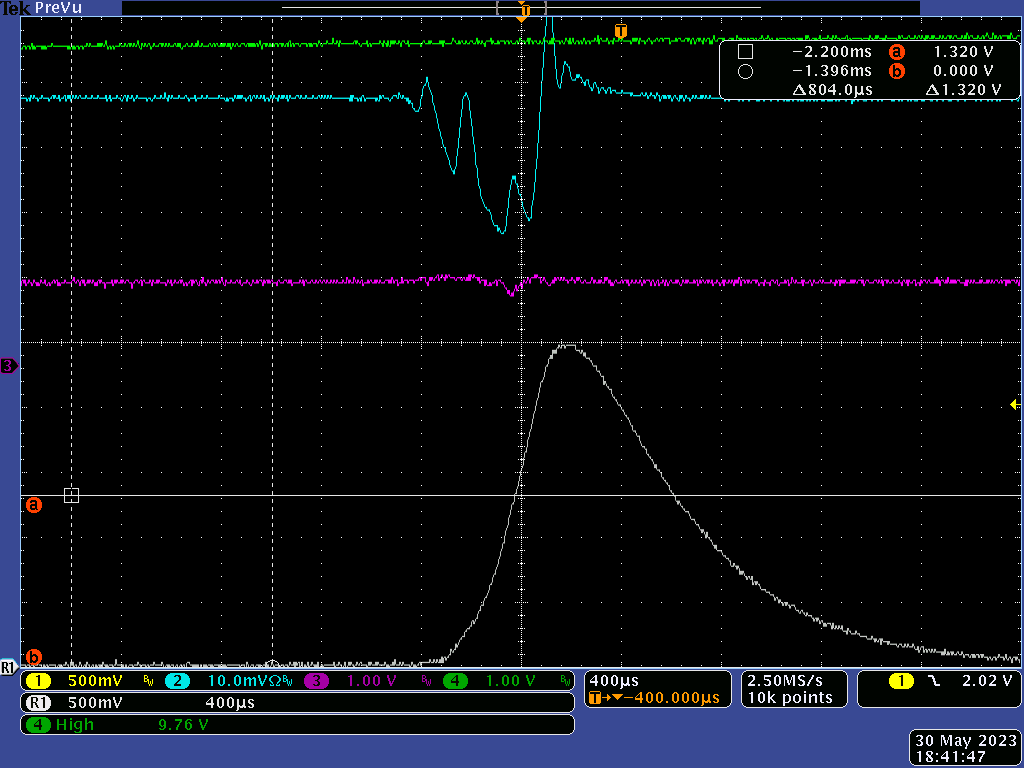
- Images:
- 1st : showing the size of the beam just before injecting into the cavity @ 10%
- 2nd: signal with only improved alignment (not CEP adjustment yet), no low pass filter added yet
- 3rd : zoom on the signals (reflection and error) while adjusting on the CEP
- 4th :attempting to lock the cavity , after getting the max coupling using the CEP motors
Note : the voltage ranges are not the same between the images
| Manar Amer wrote: |
|
Yesterday,
- we installed the second high power reflecting mirrors at the output of the amplifier.
- We aligned and installed a telescope that has adjustable distance between the 2 lenses of -100 mm, and + 200 mm, with approximate diameter at the injection window of ~ 4.5 mm.
- Amplifier was turned on only at the first stage only (output power ~ 300 mW) aligned and injected into the cavity.
- Measured the repetition frequency of the One Five oscillators, Frep = 33.326239 MHz
- Changed the FSR of the cavity to match it.
- Using the Piezo scan on the oscillator, we observed 00 Mode, Fundamental. the shape is the same
- We see transmission on the diode, but there was zero coupling observed (yet to be investigated experimentally )
- a reason could be the CEP of the oscillator ,
- bad matching of the beam waist position,
- noise from the amplifier (as we were operating it at very low power)
- additional alignment needed,
|
|
|
|
|
| Attachment 1: tek00000.png
|  |
|
215
|
Fri Jun 2 10:54:25 2023 |
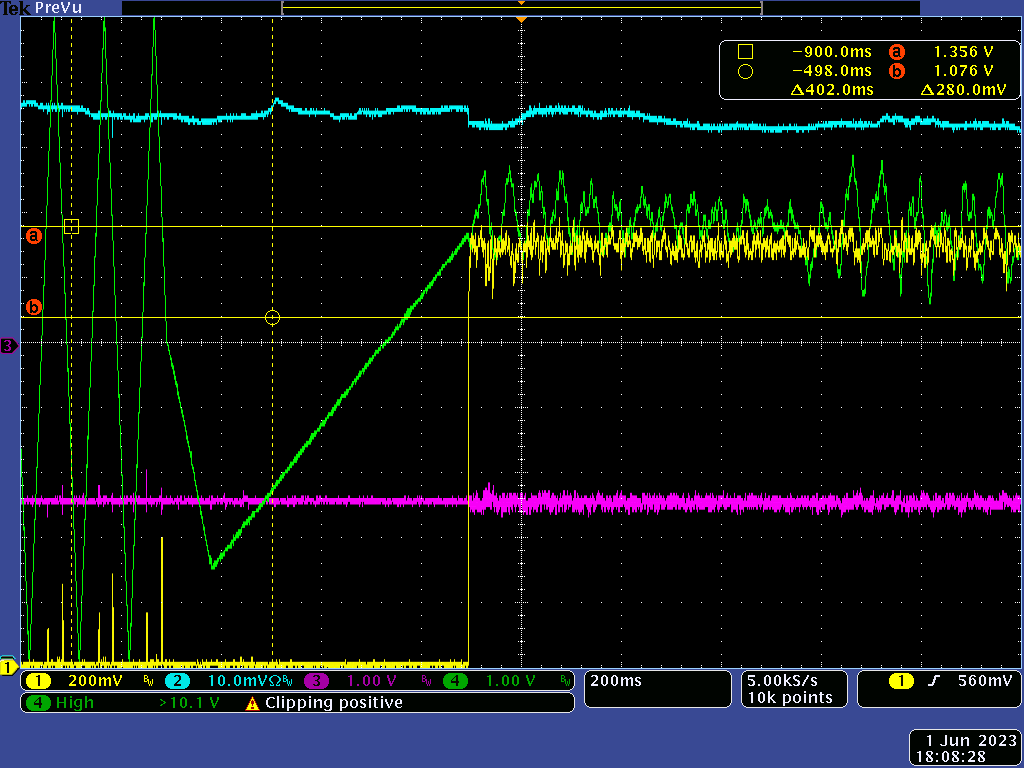
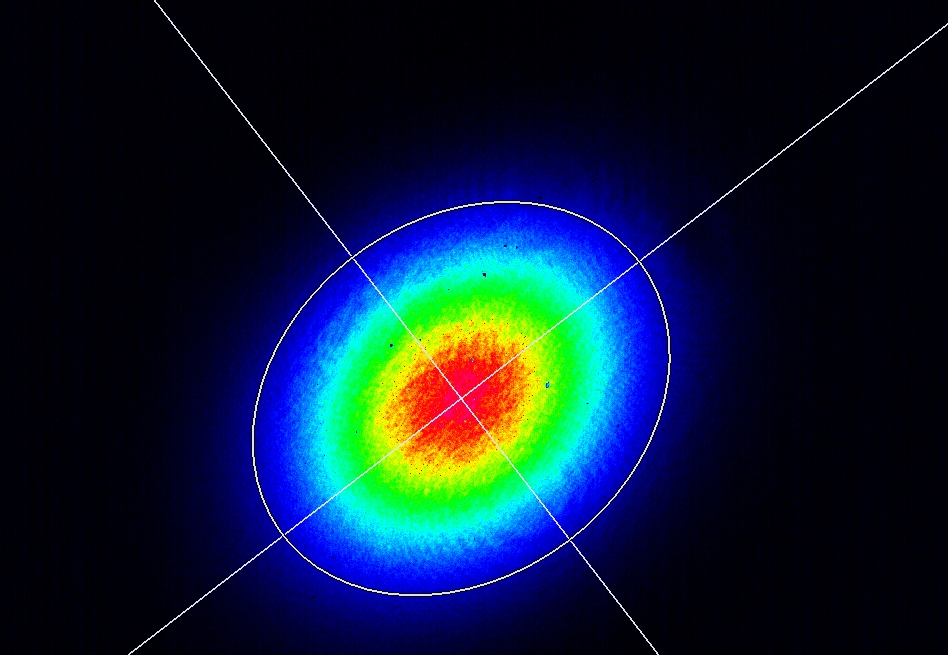
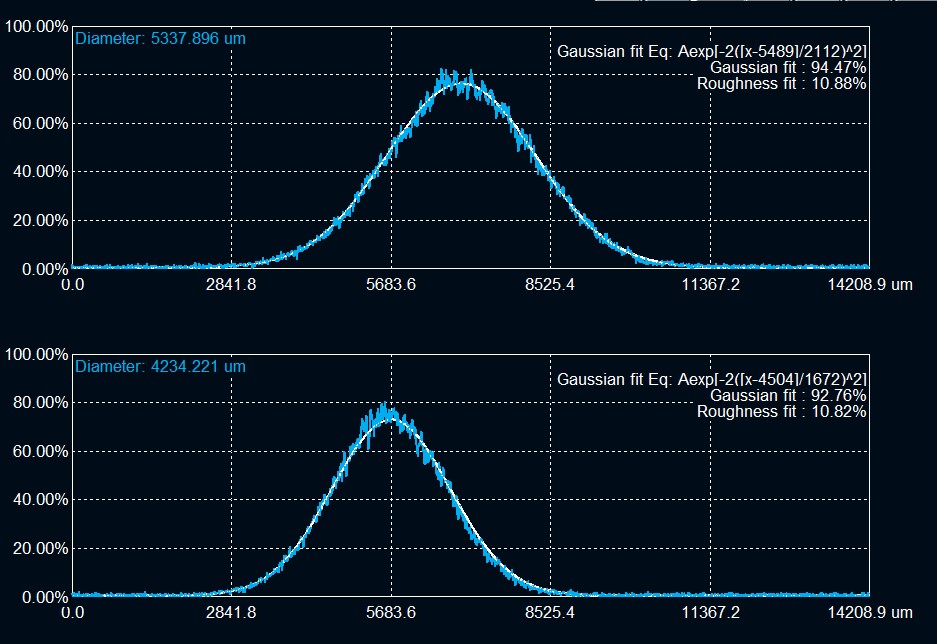
Manar Amer | Fixed | report | lasers and optics | detectors and electronics | cabling | software | ThomX igloo | Cavity Lock - Alphanov Amplifier | Yesterday, with Ronic we locked ThomX cavity on the second resonance
Laser : 33.36 MHz , Amplifier : 0 % (worked with no errors all day)
adding image for the lock on the second resonance (locked), 00 Mode image, fit, Beam measurements
and image of the first resonance signal (not locked)
Info : when locking on the secondary resonance, we aligned better and adjusted on the oscillator CEP and increased the transmission signal
Controllers connected to computer
through Ethernet :
- Cavity Mirror motors
- Lase lock
- oscillator CEP and Frequency motors (easier to follow the drift with this controller, and we can see it moving)
by USB :
| Manar Amer wrote: |
|
This morning, while trying Guillaume solution of disconnecting the 24 V necessary to the second and third stage and raise the threshold of Temp preamp 1 (to only operate the ampli with first stage only)
Ronic disconnected the 24 volt connection, turned on amplifier LAL software but no MMD3 error or a big temp on Temp preamp 1 , software worked fine with no issue.
we connected the 24 V again and the software worked with no issues.
Still not sure what happened for it to work correctly !!!!!!!!!!
- We used the amplifier at 0% all day with no errors (to test , I turned it for 10 minutes @ 10% with no error too)
- We changed the lase lock box with ThomX one (having Ethernet connection), it was connected to computer and works ok
- Ronic installed a signal amplifier for the PDH error signal. (yet to be fully optimized)
- we see a better coupling than before in the cavity.
- The dominant mode is 00 mode, but we see many higher order modes, need to alight better.
| Manar Amer wrote: |
|
Today with Ronic and Daniele we attempted to lock the cavity, but the alphanov amplifier did not turn on because of an error in MMD3 (related to the third stage)
the new error is having the MMD3 error show on the alarm window of the LAL software, and having the Alarms on the line 3 of the alphanov software red for both EXT/CPU and Laser T Max (never been red before)
this is after a 2-week work stop, but the last time when Daniele changed the fiber connector it worked for 3 hours with no errors.
Ronic, is in contact with Guillaume from Alphanov to fix the issue !!!
Work scheduled all Wednesday, in hopes the issue is fixed by then.
| Manar Amer wrote: |
|
Added Note: the coupling we get is at low power, only preamplifier is on (~ 300 mW)
was done at the end due to excitation of higher order modes.
Wanted to improve the fundamental first, then increase the power.
| Manar Amer wrote: |
- On Monday with Daniele,
- we did full characterization of amplifier beam @ 10% amplification, adjusted the telescope accordingly and injected into the cavity aligned and improved on the fundamental mode.
- On Tuesday with Daniele and Kevin
- I added a low pass filter between 1 - 1.9 MHz on the reflected signal, to reject the oscillator signal (33.33 MHz)
- removed the external resistors on the signal, only the internal resistance of the oscilloscope used ( transmission : 1 M ohm , Reflection : 50 ohm )
- We connected the motors to control the CEP and adjusted on them until we reached ~ 5 -10% coupling
- Images:
- 1st : showing the size of the beam just before injecting into the cavity @ 10%
- 2nd: signal with only improved alignment (not CEP adjustment yet), no low pass filter added yet
- 3rd : zoom on the signals (reflection and error) while adjusting on the CEP
- 4th :attempting to lock the cavity , after getting the max coupling using the CEP motors
Note : the voltage ranges are not the same between the images
| Manar Amer wrote: |
|
Yesterday,
- we installed the second high power reflecting mirrors at the output of the amplifier.
- We aligned and installed a telescope that has adjustable distance between the 2 lenses of -100 mm, and + 200 mm, with approximate diameter at the injection window of ~ 4.5 mm.
- Amplifier was turned on only at the first stage only (output power ~ 300 mW) aligned and injected into the cavity.
- Measured the repetition frequency of the One Five oscillators, Frep = 33.326239 MHz
- Changed the FSR of the cavity to match it.
- Using the Piezo scan on the oscillator, we observed 00 Mode, Fundamental. the shape is the same
- We see transmission on the diode, but there was zero coupling observed (yet to be investigated experimentally )
- a reason could be the CEP of the oscillator ,
- bad matching of the beam waist position,
- noise from the amplifier (as we were operating it at very low power)
- additional alignment needed,
|
|
|
|
|
|
| Attachment 1: tek00003_secondary_resonance_fundamental_mode_lock.png
|  |
| Attachment 2: tek0002CH1.isf
|
| Attachment 3: tek0002CH2.isf
|
| Attachment 4: tek0002CH3.isf
|
| Attachment 5: tek0002CH4.isf
|
| Attachment 6: 20230602_00mode_second_resonance.jpg
|  |
| Attachment 7: 20230602_00mode_second_resonance_fit.jpg
|  |
| Attachment 8: 20230602_00mode_second_resonance_measurements.jpg
|  |
| Attachment 9: tek00002_first_resonance_fundamental_mode_signal.png
|  |
| Attachment 10: tek0001CH1.isf
|
| Attachment 11: tek0001CH2.isf
|
| Attachment 12: tek0001CH3.isf
|
| Attachment 13: tek0001CH4.isf
|
|
216
|
Tue Jun 6 01:12:11 2023 |
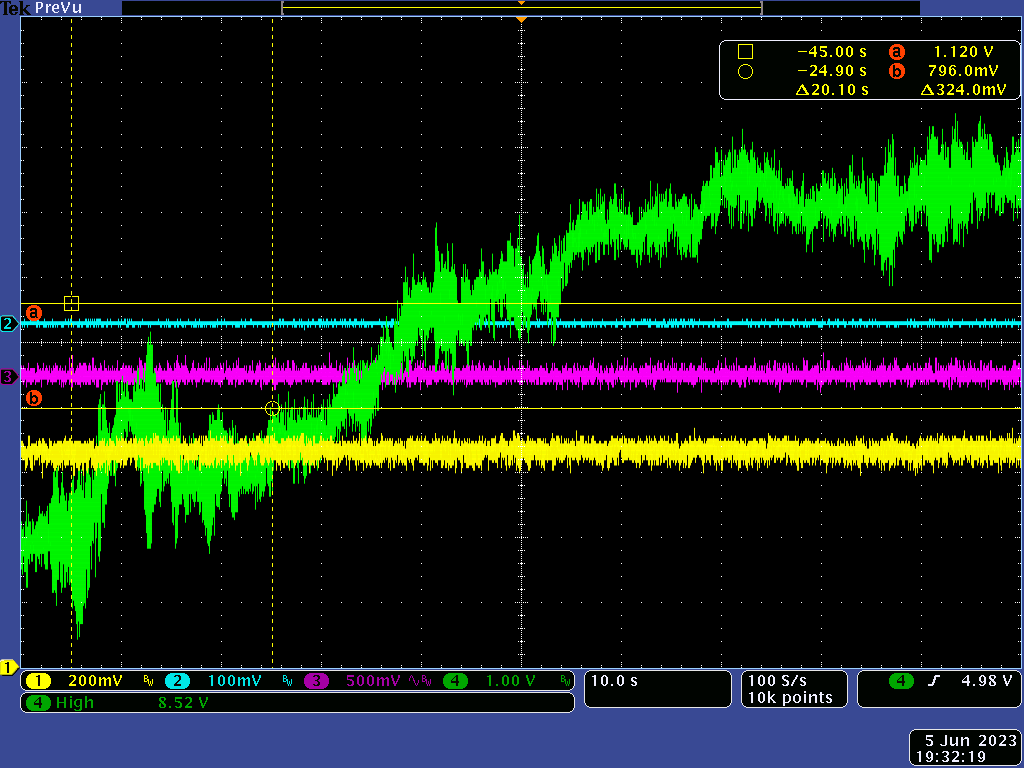
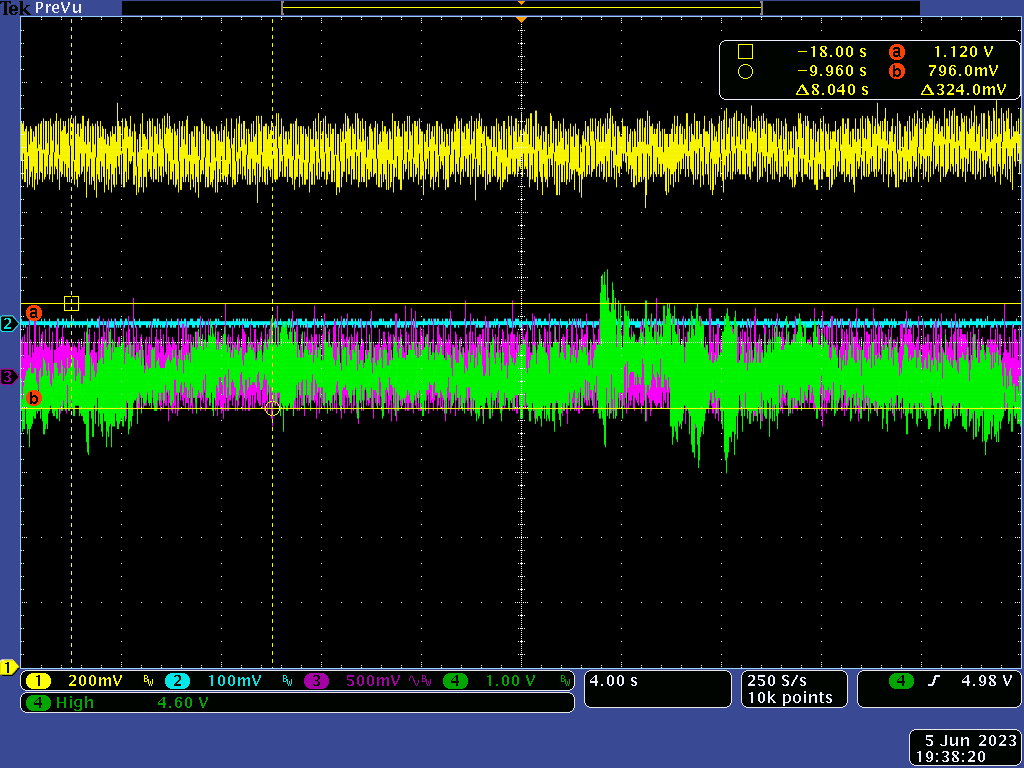
Manar Amer | Fixed | report | lasers and optics | detectors and electronics | cabling | software | ThomX igloo | Cavity Lock - Alphanov Amplifier | Today, I installed a power meter at the transmission point of the 1st spherical mirror , transmission 3 ppm (direct from cavity window beam profiler, no filter)
We locked the cavity at 2 different resonances of the fundamental mode, the lock in both cases was stable for a round 1 minute.
at different transmitted power of 33.85 uW ( 11 W average inside cavity) and then locked again at 82.65 uW (27.5 W average inside cavity) transmitted power
Note : the coupling is almost zero for both of the resonances locked !!!!
Oscillator : 33.33 MHz ( 33.356 MHz , frequency read on LAL software)
power injected into amplifier (after injecting into fiber and an EOM) : 3.886 mW (on LAL software)
Amplifier power : 0% (injected power into cavity ~ 300 mW)
Both images of oscilloscope have same voltage scales, only difference timescale and the color code is :
yellow : transmission
blue : reflection
green : piezo voltage
red : error signal
| Manar Amer wrote: |
|
Yesterday, with Ronic we locked ThomX cavity on the second resonance
Laser : 33.36 MHz , Amplifier : 0 % (worked with no errors all day)
adding image for the lock on the second resonance (locked), 00 Mode image, fit, Beam measurements
and image of the first resonance signal (not locked)
Info : when locking on the secondary resonance, we aligned better and adjusted on the oscillator CEP and increased the transmission signal
Controllers connected to computer
through Ethernet :
- Cavity Mirror motors
- Lase lock
- oscillator CEP and Frequency motors (easier to follow the drift with this controller, and we can see it moving)
by USB :
| Manar Amer wrote: |
|
This morning, while trying Guillaume solution of disconnecting the 24 V necessary to the second and third stage and raise the threshold of Temp preamp 1 (to only operate the ampli with first stage only)
Ronic disconnected the 24 volt connection, turned on amplifier LAL software but no MMD3 error or a big temp on Temp preamp 1 , software worked fine with no issue.
we connected the 24 V again and the software worked with no issues.
Still not sure what happened for it to work correctly !!!!!!!!!!
- We used the amplifier at 0% all day with no errors (to test , I turned it for 10 minutes @ 10% with no error too)
- We changed the lase lock box with ThomX one (having Ethernet connection), it was connected to computer and works ok
- Ronic installed a signal amplifier for the PDH error signal. (yet to be fully optimized)
- we see a better coupling than before in the cavity.
- The dominant mode is 00 mode, but we see many higher order modes, need to alight better.
| Manar Amer wrote: |
|
Today with Ronic and Daniele we attempted to lock the cavity, but the alphanov amplifier did not turn on because of an error in MMD3 (related to the third stage)
the new error is having the MMD3 error show on the alarm window of the LAL software, and having the Alarms on the line 3 of the alphanov software red for both EXT/CPU and Laser T Max (never been red before)
this is after a 2-week work stop, but the last time when Daniele changed the fiber connector it worked for 3 hours with no errors.
Ronic, is in contact with Guillaume from Alphanov to fix the issue !!!
Work scheduled all Wednesday, in hopes the issue is fixed by then.
| Manar Amer wrote: |
|
Added Note: the coupling we get is at low power, only preamplifier is on (~ 300 mW)
was done at the end due to excitation of higher order modes.
Wanted to improve the fundamental first, then increase the power.
| Manar Amer wrote: |
- On Monday with Daniele,
- we did full characterization of amplifier beam @ 10% amplification, adjusted the telescope accordingly and injected into the cavity aligned and improved on the fundamental mode.
- On Tuesday with Daniele and Kevin
- I added a low pass filter between 1 - 1.9 MHz on the reflected signal, to reject the oscillator signal (33.33 MHz)
- removed the external resistors on the signal, only the internal resistance of the oscilloscope used ( transmission : 1 M ohm , Reflection : 50 ohm )
- We connected the motors to control the CEP and adjusted on them until we reached ~ 5 -10% coupling
- Images:
- 1st : showing the size of the beam just before injecting into the cavity @ 10%
- 2nd: signal with only improved alignment (not CEP adjustment yet), no low pass filter added yet
- 3rd : zoom on the signals (reflection and error) while adjusting on the CEP
- 4th :attempting to lock the cavity , after getting the max coupling using the CEP motors
Note : the voltage ranges are not the same between the images
| Manar Amer wrote: |
|
Yesterday,
- we installed the second high power reflecting mirrors at the output of the amplifier.
- We aligned and installed a telescope that has adjustable distance between the 2 lenses of -100 mm, and + 200 mm, with approximate diameter at the injection window of ~ 4.5 mm.
- Amplifier was turned on only at the first stage only (output power ~ 300 mW) aligned and injected into the cavity.
- Measured the repetition frequency of the One Five oscillators, Frep = 33.326239 MHz
- Changed the FSR of the cavity to match it.
- Using the Piezo scan on the oscillator, we observed 00 Mode, Fundamental. the shape is the same
- We see transmission on the diode, but there was zero coupling observed (yet to be investigated experimentally )
- a reason could be the CEP of the oscillator ,
- bad matching of the beam waist position,
- noise from the amplifier (as we were operating it at very low power)
- additional alignment needed,
|
|
|
|
|
|
|
| Attachment 1: 20230605_tek00001_33uW.png
|  |
| Attachment 2: 20230605_tek00002_82uW.png
|  |
|
218
|
Wed Jun 7 21:46:50 2023 |
Manar Amer | Fixed | report | lasers and optics | detectors and electronics | cabling | software | ThomX igloo | Cavity Lock - Alphanov Amplifier | Today with Ronic,
starting with major events that happened (Water circulation + ThomX valves )
- Early in the morning a company worked on the water network, it seemed it was not restarted properly so there was no water circulation in the main ThomX pipes.
- There was an error on the ThomX amplifier chiller , which was noticed at the end of the morning work , where we couldn't find the cavity resonance , could be due to the temperature increase of the amplifer.
- Solved : the issue was solved by restarting the water network and the amplifier chiller was restarted an no error found and temp. Stabilized around 25°
- Around 12h15 ThomX there was a power cut off for less than a second (micro cutt), which cased all the valves to close, the valve air compressor did not restart after the power cut off, we restarted it with Daniele in the evening with the help of Marie and the valves open around 5-6 bar , you will see then all the controllers green and the valves will open.
Results of the day :
- All the power supplies and function generators are under the table, nothing on the table (reduced noise on the signal)
- EOM of Oscillator Off (for now, might turn on if needed)
- Amplifier on 0% , output ~ 300 mW
- Locked on the first resonance of the cavity, lase lock parameters to be optimized better
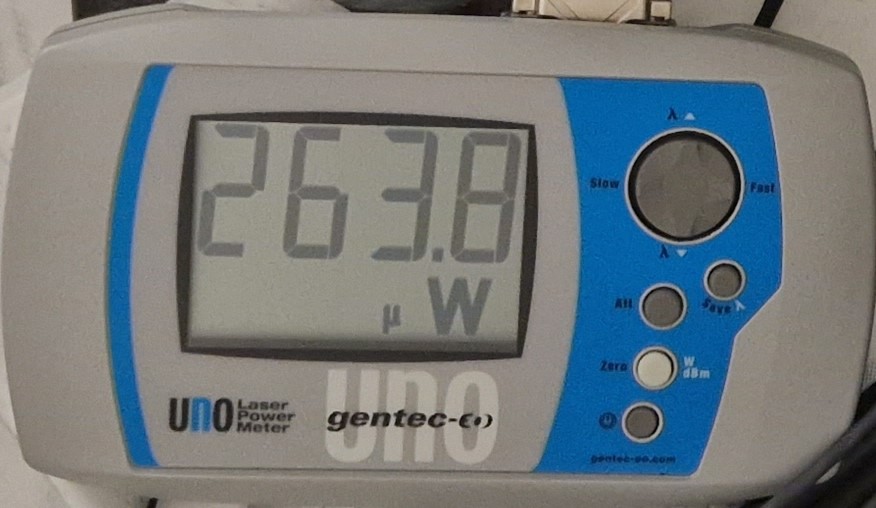
- Transmitted power increased to ~ 267.2 uW
- Average power inside cavity = 89. 06 W , peak power = 0.2 kW (pulse width = 12.6 ps , frep = 33.36 MHz )
- current effective cavity gain > 300
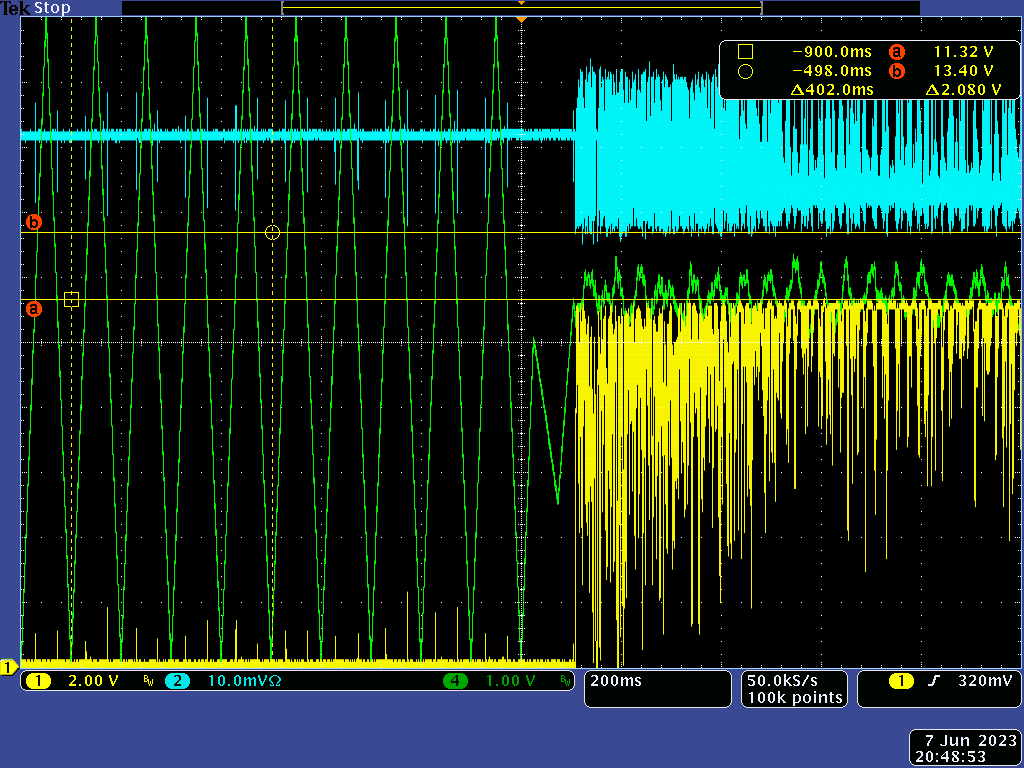
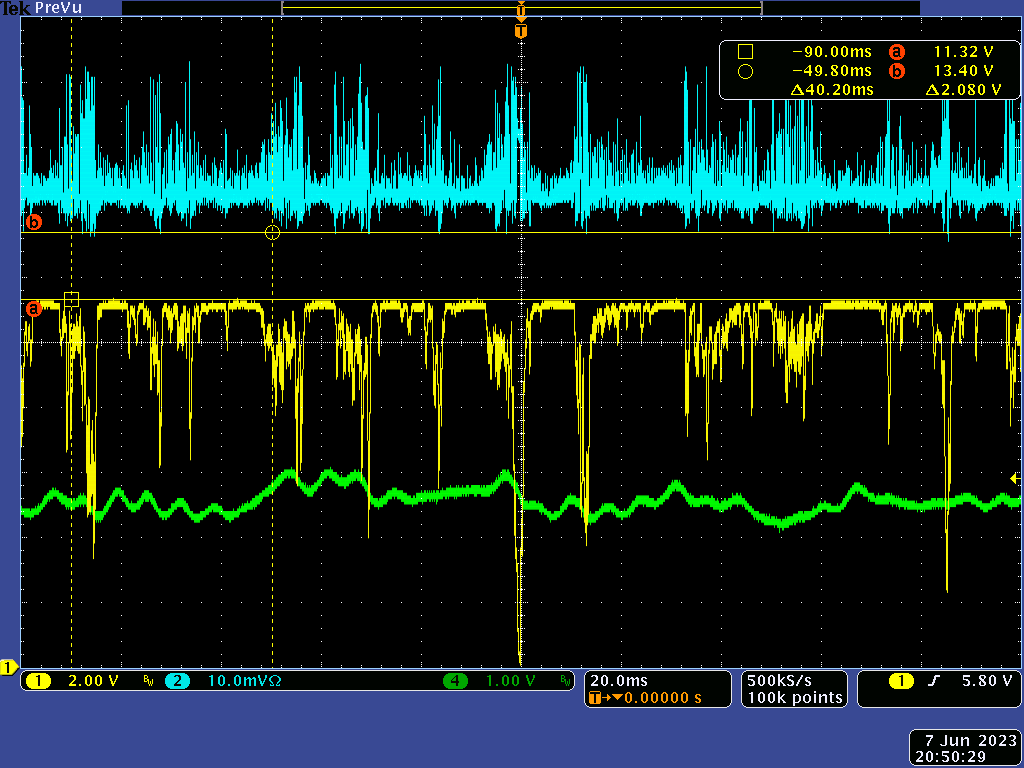
Oscilloscope :
- error signal, not shown as it was too noisy to have in the image
- blue : reflection (low bypass filter ), yellow : transmission (resistance of 100 k ohm added), green : piezo signal
- 1st image : showing lock and scan regions.
- 2nd image: time zoom on the locked signal
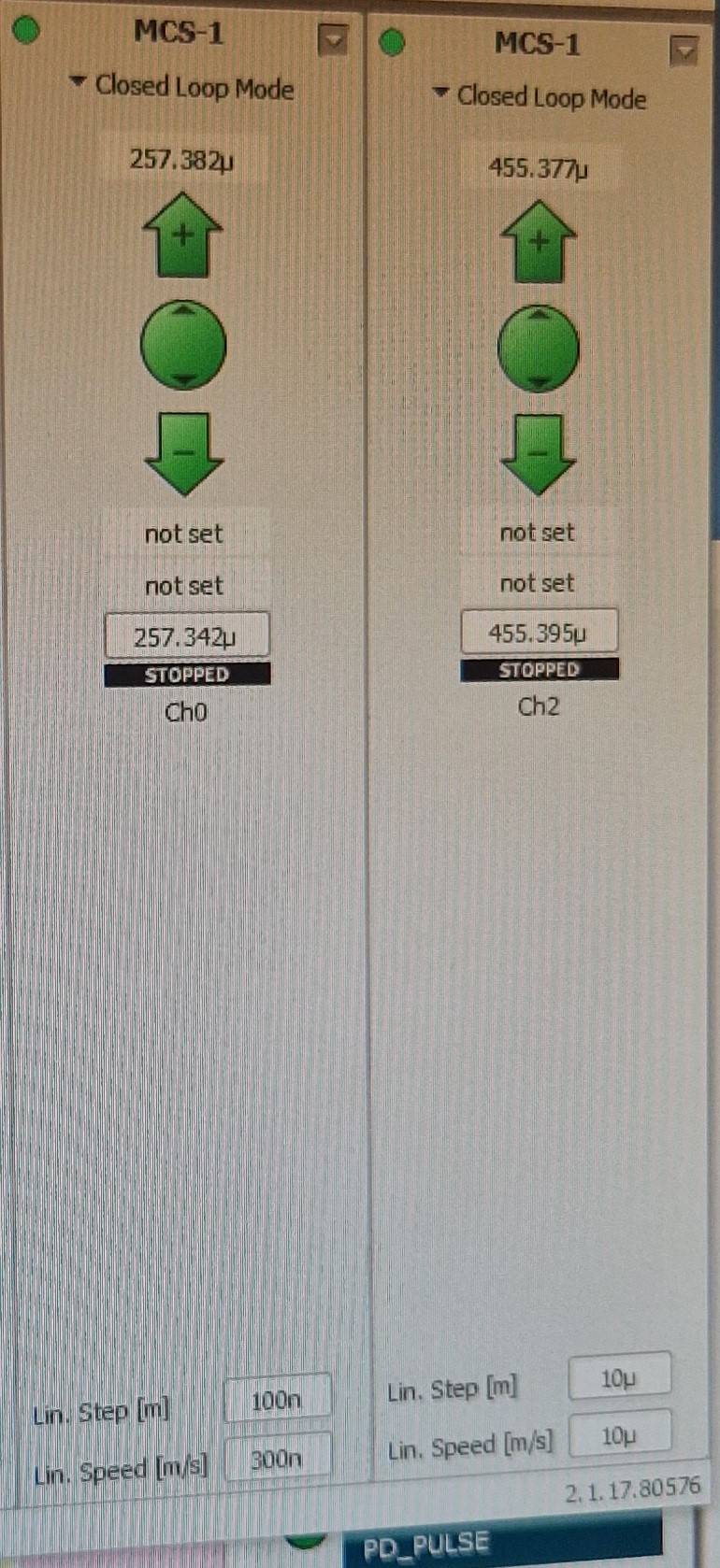
oscillators controller / smartAct:
- Frequency and CEP control , the parameters in the photo attached are the best for the moment to see the smooth change of the resonance peaks when operating the motors, and we can stay FSR range and compensate the variation easily.
- even though we stayed at closed loop (for easier adjustment), we still managed to lock , will try to switch off later to see if reduces a lot of noise.
| Manar Amer wrote: |
|
Today, I installed a power meter at the transmission point of the 1st spherical mirror , transmission 3 ppm (direct from cavity window beam profiler, no filter)
We locked the cavity at 2 different resonances of the fundamental mode, the lock in both cases was stable for a round 1 minute.
at different transmitted power of 33.85 uW ( 11 W average inside cavity) and then locked again at 82.65 uW (27.5 W average inside cavity) transmitted power
Note : the coupling is almost zero for both of the resonances locked !!!!
Oscillator : 33.33 MHz ( 33.356 MHz , frequency read on LAL software)
power injected into amplifier (after injecting into fiber and an EOM) : 3.886 mW (on LAL software)
Amplifier power : 0% (injected power into cavity ~ 300 mW)
Both images of oscilloscope have same voltage scales, only difference timescale and the color code is :
yellow : transmission
blue : reflection
green : piezo voltage
red : error signal
| Manar Amer wrote: |
|
Yesterday, with Ronic we locked ThomX cavity on the second resonance
Laser : 33.36 MHz , Amplifier : 0 % (worked with no errors all day)
adding image for the lock on the second resonance (locked), 00 Mode image, fit, Beam measurements
and image of the first resonance signal (not locked)
Info : when locking on the secondary resonance, we aligned better and adjusted on the oscillator CEP and increased the transmission signal
Controllers connected to computer
through Ethernet :
- Cavity Mirror motors
- Lase lock
- oscillator CEP and Frequency motors (easier to follow the drift with this controller, and we can see it moving)
by USB :
| Manar Amer wrote: |
|
This morning, while trying Guillaume solution of disconnecting the 24 V necessary to the second and third stage and raise the threshold of Temp preamp 1 (to only operate the ampli with first stage only)
Ronic disconnected the 24 volt connection, turned on amplifier LAL software but no MMD3 error or a big temp on Temp preamp 1 , software worked fine with no issue.
we connected the 24 V again and the software worked with no issues.
Still not sure what happened for it to work correctly !!!!!!!!!!
- We used the amplifier at 0% all day with no errors (to test , I turned it for 10 minutes @ 10% with no error too)
- We changed the lase lock box with ThomX one (having Ethernet connection), it was connected to computer and works ok
- Ronic installed a signal amplifier for the PDH error signal. (yet to be fully optimized)
- we see a better coupling than before in the cavity.
- The dominant mode is 00 mode, but we see many higher order modes, need to alight better.
| Manar Amer wrote: |
|
Today with Ronic and Daniele we attempted to lock the cavity, but the alphanov amplifier did not turn on because of an error in MMD3 (related to the third stage)
the new error is having the MMD3 error show on the alarm window of the LAL software, and having the Alarms on the line 3 of the alphanov software red for both EXT/CPU and Laser T Max (never been red before)
this is after a 2-week work stop, but the last time when Daniele changed the fiber connector it worked for 3 hours with no errors.
Ronic, is in contact with Guillaume from Alphanov to fix the issue !!!
Work scheduled all Wednesday, in hopes the issue is fixed by then.
| Manar Amer wrote: |
|
Added Note: the coupling we get is at low power, only preamplifier is on (~ 300 mW)
was done at the end due to excitation of higher order modes.
Wanted to improve the fundamental first, then increase the power.
| Manar Amer wrote: |
- On Monday with Daniele,
- we did full characterization of amplifier beam @ 10% amplification, adjusted the telescope accordingly and injected into the cavity aligned and improved on the fundamental mode.
- On Tuesday with Daniele and Kevin
- I added a low pass filter between 1 - 1.9 MHz on the reflected signal, to reject the oscillator signal (33.33 MHz)
- removed the external resistors on the signal, only the internal resistance of the oscilloscope used ( transmission : 1 M ohm , Reflection : 50 ohm )
- We connected the motors to control the CEP and adjusted on them until we reached ~ 5 -10% coupling
- Images:
- 1st : showing the size of the beam just before injecting into the cavity @ 10%
- 2nd: signal with only improved alignment (not CEP adjustment yet), no low pass filter added yet
- 3rd : zoom on the signals (reflection and error) while adjusting on the CEP
- 4th :attempting to lock the cavity , after getting the max coupling using the CEP motors
Note : the voltage ranges are not the same between the images
| Manar Amer wrote: |
|
Yesterday,
- we installed the second high power reflecting mirrors at the output of the amplifier.
- We aligned and installed a telescope that has adjustable distance between the 2 lenses of -100 mm, and + 200 mm, with approximate diameter at the injection window of ~ 4.5 mm.
- Amplifier was turned on only at the first stage only (output power ~ 300 mW) aligned and injected into the cavity.
- Measured the repetition frequency of the One Five oscillators, Frep = 33.326239 MHz
- Changed the FSR of the cavity to match it.
- Using the Piezo scan on the oscillator, we observed 00 Mode, Fundamental. the shape is the same
- We see transmission on the diode, but there was zero coupling observed (yet to be investigated experimentally )
- a reason could be the CEP of the oscillator ,
- bad matching of the beam waist position,
- noise from the amplifier (as we were operating it at very low power)
- additional alignment needed,
|
|
|
|
|
|
|
|
| Attachment 1: tek00001.png
|  |
| Attachment 2: 20230607_183626_Frep_CEP_motors_smartAct.jpg
|  |
| Attachment 3: 20230607_183641_transmitted_power.jpg
|  |
| Attachment 4: tek00002.png
|  |
|
220
|
Fri Jun 9 19:51:43 2023 |
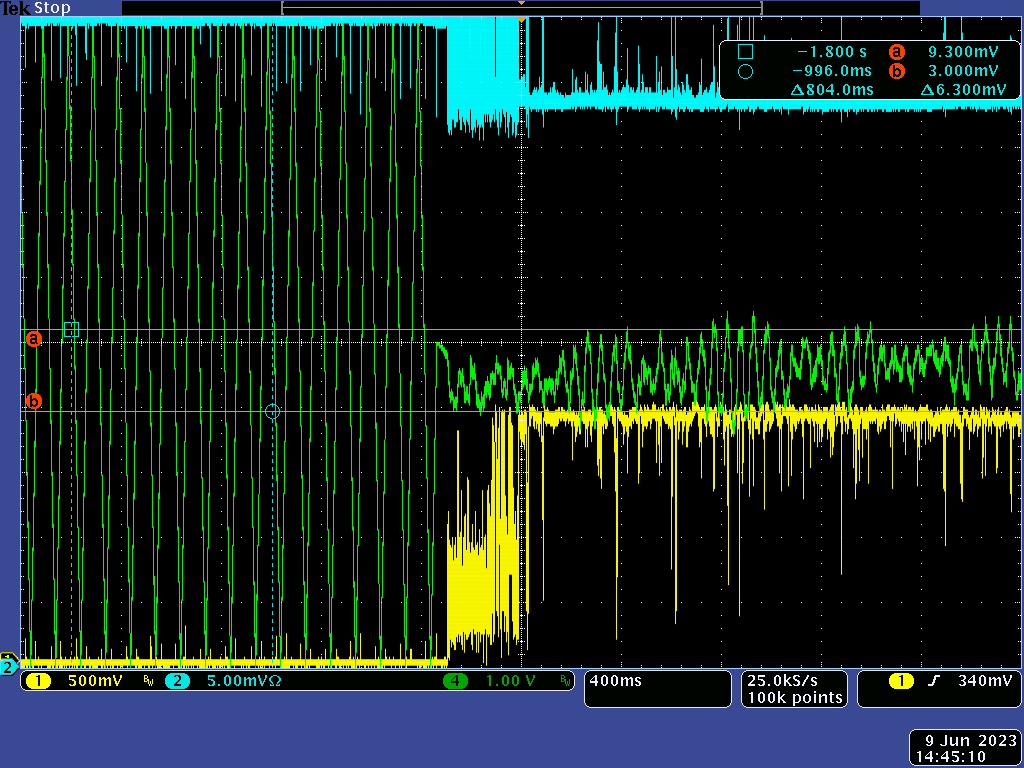
Manar Amer | Fixed | report | lasers and optics | detectors and electronics | cabling | software | ThomX igloo | Cavity Lock - Alphanov Amplifier | In the morning, we locked on the first resonance. With an increase on the amplifier power @ 20-25% and 30%, which reduced the noise
we manage to get a coupling when improving the CEP up to 55 - 60 % coupling : put there is still a drift on the CEP
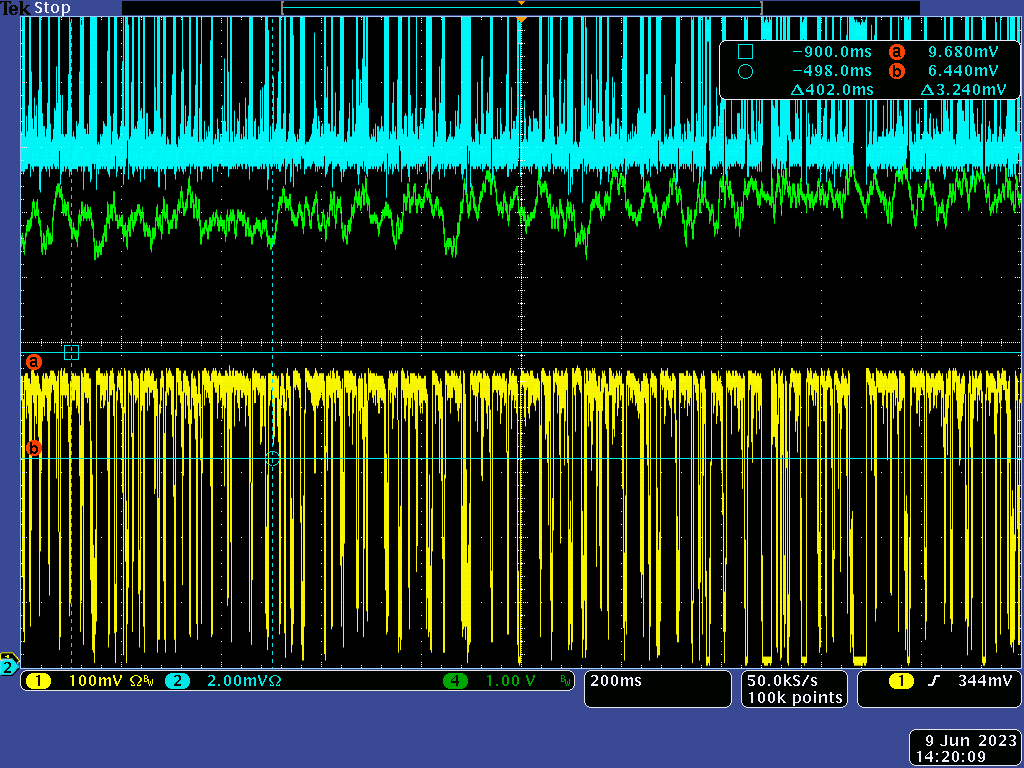
The controller for the oscillator frep and CEP produces a lot of noise, even if it is disconnected. we need to switch it off to remove its effect (Kevin will order a new one)
The image attached is of the oscilloscope lock on the first resonance @30% amplifier power ~ 10 W injected into cavity,
transmitted power ~ 36 mW (cavity average power 12 kW)
cavity effective gain > 1200
in the afternoon, we installed and aligned a gentec power meter we can monitor from the computer. (will need to buy a permeant one for ThomX)
there was an issue with the laselock USB connection, yet to be solved.
and the control of the computer.
| Manar Amer wrote: |
|
Today with Ronic,
starting with major events that happened (Water circulation + ThomX valves )
- Early in the morning a company worked on the water network, it seemed it was not restarted properly so there was no water circulation in the main ThomX pipes.
- There was an error on the ThomX amplifier chiller , which was noticed at the end of the morning work , where we couldn't find the cavity resonance , could be due to the temperature increase of the amplifer.
- Solved : the issue was solved by restarting the water network and the amplifier chiller was restarted an no error found and temp. Stabilized around 25°
- Around 12h15 ThomX there was a power cut off for less than a second (micro cutt), which cased all the valves to close, the valve air compressor did not restart after the power cut off, we restarted it with Daniele in the evening with the help of Marie and the valves open around 5-6 bar , you will see then all the controllers green and the valves will open.
Results of the day :
- All the power supplies and function generators are under the table, nothing on the table (reduced noise on the signal)
- EOM of Oscillator Off (for now, might turn on if needed)
- Amplifier on 0% , output ~ 300 mW
- Locked on the first resonance of the cavity, lase lock parameters to be optimized better
- Transmitted power increased to ~ 267.2 uW
- Average power inside cavity = 89. 06 W , peak power = 0.2 kW (pulse width = 12.6 ps , frep = 33.36 MHz )
- current effective cavity gain > 300
Oscilloscope :
- error signal, not shown as it was too noisy to have in the image
- blue : reflection (low bypass filter ), yellow : transmission (resistance of 100 k ohm added), green : piezo signal
- 1st image : showing lock and scan regions.
- 2nd image: time zoom on the locked signal
oscillators controller / smartAct:
- Frequency and CEP control , the parameters in the photo attached are the best for the moment to see the smooth change of the resonance peaks when operating the motors, and we can stay FSR range and compensate the variation easily.
- even though we stayed at closed loop (for easier adjustment), we still managed to lock , will try to switch off later to see if reduces a lot of noise.
| Manar Amer wrote: |
|
Today, I installed a power meter at the transmission point of the 1st spherical mirror , transmission 3 ppm (direct from cavity window beam profiler, no filter)
We locked the cavity at 2 different resonances of the fundamental mode, the lock in both cases was stable for a round 1 minute.
at different transmitted power of 33.85 uW ( 11 W average inside cavity) and then locked again at 82.65 uW (27.5 W average inside cavity) transmitted power
Note : the coupling is almost zero for both of the resonances locked !!!!
Oscillator : 33.33 MHz ( 33.356 MHz , frequency read on LAL software)
power injected into amplifier (after injecting into fiber and an EOM) : 3.886 mW (on LAL software)
Amplifier power : 0% (injected power into cavity ~ 300 mW)
Both images of oscilloscope have same voltage scales, only difference timescale and the color code is :
yellow : transmission
blue : reflection
green : piezo voltage
red : error signal
| Manar Amer wrote: |
|
Yesterday, with Ronic we locked ThomX cavity on the second resonance
Laser : 33.36 MHz , Amplifier : 0 % (worked with no errors all day)
adding image for the lock on the second resonance (locked), 00 Mode image, fit, Beam measurements
and image of the first resonance signal (not locked)
Info : when locking on the secondary resonance, we aligned better and adjusted on the oscillator CEP and increased the transmission signal
Controllers connected to computer
through Ethernet :
- Cavity Mirror motors
- Lase lock
- oscillator CEP and Frequency motors (easier to follow the drift with this controller, and we can see it moving)
by USB :
| Manar Amer wrote: |
|
This morning, while trying Guillaume solution of disconnecting the 24 V necessary to the second and third stage and raise the threshold of Temp preamp 1 (to only operate the ampli with first stage only)
Ronic disconnected the 24 volt connection, turned on amplifier LAL software but no MMD3 error or a big temp on Temp preamp 1 , software worked fine with no issue.
we connected the 24 V again and the software worked with no issues.
Still not sure what happened for it to work correctly !!!!!!!!!!
- We used the amplifier at 0% all day with no errors (to test , I turned it for 10 minutes @ 10% with no error too)
- We changed the lase lock box with ThomX one (having Ethernet connection), it was connected to computer and works ok
- Ronic installed a signal amplifier for the PDH error signal. (yet to be fully optimized)
- we see a better coupling than before in the cavity.
- The dominant mode is 00 mode, but we see many higher order modes, need to alight better.
| Manar Amer wrote: |
|
Today with Ronic and Daniele we attempted to lock the cavity, but the alphanov amplifier did not turn on because of an error in MMD3 (related to the third stage)
the new error is having the MMD3 error show on the alarm window of the LAL software, and having the Alarms on the line 3 of the alphanov software red for both EXT/CPU and Laser T Max (never been red before)
this is after a 2-week work stop, but the last time when Daniele changed the fiber connector it worked for 3 hours with no errors.
Ronic, is in contact with Guillaume from Alphanov to fix the issue !!!
Work scheduled all Wednesday, in hopes the issue is fixed by then.
| Manar Amer wrote: |
|
Added Note: the coupling we get is at low power, only preamplifier is on (~ 300 mW)
was done at the end due to excitation of higher order modes.
Wanted to improve the fundamental first, then increase the power.
| Manar Amer wrote: |
- On Monday with Daniele,
- we did full characterization of amplifier beam @ 10% amplification, adjusted the telescope accordingly and injected into the cavity aligned and improved on the fundamental mode.
- On Tuesday with Daniele and Kevin
- I added a low pass filter between 1 - 1.9 MHz on the reflected signal, to reject the oscillator signal (33.33 MHz)
- removed the external resistors on the signal, only the internal resistance of the oscilloscope used ( transmission : 1 M ohm , Reflection : 50 ohm )
- We connected the motors to control the CEP and adjusted on them until we reached ~ 5 -10% coupling
- Images:
- 1st : showing the size of the beam just before injecting into the cavity @ 10%
- 2nd: signal with only improved alignment (not CEP adjustment yet), no low pass filter added yet
- 3rd : zoom on the signals (reflection and error) while adjusting on the CEP
- 4th :attempting to lock the cavity , after getting the max coupling using the CEP motors
Note : the voltage ranges are not the same between the images
| Manar Amer wrote: |
|
Yesterday,
- we installed the second high power reflecting mirrors at the output of the amplifier.
- We aligned and installed a telescope that has adjustable distance between the 2 lenses of -100 mm, and + 200 mm, with approximate diameter at the injection window of ~ 4.5 mm.
- Amplifier was turned on only at the first stage only (output power ~ 300 mW) aligned and injected into the cavity.
- Measured the repetition frequency of the One Five oscillators, Frep = 33.326239 MHz
- Changed the FSR of the cavity to match it.
- Using the Piezo scan on the oscillator, we observed 00 Mode, Fundamental. the shape is the same
- We see transmission on the diode, but there was zero coupling observed (yet to be investigated experimentally )
- a reason could be the CEP of the oscillator ,
- bad matching of the beam waist position,
- noise from the amplifier (as we were operating it at very low power)
- additional alignment needed,
|
|
|
|
|
|
|
|
|
| Attachment 1: tek00001_noise_reduced_first_resonance.png
|  |
| Attachment 2: tek00000_cavity_lock_with_noise_from_odcillator_controller.png
|  |
|
221
|
Mon Jun 19 16:08:15 2023 |
Manar Amer | Fixed | report | lasers and optics | detectors and electronics | cabling | software | ThomX igloo | Cavity Lock - Alphanov Amplifier | The computer is possible to connect from the control room,
we are able to run remotely the amplifier, cavity motors, oscillator motors, lase lock (note: there is an issue with the keyboard, we are not able to use it with remote access!!!!!!!!)
Note on Amplifier: On Friday, Daniele and Ronic faced again the temperature issue that came up before. it is due to the fluctuation of the diode temperature.
It was fixed today by Ronic and Daniele. it seems there are three diodes for monitoring the temperature, only one was connected, and it had issues, with some directions from alphanov.
Ronic just removed the defective diode and soldered (connected) a different one. The amplifier should work without this issue.
now we start searching for X-rays after locking the cavity remotely
| Manar Amer wrote: |
|
In the morning, we locked on the first resonance. With an increase on the amplifier power @ 20-25% and 30%, which reduced the noise
we manage to get a coupling when improving the CEP up to 55 - 60 % coupling : put there is still a drift on the CEP
The controller for the oscillator frep and CEP produces a lot of noise, even if it is disconnected. we need to switch it off to remove its effect (Kevin will order a new one)
The image attached is of the oscilloscope lock on the first resonance @30% amplifier power ~ 10 W injected into cavity,
transmitted power ~ 36 mW (cavity average power 12 kW)
cavity effective gain > 1200
in the afternoon, we installed and aligned a gentec power meter we can monitor from the computer. (will need to buy a permeant one for ThomX)
there was an issue with the laselock USB connection, yet to be solved.
and the control of the computer.
| Manar Amer wrote: |
|
Today with Ronic,
starting with major events that happened (Water circulation + ThomX valves )
- Early in the morning a company worked on the water network, it seemed it was not restarted properly so there was no water circulation in the main ThomX pipes.
- There was an error on the ThomX amplifier chiller , which was noticed at the end of the morning work , where we couldn't find the cavity resonance , could be due to the temperature increase of the amplifer.
- Solved : the issue was solved by restarting the water network and the amplifier chiller was restarted an no error found and temp. Stabilized around 25°
- Around 12h15 ThomX there was a power cut off for less than a second (micro cutt), which cased all the valves to close, the valve air compressor did not restart after the power cut off, we restarted it with Daniele in the evening with the help of Marie and the valves open around 5-6 bar , you will see then all the controllers green and the valves will open.
Results of the day :
- All the power supplies and function generators are under the table, nothing on the table (reduced noise on the signal)
- EOM of Oscillator Off (for now, might turn on if needed)
- Amplifier on 0% , output ~ 300 mW
- Locked on the first resonance of the cavity, lase lock parameters to be optimized better
- Transmitted power increased to ~ 267.2 uW
- Average power inside cavity = 89. 06 W , peak power = 0.2 kW (pulse width = 12.6 ps , frep = 33.36 MHz )
- current effective cavity gain > 300
Oscilloscope :
- error signal, not shown as it was too noisy to have in the image
- blue : reflection (low bypass filter ), yellow : transmission (resistance of 100 k ohm added), green : piezo signal
- 1st image : showing lock and scan regions.
- 2nd image: time zoom on the locked signal
oscillators controller / smartAct:
- Frequency and CEP control , the parameters in the photo attached are the best for the moment to see the smooth change of the resonance peaks when operating the motors, and we can stay FSR range and compensate the variation easily.
- even though we stayed at closed loop (for easier adjustment), we still managed to lock , will try to switch off later to see if reduces a lot of noise.
| Manar Amer wrote: |
|
Today, I installed a power meter at the transmission point of the 1st spherical mirror , transmission 3 ppm (direct from cavity window beam profiler, no filter)
We locked the cavity at 2 different resonances of the fundamental mode, the lock in both cases was stable for a round 1 minute.
at different transmitted power of 33.85 uW ( 11 W average inside cavity) and then locked again at 82.65 uW (27.5 W average inside cavity) transmitted power
Note : the coupling is almost zero for both of the resonances locked !!!!
Oscillator : 33.33 MHz ( 33.356 MHz , frequency read on LAL software)
power injected into amplifier (after injecting into fiber and an EOM) : 3.886 mW (on LAL software)
Amplifier power : 0% (injected power into cavity ~ 300 mW)
Both images of oscilloscope have same voltage scales, only difference timescale and the color code is :
yellow : transmission
blue : reflection
green : piezo voltage
red : error signal
| Manar Amer wrote: |
|
Yesterday, with Ronic we locked ThomX cavity on the second resonance
Laser : 33.36 MHz , Amplifier : 0 % (worked with no errors all day)
adding image for the lock on the second resonance (locked), 00 Mode image, fit, Beam measurements
and image of the first resonance signal (not locked)
Info : when locking on the secondary resonance, we aligned better and adjusted on the oscillator CEP and increased the transmission signal
Controllers connected to computer
through Ethernet :
- Cavity Mirror motors
- Lase lock
- oscillator CEP and Frequency motors (easier to follow the drift with this controller, and we can see it moving)
by USB :
| Manar Amer wrote: |
|
This morning, while trying Guillaume solution of disconnecting the 24 V necessary to the second and third stage and raise the threshold of Temp preamp 1 (to only operate the ampli with first stage only)
Ronic disconnected the 24 volt connection, turned on amplifier LAL software but no MMD3 error or a big temp on Temp preamp 1 , software worked fine with no issue.
we connected the 24 V again and the software worked with no issues.
Still not sure what happened for it to work correctly !!!!!!!!!!
- We used the amplifier at 0% all day with no errors (to test , I turned it for 10 minutes @ 10% with no error too)
- We changed the lase lock box with ThomX one (having Ethernet connection), it was connected to computer and works ok
- Ronic installed a signal amplifier for the PDH error signal. (yet to be fully optimized)
- we see a better coupling than before in the cavity.
- The dominant mode is 00 mode, but we see many higher order modes, need to alight better.
| Manar Amer wrote: |
|
Today with Ronic and Daniele we attempted to lock the cavity, but the alphanov amplifier did not turn on because of an error in MMD3 (related to the third stage)
the new error is having the MMD3 error show on the alarm window of the LAL software, and having the Alarms on the line 3 of the alphanov software red for both EXT/CPU and Laser T Max (never been red before)
this is after a 2-week work stop, but the last time when Daniele changed the fiber connector it worked for 3 hours with no errors.
Ronic, is in contact with Guillaume from Alphanov to fix the issue !!!
Work scheduled all Wednesday, in hopes the issue is fixed by then.
| Manar Amer wrote: |
|
Added Note: the coupling we get is at low power, only preamplifier is on (~ 300 mW)
was done at the end due to excitation of higher order modes.
Wanted to improve the fundamental first, then increase the power.
| Manar Amer wrote: |
- On Monday with Daniele,
- we did full characterization of amplifier beam @ 10% amplification, adjusted the telescope accordingly and injected into the cavity aligned and improved on the fundamental mode.
- On Tuesday with Daniele and Kevin
- I added a low pass filter between 1 - 1.9 MHz on the reflected signal, to reject the oscillator signal (33.33 MHz)
- removed the external resistors on the signal, only the internal resistance of the oscilloscope used ( transmission : 1 M ohm , Reflection : 50 ohm )
- We connected the motors to control the CEP and adjusted on them until we reached ~ 5 -10% coupling
- Images:
- 1st : showing the size of the beam just before injecting into the cavity @ 10%
- 2nd: signal with only improved alignment (not CEP adjustment yet), no low pass filter added yet
- 3rd : zoom on the signals (reflection and error) while adjusting on the CEP
- 4th :attempting to lock the cavity , after getting the max coupling using the CEP motors
Note : the voltage ranges are not the same between the images
| Manar Amer wrote: |
|
Yesterday,
- we installed the second high power reflecting mirrors at the output of the amplifier.
- We aligned and installed a telescope that has adjustable distance between the 2 lenses of -100 mm, and + 200 mm, with approximate diameter at the injection window of ~ 4.5 mm.
- Amplifier was turned on only at the first stage only (output power ~ 300 mW) aligned and injected into the cavity.
- Measured the repetition frequency of the One Five oscillators, Frep = 33.326239 MHz
- Changed the FSR of the cavity to match it.
- Using the Piezo scan on the oscillator, we observed 00 Mode, Fundamental. the shape is the same
- We see transmission on the diode, but there was zero coupling observed (yet to be investigated experimentally )
- a reason could be the CEP of the oscillator ,
- bad matching of the beam waist position,
- noise from the amplifier (as we were operating it at very low power)
- additional alignment needed,
|
|
|
|
|
|
|
|
|
|
|
391
|
Wed Jan 8 12:24:48 2025 |
Ronic Chiche | Under Process | info | lasers and optics | detectors and electronics | cabling | ThomX igloo | CEM noise measurements | The goal of these measurements is to check if one can find some correlation between the CFP lock losses observed during a run and some CEM noise in the bunker.
the main issue is coming from a 20Hz noise apearing/disapearing in the laser cavity PZT signal.
is it a real cavity length noise that must be compensated or is it a pickup noise in the error signal which produce some unwanted compensation ?
the second issue (apearing much less often) is a higher frequency noise visible mainly in the transmission signal of the CFP which becomes wider and noisy during 1-2 seconds.
This morning, I installed a simple wire loop all around the table (the machine is OFF).
this wire is connected to the wire of a BNC connector at one end and to the ground of the same BNC connector at the other end to form a loop.
this BNC connector is connected to a 1kHz low pass filter to remove high frequency CEM noises and connected to a 10-1000 variable gain amplifier, plugged to the CH3 of the CFP scope (instead of the PDH/PZT-CAV signal).
I locked the CFP above 80kW after tuning the CEP.
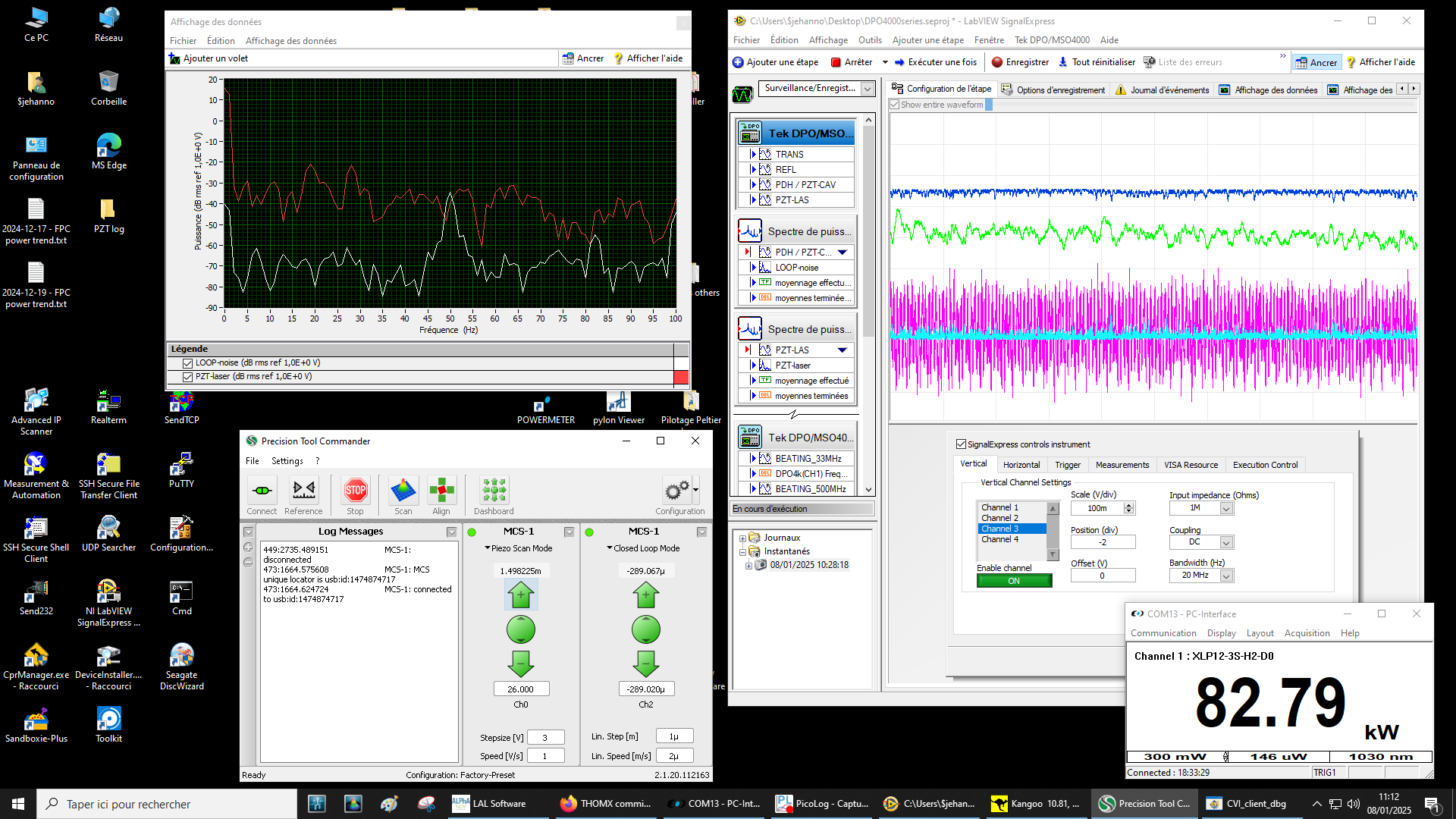
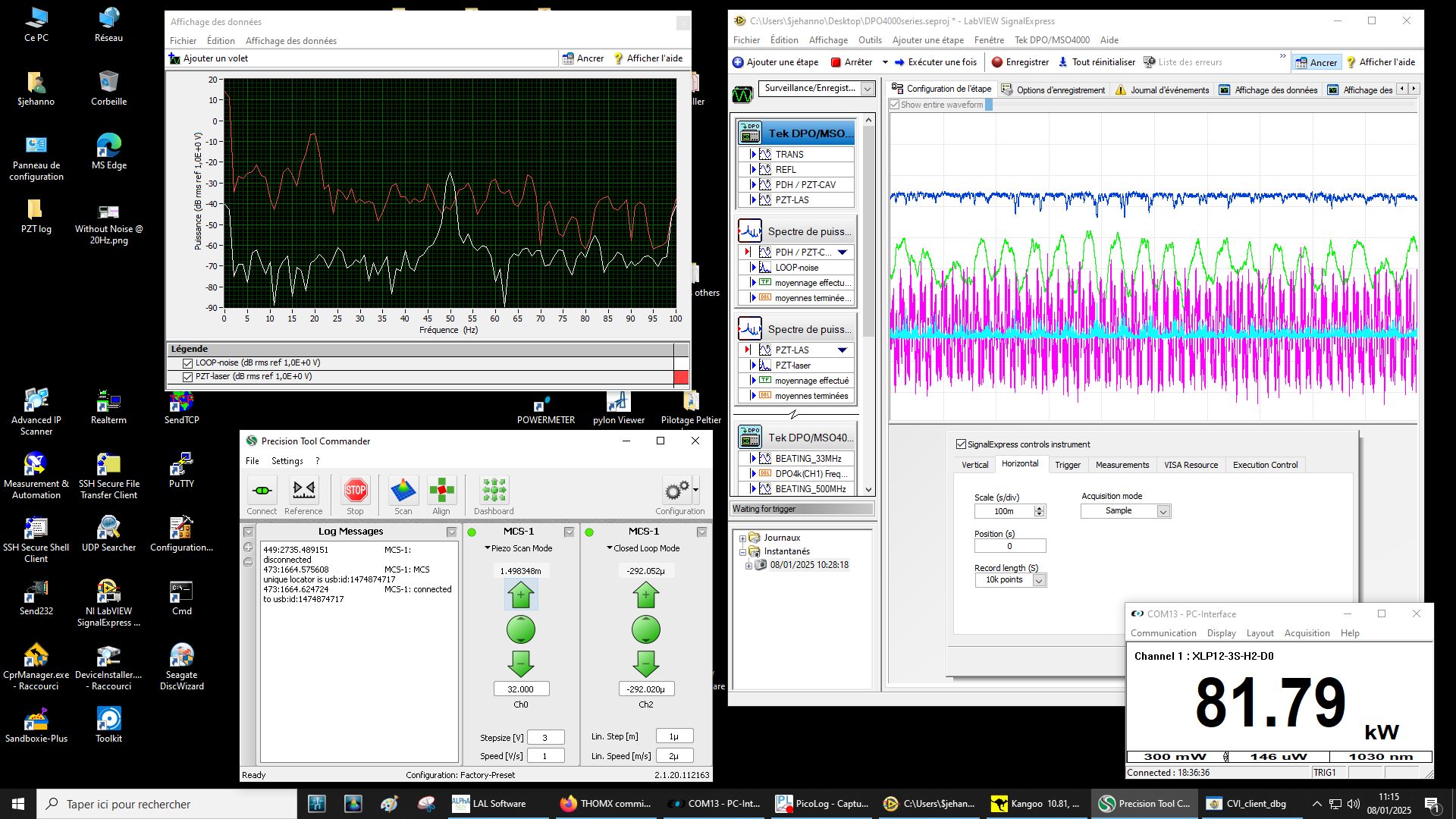
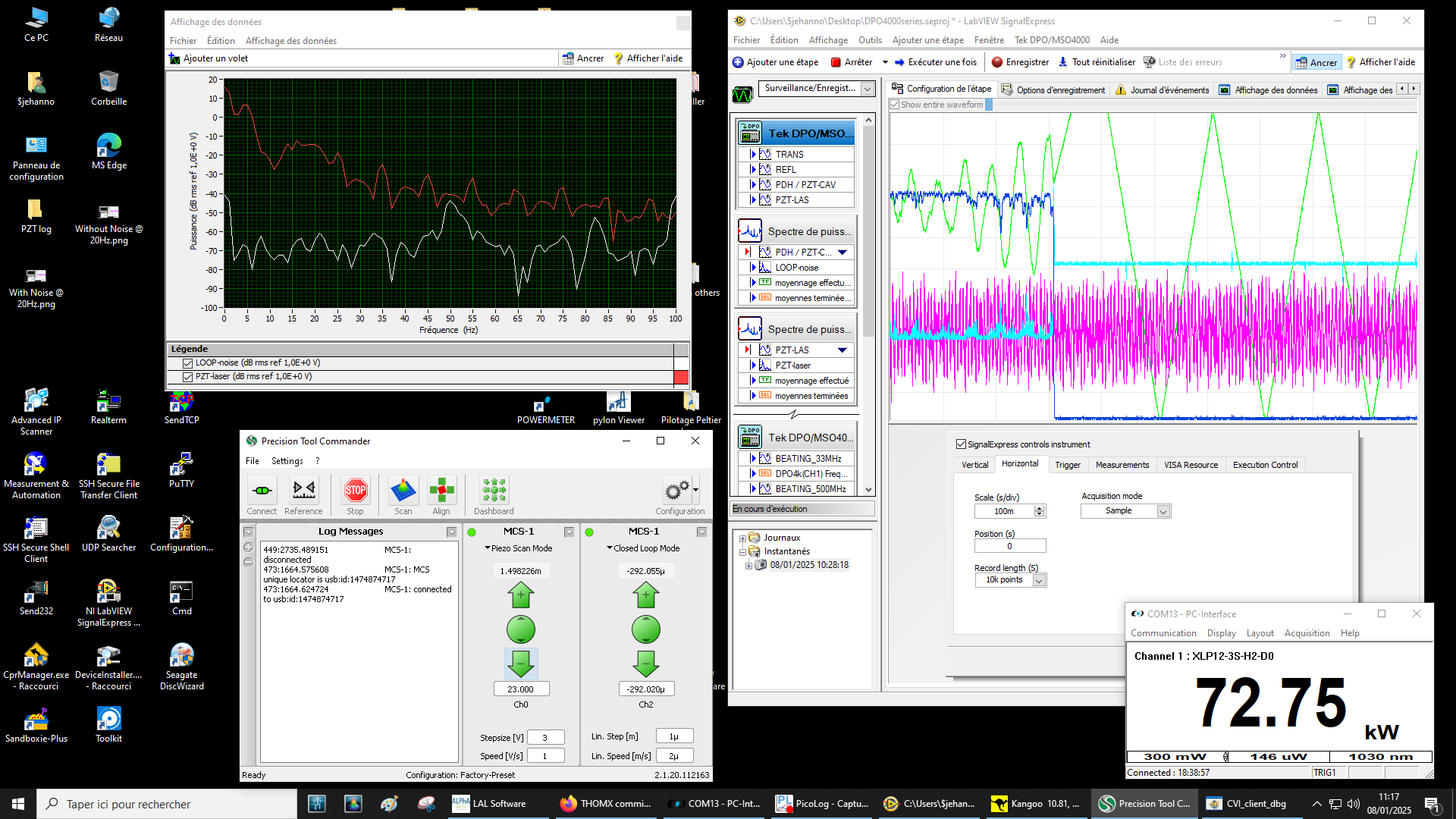
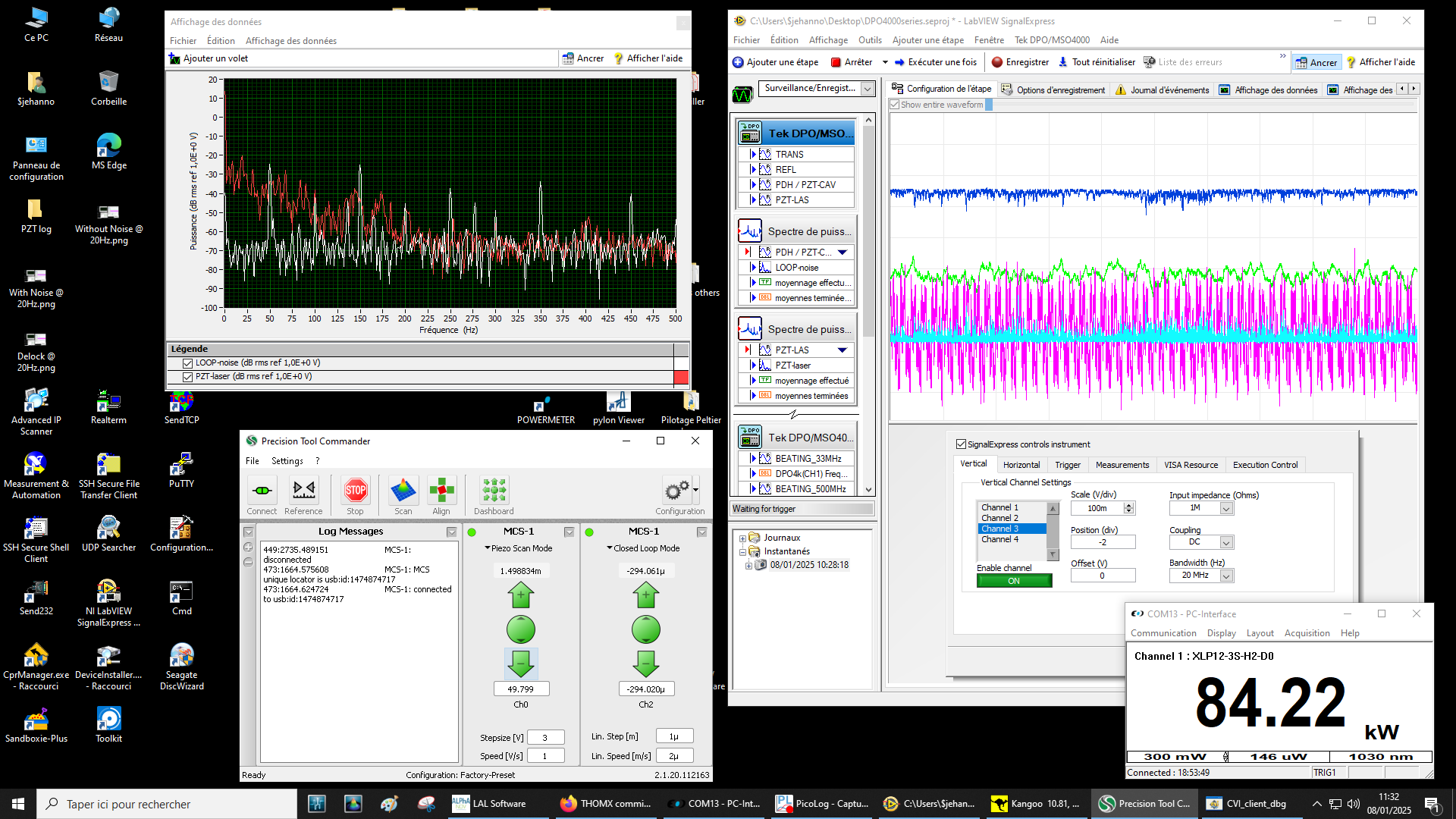
I took several pictures to illustrate what I observed :
- on the right, the scope signal in time domain (blue = TRANS / green = PZT laser / cyan = REFLECT / pink = LOOP noise)
- on the left, the spectral analysis in frequency domain (red = PZT laser / white = LOOP noise)
in these 3 measurements, I don't do anything to the CFP, I just wait for the signals.
1) normal condition : see picture "Without Noise @ 20Hz"
the PZT signal in time domain is relatively flat and the 20Hz noise is barely visible in frequency domain.
we don't see any correlation with the LOOP noise for which one can see clear 50Hz and 100Hz peaks.
2) 20Hz noise condition : see picture "With Noise @ 20Hz"
the PZT signal in time and frequency domain exhibit a clear 20Hz oscillation.
the REFLECT and TRANS signals are also correlated to this 20Hz oscillation.
but still no correlation with the LOOP noise in time or frequency domain.
3) 20Hz noise lock loss condition : see picture "Delock @ 20Hz"
because of the lock loss the spectral analysis of the PZT signal is meaningless,
but in time domain, one can clearly see the growth of the 20Hz signal, inducing large noise on TRANS and REFLECT signal but still no correlation with the LOOP noise.
Conclusion : the 20Hz noise seems not related to any CEM noisy signal but more probably to a real mechanical noise in the CFP (not in the laser cavity because it would be seen in the phase noise measurements).
in this measurement, I tried to produce a tone around 400Hz with my voice, close to the FP cavity.
it is difficult to right volume as the cavity can easily lose the lock.
4) Voice noise condition : see picture "Voice noise @ 400Hz"
here, I changed the spectral span to 500Hz.
one can see a small bump in frequency domain around 400Hz due to the accoustic noise in the PZT signal.
the general shape of the PZT spectral signal is maybe related to the PID parameters : one can see more signal at lower frequencies.
in time domain, one can see TRANS and REFLECT signals are more noisy than before and these signals shapes seems identical to what has been observed when one has lock loss due to high frequency noise.
maybe we could put a mic in the bunker, connected to one scope to check if sometime one doesn't have much more accoustic noise...
|
| Attachment 1: Without_Noise_@_20Hz.png
|  |
| Attachment 2: With_Noise_@_20Hz.png
|  |
| Attachment 3: Delock_@_20Hz.png
|  |
| Attachment 4: Voice_noise_@400Hz.png
|  |
|
392
|
Wed Jan 8 16:08:59 2025 |
Ronic Chiche | Under Process | info | lasers and optics | detectors and electronics | cabling | ThomX igloo | CEM noise measurements | This afternoon, we started almost all the parts of the machine with Vincent and Nicolas, and we didn't see any change in the Loop noise signal.
we saw only a peak comb at 10Hz on the Loop noise signal when the septum is ON. the amplitude of the peaks is then related to the voltage on the septum.
but we still don't see any noise correlation on the PZT signal.
the global conclusion about CEM noise is it is not related to laser PZT noise.
if the 20Hz oscillation is coming from a mechanical unstability in the CFP, we should be able to trigger it by moving the longitudinal motors of the CFP.
we tried also to move the MOT.03 and MOT.06 motors and we didn't see any clear correlation with the 20Hz oscillation.
the 20Hz oscillation could come from the CTA pressure variations on the housing => we can try to trigger the oscillation on the housing.
| Ronic Chiche wrote: |
|
The goal of these measurements is to check if one can find some correlation between the CFP lock losses observed during a run and some CEM noise in the bunker.
the main issue is coming from a 20Hz noise apearing/disapearing in the laser cavity PZT signal.
is it a real cavity length noise that must be compensated or is it a pickup noise in the error signal which produce some unwanted compensation ?
the second issue (apearing much less often) is a higher frequency noise visible mainly in the transmission signal of the CFP which becomes wider and noisy during 1-2 seconds.
This morning, I installed a simple wire loop all around the table (the machine is OFF).
this wire is connected to the wire of a BNC connector at one end and to the ground of the same BNC connector at the other end to form a loop.
this BNC connector is connected to a 1kHz low pass filter to remove high frequency CEM noises and connected to a 10-1000 variable gain amplifier, plugged to the CH3 of the CFP scope (instead of the PDH/PZT-CAV signal).
I locked the CFP above 80kW after tuning the CEP.
I took several pictures to illustrate what I observed :
- on the right, the scope signal in time domain (blue = TRANS / green = PZT laser / cyan = REFLECT / pink = LOOP noise)
- on the left, the spectral analysis in frequency domain (red = PZT laser / white = LOOP noise)
in these 3 measurements, I don't do anything to the CFP, I just wait for the signals.
1) normal condition : see picture "Without Noise @ 20Hz"
the PZT signal in time domain is relatively flat and the 20Hz noise is barely visible in frequency domain.
we don't see any correlation with the LOOP noise for which one can see clear 50Hz and 100Hz peaks.
2) 20Hz noise condition : see picture "With Noise @ 20Hz"
the PZT signal in time and frequency domain exhibit a clear 20Hz oscillation.
the REFLECT and TRANS signals are also correlated to this 20Hz oscillation.
but still no correlation with the LOOP noise in time or frequency domain.
3) 20Hz noise lock loss condition : see picture "Delock @ 20Hz"
because of the lock loss the spectral analysis of the PZT signal is meaningless,
but in time domain, one can clearly see the growth of the 20Hz signal, inducing large noise on TRANS and REFLECT signal but still no correlation with the LOOP noise.
Conclusion : the 20Hz noise seems not related to any CEM noisy signal but more probably to a real mechanical noise in the CFP (not in the laser cavity because it would be seen in the phase noise measurements).
in this measurement, I tried to produce a tone around 400Hz with my voice, close to the FP cavity.
it is difficult to right volume as the cavity can easily lose the lock.
4) Voice noise condition : see picture "Voice noise @ 400Hz"
here, I changed the spectral span to 500Hz.
one can see a small bump in frequency domain around 400Hz due to the accoustic noise in the PZT signal.
the general shape of the PZT spectral signal is maybe related to the PID parameters : one can see more signal at lower frequencies.
in time domain, one can see TRANS and REFLECT signals are more noisy than before and these signals shapes seems identical to what has been observed when one has lock loss due to high frequency noise.
maybe we could put a mic in the bunker, connected to one scope to check if sometime one doesn't have much more accoustic noise...
|
|
|
72
|
Thu Oct 10 17:51:26 2019 |
Ronic Chiche | Fixed | issue | lasers and optics | detectors and electronics | Optical room | First Lock with 2nd satge of amplifier : Finesse issue ? | 1st lock today with the second stage of the amplifier.
~ 300mW of injected power (but which proportion of the pump and of the signal ? => One must use a spectrometer to determine this proportion)
MAYBE the real injected power of the signal is lower => maybe the Finesse is higher !
Coupling ~ 75%
1.2 mW measured in transmission => ~800W inside the FP cavity
=> Gain ~ 3500 => Finesse ~ 11k !!!
Last Finesse measurement was about 19k ! :-( |
|
74
|
Fri Oct 11 18:42:32 2019 |
Ronic Chiche | Fixed | issue | lasers and optics | detectors and electronics | Optical room | First Lock with 2nd satge of amplifier : Finesse issue ? | First of all, we used and optical spectrometer to determine which proportion of pump and signal is in the injected beam.
the wavelength is THE SAME for the 2nd stage for the beam coming from the core or coming from the clad !
thus, it is impossible to use a spectrometer to obtain this proportion.
Thus, we made the assumption the pump beam (Sp) is unpolarized in contrary to the core beam (Sc) which is almost linearly polarized (Scp, Scs)
with a half waveplate and a PBS, we can define 2 cases in rotating the half waveplate at the output of the PBS :
maximum power : Scp + Sp/2 = a1
minimum power : Scs + Sp/2 = a2
The sum of both power a1 and a2 : a1+a2 = (Scp+Scs) + Sp is the total power of the beam before PBS.
The subtraction of power a1 and a2 : a1-a2 = Scp - Scs is independant of the pump power which can vary for example in opening an iris which normally block the most part of the pump beam.
if the core beam is perfectly linear, Scs=0 => a1-a2=Scp and Sp=2*a2
We did 2 measurements with a1=227mW, a2=67mW => Scp=160mW (Sp=134mW)
and with a1'=277mW, a2'=107mW => Scp=170mW (Sp'=214mW with a wider opened iris)
if these measurements and assumptions are correct, the real power injected to the cavity was 170mW (instead of 300mW).
with a coupling of 75% => Gain ~ 6.3k => Finesse ~ 19.7k !
to be confirmed...
| Ronic Chiche wrote: |
|
1st lock today with the second stage of the amplifier.
~ 300mW of injected power (but which proportion of the pump and of the signal ? => One must use a spectrometer to determine this proportion)
MAYBE the real injected power of the signal is lower => maybe the Finesse is higher !
Coupling ~ 75%
1.2 mW measured in transmission => ~800W inside the FP cavity
=> Gain ~ 3500 => Finesse ~ 11k !!!
Last Finesse measurement was about 19k ! :-(
|
|
|
81
|
Fri Nov 22 17:56:56 2019 |
Ronic Chiche | Fixed | issue | lasers and optics | detectors and electronics | Optical room | 30Hz noise issue | since some days, we observe the cavity is difficult to lock and a strange 30Hz noise has appeared on the PZT signal which normally compensate the phase noise difference between the cavity and the laser.
to test if the problem could come from the laser, we changed the OneFive laser for the Koheras but we have exactly the same problem, thus we concluded that the problem come from the cavity or from the feedback.
today, we borrowed an accelerometer measurement setup to Julien Bonis to test if we can see a clear noise at 30Hz from the seismic noise.
we placed to accelerometer directly on the top of the cavity but the spectrum we obtained do not show a clear noise line at 30Hz, only a small excess of noise in this region...
nothing which clearly indicate the cause of our problem.
yesterday, we changed the feedback setup in changing the PDH box from n°2 to N°3 without any change in the 30Hz noise line.
today, we also changed the feedback setup by introducing and amplifier of 100 just after the PDH box.
if noise is coupled after the amp we should be more immunized from it... but nothing changed again.
still looking for the origin of this problem... |
|
84
|
Tue Nov 26 16:35:39 2019 |
Ronic Chiche | Fixed | issue | lasers and optics | detectors and electronics | Optical room | 30Hz noise issue | The 30 Hz noise issue has been solved !
It came from translation stage of P1 and/or P4.
Fabian remembered that close to the mirror's mount translation stage end coarse, there is a mechanical instability. The mount kind of "lift up" because of the spring strength and could induce resonance.
Initial positions:
- P1: - 1 500 000
- S2: + 1 400 000
- S3: + 1 400 000
- P4: - 1 500 000
The 30 Hz noise was removed while moving only P1 closer (then if we put back P1 to the initial position, the noise clearly appear again):
- P1: - 1 300 000 --> no 30Hz noise
- S2: + 1 400 000
- S3: + 1 400 000
- P4: - 1 500 000
The 30 Hz noise appeared again while moving P4 further:
- P1: - 1 300 000
- S2: + 1 400 000
- S3: + 1 400 000
- P4: - 1 600 000 --> 30Hz noise
Final positions:
- P1: - 1 300 000
- S2: + 1 400 000
- S3: + 1 400 000
- P4: - 1 500 000
| Ronic Chiche wrote: |
|
since some days, we observe the cavity is difficult to lock and a strange 30Hz noise has appeared on the PZT signal which normally compensate the phase noise difference between the cavity and the laser.
to test if the problem could come from the laser, we changed the OneFive laser for the Koheras but we have exactly the same problem, thus we concluded that the problem come from the cavity or from the feedback.
today, we borrowed an accelerometer measurement setup to Julien Bonis to test if we can see a clear noise at 30Hz from the seismic noise.
we placed to accelerometer directly on the top of the cavity but the spectrum we obtained do not show a clear noise line at 30Hz, only a small excess of noise in this region...
nothing which clearly indicate the cause of our problem.
yesterday, we changed the feedback setup in changing the PDH box from n°2 to N°3 without any change in the 30Hz noise line.
today, we also changed the feedback setup by introducing and amplifier of 100 just after the PDH box.
if noise is coupled after the amp we should be more immunized from it... but nothing changed again.
still looking for the origin of this problem...
|
|
|
115
|
Tue Feb 1 14:17:02 2022 |
Manar Amer | Fixed | report | lasers and optics | detectors and electronics | ThomX igloo | FP cavity alignment | Installed and inputs:
- CW laser ; power = 101 mW
- PDH ;
- at output
- Low pass filter 50 ohm DC-1.9 MHz
- at input
- freq = 8.4 MHz , Ampl = 1.2 V , phase = 160 /
- voltage = ~ 6 V
- EOM ; freq = 8.4 MHz , Ampl = 100 mV , phase = 90
- Photodiodes
- beam profiler
Observed during this morning:
- coupling : below 10% .... approximately ~ 8%
- Oscilloscope :
- yellow : transmission
- purple : reflection
- Blue : error signal
- green : scan signal
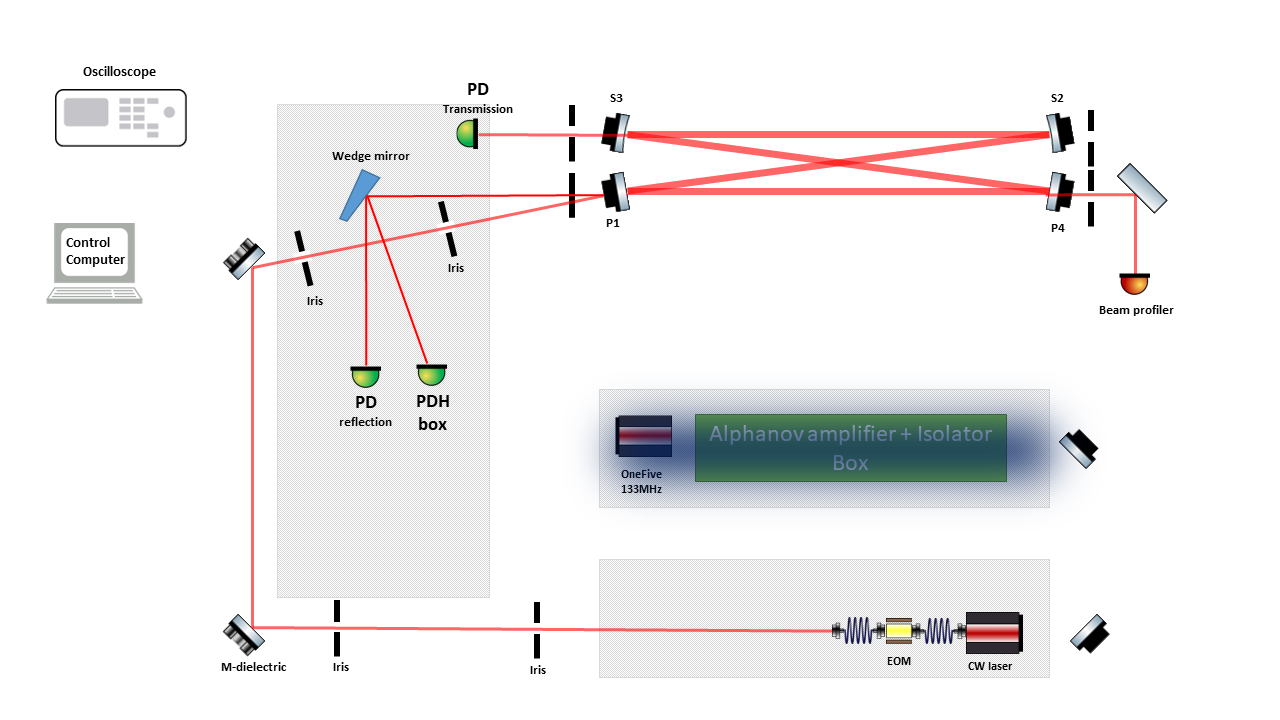
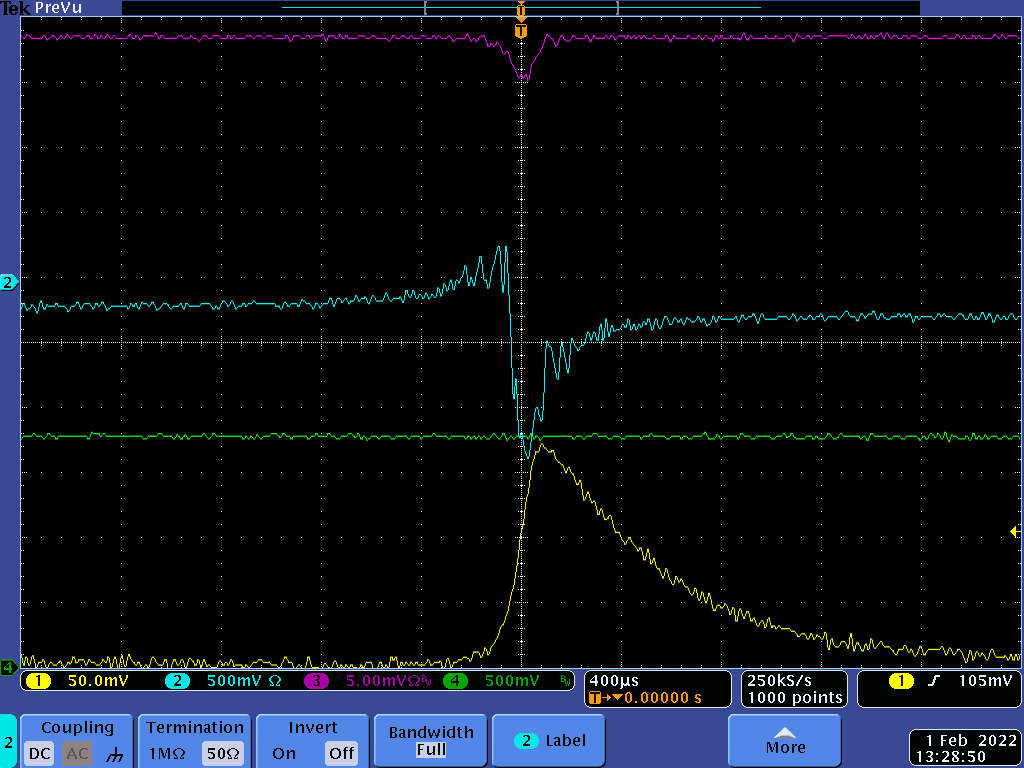
Note : We observe a lot of higher order modes, and they are not occurring regularly.
A schematic of the current setup is attached.
An image from the oscilloscope show a low coupling but clean error signal.
| Manar Amer wrote: |
|
Yesterday, we did the alignment again using Iris and beam profilers to obtain a more precise result.
at the end of the alignment procedure, we successfully obtained the beating modes.
the geometrical alignment seems good (weak odd modes) but we could need to put a telescope on the Koheras line as the beam size seems quite different from the mode size (quite strong even modes).
without any improvement of the alignment using photodiodes, one obtains about 15-20% of coupling.
we put several Iris on the table:
- 2 Iris before the 2 alignment mirrors to fix the axis of the laser on these mirrors
- 1 Iris just before the cavity (we will add an additional one today) to fix the cavity axis
- 1 Iris in reflection of the cavity to fix the M1 orientation
| Manar Amer wrote: |
|
***** Continuation of the alignment ---- FP Cavity Open --- ****
The cavity was put under outer pressure and was opened for the alignment
The alignment was done using CW koheras infrared laser and the inside mirrors irises
we observed the beam output centered at S2, S3 and P4
transmission from S4 to P1 was aligned at the center of P1 iris and an outside reference was fixed, then P1 mirror was placed, and we aligned the reflection with the transmission.
....... After the interior alignment, the cavity windows were closed ....
A beam profiler was placed at P4 transmission -----> nothing observed even with a piezo drive on the CW infrared laser
observed a beam output at S2 and S3, but the fundamental mode is not seen, or even a higher order mode (which we can't explain, as the beam is centered on the mirrors)
images show the output at S2 and S3
| Manar Amer wrote: |
|
The alignment is on hold until next week 17th - 18th Jan
an Alignment attempt will be done when the ring part close to the FP cavity is opened.
| Manar Amer wrote: |
|
Note the direction of injection is M1 - M2 - M3 - M4
P1 - S2 - S3 - P4
The injected beam is aligned at the center of the irises placed at the windows mounts of mirror M1 (Injection) and M2(spherical)
At Transmission of M2 : in addition to centered beam, we observe diffraction which interferes in observing the beating at M2 output
(could be diffracted beam from the metal pipes inside or from the D-shaped mirror installed inside)
At Transmission of M3 : we observe a beam output could be part of TM00 mode (the shape is distorted !!)
suspicious reasons :
- when we have a frequency sweep on the CW(Koheras) piezo; we observe it beating (when increasing the drive it is increasing in intensity)
- when we adjust the alignment mirrors; the beam doesn't change position and only its intensity changes
continuation with the alignment and try to eliminate the diffraction and find the shape of the beam.
A manual change in the D-shaped mirror position to remove any possible effects from it.
|
|
|
|
|
| Attachment 1: ThomX_FP_setup_01-02-2022.png
|  |
| Attachment 2: tek0002.png
|  |
|
116
|
Tue Feb 1 16:40:06 2022 |
Manar Amer | Fixed | report | lasers and optics | detectors and electronics | ThomX igloo | FP cavity alignment | This afternoon, I did some alignment of the injection mirrors with a fast scan on the LaseLock to get a regular transmission photodiode signal.
the coupling increased to 10-15%
I got a first lock of the cavity only with the PZT.
there is some ringing on the error signal and the locking is quite noisy, which means the cavity LW seems to be more narrow than the Koheras LW, which is a good sign.
tomorrow, I will add an AOM to improve the locking.
I did some alignment after locking.
it was difficult because of the outside noise (engines producing loud and low-frequency noises).
the coupling is now about 20% (position saved in the injection motors software).
I added a half waveplate which has to be optimized.
| Manar Amer wrote: |
|
Installed and inputs:
- CW laser ; power = 101 mW
- PDH ;
- at output
- Low pass filter 50 ohm DC-1.9 MHz
- at input
- freq = 8.4 MHz , Ampl = 1.2 V , phase = 160 /
- voltage = ~ 6 V
- EOM ; freq = 8.4 MHz , Ampl = 100 mV , phase = 90
- Photodiodes
- beam profiler
Observed during this morning:
- coupling : below 10% .... approximately ~ 8%
- Oscilloscope :
- yellow : transmission
- purple : reflection
- Blue : error signal
- green : scan signal
Note : We observe a lot of higher order modes, and they are not occurring regularly.
A schematic of the current setup is attached.
An image from the oscilloscope show a low coupling but clean error signal.
| Manar Amer wrote: |
|
Yesterday, we did the alignment again using Iris and beam profilers to obtain a more precise result.
at the end of the alignment procedure, we successfully obtained the beating modes.
the geometrical alignment seems good (weak odd modes) but we could need to put a telescope on the Koheras line as the beam size seems quite different from the mode size (quite strong even modes).
without any improvement of the alignment using photodiodes, one obtains about 15-20% of coupling.
we put several Iris on the table:
- 2 Iris before the 2 alignment mirrors to fix the axis of the laser on these mirrors
- 1 Iris just before the cavity (we will add an additional one today) to fix the cavity axis
- 1 Iris in reflection of the cavity to fix the M1 orientation
| Manar Amer wrote: |
|
***** Continuation of the alignment ---- FP Cavity Open --- ****
The cavity was put under outer pressure and was opened for the alignment
The alignment was done using CW koheras infrared laser and the inside mirrors irises
we observed the beam output centered at S2, S3 and P4
transmission from S4 to P1 was aligned at the center of P1 iris and an outside reference was fixed, then P1 mirror was placed, and we aligned the reflection with the transmission.
....... After the interior alignment, the cavity windows were closed ....
A beam profiler was placed at P4 transmission -----> nothing observed even with a piezo drive on the CW infrared laser
observed a beam output at S2 and S3, but the fundamental mode is not seen, or even a higher order mode (which we can't explain, as the beam is centered on the mirrors)
images show the output at S2 and S3
| Manar Amer wrote: |
|
The alignment is on hold until next week 17th - 18th Jan
an Alignment attempt will be done when the ring part close to the FP cavity is opened.
| Manar Amer wrote: |
|
Note the direction of injection is M1 - M2 - M3 - M4
P1 - S2 - S3 - P4
The injected beam is aligned at the center of the irises placed at the windows mounts of mirror M1 (Injection) and M2(spherical)
At Transmission of M2 : in addition to centered beam, we observe diffraction which interferes in observing the beating at M2 output
(could be diffracted beam from the metal pipes inside or from the D-shaped mirror installed inside)
At Transmission of M3 : we observe a beam output could be part of TM00 mode (the shape is distorted !!)
suspicious reasons :
- when we have a frequency sweep on the CW(Koheras) piezo; we observe it beating (when increasing the drive it is increasing in intensity)
- when we adjust the alignment mirrors; the beam doesn't change position and only its intensity changes
continuation with the alignment and try to eliminate the diffraction and find the shape of the beam.
A manual change in the D-shaped mirror position to remove any possible effects from it.
|
|
|
|
|
|
|
117
|
Wed Feb 2 11:22:51 2022 |
Manar Amer | Fixed | report | lasers and optics | detectors and electronics | ThomX igloo | FP cavity alignment | This morning with Manar, we installed the AOM+RF amplifier and the associated fast feedback loop.
Now the locking with the Koheras is good with a coupling of 20%.
Tomorrow is dedicated to the measurement of the Finesse.... we will have to add the 2nd EOM.
We observed a very stable lock if the airflow is OFF.
when it is ON, the lock is much less stable... maybe a problem of optimization of the feedback... we will see that tomorrow if we have time enough.
We also observed a quite important sensititvity of the PZT voltage when slightly pushing on the housing with the finger: we clearly see the compensation on the PZT voltage.
I didn't calibrate this voltage but it seems to be an important fraction of 1µm... I would say around 100nm
| Manar Amer wrote: |
|
This afternoon, I did some alignment of the injection mirrors with a fast scan on the LaseLock to get a regular transmission photodiode signal.
the coupling increased to 10-15%
I got a first lock of the cavity only with the PZT.
there is some ringing on the error signal and the locking is quite noisy, which means the cavity LW seems to be more narrow than the Koheras LW, which is a good sign.
tomorrow, I will add an AOM to improve the locking.
I did some alignment after locking.
it was difficult because of the outside noise (engines producing loud and low-frequency noises).
the coupling is now about 20% (position saved in the injection motors software).
I added a half waveplate which has to be optimized.
| Manar Amer wrote: |
|
Installed and inputs:
- CW laser ; power = 101 mW
- PDH ;
- at output
- Low pass filter 50 ohm DC-1.9 MHz
- at input
- freq = 8.4 MHz , Ampl = 1.2 V , phase = 160 /
- voltage = ~ 6 V
- EOM ; freq = 8.4 MHz , Ampl = 100 mV , phase = 90
- Photodiodes
- beam profiler
Observed during this morning:
- coupling : below 10% .... approximately ~ 8%
- Oscilloscope :
- yellow : transmission
- purple : reflection
- Blue : error signal
- green : scan signal
Note : We observe a lot of higher order modes, and they are not occurring regularly.
A schematic of the current setup is attached.
An image from the oscilloscope show a low coupling but clean error signal.
| Manar Amer wrote: |
|
Yesterday, we did the alignment again using Iris and beam profilers to obtain a more precise result.
at the end of the alignment procedure, we successfully obtained the beating modes.
the geometrical alignment seems good (weak odd modes) but we could need to put a telescope on the Koheras line as the beam size seems quite different from the mode size (quite strong even modes).
without any improvement of the alignment using photodiodes, one obtains about 15-20% of coupling.
we put several Iris on the table:
- 2 Iris before the 2 alignment mirrors to fix the axis of the laser on these mirrors
- 1 Iris just before the cavity (we will add an additional one today) to fix the cavity axis
- 1 Iris in reflection of the cavity to fix the M1 orientation
| Manar Amer wrote: |
|
***** Continuation of the alignment ---- FP Cavity Open --- ****
The cavity was put under outer pressure and was opened for the alignment
The alignment was done using CW koheras infrared laser and the inside mirrors irises
we observed the beam output centered at S2, S3 and P4
transmission from S4 to P1 was aligned at the center of P1 iris and an outside reference was fixed, then P1 mirror was placed, and we aligned the reflection with the transmission.
....... After the interior alignment, the cavity windows were closed ....
A beam profiler was placed at P4 transmission -----> nothing observed even with a piezo drive on the CW infrared laser
observed a beam output at S2 and S3, but the fundamental mode is not seen, or even a higher order mode (which we can't explain, as the beam is centered on the mirrors)
images show the output at S2 and S3
| Manar Amer wrote: |
|
The alignment is on hold until next week 17th - 18th Jan
an Alignment attempt will be done when the ring part close to the FP cavity is opened.
| Manar Amer wrote: |
|
Note the direction of injection is M1 - M2 - M3 - M4
P1 - S2 - S3 - P4
The injected beam is aligned at the center of the irises placed at the windows mounts of mirror M1 (Injection) and M2(spherical)
At Transmission of M2 : in addition to centered beam, we observe diffraction which interferes in observing the beating at M2 output
(could be diffracted beam from the metal pipes inside or from the D-shaped mirror installed inside)
At Transmission of M3 : we observe a beam output could be part of TM00 mode (the shape is distorted !!)
suspicious reasons :
- when we have a frequency sweep on the CW(Koheras) piezo; we observe it beating (when increasing the drive it is increasing in intensity)
- when we adjust the alignment mirrors; the beam doesn't change position and only its intensity changes
continuation with the alignment and try to eliminate the diffraction and find the shape of the beam.
A manual change in the D-shaped mirror position to remove any possible effects from it.
|
|
|
|
|
|
|
|
118
|
Wed Feb 2 11:41:01 2022 |
Manar Amer | Fixed | report | lasers and optics | detectors and electronics | ThomX igloo | FP cavity alignment | Adding Oscilloscope images
- delocked + locked intervals showing the 20% coupling
- lock when the housing panels are closed + airflow on .
- lock when the housing panels are closed + air flow at lowest setting
an additional factor to the PZT voltage sensitivity is the housing panels, we see a decrease in the voltage when closing them.
| Manar Amer wrote: |
|
This morning with Manar, we installed the AOM+RF amplifier and the associated fast feedback loop.
Now the locking with the Koheras is good with a coupling of 20%.
Tomorrow is dedicated to the measurement of the Finesse.... we will have to add the 2nd EOM.
We observed a very stable lock if the airflow is OFF.
when it is ON, the lock is much less stable... maybe a problem of optimization of the feedback... we will see that tomorrow if we have time enough.
We also observed a quite important sensititvity of the PZT voltage when slightly pushing on the housing with the finger: we clearly see the compensation on the PZT voltage.
I didn't calibrate this voltage but it seems to be an important fraction of 1µm... I would say around 100nm
| Manar Amer wrote: |
|
This afternoon, I did some alignment of the injection mirrors with a fast scan on the LaseLock to get a regular transmission photodiode signal.
the coupling increased to 10-15%
I got a first lock of the cavity only with the PZT.
there is some ringing on the error signal and the locking is quite noisy, which means the cavity LW seems to be more narrow than the Koheras LW, which is a good sign.
tomorrow, I will add an AOM to improve the locking.
I did some alignment after locking.
it was difficult because of the outside noise (engines producing loud and low-frequency noises).
the coupling is now about 20% (position saved in the injection motors software).
I added a half waveplate which has to be optimized.
| Manar Amer wrote: |
|
Installed and inputs:
- CW laser ; power = 101 mW
- PDH ;
- at output
- Low pass filter 50 ohm DC-1.9 MHz
- at input
- freq = 8.4 MHz , Ampl = 1.2 V , phase = 160 /
- voltage = ~ 6 V
- EOM ; freq = 8.4 MHz , Ampl = 100 mV , phase = 90
- Photodiodes
- beam profiler
Observed during this morning:
- coupling : below 10% .... approximately ~ 8%
- Oscilloscope :
- yellow : transmission
- purple : reflection
- Blue : error signal
- green : scan signal
Note : We observe a lot of higher order modes, and they are not occurring regularly.
A schematic of the current setup is attached.
An image from the oscilloscope show a low coupling but clean error signal.
| Manar Amer wrote: |
|
Yesterday, we did the alignment again using Iris and beam profilers to obtain a more precise result.
at the end of the alignment procedure, we successfully obtained the beating modes.
the geometrical alignment seems good (weak odd modes) but we could need to put a telescope on the Koheras line as the beam size seems quite different from the mode size (quite strong even modes).
without any improvement of the alignment using photodiodes, one obtains about 15-20% of coupling.
we put several Iris on the table:
- 2 Iris before the 2 alignment mirrors to fix the axis of the laser on these mirrors
- 1 Iris just before the cavity (we will add an additional one today) to fix the cavity axis
- 1 Iris in reflection of the cavity to fix the M1 orientation
| Manar Amer wrote: |
|
***** Continuation of the alignment ---- FP Cavity Open --- ****
The cavity was put under outer pressure and was opened for the alignment
The alignment was done using CW koheras infrared laser and the inside mirrors irises
we observed the beam output centered at S2, S3 and P4
transmission from S4 to P1 was aligned at the center of P1 iris and an outside reference was fixed, then P1 mirror was placed, and we aligned the reflection with the transmission.
....... After the interior alignment, the cavity windows were closed ....
A beam profiler was placed at P4 transmission -----> nothing observed even with a piezo drive on the CW infrared laser
observed a beam output at S2 and S3, but the fundamental mode is not seen, or even a higher order mode (which we can't explain, as the beam is centered on the mirrors)
images show the output at S2 and S3
| Manar Amer wrote: |
|
The alignment is on hold until next week 17th - 18th Jan
an Alignment attempt will be done when the ring part close to the FP cavity is opened.
| Manar Amer wrote: |
|
Note the direction of injection is M1 - M2 - M3 - M4
P1 - S2 - S3 - P4
The injected beam is aligned at the center of the irises placed at the windows mounts of mirror M1 (Injection) and M2(spherical)
At Transmission of M2 : in addition to centered beam, we observe diffraction which interferes in observing the beating at M2 output
(could be diffracted beam from the metal pipes inside or from the D-shaped mirror installed inside)
At Transmission of M3 : we observe a beam output could be part of TM00 mode (the shape is distorted !!)
suspicious reasons :
- when we have a frequency sweep on the CW(Koheras) piezo; we observe it beating (when increasing the drive it is increasing in intensity)
- when we adjust the alignment mirrors; the beam doesn't change position and only its intensity changes
continuation with the alignment and try to eliminate the diffraction and find the shape of the beam.
A manual change in the D-shaped mirror position to remove any possible effects from it.
|
|
|
|
|
|
|
|
| Attachment 1: tek0003.png
| 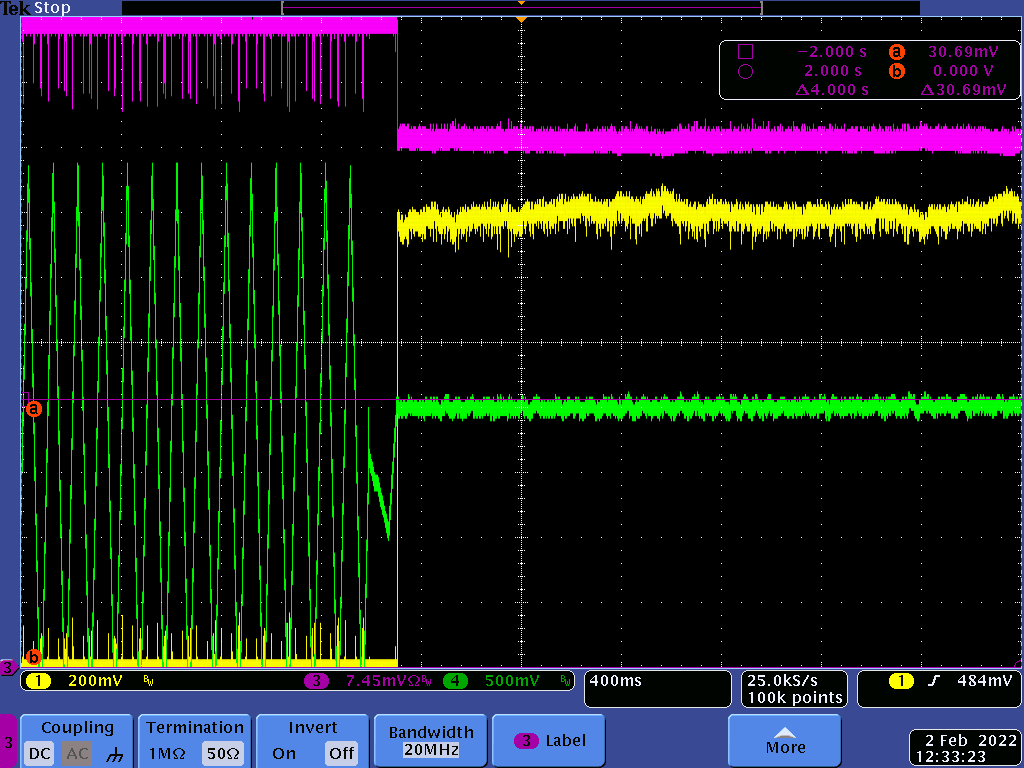 |
| Attachment 2: tek0006.png
| 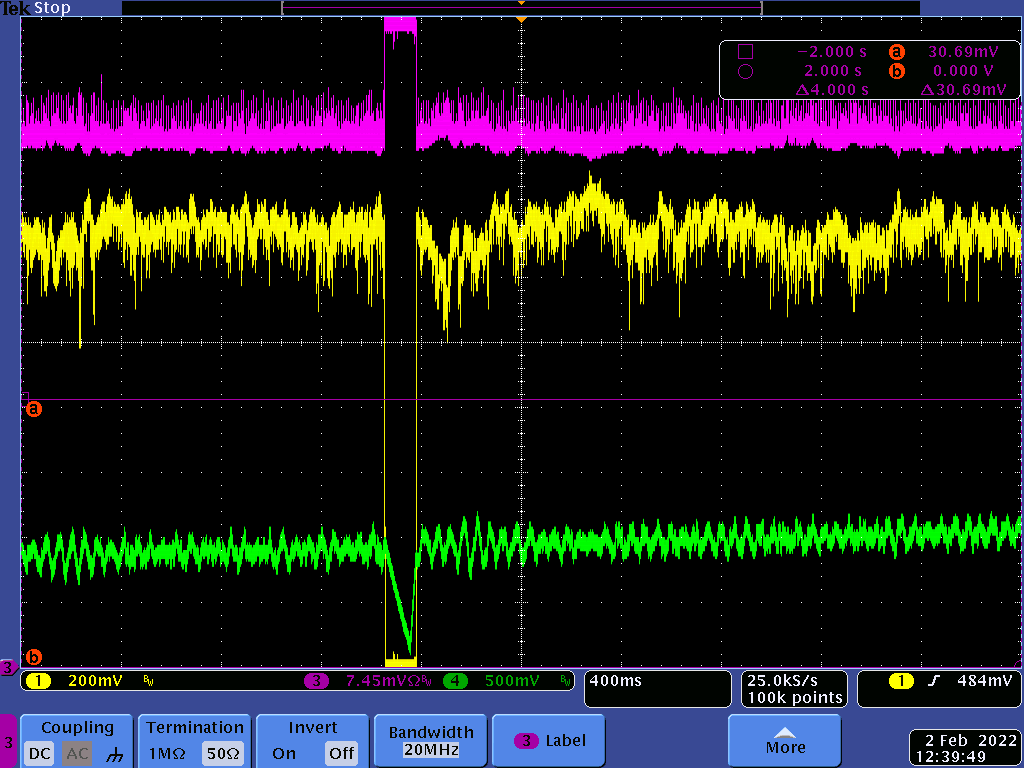 |
| Attachment 3: tek0007.png
| 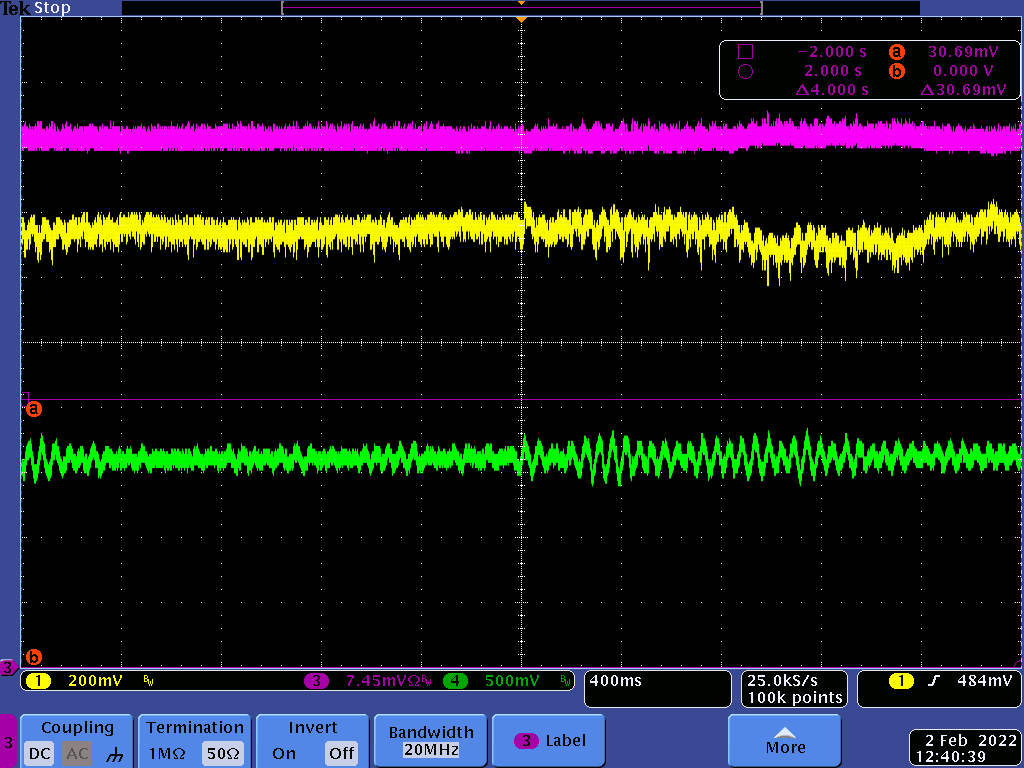 |
|
119
|
Thu Feb 3 13:56:24 2022 |
Manar Amer | Fixed | report | lasers and optics | detectors and electronics | ThomX igloo | FP cavity alignment | Ending alignment series !!
| Manar Amer wrote: |
|
Adding Oscilloscope images
- delocked + locked intervals showing the 20% coupling
- lock when the housing panels are closed + airflow on .
- lock when the housing panels are closed + air flow at lowest setting
an additional factor to the PZT voltage sensitivity is the housing panels, we see a decrease in the voltage when closing them.
| Manar Amer wrote: |
|
This morning with Manar, we installed the AOM+RF amplifier and the associated fast feedback loop.
Now the locking with the Koheras is good with a coupling of 20%.
Tomorrow is dedicated to the measurement of the Finesse.... we will have to add the 2nd EOM.
We observed a very stable lock if the airflow is OFF.
when it is ON, the lock is much less stable... maybe a problem of optimization of the feedback... we will see that tomorrow if we have time enough.
We also observed a quite important sensititvity of the PZT voltage when slightly pushing on the housing with the finger: we clearly see the compensation on the PZT voltage.
I didn't calibrate this voltage but it seems to be an important fraction of 1µm... I would say around 100nm
| Manar Amer wrote: |
|
This afternoon, I did some alignment of the injection mirrors with a fast scan on the LaseLock to get a regular transmission photodiode signal.
the coupling increased to 10-15%
I got a first lock of the cavity only with the PZT.
there is some ringing on the error signal and the locking is quite noisy, which means the cavity LW seems to be more narrow than the Koheras LW, which is a good sign.
tomorrow, I will add an AOM to improve the locking.
I did some alignment after locking.
it was difficult because of the outside noise (engines producing loud and low-frequency noises).
the coupling is now about 20% (position saved in the injection motors software).
I added a half waveplate which has to be optimized.
| Manar Amer wrote: |
|
Installed and inputs:
- CW laser ; power = 101 mW
- PDH ;
- at output
- Low pass filter 50 ohm DC-1.9 MHz
- at input
- freq = 8.4 MHz , Ampl = 1.2 V , phase = 160 /
- voltage = ~ 6 V
- EOM ; freq = 8.4 MHz , Ampl = 100 mV , phase = 90
- Photodiodes
- beam profiler
Observed during this morning:
- coupling : below 10% .... approximately ~ 8%
- Oscilloscope :
- yellow : transmission
- purple : reflection
- Blue : error signal
- green : scan signal
Note : We observe a lot of higher order modes, and they are not occurring regularly.
A schematic of the current setup is attached.
An image from the oscilloscope show a low coupling but clean error signal.
| Manar Amer wrote: |
|
Yesterday, we did the alignment again using Iris and beam profilers to obtain a more precise result.
at the end of the alignment procedure, we successfully obtained the beating modes.
the geometrical alignment seems good (weak odd modes) but we could need to put a telescope on the Koheras line as the beam size seems quite different from the mode size (quite strong even modes).
without any improvement of the alignment using photodiodes, one obtains about 15-20% of coupling.
we put several Iris on the table:
- 2 Iris before the 2 alignment mirrors to fix the axis of the laser on these mirrors
- 1 Iris just before the cavity (we will add an additional one today) to fix the cavity axis
- 1 Iris in reflection of the cavity to fix the M1 orientation
| Manar Amer wrote: |
|
***** Continuation of the alignment ---- FP Cavity Open --- ****
The cavity was put under outer pressure and was opened for the alignment
The alignment was done using CW koheras infrared laser and the inside mirrors irises
we observed the beam output centered at S2, S3 and P4
transmission from S4 to P1 was aligned at the center of P1 iris and an outside reference was fixed, then P1 mirror was placed, and we aligned the reflection with the transmission.
....... After the interior alignment, the cavity windows were closed ....
A beam profiler was placed at P4 transmission -----> nothing observed even with a piezo drive on the CW infrared laser
observed a beam output at S2 and S3, but the fundamental mode is not seen, or even a higher order mode (which we can't explain, as the beam is centered on the mirrors)
images show the output at S2 and S3
| Manar Amer wrote: |
|
The alignment is on hold until next week 17th - 18th Jan
an Alignment attempt will be done when the ring part close to the FP cavity is opened.
| Manar Amer wrote: |
|
Note the direction of injection is M1 - M2 - M3 - M4
P1 - S2 - S3 - P4
The injected beam is aligned at the center of the irises placed at the windows mounts of mirror M1 (Injection) and M2(spherical)
At Transmission of M2 : in addition to centered beam, we observe diffraction which interferes in observing the beating at M2 output
(could be diffracted beam from the metal pipes inside or from the D-shaped mirror installed inside)
At Transmission of M3 : we observe a beam output could be part of TM00 mode (the shape is distorted !!)
suspicious reasons :
- when we have a frequency sweep on the CW(Koheras) piezo; we observe it beating (when increasing the drive it is increasing in intensity)
- when we adjust the alignment mirrors; the beam doesn't change position and only its intensity changes
continuation with the alignment and try to eliminate the diffraction and find the shape of the beam.
A manual change in the D-shaped mirror position to remove any possible effects from it.
|
|
|
|
|
|
|
|
|
|
120
|
Thu Feb 3 14:10:08 2022 |
Manar Amer | Fixed | report | lasers and optics | detectors and electronics | ThomX igloo | FP cavity alignment | As it can be seen on the first plot, even with a good locking (good reduction of "high" frequencies noise: we had better locking than on the picture) we still have very low frequency (~ 1Hz) fluctuations
these fluctuations prevent having a good measurement of the Finesse and they need to be understood.
they can come from fluctuations due to :
- input power
- input or feedback polarization
- phase noise
- alignment
- mode matching
1) input power:
we looked at the direct reflected power from the cavity without locking as an image of the input power.
=> we don't see these fluctuations
2) input polarization:
as there are many unconstrained fibers after the NKT (EOM/AOM) it could produce some polarization fluctuations.
we put a PBS and half and quarter waveplates in front of the reflected photodiode when the cavity is not locked to detect a change in the input polarization
=> we don't see these fluctuations
3) feedback polarization:
the beam on the PDH box is coming from a wedge which can change the relative gains between different polarizations.
we put half and quarter waveplates in the injection path to adapt the input polarization with the cavity mode polarization axis
and we put half and quarter waveplates and a PBS in front of the PDH box to select the right polarization for the feedback.
=> it didn't change the power fluctuations effect.
4) phase noise
we adjusted the feedback parameters (PID gains, AOM gain, locking offset, digital and analog low pass filters) to have a clean signal without high frequencies noise.
the transmission and coupling signals exhibit quite narrow lines at the millisecond level but we see 10-15% transmission change at the second level.
as the PID has a higher gain at low frequencies, one should not see more fluctuations at these frequencies.
or if it comes from external noise, one should see a correction signal on the PZT which is the image of these fluctuations => we don't see that.
we also stopped the cavity motors controllers without any effect on the transmission stability.
5) alignment
the alignment cannot change except if some vibrations are present, which should be seen also on the PZT correction signal => we don't see that.
6) mode matching
as the coupling is only 20% and the alignment has been already optimized, the mode matching is quite bad for sure.
could it be the source of the problem?
from experience, we know that a bad mode matching implies a bad locking but the reason is not clear.
=> to be discussed with Viktor: can we improve the mode matching with a simple lens?
.
| Manar Amer wrote: |
|
Adding Oscilloscope images
- delocked + locked intervals showing the 20% coupling
- lock when the housing panels are closed + airflow on .
- lock when the housing panels are closed + air flow at lowest setting
an additional factor to the PZT voltage sensitivity is the housing panels, we see a decrease in the voltage when closing them.
| Manar Amer wrote: |
|
This morning with Manar, we installed the AOM+RF amplifier and the associated fast feedback loop.
Now the locking with the Koheras is good with a coupling of 20%.
Tomorrow is dedicated to the measurement of the Finesse.... we will have to add the 2nd EOM.
We observed a very stable lock if the airflow is OFF.
when it is ON, the lock is much less stable... maybe a problem of optimization of the feedback... we will see that tomorrow if we have time enough.
We also observed a quite important sensititvity of the PZT voltage when slightly pushing on the housing with the finger: we clearly see the compensation on the PZT voltage.
I didn't calibrate this voltage but it seems to be an important fraction of 1µm... I would say around 100nm
| Manar Amer wrote: |
|
This afternoon, I did some alignment of the injection mirrors with a fast scan on the LaseLock to get a regular transmission photodiode signal.
the coupling increased to 10-15%
I got a first lock of the cavity only with the PZT.
there is some ringing on the error signal and the locking is quite noisy, which means the cavity LW seems to be more narrow than the Koheras LW, which is a good sign.
tomorrow, I will add an AOM to improve the locking.
I did some alignment after locking.
it was difficult because of the outside noise (engines producing loud and low-frequency noises).
the coupling is now about 20% (position saved in the injection motors software).
I added a half waveplate which has to be optimized.
| Manar Amer wrote: |
|
Installed and inputs:
- CW laser ; power = 101 mW
- PDH ;
- at output
- Low pass filter 50 ohm DC-1.9 MHz
- at input
- freq = 8.4 MHz , Ampl = 1.2 V , phase = 160 /
- voltage = ~ 6 V
- EOM ; freq = 8.4 MHz , Ampl = 100 mV , phase = 90
- Photodiodes
- beam profiler
Observed during this morning:
- coupling : below 10% .... approximately ~ 8%
- Oscilloscope :
- yellow : transmission
- purple : reflection
- Blue : error signal
- green : scan signal
Note : We observe a lot of higher order modes, and they are not occurring regularly.
A schematic of the current setup is attached.
An image from the oscilloscope show a low coupling but clean error signal.
| Manar Amer wrote: |
|
Yesterday, we did the alignment again using Iris and beam profilers to obtain a more precise result.
at the end of the alignment procedure, we successfully obtained the beating modes.
the geometrical alignment seems good (weak odd modes) but we could need to put a telescope on the Koheras line as the beam size seems quite different from the mode size (quite strong even modes).
without any improvement of the alignment using photodiodes, one obtains about 15-20% of coupling.
we put several Iris on the table:
- 2 Iris before the 2 alignment mirrors to fix the axis of the laser on these mirrors
- 1 Iris just before the cavity (we will add an additional one today) to fix the cavity axis
- 1 Iris in reflection of the cavity to fix the M1 orientation
| Manar Amer wrote: |
|
***** Continuation of the alignment ---- FP Cavity Open --- ****
The cavity was put under outer pressure and was opened for the alignment
The alignment was done using CW koheras infrared laser and the inside mirrors irises
we observed the beam output centered at S2, S3 and P4
transmission from S4 to P1 was aligned at the center of P1 iris and an outside reference was fixed, then P1 mirror was placed, and we aligned the reflection with the transmission.
....... After the interior alignment, the cavity windows were closed ....
A beam profiler was placed at P4 transmission -----> nothing observed even with a piezo drive on the CW infrared laser
observed a beam output at S2 and S3, but the fundamental mode is not seen, or even a higher order mode (which we can't explain, as the beam is centered on the mirrors)
images show the output at S2 and S3
| Manar Amer wrote: |
|
The alignment is on hold until next week 17th - 18th Jan
an Alignment attempt will be done when the ring part close to the FP cavity is opened.
| Manar Amer wrote: |
|
Note the direction of injection is M1 - M2 - M3 - M4
P1 - S2 - S3 - P4
The injected beam is aligned at the center of the irises placed at the windows mounts of mirror M1 (Injection) and M2(spherical)
At Transmission of M2 : in addition to centered beam, we observe diffraction which interferes in observing the beating at M2 output
(could be diffracted beam from the metal pipes inside or from the D-shaped mirror installed inside)
At Transmission of M3 : we observe a beam output could be part of TM00 mode (the shape is distorted !!)
suspicious reasons :
- when we have a frequency sweep on the CW(Koheras) piezo; we observe it beating (when increasing the drive it is increasing in intensity)
- when we adjust the alignment mirrors; the beam doesn't change position and only its intensity changes
continuation with the alignment and try to eliminate the diffraction and find the shape of the beam.
A manual change in the D-shaped mirror position to remove any possible effects from it.
|
|
|
|
|
|
|
|
|
|
121
|
Thu Feb 3 14:11:50 2022 |
Manar Amer | Fixed | report | lasers and optics | detectors and electronics | ThomX igloo | Cavity Lock and Finess measurment | This morning, me and Ronic managed to obtain the FSR and image of the finesse which is to be analyzed.
Adding:
- Beam Image at P4 propagation, no lens is added.
- Image of the Finesse on Oscilloscope
more information to be included later
Will continue in the afternoon . |
| Attachment 1: Capture3.PNG
| 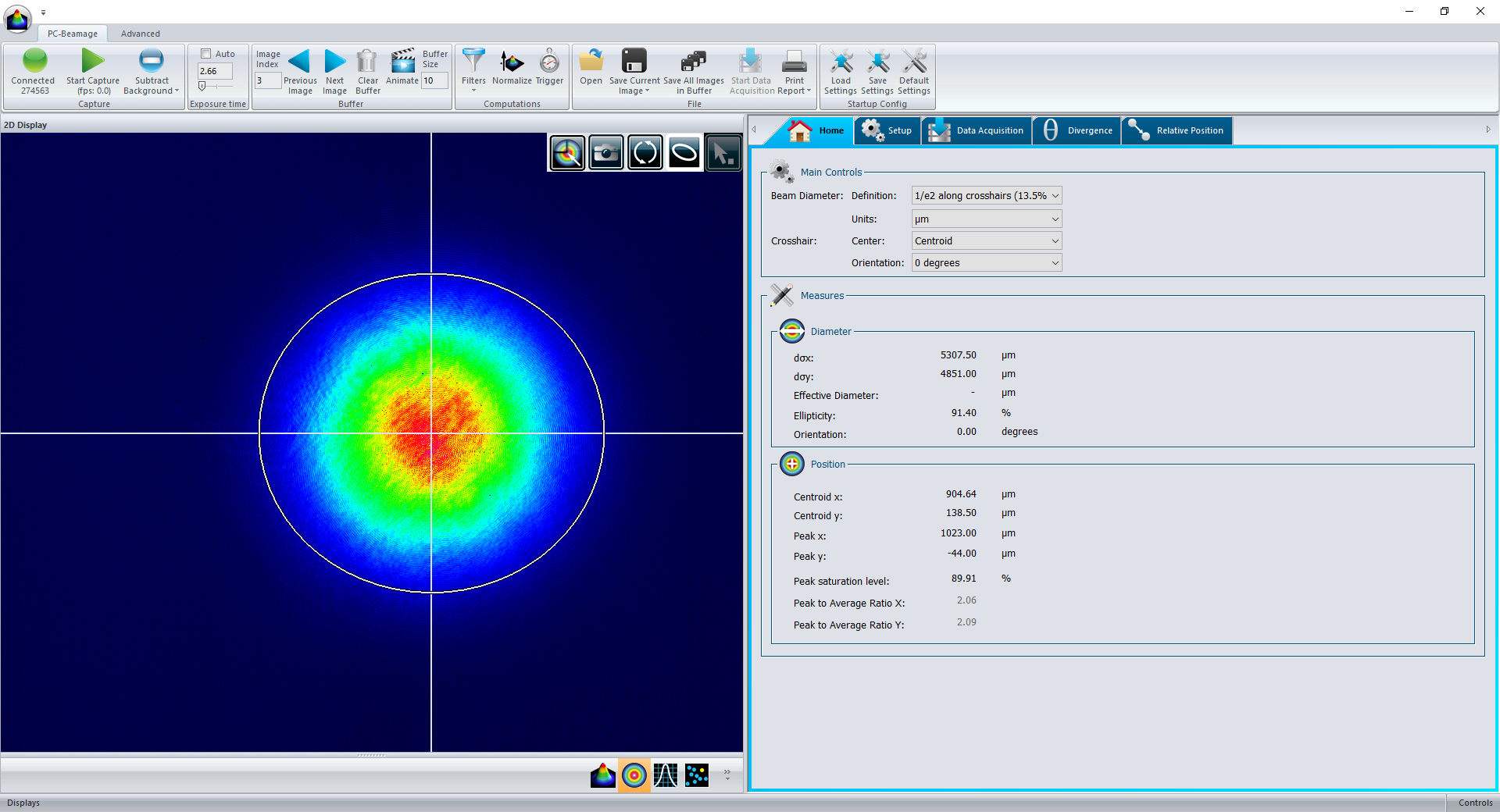 |
| Attachment 2: Capture4.PNG
| 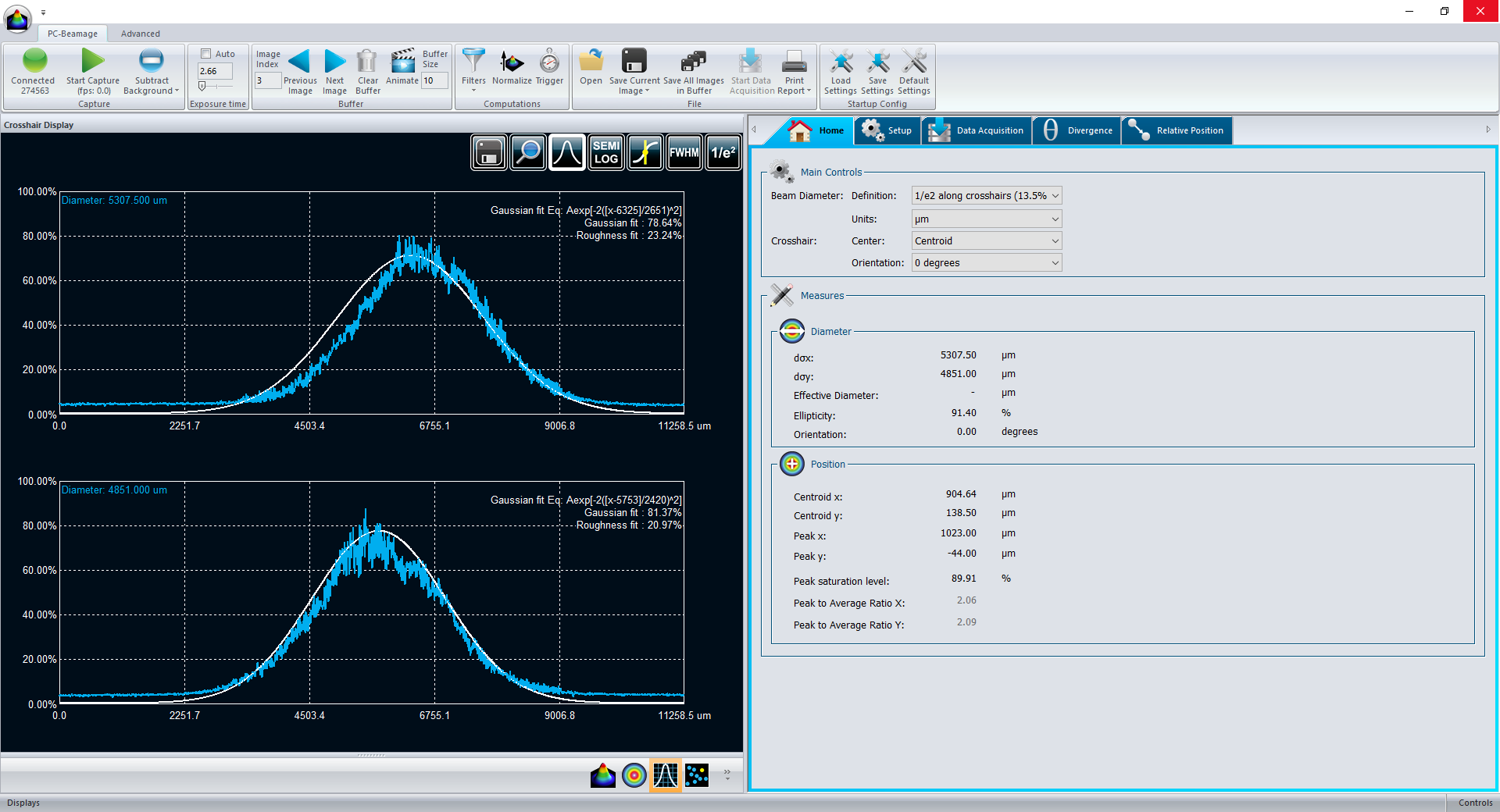 |
| Attachment 3: tek0011.png
| 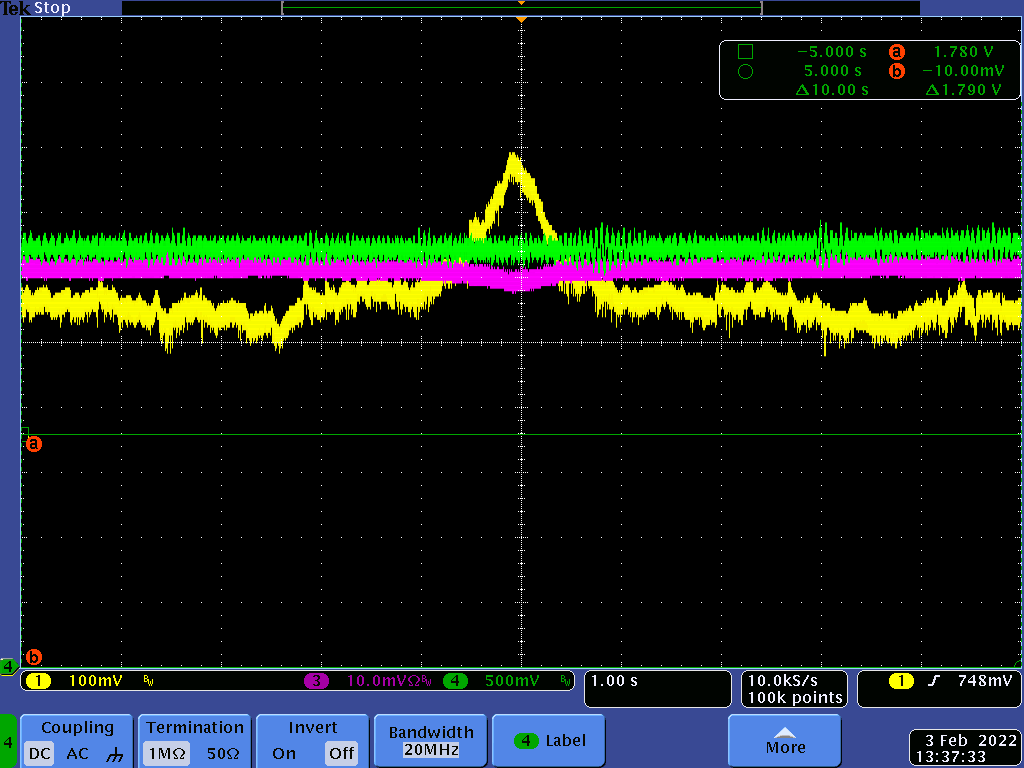 |
| Attachment 4: tek0011CH1.isf
|
| Attachment 5: tek0011CH3.isf
|
| Attachment 6: tek0011CH4.isf
|
|
123
|
Thu Feb 3 18:40:04 2022 |
Manar Amer | Fixed | report | lasers and optics | detectors and electronics | ThomX igloo | FP cavity alignment | The fluctuation problem has been solved.
It was simply the new scheme to inject 2 RF frequencies in a single EOM.
It maybe produces some standing waves in the EOM RF input and creates some phase noise.
we went back to the standard solution with 2x EOM and the problem vanished.
Now we have a very good lock and we can measure the Finesse.
| Manar Amer wrote: |
|
As it can be seen on the first plot, even with a good locking (good reduction of "high" frequencies noise: we had better locking than on the picture) we still have very low frequency (~ 1Hz) fluctuations
these fluctuations prevent having a good measurement of the Finesse and they need to be understood.
they can come from fluctuations due to :
- input power
- input or feedback polarization
- phase noise
- alignment
- mode matching
1) input power:
we looked at the direct reflected power from the cavity without locking as an image of the input power.
=> we don't see these fluctuations
2) input polarization:
as there are many unconstrained fibers after the NKT (EOM/AOM) it could produce some polarization fluctuations.
we put a PBS and half and quarter waveplates in front of the reflected photodiode when the cavity is not locked to detect a change in the input polarization
=> we don't see these fluctuations
3) feedback polarization:
the beam on the PDH box is coming from a wedge which can change the relative gains between different polarizations.
we put half and quarter waveplates in the injection path to adapt the input polarization with the cavity mode polarization axis
and we put half and quarter waveplates and a PBS in front of the PDH box to select the right polarization for the feedback.
=> it didn't change the power fluctuations effect.
4) phase noise
we adjusted the feedback parameters (PID gains, AOM gain, locking offset, digital and analog low pass filters) to have a clean signal without high frequencies noise.
the transmission and coupling signals exhibit quite narrow lines at the millisecond level but we see 10-15% transmission change at the second level.
as the PID has a higher gain at low frequencies, one should not see more fluctuations at these frequencies.
or if it comes from external noise, one should see a correction signal on the PZT which is the image of these fluctuations => we don't see that.
we also stopped the cavity motors controllers without any effect on the transmission stability.
5) alignment
the alignment cannot change except if some vibrations are present, which should be seen also on the PZT correction signal => we don't see that.
6) mode matching
as the coupling is only 20% and the alignment has been already optimized, the mode matching is quite bad for sure.
could it be the source of the problem?
from experience, we know that a bad mode matching implies a bad locking but the reason is not clear.
=> to be discussed with Viktor: can we improve the mode matching with a simple lens?
.
| Manar Amer wrote: |
|
Adding Oscilloscope images
- delocked + locked intervals showing the 20% coupling
- lock when the housing panels are closed + airflow on .
- lock when the housing panels are closed + air flow at lowest setting
an additional factor to the PZT voltage sensitivity is the housing panels, we see a decrease in the voltage when closing them.
| Manar Amer wrote: |
|
This morning with Manar, we installed the AOM+RF amplifier and the associated fast feedback loop.
Now the locking with the Koheras is good with a coupling of 20%.
Tomorrow is dedicated to the measurement of the Finesse.... we will have to add the 2nd EOM.
We observed a very stable lock if the airflow is OFF.
when it is ON, the lock is much less stable... maybe a problem of optimization of the feedback... we will see that tomorrow if we have time enough.
We also observed a quite important sensititvity of the PZT voltage when slightly pushing on the housing with the finger: we clearly see the compensation on the PZT voltage.
I didn't calibrate this voltage but it seems to be an important fraction of 1µm... I would say around 100nm
| Manar Amer wrote: |
|
This afternoon, I did some alignment of the injection mirrors with a fast scan on the LaseLock to get a regular transmission photodiode signal.
the coupling increased to 10-15%
I got a first lock of the cavity only with the PZT.
there is some ringing on the error signal and the locking is quite noisy, which means the cavity LW seems to be more narrow than the Koheras LW, which is a good sign.
tomorrow, I will add an AOM to improve the locking.
I did some alignment after locking.
it was difficult because of the outside noise (engines producing loud and low-frequency noises).
the coupling is now about 20% (position saved in the injection motors software).
I added a half waveplate which has to be optimized.
| Manar Amer wrote: |
|
Installed and inputs:
- CW laser ; power = 101 mW
- PDH ;
- at output
- Low pass filter 50 ohm DC-1.9 MHz
- at input
- freq = 8.4 MHz , Ampl = 1.2 V , phase = 160 /
- voltage = ~ 6 V
- EOM ; freq = 8.4 MHz , Ampl = 100 mV , phase = 90
- Photodiodes
- beam profiler
Observed during this morning:
- coupling : below 10% .... approximately ~ 8%
- Oscilloscope :
- yellow : transmission
- purple : reflection
- Blue : error signal
- green : scan signal
Note : We observe a lot of higher order modes, and they are not occurring regularly.
A schematic of the current setup is attached.
An image from the oscilloscope show a low coupling but clean error signal.
| Manar Amer wrote: |
|
Yesterday, we did the alignment again using Iris and beam profilers to obtain a more precise result.
at the end of the alignment procedure, we successfully obtained the beating modes.
the geometrical alignment seems good (weak odd modes) but we could need to put a telescope on the Koheras line as the beam size seems quite different from the mode size (quite strong even modes).
without any improvement of the alignment using photodiodes, one obtains about 15-20% of coupling.
we put several Iris on the table:
- 2 Iris before the 2 alignment mirrors to fix the axis of the laser on these mirrors
- 1 Iris just before the cavity (we will add an additional one today) to fix the cavity axis
- 1 Iris in reflection of the cavity to fix the M1 orientation
| Manar Amer wrote: |
|
***** Continuation of the alignment ---- FP Cavity Open --- ****
The cavity was put under outer pressure and was opened for the alignment
The alignment was done using CW koheras infrared laser and the inside mirrors irises
we observed the beam output centered at S2, S3 and P4
transmission from S4 to P1 was aligned at the center of P1 iris and an outside reference was fixed, then P1 mirror was placed, and we aligned the reflection with the transmission.
....... After the interior alignment, the cavity windows were closed ....
A beam profiler was placed at P4 transmission -----> nothing observed even with a piezo drive on the CW infrared laser
observed a beam output at S2 and S3, but the fundamental mode is not seen, or even a higher order mode (which we can't explain, as the beam is centered on the mirrors)
images show the output at S2 and S3
| Manar Amer wrote: |
|
The alignment is on hold until next week 17th - 18th Jan
an Alignment attempt will be done when the ring part close to the FP cavity is opened.
| Manar Amer wrote: |
|
Note the direction of injection is M1 - M2 - M3 - M4
P1 - S2 - S3 - P4
The injected beam is aligned at the center of the irises placed at the windows mounts of mirror M1 (Injection) and M2(spherical)
At Transmission of M2 : in addition to centered beam, we observe diffraction which interferes in observing the beating at M2 output
(could be diffracted beam from the metal pipes inside or from the D-shaped mirror installed inside)
At Transmission of M3 : we observe a beam output could be part of TM00 mode (the shape is distorted !!)
suspicious reasons :
- when we have a frequency sweep on the CW(Koheras) piezo; we observe it beating (when increasing the drive it is increasing in intensity)
- when we adjust the alignment mirrors; the beam doesn't change position and only its intensity changes
continuation with the alignment and try to eliminate the diffraction and find the shape of the beam.
A manual change in the D-shaped mirror position to remove any possible effects from it.
|
|
|
|
|
|
|
|
|
|
|