| ID |
Date |
Author |
Status |
Type |
Category |
Location |
Title |
|
456
|
Mon Sep 29 10:22:32 2025 |
Ronic Chiche | Fixed | info | mechanics | lasers and optics | vacuum | detectors and electronics | cabling | software | utilities | ThomX igloo | Power shut down on September 23th |
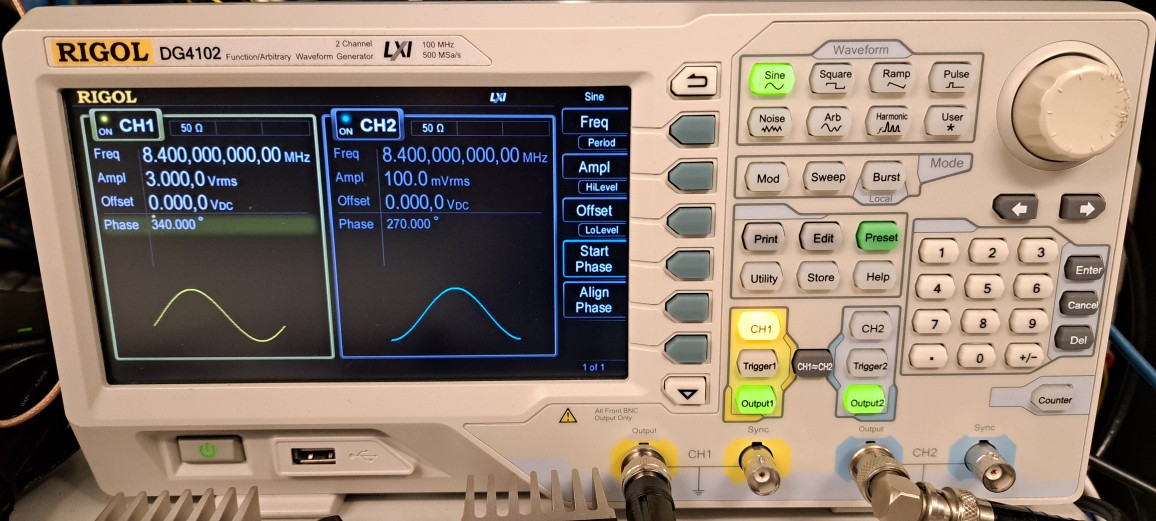
This morning I did a phase alignment on the PDH signal generator (Rigol DG4102)
this procedure ensure that both phases of the sine wave signals are aligned before finding the correct phase for maximizing the error signal.
so, from now on, in case of power shut down, one just need to :
1) do a phase alignment
2) put the correct phase number on the 2 channels according to the picture (if not automatically done by the generator itself).
340° on channel 1
270° on channel 2
1) and 2) can be done in any order.
| Ronic Chiche wrote: |
|
the 33MHz/500MHz RF frequencies from the Ring seems different from the previous state (maybe working at an energy of 50MeV instead of 70MeV which was the previous energy ?).
so, I let the FPC at the present position and wait to discuss if it is necessary or not to move the FPC motors for the correct energy...
| Ronic Chiche wrote: |
|
this morning, I restarted all the equipments of the FPC.
everything was fine after being able to get back the correct PDH phase between modulation and demodulation...I got 88kW with 33% amplifier ratio after basic alignment and CEP tuning.
the Pico1 server used for the X-ray photodiode TMD.01 doesn't want to start...
I tried with Astor. the server start to run (red => blue => green colors)
but when I start the Jive panel, it gets down again (red color)... to be solved
| Ronic Chiche wrote: |
|
to anticipate the power shut down on next tuesday 23/09,
this afternoon, I switched off all the equipments except the oscillator connected on the UPS.
|
|
|
|
| Attachment 1: img1.jpg
|
 |
|
455
|
Fri Sep 26 11:13:35 2025 |
Ronic Chiche | Fixed | info | mechanics | lasers and optics | vacuum | detectors and electronics | cabling | software | utilities | ThomX igloo | Power shut down on September 23th |
the 33MHz/500MHz RF frequencies from the Ring seems different from the previous state (maybe working at an energy of 50MeV instead of 70MeV which was the previous energy ?).
so, I let the FPC at the present position and wait to discuss if it is necessary or not to move the FPC motors for the correct energy...
| Ronic Chiche wrote: |
|
this morning, I restarted all the equipments of the FPC.
everything was fine after being able to get back the correct PDH phase between modulation and demodulation...I got 88kW with 33% amplifier ratio after basic alignment and CEP tuning.
the Pico1 server used for the X-ray photodiode TMD.01 doesn't want to start...
I tried with Astor. the server start to run (red => blue => green colors)
but when I start the Jive panel, it gets down again (red color)... to be solved
| Ronic Chiche wrote: |
|
to anticipate the power shut down on next tuesday 23/09,
this afternoon, I switched off all the equipments except the oscillator connected on the UPS.
|
|
|
|
454
|
Fri Sep 26 11:08:21 2025 |
Ronic Chiche | Fixed | info | mechanics | lasers and optics | vacuum | detectors and electronics | cabling | software | utilities | ThomX igloo | Power shut down on September 23th |
this morning, I restarted all the equipments of the FPC.
everything was fine after being able to get back the correct PDH phase between modulation and demodulation...I got 88kW with 33% amplifier ratio after basic alignment and CEP tuning.
the Pico1 server used for the X-ray photodiode TMD.01 doesn't want to start...
I tried with Astor. the server start to run (red => blue => green colors)
but when I start the Jive panel, it gets down again (red color)... to be solved
| Ronic Chiche wrote: |
|
to anticipate the power shut down on next tuesday 23/09,
this afternoon, I switched off all the equipments except the oscillator connected on the UPS.
|
|
|
453
|
Thu Sep 18 18:29:04 2025 |
Ronic Chiche | Fixed | info | mechanics | lasers and optics | vacuum | detectors and electronics | cabling | software | utilities | ThomX igloo | Power shut down on September 23th |
to anticipate the power shut down on next tuesday 23/09,
this afternoon, I switched off all the equipments except the oscillator connected on the UPS. |
|
452
|
Tue Sep 16 17:41:28 2025 |
Ronic Chiche | Fixed | info | mechanics | lasers and optics | detectors and electronics | ThomX igloo | Accelerometer measurement |
with Daniele, we placed the accelerometer on top of the fiber amplifier box which is inside the housing.
the goal was to try to detect a correlation with some possible accoustic noise coming from the bubbles of the water, cooling the amplifier box baseplate.
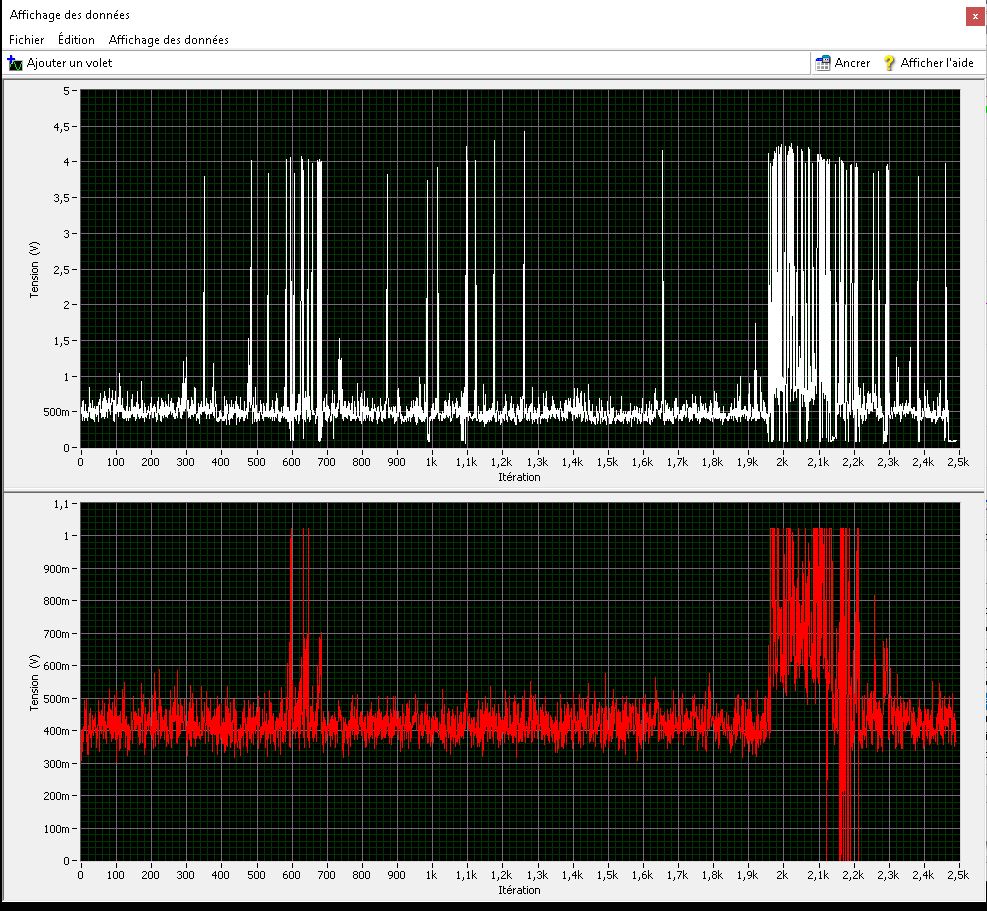
we monitored a long trend of the transmission which is perturbated when high frequency noise arises, and the accelerometer signal.
the long trend plots only the peak-peak value of a full 1 second acquisition every 2 seconds during ~2500 pts equivalent to ~5000 seconds = 1h20
on the plot, the top white signal is the transmission pk-pk and the bottom red signal is the accelerometer pk-pk.
we don't see any correlation except at 600-700 pts because Daniele entered the bunker and slightly knock on the bottom of the optical table several times.
and at 1950-2300 pts, because he opened the housing (much more noise recorded by the accelerometer) and then it close it again.
he also try to knock on the amplifier controller rack which is placed on the ground, below the table, but he didn't see any correlation with some cavity lock losses.
=> no clear conclusion.
except that the noise seen on the transmission when the housing is open is close to the "high frequency noise" we observe... could it be some accoustic noise coming from elsewhere ? |
| Attachment 1: Capture.JPG
|
 |
|
451
|
Tue Sep 16 12:32:52 2025 |
Ronic Chiche | Fixed | info | lasers and optics | detectors and electronics | ThomX igloo | polarization measurement of the FP cavity beam |
today, with Daniele, we did a simple polarization measurement in transmission of the FP cavity beam.
1) we locked the FP cavity and measured 82.5kw (for 33% amplifier ratio) with the power-meter moved a little bit further (this is maybe the reason why the power is a little bit lower than usually measured).
2) then, we installed a high power PBS CCM1-PBS25-1064-HP(/M) with a transmission of 89% of the P-polarization @ 1030nm
We measured 66.5kW in transmission of the cube.
3) then we installed a half waveplate to find the optimum angle => 77kW measured at an angle of 342°
(almost no power has been observed in the vertical polarization state of the PBS).
Then we rotated the waveplate to find the previous measurement => 66.5kW at an angle of 348°
(we checked that adding the waveplate in the path almost does not change the measured power)
Conclusions :
- the FP cavity polarization is almost horizontal (P-polarization) and linear (77kW ~ 89%*82.5kW)
- the angle of the polarization is roughly 2*(348-342)° = 12°
|
|
450
|
Thu Aug 28 18:01:46 2025 |
Ronic Chiche | Fixed | info | detectors and electronics | ThomX igloo | Power shut down on August 29th |
after alignment, CEP adjustment and optimizing the PDH phase, I got back ~92kW in the FPC for 33% amplifier ratio.
| Ronic Chiche wrote: |
|
This morning, all the equipments have been switched off due to a power shut down tomorrow morning.
Only the Onefive oscillator is still ON, connected to the Uninterruptable Power Supply (UPS).
|
|
|
449
|
Wed Aug 27 12:01:41 2025 |
Ronic Chiche | Fixed | info | detectors and electronics | ThomX igloo | Power shut down on August 29th |
This morning, all the equipments have been switched off due to a power shut down tomorrow morning.
Only the Onefive oscillator is still ON, connected to the Uninterruptable Power Supply (UPS). |
|
448
|
Thu Aug 7 11:14:47 2025 |
Ronic Chiche | Fixed | info | lasers and optics | detectors and electronics | ThomX igloo | Alignment correction during the summer break |
I restarted the FPC system this morning.
after some classic alignement procedure (some LEFT steps on the cavity injection motors X & Y) and CEP tuning,
I got 92kW for 33% amplifier ratio.
the cavity was not particularely misaligned...
then I did a long run at 90kW with both feedbacks ON without any problem. |
|
447
|
Fri Jul 18 15:56:40 2025 |
Ronic Chiche | Under Process | info | lasers and optics | ThomX igloo | laser operation again with machine OFF |
The laser start at 33% with 92 KW optimized and
P=0.03
I=0.0005
I2=0
D=0.5
But we have more and more problems with the alignement from a day to another!!!
We start the machine and we do Xrays again.
The lock is easy and stable, we see some hig fraq perturbations but no delock as yesterday.
ATTENTION!!!!! when one switch ON or OFF the hexapode motors we have big delock like what we observed some time during the operation!!!!!
For the big delock we have to investigate the operation of the hexapode!!
We have changed the orbit and obtained almost 40000 Xrays. with an ebeam dimension of 121 µm rms.
And now I go in Hollydays!!
See you after 15 august
Daniele |
|
446
|
Fri Jul 18 09:23:40 2025 |
Ronic Chiche | Under Process | info | lasers and optics | ThomX igloo | Xrays experiment with prostate |
Today we do XRays for experiment.
The laser start to 33% at 93 KW but Pgain = 0.033
The laser is locked so stable for the moment. We have Xrays and the system is stable.
I have started a trend of laser power.
Some high freq perturbations are visibles but no delock.
It's clear that when the charge vary a lot in the ring we see more high frq perturbations!!
Each time we inject electrons we see high freq pert!!! But the delock are rare!
When electrons are lost we see high freq perturbations!!
New PID parameters
P=0.03
I=0.0005
I2=0
D=0.5
Axe18=+0.0016014
We have done a vertical scan and de e-beam seem to be very very large!! >1mm
The e-beam is not well adjusted but the lock is really much better!
We do good measurement of X fluorescence spectrum of Prostate, ThomX is becoming more and more interesting Xrays source!!
Daniele |
|
445
|
Wed Jul 16 17:17:57 2025 |
Ronic Chiche | Under Process | info | lasers and optics | ThomX igloo | Suite tests stabilité |
We continue to find what gives high freq. perturbation.
The laser starts at 92 KW it is stable and locked to the RF. NO high freq parturbation.... With the machine off. (30 min of lock)
We put now the machine ON (All in warming exept pulsed elements)... => the system is very stable NO delock, NO high freq perturbations. The operator can even go to toilet during the operation... it's a very big improvement!!!
Now we continue with the e-beam production.... => when we put ON the Kikers wtih the rest of the machine (no electrons yet) some perturbations are observed and delock also.... but no really high freq perturbations juste very big 20 Hz like ones (at 10h30). Some people oh PERLE are in the igloo now. In any case it was easy to relock and it is very stable now.
10h50 some 40 Hz perturbation and delock.... and very big 20 Hz perturbations.... some delock arrived but not really high freq.
!!!!!!! PERLE PEOPLE MOVES LE PONT SINCE 10H30!!!!! CORRESPONDING TO DELOCK!!!
That means that the system is stable with all the maching On (but NO electrons).
So in the afternoon we will put the electrons and continue the investigation of stability.
I restart the laser after lunch with electrons in the machine. I have lost 7 KW of power.... and the lock parameter changed (P gain 0.05-> 0.03)
Je vois passer des hautes freq!! J'ai retrouvé 92 KW avec l'alignement qui avait bougé visiblement!! But the PID parameters are still 0.03.
I see a little bit Hig frq perturb but the laser dont delock. Also bigger high freq perturbation with delock. electrons effect or alignement problems??
We change the frequency for 50MeV. Delta freq = 3.6kHz so dela cavity lenght -1.1mm
We have electrons and we lock much better than before to add the amplifier to enlarge PID range.
We observe some high freq perturbations but the PID compensate and we have almost no delock!!
In conclusion: high freq perturbations dont come from the machine without electrons. The presence of the electrons is associated to some high frq perturbations but the new feedback system can compensate them and delock are rare but we have some with electrons.
Globaly the system is much better
Daniele |
|
444
|
Tue Jul 15 17:34:13 2025 |
Ronic Chiche | Under Process | info | lasers and optics | ThomX igloo | Stability test Without and with |
The laser starts at 93 KW.
This morning I operated the laser locked with the RF for 1h30 without any delock. All the machine was switch off.
All the system was very stable. Sometimes the 20 Hz perturbation was visible but no delocking.
In the afternoon I switched ON just the kikers and septum (with the Kikers delay of not giving perturbation for the synchro -8.561) and I do the same thing => The situation is exactely the same, all the system is very stable (but 20 Hz perturbations). NO deloking during 1h.
I change the delay between Kikers to -7.561 => exactely the same situation, all is very stable!!!!
In 3h of synchronized operation, NO delock at all with or without Kikers!!!
Conclusion no effect at all when juste pulsed element are switched ON.
Daniele |
|
443
|
Fri Jul 11 16:15:12 2025 |
Ronic Chiche | Fixed | info | lasers and optics | detectors and electronics | ThomX igloo | Tuning of the slow feeback loop analog BW + fast feedback loop gain + PID |
Today with Daniele, we tuned the potentiometer after the Laselock which drives the analog BW of the PID on the laser PZT,
and we tuned also the fast loop gain (with the rotary potentiometer dedicated to it) => the PID parameters have changed.
so, the recipies has changed => to be updated
the global observation with the x3 amplifier on the laser PZT channel, is the system is more noisy.
the maximum power for 33% amp ratio is now ~93kW instead of 97-98kW.
we tried this afternoon to do a long run with the RF and the FPC loops activated, but it seams that a lot of high frequency noise is present.
is it coming from the new parameters feedback setup or because of the electron machine which is ON ? |
|
442
|
Thu Jul 10 18:33:48 2025 |
Ronic Chiche | Fixed | info | lasers and optics | detectors and electronics | ThomX igloo | New recipies with additionnal attenuation before the diffuser and new x3 amplifier on laser PZT |
With optical attenuation + x3 amplifier on laser PZT channel + feedback tuning
Temporary recipie for ~ 92kW power in the FP-cavity:
(in the previous scheme, without x3 laser PZT amp, a good lock was achieved for a PDH signal power noise ~ 70 mV rms)
- Alplhanov amplifier ratio : 34%
- Axis 18 position : +0016956 steps
- PID A (for laser/FPC lock) :
input : input a
P = 0.04
I = 0.0005
D = 0.48
Sign : positive
Sampling : fast
filter : off
criterion : input d
upper th. : 10V
lower th. : 0.03V
speed : 100V/s
relock mode : none
off mode : reset
range : 50%
offset : 5V
- PID B (for RF/FPC lock) :
input : input b
P = 1
I = 0.00005
D = 1
Sign : positive
Sampling : mid
filter : off
criterion : input c
upper th. : +0.4V
lower th. : -0.45V
speed : 1V/s
relock mode : none
off mode : reset
range : 50%
offset : 5V
| Ronic Chiche wrote: |
|
For ~ 92kW power in the FP-cavity:
- Alplhanov amplifier ratio : 33%
- Axis 18 position : +0003768 steps
- PID A (for laser/FPC lock) :
input : input a
P = 0.1
I = 0.0015
D = 1.5
Sign : positive
Sampling : fast
filter : off
criterion : input d
upper th. : 10V
lower th. : 0.05V
speed : 100V/s
relock mode : none
off mode : hold
range : 50%
offset : 5V
- PID B (for RF/FPC lock) :
input : input b
P = 5
I = 0.0001
D = 1
Sign : negative
Sampling : mid
filter : off
criterion : input c
upper th. : 0.45V
lower th. : -0.45V
speed : 1V/s
relock mode : none
off mode : hold
range : 20%
offset : 5V
|
|
|
441
|
Thu Jul 10 18:02:54 2025 |
Ronic Chiche | Fixed | info | detectors and electronics | ThomX igloo | laser PZT amplifier |
this afternoon, I added the Gain = 2.8 amplifier at the output of the Laselock to drive the laser PZT.
the power supply of the board is disymetric to address the correct maximal dynamic range of the amplifier (~ 30V) and voltage drop (~ 2V) related to the power supply voltage.
so, the power supply is set to -2V / 32V which gives roughly 0-28V of dynamic range at the ouput for 0-10V at the input.
despite the additionnal noise added by the amplifier, we are able to lock easily, and reach ~ 93kW in the FPC for 33% amplifier ratio.
obviously, as the dynamic range of this PZT has been multiplied by ~3, it is much more comfortable to operate the motors.
but the overall stability seems a bit degraded... to be checked, as finding the right PID + fast loop gain is not easy.
=> to be done tomorow. |
|
440
|
Thu Jul 10 15:44:43 2025 |
Ronic Chiche | Fixed | info | lasers and optics | detectors and electronics | ThomX igloo | long run to test the appearance of high frequency noise |
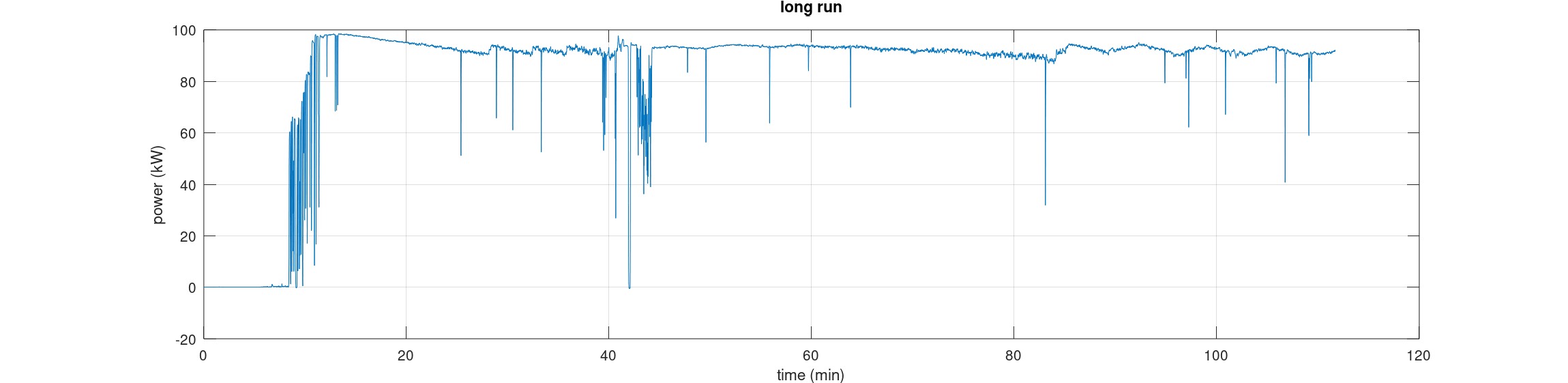
today, long run directly at full power (33% amplifier ratio) => 98kW in the FPC at the very begining of the run.
(P=0.05 / I=0.0005 / D=0.6)
10-40 min : almost misalignment effect (CEP did not change so much)
I increased 3 times the amplifier ratio to 34%, 35%, 36% to compensate the misalignment and keep the power almost constant.
then I did a full tuning (CEP + alignment)
45-110 min : misalignment effect after ~30min of warming up of the FPC => much more stable.
I corrected twice (@ 85min) the alignment to compensate a bit the power loss
globally, the FPC seems stable => all the lock losses come from the 20Hz noise and are recovered very quicly by the locking.
I never saw the high frequency noise which can produce long lock losses.
maybe it's time to add the gain x3 on the laser PZT channel to get some room on the 20Hz noise compensation.
| Ronic Chiche wrote: |
|
Today with Daniele, we did 6 long runs at different power (23kW, 46kW, 66kW, 73kW, 92kW, 92kW)
All the lock loss in between these several runs are due to FPC locking parameters change.
most of the few lock losses during the stable power duration, are due to 20Hz oscillation noise or because we forgot to center properly the PZT in its range (operator faults).
the 4 first runs (23kW, 46kW, 66kW, 73kW) are using the PID : (P=0.1 / I=0.0015 / D=1.5) without the additionnal optical attenuator placed after the diffuser.
the 5th run (92kW) is using the PID : (P=0.1 / I=0.0015 / D=1.5) with the additionnal optical attenuator placed after the diffuser.
the 6th run (92kW) is using the PID : (P=0.05 / I=0.0005 / D=0.6 and obviously a different diffuser position) with the additionnal optical attenuator placed after the diffuser.
surprisingly, we never saw any high frequency noise during the day !
to be noticed : the electron machine was OFF / the day was sunny without wind / almost nobody was working in the bunker.
|
|
| Attachment 1: 2025-07-10_-_long_run.png
|
 |
|
439
|
Wed Jul 9 18:11:59 2025 |
Ronic Chiche | Fixed | info | lasers and optics | detectors and electronics | ThomX igloo | long run to test the appearance of high frequency noise |
Today with Daniele, we did 6 long runs at different power (23kW, 46kW, 66kW, 73kW, 92kW, 92kW)
All the lock loss in between these several runs are due to FPC locking parameters change.
most of the few lock losses during the stable power duration, are due to 20Hz oscillation noise or because we forgot to center properly the PZT in its range (operator faults).
the 4 first runs (23kW, 46kW, 66kW, 73kW) are using the PID : (P=0.1 / I=0.0015 / D=1.5) without the additionnal optical attenuator placed after the diffuser.
the 5th run (92kW) is using the PID : (P=0.1 / I=0.0015 / D=1.5) with the additionnal optical attenuator placed after the diffuser.
the 6th run (92kW) is using the PID : (P=0.05 / I=0.0005 / D=0.6) and obviously a different diffuser position) with the additionnal optical attenuator placed after the diffuser.
surprisingly, we never saw any high frequency noise during the day !
to be noticed : the electron machine was OFF / the day was sunny without wind / almost nobody was working in the bunker. |
| Attachment 1: long_run_with_different_FPC_power.png
|
 |
|
438
|
Wed Jul 9 17:20:01 2025 |
Ronic Chiche | Fixed | info | lasers and optics | detectors and electronics | ThomX igloo | New recipies with additionnal attenuation before the diffuser |
With optical attenuation only
For ~ 92kW power in the FP-cavity:
- Alplhanov amplifier ratio : 33%
- Axis 18 position : +0003768 steps
- PID A (for laser/FPC lock) :
input : input a
P = 0.1
I = 0.0015
D = 1.5
Sign : positive
Sampling : fast
filter : off
criterion : input d
upper th. : 10V
lower th. : 0.05V
speed : 100V/s
relock mode : none
off mode : hold
range : 50%
offset : 5V
- PID B (for RF/FPC lock) :
input : input b
P = 5
I = 0.0001
D = 1
Sign : negative
Sampling : mid
filter : off
criterion : input c
upper th. : 0.45V
lower th. : -0.45V
speed : 1V/s
relock mode : none
off mode : hold
range : 20%
offset : 5V
|
|
437
|
Wed Jul 9 16:27:18 2025 |
Ronic Chiche | Fixed | info | lasers and optics | detectors and electronics | ThomX igloo | optical attenuator added on the diffuser + new PID parameters |
Today we did several long runs (~1h each) at ~23kW, 46kW, 66kW with different PID parameters which seems better.
P = 0.1
I = 0.0015
D = 1.5
which implies a different fast loop gain.
For these new PID parameters, it was impossible to use 33% amplifier ratio => to much power on the PID at the diffuser limit (axis 18).
so, we added a NE02 optical attenuator on the mobile diffuser => we can't use the old recipies anymore. |