| ID |
Date |
Author |
Status |
Type |
Category |
Location |
Title |
|
373
|
Tue Oct 22 18:52:40 2024 |
Ronic Chiche | Fixed | issue | lasers and optics | ThomX igloo | Onefive 33MHz modelock loss |
For the modulation/demodulation generator for the PDH signal,
after a power shutdown, on can :
1) restart the generator to get the correct parameters:
CH1:3Vrms on 50 ohms @ 8.4MHz (demod)
CH2: 100mVrms on 50 ohms @ 8.4MHz (modulation on EOM)
2) do an "Align phase" on the generator
3) put 270° on CH2 (0° on CH1) to get the max Error signal
and use a "positive" sign on the Laselock : cf https://elog.lal.in2p3.fr/FPC/THOMX+commissioning/365
| Ronic Chiche wrote: |
|
After the new Yvette flooding of the last week and the consecutive AC-shut down, I restarted this morning the laser with the same procedure (step of 1mm at 10mm/s with the Smaract motor on the rep rate channel (CH1)).
now, we have again 33.371MHz and 3.1mW input power as expected ! => OK
the last thing to do is to tune again the PDH demodulation frequency, as the generator has been shut off during the AC shut down.
| Ronic Chiche wrote: |
|
This morning, I verified the reason why the seeder frequency was not displayed on the amplifier software screen:
one needs to start the amplifier (even at 0%) to see the seeder frequency !!!
now, we have 33.371MHz as expected ! => OK
the last thing to do is to tune again the PDH demodulation frequency, as the generator has been shut off during the AC shut down.
| Ronic Chiche wrote: |
|
On Friday 11th of October, due to the Yvette flooding, all the AC power of ThomX have been shut down.
After the shutdown, I had to restart the Onefive oscillator but the laser modelock was lost.
I had to do a step of 1mm at 10mm/s with the Smaract motor on the rep rate channel (CH1)
After the step, the laser was mode-locking again, and I put it back in the original position at a much lower speed, ~10µm/s, to prevent a new modelock loss.
the power detected by the laser amplifier software is still above 3mW! => OK
Surprisingly, the laser amplifier software is not able to detect the oscillator frequency.
hopefully, the internal photodiode of the oscillator is sent to the CH4 of the R&S scope (192.168.229.21)
and we measured a correct 30ns of period, corresponding to 33MHz.
Because all the safety procedures are not fulfilled, the laser amplifier is not granted to start.
Maybe it is the Reason for the lack of measurement => to be verified later
|
|
|
|
|
378
|
Wed Nov 20 11:28:01 2024 |
Ronic Chiche | Fixed | info | lasers and optics | detectors and electronics | ThomX igloo | Checking the amplifier power |
this morning, with Daniele, we checked the amplifier power, right after the CVBG (the power meter has to be placed on a metal plate above the large table hole), and just at the input of the FP cavity, after the 1/4 and 1/2 waveplates (the power meter has to be placed on flat beam dump+ Thorlabs beam dump + V metallic mount to be at the right height).
we compared with the power measured the 9th of september : https://elog.lal.in2p3.fr/FPC/THOMX+commissioning/356
the 3 collumns are the measurement close to the CVBG on 9th of september / same position today / just befor the FPC today
amplifier ratio (%) power after compressor (W) (new) power @ CVBG (new) power @ FPC ratio FPC/CVBG power (%)
10 0.91 0.93 0.83 89.2
20 8.6 8.6 8.0 93.0
30 16.7 16.9 15.8 93.5
40 25.5 25.6 24.0 93.7
50 34.5 34.6 32.5 93.9
60 42.5 42.5 39.5 92.9
70 50.0 50.0 45.0 90.0
we observed with the viewer the beam on the powermeter.
at 70% of amplifier ratio, the beam size is as big as the powermeter detector.
then, the 93% to 90% transport efficiency drop could come from this "too small" powermeter detector.
we observed also at this power ratio (70%) that the 1/4 and 1/2 waveplates were not perfectly centered and we burn a part of the platic mount at this power.
|
|
379
|
Wed Nov 20 12:00:47 2024 |
Ronic Chiche | Fixed | info | lasers and optics | detectors and electronics | ThomX igloo | Checking the amplifier power |
we did a long term run (25 mn) with the powermeter located at the FPC position at 33% amplifier ratio.
the initial power was 18W .
then, it goes to 18.5W in 10 minutes, then 5 minutes later, it goes to 18.3W and stay stable until the end the run.
| Ronic Chiche wrote: |
|
this morning, with Daniele, we checked the amplifier power, right after the CVBG (the power meter has to be placed on a metal plate above the large table hole), and just at the input of the FP cavity, after the 1/4 and 1/2 waveplates (the power meter has to be placed on flat beam dump+ Thorlabs beam dump + V metallic mount to be at the right height).
we compared with the power measured the 9th of september : https://elog.lal.in2p3.fr/FPC/THOMX+commissioning/356
the 3 collumns are the measurement close to the CVBG on 9th of september / same position today / just befor the FPC today
amplifier ratio (%) power after compressor (W) (new) power @ CVBG (new) power @ FPC ratio FPC/CVBG power (%)
10 0.91 0.93 0.83 89.2
20 8.6 8.6 8.0 93.0
30 16.7 16.9 15.8 93.5
40 25.5 25.6 24.0 93.7
50 34.5 34.6 32.5 93.9
60 42.5 42.5 39.5 92.9
70 50.0 50.0 45.0 90.0
we observed with the viewer the beam on the powermeter.
at 70% of amplifier ratio, the beam size is as big as the powermeter detector.
then, the 93% to 90% transport efficiency drop could come from this "too small" powermeter detector.
we observed also at this power ratio (70%) that the 1/4 and 1/2 waveplates were not perfectly centered and we burn a part of the platic mount at this power.
|
|
|
380
|
Wed Nov 20 12:42:11 2024 |
Ronic Chiche | Fixed | info | lasers and optics | detectors and electronics | ThomX igloo | Checking the amplifier power |
I put back and aligned the 1/2 waveplate only and I get 71kW max after its optimization and optimizing the CEP and alignment (without walking procedure).
this waveplate change a lot the reflected power seen on the CH2 of the scope.
to be continued this afternoon...
| Ronic Chiche wrote: |
|
we did a long term run (25 mn) with the powermeter located at the FPC position at 33% amplifier ratio.
the initial power was 18W .
then, it goes to 18.5W in 10 minutes, then 5 minutes later, it goes to 18.3W and stay stable until the end the run.
| Ronic Chiche wrote: |
|
this morning, with Daniele, we checked the amplifier power, right after the CVBG (the power meter has to be placed on a metal plate above the large table hole), and just at the input of the FP cavity, after the 1/4 and 1/2 waveplates (the power meter has to be placed on flat beam dump+ Thorlabs beam dump + V metallic mount to be at the right height).
we compared with the power measured the 9th of september : https://elog.lal.in2p3.fr/FPC/THOMX+commissioning/356
the 3 collumns are the measurement close to the CVBG on 9th of september / same position today / just befor the FPC today
amplifier ratio (%) power after compressor (W) (new) power @ CVBG (new) power @ FPC ratio FPC/CVBG power (%)
10 0.91 0.93 0.83 89.2
20 8.6 8.6 8.0 93.0
30 16.7 16.9 15.8 93.5
40 25.5 25.6 24.0 93.7
50 34.5 34.6 32.5 93.9
60 42.5 42.5 39.5 92.9
70 50.0 50.0 45.0 90.0
we observed with the viewer the beam on the powermeter.
at 70% of amplifier ratio, the beam size is as big as the powermeter detector.
then, the 93% to 90% transport efficiency drop could come from this "too small" powermeter detector.
we observed also at this power ratio (70%) that the 1/4 and 1/2 waveplates were not perfectly centered and we burn a part of the platic mount at this power.
|
|
|
|
381
|
Wed Nov 20 18:55:37 2024 |
Ronic Chiche | Fixed | info | lasers and optics | detectors and electronics | ThomX igloo | Checking the amplifier power |
this afternoon, we put back the 1/4 and 1/2 waveplates and after a long alignment/angle tuning/CEP optimization process, we hardly got 80-81kW in the cavity for 33% amplifier ratio. the transmission photodiode is then ~ 7.5 divisions (500mV/division) on the scope.
BUT during the 1/2 and 1/4 waveplate angle tuning process, we clearly saw:
- a reflection signal level which is very sensitive to the input polarization
- a coupling which can be almost zero with ~70kW inside the cavity
- the more important: ~9.5 divisions (500mV/division) on the scope with only 70-75kW in the powermeter
=> which device should we believe ?
the problem is all these photodiodes (reflection, error signal, transmission) and powermeter are aligned with mirrors which seem to be sensitive to the polarization state of the beam... and for the "output" beam side of the cavity, we cannot remove the mirrors because of the mechanics of the cavity which prevent a direct view of the ports. for the "input" beam side of the cavity, the output port is used for the cavity beam size measurement with a Basler camera.
we have to think to how to solve this issue !
| Ronic Chiche wrote: |
|
I put back and aligned the 1/2 waveplate only and I get 71kW max after its optimization and optimizing the CEP and alignment (without walking procedure).
this waveplate change a lot the reflected power seen on the CH2 of the scope.
to be continued this afternoon...
| Ronic Chiche wrote: |
|
we did a long term run (25 mn) with the powermeter located at the FPC position at 33% amplifier ratio.
the initial power was 18W .
then, it goes to 18.5W in 10 minutes, then 5 minutes later, it goes to 18.3W and stay stable until the end the run.
| Ronic Chiche wrote: |
|
this morning, with Daniele, we checked the amplifier power, right after the CVBG (the power meter has to be placed on a metal plate above the large table hole), and just at the input of the FP cavity, after the 1/4 and 1/2 waveplates (the power meter has to be placed on flat beam dump+ Thorlabs beam dump + V metallic mount to be at the right height).
we compared with the power measured the 9th of september : https://elog.lal.in2p3.fr/FPC/THOMX+commissioning/356
the 3 collumns are the measurement close to the CVBG on 9th of september / same position today / just befor the FPC today
amplifier ratio (%) power after compressor (W) (new) power @ CVBG (new) power @ FPC ratio FPC/CVBG power (%)
10 0.91 0.93 0.83 89.2
20 8.6 8.6 8.0 93.0
30 16.7 16.9 15.8 93.5
40 25.5 25.6 24.0 93.7
50 34.5 34.6 32.5 93.9
60 42.5 42.5 39.5 92.9
70 50.0 50.0 45.0 90.0
we observed with the viewer the beam on the powermeter.
at 70% of amplifier ratio, the beam size is as big as the powermeter detector.
then, the 93% to 90% transport efficiency drop could come from this "too small" powermeter detector.
we observed also at this power ratio (70%) that the 1/4 and 1/2 waveplates were not perfectly centered and we burn a part of the platic mount at this power.
|
|
|
|
|
393
|
Wed Jan 22 15:32:53 2025 |
Ronic Chiche | Fixed | info | mechanics | lasers and optics | vacuum | ThomX igloo | correlations between vacuum gauges and lock losses @ 20Hz |
the machine people saw a correlation between BPM jumps and vacuum gauges peaks related to breakdowns in the beam pipe.
these breakdowns could produce some accoustic noise which could be related to our lock losses.
=> we tried to do a corrrelation between our lock losses and the vacuum gauge peaks => WE DON'T SEE any correlation !!! |
|
403
|
Mon Feb 17 12:12:02 2025 |
Ronic Chiche | Fixed | info | lasers and optics | ThomX igloo | New power record in ThomX cavity |
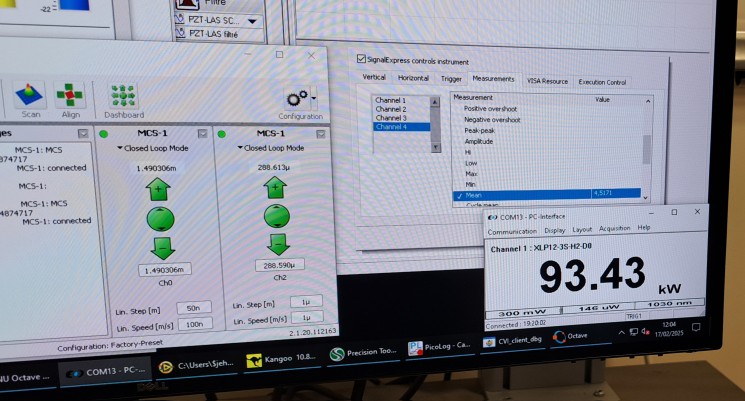
today, we were able to store more than 93kW in the FP cavity, always with the same parameter : 33% laser amplifier ratio |
| Attachment 1: img1.jpg
|
 |
|
410
|
Thu Feb 20 12:36:19 2025 |
Ronic Chiche | Fixed | info | lasers and optics | ThomX igloo | New power record in ThomX cavity |
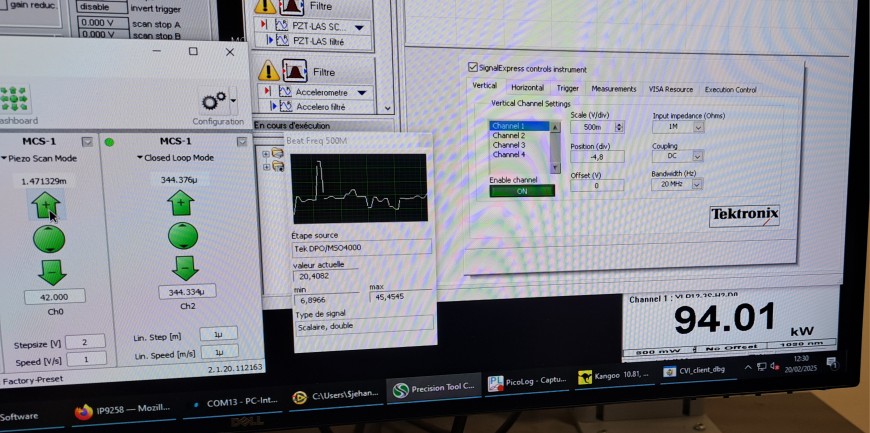
today, we were able to store more than 94kW in the FP cavity, always with the same parameter : 33% laser amplifier ratio
| Ronic Chiche wrote: |
|
today, we were able to store more than 93kW in the FP cavity, always with the same parameter : 33% laser amplifier ratio
|
|
| Attachment 1: img1.jpg
|
 |
|
412
|
Fri Feb 21 19:40:50 2025 |
Ronic Chiche | Fixed | issue | software | ThomX igloo | strange drift (new effect !?!) |
today, we had a strange effect :
both the laser and the FP cavity were locked on the RF frequency (500.10045 MHz), and we were producing X-rays but with a slowing (several seconds) fluctuation exactly as the electrons-photons phase was drifting and the fluctuation can goes to 0 Xrays produced even at the "right" phase.
but the ring people says there is no phase fluctuation in their measurements.
and I looked the baseline of the 500MHz beating (which is the synchronisation signal with electrons) and I didn't see any fluctuation either.
we tried 2 other ring frequencies : 500.10030 MHz and 500.1 MHz.
there were still X-rays production fluctuations but with a faster rate.
when we went back to 500.10045 MHz, we found back the same X-rays production fluctions at a slow rate.
to remove this effect, I had to add an integrator gain (I = 1e-6) in the Laselock in the FPC/RF loop.
this integrator was not used (I = 0) in the previous stable X-rays productions....
it means that we have now a slow phase fluctuation.
we have to check if we see these fluctuations in the 500MHz beating signal.
loosing the Xrays means we moved by the packet length dt ~ 50ps which is equivalent to 9° @ 500MHz of fluctuation.
with A= +/-1V signal, it would be equivalent to a drift of ~ A*(2pi*dt/T) ~ 157mV !!!
it is strange we didn't see it => to be checked !!!
conclusion : now, we have to put this I=1e-6 in the FPC/RF loop to get a stable Xray production.
but the locking acquisition works better with I=0.
so we need to remove it before starting to lock and then, when the lock is stable (but the X rays are poor), we need to put I=1e-6 => the Xray flux inscreases dramatically.
|
|
413
|
Fri Feb 21 19:52:57 2025 |
Ronic Chiche | Fixed | info | mechanics | lasers and optics | detectors and electronics | software | ThomX igloo | Good Xrays production trend |
this afternoon, we succeeded to get a quite long Xray production trend around 15-20 minutes with a flux above 25k on i1. |
| Attachment 1: img1(1).jpg
|
.jpg "img1(1).jpg") |
|
414
|
Tue Mar 4 14:54:31 2025 |
Ronic Chiche | Fixed | info | mechanics | software | ThomX igloo | New direction for cavity motors |
from now on, one reverts the FP cavity motors direction to compensate the long drift from the begining of the project.
the motor MOT.06 will be used for the upward direction (presently -1 082 650 steps)
and the motor MOT.03 will be used for the downward direction (presently +37 170 steps)
after CEP and walking alignment tuning, I got quickly 92kW.
the new MOT.06 and MOT.03 positions are : -1 071670 steps and +34 110 steps.
the CEP motor is at +345µm |
|
415
|
Wed Mar 5 13:17:26 2025 |
Ronic Chiche | Fixed | info | lasers and optics | detectors and electronics | ThomX igloo | Electrons-Photons phase stability measurement |
we installed a measurement at the IP with the BPM for ion cleaning for electrons and we used a fast photodiode at the output of the FP-cavity and measured with a fast oscilloscope the phase jitter between the 2 signals.
in red, the BPM signal
in blue, the photodiode signal.
on the right of the picture, this is the trend of the phase difference measurement.
in yellow, this is the histogram of this phase difference.
one measured 35ps of FWHM which is equivalent to 15ps rms for a Gaussian distribution. |
| Attachment 1: img1(1).jpg
|
.jpg "img1(1).jpg") |
|
416
|
Wed Mar 5 15:08:38 2025 |
Ronic Chiche | Fixed | info | lasers and optics | detectors and electronics | ThomX igloo | Electrons-Photons phase stability measurement |
the phase between the 500Mhz ring RF oscillator and the electrons is measured on a BPM and is very stable after 2-3ms (<< 6ps, typically) !
in the same time, we can use the residual phase beating after our 500MHz mixer to estimate the phase noise coming from the laser part.
the rms noise of this signal is around 60mV for 1.25V peak (2.5 pk-pk) signal => ~ 50mrad rms
dt = dphi / 2pi * 2ns ~ 15 ps which is the noise measured between electrons and photons at the IP !!!
we clearly see that this rms noise level is correlated with the 20Hz oscillation observed on the FPC feedback signals.
BUT even when this rms phase noise varies, we DO NOT see any effect on the X-ray production at this time,
which means this is not yet a limiting factor.
this observation is confirmed by the X-ray production flux calculation for which the time jitter is "added" to the electron beam size parameter which seems to be dominant.
| Ronic Chiche wrote: |
|
we installed a measurement at the IP with the BPM for ion cleaning for electrons and we used a fast photodiode at the output of the FP-cavity and measured with a fast oscilloscope the phase jitter between the 2 signals.
in red, the BPM signal
in blue, the photodiode signal.
on the right of the picture, this is the trend of the phase difference measurement.
in yellow, this is the histogram of this phase difference.
one measured 35ps of FWHM which is equivalent to 15ps rms for a Gaussian distribution.
|
|
|
418
|
Tue Mar 18 11:45:21 2025 |
Ronic Chiche | Fixed | info | lasers and optics | ThomX igloo | New power record in ThomX cavity |
today, we were able to store more than 95kW in the FP cavity, always with the same parameter : 33% laser amplifier ratio
| Ronic Chiche wrote: |
|
today, we were able to store more than 94kW in the FP cavity, always with the same parameter : 33% laser amplifier ratio
| Ronic Chiche wrote: |
|
today, we were able to store more than 93kW in the FP cavity, always with the same parameter : 33% laser amplifier ratio
|
|
|
| Attachment 1: img1(2).jpg
|
.jpg "img1(2).jpg") |
|
420
|
Mon Mar 31 18:19:30 2025 |
Ronic Chiche | Fixed | info | lasers and optics | ThomX igloo | New power record in ThomX cavity |
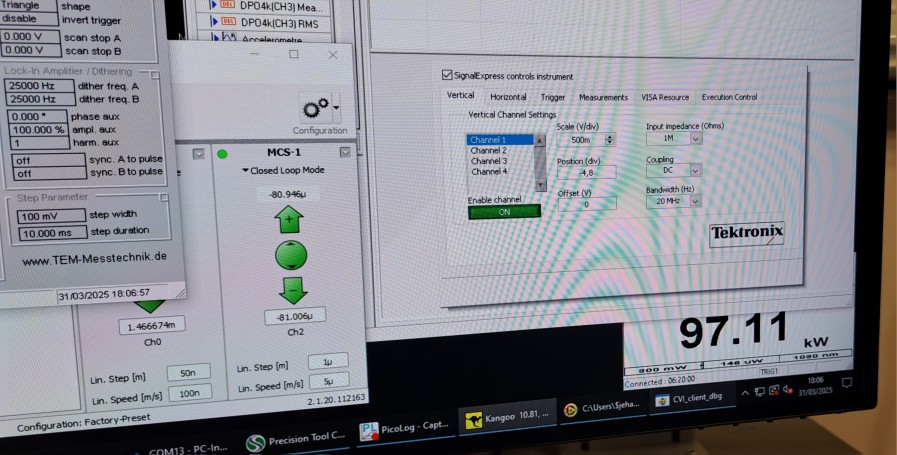
today, we were able to store more than 97kW in the FP cavity, always with the same parameter : 33% laser amplifier ratio
| Ronic Chiche wrote: |
|
today, we were able to store more than 95kW in the FP cavity, always with the same parameter : 33% laser amplifier ratio
| Ronic Chiche wrote: |
|
today, we were able to store more than 94kW in the FP cavity, always with the same parameter : 33% laser amplifier ratio
| Ronic Chiche wrote: |
|
today, we were able to store more than 93kW in the FP cavity, always with the same parameter : 33% laser amplifier ratio
|
|
|
|
| Attachment 1: 20250331_181029.jpg
|
 |
|
426
|
Wed Jun 11 11:35:22 2025 |
Ronic Chiche | Fixed | info | lasers and optics | detectors and electronics | software | ThomX igloo | 33MHz phase adjustment |
the 33MHz beating signal (phase) is used to start and stop automatically the lock on the 500MHz beating signal.
this 33MHz beating phase has a fixed range (typically +/-0.5V), so it is important to center this beating phase in the middle of its own range when the 500MHz signal is locked
=> tune the 33MHz phase in order to get ~ 0V on 33MHz beating signal when the 500MHz locking is ON.
this can be done by using the python script "Write_Phase_Rigol_33MHz located in the path /tmp_mnt/data/shared/commissioning_scripts/common
|
|
428
|
Wed Jun 25 09:43:36 2025 |
Ronic Chiche | Fixed | info | lasers and optics | ThomX igloo | New power record in ThomX cavity |
yesterday, we were able to store more than 98kW in the FP cavity, always with the same parameter : 33% laser amplifier ratio
| Ronic Chiche wrote: |
|
today, we were able to store more than 97kW in the FP cavity, always with the same parameter : 33% laser amplifier ratio
| Ronic Chiche wrote: |
|
today, we were able to store more than 95kW in the FP cavity, always with the same parameter : 33% laser amplifier ratio
| Ronic Chiche wrote: |
|
today, we were able to store more than 94kW in the FP cavity, always with the same parameter : 33% laser amplifier ratio
| Ronic Chiche wrote: |
|
today, we were able to store more than 93kW in the FP cavity, always with the same parameter : 33% laser amplifier ratio
|
|
|
|
|
| Attachment 1: img1(3).jpg
|
.jpg "img1(3).jpg") |
|
431
|
Thu Jun 26 12:37:22 2025 |
Ronic Chiche | Fixed | info | lasers and optics | ThomX igloo | Recipies for different FPC power |
For ~ 46kW power in the FP-cavity:
- Alplhanov amplifier ratio : 20%
- Axis 18 position : -0004710 steps
- PID A (for laser/FPC lock) :
input : input a
P = 0.06
I = 0.0007
D = 0.85
Sign : positive
Sampling : fast
filter : off
criterion : input d
upper th. : 10V
lower th. : 0.04V
speed : 100V/s
relock mode : none
off mode : hold
range : 50%
offset : 5V
- PID B (for RF/FPC lock) :
input : input b
P = 3
I = 0.00002
D = 2
Sign : negative
Sampling : mid
filter : off
criterion : input c
upper th. : 0.45V
lower th. : -0.45V
speed : 1V/s
relock mode : none
off mode : hold
range : 20%
offset : 5V
|
|
432
|
Tue Jul 1 12:13:18 2025 |
Ronic Chiche | Fixed | info | lasers and optics | ThomX igloo | Recipies for different FPC power |
For ~ 23kW power in the FP-cavity:
- Alplhanov amplifier ratio : 15%
- Axis 18 position : -0016014 steps
- PID A (for laser/FPC lock) :
input : input a
P = 0.1
I = 0.0016
D = 1.4
Sign : positive
Sampling : fast
filter : off
criterion : input d
upper th. : 10V
lower th. : 0.03V
speed : 100V/s
relock mode : none
off mode : hold
range : 50%
offset : 5V
- PID B (for RF/FPC lock) :
input : input b
P = 5
I = 0.0001
D = 1
Sign : negative
Sampling : mid
filter : off
criterion : input c
upper th. : 0.45V
lower th. : -0.45V
speed : 1V/s
relock mode : none
off mode : hold
range : 20%
offset : 5V
| Ronic Chiche wrote: |
|
For ~ 46kW power in the FP-cavity:
- Alplhanov amplifier ratio : 20%
- Axis 18 position : -0004710 steps
- PID A (for laser/FPC lock) :
input : input a
P = 0.06
I = 0.0007
D = 0.85
Sign : positive
Sampling : fast
filter : off
criterion : input d
upper th. : 10V
lower th. : 0.04V
speed : 100V/s
relock mode : none
off mode : hold
range : 50%
offset : 5V
- PID B (for RF/FPC lock) :
input : input b
P = 3
I = 0.00002
D = 2
Sign : negative
Sampling : mid
filter : off
criterion : input c
upper th. : 0.45V
lower th. : -0.45V
speed : 1V/s
relock mode : none
off mode : hold
range : 20%
offset : 5V
|
|
|
436
|
Wed Jul 9 14:12:54 2025 |
Ronic Chiche | Fixed | info | lasers and optics | ThomX igloo | Recipies for different FPC power |
|
For ~ 66kW power in the FP-cavity:
- Alplhanov amplifier ratio : 25%
- Axis 18 position : +0018369 steps
- PID A (for laser/FPC lock) :
input : input a
P = 0.1
I = 0.0016
D = 1.4
Sign : positive
Sampling : fast
filter : off
criterion : input d
upper th. : 10V
lower th. : 0.03V
speed : 100V/s
relock mode : none
off mode : hold
range : 50%
offset : 5V
- PID B (for RF/FPC lock) :
input : input b
P = 5
I = 0.0001
D = 1
Sign : negative
Sampling : mid
filter : off
criterion : input c
upper th. : 0.45V
lower th. : -0.45V
speed : 1V/s
relock mode : none
off mode : hold
range : 20%
offset : 5V
| Ronic Chiche wrote: |
|
For ~ 23kW power in the FP-cavity:
- Alplhanov amplifier ratio : 15%
- Axis 18 position : -0016014 steps
- PID A (for laser/FPC lock) :
input : input a
P = 0.09
I = 0.0016
D = 1.35
Sign : positive
Sampling : fast
filter : off
criterion : input d
upper th. : 10V
lower th. : 0.03V
speed : 100V/s
relock mode : none
off mode : hold
range : 50%
offset : 5V
- PID B (for RF/FPC lock) :
input : input b
P = 5
I = 0.0001
D = 1
Sign : negative
Sampling : mid
filter : off
criterion : input c
upper th. : 0.45V
lower th. : -0.45V
speed : 1V/s
relock mode : none
off mode : hold
range : 20%
offset : 5V
| Ronic Chiche wrote: |
|
For ~ 46kW power in the FP-cavity:
- Alplhanov amplifier ratio : 20%
- Axis 18 position : -0004710 steps
- PID A (for laser/FPC lock) :
input : input a
P = 0.06
I = 0.0007
D = 0.85
Sign : positive
Sampling : fast
filter : off
criterion : input d
upper th. : 10V
lower th. : 0.04V
speed : 100V/s
relock mode : none
off mode : hold
range : 50%
offset : 5V
- PID B (for RF/FPC lock) :
input : input b
P = 3
I = 0.00002
D = 2
Sign : negative
Sampling : mid
filter : off
criterion : input c
upper th. : 0.45V
lower th. : -0.45V
speed : 1V/s
relock mode : none
off mode : hold
range : 20%
offset : 5V
|
|
|