| ID |
Date |
Author |
Status |
Type |
Category |
Location |
Title |
|
148
|
Tue Apr 19 12:15:43 2022 |
Manar Amer | Fixed | report | lasers and optics | ThomX igloo | Alphanov amplifier Beam Profile |
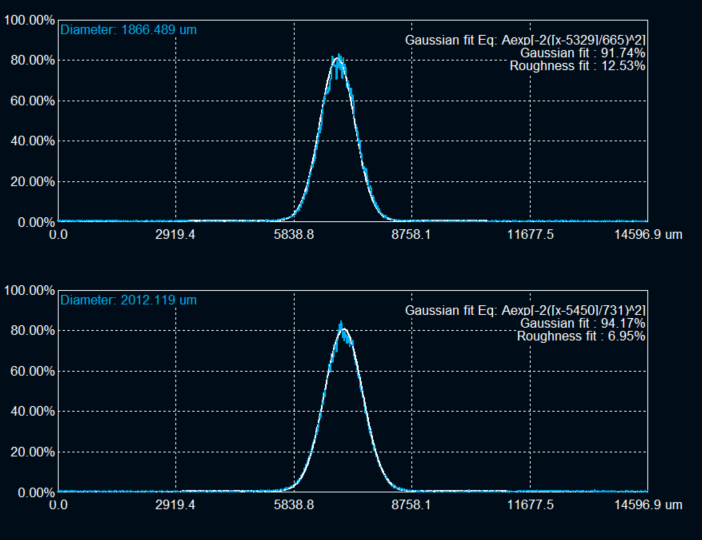
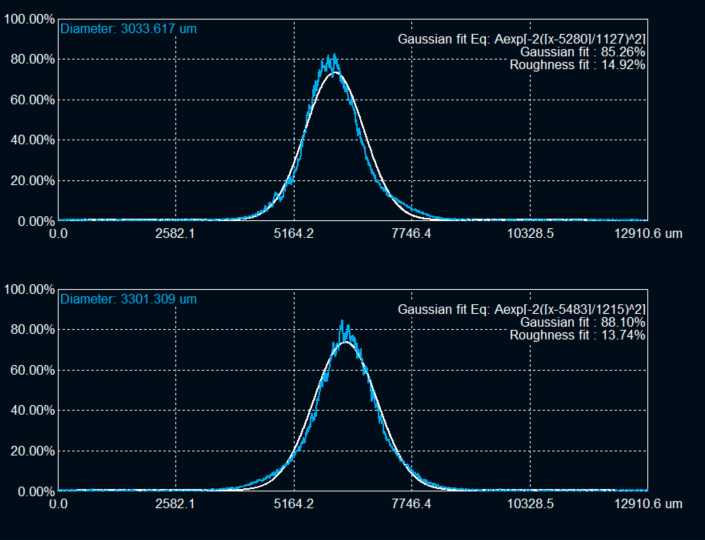
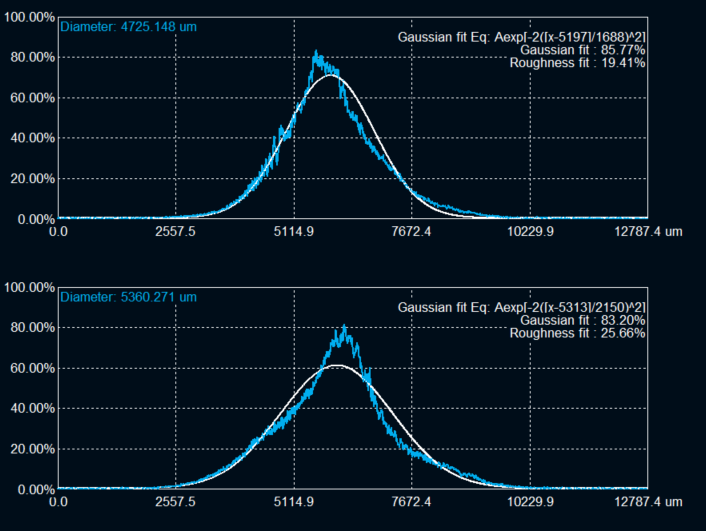
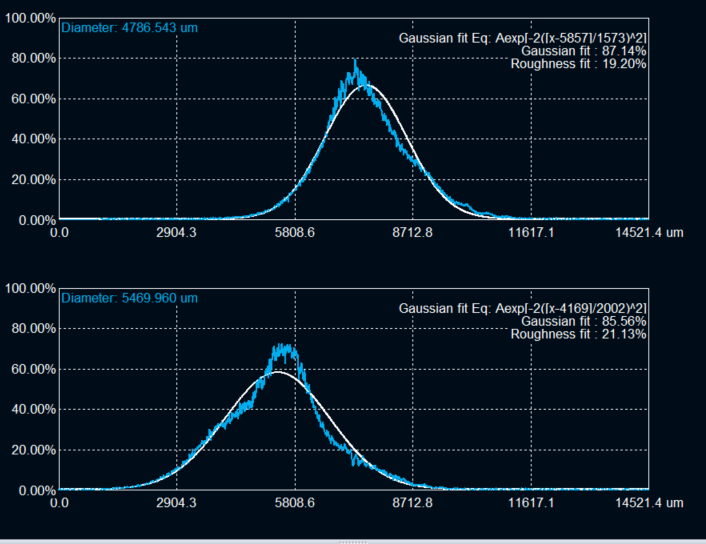
For better comparison ,
the measurements done previously with 2 CVBGs was done at ~ 30 cm and the one done on Friday was for 1 CVBG is at 1 m
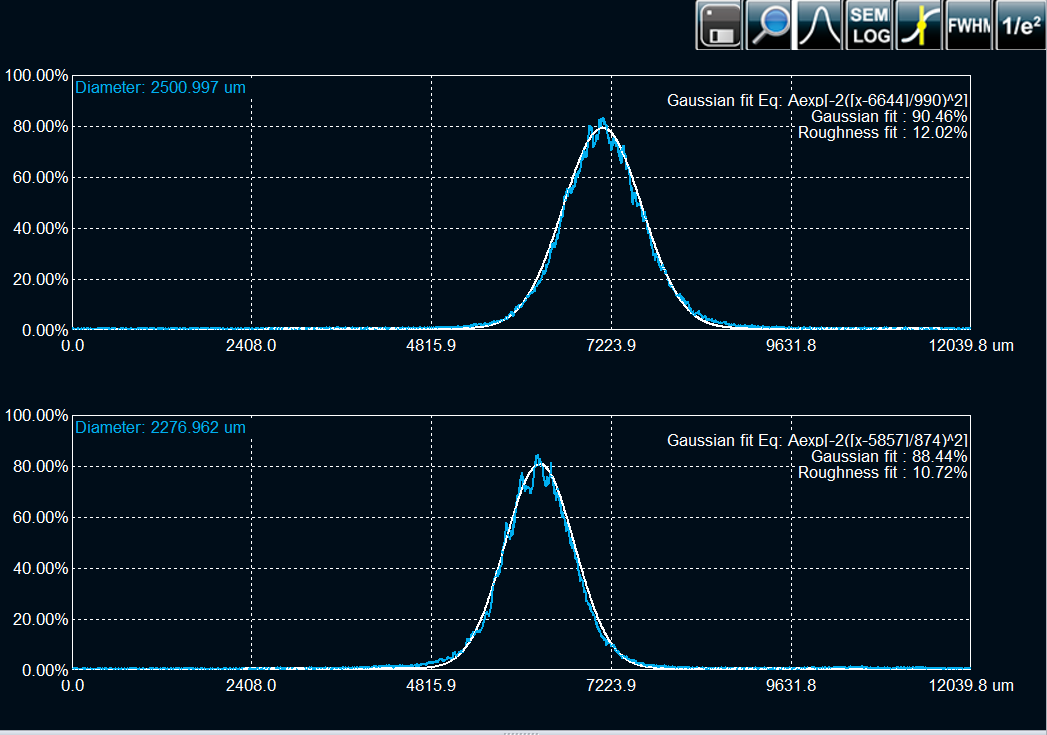
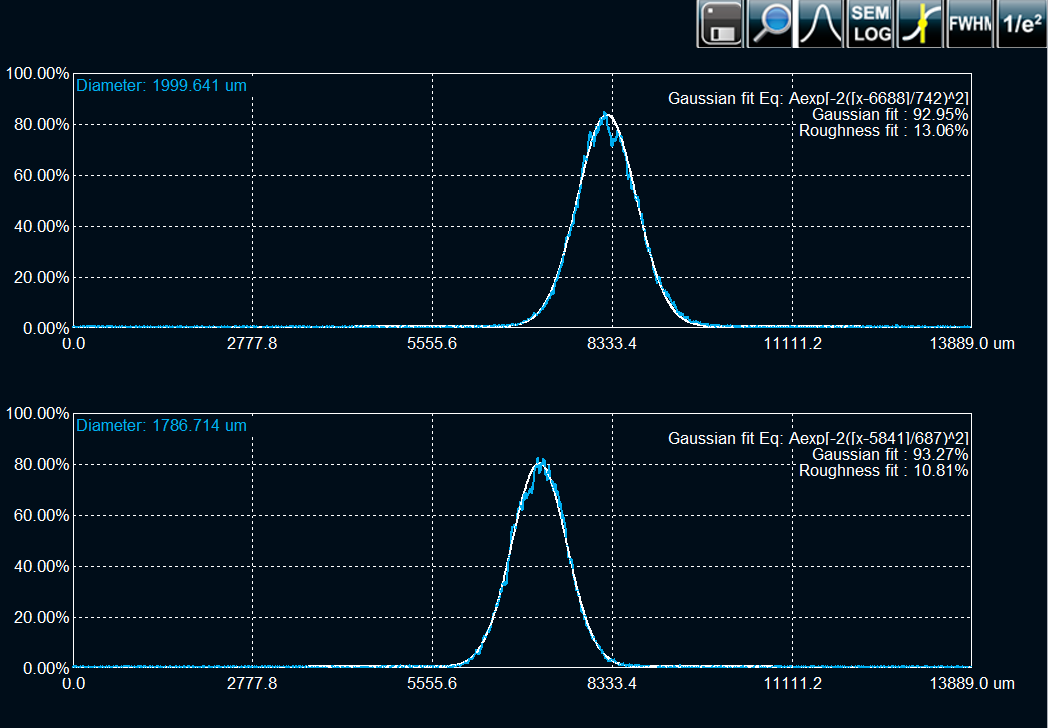
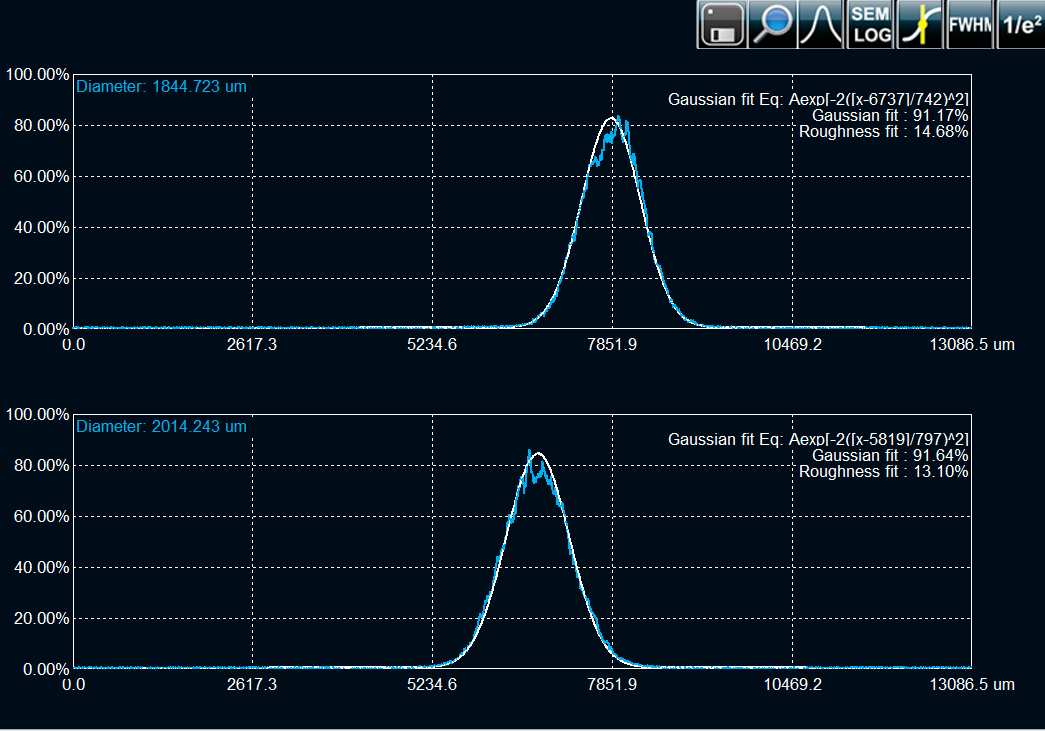
so we did additional measurement for 2 CVBGs at 1 m, for 20 , 50 and 70 % amplification
we clearly see the similar deformation at high power.
Conclusion : the effect is most likely coming from the 2nd CVBG
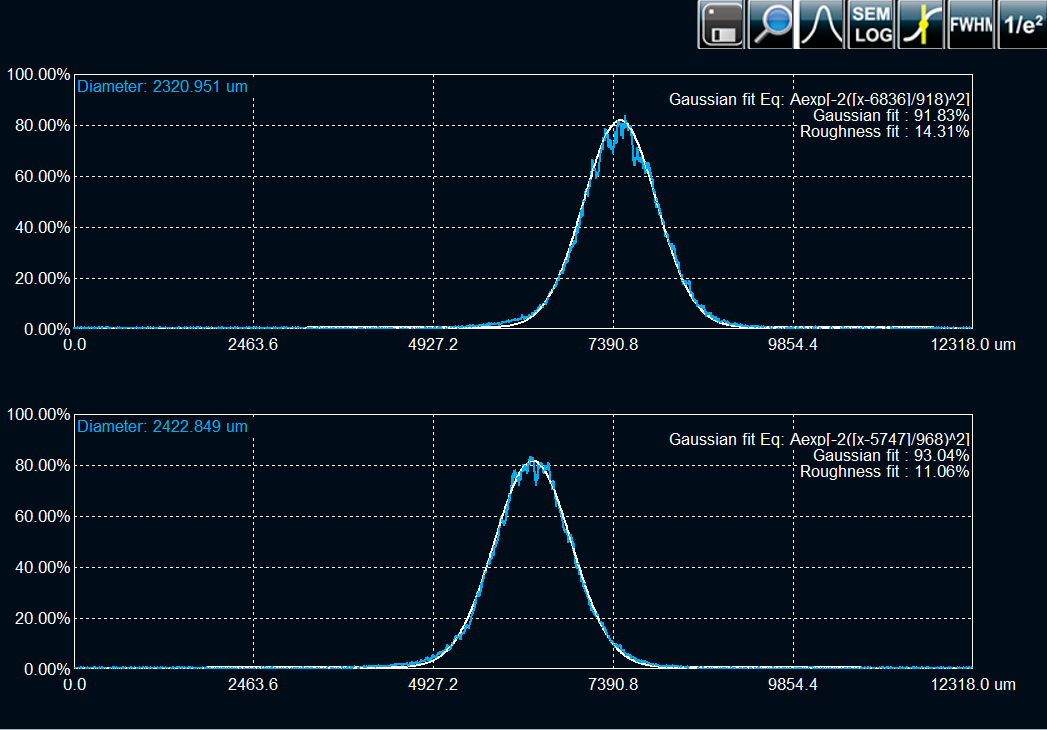
At 70 % victor optimized the horizontal axis for the injection mirror into 2nd CVBG , we see an improvement in the Gaussian fit on Horizontal and vertical axis of ~ 2%
| Manar Amer wrote: |
|
Victor, Ronic, Manar
Today was dedicated to the study of the CVBG, and it's effect on the beam profile
we opened the box containing the 2 CVBGs : The 2CVBG are glued from the bottom on a copper surface .
Using the beam viwer, the beam line inside the two CVBG is not at the exact center but not at the edges too and not hitting the boarders.
From the sides you see two lines, one is reflection on the metal.
To observe the effect of the first CVBG by itself, we blocked the second reflection into the 2nd CVBG.
By placing the D-shaped mirror just at the entrance of the 2nd CVBG (there was just enough space to put it)
Beam Profiler + OD 10E + OD 30E + OD(not known) placed at ~ 1 m from the output of compressor.
We see clearly a much better circular shape of the beam and a better Gaussian fit,
only above 90% where we see the fit percentage going down to ~ 86% and on just the Horizontal Axis.
| Manar Amer wrote: |
|
This Morning, another reading was taken for the output of the amplifier after the compressor using 2 wedge mirrors.
In addition, a start of the calibration of a PulseCheck "Autocorrelator" to measure the pulse duration.
note, the pulsed laser used is OneFive 133.33 MHz
| Manar Amer wrote: |
|
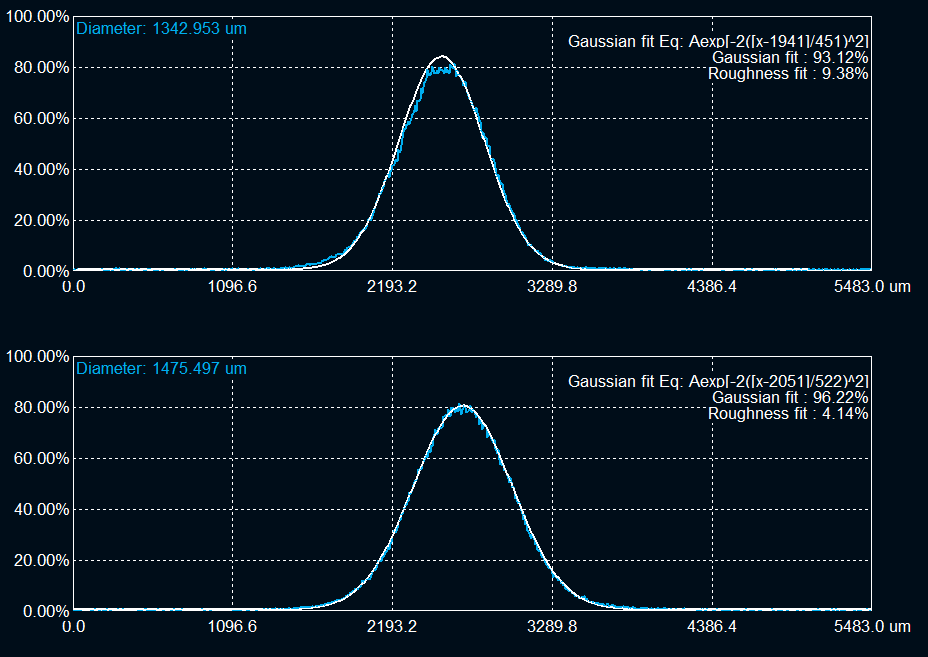
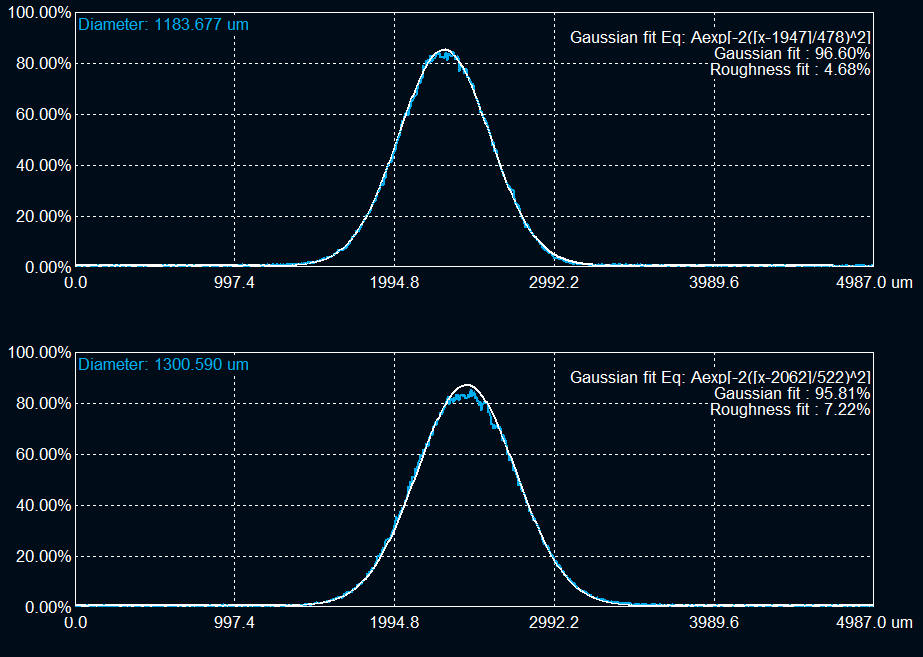
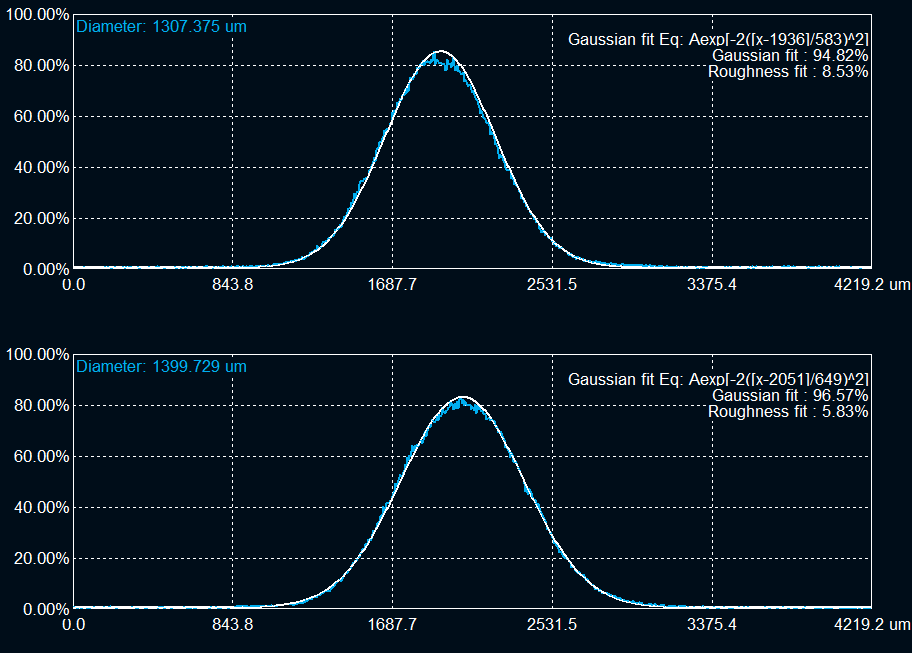
Adding the readings 20% , 30% , 40% for output of amplifier after the compressor
| Manar Amer wrote: |
|
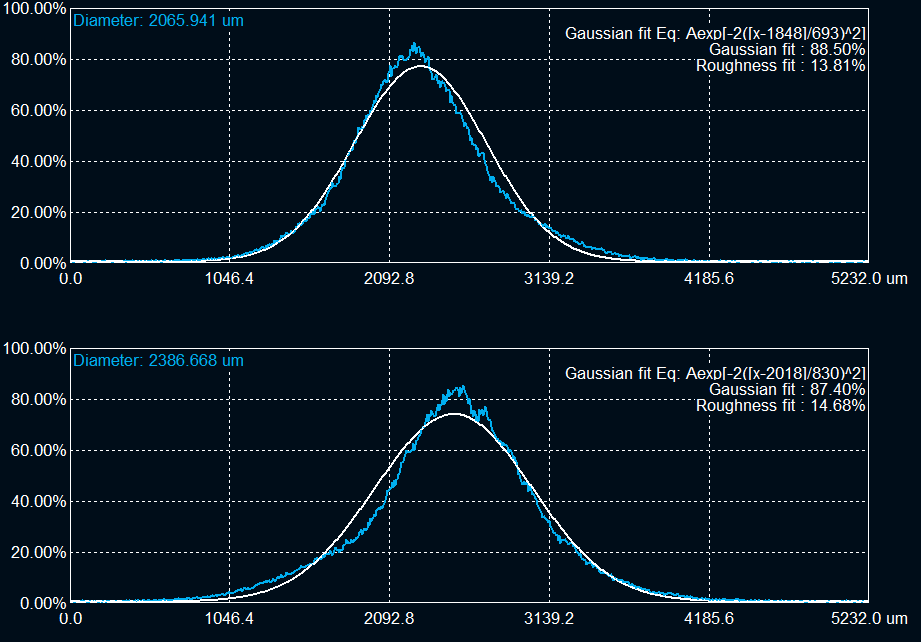
Readings of the beam shape and fit at the output of the compressor
differance from previous reading is that here we used wedges instead of HR mirrors.
Similar to previous readings, the beam shape deforms and the Gaussian fit is bad after 50% amplification
| Manar Amer wrote: |
|
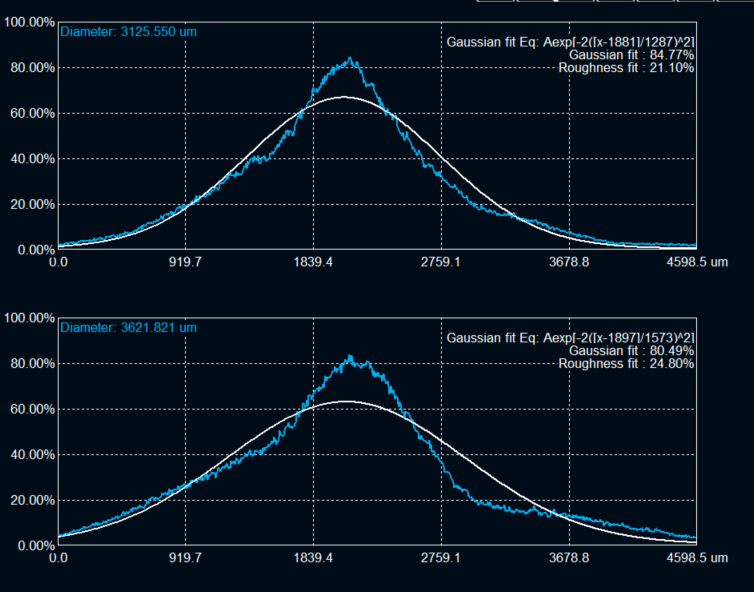
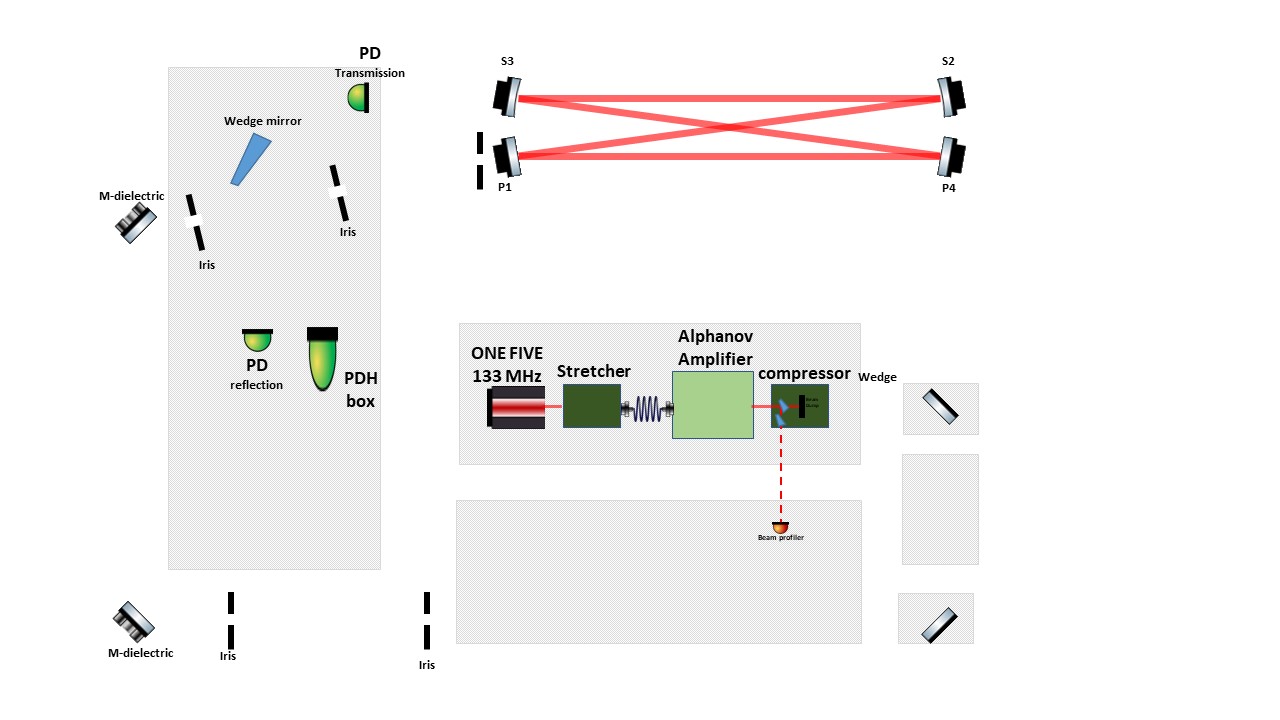
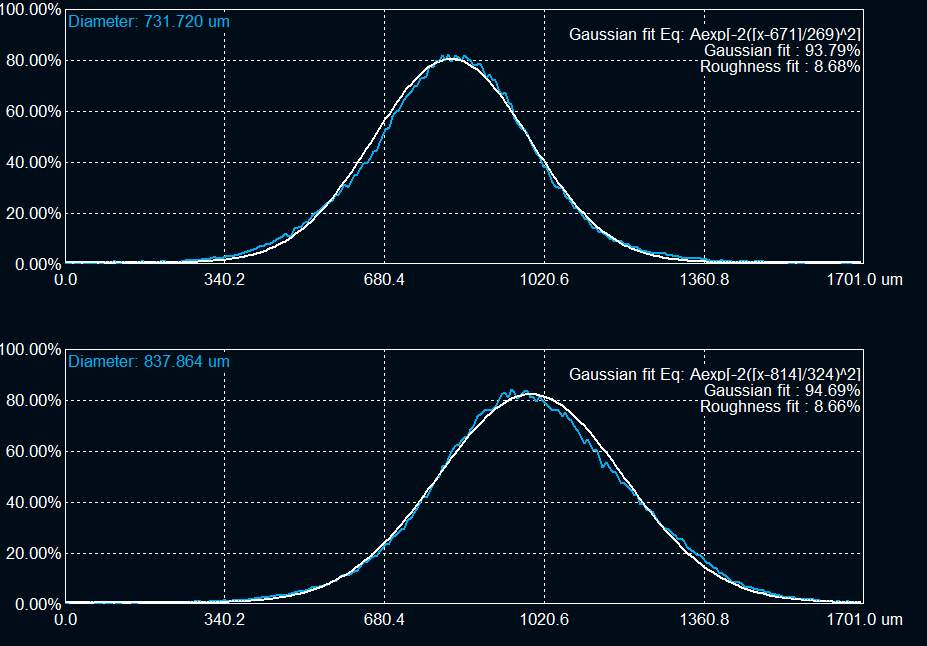
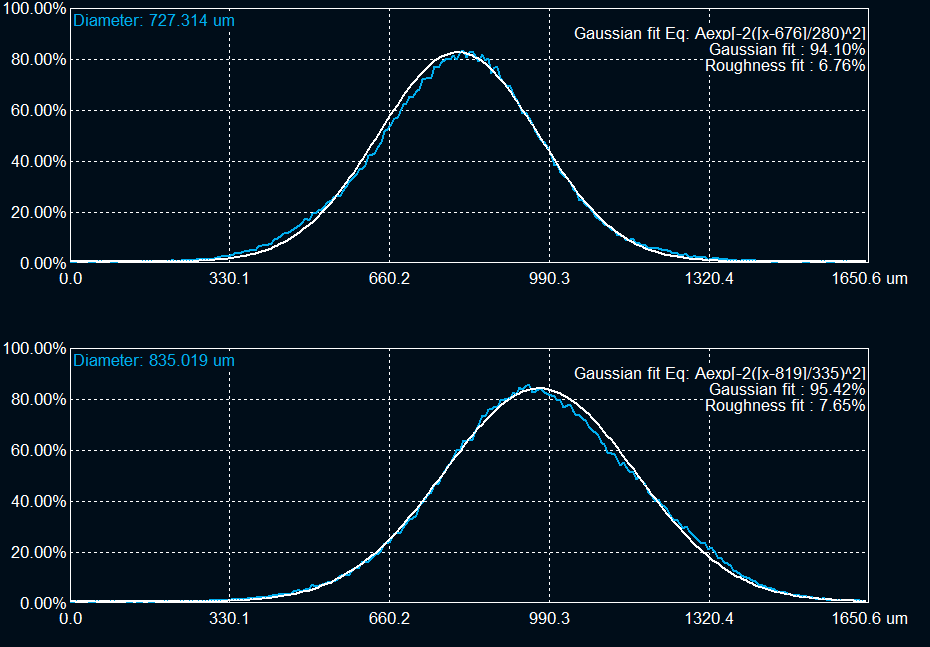
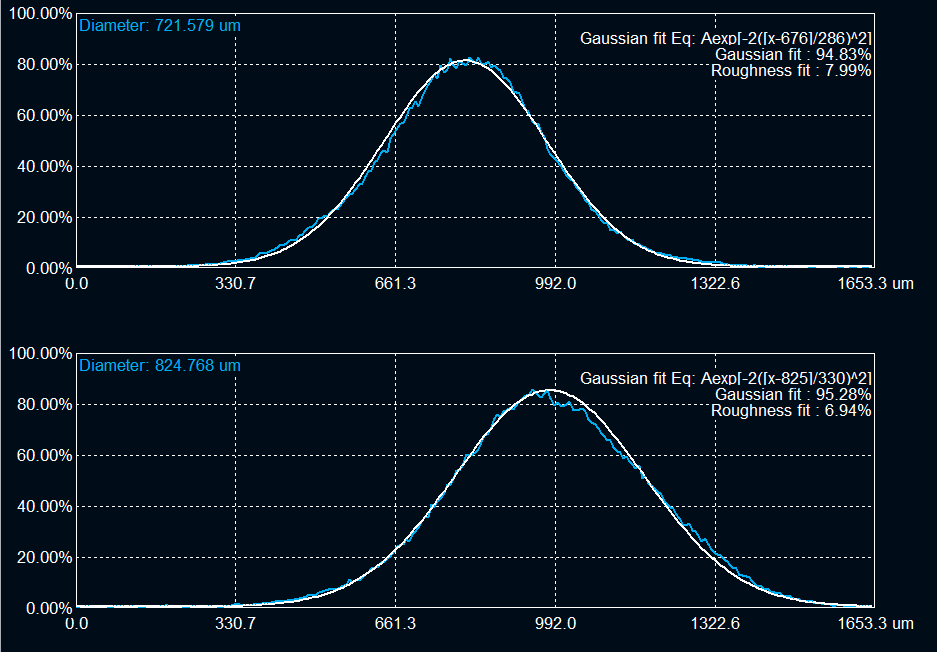
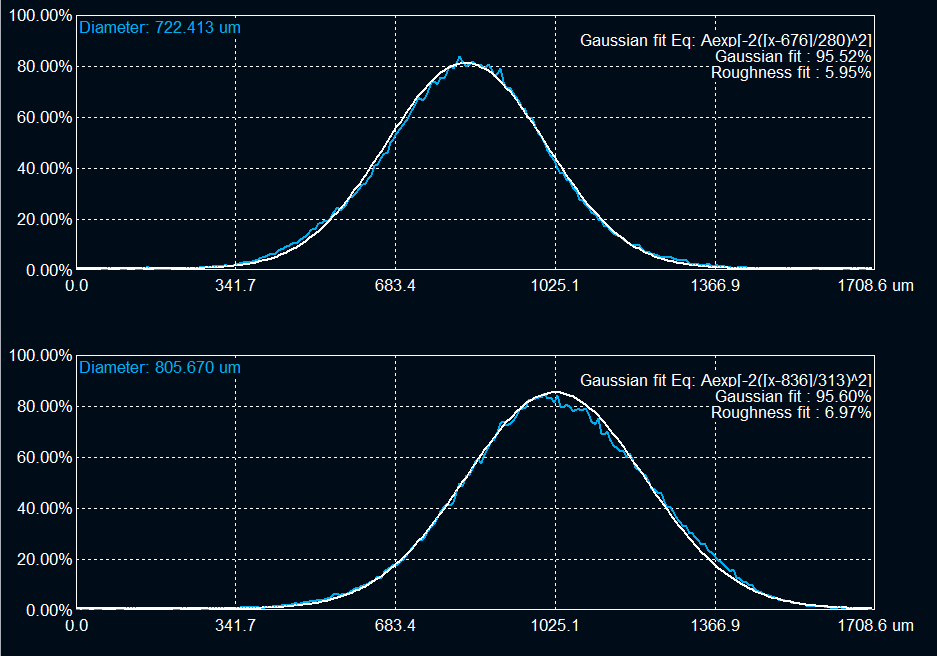
Readings of the beam shape and horizontal (upper plot) and vertical (lower plot) axis fit at the direct output of the amplifier.
The beam shape relatively shaped like an egg.
| Manar Amer wrote: |
|
Today a second reading of the beam profile was done , with Victor ,Ronic, Aurlien and Manar
an additional set-up was made using two 4 deg wedges instead of High reflecting (HR) and Anti-reflecting (AR) mirrors.
Two reading were taken:
- at the output of the compressor with a NE30A filter on the beam profiler
- at the output of the amplifier with NE30A + NE10A filter on beam profiler
| Manar Amer wrote: |
|
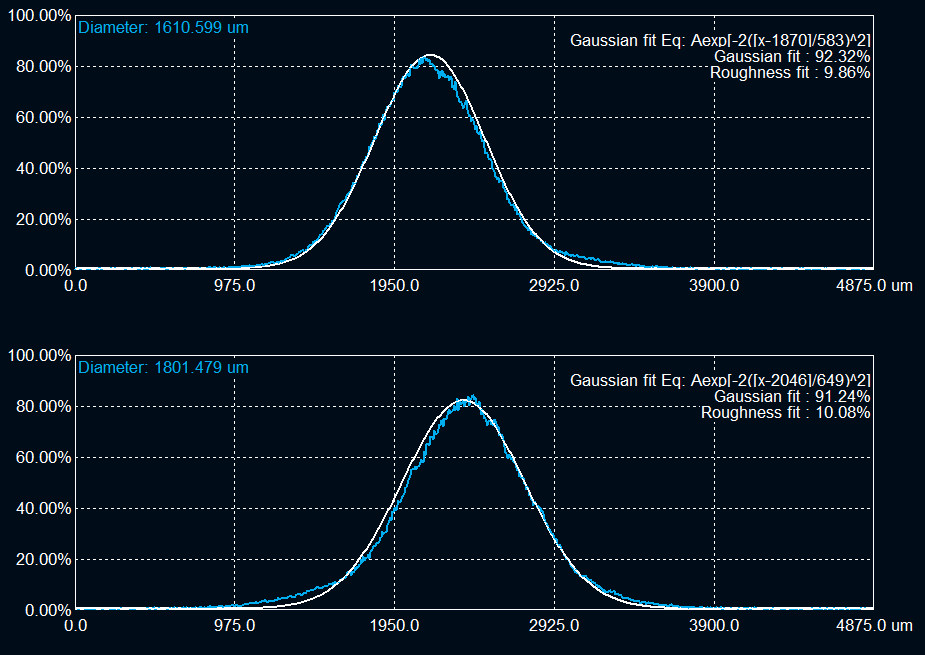
Adding the fitted beam in 1D in Horizontal and vertical axis.
for 10% to 60%
| Manar Amer wrote: |
|
| Manar Amer wrote: |
|
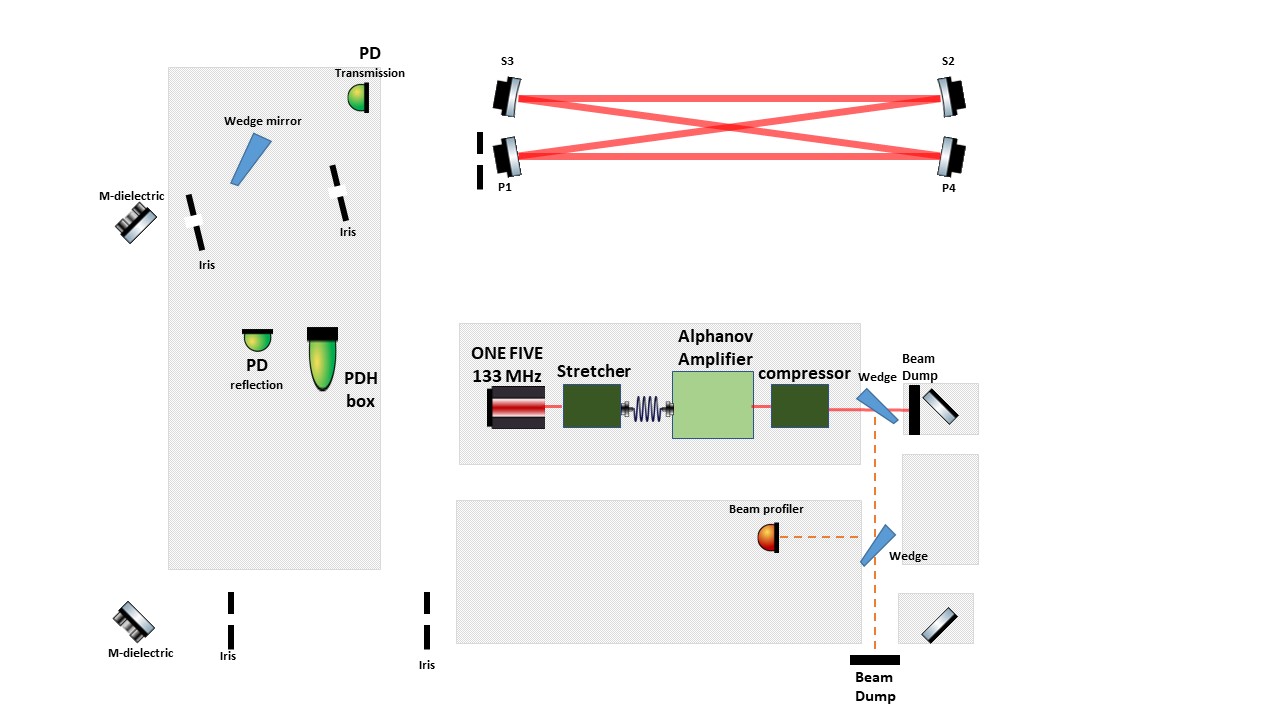
Today: Manar, Ronic and Aurlien started the study of the beam profile of the alphanov amplifier at high power.
The setup shown in the image shows how the power is reduced by using Anti-reflective mirrors,
pick up 1 : Anti-reflective coating on both sides , pick up 2 : Anti-reflective coating on one side and High reflectivity on the other
using this method, we avoid saturation and damage to the beam profiler from the high power amplified laser
in addition, an OD3 filter is placed in front of the beam profiler. and a reflective mirror is placed close to deflect the reflection from the mirror(pick up 1) second surface.
The beam observed is relatively well shaped and fitted up to 50% of amplification is where the shape starts to deform a little and is not well-fitted by a Gaussian. (image attached shows the fit for 60% amplification)
The cause is yet to be determined, as it could only be related to the reflections that occur from the mirrors (pick up 1 and pick up 2)
*** Note be always careful at High Power :)
|
|
|
|
|
|
|
|
|
|
| Attachment 1: 20p_2CVBG.bmp
|
| Attachment 2: 50p_2CVBG.bmp
|
| Attachment 3: 70p_2CVBG.bmp
|
| Attachment 4: 70p_2CVBG_CVBG_Input_Mirror_Optimize.bmp
|
| Attachment 5: 20p_2CVBG_BeamFit.png
|
 |
| Attachment 6: 50p_2CVBG_BeamFit.png
|
 |
| Attachment 7: 70p_2CVBG_BeamFit.png
|
 |
| Attachment 8: 70p_2CVBG_CVBG_Input_Mirror_Optimize_BeamFit.png
|
 |
|
147
|
Fri Apr 15 19:00:20 2022 |
Manar Amer | Fixed | report | lasers and optics | ThomX igloo | Alphanov amplifier Beam Profile |
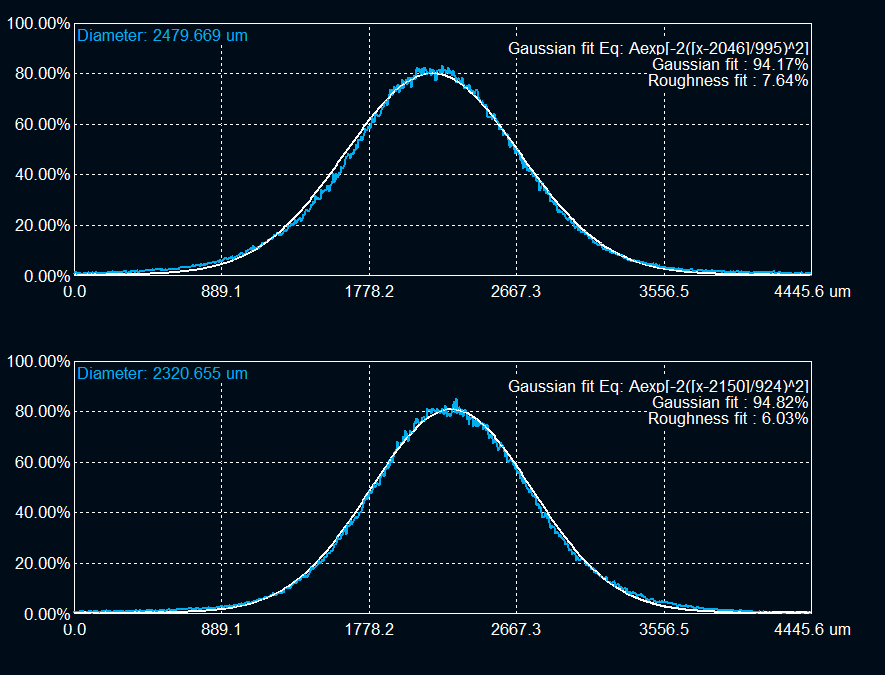
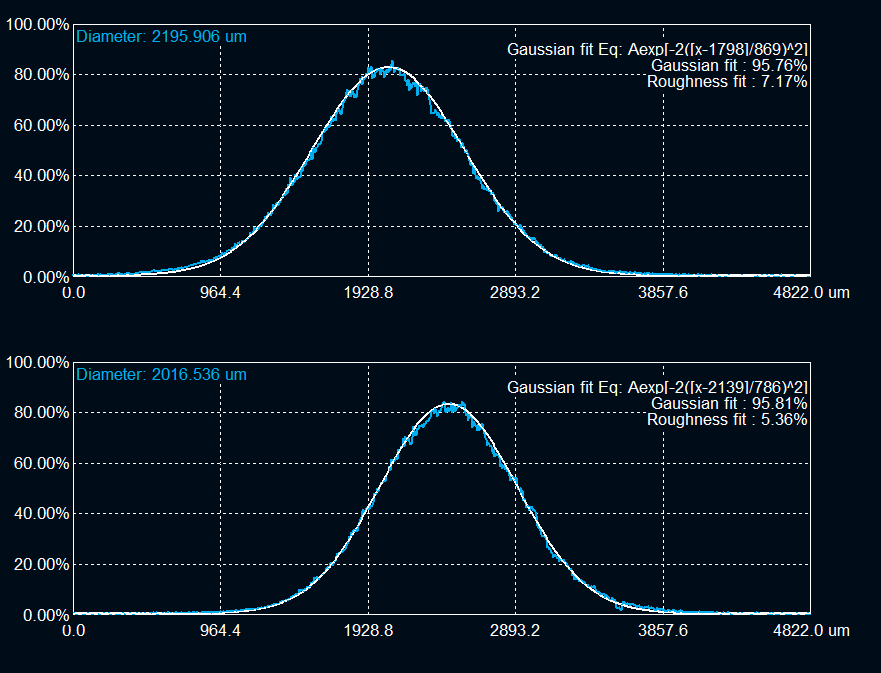
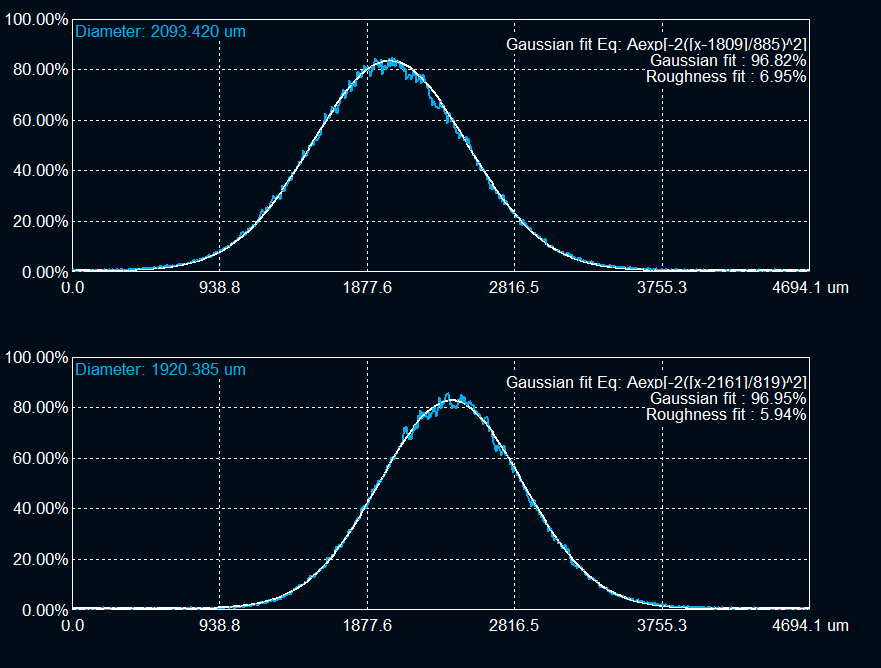
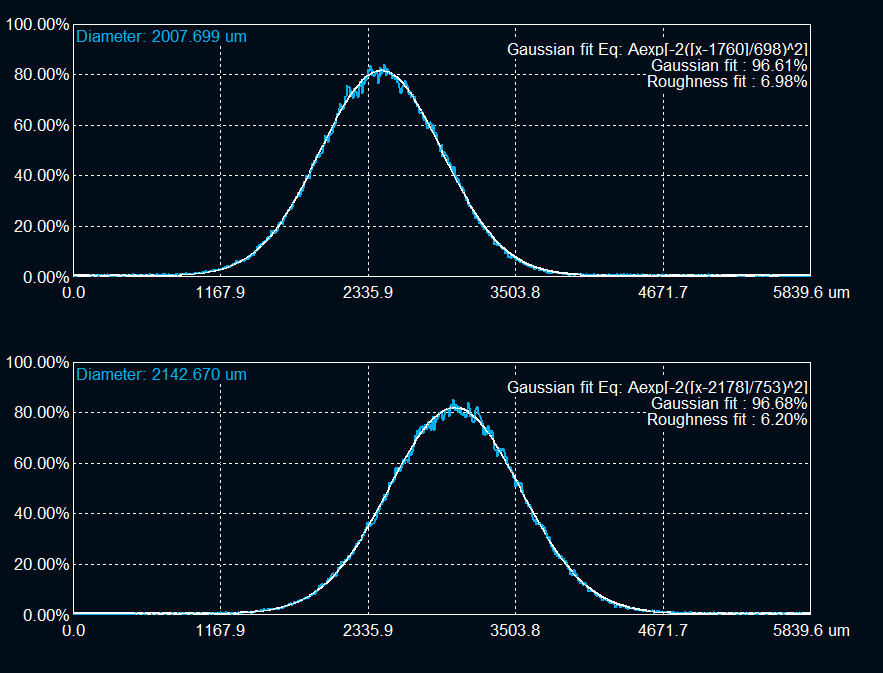
Victor, Ronic, Manar
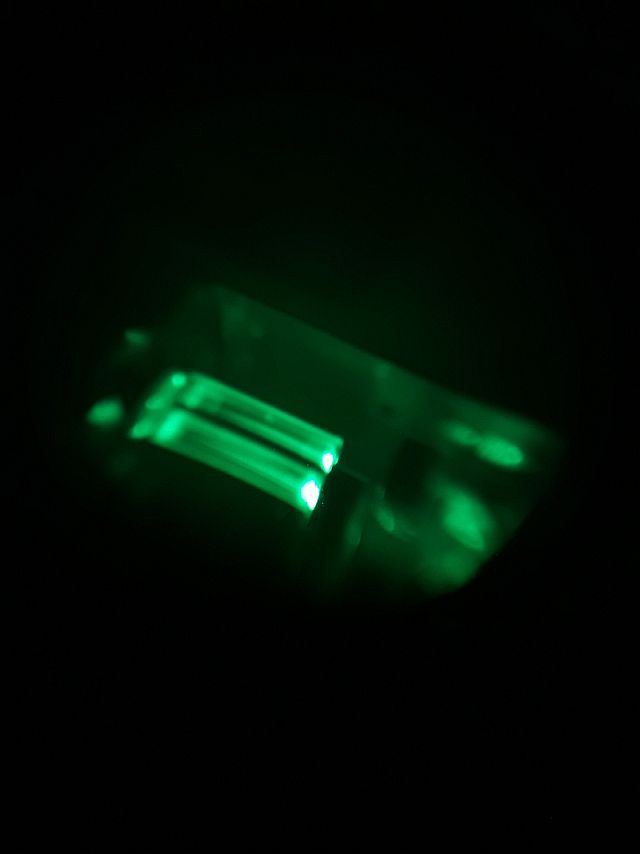
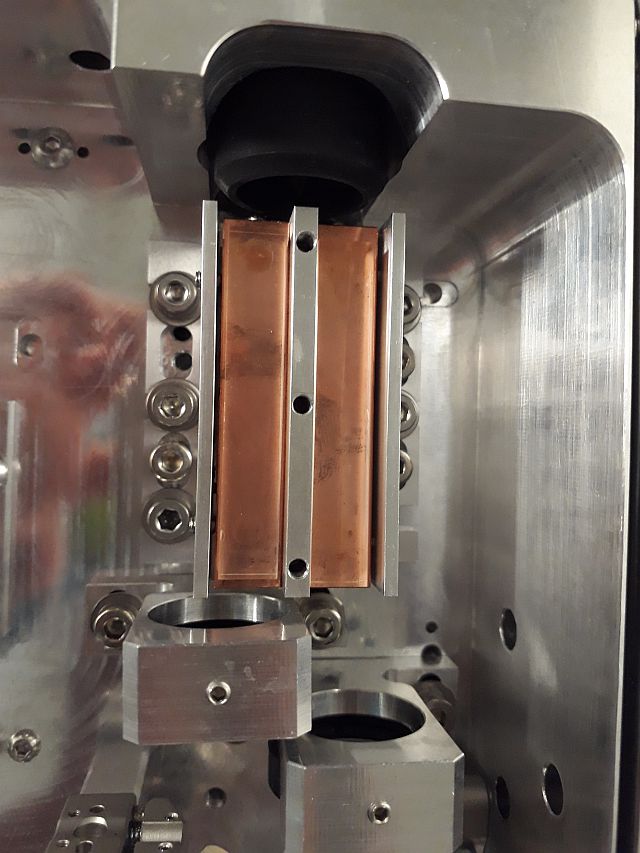
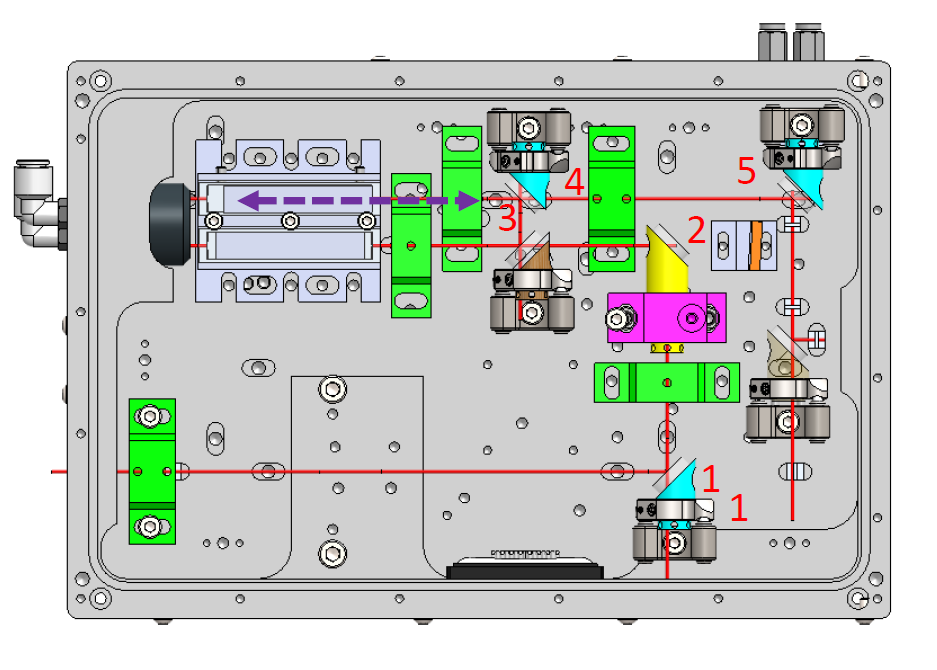
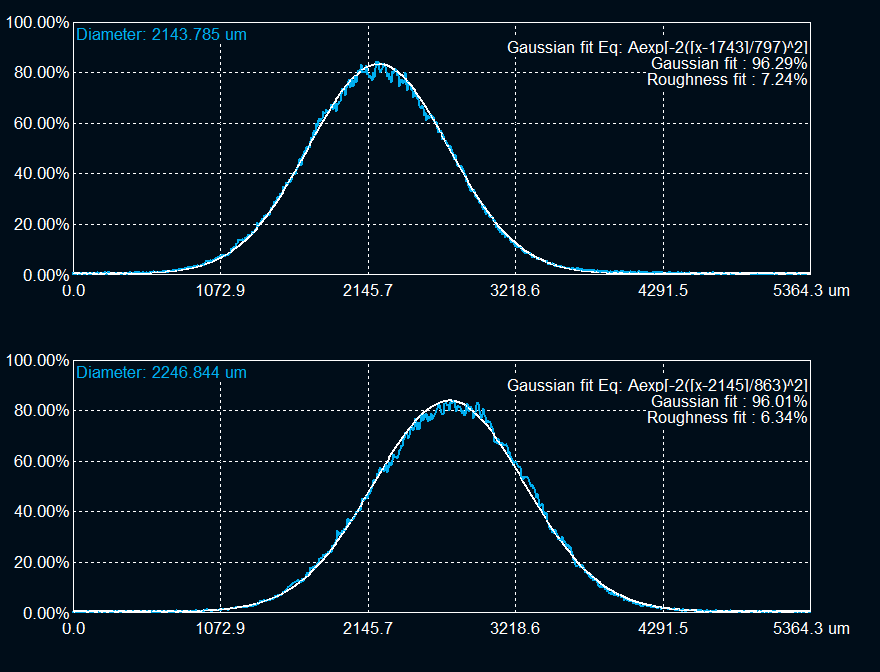
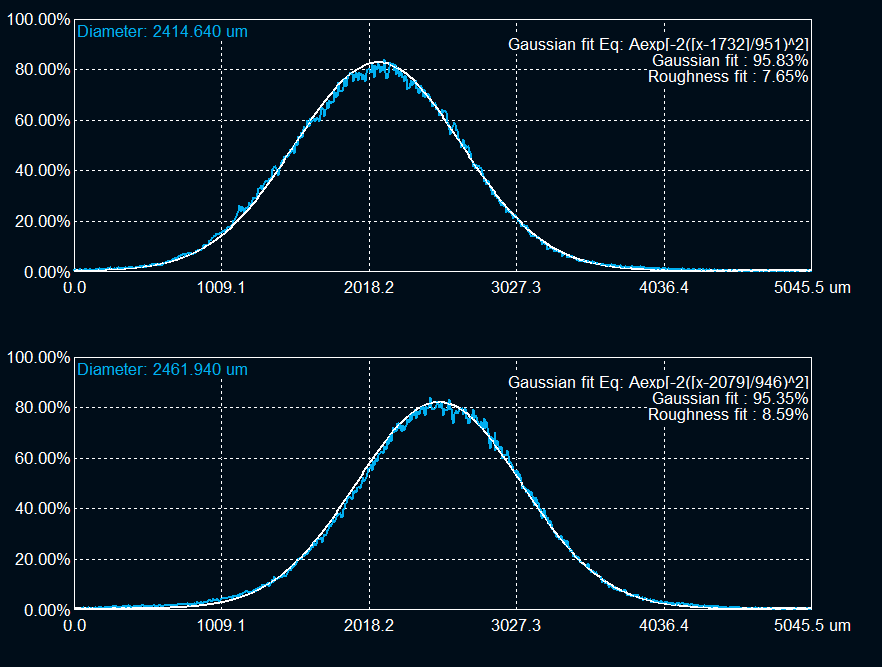
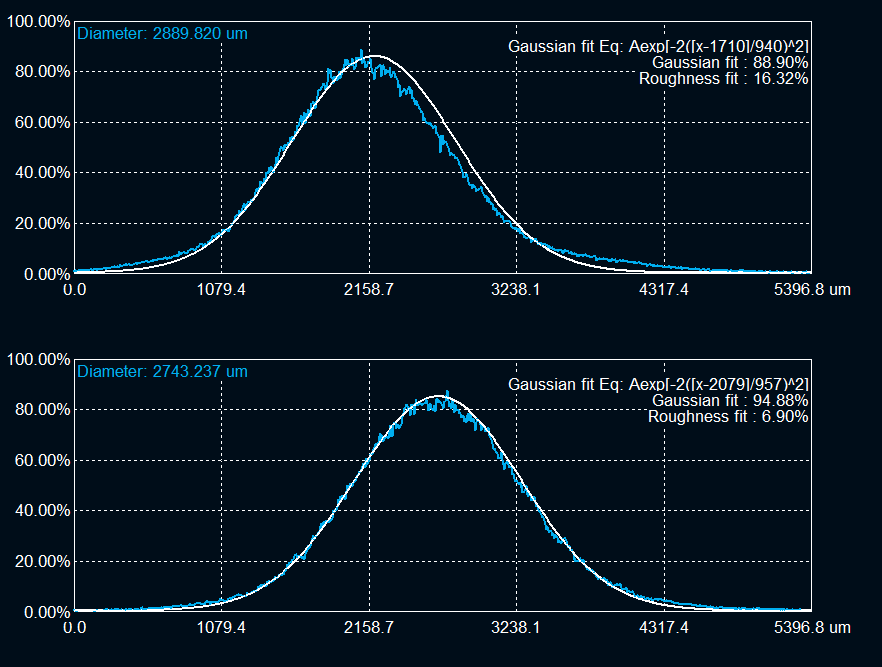
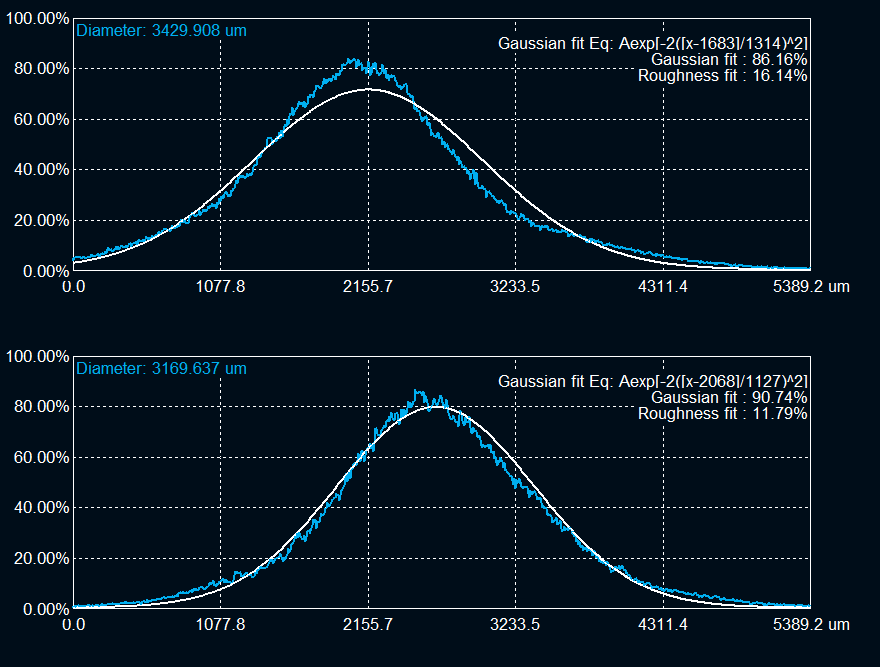
Today was dedicated to the study of the CVBG, and it's effect on the beam profile
we opened the box containing the 2 CVBGs : The 2CVBG are glued from the bottom on a copper surface .
Using the beam viwer, the beam line inside the two CVBG is not at the exact center but not at the edges too and not hitting the boarders.
From the sides you see two lines, one is reflection on the metal.
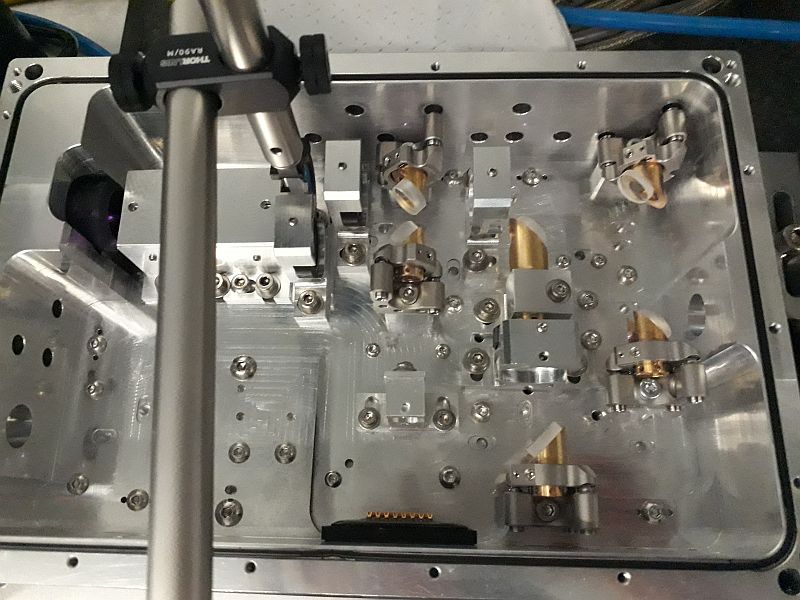
To observe the effect of the first CVBG by itself, we blocked the second reflection into the 2nd CVBG.
By placing the D-shaped mirror just at the entrance of the 2nd CVBG (there was just enough space to put it)
Beam Profiler + OD 10E + OD 30E + OD(not known) placed at ~ 1 m from the output of compressor.
We see clearly a much better circular shape of the beam and a better Gaussian fit,
only above 90% where we see the fit percentage going down to ~ 86% and on just the Horizontal Axis.
| Manar Amer wrote: |
|
This Morning, another reading was taken for the output of the amplifier after the compressor using 2 wedge mirrors.
In addition, a start of the calibration of a PulseCheck "Autocorrelator" to measure the pulse duration.
note, the pulsed laser used is OneFive 133.33 MHz
| Manar Amer wrote: |
|
Adding the readings 20% , 30% , 40% for output of amplifier after the compressor
| Manar Amer wrote: |
|
Readings of the beam shape and fit at the output of the compressor
differance from previous reading is that here we used wedges instead of HR mirrors.
Similar to previous readings, the beam shape deforms and the Gaussian fit is bad after 50% amplification
| Manar Amer wrote: |
|
Readings of the beam shape and horizontal (upper plot) and vertical (lower plot) axis fit at the direct output of the amplifier.
The beam shape relatively shaped like an egg.
| Manar Amer wrote: |
|
Today a second reading of the beam profile was done , with Victor ,Ronic, Aurlien and Manar
an additional set-up was made using two 4 deg wedges instead of High reflecting (HR) and Anti-reflecting (AR) mirrors.
Two reading were taken:
- at the output of the compressor with a NE30A filter on the beam profiler
- at the output of the amplifier with NE30A + NE10A filter on beam profiler
| Manar Amer wrote: |
|
Adding the fitted beam in 1D in Horizontal and vertical axis.
for 10% to 60%
| Manar Amer wrote: |
|
| Manar Amer wrote: |
|
Today: Manar, Ronic and Aurlien started the study of the beam profile of the alphanov amplifier at high power.
The setup shown in the image shows how the power is reduced by using Anti-reflective mirrors,
pick up 1 : Anti-reflective coating on both sides , pick up 2 : Anti-reflective coating on one side and High reflectivity on the other
using this method, we avoid saturation and damage to the beam profiler from the high power amplified laser
in addition, an OD3 filter is placed in front of the beam profiler. and a reflective mirror is placed close to deflect the reflection from the mirror(pick up 1) second surface.
The beam observed is relatively well shaped and fitted up to 50% of amplification is where the shape starts to deform a little and is not well-fitted by a Gaussian. (image attached shows the fit for 60% amplification)
The cause is yet to be determined, as it could only be related to the reflections that occur from the mirrors (pick up 1 and pick up 2)
*** Note be always careful at High Power :)
|
|
|
|
|
|
|
|
|
| Attachment 1: 20220415_Inside_CVBG_Box.jpg
|
 |
| Attachment 2: 20220415_CVBG.jpg
|
 |
| Attachment 3: 20220415_Compressor_Box.png
|
 |
| Attachment 4: 10p_1CVBG.bmp
|
| Attachment 5: 20p_1CVBG.bmp
|
| Attachment 6: 30p_1CVBG.bmp
|
| Attachment 7: 40p_1CVBG.bmp
|
| Attachment 8: 50p_1CVBG.bmp
|
| Attachment 9: 60p_1CVBG.bmp
|
| Attachment 10: 70p_1CVBG.bmp
|
| Attachment 11: 90p_1CVBG.bmp
|
| Attachment 12: 20220415_D_shaped_Mirror_Blocking_2ndCVBG.jpg
|
 |
| Attachment 13: 10p_1CVBG_BeamFit.png
|
 |
| Attachment 14: 20p_1CVBG_BeamFit.png
|
 |
| Attachment 15: 30p_1CVBG_BeamFit.png
|
 |
| Attachment 16: 40p_1CVBG_BeamFit.png
|
 |
| Attachment 17: 50p_1CVBG_BeamFit.png
|
 |
| Attachment 18: 60p_1CVBG_BeamFit.png
|
 |
| Attachment 19: 70p_1CVBG_BeamFit.png
|
 |
| Attachment 20: 90p_1CVBG_BeamFit.png
|
 |
|
146
|
Fri Apr 8 19:25:16 2022 |
Manar Amer | Fixed | report | lasers and optics | ThomX igloo | Alphanov amplifier Beam Pulse Duration |
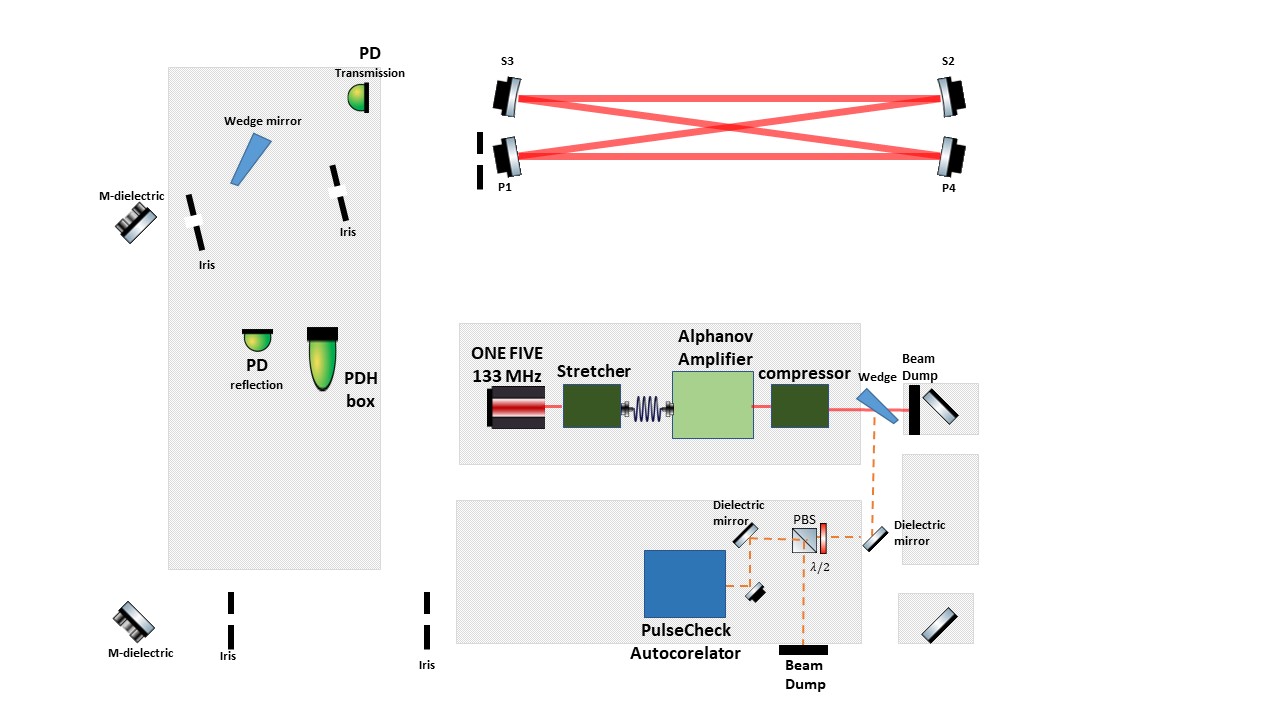
Pulse Duration FWHM = 12.9 ps
| Manar Amer wrote: |
|
Measurement of the pulse was done at the end of the afternoon, Pulse Duration FWHM = 12.9 ps
After a long process of adjusting the alignment and angle of the crystal inside the device
The power input on the PulseCheck device should be above the sensitivity, in our case we had 1 mW input.
To reach it, we removed one of the wedge mirrors and used dielectric mirrors with an amplification of 20% ~ 25 W direct output power.
The input to the pulsecheck must be horizontally polarized, which is why we used a polarizing beam splitter (PBS).
For a better pulse shape, Victor adjusted the "beam distance" and "beam focus" nobs on the device.
| Manar Amer wrote: |
|
The pulse duration from the amplifier compressor output will be measured using PulseCheck autocorelator
a first alignment of the device was done, continuation in the afternoon.
YouTube link attached of the general operation of pulse check < 5 min : https://www.youtube.com/watch?v=J1pNHYySSYg
|
|
|
|
145
|
Fri Apr 8 19:24:32 2022 |
Manar Amer | Fixed | report | lasers and optics | ThomX igloo | Alphanov amplifier Beam Pulse Duration |
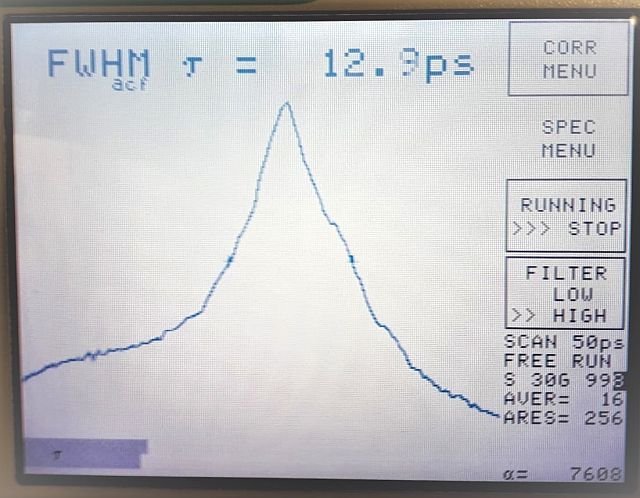
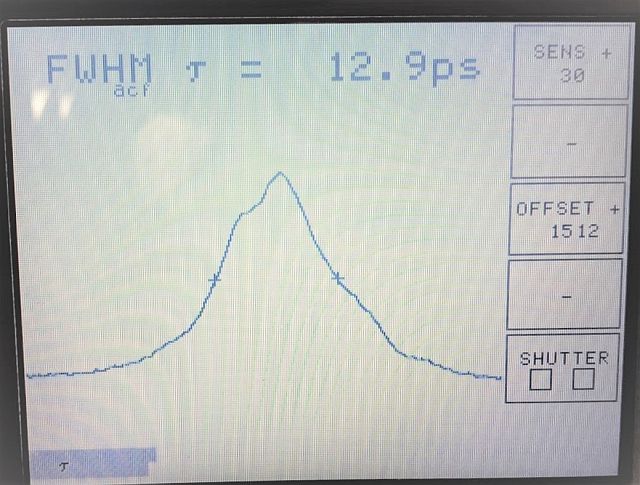
Measurement of the pulse was done at the end of the afternoon, Pulse Duration FWHM = 12.9 ps
After a long process of adjusting the alignment and angle of the crystal inside the device
The power input on the PulseCheck device should be above the sensitivity, in our case we had 1 mW input.
To reach it, we removed one of the wedge mirrors and used dielectric mirrors with an amplification of 20% ~ 25 W direct output power.
The input to the pulsecheck must be horizontally polarized, which is why we used a polarizing beam splitter (PBS).
For a better pulse shape, Victor adjusted the "beam distance" and "beam focus" nobs on the device.
| Manar Amer wrote: |
|
The pulse duration from the amplifier compressor output will be measured using PulseCheck autocorelator
a first alignment of the device was done, continuation in the afternoon.
YouTube link attached of the general operation of pulse check < 5 min : https://www.youtube.com/watch?v=J1pNHYySSYg
|
|
| Attachment 1: 20220401_Alphanov_Pulse_Duration.jpg
|
 |
| Attachment 2: 20220408_AMplifier_133MHz_Pulse_duration.jpg
|
 |
| Attachment 3: 20220408_AMplifier_133MHz_Pulse_duration_better_alignment.jpg
|
 |
|
144
|
Fri Apr 8 13:34:54 2022 |
Manar Amer | Fixed | report | lasers and optics | ThomX igloo | Alphanov amplifier Beam Pulse Duration |
The pulse duration from the amplifier compressor output will be measured using PulseCheck autocorelator
a first alignment of the device was done, continuation in the afternoon.
YouTube link attached of the general operation of pulse check < 5 min : https://www.youtube.com/watch?v=J1pNHYySSYg |
| Attachment 1: pulse-check_compressed.pdf
|
|
143
|
Fri Apr 8 13:15:18 2022 |
Ronic Chiche | Fixed | info | lasers and optics | ThomX igloo | First hands on the Alphanov amplifier & software |
Software Works well and is operational.
Just closing the log series!!!
| Ronic Chiche wrote: |
|
Additional information related to the injected power into the amplifier fibers.
power = 4.45 mW (as shown from the software)
the minimum to inject into amplifier is 2 mW
| Ronic Chiche wrote: |
|
Aurélien, Manar, and I spent more than 2h trying to start the software communicating with the Alphanov amplifier controller.
each time, we had a problem with the software, asking to switch OFF and ON the controller before being able to switch the amplifier diodes ON.
we switched OFF and ON many times without any success.
in the end, Aurélien called Guillaume from Alphanov... and without changing anything, it worked... strange!
one possible problem could be the correct detection of Frep of the seed laser (OneFive).
as we didn't check the signal coming from the seed laser, it could be the reason... to be confirmed.
the present status for the controller is:
- the power connector (on the rear side) is ON
- the green relay (on the rear side) is ACTIVATED
- the key (on the front side) is OFF
- the emission button (on the front side) is OFF
the normal procedure to start the controller is:
- switch the front side key ON
- start the software (possible error msg asking to switch OFF and ON the power button: don't do that)
- switch the emission button on the front side (which is red) ON
- switch the preamplifier button ON
=> all the software LEDs should be green and the PD_PULSE window should indicate 133.33MHz
otherwise, try a RESET on the software and restart the procedure (and pray).
at the end of the day, we successfully switched ON the preamp and increased the Power adjustment around 20% to get something about 10W on the big PowerMeter placed at the output of the amplifier.
=> we need another day of practice to be more confident with the software!
|
|
|
|
142
|
Fri Apr 8 13:12:34 2022 |
Manar Amer | Fixed | report | lasers and optics | ThomX igloo | Alphanov amplifier Beam Profile |
This Morning, another reading was taken for the output of the amplifier after the compressor using 2 wedge mirrors.
In addition, a start of the calibration of a PulseCheck "Autocorrelator" to measure the pulse duration.
note, the pulsed laser used is OneFive 133.33 MHz
| Manar Amer wrote: |
|
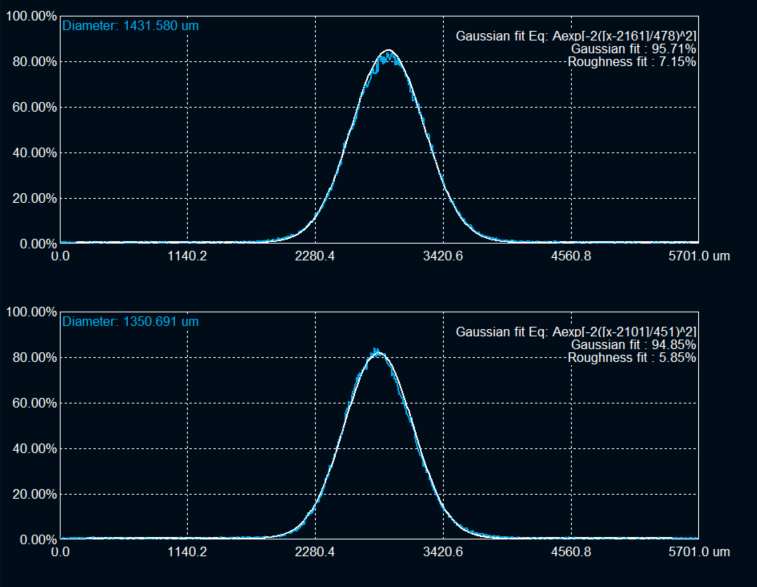
Adding the readings 20% , 30% , 40% for output of amplifier after the compressor
| Manar Amer wrote: |
|
Readings of the beam shape and fit at the output of the compressor
differance from previous reading is that here we used wedges instead of HR mirrors.
Similar to previous readings, the beam shape deforms and the Gaussian fit is bad after 50% amplification
| Manar Amer wrote: |
|
Readings of the beam shape and horizontal (upper plot) and vertical (lower plot) axis fit at the direct output of the amplifier.
The beam shape relatively shaped like an egg.
| Manar Amer wrote: |
|
Today a second reading of the beam profile was done , with Victor ,Ronic, Aurlien and Manar
an additional set-up was made using two 4 deg wedges instead of High reflecting (HR) and Anti-reflecting (AR) mirrors.
Two reading were taken:
- at the output of the compressor with a NE30A filter on the beam profiler
- at the output of the amplifier with NE30A + NE10A filter on beam profiler
| Manar Amer wrote: |
|
Adding the fitted beam in 1D in Horizontal and vertical axis.
for 10% to 60%
| Manar Amer wrote: |
|
| Manar Amer wrote: |
|
Today: Manar, Ronic and Aurlien started the study of the beam profile of the alphanov amplifier at high power.
The setup shown in the image shows how the power is reduced by using Anti-reflective mirrors,
pick up 1 : Anti-reflective coating on both sides , pick up 2 : Anti-reflective coating on one side and High reflectivity on the other
using this method, we avoid saturation and damage to the beam profiler from the high power amplified laser
in addition, an OD3 filter is placed in front of the beam profiler. and a reflective mirror is placed close to deflect the reflection from the mirror(pick up 1) second surface.
The beam observed is relatively well shaped and fitted up to 50% of amplification is where the shape starts to deform a little and is not well-fitted by a Gaussian. (image attached shows the fit for 60% amplification)
The cause is yet to be determined, as it could only be related to the reflections that occur from the mirrors (pick up 1 and pick up 2)
*** Note be always careful at High Power :)
|
|
|
|
|
|
|
|
| Attachment 1: 20220408_Amplifier_compressor_20perc.bmp
|
| Attachment 2: 20220408_Amplifier_compressor_40perc.bmp
|
| Attachment 3: 20220408_Amplifier_compressor_60perc.bmp
|
| Attachment 4: 20220408_Amplifier_compressor_70perc.bmp
|
| Attachment 5: 20220408_Amplifier_compressor_80perc.bmp
|
| Attachment 6: 20220408_Amplifier_compressor_90perc.bmp
|
| Attachment 7: 20220408_Amplifier_compressor_BeamFit_20perc.png
|
 |
| Attachment 8: 20220408_Amplifier_compressor_BeamFit_40perc.png
|
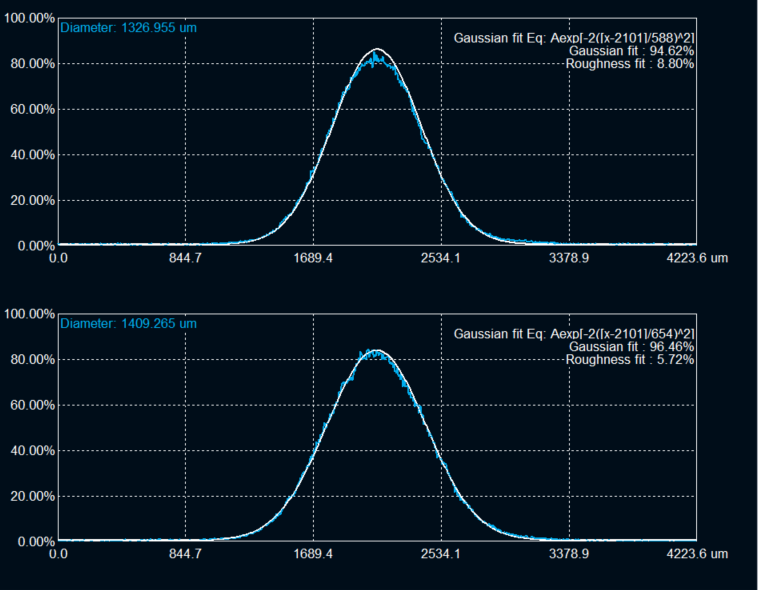 |
| Attachment 9: 20220408_Amplifier_compressor_BeamFit_60perc.png
|
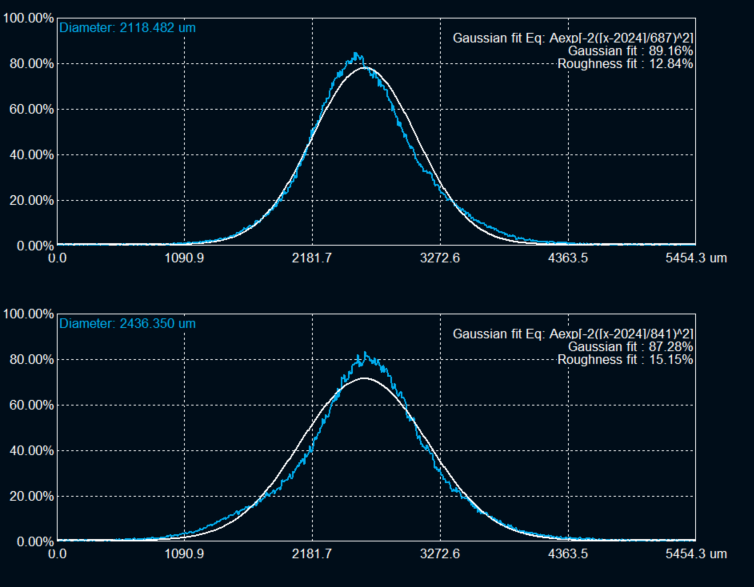 |
| Attachment 10: 20220408_Amplifier_compressor_BeamFit_70perc.png
|
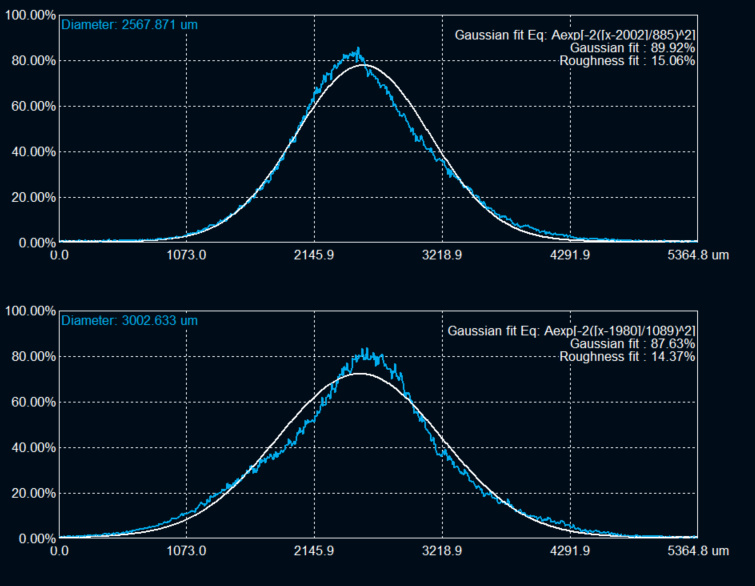 |
| Attachment 11: 20220408_Amplifier_compressor_BeamFit_80perc.png
|
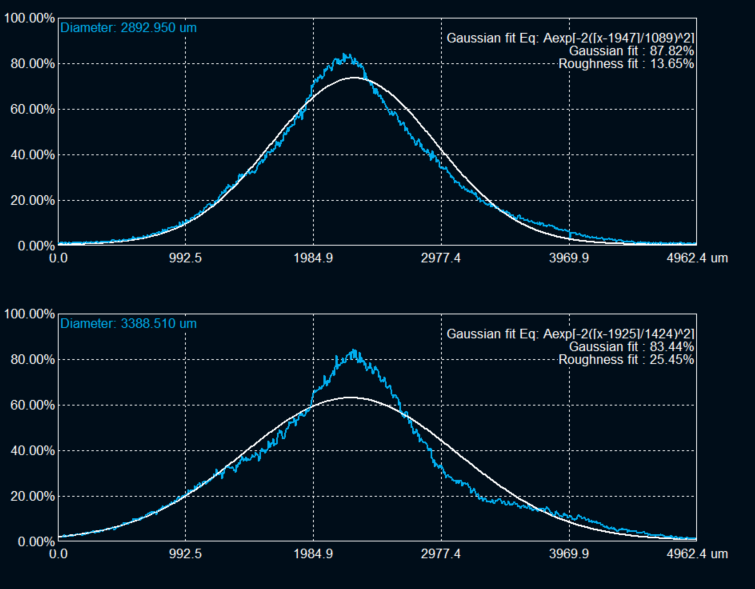 |
| Attachment 12: 20220408_Amplifier_compressor_BeamFit_90perc.png
|
 |
|
141
|
Mon Apr 4 14:23:14 2022 |
Manar Amer | Fixed | report | lasers and optics | ThomX igloo | Alphanov amplifier Beam Profile |
Adding the readings 20% , 30% , 40% for output of amplifier after the compressor
| Manar Amer wrote: |
|
Readings of the beam shape and fit at the output of the compressor
differance from previous reading is that here we used wedges instead of HR mirrors.
Similar to previous readings, the beam shape deforms and the Gaussian fit is bad after 50% amplification
| Manar Amer wrote: |
|
Readings of the beam shape and horizontal (upper plot) and vertical (lower plot) axis fit at the direct output of the amplifier.
The beam shape relatively shaped like an egg.
| Manar Amer wrote: |
|
Today a second reading of the beam profile was done , with Victor ,Ronic, Aurlien and Manar
an additional set-up was made using two 4 deg wedges instead of High reflecting (HR) and Anti-reflecting (AR) mirrors.
Two reading were taken:
- at the output of the compressor with a NE30A filter on the beam profiler
- at the output of the amplifier with NE30A + NE10A filter on beam profiler
| Manar Amer wrote: |
|
Adding the fitted beam in 1D in Horizontal and vertical axis.
for 10% to 60%
| Manar Amer wrote: |
|
| Manar Amer wrote: |
|
Today: Manar, Ronic and Aurlien started the study of the beam profile of the alphanov amplifier at high power.
The setup shown in the image shows how the power is reduced by using Anti-reflective mirrors,
pick up 1 : Anti-reflective coating on both sides , pick up 2 : Anti-reflective coating on one side and High reflectivity on the other
using this method, we avoid saturation and damage to the beam profiler from the high power amplified laser
in addition, an OD3 filter is placed in front of the beam profiler. and a reflective mirror is placed close to deflect the reflection from the mirror(pick up 1) second surface.
The beam observed is relatively well shaped and fitted up to 50% of amplification is where the shape starts to deform a little and is not well-fitted by a Gaussian. (image attached shows the fit for 60% amplification)
The cause is yet to be determined, as it could only be related to the reflections that occur from the mirrors (pick up 1 and pick up 2)
*** Note be always careful at High Power :)
|
|
|
|
|
|
|
| Attachment 1: 20220401_Amplifier_AfterCompressor_20perc_133MHz.bmp
|
| Attachment 2: 20220401_Amplifier_AfterCompressor_30perc_133MHz.bmp
|
| Attachment 3: 20220401_Amplifier_AfterCompressor_40perc_133MHz.bmp
|
| Attachment 4: 20220401_Amplifier_AfterCompressor_20perc_133MHz_BeamFit.png
|
 |
| Attachment 5: 20220401_Amplifier_AfterCompressor_30perc_133MHz_BeamFit.png
|
 |
| Attachment 6: 20220401_Amplifier_AfterCompressor_40perc_133MHz__BeamFit.png
|
 |
|
140
|
Sat Apr 2 00:51:07 2022 |
Manar Amer | Fixed | report | lasers and optics | ThomX igloo | Alphanov amplifier Beam Profile |
Readings of the beam shape and fit at the output of the compressor
differance from previous reading is that here we used wedges instead of HR mirrors.
Similar to previous readings, the beam shape deforms and the Gaussian fit is bad after 50% amplification
| Manar Amer wrote: |
|
Readings of the beam shape and horizontal (upper plot) and vertical (lower plot) axis fit at the direct output of the amplifier.
The beam shape relatively shaped like an egg.
| Manar Amer wrote: |
|
Today a second reading of the beam profile was done , with Victor ,Ronic, Aurlien and Manar
an additional set-up was made using two 4 deg wedges instead of High reflecting (HR) and Anti-reflecting (AR) mirrors.
Two reading were taken:
- at the output of the compressor with a NE30A filter on the beam profiler
- at the output of the amplifier with NE30A + NE10A filter on beam profiler
| Manar Amer wrote: |
|
Adding the fitted beam in 1D in Horizontal and vertical axis.
for 10% to 60%
| Manar Amer wrote: |
|
| Manar Amer wrote: |
|
Today: Manar, Ronic and Aurlien started the study of the beam profile of the alphanov amplifier at high power.
The setup shown in the image shows how the power is reduced by using Anti-reflective mirrors,
pick up 1 : Anti-reflective coating on both sides , pick up 2 : Anti-reflective coating on one side and High reflectivity on the other
using this method, we avoid saturation and damage to the beam profiler from the high power amplified laser
in addition, an OD3 filter is placed in front of the beam profiler. and a reflective mirror is placed close to deflect the reflection from the mirror(pick up 1) second surface.
The beam observed is relatively well shaped and fitted up to 50% of amplification is where the shape starts to deform a little and is not well-fitted by a Gaussian. (image attached shows the fit for 60% amplification)
The cause is yet to be determined, as it could only be related to the reflections that occur from the mirrors (pick up 1 and pick up 2)
*** Note be always careful at High Power :)
|
|
|
|
|
|
| Attachment 1: 20220401_Alphanov_Beam_setup_after_compressor.jpg
|
 |
| Attachment 2: 20220401_Amplifier_AfterCompressor_50perc_133MHz.bmp
|
| Attachment 3: 20220401_Amplifier_AfterCompressor_60perc_133MHz.bmp
|
| Attachment 4: 20220401_Amplifier_AfterCompressor_50perc_133MHz_BeamFit.png
|
 |
| Attachment 5: 20220401_Amplifier_AfterCompressor_60perc_133MHz_BeamFit.png
|
 |
|
139
|
Sat Apr 2 00:45:25 2022 |
Manar Amer | Fixed | report | lasers and optics | ThomX igloo | Alphanov amplifier Beam Profile |
Readings of the beam shape and horizontal (upper plot) and vertical (lower plot) axis fit at the direct output of the amplifier.
The beam shape relatively shaped like an egg.
| Manar Amer wrote: |
|
Today a second reading of the beam profile was done , with Victor ,Ronic, Aurlien and Manar
an additional set-up was made using two 4 deg wedges instead of High reflecting (HR) and Anti-reflecting (AR) mirrors.
Two reading were taken:
- at the output of the compressor with a NE30A filter on the beam profiler
- at the output of the amplifier with NE30A + NE10A filter on beam profiler
| Manar Amer wrote: |
|
Adding the fitted beam in 1D in Horizontal and vertical axis.
for 10% to 60%
| Manar Amer wrote: |
|
| Manar Amer wrote: |
|
Today: Manar, Ronic and Aurlien started the study of the beam profile of the alphanov amplifier at high power.
The setup shown in the image shows how the power is reduced by using Anti-reflective mirrors,
pick up 1 : Anti-reflective coating on both sides , pick up 2 : Anti-reflective coating on one side and High reflectivity on the other
using this method, we avoid saturation and damage to the beam profiler from the high power amplified laser
in addition, an OD3 filter is placed in front of the beam profiler. and a reflective mirror is placed close to deflect the reflection from the mirror(pick up 1) second surface.
The beam observed is relatively well shaped and fitted up to 50% of amplification is where the shape starts to deform a little and is not well-fitted by a Gaussian. (image attached shows the fit for 60% amplification)
The cause is yet to be determined, as it could only be related to the reflections that occur from the mirrors (pick up 1 and pick up 2)
*** Note be always careful at High Power :)
|
|
|
|
|
| Attachment 1: 20220401_Alphanov_Beam_setup_before_compressor.jpg
|
 |
| Attachment 2: 20220401_Amplifier_beforeCompressor_40perc_133MHz.bmp
|
| Attachment 3: 20220401_Amplifier_beforeCompressor_50perc_133MHz.bmp
|
| Attachment 4: 20220401_Amplifier_beforeCompressor_60perc_133MHz.bmp
|
| Attachment 5: 20220401_Amplifier_beforeCompressor_70perc_133MHz.bmp
|
| Attachment 6: 20220401_Amplifier_beforeCompressor_40perc_133MHz_BeamFit.png
|
 |
| Attachment 7: 20220401_Amplifier_beforeCompressor_50perc_133MHz_BeamFit.png
|
 |
| Attachment 8: 20220401_Amplifier_beforeCompressor_60perc_133MHz_BeamFit.png
|
 |
| Attachment 9: 20220401_Amplifier_beforeCompressor_70perc_133MHz_BeamFit.png
|
 |
|
138
|
Fri Apr 1 23:59:51 2022 |
Manar Amer | Fixed | report | lasers and optics | ThomX igloo | Alphanov amplifier Beam Profile |
Today a second reading of the beam profile was done , with Victor ,Ronic, Aurlien and Manar
an additional set-up was made using two 4 deg wedges instead of High reflecting (HR) and Anti-reflecting (AR) mirrors.
Two reading were taken:
- at the output of the compressor with a NE30A filter on the beam profiler
- at the output of the amplifier with NE30A + NE10A filter on beam profiler
| Manar Amer wrote: |
|
Adding the fitted beam in 1D in Horizontal and vertical axis.
for 10% to 60%
| Manar Amer wrote: |
|
| Manar Amer wrote: |
|
Today: Manar, Ronic and Aurlien started the study of the beam profile of the alphanov amplifier at high power.
The setup shown in the image shows how the power is reduced by using Anti-reflective mirrors,
pick up 1 : Anti-reflective coating on both sides , pick up 2 : Anti-reflective coating on one side and High reflectivity on the other
using this method, we avoid saturation and damage to the beam profiler from the high power amplified laser
in addition, an OD3 filter is placed in front of the beam profiler. and a reflective mirror is placed close to deflect the reflection from the mirror(pick up 1) second surface.
The beam observed is relatively well shaped and fitted up to 50% of amplification is where the shape starts to deform a little and is not well-fitted by a Gaussian. (image attached shows the fit for 60% amplification)
The cause is yet to be determined, as it could only be related to the reflections that occur from the mirrors (pick up 1 and pick up 2)
*** Note be always careful at High Power :)
|
|
|
|
|
137
|
Wed Mar 23 13:55:11 2022 |
Manar Amer | Fixed | report | lasers and optics | ThomX igloo | Alphanov amplifier Beam Profile |
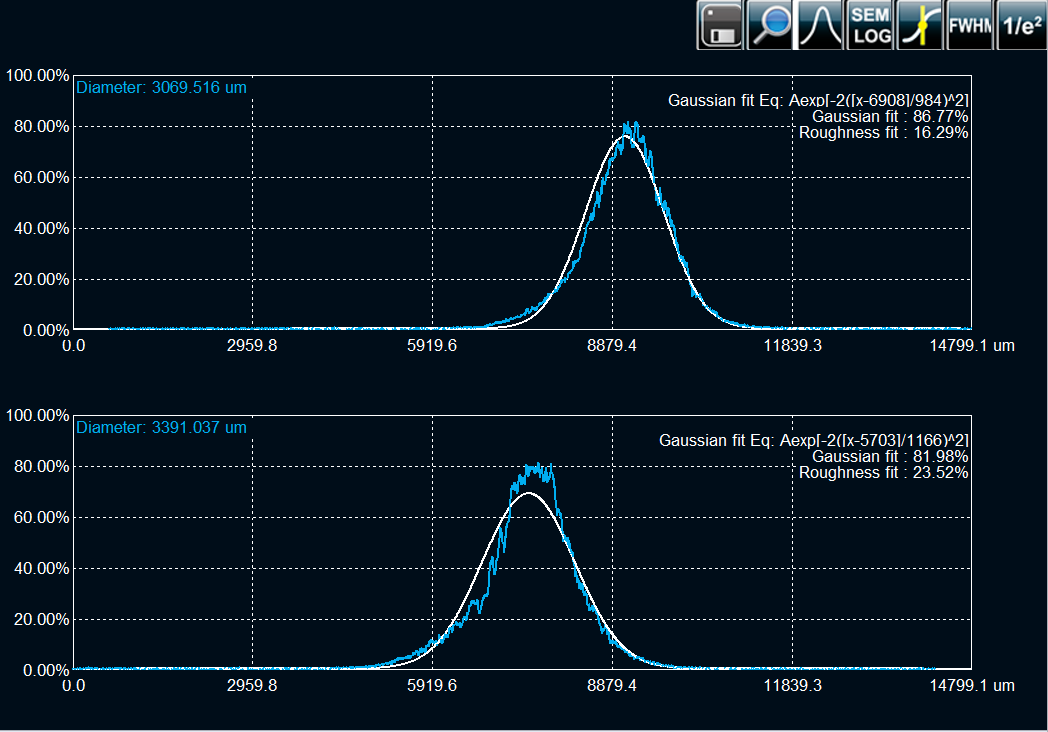
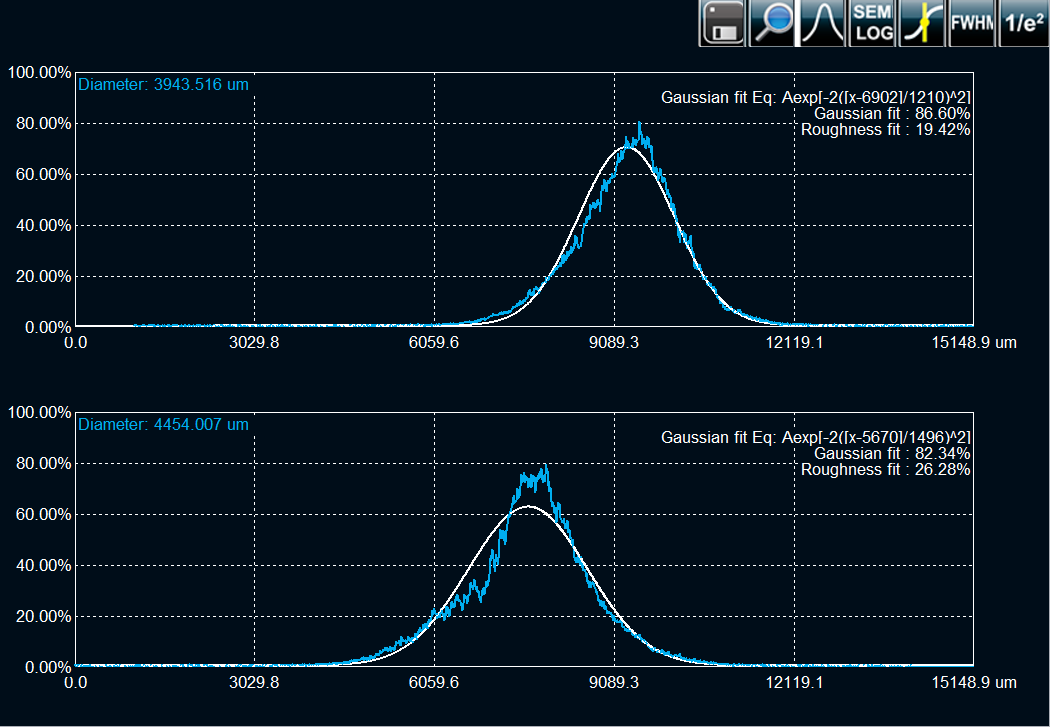
Adding the fitted beam in 1D in Horizontal and vertical axis.
for 10% to 60%
| Manar Amer wrote: |
|
| Manar Amer wrote: |
|
Today: Manar, Ronic and Aurlien started the study of the beam profile of the alphanov amplifier at high power.
The setup shown in the image shows how the power is reduced by using Anti-reflective mirrors,
pick up 1 : Anti-reflective coating on both sides , pick up 2 : Anti-reflective coating on one side and High reflectivity on the other
using this method, we avoid saturation and damage to the beam profiler from the high power amplified laser
in addition, an OD3 filter is placed in front of the beam profiler. and a reflective mirror is placed close to deflect the reflection from the mirror(pick up 1) second surface.
The beam observed is relatively well shaped and fitted up to 50% of amplification is where the shape starts to deform a little and is not well-fitted by a Gaussian. (image attached shows the fit for 60% amplification)
The cause is yet to be determined, as it could only be related to the reflections that occur from the mirrors (pick up 1 and pick up 2)
*** Note be always careful at High Power :)
|
|
|
| Attachment 1: 22032022_10perc_133MHz_Amplifier_beamFit.png
|
 |
| Attachment 2: 22032022_20perc_133MHz_Amplifier_beamFit.png
|
 |
| Attachment 3: 22032022_30perc_133MHz_Amplifier_beamFit.png
|
 |
| Attachment 4: 22032022_40perc_133MHz_Amplifier_beamFit.png
|
 |
| Attachment 5: 22032022_50perc_133MHz_Amplifier_beamFit.png
|
 |
| Attachment 6: 22032022_60perc_133MHz_Amplifier_beamFit.png
|
 |
|
136
|
Tue Mar 22 21:20:28 2022 |
Manar Amer | Fixed | report | lasers and optics | ThomX igloo | Alphanov amplifier Beam Profile |
| Manar Amer wrote: |
|
Today: Manar, Ronic and Aurlien started the study of the beam profile of the alphanov amplifier at high power.
The setup shown in the image shows how the power is reduced by using Anti-reflective mirrors,
pick up 1 : Anti-reflective coating on both sides , pick up 2 : Anti-reflective coating on one side and High reflectivity on the other
using this method, we avoid saturation and damage to the beam profiler from the high power amplified laser
in addition, an OD3 filter is placed in front of the beam profiler. and a reflective mirror is placed close to deflect the reflection from the mirror(pick up 1) second surface.
The beam observed is relatively well shaped and fitted up to 50% of amplification is where the shape starts to deform a little and is not well-fitted by a Gaussian. (image attached shows the fit for 60% amplification)
The cause is yet to be determined, as it could only be related to the reflections that occur from the mirrors (pick up 1 and pick up 2)
*** Note be always careful at High Power :)
|
|
|
135
|
Tue Mar 22 21:19:48 2022 |
Manar Amer | Fixed | report | lasers and optics | ThomX igloo | Alphanov amplifier Beam Profile |
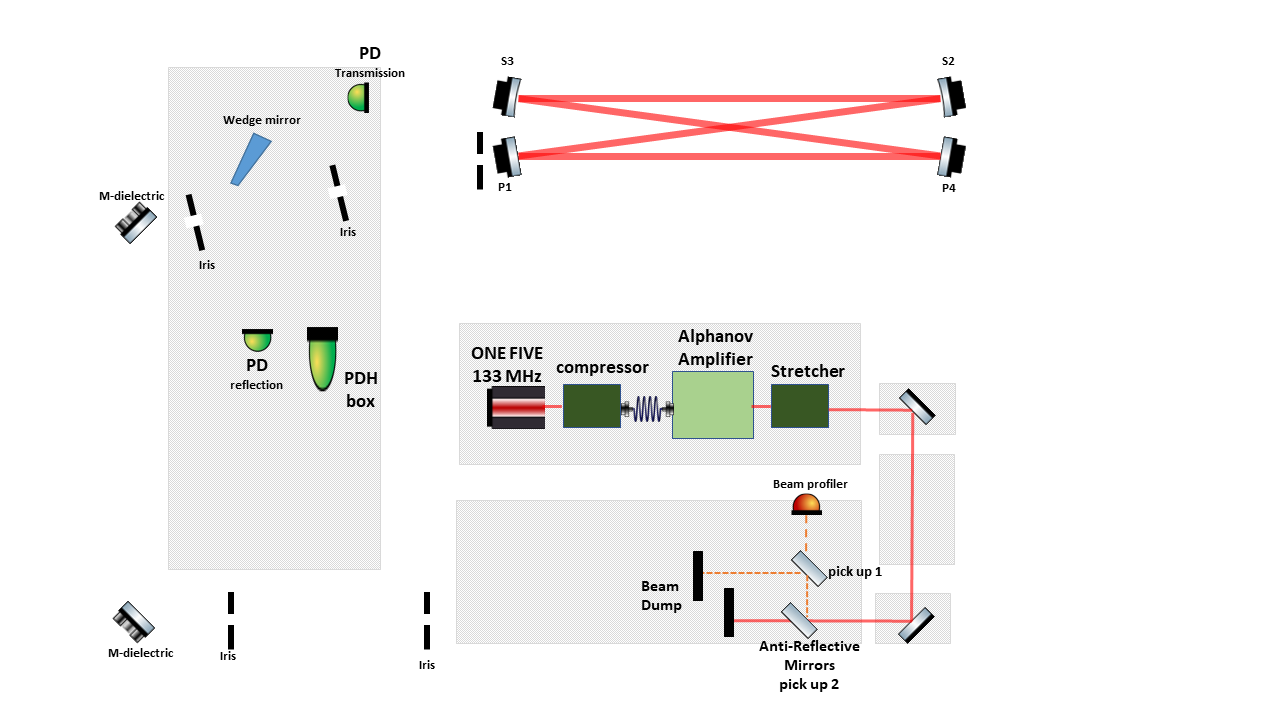
Today: Manar, Ronic and Aurlien started the study of the beam profile of the alphanov amplifier at high power.
The setup shown in the image shows how the power is reduced by using Anti-reflective mirrors,
pick up 1 : Anti-reflective coating on both sides , pick up 2 : Anti-reflective coating on one side and High reflectivity on the other
using this method, we avoid saturation and damage to the beam profiler from the high power amplified laser
in addition, an OD3 filter is placed in front of the beam profiler. and a reflective mirror is placed close to deflect the reflection from the mirror(pick up 1) second surface.
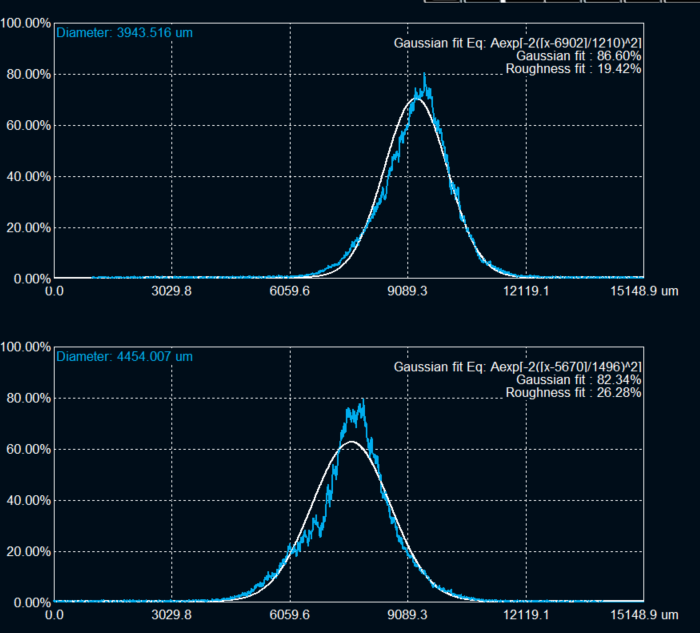
The beam observed is relatively well shaped and fitted up to 50% of amplification is where the shape starts to deform a little and is not well-fitted by a Gaussian. (image attached shows the fit for 60% amplification)
The cause is yet to be determined, as it could only be related to the reflections that occur from the mirrors (pick up 1 and pick up 2)
*** Note be always careful at High Power :)
|
| Attachment 1: 22-03-2022_Alphanov_Beam_setup.png
|
 |
| Attachment 2: 22032022_10perc_133MHz_Amplifier_beamShape.bmp
|
| Attachment 3: 22032022_20perc_133MHz_Amplifier_beamShape.bmp
|
| Attachment 4: 22032022_30perc_133MHz_Amplifier_beamShape.bmp
|
| Attachment 5: 22032022_40perc_133MHz_Amplifier_beamShape.bmp
|
| Attachment 6: 22032022_50perc_133MHz_Amplifier_beamShape.bmp
|
| Attachment 7: 22032022_60perc_133MHz_Amplifier_beamShape.bmp
|
| Attachment 8: 22032022_60perc_133MHz_Amplifier_beamFit.png
|
 |
|
134
|
Fri Mar 18 15:04:30 2022 |
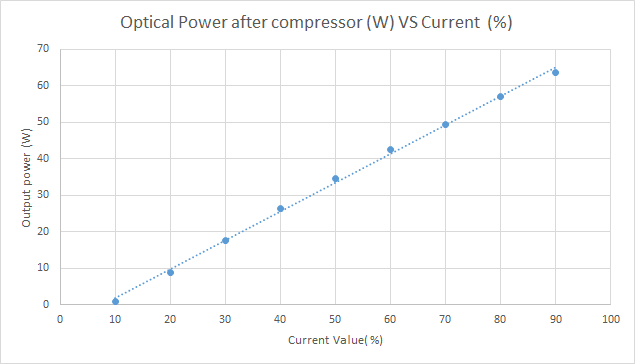
Ronic Chiche | Fixed | info | lasers and optics | ThomX igloo | Alphanov amplifier power measurement |
answers from Guillaume:
- the chiller temperature has to be set to 25°C
- the power measured with the software can change a little from what Alphanov measured with their laser.
=> one can set power tolerances to 30% in the "caracterisation.csv" file.
| Ronic Chiche wrote: |
|
This morning, with Manar and Aurélien, we measure the power directly at the output of the Alphanov amplifier.
(we had to remove the base plate where the deflector mirrors were mounted to put the large powermeter).
with the previously described procedure, it seems that the Alphanov software is now working and we were able to start immediately the amplifier.
the chiller temperature was set at 25°C but we saw in the Alphanov documentation that the chiller temperature was closer to 20°C.
we did several measurements at 25°C and 20°C and it doesn't change a lot the output power.
so, we set the temperature to 23°C to avoid condensation (if too cold).
we will ask Guillaume what is the best temperature for the chiller.
power measurements:
power ratio => measured output power (with external powermeter, not with the software)
10% => 1W
20% => 9W
30% => 17.6W
40% => 26.4W
50% => 34.5W
60% => 42.5W
70% => 49.3W
80% => 56.6W
90% => 63.6W
100% => ~70W (expected value, not measured)
we stopped the measurements at 90% as we observed a difference in the software between the expected values (previously recorded by Alphanov) and the present ones.
the present values are quite bigger than the ones measured by Alphanov.
Aurélien will call Guillaume to check if it is a problem or not.
|
|
|
133
|
Fri Mar 18 11:48:14 2022 |
Ronic Chiche | Fixed | info | lasers and optics | ThomX igloo | Alphanov amplifier power measurement |
This morning, with Manar and Aurélien, we measure the power directly at the output of the Alphanov amplifier with the 2 compressors CVBG (seeding laser at Frep = 133MHz)
(we had to remove the base plate where the deflector mirrors were mounted to put the large powermeter).
with the previously described procedure, it seems that the Alphanov software is now working and we were able to start immediately the amplifier.
the chiller temperature was set at 25°C but we saw in the Alphanov documentation that the chiller temperature was closer to 20°C.
we did several measurements at 25°C and 20°C and it doesn't change a lot the output power.
so, we set the temperature to 23°C to avoid condensation (if too cold).
we will ask Guillaume what is the best temperature for the chiller.
power measurements:
power ratio => measured output power (with external powermeter, not with the software)
10% => 1W
20% => 9W
30% => 17.6W
40% => 26.4W
50% => 34.5W
60% => 42.5W
70% => 49.3W
80% => 56.6W
90% => 63.6W
100% => ~70W (expected value, not measured)
we stopped the measurements at 90% as we observed a difference in the software between the expected values (previously recorded by Alphanov) and the present ones.
the present values are quite bigger than the ones measured by Alphanov.
Aurélien will call Guillaume to check if it is a problem or not. |
| Attachment 1: power_after_compressor_vs_current_for_133MHz_laser.png
|
 |
|
132
|
Mon Mar 14 18:39:40 2022 |
Manar Amer | Fixed | info | mechanics | lasers and optics | detectors and electronics | ThomX igloo | Current Installed Setup |
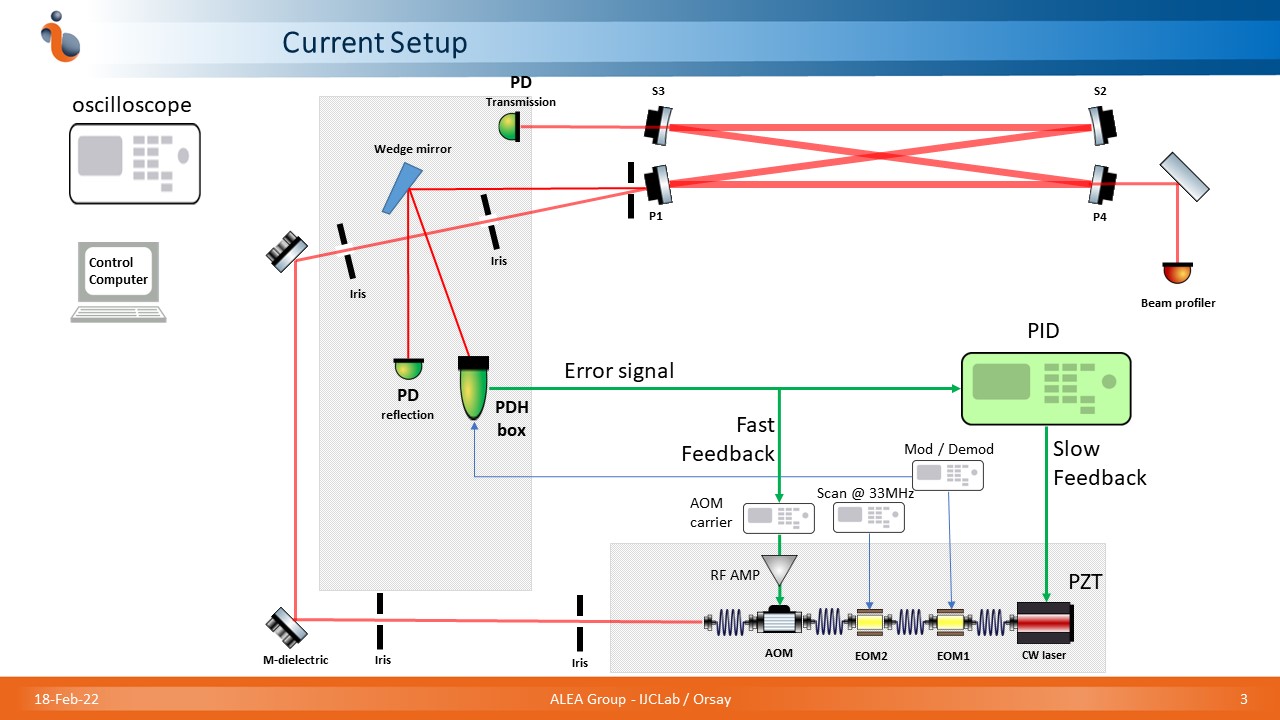
Attached is the current setup in ThomX |
| Attachment 1: 18-02-2022_ThomX_FPCavity_Finesse_Setup.jpg
|
 |
|
131
|
Fri Mar 11 17:58:24 2022 |
Ronic Chiche | Fixed | info | lasers and optics | ThomX igloo | First hands on the Alphanov amplifier & software |
Additional information related to the injected power into the amplifier fibers.
power = 4.45 mW (as shown from the software)
the minimum to inject into amplifier is 2 mW
| Ronic Chiche wrote: |
|
Aurélien, Manar, and I spent more than 2h trying to start the software communicating with the Alphanov amplifier controller.
each time, we had a problem with the software, asking to switch OFF and ON the controller before being able to switch the amplifier diodes ON.
we switched OFF and ON many times without any success.
in the end, Aurélien called Guillaume from Alphanov... and without changing anything, it worked... strange!
one possible problem could be the correct detection of Frep of the seed laser (OneFive).
as we didn't check the signal coming from the seed laser, it could be the reason... to be confirmed.
the present status for the controller is:
- the power connector (on the rear side) is ON
- the green relay (on the rear side) is ACTIVATED
- the key (on the front side) is OFF
- the emission button (on the front side) is OFF
the normal procedure to start the controller is:
- switch the front side key ON
- start the software (possible error msg asking to switch OFF and ON the power button: don't do that)
- switch the emission button on the front side (which is red) ON
- switch the preamplifier button ON
=> all the software LEDs should be green and the PD_PULSE window should indicate 133.33MHz
otherwise, try a RESET on the software and restart the procedure (and pray).
at the end of the day, we successfully switched ON the preamp and increased the Power adjustment around 20% to get something about 10W on the big PowerMeter placed at the output of the amplifier.
=> we need another day of practice to be more confident with the software!
|
|
|
130
|
Fri Mar 11 17:33:33 2022 |
Ronic Chiche | Fixed | info | lasers and optics | ThomX igloo | First hands on the Alphanov amplifier & software |
Aurélien, Manar, and I spent more than 2h trying to start the software communicating with the Alphanov amplifier controller.
each time, we had a problem with the software, asking to switch OFF and ON the controller before being able to switch the amplifier diodes ON.
we switched OFF and ON many times without any success.
in the end, Aurélien called Guillaume from Alphanov... and without changing anything, it worked... strange!
one possible problem could be the correct detection of Frep of the seed laser (OneFive).
as we didn't check the signal coming from the seed laser, it could be the reason... to be confirmed.
the present status for the controller is:
- the power connector (on the rear side) is ON
- the green relay (on the rear side) is ACTIVATED
- the key (on the front side) is OFF
- the emission button (on the front side) is OFF
the normal procedure to start the controller is:
- switch the front side key ON
- start the software (possible error msg asking to switch OFF and ON the power button: don't do that)
- switch the emission button on the front side (which is red) ON
- switch the preamplifier button ON
=> all the software LEDs should be green and the PD_PULSE window should indicate 133.33MHz
otherwise, try a RESET on the software and restart the procedure (and pray).
at the end of the day, we successfully switched ON the preamp and increased the Power adjustment around 20% to get something about 10W on the big PowerMeter placed at the output of the amplifier.
=> we need another day of practice to be more confident with the software!
|
|
129
|
Fri Mar 11 12:59:35 2022 |
Manar Amer | Fixed | report | lasers and optics | ThomX igloo | Cavity beam Image |
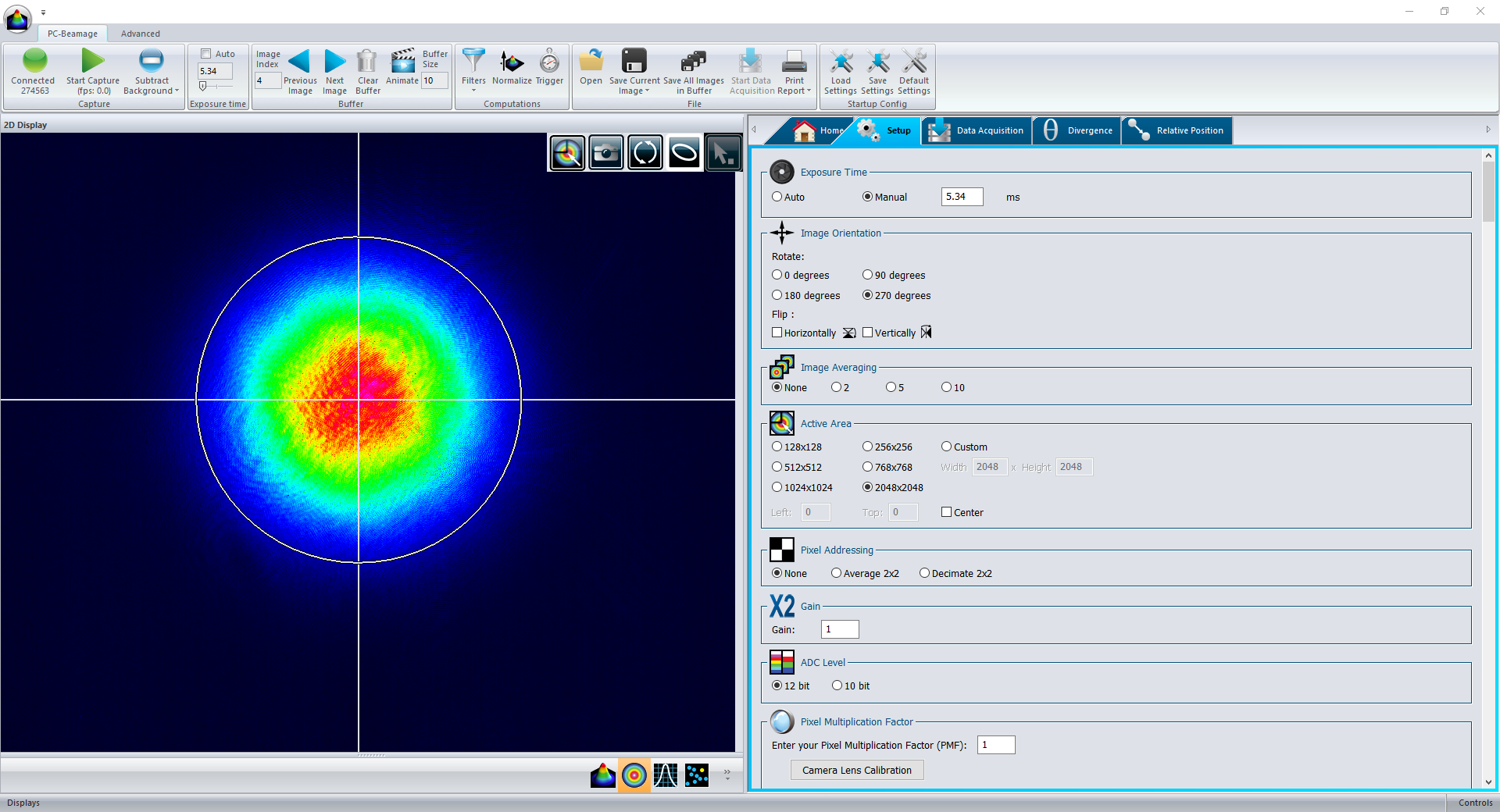
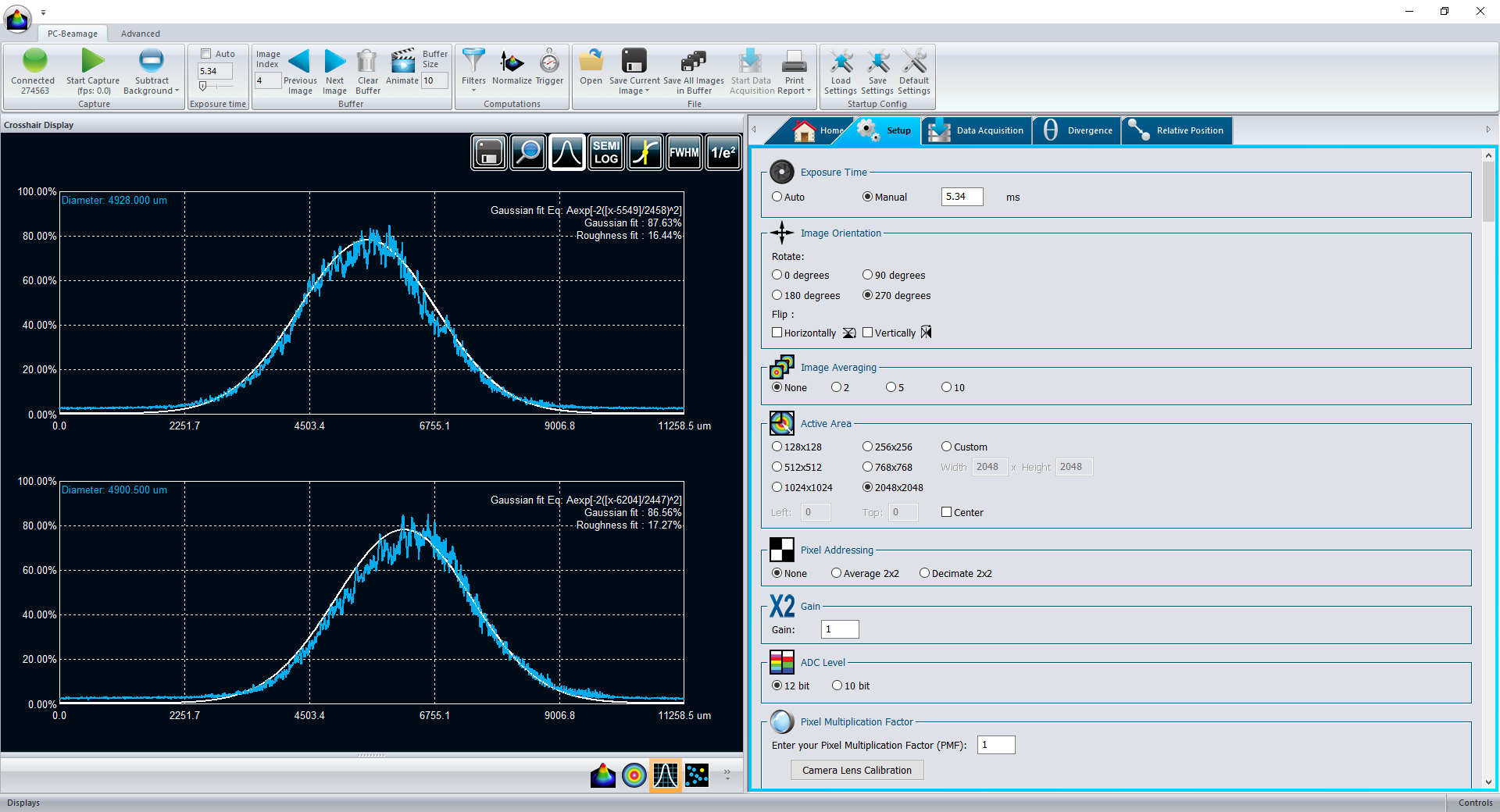
Updated beam image after change on the mode axis.
Taken after P4. |
| Attachment 1: Capture.PNG
|
 |
| Attachment 2: Capture2.PNG
|
 |