| ID |
Date |
Author |
Status |
Type |
Category |
Location |
Title |
|
436
|
Wed Jul 9 14:12:54 2025 |
Ronic Chiche | Fixed | info | lasers and optics | ThomX igloo | Recipies for different FPC power | |
For ~ 66kW power in the FP-cavity:
- Alplhanov amplifier ratio : 25%
- Axis 18 position : +0018369 steps
- PID A (for laser/FPC lock) :
input : input a
P = 0.1
I = 0.0016
D = 1.4
Sign : positive
Sampling : fast
filter : off
criterion : input d
upper th. : 10V
lower th. : 0.03V
speed : 100V/s
relock mode : none
off mode : hold
range : 50%
offset : 5V
- PID B (for RF/FPC lock) :
input : input b
P = 5
I = 0.0001
D = 1
Sign : negative
Sampling : mid
filter : off
criterion : input c
upper th. : 0.45V
lower th. : -0.45V
speed : 1V/s
relock mode : none
off mode : hold
range : 20%
offset : 5V
| Ronic Chiche wrote: |
|
For ~ 23kW power in the FP-cavity:
- Alplhanov amplifier ratio : 15%
- Axis 18 position : -0016014 steps
- PID A (for laser/FPC lock) :
input : input a
P = 0.09
I = 0.0016
D = 1.35
Sign : positive
Sampling : fast
filter : off
criterion : input d
upper th. : 10V
lower th. : 0.03V
speed : 100V/s
relock mode : none
off mode : hold
range : 50%
offset : 5V
- PID B (for RF/FPC lock) :
input : input b
P = 5
I = 0.0001
D = 1
Sign : negative
Sampling : mid
filter : off
criterion : input c
upper th. : 0.45V
lower th. : -0.45V
speed : 1V/s
relock mode : none
off mode : hold
range : 20%
offset : 5V
| Ronic Chiche wrote: |
|
For ~ 46kW power in the FP-cavity:
- Alplhanov amplifier ratio : 20%
- Axis 18 position : -0004710 steps
- PID A (for laser/FPC lock) :
input : input a
P = 0.06
I = 0.0007
D = 0.85
Sign : positive
Sampling : fast
filter : off
criterion : input d
upper th. : 10V
lower th. : 0.04V
speed : 100V/s
relock mode : none
off mode : hold
range : 50%
offset : 5V
- PID B (for RF/FPC lock) :
input : input b
P = 3
I = 0.00002
D = 2
Sign : negative
Sampling : mid
filter : off
criterion : input c
upper th. : 0.45V
lower th. : -0.45V
speed : 1V/s
relock mode : none
off mode : hold
range : 20%
offset : 5V
|
|
|
|
435
|
Tue Jul 8 18:48:51 2025 |
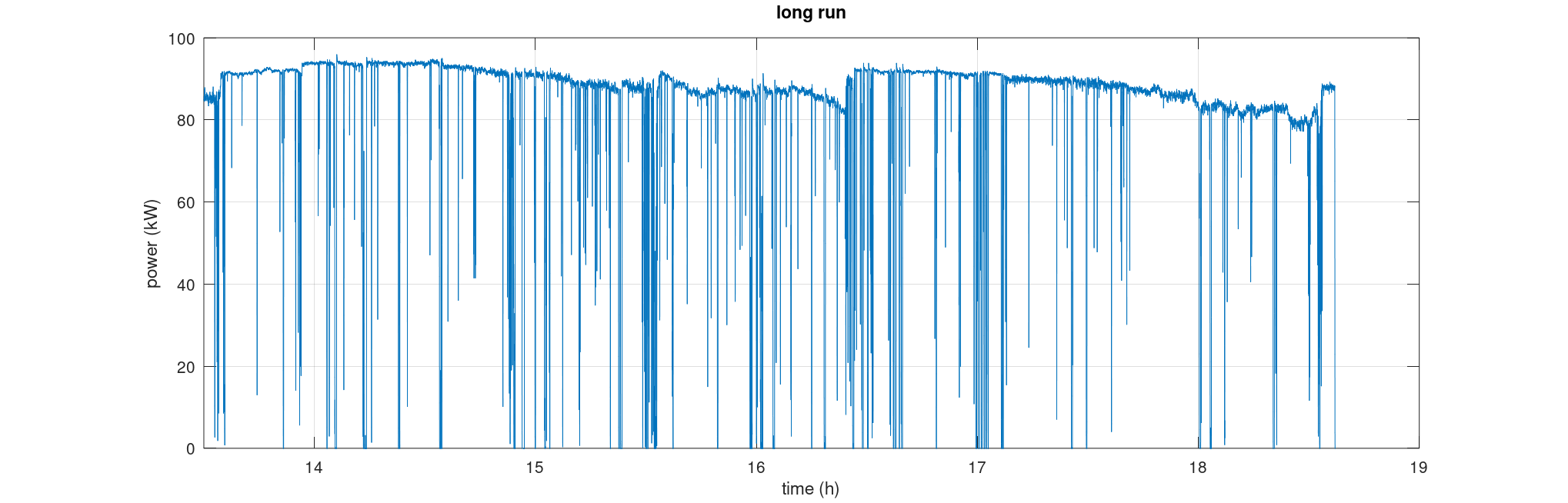
Ronic Chiche | Under Process | report | mechanics | lasers and optics | detectors and electronics | ThomX igloo | day by day run for X-ray production | long run today at relatively nominal power (~90kW) with double loop (FPC + RF) between 13:30am and 6:30pm
| Ronic Chiche wrote: |
|
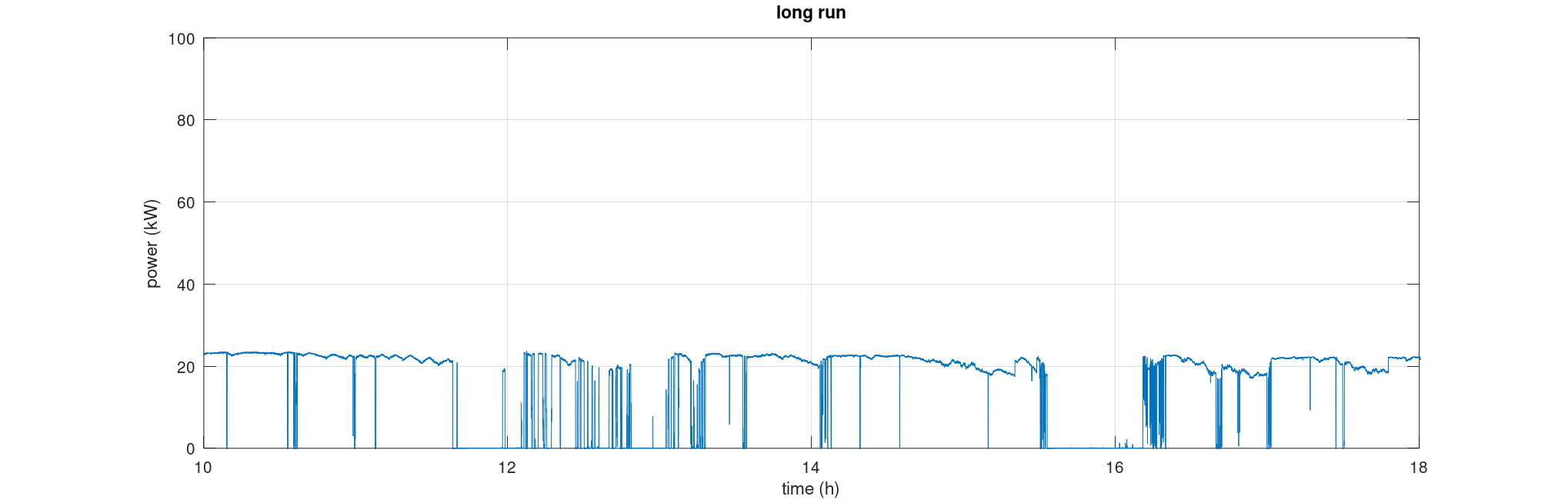
long run yesterday at relatively low power (~23kW) with double loop (FPC + RF) between 10am and 6pm
| Ronic Chiche wrote: |
|
We had a long run without any lock loss during ~1h with the 23kW recipie in the morning.
during the afternoon, we had some few lock losses but the FPC system was globally quiet and stable,
but at the end of the day, I observed more and more frequent high frequency noise which implies lock losses.
at the same time, Dalkia changed the temperature of the air flow in the bunker.
could it be the reason of the stability degradation or is it because the cavity is more unstable when hot ?
| Ronic Chiche wrote: |
|
New locking parameters (I got 98kW for 33% amp ratio) :
Axis 18 position : +0009420
P = 0.05
I = 0.0005
D = 0.6
stability seems better than previous parameters.
| Ronic Chiche wrote: |
|
Today, I removed the NKT oscillator from the bunker to put it in the PLIC room.
I locked the FP cavity and obtained 97kW with 33% amplifier ratio, without any alignment, just by changing a little bit the CEP.
| Ronic Chiche wrote: |
|
today, after 1 week of vacation, I was able to easily lock the cavity with 92kW with 33% amp ratio without too much optimizations (no walking alignment).
could it be related to the nice weather we got during this week ?
as in the past we observed more noise when the weather was changing and we had very difficult locking procedure after a simple weekend...
| Ronic Chiche wrote: |
|
today, the alignment of FP cavity was so bad that I tuned the 01 mode by error (CEP and alignment)... insead of the 00 mode !!!
I was able to reach ~30kW and was limited at this value, so I used the camera to check what was happening and saw the 01 mode.
so, I moved the lock on a 00 mode and redid a full tuning (CEP and alignment).
I got ~93kW => ok
| Ronic Chiche wrote: |
|
this morning, the cavity was pretty misaligned => basic alignment in y direction helps a lot => 93kW for 33% amp ratio.
the Rigol 33MHz generator phase was adjusted : phase ch2 = phase ch1 (40 deg) + 36 deg = 76 deg.
| Ronic Chiche wrote: |
|
this morning, I restarted the lock of the CFP after almost 2 weeks without operation.
after quick alignment and CEP tuning, I got 88kW for 33% ratio for the laser amplifier.
the FPC seems pretty far from the RF frequency (2.8kHz @ 33MHz) but it's possible the present RF frequency has been tuned for 61.5 or 70MeV (the present FPC length is tuned for 50MeV).
Jean-Noel had to reinject some SF6 gas in the section pipe => it immediately produces some lock losses during the whole filling process and even several minutes after he finishes.
this is an interesting correlation with the vibrations from the beam pipe => one needs to install the accelerometer to check the behavior.
but the lock losses were not related to "high frequency" or "20Hz oscillations" noises which are the 2 main processes for lock losses, it was just like some "cuts" in the signals.
I finally got 90kW in the FPC for 33% ratio for the laser amplifier after walking alignment procedure.
| Ronic Chiche wrote: |
|
today we did x-rays => we got 41 000 pA at maximum and 90kW in the FPC for 33% amplifier ratio.
finally, I changed the strategy for the feeback on RF.
i removed the integration and derivative parameters and reduced the gain parameter :
P=0.25 / I=D=0 => it seems to be more stable => less low frequency oscillations becoming larger and larger during a perturbation.
| Ronic Chiche wrote: |
|
this morning, I restarted the cavity after the Christmas shutdown.
everything went fine.
I got ~ 86kW for 33% laser amplifier ratio after optimization of the CEP and alignment with walking procedure.
IcePap controllers are OK and the displacements (MOT.03 and MOT.06) let the CFP locked.
I locked also on the RF frequency (I tuned the laser and CFP cavity length) => +4.1ns (C2-C4) between the 10Hz trig (C2) and the 33MHz laser signal (C4)
I observed that the search & relock range on the regulator B plays an important role on the RF locking stability.
so, I increased the previous range +/-0.25V to +/-0.5V.
we have always the 20Hz noise which can be increasing some time but the lock seems more robust.
| Ronic Chiche wrote: |
|
this morning, Kevin reduced the steering current in the IcePap controllers of the FP cavity motors.
the motor MOT.06 was producing a pattern in the Transmission signal when it was moved and doing a lock loss very often.
so, we changed its current from 0.8A to 0.4A and it fixes the problem => no more systematic lock loss.
so, we changed also the MOT.03 steering current from 0.8A to 0.7A.
on this motor, we have also a false warning about the Low limit switch which seems to be activated (strange because, we are always using it in the positive direction)
Kevin reverted the logic to remove the message.
we obtained 91kW in the FPC for 33% amplifier ratio after CEP and alignment tuning.
we did synchronized xray production with a relative delay between laser 33MHz and trigger (CH2-CH4) of +4 ns
| Ronic Chiche wrote: |
|
major result of the day: X-ray vertical scan by moving the hexapod
abscise : hexapod position
ordinate : xray flux in asynchronous condition
red curve : continuous injection at 10Hz (the scan lasts for ~5 minutes)
green curve : one single injection (the beam is not extracted).
blue curve : one single injection, ~ 10-15 minutes later
| Ronic Chiche wrote: |
|
This morning, I added an amplifier on the 33MHz beating signal in between the mixer+LPF and the scope/Laselock.
it seems to improve the robustness of the RF/FPC lock.
because of this gain, I increased the upper and lower thresholds on the search criterion of the RF/FPC lock from +/-50mV to +250mV/-200mV
=> see the picture of the Laselock parameters.
the optimum phase for X-ray production is roughly +3.6ns between C2 (machine trigger) and C4 (33MHz laser signal).
we have to use the machine at 70MeV with a new frequency at 500.0325MHz / 33.3355MHz.
=> we need to move the FPC tomorrow by roughly 60kHz @ 500MHz.
| Ronic Chiche wrote: |
|
last thing we tried :
we removed the threshold on the FPC/RF error signal.
=> we cannot choose automatically the RF bucket anymore (we need to manually let the phase drift slowly and start the lock at the right moment).
=> but the FPC/RF lock seems more robust.
in that case, we have 2 different sources of lock losses:
- the ones dues to the laser or CFP motors move.
even at low speed or in "piezo scan" mode, one observes too fast mouvement that are not properly compensated and involving some phase shift.
- the ones not related to any action.
=> the 20Hz signal seems to increase until it makes the system losing the lock
| Ronic Chiche wrote: |
|
we observed that :
- the MOT.03 motor always exhibits some perturbations on the transmitted, reflected and PZT signals (see picture) in contrary to the MOT.06 motor.
does the differences come from the motor relative positions (-900 000 steps for MOT.06 and -100 000 steps for MOT.03) or from the controller configuration ?
- the stability limits (oscillations arise) of the PID for the RF/CFP locks are P = 1 / I = 0.0001 / D = 5
then we put the new PID parameters : P = 0.25 / I = 0.000025 / D = 1
- the 20Hz oscillations are stil arising from time to time
- the lock laser/CFP is pretty robust, one observes more RF/CFP lock losses.
- we removed the 250Hz filter on the RF/CFP error signal to increase the feedback BW but we didn't see a any improvement
- at 5pm, the laser/CFP lock seems as stable as in the morning, then we don't see any change in stability during time.
we loggued CFP power measurement and signals from the cavity (~ 1GB of data)
| Ronic Chiche wrote: |
|
today with Alice, we planned to do a long run with ~80kW in the FPC to check if the lock problems are coming from the interaction with the machine or not.
the goal is to check this assumption on a full day comparable with a day of X-ray production.
we started the amplifier at 10am.
during a move of MaY (injection mirrors of the FPC), we observed a sudden total loss of resonances...
the reason was an abnormal displacement of the motor despite the fact the measured position was reasonable.
we already observed an issue like that....
to fix the problem, one just had to move back MaY.
the cavity started to be locked at 11:15am
the RF frequency has been changed to 500.09595MHz equivalent to 33.33973MHz
but we don't have a beating signal @ 500MHz => one will ask to Vincent to fix the issue.
laser motor CH0 : 1.503453 mm
laser moror CH2 : - 50µm
~ 83kW at 12:30pm
| Ronic Chiche wrote: |
|
at the begining of the day, we started to get ~81kW in the FPC for 33% amplifier ratio and after ~1h, we got 84kW after CEP and alignment tuning.
at the end of the day, we got 89kW without walking alignment.
we tried to improve a bit the robustness of the FPC and RF locks:
see the capture for the new locking parameters.
| Ronic Chiche wrote: |
|
the RF frequency changed from 500.1003MHz to 500.0913MHz => it reduced by 9kHz @ 500MHz which is equivalent to 600Hz @ 33MHz (we measured 500Hz @ 33MHz). the electron orbit length increased, so we have to increase the cavities length => increase motor values by ~ 68µm.
for the laser cavity : 1.496 560 mm => 1.564 560 mm
the initial values for the motor of the FP cavity are : MOT.03=-130 000 steps and MOT.06=-900 000 steps.
68µm is roughly 11 000 steps (6nm/step) => MOT.03=-130 000 steps and MOT.06=-889 000 steps.
optimum CEP position : -210.8µm => -192µm
I got 80kW in the FP cavity after CEP and walking alignment
then, 82kW after waiting 3h.
then, 84kW after waiting 5h.
|
|
|
|
|
|
|
|
|
|
|
|
|
|
|
|
|
|
|
| Attachment 1: 2025-07-08_-_long_run.png
|  |
|
434
|
Tue Jul 8 18:45:17 2025 |
Ronic Chiche | Under Process | report | mechanics | lasers and optics | detectors and electronics | ThomX igloo | day by day run for X-ray production | long run yesterday at relatively low power (~23kW) with double loop (FPC + RF) between 10am and 6pm
| Ronic Chiche wrote: |
|
We had a long run without any lock loss during ~1h with the 23kW recipie in the morning.
during the afternoon, we had some few lock losses but the FPC system was globally quiet and stable,
but at the end of the day, I observed more and more frequent high frequency noise which implies lock losses.
at the same time, Dalkia changed the temperature of the air flow in the bunker.
could it be the reason of the stability degradation or is it because the cavity is more unstable when hot ?
| Ronic Chiche wrote: |
|
New locking parameters (I got 98kW for 33% amp ratio) :
Axis 18 position : +0009420
P = 0.05
I = 0.0005
D = 0.6
stability seems better than previous parameters.
| Ronic Chiche wrote: |
|
Today, I removed the NKT oscillator from the bunker to put it in the PLIC room.
I locked the FP cavity and obtained 97kW with 33% amplifier ratio, without any alignment, just by changing a little bit the CEP.
| Ronic Chiche wrote: |
|
today, after 1 week of vacation, I was able to easily lock the cavity with 92kW with 33% amp ratio without too much optimizations (no walking alignment).
could it be related to the nice weather we got during this week ?
as in the past we observed more noise when the weather was changing and we had very difficult locking procedure after a simple weekend...
| Ronic Chiche wrote: |
|
today, the alignment of FP cavity was so bad that I tuned the 01 mode by error (CEP and alignment)... insead of the 00 mode !!!
I was able to reach ~30kW and was limited at this value, so I used the camera to check what was happening and saw the 01 mode.
so, I moved the lock on a 00 mode and redid a full tuning (CEP and alignment).
I got ~93kW => ok
| Ronic Chiche wrote: |
|
this morning, the cavity was pretty misaligned => basic alignment in y direction helps a lot => 93kW for 33% amp ratio.
the Rigol 33MHz generator phase was adjusted : phase ch2 = phase ch1 (40 deg) + 36 deg = 76 deg.
| Ronic Chiche wrote: |
|
this morning, I restarted the lock of the CFP after almost 2 weeks without operation.
after quick alignment and CEP tuning, I got 88kW for 33% ratio for the laser amplifier.
the FPC seems pretty far from the RF frequency (2.8kHz @ 33MHz) but it's possible the present RF frequency has been tuned for 61.5 or 70MeV (the present FPC length is tuned for 50MeV).
Jean-Noel had to reinject some SF6 gas in the section pipe => it immediately produces some lock losses during the whole filling process and even several minutes after he finishes.
this is an interesting correlation with the vibrations from the beam pipe => one needs to install the accelerometer to check the behavior.
but the lock losses were not related to "high frequency" or "20Hz oscillations" noises which are the 2 main processes for lock losses, it was just like some "cuts" in the signals.
I finally got 90kW in the FPC for 33% ratio for the laser amplifier after walking alignment procedure.
| Ronic Chiche wrote: |
|
today we did x-rays => we got 41 000 pA at maximum and 90kW in the FPC for 33% amplifier ratio.
finally, I changed the strategy for the feeback on RF.
i removed the integration and derivative parameters and reduced the gain parameter :
P=0.25 / I=D=0 => it seems to be more stable => less low frequency oscillations becoming larger and larger during a perturbation.
| Ronic Chiche wrote: |
|
this morning, I restarted the cavity after the Christmas shutdown.
everything went fine.
I got ~ 86kW for 33% laser amplifier ratio after optimization of the CEP and alignment with walking procedure.
IcePap controllers are OK and the displacements (MOT.03 and MOT.06) let the CFP locked.
I locked also on the RF frequency (I tuned the laser and CFP cavity length) => +4.1ns (C2-C4) between the 10Hz trig (C2) and the 33MHz laser signal (C4)
I observed that the search & relock range on the regulator B plays an important role on the RF locking stability.
so, I increased the previous range +/-0.25V to +/-0.5V.
we have always the 20Hz noise which can be increasing some time but the lock seems more robust.
| Ronic Chiche wrote: |
|
this morning, Kevin reduced the steering current in the IcePap controllers of the FP cavity motors.
the motor MOT.06 was producing a pattern in the Transmission signal when it was moved and doing a lock loss very often.
so, we changed its current from 0.8A to 0.4A and it fixes the problem => no more systematic lock loss.
so, we changed also the MOT.03 steering current from 0.8A to 0.7A.
on this motor, we have also a false warning about the Low limit switch which seems to be activated (strange because, we are always using it in the positive direction)
Kevin reverted the logic to remove the message.
we obtained 91kW in the FPC for 33% amplifier ratio after CEP and alignment tuning.
we did synchronized xray production with a relative delay between laser 33MHz and trigger (CH2-CH4) of +4 ns
| Ronic Chiche wrote: |
|
major result of the day: X-ray vertical scan by moving the hexapod
abscise : hexapod position
ordinate : xray flux in asynchronous condition
red curve : continuous injection at 10Hz (the scan lasts for ~5 minutes)
green curve : one single injection (the beam is not extracted).
blue curve : one single injection, ~ 10-15 minutes later
| Ronic Chiche wrote: |
|
This morning, I added an amplifier on the 33MHz beating signal in between the mixer+LPF and the scope/Laselock.
it seems to improve the robustness of the RF/FPC lock.
because of this gain, I increased the upper and lower thresholds on the search criterion of the RF/FPC lock from +/-50mV to +250mV/-200mV
=> see the picture of the Laselock parameters.
the optimum phase for X-ray production is roughly +3.6ns between C2 (machine trigger) and C4 (33MHz laser signal).
we have to use the machine at 70MeV with a new frequency at 500.0325MHz / 33.3355MHz.
=> we need to move the FPC tomorrow by roughly 60kHz @ 500MHz.
| Ronic Chiche wrote: |
|
last thing we tried :
we removed the threshold on the FPC/RF error signal.
=> we cannot choose automatically the RF bucket anymore (we need to manually let the phase drift slowly and start the lock at the right moment).
=> but the FPC/RF lock seems more robust.
in that case, we have 2 different sources of lock losses:
- the ones dues to the laser or CFP motors move.
even at low speed or in "piezo scan" mode, one observes too fast mouvement that are not properly compensated and involving some phase shift.
- the ones not related to any action.
=> the 20Hz signal seems to increase until it makes the system losing the lock
| Ronic Chiche wrote: |
|
we observed that :
- the MOT.03 motor always exhibits some perturbations on the transmitted, reflected and PZT signals (see picture) in contrary to the MOT.06 motor.
does the differences come from the motor relative positions (-900 000 steps for MOT.06 and -100 000 steps for MOT.03) or from the controller configuration ?
- the stability limits (oscillations arise) of the PID for the RF/CFP locks are P = 1 / I = 0.0001 / D = 5
then we put the new PID parameters : P = 0.25 / I = 0.000025 / D = 1
- the 20Hz oscillations are stil arising from time to time
- the lock laser/CFP is pretty robust, one observes more RF/CFP lock losses.
- we removed the 250Hz filter on the RF/CFP error signal to increase the feedback BW but we didn't see a any improvement
- at 5pm, the laser/CFP lock seems as stable as in the morning, then we don't see any change in stability during time.
we loggued CFP power measurement and signals from the cavity (~ 1GB of data)
| Ronic Chiche wrote: |
|
today with Alice, we planned to do a long run with ~80kW in the FPC to check if the lock problems are coming from the interaction with the machine or not.
the goal is to check this assumption on a full day comparable with a day of X-ray production.
we started the amplifier at 10am.
during a move of MaY (injection mirrors of the FPC), we observed a sudden total loss of resonances...
the reason was an abnormal displacement of the motor despite the fact the measured position was reasonable.
we already observed an issue like that....
to fix the problem, one just had to move back MaY.
the cavity started to be locked at 11:15am
the RF frequency has been changed to 500.09595MHz equivalent to 33.33973MHz
but we don't have a beating signal @ 500MHz => one will ask to Vincent to fix the issue.
laser motor CH0 : 1.503453 mm
laser moror CH2 : - 50µm
~ 83kW at 12:30pm
| Ronic Chiche wrote: |
|
at the begining of the day, we started to get ~81kW in the FPC for 33% amplifier ratio and after ~1h, we got 84kW after CEP and alignment tuning.
at the end of the day, we got 89kW without walking alignment.
we tried to improve a bit the robustness of the FPC and RF locks:
see the capture for the new locking parameters.
| Ronic Chiche wrote: |
|
the RF frequency changed from 500.1003MHz to 500.0913MHz => it reduced by 9kHz @ 500MHz which is equivalent to 600Hz @ 33MHz (we measured 500Hz @ 33MHz). the electron orbit length increased, so we have to increase the cavities length => increase motor values by ~ 68µm.
for the laser cavity : 1.496 560 mm => 1.564 560 mm
the initial values for the motor of the FP cavity are : MOT.03=-130 000 steps and MOT.06=-900 000 steps.
68µm is roughly 11 000 steps (6nm/step) => MOT.03=-130 000 steps and MOT.06=-889 000 steps.
optimum CEP position : -210.8µm => -192µm
I got 80kW in the FP cavity after CEP and walking alignment
then, 82kW after waiting 3h.
then, 84kW after waiting 5h.
|
|
|
|
|
|
|
|
|
|
|
|
|
|
|
|
|
|
| Attachment 1: 2025-07-07_-_long_run.png
|  |
|
433
|
Tue Jul 1 17:31:41 2025 |
Ronic Chiche | Under Process | report | mechanics | lasers and optics | detectors and electronics | ThomX igloo | day by day run for X-ray production | We had a long run without any lock loss during ~1h with the 23kW recipie in the morning.
during the afternoon, we had some few lock losses but the FPC system was globally quiet and stable,
but at the end of the day, I observed more and more frequent high frequency noise which implies lock losses.
at the same time, Dalkia changed the temperature of the air flow in the bunker.
could it be the reason of the stability degradation or is it because the cavity is more unstable when hot ?
| Ronic Chiche wrote: |
|
New locking parameters (I got 98kW for 33% amp ratio) :
Axis 18 position : +0009420
P = 0.05
I = 0.0005
D = 0.6
stability seems better than previous parameters.
| Ronic Chiche wrote: |
|
Today, I removed the NKT oscillator from the bunker to put it in the PLIC room.
I locked the FP cavity and obtained 97kW with 33% amplifier ratio, without any alignment, just by changing a little bit the CEP.
| Ronic Chiche wrote: |
|
today, after 1 week of vacation, I was able to easily lock the cavity with 92kW with 33% amp ratio without too much optimizations (no walking alignment).
could it be related to the nice weather we got during this week ?
as in the past we observed more noise when the weather was changing and we had very difficult locking procedure after a simple weekend...
| Ronic Chiche wrote: |
|
today, the alignment of FP cavity was so bad that I tuned the 01 mode by error (CEP and alignment)... insead of the 00 mode !!!
I was able to reach ~30kW and was limited at this value, so I used the camera to check what was happening and saw the 01 mode.
so, I moved the lock on a 00 mode and redid a full tuning (CEP and alignment).
I got ~93kW => ok
| Ronic Chiche wrote: |
|
this morning, the cavity was pretty misaligned => basic alignment in y direction helps a lot => 93kW for 33% amp ratio.
the Rigol 33MHz generator phase was adjusted : phase ch2 = phase ch1 (40 deg) + 36 deg = 76 deg.
| Ronic Chiche wrote: |
|
this morning, I restarted the lock of the CFP after almost 2 weeks without operation.
after quick alignment and CEP tuning, I got 88kW for 33% ratio for the laser amplifier.
the FPC seems pretty far from the RF frequency (2.8kHz @ 33MHz) but it's possible the present RF frequency has been tuned for 61.5 or 70MeV (the present FPC length is tuned for 50MeV).
Jean-Noel had to reinject some SF6 gas in the section pipe => it immediately produces some lock losses during the whole filling process and even several minutes after he finishes.
this is an interesting correlation with the vibrations from the beam pipe => one needs to install the accelerometer to check the behavior.
but the lock losses were not related to "high frequency" or "20Hz oscillations" noises which are the 2 main processes for lock losses, it was just like some "cuts" in the signals.
I finally got 90kW in the FPC for 33% ratio for the laser amplifier after walking alignment procedure.
| Ronic Chiche wrote: |
|
today we did x-rays => we got 41 000 pA at maximum and 90kW in the FPC for 33% amplifier ratio.
finally, I changed the strategy for the feeback on RF.
i removed the integration and derivative parameters and reduced the gain parameter :
P=0.25 / I=D=0 => it seems to be more stable => less low frequency oscillations becoming larger and larger during a perturbation.
| Ronic Chiche wrote: |
|
this morning, I restarted the cavity after the Christmas shutdown.
everything went fine.
I got ~ 86kW for 33% laser amplifier ratio after optimization of the CEP and alignment with walking procedure.
IcePap controllers are OK and the displacements (MOT.03 and MOT.06) let the CFP locked.
I locked also on the RF frequency (I tuned the laser and CFP cavity length) => +4.1ns (C2-C4) between the 10Hz trig (C2) and the 33MHz laser signal (C4)
I observed that the search & relock range on the regulator B plays an important role on the RF locking stability.
so, I increased the previous range +/-0.25V to +/-0.5V.
we have always the 20Hz noise which can be increasing some time but the lock seems more robust.
| Ronic Chiche wrote: |
|
this morning, Kevin reduced the steering current in the IcePap controllers of the FP cavity motors.
the motor MOT.06 was producing a pattern in the Transmission signal when it was moved and doing a lock loss very often.
so, we changed its current from 0.8A to 0.4A and it fixes the problem => no more systematic lock loss.
so, we changed also the MOT.03 steering current from 0.8A to 0.7A.
on this motor, we have also a false warning about the Low limit switch which seems to be activated (strange because, we are always using it in the positive direction)
Kevin reverted the logic to remove the message.
we obtained 91kW in the FPC for 33% amplifier ratio after CEP and alignment tuning.
we did synchronized xray production with a relative delay between laser 33MHz and trigger (CH2-CH4) of +4 ns
| Ronic Chiche wrote: |
|
major result of the day: X-ray vertical scan by moving the hexapod
abscise : hexapod position
ordinate : xray flux in asynchronous condition
red curve : continuous injection at 10Hz (the scan lasts for ~5 minutes)
green curve : one single injection (the beam is not extracted).
blue curve : one single injection, ~ 10-15 minutes later
| Ronic Chiche wrote: |
|
This morning, I added an amplifier on the 33MHz beating signal in between the mixer+LPF and the scope/Laselock.
it seems to improve the robustness of the RF/FPC lock.
because of this gain, I increased the upper and lower thresholds on the search criterion of the RF/FPC lock from +/-50mV to +250mV/-200mV
=> see the picture of the Laselock parameters.
the optimum phase for X-ray production is roughly +3.6ns between C2 (machine trigger) and C4 (33MHz laser signal).
we have to use the machine at 70MeV with a new frequency at 500.0325MHz / 33.3355MHz.
=> we need to move the FPC tomorrow by roughly 60kHz @ 500MHz.
| Ronic Chiche wrote: |
|
last thing we tried :
we removed the threshold on the FPC/RF error signal.
=> we cannot choose automatically the RF bucket anymore (we need to manually let the phase drift slowly and start the lock at the right moment).
=> but the FPC/RF lock seems more robust.
in that case, we have 2 different sources of lock losses:
- the ones dues to the laser or CFP motors move.
even at low speed or in "piezo scan" mode, one observes too fast mouvement that are not properly compensated and involving some phase shift.
- the ones not related to any action.
=> the 20Hz signal seems to increase until it makes the system losing the lock
| Ronic Chiche wrote: |
|
we observed that :
- the MOT.03 motor always exhibits some perturbations on the transmitted, reflected and PZT signals (see picture) in contrary to the MOT.06 motor.
does the differences come from the motor relative positions (-900 000 steps for MOT.06 and -100 000 steps for MOT.03) or from the controller configuration ?
- the stability limits (oscillations arise) of the PID for the RF/CFP locks are P = 1 / I = 0.0001 / D = 5
then we put the new PID parameters : P = 0.25 / I = 0.000025 / D = 1
- the 20Hz oscillations are stil arising from time to time
- the lock laser/CFP is pretty robust, one observes more RF/CFP lock losses.
- we removed the 250Hz filter on the RF/CFP error signal to increase the feedback BW but we didn't see a any improvement
- at 5pm, the laser/CFP lock seems as stable as in the morning, then we don't see any change in stability during time.
we loggued CFP power measurement and signals from the cavity (~ 1GB of data)
| Ronic Chiche wrote: |
|
today with Alice, we planned to do a long run with ~80kW in the FPC to check if the lock problems are coming from the interaction with the machine or not.
the goal is to check this assumption on a full day comparable with a day of X-ray production.
we started the amplifier at 10am.
during a move of MaY (injection mirrors of the FPC), we observed a sudden total loss of resonances...
the reason was an abnormal displacement of the motor despite the fact the measured position was reasonable.
we already observed an issue like that....
to fix the problem, one just had to move back MaY.
the cavity started to be locked at 11:15am
the RF frequency has been changed to 500.09595MHz equivalent to 33.33973MHz
but we don't have a beating signal @ 500MHz => one will ask to Vincent to fix the issue.
laser motor CH0 : 1.503453 mm
laser moror CH2 : - 50µm
~ 83kW at 12:30pm
| Ronic Chiche wrote: |
|
at the begining of the day, we started to get ~81kW in the FPC for 33% amplifier ratio and after ~1h, we got 84kW after CEP and alignment tuning.
at the end of the day, we got 89kW without walking alignment.
we tried to improve a bit the robustness of the FPC and RF locks:
see the capture for the new locking parameters.
| Ronic Chiche wrote: |
|
the RF frequency changed from 500.1003MHz to 500.0913MHz => it reduced by 9kHz @ 500MHz which is equivalent to 600Hz @ 33MHz (we measured 500Hz @ 33MHz). the electron orbit length increased, so we have to increase the cavities length => increase motor values by ~ 68µm.
for the laser cavity : 1.496 560 mm => 1.564 560 mm
the initial values for the motor of the FP cavity are : MOT.03=-130 000 steps and MOT.06=-900 000 steps.
68µm is roughly 11 000 steps (6nm/step) => MOT.03=-130 000 steps and MOT.06=-889 000 steps.
optimum CEP position : -210.8µm => -192µm
I got 80kW in the FP cavity after CEP and walking alignment
then, 82kW after waiting 3h.
then, 84kW after waiting 5h.
|
|
|
|
|
|
|
|
|
|
|
|
|
|
|
|
|
|
432
|
Tue Jul 1 12:13:18 2025 |
Ronic Chiche | Fixed | info | lasers and optics | ThomX igloo | Recipies for different FPC power | For ~ 23kW power in the FP-cavity:
- Alplhanov amplifier ratio : 15%
- Axis 18 position : -0016014 steps
- PID A (for laser/FPC lock) :
input : input a
P = 0.1
I = 0.0016
D = 1.4
Sign : positive
Sampling : fast
filter : off
criterion : input d
upper th. : 10V
lower th. : 0.03V
speed : 100V/s
relock mode : none
off mode : hold
range : 50%
offset : 5V
- PID B (for RF/FPC lock) :
input : input b
P = 5
I = 0.0001
D = 1
Sign : negative
Sampling : mid
filter : off
criterion : input c
upper th. : 0.45V
lower th. : -0.45V
speed : 1V/s
relock mode : none
off mode : hold
range : 20%
offset : 5V
| Ronic Chiche wrote: |
|
For ~ 46kW power in the FP-cavity:
- Alplhanov amplifier ratio : 20%
- Axis 18 position : -0004710 steps
- PID A (for laser/FPC lock) :
input : input a
P = 0.06
I = 0.0007
D = 0.85
Sign : positive
Sampling : fast
filter : off
criterion : input d
upper th. : 10V
lower th. : 0.04V
speed : 100V/s
relock mode : none
off mode : hold
range : 50%
offset : 5V
- PID B (for RF/FPC lock) :
input : input b
P = 3
I = 0.00002
D = 2
Sign : negative
Sampling : mid
filter : off
criterion : input c
upper th. : 0.45V
lower th. : -0.45V
speed : 1V/s
relock mode : none
off mode : hold
range : 20%
offset : 5V
|
|
|
431
|
Thu Jun 26 12:37:22 2025 |
Ronic Chiche | Fixed | info | lasers and optics | ThomX igloo | Recipies for different FPC power | For ~ 46kW power in the FP-cavity:
- Alplhanov amplifier ratio : 20%
- Axis 18 position : -0004710 steps
- PID A (for laser/FPC lock) :
input : input a
P = 0.06
I = 0.0007
D = 0.85
Sign : positive
Sampling : fast
filter : off
criterion : input d
upper th. : 10V
lower th. : 0.04V
speed : 100V/s
relock mode : none
off mode : hold
range : 50%
offset : 5V
- PID B (for RF/FPC lock) :
input : input b
P = 3
I = 0.00002
D = 2
Sign : negative
Sampling : mid
filter : off
criterion : input c
upper th. : 0.45V
lower th. : -0.45V
speed : 1V/s
relock mode : none
off mode : hold
range : 20%
offset : 5V
|
|
430
|
Wed Jun 25 18:48:28 2025 |
Ronic Chiche | Under Process | report | mechanics | lasers and optics | detectors and electronics | ThomX igloo | day by day run for X-ray production | New locking parameters (I got 98kW for 33% amp ratio) :
Axis 18 position : +0009420
P = 0.05
I = 0.0005
D = 0.6
stability seems better than previous parameters.
| Ronic Chiche wrote: |
|
Today, I removed the NKT oscillator from the bunker to put it in the PLIC room.
I locked the FP cavity and obtained 97kW with 33% amplifier ratio, without any alignment, just by changing a little bit the CEP.
| Ronic Chiche wrote: |
|
today, after 1 week of vacation, I was able to easily lock the cavity with 92kW with 33% amp ratio without too much optimizations (no walking alignment).
could it be related to the nice weather we got during this week ?
as in the past we observed more noise when the weather was changing and we had very difficult locking procedure after a simple weekend...
| Ronic Chiche wrote: |
|
today, the alignment of FP cavity was so bad that I tuned the 01 mode by error (CEP and alignment)... insead of the 00 mode !!!
I was able to reach ~30kW and was limited at this value, so I used the camera to check what was happening and saw the 01 mode.
so, I moved the lock on a 00 mode and redid a full tuning (CEP and alignment).
I got ~93kW => ok
| Ronic Chiche wrote: |
|
this morning, the cavity was pretty misaligned => basic alignment in y direction helps a lot => 93kW for 33% amp ratio.
the Rigol 33MHz generator phase was adjusted : phase ch2 = phase ch1 (40 deg) + 36 deg = 76 deg.
| Ronic Chiche wrote: |
|
this morning, I restarted the lock of the CFP after almost 2 weeks without operation.
after quick alignment and CEP tuning, I got 88kW for 33% ratio for the laser amplifier.
the FPC seems pretty far from the RF frequency (2.8kHz @ 33MHz) but it's possible the present RF frequency has been tuned for 61.5 or 70MeV (the present FPC length is tuned for 50MeV).
Jean-Noel had to reinject some SF6 gas in the section pipe => it immediately produces some lock losses during the whole filling process and even several minutes after he finishes.
this is an interesting correlation with the vibrations from the beam pipe => one needs to install the accelerometer to check the behavior.
but the lock losses were not related to "high frequency" or "20Hz oscillations" noises which are the 2 main processes for lock losses, it was just like some "cuts" in the signals.
I finally got 90kW in the FPC for 33% ratio for the laser amplifier after walking alignment procedure.
| Ronic Chiche wrote: |
|
today we did x-rays => we got 41 000 pA at maximum and 90kW in the FPC for 33% amplifier ratio.
finally, I changed the strategy for the feeback on RF.
i removed the integration and derivative parameters and reduced the gain parameter :
P=0.25 / I=D=0 => it seems to be more stable => less low frequency oscillations becoming larger and larger during a perturbation.
| Ronic Chiche wrote: |
|
this morning, I restarted the cavity after the Christmas shutdown.
everything went fine.
I got ~ 86kW for 33% laser amplifier ratio after optimization of the CEP and alignment with walking procedure.
IcePap controllers are OK and the displacements (MOT.03 and MOT.06) let the CFP locked.
I locked also on the RF frequency (I tuned the laser and CFP cavity length) => +4.1ns (C2-C4) between the 10Hz trig (C2) and the 33MHz laser signal (C4)
I observed that the search & relock range on the regulator B plays an important role on the RF locking stability.
so, I increased the previous range +/-0.25V to +/-0.5V.
we have always the 20Hz noise which can be increasing some time but the lock seems more robust.
| Ronic Chiche wrote: |
|
this morning, Kevin reduced the steering current in the IcePap controllers of the FP cavity motors.
the motor MOT.06 was producing a pattern in the Transmission signal when it was moved and doing a lock loss very often.
so, we changed its current from 0.8A to 0.4A and it fixes the problem => no more systematic lock loss.
so, we changed also the MOT.03 steering current from 0.8A to 0.7A.
on this motor, we have also a false warning about the Low limit switch which seems to be activated (strange because, we are always using it in the positive direction)
Kevin reverted the logic to remove the message.
we obtained 91kW in the FPC for 33% amplifier ratio after CEP and alignment tuning.
we did synchronized xray production with a relative delay between laser 33MHz and trigger (CH2-CH4) of +4 ns
| Ronic Chiche wrote: |
|
major result of the day: X-ray vertical scan by moving the hexapod
abscise : hexapod position
ordinate : xray flux in asynchronous condition
red curve : continuous injection at 10Hz (the scan lasts for ~5 minutes)
green curve : one single injection (the beam is not extracted).
blue curve : one single injection, ~ 10-15 minutes later
| Ronic Chiche wrote: |
|
This morning, I added an amplifier on the 33MHz beating signal in between the mixer+LPF and the scope/Laselock.
it seems to improve the robustness of the RF/FPC lock.
because of this gain, I increased the upper and lower thresholds on the search criterion of the RF/FPC lock from +/-50mV to +250mV/-200mV
=> see the picture of the Laselock parameters.
the optimum phase for X-ray production is roughly +3.6ns between C2 (machine trigger) and C4 (33MHz laser signal).
we have to use the machine at 70MeV with a new frequency at 500.0325MHz / 33.3355MHz.
=> we need to move the FPC tomorrow by roughly 60kHz @ 500MHz.
| Ronic Chiche wrote: |
|
last thing we tried :
we removed the threshold on the FPC/RF error signal.
=> we cannot choose automatically the RF bucket anymore (we need to manually let the phase drift slowly and start the lock at the right moment).
=> but the FPC/RF lock seems more robust.
in that case, we have 2 different sources of lock losses:
- the ones dues to the laser or CFP motors move.
even at low speed or in "piezo scan" mode, one observes too fast mouvement that are not properly compensated and involving some phase shift.
- the ones not related to any action.
=> the 20Hz signal seems to increase until it makes the system losing the lock
| Ronic Chiche wrote: |
|
we observed that :
- the MOT.03 motor always exhibits some perturbations on the transmitted, reflected and PZT signals (see picture) in contrary to the MOT.06 motor.
does the differences come from the motor relative positions (-900 000 steps for MOT.06 and -100 000 steps for MOT.03) or from the controller configuration ?
- the stability limits (oscillations arise) of the PID for the RF/CFP locks are P = 1 / I = 0.0001 / D = 5
then we put the new PID parameters : P = 0.25 / I = 0.000025 / D = 1
- the 20Hz oscillations are stil arising from time to time
- the lock laser/CFP is pretty robust, one observes more RF/CFP lock losses.
- we removed the 250Hz filter on the RF/CFP error signal to increase the feedback BW but we didn't see a any improvement
- at 5pm, the laser/CFP lock seems as stable as in the morning, then we don't see any change in stability during time.
we loggued CFP power measurement and signals from the cavity (~ 1GB of data)
| Ronic Chiche wrote: |
|
today with Alice, we planned to do a long run with ~80kW in the FPC to check if the lock problems are coming from the interaction with the machine or not.
the goal is to check this assumption on a full day comparable with a day of X-ray production.
we started the amplifier at 10am.
during a move of MaY (injection mirrors of the FPC), we observed a sudden total loss of resonances...
the reason was an abnormal displacement of the motor despite the fact the measured position was reasonable.
we already observed an issue like that....
to fix the problem, one just had to move back MaY.
the cavity started to be locked at 11:15am
the RF frequency has been changed to 500.09595MHz equivalent to 33.33973MHz
but we don't have a beating signal @ 500MHz => one will ask to Vincent to fix the issue.
laser motor CH0 : 1.503453 mm
laser moror CH2 : - 50µm
~ 83kW at 12:30pm
| Ronic Chiche wrote: |
|
at the begining of the day, we started to get ~81kW in the FPC for 33% amplifier ratio and after ~1h, we got 84kW after CEP and alignment tuning.
at the end of the day, we got 89kW without walking alignment.
we tried to improve a bit the robustness of the FPC and RF locks:
see the capture for the new locking parameters.
| Ronic Chiche wrote: |
|
the RF frequency changed from 500.1003MHz to 500.0913MHz => it reduced by 9kHz @ 500MHz which is equivalent to 600Hz @ 33MHz (we measured 500Hz @ 33MHz). the electron orbit length increased, so we have to increase the cavities length => increase motor values by ~ 68µm.
for the laser cavity : 1.496 560 mm => 1.564 560 mm
the initial values for the motor of the FP cavity are : MOT.03=-130 000 steps and MOT.06=-900 000 steps.
68µm is roughly 11 000 steps (6nm/step) => MOT.03=-130 000 steps and MOT.06=-889 000 steps.
optimum CEP position : -210.8µm => -192µm
I got 80kW in the FP cavity after CEP and walking alignment
then, 82kW after waiting 3h.
then, 84kW after waiting 5h.
|
|
|
|
|
|
|
|
|
|
|
|
|
|
|
|
|
429
|
Wed Jun 25 09:57:56 2025 |
Ronic Chiche | Under Process | issue | mechanics | lasers and optics | vacuum | detectors and electronics | ThomX igloo | Possible causes for the noise in the FP-cavity system | 4.3 - Vibrations of the mirror mounts due to temperature related to cavity power (the electrons machine is OFF)
1) to test this possible issue, we plan to make a run at low power in the FP-cavity, around 10kW, instead of ~90kW as usual.
for that, I will need to change the diffuser position on axis 18 to get the same error signal for the locking.
the initial axis 18 position is +11304
I used the Alphanov amplifier at its standard value : 33%
first, I did a step at 26kW in the FPC by tuning the CEP
at this power, I saw exactly the same kind of behavior with a sudden large high frequency noise which prevent the lock to run properly and which is impossible to compensate.
=> one just have to wait... until it becomes more stable.
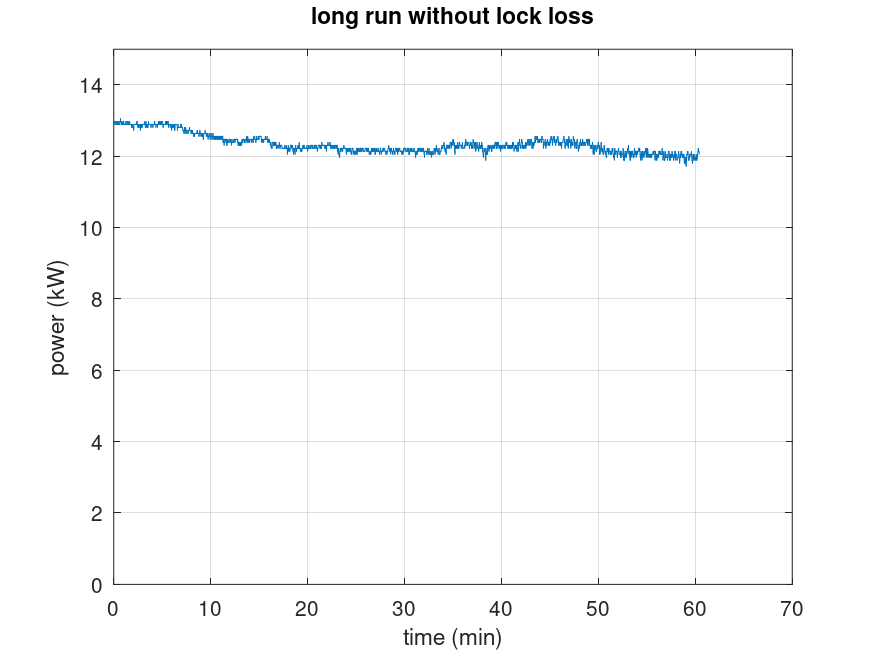
then, I went to 13kW in the FPC by tuning the CEP.
- I did the same alignement optimisation than for high power to remove possible coupling to high order modes in the error signal
- I tuned the power in the FPC by changing the CEP => the equivalent LW of the cavity will be different => I got ~ 13kW
- I changed the diffuser position on axis 18 to -23079
- I tuned the PID parameters :
initial => final
P = 0.055 => 0.1
I = 0.0005 => 0.002
D = 0.6 => 1
I started to record a long trend of the FPC power => see attached picture
I still observed the ~20Hz noise and sometime some high frequency noise, but not at a level which prevents the locking system to work.
CONCLUSION :
at this power and with a larger LW (CEP is not optimized), the FPC seems much more stable without any lock loss during 1h !
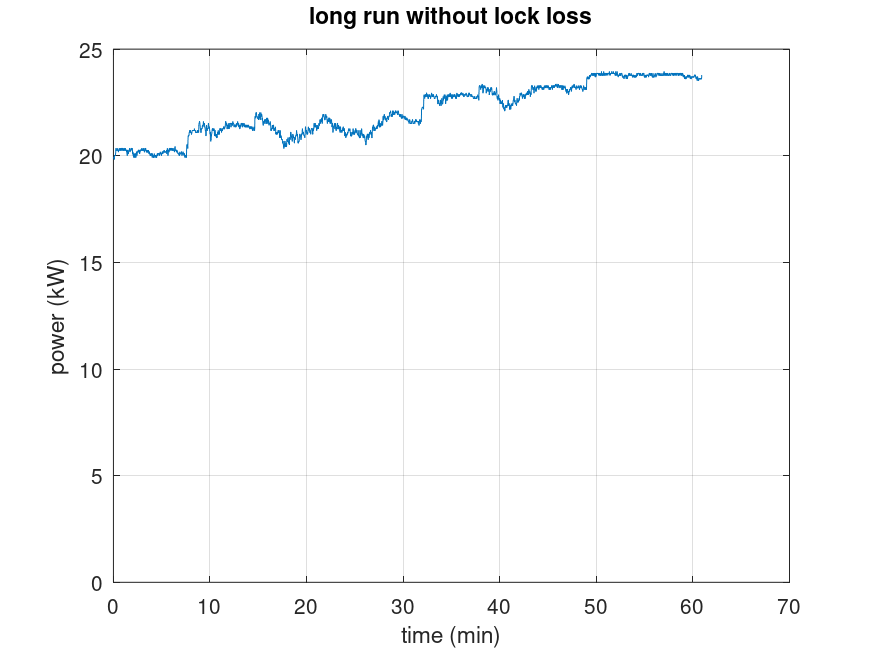
2) then I will do a test by decreasing the Alphanov amplifier ratio to work at a lower input power but with an optimized CEP.
Now, I optimized the CEP and alignment and reduce the Alphanov amplifier ratio to 15% => 24kW power in the FPC.
on CH2, I got 60mV (when I got 250mV when I'm at 97kW in the FPC) => ratio ~ 4.2 => 97kW / 4,2 ~ 23 kW
I checked that the PID parameters are not over-valuated which can produce a power reduction and the CEP is optimum as well as the alignment.
Axis 18 position : -13188
PID parameters (P = 0.1 / I = 0.002 / D = 1.5)
I started to record a long trend of the FPC power => cf 2nd trend with gradually increasing of the power because of the drift of the CEP + feedback adjustments.
CONCLUSION :
at this power and with nominal LW (CEP is optimized), the FPC seems much more stable without any lock loss during 1h !
3) I found a stable position for FPC around 46kW
I used the recepie for 46kW => after some time, I observed a lot of high frequency noise which induces some lock loss.
| Ronic Chiche wrote: |
|
list of possible causes of the high frequency noise which makes the system loosing the lock => to be checked.
(if you have some new idea, I will edit the post)
1- Laser
1.1- vibrations on the laser box coming from the optical table / housing
1.2- vibrations coming from the Smaract translation stages (Frep or CEP) inside the laser box
1.3- pressure noise coming from the weather (the laser cavity is sealed) on the laser box
2- Amplifier
2.1- vibrations coming from the fans in the controler crate
2.2- vibrations coming from the chiller (water cooling cavitation)
3- Beam propagation
3.1- vibration noise coming from the housing / the table
3.2- vibration noise coming from the motors of the injection mirrors
4- Fabry-Perot cavity
4.1- pressure noise on the cavity vessels coming from the weather/air cooling
4.2- vibrations coming from the rust on the mechanics
4.3- vibrations of the mirror mounts due to temperature related to cavity power
4.4- vibrations coming from the electron ring mechanics
4.5- "vacuum" index variation coming from local ionization due to the electron beam
5- Feedback system / Electronics / CEM
5.1- CEM votage noise on the laser or FPC PZT's
|
|
| Attachment 1: long_run_wihtout_lock_loss.png
|  |
| Attachment 2: long_run_wihtout_lock_loss_with_optimum_CEP.png
|  |
|
428
|
Wed Jun 25 09:43:36 2025 |
Ronic Chiche | Fixed | info | lasers and optics | ThomX igloo | New power record in ThomX cavity | yesterday, we were able to store more than 98kW in the FP cavity, always with the same parameter : 33% laser amplifier ratio
| Ronic Chiche wrote: |
|
today, we were able to store more than 97kW in the FP cavity, always with the same parameter : 33% laser amplifier ratio
| Ronic Chiche wrote: |
|
today, we were able to store more than 95kW in the FP cavity, always with the same parameter : 33% laser amplifier ratio
| Ronic Chiche wrote: |
|
today, we were able to store more than 94kW in the FP cavity, always with the same parameter : 33% laser amplifier ratio
| Ronic Chiche wrote: |
|
today, we were able to store more than 93kW in the FP cavity, always with the same parameter : 33% laser amplifier ratio
|
|
|
|
|
| Attachment 1: img1(3).jpg
| .jpg "img1(3).jpg") |
|
427
|
Wed Jun 11 18:59:34 2025 |
Ronic Chiche | Under Process | issue | mechanics | lasers and optics | vacuum | detectors and electronics | ThomX igloo | Possible causes for the noise in the FP-cavity system | list of possible causes of the high frequency noise which makes the system loosing the lock => to be checked.
(if you have some new idea, I will edit the post)
1- Laser
1.1- vibrations on the laser box coming from the optical table / housing
1.2- vibrations coming from the Smaract translation stages (Frep or CEP) inside the laser box
1.3- pressure noise coming from the weather (the laser cavity is sealed) on the laser box
2- Amplifier
2.1- vibrations coming from the fans in the controler crate
2.2- vibrations coming from the chiller (water cooling cavitation)
3- Beam propagation
3.1- vibration noise coming from the housing / the table
3.2- vibration noise coming from the motors of the injection mirrors
4- Fabry-Perot cavity
4.1- pressure noise on the cavity vessels coming from the weather/air cooling
4.2- vibrations coming from the rust on the mechanics
4.3- vibrations of the mirror mounts due to temperature related to cavity power
4.4- vibrations coming from the electron ring mechanics
4.5- "vacuum" index variation coming from local ionization due to the electron beam
4.6- vibrations coming from the far position (related to the middle range) of some mounts and due to the spring of the translations stage.
5- Feedback system / Electronics / CEM
5.1- CEM votage noise on the laser or FPC PZT's
|
|
426
|
Wed Jun 11 11:35:22 2025 |
Ronic Chiche | Fixed | info | lasers and optics | detectors and electronics | software | ThomX igloo | 33MHz phase adjustment | the 33MHz beating signal (phase) is used to start and stop automatically the lock on the 500MHz beating signal.
this 33MHz beating phase has a fixed range (typically +/-0.5V), so it is important to center this beating phase in the middle of its own range when the 500MHz signal is locked
=> tune the 33MHz phase in order to get ~ 0V on 33MHz beating signal when the 500MHz locking is ON.
this can be done by using the python script "Write_Phase_Rigol_33MHz located in the path /tmp_mnt/data/shared/commissioning_scripts/common
|
|
425
|
Wed May 14 09:50:52 2025 |
Ronic Chiche | Under Process | report | mechanics | lasers and optics | detectors and electronics | ThomX igloo | day by day run for X-ray production | Today, I removed the NKT oscillator from the bunker to put it in the PLIC room.
I locked the FP cavity and obtained 97kW with 33% amplifier ratio, without any alignment, just by changing a little bit the CEP.
| Ronic Chiche wrote: |
|
today, after 1 week of vacation, I was able to easily lock the cavity with 92kW with 33% amp ratio without too much optimizations (no walking alignment).
could it be related to the nice weather we got during this week ?
as in the past we observed more noise when the weather was changing and we had very difficult locking procedure after a simple weekend...
| Ronic Chiche wrote: |
|
today, the alignment of FP cavity was so bad that I tuned the 01 mode by error (CEP and alignment)... insead of the 00 mode !!!
I was able to reach ~30kW and was limited at this value, so I used the camera to check what was happening and saw the 01 mode.
so, I moved the lock on a 00 mode and redid a full tuning (CEP and alignment).
I got ~93kW => ok
| Ronic Chiche wrote: |
|
this morning, the cavity was pretty misaligned => basic alignment in y direction helps a lot => 93kW for 33% amp ratio.
the Rigol 33MHz generator phase was adjusted : phase ch2 = phase ch1 (40 deg) + 36 deg = 76 deg.
| Ronic Chiche wrote: |
|
this morning, I restarted the lock of the CFP after almost 2 weeks without operation.
after quick alignment and CEP tuning, I got 88kW for 33% ratio for the laser amplifier.
the FPC seems pretty far from the RF frequency (2.8kHz @ 33MHz) but it's possible the present RF frequency has been tuned for 61.5 or 70MeV (the present FPC length is tuned for 50MeV).
Jean-Noel had to reinject some SF6 gas in the section pipe => it immediately produces some lock losses during the whole filling process and even several minutes after he finishes.
this is an interesting correlation with the vibrations from the beam pipe => one needs to install the accelerometer to check the behavior.
but the lock losses were not related to "high frequency" or "20Hz oscillations" noises which are the 2 main processes for lock losses, it was just like some "cuts" in the signals.
I finally got 90kW in the FPC for 33% ratio for the laser amplifier after walking alignment procedure.
| Ronic Chiche wrote: |
|
today we did x-rays => we got 41 000 pA at maximum and 90kW in the FPC for 33% amplifier ratio.
finally, I changed the strategy for the feeback on RF.
i removed the integration and derivative parameters and reduced the gain parameter :
P=0.25 / I=D=0 => it seems to be more stable => less low frequency oscillations becoming larger and larger during a perturbation.
| Ronic Chiche wrote: |
|
this morning, I restarted the cavity after the Christmas shutdown.
everything went fine.
I got ~ 86kW for 33% laser amplifier ratio after optimization of the CEP and alignment with walking procedure.
IcePap controllers are OK and the displacements (MOT.03 and MOT.06) let the CFP locked.
I locked also on the RF frequency (I tuned the laser and CFP cavity length) => +4.1ns (C2-C4) between the 10Hz trig (C2) and the 33MHz laser signal (C4)
I observed that the search & relock range on the regulator B plays an important role on the RF locking stability.
so, I increased the previous range +/-0.25V to +/-0.5V.
we have always the 20Hz noise which can be increasing some time but the lock seems more robust.
| Ronic Chiche wrote: |
|
this morning, Kevin reduced the steering current in the IcePap controllers of the FP cavity motors.
the motor MOT.06 was producing a pattern in the Transmission signal when it was moved and doing a lock loss very often.
so, we changed its current from 0.8A to 0.4A and it fixes the problem => no more systematic lock loss.
so, we changed also the MOT.03 steering current from 0.8A to 0.7A.
on this motor, we have also a false warning about the Low limit switch which seems to be activated (strange because, we are always using it in the positive direction)
Kevin reverted the logic to remove the message.
we obtained 91kW in the FPC for 33% amplifier ratio after CEP and alignment tuning.
we did synchronized xray production with a relative delay between laser 33MHz and trigger (CH2-CH4) of +4 ns
| Ronic Chiche wrote: |
|
major result of the day: X-ray vertical scan by moving the hexapod
abscise : hexapod position
ordinate : xray flux in asynchronous condition
red curve : continuous injection at 10Hz (the scan lasts for ~5 minutes)
green curve : one single injection (the beam is not extracted).
blue curve : one single injection, ~ 10-15 minutes later
| Ronic Chiche wrote: |
|
This morning, I added an amplifier on the 33MHz beating signal in between the mixer+LPF and the scope/Laselock.
it seems to improve the robustness of the RF/FPC lock.
because of this gain, I increased the upper and lower thresholds on the search criterion of the RF/FPC lock from +/-50mV to +250mV/-200mV
=> see the picture of the Laselock parameters.
the optimum phase for X-ray production is roughly +3.6ns between C2 (machine trigger) and C4 (33MHz laser signal).
we have to use the machine at 70MeV with a new frequency at 500.0325MHz / 33.3355MHz.
=> we need to move the FPC tomorrow by roughly 60kHz @ 500MHz.
| Ronic Chiche wrote: |
|
last thing we tried :
we removed the threshold on the FPC/RF error signal.
=> we cannot choose automatically the RF bucket anymore (we need to manually let the phase drift slowly and start the lock at the right moment).
=> but the FPC/RF lock seems more robust.
in that case, we have 2 different sources of lock losses:
- the ones dues to the laser or CFP motors move.
even at low speed or in "piezo scan" mode, one observes too fast mouvement that are not properly compensated and involving some phase shift.
- the ones not related to any action.
=> the 20Hz signal seems to increase until it makes the system losing the lock
| Ronic Chiche wrote: |
|
we observed that :
- the MOT.03 motor always exhibits some perturbations on the transmitted, reflected and PZT signals (see picture) in contrary to the MOT.06 motor.
does the differences come from the motor relative positions (-900 000 steps for MOT.06 and -100 000 steps for MOT.03) or from the controller configuration ?
- the stability limits (oscillations arise) of the PID for the RF/CFP locks are P = 1 / I = 0.0001 / D = 5
then we put the new PID parameters : P = 0.25 / I = 0.000025 / D = 1
- the 20Hz oscillations are stil arising from time to time
- the lock laser/CFP is pretty robust, one observes more RF/CFP lock losses.
- we removed the 250Hz filter on the RF/CFP error signal to increase the feedback BW but we didn't see a any improvement
- at 5pm, the laser/CFP lock seems as stable as in the morning, then we don't see any change in stability during time.
we loggued CFP power measurement and signals from the cavity (~ 1GB of data)
| Ronic Chiche wrote: |
|
today with Alice, we planned to do a long run with ~80kW in the FPC to check if the lock problems are coming from the interaction with the machine or not.
the goal is to check this assumption on a full day comparable with a day of X-ray production.
we started the amplifier at 10am.
during a move of MaY (injection mirrors of the FPC), we observed a sudden total loss of resonances...
the reason was an abnormal displacement of the motor despite the fact the measured position was reasonable.
we already observed an issue like that....
to fix the problem, one just had to move back MaY.
the cavity started to be locked at 11:15am
the RF frequency has been changed to 500.09595MHz equivalent to 33.33973MHz
but we don't have a beating signal @ 500MHz => one will ask to Vincent to fix the issue.
laser motor CH0 : 1.503453 mm
laser moror CH2 : - 50µm
~ 83kW at 12:30pm
| Ronic Chiche wrote: |
|
at the begining of the day, we started to get ~81kW in the FPC for 33% amplifier ratio and after ~1h, we got 84kW after CEP and alignment tuning.
at the end of the day, we got 89kW without walking alignment.
we tried to improve a bit the robustness of the FPC and RF locks:
see the capture for the new locking parameters.
| Ronic Chiche wrote: |
|
the RF frequency changed from 500.1003MHz to 500.0913MHz => it reduced by 9kHz @ 500MHz which is equivalent to 600Hz @ 33MHz (we measured 500Hz @ 33MHz). the electron orbit length increased, so we have to increase the cavities length => increase motor values by ~ 68µm.
for the laser cavity : 1.496 560 mm => 1.564 560 mm
the initial values for the motor of the FP cavity are : MOT.03=-130 000 steps and MOT.06=-900 000 steps.
68µm is roughly 11 000 steps (6nm/step) => MOT.03=-130 000 steps and MOT.06=-889 000 steps.
optimum CEP position : -210.8µm => -192µm
I got 80kW in the FP cavity after CEP and walking alignment
then, 82kW after waiting 3h.
then, 84kW after waiting 5h.
|
|
|
|
|
|
|
|
|
|
|
|
|
|
|
|
424
|
Tue May 6 10:58:18 2025 |
Ronic Chiche | Under Process | report | lasers and optics | ThomX igloo | air conditionning in ThomX Bunker | I finally got 93-94kW for 33% amp ratio.
I had to move the FP-cavity length to compensate the temperature change in the bunker.
doing that, I had the message "Low Limit SW pressed" when I tried to move P4z under -98 000 steps !!!
=> so, maybe this number is not the correct steps number and we are much closer to the end than we could expect.
=> could it be the reason for the 20Hz noise related to the too strong springs, as we already observed before ?
in the meantime, I changed the use of the P1z and P4z motors to not face the situation again.
so, P4z will be used to move to higher steps (even if its apparent position seems higher than P1z).
and P1z will be used to move to lower steps.
surprinsingly, the CEP position was almost already optimized...
| Ronic Chiche wrote: |
|
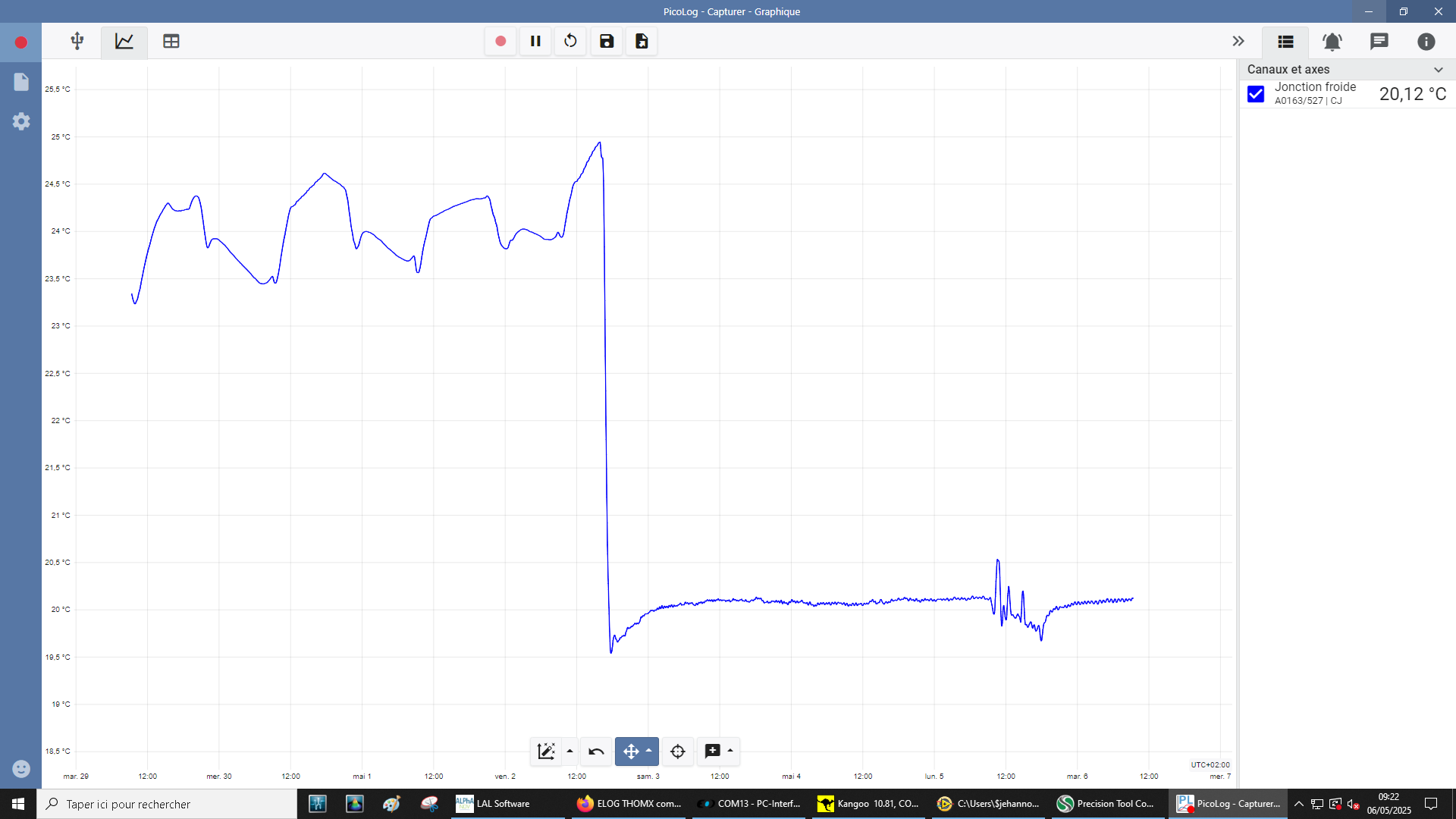
after the new temperature setting for the bunker air cooling (winter to summer transition), the temperature drop from 24° to 20°C which induced a slight misalignment between the onefive oscillator and the fiber injection.
the amplifier photodiode PD_IN which checks the amplifier power injection drop also from 3mW to 2.885mW... hopefully, it is enough to start the amplifier without realignment.
but bad news, I don't see any transmission of the cavity... to be checked...
| Ronic Chiche wrote: |
|
The temperature slitly increase in thomx Bunker from 23° to 24° during the last day.
The thermalisation of the CFP is very long...
In any case the operation of the CFP is so easy, it seems to be correlated to the weather... tody it's very nice as of hte rest of the week.
The stored power is easily 94 KW and there is not jump or delock problems.
The temperature of the bunker continiusly increase and now we observe some delocking du to high frq perturbations... may be the twe things are correlated.
|
|
|
|
423
|
Tue May 6 09:29:43 2025 |
Ronic Chiche | Under Process | report | lasers and optics | ThomX igloo | air conditionning in ThomX Bunker | after the new temperature setting for the bunker air cooling (winter to summer transition), the temperature drop from 24° to 20°C which induced a slight misalignment between the onefive oscillator and the fiber injection.
the amplifier photodiode PD_IN which checks the amplifier power injection drop also from 3mW to 2.885mW... hopefully, it is enough to start the amplifier without realignment.
but bad news, I don't see any transmission of the cavity... to be checked...
| Ronic Chiche wrote: |
|
The temperature slitly increase in thomx Bunker from 23° to 24° during the last day.
The thermalisation of the CFP is very long...
In any case the operation of the CFP is so easy, it seems to be correlated to the weather... tody it's very nice as of hte rest of the week.
The stored power is easily 94 KW and there is not jump or delock problems.
The temperature of the bunker continiusly increase and now we observe some delocking du to high frq perturbations... may be the twe things are correlated.
|
|
| Attachment 1: Sans_titre.png
|  |
|
422
|
Fri May 2 10:05:43 2025 |
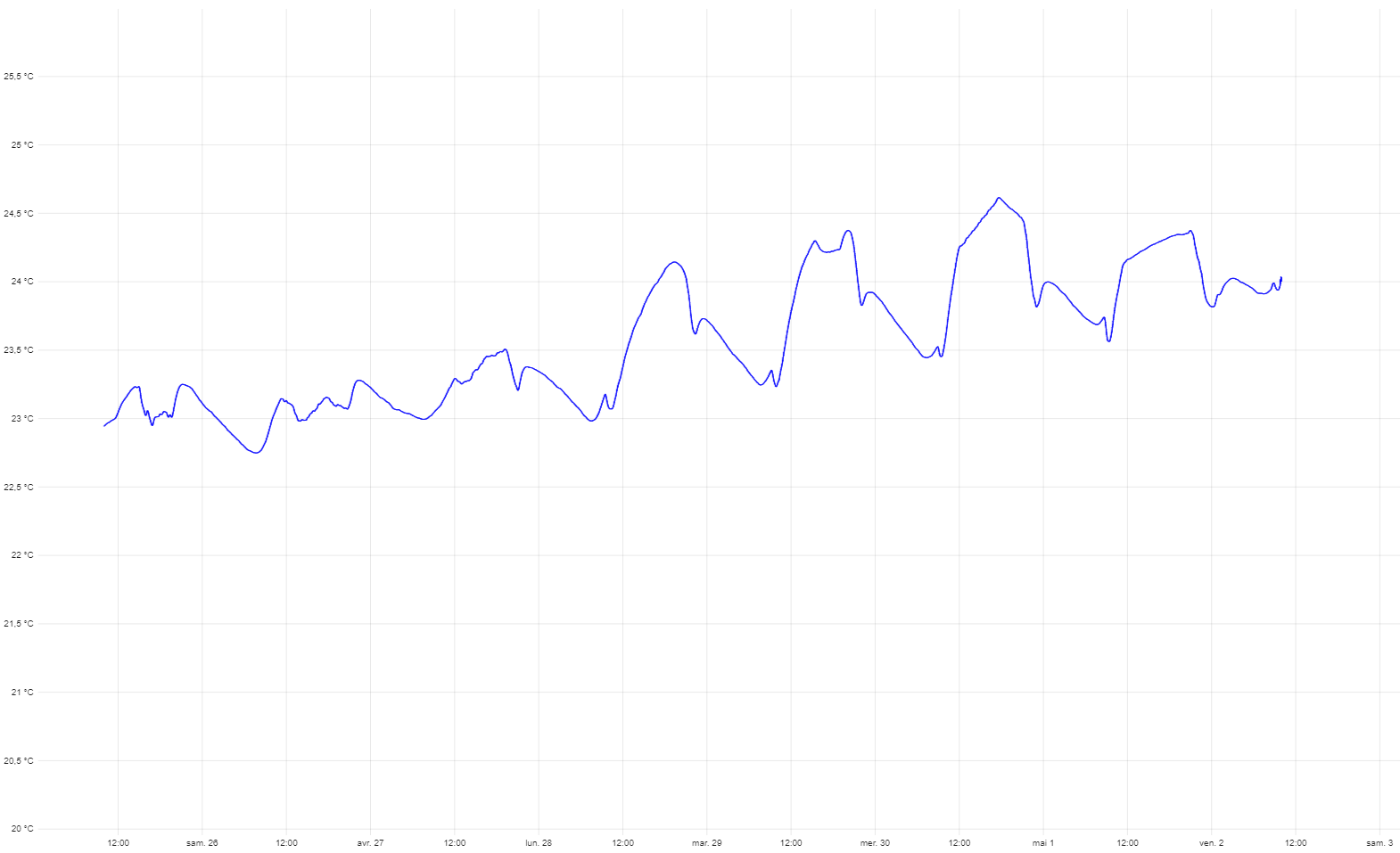
Ronic Chiche | Under Process | report | lasers and optics | ThomX igloo | air conditionning in ThomX Bunker | The temperature slitly increase in thomx Bunker from 23° to 24° during the last day.
The thermalisation of the CFP is very long...
In any case the operation of the CFP is so easy, it seems to be correlated to the weather... tody it's very nice as of hte rest of the week.
The stored power is easily 94 KW and there is not jump or delock problems.
The temperature of the bunker continiusly increase and now we observe some delocking du to high frq perturbations... may be the twe things are correlated. |
| Attachment 1: temp.png
|  |
|
421
|
Tue Apr 29 09:26:08 2025 |
Ronic Chiche | Under Process | report | mechanics | lasers and optics | detectors and electronics | ThomX igloo | day by day run for X-ray production | today, after 1 week of vacation, I was able to easily lock the cavity with 92kW with 33% amp ratio without too much optimizations (no walking alignment).
could it be related to the nice weather we got during this week ?
as in the past we observed more noise when the weather was changing and we had very difficult locking procedure after a simple weekend...
| Ronic Chiche wrote: |
|
today, the alignment of FP cavity was so bad that I tuned the 01 mode by error (CEP and alignment)... insead of the 00 mode !!!
I was able to reach ~30kW and was limited at this value, so I used the camera to check what was happening and saw the 01 mode.
so, I moved the lock on a 00 mode and redid a full tuning (CEP and alignment).
I got ~93kW => ok
| Ronic Chiche wrote: |
|
this morning, the cavity was pretty misaligned => basic alignment in y direction helps a lot => 93kW for 33% amp ratio.
the Rigol 33MHz generator phase was adjusted : phase ch2 = phase ch1 (40 deg) + 36 deg = 76 deg.
| Ronic Chiche wrote: |
|
this morning, I restarted the lock of the CFP after almost 2 weeks without operation.
after quick alignment and CEP tuning, I got 88kW for 33% ratio for the laser amplifier.
the FPC seems pretty far from the RF frequency (2.8kHz @ 33MHz) but it's possible the present RF frequency has been tuned for 61.5 or 70MeV (the present FPC length is tuned for 50MeV).
Jean-Noel had to reinject some SF6 gas in the section pipe => it immediately produces some lock losses during the whole filling process and even several minutes after he finishes.
this is an interesting correlation with the vibrations from the beam pipe => one needs to install the accelerometer to check the behavior.
but the lock losses were not related to "high frequency" or "20Hz oscillations" noises which are the 2 main processes for lock losses, it was just like some "cuts" in the signals.
I finally got 90kW in the FPC for 33% ratio for the laser amplifier after walking alignment procedure.
| Ronic Chiche wrote: |
|
today we did x-rays => we got 41 000 pA at maximum and 90kW in the FPC for 33% amplifier ratio.
finally, I changed the strategy for the feeback on RF.
i removed the integration and derivative parameters and reduced the gain parameter :
P=0.25 / I=D=0 => it seems to be more stable => less low frequency oscillations becoming larger and larger during a perturbation.
| Ronic Chiche wrote: |
|
this morning, I restarted the cavity after the Christmas shutdown.
everything went fine.
I got ~ 86kW for 33% laser amplifier ratio after optimization of the CEP and alignment with walking procedure.
IcePap controllers are OK and the displacements (MOT.03 and MOT.06) let the CFP locked.
I locked also on the RF frequency (I tuned the laser and CFP cavity length) => +4.1ns (C2-C4) between the 10Hz trig (C2) and the 33MHz laser signal (C4)
I observed that the search & relock range on the regulator B plays an important role on the RF locking stability.
so, I increased the previous range +/-0.25V to +/-0.5V.
we have always the 20Hz noise which can be increasing some time but the lock seems more robust.
| Ronic Chiche wrote: |
|
this morning, Kevin reduced the steering current in the IcePap controllers of the FP cavity motors.
the motor MOT.06 was producing a pattern in the Transmission signal when it was moved and doing a lock loss very often.
so, we changed its current from 0.8A to 0.4A and it fixes the problem => no more systematic lock loss.
so, we changed also the MOT.03 steering current from 0.8A to 0.7A.
on this motor, we have also a false warning about the Low limit switch which seems to be activated (strange because, we are always using it in the positive direction)
Kevin reverted the logic to remove the message.
we obtained 91kW in the FPC for 33% amplifier ratio after CEP and alignment tuning.
we did synchronized xray production with a relative delay between laser 33MHz and trigger (CH2-CH4) of +4 ns
| Ronic Chiche wrote: |
|
major result of the day: X-ray vertical scan by moving the hexapod
abscise : hexapod position
ordinate : xray flux in asynchronous condition
red curve : continuous injection at 10Hz (the scan lasts for ~5 minutes)
green curve : one single injection (the beam is not extracted).
blue curve : one single injection, ~ 10-15 minutes later
| Ronic Chiche wrote: |
|
This morning, I added an amplifier on the 33MHz beating signal in between the mixer+LPF and the scope/Laselock.
it seems to improve the robustness of the RF/FPC lock.
because of this gain, I increased the upper and lower thresholds on the search criterion of the RF/FPC lock from +/-50mV to +250mV/-200mV
=> see the picture of the Laselock parameters.
the optimum phase for X-ray production is roughly +3.6ns between C2 (machine trigger) and C4 (33MHz laser signal).
we have to use the machine at 70MeV with a new frequency at 500.0325MHz / 33.3355MHz.
=> we need to move the FPC tomorrow by roughly 60kHz @ 500MHz.
| Ronic Chiche wrote: |
|
last thing we tried :
we removed the threshold on the FPC/RF error signal.
=> we cannot choose automatically the RF bucket anymore (we need to manually let the phase drift slowly and start the lock at the right moment).
=> but the FPC/RF lock seems more robust.
in that case, we have 2 different sources of lock losses:
- the ones dues to the laser or CFP motors move.
even at low speed or in "piezo scan" mode, one observes too fast mouvement that are not properly compensated and involving some phase shift.
- the ones not related to any action.
=> the 20Hz signal seems to increase until it makes the system losing the lock
| Ronic Chiche wrote: |
|
we observed that :
- the MOT.03 motor always exhibits some perturbations on the transmitted, reflected and PZT signals (see picture) in contrary to the MOT.06 motor.
does the differences come from the motor relative positions (-900 000 steps for MOT.06 and -100 000 steps for MOT.03) or from the controller configuration ?
- the stability limits (oscillations arise) of the PID for the RF/CFP locks are P = 1 / I = 0.0001 / D = 5
then we put the new PID parameters : P = 0.25 / I = 0.000025 / D = 1
- the 20Hz oscillations are stil arising from time to time
- the lock laser/CFP is pretty robust, one observes more RF/CFP lock losses.
- we removed the 250Hz filter on the RF/CFP error signal to increase the feedback BW but we didn't see a any improvement
- at 5pm, the laser/CFP lock seems as stable as in the morning, then we don't see any change in stability during time.
we loggued CFP power measurement and signals from the cavity (~ 1GB of data)
| Ronic Chiche wrote: |
|
today with Alice, we planned to do a long run with ~80kW in the FPC to check if the lock problems are coming from the interaction with the machine or not.
the goal is to check this assumption on a full day comparable with a day of X-ray production.
we started the amplifier at 10am.
during a move of MaY (injection mirrors of the FPC), we observed a sudden total loss of resonances...
the reason was an abnormal displacement of the motor despite the fact the measured position was reasonable.
we already observed an issue like that....
to fix the problem, one just had to move back MaY.
the cavity started to be locked at 11:15am
the RF frequency has been changed to 500.09595MHz equivalent to 33.33973MHz
but we don't have a beating signal @ 500MHz => one will ask to Vincent to fix the issue.
laser motor CH0 : 1.503453 mm
laser moror CH2 : - 50µm
~ 83kW at 12:30pm
| Ronic Chiche wrote: |
|
at the begining of the day, we started to get ~81kW in the FPC for 33% amplifier ratio and after ~1h, we got 84kW after CEP and alignment tuning.
at the end of the day, we got 89kW without walking alignment.
we tried to improve a bit the robustness of the FPC and RF locks:
see the capture for the new locking parameters.
| Ronic Chiche wrote: |
|
the RF frequency changed from 500.1003MHz to 500.0913MHz => it reduced by 9kHz @ 500MHz which is equivalent to 600Hz @ 33MHz (we measured 500Hz @ 33MHz). the electron orbit length increased, so we have to increase the cavities length => increase motor values by ~ 68µm.
for the laser cavity : 1.496 560 mm => 1.564 560 mm
the initial values for the motor of the FP cavity are : MOT.03=-130 000 steps and MOT.06=-900 000 steps.
68µm is roughly 11 000 steps (6nm/step) => MOT.03=-130 000 steps and MOT.06=-889 000 steps.
optimum CEP position : -210.8µm => -192µm
I got 80kW in the FP cavity after CEP and walking alignment
then, 82kW after waiting 3h.
then, 84kW after waiting 5h.
|
|
|
|
|
|
|
|
|
|
|
|
|
|
|
420
|
Mon Mar 31 18:19:30 2025 |
Ronic Chiche | Fixed | info | lasers and optics | ThomX igloo | New power record in ThomX cavity | today, we were able to store more than 97kW in the FP cavity, always with the same parameter : 33% laser amplifier ratio
| Ronic Chiche wrote: |
|
today, we were able to store more than 95kW in the FP cavity, always with the same parameter : 33% laser amplifier ratio
| Ronic Chiche wrote: |
|
today, we were able to store more than 94kW in the FP cavity, always with the same parameter : 33% laser amplifier ratio
| Ronic Chiche wrote: |
|
today, we were able to store more than 93kW in the FP cavity, always with the same parameter : 33% laser amplifier ratio
|
|
|
|
| Attachment 1: 20250331_181029.jpg
| 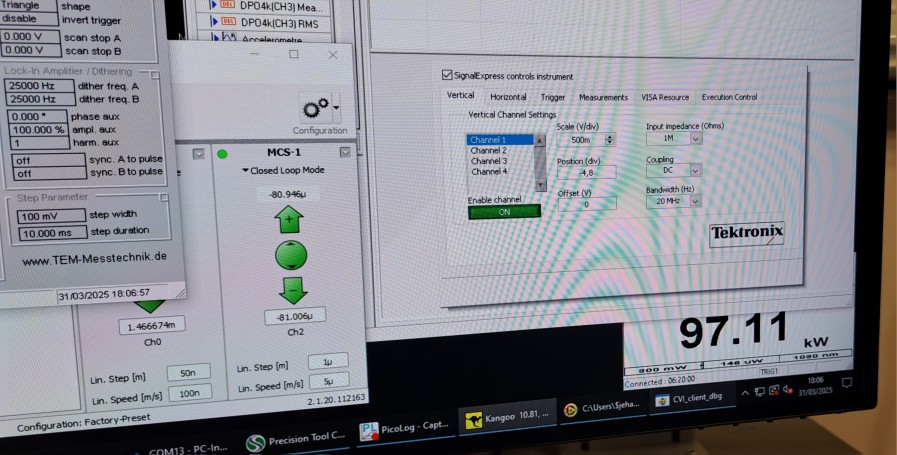 |
|
419
|
Mon Mar 31 17:12:56 2025 |
Ronic Chiche | Under Process | report | mechanics | lasers and optics | detectors and electronics | ThomX igloo | day by day run for X-ray production | today, the alignment of FP cavity was so bad that I tuned the 01 mode by error (CEP and alignment)... insead of the 00 mode !!!
I was able to reach ~30kW and was limited at this value, so I used the camera to check what was happening and saw the 01 mode.
so, I moved the lock on a 00 mode and redid a full tuning (CEP and alignment).
I got ~93kW => ok
| Ronic Chiche wrote: |
|
this morning, the cavity was pretty misaligned => basic alignment in y direction helps a lot => 93kW for 33% amp ratio.
the Rigol 33MHz generator phase was adjusted : phase ch2 = phase ch1 (40 deg) + 36 deg = 76 deg.
| Ronic Chiche wrote: |
|
this morning, I restarted the lock of the CFP after almost 2 weeks without operation.
after quick alignment and CEP tuning, I got 88kW for 33% ratio for the laser amplifier.
the FPC seems pretty far from the RF frequency (2.8kHz @ 33MHz) but it's possible the present RF frequency has been tuned for 61.5 or 70MeV (the present FPC length is tuned for 50MeV).
Jean-Noel had to reinject some SF6 gas in the section pipe => it immediately produces some lock losses during the whole filling process and even several minutes after he finishes.
this is an interesting correlation with the vibrations from the beam pipe => one needs to install the accelerometer to check the behavior.
but the lock losses were not related to "high frequency" or "20Hz oscillations" noises which are the 2 main processes for lock losses, it was just like some "cuts" in the signals.
I finally got 90kW in the FPC for 33% ratio for the laser amplifier after walking alignment procedure.
| Ronic Chiche wrote: |
|
today we did x-rays => we got 41 000 pA at maximum and 90kW in the FPC for 33% amplifier ratio.
finally, I changed the strategy for the feeback on RF.
i removed the integration and derivative parameters and reduced the gain parameter :
P=0.25 / I=D=0 => it seems to be more stable => less low frequency oscillations becoming larger and larger during a perturbation.
| Ronic Chiche wrote: |
|
this morning, I restarted the cavity after the Christmas shutdown.
everything went fine.
I got ~ 86kW for 33% laser amplifier ratio after optimization of the CEP and alignment with walking procedure.
IcePap controllers are OK and the displacements (MOT.03 and MOT.06) let the CFP locked.
I locked also on the RF frequency (I tuned the laser and CFP cavity length) => +4.1ns (C2-C4) between the 10Hz trig (C2) and the 33MHz laser signal (C4)
I observed that the search & relock range on the regulator B plays an important role on the RF locking stability.
so, I increased the previous range +/-0.25V to +/-0.5V.
we have always the 20Hz noise which can be increasing some time but the lock seems more robust.
| Ronic Chiche wrote: |
|
this morning, Kevin reduced the steering current in the IcePap controllers of the FP cavity motors.
the motor MOT.06 was producing a pattern in the Transmission signal when it was moved and doing a lock loss very often.
so, we changed its current from 0.8A to 0.4A and it fixes the problem => no more systematic lock loss.
so, we changed also the MOT.03 steering current from 0.8A to 0.7A.
on this motor, we have also a false warning about the Low limit switch which seems to be activated (strange because, we are always using it in the positive direction)
Kevin reverted the logic to remove the message.
we obtained 91kW in the FPC for 33% amplifier ratio after CEP and alignment tuning.
we did synchronized xray production with a relative delay between laser 33MHz and trigger (CH2-CH4) of +4 ns
| Ronic Chiche wrote: |
|
major result of the day: X-ray vertical scan by moving the hexapod
abscise : hexapod position
ordinate : xray flux in asynchronous condition
red curve : continuous injection at 10Hz (the scan lasts for ~5 minutes)
green curve : one single injection (the beam is not extracted).
blue curve : one single injection, ~ 10-15 minutes later
| Ronic Chiche wrote: |
|
This morning, I added an amplifier on the 33MHz beating signal in between the mixer+LPF and the scope/Laselock.
it seems to improve the robustness of the RF/FPC lock.
because of this gain, I increased the upper and lower thresholds on the search criterion of the RF/FPC lock from +/-50mV to +250mV/-200mV
=> see the picture of the Laselock parameters.
the optimum phase for X-ray production is roughly +3.6ns between C2 (machine trigger) and C4 (33MHz laser signal).
we have to use the machine at 70MeV with a new frequency at 500.0325MHz / 33.3355MHz.
=> we need to move the FPC tomorrow by roughly 60kHz @ 500MHz.
| Ronic Chiche wrote: |
|
last thing we tried :
we removed the threshold on the FPC/RF error signal.
=> we cannot choose automatically the RF bucket anymore (we need to manually let the phase drift slowly and start the lock at the right moment).
=> but the FPC/RF lock seems more robust.
in that case, we have 2 different sources of lock losses:
- the ones dues to the laser or CFP motors move.
even at low speed or in "piezo scan" mode, one observes too fast mouvement that are not properly compensated and involving some phase shift.
- the ones not related to any action.
=> the 20Hz signal seems to increase until it makes the system losing the lock
| Ronic Chiche wrote: |
|
we observed that :
- the MOT.03 motor always exhibits some perturbations on the transmitted, reflected and PZT signals (see picture) in contrary to the MOT.06 motor.
does the differences come from the motor relative positions (-900 000 steps for MOT.06 and -100 000 steps for MOT.03) or from the controller configuration ?
- the stability limits (oscillations arise) of the PID for the RF/CFP locks are P = 1 / I = 0.0001 / D = 5
then we put the new PID parameters : P = 0.25 / I = 0.000025 / D = 1
- the 20Hz oscillations are stil arising from time to time
- the lock laser/CFP is pretty robust, one observes more RF/CFP lock losses.
- we removed the 250Hz filter on the RF/CFP error signal to increase the feedback BW but we didn't see a any improvement
- at 5pm, the laser/CFP lock seems as stable as in the morning, then we don't see any change in stability during time.
we loggued CFP power measurement and signals from the cavity (~ 1GB of data)
| Ronic Chiche wrote: |
|
today with Alice, we planned to do a long run with ~80kW in the FPC to check if the lock problems are coming from the interaction with the machine or not.
the goal is to check this assumption on a full day comparable with a day of X-ray production.
we started the amplifier at 10am.
during a move of MaY (injection mirrors of the FPC), we observed a sudden total loss of resonances...
the reason was an abnormal displacement of the motor despite the fact the measured position was reasonable.
we already observed an issue like that....
to fix the problem, one just had to move back MaY.
the cavity started to be locked at 11:15am
the RF frequency has been changed to 500.09595MHz equivalent to 33.33973MHz
but we don't have a beating signal @ 500MHz => one will ask to Vincent to fix the issue.
laser motor CH0 : 1.503453 mm
laser moror CH2 : - 50µm
~ 83kW at 12:30pm
| Ronic Chiche wrote: |
|
at the begining of the day, we started to get ~81kW in the FPC for 33% amplifier ratio and after ~1h, we got 84kW after CEP and alignment tuning.
at the end of the day, we got 89kW without walking alignment.
we tried to improve a bit the robustness of the FPC and RF locks:
see the capture for the new locking parameters.
| Ronic Chiche wrote: |
|
the RF frequency changed from 500.1003MHz to 500.0913MHz => it reduced by 9kHz @ 500MHz which is equivalent to 600Hz @ 33MHz (we measured 500Hz @ 33MHz). the electron orbit length increased, so we have to increase the cavities length => increase motor values by ~ 68µm.
for the laser cavity : 1.496 560 mm => 1.564 560 mm
the initial values for the motor of the FP cavity are : MOT.03=-130 000 steps and MOT.06=-900 000 steps.
68µm is roughly 11 000 steps (6nm/step) => MOT.03=-130 000 steps and MOT.06=-889 000 steps.
optimum CEP position : -210.8µm => -192µm
I got 80kW in the FP cavity after CEP and walking alignment
then, 82kW after waiting 3h.
then, 84kW after waiting 5h.
|
|
|
|
|
|
|
|
|
|
|
|
|
|
418
|
Tue Mar 18 11:45:21 2025 |
Ronic Chiche | Fixed | info | lasers and optics | ThomX igloo | New power record in ThomX cavity | today, we were able to store more than 95kW in the FP cavity, always with the same parameter : 33% laser amplifier ratio
| Ronic Chiche wrote: |
|
today, we were able to store more than 94kW in the FP cavity, always with the same parameter : 33% laser amplifier ratio
| Ronic Chiche wrote: |
|
today, we were able to store more than 93kW in the FP cavity, always with the same parameter : 33% laser amplifier ratio
|
|
|
| Attachment 1: img1(2).jpg
| .jpg "img1(2).jpg") |
|
417
|
Tue Mar 18 11:25:07 2025 |
Ronic Chiche | Under Process | report | mechanics | lasers and optics | detectors and electronics | ThomX igloo | day by day run for X-ray production | this morning, the cavity was pretty misaligned => basic alignment in y direction helps a lot => 93kW for 33% amp ratio.
the Rigol 33MHz generator phase was adjusted : phase ch2 = phase ch1 (40 deg) + 36 deg = 76 deg.
| Ronic Chiche wrote: |
|
this morning, I restarted the lock of the CFP after almost 2 weeks without operation.
after quick alignment and CEP tuning, I got 88kW for 33% ratio for the laser amplifier.
the FPC seems pretty far from the RF frequency (2.8kHz @ 33MHz) but it's possible the present RF frequency has been tuned for 61.5 or 70MeV (the present FPC length is tuned for 50MeV).
Jean-Noel had to reinject some SF6 gas in the section pipe => it immediately produces some lock losses during the whole filling process and even several minutes after he finishes.
this is an interesting correlation with the vibrations from the beam pipe => one needs to install the accelerometer to check the behavior.
but the lock losses were not related to "high frequency" or "20Hz oscillations" noises which are the 2 main processes for lock losses, it was just like some "cuts" in the signals.
I finally got 90kW in the FPC for 33% ratio for the laser amplifier after walking alignment procedure.
| Ronic Chiche wrote: |
|
today we did x-rays => we got 41 000 pA at maximum and 90kW in the FPC for 33% amplifier ratio.
finally, I changed the strategy for the feeback on RF.
i removed the integration and derivative parameters and reduced the gain parameter :
P=0.25 / I=D=0 => it seems to be more stable => less low frequency oscillations becoming larger and larger during a perturbation.
| Ronic Chiche wrote: |
|
this morning, I restarted the cavity after the Christmas shutdown.
everything went fine.
I got ~ 86kW for 33% laser amplifier ratio after optimization of the CEP and alignment with walking procedure.
IcePap controllers are OK and the displacements (MOT.03 and MOT.06) let the CFP locked.
I locked also on the RF frequency (I tuned the laser and CFP cavity length) => +4.1ns (C2-C4) between the 10Hz trig (C2) and the 33MHz laser signal (C4)
I observed that the search & relock range on the regulator B plays an important role on the RF locking stability.
so, I increased the previous range +/-0.25V to +/-0.5V.
we have always the 20Hz noise which can be increasing some time but the lock seems more robust.
| Ronic Chiche wrote: |
|
this morning, Kevin reduced the steering current in the IcePap controllers of the FP cavity motors.
the motor MOT.06 was producing a pattern in the Transmission signal when it was moved and doing a lock loss very often.
so, we changed its current from 0.8A to 0.4A and it fixes the problem => no more systematic lock loss.
so, we changed also the MOT.03 steering current from 0.8A to 0.7A.
on this motor, we have also a false warning about the Low limit switch which seems to be activated (strange because, we are always using it in the positive direction)
Kevin reverted the logic to remove the message.
we obtained 91kW in the FPC for 33% amplifier ratio after CEP and alignment tuning.
we did synchronized xray production with a relative delay between laser 33MHz and trigger (CH2-CH4) of +4 ns
| Ronic Chiche wrote: |
|
major result of the day: X-ray vertical scan by moving the hexapod
abscise : hexapod position
ordinate : xray flux in asynchronous condition
red curve : continuous injection at 10Hz (the scan lasts for ~5 minutes)
green curve : one single injection (the beam is not extracted).
blue curve : one single injection, ~ 10-15 minutes later
| Ronic Chiche wrote: |
|
This morning, I added an amplifier on the 33MHz beating signal in between the mixer+LPF and the scope/Laselock.
it seems to improve the robustness of the RF/FPC lock.
because of this gain, I increased the upper and lower thresholds on the search criterion of the RF/FPC lock from +/-50mV to +250mV/-200mV
=> see the picture of the Laselock parameters.
the optimum phase for X-ray production is roughly +3.6ns between C2 (machine trigger) and C4 (33MHz laser signal).
we have to use the machine at 70MeV with a new frequency at 500.0325MHz / 33.3355MHz.
=> we need to move the FPC tomorrow by roughly 60kHz @ 500MHz.
| Ronic Chiche wrote: |
|
last thing we tried :
we removed the threshold on the FPC/RF error signal.
=> we cannot choose automatically the RF bucket anymore (we need to manually let the phase drift slowly and start the lock at the right moment).
=> but the FPC/RF lock seems more robust.
in that case, we have 2 different sources of lock losses:
- the ones dues to the laser or CFP motors move.
even at low speed or in "piezo scan" mode, one observes too fast mouvement that are not properly compensated and involving some phase shift.
- the ones not related to any action.
=> the 20Hz signal seems to increase until it makes the system losing the lock
| Ronic Chiche wrote: |
|
we observed that :
- the MOT.03 motor always exhibits some perturbations on the transmitted, reflected and PZT signals (see picture) in contrary to the MOT.06 motor.
does the differences come from the motor relative positions (-900 000 steps for MOT.06 and -100 000 steps for MOT.03) or from the controller configuration ?
- the stability limits (oscillations arise) of the PID for the RF/CFP locks are P = 1 / I = 0.0001 / D = 5
then we put the new PID parameters : P = 0.25 / I = 0.000025 / D = 1
- the 20Hz oscillations are stil arising from time to time
- the lock laser/CFP is pretty robust, one observes more RF/CFP lock losses.
- we removed the 250Hz filter on the RF/CFP error signal to increase the feedback BW but we didn't see a any improvement
- at 5pm, the laser/CFP lock seems as stable as in the morning, then we don't see any change in stability during time.
we loggued CFP power measurement and signals from the cavity (~ 1GB of data)
| Ronic Chiche wrote: |
|
today with Alice, we planned to do a long run with ~80kW in the FPC to check if the lock problems are coming from the interaction with the machine or not.
the goal is to check this assumption on a full day comparable with a day of X-ray production.
we started the amplifier at 10am.
during a move of MaY (injection mirrors of the FPC), we observed a sudden total loss of resonances...
the reason was an abnormal displacement of the motor despite the fact the measured position was reasonable.
we already observed an issue like that....
to fix the problem, one just had to move back MaY.
the cavity started to be locked at 11:15am
the RF frequency has been changed to 500.09595MHz equivalent to 33.33973MHz
but we don't have a beating signal @ 500MHz => one will ask to Vincent to fix the issue.
laser motor CH0 : 1.503453 mm
laser moror CH2 : - 50µm
~ 83kW at 12:30pm
| Ronic Chiche wrote: |
|
at the begining of the day, we started to get ~81kW in the FPC for 33% amplifier ratio and after ~1h, we got 84kW after CEP and alignment tuning.
at the end of the day, we got 89kW without walking alignment.
we tried to improve a bit the robustness of the FPC and RF locks:
see the capture for the new locking parameters.
| Ronic Chiche wrote: |
|
the RF frequency changed from 500.1003MHz to 500.0913MHz => it reduced by 9kHz @ 500MHz which is equivalent to 600Hz @ 33MHz (we measured 500Hz @ 33MHz). the electron orbit length increased, so we have to increase the cavities length => increase motor values by ~ 68µm.
for the laser cavity : 1.496 560 mm => 1.564 560 mm
the initial values for the motor of the FP cavity are : MOT.03=-130 000 steps and MOT.06=-900 000 steps.
68µm is roughly 11 000 steps (6nm/step) => MOT.03=-130 000 steps and MOT.06=-889 000 steps.
optimum CEP position : -210.8µm => -192µm
I got 80kW in the FP cavity after CEP and walking alignment
then, 82kW after waiting 3h.
then, 84kW after waiting 5h.
|
|
|
|
|
|
|
|
|
|
|
|
|