| ID |
Date |
Author |
Status |
Type |
Category |
Location |
Title |
|
248
|
Wed Sep 13 17:57:08 2023 |
Ronic Chiche | Fixed | issue | lasers and optics | detectors and electronics | ThomX igloo | work with HV voltage on the Laselock | This afternoon, I connected the HV output of the Laselock (instead of the standard 0-10V output) to the FP-cavity PZT to increase the locking range.
I didn't see any degradation of the FP-cavity/synthesizer lock.
| Ronic Chiche wrote: |
|
presently, the voltage on the laser PZT is 0-10V, but during the several runs we did, this voltage is too low to compensate low frequency fluctuations:
we need to change often the motors position implying a cavity lock loss.
we have to check if running the laser PZT with the HV output of the Laselock is possible without too much additionnal noise.
=> it can be done simultaneously with the fast feedback loop implementation, which has to be done.
|
|
|
255
|
Wed Sep 13 12:24:14 2023 |
Ronic Chiche | Fixed | info | detectors and electronics | Optical room | lock oscillateur 33MHz - synthé 500MHz | this morning, I added a Thorlabs lowpass filter at 1kHz after the mixer and a resistor at the Laselock output to the FP-cavity PZT.
I set the PID with P=10 and I=D~0
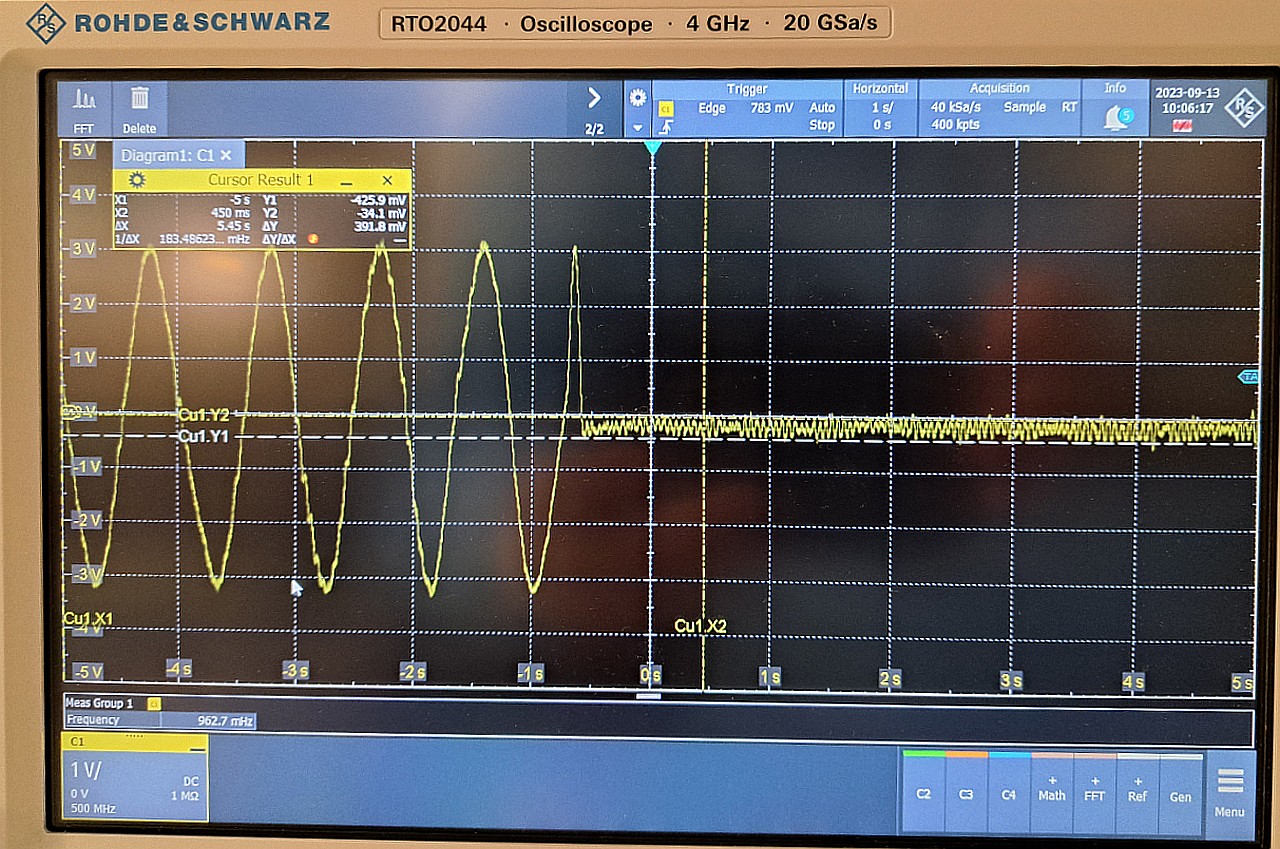
in attachement, a plot of the 500MHz mixer output, before and during the lock.
during the lock, one gets a residual oscillation around 20Hz... where does it come from ???
could it be some mechanical resonance, as we already had before (it was ~30Hz) : https://elog.lal.in2p3.fr/FPC/THOMX+commissioning/84
when unlocked, one gets : A*sin(dPHI) with A=3V => 6Vpp signal
when locked, one gets a 400mVpp error signal => A*dPHIpp = 0.4pp => dPHIpp = 133 mrad
dPHI = 2*pi*F500M*dt => peak-peak jitter dtpp = 42 ps => rms jitter = 15ps
this value can be measured directly on the 500MHz signals coming from the laser and the reference synthesizer.
| Ronic Chiche wrote: |
|
this afternoon, I tried to lock the FP-cavity on a local 500MHz synthesizer as a frequency reference
(it's faster to change the frequency from the sythesizer than from the FP cavity !!!)
I found some parameters on the PID of the Laselock to phase-lock the reference and the FP-cavity
but the locking quality is poor => we produce some oscillations which are copied by the FP-cavity/laser lock on the laser PZT.
the error signal (FP-cavity/reference) is quite noisy, then maybe one can try to do some analog filtering at a lower frequency ?
=> one can use Thorlabs LPF at 10kHz or 1KHz.
one can try also to filter the signal going to the PZT to reduce the excitation of the PZT resonance.
=> use a variable resistor in serie with the PZT capacitance to make and RC filter (Cpzt ~ 70nF)
for reminding, the previously working PID parameters, found with the 133MHz laser/533MHz reference lock, were:
P=10, I=0.01, D=0 for mid SR, and no filtering.
once we will found good PID parameters, we will be able to switch to the Ring oscillator at 500MHz as a reference,
then work with HV from the Laselock to improve the locking range.
| Ronic Chiche wrote: |
|
this afternoon, I installed the frequency detection scheme in the bunker :
- I changed the large reflected photodiode DET100 by a fast small DET10.
- a 50ohms splitter is connected to the photodiode :
* one cable is going directly to the scope for monitoring
* one cable is going to the 500MHz sharp bandpass filter to select only this harmonic.
despite the small BW of the filter, one gets 3 harmonics : 500MHz + (0 +/- 33) MHz with a bit less power on sidebands.
power on 500MHz : ~ -30dBm if the laser amplifier is at 30%
- after the BPF, one goes directly to the RF amplifier which is 2x Minicircuit amp ZX60-33LN in cascade to get ~ +3dBm
- then one goes to the level 17 mixer on the RF port.
the LO port is feeded with the 500MHz coming from the Ring reference oscillator.
in attachement is a picture of the output signal : ~ 1.5Vpp
I think the width of the signal is coming from the 33MHz sidebands which are not perfectly removed by the 20MHz BW of the scope.
one finds a frequency shift of 250kHz.
as the laser frequency has been set at 500.25MHz (on the 15th harmonic), would it mean the Ring reference oscillator was at 500MHz sharp ? => to be checked with Kevin.
| Ronic Chiche wrote: |
|
Today, I connected the BNC-DB9 female prolongator cable to the FP-cavity PZT cable (DB9-DB9) and to the channel B of the Laselock.
I additionnaly connected the reflected laser beam (normally connected to scope ch2) to the spectrum analyzer @ 1GHz to observe the 30th harmonic of the laser comb.
on the 2 attached pictures, the 1st one is @0V on FP-cavity PZT and the 2nd one is @10V on the FP-cavity PZT.
as the laser is locked on the FP-cavity, its frequency follows the FP-cavity length and its frequency changes.
as expected, applying 10V on the FP-cavity PZT, increases the laser harmonic frequency @ 1GHz by about 10Hz => the relative change is 10^-9 V^-1
(as the FP-cavity length is always moving due to temperature or low frequency vibrations, there are always some FP-cavity length fluctuations, and the measurement has to be quick to get a correct evaluation).
| Ronic Chiche wrote: |
|
Today, I installed a DB9-DB9 female-male cable on the PZT connector of the FP-cavity.
the PZT is connected between pins 1 and 2, with a capacitance around 70nF.
I need to make a prolongator cable BNC-DB9 female to connect it to the feedback system.
with a (dLpzt / dV) of 5nm/V, one should be able to see 37mHz/V on Frep which is equivalent to ~10Hz/10V @ 1GHz (30th Frep harmonics)
I connected a photodiode on the spectrum analyzer to measure this variation => to be done tomorrow.
I don't have any information about the polarity of the PZT on the DB9 connector but I know that the PZT length should increase with positivite voltage in normal operation.
from the Yann documentation about the PZT mount (in attached file), it should mean that the cavity length should decrease when the PZT length is increasing, and then the FP-cavity FSR should increase.
=> to be tested tomorrow.
about the PZT mount :
I understand that the HR face of the P4 mirror is the face placed on the only part with a chamfer (chanfrein), on the FP-cavity side.
in the documentation, the PZT connector orientation is misleading as it is oriented to the FP-cavity side instead of to the "outside" as one can see it in the cavity picture in attached file.
| Ronic Chiche wrote: |
- régler le problème 1:
Kevin m'a apporté un déphaseur Minicircuits JSPHS-661 (400-660MHz / 180° de phase) qui permet de déphaser le 500MHz de ~ 1ns avec une tension DC 0-10V.
on peut alors changer le signe du lock pour scanner les 2ns d'une période complète de 500MHz.
- régler le problème 2:
la synchro anneau se fait sur la RF du synthé 500MHz avec une signal de trig fabriqué à partir d'un 16MHz, issu d'une division de ce 500MHz.
en cas de perte de synchro de la cavité FP, on va relocker sur le 500MHz mais avec une phase aléatoire par rapport au 16MHz.
on peut donc remplacer ce 16MHz par le signal 33MHz issu du laser de telle façon que l'injection des électrons dans l'anneau se fera toujours avec la même phase par rapport à ce signal à 33MHz.
il faudra donc envoyer ce signal issu du laser cavité FP au système de synchro anneau, de cette façon la phase d'injection des électrons dans l'anneau par rapport au laser sera toujours la même.
mais il n'y a aucune raison que les électrons tombent exactement sur le pulse laser (avec la bonne phase).
il faudra donc scanner la phase du signal de trig pour décaler l'injection machine par rapport au signal 33MHz avec des steps ~ 1ns.
pour cela, on peut utiliser les générateurs de delais Greenfield Technology GFT1020 actuellement utilisés pour la synchro (résolution 100ps).
voir schéma attaché en pdf
| Ronic Chiche wrote: |
|
pour préparer le lock cavité-anneau, j'ai un setup de lock en salle optique entre le laser OneFive 133MHz et un synthé à 533MHz (133MHz x4).
ce matin, j'ai pu locker les 2 ensembles avec le laselock avec une stabilité RMS, je pense inférieure à la ps.
ma limite de mesure du jitter temporel au scope est de ~ 2.5ps.
- une fois locké avec le laselock, je peux facilement décaler légèrement en phase les 2 signaux de façon très précise (<1ps) en jouant sur l'offset de lock,
mais je ai une plage assez petite (+/- 250ps) qui correspond grosso modo aux plages linéaires du sinus (1/4 de période) soit 500ps (F ~ 533MHz => T ~ 2ns)
en changeant le signe du lock, je peux faire des sauts du lock d'une 1/2 période, soit 1ns...
mais cela ne suffit pas à couvrir l'intégralité de la période du signal de référence.
=> 1er problème : je n'ai accès qu'aux plages "linéaires" du signal de référence.
il faudrait un petit déphaseur programmable piloté en remote pour faire des steps de 100ps environ, sur une plage de 1 ou 2ns afin d'être sur de scanner tout la période du 500MHz.
- en coupant le lock, les fréquences driftent l'une par rapport à l'autre.
et en raccrochant le lock, on peut scanner toute la période entre 2 pulses d'électrons par steps de 2ns.
puis en changeant le signe du lock, par steps de 2ns mais décalé de 1ns.
on peut donc facilement scanner la période des électrons avec des steps de 1ns et une plage de 500ps autour de chacun de ces steps.
=> 2e problème : lorsque l'on perd le lock de la cavité FP/laser involontairement, on perd l'info de la longueur de la cavité FP.
et lorsqu'on retrouvera le lock, il va se raccrocher sur une autre oscillation du 500MHz.
et donc on va perdre la phase avec les électrons à 16MHz.
=> on peut éventuellement afficher ce signal à 16MHz, en même temps que le 500MHz pour rechercher l'oscillation correspondante à la bonne phase sur le 16MHz.
mais dans tous les cas, il faudra rechercher à nouveau la phase é-/laser à chaque délock.
- Autre possibilité, faire la synchro sur le 16MHz au lieu du 500MHz.
la tentative aujourd'hui n'a rien donné car le signal est 30x moins intense => beaucoup plus de bruit.
=> le lock n'arrive pas du tout à accrocher même en filtrant énormément le signal IF avec 10kHz de BW.
|
|
|
|
|
|
|
| Attachment 1: 20230913_114202.jpg
|  |
|
254
|
Tue Sep 12 17:58:41 2023 |
Ronic Chiche | Fixed | info | detectors and electronics | Optical room | lock oscillateur 33MHz - synthé 500MHz | this afternoon, I tried to lock the FP-cavity on a local 500MHz synthesizer as a frequency reference
(it's faster to change the frequency from the sythesizer than from the FP cavity !!!)
I found some parameters on the PID of the Laselock to phase-lock the reference and the FP-cavity
but the locking quality is poor => we produce some oscillations which are copied by the FP-cavity/laser lock on the laser PZT.
the error signal (FP-cavity/reference) is quite noisy, then maybe one can try to do some analog filtering at a lower frequency ?
=> one can use Thorlabs LPF at 10kHz or 1KHz.
one can try also to filter the signal going to the PZT to reduce the excitation of the PZT resonance.
=> use a variable resistor in serie with the PZT capacitance to make and RC filter (Cpzt ~ 70nF)
for reminding, the previously working PID parameters, found with the 133MHz laser/533MHz reference lock, were:
P=10, I=0.01, D=0 for mid SR, and no filtering.
once we will found good PID parameters, we will be able to switch to the Ring oscillator at 500MHz as a reference,
then work with HV from the Laselock to improve the locking range.
| Ronic Chiche wrote: |
|
this afternoon, I installed the frequency detection scheme in the bunker :
- I changed the large reflected photodiode DET100 by a fast small DET10.
- a 50ohms splitter is connected to the photodiode :
* one cable is going directly to the scope for monitoring
* one cable is going to the 500MHz sharp bandpass filter to select only this harmonic.
despite the small BW of the filter, one gets 3 harmonics : 500MHz + (0 +/- 33) MHz with a bit less power on sidebands.
power on 500MHz : ~ -30dBm if the laser amplifier is at 30%
- after the BPF, one goes directly to the RF amplifier which is 2x Minicircuit amp ZX60-33LN in cascade to get ~ +3dBm
- then one goes to the level 17 mixer on the RF port.
the LO port is feeded with the 500MHz coming from the Ring reference oscillator.
in attachement is a picture of the output signal : ~ 1.5Vpp
I think the width of the signal is coming from the 33MHz sidebands which are not perfectly removed by the 20MHz BW of the scope.
one finds a frequency shift of 250kHz.
as the laser frequency has been set at 500.25MHz (on the 15th harmonic), would it mean the Ring reference oscillator was at 500MHz sharp ? => to be checked with Kevin.
| Ronic Chiche wrote: |
|
Today, I connected the BNC-DB9 female prolongator cable to the FP-cavity PZT cable (DB9-DB9) and to the channel B of the Laselock.
I additionnaly connected the reflected laser beam (normally connected to scope ch2) to the spectrum analyzer @ 1GHz to observe the 30th harmonic of the laser comb.
on the 2 attached pictures, the 1st one is @0V on FP-cavity PZT and the 2nd one is @10V on the FP-cavity PZT.
as the laser is locked on the FP-cavity, its frequency follows the FP-cavity length and its frequency changes.
as expected, applying 10V on the FP-cavity PZT, increases the laser harmonic frequency @ 1GHz by about 10Hz => the relative change is 10^-9 V^-1
(as the FP-cavity length is always moving due to temperature or low frequency vibrations, there are always some FP-cavity length fluctuations, and the measurement has to be quick to get a correct evaluation).
| Ronic Chiche wrote: |
|
Today, I installed a DB9-DB9 female-male cable on the PZT connector of the FP-cavity.
the PZT is connected between pins 1 and 2, with a capacitance around 70nF.
I need to make a prolongator cable BNC-DB9 female to connect it to the feedback system.
with a (dLpzt / dV) of 5nm/V, one should be able to see 37mHz/V on Frep which is equivalent to ~10Hz/10V @ 1GHz (30th Frep harmonics)
I connected a photodiode on the spectrum analyzer to measure this variation => to be done tomorrow.
I don't have any information about the polarity of the PZT on the DB9 connector but I know that the PZT length should increase with positivite voltage in normal operation.
from the Yann documentation about the PZT mount (in attached file), it should mean that the cavity length should decrease when the PZT length is increasing, and then the FP-cavity FSR should increase.
=> to be tested tomorrow.
about the PZT mount :
I understand that the HR face of the P4 mirror is the face placed on the only part with a chamfer (chanfrein), on the FP-cavity side.
in the documentation, the PZT connector orientation is misleading as it is oriented to the FP-cavity side instead of to the "outside" as one can see it in the cavity picture in attached file.
| Ronic Chiche wrote: |
- régler le problème 1:
Kevin m'a apporté un déphaseur Minicircuits JSPHS-661 (400-660MHz / 180° de phase) qui permet de déphaser le 500MHz de ~ 1ns avec une tension DC 0-10V.
on peut alors changer le signe du lock pour scanner les 2ns d'une période complète de 500MHz.
- régler le problème 2:
la synchro anneau se fait sur la RF du synthé 500MHz avec une signal de trig fabriqué à partir d'un 16MHz, issu d'une division de ce 500MHz.
en cas de perte de synchro de la cavité FP, on va relocker sur le 500MHz mais avec une phase aléatoire par rapport au 16MHz.
on peut donc remplacer ce 16MHz par le signal 33MHz issu du laser de telle façon que l'injection des électrons dans l'anneau se fera toujours avec la même phase par rapport à ce signal à 33MHz.
il faudra donc envoyer ce signal issu du laser cavité FP au système de synchro anneau, de cette façon la phase d'injection des électrons dans l'anneau par rapport au laser sera toujours la même.
mais il n'y a aucune raison que les électrons tombent exactement sur le pulse laser (avec la bonne phase).
il faudra donc scanner la phase du signal de trig pour décaler l'injection machine par rapport au signal 33MHz avec des steps ~ 1ns.
pour cela, on peut utiliser les générateurs de delais Greenfield Technology GFT1020 actuellement utilisés pour la synchro (résolution 100ps).
voir schéma attaché en pdf
| Ronic Chiche wrote: |
|
pour préparer le lock cavité-anneau, j'ai un setup de lock en salle optique entre le laser OneFive 133MHz et un synthé à 533MHz (133MHz x4).
ce matin, j'ai pu locker les 2 ensembles avec le laselock avec une stabilité RMS, je pense inférieure à la ps.
ma limite de mesure du jitter temporel au scope est de ~ 2.5ps.
- une fois locké avec le laselock, je peux facilement décaler légèrement en phase les 2 signaux de façon très précise (<1ps) en jouant sur l'offset de lock,
mais je ai une plage assez petite (+/- 250ps) qui correspond grosso modo aux plages linéaires du sinus (1/4 de période) soit 500ps (F ~ 533MHz => T ~ 2ns)
en changeant le signe du lock, je peux faire des sauts du lock d'une 1/2 période, soit 1ns...
mais cela ne suffit pas à couvrir l'intégralité de la période du signal de référence.
=> 1er problème : je n'ai accès qu'aux plages "linéaires" du signal de référence.
il faudrait un petit déphaseur programmable piloté en remote pour faire des steps de 100ps environ, sur une plage de 1 ou 2ns afin d'être sur de scanner tout la période du 500MHz.
- en coupant le lock, les fréquences driftent l'une par rapport à l'autre.
et en raccrochant le lock, on peut scanner toute la période entre 2 pulses d'électrons par steps de 2ns.
puis en changeant le signe du lock, par steps de 2ns mais décalé de 1ns.
on peut donc facilement scanner la période des électrons avec des steps de 1ns et une plage de 500ps autour de chacun de ces steps.
=> 2e problème : lorsque l'on perd le lock de la cavité FP/laser involontairement, on perd l'info de la longueur de la cavité FP.
et lorsqu'on retrouvera le lock, il va se raccrocher sur une autre oscillation du 500MHz.
et donc on va perdre la phase avec les électrons à 16MHz.
=> on peut éventuellement afficher ce signal à 16MHz, en même temps que le 500MHz pour rechercher l'oscillation correspondante à la bonne phase sur le 16MHz.
mais dans tous les cas, il faudra rechercher à nouveau la phase é-/laser à chaque délock.
- Autre possibilité, faire la synchro sur le 16MHz au lieu du 500MHz.
la tentative aujourd'hui n'a rien donné car le signal est 30x moins intense => beaucoup plus de bruit.
=> le lock n'arrive pas du tout à accrocher même en filtrant énormément le signal IF avec 10kHz de BW.
|
|
|
|
|
|
|
245
|
Tue Sep 12 14:28:36 2023 |
Ronic Chiche | Fixed | info | mechanics | lasers and optics | detectors and electronics | ThomX igloo | Removing high order modes | yesterday with Daniele, we tried again to move the arm horizontally and vertically from the "zero position" to have a better understanding of the beahvior,
but it is roughly the same :
- a clear beam power reduction (=> cut of the beam) when one moves the horizontal axis
- a very small beam power reduction when one moves the vertical axis
as there are no end-position limits on the axis and as it is possible to "touch" the motors or different mecanichal pieces, we prefered to be conservative:
after several tries, one placed the arm at a position where the HOMs seem to be pretty well suppressed.
for the moment, we will consider this arm in a proper position.
| Ronic Chiche wrote: |
|
here is the picture of the L-shape arm and the inside of the vessel.
this image corresponds to the "zero" position on each positionner.
| Ronic Chiche wrote: |
|
this morning we locked the laser and the FP-cavity with ~ 40kW => some HOM appeared "randomly" depending on the power.
we tried to play manually on the L-shape arm :
- first, we moved horizontally to put the L-shape in the beam axis
at some point, we saw the power level divided by ~2, we stopped and came back to restore the full power.
- then, we tried to move vertically.
whatever the direction, we were not able to see a clear cut of the beam.
BUT "strangely", at some point, the PZT drift followed the direction of the motion and was not really depending on the "cooling" or "heating" process when the lock stops or restart.
"strangely" again, at the endpoint, the power dropped by ~20-30% after a delock but it was impossible to restore the power when we put the arm at the initial position.
=> we had to adjust the FP-cavity alignment to restore the power !!!
=> we had the feeling that moving the arm could have misalign the cavity axis !!! :-(
=> we have to discuss with Yann and get the CAD files of the cavity to have a better understanding...
|
|
|
|
244
|
Fri Sep 8 19:45:56 2023 |
Ronic Chiche | Fixed | info | lasers and optics | ThomX igloo | 33MHz oscillator + Alphanov amplifier lock | redoing the PDH error signal scheme with discrete components is more flexible and it is easier to check the signal/noise ratio.
now, we are able to get a quite clean lock only with the PZT correction (w/o fast feedback correction using the EOM) even with both motors controllers ON (cavity and laser).
then, one can consider this part is over, even if one can still improve the lock with the EOM.
see this post for that part and some details on the new PDH signal scheme : https://elog.lal.in2p3.fr/FPC/THOMX+commissioning/240
| Ronic Chiche wrote: |
|
Today, we locked the cavity with input power @ 30% for the amp => we got 40kW with only 30% of coupling (and a bad lock => we could have more power inside cavity).
P@30% = 16W
Coupling = 30% => 4.8W of input power => Measured Gain = 8300
| Ronic Chiche wrote: |
|
we checked yesterday morning the real input power @ 30% for the amp => it is 16W in agreement with the previously measured values
| Ronic Chiche wrote: |
|
I checked with the Matlab code below the CEP detuning effect (2nm sech² spectrum... not exactly the same as in ThomX)
@ CEP = 0 => coupling = 100% and Gcav = 10.5k
if all the coupling loss comes from the CEP detuning effect :
@ CEP = pi/5 => coupling = 20% and Gcav = 2.14k (~ 10.5k x 20%)
so, it does not matter if the coupling loss comes from the CEP detuning effect or from beam mismatch or misalignment.
=> we should have more power at 20% coupling, not 10kW but 35kW !!!
=> we have to check the real input power !
| Ronic Chiche wrote: |
|
this morning, I tested the laser+amplifier @ 30% lock on the FP cavity with and without Smaract motors.
I recorded the PDH error signal during a lock:
- blue : with Smaract motors controller powered ON but motors are stopped
- yellow: with Smaract motors controller powered OFF
with Smaract motors controller powered ON and motors stopped, one can see a group of resonances around 10kHz (8 - 11 - 14kHz) which disappears when the controller is powered OFF.
one can see also a group of resonances around 25-30kHz for which some peaks desappear when the controller is OFF but most of them are still there... could it come from noise on the Onefive laser PZT ?
one can see also a noise reduction at low frequency with a corner frequency around 17kHz, which could be the Unity Gain Bandwidth of the feedback loop on the laser PZT (fast feedback loop on EOM was disconnected)
=> to be confirmed
*************************************************************************************************************************************************************
I was able to lock with a decent noise on transmission and reflection signals @ Pin=17W (30%) of input power and with a coupling ~ 20%.
I measured 31mW in transmission => Pcav ~ 10.3kW (T ~ 3ppm)
as T1=115 ppm and F=30000, the cavity gain is T1*(F/pi)^2 = 10.5k,
so, the FP cavity power should have been 17W * 20% * 10,5k = 35.7 kW !!! (maybe the formula is wrong if the coupling loss comes from the CEP detuning effect)
=> we have to check the incoming power and the formula !
so, maximum expected power in FP-cavity could be 70W * 100% * 10,5k * (10.3/35.7) = 210 kW !!! :-(
*************************************************************************************************************************************************************
I was able to redo the lock easily in remote in the control room (with the Smaract motors controller OFF).
| Ronic Chiche wrote: |
|
After removing the 2 generators from the optical table, the lock is much more stable and now, it is possible to lock on the main resonance with a poor CEP but with quite good stability.
the coupling is still very low ~ 5% for that CEP but if one improves it (CEP ->0), using the laser double-wedge motor, one clearly sees an improvement of the coupling... but at the cost of the lock stability.
the reason of the poor coupling is also because the laser amplifier is used at 0%, for which we know the part of the laser signal power, compared to the total power, is low.
(a part of the beam @1030nm is not propagating in the fiber core of the amp, and then, it cannot be coupled to the FP-cavity).
the fast lock loop on the EOM has been disabled for the moment.
it has to be installed back to improve the stability at a better CEP.
at present, the FP-cavity power is estimated at ~ 90W (~270µW in transmission of ~3ppm mirrors) for ~300mW of total power coming from the laser amp.
next steps :
- in Open Loop : check what is the best coupling we can observe for CEP=0 @ P ~ 10W (laser amp at ~ 25%)
- in Closed Loop : @ P ~ 10W => measure the best transmitted power after alignement/polarization/feedback adjust => ~ 3-10kW in the cavity ?
| Ronic Chiche wrote: |
|
today with Daniele, we locked easily (but with a noisy lock) on the secundary resonance and we tried to lock on the main resonance (with very low coupling ~10% which mean a CEP ~Pi)
the lock was possible but was very noisy.
I installed a fast loop using my small DC amplifier based on OP37 (max gain=100) modified to be AC coupled to avoid to amplify the PDH box offset.
the output votage swing of the OP37 is only ~10V. Thus, the effect of this fast loop on the lock stability is not visible !
Thus, I added the M250 Leysop HV amplifier (see attached documentation), which is able to drive an EOM with >5MHz bandwidth and ~250V swing, after my OP37 amplifier.
with this additionnal HV amplifier, now we can clearly see the effect of the EOM loop which improves the lock stability BUT, even with a poor CEP, the lock is very unstable on the main resonance.
it seems the optical phase noise is still too large and/or its BW too high to be completely compensated.
The next step is to try to remove all the possible noise sources from the optical table:
- the laptop placed on the ionic pump
- the 2 Rigol generators on the table surface
and switch off the controller of the Smaract laser cavity motors.
If it doesn't help, we can send the error signal to a spectrum analyzer to have a better view of the different harmonics involved in the residual phase noise.
could it remain some noise above the present PDH box BW (1.9MHz LP filter) ?
lastely, we can also make an optical phase noise measurement to check if the Alphanov amplifier does not add some noise.
| Ronic Chiche wrote: |
|
finding the right modulation/demodulation PDH phase is very difficult on the main resonance because the we get non stationnary signals with a lot of oscillations.
changing the phase, in this condition, does not really change the error signal.
Then, we moved on the first secundary resonance with less gain and less coupling.
Thus, the error signal is more similar to the theoretical PDH signal => one can adjust the modulation/demodulation PDH phase to get the maximum error signal.
then, we locked pretty easily on this first secondary resonance, with a coupling around some % when we adjust the CEP motor.
we tried to lock on the main resonance but it is too noisy and unstable.
it seems we really need high BW feedback.
I tried to add a fast analog loop on the laser intra-cavity EOM but without a clear effect.
the problem is the gain of this loop : it is difficult to produce a "high voltage" (above 10Vpp) on this EOM.
I put "my" amplifier but the voltage output is limited... commercial amplifiers will have the same issue.
we can add HV amplifiers but it takes place and it will add some noise on the signal.
A loop with an AOM could be easier to install and manage... but at the price of a loss of power before the laser amplifier...
| Ronic Chiche wrote: |
|
the last tries to lock the 33MHz + amplifier to the 30k Finesse FP-cavity were unsuccessful.
during a laser Frep scan using the Laselock, one observes that the main cavity resonance is not able to stay inside the PZT scan range from one scan to another (500ms-1s period)
is it the effect of a large and slow phase noise ?
some informations:
- The 33MHz laser came back at lab from repair on March 2018.
- it has been sent to Alphanov in May 2020.
- it failled and has been sent to NKT/OneFive for repair in September 2021
- it came back to lab from repair in June 2022.
- on post #92 (Feb. 2020), it seems that we already locked the 33MHz laser + CELIA amplifier to the ThomX FP-cavity.
- The PZT sensitivity for the 33MHz laser is given to 0,3Hz/V for Frep <=> 2.6MHz/V for optical frequency.
=> 10V on PZT is equivalent to 26MHz of optical frequency shift which is less than FSR !
- by comparison, the PZT sensitivity for the 133MHz laser is given to 3.9Hz/V for Frep <=> 8.5MHz/V for optical frequency.
- by comparison, the PZT sensitivity for the NKT CW laser is given 10pm/100V for Wavelength <=> 30MHz/V for optical frequency
- by comparison, the PZT sensitivity for the ThomX FP cavity (Z20H38x40C) is 4nm/V for length expansion => 8nm/V for round-trip expansion <=> 0.03Hz/V for FSR expansion <=> 260kHz/V for optical frequency !!!
the PZT expansion estimation is in attached file.
|
|
|
|
|
|
|
|
|
|
253
|
Fri Sep 8 19:35:36 2023 |
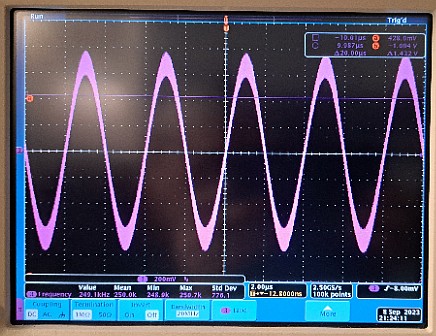
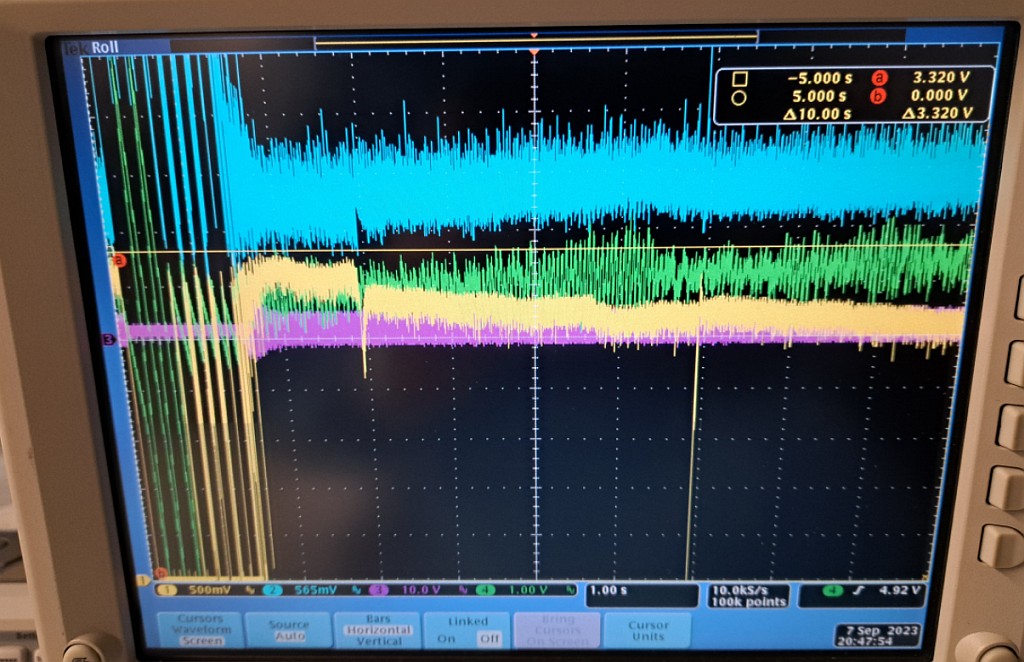
Ronic Chiche | Fixed | info | detectors and electronics | Optical room | lock oscillateur 33MHz - synthé 500MHz | this afternoon, I installed the frequency detection scheme in the bunker :
- I changed the large reflected photodiode DET100 by a fast small DET10.
- a 50ohms splitter is connected to the photodiode :
* one cable is going directly to the scope for monitoring
* one cable is going to the 500MHz sharp bandpass filter to select only this harmonic.
despite the small BW of the filter, one gets 3 harmonics : 500MHz + (0 +/- 33) MHz with a bit less power on sidebands.
power on 500MHz : ~ -30dBm if the laser amplifier is at 30%
- after the BPF, one goes directly to the RF amplifier which is 2x Minicircuit amp ZX60-33LN in cascade to get ~ +3dBm
- then one goes to the level 17 mixer on the RF port.
the LO port is feeded with the 500MHz coming from the Ring reference oscillator.
in attachement is a picture of the output signal : ~ 1.5Vpp
I think the width of the signal is coming from the 33MHz sidebands which are not perfectly removed by the 20MHz BW of the scope.
one finds a frequency shift of 250kHz.
as the laser frequency has been set at 500.25MHz (on the 15th harmonic), would it mean the Ring reference oscillator was at 500MHz sharp ? => to be checked with Kevin.
| Ronic Chiche wrote: |
|
Today, I connected the BNC-DB9 female prolongator cable to the FP-cavity PZT cable (DB9-DB9) and to the channel B of the Laselock.
I additionnaly connected the reflected laser beam (normally connected to scope ch2) to the spectrum analyzer @ 1GHz to observe the 30th harmonic of the laser comb.
on the 2 attached pictures, the 1st one is @0V on FP-cavity PZT and the 2nd one is @10V on the FP-cavity PZT.
as the laser is locked on the FP-cavity, its frequency follows the FP-cavity length and its frequency changes.
as expected, applying 10V on the FP-cavity PZT, increases the laser harmonic frequency @ 1GHz by about 10Hz => the relative change is 10^-9 V^-1
(as the FP-cavity length is always moving due to temperature or low frequency vibrations, there are always some FP-cavity length fluctuations, and the measurement has to be quick to get a correct evaluation).
| Ronic Chiche wrote: |
|
Today, I installed a DB9-DB9 female-male cable on the PZT connector of the FP-cavity.
the PZT is connected between pins 1 and 2, with a capacitance around 70nF.
I need to make a prolongator cable BNC-DB9 female to connect it to the feedback system.
with a (dLpzt / dV) of 5nm/V, one should be able to see 37mHz/V on Frep which is equivalent to ~10Hz/10V @ 1GHz (30th Frep harmonics)
I connected a photodiode on the spectrum analyzer to measure this variation => to be done tomorrow.
I don't have any information about the polarity of the PZT on the DB9 connector but I know that the PZT length should increase with positivite voltage in normal operation.
from the Yann documentation about the PZT mount (in attached file), it should mean that the cavity length should decrease when the PZT length is increasing, and then the FP-cavity FSR should increase.
=> to be tested tomorrow.
about the PZT mount :
I understand that the HR face of the P4 mirror is the face placed on the only part with a chamfer (chanfrein), on the FP-cavity side.
in the documentation, the PZT connector orientation is misleading as it is oriented to the FP-cavity side instead of to the "outside" as one can see it in the cavity picture in attached file.
| Ronic Chiche wrote: |
- régler le problème 1:
Kevin m'a apporté un déphaseur Minicircuits JSPHS-661 (400-660MHz / 180° de phase) qui permet de déphaser le 500MHz de ~ 1ns avec une tension DC 0-10V.
on peut alors changer le signe du lock pour scanner les 2ns d'une période complète de 500MHz.
- régler le problème 2:
la synchro anneau se fait sur la RF du synthé 500MHz avec une signal de trig fabriqué à partir d'un 16MHz, issu d'une division de ce 500MHz.
en cas de perte de synchro de la cavité FP, on va relocker sur le 500MHz mais avec une phase aléatoire par rapport au 16MHz.
on peut donc remplacer ce 16MHz par le signal 33MHz issu du laser de telle façon que l'injection des électrons dans l'anneau se fera toujours avec la même phase par rapport à ce signal à 33MHz.
il faudra donc envoyer ce signal issu du laser cavité FP au système de synchro anneau, de cette façon la phase d'injection des électrons dans l'anneau par rapport au laser sera toujours la même.
mais il n'y a aucune raison que les électrons tombent exactement sur le pulse laser (avec la bonne phase).
il faudra donc scanner la phase du signal de trig pour décaler l'injection machine par rapport au signal 33MHz avec des steps ~ 1ns.
pour cela, on peut utiliser les générateurs de delais Greenfield Technology GFT1020 actuellement utilisés pour la synchro (résolution 100ps).
voir schéma attaché en pdf
| Ronic Chiche wrote: |
|
pour préparer le lock cavité-anneau, j'ai un setup de lock en salle optique entre le laser OneFive 133MHz et un synthé à 533MHz (133MHz x4).
ce matin, j'ai pu locker les 2 ensembles avec le laselock avec une stabilité RMS, je pense inférieure à la ps.
ma limite de mesure du jitter temporel au scope est de ~ 2.5ps.
- une fois locké avec le laselock, je peux facilement décaler légèrement en phase les 2 signaux de façon très précise (<1ps) en jouant sur l'offset de lock,
mais je ai une plage assez petite (+/- 250ps) qui correspond grosso modo aux plages linéaires du sinus (1/4 de période) soit 500ps (F ~ 533MHz => T ~ 2ns)
en changeant le signe du lock, je peux faire des sauts du lock d'une 1/2 période, soit 1ns...
mais cela ne suffit pas à couvrir l'intégralité de la période du signal de référence.
=> 1er problème : je n'ai accès qu'aux plages "linéaires" du signal de référence.
il faudrait un petit déphaseur programmable piloté en remote pour faire des steps de 100ps environ, sur une plage de 1 ou 2ns afin d'être sur de scanner tout la période du 500MHz.
- en coupant le lock, les fréquences driftent l'une par rapport à l'autre.
et en raccrochant le lock, on peut scanner toute la période entre 2 pulses d'électrons par steps de 2ns.
puis en changeant le signe du lock, par steps de 2ns mais décalé de 1ns.
on peut donc facilement scanner la période des électrons avec des steps de 1ns et une plage de 500ps autour de chacun de ces steps.
=> 2e problème : lorsque l'on perd le lock de la cavité FP/laser involontairement, on perd l'info de la longueur de la cavité FP.
et lorsqu'on retrouvera le lock, il va se raccrocher sur une autre oscillation du 500MHz.
et donc on va perdre la phase avec les électrons à 16MHz.
=> on peut éventuellement afficher ce signal à 16MHz, en même temps que le 500MHz pour rechercher l'oscillation correspondante à la bonne phase sur le 16MHz.
mais dans tous les cas, il faudra rechercher à nouveau la phase é-/laser à chaque délock.
- Autre possibilité, faire la synchro sur le 16MHz au lieu du 500MHz.
la tentative aujourd'hui n'a rien donné car le signal est 30x moins intense => beaucoup plus de bruit.
=> le lock n'arrive pas du tout à accrocher même en filtrant énormément le signal IF avec 10kHz de BW.
|
|
|
|
|
| Attachment 1: 20230908_190054.jpg
|  |
|
242
|
Fri Sep 8 18:22:21 2023 |
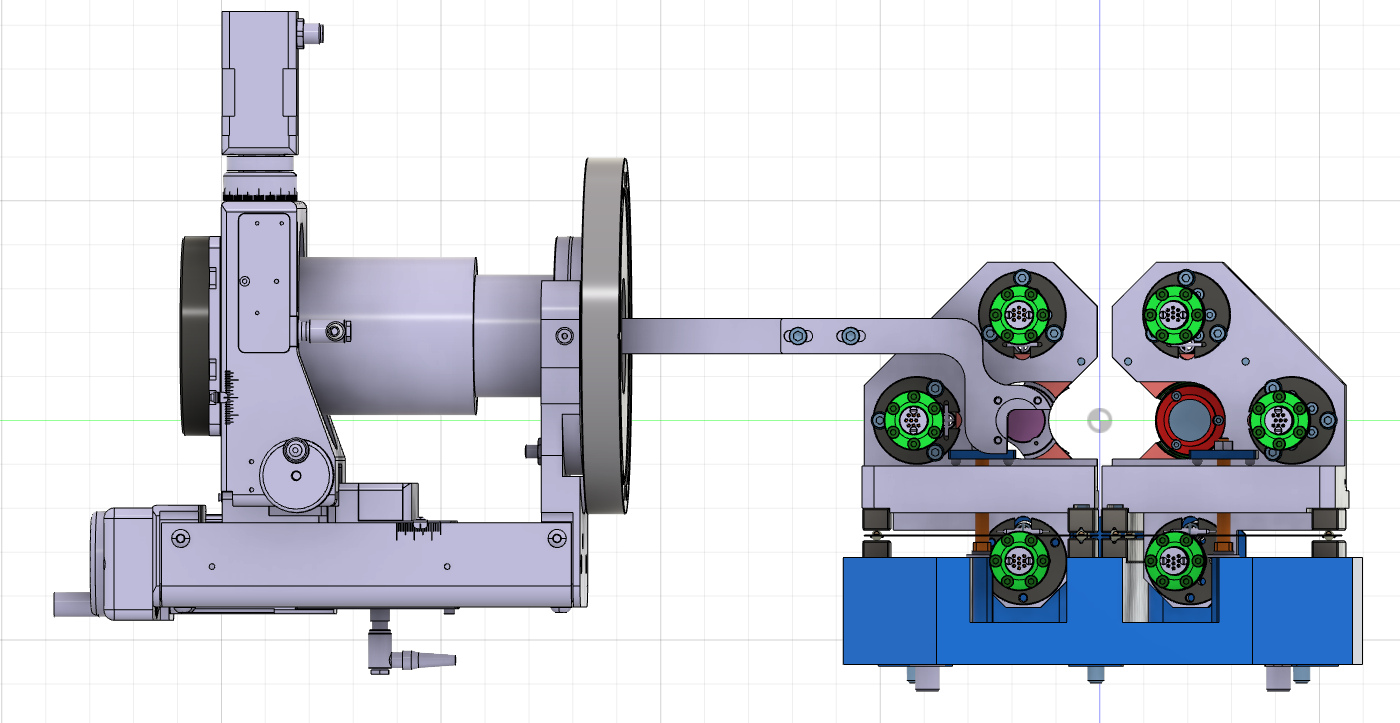
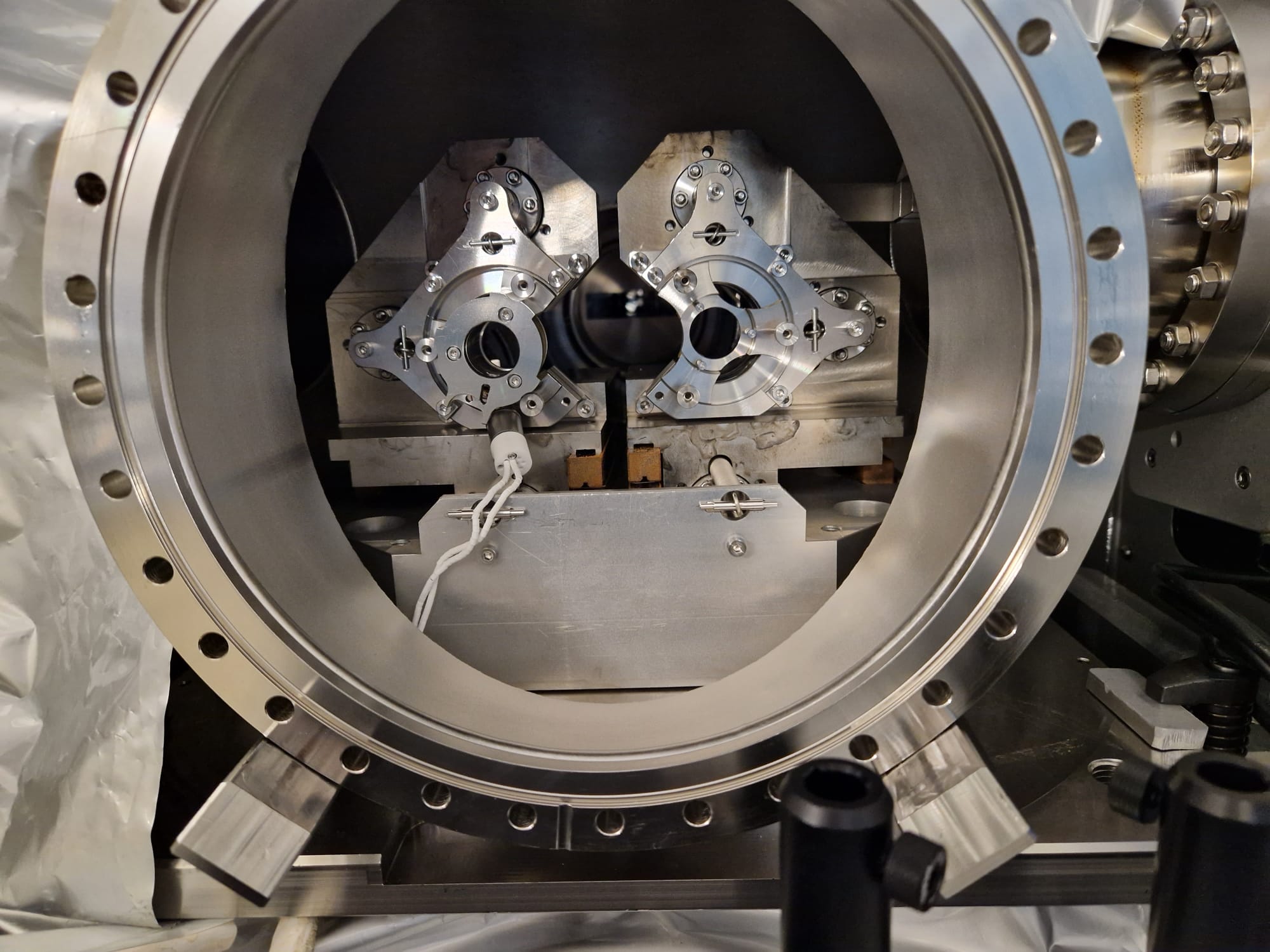
Ronic Chiche | Fixed | info | mechanics | lasers and optics | detectors and electronics | ThomX igloo | Removing high order modes | here is the picture of the L-shape arm and the inside of the vessel.
this image corresponds to the "zero" position on each positionner.
| Ronic Chiche wrote: |
|
this morning we locked the laser and the FP-cavity with ~ 40kW => some HOM appeared "randomly" depending on the power.
we tried to play manually on the L-shape arm :
- first, we moved horizontally to put the L-shape in the beam axis
at some point, we saw the power level divided by ~2, we stopped and came back to restore the full power.
- then, we tried to move vertically.
whatever the direction, we were not able to see a clear cut of the beam.
BUT "strangely", at some point, the PZT drift followed the direction of the motion and was not really depending on the "cooling" or "heating" process when the lock stops or restart.
"strangely" again, at the endpoint, the power dropped by ~20-30% after a delock but it was impossible to restore the power when we put the arm at the initial position.
=> we had to adjust the FP-cavity alignment to restore the power !!!
=> we had the feeling that moving the arm could have misalign the cavity axis !!! :-(
=> we have to discuss with Yann and get the CAD files of the cavity to have a better understanding...
|
|
| Attachment 1: Capture.PNG
|  |
|
241
|
Fri Sep 8 12:43:04 2023 |
Ronic Chiche | Fixed | info | mechanics | lasers and optics | detectors and electronics | ThomX igloo | Removing high order modes | this morning we locked the laser and the FP-cavity with ~ 40kW => some HOM appeared "randomly" depending on the power.
we tried to play manually on the L-shape arm :
- first, we moved horizontally to put the L-shape in the beam axis
at some point, we saw the power level divided by ~2, we stopped and came back to restore the full power.
- then, we tried to move vertically.
whatever the direction, we were not able to see a clear cut of the beam.
BUT "strangely", at some point, the PZT drift followed the direction of the motion and was not really depending on the "cooling" or "heating" process when the lock stops or restart.
"strangely" again, at the endpoint, the power dropped by ~20-30% after a delock but it was impossible to restore the power when we put the arm at the initial position.
=> we had to adjust the FP-cavity alignment to restore the power !!!
=> we had the feeling that moving the arm could have misalign the cavity axis !!! :-(
=> we have to discuss with Yann and get the CAD files of the cavity to have a better understanding... |
|
240
|
Thu Sep 7 19:23:36 2023 |
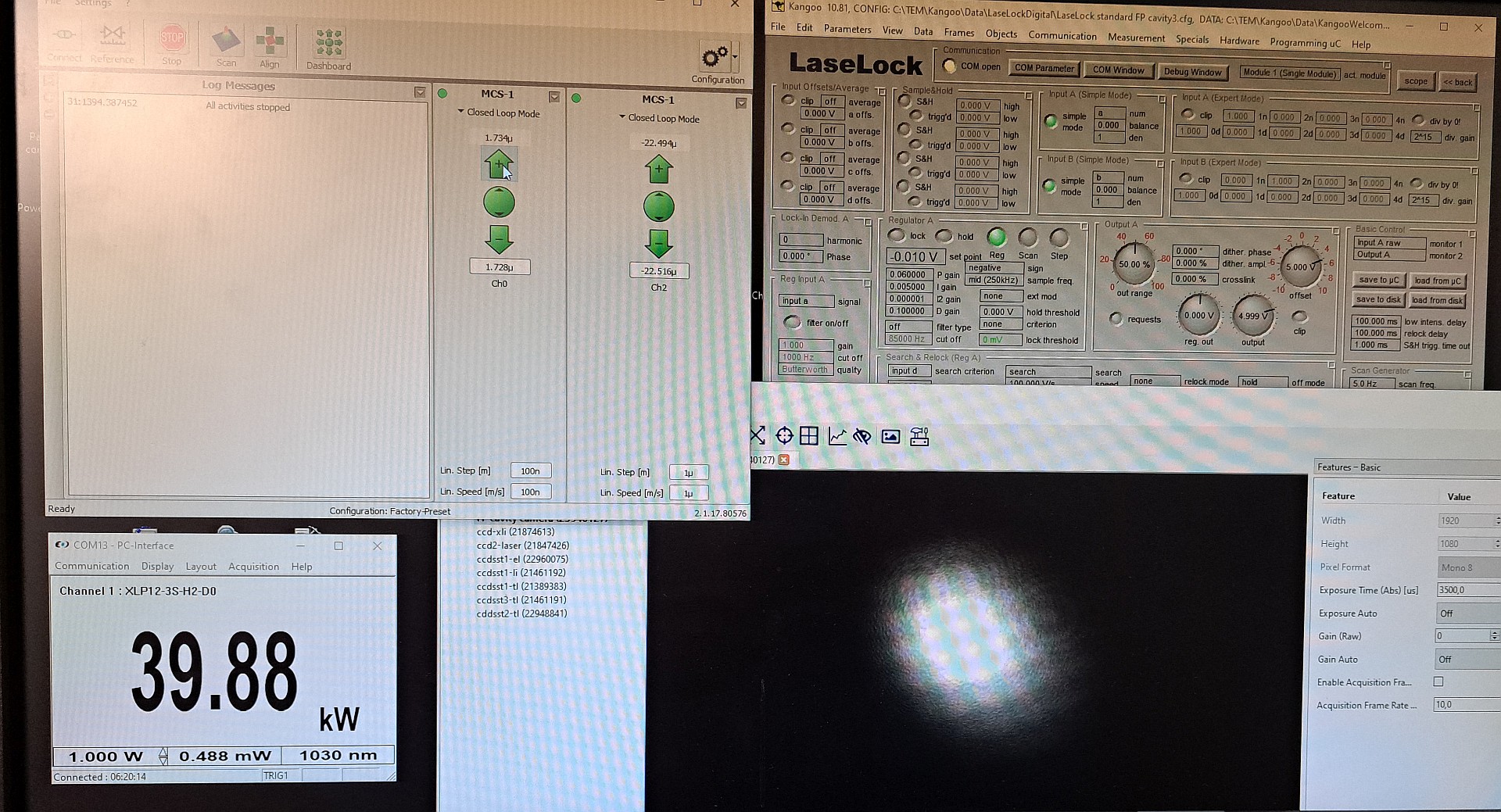
Ronic Chiche | Fixed | info | lasers and optics | detectors and electronics | ThomX igloo | Fast feedback loop between laser and FP cavity | today, after the several unsuccessful attempt yesterday to get an improvement in the lock,
we decided to "rebuild" the error signal electronics block by block and step by step :
the scheme is basically :
- DET36 photodiode
- followed by a 10MHz low pass filter to remove the laser frequency harmonics and keep only the modulation frequency at 8.4MHz.
- connected to a FEMTO HPVA AC-coupled 40dB gain amplifier with 50ohms in parallel on its input (which is connected to the photodiode).
- connected to a Minicircuit mixer which is also demodulated by the generator at 8.4MHz
- followed by a 1.9MHz low pass filter to remove image frequencies
when this signal is sent to the Laselock box, the lock of the cavity is possible but very noisy.
we need to put a large D values in the PID to maintain the lock at the price of oscillations and gain loss ! :-(
when this signal is connected also to the M250 video EOM amplifier (which is 50 ohms), but this amplifier is not used,
we suddenly got a much better lock (see the attached pictures), certainly due to the 50 ohms connected to the input of the Laselock system => to be verified.
one could have some noise current at the Laselock input which produces less noise at the output when the input impedance is 50 ohms, instead of the several kohms when the input is unloaded...
then, we were able to get a stable lock at ~40kW with 30% coupling and 30% of amplifier :
see this post with the same values : https://elog.lal.in2p3.fr/FPC/THOMX+commissioning/227
but now, the lock has been done WITH ALL the motors controllers ON !!! :-)))
now, we can try to improve the lock with the fast feedback loop.
and the only real problem is the mode degeneracy we need to block with the L-shape.
| Ronic Chiche wrote: |
|
today, we tried to lock the FP cavity with the Smaract motors ON (with option -LV).
we know the Smaract controllers produce some noise and the lock is very bad or impossible when the controller in ON (whatever the displacement mode is : closed or open loop, or piezo scan).
then we need to do a fast feedback loop on the EOM inside of the Onefive laser.
the problem is we cannot fill directly the error signal (~ 300mVpp) as the signal level is too low to produce some effect.
1- we tried to use the AC-coupled homemade amplifier alone but the output range is too low (+/- 3V)
2- we tried to use the M250 video amplifier for EOM with AC-coupling but the output range is still to low (+/-30V ? => to be confirmed)
but we saw an improvement in the locking.
3- we tried to combine AC-coupled homemade amplifier + M250 video amplifier for EOM with AC-coupling.
we are able to lock (~ 30% coupling) but the lock quality is very poor : we clearly see that we oscillate around the maximum of the Airy peak.
we tried several combination of the global gain (fast feedback + Laselock) using the diffuser, of the Laselock PID parameters but it seems we are not able to lock properly.
we measured a global delay of this double amplification stage of 80-90ns for the homemade amplifier and 150ns for the homemade+M250 amplifiers.
this delay is compatible with ~ 500kHz BW for the feedback => it seems it is not the reason...
we measured also the linearity of the homemade amp => there is ~ 30dB between a frequency and its 1st harmonic even at low signal...
the amp scheme is not very linear.
in comparison, the HV M250 amplifier exhibit > 80 dB of linearity !
we will try to remplace the homemade amp by a commercial FEMTO amplifier to imrpove the linearity and see if it improves also the lock.
we measured also a 100Hz AM modulation on the output signal of the homemade amp+M250.
=> we can try to work in differential (HV+ - HV-) to see if it helps to remove this modulation.
|
|
| Attachment 1: 20230907_182412.jpg
|  |
| Attachment 2: 20230907_182442.jpg
|  |
|
239
|
Thu Sep 7 18:51:43 2023 |
Ronic Chiche | Fixed | issue | lasers and optics | ThomX igloo | Onefive laser modelock and Smaract CEP controller | today, during an attempt in improving the CEP with the Smaract controller CH2, we lost the laser modelock.
at this point, we decided to reference the Smaract CH2 for CEP :
now, 0 mm is roughly the middle of the motor range.
the endpoints of the motor are : +/- 5.9 mm
once we found back the laser modelock, we searched for the region where the modelock was still effective : +/- 1.8 mm |
|
238
|
Wed Sep 6 20:09:56 2023 |
Ronic Chiche | Fixed | info | lasers and optics | ThomX igloo | Smaract controller remplacement | previously, we were using a spare Smaract MCS controller to drive the Onefive linear stages (without -LV -low vibration- option and using Ethernet),
during the repair of the initial MCS controller with -LV option.
this morning, it has been remplaced by the initial OEM Smaract MCS controller integrated by Onefive (with -LV option and using USB).
it worked fine with the Precision Tool Commander 2 software ! |
|
237
|
Wed Sep 6 19:57:48 2023 |
Ronic Chiche | Fixed | info | lasers and optics | detectors and electronics | ThomX igloo | Fast feedback loop between laser and FP cavity | today, we tried to lock the FP cavity with the Smaract motors ON (with option -LV).
we know the Smaract controllers produce some noise and the lock is very bad or impossible when the controller in ON (whatever the displacement mode is : closed or open loop, or piezo scan).
then we need to do a fast feedback loop on the EOM inside of the Onefive laser.
the problem is we cannot fill directly the error signal (~ 300mVpp) as the signal level is too low to produce some effect.
1- we tried to use the AC-coupled homemade amplifier alone but the output range is too low (+/- 3V)
2- we tried to use the M250 video amplifier for EOM with AC-coupling but the output range is still to low (+/-30V ? => to be confirmed)
but we saw an improvement in the locking.
3- we tried to combine AC-coupled homemade amplifier + M250 video amplifier for EOM with AC-coupling.
we are able to lock (~ 30% coupling) but the lock quality is very poor : we clearly see that we oscillate around the maximum of the Airy peak.
we tried several combination of the global gain (fast feedback + Laselock) using the diffuser, of the Laselock PID parameters but it seems we are not able to lock properly.
we measured a global delay of this double amplification stage of 80-90ns for the homemade amplifier and 150ns for the homemade+M250 amplifiers.
this delay is compatible with ~ 500kHz BW for the feedback => it seems it is not the reason...
we measured also the linearity of the homemade amp => there is ~ 30dB between a frequency and its 1st harmonic even at low signal...
the amp scheme is not very linear.
in comparison, the HV M250 amplifier exhibit > 80 dB of linearity !
we will try to remplace the homemade amp by a commercial FEMTO amplifier to imrpove the linearity and see if it improves also the lock.
we measured also a 100Hz AM modulation on the output signal of the homemade amp+M250.
=> we can try to work in differential (HV+ - HV-) to see if it helps to remove this modulation. |
|
236
|
Tue Sep 5 18:21:12 2023 |
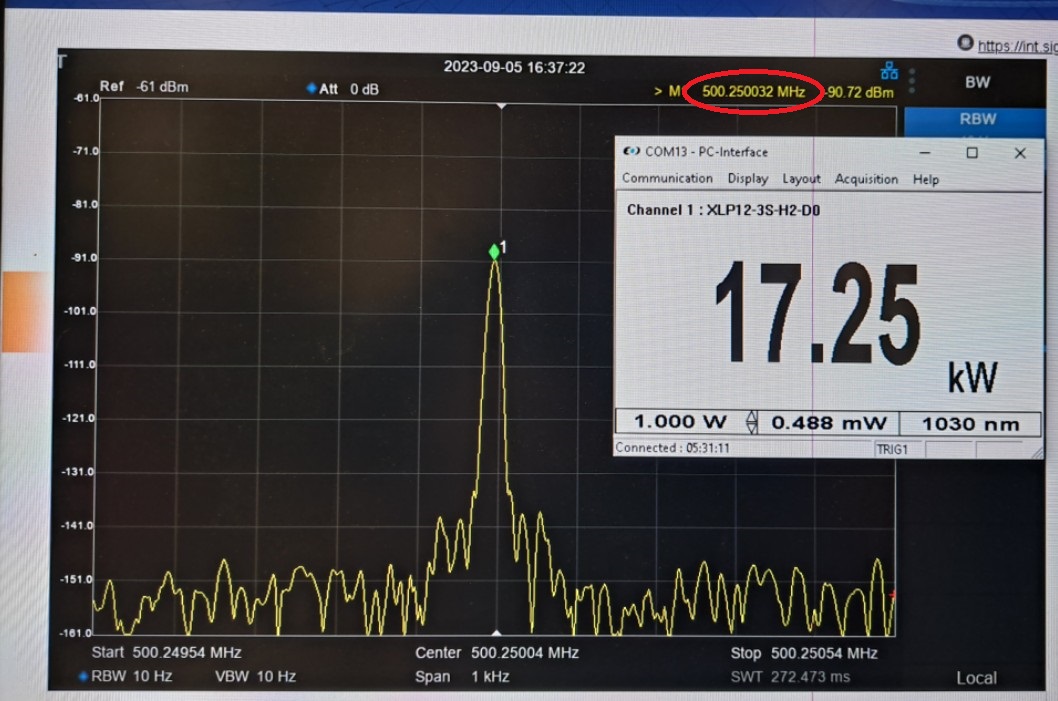
Ronic Chiche | Fixed | info | lasers and optics | ThomX igloo | FP-cavity FSR shift | today, to match the ring frequency at 500.25MHz (15th laser harmonic), we did a frequency shift on the laser using the Smaract motors (not too fast, ~2µm/s, to prevent laser modelock loss)
and we "followed" this shift on the FP-cavity using the FP-cavity motors.
we did several steps during the operation, to control the alignment, coupling and transmission.
finally, we locked again the laser and FP-cavity at 17kW for 30% of input power.
the coupling was quite low ~10% |
| Attachment 1: 20230905_173506.jpg
|  |
|
235
|
Tue Sep 5 18:08:39 2023 |
Ronic Chiche | Fixed | info | lasers and optics | ThomX igloo | Equipments shutdown | on the August 30rd and 31th, a global power shutdown was forseen for ThomX.
to prevent damage on equipments, I switched off all of them (and disconnected power cables from the wall plugs).
yesterday, after the week-end, all the equipments have been restarted and the cavity as been locked properly.
the power coupled to the input fiber of the amplifier has decreased a little bit from 3.8mW to 3mW during summer.
=> we need perharps to do some alignment on the Schaftner-Krischoff mount. |
|
234
|
Tue Sep 5 17:59:24 2023 |
Ronic Chiche | Fixed | issue | lasers and optics | detectors and electronics | ThomX igloo | work with HV voltage on the Laselock | Yesterday, I checked the 2 output HV channels of the LaseLock : they work properly but the noise is bigger than the low voltage outputs
~ 1mV rms on 0-10V outputs
~ 8 mv rms on 0-100V output
| Ronic Chiche wrote: |
|
presently, the voltage on the laser PZT is 0-10V, but during the several runs we did, this voltage is too low to compensate low frequency fluctuations:
we need to change often the motors position implying a cavity lock loss.
we have to check if running the laser PZT with the HV output of the Laselock is possible without too much additionnal noise.
=> it can be done simultaneously with the fast feedback loop implementation, which has to be done.
|
|
|
233
|
Wed Aug 2 13:13:52 2023 |
Ronic Chiche | Fixed | issue | lasers and optics | detectors and electronics | ThomX igloo | work with HV voltage on the Laselock | presently, the voltage on the laser PZT is 0-10V, but during the several runs we did, this voltage is too low to compensate low frequency fluctuations:
we need to change often the motors position implying a cavity lock loss.
we have to check if running the laser PZT with the HV output of the Laselock is possible without too much additionnal noise.
=> it can be done simultaneously with the fast feedback loop implementation, which has to be done. |
|
232
|
Wed Aug 2 13:07:59 2023 |
Ronic Chiche | Not Fixed | issue | detectors and electronics | ThomX igloo | ThomX ring injection kicker noise => USB communication issue with Alphanov amplifier | several times already, when the electrons ring injection kicker is running @10Hz, we observed peaks at the same frequency on reflected and transmitted photodiodes,
at the exact moment when the kicker is activated. we have in addition, USB communication issues with the Alphanov amplifier... the connection is lost several times.
sometime, the connection is retrieved, sometimes not... one has to stop the Alphanov application and restart it => the laser power get down to 0 % !!!
one way to get rid to this problem could be to add a "metallic sock" around the USB cable, to connected to the ground to remove the external charges.
we could ask also for a kicker shielding as this noise could perturbate several systems in the bunker. |
|
252
|
Wed Aug 2 11:38:20 2023 |
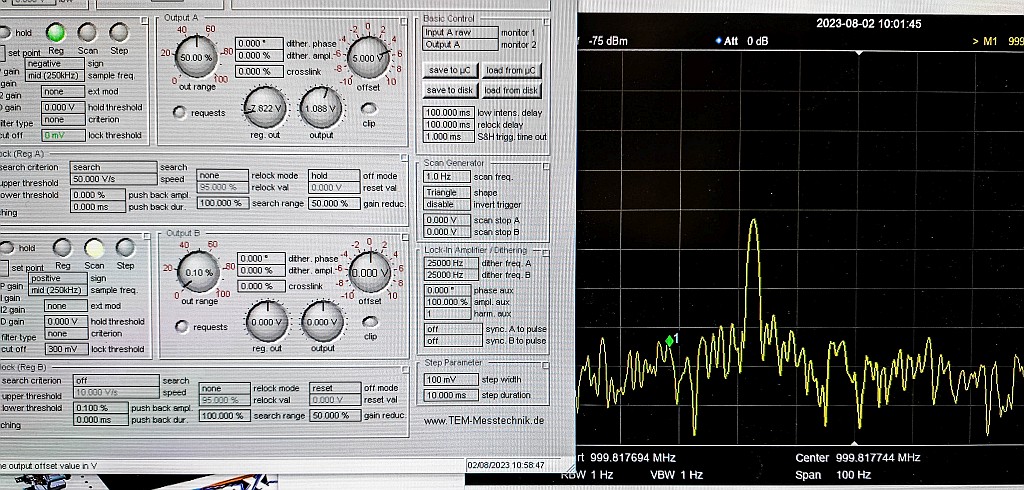
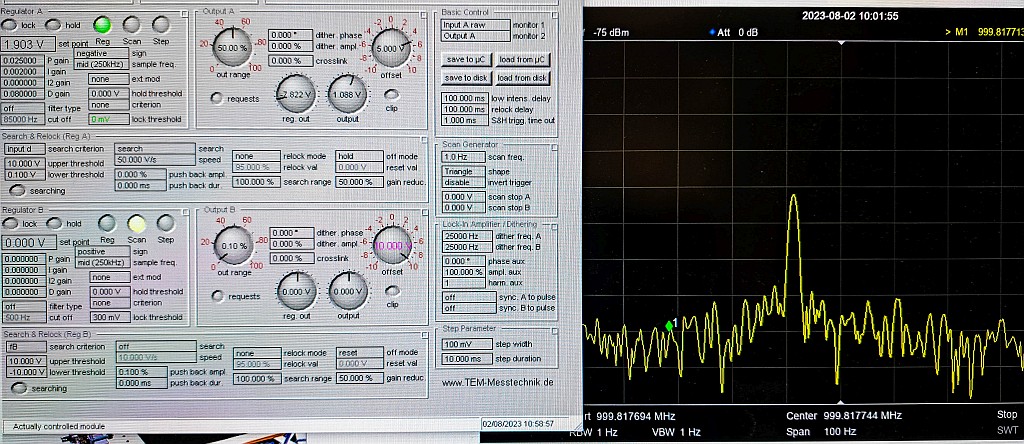
Ronic Chiche | Fixed | info | detectors and electronics | Optical room | lock oscillateur 33MHz - synthé 500MHz | Today, I connected the BNC-DB9 female prolongator cable to the FP-cavity PZT cable (DB9-DB9) and to the channel B of the Laselock.
I additionnaly connected the reflected laser beam (normally connected to scope ch2) to the spectrum analyzer @ 1GHz to observe the 30th harmonic of the laser comb.
on the 2 attached pictures, the 1st one is @0V on FP-cavity PZT and the 2nd one is @10V on the FP-cavity PZT.
as the laser is locked on the FP-cavity, its frequency follows the FP-cavity length and its frequency changes.
as expected, applying 10V on the FP-cavity PZT, increases the laser harmonic frequency @ 1GHz by about 10Hz => the relative change is 10^-9 V^-1
(as the FP-cavity length is always moving due to temperature or low frequency vibrations, there are always some FP-cavity length fluctuations, and the measurement has to be quick to get a correct evaluation).
| Ronic Chiche wrote: |
|
Today, I installed a DB9-DB9 female-male cable on the PZT connector of the FP-cavity.
the PZT is connected between pins 1 and 2, with a capacitance around 70nF.
I need to make a prolongator cable BNC-DB9 female to connect it to the feedback system.
with a (dLpzt / dV) of 5nm/V, one should be able to see 37mHz/V on Frep which is equivalent to ~10Hz/10V @ 1GHz (30th Frep harmonics)
I connected a photodiode on the spectrum analyzer to measure this variation => to be done tomorrow.
I don't have any information about the polarity of the PZT on the DB9 connector but I know that the PZT length should increase with positivite voltage in normal operation.
from the Yann documentation about the PZT mount (in attached file), it should mean that the cavity length should decrease when the PZT length is increasing, and then the FP-cavity FSR should increase.
=> to be tested tomorrow.
about the PZT mount :
I understand that the HR face of the P4 mirror is the face placed on the only part with a chamfer (chanfrein), on the FP-cavity side.
in the documentation, the PZT connector orientation is misleading as it is oriented to the FP-cavity side instead of to the "outside" as one can see it in the cavity picture in attached file.
| Ronic Chiche wrote: |
- régler le problème 1:
Kevin m'a apporté un déphaseur Minicircuits JSPHS-661 (400-660MHz / 180° de phase) qui permet de déphaser le 500MHz de ~ 1ns avec une tension DC 0-10V.
on peut alors changer le signe du lock pour scanner les 2ns d'une période complète de 500MHz.
- régler le problème 2:
la synchro anneau se fait sur la RF du synthé 500MHz avec une signal de trig fabriqué à partir d'un 16MHz, issu d'une division de ce 500MHz.
en cas de perte de synchro de la cavité FP, on va relocker sur le 500MHz mais avec une phase aléatoire par rapport au 16MHz.
on peut donc remplacer ce 16MHz par le signal 33MHz issu du laser de telle façon que l'injection des électrons dans l'anneau se fera toujours avec la même phase par rapport à ce signal à 33MHz.
il faudra donc envoyer ce signal issu du laser cavité FP au système de synchro anneau, de cette façon la phase d'injection des électrons dans l'anneau par rapport au laser sera toujours la même.
mais il n'y a aucune raison que les électrons tombent exactement sur le pulse laser (avec la bonne phase).
il faudra donc scanner la phase du signal de trig pour décaler l'injection machine par rapport au signal 33MHz avec des steps ~ 1ns.
pour cela, on peut utiliser les générateurs de delais Greenfield Technology GFT1020 actuellement utilisés pour la synchro (résolution 100ps).
voir schéma attaché en pdf
| Ronic Chiche wrote: |
|
pour préparer le lock cavité-anneau, j'ai un setup de lock en salle optique entre le laser OneFive 133MHz et un synthé à 533MHz (133MHz x4).
ce matin, j'ai pu locker les 2 ensembles avec le laselock avec une stabilité RMS, je pense inférieure à la ps.
ma limite de mesure du jitter temporel au scope est de ~ 2.5ps.
- une fois locké avec le laselock, je peux facilement décaler légèrement en phase les 2 signaux de façon très précise (<1ps) en jouant sur l'offset de lock,
mais je ai une plage assez petite (+/- 250ps) qui correspond grosso modo aux plages linéaires du sinus (1/4 de période) soit 500ps (F ~ 533MHz => T ~ 2ns)
en changeant le signe du lock, je peux faire des sauts du lock d'une 1/2 période, soit 1ns...
mais cela ne suffit pas à couvrir l'intégralité de la période du signal de référence.
=> 1er problème : je n'ai accès qu'aux plages "linéaires" du signal de référence.
il faudrait un petit déphaseur programmable piloté en remote pour faire des steps de 100ps environ, sur une plage de 1 ou 2ns afin d'être sur de scanner tout la période du 500MHz.
- en coupant le lock, les fréquences driftent l'une par rapport à l'autre.
et en raccrochant le lock, on peut scanner toute la période entre 2 pulses d'électrons par steps de 2ns.
puis en changeant le signe du lock, par steps de 2ns mais décalé de 1ns.
on peut donc facilement scanner la période des électrons avec des steps de 1ns et une plage de 500ps autour de chacun de ces steps.
=> 2e problème : lorsque l'on perd le lock de la cavité FP/laser involontairement, on perd l'info de la longueur de la cavité FP.
et lorsqu'on retrouvera le lock, il va se raccrocher sur une autre oscillation du 500MHz.
et donc on va perdre la phase avec les électrons à 16MHz.
=> on peut éventuellement afficher ce signal à 16MHz, en même temps que le 500MHz pour rechercher l'oscillation correspondante à la bonne phase sur le 16MHz.
mais dans tous les cas, il faudra rechercher à nouveau la phase é-/laser à chaque délock.
- Autre possibilité, faire la synchro sur le 16MHz au lieu du 500MHz.
la tentative aujourd'hui n'a rien donné car le signal est 30x moins intense => beaucoup plus de bruit.
=> le lock n'arrive pas du tout à accrocher même en filtrant énormément le signal IF avec 10kHz de BW.
|
|
|
|
| Attachment 1: FP-cavity_PZT_@0V.jpg
|  |
| Attachment 2: FP-cavity_PZT_@10V.jpg
|  |
|
251
|
Mon Jul 31 19:17:40 2023 |
Ronic Chiche | Fixed | info | detectors and electronics | Optical room | lock oscillateur 33MHz - synthé 500MHz | Today, I installed a DB9-DB9 female-male cable on the PZT connector of the FP-cavity.
the PZT is connected between pins 1 and 2, with a capacitance around 70nF.
I need to make a prolongator cable BNC-DB9 female to connect it to the feedback system.
with a (dLpzt / dV) of 5nm/V, one should be able to see 37mHz/V on Frep which is equivalent to ~10Hz/10V @ 1GHz (30th Frep harmonics)
I connected a photodiode on the spectrum analyzer to measure this variation => to be done tomorrow.
I don't have any information about the polarity of the PZT on the DB9 connector but I know that the PZT length should increase with positivite voltage in normal operation.
from the Yann documentation about the PZT mount (in attached file), it should mean that the cavity length should decrease when the PZT length is increasing, and then the FP-cavity FSR should increase.
=> to be tested tomorrow.
about the PZT mount :
I understand that the HR face of the P4 mirror is the face placed on the only part with a chamfer (chanfrein), on the FP-cavity side.
in the documentation, the PZT connector orientation is misleading as it is oriented to the FP-cavity side instead of to the "outside" as one can see it in the cavity picture in attached file.
| Ronic Chiche wrote: |
- régler le problème 1:
Kevin m'a apporté un déphaseur Minicircuits JSPHS-661 (400-660MHz / 180° de phase) qui permet de déphaser le 500MHz de ~ 1ns avec une tension DC 0-10V.
on peut alors changer le signe du lock pour scanner les 2ns d'une période complète de 500MHz.
- régler le problème 2:
la synchro anneau se fait sur la RF du synthé 500MHz avec une signal de trig fabriqué à partir d'un 16MHz, issu d'une division de ce 500MHz.
en cas de perte de synchro de la cavité FP, on va relocker sur le 500MHz mais avec une phase aléatoire par rapport au 16MHz.
on peut donc remplacer ce 16MHz par le signal 33MHz issu du laser de telle façon que l'injection des électrons dans l'anneau se fera toujours avec la même phase par rapport à ce signal à 33MHz.
il faudra donc envoyer ce signal issu du laser cavité FP au système de synchro anneau, de cette façon la phase d'injection des électrons dans l'anneau par rapport au laser sera toujours la même.
mais il n'y a aucune raison que les électrons tombent exactement sur le pulse laser (avec la bonne phase).
il faudra donc scanner la phase du signal de trig pour décaler l'injection machine par rapport au signal 33MHz avec des steps ~ 1ns.
pour cela, on peut utiliser les générateurs de delais Greenfield Technology GFT1020 actuellement utilisés pour la synchro (résolution 100ps).
voir schéma attaché en pdf
| Ronic Chiche wrote: |
|
pour préparer le lock cavité-anneau, j'ai un setup de lock en salle optique entre le laser OneFive 133MHz et un synthé à 533MHz (133MHz x4).
ce matin, j'ai pu locker les 2 ensembles avec le laselock avec une stabilité RMS, je pense inférieure à la ps.
ma limite de mesure du jitter temporel au scope est de ~ 2.5ps.
- une fois locké avec le laselock, je peux facilement décaler légèrement en phase les 2 signaux de façon très précise (<1ps) en jouant sur l'offset de lock,
mais je ai une plage assez petite (+/- 250ps) qui correspond grosso modo aux plages linéaires du sinus (1/4 de période) soit 500ps (F ~ 533MHz => T ~ 2ns)
en changeant le signe du lock, je peux faire des sauts du lock d'une 1/2 période, soit 1ns...
mais cela ne suffit pas à couvrir l'intégralité de la période du signal de référence.
=> 1er problème : je n'ai accès qu'aux plages "linéaires" du signal de référence.
il faudrait un petit déphaseur programmable piloté en remote pour faire des steps de 100ps environ, sur une plage de 1 ou 2ns afin d'être sur de scanner tout la période du 500MHz.
- en coupant le lock, les fréquences driftent l'une par rapport à l'autre.
et en raccrochant le lock, on peut scanner toute la période entre 2 pulses d'électrons par steps de 2ns.
puis en changeant le signe du lock, par steps de 2ns mais décalé de 1ns.
on peut donc facilement scanner la période des électrons avec des steps de 1ns et une plage de 500ps autour de chacun de ces steps.
=> 2e problème : lorsque l'on perd le lock de la cavité FP/laser involontairement, on perd l'info de la longueur de la cavité FP.
et lorsqu'on retrouvera le lock, il va se raccrocher sur une autre oscillation du 500MHz.
et donc on va perdre la phase avec les électrons à 16MHz.
=> on peut éventuellement afficher ce signal à 16MHz, en même temps que le 500MHz pour rechercher l'oscillation correspondante à la bonne phase sur le 16MHz.
mais dans tous les cas, il faudra rechercher à nouveau la phase é-/laser à chaque délock.
- Autre possibilité, faire la synchro sur le 16MHz au lieu du 500MHz.
la tentative aujourd'hui n'a rien donné car le signal est 30x moins intense => beaucoup plus de bruit.
=> le lock n'arrive pas du tout à accrocher même en filtrant énormément le signal IF avec 10kHz de BW.
|
|
|
| Attachment 1: CFP_-_piezo_intra_cavité.pdf
|
| Attachment 2: Image_of_P4_S2_window_open_Oxidization_shown.jpeg
|  |
|
250
|
Fri Jul 28 13:19:22 2023 |
Ronic Chiche | Fixed | info | detectors and electronics | Optical room | lock oscillateur 33MHz - synthé 500MHz |
- régler le problème 1:
Kevin m'a apporté un déphaseur Minicircuits JSPHS-661 (400-660MHz / 180° de phase) qui permet de déphaser le 500MHz de ~ 1ns avec une tension DC 0-10V.
on peut alors changer le signe du lock pour scanner les 2ns d'une période complète de 500MHz.
- régler le problème 2:
la synchro anneau se fait sur la RF du synthé 500MHz avec une signal de trig fabriqué à partir d'un 16MHz, issu d'une division de ce 500MHz.
en cas de perte de synchro de la cavité FP, on va relocker sur le 500MHz mais avec une phase aléatoire par rapport au 16MHz.
on peut donc remplacer ce 16MHz par le signal 33MHz issu du laser de telle façon que l'injection des électrons dans l'anneau se fera toujours avec la même phase par rapport à ce signal à 33MHz.
il faudra donc envoyer ce signal issu du laser cavité FP au système de synchro anneau, de cette façon la phase d'injection des électrons dans l'anneau par rapport au laser sera toujours la même.
mais il n'y a aucune raison que les électrons tombent exactement sur le pulse laser (avec la bonne phase).
il faudra donc scanner la phase du signal de trig pour décaler l'injection machine par rapport au signal 33MHz avec des steps ~ 1ns.
pour cela, on peut utiliser les générateurs de delais Greenfield Technology GFT1020 actuellement utilisés pour la synchro (résolution 100ps).
voir schéma attaché en pdf
| Ronic Chiche wrote: |
|
pour préparer le lock cavité-anneau, j'ai un setup de lock en salle optique entre le laser OneFive 133MHz et un synthé à 533MHz (133MHz x4).
ce matin, j'ai pu locker les 2 ensembles avec le laselock avec une stabilité RMS, je pense inférieure à la ps.
ma limite de mesure du jitter temporel au scope est de ~ 2.5ps.
- une fois locké avec le laselock, je peux facilement décaler légèrement en phase les 2 signaux de façon très précise (<1ps) en jouant sur l'offset de lock,
mais je ai une plage assez petite (+/- 250ps) qui correspond grosso modo aux plages linéaires du sinus (1/4 de période) soit 500ps (F ~ 533MHz => T ~ 2ns)
en changeant le signe du lock, je peux faire des sauts du lock d'une 1/2 période, soit 1ns...
mais cela ne suffit pas à couvrir l'intégralité de la période du signal de référence.
=> 1er problème : je n'ai accès qu'aux plages "linéaires" du signal de référence.
il faudrait un petit déphaseur programmable piloté en remote pour faire des steps de 100ps environ, sur une plage de 1 ou 2ns afin d'être sur de scanner tout la période du 500MHz.
- en coupant le lock, les fréquences driftent l'une par rapport à l'autre.
et en raccrochant le lock, on peut scanner toute la période entre 2 pulses d'électrons par steps de 2ns.
puis en changeant le signe du lock, par steps de 2ns mais décalé de 1ns.
on peut donc facilement scanner la période des électrons avec des steps de 1ns et une plage de 500ps autour de chacun de ces steps.
=> 2e problème : lorsque l'on perd le lock de la cavité FP/laser involontairement, on perd l'info de la longueur de la cavité FP.
et lorsqu'on retrouvera le lock, il va se raccrocher sur une autre oscillation du 500MHz.
et donc on va perdre la phase avec les électrons à 16MHz.
=> on peut éventuellement afficher ce signal à 16MHz, en même temps que le 500MHz pour rechercher l'oscillation correspondante à la bonne phase sur le 16MHz.
mais dans tous les cas, il faudra rechercher à nouveau la phase é-/laser à chaque délock.
- Autre possibilité, faire la synchro sur le 16MHz au lieu du 500MHz.
la tentative aujourd'hui n'a rien donné car le signal est 30x moins intense => beaucoup plus de bruit.
=> le lock n'arrive pas du tout à accrocher même en filtrant énormément le signal IF avec 10kHz de BW.
|
|
| Attachment 1: lock_anneau-cavite.pdf
|
|