| ID |
Date |
Author |
Status |
Type |
Category |
Location |
Title |
|
144
|
Tue Sep 6 17:47:40 2022 |
Ronic Chiche | Fixed | issue | lasers and optics | Optical room | unsuccessful telescope design :-( | we wanted to calculate the right telescope with 2 spherical lenses.
1) we have the FP cavity mode size which is 0.58mm at the input mirror and 0.7mm at the output mirror.
2) we planned to measure the laser beam at the output of the amplifier working at P=1W (2nd stage ON only).
we did several measurements at different positions from the amplifier output.
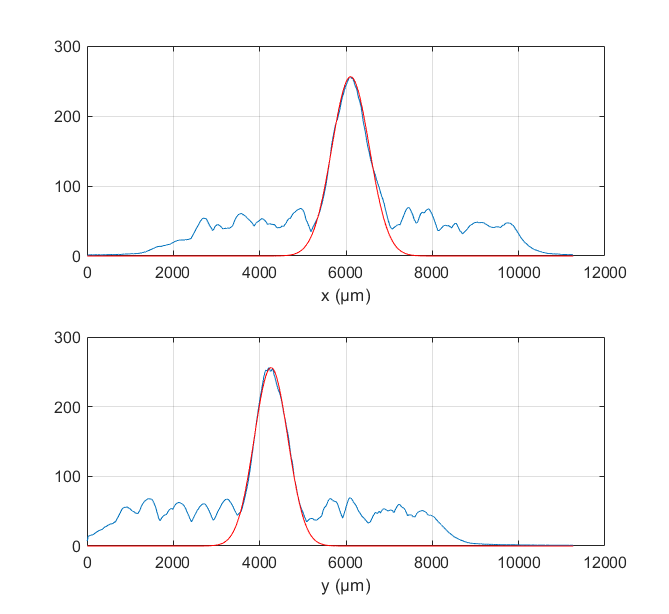
for each of these measurements, we were able to fit the intensity profile I = I0 * exp(-2 *r^2 / w^2) on x or y axis, then we have w(z).
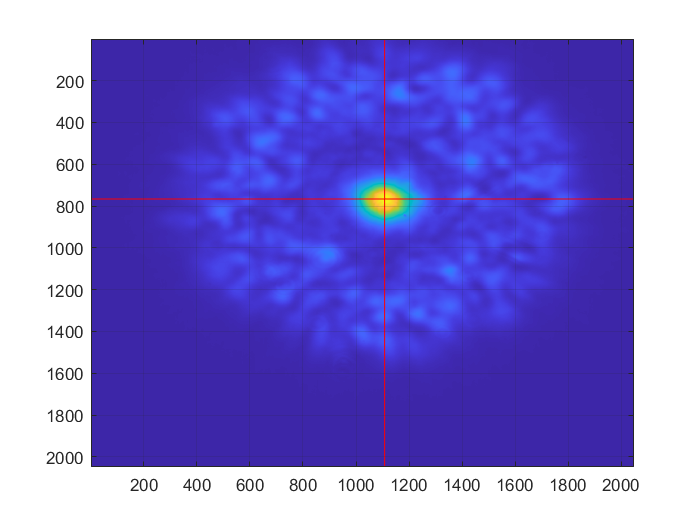
attached files give an example of the beam image at z=40mm and an example of the beam fits for w and y.
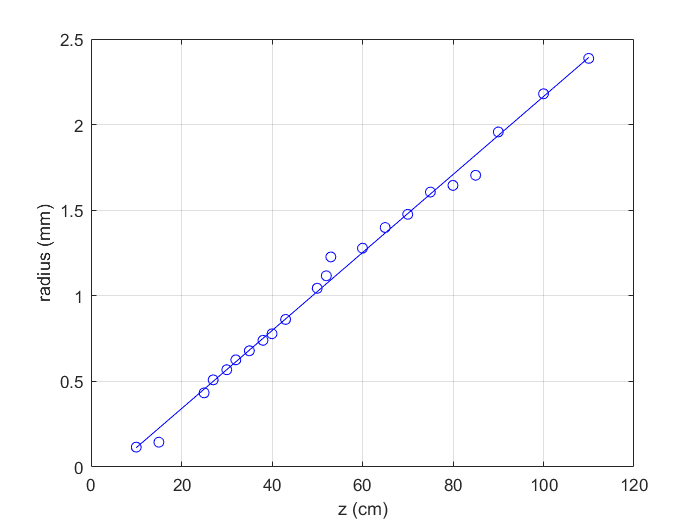
with all the w(z) measurements, we were able to fit the divergence of the beam => 2.3 mrad
attached file show the radius measurements and the divergence fit.
with this divergence, we should find a waist bigger than 140 µm (value for M²=1).
unfortunately the smallest beam radius measured is 116 µm which would give a M²<1 that is not allowed !
then it seems the measurements have not been done correctly... :-(
we will try to do them again... maybe at P=10W or 50W ?!? |
| Attachment 1: image_at_z_being_40mm.png
|  |
| Attachment 2: beam_fit_at_z_being_40mm.png
|  |
| Attachment 3: propagation_fit.png
|  |
|
145
|
Wed Sep 7 18:57:20 2022 |
Manar Amer | Fixed | report | lasers and optics | Optical room | Telescope / amplifier output | We increased the power of the amplifier up to 10 W to see if there is a change in the beam shape at the injection point or the transmission.
There was no change in the shape of both of them from the reading at 1 W (with only the 2nd stage on)
Only saw an increase in the transmission power, which is expected.
| Manar Amer wrote: |
|
Am adjustment on the lenses position to have a smaller waist.
+ 250 mm @ 88 cm from amplifier
-150 mm @ 111 cm from amplifier
the overlap with this placement is ~ 91%
the measured beam FWHM at the injection point M1 estimated to be ~ 0.94 mm
waist = 0.85*0.94 = 0.79 mm , it is still much larger than the needed 0.58 mm radius waist.
There is an improvement in reducing higher order modes, but the fundamental is still too weak to see, we observe higher order even modes 11 , 44 , ...
| Manar Amer wrote: |
|
Note the correct beam divergence is approximately ~ 2.3 mrad
M2 = 1.1 in this fit, but it is not yet optimized !!!!! could be reason for not accurate telescope reading.
Have tInstalled a new telescope with lenses
250 mm @ 86.8 cm from amplifier ,
-150 mm @109 cm (~ 22 cm between lenses)
the beam waist measured at a point on the reflection which is relatively the same distance to the injection mirror and the beam was much smaller than before
@ ~ 2 meters from amplifier + telescope , FWHM = 1.2 mm , waist = 0.85 * FWHM = 1.02 mm
| Manar Amer wrote: |
|
Here is a view of beam propagation in the optical software : GaussianBeam
the red filled shape is the model of the CELIA amplifier beam propagation with a divergence of 4.46 mrad
(the 2 black dots is the measurement of the beam size without any lens to change the beam propagation).
the 2 black lines have been put at the input and output cavity mirrors position relative to the CELIA amplifier position, respectively 2m and 2.7m roughly.
the cavity mode radius should be 0.55mm and 0.7mm respectively.
the cavity mode shape is represented by the 2 red lines (very close to the red filled shape which is the beam).
the most simple working telescope could be a +250 lens at 280mm from the CELIA amplifier.
it gives a beam radius of 0.53mm at the input mirror and 0.64mm at the output mirror.
the overlapping is more than 99%
the 2nd file is the GaussianBeam file.
| Manar Amer wrote: |
|
I placed a periscope to adjust the high of the beam from the amplifier output from ~ 10 cm from the table to ~ 15 cm
a dichroic mirror placed after it to reject the pump laser, all the mirrors on the path to the cavity were replaced with dielectric mirrors BB01-E03
the length of the path from the amplifier output to the cavity coupling mirror ~ 2 meters
setup defines the different optics placed in the path
Note: the beam goes all the way to the cavity, put it is not yet optimized to the irises.
| Manar Amer wrote: |
|
Beam divergence was measured using a method called "Focal Length Divergence Measurement Method"
Where a lens of a known focal length is placed on the beam path and the beam waist is measured at the focal distance using a beam profiler.
We ramped the power up to 10 W
for a focal length = 400 mm,
we measured a FWHM = 2.1 mm,
corresponding to a divergence = 4.45 mrad (edit : wrong software use)
for comparison, we measured the FWHM 8.1 mm @ 1.55 m and extracted the divergence directly 4.46 mrad (edit : this measurement is wrong - wrong use of the software)
Note: better to use a lens of a focal lens higher than 100 mm (to reduce the error in the distance measured)
| Manar Amer wrote: |
|
The previous Sbox telescope was dismantled and the mechanical components cleaned.
its lenses are still in the mounts, it looks that two of them are spherical and two are cylindrical
2 are -100 mm and 2 are +150 mm, there is also a box containing fused silica lenses that could be used.
Note: at high power use only fused silica lenses not BK7 type
|
|
|
|
|
|
|
|
146
|
Wed Sep 7 18:58:03 2022 |
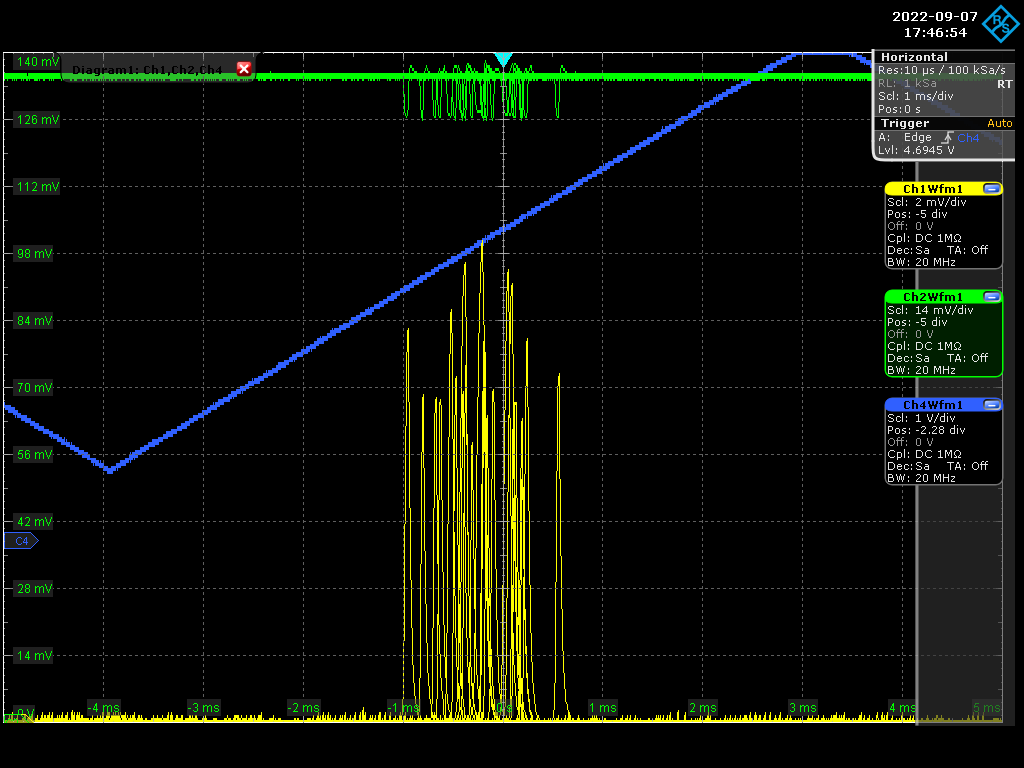
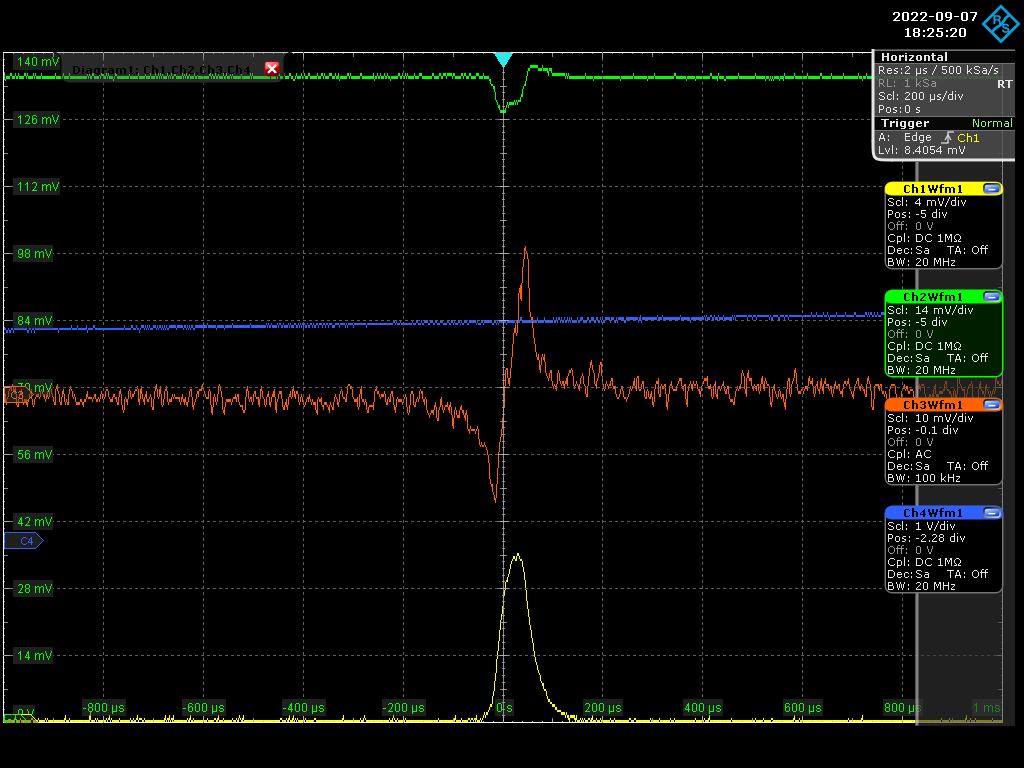
Manar Amer | Fixed | report | lasers and optics | Optical room | Locking Amplifier with Cavity | Today we managed to observe the fundamental mode and stabilize the scan on it until we improved the alignment enough.
We see some coupling, but it is very week < 5% , We improved the alignment and the polarization, but there is still no explanation to why it is very low.
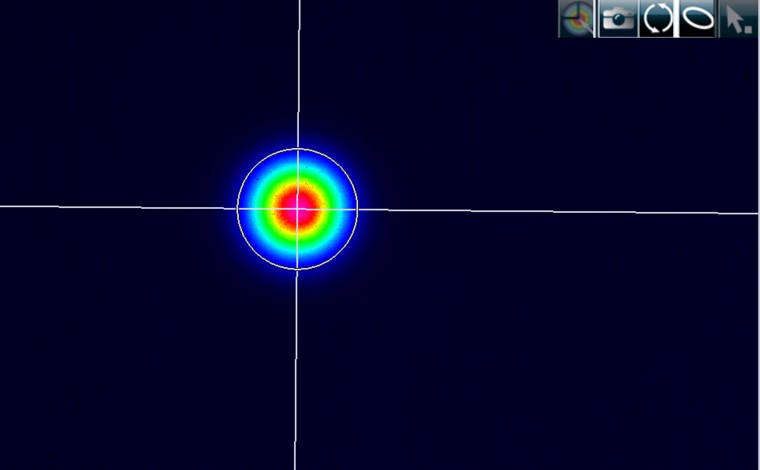
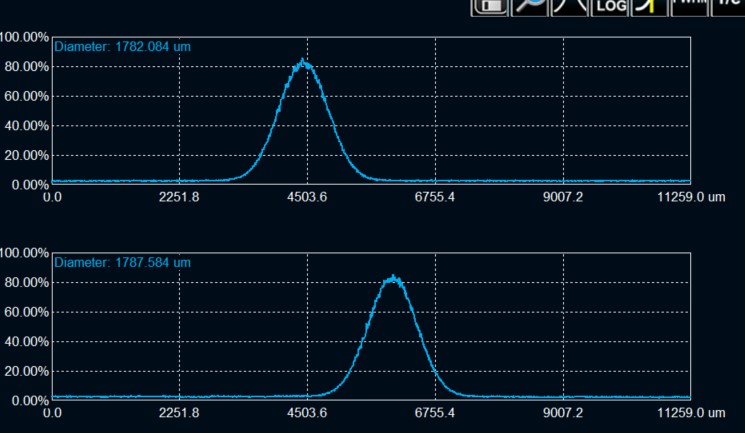
The mode shape is circular with radius = 0.89 mm at transmission point, ~ 40 cm from circular mirror.
One EOM was installed along the injection into the amplifier, we saw a drop in the power measured by the first stage monitor from ~ 8.2 mW to 7.2 mW
we improved the injection up to 7.6 mW, but it still fluctuates a lot. We need to be careful about it.
The error signal looks clean, but it is very week which is due to the weak coupling.
|
| Attachment 1: 20220907_00mode.jpg
|  |
| Attachment 2: 20220907_00mode_diameter.jpg
|  |
| Attachment 3: Screenshot_2022-09-07_0_174654.png
|  |
| Attachment 4: Screenshot_2022-09-07_2_182520.png
|  |
|
147
|
Thu Sep 8 11:16:40 2022 |
Manar Amer | Fixed | report | lasers and optics | Optical room | Locking Amplifier with Cavity | Today, we played on the CEP but using the I-tune input of the Menhir Laser (+/- 5V maximal range).
unfortunately, one only saw a very weak improvement of the transmission by 10-20%... and the coupling improvement is almost zero.
the best improvement was for the maximal I-tune range (+5V) which maybe means that we could improve more the effect if were able to get a full range of 2pi for the CEP (instead of the present pi/2 range).
| Manar Amer wrote: |
|
Today we managed to observe the fundamental mode and stabilize the scan on it until we improved the alignment enough.
We see some coupling, but it is very week < 5% , We improved the alignment and the polarization, but there is still no explanation to why it is very low.
The mode shape is circular with radius = 0.89 mm at transmission point, ~ 40 cm from circular mirror.
One EOM was installed along the injection into the amplifier, we saw a drop in the power measured by the first stage monitor from ~ 8.2 mW to 7.2 mW
we improved the injection up to 7.6 mW, but it still fluctuates a lot. We need to be careful about it.
The error signal looks clean, but it is very week which is due to the weak coupling.
|
|
|
148
|
Thu Sep 8 13:39:03 2022 |
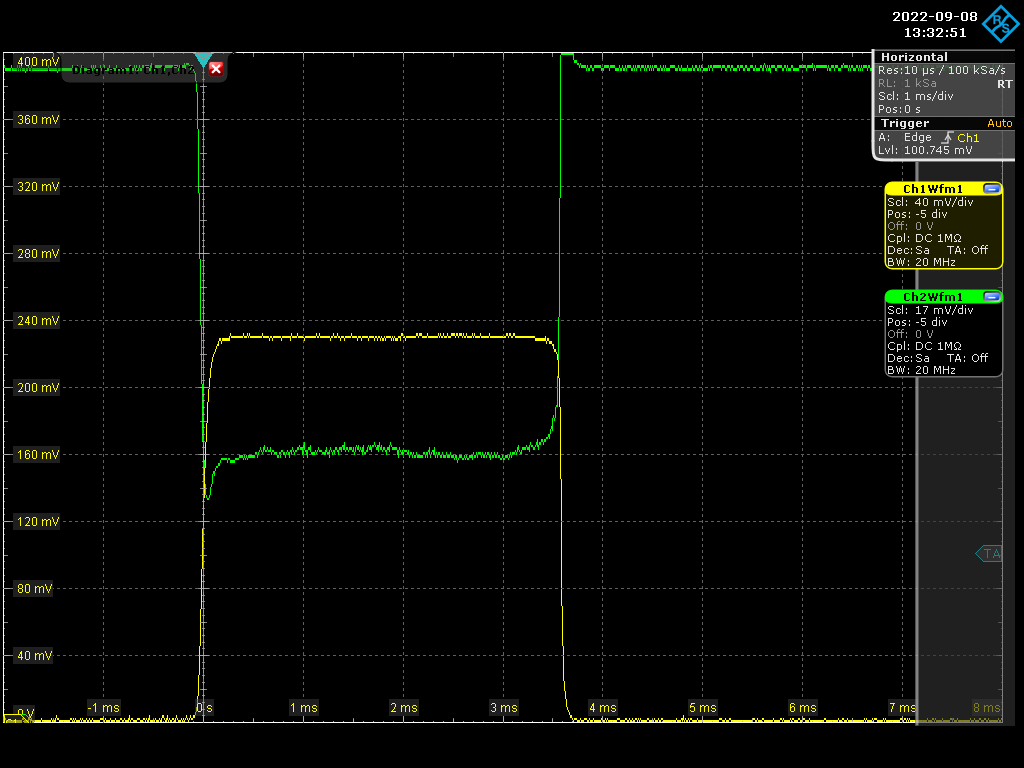
Manar Amer | Fixed | report | lasers and optics | Optical room | Locking Amplifier with Cavity | We played on the CEP using the USB command "id0=xxxxx" of the Menhir.
we put id0=48650 and we improved A LOT the transmission and coupling (~ 60%)
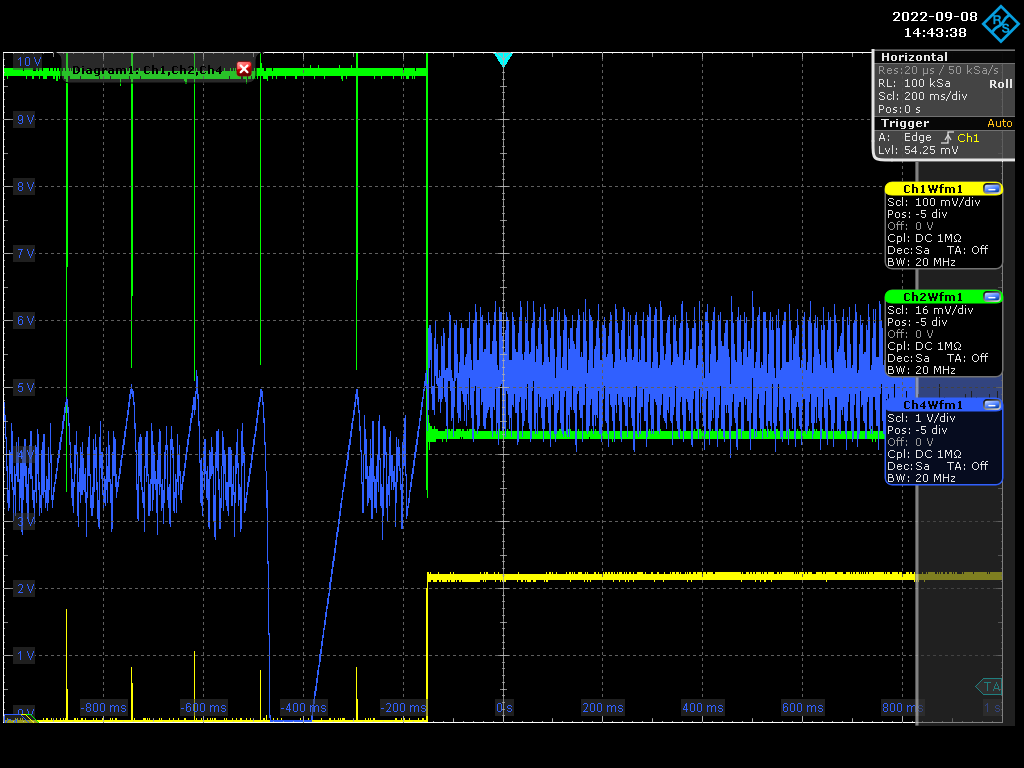
here is an image of the first attempts to lock... but the locking is quite difficult.
yellow : transmission
green : reflection
amplifier is still with 2nd stage only (Pout=~1W)
we are adding an AOM in the loop...
| Manar Amer wrote: |
|
Today, we played on the CEP but using the I-tune input of the Menhir Laser (+/- 5V maximal range).
unfortunately, one only saw a very weak improvement of the transmission by 10-20%... and the coupling improvement is almost zero.
the best improvement was for the maximal I-tune range (+5V) which maybe means that we could improve more the effect if were able to get a full range of 2pi for the CEP (instead of the present pi/2 range).
| Manar Amer wrote: |
|
Today we managed to observe the fundamental mode and stabilize the scan on it until we improved the alignment enough.
We see some coupling, but it is very week < 5% , We improved the alignment and the polarization, but there is still no explanation to why it is very low.
The mode shape is circular with radius = 0.89 mm at transmission point, ~ 40 cm from circular mirror.
One EOM was installed along the injection into the amplifier, we saw a drop in the power measured by the first stage monitor from ~ 8.2 mW to 7.2 mW
we improved the injection up to 7.6 mW, but it still fluctuates a lot. We need to be careful about it.
The error signal looks clean, but it is very week which is due to the weak coupling.
|
|
|
| Attachment 1: Screenshot_2022-09-08_0_133245.png
|  |
|
149
|
Thu Sep 8 14:58:51 2022 |
Manar Amer | Fixed | report | lasers and optics | Optical room | Locking Amplifier with Cavity | We managed to lock the cavity by adding the AOM , but the lock is still difficult to stabilize.
There is some high frequency compensated by the AOM at ~ 170 kHz (yet to understand from where it comes from)
| Manar Amer wrote: |
|
We played on the CEP using the USB command "id0=xxxxx" of the Menhir.
we put id0=48650 and we improved A LOT the transmission and coupling (~ 60%)
here is an image of the first attempts to lock... but the locking is quite difficult.
yellow : transmission
green : reflection
amplifier is still with 2nd stage only (Pout=~1W)
we are adding an AOM in the loop...
| Manar Amer wrote: |
|
Today, we played on the CEP but using the I-tune input of the Menhir Laser (+/- 5V maximal range).
unfortunately, one only saw a very weak improvement of the transmission by 10-20%... and the coupling improvement is almost zero.
the best improvement was for the maximal I-tune range (+5V) which maybe means that we could improve more the effect if were able to get a full range of 2pi for the CEP (instead of the present pi/2 range).
| Manar Amer wrote: |
|
Today we managed to observe the fundamental mode and stabilize the scan on it until we improved the alignment enough.
We see some coupling, but it is very week < 5% , We improved the alignment and the polarization, but there is still no explanation to why it is very low.
The mode shape is circular with radius = 0.89 mm at transmission point, ~ 40 cm from circular mirror.
One EOM was installed along the injection into the amplifier, we saw a drop in the power measured by the first stage monitor from ~ 8.2 mW to 7.2 mW
we improved the injection up to 7.6 mW, but it still fluctuates a lot. We need to be careful about it.
The error signal looks clean, but it is very week which is due to the weak coupling.
|
|
|
|
| Attachment 1: Screenshot_2022-09-08_2_144338.png
|  |
|
150
|
Thu Sep 8 18:28:51 2022 |
Manar Amer | Fixed | report | lasers and optics | Optical room | Locking Amplifier with Cavity | We wanted to increase the power of the amplifier to measure the transmission output at M2,
but locking the cavity again was very, very difficult.
We will try again tomorrow.
| Manar Amer wrote: |
|
We managed to lock the cavity by adding the AOM , but the lock is still difficult to stabilize.
There is some high frequency compensated by the AOM at ~ 170 kHz (yet to understand from where it comes from)
| Manar Amer wrote: |
|
We played on the CEP using the USB command "id0=xxxxx" of the Menhir.
we put id0=48650 and we improved A LOT the transmission and coupling (~ 60%)
here is an image of the first attempts to lock... but the locking is quite difficult.
yellow : transmission
green : reflection
amplifier is still with 2nd stage only (Pout=~1W)
we are adding an AOM in the loop...
| Manar Amer wrote: |
|
Today, we played on the CEP but using the I-tune input of the Menhir Laser (+/- 5V maximal range).
unfortunately, one only saw a very weak improvement of the transmission by 10-20%... and the coupling improvement is almost zero.
the best improvement was for the maximal I-tune range (+5V) which maybe means that we could improve more the effect if were able to get a full range of 2pi for the CEP (instead of the present pi/2 range).
| Manar Amer wrote: |
|
Today we managed to observe the fundamental mode and stabilize the scan on it until we improved the alignment enough.
We see some coupling, but it is very week < 5% , We improved the alignment and the polarization, but there is still no explanation to why it is very low.
The mode shape is circular with radius = 0.89 mm at transmission point, ~ 40 cm from circular mirror.
One EOM was installed along the injection into the amplifier, we saw a drop in the power measured by the first stage monitor from ~ 8.2 mW to 7.2 mW
we improved the injection up to 7.6 mW, but it still fluctuates a lot. We need to be careful about it.
The error signal looks clean, but it is very week which is due to the weak coupling.
|
|
|
|
|
|
151
|
Fri Sep 9 11:50:17 2022 |
Manar Amer | Fixed | report | lasers and optics | Optical room | Locking Amplifier with Cavity | We locked the cavity, and it is stable using the Transmission,
the high frequency that we thought could have a reason for instability, is due to the high power on the photo diode of the PDH box which can cause non-linearity effects in the signal.
We also closed the fan of the third stage and there was no significant change on the error signal and the piezo+AOM compensation signal.
| Manar Amer wrote: |
|
We managed to lock the cavity by adding the AOM , but the lock is still difficult to stabilize.
There is some high frequency compensated by the AOM at ~ 170 kHz (yet to understand from where it comes from)
| Manar Amer wrote: |
|
We played on the CEP using the USB command "id0=xxxxx" of the Menhir.
we put id0=48650 and we improved A LOT the transmission and coupling (~ 60%)
here is an image of the first attempts to lock... but the locking is quite difficult.
yellow : transmission
green : reflection
amplifier is still with 2nd stage only (Pout=~1W)
we are adding an AOM in the loop...
| Manar Amer wrote: |
|
Today, we played on the CEP but using the I-tune input of the Menhir Laser (+/- 5V maximal range).
unfortunately, one only saw a very weak improvement of the transmission by 10-20%... and the coupling improvement is almost zero.
the best improvement was for the maximal I-tune range (+5V) which maybe means that we could improve more the effect if were able to get a full range of 2pi for the CEP (instead of the present pi/2 range).
| Manar Amer wrote: |
|
Today we managed to observe the fundamental mode and stabilize the scan on it until we improved the alignment enough.
We see some coupling, but it is very week < 5% , We improved the alignment and the polarization, but there is still no explanation to why it is very low.
The mode shape is circular with radius = 0.89 mm at transmission point, ~ 40 cm from circular mirror.
One EOM was installed along the injection into the amplifier, we saw a drop in the power measured by the first stage monitor from ~ 8.2 mW to 7.2 mW
we improved the injection up to 7.6 mW, but it still fluctuates a lot. We need to be careful about it.
The error signal looks clean, but it is very week which is due to the weak coupling.
|
|
|
|
|
|
152
|
Fri Sep 9 12:45:19 2022 |
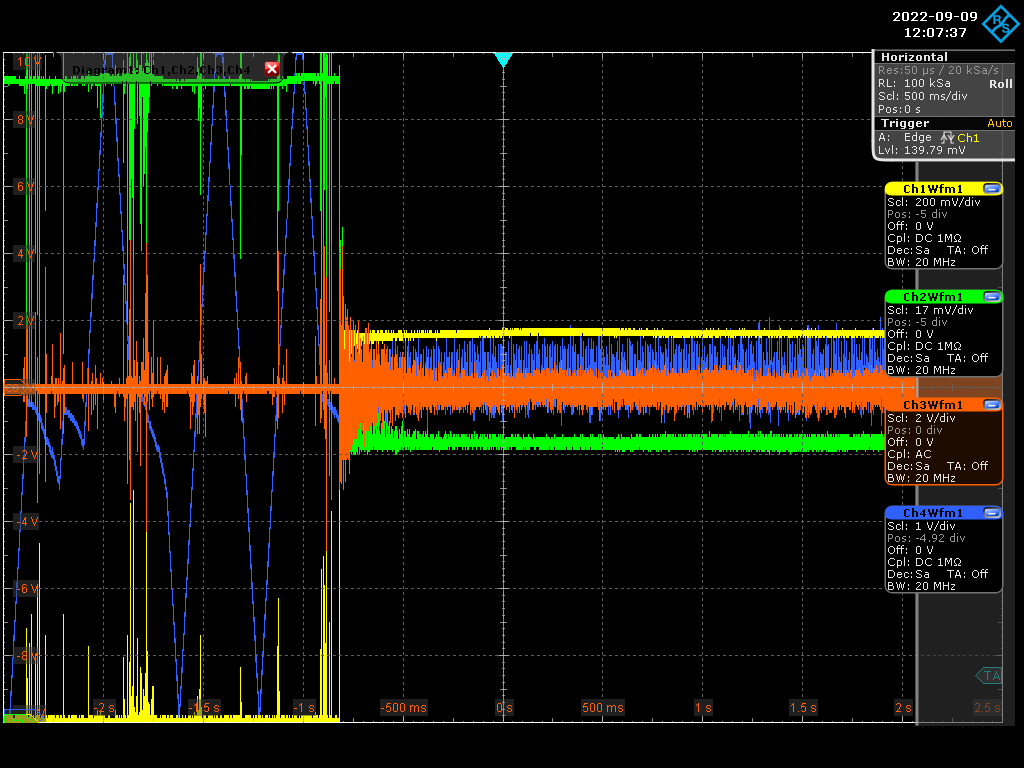
Manar Amer | Fixed | report | lasers and optics | Optical room | Locking Amplifier with Cavity | image of the lock with Coupling of ~ 60%
| Manar Amer wrote: |
|
We locked the cavity, and it is stable using the Transmission,
the high frequency that we thought could have a reason for instability, is due to the high power on the photo diode of the PDH box which can cause non-linearity effects in the signal.
We also closed the fan of the third stage and there was no significant change on the error signal and the piezo+AOM compensation signal.
| Manar Amer wrote: |
|
We managed to lock the cavity by adding the AOM , but the lock is still difficult to stabilize.
There is some high frequency compensated by the AOM at ~ 170 kHz (yet to understand from where it comes from)
| Manar Amer wrote: |
|
We played on the CEP using the USB command "id0=xxxxx" of the Menhir.
we put id0=48650 and we improved A LOT the transmission and coupling (~ 60%)
here is an image of the first attempts to lock... but the locking is quite difficult.
yellow : transmission
green : reflection
amplifier is still with 2nd stage only (Pout=~1W)
we are adding an AOM in the loop...
| Manar Amer wrote: |
|
Today, we played on the CEP but using the I-tune input of the Menhir Laser (+/- 5V maximal range).
unfortunately, one only saw a very weak improvement of the transmission by 10-20%... and the coupling improvement is almost zero.
the best improvement was for the maximal I-tune range (+5V) which maybe means that we could improve more the effect if were able to get a full range of 2pi for the CEP (instead of the present pi/2 range).
| Manar Amer wrote: |
|
Today we managed to observe the fundamental mode and stabilize the scan on it until we improved the alignment enough.
We see some coupling, but it is very week < 5% , We improved the alignment and the polarization, but there is still no explanation to why it is very low.
The mode shape is circular with radius = 0.89 mm at transmission point, ~ 40 cm from circular mirror.
One EOM was installed along the injection into the amplifier, we saw a drop in the power measured by the first stage monitor from ~ 8.2 mW to 7.2 mW
we improved the injection up to 7.6 mW, but it still fluctuates a lot. We need to be careful about it.
The error signal looks clean, but it is very week which is due to the weak coupling.
|
|
|
|
|
|
| Attachment 1: Screenshot_2022-09-09_0_120737.png
|  |
|
153
|
Fri Sep 9 12:49:44 2022 |
Manar Amer | Fixed | report | lasers and optics | Optical room | Locking Amplifier with Cavity | Alignment was improved to ~ 1.2 V on the photodiode.
Only the second stage was on with ~ 1 W output from amplifier
we measured the transmission from S2 to be 2.3 mW
| Manar Amer wrote: |
|
image of the lock with Coupling of ~ 60%
| Manar Amer wrote: |
|
We locked the cavity, and it is stable using the Transmission,
the high frequency that we thought could have a reason for instability, is due to the high power on the photo diode of the PDH box which can cause non-linearity effects in the signal.
We also closed the fan of the third stage and there was no significant change on the error signal and the piezo+AOM compensation signal.
| Manar Amer wrote: |
|
We managed to lock the cavity by adding the AOM , but the lock is still difficult to stabilize.
There is some high frequency compensated by the AOM at ~ 170 kHz (yet to understand from where it comes from)
| Manar Amer wrote: |
|
We played on the CEP using the USB command "id0=xxxxx" of the Menhir.
we put id0=48650 and we improved A LOT the transmission and coupling (~ 60%)
here is an image of the first attempts to lock... but the locking is quite difficult.
yellow : transmission
green : reflection
amplifier is still with 2nd stage only (Pout=~1W)
we are adding an AOM in the loop...
| Manar Amer wrote: |
|
Today, we played on the CEP but using the I-tune input of the Menhir Laser (+/- 5V maximal range).
unfortunately, one only saw a very weak improvement of the transmission by 10-20%... and the coupling improvement is almost zero.
the best improvement was for the maximal I-tune range (+5V) which maybe means that we could improve more the effect if were able to get a full range of 2pi for the CEP (instead of the present pi/2 range).
| Manar Amer wrote: |
|
Today we managed to observe the fundamental mode and stabilize the scan on it until we improved the alignment enough.
We see some coupling, but it is very week < 5% , We improved the alignment and the polarization, but there is still no explanation to why it is very low.
The mode shape is circular with radius = 0.89 mm at transmission point, ~ 40 cm from circular mirror.
One EOM was installed along the injection into the amplifier, we saw a drop in the power measured by the first stage monitor from ~ 8.2 mW to 7.2 mW
we improved the injection up to 7.6 mW, but it still fluctuates a lot. We need to be careful about it.
The error signal looks clean, but it is very week which is due to the weak coupling.
|
|
|
|
|
|
|
|
154
|
Fri Sep 9 14:44:35 2022 |
Manar Amer | Fixed | report | lasers and optics | Optical room | Power storage In Cavity | We start of power output from amplifier of 1W with only the first and second stage on then we start with the third stage power increase,
Note: when changing the current on the third stage 4 diodes, better to do it step by step for each one with a step of ~ 0.5 A
|
Amplifier output current (A)
for four diodes
|
Power Output (W) |
Transmitted power (MW)
|
| 0 , 0 , 0 , 0 |
~ 1 |
2.3 |
| 1 , 1 , 1 , 1 |
/ |
11.0 |
| 1.5 , 1.3, 1 , 1 |
/ |
35 |
| 1.5 , 1.5 , 1 , 1 |
/ |
42.16 |
| |
|
- we placed at the transmission point a splitter the transmitted power before was 35 mW after placing it we had 26 mW
- 97 % transmission , 3% reflected which goes to the beam profiler
- We see degeneracy modes at the last step of 42.16 mW , so we started to test the D-shaped mirrors
- the full range of the motors is 50.8 mm
- each step = 30 nm , 30 000 steps = 1 mm
|
|
155
|
Fri Sep 9 15:47:46 2022 |
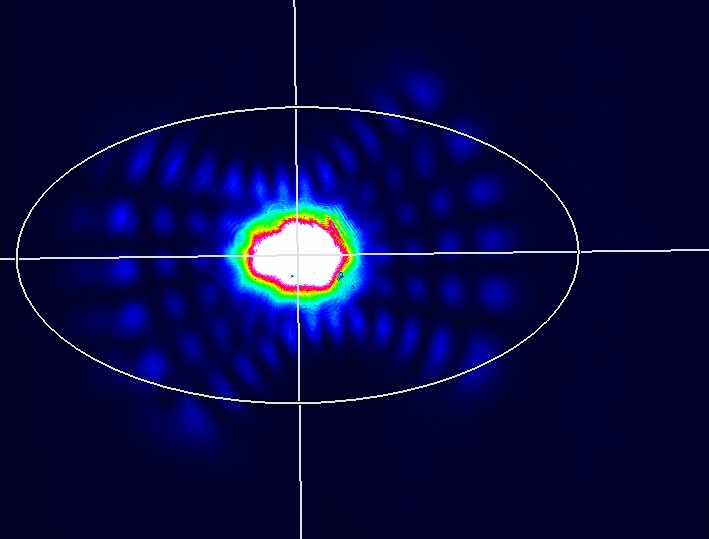
Manar Amer | Fixed | report | lasers and optics | Optical room | Power storage In Cavity | At transmission power of 42 mW, coupling 60%, we see fundamental mode with a degeneracy
The D-shape motors were moved to a position 2 000 000 steps (in theory they should be the max position)
but no change appeared on the 00 mode or the higher order mode.
We will break the vacuum and check the position of the D-shaped mirrors.
| Manar Amer wrote: |
|
We start of power output from amplifier of 1W with only the first and second stage on then we start with the third stage power increase,
Note: when changing the current on the third stage 4 diodes, better to do it step by step for each one with a step of ~ 0.5 A
|
Amplifier output current (A)
for four diodes
|
Power Output (W) |
Transmitted power (MW)
|
| 0 , 0 , 0 , 0 |
~ 1 |
2.3 |
| 1 , 1 , 1 , 1 |
/ |
11.0 |
| 1.5 , 1.3, 1 , 1 |
/ |
35 |
| 1.5 , 1.5 , 1 , 1 |
/ |
42.16 |
| |
|
- we placed at the transmission point a splitter the transmitted power before was 35 mW after placing it we had 26 mW
- 97 % transmission , 3% reflected which goes to the beam profiler
- We see degeneracy modes at the last step of 42.16 mW , so we started to test the D-shaped mirrors
- the full range of the motors is 50.8 mm
- each step = 30 nm , 30 000 steps = 1 mm
|
|
| Attachment 1: Transmission_after_S2.jpg
|  |
|
158
|
Mon Sep 12 16:27:14 2022 |
Manar Amer | Fixed | report | lasers and optics | Optical room | Power storage In Cavity | Power increased in the amplifier
reflective filters added at the transmission point to be able to have signal on the Beam Profiler, Transmission diode and power meter
|
Amplifier output current (A)
diode 1
|
Amplifier output current (A)
diode 2
|
Amplifier output current (A)
diode 3
|
Amplifier output current (A)
diode 4
|
Power Output (W) |
Transmitted power (mW) |
note |
| 0.5 |
0.5 |
0.5 |
0.5 |
|
|
no change in the beam shape |
| 1 |
1 |
1 |
1 |
|
|
|
| 1.5 |
1 |
1 |
1 |
|
|
Appearance of higher order mode (vertical), suppressed using D-shaped mirror (vertical only) by (-23000), image recorded. |
| 1.5 |
1.5 |
1.5 |
1.5 |
|
|
no change |
| 2 |
1.8 |
1.5
|
1.5 |
|
52 mA |
52 mA after CEP adjustment , power measured after 2 reflective fillers NDUV30A and NDUV20 |
| 2 |
2 |
2 |
2 |
|
70 mA |
|
| 2.5 |
2.5 |
2 |
2 |
|
95 |
|
| 2.5 |
2.5 |
2.5 |
2.5 |
|
|
sudden drop in power, cavity lock lost, lock system looks ok (maybe something in the cavity)
mode shape is the same
coupling is large, transmission is very low
change the CEP, mo effect in changing it (we have no gain in the cavity, No Finesse) could be something happened to the mirrors !!!!!!
|
| Manar Amer wrote: |
|
At transmission power of 42 mW, coupling 60%, we see fundamental mode with a degeneracy
The D-shape motors were moved to a position 2 000 000 steps (in theory they should be the max position)
but no change appeared on the 00 mode or the higher order mode.
We will break the vacuum and check the position of the D-shaped mirrors.
| Manar Amer wrote: |
|
We start of power output from amplifier of 1W with only the first and second stage on then we start with the third stage power increase,
Note: when changing the current on the third stage 4 diodes, better to do it step by step for each one with a step of ~ 0.5 A
|
Amplifier output current (A)
for four diodes
|
Power Output (W) |
Transmitted power (MW)
|
| 0 , 0 , 0 , 0 |
~ 1 |
2.3 |
| 1 , 1 , 1 , 1 |
/ |
11.0 |
| 1.5 , 1.3, 1 , 1 |
/ |
35 |
| 1.5 , 1.5 , 1 , 1 |
/ |
42.16 |
| |
|
- we placed at the transmission point a splitter the transmitted power before was 35 mW after placing it we had 26 mW
- 97 % transmission , 3% reflected which goes to the beam profiler
- We see degeneracy modes at the last step of 42.16 mW , so we started to test the D-shaped mirrors
- the full range of the motors is 50.8 mm
- each step = 30 nm , 30 000 steps = 1 mm
|
|
|
|
159
|
Mon Sep 12 17:00:35 2022 |
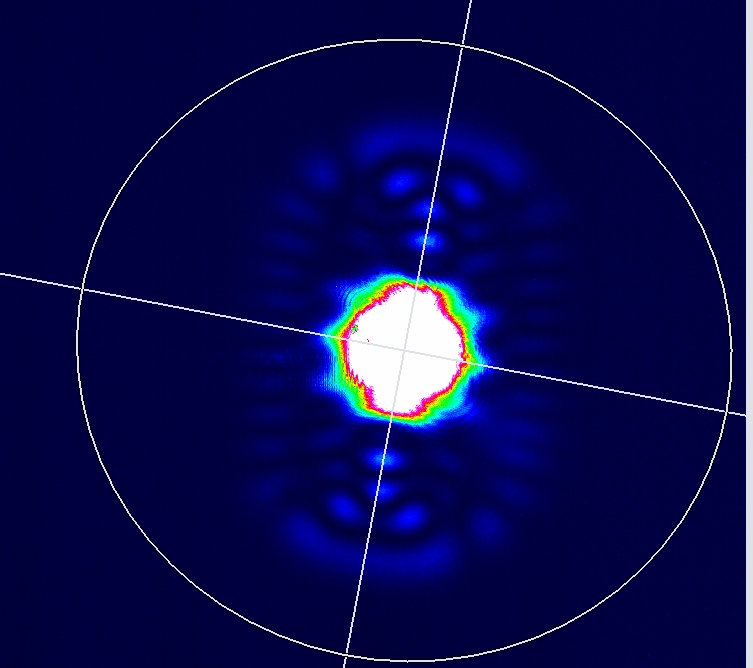
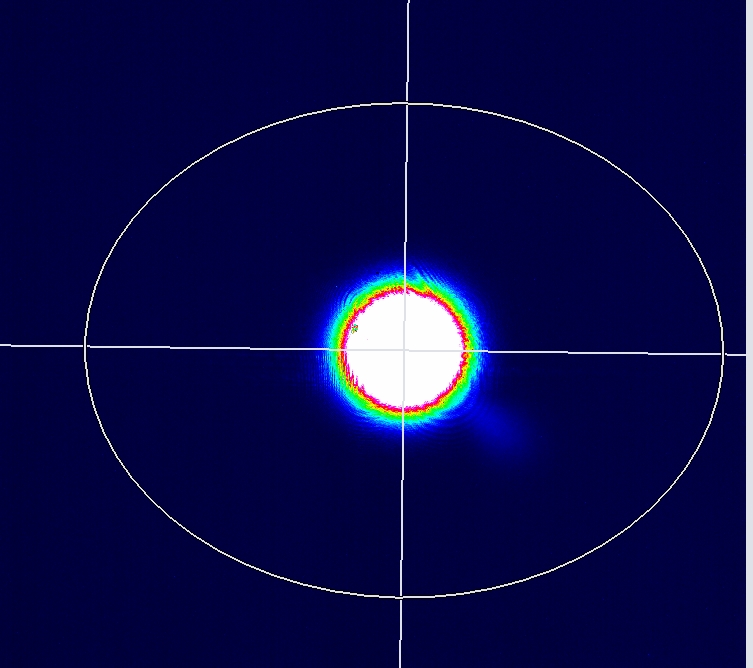
Manar Amer | Fixed | report | lasers and optics | Optical room | Power storage In Cavity | at max stage we reached at 2.5 A on the diodes we have
8000 gain , coupling ~ 60% , with power inside the cavity 50 kW
The higer order mode that was observed today,
it was also observed on Friday along the other higher order mode recorded on the logbook.
after cutting it with the D-shaped mirror we recorded the shape (image attached)
| Manar Amer wrote: |
|
Power increased in the amplifier
reflective filters added at the transmission point to be able to have signal on the Beam Profiler, Transmission diode and power meter
|
Amplifier output current (A)
diode 1
|
Amplifier output current (A)
diode 2
|
Amplifier output current (A)
diode 3
|
Amplifier output current (A)
diode 4
|
Power Output (W) |
Transmitted power (mW) |
note |
| 0.5 |
0.5 |
0.5 |
0.5 |
|
|
no change in the beam shape |
| 1 |
1 |
1 |
1 |
|
|
|
| 1.5 |
1 |
1 |
1 |
|
|
Appearance of higher order mode (vertical), suppressed using D-shaped mirror (vertical only) by (-23000), image recorded. |
| 1.5 |
1.5 |
1.5 |
1.5 |
|
|
no change |
| 2 |
1.8 |
1.5
|
1.5 |
|
52 mA |
52 mA after CEP adjustment , power measured after 2 reflective fillers NDUV30A and NDUV20 |
| 2 |
2 |
2 |
2 |
|
70 mA |
|
| 2.5 |
2.5 |
2 |
2 |
|
95 |
|
| 2.5 |
2.5 |
2.5 |
2.5 |
|
|
sudden drop in power, cavity lock lost, lock system looks ok (maybe something in the cavity)
mode shape is the same
coupling is large, transmission is very low
change the CEP, mo effect in changing it (we have no gain in the cavity, No Finesse) could be something happened to the mirrors !!!!!!
|
| Manar Amer wrote: |
|
At transmission power of 42 mW, coupling 60%, we see fundamental mode with a degeneracy
The D-shape motors were moved to a position 2 000 000 steps (in theory they should be the max position)
but no change appeared on the 00 mode or the higher order mode.
We will break the vacuum and check the position of the D-shaped mirrors.
| Manar Amer wrote: |
|
We start of power output from amplifier of 1W with only the first and second stage on then we start with the third stage power increase,
Note: when changing the current on the third stage 4 diodes, better to do it step by step for each one with a step of ~ 0.5 A
|
Amplifier output current (A)
for four diodes
|
Power Output (W) |
Transmitted power (MW)
|
| 0 , 0 , 0 , 0 |
~ 1 |
2.3 |
| 1 , 1 , 1 , 1 |
/ |
11.0 |
| 1.5 , 1.3, 1 , 1 |
/ |
35 |
| 1.5 , 1.5 , 1 , 1 |
/ |
42.16 |
| |
|
- we placed at the transmission point a splitter the transmitted power before was 35 mW after placing it we had 26 mW
- 97 % transmission , 3% reflected which goes to the beam profiler
- We see degeneracy modes at the last step of 42.16 mW , so we started to test the D-shaped mirrors
- the full range of the motors is 50.8 mm
- each step = 30 nm , 30 000 steps = 1 mm
|
|
|
|
| Attachment 1: 00mode_higer.jpg
|  |
| Attachment 2: 00mode_Removed_higer.jpg
|  |
|
160
|
Mon Sep 12 18:49:42 2022 |
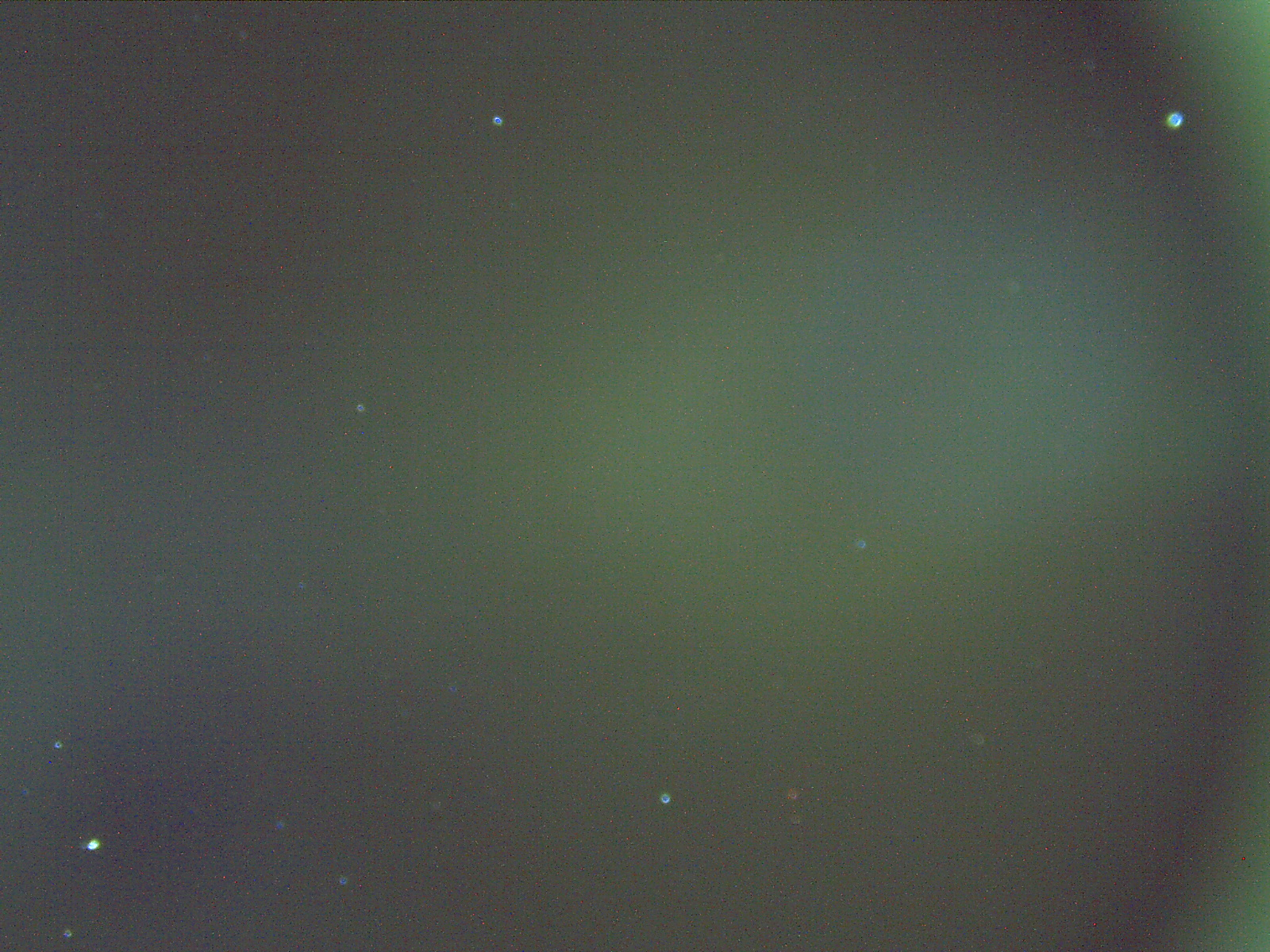
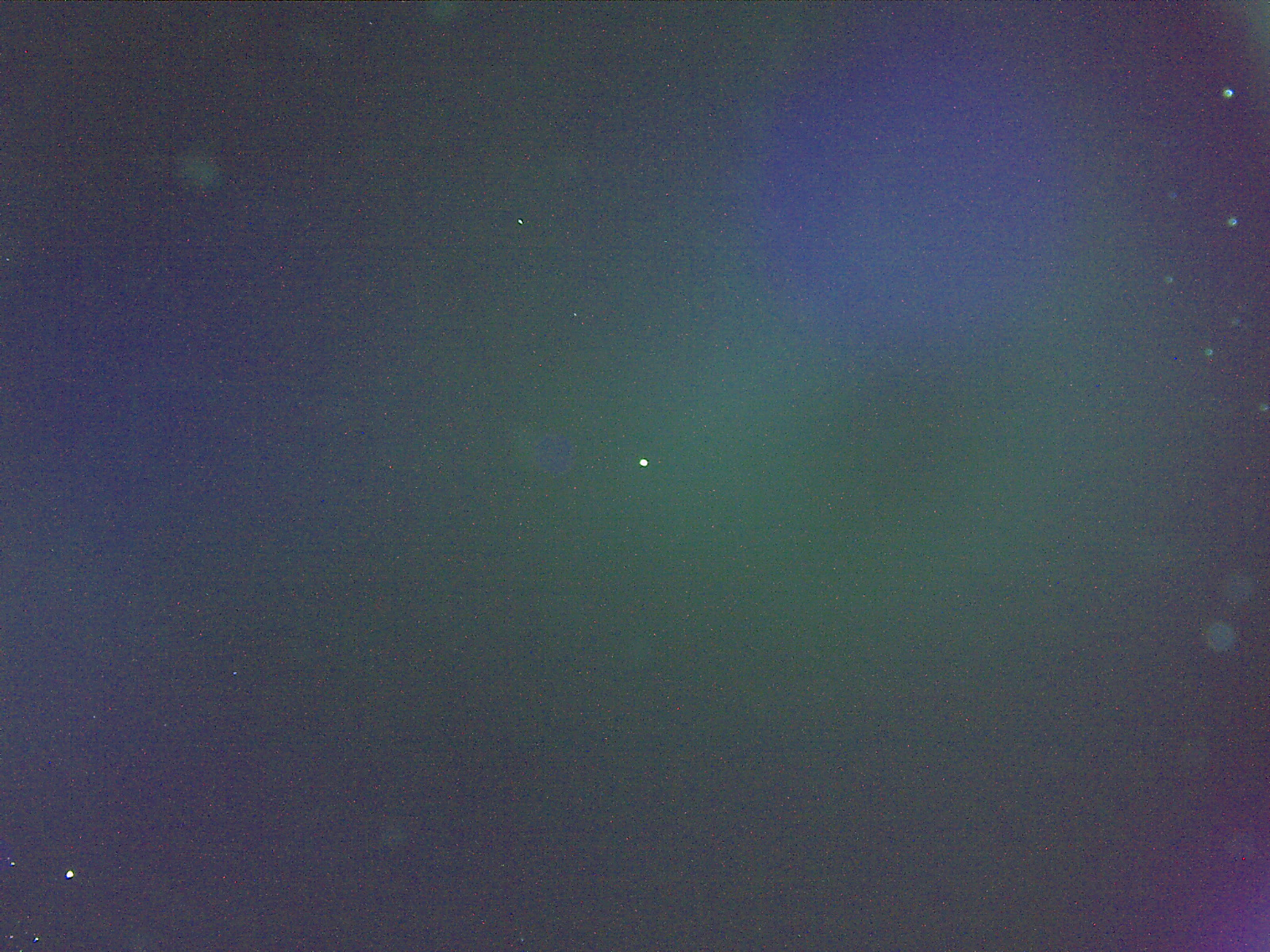
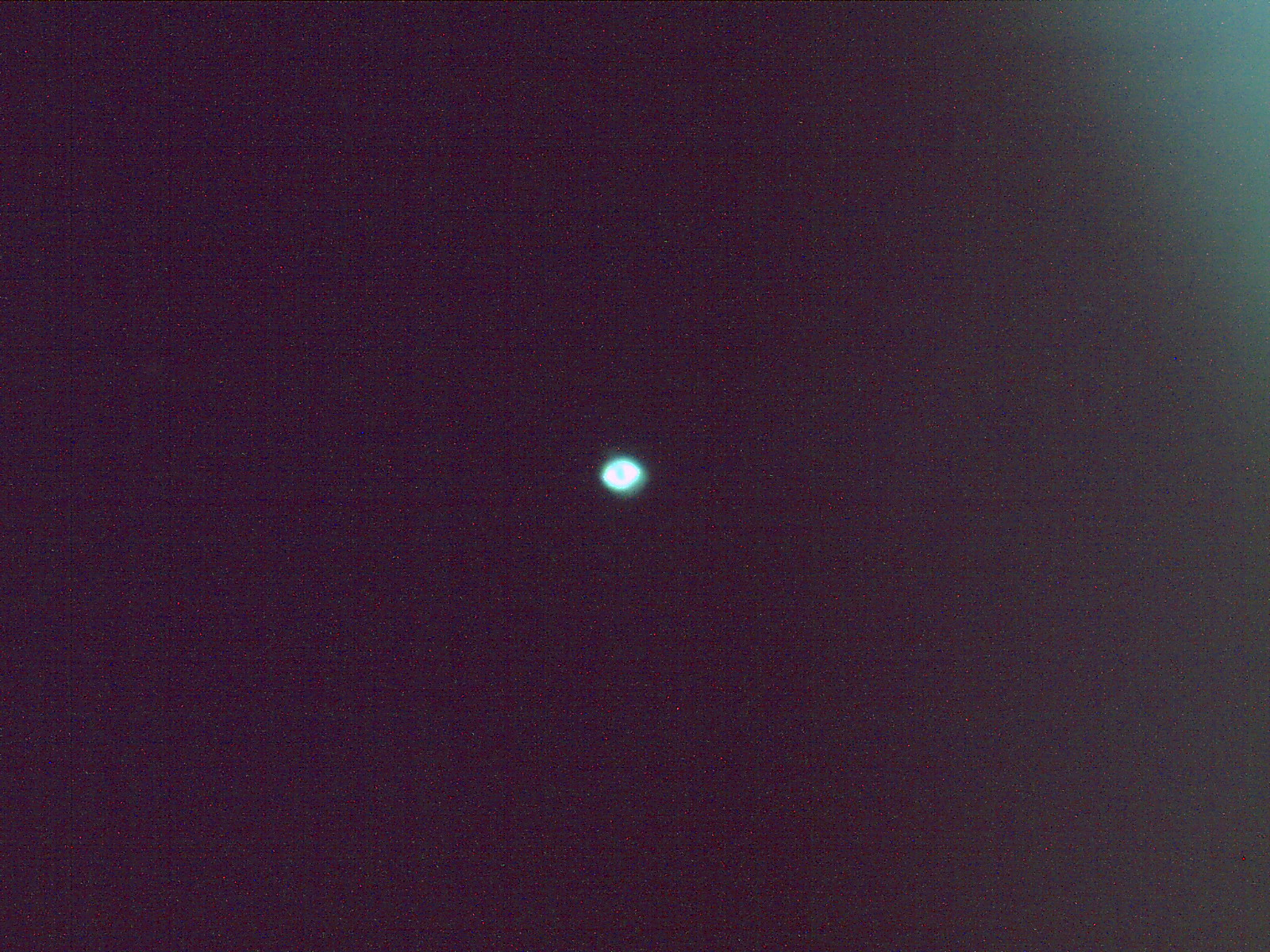
Manar Amer | Fixed | issue | lasers and optics | Optical room | Damage on mirror surface | Following the storage of ~ 50 kW inside the cavity and a sudden drop in transmitted power from the cavity
damage to the mirror surface was suspected.
We broke vacuum and took images of the surface of the 2 mirrors in the cavity, the spherical and the planar mirror
image 1 , spherical reflective surface (no visible damage with the UV light, and no visible damage under the microscope)
image 2 , planar coupler mirror reflective surface (no visible damage under UV light, but under the microscope there is a damaged spot close to the center)
image 4 is the planar surface reflective surface at zoom 8 on the microscope.
|
| Attachment 1: image001.jpg
|  |
| Attachment 2: image002.jpg
|  |
| Attachment 3: image004.jpg
|  |
|
161
|
Mon Sep 12 18:50:57 2022 |
Manar Amer | Fixed | issue | lasers and optics | Optical room | Damage on mirror surface | Tomorrow will try to shift the injection mirror to avoid hitting the damaged spot.
| Manar Amer wrote: |
|
Following the storage of ~ 50 kW inside the cavity and a sudden drop in transmitted power from the cavity
damage to the mirror surface was suspected.
We broke vacuum and took images of the surface of the 2 mirrors in the cavity, the spherical and the planar mirror
image 1 , spherical reflective surface (no visible damage with the UV light, and no visible damage under the microscope)
image 2 , planar coupler mirror reflective surface (no visible damage under UV light, but under the microscope there is a damaged spot close to the center)
image 4 is the planar surface reflective surface at zoom 8 on the microscope.
|
|
|
162
|
Tue Sep 13 19:26:27 2022 |
Manar Amer | Fixed | report | lasers and optics | Optical room | Damage on mirror surface | After discussing, we have decided against shifting the mirror to avoid the time lost.
We changed the injection mirror to a different mirror from Mighty Laser set, Transmission of mirror 80 ppm. (no visible damage at the center of the mirror, only a small scratch on the back)
mirror cleaned using pure ethanol and pure water with spin coater, also the spherical mirror was cleaned again.
| Manar Amer wrote: |
|
Tomorrow will try to shift the injection mirror to avoid hitting the damaged spot.
| Manar Amer wrote: |
|
Following the storage of ~ 50 kW inside the cavity and a sudden drop in transmitted power from the cavity
damage to the mirror surface was suspected.
We broke vacuum and took images of the surface of the 2 mirrors in the cavity, the spherical and the planar mirror
image 1 , spherical reflective surface (no visible damage with the UV light, and no visible damage under the microscope)
image 2 , planar coupler mirror reflective surface (no visible damage under UV light, but under the microscope there is a damaged spot close to the center)
image 4 is the planar surface reflective surface at zoom 8 on the microscope.
|
|
|
|
163
|
Tue Sep 13 19:31:14 2022 |
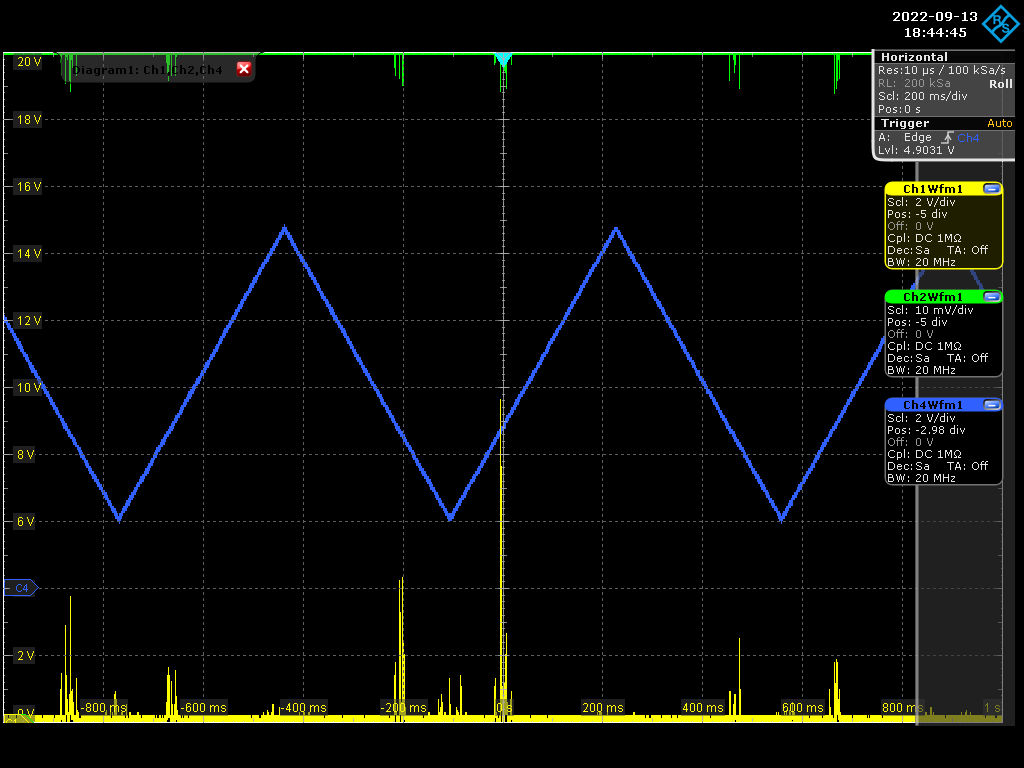
Manar Amer | Fixed | report | lasers and optics | Optical room | liPower storage In Cavity | After changing the mirror M1 and cleaning the 2 mirrors
They were placed in the cavity box (avoiding touching the mounts to not affect the alignment and placing the mirrors as close to the previous position)
we saw horizontal higher order modes immediately after injecting power, horizontal misalignment!!.
We aligned the injected beam, adjusted the cavity length and saw the modes 01 (high transition) and 00 (ok but still much lower than 01)
The image attached shows some coupling < 5% , we adjusted the CEP, but it was the max coupling.
we will need to align better tomorrow to increase 00 modes.
The cavity box is closed and placed under vacuum again.
| Manar Amer wrote: |
|
at max stage we reached at 2.5 A on the diodes we have
8000 gain , coupling ~ 60% , with power inside the cavity 50 kW
The higer order mode that was observed today,
it was also observed on Friday along the other higher order mode recorded on the logbook.
after cutting it with the D-shaped mirror we recorded the shape (image attached)
| Manar Amer wrote: |
|
Power increased in the amplifier
reflective filters added at the transmission point to be able to have signal on the Beam Profiler, Transmission diode and power meter
|
Amplifier output current (A)
diode 1
|
Amplifier output current (A)
diode 2
|
Amplifier output current (A)
diode 3
|
Amplifier output current (A)
diode 4
|
Power Output (W) |
Transmitted power (mW) |
note |
| 0.5 |
0.5 |
0.5 |
0.5 |
|
|
no change in the beam shape |
| 1 |
1 |
1 |
1 |
|
|
|
| 1.5 |
1 |
1 |
1 |
|
|
Appearance of higher order mode (vertical), suppressed using D-shaped mirror (vertical only) by (-23000), image recorded. |
| 1.5 |
1.5 |
1.5 |
1.5 |
|
|
no change |
| 2 |
1.8 |
1.5
|
1.5 |
|
52 mA |
52 mA after CEP adjustment , power measured after 2 reflective fillers NDUV30A and NDUV20 |
| 2 |
2 |
2 |
2 |
|
70 mA |
|
| 2.5 |
2.5 |
2 |
2 |
|
95 |
|
| 2.5 |
2.5 |
2.5 |
2.5 |
|
|
sudden drop in power, cavity lock lost, lock system looks ok (maybe something in the cavity)
mode shape is the same
coupling is large, transmission is very low
change the CEP, mo effect in changing it (we have no gain in the cavity, No Finesse) could be something happened to the mirrors !!!!!!
|
| Manar Amer wrote: |
|
At transmission power of 42 mW, coupling 60%, we see fundamental mode with a degeneracy
The D-shape motors were moved to a position 2 000 000 steps (in theory they should be the max position)
but no change appeared on the 00 mode or the higher order mode.
We will break the vacuum and check the position of the D-shaped mirrors.
| Manar Amer wrote: |
|
We start of power output from amplifier of 1W with only the first and second stage on then we start with the third stage power increase,
Note: when changing the current on the third stage 4 diodes, better to do it step by step for each one with a step of ~ 0.5 A
|
Amplifier output current (A)
for four diodes
|
Power Output (W) |
Transmitted power (MW)
|
| 0 , 0 , 0 , 0 |
~ 1 |
2.3 |
| 1 , 1 , 1 , 1 |
/ |
11.0 |
| 1.5 , 1.3, 1 , 1 |
/ |
35 |
| 1.5 , 1.5 , 1 , 1 |
/ |
42.16 |
| |
|
- we placed at the transmission point a splitter the transmitted power before was 35 mW after placing it we had 26 mW
- 97 % transmission , 3% reflected which goes to the beam profiler
- We see degeneracy modes at the last step of 42.16 mW , so we started to test the D-shaped mirrors
- the full range of the motors is 50.8 mm
- each step = 30 nm , 30 000 steps = 1 mm
|
|
|
|
|
| Attachment 1: Screenshot_2022-09-13_0_184445.png
|  |
|
164
|
Wed Sep 14 16:16:08 2022 |
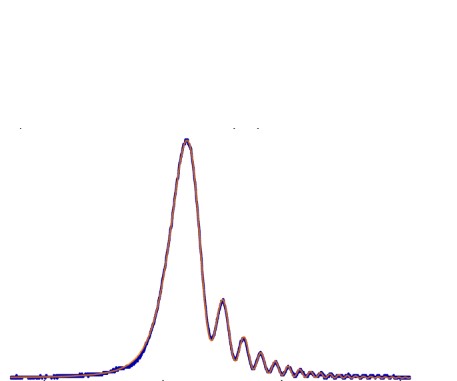
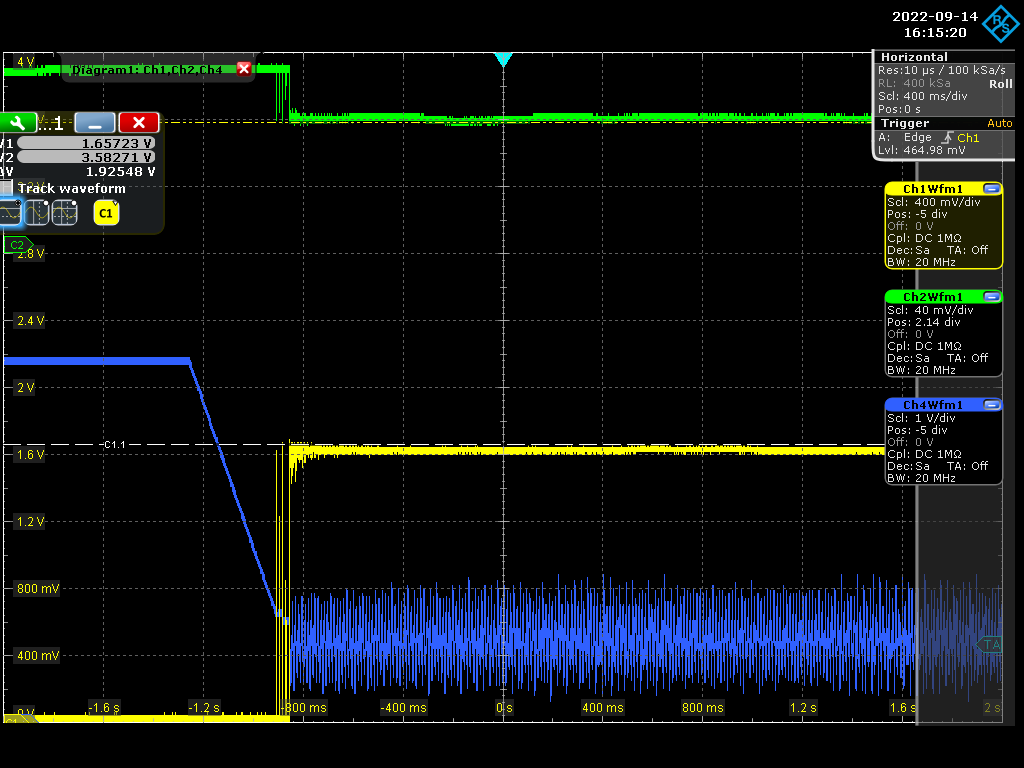
Manar Amer | Fixed | report | lasers and optics | Optical room | Power storage In Cavity | The cavity was locked under vacuum, coupling is approximately < 10%
The lock was relatively easy and the usual sign (oscillations on the transmission tail) of high finesse on the transmission signal was not seen.
| Manar Amer wrote: |
|
After changing the mirror M1 and cleaning the 2 mirrors
They were placed in the cavity box (avoiding touching the mounts to not affect the alignment and placing the mirrors as close to the previous position)
we saw horizontal higher order modes immediately after injecting power, horizontal misalignment!!.
We aligned the injected beam, adjusted the cavity length and saw the modes 01 (high transition) and 00 (ok but still much lower than 01)
The image attached shows some coupling < 5% , we adjusted the CEP, but it was the max coupling.
we will need to align better tomorrow to increase 00 modes.
The cavity box is closed and placed under vacuum again.
| Manar Amer wrote: |
|
at max stage we reached at 2.5 A on the diodes we have
8000 gain , coupling ~ 60% , with power inside the cavity 50 kW
The higer order mode that was observed today,
it was also observed on Friday along the other higher order mode recorded on the logbook.
after cutting it with the D-shaped mirror we recorded the shape (image attached)
| Manar Amer wrote: |
|
Power increased in the amplifier
reflective filters added at the transmission point to be able to have signal on the Beam Profiler, Transmission diode and power meter
|
Amplifier output current (A)
diode 1
|
Amplifier output current (A)
diode 2
|
Amplifier output current (A)
diode 3
|
Amplifier output current (A)
diode 4
|
Power Output (W) |
Transmitted power (mW) |
note |
| 0.5 |
0.5 |
0.5 |
0.5 |
|
|
no change in the beam shape |
| 1 |
1 |
1 |
1 |
|
|
|
| 1.5 |
1 |
1 |
1 |
|
|
Appearance of higher order mode (vertical), suppressed using D-shaped mirror (vertical only) by (-23000), image recorded. |
| 1.5 |
1.5 |
1.5 |
1.5 |
|
|
no change |
| 2 |
1.8 |
1.5
|
1.5 |
|
52 mA |
52 mA after CEP adjustment , power measured after 2 reflective fillers NDUV30A and NDUV20 |
| 2 |
2 |
2 |
2 |
|
70 mA |
|
| 2.5 |
2.5 |
2 |
2 |
|
95 |
|
| 2.5 |
2.5 |
2.5 |
2.5 |
|
|
sudden drop in power, cavity lock lost, lock system looks ok (maybe something in the cavity)
mode shape is the same
coupling is large, transmission is very low
change the CEP, mo effect in changing it (we have no gain in the cavity, No Finesse) could be something happened to the mirrors !!!!!!
|
| Manar Amer wrote: |
|
At transmission power of 42 mW, coupling 60%, we see fundamental mode with a degeneracy
The D-shape motors were moved to a position 2 000 000 steps (in theory they should be the max position)
but no change appeared on the 00 mode or the higher order mode.
We will break the vacuum and check the position of the D-shaped mirrors.
| Manar Amer wrote: |
|
We start of power output from amplifier of 1W with only the first and second stage on then we start with the third stage power increase,
Note: when changing the current on the third stage 4 diodes, better to do it step by step for each one with a step of ~ 0.5 A
|
Amplifier output current (A)
for four diodes
|
Power Output (W) |
Transmitted power (MW)
|
| 0 , 0 , 0 , 0 |
~ 1 |
2.3 |
| 1 , 1 , 1 , 1 |
/ |
11.0 |
| 1.5 , 1.3, 1 , 1 |
/ |
35 |
| 1.5 , 1.5 , 1 , 1 |
/ |
42.16 |
| |
|
- we placed at the transmission point a splitter the transmitted power before was 35 mW after placing it we had 26 mW
- 97 % transmission , 3% reflected which goes to the beam profiler
- We see degeneracy modes at the last step of 42.16 mW , so we started to test the D-shaped mirrors
- the full range of the motors is 50.8 mm
- each step = 30 nm , 30 000 steps = 1 mm
|
|
|
|
|
|
| Attachment 1: High_Finesse_sign_on_transmission_.jpg
|  |
| Attachment 2: Screenshot_2022-09-14_0_161520.png
|  |
|
165
|
Wed Sep 14 17:21:59 2022 |
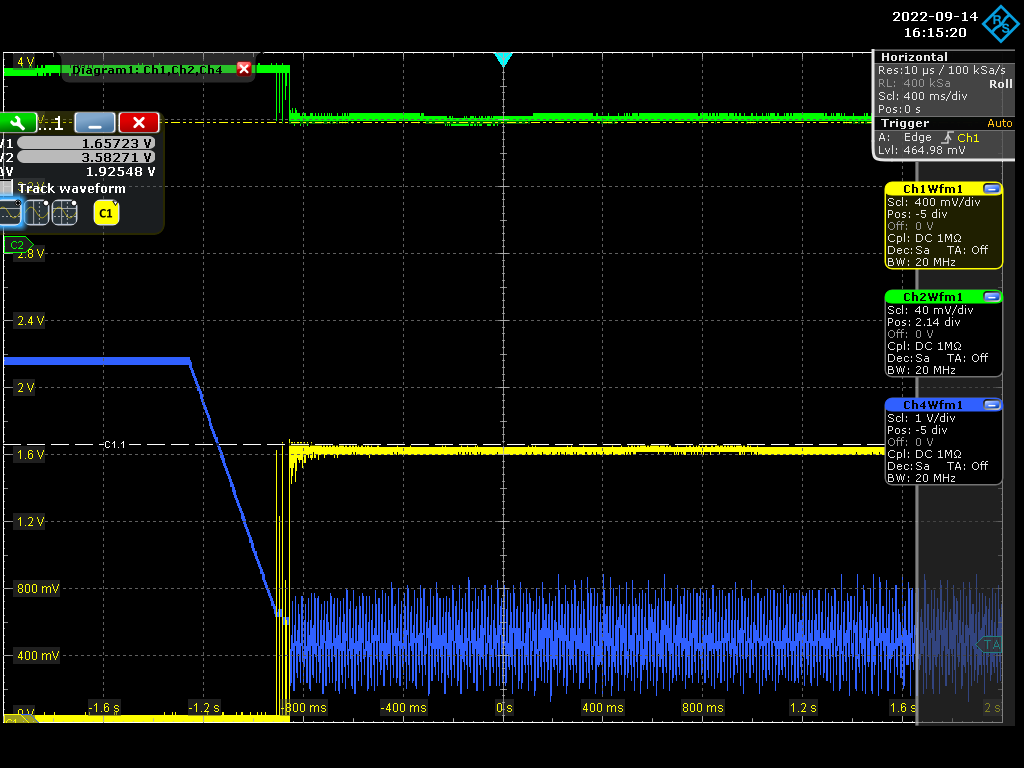
Manar Amer | Fixed | report | lasers and optics | Optical room | Power storage In Cavity | We improved the lock using the alignment, polarization and CEP , the maximum we got was ~ 12% coupling
only the second stage is on !
Decision : this is the maximum we can obtain using the M1 from mighty laser
tomorrow we break the vacuum and try with shifting M1 from ThomX position to avoid the damaged spot
| Manar Amer wrote: |
|
The cavity was locked under vacuum, coupling is approximately < 10%
The lock was relatively easy and the usual sign (oscillations on the transmission tail) of high finesse on the transmission signal was not seen.
| Manar Amer wrote: |
|
After changing the mirror M1 and cleaning the 2 mirrors
They were placed in the cavity box (avoiding touching the mounts to not affect the alignment and placing the mirrors as close to the previous position)
we saw horizontal higher order modes immediately after injecting power, horizontal misalignment!!.
We aligned the injected beam, adjusted the cavity length and saw the modes 01 (high transition) and 00 (ok but still much lower than 01)
The image attached shows some coupling < 5% , we adjusted the CEP, but it was the max coupling.
we will need to align better tomorrow to increase 00 modes.
The cavity box is closed and placed under vacuum again.
| Manar Amer wrote: |
|
at max stage we reached at 2.5 A on the diodes we have
8000 gain , coupling ~ 60% , with power inside the cavity 50 kW
The higer order mode that was observed today,
it was also observed on Friday along the other higher order mode recorded on the logbook.
after cutting it with the D-shaped mirror we recorded the shape (image attached)
| Manar Amer wrote: |
|
Power increased in the amplifier
reflective filters added at the transmission point to be able to have signal on the Beam Profiler, Transmission diode and power meter
|
Amplifier output current (A)
diode 1
|
Amplifier output current (A)
diode 2
|
Amplifier output current (A)
diode 3
|
Amplifier output current (A)
diode 4
|
Power Output (W) |
Transmitted power (mW) |
note |
| 0.5 |
0.5 |
0.5 |
0.5 |
|
|
no change in the beam shape |
| 1 |
1 |
1 |
1 |
|
|
|
| 1.5 |
1 |
1 |
1 |
|
|
Appearance of higher order mode (vertical), suppressed using D-shaped mirror (vertical only) by (-23000), image recorded. |
| 1.5 |
1.5 |
1.5 |
1.5 |
|
|
no change |
| 2 |
1.8 |
1.5
|
1.5 |
|
52 mA |
52 mA after CEP adjustment , power measured after 2 reflective fillers NDUV30A and NDUV20 |
| 2 |
2 |
2 |
2 |
|
70 mA |
|
| 2.5 |
2.5 |
2 |
2 |
|
95 |
|
| 2.5 |
2.5 |
2.5 |
2.5 |
|
|
sudden drop in power, cavity lock lost, lock system looks ok (maybe something in the cavity)
mode shape is the same
coupling is large, transmission is very low
change the CEP, mo effect in changing it (we have no gain in the cavity, No Finesse) could be something happened to the mirrors !!!!!!
|
| Manar Amer wrote: |
|
At transmission power of 42 mW, coupling 60%, we see fundamental mode with a degeneracy
The D-shape motors were moved to a position 2 000 000 steps (in theory they should be the max position)
but no change appeared on the 00 mode or the higher order mode.
We will break the vacuum and check the position of the D-shaped mirrors.
| Manar Amer wrote: |
|
We start of power output from amplifier of 1W with only the first and second stage on then we start with the third stage power increase,
Note: when changing the current on the third stage 4 diodes, better to do it step by step for each one with a step of ~ 0.5 A
|
Amplifier output current (A)
for four diodes
|
Power Output (W) |
Transmitted power (MW)
|
| 0 , 0 , 0 , 0 |
~ 1 |
2.3 |
| 1 , 1 , 1 , 1 |
/ |
11.0 |
| 1.5 , 1.3, 1 , 1 |
/ |
35 |
| 1.5 , 1.5 , 1 , 1 |
/ |
42.16 |
| |
|
- we placed at the transmission point a splitter the transmitted power before was 35 mW after placing it we had 26 mW
- 97 % transmission , 3% reflected which goes to the beam profiler
- We see degeneracy modes at the last step of 42.16 mW , so we started to test the D-shaped mirrors
- the full range of the motors is 50.8 mm
- each step = 30 nm , 30 000 steps = 1 mm
|
|
|
|
|
|
|
| Attachment 1: Screenshot_2022-09-14_0_161520.png
|  |
|