ID |
Date |
Author |
Status |
Type |
Category |
Location |
Title |
|
72
|
Thu Mar 31 13:29:01 2022 |
Manar Amer | Fixed | report | mechanics | lasers and optics | utilities | Optical room | Dust Cleaning of SBox |
After an overnight where the cavity box was left open, a measurement of the Dust meter was taken:
Outside on the optical table on direct air flux (1701 p/m3 Av 10 min) and
Inside the cavity box (998 p/m3 Av 10 min)
The dust inside the cavity has decreased by ~ 30 % for 0.3 u particles.
Note: the cavity box is still open.
| Manar Amer wrote: |
|
The inside of the cavity was cleaned today. It was very dirty and had big dust particles and fibers inside.
Cleaning was done for everything; wall, floor, fixed mounts, wires (still have some dust difficult to remove), edges.
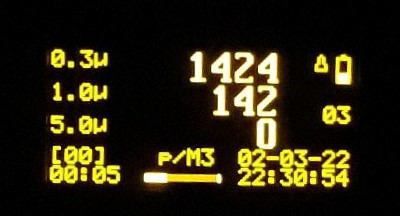
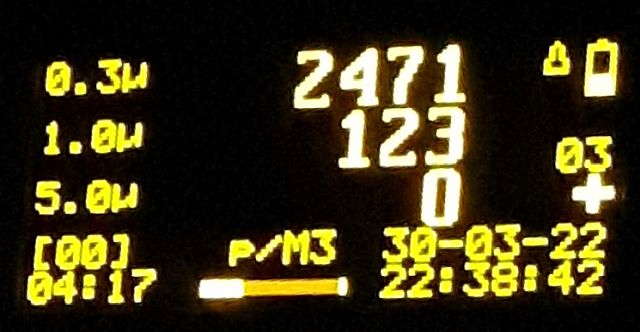
The dust meter average was measured outside the cavity (2471 p/m3 av 6 min) and inside after cleaning (1424 p/m3 av 10 min).
The cavity was left open under the clean air flow, will observe it under UV, clean and measure Dust tomorrow.
Images attached are after cleaning.
Objects inside the cavity at the moment :
- 4 main mirror mounts
- 4 mirror fixers on mounts and 3 screws each (total 12)
- 2 reflecting mirror mounts
- 2 dielectric mirrors (mounted and to be cleaned)
- two mounts for D-shaped mirrors.
- 2 D-shaped mirrors (unmounted, and they will need cleaning)
- 2 metal irises (pinholes)
| Manar Amer wrote: |
|
The cleaning was done twice with half an hour interval between the two times
reading on the dust meter was taken after each time, and it was zero averaged over a 10-min
| Manar Amer wrote: |
|
An Initial cleaning of the KBoX outside was done, All the optics and mechanics placed that were on the table were removed.
Only the old Mitylaser amplifier remains on the table.
Since we will be using the ThomX Celia amplifier, we will remove it and place it in a secure location (to be decided).
Tomorrow a cleaning of the inside of the cavity box is to be done.
|
|
|
|
| Attachment 1: 20220331_Dust_Meter_Outside_cavity_Av10min.jpg
|
 |
| Attachment 2: 20220331_Dust_Meter_Inside_cavity_Av10min.jpg
|
 |
|
71
|
Wed Mar 30 18:53:01 2022 |
Manar Amer | Fixed | report | mechanics | lasers and optics | utilities | Optical room | Dust Cleaning of SBox |
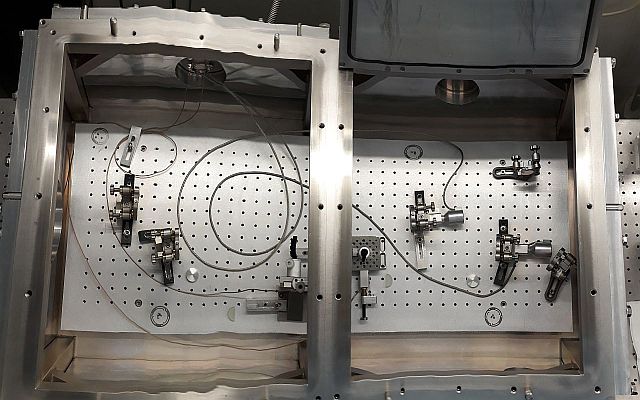
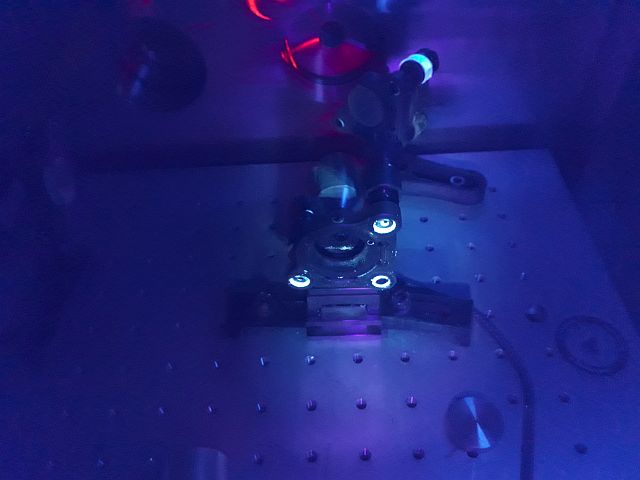
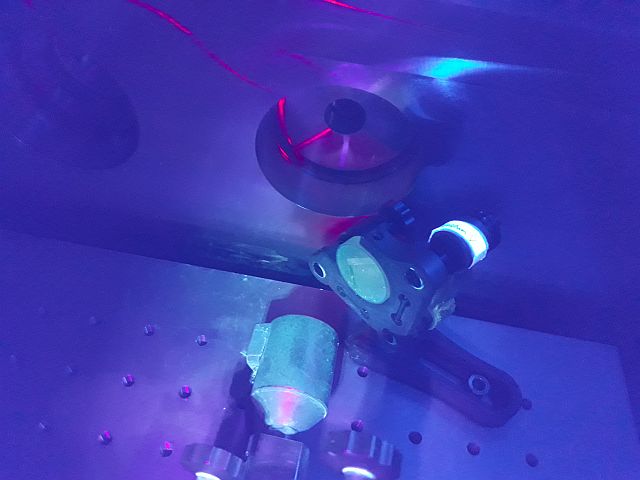
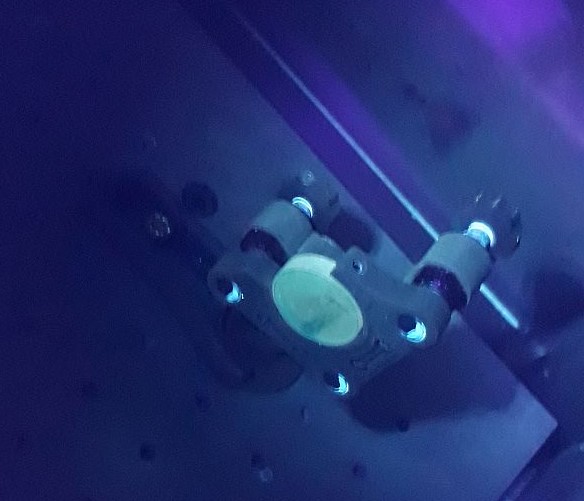
The inside of the cavity was cleaned today. It was very dirty and had big dust particles and fibers inside.
Cleaning was done for everything; wall, floor, fixed mounts, wires (still have some dust difficult to remove), edges.
The dust meter average was measured outside the cavity (2471 p/m3 av 6 min) and inside after cleaning (1424 p/m3 av 10 min).
The cavity was left open under the clean air flow, will observe it under UV, clean and measure Dust tomorrow.
Images attached are after cleaning.
Objects inside the cavity at the moment :
- 4 main mirror mounts
- 4 mirror fixers on mounts and 3 screws each (total 12)
- 2 reflecting mirror mounts
- 2 dielectric mirrors (mounted and to be cleaned)
- two mounts for D-shaped mirrors.
- 2 D-shaped mirrors (unmounted, and they will need cleaning)
- 2 metal irises (pinholes)
| Manar Amer wrote: |
|
The cleaning was done twice with half an hour interval between the two times
reading on the dust meter was taken after each time, and it was zero averaged over a 10-min
| Manar Amer wrote: |
|
An Initial cleaning of the KBoX outside was done, All the optics and mechanics placed that were on the table were removed.
Only the old Mitylaser amplifier remains on the table.
Since we will be using the ThomX Celia amplifier, we will remove it and place it in a secure location (to be decided).
Tomorrow a cleaning of the inside of the cavity box is to be done.
|
|
|
| Attachment 1: 20220330_SBox_Inside_Cavity_Box.jpg
|
 |
| Attachment 2: 20220330_Injection_Mount_UV.jpg
|
 |
| Attachment 3: 20220330_Reflection_One_UV.jpg
|
 |
| Attachment 4: 20220330_Reflection_two_UV.jpg
|
 |
| Attachment 5: 20220330_Dust_Meter_Inside_cavity_Av10min.jpg
|
 |
| Attachment 6: 20220330_Dust_Meter_Outside_cavity_Av6min.jpg
|
 |
|
70
|
Tue Mar 29 16:27:34 2022 |
Manar Amer | Fixed | report | utilities | Optical room | Spincoater - Mirrror cleaning |
In preparation for cleaning the mirrors.
The spincoater has been moved with its bump into the sas of the SBox.
The pure water used will be provided by Alice, as the previous source in the workshop is not available.
|
|
69
|
Tue Mar 29 16:23:00 2022 |
Manar Amer | Fixed | report | lasers and optics | cabling | Optical room | Mightylaser Amplifier |
Migthylaser amplifier has been moved from the SBox table to the PLIC table.
|
|
68
|
Wed Mar 23 18:17:45 2022 |
Manar Amer | Fixed | report | utilities | Optical room | Dust Cleaning of SBox |
The cleaning was done twice with half an hour interval between the two times
reading on the dust meter was taken after each time, and it was zero averaged over a 10-min
| Manar Amer wrote: |
|
An Initial cleaning of the KBoX outside was done, All the optics and mechanics placed that were on the table were removed.
Only the old Mitylaser amplifier remains on the table.
Since we will be using the ThomX Celia amplifier, we will remove it and place it in a secure location (to be decided).
Tomorrow a cleaning of the inside of the cavity box is to be done.
|
|
|
67
|
Wed Mar 23 18:11:22 2022 |
Manar Amer | Fixed | report | utilities | Optical room | Dust Cleaning of SBox |
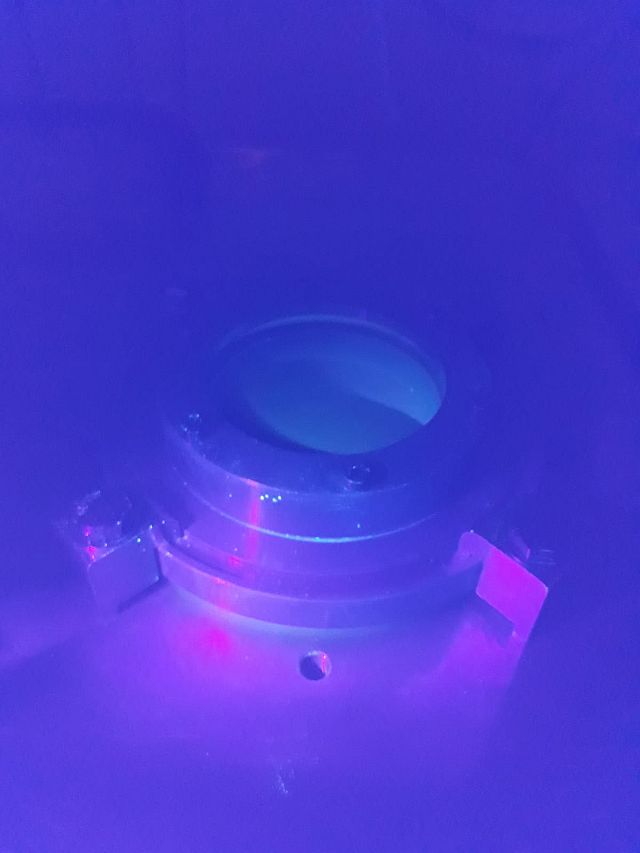
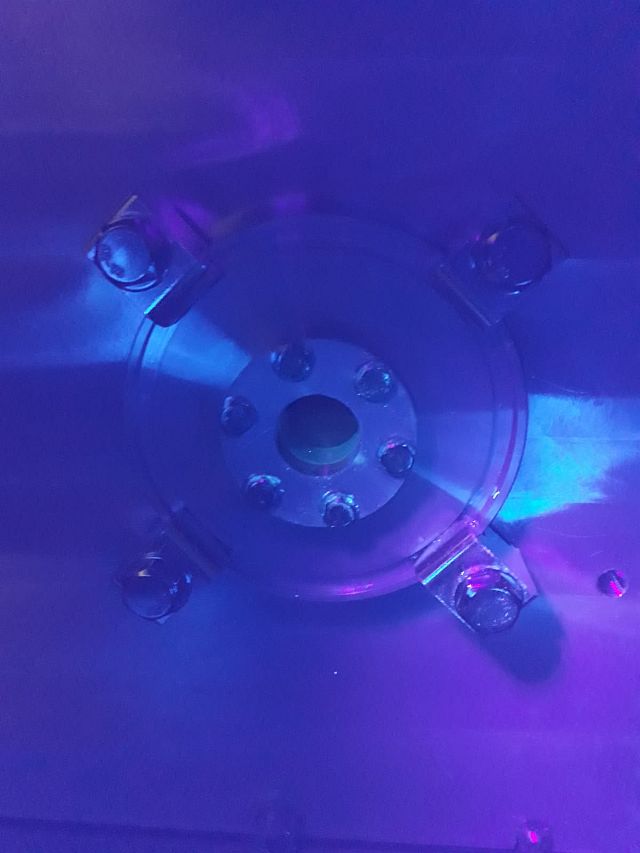
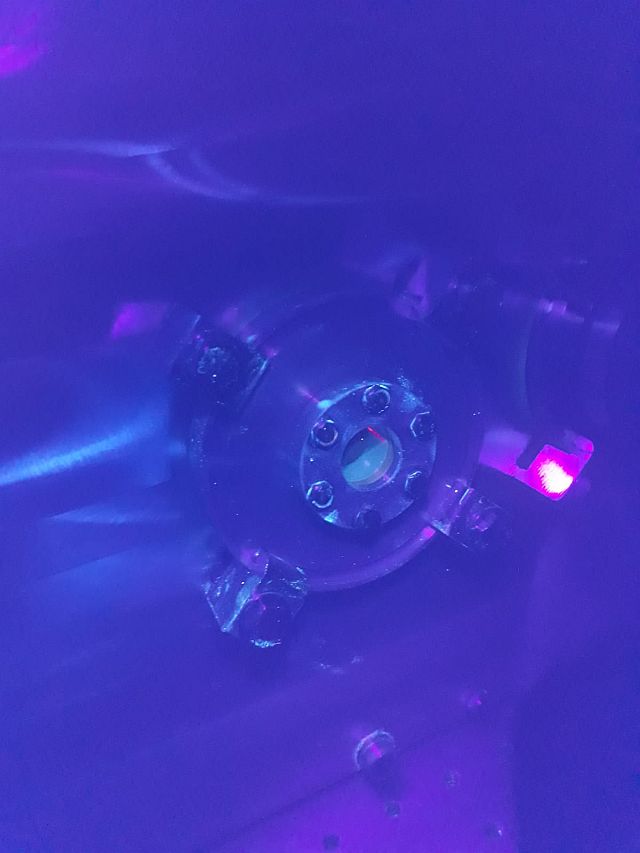
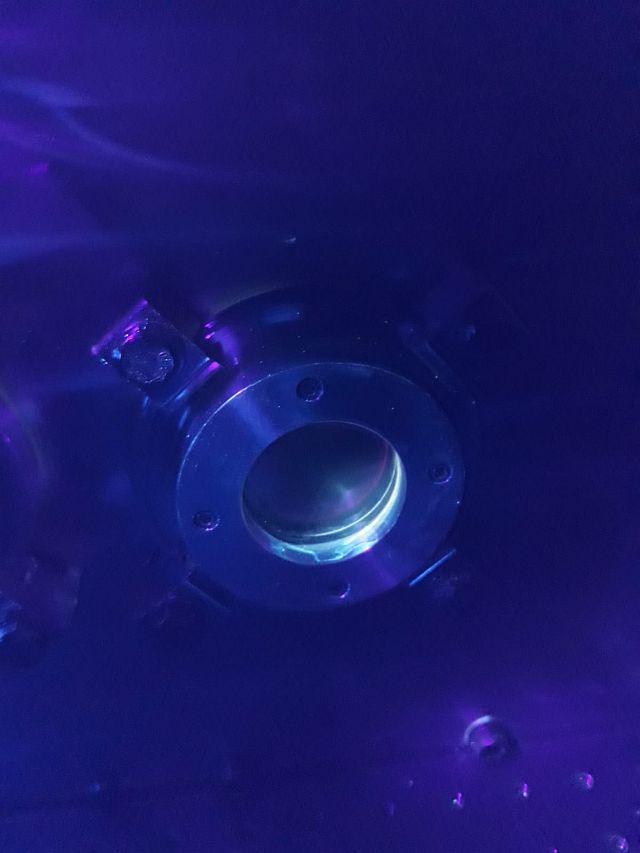
An Initial cleaning of the KBoX outside was done, All the optics and mechanics placed that were on the table were removed.
Only the old Mitylaser amplifier remains on the table.
Since we will be using the ThomX Celia amplifier, we will remove it and place it in a secure location (to be decided).
Tomorrow a cleaning of the inside of the cavity box is to be done. |
| Attachment 1: Log_Top_window.jpg
|
 |
| Attachment 2: Log_Reflection_window.jpg
|
 |
| Attachment 3: Log_Injection_Side_window.jpg
|
 |
| Attachment 4: Log_Injection_side_window2.jpg
|
 |
|
66
|
Mon Jul 5 14:46:44 2021 |
Manar Amer | Fixed | report | lasers and optics | detectors and electronics | Optical room | OEwaves CW Laser - Phase Noise |
correction on unit 1030 nm
| Manar Amer wrote: |
|
a correction on the wavelength of the laser it is 1030 um
| Manar Amer wrote: |
- We started measuring the phase noise on the OEwaves CW laser.
- Class 3b
- wavelength 1.5 um
- The procedure is done using self coupling of the laser
- splitter 50%-50%\
- delay line 100 m
- all fibers are PM type (polarity maintained)
- Photodetector is "lab buddy", very fast diode.
- Note: différance from schematic (we did not use a low pass filter)
|
|
|
|
65
|
Mon Jul 5 14:40:57 2021 |
Manar Amer | Fixed | report | lasers and optics | detectors and electronics | Optical room | OEwaves CW Laser - Phase Noise |
a correction on the wavelength of the laser it is 1030 um
| Manar Amer wrote: |
- We started measuring the phase noise on the OEwaves CW laser.
- Class 3b
- wavelength 1.5 um
- The procedure is done using self coupling of the laser
- splitter 50%-50%\
- delay line 100 m
- all fibers are PM type (polarity maintained)
- Photodetector is "lab buddy", very fast diode.
- Note: différance from schematic (we did not use a low pass filter)
|
|
|
64
|
Mon Jul 5 14:14:01 2021 |
Manar Amer | Fixed | report | lasers and optics | detectors and electronics | Optical room | OEwaves CW Laser - Phase Noise |
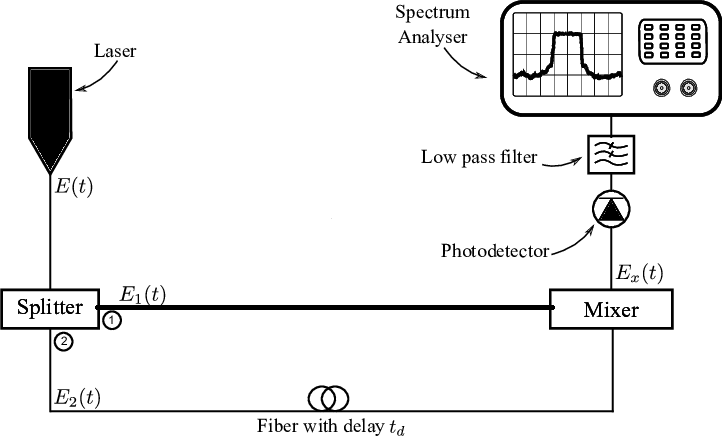
- We started measuring the phase noise on the OEwaves CW laser.
- Class 3b
- wavelength 1.5 um
- The procedure is done using self coupling of the laser
- splitter 50%-50%\
- delay line 100 m
- all fibers are PM type (polarity maintained)
- Photodetector is "lab buddy", very fast diode.
- Note: différance from schematic (we did not use a low pass filter)
|
| Attachment 1: 20210207_OEwaves_laser.jpg
|
 |
| Attachment 2: 20210207_Self_coupling_setup.jpg
|
 |
| Attachment 3: Schematic-setup-for-optical-delayed-self-coupling-detection.png
|
 |
|
63
|
Thu Jun 10 17:55:15 2021 |
Ronic Chiche | Fixed | info | lasers and optics | Optical room | Origami SN2440 133MHz laser tests |
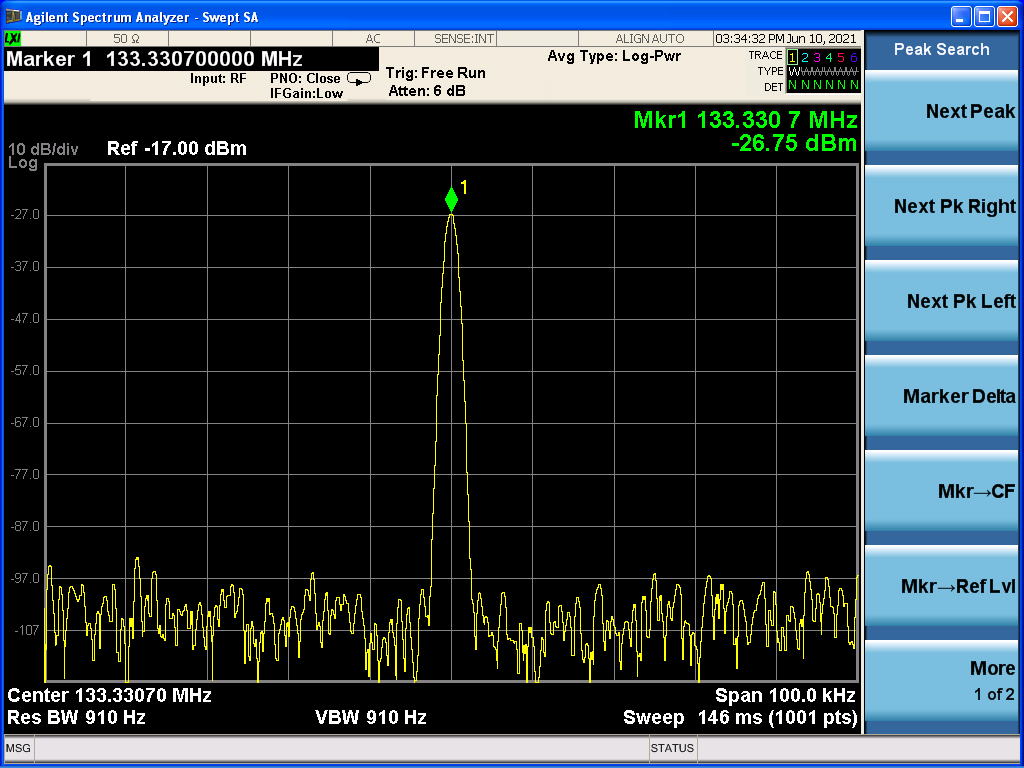
Today, we received the Origami SN2440 133MHz oscillator from repair (NKT mentioned a defective wire inside the controller....)
We immediately installed it behind an isolator (Faraday rotator+PBS+halfwave plate).
the output power is around 60mW.
the spectrum is around 1030nm
the repetition rate is around 133.33MHz |
| Attachment 1: IMG_20210610_161502.jpg
|
 |
| Attachment 2: spectre_133MHz.PNG
|
 |
| Attachment 3: Screen_0015.png
|
 |
|
62
|
Tue Jan 12 10:44:57 2021 |
Ronic Chiche | Fixed | issue | lasers and optics | Optical room | Origami SN2440 133MHz laser power measurment... and failure |
we received from NKT the Origami SN2440 133MHz oscillator from repair on 2020/12/17
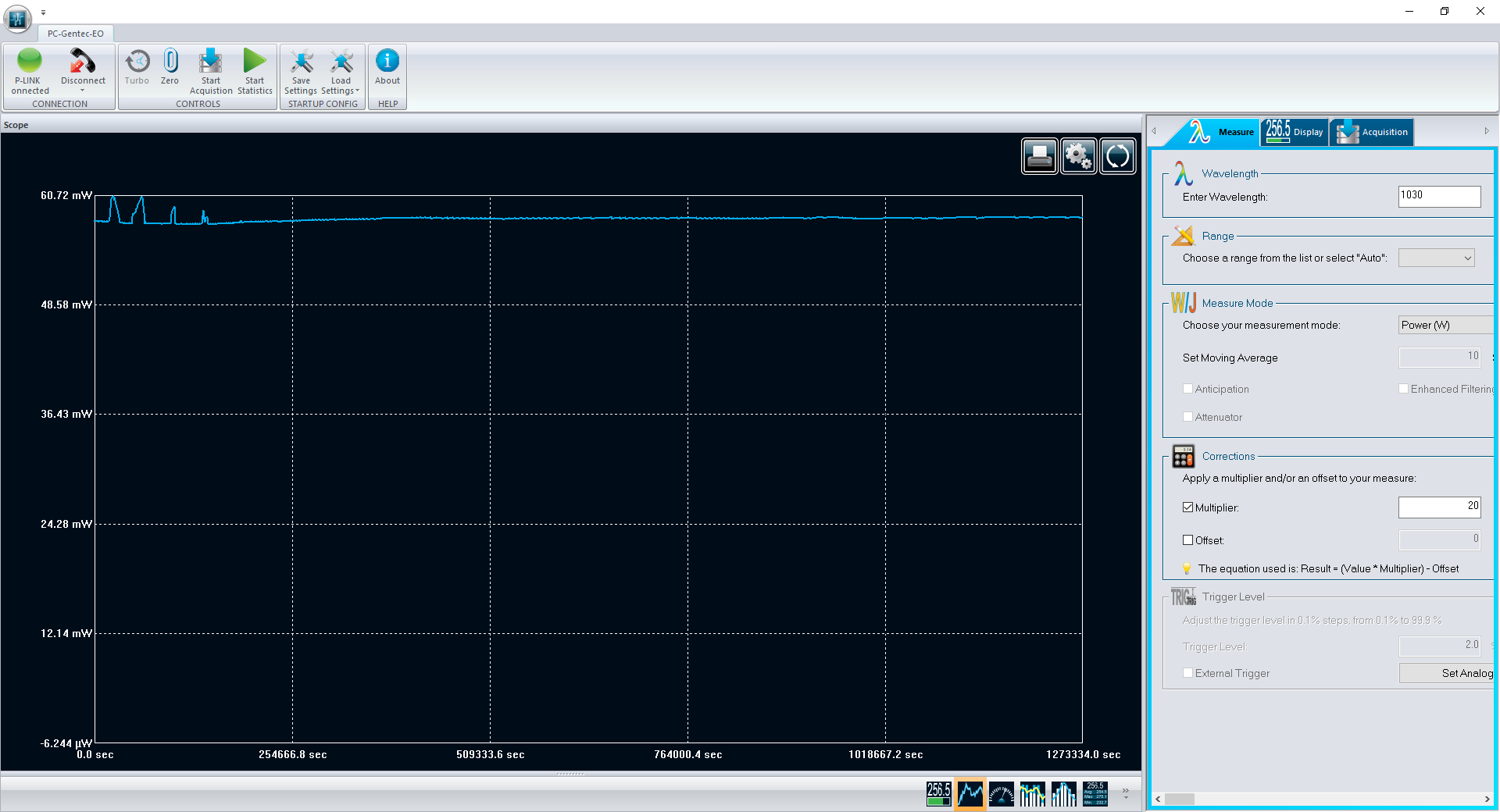
and we measured the power trend from 2020/12/21 until the whole winter Hollyday, during 14 days and 17h (1 273 334 s).
the power was quite constant, about 58mW (the measurement has been done with the OD2 filter and using a (x20) factor in the software to compensate for it),
except for some peaks at the beginning of the measurement to 60.7mW.
I tried to reproduce these peaks by switching on several lights in the room and the airflow ceil but the effect is neglectable,
thus these peaks seem to really come from the oscillator power.
at the beginning of January, the oscillator suffered a back reflection from the rugged anodized convex surface of the power meter (apparently not from the OD2 filter itself) and the laser stopped immediately to modelock.
the laser power dropped to 0 and the laser controller led started to blink red. NKT has been contacted and they think it could be the laser pump diodes that have been damaged.
for the future, we will have to install a fixed optical isolator from the start, even for short operations.
|
| Attachment 1: 133mhzpower.PNG
|
 |
| Attachment 2: 133mhz_power_zoom.png
|
 |
|
61
|
Tue Jan 5 12:38:04 2021 |
Manar Amer | Fixed | report | lasers and optics | Optical room | Transmission Measurements for the Mirrors. |
- Thursday 10 December 2020: First Test Measurement - Inside Box
- The transmission ( T ) for the mirrors of SBOX and ThomX was measured over a range from the center of the mirror up to 5mm.
-
- The first setup was initially done while the mirrorr is installed inside the metal box, when measuring T we observe that there is an erregular change in the power measured as we move azay from the center of the mirror, this was due to reflection of light inside the box. The reflection from the mirror was reflected on the metal inside the box and it was measured by the power meter.
(so for this setup we only took measrements for T along the center of the mirror)
The file stating the measurements is : Test Cavity _ Mirrors transmission _ Inside box
=======================================================================
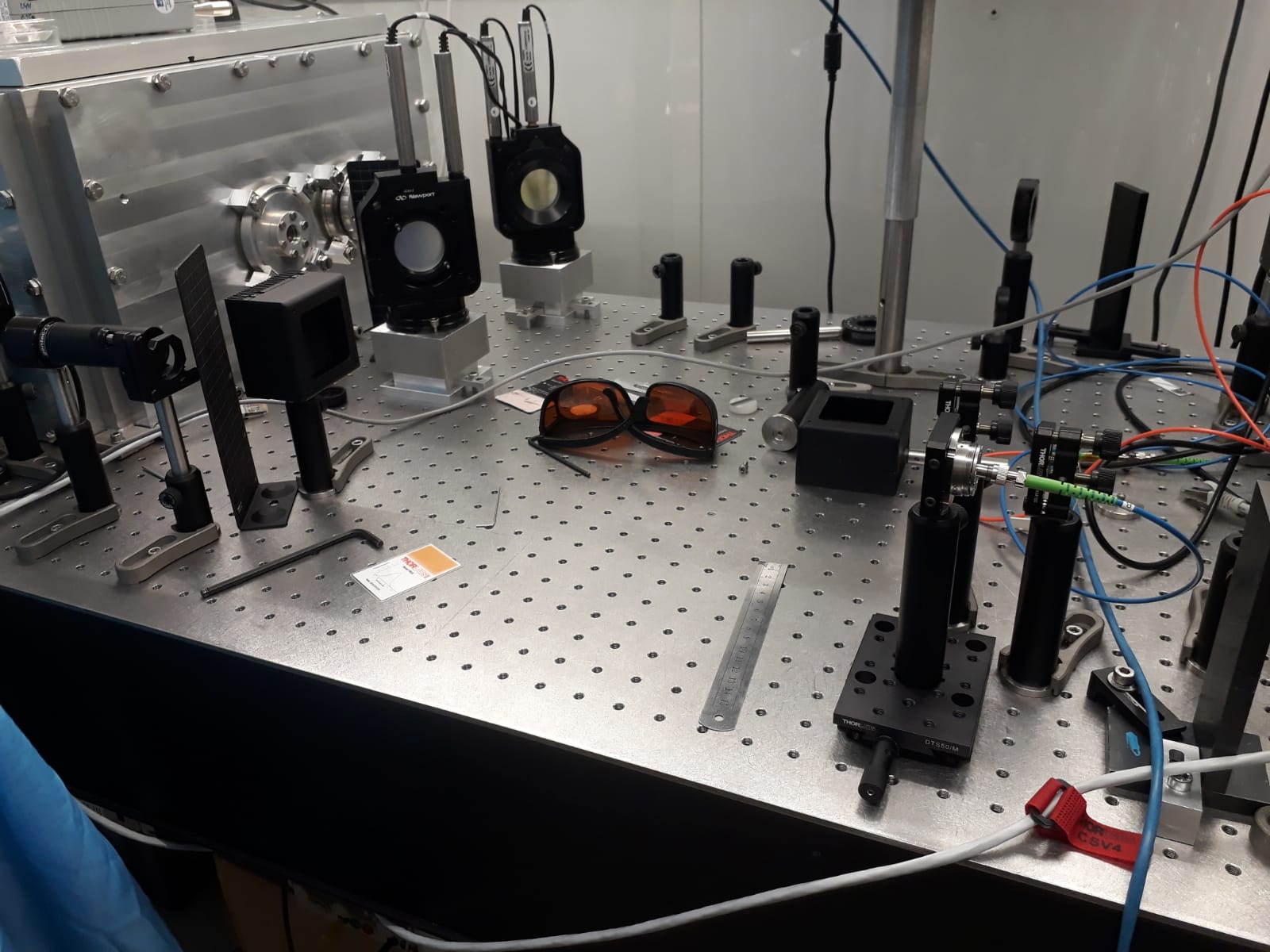
- Tuesday 15 December 2020 : Second Test - Outside Box
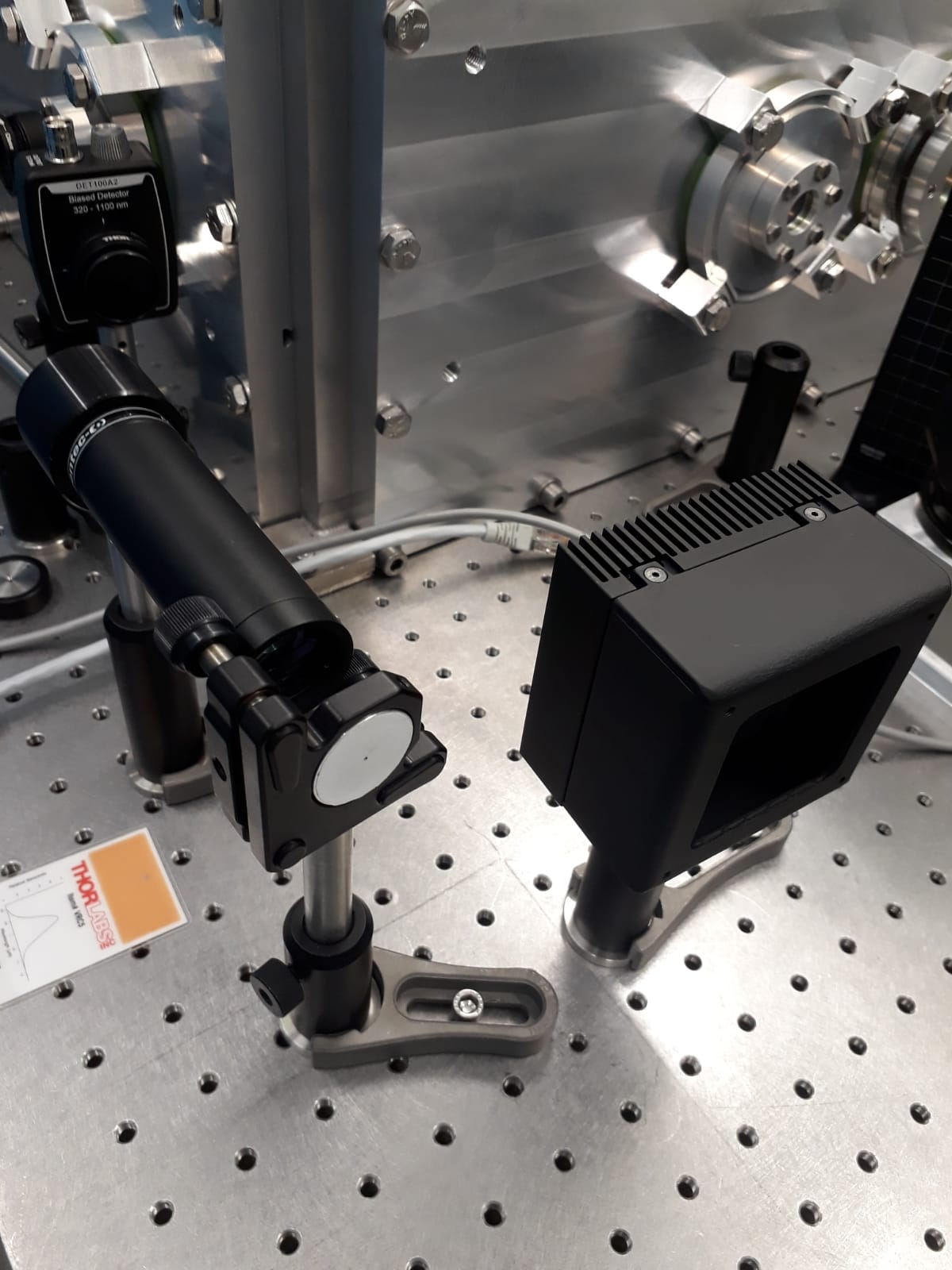
- The setup for T test was moved outside the metal box with the same distances between the injection beam and mirror ~ 50 cm. and the distance between the injection laser and the mirror next to it ~ 9 cm.
-
- Observation for T is done at full angle and at half angle of reflection ( the mirror was tilted to achive this )
-
- we observed that after each change in the distance from the center the power meter needed to be aligned to have the max power.
- after doing all the measurements for the range from the center we made it again for the center only and the consistance of the transmission was good.
The file stating the measurements is : Test Cavity _ Mirrors transmission _ outside box
note: the laser used for the test is the Koheras
details on the pwer used, mirrors, power meter, filters, ....etc are shown in the Excel data sheets
Done By : Loic , Manar and Ahmed |
| Attachment 1: Test_Cavity___Mirrors_transmission___Inside_box.xlsx
|
| Attachment 2: Test_Cavity___Mirrors_transmission___outside_box.xlsx
|
| Attachment 3: set_up_for_transmission_measurement_outside_box.jpeg
|
 |
| Attachment 4: setup_fot_T_measurement_Injection_laser_and_mirrors_reflected_on_at_angle_and_half_angle.jpeg
|
 |
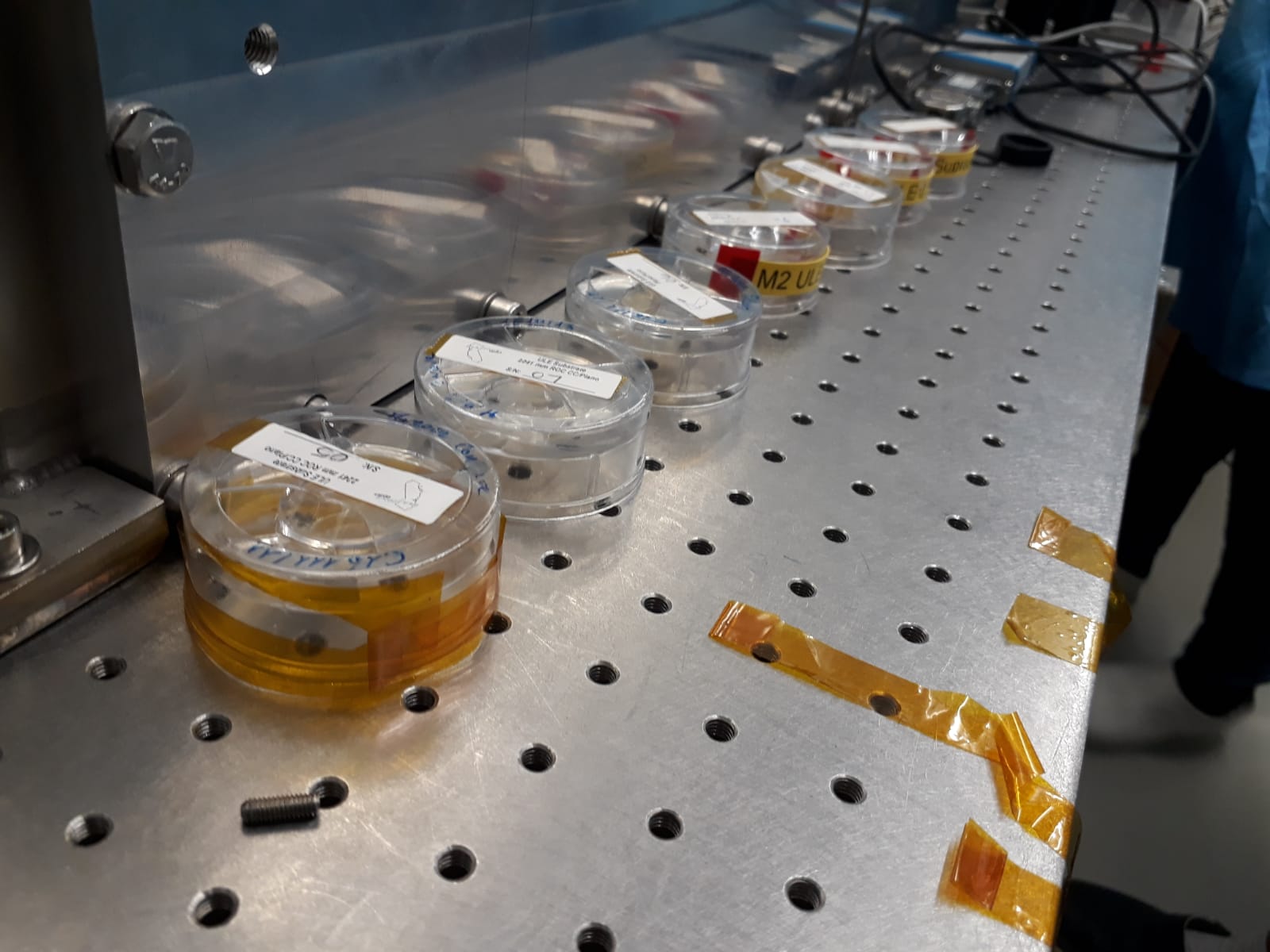
| Attachment 5: Mirrors_Tested.jpeg
|
 |
| Attachment 6: set_up_for_mirror_and_power_meter.jpeg
|
 |
|
60
|
Wed Dec 16 12:36:37 2020 |
Loïc Amoudry | Fixed | report | lasers and optics | Optical room | Mirror's cleaning and microscope imaging |
On 10th of december 2020 we cleaned the SBOX mirrors and took microscope images (the name of the images indicates what they are).
There are 7 mirror, the initial M1 (spot in the center), M2 (spot on the edge), M3 and M4 which made the 200-400kW and the M2, M3 and M4 SPARE. The difference we make between M3 and M4 SPARE is the number on the box (11 or 13).
We used 3 different cleaning methods : 1st, one spin coater on HR, 2nd one, tissu wipe on AR (wipe with the optical tissu and isoprop) or 3rd one, mirror wiped on tissue (put isoprop on tissu and press AR face of the mirror doing "8" shape 3 times).
The second method is far les efficient as a cleaning method. The image "M3_M4_spare_11_after_cleaning_back.tif " shows the traces let by it and removed by the 3rd method on image "M3_M4_spare_11_after_cleaning_back_second_time_on_tissu.tif".
We can also notice that the spin coater let some trace on the HR face, round shaped, see Image "M3_M4_spare_13_after_cleaning_back.tif". We can propose to use the third method with Acetone on HR face before using spin coater to remove oil or organic particles.
It also lets a trace on the AR face, this is why we clean the AR face with the 2nd method after cleaning it with the spin coater.
Note : The position of the mirrors in the microscope is always the same here. Meaning mirrors are directed so that the arrow (which shows the HR face and is placed on the side of the mirror) is placed on the top of the images. |
| Attachment 1: M1_before_cleaning.tif
|
| Attachment 2: M1_after_cleaning.tif
|
| Attachment 3: M2_after_cleaning.tif
|
| Attachment 4: M3_after_cleaning.tif
|
| Attachment 5: M4_after_cleaning.tif
|
| Attachment 6: M2_spare_before_cleaning.tif
|
| Attachment 7: M2_spare_after_cleaning.tif
|
| Attachment 8: M2_spare_after_cleaning_back.tif
|
| Attachment 9: M3_M4_spare_11_before_cleaning.tif
|
| Attachment 10: M3_M4_spare_11_after_cleaning_back.tif
|
| Attachment 11: M3_M4_spare_11_after_cleaning_back_second_time_on_tissu.tif
|
| Attachment 12: M3_M4_spare_13_before_cleaning.tif
|
| Attachment 13: M3_M4_spare_13_after_cleaning.tif
|
| Attachment 14: M3_M4_spare_13_after_cleaning_back.tif
|
|
59
|
Mon Jun 24 16:15:08 2019 |
Huan Wang | Fixed | info | lasers and optics | Optical room | amplifier |
I just had a phone call with Jérome and he told me 2 things :
* Be carefull ! the MightyLaser amplifier is not designed to work with 33MHz laser : the streching level is not sufficient !
One could worsen the phase noise by self-modulation due to peak power or even distroy the amplifier !
One should use it only at low power !!!
* He thinks we should more or less find back the same DC levels than before even with lower seeding power and lower repetition rate.
He thinks we should look at the optical spectrum to check if we don't have some ASE in the 1st stage and 2nd stage signal !
We can send him plots or call him to discuss these points.
| Huan Wang wrote: |
|
Onefive output power is 24mW now, and 2.41mW(after EOM) injected into fiber,
a injection power monitor added, 99% (2.06mW) injected into amplifier, 1% (16.1uW) monitored with photodiode DET36A/M, which gives ~500mV DC signal on oscilloscope with 1Mohm impedanc;
First stage amplifier works good, monitoring phtodiode gives more than 200mV DC signal with 50ohm impedance on oscilloscope (as attached photo);
Second stage, the old monitoring photodiode is broken, a new monitoring photodiode is connected, which we don't have reference data for it,
on the optical output port of the monitoring signal, it's written 150mW, but at where we measured 40mW.
|
|
|
58
|
Wed Jun 19 18:54:00 2019 |
Huan Wang | Fixed | info | lasers and optics | Optical room | amplifier |
Onefive output power is 24mW now, and 2.41mW(after EOM) injected into fiber,
a injection power monitor added, 99% (2.06mW) injected into amplifier, 1% (16.1uW) monitored with photodiode DET36A/M, which gives ~500mV DC signal on oscilloscope with 1Mohm impedanc;
First stage amplifier works good, monitoring phtodiode gives more than 200mV DC signal with 50ohm impedance on oscilloscope (as attached photo);
Second stage, the old monitoring photodiode is broken, a new monitoring photodiode is connected, which we don't have reference data for it,
on the optical output port of the monitoring signal, it's written 150mW, but at where we measured 40mW. |
| Attachment 1: 1st_stage_amplifier_monitoring_photodiode_signal.jpg
|
 |
|
57
|
Thu Feb 6 16:58:57 2020 |
Loïc Amoudry | Fixed | report | lasers and optics | Optical room | Power up to 48kW crater effect again |
As we said, after glow discharge and spin coater we recovered a low power finesse ~23000 (aligning away from the M1 crater).
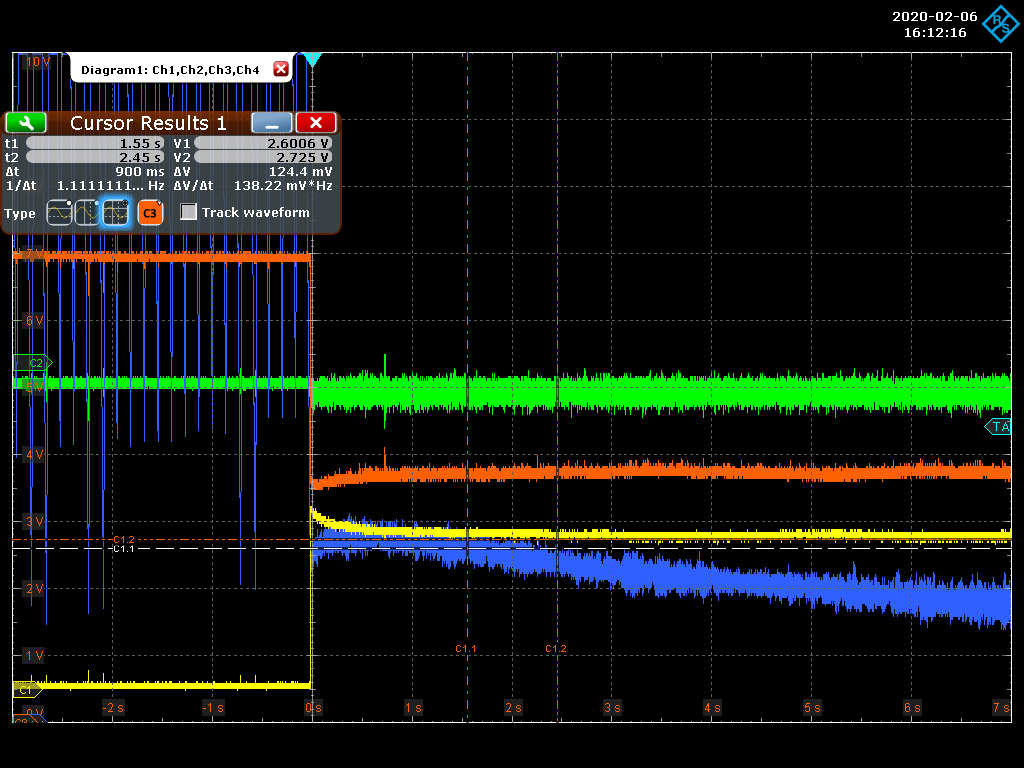
Today, we have made some power up to 48kW (3A on 3rd stage). At this power, there was no important effect on the transmission which can be compared with the coupling (see image "3A_136mWtrans"). We waited ~20min without aligning and the power dropped slowly (misalignment) to 39kW.
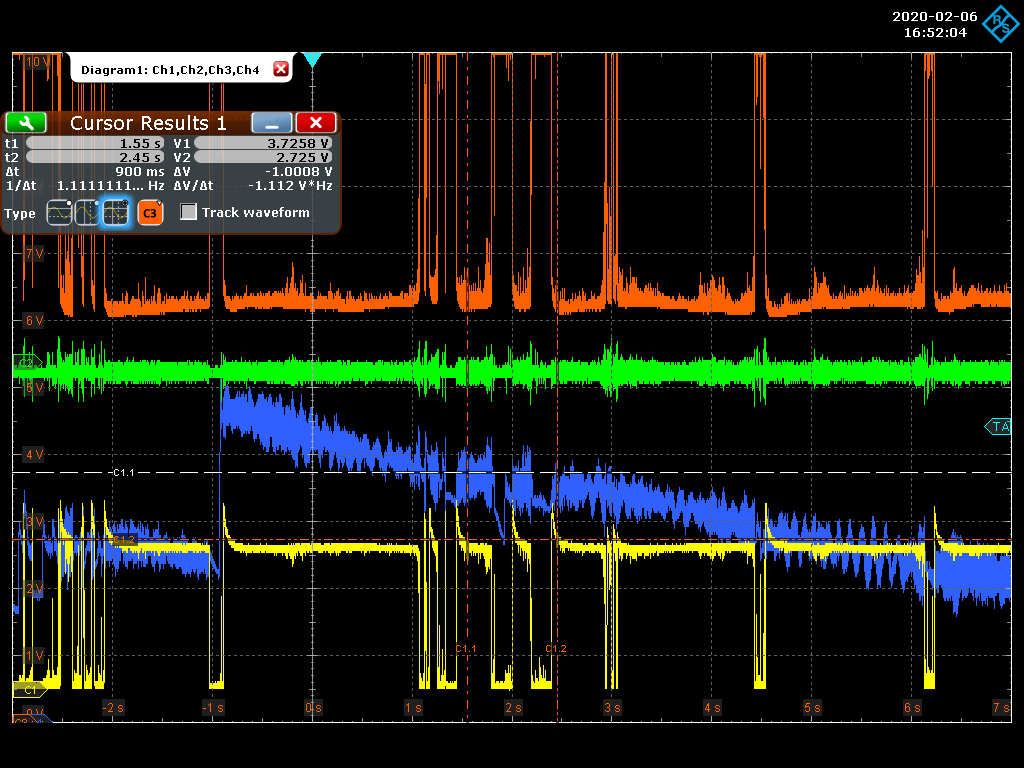
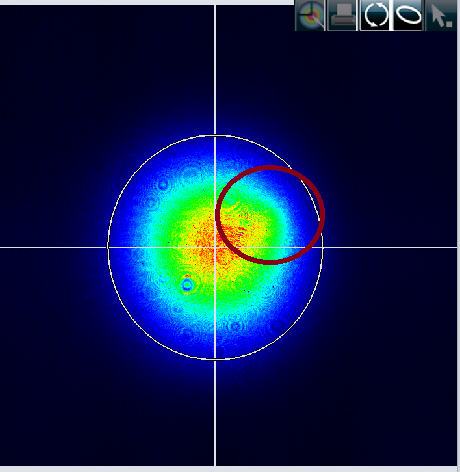
Then we increased the amplifier power to 4A and the power went up to 44kW. At this moment, the strange transmission behavior that we observed before mirror crater, appeared again (see image "4A_126mWtrans"). We also observed a mode deformation with the camera, see image "mode_strange". This shape was not depend of the camera/filter rotation angle and still appear with another camera.
| Loïc Amoudry wrote: |
|
The mirrors went in the cavity the 28th of november (We did several power up to 30kW stored and only one to 40kW then the power went down to 2kW during the run).
Microscope study shows that mirrors get some dust during the handling [travel from microscope to SBOX --> installation --> in SBOX for +1month and power up --> travel to microscope].
Almost all of these dusts can be removed with cleaning.
There is only one important difference between 28th of november and today, a large spot on M1.
|
|
| Attachment 1: 3A_136mWtrans.png
|
 |
| Attachment 2: 4A_126mWtrans.png
|
 |
| Attachment 3: mode_strange.png
|
 |
|
56
|
Thu Feb 6 11:01:08 2020 |
Ronic Chiche | Fixed | report | lasers and optics | Optical room | analysis of stored and reflected power |
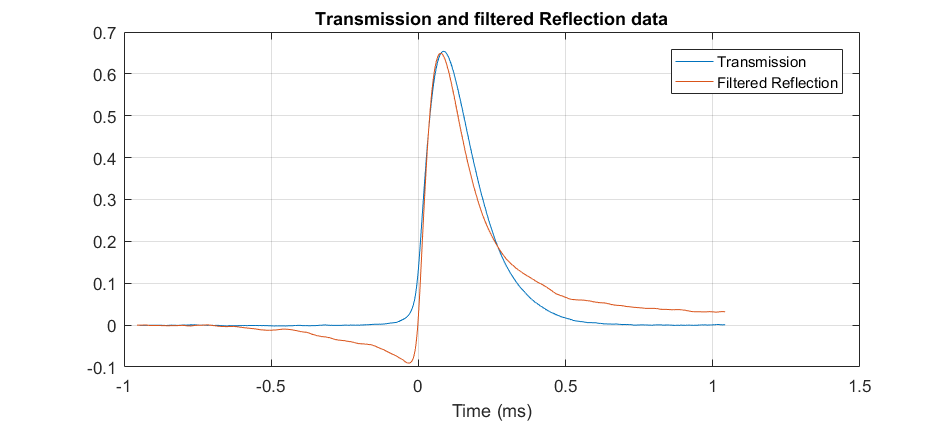
with this Finesse around 22-23k, the technique comparing TRANSMISSION and REFLECTION signals doesn't work, even in taking into account individual photodiode time responses.
It seems that the cavity is not completely stationnary and the shapes are not comparable easily with just a Low Pass Filter related to the Finesse.
Below, an example of the best fit of filtered REFLECTION signal compared to TRANSMISSION signal.... it is clear that the shapes don't fit....
| Ronic Chiche wrote: |
|
the 10th of January, we increased the power of the amplifier to study the cavity transmitted and reflected power signals.
analyzing the noise transfer functions of transmitted and reflected power one could deduce the Finesse of the cavity.
the power of this technic (if it is confirmed) does not depend on the decay time of one signal which depends on the speed of the cut off but on the difference between reflected and transmitted transfer functions,
and then is independant of the cut off speed.
here are 6 analysis of the Finesse when the cavity is cold, depending only on short lock periods.
5 of them agrees on a Finesse around 11k.
the 6th estimation at 40kW stored in the cavity is about 4k but now, we know that the M1 mirror had suddenly a hole for this power... thus the Finesse value is reasonable.
we can then, use the non conservation of TRANS+REF signal to estimate the FInesse decrease when the cavity is hot... to be done
|
|
| Attachment 1: untitled.png
|
 |
|
55
|
Wed Feb 5 16:46:01 2020 |
Loïc Amoudry | Fixed | report | lasers and optics | Optical room | SBOX mirrors cleaned |
Today we put the cavity to vacuum (~ 0.1 mBar) and we measured again the Finesse with Koheras and modulation technique.
the measurement has been done 3 times with Finesse of 23.2k, 23.8k, 23k
| Loïc Amoudry wrote: |
|
Yesterday, after installation and alignment of mirrors and cavity, the Finesse has been measured with cavity at air pressure, with Koheras and modulation technique.
the measurement has been done 5 times with quite different fits for the Finesse : 21.5k, 21.5k, 23.7k, 21.3k, 22.3k.
But, as the cavity is at air pressure, the lock is not very stable.
we will pump the cavity and make the measurement again.
| Loïc Amoudry wrote: |
|
Today, SBOX mirrors have been cleaned with spin coater on HR face and isoprop on back face. They show similar spots as before.
They also have been installed in the SBOX. The M1 mount has been displaced so the beam doesn't go in its center (spot).
|
|
|
|
54
|
Wed Feb 5 14:47:16 2020 |
Loïc Amoudry | Fixed | report | lasers and optics | Optical room | SBOX mirrors cleaned |
Yesterday, after installation and alignment of mirrors and cavity, the Finesse has been measured with cavity at air pressure, with Koheras and modulation technique.
the measurement has been done 7 times with quite different fits for the Finesse : 21.5k, 21.5k, 23.7k, 21.3k, 22.3k, 22k, 21.5k
But, as the cavity is at air pressure, the lock is not very stable.
we will pump the cavity and make the measurement again.
| Loïc Amoudry wrote: |
|
Today, SBOX mirrors have been cleaned with spin coater on HR face and isoprop on back face. They show similar spots as before.
They also have been installed in the SBOX. The M1 mount has been displaced so the beam doesn't go in its center (spot).
|
|
|
53
|
Wed Jan 29 19:04:38 2020 |
Loïc Amoudry | Fixed | report | lasers and optics | Optical room | SBOX mirrors cleaned |
Today, SBOX mirrors have been cleaned with spin coater on HR face and isoprop on back face. They show similar spots as before.
They also have been installed in the SBOX. The M1 mount has been displaced so the beam doesn't go in its center (spot). |