| ID |
Date |
Author |
Status |
Type |
Category |
Location |
Title |
|
316
|
Thu Jan 25 10:15:28 2024 |
Ronic Chiche | Fixed | info | mechanics | lasers and optics | cabling | ThomX igloo | controller M1 & M4 (plan mirrors) with IcePap controllers | previously, we have connected motor M4 with an IcePap controller.
see this post : https://elog.lal.in2p3.fr/FPC/THOMX+commissioning/278
due to the backlash behavior of the FP-cavity motors, it is impossible to work in both directions on one motor when the FP-cavity is locked.
so, we decided to use also the motor M1 to work in the other direction.
then, normally M1 will work in one direction and M4 in the other direction.
motor M1 (or P1Z) which was on the axis 9 on the ISP controller has been assigned to OC/OP/OCH.01-MOT.06
motor M4 (or P4Z) which was on the axis 12 on the ISP controller has been assigned to OC/OP/OCH.01-MOT.03
|
|
315
|
Fri Jan 19 18:05:42 2024 |
Ronic Chiche | Fixed | info | detectors and electronics | ThomX igloo | Adding one photodiode in reflection | this morning, I added a DET36 photodiode in reflection (I used a thin beam splitter) to better measure the coupling over the full beam size.
this DET36 photodiode is sent to the "laser locking" oscilloscope with the other signals :
CH1 :transmission
CH2 : reflection
CH3 : error signal or FP-cavity PZT (depending on the Laselock Monitor 1 signal configuration)
CH4 : laser PZT (Laselock Monitor 2 signal)
I kept the DET10 photodiode in reflection, but slightly misaligned to get the 500MHz laser harmonic without too much amplitude variation when locked (the lock behavior changes almost the center of the beam).
the DET10 photodiode is sent to the "RF locking" oscilloscope on CH1 |
|
314
|
Tue Jan 16 12:26:12 2024 |
Ronic Chiche | Fixed | info | lasers and optics | detectors and electronics | ThomX igloo | 33MHz (FP-cavity vs RF) phase stability | this morning, with Vincent Chaumat, we made a beating (phase detection) between the laser 33MHz and the 33MHz coming from the Rigol generator locked by the 10MHz link onto the 500MHz ring generator.
once the laser and the FP-cavity are locked on the RF reference, the 33MHz phase detection is stabilized and confirm the laser/FP-cavity lock on the RF reference.
we plan to make a drift measurement and a jitter measurement to estimate this lock quality.
the 33MHz frequency being quite small, the quality of this estimation will be poor but it can give a "worse case" estimation. |
|
313
|
Tue Jan 16 12:19:35 2024 |
Ronic Chiche | Fixed | info | lasers and optics | detectors and electronics | software | ThomX igloo | Restarting equipements after Christmas shutdown | on last friday (12/01/2024), the IcePap DS issue was solved and I was able to control the FP-cavity motors properly.
I was able to quickly lock either the laser on the FP-cavity and the FP-cavity on the RF reference as before.
then, we can close these posts on restarting the equipments after the Christmas shutdown
| Ronic Chiche wrote: |
|
this morning, I set the Ring frequency at 500.25MHz and after switching ON the power supply of the amplifiers for the RF signal coming from the laser,
I saw the beating frequency (between ring RF and laser harmonic frerquencies at 500.25MHz) that I canceled, playing with the Smaract motor.
Now, I need to adjust the FP-cavity length to follow the laser cavity length but the IcePap DS (controlling the FP-cavity motor) freezes too often and it is almost impossible to make the adjustment.
Kevin sent a GLPI ticket to try to solve this problem.... waiting for IT answer...
| Ronic Chiche wrote: |
|
the laser coupled into the amplifier is still measured at ~3mW at the input, on the Alphanov software, once the Amp stage are started at 0% of power ratio.
this afternoon, Kevin restarted the 3rd safety system of ThomX to grant the opening of the beam shutter => now the shutter can be opened.
after adjusting the phase for the PDH system, I was able to find back the laser/CFP lock.
after some minimal alignement, one gets back 50kW for 30.5% of laser amplifier ratio, as before the Christmas shutdown.
I didn't try to lock the FP cavity on the 500MHz RF reference clock as I'm not sure if it has been set to 500.25MHz (as before shutdown) or at 500.1MHz (the future RF frequency) which is very far and will require to move the FP cavity on a long rage.
=> I will ask to Vincent Chaumat to confirm the present RF frequency.
| Ronic Chiche wrote: |
|
this morning, I plugged back the 4 power cables which supply all the equipments.
all the equipments have restarted without problem, but the shutter of the laser amplifier needs a ThomX safety system grant to let the beam propagate to the cavity...
and then continue the commissioning of the restart after Christmas shutdown.
|
|
|
|
|
312
|
Thu Jan 11 13:42:16 2024 |
Ronic Chiche | Fixed | info | lasers and optics | detectors and electronics | software | ThomX igloo | Restarting equipements after Christmas shutdown | this morning, I set the Ring frequency at 500.25MHz and after switching ON the power supply of the amplifiers for the RF signal coming from the laser,
I saw the beating frequency (between ring RF and laser harmonic frerquencies at 500.25MHz) that I canceled, playing with the Smaract motor.
Now, I need to adjust the FP-cavity length to follow the laser cavity length but the IcePap DS (controlling the FP-cavity motor) freezes too often and it is almost impossible to make the adjustment.
Kevin sent a GLPI ticket to try to solve this problem.... waiting for IT answer...
| Ronic Chiche wrote: |
|
the laser coupled into the amplifier is still measured at ~3mW at the input, on the Alphanov software, once the Amp stage are started at 0% of power ratio.
this afternoon, Kevin restarted the 3rd safety system of ThomX to grant the opening of the beam shutter => now the shutter can be opened.
after adjusting the phase for the PDH system, I was able to find back the laser/CFP lock.
after some minimal alignement, one gets back 50kW for 30.5% of laser amplifier ratio, as before the Christmas shutdown.
I didn't try to lock the FP cavity on the 500MHz RF reference clock as I'm not sure if it has been set to 500.25MHz (as before shutdown) or at 500.1MHz (the future RF frequency) which is very far and will require to move the FP cavity on a long rage.
=> I will ask to Vincent Chaumat to confirm the present RF frequency.
| Ronic Chiche wrote: |
|
this morning, I plugged back the 4 power cables which supply all the equipments.
all the equipments have restarted without problem, but the shutter of the laser amplifier needs a ThomX safety system grant to let the beam propagate to the cavity...
and then continue the commissioning of the restart after Christmas shutdown.
|
|
|
|
311
|
Wed Jan 10 18:43:03 2024 |
Ronic Chiche | Fixed | info | lasers and optics | detectors and electronics | software | ThomX igloo | Restarting equipements after Christmas shutdown | the laser coupled into the amplifier is still measured at ~3mW at the input, on the Alphanov software, once the Amp stage are started at 0% of power ratio.
this afternoon, Kevin restarted the 3rd safety system of ThomX to grant the opening of the beam shutter => now the shutter can be opened.
after adjusting the phase for the PDH system, I was able to find back the laser/CFP lock.
after some minimal alignement, one gets back 50kW for 30.5% of laser amplifier ratio, as before the Christmas shutdown.
I didn't try to lock the FP cavity on the 500MHz RF reference clock as I'm not sure if it has been set to 500.25MHz (as before shutdown) or at 500.1MHz (the future RF frequency) which is very far and will require to move the FP cavity on a long rage.
=> I will ask to Vincent Chaumat to confirm the present RF frequency.
| Ronic Chiche wrote: |
|
this morning, I plugged back the 4 power cables which supply all the equipments.
all the equipments have restarted without problem, but the shutter of the laser amplifier needs a ThomX safety system grant to let the beam propagate to the cavity...
and then continue the commissioning of the restart after Christmas shutdown.
|
|
|
310
|
Wed Jan 10 15:21:46 2024 |
Ronic Chiche | Under Process | info | lasers and optics | ThomX igloo | Variable focal lens validation | we plan to use Electrically Tunable Lenses EL-10-30-C NIR to build the ThomX telescope but they need to be compatible with the powerful laser beam.
for CW regime, on the datasheet (see attached file), the optical damage threshold is 10 kW/cm².
with 70W laser power and 1mm² beam surface (which is much smaller than the real beam size), we are at 7kW/cm².
for pulsed regime, with Daniele, we can imagine that the inner material is water (n ~ 1.3 in the datasheet).
One found a paper about laser induced electric breakdown in water (see attached paper) which give a breakdown field of about 1e8 V/m (see Fig. 1 of the paper) for 7ns pulse width.
with 70W average power, 33MHz repetition rate, 10ps pulse width 1mm² beam surface, one has an intensity of ~ 2e11 W/m² (or 2.7 GW/cm²)
I = E² / 377 => E = 8.7e6 V/m which is also much smaller than the breakdown value.
from the fig. 4 of the paper, it seems the breakdown threshold increases a lot for shorter pulses from 30 GW/cm² (~10ns pulses) to ~150 GW/cm² (~10ps pulses)
so, one can expect a good behavior in pulsed regime too.
can anyone check the validity of these rough calculations ???
|
| Attachment 1: Optotune_EL-10-30.pdf
|
| Attachment 2: JOSAB.8.000337.pdf
|
|
309
|
Wed Jan 10 14:52:22 2024 |
Ronic Chiche | Fixed | info | lasers and optics | detectors and electronics | software | ThomX igloo | Restarting equipements after Christmas shutdown | this morning, I plugged back the 4 power cables which supply all the equipments.
all the equipments have restarted without problem, but the shutter of the laser amplifier needs a ThomX safety system grant to let the beam propagate to the cavity...
and then continue the commissioning of the restart after Christmas shutdown. |
|
308
|
Fri Dec 22 16:13:27 2023 |
Ronic Chiche | Fixed | info | lasers and optics | detectors and electronics | software | ThomX igloo | Christmas shutdown | this afternoon, I checked visually what happens when the AC power of the UPS is broken down => the laser controller has still its "emission" button ON... no AC interruption.
so, I guess the UPS switched properly the output AC line from the input AC line to the internal batteries.
| Ronic Chiche wrote: |
|
this morning, I shut off all the equipements (especially the computer) except the ones powered by the UPS : laser controller, laser peltier controller, laser motors controller.
and I disconnected the cables from the power plugs of the wall (to prevent any possible overvoltage).
Jean-Noël Cayla will need to shut off the electrical shelf (the one powering the UPS) during the afternoon, I will check at this moment if the laser controller is still properly powered thanks to the UPS.
|
|
|
307
|
Fri Dec 22 09:46:18 2023 |
Ronic Chiche | Fixed | info | lasers and optics | detectors and electronics | software | ThomX igloo | Christmas shutdown | this morning, I shut off all the equipements (especially the computer) except the ones powered by the UPS : laser controller, laser peltier controller, laser motors controller.
and I disconnected the cables from the power plugs of the wall (to prevent any possible overvoltage).
Jean-Noël Cayla will need to shut off the electrical shelf (the one powering the UPS) during the afternoon, I will check at this moment if the laser controller is still properly powered thanks to the UPS. |
|
306
|
Mon Dec 11 17:21:32 2023 |
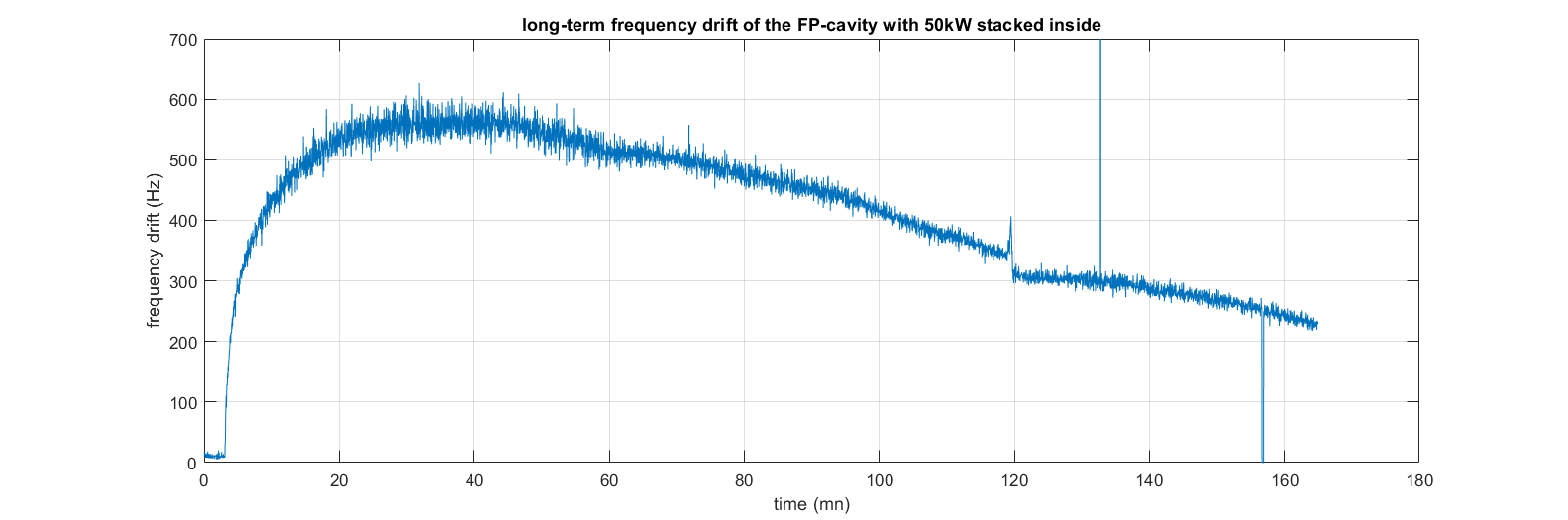
Ronic Chiche | Fixed | issue | mechanics | lasers and optics | detectors and electronics | ThomX igloo | Temperature control of the FP-cavity length | today with Fatematuj, we did a long-term frequency drift measurement between the FP-cavity loaded with 50kW and the RF reference frequency... and without any other thermal source (no heating cable !)
we had a small lock loss at t ~ 120mn.
we see at the begining an exponential behavior of the FP-cavity reaching a thermal steady state until t ~ 40mn, and then we see the frequency slowly drifting in the reverted direction...
which is the evidence of the thermal source reaching a different mechanical part of the FP-cavity for which an increase of temperature induces a reverted change in frequency.
the very long delay between these 2 opposite behaviors could come from the ceramic balls on which the big mechanical mounts of the mirrors are placed.
we have to redo this measurement with a longer period to see if and when we are reaching a steady state !
| Ronic Chiche wrote: |
|
on last tuesday, I did a long-term measurement of the frequency drift when the heating cable is powered ON at 20V (2x 10V) @ t=0mn.
the freqeuncy drift (between the laser, locked in open loop on the FP-cavity, and the RF reference oscillator) acquisition was made by the National Instrument software.
the sampling rate of this acquisition is not set by the user but depends on several parameters of the acquisition... and then can be subject to change.
on can see on the data, in blue, a possible sampling rate change @ t~30mn.
@ t~100mn : the frequency sign changes but the measurement gives always the absolute value.
in orange, the fit is not very good... possibly due to the sampling rate change.
the conclusion we can have is only this frequency drift action has a very long time constant ~ 2h
and could be used to compensate, as soon as the power is in the FPcavity, the frequency drift coming from this power.
| Ronic Chiche wrote: |
|
last friday, I locked the cavity and then, switched ON the heating cable after waiting the cavity reaches a steady state in frequency drift : see the figure.
blue : temperature of the probe on the heating cable
red : freqeuncy drift between FP-cavity (laser locked on it) and RF reference oscillator.
@ 10min : filling the FP-cavity with 50kW
@ 50min : "long" lock loss of about 1min => jumb in frequency => it is strange to see the cavity does not reach the same frequency steady state after the lock loss than before the lock loss.
(just before the small frequency jump, the frequency is increasing a bit because of the lock has been lost and the laser is drifting by itself in open loop. the jump, after that, corresponds to the moment where the laser is locked back to the FP-cavity)
@ 55min : switch ON the heating cable with 20V on the voltage supply => the probe stuck on the cable shows the temperature increases => and a bit later, one can see the frequency decreasing.
surprisingly, we don't reach a steady state ...
I suspect that filling the FP-cavity with power (without switching ON the heating cable) could first inscrease the frequency and later could decrease it if several parts of the mechanics are involved and if the thermal conduction is slow because of some isolation embbedded in the mechanics (for example ceramics balls).
it is possible to make the frequency drifting sensitivity test of the heating cable without locking the cavity at 50kW.
one can work in open loop, without power in the FP-cavity, and follow the frequency drift by keeping the main resonance at the same relative position to the laser PZT.
| Ronic Chiche wrote: |
|
this afternoon, I started the heating cable after the warm-up of the FP-cavity :
14h20 : start to fill 50kW in the cavity
15h : start of the heating cable @10V (2x 5V) (iteration 2300)
15h16 : start of the heating cable @60V (2x 30V) (iteration 3400)
15h20 : start of the heating cable @20V (2x 10V) (iteration 3600)
the offset frequency, for 20V of voltage on the DC voltage supply, is 175Hz @500MHz (equivalent to 3.5µm)
| Ronic Chiche wrote: |
|
today, I removed one of the DC voltage supply (as with 30V, we are already able to 30°C on the heating cable).
the remaining DC voltage supply is configured in series (2x30V = 60V max) and is at the IP address : 192.168.1.101
| Ronic Chiche wrote: |
|
several days ago, we installed a heating cable around the output flange (close to the X-hutch) of the FP-cavity vessel.
we are able to heat this cable by applying a DC voltage coming from 2 DC voltage supplies in serie (2 devices with 2x 0-30V / 3A => 0-120V / 3A).
currently, we apply at maximum 7V DC on each channel => 28V DC on the cable. its temperature reach ~ 30°C after 1/2h or more.
this temperature increase on one vessel of the FP-cavity, changes very slowly the length of the FP-cavity.
see this post (red curve on fig. 2) for a typical temperature curve measured (exponential-like curve) on the heating cable itself : https://elog.lal.in2p3.fr/FPC/THOMX+commissioning/290
the length change rate of the FP-cavity, due to this heating, is difficult to estimate because it depends on the part of this exponential curve you make the measurement.
but globally the drift is about 50nm every 5 minutes, which is roughly equivalent to 10 steps of the FP-cavity motor every 5 minutes.
| Ronic Chiche wrote: |
|
as the CFP motors displacements induce a cavity unlock, we try to change the cavity length by changing the temperature of elment of the cavity.
yesterday, we tried to put a "heating cable" borrowed to the vacuum group to change the temperature of one bellows between the FP-cavity and the electron ring.
we chose a below because it is flexible and should not apply a too strong force on the cavity vessels.
we heated the cable at ~30°C but we didn't see a clear effect on the FP-cavity frequency measurement.
then, we put a heating cable around the X-ray output flange of the FP-cavity vessel and we saw a clear effect : a relatively fast (at a "second" level) frequency change.
the problem is the heating system is not remotely driven.
the cable is R=55ohms impedance and can reach 450°C for 1kW dissipated.
so today, we will try to use 2 remotely controlled Siglent SPD3303X power supplies.
they can reach V=120V DC => P=V²/R=260W => we could reach more than 100°C
|
|
|
|
|
|
|
| Attachment 1: frequency_drift.png
|  |
|
305
|
Fri Dec 8 12:21:25 2023 |
Ronic Chiche | Fixed | info | lasers and optics | ThomX igloo | Strecher and fiber injection alignment | today, the Alphanov amplifier stopped because of the too low injected power : ~2.5mW (measured by the Alphanov software)
it was still working at ~2.7mW.
normally, the injected power is ~3.1mW (equivalent to 6.2mW measured directly at the fiber output).
I checked the power coming from the OneFive oscillator : it is still 36mW, identical to the power measured the first day we installed it.
by moving the "focus" knob of the mount, we saw this 3.1mW back but it was impossible to get it in a stable way.
so we think the "strecher box alignment" is still good and we decided to realign the Schafter-Kirchhoff fiber mount.
up to now, we lost all the coupling in the mount, then we improved the power at the fiber output to 4.2mW, then we lost everything again.
we will continue this afternoon.
this afternoon, I was able to go back to 5.4mW in the fiber output (3.2-3.3mW in the Alphanov software).
IN CASE OF SMALL LOSS OF POWER IN THE FIBER : DON'T TOUCH THE SCHAFTER-KIRCHHOFF MOUNT
it is too sensitive... open the Strecher box and do the alignment improvement with the 2 final (alignment) mirrors in the box.
even if it is mandatory to adjust the Schafter-Kirchhoff mount, you will have to finish the alignment with the 2 final (alignment) mirrors of the Strecher box.
Now, all the Schafter-Kirchhoff mount screws are well tighten !
So next time, use the Strecher box final mirrors to improve the injection into the fiber.
after the new fiber alignment, I was able to lock "as usual" the cavity to 47kW @30% of laser amplifier ratio.
| Ronic Chiche wrote: |
|
Today, the power measured at the input of the amplifier (PD_IN on the LAL amplifier software) is 2.5mW instead of >3mW generally measured
The power coming from the NKT/Onefive Origami oscillator is still >37mW (measured directly with the powermeter at the laser output without OD2).
thus, the problem should come from:
- the strecher/fiber alignment.
- or maybe from a wavelength shift of the oscillator
| Ronic Chiche wrote: |
|
Monday 7/11 morning, the power in the fiber was still 6.2 mW
| Ronic Chiche wrote: |
|
this morning : still 6.2 mW at the output of the fiber.
the powermeter has been removed and the fiber connected to amplifier input fiber (no EOM connected in between).
| Ronic Chiche wrote: |
|
This morning with Manar, we continued the strecher CVBG alignment and fiber injection procedure :
- we checked the power at the output of the laser and confirmed the measurement after the Isolator : ~ 36 mW
- we tried to improve the power after the strecher CVBG by rotating the quarter-wave plate but it seems we were already at the maximum : ~ 10.5 mW
- we aligned the 2 fiber injection mirrors + schafter-kirchoff mount z-axis : we saw 5 mW at the output of the fiber but it is very difficult to keep the power after swcrewing the 2 z-axis fixing screws of the schafter-kirchoff mount.
we decided to replace the 750mm focusing lens installed by a 1000mm lens.
- we aligned again the 2 fiber injection mirrors + schafter-kirchoff mount z-axis : now, we have ~ 6.2 mW stable at the output of the fiber after screwing the 2 z-axis fixing screws of the schafter-kirchoff mount.
the procedure for aligning the schafter-kirchoff mount is :
- unscrew the z-axis and tilt fixing screws (5 screws in total).
- improve the injection with the z-axis knob and the tilt screws
- tighten very softly all the fixing srews once the optimization is finished => you will lose a part of the alignment but not completely (~ 1 mW level)
- redo a part of the alignment with the 2 aligning mirrors => you should find back the values after optimization.
we let the power-meter at the output of the fiber to check in the next days if the injected power in the fiber changes or not....
it is important to not "kick" the fiber injection box or put anything on it ! as the schafter-kirchoff mount adjustment is soooo touchy...
| Ronic Chiche wrote: |
|
Manar + Victor, today in the morning we aligned the CVBG of the stretcher.
The double path using the mirror mounts, reached up to 5.4 mW just before the injection into the fibers
then we rotated the quarter wave plate and the power increased by a factor of ~ 2 to 10.3 mW
we started with the injection into the fiber by alignment of the 2 mirror mounts.
1) fiber not connected and have everything pass through the mount
2) connect fiber loosely and increase the power in fiber bit by bit until fiber fixed fully
reached power up to 438 uW
alignment not finished using the mounts, there is still also schafter-kirchoff mount.
| Ronic Chiche wrote: |
|
I used the 33MHz spectrum measurement : https://elog.lal.in2p3.fr/FPC/THOMX+commissioning/153
fitted by P=P0*sech²((f-f0)/df)
f0 = c/1030m
df = (c/1030nm^2) * 2.5nm
and the strecher CVBG measured data (in attached file with reference D24-02)
to estimate the expected power to be coupled into the fiber.
the corresponding plot shows 3 curves:
- black : the 33MHz laser spectrum "manually fittted" with the sech² function (mentionned at the begining of this post) to match the measured spectrum from the elog.
- blue : the strecher CVBG reflectivity curve from the Excel measured datasheet in attachement.
- red : the corresponding output power after a double path into a CVBG (the reflectivity is applied twice).
with this simulation, one can estimate the power after CVBG to be 12.5 mW for 35 mW of input power.
or 9.6 mW after CVBG for 27 mW of input power which is exactly what has been measured in a previous post by Loic : https://elog.lal.in2p3.fr/FPC/THOMX+commissioning/70
| Ronic Chiche wrote: |
|
This morning with Manar, we measured the power at different points:
- direct measurement at the output of the 33MHz laser : 35 mW
inside the injection box :
- after the Isolator + focalization lens : 35 mW
- just at the input of the strecher CVBG : 35 mW
- atfer optimizing the alignment of the double path CVBG, in between the 2 fiber injection coupling mirrors : 5,7 mW
(the power is measured after going through the quarter-waveplate and PBS)
I found an old post from Loic claiming that with 27mW input power, we got 9.6 mW after the PBS instead of 5,7 mW !
https://elog.lal.in2p3.fr/FPC/THOMX+commissioning/70
we have to check if the laser wavelength shifted, if the alignment could be improved, if the quarter-waveplate has the right angle,....
then, we tried to couple this 5,7mW inside the fiber using the schafter-kirchoff mount (SKM) but it is a nightmare.
changing the focus and the internal fiber angle is very sensitive, not always predictable and rarely reproductible...
I have to ask Guillaume how he used this mount...
the best power we saw in the fiber is 1mW but after screwing the fixing screws of the SKM, we lose almost all the alignment and we have something around 100-300µW...
| Ronic Chiche wrote: |
|
In preparation for tomorrow morning, I did a test with a 45° mount to have a power pickup inside the injection box.
I used the 133MHz laser.
output power measured with the powermeter : 45mW
output power measured with the powermeter + OD2 : 2mW
output power measured with the 45° mount with BB1-E03 mirror with the powermeter + OD2 : 2mW
as expected the BB1-E03 mirrors have a very good reflectance for AOI=45°
the specs give >99% @ 1030nm for both S and P polarizations.
| Ronic Chiche wrote: |
|
This morning with Viktor, we started the alignment of the CVBG and fiber.
we did a better alignment of the 2-pass CVBG.
we are able to the see a spot after PBS (after the 2 CVBG pass) which means the alignment is OK even if it can be improved.
then, we started the fiber injection alignment with the 2 last mirrors (7 & 8 on Alphanov documentation).
we saw that if we unswcrew the fiber to play on the focal position, we are able to improve a lot the power in the fiber.
2-3µW with the fiber screwed => 500µW with the fiber unscrewed.
it means the beam is not enough focused.
I will ask Guillaume Machinet his advice when injecting the 33MHz... do we need to replace the long focal lens just after the Isolator ?
and with which value approximatively ?
we played also with the Schafter+Kirchhoff mount of the fiber colimator (see attached documentation).
we loosen the 2 screws around the eccentric key which adjust the focal position + play on this eccentic key + tighten the 2 screws again.
now, we reached 330µW with the fiber properly screwed.
we have to check the available power before the fiber injection but we have very few place to place the powermeter.
maybe with a small mirror ?
| Ronic Chiche wrote: |
|
Today, after laser was modelocked, we checked the power inside the fiber coming from the Alphanov Strecher box.
it was almost zero, at the nW level.
after doing some very rough alignment, we clearly saw some power (with the powermeter) correlated with the position of mirrors, when turning the alignment knobs.
this is a first step but the output power in the fiber is still very low, about 20nW !
an additionnal 2mm L-shaped hex key is needed to do some walking alignment on the mounts.
|
|
|
|
|
|
|
|
|
|
|
|
304
|
Thu Dec 7 14:59:02 2023 |
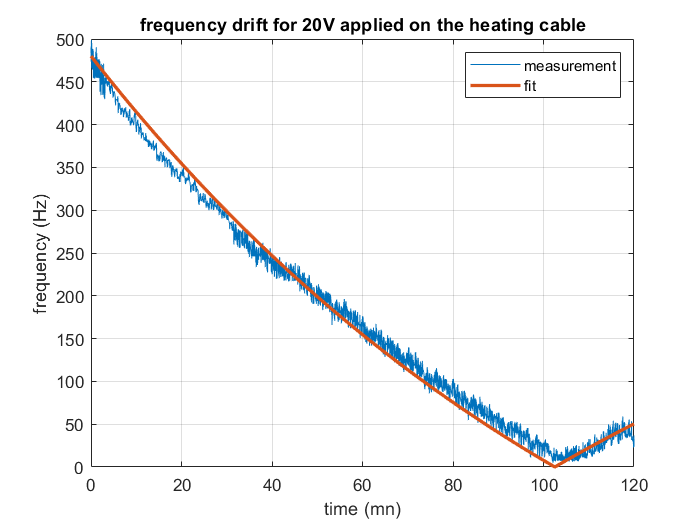
Ronic Chiche | Fixed | issue | mechanics | lasers and optics | detectors and electronics | ThomX igloo | Temperature control of the FP-cavity length | on last tuesday, I did a long-term measurement of the frequency drift when the heating cable is powered ON at 20V (2x 10V) @ t=0mn.
the freqeuncy drift (between the laser, locked in open loop on the FP-cavity, and the RF reference oscillator) acquisition was made by the National Instrument software.
the sampling rate of this acquisition is not set by the user but depends on several parameters of the acquisition... and then can be subject to change.
on can see on the data, in blue, a possible sampling rate change @ t~30mn.
@ t~100mn : the frequency sign changes but the measurement gives always the absolute value.
in orange, the fit is not very good... possibly due to the sampling rate change.
the conclusion we can have is only this frequency drift action has a very long time constant ~ 2h
and could be used to compensate, as soon as the power is in the FPcavity, the frequency drift coming from this power.
| Ronic Chiche wrote: |
|
last friday, I locked the cavity and then, switched ON the heating cable after waiting the cavity reaches a steady state in frequency drift : see the figure.
blue : temperature of the probe on the heating cable
red : freqeuncy drift between FP-cavity (laser locked on it) and RF reference oscillator.
@ 10min : filling the FP-cavity with 50kW
@ 50min : "long" lock loss of about 1min => jumb in frequency => it is strange to see the cavity does not reach the same frequency steady state after the lock loss than before the lock loss.
(just before the small frequency jump, the frequency is increasing a bit because of the lock has been lost and the laser is drifting by itself in open loop. the jump, after that, corresponds to the moment where the laser is locked back to the FP-cavity)
@ 55min : switch ON the heating cable with 20V on the voltage supply => the probe stuck on the cable shows the temperature increases => and a bit later, one can see the frequency decreasing.
surprisingly, we don't reach a steady state ...
I suspect that filling the FP-cavity with power (without switching ON the heating cable) could first inscrease the frequency and later could decrease it if several parts of the mechanics are involved and if the thermal conduction is slow because of some isolation embbedded in the mechanics (for example ceramics balls).
it is possible to make the frequency drifting sensitivity test of the heating cable without locking the cavity at 50kW.
one can work in open loop, without power in the FP-cavity, and follow the frequency drift by keeping the main resonance at the same relative position to the laser PZT.
| Ronic Chiche wrote: |
|
this afternoon, I started the heating cable after the warm-up of the FP-cavity :
14h20 : start to fill 50kW in the cavity
15h : start of the heating cable @10V (2x 5V) (iteration 2300)
15h16 : start of the heating cable @60V (2x 30V) (iteration 3400)
15h20 : start of the heating cable @20V (2x 10V) (iteration 3600)
the offset frequency, for 20V of voltage on the DC voltage supply, is 175Hz @500MHz (equivalent to 3.5µm)
| Ronic Chiche wrote: |
|
today, I removed one of the DC voltage supply (as with 30V, we are already able to 30°C on the heating cable).
the remaining DC voltage supply is configured in series (2x30V = 60V max) and is at the IP address : 192.168.1.101
| Ronic Chiche wrote: |
|
several days ago, we installed a heating cable around the output flange (close to the X-hutch) of the FP-cavity vessel.
we are able to heat this cable by applying a DC voltage coming from 2 DC voltage supplies in serie (2 devices with 2x 0-30V / 3A => 0-120V / 3A).
currently, we apply at maximum 7V DC on each channel => 28V DC on the cable. its temperature reach ~ 30°C after 1/2h or more.
this temperature increase on one vessel of the FP-cavity, changes very slowly the length of the FP-cavity.
see this post (red curve on fig. 2) for a typical temperature curve measured (exponential-like curve) on the heating cable itself : https://elog.lal.in2p3.fr/FPC/THOMX+commissioning/290
the length change rate of the FP-cavity, due to this heating, is difficult to estimate because it depends on the part of this exponential curve you make the measurement.
but globally the drift is about 50nm every 5 minutes, which is roughly equivalent to 10 steps of the FP-cavity motor every 5 minutes.
| Ronic Chiche wrote: |
|
as the CFP motors displacements induce a cavity unlock, we try to change the cavity length by changing the temperature of elment of the cavity.
yesterday, we tried to put a "heating cable" borrowed to the vacuum group to change the temperature of one bellows between the FP-cavity and the electron ring.
we chose a below because it is flexible and should not apply a too strong force on the cavity vessels.
we heated the cable at ~30°C but we didn't see a clear effect on the FP-cavity frequency measurement.
then, we put a heating cable around the X-ray output flange of the FP-cavity vessel and we saw a clear effect : a relatively fast (at a "second" level) frequency change.
the problem is the heating system is not remotely driven.
the cable is R=55ohms impedance and can reach 450°C for 1kW dissipated.
so today, we will try to use 2 remotely controlled Siglent SPD3303X power supplies.
they can reach V=120V DC => P=V²/R=260W => we could reach more than 100°C
|
|
|
|
|
|
| Attachment 1: untitled.png
|  |
|
303
|
Thu Dec 7 09:09:27 2023 |
Ronic Chiche | Fixed | info | lasers and optics | ThomX igloo | New mirrors batch informations | the 2 files describe the specfications for the16 mirrors ordered (4 for ThomX + spare, 4 for SBOX + spare) and the measurements made by the LMA. |
| Attachment 1: miroirs_puma_2022_thomx_Kbox.docx
|
| Attachment 2: Miroirs_à_1031_nm-ThomX_-_KBox_Mars_2023.pdf
|
|
302
|
Mon Dec 4 10:45:50 2023 |
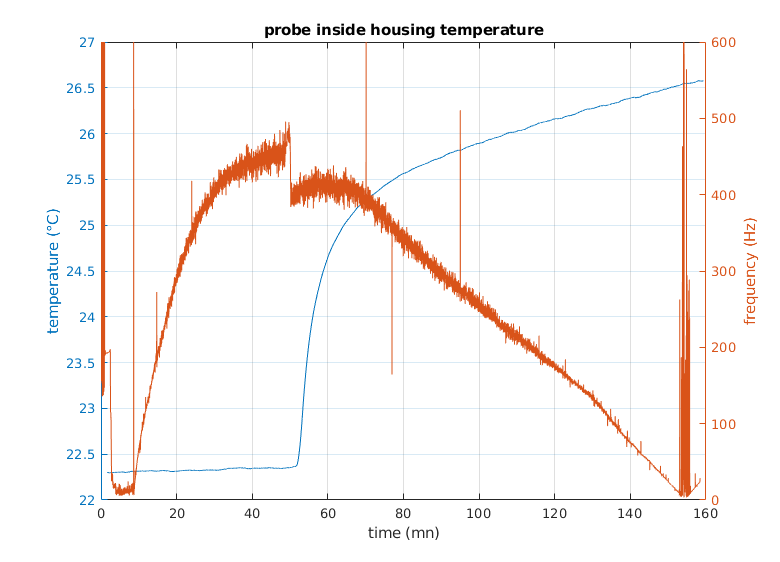
Ronic Chiche | Fixed | issue | mechanics | lasers and optics | detectors and electronics | ThomX igloo | Temperature control of the FP-cavity length | last friday, I locked the cavity and then, switched ON the heating cable after waiting the cavity reaches a steady state in frequency drift : see the figure.
blue : temperature of the probe on the heating cable
red : freqeuncy drift between FP-cavity (laser locked on it) and RF reference oscillator.
@ 10min : filling the FP-cavity with 50kW
@ 50min : "long" lock loss of about 1min => jumb in frequency => it is strange to see the cavity does not reach the same frequency steady state after the lock loss than before the lock loss.
(just before the small frequency jump, the frequency is increasing a bit because of the lock has been lost and the laser is drifting by itself in open loop. the jump, after that, corresponds to the moment where the laser is locked back to the FP-cavity)
@ 55min : switch ON the heating cable with 20V on the voltage supply => the probe stuck on the cable shows the temperature increases => and a bit later, one can see the frequency decreasing.
surprisingly, we don't reach a steady state ...
I suspect that filling the FP-cavity with power (without switching ON the heating cable) could first inscrease the frequency and later could decrease it if several parts of the mechanics are involved and if the thermal conduction is slow because of some isolation embbedded in the mechanics (for example ceramics balls).
it is possible to make the frequency drifting sensitivity test of the heating cable without locking the cavity at 50kW.
one can work in open loop, without power in the FP-cavity, and follow the frequency drift by keeping the main resonance at the same relative position to the laser PZT.
| Ronic Chiche wrote: |
|
this afternoon, I started the heating cable after the warm-up of the FP-cavity :
14h20 : start to fill 50kW in the cavity
15h : start of the heating cable @10V (2x 5V) (iteration 2300)
15h16 : start of the heating cable @60V (2x 30V) (iteration 3400)
15h20 : start of the heating cable @20V (2x 10V) (iteration 3600)
the offset frequency, for 20V of voltage on the DC voltage supply, is 175Hz @500MHz (equivalent to 3.5µm)
| Ronic Chiche wrote: |
|
today, I removed one of the DC voltage supply (as with 30V, we are already able to 30°C on the heating cable).
the remaining DC voltage supply is configured in series (2x30V = 60V max) and is at the IP address : 192.168.1.101
| Ronic Chiche wrote: |
|
several days ago, we installed a heating cable around the output flange (close to the X-hutch) of the FP-cavity vessel.
we are able to heat this cable by applying a DC voltage coming from 2 DC voltage supplies in serie (2 devices with 2x 0-30V / 3A => 0-120V / 3A).
currently, we apply at maximum 7V DC on each channel => 28V DC on the cable. its temperature reach ~ 30°C after 1/2h or more.
this temperature increase on one vessel of the FP-cavity, changes very slowly the length of the FP-cavity.
see this post (red curve on fig. 2) for a typical temperature curve measured (exponential-like curve) on the heating cable itself : https://elog.lal.in2p3.fr/FPC/THOMX+commissioning/290
the length change rate of the FP-cavity, due to this heating, is difficult to estimate because it depends on the part of this exponential curve you make the measurement.
but globally the drift is about 50nm every 5 minutes, which is roughly equivalent to 10 steps of the FP-cavity motor every 5 minutes.
| Ronic Chiche wrote: |
|
as the CFP motors displacements induce a cavity unlock, we try to change the cavity length by changing the temperature of elment of the cavity.
yesterday, we tried to put a "heating cable" borrowed to the vacuum group to change the temperature of one bellows between the FP-cavity and the electron ring.
we chose a below because it is flexible and should not apply a too strong force on the cavity vessels.
we heated the cable at ~30°C but we didn't see a clear effect on the FP-cavity frequency measurement.
then, we put a heating cable around the X-ray output flange of the FP-cavity vessel and we saw a clear effect : a relatively fast (at a "second" level) frequency change.
the problem is the heating system is not remotely driven.
the cable is R=55ohms impedance and can reach 450°C for 1kW dissipated.
so today, we will try to use 2 remotely controlled Siglent SPD3303X power supplies.
they can reach V=120V DC => P=V²/R=260W => we could reach more than 100°C
|
|
|
|
|
| Attachment 1: 2023_12_01_temp_freq.png
|  |
|
301
|
Thu Nov 30 15:53:10 2023 |
Ronic Chiche | Fixed | issue | mechanics | lasers and optics | detectors and electronics | ThomX igloo | Temperature control of the FP-cavity length | this afternoon, I started the heating cable after the warm-up of the FP-cavity :
14h20 : start to fill 50kW in the cavity
15h : start of the heating cable @10V (2x 5V) (iteration 2300)
15h16 : start of the heating cable @60V (2x 30V) (iteration 3400)
15h20 : start of the heating cable @20V (2x 10V) (iteration 3600)
the offset frequency, for 20V of voltage on the DC voltage supply, is 175Hz @500MHz (equivalent to 3.5µm)
| Ronic Chiche wrote: |
|
today, I removed one of the DC voltage supply (as with 30V, we are already able to 30°C on the heating cable).
the remaining DC voltage supply is configured in series (2x30V = 60V max) and is at the IP address : 192.168.1.101
| Ronic Chiche wrote: |
|
several days ago, we installed a heating cable around the output flange (close to the X-hutch) of the FP-cavity vessel.
we are able to heat this cable by applying a DC voltage coming from 2 DC voltage supplies in serie (2 devices with 2x 0-30V / 3A => 0-120V / 3A).
currently, we apply at maximum 7V DC on each channel => 28V DC on the cable. its temperature reach ~ 30°C after 1/2h or more.
this temperature increase on one vessel of the FP-cavity, changes very slowly the length of the FP-cavity.
see this post (red curve on fig. 2) for a typical temperature curve measured (exponential-like curve) on the heating cable itself : https://elog.lal.in2p3.fr/FPC/THOMX+commissioning/290
the length change rate of the FP-cavity, due to this heating, is difficult to estimate because it depends on the part of this exponential curve you make the measurement.
but globally the drift is about 50nm every 5 minutes, which is roughly equivalent to 10 steps of the FP-cavity motor every 5 minutes.
| Ronic Chiche wrote: |
|
as the CFP motors displacements induce a cavity unlock, we try to change the cavity length by changing the temperature of elment of the cavity.
yesterday, we tried to put a "heating cable" borrowed to the vacuum group to change the temperature of one bellows between the FP-cavity and the electron ring.
we chose a below because it is flexible and should not apply a too strong force on the cavity vessels.
we heated the cable at ~30°C but we didn't see a clear effect on the FP-cavity frequency measurement.
then, we put a heating cable around the X-ray output flange of the FP-cavity vessel and we saw a clear effect : a relatively fast (at a "second" level) frequency change.
the problem is the heating system is not remotely driven.
the cable is R=55ohms impedance and can reach 450°C for 1kW dissipated.
so today, we will try to use 2 remotely controlled Siglent SPD3303X power supplies.
they can reach V=120V DC => P=V²/R=260W => we could reach more than 100°C
|
|
|
|
| Attachment 1: Screenshot_2023-11-30_15-48-05.png
|  |
|
300
|
Thu Nov 30 12:33:08 2023 |
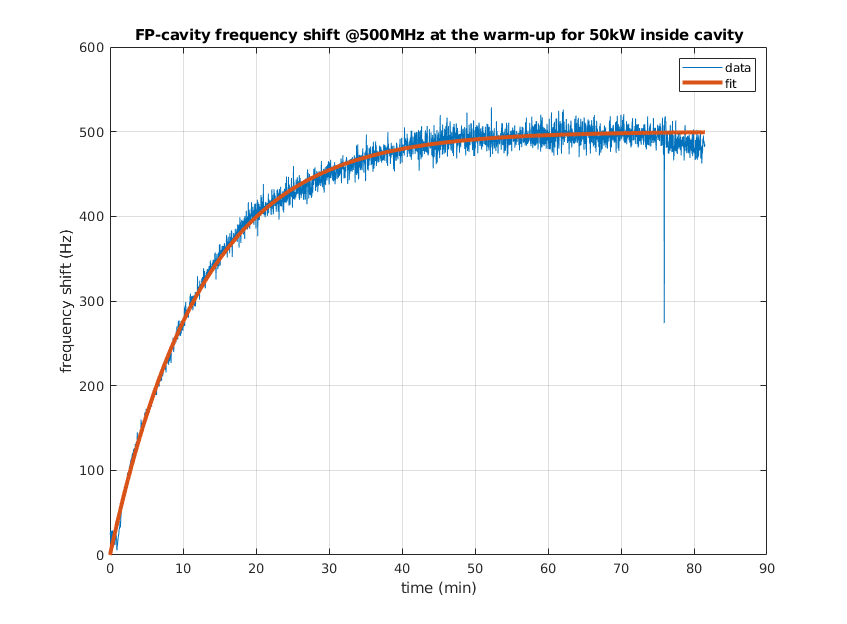
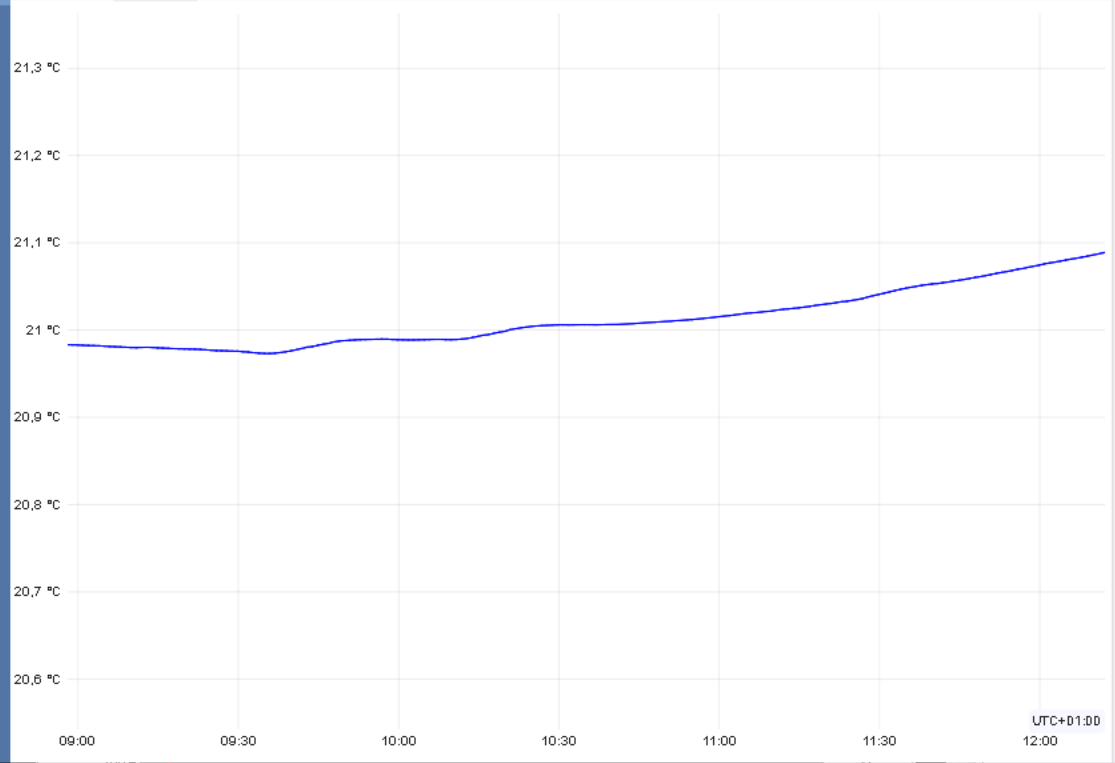
Ronic Chiche | Fixed | info | lasers and optics | ThomX igloo | FP-cavity inside power sensitivity | this morning I monitored the frequency shift between the FP-cavity frequency (the laser is locked on it) and the RF reference frequency @ 500MHz,
during the warm-up time, for 50kW stored in the cavity (the recording started ~ 9h20).
one observes on fig.1 a simple exponential behavior with 500Hz frequency shift @500MHz (equivalent to ~ 10µm) for 50kW stored.
the time constant T of the exponential curve is 12.5 minutes and the stable region starts at 5T ~ 1h.
the small drop at the end of the curve ( ~ @10h30) could come from the external temperature which started to drift before (see fig.2)
|
| Attachment 1: FP-cavity_freq.png
|  |
| Attachment 2: Screenshot_2023-11-30_12-30-23.png
|  |
|
299
|
Wed Nov 29 16:39:16 2023 |
Ronic Chiche | Fixed | info | mechanics | lasers and optics | detectors and electronics | ThomX igloo | Long term lock of Laser-FP cavity-RF reference | this afternoon, we did a new long-term "double lock" run w/o any single lock loss during 1/2h.
we did 2 acquisitions :
fig 1 : phase measurement between the 33MHz signal coming from the laser and the 500MHz RF.
this plot doesn't last 1/2h.
the measured jitter is ~45ps, at the limit of the scope resolution.
fig 2 : same phase measurement between the two 500MHz signals (laser and RF)
the lock is lost at the end of the plot.
the measured voltage noise is Vrms ~ 2.5mV rms => jitter ~ 2.8ps rms
the conversion factor between jitter and voltage is 1,1 ps / mV
!!! CAREFUL !!! heating the FP-cavity with the heating cable works in the opposite direction of the heating due to power in the cavity !
| Ronic Chiche wrote: |
|
today, I did a 20 minutes "double lock" run w/o any single lock loss.
the attached file shows the recorded RMS beating voltage between 500MHz signals (laser harmonic and RF reference).
the end of the plot after iteration ~1.8k shows the lock loss to the RF reference.
when the lock is not working, one gets a sine signal V=V0*sin(phi(t)) with V0=288mV => Vrms = 288/sqrt(2)) = 204mV rms
(this signal is not on the figure)
for low phase values : V=V0*dphi
when the locking is good, this voltage is about V = 3.5mV rms => dphi = 12mrad rms
a full beating signal period (500MHz => 2ns) corresponds to 2pi, so dphi = 12mrad rms => jitter dt = 4ps rms
| Ronic Chiche wrote: |
|
today for the first time, we were able to make a long term lock of all the elements (Laser on FP cavity and FP-cavity on RF reference) during 20 minutes @50kW without any single loss of lock.
the success of this long term lock was coming from the possibility to drive the Smaract motor in piezo-scan mode and to apply a heating on one vessel of the FP-cavity to let its frequency slowly drift always in the same direction.
then, the FP-cavity motor can follow this drift without any loss of the lock.
even when we lost the lock, it was quite easy to get it back because of the frequency drift, always in the same direction due to the FP-cavity heating with the heating cable.
a good strategy to make this double lock :
1) adjust the laser frequency to the RF reference frequency in using the Smaract motor in "closed loop" mode until reaching a beating < 10Hz.
2) search for FP-cavity resonance in using the ISP motor of the FP-cavity
3) once the laser is locked on the FP-cavity, the FP-cavity length changes => work on the FP-cavity motor to follow the drift until one reachs a thermal equilibrium.
4) once the thermal equilibrium is reached, one can switch on the heating of the heating cable to continue the slow "thermal" drift in the same direction 5V of total voltage should be enough for 1h of work.
5) in the same time, one need to cancel the frequency offset between the RF reference and the FP-cavity using the FP-cavity motor and one need to follow the laser cavity fluctuations using the Smaract motor in "closed loop" mode.
6) once the FP-cavity is at the same length than the RF-reference, one can close the second loop (when both PZT are in the middle of their range).
7) at that point, one need to swap the Smaract motor control to "piezo scan" mode => one follows only the laser fluctuations ~ 1µm peak-peak
8) one always follows the FP-cavity drift using the IcePap controller on the FP-cavity motor, 10 steps by 10 steps => it should work during 1h.
9) when one reachs the thermal equilibrium again, one can add 5V to the heating cable voltage.
|
|
|
| Attachment 1: Screenshot_2023-11-29_15-25-37.png
|  |
| Attachment 2: Screenshot_2023-11-29_15-44-27.png
|  |
|
298
|
Wed Nov 29 12:33:33 2023 |
Ronic Chiche | Fixed | info | mechanics | lasers and optics | detectors and electronics | ThomX igloo | Long term lock of Laser-FP cavity-RF reference | today, I did a 20 minutes "double lock" run w/o any single lock loss.
the attached file shows the recorded RMS beating voltage between 500MHz signals (laser harmonic and RF reference).
the end of the plot after iteration ~1.8k shows the lock loss to the RF reference.
when the lock is not working, one gets a sine signal V=V0*sin(phi(t)) with V0=288mV => Vrms = 288/sqrt(2)) = 204mV rms
(this signal is not on the figure)
for low phase values : V=V0*dphi
when the locking is good, this voltage is about V = 3.5mV rms => dphi = 12mrad rms
a full beating signal period (500MHz => 2ns) corresponds to 2pi, so dphi = 12mrad rms => jitter dt = 4ps rms
| Ronic Chiche wrote: |
|
today for the first time, we were able to make a long term lock of all the elements (Laser on FP cavity and FP-cavity on RF reference) during 20 minutes @50kW without any single loss of lock.
the success of this long term lock was coming from the possibility to drive the Smaract motor in piezo-scan mode and to apply a heating on one vessel of the FP-cavity to let its frequency slowly drift always in the same direction.
then, the FP-cavity motor can follow this drift without any loss of the lock.
even when we lost the lock, it was quite easy to get it back because of the frequency drift, always in the same direction due to the FP-cavity heating with the heating cable.
a good strategy to make this double lock :
1) adjust the laser frequency to the RF reference frequency in using the Smaract motor in "closed loop" mode until reaching a beating < 10Hz.
2) search for FP-cavity resonance in using the ISP motor of the FP-cavity
3) once the laser is locked on the FP-cavity, the FP-cavity length changes => work on the FP-cavity motor to follow the drift until one reachs a thermal equilibrium.
4) once the thermal equilibrium is reached, one can switch on the heating of the heating cable to continue the slow "thermal" drift in the same direction 5V of total voltage should be enough for 1h of work.
5) in the same time, one need to cancel the frequency offset between the RF reference and the FP-cavity using the FP-cavity motor and one need to follow the laser cavity fluctuations using the Smaract motor in "closed loop" mode.
6) once the FP-cavity is at the same length than the RF-reference, one can close the second loop (when both PZT are in the middle of their range).
7) at that point, one need to swap the Smaract motor control to "piezo scan" mode => one follows only the laser fluctuations ~ 1µm peak-peak
8) one always follows the FP-cavity drift using the IcePap controller on the FP-cavity motor, 10 steps by 10 steps => it should work during 1h.
9) when one reachs the thermal equilibrium again, one can add 5V to the heating cable voltage.
|
|
| Attachment 1: Screenshot_2023-11-29_12-04-09.png
|  |
|
297
|
Wed Nov 29 12:20:18 2023 |
Ronic Chiche | Fixed | issue | mechanics | lasers and optics | detectors and electronics | ThomX igloo | Temperature control of the FP-cavity length | today, I removed one of the DC voltage supply (as with 30V, we are already able to 30°C on the heating cable).
the remaining DC voltage supply is configured in series (2x30V = 60V max) and is at the IP address : 192.168.1.101
| Ronic Chiche wrote: |
|
several days ago, we installed a heating cable around the output flange (close to the X-hutch) of the FP-cavity vessel.
we are able to heat this cable by applying a DC voltage coming from 2 DC voltage supplies in serie (2 devices with 2x 0-30V / 3A => 0-120V / 3A).
currently, we apply at maximum 7V DC on each channel => 28V DC on the cable. its temperature reach ~ 30°C after 1/2h or more.
this temperature increase on one vessel of the FP-cavity, changes very slowly the length of the FP-cavity.
see this post (red curve on fig. 2) for a typical temperature curve measured (exponential-like curve) on the heating cable itself : https://elog.lal.in2p3.fr/FPC/THOMX+commissioning/290
the length change rate of the FP-cavity, due to this heating, is difficult to estimate because it depends on the part of this exponential curve you make the measurement.
but globally the drift is about 50nm every 5 minutes, which is roughly equivalent to 10 steps of the FP-cavity motor every 5 minutes.
| Ronic Chiche wrote: |
|
as the CFP motors displacements induce a cavity unlock, we try to change the cavity length by changing the temperature of elment of the cavity.
yesterday, we tried to put a "heating cable" borrowed to the vacuum group to change the temperature of one bellows between the FP-cavity and the electron ring.
we chose a below because it is flexible and should not apply a too strong force on the cavity vessels.
we heated the cable at ~30°C but we didn't see a clear effect on the FP-cavity frequency measurement.
then, we put a heating cable around the X-ray output flange of the FP-cavity vessel and we saw a clear effect : a relatively fast (at a "second" level) frequency change.
the problem is the heating system is not remotely driven.
the cable is R=55ohms impedance and can reach 450°C for 1kW dissipated.
so today, we will try to use 2 remotely controlled Siglent SPD3303X power supplies.
they can reach V=120V DC => P=V²/R=260W => we could reach more than 100°C
|
|
|
|