| ID |
Date |
Author |
Status |
Type |
Category |
Location |
Title |
|
296
|
Wed Nov 29 09:35:10 2023 |
Ronic Chiche | Fixed | info | mechanics | lasers and optics | ThomX igloo | Laser cavity temperature/pressure sensitivity |
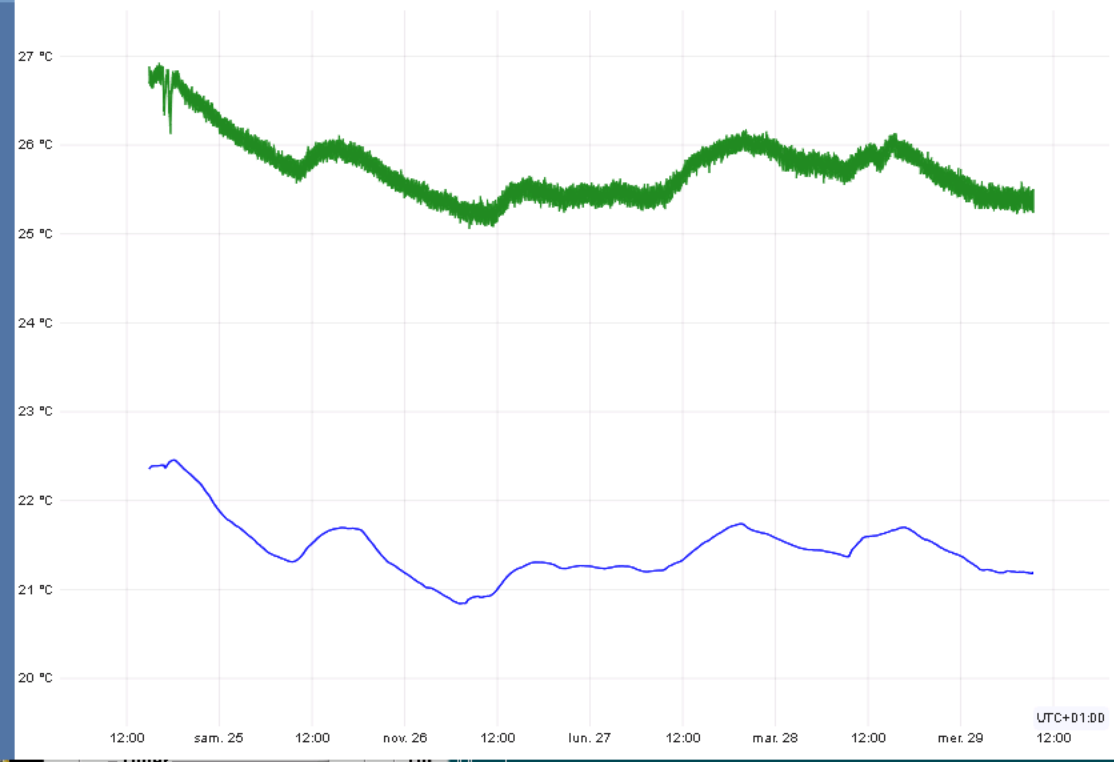
long-term correlation, over 5-6 days, between the temperature measured in the bunker, outside of the housing (blue curve) and the temperature measured with a probe stuck on the laser housing, inside of the FP-cavity housing (green).
it's a perfect correlation with almost the same temperature scale : 1°C outisde the housing => 1°C of laser housing
thus, a stabilization of the temperature, inside of the housing, could help to reduce the frequency drifts of the laser.
| Ronic Chiche wrote: |
|
today, I swapped the 500MHz RF reference oscillator for a Siglent 500MHz DDS oscillator.
see the attached plot : the beating frequency with the 500MHz laser harmonics produces the same behavior as before.
so, the oscillations should come from the laser temperature regulation.
| Ronic Chiche wrote: |
|
the last thing we did with Daniele, is to start/stop the airflow on top of the housing (closed) to see a possible pressure effect on the laser frequency drift.
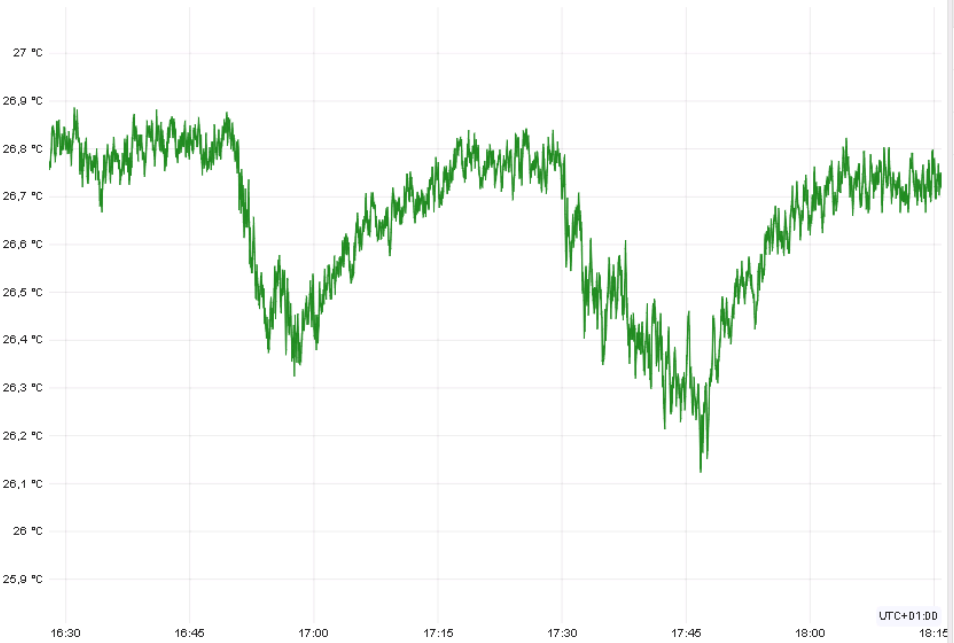
fig 1 : in green, the temperature measured with the probe stuck on the laser housing.
one can clearly see the 2 "start - wait ~10mins - stop" we did at 16h50 then at 17h30.
the air temperature blowed by the airflow is cooler than the housing temperature and we see the effect on the probe.
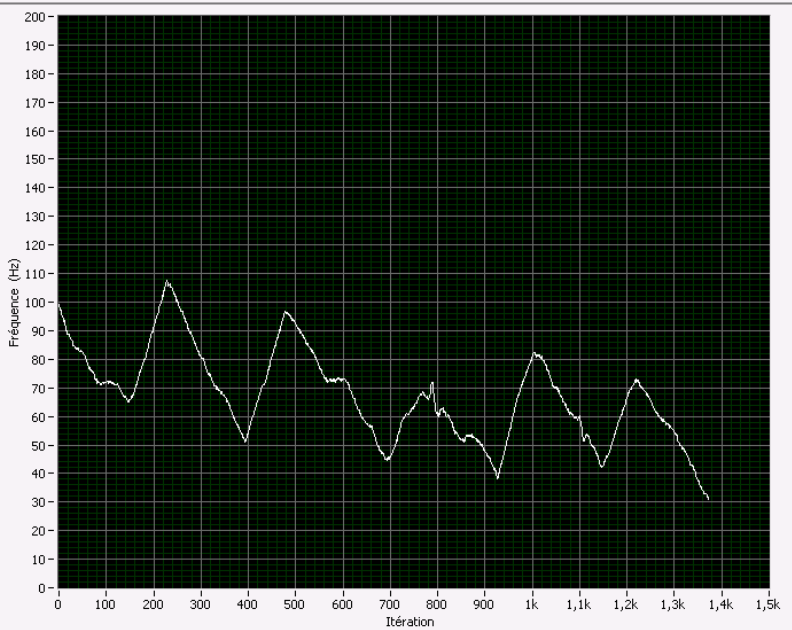
fig 2 : this is the laser frequency drift during the 1st airflow start/stop
the airflow has been turned on at 100 iterations and stopped at 500 iterations (~5 mins)
we don't see any correlation
fig 3 : this is again the laser frequency drift during the 2nd airflow start/stop
the airflow has been turned on at 1850 iterations and stopped at 2550 iterations (~10 mins)
we don't see any correlation
CONCLUSION : neither external temperature change or pressure variations can explain the 10-20min period oscillations observed on the laser frequency variations.
it can be either the laser temperature regulation or the RF reference oscillator temperature regulation (due to the oven of the quartz)
| Ronic Chiche wrote: |
|
Now, I placed a temperature probe stuck on the laser housing itself.
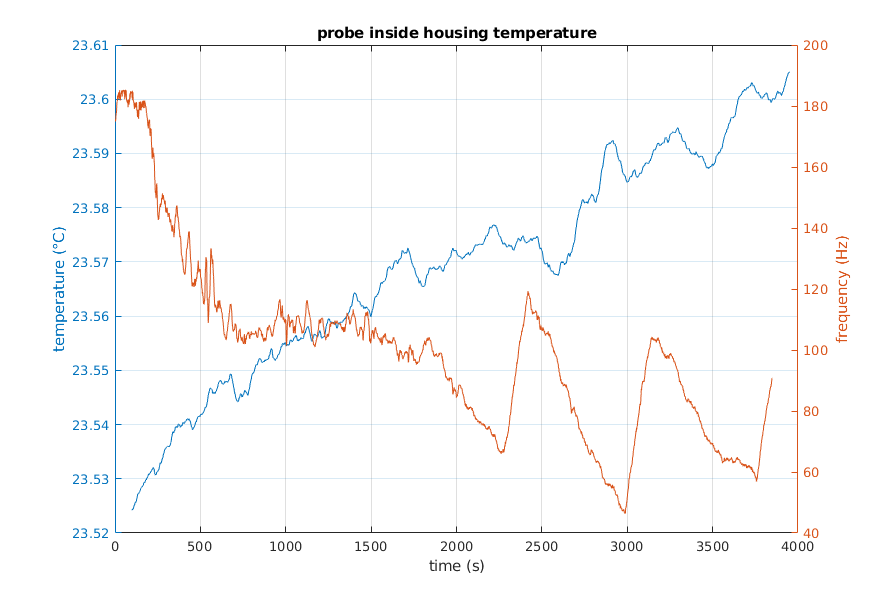
fig. 1
one can compare the temperature measured at the surface of the laser housing and the beating frequency with the 500MHz reference oscillator
one sees a possible very long term correlation but there is no correlation at the minute level when we see the frequency oscillation after t=2000s.
the laser housing temperature seems not to induce directly a frequency variation.
fig 2 / 3
we applied 15W on the heating wire rolled around the FP-cavity flange.
in red, we see the temperature increasing on the probe rolled around the wire, reaching almost 30°C.
we heat the inside of the housing (airflow stopped) during more than 30 minutes
in green, we don't see any variation (even if one makes a zoom) of the temperature of the probe stuck on the laser housing.
in same time, on fig 3, one can see the frequency drift.
there is no correlation between the oscillations and the temperature.
CONCLUSION :
the laser frequency fluctuations does not seem to come from the outside temperature.
| Ronic Chiche wrote: |
|
laser cavity :
when one decreases the laser motor position, the laser repetition rate increases (laser cavity length decreases).
=> +/- laser motor step => +/- laser cavity roundtrip length => -/+ laser repetition rate => -/+ laser harmonic @500MHz
=> +/- 100nm => +/- 200nm => -/+ 0.7Hz @33.33MHz => -/+ 10Hz @500MHz
here is the natural variation of the laser cavity frequency beating with RF @500MHz over 1h (~1.6s / iteration)
one can see some oscillations equivalent to ~1µm of roundtrip length with ~10 minutes period and maybe a slower drift or oscillation with ~2µm of roundtrip range over the hour.
I mention that I moved the laser "PZT" motor before taking the data : could it be the reason of the 10-20min oscillations ?
during the same time, here is a probe temperature curve (the probe in stuck on the end flange, close to X-hutch, of the FP-cavity, inside the housing... not close to the laser position).
the temperature variation range is ~2.5/100 °C which induces on inox (relative length thermal effect : 17e-6 /K) a length variation of 4µm of roundtrip (10m) which could be compatible to the laser cavity length variation measured.
|
|
|
|
|
| Attachment 1: Screenshot_2023-11-29_09-27-56.png
|
 |
|
295
|
Tue Nov 28 19:01:19 2023 |
Ronic Chiche | Fixed | info | mechanics | lasers and optics | detectors and electronics | ThomX igloo | Long term lock of Laser-FP cavity-RF reference |
today for the first time, we were able to make a long term lock of all the elements (Laser on FP cavity and FP-cavity on RF reference) during 20 minutes @50kW without any single loss of lock.
the success of this long term lock was coming from the possibility to drive the Smaract motor in piezo-scan mode and to apply a heating on one vessel of the FP-cavity to let its frequency slowly drift always in the same direction.
then, the FP-cavity motor can follow this drift without any loss of the lock.
even when we lost the lock, it was quite easy to get it back because of the frequency drift, always in the same direction due to the FP-cavity heating with the heating cable.
a good strategy to make this double lock :
1) adjust the laser frequency to the RF reference frequency in using the Smaract motor in "closed loop" mode until reaching a beating < 10Hz.
2) search for FP-cavity resonance in using the ISP motor of the FP-cavity
3) once the laser is locked on the FP-cavity, the FP-cavity length changes => work on the FP-cavity motor to follow the drift until one reachs a thermal equilibrium.
4) once the thermal equilibrium is reached, one can switch on the heating of the heating cable to continue the slow "thermal" drift in the same direction 5V of total voltage should be enough for 1h of work.
5) in the same time, one need to cancel the frequency offset between the RF reference and the FP-cavity using the FP-cavity motor and one need to follow the laser cavity fluctuations using the Smaract motor in "closed loop" mode.
6) once the FP-cavity is at the same length than the RF-reference, one can close the second loop (when both PZT are in the middle of their range).
7) at that point, one need to swap the Smaract motor control to "piezo scan" mode => one follows only the laser fluctuations ~ 1µm peak-peak
8) one always follows the FP-cavity drift using the IcePap controller on the FP-cavity motor, 10 steps by 10 steps => it should work during 1h.
9) when one reachs the thermal equilibrium again, one can add 5V to the heating cable voltage.
|
|
294
|
Tue Nov 28 18:38:16 2023 |
Ronic Chiche | Fixed | issue | mechanics | lasers and optics | detectors and electronics | ThomX igloo | Temperature control of the FP-cavity length |
several days ago, we installed a heating cable around the output flange (close to the X-hutch) of the FP-cavity vessel.
we are able to heat this cable by applying a DC voltage coming from 2 DC voltage supplies in serie (2 devices with 2x 0-30V / 3A => 0-120V / 3A).
currently, we apply at maximum 7V DC on each channel => 28V DC on the cable. its temperature reach ~ 30°C after 1/2h or more.
this temperature increase on one vessel of the FP-cavity, changes very slowly the length of the FP-cavity.
see this post (red curve on fig. 2) for a typical temperature curve measured (exponential-like curve) on the heating cable itself : https://elog.lal.in2p3.fr/FPC/THOMX+commissioning/290
the length change rate of the FP-cavity, due to this heating, is difficult to estimate because it depends on the part of this exponential curve you make the measurement.
but globally the drift is about 50nm every 5 minutes, which is roughly equivalent to 10 steps of the FP-cavity motor every 5 minutes.
| Ronic Chiche wrote: |
|
as the CFP motors displacements induce a cavity unlock, we try to change the cavity length by changing the temperature of elment of the cavity.
yesterday, we tried to put a "heating cable" borrowed to the vacuum group to change the temperature of one bellows between the FP-cavity and the electron ring.
we chose a below because it is flexible and should not apply a too strong force on the cavity vessels.
we heated the cable at ~30°C but we didn't see a clear effect on the FP-cavity frequency measurement.
then, we put a heating cable around the X-ray output flange of the FP-cavity vessel and we saw a clear effect : a relatively fast (at a "second" level) frequency change.
the problem is the heating system is not remotely driven.
the cable is R=55ohms impedance and can reach 450°C for 1kW dissipated.
so today, we will try to use 2 remotely controlled Siglent SPD3303X power supplies.
they can reach V=120V DC => P=V²/R=260W => we could reach more than 100°C
|
|
|
293
|
Tue Nov 28 11:32:17 2023 |
Ronic Chiche | Fixed | info | mechanics | detectors and electronics | ThomX igloo | Smaract motors parameters and controller |
current Smaract motors parameters :
- Closed loop Max frequency : 5000
- Signal Amplitude threshold : 2047
- High voltage threshold : 511
when one drives the Smaract motors in "closed loop" mode, one can get a displacement as small as 50nm... but at the price of a delock of the laser/FP-cavity.
when one drives the motor in "open loop" mode, 1 step is equivalent to 4µm !!! it is much larger than the laser PZT range.
when one drives the motor in "Piezo Scan" mode with a speed of 1V/s, one can move the motor without losing the laser/Fp-cavity lock.
the PZT voltage range of 100V (max value) is roughly equivalent to 2-3µm of round trip length, which is enough to manage several "fast" (10-20 minutes) oscillations of the laser frequency :
see these posts to get some info on the laser frequency oscillations : https://elog.lal.in2p3.fr/FPC/THOMX+commissioning/289
 |
|
292
|
Tue Nov 28 10:24:47 2023 |
Ronic Chiche | Fixed | info | mechanics | lasers and optics | ThomX igloo | Laser cavity temperature/pressure sensitivity |
today, I swapped the 500MHz RF reference oscillator for a Siglent 500MHz DDS oscillator.
see the attached plot : the beating frequency with the 500MHz laser harmonics produces the same behavior as before.
so, the oscillations should come from the laser temperature regulation.
| Ronic Chiche wrote: |
|
the last thing we did with Daniele, is to start/stop the airflow on top of the housing (closed) to see a possible pressure effect on the laser frequency drift.
fig 1 : in green, the temperature measured with the probe stuck on the laser housing.
one can clearly see the 2 "start - wait ~10mins - stop" we did at 16h50 then at 17h30.
the air temperature blowed by the airflow is cooler than the housing temperature and we see the effect on the probe.
fig 2 : this is the laser frequency drift during the 1st airflow start/stop
the airflow has been turned on at 100 iterations and stopped at 500 iterations (~5 mins)
we don't see any correlation
fig 3 : this is again the laser frequency drift during the 2nd airflow start/stop
the airflow has been turned on at 1850 iterations and stopped at 2550 iterations (~10 mins)
we don't see any correlation
CONCLUSION : neither external temperature change or pressure variations can explain the 10-20min period oscillations observed on the laser frequency variations.
it can be either the laser temperature regulation or the RF reference oscillator temperature regulation (due to the oven of the quartz)
| Ronic Chiche wrote: |
|
Now, I placed a temperature probe stuck on the laser housing itself.
fig. 1
one can compare the temperature measured at the surface of the laser housing and the beating frequency with the 500MHz reference oscillator
one sees a possible very long term correlation but there is no correlation at the minute level when we see the frequency oscillation after t=2000s.
the laser housing temperature seems not to induce directly a frequency variation.
fig 2 / 3
we applied 15W on the heating wire rolled around the FP-cavity flange.
in red, we see the temperature increasing on the probe rolled around the wire, reaching almost 30°C.
we heat the inside of the housing (airflow stopped) during more than 30 minutes
in green, we don't see any variation (even if one makes a zoom) of the temperature of the probe stuck on the laser housing.
in same time, on fig 3, one can see the frequency drift.
there is no correlation between the oscillations and the temperature.
CONCLUSION :
the laser frequency fluctuations does not seem to come from the outside temperature.
| Ronic Chiche wrote: |
|
laser cavity :
when one decreases the laser motor position, the laser repetition rate increases (laser cavity length decreases).
=> +/- laser motor step => +/- laser cavity roundtrip length => -/+ laser repetition rate => -/+ laser harmonic @500MHz
=> +/- 100nm => +/- 200nm => -/+ 0.7Hz @33.33MHz => -/+ 10Hz @500MHz
here is the natural variation of the laser cavity frequency beating with RF @500MHz over 1h (~1.6s / iteration)
one can see some oscillations equivalent to ~1µm of roundtrip length with ~10 minutes period and maybe a slower drift or oscillation with ~2µm of roundtrip range over the hour.
I mention that I moved the laser "PZT" motor before taking the data : could it be the reason of the 10-20min oscillations ?
during the same time, here is a probe temperature curve (the probe in stuck on the end flange, close to X-hutch, of the FP-cavity, inside the housing... not close to the laser position).
the temperature variation range is ~2.5/100 °C which induces on inox (relative length thermal effect : 17e-6 /K) a length variation of 4µm of roundtrip (10m) which could be compatible to the laser cavity length variation measured.
|
|
|
|
| Attachment 1: Screenshot_2023-11-28_10-21-33.png
|
 |
|
291
|
Fri Nov 24 18:47:25 2023 |
Ronic Chiche | Fixed | info | mechanics | lasers and optics | ThomX igloo | Laser cavity temperature/pressure sensitivity |
the last thing we did with Daniele, is to start/stop the airflow on top of the housing (closed) to see a possible pressure effect on the laser frequency drift.
fig 1 : in green, the temperature measured with the probe stuck on the laser housing.
one can clearly see the 2 "start - wait ~10mins - stop" we did at 16h50 then at 17h30.
the air temperature blowed by the airflow is cooler than the housing temperature and we see the effect on the probe.
fig 2 : this is the laser frequency drift during the 1st airflow start/stop
the airflow has been turned on at 100 iterations and stopped at 500 iterations (~5 mins)
we don't see any correlation
fig 3 : this is again the laser frequency drift during the 2nd airflow start/stop
the airflow has been turned on at 1850 iterations and stopped at 2550 iterations (~10 mins)
we don't see any correlation
CONCLUSION : neither external temperature change or pressure variations can explain the 10-20min period oscillations observed on the laser frequency variations.
it can be either the laser temperature regulation or the RF reference oscillator temperature regulation (due to the oven of the quartz)
| Ronic Chiche wrote: |
|
Now, I placed a temperature probe stuck on the laser housing itself.
fig. 1
one can compare the temperature measured at the surface of the laser housing and the beating frequency with the 500MHz reference oscillator
one sees a possible very long term correlation but there is no correlation at the minute level when we see the frequency oscillation after t=2000s.
the laser housing temperature seems not to induce directly a frequency variation.
fig 2 / 3
we applied 15W on the heating wire rolled around the FP-cavity flange.
in red, we see the temperature increasing on the probe rolled around the wire, reaching almost 30°C.
we heat the inside of the housing (airflow stopped) during more than 30 minutes
in green, we don't see any variation (even if one makes a zoom) of the temperature of the probe stuck on the laser housing.
in same time, on fig 3, one can see the frequency drift.
there is no correlation between the oscillations and the temperature.
CONCLUSION :
the laser frequency fluctuations does not seem to come from the outside temperature.
| Ronic Chiche wrote: |
|
laser cavity :
when one decreases the laser motor position, the laser repetition rate increases (laser cavity length decreases).
=> +/- laser motor step => +/- laser cavity roundtrip length => -/+ laser repetition rate => -/+ laser harmonic @500MHz
=> +/- 100nm => +/- 200nm => -/+ 0.7Hz @33.33MHz => -/+ 10Hz @500MHz
here is the natural variation of the laser cavity frequency beating with RF @500MHz over 1h (~1.6s / iteration)
one can see some oscillations equivalent to ~1µm of roundtrip length with ~10 minutes period and maybe a slower drift or oscillation with ~2µm of roundtrip range over the hour.
I mention that I moved the laser "PZT" motor before taking the data : could it be the reason of the 10-20min oscillations ?
during the same time, here is a probe temperature curve (the probe in stuck on the end flange, close to X-hutch, of the FP-cavity, inside the housing... not close to the laser position).
the temperature variation range is ~2.5/100 °C which induces on inox (relative length thermal effect : 17e-6 /K) a length variation of 4µm of roundtrip (10m) which could be compatible to the laser cavity length variation measured.
|
|
|
| Attachment 1: Screenshot_2023-11-24_18-24-43.png
|
 |
| Attachment 2: Screenshot_2023-11-24_17-18-09.png
|
 |
| Attachment 3: Screenshot_2023-11-24_18-37-35.png
|
 |
|
290
|
Fri Nov 24 18:16:37 2023 |
Ronic Chiche | Fixed | info | mechanics | lasers and optics | ThomX igloo | Laser cavity temperature/pressure sensitivity |
Now, I placed a temperature probe stuck on the laser housing itself.
fig. 1
one can compare the temperature measured at the surface of the laser housing and the beating frequency with the 500MHz reference oscillator
one sees a possible very long term correlation but there is no correlation at the minute level when we see the frequency oscillation after t=2000s.
the laser housing temperature seems not to induce directly a frequency variation.
fig 2 / 3
we applied 15W on the heating wire rolled around the FP-cavity flange.
in red, we see the temperature increasing on the probe rolled around the wire, reaching almost 30°C.
we heat the inside of the housing (airflow stopped) during more than 30 minutes
in green, we don't see any variation (even if one makes a zoom) of the temperature of the probe stuck on the laser housing.
in same time, on fig 3, one can see the frequency drift.
there is no correlation between the oscillations and the temperature.
CONCLUSION :
the laser frequency fluctuations does not seem to come from the outside temperature.
| Ronic Chiche wrote: |
|
laser cavity :
when one decreases the laser motor position, the laser repetition rate increases (laser cavity length decreases).
=> +/- laser motor step => +/- laser cavity roundtrip length => -/+ laser repetition rate => -/+ laser harmonic @500MHz
=> +/- 100nm => +/- 200nm => -/+ 0.7Hz @33.33MHz => -/+ 10Hz @500MHz
here is the natural variation of the laser cavity frequency beating with RF @500MHz over 1h (~1.6s / iteration)
one can see some oscillations equivalent to ~1µm of roundtrip length with ~10 minutes period and maybe a slower drift or oscillation with ~2µm of roundtrip range over the hour.
I mention that I moved the laser "PZT" motor before taking the data : could it be the reason of the 10-20min oscillations ?
during the same time, here is a probe temperature curve (the probe in stuck on the end flange, close to X-hutch, of the FP-cavity, inside the housing... not close to the laser position).
the temperature variation range is ~2.5/100 °C which induces on inox (relative length thermal effect : 17e-6 /K) a length variation of 4µm of roundtrip (10m) which could be compatible to the laser cavity length variation measured.
|
|
| Attachment 1: temp_freq.png
|
 |
| Attachment 2: Screenshot_2023-11-24_16-47-37.png
|
 |
| Attachment 3: Screenshot_2023-11-24_16-48-02.png
|
 |
|
289
|
Fri Nov 24 12:56:39 2023 |
Ronic Chiche | Fixed | info | mechanics | lasers and optics | ThomX igloo | Laser cavity temperature/pressure sensitivity |
laser cavity :
when one decreases the laser motor position, the laser repetition rate increases (laser cavity length decreases).
=> +/- laser motor step => +/- laser cavity roundtrip length => -/+ laser repetition rate => -/+ laser harmonic @500MHz
=> +/- 100nm => +/- 200nm => -/+ 0.7Hz @33.33MHz => -/+ 10Hz @500MHz
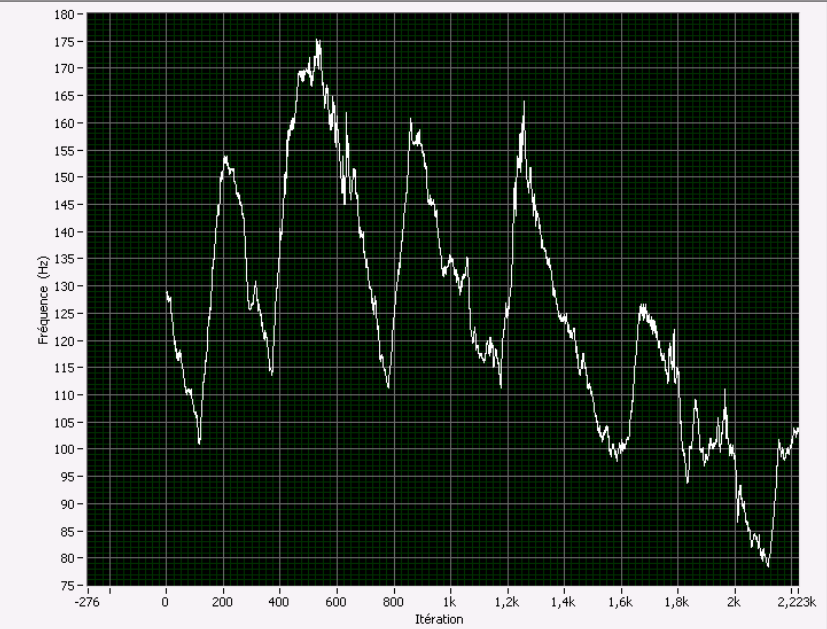
here is the natural variation of the laser cavity frequency beating with RF @500MHz over 1h (~1.6s / iteration)
one can see some oscillations equivalent to ~1µm of roundtrip length with ~10 minutes period and maybe a slower drift or oscillation with ~2µm of roundtrip range over the hour.
I mention that I moved the laser "PZT" motor before taking the data : could it be the reason of the 10-20min oscillations ?
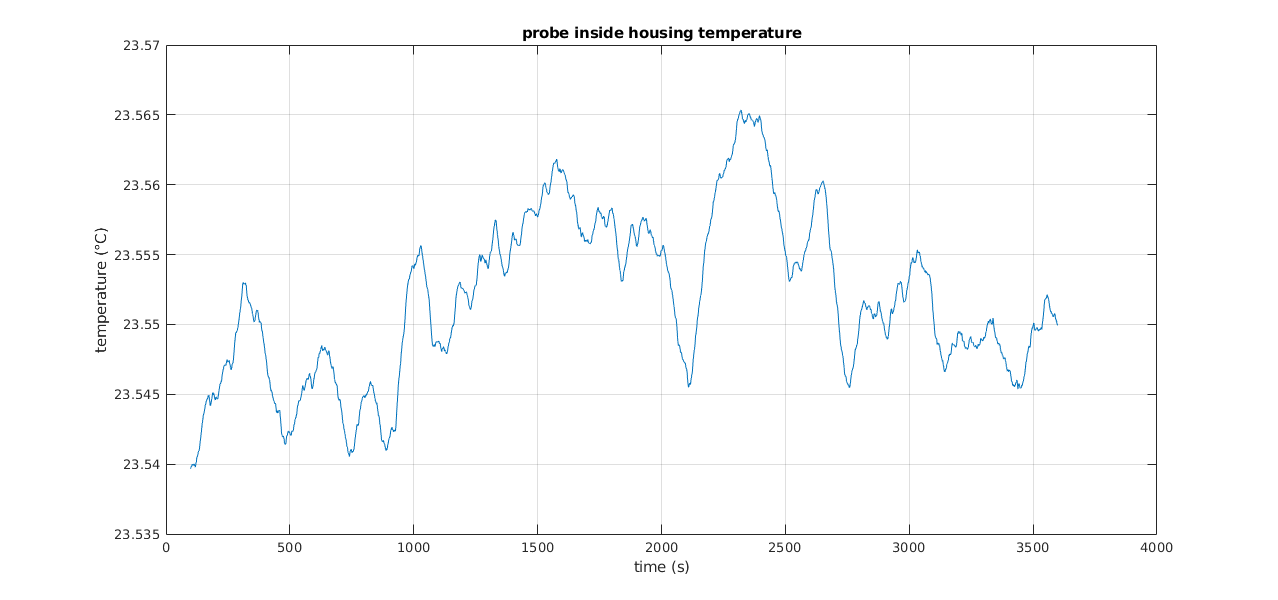
during the same time, here is a probe temperature curve (the probe in stuck on the end flange, close to X-hutch, of the FP-cavity, inside the housing... not close to the laser position).
the temperature variation range is ~2.5/100 °C which induces on inox (relative length thermal effect : 17e-6 /K) a length variation of 4µm of roundtrip (10m) which could be compatible to the laser cavity length variation measured. |
| Attachment 1: Screenshot_2023-11-24_11-44-53.png
|
 |
| Attachment 2: probe_temp.png
|
 |
|
288
|
Thu Nov 23 12:26:26 2023 |
Ronic Chiche | Fixed | issue | lasers and optics | ThomX igloo | Temperature control of the Laser length with the inside Peltier |
|
bunker temperature @ 22.5°C
today, Sebastien Pitrel improved its python software to manually control the laser peltier.
we were able to make to some test. unfortunately, doing only one step change the 500MHz relative frequency by ~400Hz (see the attached plot from 480Hz to 100Hz which is the laser harmonic @500MHz compared to the RF reference @500MHz), which is equivalent to a round trip length variation of 8µm !!!
the present PZT's ranges are equivalent to 400nm of the round trip length. the laser PZT range could be extended by a factor 10 if one drives it using 100V instead of 10V actually, but it would not be enough to be able to use the Peltier ! :-(
if the Peltier changes the inox baseplate of the laser, the relative length change is 1e-5 /K which is equivalent to 100µm/K of the round trip length.
it means the internal temperature steps, done by the peltier, are around 0.08K.
maybe we could try to have smaller steps by using an external thermal setup ?
|
|
287
|
Thu Nov 23 12:25:07 2023 |
Ronic Chiche | Fixed | issue | mechanics | lasers and optics | detectors and electronics | ThomX igloo | Temperature control of the FP-cavity length |
as the CFP motors displacements induce a cavity unlock, we try to change the cavity length by changing the temperature of elment of the cavity.
yesterday, we tried to put a "heating cable" borrowed to the vacuum group to change the temperature of one bellows between the FP-cavity and the electron ring.
we chose a below because it is flexible and should not apply a too strong force on the cavity vessels.
we heated the cable at ~30°C but we didn't see a clear effect on the FP-cavity frequency measurement.
then, we put a heating cable around the X-ray output flange of the FP-cavity vessel and we saw a clear effect : a relatively fast (at a "second" level) frequency change.
the problem is the heating system is not remotely driven.
the cable is R=55ohms impedance and can reach 450°C for 1kW dissipated.
so today, we will try to use 2 remotely controlled Siglent SPD3303X power supplies.
they can reach V=120V DC => P=V²/R=260W => we could reach more than 100°C |
|
285
|
Fri Nov 17 11:44:35 2023 |
Ronic Chiche | Fixed | info | mechanics | lasers and optics | detectors and electronics | ThomX igloo | Laser / FP-cavity "day by day" locking |
temperature @ 21.9°C
48.5kW inside CFP for 30% amplifier ratio
Frep Laser motor = 123.4µm
CEP motor = -67.8µm
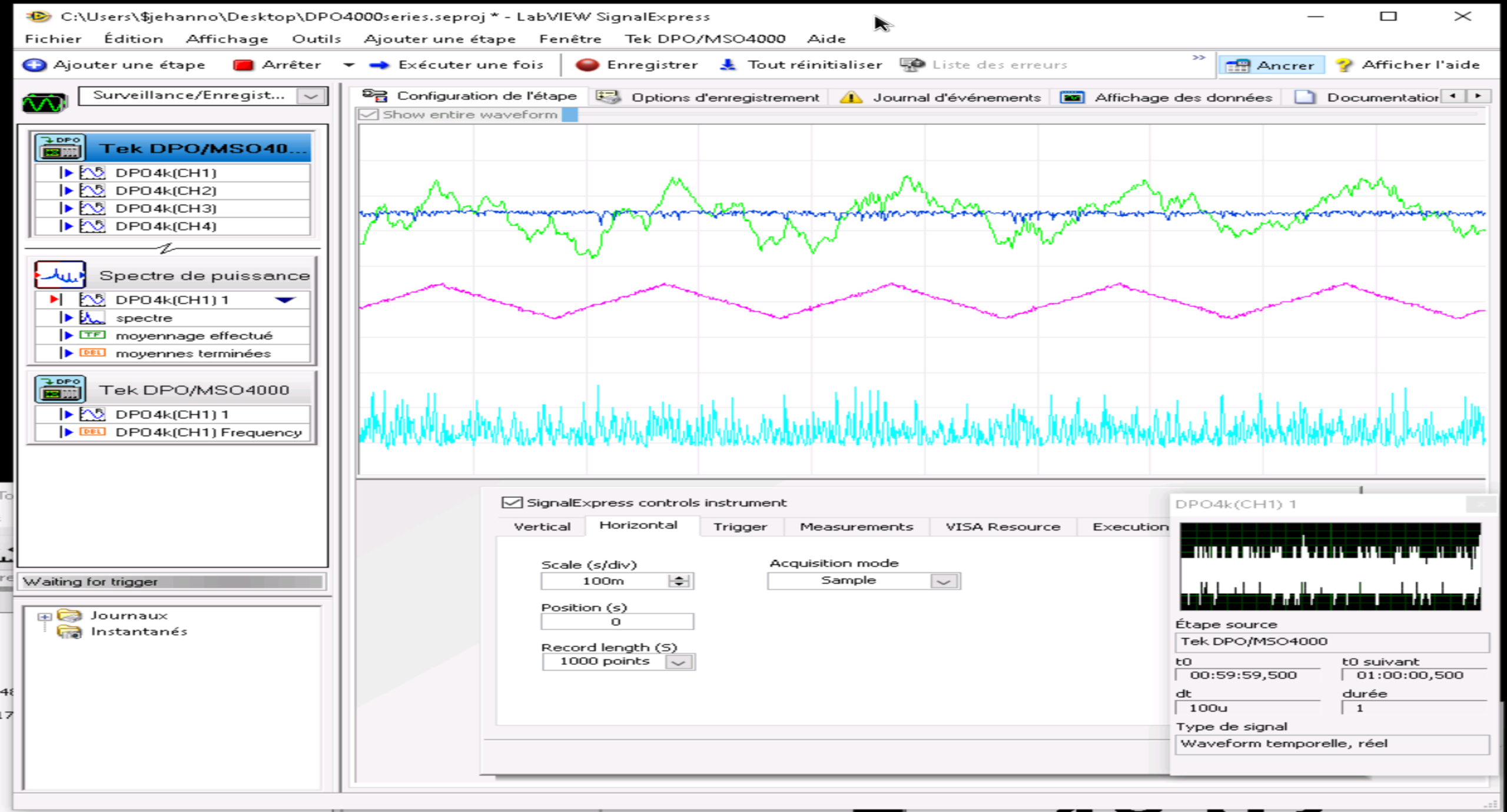
below the image of the relative voltage range between CFP PZT (pink) and laser PZT (green).
the CFP PZT is driven by 10x the voltage range showed by the scope (0-100V HV output and 0-10V monitor on the Laselock)
one can see on the scope that the relative range of both PZT voltage range is roughly the same which means that the real CFP PZT sensitivity is 10x smaller than the Laser PZT sensitivity.
as the CFP PZT is driven by 0-100V and the Laser PZT is driven by 0-10V voltages, they have approximately the same range which is ~200nm (calibrated with the Laser motor in closed loop mode).
in a previous email, the CFP PZT should be given with a sensitivty of about 4nm/V => 400nm/100V of length range => 800nm/100V of CFP roundtrip range => 80e-9/100V of relative sensitivity => 40Hz of frequency peak-peak range for 500MHz carrier frequency.
there is a discrepancy between measurements (~10Hz peak-peak range for 500MHz carrier) and expected value !
| Ronic Chiche wrote: |
|
temperature @ 22.3°C
today, all the PC applications were closed except the web browser.
I had to restart all of them, then try to relock.
(maybe I let the terminal window open with all the apps and someone tried to unlog by removing them ?)
the cavity height was pretty misaligned.
after a rough alignment, the power inside the cavity was back at 49kW for 30% amplifier ratio.
the CEP motor needs to be adjusted a lot during the cavity heating process
| Ronic Chiche wrote: |
|
temperature since we moved to temperature probe (jump at the beginning of the plot) below the ring on a metallic base.
| Ronic Chiche wrote: |
|
as the temperature is back to a normal value ~ 20.8°C, the injected power to the amplifier (PD_IN in the Alphanov software) is back to 3.15mW without doing any alignment.
this morning the lock was around 48.5kW with 30% laser amplifier ratio (16W) after CEP/alignment tuning.
| Ronic Chiche wrote: |
|
today, we locked the FP cavity at ~50kW with 30% laser amplifier ratio (16W) during almost all the day (from 10am to 4pm)
CEP optimized for MCS-1/Ch2 = -244µm at the end of the day.
once one finds the proper CEP value to reach to correct loops gain, the cavity lock and power are very stable:
one looses the lock only when one needs to use the Smaract motors to follow the long temperature drifts.
several elements of the ThomX machine have been powered ON progressively during the lock without any lock perturbation excepting for a very short time when switching ON the RF cavity (to be confirmed) and when one tried to inject electrons into the ring (loss of the electrons after few turns only)... but it's not very clear. the lock is still stable but some time one sees a lock loss without "reason"... could it be the electron loss or some bad compensation of the noise due to feedback, it's hard to say.
at the end of the day, I had to realign the FP-cavity injection and change the CEP more often than in the morning,
and surprisingly, the intra-cavity power drops a little bit at the begining of the lock (~50kW) and after some tenth of seconds (=> ~47-48kW).
it is not so much but it is very repeatable at each try.
I tried to optimize the CEP, the injection alignment, the PID parameters => it helps but at the end, I still have this slow power drop of few kW over tenth of seconds that I didn't see at the begining of the day... to be investigated.
|
|
|
|
|
| Attachment 1: Screenshot_2023-11-17_11-37-50.png
|
 |
|
284
|
Thu Nov 16 17:48:29 2023 |
Ronic Chiche | Fixed | info | mechanics | lasers and optics | detectors and electronics | ThomX igloo | Laser / FP-cavity "day by day" locking |
temperature @ 22.3°C
today, all the PC applications were closed except the web browser.
I had to restart all of them, then try to relock.
(maybe I let the terminal window open with all the apps and someone tried to unlog by removing them ?)
the cavity height was pretty misaligned.
after a rough alignment, the power inside the cavity was back at 49kW for 30% amplifier ratio.
the CEP motor needs to be adjusted a lot during the cavity heating process
| Ronic Chiche wrote: |
|
temperature since we moved to temperature probe (jump at the beginning of the plot) below the ring on a metallic base.
| Ronic Chiche wrote: |
|
as the temperature is back to a normal value ~ 20.8°C, the injected power to the amplifier (PD_IN in the Alphanov software) is back to 3.15mW without doing any alignment.
this morning the lock was around 48.5kW with 30% laser amplifier ratio (16W) after CEP/alignment tuning.
| Ronic Chiche wrote: |
|
today, we locked the FP cavity at ~50kW with 30% laser amplifier ratio (16W) during almost all the day (from 10am to 4pm)
CEP optimized for MCS-1/Ch2 = -244µm at the end of the day.
once one finds the proper CEP value to reach to correct loops gain, the cavity lock and power are very stable:
one looses the lock only when one needs to use the Smaract motors to follow the long temperature drifts.
several elements of the ThomX machine have been powered ON progressively during the lock without any lock perturbation excepting for a very short time when switching ON the RF cavity (to be confirmed) and when one tried to inject electrons into the ring (loss of the electrons after few turns only)... but it's not very clear. the lock is still stable but some time one sees a lock loss without "reason"... could it be the electron loss or some bad compensation of the noise due to feedback, it's hard to say.
at the end of the day, I had to realign the FP-cavity injection and change the CEP more often than in the morning,
and surprisingly, the intra-cavity power drops a little bit at the begining of the lock (~50kW) and after some tenth of seconds (=> ~47-48kW).
it is not so much but it is very repeatable at each try.
I tried to optimize the CEP, the injection alignment, the PID parameters => it helps but at the end, I still have this slow power drop of few kW over tenth of seconds that I didn't see at the begining of the day... to be investigated.
|
|
|
|
|
283
|
Wed Nov 15 09:36:35 2023 |
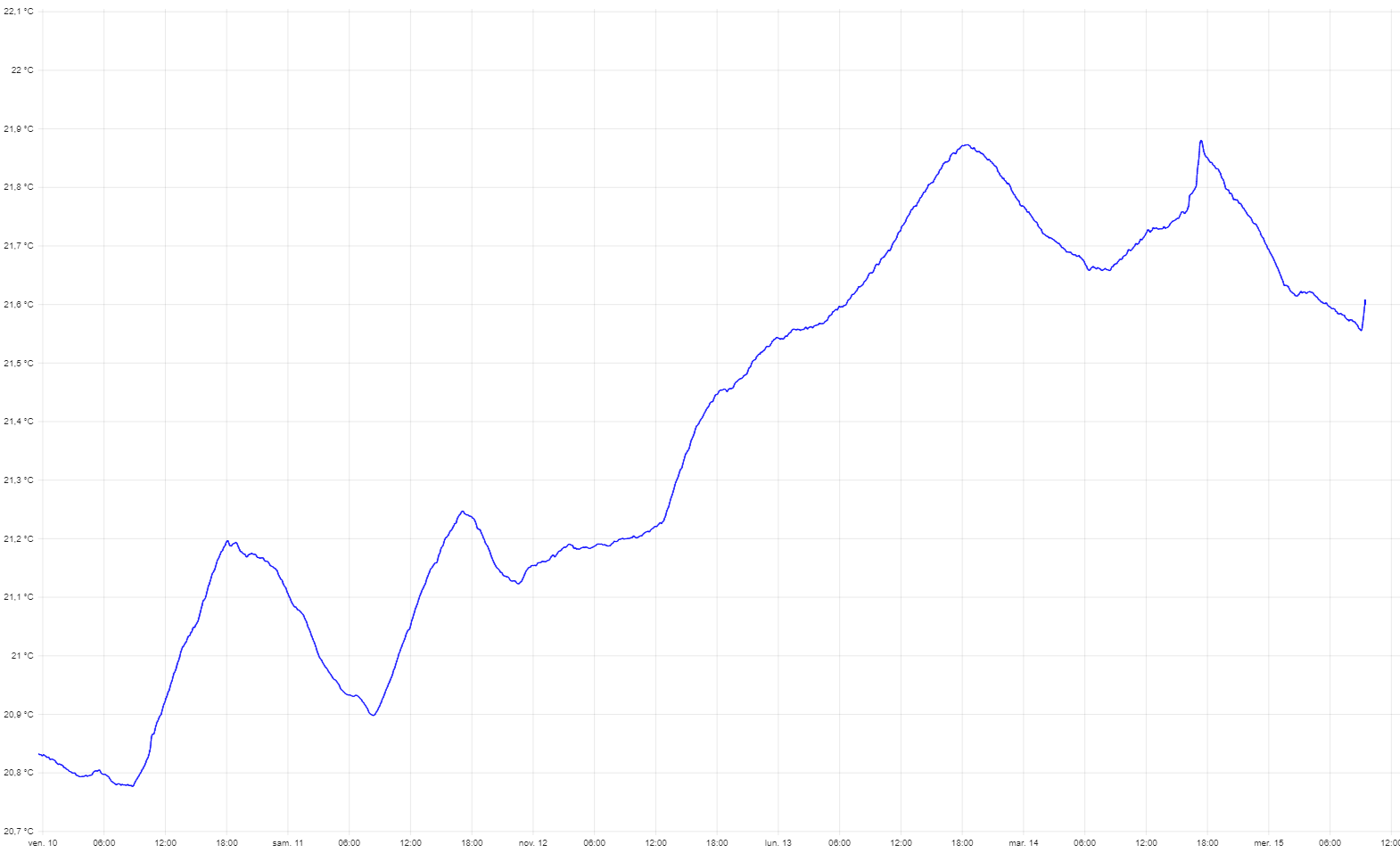
Ronic Chiche | Fixed | report | detectors and electronics | ThomX igloo | bunker temperature curve |
|
| Attachment 1: 2023-11-10_to_2023-11-15_-_temperature_curve.png
|
 |
|
282
|
Tue Nov 14 11:33:45 2023 |
Ronic Chiche | Fixed | report | mechanics | lasers and optics | ThomX igloo | M4 motor using icepap controller and jive/Atkpanel IHM |
one problem is the FP-cavity/laser lock loss when one moves a FP-cavity motor.
with acceleration = 0.01 units/s² and velocity = 50mm/s (here, the 'mm' unit seems strange as it is very fast), it's enough to make a move fast enough for small displacements (10 steps for example to center PZT position) and it seems that the cavity stays locked (only the FP-cavity/laser is locked).
=> to be checked when both FP-cavity/laser and FP-cavity/RF-reference feedback loops are running.
| Ronic Chiche wrote: |
|
Kevin moved the M4 mirror controller from the ISP controller to some ICEPAP controller.
the IHM to access this ICEPAP controller is accessible by launching 'jive' from any account ('operateur.thomx' for example).
once in the jive window, one has to select the 'device' tab, then select the OC=>OP=>OCH.02-MOT.03 device.
an AtkPanel is launched in which one can change the step values which are direclty the motor steps.
|
|
|
281
|
Tue Nov 14 10:51:57 2023 |
Ronic Chiche | Fixed | info | mechanics | lasers and optics | detectors and electronics | ThomX igloo | Ring frequency / Laser "day by day" locking |
temperature stable around 21.7°C
today, the equivalent Smaract position corresponding to the 500.25MHz ring frequency is +147µm on MCS-1/ch0 (closed loop mode)
| Ronic Chiche wrote: |
|
temperature stable around 20.8°C
today, the equivalent Smaract position corresponding to the 500.25MHz ring frequency is +158.4µm on MCS-1/ch0 (closed loop mode)
it is very difficult to maintain both loops in the same time as soon as it is needed to move one motor (CFP or Laser) because of the one element (RF reference or Laser or CFP) is drifting in frequency.
to try to understand why these 3 elements seems to drift so fast one from each other, we only measure the beating frequency between the RF reference and the free running laser (without lock of the CFP)... and we see a drift around several Hz by second of the beating signal => who is guilty ? Laser or RF synthesizer ?
one can compare their respective phase noise to have an idea of their relative phase/frequency stability :
the OneFive phase noise gives +40dBc/Hz @10Hz offset in optical frequency which is 300000 (110dB) more than at 1GHz => 40 - 110 = -70dBc/Hz @10Hz offset @ 1GHz
to be compared to the SMA100A which gives -85dBc/Hz @10Hz offset @ 1GHz
conclusion : the RF reference should be more stable in long term and the drifts we see should come from the laser...
| Ronic Chiche wrote: |
|
today, the equivalent Smaract position corresponding to the 500.25MHz ring frequency is +156µm on MCS-1/ch0 (closed loop mode)
|
|
|
|
280
|
Tue Nov 14 10:35:16 2023 |
Ronic Chiche | Fixed | info | mechanics | lasers and optics | detectors and electronics | ThomX igloo | Laser / FP-cavity "day by day" locking |
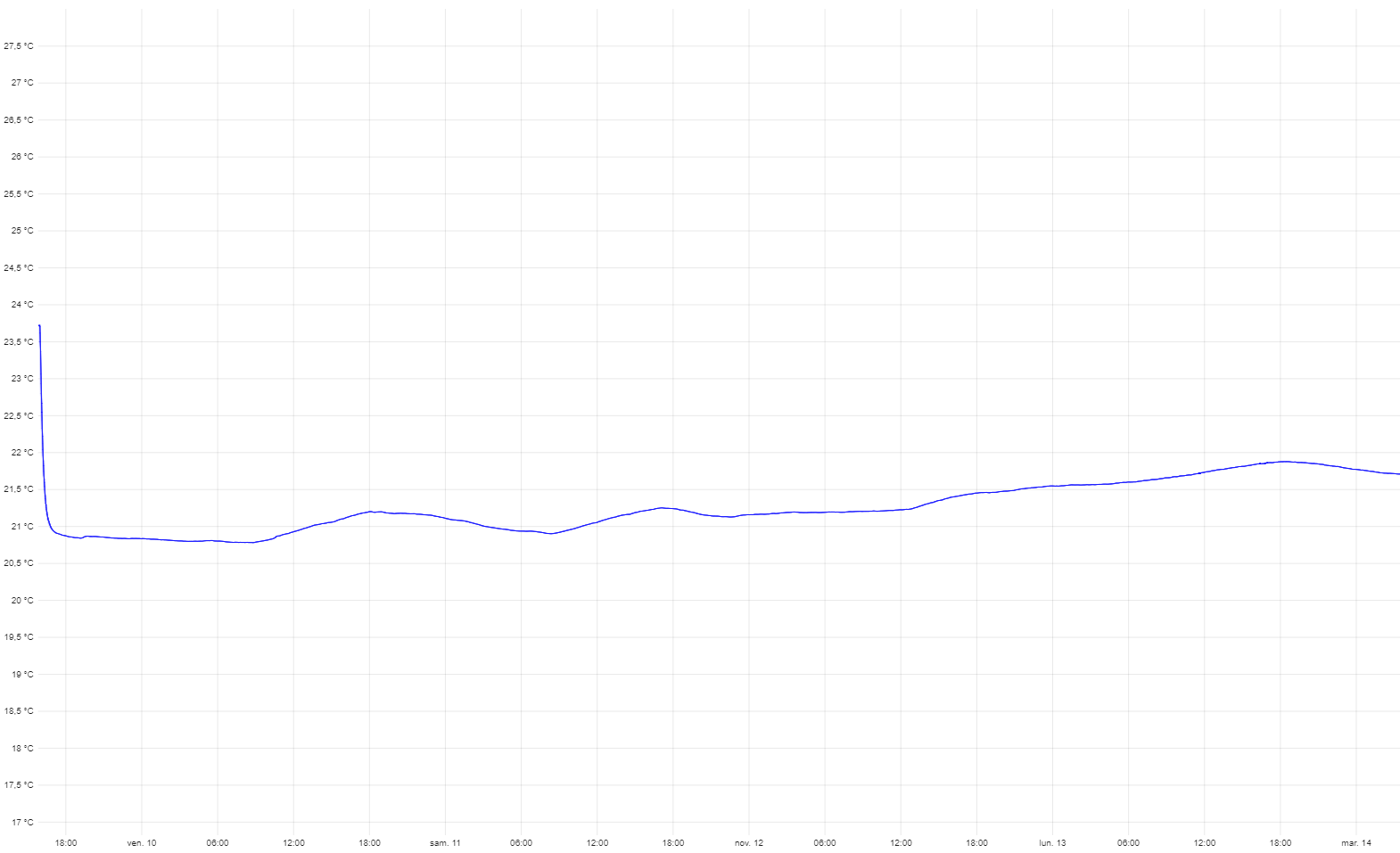
temperature since we moved to temperature probe (jump at the beginning of the plot) below the ring on a metallic base.
| Ronic Chiche wrote: |
|
as the temperature is back to a normal value ~ 20.8°C, the injected power to the amplifier (PD_IN in the Alphanov software) is back to 3.15mW without doing any alignment.
this morning the lock was around 48.5kW with 30% laser amplifier ratio (16W) after CEP/alignment tuning.
| Ronic Chiche wrote: |
|
today, we locked the FP cavity at ~50kW with 30% laser amplifier ratio (16W) during almost all the day (from 10am to 4pm)
CEP optimized for MCS-1/Ch2 = -244µm at the end of the day.
once one finds the proper CEP value to reach to correct loops gain, the cavity lock and power are very stable:
one looses the lock only when one needs to use the Smaract motors to follow the long temperature drifts.
several elements of the ThomX machine have been powered ON progressively during the lock without any lock perturbation excepting for a very short time when switching ON the RF cavity (to be confirmed) and when one tried to inject electrons into the ring (loss of the electrons after few turns only)... but it's not very clear. the lock is still stable but some time one sees a lock loss without "reason"... could it be the electron loss or some bad compensation of the noise due to feedback, it's hard to say.
at the end of the day, I had to realign the FP-cavity injection and change the CEP more often than in the morning,
and surprisingly, the intra-cavity power drops a little bit at the begining of the lock (~50kW) and after some tenth of seconds (=> ~47-48kW).
it is not so much but it is very repeatable at each try.
I tried to optimize the CEP, the injection alignment, the PID parameters => it helps but at the end, I still have this slow power drop of few kW over tenth of seconds that I didn't see at the begining of the day... to be investigated.
|
|
|
| Attachment 1: courbe_temperature_jeudi9-mardi14.png
|
 |
|
279
|
Fri Nov 10 12:37:42 2023 |
Ronic Chiche | Fixed | info | mechanics | lasers and optics | detectors and electronics | ThomX igloo | Laser / FP-cavity "day by day" locking |
as the temperature is back to a normal value ~ 20.8°C, the injected power to the amplifier (PD_IN in the Alphanov software) is back to 3.15mW without doing any alignment.
this morning the lock was around 48.5kW with 30% laser amplifier ratio (16W) after CEP/alignment tuning.
| Ronic Chiche wrote: |
|
today, we locked the FP cavity at ~50kW with 30% laser amplifier ratio (16W) during almost all the day (from 10am to 4pm)
CEP optimized for MCS-1/Ch2 = -244µm at the end of the day.
once one finds the proper CEP value to reach to correct loops gain, the cavity lock and power are very stable:
one looses the lock only when one needs to use the Smaract motors to follow the long temperature drifts.
several elements of the ThomX machine have been powered ON progressively during the lock without any lock perturbation excepting for a very short time when switching ON the RF cavity (to be confirmed) and when one tried to inject electrons into the ring (loss of the electrons after few turns only)... but it's not very clear. the lock is still stable but some time one sees a lock loss without "reason"... could it be the electron loss or some bad compensation of the noise due to feedback, it's hard to say.
at the end of the day, I had to realign the FP-cavity injection and change the CEP more often than in the morning,
and surprisingly, the intra-cavity power drops a little bit at the begining of the lock (~50kW) and after some tenth of seconds (=> ~47-48kW).
it is not so much but it is very repeatable at each try.
I tried to optimize the CEP, the injection alignment, the PID parameters => it helps but at the end, I still have this slow power drop of few kW over tenth of seconds that I didn't see at the begining of the day... to be investigated.
|
|
|
278
|
Fri Nov 10 09:51:22 2023 |
Ronic Chiche | Fixed | report | mechanics | lasers and optics | ThomX igloo | M4 motor using icepap controller and jive/Atkpanel IHM |
Kevin moved the M4 mirror controller from the ISP controller to some ICEPAP controller.
the IHM to access this ICEPAP controller is accessible by launching 'jive' from any account ('operateur.thomx' for example).
once in the jive window, one has to select the 'device' tab, then select the OC=>OP=>OCH.02-MOT.03 device.
an AtkPanel is launched in which one can change the step values which are direclty the motor steps. |
|
277
|
Fri Nov 10 09:43:26 2023 |
Ronic Chiche | Fixed | info | mechanics | lasers and optics | detectors and electronics | ThomX igloo | Ring frequency / Laser "day by day" locking |
temperature stable around 20.8°C
today, the equivalent Smaract position corresponding to the 500.25MHz ring frequency is +158.4µm on MCS-1/ch0 (closed loop mode)
it is very difficult to maintain both loops in the same time as soon as it is needed to move one motor (CFP or Laser) because of the one element (RF reference or Laser or CFP) is drifting in frequency.
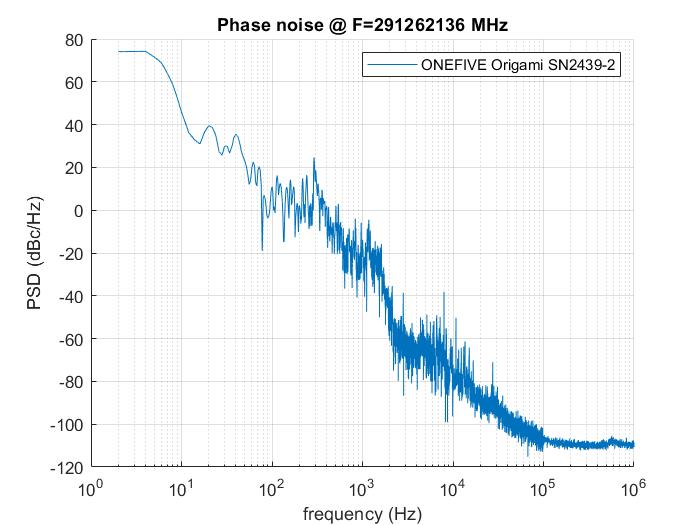
to try to understand why these 3 elements seems to drift so fast one from each other, we only measure the beating frequency between the RF reference and the free running laser (without lock of the CFP)... and we see a drift around several Hz by second of the beating signal => who is guilty ? Laser or RF synthesizer ?
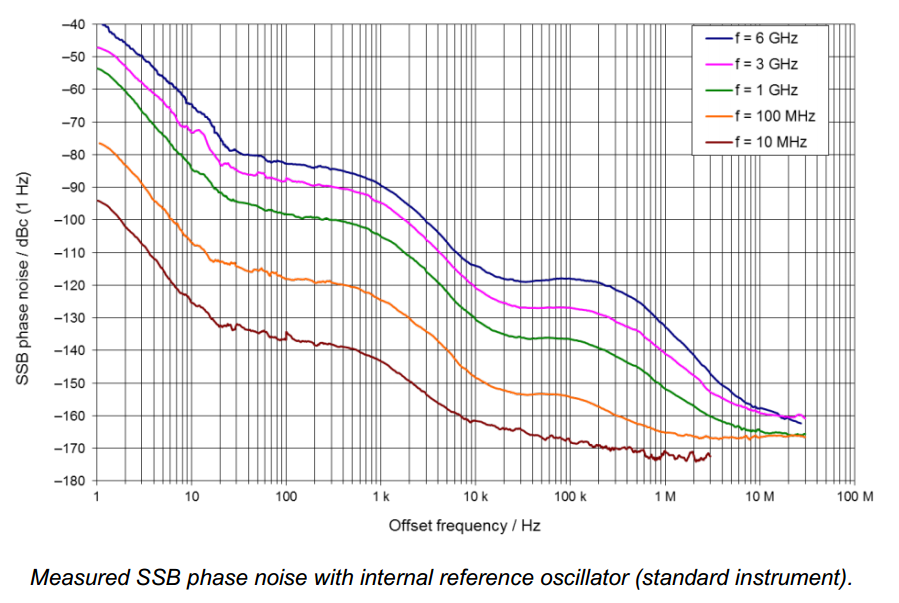
one can compare their respective phase noise to have an idea of their relative phase/frequency stability :
the OneFive phase noise gives +40dBc/Hz @10Hz offset in optical frequency which is 300000 (110dB) more than at 1GHz => 40 - 110 = -70dBc/Hz @10Hz offset @ 1GHz
to be compared to the SMA100A which gives -85dBc/Hz @10Hz offset @ 1GHz
conclusion : the RF reference should be more stable in long term and the drifts we see should come from the laser...
| Ronic Chiche wrote: |
|
today, the equivalent Smaract position corresponding to the 500.25MHz ring frequency is +156µm on MCS-1/ch0 (closed loop mode)
|
|
| Attachment 1: untitled.jpg
|
 |
| Attachment 2: Capture1.PNG
|
 |
|
276
|
Thu Nov 9 17:02:26 2023 |
Ronic Chiche | Fixed | info | mechanics | lasers and optics | detectors and electronics | ThomX igloo | Laser / FP-cavity "day by day" locking |
today, we locked the FP cavity at ~50kW with 30% laser amplifier ratio (16W) during almost all the day (from 10am to 4pm)
CEP optimized for MCS-1/Ch2 = -244µm at the end of the day.
once one finds the proper CEP value to reach to correct loops gain, the cavity lock and power are very stable:
one looses the lock only when one needs to use the Smaract motors to follow the long temperature drifts.
several elements of the ThomX machine have been powered ON progressively during the lock without any lock perturbation excepting for a very short time when switching ON the RF cavity (to be confirmed) and when one tried to inject electrons into the ring (loss of the electrons after few turns only)... but it's not very clear. the lock is still stable but some time one sees a lock loss without "reason"... could it be the electron loss or some bad compensation of the noise due to feedback, it's hard to say.
at the end of the day, I had to realign the FP-cavity injection and change the CEP more often than in the morning,
and surprisingly, the intra-cavity power drops a little bit at the begining of the lock (~50kW) and after some tenth of seconds (=> ~47-48kW).
it is not so much but it is very repeatable at each try.
I tried to optimize the CEP, the injection alignment, the PID parameters => it helps but at the end, I still have this slow power drop of few kW over tenth of seconds that I didn't see at the begining of the day... to be investigated.
|