| ID |
Date |
Author |
Status |
Type |
Category |
Location |
Title |
|
474
|
Thu Jun 25 16:04:34 2026 |
Ronic Chiche | Under Process | info | mechanics | lasers and optics | vacuum | ThomX igloo | removing of the M1 mirror | the pressure level with the ionic pump was limited to ~ 1.5 .10**-7 mbar after several days of pumping, due to some leakage located on the bottom screws of the large flange.
so we decided to reopen the flange and change the copper joint.
we did a new leakage test, and after tightening properly the screws, it seems there is no leakage anymore.
so, we started the ionic pumping in the morning (several starts and stops to clean the ionic pump with the turbo pumping), and at 3.30 pm, we closed the turbo/vessel valve.
the vacuum level is at 2.3.10*-7 mbar.
let's see how much it is tomorrow morning to have an estimation of the time needed to reach 2.10**-8 mbar (in the vessel), which should reduce to 5.10**-9 once the ring/vessel valve will be opened (the ring has roughly the same volume as the two vessel volumes).
| Ronic Chiche wrote: |
|
This afternoon, we installed a new M1 mirror, the only one for which the box was not already opened.
as the mirror should be "brand new", as the LMA has packaged it, we decided not to clean it with ultra-pure water and to install it out of the box.
we realigned it with the iris previously installed for that purpose.
primary and turbo pumping are in process. one has to wait until the vacuum level is low enough to start the ionic pumping and to reopen the isolating valve.
let's cross our fingers...
| Ronic Chiche wrote: |
|
this morning, with Daniele, we took some images of the M1 mirror HR surface :
1- large image span of the mirror surface (~center) before being cleaned :
one can see a lot of spots
2- zoom in on some spots in the middle of the mirror.
Daniele saw 2 suspicious spots among many.
difficult to be sure if it's only some dust or if it's some damage
3- large image span of the mirror surface after being cleaned with the spin coater machine
only the 2 suspicious spots remain, all others have been washed.
4- zoom in on the 2 suspicious spots
if one compares with the image before cleaning, one can see the spots are much larger
5&6- zoom in on the 2 suspicious spots separately after a 2nd cleaning process with the spin coater,
it seems the spots are even a bit larger than before
conclusion : it seems that these spots are presently showing some damage on the mirror surface.
it is strange that there are 2 in the same time.
one possible explanation is that, as we had to move the z-axis motor before, and we know that the mechanics are rusty, it's possible that it released some metallic particles on the mirror surface.
and 2 were in the beam area....
| Ronic Chiche wrote: |
|
after trying to increase the power and after moving S3 to try to change the size of the beam on the mirrors, the FPC power suddenly droped.
so, we need to remove M1 to check if it has been damaged.
we placed an iris in reflection of the FPC to keep the alignment for the new mirror M1.
the alignment has been done with an iris and the amplifier at 10% (to get a quite round beam) and the beam profiler.
once the iris is almost closed, the alignment is good, using the diffractions rings.
|
|
|
|
|
475
|
Fri Jun 26 09:42:31 2026 |
Ronic Chiche | Under Process | info | mechanics | lasers and optics | vacuum | ThomX igloo | removing of the M1 mirror | this morning, the vacuum level is still around 1.9 10**-7.
the vacuum guys said that last time, the pumping was much faster.
they ask if baking the vessel (with the mirrors inside ?) is absolutely impossible...
| Ronic Chiche wrote: |
|
the pressure level with the ionic pump was limited to ~ 1.5 .10**-7 mbar after several days of pumping, due to some leakage located on the bottom screws of the large flange.
so we decided to reopen the flange and change the copper joint.
we did a new leakage test, and after tightening properly the screws, it seems there is no leakage anymore.
so, we started the ionic pumping in the morning (several starts and stops to clean the ionic pump with the turbo pumping), and at 3.30 pm, we closed the turbo/vessel valve.
the vacuum level is at 2.3.10*-7 mbar.
let's see how much it is tomorrow morning to have an estimation of the time needed to reach 2.10**-8 mbar (in the vessel), which should reduce to 5.10**-9 once the ring/vessel valve will be opened (the ring has roughly the same volume as the two vessel volumes).
| Ronic Chiche wrote: |
|
This afternoon, we installed a new M1 mirror, the only one for which the box was not already opened.
as the mirror should be "brand new", as the LMA has packaged it, we decided not to clean it with ultra-pure water and to install it out of the box.
we realigned it with the iris previously installed for that purpose.
primary and turbo pumping are in process. one has to wait until the vacuum level is low enough to start the ionic pumping and to reopen the isolating valve.
let's cross our fingers...
| Ronic Chiche wrote: |
|
this morning, with Daniele, we took some images of the M1 mirror HR surface :
1- large image span of the mirror surface (~center) before being cleaned :
one can see a lot of spots
2- zoom in on some spots in the middle of the mirror.
Daniele saw 2 suspicious spots among many.
difficult to be sure if it's only some dust or if it's some damage
3- large image span of the mirror surface after being cleaned with the spin coater machine
only the 2 suspicious spots remain, all others have been washed.
4- zoom in on the 2 suspicious spots
if one compares with the image before cleaning, one can see the spots are much larger
5&6- zoom in on the 2 suspicious spots separately after a 2nd cleaning process with the spin coater,
it seems the spots are even a bit larger than before
conclusion : it seems that these spots are presently showing some damage on the mirror surface.
it is strange that there are 2 in the same time.
one possible explanation is that, as we had to move the z-axis motor before, and we know that the mechanics are rusty, it's possible that it released some metallic particles on the mirror surface.
and 2 were in the beam area....
| Ronic Chiche wrote: |
|
after trying to increase the power and after moving S3 to try to change the size of the beam on the mirrors, the FPC power suddenly droped.
so, we need to remove M1 to check if it has been damaged.
we placed an iris in reflection of the FPC to keep the alignment for the new mirror M1.
the alignment has been done with an iris and the amplifier at 10% (to get a quite round beam) and the beam profiler.
once the iris is almost closed, the alignment is good, using the diffractions rings.
|
|
|
|
|
|
476
|
Wed Jul 15 18:16:37 2026 |
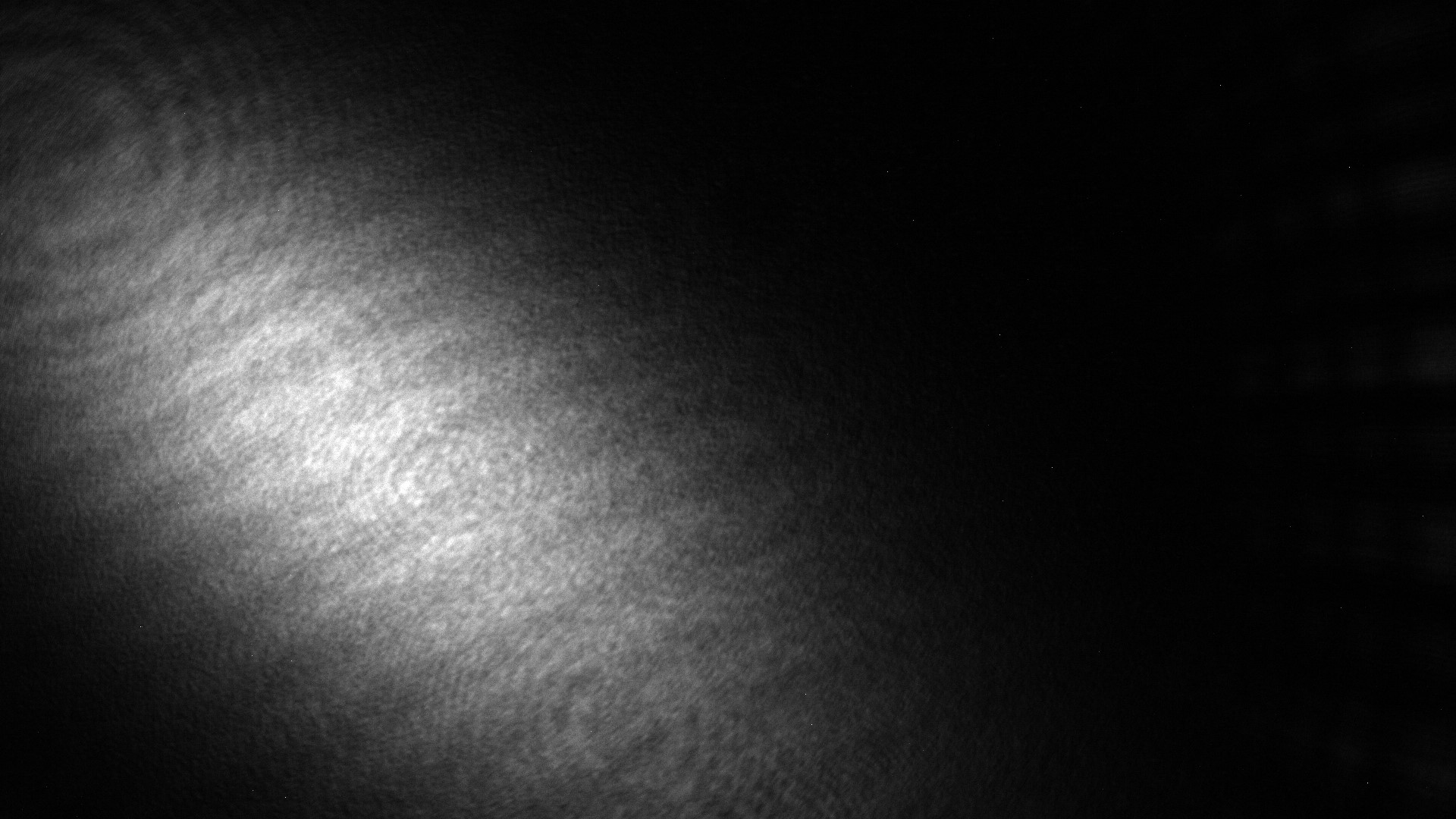
Ronic Chiche | Under Process | issue | lasers and optics | Optical room | elliptic mode shape | the mode shape @ 5-15kW is very elliptic (50% of ellipticity : large size = 2x small size).
we only changed M1 and did not move M2,M3,M4.
what are the possible reasons for the ellipticity:
- M1 misalignment (cavity axis if off the mirrors center) :
we changed the M1 orientation in X and Y => no effect on the mode shape
- cavity too close from instability region :
we changed the distance between spherical mirrors (S3 moved by almost 700µm ) => no effect on the mode shape
- thermal effect changing the mirror curvature :
we observed mode at 5 or 15 kW => no effect on the mode shape
- bad alignment of the lens in front of the camera :
we observed elliptic and round shape beams with exactly the same centroid on the camera
- thermal effect changing some stress on the mount holding the mirror :
we observed mode at 5 or 15 kW => no effect on the mode shape
- default in the mirror substrate polishing :
why not, but it's strange that with the previous mirror we saw the same kind of ellipticity at low power and a perfect round shape beam at high power.
(with this mirror, we never succeded to overcome 15kW in FPC)
- how strong the small screws holding the mirror are tightened, which could induce some stress :
but why did we saw a perfect round shape of the beam at high power with the previous mirror ?
and it would be strange to get almost the same orientation of the ellipse with the 2 mirrors.
- other ideas ??? |
| Attachment 1: Image__2026-07-15__15-28-39.jpeg
|  |
|
109
|
Thu Dec 2 21:31:21 2021 |
Manar Amer | Fixed | report | lasers and optics | ThomX igloo | FP cavity alignment | Note the direction of injection is M1 - M2 - M3 - M4
P1 - S2 - S3 - P4
The injected beam is aligned at the center of the irises placed at the windows mounts of mirror M1 (Injection) and M2(spherical)
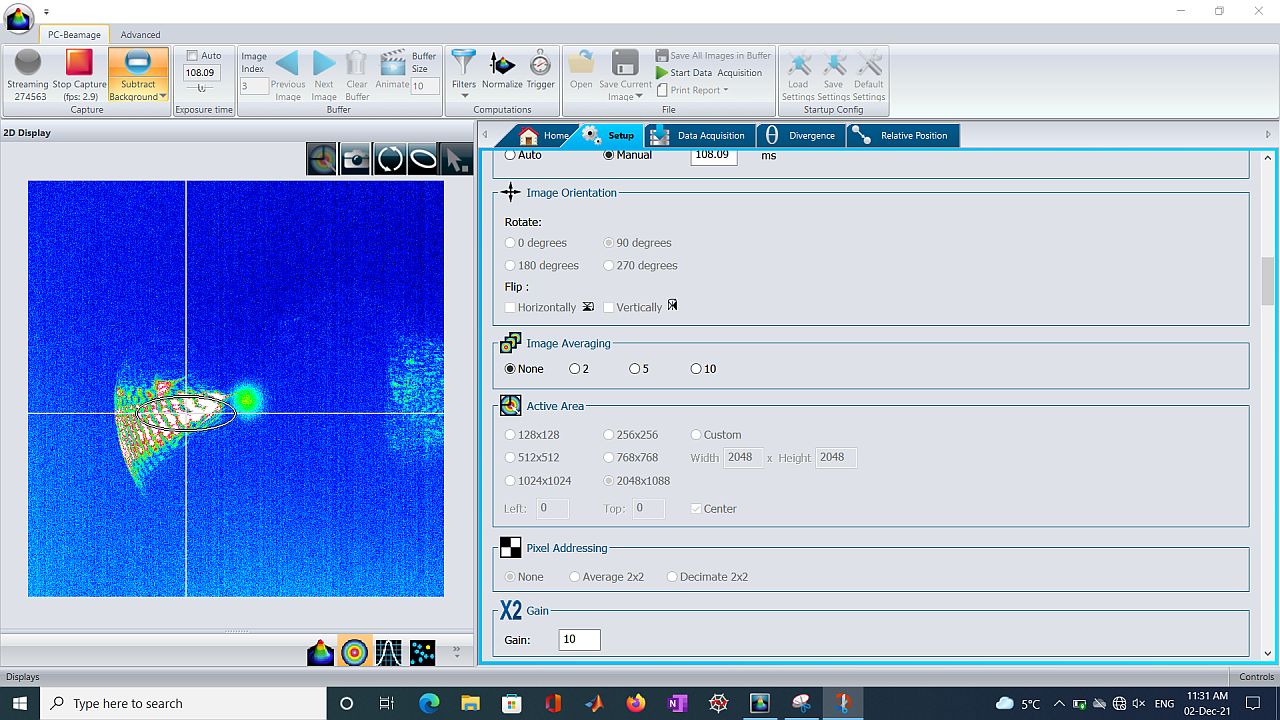
At Transmission of M2 : in addition to centered beam, we observe diffraction which interferes in observing the beating at M2 output
(could be diffracted beam from the metal pipes inside or from the D-shaped mirror installed inside)
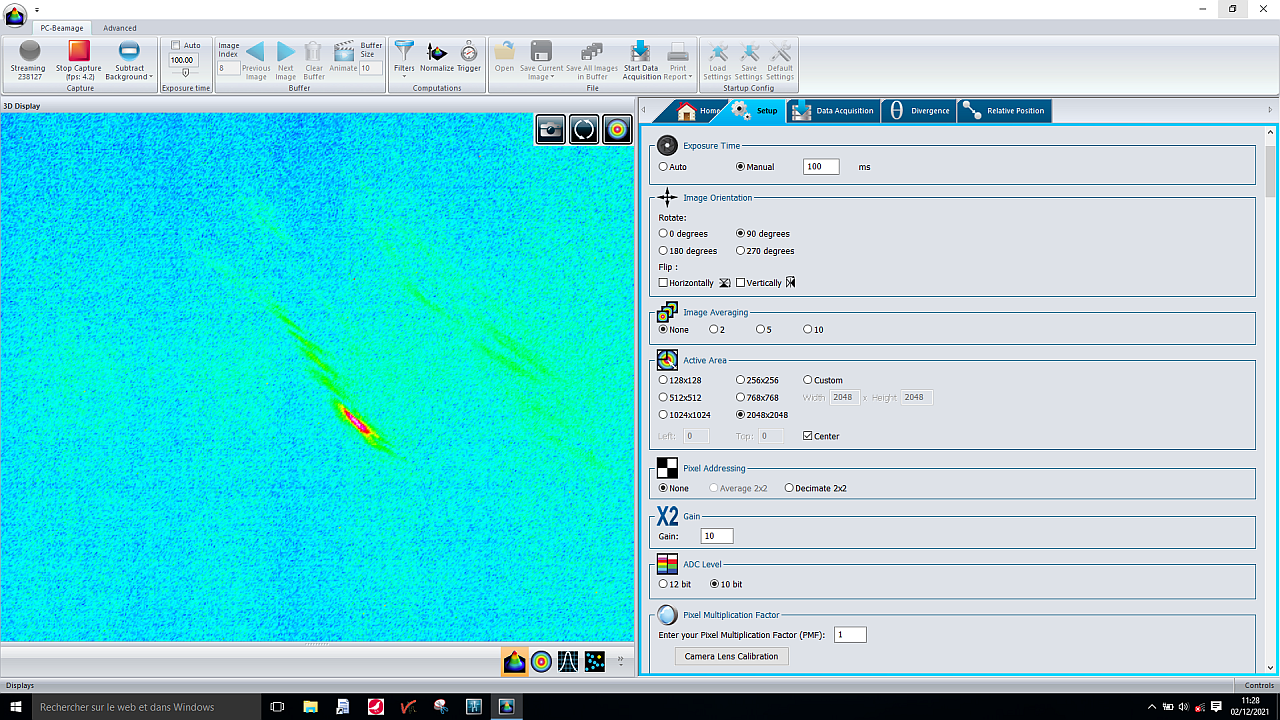
At Transmission of M3 : we observe a beam output could be part of TM00 mode (the shape is distorted !!)
suspicious reasons :
- when we have a frequency sweep on the CW(Koheras) piezo; we observe it beating (when increasing the drive it is increasing in intensity)
- when we adjust the alignment mirrors; the beam doesn't change position and only its intensity changes
continuation with the alignment and try to eliminate the diffraction and find the shape of the beam.
A manual change in the D-shaped mirror position to remove any possible effects from it.
|
| Attachment 1: 2021_12_02_M2_Transmission.jpg
|  |
| Attachment 2: 2021_12_02_M3_transmission_90deg.PNG
|  |
|
110
|
Tue Jan 11 10:36:35 2022 |
Manar Amer | Fixed | report | lasers and optics | ThomX igloo | FP cavity alignment | The alignment is on hold until next week 17th - 18th Jan
an Alignment attempt will be done when the ring part close to the FP cavity is opened.
| Manar Amer wrote: |
|
Note the direction of injection is M1 - M2 - M3 - M4
P1 - S2 - S3 - P4
The injected beam is aligned at the center of the irises placed at the windows mounts of mirror M1 (Injection) and M2(spherical)
At Transmission of M2 : in addition to centered beam, we observe diffraction which interferes in observing the beating at M2 output
(could be diffracted beam from the metal pipes inside or from the D-shaped mirror installed inside)
At Transmission of M3 : we observe a beam output could be part of TM00 mode (the shape is distorted !!)
suspicious reasons :
- when we have a frequency sweep on the CW(Koheras) piezo; we observe it beating (when increasing the drive it is increasing in intensity)
- when we adjust the alignment mirrors; the beam doesn't change position and only its intensity changes
continuation with the alignment and try to eliminate the diffraction and find the shape of the beam.
A manual change in the D-shaped mirror position to remove any possible effects from it.
|
|
|
113
|
Mon Jan 17 21:22:28 2022 |
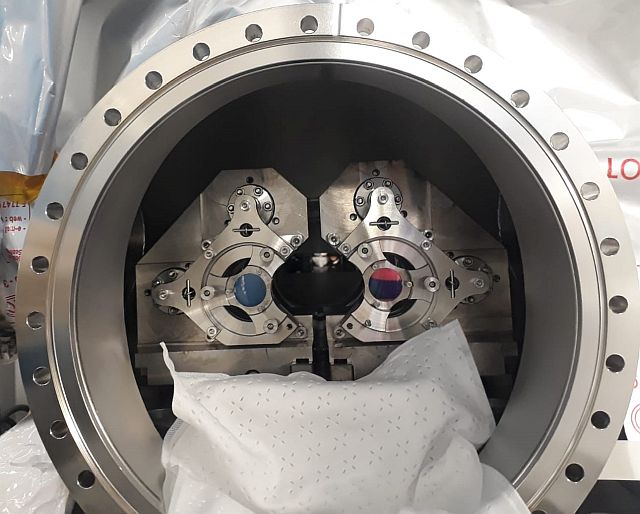
Manar Amer | Fixed | report | lasers and optics | ThomX igloo | FP cavity alignment | ***** Continuation of the alignment ---- FP Cavity Open --- ****
The cavity was put under outer pressure and was opened for the alignment
The alignment was done using CW koheras infrared laser and the inside mirrors irises
we observed the beam output centered at S2, S3 and P4
transmission from S4 to P1 was aligned at the center of P1 iris and an outside reference was fixed, then P1 mirror was placed, and we aligned the reflection with the transmission.
....... After the interior alignment, the cavity windows were closed ....
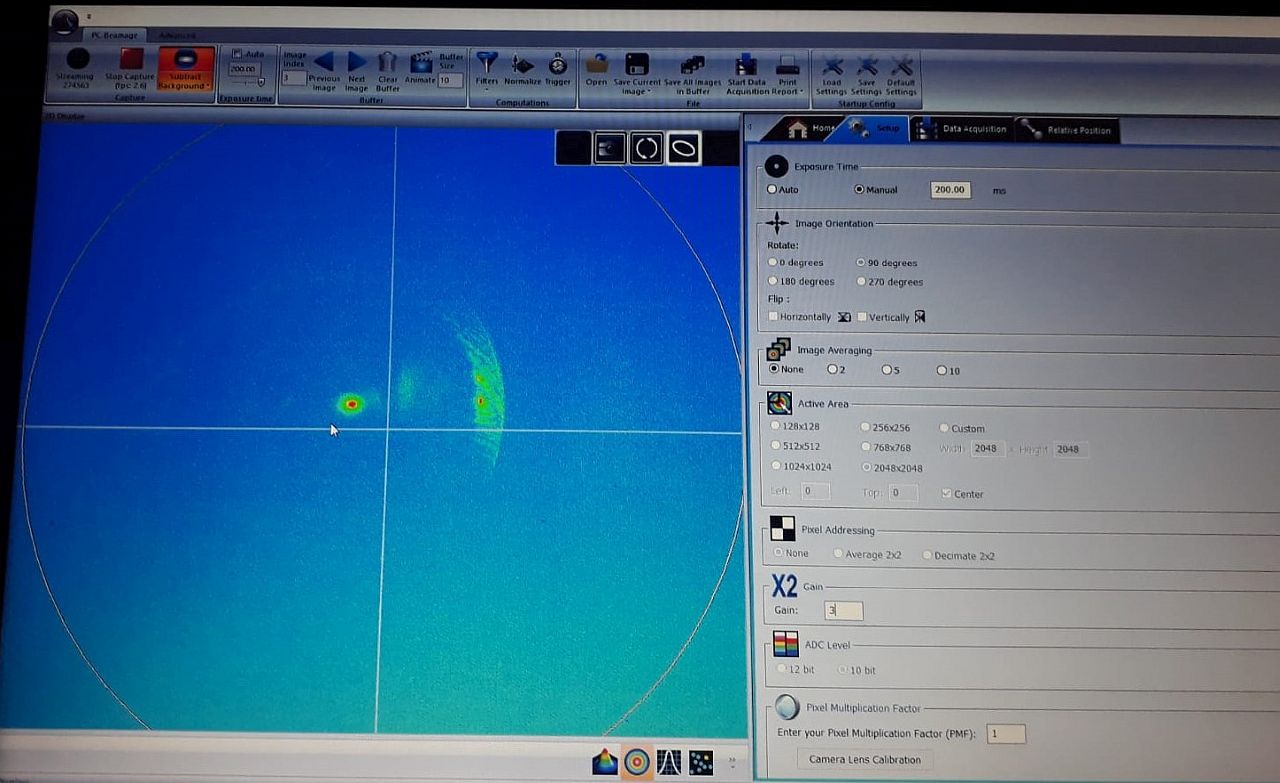
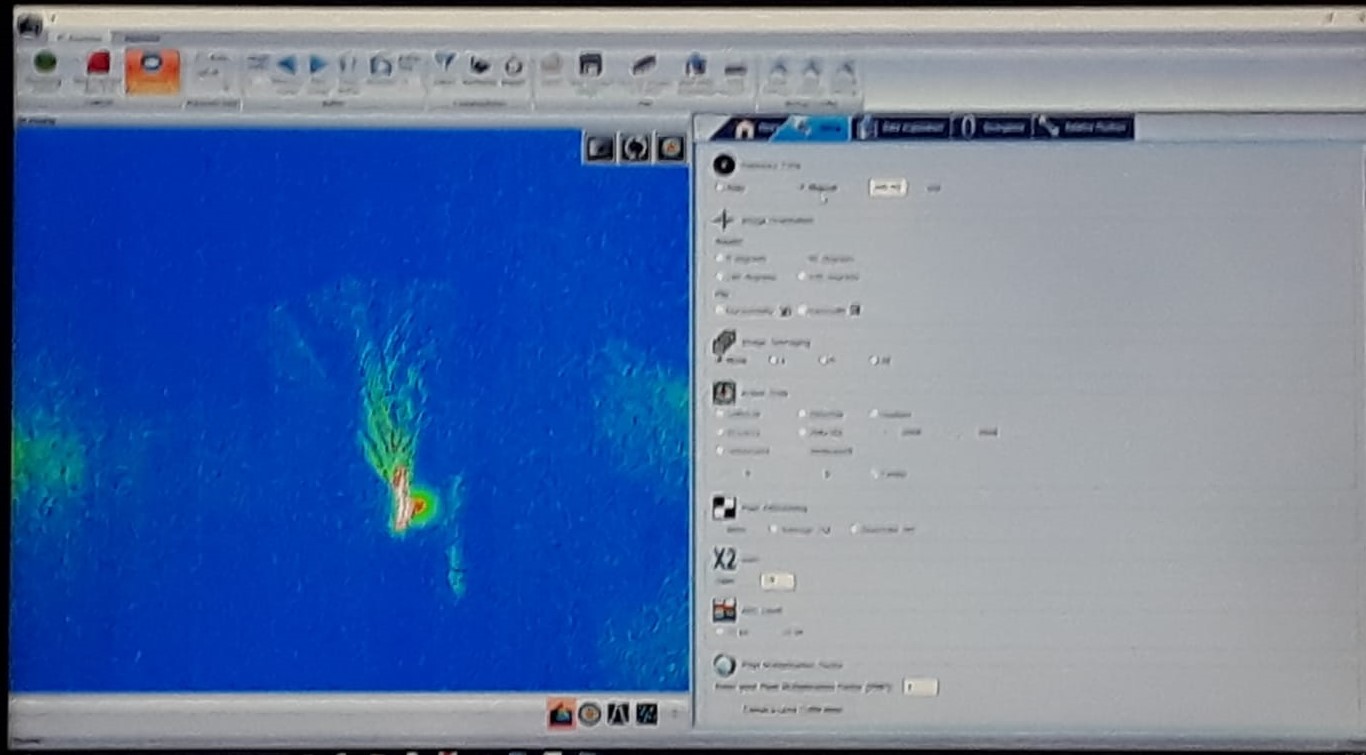
A beam profiler was placed at P4 transmission -----> nothing observed even with a piezo drive on the CW infrared laser
observed a beam output at S2 and S3, but the fundamental mode is not seen, or even a higher order mode (which we can't explain, as the beam is centered on the mirrors)
images show the output at S2 and S3
| Manar Amer wrote: |
|
The alignment is on hold until next week 17th - 18th Jan
an Alignment attempt will be done when the ring part close to the FP cavity is opened.
| Manar Amer wrote: |
|
Note the direction of injection is M1 - M2 - M3 - M4
P1 - S2 - S3 - P4
The injected beam is aligned at the center of the irises placed at the windows mounts of mirror M1 (Injection) and M2(spherical)
At Transmission of M2 : in addition to centered beam, we observe diffraction which interferes in observing the beating at M2 output
(could be diffracted beam from the metal pipes inside or from the D-shaped mirror installed inside)
At Transmission of M3 : we observe a beam output could be part of TM00 mode (the shape is distorted !!)
suspicious reasons :
- when we have a frequency sweep on the CW(Koheras) piezo; we observe it beating (when increasing the drive it is increasing in intensity)
- when we adjust the alignment mirrors; the beam doesn't change position and only its intensity changes
continuation with the alignment and try to eliminate the diffraction and find the shape of the beam.
A manual change in the D-shaped mirror position to remove any possible effects from it.
|
|
|
| Attachment 1: Interior_of_cavity_P1_S3_windowOpen.jpg
|  |
| Attachment 2: Interior_of_cavity_P1_S3_windowOpen_irrisOnP1.jpg
| 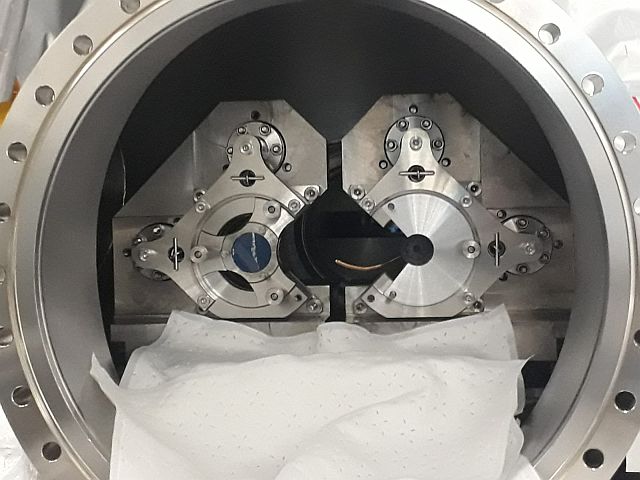 |
| Attachment 3: CavityAlignment_cavityOpen_S2_Output.jpg
|  |
| Attachment 4: CavityAlignment_cavityOpen_S3_Output.jpeg
|  |
|
114
|
Wed Jan 19 09:36:53 2022 |
Manar Amer | Fixed | report | lasers and optics | ThomX igloo | FP cavity alignment | Yesterday, we did the alignment again using Iris and beam profilers to obtain a more precise result.
at the end of the alignment procedure, we successfully obtained the beating modes.
the geometrical alignment seems good (weak odd modes) but we could need to put a telescope on the Koheras line as the beam size seems quite different from the mode size (quite strong even modes).
without any improvement of the alignment using photodiodes, one obtains about 15-20% of coupling.
we put several Iris on the table:
- 2 Iris before the 2 alignment mirrors to fix the axis of the laser on these mirrors
- 1 Iris just before the cavity (we will add an additional one today) to fix the cavity axis
- 1 Iris in reflection of the cavity to fix the M1 orientation
| Manar Amer wrote: |
|
***** Continuation of the alignment ---- FP Cavity Open --- ****
The cavity was put under outer pressure and was opened for the alignment
The alignment was done using CW koheras infrared laser and the inside mirrors irises
we observed the beam output centered at S2, S3 and P4
transmission from S4 to P1 was aligned at the center of P1 iris and an outside reference was fixed, then P1 mirror was placed, and we aligned the reflection with the transmission.
....... After the interior alignment, the cavity windows were closed ....
A beam profiler was placed at P4 transmission -----> nothing observed even with a piezo drive on the CW infrared laser
observed a beam output at S2 and S3, but the fundamental mode is not seen, or even a higher order mode (which we can't explain, as the beam is centered on the mirrors)
images show the output at S2 and S3
| Manar Amer wrote: |
|
The alignment is on hold until next week 17th - 18th Jan
an Alignment attempt will be done when the ring part close to the FP cavity is opened.
| Manar Amer wrote: |
|
Note the direction of injection is M1 - M2 - M3 - M4
P1 - S2 - S3 - P4
The injected beam is aligned at the center of the irises placed at the windows mounts of mirror M1 (Injection) and M2(spherical)
At Transmission of M2 : in addition to centered beam, we observe diffraction which interferes in observing the beating at M2 output
(could be diffracted beam from the metal pipes inside or from the D-shaped mirror installed inside)
At Transmission of M3 : we observe a beam output could be part of TM00 mode (the shape is distorted !!)
suspicious reasons :
- when we have a frequency sweep on the CW(Koheras) piezo; we observe it beating (when increasing the drive it is increasing in intensity)
- when we adjust the alignment mirrors; the beam doesn't change position and only its intensity changes
continuation with the alignment and try to eliminate the diffraction and find the shape of the beam.
A manual change in the D-shaped mirror position to remove any possible effects from it.
|
|
|
|
|
115
|
Tue Feb 1 14:17:02 2022 |
Manar Amer | Fixed | report | lasers and optics | detectors and electronics | ThomX igloo | FP cavity alignment | Installed and inputs:
- CW laser ; power = 101 mW
- PDH ;
- at output
- Low pass filter 50 ohm DC-1.9 MHz
- at input
- freq = 8.4 MHz , Ampl = 1.2 V , phase = 160 /
- voltage = ~ 6 V
- EOM ; freq = 8.4 MHz , Ampl = 100 mV , phase = 90
- Photodiodes
- beam profiler
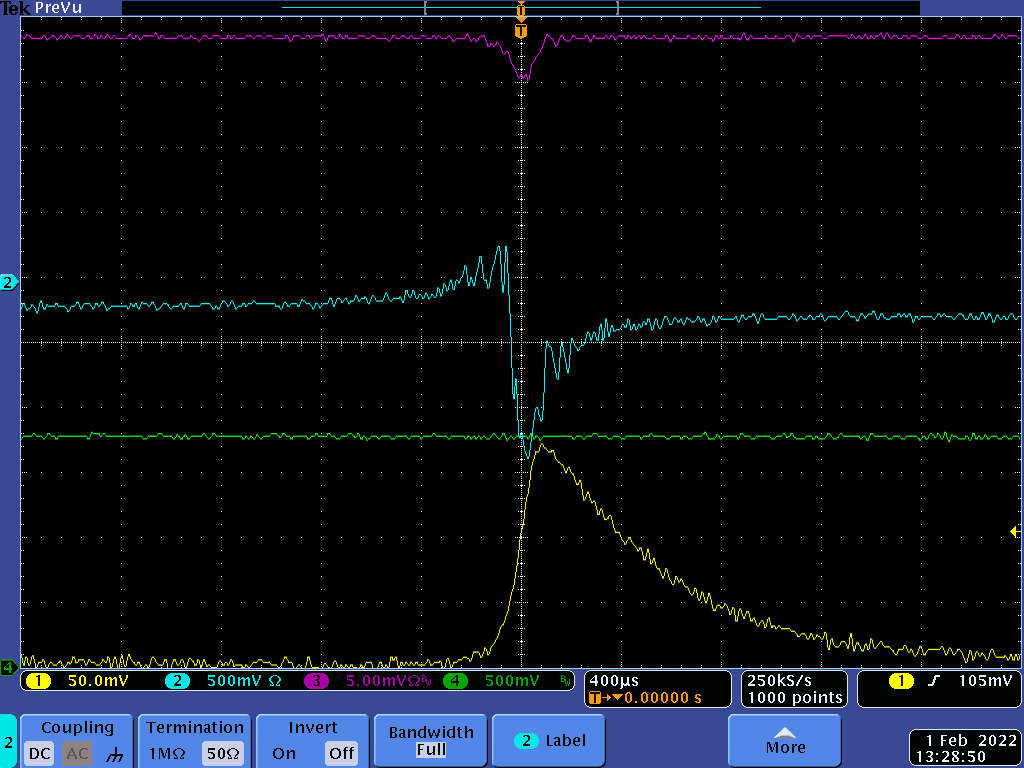
Observed during this morning:
- coupling : below 10% .... approximately ~ 8%
- Oscilloscope :
- yellow : transmission
- purple : reflection
- Blue : error signal
- green : scan signal
Note : We observe a lot of higher order modes, and they are not occurring regularly.
A schematic of the current setup is attached.
An image from the oscilloscope show a low coupling but clean error signal.
| Manar Amer wrote: |
|
Yesterday, we did the alignment again using Iris and beam profilers to obtain a more precise result.
at the end of the alignment procedure, we successfully obtained the beating modes.
the geometrical alignment seems good (weak odd modes) but we could need to put a telescope on the Koheras line as the beam size seems quite different from the mode size (quite strong even modes).
without any improvement of the alignment using photodiodes, one obtains about 15-20% of coupling.
we put several Iris on the table:
- 2 Iris before the 2 alignment mirrors to fix the axis of the laser on these mirrors
- 1 Iris just before the cavity (we will add an additional one today) to fix the cavity axis
- 1 Iris in reflection of the cavity to fix the M1 orientation
| Manar Amer wrote: |
|
***** Continuation of the alignment ---- FP Cavity Open --- ****
The cavity was put under outer pressure and was opened for the alignment
The alignment was done using CW koheras infrared laser and the inside mirrors irises
we observed the beam output centered at S2, S3 and P4
transmission from S4 to P1 was aligned at the center of P1 iris and an outside reference was fixed, then P1 mirror was placed, and we aligned the reflection with the transmission.
....... After the interior alignment, the cavity windows were closed ....
A beam profiler was placed at P4 transmission -----> nothing observed even with a piezo drive on the CW infrared laser
observed a beam output at S2 and S3, but the fundamental mode is not seen, or even a higher order mode (which we can't explain, as the beam is centered on the mirrors)
images show the output at S2 and S3
| Manar Amer wrote: |
|
The alignment is on hold until next week 17th - 18th Jan
an Alignment attempt will be done when the ring part close to the FP cavity is opened.
| Manar Amer wrote: |
|
Note the direction of injection is M1 - M2 - M3 - M4
P1 - S2 - S3 - P4
The injected beam is aligned at the center of the irises placed at the windows mounts of mirror M1 (Injection) and M2(spherical)
At Transmission of M2 : in addition to centered beam, we observe diffraction which interferes in observing the beating at M2 output
(could be diffracted beam from the metal pipes inside or from the D-shaped mirror installed inside)
At Transmission of M3 : we observe a beam output could be part of TM00 mode (the shape is distorted !!)
suspicious reasons :
- when we have a frequency sweep on the CW(Koheras) piezo; we observe it beating (when increasing the drive it is increasing in intensity)
- when we adjust the alignment mirrors; the beam doesn't change position and only its intensity changes
continuation with the alignment and try to eliminate the diffraction and find the shape of the beam.
A manual change in the D-shaped mirror position to remove any possible effects from it.
|
|
|
|
|
| Attachment 1: ThomX_FP_setup_01-02-2022.png
| 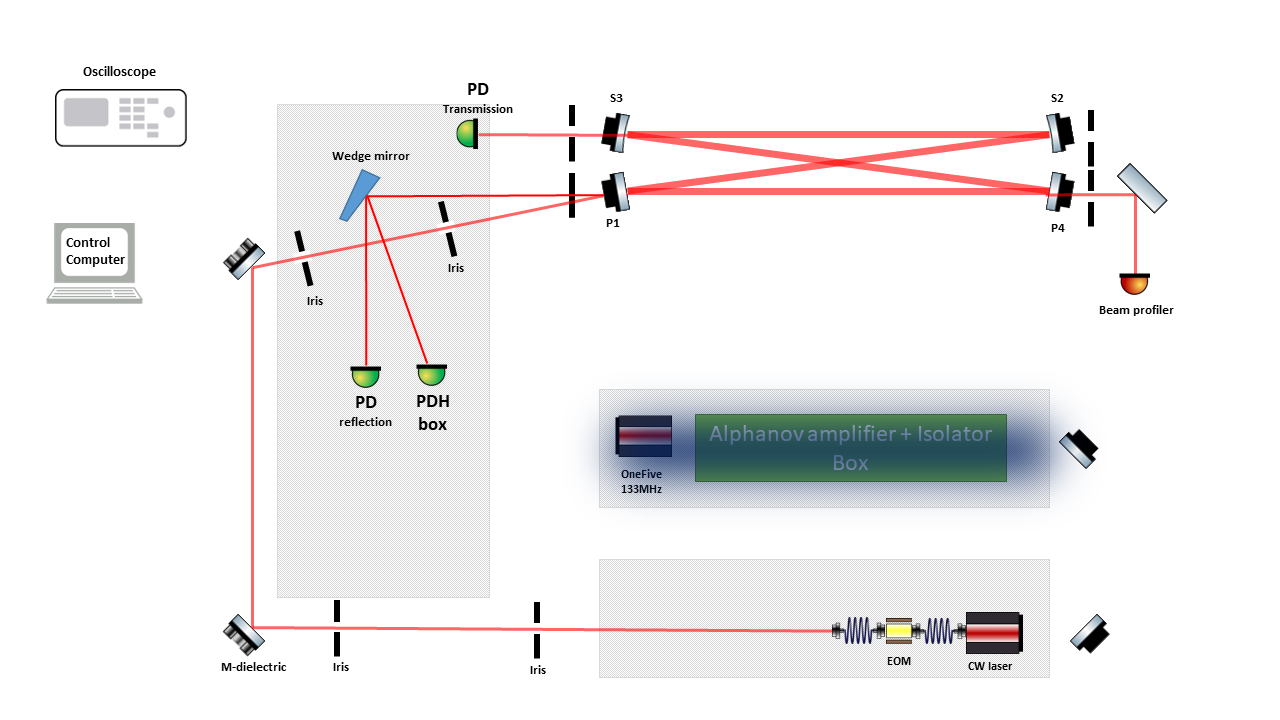 |
| Attachment 2: tek0002.png
|  |
|
116
|
Tue Feb 1 16:40:06 2022 |
Manar Amer | Fixed | report | lasers and optics | detectors and electronics | ThomX igloo | FP cavity alignment | This afternoon, I did some alignment of the injection mirrors with a fast scan on the LaseLock to get a regular transmission photodiode signal.
the coupling increased to 10-15%
I got a first lock of the cavity only with the PZT.
there is some ringing on the error signal and the locking is quite noisy, which means the cavity LW seems to be more narrow than the Koheras LW, which is a good sign.
tomorrow, I will add an AOM to improve the locking.
I did some alignment after locking.
it was difficult because of the outside noise (engines producing loud and low-frequency noises).
the coupling is now about 20% (position saved in the injection motors software).
I added a half waveplate which has to be optimized.
| Manar Amer wrote: |
|
Installed and inputs:
- CW laser ; power = 101 mW
- PDH ;
- at output
- Low pass filter 50 ohm DC-1.9 MHz
- at input
- freq = 8.4 MHz , Ampl = 1.2 V , phase = 160 /
- voltage = ~ 6 V
- EOM ; freq = 8.4 MHz , Ampl = 100 mV , phase = 90
- Photodiodes
- beam profiler
Observed during this morning:
- coupling : below 10% .... approximately ~ 8%
- Oscilloscope :
- yellow : transmission
- purple : reflection
- Blue : error signal
- green : scan signal
Note : We observe a lot of higher order modes, and they are not occurring regularly.
A schematic of the current setup is attached.
An image from the oscilloscope show a low coupling but clean error signal.
| Manar Amer wrote: |
|
Yesterday, we did the alignment again using Iris and beam profilers to obtain a more precise result.
at the end of the alignment procedure, we successfully obtained the beating modes.
the geometrical alignment seems good (weak odd modes) but we could need to put a telescope on the Koheras line as the beam size seems quite different from the mode size (quite strong even modes).
without any improvement of the alignment using photodiodes, one obtains about 15-20% of coupling.
we put several Iris on the table:
- 2 Iris before the 2 alignment mirrors to fix the axis of the laser on these mirrors
- 1 Iris just before the cavity (we will add an additional one today) to fix the cavity axis
- 1 Iris in reflection of the cavity to fix the M1 orientation
| Manar Amer wrote: |
|
***** Continuation of the alignment ---- FP Cavity Open --- ****
The cavity was put under outer pressure and was opened for the alignment
The alignment was done using CW koheras infrared laser and the inside mirrors irises
we observed the beam output centered at S2, S3 and P4
transmission from S4 to P1 was aligned at the center of P1 iris and an outside reference was fixed, then P1 mirror was placed, and we aligned the reflection with the transmission.
....... After the interior alignment, the cavity windows were closed ....
A beam profiler was placed at P4 transmission -----> nothing observed even with a piezo drive on the CW infrared laser
observed a beam output at S2 and S3, but the fundamental mode is not seen, or even a higher order mode (which we can't explain, as the beam is centered on the mirrors)
images show the output at S2 and S3
| Manar Amer wrote: |
|
The alignment is on hold until next week 17th - 18th Jan
an Alignment attempt will be done when the ring part close to the FP cavity is opened.
| Manar Amer wrote: |
|
Note the direction of injection is M1 - M2 - M3 - M4
P1 - S2 - S3 - P4
The injected beam is aligned at the center of the irises placed at the windows mounts of mirror M1 (Injection) and M2(spherical)
At Transmission of M2 : in addition to centered beam, we observe diffraction which interferes in observing the beating at M2 output
(could be diffracted beam from the metal pipes inside or from the D-shaped mirror installed inside)
At Transmission of M3 : we observe a beam output could be part of TM00 mode (the shape is distorted !!)
suspicious reasons :
- when we have a frequency sweep on the CW(Koheras) piezo; we observe it beating (when increasing the drive it is increasing in intensity)
- when we adjust the alignment mirrors; the beam doesn't change position and only its intensity changes
continuation with the alignment and try to eliminate the diffraction and find the shape of the beam.
A manual change in the D-shaped mirror position to remove any possible effects from it.
|
|
|
|
|
|
|
117
|
Wed Feb 2 11:22:51 2022 |
Manar Amer | Fixed | report | lasers and optics | detectors and electronics | ThomX igloo | FP cavity alignment | This morning with Manar, we installed the AOM+RF amplifier and the associated fast feedback loop.
Now the locking with the Koheras is good with a coupling of 20%.
Tomorrow is dedicated to the measurement of the Finesse.... we will have to add the 2nd EOM.
We observed a very stable lock if the airflow is OFF.
when it is ON, the lock is much less stable... maybe a problem of optimization of the feedback... we will see that tomorrow if we have time enough.
We also observed a quite important sensititvity of the PZT voltage when slightly pushing on the housing with the finger: we clearly see the compensation on the PZT voltage.
I didn't calibrate this voltage but it seems to be an important fraction of 1µm... I would say around 100nm
| Manar Amer wrote: |
|
This afternoon, I did some alignment of the injection mirrors with a fast scan on the LaseLock to get a regular transmission photodiode signal.
the coupling increased to 10-15%
I got a first lock of the cavity only with the PZT.
there is some ringing on the error signal and the locking is quite noisy, which means the cavity LW seems to be more narrow than the Koheras LW, which is a good sign.
tomorrow, I will add an AOM to improve the locking.
I did some alignment after locking.
it was difficult because of the outside noise (engines producing loud and low-frequency noises).
the coupling is now about 20% (position saved in the injection motors software).
I added a half waveplate which has to be optimized.
| Manar Amer wrote: |
|
Installed and inputs:
- CW laser ; power = 101 mW
- PDH ;
- at output
- Low pass filter 50 ohm DC-1.9 MHz
- at input
- freq = 8.4 MHz , Ampl = 1.2 V , phase = 160 /
- voltage = ~ 6 V
- EOM ; freq = 8.4 MHz , Ampl = 100 mV , phase = 90
- Photodiodes
- beam profiler
Observed during this morning:
- coupling : below 10% .... approximately ~ 8%
- Oscilloscope :
- yellow : transmission
- purple : reflection
- Blue : error signal
- green : scan signal
Note : We observe a lot of higher order modes, and they are not occurring regularly.
A schematic of the current setup is attached.
An image from the oscilloscope show a low coupling but clean error signal.
| Manar Amer wrote: |
|
Yesterday, we did the alignment again using Iris and beam profilers to obtain a more precise result.
at the end of the alignment procedure, we successfully obtained the beating modes.
the geometrical alignment seems good (weak odd modes) but we could need to put a telescope on the Koheras line as the beam size seems quite different from the mode size (quite strong even modes).
without any improvement of the alignment using photodiodes, one obtains about 15-20% of coupling.
we put several Iris on the table:
- 2 Iris before the 2 alignment mirrors to fix the axis of the laser on these mirrors
- 1 Iris just before the cavity (we will add an additional one today) to fix the cavity axis
- 1 Iris in reflection of the cavity to fix the M1 orientation
| Manar Amer wrote: |
|
***** Continuation of the alignment ---- FP Cavity Open --- ****
The cavity was put under outer pressure and was opened for the alignment
The alignment was done using CW koheras infrared laser and the inside mirrors irises
we observed the beam output centered at S2, S3 and P4
transmission from S4 to P1 was aligned at the center of P1 iris and an outside reference was fixed, then P1 mirror was placed, and we aligned the reflection with the transmission.
....... After the interior alignment, the cavity windows were closed ....
A beam profiler was placed at P4 transmission -----> nothing observed even with a piezo drive on the CW infrared laser
observed a beam output at S2 and S3, but the fundamental mode is not seen, or even a higher order mode (which we can't explain, as the beam is centered on the mirrors)
images show the output at S2 and S3
| Manar Amer wrote: |
|
The alignment is on hold until next week 17th - 18th Jan
an Alignment attempt will be done when the ring part close to the FP cavity is opened.
| Manar Amer wrote: |
|
Note the direction of injection is M1 - M2 - M3 - M4
P1 - S2 - S3 - P4
The injected beam is aligned at the center of the irises placed at the windows mounts of mirror M1 (Injection) and M2(spherical)
At Transmission of M2 : in addition to centered beam, we observe diffraction which interferes in observing the beating at M2 output
(could be diffracted beam from the metal pipes inside or from the D-shaped mirror installed inside)
At Transmission of M3 : we observe a beam output could be part of TM00 mode (the shape is distorted !!)
suspicious reasons :
- when we have a frequency sweep on the CW(Koheras) piezo; we observe it beating (when increasing the drive it is increasing in intensity)
- when we adjust the alignment mirrors; the beam doesn't change position and only its intensity changes
continuation with the alignment and try to eliminate the diffraction and find the shape of the beam.
A manual change in the D-shaped mirror position to remove any possible effects from it.
|
|
|
|
|
|
|
|
118
|
Wed Feb 2 11:41:01 2022 |
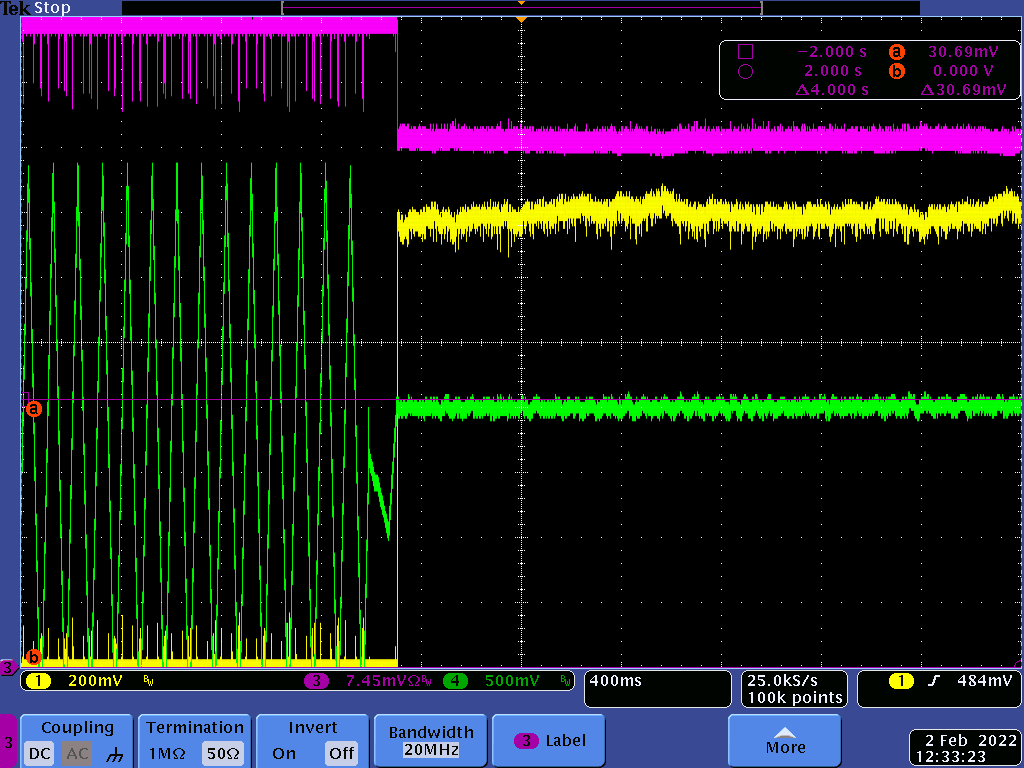
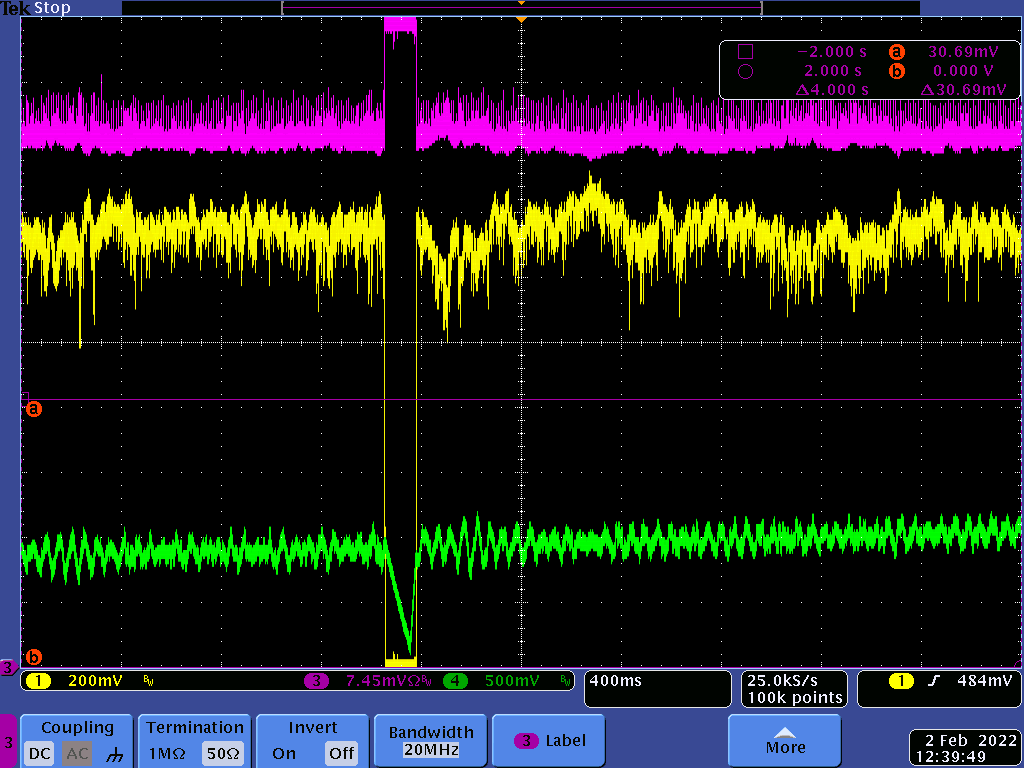
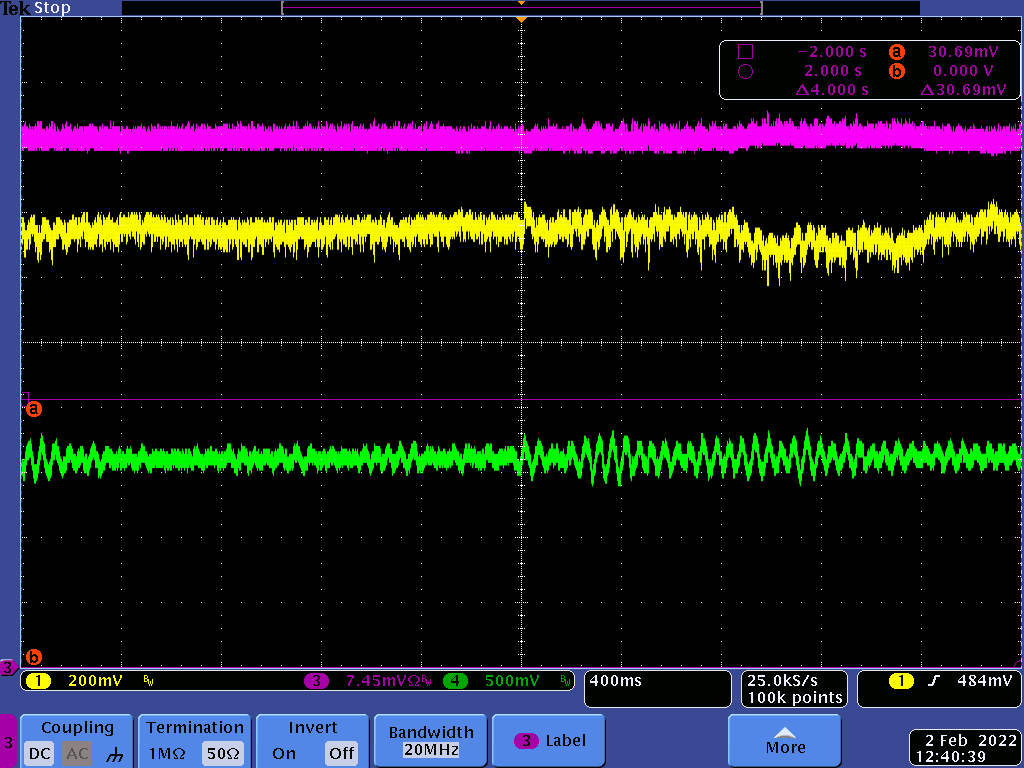
Manar Amer | Fixed | report | lasers and optics | detectors and electronics | ThomX igloo | FP cavity alignment | Adding Oscilloscope images
- delocked + locked intervals showing the 20% coupling
- lock when the housing panels are closed + airflow on .
- lock when the housing panels are closed + air flow at lowest setting
an additional factor to the PZT voltage sensitivity is the housing panels, we see a decrease in the voltage when closing them.
| Manar Amer wrote: |
|
This morning with Manar, we installed the AOM+RF amplifier and the associated fast feedback loop.
Now the locking with the Koheras is good with a coupling of 20%.
Tomorrow is dedicated to the measurement of the Finesse.... we will have to add the 2nd EOM.
We observed a very stable lock if the airflow is OFF.
when it is ON, the lock is much less stable... maybe a problem of optimization of the feedback... we will see that tomorrow if we have time enough.
We also observed a quite important sensititvity of the PZT voltage when slightly pushing on the housing with the finger: we clearly see the compensation on the PZT voltage.
I didn't calibrate this voltage but it seems to be an important fraction of 1µm... I would say around 100nm
| Manar Amer wrote: |
|
This afternoon, I did some alignment of the injection mirrors with a fast scan on the LaseLock to get a regular transmission photodiode signal.
the coupling increased to 10-15%
I got a first lock of the cavity only with the PZT.
there is some ringing on the error signal and the locking is quite noisy, which means the cavity LW seems to be more narrow than the Koheras LW, which is a good sign.
tomorrow, I will add an AOM to improve the locking.
I did some alignment after locking.
it was difficult because of the outside noise (engines producing loud and low-frequency noises).
the coupling is now about 20% (position saved in the injection motors software).
I added a half waveplate which has to be optimized.
| Manar Amer wrote: |
|
Installed and inputs:
- CW laser ; power = 101 mW
- PDH ;
- at output
- Low pass filter 50 ohm DC-1.9 MHz
- at input
- freq = 8.4 MHz , Ampl = 1.2 V , phase = 160 /
- voltage = ~ 6 V
- EOM ; freq = 8.4 MHz , Ampl = 100 mV , phase = 90
- Photodiodes
- beam profiler
Observed during this morning:
- coupling : below 10% .... approximately ~ 8%
- Oscilloscope :
- yellow : transmission
- purple : reflection
- Blue : error signal
- green : scan signal
Note : We observe a lot of higher order modes, and they are not occurring regularly.
A schematic of the current setup is attached.
An image from the oscilloscope show a low coupling but clean error signal.
| Manar Amer wrote: |
|
Yesterday, we did the alignment again using Iris and beam profilers to obtain a more precise result.
at the end of the alignment procedure, we successfully obtained the beating modes.
the geometrical alignment seems good (weak odd modes) but we could need to put a telescope on the Koheras line as the beam size seems quite different from the mode size (quite strong even modes).
without any improvement of the alignment using photodiodes, one obtains about 15-20% of coupling.
we put several Iris on the table:
- 2 Iris before the 2 alignment mirrors to fix the axis of the laser on these mirrors
- 1 Iris just before the cavity (we will add an additional one today) to fix the cavity axis
- 1 Iris in reflection of the cavity to fix the M1 orientation
| Manar Amer wrote: |
|
***** Continuation of the alignment ---- FP Cavity Open --- ****
The cavity was put under outer pressure and was opened for the alignment
The alignment was done using CW koheras infrared laser and the inside mirrors irises
we observed the beam output centered at S2, S3 and P4
transmission from S4 to P1 was aligned at the center of P1 iris and an outside reference was fixed, then P1 mirror was placed, and we aligned the reflection with the transmission.
....... After the interior alignment, the cavity windows were closed ....
A beam profiler was placed at P4 transmission -----> nothing observed even with a piezo drive on the CW infrared laser
observed a beam output at S2 and S3, but the fundamental mode is not seen, or even a higher order mode (which we can't explain, as the beam is centered on the mirrors)
images show the output at S2 and S3
| Manar Amer wrote: |
|
The alignment is on hold until next week 17th - 18th Jan
an Alignment attempt will be done when the ring part close to the FP cavity is opened.
| Manar Amer wrote: |
|
Note the direction of injection is M1 - M2 - M3 - M4
P1 - S2 - S3 - P4
The injected beam is aligned at the center of the irises placed at the windows mounts of mirror M1 (Injection) and M2(spherical)
At Transmission of M2 : in addition to centered beam, we observe diffraction which interferes in observing the beating at M2 output
(could be diffracted beam from the metal pipes inside or from the D-shaped mirror installed inside)
At Transmission of M3 : we observe a beam output could be part of TM00 mode (the shape is distorted !!)
suspicious reasons :
- when we have a frequency sweep on the CW(Koheras) piezo; we observe it beating (when increasing the drive it is increasing in intensity)
- when we adjust the alignment mirrors; the beam doesn't change position and only its intensity changes
continuation with the alignment and try to eliminate the diffraction and find the shape of the beam.
A manual change in the D-shaped mirror position to remove any possible effects from it.
|
|
|
|
|
|
|
|
| Attachment 1: tek0003.png
|  |
| Attachment 2: tek0006.png
|  |
| Attachment 3: tek0007.png
|  |
|
119
|
Thu Feb 3 13:56:24 2022 |
Manar Amer | Fixed | report | lasers and optics | detectors and electronics | ThomX igloo | FP cavity alignment | Ending alignment series !!
| Manar Amer wrote: |
|
Adding Oscilloscope images
- delocked + locked intervals showing the 20% coupling
- lock when the housing panels are closed + airflow on .
- lock when the housing panels are closed + air flow at lowest setting
an additional factor to the PZT voltage sensitivity is the housing panels, we see a decrease in the voltage when closing them.
| Manar Amer wrote: |
|
This morning with Manar, we installed the AOM+RF amplifier and the associated fast feedback loop.
Now the locking with the Koheras is good with a coupling of 20%.
Tomorrow is dedicated to the measurement of the Finesse.... we will have to add the 2nd EOM.
We observed a very stable lock if the airflow is OFF.
when it is ON, the lock is much less stable... maybe a problem of optimization of the feedback... we will see that tomorrow if we have time enough.
We also observed a quite important sensititvity of the PZT voltage when slightly pushing on the housing with the finger: we clearly see the compensation on the PZT voltage.
I didn't calibrate this voltage but it seems to be an important fraction of 1µm... I would say around 100nm
| Manar Amer wrote: |
|
This afternoon, I did some alignment of the injection mirrors with a fast scan on the LaseLock to get a regular transmission photodiode signal.
the coupling increased to 10-15%
I got a first lock of the cavity only with the PZT.
there is some ringing on the error signal and the locking is quite noisy, which means the cavity LW seems to be more narrow than the Koheras LW, which is a good sign.
tomorrow, I will add an AOM to improve the locking.
I did some alignment after locking.
it was difficult because of the outside noise (engines producing loud and low-frequency noises).
the coupling is now about 20% (position saved in the injection motors software).
I added a half waveplate which has to be optimized.
| Manar Amer wrote: |
|
Installed and inputs:
- CW laser ; power = 101 mW
- PDH ;
- at output
- Low pass filter 50 ohm DC-1.9 MHz
- at input
- freq = 8.4 MHz , Ampl = 1.2 V , phase = 160 /
- voltage = ~ 6 V
- EOM ; freq = 8.4 MHz , Ampl = 100 mV , phase = 90
- Photodiodes
- beam profiler
Observed during this morning:
- coupling : below 10% .... approximately ~ 8%
- Oscilloscope :
- yellow : transmission
- purple : reflection
- Blue : error signal
- green : scan signal
Note : We observe a lot of higher order modes, and they are not occurring regularly.
A schematic of the current setup is attached.
An image from the oscilloscope show a low coupling but clean error signal.
| Manar Amer wrote: |
|
Yesterday, we did the alignment again using Iris and beam profilers to obtain a more precise result.
at the end of the alignment procedure, we successfully obtained the beating modes.
the geometrical alignment seems good (weak odd modes) but we could need to put a telescope on the Koheras line as the beam size seems quite different from the mode size (quite strong even modes).
without any improvement of the alignment using photodiodes, one obtains about 15-20% of coupling.
we put several Iris on the table:
- 2 Iris before the 2 alignment mirrors to fix the axis of the laser on these mirrors
- 1 Iris just before the cavity (we will add an additional one today) to fix the cavity axis
- 1 Iris in reflection of the cavity to fix the M1 orientation
| Manar Amer wrote: |
|
***** Continuation of the alignment ---- FP Cavity Open --- ****
The cavity was put under outer pressure and was opened for the alignment
The alignment was done using CW koheras infrared laser and the inside mirrors irises
we observed the beam output centered at S2, S3 and P4
transmission from S4 to P1 was aligned at the center of P1 iris and an outside reference was fixed, then P1 mirror was placed, and we aligned the reflection with the transmission.
....... After the interior alignment, the cavity windows were closed ....
A beam profiler was placed at P4 transmission -----> nothing observed even with a piezo drive on the CW infrared laser
observed a beam output at S2 and S3, but the fundamental mode is not seen, or even a higher order mode (which we can't explain, as the beam is centered on the mirrors)
images show the output at S2 and S3
| Manar Amer wrote: |
|
The alignment is on hold until next week 17th - 18th Jan
an Alignment attempt will be done when the ring part close to the FP cavity is opened.
| Manar Amer wrote: |
|
Note the direction of injection is M1 - M2 - M3 - M4
P1 - S2 - S3 - P4
The injected beam is aligned at the center of the irises placed at the windows mounts of mirror M1 (Injection) and M2(spherical)
At Transmission of M2 : in addition to centered beam, we observe diffraction which interferes in observing the beating at M2 output
(could be diffracted beam from the metal pipes inside or from the D-shaped mirror installed inside)
At Transmission of M3 : we observe a beam output could be part of TM00 mode (the shape is distorted !!)
suspicious reasons :
- when we have a frequency sweep on the CW(Koheras) piezo; we observe it beating (when increasing the drive it is increasing in intensity)
- when we adjust the alignment mirrors; the beam doesn't change position and only its intensity changes
continuation with the alignment and try to eliminate the diffraction and find the shape of the beam.
A manual change in the D-shaped mirror position to remove any possible effects from it.
|
|
|
|
|
|
|
|
|
|
120
|
Thu Feb 3 14:10:08 2022 |
Manar Amer | Fixed | report | lasers and optics | detectors and electronics | ThomX igloo | FP cavity alignment | As it can be seen on the first plot, even with a good locking (good reduction of "high" frequencies noise: we had better locking than on the picture) we still have very low frequency (~ 1Hz) fluctuations
these fluctuations prevent having a good measurement of the Finesse and they need to be understood.
they can come from fluctuations due to :
- input power
- input or feedback polarization
- phase noise
- alignment
- mode matching
1) input power:
we looked at the direct reflected power from the cavity without locking as an image of the input power.
=> we don't see these fluctuations
2) input polarization:
as there are many unconstrained fibers after the NKT (EOM/AOM) it could produce some polarization fluctuations.
we put a PBS and half and quarter waveplates in front of the reflected photodiode when the cavity is not locked to detect a change in the input polarization
=> we don't see these fluctuations
3) feedback polarization:
the beam on the PDH box is coming from a wedge which can change the relative gains between different polarizations.
we put half and quarter waveplates in the injection path to adapt the input polarization with the cavity mode polarization axis
and we put half and quarter waveplates and a PBS in front of the PDH box to select the right polarization for the feedback.
=> it didn't change the power fluctuations effect.
4) phase noise
we adjusted the feedback parameters (PID gains, AOM gain, locking offset, digital and analog low pass filters) to have a clean signal without high frequencies noise.
the transmission and coupling signals exhibit quite narrow lines at the millisecond level but we see 10-15% transmission change at the second level.
as the PID has a higher gain at low frequencies, one should not see more fluctuations at these frequencies.
or if it comes from external noise, one should see a correction signal on the PZT which is the image of these fluctuations => we don't see that.
we also stopped the cavity motors controllers without any effect on the transmission stability.
5) alignment
the alignment cannot change except if some vibrations are present, which should be seen also on the PZT correction signal => we don't see that.
6) mode matching
as the coupling is only 20% and the alignment has been already optimized, the mode matching is quite bad for sure.
could it be the source of the problem?
from experience, we know that a bad mode matching implies a bad locking but the reason is not clear.
=> to be discussed with Viktor: can we improve the mode matching with a simple lens?
.
| Manar Amer wrote: |
|
Adding Oscilloscope images
- delocked + locked intervals showing the 20% coupling
- lock when the housing panels are closed + airflow on .
- lock when the housing panels are closed + air flow at lowest setting
an additional factor to the PZT voltage sensitivity is the housing panels, we see a decrease in the voltage when closing them.
| Manar Amer wrote: |
|
This morning with Manar, we installed the AOM+RF amplifier and the associated fast feedback loop.
Now the locking with the Koheras is good with a coupling of 20%.
Tomorrow is dedicated to the measurement of the Finesse.... we will have to add the 2nd EOM.
We observed a very stable lock if the airflow is OFF.
when it is ON, the lock is much less stable... maybe a problem of optimization of the feedback... we will see that tomorrow if we have time enough.
We also observed a quite important sensititvity of the PZT voltage when slightly pushing on the housing with the finger: we clearly see the compensation on the PZT voltage.
I didn't calibrate this voltage but it seems to be an important fraction of 1µm... I would say around 100nm
| Manar Amer wrote: |
|
This afternoon, I did some alignment of the injection mirrors with a fast scan on the LaseLock to get a regular transmission photodiode signal.
the coupling increased to 10-15%
I got a first lock of the cavity only with the PZT.
there is some ringing on the error signal and the locking is quite noisy, which means the cavity LW seems to be more narrow than the Koheras LW, which is a good sign.
tomorrow, I will add an AOM to improve the locking.
I did some alignment after locking.
it was difficult because of the outside noise (engines producing loud and low-frequency noises).
the coupling is now about 20% (position saved in the injection motors software).
I added a half waveplate which has to be optimized.
| Manar Amer wrote: |
|
Installed and inputs:
- CW laser ; power = 101 mW
- PDH ;
- at output
- Low pass filter 50 ohm DC-1.9 MHz
- at input
- freq = 8.4 MHz , Ampl = 1.2 V , phase = 160 /
- voltage = ~ 6 V
- EOM ; freq = 8.4 MHz , Ampl = 100 mV , phase = 90
- Photodiodes
- beam profiler
Observed during this morning:
- coupling : below 10% .... approximately ~ 8%
- Oscilloscope :
- yellow : transmission
- purple : reflection
- Blue : error signal
- green : scan signal
Note : We observe a lot of higher order modes, and they are not occurring regularly.
A schematic of the current setup is attached.
An image from the oscilloscope show a low coupling but clean error signal.
| Manar Amer wrote: |
|
Yesterday, we did the alignment again using Iris and beam profilers to obtain a more precise result.
at the end of the alignment procedure, we successfully obtained the beating modes.
the geometrical alignment seems good (weak odd modes) but we could need to put a telescope on the Koheras line as the beam size seems quite different from the mode size (quite strong even modes).
without any improvement of the alignment using photodiodes, one obtains about 15-20% of coupling.
we put several Iris on the table:
- 2 Iris before the 2 alignment mirrors to fix the axis of the laser on these mirrors
- 1 Iris just before the cavity (we will add an additional one today) to fix the cavity axis
- 1 Iris in reflection of the cavity to fix the M1 orientation
| Manar Amer wrote: |
|
***** Continuation of the alignment ---- FP Cavity Open --- ****
The cavity was put under outer pressure and was opened for the alignment
The alignment was done using CW koheras infrared laser and the inside mirrors irises
we observed the beam output centered at S2, S3 and P4
transmission from S4 to P1 was aligned at the center of P1 iris and an outside reference was fixed, then P1 mirror was placed, and we aligned the reflection with the transmission.
....... After the interior alignment, the cavity windows were closed ....
A beam profiler was placed at P4 transmission -----> nothing observed even with a piezo drive on the CW infrared laser
observed a beam output at S2 and S3, but the fundamental mode is not seen, or even a higher order mode (which we can't explain, as the beam is centered on the mirrors)
images show the output at S2 and S3
| Manar Amer wrote: |
|
The alignment is on hold until next week 17th - 18th Jan
an Alignment attempt will be done when the ring part close to the FP cavity is opened.
| Manar Amer wrote: |
|
Note the direction of injection is M1 - M2 - M3 - M4
P1 - S2 - S3 - P4
The injected beam is aligned at the center of the irises placed at the windows mounts of mirror M1 (Injection) and M2(spherical)
At Transmission of M2 : in addition to centered beam, we observe diffraction which interferes in observing the beating at M2 output
(could be diffracted beam from the metal pipes inside or from the D-shaped mirror installed inside)
At Transmission of M3 : we observe a beam output could be part of TM00 mode (the shape is distorted !!)
suspicious reasons :
- when we have a frequency sweep on the CW(Koheras) piezo; we observe it beating (when increasing the drive it is increasing in intensity)
- when we adjust the alignment mirrors; the beam doesn't change position and only its intensity changes
continuation with the alignment and try to eliminate the diffraction and find the shape of the beam.
A manual change in the D-shaped mirror position to remove any possible effects from it.
|
|
|
|
|
|
|
|
|
|
121
|
Thu Feb 3 14:11:50 2022 |
Manar Amer | Fixed | report | lasers and optics | detectors and electronics | ThomX igloo | Cavity Lock and Finess measurment | This morning, me and Ronic managed to obtain the FSR and image of the finesse which is to be analyzed.
Adding:
- Beam Image at P4 propagation, no lens is added.
- Image of the Finesse on Oscilloscope
more information to be included later
Will continue in the afternoon . |
| Attachment 1: Capture3.PNG
|  |
| Attachment 2: Capture4.PNG
|  |
| Attachment 3: tek0011.png
|  |
| Attachment 4: tek0011CH1.isf
|
| Attachment 5: tek0011CH3.isf
|
| Attachment 6: tek0011CH4.isf
|
|
123
|
Thu Feb 3 18:40:04 2022 |
Manar Amer | Fixed | report | lasers and optics | detectors and electronics | ThomX igloo | FP cavity alignment | The fluctuation problem has been solved.
It was simply the new scheme to inject 2 RF frequencies in a single EOM.
It maybe produces some standing waves in the EOM RF input and creates some phase noise.
we went back to the standard solution with 2x EOM and the problem vanished.
Now we have a very good lock and we can measure the Finesse.
| Manar Amer wrote: |
|
As it can be seen on the first plot, even with a good locking (good reduction of "high" frequencies noise: we had better locking than on the picture) we still have very low frequency (~ 1Hz) fluctuations
these fluctuations prevent having a good measurement of the Finesse and they need to be understood.
they can come from fluctuations due to :
- input power
- input or feedback polarization
- phase noise
- alignment
- mode matching
1) input power:
we looked at the direct reflected power from the cavity without locking as an image of the input power.
=> we don't see these fluctuations
2) input polarization:
as there are many unconstrained fibers after the NKT (EOM/AOM) it could produce some polarization fluctuations.
we put a PBS and half and quarter waveplates in front of the reflected photodiode when the cavity is not locked to detect a change in the input polarization
=> we don't see these fluctuations
3) feedback polarization:
the beam on the PDH box is coming from a wedge which can change the relative gains between different polarizations.
we put half and quarter waveplates in the injection path to adapt the input polarization with the cavity mode polarization axis
and we put half and quarter waveplates and a PBS in front of the PDH box to select the right polarization for the feedback.
=> it didn't change the power fluctuations effect.
4) phase noise
we adjusted the feedback parameters (PID gains, AOM gain, locking offset, digital and analog low pass filters) to have a clean signal without high frequencies noise.
the transmission and coupling signals exhibit quite narrow lines at the millisecond level but we see 10-15% transmission change at the second level.
as the PID has a higher gain at low frequencies, one should not see more fluctuations at these frequencies.
or if it comes from external noise, one should see a correction signal on the PZT which is the image of these fluctuations => we don't see that.
we also stopped the cavity motors controllers without any effect on the transmission stability.
5) alignment
the alignment cannot change except if some vibrations are present, which should be seen also on the PZT correction signal => we don't see that.
6) mode matching
as the coupling is only 20% and the alignment has been already optimized, the mode matching is quite bad for sure.
could it be the source of the problem?
from experience, we know that a bad mode matching implies a bad locking but the reason is not clear.
=> to be discussed with Viktor: can we improve the mode matching with a simple lens?
.
| Manar Amer wrote: |
|
Adding Oscilloscope images
- delocked + locked intervals showing the 20% coupling
- lock when the housing panels are closed + airflow on .
- lock when the housing panels are closed + air flow at lowest setting
an additional factor to the PZT voltage sensitivity is the housing panels, we see a decrease in the voltage when closing them.
| Manar Amer wrote: |
|
This morning with Manar, we installed the AOM+RF amplifier and the associated fast feedback loop.
Now the locking with the Koheras is good with a coupling of 20%.
Tomorrow is dedicated to the measurement of the Finesse.... we will have to add the 2nd EOM.
We observed a very stable lock if the airflow is OFF.
when it is ON, the lock is much less stable... maybe a problem of optimization of the feedback... we will see that tomorrow if we have time enough.
We also observed a quite important sensititvity of the PZT voltage when slightly pushing on the housing with the finger: we clearly see the compensation on the PZT voltage.
I didn't calibrate this voltage but it seems to be an important fraction of 1µm... I would say around 100nm
| Manar Amer wrote: |
|
This afternoon, I did some alignment of the injection mirrors with a fast scan on the LaseLock to get a regular transmission photodiode signal.
the coupling increased to 10-15%
I got a first lock of the cavity only with the PZT.
there is some ringing on the error signal and the locking is quite noisy, which means the cavity LW seems to be more narrow than the Koheras LW, which is a good sign.
tomorrow, I will add an AOM to improve the locking.
I did some alignment after locking.
it was difficult because of the outside noise (engines producing loud and low-frequency noises).
the coupling is now about 20% (position saved in the injection motors software).
I added a half waveplate which has to be optimized.
| Manar Amer wrote: |
|
Installed and inputs:
- CW laser ; power = 101 mW
- PDH ;
- at output
- Low pass filter 50 ohm DC-1.9 MHz
- at input
- freq = 8.4 MHz , Ampl = 1.2 V , phase = 160 /
- voltage = ~ 6 V
- EOM ; freq = 8.4 MHz , Ampl = 100 mV , phase = 90
- Photodiodes
- beam profiler
Observed during this morning:
- coupling : below 10% .... approximately ~ 8%
- Oscilloscope :
- yellow : transmission
- purple : reflection
- Blue : error signal
- green : scan signal
Note : We observe a lot of higher order modes, and they are not occurring regularly.
A schematic of the current setup is attached.
An image from the oscilloscope show a low coupling but clean error signal.
| Manar Amer wrote: |
|
Yesterday, we did the alignment again using Iris and beam profilers to obtain a more precise result.
at the end of the alignment procedure, we successfully obtained the beating modes.
the geometrical alignment seems good (weak odd modes) but we could need to put a telescope on the Koheras line as the beam size seems quite different from the mode size (quite strong even modes).
without any improvement of the alignment using photodiodes, one obtains about 15-20% of coupling.
we put several Iris on the table:
- 2 Iris before the 2 alignment mirrors to fix the axis of the laser on these mirrors
- 1 Iris just before the cavity (we will add an additional one today) to fix the cavity axis
- 1 Iris in reflection of the cavity to fix the M1 orientation
| Manar Amer wrote: |
|
***** Continuation of the alignment ---- FP Cavity Open --- ****
The cavity was put under outer pressure and was opened for the alignment
The alignment was done using CW koheras infrared laser and the inside mirrors irises
we observed the beam output centered at S2, S3 and P4
transmission from S4 to P1 was aligned at the center of P1 iris and an outside reference was fixed, then P1 mirror was placed, and we aligned the reflection with the transmission.
....... After the interior alignment, the cavity windows were closed ....
A beam profiler was placed at P4 transmission -----> nothing observed even with a piezo drive on the CW infrared laser
observed a beam output at S2 and S3, but the fundamental mode is not seen, or even a higher order mode (which we can't explain, as the beam is centered on the mirrors)
images show the output at S2 and S3
| Manar Amer wrote: |
|
The alignment is on hold until next week 17th - 18th Jan
an Alignment attempt will be done when the ring part close to the FP cavity is opened.
| Manar Amer wrote: |
|
Note the direction of injection is M1 - M2 - M3 - M4
P1 - S2 - S3 - P4
The injected beam is aligned at the center of the irises placed at the windows mounts of mirror M1 (Injection) and M2(spherical)
At Transmission of M2 : in addition to centered beam, we observe diffraction which interferes in observing the beating at M2 output
(could be diffracted beam from the metal pipes inside or from the D-shaped mirror installed inside)
At Transmission of M3 : we observe a beam output could be part of TM00 mode (the shape is distorted !!)
suspicious reasons :
- when we have a frequency sweep on the CW(Koheras) piezo; we observe it beating (when increasing the drive it is increasing in intensity)
- when we adjust the alignment mirrors; the beam doesn't change position and only its intensity changes
continuation with the alignment and try to eliminate the diffraction and find the shape of the beam.
A manual change in the D-shaped mirror position to remove any possible effects from it.
|
|
|
|
|
|
|
|
|
|
|
125
|
Thu Feb 3 18:59:10 2022 |
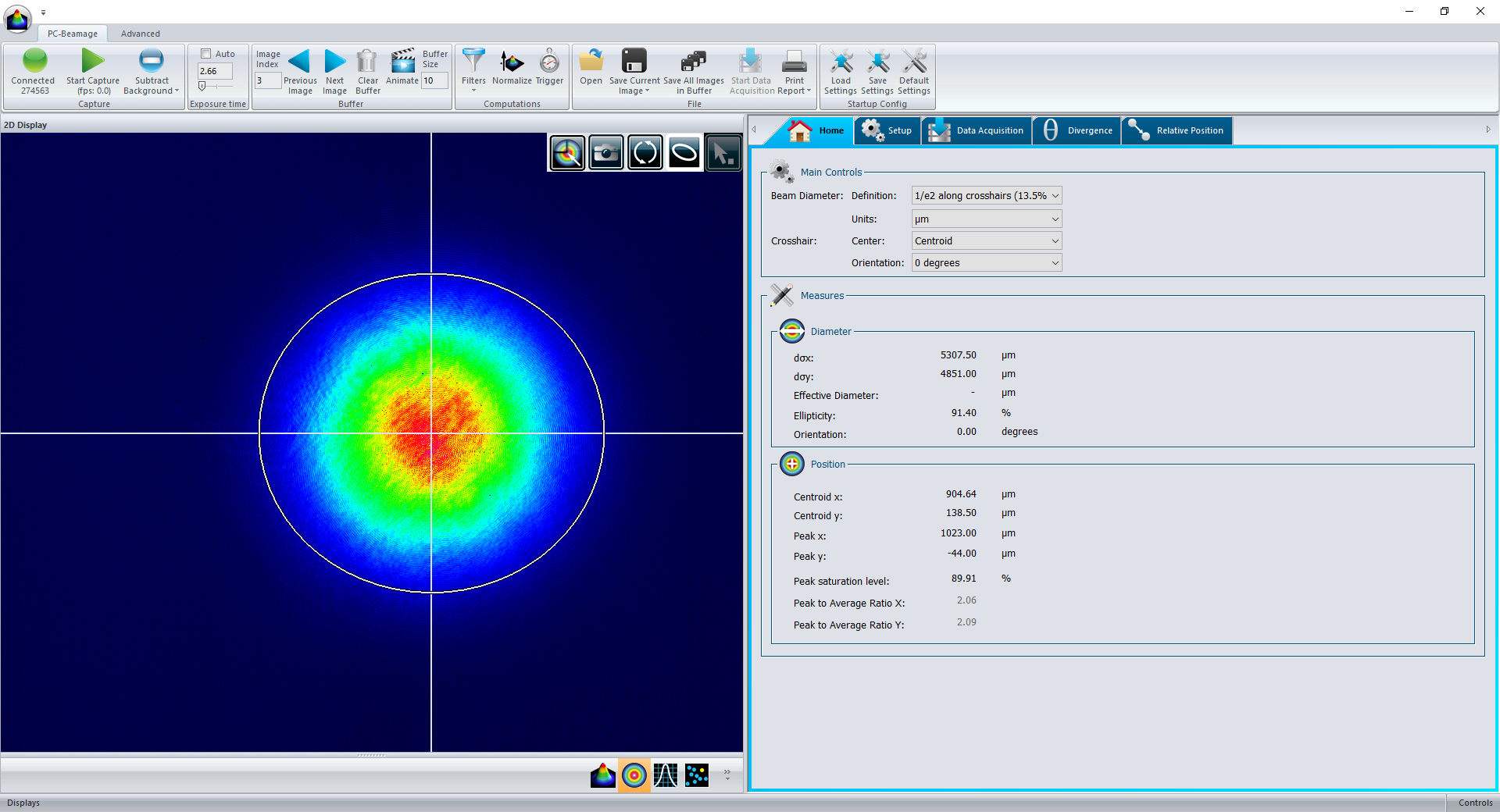
Manar Amer | Fixed | report | lasers and optics | detectors and electronics | ThomX igloo | Cavity Lock and Finess measurment | |
to measure the Finesse, instead of having 2x EOM for the PDH and for the modulation sweep, I simply used 2x generators coupled with DC-blocks to a T connector (SMA) screwed directly on the EOM input.
as the transmission signal is fluctuating, it is not easy to have a good fit of the Airy peak.
if I measure the width at half of the maximum of the peak, I found roughly 10kHz instead of the awaited 2kHz... :-(
one needs a better evaluation with a more stable transmission signal and also to be sure that the L-shape metal piece (used to remove high order modes) does not introduce some losses and then reduce the Finesse...
| Manar Amer wrote: |
|
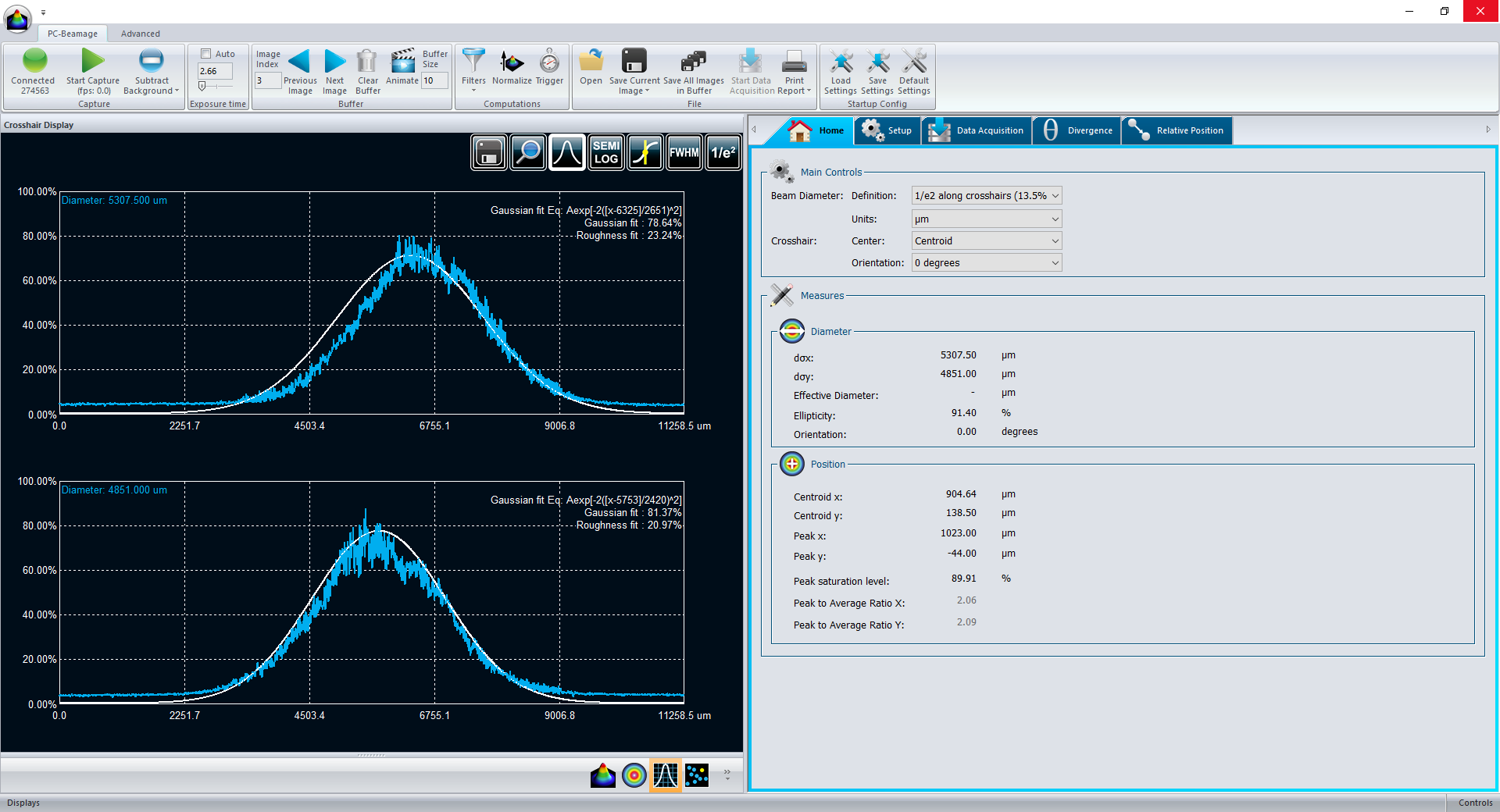
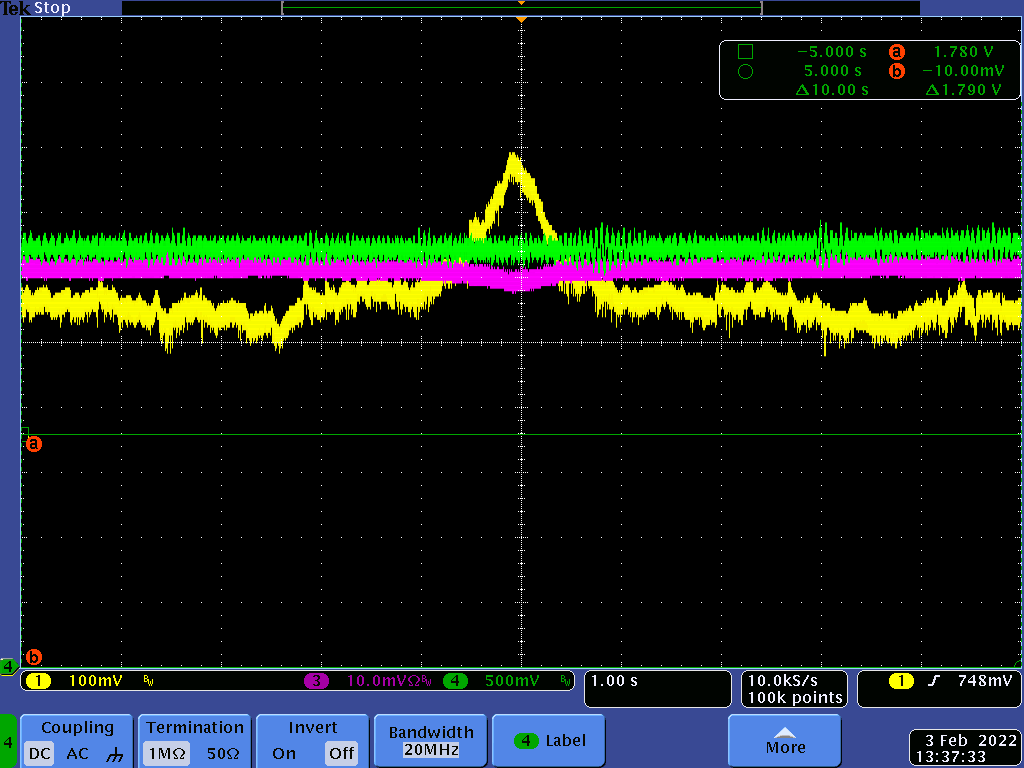
This morning, me and Ronic managed to obtain the FSR and image of the finesse which is to be analyzed.
Adding:
- Beam Image at P4 propagation, no lens is added.
- Image of the Finesse on Oscilloscope
more information to be included later
Will continue in the afternoon .
|
|
|
126
|
Thu Feb 3 19:01:04 2022 |
Manar Amer | Fixed | report | lasers and optics | detectors and electronics | ThomX igloo | Cavity Lock and Finess measurment | |
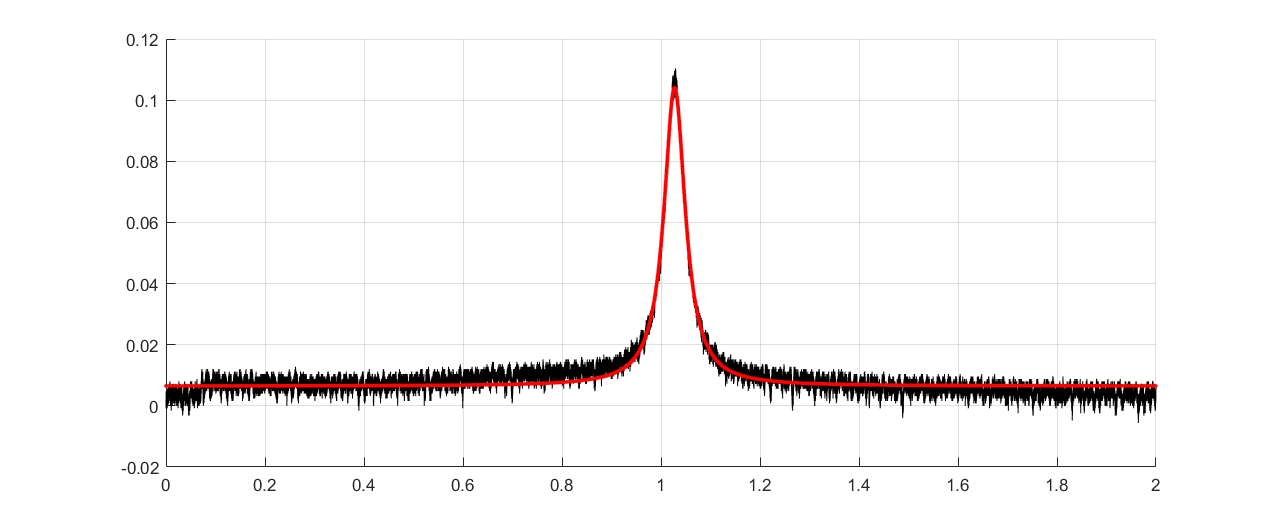
After changing the way of injecting modulation for PDH and modulation for FSR scanning (we split the modulations to 2 different EOMs), the locking is very stable and we can measure the Finesse.
FSR = 33.34MHz
hereafter, the transmission power during an FSR scan and its fit (sweep of 300kHz of FSR in 2s)
we took 5 acquisitions which give a Finesse of :
4236
4254
4400
4045
4177
=> roughly Finesse = 4200 ! far from the 17000 previously obtained........
| Manar Amer wrote: |
|
to measure the Finesse, instead of having 2x EOM for the PDH and for the modulation sweep, I simply used 2x generators coupled with DC-blocks to a T connector (SMA) screwed directly on the EOM input.
as the transmission signal is fluctuating, it is not easy to have a good fit of the Airy peak.
if I measure the width at half of the maximum of the peak, I found roughly 10kHz instead of the awaited 2kHz... :-(
one needs a better evaluation with a more stable transmission signal and also to be sure that the L-shape metal piece (used to remove high order modes) does not introduce some losses and then reduce the Finesse...
| Manar Amer wrote: |
|
This morning, me and Ronic managed to obtain the FSR and image of the finesse which is to be analyzed.
Adding:
- Beam Image at P4 propagation, no lens is added.
- Image of the Finesse on Oscilloscope
more information to be included later
Will continue in the afternoon .
|
|
|
| Attachment 1: Finesse_Fit.png
|  |
|
127
|
Fri Feb 4 10:59:56 2022 |
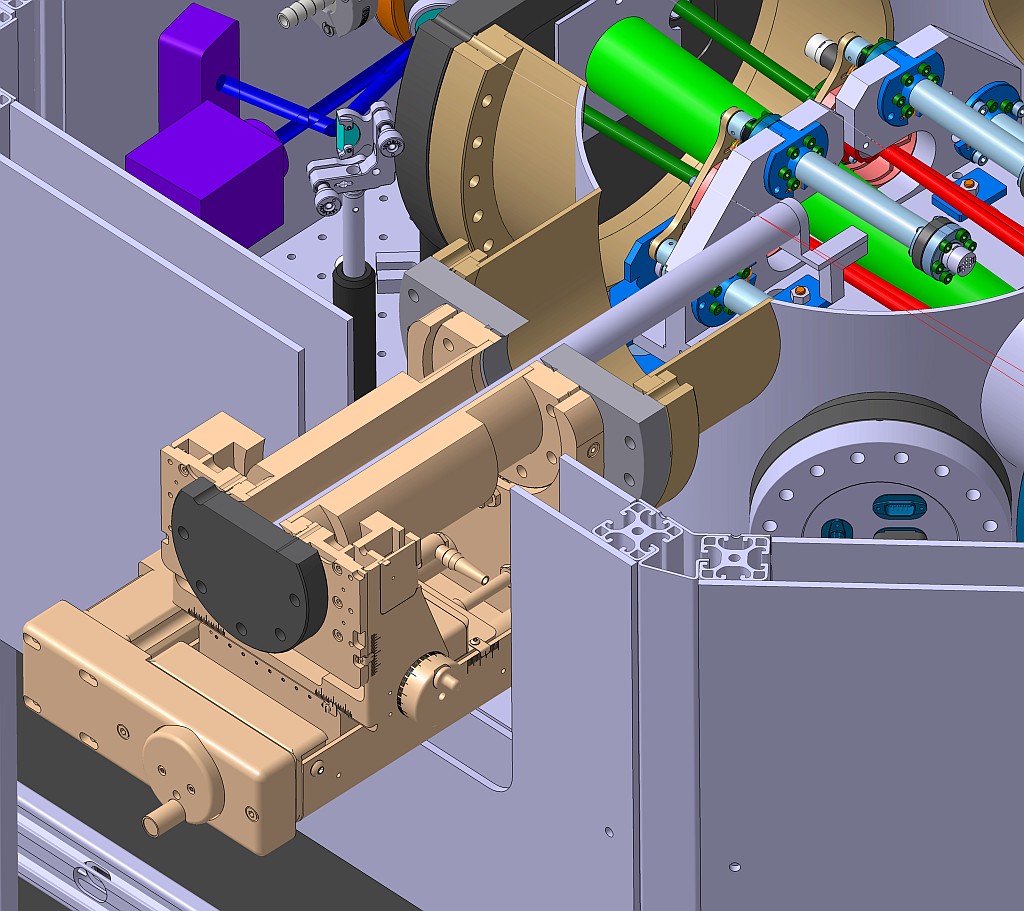
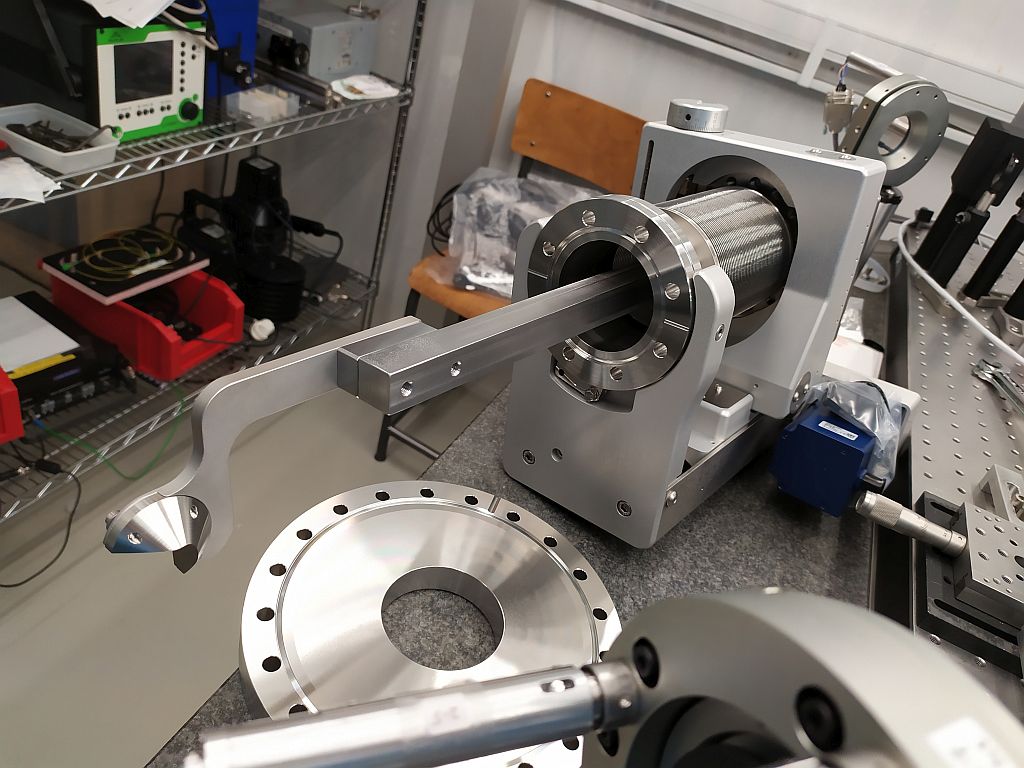
Manar Amer | Fixed | report | lasers and optics | detectors and electronics | ThomX igloo | Cavity Lock and Finess measurment | one thing which could reduce the Finesse is the L-shape metal piece if it is slightly inserted in the FP-cavity mode path.
understanding where this L-shape effectively is is not easy... some pictures are attached.
| Manar Amer wrote: |
|
After changing the way of injecting modulation for PDH and modulation for FSR scanning (we split the modulations to 2 different EOMs), the locking is very stable and we can measure the Finesse.
FSR = 33.34MHz
hereafter, the transmission power during an FSR scan and its fit (sweep of 300kHz of FSR in 2s)
we took 5 acquisitions which give a Finesse of :
4236
4254
4400
4045
4177
=> roughly Finesse = 4200 ! far from the 17000 previously obtained........
| Manar Amer wrote: |
|
to measure the Finesse, instead of having 2x EOM for the PDH and for the modulation sweep, I simply used 2x generators coupled with DC-blocks to a T connector (SMA) screwed directly on the EOM input.
as the transmission signal is fluctuating, it is not easy to have a good fit of the Airy peak.
if I measure the width at half of the maximum of the peak, I found roughly 10kHz instead of the awaited 2kHz... :-(
one needs a better evaluation with a more stable transmission signal and also to be sure that the L-shape metal piece (used to remove high order modes) does not introduce some losses and then reduce the Finesse...
| Manar Amer wrote: |
|
This morning, me and Ronic managed to obtain the FSR and image of the finesse which is to be analyzed.
Adding:
- Beam Image at P4 propagation, no lens is added.
- Image of the Finesse on Oscilloscope
more information to be included later
Will continue in the afternoon .
|
|
|
|
| Attachment 1: apercu_03.jpg
|  |
| Attachment 2: Bras_manipulateur.jpg
|  |
|
129
|
Fri Mar 11 12:59:35 2022 |
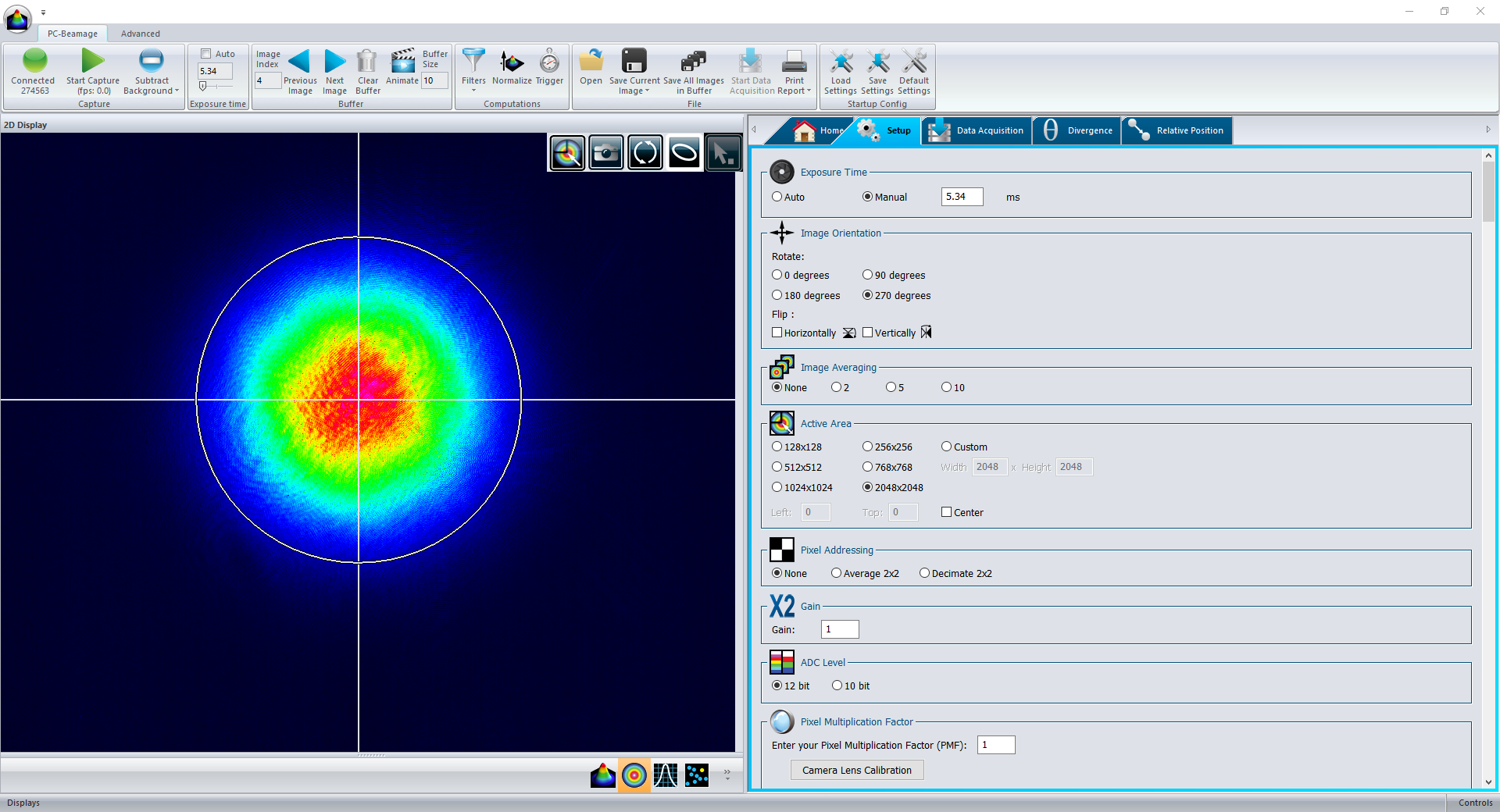
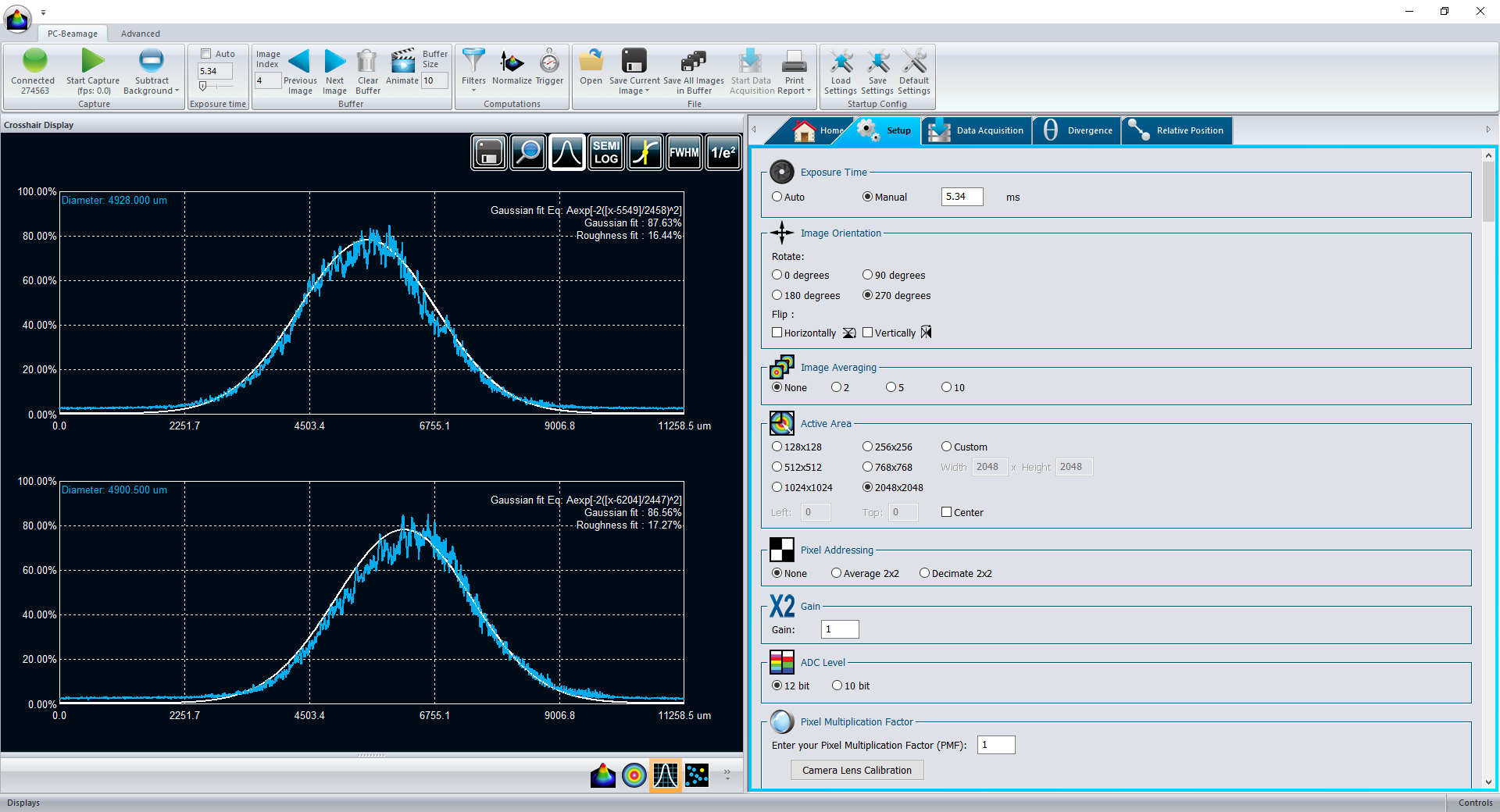
Manar Amer | Fixed | report | lasers and optics | ThomX igloo | Cavity beam Image | Updated beam image after change on the mode axis.
Taken after P4. |
| Attachment 1: Capture.PNG
|  |
| Attachment 2: Capture2.PNG
|  |
|
132
|
Mon Mar 14 18:39:40 2022 |
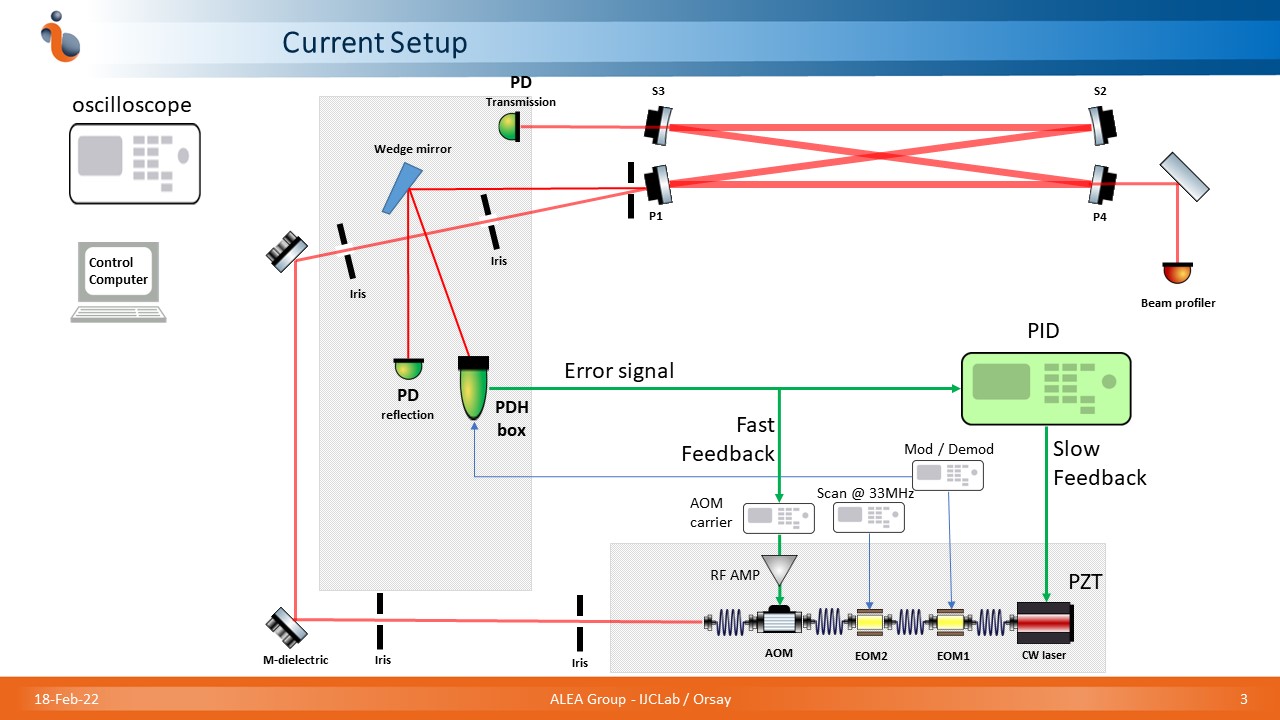
Manar Amer | Fixed | info | mechanics | lasers and optics | detectors and electronics | ThomX igloo | Current Installed Setup | Attached is the current setup in ThomX |
| Attachment 1: 18-02-2022_ThomX_FPCavity_Finesse_Setup.jpg
|  |
|