| ID |
Date |
Author |
Status |
Type |
Category |
Location |
Title |
|
249
|
Thu Jul 27 18:47:57 2023 |
Ronic Chiche | Fixed | info | detectors and electronics | Optical room | lock oscillateur 33MHz - synthé 500MHz | pour préparer le lock cavité-anneau, j'ai un setup de lock en salle optique entre le laser OneFive 133MHz et un synthé à 533MHz (133MHz x4).
ce matin, j'ai pu locker les 2 ensembles avec le laselock avec une stabilité RMS, je pense inférieure à la ps.
ma limite de mesure du jitter temporel au scope est de ~ 2.5ps.
- une fois locké avec le laselock, je peux facilement décaler légèrement en phase les 2 signaux de façon très précise (<1ps) en jouant sur l'offset de lock,
mais je ai une plage assez petite (+/- 250ps) qui correspond grosso modo aux plages linéaires du sinus (1/4 de période) soit 500ps (F ~ 533MHz => T ~ 2ns)
en changeant le signe du lock, je peux faire des sauts du lock d'une 1/2 période, soit 1ns...
mais cela ne suffit pas à couvrir l'intégralité de la période du signal de référence.
=> 1er problème : je n'ai accès qu'aux plages "linéaires" du signal de référence.
il faudrait un petit déphaseur programmable piloté en remote pour faire des steps de 100ps environ, sur une plage de 1 ou 2ns afin d'être sur de scanner tout la période du 500MHz.
- en coupant le lock, les fréquences driftent l'une par rapport à l'autre.
et en raccrochant le lock, on peut scanner toute la période entre 2 pulses d'électrons par steps de 2ns.
puis en changeant le signe du lock, par steps de 2ns mais décalé de 1ns.
on peut donc facilement scanner la période des électrons avec des steps de 1ns et une plage de 500ps autour de chacun de ces steps.
=> 2e problème : lorsque l'on perd le lock de la cavité FP/laser involontairement, on perd l'info de la longueur de la cavité FP.
et lorsqu'on retrouvera le lock, il va se raccrocher sur une autre oscillation du 500MHz.
et donc on va perdre la phase avec les électrons à 16MHz.
=> on peut éventuellement afficher ce signal à 16MHz, en même temps que le 500MHz pour rechercher l'oscillation correspondante à la bonne phase sur le 16MHz.
mais dans tous les cas, il faudra rechercher à nouveau la phase é-/laser à chaque délock.
- Autre possibilité, faire la synchro sur le 16MHz au lieu du 500MHz.
la tentative aujourd'hui n'a rien donné car le signal est 30x moins intense => beaucoup plus de bruit.
=> le lock n'arrive pas du tout à accrocher même en filtrant énormément le signal IF avec 10kHz de BW.
|
|
227
|
Wed Jul 26 14:49:41 2023 |
Ronic Chiche | Fixed | info | lasers and optics | ThomX igloo | 33MHz oscillator + Alphanov amplifier lock | Today, we locked the cavity with input power @ 30% for the amp => we got 40kW with only 30% of coupling (and a bad lock => we could have more power inside cavity).
P@30% = 16W
Coupling = 30% => 4.8W of input power => Measured Gain = 8300
| Ronic Chiche wrote: |
|
we checked yesterday morning the real input power @ 30% for the amp => it is 16W in agreement with the previously measured values
| Ronic Chiche wrote: |
|
I checked with the Matlab code below the CEP detuning effect (2nm sech² spectrum... not exactly the same as in ThomX)
@ CEP = 0 => coupling = 100% and Gcav = 10.5k
if all the coupling loss comes from the CEP detuning effect :
@ CEP = pi/5 => coupling = 20% and Gcav = 2.14k (~ 10.5k x 20%)
so, it does not matter if the coupling loss comes from the CEP detuning effect or from beam mismatch or misalignment.
=> we should have more power at 20% coupling, not 10kW but 35kW !!!
=> we have to check the real input power !
| Ronic Chiche wrote: |
|
this morning, I tested the laser+amplifier @ 30% lock on the FP cavity with and without Smaract motors.
I recorded the PDH error signal during a lock:
- blue : with Smaract motors controller powered ON but motors are stopped
- yellow: with Smaract motors controller powered OFF
with Smaract motors controller powered ON and motors stopped, one can see a group of resonances around 10kHz (8 - 11 - 14kHz) which disappears when the controller is powered OFF.
one can see also a group of resonances around 25-30kHz for which some peaks desappear when the controller is OFF but most of them are still there... could it come from noise on the Onefive laser PZT ?
one can see also a noise reduction at low frequency with a corner frequency around 17kHz, which could be the Unity Gain Bandwidth of the feedback loop on the laser PZT (fast feedback loop on EOM was disconnected)
=> to be confirmed
*************************************************************************************************************************************************************
I was able to lock with a decent noise on transmission and reflection signals @ Pin=17W (30%) of input power and with a coupling ~ 20%.
I measured 31mW in transmission => Pcav ~ 10.3kW (T ~ 3ppm)
as T1=115 ppm and F=30000, the cavity gain is T1*(F/pi)^2 = 10.5k,
so, the FP cavity power should have been 17W * 20% * 10,5k = 35.7 kW !!! (maybe the formula is wrong if the coupling loss comes from the CEP detuning effect)
=> we have to check the incoming power and the formula !
so, maximum expected power in FP-cavity could be 70W * 100% * 10,5k * (10.3/35.7) = 210 kW !!! :-(
*************************************************************************************************************************************************************
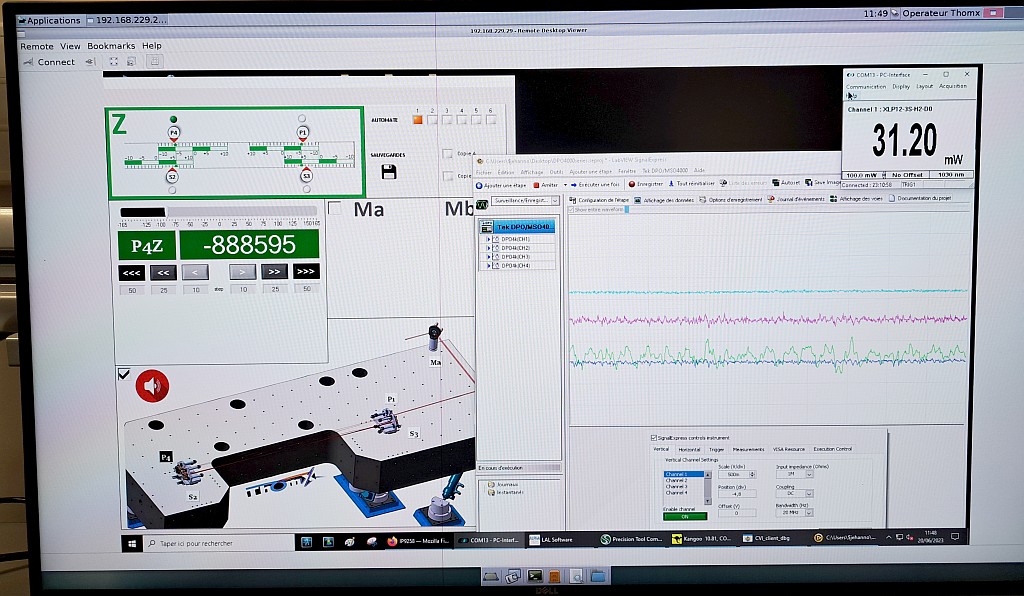
I was able to redo the lock easily in remote in the control room (with the Smaract motors controller OFF).
| Ronic Chiche wrote: |
|
After removing the 2 generators from the optical table, the lock is much more stable and now, it is possible to lock on the main resonance with a poor CEP but with quite good stability.
the coupling is still very low ~ 5% for that CEP but if one improves it (CEP ->0), using the laser double-wedge motor, one clearly sees an improvement of the coupling... but at the cost of the lock stability.
the reason of the poor coupling is also because the laser amplifier is used at 0%, for which we know the part of the laser signal power, compared to the total power, is low.
(a part of the beam @1030nm is not propagating in the fiber core of the amp, and then, it cannot be coupled to the FP-cavity).
the fast lock loop on the EOM has been disabled for the moment.
it has to be installed back to improve the stability at a better CEP.
at present, the FP-cavity power is estimated at ~ 90W (~270µW in transmission of ~3ppm mirrors) for ~300mW of total power coming from the laser amp.
next steps :
- in Open Loop : check what is the best coupling we can observe for CEP=0 @ P ~ 10W (laser amp at ~ 25%)
- in Closed Loop : @ P ~ 10W => measure the best transmitted power after alignement/polarization/feedback adjust => ~ 3-10kW in the cavity ?
| Ronic Chiche wrote: |
|
today with Daniele, we locked easily (but with a noisy lock) on the secundary resonance and we tried to lock on the main resonance (with very low coupling ~10% which mean a CEP ~Pi)
the lock was possible but was very noisy.
I installed a fast loop using my small DC amplifier based on OP37 (max gain=100) modified to be AC coupled to avoid to amplify the PDH box offset.
the output votage swing of the OP37 is only ~10V. Thus, the effect of this fast loop on the lock stability is not visible !
Thus, I added the M250 Leysop HV amplifier (see attached documentation), which is able to drive an EOM with >5MHz bandwidth and ~250V swing, after my OP37 amplifier.
with this additionnal HV amplifier, now we can clearly see the effect of the EOM loop which improves the lock stability BUT, even with a poor CEP, the lock is very unstable on the main resonance.
it seems the optical phase noise is still too large and/or its BW too high to be completely compensated.
The next step is to try to remove all the possible noise sources from the optical table:
- the laptop placed on the ionic pump
- the 2 Rigol generators on the table surface
and switch off the controller of the Smaract laser cavity motors.
If it doesn't help, we can send the error signal to a spectrum analyzer to have a better view of the different harmonics involved in the residual phase noise.
could it remain some noise above the present PDH box BW (1.9MHz LP filter) ?
lastely, we can also make an optical phase noise measurement to check if the Alphanov amplifier does not add some noise.
| Ronic Chiche wrote: |
|
finding the right modulation/demodulation PDH phase is very difficult on the main resonance because the we get non stationnary signals with a lot of oscillations.
changing the phase, in this condition, does not really change the error signal.
Then, we moved on the first secundary resonance with less gain and less coupling.
Thus, the error signal is more similar to the theoretical PDH signal => one can adjust the modulation/demodulation PDH phase to get the maximum error signal.
then, we locked pretty easily on this first secondary resonance, with a coupling around some % when we adjust the CEP motor.
we tried to lock on the main resonance but it is too noisy and unstable.
it seems we really need high BW feedback.
I tried to add a fast analog loop on the laser intra-cavity EOM but without a clear effect.
the problem is the gain of this loop : it is difficult to produce a "high voltage" (above 10Vpp) on this EOM.
I put "my" amplifier but the voltage output is limited... commercial amplifiers will have the same issue.
we can add HV amplifiers but it takes place and it will add some noise on the signal.
A loop with an AOM could be easier to install and manage... but at the price of a loss of power before the laser amplifier...
| Ronic Chiche wrote: |
|
the last tries to lock the 33MHz + amplifier to the 30k Finesse FP-cavity were unsuccessful.
during a laser Frep scan using the Laselock, one observes that the main cavity resonance is not able to stay inside the PZT scan range from one scan to another (500ms-1s period)
is it the effect of a large and slow phase noise ?
some informations:
- The 33MHz laser came back at lab from repair on March 2018.
- it has been sent to Alphanov in May 2020.
- it failled and has been sent to NKT/OneFive for repair in September 2021
- it came back to lab from repair in June 2022.
- on post #92 (Feb. 2020), it seems that we already locked the 33MHz laser + CELIA amplifier to the ThomX FP-cavity.
- The PZT sensitivity for the 33MHz laser is given to 0,3Hz/V for Frep <=> 2.6MHz/V for optical frequency.
=> 10V on PZT is equivalent to 26MHz of optical frequency shift which is less than FSR !
- by comparison, the PZT sensitivity for the 133MHz laser is given to 3.9Hz/V for Frep <=> 8.5MHz/V for optical frequency.
- by comparison, the PZT sensitivity for the NKT CW laser is given 10pm/100V for Wavelength <=> 30MHz/V for optical frequency
- by comparison, the PZT sensitivity for the ThomX FP cavity (Z20H38x40C) is 4nm/V for length expansion => 8nm/V for round-trip expansion <=> 0.03Hz/V for FSR expansion <=> 260kHz/V for optical frequency !!!
the PZT expansion estimation is in attached file.
|
|
|
|
|
|
|
|
|
226
|
Wed Jun 28 19:07:42 2023 |
Ronic Chiche | Fixed | issue | lasers and optics | ThomX igloo | Incoming laser beam power issue | today, we observed on the photodiode used in reflexion of the cavity, that its voltage level stops increasing after 50% of power for the laser amplifier when the cavity is not locked (the FP-cavity is just a reflective mirror).
the photodiode itself is not saturated (low power sent after a wedge and an absorbing filter) and the reading is done on 50 ohms.
so we are investigating the reason of this "saturation".
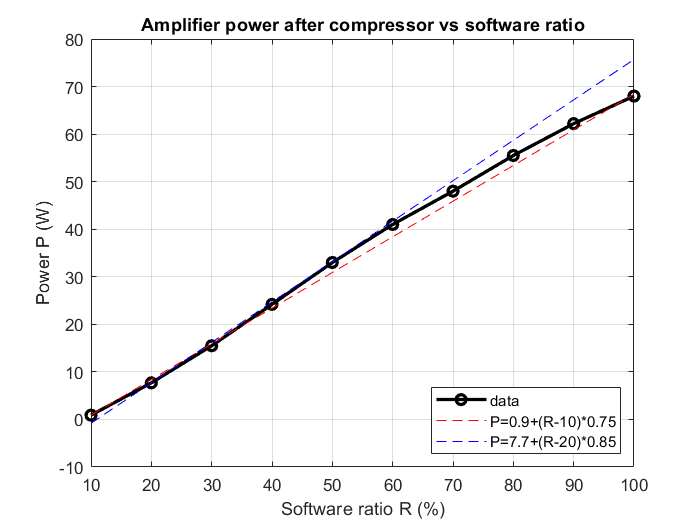
1) we did a beam power measurement just after the 2 mirrors, right after the amplifier, with the "big" powermeter:
power ratio Power (W)
10% => 0.9
20% => 7.7
30% => 15.5
40% => 24.2
50% => 33
60% => 41
70% => 48
80% => 55.5
90% => 62.2
100% => 68
plot in attached file
2) we did the same measurement after the periscope:
power ratio Power (W)
10% => 0.82
20% => 7.7
30% => 15.5
40% => 24.2
50% => 32.6
60% => 39
70% => 44
80% => 47.4
we clearly see a power reduction from 50% and beyond.
with the viewer we saw 2 effects : a slight clipping in the telescope and some speckles on the periscope mirrors mainly.
the laser is also slightly shifted on the 2nd mirror after the amp.
it is possible the laser beam moved due to thermal effect => we will need to realign properly the whole injection line and be aware about mirrors and lens cleaning !
3) we did some measurements using 2 wedges with the "small' powermeter in reflection of the cavity.
we remove the small aperture half-waveplate to see the effect and we used a lens to focalize the beam:
the half-waveplate has an effect on the reflectivity of the wedges, this is the reason of the difference in the measurement.
Power (µW)
power ratio with lambda/2 w/o lambda/2 w/o lambda/2+lens
10% => 12.4 4.8 5.1
20% => 132 48 51
30% => 262 96 101
40% => 370 137 147
50% => 420 158 175
60% => 430 165 181
we observe a clear "saturation" after 50%-60% which is very similar to what we observed with the photodiode in reflection when the cavity is not locked.
the small iris used in front of the injection window of the cavity is a good "candidate" for clipping the beam at high power (we observed it was still quite hot after stopping the beam).
=> we have to redo the measurements after removing it. |
| Attachment 1: Amp_power_vs_ratio.png
|  |
|
225
|
Wed Jun 28 19:01:03 2023 |
Ronic Chiche | Fixed | info | lasers and optics | ThomX igloo | First X rays and FP-cavity mode and electron beam waists size @ IP | on friday 23/06 afternoon, after scanning the hexapod z-axis, we observed a cut of the power stored in the FP-cavity (with constant input power/coupling) at both ends of the scan, due to the losses of the beam-pipe aperture.
we placed the hexapod exactly in the middle of this range ~ z=-1.68 mm (which is not the middle of the maximum range of the hexapod), we opened the slits on the X-table and we found the first signal.
after scanning, shuting the laser beam and electron beam ON and OFF, we confirmed this signal was coming from X-rays.
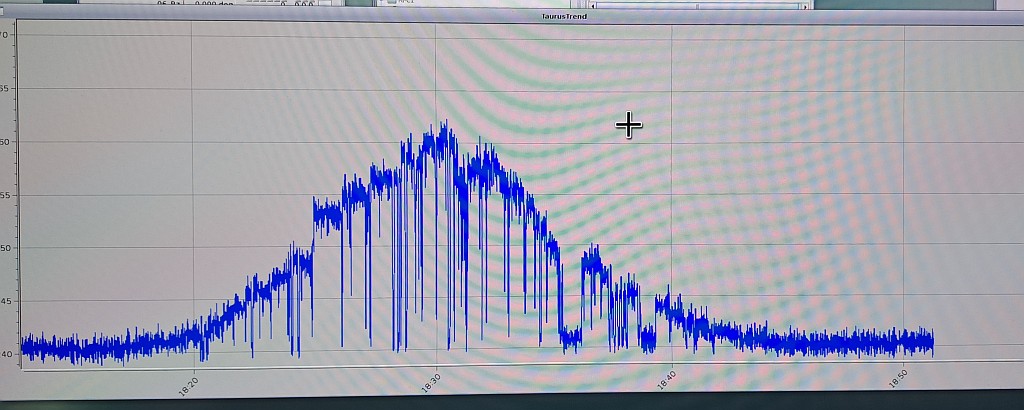
on monday 27/06, roughly in the same condition (25kW of power stored in FP-cavity), we scanned properly the same z-axis with the hexapod and we measured the pico-ampermeter current related to the produced X-rays to get the approximated size of the laser and electron beams at the IP position : see the raw data.
Daniele did the data analysis : see the attached analyse_profil_vert_X-1.pptx file
the total rms size (sigma of the Gaussian profile) is 100µm.
this morning, we measured the FP-cavity waist size by measuring the waist size of beam at the focal distance of a lens used after the spherical mirrors.
we measured the rms size of the FP-cavity mode to be 60µm in agreement with simulations, which leads to 80µm rms for the electron beam waist size. |
| Attachment 1: Raw_data.jpg
|  |
| Attachment 2: analyse_profil_vert_X-1.pptx
|
|
224
|
Thu Jun 22 20:20:03 2023 |
Ronic Chiche | Fixed | info | lasers and optics | ThomX igloo | 33MHz oscillator + Alphanov amplifier lock | we checked yesterday morning the real input power @ 30% for the amp => it is 16W in agreement with the previously measured values
| Ronic Chiche wrote: |
|
I checked with the Matlab code below the CEP detuning effect (2nm sech² spectrum... not exactly the same as in ThomX)
@ CEP = 0 => coupling = 100% and Gcav = 10.5k
if all the coupling loss comes from the CEP detuning effect :
@ CEP = pi/5 => coupling = 20% and Gcav = 2.14k (~ 10.5k x 20%)
so, it does not matter if the coupling loss comes from the CEP detuning effect or from beam mismatch or misalignment.
=> we should have more power at 20% coupling, not 10kW but 35kW !!!
=> we have to check the real input power !
| Ronic Chiche wrote: |
|
this morning, I tested the laser+amplifier @ 30% lock on the FP cavity with and without Smaract motors.
I recorded the PDH error signal during a lock:
- blue : with Smaract motors controller powered ON but motors are stopped
- yellow: with Smaract motors controller powered OFF
with Smaract motors controller powered ON and motors stopped, one can see a group of resonances around 10kHz (8 - 11 - 14kHz) which disappears when the controller is powered OFF.
one can see also a group of resonances around 25-30kHz for which some peaks desappear when the controller is OFF but most of them are still there... could it come from noise on the Onefive laser PZT ?
one can see also a noise reduction at low frequency with a corner frequency around 17kHz, which could be the Unity Gain Bandwidth of the feedback loop on the laser PZT (fast feedback loop on EOM was disconnected)
=> to be confirmed
*************************************************************************************************************************************************************
I was able to lock with a decent noise on transmission and reflection signals @ Pin=17W (30%) of input power and with a coupling ~ 20%.
I measured 31mW in transmission => Pcav ~ 10.3kW (T ~ 3ppm)
as T1=115 ppm and F=30000, the cavity gain is T1*(F/pi)^2 = 10.5k,
so, the FP cavity power should have been 17W * 20% * 10,5k = 35.7 kW !!! (maybe the formula is wrong if the coupling loss comes from the CEP detuning effect)
=> we have to check the incoming power and the formula !
so, maximum expected power in FP-cavity could be 70W * 100% * 10,5k * (10.3/35.7) = 210 kW !!! :-(
*************************************************************************************************************************************************************
I was able to redo the lock easily in remote in the control room (with the Smaract motors controller OFF).
| Ronic Chiche wrote: |
|
After removing the 2 generators from the optical table, the lock is much more stable and now, it is possible to lock on the main resonance with a poor CEP but with quite good stability.
the coupling is still very low ~ 5% for that CEP but if one improves it (CEP ->0), using the laser double-wedge motor, one clearly sees an improvement of the coupling... but at the cost of the lock stability.
the reason of the poor coupling is also because the laser amplifier is used at 0%, for which we know the part of the laser signal power, compared to the total power, is low.
(a part of the beam @1030nm is not propagating in the fiber core of the amp, and then, it cannot be coupled to the FP-cavity).
the fast lock loop on the EOM has been disabled for the moment.
it has to be installed back to improve the stability at a better CEP.
at present, the FP-cavity power is estimated at ~ 90W (~270µW in transmission of ~3ppm mirrors) for ~300mW of total power coming from the laser amp.
next steps :
- in Open Loop : check what is the best coupling we can observe for CEP=0 @ P ~ 10W (laser amp at ~ 25%)
- in Closed Loop : @ P ~ 10W => measure the best transmitted power after alignement/polarization/feedback adjust => ~ 3-10kW in the cavity ?
| Ronic Chiche wrote: |
|
today with Daniele, we locked easily (but with a noisy lock) on the secundary resonance and we tried to lock on the main resonance (with very low coupling ~10% which mean a CEP ~Pi)
the lock was possible but was very noisy.
I installed a fast loop using my small DC amplifier based on OP37 (max gain=100) modified to be AC coupled to avoid to amplify the PDH box offset.
the output votage swing of the OP37 is only ~10V. Thus, the effect of this fast loop on the lock stability is not visible !
Thus, I added the M250 Leysop HV amplifier (see attached documentation), which is able to drive an EOM with >5MHz bandwidth and ~250V swing, after my OP37 amplifier.
with this additionnal HV amplifier, now we can clearly see the effect of the EOM loop which improves the lock stability BUT, even with a poor CEP, the lock is very unstable on the main resonance.
it seems the optical phase noise is still too large and/or its BW too high to be completely compensated.
The next step is to try to remove all the possible noise sources from the optical table:
- the laptop placed on the ionic pump
- the 2 Rigol generators on the table surface
and switch off the controller of the Smaract laser cavity motors.
If it doesn't help, we can send the error signal to a spectrum analyzer to have a better view of the different harmonics involved in the residual phase noise.
could it remain some noise above the present PDH box BW (1.9MHz LP filter) ?
lastely, we can also make an optical phase noise measurement to check if the Alphanov amplifier does not add some noise.
| Ronic Chiche wrote: |
|
finding the right modulation/demodulation PDH phase is very difficult on the main resonance because the we get non stationnary signals with a lot of oscillations.
changing the phase, in this condition, does not really change the error signal.
Then, we moved on the first secundary resonance with less gain and less coupling.
Thus, the error signal is more similar to the theoretical PDH signal => one can adjust the modulation/demodulation PDH phase to get the maximum error signal.
then, we locked pretty easily on this first secondary resonance, with a coupling around some % when we adjust the CEP motor.
we tried to lock on the main resonance but it is too noisy and unstable.
it seems we really need high BW feedback.
I tried to add a fast analog loop on the laser intra-cavity EOM but without a clear effect.
the problem is the gain of this loop : it is difficult to produce a "high voltage" (above 10Vpp) on this EOM.
I put "my" amplifier but the voltage output is limited... commercial amplifiers will have the same issue.
we can add HV amplifiers but it takes place and it will add some noise on the signal.
A loop with an AOM could be easier to install and manage... but at the price of a loss of power before the laser amplifier...
| Ronic Chiche wrote: |
|
the last tries to lock the 33MHz + amplifier to the 30k Finesse FP-cavity were unsuccessful.
during a laser Frep scan using the Laselock, one observes that the main cavity resonance is not able to stay inside the PZT scan range from one scan to another (500ms-1s period)
is it the effect of a large and slow phase noise ?
some informations:
- The 33MHz laser came back at lab from repair on March 2018.
- it has been sent to Alphanov in May 2020.
- it failled and has been sent to NKT/OneFive for repair in September 2021
- it came back to lab from repair in June 2022.
- on post #92 (Feb. 2020), it seems that we already locked the 33MHz laser + CELIA amplifier to the ThomX FP-cavity.
- The PZT sensitivity for the 33MHz laser is given to 0,3Hz/V for Frep <=> 2.6MHz/V for optical frequency.
=> 10V on PZT is equivalent to 26MHz of optical frequency shift which is less than FSR !
- by comparison, the PZT sensitivity for the 133MHz laser is given to 3.9Hz/V for Frep <=> 8.5MHz/V for optical frequency.
- by comparison, the PZT sensitivity for the NKT CW laser is given 10pm/100V for Wavelength <=> 30MHz/V for optical frequency
- by comparison, the PZT sensitivity for the ThomX FP cavity (Z20H38x40C) is 4nm/V for length expansion => 8nm/V for round-trip expansion <=> 0.03Hz/V for FSR expansion <=> 260kHz/V for optical frequency !!!
the PZT expansion estimation is in attached file.
|
|
|
|
|
|
|
|
223
|
Tue Jun 20 19:08:17 2023 |
Ronic Chiche | Fixed | info | lasers and optics | ThomX igloo | 33MHz oscillator + Alphanov amplifier lock | I checked with the Matlab code below the CEP detuning effect (2nm sech² spectrum... not exactly the same as in ThomX)
@ CEP = 0 => coupling = 100% and Gcav = 10.5k
if all the coupling loss comes from the CEP detuning effect :
@ CEP = pi/5 => coupling = 20% and Gcav = 2.14k (~ 10.5k x 20%)
so, it does not matter if the coupling loss comes from the CEP detuning effect or from beam mismatch or misalignment.
=> we should have more power at 20% coupling, not 10kW but 35kW !!!
=> we have to check the real input power !
| Ronic Chiche wrote: |
|
this morning, I tested the laser+amplifier @ 30% lock on the FP cavity with and without Smaract motors.
I recorded the PDH error signal during a lock:
- blue : with Smaract motors controller powered ON but motors are stopped
- yellow: with Smaract motors controller powered OFF
with Smaract motors controller powered ON and motors stopped, one can see a group of resonances around 10kHz (8 - 11 - 14kHz) which disappears when the controller is powered OFF.
one can see also a group of resonances around 25-30kHz for which some peaks desappear when the controller is OFF but most of them are still there... could it come from noise on the Onefive laser PZT ?
one can see also a noise reduction at low frequency with a corner frequency around 17kHz, which could be the Unity Gain Bandwidth of the feedback loop on the laser PZT (fast feedback loop on EOM was disconnected)
=> to be confirmed
*************************************************************************************************************************************************************
I was able to lock with a decent noise on transmission and reflection signals @ Pin=17W (30%) of input power and with a coupling ~ 20%.
I measured 31mW in transmission => Pcav ~ 10.3kW (T ~ 3ppm)
as T1=115 ppm and F=30000, the cavity gain is T1*(F/pi)^2 = 10.5k,
so, the FP cavity power should have been 17W * 20% * 10,5k = 35.7 kW !!! (maybe the formula is wrong if the coupling loss comes from the CEP detuning effect)
=> we have to check the incoming power and the formula !
so, maximum expected power in FP-cavity could be 70W * 100% * 10,5k * (10.3/35.7) = 210 kW !!! :-(
*************************************************************************************************************************************************************
I was able to redo the lock easily in remote in the control room (with the Smaract motors controller OFF).
| Ronic Chiche wrote: |
|
After removing the 2 generators from the optical table, the lock is much more stable and now, it is possible to lock on the main resonance with a poor CEP but with quite good stability.
the coupling is still very low ~ 5% for that CEP but if one improves it (CEP ->0), using the laser double-wedge motor, one clearly sees an improvement of the coupling... but at the cost of the lock stability.
the reason of the poor coupling is also because the laser amplifier is used at 0%, for which we know the part of the laser signal power, compared to the total power, is low.
(a part of the beam @1030nm is not propagating in the fiber core of the amp, and then, it cannot be coupled to the FP-cavity).
the fast lock loop on the EOM has been disabled for the moment.
it has to be installed back to improve the stability at a better CEP.
at present, the FP-cavity power is estimated at ~ 90W (~270µW in transmission of ~3ppm mirrors) for ~300mW of total power coming from the laser amp.
next steps :
- in Open Loop : check what is the best coupling we can observe for CEP=0 @ P ~ 10W (laser amp at ~ 25%)
- in Closed Loop : @ P ~ 10W => measure the best transmitted power after alignement/polarization/feedback adjust => ~ 3-10kW in the cavity ?
| Ronic Chiche wrote: |
|
today with Daniele, we locked easily (but with a noisy lock) on the secundary resonance and we tried to lock on the main resonance (with very low coupling ~10% which mean a CEP ~Pi)
the lock was possible but was very noisy.
I installed a fast loop using my small DC amplifier based on OP37 (max gain=100) modified to be AC coupled to avoid to amplify the PDH box offset.
the output votage swing of the OP37 is only ~10V. Thus, the effect of this fast loop on the lock stability is not visible !
Thus, I added the M250 Leysop HV amplifier (see attached documentation), which is able to drive an EOM with >5MHz bandwidth and ~250V swing, after my OP37 amplifier.
with this additionnal HV amplifier, now we can clearly see the effect of the EOM loop which improves the lock stability BUT, even with a poor CEP, the lock is very unstable on the main resonance.
it seems the optical phase noise is still too large and/or its BW too high to be completely compensated.
The next step is to try to remove all the possible noise sources from the optical table:
- the laptop placed on the ionic pump
- the 2 Rigol generators on the table surface
and switch off the controller of the Smaract laser cavity motors.
If it doesn't help, we can send the error signal to a spectrum analyzer to have a better view of the different harmonics involved in the residual phase noise.
could it remain some noise above the present PDH box BW (1.9MHz LP filter) ?
lastely, we can also make an optical phase noise measurement to check if the Alphanov amplifier does not add some noise.
| Ronic Chiche wrote: |
|
finding the right modulation/demodulation PDH phase is very difficult on the main resonance because the we get non stationnary signals with a lot of oscillations.
changing the phase, in this condition, does not really change the error signal.
Then, we moved on the first secundary resonance with less gain and less coupling.
Thus, the error signal is more similar to the theoretical PDH signal => one can adjust the modulation/demodulation PDH phase to get the maximum error signal.
then, we locked pretty easily on this first secondary resonance, with a coupling around some % when we adjust the CEP motor.
we tried to lock on the main resonance but it is too noisy and unstable.
it seems we really need high BW feedback.
I tried to add a fast analog loop on the laser intra-cavity EOM but without a clear effect.
the problem is the gain of this loop : it is difficult to produce a "high voltage" (above 10Vpp) on this EOM.
I put "my" amplifier but the voltage output is limited... commercial amplifiers will have the same issue.
we can add HV amplifiers but it takes place and it will add some noise on the signal.
A loop with an AOM could be easier to install and manage... but at the price of a loss of power before the laser amplifier...
| Ronic Chiche wrote: |
|
the last tries to lock the 33MHz + amplifier to the 30k Finesse FP-cavity were unsuccessful.
during a laser Frep scan using the Laselock, one observes that the main cavity resonance is not able to stay inside the PZT scan range from one scan to another (500ms-1s period)
is it the effect of a large and slow phase noise ?
some informations:
- The 33MHz laser came back at lab from repair on March 2018.
- it has been sent to Alphanov in May 2020.
- it failled and has been sent to NKT/OneFive for repair in September 2021
- it came back to lab from repair in June 2022.
- on post #92 (Feb. 2020), it seems that we already locked the 33MHz laser + CELIA amplifier to the ThomX FP-cavity.
- The PZT sensitivity for the 33MHz laser is given to 0,3Hz/V for Frep <=> 2.6MHz/V for optical frequency.
=> 10V on PZT is equivalent to 26MHz of optical frequency shift which is less than FSR !
- by comparison, the PZT sensitivity for the 133MHz laser is given to 3.9Hz/V for Frep <=> 8.5MHz/V for optical frequency.
- by comparison, the PZT sensitivity for the NKT CW laser is given 10pm/100V for Wavelength <=> 30MHz/V for optical frequency
- by comparison, the PZT sensitivity for the ThomX FP cavity (Z20H38x40C) is 4nm/V for length expansion => 8nm/V for round-trip expansion <=> 0.03Hz/V for FSR expansion <=> 260kHz/V for optical frequency !!!
the PZT expansion estimation is in attached file.
|
|
|
|
|
|
| Attachment 1: ThomX_FP_intracavity_signal.m
|
clear
clc

% resonance order
% Main resonance => Nr=0
Nr=00;

c=3e8;
lambda0=1030e-9;
dlambda0=2e-9;

FSR=33e6;
T1=115e-6;
F=30e3;
CEP=2*pi/10;

L0=c/FSR;
f0=c/lambda0;
df0=f0*dlambda0/lambda0;
n0=round(f0/FSR);
dn0=round(df0/FSR);
n=n0-3*dn0:n0+3*dn0;

fcav=n*FSR;

Pin=sech(1.77*(fcav-f0)/df0).^2;
Ein=sqrt(Pin);

figure(1)
clf
plot(c./fcav*1e9,Pin)
grid on
xlabel('wavelength (nm)')
ylabel('power (A.U.)')
title('normalized laser power spectrum')

df_FSR=linspace(-FSR/2,FSR/2,1e6);
Ec=Ffp(df_FSR,FSR,T1,F,1);

figure(2)
clf
plot(F*df_FSR/FSR,abs(Ec).^2,'r')
grid on
xlim([-5 5])
xlabel('normalized frequency (Hz / LW)')
ylabel('real part (A.U.)')
title('FP-cavity intra-cavity power gain')

dLmax=lambda0/1000;
Nk=1e2;
dL=linspace(-dLmax/2,dLmax/2,Nk+1)-L0*CEP/(2*pi)*FSR/f0;
for k=1:length(dL)
    df=FSR*(dL(k)+Nr*lambda0)/L0;
    Frep=FSR+df;
    flas=(n+CEP/2/pi)*Frep;

    [Ec,Er]=Ffp(flas,FSR,T1,F,Ein);
    Gc(k)=sum(abs(Ec).^2)/sum(Pin);
    Gr(k)=sum(abs(Er).^2)/sum(Pin);
end

figure(3)
clf
plot(dL/1e-6,Gc,'.')
grid on
xlabel('length scan (µm)')
ylabel('cavity power gain (A.U.)')

figure(4)
clf
plot(dL/1e-6,Gr,'.')
grid on
xlabel('length scan (µm)')
ylabel('cavity refleced power gain (A.U.)')

% cavity field & reflectivity of the FP cavity
function [Ec,Er] = Ffp(df,FSR,T1,F,Ein)
rho=1-pi/F;
t1=sqrt(T1);
r1=sqrt(1-t1^2);
r2=rho/r1;
if r2>1
    error('r2 > 1 !!!!')
end
Fc=1i*t1./(1-rho*exp(-1i*2*pi*df/FSR));
Ec=Fc.*Ein;
Fr=r1+1i*t1*r2*exp(-1i*2*pi*df/FSR).*Fc;
Er=Fr.*Ein;
end
|
|
222
|
Tue Jun 20 18:45:10 2023 |
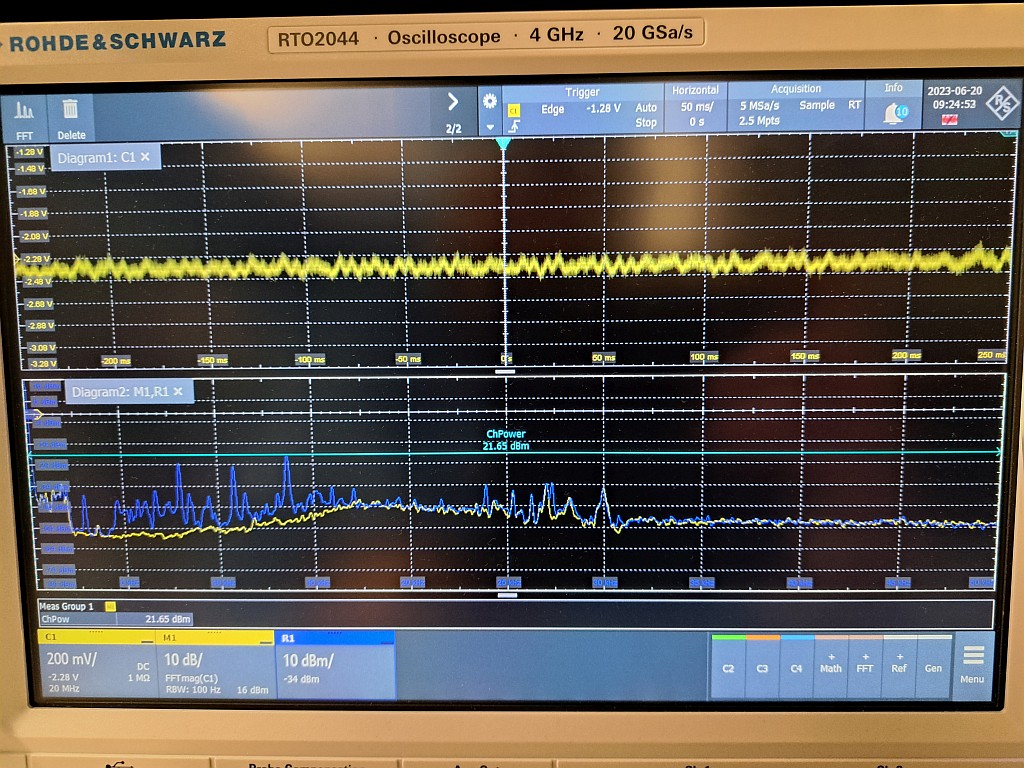
Ronic Chiche | Fixed | info | lasers and optics | ThomX igloo | 33MHz oscillator + Alphanov amplifier lock | this morning, I tested the laser+amplifier @ 30% lock on the FP cavity with and without Smaract motors.
I recorded the PDH error signal during a lock:
- blue : with Smaract motors controller powered ON but motors are stopped
- yellow: with Smaract motors controller powered OFF
with Smaract motors controller powered ON and motors stopped, one can see a group of resonances around 10kHz (8 - 11 - 14kHz) which disappears when the controller is powered OFF.
one can see also a group of resonances around 25-30kHz for which some peaks desappear when the controller is OFF but most of them are still there... could it come from noise on the Onefive laser PZT ?
one can see also a noise reduction at low frequency with a corner frequency around 17kHz, which could be the Unity Gain Bandwidth of the feedback loop on the laser PZT (fast feedback loop on EOM was disconnected)
=> to be confirmed
*************************************************************************************************************************************************************
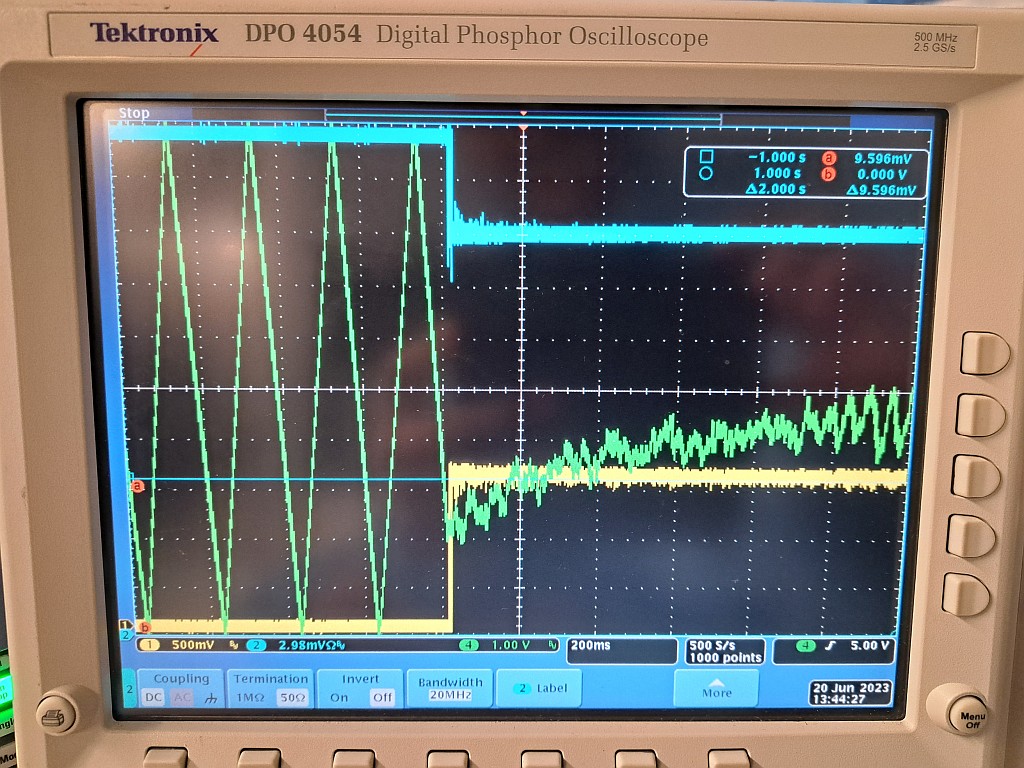
I was able to lock with a decent noise on transmission and reflection signals @ Pin=17W (30%) of input power and with a coupling ~ 20%.
I measured 31mW in transmission => Pcav ~ 10.3kW (T ~ 3ppm)
as T1=115 ppm and F=30000, the cavity gain is T1*(F/pi)^2 = 10.5k,
so, the FP cavity power should have been 17W * 20% * 10,5k = 35.7 kW !!! (maybe the formula is wrong if the coupling loss comes from the CEP detuning effect)
=> we have to check the incoming power and the formula !
so, maximum expected power in FP-cavity could be 70W * 100% * 10,5k * (10.3/35.7) = 210 kW !!! :-(
*************************************************************************************************************************************************************
I was able to redo the lock easily in remote in the control room (with the Smaract motors controller OFF).
| Ronic Chiche wrote: |
|
After removing the 2 generators from the optical table, the lock is much more stable and now, it is possible to lock on the main resonance with a poor CEP but with quite good stability.
the coupling is still very low ~ 5% for that CEP but if one improves it (CEP ->0), using the laser double-wedge motor, one clearly sees an improvement of the coupling... but at the cost of the lock stability.
the reason of the poor coupling is also because the laser amplifier is used at 0%, for which we know the part of the laser signal power, compared to the total power, is low.
(a part of the beam @1030nm is not propagating in the fiber core of the amp, and then, it cannot be coupled to the FP-cavity).
the fast lock loop on the EOM has been disabled for the moment.
it has to be installed back to improve the stability at a better CEP.
at present, the FP-cavity power is estimated at ~ 90W (~270µW in transmission of ~3ppm mirrors) for ~300mW of total power coming from the laser amp.
next steps :
- in Open Loop : check what is the best coupling we can observe for CEP=0 @ P ~ 10W (laser amp at ~ 25%)
- in Closed Loop : @ P ~ 10W => measure the best transmitted power after alignement/polarization/feedback adjust => ~ 3-10kW in the cavity ?
| Ronic Chiche wrote: |
|
today with Daniele, we locked easily (but with a noisy lock) on the secundary resonance and we tried to lock on the main resonance (with very low coupling ~10% which mean a CEP ~Pi)
the lock was possible but was very noisy.
I installed a fast loop using my small DC amplifier based on OP37 (max gain=100) modified to be AC coupled to avoid to amplify the PDH box offset.
the output votage swing of the OP37 is only ~10V. Thus, the effect of this fast loop on the lock stability is not visible !
Thus, I added the M250 Leysop HV amplifier (see attached documentation), which is able to drive an EOM with >5MHz bandwidth and ~250V swing, after my OP37 amplifier.
with this additionnal HV amplifier, now we can clearly see the effect of the EOM loop which improves the lock stability BUT, even with a poor CEP, the lock is very unstable on the main resonance.
it seems the optical phase noise is still too large and/or its BW too high to be completely compensated.
The next step is to try to remove all the possible noise sources from the optical table:
- the laptop placed on the ionic pump
- the 2 Rigol generators on the table surface
and switch off the controller of the Smaract laser cavity motors.
If it doesn't help, we can send the error signal to a spectrum analyzer to have a better view of the different harmonics involved in the residual phase noise.
could it remain some noise above the present PDH box BW (1.9MHz LP filter) ?
lastely, we can also make an optical phase noise measurement to check if the Alphanov amplifier does not add some noise.
| Ronic Chiche wrote: |
|
finding the right modulation/demodulation PDH phase is very difficult on the main resonance because the we get non stationnary signals with a lot of oscillations.
changing the phase, in this condition, does not really change the error signal.
Then, we moved on the first secundary resonance with less gain and less coupling.
Thus, the error signal is more similar to the theoretical PDH signal => one can adjust the modulation/demodulation PDH phase to get the maximum error signal.
then, we locked pretty easily on this first secondary resonance, with a coupling around some % when we adjust the CEP motor.
we tried to lock on the main resonance but it is too noisy and unstable.
it seems we really need high BW feedback.
I tried to add a fast analog loop on the laser intra-cavity EOM but without a clear effect.
the problem is the gain of this loop : it is difficult to produce a "high voltage" (above 10Vpp) on this EOM.
I put "my" amplifier but the voltage output is limited... commercial amplifiers will have the same issue.
we can add HV amplifiers but it takes place and it will add some noise on the signal.
A loop with an AOM could be easier to install and manage... but at the price of a loss of power before the laser amplifier...
| Ronic Chiche wrote: |
|
the last tries to lock the 33MHz + amplifier to the 30k Finesse FP-cavity were unsuccessful.
during a laser Frep scan using the Laselock, one observes that the main cavity resonance is not able to stay inside the PZT scan range from one scan to another (500ms-1s period)
is it the effect of a large and slow phase noise ?
some informations:
- The 33MHz laser came back at lab from repair on March 2018.
- it has been sent to Alphanov in May 2020.
- it failled and has been sent to NKT/OneFive for repair in September 2021
- it came back to lab from repair in June 2022.
- on post #92 (Feb. 2020), it seems that we already locked the 33MHz laser + CELIA amplifier to the ThomX FP-cavity.
- The PZT sensitivity for the 33MHz laser is given to 0,3Hz/V for Frep <=> 2.6MHz/V for optical frequency.
=> 10V on PZT is equivalent to 26MHz of optical frequency shift which is less than FSR !
- by comparison, the PZT sensitivity for the 133MHz laser is given to 3.9Hz/V for Frep <=> 8.5MHz/V for optical frequency.
- by comparison, the PZT sensitivity for the NKT CW laser is given 10pm/100V for Wavelength <=> 30MHz/V for optical frequency
- by comparison, the PZT sensitivity for the ThomX FP cavity (Z20H38x40C) is 4nm/V for length expansion => 8nm/V for round-trip expansion <=> 0.03Hz/V for FSR expansion <=> 260kHz/V for optical frequency !!!
the PZT expansion estimation is in attached file.
|
|
|
|
|
| Attachment 1: PDH_error_signal_with_Smaract_motors_ON-OFF.jpg
|  |
| Attachment 2: Lock_at_amp_@30%.jpg
|  |
| Attachment 3: 10kW_in_remote.jpg
|  |
|
221
|
Mon Jun 19 16:08:15 2023 |
Manar Amer | Fixed | report | lasers and optics | detectors and electronics | cabling | software | ThomX igloo | Cavity Lock - Alphanov Amplifier | The computer is possible to connect from the control room,
we are able to run remotely the amplifier, cavity motors, oscillator motors, lase lock (note: there is an issue with the keyboard, we are not able to use it with remote access!!!!!!!!)
Note on Amplifier: On Friday, Daniele and Ronic faced again the temperature issue that came up before. it is due to the fluctuation of the diode temperature.
It was fixed today by Ronic and Daniele. it seems there are three diodes for monitoring the temperature, only one was connected, and it had issues, with some directions from alphanov.
Ronic just removed the defective diode and soldered (connected) a different one. The amplifier should work without this issue.
now we start searching for X-rays after locking the cavity remotely
| Manar Amer wrote: |
|
In the morning, we locked on the first resonance. With an increase on the amplifier power @ 20-25% and 30%, which reduced the noise
we manage to get a coupling when improving the CEP up to 55 - 60 % coupling : put there is still a drift on the CEP
The controller for the oscillator frep and CEP produces a lot of noise, even if it is disconnected. we need to switch it off to remove its effect (Kevin will order a new one)
The image attached is of the oscilloscope lock on the first resonance @30% amplifier power ~ 10 W injected into cavity,
transmitted power ~ 36 mW (cavity average power 12 kW)
cavity effective gain > 1200
in the afternoon, we installed and aligned a gentec power meter we can monitor from the computer. (will need to buy a permeant one for ThomX)
there was an issue with the laselock USB connection, yet to be solved.
and the control of the computer.
| Manar Amer wrote: |
|
Today with Ronic,
starting with major events that happened (Water circulation + ThomX valves )
- Early in the morning a company worked on the water network, it seemed it was not restarted properly so there was no water circulation in the main ThomX pipes.
- There was an error on the ThomX amplifier chiller , which was noticed at the end of the morning work , where we couldn't find the cavity resonance , could be due to the temperature increase of the amplifer.
- Solved : the issue was solved by restarting the water network and the amplifier chiller was restarted an no error found and temp. Stabilized around 25°
- Around 12h15 ThomX there was a power cut off for less than a second (micro cutt), which cased all the valves to close, the valve air compressor did not restart after the power cut off, we restarted it with Daniele in the evening with the help of Marie and the valves open around 5-6 bar , you will see then all the controllers green and the valves will open.
Results of the day :
- All the power supplies and function generators are under the table, nothing on the table (reduced noise on the signal)
- EOM of Oscillator Off (for now, might turn on if needed)
- Amplifier on 0% , output ~ 300 mW
- Locked on the first resonance of the cavity, lase lock parameters to be optimized better
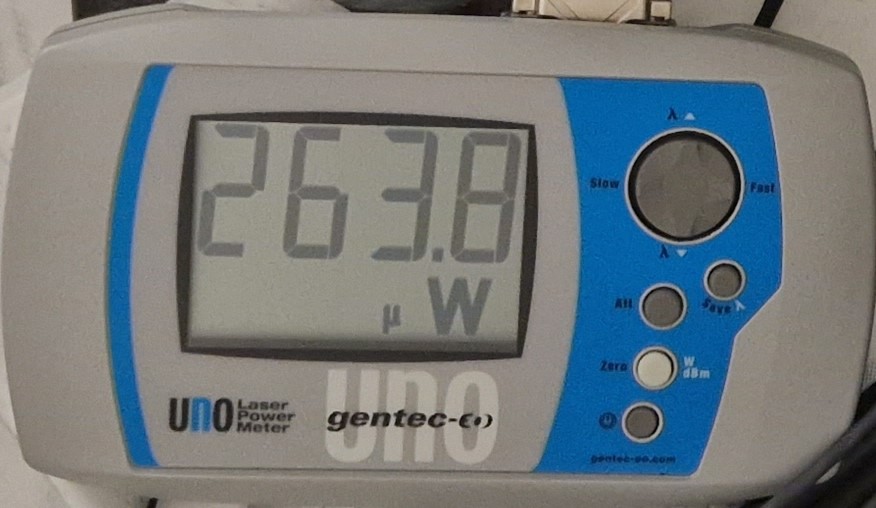
- Transmitted power increased to ~ 267.2 uW
- Average power inside cavity = 89. 06 W , peak power = 0.2 kW (pulse width = 12.6 ps , frep = 33.36 MHz )
- current effective cavity gain > 300
Oscilloscope :
- error signal, not shown as it was too noisy to have in the image
- blue : reflection (low bypass filter ), yellow : transmission (resistance of 100 k ohm added), green : piezo signal
- 1st image : showing lock and scan regions.
- 2nd image: time zoom on the locked signal
oscillators controller / smartAct:
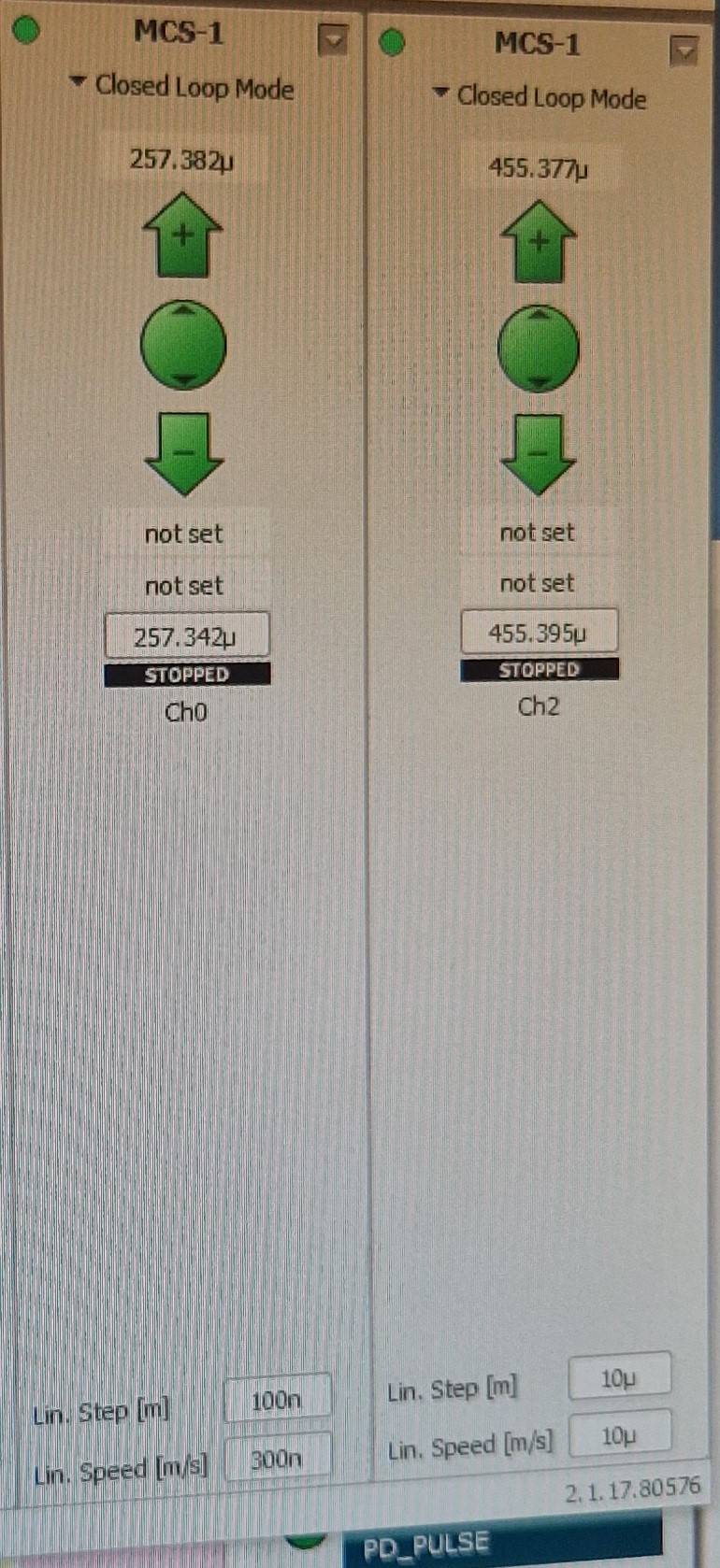
- Frequency and CEP control , the parameters in the photo attached are the best for the moment to see the smooth change of the resonance peaks when operating the motors, and we can stay FSR range and compensate the variation easily.
- even though we stayed at closed loop (for easier adjustment), we still managed to lock , will try to switch off later to see if reduces a lot of noise.
| Manar Amer wrote: |
|
Today, I installed a power meter at the transmission point of the 1st spherical mirror , transmission 3 ppm (direct from cavity window beam profiler, no filter)
We locked the cavity at 2 different resonances of the fundamental mode, the lock in both cases was stable for a round 1 minute.
at different transmitted power of 33.85 uW ( 11 W average inside cavity) and then locked again at 82.65 uW (27.5 W average inside cavity) transmitted power
Note : the coupling is almost zero for both of the resonances locked !!!!
Oscillator : 33.33 MHz ( 33.356 MHz , frequency read on LAL software)
power injected into amplifier (after injecting into fiber and an EOM) : 3.886 mW (on LAL software)
Amplifier power : 0% (injected power into cavity ~ 300 mW)
Both images of oscilloscope have same voltage scales, only difference timescale and the color code is :
yellow : transmission
blue : reflection
green : piezo voltage
red : error signal
| Manar Amer wrote: |
|
Yesterday, with Ronic we locked ThomX cavity on the second resonance
Laser : 33.36 MHz , Amplifier : 0 % (worked with no errors all day)
adding image for the lock on the second resonance (locked), 00 Mode image, fit, Beam measurements
and image of the first resonance signal (not locked)
Info : when locking on the secondary resonance, we aligned better and adjusted on the oscillator CEP and increased the transmission signal
Controllers connected to computer
through Ethernet :
- Cavity Mirror motors
- Lase lock
- oscillator CEP and Frequency motors (easier to follow the drift with this controller, and we can see it moving)
by USB :
| Manar Amer wrote: |
|
This morning, while trying Guillaume solution of disconnecting the 24 V necessary to the second and third stage and raise the threshold of Temp preamp 1 (to only operate the ampli with first stage only)
Ronic disconnected the 24 volt connection, turned on amplifier LAL software but no MMD3 error or a big temp on Temp preamp 1 , software worked fine with no issue.
we connected the 24 V again and the software worked with no issues.
Still not sure what happened for it to work correctly !!!!!!!!!!
- We used the amplifier at 0% all day with no errors (to test , I turned it for 10 minutes @ 10% with no error too)
- We changed the lase lock box with ThomX one (having Ethernet connection), it was connected to computer and works ok
- Ronic installed a signal amplifier for the PDH error signal. (yet to be fully optimized)
- we see a better coupling than before in the cavity.
- The dominant mode is 00 mode, but we see many higher order modes, need to alight better.
| Manar Amer wrote: |
|
Today with Ronic and Daniele we attempted to lock the cavity, but the alphanov amplifier did not turn on because of an error in MMD3 (related to the third stage)
the new error is having the MMD3 error show on the alarm window of the LAL software, and having the Alarms on the line 3 of the alphanov software red for both EXT/CPU and Laser T Max (never been red before)
this is after a 2-week work stop, but the last time when Daniele changed the fiber connector it worked for 3 hours with no errors.
Ronic, is in contact with Guillaume from Alphanov to fix the issue !!!
Work scheduled all Wednesday, in hopes the issue is fixed by then.
| Manar Amer wrote: |
|
Added Note: the coupling we get is at low power, only preamplifier is on (~ 300 mW)
was done at the end due to excitation of higher order modes.
Wanted to improve the fundamental first, then increase the power.
| Manar Amer wrote: |
- On Monday with Daniele,
- we did full characterization of amplifier beam @ 10% amplification, adjusted the telescope accordingly and injected into the cavity aligned and improved on the fundamental mode.
- On Tuesday with Daniele and Kevin
- I added a low pass filter between 1 - 1.9 MHz on the reflected signal, to reject the oscillator signal (33.33 MHz)
- removed the external resistors on the signal, only the internal resistance of the oscilloscope used ( transmission : 1 M ohm , Reflection : 50 ohm )
- We connected the motors to control the CEP and adjusted on them until we reached ~ 5 -10% coupling
- Images:
- 1st : showing the size of the beam just before injecting into the cavity @ 10%
- 2nd: signal with only improved alignment (not CEP adjustment yet), no low pass filter added yet
- 3rd : zoom on the signals (reflection and error) while adjusting on the CEP
- 4th :attempting to lock the cavity , after getting the max coupling using the CEP motors
Note : the voltage ranges are not the same between the images
| Manar Amer wrote: |
|
Yesterday,
- we installed the second high power reflecting mirrors at the output of the amplifier.
- We aligned and installed a telescope that has adjustable distance between the 2 lenses of -100 mm, and + 200 mm, with approximate diameter at the injection window of ~ 4.5 mm.
- Amplifier was turned on only at the first stage only (output power ~ 300 mW) aligned and injected into the cavity.
- Measured the repetition frequency of the One Five oscillators, Frep = 33.326239 MHz
- Changed the FSR of the cavity to match it.
- Using the Piezo scan on the oscillator, we observed 00 Mode, Fundamental. the shape is the same
- We see transmission on the diode, but there was zero coupling observed (yet to be investigated experimentally )
- a reason could be the CEP of the oscillator ,
- bad matching of the beam waist position,
- noise from the amplifier (as we were operating it at very low power)
- additional alignment needed,
|
|
|
|
|
|
|
|
|
|
|
220
|
Fri Jun 9 19:51:43 2023 |
Manar Amer | Fixed | report | lasers and optics | detectors and electronics | cabling | software | ThomX igloo | Cavity Lock - Alphanov Amplifier | In the morning, we locked on the first resonance. With an increase on the amplifier power @ 20-25% and 30%, which reduced the noise
we manage to get a coupling when improving the CEP up to 55 - 60 % coupling : put there is still a drift on the CEP
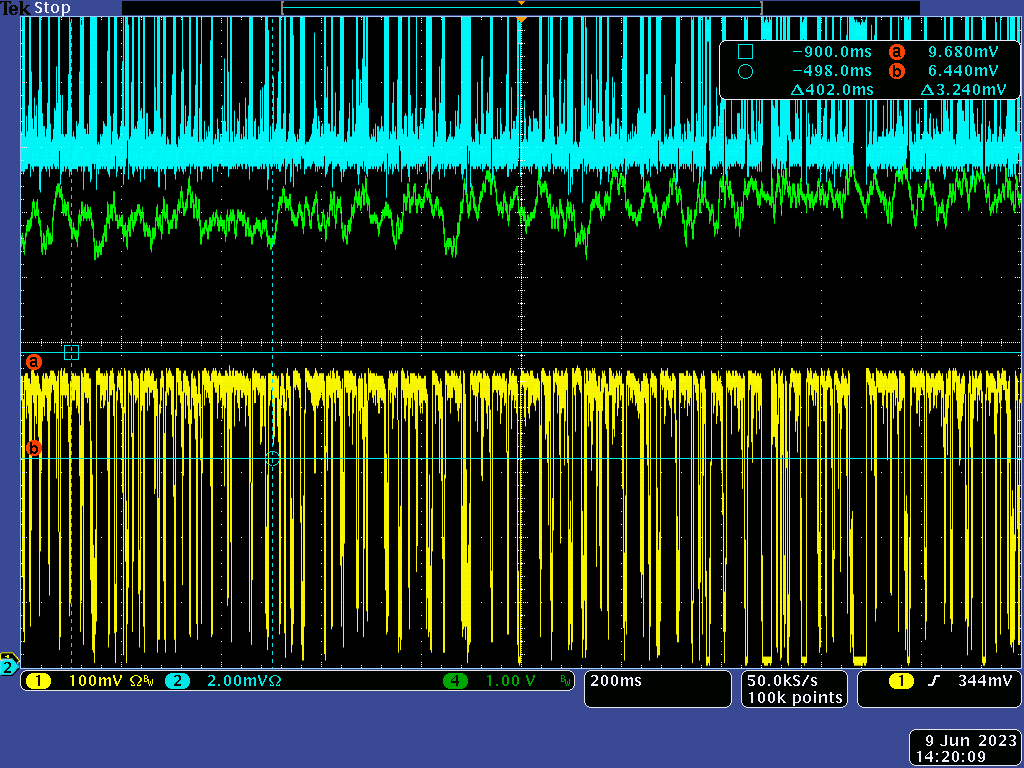
The controller for the oscillator frep and CEP produces a lot of noise, even if it is disconnected. we need to switch it off to remove its effect (Kevin will order a new one)
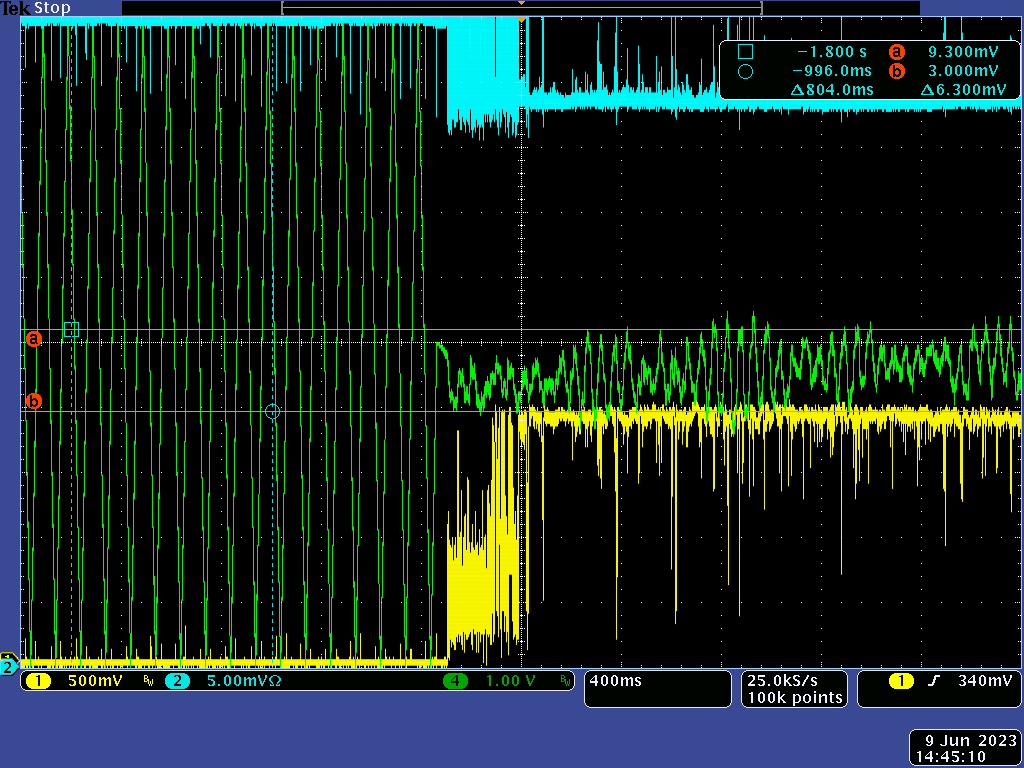
The image attached is of the oscilloscope lock on the first resonance @30% amplifier power ~ 10 W injected into cavity,
transmitted power ~ 36 mW (cavity average power 12 kW)
cavity effective gain > 1200
in the afternoon, we installed and aligned a gentec power meter we can monitor from the computer. (will need to buy a permeant one for ThomX)
there was an issue with the laselock USB connection, yet to be solved.
and the control of the computer.
| Manar Amer wrote: |
|
Today with Ronic,
starting with major events that happened (Water circulation + ThomX valves )
- Early in the morning a company worked on the water network, it seemed it was not restarted properly so there was no water circulation in the main ThomX pipes.
- There was an error on the ThomX amplifier chiller , which was noticed at the end of the morning work , where we couldn't find the cavity resonance , could be due to the temperature increase of the amplifer.
- Solved : the issue was solved by restarting the water network and the amplifier chiller was restarted an no error found and temp. Stabilized around 25°
- Around 12h15 ThomX there was a power cut off for less than a second (micro cutt), which cased all the valves to close, the valve air compressor did not restart after the power cut off, we restarted it with Daniele in the evening with the help of Marie and the valves open around 5-6 bar , you will see then all the controllers green and the valves will open.
Results of the day :
- All the power supplies and function generators are under the table, nothing on the table (reduced noise on the signal)
- EOM of Oscillator Off (for now, might turn on if needed)
- Amplifier on 0% , output ~ 300 mW
- Locked on the first resonance of the cavity, lase lock parameters to be optimized better
- Transmitted power increased to ~ 267.2 uW
- Average power inside cavity = 89. 06 W , peak power = 0.2 kW (pulse width = 12.6 ps , frep = 33.36 MHz )
- current effective cavity gain > 300
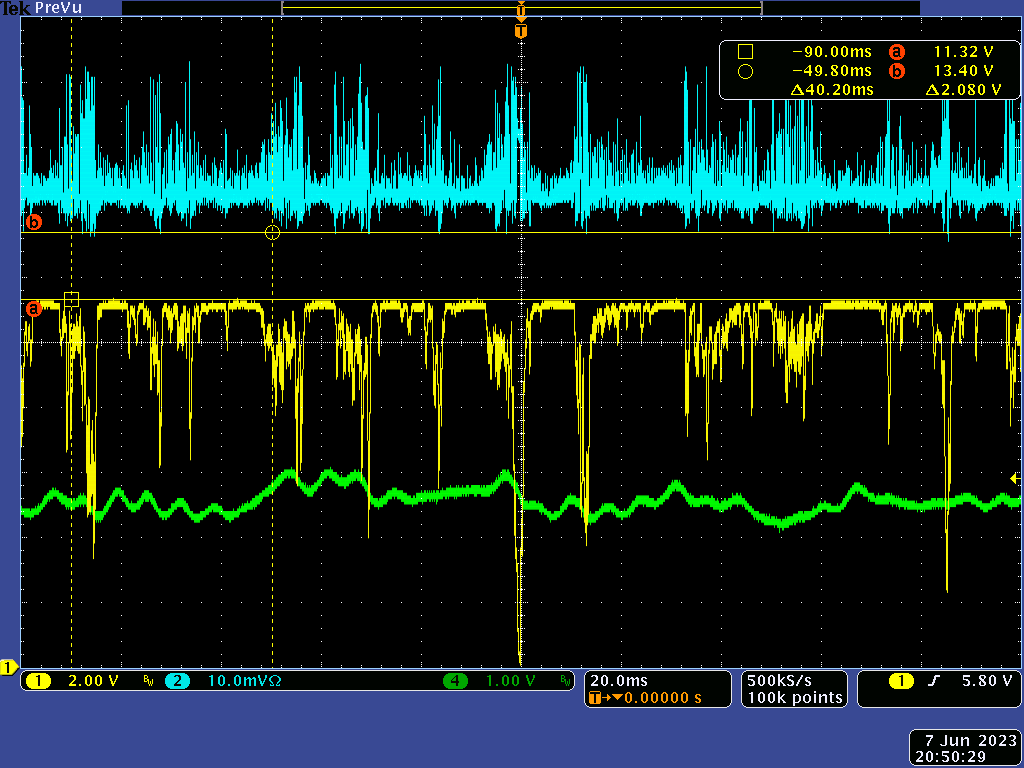
Oscilloscope :
- error signal, not shown as it was too noisy to have in the image
- blue : reflection (low bypass filter ), yellow : transmission (resistance of 100 k ohm added), green : piezo signal
- 1st image : showing lock and scan regions.
- 2nd image: time zoom on the locked signal
oscillators controller / smartAct:
- Frequency and CEP control , the parameters in the photo attached are the best for the moment to see the smooth change of the resonance peaks when operating the motors, and we can stay FSR range and compensate the variation easily.
- even though we stayed at closed loop (for easier adjustment), we still managed to lock , will try to switch off later to see if reduces a lot of noise.
| Manar Amer wrote: |
|
Today, I installed a power meter at the transmission point of the 1st spherical mirror , transmission 3 ppm (direct from cavity window beam profiler, no filter)
We locked the cavity at 2 different resonances of the fundamental mode, the lock in both cases was stable for a round 1 minute.
at different transmitted power of 33.85 uW ( 11 W average inside cavity) and then locked again at 82.65 uW (27.5 W average inside cavity) transmitted power
Note : the coupling is almost zero for both of the resonances locked !!!!
Oscillator : 33.33 MHz ( 33.356 MHz , frequency read on LAL software)
power injected into amplifier (after injecting into fiber and an EOM) : 3.886 mW (on LAL software)
Amplifier power : 0% (injected power into cavity ~ 300 mW)
Both images of oscilloscope have same voltage scales, only difference timescale and the color code is :
yellow : transmission
blue : reflection
green : piezo voltage
red : error signal
| Manar Amer wrote: |
|
Yesterday, with Ronic we locked ThomX cavity on the second resonance
Laser : 33.36 MHz , Amplifier : 0 % (worked with no errors all day)
adding image for the lock on the second resonance (locked), 00 Mode image, fit, Beam measurements
and image of the first resonance signal (not locked)
Info : when locking on the secondary resonance, we aligned better and adjusted on the oscillator CEP and increased the transmission signal
Controllers connected to computer
through Ethernet :
- Cavity Mirror motors
- Lase lock
- oscillator CEP and Frequency motors (easier to follow the drift with this controller, and we can see it moving)
by USB :
| Manar Amer wrote: |
|
This morning, while trying Guillaume solution of disconnecting the 24 V necessary to the second and third stage and raise the threshold of Temp preamp 1 (to only operate the ampli with first stage only)
Ronic disconnected the 24 volt connection, turned on amplifier LAL software but no MMD3 error or a big temp on Temp preamp 1 , software worked fine with no issue.
we connected the 24 V again and the software worked with no issues.
Still not sure what happened for it to work correctly !!!!!!!!!!
- We used the amplifier at 0% all day with no errors (to test , I turned it for 10 minutes @ 10% with no error too)
- We changed the lase lock box with ThomX one (having Ethernet connection), it was connected to computer and works ok
- Ronic installed a signal amplifier for the PDH error signal. (yet to be fully optimized)
- we see a better coupling than before in the cavity.
- The dominant mode is 00 mode, but we see many higher order modes, need to alight better.
| Manar Amer wrote: |
|
Today with Ronic and Daniele we attempted to lock the cavity, but the alphanov amplifier did not turn on because of an error in MMD3 (related to the third stage)
the new error is having the MMD3 error show on the alarm window of the LAL software, and having the Alarms on the line 3 of the alphanov software red for both EXT/CPU and Laser T Max (never been red before)
this is after a 2-week work stop, but the last time when Daniele changed the fiber connector it worked for 3 hours with no errors.
Ronic, is in contact with Guillaume from Alphanov to fix the issue !!!
Work scheduled all Wednesday, in hopes the issue is fixed by then.
| Manar Amer wrote: |
|
Added Note: the coupling we get is at low power, only preamplifier is on (~ 300 mW)
was done at the end due to excitation of higher order modes.
Wanted to improve the fundamental first, then increase the power.
| Manar Amer wrote: |
- On Monday with Daniele,
- we did full characterization of amplifier beam @ 10% amplification, adjusted the telescope accordingly and injected into the cavity aligned and improved on the fundamental mode.
- On Tuesday with Daniele and Kevin
- I added a low pass filter between 1 - 1.9 MHz on the reflected signal, to reject the oscillator signal (33.33 MHz)
- removed the external resistors on the signal, only the internal resistance of the oscilloscope used ( transmission : 1 M ohm , Reflection : 50 ohm )
- We connected the motors to control the CEP and adjusted on them until we reached ~ 5 -10% coupling
- Images:
- 1st : showing the size of the beam just before injecting into the cavity @ 10%
- 2nd: signal with only improved alignment (not CEP adjustment yet), no low pass filter added yet
- 3rd : zoom on the signals (reflection and error) while adjusting on the CEP
- 4th :attempting to lock the cavity , after getting the max coupling using the CEP motors
Note : the voltage ranges are not the same between the images
| Manar Amer wrote: |
|
Yesterday,
- we installed the second high power reflecting mirrors at the output of the amplifier.
- We aligned and installed a telescope that has adjustable distance between the 2 lenses of -100 mm, and + 200 mm, with approximate diameter at the injection window of ~ 4.5 mm.
- Amplifier was turned on only at the first stage only (output power ~ 300 mW) aligned and injected into the cavity.
- Measured the repetition frequency of the One Five oscillators, Frep = 33.326239 MHz
- Changed the FSR of the cavity to match it.
- Using the Piezo scan on the oscillator, we observed 00 Mode, Fundamental. the shape is the same
- We see transmission on the diode, but there was zero coupling observed (yet to be investigated experimentally )
- a reason could be the CEP of the oscillator ,
- bad matching of the beam waist position,
- noise from the amplifier (as we were operating it at very low power)
- additional alignment needed,
|
|
|
|
|
|
|
|
|
| Attachment 1: tek00001_noise_reduced_first_resonance.png
|  |
| Attachment 2: tek00000_cavity_lock_with_noise_from_odcillator_controller.png
|  |
|
219
|
Thu Jun 8 11:12:20 2023 |
Ronic Chiche | Fixed | info | lasers and optics | ThomX igloo | 33MHz oscillator + Alphanov amplifier lock | After removing the 2 generators from the optical table, the lock is much more stable and now, it is possible to lock on the main resonance with a poor CEP but with quite good stability.
the coupling is still very low ~ 5% for that CEP but if one improves it (CEP ->0), using the laser double-wedge motor, one clearly sees an improvement of the coupling... but at the cost of the lock stability.
the reason of the poor coupling is also because the laser amplifier is used at 0%, for which we know the part of the laser signal power, compared to the total power, is low.
(a part of the beam @1030nm is not propagating in the fiber core of the amp, and then, it cannot be coupled to the FP-cavity).
the fast lock loop on the EOM has been disabled for the moment.
it has to be installed back to improve the stability at a better CEP.
at present, the FP-cavity power is estimated at ~ 90W (~270µW in transmission of ~3ppm mirrors) for ~300mW of total power coming from the laser amp.
next steps :
- in Open Loop : check what is the best coupling we can observe for CEP=0 @ P ~ 10W (laser amp at ~ 25%)
- in Closed Loop : @ P ~ 10W => measure the best transmitted power after alignement/polarization/feedback adjust => ~ 3-10kW in the cavity ?
| Ronic Chiche wrote: |
|
today with Daniele, we locked easily (but with a noisy lock) on the secundary resonance and we tried to lock on the main resonance (with very low coupling ~10% which mean a CEP ~Pi)
the lock was possible but was very noisy.
I installed a fast loop using my small DC amplifier based on OP37 (max gain=100) modified to be AC coupled to avoid to amplify the PDH box offset.
the output votage swing of the OP37 is only ~10V. Thus, the effect of this fast loop on the lock stability is not visible !
Thus, I added the M250 Leysop HV amplifier (see attached documentation), which is able to drive an EOM with >5MHz bandwidth and ~250V swing, after my OP37 amplifier.
with this additionnal HV amplifier, now we can clearly see the effect of the EOM loop which improves the lock stability BUT, even with a poor CEP, the lock is very unstable on the main resonance.
it seems the optical phase noise is still too large and/or its BW too high to be completely compensated.
The next step is to try to remove all the possible noise sources from the optical table:
- the laptop placed on the ionic pump
- the 2 Rigol generators on the table surface
and switch off the controller of the Smaract laser cavity motors.
If it doesn't help, we can send the error signal to a spectrum analyzer to have a better view of the different harmonics involved in the residual phase noise.
could it remain some noise above the present PDH box BW (1.9MHz LP filter) ?
lastely, we can also make an optical phase noise measurement to check if the Alphanov amplifier does not add some noise.
| Ronic Chiche wrote: |
|
finding the right modulation/demodulation PDH phase is very difficult on the main resonance because the we get non stationnary signals with a lot of oscillations.
changing the phase, in this condition, does not really change the error signal.
Then, we moved on the first secundary resonance with less gain and less coupling.
Thus, the error signal is more similar to the theoretical PDH signal => one can adjust the modulation/demodulation PDH phase to get the maximum error signal.
then, we locked pretty easily on this first secondary resonance, with a coupling around some % when we adjust the CEP motor.
we tried to lock on the main resonance but it is too noisy and unstable.
it seems we really need high BW feedback.
I tried to add a fast analog loop on the laser intra-cavity EOM but without a clear effect.
the problem is the gain of this loop : it is difficult to produce a "high voltage" (above 10Vpp) on this EOM.
I put "my" amplifier but the voltage output is limited... commercial amplifiers will have the same issue.
we can add HV amplifiers but it takes place and it will add some noise on the signal.
A loop with an AOM could be easier to install and manage... but at the price of a loss of power before the laser amplifier...
| Ronic Chiche wrote: |
|
the last tries to lock the 33MHz + amplifier to the 30k Finesse FP-cavity were unsuccessful.
during a laser Frep scan using the Laselock, one observes that the main cavity resonance is not able to stay inside the PZT scan range from one scan to another (500ms-1s period)
is it the effect of a large and slow phase noise ?
some informations:
- The 33MHz laser came back at lab from repair on March 2018.
- it has been sent to Alphanov in May 2020.
- it failled and has been sent to NKT/OneFive for repair in September 2021
- it came back to lab from repair in June 2022.
- on post #92 (Feb. 2020), it seems that we already locked the 33MHz laser + CELIA amplifier to the ThomX FP-cavity.
- The PZT sensitivity for the 33MHz laser is given to 0,3Hz/V for Frep <=> 2.6MHz/V for optical frequency.
=> 10V on PZT is equivalent to 26MHz of optical frequency shift which is less than FSR !
- by comparison, the PZT sensitivity for the 133MHz laser is given to 3.9Hz/V for Frep <=> 8.5MHz/V for optical frequency.
- by comparison, the PZT sensitivity for the NKT CW laser is given 10pm/100V for Wavelength <=> 30MHz/V for optical frequency
- by comparison, the PZT sensitivity for the ThomX FP cavity (Z20H38x40C) is 4nm/V for length expansion => 8nm/V for round-trip expansion <=> 0.03Hz/V for FSR expansion <=> 260kHz/V for optical frequency !!!
the PZT expansion estimation is in attached file.
|
|
|
|
|
218
|
Wed Jun 7 21:46:50 2023 |
Manar Amer | Fixed | report | lasers and optics | detectors and electronics | cabling | software | ThomX igloo | Cavity Lock - Alphanov Amplifier | Today with Ronic,
starting with major events that happened (Water circulation + ThomX valves )
- Early in the morning a company worked on the water network, it seemed it was not restarted properly so there was no water circulation in the main ThomX pipes.
- There was an error on the ThomX amplifier chiller , which was noticed at the end of the morning work , where we couldn't find the cavity resonance , could be due to the temperature increase of the amplifer.
- Solved : the issue was solved by restarting the water network and the amplifier chiller was restarted an no error found and temp. Stabilized around 25°
- Around 12h15 ThomX there was a power cut off for less than a second (micro cutt), which cased all the valves to close, the valve air compressor did not restart after the power cut off, we restarted it with Daniele in the evening with the help of Marie and the valves open around 5-6 bar , you will see then all the controllers green and the valves will open.
Results of the day :
- All the power supplies and function generators are under the table, nothing on the table (reduced noise on the signal)
- EOM of Oscillator Off (for now, might turn on if needed)
- Amplifier on 0% , output ~ 300 mW
- Locked on the first resonance of the cavity, lase lock parameters to be optimized better
- Transmitted power increased to ~ 267.2 uW
- Average power inside cavity = 89. 06 W , peak power = 0.2 kW (pulse width = 12.6 ps , frep = 33.36 MHz )
- current effective cavity gain > 300
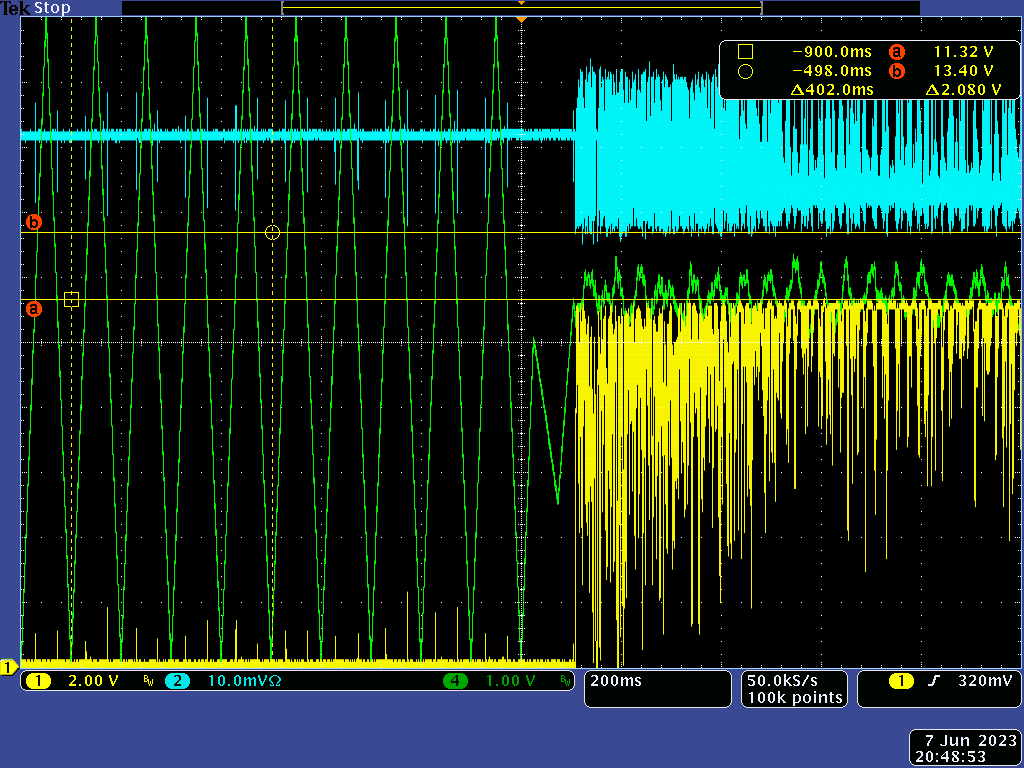
Oscilloscope :
- error signal, not shown as it was too noisy to have in the image
- blue : reflection (low bypass filter ), yellow : transmission (resistance of 100 k ohm added), green : piezo signal
- 1st image : showing lock and scan regions.
- 2nd image: time zoom on the locked signal
oscillators controller / smartAct:
- Frequency and CEP control , the parameters in the photo attached are the best for the moment to see the smooth change of the resonance peaks when operating the motors, and we can stay FSR range and compensate the variation easily.
- even though we stayed at closed loop (for easier adjustment), we still managed to lock , will try to switch off later to see if reduces a lot of noise.
| Manar Amer wrote: |
|
Today, I installed a power meter at the transmission point of the 1st spherical mirror , transmission 3 ppm (direct from cavity window beam profiler, no filter)
We locked the cavity at 2 different resonances of the fundamental mode, the lock in both cases was stable for a round 1 minute.
at different transmitted power of 33.85 uW ( 11 W average inside cavity) and then locked again at 82.65 uW (27.5 W average inside cavity) transmitted power
Note : the coupling is almost zero for both of the resonances locked !!!!
Oscillator : 33.33 MHz ( 33.356 MHz , frequency read on LAL software)
power injected into amplifier (after injecting into fiber and an EOM) : 3.886 mW (on LAL software)
Amplifier power : 0% (injected power into cavity ~ 300 mW)
Both images of oscilloscope have same voltage scales, only difference timescale and the color code is :
yellow : transmission
blue : reflection
green : piezo voltage
red : error signal
| Manar Amer wrote: |
|
Yesterday, with Ronic we locked ThomX cavity on the second resonance
Laser : 33.36 MHz , Amplifier : 0 % (worked with no errors all day)
adding image for the lock on the second resonance (locked), 00 Mode image, fit, Beam measurements
and image of the first resonance signal (not locked)
Info : when locking on the secondary resonance, we aligned better and adjusted on the oscillator CEP and increased the transmission signal
Controllers connected to computer
through Ethernet :
- Cavity Mirror motors
- Lase lock
- oscillator CEP and Frequency motors (easier to follow the drift with this controller, and we can see it moving)
by USB :
| Manar Amer wrote: |
|
This morning, while trying Guillaume solution of disconnecting the 24 V necessary to the second and third stage and raise the threshold of Temp preamp 1 (to only operate the ampli with first stage only)
Ronic disconnected the 24 volt connection, turned on amplifier LAL software but no MMD3 error or a big temp on Temp preamp 1 , software worked fine with no issue.
we connected the 24 V again and the software worked with no issues.
Still not sure what happened for it to work correctly !!!!!!!!!!
- We used the amplifier at 0% all day with no errors (to test , I turned it for 10 minutes @ 10% with no error too)
- We changed the lase lock box with ThomX one (having Ethernet connection), it was connected to computer and works ok
- Ronic installed a signal amplifier for the PDH error signal. (yet to be fully optimized)
- we see a better coupling than before in the cavity.
- The dominant mode is 00 mode, but we see many higher order modes, need to alight better.
| Manar Amer wrote: |
|
Today with Ronic and Daniele we attempted to lock the cavity, but the alphanov amplifier did not turn on because of an error in MMD3 (related to the third stage)
the new error is having the MMD3 error show on the alarm window of the LAL software, and having the Alarms on the line 3 of the alphanov software red for both EXT/CPU and Laser T Max (never been red before)
this is after a 2-week work stop, but the last time when Daniele changed the fiber connector it worked for 3 hours with no errors.
Ronic, is in contact with Guillaume from Alphanov to fix the issue !!!
Work scheduled all Wednesday, in hopes the issue is fixed by then.
| Manar Amer wrote: |
|
Added Note: the coupling we get is at low power, only preamplifier is on (~ 300 mW)
was done at the end due to excitation of higher order modes.
Wanted to improve the fundamental first, then increase the power.
| Manar Amer wrote: |
- On Monday with Daniele,
- we did full characterization of amplifier beam @ 10% amplification, adjusted the telescope accordingly and injected into the cavity aligned and improved on the fundamental mode.
- On Tuesday with Daniele and Kevin
- I added a low pass filter between 1 - 1.9 MHz on the reflected signal, to reject the oscillator signal (33.33 MHz)
- removed the external resistors on the signal, only the internal resistance of the oscilloscope used ( transmission : 1 M ohm , Reflection : 50 ohm )
- We connected the motors to control the CEP and adjusted on them until we reached ~ 5 -10% coupling
- Images:
- 1st : showing the size of the beam just before injecting into the cavity @ 10%
- 2nd: signal with only improved alignment (not CEP adjustment yet), no low pass filter added yet
- 3rd : zoom on the signals (reflection and error) while adjusting on the CEP
- 4th :attempting to lock the cavity , after getting the max coupling using the CEP motors
Note : the voltage ranges are not the same between the images
| Manar Amer wrote: |
|
Yesterday,
- we installed the second high power reflecting mirrors at the output of the amplifier.
- We aligned and installed a telescope that has adjustable distance between the 2 lenses of -100 mm, and + 200 mm, with approximate diameter at the injection window of ~ 4.5 mm.
- Amplifier was turned on only at the first stage only (output power ~ 300 mW) aligned and injected into the cavity.
- Measured the repetition frequency of the One Five oscillators, Frep = 33.326239 MHz
- Changed the FSR of the cavity to match it.
- Using the Piezo scan on the oscillator, we observed 00 Mode, Fundamental. the shape is the same
- We see transmission on the diode, but there was zero coupling observed (yet to be investigated experimentally )
- a reason could be the CEP of the oscillator ,
- bad matching of the beam waist position,
- noise from the amplifier (as we were operating it at very low power)
- additional alignment needed,
|
|
|
|
|
|
|
|
| Attachment 1: tek00001.png
|  |
| Attachment 2: 20230607_183626_Frep_CEP_motors_smartAct.jpg
|  |
| Attachment 3: 20230607_183641_transmitted_power.jpg
|  |
| Attachment 4: tek00002.png
|  |
|
217
|
Tue Jun 6 15:52:59 2023 |
Ronic Chiche | Fixed | info | lasers and optics | ThomX igloo | 33MHz oscillator + Alphanov amplifier lock | today with Daniele, we locked easily (but with a noisy lock) on the secundary resonance and we tried to lock on the main resonance (with very low coupling ~10% which mean a CEP ~Pi)
the lock was possible but was very noisy.
I installed a fast loop using my small DC amplifier based on OP37 (max gain=100) modified to be AC coupled to avoid to amplify the PDH box offset.
the output votage swing of the OP37 is only ~10V. Thus, the effect of this fast loop on the lock stability is not visible !
Thus, I added the M250 Leysop HV amplifier (see attached documentation), which is able to drive an EOM with >5MHz bandwidth and ~250V swing, after my OP37 amplifier.
with this additionnal HV amplifier, now we can clearly see the effect of the EOM loop which improves the lock stability BUT, even with a poor CEP, the lock is very unstable on the main resonance.
it seems the optical phase noise is still too large and/or its BW too high to be completely compensated.
The next step is to try to remove all the possible noise sources from the optical table:
- the laptop placed on the ionic pump
- the 2 Rigol generators on the table surface
and switch off the controller of the Smaract laser cavity motors.
If it doesn't help, we can send the error signal to a spectrum analyzer to have a better view of the different harmonics involved in the residual phase noise.
could it remain some noise above the present PDH box BW (1.9MHz LP filter) ?
lastely, we can also make an optical phase noise measurement to check if the Alphanov amplifier does not add some noise.
| Ronic Chiche wrote: |
|
finding the right modulation/demodulation PDH phase is very difficult on the main resonance because the we get non stationnary signals with a lot of oscillations.
changing the phase, in this condition, does not really change the error signal.
Then, we moved on the first secundary resonance with less gain and less coupling.
Thus, the error signal is more similar to the theoretical PDH signal => one can adjust the modulation/demodulation PDH phase to get the maximum error signal.
then, we locked pretty easily on this first secondary resonance, with a coupling around some % when we adjust the CEP motor.
we tried to lock on the main resonance but it is too noisy and unstable.
it seems we really need high BW feedback.
I tried to add a fast analog loop on the laser intra-cavity EOM but without a clear effect.
the problem is the gain of this loop : it is difficult to produce a "high voltage" (above 10Vpp) on this EOM.
I put "my" amplifier but the voltage output is limited... commercial amplifiers will have the same issue.
we can add HV amplifiers but it takes place and it will add some noise on the signal.
A loop with an AOM could be easier to install and manage... but at the price of a loss of power before the laser amplifier...
| Ronic Chiche wrote: |
|
the last tries to lock the 33MHz + amplifier to the 30k Finesse FP-cavity were unsuccessful.
during a laser Frep scan using the Laselock, one observes that the main cavity resonance is not able to stay inside the PZT scan range from one scan to another (500ms-1s period)
is it the effect of a large and slow phase noise ?
some informations:
- The 33MHz laser came back at lab from repair on March 2018.
- it has been sent to Alphanov in May 2020.
- it failled and has been sent to NKT/OneFive for repair in September 2021
- it came back to lab from repair in June 2022.
- on post #92 (Feb. 2020), it seems that we already locked the 33MHz laser + CELIA amplifier to the ThomX FP-cavity.
- The PZT sensitivity for the 33MHz laser is given to 0,3Hz/V for Frep <=> 2.6MHz/V for optical frequency.
=> 10V on PZT is equivalent to 26MHz of optical frequency shift which is less than FSR !
- by comparison, the PZT sensitivity for the 133MHz laser is given to 3.9Hz/V for Frep <=> 8.5MHz/V for optical frequency.
- by comparison, the PZT sensitivity for the NKT CW laser is given 10pm/100V for Wavelength <=> 30MHz/V for optical frequency
- by comparison, the PZT sensitivity for the ThomX FP cavity (Z20H38x40C) is 4nm/V for length expansion => 8nm/V for round-trip expansion <=> 0.03Hz/V for FSR expansion <=> 260kHz/V for optical frequency !!!
the PZT expansion estimation is in attached file.
|
|
|
| Attachment 1: M250_Video_Amplifier.pdf
|
| Attachment 2: M250_manual.pdf
|
|
216
|
Tue Jun 6 01:12:11 2023 |
Manar Amer | Fixed | report | lasers and optics | detectors and electronics | cabling | software | ThomX igloo | Cavity Lock - Alphanov Amplifier | Today, I installed a power meter at the transmission point of the 1st spherical mirror , transmission 3 ppm (direct from cavity window beam profiler, no filter)
We locked the cavity at 2 different resonances of the fundamental mode, the lock in both cases was stable for a round 1 minute.
at different transmitted power of 33.85 uW ( 11 W average inside cavity) and then locked again at 82.65 uW (27.5 W average inside cavity) transmitted power
Note : the coupling is almost zero for both of the resonances locked !!!!
Oscillator : 33.33 MHz ( 33.356 MHz , frequency read on LAL software)
power injected into amplifier (after injecting into fiber and an EOM) : 3.886 mW (on LAL software)
Amplifier power : 0% (injected power into cavity ~ 300 mW)
Both images of oscilloscope have same voltage scales, only difference timescale and the color code is :
yellow : transmission
blue : reflection
green : piezo voltage
red : error signal
| Manar Amer wrote: |
|
Yesterday, with Ronic we locked ThomX cavity on the second resonance
Laser : 33.36 MHz , Amplifier : 0 % (worked with no errors all day)
adding image for the lock on the second resonance (locked), 00 Mode image, fit, Beam measurements
and image of the first resonance signal (not locked)
Info : when locking on the secondary resonance, we aligned better and adjusted on the oscillator CEP and increased the transmission signal
Controllers connected to computer
through Ethernet :
- Cavity Mirror motors
- Lase lock
- oscillator CEP and Frequency motors (easier to follow the drift with this controller, and we can see it moving)
by USB :
| Manar Amer wrote: |
|
This morning, while trying Guillaume solution of disconnecting the 24 V necessary to the second and third stage and raise the threshold of Temp preamp 1 (to only operate the ampli with first stage only)
Ronic disconnected the 24 volt connection, turned on amplifier LAL software but no MMD3 error or a big temp on Temp preamp 1 , software worked fine with no issue.
we connected the 24 V again and the software worked with no issues.
Still not sure what happened for it to work correctly !!!!!!!!!!
- We used the amplifier at 0% all day with no errors (to test , I turned it for 10 minutes @ 10% with no error too)
- We changed the lase lock box with ThomX one (having Ethernet connection), it was connected to computer and works ok
- Ronic installed a signal amplifier for the PDH error signal. (yet to be fully optimized)
- we see a better coupling than before in the cavity.
- The dominant mode is 00 mode, but we see many higher order modes, need to alight better.
| Manar Amer wrote: |
|
Today with Ronic and Daniele we attempted to lock the cavity, but the alphanov amplifier did not turn on because of an error in MMD3 (related to the third stage)
the new error is having the MMD3 error show on the alarm window of the LAL software, and having the Alarms on the line 3 of the alphanov software red for both EXT/CPU and Laser T Max (never been red before)
this is after a 2-week work stop, but the last time when Daniele changed the fiber connector it worked for 3 hours with no errors.
Ronic, is in contact with Guillaume from Alphanov to fix the issue !!!
Work scheduled all Wednesday, in hopes the issue is fixed by then.
| Manar Amer wrote: |
|
Added Note: the coupling we get is at low power, only preamplifier is on (~ 300 mW)
was done at the end due to excitation of higher order modes.
Wanted to improve the fundamental first, then increase the power.
| Manar Amer wrote: |
- On Monday with Daniele,
- we did full characterization of amplifier beam @ 10% amplification, adjusted the telescope accordingly and injected into the cavity aligned and improved on the fundamental mode.
- On Tuesday with Daniele and Kevin
- I added a low pass filter between 1 - 1.9 MHz on the reflected signal, to reject the oscillator signal (33.33 MHz)
- removed the external resistors on the signal, only the internal resistance of the oscilloscope used ( transmission : 1 M ohm , Reflection : 50 ohm )
- We connected the motors to control the CEP and adjusted on them until we reached ~ 5 -10% coupling
- Images:
- 1st : showing the size of the beam just before injecting into the cavity @ 10%
- 2nd: signal with only improved alignment (not CEP adjustment yet), no low pass filter added yet
- 3rd : zoom on the signals (reflection and error) while adjusting on the CEP
- 4th :attempting to lock the cavity , after getting the max coupling using the CEP motors
Note : the voltage ranges are not the same between the images
| Manar Amer wrote: |
|
Yesterday,
- we installed the second high power reflecting mirrors at the output of the amplifier.
- We aligned and installed a telescope that has adjustable distance between the 2 lenses of -100 mm, and + 200 mm, with approximate diameter at the injection window of ~ 4.5 mm.
- Amplifier was turned on only at the first stage only (output power ~ 300 mW) aligned and injected into the cavity.
- Measured the repetition frequency of the One Five oscillators, Frep = 33.326239 MHz
- Changed the FSR of the cavity to match it.
- Using the Piezo scan on the oscillator, we observed 00 Mode, Fundamental. the shape is the same
- We see transmission on the diode, but there was zero coupling observed (yet to be investigated experimentally )
- a reason could be the CEP of the oscillator ,
- bad matching of the beam waist position,
- noise from the amplifier (as we were operating it at very low power)
- additional alignment needed,
|
|
|
|
|
|
|
| Attachment 1: 20230605_tek00001_33uW.png
| 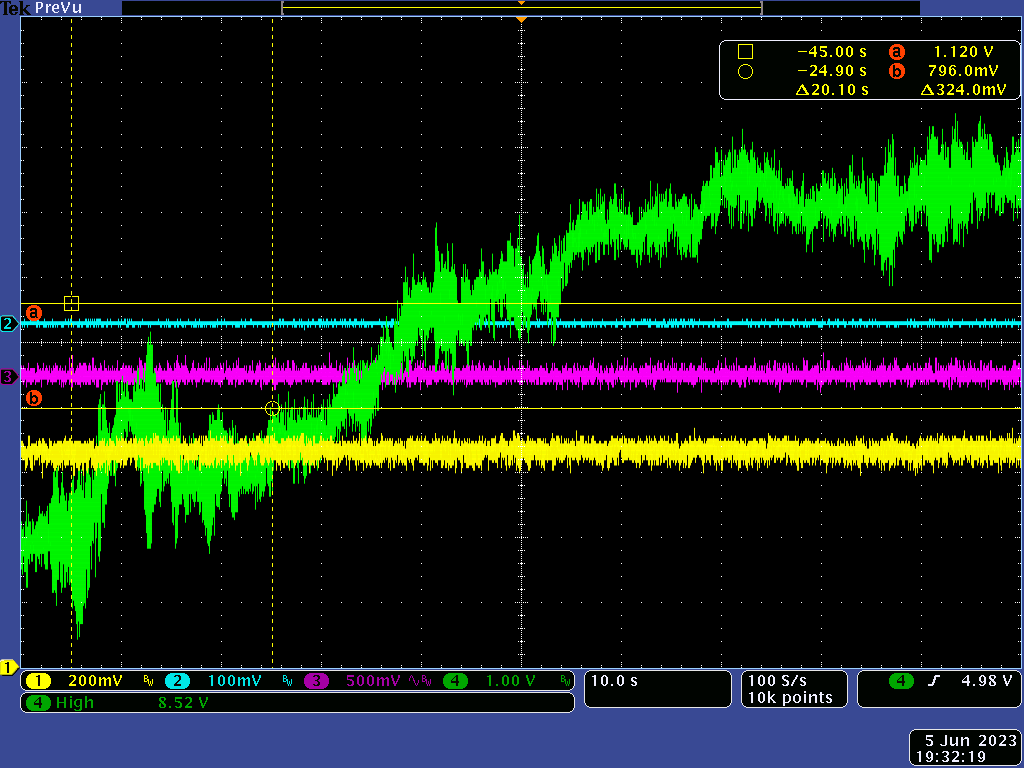 |
| Attachment 2: 20230605_tek00002_82uW.png
| 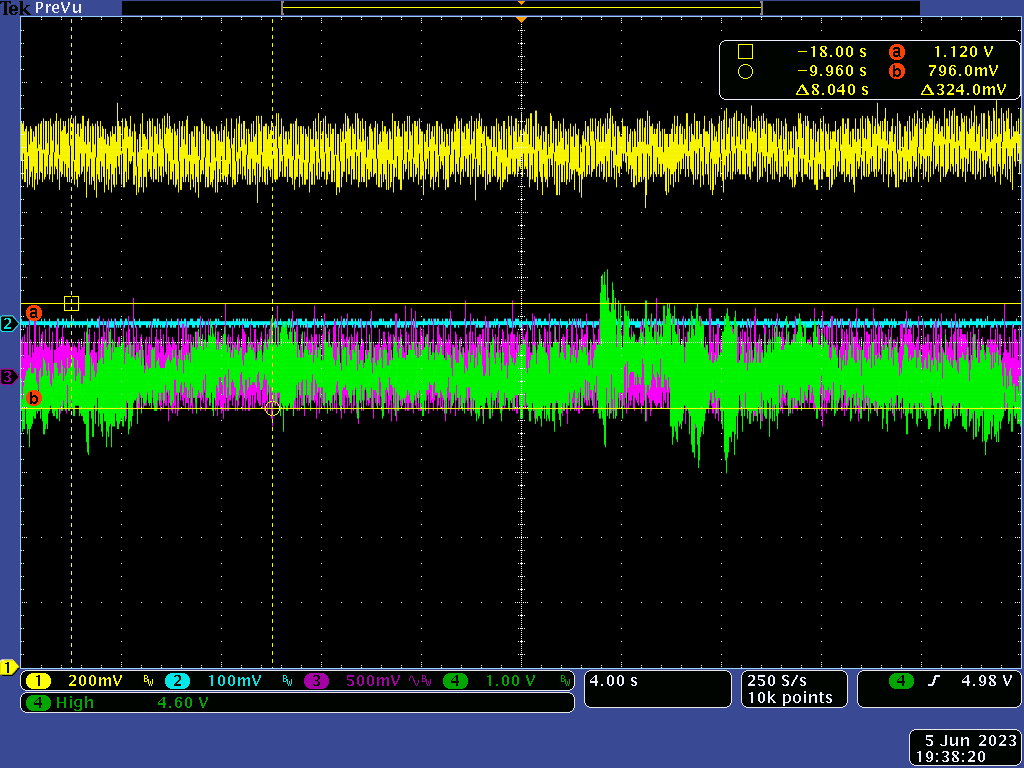 |
|
215
|
Fri Jun 2 10:54:25 2023 |
Manar Amer | Fixed | report | lasers and optics | detectors and electronics | cabling | software | ThomX igloo | Cavity Lock - Alphanov Amplifier | Yesterday, with Ronic we locked ThomX cavity on the second resonance
Laser : 33.36 MHz , Amplifier : 0 % (worked with no errors all day)
adding image for the lock on the second resonance (locked), 00 Mode image, fit, Beam measurements
and image of the first resonance signal (not locked)
Info : when locking on the secondary resonance, we aligned better and adjusted on the oscillator CEP and increased the transmission signal
Controllers connected to computer
through Ethernet :
- Cavity Mirror motors
- Lase lock
- oscillator CEP and Frequency motors (easier to follow the drift with this controller, and we can see it moving)
by USB :
| Manar Amer wrote: |
|
This morning, while trying Guillaume solution of disconnecting the 24 V necessary to the second and third stage and raise the threshold of Temp preamp 1 (to only operate the ampli with first stage only)
Ronic disconnected the 24 volt connection, turned on amplifier LAL software but no MMD3 error or a big temp on Temp preamp 1 , software worked fine with no issue.
we connected the 24 V again and the software worked with no issues.
Still not sure what happened for it to work correctly !!!!!!!!!!
- We used the amplifier at 0% all day with no errors (to test , I turned it for 10 minutes @ 10% with no error too)
- We changed the lase lock box with ThomX one (having Ethernet connection), it was connected to computer and works ok
- Ronic installed a signal amplifier for the PDH error signal. (yet to be fully optimized)
- we see a better coupling than before in the cavity.
- The dominant mode is 00 mode, but we see many higher order modes, need to alight better.
| Manar Amer wrote: |
|
Today with Ronic and Daniele we attempted to lock the cavity, but the alphanov amplifier did not turn on because of an error in MMD3 (related to the third stage)
the new error is having the MMD3 error show on the alarm window of the LAL software, and having the Alarms on the line 3 of the alphanov software red for both EXT/CPU and Laser T Max (never been red before)
this is after a 2-week work stop, but the last time when Daniele changed the fiber connector it worked for 3 hours with no errors.
Ronic, is in contact with Guillaume from Alphanov to fix the issue !!!
Work scheduled all Wednesday, in hopes the issue is fixed by then.
| Manar Amer wrote: |
|
Added Note: the coupling we get is at low power, only preamplifier is on (~ 300 mW)
was done at the end due to excitation of higher order modes.
Wanted to improve the fundamental first, then increase the power.
| Manar Amer wrote: |
- On Monday with Daniele,
- we did full characterization of amplifier beam @ 10% amplification, adjusted the telescope accordingly and injected into the cavity aligned and improved on the fundamental mode.
- On Tuesday with Daniele and Kevin
- I added a low pass filter between 1 - 1.9 MHz on the reflected signal, to reject the oscillator signal (33.33 MHz)
- removed the external resistors on the signal, only the internal resistance of the oscilloscope used ( transmission : 1 M ohm , Reflection : 50 ohm )
- We connected the motors to control the CEP and adjusted on them until we reached ~ 5 -10% coupling
- Images:
- 1st : showing the size of the beam just before injecting into the cavity @ 10%
- 2nd: signal with only improved alignment (not CEP adjustment yet), no low pass filter added yet
- 3rd : zoom on the signals (reflection and error) while adjusting on the CEP
- 4th :attempting to lock the cavity , after getting the max coupling using the CEP motors
Note : the voltage ranges are not the same between the images
| Manar Amer wrote: |
|
Yesterday,
- we installed the second high power reflecting mirrors at the output of the amplifier.
- We aligned and installed a telescope that has adjustable distance between the 2 lenses of -100 mm, and + 200 mm, with approximate diameter at the injection window of ~ 4.5 mm.
- Amplifier was turned on only at the first stage only (output power ~ 300 mW) aligned and injected into the cavity.
- Measured the repetition frequency of the One Five oscillators, Frep = 33.326239 MHz
- Changed the FSR of the cavity to match it.
- Using the Piezo scan on the oscillator, we observed 00 Mode, Fundamental. the shape is the same
- We see transmission on the diode, but there was zero coupling observed (yet to be investigated experimentally )
- a reason could be the CEP of the oscillator ,
- bad matching of the beam waist position,
- noise from the amplifier (as we were operating it at very low power)
- additional alignment needed,
|
|
|
|
|
|
| Attachment 1: tek00003_secondary_resonance_fundamental_mode_lock.png
| 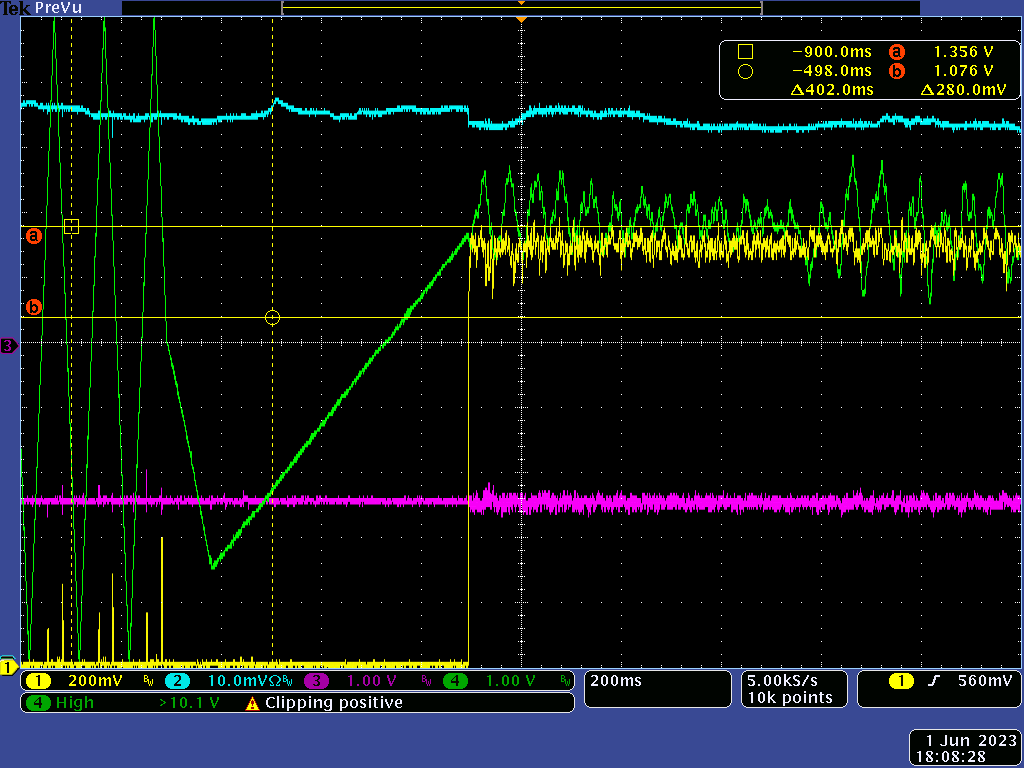 |
| Attachment 2: tek0002CH1.isf
|
| Attachment 3: tek0002CH2.isf
|
| Attachment 4: tek0002CH3.isf
|
| Attachment 5: tek0002CH4.isf
|
| Attachment 6: 20230602_00mode_second_resonance.jpg
| 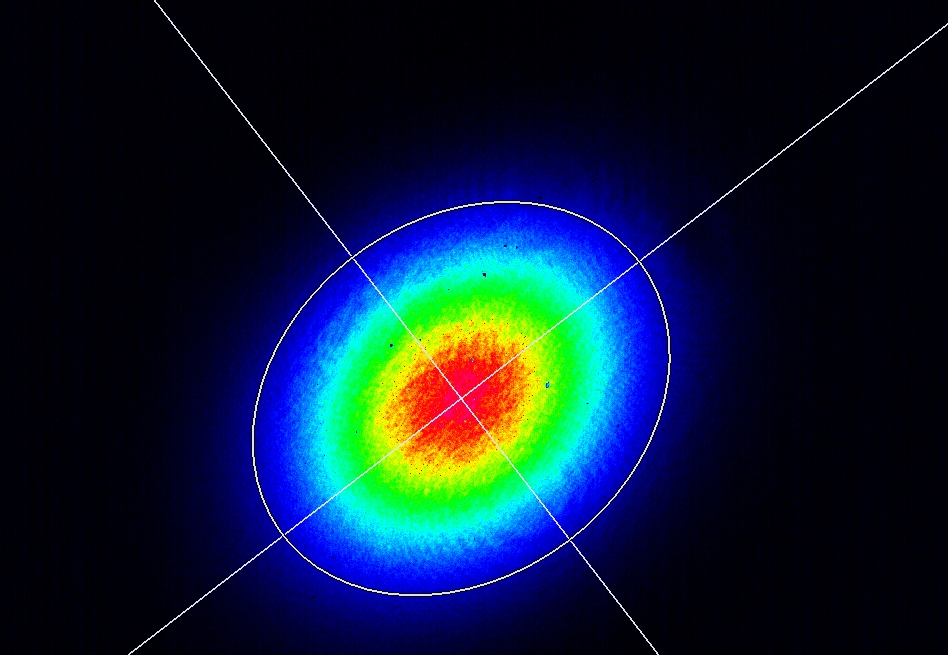 |
| Attachment 7: 20230602_00mode_second_resonance_fit.jpg
| 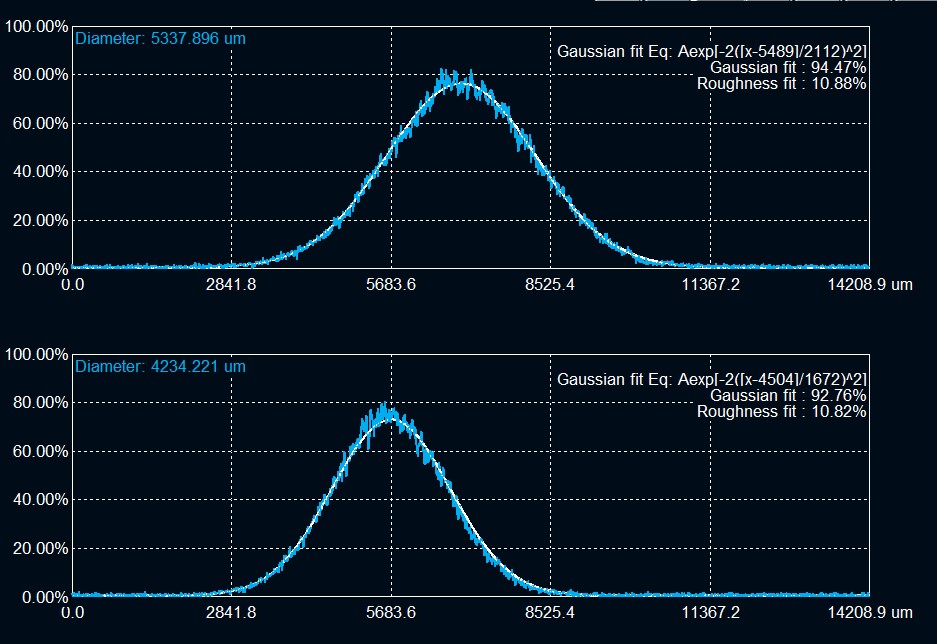 |
| Attachment 8: 20230602_00mode_second_resonance_measurements.jpg
|  |
| Attachment 9: tek00002_first_resonance_fundamental_mode_signal.png
|  |
| Attachment 10: tek0001CH1.isf
|
| Attachment 11: tek0001CH2.isf
|
| Attachment 12: tek0001CH3.isf
|
| Attachment 13: tek0001CH4.isf
|
|
214
|
Thu Jun 1 18:15:04 2023 |
Ronic Chiche | Fixed | info | lasers and optics | ThomX igloo | 33MHz oscillator + Alphanov amplifier lock | finding the right modulation/demodulation PDH phase is very difficult on the main resonance because the we get non stationnary signals with a lot of oscillations.
changing the phase, in this condition, does not really change the error signal.
Then, we moved on the first secundary resonance with less gain and less coupling.
Thus, the error signal is more similar to the theoretical PDH signal => one can adjust the modulation/demodulation PDH phase to get the maximum error signal.
then, we locked pretty easily on this first secondary resonance, with a coupling around some % when we adjust the CEP motor.
we tried to lock on the main resonance but it is too noisy and unstable.
it seems we really need high BW feedback.
I tried to add a fast analog loop on the laser intra-cavity EOM but without a clear effect.
the problem is the gain of this loop : it is difficult to produce a "high voltage" (above 10Vpp) on this EOM.
I put "my" amplifier but the voltage output is limited... commercial amplifiers will have the same issue.
we can add HV amplifiers but it takes place and it will add some noise on the signal.
A loop with an AOM could be easier to install and manage... but at the price of a loss of power before the laser amplifier...
| Ronic Chiche wrote: |
|
the last tries to lock the 33MHz + amplifier to the 30k Finesse FP-cavity were unsuccessful.
during a laser Frep scan using the Laselock, one observes that the main cavity resonance is not able to stay inside the PZT scan range from one scan to another (500ms-1s period)
is it the effect of a large and slow phase noise ?
some informations:
- The 33MHz laser came back at lab from repair on March 2018.
- it has been sent to Alphanov in May 2020.
- it failled and has been sent to NKT/OneFive for repair in September 2021
- it came back to lab from repair in June 2022.
- on post #92 (Feb. 2020), it seems that we already locked the 33MHz laser + CELIA amplifier to the ThomX FP-cavity.
- The PZT sensitivity for the 33MHz laser is given to 0,3Hz/V for Frep <=> 2.6MHz/V for optical frequency.
=> 10V on PZT is equivalent to 26MHz of optical frequency shift which is less than FSR !
- by comparison, the PZT sensitivity for the 133MHz laser is given to 3.9Hz/V for Frep <=> 8.5MHz/V for optical frequency.
- by comparison, the PZT sensitivity for the NKT CW laser is given 10pm/100V for Wavelength <=> 30MHz/V for optical frequency
- by comparison, the PZT sensitivity for the ThomX FP cavity (Z20H38x40C) is 4nm/V for length expansion => 8nm/V for round-trip expansion <=> 0.03Hz/V for FSR expansion <=> 260kHz/V for optical frequency !!!
the PZT expansion estimation is in attached file.
|
|
|
213
|
Thu Jun 1 10:31:45 2023 |
Ronic Chiche | Fixed | info | lasers and optics | ThomX igloo | 33MHz oscillator + Alphanov amplifier lock | the last tries to lock the 33MHz + amplifier to the 30k Finesse FP-cavity were unsuccessful.
during a laser Frep scan using the Laselock, one observes that the main cavity resonance is not able to stay inside the PZT scan range from one scan to another (500ms-1s period)
is it the effect of a large and slow phase noise ?
some informations:
- The 33MHz laser came back at lab from repair on March 2018.
- it has been sent to Alphanov in May 2020.
- it failled and has been sent to NKT/OneFive for repair in September 2021
- it came back to lab from repair in June 2022.
- on post #92 (Feb. 2020), it seems that we already locked the 33MHz laser + CELIA amplifier to the ThomX FP-cavity.
- The PZT sensitivity for the 33MHz laser is given to 0,3Hz/V for Frep <=> 2.6MHz/V for optical frequency.
=> 10V on PZT is equivalent to 26MHz of optical frequency shift which is less than FSR !
- by comparison, the PZT sensitivity for the 133MHz laser is given to 3.9Hz/V for Frep <=> 8.5MHz/V for optical frequency.
- by comparison, the PZT sensitivity for the NKT CW laser is given 10pm/100V for Wavelength <=> 30MHz/V for optical frequency
- by comparison, the PZT sensitivity for the ThomX FP cavity (Z20H38x40C) is 4nm/V for length expansion => 8nm/V for round-trip expansion <=> 0.03Hz/V for FSR expansion <=> 260kHz/V for optical frequency !!!
the PZT expansion estimation is in attached file. |
| Attachment 1: 120705_Displacement_of_cylindrical_piezo_ceramics.xls
|
|
212
|
Tue May 30 18:32:37 2023 |
Manar Amer | Fixed | report | lasers and optics | detectors and electronics | cabling | software | ThomX igloo | Cavity Lock - Alphanov Amplifier | This morning, while trying Guillaume solution of disconnecting the 24 V necessary to the second and third stage and raise the threshold of Temp preamp 1 (to only operate the ampli with first stage only)
Ronic disconnected the 24 volt connection, turned on amplifier LAL software but no MMD3 error or a big temp on Temp preamp 1 , software worked fine with no issue.
we connected the 24 V again and the software worked with no issues.
Still not sure what happened for it to work correctly !!!!!!!!!!
- We used the amplifier at 0% all day with no errors (to test , I turned it for 10 minutes @ 10% with no error too)
- We changed the lase lock box with ThomX one (having Ethernet connection), it was connected to computer and works ok
- Ronic installed a signal amplifier for the PDH error signal. (yet to be fully optimized)
- we see a better coupling than before in the cavity.
- The dominant mode is 00 mode, but we see many higher order modes, need to alight better.
| Manar Amer wrote: |
|
Today with Ronic and Daniele we attempted to lock the cavity, but the alphanov amplifier did not turn on because of an error in MMD3 (related to the third stage)
the new error is having the MMD3 error show on the alarm window of the LAL software, and having the Alarms on the line 3 of the alphanov software red for both EXT/CPU and Laser T Max (never been red before)
this is after a 2-week work stop, but the last time when Daniele changed the fiber connector it worked for 3 hours with no errors.
Ronic, is in contact with Guillaume from Alphanov to fix the issue !!!
Work scheduled all Wednesday, in hopes the issue is fixed by then.
| Manar Amer wrote: |
|
Added Note: the coupling we get is at low power, only preamplifier is on (~ 300 mW)
was done at the end due to excitation of higher order modes.
Wanted to improve the fundamental first, then increase the power.
| Manar Amer wrote: |
- On Monday with Daniele,
- we did full characterization of amplifier beam @ 10% amplification, adjusted the telescope accordingly and injected into the cavity aligned and improved on the fundamental mode.
- On Tuesday with Daniele and Kevin
- I added a low pass filter between 1 - 1.9 MHz on the reflected signal, to reject the oscillator signal (33.33 MHz)
- removed the external resistors on the signal, only the internal resistance of the oscilloscope used ( transmission : 1 M ohm , Reflection : 50 ohm )
- We connected the motors to control the CEP and adjusted on them until we reached ~ 5 -10% coupling
- Images:
- 1st : showing the size of the beam just before injecting into the cavity @ 10%
- 2nd: signal with only improved alignment (not CEP adjustment yet), no low pass filter added yet
- 3rd : zoom on the signals (reflection and error) while adjusting on the CEP
- 4th :attempting to lock the cavity , after getting the max coupling using the CEP motors
Note : the voltage ranges are not the same between the images
| Manar Amer wrote: |
|
Yesterday,
- we installed the second high power reflecting mirrors at the output of the amplifier.
- We aligned and installed a telescope that has adjustable distance between the 2 lenses of -100 mm, and + 200 mm, with approximate diameter at the injection window of ~ 4.5 mm.
- Amplifier was turned on only at the first stage only (output power ~ 300 mW) aligned and injected into the cavity.
- Measured the repetition frequency of the One Five oscillators, Frep = 33.326239 MHz
- Changed the FSR of the cavity to match it.
- Using the Piezo scan on the oscillator, we observed 00 Mode, Fundamental. the shape is the same
- We see transmission on the diode, but there was zero coupling observed (yet to be investigated experimentally )
- a reason could be the CEP of the oscillator ,
- bad matching of the beam waist position,
- noise from the amplifier (as we were operating it at very low power)
- additional alignment needed,
|
|
|
|
|
| Attachment 1: tek00000.png
| 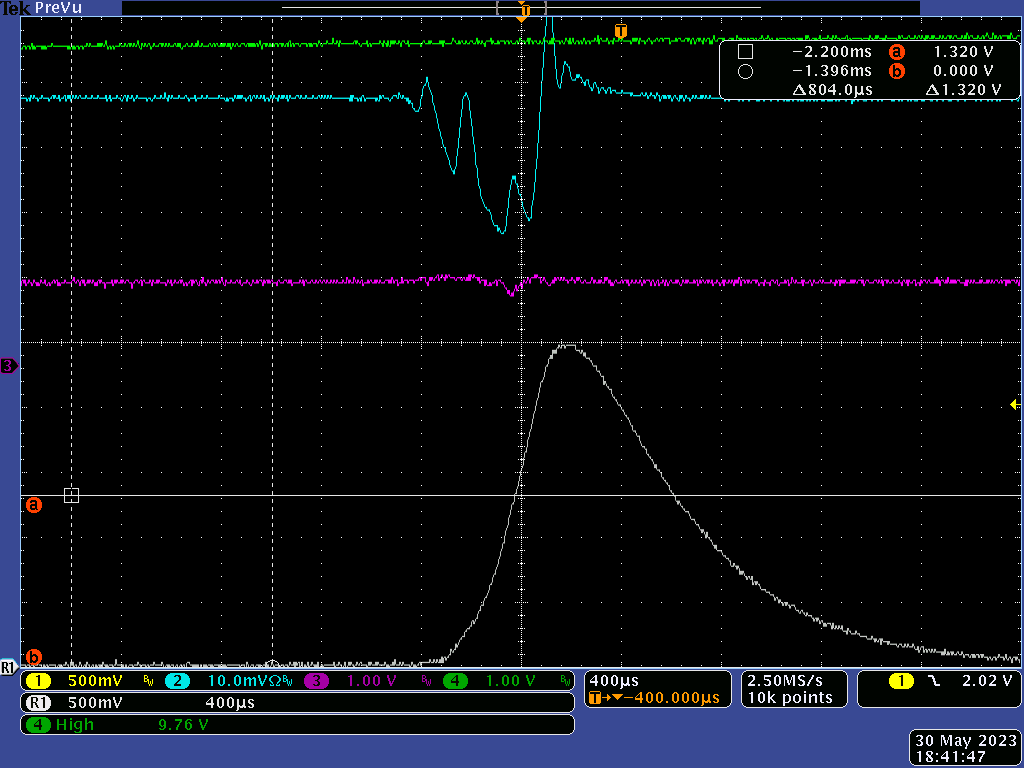 |
|
211
|
Mon May 22 16:07:12 2023 |
Manar Amer | Fixed | report | lasers and optics | detectors and electronics | ThomX igloo | PW laser Injection into cavity | Today with Ronic and Daniele we attempted to lock the cavity, but the alphanov amplifier did not turn on because of an error in MMD3 (related to the third stage)
the new error is having the MMD3 error show on the alarm window of the LAL software, and having the Alarms on the line 3 of the alphanov software red for both EXT/CPU and Laser T Max (never been red before)
this is after a 2-week work stop, but the last time when Daniele changed the fiber connector it worked for 3 hours with no errors.
Ronic, is in contact with Guillaume from Alphanov to fix the issue !!!
Work scheduled all Wednesday, in hopes the issue is fixed by then.
| Manar Amer wrote: |
|
Added Note: the coupling we get is at low power, only preamplifier is on (~ 300 mW)
was done at the end due to excitation of higher order modes.
Wanted to improve the fundamental first, then increase the power.
| Manar Amer wrote: |
- On Monday with Daniele,
- we did full characterization of amplifier beam @ 10% amplification, adjusted the telescope accordingly and injected into the cavity aligned and improved on the fundamental mode.
- On Tuesday with Daniele and Kevin
- I added a low pass filter between 1 - 1.9 MHz on the reflected signal, to reject the oscillator signal (33.33 MHz)
- removed the external resistors on the signal, only the internal resistance of the oscilloscope used ( transmission : 1 M ohm , Reflection : 50 ohm )
- We connected the motors to control the CEP and adjusted on them until we reached ~ 5 -10% coupling
- Images:
- 1st : showing the size of the beam just before injecting into the cavity @ 10%
- 2nd: signal with only improved alignment (not CEP adjustment yet), no low pass filter added yet
- 3rd : zoom on the signals (reflection and error) while adjusting on the CEP
- 4th :attempting to lock the cavity , after getting the max coupling using the CEP motors
Note : the voltage ranges are not the same between the images
| Manar Amer wrote: |
|
Yesterday,
- we installed the second high power reflecting mirrors at the output of the amplifier.
- We aligned and installed a telescope that has adjustable distance between the 2 lenses of -100 mm, and + 200 mm, with approximate diameter at the injection window of ~ 4.5 mm.
- Amplifier was turned on only at the first stage only (output power ~ 300 mW) aligned and injected into the cavity.
- Measured the repetition frequency of the One Five oscillators, Frep = 33.326239 MHz
- Changed the FSR of the cavity to match it.
- Using the Piezo scan on the oscillator, we observed 00 Mode, Fundamental. the shape is the same
- We see transmission on the diode, but there was zero coupling observed (yet to be investigated experimentally )
- a reason could be the CEP of the oscillator ,
- bad matching of the beam waist position,
- noise from the amplifier (as we were operating it at very low power)
- additional alignment needed,
|
|
|
|
| Attachment 1: 2023-05-22_MMD3_error_on_alarm_window.jpg
| 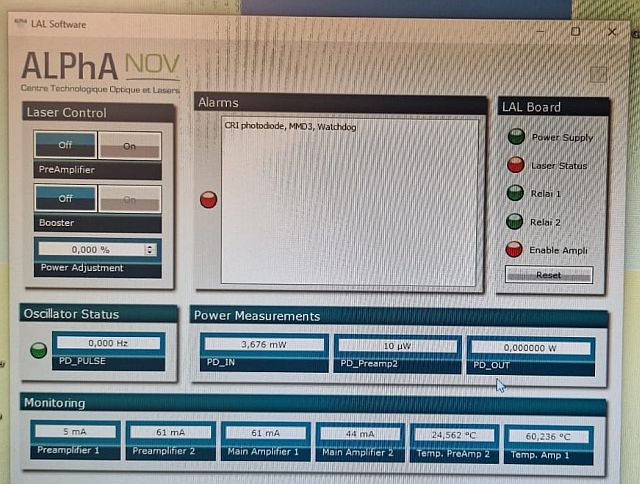 |
| Attachment 2: 2023-05-22_alphanov_software.jpg
| 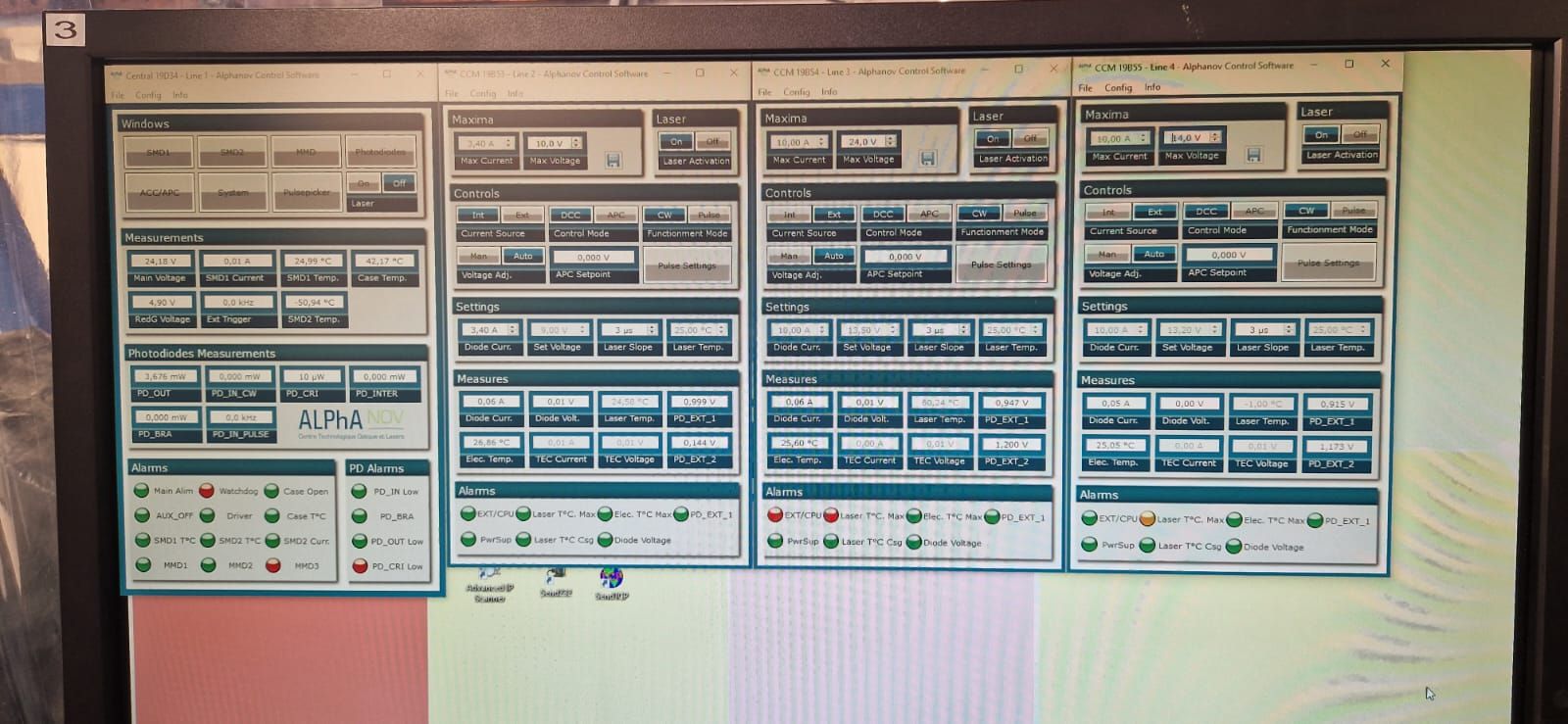 |
|
210
|
Wed Apr 19 16:41:46 2023 |
Manar Amer | Fixed | report | lasers and optics | detectors and electronics | ThomX igloo | PW laser Injection into cavity | Added Note: the coupling we get is at low power, only preamplifier is on (~ 300 mW)
was done at the end due to excitation of higher order modes.
Wanted to improve the fundamental first, then increase the power.
| Manar Amer wrote: |
- On Monday with Daniele,
- we did full characterization of amplifier beam @ 10% amplification, adjusted the telescope accordingly and injected into the cavity aligned and improved on the fundamental mode.
- On Tuesday with Daniele and Kevin
- I added a low pass filter between 1 - 1.9 MHz on the reflected signal, to reject the oscillator signal (33.33 MHz)
- removed the external resistors on the signal, only the internal resistance of the oscilloscope used ( transmission : 1 M ohm , Reflection : 50 ohm )
- We connected the motors to control the CEP and adjusted on them until we reached ~ 5 -10% coupling
- Images:
- 1st : showing the size of the beam just before injecting into the cavity @ 10%
- 2nd: signal with only improved alignment (not CEP adjustment yet), no low pass filter added yet
- 3rd : zoom on the signals (reflection and error) while adjusting on the CEP
- 4th :attempting to lock the cavity , after getting the max coupling using the CEP motors
Note : the voltage ranges are not the same between the images
| Manar Amer wrote: |
|
Yesterday,
- we installed the second high power reflecting mirrors at the output of the amplifier.
- We aligned and installed a telescope that has adjustable distance between the 2 lenses of -100 mm, and + 200 mm, with approximate diameter at the injection window of ~ 4.5 mm.
- Amplifier was turned on only at the first stage only (output power ~ 300 mW) aligned and injected into the cavity.
- Measured the repetition frequency of the One Five oscillators, Frep = 33.326239 MHz
- Changed the FSR of the cavity to match it.
- Using the Piezo scan on the oscillator, we observed 00 Mode, Fundamental. the shape is the same
- We see transmission on the diode, but there was zero coupling observed (yet to be investigated experimentally )
- a reason could be the CEP of the oscillator ,
- bad matching of the beam waist position,
- noise from the amplifier (as we were operating it at very low power)
- additional alignment needed,
|
|
|
|
209
|
Wed Apr 19 16:39:28 2023 |
Manar Amer | Fixed | report | lasers and optics | detectors and electronics | ThomX igloo | PW laser Injection into cavity |
- On Monday with Daniele,
- we did full characterization of amplifier beam @ 10% amplification, adjusted the telescope accordingly and injected into the cavity aligned and improved on the fundamental mode.
- On Tuesday with Daniele and Kevin
- I added a low pass filter between 1 - 1.9 MHz on the reflected signal, to reject the oscillator signal (33.33 MHz)
- removed the external resistors on the signal, only the internal resistance of the oscilloscope used ( transmission : 1 M ohm , Reflection : 50 ohm )
- We connected the motors to control the CEP and adjusted on them until we reached ~ 5 -10% coupling
- Images:
- 1st : showing the size of the beam just before injecting into the cavity @ 10%
- 2nd: signal with only improved alignment (not CEP adjustment yet), no low pass filter added yet
- 3rd : zoom on the signals (reflection and error) while adjusting on the CEP
- 4th :attempting to lock the cavity , after getting the max coupling using the CEP motors
Note : the voltage ranges are not the same between the images
| Manar Amer wrote: |
|
Yesterday,
- we installed the second high power reflecting mirrors at the output of the amplifier.
- We aligned and installed a telescope that has adjustable distance between the 2 lenses of -100 mm, and + 200 mm, with approximate diameter at the injection window of ~ 4.5 mm.
- Amplifier was turned on only at the first stage only (output power ~ 300 mW) aligned and injected into the cavity.
- Measured the repetition frequency of the One Five oscillators, Frep = 33.326239 MHz
- Changed the FSR of the cavity to match it.
- Using the Piezo scan on the oscillator, we observed 00 Mode, Fundamental. the shape is the same
- We see transmission on the diode, but there was zero coupling observed (yet to be investigated experimentally )
- a reason could be the CEP of the oscillator ,
- bad matching of the beam waist position,
- noise from the amplifier (as we were operating it at very low power)
- additional alignment needed,
|
|
| Attachment 1: 20230418_size_of_beam_before_injection_window_at_10percetage_ampli.jpg
|  |
| Attachment 2: 20230418_coupling_at_the_start_only_alignment_improved1.jpg
| 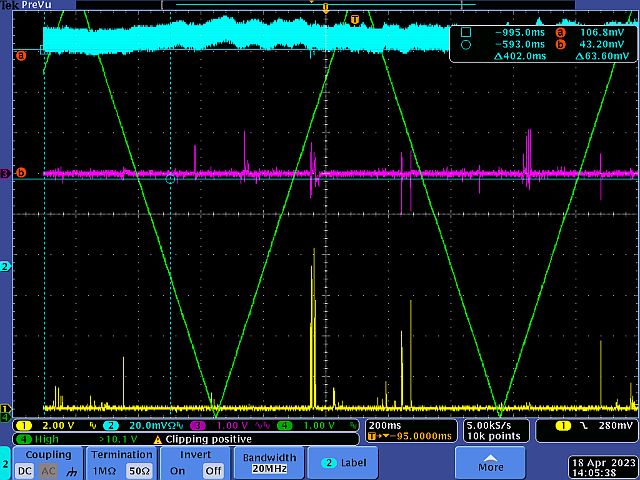 |
| Attachment 3: 20230418_zoom_on_Oscilliscope_signal_fundamental_mode.jpg
| 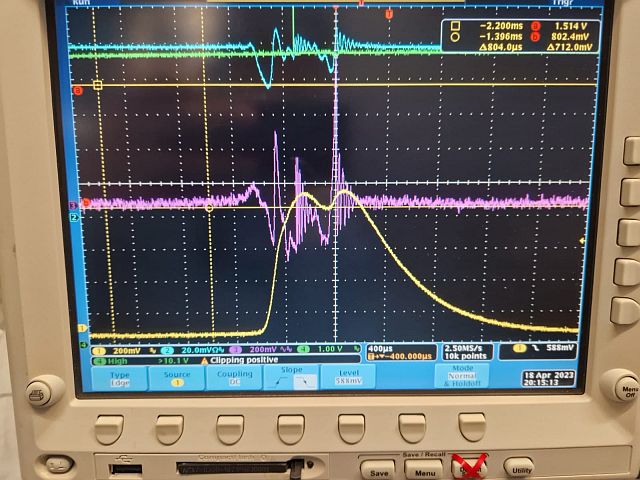 |
| Attachment 4: 20230418_coupling_after_improving_it_with_regulator_on_attempting_to_lock.jpg
| 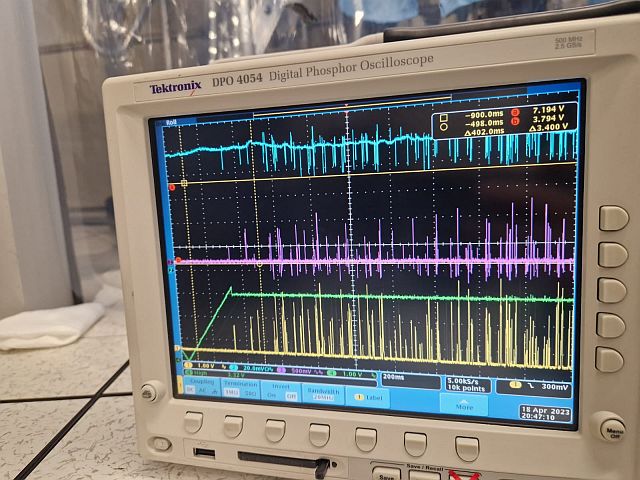 |
|