| ID |
Date |
Author |
Status |
Type |
Category |
Location |
Title |
|
358
|
Fri Sep 6 12:10:51 2024 |
Ronic Chiche | Fixed | info | lasers and optics | detectors and electronics | software | ThomX igloo | restarting CFP system after the long summer shutdown (RF section conditionning) and Alphanov amplifier issue | after redoing the alignment of the CVBG, we got back the initial power in the FPC (87kW)
now, I checked the RF locking signals on the 2nd oscilloscope.
I get a strange ratio between the 33MHz beating and the 500MHz beating signals.
beat @ 33MHz ~ 40kHz !
beat @ 500MHz ~ 700Hz !
maybe the 33MHz generator frequency is not matching the 500MHz RF frequency ?
| Ronic Chiche wrote: |
|
amplifier power measurement before the compressor CVBG.
we used a mirror in between the amplifier output and the compressor + a 2-mirror periscope to match the powermeter height.
amp ratio (%) power (W)
0 0.7
10 1.65
20 13
30 25
40 37.7
50 50.5
60 62
70 74
80 86
90 99
100 110
we had an alarm @100% of amplifier ratio => the reason is not clear... maybe it's coming from a discrepency between some internal measurement and the expected value.
we checked the power after the alarm => still OK
conclusion, the amplifier seems to be OK... we need to redo the alignment of the compressor CVBG.
| Ronic Chiche wrote: |
|
After the summer power shutdown, I restarted all the equipements and got quickly ~80kW for 33% amplifier ratio with CEP optimization and without Alignment optimization.
CEP motor position : -506µm
| Ronic Chiche wrote: |
|
this morning with Daniele, we are measuring the amplifier power just before the FP-cavity.
Casemate temperature @19.5°C
@0% : 205mW
@10%: 755mW
@20%: 7.44W
@30%: 14.3W
@33%:16.3W
@40% : 20.3W
@50% : 24W
@60% : 26W
=> there is a power issue !!!
the normal casemate temperature should be in between 21 and 22°C.
cf this post (https://elog.lal.in2p3.fr/FPC/THOMX+commissioning/133) to get previous amplifier power.
=> it seems we need to redo the compressor CVBG alignment !
first, we will check the amplifier power before the compressor.
| Ronic Chiche wrote: |
|
after doing some alignment (walking procedure on the Y axis), and CEP optimization, I got 83kW for 33% on the laser amplifier with a coupling of ~60%
=> we have to check the input power after the amplifier.
I adjusted the FP and laser cavity motors to have a small 33MHz detuning with the RF reference (~10 Hz of beating @ 33MHz)
pb : I don't see the 500MHz beating signal => to be checked
during the motion of the FP-cavity motors, I observed a systematic delock when moving MOT.06 on P1z and no delock with MOT.03 on P4z when I move by 10 steps.
Kevin checked that both IcePap controller have the same configuration and then, the problem is maybe coming from the rust observed on the mechanic.
| Ronic Chiche wrote: |
|
we had to move the laser cavity motor to find the resonances and change a lot the CEP.
the CEP motor is at -524.1µm
we got ~75kW in the FP cavity without alignment but with CEP optimization.
the coupling (the cyan color) is ~ 62% !
=> we need to do some alignment
| Ronic Chiche wrote: |
|
I refilled the chiller and the stabilized temperature is @ 25°C
we started the 3rd stage of the Alphanov amplifier at 30% => PD_OUT is fluctuating around 1-1.4W => it's not related to the real output power !
the photodiode connected to the scope CH2 is around 210mV @ 50ohms
we clearly see some small peak on the transmission signal (scope CH1) => we need to optimize the laser cavity length and the CEP
| Ronic Chiche wrote: |
|
temperature in the casemate ~ 19.5°C stable
this morning, I measured the power directly at the output of the fiber coupler (through the output fiber), after the strecher : ~5mW
then, I connected the EOM used for the PDH technic : ~2.5mW
then, I connected the fiber of the EOM to the Alphanov amplifier input fiber.
LAL Alphnov software :
PD_IN = 3.289mW
PD_PULSE = 33.372MHz
=> nothing to do ! :-)))
I switched ON the preamplifier (3rd stage @ 0%) => PD_Preamp2 = 152.44mW
|
|
|
|
|
|
|
|
|
359
|
Fri Sep 6 15:20:20 2024 |
Ronic Chiche | Fixed | info | lasers and optics | detectors and electronics | software | ThomX igloo | restarting CFP system after the long summer shutdown (RF section conditionning) and Alphanov amplifier issue | now, the Ring RF frequency is set to 500.067MHz.
so the CFP/laser frequency should be 500.067MHz/15 = 33.3378MHz.
the frequency was set to 33.378MHz !!! => it explains the frequency shift only on the 33MHz beating => I corrected the frequency on the generator and informed Nicolas Delerue.
=> now, I can try to lock the CFP to the RF frequency.
| Ronic Chiche wrote: |
|
after redoing the alignment of the CVBG, we got back the initial power in the FPC (87kW)
now, I checked the RF locking signals on the 2nd oscilloscope.
I get a strange ratio between the 33MHz beating and the 500MHz beating signals.
beat @ 33MHz ~ 40kHz !
beat @ 500MHz ~ 700Hz !
maybe the 33MHz generator frequency is not matching the 500MHz RF frequency ?
| Ronic Chiche wrote: |
|
amplifier power measurement before the compressor CVBG.
we used a mirror in between the amplifier output and the compressor + a 2-mirror periscope to match the powermeter height.
amp ratio (%) power (W)
0 0.7
10 1.65
20 13
30 25
40 37.7
50 50.5
60 62
70 74
80 86
90 99
100 110
we had an alarm @100% of amplifier ratio => the reason is not clear... maybe it's coming from a discrepency between some internal measurement and the expected value.
we checked the power after the alarm => still OK
conclusion, the amplifier seems to be OK... we need to redo the alignment of the compressor CVBG.
| Ronic Chiche wrote: |
|
After the summer power shutdown, I restarted all the equipements and got quickly ~80kW for 33% amplifier ratio with CEP optimization and without Alignment optimization.
CEP motor position : -506µm
| Ronic Chiche wrote: |
|
this morning with Daniele, we are measuring the amplifier power just before the FP-cavity.
Casemate temperature @19.5°C
@0% : 205mW
@10%: 755mW
@20%: 7.44W
@30%: 14.3W
@33%:16.3W
@40% : 20.3W
@50% : 24W
@60% : 26W
=> there is a power issue !!!
the normal casemate temperature should be in between 21 and 22°C.
cf this post (https://elog.lal.in2p3.fr/FPC/THOMX+commissioning/133) to get previous amplifier power.
=> it seems we need to redo the compressor CVBG alignment !
first, we will check the amplifier power before the compressor.
| Ronic Chiche wrote: |
|
after doing some alignment (walking procedure on the Y axis), and CEP optimization, I got 83kW for 33% on the laser amplifier with a coupling of ~60%
=> we have to check the input power after the amplifier.
I adjusted the FP and laser cavity motors to have a small 33MHz detuning with the RF reference (~10 Hz of beating @ 33MHz)
pb : I don't see the 500MHz beating signal => to be checked
during the motion of the FP-cavity motors, I observed a systematic delock when moving MOT.06 on P1z and no delock with MOT.03 on P4z when I move by 10 steps.
Kevin checked that both IcePap controller have the same configuration and then, the problem is maybe coming from the rust observed on the mechanic.
| Ronic Chiche wrote: |
|
we had to move the laser cavity motor to find the resonances and change a lot the CEP.
the CEP motor is at -524.1µm
we got ~75kW in the FP cavity without alignment but with CEP optimization.
the coupling (the cyan color) is ~ 62% !
=> we need to do some alignment
| Ronic Chiche wrote: |
|
I refilled the chiller and the stabilized temperature is @ 25°C
we started the 3rd stage of the Alphanov amplifier at 30% => PD_OUT is fluctuating around 1-1.4W => it's not related to the real output power !
the photodiode connected to the scope CH2 is around 210mV @ 50ohms
we clearly see some small peak on the transmission signal (scope CH1) => we need to optimize the laser cavity length and the CEP
| Ronic Chiche wrote: |
|
temperature in the casemate ~ 19.5°C stable
this morning, I measured the power directly at the output of the fiber coupler (through the output fiber), after the strecher : ~5mW
then, I connected the EOM used for the PDH technic : ~2.5mW
then, I connected the fiber of the EOM to the Alphanov amplifier input fiber.
LAL Alphnov software :
PD_IN = 3.289mW
PD_PULSE = 33.372MHz
=> nothing to do ! :-)))
I switched ON the preamplifier (3rd stage @ 0%) => PD_Preamp2 = 152.44mW
|
|
|
|
|
|
|
|
|
|
360
|
Fri Sep 6 17:21:51 2024 |
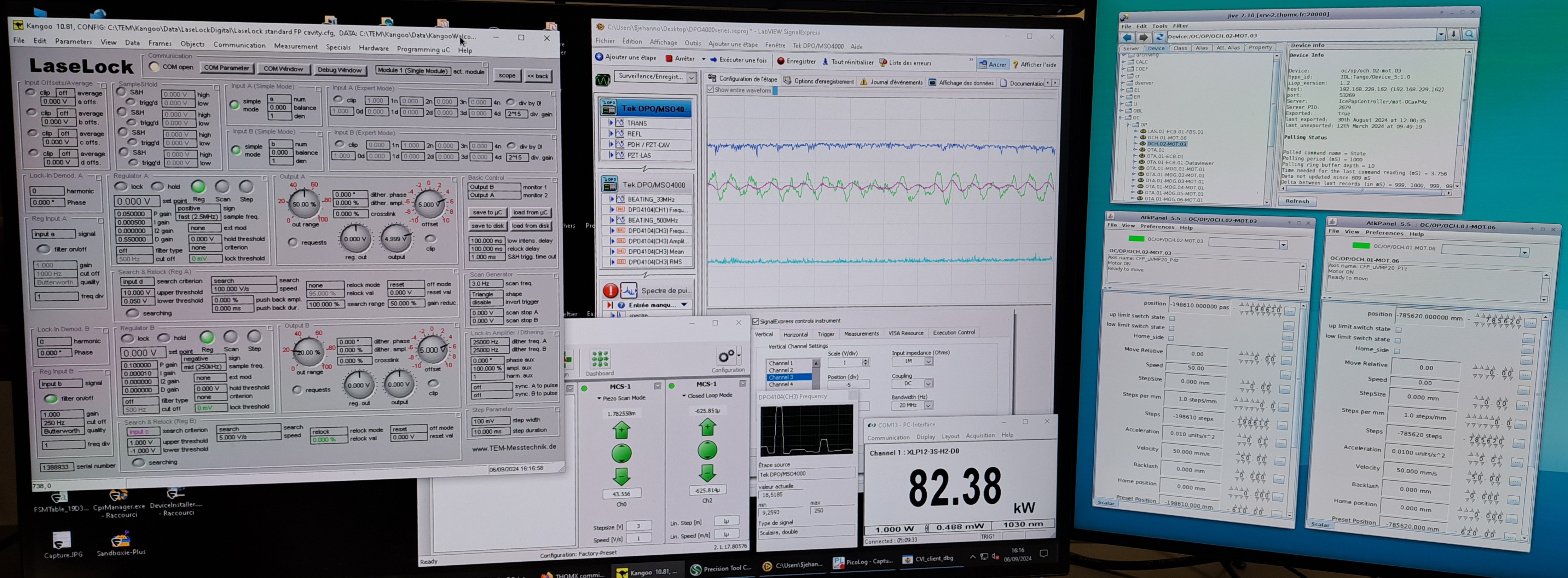
Ronic Chiche | Fixed | info | lasers and optics | detectors and electronics | software | ThomX igloo | restarting CFP system after the long summer shutdown (RF section conditionning) and Alphanov amplifier issue | I changed a little bit the locking parameters (see picture) for the RF/FPC loop and it locked rapidely.
I asked Vincent to connect on the same scope the synchro signals to check if the FPC lock was OK => he connected 33MHz signals coming from the laser and from the 33MHz RF generator.
=> the signals are not locked even when the FPC seems to be locked to the RF.
=> it can be normal because he forgot to connect also the synchro trigger signal which gives the moment of synchronization of the machine... to be finished on Monday.
| Ronic Chiche wrote: |
|
now, the Ring RF frequency is set to 500.067MHz.
so the CFP/laser frequency should be 500.067MHz/15 = 33.3378MHz.
the frequency was set to 33.378MHz !!! => it explains the frequency shift only on the 33MHz beating => I corrected the frequency on the generator and informed Nicolas Delerue.
=> now, I can try to lock the CFP to the RF frequency.
| Ronic Chiche wrote: |
|
after redoing the alignment of the CVBG, we got back the initial power in the FPC (87kW)
now, I checked the RF locking signals on the 2nd oscilloscope.
I get a strange ratio between the 33MHz beating and the 500MHz beating signals.
beat @ 33MHz ~ 40kHz !
beat @ 500MHz ~ 700Hz !
maybe the 33MHz generator frequency is not matching the 500MHz RF frequency ?
| Ronic Chiche wrote: |
|
amplifier power measurement before the compressor CVBG.
we used a mirror in between the amplifier output and the compressor + a 2-mirror periscope to match the powermeter height.
amp ratio (%) power (W)
0 0.7
10 1.65
20 13
30 25
40 37.7
50 50.5
60 62
70 74
80 86
90 99
100 110
we had an alarm @100% of amplifier ratio => the reason is not clear... maybe it's coming from a discrepency between some internal measurement and the expected value.
we checked the power after the alarm => still OK
conclusion, the amplifier seems to be OK... we need to redo the alignment of the compressor CVBG.
| Ronic Chiche wrote: |
|
After the summer power shutdown, I restarted all the equipements and got quickly ~80kW for 33% amplifier ratio with CEP optimization and without Alignment optimization.
CEP motor position : -506µm
| Ronic Chiche wrote: |
|
this morning with Daniele, we are measuring the amplifier power just before the FP-cavity.
Casemate temperature @19.5°C
@0% : 205mW
@10%: 755mW
@20%: 7.44W
@30%: 14.3W
@33%:16.3W
@40% : 20.3W
@50% : 24W
@60% : 26W
=> there is a power issue !!!
the normal casemate temperature should be in between 21 and 22°C.
cf this post (https://elog.lal.in2p3.fr/FPC/THOMX+commissioning/133) to get previous amplifier power.
=> it seems we need to redo the compressor CVBG alignment !
first, we will check the amplifier power before the compressor.
| Ronic Chiche wrote: |
|
after doing some alignment (walking procedure on the Y axis), and CEP optimization, I got 83kW for 33% on the laser amplifier with a coupling of ~60%
=> we have to check the input power after the amplifier.
I adjusted the FP and laser cavity motors to have a small 33MHz detuning with the RF reference (~10 Hz of beating @ 33MHz)
pb : I don't see the 500MHz beating signal => to be checked
during the motion of the FP-cavity motors, I observed a systematic delock when moving MOT.06 on P1z and no delock with MOT.03 on P4z when I move by 10 steps.
Kevin checked that both IcePap controller have the same configuration and then, the problem is maybe coming from the rust observed on the mechanic.
| Ronic Chiche wrote: |
|
we had to move the laser cavity motor to find the resonances and change a lot the CEP.
the CEP motor is at -524.1µm
we got ~75kW in the FP cavity without alignment but with CEP optimization.
the coupling (the cyan color) is ~ 62% !
=> we need to do some alignment
| Ronic Chiche wrote: |
|
I refilled the chiller and the stabilized temperature is @ 25°C
we started the 3rd stage of the Alphanov amplifier at 30% => PD_OUT is fluctuating around 1-1.4W => it's not related to the real output power !
the photodiode connected to the scope CH2 is around 210mV @ 50ohms
we clearly see some small peak on the transmission signal (scope CH1) => we need to optimize the laser cavity length and the CEP
| Ronic Chiche wrote: |
|
temperature in the casemate ~ 19.5°C stable
this morning, I measured the power directly at the output of the fiber coupler (through the output fiber), after the strecher : ~5mW
then, I connected the EOM used for the PDH technic : ~2.5mW
then, I connected the fiber of the EOM to the Alphanov amplifier input fiber.
LAL Alphnov software :
PD_IN = 3.289mW
PD_PULSE = 33.372MHz
=> nothing to do ! :-)))
I switched ON the preamplifier (3rd stage @ 0%) => PD_Preamp2 = 152.44mW
|
|
|
|
|
|
|
|
|
|
| Attachment 1: 20240906_161926.jpg
|  |
|
361
|
Fri Sep 6 17:27:20 2024 |
Ronic Chiche | Under Process | issue | mechanics | lasers and optics | detectors and electronics | ThomX igloo | 20Hz oscillation in the locking between Laser and FP-cavity | could it be possible this 20Hz oscillations comes from anouncements in the bunker, puting the housing+table in vibration ?
(there are such anouncements during restricted access) => to be asked to Harold
| Ronic Chiche wrote: |
|
measure to be done next week to check the 20Hz noise on the laser amplifier signal:
- install a DET10 in reflection of the FP-cavity to get a high BW and measure the 500MHz harmonic.
- do the beating with the 500MHz Ring RF generator
- with the laser motor try to be close to the 500MHz Ring RF frequency => beating frequency below 1kHz
- send the beating signal to some RF spectrum analyzer to use its large dynamic range.
for example, with the Siglent RF spectrum analyzer, it is possible to detect easily a peak @ -96dBm <=> 3.5µV rms
so, one should be able to make the measurement @ 500MHz or even @ 33MHz even if the phase sensitivity is lower :
for example V0=100mV peak beating signal @ f0=33MHz should produce a 20Hz noise signal of:
dV ~ V0 * dphi = V0 * 2*pi*f0*dt = 200µV rms with jitter dt=10ps rms
| Ronic Chiche wrote: |
|
what does this 10ps phase jitter mean in term of cavity length variations ?
L = L0 + dL sin(2pi fm t) = L0 (1 + dL/L0 sin(2pi fm t))
F = c / L ~ F0 - F0² dL / c sin(2pi fm t) with F0 = c / L0
d/dt(phi) = 2pi F => phi = 2pi F0 t + F0² dL / (c fm) cos(2pi fm t) => dphi = F0² dL / (c fm)
dphi = 2pi F0 dt => dL = L0 * 2pi fm dt
dt rms = 10ps @ fm = 20Hz of modulation frequency <=> dL rms = 10 nm (L0 = 9m)
| Ronic Chiche wrote: |
|
yesterday I did 2 tests to try to understand the origin of the 20Hz oscillation which is dominant in the remaining 10-20ps rms jitter between the transmitted pulses and the RF reference generator.
10ps rms jitter is equivalent to phase jitter dphi = 2*pi*f0*dt = 2mrad rms @ 33MHz or 30mrad rms @ 500MHz.
with V0 = 1Vpeak of beating signal amplitude, the equivalent rms beating voltage is dV = V0 * sin(dphi) ~ V0 * dphi = 2mV rms @ 33MHz or 30mV rms @ 500MHz
1) I did a beating between the internal photodiode of the laser with an external 33MHz oscillator (the photodiode is too slow to use higher harmonic).
the difficult part is to see the 2mV rms noise on a 2Vpp oscillating signal, so I locked the external 33MHz reference oscillator with the beating signal => see first plot.
there is no trace of 20Hz oscillation in the beating signal => the lock is too good and removed the oscillation ?
2) I did a beating between the photodiode in reflection of the FP-cavity (so the signal is not coming only from the oscillator but is going also through the Alphanov amplifier) with the 500MHz RF Ring generator.
I cannot the lock the generator anymore, so the measurement is done in open loop. I adjust the laser Frep with the motor to try to cancel the beating frequency => see 2nd plot
there is no trace of 20Hz oscillation in the beating signal => it is in contradiction with the previous post : "conclusion: the 20Hz oscillation is coming from the laser cavity" ?!?
maybe we need a more complex measurement scheme with the possibility to measure in the same time the 10-20ps rms jitter coming from the locked FP-cavity transmitted signal/500MHz Ring generator
AND the beating signal between the laser or amplifier with 500MHz local reference generator... to be done...
| Ronic Chiche wrote: |
|
this afternoon, we did 2 tests to better understand this 20Hz oscillation:
- we locked the amplified laser directly to the 500MHz ring reference oscillator, without any intermediate locking to the FP-cavity => no change
the 20Hz oscillation is still present in the correction signal of the laser PZT.
- we switched OFF the controller of the hexapod => no change.
conclusion:
the 20Hz oscillation is coming from the laser cavity
or is coming from "outside" and could be measured, maybe at a higher level, with an external "noises & vibrations measurement system".
| Ronic Chiche wrote: |
|
this morning, we tried to find the origin of the 20Hz oscillation.
- we switched OFF the laser Smaract motors controller => no change
- then, we addionally disconnected the FP-cavity PZT cable from the Laselock (we put a charge of 1kohm) => no change
- then, we switched ON the laser Smaract motors controller and switched OFF the FP-cavity motors controllers => no change
in conclusion, we don't really know where this instabillity comes from.
the amplitude is roughly 1Vpp (when the oscillation is at its maximum) on the laser PZT <=> length oscillation of ~20nm pp
could it come :
- from the air cooling regulation with pressure variation ?
- from vibrations of the hexapod below the table ?
or is it from inside of the laser or FP cavities ?
see these posts for the first measurements on this issue: https://elog.lal.in2p3.fr/FPC/THOMX+commissioning/257
|
|
|
|
|
|
|
362
|
Mon Sep 9 11:00:43 2024 |
Ronic Chiche | Fixed | info | lasers and optics | detectors and electronics | software | ThomX igloo | restarting CFP system after the long summer shutdown (RF section conditionning) and Alphanov amplifier issue | this morning, with Vincent :
- we added the 10Hz trigger to the CH2 on the remote scope (192.168.229.21) to check the synchronization at the right timing.
CH1 : 33MHz RING
CH2 : LINAC/RING synchro signal
CH3 : 500MHz RING
CH4 : 33MHz FPC
we successfully lock both laser on FPC (87kW for 33% amp ratio) and FPC on 500MHz RF.
we saw the result on the scope.
suprisingly, the FPC/RF lock seems much robust than before.
the only problem is the MOT.06 which make the lock being lost at almost every move.
one reason could be the rust on the mechanics... we can try to change the position of both plan mirror motors to work in a proper region.
before, it was working well at -900 000 steps on MOT.06, now it is -780 00.
it's a quite long travel...
end of this posts thread
| Ronic Chiche wrote: |
|
I changed a little bit the locking parameters (see picture) for the RF/FPC loop and it locked rapidely.
I asked Vincent to connect on the same scope the synchro signals to check if the FPC lock was OK => he connected 33MHz signals coming from the laser and from the 33MHz RF generator.
=> the signals are not locked even when the FPC seems to be locked to the RF.
=> it can be normal because he forgot to connect also the synchro trigger signal which gives the moment of synchronization of the machine... to be finished on Monday.
| Ronic Chiche wrote: |
|
now, the Ring RF frequency is set to 500.067MHz.
so the CFP/laser frequency should be 500.067MHz/15 = 33.3378MHz.
the frequency was set to 33.378MHz !!! => it explains the frequency shift only on the 33MHz beating => I corrected the frequency on the generator and informed Nicolas Delerue.
=> now, I can try to lock the CFP to the RF frequency.
| Ronic Chiche wrote: |
|
after redoing the alignment of the CVBG, we got back the initial power in the FPC (87kW)
now, I checked the RF locking signals on the 2nd oscilloscope.
I get a strange ratio between the 33MHz beating and the 500MHz beating signals.
beat @ 33MHz ~ 40kHz !
beat @ 500MHz ~ 700Hz !
maybe the 33MHz generator frequency is not matching the 500MHz RF frequency ?
| Ronic Chiche wrote: |
|
amplifier power measurement before the compressor CVBG.
we used a mirror in between the amplifier output and the compressor + a 2-mirror periscope to match the powermeter height.
amp ratio (%) power (W)
0 0.7
10 1.65
20 13
30 25
40 37.7
50 50.5
60 62
70 74
80 86
90 99
100 110
we had an alarm @100% of amplifier ratio => the reason is not clear... maybe it's coming from a discrepency between some internal measurement and the expected value.
we checked the power after the alarm => still OK
conclusion, the amplifier seems to be OK... we need to redo the alignment of the compressor CVBG.
| Ronic Chiche wrote: |
|
After the summer power shutdown, I restarted all the equipements and got quickly ~80kW for 33% amplifier ratio with CEP optimization and without Alignment optimization.
CEP motor position : -506µm
| Ronic Chiche wrote: |
|
this morning with Daniele, we are measuring the amplifier power just before the FP-cavity.
Casemate temperature @19.5°C
@0% : 205mW
@10%: 755mW
@20%: 7.44W
@30%: 14.3W
@33%:16.3W
@40% : 20.3W
@50% : 24W
@60% : 26W
=> there is a power issue !!!
the normal casemate temperature should be in between 21 and 22°C.
cf this post (https://elog.lal.in2p3.fr/FPC/THOMX+commissioning/133) to get previous amplifier power.
=> it seems we need to redo the compressor CVBG alignment !
first, we will check the amplifier power before the compressor.
| Ronic Chiche wrote: |
|
after doing some alignment (walking procedure on the Y axis), and CEP optimization, I got 83kW for 33% on the laser amplifier with a coupling of ~60%
=> we have to check the input power after the amplifier.
I adjusted the FP and laser cavity motors to have a small 33MHz detuning with the RF reference (~10 Hz of beating @ 33MHz)
pb : I don't see the 500MHz beating signal => to be checked
during the motion of the FP-cavity motors, I observed a systematic delock when moving MOT.06 on P1z and no delock with MOT.03 on P4z when I move by 10 steps.
Kevin checked that both IcePap controller have the same configuration and then, the problem is maybe coming from the rust observed on the mechanic.
| Ronic Chiche wrote: |
|
we had to move the laser cavity motor to find the resonances and change a lot the CEP.
the CEP motor is at -524.1µm
we got ~75kW in the FP cavity without alignment but with CEP optimization.
the coupling (the cyan color) is ~ 62% !
=> we need to do some alignment
| Ronic Chiche wrote: |
|
I refilled the chiller and the stabilized temperature is @ 25°C
we started the 3rd stage of the Alphanov amplifier at 30% => PD_OUT is fluctuating around 1-1.4W => it's not related to the real output power !
the photodiode connected to the scope CH2 is around 210mV @ 50ohms
we clearly see some small peak on the transmission signal (scope CH1) => we need to optimize the laser cavity length and the CEP
| Ronic Chiche wrote: |
|
temperature in the casemate ~ 19.5°C stable
this morning, I measured the power directly at the output of the fiber coupler (through the output fiber), after the strecher : ~5mW
then, I connected the EOM used for the PDH technic : ~2.5mW
then, I connected the fiber of the EOM to the Alphanov amplifier input fiber.
LAL Alphnov software :
PD_IN = 3.289mW
PD_PULSE = 33.372MHz
=> nothing to do ! :-)))
I switched ON the preamplifier (3rd stage @ 0%) => PD_Preamp2 = 152.44mW
|
|
|
|
|
|
|
|
|
|
|
|
363
|
Mon Sep 16 12:03:30 2024 |
Ronic Chiche | Fixed | info | mechanics | ThomX igloo | Finding correct motors position and parameters to keep the lock during a move | this morning, I try to find a new region for MOT.03 and MOT.06 where we can move them without unlocking the cavity.
I started from the position:
MOT06 : ~ -785 000
MOT03 : ~ -200 000
and I do -10 000 steps (dz = 10k x 6nm = 60µm) at a time on both motors.
previously a good region for MOT.06 was -900 000 !
I moved also the laser cavity by 40µm to cancel the beating with the RF frequency.
MOT06 : ~ -795 000
MOT03 : ~ -191 000
Max power after optimazing the CEP ~ 65kW => I need to realign => 78kW
I need to increase the D parameter on the PID to compensate the (85kW / 78kW ratio).
I changed the MOT.03 and MOT.06 speed to 30steps/s => it seems a bit better.
but I still see some lock losses during a move.
.... to be continued...
|
|
364
|
Tue Sep 17 12:48:13 2024 |
Ronic Chiche | Fixed | info | mechanics | ThomX igloo | Finding correct motors position and parameters to keep the lock during a move | this morning with Daniele, we did a quite long run with this motor position and it seems we don't lose the lock too much.
the motor positions are:
MOT.03 (M4): -186 500 steps
MOT.06 (M1): -797 500 steps
we got 85kW after CEP optimization and rough alignment optimization.
| Ronic Chiche wrote: |
|
this morning, I try to find a new region for MOT.03 and MOT.06 where we can move them without unlocking the cavity.
I started from the position:
MOT06 : ~ -785 000
MOT03 : ~ -200 000
and I do -10 000 steps (dz = 10k x 6nm = 60µm) at a time on both motors.
previously a good region for MOT.06 was -900 000 !
I moved also the laser cavity by 40µm to cancel the beating with the RF frequency.
MOT06 : ~ -795 000
MOT03 : ~ -191 000
Max power after optimazing the CEP ~ 65kW => I need to realign => 78kW
I need to increase the D parameter on the PID to compensate the (85kW / 78kW ratio).
I changed the MOT.03 and MOT.06 speed to 30steps/s => it seems a bit better.
but I still see some lock losses during a move.
.... to be continued...
|
|
|
365
|
Tue Sep 17 13:04:32 2024 |
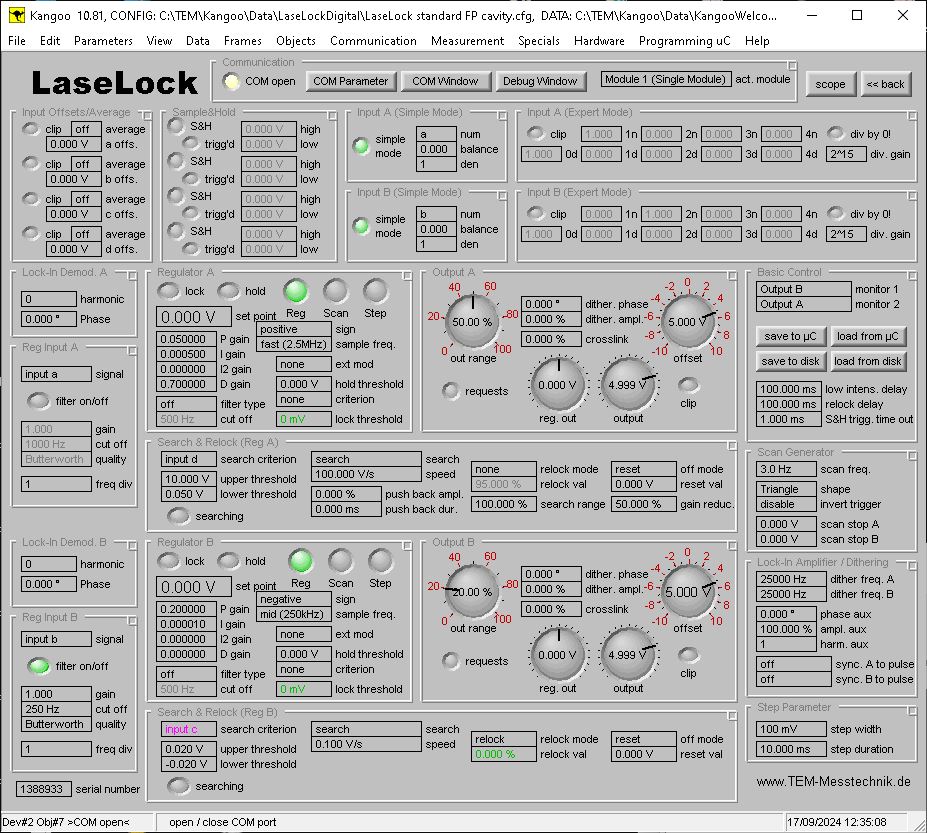
Ronic Chiche | Under Process | info | lasers and optics | software | ThomX igloo | Optimizing lock parameters for stable X-ray production | here are the (good) lock parameters used this morning.
for the RF/FPC lock, the 33MHz beating signal used to select the right bucket is 1Vpp
=> beating signal : V0 . sin(phi) with V0=0.5V.
to discrimate a 500MHz bucket, we need to get dV < V0 dphi.
dphi = 2pi / 15 = 420 mrad => dV < 0.2 V => dV < +/- 0.1V
we used dV = +/- 0.02V but perharps we can relax the constraint.
we also reduced the RF scanning speed at 0.1V/s to let the system find the right phase when the system is slowly drifting.
|
| Attachment 1: Capture.JPG
|  |
|
366
|
Thu Oct 3 16:38:03 2024 |
Ronic Chiche | Under Process | info | lasers and optics | software | ThomX igloo | Optimizing lock parameters for stable X-ray production | Today with Daniele and Alice, we operated to cavity.
we obtained 84kW for 33% of amplifier ratio.
we had to tune the CEP @ -565µm and the FP-cavity alignment.
then we locked properly the FP-cavity on the ring RF frequency.
we quite easily relock with the correct phase when we are loosing the lock.
the ThomX machine was running during these 2 locks, so we are ready for doing X-rays again.
| Ronic Chiche wrote: |
|
here are the (good) lock parameters used this morning.
for the RF/FPC lock, the 33MHz beating signal used to select the right bucket is 1Vpp
=> beating signal : V0 . sin(phi) with V0=0.5V.
to discrimate a 500MHz bucket, we need to get dV < V0 dphi.
dphi = 2pi / 15 = 420 mrad => dV < 0.2 V => dV < +/- 0.1V
we used dV = +/- 0.02V but perharps we can relax the constraint.
we also reduced the RF scanning speed at 0.1V/s to let the system find the right phase when the system is slowly drifting.
|
|
|
368
|
Wed Oct 9 09:56:21 2024 |
Ronic Chiche | Under Process | info | lasers and optics | software | ThomX igloo | Optimizing lock parameters for stable X-ray production | This morning, I wanted to test quickly if the Smaract motors can be used in open loop instead of closed loop or in piezo scan.
the goal is to do very fine steps without to much vibrations (like with piezo scan mode) but with the full motor range (the piezo scan mode has a very limited range).
I can check what happens to the 33MHz beating frequency between the laser and the RF frequency without the laser amplifier or the lock of the FP-cavity.
1Hz of beating freqency variation is equivalent to 270nm of round-trip length, which is 135nm of motor displacement !
=> the full range of the piezo scan mode is difficult to estimate because the measurement sensitivity is not good enough but around 5Hz.
=> 1350nm in closed loop is equivalent to ~ 10Hz => 135nm is equivalent to 1Hz => ok
=> 1 step in open loop is equivalent to ~ 10Hz !!! => this is a way too coarse tuning !!!! => cannot be used unless one finds a way to set the motion differently in the settings parameters.
but usually, the settings parameters are used only to tune the speed, not the step size.
| Ronic Chiche wrote: |
|
Today with Daniele and Alice, we operated to cavity.
we obtained 84kW for 33% of amplifier ratio.
we had to tune the CEP @ -565µm and the FP-cavity alignment.
then we locked properly the FP-cavity on the ring RF frequency.
we quite easily relock with the correct phase when we are loosing the lock.
the ThomX machine was running during these 2 locks, so we are ready for doing X-rays again.
| Ronic Chiche wrote: |
|
here are the (good) lock parameters used this morning.
for the RF/FPC lock, the 33MHz beating signal used to select the right bucket is 1Vpp
=> beating signal : V0 . sin(phi) with V0=0.5V.
to discrimate a 500MHz bucket, we need to get dV < V0 dphi.
dphi = 2pi / 15 = 420 mrad => dV < 0.2 V => dV < +/- 0.1V
we used dV = +/- 0.02V but perharps we can relax the constraint.
we also reduced the RF scanning speed at 0.1V/s to let the system find the right phase when the system is slowly drifting.
|
|
|
|
369
|
Wed Oct 9 18:39:34 2024 |
Ronic Chiche | Under Process | info | lasers and optics | software | ThomX igloo | Optimizing lock parameters for stable X-ray production | This afternoon, we scanned the optical table vertically with the hexapod in asynchronous mode to find its optimum position, looking at the X-ray production.
then, we searched for the correct bucket and phase in the bucket thanks to the Kevin script on the 500MHz and the 33MHz phases.
we got relatively easily some stable X-rays.
on the gain "0" on the current amplifier of the X-rays photodiode, we got 15 000 pA (380k Xrays / pA => 5.7.10^9 Xrays).
but we saw, when the cathode charge was fluctuating, that we could be saturated above 20 000 pA !
the power in the cavity was ~84kW after CEP and alignment tuning.
the command to launch the X-rays measurement window is:
taurustrend -r 100 /XLI/OP/TMD.01/I1
| Ronic Chiche wrote: |
|
This morning, I wanted to test quickly if the Smaract motors can be used in open loop instead of closed loop or in piezo scan.
the goal is to do very fine steps without to much vibrations (like with piezo scan mode) but with the full motor range (the piezo scan mode has a very limited range).
I can check what happens to the 33MHz beating frequency between the laser and the RF frequency without the laser amplifier or the lock of the FP-cavity.
1Hz of beating freqency variation is equivalent to 270nm of round-trip length, which is 135nm of motor displacement !
=> the full range of the piezo scan mode is difficult to estimate because the measurement sensitivity is not good enough but around 5Hz.
=> 1350nm in closed loop is equivalent to ~ 10Hz => 135nm is equivalent to 1Hz => ok
=> 1 step in open loop is equivalent to ~ 10Hz !!! => this is a way too coarse tuning !!!! => cannot be used unless one finds a way to set the motion differently in the settings parameters.
but usually, the settings parameters are used only to tune the speed, not the step size.
| Ronic Chiche wrote: |
|
Today with Daniele and Alice, we operated to cavity.
we obtained 84kW for 33% of amplifier ratio.
we had to tune the CEP @ -565µm and the FP-cavity alignment.
then we locked properly the FP-cavity on the ring RF frequency.
we quite easily relock with the correct phase when we are loosing the lock.
the ThomX machine was running during these 2 locks, so we are ready for doing X-rays again.
| Ronic Chiche wrote: |
|
here are the (good) lock parameters used this morning.
for the RF/FPC lock, the 33MHz beating signal used to select the right bucket is 1Vpp
=> beating signal : V0 . sin(phi) with V0=0.5V.
to discrimate a 500MHz bucket, we need to get dV < V0 dphi.
dphi = 2pi / 15 = 420 mrad => dV < 0.2 V => dV < +/- 0.1V
we used dV = +/- 0.02V but perharps we can relax the constraint.
we also reduced the RF scanning speed at 0.1V/s to let the system find the right phase when the system is slowly drifting.
|
|
|
|
|
370
|
Mon Oct 14 10:21:17 2024 |
Ronic Chiche | Fixed | issue | lasers and optics | ThomX igloo | Onefive 33MHz modelock loss | On Friday 11th of October, due to the Yvette flooding, all the AC power of ThomX have been shut down.
After the shutdown, I had to restart the Onefive oscillator but the laser modelock was lost.
I had to do a step of 1mm at 10mm/s with the Smaract motor on the rep rate channel (CH1)
After the step, the laser was mode-locking again, and I put it back in the original position at a much lower speed, ~10µm/s, to prevent a new modelock loss.
the power detected by the laser amplifier software is still above 3mW! => OK
Surprisingly, the laser amplifier software is not able to detect the oscillator frequency.
hopefully, the internal photodiode of the oscillator is sent to the CH4 of the R&S scope (192.168.229.21)
and we measured a correct 30ns of period, corresponding to 33MHz.
Because all the safety procedures are not fulfilled, the laser amplifier is not granted to start.
Maybe it is the Reason for the lack of measurement => to be verified later
|
|
371
|
Tue Oct 15 09:33:15 2024 |
Ronic Chiche | Fixed | issue | lasers and optics | ThomX igloo | Onefive 33MHz modelock loss | This morning, I verified the reason why the seeder frequency was not displayed on the amplifier software screen:
one needs to start the amplifier (even at 0%) to see the seeder frequency !!!
now, we have 33.371MHz as expected ! => OK
the last thing to do is to tune again the PDH demodulation frequency, as the generator has been shut off during the AC shut down.
| Ronic Chiche wrote: |
|
On Friday 11th of October, due to the Yvette flooding, all the AC power of ThomX have been shut down.
After the shutdown, I had to restart the Onefive oscillator but the laser modelock was lost.
I had to do a step of 1mm at 10mm/s with the Smaract motor on the rep rate channel (CH1)
After the step, the laser was mode-locking again, and I put it back in the original position at a much lower speed, ~10µm/s, to prevent a new modelock loss.
the power detected by the laser amplifier software is still above 3mW! => OK
Surprisingly, the laser amplifier software is not able to detect the oscillator frequency.
hopefully, the internal photodiode of the oscillator is sent to the CH4 of the R&S scope (192.168.229.21)
and we measured a correct 30ns of period, corresponding to 33MHz.
Because all the safety procedures are not fulfilled, the laser amplifier is not granted to start.
Maybe it is the Reason for the lack of measurement => to be verified later
|
|
|
372
|
Mon Oct 21 09:20:47 2024 |
Ronic Chiche | Fixed | issue | lasers and optics | ThomX igloo | Onefive 33MHz modelock loss | After the new Yvette flooding of the last week and the consecutive AC-shut down, I restarted this morning the laser with the same procedure (step of 1mm at 10mm/s with the Smaract motor on the rep rate channel (CH1)).
now, we have again 33.371MHz and 3.1mW input power as expected ! => OK
the last thing to do is to tune again the PDH demodulation frequency, as the generator has been shut off during the AC shut down.
| Ronic Chiche wrote: |
|
This morning, I verified the reason why the seeder frequency was not displayed on the amplifier software screen:
one needs to start the amplifier (even at 0%) to see the seeder frequency !!!
now, we have 33.371MHz as expected ! => OK
the last thing to do is to tune again the PDH demodulation frequency, as the generator has been shut off during the AC shut down.
| Ronic Chiche wrote: |
|
On Friday 11th of October, due to the Yvette flooding, all the AC power of ThomX have been shut down.
After the shutdown, I had to restart the Onefive oscillator but the laser modelock was lost.
I had to do a step of 1mm at 10mm/s with the Smaract motor on the rep rate channel (CH1)
After the step, the laser was mode-locking again, and I put it back in the original position at a much lower speed, ~10µm/s, to prevent a new modelock loss.
the power detected by the laser amplifier software is still above 3mW! => OK
Surprisingly, the laser amplifier software is not able to detect the oscillator frequency.
hopefully, the internal photodiode of the oscillator is sent to the CH4 of the R&S scope (192.168.229.21)
and we measured a correct 30ns of period, corresponding to 33MHz.
Because all the safety procedures are not fulfilled, the laser amplifier is not granted to start.
Maybe it is the Reason for the lack of measurement => to be verified later
|
|
|
|
373
|
Tue Oct 22 18:52:40 2024 |
Ronic Chiche | Fixed | issue | lasers and optics | ThomX igloo | Onefive 33MHz modelock loss | For the modulation/demodulation generator for the PDH signal,
after a power shutdown, on can :
1) restart the generator to get the correct parameters:
CH1:3Vrms on 50 ohms @ 8.4MHz (demod)
CH2: 100mVrms on 50 ohms @ 8.4MHz (modulation on EOM)
2) do an "Align phase" on the generator
3) put 270° on CH2 (0° on CH1) to get the max Error signal
and use a "positive" sign on the Laselock : cf https://elog.lal.in2p3.fr/FPC/THOMX+commissioning/365
| Ronic Chiche wrote: |
|
After the new Yvette flooding of the last week and the consecutive AC-shut down, I restarted this morning the laser with the same procedure (step of 1mm at 10mm/s with the Smaract motor on the rep rate channel (CH1)).
now, we have again 33.371MHz and 3.1mW input power as expected ! => OK
the last thing to do is to tune again the PDH demodulation frequency, as the generator has been shut off during the AC shut down.
| Ronic Chiche wrote: |
|
This morning, I verified the reason why the seeder frequency was not displayed on the amplifier software screen:
one needs to start the amplifier (even at 0%) to see the seeder frequency !!!
now, we have 33.371MHz as expected ! => OK
the last thing to do is to tune again the PDH demodulation frequency, as the generator has been shut off during the AC shut down.
| Ronic Chiche wrote: |
|
On Friday 11th of October, due to the Yvette flooding, all the AC power of ThomX have been shut down.
After the shutdown, I had to restart the Onefive oscillator but the laser modelock was lost.
I had to do a step of 1mm at 10mm/s with the Smaract motor on the rep rate channel (CH1)
After the step, the laser was mode-locking again, and I put it back in the original position at a much lower speed, ~10µm/s, to prevent a new modelock loss.
the power detected by the laser amplifier software is still above 3mW! => OK
Surprisingly, the laser amplifier software is not able to detect the oscillator frequency.
hopefully, the internal photodiode of the oscillator is sent to the CH4 of the R&S scope (192.168.229.21)
and we measured a correct 30ns of period, corresponding to 33MHz.
Because all the safety procedures are not fulfilled, the laser amplifier is not granted to start.
Maybe it is the Reason for the lack of measurement => to be verified later
|
|
|
|
|
374
|
Tue Oct 22 18:58:56 2024 |
Ronic Chiche | Under Process | info | lasers and optics | software | ThomX igloo | Optimizing lock parameters for stable X-ray production | Today, after setting the locking parameters, I got 80kW in the FPC for 33% amplifier ratio after CEP tuning (Smaract CH2 ~ -423.5µm) and alignment.
maybe the alignment has to be improved by some walking procedure.
| Ronic Chiche wrote: |
|
This afternoon, we scanned the optical table vertically with the hexapod in asynchronous mode to find its optimum position, looking at the X-ray production.
then, we searched for the correct bucket and phase in the bucket thanks to the Kevin script on the 500MHz and the 33MHz phases.
we got relatively easily some stable X-rays.
on the gain "0" on the current amplifier of the X-rays photodiode, we got 15 000 pA (380k Xrays / pA => 5.7.10^9 Xrays).
but we saw, when the cathode charge was fluctuating, that we could be saturated above 20 000 pA !
the power in the cavity was ~84kW after CEP and alignment tuning.
the command to launch the X-rays measurement window is:
taurustrend -r 100 /XLI/OP/TMD.01/I1
| Ronic Chiche wrote: |
|
This morning, I wanted to test quickly if the Smaract motors can be used in open loop instead of closed loop or in piezo scan.
the goal is to do very fine steps without to much vibrations (like with piezo scan mode) but with the full motor range (the piezo scan mode has a very limited range).
I can check what happens to the 33MHz beating frequency between the laser and the RF frequency without the laser amplifier or the lock of the FP-cavity.
1Hz of beating freqency variation is equivalent to 270nm of round-trip length, which is 135nm of motor displacement !
=> the full range of the piezo scan mode is difficult to estimate because the measurement sensitivity is not good enough but around 5Hz.
=> 1350nm in closed loop is equivalent to ~ 10Hz => 135nm is equivalent to 1Hz => ok
=> 1 step in open loop is equivalent to ~ 10Hz !!! => this is a way too coarse tuning !!!! => cannot be used unless one finds a way to set the motion differently in the settings parameters.
but usually, the settings parameters are used only to tune the speed, not the step size.
| Ronic Chiche wrote: |
|
Today with Daniele and Alice, we operated to cavity.
we obtained 84kW for 33% of amplifier ratio.
we had to tune the CEP @ -565µm and the FP-cavity alignment.
then we locked properly the FP-cavity on the ring RF frequency.
we quite easily relock with the correct phase when we are loosing the lock.
the ThomX machine was running during these 2 locks, so we are ready for doing X-rays again.
| Ronic Chiche wrote: |
|
here are the (good) lock parameters used this morning.
for the RF/FPC lock, the 33MHz beating signal used to select the right bucket is 1Vpp
=> beating signal : V0 . sin(phi) with V0=0.5V.
to discrimate a 500MHz bucket, we need to get dV < V0 dphi.
dphi = 2pi / 15 = 420 mrad => dV < 0.2 V => dV < +/- 0.1V
we used dV = +/- 0.02V but perharps we can relax the constraint.
we also reduced the RF scanning speed at 0.1V/s to let the system find the right phase when the system is slowly drifting.
|
|
|
|
|
|
375
|
Wed Oct 23 12:23:10 2024 |
Ronic Chiche | Under Process | info | lasers and optics | software | ThomX igloo | Optimizing lock parameters for stable X-ray production | this morning, I did some walking procedure and I got 82kW in the FPC with 33% amplifier ratio (after CEP optimization too).
but when I move the FP cavity motors to adjust the frequency, I cannot keep this power and it is reduced.
could it be we get a stronger correlation between axis than before in the mechanics has more rust than before ?
I'm able to keep the power quite easily with a stable phase related to the 33MHz RF generator,
so, we are ready to produce X-rays again.
we could do also a measurement of the amplifier power vs ratio, as maybe it reduced a bit which could explain why we have this small power drop compare to before.
| Ronic Chiche wrote: |
|
Today, after setting the locking parameters, I got 80kW in the FPC for 33% amplifier ratio after CEP tuning (Smaract CH2 ~ -423.5µm) and alignment.
maybe the alignment has to be improved by some walking procedure.
| Ronic Chiche wrote: |
|
This afternoon, we scanned the optical table vertically with the hexapod in asynchronous mode to find its optimum position, looking at the X-ray production.
then, we searched for the correct bucket and phase in the bucket thanks to the Kevin script on the 500MHz and the 33MHz phases.
we got relatively easily some stable X-rays.
on the gain "0" on the current amplifier of the X-rays photodiode, we got 15 000 pA (380k Xrays / pA => 5.7.10^9 Xrays).
but we saw, when the cathode charge was fluctuating, that we could be saturated above 20 000 pA !
the power in the cavity was ~84kW after CEP and alignment tuning.
the command to launch the X-rays measurement window is:
taurustrend -r 100 /XLI/OP/TMD.01/I1
| Ronic Chiche wrote: |
|
This morning, I wanted to test quickly if the Smaract motors can be used in open loop instead of closed loop or in piezo scan.
the goal is to do very fine steps without to much vibrations (like with piezo scan mode) but with the full motor range (the piezo scan mode has a very limited range).
I can check what happens to the 33MHz beating frequency between the laser and the RF frequency without the laser amplifier or the lock of the FP-cavity.
1Hz of beating freqency variation is equivalent to 270nm of round-trip length, which is 135nm of motor displacement !
=> the full range of the piezo scan mode is difficult to estimate because the measurement sensitivity is not good enough but around 5Hz.
=> 1350nm in closed loop is equivalent to ~ 10Hz => 135nm is equivalent to 1Hz => ok
=> 1 step in open loop is equivalent to ~ 10Hz !!! => this is a way too coarse tuning !!!! => cannot be used unless one finds a way to set the motion differently in the settings parameters.
but usually, the settings parameters are used only to tune the speed, not the step size.
| Ronic Chiche wrote: |
|
Today with Daniele and Alice, we operated to cavity.
we obtained 84kW for 33% of amplifier ratio.
we had to tune the CEP @ -565µm and the FP-cavity alignment.
then we locked properly the FP-cavity on the ring RF frequency.
we quite easily relock with the correct phase when we are loosing the lock.
the ThomX machine was running during these 2 locks, so we are ready for doing X-rays again.
| Ronic Chiche wrote: |
|
here are the (good) lock parameters used this morning.
for the RF/FPC lock, the 33MHz beating signal used to select the right bucket is 1Vpp
=> beating signal : V0 . sin(phi) with V0=0.5V.
to discrimate a 500MHz bucket, we need to get dV < V0 dphi.
dphi = 2pi / 15 = 420 mrad => dV < 0.2 V => dV < +/- 0.1V
we used dV = +/- 0.02V but perharps we can relax the constraint.
we also reduced the RF scanning speed at 0.1V/s to let the system find the right phase when the system is slowly drifting.
|
|
|
|
|
|
|
376
|
Fri Nov 8 15:23:11 2024 |
Ronic Chiche | Under Process | info | lasers and optics | software | ThomX igloo | Optimizing lock parameters for stable X-ray production | this morning, I did some walking procedure and CEP alignment to get ~80kW in the FPC with 33% amplifier ratio.
we have to check if this power drop comes from:
- a laser amplifier power drop
- or related to some cavity axis shift which could change the cavity gain due to L-shapes
| Ronic Chiche wrote: |
|
this morning, I did some walking procedure and I got 82kW in the FPC with 33% amplifier ratio (after CEP optimization too).
but when I move the FP cavity motors to adjust the frequency, I cannot keep this power and it is reduced.
could it be we get a stronger correlation between axis than before in the mechanics has more rust than before ?
I'm able to keep the power quite easily with a stable phase related to the 33MHz RF generator,
so, we are ready to produce X-rays again.
we could do also a measurement of the amplifier power vs ratio, as maybe it reduced a bit which could explain why we have this small power drop compare to before.
| Ronic Chiche wrote: |
|
Today, after setting the locking parameters, I got 80kW in the FPC for 33% amplifier ratio after CEP tuning (Smaract CH2 ~ -423.5µm) and alignment.
maybe the alignment has to be improved by some walking procedure.
| Ronic Chiche wrote: |
|
This afternoon, we scanned the optical table vertically with the hexapod in asynchronous mode to find its optimum position, looking at the X-ray production.
then, we searched for the correct bucket and phase in the bucket thanks to the Kevin script on the 500MHz and the 33MHz phases.
we got relatively easily some stable X-rays.
on the gain "0" on the current amplifier of the X-rays photodiode, we got 15 000 pA (380k Xrays / pA => 5.7.10^9 Xrays).
but we saw, when the cathode charge was fluctuating, that we could be saturated above 20 000 pA !
the power in the cavity was ~84kW after CEP and alignment tuning.
the command to launch the X-rays measurement window is:
taurustrend -r 100 /XLI/OP/TMD.01/I1
| Ronic Chiche wrote: |
|
This morning, I wanted to test quickly if the Smaract motors can be used in open loop instead of closed loop or in piezo scan.
the goal is to do very fine steps without to much vibrations (like with piezo scan mode) but with the full motor range (the piezo scan mode has a very limited range).
I can check what happens to the 33MHz beating frequency between the laser and the RF frequency without the laser amplifier or the lock of the FP-cavity.
1Hz of beating freqency variation is equivalent to 270nm of round-trip length, which is 135nm of motor displacement !
=> the full range of the piezo scan mode is difficult to estimate because the measurement sensitivity is not good enough but around 5Hz.
=> 1350nm in closed loop is equivalent to ~ 10Hz => 135nm is equivalent to 1Hz => ok
=> 1 step in open loop is equivalent to ~ 10Hz !!! => this is a way too coarse tuning !!!! => cannot be used unless one finds a way to set the motion differently in the settings parameters.
but usually, the settings parameters are used only to tune the speed, not the step size.
| Ronic Chiche wrote: |
|
Today with Daniele and Alice, we operated to cavity.
we obtained 84kW for 33% of amplifier ratio.
we had to tune the CEP @ -565µm and the FP-cavity alignment.
then we locked properly the FP-cavity on the ring RF frequency.
we quite easily relock with the correct phase when we are loosing the lock.
the ThomX machine was running during these 2 locks, so we are ready for doing X-rays again.
| Ronic Chiche wrote: |
|
here are the (good) lock parameters used this morning.
for the RF/FPC lock, the 33MHz beating signal used to select the right bucket is 1Vpp
=> beating signal : V0 . sin(phi) with V0=0.5V.
to discrimate a 500MHz bucket, we need to get dV < V0 dphi.
dphi = 2pi / 15 = 420 mrad => dV < 0.2 V => dV < +/- 0.1V
we used dV = +/- 0.02V but perharps we can relax the constraint.
we also reduced the RF scanning speed at 0.1V/s to let the system find the right phase when the system is slowly drifting.
|
|
|
|
|
|
|
|
377
|
Tue Nov 19 17:37:55 2024 |
Ronic Chiche | Under Process | info | lasers and optics | software | ThomX igloo | Optimizing lock parameters for stable X-ray production | the RF frequency is now 500.1003MHz which is equivalent (if divided by 15) to 33.34002MHz.
the frequency has to be changed by ~2kHz @33MHz <=> ~550µm /2 for one motor.
I changed the laser and the FP cavities frequency.
for the laser frequency, the smaract motor CH1 is at 1.500627m.
for the FPC frequency, the plane mirror motors are at MOT.03= - 123 130 steps and MOT.06
BE CARREFUL, when the offset frequency is large, as we measure it on a scope with a beat frequency, if the scope window is too large,
one gets some stromboscope effect and one measures a lower frequency depending on the number of points in the window.
we got ~81kW for 33% amplifier ratio
| Ronic Chiche wrote: |
|
this morning, I did some walking procedure and CEP alignment to get ~80kW in the FPC with 33% amplifier ratio.
we have to check if this power drop comes from:
- a laser amplifier power drop
- or related to some cavity axis shift which could change the cavity gain due to L-shapes
| Ronic Chiche wrote: |
|
this morning, I did some walking procedure and I got 82kW in the FPC with 33% amplifier ratio (after CEP optimization too).
but when I move the FP cavity motors to adjust the frequency, I cannot keep this power and it is reduced.
could it be we get a stronger correlation between axis than before in the mechanics has more rust than before ?
I'm able to keep the power quite easily with a stable phase related to the 33MHz RF generator,
so, we are ready to produce X-rays again.
we could do also a measurement of the amplifier power vs ratio, as maybe it reduced a bit which could explain why we have this small power drop compare to before.
| Ronic Chiche wrote: |
|
Today, after setting the locking parameters, I got 80kW in the FPC for 33% amplifier ratio after CEP tuning (Smaract CH2 ~ -423.5µm) and alignment.
maybe the alignment has to be improved by some walking procedure.
| Ronic Chiche wrote: |
|
This afternoon, we scanned the optical table vertically with the hexapod in asynchronous mode to find its optimum position, looking at the X-ray production.
then, we searched for the correct bucket and phase in the bucket thanks to the Kevin script on the 500MHz and the 33MHz phases.
we got relatively easily some stable X-rays.
on the gain "0" on the current amplifier of the X-rays photodiode, we got 15 000 pA (380k Xrays / pA => 5.7.10^9 Xrays).
but we saw, when the cathode charge was fluctuating, that we could be saturated above 20 000 pA !
the power in the cavity was ~84kW after CEP and alignment tuning.
the command to launch the X-rays measurement window is:
taurustrend -r 100 /XLI/OP/TMD.01/I1
| Ronic Chiche wrote: |
|
This morning, I wanted to test quickly if the Smaract motors can be used in open loop instead of closed loop or in piezo scan.
the goal is to do very fine steps without to much vibrations (like with piezo scan mode) but with the full motor range (the piezo scan mode has a very limited range).
I can check what happens to the 33MHz beating frequency between the laser and the RF frequency without the laser amplifier or the lock of the FP-cavity.
1Hz of beating freqency variation is equivalent to 270nm of round-trip length, which is 135nm of motor displacement !
=> the full range of the piezo scan mode is difficult to estimate because the measurement sensitivity is not good enough but around 5Hz.
=> 1350nm in closed loop is equivalent to ~ 10Hz => 135nm is equivalent to 1Hz => ok
=> 1 step in open loop is equivalent to ~ 10Hz !!! => this is a way too coarse tuning !!!! => cannot be used unless one finds a way to set the motion differently in the settings parameters.
but usually, the settings parameters are used only to tune the speed, not the step size.
| Ronic Chiche wrote: |
|
Today with Daniele and Alice, we operated to cavity.
we obtained 84kW for 33% of amplifier ratio.
we had to tune the CEP @ -565µm and the FP-cavity alignment.
then we locked properly the FP-cavity on the ring RF frequency.
we quite easily relock with the correct phase when we are loosing the lock.
the ThomX machine was running during these 2 locks, so we are ready for doing X-rays again.
| Ronic Chiche wrote: |
|
here are the (good) lock parameters used this morning.
for the RF/FPC lock, the 33MHz beating signal used to select the right bucket is 1Vpp
=> beating signal : V0 . sin(phi) with V0=0.5V.
to discrimate a 500MHz bucket, we need to get dV < V0 dphi.
dphi = 2pi / 15 = 420 mrad => dV < 0.2 V => dV < +/- 0.1V
we used dV = +/- 0.02V but perharps we can relax the constraint.
we also reduced the RF scanning speed at 0.1V/s to let the system find the right phase when the system is slowly drifting.
|
|
|
|
|
|
|
|
|
378
|
Wed Nov 20 11:28:01 2024 |
Ronic Chiche | Fixed | info | lasers and optics | detectors and electronics | ThomX igloo | Checking the amplifier power | this morning, with Daniele, we checked the amplifier power, right after the CVBG (the power meter has to be placed on a metal plate above the large table hole), and just at the input of the FP cavity, after the 1/4 and 1/2 waveplates (the power meter has to be placed on flat beam dump+ Thorlabs beam dump + V metallic mount to be at the right height).
we compared with the power measured the 9th of september : https://elog.lal.in2p3.fr/FPC/THOMX+commissioning/356
the 3 collumns are the measurement close to the CVBG on 9th of september / same position today / just befor the FPC today
amplifier ratio (%) power after compressor (W) (new) power @ CVBG (new) power @ FPC ratio FPC/CVBG power (%)
10 0.91 0.93 0.83 89.2
20 8.6 8.6 8.0 93.0
30 16.7 16.9 15.8 93.5
40 25.5 25.6 24.0 93.7
50 34.5 34.6 32.5 93.9
60 42.5 42.5 39.5 92.9
70 50.0 50.0 45.0 90.0
we observed with the viewer the beam on the powermeter.
at 70% of amplifier ratio, the beam size is as big as the powermeter detector.
then, the 93% to 90% transport efficiency drop could come from this "too small" powermeter detector.
we observed also at this power ratio (70%) that the 1/4 and 1/2 waveplates were not perfectly centered and we burn a part of the platic mount at this power.
|
|