| ID |
Date |
Author |
Status |
Type |
Category |
Location |
Title |
|
317
|
Thu Jan 25 12:45:41 2024 |
Ronic Chiche | Fixed | info | mechanics | lasers and optics | cabling | ThomX igloo | controller M1 & M4 (plan mirrors) with IcePap controllers | this double motors scheme works good.
if motor P4 is used by increasing value, the FP-cavityPZT signal (pink signal on scope) goes HIGHER
if motor P1 is used by increasing value, the FP-cavityPZT signal (pink signal on scope) goes LOWER
!!! CAREFUL !!!
after each session, it is mandatory to put the motors back to their initial position to avoid FP-cavity misalignment.
on P1 : - 900 000 steps
on P4 : - 360 000 steps
| Ronic Chiche wrote: |
|
previously, we have connected motor M4 with an IcePap controller.
see this post : https://elog.lal.in2p3.fr/FPC/THOMX+commissioning/278
due to the backlash behavior of the FP-cavity motors, it is impossible to work in both directions on one motor when the FP-cavity is locked.
so, we decided to use also the motor M1 to work in the other direction.
then, normally M1 will work in one direction and M4 in the other direction.
motor M1 (or P1Z) which was on the axis 9 on the ISP controller has been assigned to OC/OP/OCH.01-MOT.06
motor M4 (or P4Z) which was on the axis 12 on the ISP controller has been assigned to OC/OP/OCH.01-MOT.03
|
|
|
318
|
Thu Jan 25 13:36:35 2024 |
Ronic Chiche | Fixed | info | detectors and electronics | ThomX igloo | First stable X-rays production | this morning, we locked the laser on the FP-cavity with about 48-49kW stable in the FP-cavity (for 32% of amplifier ratio).
and then we locked the FP-cavity on the RF reference (500MHz beating lock + 33MHz beating for starting lock search).
the starting lock search voltage has been chosen between -20mV and +20mV.
then we lock with an uncertainty of 180°... but we can check the lock phase with the "Synchro oscilloscope" (192.168.229.21).
if necessary, we can stop the lock and let the phase drift and then relock with the right phase.
Kevin did a buckets scan (30ns by 2ns steps) to find the right bucket and also a fine phase tuning scan (2ns scan).
unfortunately, the fine phase was close to 0, so the Laselock did the fine phase adjustement by changing the SetPoint of the RF loop to : -720mV
at this moment, we got relatively stable X-rays at an approximated flux of 1e10 photons/s
we still need to optimize phase, table position and improve the jitters...
|
|
319
|
Fri Jan 26 11:05:27 2024 |
Ronic Chiche | Fixed | info | mechanics | lasers and optics | cabling | ThomX igloo | controller M1 & M4 (plan mirrors) with IcePap controllers | at the begining of each session, it will be mandatory to avoid any backlash for the motors :
- for the P4 motor : one can go 2k steps DOWN, then 2k steps UP to go back to -360 000 and use the steps UP without any backlash
- for the P1 motor : one can go 2k steps UP, then 2k steps DOWN to go back to -900 000 and use the steps DOWN without any backlash
today, I used the P1 motor to do some steps DOWN to find back the main resonance at the begining of the session.
| Ronic Chiche wrote: |
|
this double motors scheme works good.
if motor P4 is used by increasing value, the FP-cavityPZT signal (pink signal on scope) goes HIGHER
if motor P1 is used by increasing value, the FP-cavityPZT signal (pink signal on scope) goes LOWER
!!! CAREFUL !!!
after each session, it is mandatory to put the motors back to their initial position to avoid FP-cavity misalignment.
on P1 : - 900 000 steps
on P4 : - 360 000 steps
| Ronic Chiche wrote: |
|
previously, we have connected motor M4 with an IcePap controller.
see this post : https://elog.lal.in2p3.fr/FPC/THOMX+commissioning/278
due to the backlash behavior of the FP-cavity motors, it is impossible to work in both directions on one motor when the FP-cavity is locked.
so, we decided to use also the motor M1 to work in the other direction.
then, normally M1 will work in one direction and M4 in the other direction.
motor M1 (or P1Z) which was on the axis 9 on the ISP controller has been assigned to OC/OP/OCH.01-MOT.06
motor M4 (or P4Z) which was on the axis 12 on the ISP controller has been assigned to OC/OP/OCH.01-MOT.03
|
|
|
|
320
|
Fri Jan 26 13:04:56 2024 |
Ronic Chiche | Fixed | info | lasers and optics | detectors and electronics | ThomX igloo | 33MHz (FP-cavity vs RF) phase stability | today, I locked the laser on the FP-cavity and the FP-cavity on the RF reference with 47kW inside the FP-cavity.
equivalent jitter :
when lock is OFF : sine signal V=V0*sin(phi(t)) with V0=300mV => Vrms = 300/sqrt(2)) = 210mV rms
when lock is ON : noise 10mV < dV < 20mV
for low phase values : dV=V0*dphi
when the RF locking is done, this voltage is about dV = 20mV rms => dphi = dV/V0 = 67 mrad
dphi = 2*pi*f0*dt => jitter dt = dphi/(2*pi*f0) = dV * T0/(2*pi*V0)
T0/(2*pi*V0) ~ 1ps/mV => jitter ~ 10-20 ps rms
previous measurements were exhibiting a jitter lower than 5ps rms : https://elog.lal.in2p3.fr/FPC/THOMX+commissioning/299
| Ronic Chiche wrote: |
|
this morning, with Vincent Chaumat, we made a beating (phase detection) between the laser 33MHz and the 33MHz coming from the Rigol generator locked by the 10MHz link onto the 500MHz ring generator.
once the laser and the FP-cavity are locked on the RF reference, the 33MHz phase detection is stabilized and confirm the laser/FP-cavity lock on the RF reference.
we plan to make a drift measurement and a jitter measurement to estimate this lock quality.
the 33MHz frequency being quite small, the quality of this estimation will be poor but it can give a "worse case" estimation.
|
|
|
321
|
Thu Feb 1 17:23:23 2024 |
Ronic Chiche | Fixed | info | detectors and electronics | ThomX igloo | locking | during the last days we changed the FP-cavity - RF reference locking system to force the right bucket:
in addition to the 500MHz beating which is the signal input to the PID, we added a 33MHz beating signal which is the trigger signal of the PID.
then, the lock is triggered only when this trigger signal is close to 0.
as the peak input signal is Ap = 0.5V, the beating signal is Ap*sin(phi)
one needs a phi determination below 2pi/15 which correspond to a particular 500MHz bucket (500MHz/33MHz = 15).
so, Ap*sin(+/- 2pi/30) = +/- 0.2*Ap = +/- 0.1V
we should be able to put a trigger intervalle value between -0.1V and +0.1V to always fall into the same bucket.
we did a test with -0.05V et +0.05V and we always fall into the same bucket => we will have to test the intervalle -0.1V / +0.1V to check if it is ok or not.
as the crossing is around 0V, there is 2 possible locking trigger phase position with Pi intervalle.
for the moment, there is no way to get rid of this problem. one can only let the phase drift until it reaches the right phase to start the lock.
if one tries to detect the maximum or minimum value to fall into the same bucket, the voltage level is very sensitive :
Ap*sin(pi/2 +/- pi/30) = 0.995 * Ap => it has to be sensitive at 0.5% !
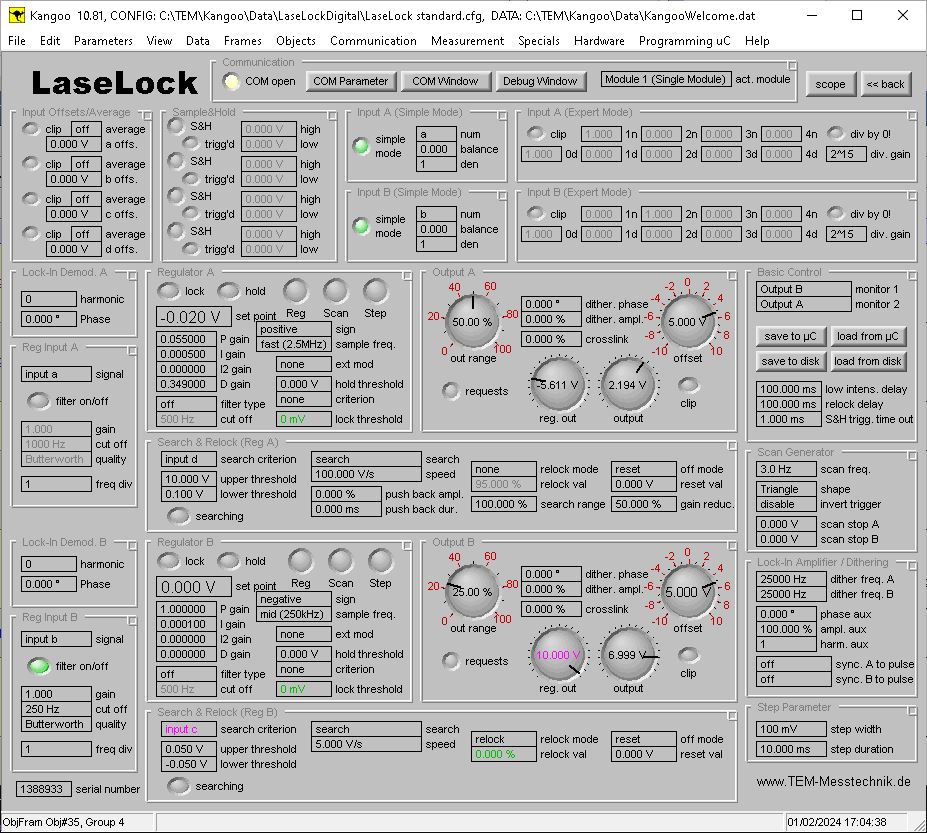
we changed also some locking condition on the 2 Laselock PID regulators : see the attached picture.
search and relock : reset mode with 0V for both => when the 2 PID are losing the lock, they search a new lock starting with the same 0V value on the PZT (it can prevent they are out of range in some cases)
with these condition, it seems the lock is quicker to come back.
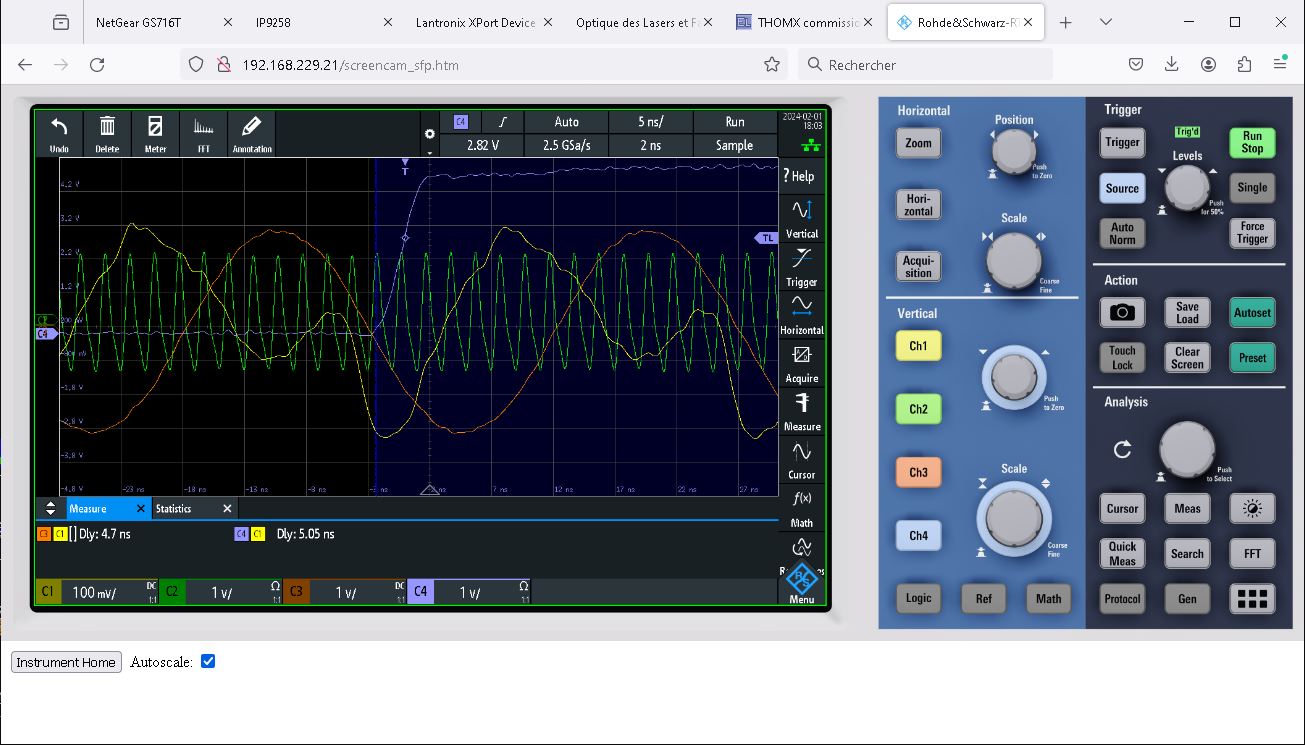
we can check the phase bucket with the remote oscilloscope at the IP address : 192.168.229.21 (see attached picture)
blue : trigger signal @ 10Hz (will be 50Hz in next ThomX update)
red : reference 33MHz signal, phase linked with the 500MHz of the ring
yellow : laser 33MHz signal (need to have always the same phase relation with the reference 33MHz when locked to RF reference)
the rms jitter with the RF reference is still ~15ps => to be improved...
|
| Attachment 1: Capture.JPG
|  |
| Attachment 2: Capture.JPG
|  |
|
322
|
Fri Feb 2 11:53:40 2024 |
Ronic Chiche | Fixed | info | mechanics | lasers and optics | ThomX igloo | Laser cavity temperature/pressure sensitivity | this morning, I did a 500MHz beating frequency (Laser vs RF) drift test with the Smaract motors configured with "Sensor Mode" OFF over 50 minutes (~ 1500 acquisitions)
compared with previous measurements, one observes a much more smooth "exponential-like" drift compared to "Sensor Mode" ON (see previous posts).
| Ronic Chiche wrote: |
|
long-term correlation, over 5-6 days, between the temperature measured in the bunker, outside of the housing (blue curve) and the temperature measured with a probe stuck on the laser housing, inside of the FP-cavity housing (green).
it's a perfect correlation with almost the same temperature scale : 1°C outisde the housing => 1°C of laser housing
thus, a stabilization of the temperature, inside of the housing, could help to reduce the frequency drifts of the laser.
| Ronic Chiche wrote: |
|
today, I swapped the 500MHz RF reference oscillator for a Siglent 500MHz DDS oscillator.
see the attached plot : the beating frequency with the 500MHz laser harmonics produces the same behavior as before.
so, the oscillations should come from the laser temperature regulation.
| Ronic Chiche wrote: |
|
the last thing we did with Daniele, is to start/stop the airflow on top of the housing (closed) to see a possible pressure effect on the laser frequency drift.
fig 1 : in green, the temperature measured with the probe stuck on the laser housing.
one can clearly see the 2 "start - wait ~10mins - stop" we did at 16h50 then at 17h30.
the air temperature blowed by the airflow is cooler than the housing temperature and we see the effect on the probe.
fig 2 : this is the laser frequency drift during the 1st airflow start/stop
the airflow has been turned on at 100 iterations and stopped at 500 iterations (~5 mins)
we don't see any correlation
fig 3 : this is again the laser frequency drift during the 2nd airflow start/stop
the airflow has been turned on at 1850 iterations and stopped at 2550 iterations (~10 mins)
we don't see any correlation
CONCLUSION : neither external temperature change or pressure variations can explain the 10-20min period oscillations observed on the laser frequency variations.
it can be either the laser temperature regulation or the RF reference oscillator temperature regulation (due to the oven of the quartz)
| Ronic Chiche wrote: |
|
Now, I placed a temperature probe stuck on the laser housing itself.
fig. 1
one can compare the temperature measured at the surface of the laser housing and the beating frequency with the 500MHz reference oscillator
one sees a possible very long term correlation but there is no correlation at the minute level when we see the frequency oscillation after t=2000s.
the laser housing temperature seems not to induce directly a frequency variation.
fig 2 / 3
we applied 15W on the heating wire rolled around the FP-cavity flange.
in red, we see the temperature increasing on the probe rolled around the wire, reaching almost 30°C.
we heat the inside of the housing (airflow stopped) during more than 30 minutes
in green, we don't see any variation (even if one makes a zoom) of the temperature of the probe stuck on the laser housing.
in same time, on fig 3, one can see the frequency drift.
there is no correlation between the oscillations and the temperature.
CONCLUSION :
the laser frequency fluctuations does not seem to come from the outside temperature.
| Ronic Chiche wrote: |
|
laser cavity :
when one decreases the laser motor position, the laser repetition rate increases (laser cavity length decreases).
=> +/- laser motor step => +/- laser cavity roundtrip length => -/+ laser repetition rate => -/+ laser harmonic @500MHz
=> +/- 100nm => +/- 200nm => -/+ 0.7Hz @33.33MHz => -/+ 10Hz @500MHz
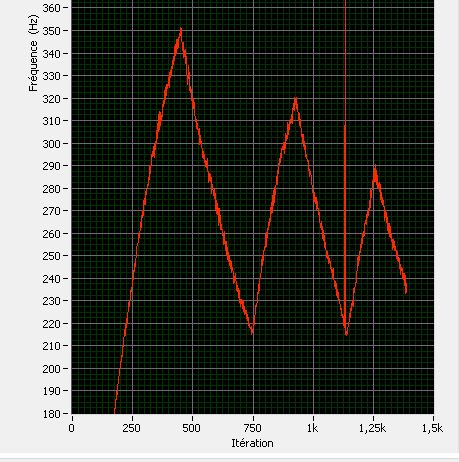
here is the natural variation of the laser cavity frequency beating with RF @500MHz over 1h (~1.6s / iteration)
one can see some oscillations equivalent to ~1µm of roundtrip length with ~10 minutes period and maybe a slower drift or oscillation with ~2µm of roundtrip range over the hour.
I mention that I moved the laser "PZT" motor before taking the data : could it be the reason of the 10-20min oscillations ?
during the same time, here is a probe temperature curve (the probe in stuck on the end flange, close to X-hutch, of the FP-cavity, inside the housing... not close to the laser position).
the temperature variation range is ~2.5/100 °C which induces on inox (relative length thermal effect : 17e-6 /K) a length variation of 4µm of roundtrip (10m) which could be compatible to the laser cavity length variation measured.
|
|
|
|
|
|
| Attachment 1: Capture.JPG
|  |
|
324
|
Fri Feb 9 09:50:45 2024 |
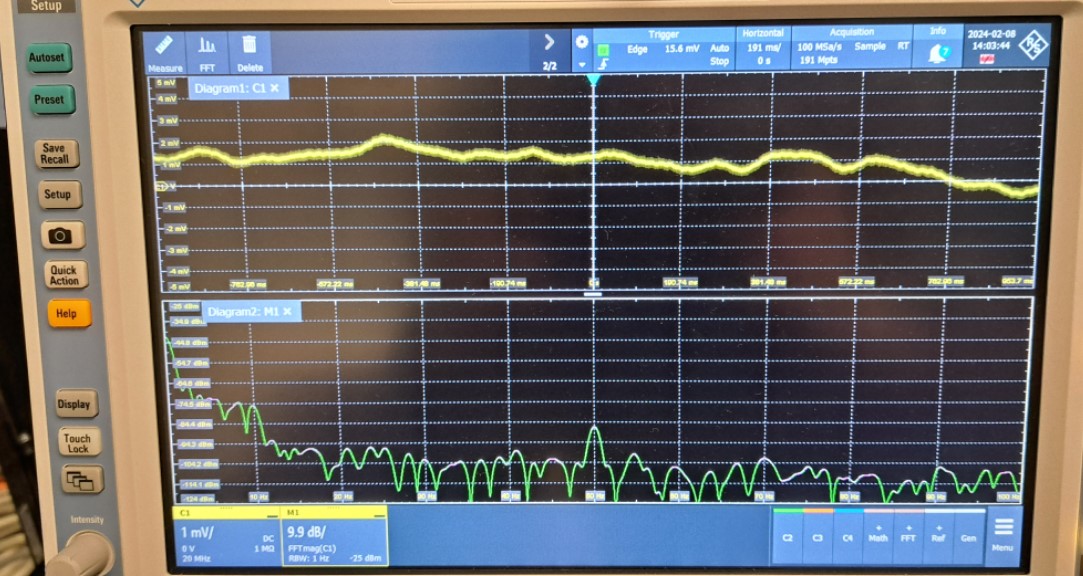
Ronic Chiche | Under Process | issue | mechanics | lasers and optics | detectors and electronics | ThomX igloo | 20Hz oscillation in the locking between Laser and FP-cavity | yesterday I did 2 tests to try to understand the origin of the 20Hz oscillation which is dominant in the remaining 10-20ps rms jitter between the transmitted pulses and the RF reference generator.
10ps rms jitter is equivalent to phase jitter dphi = 2*pi*f0*dt = 2mrad rms @ 33MHz or 30mrad rms @ 500MHz.
with V0 = 1Vpeak of beating signal amplitude, the equivalent rms beating voltage is dV = V0 * sin(dphi) ~ V0 * dphi = 2mV rms @ 33MHz or 30mV rms @ 500MHz
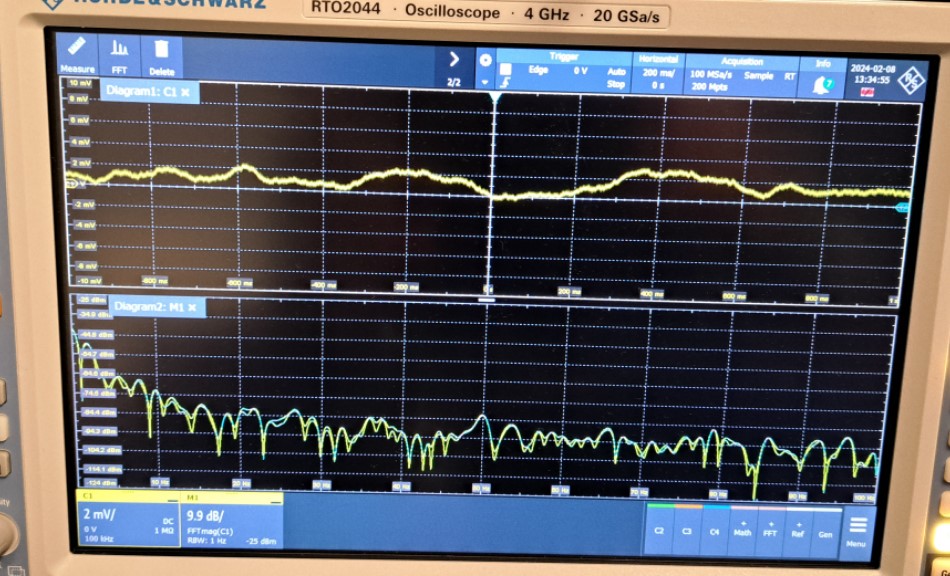
1) I did a beating between the internal photodiode of the laser with an external 33MHz oscillator (the photodiode is too slow to use higher harmonic).
the difficult part is to see the 2mV rms noise on a 2Vpp oscillating signal, so I locked the external 33MHz reference oscillator with the beating signal => see first plot.
there is no trace of 20Hz oscillation in the beating signal => the lock is too good and removed the oscillation ?
2) I did a beating between the photodiode in reflection of the FP-cavity (so the signal is not coming only from the oscillator but is going also through the Alphanov amplifier) with the 500MHz RF Ring generator.
I cannot the lock the generator anymore, so the measurement is done in open loop. I adjust the laser Frep with the motor to try to cancel the beating frequency => see 2nd plot
there is no trace of 20Hz oscillation in the beating signal => it is in contradiction with the previous post : "conclusion: the 20Hz oscillation is coming from the laser cavity" ?!?
maybe we need a more complex measurement scheme with the possibility to measure in the same time the 10-20ps rms jitter coming from the locked FP-cavity transmitted signal/500MHz Ring generator
AND the beating signal between the laser or amplifier with 500MHz local reference generator... to be done...
| Ronic Chiche wrote: |
|
this afternoon, we did 2 tests to better understand this 20Hz oscillation:
- we locked the amplified laser directly to the 500MHz ring reference oscillator, without any intermediate locking to the FP-cavity => no change
the 20Hz oscillation is still present in the correction signal of the laser PZT.
- we switched OFF the controller of the hexapod => no change.
conclusion:
the 20Hz oscillation is coming from the laser cavity
or is coming from "outside" and could be measured, maybe at a higher level, with an external "noises & vibrations measurement system".
| Ronic Chiche wrote: |
|
this morning, we tried to find the origin of the 20Hz oscillation.
- we switched OFF the laser Smaract motors controller => no change
- then, we addionally disconnected the FP-cavity PZT cable from the Laselock (we put a charge of 1kohm) => no change
- then, we switched ON the laser Smaract motors controller and switched OFF the FP-cavity motors controllers => no change
in conclusion, we don't really know where this instabillity comes from.
the amplitude is roughly 1Vpp (when the oscillation is at its maximum) on the laser PZT <=> length oscillation of ~20nm pp
could it come :
- from the air cooling regulation with pressure variation ?
- from vibrations of the hexapod below the table ?
or is it from inside of the laser or FP cavities ?
see these posts for the first measurements on this issue: https://elog.lal.in2p3.fr/FPC/THOMX+commissioning/257
|
|
|
| Attachment 1: 20240208_133745.jpg
|  |
| Attachment 2: 20240208_140636.jpg
|  |
|
325
|
Fri Feb 9 15:49:39 2024 |
Ronic Chiche | Under Process | issue | mechanics | lasers and optics | detectors and electronics | ThomX igloo | 20Hz oscillation in the locking between Laser and FP-cavity | what does this 10ps phase jitter mean in term of cavity length variations ?
L = L0 + dL sin(2pi fm t) = L0 (1 + dL/L0 sin(2pi fm t))
F = c / L ~ F0 - F0² dL / c sin(2pi fm t) with F0 = c / L0
d/dt(phi) = 2pi F => phi = 2pi F0 t + F0² dL / (c fm) cos(2pi fm t) => dphi = F0² dL / (c fm)
dphi = 2pi F0 dt => dL = L0 * 2pi fm dt
dt rms = 10ps @ fm = 20Hz of modulation frequency <=> dL rms = 10 nm (L0 = 9m)
| Ronic Chiche wrote: |
|
yesterday I did 2 tests to try to understand the origin of the 20Hz oscillation which is dominant in the remaining 10-20ps rms jitter between the transmitted pulses and the RF reference generator.
10ps rms jitter is equivalent to phase jitter dphi = 2*pi*f0*dt = 2mrad rms @ 33MHz or 30mrad rms @ 500MHz.
with V0 = 1Vpeak of beating signal amplitude, the equivalent rms beating voltage is dV = V0 * sin(dphi) ~ V0 * dphi = 2mV rms @ 33MHz or 30mV rms @ 500MHz
1) I did a beating between the internal photodiode of the laser with an external 33MHz oscillator (the photodiode is too slow to use higher harmonic).
the difficult part is to see the 2mV rms noise on a 2Vpp oscillating signal, so I locked the external 33MHz reference oscillator with the beating signal => see first plot.
there is no trace of 20Hz oscillation in the beating signal => the lock is too good and removed the oscillation ?
2) I did a beating between the photodiode in reflection of the FP-cavity (so the signal is not coming only from the oscillator but is going also through the Alphanov amplifier) with the 500MHz RF Ring generator.
I cannot the lock the generator anymore, so the measurement is done in open loop. I adjust the laser Frep with the motor to try to cancel the beating frequency => see 2nd plot
there is no trace of 20Hz oscillation in the beating signal => it is in contradiction with the previous post : "conclusion: the 20Hz oscillation is coming from the laser cavity" ?!?
maybe we need a more complex measurement scheme with the possibility to measure in the same time the 10-20ps rms jitter coming from the locked FP-cavity transmitted signal/500MHz Ring generator
AND the beating signal between the laser or amplifier with 500MHz local reference generator... to be done...
| Ronic Chiche wrote: |
|
this afternoon, we did 2 tests to better understand this 20Hz oscillation:
- we locked the amplified laser directly to the 500MHz ring reference oscillator, without any intermediate locking to the FP-cavity => no change
the 20Hz oscillation is still present in the correction signal of the laser PZT.
- we switched OFF the controller of the hexapod => no change.
conclusion:
the 20Hz oscillation is coming from the laser cavity
or is coming from "outside" and could be measured, maybe at a higher level, with an external "noises & vibrations measurement system".
| Ronic Chiche wrote: |
|
this morning, we tried to find the origin of the 20Hz oscillation.
- we switched OFF the laser Smaract motors controller => no change
- then, we addionally disconnected the FP-cavity PZT cable from the Laselock (we put a charge of 1kohm) => no change
- then, we switched ON the laser Smaract motors controller and switched OFF the FP-cavity motors controllers => no change
in conclusion, we don't really know where this instabillity comes from.
the amplitude is roughly 1Vpp (when the oscillation is at its maximum) on the laser PZT <=> length oscillation of ~20nm pp
could it come :
- from the air cooling regulation with pressure variation ?
- from vibrations of the hexapod below the table ?
or is it from inside of the laser or FP cavities ?
see these posts for the first measurements on this issue: https://elog.lal.in2p3.fr/FPC/THOMX+commissioning/257
|
|
|
|
|
326
|
Fri Feb 9 18:00:05 2024 |
Ronic Chiche | Under Process | issue | mechanics | lasers and optics | detectors and electronics | ThomX igloo | 20Hz oscillation in the locking between Laser and FP-cavity | measure to be done next week to check the 20Hz noise on the laser amplifier signal:
- install a DET10 in reflection of the FP-cavity to get a high BW and measure the 500MHz harmonic.
- do the beating with the 500MHz Ring RF generator
- with the laser motor try to be close to the 500MHz Ring RF frequency => beating frequency below 1kHz
- send the beating signal to some RF spectrum analyzer to use its large dynamic range.
for example, with the Siglent RF spectrum analyzer, it is possible to detect easily a peak @ -96dBm <=> 3.5µV rms
so, one should be able to make the measurement @ 500MHz or even @ 33MHz even if the phase sensitivity is lower :
for example V0=100mV peak beating signal @ f0=33MHz should produce a 20Hz noise signal of:
dV ~ V0 * dphi = V0 * 2*pi*f0*dt = 200µV rms with jitter dt=10ps rms
| Ronic Chiche wrote: |
|
what does this 10ps phase jitter mean in term of cavity length variations ?
L = L0 + dL sin(2pi fm t) = L0 (1 + dL/L0 sin(2pi fm t))
F = c / L ~ F0 - F0² dL / c sin(2pi fm t) with F0 = c / L0
d/dt(phi) = 2pi F => phi = 2pi F0 t + F0² dL / (c fm) cos(2pi fm t) => dphi = F0² dL / (c fm)
dphi = 2pi F0 dt => dL = L0 * 2pi fm dt
dt rms = 10ps @ fm = 20Hz of modulation frequency <=> dL rms = 10 nm (L0 = 9m)
| Ronic Chiche wrote: |
|
yesterday I did 2 tests to try to understand the origin of the 20Hz oscillation which is dominant in the remaining 10-20ps rms jitter between the transmitted pulses and the RF reference generator.
10ps rms jitter is equivalent to phase jitter dphi = 2*pi*f0*dt = 2mrad rms @ 33MHz or 30mrad rms @ 500MHz.
with V0 = 1Vpeak of beating signal amplitude, the equivalent rms beating voltage is dV = V0 * sin(dphi) ~ V0 * dphi = 2mV rms @ 33MHz or 30mV rms @ 500MHz
1) I did a beating between the internal photodiode of the laser with an external 33MHz oscillator (the photodiode is too slow to use higher harmonic).
the difficult part is to see the 2mV rms noise on a 2Vpp oscillating signal, so I locked the external 33MHz reference oscillator with the beating signal => see first plot.
there is no trace of 20Hz oscillation in the beating signal => the lock is too good and removed the oscillation ?
2) I did a beating between the photodiode in reflection of the FP-cavity (so the signal is not coming only from the oscillator but is going also through the Alphanov amplifier) with the 500MHz RF Ring generator.
I cannot the lock the generator anymore, so the measurement is done in open loop. I adjust the laser Frep with the motor to try to cancel the beating frequency => see 2nd plot
there is no trace of 20Hz oscillation in the beating signal => it is in contradiction with the previous post : "conclusion: the 20Hz oscillation is coming from the laser cavity" ?!?
maybe we need a more complex measurement scheme with the possibility to measure in the same time the 10-20ps rms jitter coming from the locked FP-cavity transmitted signal/500MHz Ring generator
AND the beating signal between the laser or amplifier with 500MHz local reference generator... to be done...
| Ronic Chiche wrote: |
|
this afternoon, we did 2 tests to better understand this 20Hz oscillation:
- we locked the amplified laser directly to the 500MHz ring reference oscillator, without any intermediate locking to the FP-cavity => no change
the 20Hz oscillation is still present in the correction signal of the laser PZT.
- we switched OFF the controller of the hexapod => no change.
conclusion:
the 20Hz oscillation is coming from the laser cavity
or is coming from "outside" and could be measured, maybe at a higher level, with an external "noises & vibrations measurement system".
| Ronic Chiche wrote: |
|
this morning, we tried to find the origin of the 20Hz oscillation.
- we switched OFF the laser Smaract motors controller => no change
- then, we addionally disconnected the FP-cavity PZT cable from the Laselock (we put a charge of 1kohm) => no change
- then, we switched ON the laser Smaract motors controller and switched OFF the FP-cavity motors controllers => no change
in conclusion, we don't really know where this instabillity comes from.
the amplitude is roughly 1Vpp (when the oscillation is at its maximum) on the laser PZT <=> length oscillation of ~20nm pp
could it come :
- from the air cooling regulation with pressure variation ?
- from vibrations of the hexapod below the table ?
or is it from inside of the laser or FP cavities ?
see these posts for the first measurements on this issue: https://elog.lal.in2p3.fr/FPC/THOMX+commissioning/257
|
|
|
|
|
|
327
|
Fri Mar 1 18:38:17 2024 |
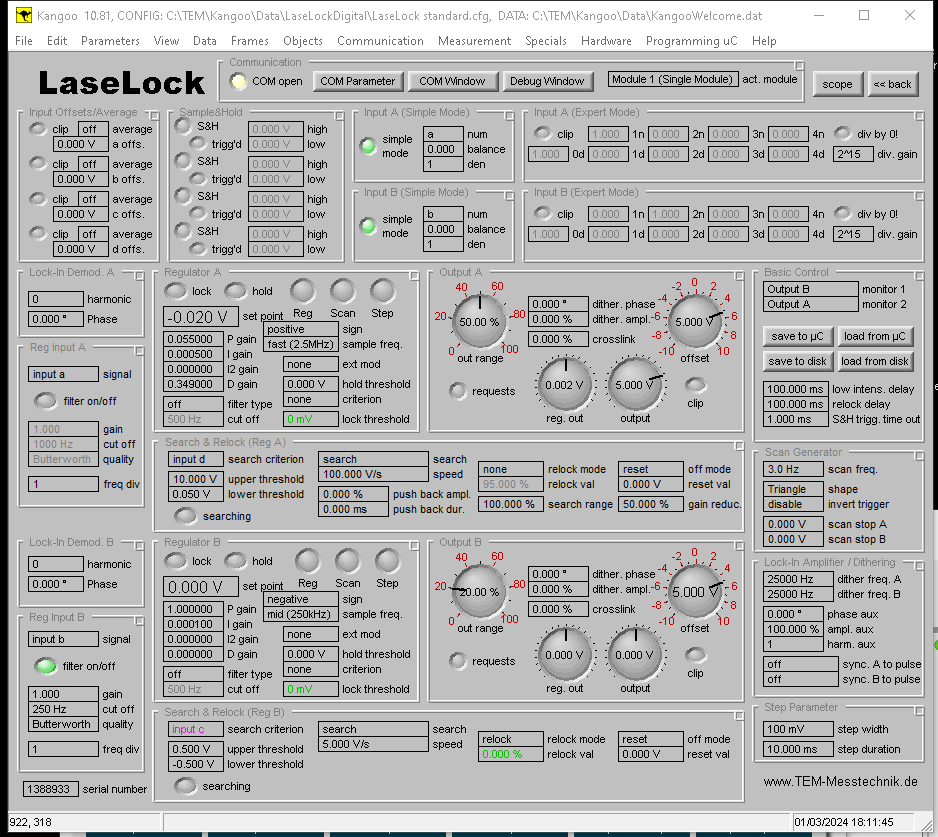
Ronic Chiche | Fixed | info | software | ThomX igloo | correct parameters for locking the FP-cavity | Today, we restarted the FP-cavity locking, after 3 weeks without using it.
those 3 weeks have been used to set the machine ring at the new (better) frequency : 500.067MHz (corresponding to a change of -183kHz)
or 33.3378MHz in fondamental frequency (corresponding to a change of -12.2kHz)
the power supply of FP-cavity photodiodes was OFF maybe due to some electrons losses.
we had to switch it OFF and ON to restart it.
the computer was restarted and we had to restart the applications and set their parameters.
in attachement, the parameters of the Kangoo software.
we had several "warnings" from the laser amplifier software => the amplifier stopped
but maybe it's because of the electrons not sent in the dump which pertubate the monitoring signal levels of the amplifier => to be confirmed
we had to do some alignment.
with 33% of amplifier ratio, we had 49kW inside the FP-cavity.
we tried to move a bit the L-shape mirror but without any significant effect to improve the intra-cavity power.
we didn't start the laser and FP cavities length increase procedure.
surprinsingly, the beating frequency between laser cavity and 33.3378MHz is only 140Hz and not 12kHz as expected.... to be investigated
|
| Attachment 1: good_parameters.png
|  |
|
328
|
Mon Mar 4 09:32:06 2024 |
Ronic Chiche | Fixed | info | software | ThomX igloo | correct parameters for locking the FP-cavity | this morning I solved the problem of the 33MHz frequency beating which should be ~12kHz between the generator (at the new frequency 33.3378MHz) and the laser cavity frequency (still at the old frequency which is 33.35MHz)...
the generator providing the 33MHz frequency has 2 channels, and only one was set at the proper frequency !
so, I set both channels at 33.3378MHz and now I measure properly ~12kHz of frequency beating.
now, we can move the laser cavity and the FP cavity in confidence.
| Ronic Chiche wrote: |
|
Today, we restarted the FP-cavity locking, after 3 weeks without using it.
those 3 weeks have been used to set the machine ring at the new (better) frequency : 500.067MHz (corresponding to a change of -183kHz)
or 33.3378MHz in fondamental frequency (corresponding to a change of -12.2kHz)
the power supply of FP-cavity photodiodes was OFF maybe due to some electrons losses.
we had to switch it OFF and ON to restart it.
the computer was restarted and we had to restart the applications and set their parameters.
in attachement, the parameters of the Kangoo software.
we had several "warnings" from the laser amplifier software => the amplifier stopped
but maybe it's because of the electrons not sent in the dump which pertubate the monitoring signal levels of the amplifier => to be confirmed
we had to do some alignment.
with 33% of amplifier ratio, we had 49kW inside the FP-cavity.
we tried to move a bit the L-shape mirror but without any significant effect to improve the intra-cavity power.
we didn't start the laser and FP cavities length increase procedure.
surprinsingly, the beating frequency between laser cavity and 33.3378MHz is only 140Hz and not 12kHz as expected.... to be investigated
|
|
|
329
|
Mon Mar 4 12:39:56 2024 |
Ronic Chiche | Fixed | info | mechanics | lasers and optics | ThomX igloo | Laser and FP cavities frequency adjustment | at the beginning of the procedure, the frequency gap between the new Ring 33MHz frequency (33.3378MHz) and the laser/FP cavities frequency was 12.33kHz
=> the Smaract motor position was at +100µm
=> the FP cavity motor Mot.03 position was at -358 720 steps
the PDin photodiode was at 3.151mW @ 33% amplifier ratio
the PDpulse photodiode was at 33.384MHz
after several moves (each time, one corrects the CEP / alignment to keep ~ 47kW inside the FP-cavity)
we can move the laser cavity at 300nm/s without any laser modelock loss
we move the FP cavity at the same speed (300nm/s = 50 steps/s with 1step = 6nm)
now, we did roughly half of the travel : dF @ 33MHz = 5.3kHz
=> the Smaract motor position was at +1075µm
=> the FP cavity motor Mot.03 position was at -200 000 steps
the PDin photodiode was at 3.178mW @ 33% amplifier ratio
the PDpulse photodiode was at 33.377MHz
|
|
330
|
Mon Mar 4 18:32:21 2024 |
Ronic Chiche | Fixed | info | mechanics | lasers and optics | ThomX igloo | Laser and FP cavities frequency adjustment | This afternoon, I did the 2nd half of the travel: dF @ 33MHz = 0Hz
=> the Smaract motor position is now at +1750µm
=> the FP cavity motor Mot.03 position stayed at -200 000 steps
=> the FP cavity motor Mot.06 position is now at -790 000 steps
the PDin photodiode was at 3.191mW @ 33% amplifier ratio
the PDpulse photodiode was at 33.372 / 33.371MHz
the FP-cavity power is ~47kW @ 33% amplifier ratio => to be improved
there is no signal beating at 500MHz, only at 33MHz => to be investiguated => fixed
| Ronic Chiche wrote: |
|
at the beginning of the procedure, the frequency gap between the new Ring 33MHz frequency (33.3378MHz) and the laser/FP cavities frequency was 12.33kHz
=> the Smaract motor position was at +100µm
=> the FP cavity motor Mot.03 position was at -358 720 steps
the PDin photodiode was at 3.151mW @ 33% amplifier ratio
the PDpulse photodiode was at 33.384MHz
after several moves (each time, one corrects the CEP / alignment to keep ~ 47kW inside the FP-cavity)
we can move the laser cavity at 300nm/s without any laser modelock loss
we move the FP cavity at the same speed (300nm/s = 50 steps/s with 1step = 6nm)
now, we did roughly half of the travel : dF @ 33MHz = 5.3kHz
=> the Smaract motor position was at +1075µm
=> the FP cavity motor Mot.03 position was at -200 000 steps
the PDin photodiode was at 3.178mW @ 33% amplifier ratio
the PDpulse photodiode was at 33.377MHz
|
|
|
331
|
Tue Mar 5 11:20:43 2024 |
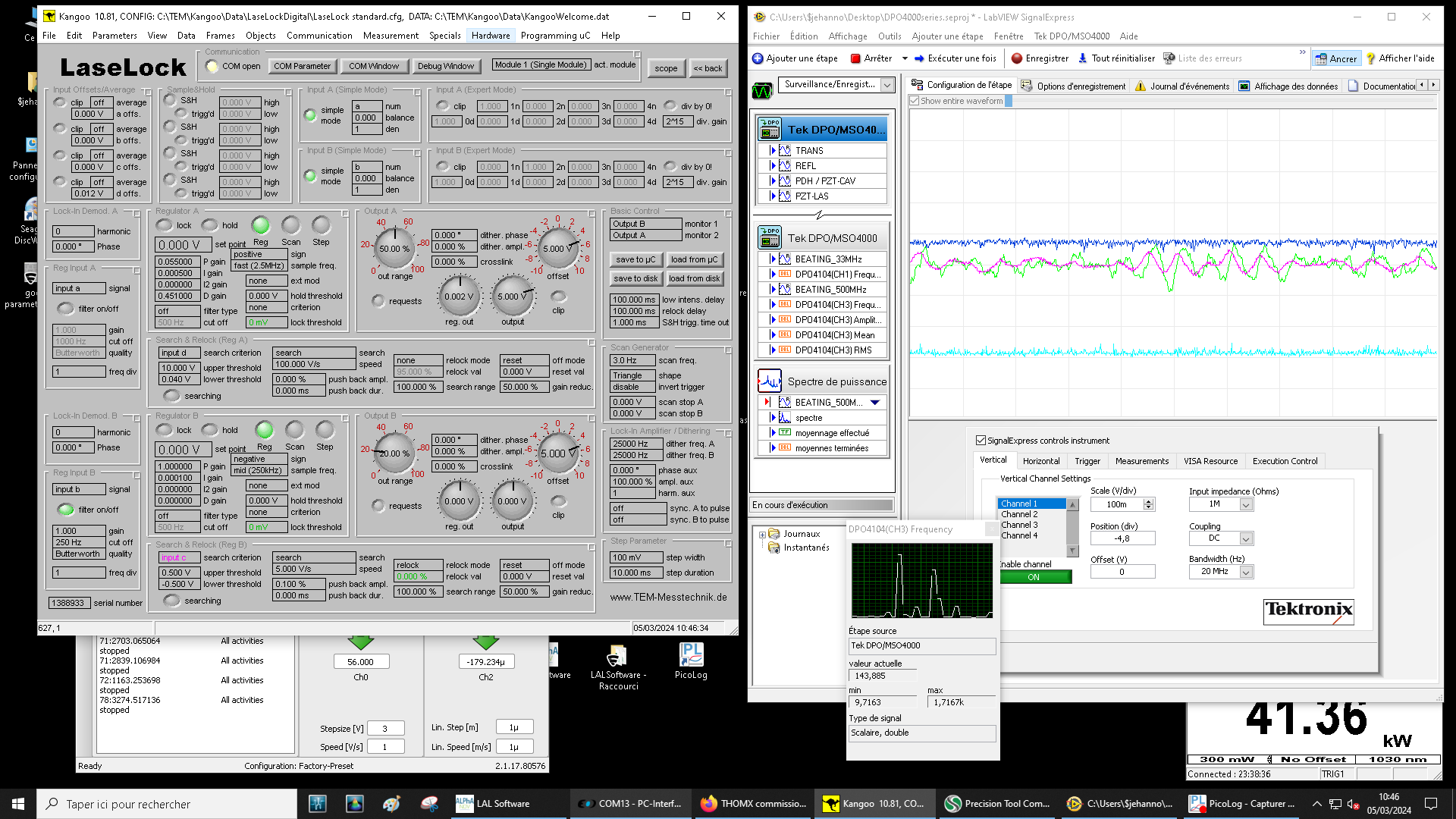
Ronic Chiche | Fixed | info | software | ThomX igloo | correct parameters for locking the FP-cavity | this morning, I finished the FP-cavity alignment with the new ring RF frequency.
I get back 50kW @ 33% amplifier ratio.
I'm also able to lock very smoothly on the 500MHz ring RF frequency.
so, we are ready to produce X-ray.
warning : apparently, when one changes the 33MHz generator frequency with the "Nicolas" script, it does not change both channels of the generator, which is mandatory for us.
=> to be fixed : freq(CH2) = freq(CH1)
new optimized lock parameters in attached file (Kangoo parameters)
no more "Alphanov amplifier warnings" when one works without the ring machine => it is important/mandatory to send the electrons in the dump.
| Ronic Chiche wrote: |
|
this morning I solved the problem of the 33MHz frequency beating which should be ~12kHz between the generator (at the new frequency 33.3378MHz) and the laser cavity frequency (still at the old frequency which is 33.35MHz)...
the generator providing the 33MHz frequency has 2 channels, and only one was set at the proper frequency !
so, I set both channels at 33.3378MHz and now I measure properly ~12kHz of frequency beating.
now, we can move the laser cavity and the FP cavity in confidence.
| Ronic Chiche wrote: |
|
Today, we restarted the FP-cavity locking, after 3 weeks without using it.
those 3 weeks have been used to set the machine ring at the new (better) frequency : 500.067MHz (corresponding to a change of -183kHz)
or 33.3378MHz in fondamental frequency (corresponding to a change of -12.2kHz)
the power supply of FP-cavity photodiodes was OFF maybe due to some electrons losses.
we had to switch it OFF and ON to restart it.
the computer was restarted and we had to restart the applications and set their parameters.
in attachement, the parameters of the Kangoo software.
we had several "warnings" from the laser amplifier software => the amplifier stopped
but maybe it's because of the electrons not sent in the dump which pertubate the monitoring signal levels of the amplifier => to be confirmed
we had to do some alignment.
with 33% of amplifier ratio, we had 49kW inside the FP-cavity.
we tried to move a bit the L-shape mirror but without any significant effect to improve the intra-cavity power.
we didn't start the laser and FP cavities length increase procedure.
surprinsingly, the beating frequency between laser cavity and 33.3378MHz is only 140Hz and not 12kHz as expected.... to be investigated
|
|
|
| Attachment 1: Correct_lock_parameters.png
|  |
|
332
|
Tue Mar 19 13:01:22 2024 |
Ronic Chiche | Fixed | info | lasers and optics | detectors and electronics | ThomX igloo | FP-cavity lock survey during the Linac section changing operation | This morning with Daniele, we operated the FP-cavity to be sure there is no issue due to the Linac section changing operation :
- opening/closing the valves due to air pressure break down
- opening/closing the bunker roof
- large temperature change
- etc...
the temperature in the bunker dropped to 18°C instead of 21.5°C, so we had to do some FP-cavity alignment.
but after obtaining resonances and changing the CEP, we got more than 50kW for 33% of amplifier ratio => OK !
|
|
333
|
Tue Mar 26 10:20:54 2024 |
Ronic Chiche | Fixed | info | lasers and optics | detectors and electronics | ThomX igloo | FP-cavity lock survey during the Linac section changing operation | This morning, I locked again the FP-cavity at more than 50kW with 33% of laser amplifier ratio.
the temperature is measured today at 20.5°C despite the fact the air conditionning is still OFF.
the temperature, rising from 18°C, started monday at 11AM roughly.
maybe, the difference comes from the external doors of the Igloo which have been closed recently ? to be confirmed.
as the temperature is measured inside the airflow housing, all the powered equipements are disspating some heat, rising the inside temperature compared to the bunker temperature.
EDIT : Sophie Chance told me the water temperature cooling of ThomX was defective... the water temperature went to 29°C ! it is being fixed by Dalkia.
careful, we don't have a temperature measurement of the water going to the chiller...
to find resonances, I moved the OC/OP/OCH.01-MOT06 motor from position -770 000 steps to position -788 600 steps which corresponds to ~100µm !
it can be explained by the temperature change and also because during the lock last week, I let the MOT06 motor in position after the cavity was at 50kW.
I had also to change the CEP motor position from -170µm to -420µm and to do some alignment (with walking procedure).
accessing the motor OC/OP/OCH.01-MOT03 from the ATK panel, produces an error : "connection to device failed"... to be solved by Kevin ?
| Ronic Chiche wrote: |
|
This morning with Daniele, we operated the FP-cavity to be sure there is no issue due to the Linac section changing operation :
- opening/closing the valves due to air pressure break down
- opening/closing the bunker roof
- large temperature change
- etc...
the temperature in the bunker dropped to 18°C instead of 21.5°C, so we had to do some FP-cavity alignment.
but after obtaining resonances and changing the CEP, we got more than 50kW for 33% of amplifier ratio => OK !
|
|
|
334
|
Tue Apr 2 08:51:21 2024 |
Ronic Chiche | Fixed | info | lasers and optics | ThomX igloo | New multiplication factor for the Fabry-Perot intra-cavity power | last week, we measured the transmission of a plan mirror from the same batch than the ThomX mirrors and we got ~ 1.75ppm instead of 3ppm which was the calculated value by the LMA.
previously, we put 1/3ppm = 333 333 as multiplication factor.
from today, we will put 1/1.75ppm ~ 570 000 as multiplication factor.
then, previously we got 50kW, now we should get 85.5kW instead in the same conditions. |
|
335
|
Tue Apr 2 09:19:31 2024 |
Ronic Chiche | Fixed | info | lasers and optics | detectors and electronics | ThomX igloo | FP-cavity lock survey during the Linac section changing operation | from now on, the transmission factor for calculating the FP intra cavity power is 1/1.75ppm ~ 570 000 (changed in the Powermeter software)
this morning the temperature of the water cooling circuit is still very high said Sophie, and the laser amplifier temperature "Temp Amp1" is at 29°C instead of ~23-25°C
then, when I start the laser amplifier, it stops rapidly with a warning error.
I will check the chiller status as the Dalkia should fix the water temperature problem at some time (Sophie + Alice working on this point)
the air temperature in the bunker is back at 19.5°C from last Friday afternoon and is stable at less than 0.5°C.
after restarting the chiller, the "Temp Amp1" is now at 25°C before starting the power in the amplifier, it rises at 28.5°C after some minutes
I found the resonances with the motor OC/OP/OCH.01-MOT06 at position -783 460 steps.
and I had to tune the CEP to get the maximum resonances at -198µm.
with the new transmission factor, I got almost 90kW for 33% laser amplifier ratio after a simple alignment procedure.
the motor OC/OP/OCH.01-MOT03 is sill in error.
| Ronic Chiche wrote: |
|
This morning, I locked again the FP-cavity at more than 50kW with 33% of laser amplifier ratio.
the temperature is measured today at 20.5°C despite the fact the air conditionning is still OFF.
the temperature, rising from 18°C, started monday at 11AM roughly.
maybe, the difference comes from the external doors of the Igloo which have been closed recently ? to be confirmed.
as the temperature is measured inside the airflow housing, all the powered equipements are disspating some heat, rising the inside temperature compared to the bunker temperature.
EDIT : Sophie Chance told me the water temperature cooling of ThomX was defective... the water temperature went to 29°C ! it is being fixed by Dalkia.
careful, we don't have a temperature measurement of the water going to the chiller...
to find resonances, I moved the OC/OP/OCH.01-MOT06 motor from position -770 000 steps to position -788 600 steps which corresponds to ~100µm !
it can be explained by the temperature change and also because during the lock last week, I let the MOT06 motor in position after the cavity was at 50kW.
I had also to change the CEP motor position from -170µm to -420µm and to do some alignment (with walking procedure).
accessing the motor OC/OP/OCH.01-MOT03 from the ATK panel, produces an error : "connection to device failed"... to be solved by Kevin ?
| Ronic Chiche wrote: |
|
This morning with Daniele, we operated the FP-cavity to be sure there is no issue due to the Linac section changing operation :
- opening/closing the valves due to air pressure break down
- opening/closing the bunker roof
- large temperature change
- etc...
the temperature in the bunker dropped to 18°C instead of 21.5°C, so we had to do some FP-cavity alignment.
but after obtaining resonances and changing the CEP, we got more than 50kW for 33% of amplifier ratio => OK !
|
|
|
|
336
|
Tue Apr 9 09:38:18 2024 |
Ronic Chiche | Fixed | info | lasers and optics | detectors and electronics | ThomX igloo | FP-cavity lock survey during the Linac section changing operation | this morning, I had to restart the chiller. Temp Amp 1 is at 27.5°C after having started the amplifier at 33% ratio.
I removed the 100kohms resistor on the Transmission channel, on the scope (now, it is 1Mohms), to get more sensitivity.
the air temperature is around 21°C and is stable during the last days.
I don't see any power coming from the amplifier despite it is at 33%... I think the MPS prevent us to work and the amplifier shutter is blocking the beam.
I will send an email to Sophie to check that point.
EDIT : Kevin showed me how to acknowledge the error on the MPS
=> go to "Detail" and then acknowledge the "vacuum error".
I saw the FP-cavity resonances but I didn't have time to optimize them as the water temperature is still too high and the chiller is not working good enough.
=> the amplifier did a safety stop.
one needs to wait this issue is fixed.
OC/OP/OCH.01-MOT06 at position -790 000 steps.
CEP motor = -300µm but far from the optimum CEP position.
| Ronic Chiche wrote: |
|
from now on, the transmission factor for calculating the FP intra cavity power is 1/1.75ppm ~ 570 000 (changed in the Powermeter software)
this morning the temperature of the water cooling circuit is still very high said Sophie, and the laser amplifier temperature "Temp Amp1" is at 29°C instead of ~23-25°C
then, when I start the laser amplifier, it stops rapidly with a warning error.
I will check the chiller status as the Dalkia should fix the water temperature problem at some time (Sophie + Alice working on this point)
the air temperature in the bunker is back at 19.5°C from last Friday afternoon and is stable at less than 0.5°C.
after restarting the chiller, the "Temp Amp1" is now at 25°C before starting the power in the amplifier, it rises at 28.5°C after some minutes
I found the resonances with the motor OC/OP/OCH.01-MOT06 at position -783 460 steps.
and I had to tune the CEP to get the maximum resonances at -198µm.
with the new transmission factor, I got almost 90kW for 33% laser amplifier ratio after a simple alignment procedure.
the motor OC/OP/OCH.01-MOT03 is sill in error.
| Ronic Chiche wrote: |
|
This morning, I locked again the FP-cavity at more than 50kW with 33% of laser amplifier ratio.
the temperature is measured today at 20.5°C despite the fact the air conditionning is still OFF.
the temperature, rising from 18°C, started monday at 11AM roughly.
maybe, the difference comes from the external doors of the Igloo which have been closed recently ? to be confirmed.
as the temperature is measured inside the airflow housing, all the powered equipements are disspating some heat, rising the inside temperature compared to the bunker temperature.
EDIT : Sophie Chance told me the water temperature cooling of ThomX was defective... the water temperature went to 29°C ! it is being fixed by Dalkia.
careful, we don't have a temperature measurement of the water going to the chiller...
to find resonances, I moved the OC/OP/OCH.01-MOT06 motor from position -770 000 steps to position -788 600 steps which corresponds to ~100µm !
it can be explained by the temperature change and also because during the lock last week, I let the MOT06 motor in position after the cavity was at 50kW.
I had also to change the CEP motor position from -170µm to -420µm and to do some alignment (with walking procedure).
accessing the motor OC/OP/OCH.01-MOT03 from the ATK panel, produces an error : "connection to device failed"... to be solved by Kevin ?
| Ronic Chiche wrote: |
|
This morning with Daniele, we operated the FP-cavity to be sure there is no issue due to the Linac section changing operation :
- opening/closing the valves due to air pressure break down
- opening/closing the bunker roof
- large temperature change
- etc...
the temperature in the bunker dropped to 18°C instead of 21.5°C, so we had to do some FP-cavity alignment.
but after obtaining resonances and changing the CEP, we got more than 50kW for 33% of amplifier ratio => OK !
|
|
|
|
|
337
|
Thu Apr 11 09:58:10 2024 |
Ronic Chiche | Fixed | info | lasers and optics | detectors and electronics | ThomX igloo | FP-cavity lock survey during the Linac section changing operation | this morning, the computer was restarted and I had to launch all the applications.
no problem except the powermeter for which I had to do a power switch OFF and ON remotely.
the chiller was in error and I had to restart it also.
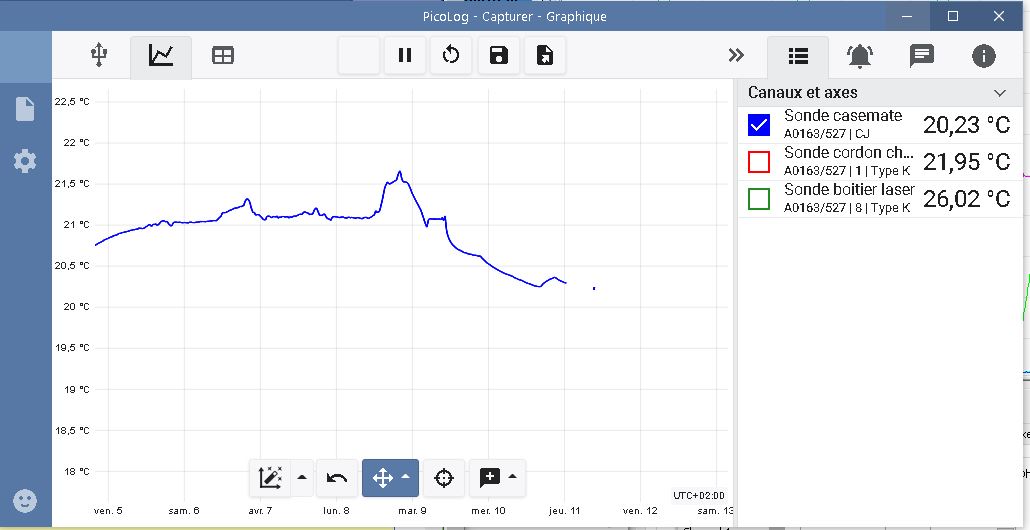
the air temperature seems to be not properly controlled (see the picture)
one can see a constant temperature drop from Tuesday 9 April 10:30am.
it seems the water cooling is also not working properly as I saw the laser amplifier temperature (Temp Amp 1) increased constantly during the run from 24°C to 30°C (in 30 mintues).
=> it's not normal, it should be regulated at 25°C !
I got 89kW in the FP-cavity with 33% of laser amplifier ratio after tuning the CEP and the alignment.
OC/OP/OCH.01-MOT06 roughly at position -782 000 steps.
CEP motor = -425µm
the OC/OP/OCH.01-MOT03 is still faulty => to be fixed by Kevin.
| Ronic Chiche wrote: |
|
this morning, I had to restart the chiller. Temp Amp 1 is at 27.5°C after having started the amplifier at 33% ratio.
I removed the 100kohms resistor on the Transmission channel, on the scope (now, it is 1Mohms), to get more sensitivity.
the air temperature is around 21°C and is stable during the last days.
I don't see any power coming from the amplifier despite it is at 33%... I think the MPS prevent us to work and the amplifier shutter is blocking the beam.
I will send an email to Sophie to check that point.
EDIT : Kevin showed me how to acknowledge the error on the MPS
=> go to "Detail" and then acknowledge the "vacuum error".
I saw the FP-cavity resonances but I didn't have time to optimize them as the water temperature is still too high and the chiller is not working good enough.
=> the amplifier did a safety stop.
one needs to wait this issue is fixed.
OC/OP/OCH.01-MOT06 at position -790 000 steps.
CEP motor = -300µm but far from the optimum CEP position.
| Ronic Chiche wrote: |
|
from now on, the transmission factor for calculating the FP intra cavity power is 1/1.75ppm ~ 570 000 (changed in the Powermeter software)
this morning the temperature of the water cooling circuit is still very high said Sophie, and the laser amplifier temperature "Temp Amp1" is at 29°C instead of ~23-25°C
then, when I start the laser amplifier, it stops rapidly with a warning error.
I will check the chiller status as the Dalkia should fix the water temperature problem at some time (Sophie + Alice working on this point)
the air temperature in the bunker is back at 19.5°C from last Friday afternoon and is stable at less than 0.5°C.
after restarting the chiller, the "Temp Amp1" is now at 25°C before starting the power in the amplifier, it rises at 28.5°C after some minutes
I found the resonances with the motor OC/OP/OCH.01-MOT06 at position -783 460 steps.
and I had to tune the CEP to get the maximum resonances at -198µm.
with the new transmission factor, I got almost 90kW for 33% laser amplifier ratio after a simple alignment procedure.
the motor OC/OP/OCH.01-MOT03 is sill in error.
| Ronic Chiche wrote: |
|
This morning, I locked again the FP-cavity at more than 50kW with 33% of laser amplifier ratio.
the temperature is measured today at 20.5°C despite the fact the air conditionning is still OFF.
the temperature, rising from 18°C, started monday at 11AM roughly.
maybe, the difference comes from the external doors of the Igloo which have been closed recently ? to be confirmed.
as the temperature is measured inside the airflow housing, all the powered equipements are disspating some heat, rising the inside temperature compared to the bunker temperature.
EDIT : Sophie Chance told me the water temperature cooling of ThomX was defective... the water temperature went to 29°C ! it is being fixed by Dalkia.
careful, we don't have a temperature measurement of the water going to the chiller...
to find resonances, I moved the OC/OP/OCH.01-MOT06 motor from position -770 000 steps to position -788 600 steps which corresponds to ~100µm !
it can be explained by the temperature change and also because during the lock last week, I let the MOT06 motor in position after the cavity was at 50kW.
I had also to change the CEP motor position from -170µm to -420µm and to do some alignment (with walking procedure).
accessing the motor OC/OP/OCH.01-MOT03 from the ATK panel, produces an error : "connection to device failed"... to be solved by Kevin ?
| Ronic Chiche wrote: |
|
This morning with Daniele, we operated the FP-cavity to be sure there is no issue due to the Linac section changing operation :
- opening/closing the valves due to air pressure break down
- opening/closing the bunker roof
- large temperature change
- etc...
the temperature in the bunker dropped to 18°C instead of 21.5°C, so we had to do some FP-cavity alignment.
but after obtaining resonances and changing the CEP, we got more than 50kW for 33% of amplifier ratio => OK !
|
|
|
|
|
| Attachment 1: Capture.JPG
|  |
|