| ID |
Date |
Author |
Status |
Type |
Category |
Location |
Title |
|
416
|
Wed Mar 5 15:08:38 2025 |
Ronic Chiche | Fixed | info | lasers and optics | detectors and electronics | ThomX igloo | Electrons-Photons phase stability measurement | the phase between the 500Mhz ring RF oscillator and the electrons is measured on a BPM and is very stable after 2-3ms (<< 6ps, typically) !
in the same time, we can use the residual phase beating after our 500MHz mixer to estimate the phase noise coming from the laser part.
the rms noise of this signal is around 60mV for 1.25V peak (2.5 pk-pk) signal => ~ 50mrad rms
dt = dphi / 2pi * 2ns ~ 15 ps which is the noise measured between electrons and photons at the IP !!!
we clearly see that this rms noise level is correlated with the 20Hz oscillation observed on the FPC feedback signals.
BUT even when this rms phase noise varies, we DO NOT see any effect on the X-ray production at this time,
which means this is not yet a limiting factor.
this observation is confirmed by the X-ray production flux calculation for which the time jitter is "added" to the electron beam size parameter which seems to be dominant.
| Ronic Chiche wrote: |
|
we installed a measurement at the IP with the BPM for ion cleaning for electrons and we used a fast photodiode at the output of the FP-cavity and measured with a fast oscilloscope the phase jitter between the 2 signals.
in red, the BPM signal
in blue, the photodiode signal.
on the right of the picture, this is the trend of the phase difference measurement.
in yellow, this is the histogram of this phase difference.
one measured 35ps of FWHM which is equivalent to 15ps rms for a Gaussian distribution.
|
|
|
415
|
Wed Mar 5 13:17:26 2025 |
Ronic Chiche | Fixed | info | lasers and optics | detectors and electronics | ThomX igloo | Electrons-Photons phase stability measurement | we installed a measurement at the IP with the BPM for ion cleaning for electrons and we used a fast photodiode at the output of the FP-cavity and measured with a fast oscilloscope the phase jitter between the 2 signals.
in red, the BPM signal
in blue, the photodiode signal.
on the right of the picture, this is the trend of the phase difference measurement.
in yellow, this is the histogram of this phase difference.
one measured 35ps of FWHM which is equivalent to 15ps rms for a Gaussian distribution. |
| Attachment 1: img1(1).jpg
| .jpg "img1(1).jpg") |
|
414
|
Tue Mar 4 14:54:31 2025 |
Ronic Chiche | Fixed | info | mechanics | software | ThomX igloo | New direction for cavity motors | from now on, one reverts the FP cavity motors direction to compensate the long drift from the begining of the project.
the motor MOT.06 will be used for the upward direction (presently -1 082 650 steps)
and the motor MOT.03 will be used for the downward direction (presently +37 170 steps)
after CEP and walking alignment tuning, I got quickly 92kW.
the new MOT.06 and MOT.03 positions are : -1 071670 steps and +34 110 steps.
the CEP motor is at +345µm |
|
413
|
Fri Feb 21 19:52:57 2025 |
Ronic Chiche | Fixed | info | mechanics | lasers and optics | detectors and electronics | software | ThomX igloo | Good Xrays production trend | this afternoon, we succeeded to get a quite long Xray production trend around 15-20 minutes with a flux above 25k on i1. |
| Attachment 1: img1(1).jpg
| .jpg "img1(1).jpg") |
|
412
|
Fri Feb 21 19:40:50 2025 |
Ronic Chiche | Fixed | issue | software | ThomX igloo | strange drift (new effect !?!) | today, we had a strange effect :
both the laser and the FP cavity were locked on the RF frequency (500.10045 MHz), and we were producing X-rays but with a slowing (several seconds) fluctuation exactly as the electrons-photons phase was drifting and the fluctuation can goes to 0 Xrays produced even at the "right" phase.
but the ring people says there is no phase fluctuation in their measurements.
and I looked the baseline of the 500MHz beating (which is the synchronisation signal with electrons) and I didn't see any fluctuation either.
we tried 2 other ring frequencies : 500.10030 MHz and 500.1 MHz.
there were still X-rays production fluctuations but with a faster rate.
when we went back to 500.10045 MHz, we found back the same X-rays production fluctions at a slow rate.
to remove this effect, I had to add an integrator gain (I = 1e-6) in the Laselock in the FPC/RF loop.
this integrator was not used (I = 0) in the previous stable X-rays productions....
it means that we have now a slow phase fluctuation.
we have to check if we see these fluctuations in the 500MHz beating signal.
loosing the Xrays means we moved by the packet length dt ~ 50ps which is equivalent to 9° @ 500MHz of fluctuation.
with A= +/-1V signal, it would be equivalent to a drift of ~ A*(2pi*dt/T) ~ 157mV !!!
it is strange we didn't see it => to be checked !!!
conclusion : now, we have to put this I=1e-6 in the FPC/RF loop to get a stable Xray production.
but the locking acquisition works better with I=0.
so we need to remove it before starting to lock and then, when the lock is stable (but the X rays are poor), we need to put I=1e-6 => the Xray flux inscreases dramatically.
|
|
411
|
Fri Feb 21 10:13:03 2025 |
Ronic Chiche | Under Process | info | mechanics | lasers and optics | detectors and electronics | ThomX igloo | correlations between accelerometer and lock losses @ 20Hz | for this 20Hz oscillation, could it be a natural resonance of the optical table placed on its feet ?
typical mass of the table m ~ 8T
feets :
young modulus of steel E ~ 210 G N/m²
length L ~ 1m
diameter d ~ 10cm
rigidity for 6 feets => k ~ 6. pi.d²/4L E ~ 9.9 G N/m
rough estimation of the oscillation frequency : f = sqrt(k / m) / 2pi ~ 177 Hz
if the rigidity of the real moving feets is lower (~ by a factor 80) than if they were made of plain steel, we are not so far.
to be continued...
| Ronic Chiche wrote: |
|
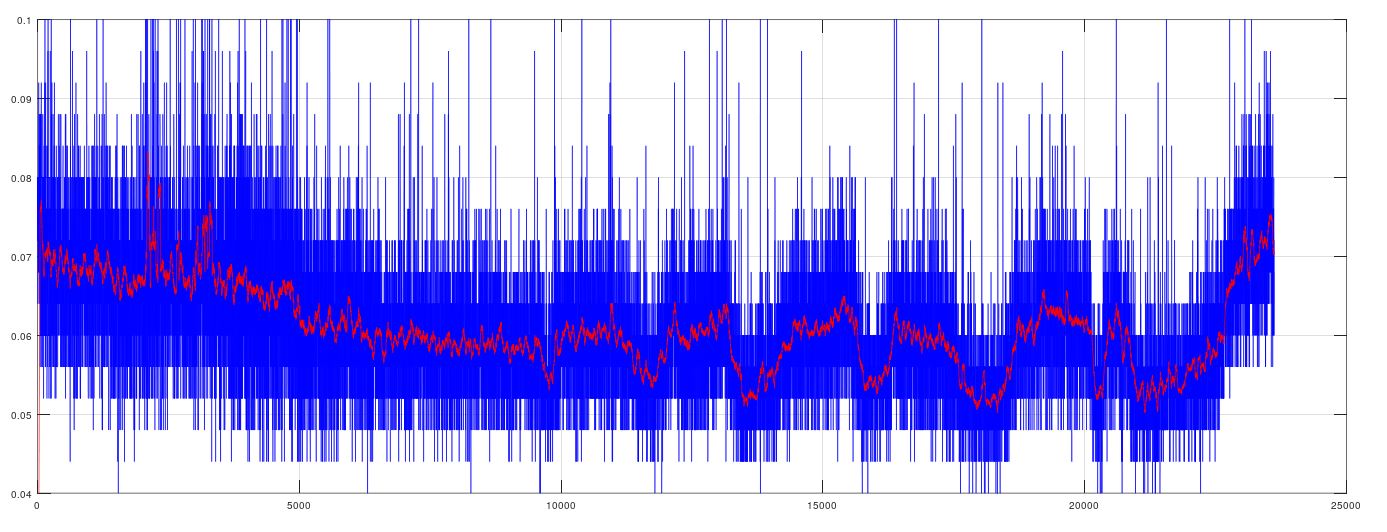
I installed the accelerometer on the ground close to one feet of the FP cavity hexapod (see picture) and restarted the acquisition at 6:40pm on 20th of february.
the acquisition corresponds to the night between the 20th and the 21th of february.
23.3k points from 6:40pm to 9am => 2.215s / point
the large peaks in between 2k and 3.5k points correspond to 7:55pm to 8:50pm => some working operation in the bunker (maybe finish the work of the kicker).
one does not observe a clear decrease of the vibrations during the night.
I added a vertical zoom of the acquisition => it seems there is a small decrease during the night but nothing clear.
the last plot shows exactly the same data but with a strong filtering (raw data in blue, filtered data in red).
we see a little bit better the reduction of the vibration during the night.
| Ronic Chiche wrote: |
|
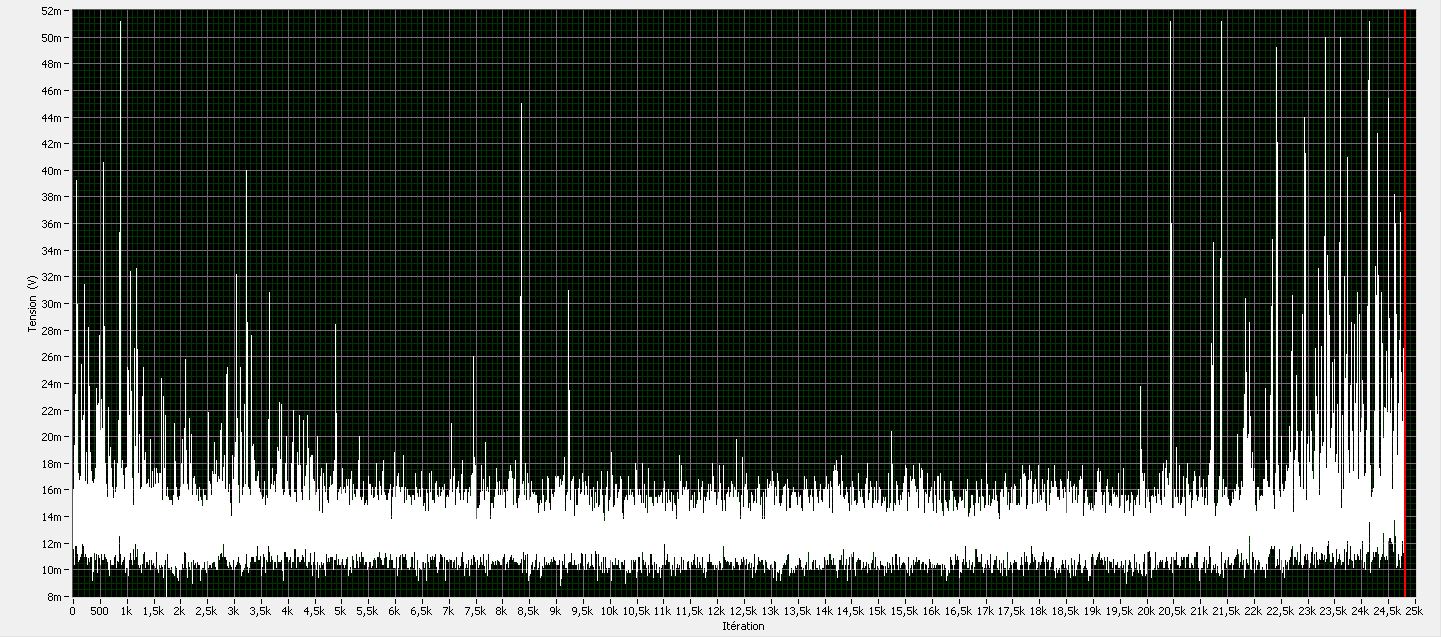
long term pk-pk measurement of the accelerometer (placed on the optical cavity table, on the marble part close to the laser oscillator) from 5:30pm to 9am => ~ 2.255s / pt
start of the quiet period : ~ 5k pts <=> 8:45pm
3 peaks at ~ 7.5k, 8.5k, 9.5k pts <=> 10:10pm, 10:50pm, 11:30pm
begining of the noise : big peak at ~20.5k pts <=> 6:20am
conclusion : relatively same behavior than the previous measurement made in the same condition except the "quiet" and "wake up" schedule of the noise is not strictly the same.
| Ronic Chiche wrote: |
|
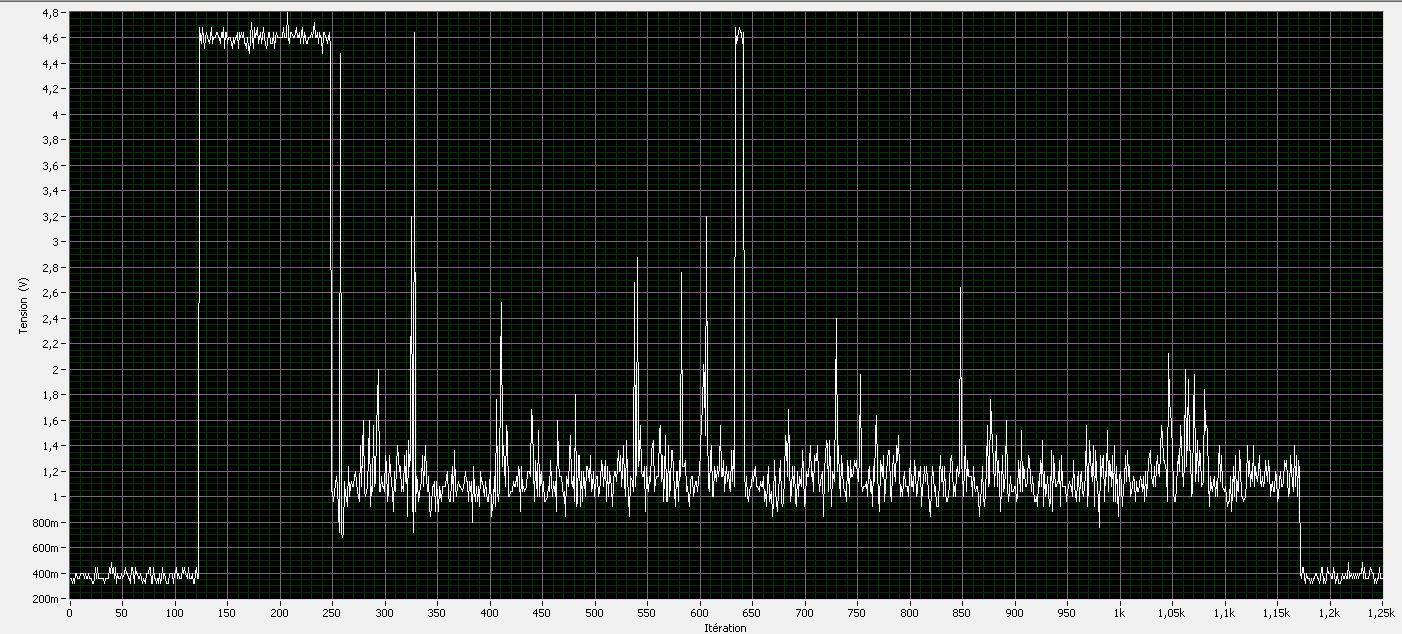
here is the same kind of measurement (pk-pk of 1 sec of acquisition) done on the laser PZT when the FP is at 90kW.
it's from 6:20pm to 7:10pm => ~2.4s by point
the minimum values are for the PZT being off.
the maximum values are for PZT scanning or lock loss.
in between, we get the measurements of the perturbations.
at 6:30pm (~250 points), Jean-Noel stopped all the water cooling circuit of ThomX.
at 6:46pm (~650 points), Jean-Noel restarted the main water cooling circuit.
at 7pm (~1000 points), Jean-Noel restarted all the water cooling circuit.
at 7:10pm (~1250 points) => we stopped the acquisition.
conclusion : no clear effect of the water cooling circuit on the locking stability.
| Ronic Chiche wrote: |
|
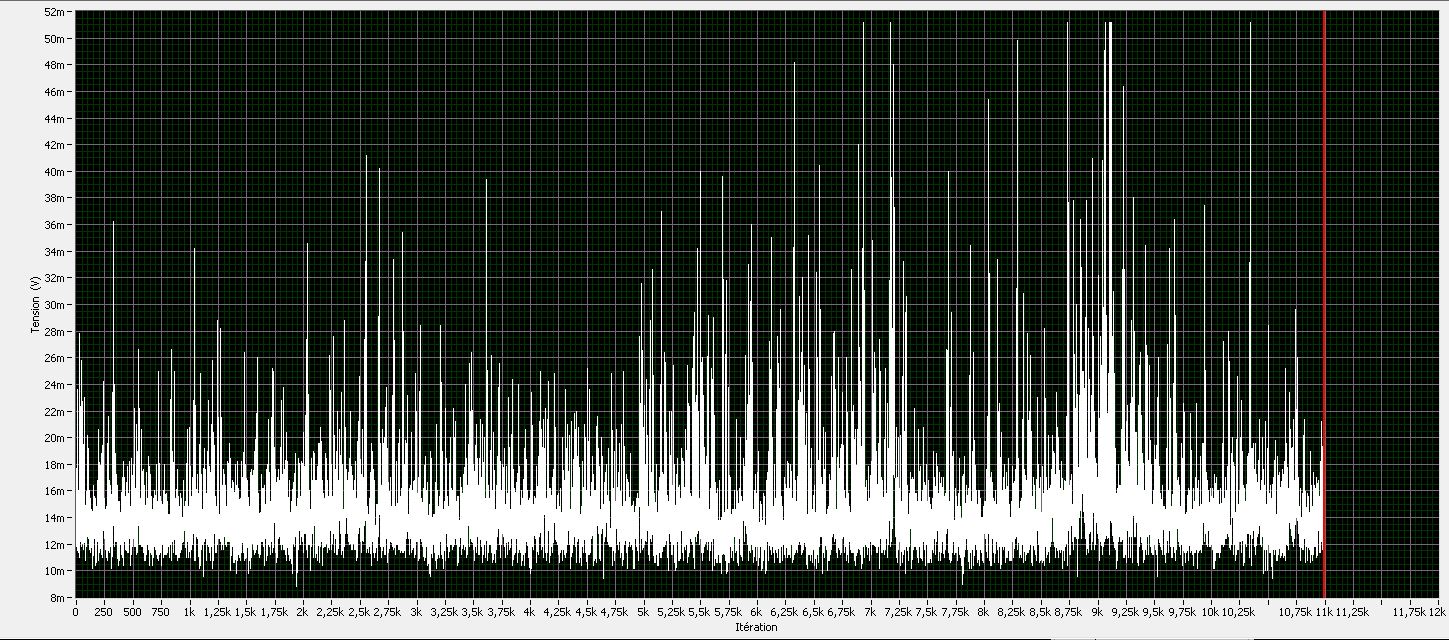
here is the acquisition from 10:30am to 5:30pm
11k point in 7h => 1.57k points / h
the noise is almost the same during the daylight, a little bit increasing from 1:30pm.
I restarted an acquisition at 5:30pm to check if the noise reduction during the night is repeatable or not....
| Ronic Chiche wrote: |
|
here is the pk-pk measurement of the accelerometer during the whole night.
the recording started at 5pm yesterday and has been stopped this morning at 10am.
one got 28k points in 17 hours => 1.65k points / h
the "last" peak in the evening at 8.5k points is equivalent to 10pm.
the "fisrt" peaks in the morning at 23k points is equivalent to 7am.
I discussed with Jean-Noël but we don't any clear correlation of this schedule with some equipment schedule in ThomX....
I restarted a new acquisition at 10.30am.
| Ronic Chiche wrote: |
|
one possible source for this acoustic noise was the vibrations coming from the water cooling of the dipoles which is normally never turned off even when the machine is off.
this afternoon, Kevin turned off the main valve of the water cooling of half of the dipoles (the half on the FPC side), and we recorded the peak-peak value of accelerometer signal on a long trend (~20mn) but we didn't see a clear difference before and after.
I keep recording the accelerometer pk-pk signal during the night in case of one could see something different...
| Ronic Chiche wrote: |
|
new plots, with the accelerometer placed directly on the optical cavity table (on the marble part), close to the oscillator.
the correlation seems a bit better....
we would need to put the accelerometer on one foot of the table to check if the table has not some micro-movement or at the IP to check if the water in the dipole are doing some vibrations.
| Ronic Chiche wrote: |
|
this morning, I did some new plots with the accelerometer placed on the top of the case of the OneFive laser.
I previously observed with the accelerometer placed on the top of one cavity vessel, the correlation between the accelerometer signal and the PZT noise is pretty good but not 100%.
I will move the accelerometer on the optical cavity table.
| Ronic Chiche wrote: |
|
at the end of the day, I moved the accelerometer from the top of the cavity vessel to the top case of the Onefive laser.
I quickly saw again quite strong correlations between the vibrations compensated by the PZT and the accelerometer signal.
when one does a laser motor step which makes a systematic lock loss, one doesn't see any signal on the accelerometer.
=> more measurements have to be done.
I would like also to put also the accelerometer on the mechanics attached to the pipe at the IP.
=> to be discussed to find the best place as a lot of cables, the 2 dipoles and the aluminium sheets around the vacuum stufs don't let a lot of place to put the accelerometer....
| Ronic Chiche wrote: |
|
then, I moved the accelerometer on top of the "X-hutch side" vessel, placed directly on the metal top case, inside the housing.
- the "no noise same range" image shows a standard situation during 10s when there no noise either on PZT or Accelerometer.
on can compare the noise level on the accelerometer with the previous post when it was outside on top of the housing.
its noise is much much lower... which means the housing is properly dumping the acoustic noise at this frequency around 20-30Hz.
so, we increase the accelerometer measurement sensitivity to better measure its noise.
- the "no noise new range" image shows a standard situation during 10s when there no noise either on PZT or Accelerometer but with a smaller range.
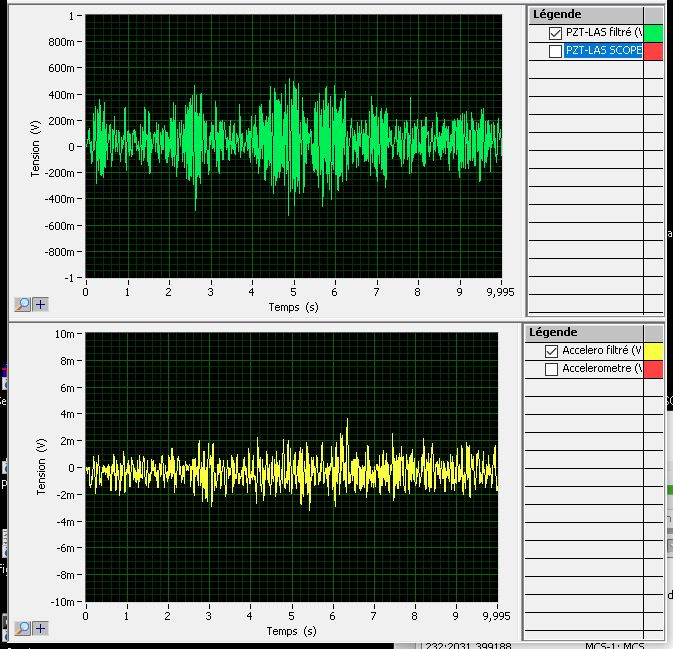
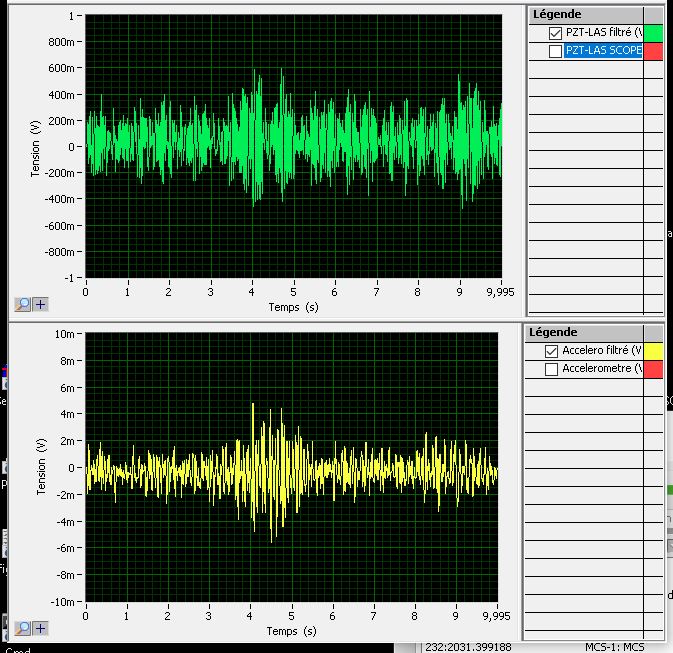
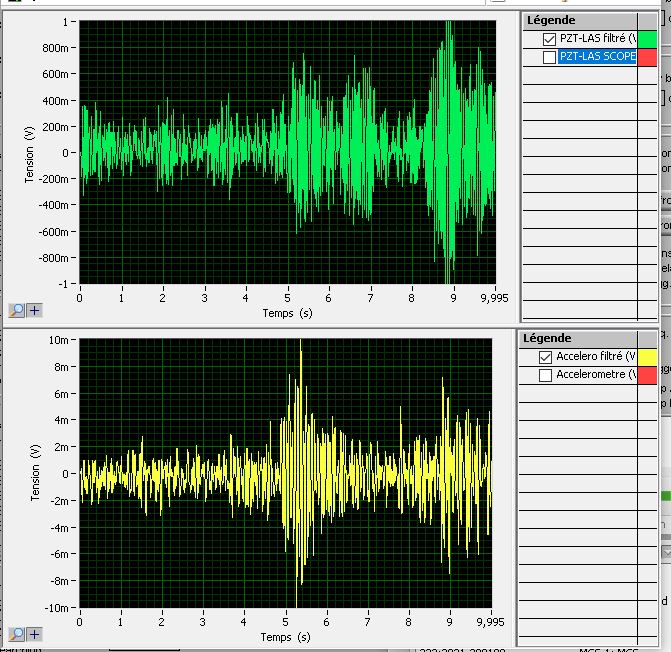
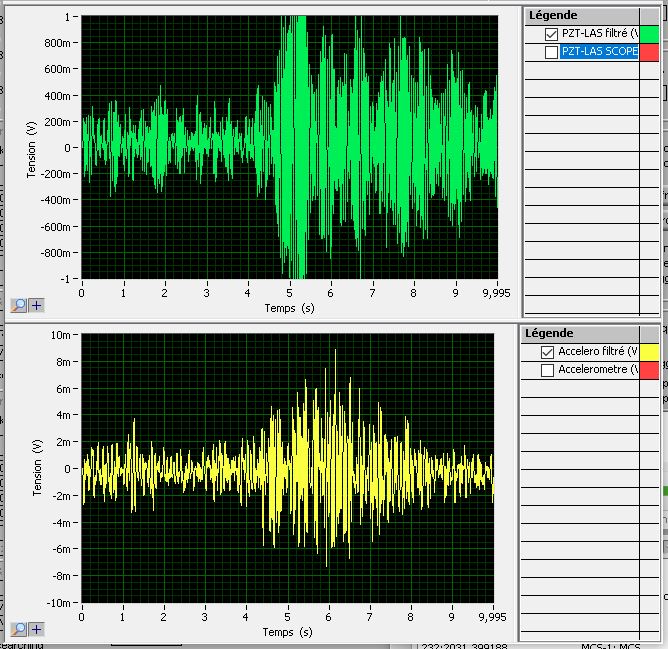
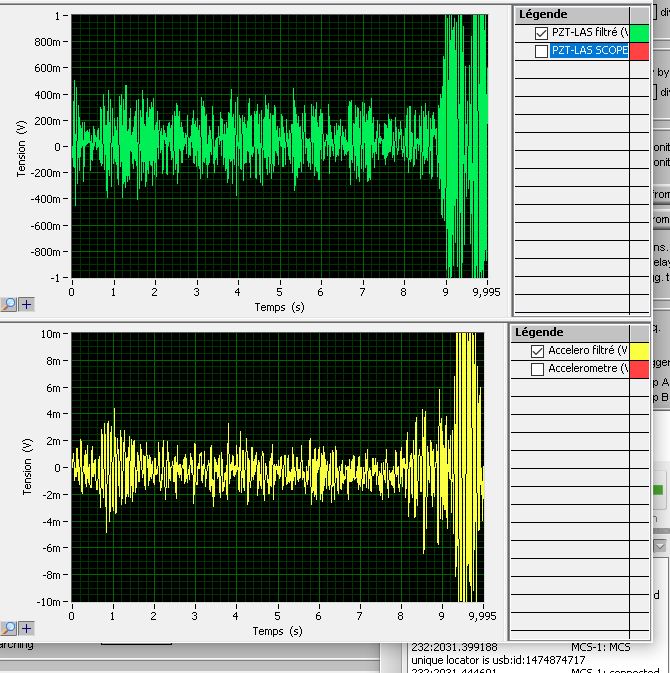
- the "noise 1,2,3" images show the situation when the PZT start to compensate large noise with good correlation with accelerometer placed on top of the optical vessel.
- the "noise 1,2,3 not clear" images show the situation when the PZT start to compensate large noise with correlation with accelerometer but the signal level is not the same as before.
this make me think the origin of the noise is maybe not coming from the inside of the optical vessel.
=> conclusion : we see for the first time a correlation between the PZT noise and some vibration/acoustic noise.
now, we have to investigate the precise origin of this noise (or the different sources).
| Ronic Chiche wrote: |
|
this morning, I did some measurement with nobody interfering with the tests.
- the "no noise" image shows a standard situation during 10s when there is no noise either on PZT or Accelerometer.
most of the time, we are in this situation.
- the "slaping door" image shows the case where the large igloo door is opened and slaping when it closes.
the accelerometer and the PZT exhibit correlated noise when the door is slaping.
we can see a PZT "recovery" time longer than the perturbation.
but these events are rare and are not the source of the problematic perturbations.
- "noise 1,2,3" images show the typical situation when the PZT start to compensate large noise without any correlation with accelerometer placed on top of the housing.
=> conclusion, some external noise (to the housing) should not be the source of the perturbations on the PZT.
| Ronic Chiche wrote: |
|
today I connected a copy of the laser PZT signal to the 2nd scope CH2 (with AC coupling to remove the DC offset) to be able to monitor synchronously the Accelerometer and laser PZT signals.
the accelerometer is still connected to the 2nd scope CH4 and placed on top of the housing.
I filtered both signals in the Labview Signal Express software with a low-pass filter at 30Hz to focus on low frequencies noise (~20Hz).
now, I need to wait to work with the bunker closed to compare with normal operation (if some people work in the same time in the bunker, obviously, we will get some correlation between the accelerometer and laser PZT signals.....)
| Ronic Chiche wrote: |
|
I installed an accelerometer setup in the bunker.
presently, the accelerometer is placed on top of the housing and its signal is connected to the 2nd scope (33MHz and 500MHz RF beating) on channel 4.
the FPC is locked to ~90kW.
the accelerometer noise is filtered on the Labview Signal Express software in order to focus on the 20Hz noise.
one applied a RII elliptic 5th order low pass filter at 30Hz.
the 20Hz noise can be seen on the PZT which always compensate for CFP frequency drifts.
figure 1 : example of typical accelerometer filtered noise (yellow curve) when the PZT compensation (green curve) is quite (measurement on 4 seconds)
figure 2 : example of accelerometer filtered noise (yellow curve) when the PZT compensation (green curve) exhibits some 20Hz noise (measurement on 10 seconds)
conclusion : there is no clear evidence of a correlation between accoustic noise outside of the housing (measured by the accelerometer) and the 20Hz noise in the laser PZT compensation.
=> putting the 2 signals on 2 different scopes doesn't help because the slow acquisition done is not synchronous.
next try : use the same scope and put the accelerometer inside the housing, for example on top of one of the FPC vessel.
|
|
|
|
|
|
|
|
|
|
|
|
|
|
|
410
|
Thu Feb 20 12:36:19 2025 |
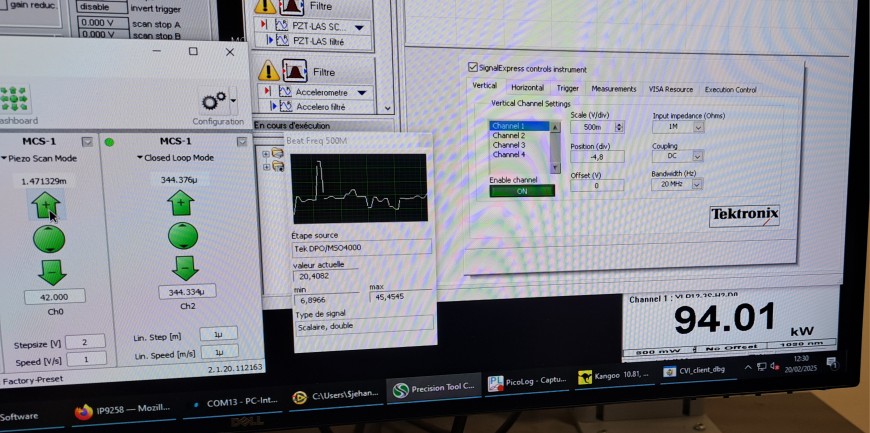
Ronic Chiche | Fixed | info | lasers and optics | ThomX igloo | New power record in ThomX cavity | today, we were able to store more than 94kW in the FP cavity, always with the same parameter : 33% laser amplifier ratio
| Ronic Chiche wrote: |
|
today, we were able to store more than 93kW in the FP cavity, always with the same parameter : 33% laser amplifier ratio
|
|
| Attachment 1: img1.jpg
|  |
|
409
|
Wed Feb 19 10:35:06 2025 |
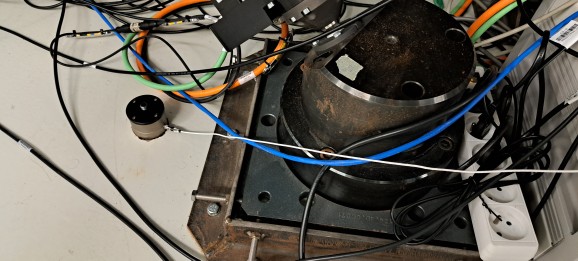
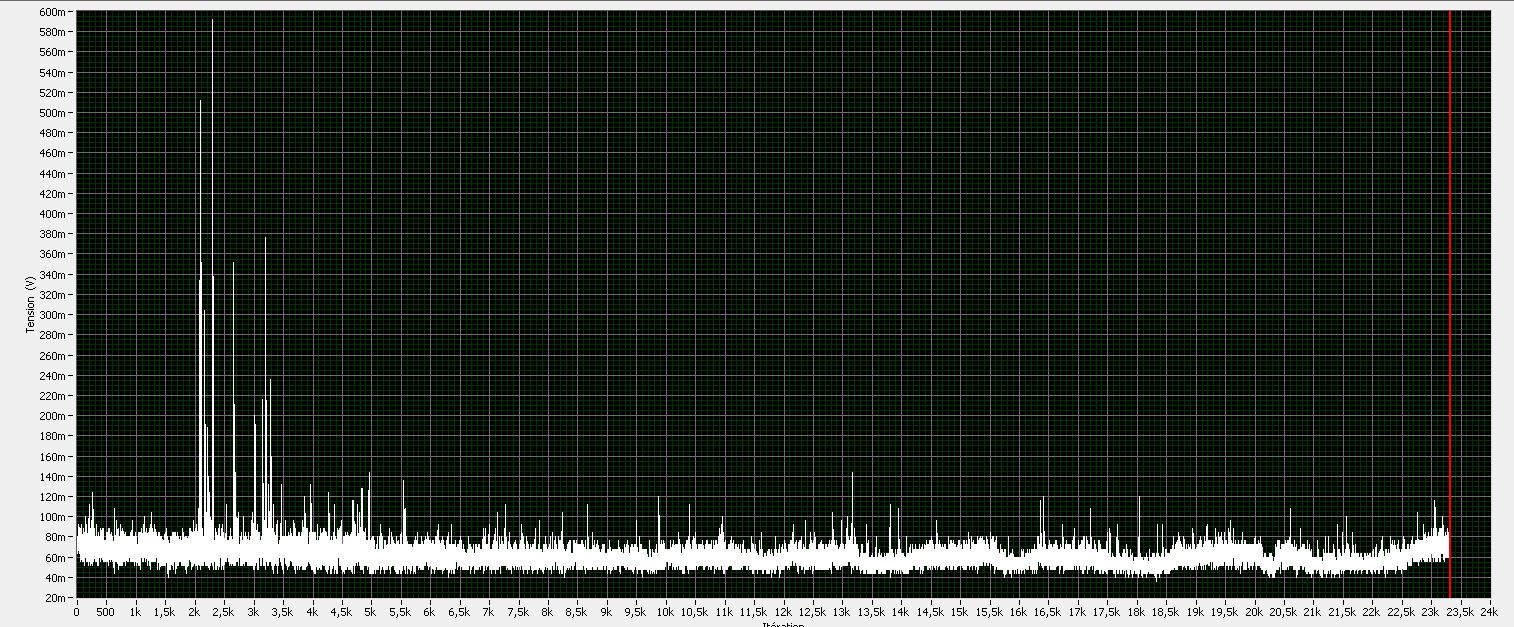
Ronic Chiche | Under Process | info | mechanics | lasers and optics | detectors and electronics | ThomX igloo | correlations between accelerometer and lock losses @ 20Hz | I installed the accelerometer on the ground close to one feet of the FP cavity hexapod (see picture) and restarted the acquisition at 6:40pm on 20th of february.
the acquisition corresponds to the night between the 20th and the 21th of february.
23.3k points from 6:40pm to 9am => 2.215s / point
the large peaks in between 2k and 3.5k points correspond to 7:55pm to 8:50pm => some working operation in the bunker (maybe finish the work of the kicker).
one does not observe a clear decrease of the vibrations during the night.
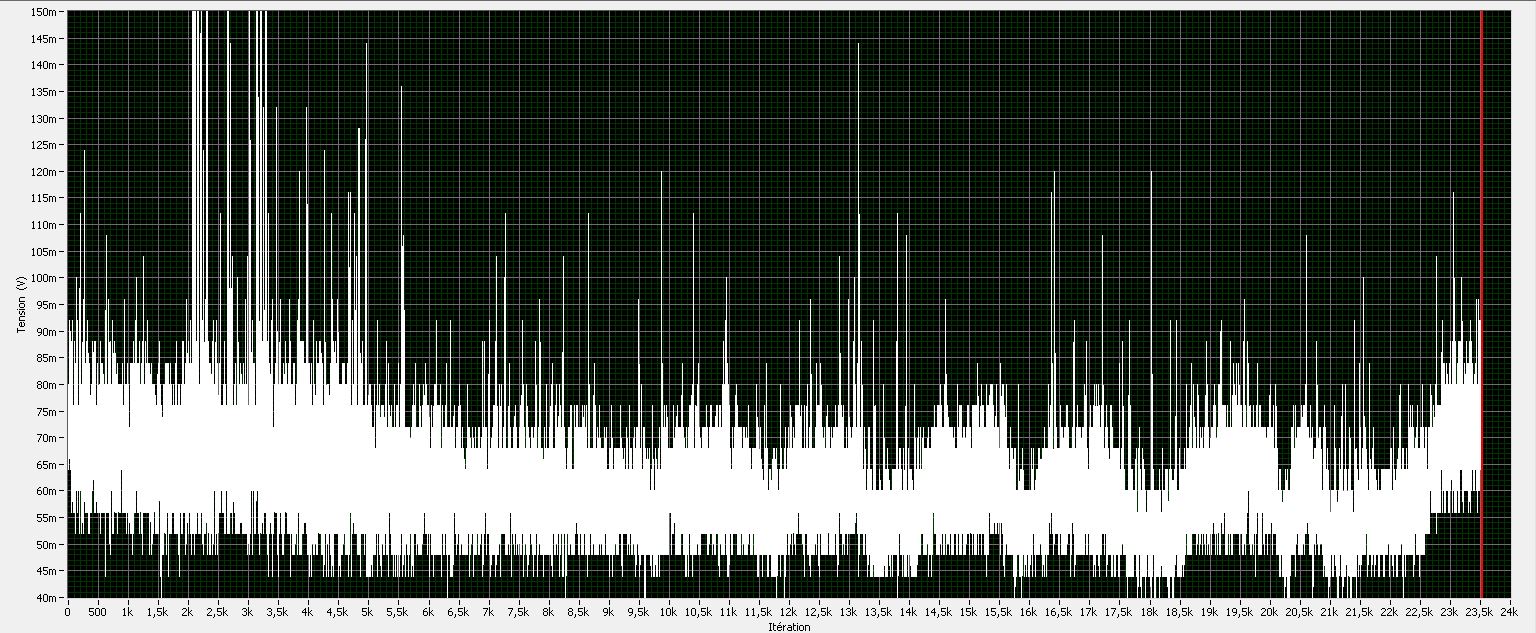
I added a vertical zoom of the acquisition => it seems there is a small decrease during the night but nothing clear.
the last plot shows exactly the same data but with a strong filtering (raw data in blue, filtered data in red).
we see a little bit better the reduction of the vibration during the night.
| Ronic Chiche wrote: |
|
long term pk-pk measurement of the accelerometer (placed on the optical cavity table, on the marble part close to the laser oscillator) from 5:30pm to 9am => ~ 2.255s / pt
start of the quiet period : ~ 5k pts <=> 8:45pm
3 peaks at ~ 7.5k, 8.5k, 9.5k pts <=> 10:10pm, 10:50pm, 11:30pm
begining of the noise : big peak at ~20.5k pts <=> 6:20am
conclusion : relatively same behavior than the previous measurement made in the same condition except the "quiet" and "wake up" schedule of the noise is not strictly the same.
| Ronic Chiche wrote: |
|
here is the same kind of measurement (pk-pk of 1 sec of acquisition) done on the laser PZT when the FP is at 90kW.
it's from 6:20pm to 7:10pm => ~2.4s by point
the minimum values are for the PZT being off.
the maximum values are for PZT scanning or lock loss.
in between, we get the measurements of the perturbations.
at 6:30pm (~250 points), Jean-Noel stopped all the water cooling circuit of ThomX.
at 6:46pm (~650 points), Jean-Noel restarted the main water cooling circuit.
at 7pm (~1000 points), Jean-Noel restarted all the water cooling circuit.
at 7:10pm (~1250 points) => we stopped the acquisition.
conclusion : no clear effect of the water cooling circuit on the locking stability.
| Ronic Chiche wrote: |
|
here is the acquisition from 10:30am to 5:30pm
11k point in 7h => 1.57k points / h
the noise is almost the same during the daylight, a little bit increasing from 1:30pm.
I restarted an acquisition at 5:30pm to check if the noise reduction during the night is repeatable or not....
| Ronic Chiche wrote: |
|
here is the pk-pk measurement of the accelerometer during the whole night.
the recording started at 5pm yesterday and has been stopped this morning at 10am.
one got 28k points in 17 hours => 1.65k points / h
the "last" peak in the evening at 8.5k points is equivalent to 10pm.
the "fisrt" peaks in the morning at 23k points is equivalent to 7am.
I discussed with Jean-Noël but we don't any clear correlation of this schedule with some equipment schedule in ThomX....
I restarted a new acquisition at 10.30am.
| Ronic Chiche wrote: |
|
one possible source for this acoustic noise was the vibrations coming from the water cooling of the dipoles which is normally never turned off even when the machine is off.
this afternoon, Kevin turned off the main valve of the water cooling of half of the dipoles (the half on the FPC side), and we recorded the peak-peak value of accelerometer signal on a long trend (~20mn) but we didn't see a clear difference before and after.
I keep recording the accelerometer pk-pk signal during the night in case of one could see something different...
| Ronic Chiche wrote: |
|
new plots, with the accelerometer placed directly on the optical cavity table (on the marble part), close to the oscillator.
the correlation seems a bit better....
we would need to put the accelerometer on one foot of the table to check if the table has not some micro-movement or at the IP to check if the water in the dipole are doing some vibrations.
| Ronic Chiche wrote: |
|
this morning, I did some new plots with the accelerometer placed on the top of the case of the OneFive laser.
I previously observed with the accelerometer placed on the top of one cavity vessel, the correlation between the accelerometer signal and the PZT noise is pretty good but not 100%.
I will move the accelerometer on the optical cavity table.
| Ronic Chiche wrote: |
|
at the end of the day, I moved the accelerometer from the top of the cavity vessel to the top case of the Onefive laser.
I quickly saw again quite strong correlations between the vibrations compensated by the PZT and the accelerometer signal.
when one does a laser motor step which makes a systematic lock loss, one doesn't see any signal on the accelerometer.
=> more measurements have to be done.
I would like also to put also the accelerometer on the mechanics attached to the pipe at the IP.
=> to be discussed to find the best place as a lot of cables, the 2 dipoles and the aluminium sheets around the vacuum stufs don't let a lot of place to put the accelerometer....
| Ronic Chiche wrote: |
|
then, I moved the accelerometer on top of the "X-hutch side" vessel, placed directly on the metal top case, inside the housing.
- the "no noise same range" image shows a standard situation during 10s when there no noise either on PZT or Accelerometer.
on can compare the noise level on the accelerometer with the previous post when it was outside on top of the housing.
its noise is much much lower... which means the housing is properly dumping the acoustic noise at this frequency around 20-30Hz.
so, we increase the accelerometer measurement sensitivity to better measure its noise.
- the "no noise new range" image shows a standard situation during 10s when there no noise either on PZT or Accelerometer but with a smaller range.
- the "noise 1,2,3" images show the situation when the PZT start to compensate large noise with good correlation with accelerometer placed on top of the optical vessel.
- the "noise 1,2,3 not clear" images show the situation when the PZT start to compensate large noise with correlation with accelerometer but the signal level is not the same as before.
this make me think the origin of the noise is maybe not coming from the inside of the optical vessel.
=> conclusion : we see for the first time a correlation between the PZT noise and some vibration/acoustic noise.
now, we have to investigate the precise origin of this noise (or the different sources).
| Ronic Chiche wrote: |
|
this morning, I did some measurement with nobody interfering with the tests.
- the "no noise" image shows a standard situation during 10s when there is no noise either on PZT or Accelerometer.
most of the time, we are in this situation.
- the "slaping door" image shows the case where the large igloo door is opened and slaping when it closes.
the accelerometer and the PZT exhibit correlated noise when the door is slaping.
we can see a PZT "recovery" time longer than the perturbation.
but these events are rare and are not the source of the problematic perturbations.
- "noise 1,2,3" images show the typical situation when the PZT start to compensate large noise without any correlation with accelerometer placed on top of the housing.
=> conclusion, some external noise (to the housing) should not be the source of the perturbations on the PZT.
| Ronic Chiche wrote: |
|
today I connected a copy of the laser PZT signal to the 2nd scope CH2 (with AC coupling to remove the DC offset) to be able to monitor synchronously the Accelerometer and laser PZT signals.
the accelerometer is still connected to the 2nd scope CH4 and placed on top of the housing.
I filtered both signals in the Labview Signal Express software with a low-pass filter at 30Hz to focus on low frequencies noise (~20Hz).
now, I need to wait to work with the bunker closed to compare with normal operation (if some people work in the same time in the bunker, obviously, we will get some correlation between the accelerometer and laser PZT signals.....)
| Ronic Chiche wrote: |
|
I installed an accelerometer setup in the bunker.
presently, the accelerometer is placed on top of the housing and its signal is connected to the 2nd scope (33MHz and 500MHz RF beating) on channel 4.
the FPC is locked to ~90kW.
the accelerometer noise is filtered on the Labview Signal Express software in order to focus on the 20Hz noise.
one applied a RII elliptic 5th order low pass filter at 30Hz.
the 20Hz noise can be seen on the PZT which always compensate for CFP frequency drifts.
figure 1 : example of typical accelerometer filtered noise (yellow curve) when the PZT compensation (green curve) is quite (measurement on 4 seconds)
figure 2 : example of accelerometer filtered noise (yellow curve) when the PZT compensation (green curve) exhibits some 20Hz noise (measurement on 10 seconds)
conclusion : there is no clear evidence of a correlation between accoustic noise outside of the housing (measured by the accelerometer) and the 20Hz noise in the laser PZT compensation.
=> putting the 2 signals on 2 different scopes doesn't help because the slow acquisition done is not synchronous.
next try : use the same scope and put the accelerometer inside the housing, for example on top of one of the FPC vessel.
|
|
|
|
|
|
|
|
|
|
|
|
|
| Attachment 1: img1.jpg
|  |
| Attachment 2: Capture.JPG
|  |
| Attachment 3: Capture.JPG
|  |
| Attachment 4: Capture.JPG
|  |
|
408
|
Wed Feb 19 09:28:12 2025 |
Ronic Chiche | Under Process | info | mechanics | lasers and optics | detectors and electronics | ThomX igloo | correlations between accelerometer and lock losses @ 20Hz | long term pk-pk measurement of the accelerometer (placed on the optical cavity table, on the marble part close to the laser oscillator) from 5:30pm to 9am => ~ 2.255s / pt
start of the quiet period : ~ 5k pts <=> 8:45pm
3 peaks at ~ 7.5k, 8.5k, 9.5k pts <=> 10:10pm, 10:50pm, 11:30pm
begining of the noise : big peak at ~20.5k pts <=> 6:20am
conclusion : relatively same behavior than the previous measurement made in the same condition except the "quiet" and "wake up" schedule of the noise is not strictly the same.
| Ronic Chiche wrote: |
|
here is the same kind of measurement (pk-pk of 1 sec of acquisition) done on the laser PZT when the FP is at 90kW.
it's from 6:20pm to 7:10pm => ~2.4s by point
the minimum values are for the PZT being off.
the maximum values are for PZT scanning or lock loss.
in between, we get the measurements of the perturbations.
at 6:30pm (~250 points), Jean-Noel stopped all the water cooling circuit of ThomX.
at 6:46pm (~650 points), Jean-Noel restarted the main water cooling circuit.
at 7pm (~1000 points), Jean-Noel restarted all the water cooling circuit.
at 7:10pm (~1250 points) => we stopped the acquisition.
conclusion : no clear effect of the water cooling circuit on the locking stability.
| Ronic Chiche wrote: |
|
here is the acquisition from 10:30am to 5:30pm
11k point in 7h => 1.57k points / h
the noise is almost the same during the daylight, a little bit increasing from 1:30pm.
I restarted an acquisition at 5:30pm to check if the noise reduction during the night is repeatable or not....
| Ronic Chiche wrote: |
|
here is the pk-pk measurement of the accelerometer during the whole night.
the recording started at 5pm yesterday and has been stopped this morning at 10am.
one got 28k points in 17 hours => 1.65k points / h
the "last" peak in the evening at 8.5k points is equivalent to 10pm.
the "fisrt" peaks in the morning at 23k points is equivalent to 7am.
I discussed with Jean-Noël but we don't any clear correlation of this schedule with some equipment schedule in ThomX....
I restarted a new acquisition at 10.30am.
| Ronic Chiche wrote: |
|
one possible source for this acoustic noise was the vibrations coming from the water cooling of the dipoles which is normally never turned off even when the machine is off.
this afternoon, Kevin turned off the main valve of the water cooling of half of the dipoles (the half on the FPC side), and we recorded the peak-peak value of accelerometer signal on a long trend (~20mn) but we didn't see a clear difference before and after.
I keep recording the accelerometer pk-pk signal during the night in case of one could see something different...
| Ronic Chiche wrote: |
|
new plots, with the accelerometer placed directly on the optical cavity table (on the marble part), close to the oscillator.
the correlation seems a bit better....
we would need to put the accelerometer on one foot of the table to check if the table has not some micro-movement or at the IP to check if the water in the dipole are doing some vibrations.
| Ronic Chiche wrote: |
|
this morning, I did some new plots with the accelerometer placed on the top of the case of the OneFive laser.
I previously observed with the accelerometer placed on the top of one cavity vessel, the correlation between the accelerometer signal and the PZT noise is pretty good but not 100%.
I will move the accelerometer on the optical cavity table.
| Ronic Chiche wrote: |
|
at the end of the day, I moved the accelerometer from the top of the cavity vessel to the top case of the Onefive laser.
I quickly saw again quite strong correlations between the vibrations compensated by the PZT and the accelerometer signal.
when one does a laser motor step which makes a systematic lock loss, one doesn't see any signal on the accelerometer.
=> more measurements have to be done.
I would like also to put also the accelerometer on the mechanics attached to the pipe at the IP.
=> to be discussed to find the best place as a lot of cables, the 2 dipoles and the aluminium sheets around the vacuum stufs don't let a lot of place to put the accelerometer....
| Ronic Chiche wrote: |
|
then, I moved the accelerometer on top of the "X-hutch side" vessel, placed directly on the metal top case, inside the housing.
- the "no noise same range" image shows a standard situation during 10s when there no noise either on PZT or Accelerometer.
on can compare the noise level on the accelerometer with the previous post when it was outside on top of the housing.
its noise is much much lower... which means the housing is properly dumping the acoustic noise at this frequency around 20-30Hz.
so, we increase the accelerometer measurement sensitivity to better measure its noise.
- the "no noise new range" image shows a standard situation during 10s when there no noise either on PZT or Accelerometer but with a smaller range.
- the "noise 1,2,3" images show the situation when the PZT start to compensate large noise with good correlation with accelerometer placed on top of the optical vessel.
- the "noise 1,2,3 not clear" images show the situation when the PZT start to compensate large noise with correlation with accelerometer but the signal level is not the same as before.
this make me think the origin of the noise is maybe not coming from the inside of the optical vessel.
=> conclusion : we see for the first time a correlation between the PZT noise and some vibration/acoustic noise.
now, we have to investigate the precise origin of this noise (or the different sources).
| Ronic Chiche wrote: |
|
this morning, I did some measurement with nobody interfering with the tests.
- the "no noise" image shows a standard situation during 10s when there is no noise either on PZT or Accelerometer.
most of the time, we are in this situation.
- the "slaping door" image shows the case where the large igloo door is opened and slaping when it closes.
the accelerometer and the PZT exhibit correlated noise when the door is slaping.
we can see a PZT "recovery" time longer than the perturbation.
but these events are rare and are not the source of the problematic perturbations.
- "noise 1,2,3" images show the typical situation when the PZT start to compensate large noise without any correlation with accelerometer placed on top of the housing.
=> conclusion, some external noise (to the housing) should not be the source of the perturbations on the PZT.
| Ronic Chiche wrote: |
|
today I connected a copy of the laser PZT signal to the 2nd scope CH2 (with AC coupling to remove the DC offset) to be able to monitor synchronously the Accelerometer and laser PZT signals.
the accelerometer is still connected to the 2nd scope CH4 and placed on top of the housing.
I filtered both signals in the Labview Signal Express software with a low-pass filter at 30Hz to focus on low frequencies noise (~20Hz).
now, I need to wait to work with the bunker closed to compare with normal operation (if some people work in the same time in the bunker, obviously, we will get some correlation between the accelerometer and laser PZT signals.....)
| Ronic Chiche wrote: |
|
I installed an accelerometer setup in the bunker.
presently, the accelerometer is placed on top of the housing and its signal is connected to the 2nd scope (33MHz and 500MHz RF beating) on channel 4.
the FPC is locked to ~90kW.
the accelerometer noise is filtered on the Labview Signal Express software in order to focus on the 20Hz noise.
one applied a RII elliptic 5th order low pass filter at 30Hz.
the 20Hz noise can be seen on the PZT which always compensate for CFP frequency drifts.
figure 1 : example of typical accelerometer filtered noise (yellow curve) when the PZT compensation (green curve) is quite (measurement on 4 seconds)
figure 2 : example of accelerometer filtered noise (yellow curve) when the PZT compensation (green curve) exhibits some 20Hz noise (measurement on 10 seconds)
conclusion : there is no clear evidence of a correlation between accoustic noise outside of the housing (measured by the accelerometer) and the 20Hz noise in the laser PZT compensation.
=> putting the 2 signals on 2 different scopes doesn't help because the slow acquisition done is not synchronous.
next try : use the same scope and put the accelerometer inside the housing, for example on top of one of the FPC vessel.
|
|
|
|
|
|
|
|
|
|
|
|
| Attachment 1: Capture.JPG
|  |
|
407
|
Tue Feb 18 19:33:27 2025 |
Ronic Chiche | Under Process | info | mechanics | lasers and optics | detectors and electronics | ThomX igloo | correlations between accelerometer and lock losses @ 20Hz | here is the same kind of measurement (pk-pk of 1 sec of acquisition) done on the laser PZT when the FP is at 90kW.
it's from 6:20pm to 7:10pm => ~2.4s by point
the minimum values are for the PZT being off.
the maximum values are for PZT scanning or lock loss.
in between, we get the measurements of the perturbations.
at 6:30pm (~250 points), Jean-Noel stopped all the water cooling circuit of ThomX.
at 6:46pm (~650 points), Jean-Noel restarted the main water cooling circuit.
at 7pm (~1000 points), Jean-Noel restarted all the water cooling circuit.
at 7:10pm (~1250 points) => we stopped the acquisition.
conclusion : no clear effect of the water cooling circuit on the locking stability.
| Ronic Chiche wrote: |
|
here is the acquisition from 10:30am to 5:30pm
11k point in 7h => 1.57k points / h
the noise is almost the same during the daylight, a little bit increasing from 1:30pm.
I restarted an acquisition at 5:30pm to check if the noise reduction during the night is repeatable or not....
| Ronic Chiche wrote: |
|
here is the pk-pk measurement of the accelerometer during the whole night.
the recording started at 5pm yesterday and has been stopped this morning at 10am.
one got 28k points in 17 hours => 1.65k points / h
the "last" peak in the evening at 8.5k points is equivalent to 10pm.
the "fisrt" peaks in the morning at 23k points is equivalent to 7am.
I discussed with Jean-Noël but we don't any clear correlation of this schedule with some equipment schedule in ThomX....
I restarted a new acquisition at 10.30am.
| Ronic Chiche wrote: |
|
one possible source for this acoustic noise was the vibrations coming from the water cooling of the dipoles which is normally never turned off even when the machine is off.
this afternoon, Kevin turned off the main valve of the water cooling of half of the dipoles (the half on the FPC side), and we recorded the peak-peak value of accelerometer signal on a long trend (~20mn) but we didn't see a clear difference before and after.
I keep recording the accelerometer pk-pk signal during the night in case of one could see something different...
| Ronic Chiche wrote: |
|
new plots, with the accelerometer placed directly on the optical cavity table (on the marble part), close to the oscillator.
the correlation seems a bit better....
we would need to put the accelerometer on one foot of the table to check if the table has not some micro-movement or at the IP to check if the water in the dipole are doing some vibrations.
| Ronic Chiche wrote: |
|
this morning, I did some new plots with the accelerometer placed on the top of the case of the OneFive laser.
I previously observed with the accelerometer placed on the top of one cavity vessel, the correlation between the accelerometer signal and the PZT noise is pretty good but not 100%.
I will move the accelerometer on the optical cavity table.
| Ronic Chiche wrote: |
|
at the end of the day, I moved the accelerometer from the top of the cavity vessel to the top case of the Onefive laser.
I quickly saw again quite strong correlations between the vibrations compensated by the PZT and the accelerometer signal.
when one does a laser motor step which makes a systematic lock loss, one doesn't see any signal on the accelerometer.
=> more measurements have to be done.
I would like also to put also the accelerometer on the mechanics attached to the pipe at the IP.
=> to be discussed to find the best place as a lot of cables, the 2 dipoles and the aluminium sheets around the vacuum stufs don't let a lot of place to put the accelerometer....
| Ronic Chiche wrote: |
|
then, I moved the accelerometer on top of the "X-hutch side" vessel, placed directly on the metal top case, inside the housing.
- the "no noise same range" image shows a standard situation during 10s when there no noise either on PZT or Accelerometer.
on can compare the noise level on the accelerometer with the previous post when it was outside on top of the housing.
its noise is much much lower... which means the housing is properly dumping the acoustic noise at this frequency around 20-30Hz.
so, we increase the accelerometer measurement sensitivity to better measure its noise.
- the "no noise new range" image shows a standard situation during 10s when there no noise either on PZT or Accelerometer but with a smaller range.
- the "noise 1,2,3" images show the situation when the PZT start to compensate large noise with good correlation with accelerometer placed on top of the optical vessel.
- the "noise 1,2,3 not clear" images show the situation when the PZT start to compensate large noise with correlation with accelerometer but the signal level is not the same as before.
this make me think the origin of the noise is maybe not coming from the inside of the optical vessel.
=> conclusion : we see for the first time a correlation between the PZT noise and some vibration/acoustic noise.
now, we have to investigate the precise origin of this noise (or the different sources).
| Ronic Chiche wrote: |
|
this morning, I did some measurement with nobody interfering with the tests.
- the "no noise" image shows a standard situation during 10s when there is no noise either on PZT or Accelerometer.
most of the time, we are in this situation.
- the "slaping door" image shows the case where the large igloo door is opened and slaping when it closes.
the accelerometer and the PZT exhibit correlated noise when the door is slaping.
we can see a PZT "recovery" time longer than the perturbation.
but these events are rare and are not the source of the problematic perturbations.
- "noise 1,2,3" images show the typical situation when the PZT start to compensate large noise without any correlation with accelerometer placed on top of the housing.
=> conclusion, some external noise (to the housing) should not be the source of the perturbations on the PZT.
| Ronic Chiche wrote: |
|
today I connected a copy of the laser PZT signal to the 2nd scope CH2 (with AC coupling to remove the DC offset) to be able to monitor synchronously the Accelerometer and laser PZT signals.
the accelerometer is still connected to the 2nd scope CH4 and placed on top of the housing.
I filtered both signals in the Labview Signal Express software with a low-pass filter at 30Hz to focus on low frequencies noise (~20Hz).
now, I need to wait to work with the bunker closed to compare with normal operation (if some people work in the same time in the bunker, obviously, we will get some correlation between the accelerometer and laser PZT signals.....)
| Ronic Chiche wrote: |
|
I installed an accelerometer setup in the bunker.
presently, the accelerometer is placed on top of the housing and its signal is connected to the 2nd scope (33MHz and 500MHz RF beating) on channel 4.
the FPC is locked to ~90kW.
the accelerometer noise is filtered on the Labview Signal Express software in order to focus on the 20Hz noise.
one applied a RII elliptic 5th order low pass filter at 30Hz.
the 20Hz noise can be seen on the PZT which always compensate for CFP frequency drifts.
figure 1 : example of typical accelerometer filtered noise (yellow curve) when the PZT compensation (green curve) is quite (measurement on 4 seconds)
figure 2 : example of accelerometer filtered noise (yellow curve) when the PZT compensation (green curve) exhibits some 20Hz noise (measurement on 10 seconds)
conclusion : there is no clear evidence of a correlation between accoustic noise outside of the housing (measured by the accelerometer) and the 20Hz noise in the laser PZT compensation.
=> putting the 2 signals on 2 different scopes doesn't help because the slow acquisition done is not synchronous.
next try : use the same scope and put the accelerometer inside the housing, for example on top of one of the FPC vessel.
|
|
|
|
|
|
|
|
|
|
|
| Attachment 1: Capture.JPG
|  |
|
406
|
Tue Feb 18 17:36:25 2025 |
Ronic Chiche | Under Process | info | mechanics | lasers and optics | detectors and electronics | ThomX igloo | correlations between accelerometer and lock losses @ 20Hz | here is the acquisition from 10:30am to 5:30pm
11k point in 7h => 1.57k points / h
the noise is almost the same during the daylight, a little bit increasing from 1:30pm.
I restarted an acquisition at 5:30pm to check if the noise reduction during the night is repeatable or not....
| Ronic Chiche wrote: |
|
here is the pk-pk measurement of the accelerometer during the whole night.
the recording started at 5pm yesterday and has been stopped this morning at 10am.
one got 28k points in 17 hours => 1.65k points / h
the "last" peak in the evening at 8.5k points is equivalent to 10pm.
the "fisrt" peaks in the morning at 23k points is equivalent to 7am.
I discussed with Jean-Noël but we don't any clear correlation of this schedule with some equipment schedule in ThomX....
I restarted a new acquisition at 10.30am.
| Ronic Chiche wrote: |
|
one possible source for this acoustic noise was the vibrations coming from the water cooling of the dipoles which is normally never turned off even when the machine is off.
this afternoon, Kevin turned off the main valve of the water cooling of half of the dipoles (the half on the FPC side), and we recorded the peak-peak value of accelerometer signal on a long trend (~20mn) but we didn't see a clear difference before and after.
I keep recording the accelerometer pk-pk signal during the night in case of one could see something different...
| Ronic Chiche wrote: |
|
new plots, with the accelerometer placed directly on the optical cavity table (on the marble part), close to the oscillator.
the correlation seems a bit better....
we would need to put the accelerometer on one foot of the table to check if the table has not some micro-movement or at the IP to check if the water in the dipole are doing some vibrations.
| Ronic Chiche wrote: |
|
this morning, I did some new plots with the accelerometer placed on the top of the case of the OneFive laser.
I previously observed with the accelerometer placed on the top of one cavity vessel, the correlation between the accelerometer signal and the PZT noise is pretty good but not 100%.
I will move the accelerometer on the optical cavity table.
| Ronic Chiche wrote: |
|
at the end of the day, I moved the accelerometer from the top of the cavity vessel to the top case of the Onefive laser.
I quickly saw again quite strong correlations between the vibrations compensated by the PZT and the accelerometer signal.
when one does a laser motor step which makes a systematic lock loss, one doesn't see any signal on the accelerometer.
=> more measurements have to be done.
I would like also to put also the accelerometer on the mechanics attached to the pipe at the IP.
=> to be discussed to find the best place as a lot of cables, the 2 dipoles and the aluminium sheets around the vacuum stufs don't let a lot of place to put the accelerometer....
| Ronic Chiche wrote: |
|
then, I moved the accelerometer on top of the "X-hutch side" vessel, placed directly on the metal top case, inside the housing.
- the "no noise same range" image shows a standard situation during 10s when there no noise either on PZT or Accelerometer.
on can compare the noise level on the accelerometer with the previous post when it was outside on top of the housing.
its noise is much much lower... which means the housing is properly dumping the acoustic noise at this frequency around 20-30Hz.
so, we increase the accelerometer measurement sensitivity to better measure its noise.
- the "no noise new range" image shows a standard situation during 10s when there no noise either on PZT or Accelerometer but with a smaller range.
- the "noise 1,2,3" images show the situation when the PZT start to compensate large noise with good correlation with accelerometer placed on top of the optical vessel.
- the "noise 1,2,3 not clear" images show the situation when the PZT start to compensate large noise with correlation with accelerometer but the signal level is not the same as before.
this make me think the origin of the noise is maybe not coming from the inside of the optical vessel.
=> conclusion : we see for the first time a correlation between the PZT noise and some vibration/acoustic noise.
now, we have to investigate the precise origin of this noise (or the different sources).
| Ronic Chiche wrote: |
|
this morning, I did some measurement with nobody interfering with the tests.
- the "no noise" image shows a standard situation during 10s when there is no noise either on PZT or Accelerometer.
most of the time, we are in this situation.
- the "slaping door" image shows the case where the large igloo door is opened and slaping when it closes.
the accelerometer and the PZT exhibit correlated noise when the door is slaping.
we can see a PZT "recovery" time longer than the perturbation.
but these events are rare and are not the source of the problematic perturbations.
- "noise 1,2,3" images show the typical situation when the PZT start to compensate large noise without any correlation with accelerometer placed on top of the housing.
=> conclusion, some external noise (to the housing) should not be the source of the perturbations on the PZT.
| Ronic Chiche wrote: |
|
today I connected a copy of the laser PZT signal to the 2nd scope CH2 (with AC coupling to remove the DC offset) to be able to monitor synchronously the Accelerometer and laser PZT signals.
the accelerometer is still connected to the 2nd scope CH4 and placed on top of the housing.
I filtered both signals in the Labview Signal Express software with a low-pass filter at 30Hz to focus on low frequencies noise (~20Hz).
now, I need to wait to work with the bunker closed to compare with normal operation (if some people work in the same time in the bunker, obviously, we will get some correlation between the accelerometer and laser PZT signals.....)
| Ronic Chiche wrote: |
|
I installed an accelerometer setup in the bunker.
presently, the accelerometer is placed on top of the housing and its signal is connected to the 2nd scope (33MHz and 500MHz RF beating) on channel 4.
the FPC is locked to ~90kW.
the accelerometer noise is filtered on the Labview Signal Express software in order to focus on the 20Hz noise.
one applied a RII elliptic 5th order low pass filter at 30Hz.
the 20Hz noise can be seen on the PZT which always compensate for CFP frequency drifts.
figure 1 : example of typical accelerometer filtered noise (yellow curve) when the PZT compensation (green curve) is quite (measurement on 4 seconds)
figure 2 : example of accelerometer filtered noise (yellow curve) when the PZT compensation (green curve) exhibits some 20Hz noise (measurement on 10 seconds)
conclusion : there is no clear evidence of a correlation between accoustic noise outside of the housing (measured by the accelerometer) and the 20Hz noise in the laser PZT compensation.
=> putting the 2 signals on 2 different scopes doesn't help because the slow acquisition done is not synchronous.
next try : use the same scope and put the accelerometer inside the housing, for example on top of one of the FPC vessel.
|
|
|
|
|
|
|
|
|
|
| Attachment 1: Capture.JPG
|  |
|
405
|
Tue Feb 18 10:40:55 2025 |
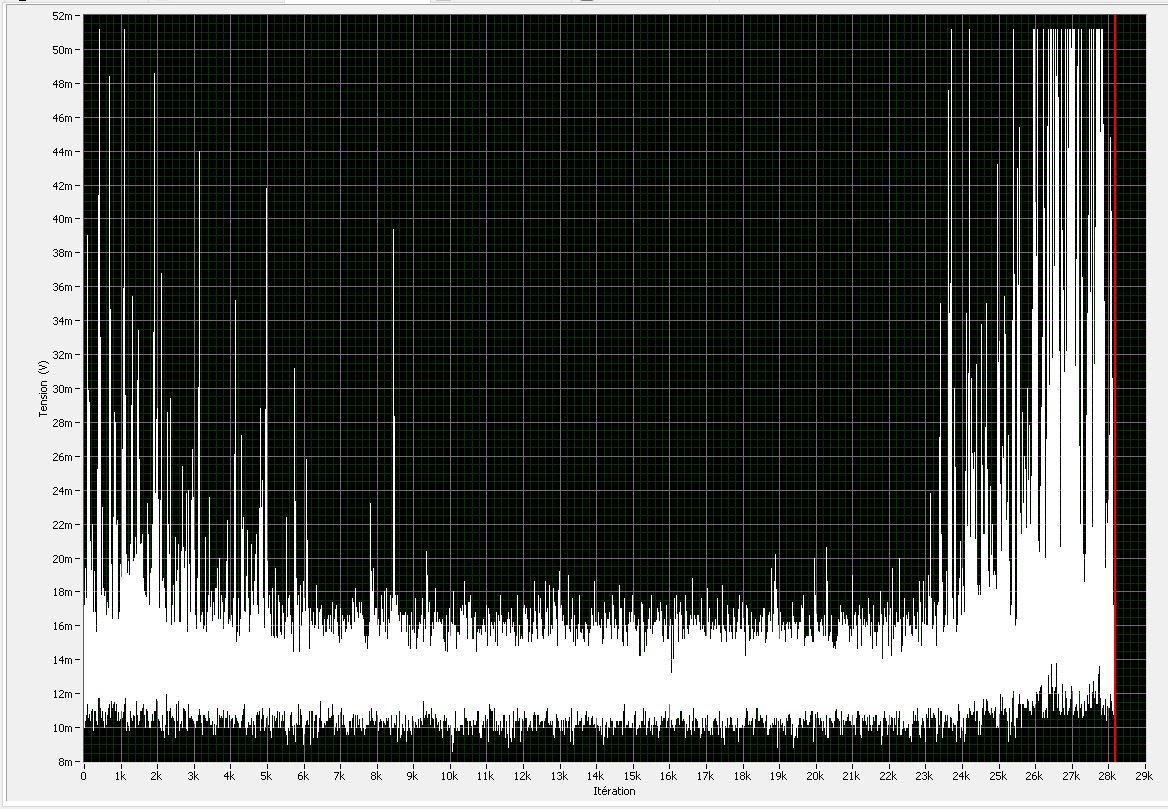
Ronic Chiche | Under Process | info | mechanics | lasers and optics | detectors and electronics | ThomX igloo | correlations between accelerometer and lock losses @ 20Hz | here is the pk-pk measurement of the accelerometer during the whole night.
the recording started at 5pm yesterday and has been stopped this morning at 10am.
one got 28k points in 17 hours => 1.65k points / h
the "last" peak in the evening at 8.5k points is equivalent to 10pm.
the "fisrt" peaks in the morning at 23k points is equivalent to 7am.
I discussed with Jean-Noël but we don't any clear correlation of this schedule with some equipment schedule in ThomX....
I restarted a new acquisition at 10.30am.
| Ronic Chiche wrote: |
|
one possible source for this acoustic noise was the vibrations coming from the water cooling of the dipoles which is normally never turned off even when the machine is off.
this afternoon, Kevin turned off the main valve of the water cooling of half of the dipoles (the half on the FPC side), and we recorded the peak-peak value of accelerometer signal on a long trend (~20mn) but we didn't see a clear difference before and after.
I keep recording the accelerometer pk-pk signal during the night in case of one could see something different...
| Ronic Chiche wrote: |
|
new plots, with the accelerometer placed directly on the optical cavity table (on the marble part), close to the oscillator.
the correlation seems a bit better....
we would need to put the accelerometer on one foot of the table to check if the table has not some micro-movement or at the IP to check if the water in the dipole are doing some vibrations.
| Ronic Chiche wrote: |
|
this morning, I did some new plots with the accelerometer placed on the top of the case of the OneFive laser.
I previously observed with the accelerometer placed on the top of one cavity vessel, the correlation between the accelerometer signal and the PZT noise is pretty good but not 100%.
I will move the accelerometer on the optical cavity table.
| Ronic Chiche wrote: |
|
at the end of the day, I moved the accelerometer from the top of the cavity vessel to the top case of the Onefive laser.
I quickly saw again quite strong correlations between the vibrations compensated by the PZT and the accelerometer signal.
when one does a laser motor step which makes a systematic lock loss, one doesn't see any signal on the accelerometer.
=> more measurements have to be done.
I would like also to put also the accelerometer on the mechanics attached to the pipe at the IP.
=> to be discussed to find the best place as a lot of cables, the 2 dipoles and the aluminium sheets around the vacuum stufs don't let a lot of place to put the accelerometer....
| Ronic Chiche wrote: |
|
then, I moved the accelerometer on top of the "X-hutch side" vessel, placed directly on the metal top case, inside the housing.
- the "no noise same range" image shows a standard situation during 10s when there no noise either on PZT or Accelerometer.
on can compare the noise level on the accelerometer with the previous post when it was outside on top of the housing.
its noise is much much lower... which means the housing is properly dumping the acoustic noise at this frequency around 20-30Hz.
so, we increase the accelerometer measurement sensitivity to better measure its noise.
- the "no noise new range" image shows a standard situation during 10s when there no noise either on PZT or Accelerometer but with a smaller range.
- the "noise 1,2,3" images show the situation when the PZT start to compensate large noise with good correlation with accelerometer placed on top of the optical vessel.
- the "noise 1,2,3 not clear" images show the situation when the PZT start to compensate large noise with correlation with accelerometer but the signal level is not the same as before.
this make me think the origin of the noise is maybe not coming from the inside of the optical vessel.
=> conclusion : we see for the first time a correlation between the PZT noise and some vibration/acoustic noise.
now, we have to investigate the precise origin of this noise (or the different sources).
| Ronic Chiche wrote: |
|
this morning, I did some measurement with nobody interfering with the tests.
- the "no noise" image shows a standard situation during 10s when there is no noise either on PZT or Accelerometer.
most of the time, we are in this situation.
- the "slaping door" image shows the case where the large igloo door is opened and slaping when it closes.
the accelerometer and the PZT exhibit correlated noise when the door is slaping.
we can see a PZT "recovery" time longer than the perturbation.
but these events are rare and are not the source of the problematic perturbations.
- "noise 1,2,3" images show the typical situation when the PZT start to compensate large noise without any correlation with accelerometer placed on top of the housing.
=> conclusion, some external noise (to the housing) should not be the source of the perturbations on the PZT.
| Ronic Chiche wrote: |
|
today I connected a copy of the laser PZT signal to the 2nd scope CH2 (with AC coupling to remove the DC offset) to be able to monitor synchronously the Accelerometer and laser PZT signals.
the accelerometer is still connected to the 2nd scope CH4 and placed on top of the housing.
I filtered both signals in the Labview Signal Express software with a low-pass filter at 30Hz to focus on low frequencies noise (~20Hz).
now, I need to wait to work with the bunker closed to compare with normal operation (if some people work in the same time in the bunker, obviously, we will get some correlation between the accelerometer and laser PZT signals.....)
| Ronic Chiche wrote: |
|
I installed an accelerometer setup in the bunker.
presently, the accelerometer is placed on top of the housing and its signal is connected to the 2nd scope (33MHz and 500MHz RF beating) on channel 4.
the FPC is locked to ~90kW.
the accelerometer noise is filtered on the Labview Signal Express software in order to focus on the 20Hz noise.
one applied a RII elliptic 5th order low pass filter at 30Hz.
the 20Hz noise can be seen on the PZT which always compensate for CFP frequency drifts.
figure 1 : example of typical accelerometer filtered noise (yellow curve) when the PZT compensation (green curve) is quite (measurement on 4 seconds)
figure 2 : example of accelerometer filtered noise (yellow curve) when the PZT compensation (green curve) exhibits some 20Hz noise (measurement on 10 seconds)
conclusion : there is no clear evidence of a correlation between accoustic noise outside of the housing (measured by the accelerometer) and the 20Hz noise in the laser PZT compensation.
=> putting the 2 signals on 2 different scopes doesn't help because the slow acquisition done is not synchronous.
next try : use the same scope and put the accelerometer inside the housing, for example on top of one of the FPC vessel.
|
|
|
|
|
|
|
|
|
| Attachment 1: Capture.JPG
|  |
|
404
|
Mon Feb 17 17:37:27 2025 |
Ronic Chiche | Under Process | info | mechanics | lasers and optics | detectors and electronics | ThomX igloo | correlations between accelerometer and lock losses @ 20Hz | one possible source for this acoustic noise was the vibrations coming from the water cooling of the dipoles which is normally never turned off even when the machine is off.
this afternoon, Kevin turned off the main valve of the water cooling of half of the dipoles (the half on the FPC side), and we recorded the peak-peak value of accelerometer signal on a long trend (~20mn) but we didn't see a clear difference before and after.
I keep recording the accelerometer pk-pk signal during the night in case of one could see something different...
| Ronic Chiche wrote: |
|
new plots, with the accelerometer placed directly on the optical cavity table (on the marble part), close to the oscillator.
the correlation seems a bit better....
we would need to put the accelerometer on one foot of the table to check if the table has not some micro-movement or at the IP to check if the water in the dipole are doing some vibrations.
| Ronic Chiche wrote: |
|
this morning, I did some new plots with the accelerometer placed on the top of the case of the OneFive laser.
I previously observed with the accelerometer placed on the top of one cavity vessel, the correlation between the accelerometer signal and the PZT noise is pretty good but not 100%.
I will move the accelerometer on the optical cavity table.
| Ronic Chiche wrote: |
|
at the end of the day, I moved the accelerometer from the top of the cavity vessel to the top case of the Onefive laser.
I quickly saw again quite strong correlations between the vibrations compensated by the PZT and the accelerometer signal.
when one does a laser motor step which makes a systematic lock loss, one doesn't see any signal on the accelerometer.
=> more measurements have to be done.
I would like also to put also the accelerometer on the mechanics attached to the pipe at the IP.
=> to be discussed to find the best place as a lot of cables, the 2 dipoles and the aluminium sheets around the vacuum stufs don't let a lot of place to put the accelerometer....
| Ronic Chiche wrote: |
|
then, I moved the accelerometer on top of the "X-hutch side" vessel, placed directly on the metal top case, inside the housing.
- the "no noise same range" image shows a standard situation during 10s when there no noise either on PZT or Accelerometer.
on can compare the noise level on the accelerometer with the previous post when it was outside on top of the housing.
its noise is much much lower... which means the housing is properly dumping the acoustic noise at this frequency around 20-30Hz.
so, we increase the accelerometer measurement sensitivity to better measure its noise.
- the "no noise new range" image shows a standard situation during 10s when there no noise either on PZT or Accelerometer but with a smaller range.
- the "noise 1,2,3" images show the situation when the PZT start to compensate large noise with good correlation with accelerometer placed on top of the optical vessel.
- the "noise 1,2,3 not clear" images show the situation when the PZT start to compensate large noise with correlation with accelerometer but the signal level is not the same as before.
this make me think the origin of the noise is maybe not coming from the inside of the optical vessel.
=> conclusion : we see for the first time a correlation between the PZT noise and some vibration/acoustic noise.
now, we have to investigate the precise origin of this noise (or the different sources).
| Ronic Chiche wrote: |
|
this morning, I did some measurement with nobody interfering with the tests.
- the "no noise" image shows a standard situation during 10s when there is no noise either on PZT or Accelerometer.
most of the time, we are in this situation.
- the "slaping door" image shows the case where the large igloo door is opened and slaping when it closes.
the accelerometer and the PZT exhibit correlated noise when the door is slaping.
we can see a PZT "recovery" time longer than the perturbation.
but these events are rare and are not the source of the problematic perturbations.
- "noise 1,2,3" images show the typical situation when the PZT start to compensate large noise without any correlation with accelerometer placed on top of the housing.
=> conclusion, some external noise (to the housing) should not be the source of the perturbations on the PZT.
| Ronic Chiche wrote: |
|
today I connected a copy of the laser PZT signal to the 2nd scope CH2 (with AC coupling to remove the DC offset) to be able to monitor synchronously the Accelerometer and laser PZT signals.
the accelerometer is still connected to the 2nd scope CH4 and placed on top of the housing.
I filtered both signals in the Labview Signal Express software with a low-pass filter at 30Hz to focus on low frequencies noise (~20Hz).
now, I need to wait to work with the bunker closed to compare with normal operation (if some people work in the same time in the bunker, obviously, we will get some correlation between the accelerometer and laser PZT signals.....)
| Ronic Chiche wrote: |
|
I installed an accelerometer setup in the bunker.
presently, the accelerometer is placed on top of the housing and its signal is connected to the 2nd scope (33MHz and 500MHz RF beating) on channel 4.
the FPC is locked to ~90kW.
the accelerometer noise is filtered on the Labview Signal Express software in order to focus on the 20Hz noise.
one applied a RII elliptic 5th order low pass filter at 30Hz.
the 20Hz noise can be seen on the PZT which always compensate for CFP frequency drifts.
figure 1 : example of typical accelerometer filtered noise (yellow curve) when the PZT compensation (green curve) is quite (measurement on 4 seconds)
figure 2 : example of accelerometer filtered noise (yellow curve) when the PZT compensation (green curve) exhibits some 20Hz noise (measurement on 10 seconds)
conclusion : there is no clear evidence of a correlation between accoustic noise outside of the housing (measured by the accelerometer) and the 20Hz noise in the laser PZT compensation.
=> putting the 2 signals on 2 different scopes doesn't help because the slow acquisition done is not synchronous.
next try : use the same scope and put the accelerometer inside the housing, for example on top of one of the FPC vessel.
|
|
|
|
|
|
|
|
|
403
|
Mon Feb 17 12:12:02 2025 |
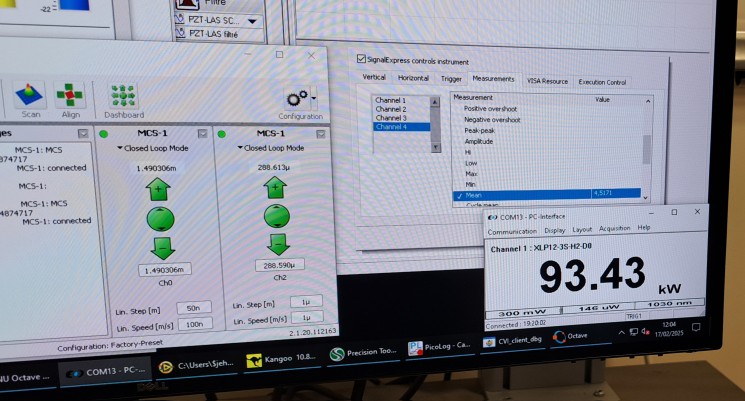
Ronic Chiche | Fixed | info | lasers and optics | ThomX igloo | New power record in ThomX cavity | today, we were able to store more than 93kW in the FP cavity, always with the same parameter : 33% laser amplifier ratio |
| Attachment 1: img1.jpg
|  |
|
402
|
Mon Feb 17 10:48:00 2025 |
Ronic Chiche | Under Process | info | mechanics | lasers and optics | detectors and electronics | ThomX igloo | correlations between accelerometer and lock losses @ 20Hz | new plots, with the accelerometer placed directly on the optical cavity table (on the marble part), close to the oscillator.
the correlation seems a bit better....
we would need to put the accelerometer on one foot of the table to check if the table has not some micro-movement or at the IP to check if the water in the dipole are doing some vibrations.
| Ronic Chiche wrote: |
|
this morning, I did some new plots with the accelerometer placed on the top of the case of the OneFive laser.
I previously observed with the accelerometer placed on the top of one cavity vessel, the correlation between the accelerometer signal and the PZT noise is pretty good but not 100%.
I will move the accelerometer on the optical cavity table.
| Ronic Chiche wrote: |
|
at the end of the day, I moved the accelerometer from the top of the cavity vessel to the top case of the Onefive laser.
I quickly saw again quite strong correlations between the vibrations compensated by the PZT and the accelerometer signal.
when one does a laser motor step which makes a systematic lock loss, one doesn't see any signal on the accelerometer.
=> more measurements have to be done.
I would like also to put also the accelerometer on the mechanics attached to the pipe at the IP.
=> to be discussed to find the best place as a lot of cables, the 2 dipoles and the aluminium sheets around the vacuum stufs don't let a lot of place to put the accelerometer....
| Ronic Chiche wrote: |
|
then, I moved the accelerometer on top of the "X-hutch side" vessel, placed directly on the metal top case, inside the housing.
- the "no noise same range" image shows a standard situation during 10s when there no noise either on PZT or Accelerometer.
on can compare the noise level on the accelerometer with the previous post when it was outside on top of the housing.
its noise is much much lower... which means the housing is properly dumping the acoustic noise at this frequency around 20-30Hz.
so, we increase the accelerometer measurement sensitivity to better measure its noise.
- the "no noise new range" image shows a standard situation during 10s when there no noise either on PZT or Accelerometer but with a smaller range.
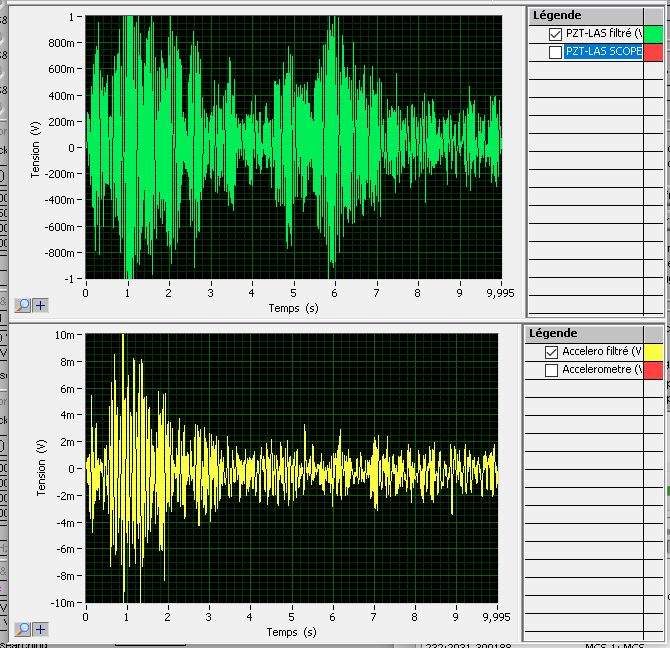
- the "noise 1,2,3" images show the situation when the PZT start to compensate large noise with good correlation with accelerometer placed on top of the optical vessel.
- the "noise 1,2,3 not clear" images show the situation when the PZT start to compensate large noise with correlation with accelerometer but the signal level is not the same as before.
this make me think the origin of the noise is maybe not coming from the inside of the optical vessel.
=> conclusion : we see for the first time a correlation between the PZT noise and some vibration/acoustic noise.
now, we have to investigate the precise origin of this noise (or the different sources).
| Ronic Chiche wrote: |
|
this morning, I did some measurement with nobody interfering with the tests.
- the "no noise" image shows a standard situation during 10s when there is no noise either on PZT or Accelerometer.
most of the time, we are in this situation.
- the "slaping door" image shows the case where the large igloo door is opened and slaping when it closes.
the accelerometer and the PZT exhibit correlated noise when the door is slaping.
we can see a PZT "recovery" time longer than the perturbation.
but these events are rare and are not the source of the problematic perturbations.
- "noise 1,2,3" images show the typical situation when the PZT start to compensate large noise without any correlation with accelerometer placed on top of the housing.
=> conclusion, some external noise (to the housing) should not be the source of the perturbations on the PZT.
| Ronic Chiche wrote: |
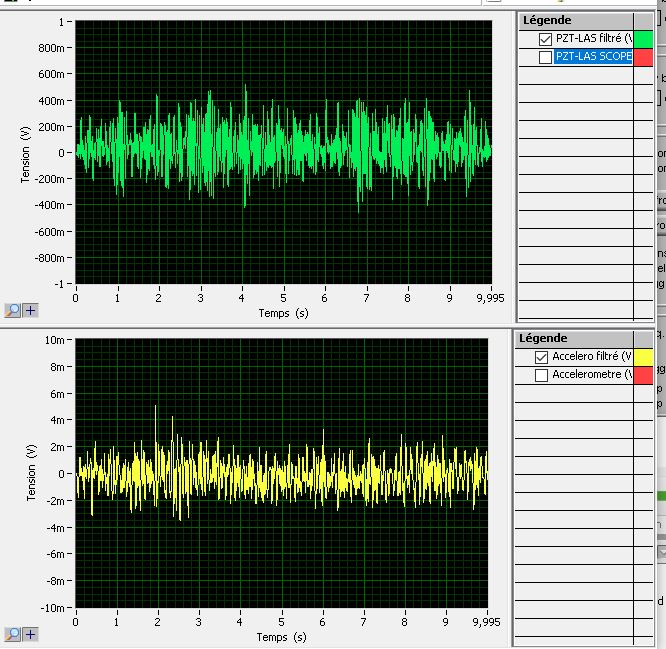
|
today I connected a copy of the laser PZT signal to the 2nd scope CH2 (with AC coupling to remove the DC offset) to be able to monitor synchronously the Accelerometer and laser PZT signals.
the accelerometer is still connected to the 2nd scope CH4 and placed on top of the housing.
I filtered both signals in the Labview Signal Express software with a low-pass filter at 30Hz to focus on low frequencies noise (~20Hz).
now, I need to wait to work with the bunker closed to compare with normal operation (if some people work in the same time in the bunker, obviously, we will get some correlation between the accelerometer and laser PZT signals.....)
| Ronic Chiche wrote: |
|
I installed an accelerometer setup in the bunker.
presently, the accelerometer is placed on top of the housing and its signal is connected to the 2nd scope (33MHz and 500MHz RF beating) on channel 4.
the FPC is locked to ~90kW.
the accelerometer noise is filtered on the Labview Signal Express software in order to focus on the 20Hz noise.
one applied a RII elliptic 5th order low pass filter at 30Hz.
the 20Hz noise can be seen on the PZT which always compensate for CFP frequency drifts.
figure 1 : example of typical accelerometer filtered noise (yellow curve) when the PZT compensation (green curve) is quite (measurement on 4 seconds)
figure 2 : example of accelerometer filtered noise (yellow curve) when the PZT compensation (green curve) exhibits some 20Hz noise (measurement on 10 seconds)
conclusion : there is no clear evidence of a correlation between accoustic noise outside of the housing (measured by the accelerometer) and the 20Hz noise in the laser PZT compensation.
=> putting the 2 signals on 2 different scopes doesn't help because the slow acquisition done is not synchronous.
next try : use the same scope and put the accelerometer inside the housing, for example on top of one of the FPC vessel.
|
|
|
|
|
|
|
| Attachment 1: no_noise.JPG
|  |
| Attachment 2: Capture5.JPG
|  |
| Attachment 3: Capture6.JPG
|  |
| Attachment 4: Capture7.JPG
|  |
| Attachment 5: Capture2.JPG
|  |
| Attachment 6: Capture3.JPG
|  |
| Attachment 7: Capture4.JPG
|  |
|
401
|
Mon Feb 17 09:52:21 2025 |
Ronic Chiche | Under Process | info | mechanics | lasers and optics | detectors and electronics | ThomX igloo | correlations between accelerometer and lock losses @ 20Hz | this morning, I did some new plots with the accelerometer placed on the top of the case of the OneFive laser.
I previously observed with the accelerometer placed on the top of one cavity vessel, the correlation between the accelerometer signal and the PZT noise is pretty good but not 100%.
I will move the accelerometer on the optical cavity table.
| Ronic Chiche wrote: |
|
at the end of the day, I moved the accelerometer from the top of the cavity vessel to the top case of the Onefive laser.
I quickly saw again quite strong correlations between the vibrations compensated by the PZT and the accelerometer signal.
when one does a laser motor step which makes a systematic lock loss, one doesn't see any signal on the accelerometer.
=> more measurements have to be done.
I would like also to put also the accelerometer on the mechanics attached to the pipe at the IP.
=> to be discussed to find the best place as a lot of cables, the 2 dipoles and the aluminium sheets around the vacuum stufs don't let a lot of place to put the accelerometer....
| Ronic Chiche wrote: |
|
then, I moved the accelerometer on top of the "X-hutch side" vessel, placed directly on the metal top case, inside the housing.
- the "no noise same range" image shows a standard situation during 10s when there no noise either on PZT or Accelerometer.
on can compare the noise level on the accelerometer with the previous post when it was outside on top of the housing.
its noise is much much lower... which means the housing is properly dumping the acoustic noise at this frequency around 20-30Hz.
so, we increase the accelerometer measurement sensitivity to better measure its noise.
- the "no noise new range" image shows a standard situation during 10s when there no noise either on PZT or Accelerometer but with a smaller range.
- the "noise 1,2,3" images show the situation when the PZT start to compensate large noise with good correlation with accelerometer placed on top of the optical vessel.
- the "noise 1,2,3 not clear" images show the situation when the PZT start to compensate large noise with correlation with accelerometer but the signal level is not the same as before.
this make me think the origin of the noise is maybe not coming from the inside of the optical vessel.
=> conclusion : we see for the first time a correlation between the PZT noise and some vibration/acoustic noise.
now, we have to investigate the precise origin of this noise (or the different sources).
| Ronic Chiche wrote: |
|
this morning, I did some measurement with nobody interfering with the tests.
- the "no noise" image shows a standard situation during 10s when there is no noise either on PZT or Accelerometer.
most of the time, we are in this situation.
- the "slaping door" image shows the case where the large igloo door is opened and slaping when it closes.
the accelerometer and the PZT exhibit correlated noise when the door is slaping.
we can see a PZT "recovery" time longer than the perturbation.
but these events are rare and are not the source of the problematic perturbations.
- "noise 1,2,3" images show the typical situation when the PZT start to compensate large noise without any correlation with accelerometer placed on top of the housing.
=> conclusion, some external noise (to the housing) should not be the source of the perturbations on the PZT.
| Ronic Chiche wrote: |
|
today I connected a copy of the laser PZT signal to the 2nd scope CH2 (with AC coupling to remove the DC offset) to be able to monitor synchronously the Accelerometer and laser PZT signals.
the accelerometer is still connected to the 2nd scope CH4 and placed on top of the housing.
I filtered both signals in the Labview Signal Express software with a low-pass filter at 30Hz to focus on low frequencies noise (~20Hz).
now, I need to wait to work with the bunker closed to compare with normal operation (if some people work in the same time in the bunker, obviously, we will get some correlation between the accelerometer and laser PZT signals.....)
| Ronic Chiche wrote: |
|
I installed an accelerometer setup in the bunker.
presently, the accelerometer is placed on top of the housing and its signal is connected to the 2nd scope (33MHz and 500MHz RF beating) on channel 4.
the FPC is locked to ~90kW.
the accelerometer noise is filtered on the Labview Signal Express software in order to focus on the 20Hz noise.
one applied a RII elliptic 5th order low pass filter at 30Hz.
the 20Hz noise can be seen on the PZT which always compensate for CFP frequency drifts.
figure 1 : example of typical accelerometer filtered noise (yellow curve) when the PZT compensation (green curve) is quite (measurement on 4 seconds)
figure 2 : example of accelerometer filtered noise (yellow curve) when the PZT compensation (green curve) exhibits some 20Hz noise (measurement on 10 seconds)
conclusion : there is no clear evidence of a correlation between accoustic noise outside of the housing (measured by the accelerometer) and the 20Hz noise in the laser PZT compensation.
=> putting the 2 signals on 2 different scopes doesn't help because the slow acquisition done is not synchronous.
next try : use the same scope and put the accelerometer inside the housing, for example on top of one of the FPC vessel.
|
|
|
|
|
|
| Attachment 1: no_noise.JPG
| 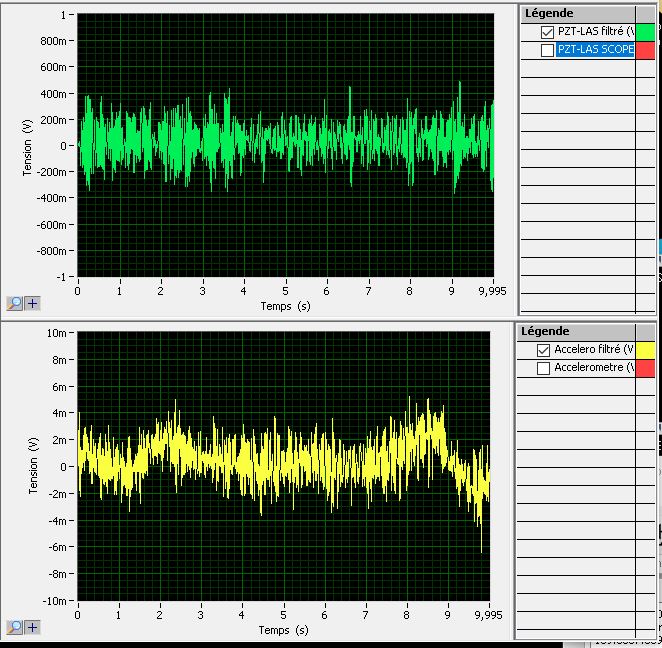 |
| Attachment 2: Capture6.JPG
| 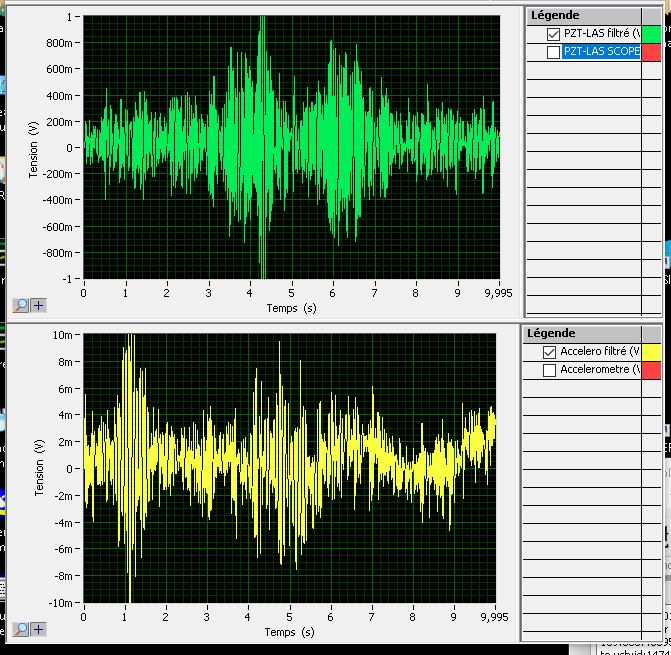 |
| Attachment 3: Capture2.JPG
| 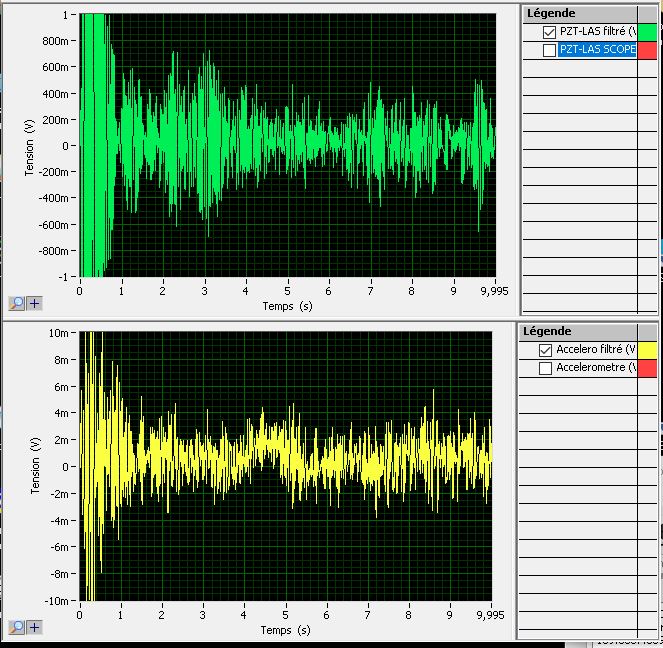 |
| Attachment 4: Capture3.JPG
| 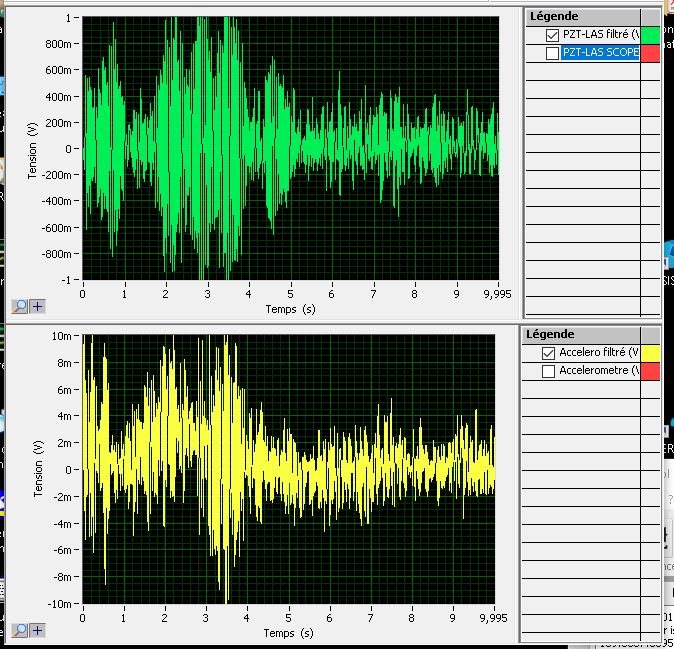 |
| Attachment 5: Capture4.JPG
| 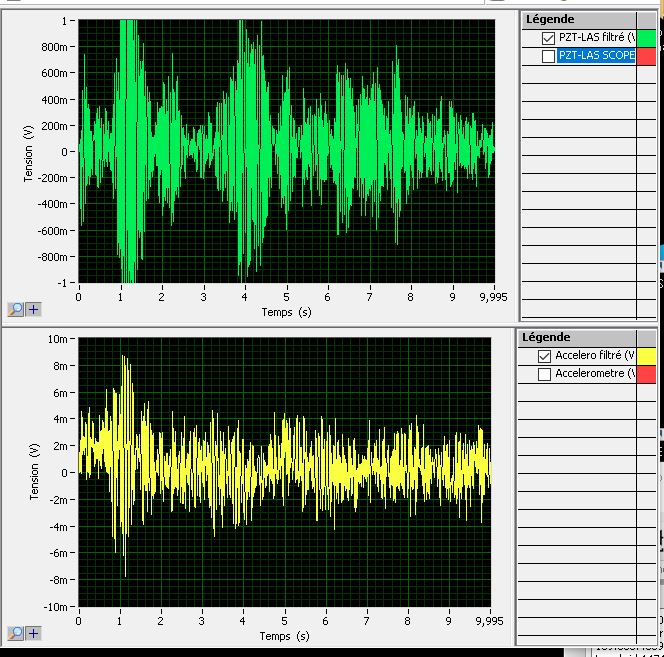 |
| Attachment 6: Capture5.JPG
| 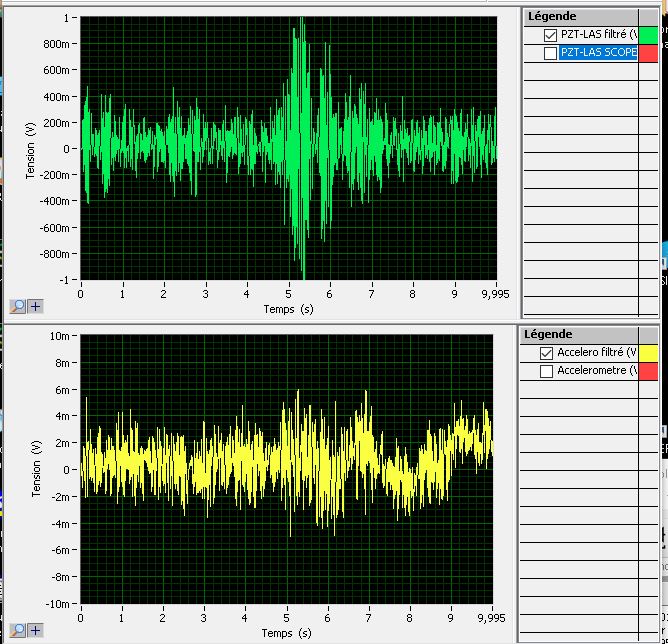 |
|
400
|
Fri Feb 14 19:08:09 2025 |
Ronic Chiche | Under Process | info | mechanics | lasers and optics | detectors and electronics | ThomX igloo | correlations between accelerometer and lock losses @ 20Hz | at the end of the day, I moved the accelerometer from the top of the cavity vessel to the top case of the Onefive laser.
I quickly saw again quite strong correlations between the vibrations compensated by the PZT and the accelerometer signal.
when one does a laser motor step which makes a systematic lock loss, one doesn't see any signal on the accelerometer.
=> more measurements have to be done.
I would like also to put also the accelerometer on the mechanics attached to the pipe at the IP.
=> to be discussed to find the best place as a lot of cables, the 2 dipoles and the aluminium sheets around the vacuum stufs don't let a lot of place to put the accelerometer....
| Ronic Chiche wrote: |
|
then, I moved the accelerometer on top of the "X-hutch side" vessel, placed directly on the metal top case, inside the housing.
- the "no noise same range" image shows a standard situation during 10s when there no noise either on PZT or Accelerometer.
on can compare the noise level on the accelerometer with the previous post when it was outside on top of the housing.
its noise is much much lower... which means the housing is properly dumping the acoustic noise at this frequency around 20-30Hz.
so, we increase the accelerometer measurement sensitivity to better measure its noise.
- the "no noise new range" image shows a standard situation during 10s when there no noise either on PZT or Accelerometer but with a smaller range.
- the "noise 1,2,3" images show the situation when the PZT start to compensate large noise with good correlation with accelerometer placed on top of the optical vessel.
- the "noise 1,2,3 not clear" images show the situation when the PZT start to compensate large noise with correlation with accelerometer but the signal level is not the same as before.
this make me think the origin of the noise is maybe not coming from the inside of the optical vessel.
=> conclusion : we see for the first time a correlation between the PZT noise and some vibration/acoustic noise.
now, we have to investigate the precise origin of this noise (or the different sources).
| Ronic Chiche wrote: |
|
this morning, I did some measurement with nobody interfering with the tests.
- the "no noise" image shows a standard situation during 10s when there is no noise either on PZT or Accelerometer.
most of the time, we are in this situation.
- the "slaping door" image shows the case where the large igloo door is opened and slaping when it closes.
the accelerometer and the PZT exhibit correlated noise when the door is slaping.
we can see a PZT "recovery" time longer than the perturbation.
but these events are rare and are not the source of the problematic perturbations.
- "noise 1,2,3" images show the typical situation when the PZT start to compensate large noise without any correlation with accelerometer placed on top of the housing.
=> conclusion, some external noise (to the housing) should not be the source of the perturbations on the PZT.
| Ronic Chiche wrote: |
|
today I connected a copy of the laser PZT signal to the 2nd scope CH2 (with AC coupling to remove the DC offset) to be able to monitor synchronously the Accelerometer and laser PZT signals.
the accelerometer is still connected to the 2nd scope CH4 and placed on top of the housing.
I filtered both signals in the Labview Signal Express software with a low-pass filter at 30Hz to focus on low frequencies noise (~20Hz).
now, I need to wait to work with the bunker closed to compare with normal operation (if some people work in the same time in the bunker, obviously, we will get some correlation between the accelerometer and laser PZT signals.....)
| Ronic Chiche wrote: |
|
I installed an accelerometer setup in the bunker.
presently, the accelerometer is placed on top of the housing and its signal is connected to the 2nd scope (33MHz and 500MHz RF beating) on channel 4.
the FPC is locked to ~90kW.
the accelerometer noise is filtered on the Labview Signal Express software in order to focus on the 20Hz noise.
one applied a RII elliptic 5th order low pass filter at 30Hz.
the 20Hz noise can be seen on the PZT which always compensate for CFP frequency drifts.
figure 1 : example of typical accelerometer filtered noise (yellow curve) when the PZT compensation (green curve) is quite (measurement on 4 seconds)
figure 2 : example of accelerometer filtered noise (yellow curve) when the PZT compensation (green curve) exhibits some 20Hz noise (measurement on 10 seconds)
conclusion : there is no clear evidence of a correlation between accoustic noise outside of the housing (measured by the accelerometer) and the 20Hz noise in the laser PZT compensation.
=> putting the 2 signals on 2 different scopes doesn't help because the slow acquisition done is not synchronous.
next try : use the same scope and put the accelerometer inside the housing, for example on top of one of the FPC vessel.
|
|
|
|
|
|
399
|
Fri Feb 14 10:58:48 2025 |
Ronic Chiche | Under Process | info | mechanics | lasers and optics | detectors and electronics | ThomX igloo | correlations between accelerometer and lock losses @ 20Hz | then, I moved the accelerometer on top of the "X-hutch side" vessel, placed directly on the metal top case, inside the housing.
- the "no noise same range" image shows a standard situation during 10s when there no noise either on PZT or Accelerometer.
on can compare the noise level on the accelerometer with the previous post when it was outside on top of the housing.
its noise is much much lower... which means the housing is properly dumping the acoustic noise at this frequency around 20-30Hz.
so, we increase the accelerometer measurement sensitivity to better measure its noise.
- the "no noise new range" image shows a standard situation during 10s when there no noise either on PZT or Accelerometer but with a smaller range.
- the "noise 1,2,3" images show the situation when the PZT start to compensate large noise with good correlation with accelerometer placed on top of the optical vessel.
- the "noise 1,2,3 not clear" images show the situation when the PZT start to compensate large noise with correlation with accelerometer but the signal level is not the same as before.
this make me think the origin of the noise is maybe not coming from the inside of the optical vessel.
=> conclusion : we see for the first time a correlation between the PZT noise and some vibration/acoustic noise.
now, we have to investigate the precise origin of this noise (or the different sources).
| Ronic Chiche wrote: |
|
this morning, I did some measurement with nobody interfering with the tests.
- the "no noise" image shows a standard situation during 10s when there is no noise either on PZT or Accelerometer.
most of the time, we are in this situation.
- the "slaping door" image shows the case where the large igloo door is opened and slaping when it closes.
the accelerometer and the PZT exhibit correlated noise when the door is slaping.
we can see a PZT "recovery" time longer than the perturbation.
but these events are rare and are not the source of the problematic perturbations.
- "noise 1,2,3" images show the typical situation when the PZT start to compensate large noise without any correlation with accelerometer placed on top of the housing.
=> conclusion, some external noise (to the housing) should not be the source of the perturbations on the PZT.
| Ronic Chiche wrote: |
|
today I connected a copy of the laser PZT signal to the 2nd scope CH2 (with AC coupling to remove the DC offset) to be able to monitor synchronously the Accelerometer and laser PZT signals.
the accelerometer is still connected to the 2nd scope CH4 and placed on top of the housing.
I filtered both signals in the Labview Signal Express software with a low-pass filter at 30Hz to focus on low frequencies noise (~20Hz).
now, I need to wait to work with the bunker closed to compare with normal operation (if some people work in the same time in the bunker, obviously, we will get some correlation between the accelerometer and laser PZT signals.....)
| Ronic Chiche wrote: |
|
I installed an accelerometer setup in the bunker.
presently, the accelerometer is placed on top of the housing and its signal is connected to the 2nd scope (33MHz and 500MHz RF beating) on channel 4.
the FPC is locked to ~90kW.
the accelerometer noise is filtered on the Labview Signal Express software in order to focus on the 20Hz noise.
one applied a RII elliptic 5th order low pass filter at 30Hz.
the 20Hz noise can be seen on the PZT which always compensate for CFP frequency drifts.
figure 1 : example of typical accelerometer filtered noise (yellow curve) when the PZT compensation (green curve) is quite (measurement on 4 seconds)
figure 2 : example of accelerometer filtered noise (yellow curve) when the PZT compensation (green curve) exhibits some 20Hz noise (measurement on 10 seconds)
conclusion : there is no clear evidence of a correlation between accoustic noise outside of the housing (measured by the accelerometer) and the 20Hz noise in the laser PZT compensation.
=> putting the 2 signals on 2 different scopes doesn't help because the slow acquisition done is not synchronous.
next try : use the same scope and put the accelerometer inside the housing, for example on top of one of the FPC vessel.
|
|
|
|
| Attachment 1: no_noise_same_range.JPG
| 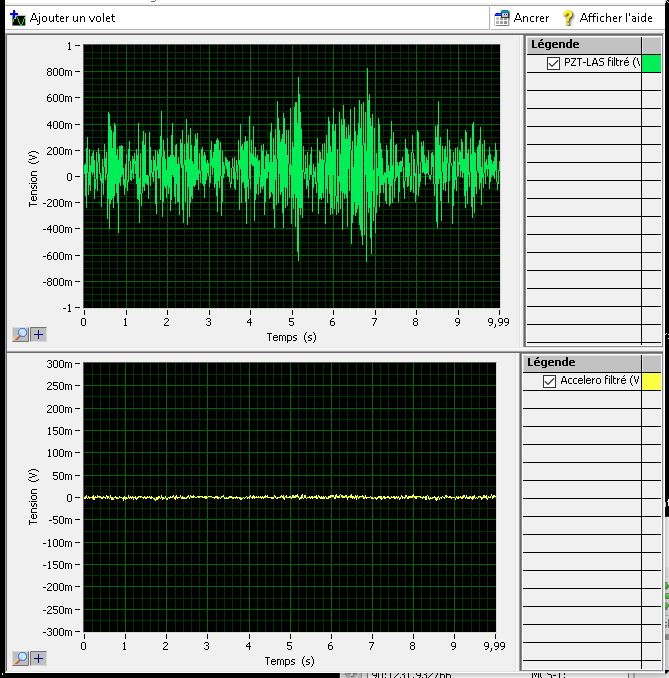 |
| Attachment 2: no_noise_new_range.JPG
| 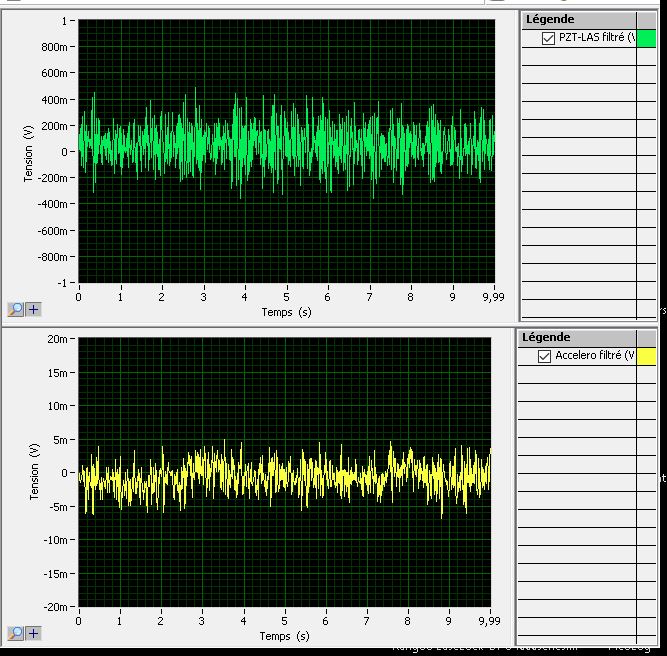 |
| Attachment 3: noise1.JPG
| 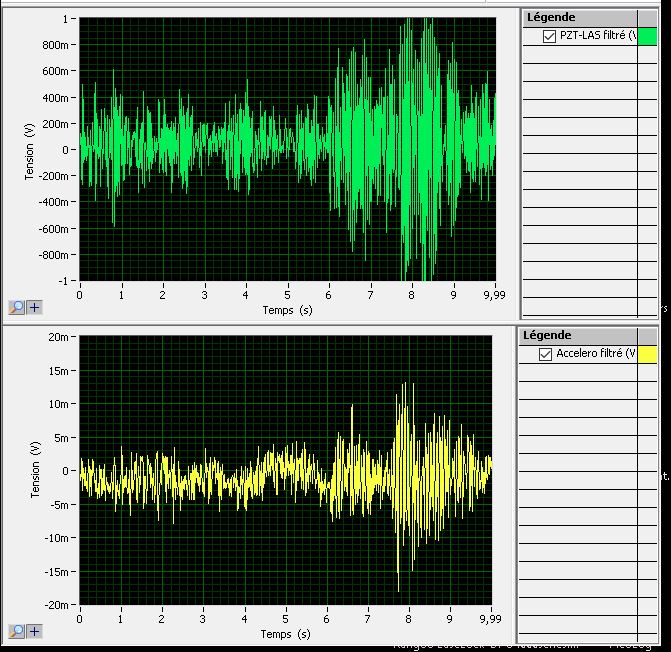 |
| Attachment 4: noise2.JPG
| 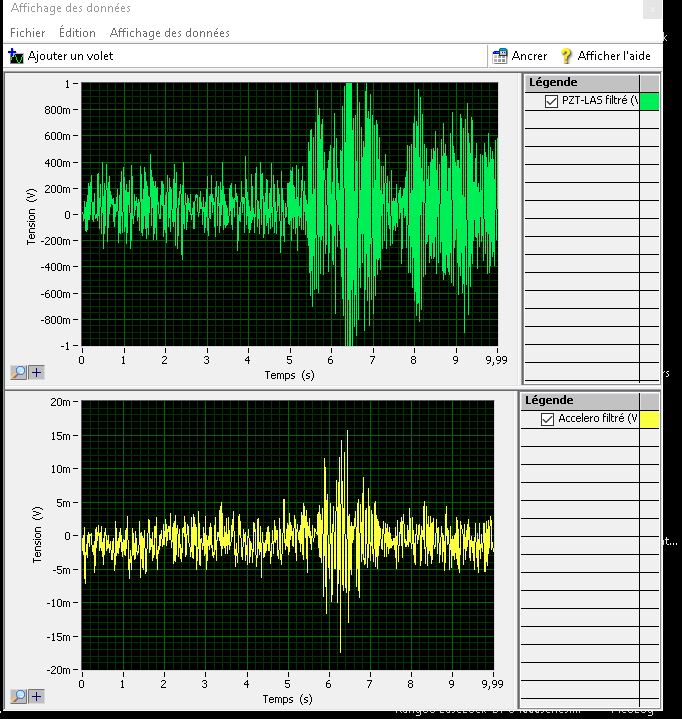 |
| Attachment 5: noise3.JPG
| 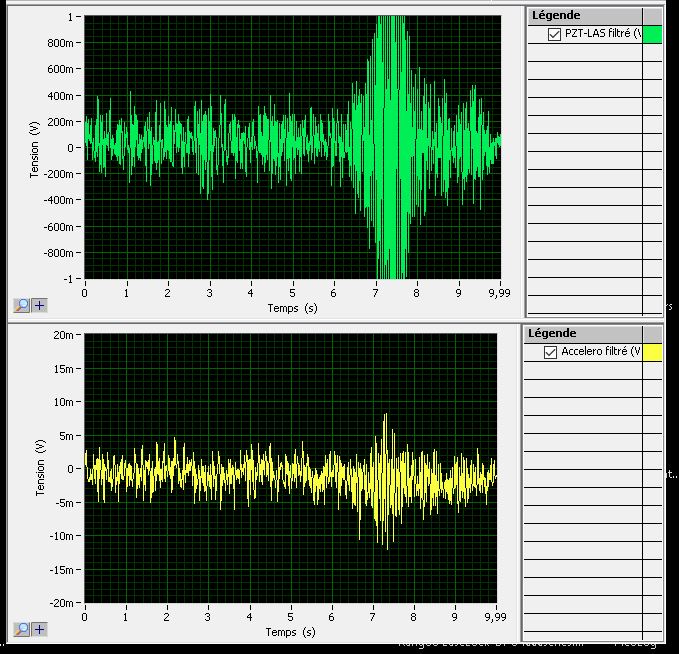 |
| Attachment 6: noise1_not_clear.JPG
| 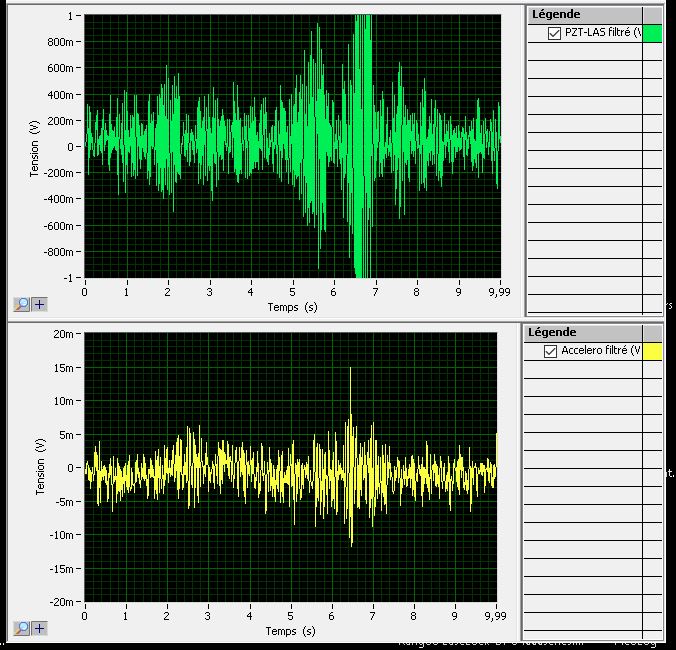 |
| Attachment 7: noise2_not_clear.JPG
| 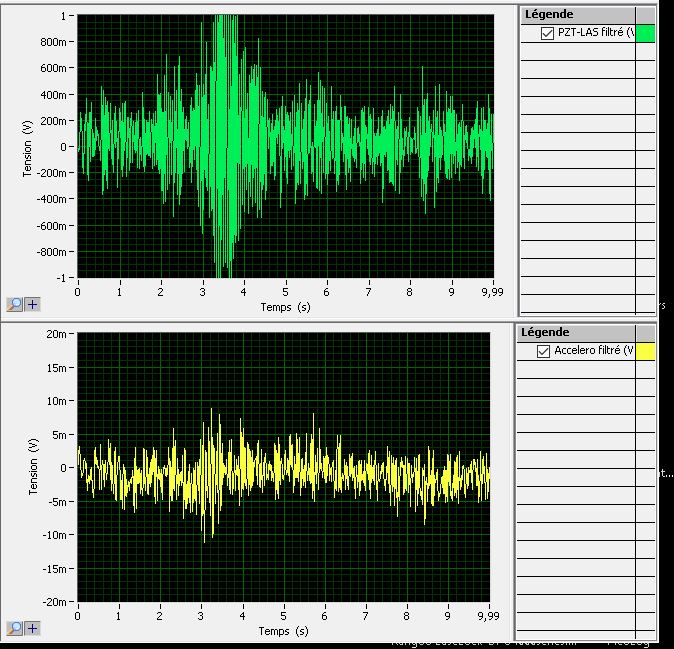 |
| Attachment 8: noise3_not_clear.JPG
| 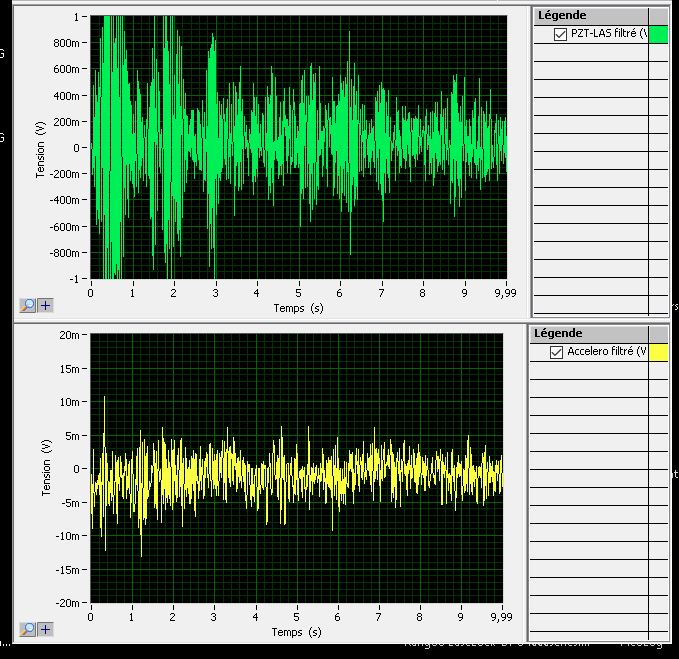 |
|
398
|
Fri Feb 14 10:11:00 2025 |
Ronic Chiche | Under Process | info | mechanics | lasers and optics | detectors and electronics | ThomX igloo | correlations between accelerometer and lock losses @ 20Hz | this morning, I did some measurement with nobody interfering with the tests.
- the "no noise" image shows a standard situation during 10s when there is no noise either on PZT or Accelerometer.
most of the time, we are in this situation.
- the "slaping door" image shows the case where the large igloo door is opened and slaping when it closes.
the accelerometer and the PZT exhibit correlated noise when the door is slaping.
we can see a PZT "recovery" time longer than the perturbation.
but these events are rare and are not the source of the problematic perturbations.
- "noise 1,2,3" images show the typical situation when the PZT start to compensate large noise without any correlation with accelerometer placed on top of the housing.
=> conclusion, some external noise (to the housing) should not be the source of the perturbations on the PZT.
| Ronic Chiche wrote: |
|
today I connected a copy of the laser PZT signal to the 2nd scope CH2 (with AC coupling to remove the DC offset) to be able to monitor synchronously the Accelerometer and laser PZT signals.
the accelerometer is still connected to the 2nd scope CH4 and placed on top of the housing.
I filtered both signals in the Labview Signal Express software with a low-pass filter at 30Hz to focus on low frequencies noise (~20Hz).
now, I need to wait to work with the bunker closed to compare with normal operation (if some people work in the same time in the bunker, obviously, we will get some correlation between the accelerometer and laser PZT signals.....)
| Ronic Chiche wrote: |
|
I installed an accelerometer setup in the bunker.
presently, the accelerometer is placed on top of the housing and its signal is connected to the 2nd scope (33MHz and 500MHz RF beating) on channel 4.
the FPC is locked to ~90kW.
the accelerometer noise is filtered on the Labview Signal Express software in order to focus on the 20Hz noise.
one applied a RII elliptic 5th order low pass filter at 30Hz.
the 20Hz noise can be seen on the PZT which always compensate for CFP frequency drifts.
figure 1 : example of typical accelerometer filtered noise (yellow curve) when the PZT compensation (green curve) is quite (measurement on 4 seconds)
figure 2 : example of accelerometer filtered noise (yellow curve) when the PZT compensation (green curve) exhibits some 20Hz noise (measurement on 10 seconds)
conclusion : there is no clear evidence of a correlation between accoustic noise outside of the housing (measured by the accelerometer) and the 20Hz noise in the laser PZT compensation.
=> putting the 2 signals on 2 different scopes doesn't help because the slow acquisition done is not synchronous.
next try : use the same scope and put the accelerometer inside the housing, for example on top of one of the FPC vessel.
|
|
|
| Attachment 1: No_noise.JPG
| 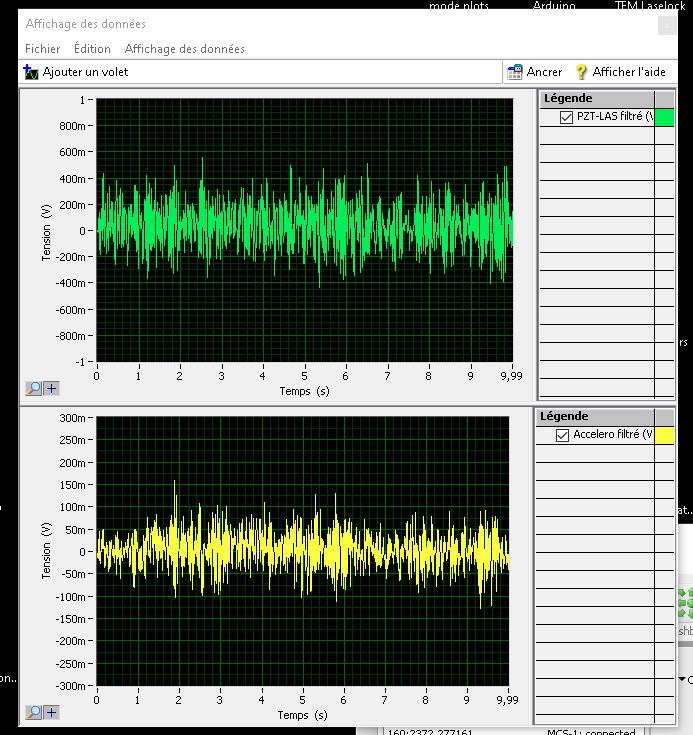 |
| Attachment 2: Slaping_door.JPG
| 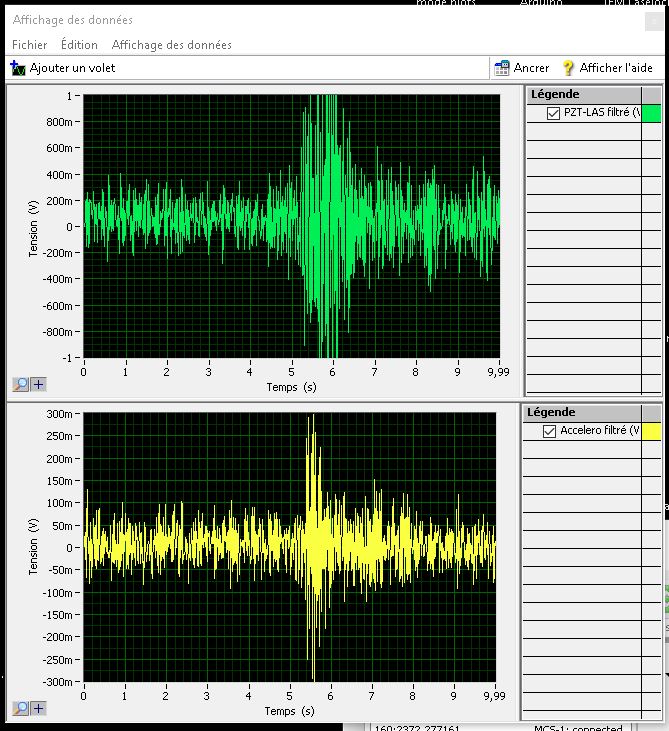 |
| Attachment 3: Noise1.JPG
| 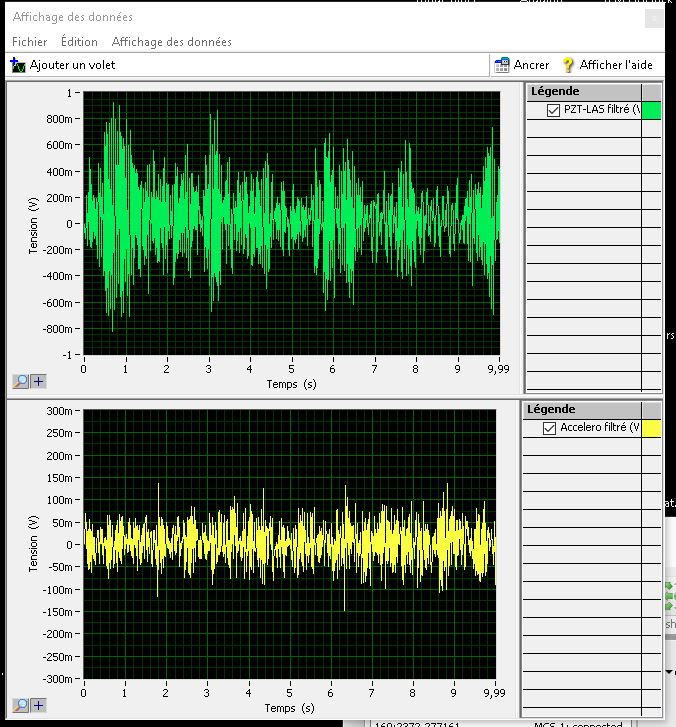 |
| Attachment 4: Noise2.JPG
| 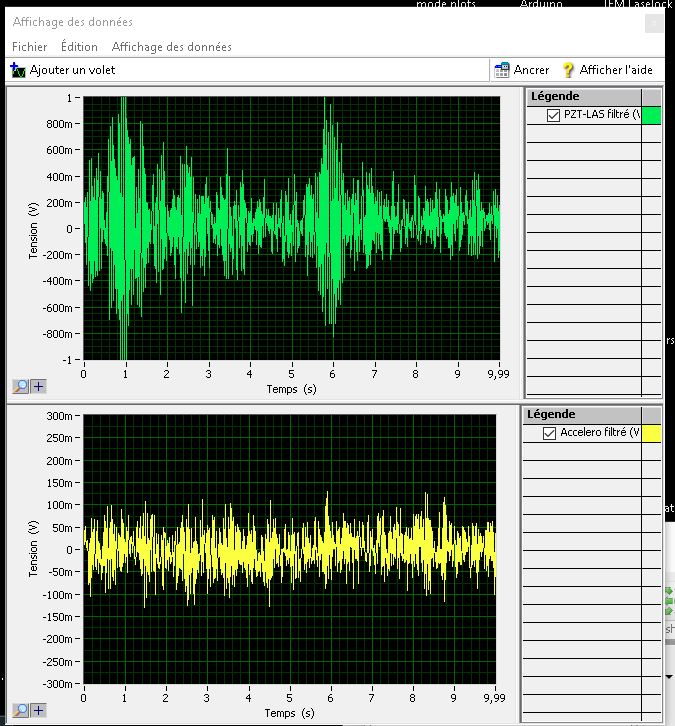 |
| Attachment 5: Noise3.JPG
| 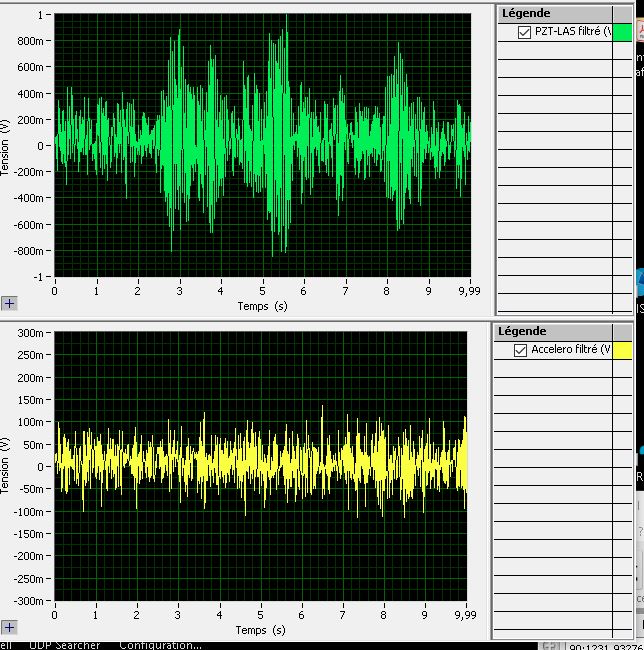 |
|
397
|
Tue Feb 11 10:55:21 2025 |
Ronic Chiche | Under Process | info | mechanics | lasers and optics | detectors and electronics | ThomX igloo | correlations between accelerometer and lock losses @ 20Hz | today I connected a copy of the laser PZT signal to the 2nd scope CH2 (with AC coupling to remove the DC offset) to be able to monitor synchronously the Accelerometer and laser PZT signals.
the accelerometer is still connected to the 2nd scope CH4 and placed on top of the housing.
I filtered both signals in the Labview Signal Express software with a low-pass filter at 30Hz to focus on low frequencies noise (~20Hz).
now, I need to wait to work with the bunker closed to compare with normal operation (if some people work in the same time in the bunker, obviously, we will get some correlation between the accelerometer and laser PZT signals.....)
| Ronic Chiche wrote: |
|
I installed an accelerometer setup in the bunker.
presently, the accelerometer is placed on top of the housing and its signal is connected to the 2nd scope (33MHz and 500MHz RF beating) on channel 4.
the FPC is locked to ~90kW.
the accelerometer noise is filtered on the Labview Signal Express software in order to focus on the 20Hz noise.
one applied a RII elliptic 5th order low pass filter at 30Hz.
the 20Hz noise can be seen on the PZT which always compensate for CFP frequency drifts.
figure 1 : example of typical accelerometer filtered noise (yellow curve) when the PZT compensation (green curve) is quite (measurement on 4 seconds)
figure 2 : example of accelerometer filtered noise (yellow curve) when the PZT compensation (green curve) exhibits some 20Hz noise (measurement on 10 seconds)
conclusion : there is no clear evidence of a correlation between accoustic noise outside of the housing (measured by the accelerometer) and the 20Hz noise in the laser PZT compensation.
=> putting the 2 signals on 2 different scopes doesn't help because the slow acquisition done is not synchronous.
next try : use the same scope and put the accelerometer inside the housing, for example on top of one of the FPC vessel.
|
|
|