| ID |
Date |
Author |
Status |
Type |
Category |
Location |
Title |
|
258
|
Fri Sep 15 18:00:41 2023 |
Ronic Chiche | Under Process | issue | mechanics | lasers and optics | detectors and electronics | ThomX igloo | 20Hz oscillation in the locking between Laser and FP-cavity | this morning, we tried to find the origin of the 20Hz oscillation.
- we switched OFF the laser Smaract motors controller => no change
- then, we addionally disconnected the FP-cavity PZT cable from the Laselock (we put a charge of 1kohm) => no change
- then, we switched ON the laser Smaract motors controller and switched OFF the FP-cavity motors controllers => no change
in conclusion, we don't really know where this instabillity comes from.
the amplitude is roughly 1Vpp (when the oscillation is at its maximum) on the laser PZT <=> length oscillation of ~20nm pp
could it come :
- from the air cooling regulation with pressure variation ?
- from vibrations of the hexapod below the table ?
or is it from inside of the laser or FP cavities ?
see these posts for the first measurements on this issue: https://elog.lal.in2p3.fr/FPC/THOMX+commissioning/257
|
|
259
|
Fri Sep 15 18:11:07 2023 |
Ronic Chiche | Under Process | issue | mechanics | lasers and optics | detectors and electronics | ThomX igloo | 20Hz oscillation in the locking between Laser and FP-cavity | this afternoon, we did 2 tests to better understand this 20Hz oscillation:
- we locked the amplified laser directly to the 500MHz ring reference oscillator, without any intermediate locking to the FP-cavity => no change
the 20Hz oscillation is still present in the correction signal of the laser PZT.
- we switched OFF the controller of the hexapod => no change.
conclusion:
the 20Hz oscillation is coming from the laser cavity
or is coming from "outside" and could be measured, maybe at a higher level, with an external "noises & vibrations measurement system".
| Ronic Chiche wrote: |
|
this morning, we tried to find the origin of the 20Hz oscillation.
- we switched OFF the laser Smaract motors controller => no change
- then, we addionally disconnected the FP-cavity PZT cable from the Laselock (we put a charge of 1kohm) => no change
- then, we switched ON the laser Smaract motors controller and switched OFF the FP-cavity motors controllers => no change
in conclusion, we don't really know where this instabillity comes from.
the amplitude is roughly 1Vpp (when the oscillation is at its maximum) on the laser PZT <=> length oscillation of ~20nm pp
could it come :
- from the air cooling regulation with pressure variation ?
- from vibrations of the hexapod below the table ?
or is it from inside of the laser or FP cavities ?
see these posts for the first measurements on this issue: https://elog.lal.in2p3.fr/FPC/THOMX+commissioning/257
|
|
|
310
|
Wed Jan 10 15:21:46 2024 |
Ronic Chiche | Under Process | info | lasers and optics | ThomX igloo | Variable focal lens validation | we plan to use Electrically Tunable Lenses EL-10-30-C NIR to build the ThomX telescope but they need to be compatible with the powerful laser beam.
for CW regime, on the datasheet (see attached file), the optical damage threshold is 10 kW/cm².
with 70W laser power and 1mm² beam surface (which is much smaller than the real beam size), we are at 7kW/cm².
for pulsed regime, with Daniele, we can imagine that the inner material is water (n ~ 1.3 in the datasheet).
One found a paper about laser induced electric breakdown in water (see attached paper) which give a breakdown field of about 1e8 V/m (see Fig. 1 of the paper) for 7ns pulse width.
with 70W average power, 33MHz repetition rate, 10ps pulse width 1mm² beam surface, one has an intensity of ~ 2e11 W/m² (or 2.7 GW/cm²)
I = E² / 377 => E = 8.7e6 V/m which is also much smaller than the breakdown value.
from the fig. 4 of the paper, it seems the breakdown threshold increases a lot for shorter pulses from 30 GW/cm² (~10ns pulses) to ~150 GW/cm² (~10ps pulses)
so, one can expect a good behavior in pulsed regime too.
can anyone check the validity of these rough calculations ???
|
| Attachment 1: Optotune_EL-10-30.pdf
|
| Attachment 2: JOSAB.8.000337.pdf
|
|
324
|
Fri Feb 9 09:50:45 2024 |
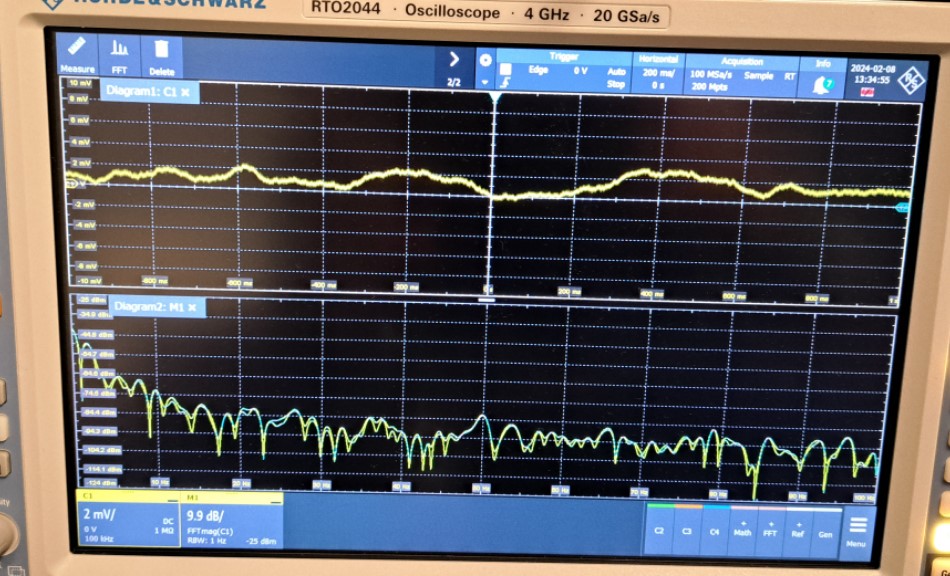
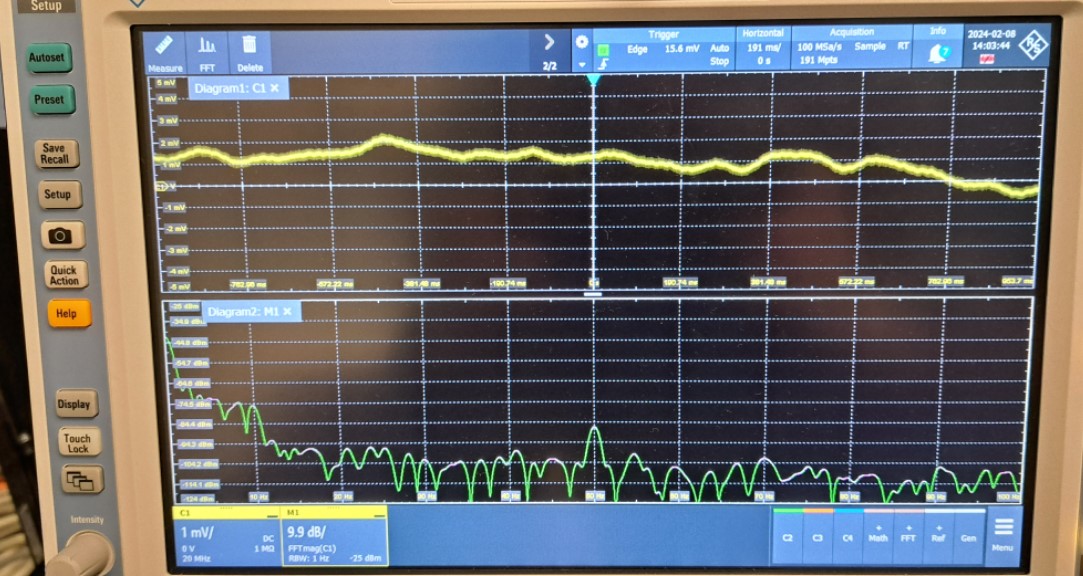
Ronic Chiche | Under Process | issue | mechanics | lasers and optics | detectors and electronics | ThomX igloo | 20Hz oscillation in the locking between Laser and FP-cavity | yesterday I did 2 tests to try to understand the origin of the 20Hz oscillation which is dominant in the remaining 10-20ps rms jitter between the transmitted pulses and the RF reference generator.
10ps rms jitter is equivalent to phase jitter dphi = 2*pi*f0*dt = 2mrad rms @ 33MHz or 30mrad rms @ 500MHz.
with V0 = 1Vpeak of beating signal amplitude, the equivalent rms beating voltage is dV = V0 * sin(dphi) ~ V0 * dphi = 2mV rms @ 33MHz or 30mV rms @ 500MHz
1) I did a beating between the internal photodiode of the laser with an external 33MHz oscillator (the photodiode is too slow to use higher harmonic).
the difficult part is to see the 2mV rms noise on a 2Vpp oscillating signal, so I locked the external 33MHz reference oscillator with the beating signal => see first plot.
there is no trace of 20Hz oscillation in the beating signal => the lock is too good and removed the oscillation ?
2) I did a beating between the photodiode in reflection of the FP-cavity (so the signal is not coming only from the oscillator but is going also through the Alphanov amplifier) with the 500MHz RF Ring generator.
I cannot the lock the generator anymore, so the measurement is done in open loop. I adjust the laser Frep with the motor to try to cancel the beating frequency => see 2nd plot
there is no trace of 20Hz oscillation in the beating signal => it is in contradiction with the previous post : "conclusion: the 20Hz oscillation is coming from the laser cavity" ?!?
maybe we need a more complex measurement scheme with the possibility to measure in the same time the 10-20ps rms jitter coming from the locked FP-cavity transmitted signal/500MHz Ring generator
AND the beating signal between the laser or amplifier with 500MHz local reference generator... to be done...
| Ronic Chiche wrote: |
|
this afternoon, we did 2 tests to better understand this 20Hz oscillation:
- we locked the amplified laser directly to the 500MHz ring reference oscillator, without any intermediate locking to the FP-cavity => no change
the 20Hz oscillation is still present in the correction signal of the laser PZT.
- we switched OFF the controller of the hexapod => no change.
conclusion:
the 20Hz oscillation is coming from the laser cavity
or is coming from "outside" and could be measured, maybe at a higher level, with an external "noises & vibrations measurement system".
| Ronic Chiche wrote: |
|
this morning, we tried to find the origin of the 20Hz oscillation.
- we switched OFF the laser Smaract motors controller => no change
- then, we addionally disconnected the FP-cavity PZT cable from the Laselock (we put a charge of 1kohm) => no change
- then, we switched ON the laser Smaract motors controller and switched OFF the FP-cavity motors controllers => no change
in conclusion, we don't really know where this instabillity comes from.
the amplitude is roughly 1Vpp (when the oscillation is at its maximum) on the laser PZT <=> length oscillation of ~20nm pp
could it come :
- from the air cooling regulation with pressure variation ?
- from vibrations of the hexapod below the table ?
or is it from inside of the laser or FP cavities ?
see these posts for the first measurements on this issue: https://elog.lal.in2p3.fr/FPC/THOMX+commissioning/257
|
|
|
| Attachment 1: 20240208_133745.jpg
|  |
| Attachment 2: 20240208_140636.jpg
|  |
|
325
|
Fri Feb 9 15:49:39 2024 |
Ronic Chiche | Under Process | issue | mechanics | lasers and optics | detectors and electronics | ThomX igloo | 20Hz oscillation in the locking between Laser and FP-cavity | what does this 10ps phase jitter mean in term of cavity length variations ?
L = L0 + dL sin(2pi fm t) = L0 (1 + dL/L0 sin(2pi fm t))
F = c / L ~ F0 - F0² dL / c sin(2pi fm t) with F0 = c / L0
d/dt(phi) = 2pi F => phi = 2pi F0 t + F0² dL / (c fm) cos(2pi fm t) => dphi = F0² dL / (c fm)
dphi = 2pi F0 dt => dL = L0 * 2pi fm dt
dt rms = 10ps @ fm = 20Hz of modulation frequency <=> dL rms = 10 nm (L0 = 9m)
| Ronic Chiche wrote: |
|
yesterday I did 2 tests to try to understand the origin of the 20Hz oscillation which is dominant in the remaining 10-20ps rms jitter between the transmitted pulses and the RF reference generator.
10ps rms jitter is equivalent to phase jitter dphi = 2*pi*f0*dt = 2mrad rms @ 33MHz or 30mrad rms @ 500MHz.
with V0 = 1Vpeak of beating signal amplitude, the equivalent rms beating voltage is dV = V0 * sin(dphi) ~ V0 * dphi = 2mV rms @ 33MHz or 30mV rms @ 500MHz
1) I did a beating between the internal photodiode of the laser with an external 33MHz oscillator (the photodiode is too slow to use higher harmonic).
the difficult part is to see the 2mV rms noise on a 2Vpp oscillating signal, so I locked the external 33MHz reference oscillator with the beating signal => see first plot.
there is no trace of 20Hz oscillation in the beating signal => the lock is too good and removed the oscillation ?
2) I did a beating between the photodiode in reflection of the FP-cavity (so the signal is not coming only from the oscillator but is going also through the Alphanov amplifier) with the 500MHz RF Ring generator.
I cannot the lock the generator anymore, so the measurement is done in open loop. I adjust the laser Frep with the motor to try to cancel the beating frequency => see 2nd plot
there is no trace of 20Hz oscillation in the beating signal => it is in contradiction with the previous post : "conclusion: the 20Hz oscillation is coming from the laser cavity" ?!?
maybe we need a more complex measurement scheme with the possibility to measure in the same time the 10-20ps rms jitter coming from the locked FP-cavity transmitted signal/500MHz Ring generator
AND the beating signal between the laser or amplifier with 500MHz local reference generator... to be done...
| Ronic Chiche wrote: |
|
this afternoon, we did 2 tests to better understand this 20Hz oscillation:
- we locked the amplified laser directly to the 500MHz ring reference oscillator, without any intermediate locking to the FP-cavity => no change
the 20Hz oscillation is still present in the correction signal of the laser PZT.
- we switched OFF the controller of the hexapod => no change.
conclusion:
the 20Hz oscillation is coming from the laser cavity
or is coming from "outside" and could be measured, maybe at a higher level, with an external "noises & vibrations measurement system".
| Ronic Chiche wrote: |
|
this morning, we tried to find the origin of the 20Hz oscillation.
- we switched OFF the laser Smaract motors controller => no change
- then, we addionally disconnected the FP-cavity PZT cable from the Laselock (we put a charge of 1kohm) => no change
- then, we switched ON the laser Smaract motors controller and switched OFF the FP-cavity motors controllers => no change
in conclusion, we don't really know where this instabillity comes from.
the amplitude is roughly 1Vpp (when the oscillation is at its maximum) on the laser PZT <=> length oscillation of ~20nm pp
could it come :
- from the air cooling regulation with pressure variation ?
- from vibrations of the hexapod below the table ?
or is it from inside of the laser or FP cavities ?
see these posts for the first measurements on this issue: https://elog.lal.in2p3.fr/FPC/THOMX+commissioning/257
|
|
|
|
|
326
|
Fri Feb 9 18:00:05 2024 |
Ronic Chiche | Under Process | issue | mechanics | lasers and optics | detectors and electronics | ThomX igloo | 20Hz oscillation in the locking between Laser and FP-cavity | measure to be done next week to check the 20Hz noise on the laser amplifier signal:
- install a DET10 in reflection of the FP-cavity to get a high BW and measure the 500MHz harmonic.
- do the beating with the 500MHz Ring RF generator
- with the laser motor try to be close to the 500MHz Ring RF frequency => beating frequency below 1kHz
- send the beating signal to some RF spectrum analyzer to use its large dynamic range.
for example, with the Siglent RF spectrum analyzer, it is possible to detect easily a peak @ -96dBm <=> 3.5µV rms
so, one should be able to make the measurement @ 500MHz or even @ 33MHz even if the phase sensitivity is lower :
for example V0=100mV peak beating signal @ f0=33MHz should produce a 20Hz noise signal of:
dV ~ V0 * dphi = V0 * 2*pi*f0*dt = 200µV rms with jitter dt=10ps rms
| Ronic Chiche wrote: |
|
what does this 10ps phase jitter mean in term of cavity length variations ?
L = L0 + dL sin(2pi fm t) = L0 (1 + dL/L0 sin(2pi fm t))
F = c / L ~ F0 - F0² dL / c sin(2pi fm t) with F0 = c / L0
d/dt(phi) = 2pi F => phi = 2pi F0 t + F0² dL / (c fm) cos(2pi fm t) => dphi = F0² dL / (c fm)
dphi = 2pi F0 dt => dL = L0 * 2pi fm dt
dt rms = 10ps @ fm = 20Hz of modulation frequency <=> dL rms = 10 nm (L0 = 9m)
| Ronic Chiche wrote: |
|
yesterday I did 2 tests to try to understand the origin of the 20Hz oscillation which is dominant in the remaining 10-20ps rms jitter between the transmitted pulses and the RF reference generator.
10ps rms jitter is equivalent to phase jitter dphi = 2*pi*f0*dt = 2mrad rms @ 33MHz or 30mrad rms @ 500MHz.
with V0 = 1Vpeak of beating signal amplitude, the equivalent rms beating voltage is dV = V0 * sin(dphi) ~ V0 * dphi = 2mV rms @ 33MHz or 30mV rms @ 500MHz
1) I did a beating between the internal photodiode of the laser with an external 33MHz oscillator (the photodiode is too slow to use higher harmonic).
the difficult part is to see the 2mV rms noise on a 2Vpp oscillating signal, so I locked the external 33MHz reference oscillator with the beating signal => see first plot.
there is no trace of 20Hz oscillation in the beating signal => the lock is too good and removed the oscillation ?
2) I did a beating between the photodiode in reflection of the FP-cavity (so the signal is not coming only from the oscillator but is going also through the Alphanov amplifier) with the 500MHz RF Ring generator.
I cannot the lock the generator anymore, so the measurement is done in open loop. I adjust the laser Frep with the motor to try to cancel the beating frequency => see 2nd plot
there is no trace of 20Hz oscillation in the beating signal => it is in contradiction with the previous post : "conclusion: the 20Hz oscillation is coming from the laser cavity" ?!?
maybe we need a more complex measurement scheme with the possibility to measure in the same time the 10-20ps rms jitter coming from the locked FP-cavity transmitted signal/500MHz Ring generator
AND the beating signal between the laser or amplifier with 500MHz local reference generator... to be done...
| Ronic Chiche wrote: |
|
this afternoon, we did 2 tests to better understand this 20Hz oscillation:
- we locked the amplified laser directly to the 500MHz ring reference oscillator, without any intermediate locking to the FP-cavity => no change
the 20Hz oscillation is still present in the correction signal of the laser PZT.
- we switched OFF the controller of the hexapod => no change.
conclusion:
the 20Hz oscillation is coming from the laser cavity
or is coming from "outside" and could be measured, maybe at a higher level, with an external "noises & vibrations measurement system".
| Ronic Chiche wrote: |
|
this morning, we tried to find the origin of the 20Hz oscillation.
- we switched OFF the laser Smaract motors controller => no change
- then, we addionally disconnected the FP-cavity PZT cable from the Laselock (we put a charge of 1kohm) => no change
- then, we switched ON the laser Smaract motors controller and switched OFF the FP-cavity motors controllers => no change
in conclusion, we don't really know where this instabillity comes from.
the amplitude is roughly 1Vpp (when the oscillation is at its maximum) on the laser PZT <=> length oscillation of ~20nm pp
could it come :
- from the air cooling regulation with pressure variation ?
- from vibrations of the hexapod below the table ?
or is it from inside of the laser or FP cavities ?
see these posts for the first measurements on this issue: https://elog.lal.in2p3.fr/FPC/THOMX+commissioning/257
|
|
|
|
|
|
361
|
Fri Sep 6 17:27:20 2024 |
Ronic Chiche | Under Process | issue | mechanics | lasers and optics | detectors and electronics | ThomX igloo | 20Hz oscillation in the locking between Laser and FP-cavity | could it be possible this 20Hz oscillations comes from anouncements in the bunker, puting the housing+table in vibration ?
(there are such anouncements during restricted access) => to be asked to Harold
| Ronic Chiche wrote: |
|
measure to be done next week to check the 20Hz noise on the laser amplifier signal:
- install a DET10 in reflection of the FP-cavity to get a high BW and measure the 500MHz harmonic.
- do the beating with the 500MHz Ring RF generator
- with the laser motor try to be close to the 500MHz Ring RF frequency => beating frequency below 1kHz
- send the beating signal to some RF spectrum analyzer to use its large dynamic range.
for example, with the Siglent RF spectrum analyzer, it is possible to detect easily a peak @ -96dBm <=> 3.5µV rms
so, one should be able to make the measurement @ 500MHz or even @ 33MHz even if the phase sensitivity is lower :
for example V0=100mV peak beating signal @ f0=33MHz should produce a 20Hz noise signal of:
dV ~ V0 * dphi = V0 * 2*pi*f0*dt = 200µV rms with jitter dt=10ps rms
| Ronic Chiche wrote: |
|
what does this 10ps phase jitter mean in term of cavity length variations ?
L = L0 + dL sin(2pi fm t) = L0 (1 + dL/L0 sin(2pi fm t))
F = c / L ~ F0 - F0² dL / c sin(2pi fm t) with F0 = c / L0
d/dt(phi) = 2pi F => phi = 2pi F0 t + F0² dL / (c fm) cos(2pi fm t) => dphi = F0² dL / (c fm)
dphi = 2pi F0 dt => dL = L0 * 2pi fm dt
dt rms = 10ps @ fm = 20Hz of modulation frequency <=> dL rms = 10 nm (L0 = 9m)
| Ronic Chiche wrote: |
|
yesterday I did 2 tests to try to understand the origin of the 20Hz oscillation which is dominant in the remaining 10-20ps rms jitter between the transmitted pulses and the RF reference generator.
10ps rms jitter is equivalent to phase jitter dphi = 2*pi*f0*dt = 2mrad rms @ 33MHz or 30mrad rms @ 500MHz.
with V0 = 1Vpeak of beating signal amplitude, the equivalent rms beating voltage is dV = V0 * sin(dphi) ~ V0 * dphi = 2mV rms @ 33MHz or 30mV rms @ 500MHz
1) I did a beating between the internal photodiode of the laser with an external 33MHz oscillator (the photodiode is too slow to use higher harmonic).
the difficult part is to see the 2mV rms noise on a 2Vpp oscillating signal, so I locked the external 33MHz reference oscillator with the beating signal => see first plot.
there is no trace of 20Hz oscillation in the beating signal => the lock is too good and removed the oscillation ?
2) I did a beating between the photodiode in reflection of the FP-cavity (so the signal is not coming only from the oscillator but is going also through the Alphanov amplifier) with the 500MHz RF Ring generator.
I cannot the lock the generator anymore, so the measurement is done in open loop. I adjust the laser Frep with the motor to try to cancel the beating frequency => see 2nd plot
there is no trace of 20Hz oscillation in the beating signal => it is in contradiction with the previous post : "conclusion: the 20Hz oscillation is coming from the laser cavity" ?!?
maybe we need a more complex measurement scheme with the possibility to measure in the same time the 10-20ps rms jitter coming from the locked FP-cavity transmitted signal/500MHz Ring generator
AND the beating signal between the laser or amplifier with 500MHz local reference generator... to be done...
| Ronic Chiche wrote: |
|
this afternoon, we did 2 tests to better understand this 20Hz oscillation:
- we locked the amplified laser directly to the 500MHz ring reference oscillator, without any intermediate locking to the FP-cavity => no change
the 20Hz oscillation is still present in the correction signal of the laser PZT.
- we switched OFF the controller of the hexapod => no change.
conclusion:
the 20Hz oscillation is coming from the laser cavity
or is coming from "outside" and could be measured, maybe at a higher level, with an external "noises & vibrations measurement system".
| Ronic Chiche wrote: |
|
this morning, we tried to find the origin of the 20Hz oscillation.
- we switched OFF the laser Smaract motors controller => no change
- then, we addionally disconnected the FP-cavity PZT cable from the Laselock (we put a charge of 1kohm) => no change
- then, we switched ON the laser Smaract motors controller and switched OFF the FP-cavity motors controllers => no change
in conclusion, we don't really know where this instabillity comes from.
the amplitude is roughly 1Vpp (when the oscillation is at its maximum) on the laser PZT <=> length oscillation of ~20nm pp
could it come :
- from the air cooling regulation with pressure variation ?
- from vibrations of the hexapod below the table ?
or is it from inside of the laser or FP cavities ?
see these posts for the first measurements on this issue: https://elog.lal.in2p3.fr/FPC/THOMX+commissioning/257
|
|
|
|
|
|
|
365
|
Tue Sep 17 13:04:32 2024 |
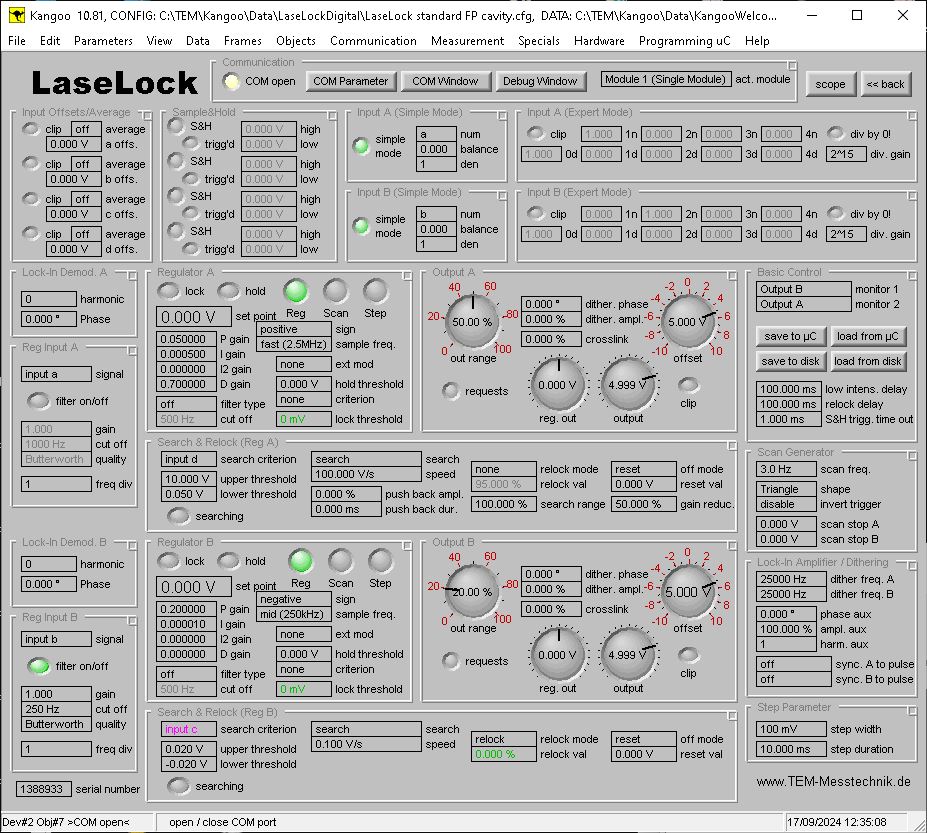
Ronic Chiche | Under Process | info | lasers and optics | software | ThomX igloo | Optimizing lock parameters for stable X-ray production | here are the (good) lock parameters used this morning.
for the RF/FPC lock, the 33MHz beating signal used to select the right bucket is 1Vpp
=> beating signal : V0 . sin(phi) with V0=0.5V.
to discrimate a 500MHz bucket, we need to get dV < V0 dphi.
dphi = 2pi / 15 = 420 mrad => dV < 0.2 V => dV < +/- 0.1V
we used dV = +/- 0.02V but perharps we can relax the constraint.
we also reduced the RF scanning speed at 0.1V/s to let the system find the right phase when the system is slowly drifting.
|
| Attachment 1: Capture.JPG
|  |
|
366
|
Thu Oct 3 16:38:03 2024 |
Ronic Chiche | Under Process | info | lasers and optics | software | ThomX igloo | Optimizing lock parameters for stable X-ray production | Today with Daniele and Alice, we operated to cavity.
we obtained 84kW for 33% of amplifier ratio.
we had to tune the CEP @ -565µm and the FP-cavity alignment.
then we locked properly the FP-cavity on the ring RF frequency.
we quite easily relock with the correct phase when we are loosing the lock.
the ThomX machine was running during these 2 locks, so we are ready for doing X-rays again.
| Ronic Chiche wrote: |
|
here are the (good) lock parameters used this morning.
for the RF/FPC lock, the 33MHz beating signal used to select the right bucket is 1Vpp
=> beating signal : V0 . sin(phi) with V0=0.5V.
to discrimate a 500MHz bucket, we need to get dV < V0 dphi.
dphi = 2pi / 15 = 420 mrad => dV < 0.2 V => dV < +/- 0.1V
we used dV = +/- 0.02V but perharps we can relax the constraint.
we also reduced the RF scanning speed at 0.1V/s to let the system find the right phase when the system is slowly drifting.
|
|
|
367
|
Tue Oct 8 11:59:27 2024 |
Fatematuj Johora | Under Process | report | lasers and optics | Optical room | Characterizing Focus Tunable Lens | Yesterday Ronic and I worked on the high laser power measurements with the Vertical set-up of the Focus Tunable Lens. We went upto 38W@4 dpt at the begining and then also changed the focal power at 38W.
Observation:
1. We observed nice rings @38W 4dpt, maybe it hits some optics we have to check.
2. We also observed flactuations of power for two adjacent index of the beam profiler when we increase the laser power, which we need to understand.
3. We could see that the vertical deformation is not present for this set-up, we could remove the effect of gravity by this set-up. |
| Attachment 1: Updates_of_Focus_Tunable_lenses.pdf
|
|
368
|
Wed Oct 9 09:56:21 2024 |
Ronic Chiche | Under Process | info | lasers and optics | software | ThomX igloo | Optimizing lock parameters for stable X-ray production | This morning, I wanted to test quickly if the Smaract motors can be used in open loop instead of closed loop or in piezo scan.
the goal is to do very fine steps without to much vibrations (like with piezo scan mode) but with the full motor range (the piezo scan mode has a very limited range).
I can check what happens to the 33MHz beating frequency between the laser and the RF frequency without the laser amplifier or the lock of the FP-cavity.
1Hz of beating freqency variation is equivalent to 270nm of round-trip length, which is 135nm of motor displacement !
=> the full range of the piezo scan mode is difficult to estimate because the measurement sensitivity is not good enough but around 5Hz.
=> 1350nm in closed loop is equivalent to ~ 10Hz => 135nm is equivalent to 1Hz => ok
=> 1 step in open loop is equivalent to ~ 10Hz !!! => this is a way too coarse tuning !!!! => cannot be used unless one finds a way to set the motion differently in the settings parameters.
but usually, the settings parameters are used only to tune the speed, not the step size.
| Ronic Chiche wrote: |
|
Today with Daniele and Alice, we operated to cavity.
we obtained 84kW for 33% of amplifier ratio.
we had to tune the CEP @ -565µm and the FP-cavity alignment.
then we locked properly the FP-cavity on the ring RF frequency.
we quite easily relock with the correct phase when we are loosing the lock.
the ThomX machine was running during these 2 locks, so we are ready for doing X-rays again.
| Ronic Chiche wrote: |
|
here are the (good) lock parameters used this morning.
for the RF/FPC lock, the 33MHz beating signal used to select the right bucket is 1Vpp
=> beating signal : V0 . sin(phi) with V0=0.5V.
to discrimate a 500MHz bucket, we need to get dV < V0 dphi.
dphi = 2pi / 15 = 420 mrad => dV < 0.2 V => dV < +/- 0.1V
we used dV = +/- 0.02V but perharps we can relax the constraint.
we also reduced the RF scanning speed at 0.1V/s to let the system find the right phase when the system is slowly drifting.
|
|
|
|
369
|
Wed Oct 9 18:39:34 2024 |
Ronic Chiche | Under Process | info | lasers and optics | software | ThomX igloo | Optimizing lock parameters for stable X-ray production | This afternoon, we scanned the optical table vertically with the hexapod in asynchronous mode to find its optimum position, looking at the X-ray production.
then, we searched for the correct bucket and phase in the bucket thanks to the Kevin script on the 500MHz and the 33MHz phases.
we got relatively easily some stable X-rays.
on the gain "0" on the current amplifier of the X-rays photodiode, we got 15 000 pA (380k Xrays / pA => 5.7.10^9 Xrays).
but we saw, when the cathode charge was fluctuating, that we could be saturated above 20 000 pA !
the power in the cavity was ~84kW after CEP and alignment tuning.
the command to launch the X-rays measurement window is:
taurustrend -r 100 /XLI/OP/TMD.01/I1
| Ronic Chiche wrote: |
|
This morning, I wanted to test quickly if the Smaract motors can be used in open loop instead of closed loop or in piezo scan.
the goal is to do very fine steps without to much vibrations (like with piezo scan mode) but with the full motor range (the piezo scan mode has a very limited range).
I can check what happens to the 33MHz beating frequency between the laser and the RF frequency without the laser amplifier or the lock of the FP-cavity.
1Hz of beating freqency variation is equivalent to 270nm of round-trip length, which is 135nm of motor displacement !
=> the full range of the piezo scan mode is difficult to estimate because the measurement sensitivity is not good enough but around 5Hz.
=> 1350nm in closed loop is equivalent to ~ 10Hz => 135nm is equivalent to 1Hz => ok
=> 1 step in open loop is equivalent to ~ 10Hz !!! => this is a way too coarse tuning !!!! => cannot be used unless one finds a way to set the motion differently in the settings parameters.
but usually, the settings parameters are used only to tune the speed, not the step size.
| Ronic Chiche wrote: |
|
Today with Daniele and Alice, we operated to cavity.
we obtained 84kW for 33% of amplifier ratio.
we had to tune the CEP @ -565µm and the FP-cavity alignment.
then we locked properly the FP-cavity on the ring RF frequency.
we quite easily relock with the correct phase when we are loosing the lock.
the ThomX machine was running during these 2 locks, so we are ready for doing X-rays again.
| Ronic Chiche wrote: |
|
here are the (good) lock parameters used this morning.
for the RF/FPC lock, the 33MHz beating signal used to select the right bucket is 1Vpp
=> beating signal : V0 . sin(phi) with V0=0.5V.
to discrimate a 500MHz bucket, we need to get dV < V0 dphi.
dphi = 2pi / 15 = 420 mrad => dV < 0.2 V => dV < +/- 0.1V
we used dV = +/- 0.02V but perharps we can relax the constraint.
we also reduced the RF scanning speed at 0.1V/s to let the system find the right phase when the system is slowly drifting.
|
|
|
|
|
374
|
Tue Oct 22 18:58:56 2024 |
Ronic Chiche | Under Process | info | lasers and optics | software | ThomX igloo | Optimizing lock parameters for stable X-ray production | Today, after setting the locking parameters, I got 80kW in the FPC for 33% amplifier ratio after CEP tuning (Smaract CH2 ~ -423.5µm) and alignment.
maybe the alignment has to be improved by some walking procedure.
| Ronic Chiche wrote: |
|
This afternoon, we scanned the optical table vertically with the hexapod in asynchronous mode to find its optimum position, looking at the X-ray production.
then, we searched for the correct bucket and phase in the bucket thanks to the Kevin script on the 500MHz and the 33MHz phases.
we got relatively easily some stable X-rays.
on the gain "0" on the current amplifier of the X-rays photodiode, we got 15 000 pA (380k Xrays / pA => 5.7.10^9 Xrays).
but we saw, when the cathode charge was fluctuating, that we could be saturated above 20 000 pA !
the power in the cavity was ~84kW after CEP and alignment tuning.
the command to launch the X-rays measurement window is:
taurustrend -r 100 /XLI/OP/TMD.01/I1
| Ronic Chiche wrote: |
|
This morning, I wanted to test quickly if the Smaract motors can be used in open loop instead of closed loop or in piezo scan.
the goal is to do very fine steps without to much vibrations (like with piezo scan mode) but with the full motor range (the piezo scan mode has a very limited range).
I can check what happens to the 33MHz beating frequency between the laser and the RF frequency without the laser amplifier or the lock of the FP-cavity.
1Hz of beating freqency variation is equivalent to 270nm of round-trip length, which is 135nm of motor displacement !
=> the full range of the piezo scan mode is difficult to estimate because the measurement sensitivity is not good enough but around 5Hz.
=> 1350nm in closed loop is equivalent to ~ 10Hz => 135nm is equivalent to 1Hz => ok
=> 1 step in open loop is equivalent to ~ 10Hz !!! => this is a way too coarse tuning !!!! => cannot be used unless one finds a way to set the motion differently in the settings parameters.
but usually, the settings parameters are used only to tune the speed, not the step size.
| Ronic Chiche wrote: |
|
Today with Daniele and Alice, we operated to cavity.
we obtained 84kW for 33% of amplifier ratio.
we had to tune the CEP @ -565µm and the FP-cavity alignment.
then we locked properly the FP-cavity on the ring RF frequency.
we quite easily relock with the correct phase when we are loosing the lock.
the ThomX machine was running during these 2 locks, so we are ready for doing X-rays again.
| Ronic Chiche wrote: |
|
here are the (good) lock parameters used this morning.
for the RF/FPC lock, the 33MHz beating signal used to select the right bucket is 1Vpp
=> beating signal : V0 . sin(phi) with V0=0.5V.
to discrimate a 500MHz bucket, we need to get dV < V0 dphi.
dphi = 2pi / 15 = 420 mrad => dV < 0.2 V => dV < +/- 0.1V
we used dV = +/- 0.02V but perharps we can relax the constraint.
we also reduced the RF scanning speed at 0.1V/s to let the system find the right phase when the system is slowly drifting.
|
|
|
|
|
|
375
|
Wed Oct 23 12:23:10 2024 |
Ronic Chiche | Under Process | info | lasers and optics | software | ThomX igloo | Optimizing lock parameters for stable X-ray production | this morning, I did some walking procedure and I got 82kW in the FPC with 33% amplifier ratio (after CEP optimization too).
but when I move the FP cavity motors to adjust the frequency, I cannot keep this power and it is reduced.
could it be we get a stronger correlation between axis than before in the mechanics has more rust than before ?
I'm able to keep the power quite easily with a stable phase related to the 33MHz RF generator,
so, we are ready to produce X-rays again.
we could do also a measurement of the amplifier power vs ratio, as maybe it reduced a bit which could explain why we have this small power drop compare to before.
| Ronic Chiche wrote: |
|
Today, after setting the locking parameters, I got 80kW in the FPC for 33% amplifier ratio after CEP tuning (Smaract CH2 ~ -423.5µm) and alignment.
maybe the alignment has to be improved by some walking procedure.
| Ronic Chiche wrote: |
|
This afternoon, we scanned the optical table vertically with the hexapod in asynchronous mode to find its optimum position, looking at the X-ray production.
then, we searched for the correct bucket and phase in the bucket thanks to the Kevin script on the 500MHz and the 33MHz phases.
we got relatively easily some stable X-rays.
on the gain "0" on the current amplifier of the X-rays photodiode, we got 15 000 pA (380k Xrays / pA => 5.7.10^9 Xrays).
but we saw, when the cathode charge was fluctuating, that we could be saturated above 20 000 pA !
the power in the cavity was ~84kW after CEP and alignment tuning.
the command to launch the X-rays measurement window is:
taurustrend -r 100 /XLI/OP/TMD.01/I1
| Ronic Chiche wrote: |
|
This morning, I wanted to test quickly if the Smaract motors can be used in open loop instead of closed loop or in piezo scan.
the goal is to do very fine steps without to much vibrations (like with piezo scan mode) but with the full motor range (the piezo scan mode has a very limited range).
I can check what happens to the 33MHz beating frequency between the laser and the RF frequency without the laser amplifier or the lock of the FP-cavity.
1Hz of beating freqency variation is equivalent to 270nm of round-trip length, which is 135nm of motor displacement !
=> the full range of the piezo scan mode is difficult to estimate because the measurement sensitivity is not good enough but around 5Hz.
=> 1350nm in closed loop is equivalent to ~ 10Hz => 135nm is equivalent to 1Hz => ok
=> 1 step in open loop is equivalent to ~ 10Hz !!! => this is a way too coarse tuning !!!! => cannot be used unless one finds a way to set the motion differently in the settings parameters.
but usually, the settings parameters are used only to tune the speed, not the step size.
| Ronic Chiche wrote: |
|
Today with Daniele and Alice, we operated to cavity.
we obtained 84kW for 33% of amplifier ratio.
we had to tune the CEP @ -565µm and the FP-cavity alignment.
then we locked properly the FP-cavity on the ring RF frequency.
we quite easily relock with the correct phase when we are loosing the lock.
the ThomX machine was running during these 2 locks, so we are ready for doing X-rays again.
| Ronic Chiche wrote: |
|
here are the (good) lock parameters used this morning.
for the RF/FPC lock, the 33MHz beating signal used to select the right bucket is 1Vpp
=> beating signal : V0 . sin(phi) with V0=0.5V.
to discrimate a 500MHz bucket, we need to get dV < V0 dphi.
dphi = 2pi / 15 = 420 mrad => dV < 0.2 V => dV < +/- 0.1V
we used dV = +/- 0.02V but perharps we can relax the constraint.
we also reduced the RF scanning speed at 0.1V/s to let the system find the right phase when the system is slowly drifting.
|
|
|
|
|
|
|
376
|
Fri Nov 8 15:23:11 2024 |
Ronic Chiche | Under Process | info | lasers and optics | software | ThomX igloo | Optimizing lock parameters for stable X-ray production | this morning, I did some walking procedure and CEP alignment to get ~80kW in the FPC with 33% amplifier ratio.
we have to check if this power drop comes from:
- a laser amplifier power drop
- or related to some cavity axis shift which could change the cavity gain due to L-shapes
| Ronic Chiche wrote: |
|
this morning, I did some walking procedure and I got 82kW in the FPC with 33% amplifier ratio (after CEP optimization too).
but when I move the FP cavity motors to adjust the frequency, I cannot keep this power and it is reduced.
could it be we get a stronger correlation between axis than before in the mechanics has more rust than before ?
I'm able to keep the power quite easily with a stable phase related to the 33MHz RF generator,
so, we are ready to produce X-rays again.
we could do also a measurement of the amplifier power vs ratio, as maybe it reduced a bit which could explain why we have this small power drop compare to before.
| Ronic Chiche wrote: |
|
Today, after setting the locking parameters, I got 80kW in the FPC for 33% amplifier ratio after CEP tuning (Smaract CH2 ~ -423.5µm) and alignment.
maybe the alignment has to be improved by some walking procedure.
| Ronic Chiche wrote: |
|
This afternoon, we scanned the optical table vertically with the hexapod in asynchronous mode to find its optimum position, looking at the X-ray production.
then, we searched for the correct bucket and phase in the bucket thanks to the Kevin script on the 500MHz and the 33MHz phases.
we got relatively easily some stable X-rays.
on the gain "0" on the current amplifier of the X-rays photodiode, we got 15 000 pA (380k Xrays / pA => 5.7.10^9 Xrays).
but we saw, when the cathode charge was fluctuating, that we could be saturated above 20 000 pA !
the power in the cavity was ~84kW after CEP and alignment tuning.
the command to launch the X-rays measurement window is:
taurustrend -r 100 /XLI/OP/TMD.01/I1
| Ronic Chiche wrote: |
|
This morning, I wanted to test quickly if the Smaract motors can be used in open loop instead of closed loop or in piezo scan.
the goal is to do very fine steps without to much vibrations (like with piezo scan mode) but with the full motor range (the piezo scan mode has a very limited range).
I can check what happens to the 33MHz beating frequency between the laser and the RF frequency without the laser amplifier or the lock of the FP-cavity.
1Hz of beating freqency variation is equivalent to 270nm of round-trip length, which is 135nm of motor displacement !
=> the full range of the piezo scan mode is difficult to estimate because the measurement sensitivity is not good enough but around 5Hz.
=> 1350nm in closed loop is equivalent to ~ 10Hz => 135nm is equivalent to 1Hz => ok
=> 1 step in open loop is equivalent to ~ 10Hz !!! => this is a way too coarse tuning !!!! => cannot be used unless one finds a way to set the motion differently in the settings parameters.
but usually, the settings parameters are used only to tune the speed, not the step size.
| Ronic Chiche wrote: |
|
Today with Daniele and Alice, we operated to cavity.
we obtained 84kW for 33% of amplifier ratio.
we had to tune the CEP @ -565µm and the FP-cavity alignment.
then we locked properly the FP-cavity on the ring RF frequency.
we quite easily relock with the correct phase when we are loosing the lock.
the ThomX machine was running during these 2 locks, so we are ready for doing X-rays again.
| Ronic Chiche wrote: |
|
here are the (good) lock parameters used this morning.
for the RF/FPC lock, the 33MHz beating signal used to select the right bucket is 1Vpp
=> beating signal : V0 . sin(phi) with V0=0.5V.
to discrimate a 500MHz bucket, we need to get dV < V0 dphi.
dphi = 2pi / 15 = 420 mrad => dV < 0.2 V => dV < +/- 0.1V
we used dV = +/- 0.02V but perharps we can relax the constraint.
we also reduced the RF scanning speed at 0.1V/s to let the system find the right phase when the system is slowly drifting.
|
|
|
|
|
|
|
|
377
|
Tue Nov 19 17:37:55 2024 |
Ronic Chiche | Under Process | info | lasers and optics | software | ThomX igloo | Optimizing lock parameters for stable X-ray production | the RF frequency is now 500.1003MHz which is equivalent (if divided by 15) to 33.34002MHz.
the frequency has to be changed by ~2kHz @33MHz <=> ~550µm /2 for one motor.
I changed the laser and the FP cavities frequency.
for the laser frequency, the smaract motor CH1 is at 1.500627m.
for the FPC frequency, the plane mirror motors are at MOT.03= - 123 130 steps and MOT.06
BE CARREFUL, when the offset frequency is large, as we measure it on a scope with a beat frequency, if the scope window is too large,
one gets some stromboscope effect and one measures a lower frequency depending on the number of points in the window.
we got ~81kW for 33% amplifier ratio
| Ronic Chiche wrote: |
|
this morning, I did some walking procedure and CEP alignment to get ~80kW in the FPC with 33% amplifier ratio.
we have to check if this power drop comes from:
- a laser amplifier power drop
- or related to some cavity axis shift which could change the cavity gain due to L-shapes
| Ronic Chiche wrote: |
|
this morning, I did some walking procedure and I got 82kW in the FPC with 33% amplifier ratio (after CEP optimization too).
but when I move the FP cavity motors to adjust the frequency, I cannot keep this power and it is reduced.
could it be we get a stronger correlation between axis than before in the mechanics has more rust than before ?
I'm able to keep the power quite easily with a stable phase related to the 33MHz RF generator,
so, we are ready to produce X-rays again.
we could do also a measurement of the amplifier power vs ratio, as maybe it reduced a bit which could explain why we have this small power drop compare to before.
| Ronic Chiche wrote: |
|
Today, after setting the locking parameters, I got 80kW in the FPC for 33% amplifier ratio after CEP tuning (Smaract CH2 ~ -423.5µm) and alignment.
maybe the alignment has to be improved by some walking procedure.
| Ronic Chiche wrote: |
|
This afternoon, we scanned the optical table vertically with the hexapod in asynchronous mode to find its optimum position, looking at the X-ray production.
then, we searched for the correct bucket and phase in the bucket thanks to the Kevin script on the 500MHz and the 33MHz phases.
we got relatively easily some stable X-rays.
on the gain "0" on the current amplifier of the X-rays photodiode, we got 15 000 pA (380k Xrays / pA => 5.7.10^9 Xrays).
but we saw, when the cathode charge was fluctuating, that we could be saturated above 20 000 pA !
the power in the cavity was ~84kW after CEP and alignment tuning.
the command to launch the X-rays measurement window is:
taurustrend -r 100 /XLI/OP/TMD.01/I1
| Ronic Chiche wrote: |
|
This morning, I wanted to test quickly if the Smaract motors can be used in open loop instead of closed loop or in piezo scan.
the goal is to do very fine steps without to much vibrations (like with piezo scan mode) but with the full motor range (the piezo scan mode has a very limited range).
I can check what happens to the 33MHz beating frequency between the laser and the RF frequency without the laser amplifier or the lock of the FP-cavity.
1Hz of beating freqency variation is equivalent to 270nm of round-trip length, which is 135nm of motor displacement !
=> the full range of the piezo scan mode is difficult to estimate because the measurement sensitivity is not good enough but around 5Hz.
=> 1350nm in closed loop is equivalent to ~ 10Hz => 135nm is equivalent to 1Hz => ok
=> 1 step in open loop is equivalent to ~ 10Hz !!! => this is a way too coarse tuning !!!! => cannot be used unless one finds a way to set the motion differently in the settings parameters.
but usually, the settings parameters are used only to tune the speed, not the step size.
| Ronic Chiche wrote: |
|
Today with Daniele and Alice, we operated to cavity.
we obtained 84kW for 33% of amplifier ratio.
we had to tune the CEP @ -565µm and the FP-cavity alignment.
then we locked properly the FP-cavity on the ring RF frequency.
we quite easily relock with the correct phase when we are loosing the lock.
the ThomX machine was running during these 2 locks, so we are ready for doing X-rays again.
| Ronic Chiche wrote: |
|
here are the (good) lock parameters used this morning.
for the RF/FPC lock, the 33MHz beating signal used to select the right bucket is 1Vpp
=> beating signal : V0 . sin(phi) with V0=0.5V.
to discrimate a 500MHz bucket, we need to get dV < V0 dphi.
dphi = 2pi / 15 = 420 mrad => dV < 0.2 V => dV < +/- 0.1V
we used dV = +/- 0.02V but perharps we can relax the constraint.
we also reduced the RF scanning speed at 0.1V/s to let the system find the right phase when the system is slowly drifting.
|
|
|
|
|
|
|
|
|
382
|
Fri Nov 22 10:23:33 2024 |
Ronic Chiche | Under Process | report | mechanics | lasers and optics | detectors and electronics | ThomX igloo | day by day run for X-ray production | the RF frequency changed from 500.1003MHz to 500.0913MHz => it reduced by 9kHz @ 500MHz which is equivalent to 600Hz @ 33MHz (we measured 500Hz @ 33MHz). the electron orbit length increased, so we have to increase the cavities length => increase motor values by ~ 68µm.
for the laser cavity : 1.496 560 mm => 1.564 560 mm
the initial values for the motor of the FP cavity are : MOT.03=-130 000 steps and MOT.06=-900 000 steps.
68µm is roughly 11 000 steps (6nm/step) => MOT.03=-130 000 steps and MOT.06=-889 000 steps.
optimum CEP position : -210.8µm => -192µm
I got 80kW in the FP cavity after CEP and walking alignment
then, 82kW after waiting 3h.
then, 84kW after waiting 5h.
|
|
383
|
Tue Nov 26 18:00:14 2024 |
Ronic Chiche | Under Process | report | mechanics | lasers and optics | detectors and electronics | ThomX igloo | day by day run for X-ray production | at the begining of the day, we started to get ~81kW in the FPC for 33% amplifier ratio and after ~1h, we got 84kW after CEP and alignment tuning.
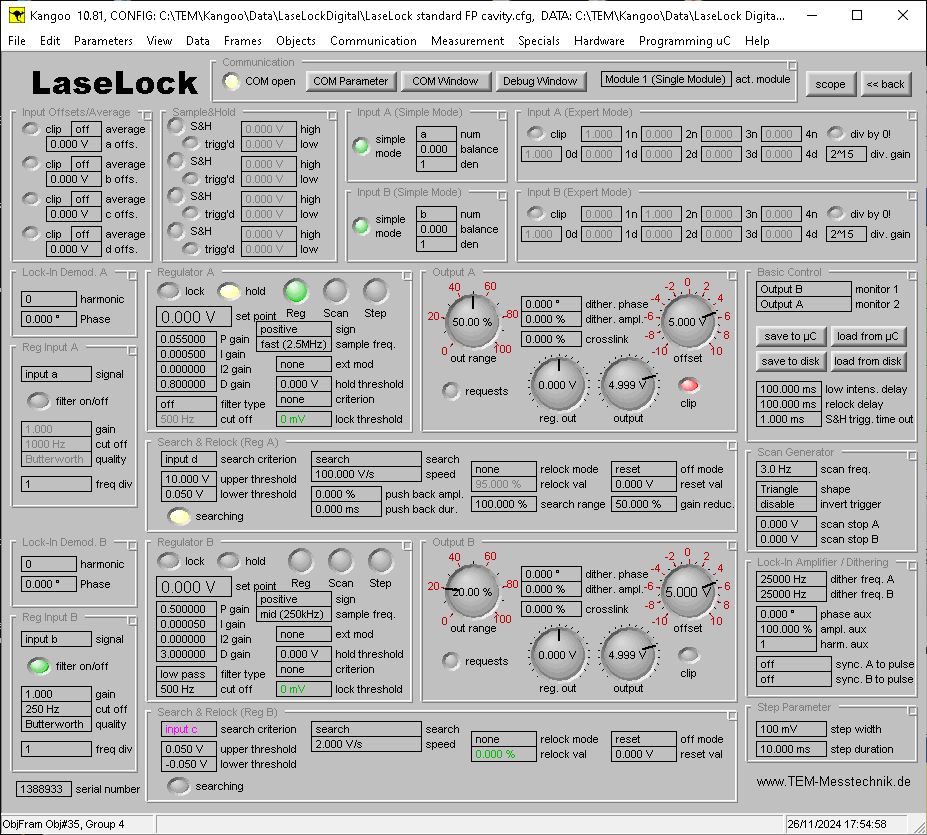
at the end of the day, we got 89kW without walking alignment.
we tried to improve a bit the robustness of the FPC and RF locks:
see the capture for the new locking parameters.
| Ronic Chiche wrote: |
|
the RF frequency changed from 500.1003MHz to 500.0913MHz => it reduced by 9kHz @ 500MHz which is equivalent to 600Hz @ 33MHz (we measured 500Hz @ 33MHz). the electron orbit length increased, so we have to increase the cavities length => increase motor values by ~ 68µm.
for the laser cavity : 1.496 560 mm => 1.564 560 mm
the initial values for the motor of the FP cavity are : MOT.03=-130 000 steps and MOT.06=-900 000 steps.
68µm is roughly 11 000 steps (6nm/step) => MOT.03=-130 000 steps and MOT.06=-889 000 steps.
optimum CEP position : -210.8µm => -192µm
I got 80kW in the FP cavity after CEP and walking alignment
then, 82kW after waiting 3h.
then, 84kW after waiting 5h.
|
|
| Attachment 1: Capture.JPG
|  |
|
384
|
Wed Dec 4 12:26:03 2024 |
Ronic Chiche | Under Process | report | mechanics | lasers and optics | detectors and electronics | ThomX igloo | day by day run for X-ray production | today with Alice, we planned to do a long run with ~80kW in the FPC to check if the lock problems are coming from the interaction with the machine or not.
the goal is to check this assumption on a full day comparable with a day of X-ray production.
we started the amplifier at 10am.
during a move of MaY (injection mirrors of the FPC), we observed a sudden total loss of resonances...
the reason was an abnormal displacement of the motor despite the fact the measured position was reasonable.
we already observed an issue like that....
to fix the problem, one just had to move back MaY.
the cavity started to be locked at 11:15am
the RF frequency has been changed to 500.09595MHz equivalent to 33.33973MHz
but we don't have a beating signal @ 500MHz => one will ask to Vincent to fix the issue.
laser motor CH0 : 1.503453 mm
laser moror CH2 : - 50µm
~ 83kW at 12:30pm
| Ronic Chiche wrote: |
|
at the begining of the day, we started to get ~81kW in the FPC for 33% amplifier ratio and after ~1h, we got 84kW after CEP and alignment tuning.
at the end of the day, we got 89kW without walking alignment.
we tried to improve a bit the robustness of the FPC and RF locks:
see the capture for the new locking parameters.
| Ronic Chiche wrote: |
|
the RF frequency changed from 500.1003MHz to 500.0913MHz => it reduced by 9kHz @ 500MHz which is equivalent to 600Hz @ 33MHz (we measured 500Hz @ 33MHz). the electron orbit length increased, so we have to increase the cavities length => increase motor values by ~ 68µm.
for the laser cavity : 1.496 560 mm => 1.564 560 mm
the initial values for the motor of the FP cavity are : MOT.03=-130 000 steps and MOT.06=-900 000 steps.
68µm is roughly 11 000 steps (6nm/step) => MOT.03=-130 000 steps and MOT.06=-889 000 steps.
optimum CEP position : -210.8µm => -192µm
I got 80kW in the FP cavity after CEP and walking alignment
then, 82kW after waiting 3h.
then, 84kW after waiting 5h.
|
|
|
|
385
|
Wed Dec 4 17:11:50 2024 |
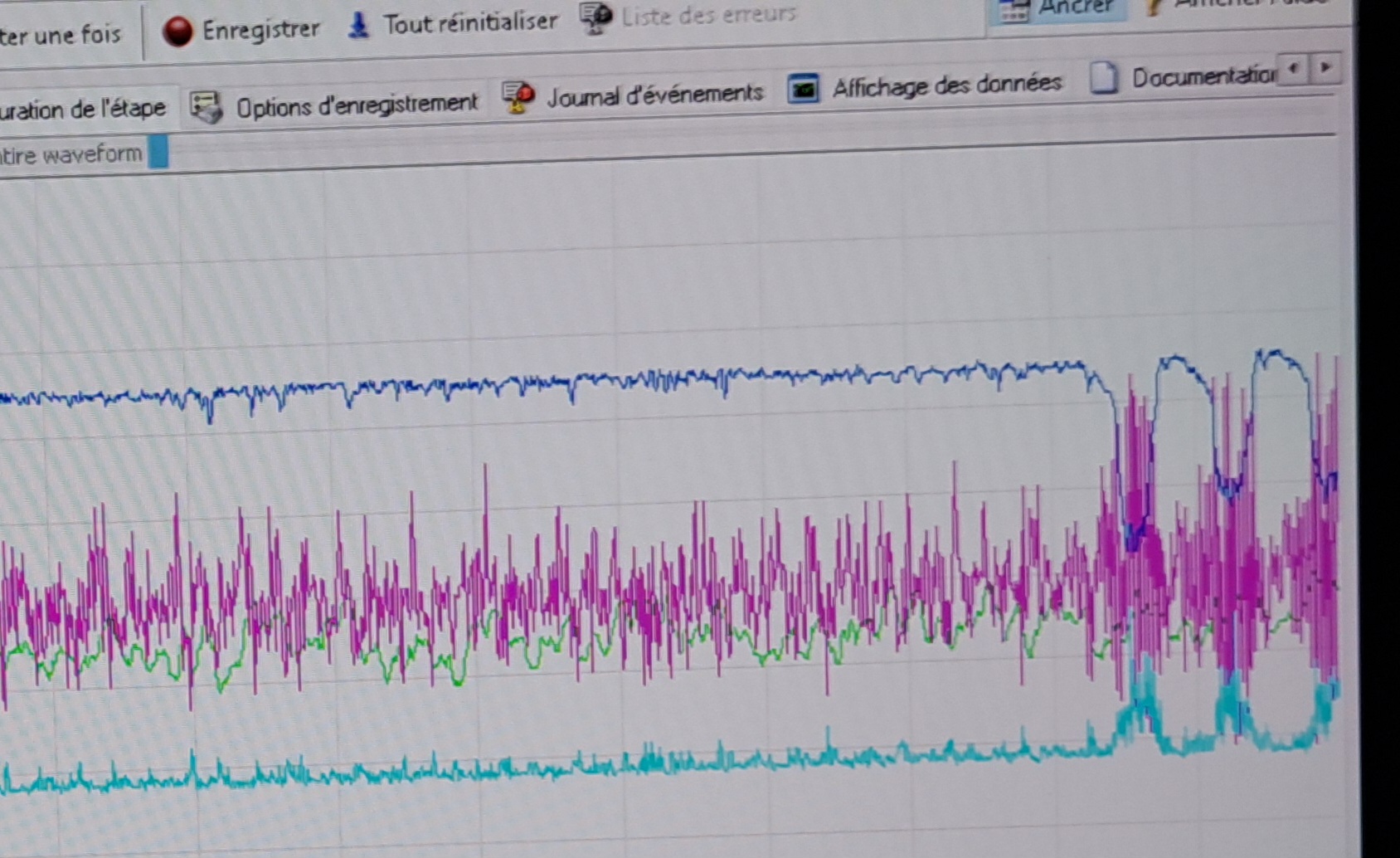
Ronic Chiche | Under Process | report | mechanics | lasers and optics | detectors and electronics | ThomX igloo | day by day run for X-ray production | we observed that :
- the MOT.03 motor always exhibits some perturbations on the transmitted, reflected and PZT signals (see "peaks" in the picture) in contrary to the MOT.06 motor.
does the differences come from the motor relative positions (-900 000 steps for MOT.06 and -100 000 steps for MOT.03) or from the controller configuration ?
- the stability limits (oscillations arise) of the PID for the RF/CFP locks are P = 1 / I = 0.0001 / D = 5
then we put the new PID parameters : P = 0.25 / I = 0.000025 / D = 1
- the 20Hz oscillations are stil arising from time to time
- the lock laser/CFP is pretty robust, one observes more RF/CFP lock losses.
- we removed the 250Hz filter on the RF/CFP error signal to increase the feedback BW but we didn't see a any improvement
- at 5pm, the laser/CFP lock seems as stable as in the morning, then we don't see any change in stability during time.
we loggued CFP power measurement and signals from the cavity (~ 1GB of data)
| Ronic Chiche wrote: |
|
today with Alice, we planned to do a long run with ~80kW in the FPC to check if the lock problems are coming from the interaction with the machine or not.
the goal is to check this assumption on a full day comparable with a day of X-ray production.
we started the amplifier at 10am.
during a move of MaY (injection mirrors of the FPC), we observed a sudden total loss of resonances...
the reason was an abnormal displacement of the motor despite the fact the measured position was reasonable.
we already observed an issue like that....
to fix the problem, one just had to move back MaY.
the cavity started to be locked at 11:15am
the RF frequency has been changed to 500.09595MHz equivalent to 33.33973MHz
but we don't have a beating signal @ 500MHz => one will ask to Vincent to fix the issue.
laser motor CH0 : 1.503453 mm
laser moror CH2 : - 50µm
~ 83kW at 12:30pm
| Ronic Chiche wrote: |
|
at the begining of the day, we started to get ~81kW in the FPC for 33% amplifier ratio and after ~1h, we got 84kW after CEP and alignment tuning.
at the end of the day, we got 89kW without walking alignment.
we tried to improve a bit the robustness of the FPC and RF locks:
see the capture for the new locking parameters.
| Ronic Chiche wrote: |
|
the RF frequency changed from 500.1003MHz to 500.0913MHz => it reduced by 9kHz @ 500MHz which is equivalent to 600Hz @ 33MHz (we measured 500Hz @ 33MHz). the electron orbit length increased, so we have to increase the cavities length => increase motor values by ~ 68µm.
for the laser cavity : 1.496 560 mm => 1.564 560 mm
the initial values for the motor of the FP cavity are : MOT.03=-130 000 steps and MOT.06=-900 000 steps.
68µm is roughly 11 000 steps (6nm/step) => MOT.03=-130 000 steps and MOT.06=-889 000 steps.
optimum CEP position : -210.8µm => -192µm
I got 80kW in the FP cavity after CEP and walking alignment
then, 82kW after waiting 3h.
then, 84kW after waiting 5h.
|
|
|
|
| Attachment 1: 20241204_125955.jpg
|  |
|