| ID |
Date |
Author |
Status |
Type |
Category |
Location |
Title |
|
252
|
Fri Aug 7 11:41:17 2026 |
Ronic Chiche | Under Process | info | mechanics | lasers and optics | cabling | Optical room | Neolase amplifier installation | as soon as I connect the amplifier to the pipes, the flow decreases to 1.7Lpm.
and the filling process is very long and noisy, as there was something blocking the filling process...
| Ronic Chiche wrote: |
|
I cut a small part of the black pipe on the amplifier side (could it be slightly deformed by a try with an other type of adapter ?), with the dedicated tool, changed the adapter and plugged it more firmly in the pipe (pipe deeply inserted in the adapter).
it seems, there is no more leakage.
measured pressure and flow are 0.9 bar and 4.7Lpm => OK without amplifier.
| Ronic Chiche wrote: |
|
now, I installed the long pipes (2x 3m) in closed loop (without the amplifier connected), but the exact ones used to connect the laser, with the same pipe adapters.
after the compression process, the chiller works at 0.9 bar and the measured flow is 4.7Lpm.
so, it's still OK !
after a long time, I observed a small leakage on the "male" adapter on the amplifier side.
| Ronic Chiche wrote: |
|
I drained the chiller to install again the short pipe (< 1m) in closed loop.
then, I filled again the chiller and did the compression process to obtain 1bar.
in that case, the flow measured by the chiller is correct about 5.8Lpm.
PS : the correct length for the previous calculation is 6m (2x 3m) and not 3m...
in that case, the flow should be ~ 15Lpm (and not 22 Lpm)
| )Ronic Chiche wrote: |
|
pipes are maybe too long ?
we can use the Darcy-Weisbach + Blasius laws (non linear laws).
I asked to ChatGPT, Claude, Mistral and MathGPT to solve it with these parameters :
L ~ 3m
D = 1 cm
water at 20°C
dP = 0.7 bar
they all found ~ 22-23L/min
so, the tube length should not be the problem... to be investiguated.
| Ronic Chiche wrote: |
|
now, I connected the chiller circuit to the amplifier, thanks to the adapters.
chiller IN => blue pipe => laser OUT
chiller OUT => black pipe => laser IN
after several filling and compression procedure, the flow is only 1.7Lpm and the pressure is 0.8 bar.
the temperature has been set to 20°C according to the manual operating range 18-23°C.
the flow is too low !
according to the manual, the flow should be 3-5Lpm !
a very small leakage appears if the mechanical constrains on the pipe is too high.
so, I separated the IN and OUT pipes to release this constrain and fixed the pipes to keep the position.
| Ronic Chiche wrote: |
|
we have all the adaptor plugs for connecting the chiller.
so, I tested first the chiller connected in closed loop (on itself).
there is no manual, so procedure is not completely clear...
DO NOT PLUG ANYTHING BEFORE THE CHILLER ASK FOR IT
ONE MUST FOLLOW THE PROCEDURE ON THE CHILLER DISPLAY
1) if the chiller circuit is full of coolant liquid,
one must start by a System Startup -> Draining
(a trash tank and the hose will be need for emptying the circuit)
2) once the chiller circuit is empty
one must continue by System Startup -> Filling
(a clean demineralized water tank and the hose will be need for filling the circuit)
=> OK !
the chiller is able the fill and drain its circuit.
I saw the cooling water circulating in the closed loop.
|
|
|
|
|
|
|
|
251
|
Fri Aug 7 10:59:52 2026 |
Ronic Chiche | Under Process | info | mechanics | lasers and optics | cabling | Optical room | Neolase amplifier installation | I cut a small part of the black pipe on the amplifier side (could it be slightly deformed by a try with an other type of adapter ?), with the dedicated tool, changed the adapter and plugged it more firmly in the pipe (pipe deeply inserted in the adapter).
it seems, there is no more leakage.
measured pressure and flow are 0.9 bar and 4.7Lpm => OK without amplifier.
| Ronic Chiche wrote: |
|
now, I installed the long pipes (2x 3m) in closed loop (without the amplifier connected), but the exact ones used to connect the laser, with the same pipe adapters.
after the compression process, the chiller works at 0.9 bar and the measured flow is 4.7Lpm.
so, it's still OK !
after a long time, I observed a small leakage on the "male" adapter on the amplifier side.
| Ronic Chiche wrote: |
|
I drained the chiller to install again the short pipe (< 1m) in closed loop.
then, I filled again the chiller and did the compression process to obtain 1bar.
in that case, the flow measured by the chiller is correct about 5.8Lpm.
PS : the correct length for the previous calculation is 6m (2x 3m) and not 3m...
in that case, the flow should be ~ 15Lpm (and not 22 Lpm)
| )Ronic Chiche wrote: |
|
pipes are maybe too long ?
we can use the Darcy-Weisbach + Blasius laws (non linear laws).
I asked to ChatGPT, Claude, Mistral and MathGPT to solve it with these parameters :
L ~ 3m
D = 1 cm
water at 20°C
dP = 0.7 bar
they all found ~ 22-23L/min
so, the tube length should not be the problem... to be investiguated.
| Ronic Chiche wrote: |
|
now, I connected the chiller circuit to the amplifier, thanks to the adapters.
chiller IN => blue pipe => laser OUT
chiller OUT => black pipe => laser IN
after several filling and compression procedure, the flow is only 1.7Lpm and the pressure is 0.8 bar.
the temperature has been set to 20°C according to the manual operating range 18-23°C.
the flow is too low !
according to the manual, the flow should be 3-5Lpm !
a very small leakage appears if the mechanical constrains on the pipe is too high.
so, I separated the IN and OUT pipes to release this constrain and fixed the pipes to keep the position.
| Ronic Chiche wrote: |
|
we have all the adaptor plugs for connecting the chiller.
so, I tested first the chiller connected in closed loop (on itself).
there is no manual, so procedure is not completely clear...
DO NOT PLUG ANYTHING BEFORE THE CHILLER ASK FOR IT
ONE MUST FOLLOW THE PROCEDURE ON THE CHILLER DISPLAY
1) if the chiller circuit is full of coolant liquid,
one must start by a System Startup -> Draining
(a trash tank and the hose will be need for emptying the circuit)
2) once the chiller circuit is empty
one must continue by System Startup -> Filling
(a clean demineralized water tank and the hose will be need for filling the circuit)
=> OK !
the chiller is able the fill and drain its circuit.
I saw the cooling water circulating in the closed loop.
|
|
|
|
|
|
|
250
|
Thu Aug 6 15:12:49 2026 |
Ronic Chiche | Under Process | info | mechanics | lasers and optics | cabling | Optical room | Neolase amplifier installation | now, I installed the long pipes (2x 3m) in closed loop (without the amplifier connected), but the exact ones used to connect the laser, with the same pipe adapters.
after the compression process, the chiller works at 0.9 bar and the measured flow is 4.7Lpm.
so, it's still OK !
after a long time, I observed a small leakage on the "male" adapter on the amplifier side.
| Ronic Chiche wrote: |
|
I drained the chiller to install again the short pipe (< 1m) in closed loop.
then, I filled again the chiller and did the compression process to obtain 1bar.
in that case, the flow measured by the chiller is correct about 5.8Lpm.
PS : the correct length for the previous calculation is 6m (2x 3m) and not 3m...
in that case, the flow should be ~ 15Lpm (and not 22 Lpm)
| )Ronic Chiche wrote: |
|
pipes are maybe too long ?
we can use the Darcy-Weisbach + Blasius laws (non linear laws).
I asked to ChatGPT, Claude, Mistral and MathGPT to solve it with these parameters :
L ~ 3m
D = 1 cm
water at 20°C
dP = 0.7 bar
they all found ~ 22-23L/min
so, the tube length should not be the problem... to be investiguated.
| Ronic Chiche wrote: |
|
now, I connected the chiller circuit to the amplifier, thanks to the adapters.
chiller IN => blue pipe => laser OUT
chiller OUT => black pipe => laser IN
after several filling and compression procedure, the flow is only 1.7Lpm and the pressure is 0.8 bar.
the temperature has been set to 20°C according to the manual operating range 18-23°C.
the flow is too low !
according to the manual, the flow should be 3-5Lpm !
a very small leakage appears if the mechanical constrains on the pipe is too high.
so, I separated the IN and OUT pipes to release this constrain and fixed the pipes to keep the position.
| Ronic Chiche wrote: |
|
we have all the adaptor plugs for connecting the chiller.
so, I tested first the chiller connected in closed loop (on itself).
there is no manual, so procedure is not completely clear...
DO NOT PLUG ANYTHING BEFORE THE CHILLER ASK FOR IT
ONE MUST FOLLOW THE PROCEDURE ON THE CHILLER DISPLAY
1) if the chiller circuit is full of coolant liquid,
one must start by a System Startup -> Draining
(a trash tank and the hose will be need for emptying the circuit)
2) once the chiller circuit is empty
one must continue by System Startup -> Filling
(a clean demineralized water tank and the hose will be need for filling the circuit)
=> OK !
the chiller is able the fill and drain its circuit.
I saw the cooling water circulating in the closed loop.
|
|
|
|
|
|
249
|
Thu Aug 6 14:49:32 2026 |
Ronic Chiche | Under Process | info | mechanics | lasers and optics | cabling | Optical room | Neolase amplifier installation | I drained the chiller to install again the short pipe (< 1m) in closed loop.
then, I filled again the chiller and did the compression process to obtain 1bar.
in that case, the flow measured by the chiller is correct about 5.8Lpm.
PS : the correct length for the previous calculation is 6m (2x 3m) and not 3m...
in that case, the flow should be ~ 15Lpm (and not 22 Lpm)
| )Ronic Chiche wrote: |
|
pipes are maybe too long ?
we can use the Darcy-Weisbach + Blasius laws (non linear laws).
I asked to ChatGPT, Claude, Mistral and MathGPT to solve it with these parameters :
L ~ 3m
D = 1 cm
water at 20°C
dP = 0.7 bar
they all found ~ 22-23L/min
so, the tube length should not be the problem... to be investiguated.
| Ronic Chiche wrote: |
|
now, I connected the chiller circuit to the amplifier, thanks to the adapters.
chiller IN => blue pipe => laser OUT
chiller OUT => black pipe => laser IN
after several filling and compression procedure, the flow is only 1.7Lpm and the pressure is 0.8 bar.
the temperature has been set to 20°C according to the manual operating range 18-23°C.
the flow is too low !
according to the manual, the flow should be 3-5Lpm !
a very small leakage appears if the mechanical constrains on the pipe is too high.
so, I separated the IN and OUT pipes to release this constrain and fixed the pipes to keep the position.
| Ronic Chiche wrote: |
|
we have all the adaptor plugs for connecting the chiller.
so, I tested first the chiller connected in closed loop (on itself).
there is no manual, so procedure is not completely clear...
DO NOT PLUG ANYTHING BEFORE THE CHILLER ASK FOR IT
ONE MUST FOLLOW THE PROCEDURE ON THE CHILLER DISPLAY
1) if the chiller circuit is full of coolant liquid,
one must start by a System Startup -> Draining
(a trash tank and the hose will be need for emptying the circuit)
2) once the chiller circuit is empty
one must continue by System Startup -> Filling
(a clean demineralized water tank and the hose will be need for filling the circuit)
=> OK !
the chiller is able the fill and drain its circuit.
I saw the cooling water circulating in the closed loop.
|
|
|
|
|
248
|
Wed Aug 5 13:49:49 2026 |
Ronic Chiche | Under Process | info | mechanics | lasers and optics | cabling | Optical room | Neolase amplifier installation | pipes are maybe too long ?
we can use the Darcy-Weisbach + Blasius laws (non linear laws).
I asked to ChatGPT, Claude, Mistral and MathGPT to solve it with these parameters :
L ~ 3m
D = 1 cm
water at 20°C
dP = 0.7 bar
they all found ~ 22-23L/min
so, the tube length should not be the problem... to be investiguated.
| Ronic Chiche wrote: |
|
now, I connected the chiller circuit to the amplifier, thanks to the adapters.
chiller IN => blue pipe => laser OUT
chiller OUT => black pipe => laser IN
after several filling and compression procedure, the flow is only 1.7Lpm and the pressure is 0.8 bar.
the temperature has been set to 20°C according to the manual operating range 18-23°C.
the flow is too low !
according to the manual, the flow should be 3-5Lpm !
a very small leakage appears if the mechanical constrains on the pipe is too high.
so, I separated the IN and OUT pipes to release this constrain and fixed the pipes to keep the position.
| Ronic Chiche wrote: |
|
we have all the adaptor plugs for connecting the chiller.
so, I tested first the chiller connected in closed loop (on itself).
there is no manual, so procedure is not completely clear...
DO NOT PLUG ANYTHING BEFORE THE CHILLER ASK FOR IT
ONE MUST FOLLOW THE PROCEDURE ON THE CHILLER DISPLAY
1) if the chiller circuit is full of coolant liquid,
one must start by a System Startup -> Draining
(a trash tank and the hose will be need for emptying the circuit)
2) once the chiller circuit is empty
one must continue by System Startup -> Filling
(a clean demineralized water tank and the hose will be need for filling the circuit)
=> OK !
the chiller is able the fill and drain its circuit.
I saw the cooling water circulating in the closed loop.
|
|
|
|
247
|
Wed Aug 5 12:22:52 2026 |
Ronic Chiche | Under Process | info | mechanics | lasers and optics | cabling | Optical room | Neolase amplifier installation | now, I connected the chiller circuit to the amplifier, thanks to the adapters.
chiller IN => blue pipe => laser OUT
chiller OUT => black pipe => laser IN
after several filling and compression procedure, the flow is only 1.7Lpm and the pressure is 0.8 bar.
the temperature has been set to 20°C according to the manual operating range 18-23°C.
the flow is too low !
according to the manual, the flow should be 3-5Lpm !
a very small leakage appears if the mechanical constrains on the pipe is too high.
so, I separated the IN and OUT pipes to release this constrain and fixed the pipes to keep the position.
| Ronic Chiche wrote: |
|
we have all the adaptor plugs for connecting the chiller.
so, I tested first the chiller connected in closed loop (on itself).
there is no manual, so procedure is not completely clear...
DO NOT PLUG ANYTHING BEFORE THE CHILLER ASK FOR IT
ONE MUST FOLLOW THE PROCEDURE ON THE CHILLER DISPLAY
1) if the chiller circuit is full of coolant liquid,
one must start by a System Startup -> Draining
(a trash tank and the hose will be need for emptying the circuit)
2) once the chiller circuit is empty
one must continue by System Startup -> Filling
(a clean demineralized water tank and the hose will be need for filling the circuit)
=> OK !
the chiller is able the fill and drain its circuit.
I saw the cooling water circulating in the closed loop.
|
|
|
246
|
Wed Aug 5 11:25:41 2026 |
Ronic Chiche | Under Process | info | mechanics | lasers and optics | cabling | Optical room | Neolase amplifier installation | we have all the adaptor plugs for connecting the chiller.
so, I tested first the chiller connected in closed loop (on itself).
there is no manual, so procedure is not completely clear...
DO NOT PLUG ANYTHING BEFORE THE CHILLER ASK FOR IT
ONE MUST FOLLOW THE PROCEDURE ON THE CHILLER DISPLAY
1) if the chiller circuit is full of coolant liquid,
one must start by a System Startup -> Draining
(a trash tank and the hose will be need for emptying the circuit)
2) once the chiller circuit is empty
one must continue by System Startup -> Filling
(a clean demineralized water tank and the hose will be need for filling the circuit)
=> OK !
the chiller is able the fill and drain its circuit.
I saw the cooling water circulating in the closed loop.
|
|
245
|
Wed Sep 10 11:27:45 2025 |
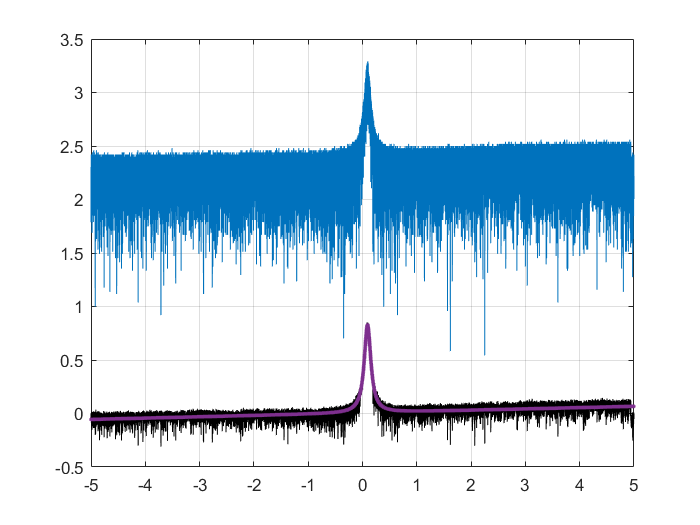
Alice Renaux | Under Process | report | lasers and optics | Optical room | new cavity | The 2-mirrors cavity has 460ppm of transmission for M1 and 10ppm for M2 which should exhibit a Finesse around 13400.
Today, we managed to lock the NKT laser (with an AOM for fast feedback) onto the cavity, and we made 5 Finesse measurements with the modulation technic : 14151, 13847, 13968, 14604, 13892 with an average around 14000 => LW = 216MHz/F ~ 16kHz.
On the plot (Frequency span 1MHz <=> Time span 10s)
blue curve : raw data
black curve : cleaned data
red curve : fitted data
| Alice Renaux wrote: |
|
Yesterday, we changed the M1 mirror to a 161185 Gamma Factory mirror of transmission 460ppm, the cavity finesse is now 13360.
We managed to lock it today.
|
|
| Attachment 1: Finesse.png
|  |
|
244
|
Tue Sep 9 21:23:11 2025 |
Alice Renaux | Under Process | report | lasers and optics | Optical room | new cavity | Yesterday, we changed the M1 mirror to a 161185 Gamma Factory mirror of transmission 460ppm, the cavity finesse is now 13360.
We managed to lock it today. |
|
243
|
Thu Sep 4 17:56:50 2025 |
Alice Renaux | Under Process | report | lasers and optics | Optical room | Finesse measurement | (Finesse 2651 is consistent with that obtained from the mirrors' transmission coefficients, which is about 3100.)
| Alice Renaux wrote: |
|
Today, with Ronic, we measured the finesse of the 2-mirror cavity witht the NKT CW laser.
We were able to perfrom the measurement only once, and the results of the measurement are attached to this note. We added sidebands to the laser spectrum peak thanks to an EOM, and we sweeped the modulation frequency on a 1MHz span around an estimated FSR of 216.63MHz in 10s. We found a 82kHz linewidth, hence a finesse of 2651.
|
|
|
242
|
Thu Sep 4 17:52:03 2025 |
Alice Renaux | Under Process | report | lasers and optics | Optical room | Finesse measurement | Today, with Ronic, we measured the finesse of the 2-mirror cavity witht the NKT CW laser.
We were able to perfrom the measurement only once, and the results of the measurement are attached to this note. We added sidebands to the laser spectrum peak thanks to an EOM, and we sweeped the modulation frequency on a 1MHz span around an estimated FSR of 216.63MHz in 10s. We found a 82kHz linewidth, hence a finesse of 2651. |
| Attachment 1: Figure_3.png
|  |
|
241
|
Thu Sep 4 17:35:50 2025 |
Ronic Chiche | Fixed | info | lasers and optics | detectors and electronics | Optical room | Installation of the avalanche photodiode | After installing the 2nd EOM, we had some trouble to be able to lock again.
One possible reason was the very low signal level in transmission, which is important to trigger the locking system (and stop it).
See the Alice post for details, but we were able to measure only once the Finesse of the cavity at around 2600.
After the Finesse measurement, we opened the box to change the M1 mirror... so the box is at ambient pressure now.
I took back the avalanche photodiode from the Minicav room and installed it on the setup to replace the FPC transmission photodiode.
Now, the transmission peaks are at the 1V level, and it's very easy to trigger on...
The system locked very easily, even without being under vacuum.
It will help if we need to inject very low power laser (e.g. OEwaves after 2x EOM and AOM).
|
|
240
|
Wed Sep 3 18:10:34 2025 |
Alice Renaux | Under Process | report | lasers and optics | Optical room | Successful lock (finally !) | Today, with Ronic, we managed to get a successful lock with the NKT laser by setting up a new PDH box from scratch (photodiode + amplifer + mixer).
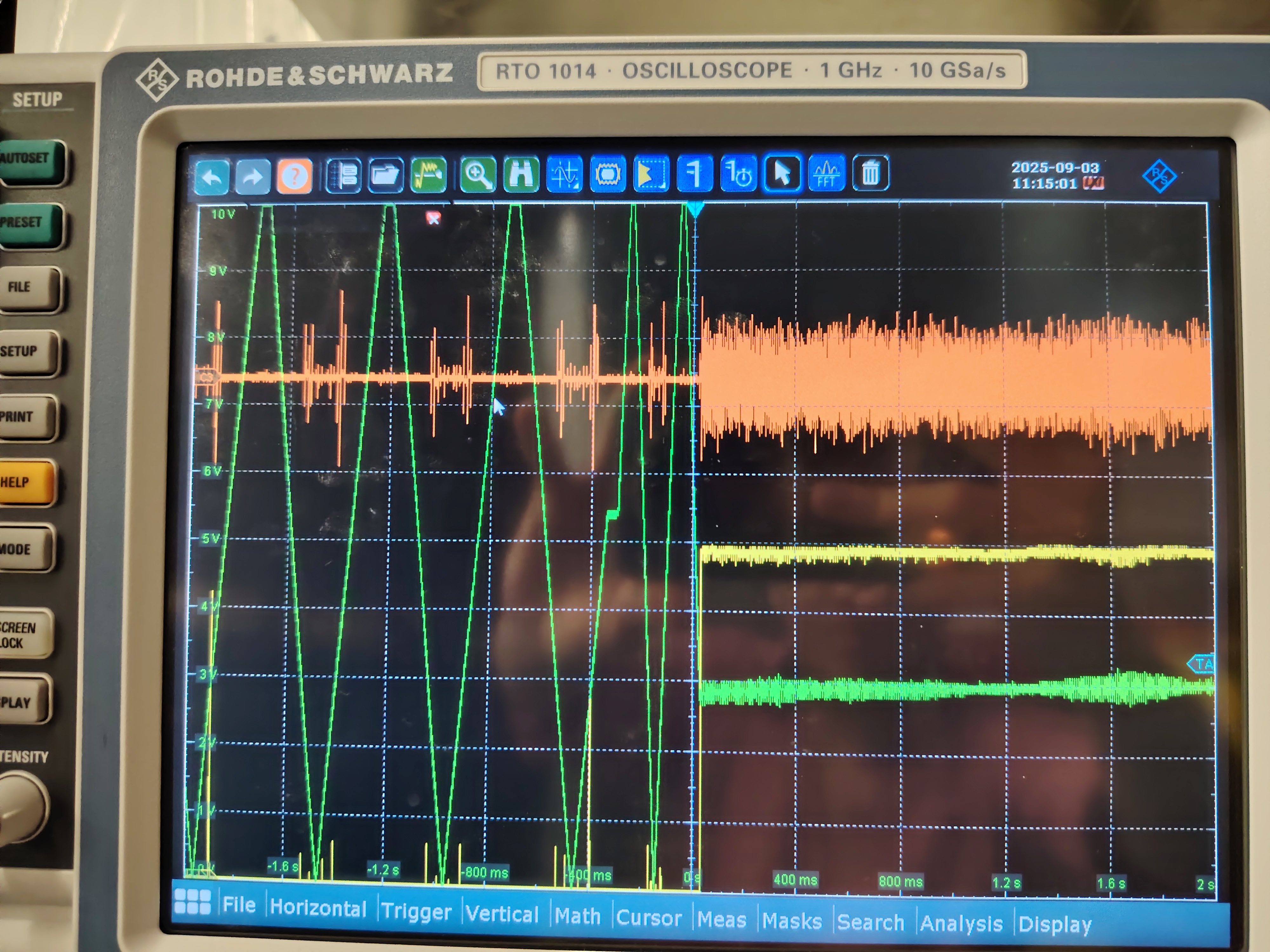
Me measured the injected power (5.4mW) and the transmitted power (33µW) after a wedge (92% transmission) and a 7ppm transmission mirror, so the intracavity power was 5.1W. We have a 950 enhancement factor for a 3100 finesse cavity, so a nominal enhancement factor of 2500. The lock was very stable, as shown in the attached picture (yellow signal is the transmitted power, orange signal is the error signal and green signal is the voltage sent from the Laselock module to the pizeoelectric actuator of the NKT laser cavity).
Then, we added a second EOM in order to perform a finesse measurement, but we weren't able to inject more than 3mW at full laser power in the cavity or to lock the laser onto the cavity. |
| Attachment 1: IMG_20250903_113758.jpg
|  |
|
239
|
Thu Aug 28 15:29:00 2025 |
Alice Renaux | Under Process | report | lasers and optics | Optical room | 2-mirror cavity locking | In June, we encountered some problems regarding the transmission and error signals (see images here), looking as if the laser was switched off before the cavity was filled.
Aurélien, Ronic and I discussed this on 08/27, resulting in a list of tests to perform. We :
- checked the mirrors' thickness (maybe there was some mechanical stress if they were too thick). The mirrors' thickness is 6.35mm (1/4 inch) and is consistent with the mounts size ;
- checked the mirrors' mounts' screws' tightening (maybe the mirrors were either moving if the screws were not tight enough or some mechanical stress if they were too tight). We tightened the mirrors' mounts' upper screws.
Next thing we did with Ronic was check if the error signal depended on the modulation/demodulation relative phase, which was not the case, but it should have.
Ronic added a quarter waveplate before the half waveplate in the injection system.
Today, on 08/29, the succession of the higher-order transverse modes when scanning the seeder laser's piezoelectric actuator's voltage to scan the seeder laser's optical frequency seemed a bit strange, so we checked the resonance frequencies of several occurrences of the same transverse mode :
- (0, 0) : @ -0.4V and 6.0V ;
- (1, 0) and (0, 1) : @0.5V and 6.9V.
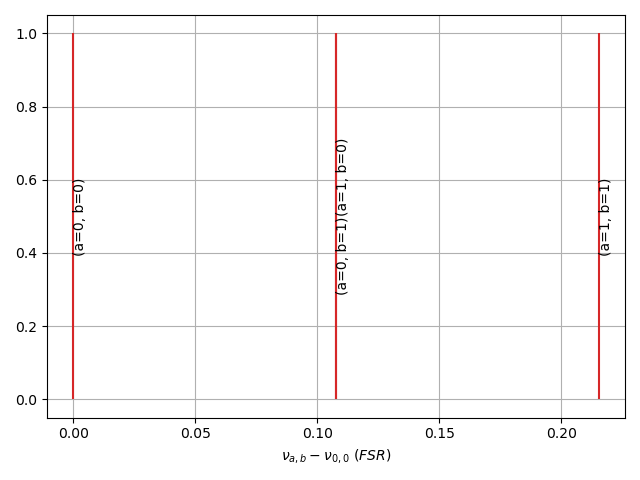
In both cases, several occurrences were separated by about 6.4V, which corresponds to the voltage difference to scan a full FSR. The spacing between (0, 0) and (1, 0)/(0, 1) is then about 0.14*FSR.
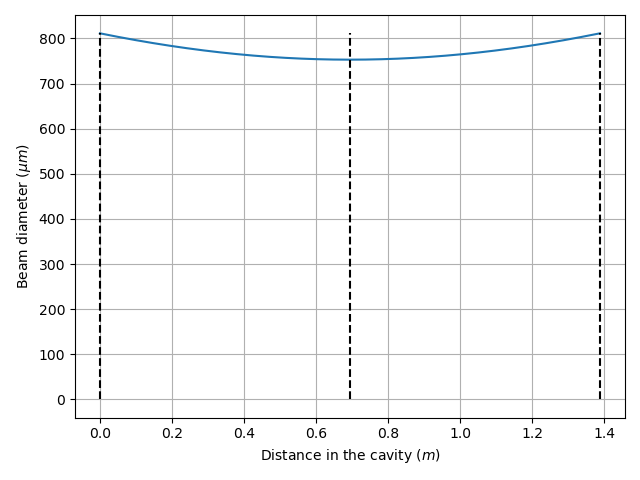
I checked this by writing a small piece of Python code to calculate the cavity's fundamental transverse mode and its Rayleigh length, which is displayed in Figure 1, and then by calculating the resonance frequencies wrt the (0, 0) resonance frequency for the (1, 0), (0, 1) and (1, 1) transverse modes, which is displayed in Figure 2, with the following formula: $\nu_{p, n, m}=(p+\frac{(n+\frac{1}{2})\arctan(\frac{2L_{\text{cav}}}{z_{\text{R}}})+(m+\frac{1}{2})\arctan(\frac{2L_{\text{cav}}}{z_{\text{R}}})}{2\pi})\times\text{FSR}$ for a $p$ longitudinal and ($n$, $m$) transverse mode. Here, $p=1$. The spacing betwen (0, 0) and (1, 0)/(0, 1) is about 0.11*FSR, making the previous observation consistent with the calculation. Everything seems normal.
Ronic also increased the EOM modulation voltage, increasing the modulation depth for the generation of the error signal (from 100mV RMS to 300mV RMS), making the error signal depend on the modulation/demodulation relative phase, as it should. He managed to lock the laser onto the cavity for about 1s at a time.
Next steps are to optimize the PID parameters and to add a low-pass filter/AOM to cut the higher frequencies off and improve the feedback loop. |
| Attachment 1: Figure_1.png
|  |
| Attachment 2: Figure_2.png
|  |
|
238
|
Mon Jun 23 14:38:33 2025 |
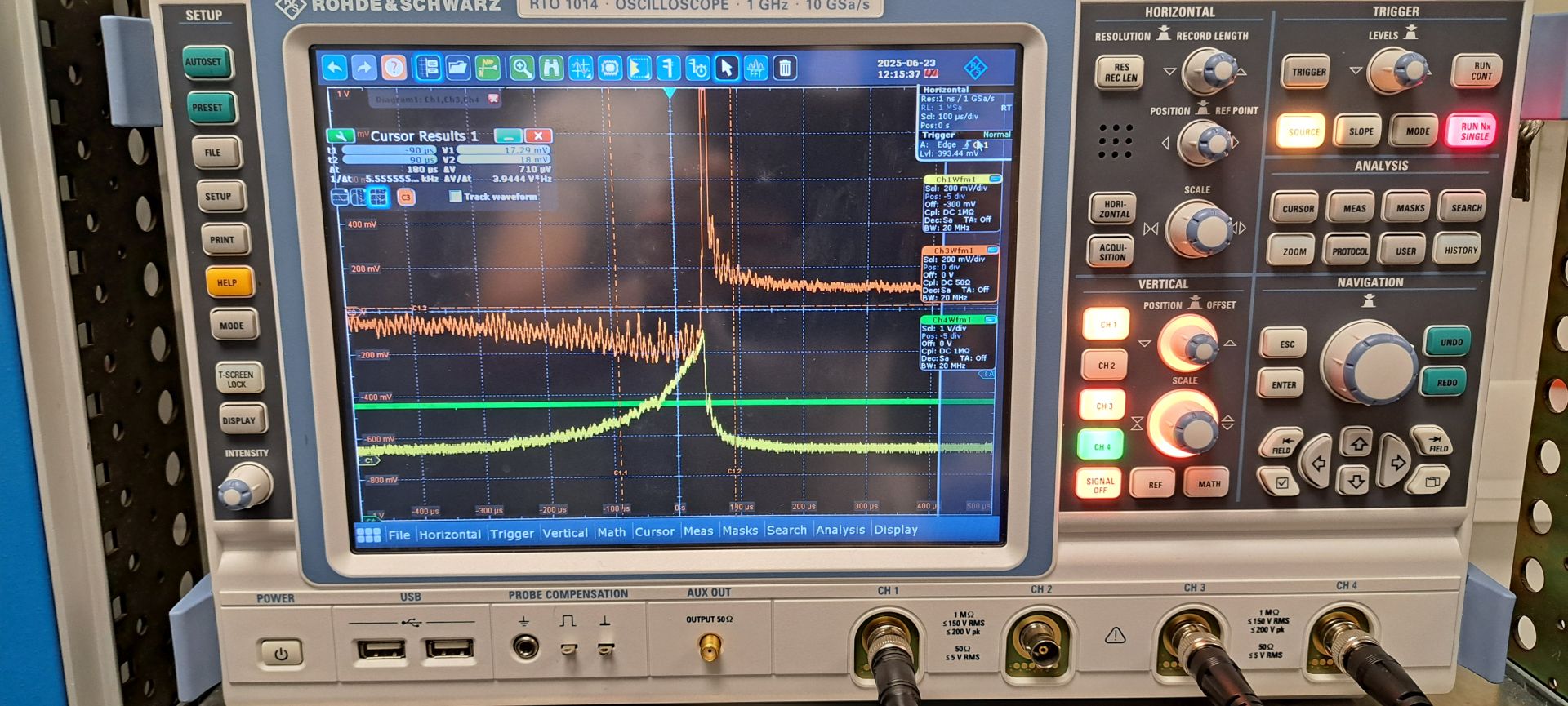
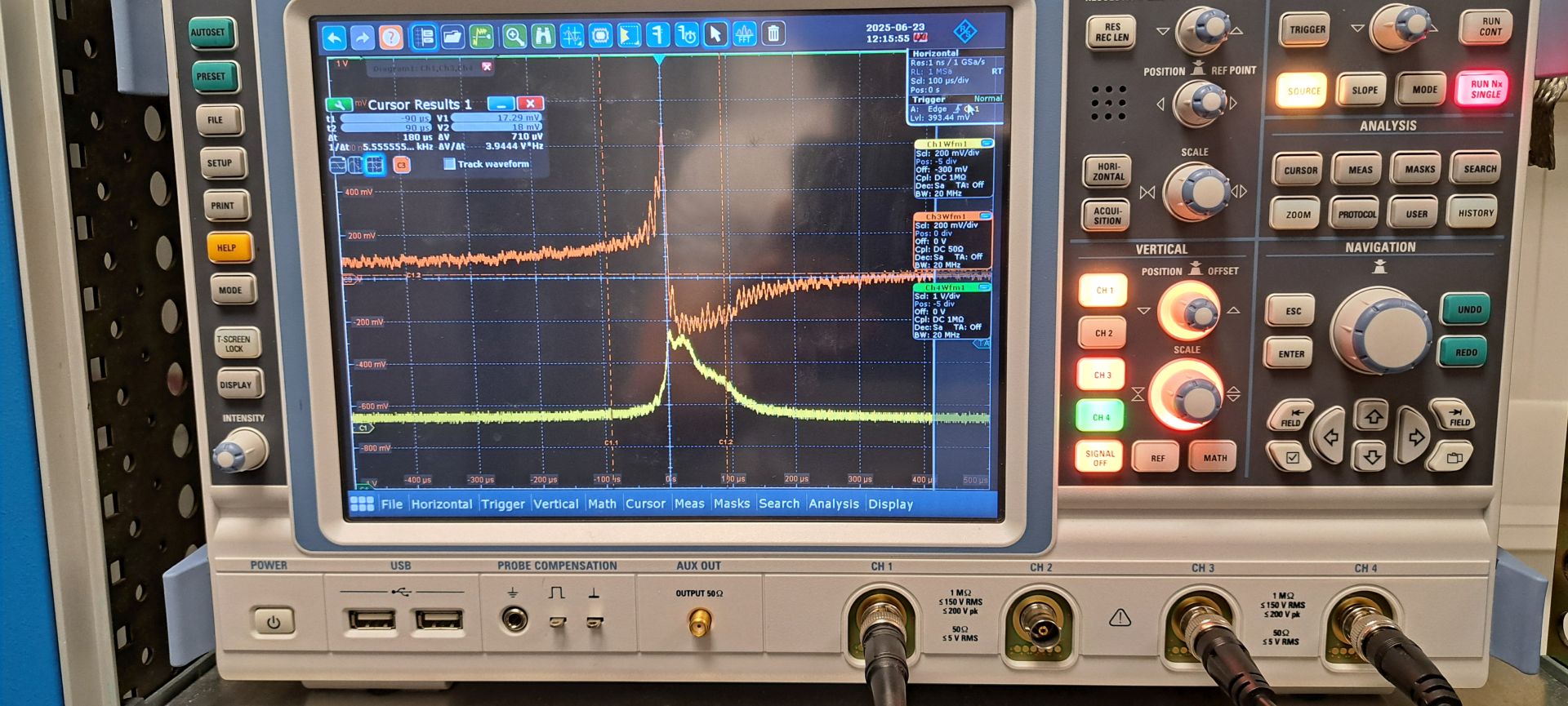
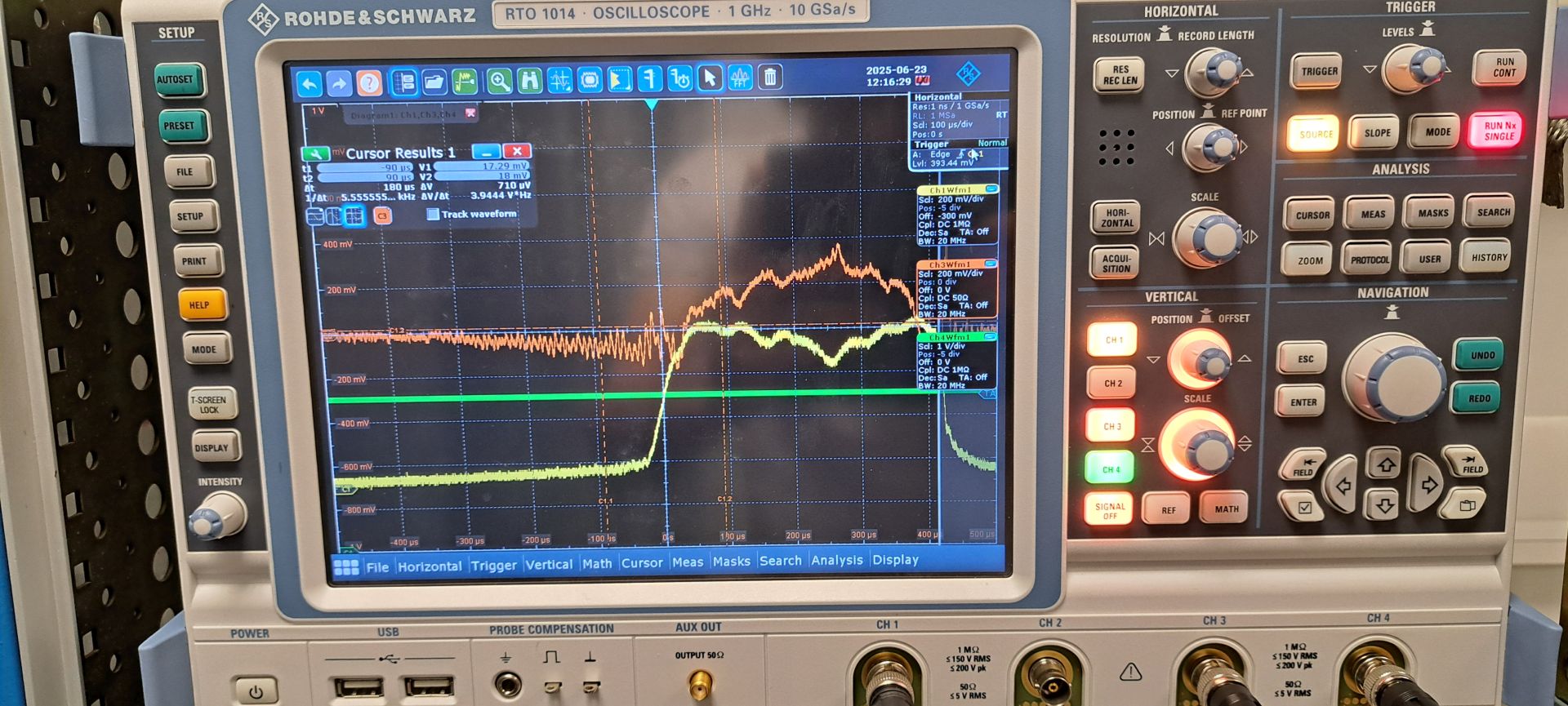
Ronic Chiche | Under Process | issue | mechanics | lasers and optics | detectors and electronics | Optical room | first attempt to lock | With Alice, we installed the EOWaves oscillator to be locked on the FP-cavity (T1 ~ 2500ppm, T2 ~ 10ppm => F ~ 2500)
FSR = 216MHz => LW = 86kHz.
We installed the PDH box, and we got some error signal, but the shape of the transmission signal and error signal is a bit strange...
It grows smoothly, and when the power is large enough, one can see a sudden and fast drop.
Could it be some mechanical problem with the mirrors' mounts ?
I opened the SBOX this morning to do some inspection, and the mirrors seem properly installed in the mounts.
In some rare cases (last picture), the "instability" effect is not dominant, and we are able to maintain a quasi-lock during some 1- 2ms.
But it is still impossible to lock the cavity.
(We did a test with a vacuum in the SBOX at ~2mbar, but the problem is the same.) |
| Attachment 1: 20250623_123816.jpg
|  |
| Attachment 2: 20250623_123833.jpg
|  |
| Attachment 3: 20250623_123908.jpg
|  |
|
237
|
Fri Jun 13 20:10:00 2025 |
Alice Renaux | Fixed | report | lasers and optics | Optical room | Damaged mirrors test | Today with Dorian we tested three mirrors with which we previously haven't been able to obtain any resonance or optical beating :
- C16111/11 : The mirror looks normal under a microscope, apart from a few inclusions and maybe a small scratch towards the edge. We tested it with a 161186 M1 mirror and we weren't able to obtain any optical beating on the cavity's mirrors or resonance.
- 161185 (1) : The mirror looks normal with the naked eye. We tested it with a 161182 M2 mirror and we were able to notice some optical beating on the cavity's mirrors as well as small resonance peaks and a higher-order transverse mode.
- 161185 (2) : The mirror shows some damage on the substrate side (not the coated side). We tested it with a 161186 M2 mirror and we were able to notice some optical beating on the cavity's mirrors as well as huge resonance peaks and a Gaussian transverse mode.
The updated recap file is available here, as well as a few pictures. |
|
236
|
Wed May 28 18:27:27 2025 |
Alice Renaux | Under Process | report | lasers and optics | Optical room | 2-mirror cavity full setup | Today with Ronic, we changed the FP cavity's mirrors to Layertek (Gamma Factory) mirrors :
- M1 : n°161186 --> fused silica, unknown absorption, unknown diffusion, T1=2500ppm transmission planar mirror ;
- M2 : n°161182 --> fused silica, unknown absorption, unknown diffusion, T2=10ppm transmission, 5m ROC mirror.
RTL (round-trip losses) ~ 2500 + 10 ppm (we forget the unknown parameters for absorption and diffusion).
The maximal finesse we could expect is thus F=π([(1-T1)(1-T2)]^(1/4))/(1-[(1-T1)(1-2)]^(1/2)) ~ 2*pi /RTL ≈ 2500 assuming no absorption and no scattering.
The FP cavity's FSR is ≈ 216 MHz given its length.
We managed to see some optical beating on the FP cavity's mirrors and to reach the fundamental transverse mode of the FP cavity by adjusting the injection mirrors, but when scanning the laser's wavelength, some higher-order modes appear and the fundamental mode is reached when the voltage applied to the piezoelectric actuator of the laser's cavity is ≈0V. The actuator is not meant to work with negative voltages, so we translated one of the FP cavity's mirrors so that the fundamental transverse mode's resonance frequency is in the middle of the voltage range.
We also removed the D-shaped mirrors, as they are only useful when working with high power. |
|
235
|
Wed May 28 10:55:15 2025 |
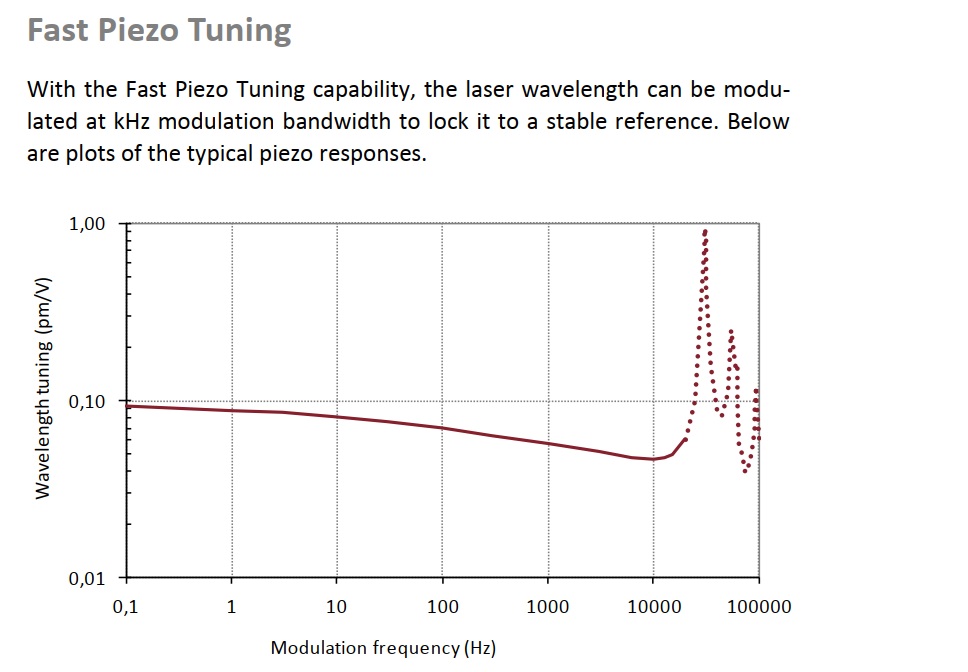
Alice Renaux | Under Process | report | lasers and optics | Optical room | 2-mirror cavity alignment | The NKT laser PZT sensitivity is ~0.09pm/V of wavelength variation, which is equivalent to ~ 25MHz/V
So, the full range of the scan is roughly 250MHz (more than a FSR) for 10V.
It seems impossible to get such large resonances unless the Finesse is very low => let's try to change M1 by a spare GammaFactory plan or 10m ROC mirror.
| Alice Renaux wrote: |
|
Yesterday and today, I replaced the OEWaves CW laser with the NKT CW laser. Its screen does not display anything, so it has to be operated through the GraphiK software.
I then re-aligned the cavity with a new adjustment adaptation tool between the mirror mounts and the irises.
The motor positions are :
- 1 : 3.354420 mm
- 3 : 2.128850 mm
- 4 : 3.468480 mm
- 5 : 3.157300 mm
I then connected the LaseLock module to scan the NKT laser wavelength on a roughly 0-10 V range at a 2Hz rate, so that it could match the cavity's resonance frequency.
Without optimizing the injection, I monitored the transmitted power with a photodiode paired with an amplifier. The pictures are available through this link : https://box.in2p3.fr/s/TGgwkKgYik7MyqW, and an example picture is attached. Their timestamp is in their filenames, and it seems that the transmission varies quite a lot on a ≈10 s scale, and these variations seem to be periodic on a ≈1 minute scale. The peaks seem weirdly wide, almost up to 100-200 MHz (≈FSR).
|
|
| Attachment 1: Sans_titre.jpg
|  |
|
234
|
Tue May 27 18:12:22 2025 |
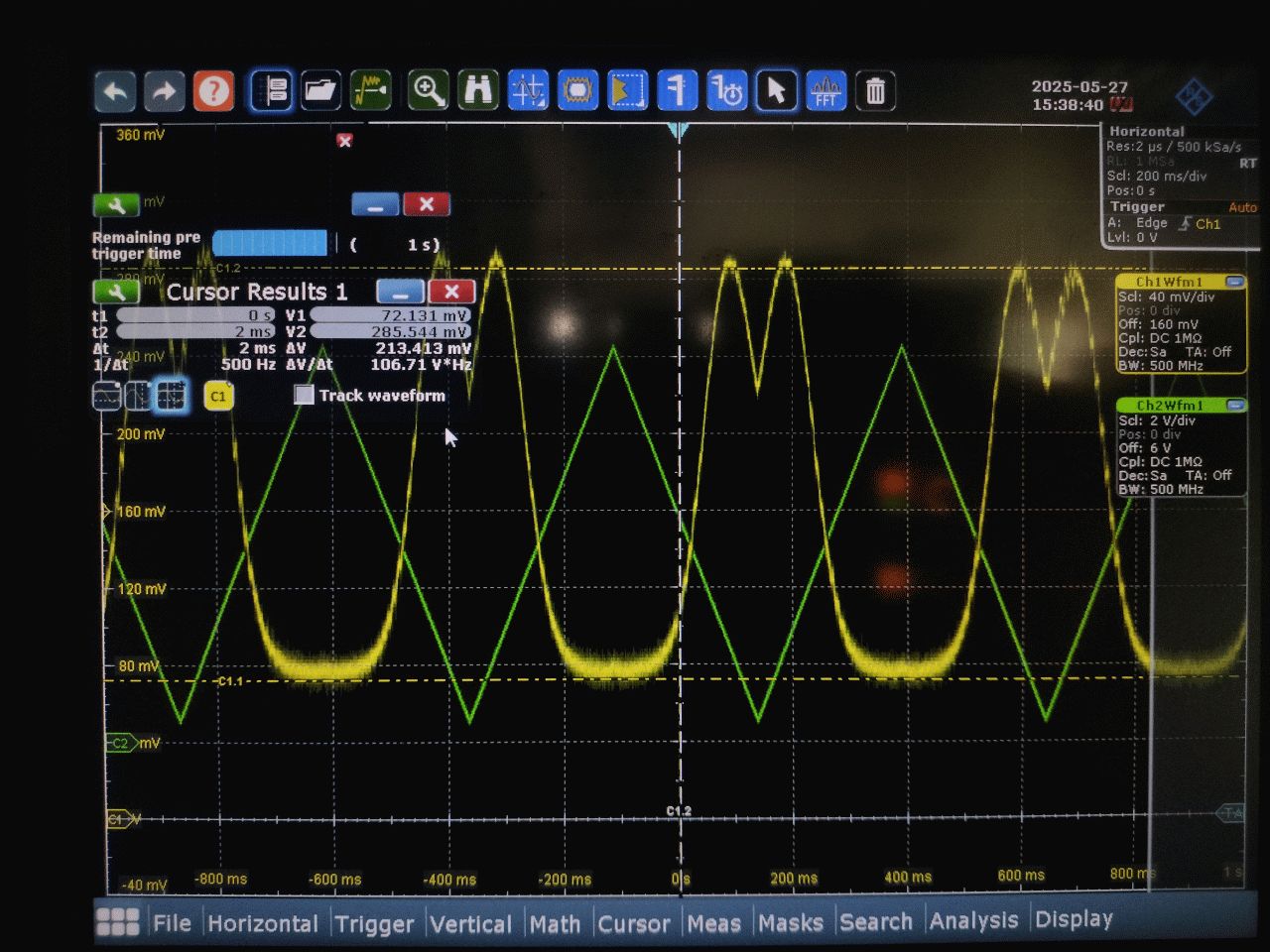
Alice Renaux | Under Process | report | lasers and optics | Optical room | 2-mirror cavity alignment | Yesterday and today, I replaced the OEWaves CW laser with the NKT CW laser. Its screen does not display anything, so it has to be operated through the GraphiK software.
I then re-aligned the cavity with a new adjustment adaptation tool between the mirror mounts and the irises.
The motor positions are :
- 1 : 3.354420 mm
- 3 : 2.128850 mm
- 4 : 3.468480 mm
- 5 : 3.157300 mm
I then connected the LaseLock module to scan the NKT laser wavelength on a roughly 0-10 V range at a 2Hz rate, so that it could match the cavity's resonance frequency.
Without optimizing the injection, I monitored the transmitted power with a photodiode paired with an amplifier. The pictures are available through this link : https://box.in2p3.fr/s/TGgwkKgYik7MyqW, and an example picture is attached. Their timestamp is in their filenames, and it seems that the transmission varies quite a lot on a ≈10 s scale, and these variations seem to be periodic on a ≈1 minute scale. The peaks seem weirdly wide, almost up to 100-200 MHz (≈FSR). |
| Attachment 1: IMG20250527160111.jpg
|  |
|
233
|
Fri Mar 21 18:27:36 2025 |
Alice Renaux | Under Process | report | mechanics | lasers and optics | Optical room | 2-mirror cavity alignment | At the beginning of the week, I installed a half-wave plate, a beamsplitter cube and a quarter-wave plate, as well as the end-of-cavity mirror, which I unsuccessfully tried to align.
I removed the end-of-cavity mirror and started the laser injection over again with the two motorized mirrors placed in front of the vacuum chamber (but left Ronic's setup as it was).
Today, I aligned the laser by putting an iris on the cavity mirrors' mounts. I tested the repeatability of such a setup, both by removing and putting back the same iris and by using a different iris. The result is in the attached pictures. Is it good enough ?
The mirrors' motors positions are :
- 1 : 3.349670 mm ;
- 3 : 2.060280 mm ;
- 4 : 3.484560 mm ;
- 5 : 3.269710 mm.
|
| Attachment 1: 2-mirror_cavity_alignment.zip
|
|