| ID |
Date |
Author |
Status |
Type |
Category |
Location |
Title |
|
9
|
Thu Apr 29 06:14:09 2021 |
Manar Amer | Fixed | report | lasers and optics | Other | Mode observed and cavity Lock |
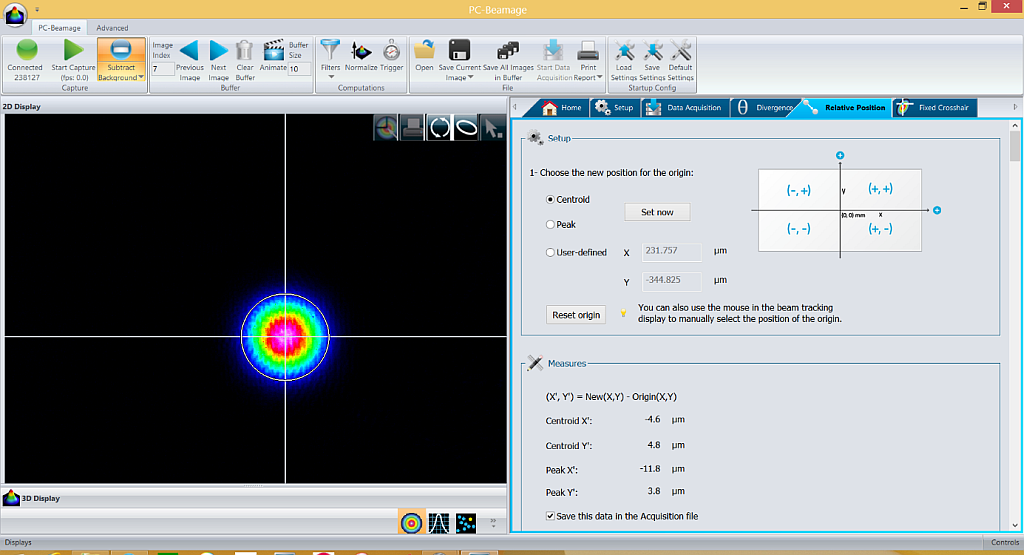
** Following up from yesterday an observation about the TM00 mode : it has been seen with similar dimensions and its position is the same, this was before restarting the temperature regulator.
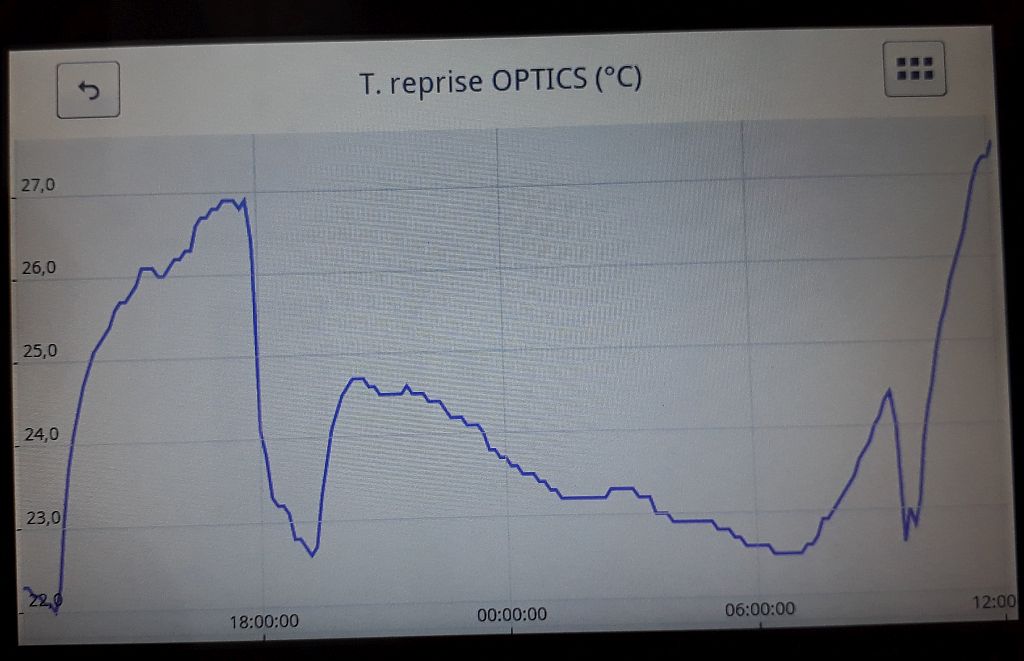
--> after restarting the temp. regulator there was a slight shift in the position (likely it is caused by the temperature variation, a temperature graph for during the morning is attached)
** Coupling of the cavity and koheras is observed (photo attached)
** Error curve measurement to be done.
- What we used before to do a frequency scan and lock the cavity was a function generator and an amplifier
- There is noise from the amplifier causing the sweep to pass through the cavity frequencies a lot.
- we shift to using LaseLock, it gives a very clean sweep ( a clean sweep meaning we have a resistance at the output of laselock combined with the capacitance in the Piezo input behind the koheras, this gives the time constant which affects the signal shape)
- Changes in the temperature of the koheras affects its wavelength and in turn the mode resonates in the cavity.
- note** when the mode is at the top peak of the sweep (Piezo ) meaning we are observing the resonance at the ends of the sweep, we increase the temperature of the laser very slightly to shit the sweep a little ( temp increase ~ 0.010 c , very small increase step by step )
- For observing the Mode Lock of the cavity, there are a few points to be aware of :
- Coupling Frequency -----{convention represented in blue curve}
- The reflection from the mirror M1 (cavity reflection) -----{convention represented in yellow curve}
- The transmission from the nirrors M2,M3,M4 ( what is resonating in the cavity) -----{convention represented in green curve}
- :When the laser is in resonance with the cavity "locked" the reflection decreases and power is stored momentarily in the cavity meaning the transmission increase that is why when the cavity is locked we see a decrease in the reflection (yellow curve) and at the same moment an increase in the cavity transmission (green curve)
- To be done : do a measurement of the error signal curve, what is needed :
- the reflected beam (split it into two ) -- one for coupling measurement done before and the other for the error signal curve
- PDH -- photodiode with bandwidth amplifier
- Function generator
- EOM
- ...
| Manar Amer wrote: |
|
Following the Helium Neon Alignment + change in the distance between the mirrors to be; M3-M4 = 90.5 mm , M1-M2 = 80.2 mm -→ The alignment using the Koheras CW laser is done.
- Additional components used:
- for monitoring beam : Photodiode (power of beam), Beam Profiler (shape, position, power , ... )
- for Koheras frequency scan: function generator, Amplifier or use lase-lock (had some issues to be checked)
- Telescope: made using 1 m focal length to match the beam shape of the cavity
- Observed during:
- The alignment is fairly similar to the previous one, placed two irises to preserve it.
- Fundamental mode observed (beam profiler after M2) was circular
- when the frequency scan was fine-tuned around the fundamental mode we could see the mode pulsing in the cavity, but there was a bit of instability.
- when doing a very wide frequency scan (50 V ~ 1.5 GHz), multiple modes where showing inside the cavity
Photos attached show:
- some resonating modes in the cavity
- Fundamental mode resonating in the cavity, with its properties (2D shape, 1D shape, position) ** The picture is taken after subtracting the background **
- from 2D it is very circular
- from 1D it is confirmed to be circular (715.00 um - 704.00 um)
- From position, we have a reference to compare with tomorrow morning.
- Diffraction that can be observed in the cavity (you can clearly see the edges of the mirrors in the photo)
- The temperature curve is attached for the duration of the exp. (before starting Ronic switched something off and then put it on !!!!!! it seems to be for temp regulation )
** Notes for tomorrow morning : first : switch on the laser and check if the beam 00 mode is still observed and check its position
this is to see the stability and the effect of the temperature.
|
|
| Attachment 1: 20212804_Fundamental_mode_in_cavity_2D_-_Position.png
|
 |
| Attachment 2: 20212804_Cavity_Coupling_with_Koheras.jpg
|
 |
| Attachment 3: 20212804_Temperature_Curve.jpg
|
 |
|
8
|
Tue Apr 27 13:57:15 2021 |
Manar Amer | Fixed | report | lasers and optics | Other | Alignment using Koheras |
Following the Helium Neon Alignment + change in the distance between the mirrors to be; M3-M4 = 90.5 mm , M1-M2 = 80.2 mm -→ The alignment using the Koheras CW laser is done.
- Additional components used:
- for monitoring beam : Photodiode (power of beam), Beam Profiler (shape, position, power , ... )
- for Koheras frequency scan: function generator, Amplifier or use lase-lock (had some issues to be checked)
- Telescope: made using 1 m focal length to match the beam shape of the cavity
- Observed during:
- The alignment is fairly similar to the previous one, placed two irises to preserve it.
- Fundamental mode observed (beam profiler after M2) was circular
- when the frequency scan was fine-tuned around the fundamental mode we could see the mode pulsing in the cavity, but there was a bit of instability.
- when doing a very wide frequency scan (50 V ~ 1.5 GHz), multiple modes where showing inside the cavity
Photos attached show:
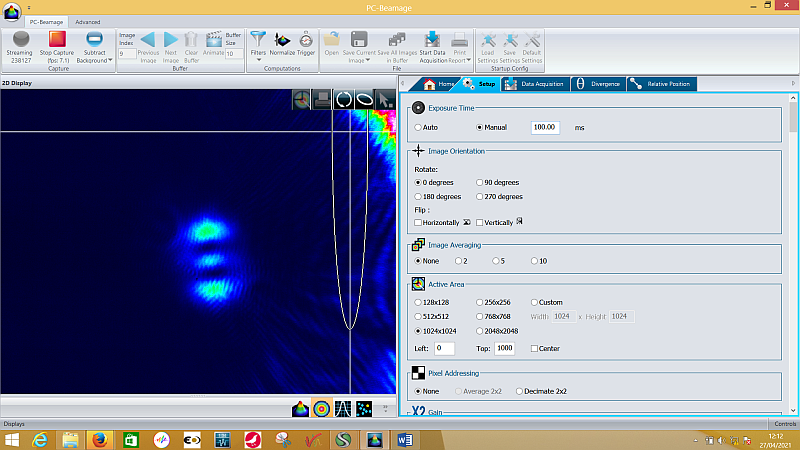
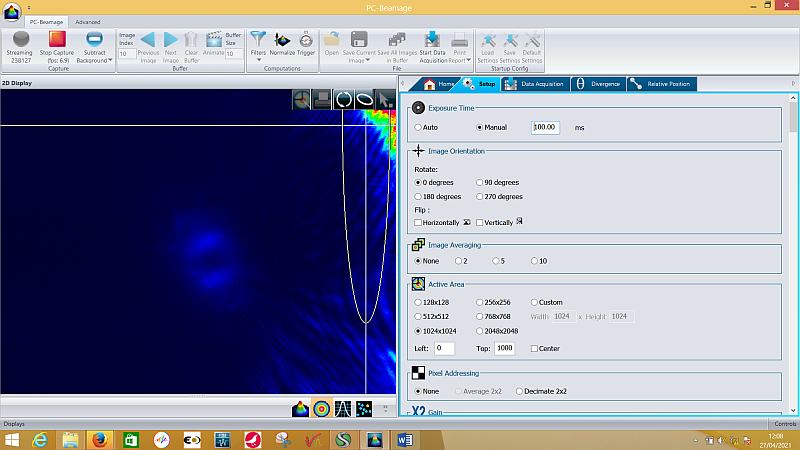
- some resonating modes in the cavity
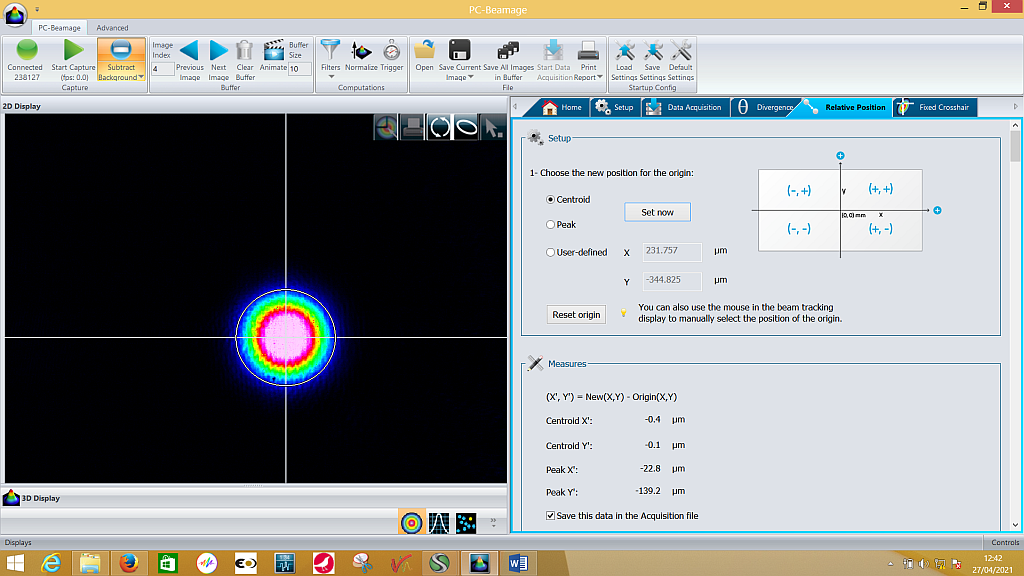
- Fundamental mode resonating in the cavity, with its properties (2D shape, 1D shape, position) ** The picture is taken after subtracting the background **
- from 2D it is very circular
- from 1D it is confirmed to be circular (715.00 um - 704.00 um)
- From position, we have a reference to compare with tomorrow morning.
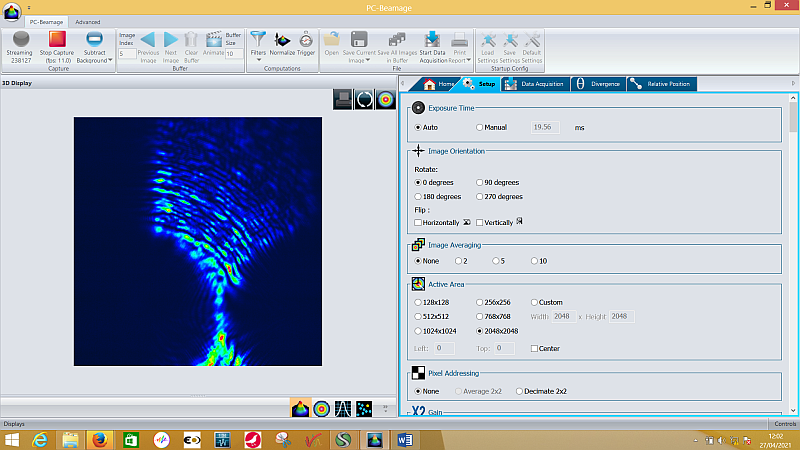
- Diffraction that can be observed in the cavity (you can clearly see the edges of the mirrors in the photo)
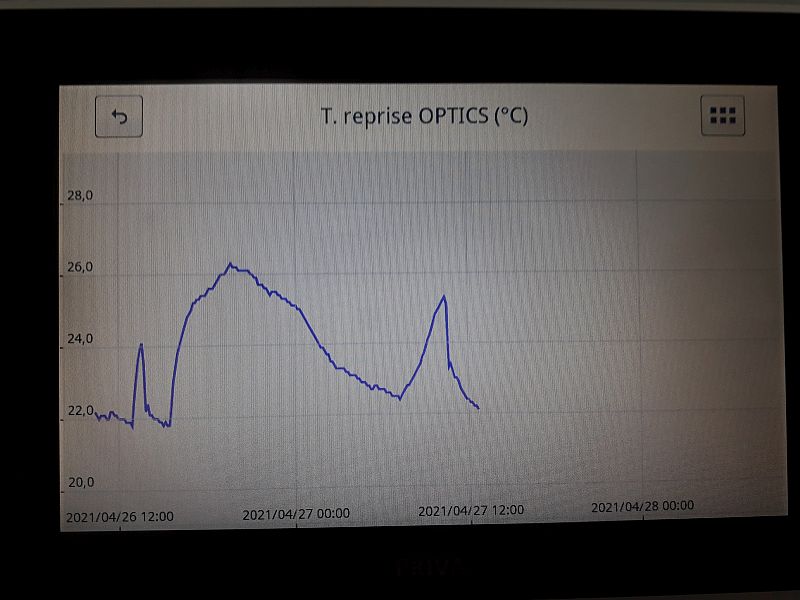
- The temperature curve is attached for the duration of the exp. (before starting Ronic switched something off and then put it on !!!!!! it seems to be for temp regulation )
** Notes for tomorrow morning : first : switch on the laser and check if the beam 00 mode is still observed and check its position
this is to see the stability and the effect of the temperature. |
| Attachment 1: 20212704_Fundamental_mode_in_cavity_2D_-_Position.png
|
 |
| Attachment 2: 20212704_Fundamental_mode_in_cavity_1D_shape.png
|
 |
| Attachment 3: 20212704__Difraction_along_the_mirror_edges_in_cavity.png
|
 |
| Attachment 4: 20212704__Modes_observed_resonating_in_the_cavity_0.png
|
 |
| Attachment 5: 20212704__Modes_observed_resonating_in_the_cavity_1.png
|
 |
| Attachment 6: 20212704_Temperature_Curve.jpg
|
 |
|
7
|
Mon Apr 19 19:11:47 2021 |
Manar Amer | Fixed | report | mechanics | software | Other | Distances between mirrors |
- At the reference zero the distance between the mirrors is (taken from a reference presentation "status9nov2020" attached):
M1-M2 = 88.029 mm
M3-M4 = 84.6895 mm
- The distances between the spherical mirrors ( M3-M4 ) was set to take into account the stability of the mirror ( M3-M4 > Spherical mirror focal length = 85.3 mm)
M3-M4 = 90.5 mm
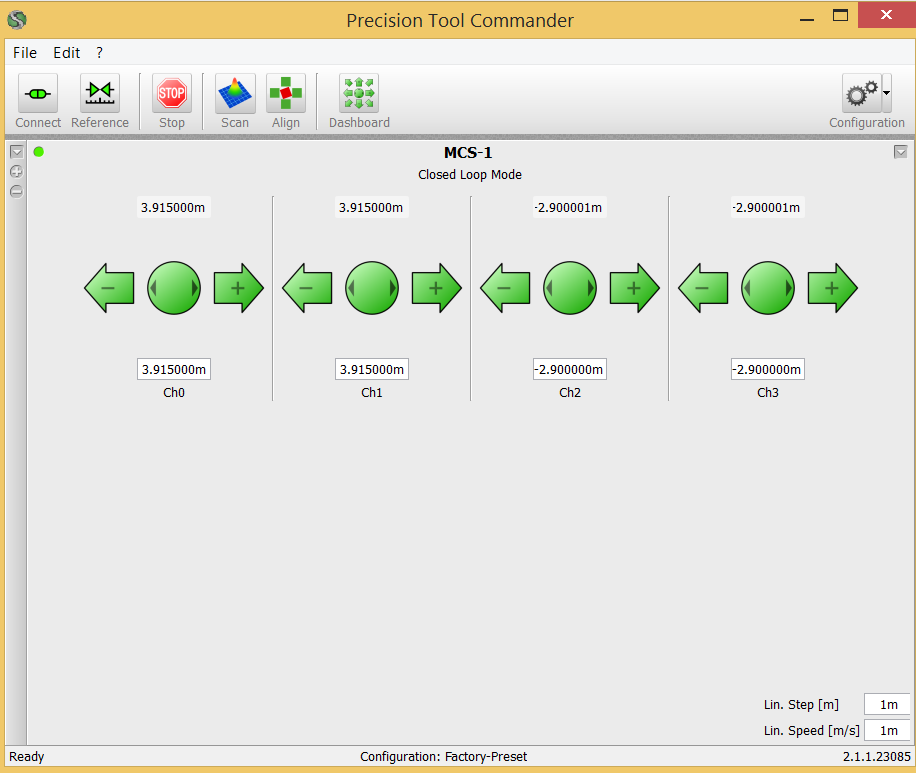
we increased the distance between them by 5.8 mm, and moving the mirrors symmetrically, M3 and M4 moved by -2.9 mm (negative defines outer motion)
- Following the definition of M3-M4, fixing of the angle = 2.55637 degrees and frequency (Frep = 876.3636 MHz). Distance between planners (M1-M2)
M1-M2 = 80.2 mm
we decreased the distance between them by 7.83 mm, and moving the mirrors symmetrically, M1 and M2 moved by +3.915 mm (positive defines inward motion)
**** Photo attached is the values on the software at the time. |
| Attachment 1: 20211604__Distances_Between_mirrors.png
|
 |
| Attachment 2: status9nov2020.pptx
|
|
6
|
Mon Apr 19 18:47:28 2021 |
Manar Amer | Fixed | report | lasers and optics | Other | Alignment using Helium Neon Laser |
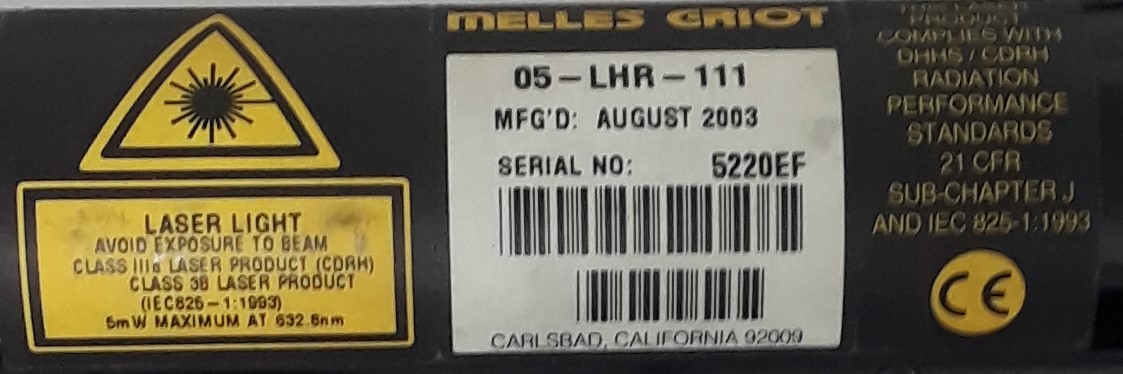
05 April 2021 : A rough alignment of the cavity was done using the Helium Neon Laser. |
| Attachment 1: 20210202__Helium_Neon_laser_parameters.jpg
|
 |
|
5
|
Mon Apr 19 18:41:03 2021 |
Manar Amer | Fixed | report | mechanics | cabling | software | Other | Setting up the Motors |
A document attached that describes the procedure needed to:
- connect the motors
- configure the Ethernet connection
- Calibrate and reference the software used to control the motors. |
| Attachment 1: setting_up_the_motors.docx
|
|
4
|
Thu Apr 15 19:54:19 2021 |
Manar Amer | Fixed | report | mechanics | cabling | Other | Mirrors Mottors Connections |
Added the cabling to the categories
| Manar Amer wrote: |
|
* The connections to control the motors of the mirrors are connected in the order stated :
M1 - M2 - M3 - M4
bottom right - bottom left - top right - top left
* The cables on the back of the box are connected as shown in attached photo
as they are connected they show on the software (Precision Tool commander) as
M1 - M2 - M3 - M4
Ch0 - Ch1 - Ch2 - Ch3
|
|
|
3
|
Thu Apr 15 19:45:08 2021 |
Manar Amer | Fixed | report | mechanics | Other | Mirrors Mottors Connections |
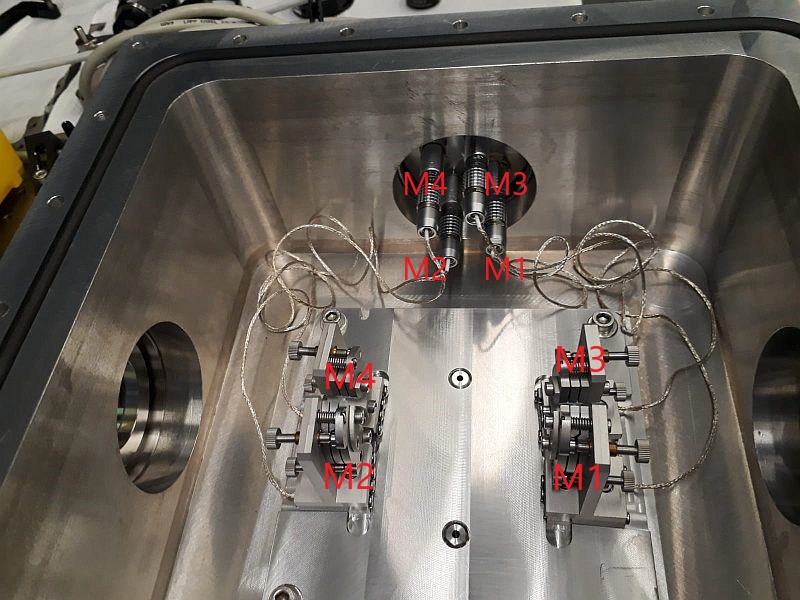
* The connections to control the motors of the mirrors are connected in the order stated :
M1 - M2 - M3 - M4
bottom right - bottom left - top right - top left
* The cables on the back of the box are connected as shown in attached photo
as they are connected they show on the software (Precision Tool commander) as
M1 - M2 - M3 - M4
Ch0 - Ch1 - Ch2 - Ch3
|
| Attachment 1: 20210804_Motor_connections_with_mirrors_inside_cavity_box.jpg
|
 |
| Attachment 2: 20210804_Mottor_cables_behind_cavity_box.jpg
|
 |
|
2
|
Tue Apr 6 09:25:47 2021 |
Ronic Chiche | Fixed | info | lasers and optics | detectors and electronics | Optical room | Phase noise measurement of the Amplitude MIKAN |
Coupling into a 50-50% fiber coupler using the Thorlabs XYZ table NanoMax TS.
We reached 117mW after the 50% arm which means we coupled about 230mW (the coupling better than 50%).
| Ronic Chiche wrote: |
|
Installation of the MIKAN.
powermeter (with OD1) just after the oscillator shows 440mW for 4A of the MIKAN pump current.
Installation of a periscope as the oscillator beam position is very close to the table... not easy to put devices at this height (be aware to use proper wavelength range mirrors: Thorlabs BB1-E03)
Installation of a HALF waveplate to align beam polarisation on the isolator axis
Installation of a High power isolator (the one of ThomX): Newport ISO-FRDY-05-1030-N
powermeter (with OD1) just after the isolator shows 427mW
|
|
|
1
|
Tue Mar 23 18:33:16 2021 |
Ronic Chiche | Fixed | info | lasers and optics | detectors and electronics | Optical room | Phase noise measurement of the Amplitude MIKAN |
Installation of the MIKAN.
powermeter (with OD1) just after the oscillator shows 440mW for 4A of the MIKAN pump current.
Installation of a periscope as the oscillator beam position is very close to the table... not easy to put devices at this height (be aware to use proper wavelength range mirrors: Thorlabs BB1-E03)
Installation of a HALF waveplate to align beam polarisation on the isolator axis
Installation of a High power isolator (the one of ThomX): Newport ISO-FRDY-05-1030-N
powermeter (with OD1) just after the isolator shows 427mW
|