| ID |
Date |
Author |
Status |
Type |
Category |
Location |
Title |
|
242
|
Fri Sep 8 18:22:21 2023 |
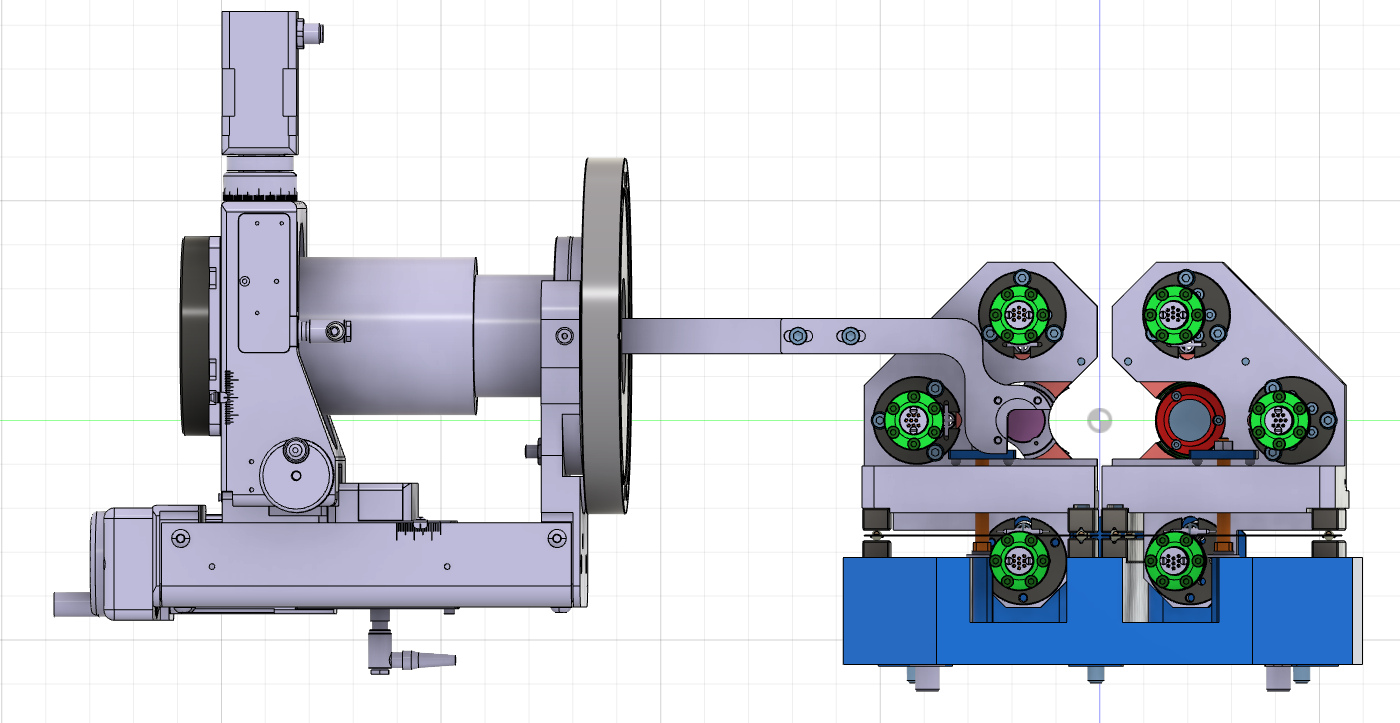
Ronic Chiche | Fixed | info | mechanics | lasers and optics | detectors and electronics | ThomX igloo | Removing high order modes | here is the picture of the L-shape arm and the inside of the vessel.
this image corresponds to the "zero" position on each positionner.
| Ronic Chiche wrote: |
|
this morning we locked the laser and the FP-cavity with ~ 40kW => some HOM appeared "randomly" depending on the power.
we tried to play manually on the L-shape arm :
- first, we moved horizontally to put the L-shape in the beam axis
at some point, we saw the power level divided by ~2, we stopped and came back to restore the full power.
- then, we tried to move vertically.
whatever the direction, we were not able to see a clear cut of the beam.
BUT "strangely", at some point, the PZT drift followed the direction of the motion and was not really depending on the "cooling" or "heating" process when the lock stops or restart.
"strangely" again, at the endpoint, the power dropped by ~20-30% after a delock but it was impossible to restore the power when we put the arm at the initial position.
=> we had to adjust the FP-cavity alignment to restore the power !!!
=> we had the feeling that moving the arm could have misalign the cavity axis !!! :-(
=> we have to discuss with Yann and get the CAD files of the cavity to have a better understanding...
|
|
| Attachment 1: Capture.PNG
|  |
|
244
|
Fri Sep 8 19:45:56 2023 |
Ronic Chiche | Fixed | info | lasers and optics | ThomX igloo | 33MHz oscillator + Alphanov amplifier lock | redoing the PDH error signal scheme with discrete components is more flexible and it is easier to check the signal/noise ratio.
now, we are able to get a quite clean lock only with the PZT correction (w/o fast feedback correction using the EOM) even with both motors controllers ON (cavity and laser).
then, one can consider this part is over, even if one can still improve the lock with the EOM.
see this post for that part and some details on the new PDH signal scheme : https://elog.lal.in2p3.fr/FPC/THOMX+commissioning/240
| Ronic Chiche wrote: |
|
Today, we locked the cavity with input power @ 30% for the amp => we got 40kW with only 30% of coupling (and a bad lock => we could have more power inside cavity).
P@30% = 16W
Coupling = 30% => 4.8W of input power => Measured Gain = 8300
| Ronic Chiche wrote: |
|
we checked yesterday morning the real input power @ 30% for the amp => it is 16W in agreement with the previously measured values
| Ronic Chiche wrote: |
|
I checked with the Matlab code below the CEP detuning effect (2nm sech² spectrum... not exactly the same as in ThomX)
@ CEP = 0 => coupling = 100% and Gcav = 10.5k
if all the coupling loss comes from the CEP detuning effect :
@ CEP = pi/5 => coupling = 20% and Gcav = 2.14k (~ 10.5k x 20%)
so, it does not matter if the coupling loss comes from the CEP detuning effect or from beam mismatch or misalignment.
=> we should have more power at 20% coupling, not 10kW but 35kW !!!
=> we have to check the real input power !
| Ronic Chiche wrote: |
|
this morning, I tested the laser+amplifier @ 30% lock on the FP cavity with and without Smaract motors.
I recorded the PDH error signal during a lock:
- blue : with Smaract motors controller powered ON but motors are stopped
- yellow: with Smaract motors controller powered OFF
with Smaract motors controller powered ON and motors stopped, one can see a group of resonances around 10kHz (8 - 11 - 14kHz) which disappears when the controller is powered OFF.
one can see also a group of resonances around 25-30kHz for which some peaks desappear when the controller is OFF but most of them are still there... could it come from noise on the Onefive laser PZT ?
one can see also a noise reduction at low frequency with a corner frequency around 17kHz, which could be the Unity Gain Bandwidth of the feedback loop on the laser PZT (fast feedback loop on EOM was disconnected)
=> to be confirmed
*************************************************************************************************************************************************************
I was able to lock with a decent noise on transmission and reflection signals @ Pin=17W (30%) of input power and with a coupling ~ 20%.
I measured 31mW in transmission => Pcav ~ 10.3kW (T ~ 3ppm)
as T1=115 ppm and F=30000, the cavity gain is T1*(F/pi)^2 = 10.5k,
so, the FP cavity power should have been 17W * 20% * 10,5k = 35.7 kW !!! (maybe the formula is wrong if the coupling loss comes from the CEP detuning effect)
=> we have to check the incoming power and the formula !
so, maximum expected power in FP-cavity could be 70W * 100% * 10,5k * (10.3/35.7) = 210 kW !!! :-(
*************************************************************************************************************************************************************
I was able to redo the lock easily in remote in the control room (with the Smaract motors controller OFF).
| Ronic Chiche wrote: |
|
After removing the 2 generators from the optical table, the lock is much more stable and now, it is possible to lock on the main resonance with a poor CEP but with quite good stability.
the coupling is still very low ~ 5% for that CEP but if one improves it (CEP ->0), using the laser double-wedge motor, one clearly sees an improvement of the coupling... but at the cost of the lock stability.
the reason of the poor coupling is also because the laser amplifier is used at 0%, for which we know the part of the laser signal power, compared to the total power, is low.
(a part of the beam @1030nm is not propagating in the fiber core of the amp, and then, it cannot be coupled to the FP-cavity).
the fast lock loop on the EOM has been disabled for the moment.
it has to be installed back to improve the stability at a better CEP.
at present, the FP-cavity power is estimated at ~ 90W (~270µW in transmission of ~3ppm mirrors) for ~300mW of total power coming from the laser amp.
next steps :
- in Open Loop : check what is the best coupling we can observe for CEP=0 @ P ~ 10W (laser amp at ~ 25%)
- in Closed Loop : @ P ~ 10W => measure the best transmitted power after alignement/polarization/feedback adjust => ~ 3-10kW in the cavity ?
| Ronic Chiche wrote: |
|
today with Daniele, we locked easily (but with a noisy lock) on the secundary resonance and we tried to lock on the main resonance (with very low coupling ~10% which mean a CEP ~Pi)
the lock was possible but was very noisy.
I installed a fast loop using my small DC amplifier based on OP37 (max gain=100) modified to be AC coupled to avoid to amplify the PDH box offset.
the output votage swing of the OP37 is only ~10V. Thus, the effect of this fast loop on the lock stability is not visible !
Thus, I added the M250 Leysop HV amplifier (see attached documentation), which is able to drive an EOM with >5MHz bandwidth and ~250V swing, after my OP37 amplifier.
with this additionnal HV amplifier, now we can clearly see the effect of the EOM loop which improves the lock stability BUT, even with a poor CEP, the lock is very unstable on the main resonance.
it seems the optical phase noise is still too large and/or its BW too high to be completely compensated.
The next step is to try to remove all the possible noise sources from the optical table:
- the laptop placed on the ionic pump
- the 2 Rigol generators on the table surface
and switch off the controller of the Smaract laser cavity motors.
If it doesn't help, we can send the error signal to a spectrum analyzer to have a better view of the different harmonics involved in the residual phase noise.
could it remain some noise above the present PDH box BW (1.9MHz LP filter) ?
lastely, we can also make an optical phase noise measurement to check if the Alphanov amplifier does not add some noise.
| Ronic Chiche wrote: |
|
finding the right modulation/demodulation PDH phase is very difficult on the main resonance because the we get non stationnary signals with a lot of oscillations.
changing the phase, in this condition, does not really change the error signal.
Then, we moved on the first secundary resonance with less gain and less coupling.
Thus, the error signal is more similar to the theoretical PDH signal => one can adjust the modulation/demodulation PDH phase to get the maximum error signal.
then, we locked pretty easily on this first secondary resonance, with a coupling around some % when we adjust the CEP motor.
we tried to lock on the main resonance but it is too noisy and unstable.
it seems we really need high BW feedback.
I tried to add a fast analog loop on the laser intra-cavity EOM but without a clear effect.
the problem is the gain of this loop : it is difficult to produce a "high voltage" (above 10Vpp) on this EOM.
I put "my" amplifier but the voltage output is limited... commercial amplifiers will have the same issue.
we can add HV amplifiers but it takes place and it will add some noise on the signal.
A loop with an AOM could be easier to install and manage... but at the price of a loss of power before the laser amplifier...
| Ronic Chiche wrote: |
|
the last tries to lock the 33MHz + amplifier to the 30k Finesse FP-cavity were unsuccessful.
during a laser Frep scan using the Laselock, one observes that the main cavity resonance is not able to stay inside the PZT scan range from one scan to another (500ms-1s period)
is it the effect of a large and slow phase noise ?
some informations:
- The 33MHz laser came back at lab from repair on March 2018.
- it has been sent to Alphanov in May 2020.
- it failled and has been sent to NKT/OneFive for repair in September 2021
- it came back to lab from repair in June 2022.
- on post #92 (Feb. 2020), it seems that we already locked the 33MHz laser + CELIA amplifier to the ThomX FP-cavity.
- The PZT sensitivity for the 33MHz laser is given to 0,3Hz/V for Frep <=> 2.6MHz/V for optical frequency.
=> 10V on PZT is equivalent to 26MHz of optical frequency shift which is less than FSR !
- by comparison, the PZT sensitivity for the 133MHz laser is given to 3.9Hz/V for Frep <=> 8.5MHz/V for optical frequency.
- by comparison, the PZT sensitivity for the NKT CW laser is given 10pm/100V for Wavelength <=> 30MHz/V for optical frequency
- by comparison, the PZT sensitivity for the ThomX FP cavity (Z20H38x40C) is 4nm/V for length expansion => 8nm/V for round-trip expansion <=> 0.03Hz/V for FSR expansion <=> 260kHz/V for optical frequency !!!
the PZT expansion estimation is in attached file.
|
|
|
|
|
|
|
|
|
|
245
|
Tue Sep 12 14:28:36 2023 |
Ronic Chiche | Fixed | info | mechanics | lasers and optics | detectors and electronics | ThomX igloo | Removing high order modes | yesterday with Daniele, we tried again to move the arm horizontally and vertically from the "zero position" to have a better understanding of the beahvior,
but it is roughly the same :
- a clear beam power reduction (=> cut of the beam) when one moves the horizontal axis
- a very small beam power reduction when one moves the vertical axis
as there are no end-position limits on the axis and as it is possible to "touch" the motors or different mecanichal pieces, we prefered to be conservative:
after several tries, one placed the arm at a position where the HOMs seem to be pretty well suppressed.
for the moment, we will consider this arm in a proper position.
| Ronic Chiche wrote: |
|
here is the picture of the L-shape arm and the inside of the vessel.
this image corresponds to the "zero" position on each positionner.
| Ronic Chiche wrote: |
|
this morning we locked the laser and the FP-cavity with ~ 40kW => some HOM appeared "randomly" depending on the power.
we tried to play manually on the L-shape arm :
- first, we moved horizontally to put the L-shape in the beam axis
at some point, we saw the power level divided by ~2, we stopped and came back to restore the full power.
- then, we tried to move vertically.
whatever the direction, we were not able to see a clear cut of the beam.
BUT "strangely", at some point, the PZT drift followed the direction of the motion and was not really depending on the "cooling" or "heating" process when the lock stops or restart.
"strangely" again, at the endpoint, the power dropped by ~20-30% after a delock but it was impossible to restore the power when we put the arm at the initial position.
=> we had to adjust the FP-cavity alignment to restore the power !!!
=> we had the feeling that moving the arm could have misalign the cavity axis !!! :-(
=> we have to discuss with Yann and get the CAD files of the cavity to have a better understanding...
|
|
|
|
248
|
Wed Sep 13 17:57:08 2023 |
Ronic Chiche | Fixed | issue | lasers and optics | detectors and electronics | ThomX igloo | work with HV voltage on the Laselock | This afternoon, I connected the HV output of the Laselock (instead of the standard 0-10V output) to the FP-cavity PZT to increase the locking range.
I didn't see any degradation of the FP-cavity/synthesizer lock.
| Ronic Chiche wrote: |
|
presently, the voltage on the laser PZT is 0-10V, but during the several runs we did, this voltage is too low to compensate low frequency fluctuations:
we need to change often the motors position implying a cavity lock loss.
we have to check if running the laser PZT with the HV output of the Laselock is possible without too much additionnal noise.
=> it can be done simultaneously with the fast feedback loop implementation, which has to be done.
|
|
|
258
|
Fri Sep 15 18:00:41 2023 |
Ronic Chiche | Under Process | issue | mechanics | lasers and optics | detectors and electronics | ThomX igloo | 20Hz oscillation in the locking between Laser and FP-cavity | this morning, we tried to find the origin of the 20Hz oscillation.
- we switched OFF the laser Smaract motors controller => no change
- then, we addionally disconnected the FP-cavity PZT cable from the Laselock (we put a charge of 1kohm) => no change
- then, we switched ON the laser Smaract motors controller and switched OFF the FP-cavity motors controllers => no change
in conclusion, we don't really know where this instabillity comes from.
the amplitude is roughly 1Vpp (when the oscillation is at its maximum) on the laser PZT <=> length oscillation of ~20nm pp
could it come :
- from the air cooling regulation with pressure variation ?
- from vibrations of the hexapod below the table ?
or is it from inside of the laser or FP cavities ?
see these posts for the first measurements on this issue: https://elog.lal.in2p3.fr/FPC/THOMX+commissioning/257
|
|
259
|
Fri Sep 15 18:11:07 2023 |
Ronic Chiche | Under Process | issue | mechanics | lasers and optics | detectors and electronics | ThomX igloo | 20Hz oscillation in the locking between Laser and FP-cavity | this afternoon, we did 2 tests to better understand this 20Hz oscillation:
- we locked the amplified laser directly to the 500MHz ring reference oscillator, without any intermediate locking to the FP-cavity => no change
the 20Hz oscillation is still present in the correction signal of the laser PZT.
- we switched OFF the controller of the hexapod => no change.
conclusion:
the 20Hz oscillation is coming from the laser cavity
or is coming from "outside" and could be measured, maybe at a higher level, with an external "noises & vibrations measurement system".
| Ronic Chiche wrote: |
|
this morning, we tried to find the origin of the 20Hz oscillation.
- we switched OFF the laser Smaract motors controller => no change
- then, we addionally disconnected the FP-cavity PZT cable from the Laselock (we put a charge of 1kohm) => no change
- then, we switched ON the laser Smaract motors controller and switched OFF the FP-cavity motors controllers => no change
in conclusion, we don't really know where this instabillity comes from.
the amplitude is roughly 1Vpp (when the oscillation is at its maximum) on the laser PZT <=> length oscillation of ~20nm pp
could it come :
- from the air cooling regulation with pressure variation ?
- from vibrations of the hexapod below the table ?
or is it from inside of the laser or FP cavities ?
see these posts for the first measurements on this issue: https://elog.lal.in2p3.fr/FPC/THOMX+commissioning/257
|
|
|
260
|
Fri Sep 15 18:27:24 2023 |
Ronic Chiche | Fixed | info | lasers and optics | detectors and electronics | ThomX igloo | Fast feedback loop between laser and FP cavity | this afternoon, we tried to better understand how to drive properly the EOM to kill high frequency noise.
we locked to laser on the FP-cavity as usual.
then we injected a 0-10V square signal on the laser EOM @ 1KHz (with fast rise and fall times ~ 10ns)
we clearly see a small drop on the cavity transmitted power, but much like a sine wave in phase with square signal, because of the small bandwidth of the cavity ~ 1kHz.
then it is difficult to deduce a time response of the system when one injects a signal on the EOM.
because of compensated noise on the PZT signal, one does not see any variation on this signal
because of the bandwidth of the feedback (~10kHz => 100µs period), the possibly visible effect of the square input signal on EOM is compensated quickly,
in addition, the effect with 0-10V input signal is small and superposed with other noise sources => one does not see a clear correlation.
we planned to work with 0-100V input signal but we add a strange issue at this moment BEFORE increasing the voltage on the EOM
=> see next post : https://elog.lal.in2p3.fr/FPC/THOMX+commissioning/261
| Ronic Chiche wrote: |
|
today, after the several unsuccessful attempt yesterday to get an improvement in the lock,
we decided to "rebuild" the error signal electronics block by block and step by step :
the scheme is basically :
- DET36 photodiode
- followed by a 10MHz low pass filter to remove the laser frequency harmonics and keep only the modulation frequency at 8.4MHz.
- connected to a FEMTO HPVA AC-coupled 40dB gain amplifier with 50ohms in parallel on its input (which is connected to the photodiode).
- connected to a Minicircuit mixer which is also demodulated by the generator at 8.4MHz
- followed by a 1.9MHz low pass filter to remove image frequencies
when this signal is sent to the Laselock box, the lock of the cavity is possible but very noisy.
we need to put a large D values in the PID to maintain the lock at the price of oscillations and gain loss ! :-(
when this signal is connected also to the M250 video EOM amplifier (which is 50 ohms), but this amplifier is not used,
we suddenly got a much better lock (see the attached pictures), certainly due to the 50 ohms connected to the input of the Laselock system => to be verified.
one could have some noise current at the Laselock input which produces less noise at the output when the input impedance is 50 ohms, instead of the several kohms when the input is unloaded...
then, we were able to get a stable lock at ~40kW with 30% coupling and 30% of amplifier :
see this post with the same values : https://elog.lal.in2p3.fr/FPC/THOMX+commissioning/227
but now, the lock has been done WITH ALL the motors controllers ON !!! :-)))
now, we can try to improve the lock with the fast feedback loop.
and the only real problem is the mode degeneracy we need to block with the L-shape.
| Ronic Chiche wrote: |
|
today, we tried to lock the FP cavity with the Smaract motors ON (with option -LV).
we know the Smaract controllers produce some noise and the lock is very bad or impossible when the controller in ON (whatever the displacement mode is : closed or open loop, or piezo scan).
then we need to do a fast feedback loop on the EOM inside of the Onefive laser.
the problem is we cannot fill directly the error signal (~ 300mVpp) as the signal level is too low to produce some effect.
1- we tried to use the AC-coupled homemade amplifier alone but the output range is too low (+/- 3V)
2- we tried to use the M250 video amplifier for EOM with AC-coupling but the output range is still to low (+/-30V ? => to be confirmed)
but we saw an improvement in the locking.
3- we tried to combine AC-coupled homemade amplifier + M250 video amplifier for EOM with AC-coupling.
we are able to lock (~ 30% coupling) but the lock quality is very poor : we clearly see that we oscillate around the maximum of the Airy peak.
we tried several combination of the global gain (fast feedback + Laselock) using the diffuser, of the Laselock PID parameters but it seems we are not able to lock properly.
we measured a global delay of this double amplification stage of 80-90ns for the homemade amplifier and 150ns for the homemade+M250 amplifiers.
this delay is compatible with ~ 500kHz BW for the feedback => it seems it is not the reason...
we measured also the linearity of the homemade amp => there is ~ 30dB between a frequency and its 1st harmonic even at low signal...
the amp scheme is not very linear.
in comparison, the HV M250 amplifier exhibit > 80 dB of linearity !
we will try to remplace the homemade amp by a commercial FEMTO amplifier to imrpove the linearity and see if it improves also the lock.
we measured also a 100Hz AM modulation on the output signal of the homemade amp+M250.
=> we can try to work in differential (HV+ - HV-) to see if it helps to remove this modulation.
|
|
|
|
261
|
Fri Sep 15 18:56:36 2023 |
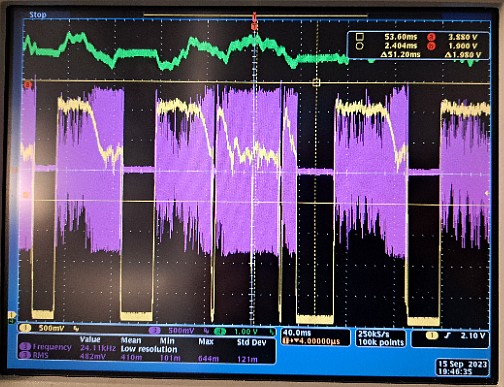
Ronic Chiche | Fixed | issue | mechanics | lasers and optics | detectors and electronics | ThomX igloo | !!! strange FP cavity behavior => impossible to lock !!! | suddenly, BEFORE switching the HV amplifier ON and BEFORE connecting it to the EOM (in order to explore the HV effect on the EOM for the fast feedback loop),
we lost the lock between the laser and the FP-cavity: in attchement a plot a the lock with the "best" PID parameters.
- yellow: FP-cavity transmission signal
- green: PZT signal
- pink: PDH error signal
the lock was pretty "normal" except that we observed that the intra-cavity power is always slowly increasing from 40kW to ~44kW during a lock, all along this last week.
there are several possiblities for that :
- a slow increasing of the input power (we see the effect on the reflected signal when the FP-cavity is not locked)
- fluctuations of the CEP to the "good" value,
- or more supprisingly an improvement of the Finesse.
after this issue, we tried to change the laser input power (30% to 25%), or the change the CEP => we always get the same result => the lock is either too "weak" (not enough gain) or too "strong" (the system is unstable and goes in oscillations visible on the picture a the end of each lock period).
we tried to change the PID parameters quite a lot to try to compensate a change in the FP-cavity transfer function without any effect => impossible to have a proper lock as before.
we tried to check if the PDH phase, to produce a proper error signal, has changed => no, it was the good one.
we tried to correct the laser alignement to the FP-cavity, but it was more or less correct and we didn't see any change in the locking.
then, one possibility could be that one dust have been suddenly removed from the cavity mirrors by the high power and the Finesse suddenly increased substancially.
=> more Finesse => less bandwidth => high frequency noise are less "visible" in the error signal and we get less bandwith for the feedback => more difficult to lock.
we thought that this kind of problem could be solved by changing the CEP, but in this case, it didn't succeded to lock.
the other possibility is that just before having this issue, we were doing tests on the EOM with a 0-10V signal.
=> could it be possible that the static polarisation of the laser has changed ?
then, we would need to adjust the waveplates in the laser path to adjust the correct polarisation ?
=> not for sure... as the maximum transmitted power at the begining of the lock is the same as before... and compatible with ~ 43 - 44kW in the FP-cavity.
could it be also that the intermediate signals of the PDH scheme are saturated (because of the increasing power : 40kW to 44kW) and produce a "false" error signal leading to instability ?
or could it be a bug in the Laselock ?
=> we could restart it to confirm.... |
| Attachment 1: 20230915_172239.jpg
|  |
|
262
|
Fri Sep 15 19:13:44 2023 |
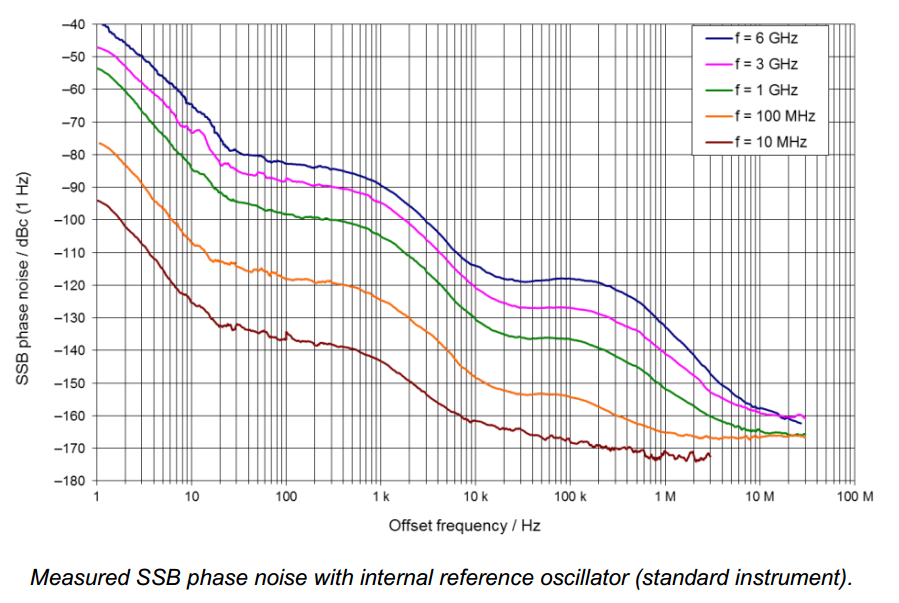
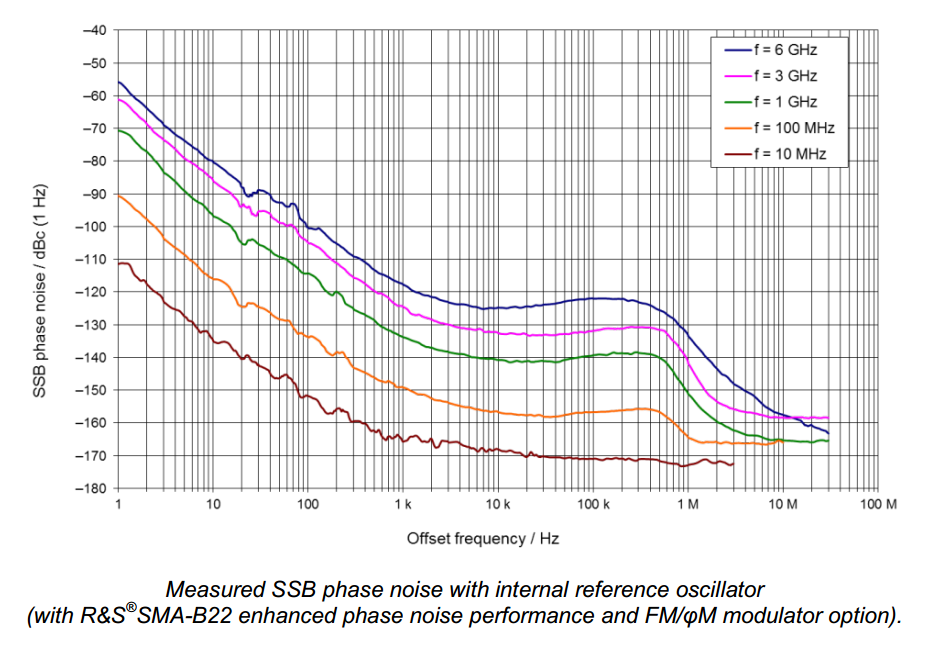
Ronic Chiche | Fixed | info | lasers and optics | ThomX igloo | drift calculation for the SMA100A | the goal is to estimate what could be the frequency drift at 500MHz for the SMA100A: see phase noise datasheet in attachement
Sphi(f) = FFT ( Rphi(T) ) = FFT ( < Phi(t) Phi(t+T) > )
at low frequency, Sphi(f) ~ A / (f^n) = A*(2pi)^n / (i2pi*f)^n => Rphi(T) = A*(2pi)^n*T^(n-1) / (n-1)!
for the SMA100A : n ~ 2 and A =10^-7 at f0=1GHz with B22 option
=> Rphi(T) ~ 4e-6*T
|
| Attachment 1: Capture1.PNG
|  |
| Attachment 2: Capture2.PNG
|  |
|
263
|
Mon Sep 18 12:48:39 2023 |
Ronic Chiche | Fixed | issue | mechanics | lasers and optics | detectors and electronics | ThomX igloo | !!! strange FP cavity behavior => impossible to lock !!! | this morning, we tried:
- to move a bit the arm of the L-shape off the beam axis (in case of it could have touch something and induce vibrations) => no effect
- to change the CEP to get an equivalent lower Finesse => weak improvement
- to add a diffuser in front of the PDH photodiode and check the saturation level after the FEMTO amplifier to avoid non linearity effects in the PDH signal => weak improvement
- to move the half and quarter waveplates in the incoming beam path => no effect
then, we have to work with the laser intracavity EOM to try to cancel high frequencies noise
| Ronic Chiche wrote: |
|
suddenly, BEFORE switching the HV amplifier ON and BEFORE connecting it to the EOM (in order to explore the HV effect on the EOM for the fast feedback loop),
we lost the lock between the laser and the FP-cavity: in attchement a plot a the lock with the "best" PID parameters.
- yellow: FP-cavity transmission signal
- green: PZT signal
- pink: PDH error signal
the lock was pretty "normal" except that we observed that the intra-cavity power is always slowly increasing from 40kW to ~44kW during a lock, all along this last week.
there are several possiblities for that :
- a slow increasing of the input power (we see the effect on the reflected signal when the FP-cavity is not locked)
- fluctuations of the CEP to the "good" value,
- or more supprisingly an improvement of the Finesse.
after this issue, we tried to change the laser input power (30% to 25%), or the change the CEP => we always get the same result => the lock is either too "weak" (not enough gain) or too "strong" (the system is unstable and goes in oscillations visible on the picture a the end of each lock period).
we tried to change the PID parameters quite a lot to try to compensate a change in the FP-cavity transfer function without any effect => impossible to have a proper lock as before.
we tried to check if the PDH phase, to produce a proper error signal, has changed => no, it was the good one.
we tried to correct the laser alignement to the FP-cavity, but it was more or less correct and we didn't see any change in the locking.
then, one possibility could be that one dust have been suddenly removed from the cavity mirrors by the high power and the Finesse suddenly increased substancially.
=> more Finesse => less bandwidth => high frequency noise are less "visible" in the error signal and we get less bandwith for the feedback => more difficult to lock.
we thought that this kind of problem could be solved by changing the CEP, but in this case, it didn't succeded to lock.
the other possibility is that just before having this issue, we were doing tests on the EOM with a 0-10V signal.
=> could it be possible that the static polarisation of the laser has changed ?
then, we would need to adjust the waveplates in the laser path to adjust the correct polarisation ?
=> not for sure... as the maximum transmitted power at the begining of the lock is the same as before... and compatible with ~ 43 - 44kW in the FP-cavity.
could it be also that the intermediate signals of the PDH scheme are saturated (because of the increasing power : 40kW to 44kW) and produce a "false" error signal leading to instability ?
or could it be a bug in the Laselock ?
=> we could restart it to confirm....
|
|
|
264
|
Mon Sep 18 17:12:07 2023 |
Ronic Chiche | Fixed | issue | mechanics | lasers and optics | detectors and electronics | ThomX igloo | !!! strange FP cavity behavior => impossible to lock !!! | it could be also an optical unstability, as when the intra-cavity power increases, the radius of curvatures of the mirrors increases too due to thermal effect, and then one could go in the instability region.
but if it was the case, by reducing the power in the FP-cavity, we would also reduce the thermal effect and then, we would come back in the stability region...
and it is not the case : the system is unstable even with 20kW instead of 40kW.
| Ronic Chiche wrote:kW |
|
this morning, we tried:
- to move a bit the arm of the L-shape off the beam axis (in case of it could have touch something and induce vibrations) => no effect
- to change the CEP to get an equivalent lower Finesse => weak improvement
- to add a diffuser in front of the PDH photodiode and check the saturation level after the FEMTO amplifier to avoid non linearity effects in the PDH signal => weak improvement
- to move the half and quarter waveplates in the incoming beam path => no effect
then, we have to work with the laser intracavity EOM to try to cancel high frequencies noise
| Ronic Chiche wrote: |
|
suddenly, BEFORE switching the HV amplifier ON and BEFORE connecting it to the EOM (in order to explore the HV effect on the EOM for the fast feedback loop),
we lost the lock between the laser and the FP-cavity: in attchement a plot a the lock with the "best" PID parameters.
- yellow: FP-cavity transmission signal
- green: PZT signal
- pink: PDH error signal
the lock was pretty "normal" except that we observed that the intra-cavity power is always slowly increasing from 40kW to ~44kW during a lock, all along this last week.
there are several possiblities for that :
- a slow increasing of the input power (we see the effect on the reflected signal when the FP-cavity is not locked)
- fluctuations of the CEP to the "good" value,
- or more supprisingly an improvement of the Finesse.
after this issue, we tried to change the laser input power (30% to 25%), or the change the CEP => we always get the same result => the lock is either too "weak" (not enough gain) or too "strong" (the system is unstable and goes in oscillations visible on the picture a the end of each lock period).
we tried to change the PID parameters quite a lot to try to compensate a change in the FP-cavity transfer function without any effect => impossible to have a proper lock as before.
we tried to check if the PDH phase, to produce a proper error signal, has changed => no, it was the good one.
we tried to correct the laser alignement to the FP-cavity, but it was more or less correct and we didn't see any change in the locking.
then, one possibility could be that one dust have been suddenly removed from the cavity mirrors by the high power and the Finesse suddenly increased substancially.
=> more Finesse => less bandwidth => high frequency noise are less "visible" in the error signal and we get less bandwith for the feedback => more difficult to lock.
we thought that this kind of problem could be solved by changing the CEP, but in this case, it didn't succeded to lock.
the other possibility is that just before having this issue, we were doing tests on the EOM with a 0-10V signal.
=> could it be possible that the static polarisation of the laser has changed ?
then, we would need to adjust the waveplates in the laser path to adjust the correct polarisation ?
=> not for sure... as the maximum transmitted power at the begining of the lock is the same as before... and compatible with ~ 43 - 44kW in the FP-cavity.
could it be also that the intermediate signals of the PDH scheme are saturated (because of the increasing power : 40kW to 44kW) and produce a "false" error signal leading to instability ?
or could it be a bug in the Laselock ?
=> we could restart it to confirm....
|
|
|
|
265
|
Wed Sep 20 14:16:09 2023 |
Ronic Chiche | Fixed | issue | mechanics | lasers and optics | detectors and electronics | ThomX igloo | !!! strange FP cavity behavior => impossible to lock !!! | This morning,
- I installed the fast feedback loop.
now, the error signal goes to the Laselock AND
to a FEMTO DHPVA amplifier which is connected to the Leysop M250 HV amplifier connected through its HV+ output to the EOM.
one can set the gain of this loop thanks to the DHPVA gain potentiometer and to a 30dB attenuator.
it allows to have a fast and stable lock ONLY IF one reduce the FP-cavity gain using the CEP.
I will check later if I'm able to lock at the maximum gain but today, the cavity power is ~ 30kW, to be compared to the 45kW we were able to get before the "mirror cleaning event".
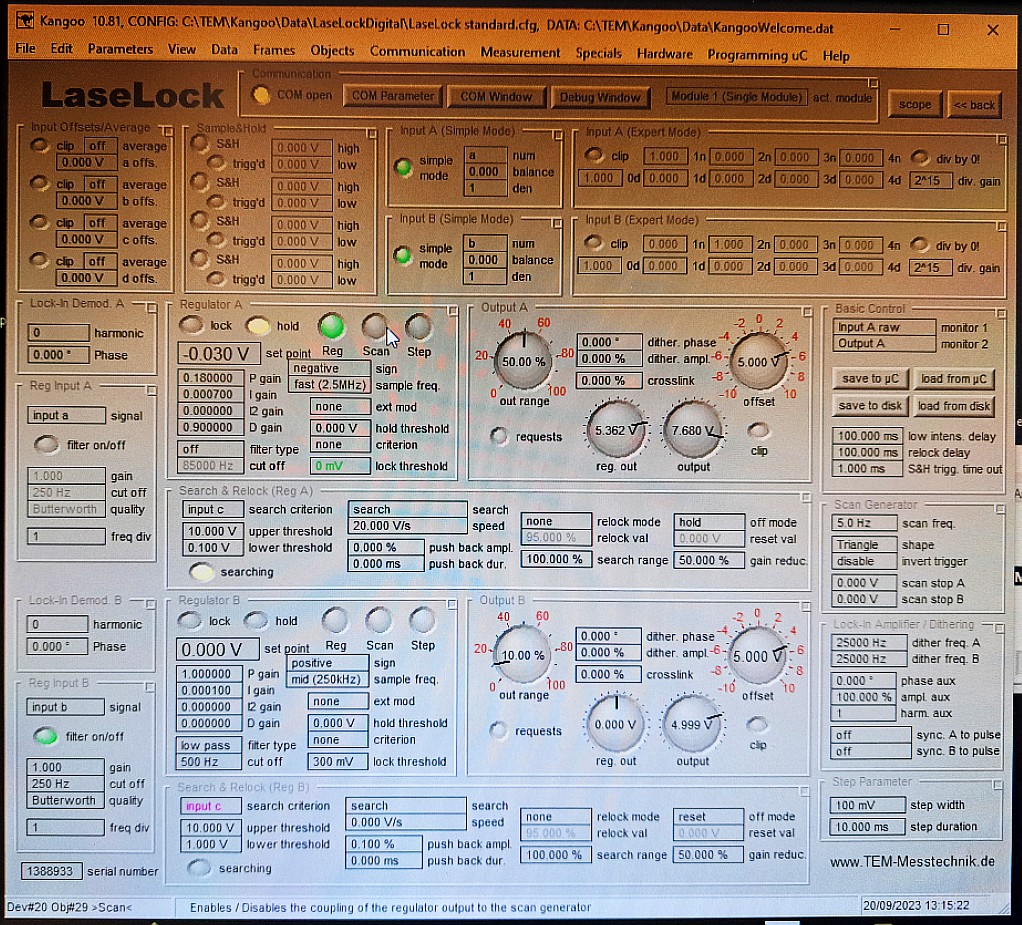
- I had to swap the sampling frequency of the Laselock from 250kHz to 2.5MHz to reduce the latency and improve the Slow feedback loop stability.
with the previous sampling frequency, the fast feedback loop was almost uneffective...
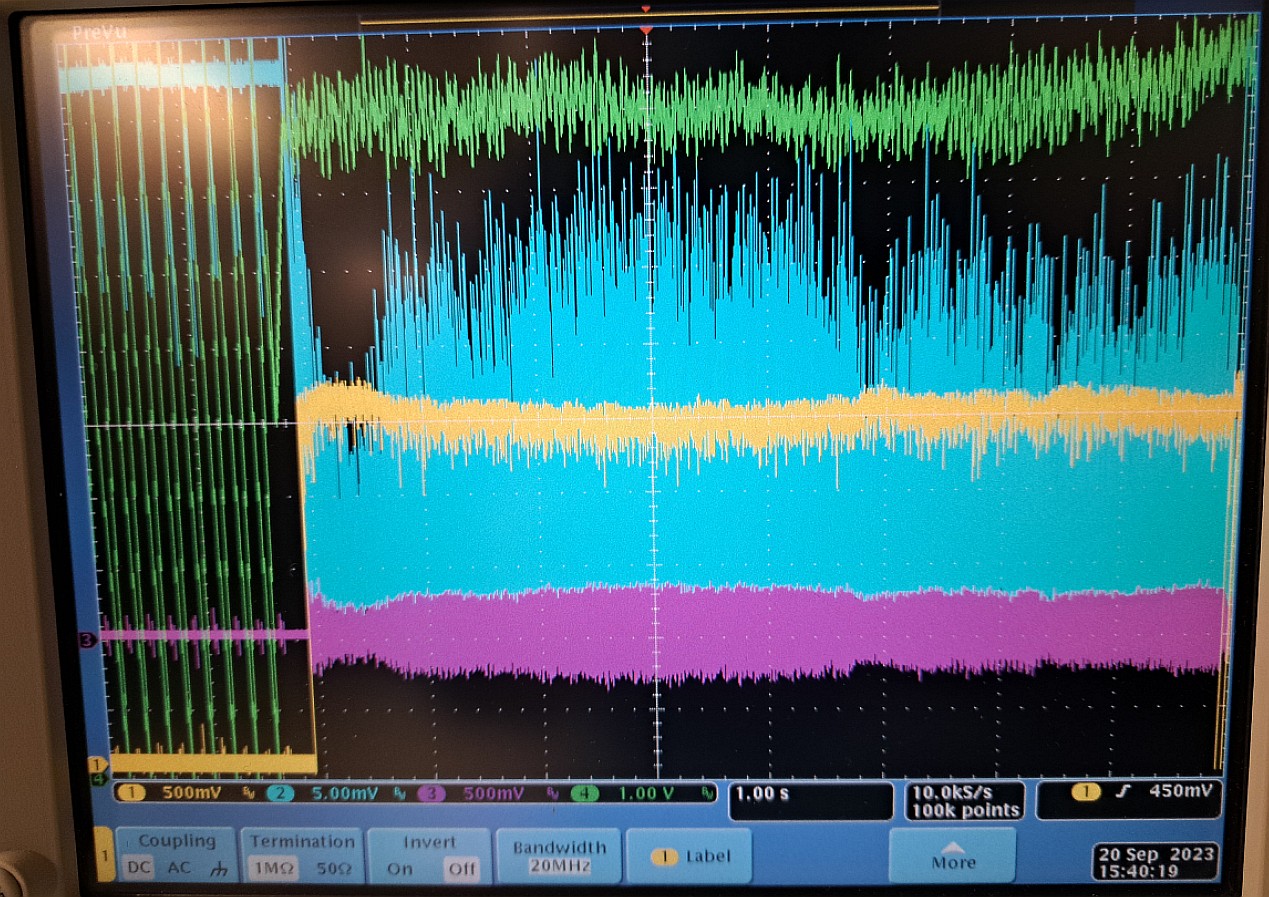
in attachement, the Laselock parameters and a picture of a lock.
yellow: FP-cavity transmission signal
blue : FP-cavity reflection signal
green: PZT signal
pink: PDH error signal
One has to move again the L-shape arm to remove the HOM
and check if we are able to lock in the same time the FP-cavity on the 500.25MHz reference oscillator... to be done this afternoon.
| Ronic Chiche wrote: |
|
it could be also an optical unstability, as when the intra-cavity power increases, the radius of curvatures of the mirrors increases too due to thermal effect, and then one could go in the instability region.
but if it was the case, by reducing the power in the FP-cavity, we would also reduce the thermal effect and then, we would come back in the stability region...
and it is not the case : the system is unstable even with 20kW instead of 40kW.
| Ronic Chiche wrote:kW |
|
this morning, we tried:
- to move a bit the arm of the L-shape off the beam axis (in case of it could have touch something and induce vibrations) => no effect
- to change the CEP to get an equivalent lower Finesse => weak improvement
- to add a diffuser in front of the PDH photodiode and check the saturation level after the FEMTO amplifier to avoid non linearity effects in the PDH signal => weak improvement
- to move the half and quarter waveplates in the incoming beam path => no effect
then, we have to work with the laser intracavity EOM to try to cancel high frequencies noise
| Ronic Chiche wrote: |
|
suddenly, BEFORE switching the HV amplifier ON and BEFORE connecting it to the EOM (in order to explore the HV effect on the EOM for the fast feedback loop),
we lost the lock between the laser and the FP-cavity: in attchement a plot a the lock with the "best" PID parameters.
- yellow: FP-cavity transmission signal
- green: PZT signal
- pink: PDH error signal
the lock was pretty "normal" except that we observed that the intra-cavity power is always slowly increasing from 40kW to ~44kW during a lock, all along this last week.
there are several possiblities for that :
- a slow increasing of the input power (we see the effect on the reflected signal when the FP-cavity is not locked)
- fluctuations of the CEP to the "good" value,
- or more supprisingly an improvement of the Finesse.
after this issue, we tried to change the laser input power (30% to 25%), or the change the CEP => we always get the same result => the lock is either too "weak" (not enough gain) or too "strong" (the system is unstable and goes in oscillations visible on the picture a the end of each lock period).
we tried to change the PID parameters quite a lot to try to compensate a change in the FP-cavity transfer function without any effect => impossible to have a proper lock as before.
we tried to check if the PDH phase, to produce a proper error signal, has changed => no, it was the good one.
we tried to correct the laser alignement to the FP-cavity, but it was more or less correct and we didn't see any change in the locking.
then, one possibility could be that one dust have been suddenly removed from the cavity mirrors by the high power and the Finesse suddenly increased substancially.
=> more Finesse => less bandwidth => high frequency noise are less "visible" in the error signal and we get less bandwith for the feedback => more difficult to lock.
we thought that this kind of problem could be solved by changing the CEP, but in this case, it didn't succeded to lock.
the other possibility is that just before having this issue, we were doing tests on the EOM with a 0-10V signal.
=> could it be possible that the static polarisation of the laser has changed ?
then, we would need to adjust the waveplates in the laser path to adjust the correct polarisation ?
=> not for sure... as the maximum transmitted power at the begining of the lock is the same as before... and compatible with ~ 43 - 44kW in the FP-cavity.
could it be also that the intermediate signals of the PDH scheme are saturated (because of the increasing power : 40kW to 44kW) and produce a "false" error signal leading to instability ?
or could it be a bug in the Laselock ?
=> we could restart it to confirm....
|
|
|
|
| Attachment 1: 20230920_131634.jpg
|  |
| Attachment 2: 20230920_131559.jpg
|  |
|
266
|
Wed Sep 20 19:10:16 2023 |
Ronic Chiche | Fixed | issue | mechanics | lasers and optics | detectors and electronics | ThomX igloo | !!! strange FP cavity behavior => impossible to lock !!! | this afternoon, in adjusting the CEP and improving the parameters of the lock, I was able to get ~ 47kW stable inside the cavity, always for 30% of laser amplification ratio.
it confirms that the Finesse, and then the gain of FP-cavity, has suddenly increased thanks to some "mirrors surface cleaning"
| Ronic Chiche wrote: |
|
This morning,
- I installed the fast feedback loop.
now, the error signal goes to the Laselock AND
to a FEMTO DHPVA amplifier which is connected to the Leysop M250 HV amplifier connected through its HV+ output to the EOM.
one can set the gain of this loop thanks to the DHPVA gain potentiometer and to a 30dB attenuator.
it allows to have a fast and stable lock ONLY IF one reduce the FP-cavity gain using the CEP.
I will check later if I'm able to lock at the maximum gain but today, the cavity power is ~ 30kW, to be compared to the 45kW we were able to get before the "mirror cleaning event".
- I had to swap the sampling frequency of the Laselock from 250kHz to 2.5MHz to reduce the latency and improve the Slow feedback loop stability.
with the previous sampling frequency, the fast feedback loop was almost uneffective...
in attachement, the Laselock parameters and a picture of a lock.
yellow: FP-cavity transmission signal
blue : FP-cavity reflection signal
green: PZT signal
pink: PDH error signal
One has to move again the L-shape arm to remove the HOM
and check if we are able to lock in the same time the FP-cavity on the 500.25MHz reference oscillator... to be done this afternoon.
| Ronic Chiche wrote: |
|
it could be also an optical unstability, as when the intra-cavity power increases, the radius of curvatures of the mirrors increases too due to thermal effect, and then one could go in the instability region.
but if it was the case, by reducing the power in the FP-cavity, we would also reduce the thermal effect and then, we would come back in the stability region...
and it is not the case : the system is unstable even with 20kW instead of 40kW.
| Ronic Chiche wrote:kW |
|
this morning, we tried:
- to move a bit the arm of the L-shape off the beam axis (in case of it could have touch something and induce vibrations) => no effect
- to change the CEP to get an equivalent lower Finesse => weak improvement
- to add a diffuser in front of the PDH photodiode and check the saturation level after the FEMTO amplifier to avoid non linearity effects in the PDH signal => weak improvement
- to move the half and quarter waveplates in the incoming beam path => no effect
then, we have to work with the laser intracavity EOM to try to cancel high frequencies noise
| Ronic Chiche wrote: |
|
suddenly, BEFORE switching the HV amplifier ON and BEFORE connecting it to the EOM (in order to explore the HV effect on the EOM for the fast feedback loop),
we lost the lock between the laser and the FP-cavity: in attchement a plot a the lock with the "best" PID parameters.
- yellow: FP-cavity transmission signal
- green: PZT signal
- pink: PDH error signal
the lock was pretty "normal" except that we observed that the intra-cavity power is always slowly increasing from 40kW to ~44kW during a lock, all along this last week.
there are several possiblities for that :
- a slow increasing of the input power (we see the effect on the reflected signal when the FP-cavity is not locked)
- fluctuations of the CEP to the "good" value,
- or more supprisingly an improvement of the Finesse.
after this issue, we tried to change the laser input power (30% to 25%), or the change the CEP => we always get the same result => the lock is either too "weak" (not enough gain) or too "strong" (the system is unstable and goes in oscillations visible on the picture a the end of each lock period).
we tried to change the PID parameters quite a lot to try to compensate a change in the FP-cavity transfer function without any effect => impossible to have a proper lock as before.
we tried to check if the PDH phase, to produce a proper error signal, has changed => no, it was the good one.
we tried to correct the laser alignement to the FP-cavity, but it was more or less correct and we didn't see any change in the locking.
then, one possibility could be that one dust have been suddenly removed from the cavity mirrors by the high power and the Finesse suddenly increased substancially.
=> more Finesse => less bandwidth => high frequency noise are less "visible" in the error signal and we get less bandwith for the feedback => more difficult to lock.
we thought that this kind of problem could be solved by changing the CEP, but in this case, it didn't succeded to lock.
the other possibility is that just before having this issue, we were doing tests on the EOM with a 0-10V signal.
=> could it be possible that the static polarisation of the laser has changed ?
then, we would need to adjust the waveplates in the laser path to adjust the correct polarisation ?
=> not for sure... as the maximum transmitted power at the begining of the lock is the same as before... and compatible with ~ 43 - 44kW in the FP-cavity.
could it be also that the intermediate signals of the PDH scheme are saturated (because of the increasing power : 40kW to 44kW) and produce a "false" error signal leading to instability ?
or could it be a bug in the Laselock ?
=> we could restart it to confirm....
|
|
|
|
|
|
267
|
Wed Sep 20 19:12:16 2023 |
Ronic Chiche | Fixed | info | lasers and optics | detectors and electronics | ThomX igloo | Fast feedback loop between laser and FP cavity | I copy the post about Fast Feedback loop : https://elog.lal.in2p3.fr/FPC/THOMX+commissioning/265
This morning,
- I installed the fast feedback loop.
now, the error signal goes to the Laselock AND
to a FEMTO DHPVA amplifier which is connected to the Leysop M250 HV amplifier connected through its HV+ output to the EOM.
one can set the gain of this loop thanks to the DHPVA gain potentiometer and to a 30dB attenuator.
it allows to have a fast and stable lock ONLY IF one reduce the FP-cavity gain using the CEP.
I will check later if I'm able to lock at the maximum gain but today, the cavity power is ~ 30kW, to be compared to the 45kW we were able to get before the "mirror cleaning event".
- I had to swap the sampling frequency of the Laselock from 250kHz to 2.5MHz to reduce the latency and improve the Slow feedback loop stability.
with the previous sampling frequency, the fast feedback loop was almost uneffective...
Conclusion : now, this Fast feedback loop is mandatory to lock the cavity at high Finesse or high Gain (G > 10k)
| Ronic Chiche wrote: |
|
this afternoon, we tried to better understand how to drive properly the EOM to kill high frequency noise.
we locked to laser on the FP-cavity as usual.
then we injected a 0-10V square signal on the laser EOM @ 1KHz (with fast rise and fall times ~ 10ns)
we clearly see a small drop on the cavity transmitted power, but much like a sine wave in phase with square signal, because of the small bandwidth of the cavity ~ 1kHz.
then it is difficult to deduce a time response of the system when one injects a signal on the EOM.
because of compensated noise on the PZT signal, one does not see any variation on this signal
because of the bandwidth of the feedback (~10kHz => 100µs period), the possibly visible effect of the square input signal on EOM is compensated quickly,
in addition, the effect with 0-10V input signal is small and superposed with other noise sources => one does not see a clear correlation.
we planned to work with 0-100V input signal but we add a strange issue at this moment BEFORE increasing the voltage on the EOM
=> see next post : https://elog.lal.in2p3.fr/FPC/THOMX+commissioning/261
| Ronic Chiche wrote: |
|
today, after the several unsuccessful attempt yesterday to get an improvement in the lock,
we decided to "rebuild" the error signal electronics block by block and step by step :
the scheme is basically :
- DET36 photodiode
- followed by a 10MHz low pass filter to remove the laser frequency harmonics and keep only the modulation frequency at 8.4MHz.
- connected to a FEMTO HPVA AC-coupled 40dB gain amplifier with 50ohms in parallel on its input (which is connected to the photodiode).
- connected to a Minicircuit mixer which is also demodulated by the generator at 8.4MHz
- followed by a 1.9MHz low pass filter to remove image frequencies
when this signal is sent to the Laselock box, the lock of the cavity is possible but very noisy.
we need to put a large D values in the PID to maintain the lock at the price of oscillations and gain loss ! :-(
when this signal is connected also to the M250 video EOM amplifier (which is 50 ohms), but this amplifier is not used,
we suddenly got a much better lock (see the attached pictures), certainly due to the 50 ohms connected to the input of the Laselock system => to be verified.
one could have some noise current at the Laselock input which produces less noise at the output when the input impedance is 50 ohms, instead of the several kohms when the input is unloaded...
then, we were able to get a stable lock at ~40kW with 30% coupling and 30% of amplifier :
see this post with the same values : https://elog.lal.in2p3.fr/FPC/THOMX+commissioning/227
but now, the lock has been done WITH ALL the motors controllers ON !!! :-)))
now, we can try to improve the lock with the fast feedback loop.
and the only real problem is the mode degeneracy we need to block with the L-shape.
| Ronic Chiche wrote: |
|
today, we tried to lock the FP cavity with the Smaract motors ON (with option -LV).
we know the Smaract controllers produce some noise and the lock is very bad or impossible when the controller in ON (whatever the displacement mode is : closed or open loop, or piezo scan).
then we need to do a fast feedback loop on the EOM inside of the Onefive laser.
the problem is we cannot fill directly the error signal (~ 300mVpp) as the signal level is too low to produce some effect.
1- we tried to use the AC-coupled homemade amplifier alone but the output range is too low (+/- 3V)
2- we tried to use the M250 video amplifier for EOM with AC-coupling but the output range is still to low (+/-30V ? => to be confirmed)
but we saw an improvement in the locking.
3- we tried to combine AC-coupled homemade amplifier + M250 video amplifier for EOM with AC-coupling.
we are able to lock (~ 30% coupling) but the lock quality is very poor : we clearly see that we oscillate around the maximum of the Airy peak.
we tried several combination of the global gain (fast feedback + Laselock) using the diffuser, of the Laselock PID parameters but it seems we are not able to lock properly.
we measured a global delay of this double amplification stage of 80-90ns for the homemade amplifier and 150ns for the homemade+M250 amplifiers.
this delay is compatible with ~ 500kHz BW for the feedback => it seems it is not the reason...
we measured also the linearity of the homemade amp => there is ~ 30dB between a frequency and its 1st harmonic even at low signal...
the amp scheme is not very linear.
in comparison, the HV M250 amplifier exhibit > 80 dB of linearity !
we will try to remplace the homemade amp by a commercial FEMTO amplifier to imrpove the linearity and see if it improves also the lock.
we measured also a 100Hz AM modulation on the output signal of the homemade amp+M250.
=> we can try to work in differential (HV+ - HV-) to see if it helps to remove this modulation.
|
|
|
|
|
269
|
Thu Sep 21 18:56:56 2023 |
Ronic Chiche | Fixed | issue | mechanics | lasers and optics | ThomX igloo | !!! strange amplifier beam pointing fluctuations !!! | this morning, I locked the cavity to ~25kW without any problem.
but this afternoon, the reflected power exhibited low frequency (~1Hz) fluctuations of about 10% without any lock.
the reflected PhD is a DET10 which has a small surface.
we checked the OneFive oscillator power which is perfectly stable.
we changed the DET10 PhD for a DET100 PhD with ~1cm surface : we don't see any power fluctuation => the amplifier power seems stable.
we put back the DET10 PhD : we see these fluctuations of about 10% => it could be some pointing effect !!!
when one locks the FP-cavity, we clearly see exactly the same power fluctuations at the Transmission PhD but complementary => the sum is constant.
so, it seems clear that the beam coupling to the cavity is fluctuating due to some pointing fluctuation of the incoming beam.
a reason of these fluctuations could be the thermal jump done today because of the air cooling system of the bunker :
the temperature jumped from 25°C yesterday (and maybe still this morning ?) to 18°C this afternoon !!!
thus, some mechanical parts (the compressor CVBG ?) could be moving and then could produce these pointing fluctuations... |
|
271
|
Mon Oct 9 13:11:23 2023 |
Daniele Nutarelli | Fixed | info | lasers and optics | ThomX igloo | Tests of pointing stability of the laser CFP | Last monday with Victor we have cheked the stability of de pointing of the laser FP.
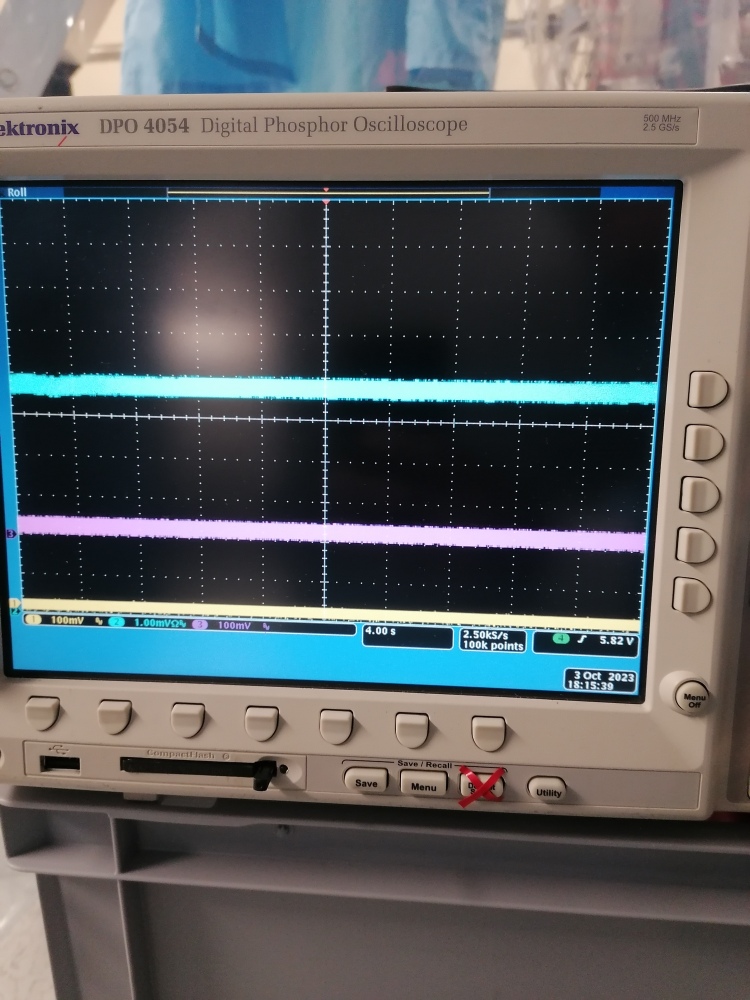
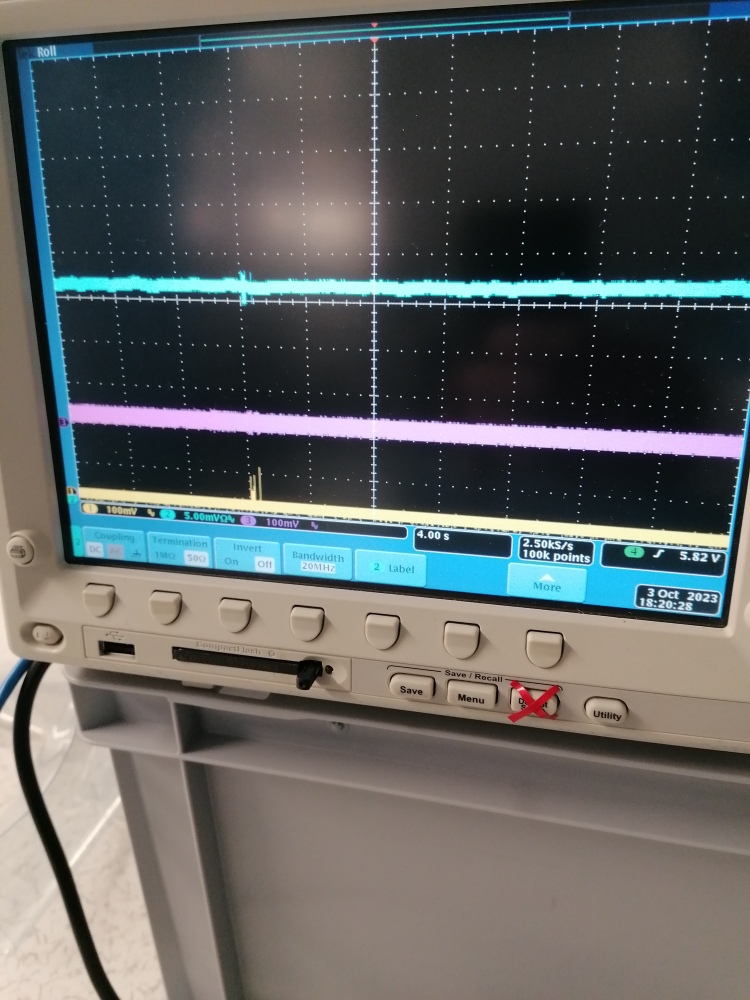
The climatisation was operating since 3 days in satble way. The laser pointing was very stable before to inejct in to the cavity (picture 1) and also for the reflexion from the cavity (picture 2).
That means thant it is necessary to have a stable climatisation operation. |
| Attachment 1: IMG_20231003_155009_resized_20231009_103610100.jpg
|  |
| Attachment 2: IMG_20231003_155458_resized_20231009_103610449.jpg
|  |
|
272
|
Tue Nov 7 14:09:25 2023 |
Ronic Chiche | Fixed | info | lasers and optics | ThomX igloo | Strecher and fiber injection alignment | Today, the power measured at the input of the amplifier (PD_IN on the LAL amplifier software) is 2.5mW instead of >3mW generally measured
The power coming from the NKT/Onefive Origami oscillator is still >37mW (measured directly with the powermeter at the laser output without OD2).
thus, the problem should come from:
- the strecher/fiber alignment.
- or maybe from a wavelength shift of the oscillator
| Ronic Chiche wrote: |
|
Monday 7/11 morning, the power in the fiber was still 6.2 mW
| Ronic Chiche wrote: |
|
this morning : still 6.2 mW at the output of the fiber.
the powermeter has been removed and the fiber connected to amplifier input fiber (no EOM connected in between).
| Ronic Chiche wrote: |
|
This morning with Manar, we continued the strecher CVBG alignment and fiber injection procedure :
- we checked the power at the output of the laser and confirmed the measurement after the Isolator : ~ 36 mW
- we tried to improve the power after the strecher CVBG by rotating the quarter-wave plate but it seems we were already at the maximum : ~ 10.5 mW
- we aligned the 2 fiber injection mirrors + schafter-kirchoff mount z-axis : we saw 5 mW at the output of the fiber but it is very difficult to keep the power after swcrewing the 2 z-axis fixing screws of the schafter-kirchoff mount.
we decided to replace the 750mm focusing lens installed by a 1000mm lens.
- we aligned again the 2 fiber injection mirrors + schafter-kirchoff mount z-axis : now, we have ~ 6.2 mW stable at the output of the fiber after screwing the 2 z-axis fixing screws of the schafter-kirchoff mount.
the procedure for aligning the schafter-kirchoff mount is :
- unscrew the z-axis and tilt fixing screws (5 screws in total).
- improve the injection with the z-axis knob and the tilt screws
- tighten very softly all the fixing srews once the optimization is finished => you will lose a part of the alignment but not completely (~ 1 mW level)
- redo a part of the alignment with the 2 aligning mirrors => you should find back the values after optimization.
we let the power-meter at the output of the fiber to check in the next days if the injected power in the fiber changes or not....
it is important to not "kick" the fiber injection box or put anything on it ! as the schafter-kirchoff mount adjustment is soooo touchy...
| Ronic Chiche wrote: |
|
Manar + Victor, today in the morning we aligned the CVBG of the stretcher.
The double path using the mirror mounts, reached up to 5.4 mW just before the injection into the fibers
then we rotated the quarter wave plate and the power increased by a factor of ~ 2 to 10.3 mW
we started with the injection into the fiber by alignment of the 2 mirror mounts.
1) fiber not connected and have everything pass through the mount
2) connect fiber loosely and increase the power in fiber bit by bit until fiber fixed fully
reached power up to 438 uW
alignment not finished using the mounts, there is still also schafter-kirchoff mount.
| Ronic Chiche wrote: |
|
I used the 33MHz spectrum measurement : https://elog.lal.in2p3.fr/FPC/THOMX+commissioning/153
fitted by P=P0*sech²((f-f0)/df)
f0 = c/1030m
df = (c/1030nm^2) * 2.5nm
and the strecher CVBG measured data (in attached file with reference D24-02)
to estimate the expected power to be coupled into the fiber.
the corresponding plot shows 3 curves:
- black : the 33MHz laser spectrum "manually fittted" with the sech² function (mentionned at the begining of this post) to match the measured spectrum from the elog.
- blue : the strecher CVBG reflectivity curve from the Excel measured datasheet in attachement.
- red : the corresponding output power after a double path into a CVBG (the reflectivity is applied twice).
with this simulation, one can estimate the power after CVBG to be 12.5 mW for 35 mW of input power.
or 9.6 mW after CVBG for 27 mW of input power which is exactly what has been measured in a previous post by Loic : https://elog.lal.in2p3.fr/FPC/THOMX+commissioning/70
| Ronic Chiche wrote: |
|
This morning with Manar, we measured the power at different points:
- direct measurement at the output of the 33MHz laser : 35 mW
inside the injection box :
- after the Isolator + focalization lens : 35 mW
- just at the input of the strecher CVBG : 35 mW
- atfer optimizing the alignment of the double path CVBG, in between the 2 fiber injection coupling mirrors : 5,7 mW
(the power is measured after going through the quarter-waveplate and PBS)
I found an old post from Loic claiming that with 27mW input power, we got 9.6 mW after the PBS instead of 5,7 mW !
https://elog.lal.in2p3.fr/FPC/THOMX+commissioning/70
we have to check if the laser wavelength shifted, if the alignment could be improved, if the quarter-waveplate has the right angle,....
then, we tried to couple this 5,7mW inside the fiber using the schafter-kirchoff mount (SKM) but it is a nightmare.
changing the focus and the internal fiber angle is very sensitive, not always predictable and rarely reproductible...
I have to ask Guillaume how he used this mount...
the best power we saw in the fiber is 1mW but after screwing the fixing screws of the SKM, we lose almost all the alignment and we have something around 100-300µW...
| Ronic Chiche wrote: |
|
In preparation for tomorrow morning, I did a test with a 45° mount to have a power pickup inside the injection box.
I used the 133MHz laser.
output power measured with the powermeter : 45mW
output power measured with the powermeter + OD2 : 2mW
output power measured with the 45° mount with BB1-E03 mirror with the powermeter + OD2 : 2mW
as expected the BB1-E03 mirrors have a very good reflectance for AOI=45°
the specs give >99% @ 1030nm for both S and P polarizations.
| Ronic Chiche wrote: |
|
This morning with Viktor, we started the alignment of the CVBG and fiber.
we did a better alignment of the 2-pass CVBG.
we are able to the see a spot after PBS (after the 2 CVBG pass) which means the alignment is OK even if it can be improved.
then, we started the fiber injection alignment with the 2 last mirrors (7 & 8 on Alphanov documentation).
we saw that if we unswcrew the fiber to play on the focal position, we are able to improve a lot the power in the fiber.
2-3µW with the fiber screwed => 500µW with the fiber unscrewed.
it means the beam is not enough focused.
I will ask Guillaume Machinet his advice when injecting the 33MHz... do we need to replace the long focal lens just after the Isolator ?
and with which value approximatively ?
we played also with the Schafter+Kirchhoff mount of the fiber colimator (see attached documentation).
we loosen the 2 screws around the eccentric key which adjust the focal position + play on this eccentic key + tighten the 2 screws again.
now, we reached 330µW with the fiber properly screwed.
we have to check the available power before the fiber injection but we have very few place to place the powermeter.
maybe with a small mirror ?
| Ronic Chiche wrote: |
|
Today, after laser was modelocked, we checked the power inside the fiber coming from the Alphanov Strecher box.
it was almost zero, at the nW level.
after doing some very rough alignment, we clearly saw some power (with the powermeter) correlated with the position of mirrors, when turning the alignment knobs.
this is a first step but the output power in the fiber is still very low, about 20nW !
an additionnal 2mm L-shaped hex key is needed to do some walking alignment on the mounts.
|
|
|
|
|
|
|
|
|
|
|
273
|
Wed Nov 8 17:51:30 2023 |
Ronic Chiche | Fixed | issue | mechanics | lasers and optics | ThomX igloo | !!! strange amplifier beam pointing fluctuations !!! | we confirmed the effect of the bunker temperature on the laser amplifier "beam pointing" fluctuations.
once the temperature is getting back to stable values, it doesn't happend again.
we bought a temperature data logguer to monitor them in the future: https://www.picotech.com/data-logger/tc-08/thermocouple-data-logger
this post close this thread.
| Ronic Chiche wrote: |
|
this morning, I locked the cavity to ~25kW without any problem.
but this afternoon, the reflected power exhibited low frequency (~1Hz) fluctuations of about 10% without any lock.
the reflected PhD is a DET10 which has a small surface.
we checked the OneFive oscillator power which is perfectly stable.
we changed the DET10 PhD for a DET100 PhD with ~1cm surface : we don't see any power fluctuation => the amplifier power seems stable.
we put back the DET10 PhD : we see these fluctuations of about 10% => it could be some pointing effect !!!
when one locks the FP-cavity, we clearly see exactly the same power fluctuations at the Transmission PhD but complementary => the sum is constant.
so, it seems clear that the beam coupling to the cavity is fluctuating due to some pointing fluctuation of the incoming beam.
a reason of these fluctuations could be the thermal jump done today because of the air cooling system of the bunker :
the temperature jumped from 25°C yesterday (and maybe still this morning ?) to 18°C this afternoon !!!
thus, some mechanical parts (the compressor CVBG ?) could be moving and then could produce these pointing fluctuations...
|
|
|
274
|
Wed Nov 8 18:52:44 2023 |
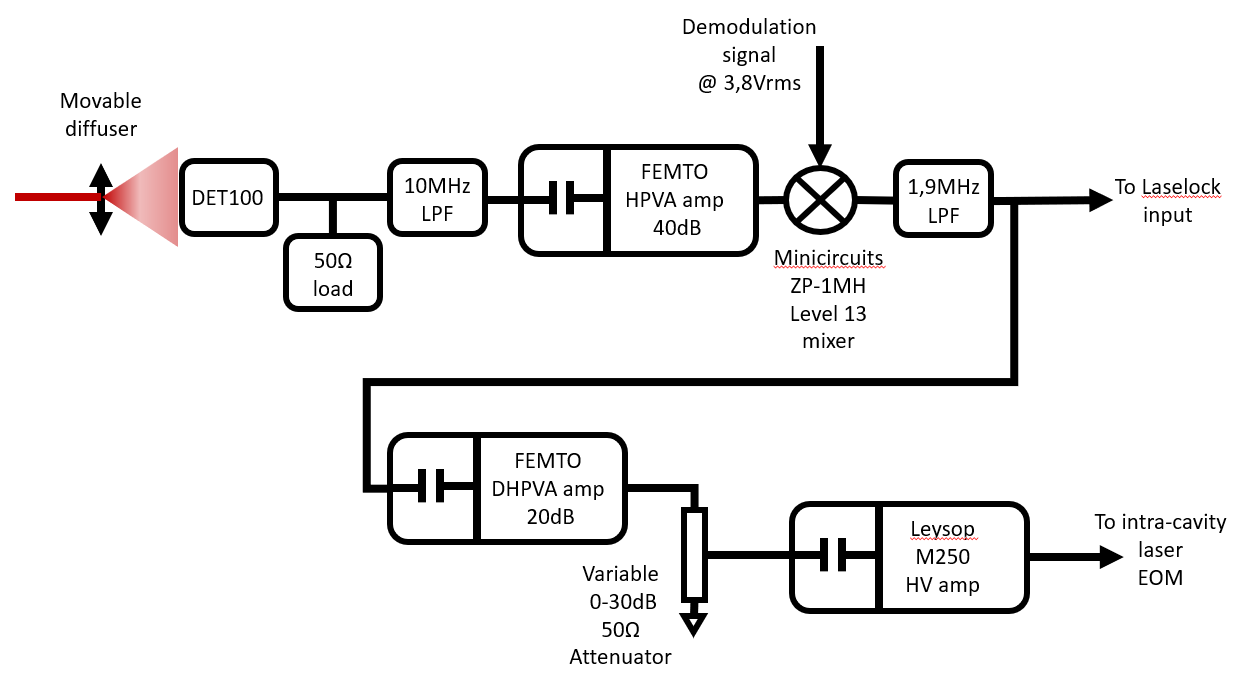
Ronic Chiche | Fixed | info | lasers and optics | detectors and electronics | ThomX igloo | some changes in the feedback scheme | from several weeks, the maximum power stored in the FP-cavity was ~ 5kW.
today with Daniele, we finished to investigate the problem, and now the power inside the FP-cavity is back to ~50kW for 30% of laser amplifier ratio (~16W).
we optimized the signal received by the PDH photodiode by installing a large DET100 to collect more light.
if one installs a small photodiode (DET10) in the middle of the beam, the carrier signal when a FP-cavity crosses a resonance is larger because the photodiode "sees" only the part of the beam which is geometrically coupled to the cavity in its small active area, but :
1- once we will improve the geometrical coupling, the part of the incoming beam coupled to the FP-cavity will increase.
2- one need to work with a diffuser in front of this photodiode to precisely adapt the feedback loops gain : in that case the photodiode is sensitive to the whole input beam, whatever his active area size.
so, we decide to put a DET100 (which is given for 35ns rise time / 10MHz BW when connected on 50ohms).
see the scheme in attached file.
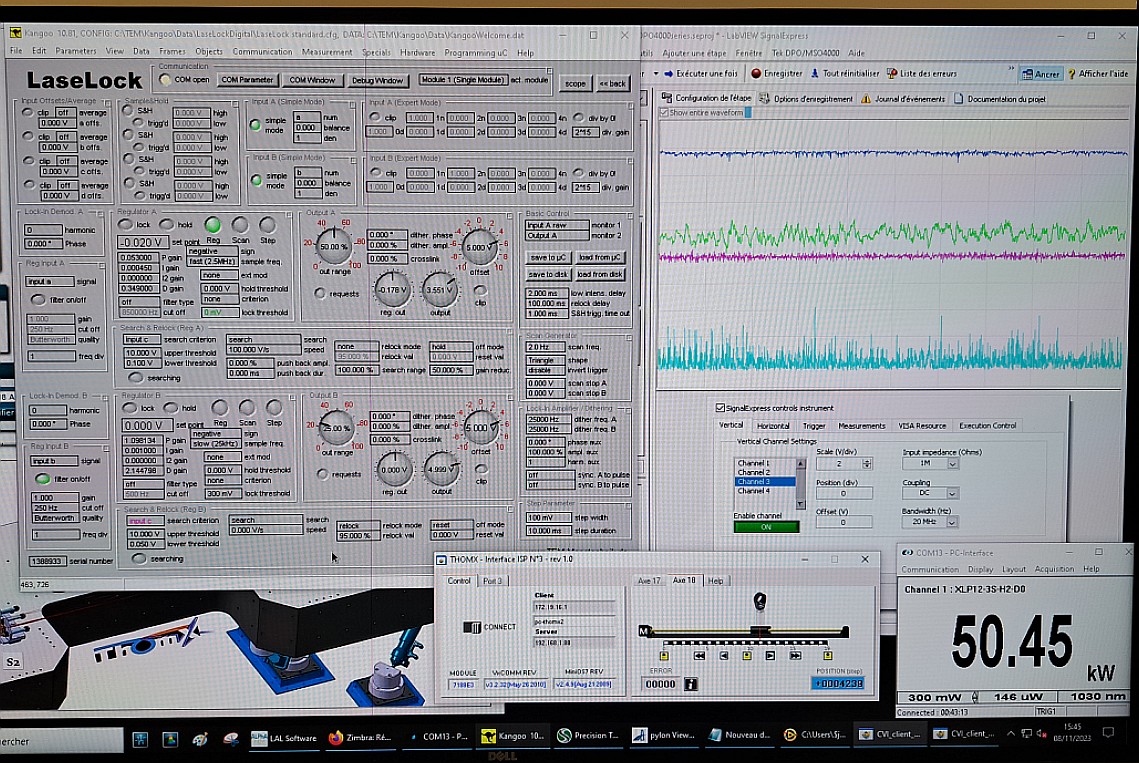
and a picture of the desktop with all the lock parameters :
the quality of the lock, seen on the reflected power signal is very good !
and the stability is only limited by the necessity to act on the laser Smaract motors to let the PZT in its working range.
dark blue : transmitted signal
green : PZT
pink : error signal
light blue : reflected signal
conclusion : it is not clear that the cavity Finesse have significantly increased during the last weeks, as we are roughly at the same level than before (47kW).
but as we precisely adapted the signal levels in the feedback scheme (PDH S/N ratio and Laselock parameters), the result is a more stable lock.
|
| Attachment 1: Capture.PNG
|  |
| Attachment 2: 20231108_154711.jpg
|  |
|
275
|
Thu Nov 9 16:40:16 2023 |
Ronic Chiche | Fixed | info | mechanics | lasers and optics | detectors and electronics | ThomX igloo | Ring frequency / Laser "day by day" locking | today, the equivalent Smaract position corresponding to the 500.25MHz ring frequency is +156µm on MCS-1/ch0 (closed loop mode) |
|