| ID |
Date |
Author |
Status |
Type |
Category |
Location |
Title |
|
461
|
Mon Dec 1 18:03:29 2025 |
Ronic Chiche | Fixed | report | lasers and optics | detectors and electronics | ThomX igloo | Noise issue | since several days, we see that the locking is more and more unstable and the lock duration was sometime less than 20-30 seconds !
1) I tried to optimize the feedback loops
I discovered that the gain on the fast loop on the laser EOM was very low and was almost uneffective for the global stability of the lock (I can remove the cable of the HV to EOM and it does not change the stability of the signals).
when I tried to increase this loop gain in open loop for the PZT loop, I clearly saw an improvement of the transmission signal stored in the cavity.
but when I close the PZT loop, it does not help to get a better locking.
so, at the end, I cancel this loop gain (HV amplifier for the EOM is OFF !) and only the slow feedback loop on the PZT is working.
I reduced the by a factor 2 the range on the PZT loop side to reduce the noise due to the amplified Laselock (voltage divider 1/2 before the HV amp for the PZT).
and I switched off the laser motor controller (Smaract MCS).
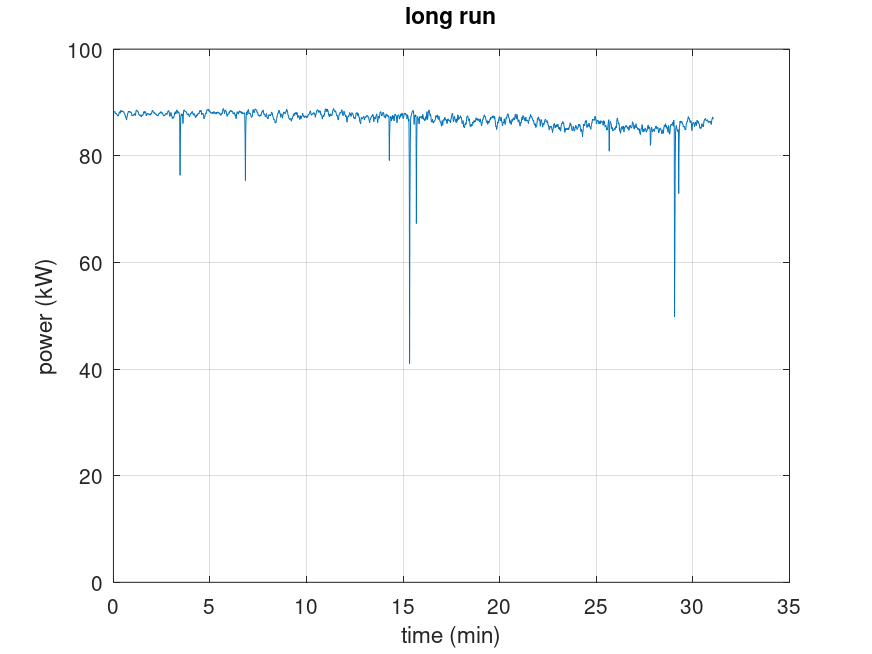
after optmization of the PID parameters, I was able to get back the 90kW we had in the past for 33% laser amp ratio and with a very good stability :
the transmission signal is a line and the reflection signal is almost a line too.
in this condition, I seems that I can lock the laser and the FPC indefinitely.
2) issue with Smaract controller
I put back the Smaract controller only for the CEP channel => one can clearly see a bit more noise on the PDH signal but the transmssion and the reflection signal stay almost the same with a very good stability.
then, I put back the Smaract controller for both channels (CEP and laser cavity length) => the lock was very bad, even after a PID optimization despite the fact it was a "Low Vibration" (LV) Smaract MCS controller.
we tried to change the 3-channels LV controller by a standard 3-channels (not LV) spare controller => it was OK for the CEP channel but not good at all the laser cavity length channel => very noisy.
so, we kept this standard controller for the CEP channel and we took 1-channel LV spare controller for the laser cavity length channel => it was ok. no more additionnal noise and we can work without delock in piezo-scan mode.
important parameters :
I used 1ms for hold time in the Smaract controller configuration.
I used 1V/s in piezo scan mode for the speed => it does affect the noise level when the piezo is moved !
3) IP Smaract controller parameters :
I used the MCSNetworkInterfaceConfig.exe software to configure both IP addresses of the 2 controllers.
it's easy, one just has to choose the options.
the IP address for controller ruling the laser cavity length is : 192.168.1.200:5000
the IP address for controller ruling the CEP is : 192.168.1.201:5000
4) final long run test
We did a 1/2h run test to check how many lock loss one gets... see the picture.
we had some few lock losses (with the RF feedback lock ON too) but most of the time, the RF phase was not lost and the X-rays should be continued to be produced.
a test should be done tomorrow.
|
| Attachment 1: 2025-12-01_-_long_run_few_delocks.png
|  |
|
462
|
Wed Dec 3 16:23:40 2025 |
Ronic Chiche | Fixed | report | lasers and optics | detectors and electronics | ThomX igloo | Noise issue | yesterday, in the same conditions, we had so many locking issues... exactly in the same way than before. :-(
so we still have "locking issues" depending on something we didn't find...
today, we removed the "1/2 voltage divider" before the PZT amplifier to get back the full dynamic.
we have a little bit more noise and we lose some power on transmission (85kW instead of 90kW) but it worked pretty well.
we had quite long X-rays runs ~ 20 minutes without any lock losses => see the picture.
but we have to keep in mind that maybe it was just a "good" day and an another day can be "bad".
we still have to understand where do these perturbations come from.
the good news is we brought back the previous setting of the FPC.
| Ronic Chiche wrote: |
|
since several days, we see that the locking is more and more unstable and the lock duration was sometime less than 20-30 seconds !
1) I tried to optimize the feedback loops
I discovered that the gain on the fast loop on the laser EOM was very low and was almost uneffective for the global stability of the lock (I can remove the cable of the HV to EOM and it does not change the stability of the signals).
when I tried to increase this loop gain in open loop for the PZT loop, I clearly saw an improvement of the transmission signal stored in the cavity.
but when I close the PZT loop, it does not help to get a better locking.
so, at the end, I cancel this loop gain (HV amplifier for the EOM is OFF !) and only the slow feedback loop on the PZT is working.
I reduced the by a factor 2 the range on the PZT loop side to reduce the noise due to the amplified Laselock (voltage divider 1/2 before the HV amp for the PZT).
and I switched off the laser motor controller (Smaract MCS).
after optmization of the PID parameters, I was able to get back the 90kW we had in the past for 33% laser amp ratio and with a very good stability :
the transmission signal is a line and the reflection signal is almost a line too.
in this condition, I seems that I can lock the laser and the FPC indefinitely.
2) issue with Smaract controller
I put back the Smaract controller only for the CEP channel => one can clearly see a bit more noise on the PDH signal but the transmssion and the reflection signal stay almost the same with a very good stability.
then, I put back the Smaract controller for both channels (CEP and laser cavity length) => the lock was very bad, even after a PID optimization despite the fact it was a "Low Vibration" (LV) Smaract MCS controller.
we tried to change the 3-channels LV controller by a standard 3-channels (not LV) spare controller => it was OK for the CEP channel but not good at all the laser cavity length channel => very noisy.
so, we kept this standard controller for the CEP channel and we took 1-channel LV spare controller for the laser cavity length channel => it was ok. no more additionnal noise and we can work without delock in piezo-scan mode.
important parameters :
I used 1ms for hold time in the Smaract controller configuration.
I used 1V/s in piezo scan mode for the speed => it does affect the noise level when the piezo is moved !
3) IP Smaract controller parameters :
I used the MCSNetworkInterfaceConfig.exe software to configure both IP addresses of the 2 controllers.
it's easy, one just has to choose the options.
the IP address for controller ruling the laser cavity length is : 192.168.1.200:5000
the IP address for controller ruling the CEP is : 192.168.1.201:5000
4) final long run test
We did a 1/2h run test to check how many lock loss one gets... see the picture.
we had some few lock losses (with the RF feedback lock ON too) but most of the time, the RF phase was not lost and the X-rays should be continued to be produced.
a test should be done tomorrow.
|
|
| Attachment 1: Screenshot_2025-12-03_15-36-59.png
|  |
|
463
|
Mon Dec 8 11:17:17 2025 |
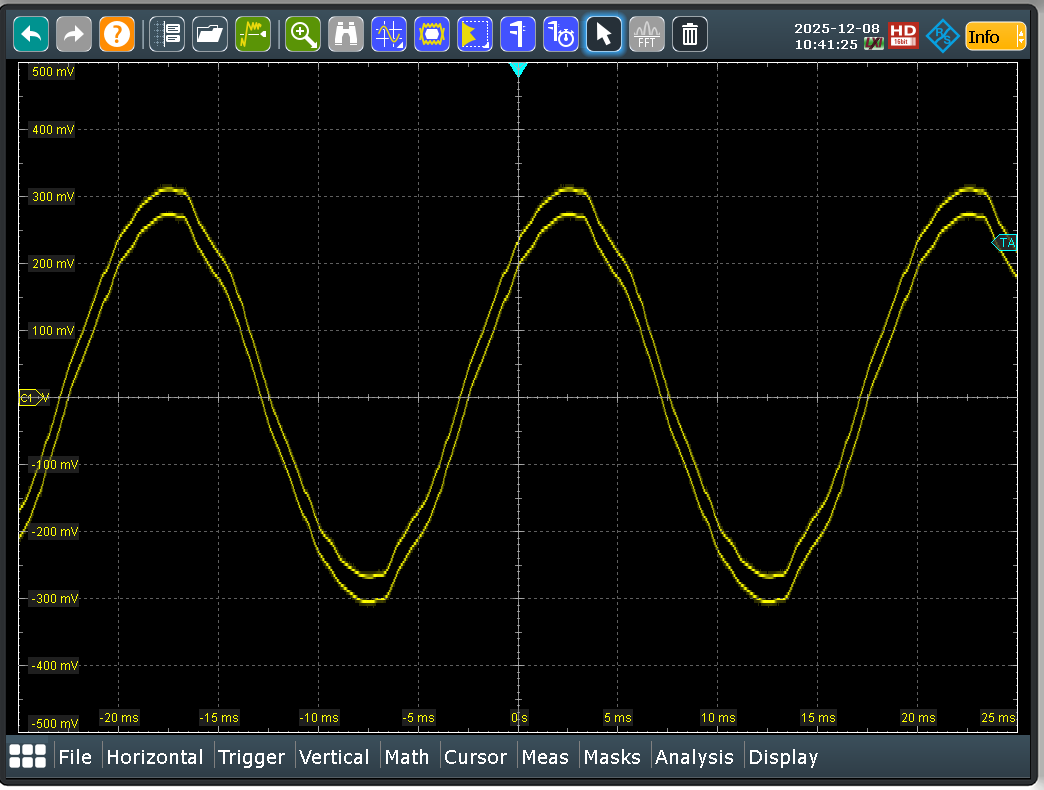
Ronic Chiche | Fixed | issue | lasers and optics | detectors and electronics | ThomX igloo | High frequency noise | This morning, I installed a high-voltage probe (1:1000) on the AC-line to see if one could detect a correlation between lock losses and AC-line voltage variations.
I observed many lock losses but without any variation or correlation of the AC-line signal (scope set in "peak detect" with "envelope" arithmetics).
see attached figure.
| Ronic Chiche wrote: |
|
we did some tests with Marie to make some vibrations on the door.
below, I exhibit some pictures of the scope with the accelerometer plugged on it without or with noise...
this level of noise is not able to make the FPC loosing the lock.
even when saturating the noise signal on the accelerometer, the FPC is not loosing the lock all the time.
then, when a day is very windy, it's possible it could have some effect, but for a normal day, it's seems very doubtful that is the reason...
| Ronic Chiche wrote: |
|
After this observation, we did a test with Daniele to try to correlate the road traffic in front of the Igloo with the lock losses observed on the FPC.
We didn't see any clear correlation. Cars or buses are not the direct origin of the FPC lock losses... only when some heavy load is hitting the building, we observed a clear correlation.
So, we still observed a lot of FPC lock losses when the day is windy...
One possible cause could be the large door of the igloo (~20 m²) hitting the Igloo when the day is windy.
I installed the accelerometer on the rail on the bottom of the large door to see if there is any correlation.
| Ronic Chiche wrote: |
|
At the end of the day, we found out what was the origin of this noise : some road renovation work with jackhammer and road roller just at the entrance of the "Igloo".
this origin was 100% correlated with a large increase of the accelerometer signal.
but we clearly saw that the FPC is much more sensitive than the accelerometer... the signal can have a small increase or just one peak and the cavity lock is lost.
then, we can make the assumption that all the "high frequency noise" which produces some lock losses could come from acoustic noise due to the road traffic or from the equipments in the bunker itself.
| Ronic Chiche wrote: |
|
Today, the lock of the FPC was particularly bad (maybe the worst ever seen), with a lot of high frequency noise.
the lock was impossible during several minutes !
we tried to switch off all the equipments of the machine, one by one without any effect on the lock.
at the end, we looked at the accelerometer installed inside the housing to check if there was some correlation.
and for the 1st time we clearly saw a 100% correlation beween the accelerometer signal with a noise oscillating above +/-300mV
but we didn't find the origin of this noise.
|
|
|
|
|
| Attachment 1: AC-line.png
|  |
|
464
|
Mon Feb 2 15:29:45 2026 |
Ronic Chiche | Fixed | info | lasers and optics | ThomX igloo | Laser Amplifier used at 70% | today, I installed a laser dump just before the telescope to avoid any high power (50W instead of 17W usually) issue in the injection line.
last time, we saw some plastic mounts of the polarizers slightly burnt because of some small misalignment.
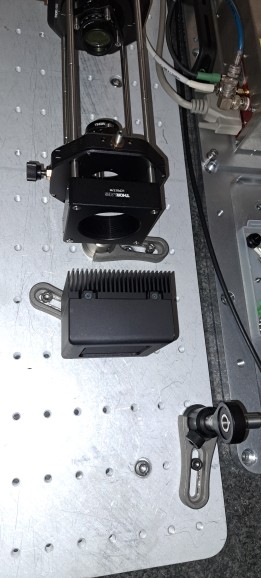
I used a thorlabs LB2 (see picture) which is able to manage 80W CW or 25J/cm2 pulses => this is OK in both cases : 50W CW / 1.5µJ/pulse for ThomX.
I started the laser amplifier at 70% which produces 50W at the amplifier output and 45W at the input of the FPC.
start : 15h10
immediately, the Temp Amp1 increases from 26°C to 30°C
the Temp Amp2 stays around 26°C
PD_OUT = 79,2W
start + 5-10 min
Temp Amp1 : 31°C
Temp Amp2 : 27°C
PD_OUT = 79,2W
start + 30 min
Temp Amp1 : 31,6°C
Temp Amp2 : 27,5°C
PD_OUT = 79,2W
start + 1h00
Temp Amp1 : 31,6°C
Temp Amp2 : 27,6°C
PD_OUT = 79,2W
start + 1h30
Temp Amp1 : 31,7°C
Temp Amp2 : 27,7°C
PD_OUT = 79,2W
start + 2h00
Temp Amp1 : 31,7°C
Temp Amp2 : 27,7°C
PD_OUT = 79,2W
start + 2h30
Temp Amp1 : 31,7°C
Temp Amp2 : 27,7°C
PD_OUT = 79,2W
|
| Attachment 1: img1.jpg
|  |
|