| ID |
Date |
Author |
Status |
Type |
Category |
Location |
Title |
|
476
|
Wed Jul 15 18:16:37 2026 |
Ronic Chiche | Under Process | issue | lasers and optics | Optical room | elliptic mode shape | the mode shape @ 5-15kW is very elliptic (50% of ellipticity : large size = 2x small size).
we only changed M1 and did not move M2,M3,M4.
what are the possible reasons for the ellipticity:
- M1 misalignment (cavity axis if off the mirrors center) :
we changed the M1 orientation in X and Y => no effect on the mode shape
- cavity too close from instability region :
we changed the distance between spherical mirrors (S3 moved by almost 700µm ) => no effect on the mode shape
- thermal effect changing the mirror curvature :
we observed mode at 5 or 15 kW => no effect on the mode shape
- bad alignment of the lens in front of the camera :
we observed elliptic and round shape beams with exactly the same centroid on the camera
- thermal effect changing some stress on the mount holding the mirror :
we observed mode at 5 or 15 kW => no effect on the mode shape
- default in the mirror substrate polishing :
why not, but it's strange that with the previous mirror we saw the same kind of ellipticity at low power and a perfect round shape beam at high power.
(with this mirror, we never succeded to overcome 15kW in FPC)
- how strong the small screws holding the mirror are tightened, which could induce some stress :
but why did we saw a perfect round shape of the beam at high power with the previous mirror ?
and it would be strange to get almost the same orientation of the ellipse with the 2 mirrors.
- other ideas ??? |
| Attachment 1: Image__2026-07-15__15-28-39.jpeg
|  |
|
475
|
Fri Jun 26 09:42:31 2026 |
Ronic Chiche | Under Process | info | mechanics | lasers and optics | vacuum | ThomX igloo | removing of the M1 mirror | this morning, the vacuum level is still around 1.9 10**-7.
the vacuum guys said that last time, the pumping was much faster.
they ask if baking the vessel (with the mirrors inside ?) is absolutely impossible...
| Ronic Chiche wrote: |
|
the pressure level with the ionic pump was limited to ~ 1.5 .10**-7 mbar after several days of pumping, due to some leakage located on the bottom screws of the large flange.
so we decided to reopen the flange and change the copper joint.
we did a new leakage test, and after tightening properly the screws, it seems there is no leakage anymore.
so, we started the ionic pumping in the morning (several starts and stops to clean the ionic pump with the turbo pumping), and at 3.30 pm, we closed the turbo/vessel valve.
the vacuum level is at 2.3.10*-7 mbar.
let's see how much it is tomorrow morning to have an estimation of the time needed to reach 2.10**-8 mbar (in the vessel), which should reduce to 5.10**-9 once the ring/vessel valve will be opened (the ring has roughly the same volume as the two vessel volumes).
| Ronic Chiche wrote: |
|
This afternoon, we installed a new M1 mirror, the only one for which the box was not already opened.
as the mirror should be "brand new", as the LMA has packaged it, we decided not to clean it with ultra-pure water and to install it out of the box.
we realigned it with the iris previously installed for that purpose.
primary and turbo pumping are in process. one has to wait until the vacuum level is low enough to start the ionic pumping and to reopen the isolating valve.
let's cross our fingers...
| Ronic Chiche wrote: |
|
this morning, with Daniele, we took some images of the M1 mirror HR surface :
1- large image span of the mirror surface (~center) before being cleaned :
one can see a lot of spots
2- zoom in on some spots in the middle of the mirror.
Daniele saw 2 suspicious spots among many.
difficult to be sure if it's only some dust or if it's some damage
3- large image span of the mirror surface after being cleaned with the spin coater machine
only the 2 suspicious spots remain, all others have been washed.
4- zoom in on the 2 suspicious spots
if one compares with the image before cleaning, one can see the spots are much larger
5&6- zoom in on the 2 suspicious spots separately after a 2nd cleaning process with the spin coater,
it seems the spots are even a bit larger than before
conclusion : it seems that these spots are presently showing some damage on the mirror surface.
it is strange that there are 2 in the same time.
one possible explanation is that, as we had to move the z-axis motor before, and we know that the mechanics are rusty, it's possible that it released some metallic particles on the mirror surface.
and 2 were in the beam area....
| Ronic Chiche wrote: |
|
after trying to increase the power and after moving S3 to try to change the size of the beam on the mirrors, the FPC power suddenly droped.
so, we need to remove M1 to check if it has been damaged.
we placed an iris in reflection of the FPC to keep the alignment for the new mirror M1.
the alignment has been done with an iris and the amplifier at 10% (to get a quite round beam) and the beam profiler.
once the iris is almost closed, the alignment is good, using the diffractions rings.
|
|
|
|
|
|
474
|
Thu Jun 25 16:04:34 2026 |
Ronic Chiche | Under Process | info | mechanics | lasers and optics | vacuum | ThomX igloo | removing of the M1 mirror | the pressure level with the ionic pump was limited to ~ 1.5 .10**-7 mbar after several days of pumping, due to some leakage located on the bottom screws of the large flange.
so we decided to reopen the flange and change the copper joint.
we did a new leakage test, and after tightening properly the screws, it seems there is no leakage anymore.
so, we started the ionic pumping in the morning (several starts and stops to clean the ionic pump with the turbo pumping), and at 3.30 pm, we closed the turbo/vessel valve.
the vacuum level is at 2.3.10*-7 mbar.
let's see how much it is tomorrow morning to have an estimation of the time needed to reach 2.10**-8 mbar (in the vessel), which should reduce to 5.10**-9 once the ring/vessel valve will be opened (the ring has roughly the same volume as the two vessel volumes).
| Ronic Chiche wrote: |
|
This afternoon, we installed a new M1 mirror, the only one for which the box was not already opened.
as the mirror should be "brand new", as the LMA has packaged it, we decided not to clean it with ultra-pure water and to install it out of the box.
we realigned it with the iris previously installed for that purpose.
primary and turbo pumping are in process. one has to wait until the vacuum level is low enough to start the ionic pumping and to reopen the isolating valve.
let's cross our fingers...
| Ronic Chiche wrote: |
|
this morning, with Daniele, we took some images of the M1 mirror HR surface :
1- large image span of the mirror surface (~center) before being cleaned :
one can see a lot of spots
2- zoom in on some spots in the middle of the mirror.
Daniele saw 2 suspicious spots among many.
difficult to be sure if it's only some dust or if it's some damage
3- large image span of the mirror surface after being cleaned with the spin coater machine
only the 2 suspicious spots remain, all others have been washed.
4- zoom in on the 2 suspicious spots
if one compares with the image before cleaning, one can see the spots are much larger
5&6- zoom in on the 2 suspicious spots separately after a 2nd cleaning process with the spin coater,
it seems the spots are even a bit larger than before
conclusion : it seems that these spots are presently showing some damage on the mirror surface.
it is strange that there are 2 in the same time.
one possible explanation is that, as we had to move the z-axis motor before, and we know that the mechanics are rusty, it's possible that it released some metallic particles on the mirror surface.
and 2 were in the beam area....
| Ronic Chiche wrote: |
|
after trying to increase the power and after moving S3 to try to change the size of the beam on the mirrors, the FPC power suddenly droped.
so, we need to remove M1 to check if it has been damaged.
we placed an iris in reflection of the FPC to keep the alignment for the new mirror M1.
the alignment has been done with an iris and the amplifier at 10% (to get a quite round beam) and the beam profiler.
once the iris is almost closed, the alignment is good, using the diffractions rings.
|
|
|
|
|
473
|
Thu Jun 11 17:11:02 2026 |
Ronic Chiche | Under Process | info | mechanics | lasers and optics | vacuum | ThomX igloo | removing of the M1 mirror | This afternoon, we installed a new M1 mirror, the only one for which the box was not already opened.
as the mirror should be "brand new", as the LMA has packaged it, we decided not to clean it with ultra-pure water and to install it out of the box.
we realigned it with the iris previously installed for that purpose.
primary and turbo pumping are in process. one has to wait until the vacuum level is low enough to start the ionic pumping and to reopen the isolating valve.
let's cross our fingers...
| Ronic Chiche wrote: |
|
this morning, with Daniele, we took some images of the M1 mirror HR surface :
1- large image span of the mirror surface (~center) before being cleaned :
one can see a lot of spots
2- zoom in on some spots in the middle of the mirror.
Daniele saw 2 suspicious spots among many.
difficult to be sure if it's only some dust or if it's some damage
3- large image span of the mirror surface after being cleaned with the spin coater machine
only the 2 suspicious spots remain, all others have been washed.
4- zoom in on the 2 suspicious spots
if one compares with the image before cleaning, one can see the spots are much larger
5&6- zoom in on the 2 suspicious spots separately after a 2nd cleaning process with the spin coater,
it seems the spots are even a bit larger than before
conclusion : it seems that these spots are presently showing some damage on the mirror surface.
it is strange that there are 2 in the same time.
one possible explanation is that, as we had to move the z-axis motor before, and we know that the mechanics are rusty, it's possible that it released some metallic particles on the mirror surface.
and 2 were in the beam area....
| Ronic Chiche wrote: |
|
after trying to increase the power and after moving S3 to try to change the size of the beam on the mirrors, the FPC power suddenly droped.
so, we need to remove M1 to check if it has been damaged.
we placed an iris in reflection of the FPC to keep the alignment for the new mirror M1.
the alignment has been done with an iris and the amplifier at 10% (to get a quite round beam) and the beam profiler.
once the iris is almost closed, the alignment is good, using the diffractions rings.
|
|
|
|
472
|
Thu Jun 11 11:16:55 2026 |
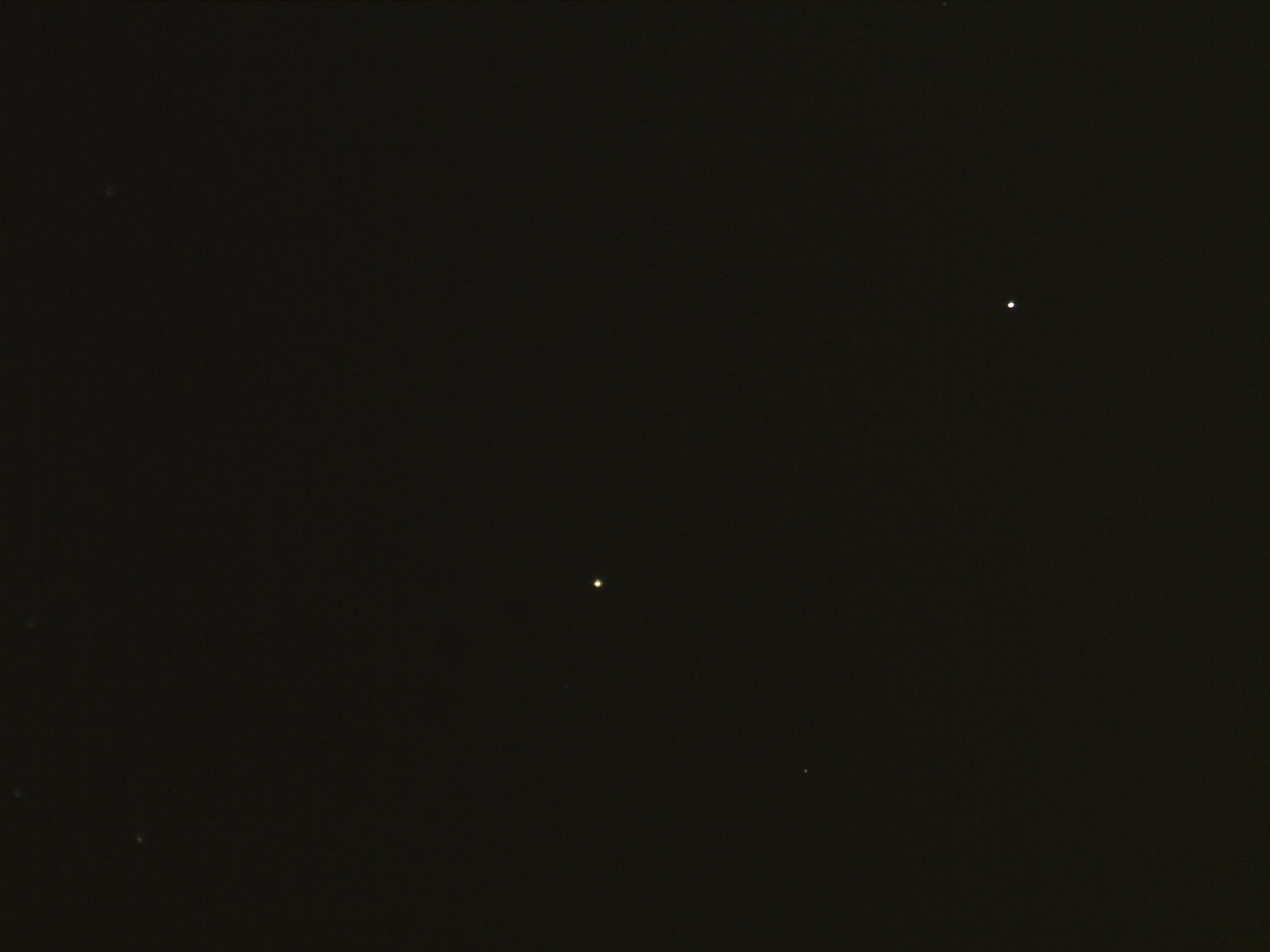
Ronic Chiche | Under Process | info | mechanics | lasers and optics | vacuum | ThomX igloo | removing of the M1 mirror | this morning, with Daniele, we took some images of the M1 mirror HR surface :
1- large image span of the mirror surface (~center) before being cleaned :
one can see a lot of spots
2- zoom in on some spots in the middle of the mirror.
Daniele saw 2 suspicious spots among many.
difficult to be sure if it's only some dust or if it's some damage
3- large image span of the mirror surface after being cleaned with the spin coater machine
only the 2 suspicious spots remain, all others have been washed.
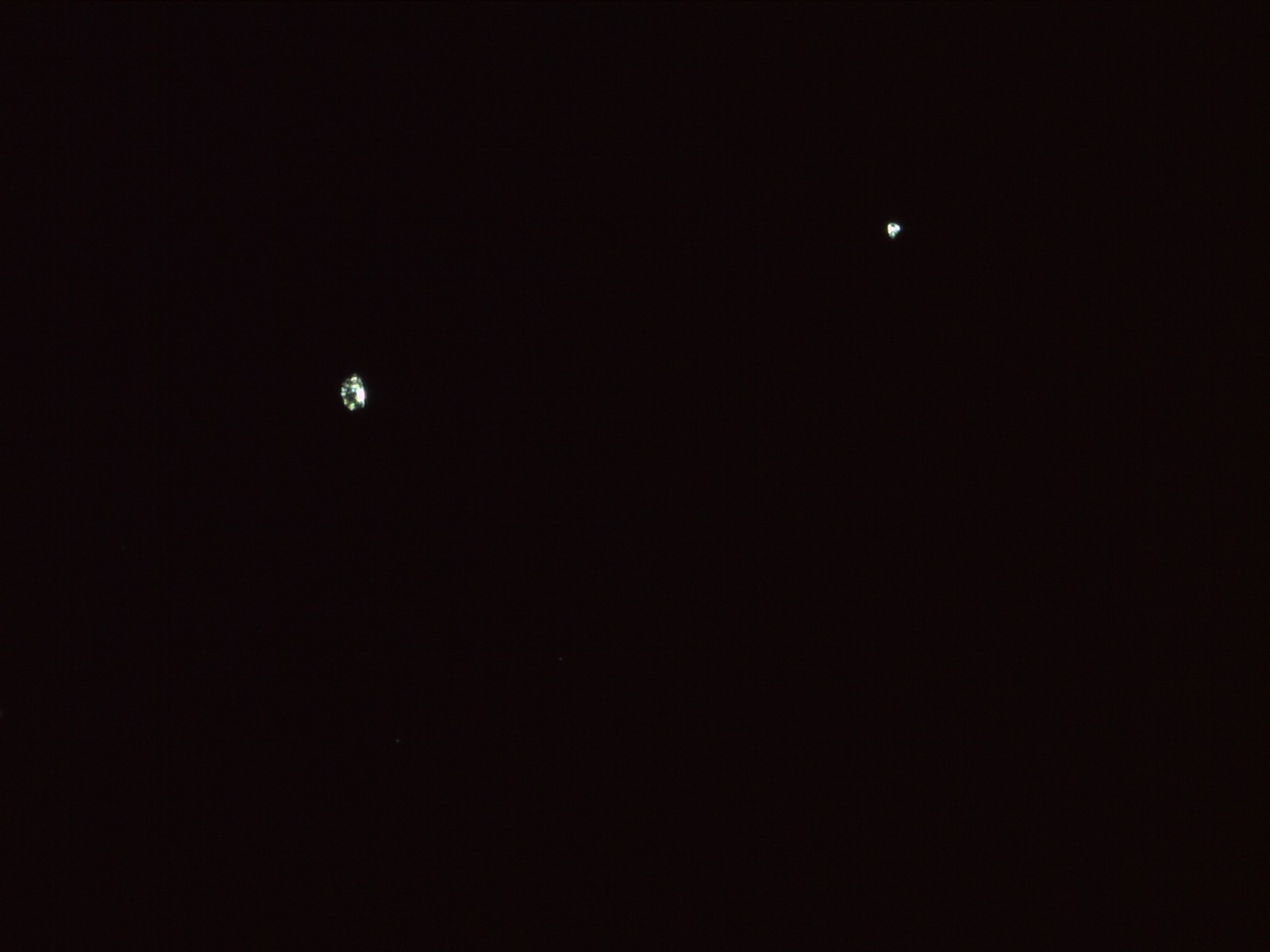
4- zoom in on the 2 suspicious spots
if one compares with the image before cleaning, one can see the spots are much larger
5&6- zoom in on the 2 suspicious spots separately after a 2nd cleaning process with the spin coater,
it seems the spots are even a bit larger than before
conclusion : it seems that these spots are presently showing some damage on the mirror surface.
it is strange that there are 2 in the same time.
one possible explanation is that, as we had to move the z-axis motor before, and we know that the mechanics are rusty, it's possible that it released some metallic particles on the mirror surface.
and 2 were in the beam area....
| Ronic Chiche wrote: |
|
after trying to increase the power and after moving S3 to try to change the size of the beam on the mirrors, the FPC power suddenly droped.
so, we need to remove M1 to check if it has been damaged.
we placed an iris in reflection of the FPC to keep the alignment for the new mirror M1.
the alignment has been done with an iris and the amplifier at 10% (to get a quite round beam) and the beam profiler.
once the iris is almost closed, the alignment is good, using the diffractions rings.
|
|
| Attachment 1: large_image_before_cleaning.jpeg
|  |
| Attachment 2: 2_suspicious_spots_before_cleaning.jpeg
|  |
| Attachment 3: large_image_after_cleaning.jpeg
|  |
| Attachment 4: 2_suspicious_spots_after_cleaning_#1.jpeg
|  |
| Attachment 5: 2_suspicious_spots_after_cleaning_#2_focus_on_spot_1.jpeg.jpeg
|  |
| Attachment 6: 2_suspicious_spots_after_cleaning_#2_focus_on_spot_2.jpeg.jpeg
|  |
|
471
|
Wed Jun 10 16:16:33 2026 |
Ronic Chiche | Under Process | info | mechanics | lasers and optics | vacuum | ThomX igloo | removing of the M1 mirror | after trying to increase the power and after moving S3 to try to change the size of the beam on the mirrors, the FPC power suddenly droped.
so, we need to remove M1 to check if it has been damaged.
we placed an iris in reflection of the FPC to keep the alignment for the new mirror M1.
the alignment has been done with an iris and the amplifier at 10% (to get a quite round beam) and the beam profiler.
once the iris is almost closed, the alignment is good, using the diffractions rings. |
|
470
|
Thu May 28 10:31:23 2026 |
Ronic Chiche | Under Process | report | lasers and optics | ThomX igloo | Increasing the FP-cavity power | Last friday, with Daniele, we did some realignement on the 2nd CVBG of the compressor : the beam shape seems better, now.
this morning, we checked that the injection path (periscope and injecton mirrors) is not sensitive to the polarization state of the beam.
we checked also the power at the input of the FPC for 70% amplifier ratio : 40W !
so, with 100% coupling, we can only expect 400kW in the FPC !
| Ronic Chiche wrote: |
|
this morning with Daniele, we set the amplifier ratio to 33% => 97kW
then, we set the amplifier ratio to 50% => 124 kW (position of the diffuser on Axis 18 : +11775)
we changed the waveplates axis => no effect
we changed the position of the L-shape :
- lower button / clockwise / 1/20 of a turn (one has to decrease the laser motor position to compensate) => no effect but the misalignement is very sensitive for this axis
- upper button / anti-clockwise (the Lshape position is getting down) / we went to the limit (not very sensitive in alignment) => no effect ! (no beam cut nor HOM apparition)
=> conclusion : now, the L-shape is badly positionned (it's off the beam) but it cannot be the reason for a lake of power in the cavity.
PS : the lock seems very stable for long term (~ 130kW)
| Ronic Chiche wrote: |
|
I installed a stronger optical filter on the reflection photodiode and loaded it on 1kOhms.
70% amplifier ratio => 575 mV => 575 µA => no more photodiode linearity issue
amplifier ratio (%) => Vr unlocked (mV)
10 => 14
20 => 156
30 => 295
40 => 412
50 => 491
60 => 545
70 => 575
to be compared to : https://elog.lal.in2p3.fr/FPC/THOMX+commissioning/378
=> still a big discrepency => could we have some clipping in the reflective wedge ?
=> I tried in realigning the wedge but got roughly the same result.
=> could it be the size of the PhD (DET36 presently) ?
=> we should also check the amplifier power at FPC input before increasing power
| Ronic Chiche wrote: |
|
new power increase after alignment of the waveplates and iris.
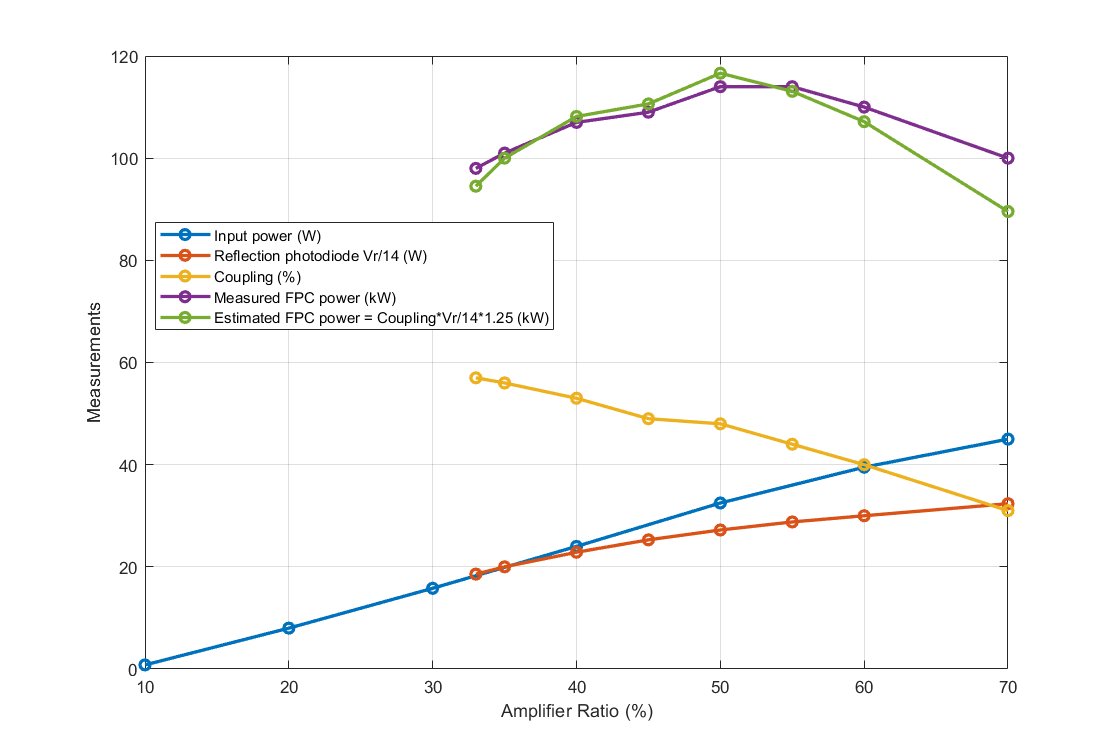
amplifier ratio (%) => FPC cavity power (kW) => FPC cavity coupling (%) => Vr unlock (mV)
33 => 98 => 57 => 260
35 => 101 => 56 => 280
40 => 107 => 53 => 320
45 => 109 => 49 => 354
50 => 114 => 48 => 381
55 => 114 => 44 => 403
60 => 110 => 40 => 420
70 => 100 => 31 => 453
We still observe a discrepancy between the measured and estimated input power (using the unlocked reflection photodiode) as the amplifier ratio increases.
But this time, the estimated FPC power is also badly estimated.
So, it is possible that the reflection photodiode is operating in a nonlinear regime, as 300 mV across 50 Ohms is equivalent to 6 mA, which may be too much to remain in the linear regime.
It could be interesting to reduce the photodiode's power (add an optical filter) and use a 1k-Ohm load impedance.
| Ronic Chiche wrote: |
|
today with Alice and Daniele,
we checked the distance of the optical setup :
from the amplifier output (the fiber output) to the 2nd lens (+200 mm) :
131.5+41+17+28 cm = 217.5 cm
from the 2nd lens (+200 mm) to the FP cavity window :
133+97+70+14+22 cm = 336 cm
1st lens : -100 mm
2nd lens : +200 mm
distance between them : 11 cm
we checked also the alignment of the different iris and waveplates of the optical setup :
we had to realign a little bit the 2 waveplates.
after the realignment, we obtain the 96-97kW in the FPC for 33% of amplifier ratio !
| Ronic Chiche wrote: |
|
Last Friday, we tried to increase the FP-cavity power by just increasing the amplifier ratio from 35% to 70%.
It took a bit longer than expected because it started with the surprise of finding our entire setup powered off…
The power had tripped, and the switch that allowed us to remotely reset the power supplies had been damaged.
The switch was bypassed, and the instruments restarted → OK.
As usual, the locks were pretty unstable (as has been the case for several weeks), and we couldn’t hold them for more than 10–20 seconds…
So I removed the HV amplifier between the LaseLock and the laser PZT.
Since the Smaract MCS2 controller is much less noisy than the MCS1, we can use it directly without unlocking the cavity or going through "piezo-scan" mode.
So basically, having a larger range on the laser PZT is less useful.
Result: perfectly stable locks in the short term (as before installing the amplifier) AND in the long term as well… no more random unlocks!!!
So the amplifier must have been picking up parasitic noise that was being reinjected into the loop and causing regular unlocks… it works much better now! :-)
Actual power ramp-up was done entirely from the control room:
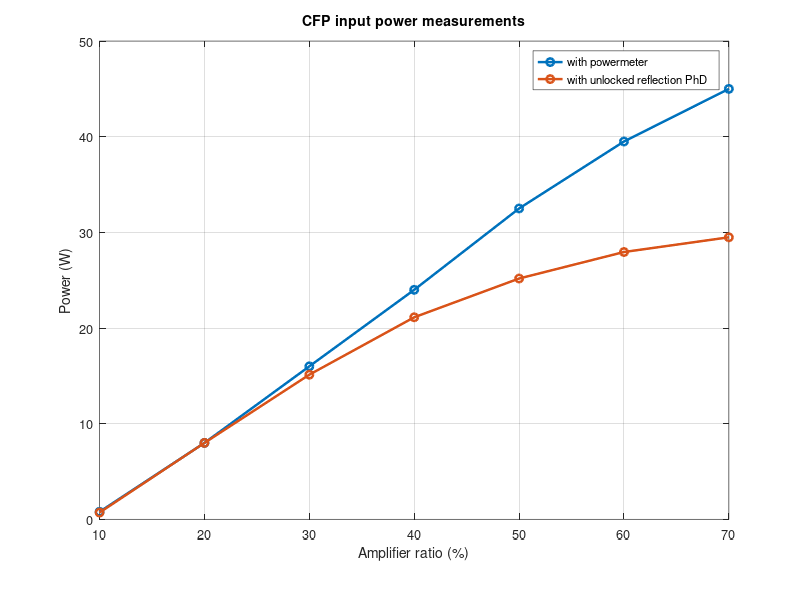
Previously measured relation between amplifier ratio and input power to the cavity:
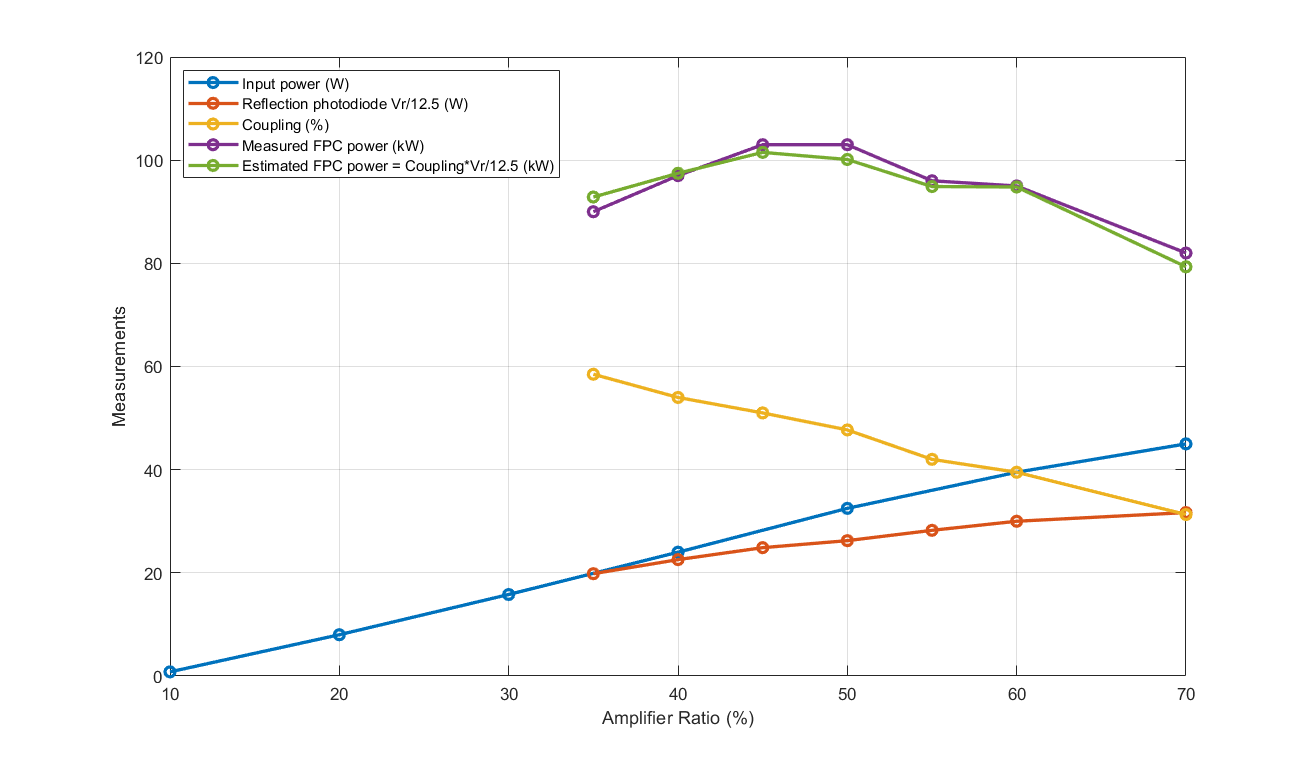
Amplifier ratio = 10 20 30 40 50 60 70 %
Amplifier Pin = 0.8 8 15.8 24 32.5 39.5 45 W
We performed 7 measurement points:
- Amplifier ratio = 35%
Vr unlocked = 248 mV
Vr locked = 103 mV
Coupling = 58.5%
Stored power = 90 kW
Vpdh = 50 mV rms
- Amplifier ratio = 40%
Vr unlocked = 282 mV
Vr locked = 130 mV
Coupling = 54%
Stored power = 97 kW
Vpdh = 52 mV rms
- Amplifier ratio = 45%
Vr unlocked = 311 mV
Vr locked = 152 mV
Coupling = 51%
Stored power = 103 kW
Vpdh = 55 mV rms
- Amplifier ratio = 50%
Vr unlocked = 328 mV
Vr locked = 171.5 mV
Coupling = 47.7%
Stored power = 103 kW
Vpdh = 51 mV rms
- Amplifier ratio = 55%
Vr unlocked = 353 mV
Vr locked = 204 mV
Coupling = 42%
Stored power = 96 kW
Vpdh = 51 mV rms
- Amplifier ratio = 60%
Vr unlocked = 375 mV
Vr locked = 227 mV
Coupling = 39.5%
Stored power = 95 kW
Vpdh = 53 mV rms
- Amplifier ratio = 70%
Vr unlocked = 396 mV
Vr locked = 272 mV
Coupling = 31.3%
Stored power = 82 kW
Vpdh = 53 mV rms
Normally, the unlocked Vr voltage should be proportional to the incident power on the cavity.
But it clearly isn’t at all!
We need to verify that this photodiode remains well aligned as power increases.
Or whether we might be clipping on a lens edge as the power increases.
Or whether the power still follows the amplifier ratio/power relation measured several months ago.
To be checked during the power ramp-up from the bunker.
We didn’t go above 103 kW!!! :-(((
I think the main reason is that we are probably hitting a mount edge, and the coupling drops so quickly that it dominates
→ so we absolutely need to redesign a proper telescope.
We also took beam images for different Pin values, but since the power in the cavity barely changes, it’s not very informative.
The last plot shows that the signal from the reflection photodiode indeed corresponds to the incident power in the cavity.
There is a strong chance we are hitting something when changing the power… to be checked in the bunker!!!
Have a nice weekend
Daniele & ronic
|
|
|
|
|
|
|
469
|
Mon May 18 11:33:46 2026 |
Ronic Chiche | Under Process | report | lasers and optics | ThomX igloo | Increasing the FP-cavity power | this morning with Daniele, we set the amplifier ratio to 33% => 97kW
then, we set the amplifier ratio to 50% => 124 kW (position of the diffuser on Axis 18 : +11775)
we changed the waveplates axis => no effect
we changed the position of the L-shape :
- lower button / clockwise / 1/20 of a turn (one has to decrease the laser motor position to compensate) => no effect but the misalignement is very sensitive for this axis
- upper button / anti-clockwise (the Lshape position is getting down) / we went to the limit (not very sensitive in alignment) => no effect ! (no beam cut nor HOM apparition)
=> conclusion : now, the L-shape is badly positionned (it's off the beam) but it cannot be the reason for a lake of power in the cavity.
PS : the lock seems very stable for long term (~ 130kW)
| Ronic Chiche wrote: |
|
I installed a stronger optical filter on the reflection photodiode and loaded it on 1kOhms.
70% amplifier ratio => 575 mV => 575 µA => no more photodiode linearity issue
amplifier ratio (%) => Vr unlocked (mV)
10 => 14
20 => 156
30 => 295
40 => 412
50 => 491
60 => 545
70 => 575
to be compared to : https://elog.lal.in2p3.fr/FPC/THOMX+commissioning/378
=> still a big discrepency => could we have some clipping in the reflective wedge ?
=> I tried in realigning the wedge but got roughly the same result.
=> could it be the size of the PhD (DET36 presently) ?
=> we should also check the amplifier power at FPC input before increasing power
| Ronic Chiche wrote: |
|
new power increase after alignment of the waveplates and iris.
amplifier ratio (%) => FPC cavity power (kW) => FPC cavity coupling (%) => Vr unlock (mV)
33 => 98 => 57 => 260
35 => 101 => 56 => 280
40 => 107 => 53 => 320
45 => 109 => 49 => 354
50 => 114 => 48 => 381
55 => 114 => 44 => 403
60 => 110 => 40 => 420
70 => 100 => 31 => 453
We still observe a discrepancy between the measured and estimated input power (using the unlocked reflection photodiode) as the amplifier ratio increases.
But this time, the estimated FPC power is also badly estimated.
So, it is possible that the reflection photodiode is operating in a nonlinear regime, as 300 mV across 50 Ohms is equivalent to 6 mA, which may be too much to remain in the linear regime.
It could be interesting to reduce the photodiode's power (add an optical filter) and use a 1k-Ohm load impedance.
| Ronic Chiche wrote: |
|
today with Alice and Daniele,
we checked the distance of the optical setup :
from the amplifier output (the fiber output) to the 2nd lens (+200 mm) :
131.5+41+17+28 cm = 217.5 cm
from the 2nd lens (+200 mm) to the FP cavity window :
133+97+70+14+22 cm = 336 cm
1st lens : -100 mm
2nd lens : +200 mm
distance between them : 11 cm
we checked also the alignment of the different iris and waveplates of the optical setup :
we had to realign a little bit the 2 waveplates.
after the realignment, we obtain the 96-97kW in the FPC for 33% of amplifier ratio !
| Ronic Chiche wrote: |
|
Last Friday, we tried to increase the FP-cavity power by just increasing the amplifier ratio from 35% to 70%.
It took a bit longer than expected because it started with the surprise of finding our entire setup powered off…
The power had tripped, and the switch that allowed us to remotely reset the power supplies had been damaged.
The switch was bypassed, and the instruments restarted → OK.
As usual, the locks were pretty unstable (as has been the case for several weeks), and we couldn’t hold them for more than 10–20 seconds…
So I removed the HV amplifier between the LaseLock and the laser PZT.
Since the Smaract MCS2 controller is much less noisy than the MCS1, we can use it directly without unlocking the cavity or going through "piezo-scan" mode.
So basically, having a larger range on the laser PZT is less useful.
Result: perfectly stable locks in the short term (as before installing the amplifier) AND in the long term as well… no more random unlocks!!!
So the amplifier must have been picking up parasitic noise that was being reinjected into the loop and causing regular unlocks… it works much better now! :-)
Actual power ramp-up was done entirely from the control room:
Previously measured relation between amplifier ratio and input power to the cavity:
Amplifier ratio = 10 20 30 40 50 60 70 %
Amplifier Pin = 0.8 8 15.8 24 32.5 39.5 45 W
We performed 7 measurement points:
- Amplifier ratio = 35%
Vr unlocked = 248 mV
Vr locked = 103 mV
Coupling = 58.5%
Stored power = 90 kW
Vpdh = 50 mV rms
- Amplifier ratio = 40%
Vr unlocked = 282 mV
Vr locked = 130 mV
Coupling = 54%
Stored power = 97 kW
Vpdh = 52 mV rms
- Amplifier ratio = 45%
Vr unlocked = 311 mV
Vr locked = 152 mV
Coupling = 51%
Stored power = 103 kW
Vpdh = 55 mV rms
- Amplifier ratio = 50%
Vr unlocked = 328 mV
Vr locked = 171.5 mV
Coupling = 47.7%
Stored power = 103 kW
Vpdh = 51 mV rms
- Amplifier ratio = 55%
Vr unlocked = 353 mV
Vr locked = 204 mV
Coupling = 42%
Stored power = 96 kW
Vpdh = 51 mV rms
- Amplifier ratio = 60%
Vr unlocked = 375 mV
Vr locked = 227 mV
Coupling = 39.5%
Stored power = 95 kW
Vpdh = 53 mV rms
- Amplifier ratio = 70%
Vr unlocked = 396 mV
Vr locked = 272 mV
Coupling = 31.3%
Stored power = 82 kW
Vpdh = 53 mV rms
Normally, the unlocked Vr voltage should be proportional to the incident power on the cavity.
But it clearly isn’t at all!
We need to verify that this photodiode remains well aligned as power increases.
Or whether we might be clipping on a lens edge as the power increases.
Or whether the power still follows the amplifier ratio/power relation measured several months ago.
To be checked during the power ramp-up from the bunker.
We didn’t go above 103 kW!!! :-(((
I think the main reason is that we are probably hitting a mount edge, and the coupling drops so quickly that it dominates
→ so we absolutely need to redesign a proper telescope.
We also took beam images for different Pin values, but since the power in the cavity barely changes, it’s not very informative.
The last plot shows that the signal from the reflection photodiode indeed corresponds to the incident power in the cavity.
There is a strong chance we are hitting something when changing the power… to be checked in the bunker!!!
Have a nice weekend
Daniele & ronic
|
|
|
|
|
|
468
|
Wed Apr 29 15:31:06 2026 |
Ronic Chiche | Under Process | report | lasers and optics | ThomX igloo | Increasing the FP-cavity power | I installed a stronger optical filter on the reflection photodiode and loaded it on 1kOhms.
70% amplifier ratio => 575 mV => 575 µA => no more photodiode linearity issue
amplifier ratio (%) => Vr unlocked (mV)
10 => 14
20 => 156
30 => 295
40 => 412
50 => 491
60 => 545
70 => 575
to be compared to : https://elog.lal.in2p3.fr/FPC/THOMX+commissioning/378
=> still a big discrepency => could we have some clipping in the reflective wedge ?
=> I tried in realigning the wedge but got roughly the same result.
=> could it be the size of the PhD (DET36 presently) ?
=> we should also check the amplifier power at FPC input before increasing power
| Ronic Chiche wrote: |
|
new power increase after alignment of the waveplates and iris.
amplifier ratio (%) => FPC cavity power (kW) => FPC cavity coupling (%) => Vr unlock (mV)
33 => 98 => 57 => 260
35 => 101 => 56 => 280
40 => 107 => 53 => 320
45 => 109 => 49 => 354
50 => 114 => 48 => 381
55 => 114 => 44 => 403
60 => 110 => 40 => 420
70 => 100 => 31 => 453
We still observe a discrepancy between the measured and estimated input power (using the unlocked reflection photodiode) as the amplifier ratio increases.
But this time, the estimated FPC power is also badly estimated.
So, it is possible that the reflection photodiode is operating in a nonlinear regime, as 300 mV across 50 Ohms is equivalent to 6 mA, which may be too much to remain in the linear regime.
It could be interesting to reduce the photodiode's power (add an optical filter) and use a 1k-Ohm load impedance.
| Ronic Chiche wrote: |
|
today with Alice and Daniele,
we checked the distance of the optical setup :
from the amplifier output (the fiber output) to the 2nd lens (+200 mm) :
131.5+41+17+28 cm = 217.5 cm
from the 2nd lens (+200 mm) to the FP cavity window :
133+97+70+14+22 cm = 336 cm
1st lens : -100 mm
2nd lens : +200 mm
distance between them : 11 cm
we checked also the alignment of the different iris and waveplates of the optical setup :
we had to realign a little bit the 2 waveplates.
after the realignment, we obtain the 96-97kW in the FPC for 33% of amplifier ratio !
| Ronic Chiche wrote: |
|
Last Friday, we tried to increase the FP-cavity power by just increasing the amplifier ratio from 35% to 70%.
It took a bit longer than expected because it started with the surprise of finding our entire setup powered off…
The power had tripped, and the switch that allowed us to remotely reset the power supplies had been damaged.
The switch was bypassed, and the instruments restarted → OK.
As usual, the locks were pretty unstable (as has been the case for several weeks), and we couldn’t hold them for more than 10–20 seconds…
So I removed the HV amplifier between the LaseLock and the laser PZT.
Since the Smaract MCS2 controller is much less noisy than the MCS1, we can use it directly without unlocking the cavity or going through "piezo-scan" mode.
So basically, having a larger range on the laser PZT is less useful.
Result: perfectly stable locks in the short term (as before installing the amplifier) AND in the long term as well… no more random unlocks!!!
So the amplifier must have been picking up parasitic noise that was being reinjected into the loop and causing regular unlocks… it works much better now! :-)
Actual power ramp-up was done entirely from the control room:
Previously measured relation between amplifier ratio and input power to the cavity:
Amplifier ratio = 10 20 30 40 50 60 70 %
Amplifier Pin = 0.8 8 15.8 24 32.5 39.5 45 W
We performed 7 measurement points:
- Amplifier ratio = 35%
Vr unlocked = 248 mV
Vr locked = 103 mV
Coupling = 58.5%
Stored power = 90 kW
Vpdh = 50 mV rms
- Amplifier ratio = 40%
Vr unlocked = 282 mV
Vr locked = 130 mV
Coupling = 54%
Stored power = 97 kW
Vpdh = 52 mV rms
- Amplifier ratio = 45%
Vr unlocked = 311 mV
Vr locked = 152 mV
Coupling = 51%
Stored power = 103 kW
Vpdh = 55 mV rms
- Amplifier ratio = 50%
Vr unlocked = 328 mV
Vr locked = 171.5 mV
Coupling = 47.7%
Stored power = 103 kW
Vpdh = 51 mV rms
- Amplifier ratio = 55%
Vr unlocked = 353 mV
Vr locked = 204 mV
Coupling = 42%
Stored power = 96 kW
Vpdh = 51 mV rms
- Amplifier ratio = 60%
Vr unlocked = 375 mV
Vr locked = 227 mV
Coupling = 39.5%
Stored power = 95 kW
Vpdh = 53 mV rms
- Amplifier ratio = 70%
Vr unlocked = 396 mV
Vr locked = 272 mV
Coupling = 31.3%
Stored power = 82 kW
Vpdh = 53 mV rms
Normally, the unlocked Vr voltage should be proportional to the incident power on the cavity.
But it clearly isn’t at all!
We need to verify that this photodiode remains well aligned as power increases.
Or whether we might be clipping on a lens edge as the power increases.
Or whether the power still follows the amplifier ratio/power relation measured several months ago.
To be checked during the power ramp-up from the bunker.
We didn’t go above 103 kW!!! :-(((
I think the main reason is that we are probably hitting a mount edge, and the coupling drops so quickly that it dominates
→ so we absolutely need to redesign a proper telescope.
We also took beam images for different Pin values, but since the power in the cavity barely changes, it’s not very informative.
The last plot shows that the signal from the reflection photodiode indeed corresponds to the incident power in the cavity.
There is a strong chance we are hitting something when changing the power… to be checked in the bunker!!!
Have a nice weekend
Daniele & ronic
|
|
|
|
| Attachment 1: Sans_titre.png
|  |
|
467
|
Wed Apr 29 09:38:20 2026 |
Ronic Chiche | Under Process | report | lasers and optics | ThomX igloo | Increasing the FP-cavity power | new power increase after alignment of the waveplates and iris.
amplifier ratio (%) => FPC cavity power (kW) => FPC cavity coupling (%) => Vr unlock (mV)
33 => 98 => 57 => 260
35 => 101 => 56 => 280
40 => 107 => 53 => 320
45 => 109 => 49 => 354
50 => 114 => 48 => 381
55 => 114 => 44 => 403
60 => 110 => 40 => 420
70 => 100 => 31 => 453
We still observe a discrepancy between the measured and estimated input power (using the unlocked reflection photodiode) as the amplifier ratio increases.
But this time, the estimated FPC power is also badly estimated.
So, it is possible that the reflection photodiode is operating in a nonlinear regime, as 300 mV across 50 Ohms is equivalent to 6 mA, which may be too much to remain in the linear regime.
It could be interesting to reduce the photodiode's power (add an optical filter) and use a 1k-Ohm load impedance.
| Ronic Chiche wrote: |
|
today with Alice and Daniele,
we checked the distance of the optical setup :
from the amplifier output (the fiber output) to the 2nd lens (+200 mm) :
131.5+41+17+28 cm = 217.5 cm
from the 2nd lens (+200 mm) to the FP cavity window :
133+97+70+14+22 cm = 336 cm
1st lens : -100 mm
2nd lens : +200 mm
distance between them : 11 cm
we checked also the alignment of the different iris and waveplates of the optical setup :
we had to realign a little bit the 2 waveplates.
after the realignment, we obtain the 96-97kW in the FPC for 33% of amplifier ratio !
| Ronic Chiche wrote: |
|
Last Friday, we tried to increase the FP-cavity power by just increasing the amplifier ratio from 35% to 70%.
It took a bit longer than expected because it started with the surprise of finding our entire setup powered off…
The power had tripped, and the switch that allowed us to remotely reset the power supplies had been damaged.
The switch was bypassed, and the instruments restarted → OK.
As usual, the locks were pretty unstable (as has been the case for several weeks), and we couldn’t hold them for more than 10–20 seconds…
So I removed the HV amplifier between the LaseLock and the laser PZT.
Since the Smaract MCS2 controller is much less noisy than the MCS1, we can use it directly without unlocking the cavity or going through "piezo-scan" mode.
So basically, having a larger range on the laser PZT is less useful.
Result: perfectly stable locks in the short term (as before installing the amplifier) AND in the long term as well… no more random unlocks!!!
So the amplifier must have been picking up parasitic noise that was being reinjected into the loop and causing regular unlocks… it works much better now! :-)
Actual power ramp-up was done entirely from the control room:
Previously measured relation between amplifier ratio and input power to the cavity:
Amplifier ratio = 10 20 30 40 50 60 70 %
Amplifier Pin = 0.8 8 15.8 24 32.5 39.5 45 W
We performed 7 measurement points:
- Amplifier ratio = 35%
Vr unlocked = 248 mV
Vr locked = 103 mV
Coupling = 58.5%
Stored power = 90 kW
Vpdh = 50 mV rms
- Amplifier ratio = 40%
Vr unlocked = 282 mV
Vr locked = 130 mV
Coupling = 54%
Stored power = 97 kW
Vpdh = 52 mV rms
- Amplifier ratio = 45%
Vr unlocked = 311 mV
Vr locked = 152 mV
Coupling = 51%
Stored power = 103 kW
Vpdh = 55 mV rms
- Amplifier ratio = 50%
Vr unlocked = 328 mV
Vr locked = 171.5 mV
Coupling = 47.7%
Stored power = 103 kW
Vpdh = 51 mV rms
- Amplifier ratio = 55%
Vr unlocked = 353 mV
Vr locked = 204 mV
Coupling = 42%
Stored power = 96 kW
Vpdh = 51 mV rms
- Amplifier ratio = 60%
Vr unlocked = 375 mV
Vr locked = 227 mV
Coupling = 39.5%
Stored power = 95 kW
Vpdh = 53 mV rms
- Amplifier ratio = 70%
Vr unlocked = 396 mV
Vr locked = 272 mV
Coupling = 31.3%
Stored power = 82 kW
Vpdh = 53 mV rms
Normally, the unlocked Vr voltage should be proportional to the incident power on the cavity.
But it clearly isn’t at all!
We need to verify that this photodiode remains well aligned as power increases.
Or whether we might be clipping on a lens edge as the power increases.
Or whether the power still follows the amplifier ratio/power relation measured several months ago.
To be checked during the power ramp-up from the bunker.
We didn’t go above 103 kW!!! :-(((
I think the main reason is that we are probably hitting a mount edge, and the coupling drops so quickly that it dominates
→ so we absolutely need to redesign a proper telescope.
We also took beam images for different Pin values, but since the power in the cavity barely changes, it’s not very informative.
The last plot shows that the signal from the reflection photodiode indeed corresponds to the incident power in the cavity.
There is a strong chance we are hitting something when changing the power… to be checked in the bunker!!!
Have a nice weekend
Daniele & ronic
|
|
|
| Attachment 1: Measured_data_v2.png
|  |
|
466
|
Mon Apr 27 16:55:15 2026 |
Ronic Chiche | Under Process | report | lasers and optics | ThomX igloo | Increasing the FP-cavity power | today with Alice and Daniele,
we checked the distance of the optical setup :
from the amplifier output (the fiber output) to the 2nd lens (+200 mm) :
131.5+41+17+28 cm = 217.5 cm
from the 2nd lens (+200 mm) to the FP cavity window :
133+97+70+14+22 cm = 336 cm
1st lens : -100 mm
2nd lens : +200 mm
distance between them : 11 cm
we checked also the alignment of the different iris and waveplates of the optical setup :
we had to realign a little bit the 2 waveplates.
after the realignment, we obtain the 96-97kW in the FPC for 33% of amplifier ratio !
| Ronic Chiche wrote: |
|
Last Friday, we tried to increase the FP-cavity power by just increasing the amplifier ratio from 35% to 70%.
It took a bit longer than expected because it started with the surprise of finding our entire setup powered off…
The power had tripped, and the switch that allowed us to remotely reset the power supplies had been damaged.
The switch was bypassed, and the instruments restarted → OK.
As usual, the locks were pretty unstable (as has been the case for several weeks), and we couldn’t hold them for more than 10–20 seconds…
So I removed the HV amplifier between the LaseLock and the laser PZT.
Since the Smaract MCS2 controller is much less noisy than the MCS1, we can use it directly without unlocking the cavity or going through "piezo-scan" mode.
So basically, having a larger range on the laser PZT is less useful.
Result: perfectly stable locks in the short term (as before installing the amplifier) AND in the long term as well… no more random unlocks!!!
So the amplifier must have been picking up parasitic noise that was being reinjected into the loop and causing regular unlocks… it works much better now! :-)
Actual power ramp-up was done entirely from the control room:
Previously measured relation between amplifier ratio and input power to the cavity:
Amplifier ratio = 10 20 30 40 50 60 70 %
Amplifier Pin = 0.8 8 15.8 24 32.5 39.5 45 W
We performed 7 measurement points:
- Amplifier ratio = 35%
Vr unlocked = 248 mV
Vr locked = 103 mV
Coupling = 58.5%
Stored power = 90 kW
Vpdh = 50 mV rms
- Amplifier ratio = 40%
Vr unlocked = 282 mV
Vr locked = 130 mV
Coupling = 54%
Stored power = 97 kW
Vpdh = 52 mV rms
- Amplifier ratio = 45%
Vr unlocked = 311 mV
Vr locked = 152 mV
Coupling = 51%
Stored power = 103 kW
Vpdh = 55 mV rms
- Amplifier ratio = 50%
Vr unlocked = 328 mV
Vr locked = 171.5 mV
Coupling = 47.7%
Stored power = 103 kW
Vpdh = 51 mV rms
- Amplifier ratio = 55%
Vr unlocked = 353 mV
Vr locked = 204 mV
Coupling = 42%
Stored power = 96 kW
Vpdh = 51 mV rms
- Amplifier ratio = 60%
Vr unlocked = 375 mV
Vr locked = 227 mV
Coupling = 39.5%
Stored power = 95 kW
Vpdh = 53 mV rms
- Amplifier ratio = 70%
Vr unlocked = 396 mV
Vr locked = 272 mV
Coupling = 31.3%
Stored power = 82 kW
Vpdh = 53 mV rms
Normally, the unlocked Vr voltage should be proportional to the incident power on the cavity.
But it clearly isn’t at all!
We need to verify that this photodiode remains well aligned as power increases.
Or whether we might be clipping on a lens edge as the power increases.
Or whether the power still follows the amplifier ratio/power relation measured several months ago.
To be checked during the power ramp-up from the bunker.
We didn’t go above 103 kW!!! :-(((
I think the main reason is that we are probably hitting a mount edge, and the coupling drops so quickly that it dominates
→ so we absolutely need to redesign a proper telescope.
We also took beam images for different Pin values, but since the power in the cavity barely changes, it’s not very informative.
The last plot shows that the signal from the reflection photodiode indeed corresponds to the incident power in the cavity.
There is a strong chance we are hitting something when changing the power… to be checked in the bunker!!!
Have a nice weekend
Daniele & ronic
|
|
|
465
|
Wed Apr 22 09:52:40 2026 |
Ronic Chiche | Under Process | report | lasers and optics | ThomX igloo | Increasing the FP-cavity power | Last Friday, we tried to increase the FP-cavity power by just increasing the amplifier ratio from 35% to 70%.
It took a bit longer than expected because it started with the surprise of finding our entire setup powered off…
The power had tripped, and the switch that allowed us to remotely reset the power supplies had been damaged.
The switch was bypassed, and the instruments restarted → OK.
As usual, the locks were pretty unstable (as has been the case for several weeks), and we couldn’t hold them for more than 10–20 seconds…
So I removed the HV amplifier between the LaseLock and the laser PZT.
Since the Smaract MCS2 controller is much less noisy than the MCS1, we can use it directly without unlocking the cavity or going through "piezo-scan" mode.
So basically, having a larger range on the laser PZT is less useful.
Result: perfectly stable locks in the short term (as before installing the amplifier) AND in the long term as well… no more random unlocks!!!
So the amplifier must have been picking up parasitic noise that was being reinjected into the loop and causing regular unlocks… it works much better now! :-)
Actual power ramp-up was done entirely from the control room:
Previously measured relation between amplifier ratio and input power to the cavity:
Amplifier ratio = 10 20 30 40 50 60 70 %
Amplifier Pin = 0.8 8 15.8 24 32.5 39.5 45 W
We performed 7 measurement points:
- Amplifier ratio = 35%
Vr unlocked = 248 mV
Vr locked = 103 mV
Coupling = 58.5%
Stored power = 90 kW
Vpdh = 50 mV rms
- Amplifier ratio = 40%
Vr unlocked = 282 mV
Vr locked = 130 mV
Coupling = 54%
Stored power = 97 kW
Vpdh = 52 mV rms
- Amplifier ratio = 45%
Vr unlocked = 311 mV
Vr locked = 152 mV
Coupling = 51%
Stored power = 103 kW
Vpdh = 55 mV rms
- Amplifier ratio = 50%
Vr unlocked = 328 mV
Vr locked = 171.5 mV
Coupling = 47.7%
Stored power = 103 kW
Vpdh = 51 mV rms
- Amplifier ratio = 55%
Vr unlocked = 353 mV
Vr locked = 204 mV
Coupling = 42%
Stored power = 96 kW
Vpdh = 51 mV rms
- Amplifier ratio = 60%
Vr unlocked = 375 mV
Vr locked = 227 mV
Coupling = 39.5%
Stored power = 95 kW
Vpdh = 53 mV rms
- Amplifier ratio = 70%
Vr unlocked = 396 mV
Vr locked = 272 mV
Coupling = 31.3%
Stored power = 82 kW
Vpdh = 53 mV rms
Normally, the unlocked Vr voltage should be proportional to the incident power on the cavity.
But it clearly isn’t at all!
We need to verify that this photodiode remains well aligned as power increases.
Or whether we might be clipping on a lens edge as the power increases.
Or whether the power still follows the amplifier ratio/power relation measured several months ago.
To be checked during the power ramp-up from the bunker.
We didn’t go above 103 kW!!! :-(((
I think the main reason is that we are probably hitting a mount edge, and the coupling drops so quickly that it dominates
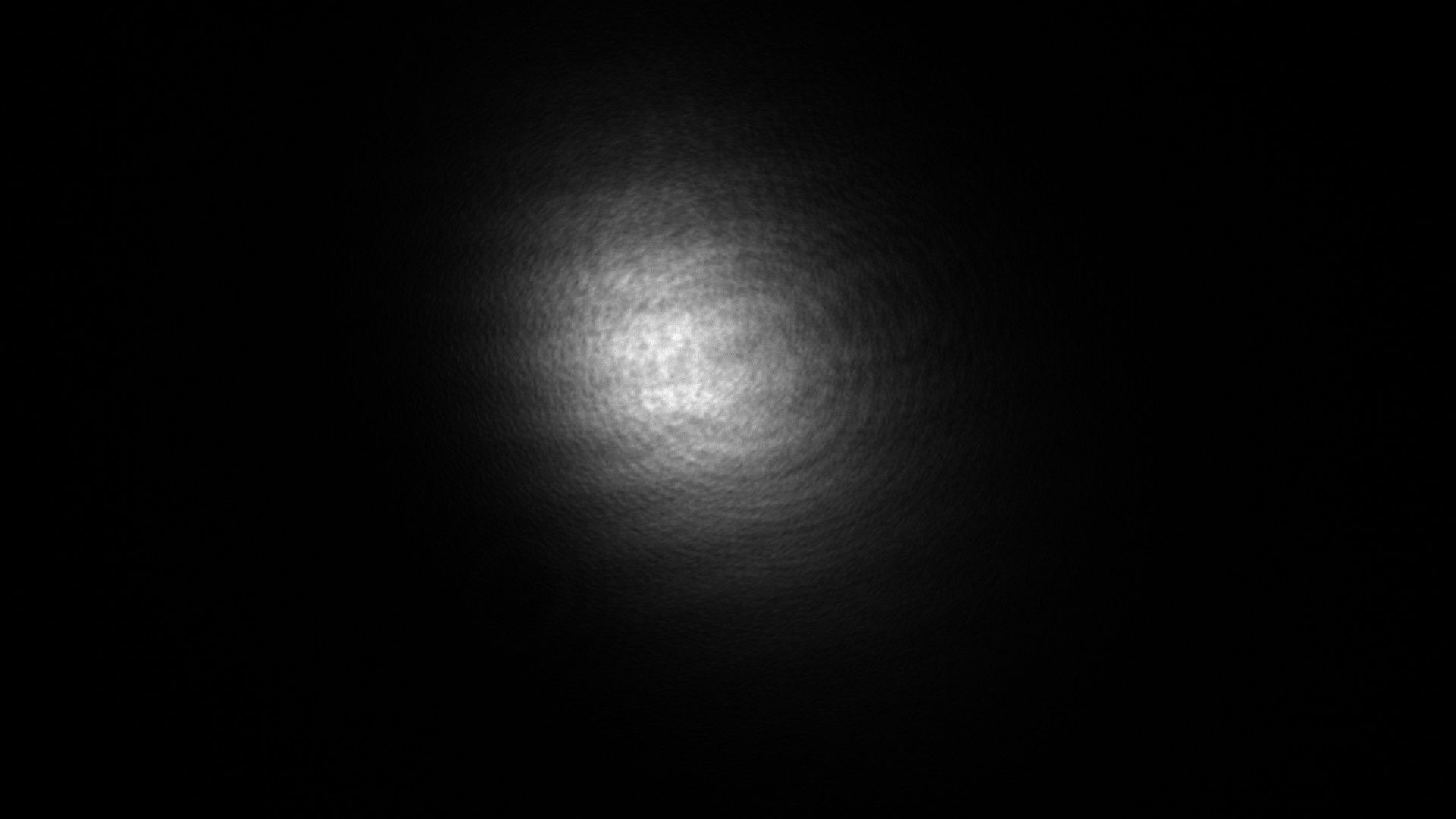
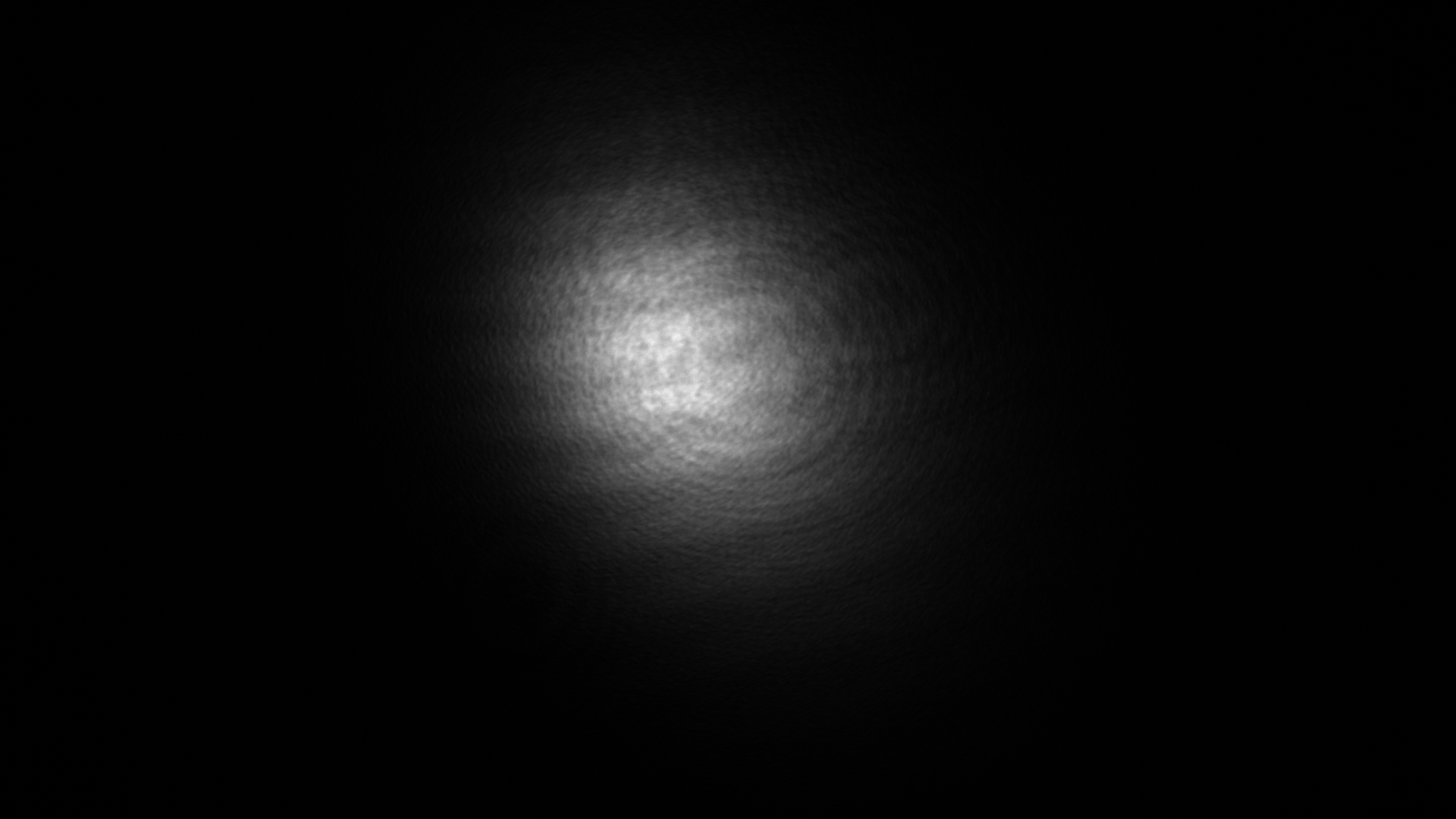
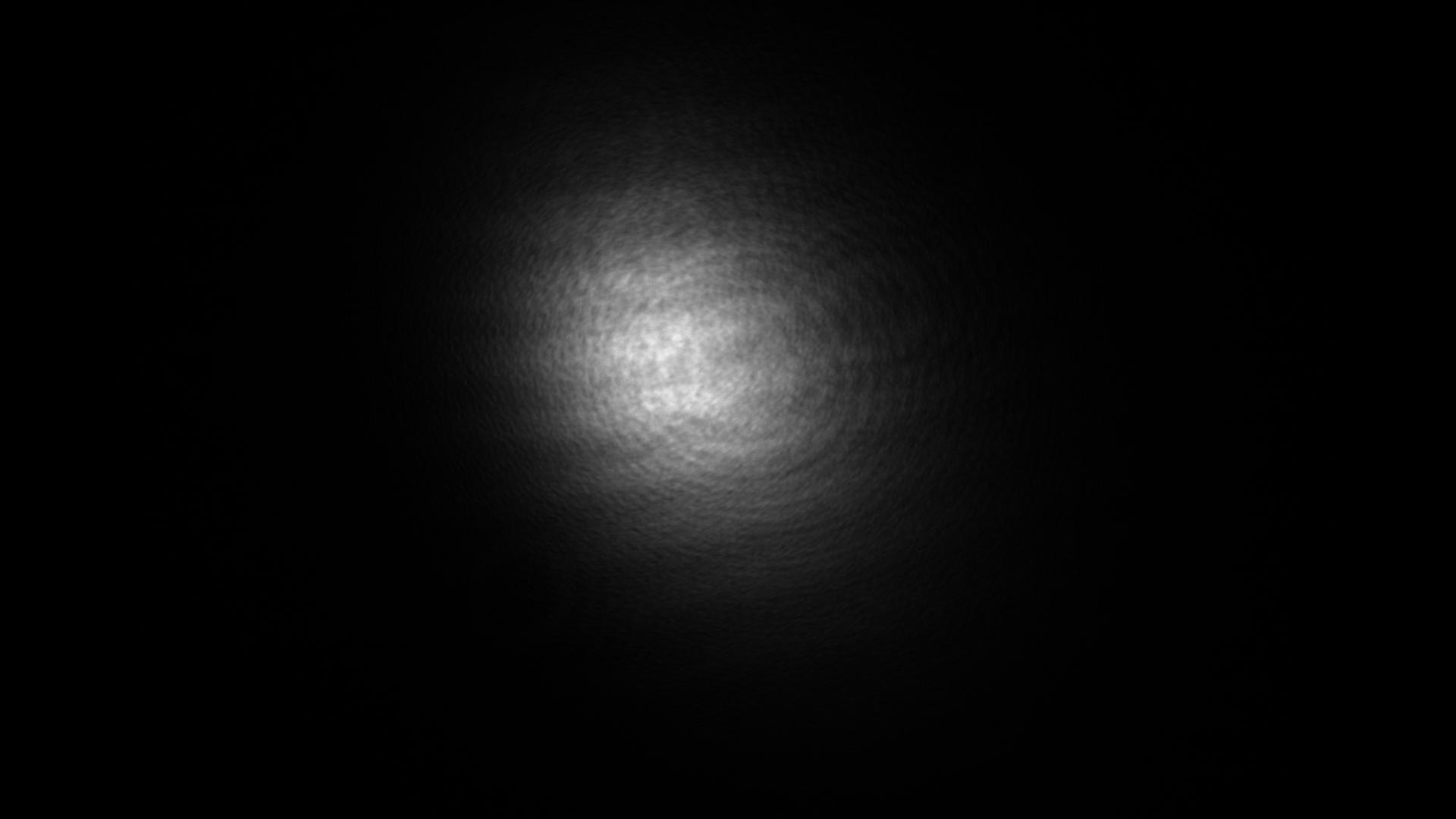
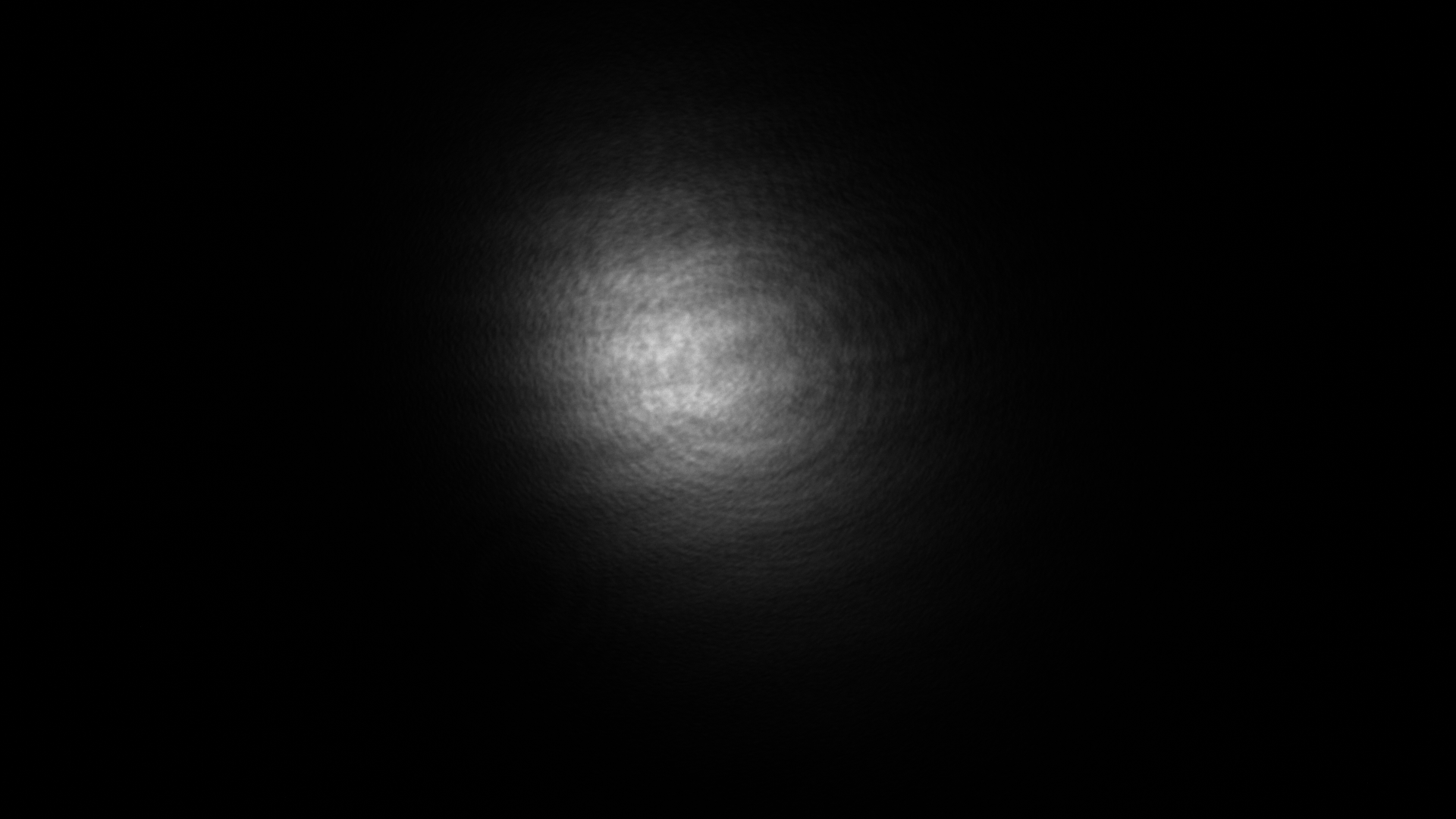
→ so we absolutely need to redesign a proper telescope.
We also took beam images for different Pin values, but since the power in the cavity barely changes, it’s not very informative.
The last plot shows that the signal from the reflection photodiode indeed corresponds to the incident power in the cavity.
There is a strong chance we are hitting something when changing the power… to be checked in the bunker!!!
Have a nice weekend
Daniele & ronic
|
| Attachment 1: 35_-90kW.png
|  |
| Attachment 2: 40_-97kW.png
|  |
| Attachment 3: 45_-103kW.png
|  |
| Attachment 4: 50_-103kW.png
|  |
| Attachment 5: 55_-97kW.png
|  |
| Attachment 6: 60_-95kW.png
|  |
| Attachment 7: 70_-82kW.png
|  |
| Attachment 8: Measured_data.png
|  |
|
464
|
Mon Feb 2 15:29:45 2026 |
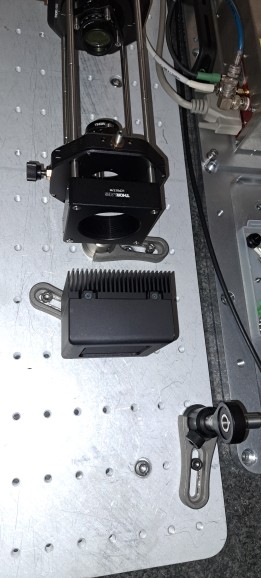
Ronic Chiche | Fixed | info | lasers and optics | ThomX igloo | Laser Amplifier used at 70% | today, I installed a laser dump just before the telescope to avoid any high power (50W instead of 17W usually) issue in the injection line.
last time, we saw some plastic mounts of the polarizers slightly burnt because of some small misalignment.
I used a thorlabs LB2 (see picture) which is able to manage 80W CW or 25J/cm2 pulses => this is OK in both cases : 50W CW / 1.5µJ/pulse for ThomX.
I started the laser amplifier at 70% which produces 50W at the amplifier output and 45W at the input of the FPC.
start : 15h10
immediately, the Temp Amp1 increases from 26°C to 30°C
the Temp Amp2 stays around 26°C
PD_OUT = 79,2W
start + 5-10 min
Temp Amp1 : 31°C
Temp Amp2 : 27°C
PD_OUT = 79,2W
start + 30 min
Temp Amp1 : 31,6°C
Temp Amp2 : 27,5°C
PD_OUT = 79,2W
start + 1h00
Temp Amp1 : 31,6°C
Temp Amp2 : 27,6°C
PD_OUT = 79,2W
start + 1h30
Temp Amp1 : 31,7°C
Temp Amp2 : 27,7°C
PD_OUT = 79,2W
start + 2h00
Temp Amp1 : 31,7°C
Temp Amp2 : 27,7°C
PD_OUT = 79,2W
start + 2h30
Temp Amp1 : 31,7°C
Temp Amp2 : 27,7°C
PD_OUT = 79,2W
|
| Attachment 1: img1.jpg
|  |
|
463
|
Mon Dec 8 11:17:17 2025 |
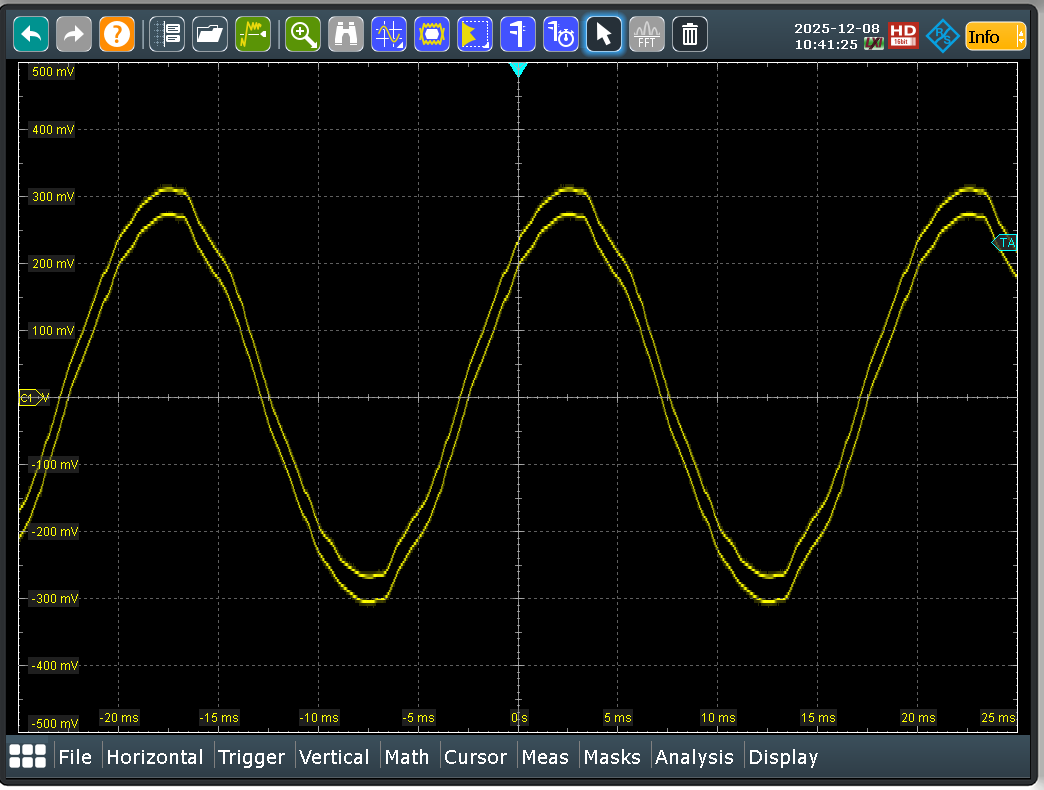
Ronic Chiche | Fixed | issue | lasers and optics | detectors and electronics | ThomX igloo | High frequency noise | This morning, I installed a high-voltage probe (1:1000) on the AC-line to see if one could detect a correlation between lock losses and AC-line voltage variations.
I observed many lock losses but without any variation or correlation of the AC-line signal (scope set in "peak detect" with "envelope" arithmetics).
see attached figure.
| Ronic Chiche wrote: |
|
we did some tests with Marie to make some vibrations on the door.
below, I exhibit some pictures of the scope with the accelerometer plugged on it without or with noise...
this level of noise is not able to make the FPC loosing the lock.
even when saturating the noise signal on the accelerometer, the FPC is not loosing the lock all the time.
then, when a day is very windy, it's possible it could have some effect, but for a normal day, it's seems very doubtful that is the reason...
| Ronic Chiche wrote: |
|
After this observation, we did a test with Daniele to try to correlate the road traffic in front of the Igloo with the lock losses observed on the FPC.
We didn't see any clear correlation. Cars or buses are not the direct origin of the FPC lock losses... only when some heavy load is hitting the building, we observed a clear correlation.
So, we still observed a lot of FPC lock losses when the day is windy...
One possible cause could be the large door of the igloo (~20 m²) hitting the Igloo when the day is windy.
I installed the accelerometer on the rail on the bottom of the large door to see if there is any correlation.
| Ronic Chiche wrote: |
|
At the end of the day, we found out what was the origin of this noise : some road renovation work with jackhammer and road roller just at the entrance of the "Igloo".
this origin was 100% correlated with a large increase of the accelerometer signal.
but we clearly saw that the FPC is much more sensitive than the accelerometer... the signal can have a small increase or just one peak and the cavity lock is lost.
then, we can make the assumption that all the "high frequency noise" which produces some lock losses could come from acoustic noise due to the road traffic or from the equipments in the bunker itself.
| Ronic Chiche wrote: |
|
Today, the lock of the FPC was particularly bad (maybe the worst ever seen), with a lot of high frequency noise.
the lock was impossible during several minutes !
we tried to switch off all the equipments of the machine, one by one without any effect on the lock.
at the end, we looked at the accelerometer installed inside the housing to check if there was some correlation.
and for the 1st time we clearly saw a 100% correlation beween the accelerometer signal with a noise oscillating above +/-300mV
but we didn't find the origin of this noise.
|
|
|
|
|
| Attachment 1: AC-line.png
|  |
|
462
|
Wed Dec 3 16:23:40 2025 |
Ronic Chiche | Fixed | report | lasers and optics | detectors and electronics | ThomX igloo | Noise issue | yesterday, in the same conditions, we had so many locking issues... exactly in the same way than before. :-(
so we still have "locking issues" depending on something we didn't find...
today, we removed the "1/2 voltage divider" before the PZT amplifier to get back the full dynamic.
we have a little bit more noise and we lose some power on transmission (85kW instead of 90kW) but it worked pretty well.
we had quite long X-rays runs ~ 20 minutes without any lock losses => see the picture.
but we have to keep in mind that maybe it was just a "good" day and an another day can be "bad".
we still have to understand where do these perturbations come from.
the good news is we brought back the previous setting of the FPC.
| Ronic Chiche wrote: |
|
since several days, we see that the locking is more and more unstable and the lock duration was sometime less than 20-30 seconds !
1) I tried to optimize the feedback loops
I discovered that the gain on the fast loop on the laser EOM was very low and was almost uneffective for the global stability of the lock (I can remove the cable of the HV to EOM and it does not change the stability of the signals).
when I tried to increase this loop gain in open loop for the PZT loop, I clearly saw an improvement of the transmission signal stored in the cavity.
but when I close the PZT loop, it does not help to get a better locking.
so, at the end, I cancel this loop gain (HV amplifier for the EOM is OFF !) and only the slow feedback loop on the PZT is working.
I reduced the by a factor 2 the range on the PZT loop side to reduce the noise due to the amplified Laselock (voltage divider 1/2 before the HV amp for the PZT).
and I switched off the laser motor controller (Smaract MCS).
after optmization of the PID parameters, I was able to get back the 90kW we had in the past for 33% laser amp ratio and with a very good stability :
the transmission signal is a line and the reflection signal is almost a line too.
in this condition, I seems that I can lock the laser and the FPC indefinitely.
2) issue with Smaract controller
I put back the Smaract controller only for the CEP channel => one can clearly see a bit more noise on the PDH signal but the transmssion and the reflection signal stay almost the same with a very good stability.
then, I put back the Smaract controller for both channels (CEP and laser cavity length) => the lock was very bad, even after a PID optimization despite the fact it was a "Low Vibration" (LV) Smaract MCS controller.
we tried to change the 3-channels LV controller by a standard 3-channels (not LV) spare controller => it was OK for the CEP channel but not good at all the laser cavity length channel => very noisy.
so, we kept this standard controller for the CEP channel and we took 1-channel LV spare controller for the laser cavity length channel => it was ok. no more additionnal noise and we can work without delock in piezo-scan mode.
important parameters :
I used 1ms for hold time in the Smaract controller configuration.
I used 1V/s in piezo scan mode for the speed => it does affect the noise level when the piezo is moved !
3) IP Smaract controller parameters :
I used the MCSNetworkInterfaceConfig.exe software to configure both IP addresses of the 2 controllers.
it's easy, one just has to choose the options.
the IP address for controller ruling the laser cavity length is : 192.168.1.200:5000
the IP address for controller ruling the CEP is : 192.168.1.201:5000
4) final long run test
We did a 1/2h run test to check how many lock loss one gets... see the picture.
we had some few lock losses (with the RF feedback lock ON too) but most of the time, the RF phase was not lost and the X-rays should be continued to be produced.
a test should be done tomorrow.
|
|
| Attachment 1: Screenshot_2025-12-03_15-36-59.png
|  |
|
461
|
Mon Dec 1 18:03:29 2025 |
Ronic Chiche | Fixed | report | lasers and optics | detectors and electronics | ThomX igloo | Noise issue | since several days, we see that the locking is more and more unstable and the lock duration was sometime less than 20-30 seconds !
1) I tried to optimize the feedback loops
I discovered that the gain on the fast loop on the laser EOM was very low and was almost uneffective for the global stability of the lock (I can remove the cable of the HV to EOM and it does not change the stability of the signals).
when I tried to increase this loop gain in open loop for the PZT loop, I clearly saw an improvement of the transmission signal stored in the cavity.
but when I close the PZT loop, it does not help to get a better locking.
so, at the end, I cancel this loop gain (HV amplifier for the EOM is OFF !) and only the slow feedback loop on the PZT is working.
I reduced the by a factor 2 the range on the PZT loop side to reduce the noise due to the amplified Laselock (voltage divider 1/2 before the HV amp for the PZT).
and I switched off the laser motor controller (Smaract MCS).
after optmization of the PID parameters, I was able to get back the 90kW we had in the past for 33% laser amp ratio and with a very good stability :
the transmission signal is a line and the reflection signal is almost a line too.
in this condition, I seems that I can lock the laser and the FPC indefinitely.
2) issue with Smaract controller
I put back the Smaract controller only for the CEP channel => one can clearly see a bit more noise on the PDH signal but the transmssion and the reflection signal stay almost the same with a very good stability.
then, I put back the Smaract controller for both channels (CEP and laser cavity length) => the lock was very bad, even after a PID optimization despite the fact it was a "Low Vibration" (LV) Smaract MCS controller.
we tried to change the 3-channels LV controller by a standard 3-channels (not LV) spare controller => it was OK for the CEP channel but not good at all the laser cavity length channel => very noisy.
so, we kept this standard controller for the CEP channel and we took 1-channel LV spare controller for the laser cavity length channel => it was ok. no more additionnal noise and we can work without delock in piezo-scan mode.
important parameters :
I used 1ms for hold time in the Smaract controller configuration.
I used 1V/s in piezo scan mode for the speed => it does affect the noise level when the piezo is moved !
3) IP Smaract controller parameters :
I used the MCSNetworkInterfaceConfig.exe software to configure both IP addresses of the 2 controllers.
it's easy, one just has to choose the options.
the IP address for controller ruling the laser cavity length is : 192.168.1.200:5000
the IP address for controller ruling the CEP is : 192.168.1.201:5000
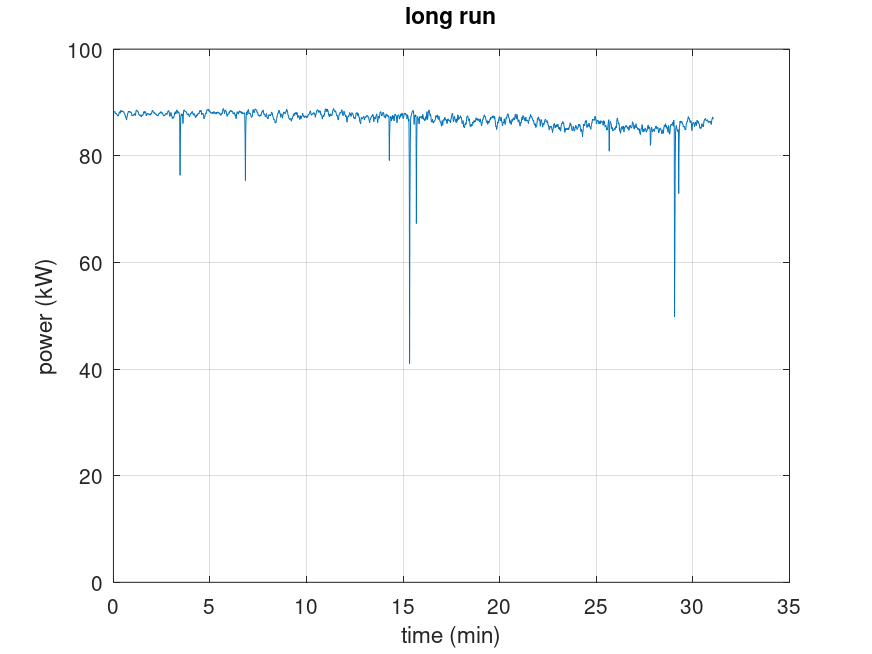
4) final long run test
We did a 1/2h run test to check how many lock loss one gets... see the picture.
we had some few lock losses (with the RF feedback lock ON too) but most of the time, the RF phase was not lost and the X-rays should be continued to be produced.
a test should be done tomorrow.
|
| Attachment 1: 2025-12-01_-_long_run_few_delocks.png
|  |
|
460
|
Tue Oct 28 17:31:47 2025 |
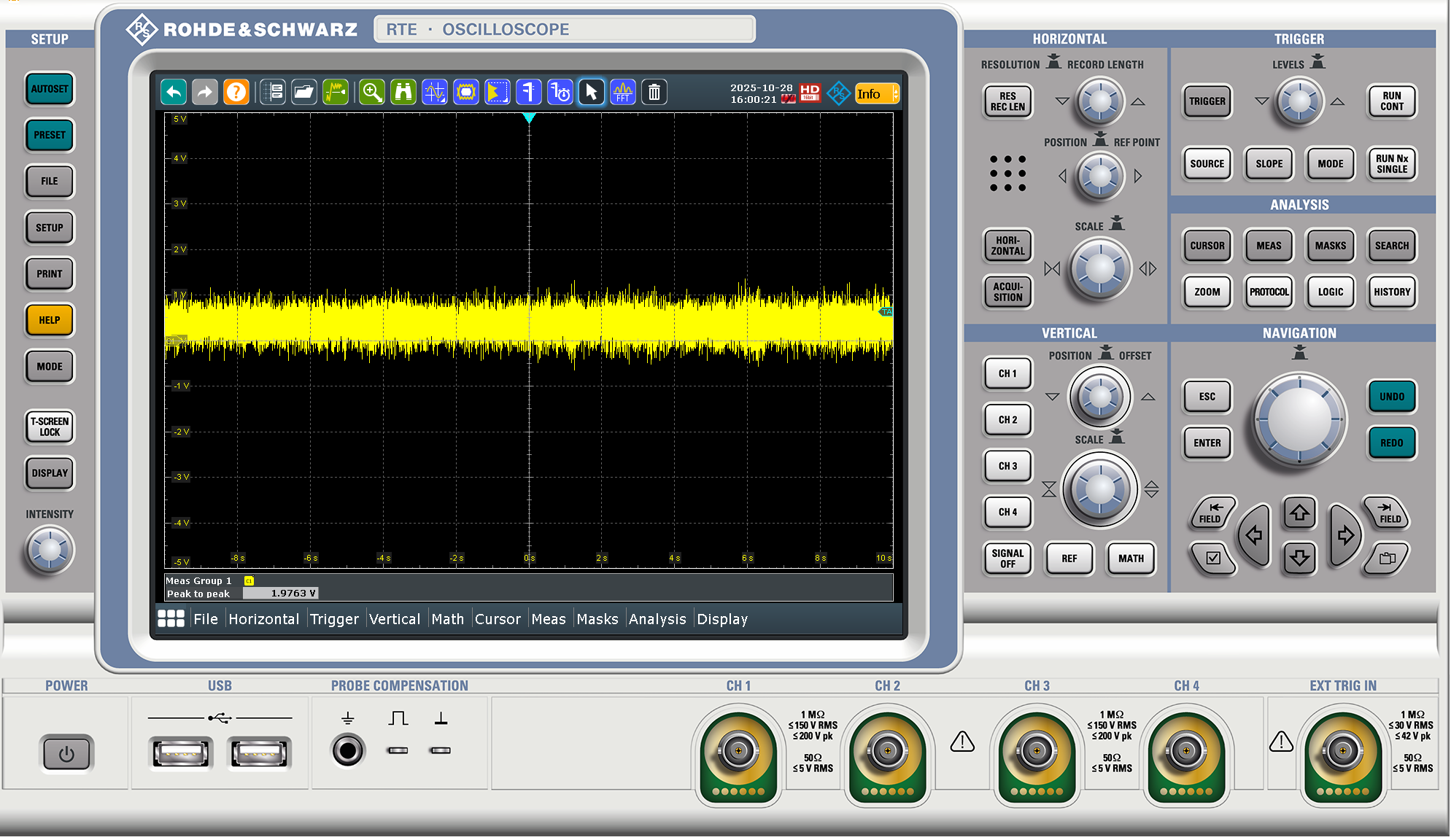
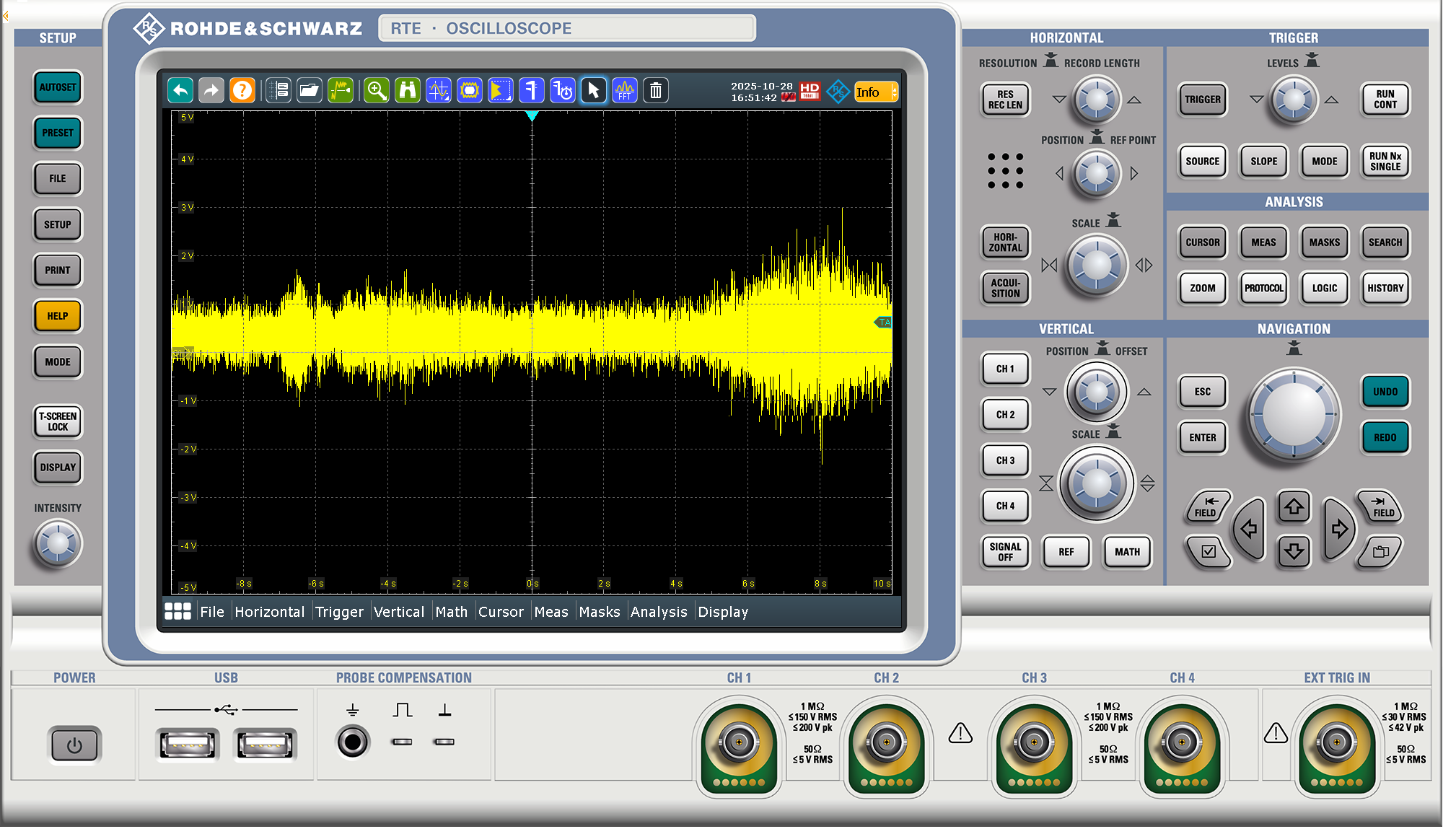
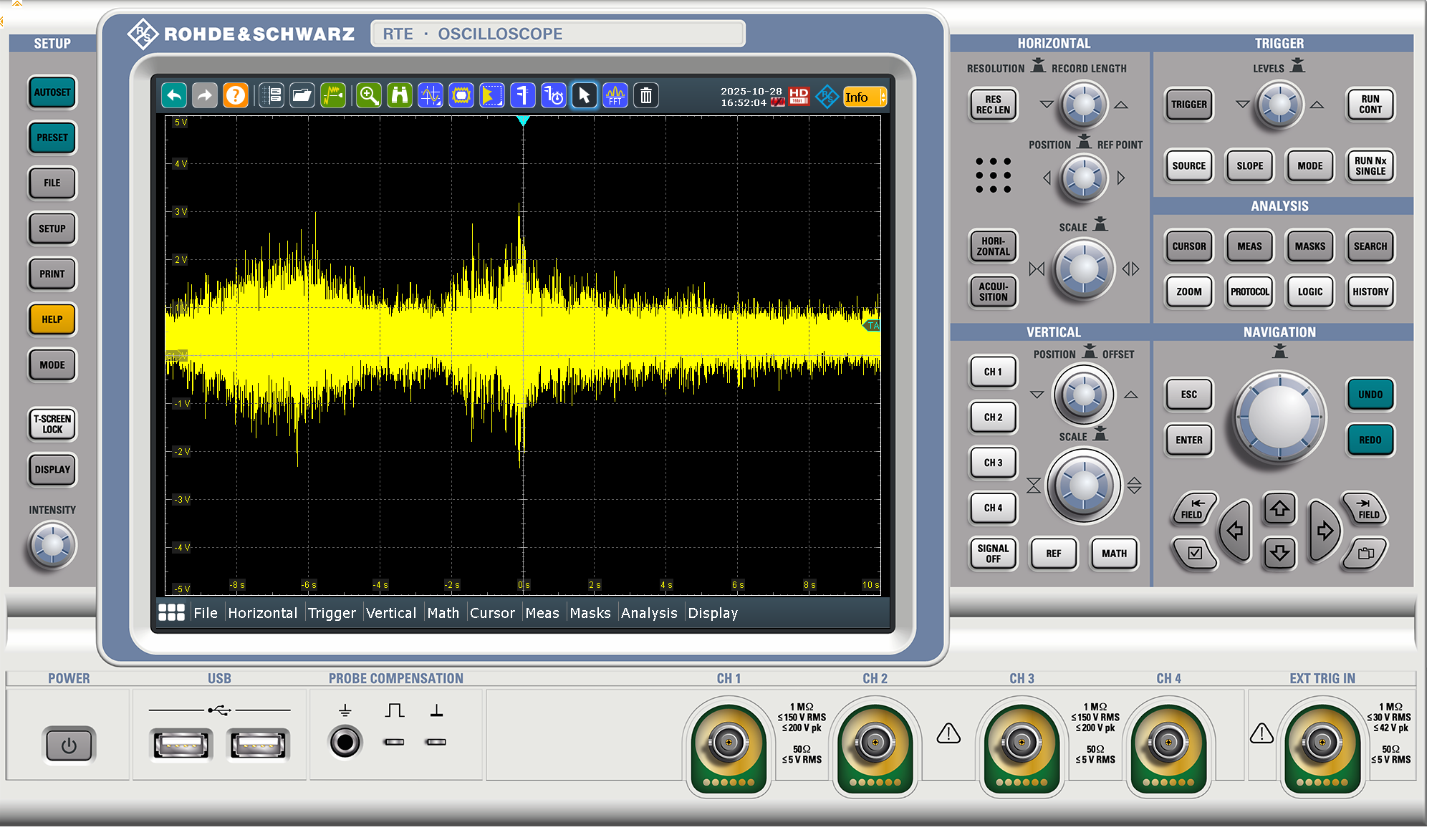
Ronic Chiche | Fixed | issue | lasers and optics | detectors and electronics | ThomX igloo | High frequency noise | we did some tests with Marie to make some vibrations on the door.
below, I exhibit some pictures of the scope with the accelerometer plugged on it without or with noise...
this level of noise is not able to make the FPC loosing the lock.
even when saturating the noise signal on the accelerometer, the FPC is not loosing the lock all the time.
then, when a day is very windy, it's possible it could have some effect, but for a normal day, it's seems very doubtful that is the reason...
| Ronic Chiche wrote: |
|
After this observation, we did a test with Daniele to try to correlate the road traffic in front of the Igloo with the lock losses observed on the FPC.
We didn't see any clear correlation. Cars or buses are not the direct origin of the FPC lock losses... only when some heavy load is hitting the building, we observed a clear correlation.
So, we still observed a lot of FPC lock losses when the day is windy...
One possible cause could be the large door of the igloo (~20 m²) hitting the Igloo when the day is windy.
I installed the accelerometer on the rail on the bottom of the large door to see if there is any correlation.
| Ronic Chiche wrote: |
|
At the end of the day, we found out what was the origin of this noise : some road renovation work with jackhammer and road roller just at the entrance of the "Igloo".
this origin was 100% correlated with a large increase of the accelerometer signal.
but we clearly saw that the FPC is much more sensitive than the accelerometer... the signal can have a small increase or just one peak and the cavity lock is lost.
then, we can make the assumption that all the "high frequency noise" which produces some lock losses could come from acoustic noise due to the road traffic or from the equipments in the bunker itself.
| Ronic Chiche wrote: |
|
Today, the lock of the FPC was particularly bad (maybe the worst ever seen), with a lot of high frequency noise.
the lock was impossible during several minutes !
we tried to switch off all the equipments of the machine, one by one without any effect on the lock.
at the end, we looked at the accelerometer installed inside the housing to check if there was some correlation.
and for the 1st time we clearly saw a 100% correlation beween the accelerometer signal with a noise oscillating above +/-300mV
but we didn't find the origin of this noise.
|
|
|
|
| Attachment 1: Accelerometer_on_door_wo_noise.png
|  |
| Attachment 2: Accelerometer_on_door_with_few_noise.png
|  |
| Attachment 3: Accelerometer_on_door_with_few_noise2.png
|  |
|
459
|
Tue Oct 28 10:07:48 2025 |
Ronic Chiche | Fixed | issue | lasers and optics | detectors and electronics | ThomX igloo | High frequency noise | After this observation, we did a test with Daniele to try to correlate the road traffic in front of the Igloo with the lock losses observed on the FPC.
We didn't see any clear correlation. Cars or buses are not the direct origin of the FPC lock losses... only when some heavy load is hitting the building, we observed a clear correlation.
So, we still observed a lot of FPC lock losses when the day is windy...
One possible cause could be the large door of the igloo (~20 m²) hitting the Igloo when the day is windy.
I installed the accelerometer on the rail on the bottom of the large door to see if there is any correlation.
| Ronic Chiche wrote: |
|
At the end of the day, we found out what was the origin of this noise : some road renovation work with jackhammer and road roller just at the entrance of the "Igloo".
this origin was 100% correlated with a large increase of the accelerometer signal.
but we clearly saw that the FPC is much more sensitive than the accelerometer... the signal can have a small increase or just one peak and the cavity lock is lost.
then, we can make the assumption that all the "high frequency noise" which produces some lock losses could come from acoustic noise due to the road traffic or from the equipments in the bunker itself.
| Ronic Chiche wrote: |
|
Today, the lock of the FPC was particularly bad (maybe the worst ever seen), with a lot of high frequency noise.
the lock was impossible during several minutes !
we tried to switch off all the equipments of the machine, one by one without any effect on the lock.
at the end, we looked at the accelerometer installed inside the housing to check if there was some correlation.
and for the 1st time we clearly saw a 100% correlation beween the accelerometer signal with a noise oscillating above +/-300mV
but we didn't find the origin of this noise.
|
|
|
|
458
|
Wed Oct 1 10:14:12 2025 |
Ronic Chiche | Fixed | issue | lasers and optics | detectors and electronics | ThomX igloo | High frequency noise | At the end of the day, we found out what was the origin of this noise : some road renovation work with jackhammer and road roller just at the entrance of the "Igloo".
this origin was 100% correlated with a large increase of the accelerometer signal.
but we clearly saw that the FPC is much more sensitive than the accelerometer... the signal can have a small increase or just one peak and the cavity lock is lost.
then, we can make the assumption that all the "high frequency noise" which produces some lock losses could come from acoustic noise due to the road traffic or from the equipments in the bunker itself.
| Ronic Chiche wrote: |
|
Today, the lock of the FPC was particularly bad (maybe the worst ever seen), with a lot of high frequency noise.
the lock was impossible during several minutes !
we tried to switch off all the equipments of the machine, one by one without any effect on the lock.
at the end, we looked at the accelerometer installed inside the housing to check if there was some correlation.
and for the 1st time we clearly saw a 100% correlation beween the accelerometer signal with a noise oscillating above +/-300mV
but we didn't find the origin of this noise.
|
|
|
457
|
Tue Sep 30 15:17:30 2025 |
Ronic Chiche | Fixed | issue | lasers and optics | detectors and electronics | ThomX igloo | High frequency noise | Today, the lock of the FPC was particularly bad (maybe the worst ever seen), with a lot of high frequency noise.
the lock was impossible during several minutes !
we tried to switch off all the equipments of the machine, one by one without any effect on the lock.
at the end, we looked at the accelerometer installed inside the housing to check if there was some correlation.
and for the 1st time we clearly saw a 100% correlation beween the accelerometer signal with a noise oscillating above +/-300mV
but we didn't find the origin of this noise. |
|